“Knowing how the components and systems work on the
helicopter enables the pilot to more easily recognize
malfunctions and possible emergency situations.
Understanding the relationship of these systems allows
the pilot to make an informed decision and take the
appropriate corrective action should a problem arise.”
Helicopter Flying Handbook 2012
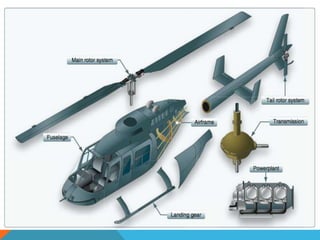
Fuselage- outer core of the airframe. This is the
aircraft’s main body that houses the cabin. This also
houses the engine, transmission, avionics, flight
controls and the powerplant.
Helicopter Flying Handbook 2012
Main rotor system- the rotating part of the helicopter that
generates lift. It consists of a mast, hub and rotor
blades. The mast is a hollow shaft that extends
upward to the hub which the rotor blades are attached
to.
Helicopter Flying Handbook 2012
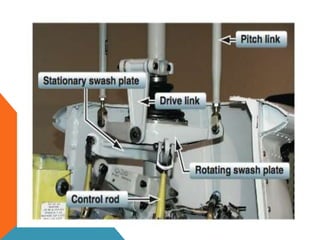
Swash plate assembly- “The purpose of the swash plate
is to convert stationary control inputs from the pilot
into rotating inputs which can be connected to the
rotor blades or control surfaces. It consists of two
main parts, stationary swash plate and rotating swash
plate. “
Helicopter Flying Handbook 2012
Freewheeling unit- this unit automatically disengages the
engine from the rotor system when the engine
revolutions per minute (rpm) are less than main rotor
rmp. Doing this, it allows the main rotor and the tail
rotor to continue to turn normally inflight speeds.
Helicopter Flying Handbook 2012
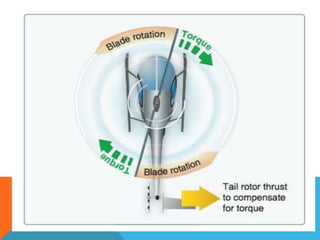
Antitorque system- a helicopter with a single, main rotor
system require a separate system. This is through a
variable pitch, antitorque rotor or tail rotor.
Helicopter Flying Handbook 2012
ENGINES
Reciprocating engine- also called piston engines, used in
smaller helicopters because they are simple and
inexpensive to operate
Turbine engine- more powerful and widely used in
helicopters, they produce more power but are more
expensive to operate
Helicopter Flying Handbook 2012
TRANSMISSION SYSTEM
“The transmission system transfers power from the
engine to the main rotor, tail rotor, and other accessories
during normal flight control. The main components of
the transmission system are the main rotor transmission,
tail rotor drive system, clutch, and freewheeling unit. The
freewheeling unit or autorotative clutch allows the main
rotor transmission to drive the tail rotor drive shaft during
autorotation.”
Helicopter Flying Handbook 2012

Helicopter components

  • 3.
    “Knowing how thecomponents and systems work on the helicopter enables the pilot to more easily recognize malfunctions and possible emergency situations. Understanding the relationship of these systems allows the pilot to make an informed decision and take the appropriate corrective action should a problem arise.” Helicopter Flying Handbook 2012
  • 4.
    Fuselage- outer coreof the airframe. This is the aircraft’s main body that houses the cabin. This also houses the engine, transmission, avionics, flight controls and the powerplant. Helicopter Flying Handbook 2012
  • 5.
    Main rotor system-the rotating part of the helicopter that generates lift. It consists of a mast, hub and rotor blades. The mast is a hollow shaft that extends upward to the hub which the rotor blades are attached to. Helicopter Flying Handbook 2012
  • 6.
    Swash plate assembly-“The purpose of the swash plate is to convert stationary control inputs from the pilot into rotating inputs which can be connected to the rotor blades or control surfaces. It consists of two main parts, stationary swash plate and rotating swash plate. “ Helicopter Flying Handbook 2012
  • 8.
    Freewheeling unit- thisunit automatically disengages the engine from the rotor system when the engine revolutions per minute (rpm) are less than main rotor rmp. Doing this, it allows the main rotor and the tail rotor to continue to turn normally inflight speeds. Helicopter Flying Handbook 2012
  • 9.
    Antitorque system- ahelicopter with a single, main rotor system require a separate system. This is through a variable pitch, antitorque rotor or tail rotor. Helicopter Flying Handbook 2012
  • 11.
    ENGINES Reciprocating engine- alsocalled piston engines, used in smaller helicopters because they are simple and inexpensive to operate Turbine engine- more powerful and widely used in helicopters, they produce more power but are more expensive to operate Helicopter Flying Handbook 2012
  • 12.
    TRANSMISSION SYSTEM “The transmissionsystem transfers power from the engine to the main rotor, tail rotor, and other accessories during normal flight control. The main components of the transmission system are the main rotor transmission, tail rotor drive system, clutch, and freewheeling unit. The freewheeling unit or autorotative clutch allows the main rotor transmission to drive the tail rotor drive shaft during autorotation.” Helicopter Flying Handbook 2012