CE1020- PROJECT
TOPIC: HEAT STRESS ASSESSMENT
METHODS
NAME: ARAVIND.R
ROLL NO: CE14B006
 When the body loses its ability to control its internal
temperature it is called as Heat stress.
 As well as work rate ,humidity, clothing worn may
lead to heat stress.
 So it is very necessary to know by every individual to
know how to work safely in the heated environment
to avoid the dangers of heat stress.
WHAT IS HEAT STRESS?
Someone wearing protective clothing and performing heavy
work in hot and humid conditions could be at risk of heat
stress because:
 Sweat evaporation is restricted by the type of clothing and
the humidity of the environment.
 Heat will be produced within the body due to the work
rate and, if insufficient heat is lost, deep body temperature
will rise.
 As deep body temperature rises the body reacts by
increasing the amount of sweat produced , which may lead
to dehydration.
EXAMPLE OF HEAT STRESS
SITUATION
 Mines
 Compressed air tunnels
 Boiler rooms
 Bakeries and Kitchen
 Brick firing and Ceramics plants
 Nuclear power plants
 Foundries and smelting operations
Generally the places mentioned above have the great deal
of chances of occurring Heat stress. Hence we need to do
stress assessment by various method.
WHERE DOES HEAT STRESS
OCCURS?
When we are carrying out risk assessment we need to
consider major factors like,
1. Working rate
2. Working climate
3. Worker clothing
4. Protective equipment
5. To know the initial health conditions of Workers
The above mentioned factors are the main factors involving
for heat risk assessment.
RISK ASSESSMENT
The strategy of calculating the heat stress is classified
into three stages namely
1. Exploratory stage
2. Development and design stage
3. Evaluation stage
The three mentioned above stages has advantages
,disadvantages and some sort of complexity in it.
HEAT STRESS ASSESSMENT METHOD
The main objectives of this stage are
1. To provide a practical example of a heat stress assessment in
industry.
2. To investigate and describe the task of assessing the risk of
heat stress using current heat stress standards.
Some of important methods used are
Literature review
Informal interviews
Hierarchical task analysis
EXPLORATORY STAGE
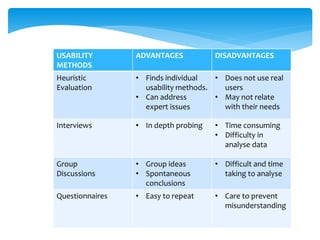
USABILITY
METHODS
ADVANTAGES DISADVANTAGES
Heuristic
Evaluation
• Finds individual
usability methods.
• Can address
expert issues
• Does not use real
users
• May not relate
with their needs
Interviews • In depth probing • Time consuming
• Difficulty in
analyse data
Group
Discussions
• Group ideas
• Spontaneous
conclusions
• Difficult and time
taking to analyse
Questionnaires • Easy to repeat • Care to prevent
misunderstanding
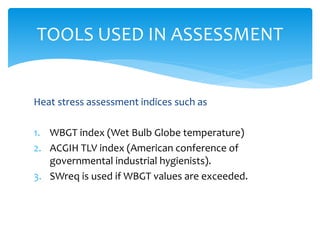
TOOLS USED IN ASSESSMENT
Heat stress assessment indices such as
1. WBGT index (Wet Bulb Globe temperature)
2. ACGIH TLV index (American conference of
governmental industrial hygienists).
3. SWreq is used if WBGT values are exceeded.
This is one of very effective methods ,
It comprises of 3 types of temperature
 Natural wet bulb temperature
 Global temperature
 Air temperature
In this method we will know all environmental measures . Then we will
consider the Air Movement and working rate of acclimatized worker and his
metabolic rate.
The WBGT obtained value is compared with standards with the information
of air movement and working rate of acclimatized worker.
If the measured value of WBGT is less than that of reference value then we
can conclude that heat stress is not a problem in that environment.
But there are disadvantages too!!
WBGT INDEX
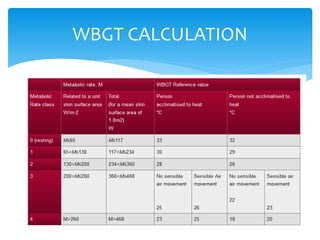
WBGT CALCULATION
There is a way in which heat stress can be assessed in
quantitative way. The way is Heat Stress Assessment
checklist ,this a sheet which contains various
parameters such as temperature ,humidity , heat
radiation, Air movement, Workload, Acclimatization and
clothing.
We have to answer various questions inside the
divisions at the end we use all answers for analysis. With
the data analysed we will predict the heat stress in
quantitative way and will derive into conclusions.
ASSESSMENT CHECKLIST
It is better than exploratory stage as it prioritise the
various factors and give them importance accordingly.
Means it gives the score accordingly to the level of
effects by various factors which causes Heat Stress.
In this two main things are
1. Severity
2. Consequences
The above mentioned things are important as it clearly
decides the necessary requirements that can prevent
the adverse effects of Heat Stress risk.
DESIGN AND DEVELOPMENT STAGE
SEVERITY AND CONSEQUENCES
Two methods are implemented for calculating clothing
insulation values
1. Estimate the insulation values from standard tables
2. Calculating insulation value from actually what they
worn. It depends on material and surface area of the
clothing.
This helps in quantitative risk assessment. This can be
used in designing the cloth material for the workers to
reduce their heat stress. But first method is preferable
as it gives direct values but it is material specific.
CLOTHING INSULATION VALUES
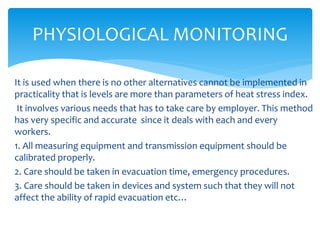
It is used when there is no other alternatives cannot be implemented in
practicality that is levels are more than parameters of heat stress index.
It involves various needs that has to take care by employer. This method
has very specific and accurate since it deals with each and every
workers.
1. All measuring equipment and transmission equipment should be
calibrated properly.
2. Care should be taken in evacuation time, emergency procedures.
3. Care should be taken in devices and system such that they will not
affect the ability of rapid evacuation etc…
PHYSIOLOGICAL MONITORING
Hence we can conclude by giving overall outlook .
Methods are implemented following basis.
1. Basic assessment operation
2. Generic strategy
3. Presentation of information
4. Group discussions and interviews
The above four things are necessary for implementing a
method by going through all the steps above in order to
make efficient design to reduce heat stress.
CONCLUSIONS
As a Civil Engineer we have to care of many parameters
that creates problems to the users in very effective,
simple and cost effective ways ....
THANK YOU…..

Heat stress assessment methods

  • 1.
    CE1020- PROJECT TOPIC: HEATSTRESS ASSESSMENT METHODS NAME: ARAVIND.R ROLL NO: CE14B006
  • 2.
     When thebody loses its ability to control its internal temperature it is called as Heat stress.  As well as work rate ,humidity, clothing worn may lead to heat stress.  So it is very necessary to know by every individual to know how to work safely in the heated environment to avoid the dangers of heat stress. WHAT IS HEAT STRESS?
  • 3.
    Someone wearing protectiveclothing and performing heavy work in hot and humid conditions could be at risk of heat stress because:  Sweat evaporation is restricted by the type of clothing and the humidity of the environment.  Heat will be produced within the body due to the work rate and, if insufficient heat is lost, deep body temperature will rise.  As deep body temperature rises the body reacts by increasing the amount of sweat produced , which may lead to dehydration. EXAMPLE OF HEAT STRESS SITUATION
  • 4.
     Mines  Compressedair tunnels  Boiler rooms  Bakeries and Kitchen  Brick firing and Ceramics plants  Nuclear power plants  Foundries and smelting operations Generally the places mentioned above have the great deal of chances of occurring Heat stress. Hence we need to do stress assessment by various method. WHERE DOES HEAT STRESS OCCURS?
  • 5.
    When we arecarrying out risk assessment we need to consider major factors like, 1. Working rate 2. Working climate 3. Worker clothing 4. Protective equipment 5. To know the initial health conditions of Workers The above mentioned factors are the main factors involving for heat risk assessment. RISK ASSESSMENT
  • 6.
    The strategy ofcalculating the heat stress is classified into three stages namely 1. Exploratory stage 2. Development and design stage 3. Evaluation stage The three mentioned above stages has advantages ,disadvantages and some sort of complexity in it. HEAT STRESS ASSESSMENT METHOD
  • 7.
    The main objectivesof this stage are 1. To provide a practical example of a heat stress assessment in industry. 2. To investigate and describe the task of assessing the risk of heat stress using current heat stress standards. Some of important methods used are Literature review Informal interviews Hierarchical task analysis EXPLORATORY STAGE
  • 8.
    USABILITY METHODS ADVANTAGES DISADVANTAGES Heuristic Evaluation • Findsindividual usability methods. • Can address expert issues • Does not use real users • May not relate with their needs Interviews • In depth probing • Time consuming • Difficulty in analyse data Group Discussions • Group ideas • Spontaneous conclusions • Difficult and time taking to analyse Questionnaires • Easy to repeat • Care to prevent misunderstanding
  • 9.
    TOOLS USED INASSESSMENT Heat stress assessment indices such as 1. WBGT index (Wet Bulb Globe temperature) 2. ACGIH TLV index (American conference of governmental industrial hygienists). 3. SWreq is used if WBGT values are exceeded.
  • 10.
    This is oneof very effective methods , It comprises of 3 types of temperature  Natural wet bulb temperature  Global temperature  Air temperature In this method we will know all environmental measures . Then we will consider the Air Movement and working rate of acclimatized worker and his metabolic rate. The WBGT obtained value is compared with standards with the information of air movement and working rate of acclimatized worker. If the measured value of WBGT is less than that of reference value then we can conclude that heat stress is not a problem in that environment. But there are disadvantages too!! WBGT INDEX
  • 11.
  • 12.
    There is away in which heat stress can be assessed in quantitative way. The way is Heat Stress Assessment checklist ,this a sheet which contains various parameters such as temperature ,humidity , heat radiation, Air movement, Workload, Acclimatization and clothing. We have to answer various questions inside the divisions at the end we use all answers for analysis. With the data analysed we will predict the heat stress in quantitative way and will derive into conclusions. ASSESSMENT CHECKLIST
  • 13.
    It is betterthan exploratory stage as it prioritise the various factors and give them importance accordingly. Means it gives the score accordingly to the level of effects by various factors which causes Heat Stress. In this two main things are 1. Severity 2. Consequences The above mentioned things are important as it clearly decides the necessary requirements that can prevent the adverse effects of Heat Stress risk. DESIGN AND DEVELOPMENT STAGE
  • 14.
  • 15.
    Two methods areimplemented for calculating clothing insulation values 1. Estimate the insulation values from standard tables 2. Calculating insulation value from actually what they worn. It depends on material and surface area of the clothing. This helps in quantitative risk assessment. This can be used in designing the cloth material for the workers to reduce their heat stress. But first method is preferable as it gives direct values but it is material specific. CLOTHING INSULATION VALUES
  • 16.
    It is usedwhen there is no other alternatives cannot be implemented in practicality that is levels are more than parameters of heat stress index. It involves various needs that has to take care by employer. This method has very specific and accurate since it deals with each and every workers. 1. All measuring equipment and transmission equipment should be calibrated properly. 2. Care should be taken in evacuation time, emergency procedures. 3. Care should be taken in devices and system such that they will not affect the ability of rapid evacuation etc… PHYSIOLOGICAL MONITORING
  • 17.
    Hence we canconclude by giving overall outlook . Methods are implemented following basis. 1. Basic assessment operation 2. Generic strategy 3. Presentation of information 4. Group discussions and interviews The above four things are necessary for implementing a method by going through all the steps above in order to make efficient design to reduce heat stress. CONCLUSIONS
  • 18.
    As a CivilEngineer we have to care of many parameters that creates problems to the users in very effective, simple and cost effective ways .... THANK YOU…..