SHEALYNN BUCK, MD PRESCRIPTION TO THRIVE, LLC HEALTH STRATEGIST, COACH, & EDUCATOR


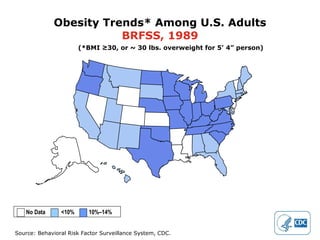
Obesity Trends* Among U.S. Adults BRFSS, 1989 (*BMI ≥30, or ~ 30 lbs. overweight for 5’ 4” person) No Data  <10%  10%–14%
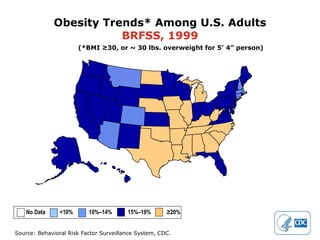
Obesity Trends* Among U.S. Adults BRFSS, 1999 (*BMI ≥30, or ~ 30 lbs. overweight for 5’ 4” person) No Data  <10%  10%–14%   15%–19%  ≥20%
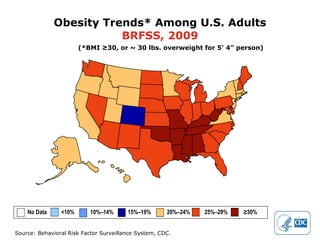
Obesity Trends* Among U.S. Adults BRFSS, 2009 (*BMI ≥30, or ~ 30 lbs. overweight for 5’ 4” person) No Data  <10%  10%–14%   15%–19%  20%–24%  25%–29%  ≥30%
“ High rates of obesity and overweight in the U.S. are not just a public health issue  –  they are an issue of national security. If our society is not physically fit,  we will not be able to defend ourselves  and our country’s common interests” John Robitscher, Executive Director, National Association of Chronic Disease Directors
Which country spends the most on healthcare as a % of GDP? a) Switzerland b) U.S. c) Canada d) U.K.
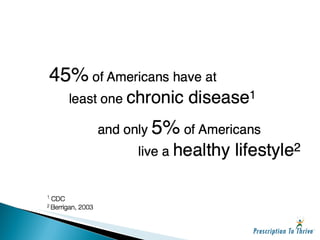
Health care costs in  U.S.  account for approximately  17%  of GDP 1 Less than 1% of U.S. health care spending is for  prevention 2 1 National Health Expenditure Data, CMS 2 2009 Almanac of Chronic Disease
Starbucks spends more on employee health benefits than coffee. 1 GM, Ford, and Chrysler spend more on employee health expenses than on steel for the cars they produce. 2 1 Reported by Associated Press 2 Reported by USA Today
True or False The U.S. spends more on health care for chronic disease than it spends on food.
True.  Approximately $2 Trillion… and the U.S. spends more on health care for chronic disease  than all of China’s personal consumption. McKinsey & Co. December 2008
True or False The direct costs of chronic disease (medical care costs) outweigh indirect costs (lost productivity).
False Indirect costs  of chronic disease account for approximately  80%  of total health care costs.  These include costs related to lost economic output from workforce  absenteeism  &  presenteeism . The Milken Institute. Oct 2007
Presenteeism – lost productivity from workers who are at work but perform below their expected level of output due to an illness . Presenteeism  from chronic disease accounts for almost  90%  (close to $900 billion) in lost productivity (absenteeism is 10%) 1 The Milken Institute. Oct 2007
Which chronic condition accounts for the greatest productivity loss among workers? a) obesity b) diabetes c) depression d) chronic pain
Depression is the greatest cause of productivity loss among workers 1 U.S. has highest rates of anxiety and depression in the world. 2 1  2009 Almanac of Chronic Disease 2  WHO World Mental Health Survey
3 out of 4 Americans report having moderate to high stress. 1 Job stress is the leading causes of stress in America. 2 Job stress increases U.S. cost of doing business by over $150 billion per year. 3 1  2009 American Psychological Associations  Stress in America  poll 2  American Institute of Stress 3  Milani RV and Lavie CJ.  Stopping stress at its origins.  Hypertension. 2007; 49:268
42% of Americans regularly skip their vacations 40% of Americans who take a vacation take their laptop APA Stress in America Survey
What fraction of U.S. healthcare costs are driven by lifestyle choices? a) 1/5 b) 2/3 c) 1/3 d) 2/5
2/3  of U.S. healthcare costs are driven by  our  lifestyle choices . *Institute of Medicine. (2006).  Genes, behavior, and the social environment: Moving beyond the nature/nurture debate.  Washington, D.C.: National Academies Press.
we are in the driver’s seat
“ The next  major advances  in health  of the American people will come from…
… the assumption of  individual responsibility  for  one’s own health  and a necessary  change in lifestyle  for the majority of Americans.” John H. Knowles, MD Former President of Rockefeller Foundation
we can change the course of our future
If we don’t  change course by 2023, the U.S. will see a  40%  increase in  heart disease  and a The Milken Institute. Oct 2007 50%   increase in cancer, mental disorders  &  diabetes
But, wait?  We have a workplace wellness program. (But what does that really mean?)
It’s not just a gym membership It’s not just an email newsletter
“ a state of being that is shaped by engagement and other workplace factors as much as physical and psychological health.” Redefining Workplace Wellness World Economic Forum (2010).  The Wellness Imperative: Creating More Effective Organizations
“ a corporate set of strategic and tactical actions that seek to optimize worker health and business performance through the collective efforts of employees, families, employers, communities, and society-at-large.” International Association for Worksite Health Promotion Redefining Workplace Wellness
Wellness must be  central   to business  strategy Leaders must be  engaged Leaders must  lead by example World Economic Forum (2010).  The Wellness Imperative: Creating More Effective Organizations
“ creating  a   culture of health   takes   passionate , persistent,  and   persuasive   leadership   at   all levels .” What’s the Hard Return on Employee Wellness Programs? Harvard Business Review. December 2010.
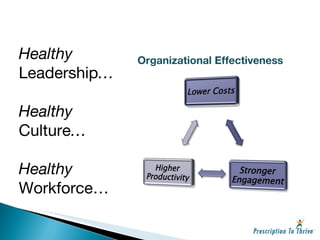
Healthy  Leadership … Healthy  Culture … Healthy  Workforce… Organizational Effectiveness
When health & well-being are actively promoted… Organizations are  2.5 times  more likely to be a  TOP PERFORMER World Economic Forum (2010).  The Wellness Imperative: Creating More Effective Organizations
When health & well-being are actively promoted… Organizations are  3 times  more likely to be PRODUCTIVE World Economic Forum (2010).  The Wellness Imperative: Creating More Effective Organizations
When health & well-being are actively promoted… Organizations are  4 times more  likely to KEEP TALENT World Economic Forum (2010).  The Wellness Imperative: Creating More Effective Organizations
When health & well-being are actively promoted… Employees are  8 times  more likely to be ENGAGED in the organization World Economic Forum (2010).  The Wellness Imperative: Creating More Effective Organizations
With a strategic, well-run wellness program Organizations can see up to a  6:1  ROI Am J Cardiol 2009;104:1389-1392
The New Wave of Workplace Wellness
Well Analyzed & Measurable Engaged Leaders at All Levels (Top-Down, Middle-Out, and Bottom-Up) Discover & Develop Wellness Champions within Organization Integrate Wellness Strategy into Organization’s Strategy Effective Programs…
Accessible and Empowering Build Healthy Workplace Community Have Strong Communication Plan & Support Tied to Families & Surrounding Community Shift Organizational Culture Effective Programs…
Culture “ the set of shared attitudes, values, goals, and practices that characterizes an institution or organization” Cultural Norms “ a pattern or trait taken to be typical in the behavior of a social group” Merriam-Webster Online Dictionary Healthy Leaders are  Change Agents for Healthy Culture
Aware & Informed Model Healthy Behaviors & Actions Collaborate to Create a Community Effectively Communicate Wellness Strategy Measure Progress & Celebrate Small Successes Patient – Focus on Long-term Success Healthy Leaders…
Ask yourself… Does “going the extra mile” mean repeatedly sacrificing my well-being?  Are unhealthy behaviors consistently rewarded? Is it expected that I take my laptop on vacation? Is it expected that I work through lunch? What if I took a 15 minute walk outside during the workday? What if I didn’t take work home with me? What if I didn’t answer emails at 9 pm (or midnight)? What if I didn’t keep my smart phone on my night stand?What if I turned it off on occasion? Cultural Norms Self-Assessment
be  the  change …

Healthy Bottom Line

  • 1.
    SHEALYNN BUCK, MDPRESCRIPTION TO THRIVE, LLC HEALTH STRATEGIST, COACH, & EDUCATOR
  • 2.
  • 3.
  • 4.
  • 5.
    Obesity Trends* AmongU.S. Adults BRFSS, 1989 (*BMI ≥30, or ~ 30 lbs. overweight for 5’ 4” person) No Data <10% 10%–14%
  • 6.
    Obesity Trends* AmongU.S. Adults BRFSS, 1999 (*BMI ≥30, or ~ 30 lbs. overweight for 5’ 4” person) No Data <10% 10%–14% 15%–19% ≥20%
  • 7.
    Obesity Trends* AmongU.S. Adults BRFSS, 2009 (*BMI ≥30, or ~ 30 lbs. overweight for 5’ 4” person) No Data <10% 10%–14% 15%–19% 20%–24% 25%–29% ≥30%
  • 8.
    “ High ratesof obesity and overweight in the U.S. are not just a public health issue – they are an issue of national security. If our society is not physically fit, we will not be able to defend ourselves and our country’s common interests” John Robitscher, Executive Director, National Association of Chronic Disease Directors
  • 9.
    Which country spendsthe most on healthcare as a % of GDP? a) Switzerland b) U.S. c) Canada d) U.K.
  • 10.
    Health care costsin U.S. account for approximately 17% of GDP 1 Less than 1% of U.S. health care spending is for prevention 2 1 National Health Expenditure Data, CMS 2 2009 Almanac of Chronic Disease
  • 11.
    Starbucks spends moreon employee health benefits than coffee. 1 GM, Ford, and Chrysler spend more on employee health expenses than on steel for the cars they produce. 2 1 Reported by Associated Press 2 Reported by USA Today
  • 12.
    True or FalseThe U.S. spends more on health care for chronic disease than it spends on food.
  • 13.
    True. Approximately$2 Trillion… and the U.S. spends more on health care for chronic disease than all of China’s personal consumption. McKinsey & Co. December 2008
  • 14.
    True or FalseThe direct costs of chronic disease (medical care costs) outweigh indirect costs (lost productivity).
  • 15.
    False Indirect costs of chronic disease account for approximately 80% of total health care costs. These include costs related to lost economic output from workforce absenteeism & presenteeism . The Milken Institute. Oct 2007
  • 16.
    Presenteeism – lostproductivity from workers who are at work but perform below their expected level of output due to an illness . Presenteeism from chronic disease accounts for almost 90% (close to $900 billion) in lost productivity (absenteeism is 10%) 1 The Milken Institute. Oct 2007
  • 17.
    Which chronic conditionaccounts for the greatest productivity loss among workers? a) obesity b) diabetes c) depression d) chronic pain
  • 18.
    Depression is thegreatest cause of productivity loss among workers 1 U.S. has highest rates of anxiety and depression in the world. 2 1 2009 Almanac of Chronic Disease 2 WHO World Mental Health Survey
  • 19.
    3 out of4 Americans report having moderate to high stress. 1 Job stress is the leading causes of stress in America. 2 Job stress increases U.S. cost of doing business by over $150 billion per year. 3 1 2009 American Psychological Associations Stress in America poll 2 American Institute of Stress 3 Milani RV and Lavie CJ. Stopping stress at its origins. Hypertension. 2007; 49:268
  • 20.
    42% of Americansregularly skip their vacations 40% of Americans who take a vacation take their laptop APA Stress in America Survey
  • 21.
    What fraction ofU.S. healthcare costs are driven by lifestyle choices? a) 1/5 b) 2/3 c) 1/3 d) 2/5
  • 22.
    2/3 ofU.S. healthcare costs are driven by our lifestyle choices . *Institute of Medicine. (2006). Genes, behavior, and the social environment: Moving beyond the nature/nurture debate. Washington, D.C.: National Academies Press.
  • 23.
    we are inthe driver’s seat
  • 24.
    “ The next major advances in health of the American people will come from…
  • 25.
    … the assumptionof individual responsibility for one’s own health and a necessary change in lifestyle for the majority of Americans.” John H. Knowles, MD Former President of Rockefeller Foundation
  • 26.
    we can changethe course of our future
  • 27.
    If we don’t change course by 2023, the U.S. will see a 40% increase in heart disease and a The Milken Institute. Oct 2007 50% increase in cancer, mental disorders & diabetes
  • 28.
    But, wait? We have a workplace wellness program. (But what does that really mean?)
  • 29.
    It’s not justa gym membership It’s not just an email newsletter
  • 30.
    “ a stateof being that is shaped by engagement and other workplace factors as much as physical and psychological health.” Redefining Workplace Wellness World Economic Forum (2010). The Wellness Imperative: Creating More Effective Organizations
  • 31.
    “ a corporateset of strategic and tactical actions that seek to optimize worker health and business performance through the collective efforts of employees, families, employers, communities, and society-at-large.” International Association for Worksite Health Promotion Redefining Workplace Wellness
  • 32.
    Wellness must be central to business strategy Leaders must be engaged Leaders must lead by example World Economic Forum (2010). The Wellness Imperative: Creating More Effective Organizations
  • 33.
    “ creating a culture of health takes passionate , persistent, and persuasive leadership at all levels .” What’s the Hard Return on Employee Wellness Programs? Harvard Business Review. December 2010.
  • 34.
    Healthy Leadership… Healthy Culture … Healthy Workforce… Organizational Effectiveness
  • 35.
    When health &well-being are actively promoted… Organizations are 2.5 times more likely to be a TOP PERFORMER World Economic Forum (2010). The Wellness Imperative: Creating More Effective Organizations
  • 36.
    When health &well-being are actively promoted… Organizations are 3 times more likely to be PRODUCTIVE World Economic Forum (2010). The Wellness Imperative: Creating More Effective Organizations
  • 37.
    When health &well-being are actively promoted… Organizations are 4 times more likely to KEEP TALENT World Economic Forum (2010). The Wellness Imperative: Creating More Effective Organizations
  • 38.
    When health &well-being are actively promoted… Employees are 8 times more likely to be ENGAGED in the organization World Economic Forum (2010). The Wellness Imperative: Creating More Effective Organizations
  • 39.
    With a strategic,well-run wellness program Organizations can see up to a 6:1 ROI Am J Cardiol 2009;104:1389-1392
  • 40.
    The New Waveof Workplace Wellness
  • 41.
    Well Analyzed &Measurable Engaged Leaders at All Levels (Top-Down, Middle-Out, and Bottom-Up) Discover & Develop Wellness Champions within Organization Integrate Wellness Strategy into Organization’s Strategy Effective Programs…
  • 42.
    Accessible and EmpoweringBuild Healthy Workplace Community Have Strong Communication Plan & Support Tied to Families & Surrounding Community Shift Organizational Culture Effective Programs…
  • 43.
    Culture “ theset of shared attitudes, values, goals, and practices that characterizes an institution or organization” Cultural Norms “ a pattern or trait taken to be typical in the behavior of a social group” Merriam-Webster Online Dictionary Healthy Leaders are Change Agents for Healthy Culture
  • 44.
    Aware & InformedModel Healthy Behaviors & Actions Collaborate to Create a Community Effectively Communicate Wellness Strategy Measure Progress & Celebrate Small Successes Patient – Focus on Long-term Success Healthy Leaders…
  • 45.
    Ask yourself… Does“going the extra mile” mean repeatedly sacrificing my well-being? Are unhealthy behaviors consistently rewarded? Is it expected that I take my laptop on vacation? Is it expected that I work through lunch? What if I took a 15 minute walk outside during the workday? What if I didn’t take work home with me? What if I didn’t answer emails at 9 pm (or midnight)? What if I didn’t keep my smart phone on my night stand?What if I turned it off on occasion? Cultural Norms Self-Assessment
  • 46.
    be the change …

Editor's Notes

  • #5 Chronic disease are ongoing, generally incurable illnesses or conditions such as heart disease, asthma, cancer, and diabetes. These diseases are often preventable, and frequently manageable through early detection, improved lifestyle choices, and lifestyle modifications. 26% of Americans have multiple chronic conditions.
  • #10 Close to 17% GDP. Congressional budget office estimated that up to 1/3 of health spending or $700 billion did not improve Americans’ health outcomes. Treatment of chronic disease is responsible for 75% of total health care spending – close to $2 Trillion. When we look at hourly cost of health benefits in the manufacturing sector, the US is $2.38 compared to France at $2.17, Canada at $0.86, and the UK at $0.40.
  • #11 Close to 17% GDP. Congressional budget office estimated that up to 1/3 of health spending or $700 billion did not improve Americans’ health outcomes. Treatment of chronic disease is responsible for 75% of total health care spending – close to $2 Trillion. When we look at hourly cost of health benefits in the manufacturing sector, the US is $2.38 compared to France at $2.17, Canada at $0.86, and the UK at $0.40.
  • #12 When we look at hourly cost of health benefits in the manufacturing sector, the US is $2.38 compared to France at $2.17, Canada at $0.86, and the UK at $0.40.
  • #13 Close to 16% GDP.
  • #14 Close to 16% GDP.
  • #15 Close to 16% GDP.
  • #16 Close to 16% GDP.
  • #17 Close to 16% GDP.
  • #18 Close to 16% GDP.
  • #19 According to the APA Stress in America survey. This is compared to ex-US in which only 39% of workers report moderate to high stress.
  • #20 Compared to 39% of workers outside of the US. In 1970s, Japanese coined the term Karoshi – death from overwork.
  • #21 According to the APA Stress in America survey. This is compared to ex-US in which only 39% of workers report moderate to high stress.
  • #28 According to the National Business Group on Health – the cost of a single heart attack is between $760,000 to $1 million when you factor direct and indirect costs. If we stay on this course, we would see an additional $1 trillion spent on healthcare by 2023 for 7 of the most common chronic diseases. In contrast, if we reverse this course with effective prevention, lifestyle modification, and disease management strategies, we would see an estimated $1 trillion in indirect and direct cost savings.
  • #29 According to a 2009 report published in Health Affairs 54% of US firms (small and large) that offer health benefits offer a wellness program. The most common programs are gym memberships and web-based resources for healthy living. A comprehensive global study by Buck Consultants of 45 countries and 10 million employees showed that 64% of companies have a workplace wellness program
  • #30 According to a 2009 report published in Health Affairs 54% of US firms (small and large) that offer health benefits offer a wellness program. The most common programs are gym memberships and web-based resources for healthy living. A comprehensive global study by Buck Consultants of 45 countries and 10 million employees showed that 64% of companies have a workplace wellness program
  • #31 According to a 2009 report published in Health Affairs 54% of US firms (small and large) that offer health benefits offer a wellness program. The most common programs are gym memberships and web-based resources for healthy living. A comp
  • #32 According to a 2009 report published in Health Affairs 54% of US firms (small and large) that offer health benefits offer a wellness program. The most common programs are gym memberships and web-based resources for healthy living.
  • #33 A survey conducted by Buck Consultants in October 2008 found that line managers were “very involved”in the development of a wellness programme in only 5% of cases, while the HR or benefits staff were very involved in 78% of the cases.
  • #34 A survey conducted by Buck Consultants in October 2008 found that line managers were “very involved”in the development of a wellness programme in only 5% of cases, while the HR or benefits staff were very involved in 78% of the cases. Enhanced Engagement &amp; Teamwork Positive Contributions Increased Productivity Peak Performance Improved Image Reduced Health Risks Controlled Costs
  • #35 2009 survey of organizational effectiveness by Right Management published by the World Economic Forum of 30,000 employees worldwide. Fewer than half reported that their organization actively promoted employee health and well-being. The study found that the promotion of employee health and well-being is correlated with stronger employee engagement and talent retention, organizational productivity, and creativity &amp; innovation.
  • #36 2009 survey of organizational effectiveness by Right Management published by the World Economic Forum of 30,000 employees worldwide. Fewer than half reported that their organization actively promoted employee health and well-being. The study
  • #37 2009 survey of organizational effectiveness by Right Management published by the World Economic Forum of 30,000 employees worldwide. Fewer than half reported that their organization actively promoted employee health and well-being. The study
  • #38 2009 survey of organizational effectiveness by Right Management published by the World Economic Forum of 30,000 employees worldwide. Fewer than half reported that their organization actively promoted employee health and well-being. The study
  • #39 2009 survey of organizational effectiveness by Right Management published by the World Economic Forum of 30,000 employees worldwide. Fewer than half reported that their organization actively promoted employee health and well-being.
  • #40 J&amp;J invested in a well-run workplace wellness program - saved $250 million healthcare costs alone in the past decade with a return of $2.71 for every $1 spent.
  • #44 According to a 2009 report published in Health Affairs 54% of US firms (small and large) that offer health benefits offer a wellness program. The most common programs are gym memberships and web-based resources for healthy living.