The Business of
Preventative Wellness
By: Connor Ruby
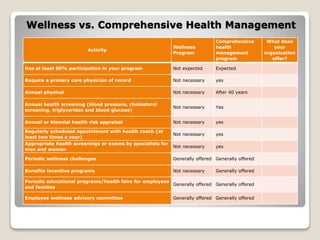
Wellness vs. Comprehensive Health Management
Activity
Wellness
Program
Comprehensive
health
management
program
What does
your
organization
offer?
Has at least 80% participation in your program Not expected Expected
Require a primary care physician of record Not necessary yes
Annual physical Not necessary After 40 years
Annual health screening (blood pressure, cholesterol
screening, triglycerides and blood glucose)
Not necessary Yes
Annual or biennial health risk appraisal Not necessary yes
Regularly scheduled appointment with health coach (at
least two times a year)
Not necessary yes
Appropriate health screenings or exams by specialists for
men and women
Not necessary yes
Periodic wellness challenges Generally offered Generally offered
Benefits incentive programs Not necessary Generally offered
Periodic educational programs/health fairs for employees
and families
Generally offered Generally offered
Employee wellness advisory committee Generally offered Generally offered
Mission Statement
 We believe in moving from the current “wait for illness”
level of thinking to a higher level of thought, that is,
“promotion of wellness.”
◦ This type of mindset will ultimately lead to financial savings
and will also enhance people’s ability to lead meaningful
lives.
 Wellness programs were founded on the urgency and
passion for people, the business community, our country,
and the world. We must create social and physical
environments to enable individuals and their families to
succeed.
 The data and information provided in this presentation will
support the argument that improved health will not only
reduce healthcare costs for companies, but also increase
performance and productivity in the workplace.
Total Cost of
Health
• Sickness
• Drug
• Absence
• Disability
• Workers'
Compensation
• Effectiveness on the
Job
• Recruitment
• Retention
• Morale
Cited: University of Michigan Health Management Research Center.
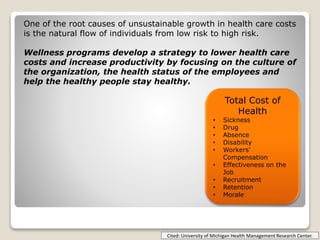
One of the root causes of unsustainable growth in health care costs
is the natural flow of individuals from low risk to high risk.
Wellness programs develop a strategy to lower health care
costs and increase productivity by focusing on the culture of
the organization, the health status of the employees and
help the healthy people stay healthy.
 How will a new wellness
program be able to help your
business?
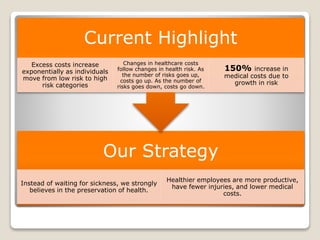
Our Strategy
Instead of waiting for sickness, we strongly
believes in the preservation of health.
Healthier employees are more productive,
have fewer injuries, and lower medical
costs.
Current Highlight
Excess costs increase
exponentially as individuals
move from low risk to high
risk categories
Changes in healthcare costs
follow changes in health risk. As
the number of risks goes up,
costs go up. As the number of
risks goes down, costs go down.
150% increase in
medical costs due to
growth in risk
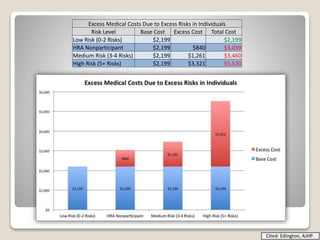
Excess Medical Costs Due to Excess Risks in Individuals
Risk Level Base Cost Excess Cost Total Cost
Low Risk (0-2 Risks) $2,199 $2,199
HRA Nonparticipant $2,199 $840 $3,039
Medium Risk (3-4 Risks) $2,199 $1,261 $3,460
High Risk (5+ Risks) $2,199 $3,321 $5,520
Our Strategy
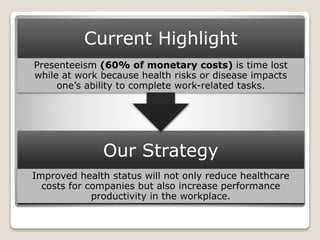
Improved health status will not only reduce healthcare
costs for companies but also increase performance
productivity in the workplace.
Current Highlight
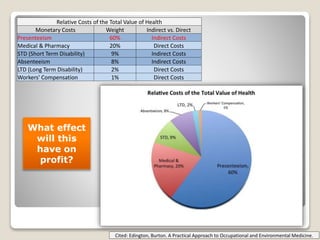
Presenteeism (60% of monetary costs) is time lost
while at work because health risks or disease impacts
one’s ability to complete work-related tasks.
Relative Costs of the Total Value of Health
Monetary Costs Weight Indirect vs. Direct
Presenteeism 60% Indirect Costs
Medical & Pharmacy 20% Direct Costs
STD (Short Term Disability) 9% Indirect Costs
Absenteeism 8% Indirect Costs
LTD (Long Term Disability) 2% Direct Costs
Workers' Compensation 1% Direct Costs
Cited: Edington, Burton. A Practical Approach to Occupational and Environmental Medicine.
What effect
will this
have on
profit?
Our Strategy
Lower health care costs and increase productivity by focusing
on the culture of the organization.
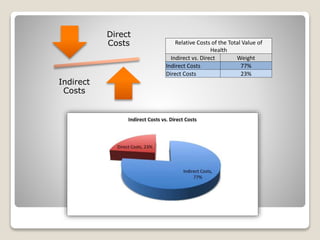
Current Highlight
Indirect costs are often overlooked by medical costs,
workers’ compensation, and LTD. Research shows majority of
cost comes from Presenteeism; work lost while in the office.
Relative Costs of the Total Value of
Health
Indirect vs. Direct Weight
Indirect Costs 77%
Direct Costs 23%
Direct
Costs
Indirect
Costs
Our Strategy
Focusing on risk reduction alone is flawed. HWI
provides an intellectual, easy to use product that will
increase wellness scores and decrease costs.
Current Highlight
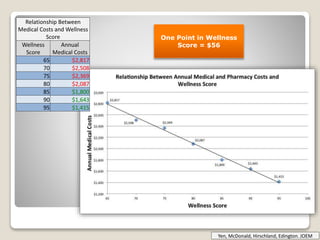
One point increase in
wellness score equals to a
$56 decrease in cost.
As health improves,
medical costs decrease
substantially.
Relationship Between
Medical Costs and Wellness
Score
Wellness
Score
Annual
Medical Costs
65 $2,817
70 $2,508
75 $2,369
80 $2,087
85 $1,800
90 $1,643
95 $1,415
One Point in Wellness
Score = $56
Yen, McDonald, Hirschland, Edington. JOEM
Our Strategy
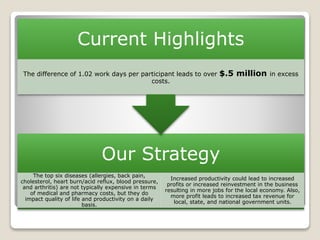
The top six diseases (allergies, back pain,
cholesterol, heart burn/acid reflux, blood pressure,
and arthritis) are not typically expensive in terms
of medical and pharmacy costs, but they do
impact quality of life and productivity on a daily
basis.
Increased productivity could lead to increased
profits or increased reinvestment in the business
resulting in more jobs for the local economy. Also,
more profit leads to increased tax revenue for
local, state, and national government units.
Current Highlights
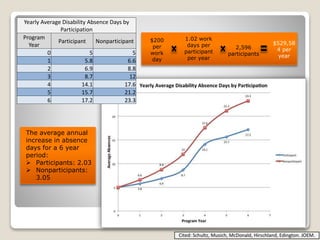
The difference of 1.02 work days per participant leads to over $.5 million in excess
costs.
Yearly Average Disability Absence Days by
Participation
Program
Year
Participant Nonparticipant
0 5 5
1 5.8 6.6
2 6.9 8.8
3 8.7 12
4 14.1 17.6
5 15.7 21.2
6 17.2 23.3
The average annual
increase in absence
days for a 6 year
period:
 Participants: 2.03
 Nonparticipants:
3.05
$200
per
work
day
1.02 work
days per
participant
per year
2,596
participants
$529,58
4 per
year
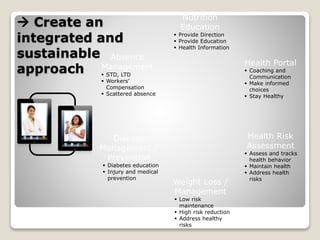
Nutrition
Education
 Provide Direction
 Provide Education
 Health Information
Health Portal
 Coaching and
Communication
 Make informed
choices
 Stay Healthy
Health Risk
Assessment
 Assess and tracks
health behavior
 Maintain health
 Address health
risks
Weight Loss /
Management
 Low risk
maintenance
 High risk reduction
 Address healthy
risks
Disease
Management /
Prevention
 Diabetes education
 Injury and medical
prevention
Absence
Management
 STD, LTD
 Workers’
Compensation
 Scattered absence
 Create an
integrated and
sustainable
approach
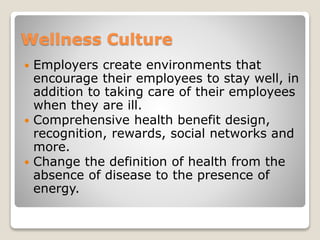
Wellness Culture
 Employers create environments that
encourage their employees to stay well, in
addition to taking care of their employees
when they are ill.
 Comprehensive health benefit design,
recognition, rewards, social networks and
more.
 Change the definition of health from the
absence of disease to the presence of
energy.
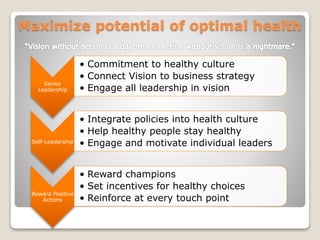
Maximize potential of optimal health
Senior
Leadership
• Commitment to healthy culture
• Connect Vision to business strategy
• Engage all leadership in vision
Self-Leadership
• Integrate policies into health culture
• Help healthy people stay healthy
• Engage and motivate individual leaders
Reward Positive
Actions
• Reward champions
• Set incentives for healthy choices
• Reinforce at every touch point
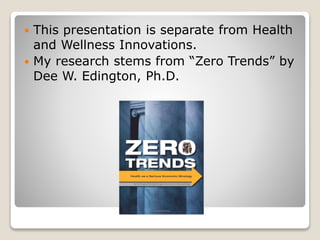
 This presentation is separate from Health
and Wellness Innovations.
 My research stems from “Zero Trends” by
Dee W. Edington, Ph.D.

HWI Presentation PP Final

  • 1.
    The Business of PreventativeWellness By: Connor Ruby
  • 2.
    Wellness vs. ComprehensiveHealth Management Activity Wellness Program Comprehensive health management program What does your organization offer? Has at least 80% participation in your program Not expected Expected Require a primary care physician of record Not necessary yes Annual physical Not necessary After 40 years Annual health screening (blood pressure, cholesterol screening, triglycerides and blood glucose) Not necessary Yes Annual or biennial health risk appraisal Not necessary yes Regularly scheduled appointment with health coach (at least two times a year) Not necessary yes Appropriate health screenings or exams by specialists for men and women Not necessary yes Periodic wellness challenges Generally offered Generally offered Benefits incentive programs Not necessary Generally offered Periodic educational programs/health fairs for employees and families Generally offered Generally offered Employee wellness advisory committee Generally offered Generally offered
  • 3.
    Mission Statement  Webelieve in moving from the current “wait for illness” level of thinking to a higher level of thought, that is, “promotion of wellness.” ◦ This type of mindset will ultimately lead to financial savings and will also enhance people’s ability to lead meaningful lives.  Wellness programs were founded on the urgency and passion for people, the business community, our country, and the world. We must create social and physical environments to enable individuals and their families to succeed.  The data and information provided in this presentation will support the argument that improved health will not only reduce healthcare costs for companies, but also increase performance and productivity in the workplace.
  • 4.
    Total Cost of Health •Sickness • Drug • Absence • Disability • Workers' Compensation • Effectiveness on the Job • Recruitment • Retention • Morale Cited: University of Michigan Health Management Research Center. One of the root causes of unsustainable growth in health care costs is the natural flow of individuals from low risk to high risk. Wellness programs develop a strategy to lower health care costs and increase productivity by focusing on the culture of the organization, the health status of the employees and help the healthy people stay healthy.
  • 5.
     How willa new wellness program be able to help your business?
  • 6.
    Our Strategy Instead ofwaiting for sickness, we strongly believes in the preservation of health. Healthier employees are more productive, have fewer injuries, and lower medical costs. Current Highlight Excess costs increase exponentially as individuals move from low risk to high risk categories Changes in healthcare costs follow changes in health risk. As the number of risks goes up, costs go up. As the number of risks goes down, costs go down. 150% increase in medical costs due to growth in risk
  • 7.
    Excess Medical CostsDue to Excess Risks in Individuals Risk Level Base Cost Excess Cost Total Cost Low Risk (0-2 Risks) $2,199 $2,199 HRA Nonparticipant $2,199 $840 $3,039 Medium Risk (3-4 Risks) $2,199 $1,261 $3,460 High Risk (5+ Risks) $2,199 $3,321 $5,520
  • 8.
    Our Strategy Improved healthstatus will not only reduce healthcare costs for companies but also increase performance productivity in the workplace. Current Highlight Presenteeism (60% of monetary costs) is time lost while at work because health risks or disease impacts one’s ability to complete work-related tasks.
  • 9.
    Relative Costs ofthe Total Value of Health Monetary Costs Weight Indirect vs. Direct Presenteeism 60% Indirect Costs Medical & Pharmacy 20% Direct Costs STD (Short Term Disability) 9% Indirect Costs Absenteeism 8% Indirect Costs LTD (Long Term Disability) 2% Direct Costs Workers' Compensation 1% Direct Costs Cited: Edington, Burton. A Practical Approach to Occupational and Environmental Medicine. What effect will this have on profit?
  • 10.
    Our Strategy Lower healthcare costs and increase productivity by focusing on the culture of the organization. Current Highlight Indirect costs are often overlooked by medical costs, workers’ compensation, and LTD. Research shows majority of cost comes from Presenteeism; work lost while in the office.
  • 11.
    Relative Costs ofthe Total Value of Health Indirect vs. Direct Weight Indirect Costs 77% Direct Costs 23% Direct Costs Indirect Costs
  • 12.
    Our Strategy Focusing onrisk reduction alone is flawed. HWI provides an intellectual, easy to use product that will increase wellness scores and decrease costs. Current Highlight One point increase in wellness score equals to a $56 decrease in cost. As health improves, medical costs decrease substantially.
  • 13.
    Relationship Between Medical Costsand Wellness Score Wellness Score Annual Medical Costs 65 $2,817 70 $2,508 75 $2,369 80 $2,087 85 $1,800 90 $1,643 95 $1,415 One Point in Wellness Score = $56 Yen, McDonald, Hirschland, Edington. JOEM
  • 14.
    Our Strategy The topsix diseases (allergies, back pain, cholesterol, heart burn/acid reflux, blood pressure, and arthritis) are not typically expensive in terms of medical and pharmacy costs, but they do impact quality of life and productivity on a daily basis. Increased productivity could lead to increased profits or increased reinvestment in the business resulting in more jobs for the local economy. Also, more profit leads to increased tax revenue for local, state, and national government units. Current Highlights The difference of 1.02 work days per participant leads to over $.5 million in excess costs.
  • 15.
    Yearly Average DisabilityAbsence Days by Participation Program Year Participant Nonparticipant 0 5 5 1 5.8 6.6 2 6.9 8.8 3 8.7 12 4 14.1 17.6 5 15.7 21.2 6 17.2 23.3 The average annual increase in absence days for a 6 year period:  Participants: 2.03  Nonparticipants: 3.05 $200 per work day 1.02 work days per participant per year 2,596 participants $529,58 4 per year
  • 16.
    Nutrition Education  Provide Direction Provide Education  Health Information Health Portal  Coaching and Communication  Make informed choices  Stay Healthy Health Risk Assessment  Assess and tracks health behavior  Maintain health  Address health risks Weight Loss / Management  Low risk maintenance  High risk reduction  Address healthy risks Disease Management / Prevention  Diabetes education  Injury and medical prevention Absence Management  STD, LTD  Workers’ Compensation  Scattered absence  Create an integrated and sustainable approach
  • 17.
    Wellness Culture  Employerscreate environments that encourage their employees to stay well, in addition to taking care of their employees when they are ill.  Comprehensive health benefit design, recognition, rewards, social networks and more.  Change the definition of health from the absence of disease to the presence of energy.
  • 18.
    Maximize potential ofoptimal health Senior Leadership • Commitment to healthy culture • Connect Vision to business strategy • Engage all leadership in vision Self-Leadership • Integrate policies into health culture • Help healthy people stay healthy • Engage and motivate individual leaders Reward Positive Actions • Reward champions • Set incentives for healthy choices • Reinforce at every touch point
  • 19.
     This presentationis separate from Health and Wellness Innovations.  My research stems from “Zero Trends” by Dee W. Edington, Ph.D.