http://www.crelos.com Dealing with Change Fatigue 20 th  January 2011 One Moorgate, London.
Agenda Panel discussion, followed by Q&A: Dealing with Change Fatigue 17.55 Close 19.00  Drinks reception 18.20 Wild Fitness: a new approach to change Edward Drax, CEO of Wild Fitness explores new approaches for ensuring that your people are in the correct mental and physical state to react to, embrace and lead change 17.30 Sport as a Vehicle for Change Matt Johnson, Director of Basketball at Reading Rockets and GB U20 Women’s Assistant Coach, and Miriam Batten, Olympic Rowing Medallist explore how sport as a learning vehicle provides a compelling learning environment that accelerates behavioural and organisational change 17.10 Consultation Syndicates A novel way of examining and sharing learning about a subject 16.15 Promoting Resourcefulness and Resilience in Change Situations Ali Gill, Co-founder of Crelos, business psychologist and Executive Coach 16.00 Detail Time
http://www.crelos.com Ali Gill 20 th  January 2011 One Moorgate, London. Promoting Resourcefulness and Resilience in Change Situations
http://www.crelos.com Consultation Syndicates 20 th  January 2011 One Moorgate, London. Experiential Master Class
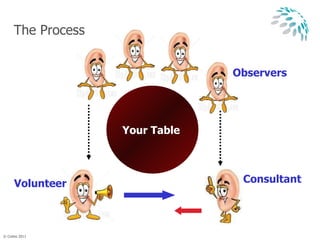
The Process Your Table Volunteer Consultant Observers
http://www.crelos.com Matt Johnson & Miriam Batten  20 th  January 2011  One Moorgate, London. Sport as a Vehicle for Change
 
Sport as a Vehicle for Change Just a Team Build or a unique opportunity for self awareness and to try out new behavioural skills. To Create a Powerful  Behavioural Learning Experience Bespoke Approach -  Our Expertise to Identify your Objectives Enhancing “High Performance”  -  selection of appropriate venue and other supporting aspects Experiential Learning -  A Blend of High Energy activity under pressure/competition plus individual/team reflection A Dynamic Mix -  World Class Coach plus an Expert Behavioural Facilitator with experience in top level sport
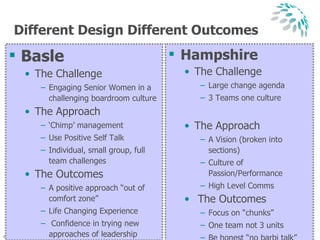
Different Design Different Outcomes Basle The Challenge Engaging Senior Women in a challenging boardroom culture The Approach ‘ Chimp’ management Use Positive Self Talk Individual, small group, full team challenges The Outcomes A positive approach “out of comfort zone”  Life Changing Experience Confidence in trying new approaches of leadership Hampshire The Challenge  Large change agenda 3 Teams one culture The Approach A Vision (broken into sections) Culture of Passion/Performance  High Level Comms The Outcomes Focus on “chunks” One team not 3 units Be honest “no barbi talk”
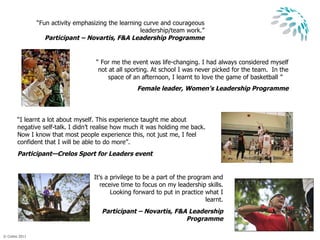
“  For me the event was life-changing. I had always considered myself not at all sporting. At school I was never picked for the team.  In the space of an afternoon, I learnt to love the game of basketball ”  Female leader, Women’s Leadership Programme “ I learnt a lot about myself. This experience taught me about negative self-talk. I didn’t realise how much it was holding me back. Now I know that most people experience this, not just me, I feel confident that I will be able to do more”.  Participant—Crelos Sport for Leaders event   It's a privilege to be a part of the program and receive time to focus on my leadership skills. Looking forward to put in practice what I learnt. Participant – Novartis, F&A Leadership Programme “ Fun activity emphasizing the learning curve and courageous leadership/team work.” Participant – Novartis, F&A Leadership Programme
http://www.crelos.com Edward Drax 20 th  January 2011  One Moorgate, London. Wildfitness: A New Approach to Change
A philosophy for life-long health
“ Before beginning an exercise programme, consult your doctor”
“ Before beginning a programme of physical inactivity consult your doctor”
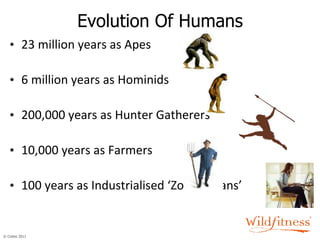
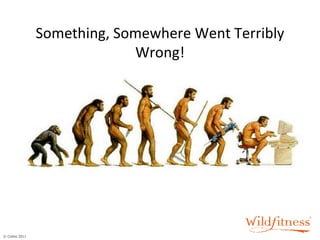
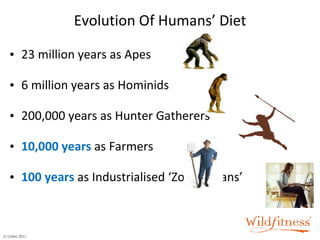
23 million years as Apes 6 million years as Hominids 200,000 years as Hunter Gatherers 10,000 years as Farmers 100 years as Industrialised ‘Zoo Humans’ Evolution Of Humans
“ The Primate Predicament”
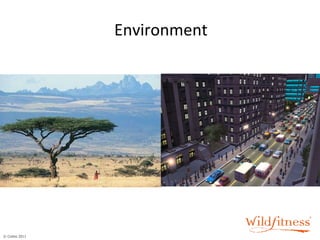
Environment
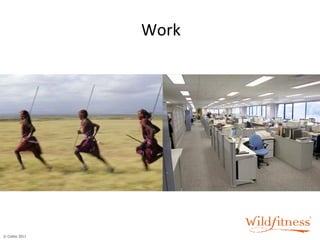
Work
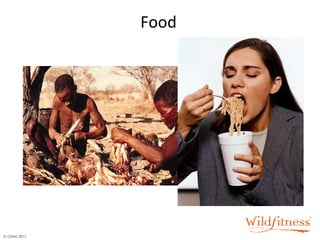
Food
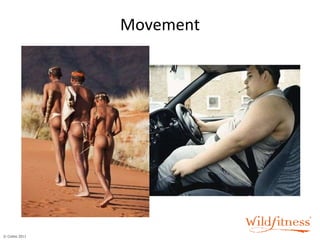
Movement
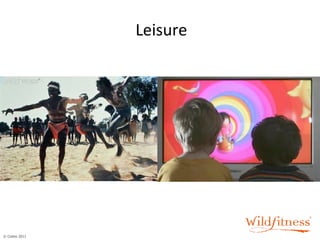
Leisure
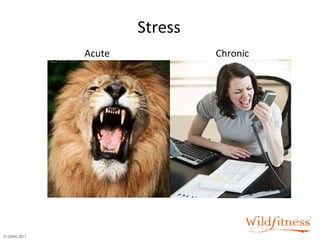
Stress Acute Chronic
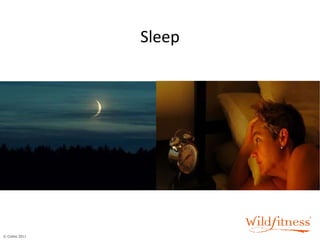
Sleep
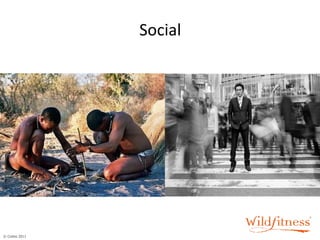
Social
Something, Somewhere Went Terribly Wrong!
“ The deviation of man from the state in which he was originally placed by nature seems to have proved to him a prolific source of diseases.” Edward Jenner, the “Father of Immunology” 1749 - 1823
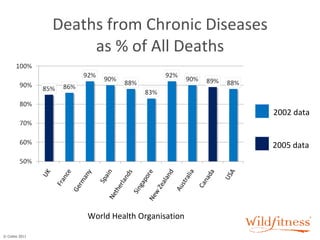
Noncommunicable / Chronic Diseases “ Noncommunicable diseases , principally cardiovascular diseases, cancers, diabetes and chronic respiratory diseases   caused an estimated 35 million deaths in 2005 . This figure represents   60% of all deaths globally … … projected to increase by a further 17% over the next 10 years.” World Health Organisation
Deaths from Chronic Diseases as % of All Deaths World Health Organisation 2002 data 2005 data
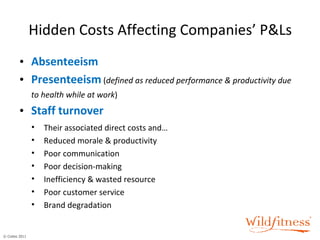
Hidden Costs Affecting Companies’ P&Ls Absenteeism Presenteeism   ( defined as reduced performance & productivity due to health while at work ) Staff   turnover Their associated direct costs and… Reduced morale & productivity Poor communication Poor decision-making Inefficiency & wasted resource Poor customer service Brand degradation
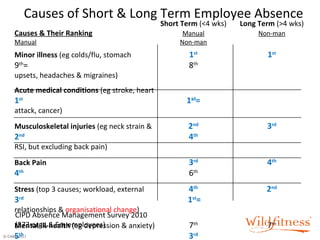
Causes of Short & Long Term Employee Absence Short Term  (<4 wks) Long Term  (>4 wks) Causes & Their Ranking Manual Non-man Manual Non-man Minor illness  (eg colds/flu, stomach 1 st 1 st   9 th = 8 th upsets, headaches & migraines) Acute medical conditions  (eg stroke, heart 1 st 1 st = attack, cancer) Musculoskeletal injuries  (eg neck strain & 2 nd 3 rd 2 nd 4 th RSI, but excluding back pain) Back Pain 3 rd 4 th 4 th 6 th Stress  (top 3 causes; workload, external 4 th 2 nd 3 rd   1 st = relationships &  organisational change ) Mental ill-health  (eg depression & anxiety)  7 th 7 th 5 th 3 rd CIPD Absence Management Survey 2010 (573 orgs, 1.5m employees)
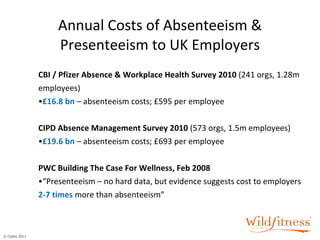
Annual Costs of Absenteeism & Presenteeism to UK Employers CBI / Pfizer Absence & Workplace Health Survey 2010  (241 orgs, 1.28m employees) £16.8 bn  – absenteeism costs; £595 per employee  CIPD Absence Management Survey 2010  (573 orgs, 1.5m employees) £19.6 bn   – absenteeism costs; £693 per employee PWC Building The Case For Wellness, Feb 2008 “ Presenteeism – no hard data, but evidence suggests cost to employers   2-7 times  more than absenteeism”
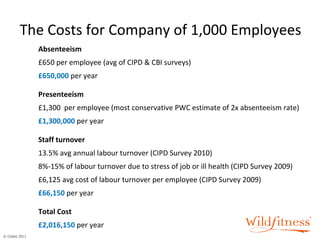
The Costs for Company of 1,000 Employees Absenteeism £650 per employee (avg of CIPD & CBI surveys) £650,000  per year Presenteeism £1,300  per employee (most conservative PWC estimate of 2x absenteeism rate) £1,300,000  per year Staff turnover 13.5% avg annual labour turnover (CIPD Survey 2010) 8%-15% of labour turnover due to stress of job or ill health (CIPD Survey 2009) £6,125 avg cost of labour turnover per employee (CIPD Survey 2009) £66,150  per year Total Cost £2,016,150  per year
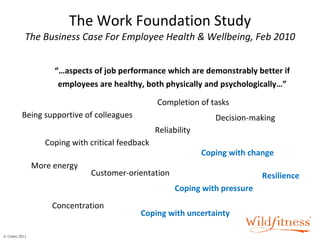
The Work Foundation Study The Business Case For Employee Health & Wellbeing, Feb 2010 “… aspects of job performance which are demonstrably better if employees are healthy, both physically and psychologically…” Reliability Completion of tasks Customer-orientation Being supportive of colleagues Concentration Resilience Decision-making Coping with critical feedback More energy Coping with pressure Coping with uncertainty Coping with change
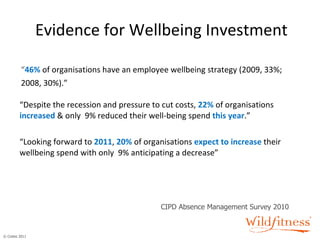
Evidence for Wellbeing Investment “ 46%  of organisations have an employee wellbeing strategy (2009, 33%; 2008, 30%).”   CIPD Absence Management Survey 2010 “ Despite the recession and pressure to cut costs,  22%  of organisations  increased  & only  9% reduced their well-being spend  this year .” “ Looking forward to  2011 ,  20%  of organisations  expect to increase  their wellbeing spend with only  9% anticipating a decrease”
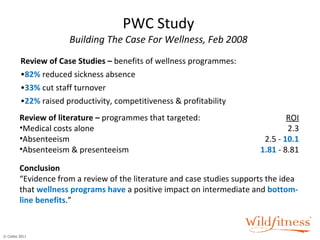
PWC Study Building The Case For Wellness, Feb 2008 Review of Case Studies –  benefits of wellness programmes: 82%  reduced sickness absence 33%  cut staff turnover 22%  raised productivity, competitiveness & profitability Review of literature –  programmes that targeted: ROI Medical costs alone 2.3 Absenteeism 2.5 -  10.1 Absenteeism & presenteeism 1.81  - 8.81 Conclusion “Evidence from a review of the literature and case studies supports the idea that  wellness programs have  a positive impact on intermediate and  bottom-line benefits .”
The Link Between Physical Activity &… “ It is clear that physical activity contributes to   cognitive functioning .”  The Effects of Physical Activity & Sedentary Behaviour on Cognitive Health 2005 “ Physical activity seems to boost one’s   happiness   level and is a   strong protector against morbidity .”   Effects of Happiness on All-Cause Mortality 2008 “ A change from sedentary to more physical activity was associated with   lower stress  and   higher satisfaction .”   Scandinavian Journal of Medicine & Science in Sports 2005 “ Increasing physical activity levels will help   prevent and manage diseases   including cancer, coronary heart disease, diabetes and obesity.  It can also help to promote   mental wellbeing ” Department of Health 2004 “ Physically active employees are less likely to suffer from   major health problems ,  less likely to take   sickness leave  and less likely to have an   accident   at work” Dishman et al. 1998
Employee Engagement “… 65% of respondents  revealed that they   are disengaged from their work , 21% of them toxically.  It’s a sobering number that impacts the very core of productivity, customer service, innovation, creativity and staff retention.&quot;   &quot;But where do you start?  The steps to follow are deceptively   clear.    First fix the body (physical engagement) …” Human Performance Institute White Paper, June 2010
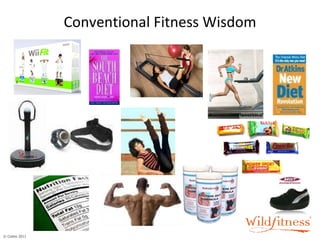
Conventional Fitness Wisdom
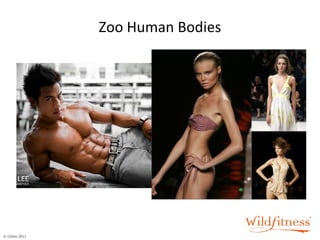
Zoo Human Bodies
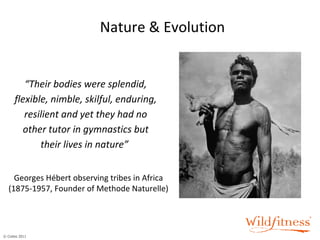
Nature & Evolution “ Their bodies were splendid, flexible, nimble, skilful, enduring, resilient and yet they had no other tutor in gymnastics but their lives in nature”  Georges Hébert observing tribes in Africa (1875-1957, Founder of Methode Naturelle)
A philosophy for life-long health Wild Moving Wild Eating Wild Living
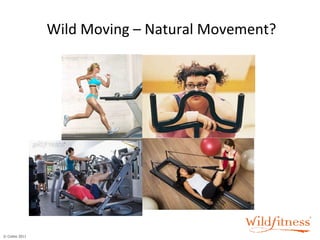
Wild Moving – Natural Movement?
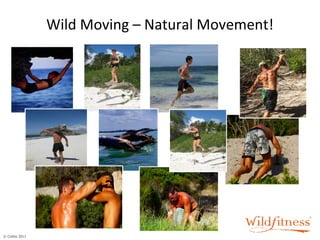
Wild Moving – Natural Movement!
 
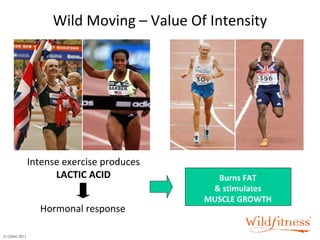
Wild Moving – Value Of Intensity Intense exercise produces LACTIC ACID Hormonal response Burns FAT & stimulates MUSCLE GROWTH
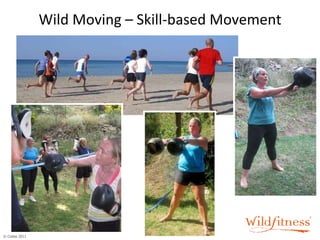
Wild Moving – Skill-based Movement
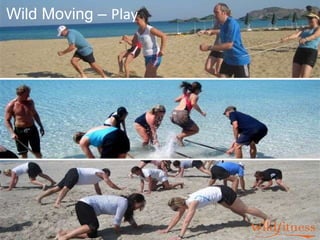
Wild Moving –  Play
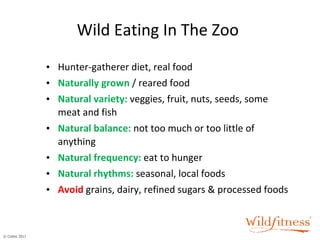
23 million years as Apes 6 million years as Hominids 200,000 years as Hunter Gatherers 10,000   years   as Farmers 100   years   as Industrialised ‘Zoo Humans’ Evolution Of Humans’ Diet
Wild Eating In The Zoo Hunter-gatherer diet, real food Naturally grown  / reared food Natural variety:   veggies, fruit, nuts, seeds, some meat and fish Natural balance:   not too much or too little of anything  Natural frequency:   eat to hunger Natural rhythms:   seasonal, local foods Avoid   grains, dairy, refined sugars & processed foods
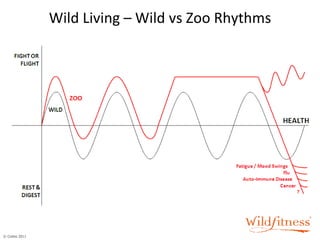
Wild Living – Wild vs Zoo Rhythms
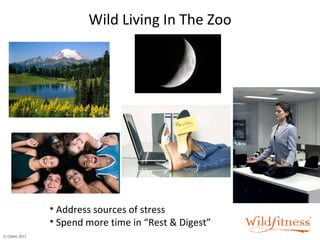
Wild Living In The Zoo Address sources of stress Spend more time in “Rest & Digest”
A philosophy for life-long health
“ Employers want employees who will do their best work or ‘go the extra mile’.  Employees want jobs that are worthwhile and that inspire them.  More and more organisations are looking for a win-win solution that meets their needs and those of their employees.  What they increasingly say they are looking for is an engaged workforce“ Chartered Institute of Personnel & Development   “ We cannot command Nature except by obeying her”  Francis bacon 1561 – 1626
http://www.crelos.com Panel Discussion 20 th  January 2011 One Moorgate, London. Dealing with Change Fatigue

Crelos Change Fatigue 2011 01 20

  • 1.
    http://www.crelos.com Dealing withChange Fatigue 20 th January 2011 One Moorgate, London.
  • 2.
    Agenda Panel discussion,followed by Q&A: Dealing with Change Fatigue 17.55 Close 19.00 Drinks reception 18.20 Wild Fitness: a new approach to change Edward Drax, CEO of Wild Fitness explores new approaches for ensuring that your people are in the correct mental and physical state to react to, embrace and lead change 17.30 Sport as a Vehicle for Change Matt Johnson, Director of Basketball at Reading Rockets and GB U20 Women’s Assistant Coach, and Miriam Batten, Olympic Rowing Medallist explore how sport as a learning vehicle provides a compelling learning environment that accelerates behavioural and organisational change 17.10 Consultation Syndicates A novel way of examining and sharing learning about a subject 16.15 Promoting Resourcefulness and Resilience in Change Situations Ali Gill, Co-founder of Crelos, business psychologist and Executive Coach 16.00 Detail Time
  • 3.
    http://www.crelos.com Ali Gill20 th January 2011 One Moorgate, London. Promoting Resourcefulness and Resilience in Change Situations
  • 4.
    http://www.crelos.com Consultation Syndicates20 th January 2011 One Moorgate, London. Experiential Master Class
  • 5.
    The Process YourTable Volunteer Consultant Observers
  • 6.
    http://www.crelos.com Matt Johnson& Miriam Batten 20 th January 2011 One Moorgate, London. Sport as a Vehicle for Change
  • 7.
  • 8.
    Sport as aVehicle for Change Just a Team Build or a unique opportunity for self awareness and to try out new behavioural skills. To Create a Powerful Behavioural Learning Experience Bespoke Approach - Our Expertise to Identify your Objectives Enhancing “High Performance” - selection of appropriate venue and other supporting aspects Experiential Learning - A Blend of High Energy activity under pressure/competition plus individual/team reflection A Dynamic Mix - World Class Coach plus an Expert Behavioural Facilitator with experience in top level sport
  • 9.
    Different Design DifferentOutcomes Basle The Challenge Engaging Senior Women in a challenging boardroom culture The Approach ‘ Chimp’ management Use Positive Self Talk Individual, small group, full team challenges The Outcomes A positive approach “out of comfort zone” Life Changing Experience Confidence in trying new approaches of leadership Hampshire The Challenge Large change agenda 3 Teams one culture The Approach A Vision (broken into sections) Culture of Passion/Performance High Level Comms The Outcomes Focus on “chunks” One team not 3 units Be honest “no barbi talk”
  • 10.
    “ Forme the event was life-changing. I had always considered myself not at all sporting. At school I was never picked for the team. In the space of an afternoon, I learnt to love the game of basketball ” Female leader, Women’s Leadership Programme “ I learnt a lot about myself. This experience taught me about negative self-talk. I didn’t realise how much it was holding me back. Now I know that most people experience this, not just me, I feel confident that I will be able to do more”. Participant—Crelos Sport for Leaders event It's a privilege to be a part of the program and receive time to focus on my leadership skills. Looking forward to put in practice what I learnt. Participant – Novartis, F&A Leadership Programme “ Fun activity emphasizing the learning curve and courageous leadership/team work.” Participant – Novartis, F&A Leadership Programme
  • 11.
    http://www.crelos.com Edward Drax20 th January 2011 One Moorgate, London. Wildfitness: A New Approach to Change
  • 12.
    A philosophy forlife-long health
  • 13.
    “ Before beginningan exercise programme, consult your doctor”
  • 14.
    “ Before beginninga programme of physical inactivity consult your doctor”
  • 15.
    23 million yearsas Apes 6 million years as Hominids 200,000 years as Hunter Gatherers 10,000 years as Farmers 100 years as Industrialised ‘Zoo Humans’ Evolution Of Humans
  • 16.
    “ The PrimatePredicament”
  • 17.
  • 18.
  • 19.
  • 20.
  • 21.
  • 22.
  • 23.
  • 24.
  • 25.
  • 26.
    “ The deviationof man from the state in which he was originally placed by nature seems to have proved to him a prolific source of diseases.” Edward Jenner, the “Father of Immunology” 1749 - 1823
  • 27.
    Noncommunicable / ChronicDiseases “ Noncommunicable diseases , principally cardiovascular diseases, cancers, diabetes and chronic respiratory diseases caused an estimated 35 million deaths in 2005 . This figure represents 60% of all deaths globally … … projected to increase by a further 17% over the next 10 years.” World Health Organisation
  • 28.
    Deaths from ChronicDiseases as % of All Deaths World Health Organisation 2002 data 2005 data
  • 29.
    Hidden Costs AffectingCompanies’ P&Ls Absenteeism Presenteeism ( defined as reduced performance & productivity due to health while at work ) Staff turnover Their associated direct costs and… Reduced morale & productivity Poor communication Poor decision-making Inefficiency & wasted resource Poor customer service Brand degradation
  • 30.
    Causes of Short& Long Term Employee Absence Short Term (<4 wks) Long Term (>4 wks) Causes & Their Ranking Manual Non-man Manual Non-man Minor illness (eg colds/flu, stomach 1 st 1 st 9 th = 8 th upsets, headaches & migraines) Acute medical conditions (eg stroke, heart 1 st 1 st = attack, cancer) Musculoskeletal injuries (eg neck strain & 2 nd 3 rd 2 nd 4 th RSI, but excluding back pain) Back Pain 3 rd 4 th 4 th 6 th Stress (top 3 causes; workload, external 4 th 2 nd 3 rd 1 st = relationships & organisational change ) Mental ill-health (eg depression & anxiety) 7 th 7 th 5 th 3 rd CIPD Absence Management Survey 2010 (573 orgs, 1.5m employees)
  • 31.
    Annual Costs ofAbsenteeism & Presenteeism to UK Employers CBI / Pfizer Absence & Workplace Health Survey 2010 (241 orgs, 1.28m employees) £16.8 bn – absenteeism costs; £595 per employee CIPD Absence Management Survey 2010 (573 orgs, 1.5m employees) £19.6 bn – absenteeism costs; £693 per employee PWC Building The Case For Wellness, Feb 2008 “ Presenteeism – no hard data, but evidence suggests cost to employers 2-7 times more than absenteeism”
  • 32.
    The Costs forCompany of 1,000 Employees Absenteeism £650 per employee (avg of CIPD & CBI surveys) £650,000 per year Presenteeism £1,300 per employee (most conservative PWC estimate of 2x absenteeism rate) £1,300,000 per year Staff turnover 13.5% avg annual labour turnover (CIPD Survey 2010) 8%-15% of labour turnover due to stress of job or ill health (CIPD Survey 2009) £6,125 avg cost of labour turnover per employee (CIPD Survey 2009) £66,150 per year Total Cost £2,016,150 per year
  • 33.
    The Work FoundationStudy The Business Case For Employee Health & Wellbeing, Feb 2010 “… aspects of job performance which are demonstrably better if employees are healthy, both physically and psychologically…” Reliability Completion of tasks Customer-orientation Being supportive of colleagues Concentration Resilience Decision-making Coping with critical feedback More energy Coping with pressure Coping with uncertainty Coping with change
  • 34.
    Evidence for WellbeingInvestment “ 46% of organisations have an employee wellbeing strategy (2009, 33%; 2008, 30%).”   CIPD Absence Management Survey 2010 “ Despite the recession and pressure to cut costs, 22% of organisations increased & only 9% reduced their well-being spend this year .” “ Looking forward to 2011 , 20% of organisations expect to increase their wellbeing spend with only 9% anticipating a decrease”
  • 35.
    PWC Study BuildingThe Case For Wellness, Feb 2008 Review of Case Studies – benefits of wellness programmes: 82% reduced sickness absence 33% cut staff turnover 22% raised productivity, competitiveness & profitability Review of literature – programmes that targeted: ROI Medical costs alone 2.3 Absenteeism 2.5 - 10.1 Absenteeism & presenteeism 1.81 - 8.81 Conclusion “Evidence from a review of the literature and case studies supports the idea that wellness programs have a positive impact on intermediate and bottom-line benefits .”
  • 36.
    The Link BetweenPhysical Activity &… “ It is clear that physical activity contributes to cognitive functioning .” The Effects of Physical Activity & Sedentary Behaviour on Cognitive Health 2005 “ Physical activity seems to boost one’s happiness level and is a strong protector against morbidity .” Effects of Happiness on All-Cause Mortality 2008 “ A change from sedentary to more physical activity was associated with lower stress and higher satisfaction .” Scandinavian Journal of Medicine & Science in Sports 2005 “ Increasing physical activity levels will help prevent and manage diseases including cancer, coronary heart disease, diabetes and obesity. It can also help to promote mental wellbeing ” Department of Health 2004 “ Physically active employees are less likely to suffer from major health problems , less likely to take sickness leave and less likely to have an accident at work” Dishman et al. 1998
  • 37.
    Employee Engagement “…65% of respondents revealed that they are disengaged from their work , 21% of them toxically.  It’s a sobering number that impacts the very core of productivity, customer service, innovation, creativity and staff retention.&quot;   &quot;But where do you start?  The steps to follow are deceptively clear.   First fix the body (physical engagement) …” Human Performance Institute White Paper, June 2010
  • 38.
  • 39.
  • 40.
    Nature & Evolution“ Their bodies were splendid, flexible, nimble, skilful, enduring, resilient and yet they had no other tutor in gymnastics but their lives in nature” Georges Hébert observing tribes in Africa (1875-1957, Founder of Methode Naturelle)
  • 41.
    A philosophy forlife-long health Wild Moving Wild Eating Wild Living
  • 42.
    Wild Moving –Natural Movement?
  • 43.
    Wild Moving –Natural Movement!
  • 44.
  • 45.
    Wild Moving –Value Of Intensity Intense exercise produces LACTIC ACID Hormonal response Burns FAT & stimulates MUSCLE GROWTH
  • 46.
    Wild Moving –Skill-based Movement
  • 47.
  • 48.
    23 million yearsas Apes 6 million years as Hominids 200,000 years as Hunter Gatherers 10,000 years as Farmers 100 years as Industrialised ‘Zoo Humans’ Evolution Of Humans’ Diet
  • 49.
    Wild Eating InThe Zoo Hunter-gatherer diet, real food Naturally grown / reared food Natural variety: veggies, fruit, nuts, seeds, some meat and fish Natural balance: not too much or too little of anything Natural frequency: eat to hunger Natural rhythms: seasonal, local foods Avoid grains, dairy, refined sugars & processed foods
  • 50.
    Wild Living –Wild vs Zoo Rhythms
  • 51.
    Wild Living InThe Zoo Address sources of stress Spend more time in “Rest & Digest”
  • 52.
    A philosophy forlife-long health
  • 53.
    “ Employers wantemployees who will do their best work or ‘go the extra mile’. Employees want jobs that are worthwhile and that inspire them. More and more organisations are looking for a win-win solution that meets their needs and those of their employees. What they increasingly say they are looking for is an engaged workforce“ Chartered Institute of Personnel & Development   “ We cannot command Nature except by obeying her” Francis bacon 1561 – 1626
  • 54.
    http://www.crelos.com Panel Discussion20 th January 2011 One Moorgate, London. Dealing with Change Fatigue

Editor's Notes

  • #10 ‘ The challenge’: WHO? A global pharmaceutical company in need of engaging senior women in shifting its “overly macho culture”. WHAT? Seeking a programme to encourage women to challenge the norms and shift the board room culture WHERE? Switzerland. Interwoven within Women’s leadership programme called “Breaking the rules.” ‘ The approach’ : We used basketball as it is so flexible in its delivery and outcomes. And provided an excellent level playing field for both genders Facilitator, Coach and Client preparation time prior to the event to ensure expected outcomes are encouraged through the physical aspects of delivery and engagement Session outline: Starting with individual aspects , leading into small and pressurised games and finally into fully managed and resourced team tournament with high expectations of behaviour change and understanding of the facilitator’s key messages. Rest times (!) And debriefs within the natural flow of the session to allow for learning, reflection and facilitator time. ‘ The outcome’: As with every intervention personal outcomes arrive at varying stages although some early responses from clients were: A much more positive approach to ‘out of my comfort zone programmes’ Change of perspective to the value of sport within their life and work leading to a healthier lifestyle Developed self confidence within board room environment through ‘ chimp management!’