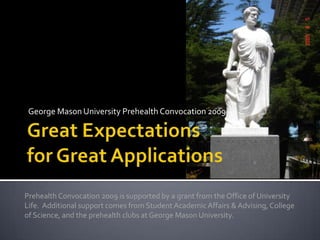


Great Expectationsfor Great ApplicationsGeorge Mason University Prehealth Convocation 2009Prehealth Convocation 2009 is supported by a grant from the Office of University Life.  Additional support comes from Student Academic Affairs & Advising, College of Science, and the prehealth clubs at George Mason University.
Convocation GoalsConnect advisees with Mason resourcesEducate advisees on “the process”Inform advisees of opportunitiesUnderstand why early advising and planning are critical to successRaffle off a free Kaplan class
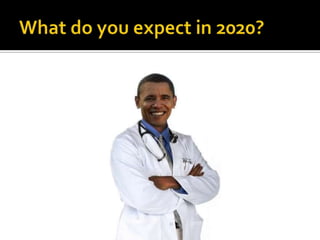
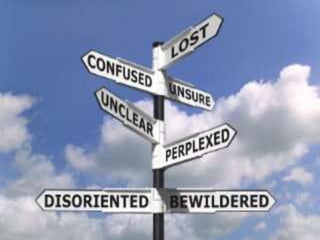
What do you expect in 2020?
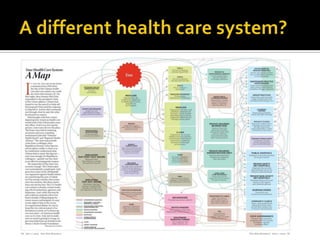
A different health care system?
There’s a class for that.HHS 201: Introduction to the Health ProfessionsThere’s also a seminar series for that.Center for Health Policy, Research, and Ethics21 September noon: Will we see health care reform in 2009?
A better health care system?A Consumer Reports survey found that doctors and patients don't always see eye-to-eye. Here are some of the most common gripes:What bugs patients about doctorsKept me waiting 30 minutes or longer 24%Could not schedule an appointment within a week 19%Spent too little time with me 9%Didn't get test results promptly 7%Didn't respond to my calls promptly 6%What bugs doctors about patientsDon't follow prescribed treatment 59%Wait too long before making appointment 41%Are reluctant to discuss symptoms 32%Request unnecessary tests 31%Request unnecessary prescriptions 28%Source: Consumer Reports, February 2007
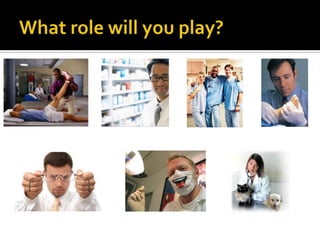
What role will you play?
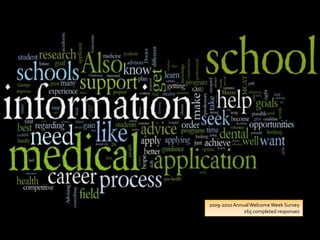
2009-2010 Annual Welcome Week Survey265 completed responses
What’s important for you?What are my chances of getting in?
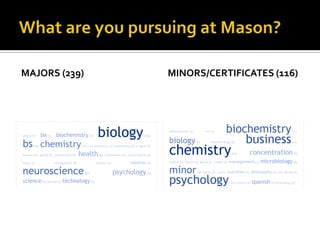
What are you pursuing at Mason?Majors (239)Minors/Certificates (116)
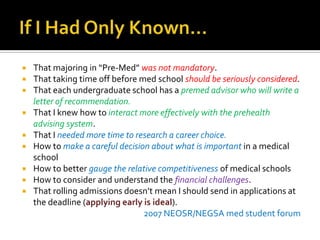
If I Had Only Known…That majoring in “Pre-Med” was not mandatory.That taking time off before med school should be seriously considered.That each undergraduate school has a premed advisor who will write a letter of recommendation.That I knew how to interact more effectively with the prehealth advising system.That I needed more time to research a career choice.How to make a careful decision about what is important in a medical schoolHow to better gauge the relative competitiveness of medical schoolsHow to consider and understand the financial challenges.That rolling admissions doesn’t mean I should send in applications at the deadline (applying early is ideal).2007 NEOSR/NEGSA med student forum
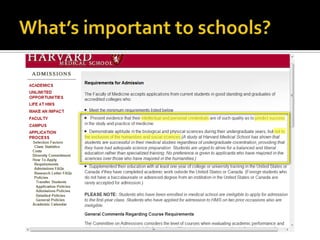
What’s important to schools?
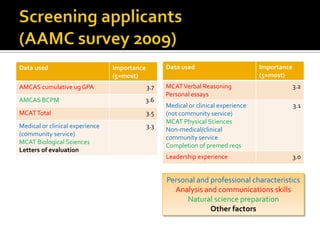
Screening applicants(AAMC survey 2009)Personal and professional characteristicsAnalysis and communications skillsNatural science preparationOther factors
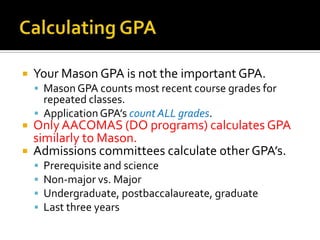
Calculating GPAYour Mason GPA is not the important GPA.Mason GPA counts most recent course grades for repeated classes.Application GPA’s count ALL grades.Only AACOMAS (DO programs) calculates GPA similarly to Mason.Admissions committees calculate other GPA’s.Prerequisite and scienceNon-major vs. MajorUndergraduate, postbaccalaureate, graduateLast three years
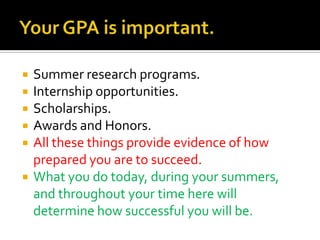
Your GPA is important.Summer research programs.Internship opportunities.Scholarships.Awards and Honors.All these things provide evidence of how prepared you are to succeed.What you do today, during your summers, and throughout your time here will determine how successful you will be.
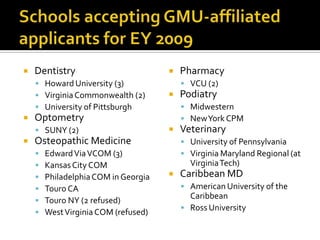
Schools accepting GMU-affiliated applicants for EY 2009DentistryHoward University (3)Virginia Commonwealth (2)University of PittsburghOptometrySUNY (2)Osteopathic MedicineEdward Via VCOM (3)Kansas City COMPhiladelphia COM in GeorgiaTouro CATouro NY (2 refused)West Virginia COM (refused)PharmacyVCU (2)PodiatryMidwesternNew York CPMVeterinaryUniversity of PennsylvaniaVirginia Maryland Regional (at Virginia Tech)Caribbean MDAmerican University of the CaribbeanRoss University
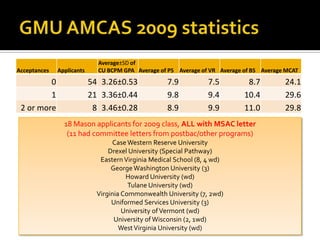
GMU AMCAS 2009 statistics18 Mason applicants for 2009 class, ALL with MSAC letter(11 had committee letters from postbac/other programs)Case Western Reserve UniversityDrexel University (Special Pathway)Eastern Virginia Medical School (8, 4 wd)George Washington University (3)Howard University (wd)Tulane University (wd)Virginia Commonwealth University (7, 2wd)Uniformed Services University (3)University of Vermont (wd)University of Wisconsin (2, 1wd)West Virginia University (wd)
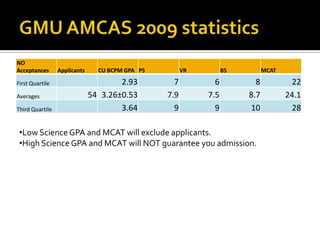
GMU AMCAS 2009 statisticsLow Science GPA and MCAT will exclude applicants.
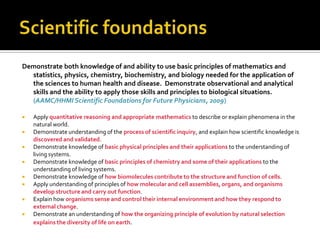
High Science GPA and MCAT will NOT guarantee you admission.Scientific foundationsDemonstrate both knowledge of and ability to use basic principles of mathematics and statistics, physics, chemistry, biochemistry, and biology needed for the application of the sciences to human health and disease.  Demonstrate observational and analytical skills and the ability to apply those skills and principles to biological situations.  (AAMC/HHMI Scientific Foundations for Future Physicians, 2009)Apply quantitative reasoning and appropriate mathematicsto describe or explain phenomena in the natural world. Demonstrate understanding of the process of scientific inquiry, and explain how scientific knowledge is discovered and validated.Demonstrate knowledge of basic physical principles and their applicationsto the understanding of living systems.Demonstrate knowledge of basic principles of chemistry and some of their applicationsto the understanding of living systems.Demonstrate knowledge of how biomolecules contribute to the structure and function of cells.Apply understanding of principles of how molecular and cell assemblies, organs, and organisms develop structure and carry out function.Explain how organisms sense and control their internal environment and how they respond to external change.Demonstrate an understanding of how the organizing principle of evolution by natural selection explains the diversity of life on earth.
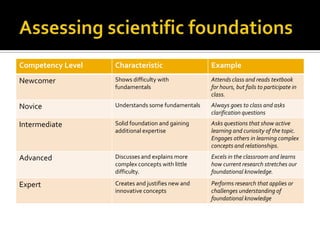
Assessing scientific foundations
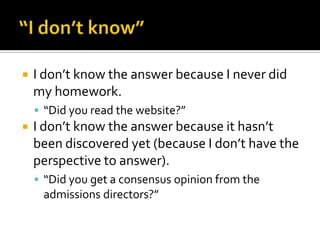
“I don’t know”I don’t know the answer because I never did my homework.“Did you read the website?”I don’t know the answer because it hasn’t been discovered yet (because I don’t have the perspective to answer).“Did you get a consensus opinion from the admissions directors?”
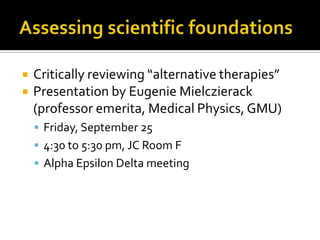
Assessing scientific foundationsCritically reviewing “alternative therapies”Presentation by Eugenie Mielczierack (professor emerita, Medical Physics, GMU)Friday, September 254:30 to 5:30 pm, JC Room FAlpha Epsilon Delta meeting
Liberal arts and humanitiesProf. de Paula invokes the liberal arts tradition, but he mentions only science and math. Meaningful reform of the pre-med curriculum should stress science, of course, but it should also give just as much emphasis to courses in the humanities. Since medical professionals confront all aspects of the human condition in their work—from birth to death and everything in between—it makes sense for them to have a strong background in the humanities, so that they can draw on the collective wisdom of those who have pondered and struggled with what it means to be human. Posted by Samuel J. Huskey , Chair, Classics and Letters at University of Oklahoma on August 20, 2009 at 10:00am EDT
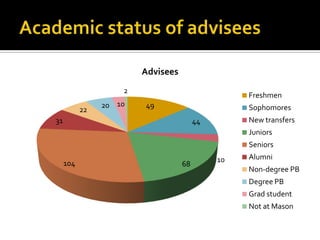
Academic status of advisees
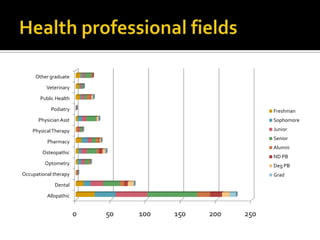
Health professional fields
Advantages to early advisingFind out about all the roles.Early interventions to understand the application process.Access to early selection programs.9 of 10 freshmen claim interest in early selection programs.Early involvement in research opportunities.Freshman/sophomore-only programsMD/PhD candidates should have 2 years of research exposure.Early interactions with admissions officials.
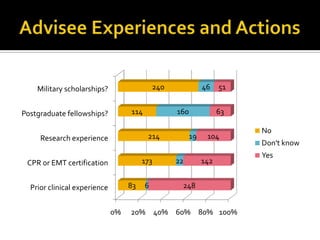
Advisee Experiences and Actions
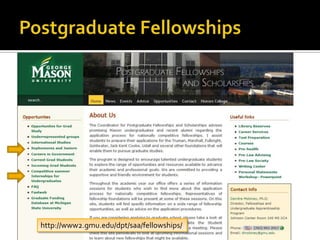
Postgraduate Fellowshipshttp://www2.gmu.edu/dpt/saa/fellowships/
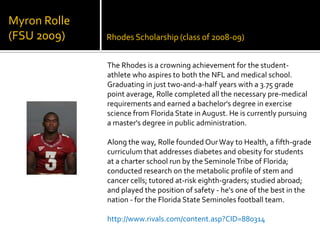
Rhodes Scholarship (class of 2008-09)Myron Rolle(FSU 2009)The Rhodes is a crowning achievement for the student-athlete who aspires to both the NFL and medical school. Graduating in just two-and-a-half years with a 3.75 grade point average, Rolle completed all the necessary pre-medical requirements and earned a bachelor's degree in exercise science from Florida State in August. He is currently pursuing a master's degree in public administration. Along the way, Rolle founded Our Way to Health, a fifth-grade curriculum that addresses diabetes and obesity for students at a charter school run by the Seminole Tribe of Florida; conducted research on the metabolic profile of stem and cancer cells; tutored at-risk eighth-graders; studied abroad; and played the position of safety - he's one of the best in the nation - for the Florida State Seminoles football team.http://www.rivals.com/content.asp?CID=880314
Admissions Visit KickoffDentistry (17 Sep): VCUMedicine (21 Sep): Howard UniversityOptometry (21 Sep): Salus UniversityPharmacy (21 Sep): University of MarylandOptometry (23 Sep): SUNYMedicine (23 Sep): UAGMedicine (28 Sep): University of VirginiaPodiatry (30 Sep): NYCPM
What’s important to schools?It’s more than GPA and test scores.
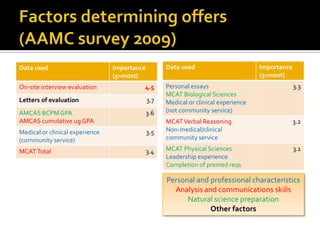
Factors determining offers(AAMC survey 2009)Personal and professional characteristicsAnalysis and communications skillsNatural science preparationOther factors
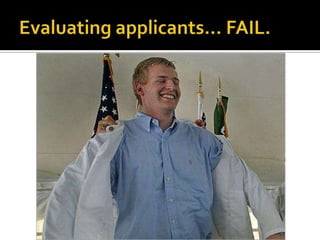
Evaluating applicants… FAIL.
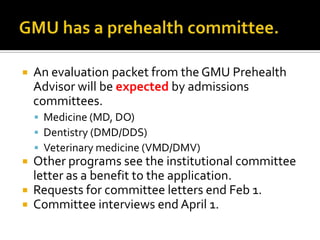
GMU has a prehealth committee.An evaluation packet from the GMU Prehealth Advisor will be expected by admissions committees.Medicine (MD, DO)Dentistry (DMD/DDS)Veterinary medicine (VMD/DMV)Other programs see the institutional committee letter as a benefit to the application.Requests for committee letters end Feb 1.Committee interviews end April 1.
GMU has a prehealth committee.Some summer research opportunities want to see a prehealth advisor letter.Requests for Dr. Chuck’s recommendation letters must occur between November 1 and January 1 (through Blackboard with requested information).
Are you prepared?Smart (scientific and culturally aware)Up-to-date with treatments and technologyCollaborates with other professionalsEmulates professional behavior and trustManages time, people, resources exceptionallyObservant in diagnosisTechnically capableCommunicates impeccablyOperates fluidly in health care environment
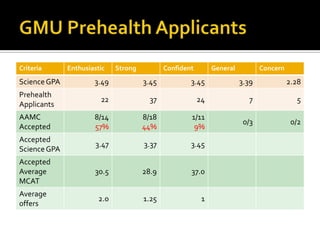
GMU Prehealth Applicants
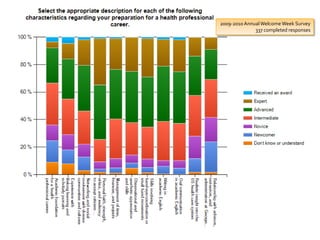
2009-2010 Annual Welcome Week Survey337 completed responses
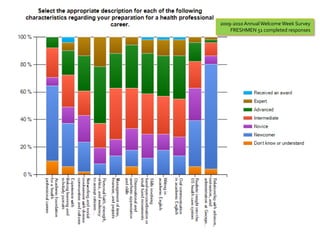
2009-2010 Annual Welcome Week SurveyFRESHMEN 51 completed responses
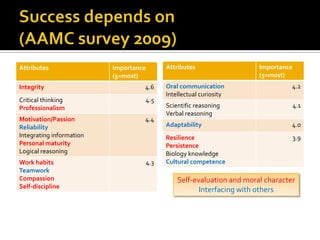
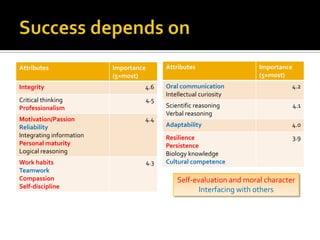
Success depends on(AAMC survey 2009)Self-evaluation and moral characterInterfacing with others
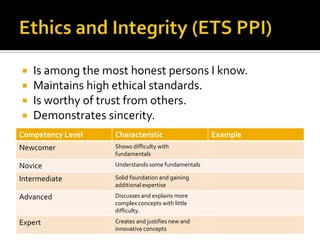
Ethics and Integrity (ETS PPI)Is among the most honest persons I know.Maintains high ethical standards.Is worthy of trust from others.Demonstrates sincerity.
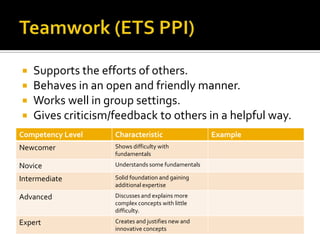
Teamwork (ETS PPI)Supports the efforts of others.Behaves in an open and friendly manner.Works well in group settings.Gives criticism/feedback to others in a helpful way.
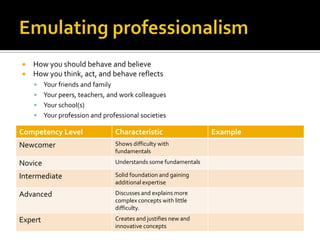
Emulating professionalismHow you should behave and believeHow you think, act, and behave reflectsYour friends and familyYour peers, teachers, and work colleaguesYour school(s)Your profession and professional societies
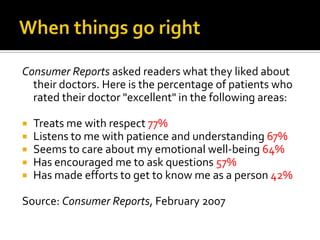
When things go rightConsumer Reports asked readers what they liked about their doctors. Here is the percentage of patients who rated their doctor "excellent" in the following areas:Treats me with respect 77%Listens to me with patience and understanding 67%Seems to care about my emotional well-being 64%Has encouraged me to ask questions 57%Has made efforts to get to know me as a person 42%Source: Consumer Reports, February 2007
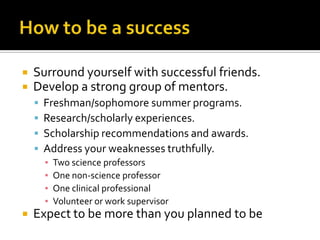
How to be a successSurround yourself with successful friends.Develop a strong group of mentors.Freshman/sophomore summer programs.Research/scholarly experiences.Scholarship recommendations and awards.Address your weaknesses truthfully.Two science professorsOne non-science professorOne clinical professionalVolunteer or work supervisorExpect to be more than you planned to be
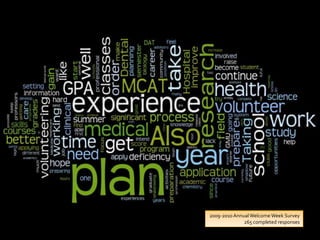
2009-2010 Annual Welcome Week Survey265 completed responses
Then you have to ask…How do you convince someone else that you have successful traits?
Success depends onSelf-evaluation and moral characterInterfacing with others
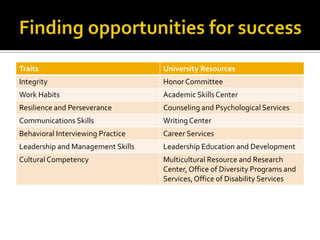
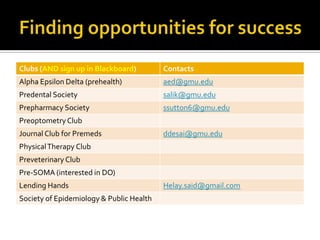
Finding opportunities for success
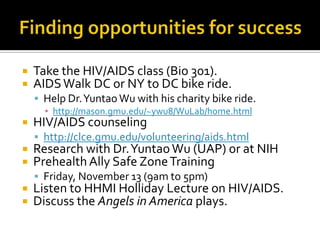
Finding opportunities for successTake the HIV/AIDS class (Bio 301).AIDS Walk DC or NY to DC bike ride.Help Dr. Yuntao Wu with his charity bike ride.http://mason.gmu.edu/~ywu8/WuLab/home.htmlHIV/AIDS counselinghttp://clce.gmu.edu/volunteering/aids.htmlResearch with Dr. Yuntao Wu (UAP) or at NIHPrehealth Ally Safe Zone TrainingFriday, November 13 (9am to 5pm)Listen to HHMI Holliday Lecture on HIV/AIDS.Discuss the Angels in America plays.
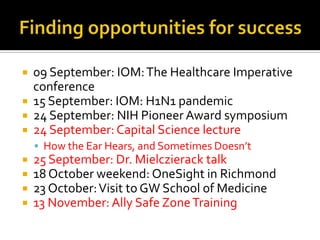
Finding opportunities for success09 September: IOM: The Healthcare Imperative conference15 September: IOM: H1N1 pandemic24 September: NIH Pioneer Award symposium24 September: Capital Science lectureHow the Ear Hears, and Sometimes Doesn’t25 September: Dr. Mielczierack talk18 October weekend: OneSight in Richmond23 October: Visit to GW School of Medicine13 November: Ally Safe Zone Training
Prehealth ResourcesSuccess depends on how you use these and other resources.
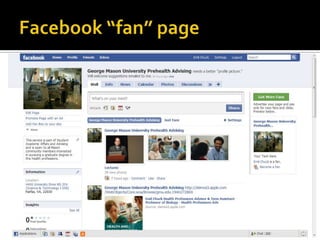
Facebook “fan” page
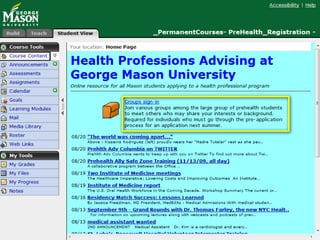
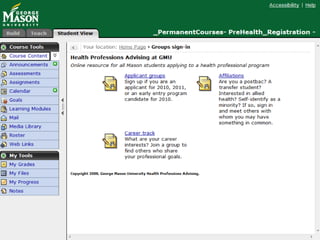
Resources for SuccessGMU Prehealth WebsiteAnnual Welcome Week SurveyPrehealth-L listservGMU Prehealth NewsfeedsPrehealth Blackboard “class”Facebook fan pageiTunesU channel (CHHS)MasonWikiwebpagesBookshelf and Library (on reserve)

Great Expectations for Great Applications 2009

  • 1.
    Great Expectationsfor GreatApplicationsGeorge Mason University Prehealth Convocation 2009Prehealth Convocation 2009 is supported by a grant from the Office of University Life. Additional support comes from Student Academic Affairs & Advising, College of Science, and the prehealth clubs at George Mason University.
  • 2.
    Convocation GoalsConnect adviseeswith Mason resourcesEducate advisees on “the process”Inform advisees of opportunitiesUnderstand why early advising and planning are critical to successRaffle off a free Kaplan class
  • 3.
    What do youexpect in 2020?
  • 4.
    A different healthcare system?
  • 5.
    There’s a classfor that.HHS 201: Introduction to the Health ProfessionsThere’s also a seminar series for that.Center for Health Policy, Research, and Ethics21 September noon: Will we see health care reform in 2009?
  • 6.
    A better healthcare system?A Consumer Reports survey found that doctors and patients don't always see eye-to-eye. Here are some of the most common gripes:What bugs patients about doctorsKept me waiting 30 minutes or longer 24%Could not schedule an appointment within a week 19%Spent too little time with me 9%Didn't get test results promptly 7%Didn't respond to my calls promptly 6%What bugs doctors about patientsDon't follow prescribed treatment 59%Wait too long before making appointment 41%Are reluctant to discuss symptoms 32%Request unnecessary tests 31%Request unnecessary prescriptions 28%Source: Consumer Reports, February 2007
  • 7.
  • 9.
    2009-2010 Annual WelcomeWeek Survey265 completed responses
  • 10.
    What’s important foryou?What are my chances of getting in?
  • 11.
    What are youpursuing at Mason?Majors (239)Minors/Certificates (116)
  • 12.
    If I HadOnly Known…That majoring in “Pre-Med” was not mandatory.That taking time off before med school should be seriously considered.That each undergraduate school has a premed advisor who will write a letter of recommendation.That I knew how to interact more effectively with the prehealth advising system.That I needed more time to research a career choice.How to make a careful decision about what is important in a medical schoolHow to better gauge the relative competitiveness of medical schoolsHow to consider and understand the financial challenges.That rolling admissions doesn’t mean I should send in applications at the deadline (applying early is ideal).2007 NEOSR/NEGSA med student forum
  • 13.
  • 14.
  • 15.
    Screening applicants(AAMC survey2009)Personal and professional characteristicsAnalysis and communications skillsNatural science preparationOther factors
  • 16.
    Calculating GPAYour MasonGPA is not the important GPA.Mason GPA counts most recent course grades for repeated classes.Application GPA’s count ALL grades.Only AACOMAS (DO programs) calculates GPA similarly to Mason.Admissions committees calculate other GPA’s.Prerequisite and scienceNon-major vs. MajorUndergraduate, postbaccalaureate, graduateLast three years
  • 17.
    Your GPA isimportant.Summer research programs.Internship opportunities.Scholarships.Awards and Honors.All these things provide evidence of how prepared you are to succeed.What you do today, during your summers, and throughout your time here will determine how successful you will be.
  • 18.
    Schools accepting GMU-affiliatedapplicants for EY 2009DentistryHoward University (3)Virginia Commonwealth (2)University of PittsburghOptometrySUNY (2)Osteopathic MedicineEdward Via VCOM (3)Kansas City COMPhiladelphia COM in GeorgiaTouro CATouro NY (2 refused)West Virginia COM (refused)PharmacyVCU (2)PodiatryMidwesternNew York CPMVeterinaryUniversity of PennsylvaniaVirginia Maryland Regional (at Virginia Tech)Caribbean MDAmerican University of the CaribbeanRoss University
  • 19.
    GMU AMCAS 2009statistics18 Mason applicants for 2009 class, ALL with MSAC letter(11 had committee letters from postbac/other programs)Case Western Reserve UniversityDrexel University (Special Pathway)Eastern Virginia Medical School (8, 4 wd)George Washington University (3)Howard University (wd)Tulane University (wd)Virginia Commonwealth University (7, 2wd)Uniformed Services University (3)University of Vermont (wd)University of Wisconsin (2, 1wd)West Virginia University (wd)
  • 20.
    GMU AMCAS 2009statisticsLow Science GPA and MCAT will exclude applicants.
  • 21.
    High Science GPAand MCAT will NOT guarantee you admission.Scientific foundationsDemonstrate both knowledge of and ability to use basic principles of mathematics and statistics, physics, chemistry, biochemistry, and biology needed for the application of the sciences to human health and disease. Demonstrate observational and analytical skills and the ability to apply those skills and principles to biological situations. (AAMC/HHMI Scientific Foundations for Future Physicians, 2009)Apply quantitative reasoning and appropriate mathematicsto describe or explain phenomena in the natural world. Demonstrate understanding of the process of scientific inquiry, and explain how scientific knowledge is discovered and validated.Demonstrate knowledge of basic physical principles and their applicationsto the understanding of living systems.Demonstrate knowledge of basic principles of chemistry and some of their applicationsto the understanding of living systems.Demonstrate knowledge of how biomolecules contribute to the structure and function of cells.Apply understanding of principles of how molecular and cell assemblies, organs, and organisms develop structure and carry out function.Explain how organisms sense and control their internal environment and how they respond to external change.Demonstrate an understanding of how the organizing principle of evolution by natural selection explains the diversity of life on earth.
  • 22.
  • 23.
    “I don’t know”Idon’t know the answer because I never did my homework.“Did you read the website?”I don’t know the answer because it hasn’t been discovered yet (because I don’t have the perspective to answer).“Did you get a consensus opinion from the admissions directors?”
  • 24.
    Assessing scientific foundationsCriticallyreviewing “alternative therapies”Presentation by Eugenie Mielczierack (professor emerita, Medical Physics, GMU)Friday, September 254:30 to 5:30 pm, JC Room FAlpha Epsilon Delta meeting
  • 25.
    Liberal arts andhumanitiesProf. de Paula invokes the liberal arts tradition, but he mentions only science and math. Meaningful reform of the pre-med curriculum should stress science, of course, but it should also give just as much emphasis to courses in the humanities. Since medical professionals confront all aspects of the human condition in their work—from birth to death and everything in between—it makes sense for them to have a strong background in the humanities, so that they can draw on the collective wisdom of those who have pondered and struggled with what it means to be human. Posted by Samuel J. Huskey , Chair, Classics and Letters at University of Oklahoma on August 20, 2009 at 10:00am EDT
  • 26.
  • 27.
  • 28.
    Advantages to earlyadvisingFind out about all the roles.Early interventions to understand the application process.Access to early selection programs.9 of 10 freshmen claim interest in early selection programs.Early involvement in research opportunities.Freshman/sophomore-only programsMD/PhD candidates should have 2 years of research exposure.Early interactions with admissions officials.
  • 29.
  • 30.
  • 31.
    Rhodes Scholarship (classof 2008-09)Myron Rolle(FSU 2009)The Rhodes is a crowning achievement for the student-athlete who aspires to both the NFL and medical school. Graduating in just two-and-a-half years with a 3.75 grade point average, Rolle completed all the necessary pre-medical requirements and earned a bachelor's degree in exercise science from Florida State in August. He is currently pursuing a master's degree in public administration. Along the way, Rolle founded Our Way to Health, a fifth-grade curriculum that addresses diabetes and obesity for students at a charter school run by the Seminole Tribe of Florida; conducted research on the metabolic profile of stem and cancer cells; tutored at-risk eighth-graders; studied abroad; and played the position of safety - he's one of the best in the nation - for the Florida State Seminoles football team.http://www.rivals.com/content.asp?CID=880314
  • 32.
    Admissions Visit KickoffDentistry(17 Sep): VCUMedicine (21 Sep): Howard UniversityOptometry (21 Sep): Salus UniversityPharmacy (21 Sep): University of MarylandOptometry (23 Sep): SUNYMedicine (23 Sep): UAGMedicine (28 Sep): University of VirginiaPodiatry (30 Sep): NYCPM
  • 33.
    What’s important toschools?It’s more than GPA and test scores.
  • 34.
    Factors determining offers(AAMCsurvey 2009)Personal and professional characteristicsAnalysis and communications skillsNatural science preparationOther factors
  • 35.
  • 36.
    GMU has aprehealth committee.An evaluation packet from the GMU Prehealth Advisor will be expected by admissions committees.Medicine (MD, DO)Dentistry (DMD/DDS)Veterinary medicine (VMD/DMV)Other programs see the institutional committee letter as a benefit to the application.Requests for committee letters end Feb 1.Committee interviews end April 1.
  • 37.
    GMU has aprehealth committee.Some summer research opportunities want to see a prehealth advisor letter.Requests for Dr. Chuck’s recommendation letters must occur between November 1 and January 1 (through Blackboard with requested information).
  • 38.
    Are you prepared?Smart(scientific and culturally aware)Up-to-date with treatments and technologyCollaborates with other professionalsEmulates professional behavior and trustManages time, people, resources exceptionallyObservant in diagnosisTechnically capableCommunicates impeccablyOperates fluidly in health care environment
  • 39.
  • 40.
    2009-2010 Annual WelcomeWeek Survey337 completed responses
  • 41.
    2009-2010 Annual WelcomeWeek SurveyFRESHMEN 51 completed responses
  • 42.
    Success depends on(AAMCsurvey 2009)Self-evaluation and moral characterInterfacing with others
  • 43.
    Ethics and Integrity(ETS PPI)Is among the most honest persons I know.Maintains high ethical standards.Is worthy of trust from others.Demonstrates sincerity.
  • 44.
    Teamwork (ETS PPI)Supportsthe efforts of others.Behaves in an open and friendly manner.Works well in group settings.Gives criticism/feedback to others in a helpful way.
  • 45.
    Emulating professionalismHow youshould behave and believeHow you think, act, and behave reflectsYour friends and familyYour peers, teachers, and work colleaguesYour school(s)Your profession and professional societies
  • 46.
    When things gorightConsumer Reports asked readers what they liked about their doctors. Here is the percentage of patients who rated their doctor "excellent" in the following areas:Treats me with respect 77%Listens to me with patience and understanding 67%Seems to care about my emotional well-being 64%Has encouraged me to ask questions 57%Has made efforts to get to know me as a person 42%Source: Consumer Reports, February 2007
  • 47.
    How to bea successSurround yourself with successful friends.Develop a strong group of mentors.Freshman/sophomore summer programs.Research/scholarly experiences.Scholarship recommendations and awards.Address your weaknesses truthfully.Two science professorsOne non-science professorOne clinical professionalVolunteer or work supervisorExpect to be more than you planned to be
  • 48.
    2009-2010 Annual WelcomeWeek Survey265 completed responses
  • 49.
    Then you haveto ask…How do you convince someone else that you have successful traits?
  • 50.
    Success depends onSelf-evaluationand moral characterInterfacing with others
  • 51.
  • 52.
  • 53.
    Finding opportunities forsuccessTake the HIV/AIDS class (Bio 301).AIDS Walk DC or NY to DC bike ride.Help Dr. Yuntao Wu with his charity bike ride.http://mason.gmu.edu/~ywu8/WuLab/home.htmlHIV/AIDS counselinghttp://clce.gmu.edu/volunteering/aids.htmlResearch with Dr. Yuntao Wu (UAP) or at NIHPrehealth Ally Safe Zone TrainingFriday, November 13 (9am to 5pm)Listen to HHMI Holliday Lecture on HIV/AIDS.Discuss the Angels in America plays.
  • 54.
    Finding opportunities forsuccess09 September: IOM: The Healthcare Imperative conference15 September: IOM: H1N1 pandemic24 September: NIH Pioneer Award symposium24 September: Capital Science lectureHow the Ear Hears, and Sometimes Doesn’t25 September: Dr. Mielczierack talk18 October weekend: OneSight in Richmond23 October: Visit to GW School of Medicine13 November: Ally Safe Zone Training
  • 55.
    Prehealth ResourcesSuccess dependson how you use these and other resources.
  • 58.
  • 59.
    Resources for SuccessGMUPrehealth WebsiteAnnual Welcome Week SurveyPrehealth-L listservGMU Prehealth NewsfeedsPrehealth Blackboard “class”Facebook fan pageiTunesU channel (CHHS)MasonWikiwebpagesBookshelf and Library (on reserve)

Editor's Notes

  • #4 Image accessed from www.stolaf.edu/people/forrest/ObamaHealthCare.jpg
  • #5 From: http://www.takepart.com/blog/2009/07/15/house-republicans-map-out-the-obama-health-care-plan/ “Johnathan Cohn of The New Republic introduced a map of his own today. Starting with “You,” the average American, the map traces the complexities of the employer-funded system in place today. Without centralized regulation, the industry has grown into a multi-billion dollar behemoth with haphazard bureaucratic channels and squabbles between industry players. Sure, Obama’s plan is complicated, Cohn admits, but with the current system looking like this, how long can America go without it?”
  • #7 Weblink: http://www.ama-assn.org/amednews/2007/01/29/prl20129.htm
  • #10 Word cloud: concerns 200 prehealth students have in which they seek help or more information. N=228, 2009-2010 Welcome Week Annual Survey.
  • #15 Accessed August 20, 2009
  • #26 Weblink: http://www.insidehighered.com/views/2009/08/20/depaula
  • #36 Photo of alleged “Craiglist killer” Philip Markoff, who was attending Boston University School of Medicine (http://a11news.com/images/philip-markoff.jpg).
  • #47 Weblink: http://www.ama-assn.org/amednews/2007/01/29/prl20129.htm
  • #49 Word cloud n=229, 2009-2010 Annual Welcome Week Survey