Page 1 of 69
0
HOPE 4
Republic of the Philippines
Department of Education
Region IV-A
CAVITE COMMUNITY ACADEMY INC.
12
Senior High School
Page 2 of 69
TABLE OF CONTENTS
THIRD QUARTER
LESSON 1: BODY COMPOSITION, MUSCULAR STRENGTH AND ENDURANCE,
FLEXIBILITY (RECREATIONAL ACTIVITIES)
Worksheet # 1
LESSON 2: SWIMMING . . . . . . . . . . . . . . . . . . . . . . . . . . . . . . . . . . . . . . . . . .
Worksheet # 2
LESSON 3: WATER AEROBICS. . . . . . . . . . . . . . . . . . . . . . . . . . . . . . . . . . . . .
Worksheet # 3
LESSON 4: SNORKLING . . . . . . . . . . . . . . . . . . . . . . . . . . . . . . . . . . . . . . . . . .
Worksheet # 4
LESSON 5: HIKING AND TREKKING . . . . . . . . . . . . . . . . . . . . . . . . . . . . . . .
Worksheet # 5
LESSON 6: ROCK CLIMBING . . . . . . . . . . . . . . . . . . . . . . . . . . . . . . . . . . . . .
Worksheet # 6
LESSON 7: CAMPING . . . . . . . . . . . . . . . . . . . . . . . . . . . . . . . . . . . . . . . . . . . .
Worksheet # 7
LESSON 8: ORIENTEERING . . . . . . . . . . . . . . . . . . . . . . . . . . . . . . . . . . . . . . .
Worksheet # 8
Page 3 of 69
Body Composition, Muscular Strength and Endurance,
Flexibility (Recreational Activities)
Module 1:
Page 4 of 69
Recreational from term recreation, is an activity done for enjoyment when one is
not working. Recreational means relating or denoting activity done for enjoyment during
free time. It refers to the time spent in an activity one loves to engage in with intent to
feel refreshed.
Recreational activities help you to take a break from monotony and diversion
from the daily routine. It gives people the benefit of a positive change from the stereo
typical life style and involves an active participation in entertaining activities that a
person is interested in. When a person is engaged in recreating activities that he or she
likes, it would naturally give them enjoyment. Recreational activities provide source of
joy and relaxation to one’s mind and body
Health – related fitness is all about psychology, personal health and how activity
influences us as person. This is important for anyone who wants to live a physically
active lifestyle to support a higher quality of life.
An individual requires a fine level of health – related fitness for a normal life style
regardless of age, gender or sporting ability. One’s failure to sustain this could lessen
his/her quality of life. Poor fitness on the other hand also controls the capability to
perform daily activities like walking/ cycling to work, shopping and picking up children
to school, or climbing the stairs at home.
Fitness is a complex subject. In fact, there are many definition and explanation
about it. Health – related fitness speaks about the components of fitness, which composed
our health condition. Body composition, muscular strength and muscular endurance,
flexibility and cardio – respiratory endurance are the components of health – related
fitness.
BODY COMPOSITION is the percentage of body fat and lean body tissue in an
individual, Lean body tissue is composed of water, blood, skin, muscles and bone. From
a health viewpoint, it is very significant to have a low level of body fat,
BMI is an indicator of total body fat which is related to the risk of disease and
death. Body Mass Index (BMI) refers to the measurement of one’s weight relative to his
or her height. Researchers frequently use BMI in studies that examine health risk
associated with body weight. BMI is useful in areas where there is no adequate
equipment to measure body fat. It is also effective when use in large population survey
Muscular Strength and Muscular Endurance
Strength is also known as MUSCULAR STRENGTH. It is vital for everyone not
just to athletes. Strength is the ability of a particular muscles or group of muscle to put
forth force in a single maximal contraction to conquer other form of resistance. Relating
to everyday life, this resistance is classified as an activity that involves a level of strength
Page 5 of 69
to perform such as picking up and carrying shopping bags from the supermarket. A good
level of strength permits an individual to carry out daily activities concerning strength
without feeling exhaustion or weariness.
Unlike strength that involves the muscles performing one action, MUSCULAR
ENDURANCE involves the muscle in building a number of continuous movements.
Muscular endurance can be a specific muscle or group of muscle such as the biceps,
making continual contractions over a considerable period, perhaps over a number of
minutes.
Muscular strength and endurance are advantages in the capability to carry out
daily activities such as lifting, carrying, pushing and pulling without tension or
unwarranted exhaustion.
Picking up shopping bags from floor or reaching for something, needs good
flexibility. FLEXIBILITY is capacity of a particular joints such as our knee, to move
during a complete range of motion. A flexible body possesses a better variety of motion
which should help in the performance of skills.
Flexibility is the ability of the joints to move. Each joint (location where your
bones join together) in your body is designed to move in a certain way. Flexibility is as
important as aerobic endurance and must be specifically included during training.
Page 6 of 69
Worksheet # 1
Name: __________________________________ Date: ______________
Strand: _________________________________ Grade: 12
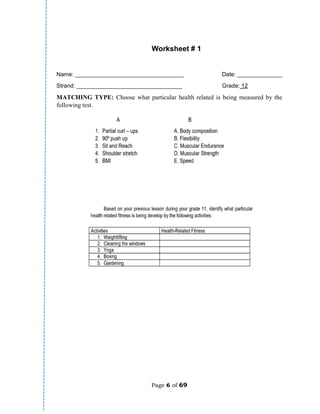
MATCHING TYPE: Choose what particular health related is being measured by the
following test.
Page 7 of 69
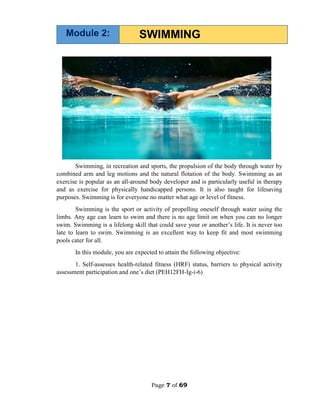
Swimming, in recreation and sports, the propulsion of the body through water by
combined arm and leg motions and the natural flotation of the body. Swimming as an
exercise is popular as an all-around body developer and is particularly useful in therapy
and as exercise for physically handicapped persons. It is also taught for lifesaving
purposes. Swimming is for everyone no matter what age or level of fitness.
Swimming is the sport or activity of propelling oneself through water using the
limbs. Any age can learn to swim and there is no age limit on when you can no longer
swim. Swimming is a lifelong skill that could save your or another’s life. It is never too
late to learn to swim. Swimming is an excellent way to keep fit and most swimming
pools cater for all.
In this module, you are expected to attain the following objective:
1. Self-assesses health-related fitness (HRF) status, barriers to physical activity
assessment participation and one’s diet (PEH12FH-Ig-i-6)
SWIMMING
Module 2:
Page 8 of 69
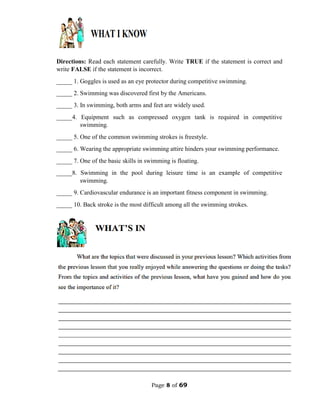
Directions: Read each statement carefully. Write TRUE if the statement is correct and
write FALSE if the statement is incorrect.
_____ 1. Goggles is used as an eye protector during competitive swimming.
_____ 2. Swimming was discovered first by the Americans.
_____ 3. In swimming, both arms and feet are widely used.
_____4. Equipment such as compressed oxygen tank is required in competitive
swimming.
_____ 5. One of the common swimming strokes is freestyle.
_____ 6. Wearing the appropriate swimming attire hinders your swimming performance.
_____ 7. One of the basic skills in swimming is floating.
_____8. Swimming in the pool during leisure time is an example of competitive
swimming.
_____ 9. Cardiovascular endurance is an important fitness component in swimming.
_____ 10. Back stroke is the most difficult among all the swimming strokes.
Page 9 of 69
One of the most popular water sports is swimming. Swimming has been around
for centuries. It has evolved to become one of the most common recreational activities as
well. Swimming is a sport that tests your fitness and stamina.
Swimming is a great recreational activity for people of all ages. Recreational
activity means any outdoor activity under- taken for the purpose of exercise, relaxation or
pleasure, including practice or instruction in any such activity. Recreational swimming
can provide you with a low-impact workout and it’s also a good way to relax and feel
good. Common swimming styles in recreational swimming are breaststroke, backstroke,
side stroke and freestyle.
COMPETITIVE SWIMMING AND RECREATIONAL SWIMMING
COMPETITIVE SWIMMING Competitive swimming is an activity which involves
swimming as its primary mechanism in competing which can either be individual or team
based.
Example: World Championships, Olympics
RECREATIONAL SWIMMING Recreational swimming occurs when learning
swimming and water safety is the main objective of the activity. Recreational swimming
is often less structured than sessions designed to teach swimming and water safety, and
may occur in a wider than usual range of environments.
Example: Swimming in the pool (learning the basics of swimming)
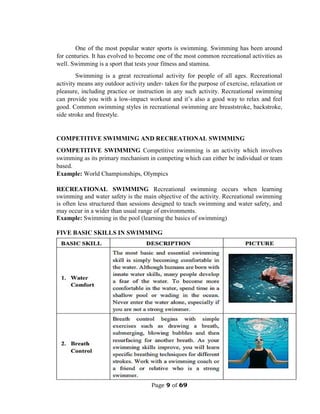
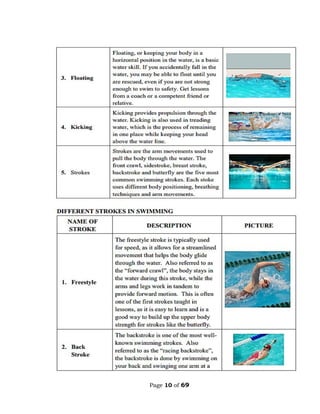
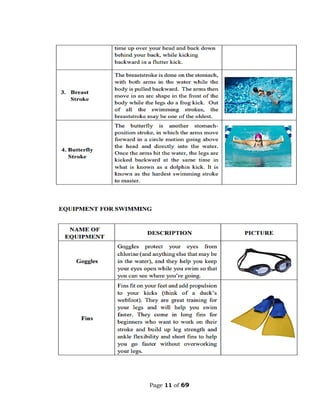
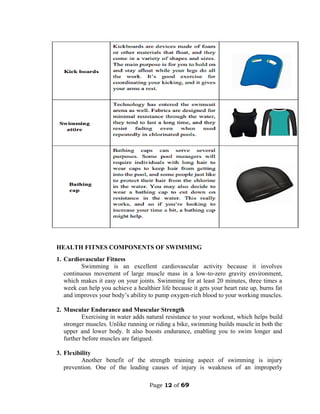
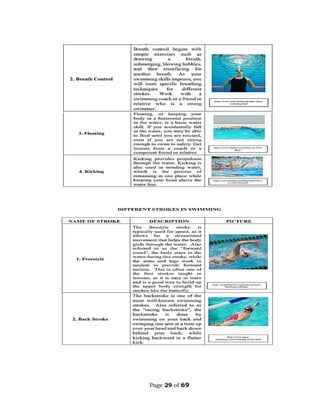
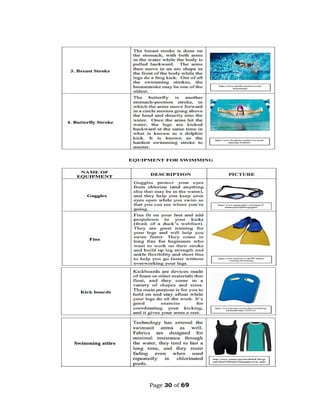
FIVE BASIC SKILLS IN SWIMMING
Page 10 of 69
Page 11 of 69
Page 12 of 69
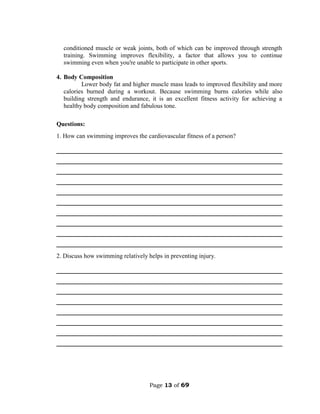
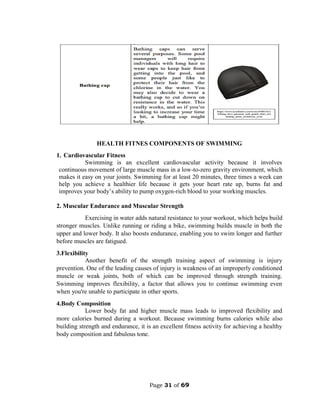
HEALTH FITNES COMPONENTS OF SWIMMING
1. Cardiovascular Fitness
Swimming is an excellent cardiovascular activity because it involves
continuous movement of large muscle mass in a low-to-zero gravity environment,
which makes it easy on your joints. Swimming for at least 20 minutes, three times a
week can help you achieve a healthier life because it gets your heart rate up, burns fat
and improves your body’s ability to pump oxygen-rich blood to your working muscles.
2. Muscular Endurance and Muscular Strength
Exercising in water adds natural resistance to your workout, which helps build
stronger muscles. Unlike running or riding a bike, swimming builds muscle in both the
upper and lower body. It also boosts endurance, enabling you to swim longer and
further before muscles are fatigued.
3. Flexibility
Another benefit of the strength training aspect of swimming is injury
prevention. One of the leading causes of injury is weakness of an improperly
Page 13 of 69
conditioned muscle or weak joints, both of which can be improved through strength
training. Swimming improves flexibility, a factor that allows you to continue
swimming even when you're unable to participate in other sports.
4. Body Composition
Lower body fat and higher muscle mass leads to improved flexibility and more
calories burned during a workout. Because swimming burns calories while also
building strength and endurance, it is an excellent fitness activity for achieving a
healthy body composition and fabulous tone.
Questions:
1. How can swimming improves the cardiovascular fitness of a person?
______________________________________________________
______________________________________________________
______________________________________________________
______________________________________________________
______________________________________________________
______________________________________________________
______________________________________________________
______________________________________________________
______________________________________________________
______________________________________________________
2. Discuss how swimming relatively helps in preventing injury.
______________________________________________________
______________________________________________________
______________________________________________________
______________________________________________________
______________________________________________________
______________________________________________________
______________________________________________________
______________________________________________________
Page 14 of 69
Worksheet # 2
Name: __________________________________ Date: ______________
Strand: _________________________________ Grade: 12
Modified True or False. Read the statements carefully. Write TRUE if the statement is
correct. Write FALSE if the statement is incorrect and underline
_____1. Kickboards are devices made of foam or other materials that float, and they
come in a variety of shapes and sizes.
_____ 2. Strokes are the arm movements used to pull the body through the water.
_____ 3. Learning swimming and water safety is the main objective of the activity of
competitive swimming.
_____ 4. The breast stroke is typically used for speed, as it allows for a streamlined
movement that helps the body glide through the water.
_____ 5. Exercising in water adds natural resistance to your workout, which helps build
stronger muscles. This statement supports the body composition fitness
component.
_____ 6. Floating provides propulsion through the water. It is also used in treading water.
_____ 7. Swimming is an excellent cardiovascular activity because it involves continuous
movement of large muscle mass
_____ 8. Goggles, fins and bathing cap are all examples of swimming strokes.
_____ 9. The most basic and essential swimming skill is simply becoming comfortable in
the water.
_____ 10. The butterfly stroke is done in the stomach, with both arms in the water while
the body is pulled backward.
Page 15 of 69
Health Optimizing Physical
Education
Senior High School
3
Page 16 of 69
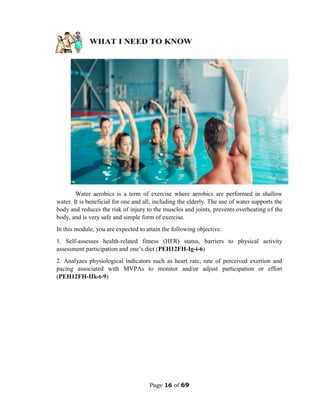
Water aerobics is a term of exercise where aerobics are performed in shallow
water. It is beneficial for one and all, including the elderly. The use of water supports the
body and reduces the risk of injury to the muscles and joints, prevents overheating of the
body, and is very safe and simple form of exercise.
In this module, you are expected to attain the following objective:
1. Self-assesses health-related fitness (HFR) status, barriers to physical activity
assessment participation and one’s diet (PEH12FH-Ig-i-6)
2. Analyzes physiological indicators such as heart rate, rate of perceived exertion and
pacing associated with MVPAs to monitor and/or adjust participation or effort
(PEH12FH-IIk-t-9)
Page 17 of 69
Directions: Read each statement carefully. Write FACT if the statement is correct and
write BLUFF if the statement is incorrect.
______________ 1. Water aerobics is a method of resistance training.
______________ 2. Water aerobics is an activity intended for an elder group only.
______________3. Only those who can swim can participate in the water aerobics
activity.
______________ 4. Water aerobics is a muscle resistance training which challenges your
muscles.
______________ 5. The heart rate is the number of your heart beats per minute.
______________ 6. The water’s buoyancy supports your body weight.
______________ 7. One of the basic skills in swimming is floating.
______________ 8. Heart rate and rate of perceived exertion are called psychological
indicators.
______________ 9. Participating in water exercises does not contribute in developing our
heart.
______________ 10. Only those who knows how to float can participate in water
aerobics.
Recall the previous lesson HOPE 4. Write down some learnings that you gained from the
last lesson and include also the activities that you were most interested about from the
previous lesson.
________________________________________________________________________
________________________________________________________________________
________________________________________________________________________
________________________________________________________________________
________________________________________________________________________
________________________________________________________________________
________________________________________________________________________
________________________________________________________________________
________________________________________________________________________
________________________________________________________________________
________________________________________________________________________
Page 18 of 69
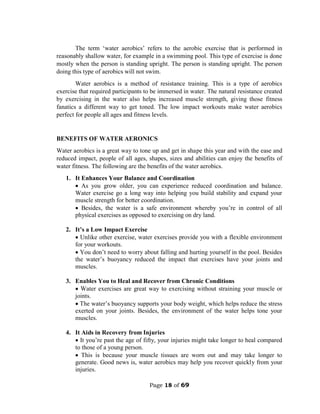
The term ‘water aerobics’ refers to the aerobic exercise that is performed in
reasonably shallow water, for example in a swimming pool. This type of exercise is done
mostly when the person is standing upright. The person is standing upright. The person
doing this type of aerobics will not swim.
Water aerobics is a method of resistance training. This is a type of aerobics
exercise that required participants to be immersed in water. The natural resistance created
by exercising in the water also helps increased muscle strength, giving those fitness
fanatics a different way to get toned. The low impact workouts make water aerobics
perfect for people all ages and fitness levels.
BENEFITS OF WATER AERONICS
Water aerobics is a great way to tone up and get in shape this year and with the ease and
reduced impact, people of all ages, shapes, sizes and abilities can enjoy the benefits of
water fitness. The following are the benefits of the water aerobics.
1. It Enhances Your Balance and Coordination
 As you grow older, you can experience reduced coordination and balance.
Water exercise go a long way into helping you build stability and expand your
muscle strength for better coordination.
 Besides, the water is a safe environment whereby you’re in control of all
physical exercises as opposed to exercising on dry land.
2. It’s a Low Impact Exercise
 Unlike other exercise, water exercises provide you with a flexible environment
for your workouts.
 You don’t need to worry about falling and hurting yourself in the pool. Besides
the water’s buoyancy reduced the impact that exercises have your joints and
muscles.
3. Enables You to Heal and Recover from Chronic Conditions
 Water exercises are great way to exercising without straining your muscle or
joints.
 The water’s buoyancy supports your body weight, which helps reduce the stress
exerted on your joints. Besides, the environment of the water helps tone your
muscles.
4. It Aids in Recovery from Injuries
 It you’re past the age of fifty, your injuries might take longer to heal compared
to those of a young person.
 This is because your muscle tissues are worn out and may take longer to
generate. Good news is, water aerobics may help you recover quickly from your
injuries.
Page 19 of 69
5. Helps you build Physical Endurance
 Water aerobics is unique way of building your physical endurance. Water
aerobics is a muscle resistance training which challenges your muscles.
 As you continue challenging your muscles, they become stronger. As you build
your physical endurance, your heart, your lungs, and other body muscles become
stronger.
HEALTH COMPONENTS OF WATER AEROBICS
1. Cardiovascular Endurance
 Regular participation in water exercises can help improve the health of your
heart.
 The water’s pressure in the pool helps in blood circulation. This reduces your
blood pressure, which puts less strain on your heart as it pumps blood. With time,
you gain cardiovascular strength.
2. Flexibility
 One of the main benefits of water aerobics is gaining overall flexibility.
 Water adds resistance to the movement you make. Your joints and body parts
are pulled and pushed in directions they aren’t used to. With time you get used to
this, and this increases your flexibility both in dry land and in water.
3. Body Composition
 Water exercise can help you burn 500 to 1000 calories per hour. When you
swim or do water exercises in cold water, your body burns more calories to keep
you warm.
 The more calories you burn; the more weight you lose. Besides, the water
massages your muscles in a way that helps tone them.
Page 20 of 69
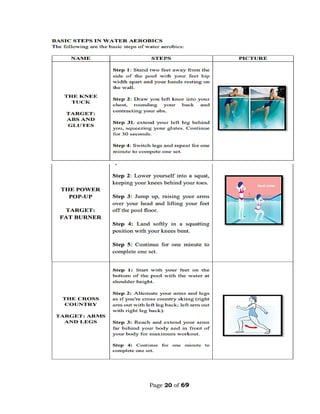
Page 21 of 69
PHYSIOLOGICAL INDICATORS
In physical activity participation, it is also important that we should monitor our
physiological indicators. Physiological indicators are those signs that are physiologic in
nature or have to do with bodily processes. These include heart and rate of perceived
exertion. Each of these physiological indicators is important.
HEART RATE
Heart rate, also known as pulse rate, this is the number of times a person’s heart
beats per minute. It indicates the effort your heart is doing based on the demands you
place on your body. The more demanding your physical activity means that the heart rate
is faster.
To determine your pulse rate, locate your pulse using your index and middle
fingers. Press gently to feel the pulse. Count the number of beats in 10 seconds and
multiply by 6 to get your number of beats per minute. The 15 second count is also used
by the multiplied by 4 to get the number of beats per minute. The normal heart rate of a
person ranges from 60 to 100 beats per minute (bpm).
Example:
Marissa counted her heart beat following the 15 seconds method, Marissa’s heart
beats for 15 seconds is 23. So:
23 x 4 = 92 beats per minute
Therefore, Marissa’s heart rate is 92 beats per minute (bpm)
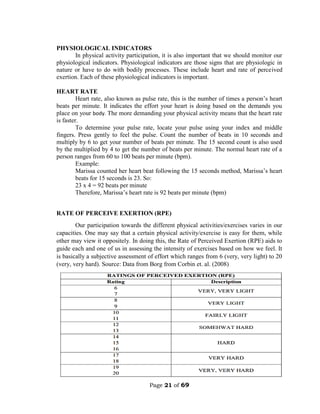
RATE OF PERCEIVE EXERTION (RPE)
Our participation towards the different physical activities/exercises varies in our
capacities. One may say that a certain physical activity/exercise is easy for them, while
other may view it oppositely. In doing this, the Rate of Perceived Exertion (RPE) aids to
guide each and one of us in assessing the intensity of exercises based on how we feel. It
is basically a subjective assessment of effort which ranges from 6 (very, very light) to 20
(very, very hard). Source: Data from Borg from Corbin et. al. (2008)
Page 22 of 69
QUESTIONS:
1. In your own opinion, what is the importance of self-assessing your exertion before
engaging to any physical activities/exercises?
__________________________________________________________________
__________________________________________________________________
__________________________________________________________________
__________________________________________________________________
__________________________________________________________________
__________________________________________________________________
__________________________________________________________________
__________________________________________________________________
__________________________________________________________________
__________________________________________________________________
__________________________________________________________________
2. If you were asked to perform a 10-minute aerobics, what will be your self-assessment
to your exertion on the said activity? Justify your answer.
________________________________________________________
________________________________________________________
________________________________________________________
________________________________________________________
________________________________________________________
________________________________________________________
________________________________________________________
________________________________________________________
Page 23 of 69
WORKSHEET # 3
Name: __________________________________ Date: ___________
Strand: _________________________________ Grade 12
Assessment
DIRECTIONS: Modified True or False. Read the statements carefully. Write TRUE
if the underline word/underline number from the statement is correct. If the underline
word/underline number from the statement is incorrect, write the correct word to
make the statement correct.
_______________1. As we grow older, you can experience reduced coordination and
balance.
_______________2. Water aerobics is a method of resistance training.
_______________3. Unlike other exercise, water exercises provide you with flexible
environment for workouts.
_______________4. Water exercises can help you burn 500 to 800 calories per hour.
_______________5. Regular participation in water exercise can help improve the
health of your heart. This statement supports the cardiovascular
endurance fitness component.
________________6. The cross-country step of water aerobics targets the abdominal
and glutes.
________________7. The water’s volume reduced the impact that exercises have on
your joints and muscles.
________________8. The high impact workouts make water aerobics perfect for
people all ages and fairness levels.
________________9. Water adds resistance to the movement you make. Your joints
and body parts are pulled and pushed in direction they aren’t
used to. This statement supports the flexibility.
________________10. The rate of perceived exertion is subjective assessment of
your effort in engaging to any physical activities/exercises.
Page 24 of 69
Health Optimizing Physical
Education
4
1
1
1
Senior High School
Page 25 of 69
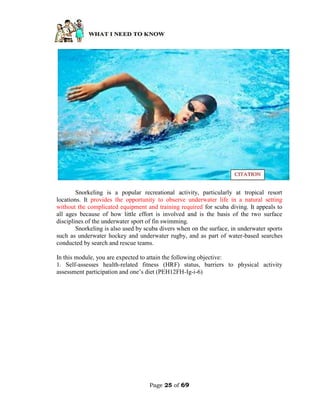
Snorkeling is a popular recreational activity, particularly at tropical resort
locations. It provides the opportunity to observe underwater life in a natural setting
without the complicated equipment and training required for scuba diving. It appeals to
all ages because of how little effort is involved and is the basis of the two surface
disciplines of the underwater sport of fin swimming.
Snorkeling is also used by scuba divers when on the surface, in underwater sports
such as underwater hockey and underwater rugby, and as part of water-based searches
conducted by search and rescue teams.
In this module, you are expected to attain the following objective:
1. Self-assesses health-related fitness (HRF) status, barriers to physical activity
assessment participation and one’s diet (PEH12FH-Ig-i-6)
Page 26 of 69
What are the topics that were discussed in your previous lesson? Which activities
from the previous lesson that you really enjoyed while answering the questions or doing
the tasks? From the topics and activities of the previous lesson, what have you gained and
how do you see the importance of it?
________________________________________________________________________
________________________________________________________________________
________________________________________________________________________
________________________________________________________________________
________________________________________________________________________
________________________________________________________________________
________________________________________________________________________
________________________________________________________________________
________________________________________________________________________
Page 27 of 69
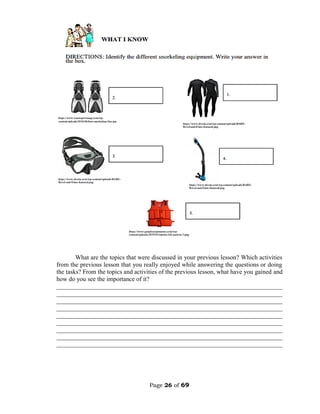
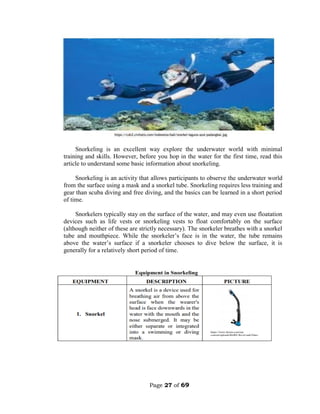
Snorkeling is an excellent way explore the underwater world with minimal
training and skills. However, before you hop in the water for the first time, read this
article to understand some basic information about snorkeling.
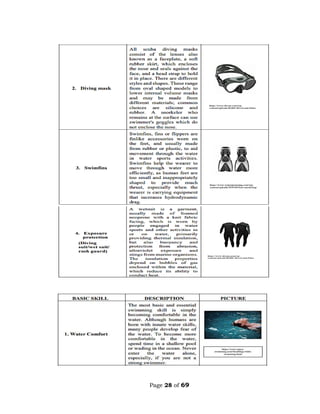
Snorkeling is an activity that allows participants to observe the underwater world
from the surface using a mask and a snorkel tube. Snorkeling requires less training and
gear than scuba diving and free diving, and the basics can be learned in a short period
of time.
Snorkelers typically stay on the surface of the water, and may even use floatation
devices such as life vests or snorkeling vests to float comfortably on the surface
(although neither of these are strictly necessary). The snorkeler breathes with a snorkel
tube and mouthpiece. While the snorkeler’s face is in the water, the tube remains
above the water’s surface if a snorkeler chooses to dive below the surface, it is
generally for a relatively short period of time.
Page 28 of 69
Page 29 of 69
Page 30 of 69
Page 31 of 69
HEALTH FITNES COMPONENTS OF SWIMMING
1. Cardiovascular Fitness
Swimming is an excellent cardiovascular activity because it involves
continuous movement of large muscle mass in a low-to-zero gravity environment, which
makes it easy on your joints. Swimming for at least 20 minutes, three times a week can
help you achieve a healthier life because it gets your heart rate up, burns fat and
improves your body’s ability to pump oxygen-rich blood to your working muscles.
2. Muscular Endurance and Muscular Strength
Exercising in water adds natural resistance to your workout, which helps build
stronger muscles. Unlike running or riding a bike, swimming builds muscle in both the
upper and lower body. It also boosts endurance, enabling you to swim longer and further
before muscles are fatigued.
3.Flexibility
Another benefit of the strength training aspect of swimming is injury
prevention. One of the leading causes of injury is weakness of an improperly conditioned
muscle or weak joints, both of which can be improved through strength training.
Swimming improves flexibility, a factor that allows you to continue swimming even
when you're unable to participate in other sports.
4.Body Composition
Lower body fat and higher muscle mass leads to improved flexibility and
more calories burned during a workout. Because swimming burns calories while also
building strength and endurance, it is an excellent fitness activity for achieving a healthy
body composition and fabulous tone.
Page 32 of 69
1. How can swimming improves the cardiovascular fitness of a person?
__________________________________________________________________
__________________________________________________________________
__________________________________________________________________
__________________________________________________________________
__________________________________________________________________
2. Discuss how swimming relatively helps in preventing injury.
__________________________________________________________________
__________________________________________________________________
__________________________________________________________________
__________________________________________________________________
__________________________________________________________________
Page 33 of 69
WORKSHEET # 4
Name: __________________________________ Date: ___________
Strand: _________________________________ Grade 12
DIRECTIONS: Modified True or False. Read the statements carefully. Write TRUE if
the statement is correct. Write FALSE if the statement is incorrect and underline the
word or phrase which made the statement incorrect.
___________1. Kickboards are devices made of foam or other materials that float, and
they come in a variety of shapes and sizes.
___________2. Strokes are the arm movements used to pull the body through the water.
___________3. Learning swimming and water safety is the main objective of the activity
of competitive swimming.
___________4. The breast stroke is typically used for speed, as it allows for a
streamlined movement that helps the body glide through the water.
___________5. Exercising in water adds natural resistance to your workout, which helps
build stronger muscles. This statement supports the body composition fitness component.
___________6. Floating provides propulsion through the water. It is also used in treading
water.
___________7. Swimming is an excellent cardiovascular activity because it involves
continuous movement of large muscle mass.
___________8. Goggles, fins, and bathing cap are all examples of swimming strokes.
___________9. The most basic and essential swimming skill is simply becoming
comfortable in the water.
___________10. The butterfly stroke is done on the stomach, with both arms in the water
while the body is pulled backward.
Page 34 of 69
Health Optimizing Physical
Education
Senior High School
Page 35 of 69
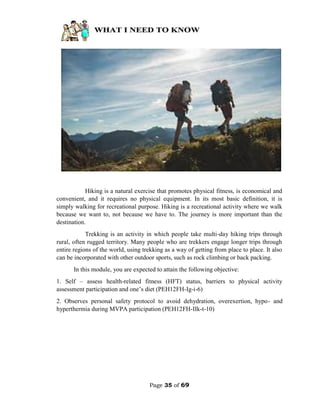
Hiking is a natural exercise that promotes physical fitness, is economical and
convenient, and it requires no physical equipment. In its most basic definition, it is
simply walking for recreational purpose. Hiking is a recreational activity where we walk
because we want to, not because we have to. The journey is more important than the
destination.
Trekking is an activity in which people take multi-day hiking trips through
rural, often rugged territory. Many people who are trekkers engage longer trips through
entire regions of the world, using trekking as a way of getting from place to place. It also
can be incorporated with other outdoor sports, such as rock climbing or back packing.
In this module, you are expected to attain the following objective:
1. Self – assess health-related fitness (HFT) status, barriers to physical activity
assessment participation and one’s diet (PEH12FH-Ig-i-6)
2. Observes personal safety protocol to avoid dehydration, overexertion, hypo- and
hyperthermia during MVPA participation (PEH12FH-IIk-t-10)
Page 36 of 69
Page 37 of 69
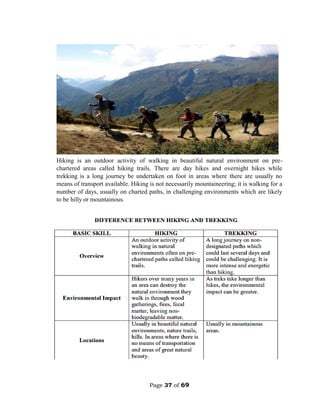
Hiking is an outdoor activity of walking in beautiful natural environment on pre-
chartered areas called hiking trails. There are day hikes and overnight hikes while
trekking is a long journey be undertaken on foot in areas where there are usually no
means of transport available. Hiking is not necessarily mountaineering; it is walking for a
number of days, usually on charted paths, in challenging environments which are likely
to be hilly or mountainous.
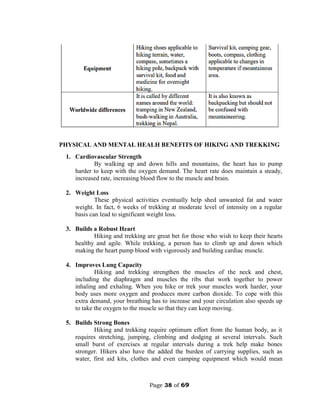
Page 38 of 69
PHYSICAL AND MENTAL HEALH BENEFITS OF HIKING AND TREKKING
1. Cardiovascular Strength
By walking up and down hills and mountains, the heart has to pump
harder to keep with the oxygen demand. The heart rate does maintain a steady,
increased rate, increasing blood flow to the muscle and brain.
2. Weight Loss
These physical activities eventually help shed unwanted fat and water
weight. In fact, 6 weeks of trekking at moderate level of intensity on a regular
basis can lead to significant weight loss.
3. Builds a Robust Heart
Hiking and trekking are great bet for those who wish to keep their hearts
healthy and agile. While trekking, a person has to climb up and down which
making the heart pump blood with vigorously and building cardiac muscle.
4. Improves Lung Capacity
Hiking and trekking strengthen the muscles of the neck and chest,
including the diaphragm and muscles the ribs that work together to power
inhaling and exhaling. When you hike or trek your muscles work harder, your
body uses more oxygen and produces more carbon dioxide. To cope with this
extra demand, your breathing has to increase and your circulation also speeds up
to take the oxygen to the muscle so that they can keep moving.
5. Builds Strong Bones
Hiking and trekking require optimum effort from the human body, as it
requires stretching, jumping, climbing and dodging at several intervals. Such
small burst of exercises at regular intervals during a trek help make bones
stronger. Hikers also have the added the burden of carrying supplies, such as
water, first aid kits, clothes and even camping equipment which would mean
Page 39 of 69
added weight on the shoulders and spine. If carried properly, this weight training
can help add on bone density thereby achieving overall fitness.
6. Agile Muscles
The one thing that a trekker would surely achieve while on a trekking tour
is excellent muscle strength. The energy and strain that a trekker requires while on
a trekking tour would undoubtedly lead to exercising of each and every muscle in
the body, from the core abdominal muscles to the quads and calves, thus making
body flexible and muscle agile.
7. Mental Health Benefits
Hiking and trekking often require the hikers be focused on their activity.
To do that, the hikers must clear his thoughts and prepare his mind to face
topographical challenges.
It is a great way to reduce the stress in your life, because of the release of
endorphins, which are known to make us happy. Breathing in fresh air as well as
seeing nature around while trekking is a great way to improve mental health,
memory and functionality of the brain. It can also give you a better appreciation
of the world and a sense of calmness and joy.
1. Which do you think is more physically and mentally challenging, hiking or
trekking? Why?
__________________________________________________________________
__________________________________________________________________
2. Discuss how hiking and trekking improves cardiovascular strength.
__________________________________________________________________
__________________________________________________________________
3. Discuss the effect of hiking and trekking in improving lung capacity.
__________________________________________________________________
__________________________________________________________________
4. Explain the importance of hiking and trekking in gaining muscular strength and
endurance.
__________________________________________________________________
__________________________________________________________________
5. Discuss the mental health benefits of hiking and trekking.
__________________________________________________________________
__________________________________________________________________
Page 40 of 69
Hiking and trekking can be hazardous because of terrain, inclement weather, becoming
lost or preexisting medical conditions the dangerous circumstances hikers can face
include specific accidents or physical ailments. Potential hazards involving physical
ailments may include the following:
1. Dehydration – occurs when you use or lose more fluid than you take in, and your
body doesn’t have enough water and other fluids to carry out its normal function.
2. Frostbite – an injury caused by freezing of the skin and underlying tissues. The
skin becomes cold and red, then numb hard and pale.
3. Hypothermia – a medical emergency that occurs when your body loses heat faster
than it can produce heat, causing a dangerously low body temperature. Normal
body temperature is around 98.6 F (37 C).
4. Sunburn – the term for red, sometimes swollen, and painful skin caused by
overexposure to ultraviolet (UV) rays from the sun.
5. Heat stroke – a condition caused by your body overheating, usually as a result of
prolonged exposure to or over exertion in high temperatures.
6. Diarrhea – loose, watery and possibly more frequent bowel movements.
SOME SAFETY PRECAUTIONARY MEASURES IN HIKING AND TREKKING:
1. Hike with a “buddy” when at all possible. If you choose to hike alone, make sure
someone knows where you are headed and when you should be expected back.
2. Avoid venturing off the beaten path. Staying on marked trails is important,
regardless of how familiar with the area.
3. Stay hydrated and bring drinking water.
4. Know where you are going ahead of time. Check out the trail you plan to hike
ahead of time to know what you are getting into.
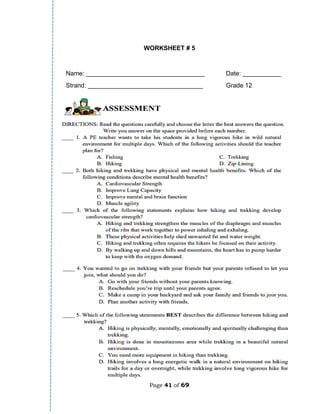
5. Wear your PPE. Dress appropriately for the weather and specific hiking area.
Page 41 of 69
WORKSHEET # 5
Name: __________________________________ Date: ___________
Strand: _________________________________ Grade 12
Page 42 of 69
Health Optimizing Physical
Education
Senior High School
Page 43 of 69
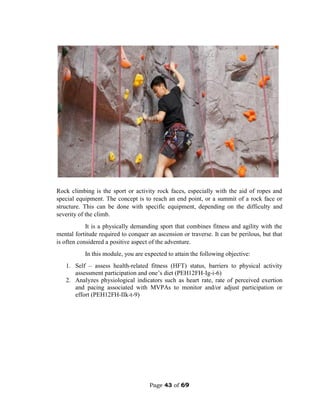
Rock climbing is the sport or activity rock faces, especially with the aid of ropes and
special equipment. The concept is to reach an end point, or a summit of a rock face or
structure. This can be done with specific equipment, depending on the difficulty and
severity of the climb.
It is a physically demanding sport that combines fitness and agility with the
mental fortitude required to conquer an ascension or traverse. It can be perilous, but that
is often considered a positive aspect of the adventure.
In this module, you are expected to attain the following objective:
1. Self – assess health-related fitness (HFT) status, barriers to physical activity
assessment participation and one’s diet (PEH12FH-Ig-i-6)
2. Analyzes physiological indicators such as heart rate, rate of perceived exertion
and pacing associated with MVPAs to monitor and/or adjust participation or
effort (PEH12FH-IIk-t-9)
Page 44 of 69
Page 45 of 69
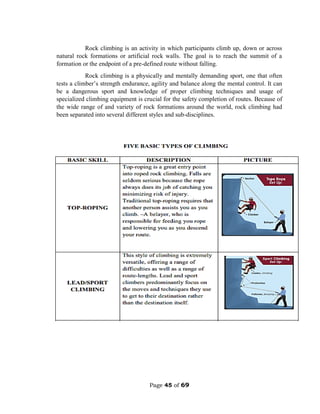
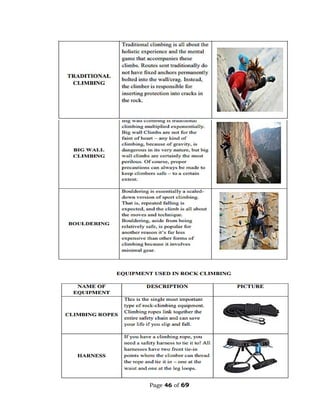
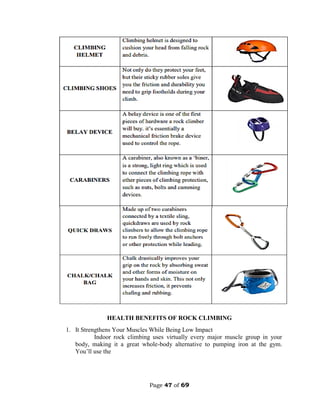
Rock climbing is an activity in which participants climb up, down or across
natural rock formations or artificial rock walls. The goal is to reach the summit of a
formation or the endpoint of a pre-defined route without falling.
Rock climbing is a physically and mentally demanding sport, one that often
tests a climber’s strength endurance, agility and balance along the mental control. It can
be a dangerous sport and knowledge of proper climbing techniques and usage of
specialized climbing equipment is crucial for the safety completion of routes. Because of
the wide range of and variety of rock formations around the world, rock climbing had
been separated into several different styles and sub-disciplines.
Page 46 of 69
Page 47 of 69
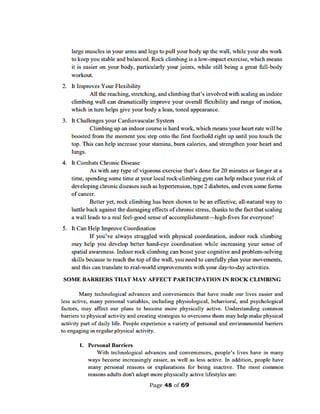
HEALTH BENEFITS OF ROCK CLIMBING
1. It Strengthens Your Muscles While Being Low Impact
Indoor rock climbing uses virtually every major muscle group in your
body, making it a great whole-body alternative to pumping iron at the gym.
You’ll use the
Page 48 of 69
Page 49 of 69
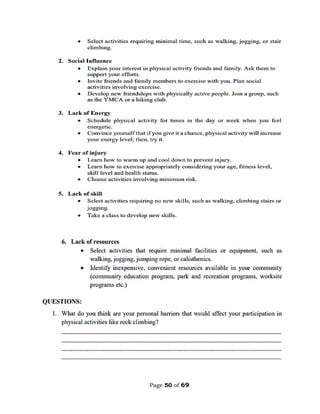
Page 50 of 69
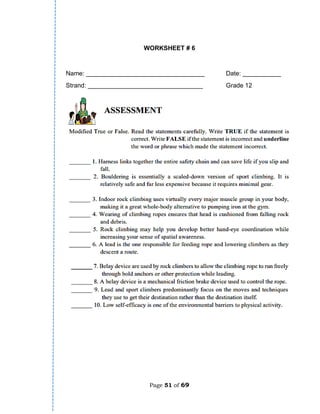
Page 51 of 69
WORKSHEET # 6
Name: __________________________________ Date: ___________
Strand: _________________________________ Grade 12
Page 52 of 69
Health Optimizing Physical
Education
Senior High School
Page 53 of 69
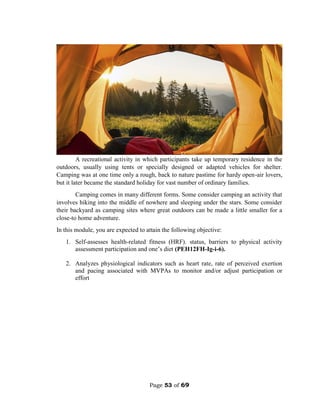
A recreational activity in which participants take up temporary residence in the
outdoors, usually using tents or specially designed or adapted vehicles for shelter.
Camping was at one time only a rough, back to nature pastime for hardy open-air lovers,
but it later became the standard holiday for vast number of ordinary families.
Camping comes in many different forms. Some consider camping an activity that
involves hiking into the middle of nowhere and sleeping under the stars. Some consider
their backyard as camping sites where great outdoors can be made a little smaller for a
close-to home adventure.
In this module, you are expected to attain the following objective:
1. Self-assesses health-related fitness (HRF). status, barriers to physical activity
assessment participation and one’s diet (PEH12FH-Ig-i-6).
2. Analyzes physiological indicators such as heart rate, rate of perceived exertion
and pacing associated with MVPAs to monitor and/or adjust participation or
effort
Page 54 of 69
Page 55 of 69
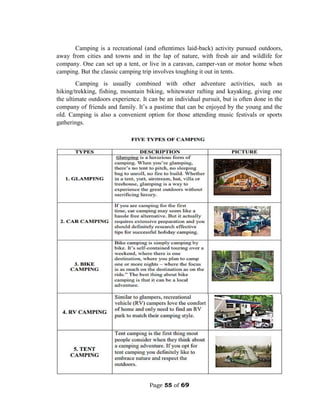
Camping is a recreational (and oftentimes laid-back) activity pursued outdoors,
away from cities and towns and in the lap of nature, with fresh air and wildlife for
company. One can set up a tent, or live in a caravan, camper-van or motor home when
camping. But the classic camping trip involves toughing it out in tents.
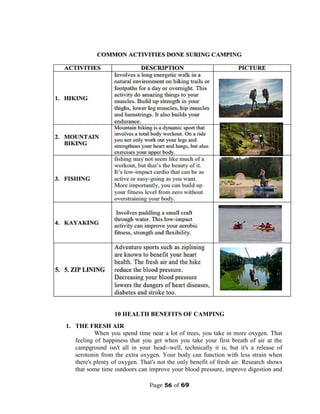
Camping is usually combined with other adventure activities, such as
hiking/trekking, fishing, mountain biking, whitewater rafting and kayaking, giving one
the ultimate outdoors experience. It can be an individual pursuit, but is often done in the
company of friends and family. It’s a pastime that can be enjoyed by the young and the
old. Camping is also a convenient option for those attending music festivals or sports
gatherings.
Page 56 of 69
10 HEALTH BENEFITS OF CAMPING
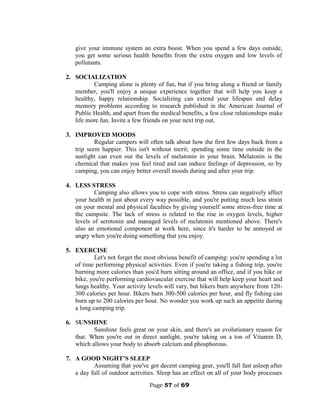
1. THE FRESH AIR
When you spend time near a lot of trees, you take in more oxygen. That
feeling of happiness that you get when you take your first breath of air at the
campground isn't all in your head--well, technically it is, but it's a release of
serotonin from the extra oxygen. Your body can function with less strain when
there's plenty of oxygen. That's not the only benefit of fresh air. Research shows
that some time outdoors can improve your blood pressure, improve digestion and
Page 57 of 69
give your immune system an extra boost. When you spend a few days outside,
you get some serious health benefits from the extra oxygen and low levels of
pollutants.
2. SOCIALIZATION
Camping alone is plenty of fun, but if you bring along a friend or family
member, you'll enjoy a unique experience together that will help you keep a
healthy, happy relationship. Socializing can extend your lifespan and delay
memory problems according to research published in the American Journal of
Public Health, and apart from the medical benefits, a few close relationships make
life more fun. Invite a few friends on your next trip out.
3. IMPROVED MOODS
Regular campers will often talk about how the first few days back from a
trip seem happier. This isn't without merit; spending some time outside in the
sunlight can even out the levels of melatonin in your brain. Melatonin is the
chemical that makes you feel tired and can induce feelings of depression, so by
camping, you can enjoy better overall moods during and after your trip.
4. LESS STRESS
Camping also allows you to cope with stress. Stress can negatively affect
your health in just about every way possible, and you're putting much less strain
on your mental and physical faculties by giving yourself some stress-free time at
the campsite. The lack of stress is related to the rise in oxygen levels, higher
levels of serotonin and managed levels of melatonin mentioned above. There's
also an emotional component at work here, since it's harder to be annoyed or
angry when you're doing something that you enjoy.
5. EXERCISE
Let's not forget the most obvious benefit of camping: you're spending a lot
of time performing physical activities. Even if you're taking a fishing trip, you're
burning more calories than you'd burn sitting around an office, and if you hike or
bike, you're performing cardiovascular exercise that will help keep your heart and
lungs healthy. Your activity levels will vary, but hikers burn anywhere from 120-
300 calories per hour. Bikers burn 300-500 calories per hour, and fly fishing can
burn up to 200 calories per hour. No wonder you work up such an appetite during
a long camping trip.
6. SUNSHINE
Sunshine feels great on your skin, and there's an evolutionary reason for
that. When you're out in direct sunlight, you're taking on a ton of Vitamin D,
which allows your body to absorb calcium and phosphorous.
7. A GOOD NIGHT’S SLEEP
Assuming that you've got decent camping gear, you'll fall fast asleep after
a day full of outdoor activities. Sleep has an effect on all of your body processes
Page 58 of 69
and can reduce inflammation, improve your cardiovascular system and help you
stay alert. Many campers report better sleep cycles when they return for a trip.
8. GOOD FOOD
If you pack s'mores, you're not seeing any particularly solid health benefits
in this department. However, if you're fond of fishing and hunting, you'll likely
eat a large amount of protein and healthy fats on your camping trip. You won't get
any preservatives or unnatural ingredients in a fresh lake-caught fish, and all of
the exercise on your trip will help you digest.
9. NEW CHALLENGES
No two camping trips are exactly the same, and that's a good thing.
Studies from the University of Texas and University of Michigan show that new
experiences help to keep brains healthy. New activities that are both physically
and intellectually stimulating have the greatest effect on brain health, and
camping fits both of these criteria.
10. MEDITATION
When you go camping, don't forget to turn off your cell phone. Leave the
tablet and the laptop computer at home. Try to disconnect for a few days and
enjoy the simplicity of the natural experience.
Page 59 of 69
WORKSHEET # 7
Name: __________________________________ Date: ___________
Strand: _________________________________ Grade 12
Multiple Choice: Read the questions carefully and choose the letter of the best answers
the question. Write your answer on the space provided before each number.
1. Alvin, a basketball coach took his athlete to a camping trip to improve their endurance.
Which of the following activities should the athletes do?
A. Fishing C. Kayaking
B. Hiking D. Zip-Lining
2. Which of the following instances shows how glampers cook their food?
A. roasting wild duck on top of a campfire
B. roasting chicken on instant pot
C. roasting potatoes underground
D. hanging chicken over a fire pit
3. How does camping reduced stress?
A. Camping offers a peaceful place to do your work.
B. Camping brings you close to nature.
C. Camping offers a lot of activities that make you forget work.
D. Camping puts less strain on your mental and physical facilities.
4. You wanted to go camping with your friends but your parents refused to let you join,
what should you do?
A. Go with your friends without your parents knowing.
B. Reschedule you’re trip until your parents agree.
C. Make a camp in your backyard and ask your family and friends to join you.
D. Plan another activity with friends.
5. How would you plan the activities you will do during a camping trip?
A. Choose common camping activities that are fun.
B. Choose fun activities that fits your physical capability.
C. Choose extreme activities you’ve never done before.
D. Choose activities your friends have chosen.
Page 60 of 69
Health Optimizing Physical
Education
Senior High School
Page 61 of 69
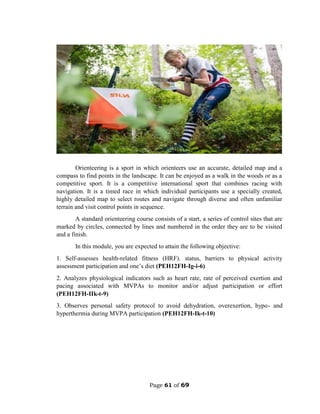
Orienteering is a sport in which orienteers use an accurate, detailed map and a
compass to find points in the landscape. It can be enjoyed as a walk in the woods or as a
competitive sport. It is a competitive international sport that combines racing with
navigation. It is a timed race in which individual participants use a specially created,
highly detailed map to select routes and navigate through diverse and often unfamiliar
terrain and visit control points in sequence.
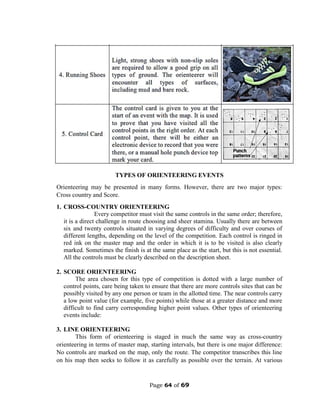
A standard orienteering course consists of a start, a series of control sites that are
marked by circles, connected by lines and numbered in the order they are to be visited
and a finish.
In this module, you are expected to attain the following objective:
1. Self-assesses health-related fitness (HRF). status, barriers to physical activity
assessment participation and one’s diet (PEH12FH-Ig-i-6)
2. Analyzes physiological indicators such as heart rate, rate of perceived exertion and
pacing associated with MVPAs to monitor and/or adjust participation or effort
(PEH12FH-IIk-t-9)
3. Observes personal safety protocol to avoid dehydration, overexertion, hypo- and
hyperthermia during MVPA participation (PEH12FH-Ik-t-10)
Page 62 of 69
Directions: Read each statement carefully. Write TRUE if the statement is correct and
write FALSE if the statement is incorrect.
________1. In orienteering, a map is used to search for correct navigation.
________2. The relay orienteering is the most popular team orienteering competition
wherein the number of legs in the relay depends on the number of persons on a team.
________3. The pair work is a method by which teams can work in group and it is up to
the leader to decide which members of the team should be sent to find which controls.
________4. In orienteering, abrasions, cuts, bruises, insect bites and sunburn are known
as running injuries
________5. There is a high chance that an inexperience orienteer can win a certain
orienteering event.
Page 63 of 69
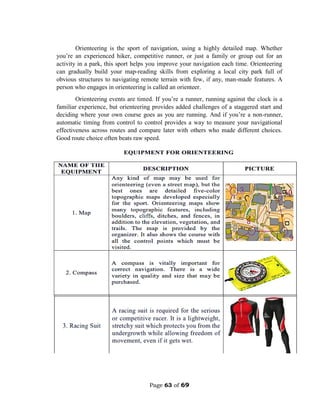
Orienteering is the sport of navigation, using a highly detailed map. Whether
you’re an experienced hiker, competitive runner, or just a family or group out for an
activity in a park, this sport helps you improve your navigation each time. Orienteering
can gradually build your map-reading skills from exploring a local city park full of
obvious structures to navigating remote terrain with few, if any, man-made features. A
person who engages in orienteering is called an orienteer.
Orienteering events are timed. If you’re a runner, running against the clock is a
familiar experience, but orienteering provides added challenges of a staggered start and
deciding where your own course goes as you are running. And if you’re a non-runner,
automatic timing from control to control provides a way to measure your navigational
effectiveness across routes and compare later with others who made different choices.
Good route choice often beats raw speed.
Page 64 of 69
TYPES OF ORIENTEERING EVENTS
Orienteering may be presented in many forms. However, there are two major types:
Cross country and Score.
1. CROSS-COUNTRY ORIENTEERING
Every competitor must visit the same controls in the same order; therefore,
it is a direct challenge in route choosing and sheer stamina. Usually there are between
six and twenty controls situated in varying degrees of difficulty and over courses of
different lengths, depending on the level of the competition. Each control is ringed in
red ink on the master map and the order in which it is to be visited is also clearly
marked. Sometimes the finish is at the same place as the start, but this is not essential.
All the controls must be clearly described on the description sheet.
2. SCORE ORIENTEERING
The area chosen for this type of competition is dotted with a large number of
control points, care being taken to ensure that there are more controls sites that can be
possibly visited by any one person or team in the allotted time. The near controls carry
a low point value (for example, five points) while those at a greater distance and more
difficult to find carry corresponding higher point values. Other types of orienteering
events include:
3. LINE ORIENTEERING
This form of orienteering is staged in much the same way as cross-country
orienteering in terms of master map, starting intervals, but there is one major difference:
No controls are marked on the map, only the route. The competitor transcribes this line
on his map then seeks to follow it as carefully as possible over the terrain. At various
Page 65 of 69
points along this line, hidden controls are sites, the location of which is known only the
organizer. The competitor will only find a control by following the line.
4. ROUTE ORIENTEERING
It is similar to line orienteering, only the route is marked by streamers in
the woods. The competitor will mark on their map the location of each control. A penalty
is given for distance from the correct locations.
5. RELAY ORIENTEERING
This is the most popular team competition. The number of legs in the relay
depends on the number of persons on a team.
Page 66 of 69
Page 67 of 69
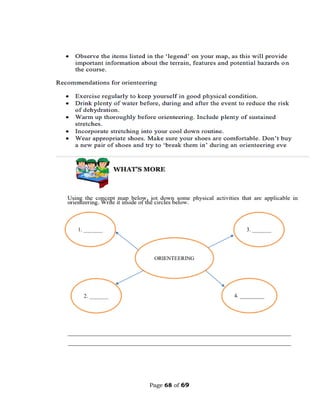
Page 68 of 69
Page 69 of 69
WORKSHEET # 8
Name: __________________________________ Date: ___________
Strand: _________________________________ Grade 12

Health Optimizing Physical Education 4 - 3RD QTR.pdf

  • 1.
    Page 1 of69 0 HOPE 4 Republic of the Philippines Department of Education Region IV-A CAVITE COMMUNITY ACADEMY INC. 12 Senior High School
  • 2.
    Page 2 of69 TABLE OF CONTENTS THIRD QUARTER LESSON 1: BODY COMPOSITION, MUSCULAR STRENGTH AND ENDURANCE, FLEXIBILITY (RECREATIONAL ACTIVITIES) Worksheet # 1 LESSON 2: SWIMMING . . . . . . . . . . . . . . . . . . . . . . . . . . . . . . . . . . . . . . . . . . Worksheet # 2 LESSON 3: WATER AEROBICS. . . . . . . . . . . . . . . . . . . . . . . . . . . . . . . . . . . . . Worksheet # 3 LESSON 4: SNORKLING . . . . . . . . . . . . . . . . . . . . . . . . . . . . . . . . . . . . . . . . . . Worksheet # 4 LESSON 5: HIKING AND TREKKING . . . . . . . . . . . . . . . . . . . . . . . . . . . . . . . Worksheet # 5 LESSON 6: ROCK CLIMBING . . . . . . . . . . . . . . . . . . . . . . . . . . . . . . . . . . . . . Worksheet # 6 LESSON 7: CAMPING . . . . . . . . . . . . . . . . . . . . . . . . . . . . . . . . . . . . . . . . . . . . Worksheet # 7 LESSON 8: ORIENTEERING . . . . . . . . . . . . . . . . . . . . . . . . . . . . . . . . . . . . . . . Worksheet # 8
  • 3.
    Page 3 of69 Body Composition, Muscular Strength and Endurance, Flexibility (Recreational Activities) Module 1:
  • 4.
    Page 4 of69 Recreational from term recreation, is an activity done for enjoyment when one is not working. Recreational means relating or denoting activity done for enjoyment during free time. It refers to the time spent in an activity one loves to engage in with intent to feel refreshed. Recreational activities help you to take a break from monotony and diversion from the daily routine. It gives people the benefit of a positive change from the stereo typical life style and involves an active participation in entertaining activities that a person is interested in. When a person is engaged in recreating activities that he or she likes, it would naturally give them enjoyment. Recreational activities provide source of joy and relaxation to one’s mind and body Health – related fitness is all about psychology, personal health and how activity influences us as person. This is important for anyone who wants to live a physically active lifestyle to support a higher quality of life. An individual requires a fine level of health – related fitness for a normal life style regardless of age, gender or sporting ability. One’s failure to sustain this could lessen his/her quality of life. Poor fitness on the other hand also controls the capability to perform daily activities like walking/ cycling to work, shopping and picking up children to school, or climbing the stairs at home. Fitness is a complex subject. In fact, there are many definition and explanation about it. Health – related fitness speaks about the components of fitness, which composed our health condition. Body composition, muscular strength and muscular endurance, flexibility and cardio – respiratory endurance are the components of health – related fitness. BODY COMPOSITION is the percentage of body fat and lean body tissue in an individual, Lean body tissue is composed of water, blood, skin, muscles and bone. From a health viewpoint, it is very significant to have a low level of body fat, BMI is an indicator of total body fat which is related to the risk of disease and death. Body Mass Index (BMI) refers to the measurement of one’s weight relative to his or her height. Researchers frequently use BMI in studies that examine health risk associated with body weight. BMI is useful in areas where there is no adequate equipment to measure body fat. It is also effective when use in large population survey Muscular Strength and Muscular Endurance Strength is also known as MUSCULAR STRENGTH. It is vital for everyone not just to athletes. Strength is the ability of a particular muscles or group of muscle to put forth force in a single maximal contraction to conquer other form of resistance. Relating to everyday life, this resistance is classified as an activity that involves a level of strength
  • 5.
    Page 5 of69 to perform such as picking up and carrying shopping bags from the supermarket. A good level of strength permits an individual to carry out daily activities concerning strength without feeling exhaustion or weariness. Unlike strength that involves the muscles performing one action, MUSCULAR ENDURANCE involves the muscle in building a number of continuous movements. Muscular endurance can be a specific muscle or group of muscle such as the biceps, making continual contractions over a considerable period, perhaps over a number of minutes. Muscular strength and endurance are advantages in the capability to carry out daily activities such as lifting, carrying, pushing and pulling without tension or unwarranted exhaustion. Picking up shopping bags from floor or reaching for something, needs good flexibility. FLEXIBILITY is capacity of a particular joints such as our knee, to move during a complete range of motion. A flexible body possesses a better variety of motion which should help in the performance of skills. Flexibility is the ability of the joints to move. Each joint (location where your bones join together) in your body is designed to move in a certain way. Flexibility is as important as aerobic endurance and must be specifically included during training.
  • 6.
    Page 6 of69 Worksheet # 1 Name: __________________________________ Date: ______________ Strand: _________________________________ Grade: 12 MATCHING TYPE: Choose what particular health related is being measured by the following test.
  • 7.
    Page 7 of69 Swimming, in recreation and sports, the propulsion of the body through water by combined arm and leg motions and the natural flotation of the body. Swimming as an exercise is popular as an all-around body developer and is particularly useful in therapy and as exercise for physically handicapped persons. It is also taught for lifesaving purposes. Swimming is for everyone no matter what age or level of fitness. Swimming is the sport or activity of propelling oneself through water using the limbs. Any age can learn to swim and there is no age limit on when you can no longer swim. Swimming is a lifelong skill that could save your or another’s life. It is never too late to learn to swim. Swimming is an excellent way to keep fit and most swimming pools cater for all. In this module, you are expected to attain the following objective: 1. Self-assesses health-related fitness (HRF) status, barriers to physical activity assessment participation and one’s diet (PEH12FH-Ig-i-6) SWIMMING Module 2:
  • 8.
    Page 8 of69 Directions: Read each statement carefully. Write TRUE if the statement is correct and write FALSE if the statement is incorrect. _____ 1. Goggles is used as an eye protector during competitive swimming. _____ 2. Swimming was discovered first by the Americans. _____ 3. In swimming, both arms and feet are widely used. _____4. Equipment such as compressed oxygen tank is required in competitive swimming. _____ 5. One of the common swimming strokes is freestyle. _____ 6. Wearing the appropriate swimming attire hinders your swimming performance. _____ 7. One of the basic skills in swimming is floating. _____8. Swimming in the pool during leisure time is an example of competitive swimming. _____ 9. Cardiovascular endurance is an important fitness component in swimming. _____ 10. Back stroke is the most difficult among all the swimming strokes.
  • 9.
    Page 9 of69 One of the most popular water sports is swimming. Swimming has been around for centuries. It has evolved to become one of the most common recreational activities as well. Swimming is a sport that tests your fitness and stamina. Swimming is a great recreational activity for people of all ages. Recreational activity means any outdoor activity under- taken for the purpose of exercise, relaxation or pleasure, including practice or instruction in any such activity. Recreational swimming can provide you with a low-impact workout and it’s also a good way to relax and feel good. Common swimming styles in recreational swimming are breaststroke, backstroke, side stroke and freestyle. COMPETITIVE SWIMMING AND RECREATIONAL SWIMMING COMPETITIVE SWIMMING Competitive swimming is an activity which involves swimming as its primary mechanism in competing which can either be individual or team based. Example: World Championships, Olympics RECREATIONAL SWIMMING Recreational swimming occurs when learning swimming and water safety is the main objective of the activity. Recreational swimming is often less structured than sessions designed to teach swimming and water safety, and may occur in a wider than usual range of environments. Example: Swimming in the pool (learning the basics of swimming) FIVE BASIC SKILLS IN SWIMMING
  • 10.
  • 11.
  • 12.
    Page 12 of69 HEALTH FITNES COMPONENTS OF SWIMMING 1. Cardiovascular Fitness Swimming is an excellent cardiovascular activity because it involves continuous movement of large muscle mass in a low-to-zero gravity environment, which makes it easy on your joints. Swimming for at least 20 minutes, three times a week can help you achieve a healthier life because it gets your heart rate up, burns fat and improves your body’s ability to pump oxygen-rich blood to your working muscles. 2. Muscular Endurance and Muscular Strength Exercising in water adds natural resistance to your workout, which helps build stronger muscles. Unlike running or riding a bike, swimming builds muscle in both the upper and lower body. It also boosts endurance, enabling you to swim longer and further before muscles are fatigued. 3. Flexibility Another benefit of the strength training aspect of swimming is injury prevention. One of the leading causes of injury is weakness of an improperly
  • 13.
    Page 13 of69 conditioned muscle or weak joints, both of which can be improved through strength training. Swimming improves flexibility, a factor that allows you to continue swimming even when you're unable to participate in other sports. 4. Body Composition Lower body fat and higher muscle mass leads to improved flexibility and more calories burned during a workout. Because swimming burns calories while also building strength and endurance, it is an excellent fitness activity for achieving a healthy body composition and fabulous tone. Questions: 1. How can swimming improves the cardiovascular fitness of a person? ______________________________________________________ ______________________________________________________ ______________________________________________________ ______________________________________________________ ______________________________________________________ ______________________________________________________ ______________________________________________________ ______________________________________________________ ______________________________________________________ ______________________________________________________ 2. Discuss how swimming relatively helps in preventing injury. ______________________________________________________ ______________________________________________________ ______________________________________________________ ______________________________________________________ ______________________________________________________ ______________________________________________________ ______________________________________________________ ______________________________________________________
  • 14.
    Page 14 of69 Worksheet # 2 Name: __________________________________ Date: ______________ Strand: _________________________________ Grade: 12 Modified True or False. Read the statements carefully. Write TRUE if the statement is correct. Write FALSE if the statement is incorrect and underline _____1. Kickboards are devices made of foam or other materials that float, and they come in a variety of shapes and sizes. _____ 2. Strokes are the arm movements used to pull the body through the water. _____ 3. Learning swimming and water safety is the main objective of the activity of competitive swimming. _____ 4. The breast stroke is typically used for speed, as it allows for a streamlined movement that helps the body glide through the water. _____ 5. Exercising in water adds natural resistance to your workout, which helps build stronger muscles. This statement supports the body composition fitness component. _____ 6. Floating provides propulsion through the water. It is also used in treading water. _____ 7. Swimming is an excellent cardiovascular activity because it involves continuous movement of large muscle mass _____ 8. Goggles, fins and bathing cap are all examples of swimming strokes. _____ 9. The most basic and essential swimming skill is simply becoming comfortable in the water. _____ 10. The butterfly stroke is done in the stomach, with both arms in the water while the body is pulled backward.
  • 15.
    Page 15 of69 Health Optimizing Physical Education Senior High School 3
  • 16.
    Page 16 of69 Water aerobics is a term of exercise where aerobics are performed in shallow water. It is beneficial for one and all, including the elderly. The use of water supports the body and reduces the risk of injury to the muscles and joints, prevents overheating of the body, and is very safe and simple form of exercise. In this module, you are expected to attain the following objective: 1. Self-assesses health-related fitness (HFR) status, barriers to physical activity assessment participation and one’s diet (PEH12FH-Ig-i-6) 2. Analyzes physiological indicators such as heart rate, rate of perceived exertion and pacing associated with MVPAs to monitor and/or adjust participation or effort (PEH12FH-IIk-t-9)
  • 17.
    Page 17 of69 Directions: Read each statement carefully. Write FACT if the statement is correct and write BLUFF if the statement is incorrect. ______________ 1. Water aerobics is a method of resistance training. ______________ 2. Water aerobics is an activity intended for an elder group only. ______________3. Only those who can swim can participate in the water aerobics activity. ______________ 4. Water aerobics is a muscle resistance training which challenges your muscles. ______________ 5. The heart rate is the number of your heart beats per minute. ______________ 6. The water’s buoyancy supports your body weight. ______________ 7. One of the basic skills in swimming is floating. ______________ 8. Heart rate and rate of perceived exertion are called psychological indicators. ______________ 9. Participating in water exercises does not contribute in developing our heart. ______________ 10. Only those who knows how to float can participate in water aerobics. Recall the previous lesson HOPE 4. Write down some learnings that you gained from the last lesson and include also the activities that you were most interested about from the previous lesson. ________________________________________________________________________ ________________________________________________________________________ ________________________________________________________________________ ________________________________________________________________________ ________________________________________________________________________ ________________________________________________________________________ ________________________________________________________________________ ________________________________________________________________________ ________________________________________________________________________ ________________________________________________________________________ ________________________________________________________________________
  • 18.
    Page 18 of69 The term ‘water aerobics’ refers to the aerobic exercise that is performed in reasonably shallow water, for example in a swimming pool. This type of exercise is done mostly when the person is standing upright. The person is standing upright. The person doing this type of aerobics will not swim. Water aerobics is a method of resistance training. This is a type of aerobics exercise that required participants to be immersed in water. The natural resistance created by exercising in the water also helps increased muscle strength, giving those fitness fanatics a different way to get toned. The low impact workouts make water aerobics perfect for people all ages and fitness levels. BENEFITS OF WATER AERONICS Water aerobics is a great way to tone up and get in shape this year and with the ease and reduced impact, people of all ages, shapes, sizes and abilities can enjoy the benefits of water fitness. The following are the benefits of the water aerobics. 1. It Enhances Your Balance and Coordination  As you grow older, you can experience reduced coordination and balance. Water exercise go a long way into helping you build stability and expand your muscle strength for better coordination.  Besides, the water is a safe environment whereby you’re in control of all physical exercises as opposed to exercising on dry land. 2. It’s a Low Impact Exercise  Unlike other exercise, water exercises provide you with a flexible environment for your workouts.  You don’t need to worry about falling and hurting yourself in the pool. Besides the water’s buoyancy reduced the impact that exercises have your joints and muscles. 3. Enables You to Heal and Recover from Chronic Conditions  Water exercises are great way to exercising without straining your muscle or joints.  The water’s buoyancy supports your body weight, which helps reduce the stress exerted on your joints. Besides, the environment of the water helps tone your muscles. 4. It Aids in Recovery from Injuries  It you’re past the age of fifty, your injuries might take longer to heal compared to those of a young person.  This is because your muscle tissues are worn out and may take longer to generate. Good news is, water aerobics may help you recover quickly from your injuries.
  • 19.
    Page 19 of69 5. Helps you build Physical Endurance  Water aerobics is unique way of building your physical endurance. Water aerobics is a muscle resistance training which challenges your muscles.  As you continue challenging your muscles, they become stronger. As you build your physical endurance, your heart, your lungs, and other body muscles become stronger. HEALTH COMPONENTS OF WATER AEROBICS 1. Cardiovascular Endurance  Regular participation in water exercises can help improve the health of your heart.  The water’s pressure in the pool helps in blood circulation. This reduces your blood pressure, which puts less strain on your heart as it pumps blood. With time, you gain cardiovascular strength. 2. Flexibility  One of the main benefits of water aerobics is gaining overall flexibility.  Water adds resistance to the movement you make. Your joints and body parts are pulled and pushed in directions they aren’t used to. With time you get used to this, and this increases your flexibility both in dry land and in water. 3. Body Composition  Water exercise can help you burn 500 to 1000 calories per hour. When you swim or do water exercises in cold water, your body burns more calories to keep you warm.  The more calories you burn; the more weight you lose. Besides, the water massages your muscles in a way that helps tone them.
  • 20.
  • 21.
    Page 21 of69 PHYSIOLOGICAL INDICATORS In physical activity participation, it is also important that we should monitor our physiological indicators. Physiological indicators are those signs that are physiologic in nature or have to do with bodily processes. These include heart and rate of perceived exertion. Each of these physiological indicators is important. HEART RATE Heart rate, also known as pulse rate, this is the number of times a person’s heart beats per minute. It indicates the effort your heart is doing based on the demands you place on your body. The more demanding your physical activity means that the heart rate is faster. To determine your pulse rate, locate your pulse using your index and middle fingers. Press gently to feel the pulse. Count the number of beats in 10 seconds and multiply by 6 to get your number of beats per minute. The 15 second count is also used by the multiplied by 4 to get the number of beats per minute. The normal heart rate of a person ranges from 60 to 100 beats per minute (bpm). Example: Marissa counted her heart beat following the 15 seconds method, Marissa’s heart beats for 15 seconds is 23. So: 23 x 4 = 92 beats per minute Therefore, Marissa’s heart rate is 92 beats per minute (bpm) RATE OF PERCEIVE EXERTION (RPE) Our participation towards the different physical activities/exercises varies in our capacities. One may say that a certain physical activity/exercise is easy for them, while other may view it oppositely. In doing this, the Rate of Perceived Exertion (RPE) aids to guide each and one of us in assessing the intensity of exercises based on how we feel. It is basically a subjective assessment of effort which ranges from 6 (very, very light) to 20 (very, very hard). Source: Data from Borg from Corbin et. al. (2008)
  • 22.
    Page 22 of69 QUESTIONS: 1. In your own opinion, what is the importance of self-assessing your exertion before engaging to any physical activities/exercises? __________________________________________________________________ __________________________________________________________________ __________________________________________________________________ __________________________________________________________________ __________________________________________________________________ __________________________________________________________________ __________________________________________________________________ __________________________________________________________________ __________________________________________________________________ __________________________________________________________________ __________________________________________________________________ 2. If you were asked to perform a 10-minute aerobics, what will be your self-assessment to your exertion on the said activity? Justify your answer. ________________________________________________________ ________________________________________________________ ________________________________________________________ ________________________________________________________ ________________________________________________________ ________________________________________________________ ________________________________________________________ ________________________________________________________
  • 23.
    Page 23 of69 WORKSHEET # 3 Name: __________________________________ Date: ___________ Strand: _________________________________ Grade 12 Assessment DIRECTIONS: Modified True or False. Read the statements carefully. Write TRUE if the underline word/underline number from the statement is correct. If the underline word/underline number from the statement is incorrect, write the correct word to make the statement correct. _______________1. As we grow older, you can experience reduced coordination and balance. _______________2. Water aerobics is a method of resistance training. _______________3. Unlike other exercise, water exercises provide you with flexible environment for workouts. _______________4. Water exercises can help you burn 500 to 800 calories per hour. _______________5. Regular participation in water exercise can help improve the health of your heart. This statement supports the cardiovascular endurance fitness component. ________________6. The cross-country step of water aerobics targets the abdominal and glutes. ________________7. The water’s volume reduced the impact that exercises have on your joints and muscles. ________________8. The high impact workouts make water aerobics perfect for people all ages and fairness levels. ________________9. Water adds resistance to the movement you make. Your joints and body parts are pulled and pushed in direction they aren’t used to. This statement supports the flexibility. ________________10. The rate of perceived exertion is subjective assessment of your effort in engaging to any physical activities/exercises.
  • 24.
    Page 24 of69 Health Optimizing Physical Education 4 1 1 1 Senior High School
  • 25.
    Page 25 of69 Snorkeling is a popular recreational activity, particularly at tropical resort locations. It provides the opportunity to observe underwater life in a natural setting without the complicated equipment and training required for scuba diving. It appeals to all ages because of how little effort is involved and is the basis of the two surface disciplines of the underwater sport of fin swimming. Snorkeling is also used by scuba divers when on the surface, in underwater sports such as underwater hockey and underwater rugby, and as part of water-based searches conducted by search and rescue teams. In this module, you are expected to attain the following objective: 1. Self-assesses health-related fitness (HRF) status, barriers to physical activity assessment participation and one’s diet (PEH12FH-Ig-i-6)
  • 26.
    Page 26 of69 What are the topics that were discussed in your previous lesson? Which activities from the previous lesson that you really enjoyed while answering the questions or doing the tasks? From the topics and activities of the previous lesson, what have you gained and how do you see the importance of it? ________________________________________________________________________ ________________________________________________________________________ ________________________________________________________________________ ________________________________________________________________________ ________________________________________________________________________ ________________________________________________________________________ ________________________________________________________________________ ________________________________________________________________________ ________________________________________________________________________
  • 27.
    Page 27 of69 Snorkeling is an excellent way explore the underwater world with minimal training and skills. However, before you hop in the water for the first time, read this article to understand some basic information about snorkeling. Snorkeling is an activity that allows participants to observe the underwater world from the surface using a mask and a snorkel tube. Snorkeling requires less training and gear than scuba diving and free diving, and the basics can be learned in a short period of time. Snorkelers typically stay on the surface of the water, and may even use floatation devices such as life vests or snorkeling vests to float comfortably on the surface (although neither of these are strictly necessary). The snorkeler breathes with a snorkel tube and mouthpiece. While the snorkeler’s face is in the water, the tube remains above the water’s surface if a snorkeler chooses to dive below the surface, it is generally for a relatively short period of time.
  • 28.
  • 29.
  • 30.
  • 31.
    Page 31 of69 HEALTH FITNES COMPONENTS OF SWIMMING 1. Cardiovascular Fitness Swimming is an excellent cardiovascular activity because it involves continuous movement of large muscle mass in a low-to-zero gravity environment, which makes it easy on your joints. Swimming for at least 20 minutes, three times a week can help you achieve a healthier life because it gets your heart rate up, burns fat and improves your body’s ability to pump oxygen-rich blood to your working muscles. 2. Muscular Endurance and Muscular Strength Exercising in water adds natural resistance to your workout, which helps build stronger muscles. Unlike running or riding a bike, swimming builds muscle in both the upper and lower body. It also boosts endurance, enabling you to swim longer and further before muscles are fatigued. 3.Flexibility Another benefit of the strength training aspect of swimming is injury prevention. One of the leading causes of injury is weakness of an improperly conditioned muscle or weak joints, both of which can be improved through strength training. Swimming improves flexibility, a factor that allows you to continue swimming even when you're unable to participate in other sports. 4.Body Composition Lower body fat and higher muscle mass leads to improved flexibility and more calories burned during a workout. Because swimming burns calories while also building strength and endurance, it is an excellent fitness activity for achieving a healthy body composition and fabulous tone.
  • 32.
    Page 32 of69 1. How can swimming improves the cardiovascular fitness of a person? __________________________________________________________________ __________________________________________________________________ __________________________________________________________________ __________________________________________________________________ __________________________________________________________________ 2. Discuss how swimming relatively helps in preventing injury. __________________________________________________________________ __________________________________________________________________ __________________________________________________________________ __________________________________________________________________ __________________________________________________________________
  • 33.
    Page 33 of69 WORKSHEET # 4 Name: __________________________________ Date: ___________ Strand: _________________________________ Grade 12 DIRECTIONS: Modified True or False. Read the statements carefully. Write TRUE if the statement is correct. Write FALSE if the statement is incorrect and underline the word or phrase which made the statement incorrect. ___________1. Kickboards are devices made of foam or other materials that float, and they come in a variety of shapes and sizes. ___________2. Strokes are the arm movements used to pull the body through the water. ___________3. Learning swimming and water safety is the main objective of the activity of competitive swimming. ___________4. The breast stroke is typically used for speed, as it allows for a streamlined movement that helps the body glide through the water. ___________5. Exercising in water adds natural resistance to your workout, which helps build stronger muscles. This statement supports the body composition fitness component. ___________6. Floating provides propulsion through the water. It is also used in treading water. ___________7. Swimming is an excellent cardiovascular activity because it involves continuous movement of large muscle mass. ___________8. Goggles, fins, and bathing cap are all examples of swimming strokes. ___________9. The most basic and essential swimming skill is simply becoming comfortable in the water. ___________10. The butterfly stroke is done on the stomach, with both arms in the water while the body is pulled backward.
  • 34.
    Page 34 of69 Health Optimizing Physical Education Senior High School
  • 35.
    Page 35 of69 Hiking is a natural exercise that promotes physical fitness, is economical and convenient, and it requires no physical equipment. In its most basic definition, it is simply walking for recreational purpose. Hiking is a recreational activity where we walk because we want to, not because we have to. The journey is more important than the destination. Trekking is an activity in which people take multi-day hiking trips through rural, often rugged territory. Many people who are trekkers engage longer trips through entire regions of the world, using trekking as a way of getting from place to place. It also can be incorporated with other outdoor sports, such as rock climbing or back packing. In this module, you are expected to attain the following objective: 1. Self – assess health-related fitness (HFT) status, barriers to physical activity assessment participation and one’s diet (PEH12FH-Ig-i-6) 2. Observes personal safety protocol to avoid dehydration, overexertion, hypo- and hyperthermia during MVPA participation (PEH12FH-IIk-t-10)
  • 36.
  • 37.
    Page 37 of69 Hiking is an outdoor activity of walking in beautiful natural environment on pre- chartered areas called hiking trails. There are day hikes and overnight hikes while trekking is a long journey be undertaken on foot in areas where there are usually no means of transport available. Hiking is not necessarily mountaineering; it is walking for a number of days, usually on charted paths, in challenging environments which are likely to be hilly or mountainous.
  • 38.
    Page 38 of69 PHYSICAL AND MENTAL HEALH BENEFITS OF HIKING AND TREKKING 1. Cardiovascular Strength By walking up and down hills and mountains, the heart has to pump harder to keep with the oxygen demand. The heart rate does maintain a steady, increased rate, increasing blood flow to the muscle and brain. 2. Weight Loss These physical activities eventually help shed unwanted fat and water weight. In fact, 6 weeks of trekking at moderate level of intensity on a regular basis can lead to significant weight loss. 3. Builds a Robust Heart Hiking and trekking are great bet for those who wish to keep their hearts healthy and agile. While trekking, a person has to climb up and down which making the heart pump blood with vigorously and building cardiac muscle. 4. Improves Lung Capacity Hiking and trekking strengthen the muscles of the neck and chest, including the diaphragm and muscles the ribs that work together to power inhaling and exhaling. When you hike or trek your muscles work harder, your body uses more oxygen and produces more carbon dioxide. To cope with this extra demand, your breathing has to increase and your circulation also speeds up to take the oxygen to the muscle so that they can keep moving. 5. Builds Strong Bones Hiking and trekking require optimum effort from the human body, as it requires stretching, jumping, climbing and dodging at several intervals. Such small burst of exercises at regular intervals during a trek help make bones stronger. Hikers also have the added the burden of carrying supplies, such as water, first aid kits, clothes and even camping equipment which would mean
  • 39.
    Page 39 of69 added weight on the shoulders and spine. If carried properly, this weight training can help add on bone density thereby achieving overall fitness. 6. Agile Muscles The one thing that a trekker would surely achieve while on a trekking tour is excellent muscle strength. The energy and strain that a trekker requires while on a trekking tour would undoubtedly lead to exercising of each and every muscle in the body, from the core abdominal muscles to the quads and calves, thus making body flexible and muscle agile. 7. Mental Health Benefits Hiking and trekking often require the hikers be focused on their activity. To do that, the hikers must clear his thoughts and prepare his mind to face topographical challenges. It is a great way to reduce the stress in your life, because of the release of endorphins, which are known to make us happy. Breathing in fresh air as well as seeing nature around while trekking is a great way to improve mental health, memory and functionality of the brain. It can also give you a better appreciation of the world and a sense of calmness and joy. 1. Which do you think is more physically and mentally challenging, hiking or trekking? Why? __________________________________________________________________ __________________________________________________________________ 2. Discuss how hiking and trekking improves cardiovascular strength. __________________________________________________________________ __________________________________________________________________ 3. Discuss the effect of hiking and trekking in improving lung capacity. __________________________________________________________________ __________________________________________________________________ 4. Explain the importance of hiking and trekking in gaining muscular strength and endurance. __________________________________________________________________ __________________________________________________________________ 5. Discuss the mental health benefits of hiking and trekking. __________________________________________________________________ __________________________________________________________________
  • 40.
    Page 40 of69 Hiking and trekking can be hazardous because of terrain, inclement weather, becoming lost or preexisting medical conditions the dangerous circumstances hikers can face include specific accidents or physical ailments. Potential hazards involving physical ailments may include the following: 1. Dehydration – occurs when you use or lose more fluid than you take in, and your body doesn’t have enough water and other fluids to carry out its normal function. 2. Frostbite – an injury caused by freezing of the skin and underlying tissues. The skin becomes cold and red, then numb hard and pale. 3. Hypothermia – a medical emergency that occurs when your body loses heat faster than it can produce heat, causing a dangerously low body temperature. Normal body temperature is around 98.6 F (37 C). 4. Sunburn – the term for red, sometimes swollen, and painful skin caused by overexposure to ultraviolet (UV) rays from the sun. 5. Heat stroke – a condition caused by your body overheating, usually as a result of prolonged exposure to or over exertion in high temperatures. 6. Diarrhea – loose, watery and possibly more frequent bowel movements. SOME SAFETY PRECAUTIONARY MEASURES IN HIKING AND TREKKING: 1. Hike with a “buddy” when at all possible. If you choose to hike alone, make sure someone knows where you are headed and when you should be expected back. 2. Avoid venturing off the beaten path. Staying on marked trails is important, regardless of how familiar with the area. 3. Stay hydrated and bring drinking water. 4. Know where you are going ahead of time. Check out the trail you plan to hike ahead of time to know what you are getting into. 5. Wear your PPE. Dress appropriately for the weather and specific hiking area.
  • 41.
    Page 41 of69 WORKSHEET # 5 Name: __________________________________ Date: ___________ Strand: _________________________________ Grade 12
  • 42.
    Page 42 of69 Health Optimizing Physical Education Senior High School
  • 43.
    Page 43 of69 Rock climbing is the sport or activity rock faces, especially with the aid of ropes and special equipment. The concept is to reach an end point, or a summit of a rock face or structure. This can be done with specific equipment, depending on the difficulty and severity of the climb. It is a physically demanding sport that combines fitness and agility with the mental fortitude required to conquer an ascension or traverse. It can be perilous, but that is often considered a positive aspect of the adventure. In this module, you are expected to attain the following objective: 1. Self – assess health-related fitness (HFT) status, barriers to physical activity assessment participation and one’s diet (PEH12FH-Ig-i-6) 2. Analyzes physiological indicators such as heart rate, rate of perceived exertion and pacing associated with MVPAs to monitor and/or adjust participation or effort (PEH12FH-IIk-t-9)
  • 44.
  • 45.
    Page 45 of69 Rock climbing is an activity in which participants climb up, down or across natural rock formations or artificial rock walls. The goal is to reach the summit of a formation or the endpoint of a pre-defined route without falling. Rock climbing is a physically and mentally demanding sport, one that often tests a climber’s strength endurance, agility and balance along the mental control. It can be a dangerous sport and knowledge of proper climbing techniques and usage of specialized climbing equipment is crucial for the safety completion of routes. Because of the wide range of and variety of rock formations around the world, rock climbing had been separated into several different styles and sub-disciplines.
  • 46.
  • 47.
    Page 47 of69 HEALTH BENEFITS OF ROCK CLIMBING 1. It Strengthens Your Muscles While Being Low Impact Indoor rock climbing uses virtually every major muscle group in your body, making it a great whole-body alternative to pumping iron at the gym. You’ll use the
  • 48.
  • 49.
  • 50.
  • 51.
    Page 51 of69 WORKSHEET # 6 Name: __________________________________ Date: ___________ Strand: _________________________________ Grade 12
  • 52.
    Page 52 of69 Health Optimizing Physical Education Senior High School
  • 53.
    Page 53 of69 A recreational activity in which participants take up temporary residence in the outdoors, usually using tents or specially designed or adapted vehicles for shelter. Camping was at one time only a rough, back to nature pastime for hardy open-air lovers, but it later became the standard holiday for vast number of ordinary families. Camping comes in many different forms. Some consider camping an activity that involves hiking into the middle of nowhere and sleeping under the stars. Some consider their backyard as camping sites where great outdoors can be made a little smaller for a close-to home adventure. In this module, you are expected to attain the following objective: 1. Self-assesses health-related fitness (HRF). status, barriers to physical activity assessment participation and one’s diet (PEH12FH-Ig-i-6). 2. Analyzes physiological indicators such as heart rate, rate of perceived exertion and pacing associated with MVPAs to monitor and/or adjust participation or effort
  • 54.
  • 55.
    Page 55 of69 Camping is a recreational (and oftentimes laid-back) activity pursued outdoors, away from cities and towns and in the lap of nature, with fresh air and wildlife for company. One can set up a tent, or live in a caravan, camper-van or motor home when camping. But the classic camping trip involves toughing it out in tents. Camping is usually combined with other adventure activities, such as hiking/trekking, fishing, mountain biking, whitewater rafting and kayaking, giving one the ultimate outdoors experience. It can be an individual pursuit, but is often done in the company of friends and family. It’s a pastime that can be enjoyed by the young and the old. Camping is also a convenient option for those attending music festivals or sports gatherings.
  • 56.
    Page 56 of69 10 HEALTH BENEFITS OF CAMPING 1. THE FRESH AIR When you spend time near a lot of trees, you take in more oxygen. That feeling of happiness that you get when you take your first breath of air at the campground isn't all in your head--well, technically it is, but it's a release of serotonin from the extra oxygen. Your body can function with less strain when there's plenty of oxygen. That's not the only benefit of fresh air. Research shows that some time outdoors can improve your blood pressure, improve digestion and
  • 57.
    Page 57 of69 give your immune system an extra boost. When you spend a few days outside, you get some serious health benefits from the extra oxygen and low levels of pollutants. 2. SOCIALIZATION Camping alone is plenty of fun, but if you bring along a friend or family member, you'll enjoy a unique experience together that will help you keep a healthy, happy relationship. Socializing can extend your lifespan and delay memory problems according to research published in the American Journal of Public Health, and apart from the medical benefits, a few close relationships make life more fun. Invite a few friends on your next trip out. 3. IMPROVED MOODS Regular campers will often talk about how the first few days back from a trip seem happier. This isn't without merit; spending some time outside in the sunlight can even out the levels of melatonin in your brain. Melatonin is the chemical that makes you feel tired and can induce feelings of depression, so by camping, you can enjoy better overall moods during and after your trip. 4. LESS STRESS Camping also allows you to cope with stress. Stress can negatively affect your health in just about every way possible, and you're putting much less strain on your mental and physical faculties by giving yourself some stress-free time at the campsite. The lack of stress is related to the rise in oxygen levels, higher levels of serotonin and managed levels of melatonin mentioned above. There's also an emotional component at work here, since it's harder to be annoyed or angry when you're doing something that you enjoy. 5. EXERCISE Let's not forget the most obvious benefit of camping: you're spending a lot of time performing physical activities. Even if you're taking a fishing trip, you're burning more calories than you'd burn sitting around an office, and if you hike or bike, you're performing cardiovascular exercise that will help keep your heart and lungs healthy. Your activity levels will vary, but hikers burn anywhere from 120- 300 calories per hour. Bikers burn 300-500 calories per hour, and fly fishing can burn up to 200 calories per hour. No wonder you work up such an appetite during a long camping trip. 6. SUNSHINE Sunshine feels great on your skin, and there's an evolutionary reason for that. When you're out in direct sunlight, you're taking on a ton of Vitamin D, which allows your body to absorb calcium and phosphorous. 7. A GOOD NIGHT’S SLEEP Assuming that you've got decent camping gear, you'll fall fast asleep after a day full of outdoor activities. Sleep has an effect on all of your body processes
  • 58.
    Page 58 of69 and can reduce inflammation, improve your cardiovascular system and help you stay alert. Many campers report better sleep cycles when they return for a trip. 8. GOOD FOOD If you pack s'mores, you're not seeing any particularly solid health benefits in this department. However, if you're fond of fishing and hunting, you'll likely eat a large amount of protein and healthy fats on your camping trip. You won't get any preservatives or unnatural ingredients in a fresh lake-caught fish, and all of the exercise on your trip will help you digest. 9. NEW CHALLENGES No two camping trips are exactly the same, and that's a good thing. Studies from the University of Texas and University of Michigan show that new experiences help to keep brains healthy. New activities that are both physically and intellectually stimulating have the greatest effect on brain health, and camping fits both of these criteria. 10. MEDITATION When you go camping, don't forget to turn off your cell phone. Leave the tablet and the laptop computer at home. Try to disconnect for a few days and enjoy the simplicity of the natural experience.
  • 59.
    Page 59 of69 WORKSHEET # 7 Name: __________________________________ Date: ___________ Strand: _________________________________ Grade 12 Multiple Choice: Read the questions carefully and choose the letter of the best answers the question. Write your answer on the space provided before each number. 1. Alvin, a basketball coach took his athlete to a camping trip to improve their endurance. Which of the following activities should the athletes do? A. Fishing C. Kayaking B. Hiking D. Zip-Lining 2. Which of the following instances shows how glampers cook their food? A. roasting wild duck on top of a campfire B. roasting chicken on instant pot C. roasting potatoes underground D. hanging chicken over a fire pit 3. How does camping reduced stress? A. Camping offers a peaceful place to do your work. B. Camping brings you close to nature. C. Camping offers a lot of activities that make you forget work. D. Camping puts less strain on your mental and physical facilities. 4. You wanted to go camping with your friends but your parents refused to let you join, what should you do? A. Go with your friends without your parents knowing. B. Reschedule you’re trip until your parents agree. C. Make a camp in your backyard and ask your family and friends to join you. D. Plan another activity with friends. 5. How would you plan the activities you will do during a camping trip? A. Choose common camping activities that are fun. B. Choose fun activities that fits your physical capability. C. Choose extreme activities you’ve never done before. D. Choose activities your friends have chosen.
  • 60.
    Page 60 of69 Health Optimizing Physical Education Senior High School
  • 61.
    Page 61 of69 Orienteering is a sport in which orienteers use an accurate, detailed map and a compass to find points in the landscape. It can be enjoyed as a walk in the woods or as a competitive sport. It is a competitive international sport that combines racing with navigation. It is a timed race in which individual participants use a specially created, highly detailed map to select routes and navigate through diverse and often unfamiliar terrain and visit control points in sequence. A standard orienteering course consists of a start, a series of control sites that are marked by circles, connected by lines and numbered in the order they are to be visited and a finish. In this module, you are expected to attain the following objective: 1. Self-assesses health-related fitness (HRF). status, barriers to physical activity assessment participation and one’s diet (PEH12FH-Ig-i-6) 2. Analyzes physiological indicators such as heart rate, rate of perceived exertion and pacing associated with MVPAs to monitor and/or adjust participation or effort (PEH12FH-IIk-t-9) 3. Observes personal safety protocol to avoid dehydration, overexertion, hypo- and hyperthermia during MVPA participation (PEH12FH-Ik-t-10)
  • 62.
    Page 62 of69 Directions: Read each statement carefully. Write TRUE if the statement is correct and write FALSE if the statement is incorrect. ________1. In orienteering, a map is used to search for correct navigation. ________2. The relay orienteering is the most popular team orienteering competition wherein the number of legs in the relay depends on the number of persons on a team. ________3. The pair work is a method by which teams can work in group and it is up to the leader to decide which members of the team should be sent to find which controls. ________4. In orienteering, abrasions, cuts, bruises, insect bites and sunburn are known as running injuries ________5. There is a high chance that an inexperience orienteer can win a certain orienteering event.
  • 63.
    Page 63 of69 Orienteering is the sport of navigation, using a highly detailed map. Whether you’re an experienced hiker, competitive runner, or just a family or group out for an activity in a park, this sport helps you improve your navigation each time. Orienteering can gradually build your map-reading skills from exploring a local city park full of obvious structures to navigating remote terrain with few, if any, man-made features. A person who engages in orienteering is called an orienteer. Orienteering events are timed. If you’re a runner, running against the clock is a familiar experience, but orienteering provides added challenges of a staggered start and deciding where your own course goes as you are running. And if you’re a non-runner, automatic timing from control to control provides a way to measure your navigational effectiveness across routes and compare later with others who made different choices. Good route choice often beats raw speed.
  • 64.
    Page 64 of69 TYPES OF ORIENTEERING EVENTS Orienteering may be presented in many forms. However, there are two major types: Cross country and Score. 1. CROSS-COUNTRY ORIENTEERING Every competitor must visit the same controls in the same order; therefore, it is a direct challenge in route choosing and sheer stamina. Usually there are between six and twenty controls situated in varying degrees of difficulty and over courses of different lengths, depending on the level of the competition. Each control is ringed in red ink on the master map and the order in which it is to be visited is also clearly marked. Sometimes the finish is at the same place as the start, but this is not essential. All the controls must be clearly described on the description sheet. 2. SCORE ORIENTEERING The area chosen for this type of competition is dotted with a large number of control points, care being taken to ensure that there are more controls sites that can be possibly visited by any one person or team in the allotted time. The near controls carry a low point value (for example, five points) while those at a greater distance and more difficult to find carry corresponding higher point values. Other types of orienteering events include: 3. LINE ORIENTEERING This form of orienteering is staged in much the same way as cross-country orienteering in terms of master map, starting intervals, but there is one major difference: No controls are marked on the map, only the route. The competitor transcribes this line on his map then seeks to follow it as carefully as possible over the terrain. At various
  • 65.
    Page 65 of69 points along this line, hidden controls are sites, the location of which is known only the organizer. The competitor will only find a control by following the line. 4. ROUTE ORIENTEERING It is similar to line orienteering, only the route is marked by streamers in the woods. The competitor will mark on their map the location of each control. A penalty is given for distance from the correct locations. 5. RELAY ORIENTEERING This is the most popular team competition. The number of legs in the relay depends on the number of persons on a team.
  • 66.
  • 67.
  • 68.
  • 69.
    Page 69 of69 WORKSHEET # 8 Name: __________________________________ Date: ___________ Strand: _________________________________ Grade 12