COMA
Presented by
Dr. Mahmudul Hasan
What is a "coma"?
Coma is a state of unconsciousness whereby
a patient cannot react with the surrounding
environment. The patient cannot be wakened
with outside physical or auditory stimulation.
Some other terms ..
Stupor:
Refers to a higher degree of arousability in
which the patient can be awakened only by
vigorous stimuli, accompanied by motor
behavior that leads to avoidance of
uncomfortable or aggravating stimuli.
Drowsiness:
which is familiar to all persons, simulates light
sleep and is characterized by easy arousal
and the persistence of alertness for brief
periods.
Some other terms ..
 Lethargy indicates a patient who is
incoherent but arousable and has
tendency to sleep and able to
communicate
 Vegetative state signifies an awake
but unresponsive state
 Locked in state is a pseudocoma in
which an awake patient has no means
of producing speech.
Pathophysiology
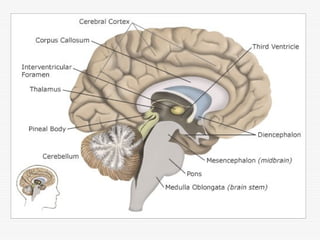
 In order for a patient to maintain
consciousness, two important neurological
components must function impeccably. The
first is the cerebral cortex which is the gray
matter covering the outer layer of the
brain, and the other is a structure located
in the brainstem, called Reticular activating
system (RAS or ARAS). Injury to either or
both of these components is sufficient to
cause a patient to experience a coma.
Pathophysiology
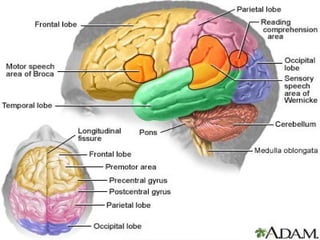
 The human cortex is a group of tightly
dense, "gray matter" composed of the
nucleus of the neurons whose axons then
form the "white matter", and is responsible
for the perception of the universe, relay of
the sensory input (sensation) via the
thalamic pathway, and most importantly
directly or indirectly in charge of all the
neurological functions, from simple reflexes
to complex thinking.
Pathophysiology
 Reticular activating system (RAS) on the
other hand is a more primitive structure in
the brainstem that is tightly in connection
with reticular formation (RF), a critical
anatomical structure needed for
maintenance of arousal. Reticular activating
system (RAS) takes its name from the
effect it has on the reticular formation
which is via its stimulation.
Pathophysiology
So the principal ways to develop coma :
 Damage to RAS and its projections
 Damage to both cerebral hemisphere
 Suppression of reticulo-cerebral
function by drugs ,toxins
hypoglycemia , hepatic failure or
azotemia etc..
Classification
Plum and Posner classify coma either :
1) supratentoral (above Tentorium cerebelli,
2) infratentoral (below Tentorium cerebelli)
3) metabolic or
4) diffuse.
 This classification is merely dependent on the position
of the original damage that caused the coma, and
does not correlate with severity or the prognosis.
 The severity of coma impairment however is
categorized into several levels. Patients may or may
not progress through these levels. In the first level,
the brain responsiveness lessens, normal reflexes are
lost, the patient no longer responds to pain and
cannot hear.
CAUSES OF COMA
Metabolic disturbance
Drug overdose
Hyponatraemia
Uraemia
Hepatic failure
Respiratory failure
Hypothermia
Hypothyroidism
Diabetes mellitus:
Hypoglycaemia
Ketoacidosis
Hyperosmolar coma
CAUSES
Trauma
 Cerebral contusion
 Extradural haematoma
 Subdural haematoma
CAUSES
Cerebrovascular disease
 Subarachnoid haemorrhage
 Intracerebral haemorrhage
 Brain-stem infarction/haemorrhage
 Cerebral venous sinus thrombosis
CAUSES
Infections
 Meningitis
 Encephalitis
 Cerebral abscess
 General sepsis
CAUSES
Others
 Epilepsy
 Brain tumour
 Thiamin deficiency
Approach to the Patient: Coma
 Acute respiratory and cardiovascular
problems should be attended to prior to
neurologic assessment. In most
instances, a complete medical
evaluation, except for vital signs,
funduscopy, and examination for nuchal
rigidity, may be deferred until the
neurologic evaluation has established
the severity and nature of coma.
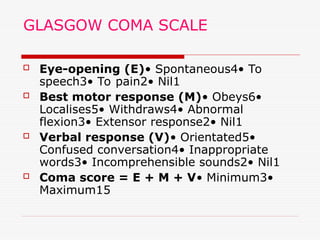
GLASGOW COMA SCALE
 Eye-opening (E)• Spontaneous4• To
speech3• To pain2• Nil1
 Best motor response (M)• Obeys6•
Localises5• Withdraws4• Abnormal
flexion3• Extensor response2• Nil1
 Verbal response (V)• Orientated5•
Confused conversation4• Inappropriate
words3• Incomprehensible sounds2• Nil1
 Coma score = E + M + V• Minimum3•
Maximum15
Approach
 History
(1) The circumstances and rapidity with which
neurological symptoms developed;
(2)The antecedent symptoms (confusion,
weakness, headache, fever, seizures,
dizziness, double vision, or vomiting);
(3)The use of medications, illicit drugs, or
alcohol; and
(4)Chronic liver, kidney, lung, heart, or other
medical disease.
Approach
General Physical Examination
 The temperature, pulse, respiratory rate
and pattern, and blood pressure should be
measured quickly.
 Fever suggests a systemic infection,
bacterial meningitis, or encephalitis;
 High body temperature, 42–44°C,
associated with dry skin should arouse the
suspicion of heat stroke or anticholinergic
drug intoxication. Hypothermia is observed
with alcoholic, barbiturate, sedative, or
phenothiazine
Approach
 Tachypnea may indicate systemic acidosis or
pneumonia. Aberrant respiratory patterns that reflect
brainstem disorders.
 Marked hypertension either indicates hypertensive
encephalopathy or is the result of a rapid rise in
intracranial pressure (ICP; the Cushing response)
most often after cerebral hemorrhage or head injury.
 Hypotension is characteristic of coma from alcohol or
barbiturate intoxication, internal hemorrhage,
myocardial infarction, sepsis, profound
hypothyroidism, or Addisonian crisis.
 The funduscopic examination can detect
subarachnoid hemorrhage (subhyaloid
hemorrhages), hypertensive
encephalopathy (exudates, hemorrhages,
vessel-crossing changes, papilledema), and
increased ICP (papilledema).
 Cutaneous petechiae suggest thrombotic
thrombocytopenic purpura,
meningococcemia, or a bleeding diathesis
from which an intracerebral hemorrhage
has arisen.
Approach
Neurologic Examination
 First, the patient should be observed
without intervention by the examiner.
 Tossing about in the bed, reaching up
toward the face, crossing legs, yawning,
swallowing, coughing, or moaning denote a
state close to normal awakeness.
 Lack of restless movements on one side or
an outturned leg suggests a hemiplegia.
Intermittent twitching movements of a foot,
finger, or facial muscle may be the only
sign of seizures.
 Multifocal myoclonus almost always
indicates a metabolic disorder,
particularly uremia, anoxia, or drug
intoxication.
 In a drowsy and confused patient
bilateral asterixis is a certain sign of
metabolic encephalopathy or drug
intoxication.
Approach
Level of Arousal
 A sequence of increasingly intense stimuli is
used to determine the threshold for arousal
and the optimal motor response of each
side of the body. The results of testing may
vary from minute to minute and serial
examinations are most useful.
 Tickling the nostrils with a cotton wisp is a
moderate stimulus to arousal—all but
deeply stuporous and comatose patients
will move the head away and rouse to
some degree.
Approach
 Using the hand to remove the offending
stimulus represents an even greater degree
of responsiveness.
 Stereotyped posturing in response to
noxious stimuli indicates severe dysfunction
of the corticospinal system.
 Abduction-avoidance movement of a limb is
usually purposeful and denotes an intact
corticospinal system.
 Pressure on the knuckles or bony
prominences and pinprick stimulation are
humane forms of noxious stimuli;
Approach
Brainstem Reflexes
 Assessment of brainstem function is
essential to localization of the lesion in
coma
 The brainstem reflexes that are
conveniently examined are:
1. pupillary responses to light,
2. spontaneous and elicited eye movements,
3. corneal responses, and
4. the respiratory pattern.
Approach
Pupillary Signs:
 Pupillary reactions are examined with a bright, diffuse
light (not an ophthalmoscope); if the response is
absent, this should be confirmed by observation
through a magnifying lens.
 Normally reactive and round pupils of midsize (2.5–5
mm) essentially exclude midbrain damage, either
primary or secondary to compression.
 One unreactive and enlarged pupil (>6 mm) or one
that is poorly reactive signifies compression of the
third nerve from the effects of a mass above.
Approach
 An oval and slightly eccentric pupil is a
transitional sign that accompanies early
midbrain–third nerve compression.
 The most extreme pupillary sign, bilaterally
dilated and unreactive pupils, indicates
severe midbrain damage, usually from
compression by a supratentorial mass.
Ingestion of drugs with anticholinergic
activity, the use of mydriatic eye drops,
and direct ocular trauma are among the
causes of misleading pupillary enlargement.
Approach
 Unilateral miosis in coma has been attributed to
dysfunction of sympathetic efferents originating in the
posterior hypothalamus and descending in the
tegmentum of the brainstem to the cervical cord.
 Reactive and bilaterally small (1–2.5 mm) but not
pinpoint pupils are seen in metabolic
encephalopathies or in deep bilateral hemispheral
lesions such as hydrocephalus or thalamic
hemorrhage.
 Very small but reactive pupils (<1 mm) characterize
narcotic or barbiturate overdoses but also occur with
extensive pontine hemorrhage.
Approach
Ocular Movements
 The eyes are first observed by elevating the
lids and noting the resting position and
spontaneous movements of the globes. Lid
tone, tested by lifting the eyelids and
noting their resistance to opening and the
speed of closure, is reduced progressively
as coma deepens. Horizontal divergence of
the eyes at rest is normal in drowsiness. As
coma deepens, the ocular axes may
become parallel again.
Approach
Respiratory Patterns
 Shallow, slow, but regular breathing suggests
metabolic or drug depression.
 Cheyne-Stokes respiration in its classic cyclic form,
ending with a brief apneic period, signifies
bihemispheral damage or metabolic suppression and
commonly accompanies light coma.
 Rapid, deep (Kussmaul) breathing usually implies
metabolic acidosis but may also occur with
pontomesencephalic lesions.
 Agonal gasps are the result of lower brainstem
(medullary) damage and are well known as the
terminal respiratory pattern of severe brain damage.
Laboratory Studies and
Imaging
 chemical-toxicologic analysis of blood
and urine,
 cranial CT or MRI,
 EEG, and
 CSF examination.
 Arterial blood-gas analysis
 Blood glucose
Laboratory Studies and Imaging
cont …
 Calcium and phosphate level
 Coagulation profile
 Blood count and hemoglobin level
 Chest X-ray
 Urea and electrolytes
 Liver function test
Laboratory Studies and Imaging
cont …
 Normal CT scan excludes anatomic lesions
as the cause of coma is also erroneous.
Bilateral hemisphere infarction, acute
brainstem infarction, encephalitis,
meningitis, Nevertheless, if the source of
coma remains unknown, a scan should be
obtained.
 EEG is useful in metabolic or drug-induced
states but is rarely diagnostic.
Treatment
Coma is a medical emergency, and attention
must first be directed to:
 maintaining the patient's respiration and
circulation, using intubation and ventilation,
 administration of intravenous fluids blood
and other supportive care as needed.
 Once a patient is stable and no longer in
immediate danger, the medical staff may
concentrate on maintaining the health of
patient’s physical state.
Treatment
The concentration will be directed on…
 preventing infections such as pneumonias, bedsores
(decubitus ulcers) and providing a balanced nutrition.
These infections may appear from the patient not
being able to move around, and being confined to the
bed.
 The nursing staff will move the patient every 2–3
hours from side to side and depending on the state of
consciousness sometimes to a chair.
 The goal is to move the patient as much as possible
to try to avoid bedsores, atelectasis and pneumonia.
Treatment
 Pneumonia can occur from the person’s inability to
swallow leading to aspiration, lack of gag reflex or
from feeding tube, (aspiration pneumonia. Physical
therapy may also be used to prevent contractures and
orthopedic deformities that would limit recovery for
those patients who emerge from coma.
 A person in a coma may become restless, or seize and
need special care to prevent them from hurting
themselves.
 Medicine may be given to calm such individuals.
Patients who are restless may also try to pull on tubes
or dressings so soft cloth wrist restraints may be put
on. Side rails on the bed should be kept up to prevent
patient from falling.
Follow up
 BP 2 hourly
 Temperature 2 hourly
 Strict intake output chart
 4 hourly blood gases
 Continuous monitoring of oxygen saturation
with pulse oxymetry
 Blood glucose 4 hourly
 Ca and ph 12 hourly
 Urea and electrolytes twice daily
Prognosis
 Children and young adults may have
ominous early clinical findings such as
abnormal brainstem reflexes and yet
recover, so that temporization in offering a
prognosis in this group of patients is wise.
 Metabolic comas have a far better
prognosis than traumatic ones.
 The absence of the cortical waves of the
somatosensory evoked potentials has also
proved a strong indicator of poor outcome
in coma from any cause.
63514351-coma-ppt.ppt....................

63514351-coma-ppt.ppt....................

  • 2.
  • 3.
    What is a"coma"? Coma is a state of unconsciousness whereby a patient cannot react with the surrounding environment. The patient cannot be wakened with outside physical or auditory stimulation.
  • 4.
    Some other terms.. Stupor: Refers to a higher degree of arousability in which the patient can be awakened only by vigorous stimuli, accompanied by motor behavior that leads to avoidance of uncomfortable or aggravating stimuli. Drowsiness: which is familiar to all persons, simulates light sleep and is characterized by easy arousal and the persistence of alertness for brief periods.
  • 5.
    Some other terms..  Lethargy indicates a patient who is incoherent but arousable and has tendency to sleep and able to communicate  Vegetative state signifies an awake but unresponsive state  Locked in state is a pseudocoma in which an awake patient has no means of producing speech.
  • 6.
    Pathophysiology  In orderfor a patient to maintain consciousness, two important neurological components must function impeccably. The first is the cerebral cortex which is the gray matter covering the outer layer of the brain, and the other is a structure located in the brainstem, called Reticular activating system (RAS or ARAS). Injury to either or both of these components is sufficient to cause a patient to experience a coma.
  • 7.
    Pathophysiology  The humancortex is a group of tightly dense, "gray matter" composed of the nucleus of the neurons whose axons then form the "white matter", and is responsible for the perception of the universe, relay of the sensory input (sensation) via the thalamic pathway, and most importantly directly or indirectly in charge of all the neurological functions, from simple reflexes to complex thinking.
  • 10.
    Pathophysiology  Reticular activatingsystem (RAS) on the other hand is a more primitive structure in the brainstem that is tightly in connection with reticular formation (RF), a critical anatomical structure needed for maintenance of arousal. Reticular activating system (RAS) takes its name from the effect it has on the reticular formation which is via its stimulation.
  • 11.
    Pathophysiology So the principalways to develop coma :  Damage to RAS and its projections  Damage to both cerebral hemisphere  Suppression of reticulo-cerebral function by drugs ,toxins hypoglycemia , hepatic failure or azotemia etc..
  • 12.
    Classification Plum and Posnerclassify coma either : 1) supratentoral (above Tentorium cerebelli, 2) infratentoral (below Tentorium cerebelli) 3) metabolic or 4) diffuse.  This classification is merely dependent on the position of the original damage that caused the coma, and does not correlate with severity or the prognosis.  The severity of coma impairment however is categorized into several levels. Patients may or may not progress through these levels. In the first level, the brain responsiveness lessens, normal reflexes are lost, the patient no longer responds to pain and cannot hear.
  • 13.
    CAUSES OF COMA Metabolicdisturbance Drug overdose Hyponatraemia Uraemia Hepatic failure Respiratory failure Hypothermia Hypothyroidism Diabetes mellitus: Hypoglycaemia Ketoacidosis Hyperosmolar coma
  • 14.
    CAUSES Trauma  Cerebral contusion Extradural haematoma  Subdural haematoma
  • 15.
    CAUSES Cerebrovascular disease  Subarachnoidhaemorrhage  Intracerebral haemorrhage  Brain-stem infarction/haemorrhage  Cerebral venous sinus thrombosis
  • 16.
    CAUSES Infections  Meningitis  Encephalitis Cerebral abscess  General sepsis
  • 17.
    CAUSES Others  Epilepsy  Braintumour  Thiamin deficiency
  • 18.
    Approach to thePatient: Coma  Acute respiratory and cardiovascular problems should be attended to prior to neurologic assessment. In most instances, a complete medical evaluation, except for vital signs, funduscopy, and examination for nuchal rigidity, may be deferred until the neurologic evaluation has established the severity and nature of coma.
  • 19.
    GLASGOW COMA SCALE Eye-opening (E)• Spontaneous4• To speech3• To pain2• Nil1  Best motor response (M)• Obeys6• Localises5• Withdraws4• Abnormal flexion3• Extensor response2• Nil1  Verbal response (V)• Orientated5• Confused conversation4• Inappropriate words3• Incomprehensible sounds2• Nil1  Coma score = E + M + V• Minimum3• Maximum15
  • 20.
    Approach  History (1) Thecircumstances and rapidity with which neurological symptoms developed; (2)The antecedent symptoms (confusion, weakness, headache, fever, seizures, dizziness, double vision, or vomiting); (3)The use of medications, illicit drugs, or alcohol; and (4)Chronic liver, kidney, lung, heart, or other medical disease.
  • 21.
    Approach General Physical Examination The temperature, pulse, respiratory rate and pattern, and blood pressure should be measured quickly.  Fever suggests a systemic infection, bacterial meningitis, or encephalitis;  High body temperature, 42–44°C, associated with dry skin should arouse the suspicion of heat stroke or anticholinergic drug intoxication. Hypothermia is observed with alcoholic, barbiturate, sedative, or phenothiazine
  • 22.
    Approach  Tachypnea mayindicate systemic acidosis or pneumonia. Aberrant respiratory patterns that reflect brainstem disorders.  Marked hypertension either indicates hypertensive encephalopathy or is the result of a rapid rise in intracranial pressure (ICP; the Cushing response) most often after cerebral hemorrhage or head injury.  Hypotension is characteristic of coma from alcohol or barbiturate intoxication, internal hemorrhage, myocardial infarction, sepsis, profound hypothyroidism, or Addisonian crisis.
  • 23.
     The funduscopicexamination can detect subarachnoid hemorrhage (subhyaloid hemorrhages), hypertensive encephalopathy (exudates, hemorrhages, vessel-crossing changes, papilledema), and increased ICP (papilledema).  Cutaneous petechiae suggest thrombotic thrombocytopenic purpura, meningococcemia, or a bleeding diathesis from which an intracerebral hemorrhage has arisen.
  • 24.
    Approach Neurologic Examination  First,the patient should be observed without intervention by the examiner.  Tossing about in the bed, reaching up toward the face, crossing legs, yawning, swallowing, coughing, or moaning denote a state close to normal awakeness.  Lack of restless movements on one side or an outturned leg suggests a hemiplegia. Intermittent twitching movements of a foot, finger, or facial muscle may be the only sign of seizures.
  • 25.
     Multifocal myoclonusalmost always indicates a metabolic disorder, particularly uremia, anoxia, or drug intoxication.  In a drowsy and confused patient bilateral asterixis is a certain sign of metabolic encephalopathy or drug intoxication.
  • 26.
    Approach Level of Arousal A sequence of increasingly intense stimuli is used to determine the threshold for arousal and the optimal motor response of each side of the body. The results of testing may vary from minute to minute and serial examinations are most useful.  Tickling the nostrils with a cotton wisp is a moderate stimulus to arousal—all but deeply stuporous and comatose patients will move the head away and rouse to some degree.
  • 27.
    Approach  Using thehand to remove the offending stimulus represents an even greater degree of responsiveness.  Stereotyped posturing in response to noxious stimuli indicates severe dysfunction of the corticospinal system.  Abduction-avoidance movement of a limb is usually purposeful and denotes an intact corticospinal system.  Pressure on the knuckles or bony prominences and pinprick stimulation are humane forms of noxious stimuli;
  • 28.
    Approach Brainstem Reflexes  Assessmentof brainstem function is essential to localization of the lesion in coma  The brainstem reflexes that are conveniently examined are: 1. pupillary responses to light, 2. spontaneous and elicited eye movements, 3. corneal responses, and 4. the respiratory pattern.
  • 29.
    Approach Pupillary Signs:  Pupillaryreactions are examined with a bright, diffuse light (not an ophthalmoscope); if the response is absent, this should be confirmed by observation through a magnifying lens.  Normally reactive and round pupils of midsize (2.5–5 mm) essentially exclude midbrain damage, either primary or secondary to compression.  One unreactive and enlarged pupil (>6 mm) or one that is poorly reactive signifies compression of the third nerve from the effects of a mass above.
  • 30.
    Approach  An ovaland slightly eccentric pupil is a transitional sign that accompanies early midbrain–third nerve compression.  The most extreme pupillary sign, bilaterally dilated and unreactive pupils, indicates severe midbrain damage, usually from compression by a supratentorial mass. Ingestion of drugs with anticholinergic activity, the use of mydriatic eye drops, and direct ocular trauma are among the causes of misleading pupillary enlargement.
  • 31.
    Approach  Unilateral miosisin coma has been attributed to dysfunction of sympathetic efferents originating in the posterior hypothalamus and descending in the tegmentum of the brainstem to the cervical cord.  Reactive and bilaterally small (1–2.5 mm) but not pinpoint pupils are seen in metabolic encephalopathies or in deep bilateral hemispheral lesions such as hydrocephalus or thalamic hemorrhage.  Very small but reactive pupils (<1 mm) characterize narcotic or barbiturate overdoses but also occur with extensive pontine hemorrhage.
  • 32.
    Approach Ocular Movements  Theeyes are first observed by elevating the lids and noting the resting position and spontaneous movements of the globes. Lid tone, tested by lifting the eyelids and noting their resistance to opening and the speed of closure, is reduced progressively as coma deepens. Horizontal divergence of the eyes at rest is normal in drowsiness. As coma deepens, the ocular axes may become parallel again.
  • 33.
    Approach Respiratory Patterns  Shallow,slow, but regular breathing suggests metabolic or drug depression.  Cheyne-Stokes respiration in its classic cyclic form, ending with a brief apneic period, signifies bihemispheral damage or metabolic suppression and commonly accompanies light coma.  Rapid, deep (Kussmaul) breathing usually implies metabolic acidosis but may also occur with pontomesencephalic lesions.  Agonal gasps are the result of lower brainstem (medullary) damage and are well known as the terminal respiratory pattern of severe brain damage.
  • 34.
    Laboratory Studies and Imaging chemical-toxicologic analysis of blood and urine,  cranial CT or MRI,  EEG, and  CSF examination.  Arterial blood-gas analysis  Blood glucose
  • 35.
    Laboratory Studies andImaging cont …  Calcium and phosphate level  Coagulation profile  Blood count and hemoglobin level  Chest X-ray  Urea and electrolytes  Liver function test
  • 36.
    Laboratory Studies andImaging cont …  Normal CT scan excludes anatomic lesions as the cause of coma is also erroneous. Bilateral hemisphere infarction, acute brainstem infarction, encephalitis, meningitis, Nevertheless, if the source of coma remains unknown, a scan should be obtained.  EEG is useful in metabolic or drug-induced states but is rarely diagnostic.
  • 37.
    Treatment Coma is amedical emergency, and attention must first be directed to:  maintaining the patient's respiration and circulation, using intubation and ventilation,  administration of intravenous fluids blood and other supportive care as needed.  Once a patient is stable and no longer in immediate danger, the medical staff may concentrate on maintaining the health of patient’s physical state.
  • 38.
    Treatment The concentration willbe directed on…  preventing infections such as pneumonias, bedsores (decubitus ulcers) and providing a balanced nutrition. These infections may appear from the patient not being able to move around, and being confined to the bed.  The nursing staff will move the patient every 2–3 hours from side to side and depending on the state of consciousness sometimes to a chair.  The goal is to move the patient as much as possible to try to avoid bedsores, atelectasis and pneumonia.
  • 39.
    Treatment  Pneumonia canoccur from the person’s inability to swallow leading to aspiration, lack of gag reflex or from feeding tube, (aspiration pneumonia. Physical therapy may also be used to prevent contractures and orthopedic deformities that would limit recovery for those patients who emerge from coma.  A person in a coma may become restless, or seize and need special care to prevent them from hurting themselves.  Medicine may be given to calm such individuals. Patients who are restless may also try to pull on tubes or dressings so soft cloth wrist restraints may be put on. Side rails on the bed should be kept up to prevent patient from falling.
  • 40.
    Follow up  BP2 hourly  Temperature 2 hourly  Strict intake output chart  4 hourly blood gases  Continuous monitoring of oxygen saturation with pulse oxymetry  Blood glucose 4 hourly  Ca and ph 12 hourly  Urea and electrolytes twice daily
  • 41.
    Prognosis  Children andyoung adults may have ominous early clinical findings such as abnormal brainstem reflexes and yet recover, so that temporization in offering a prognosis in this group of patients is wise.  Metabolic comas have a far better prognosis than traumatic ones.  The absence of the cortical waves of the somatosensory evoked potentials has also proved a strong indicator of poor outcome in coma from any cause.