DRAFT
April 10, 2014
QUARTER 1
NUTRITION
DRAFT
April 10, 2014
INTRODUCTION:
Eat well and live well! Nutrition addresses the importance of eating healthy and
establishing good eating habits to enhance health and prevent diseases. This
module aims to help the learners demonstrate understanding of the importance
of following nutritional guidelines and maintaining a balanced diet for good
nutrition and health. It is also hoped that learning with the module will help the
learners to consistently demonstrate good decision-making skills in making food
choices and maintaining lifestyles. It is highly encouraged for teachers to use
the varied activities that are included in the module to scaffold on learnerโ€™s prior
learning, needs, abilities and interests as the learners engaging in meaningful
learning activities and apply specific life skills.
Instruct the pupils to answer the Pre-test.
I. Direction: Write the letter of the correct answer.
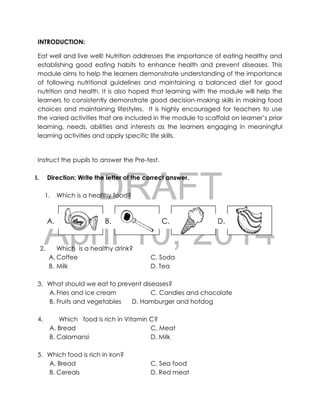
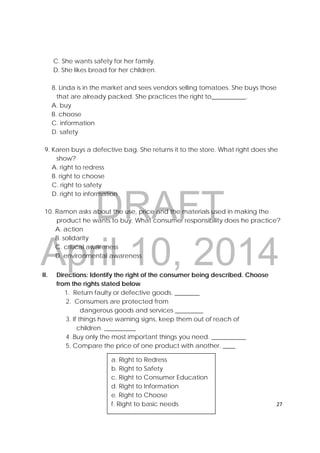
1. Which is a healthy food?
2. Which is a healthy drink?
A. Coffee C. Soda
B. Milk D. Tea
3. What should we eat to prevent diseases?
A.Fries and ice cream C. Candies and chocolate
B. Fruits and vegetables D. Hamburger and hotdog
4. Which food is rich in Vitamin C?
A. Bread C. Meat
B. Calamansi D. Milk
5. Which food is rich in iron?
A. Bread C. Sea food
B. Cereals D. Red meat
candy
D.C.B.A.
DRAFT
April 10, 2014
6. What condition is caused by lack of Vitamin A?
A. Anemia C. Rickets
B. Nightblindness D. Goiter
7. Sofia eats much. She doesnโ€™t like to play active games.
Sofia will_______________.
A. get fat C. get sick
B. get thin D. be healthy
8. Nelia is already getting fat. What should she do?
A. Take medicine. C. Sleep more than 8 hours.
B. Eat once a day. D. Play active games.
9. Jen often feels dizzy. A part of her throat is enlarged and she has difficulty in
swallowing. What mineral does Jen lack?
A. Iron C. Calcium
B. Iodine D. Potassium
10. How can you keep food safe and clean?
A. Eat with bare hands. C. Leave food uncovered.
B. Cook food well. D. Wash food with soap.
II. Direction: On the space before the number, write True if the statement is
correct and False if it is wrong.
___1. Drink milk every day.
___2. Eat much food rich in fats and oil.
___3. Eat much food rich in carbohydrate.
___4. Eat foods rich in vitamins and mineral.
___5. Eat different kinds of food every day.
III. Direction: Match the symptom in A to the deficiency in B. Write the letter of
the answer on the space before the number.
A B
___1. Lack of appetite A. Anemia
___2. Thick dry skin and slow mental development B. Beriberi
DRAFT
April 10, 2014
___3. Emotional disturbance and painful limbs C. Goiter
___4. Deformed and painful bones D. Measles
___5. Bleeding gums and slow wound healing E. Rickets
F. Scurvy
DRAFT
April 10, 2014
Quarte
I.
1. D
2. B
3. B
4. B
5. C
6. B
7. A
8. D
9. B
10. B
II.
1. T
2. F
3. F
4. T
5. T
III.
1. A
2. C
3. B
4. E
5. F
Lesson 1: Good or Bad Nutrition?
No. of Days: 1
I. Objectives: At the end of the lesson, the pupil will be able to:
- Describe a healthy person
- Explain the concept of malnutrition
II. Subject Matter:
Content: Concept of Malnutrition
DRAFT
April 10, 2014
- Forms of malnutrition(undernutrition and overnutrition)
References:
DOST-PINOY (2010). A training manual for Nutrition Health Workers. Taguig:
DOST.
DepEd (2013). K to 12 Health curriculum guide. Pasig: DepEd.
Background Information
Malnutrition is characterized by lack, excess or imbalance in nutrients
(DOST-PINOY, 2010). There are two forms of malnutrition: undernutrition and
overnutrition, the most common of which is undernutrition that leads to
deficiency diseases.
III. Procedure
A. Preliminary Activities ( 3 minutes)
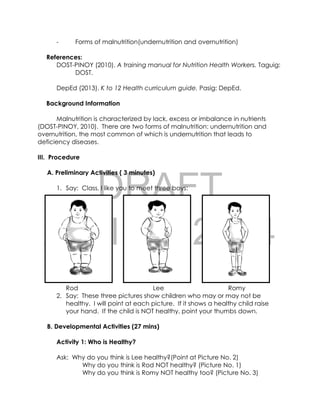
1. Say: Class, I like you to meet three boys:
Rod Lee Romy
2. Say: These three pictures show children who may or may not be
healthy. I will point at each picture. If it shows a healthy child raise
your hand. If the child is NOT healthy, point your thumbs down.
B. Developmental Activities (27 mins)
Activity 1: Who is Healthy?
Ask: Why do you think is Lee healthy?(Point at Picture No. 2)
Why do you think is Rod NOT healthy? (Picture No. 1)
Why do you think is Romy NOT healthy too? (Picture No. 3)
DRAFT
April 10, 2014
What is a healthy child?
Activity 2: Eating Properly
1. Ask: Who do you think is eating properly? (Picture 2)
Why do you say so?
Who is NOT eating properly?
Why do you say so?
2. Answer Letโ€™s Do This on p. ___.
3. Say: People who do NOT eat properly suffer from wrong nutrition or
malnutrition.
Write the word on the board and let the pupils say it.
4. Ask: Who among the boys are suffering from malnutrition?
5. Refer to the pictures again. Transfer the picture of Romy beside Rodโ€™s.
Ask: Who is eating too little or too little healthy food?
What does he suffer from? *Point to the word โ€œmalnutritionโ€ on
the board).
What food do you think does theโ€ฆ
โ€ฆthin child eat?
โ€ฆthin child NOT eat?
Tell the pupils that there are two forms of malnutrition. Introduce the
word โ€œundernutrition,โ€ which means eating too little and not getting
enough nutrients needed by the body,
6. Ask: Who is eating too much?
What does he suffer from? (Point to the word malnutrition)
What food do you think does theโ€ฆ
โ€ฆstout child eat?โ€
โ€ฆstout child NOT eat?
Introduce the word overeating which means eating too much.
Ask: Is it good to eat too much? Why?
Is it good to eat too little? Why?
Is it good to eat just right? Why?
C. Generalization (5 mins)
Ask, โ€œWhat is malnutrition?โ€ (Eating too much food, too little food, or not
enough healthy food). Let the pupils write in their notebook.
DRAFT
April 10, 2014
D. Evaluation (5 mins)
Ask the pupils to answer Letโ€™s Check on p _____.
Answers will vary.
Lesson 2: Are You Undereating?
No. of Days: 2
I. Objectives: At the end of the lesson, the pupil will be able to:
- Identify nutritional problems- undernutrition
- Describe the characteristics, signs and symptoms, and effects of the
various forms of malnutrition - undernutrition, specifically protein-energy
malnutrition.
II. Subject Matter
Content: Form of malnutrition: Undernutrition
a. Protein-Energy Malnutrition (PEM)
Materials:
Pencil and crayons
References:
DepEd (2013). K to 12 Health curriculum guide. Pasig: DepEd.
Friedman, D.P., Stine, CC., & Whalen, S. (2005). Lifetime health.
NY: Holt, Rinehart & Winston.
National Nutrition Council (2013). Nutrition is key. Retrieved from
http://www.nnc.gov.ph/home/item/112-nutrition-is-key.
UNICEF (2009). Nutrition in emergencies. Retrieved from
http://www.unicef.org/nutrition/training/
Background Information
The National Nutrition Council of the Philippines (2013) reported that 80%
of the world's undernourished children live in just 20 countries, one of which is the
Philippines. Our most prevalent malnutrition problems are protein-energy
DRAFT
April 10, 2014
malnutrition (PEM), where we rank 4th among countries with such a problem;
Vitamin A Deficiency (VAD); Iron-Deficiency Anemia (IDA); and Iodine
Deficiency Disorder (IDD).
The nutrients our body needs are classified according to the amount
needed by our body. Protein, carbohydrates and fats are called macronutrients
because our body needs large amounts of them to ensure normal growth and
development and to regulate body processes. On the other hand, vitamins,
minerals and trace elements (including water) are called micronutrients
because our body needs small amounts of them for it to function. Deficiencies
in macronutrients and micronutrients have harmful effects on health.
Protein-energy malnutrition (PEM) affects people whose diet lacks protein
and energy (measured in calories). It is possible for a childโ€™s diet to provide
enough energy, but if it is deficient in protein, PEM still results. This is called
primary PEM. Secondary PEM happens as a complication of chronic or acute
illnesses that prevent the patient from getting enough nutrients.
P-energy malnutritionand eating.
III. Procedure
A. Preliminary Activity (1 minute)
1. Say: We will play a Word Association game. I will write a word and call
a pupil who will quickly give a related word.
2. Write โ€œMalnutritionโ€ on the board and call a pupil who will give a word
related to โ€œmalnutritionโ€ as fast as possible. Call about five children. If
there are doubts about the relationship of the words, ask the pupil to
explain how the word is related.
B. Developmental Activities (25 minutes)
Activity 1: A Story of Two Children
1. Tell the pupils that they are going to read two stories about
malnutrition.
2. Let the pupils read the stories silently.
3. Ask the pupils to answer the questions orally after each story.
DRAFT
April 10, 2014
4. Let the pupils recall the nutrients they learned in Grade 2.
Have a guessing game.
Divide the class into small groups. Tell the groups to guess the name of
the nutrient after you will write its first letter on the board. Let the groups
take turns in answering.
Write the beginning letters of the nutrients:
P: Protein
C: Carbohydrates
D: Fats
V: Vitamins
M: Minerals
Once the pupils have identifies the correct word, complete the word
on the board and ask the pupils to read it aloud.
5. Recall with the pupils the functions of the food nutrients:
Which is the body-building nutrient?
Which are the energy-giving nutrients?
Which are the body regulating nutrients?
Once the correct answer have been given, write the functions on the
board and let the class read it aloud.
6. Ask: What does M lack in her diet?
What does K lack in his diet?
7. Write the phrase โ€œProtein-energy malnutritionโ€ on the board and tell
the pupils that it is a kind of undernutrition where there is lack of body-
building and energy-giving nutrients in the diet.
Activity 2: Draw Me a Picture
Tell the pupils to do Activity 2 on page ___.
C. Generalization (6 minutes)
Call some pupils to read aloud their endings to the statements.
D. Evaluation (8 minutes)
Let the pupils answer Letโ€™s Check on page _____.
Answer Key: (1) False (2) True (3) False (4) True (5) True
DRAFT
April 10, 2014
E. Assignment
Divide the class into small groups and assign to bring different kinds of
food rich in vitamins.
Sing the song on p. __ as closing an synthesis.
Homework
Explain the homework. Present the rubrics for grading.
DRAFT
April 10, 2014
Lesson 3: Vitamins for Life
Number of Days: 2
I. Objectives: At the end of the lesson, the pupil should be able to:
- Identify nutritional problems-micronutrient deficiency
๏‚ท Vitamin A โ€“ Night Blindness
๏‚ท Vitamin B โ€“ Beri โ€“ beri
๏‚ท Vitamin C โ€“ Scurvy
๏‚ท Vitamin D โ€“ Rickets
- Describe the characteristics, signs and symptoms of
micronutrient deficiencies
II. Subject Matter:
III. Content: Nutritional Deficiencies
IV.
V.
VI. /Calcium
VII.
Materials:
- manila paper
- marker
- meta cards
- string/yarn
- hangers
Reference:
- Friedman, D.P., Stine, CC., & Whalen, S. (2005). Lifetime health.
NY: Holt, Rinehart & Winston.
Background Information
A growing child needs different vitamins in right amounts and
proportions. These vitamins are needed by the body to function
normally.
DRAFT
April 10, 2014
What are vitamins?
Vitamins A, B, C and D are some kinds of vitaminsfour.
These cover nutrients that contain carbon and are needed in small
amounts to maintain health and allow growth.fromources, a kind of
micronutrient, .
ssVCIf a child lacks vitamins, he/she will suffer from the following
nutrition deficiencies its characteristics and symptoms:
Vitamin Characteristics Signs and Symptoms
Vitamin A โ€“ Night
Blindness
Condition of defective or
reduced vision in the
dark, especially after
coming from bright
lightDry and scaly skin
๏‚ท Difficulty in seeing in
dim light or during
the night
Vitamin B โ€“ Beri-beri Loss of appetite and
general feeling of
discomfort associated
with heaviness and
weakness of the legs and
numbness of feet
๏‚ท Weight loss,
impaired sensory
perception,
emotional
disturbance and
pain in limbs
Vitamin C โ€“ Scurvy Shortness of breath,
aching bones and joints,
gums bleed easily
๏‚ท Bleeding gums, slow
wound healing,
nosebleed, fatigue
Vitamin D โ€“ Rickets Soft bones and skeletal
deformities
๏‚ท Bone pain, muscle
weakness
Nutritional deficiency is caused by eating the wrong kind of food.
It is also caused by unhealthy lifestyle and environment. When we are
unhealthy, we are predisposed to getdiseases. It is therefore important to
keep our bodies healthy.
Here are some ways to prevent nutritional deficiencies:
Nutritional Disorders Prevention and Control
Vitamin A Deficient โ€“
Night Blindness
๏‚ท Drink milk.
๏‚ท Eat yellow and orange fruits and vegetables
(carrot, squash).
๏‚ท Eat dark-green and leafy vegetables (pechay,
kangkong).
๏‚ท Eat egg, butter, and cheese.
Vitamin B Deficient
(Beri-beri)
๏‚ท Eat vegetables.
๏‚ท Eat pork and liver.
๏‚ท Eat food enriched and whole grains and
cereals.
DRAFT
April 10, 2014
๏‚ท Eat nuts and seeds.
Vitamin C Deficient โ€“
Scurvy
๏‚ท Eat citrus fruits (melons, strawberries)
๏‚ท Eat green vegetables and peppers.
Vitamin D Deficient โ€“
Rickets
๏‚ท Eat food rich in fish oil, tuna and salmon
๏‚ท Eat liver.
๏‚ท Eat egg yolk.
VIII. Procedure
A. Preliminary Activity
Let the pupils bring out the food assigned to them.
What do we get from fruits?
B. Developmental Activities
Activity 1
C. Preliminary Activity
1. Instruct the pupils to turn to p. __.
2. Read the questions.
3. Give them 5 minutes to perform the task.
4. Ask, โ€œWhat do we get from fruits?โ€
5. Elicit responses and process to lead to vitamins.
D. Developmental Activities
Activity 1
1. Ask the pupils to form the groups they were assigned to.
2. Let them discuss the reason/s why the foods they brought are nutritious.
3. Let a group representative share the answers.
4. Tell the pupils that these foods give us different vitamins. Ask them
about the vitamins they know. Explain that not getting enough of a
kind of vitamin may lead to certain nutritional deficiency.
5. Discuss the different vitamin deficiencies. Show the pictures of children
with specific vitamin deficiencies on LM p____.
6. Ask who has experienced any of these nutritional deficiencies.
Activity 2
1. Let pupils answer Activity 1 on LM p.
Answer Key: (1) C (2) B (3) D (4) A
Activity 3- Letโ€™s Go To The Market
DRAFT
April 10, 2014
1. Ask the pupils, โ€œHow can we avoid vitamin deficiencies?โ€
2. Let the class divide into four groups.
3. Prepare set drawings or plastic fruits representing the four vitamins.
4. Play games like Maria Went to Town but in each run, the player will get
fruits representing the vitamin that you will say.
5. The group with most correct answers wins.
1. After answering, ask the pupils, โ€œWhat will happen if we donโ€™t
get enough vitamins?โ€
1. Discussion (refer to background infor
Ask:
1. What will happen if we do not get enough vitamins?
2. What are the conditions if you lack vitamin A? B? C? D?
3. The lack of vitamins is also a type of ______________.
4. Vitamin deficiencies may be prevented by _______________.
Fruits rich with Vitamin A are __________________.
Fruits rich with Vitamin B are __________________.
Fruits rich with Vitamin C are__________________.
Fruits rich with Vitamin D are___________________.
mation)
2. Discuss with pupils the specific conditions of each vitamin
deficiency.
Describe the signs and symptoms.
3. Instruct pupils to turn to p, __.
Evaluation
Let pupils answer the exercise for 10 minutes.Answer Key: (1) Vitamin A (2)
Vitamin B (3) Vitamin C (4) Vitamin D
I.
Lesson 4: Minerals for Life
I. Objective: At the end of the lesson, the pupils should be able to:
a.
b. Describe the characteristics, signs and symptoms of nutritional deficiencies
due to lack of minerals in the body
-Discuss ways on how to prevent mineral deficiencies
DRAFT
April 10, 2014
II. Subject Matter:
Content: Nutritional Deficiencies
Iron โ€“ Anemia
Iodine โ€“ Goiter
Calcium โ€“ Rickets
Materials:
word cards(iron, iodine, calcium, anemia, goiter, osteoporosis)
scotch tape
pocket chart labeled with nutritional deficiency and effect
References:
- Lifetime Health, Friedman, F.P., et.al. (2005) h NY: Holt,
Rinehart & Winston.
- DOST-PINOY(2010): A Training Manual for Nutrition Health
Workers. Taguig: DOST.
- Iodine Deficiency. American Thyroid Association. Retrieved from
http://www.thyroid.org/iodine-deficiency/
- Nutrition for Everyone. Center for Disease Control and Prevention.
Retrieved from
http://www.cdc.gov/nutrition/everyone/basics/vitamins/iron
- Calcium deficiency. Ostelin. Retrieved from
http://www.ostelin.com.au/calcium/3/
- Calcium quick facts. Office of Dietary Supplements โ€“National
Institutes of Health. Retrieved from
http://ods.od.nih.gov/factsheets/Calcium-QuickFacts/#h6
Blake, Kati (2012). Nutritional Deficiencies.
Retrieved from K to 12Curriculum, Health 3
http://www.healthline.com/health/malnutrition
- Mayo Clinic Staf (2011). Goiter. Retrieved from
http://www.mayoclinic.com/health/goiter/DS00217"
>Goiter</a
p. 163
K to 12 Health Learning Competencies
DRAFT
April 10, 2014
Background Information
Minerals are nutrients needed for certain processes, such
as building strong bones and teeth and for helping the nerves work.
Minerals are also needed for regulating growth and for
the clotting of blood. Some of the minerals needed by the body to
avoid nutritional problems are iron, iodine and calcium.
Iron is a mineral needed by the body. It is also part of all cells and
does many things in the body. For example, as part of haemoglobin, it carries
oxygen from the lungs to all parts of the body. It also helps muscles store and
use oxygen. It is also a part of enzymes and used in many cell functions.
Therefore when the body doesnโ€™t have enough iron (also known as iron
deficiency) many parts of the body are affected. (Friedman, 2005)
Iodine it is another mineral needed for the production of
thyroid hormones. If the body lacks iodine, the body cannot produce thyroid
hormones. This can lead to enlargement of the thyroid in the lower front of the
neck. It can also lead to hypothyroidism and mental retardation in children
whose mothers may have had iodine deficiency during pregnancy.
Calcium is the most abundant mineral in the body. More than 99% of
the bodyโ€™s calcium is found in the bones and teeth and the remaining 1% is
found throughout the body in blood, muscle and fluid within the cells. It โ€“ it is
another important mineral needed by the body to maintain strong bones and
teeth, transmission of nerve impulses, muscle contraction, blood
clotting. Lack of calcium or calcium deficiency can greatly affect the bones
as well as numerous body processes. It can also lead to osteoporosis-a disease
of the bone for older adults wherein the bones become porous, fragile and
prone to fracture and breakage.
Deficiencies in these minerals may cause the following:
Nutritional
Deficiency
Signs/Symptoms
Iron Deficiency - Anemia ๏‚ท Weakness and tiredness
๏‚ท Paleness
๏‚ท Slow cognitive and social
development
DRAFT
April 10, 2014
Prevention of anemia 1. Ask your doctor to test for anemia
regularly if you are at risk.
2. Eat food rich in iron and vitamin C. Good sources of
available iron include:
Animal proteins (especially red meat)
Beans
Spinach
Dark chocolateTake a
3. Take an iron supplement to ensure you have
enough.
4. Avoid excessive dieting or over-exercising, which can
trigger symptoms in someone who is already at risk.
a.Prevention of goiter
There are no ways to prevent goiter unless it is caused by iodine
deficiency. Dietary measures to prevent iodine deficiency
include use of iodized table salt and consumption of rich
sources of iodine, such as seafood.
๏‚ท DizzinessLack of appetite
Iodine Deficiency โ€“ Goiter ๏‚ท Slow mental development
๏‚ท Deafness
๏‚ท Difficulty in looking in bright light
๏‚ท Weakness, sleepiness, cold feeling
๏‚ท Thick dry skin
๏‚ท Difficulty in swallowing
๏‚ท Bulging eyes
๏‚ท Enlargement of the thyroid in the
lower front of the neck
Calcium- Rickets/Osteoporosis ๏‚ท Muscle cramps
๏‚ท Joint pains
๏‚ท Brittle nails
๏‚ท Dry skin
๏‚ท Increased bone fracture or breakage
DRAFT
April 10, 2014
b.Prevention of rickets
Most vitamin D in older children and adolescents
issupplied by sunlight exposure. Some However, dermatologists
and cancer experts advise caution in exposure to sun,
especially in childhood, and recommend regular use of
sunscreens. children and adolescents do not get regular
sunlight exposure, ingest at least 500 mL per day of
vitamin D-fortified milk, take adaily multivitamin
supplement containing at least 200 IU of vitamin D..
Prevention of calcium deficiency
c. Prevention of Osteoporosis
Eating the right foods is essential for good nutrition. Our
bodies need the right vitamins, minerals, and other nutrients to
stay healthy. Getting enough calcium and vitamin D is important
for strong bones as well as for proper function of the heart,
muscles, and nerves. The best way to get enough calcium and
vitamin D is through a balanced diet.
Not getting enough calcium during a lifetime significantly
increases the risk of developing osteoporosis and is associated
with low bone mass, rapid bone loss, and broken bones. A diet
high in calcium is important. However, calcium requirement differs
according to population groups and gender. For children ages 7-9 years
old, the Recommended Energy Nutrient Intake (RENI) for calcium in 700
mg.
Good sources of calcium include low-fat dairy products, such
as milk, yogurt, cheese, and ice cream; dark green leafy vegetables,
such as broccoli, collard greens, and spinach; sardines and salmon
with bones; tofu; almonds; and foods with added calcium, such as
orange juice, cereals, soy products, and breads. Calcium
supplements and vitamins are also available.
Listed below are the common food sources that can help prevent the
three nutritional deficiencies.
DRAFT
April 10, 2014
II. Procedure
1. Preliminary ActivitAsk the pupils:
a. What are the vitamins that we learned in the previous lesson?
b. Aside from vitamins, what else does our body need to function
normally
2. Ask the pupils to arrange the jumbled letters and form a word.
a. O I N R โ€“ IRON
b. D O I N I E โ€“ IODINE
c. C L U I A C M โ€“ CALCIUM ?
3. Ask the pupils, โ€œWhat do minerals give to our bodies?โ€
2. yInvite the pupils to sing Bahay Kubo with you.
3. Ask the pupils:
a. What is the song about?
b. What is your favorite vegetable?
c. What do vegetables give our bodies?
2. Elicit responses from the pupils.
A. Developmental Activities
Activity 1
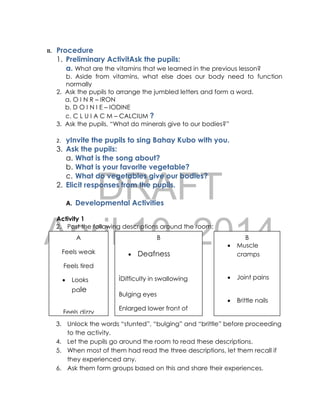
2. Post the following descriptions around the room:
3. Unlock the words โ€œstuntedโ€, โ€œbulgingโ€ and โ€œbrittleโ€ before proceeding
to the activity.
4. Let the pupils go around the room to read these descriptions.
5. When most of them had read the three descriptions, let them recall if
they experienced any.
6. Ask them form groups based on this and share their experiences.
A
Feels weak
Feels tired
๏‚ท Looks
pale
Feels dizzy
B
๏‚ท Deafness
iDifficulty in swallowing
Bulging eyes
Enlarged lower front of
the neck
B
๏‚ท Muscle
cramps
๏‚ท Joint pains
๏‚ท Brittle nails
Frequent bone
fracture or
breakage
DRAFT
April 10, 2014
7. After their sharing, unlock the three nutritional deficiencies and explain
further. (e.g. those that experience symptoms/signs in Box A may have
iron deficiency, Box B-may have iron deficiency, Box C-may have
calcium deficiency).
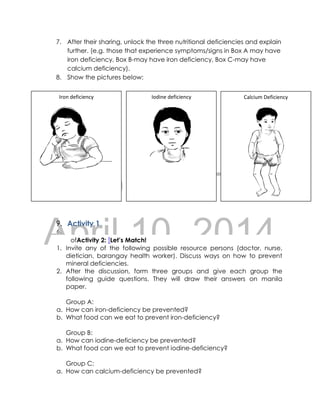
8. Show the pictures below:
9. Activity 1
6.
ofActivity 2: !Letโ€™s Match!
1. Invite any of the following possible resource persons (doctor, nurse,
dietician, barangay health worker). Discuss ways on how to prevent
mineral deficiencies.
2. After the discussion, form three groups and give each group the
following guide questions. They will draw their answers on manila
paper.
Group A:
a. How can iron-deficiency be prevented?
b. What food can we eat to prevent iron-deficiency?
Group B:
a. How can iodine-deficiency be prevented?
b. What food can we eat to prevent iodine-deficiency?
Group C:
a. How can calcium-deficiency be prevented?
Iron deficiency Iodine deficiency Calcium Deficiency
DRAFT
April 10, 2014
b. What food can prevent iodine-deficiency?
3. Ask each group to report.
4. Let them do Act. 1 on LM p. _____.
After finishing, ask the pupils, โ€œWhat will happen if we do not
get enough minerals?โ€
7. Instruct to turn to p. __.
8. Tell the pupils to observe the pictures. Call volunteers to
share their ideas.
9. Share that the pictures show how a child with mineral
deficiency looks like.
10.
B. Generalization
1. Call volunteers to describe each mineral deficiency using
one sentence.
2. Ask pupils to complete complete the sentence:
3. I can avoid iron/iodine/calcium deficiency by _____________.
C. Evaluation
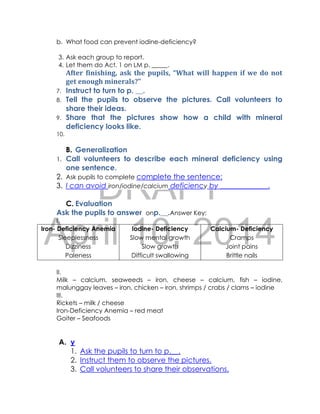
Ask the pupils to answer onp.__.Answer Key:
I.
Iron- Deficiency Anemia
Sleeplessness
Dizziness
Paleness
Iodine- Deficiency
Slow mental growth
Slow growth
Difficult swallowing
Calcium- Deficiency
Cramps
Joint pains
Brittle nails
II.
Milk โ€“ calcium, seaweeds โ€“ iron, cheese โ€“ calcium, fish โ€“ iodine,
malunggay leaves โ€“ iron, chicken โ€“ iron, shrimps / crabs / clams โ€“ iodine
III.
Rickets โ€“ milk / cheese
Iron-Deficiency Anemia โ€“ red meat
Goiter โ€“ Seafoods
A. y
1. Ask the pupils to turn to p.__.
2. Instruct them to observe the pictures.
3. Call volunteers to share their observations.
DRAFT
April 10, 2014
4. Ask the pupils to recall the previous lesson by asking:
a. How do they look like?
b. What condition could they have?
c. What are other effects of the conditions to the body?
d. What are the things that you cannot do when you
have these conditions?
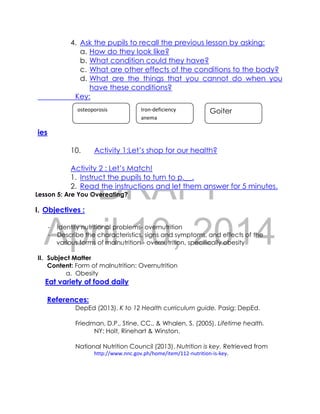
Key:
ies
10. Activity 1:Letโ€™s shop for our health?
Activity 2 : Letโ€™s Match!
1. Instruct the pupils to turn to p.__.
2. Read the instructions and let them answer for 5 minutes.
Lesson 5: Are You Overeating?
I. Objectives :
- Identify nutritional problems- overnutrition
- Describe the characteristics, signs and symptoms, and effects of the
various forms of malnutrition - overnutrition, specifically obesity
II. Subject Matter
Content: Form of malnutrition: Overnutrition
a. Obesity
Eat variety of food daily
References:
DepEd (2013). K to 12 Health curriculum guide. Pasig: DepEd.
Friedman, D.P., Stine, CC., & Whalen, S. (2005). Lifetime health.
NY: Holt, Rinehart & Winston.
National Nutrition Council (2013). Nutrition is key. Retrieved from
http://www.nnc.gov.ph/home/item/112-nutrition-is-key.
osteoporosis Iron-deficiency
anema
Goiter
DRAFT
April 10, 2014
UNICEF (2009). Nutrition in emergencies. Retrieved from
http://www.unicef.org/nutrition/training/
Background Information
III. Procedure
A. Preliminary Activity
Activity 1: A Letter For My Friend
1. Tell the pupils that they are going to read a letter.
2. Ask them to read the letter aloud.
3. Let them answer the questions orally after each story.
B. Developmental Activities
Activity 2: Eat All You Can!
3. Ask the pupils to get a piece of paper and draw/write all their favorite
foods. Give them three minutes.
4. Ask:
a. Is it okay to eat food as much as we want?
b. What will happen if we eat food more than the right amount?
c. Do you think it was the reason why the friend in the letter became
fat?
5. Write the word obesity on the board and tell them that it is a kind of
overnutrition where there is excess of body-building and energy-giving
nutrients in the diet.
C. Generalization (6 minutes)
Answer Letโ€™s Remember on LM p___.
D. Evaluation (8 minutes)
Let the pupils answer Letโ€™s Check on p _____.
Answer Key: (1) False (2) True (3) False (4) True (5) False
DRAFT
April 10, 2014
Lesson 6: Nutritional Guidelines for FilipinosEat Just Right!
I. Objectives :
- Identify the nutritional guidelines 1 and 4 for Filipinos
- Explain the importance of following the nutritional
guidelines (to avoid PEM)
- Plan balanced meals for a day
Subject Matter:
Content: Nutritional Guideline 1 and 4
1: Eat variety of food every day to get the nutrients needed by the
body.
4: Consume fish, lean meat, poultry, egg, dried beans or nuts daily
for growth and the repair of body tissues
Eat variety of food daily
Materials:
Real picture of foods
Organizers and charts
Picture of FNRI Food Pyramid
References:
Health and wellness. pp. 36-41, Meeks L. &Heit, P. (2005)
Food and Nutrition Research Institute. Eating plan for healthy living.
Retrieved from
http://www.fnri.dost.gov.ph/images/stories/Fnri%20Files/daily_nut_guide/7-
12body.jpg
Background Information
Following the nutritional guidelines for Filipinos will help the pupils
to stay away from different kinds of illnesses. Making foods choices
about the right foods to eat based on the food pyramid will help
develop healthy individuals. The Food Guide Pyramid teaches the
principle of eating the right amounts of a variety of foods every day.
Children should eat most rice and other cereals, bread and root
crops. They should eat more vegetables and fruits. Eating animal
foods, dried beans and nuts should be in moderately done. Eat just
enough foods rich in fats, oil and sugar. The following diagram shows
DRAFT
April 10, 2014
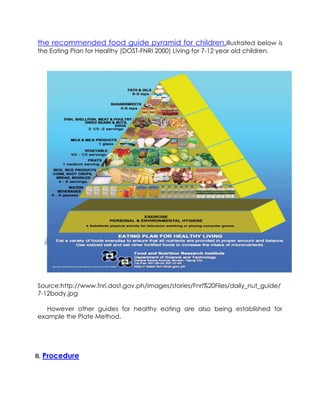
the recommended food guide pyramid for children.Illustrated below is
the Eating Plan for Healthy (DOST-FNRI 2000) Living for 7-12 year old children.
Source:http://www.fnri.dost.gov.ph/images/stories/Fnri%20Files/daily_nut_guide/
7-12body.jpg
However other guides for healthy eating are also being established for
example the Plate Method.
II. Procedure
DRAFT
April 10, 2014
A. Preliminary Activities
1. Instruct the pupils to turn to p. __.
2. Ask about their favorite breakfast, lunch, and dinner.
3. Tell them to draw their favorite dishes/meals on each plate.
4. After finishing, ask the pupils:
a. Are your favorite meals healthy Why do you say so??
b. How much food can you eat?
c. Is it okay to eat too much or too less? Why?
Developmental Activities
Activity 1
Ask the pupils to recall about forms of malnutrition:
Too much ๏ƒ  obesity , too less ๏ƒ  PEM
1. Tell pupils that it is important to eat just right to avoid malnutrition.
2. Ask the pupils, โ€œHow do you know how much food should be eaten
everyday?โ€
3. Draw a big pyramid on the board and ask if the pupils are familiar with
it.
Activity 1
1. Build the levels of the food pyramid with the pupils. Identify foods to be
eaten in right amounts.
Activity 2- Create your own menu!
1. Ask the pupils to turn to p.__.
2. Using the Food Pyramid Guide in their LM on page ___, ask each pupil
to work with a classmate. They must plan their food for breakfast, lunch
and dinner.
Activity 2
2. Tell the students that they will pretend to be chefs that will
make a menu for the day.
3. Instruct them to list the foods on each menu.
B. Generalization
Ask the pupils:
a. What do you mean by a balanced diet? guide
b. What is the importance of maintaining a balanced diet?
C. Evaluation
DRAFT
April 10, 2014
Ask the pupils to answer On p. __.
I. Answers may vary.
Eat less = PEM, Eat much = obesity, Eat right = healthy)
(plates)
D. Assignment
Make a 3-day breakfast, lunch, and dinner menu for your family.
Write it on your notebook.
DRAFT
April 10, 2014
Lesson 7:
๏‚ท Eat more vegetables, fruit and root crops.
๏‚ท Drink milk and eat food rich in calcium daily.
๏‚ท Breastfeed infants exclusively from birth up to 6
months.
I. Objectives:
- Identify the different nutritional guidelines 3, 5, 7,and 8 for
Filipinos
- Discuss the different nutritional guidelines for Filipinos
- Appreciate the importance of eating more vegetables,
fruits and root crops
II. Subject Matter:
III. Content: (No. 3, 5, 7, 8)more fruits and vegetables everyday to get the
essential vitamins, minerals, and fiber for regulation of body processes
IV. Consume milk, milk products, small fish and shellfish and other foods rich in
calcium everyday for healthy bones and teeth
babies Then give other foods but continue breastfeeding for 2 years or
longer
Use iodized salt to prevent iodine deficiency disorders
๏‚ท Limit intake of salty, fried, fatty, and sugar rich foods to
prevent cardiovascular diseases
V.
Materials:
pictures
charts
picture of a maze or puzzle
References:
- The .hcpbe, vol. 2. A resource book in health for teachers.
Manila: UNACOM
- National Nutrition Council (2012). 2012 Nutritional guidelines for
Filipinos. Retrieved from http://www.nnc.gov.ph/home/item/5-
10-nutritional-guidelines-for-filipinos-mga-gabay-sa-wastong-
nutrisyon-para-sa-pilipino
Health Curriculum in Phil. Basic Education, Vol.2 pp. 45-46
DRAFT
April 10, 2014
Background Information
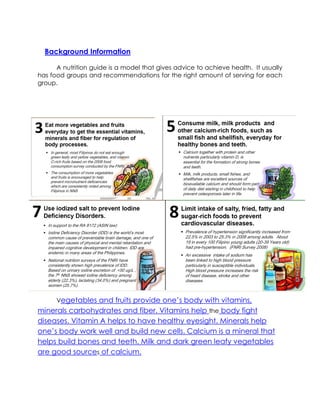
A nutrition guide is a model that gives advice to achieve health. It usually
has food groups and recommendations for the right amount of serving for each
group.
Vegetables and fruits provide oneโ€™s body with vitamins,
minerals carbohydrates and fiber. Vitamins help the body fight
diseases. Vitamin A helps to have healthy eyesight. Minerals help
oneโ€™s body work well and build new cells. Calcium is a mineral that
helps build bones and teeth. Milk and dark green leafy vegetables
are good sources of calcium.
DRAFT
April 10, 2014
Root crops like ube, gabi ,tugi, potato, camote, cassava, and
legumes are good sources of dietary fiber and help prevent risks for
diabetes, cardiovascular diseases and cancer.
Eating vegetable and fruits ensures that we get the vitamins, minerals and
fiber needed by the body to work well.
Fish, lean meat, poultry and dried beans are good sources of
protein. Proteins are used by the body to repair cells to grow. They
also give energy.
Limit the intake of salty food. One teaspoon of salt contains
about 2,300 mgof sodium. Children from age 4-8 should eat less than
1,900 milligrams a day while those from age 9-13-years old should eat
less than 2,200 milligrams a day.
Fats are sources of energy needed for immune system function
and vitamin absorption. These also cushion the internal organs of the
body, such as heart, liver and kidneys. Too much eating of fatty foods
will lead to obesity and heart problems.
VI. Procedure
A. Preliminary Activities
1. Instruct the pupils to turn to p.__.
2. Ask them to look for nutritious foodss found in the puzzle.
3. After finishing, call on volunteers to identify the foods they have
found.
4. Ask the pupils:
a. What kinds of foods are these?
b. What do they give the body?
5. Guide the students in recalling the previous lesson by asking,
โ€œHow much of these foods should you eat every day?โ€
B. Developmental Activities
Activity 1
Activity 1 Match Me!
1. Ask the pupils, โ€œWhy do we need to eat more vegetables,
fruits, and root crops?โ€
2. Instruct the pupils to turn toLetโ€™s Do p.__.
3. Tell them to match the picture to the correct word in the other
table.
Key:
Fruits โ€“ vitamins
DRAFT
April 10, 2014
Vegetables โ€“ minerals
Root crops โ€“ carbohydrates
Milk โ€“ calcium
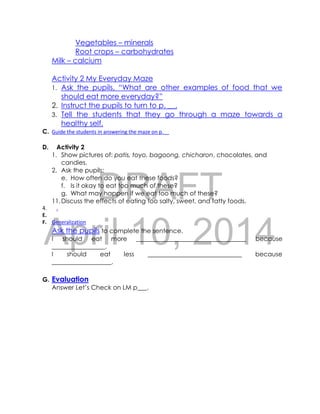
Activity 2 My Everyday Maze
1. Ask the pupils, โ€œWhat are other examples of food that we
should eat more everyday?โ€
2. Instruct the pupils to turn to p. __.
3. Tell the students that they go through a maze towards a
healthy self.
C. Guide the students in answering the maze on p.__
D. Activity 2
1. Show pictures of: patis, toyo, bagoong, chicharon, chocolates, and
candies.
2. Ask the pupils:
e. How often do you eat these foods?
f. Is it okay to eat too much of these?
g. What may happen if we eat too much of these?
11.Discuss the effects of eating too salty, sweet, and fatty foods.
4. .
E.
F. Generalization
Ask the pupils to complete the sentence.
I should eat more ___________________________________ because
_________________.
I should eat less ______________________________ because
___________________.
G. Evaluation
Answer Letโ€™s Check on LM p___.
DRAFT
April 10, 2014
DRAFT
April 10, 2014
Teachersโ€™ Guide
Quarter 2-Health Grade III
Lesson 8: Nutritional Guidelines for Filipinos
Objectives
Identify and discuss nutritional guideline 6 for Filipinos
๏‚ท Discuss ways on how to keep food safe and clean
Eat clean and safe food
๏‚ท Content: al (No. 6)Consume safe foods and water to prevent
diarrhea and other food-and-water borne diseases
- K to 12 Curriculum Guide- Health 3DepEd (2013). K to 12 Health
curriculum guide. Pasig: DepEd.
- The .hcpbe, vol. 2. A resource book in health for teachers. Manila:
UNACOM
Background Information
Eating clean involves eating whole, natural foods andvegetables
The Basics for safe food are general cleanliness, proper food storage and proper
food preparation and handling.
S
Safe food rules include:
a. Maintain cleanliness. Wash hands, food, utensils and work surfaces.
b. Store food in a cool dry place, properly covered and away from flies
and animals.
c. Cook food thoroughly. Serve food in clean utensils.
d. Eat food promptly.
e. Reheat food leftovers.
DRAFT
April 10, 2014
A. Preliminaries
of their LM
, 1. Ask: What is the message of the song?
Instruct the pupils to turn to p. ___.
B. Developmental Activities
2. Tell them to turn to Activity 1 on p. ____.
1. Let them observe the picture.
Ask the pupils:
Whatโ€™s wrong with the things in the picture?
Do you want to eat in this place?
What can we get from eating in dirty placeswith
2. Form 5 groups. Assign one picture for each group to work on. Let
the group do Activity 2 on p._____.
and x if the picture do not
DRAFT
April 10, 2014
?5.
Activity 1: Choose and TellAsk the pupils to turn to3 p.__.
Statement 1-agree 2-disgree 3-disagree 4-agree 5-agree 6-disagree 7-
disagree 8-agree
C. Generalization
1. Ask the pupils:
a. What are the ways to have clean and safe food?
b. Why do we need to eat clean and safe food?
2. Sing the song with the pupils.
Sing the song in tune of
โ€œRow, row, row your boatโ€
Eat clean and safe food
Make it everyday
Happily, happily, happily, happily
We will be healthy
E. Evaluation:
Ask pupils to answer p. __
Answers: hands, utensils, food, cover, insects
(Activity 3)
DRAFT
April 10, 2014
Lesson: 9: Maintain Healthy Life Style
I. Objectives:
- Identify and discuss nutritional guidelines 9 and 10
- Describe ways of maintaining healthy lifestyle
๏‚ท Proper diet
๏‚ท Regular exercise
๏‚ท Avoid people who smoke
๏‚ท Avoid drinking alcoholic beverages
- Adopt habits for healthy life style
II. Subject Matter:
Content: Nutritional Guidelines 9 and 10
Attain normal body weight through proper diet and
moderate physical activity to maintain good health and help
prevent obesity
Be physically active, make healthy food choices, manage
stress, avoid alcoholic beverage and do not smoke to help
prevent lifestyle-related non-communicable diseases
III.
IV.
V.
VI.
Materials:
- pictures
- charts
References:
-
- The Lung Association. Smoking and tobacco. Retrieved from
http://www.lung.ca/protect-protegez/tobacco-
tabagisme/second-secondaire/thirdhand-tertiaire_e.php
- Paige Waeher. Simple ways to live a healthy lifestyle.
Retrieved from
http://exercise.about.com/od/healthinjuries/a/healthylifestyl.
htm K to 12 Curriculum in Health 3
DRAFT
April 10, 2014
Background Information
The choices we make for ourselves like the food we eat
and the activities we do are important determinants of our
health. Our choices can make us healthy or can predispose us
to diseases.
Eating properly can improve chances for a long and healthy
lifestyle.Rphysical Benefits of regular physical
exercise/physical activities:
๏‚ท controls weight, combats diseases, improves mood,
boosts energy, and promotes better sleep
๏‚ท can be fun
The goal of any parent and health education program is to
ultimately create a healthy lifestyle for children. Creating a healthy
lifestyle for children includes how they eat, behave and most of all their
daily life habits, responsibilities, respect and appreciation for their body,
mind and spirit.
However not all the activities or habits pursued by children and
even adults are good for a healthy lifestyle and this include excessive
alcohol consumption and smoking.
Non-smokers are affected by cigarette smoke. Smoking
does not just affect the smoker. Everyone around inhales the
smoke produced- or โ€œsecond hand smokeโ€. It can lead to the
same complications as the smokers if exposed long
enough. It is almost like the non-smoking by standers had been
smoking as well- hence the term โ€œ passive smokers. Children
DRAFT
April 10, 2014
are especially vulnerable to second-hand smoke if there are
active smokers at home. Passive smokers have twice the
rate of serious lung infections, twice the likelihood of
developing asthma, five times the rate of developing

allergic symptoms, and have increased susceptibility to
diseases and other ear, nose and throat problems.
There is also now what is known as third hand-smoke. This is the
smoke that gets trapped in hair, skin, carpet, fabric, furniture and toys. It
has the same toxic chemicals as second hand smoke. The chemicals
from the trapped smoke pollute the air and get into peopleโ€™s lungs and
bodies. People should be protected from third hand smoke.
VII.Procedure
A. Preliminary Activities
3. Tell the pupils to stand and get ready forexercise.
4. Sing the song โ€œMag Exercise TayoTuwingUmagaโ€ with
the pupils.
5. Ask:
๏‚ท What does the song say about exercise?
๏‚ท Is exercise important? Why or why not?
๏‚ท
B. Developmental Activities
1. Ask the pupils to list their favorite activities.
2. Let them play an active game the class is mostly interested in.
3. After the game, ask:
๏‚ท What parts of the body were used/exercised/stretched well in
the game?
๏‚ท What did you feel after doing the game?
๏‚ท Did you enjoy playing?
๏‚ท Do you get the same feelings when you exercise?
4. Let them read their list of favorite activities. Let them check which
activities give them same benefits as exercise and playing active
games. Ask, โ€œWhat should they do to have a more active lifestyle?โ€
5. Divide the class into two groups.
6. Group A will read Story A and Group B Story B on Letโ€™s Do Activity 1.
Activity 2 and 3
DRAFT
April 10, 2014
1. Ask the pupils, โ€œAside from exercising, how else can you
keep your body healthy?โ€
2. Instruct the pupils to turn to p.__.
(Healthy food-rice, bread, fruits,vegetables, nuts, milk)
(Healthy activity-biking, running/jogging)
7. Discuss why healthy lifestyle prevents diseases.
Discussion
C. Generalization
Ask the pupils to answer p. __. (Activity 4)
D. Application
Do activity in LM page ____.
E. Evaluation
Ask the pupils to draw a poster that shows practices of a
healthy lifestyle
Rubrics:
Content: 5 points
Creativity: 3 points
Neatness: 2 points
Total: 10 points
F.Assignment
Answer Letโ€™s do this at home.
Instruct the pupils to make a โ€œone-day vacationโ€ plan for their
family. It should include the following:
a. The foods to eat for the day (breakfast, lunch, and dinner)
Activities to do during the day
b.
POST-TEST
Instruct the pupils to do the Post-test.
DRAFT
April 10, 2014
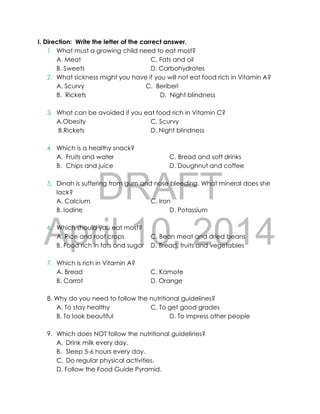
I. Direction: Write the letter of the correct answer.
1. What must a growing child need to eat most?
A. Meat C. Fats and oil
B. Sweets D. Carbohydrates
2. What sickness might you have if you will not eat food rich in Vitamin A?
A. Scurvy C. Beriberi
B. Rickets D. Night blindness
3. What can be avoided if you eat food rich in Vitamin C?
A.Obesity C. Scurvy
B.Rickets D. Night blindness
4. Which is a healthy snack?
A. Fruits and water C. Bread and soft drinks
B. Chips and juice D. Doughnut and coffee
5. Dinah is suffering from gum and nose bleeding. What mineral does she
lack?
A. Calcium C. Iron
B. Iodine D. Potassium
6. Which should you eat most?
A. Rice and root crops C. Bean meat and dried beans
B. Food rich in fats and sugar D. Bread, fruits and vegetables
7. Which is rich in Vitamin A?
A. Bread C. Kamote
B. Carrot D. Orange
8. Why do you need to follow the nutritional guidelines?
A. To stay healthy C. To get good grades
B. To look beautiful D. To impress other people
9. Which does NOT follow the nutritional guidelines?
A. Drink milk every day.
B. Sleep 5-6 hours every day.
C. Do regular physical activities.
D. Follow the Food Guide Pyramid.
DRAFT
April 10, 2014
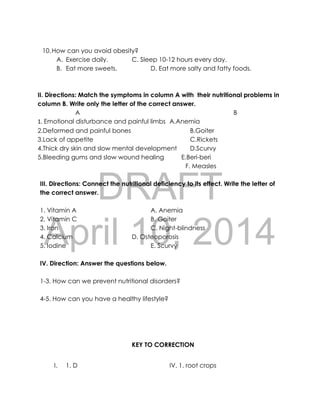
10.How can you avoid obesity?
A. Exercise daily. C. Sleep 10-12 hours every day.
B. Eat more sweets. D. Eat more salty and fatty foods.
II. Directions: Match the symptoms in column A with their nutritional problems in
column B. Write only the letter of the correct answer.
A B
1. Emotional disturbance and painful limbs A.Anemia
2.Deformed and painful bones B.Goiter
3.Lack of appetite C.Rickets
4.Thick dry skin and slow mental development D.Scurvy
5.Bleeding gums and slow wound healing E.Beri-beri
F. Measles
III. Directions: Connect the nutritional deficiency to its effect. Write the letter of
the correct answer.
1. Vitamin A A. Anemia
2. Vitamin C B. Goiter
3. Iron C. Night-blindness
4. Calcium D. Osteoporosis
5. Iodine E. Scurvy
IV. Direction: Answer the questions below.
1-3. How can we prevent nutritional disorders?
4-5. How can you have a healthy lifestyle?
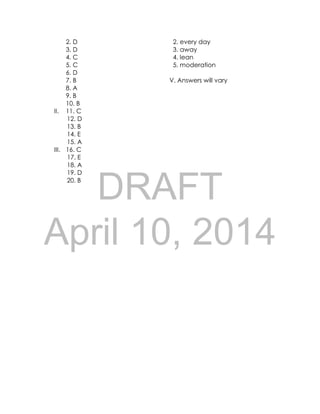
KEY TO CORRECTION
I. 1. D IV. 1. root crops
DRAFT
April 10, 2014
2. D 2. every day
3. D 3. away
4. C 4. lean
5. C 5. moderation
6. D
7. B V. Answers will vary
8. A
9. B
10. B
II. 11. C
12. D
13. B
14. E
15. A
III. 16. C
17. E
18. A
19. D
20. B
DRAFT
April 10, 2014
1ย 
ย 
QUARTER 2
PERSONAL HEALTH
PREVENTION OF DISEASES
TEACHERโ€™S GUIDE
DRAFT
April 10, 2014
2ย 
ย 
ย 
ย 
ย 
__________________________
ย 
ย 
ย 
__________________________ย 
ย 
ย 
ย 
__________________________ย 
ย 
ย 
ย 
__________________________ย 
INTRODUCTION:
Personal health involves the development of habits and practices for good
health. This module focuses on personal health for prevention and control of
common childhood diseases. It aims to develop among learners an
understanding of health and wellness and practice of healthy habits to prevent
and control common childhood diseases. Teachers are highly encouraged to
use the varied activities that are included in the module to build on learnerโ€™s
needs, abilities, and interests as they engage in meaningful learning activities
and apply specific life skills. May this module serve its purpose as a powerful
reminder that health is wealth but we need to work to maintain it.
PRE-TEST
Instruct the pupils to answer the Pre-test.
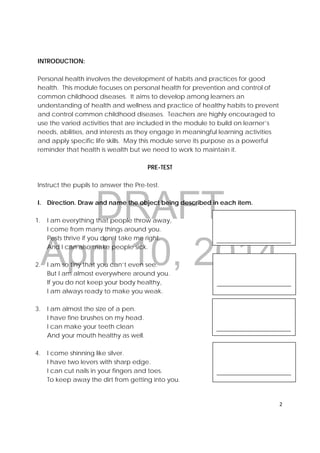
I. Direction. Draw and name the object being described in each item.
1. I am everything that people throw away,
I come from many things around you.
Pests thrive if you donโ€™t take me right.
And I can also make people sick.
2. I am so tiny that you canโ€™t even see.
But I am almost everywhere around you.
If you do not keep your body healthy,
I am always ready to make you weak.
3. I am almost the size of a pen.
I have fine brushes on my head.
I can make your teeth clean
And your mouth healthy as well.
4. I come shinning like silver.
I have two levers with sharp edge.
I can cut nails in your fingers and toes.
To keep away the dirt from getting into you.
DRAFT
April 10, 2014
3ย 
ย 
ย 
ย 
ย 
ย 
__________________________ย 
5. I am a piece of slippery fragrant bar.
I also come in a plastic bottle sometimes.
With water running through your body,
I wash away dirt and make you smell good.
II. Direction: Write on your paper the letter of correct answer.
1. Which best describes health?
A. A happy and good life without problems
B. A good-looking face and a beautiful body
C. A healthy body without disorders and diseases
D. A balanced well-being of body, mind, feeling, spirit and relationship
with others
2. Which shows a healthy person?
A. Ana eats a lot of food.
B. Tinoy stays up late watching TV.
C. Jenny makes friends with her classmates.
D. Boyet cries out loud when he does not get what he wants.
3. Which is not a risk factor of diseases?
A. Heredity
B. Lifestyle
C. Environment
D. Appearance
4. Which is a good physical activity?
A. Watching TV every night
B. Doing stunts and rough games
C. Playing computer games all day
D. Playing patintero with friends during free time
5. Which can make you sick?
A. Clean body
B. Immunization
C. Dirty environment
D. Regular physical activity
DRAFT
April 10, 2014
4ย 
ย 
III. Direction: Write YES if the statement is a healthy habit and write NO if it is not.
Do it in your notebook.
________1. Watch TV all day.
________2. Bite your fingernails.
________3. Take a bath regularly.
________4. Sleep late every night.
________5. Jog regularly with your family.
________6. Keep your surroundings clean.
________7. Consult the doctor for immunizations.
________8. Brush your teeth during night time only.
________9. Eat plenty of all kinds of food everyday.
________10. Wash your hands before and after eating.
KEY TO CORRECTION
I.
1. Garbage/Trash/Wastes
2. Germs/Microbes/Pathogens
3. Toothbrush
Letโ€™s check how well you did in the test?
If you get a score of:
20-17- Congratulations! You did an excellent job. For sure, you
will learn more in our next lessons.
16- 12- Itโ€™s a good start! Be ready to learn more.
11-below- Its okay! Letโ€™s take this time to learn a lot.
Now, letโ€™s turn to the next page and be ready to learn more
and be healthy!
DRAFT
April 10, 2014
5ย 
ย 
4. Nail cutter
5. Soap
II.
1. D
2. C
3. D
4. D
5. C
III.
1. No
2. No
3. Yes
4. No
5. Yes
6. Yes
7. Yes
8. No
9. N0
10.Yes
Ask the pupils to check how well they did in the test. Ask them to raise their
hand, as teacher calls out their scores. Tell them that if they get a score of:
20-17- Congratulations! You did an excellent job. For sure, you will learn more
in our next lessons.
16- 12- Itโ€™s a good start! Be ready to learn more.
11-below- Itโ€™s okay! Letโ€™s take this time to learn a lot.
Lesson 1: Health and Wellness
I. Objectives:
At the end of the lesson pupil should be able to:
โ€ Describe a healthy person and an unhealthy person
II. Subject Matter:
Content: Concept of Health and Wellness
DRAFT
April 10, 2014
6ย 
ย 
Materials: pictures, chart, markers
References:
โ€ Meeks, Linda, .et,al. (2010). Comprehensive School Health Education.
Totally Awesome Strategies for Teaching Health (7th ed). New York USA:
McGraw Hill.
โ€ McTavish, Sandra ( 2004).Life Skills. 225 Ready to Use Health Activities for
Success and Well-being. California USA: John Wiley & Sons Inc.
โ€ Donatelle, R.J. (1996). Access to Health (9th ed.) New Jersey: Pearson
Education Inc.
โ€ DepEd (2013). K to 12 Health Curriculum Guide. Pasig: DepED.
Background Information
HEALTH AND WELLNESS
The World Health Organization (WHO) defines health as a state of
complete physical, mental and social well-being and not merely the
absence of disease or infirmity. It is the complete well-being of the body,
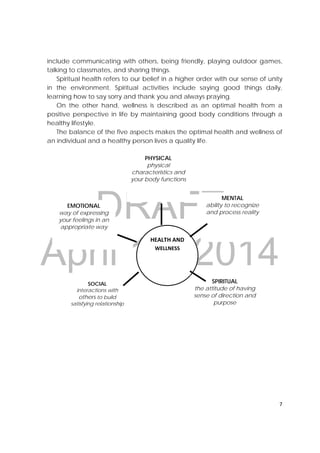
mind, feelings, spirit and relationship with others. There are five aspects of
health that contribute to the total health or state of well-being of an
individual. These aspects include the physical, emotional, mental, social and
spiritual.
Physical health refers to the state and characteristics of the body along
with its size, shape, body parts, body functioning, sensory acuity,
recuperative ability and basic needs. Physical activities include body
exercise, playing games, eating proper diet, practicing personal hygiene
and getting adequate rest and sleep.
Mental health refers to our capability to think, to recognize and to process
information and reality. Emotional health speaks of our different emotions
and how we express and manage such feelings. Mental and emotional
health is described as the psychological component of health which
includes our values, belief system, and levels self-esteem, self confidence and
coping mechanisms. Mental activities include doing homework, computing
expenses and problem solving activities. Emotional activities include
accepting comments positively, managing anger and showing feelings
through facial expressions.
Social health is the state of our interaction and relationship with others
with our ability to adapt to various situations and behaviors. Social activities
DRAFT
April 10, 2014
7ย 
ย 
include communicating with others, being friendly, playing outdoor games,
talking to classmates, and sharing things.
Spiritual health refers to our belief in a higher order with our sense of unity
in the environment. Spiritual activities include saying good things daily,
learning how to say sorry and thank you and always praying.
On the other hand, wellness is described as an optimal health from a
positive perspective in life by maintaining good body conditions through a
healthy lifestyle.
The balance of the five aspects makes the optimal health and wellness of
an individual and a healthy person lives a quality life.
HEALTHย ANDย 
WELLNESSย 
ย 
PHYSICAL
physical
characteristics and
your body functions
MENTAL
ability to recognize
and process reality
EMOTIONAL
way of expressing
your feelings in an
appropriate way
SOCIAL
interactions with
others to build
satisfying relationship
SPIRITUAL
the attitude of having
sense of direction and
purpose
DRAFT
April 10, 2014
8ย 
ย 
III. Procedure
A. Preliminary Activities
1. Ask the pupils to identify healthy people they know.
2. Tell the students to write the names or draw the faces of their healthy
idols. Let them list or draw as many as they can.
3. Call for volunteers to share their work.
4. Ask the pupils: What makes these people your healthy idols?
5. Ask the students to describe the characteristics of their healthy idols.
Write on the board the adjectives used to describe healthy people.
6. Let the pupils describe a healthy one using all the adjectives used for
their healthy idols.
B. Developmental Activities
1. Call on volunteer who will read in class the definition of health and
wellness according to W.H.O. Ask the volunteer to explain the definition.
โ€œHealth as a state of complete physical, mental and social well-being
and not merely the absence of disease or infirmity.โ€
2. Present pictures of the 5 aspects of health (physical, mental, emotional,
social and spiritual)
3. Discuss with the class the components of each aspect.
4. Let the pupils do Activity 1: The Healthy One on p._____.
5. After doing the activity, ask a pupil to read and explain his/her work in
class by answering the following questions:
a. Do you think you are a healthy one? Why?
b. What are the activities that a healthy person can do?
6. Ask the pupils to identify activities under physical, mental, emotional,
spiritual and social.
7. Ask the pupils to turn their module to p.____ for Activity 2: Wellness on the
Go. Let the pupils describe each picture and answer the activity.
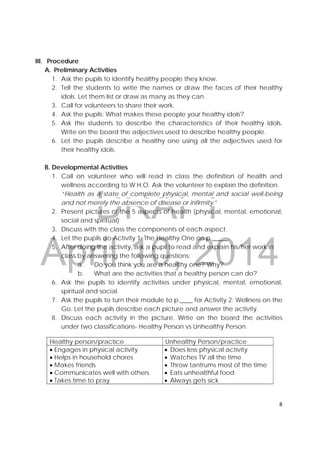
8. Discuss each activity in the picture. Write on the board the activities
under two classifications- Healthy Person vs Unhealthy Person.
Healthy person/practice Unhealthy Person/practice
๏‚ท Engages in physical activity
๏‚ท Helps in household chores
๏‚ท Makes friends
๏‚ท Communicates well with others
๏‚ท Takes time to pray
๏‚ท Does less physical activity
๏‚ท Watches TV all the time
๏‚ท Throw tantrums most of the time
๏‚ท Eats unhealthful food
๏‚ท Always gets sick
DRAFT
April 10, 2014
9ย 
ย 
9. Ask the pupils to name other healthy and unhealthful activities and
characteristics aside from those in the module.
10. Let the pupils contrast healthy and unhealthy pictures using the
characteristics and activities written on the board.
C. Generalization
1. Let pupils do Let's Check! on p ___.
2. Remind the pupils to write only the promises that they intend to keep
and willing to commit for the health.
D. Evaluation
1. Ask the pupils to answer Activity 3: Getโ€™s Go for Health and Wellness on
p.____.
2. Let them identify ways for a healthy lifestyle as decoded in the
message from the activity. Ask them to explain each step.
a. Eat a balanced diet.
b. Exercise regularly.
c. Avoid harmful habits.
d. Get adequate rest.
e. Manage stress
f. Get regular medical attention.
g. Practice safety.
Lesson 2: Sickness Troubles
I. Objectives:
โ€ Define disease
โ€ Identify common childhood diseases
โ€ Explain effects of diseases
II. Subject Matter:
Content: Common Childhood Diseases
Materials:
โ€ Activity cards
โ€ Pictures
โ€ Markers
DRAFT
April 10, 2014
10ย 
ย 
References:
โ€ Meeks, Linda, .et,al. (2010). Comprehensive School Health Education. Totally
Awesome Strategies for Teaching Health (7th ed). New York USA: McGraw Hill.
โ€ McTavish, Sandra ( 2004).Life Skills. 225 Ready to Use Health Activities for
Success and Well-being. California USA: John Wiley & Sons Inc.
โ€ Galvez Tan, JZ, et al. (2009). The Health Curriculum in the Philippine
Basic Education. Manila: UNACOM.
โ€ Donatelle, R.J. (1996). Access to Health (9th ed.) New Jersey: Pearson
Education Inc.
โ€ DepEd (2013). K to 12 Health Curriculum Guide. Pasig: DepED.
Background Information
Disease is an abnormal condition of the body which alters the normal
functioning of the body and mind. Each disease comes with specific group of
signs and symptoms. Diseases affect our total health. It limits our activities and
affects the quality of our life as well as our relationship with others.
Children are viewed as more susceptible to various kinds of diseases.
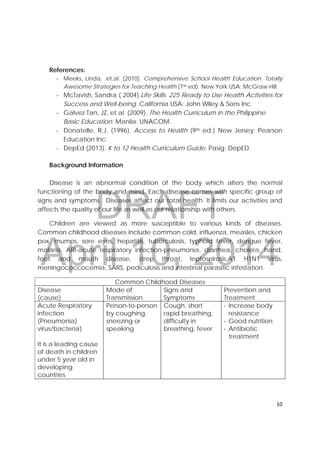
Common childhood diseases include common cold, influenza, measles, chicken
pox, mumps, sore eyes, hepatitis, tuberculosis, typhoid fever, dengue fever,
malaria, ARI-acute respiratory infection-pneumonia, diarrhea, cholera, hand,
foot and mouth disease, strep throat, leptospirosis,A1 H1N1 virus,
meningococcocemia, SARS, pediculosis and intestinal parasitic infestation.
Common Childhood Diseases
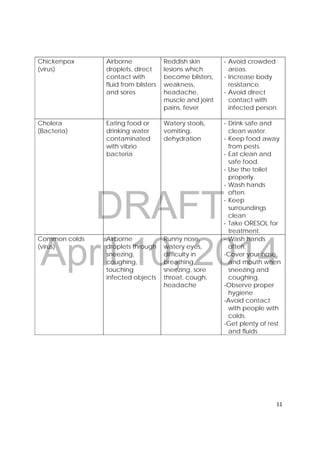
Disease
(cause)
Mode of
Transmission
Signs and
Symptoms
Prevention and
Treatment
Acute Respiratory
infection
(Pneumonia)
virus/bacteria)
It is a leading cause
of death in children
under 5 year old in
developing
countries
Person-to-person
by coughing,
sneezing or
speaking
Cough, short
rapid breathing,
difficulty in
breathing, fever
โ€ Increase body
resistance
โ€ Good nutrition
โ€ Antibiotic
treatment
DRAFT
April 10, 2014
11ย 
ย 
Chickenpox
(virus)
Airborne
droplets, direct
contact with
fluid from blisters
and sores
Reddish skin
lesions which
become blisters,
weakness,
headache,
muscle and joint
pains, fever
โ€ Avoid crowded
areas.
โ€ Increase body
resistance.
โ€ Avoid direct
contact with
infected person.
Cholera
(Bacteria)
Eating food or
drinking water
contaminated
with vibrio
bacteria
Watery stools,
vomiting,
dehydration
โ€ Drink safe and
clean water.
โ€ Keep food away
from pests.
โ€ Eat clean and
safe food.
โ€ Use the toilet
properly.
โ€ Wash hands
often.
โ€ Keep
surroundings
clean
โ€ Take ORESOL for
treatment.
Common colds
(virus)
Airborne
droplets through
sneezing,
coughing,
touching
infected objects
Runny nose,
watery eyes,
difficulty in
breathing,
sneezing, sore
throat, cough,
headache
โ€ Wash hands
often.
-Cover your nose
and mouth when
sneezing and
coughing.
-Observe proper
hygiene
-Avoid contact
with people with
colds.
-Get plenty of rest
and fluids
DRAFT
April 10, 2014
12ย 
ย 
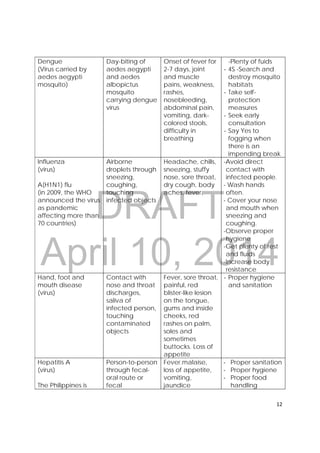
Dengue
(Virus carried by
aedes aegypti
mosquito)
Day-biting of
aedes aegypti
and aedes
albopictus
mosquito
carrying dengue
virus
Onset of fever for
2-7 days, joint
and muscle
pains, weakness,
rashes,
nosebleeding,
abdominal pain,
vomiting, dark-
colored stools,
difficulty in
breathing
-Plenty of fuids
โ€ 4S -Search and
destroy mosquito
habitats
โ€ Take self-
protection
measures
โ€ Seek early
consultation
โ€ Say Yes to
fogging when
there is an
impending break
Influenza
(virus)
A(H1N1) flu
(in 2009, the WHO
announced the virus
as pandemic
affecting more than
70 countries)
Airborne
droplets through
sneezing,
coughing,
touching
infected objects
Headache, chills,
sneezing, stuffy
nose, sore throat,
dry cough, body
aches, fever,
-Avoid direct
contact with
infected people.
- Wash hands
often.
- Cover your nose
and mouth when
sneezing and
coughing.
-Observe proper
hygiene
-Get plenty of rest
and fluids
-Increase body
resistance
Hand, foot and
mouth disease
(virus)
Contact with
nose and throat
discharges,
saliva of
infected person,
touching
contaminated
objects
Fever, sore throat,
painful, red
blister-like lesion
on the tongue,
gums and inside
cheeks, red
rashes on palm,
soles and
sometimes
buttocks. Loss of
appetite
โ€ Proper hygiene
and sanitation
Hepatitis A
(virus)
The Philippines is
Person-to-person
through fecal-
oral route or
fecal
Fever.malaise,
loss of appetite,
vomiting,
jaundice
โ€ Proper sanitation
โ€ Proper hygiene
โ€ Proper food
handling
DRAFT
April 10, 2014
13ย 
ย 
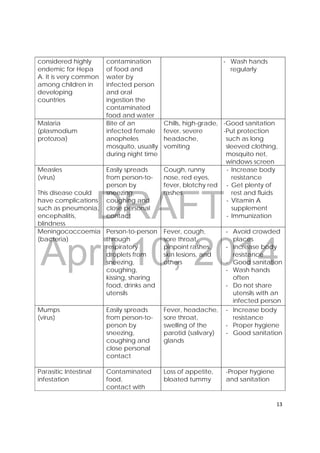
considered highly
endemic for Hepa
A. It is very common
among children in
developing
countries
contamination
of food and
water by
infected person
and oral
ingestion the
contaminated
food and water
โ€ Wash hands
regularly
Malaria
(plasmodium
protozoa)
Bite of an
infected female
anopheles
mosquito, usually
during night time
Chills, high-grade,
fever, severe
headache,
vomiting
-Good sanitation
-Put protection
such as long
sleeved clothing,
mosquito net,
windows screen
Measles
(virus)
This disease could
have complications
such as pneumonia,
encephalitis,
blindness
Easily spreads
from person-to-
person by
sneezing,
coughing and
close personal
contact
Cough, runny
nose, red eyes,
fever, blotchy red
rashes
โ€ Increase body
resistance
โ€ Get plenty of
rest and fluids
โ€ Vitamin A
supplement
โ€ Immunization
Meningococcoemia
(bacteria)
Person-to-person
through
respiratory
droplets from
sneezing,
coughing,
kissing, sharing
food, drinks and
utensils
Fever, cough,
sore throat,
pinpoint rashes,
skin lesions, and
others
โ€ Avoid crowded
places
โ€ Increase body
resistance
โ€ Good sanitation
โ€ Wash hands
often
โ€ Do not share
utensils with an
infected person
Mumps
(virus)
Easily spreads
from person-to-
person by
sneezing,
coughing and
close personal
contact
Fever, headache,
sore throat,
swelling of the
parotid (salivary)
glands
โ€ Increase body
resistance
โ€ Proper hygiene
โ€ Good sanitation
Parasitic Intestinal
infestation
Contaminated
food,
contact with
Loss of appetite,
bloated tummy
-Proper hygiene
and sanitation
DRAFT
April 10, 2014
14ย 
ย 
contaminated
soil and human
waste,
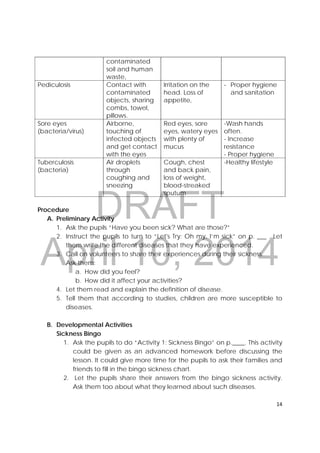
Pediculosis Contact with
contaminated
objects, sharing
combs, towel,
pillows.
Irritation on the
head. Loss of
appetite,
โ€ Proper hygiene
and sanitation
Sore eyes
(bacteria/virus)
Airborne,
touching of
infected objects
and get contact
with the eyes
Red eyes, sore
eyes, watery eyes
with plenty of
mucus
-Wash hands
often.
- Increase
resistance
- Proper hygiene
Tuberculosis
(bacteria)
Air droplets
through
coughing and
sneezing
Cough, chest
and back pain,
loss of weight,
blood-streaked
sputum
-Healthy lifestyle
Procedure
A. Preliminary Activity
1. Ask the pupils โ€œHave you been sick? What are those?โ€
2. Instruct the pupils to turn to โ€œLet's Try: Oh my, Iโ€™m sickโ€ on p. ___ . Let
them write the different diseases that they have experienced.
3. Call on volunteers to share their experiences during their sickness.
Ask them:
a. How did you feel?
b. How did it affect your activities?
4. Let them read and explain the definition of disease.
5. Tell them that according to studies, children are more susceptible to
diseases.
B. Developmental Activities
Sickness Bingo
1. Ask the pupils to do โ€œActivity 1: Sickness Bingoโ€ on p.____. This activity
could be given as an advanced homework before discussing the
lesson. It could give more time for the pupils to ask their families and
friends to fill in the bingo sickness chart.
2. Let the pupils share their answers from the bingo sickness activity.
Ask them too about what they learned about such diseases.
DRAFT
April 10, 2014
15ย 
ย 
3. Briefly give information about the diseases indicated in the activity.
4. Instruct the pupils to do โ€œActivity 2: Just canโ€™t Forget about itโ€ on
p.___. Let them write a short paragraph about their unforgettable or
worst experience on sickness. Encourage them to write their feelings
about it, and what they have done with it.
5. Ask some pupils to share their work. Draw from the experiences of
the students to briefly discuss how diseases affect us.
C. Generalization
Call on volunteers and ask,
a. What is a disease?
b. How do diseases affect us?
c. What are some common childhood diseases?
D. Evaluation
Ask the pupils to answer Let's Check: Health advisoryโ€ on p. ____.
Rate the poster:
Content- 5 pts
Presentation-3 pts
Creativity-2 pts
Lesson 3 : Factors on the Go
I. Objective:
โ€ Identify risk factors of diseases
โ€ Discuss risk factors of diseases
โ€ Give examples of health condition under each risk factor
II. Subject Matter:
Content Outline: Contributing risk factors of diseases
Materials:
โ€ activity cards
โ€ pictures
โ€ markers
References:
DRAFT
April 10, 2014
16ย 
ย 
โ€ Meeks, Linda, .et,al. (2010). Comprehensive School Health Education.
Totally Awesome Strategies for Teaching Health (7th ed). New York USA:
McGraw Hill.
โ€ Department of Health (2012). Philippine Health Advisories. Manila:
National Center for Health Promotion, National center for Disease
Preventon and Control.
โ€ McTavish, Sandra ( 2004).Life Skills. 225 Ready to Use Health Activities for
Success and Well-being. California USA: John Wiley & Sons Inc.
โ€ Donatelle, R.J. (1996). Access to Health (9th ed.) New Jersey: Pearson
Education Inc.
โ€ DepEd (2013). K to 12 Health Curriculum Guide. Pasig: DepED.
Background Information
Diseases develop with various elements and contributing risk factors. The
elements of diseases include the susceptible host, causative agent, and the
environment. A disease starts with a susceptible host which can be any
organism- human or animals with a weak resistance level or genetic
dysfunction. The causative-agents or pathogens are disease-causing
microorganisms such as bacteria, virus, fungi and protozoa. These agents are
very tiny organisms that can not be seen by the naked eye. Most people call
these โ€œgermsโ€ which cause infection and communicable diseases.
Environment includes the surrounding and all its elements such that an
unhealthy environment contributes to the development of diseases. There
are various risk factors that contribute to susceptibility such as heredity,
lifestyle and environment.
Heredity includes the genes from the family. Research studies show that
some diseases are caused by direct chromosomal inheritance. It is also
believed that certain people may actually inherit immune systems that are
susceptible to a wide variety of invasive organisms. It has also been studied
that with age, the bodyโ€™s immune system responds less efficiently to the
invading organisms thus, increasing the risk of illness.
The contributing risks factors of diseases from the environment include
pollutants, radioactive substances, and infectious pathogens which may
contaminate the air, water, food supply and soil and make people
susceptible to diseases. For instance, eating contaminated food, drinking of
contaminated or dirty water will result in typhoid fever, and diarrhea. Polluted
DRAFT
April 10, 2014
17ย 
ย 
air and sudden change of weather can contribute to the development of
disease such as asthma, colds, and severe coughing.
On the other hand, lifestyle refers to the actions or practices of a person. It
is considered as one of the greatest contributors of diseases such that the
impacts of other factors will vary according to a personโ€™s lifestyle. Healthy
lifestyle includes having proper and balanced nutrition, taking adequate rest
and sleep, doing regular physical activities, avoiding smoking and alcohol,
managing stress, practicing safety and taking regular medical check-ups.
People who choose to do harmful and unhealthful habits have the higher
susceptibility to diseases. Lifestyle diseases also include obesity, asthma,
chronic liver diseases, and some kinds of cancer, heart diseases, diabetes and
many others.
ย 
III. Procedure
A. Preliminary Activity
Picture says
1. Ask the pupils to turn to โ€œPicture saysโ€ on p. ______. The pupils must
describe what each picture.
2. Let them identify if the picture shows a healthy habit or a habit that
could make people sick.
3. Emphasize that there are certain factors that contribute to
development of diseases such as heredity, lifestyle and environment.
4. Let them identify the factor shown on each picture.
B. Developmental Activitiesย 
1. Show pictures of examples of the three contributing risk factors in
different conditions.
2. Let the pupils guess the factor involved in each picture being
shown.
3. Instruct the pupils to answer Activity 1: Sickness Factors on p___.ย 
(Answers: 1. L 2. H 3. L 4. E 5. E)
4. Discuss that contributing risk factors under different conditions
have a big impact on our health, which could either make us
healthy or sick and weak.ย 
5. Ask the pupils to answer Activity 2: Friends or Foes on p. ____. Let
them identify conditions that are risk factors of diseases.ย 
ย 
DRAFT
April 10, 2014
18ย 
ย 
Friends Foes
Rest Clean body
Exercise Immunizations
Balanced Diet Check-ups
Germs Dirty water
Smoking Household pests
Polluted air Abnormal tissues
ย 
C. Generalization
Ask the pupils: What makes us sick?
D. Evaluation
Let pupils answer Let's Check on p.____. Make them identify in their
community the different conditions that makes them healthy or sick.
ย 
Lesson 4: Be Healthy with Clean Body
I. Objectives:
โ€ Explain measure to prevent common diseases-proper hygiene
โ€ Explain the importance of proper hygiene in the prevention of
diseases
โ€ Discuss ways to maintain proper hygiene
โ€ Practice proper hygiene
โ€ Demonstrate good decision-making skills to prevent diseases
II. Subject Matter:
Content: Preventive measures for common childhood diseases- proper
hygiene
Materials:
โ€ Activity cards
โ€ pictures
โ€ markers
โ€ personal care products
References:
โ€ Meeks, Linda, .et,al. (2010). Comprehensive School Health Education. Totally
Awesome Strategies for Teaching Health (7th ed). New York USA: McGraw Hill.
โ€ McTavish, Sandra ( 2004).Life Skills. 225 Ready to Use Health Activities for
Success and Well-being. California USA: John Wiley & Sons Inc.
โ€ Galvez Tan, JZ, et al. (2009). The Health Curriculum in the Philippine
Basic Education. Manila: UNACOM.
DRAFT
April 10, 2014
19ย 
ย 
โ€ Donatelle, R.J. (1996). Access to Health (9th ed.) New Jersey: Pearson
Education Inc.
โ€ DepEd (2013). K to 12 Health Curriculum Guide. Pasig: DepED.
Background Information
Hygiene is a set of practices or ways of carrying out daily tasks in
keeping oneself healthy. Personal hygiene involves those practices
performed by an individual to care for one's bodily health and well being,
through cleanliness and self grooming.
Practices that are generally considered proper hygiene include bathing
regularly, always washing hands and especially before handling food,
washing scalp hair, wearing clean clothing, brushing one's teeth, cutting
nails regularly and other grooming practices. Other personal hygienic
practices include covering one's mouth when coughing, disposing soiled
tissues appropriately, making sure toilets are clean. Personal grooming
extends personal hygiene as it pertains to the maintenance of a good
personal and public appearance. It may involve, for example, using
deodorants or perfume, shaving, or combing, besides other practices.
Effects of being unhygienic lead to infection, food poisoning and the
contamination and spread of diseases. Maintaining proper hygiene
promotes optimal health, sense of well-being, social acceptance and high
resistance to diseases. Moreover, good daily habits must always be
practiced to stay healthy, avoid getting sick and prevent the spread of
diseases.
Some ways to maintain proper hygiene include the following:
1. Take a bath everyday. Use water and mild soap to wash dirt and prevent
bacteria build-up and body odors especially in the groin area, hands,
feet, and underarms.
2. Wash hair as often as needed. Use a clean comb and do not share it with
others.
3. Brush teeth at least twice a day or every after meal. Use dental floss after
meals to get rid food particles and plaque stuck between teeth and to
prevent gum infection, tooth decay, bad breath and other oral problems.
4. Always wear clean underwear and clothes. Change it regularly.
5. Wash hands as often as possible.
6. Cut nails at least once a week to keep away the dirt stuck in the nails.
DRAFT
April 10, 2014
20ย 
ย 
III. Procedure
A. Preliminary Activity
Sing a song
1. Tell them to sing the song entitled โ€œ Cleanup your Bodyโ€ in the tune of
โ€œClap your handsโ€.
2. After singing the song, answer the following questions:
a. What is the song all about?
b. How do we keep our teeth and face clean?
B. Developmental Activities
1. Game: Bring Me (comb, hair clip, headband, toothbrush, face
powder, alcohol, lotion and other personal care products)
2. Process the game by asking the students about how do they use
their things. Let the pupils demonstrate in front. Add other materials
used for cleaning the body.
3. Answer Activity 1: Cleaning is Fun on p ___.
4. Call on volunteers to share their answers in class.
5. Instruct them to do Activity 2: Check for Health on p ___. Let them
identify if the statement is hygienic or not.
6. Ask them to do Activity 3 Poster for Health.
C. Generalization
Ask the pupils the following questions:
1. Why is it important to practice proper hygiene?
2. What are the effects of being unhygienic?
D. Evaluation
Let pupils answer Let's Check: Self Checklist on p.____. Let them evaluate
their health behaviors. Remind them to answer truthfully.
E. Assignment
Let pupils do Let's do this at Home: Collage for Hygiene on p ____.
DRAFT
April 10, 2014
21ย 
ย 
Lesson 5: Build-up for a Healthy Fight (1-2 days)
I. Objectives:
โ€ Explain measures to prevent common childhood diseases-
building up oneโ€™s body resistance through regular physical
activity, proper nutrition, adequate rest and sleep
โ€ Explain the importance of building up one's body resistance to
prevent diseases
โ€ Discuss ways to build-up oneโ€™s body resistance
โ€ Practice ways to build-up body resistance against diseases
โ€ Demonstrate good decisionmaking skills to prevent diseases
II. Subject Matter:
Content: Building Up Oneโ€™s Body Resistance against Diseases
Materials:
โ€ activity card
โ€ pictures/chart of Pyramid of Physical activity, Food Guide
pyramid, my healthy plate
โ€ markers
References:
โ€ Meeks, Linda, .et,al. (2010). Comprehensive School Health Education.
Totally Awesome Strategies for Teaching Health (7th ed). New York USA:
McGraw Hill.
โ€ Marotz, L.R., et al. Health, Safety, and Nutrition for the Young Child 6th
Edition (2005). New York. Thomson Delmar Learning
โ€ McTavish, Sandra ( 2004).Life Skills. 225 Ready to Use Health Activities for
Success and Well-being. California USA: John Wiley & Sons Inc.
โ€ Galvez Tan, JZ, et al. (2009). The Health Curriculum in the Philippine
Basic Education. Manila: UNACOM.
โ€ Donatelle, R.J. (1996). Access to Health (9th ed.) New Jersey: Pearson
Education Inc.
โ€ DepEd (2013). K to 12 Health Curriculum Guide. Pasig: DepED.
Background Information
The body, with its immune and lymphatic system, has its own defense
mechanism to fight against diseases. A strong and healthy body must be
maintained to keep our systems functioning well and to fight diseases. Some
DRAFT
April 10, 2014
22ย 
ย 
ways to buildup resistance include proper hygiene, proper nutrition, adequate
rest and sleep, regular physical activities, regular medical and dental check-ups
and immunizations.
Playing outdoor games and having physical activities daily must be
encouraged at home and in school. This can enhance the fitness and wellness
of the children. It is appropriate for children aged 8-9 to have at least 30-60
minutes of physical activities daily to divert energy in a more meaningful way.
Consistent exercise will decrease the risk of diabetes, heart disease and prolong
life. Walking, swimming, jogging, weight lifting, bike riding, and aerobics are all
good examples of exercises that improve overall health.
The pyramid of physical activity suggests the appropriate frequency of
different activities.
DRAFT
April 10, 2014
23ย 
ย 
Proper nutrition is also very essential for a healthy and strong body that
can fight diseases. The body has basic needs such as food and water in
adequate amounts to maintain normal body functions. Too much or too little of
it will increase susceptibility to sickness. A person who eats a balanced diet gets
all the necessary nutrients for a strong and healthy body.
The food pyramid provides a guide for a balanced diet. It shows that
taking food in the right amount ensures proper nutrients for the body.
On the other hand, the healthy food plate presents a simpler guide for a
healthy meal. Pinggang Pinoy is introduced to Filipinos by the Department of
Health along and its allied agencies. It aims to provide a food guide that makes
it easy for the children to see the correct proportion of nutrients that they can
get from the right kinds of food in one meal.
Drinking enough water daily is also essential for our body to replace the
loss of fluid for good circulation. The body needs at least 8 glasses of water
everyday.
Our body also needs rest and sleep. The body must regain strength to
face another task and other physical activities. A developing child needs at
least 10-11 hours of sleep for a complete cycle of rest. Some ways to maintain
good sleeping habits of children include regular sleeping hours at night, a quiet,
dark and cool room, no TV, computer or any gadget inside the room and less
consumption of food at night.
III. Procedure
A. Preliminary Activities
DRAFT
April 10, 2014
24ย 
ย 
Being active is fun
1. Facilitate the game โ€œFollow the Leaderโ€. The class will have to follow
leaderโ€™s commands. Let the โ€œleaderโ€ ask the class to do different
movements.
2. Ask the pupils
to imitate the movement of each animal shown on Letโ€™s Try on p.____
3. After doing the exercises, ask the pupils:
a. What body parts did you exercise?
b. Why is it important to exercise?
B. Developmental Activities
1. Show the illustration of the Pyramid guide of physical activity.
2. Let the pupils choose their partners. They will ask one another
about daily activities that help in building body resistance.
3. Let them identify different activities that are appropriate to each
level of the pyramid.
4. Ask them to put their answers on Activity 1: Get Physical with
Pyramid on p ___. Call on volunteers to share their answers.
5. Do a class check-up by having the pupils raise their hands to
check if they are doing certain activity at the right frequency.
6. Emphasize the importance of physical activity to maintain a strong
and healthy body.
7. Ask if they can still remember the other pyramid guide that helps
them to be healthy. Briefly discuss the food pyramid by presenting
each kind of food in its appropriate level. Do it one level at a time
until the pyramid is complete.
8. Introduce the healthy food plate in the same manner, one nutrient
at a time, until the plate is complete with the right proportion in a
meal.
9. Show example of a meal using the food plate (dairy- milk; fruit-
banana; vegetables- pinakbet; grain- rice; proteins- fried fish)
10.Ask the pupils to plan their meals for a day by completing the
healthy plates in Activity 2: Balanced Diet with Pyramid and Plate
on p. ____. Call on volunteers to share their work.
11.Show picture of a child who is sleeping. Ask the following questions;
a. How many hours did you sleep last night?
b. How many hours of sleep does a child need?
DRAFT
April 10, 2014
25ย 
ย 
c. What do you feel after playing? What do you usually do after
playing hard? Why is this needed?
d. Why do we need to rest and sleep?
12.Let the pupils check their sleeping hours in Activity 3: Get enough
rest and sleep on p.____
C. Generalization
Ask: How can we build oneโ€™s body resistance to prevent diseases?
D. Evaluation
Do Let's Check: Crossword Puzzle time on p. ____
Answers: 1. Walking 2. Vitamins 3. Strong 4. Sleep 5. Play
Lesson 6: Get Protection For Your Health
I. Objectives:
โ€ Explain measures to prevent common childhood diseases-
specific protection through immunization
โ€ Explain importance of immunization against diseases
โ€ Identify specific protection through immunization
โ€ Demonstrate good decision-making skills to prevent diseases
II. Subject Matter:
Content: Specific Protection through Immunization
Material:
โ€ chart of the concept map
References:
โ€ Meeks, Linda, .et,al. (2010). Comprehensive School Health Education.
Totally Awesome Strategies for Teaching Health (7th ed). New York USA:
McGraw Hill.
โ€ Marotz, L.R., et al. Health, Safety, and Nutrition for the Young Child 6th
Edition (2005). New York. Thomson Delmar Learning
โ€ McTavish, Sandra ( 2004).Life Skills. 225 Ready to Use Health Activities for
Success and Well-being. California USA: John Wiley & Sons Inc.
โ€ Galvez Tan, JZ, et al. (2009). The Health Curriculum in the Philippine
Basic Education. Manila: UNACOM.
DRAFT
April 10, 2014
26ย 
ย 
โ€ Donatelle, R.J. (1996). Access to Health (9th ed.) New Jersey: Pearson
Education Inc.
โ€ DepEd (2013). K to 12 Health Curriculum Guide. Pasig: DepED.
Background Information
Immunization is an important health intervention that helps control the
spread of communicable diseases. Some immunization programs have led to
the eradication of deadly diseases like smalllpox and poliomyelitis. Some
diseases that could be prevented through vaccines include diphtheria, hepatitis
A and B, Influenza, German measles, meningococcemia, mumps, whooping
cough, poliomyelitis, rabies, chickenpox, tetanus, tuberculosis and typhoid fever.
The Expanded Program of and Immunization (EPI) promoted by the World
Health Organization (WHO) helps prevent communicable diseases from
spreading. EPI Vaccines are available for free in government or Public Health
Care Facilities, such as barangay health and municipal or city health clinics or
rural health clinics. Children are encouraged to complete their immunization so
that they will not be prone to some common childhood diseases.
Vaccines contain germs that have been killed or weakened. When given
to a healthy person, the vaccine triggers the immune system to respond and
thus build immunity. During vaccination, a harmless version of a germ is
introduced to the body and the immune system responds by producing
antibodies to attack the intruder. OPV or Oral Polio Vaccine, pertussis
(whooping cough) vaccine which killed the virus that triggers an immune
response and Tetanus Toxoid (TT), a vaccine that protects mothers and newborn
babies from tetanus are some examples of vaccines
EPI recommends the schedule of immunizations as follows:
IMMUNIZATION AGE
BCG (against TB meningitis, military TB) vaccine immediately after birth
Hepatitis B At birth, 6 weeks, 10 weeks, 14 weeks
Polio At 6, 10, 14 weeks
DPT (diphtheria-pertussis-tetanus) At 6, 10, 14 weeks
Measles 9 months
HiB (Hemophilus B infection) Same time with DTP and Polio vaccine,
12 months
Measles-Mumps-Rubella (MMR) 12-15 months
Chickenpox (Varicella vaccine) 12-15 months, 4-6 years old
Hepatitis A 12 months
DRAFT
April 10, 2014
27ย 
ย 
Influenza 6-59 months, after the 6th birthday
yearly immunization is recommended
Pneumoncoccal Infants and children, older children
and adults with chronic heart, lung
and kidney problem
Booster of Tetanus and diphtheria Every 10 years
Human papilloma virus (cervical
cancer)
Female adolescents and aduts starting
11-12 years
Many vaccines are being developed against many other diseases but
they are still being studied and not yet available to the public.
It is very important to consult a doctor at least twice a year. Doctors are
the most reliable people that we can consult regarding our health. Regular visits
to the doctors will provide us information about the condition of our health and
the appropriate measures to take for optimal health.
III. Procedure
A. Preliminary Activity
1. Have the class read the conversation between Roy and Eva.
2. Assign a boy to read the dialogue of Roy and a girl to read Evaโ€™s
dialogue. After reading, ask the following questions;
a. Why does Eva like to go to Barangay Center?
b. What will happen if she gets influenza vaccination?
B. Developmental Activities
1. The teacher may invite a resource person, e.g. doctor, nurse or
barangay health worker to be interviewed by the pupils. The
questions to be asked by the pupils are the following:
a. What are the different immunization that children must
have?
b. Why is immunization important?
c. How does this prevent diseases?
d. What should be done when someone does not have
immunization yet? Why?
2. Ask the children to name the vaccinations they have been given.
3. Write the examples of vaccines given by the pupils on the board.
4. Instruct them to answer Activities 1 and 2 on p.___ and p.___.
DRAFT
April 10, 2014
28ย 
ย 
C. Generalization
Ask: How does immunization help us?
D. Evaluation
Answer Letโ€™s Check! on p.____.
Lesson 7: Clean-up for a Healthy Environment
I. Objective:
โ€ Explain measure to prevent common childhood diseases-
healthy environment
โ€ Describe ways to keep the environment healthy
โ€ Practice healthy ways for a healthy environment
โ€ Demonstrate good decisionmaking skills to prevent diseases
II. Subject Matter:
Content: Preventive measures for common childhood diseases-environmental
sanitation
Materials:
โ€ Charts, strips of paper
References:
โ€ Meeks, Linda, .et,al. (2010). Comprehensive School Health Education.
Totally Awesome Strategies for Teaching Health (7th ed). New York USA:
McGraw Hill.
โ€ Marotz, L.R., et al. Health, Safety, and Nutrition for the Young Child 6th
Edition (2005). New York. Thomson Delmar Learning
โ€ McTavish, Sandra ( 2004).Life Skills. 225 Ready to Use Health Activities for
Success and Well-being. California USA: John Wiley & Sons Inc.
โ€ Galvez Tan, JZ, et al. (2009). The Health Curriculum in the Philippine
Basic Education. Manila: UNACOM.
โ€ Donatelle, R.J. (1996). Access to Health (9th ed.) New Jersey: Pearson
Education Inc.
โ€ DepEd (2013). K to 12 Health Curriculum Guide. Pasig: DepED.
Background Information
DRAFT
April 10, 2014
29ย 
ย 
The environment is a big contributing factor of diseases. A clean and
healthy environment supports health. Healthy environment requires clean air
and land, clean and adequate water and food, clean and spacious shelter free
from unpleasant noise and odors, adequate recreation and neighborhood
facilities and convenient services in an environment that provides safety,
comfort, and privacy.
A dirty and unhealthy environment with polluted air, land and water is not
suitable to healthy living. A polluted environment can also cause waterborne
diseases from pathogenic microorganisms transmitted in contaminated water.
Common food and waterborne diseases are bacterial diarrhea, hepatitis A and
Typhoid fever. Vector-borne diseases like malaria and dengue fever are also
brought by a polluted environment through its mosquito carriers. These diseases
will be prevented by having a clean environment.
Healthy environment can be maintained through proper solid waste
management such as proper disposal, segregation, and 3Rโ€™s- reduce, reuse,
and recycle. Each member of the community must contribute to an
environmental program.
III.Procedure
A. Preliminary Activities
1. Organize a school/community tour with the class.
2. Let the pupils observe the surroundings of the school. Keep in
mind the two questions below:
a. How will you describe the surroundings of your school?
b. What makes your community healthy? Unhealthy?
3. Let them do Letโ€™s Try! Community Check-up on p. _____.
B. Developmental Activities
1. Let the students answer Activity 1: Cleaning-up on p.______.
2. Ask the following questions after the activity;
a. What have you done for the environment?
b. What must we do for the environment?
c. What diseases will be prevented if you are living in a clean
environment? How?
d. What are the healthy practices for a clean environment?โ€
3. Instruct the pupils to answer Activities 2: Clean-up promise on p. ___.
4. Divide the class into 4-5 groups and assign them as class cleaners.
Assign one group per day.
DRAFT
April 10, 2014
30ย 
ย 
C. Generalization
Ask the class:
How can we prevent diseases at home? in school? in our community?
What must we do for a healthy environment?
D. Evaluation:
Ask the class to do Let's Check on p.____.
Lesson 8: Living-up a Healthy Life
I. Objective:
โ€ Explain measures to prevent diseases
โ€ Practice ways to prevent diseases
โ€ Demonstrate good decisionmaking skills to prevent diseases
II. Subject Matter:
Content Outline: Healthy Lifestyle
Materials: chart, pictures
References:
โ€ Meeks, Linda, .et,al. (2010). Comprehensive School Health Education.
Totally Awesome Strategies for Teaching Health (7th ed). New York USA:
McGraw Hill.
โ€ Marotz, L.R., et al. Health, Safety, and Nutrition for the Young Child 6th
Edition (2005). New York. Thomson Delmar Learning
โ€ McTavish, Sandra ( 2004).Life Skills. 225 Ready to Use Health Activities for
Success and Well-being. California USA: John Wiley & Sons Inc.
โ€ Galvez Tan, JZ, et al. (2009). The Health Curriculum in the Philippine
Basic Education. Manila: UNACOM.
โ€ Donatelle, R.J. (1996). Access to Health (9th ed.) New Jersey: Pearson
Education Inc.
โ€ DepEd (2013). K to 12 Health Curriculum Guide. Pasig: DepED.
Background Information
The choices that we make for ourselves, like the food we eat and our
activities, are important determinants of our health. Our choices can make us
healthy or prone to diseases. It is a choice to have a healthy living. Healthy
DRAFT
April 10, 2014
31ย 
ย 
lifestyle is one which helps to keep and improve oneโ€™s health and well-being.
Livingup a healthy life entails the following activities:
a. Practice of proper hygiene
b. Buildup resistance through proper nutrition, adequate rest and
sleep, regular physical activities, stress, avoidance of harmful habits
such smoking and drinking alcohol, regular medical and dental
check-ups and specific protection through immunizations.
c. Proper sanitation for a clean environment
III. Procedure
A. Preliminary Activity
1. Ask the class to read/recite the poem. Let them try to act it out.
2. After reading the poem, ask the following questions:
a. What can you do to be healthy?
b. Why should you get away from bad habits?
B. Developmental Activities
1. Roleplay: Group the pupils into four. Distribute the metacards with
certain situations they need to act out. This task coud be given earlier
(during the previous meeting) as a group assignment. This will give
them enough time to prepare and as well save time for the class.
Group 1-Proper Hygiene (Grooming before going to school)
Group 2- Proper Nutrition (Eating properly)
Group 3- Rest and Sleep (Resting after an activity)
Group 4- Physical Activities (Perform some exercises)
2. Let pupils do โ€œLets Do This Activity 1: Healthy Habitsโ€ and โ€œActivity 2
Healthy Storyโ€ on page _____
C. Generalization
1. Let the pupils sing,
โ€œThis is the way I wash my face, Wash my face, wash my face.
This is the way I wash my face. So early in the morningโ€.
2. Repeat the song with other healthy habits. (brush my teeth, comb my
hair, cut my nails and others). Include other healthy habits to keep the
environment clean like sweeping the floor, throwing thrash etc.
D. Evaluation:
DRAFT
April 10, 2014
32ย 
ย 
Let the pupils evaluate their lifestyle with the record of their daily activities.
Ask them to answer Letโ€™s checkโ€ My Daily Recordโ€ on p. ____
E. Assignment
1. Answer Activity 3: Checklist for the Parents and Activity 4: Healthful
Prayer on p.____.
2. Assign the pupils ask their parents to assess their lifestyles. Stress that
healthy habits must be done consistently.
3. Instruct the pupils to do their best to answer the test. Remind them that
this test will evaluate what they learned for the quarter.
POST-TEST
I. Directions: Write the letter of the correct answer.
1. Which of the following describes a healthy person?
A. He has a healthy body and mind.
B. He always eats less healthy food.
C. He often visits the doctor.
D. He has strong teeth.
2. Which picture shows a healthy habit?
A. B. C. D.
3. Which is NOT a healthy habit?
A. Eat junk food.
B. Exercise regularly.
C. Take a bath every day.
D. Eat fruits and vegetables.
4. What might happen if you will not wash your hands before eating?
A. I will get sick
B. I will get tired.
C. I will get bored.
D. I will have tooth decay.
ย  ย  ย 
DRAFT
April 10, 2014
33ย 
ย 
5. What will Minda use to have clean teeth?
A. soap
B. shampoo
C. face towel
D. tooth brush
6. Which of the following will you do to be healthy?
A. Eat fatty foods.
B. Play in the rain.
C. Take a bath every other day.
D. Have enough sleep, rest and exercise.
7. Which disease could be prevented through immunization?
A. Diabetes B. Cancer C. Mumps D. Beri-beri
8. Which is NOT a healthy practice?
A. Seperate garbage.
B. Plant trees in the park.
C. Clean canals and esteros.
D. Throw garbage anywhere.
9. How can you keep your surroundings safe and clean?
A. Observe the surroundings.
B. Throw the trash anywhere.
C. Clean the surroundings every day.
D. Allow the stray animals to roam around.
10. Which is a way of preventing diseases?
A. Having immunization
B. Drinking alcoholic drinks
C. Sleeping for 5 to 6 hours daily
D. Eating much fatty and oily foods
II. Directions: Put a check (๏ƒผ) if the statement is a healthful practice. Put a cross
(X) if not.
________ 1. Sleep all day.
________ 2. Drink soft drinks.
________ 3. Eat a balanced diet.
________ 4. Do a physical activity daily.
DRAFT
April 10, 2014
34ย 
ย 
________ 5. Take enough rest and sleep.
________ 6. Drink 8 glasses of water a day.
________ 7. Eat a lot of fatty and oily foods.
________ 8. Get close to a person who is smoking.
________ 9. Play computer games the whole day.
________ 10. Clean your body before going to bed.
II. Direction: Answer the following questions below.
1. How will you describe a healthy person? (5 pts)
2. How can you prevent common diseases? (5 pts)
KEY TO CORRECTION
I.
1. A
2. B
3. A
4. A
5. D
6. D
7. C
8. D
9. C
10. A
II.
1. ๏ƒป
2. ๏ƒป
3. ๏ƒผ
4. ๏ƒผ
5. ๏ƒผ
6. ๏ƒผ
7. ๏ƒป
8. ๏ƒป
9. ๏ƒป
10. ๏ƒผ
ย 
DRAFT
April 10, 2014
1ย 
ย 
QUARTER 3
CONSUMER HEALTH
TEACHERโ€™S GUIDE
DRAFT
April 10, 2014
2ย 
ย 
PRE-TEST
Instruct the pupils to answer the Pre-test.
I. Direction: Write the letter of the correct answer.
1. Who buys goods and services for personal use?
A. Consumer C. Seller
B. Salesman D. Vendor
2. Which is a health service?
A. toothpaste C. dental Clinic
B. shampoo D. toy
3. Which is a health product?
A. barber shop C. hospital
B. market D. Toothpaste
4. What practice makes you spend your money wisely?
A. Brushing C. Buying
B. Budgeting D. Collecting
5. A consumer does NOT have the right to _____________.
A. choose C. redress
B. destroy D. safety
6. Who can be a good source of reliable health information?
A. Basketballplayer C. Gardener
B. Doctor D. Janitor
7. Who is a wise consumer?
A. Salve asks her mother first before buying things.
B. Minerva buys things even if she doesnโ€™t need these.
C. Emong doesnโ€™t care even if the toy he buys is too expensive.
D. Zaldy canvasses the prices of the t-shirts before he buys.
DRAFT
April 10, 2014
3ย 
ย 
8. What will you do if you find out that the school bag you bought is
defective?
A. Throw the product.
B. Ask politely for a replacement.
C. Get angry at the saleslady.
D. Tell others not to buy at the store.
9. It deals with the feelings of the consumers, their satisfaction of buying
goods and availing the services.
A. Economic C. Personal
B. Environmental D. Psychological
10. It is a consumer responsibility that asks questions on the quality, use and
prices of goods and services.
A. Social concern C. Critical awareness
B. Emotional Concern D. Environmental Awareness
II. A. Direction: Match column A to column B. Write the letter of the correct
answer.
A B
1. The right that guarantees A. right to safety
survival of the consumers
2. The right to know the content B. right to basic needs
and expiration date of the
product
3. The right of the consumers to be C. right to
protected from products and information
services that may be dangerous
to oneโ€™s health.
4. The right to choose a product at D. right to redress
high price but with good quality
and performance.
5. The right of the consumers to live E. right to choose
In a pollution free environment
DRAFT
April 10, 2014
4ย 
ย 
F. right to a healthy
environment
B. Match the description in column A with the picture in column B. Write the letter
of the correct answer.
A B
6. A government agency that
gives information on health
programs and projects A.
7. Source of reliable information
and news
8. People who help us improve B.
our health conditions
9. Teaches pupils health education
10.He helps us take care of our teeth. C.
D.
E.
ย 
Picture of a
dentist
DRAFT
April 10, 2014
5ย 
ย 
III. Direction: Identify the factors that influence the consumers in choosing
products and services. Choose your answers from the box below.
1. What is important for the buyer ______________________________
2. What the buyer wants______________________________
3. The happiness of the consumer in using the product or service____________
4. What other people say _______________________________
5. The price of the product or service_______________________________
Key to Correction
I. 1. A
2. C
3. D
4. B
5. B
6. B
7. D
8. B
9. D
10. C
II. A. 1. B
2. C
3. A
4. E
5. F
B. 6. D
7. C
8. B
9. A
10. E
likes money feelings value other people and media
DRAFT
April 10, 2014
6ย 
ย 
III. 1. value
2 .likes
3. feelings
4. other people and media
5. money
Lesson 1: I am a Consumer!
I. Objective: At the end of the lesson, the pupil should be be able to;
- define a consumer
- explain the components of consumer health.
II. Subject Matter:
Content: Introduction to consumer health education and its components
1. Health Information
2. Health Products
3. Health Services
Materials:
- Pictures, strips of paper or cartolina
References:
โ€ DepEd (2013). K to 12 Health Curriculum Guide. Pasig: DepED.
- Galvez Tan, J.Z. et.al, (2009). The Health Curriculum in Philippine
Basic Education. 2009. UNESCO National Commission of the
Philippines.
- The Consumer Act of the Philippines. Republic Act 7394 (1992).
Background Information
A consumer is a person who uses information, products and services that
are important to health.
Health information comes from various sources in the community. There
are 2 types of sources of information namely: reliable and unreliable. Reliable
information gives correct, scientific, updated, safe and healthful facts.
Unreliable information gives information that is not true. It usually comes from
individuals and institutions with personal interest and commercial purposes.
Health products include food, shampoo, soap, medicines, tooth
paste and etc.
DRAFT
April 10, 2014
7ย 
ย 
Health services are tangible or intangible.
The examples of providers of health services are the following;
- doctor - hospital - barangay health center
- dentist - parlor -DOH ( Department of Health)
- nurse -barber shop
- albularyo -restaurant
III. Procedure
A. Preliminary Activity
Game: Guess What!
1. It is a place where we go when we like to have a new haircut.
2. It is a thing we use when we brush our teeth.
3. It is the date on the label of food, medicine, cosmetic or device and
after this date, it is no longer permissible to sell them.
B. Developmental Activities
1. Ask the pupils to act out the following situations;
a. Mother and a child buying fruits and vegetables at the market
b. A barber trimming the hair of a boy
c. A buyer reading the information label of the medicine
Ask the following questions:
-Who are buying fruits and vegetables? Why are they buying? What do we
call a person who is buying products for his/her own use?
-What service is the boy using? Who is giving the service?
- Why does the buyer read the label of the medicine?
- What do we call this information?
2. Let them name other health products, health services and information.
3. Instruct them to answer Activities 1 and 2 on page _______.
C. Generalization
Ask the following questions;
- Who is a consumer?
DRAFT
April 10, 2014
8ย 
ย 
- What are the components of consumer health? Give examples for
each component.
D. Evaluation
Answer Let's Check! on p ___.
Answers:
I. 1. HS 2. HP 3. HI 4. HP 5. HI
II. A consumer is a person who uses health information, products and
services.
Lesson 2: My Healthy Choice
No. of Days: 2
I. Objective: At the end of the lesson, the pupil will be able to;
- identify the different factors that influence the choice of goods
and services
- discuss the different factors that influence choice of goods and
services
II. Subject Matter:
Content: Factors that Influence the Choice of Goods and Services
Materials: actual goods like school materials, biscuits, fruits, strips of cartolina
References:
โ€ Consumer Rights. Retrieved December 15, 2013, from:
http://www.dti.gov.ph/dti/index.php?p=720ย 
โ€ Meeks, L. &Heit, P. Health and Wellness.(2006) New York:
Macmillan/McGraw-Hill Companies, Pub. Company
Background Information
The factors that influence the choice of health information, products and
services are the following:
a. Personal (interest, preference)
It deals with our needs, wants, likes, dislikes and time available.
Needs refer to information, products and services that consumers need
to survive. These include fresh water, clothing and food. Wants are
goods or services that consumers can live without but would like to
DRAFT
April 10, 2014
9ย 
ย 
have. These include another pair of shoes, a new TV set and a
comfortable bedroom. Personal preference is the like, dislike or the
opportunity of choosing by the consumers. Time available of the
consumers for travelling, shopping, and avail in services is also
significant.
a. Economic (budget)
It deals with the amount of products and services that the
consumers can afford. Purchasing of products and availing of services
depends on the consumersโ€™ income.
b. Psychological (emotion)
It deals with the feelings of the consumers, their satisfaction in
buying goods and availing of the services.
c. Ethical (values)
It deals with the standard norms of behavior of the consumers.
d. Environmental/Social includes oneโ€™s family, peers, media, and trends.
Decision making on products that will be used by the family is typically
done by the parents. This situation is common in many households since parents
are responsible for budgeting, managing needs and looking for resources for
the family. As a result, children are influenced by their parents in choosing health
products. For example, in choosing what food to eat, the color of the clothes to
wear, medicine to take and the brand of toiletries to use, the children are
influenced by their parents. This situation can affect personal health and the
behavioral development of a child. Therefore, parents should educate their
children in choosing the right products to become healthy consumers. Quality
and safety should always be considered to promote healthful living.
A parent shouldโ€ฆ.
- accompany the child in purchasing health products
- discuss the use and effect of the health products
- give the child healthy options
- set a limit in spending through proper budgeting
- listen to the needs of the child
DRAFT
April 10, 2014
10ย 
ย 
Peer influence could be direct and indirect. Direct peer influence can
manifest through giving direct orders to maintain friendship. Giving in to a
dominant friend is sometimes the result of direct peer influence. Unlike direct
peer influence like bullying, indirect peer influence is somewhat pressure coming
from within. We sometimes do things because we are afraid to be alone.
Following what others do, the child will also do it, although no one is asking the
child to do it. The same is true for a child who is asking to join an enjoyable
game with friends or wanting to buy things because most friends have these.
Mass media are methods used to convey advertising information to the
public such as television, radio, billboard, magazines, cinema, posters,
streamers, leaflets, mail, and internet. Children in this modern world can easily
access media anywhere. In school, community and at home, they can be
exposed to wrong advertisements, and misleading information.
Advertisements in print, radio, TV and online are used as public media in
promoting a product, service, or event. These use different propaganda
techniques to promote the information, product and services for their
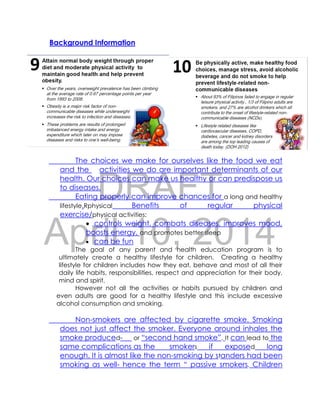
commercial and personal interest. Internet is a network that connects
computers around the world. It has websites set up by various groups of people
with different objectives. Therefore, parents and teachers must always monitor
the childโ€™s activities. As a big influence on a child, adults should know how to
handle this situation. A child should be taught the right decision-making skills in
choosing health products.
Children can easily be convinced by what they see or hear through
media, without learning about the weaknesses of a product. Before buying
health products or availing of different services, a child must be guided so that
misleading advertisements can be avoided.
Consumer trends track more than what people buy and how much they
spend. In buying goods and availing of services, consumerโ€™s habits and
behaviors are currently prevalent. Children like to buy products because of the
information they hear from users and the good feedback they read about in
social networks.
III. Procedure
A. Preliminary Activities
1. Review
Game: Pass the Message
DRAFT
April 10, 2014
11ย 
ย 
Message: A consumer is a person who uses health information,
products and services.
Group the pupils into four. Each group will form a straight line. The teacher
will call the leaders to say the message. Each leader will pass the message
to the member behind. The message will be passed until it reaches the last
pupil in the line. The last pupil in the line will give the message to the teacher.
The group who first reports first the message correctly wins.
2. Motivation
Ask the following questions;
1. What are your everyday needs?
2. Would you like to buy another pair of shoes? Why?
3. Who accompanies you in choosing the things you like to buy?
4. Does your father or mother, help you choose the things you like to
buy?
B. Developmental Activities
1. Set-up the following in front of the classroom:
a. Mini-store with goods
b. Strips of cartolina (with different services printed) posted on the
blackboard/white board. The examples of services are restaurant,
hospital, parlor, barber shop, dental clinic and barangay health
center.
Allow the pupils to explore. Give them freedom to choose
where they should go, either to the mini-store or to the the different
services. Give them play money to be spent for buying different
goods and different services. After shopping, they will share the
reasons for their choices.
2. Ask the following questions;
a. Who decides on the health products your family will use?
b. Who influences you in buying school materials? How do
they convince you? What do they say?
3. Introduce the different factors that influence the choice of goods and
services. Encourage the pupils to share ideas about each factor.
-Likes -Feelings
-Money/Price -Value/Importance
4. Instruct the pupils to do Activity 1 on p ___.
C. Generalization:
DRAFT
April 10, 2014
12ย 
ย 
Ask them do โ€œLetโ€™s Rememberโ€.
D. Evaluation:
Do Let's Check on p. ______.
Answers:
1. likes
2. value
3. feelings
4. other people and media
5. money
Lesson 3: Be Wise, Be Healthy
I. Objective: At the end of the lesson, the pupil will be able to;
- Describe the skills of a wise consumer
- Demonstrate consumer skills needed for given situations
II. Subject Matter:
Content: Skills of a Wise Consumer
1. Budgeting
2. Bargaining
3. Data collection
4. Comparison buying
5. Communication and assertiveness
Materials:
- actual objects, charts, strips of paper
References:
โ€ DepEd (2013). K to 12 Health Curriculum Guide. Pasig: DepED.
- Johnson, P. Hunter, L. (2011). Consumer stuff for kids. A
teaching-learning resource. Retrieved from
www.consumer.vic.gov.au/library/publications/resources-ad-
education/teacher-resources/consumer-stuff-for-kids-teaching-
andโ€”learning-resource.pdf
- Galvez Tan, J.Z. et.al, (2009). The Health Curriculum in Philippine
Basic Education. 2009. UNESCO National Commission of the
Philippines.
DRAFT
April 10, 2014
13ย 
ย 
Background Information
Consumers are users of goods and services. They buy goods such as
foods, school materials, toys, clothes and books. They also avail different services
at places like police stations, schools, hospitals, dental clinics, barber shops and
parlor shops. Consumers must possess skills in choosing and buying products and
services.
The skills of a wise consumer include:
1. Budgeting (plans and budgets what to buy)
2. Bargaining (bargains, negotiates)
3. Data Collection (reads information about the products and services)
4. Comparison buying (canvasses price and gathers information about the
product)
5. Communication and assertiveness (writes or reports a complaint on a
defective or fraudulent good/service)
III. Procedure
A. Preliminary Activity
1. Review
Form groups who will play a game in identifying the different factors
that influence the choice of goods and services. Examples:
a. Ricky wants his mother to buy him a bag since most of his classmates
have new bags.
b. Maria buys a pair of shoes that looks sturdy.
2. Motivation
Show the following real objects with labels;
a. Pencil with eraser and sharpener which costs PhP 15.00
b. Pencil with eraser which costs PhP 13.00
Ask: If you will choose between these two items, which pencil will you
buy? Why?
B. Developmental Activities
1. Tell the pupils to read the story on page ________.
Ask the following questions:
DRAFT
April 10, 2014
14ย 
ย 
a. What did Mrs. Castro do before she bought the school bags for her
children?
b. Write answers on the board. What kind of consumer is she? Why?
2. Instruct the pupils to do Let's Do! Activity 1 on p ___.
Ask: What do you consider before buying your snacks during recess
time?
3. Let the pupils answer Activity 2 on p ___.
Ask: How did you select the product?
What should a wise consumer do? Why?
4. Instruct them to answer Activity 3 on p ___.
Ask: Why should you ask information before buying?
Do you need to complain when you receive a defective product?
Why? How will you do it?
C. Generalization
Ask: What skills should a wise consumer have?
D. Evaluation
Answer Let's Check! on p ___.
Answers: (in any order)
1. Plans and budgets what to buy
2. Bargains
2. Compares prices, gathers information before buying
3. Make a complaint about a defective product/service
E. Assignment
Answer โ€œLetโ€™s Do this at Homeโ€ on page ______.
Lesson 4: My Consumer Rights
I. Objective: At the end of the lesson, the pupil will be able to;
-identify consumer rights
-practice consumer rights when buying
II. Subject Matter:
Content: Consumer Rights
-Right to basic needs
DRAFT
April 10, 2014
15ย 
ย 
-Right to safety
-Right to information
-Right to choose
Materials:
- charts
Reference:
โ€ DepEd (2013). K to 12 Health curriculum guide. Pasig: DepED.
- Consumer Rights. Retrieved from
http://www.dti.gov.ph/dti/index.php?p=720.
Background Information
As consumers, we have rights to the different kinds of health information,
services and products that we get. The following are the consumersโ€™ rights;
1. Right to Basic Needs
This right guarantees survival, adequate food, clothing, shelter, health
care, education and sanitation. Here are ways to practice our rights to basic
needs:
a. Prioritize your needs.
b. Look for quality, not quantity.
c. Be quality conscious, not brand conscious.
d. Do not engage in panic-buying.
e. In times of crisis/calamity, be vigilant in ensuring that basic commodities
are available in the market.
2. Right to safety
Consumers have the right to be protected from products and
services that may be dangerous to oneโ€™s health. Here are ways to
practice our rights and to ensure our safety;
a. Read labels and study the effectiveness of the product, ingredients,
how it works/operates.
b. If labels have warning signs, they should be kept out of children's
reach.
c. Ask for sample testers for large quantity of goods.
d. If not satisfied, ask the salesman to explain the details of the product.
DRAFT
April 10, 2014
16ย 
ย 
3. Right to Information
The right to be given facts and information needed to make a wise
choice so as not to be misled by advertisements that make false or
dishonest claims about the product.
What to do?
a. Before buying the product, be sure to read labels and know the
information such as content, number of pieces, manufacturing and
expiration dates, ingredients, and care instructions, including
warranties /guarantees or service contracts,
b. Consult somebody who purchased the same product.
4. Right to Choose
This is the right to choose a product at a competitive price with assurance
of high quality performance.
What to do?
a. Specify what you really need to buy. Buy only what is important. It
may be cheaper to buy big sizes, but it may not be what you need.
b. Canvass before buying. Compare products in terms of price, quality
and quantity.
c. Read manuals /instructions carefully. If product testers are available,
be sure to try these.
d. If there are special offers like BUY 1 TAKE 1, compare with regular
prices just to check that you are not paying for the free item.
III. Procedure
A. Preliminary Activities
1. Checking of Assignment
2. Motivation
a. Instruct pupils to turn to Let's Try! on p. _____.
b. Tell the pupils to study the pictures.
c. Ask the following:
-What is the woman doing?
-What is the man doing?
DRAFT
April 10, 2014
17ย 
ย 
-Do you also do these? Why?
B. Developmental Activities
1. Ask some pupils to act out the following situations printed on strips of
paper:
a. Mother buys food and clothes for the family. She asks for
information about what she is buying.
b. At the drugstore, Father reads the label and looks for the
expiration date, and ingredients of cough syrup.
After the activity, ask the following questions;
a. Why does mother ask the help of the saleslady? What right as
a consumer does she practice?
b. Why does father read the label of the cough syrup before
buying it? What consumer right does he practice?
2. Introduce some consumersโ€™ rights such as right to basic needs, right to
safety, right to information, and right to choose. Write on the
blackboard/whiteboard or manila paper.
3. Ask the pupils to enumerate and discuss each consumer right.
4. Instruct the pupils to do activity1 on p. ___.
Answer Key: 1. B 2. B 3. A 4. A 5. A 6. C 7. D 8. B
5. Instruct the pupils to do Activities 2 and 3 on p. ____.
Act. 2 Answer Key:
1. Right to Information
2. Right to Safety
3. Right to Choose
4. Right to Information
5. Right to basic needs
C. Generalization
Ask the following questions;
- What are the basic rights of the consumers?
- What questions should you ask a seller before buying?
- Ask them to do โ€œ Letโ€™s Remember!โ€ on p___.
DRAFT
April 10, 2014
18ย 
ย 
D. Evaluation
Instruct pupils to answer โ€œLet's Check!โ€ on p. ___.
(Answers will vary.)
E. Assignment
Do the activity on p. ________.
Lesson 5: Letโ€™s Practice our Rights
I. Objective: At the end of the lesson, the pupil will be able to;
- identify basic consumers rights
- practice basic consumer rights
II. Subject Matter
Content: Consumer Rights
โ€ Right to representation
โ€ Right to redress
โ€ Right to consumer education
โ€ Right to a healthy environment
Materials:
- Metacards
References:
โ€ Consumer rights. Retrieved from:
http://www.dti.gov.ph/dti/index.php?p=720 .
โ€ National Consumer Affairs Council (n.d.). Consumer rights and
responsibilities. Retrieved from naciphil.tripod.com/id9.html
Background Information
The fifth consumer right is THE RIGHT TO REPRESENTATION, which is the
right to express interest in the making and execution of government policies.
What to do:
๏‚ท Read newspapers and bulletin boards at private and
government offices, especially in your locality for
announcements of public hearings
๏‚ท Take time to attend public hearings or even meetings
conducted in your area wherein consumer issues are
discussed.
DRAFT
April 10, 2014
19ย 
ย 
๏‚ท Be aware of how the consumer laws and regulations are
implemented in your locality.
The sixth consumer right is THE RIGHT TO REDRESS, which is the right
to be compensated for misrepresentation, shoddy goods or unsatisfactory
services.
What to do:
๏‚ท In case you bought a defective product, try returning to the
store where you bought the item and look for the Consumer
Welfare Desk.
๏‚ท You may request a replacement, refund or if needed, have
the defective item repaired.
๏‚ท If the manager or store representative does not act on your
complaint, proceed to the agency which has jurisdiction over
your case.
๏‚ท Bring the necessary documents like a complaint letter and a
copy of your receipt and other documents you deem are
vital for the mediation.
๏‚ท Be sure to attend the mediation conference.
The seventh consumer right is THE RIGHT TO CONSUMER EDUCATION
which is the right to acquire the knowledge and skills necessary to be an
informed customer.
What to do:
๏‚ท Scan newspapers, magazines and other reading materials
for articles or news bits, which educate consumers on how
to get the best value for their money.
๏‚ท Involve yourself in public hearings or even meetings
conducted in your area wherein consumer -related issues
such as access to basic goods and services, product quality
and safety, sustainable consumption, and the like are being
discussed.
๏‚ท Participate in seminars, conferences and fora conducted
by government agencies, consumer groups and business /
industry sectors regarding news and regulations for
consumer welfare.
The eighth consumer right is THE RIGHT TO A HEALTHY ENVIRONMENT
which is the right to live and work in an environment that is not threatening
nor dangerous and which leads to a life of dignity and well-being.
What to do:
DRAFT
April 10, 2014
20ย 
ย 
๏‚ท Be aware of the kind and extent of pollution in your locality,
like air pollution, noise / odor, etc. so that you would be able
to address the problem
๏‚ท Do your share in caring for our environment by practicing
the 3R's of environmental protection:
๏ฑ REDUCE the source of solid wastes by buying earth
friendly products. These are products that could be
disposed properly without harming our environment.
๏ฑ REUSE products and containers as much as possible.
๏ฑ RECYCLE because using recycled products will
prolong the life of our landfills.
I. Procedure
A. Preliminary Activity
1. Checking of Assignment
What consumer rights have you learned?
2. Do Let's Try! on p. _____.
3. Ask:
a. What items are accepted by the Department of Health? What
ingredients are these enriched with? Have these items expired? Is it
important for us to know all these details? Why?
(Tell the class that if the item/goods has the DOH logo and its has
the fortified seal it is safe for children to eat) Show these to the pupils.
B. Developmental Activities
1. Tell: We will a have group activity. We will divide the class into four
groups.
Each group will act out the situation printed on given meta
cards.
Group 1- You and your mother will attend a barangay
assembly conducted by the DOH about the
importance of generic medicines.
Group 2- You bought an expired cupcake from the grocery
store. You returned it to the vendor.
Group 3- Mother read in a magazine about the importance
of using iodized salt.
Group 4- Aling Nora sees to it that when she goes to
market, she brings with her a basket and some
ecobags. She does not use plastic bag.
5. The situations presented by the different groups show consumer rights.
What must we do when there are meetings and assemblies in school
and in the barangay? What must we do when the vendor does not
like to change or replace the goods we bought? Why is it important
for us to use recyclable materials?
DRAFT
April 10, 2014
21ย 
ย 
6. Introduce the rights and let the children match each with the
situations performed by the groups.
C. Generalization:
What are the different consumer rights? Why do we need to practice
these when buying?
Let them doโ€ Letโ€™s Rememberโ€ on page ______.
D. Evaluation:
Do Let's Check on p. ______.
Answer Key:
1. Redress 4. Healthy environment
2. Representation 5. Redress
3. Consumer education
Lesson 6: I am Responsible
I. Objectives: At the end of the lesson, the pupil will be able to;
- identify consumer responsibilities
- discuss consumer responsibilities
II. Subject Matter
Content: Consumer Responsibilities
-Critical Awareness
-Action
-Social Concern
-Environmental Awareness
-Solidarity
Materials: clothes (pants, shirt, blouse, shorts, sando with price tags)
References:
โ€ National Consumer Affair Council (NCAC). (n.d) Consumer
Rights and Responsibilities. Retrieved from
naciphil.tripod.comlidq.html
Background Information
THE FIVE (5) CONSUMER RESPONSIBILITIES
1. Critical Awareness
DRAFT
April 10, 2014
22ย 
ย 
The responsibility to be more alert and questioning about the use
and the price and quality of goods and services we use.
2. Action
The responsibility to assert ourselves and act to ensure that we get a
fair deal. Remember that as long as we remain passive consumers, we will
continue to be exploited.
3. Social Concern
The responsibility to be aware of the impact of our consumption on
other citizens, especially the poor, exploited, disadvantaged or powerless
groups, whether in the local, national or international community.
4. Environmental Awareness
The responsibility to the environmental consequences of our
consumption. We should recognize our individual and social responsibility to
conserve natural resources and protect the earth for future generations.
5. Solidarity
The responsibility to organize together as consumers to develop the
strength and influence to promote and protect our interests.
Source: National Consumer Affair Council (NCAC). (n.d) Consumer Rights and
Responsibilities. Retrieved from naciphil.tripod.comlidq.html
III. Procedure
A. Preliminary Activity
1. Review
- Form 3 groups and ask each group to role play a situation about
consumer right. Let the others guess this right.
2. Motivation
The pupils will answer a given question. The answer must be written
on a piece of paper and placed in the โ€œHealth Boxโ€.
Question: What should you do as a consumer before you use a product or
service?
B. Developmental Activities
1. The pupils will open the box and will read the answers on the pieces of
paper. Based on the answers, let them know their responsibilities as
consumers.
DRAFT
April 10, 2014
23ย 
ย 
2. The teacher will discuss the five consumer responsibilities written in the
chart. Elicit some answers from the pupils.
3. Tell them to answer Activity 1 on p._____.
Anwer Key:
1. ๏Š 5. ๏Œ
2. ๏Œ 6. ๏Œ
3. ๏Š 7. ๏Š
4. ๏Œ 8. ๏Š
C. Generalization:
Ask: What are the consumer responsibilities that you must do before you
use a product or a service.
Let them do โ€œLetโ€™s Rememberโ€ on page___ .
D. Evaluation:
Do Let's Check on p. ______.
Answers:
1. Critical awareness
2. Environmental Awareness
3. Solidarity
4. Action
5. Social Concern
Lesson 7: Information: Good for Me and You
No. of Days: 2
I. Objective: At the end of the lesson, the pupil will be able to;
- identify reliable sources of health information.
II. Subject Matter
Content: Sources of reliable health information
๏‚ท Government agencies
๏‚ท Health Professionals
๏‚ท Printed materials
Materials:
โ€ Pictures of sources of reliable health information
DRAFT
April 10, 2014
24ย 
ย 
โ€ strips of papers
โ€ pocket charts
Reference:
โ€ Consumer Rights. Retrieved from:
http://www.dti.gov.ph/dti/index.php?p=720.
Background Information
Health information can come from different sources. To be helpful,
the information must be reliable. Reliable information is based on scientific
study. Scientists test health products and services. They decide if the
information about these products and services is correct or not. Reliable
health information comes from sources that can be trusted.
Sources of reliable health information
๏‚ท Government agencies such as Department of Health,
Department of Education, Department of Trade and
Industries
๏‚ท Health Professionals such as licensed doctor, dentist,
nurse, health educator
๏‚ท Printed materials such as health books, pamphlets,
brochures, and magazines produced by health
professionals or legitimate institutions
๏‚ท Examples of unreliable sources of information are
friends, playmates, classmates, siblings, and neighbors.
III. Procedure:
A. Preliminary Activities
Ask: โ€œWhen you want to get information about health, where do you go?โ€
List answers on the board.
B. Developmental Activities
1. Ask the pupils to read their answers on the board.
2. Let them group common answers together.
3. What do you think are the most reliable sources of health-related
information? Why?
4. Discuss the different sources of reliable health information. Bring and
show samples of printed materials.
DRAFT
April 10, 2014
25ย 
ย 
5. Do Activities 1-3 on p._____.
Answer Key Activity 1: DOH, DepEd, DTI
Answer Key Activity 2: 1. ๏ƒผ 2. X 3. X 4. ๏ƒผ 5. X
6. Form groups to act out the following situations:
A. A person recommending medicine to a sick friend because this was
proven effective to him/her
B. A playmate who asked her friend to buy a new lotion which can
make the skin whiter
C. A neighbor advising someone to buy a vitamin which can make one
healthier
7. Ask the class after each presentations, what should one do in each
situation? Why?
Are your friends, classmates, playmates and neighbors qualified to give
health information?
C. Generalization:
What are the different sources of reliable information?
Why should we believe them?
D. Evaluation:
Do Let's Check on p. ______.
Answers:
1. / 2. / 3. 4. 5. / 6.
POST-TEST
I. Directions: Read and answer each item carefully. Choose and write the
letter of the correct answer.
1. Mother is preparing to go to market. She has 1000 pesos for a weekโ€™s food
of the family. She lists only those that are needed and can be used for a
week. Mother is___
a. bargaining
b. planning
c. informing
d. gaining
2. Mrs. Enriquez is looking for a doctor to treat her son. She asks about
three doctors at the hospital. Why is she a wise consumer?
A. She looks for a bargain.
DRAFT
April 10, 2014
26ย 
ย 
B. She compares doctors.
C. She budgets her money.
D. She looks for the cheapest doctor.
3. Vining bought laundry soap on sale. After using it, she had allergy on
the skin. What did she forget to do?
A. Ask for a bargain
B. Ask a doctor
C. Look for the price
D. Read the label
4. Fredโ€™s mother is buying a special soap for his allergy. There is a new
soap offered as a bargain. She buys the soap without consulting a doctor.
What kind of consumer is Fredโ€™s mother?
A. She is a wise consumer.
B. She practices her right.
C. She is comparing services.
D. She is not a wise consumer.
5. Benet is in a store with her Mother to buy a bag. She sees one like her
Motherโ€™s bag. It is also in fashion. What do you think will she buy?
A. a bigger bag
B. a bag like her mother
C. a more colorful bag
D. a bag like her friendโ€™s
6. Noraโ€™s friends love to eat banana cue. They share their banana cues with
her. She also starts buying banana cue. Who influenced her to buy banana
cue?
A. Parents
B. Friends
C. Neighbors
D. Classmates
7. Mother is at the bakeshop. She looks for the expiration date of the bread.
Why did she do that?
A. She needs a lot of bread.
B. She wants cheaper bread.
DRAFT
April 10, 2014
27ย 
ย 
C. She wants safety for her family.
D. She likes bread for her children.
8. Linda is in the market and sees vendors selling tomatoes. She buys those
that are already packed. She practices the right to___________.
A. buy
B. choose
C. information
D. safety
9. Karen buys a defective bag. She returns it to the store. What right does she
show?
A. right to redress
B. right to choose
C. right to safety
D. right to information
10. Ramon asks about the use, price and the materials used in making the
product he wants to buy. What consumer responsibility does he practice?
A. action
B. solidarity
C. critical awareness
D. environmental awareness
II. Directions: Identify the right of the consumer being described. Choose
from the rights stated below
1. Return faulty or defective goods. ________
2. Consumers are protected from
dangerous goods and services _________
3. If things have warning signs, keep them out of reach of
children. __________
4 .Buy only the most important things you need. ___________
5. Compare the price of one product with another. ____
ย 
ย 
ย 
a. Right to Redress
b. Right to Safety
c. Right to Consumer Education
d. Right to Information
e. Right to Choose
f. Right to basic needs
DRAFT
April 10, 2014
28ย 
ย 
III.ย ย Direction: Write Yes if the statement tells about consumer responsibility. Write
No if it is not.
________1. If you believe that the goods you bought are faulty you should stop
using. See to it that you study the quality of a product before buying.
________2.You can refund goods you bought even if you do not have proof of
purchase such as receipt.
________3. Good traders try to keep their customers happy so they shouldnโ€™t get
angry at the costumers.
________4. Groceries and department stores must provide fast lanes for senior
citizens and people with disabilities.
________ 5.Ak the salesman to demonstrate how the new product works before
you buy.
________6. Always vacate the front seats in the bus for the elderly and senior
citizens.
________7. The use of paper bags should be implemented at all grocery stores.
IV. Supply the needed information below about the sources of reliable
information.
Write the sources of reliable health information
Government Agency 8. ________________________________
Health Professionals 9. ________________________________
Printed Materials 10. _________________________________
Key to Correction
I
1. B
2. B
3. D
4. D
5. B
6. B
7. C
8. B
9. A
10. C
DRAFT
April 10, 2014
29ย 
ย 
II.
1. A
2. B
3. D
4. F
5. E
III.
1 . YES
2. NO
3. YES
4. YES
5. YES
6. YES
7. YES
IV. (Note: Select just one from among the expected answers.)
8. (DOH,DEPED, DTI)
9. ( LICENSCED MEDICAL DOCTOR, DENTIST, NURSE, HEALTH EDUCATOR)
10. ( HEALTH BOOKS, PAMPHLETS, BROCHURES AND MAGAZINES)
DRAFT
April 10, 2014
1ย 
ย 
QUARTER 4
INJURY PREVENTION
AND SAFETY
DRAFT
April 10, 2014
2ย 
ย 
INTRODUCTION:
According to a study by the World Health Organization one of the leading
causes of unintentional injury globally is road traffic injuries. Our country is of no
exception especially with the high number of crashes involving public utility
vehicles. More citizens are therefore exposed to hazard since most people are
public transport commuters.
These lessons in road safety seek to put a stop into this. Hence, many hands-on
activities and actual practice are provided for this quarter, the goal of which to
help the learners develop safety habits that will minimize their risks of meeting
accidents in the road and in vehicle.
Instruct the pupils to answer the Pre-test.
I. Direction: Encircle the letter of the correct answer.
1. Who are road users walking and crossing the streets?
A. Drivers C. Passengers
B. Commuters D. Pedestrians
2. What is a safe area for pedestrians in crossing the streets?
A. Behind the vehicles C. Terminal
B. Middle area of the streetD. Pedestrian Lane
3. Which is a safe part to sit in a bus?
A. Near the door
B. Near the window
C. Behind the driver
D. Far from the door
4. What must you do to avoid accidents?
A. Throw your litter outside the vehicle.
B. Do not extend any part of your body outside the vehicle.
C. Do not wait for the bus to make a complete stop before boarding.
D. Transfer from one seat to another while the vehicle is moving.
DRAFT
April 10, 2014
3ย 
ย 
5. What road safety rule will you apply?
A. No overloading
B. Sit near the entrance
C. No running into the street
D. Line up while waiting for your turn
6. A natural hazard in the community is _______________.
A. Earthquake C. Snatching
B. Kidnapping D. Car accident
7. To keep safe during an earthquake, one must______
A. Cover-duck-hold C. Cover-hold-duck
B. Duck-cover-hold D. Hold-cover-duck
8. A man-made hazard in the community is ________________.
A. Flood C. Typhoon
B. Landslide D. Road accident
9. A guideline for man-made hazards is__________.
A. Donโ€™t go to dark places. C. Have an emergency kit ready.
B. Listen to news updates. D. Look for a safe place.
10. A stranger encourages Rodel to accompany him. Rodel should
____________.
A. neither talk nor follow him
B. accept his offer
C. follow him
D. talk to him
The jeepney is full and there are no vacant seats. Some passengers
are holding on to the bars. Some are clinging at the bar at the
entrance.
DRAFT
April 10, 2014
4ย 
ย 
II. Direction: Match column A to column B. Write the letter of the correct
answer on the space before the number.
A B
___1. Pedestrian Not Allowed a.
___2. School Zone b.
___3. Pedestrian Crossing c.
___4. Slippery road d.
___5. Road Work/Construction Going on e.
f.
Key to Correction
I. 1. D
2. C
3. C
4. B
5. A
DRAFT
April 10, 2014
5ย 
ย 
6. A
7. D
8. A
9. C
10. A
II. 11. C
12. D
13. B
14. A
15. F
Lesson 1: Keep Safe with Road Signs
I. Objectives: At the end of the lesson, the learners will be able to:
- Identify the different road signs which can help them as a
pedestrians
- Explain the meaning of traffic signals and road signs
II. Subject Matter:
Content: Road Safety Practices as Pedestrian: Traffic Rules and Road Signs
Materials:
- Pictures of actual road signs and pedestrian
- green, yellow and red signages
References:
โ€ Ibanez, N. (2012). How to read traffic signs: recognizing
shapes and colors. Retrieved from
http://www.dmv.org/articles/how-to-read-traffic-signs-
recognizing-shapes-and-colors/
โ€ Crossing enhancements. Retrieved from http: //
www.walking info.org/engineering/crossings
โ€ School safety reference manual (2004). Philippines: DuPont
Background Information
Road signals and signs provide important information and warnings to
ensure safety for users. These also help maintain order in the streets. Road signs
should be clearly visible to all users.
DRAFT
April 10, 2014
6ย 
ย 
Pedestrians are road users who walk and cross the streets. Thus, it is
essential to understand the different signs and symbols in the streets to avoid
any untoward incident. Shapes and colors that are shown in traffic signs have
different meanings.
Red โ€“ almost always indicates stop! This commonly gives
prohibitions to any pedestrian or vehicle to enter.
Green โ€“ almost always indicates go particularly in traffic lights.
It may also indicate direction or information on where to
proceed.
Yellow โ€“ stands for CAUTION. It mostly serves as a general
warning.
Black and White โ€“ provides regulation (i.e. speed limit)
Orange โ€“ signifies construction. You will likely see this at a
construction site or the color of the traffic cones.
Blue โ€“ stands for guidance. It contains instructions and
information for motorists.
Octagon โ€“ means stop!
Triangle โ€“ gives warning or junction signs
Upside down triangle โ€“ means โ€œyieldโ€ or โ€œgive wayโ€
Diamond โ€“ warns possible hazards ahead
Pennant โ€“ advanced warning of no passing zones
Round โ€“ stands for railroad or indicates instruction on
prohibitions
Pentagon โ€“ school zone ahead, pedestrian crossing
DRAFT
April 10, 2014
7ย 
ย 
Horizontal rectangle โ€“ provides guidance to motorists
Vertical rectangle โ€“ serves as regulatory notice
III. Procedure
A. Preliminary Activities: โ€œGreen, Yellow and Redโ€
Motivation
This activity will activate the prior knowledge of your pupils in following
directions, particularly in traffic rules.
1. Using green, yellow and red signages, engage the pupils in activities
(ex. group stop dance, marching, etc.) that focus on the basic
colors in road safety. Ask them do Letโ€™s Try on page ____.
Green โ€“ Go Yellow โ€“ Slow down Red โ€“ Stop
2. After the activity, ask/guide the pupils to relate the situation by
asking the following:
a. Where else can you see these colors?
b. Aside from these colors, what traffic signs do you see in the
road?
B. Developmental Activities
1. Show models or pictures of the different road signs. If the pupils
have seen this model or picture before answer yes by raising hands.
If not, answer no by putting their hands down.
a. Stop Light for pedestrian
b. Pedestrian Crossing and Childrenโ€™s Crossing
c. No Jaywalking
d. School, Church and Hospital Zone
e. Stop and Go Signs
f. Pedestrian Lane
g. Pedestrian Not Allowed
h. Railroad Crossing
2. Ask the pupils to share their insights on the meaning of each sign
based on the symbols.
3. Reveal the exact meanings of the basic road signs and check if
they got the correct answers. Ask them do Letโ€™s Do This Activity 1
on page___.
4. Follow-up questions:
a. For whom are these road signs?
DRAFT
April 10, 2014
8ย 
ย 
b. Why should road users or pedestrians know and follow all
these traffic signs?
C. Generalization
1. Ask the pupils to identify individually the traffic signs they might
encounter as pedestrians.
2. Teach the class an action song about road safety on the basic
precautions of stop, look and listen. Ask them to do Letโ€™s
Remember on page ___.
D. Evaluation
Please see Letโ€™s Check on LM p.____
E. Assignment
Please see Letโ€™s do this at Home on LM p. ____
Lesson 2: Crossing the Street Safely
I. Objectives: At the end of the lesson, the learners will be able to:
โ€ Explain road safety practices as pedestrians
โ€ Demonstrate road safety practices as pedestrians
II. Subject Matter:
Content: Road Safety Practices as Pedestrian
โ€ Cross safely using the pedestrian lane (with an adult or in groups)
โ€ Walk facing traffic (best chance to see approaching vehicles)
โ€ Walk on the sidewalk
โ€ Be aware of bikers and runners while walking
Materials:
- Improvise pedestrian lane
- green, yellow and red signages
- chart of road safety signals for pedestrian
References:
โ€ School safety reference manual (2004). Philippines: DuPont
Background Information
Accidents and injuries may happen anytime and anywhere. These occur
frequently in residential and main streets. There is a greater risk of accidents
DRAFT
April 10, 2014
9ย 
ย 
when drivers are careless and do not observe traffic signs and speed limits, and
there are no sidewalks and pedestrian lanes.
Pedestrian lanes and sidewalks are safe areas for pedestrians. Pedestrian
lanes are used for crossing the street, while sidewalks are the road edges for the
pedestrians. Take at least one big step back from the edge of the road to have
boundaries for the incoming vehicles.
Here are some safety reminders for the pedestrians;
1. Read and obey traffic signs and signals.
2. Stop, look and listen before crossing the street.
3. Be alert while on the streets. Listen and watch out carefully for
incoming bikers, runners/joggers, or vehicles.
4. Walk opposite the traffic flow in order to see the incoming
vehicles and to protect yourself quickly.
5. Stay focused. Do not play along the streets. Do not use gadgets.
6. Use the safe areas of the road for pedestrians such as sidewalks,
overpass, underpass and pedestrian lanes.
7. Wear bright colored clothes to be visible when crossing the street
at night.
8. Cross safely using the pedestrian lane (with an adult or in
groups).
III. Procedure
A. Preliminary Activities
1. Check the assignments by asking at least 3 pupils to read their answers
aloud.
2. Sing the action song that you learned from Lesson 1.
3. Motivation:
Activate prior knowledge by asking the following questions:
a. Who is a pedestrian?
b. What road signals and signs do you see on your way to school?
B. Developmental Activities
1. Ask the pupils to study the picture on Letโ€™s Do This on p ____.
Ask:
a. Based on the picture, how will you cross the street?
b. How can a pedestrian be safe while on the street?
DRAFT
April 10, 2014
10ย 
ย 
2. Make instructional materials on road safety practices for pedestrians
and explain its use. (Refer to background information)
3. Instruct the pupils do Letโ€™s Do This-Activity 2 on p. _____.
C. Generalization:
1. Create a scenario wherein the pupils will play pedestrians and apply the
different road safety practices.
2. Ask some pupils to act out some roles in road safety situations.
Example:
- Pedestrians
- Traffic enforcer
- Vehicles
- Stop light
3. Guide and ask the pupils to recite individually the different road safety
practices while crossing and walking on the streets.
D. Evaluation
โ€ Please see Letโ€™s Check on LM p. ____ or evaluate the pupilsโ€™ performance
in play acting while crossing and walking on the street.
Rubrics for Participation
KEY 1 2 3 4
Working
with
Others
Rarely listens to,
shares with, and
supports the
efforts of others,
often disrupts or
discourages
othersโ€™ attempts
to participate
Often listens to,
shares with, and
supports the
efforts of others,
but sometimes
not actively
listening or
responding
Usually listens
to, shares with,
and supports
the efforts of
others
Almost always
listens to, shares
with, and
supports the
efforts of others.
Inspires others to
volunteer
Attitude
towards
learning
Shows little
evidence of
wanting to be in
the class to learn
Shows effort but
displays some
extreme playful
attitudes which
disregards the
essence of the
activity
Seems
interested in
learning,
makes an
above
average effort
to maximize
the learning
experience
Exhibits
extremely
diligent and
spirited desire to
learn the
material, and
enhance the
learning of
others in the
class
DRAFT
April 10, 2014
11ย 
ย 
Lesson 3: Safety at Loading and Unloading Zones
I. Objectives: At the end of the lesson, the learners will be able to:
โ€ Explain basic road safety practices as passengers
โ€ Demonstrate road safety practices as passengers
II. Subject Matter:
Content: Road Safety as Passenger-Safe Loading and Unloading
Material:
โ€ Pictures of actual road safety signs and commuters
References:
โ€ DepEd (2013). K to 12 Health curriculum guide. Pasig: DepED.
โ€ ELL activity guide Grade 3, Health and wellness (2001).
Mcmillan/McGraw-Hill.
โ€ School safety reference manual (2004). Philippines: DuPont
Background Information
Passengers refer to users who use and pay for any mode of transportation
to reach their destination. There are many kinds of transportation we can
choose as commuters, like โ€œpadyakโ€, tricycle, jeep, bus, taxi, LRT, etc. In some
instances, passengers and public utility vehicles (PUV) cause unnecessary traffic
on the road because they do not follow traffic rules. To ensure smooth and safe
traffic flow, passengers and vehicles have proper areas to load and unload.
Safety measures in loading and unloading include:
โ€ Stay at the sidewalk and wait at the designated safe area.
Stay five giant steps away from the side of the vehicles.
โ€ Do not play on the streets while waiting for transportation.
โ€ Fall in line and wait for your turn to board. Allow passengers to
get off first.
โ€ Before getting on, wait for the vehicle to make a complete
stop on the proper area before loading. Before getting on,
stay seated until the vehicle stops.
โ€ Do not push or play while getting off the vehicle.
โ€ To avoid accidents, use handrails or hold on strongly to the
vehicle.
DRAFT
April 10, 2014
12ย 
ย 
III. Procedure
A. Preliminary Activities
1. Review the different road safety practices for pedestrians by
showing the pictures again to the pupils.
2. Motivation:
Ask the class to study the picture on LM Letโ€™s Try p ___.
Follow-up questions:
โ€ What are the differences between the two pictures?
โ€ Which picture do you think is safer?
B. Developmental Activities
1. Present the different road signs and get pupilsโ€™ feedback if they
have seen this before by answering โ€œyesโ€ or โ€œnoโ€.
a. Loading and unloading zones
b. No loading and Unloading
2. Ask the pupils to share their insights about the meaning of each
sign.
3. Reveal the exact meanings of common road signs and check their
answers.
4. Follow up questions:
a. For whom are the road signs intended?
b. How should commuters behave while waiting for
transportation?
C. Generalization:
1. Ask the pupils to identify individually the traffic signs for passengers.
Follow-up questions:
โ€ What safety rules should we follow as commuters?
โ€ Why do we need to follow these safety rules? Explain.
2. Read the poem about road safety. Sing to the tune of โ€œWe Can Do
Everything Together.โ€
D. Evaluation:
Answer activity on LM page ____. Please see Letโ€™s Check!
E. Assignment
See Letโ€™s Do this at Home on LM p. ____
DRAFT
April 10, 2014
13ย 
ย 
Lesson 4: Safety First Inside a Vehicle
I. Objectives: At the end of the lesson, the learners will be able to:
โ€ Explain basic road safety practices as a passenger
โ€ Display self-management skills for road safety
II. Subject Matter:
Content: Road Safety as Passenger
Materials:
โ€ pictures
โ€ charts
References:
โ€ DepEd (2013). K to 12 Health curriculum guide. Pasig: DepED.
โ€ ELL activity guide Grade 3, Health and wellness (2001).
Macmillan/McGraw-Hill.
โ€ School safety reference manual (2004). Philippines: DuPont
Background Information
Public transportation is a system of vehicles such as buses, jeepney, trains,
that operate on fixed routes and are meant for the public. Some vehicles are
often not equipped with safety devices since it is commonly being used by the
general public.
Private transportation is a system wherein people use their own vehicles
on the way to a destination. Private vehicles are equipped with safety devices
like seatbelts, airbags, reinforced impact beams and bumpers.
Safety Rules for taking public transportation
a. Jeepneys /buses
โ€ Wait for the vehicle to make a complete stop before
boarding.
โ€ Choose a place far from the entrance. Donโ€™t sit by the back
or side door. Although these places provide good views,
these are the most vulnerable during accidents.
DRAFT
April 10, 2014
14ย 
ย 
โ€ Never put arms, hands and head outside the window.
โ€ Donโ€™t stand or transfer from one seat to another while the
vehicle is in motion.
โ€ Always hold on to the safety bars while inside the jeep or bus.
b. Tricycles /Pedicabs
โ€ When riding tricycles, never sit behind the driver. Always sit in
the sidecar, the inner portion of which is the safest area.
III. Procedure
A. Preliminary Activities
1. Check the assignments by asking at least 3 pupils to read their
answers aloud. Collect notebooks and check.
2. Review road safety including the different road signs for passengers.
Ask the pupils to identify the different safety guidelines for passengers.
3. Let the pupils to read the poem entitled โ€œThe King of the Roadโ€ on
LM p ____.
1. Discuss every stanza of the poem.
2. Follow-up questions
a. Who is the โ€œking of the roadโ€?
b. Why do you think the jeepney is the king of the road?
c. Have you experienced riding in a jeep? How did you feel?
d. Is it safe to cling to the bars while riding in a jeep?
e. Which habits of jeepney drivers cause accidents?
f. How can passengers of jeepneys avoid accidents?
B. Developmental Activities
1. Ask the pupils do activity 1 on LM p ____.
2. Discuss the story of Lucia and her family.
a. What happened while Lucia and her family were on their
way to the birthday party?
b. What would have happened if they did not wear their
seat belts?
c. If you were a passenger, what are the different ways to be
safe in a vehicle?
d. Have you experienced riding a tricycle? Where did you
sit? Is it safe to ride outside the tricycle, behind the driver?
Where is it safer to sit?
DRAFT
April 10, 2014
15ย 
ย 
C. Generalization:
1. Do Activity 2 on LM p.___
2. What safety rules should we follow as passengers?
3. Why do we need to follow these rules?
D. Evaluation:
Do the activity on page ____.
Please see Letโ€™s Check!
E. Assignment
Ask the children to bring local newspapers with stories about road
hazards.
Lesson 5: Unsafe Roads
I. Objectives:
โ€ Describe dangerous, destructive and disturbing road situations
that need to be reported to authorities
โ€ Display self-management skills on road safety
II. Subject Matter:
Content: Road hazards and accident prevention
Materials:
โ€ pictures
โ€ charts
References:
โ€ DepEd (2013). K to 12 Health curriculum guide. Pasig: DepED.
- Choose to sit in the sidecar of the tricycle or in the
middle if in a car.
- Choose a place far from the entrance.
- Never put arms, hands and head outside the
window.
- Be seated while the vehicle is moving.
- Always wear a seatbelt if available.
DRAFT
April 10, 2014
16ย 
ย 
โ€ Kids on the move Levels 1 & 2: Traffic safety education for
primary schools-Book 2 (2006). Victoria, Australia: Vicroads.
โ€ Cronan, Kate et al(2005). Decisions for Health. United States
of America:Holt.
โ€ Meeks, LB & Heit, P. Stay safe, health & wellness. United States
of America:Macmillan/McGraw-Hill Publishing
Background Information
The increasing number of road accidents is alarming. These accidents
are caused by dangerous, destructive and disturbing road situations that
may even lead to death.
Some Causes of Dangerous Road Situations:
๏‚ท Bent or curved roads, hills, and blind corners
๏‚ท Things on the footpath that cause you to leave the footpath, like
people riding bikes, motorcycles, and scooters; potholes and open
manholes; cars, vans, jeepneys, trucks and tricycles parked across foot
paths
๏‚ท Lack of footpaths especially in rural areas, so people need to walk
along the side of the road
๏‚ท Poor lighting on the road
๏‚ท Slippery road after heavy rain
Other dangerous road situations occur because of the following reasons;
1. Pedestrians and commuters who do not follow road safety
practices
2. Drivers who do not obey traffic rules and signals
3. Drivers under the influence of alcohol or drugs
4. Inadequate number of traffic enforcers
5. Lack of traffic signals
The authorities who attend to road incidents include police officers,
traffic enforcers and medical officers. Others are firefighters and other
representatives of organizations like Philippine Red Cross. They should always be
visible to monitor any road accident.
III. Procedure
DRAFT
April 10, 2014
17ย 
ย 
A. Preliminary Activities
1. Review road safety by recalling the different road safety guidelines for
passengers.
2. Motivation
a. Complete the semantic web on Letโ€™s Try! p____.
b. Discuss the answers of the students related to dangerous road
situations.
B. Developmental Activities
1. Do activity 1 on LM p._____.
2. Ask the pupils to bring local news papers.
3. Ask a pupil to read a news item about road hazards.
4. Ask:
a. What happened in the news?
b. Why did this kind of accident happen?
5. Instruct them to do Activity 2 on LM p ___.
C. Generalization:
1. Discuss different road hazards such as open manholes, slippery
surfaces, crowded sidewalks, uneven surfaces and poor lighting.
2. Ask the pupil, about their responses if they see the dangerous situation
in the road mentioned above?
D. Evaluation:
Answer the activity on LM p___.
Please see Letโ€™s Check!
Lesson 6: Hazards in the Community
I. Objectives: At the end of the lesson, the learners will be able to:
- Identify hazards in the community
- Follow safety rules to avoid accidents in the community
II. Subject Matter:
Content: Hazards in the Community: Natural Hazards
Materials:
โ€ pictures
โ€ charts
DRAFT
April 10, 2014
18ย 
ย 
References:
โ€ DepEd (2013). K to 12 Health Curriculum Guide. Pasig: DepED.
โ€ Index Mundi (2013). Philippines Country Profile. Retrieved from
www.indexmundi.com/philippines
โ€ The Philippine public storm warning signals (2012). Retrieved
from http://www.gov.ph/crisis-response/the-philippine-public-
storm-warning-signals/
โ€ Natural disaster reduction. Retrieved from
http://kidlat.pagasa.dost.gov.ph/ndrb/NDRB_Website.html
Background Information
Community hazards put us at risk of being hurt, and even dying. These
community hazards can be divided into two types, natural and man-made
hazards.
Natural hazards include (Index mundi, 2013)
๏‚ง Earthquake
๏‚ง Typhoon
๏‚ง Flood
๏‚ง Tsunami and storm surge
๏‚ง Volcanic eruption
๏‚ง Landslide
๏‚ง Forest fire
To ensure public safety, community guidelines should be set to lessen
victims of these community hazards. These guidelines should always be
promoted and observed in homes and in the community.
Natural hazards
๏‚ง Donโ€™t panic.
๏‚ง Be familiar with people in the community who can help you in
the community.
๏‚ง Look for a safer place and stay there.
๏‚ง Always listen to news and parental advice.
๏‚ง If trapped, make some noise without speaking to conserve
voice.
DRAFT
April 10, 2014
19ย 
ย 
๏‚ง Prepare an emergency kit with food, water and important
documents.
Fire
๏‚ง Do not play with candles or any flammable material.
๏‚ง Unplug appliances if not in use.
๏‚ง Monitor your cooking.
Practice the following guidelines to be safe during natural disasters.
Earthquake
Duck Cover Hold
Rainfall Advisory
Warning Indication
Serious flooding expected in low lying
areas
Flooding is threatening
Response
RED
WARNING
Evacuation
ORANGE
WARNING
Alert
for the possible
evacuation
YELLOW
Monitor
for possible
DRAFT
April 10, 2014
20ย 
ย 
WARNING Flooding is possible flooding
Philippine Public Storm Signal Warning
1. When a tropical cyclone
intensifies and moves closer,
this warning signal number
may be upgraded.
2. The waves on coastal waters
may gradually develop and
swell.
3. The people are advised to listen to PAGASA updates and severe weather
bulletins.
4. Business may be carried out as usual except when floods occur.
5. Disaster preparedness units are activated to alert status.
1. The sea and coastal waters
are dangerous to small sea
craft.
2. Special attention should be
given to the latest position,
direction, movement, speed,
and intensity of the storm as it moves toward an area.
3. The public, especially people travelling by sea and air, are cautioned.
4. Classes in elementary and secondary levels are suspended
5. Outdoor activities of children should be postponed.
6. Disaster preparedness agencies/organizations must alert their communities.
1. The weather condition is
dangerous to the
communities.
2. The sea and coastal waters
are very dangerous to all sea
craft.
3. Travel especially by air and
sea is very risky.
4. People are advised to evacuate low-lying areas and stay away from the
coasts and riverbanks.
5. Classes in all levels are suspended and children stay in the safety of strong
buildings.
DRAFT
April 10, 2014
21ย 
ย 
6. Disaster preparedness and response agencies/organizations are in action
with appropriate response to emergency.
1. The situation is potentially very
destructive to the
community.
2. All travels and outdoor
activities should be
cancelled.
3. Evacuation to safer shelters
should have been completed.
4. Food and water must be secured.
5. The area is very likely to be hit directly by the eye of the typhoon.
6. The disaster coordinating council and other disaster response organizations
are now fully responding to emergencies.
Survival tips in case of fire
Sleep with the bedroom
door closed
This will prevent smoke
from entering and to
reduce the risk of
suffocation.
Test the door before
opening it. If the knob is
hot, use alternative exits
Use windows as
alternative exit but donโ€™t
jump if it is too high. Call
for help!
DRAFT
April 10, 2014
22ย 
ย 
Crawl low under the
smoke. There is more
oxygen at the bottom.
If your clothes catch fire,
stop, drop and roll in an
open area
Call the fire department in
your community.
III. Procedure
A. Preliminary Activity
1. Review different hazards in road situations by showing the pupils the
signs and symbols.
B. Developmental Activities
1. Show different pictures of natural disasters.
2. Ask:
a. What are the causes of these disasters? (Explain until it is clear to
them that these are natural disasters.)
b. Who has experienced any of these disasters?
c. Can these disasters happen in your community?
d. Are you ready to face these disasters?
3. Divide the class into 3 to 4 groups. Ask them to share their experiences
during different natural calamities.
4. Do Letโ€™s Do Activity 2 on LM p.____
5. Discuss the following general safety precautions during natural hazards:
a. Donโ€™t panic.
b. Seek for immediate help from trusted adults.
c. Look for a safer place and stay there.
d. Always listen to news and parental advice
e. If trapped, make noise but donโ€™t speak.
C. Generalization:
DRAFT
April 10, 2014
23ย 
ย 
1. Divide the class into groups. Assign each group to study a different
natural hazard and get summarized answers.
2. Ask the pupils about how they can be safe during natural hazards?
3. After listening to answers, synthesize by emphasizing best insights.
D. Evaluation
Answer activity on LM p ___.
Please see Letโ€™s Check!
E. Assignment
Answer activity on โ€œLetโ€™s Do this at Home! p. ___.
Lesson 7: Be Alert!
I. Objectives: At the end of the lesson, the learners will be able to:
โ€ Identify hazards in the community
โ€ Follow safety rules to avoid accidents in the community
II. Subject Matter:
Content: Hazards in the community-human-caused hazards (crime and
violent acts)
Materials:
โ€ pictures
โ€ charts
References:
โ€ DepEd (2013). K to 12 Health Curriculum Guide. Pasig: DepED.
Background Information
Man-made hazards include:
๏‚ง House and community fire
๏‚ง Road accidents
๏‚ง Crime and violent acts
o Burglary
o Holdup
o Snatching
DRAFT
April 10, 2014
24ย 
ย 
o Fixing
o Kidnapping
o Rape
To ensure public safety and to lessen casualties or victims of these
man-made hazards, some community guidelines should be set and these
include:
How to Prevent Crime and Violent Acts:
๏‚ง Donโ€™t talk to strangers.
๏‚ง Donโ€™t accept anything from strangers.
๏‚ง Donโ€™t go to any dark place or area, which you do not know.
๏‚ง Memorize the contact numbers of your parents.
III. Procedure
A. Preliminary Activities
1. Ask the pupils to answer the assignments about hazards in their homes if
natural disaster strikes. Let some pupils share their answers.
2. Review on the different natural hazards in the community by showing
pictures.
B. Developmental Activities
1. Choose scenario depending on your situation and location.
Situation 1: Stranger trying to talk to kids
Situation 2: Stranger offering food to kids
Situation 3: Kids passing through a dark place
Situation 4: Kids who do not know their address
Situation 5: Kids who do not know the contact numbers of their
parents
2. Give the pupils time, at least 2 to 3 minutes to brainstorm on how they
should act during these situations.
3. Let the pupils show their group presentations for 3-5 minutes only.
C. Generalization:
Synthesize the group presentations by discussing the different safety
guidelines on man-made hazard.
D. Evaluation
Evaluate the group presentations about safety guidelines on disaster and
emergency preparedness. Use the following rubrics.
DRAFT
April 10, 2014
25ย 
ย 
RUBRIC FOR GROUP PRESENTATION
KEY 1 2 3 4
Content
Did the
presentation
have
valuable
materials
Presentation
contained
little to no
valuable
materials
Presentation
had
moments
when
valuable
material was
present but
as a whole,
content was
lacking
Presentation
had a good
amount of
materials
and benefits
the class
Presentation
had
exceptional
amount of
valuable
materials
and was
extremely
beneficial to
the class
Collaboration
Did everyone
contribute to
the
presentation?
Only few
members
participated
and no
group output
Certain
members
participated
with not very
good output
Most of the
members
participated
and output is
good
All members
participated
and output is
excellent
and
beneficial to
the class
Assignment
Answer activity on p___.
Please see โ€œLetโ€™s Do This at Home!โ€.
Lesson 8: I Want to be Safe!
I. Objectives: At the end of the lesson, the learner will be able to
โ€ Follow safety rules/guidelines to avoid accidents in the community
โ€ Recommend preventive action for a safe community
II. Subject Matter:
Content: Community Safety-Safety Guidelines
โ€ Participate in family and community disaster drills
โ€ Be vigilant (do not talk to strangers; do not invite a stranger to the house;
do not accept anything from a stranger)
โ€ Report to a trusted adult or authority any suspicious looking person or
suspicious actions
โ€ Know places and the people to go to when seeking help
DRAFT
April 10, 2014
26ย 
ย 
Materials:
โ€ pictures
โ€ charts
โ€ coloring and art materials
โ€ Manila paper
References:
โ€ Rowett, R. Community safety-its everyoneโ€™s responsibility.
Retrieved from http://www.free-
training.com/Randy/Community%20Safety.htm
โ€ World Health Organization. Becoming a member of the
International Safe Community Network-Guidelines. Retrieved
from
http://www.ki.se/csp/pdf/guidelines/20120124guidelines_safe_
community_applications.pdf
โ€ Sundstrom, M. Safe communities. Retrieved from
http://www.ki.se/csp/who_safe_communities_en.htm
Background Information
Safety in homes, offices and schools is sometimes taken for granted.
Some people boast that they know their neighbors well and that serious
incidents will not occur in their community. However, in todayโ€™s world we are
surprised to hear shocking news about crimes near our residence. Therefore,
there is a need to keep the community safer and to have preventive
programs.
The World Health Organization, more than two decades ago,
developed the โ€œSafe Communitiesโ€ concept. A โ€œSafe Communityโ€ can be a
municipality, a county, a city or a district of a city working with safety
promotion, injury, violence and suicide prevention and prevention of the
consequences (human injuries) related to natural disaster, covering all age
groups, gender and areas and is a part of an international network of
accredited programs (Sundstrom, 2007).
Communities can apply and be recognized as safe communities.
However, as individuals, the following can be done to have safer
communities:
- Join a crime prevention program.
- Participate in family/community disaster drills.
DRAFT
April 10, 2014
27ย 
ย 
- Be vigilant (do not talk to strangers, do not invite strangers to the
house, do not accept anything from a stranger).
- Report suspicious behavior of unknown or unrecognized persons in
the area to a trusted adult or authority.
- Keep doors locked even if you are just in the back yard. Do not
assume that you can easily hear or see someone if they try to enter
without approval .
- Use safe routes for walking in the community.
- At night time, walk in groups or with a buddy.
- Know the places and the people to go to when seeking help.
III. Procedure
A. Preliminary Activity
1. Check the assignment of the pupils on details of their contact persons in
cases of emergency and community hazards.
2. Review the previous lesson on how to become safe during man-made
hazards by answering Letโ€™s try on p. ______. Ask at least 2-3 pupils to
present it by group game recitation.
B. Developmental Activities
1. See Letโ€™s Do Activity 1: Drawing Maps on p. ____.
2. Post the map on the wall of the classroom for everyone to see.
3. Form 3 groups who will trace the route for the following on the map:
Group 1- safe route for walking in the community
Group 2-trace places/people to go when seeking help
Group 3-trace route of places where to report suspicious looking
people/suspicious actions
4. Ask:
a. Why is it important for you to know these routes?
b. Have you participated in any disaster drill?
5. Stress that as part of safety guidelines they should participate in
disaster drills so that they will know what to do when disaster
happens. Schools usually do earthquake and fire drills.
6. Discuss again the safety guidelines on dealing with strangers.
7. Point out that these three things make up safety guidelines.
DRAFT
April 10, 2014
28ย 
ย 
8. Ask if they can add more safety guidelines or preventive actions for
a safe community by doing Activity 2 on p. ____.
C. Generalization
Give time for the pupils to make posters about a safe and peaceful
community.
D. Evaluation
1. Let 2-3 pupils share their works in front of the class.
2. After rating their art work, choose a corner inside their room where
they can post their work
Rubrics for Artwork
KEY 1 2 3 4
Creativity Beginner and
restricted work to
develop the idea
with no evidence
of risk taking
Improved
thinking and
expression in
development of
creative idea,
but with limited
risk taking
Competent
development in
expression of
creative idea
with increased
attempt at risk
taking
Refined and
sophisticated work
to original and
unique expression
with a high degree
of risk taking
Effort Artwork is
obviously lacking
in detail. Looks
like it was done
too hastily
Class time was
not always used
wisely.
Inconsistently
shows the
studentโ€™s effort in
artwork
Class time was
used wisely, but
student could
have put in more
time and effort
at home or in
class
Class time was
used wisely. Much
time and effort
went into the
planning and
design of the
project
Relevance
to the
reading
Difficult to
understand the
artworkโ€™s
relevance to the
topic
Inconsistently
expresses the
deeper meaning
of the topic
Somewhat
expresses the
deeper meaning
of the topic
Clearly expresses
the deeper
meaning of the
topic
POST TEST
I Direction: Write the letter of the correct answer.
1. Which is a road safety practice for pedestrians?
A. Walk near vehicles.
B. Run after the vehicles.
C. Walk facing the traffic.
D. Talk to your friends while crossing the street.
DRAFT
April 10, 2014
29ย 
ย 
2. Which is a road sign for pedestrian crossing?
A. C.
B. D.
3. Which is a road sign for school zone?
A. C.
B. D.
4. Which is a road sign for โ€œPedestrian Not Allowedโ€?
A. C.
B. D.
5. Which is a road sign for traffic lights?
A. C.
B. D.
DRAFT
April 10, 2014
30ย 
ย 
6. Roy rides a jeepney. When he sees his destination, he immediately
steps down the jeep. What road safety is violated?
A. Choose a spot to spit.
B. Do not run on the street.
C. Do not disturb the driver.
D. Wait for the jeepney to stop before alighting.
7. Which is a road safety practice for passenger?
A. Talk to the driver.
B. Choose a safe spot to sit on.
C. Extend your hands outside the jeepney.
D. Wave your hand outside while you are inside the jeepney.
8. You ride in a tricycle. You meet your friend walking down the road. You
wave your hands outside the tricycle to call her attention. Is this the
right thing to do? Why?
A. No, because you donโ€™t want to see your friend.
B. Yes, so that your friend will recognize you.
C. Yes, so that you can talk to her.
D. No, it may cause an accident.
9. Mang Cadio is riding his bike. He wants to spit. Where should he do
this?
A. Anywhere
B. In a safe spot
C. In a garbage can
D. In front of the grocery store
10.Which causes road accident?
A. Open manhole
B. Slippery surface
C. Even road surface
D. Properly lighted streets
DRAFT
April 10, 2014
31ย 
ย 
II. Matching Type: Match the Column A to Column. Write the letter of the correct
answer.
Column A Column B
1. Natural community hazards
which are caused by movement of
the earthโ€™s surface
A. Typhoon
2. This will happen if heavy rain do
not stop falling for long hours
B. Tsunami/Storm serge
3. Natural hazard that is common
at mountain sides
C. Earthquake
4. Yearly, the Philippines is struck by
this kind of natural hazard
D. Volcanic Eruption
5. Natural hazard which cause sea
elevation that can strike the
community
E. Landslide
F. Flood
III. True or false: Write True if the statement is correct and False if not.
_____1. It is nice to talk to anyone most, especially to strangers.
_____2. Knowing how to contact my parents is very important.
_____3. Watching news on TV is not important because itโ€™s boring.
_____4. Panicking is good when community hazards strike.
_____5. Going to dark places alone in your community is dangerous.
IV. Essay: Answer the given question.
Why do you think it is important to have safe and peaceful community?(5 pts.)
______________________________________________________________________________
______________________________________________________________________________
______________________________________________________________________________
DRAFT
April 10, 2014
32ย 
ย 
Key to Correction
I. Multiple Choice
1. C
2. A
3. B
4. C
5. A
6. D
7. B
8. D
9. C
10. B
II. Matching Type
1. C
2. F
3. E
4. A
5. B
III. True or False
1. F
2. T
3. F
4. F
5. T
IV. Essay: Answer varies
Rubrics for essay: Content
1 2 3 4 5
Pupilโ€™s answer
has totally no
connection to
the topic with
poor
handwriting
Pupilโ€™s answer
has a little
connection to
the topic with
poor
handwriting
Pupilโ€™s answer
has a little
connection to
the topic but
with good
handwriting
Pupilโ€™s answer
has a fine
connection to
the topic with
good
handwriting
Pupilโ€™s answer
has an exact
connection to
the topic with
good
handwriting

Health 3 tg draft 4.10.2014

  • 1.
  • 2.
    DRAFT April 10, 2014 INTRODUCTION: Eatwell and live well! Nutrition addresses the importance of eating healthy and establishing good eating habits to enhance health and prevent diseases. This module aims to help the learners demonstrate understanding of the importance of following nutritional guidelines and maintaining a balanced diet for good nutrition and health. It is also hoped that learning with the module will help the learners to consistently demonstrate good decision-making skills in making food choices and maintaining lifestyles. It is highly encouraged for teachers to use the varied activities that are included in the module to scaffold on learnerโ€™s prior learning, needs, abilities and interests as the learners engaging in meaningful learning activities and apply specific life skills. Instruct the pupils to answer the Pre-test. I. Direction: Write the letter of the correct answer. 1. Which is a healthy food? 2. Which is a healthy drink? A. Coffee C. Soda B. Milk D. Tea 3. What should we eat to prevent diseases? A.Fries and ice cream C. Candies and chocolate B. Fruits and vegetables D. Hamburger and hotdog 4. Which food is rich in Vitamin C? A. Bread C. Meat B. Calamansi D. Milk 5. Which food is rich in iron? A. Bread C. Sea food B. Cereals D. Red meat candy D.C.B.A.
  • 3.
    DRAFT April 10, 2014 6.What condition is caused by lack of Vitamin A? A. Anemia C. Rickets B. Nightblindness D. Goiter 7. Sofia eats much. She doesnโ€™t like to play active games. Sofia will_______________. A. get fat C. get sick B. get thin D. be healthy 8. Nelia is already getting fat. What should she do? A. Take medicine. C. Sleep more than 8 hours. B. Eat once a day. D. Play active games. 9. Jen often feels dizzy. A part of her throat is enlarged and she has difficulty in swallowing. What mineral does Jen lack? A. Iron C. Calcium B. Iodine D. Potassium 10. How can you keep food safe and clean? A. Eat with bare hands. C. Leave food uncovered. B. Cook food well. D. Wash food with soap. II. Direction: On the space before the number, write True if the statement is correct and False if it is wrong. ___1. Drink milk every day. ___2. Eat much food rich in fats and oil. ___3. Eat much food rich in carbohydrate. ___4. Eat foods rich in vitamins and mineral. ___5. Eat different kinds of food every day. III. Direction: Match the symptom in A to the deficiency in B. Write the letter of the answer on the space before the number. A B ___1. Lack of appetite A. Anemia ___2. Thick dry skin and slow mental development B. Beriberi
  • 4.
    DRAFT April 10, 2014 ___3.Emotional disturbance and painful limbs C. Goiter ___4. Deformed and painful bones D. Measles ___5. Bleeding gums and slow wound healing E. Rickets F. Scurvy
  • 5.
    DRAFT April 10, 2014 Quarte I. 1.D 2. B 3. B 4. B 5. C 6. B 7. A 8. D 9. B 10. B II. 1. T 2. F 3. F 4. T 5. T III. 1. A 2. C 3. B 4. E 5. F Lesson 1: Good or Bad Nutrition? No. of Days: 1 I. Objectives: At the end of the lesson, the pupil will be able to: - Describe a healthy person - Explain the concept of malnutrition II. Subject Matter: Content: Concept of Malnutrition
  • 6.
    DRAFT April 10, 2014 -Forms of malnutrition(undernutrition and overnutrition) References: DOST-PINOY (2010). A training manual for Nutrition Health Workers. Taguig: DOST. DepEd (2013). K to 12 Health curriculum guide. Pasig: DepEd. Background Information Malnutrition is characterized by lack, excess or imbalance in nutrients (DOST-PINOY, 2010). There are two forms of malnutrition: undernutrition and overnutrition, the most common of which is undernutrition that leads to deficiency diseases. III. Procedure A. Preliminary Activities ( 3 minutes) 1. Say: Class, I like you to meet three boys: Rod Lee Romy 2. Say: These three pictures show children who may or may not be healthy. I will point at each picture. If it shows a healthy child raise your hand. If the child is NOT healthy, point your thumbs down. B. Developmental Activities (27 mins) Activity 1: Who is Healthy? Ask: Why do you think is Lee healthy?(Point at Picture No. 2) Why do you think is Rod NOT healthy? (Picture No. 1) Why do you think is Romy NOT healthy too? (Picture No. 3)
  • 7.
    DRAFT April 10, 2014 Whatis a healthy child? Activity 2: Eating Properly 1. Ask: Who do you think is eating properly? (Picture 2) Why do you say so? Who is NOT eating properly? Why do you say so? 2. Answer Letโ€™s Do This on p. ___. 3. Say: People who do NOT eat properly suffer from wrong nutrition or malnutrition. Write the word on the board and let the pupils say it. 4. Ask: Who among the boys are suffering from malnutrition? 5. Refer to the pictures again. Transfer the picture of Romy beside Rodโ€™s. Ask: Who is eating too little or too little healthy food? What does he suffer from? *Point to the word โ€œmalnutritionโ€ on the board). What food do you think does theโ€ฆ โ€ฆthin child eat? โ€ฆthin child NOT eat? Tell the pupils that there are two forms of malnutrition. Introduce the word โ€œundernutrition,โ€ which means eating too little and not getting enough nutrients needed by the body, 6. Ask: Who is eating too much? What does he suffer from? (Point to the word malnutrition) What food do you think does theโ€ฆ โ€ฆstout child eat?โ€ โ€ฆstout child NOT eat? Introduce the word overeating which means eating too much. Ask: Is it good to eat too much? Why? Is it good to eat too little? Why? Is it good to eat just right? Why? C. Generalization (5 mins) Ask, โ€œWhat is malnutrition?โ€ (Eating too much food, too little food, or not enough healthy food). Let the pupils write in their notebook.
  • 8.
    DRAFT April 10, 2014 D.Evaluation (5 mins) Ask the pupils to answer Letโ€™s Check on p _____. Answers will vary. Lesson 2: Are You Undereating? No. of Days: 2 I. Objectives: At the end of the lesson, the pupil will be able to: - Identify nutritional problems- undernutrition - Describe the characteristics, signs and symptoms, and effects of the various forms of malnutrition - undernutrition, specifically protein-energy malnutrition. II. Subject Matter Content: Form of malnutrition: Undernutrition a. Protein-Energy Malnutrition (PEM) Materials: Pencil and crayons References: DepEd (2013). K to 12 Health curriculum guide. Pasig: DepEd. Friedman, D.P., Stine, CC., & Whalen, S. (2005). Lifetime health. NY: Holt, Rinehart & Winston. National Nutrition Council (2013). Nutrition is key. Retrieved from http://www.nnc.gov.ph/home/item/112-nutrition-is-key. UNICEF (2009). Nutrition in emergencies. Retrieved from http://www.unicef.org/nutrition/training/ Background Information The National Nutrition Council of the Philippines (2013) reported that 80% of the world's undernourished children live in just 20 countries, one of which is the Philippines. Our most prevalent malnutrition problems are protein-energy
  • 9.
    DRAFT April 10, 2014 malnutrition(PEM), where we rank 4th among countries with such a problem; Vitamin A Deficiency (VAD); Iron-Deficiency Anemia (IDA); and Iodine Deficiency Disorder (IDD). The nutrients our body needs are classified according to the amount needed by our body. Protein, carbohydrates and fats are called macronutrients because our body needs large amounts of them to ensure normal growth and development and to regulate body processes. On the other hand, vitamins, minerals and trace elements (including water) are called micronutrients because our body needs small amounts of them for it to function. Deficiencies in macronutrients and micronutrients have harmful effects on health. Protein-energy malnutrition (PEM) affects people whose diet lacks protein and energy (measured in calories). It is possible for a childโ€™s diet to provide enough energy, but if it is deficient in protein, PEM still results. This is called primary PEM. Secondary PEM happens as a complication of chronic or acute illnesses that prevent the patient from getting enough nutrients. P-energy malnutritionand eating. III. Procedure A. Preliminary Activity (1 minute) 1. Say: We will play a Word Association game. I will write a word and call a pupil who will quickly give a related word. 2. Write โ€œMalnutritionโ€ on the board and call a pupil who will give a word related to โ€œmalnutritionโ€ as fast as possible. Call about five children. If there are doubts about the relationship of the words, ask the pupil to explain how the word is related. B. Developmental Activities (25 minutes) Activity 1: A Story of Two Children 1. Tell the pupils that they are going to read two stories about malnutrition. 2. Let the pupils read the stories silently. 3. Ask the pupils to answer the questions orally after each story.
  • 10.
    DRAFT April 10, 2014 4.Let the pupils recall the nutrients they learned in Grade 2. Have a guessing game. Divide the class into small groups. Tell the groups to guess the name of the nutrient after you will write its first letter on the board. Let the groups take turns in answering. Write the beginning letters of the nutrients: P: Protein C: Carbohydrates D: Fats V: Vitamins M: Minerals Once the pupils have identifies the correct word, complete the word on the board and ask the pupils to read it aloud. 5. Recall with the pupils the functions of the food nutrients: Which is the body-building nutrient? Which are the energy-giving nutrients? Which are the body regulating nutrients? Once the correct answer have been given, write the functions on the board and let the class read it aloud. 6. Ask: What does M lack in her diet? What does K lack in his diet? 7. Write the phrase โ€œProtein-energy malnutritionโ€ on the board and tell the pupils that it is a kind of undernutrition where there is lack of body- building and energy-giving nutrients in the diet. Activity 2: Draw Me a Picture Tell the pupils to do Activity 2 on page ___. C. Generalization (6 minutes) Call some pupils to read aloud their endings to the statements. D. Evaluation (8 minutes) Let the pupils answer Letโ€™s Check on page _____. Answer Key: (1) False (2) True (3) False (4) True (5) True
  • 11.
    DRAFT April 10, 2014 E.Assignment Divide the class into small groups and assign to bring different kinds of food rich in vitamins. Sing the song on p. __ as closing an synthesis. Homework Explain the homework. Present the rubrics for grading.
  • 12.
    DRAFT April 10, 2014 Lesson3: Vitamins for Life Number of Days: 2 I. Objectives: At the end of the lesson, the pupil should be able to: - Identify nutritional problems-micronutrient deficiency ๏‚ท Vitamin A โ€“ Night Blindness ๏‚ท Vitamin B โ€“ Beri โ€“ beri ๏‚ท Vitamin C โ€“ Scurvy ๏‚ท Vitamin D โ€“ Rickets - Describe the characteristics, signs and symptoms of micronutrient deficiencies II. Subject Matter: III. Content: Nutritional Deficiencies IV. V. VI. /Calcium VII. Materials: - manila paper - marker - meta cards - string/yarn - hangers Reference: - Friedman, D.P., Stine, CC., & Whalen, S. (2005). Lifetime health. NY: Holt, Rinehart & Winston. Background Information A growing child needs different vitamins in right amounts and proportions. These vitamins are needed by the body to function normally.
  • 13.
    DRAFT April 10, 2014 Whatare vitamins? Vitamins A, B, C and D are some kinds of vitaminsfour. These cover nutrients that contain carbon and are needed in small amounts to maintain health and allow growth.fromources, a kind of micronutrient, . ssVCIf a child lacks vitamins, he/she will suffer from the following nutrition deficiencies its characteristics and symptoms: Vitamin Characteristics Signs and Symptoms Vitamin A โ€“ Night Blindness Condition of defective or reduced vision in the dark, especially after coming from bright lightDry and scaly skin ๏‚ท Difficulty in seeing in dim light or during the night Vitamin B โ€“ Beri-beri Loss of appetite and general feeling of discomfort associated with heaviness and weakness of the legs and numbness of feet ๏‚ท Weight loss, impaired sensory perception, emotional disturbance and pain in limbs Vitamin C โ€“ Scurvy Shortness of breath, aching bones and joints, gums bleed easily ๏‚ท Bleeding gums, slow wound healing, nosebleed, fatigue Vitamin D โ€“ Rickets Soft bones and skeletal deformities ๏‚ท Bone pain, muscle weakness Nutritional deficiency is caused by eating the wrong kind of food. It is also caused by unhealthy lifestyle and environment. When we are unhealthy, we are predisposed to getdiseases. It is therefore important to keep our bodies healthy. Here are some ways to prevent nutritional deficiencies: Nutritional Disorders Prevention and Control Vitamin A Deficient โ€“ Night Blindness ๏‚ท Drink milk. ๏‚ท Eat yellow and orange fruits and vegetables (carrot, squash). ๏‚ท Eat dark-green and leafy vegetables (pechay, kangkong). ๏‚ท Eat egg, butter, and cheese. Vitamin B Deficient (Beri-beri) ๏‚ท Eat vegetables. ๏‚ท Eat pork and liver. ๏‚ท Eat food enriched and whole grains and cereals.
  • 14.
    DRAFT April 10, 2014 ๏‚ทEat nuts and seeds. Vitamin C Deficient โ€“ Scurvy ๏‚ท Eat citrus fruits (melons, strawberries) ๏‚ท Eat green vegetables and peppers. Vitamin D Deficient โ€“ Rickets ๏‚ท Eat food rich in fish oil, tuna and salmon ๏‚ท Eat liver. ๏‚ท Eat egg yolk. VIII. Procedure A. Preliminary Activity Let the pupils bring out the food assigned to them. What do we get from fruits? B. Developmental Activities Activity 1 C. Preliminary Activity 1. Instruct the pupils to turn to p. __. 2. Read the questions. 3. Give them 5 minutes to perform the task. 4. Ask, โ€œWhat do we get from fruits?โ€ 5. Elicit responses and process to lead to vitamins. D. Developmental Activities Activity 1 1. Ask the pupils to form the groups they were assigned to. 2. Let them discuss the reason/s why the foods they brought are nutritious. 3. Let a group representative share the answers. 4. Tell the pupils that these foods give us different vitamins. Ask them about the vitamins they know. Explain that not getting enough of a kind of vitamin may lead to certain nutritional deficiency. 5. Discuss the different vitamin deficiencies. Show the pictures of children with specific vitamin deficiencies on LM p____. 6. Ask who has experienced any of these nutritional deficiencies. Activity 2 1. Let pupils answer Activity 1 on LM p. Answer Key: (1) C (2) B (3) D (4) A Activity 3- Letโ€™s Go To The Market
  • 15.
    DRAFT April 10, 2014 1.Ask the pupils, โ€œHow can we avoid vitamin deficiencies?โ€ 2. Let the class divide into four groups. 3. Prepare set drawings or plastic fruits representing the four vitamins. 4. Play games like Maria Went to Town but in each run, the player will get fruits representing the vitamin that you will say. 5. The group with most correct answers wins. 1. After answering, ask the pupils, โ€œWhat will happen if we donโ€™t get enough vitamins?โ€ 1. Discussion (refer to background infor Ask: 1. What will happen if we do not get enough vitamins? 2. What are the conditions if you lack vitamin A? B? C? D? 3. The lack of vitamins is also a type of ______________. 4. Vitamin deficiencies may be prevented by _______________. Fruits rich with Vitamin A are __________________. Fruits rich with Vitamin B are __________________. Fruits rich with Vitamin C are__________________. Fruits rich with Vitamin D are___________________. mation) 2. Discuss with pupils the specific conditions of each vitamin deficiency. Describe the signs and symptoms. 3. Instruct pupils to turn to p, __. Evaluation Let pupils answer the exercise for 10 minutes.Answer Key: (1) Vitamin A (2) Vitamin B (3) Vitamin C (4) Vitamin D I. Lesson 4: Minerals for Life I. Objective: At the end of the lesson, the pupils should be able to: a. b. Describe the characteristics, signs and symptoms of nutritional deficiencies due to lack of minerals in the body -Discuss ways on how to prevent mineral deficiencies
  • 16.
    DRAFT April 10, 2014 II.Subject Matter: Content: Nutritional Deficiencies Iron โ€“ Anemia Iodine โ€“ Goiter Calcium โ€“ Rickets Materials: word cards(iron, iodine, calcium, anemia, goiter, osteoporosis) scotch tape pocket chart labeled with nutritional deficiency and effect References: - Lifetime Health, Friedman, F.P., et.al. (2005) h NY: Holt, Rinehart & Winston. - DOST-PINOY(2010): A Training Manual for Nutrition Health Workers. Taguig: DOST. - Iodine Deficiency. American Thyroid Association. Retrieved from http://www.thyroid.org/iodine-deficiency/ - Nutrition for Everyone. Center for Disease Control and Prevention. Retrieved from http://www.cdc.gov/nutrition/everyone/basics/vitamins/iron - Calcium deficiency. Ostelin. Retrieved from http://www.ostelin.com.au/calcium/3/ - Calcium quick facts. Office of Dietary Supplements โ€“National Institutes of Health. Retrieved from http://ods.od.nih.gov/factsheets/Calcium-QuickFacts/#h6 Blake, Kati (2012). Nutritional Deficiencies. Retrieved from K to 12Curriculum, Health 3 http://www.healthline.com/health/malnutrition - Mayo Clinic Staf (2011). Goiter. Retrieved from http://www.mayoclinic.com/health/goiter/DS00217" >Goiter</a p. 163 K to 12 Health Learning Competencies
  • 17.
    DRAFT April 10, 2014 BackgroundInformation Minerals are nutrients needed for certain processes, such as building strong bones and teeth and for helping the nerves work. Minerals are also needed for regulating growth and for the clotting of blood. Some of the minerals needed by the body to avoid nutritional problems are iron, iodine and calcium. Iron is a mineral needed by the body. It is also part of all cells and does many things in the body. For example, as part of haemoglobin, it carries oxygen from the lungs to all parts of the body. It also helps muscles store and use oxygen. It is also a part of enzymes and used in many cell functions. Therefore when the body doesnโ€™t have enough iron (also known as iron deficiency) many parts of the body are affected. (Friedman, 2005) Iodine it is another mineral needed for the production of thyroid hormones. If the body lacks iodine, the body cannot produce thyroid hormones. This can lead to enlargement of the thyroid in the lower front of the neck. It can also lead to hypothyroidism and mental retardation in children whose mothers may have had iodine deficiency during pregnancy. Calcium is the most abundant mineral in the body. More than 99% of the bodyโ€™s calcium is found in the bones and teeth and the remaining 1% is found throughout the body in blood, muscle and fluid within the cells. It โ€“ it is another important mineral needed by the body to maintain strong bones and teeth, transmission of nerve impulses, muscle contraction, blood clotting. Lack of calcium or calcium deficiency can greatly affect the bones as well as numerous body processes. It can also lead to osteoporosis-a disease of the bone for older adults wherein the bones become porous, fragile and prone to fracture and breakage. Deficiencies in these minerals may cause the following: Nutritional Deficiency Signs/Symptoms Iron Deficiency - Anemia ๏‚ท Weakness and tiredness ๏‚ท Paleness ๏‚ท Slow cognitive and social development
  • 18.
    DRAFT April 10, 2014 Preventionof anemia 1. Ask your doctor to test for anemia regularly if you are at risk. 2. Eat food rich in iron and vitamin C. Good sources of available iron include: Animal proteins (especially red meat) Beans Spinach Dark chocolateTake a 3. Take an iron supplement to ensure you have enough. 4. Avoid excessive dieting or over-exercising, which can trigger symptoms in someone who is already at risk. a.Prevention of goiter There are no ways to prevent goiter unless it is caused by iodine deficiency. Dietary measures to prevent iodine deficiency include use of iodized table salt and consumption of rich sources of iodine, such as seafood. ๏‚ท DizzinessLack of appetite Iodine Deficiency โ€“ Goiter ๏‚ท Slow mental development ๏‚ท Deafness ๏‚ท Difficulty in looking in bright light ๏‚ท Weakness, sleepiness, cold feeling ๏‚ท Thick dry skin ๏‚ท Difficulty in swallowing ๏‚ท Bulging eyes ๏‚ท Enlargement of the thyroid in the lower front of the neck Calcium- Rickets/Osteoporosis ๏‚ท Muscle cramps ๏‚ท Joint pains ๏‚ท Brittle nails ๏‚ท Dry skin ๏‚ท Increased bone fracture or breakage
  • 19.
    DRAFT April 10, 2014 b.Preventionof rickets Most vitamin D in older children and adolescents issupplied by sunlight exposure. Some However, dermatologists and cancer experts advise caution in exposure to sun, especially in childhood, and recommend regular use of sunscreens. children and adolescents do not get regular sunlight exposure, ingest at least 500 mL per day of vitamin D-fortified milk, take adaily multivitamin supplement containing at least 200 IU of vitamin D.. Prevention of calcium deficiency c. Prevention of Osteoporosis Eating the right foods is essential for good nutrition. Our bodies need the right vitamins, minerals, and other nutrients to stay healthy. Getting enough calcium and vitamin D is important for strong bones as well as for proper function of the heart, muscles, and nerves. The best way to get enough calcium and vitamin D is through a balanced diet. Not getting enough calcium during a lifetime significantly increases the risk of developing osteoporosis and is associated with low bone mass, rapid bone loss, and broken bones. A diet high in calcium is important. However, calcium requirement differs according to population groups and gender. For children ages 7-9 years old, the Recommended Energy Nutrient Intake (RENI) for calcium in 700 mg. Good sources of calcium include low-fat dairy products, such as milk, yogurt, cheese, and ice cream; dark green leafy vegetables, such as broccoli, collard greens, and spinach; sardines and salmon with bones; tofu; almonds; and foods with added calcium, such as orange juice, cereals, soy products, and breads. Calcium supplements and vitamins are also available. Listed below are the common food sources that can help prevent the three nutritional deficiencies.
  • 20.
    DRAFT April 10, 2014 II.Procedure 1. Preliminary ActivitAsk the pupils: a. What are the vitamins that we learned in the previous lesson? b. Aside from vitamins, what else does our body need to function normally 2. Ask the pupils to arrange the jumbled letters and form a word. a. O I N R โ€“ IRON b. D O I N I E โ€“ IODINE c. C L U I A C M โ€“ CALCIUM ? 3. Ask the pupils, โ€œWhat do minerals give to our bodies?โ€ 2. yInvite the pupils to sing Bahay Kubo with you. 3. Ask the pupils: a. What is the song about? b. What is your favorite vegetable? c. What do vegetables give our bodies? 2. Elicit responses from the pupils. A. Developmental Activities Activity 1 2. Post the following descriptions around the room: 3. Unlock the words โ€œstuntedโ€, โ€œbulgingโ€ and โ€œbrittleโ€ before proceeding to the activity. 4. Let the pupils go around the room to read these descriptions. 5. When most of them had read the three descriptions, let them recall if they experienced any. 6. Ask them form groups based on this and share their experiences. A Feels weak Feels tired ๏‚ท Looks pale Feels dizzy B ๏‚ท Deafness iDifficulty in swallowing Bulging eyes Enlarged lower front of the neck B ๏‚ท Muscle cramps ๏‚ท Joint pains ๏‚ท Brittle nails Frequent bone fracture or breakage
  • 21.
    DRAFT April 10, 2014 7.After their sharing, unlock the three nutritional deficiencies and explain further. (e.g. those that experience symptoms/signs in Box A may have iron deficiency, Box B-may have iron deficiency, Box C-may have calcium deficiency). 8. Show the pictures below: 9. Activity 1 6. ofActivity 2: !Letโ€™s Match! 1. Invite any of the following possible resource persons (doctor, nurse, dietician, barangay health worker). Discuss ways on how to prevent mineral deficiencies. 2. After the discussion, form three groups and give each group the following guide questions. They will draw their answers on manila paper. Group A: a. How can iron-deficiency be prevented? b. What food can we eat to prevent iron-deficiency? Group B: a. How can iodine-deficiency be prevented? b. What food can we eat to prevent iodine-deficiency? Group C: a. How can calcium-deficiency be prevented? Iron deficiency Iodine deficiency Calcium Deficiency
  • 22.
    DRAFT April 10, 2014 b.What food can prevent iodine-deficiency? 3. Ask each group to report. 4. Let them do Act. 1 on LM p. _____. After finishing, ask the pupils, โ€œWhat will happen if we do not get enough minerals?โ€ 7. Instruct to turn to p. __. 8. Tell the pupils to observe the pictures. Call volunteers to share their ideas. 9. Share that the pictures show how a child with mineral deficiency looks like. 10. B. Generalization 1. Call volunteers to describe each mineral deficiency using one sentence. 2. Ask pupils to complete complete the sentence: 3. I can avoid iron/iodine/calcium deficiency by _____________. C. Evaluation Ask the pupils to answer onp.__.Answer Key: I. Iron- Deficiency Anemia Sleeplessness Dizziness Paleness Iodine- Deficiency Slow mental growth Slow growth Difficult swallowing Calcium- Deficiency Cramps Joint pains Brittle nails II. Milk โ€“ calcium, seaweeds โ€“ iron, cheese โ€“ calcium, fish โ€“ iodine, malunggay leaves โ€“ iron, chicken โ€“ iron, shrimps / crabs / clams โ€“ iodine III. Rickets โ€“ milk / cheese Iron-Deficiency Anemia โ€“ red meat Goiter โ€“ Seafoods A. y 1. Ask the pupils to turn to p.__. 2. Instruct them to observe the pictures. 3. Call volunteers to share their observations.
  • 23.
    DRAFT April 10, 2014 4.Ask the pupils to recall the previous lesson by asking: a. How do they look like? b. What condition could they have? c. What are other effects of the conditions to the body? d. What are the things that you cannot do when you have these conditions? Key: ies 10. Activity 1:Letโ€™s shop for our health? Activity 2 : Letโ€™s Match! 1. Instruct the pupils to turn to p.__. 2. Read the instructions and let them answer for 5 minutes. Lesson 5: Are You Overeating? I. Objectives : - Identify nutritional problems- overnutrition - Describe the characteristics, signs and symptoms, and effects of the various forms of malnutrition - overnutrition, specifically obesity II. Subject Matter Content: Form of malnutrition: Overnutrition a. Obesity Eat variety of food daily References: DepEd (2013). K to 12 Health curriculum guide. Pasig: DepEd. Friedman, D.P., Stine, CC., & Whalen, S. (2005). Lifetime health. NY: Holt, Rinehart & Winston. National Nutrition Council (2013). Nutrition is key. Retrieved from http://www.nnc.gov.ph/home/item/112-nutrition-is-key. osteoporosis Iron-deficiency anema Goiter
  • 24.
    DRAFT April 10, 2014 UNICEF(2009). Nutrition in emergencies. Retrieved from http://www.unicef.org/nutrition/training/ Background Information III. Procedure A. Preliminary Activity Activity 1: A Letter For My Friend 1. Tell the pupils that they are going to read a letter. 2. Ask them to read the letter aloud. 3. Let them answer the questions orally after each story. B. Developmental Activities Activity 2: Eat All You Can! 3. Ask the pupils to get a piece of paper and draw/write all their favorite foods. Give them three minutes. 4. Ask: a. Is it okay to eat food as much as we want? b. What will happen if we eat food more than the right amount? c. Do you think it was the reason why the friend in the letter became fat? 5. Write the word obesity on the board and tell them that it is a kind of overnutrition where there is excess of body-building and energy-giving nutrients in the diet. C. Generalization (6 minutes) Answer Letโ€™s Remember on LM p___. D. Evaluation (8 minutes) Let the pupils answer Letโ€™s Check on p _____. Answer Key: (1) False (2) True (3) False (4) True (5) False
  • 25.
    DRAFT April 10, 2014 Lesson6: Nutritional Guidelines for FilipinosEat Just Right! I. Objectives : - Identify the nutritional guidelines 1 and 4 for Filipinos - Explain the importance of following the nutritional guidelines (to avoid PEM) - Plan balanced meals for a day Subject Matter: Content: Nutritional Guideline 1 and 4 1: Eat variety of food every day to get the nutrients needed by the body. 4: Consume fish, lean meat, poultry, egg, dried beans or nuts daily for growth and the repair of body tissues Eat variety of food daily Materials: Real picture of foods Organizers and charts Picture of FNRI Food Pyramid References: Health and wellness. pp. 36-41, Meeks L. &Heit, P. (2005) Food and Nutrition Research Institute. Eating plan for healthy living. Retrieved from http://www.fnri.dost.gov.ph/images/stories/Fnri%20Files/daily_nut_guide/7- 12body.jpg Background Information Following the nutritional guidelines for Filipinos will help the pupils to stay away from different kinds of illnesses. Making foods choices about the right foods to eat based on the food pyramid will help develop healthy individuals. The Food Guide Pyramid teaches the principle of eating the right amounts of a variety of foods every day. Children should eat most rice and other cereals, bread and root crops. They should eat more vegetables and fruits. Eating animal foods, dried beans and nuts should be in moderately done. Eat just enough foods rich in fats, oil and sugar. The following diagram shows
  • 26.
    DRAFT April 10, 2014 therecommended food guide pyramid for children.Illustrated below is the Eating Plan for Healthy (DOST-FNRI 2000) Living for 7-12 year old children. Source:http://www.fnri.dost.gov.ph/images/stories/Fnri%20Files/daily_nut_guide/ 7-12body.jpg However other guides for healthy eating are also being established for example the Plate Method. II. Procedure
  • 27.
    DRAFT April 10, 2014 A.Preliminary Activities 1. Instruct the pupils to turn to p. __. 2. Ask about their favorite breakfast, lunch, and dinner. 3. Tell them to draw their favorite dishes/meals on each plate. 4. After finishing, ask the pupils: a. Are your favorite meals healthy Why do you say so?? b. How much food can you eat? c. Is it okay to eat too much or too less? Why? Developmental Activities Activity 1 Ask the pupils to recall about forms of malnutrition: Too much ๏ƒ  obesity , too less ๏ƒ  PEM 1. Tell pupils that it is important to eat just right to avoid malnutrition. 2. Ask the pupils, โ€œHow do you know how much food should be eaten everyday?โ€ 3. Draw a big pyramid on the board and ask if the pupils are familiar with it. Activity 1 1. Build the levels of the food pyramid with the pupils. Identify foods to be eaten in right amounts. Activity 2- Create your own menu! 1. Ask the pupils to turn to p.__. 2. Using the Food Pyramid Guide in their LM on page ___, ask each pupil to work with a classmate. They must plan their food for breakfast, lunch and dinner. Activity 2 2. Tell the students that they will pretend to be chefs that will make a menu for the day. 3. Instruct them to list the foods on each menu. B. Generalization Ask the pupils: a. What do you mean by a balanced diet? guide b. What is the importance of maintaining a balanced diet? C. Evaluation
  • 28.
    DRAFT April 10, 2014 Askthe pupils to answer On p. __. I. Answers may vary. Eat less = PEM, Eat much = obesity, Eat right = healthy) (plates) D. Assignment Make a 3-day breakfast, lunch, and dinner menu for your family. Write it on your notebook.
  • 29.
    DRAFT April 10, 2014 Lesson7: ๏‚ท Eat more vegetables, fruit and root crops. ๏‚ท Drink milk and eat food rich in calcium daily. ๏‚ท Breastfeed infants exclusively from birth up to 6 months. I. Objectives: - Identify the different nutritional guidelines 3, 5, 7,and 8 for Filipinos - Discuss the different nutritional guidelines for Filipinos - Appreciate the importance of eating more vegetables, fruits and root crops II. Subject Matter: III. Content: (No. 3, 5, 7, 8)more fruits and vegetables everyday to get the essential vitamins, minerals, and fiber for regulation of body processes IV. Consume milk, milk products, small fish and shellfish and other foods rich in calcium everyday for healthy bones and teeth babies Then give other foods but continue breastfeeding for 2 years or longer Use iodized salt to prevent iodine deficiency disorders ๏‚ท Limit intake of salty, fried, fatty, and sugar rich foods to prevent cardiovascular diseases V. Materials: pictures charts picture of a maze or puzzle References: - The .hcpbe, vol. 2. A resource book in health for teachers. Manila: UNACOM - National Nutrition Council (2012). 2012 Nutritional guidelines for Filipinos. Retrieved from http://www.nnc.gov.ph/home/item/5- 10-nutritional-guidelines-for-filipinos-mga-gabay-sa-wastong- nutrisyon-para-sa-pilipino Health Curriculum in Phil. Basic Education, Vol.2 pp. 45-46
  • 30.
    DRAFT April 10, 2014 BackgroundInformation A nutrition guide is a model that gives advice to achieve health. It usually has food groups and recommendations for the right amount of serving for each group. Vegetables and fruits provide oneโ€™s body with vitamins, minerals carbohydrates and fiber. Vitamins help the body fight diseases. Vitamin A helps to have healthy eyesight. Minerals help oneโ€™s body work well and build new cells. Calcium is a mineral that helps build bones and teeth. Milk and dark green leafy vegetables are good sources of calcium.
  • 31.
    DRAFT April 10, 2014 Rootcrops like ube, gabi ,tugi, potato, camote, cassava, and legumes are good sources of dietary fiber and help prevent risks for diabetes, cardiovascular diseases and cancer. Eating vegetable and fruits ensures that we get the vitamins, minerals and fiber needed by the body to work well. Fish, lean meat, poultry and dried beans are good sources of protein. Proteins are used by the body to repair cells to grow. They also give energy. Limit the intake of salty food. One teaspoon of salt contains about 2,300 mgof sodium. Children from age 4-8 should eat less than 1,900 milligrams a day while those from age 9-13-years old should eat less than 2,200 milligrams a day. Fats are sources of energy needed for immune system function and vitamin absorption. These also cushion the internal organs of the body, such as heart, liver and kidneys. Too much eating of fatty foods will lead to obesity and heart problems. VI. Procedure A. Preliminary Activities 1. Instruct the pupils to turn to p.__. 2. Ask them to look for nutritious foodss found in the puzzle. 3. After finishing, call on volunteers to identify the foods they have found. 4. Ask the pupils: a. What kinds of foods are these? b. What do they give the body? 5. Guide the students in recalling the previous lesson by asking, โ€œHow much of these foods should you eat every day?โ€ B. Developmental Activities Activity 1 Activity 1 Match Me! 1. Ask the pupils, โ€œWhy do we need to eat more vegetables, fruits, and root crops?โ€ 2. Instruct the pupils to turn toLetโ€™s Do p.__. 3. Tell them to match the picture to the correct word in the other table. Key: Fruits โ€“ vitamins
  • 32.
    DRAFT April 10, 2014 Vegetablesโ€“ minerals Root crops โ€“ carbohydrates Milk โ€“ calcium Activity 2 My Everyday Maze 1. Ask the pupils, โ€œWhat are other examples of food that we should eat more everyday?โ€ 2. Instruct the pupils to turn to p. __. 3. Tell the students that they go through a maze towards a healthy self. C. Guide the students in answering the maze on p.__ D. Activity 2 1. Show pictures of: patis, toyo, bagoong, chicharon, chocolates, and candies. 2. Ask the pupils: e. How often do you eat these foods? f. Is it okay to eat too much of these? g. What may happen if we eat too much of these? 11.Discuss the effects of eating too salty, sweet, and fatty foods. 4. . E. F. Generalization Ask the pupils to complete the sentence. I should eat more ___________________________________ because _________________. I should eat less ______________________________ because ___________________. G. Evaluation Answer Letโ€™s Check on LM p___.
  • 33.
  • 34.
    DRAFT April 10, 2014 Teachersโ€™Guide Quarter 2-Health Grade III Lesson 8: Nutritional Guidelines for Filipinos Objectives Identify and discuss nutritional guideline 6 for Filipinos ๏‚ท Discuss ways on how to keep food safe and clean Eat clean and safe food ๏‚ท Content: al (No. 6)Consume safe foods and water to prevent diarrhea and other food-and-water borne diseases - K to 12 Curriculum Guide- Health 3DepEd (2013). K to 12 Health curriculum guide. Pasig: DepEd. - The .hcpbe, vol. 2. A resource book in health for teachers. Manila: UNACOM Background Information Eating clean involves eating whole, natural foods andvegetables The Basics for safe food are general cleanliness, proper food storage and proper food preparation and handling. S Safe food rules include: a. Maintain cleanliness. Wash hands, food, utensils and work surfaces. b. Store food in a cool dry place, properly covered and away from flies and animals. c. Cook food thoroughly. Serve food in clean utensils. d. Eat food promptly. e. Reheat food leftovers.
  • 35.
    DRAFT April 10, 2014 A.Preliminaries of their LM , 1. Ask: What is the message of the song? Instruct the pupils to turn to p. ___. B. Developmental Activities 2. Tell them to turn to Activity 1 on p. ____. 1. Let them observe the picture. Ask the pupils: Whatโ€™s wrong with the things in the picture? Do you want to eat in this place? What can we get from eating in dirty placeswith 2. Form 5 groups. Assign one picture for each group to work on. Let the group do Activity 2 on p._____. and x if the picture do not
  • 36.
    DRAFT April 10, 2014 ?5. Activity1: Choose and TellAsk the pupils to turn to3 p.__. Statement 1-agree 2-disgree 3-disagree 4-agree 5-agree 6-disagree 7- disagree 8-agree C. Generalization 1. Ask the pupils: a. What are the ways to have clean and safe food? b. Why do we need to eat clean and safe food? 2. Sing the song with the pupils. Sing the song in tune of โ€œRow, row, row your boatโ€ Eat clean and safe food Make it everyday Happily, happily, happily, happily We will be healthy E. Evaluation: Ask pupils to answer p. __ Answers: hands, utensils, food, cover, insects (Activity 3)
  • 37.
    DRAFT April 10, 2014 Lesson:9: Maintain Healthy Life Style I. Objectives: - Identify and discuss nutritional guidelines 9 and 10 - Describe ways of maintaining healthy lifestyle ๏‚ท Proper diet ๏‚ท Regular exercise ๏‚ท Avoid people who smoke ๏‚ท Avoid drinking alcoholic beverages - Adopt habits for healthy life style II. Subject Matter: Content: Nutritional Guidelines 9 and 10 Attain normal body weight through proper diet and moderate physical activity to maintain good health and help prevent obesity Be physically active, make healthy food choices, manage stress, avoid alcoholic beverage and do not smoke to help prevent lifestyle-related non-communicable diseases III. IV. V. VI. Materials: - pictures - charts References: - - The Lung Association. Smoking and tobacco. Retrieved from http://www.lung.ca/protect-protegez/tobacco- tabagisme/second-secondaire/thirdhand-tertiaire_e.php - Paige Waeher. Simple ways to live a healthy lifestyle. Retrieved from http://exercise.about.com/od/healthinjuries/a/healthylifestyl. htm K to 12 Curriculum in Health 3
  • 38.
    DRAFT April 10, 2014 BackgroundInformation The choices we make for ourselves like the food we eat and the activities we do are important determinants of our health. Our choices can make us healthy or can predispose us to diseases. Eating properly can improve chances for a long and healthy lifestyle.Rphysical Benefits of regular physical exercise/physical activities: ๏‚ท controls weight, combats diseases, improves mood, boosts energy, and promotes better sleep ๏‚ท can be fun The goal of any parent and health education program is to ultimately create a healthy lifestyle for children. Creating a healthy lifestyle for children includes how they eat, behave and most of all their daily life habits, responsibilities, respect and appreciation for their body, mind and spirit. However not all the activities or habits pursued by children and even adults are good for a healthy lifestyle and this include excessive alcohol consumption and smoking. Non-smokers are affected by cigarette smoke. Smoking does not just affect the smoker. Everyone around inhales the smoke produced- or โ€œsecond hand smokeโ€. It can lead to the same complications as the smokers if exposed long enough. It is almost like the non-smoking by standers had been smoking as well- hence the term โ€œ passive smokers. Children
  • 39.
    DRAFT April 10, 2014 areespecially vulnerable to second-hand smoke if there are active smokers at home. Passive smokers have twice the rate of serious lung infections, twice the likelihood of developing asthma, five times the rate of developing allergic symptoms, and have increased susceptibility to diseases and other ear, nose and throat problems. There is also now what is known as third hand-smoke. This is the smoke that gets trapped in hair, skin, carpet, fabric, furniture and toys. It has the same toxic chemicals as second hand smoke. The chemicals from the trapped smoke pollute the air and get into peopleโ€™s lungs and bodies. People should be protected from third hand smoke. VII.Procedure A. Preliminary Activities 3. Tell the pupils to stand and get ready forexercise. 4. Sing the song โ€œMag Exercise TayoTuwingUmagaโ€ with the pupils. 5. Ask: ๏‚ท What does the song say about exercise? ๏‚ท Is exercise important? Why or why not? ๏‚ท B. Developmental Activities 1. Ask the pupils to list their favorite activities. 2. Let them play an active game the class is mostly interested in. 3. After the game, ask: ๏‚ท What parts of the body were used/exercised/stretched well in the game? ๏‚ท What did you feel after doing the game? ๏‚ท Did you enjoy playing? ๏‚ท Do you get the same feelings when you exercise? 4. Let them read their list of favorite activities. Let them check which activities give them same benefits as exercise and playing active games. Ask, โ€œWhat should they do to have a more active lifestyle?โ€ 5. Divide the class into two groups. 6. Group A will read Story A and Group B Story B on Letโ€™s Do Activity 1. Activity 2 and 3
  • 40.
    DRAFT April 10, 2014 1.Ask the pupils, โ€œAside from exercising, how else can you keep your body healthy?โ€ 2. Instruct the pupils to turn to p.__. (Healthy food-rice, bread, fruits,vegetables, nuts, milk) (Healthy activity-biking, running/jogging) 7. Discuss why healthy lifestyle prevents diseases. Discussion C. Generalization Ask the pupils to answer p. __. (Activity 4) D. Application Do activity in LM page ____. E. Evaluation Ask the pupils to draw a poster that shows practices of a healthy lifestyle Rubrics: Content: 5 points Creativity: 3 points Neatness: 2 points Total: 10 points F.Assignment Answer Letโ€™s do this at home. Instruct the pupils to make a โ€œone-day vacationโ€ plan for their family. It should include the following: a. The foods to eat for the day (breakfast, lunch, and dinner) Activities to do during the day b. POST-TEST Instruct the pupils to do the Post-test.
  • 41.
    DRAFT April 10, 2014 I.Direction: Write the letter of the correct answer. 1. What must a growing child need to eat most? A. Meat C. Fats and oil B. Sweets D. Carbohydrates 2. What sickness might you have if you will not eat food rich in Vitamin A? A. Scurvy C. Beriberi B. Rickets D. Night blindness 3. What can be avoided if you eat food rich in Vitamin C? A.Obesity C. Scurvy B.Rickets D. Night blindness 4. Which is a healthy snack? A. Fruits and water C. Bread and soft drinks B. Chips and juice D. Doughnut and coffee 5. Dinah is suffering from gum and nose bleeding. What mineral does she lack? A. Calcium C. Iron B. Iodine D. Potassium 6. Which should you eat most? A. Rice and root crops C. Bean meat and dried beans B. Food rich in fats and sugar D. Bread, fruits and vegetables 7. Which is rich in Vitamin A? A. Bread C. Kamote B. Carrot D. Orange 8. Why do you need to follow the nutritional guidelines? A. To stay healthy C. To get good grades B. To look beautiful D. To impress other people 9. Which does NOT follow the nutritional guidelines? A. Drink milk every day. B. Sleep 5-6 hours every day. C. Do regular physical activities. D. Follow the Food Guide Pyramid.
  • 42.
    DRAFT April 10, 2014 10.Howcan you avoid obesity? A. Exercise daily. C. Sleep 10-12 hours every day. B. Eat more sweets. D. Eat more salty and fatty foods. II. Directions: Match the symptoms in column A with their nutritional problems in column B. Write only the letter of the correct answer. A B 1. Emotional disturbance and painful limbs A.Anemia 2.Deformed and painful bones B.Goiter 3.Lack of appetite C.Rickets 4.Thick dry skin and slow mental development D.Scurvy 5.Bleeding gums and slow wound healing E.Beri-beri F. Measles III. Directions: Connect the nutritional deficiency to its effect. Write the letter of the correct answer. 1. Vitamin A A. Anemia 2. Vitamin C B. Goiter 3. Iron C. Night-blindness 4. Calcium D. Osteoporosis 5. Iodine E. Scurvy IV. Direction: Answer the questions below. 1-3. How can we prevent nutritional disorders? 4-5. How can you have a healthy lifestyle? KEY TO CORRECTION I. 1. D IV. 1. root crops
  • 43.
    DRAFT April 10, 2014 2.D 2. every day 3. D 3. away 4. C 4. lean 5. C 5. moderation 6. D 7. B V. Answers will vary 8. A 9. B 10. B II. 11. C 12. D 13. B 14. E 15. A III. 16. C 17. E 18. A 19. D 20. B
  • 44.
    DRAFT April 10, 2014 1ย  ย  QUARTER2 PERSONAL HEALTH PREVENTION OF DISEASES TEACHERโ€™S GUIDE
  • 45.
    DRAFT April 10, 2014 2ย  ย  ย  ย  ย  __________________________ ย  ย  ย  __________________________ย  ย  ย  ย  __________________________ย  ย  ย  ย  __________________________ย  INTRODUCTION: Personalhealth involves the development of habits and practices for good health. This module focuses on personal health for prevention and control of common childhood diseases. It aims to develop among learners an understanding of health and wellness and practice of healthy habits to prevent and control common childhood diseases. Teachers are highly encouraged to use the varied activities that are included in the module to build on learnerโ€™s needs, abilities, and interests as they engage in meaningful learning activities and apply specific life skills. May this module serve its purpose as a powerful reminder that health is wealth but we need to work to maintain it. PRE-TEST Instruct the pupils to answer the Pre-test. I. Direction. Draw and name the object being described in each item. 1. I am everything that people throw away, I come from many things around you. Pests thrive if you donโ€™t take me right. And I can also make people sick. 2. I am so tiny that you canโ€™t even see. But I am almost everywhere around you. If you do not keep your body healthy, I am always ready to make you weak. 3. I am almost the size of a pen. I have fine brushes on my head. I can make your teeth clean And your mouth healthy as well. 4. I come shinning like silver. I have two levers with sharp edge. I can cut nails in your fingers and toes. To keep away the dirt from getting into you.
  • 46.
    DRAFT April 10, 2014 3ย  ย  ย  ย  ย  ย  __________________________ย  5.I am a piece of slippery fragrant bar. I also come in a plastic bottle sometimes. With water running through your body, I wash away dirt and make you smell good. II. Direction: Write on your paper the letter of correct answer. 1. Which best describes health? A. A happy and good life without problems B. A good-looking face and a beautiful body C. A healthy body without disorders and diseases D. A balanced well-being of body, mind, feeling, spirit and relationship with others 2. Which shows a healthy person? A. Ana eats a lot of food. B. Tinoy stays up late watching TV. C. Jenny makes friends with her classmates. D. Boyet cries out loud when he does not get what he wants. 3. Which is not a risk factor of diseases? A. Heredity B. Lifestyle C. Environment D. Appearance 4. Which is a good physical activity? A. Watching TV every night B. Doing stunts and rough games C. Playing computer games all day D. Playing patintero with friends during free time 5. Which can make you sick? A. Clean body B. Immunization C. Dirty environment D. Regular physical activity
  • 47.
    DRAFT April 10, 2014 4ย  ย  III.Direction: Write YES if the statement is a healthy habit and write NO if it is not. Do it in your notebook. ________1. Watch TV all day. ________2. Bite your fingernails. ________3. Take a bath regularly. ________4. Sleep late every night. ________5. Jog regularly with your family. ________6. Keep your surroundings clean. ________7. Consult the doctor for immunizations. ________8. Brush your teeth during night time only. ________9. Eat plenty of all kinds of food everyday. ________10. Wash your hands before and after eating. KEY TO CORRECTION I. 1. Garbage/Trash/Wastes 2. Germs/Microbes/Pathogens 3. Toothbrush Letโ€™s check how well you did in the test? If you get a score of: 20-17- Congratulations! You did an excellent job. For sure, you will learn more in our next lessons. 16- 12- Itโ€™s a good start! Be ready to learn more. 11-below- Its okay! Letโ€™s take this time to learn a lot. Now, letโ€™s turn to the next page and be ready to learn more and be healthy!
  • 48.
    DRAFT April 10, 2014 5ย  ย  4.Nail cutter 5. Soap II. 1. D 2. C 3. D 4. D 5. C III. 1. No 2. No 3. Yes 4. No 5. Yes 6. Yes 7. Yes 8. No 9. N0 10.Yes Ask the pupils to check how well they did in the test. Ask them to raise their hand, as teacher calls out their scores. Tell them that if they get a score of: 20-17- Congratulations! You did an excellent job. For sure, you will learn more in our next lessons. 16- 12- Itโ€™s a good start! Be ready to learn more. 11-below- Itโ€™s okay! Letโ€™s take this time to learn a lot. Lesson 1: Health and Wellness I. Objectives: At the end of the lesson pupil should be able to: โ€ Describe a healthy person and an unhealthy person II. Subject Matter: Content: Concept of Health and Wellness
  • 49.
    DRAFT April 10, 2014 6ย  ย  Materials:pictures, chart, markers References: โ€ Meeks, Linda, .et,al. (2010). Comprehensive School Health Education. Totally Awesome Strategies for Teaching Health (7th ed). New York USA: McGraw Hill. โ€ McTavish, Sandra ( 2004).Life Skills. 225 Ready to Use Health Activities for Success and Well-being. California USA: John Wiley & Sons Inc. โ€ Donatelle, R.J. (1996). Access to Health (9th ed.) New Jersey: Pearson Education Inc. โ€ DepEd (2013). K to 12 Health Curriculum Guide. Pasig: DepED. Background Information HEALTH AND WELLNESS The World Health Organization (WHO) defines health as a state of complete physical, mental and social well-being and not merely the absence of disease or infirmity. It is the complete well-being of the body, mind, feelings, spirit and relationship with others. There are five aspects of health that contribute to the total health or state of well-being of an individual. These aspects include the physical, emotional, mental, social and spiritual. Physical health refers to the state and characteristics of the body along with its size, shape, body parts, body functioning, sensory acuity, recuperative ability and basic needs. Physical activities include body exercise, playing games, eating proper diet, practicing personal hygiene and getting adequate rest and sleep. Mental health refers to our capability to think, to recognize and to process information and reality. Emotional health speaks of our different emotions and how we express and manage such feelings. Mental and emotional health is described as the psychological component of health which includes our values, belief system, and levels self-esteem, self confidence and coping mechanisms. Mental activities include doing homework, computing expenses and problem solving activities. Emotional activities include accepting comments positively, managing anger and showing feelings through facial expressions. Social health is the state of our interaction and relationship with others with our ability to adapt to various situations and behaviors. Social activities
  • 50.
    DRAFT April 10, 2014 7ย  ย  includecommunicating with others, being friendly, playing outdoor games, talking to classmates, and sharing things. Spiritual health refers to our belief in a higher order with our sense of unity in the environment. Spiritual activities include saying good things daily, learning how to say sorry and thank you and always praying. On the other hand, wellness is described as an optimal health from a positive perspective in life by maintaining good body conditions through a healthy lifestyle. The balance of the five aspects makes the optimal health and wellness of an individual and a healthy person lives a quality life. HEALTHย ANDย  WELLNESSย  ย  PHYSICAL physical characteristics and your body functions MENTAL ability to recognize and process reality EMOTIONAL way of expressing your feelings in an appropriate way SOCIAL interactions with others to build satisfying relationship SPIRITUAL the attitude of having sense of direction and purpose
  • 51.
    DRAFT April 10, 2014 8ย  ย  III.Procedure A. Preliminary Activities 1. Ask the pupils to identify healthy people they know. 2. Tell the students to write the names or draw the faces of their healthy idols. Let them list or draw as many as they can. 3. Call for volunteers to share their work. 4. Ask the pupils: What makes these people your healthy idols? 5. Ask the students to describe the characteristics of their healthy idols. Write on the board the adjectives used to describe healthy people. 6. Let the pupils describe a healthy one using all the adjectives used for their healthy idols. B. Developmental Activities 1. Call on volunteer who will read in class the definition of health and wellness according to W.H.O. Ask the volunteer to explain the definition. โ€œHealth as a state of complete physical, mental and social well-being and not merely the absence of disease or infirmity.โ€ 2. Present pictures of the 5 aspects of health (physical, mental, emotional, social and spiritual) 3. Discuss with the class the components of each aspect. 4. Let the pupils do Activity 1: The Healthy One on p._____. 5. After doing the activity, ask a pupil to read and explain his/her work in class by answering the following questions: a. Do you think you are a healthy one? Why? b. What are the activities that a healthy person can do? 6. Ask the pupils to identify activities under physical, mental, emotional, spiritual and social. 7. Ask the pupils to turn their module to p.____ for Activity 2: Wellness on the Go. Let the pupils describe each picture and answer the activity. 8. Discuss each activity in the picture. Write on the board the activities under two classifications- Healthy Person vs Unhealthy Person. Healthy person/practice Unhealthy Person/practice ๏‚ท Engages in physical activity ๏‚ท Helps in household chores ๏‚ท Makes friends ๏‚ท Communicates well with others ๏‚ท Takes time to pray ๏‚ท Does less physical activity ๏‚ท Watches TV all the time ๏‚ท Throw tantrums most of the time ๏‚ท Eats unhealthful food ๏‚ท Always gets sick
  • 52.
    DRAFT April 10, 2014 9ย  ย  9.Ask the pupils to name other healthy and unhealthful activities and characteristics aside from those in the module. 10. Let the pupils contrast healthy and unhealthy pictures using the characteristics and activities written on the board. C. Generalization 1. Let pupils do Let's Check! on p ___. 2. Remind the pupils to write only the promises that they intend to keep and willing to commit for the health. D. Evaluation 1. Ask the pupils to answer Activity 3: Getโ€™s Go for Health and Wellness on p.____. 2. Let them identify ways for a healthy lifestyle as decoded in the message from the activity. Ask them to explain each step. a. Eat a balanced diet. b. Exercise regularly. c. Avoid harmful habits. d. Get adequate rest. e. Manage stress f. Get regular medical attention. g. Practice safety. Lesson 2: Sickness Troubles I. Objectives: โ€ Define disease โ€ Identify common childhood diseases โ€ Explain effects of diseases II. Subject Matter: Content: Common Childhood Diseases Materials: โ€ Activity cards โ€ Pictures โ€ Markers
  • 53.
    DRAFT April 10, 2014 10ย  ย  References: โ€Meeks, Linda, .et,al. (2010). Comprehensive School Health Education. Totally Awesome Strategies for Teaching Health (7th ed). New York USA: McGraw Hill. โ€ McTavish, Sandra ( 2004).Life Skills. 225 Ready to Use Health Activities for Success and Well-being. California USA: John Wiley & Sons Inc. โ€ Galvez Tan, JZ, et al. (2009). The Health Curriculum in the Philippine Basic Education. Manila: UNACOM. โ€ Donatelle, R.J. (1996). Access to Health (9th ed.) New Jersey: Pearson Education Inc. โ€ DepEd (2013). K to 12 Health Curriculum Guide. Pasig: DepED. Background Information Disease is an abnormal condition of the body which alters the normal functioning of the body and mind. Each disease comes with specific group of signs and symptoms. Diseases affect our total health. It limits our activities and affects the quality of our life as well as our relationship with others. Children are viewed as more susceptible to various kinds of diseases. Common childhood diseases include common cold, influenza, measles, chicken pox, mumps, sore eyes, hepatitis, tuberculosis, typhoid fever, dengue fever, malaria, ARI-acute respiratory infection-pneumonia, diarrhea, cholera, hand, foot and mouth disease, strep throat, leptospirosis,A1 H1N1 virus, meningococcocemia, SARS, pediculosis and intestinal parasitic infestation. Common Childhood Diseases Disease (cause) Mode of Transmission Signs and Symptoms Prevention and Treatment Acute Respiratory infection (Pneumonia) virus/bacteria) It is a leading cause of death in children under 5 year old in developing countries Person-to-person by coughing, sneezing or speaking Cough, short rapid breathing, difficulty in breathing, fever โ€ Increase body resistance โ€ Good nutrition โ€ Antibiotic treatment
  • 54.
    DRAFT April 10, 2014 11ย  ย  Chickenpox (virus) Airborne droplets,direct contact with fluid from blisters and sores Reddish skin lesions which become blisters, weakness, headache, muscle and joint pains, fever โ€ Avoid crowded areas. โ€ Increase body resistance. โ€ Avoid direct contact with infected person. Cholera (Bacteria) Eating food or drinking water contaminated with vibrio bacteria Watery stools, vomiting, dehydration โ€ Drink safe and clean water. โ€ Keep food away from pests. โ€ Eat clean and safe food. โ€ Use the toilet properly. โ€ Wash hands often. โ€ Keep surroundings clean โ€ Take ORESOL for treatment. Common colds (virus) Airborne droplets through sneezing, coughing, touching infected objects Runny nose, watery eyes, difficulty in breathing, sneezing, sore throat, cough, headache โ€ Wash hands often. -Cover your nose and mouth when sneezing and coughing. -Observe proper hygiene -Avoid contact with people with colds. -Get plenty of rest and fluids
  • 55.
    DRAFT April 10, 2014 12ย  ย  Dengue (Viruscarried by aedes aegypti mosquito) Day-biting of aedes aegypti and aedes albopictus mosquito carrying dengue virus Onset of fever for 2-7 days, joint and muscle pains, weakness, rashes, nosebleeding, abdominal pain, vomiting, dark- colored stools, difficulty in breathing -Plenty of fuids โ€ 4S -Search and destroy mosquito habitats โ€ Take self- protection measures โ€ Seek early consultation โ€ Say Yes to fogging when there is an impending break Influenza (virus) A(H1N1) flu (in 2009, the WHO announced the virus as pandemic affecting more than 70 countries) Airborne droplets through sneezing, coughing, touching infected objects Headache, chills, sneezing, stuffy nose, sore throat, dry cough, body aches, fever, -Avoid direct contact with infected people. - Wash hands often. - Cover your nose and mouth when sneezing and coughing. -Observe proper hygiene -Get plenty of rest and fluids -Increase body resistance Hand, foot and mouth disease (virus) Contact with nose and throat discharges, saliva of infected person, touching contaminated objects Fever, sore throat, painful, red blister-like lesion on the tongue, gums and inside cheeks, red rashes on palm, soles and sometimes buttocks. Loss of appetite โ€ Proper hygiene and sanitation Hepatitis A (virus) The Philippines is Person-to-person through fecal- oral route or fecal Fever.malaise, loss of appetite, vomiting, jaundice โ€ Proper sanitation โ€ Proper hygiene โ€ Proper food handling
  • 56.
    DRAFT April 10, 2014 13ย  ย  consideredhighly endemic for Hepa A. It is very common among children in developing countries contamination of food and water by infected person and oral ingestion the contaminated food and water โ€ Wash hands regularly Malaria (plasmodium protozoa) Bite of an infected female anopheles mosquito, usually during night time Chills, high-grade, fever, severe headache, vomiting -Good sanitation -Put protection such as long sleeved clothing, mosquito net, windows screen Measles (virus) This disease could have complications such as pneumonia, encephalitis, blindness Easily spreads from person-to- person by sneezing, coughing and close personal contact Cough, runny nose, red eyes, fever, blotchy red rashes โ€ Increase body resistance โ€ Get plenty of rest and fluids โ€ Vitamin A supplement โ€ Immunization Meningococcoemia (bacteria) Person-to-person through respiratory droplets from sneezing, coughing, kissing, sharing food, drinks and utensils Fever, cough, sore throat, pinpoint rashes, skin lesions, and others โ€ Avoid crowded places โ€ Increase body resistance โ€ Good sanitation โ€ Wash hands often โ€ Do not share utensils with an infected person Mumps (virus) Easily spreads from person-to- person by sneezing, coughing and close personal contact Fever, headache, sore throat, swelling of the parotid (salivary) glands โ€ Increase body resistance โ€ Proper hygiene โ€ Good sanitation Parasitic Intestinal infestation Contaminated food, contact with Loss of appetite, bloated tummy -Proper hygiene and sanitation
  • 57.
    DRAFT April 10, 2014 14ย  ย  contaminated soiland human waste, Pediculosis Contact with contaminated objects, sharing combs, towel, pillows. Irritation on the head. Loss of appetite, โ€ Proper hygiene and sanitation Sore eyes (bacteria/virus) Airborne, touching of infected objects and get contact with the eyes Red eyes, sore eyes, watery eyes with plenty of mucus -Wash hands often. - Increase resistance - Proper hygiene Tuberculosis (bacteria) Air droplets through coughing and sneezing Cough, chest and back pain, loss of weight, blood-streaked sputum -Healthy lifestyle Procedure A. Preliminary Activity 1. Ask the pupils โ€œHave you been sick? What are those?โ€ 2. Instruct the pupils to turn to โ€œLet's Try: Oh my, Iโ€™m sickโ€ on p. ___ . Let them write the different diseases that they have experienced. 3. Call on volunteers to share their experiences during their sickness. Ask them: a. How did you feel? b. How did it affect your activities? 4. Let them read and explain the definition of disease. 5. Tell them that according to studies, children are more susceptible to diseases. B. Developmental Activities Sickness Bingo 1. Ask the pupils to do โ€œActivity 1: Sickness Bingoโ€ on p.____. This activity could be given as an advanced homework before discussing the lesson. It could give more time for the pupils to ask their families and friends to fill in the bingo sickness chart. 2. Let the pupils share their answers from the bingo sickness activity. Ask them too about what they learned about such diseases.
  • 58.
    DRAFT April 10, 2014 15ย  ย  3.Briefly give information about the diseases indicated in the activity. 4. Instruct the pupils to do โ€œActivity 2: Just canโ€™t Forget about itโ€ on p.___. Let them write a short paragraph about their unforgettable or worst experience on sickness. Encourage them to write their feelings about it, and what they have done with it. 5. Ask some pupils to share their work. Draw from the experiences of the students to briefly discuss how diseases affect us. C. Generalization Call on volunteers and ask, a. What is a disease? b. How do diseases affect us? c. What are some common childhood diseases? D. Evaluation Ask the pupils to answer Let's Check: Health advisoryโ€ on p. ____. Rate the poster: Content- 5 pts Presentation-3 pts Creativity-2 pts Lesson 3 : Factors on the Go I. Objective: โ€ Identify risk factors of diseases โ€ Discuss risk factors of diseases โ€ Give examples of health condition under each risk factor II. Subject Matter: Content Outline: Contributing risk factors of diseases Materials: โ€ activity cards โ€ pictures โ€ markers References:
  • 59.
    DRAFT April 10, 2014 16ย  ย  โ€Meeks, Linda, .et,al. (2010). Comprehensive School Health Education. Totally Awesome Strategies for Teaching Health (7th ed). New York USA: McGraw Hill. โ€ Department of Health (2012). Philippine Health Advisories. Manila: National Center for Health Promotion, National center for Disease Preventon and Control. โ€ McTavish, Sandra ( 2004).Life Skills. 225 Ready to Use Health Activities for Success and Well-being. California USA: John Wiley & Sons Inc. โ€ Donatelle, R.J. (1996). Access to Health (9th ed.) New Jersey: Pearson Education Inc. โ€ DepEd (2013). K to 12 Health Curriculum Guide. Pasig: DepED. Background Information Diseases develop with various elements and contributing risk factors. The elements of diseases include the susceptible host, causative agent, and the environment. A disease starts with a susceptible host which can be any organism- human or animals with a weak resistance level or genetic dysfunction. The causative-agents or pathogens are disease-causing microorganisms such as bacteria, virus, fungi and protozoa. These agents are very tiny organisms that can not be seen by the naked eye. Most people call these โ€œgermsโ€ which cause infection and communicable diseases. Environment includes the surrounding and all its elements such that an unhealthy environment contributes to the development of diseases. There are various risk factors that contribute to susceptibility such as heredity, lifestyle and environment. Heredity includes the genes from the family. Research studies show that some diseases are caused by direct chromosomal inheritance. It is also believed that certain people may actually inherit immune systems that are susceptible to a wide variety of invasive organisms. It has also been studied that with age, the bodyโ€™s immune system responds less efficiently to the invading organisms thus, increasing the risk of illness. The contributing risks factors of diseases from the environment include pollutants, radioactive substances, and infectious pathogens which may contaminate the air, water, food supply and soil and make people susceptible to diseases. For instance, eating contaminated food, drinking of contaminated or dirty water will result in typhoid fever, and diarrhea. Polluted
  • 60.
    DRAFT April 10, 2014 17ย  ย  airand sudden change of weather can contribute to the development of disease such as asthma, colds, and severe coughing. On the other hand, lifestyle refers to the actions or practices of a person. It is considered as one of the greatest contributors of diseases such that the impacts of other factors will vary according to a personโ€™s lifestyle. Healthy lifestyle includes having proper and balanced nutrition, taking adequate rest and sleep, doing regular physical activities, avoiding smoking and alcohol, managing stress, practicing safety and taking regular medical check-ups. People who choose to do harmful and unhealthful habits have the higher susceptibility to diseases. Lifestyle diseases also include obesity, asthma, chronic liver diseases, and some kinds of cancer, heart diseases, diabetes and many others. ย  III. Procedure A. Preliminary Activity Picture says 1. Ask the pupils to turn to โ€œPicture saysโ€ on p. ______. The pupils must describe what each picture. 2. Let them identify if the picture shows a healthy habit or a habit that could make people sick. 3. Emphasize that there are certain factors that contribute to development of diseases such as heredity, lifestyle and environment. 4. Let them identify the factor shown on each picture. B. Developmental Activitiesย  1. Show pictures of examples of the three contributing risk factors in different conditions. 2. Let the pupils guess the factor involved in each picture being shown. 3. Instruct the pupils to answer Activity 1: Sickness Factors on p___.ย  (Answers: 1. L 2. H 3. L 4. E 5. E) 4. Discuss that contributing risk factors under different conditions have a big impact on our health, which could either make us healthy or sick and weak.ย  5. Ask the pupils to answer Activity 2: Friends or Foes on p. ____. Let them identify conditions that are risk factors of diseases.ย  ย 
  • 61.
    DRAFT April 10, 2014 18ย  ย  FriendsFoes Rest Clean body Exercise Immunizations Balanced Diet Check-ups Germs Dirty water Smoking Household pests Polluted air Abnormal tissues ย  C. Generalization Ask the pupils: What makes us sick? D. Evaluation Let pupils answer Let's Check on p.____. Make them identify in their community the different conditions that makes them healthy or sick. ย  Lesson 4: Be Healthy with Clean Body I. Objectives: โ€ Explain measure to prevent common diseases-proper hygiene โ€ Explain the importance of proper hygiene in the prevention of diseases โ€ Discuss ways to maintain proper hygiene โ€ Practice proper hygiene โ€ Demonstrate good decision-making skills to prevent diseases II. Subject Matter: Content: Preventive measures for common childhood diseases- proper hygiene Materials: โ€ Activity cards โ€ pictures โ€ markers โ€ personal care products References: โ€ Meeks, Linda, .et,al. (2010). Comprehensive School Health Education. Totally Awesome Strategies for Teaching Health (7th ed). New York USA: McGraw Hill. โ€ McTavish, Sandra ( 2004).Life Skills. 225 Ready to Use Health Activities for Success and Well-being. California USA: John Wiley & Sons Inc. โ€ Galvez Tan, JZ, et al. (2009). The Health Curriculum in the Philippine Basic Education. Manila: UNACOM.
  • 62.
    DRAFT April 10, 2014 19ย  ย  โ€Donatelle, R.J. (1996). Access to Health (9th ed.) New Jersey: Pearson Education Inc. โ€ DepEd (2013). K to 12 Health Curriculum Guide. Pasig: DepED. Background Information Hygiene is a set of practices or ways of carrying out daily tasks in keeping oneself healthy. Personal hygiene involves those practices performed by an individual to care for one's bodily health and well being, through cleanliness and self grooming. Practices that are generally considered proper hygiene include bathing regularly, always washing hands and especially before handling food, washing scalp hair, wearing clean clothing, brushing one's teeth, cutting nails regularly and other grooming practices. Other personal hygienic practices include covering one's mouth when coughing, disposing soiled tissues appropriately, making sure toilets are clean. Personal grooming extends personal hygiene as it pertains to the maintenance of a good personal and public appearance. It may involve, for example, using deodorants or perfume, shaving, or combing, besides other practices. Effects of being unhygienic lead to infection, food poisoning and the contamination and spread of diseases. Maintaining proper hygiene promotes optimal health, sense of well-being, social acceptance and high resistance to diseases. Moreover, good daily habits must always be practiced to stay healthy, avoid getting sick and prevent the spread of diseases. Some ways to maintain proper hygiene include the following: 1. Take a bath everyday. Use water and mild soap to wash dirt and prevent bacteria build-up and body odors especially in the groin area, hands, feet, and underarms. 2. Wash hair as often as needed. Use a clean comb and do not share it with others. 3. Brush teeth at least twice a day or every after meal. Use dental floss after meals to get rid food particles and plaque stuck between teeth and to prevent gum infection, tooth decay, bad breath and other oral problems. 4. Always wear clean underwear and clothes. Change it regularly. 5. Wash hands as often as possible. 6. Cut nails at least once a week to keep away the dirt stuck in the nails.
  • 63.
    DRAFT April 10, 2014 20ย  ย  III.Procedure A. Preliminary Activity Sing a song 1. Tell them to sing the song entitled โ€œ Cleanup your Bodyโ€ in the tune of โ€œClap your handsโ€. 2. After singing the song, answer the following questions: a. What is the song all about? b. How do we keep our teeth and face clean? B. Developmental Activities 1. Game: Bring Me (comb, hair clip, headband, toothbrush, face powder, alcohol, lotion and other personal care products) 2. Process the game by asking the students about how do they use their things. Let the pupils demonstrate in front. Add other materials used for cleaning the body. 3. Answer Activity 1: Cleaning is Fun on p ___. 4. Call on volunteers to share their answers in class. 5. Instruct them to do Activity 2: Check for Health on p ___. Let them identify if the statement is hygienic or not. 6. Ask them to do Activity 3 Poster for Health. C. Generalization Ask the pupils the following questions: 1. Why is it important to practice proper hygiene? 2. What are the effects of being unhygienic? D. Evaluation Let pupils answer Let's Check: Self Checklist on p.____. Let them evaluate their health behaviors. Remind them to answer truthfully. E. Assignment Let pupils do Let's do this at Home: Collage for Hygiene on p ____.
  • 64.
    DRAFT April 10, 2014 21ย  ย  Lesson5: Build-up for a Healthy Fight (1-2 days) I. Objectives: โ€ Explain measures to prevent common childhood diseases- building up oneโ€™s body resistance through regular physical activity, proper nutrition, adequate rest and sleep โ€ Explain the importance of building up one's body resistance to prevent diseases โ€ Discuss ways to build-up oneโ€™s body resistance โ€ Practice ways to build-up body resistance against diseases โ€ Demonstrate good decisionmaking skills to prevent diseases II. Subject Matter: Content: Building Up Oneโ€™s Body Resistance against Diseases Materials: โ€ activity card โ€ pictures/chart of Pyramid of Physical activity, Food Guide pyramid, my healthy plate โ€ markers References: โ€ Meeks, Linda, .et,al. (2010). Comprehensive School Health Education. Totally Awesome Strategies for Teaching Health (7th ed). New York USA: McGraw Hill. โ€ Marotz, L.R., et al. Health, Safety, and Nutrition for the Young Child 6th Edition (2005). New York. Thomson Delmar Learning โ€ McTavish, Sandra ( 2004).Life Skills. 225 Ready to Use Health Activities for Success and Well-being. California USA: John Wiley & Sons Inc. โ€ Galvez Tan, JZ, et al. (2009). The Health Curriculum in the Philippine Basic Education. Manila: UNACOM. โ€ Donatelle, R.J. (1996). Access to Health (9th ed.) New Jersey: Pearson Education Inc. โ€ DepEd (2013). K to 12 Health Curriculum Guide. Pasig: DepED. Background Information The body, with its immune and lymphatic system, has its own defense mechanism to fight against diseases. A strong and healthy body must be maintained to keep our systems functioning well and to fight diseases. Some
  • 65.
    DRAFT April 10, 2014 22ย  ย  waysto buildup resistance include proper hygiene, proper nutrition, adequate rest and sleep, regular physical activities, regular medical and dental check-ups and immunizations. Playing outdoor games and having physical activities daily must be encouraged at home and in school. This can enhance the fitness and wellness of the children. It is appropriate for children aged 8-9 to have at least 30-60 minutes of physical activities daily to divert energy in a more meaningful way. Consistent exercise will decrease the risk of diabetes, heart disease and prolong life. Walking, swimming, jogging, weight lifting, bike riding, and aerobics are all good examples of exercises that improve overall health. The pyramid of physical activity suggests the appropriate frequency of different activities.
  • 66.
    DRAFT April 10, 2014 23ย  ย  Propernutrition is also very essential for a healthy and strong body that can fight diseases. The body has basic needs such as food and water in adequate amounts to maintain normal body functions. Too much or too little of it will increase susceptibility to sickness. A person who eats a balanced diet gets all the necessary nutrients for a strong and healthy body. The food pyramid provides a guide for a balanced diet. It shows that taking food in the right amount ensures proper nutrients for the body. On the other hand, the healthy food plate presents a simpler guide for a healthy meal. Pinggang Pinoy is introduced to Filipinos by the Department of Health along and its allied agencies. It aims to provide a food guide that makes it easy for the children to see the correct proportion of nutrients that they can get from the right kinds of food in one meal. Drinking enough water daily is also essential for our body to replace the loss of fluid for good circulation. The body needs at least 8 glasses of water everyday. Our body also needs rest and sleep. The body must regain strength to face another task and other physical activities. A developing child needs at least 10-11 hours of sleep for a complete cycle of rest. Some ways to maintain good sleeping habits of children include regular sleeping hours at night, a quiet, dark and cool room, no TV, computer or any gadget inside the room and less consumption of food at night. III. Procedure A. Preliminary Activities
  • 67.
    DRAFT April 10, 2014 24ย  ย  Beingactive is fun 1. Facilitate the game โ€œFollow the Leaderโ€. The class will have to follow leaderโ€™s commands. Let the โ€œleaderโ€ ask the class to do different movements. 2. Ask the pupils to imitate the movement of each animal shown on Letโ€™s Try on p.____ 3. After doing the exercises, ask the pupils: a. What body parts did you exercise? b. Why is it important to exercise? B. Developmental Activities 1. Show the illustration of the Pyramid guide of physical activity. 2. Let the pupils choose their partners. They will ask one another about daily activities that help in building body resistance. 3. Let them identify different activities that are appropriate to each level of the pyramid. 4. Ask them to put their answers on Activity 1: Get Physical with Pyramid on p ___. Call on volunteers to share their answers. 5. Do a class check-up by having the pupils raise their hands to check if they are doing certain activity at the right frequency. 6. Emphasize the importance of physical activity to maintain a strong and healthy body. 7. Ask if they can still remember the other pyramid guide that helps them to be healthy. Briefly discuss the food pyramid by presenting each kind of food in its appropriate level. Do it one level at a time until the pyramid is complete. 8. Introduce the healthy food plate in the same manner, one nutrient at a time, until the plate is complete with the right proportion in a meal. 9. Show example of a meal using the food plate (dairy- milk; fruit- banana; vegetables- pinakbet; grain- rice; proteins- fried fish) 10.Ask the pupils to plan their meals for a day by completing the healthy plates in Activity 2: Balanced Diet with Pyramid and Plate on p. ____. Call on volunteers to share their work. 11.Show picture of a child who is sleeping. Ask the following questions; a. How many hours did you sleep last night? b. How many hours of sleep does a child need?
  • 68.
    DRAFT April 10, 2014 25ย  ย  c.What do you feel after playing? What do you usually do after playing hard? Why is this needed? d. Why do we need to rest and sleep? 12.Let the pupils check their sleeping hours in Activity 3: Get enough rest and sleep on p.____ C. Generalization Ask: How can we build oneโ€™s body resistance to prevent diseases? D. Evaluation Do Let's Check: Crossword Puzzle time on p. ____ Answers: 1. Walking 2. Vitamins 3. Strong 4. Sleep 5. Play Lesson 6: Get Protection For Your Health I. Objectives: โ€ Explain measures to prevent common childhood diseases- specific protection through immunization โ€ Explain importance of immunization against diseases โ€ Identify specific protection through immunization โ€ Demonstrate good decision-making skills to prevent diseases II. Subject Matter: Content: Specific Protection through Immunization Material: โ€ chart of the concept map References: โ€ Meeks, Linda, .et,al. (2010). Comprehensive School Health Education. Totally Awesome Strategies for Teaching Health (7th ed). New York USA: McGraw Hill. โ€ Marotz, L.R., et al. Health, Safety, and Nutrition for the Young Child 6th Edition (2005). New York. Thomson Delmar Learning โ€ McTavish, Sandra ( 2004).Life Skills. 225 Ready to Use Health Activities for Success and Well-being. California USA: John Wiley & Sons Inc. โ€ Galvez Tan, JZ, et al. (2009). The Health Curriculum in the Philippine Basic Education. Manila: UNACOM.
  • 69.
    DRAFT April 10, 2014 26ย  ย  โ€Donatelle, R.J. (1996). Access to Health (9th ed.) New Jersey: Pearson Education Inc. โ€ DepEd (2013). K to 12 Health Curriculum Guide. Pasig: DepED. Background Information Immunization is an important health intervention that helps control the spread of communicable diseases. Some immunization programs have led to the eradication of deadly diseases like smalllpox and poliomyelitis. Some diseases that could be prevented through vaccines include diphtheria, hepatitis A and B, Influenza, German measles, meningococcemia, mumps, whooping cough, poliomyelitis, rabies, chickenpox, tetanus, tuberculosis and typhoid fever. The Expanded Program of and Immunization (EPI) promoted by the World Health Organization (WHO) helps prevent communicable diseases from spreading. EPI Vaccines are available for free in government or Public Health Care Facilities, such as barangay health and municipal or city health clinics or rural health clinics. Children are encouraged to complete their immunization so that they will not be prone to some common childhood diseases. Vaccines contain germs that have been killed or weakened. When given to a healthy person, the vaccine triggers the immune system to respond and thus build immunity. During vaccination, a harmless version of a germ is introduced to the body and the immune system responds by producing antibodies to attack the intruder. OPV or Oral Polio Vaccine, pertussis (whooping cough) vaccine which killed the virus that triggers an immune response and Tetanus Toxoid (TT), a vaccine that protects mothers and newborn babies from tetanus are some examples of vaccines EPI recommends the schedule of immunizations as follows: IMMUNIZATION AGE BCG (against TB meningitis, military TB) vaccine immediately after birth Hepatitis B At birth, 6 weeks, 10 weeks, 14 weeks Polio At 6, 10, 14 weeks DPT (diphtheria-pertussis-tetanus) At 6, 10, 14 weeks Measles 9 months HiB (Hemophilus B infection) Same time with DTP and Polio vaccine, 12 months Measles-Mumps-Rubella (MMR) 12-15 months Chickenpox (Varicella vaccine) 12-15 months, 4-6 years old Hepatitis A 12 months
  • 70.
    DRAFT April 10, 2014 27ย  ย  Influenza6-59 months, after the 6th birthday yearly immunization is recommended Pneumoncoccal Infants and children, older children and adults with chronic heart, lung and kidney problem Booster of Tetanus and diphtheria Every 10 years Human papilloma virus (cervical cancer) Female adolescents and aduts starting 11-12 years Many vaccines are being developed against many other diseases but they are still being studied and not yet available to the public. It is very important to consult a doctor at least twice a year. Doctors are the most reliable people that we can consult regarding our health. Regular visits to the doctors will provide us information about the condition of our health and the appropriate measures to take for optimal health. III. Procedure A. Preliminary Activity 1. Have the class read the conversation between Roy and Eva. 2. Assign a boy to read the dialogue of Roy and a girl to read Evaโ€™s dialogue. After reading, ask the following questions; a. Why does Eva like to go to Barangay Center? b. What will happen if she gets influenza vaccination? B. Developmental Activities 1. The teacher may invite a resource person, e.g. doctor, nurse or barangay health worker to be interviewed by the pupils. The questions to be asked by the pupils are the following: a. What are the different immunization that children must have? b. Why is immunization important? c. How does this prevent diseases? d. What should be done when someone does not have immunization yet? Why? 2. Ask the children to name the vaccinations they have been given. 3. Write the examples of vaccines given by the pupils on the board. 4. Instruct them to answer Activities 1 and 2 on p.___ and p.___.
  • 71.
    DRAFT April 10, 2014 28ย  ย  C.Generalization Ask: How does immunization help us? D. Evaluation Answer Letโ€™s Check! on p.____. Lesson 7: Clean-up for a Healthy Environment I. Objective: โ€ Explain measure to prevent common childhood diseases- healthy environment โ€ Describe ways to keep the environment healthy โ€ Practice healthy ways for a healthy environment โ€ Demonstrate good decisionmaking skills to prevent diseases II. Subject Matter: Content: Preventive measures for common childhood diseases-environmental sanitation Materials: โ€ Charts, strips of paper References: โ€ Meeks, Linda, .et,al. (2010). Comprehensive School Health Education. Totally Awesome Strategies for Teaching Health (7th ed). New York USA: McGraw Hill. โ€ Marotz, L.R., et al. Health, Safety, and Nutrition for the Young Child 6th Edition (2005). New York. Thomson Delmar Learning โ€ McTavish, Sandra ( 2004).Life Skills. 225 Ready to Use Health Activities for Success and Well-being. California USA: John Wiley & Sons Inc. โ€ Galvez Tan, JZ, et al. (2009). The Health Curriculum in the Philippine Basic Education. Manila: UNACOM. โ€ Donatelle, R.J. (1996). Access to Health (9th ed.) New Jersey: Pearson Education Inc. โ€ DepEd (2013). K to 12 Health Curriculum Guide. Pasig: DepED. Background Information
  • 72.
    DRAFT April 10, 2014 29ย  ย  Theenvironment is a big contributing factor of diseases. A clean and healthy environment supports health. Healthy environment requires clean air and land, clean and adequate water and food, clean and spacious shelter free from unpleasant noise and odors, adequate recreation and neighborhood facilities and convenient services in an environment that provides safety, comfort, and privacy. A dirty and unhealthy environment with polluted air, land and water is not suitable to healthy living. A polluted environment can also cause waterborne diseases from pathogenic microorganisms transmitted in contaminated water. Common food and waterborne diseases are bacterial diarrhea, hepatitis A and Typhoid fever. Vector-borne diseases like malaria and dengue fever are also brought by a polluted environment through its mosquito carriers. These diseases will be prevented by having a clean environment. Healthy environment can be maintained through proper solid waste management such as proper disposal, segregation, and 3Rโ€™s- reduce, reuse, and recycle. Each member of the community must contribute to an environmental program. III.Procedure A. Preliminary Activities 1. Organize a school/community tour with the class. 2. Let the pupils observe the surroundings of the school. Keep in mind the two questions below: a. How will you describe the surroundings of your school? b. What makes your community healthy? Unhealthy? 3. Let them do Letโ€™s Try! Community Check-up on p. _____. B. Developmental Activities 1. Let the students answer Activity 1: Cleaning-up on p.______. 2. Ask the following questions after the activity; a. What have you done for the environment? b. What must we do for the environment? c. What diseases will be prevented if you are living in a clean environment? How? d. What are the healthy practices for a clean environment?โ€ 3. Instruct the pupils to answer Activities 2: Clean-up promise on p. ___. 4. Divide the class into 4-5 groups and assign them as class cleaners. Assign one group per day.
  • 73.
    DRAFT April 10, 2014 30ย  ย  C.Generalization Ask the class: How can we prevent diseases at home? in school? in our community? What must we do for a healthy environment? D. Evaluation: Ask the class to do Let's Check on p.____. Lesson 8: Living-up a Healthy Life I. Objective: โ€ Explain measures to prevent diseases โ€ Practice ways to prevent diseases โ€ Demonstrate good decisionmaking skills to prevent diseases II. Subject Matter: Content Outline: Healthy Lifestyle Materials: chart, pictures References: โ€ Meeks, Linda, .et,al. (2010). Comprehensive School Health Education. Totally Awesome Strategies for Teaching Health (7th ed). New York USA: McGraw Hill. โ€ Marotz, L.R., et al. Health, Safety, and Nutrition for the Young Child 6th Edition (2005). New York. Thomson Delmar Learning โ€ McTavish, Sandra ( 2004).Life Skills. 225 Ready to Use Health Activities for Success and Well-being. California USA: John Wiley & Sons Inc. โ€ Galvez Tan, JZ, et al. (2009). The Health Curriculum in the Philippine Basic Education. Manila: UNACOM. โ€ Donatelle, R.J. (1996). Access to Health (9th ed.) New Jersey: Pearson Education Inc. โ€ DepEd (2013). K to 12 Health Curriculum Guide. Pasig: DepED. Background Information The choices that we make for ourselves, like the food we eat and our activities, are important determinants of our health. Our choices can make us healthy or prone to diseases. It is a choice to have a healthy living. Healthy
  • 74.
    DRAFT April 10, 2014 31ย  ย  lifestyleis one which helps to keep and improve oneโ€™s health and well-being. Livingup a healthy life entails the following activities: a. Practice of proper hygiene b. Buildup resistance through proper nutrition, adequate rest and sleep, regular physical activities, stress, avoidance of harmful habits such smoking and drinking alcohol, regular medical and dental check-ups and specific protection through immunizations. c. Proper sanitation for a clean environment III. Procedure A. Preliminary Activity 1. Ask the class to read/recite the poem. Let them try to act it out. 2. After reading the poem, ask the following questions: a. What can you do to be healthy? b. Why should you get away from bad habits? B. Developmental Activities 1. Roleplay: Group the pupils into four. Distribute the metacards with certain situations they need to act out. This task coud be given earlier (during the previous meeting) as a group assignment. This will give them enough time to prepare and as well save time for the class. Group 1-Proper Hygiene (Grooming before going to school) Group 2- Proper Nutrition (Eating properly) Group 3- Rest and Sleep (Resting after an activity) Group 4- Physical Activities (Perform some exercises) 2. Let pupils do โ€œLets Do This Activity 1: Healthy Habitsโ€ and โ€œActivity 2 Healthy Storyโ€ on page _____ C. Generalization 1. Let the pupils sing, โ€œThis is the way I wash my face, Wash my face, wash my face. This is the way I wash my face. So early in the morningโ€. 2. Repeat the song with other healthy habits. (brush my teeth, comb my hair, cut my nails and others). Include other healthy habits to keep the environment clean like sweeping the floor, throwing thrash etc. D. Evaluation:
  • 75.
    DRAFT April 10, 2014 32ย  ย  Letthe pupils evaluate their lifestyle with the record of their daily activities. Ask them to answer Letโ€™s checkโ€ My Daily Recordโ€ on p. ____ E. Assignment 1. Answer Activity 3: Checklist for the Parents and Activity 4: Healthful Prayer on p.____. 2. Assign the pupils ask their parents to assess their lifestyles. Stress that healthy habits must be done consistently. 3. Instruct the pupils to do their best to answer the test. Remind them that this test will evaluate what they learned for the quarter. POST-TEST I. Directions: Write the letter of the correct answer. 1. Which of the following describes a healthy person? A. He has a healthy body and mind. B. He always eats less healthy food. C. He often visits the doctor. D. He has strong teeth. 2. Which picture shows a healthy habit? A. B. C. D. 3. Which is NOT a healthy habit? A. Eat junk food. B. Exercise regularly. C. Take a bath every day. D. Eat fruits and vegetables. 4. What might happen if you will not wash your hands before eating? A. I will get sick B. I will get tired. C. I will get bored. D. I will have tooth decay. ย  ย  ย 
  • 76.
    DRAFT April 10, 2014 33ย  ย  5.What will Minda use to have clean teeth? A. soap B. shampoo C. face towel D. tooth brush 6. Which of the following will you do to be healthy? A. Eat fatty foods. B. Play in the rain. C. Take a bath every other day. D. Have enough sleep, rest and exercise. 7. Which disease could be prevented through immunization? A. Diabetes B. Cancer C. Mumps D. Beri-beri 8. Which is NOT a healthy practice? A. Seperate garbage. B. Plant trees in the park. C. Clean canals and esteros. D. Throw garbage anywhere. 9. How can you keep your surroundings safe and clean? A. Observe the surroundings. B. Throw the trash anywhere. C. Clean the surroundings every day. D. Allow the stray animals to roam around. 10. Which is a way of preventing diseases? A. Having immunization B. Drinking alcoholic drinks C. Sleeping for 5 to 6 hours daily D. Eating much fatty and oily foods II. Directions: Put a check (๏ƒผ) if the statement is a healthful practice. Put a cross (X) if not. ________ 1. Sleep all day. ________ 2. Drink soft drinks. ________ 3. Eat a balanced diet. ________ 4. Do a physical activity daily.
  • 77.
    DRAFT April 10, 2014 34ย  ย  ________5. Take enough rest and sleep. ________ 6. Drink 8 glasses of water a day. ________ 7. Eat a lot of fatty and oily foods. ________ 8. Get close to a person who is smoking. ________ 9. Play computer games the whole day. ________ 10. Clean your body before going to bed. II. Direction: Answer the following questions below. 1. How will you describe a healthy person? (5 pts) 2. How can you prevent common diseases? (5 pts) KEY TO CORRECTION I. 1. A 2. B 3. A 4. A 5. D 6. D 7. C 8. D 9. C 10. A II. 1. ๏ƒป 2. ๏ƒป 3. ๏ƒผ 4. ๏ƒผ 5. ๏ƒผ 6. ๏ƒผ 7. ๏ƒป 8. ๏ƒป 9. ๏ƒป 10. ๏ƒผ ย 
  • 78.
    DRAFT April 10, 2014 1ย  ย  QUARTER3 CONSUMER HEALTH TEACHERโ€™S GUIDE
  • 79.
    DRAFT April 10, 2014 2ย  ย  PRE-TEST Instructthe pupils to answer the Pre-test. I. Direction: Write the letter of the correct answer. 1. Who buys goods and services for personal use? A. Consumer C. Seller B. Salesman D. Vendor 2. Which is a health service? A. toothpaste C. dental Clinic B. shampoo D. toy 3. Which is a health product? A. barber shop C. hospital B. market D. Toothpaste 4. What practice makes you spend your money wisely? A. Brushing C. Buying B. Budgeting D. Collecting 5. A consumer does NOT have the right to _____________. A. choose C. redress B. destroy D. safety 6. Who can be a good source of reliable health information? A. Basketballplayer C. Gardener B. Doctor D. Janitor 7. Who is a wise consumer? A. Salve asks her mother first before buying things. B. Minerva buys things even if she doesnโ€™t need these. C. Emong doesnโ€™t care even if the toy he buys is too expensive. D. Zaldy canvasses the prices of the t-shirts before he buys.
  • 80.
    DRAFT April 10, 2014 3ย  ย  8.What will you do if you find out that the school bag you bought is defective? A. Throw the product. B. Ask politely for a replacement. C. Get angry at the saleslady. D. Tell others not to buy at the store. 9. It deals with the feelings of the consumers, their satisfaction of buying goods and availing the services. A. Economic C. Personal B. Environmental D. Psychological 10. It is a consumer responsibility that asks questions on the quality, use and prices of goods and services. A. Social concern C. Critical awareness B. Emotional Concern D. Environmental Awareness II. A. Direction: Match column A to column B. Write the letter of the correct answer. A B 1. The right that guarantees A. right to safety survival of the consumers 2. The right to know the content B. right to basic needs and expiration date of the product 3. The right of the consumers to be C. right to protected from products and information services that may be dangerous to oneโ€™s health. 4. The right to choose a product at D. right to redress high price but with good quality and performance. 5. The right of the consumers to live E. right to choose In a pollution free environment
  • 81.
    DRAFT April 10, 2014 4ย  ย  F.right to a healthy environment B. Match the description in column A with the picture in column B. Write the letter of the correct answer. A B 6. A government agency that gives information on health programs and projects A. 7. Source of reliable information and news 8. People who help us improve B. our health conditions 9. Teaches pupils health education 10.He helps us take care of our teeth. C. D. E. ย  Picture of a dentist
  • 82.
    DRAFT April 10, 2014 5ย  ย  III.Direction: Identify the factors that influence the consumers in choosing products and services. Choose your answers from the box below. 1. What is important for the buyer ______________________________ 2. What the buyer wants______________________________ 3. The happiness of the consumer in using the product or service____________ 4. What other people say _______________________________ 5. The price of the product or service_______________________________ Key to Correction I. 1. A 2. C 3. D 4. B 5. B 6. B 7. D 8. B 9. D 10. C II. A. 1. B 2. C 3. A 4. E 5. F B. 6. D 7. C 8. B 9. A 10. E likes money feelings value other people and media
  • 83.
    DRAFT April 10, 2014 6ย  ย  III.1. value 2 .likes 3. feelings 4. other people and media 5. money Lesson 1: I am a Consumer! I. Objective: At the end of the lesson, the pupil should be be able to; - define a consumer - explain the components of consumer health. II. Subject Matter: Content: Introduction to consumer health education and its components 1. Health Information 2. Health Products 3. Health Services Materials: - Pictures, strips of paper or cartolina References: โ€ DepEd (2013). K to 12 Health Curriculum Guide. Pasig: DepED. - Galvez Tan, J.Z. et.al, (2009). The Health Curriculum in Philippine Basic Education. 2009. UNESCO National Commission of the Philippines. - The Consumer Act of the Philippines. Republic Act 7394 (1992). Background Information A consumer is a person who uses information, products and services that are important to health. Health information comes from various sources in the community. There are 2 types of sources of information namely: reliable and unreliable. Reliable information gives correct, scientific, updated, safe and healthful facts. Unreliable information gives information that is not true. It usually comes from individuals and institutions with personal interest and commercial purposes. Health products include food, shampoo, soap, medicines, tooth paste and etc.
  • 84.
    DRAFT April 10, 2014 7ย  ย  Healthservices are tangible or intangible. The examples of providers of health services are the following; - doctor - hospital - barangay health center - dentist - parlor -DOH ( Department of Health) - nurse -barber shop - albularyo -restaurant III. Procedure A. Preliminary Activity Game: Guess What! 1. It is a place where we go when we like to have a new haircut. 2. It is a thing we use when we brush our teeth. 3. It is the date on the label of food, medicine, cosmetic or device and after this date, it is no longer permissible to sell them. B. Developmental Activities 1. Ask the pupils to act out the following situations; a. Mother and a child buying fruits and vegetables at the market b. A barber trimming the hair of a boy c. A buyer reading the information label of the medicine Ask the following questions: -Who are buying fruits and vegetables? Why are they buying? What do we call a person who is buying products for his/her own use? -What service is the boy using? Who is giving the service? - Why does the buyer read the label of the medicine? - What do we call this information? 2. Let them name other health products, health services and information. 3. Instruct them to answer Activities 1 and 2 on page _______. C. Generalization Ask the following questions; - Who is a consumer?
  • 85.
    DRAFT April 10, 2014 8ย  ย  -What are the components of consumer health? Give examples for each component. D. Evaluation Answer Let's Check! on p ___. Answers: I. 1. HS 2. HP 3. HI 4. HP 5. HI II. A consumer is a person who uses health information, products and services. Lesson 2: My Healthy Choice No. of Days: 2 I. Objective: At the end of the lesson, the pupil will be able to; - identify the different factors that influence the choice of goods and services - discuss the different factors that influence choice of goods and services II. Subject Matter: Content: Factors that Influence the Choice of Goods and Services Materials: actual goods like school materials, biscuits, fruits, strips of cartolina References: โ€ Consumer Rights. Retrieved December 15, 2013, from: http://www.dti.gov.ph/dti/index.php?p=720ย  โ€ Meeks, L. &Heit, P. Health and Wellness.(2006) New York: Macmillan/McGraw-Hill Companies, Pub. Company Background Information The factors that influence the choice of health information, products and services are the following: a. Personal (interest, preference) It deals with our needs, wants, likes, dislikes and time available. Needs refer to information, products and services that consumers need to survive. These include fresh water, clothing and food. Wants are goods or services that consumers can live without but would like to
  • 86.
    DRAFT April 10, 2014 9ย  ย  have.These include another pair of shoes, a new TV set and a comfortable bedroom. Personal preference is the like, dislike or the opportunity of choosing by the consumers. Time available of the consumers for travelling, shopping, and avail in services is also significant. a. Economic (budget) It deals with the amount of products and services that the consumers can afford. Purchasing of products and availing of services depends on the consumersโ€™ income. b. Psychological (emotion) It deals with the feelings of the consumers, their satisfaction in buying goods and availing of the services. c. Ethical (values) It deals with the standard norms of behavior of the consumers. d. Environmental/Social includes oneโ€™s family, peers, media, and trends. Decision making on products that will be used by the family is typically done by the parents. This situation is common in many households since parents are responsible for budgeting, managing needs and looking for resources for the family. As a result, children are influenced by their parents in choosing health products. For example, in choosing what food to eat, the color of the clothes to wear, medicine to take and the brand of toiletries to use, the children are influenced by their parents. This situation can affect personal health and the behavioral development of a child. Therefore, parents should educate their children in choosing the right products to become healthy consumers. Quality and safety should always be considered to promote healthful living. A parent shouldโ€ฆ. - accompany the child in purchasing health products - discuss the use and effect of the health products - give the child healthy options - set a limit in spending through proper budgeting - listen to the needs of the child
  • 87.
    DRAFT April 10, 2014 10ย  ย  Peerinfluence could be direct and indirect. Direct peer influence can manifest through giving direct orders to maintain friendship. Giving in to a dominant friend is sometimes the result of direct peer influence. Unlike direct peer influence like bullying, indirect peer influence is somewhat pressure coming from within. We sometimes do things because we are afraid to be alone. Following what others do, the child will also do it, although no one is asking the child to do it. The same is true for a child who is asking to join an enjoyable game with friends or wanting to buy things because most friends have these. Mass media are methods used to convey advertising information to the public such as television, radio, billboard, magazines, cinema, posters, streamers, leaflets, mail, and internet. Children in this modern world can easily access media anywhere. In school, community and at home, they can be exposed to wrong advertisements, and misleading information. Advertisements in print, radio, TV and online are used as public media in promoting a product, service, or event. These use different propaganda techniques to promote the information, product and services for their commercial and personal interest. Internet is a network that connects computers around the world. It has websites set up by various groups of people with different objectives. Therefore, parents and teachers must always monitor the childโ€™s activities. As a big influence on a child, adults should know how to handle this situation. A child should be taught the right decision-making skills in choosing health products. Children can easily be convinced by what they see or hear through media, without learning about the weaknesses of a product. Before buying health products or availing of different services, a child must be guided so that misleading advertisements can be avoided. Consumer trends track more than what people buy and how much they spend. In buying goods and availing of services, consumerโ€™s habits and behaviors are currently prevalent. Children like to buy products because of the information they hear from users and the good feedback they read about in social networks. III. Procedure A. Preliminary Activities 1. Review Game: Pass the Message
  • 88.
    DRAFT April 10, 2014 11ย  ย  Message:A consumer is a person who uses health information, products and services. Group the pupils into four. Each group will form a straight line. The teacher will call the leaders to say the message. Each leader will pass the message to the member behind. The message will be passed until it reaches the last pupil in the line. The last pupil in the line will give the message to the teacher. The group who first reports first the message correctly wins. 2. Motivation Ask the following questions; 1. What are your everyday needs? 2. Would you like to buy another pair of shoes? Why? 3. Who accompanies you in choosing the things you like to buy? 4. Does your father or mother, help you choose the things you like to buy? B. Developmental Activities 1. Set-up the following in front of the classroom: a. Mini-store with goods b. Strips of cartolina (with different services printed) posted on the blackboard/white board. The examples of services are restaurant, hospital, parlor, barber shop, dental clinic and barangay health center. Allow the pupils to explore. Give them freedom to choose where they should go, either to the mini-store or to the the different services. Give them play money to be spent for buying different goods and different services. After shopping, they will share the reasons for their choices. 2. Ask the following questions; a. Who decides on the health products your family will use? b. Who influences you in buying school materials? How do they convince you? What do they say? 3. Introduce the different factors that influence the choice of goods and services. Encourage the pupils to share ideas about each factor. -Likes -Feelings -Money/Price -Value/Importance 4. Instruct the pupils to do Activity 1 on p ___. C. Generalization:
  • 89.
    DRAFT April 10, 2014 12ย  ย  Askthem do โ€œLetโ€™s Rememberโ€. D. Evaluation: Do Let's Check on p. ______. Answers: 1. likes 2. value 3. feelings 4. other people and media 5. money Lesson 3: Be Wise, Be Healthy I. Objective: At the end of the lesson, the pupil will be able to; - Describe the skills of a wise consumer - Demonstrate consumer skills needed for given situations II. Subject Matter: Content: Skills of a Wise Consumer 1. Budgeting 2. Bargaining 3. Data collection 4. Comparison buying 5. Communication and assertiveness Materials: - actual objects, charts, strips of paper References: โ€ DepEd (2013). K to 12 Health Curriculum Guide. Pasig: DepED. - Johnson, P. Hunter, L. (2011). Consumer stuff for kids. A teaching-learning resource. Retrieved from www.consumer.vic.gov.au/library/publications/resources-ad- education/teacher-resources/consumer-stuff-for-kids-teaching- andโ€”learning-resource.pdf - Galvez Tan, J.Z. et.al, (2009). The Health Curriculum in Philippine Basic Education. 2009. UNESCO National Commission of the Philippines.
  • 90.
    DRAFT April 10, 2014 13ย  ย  BackgroundInformation Consumers are users of goods and services. They buy goods such as foods, school materials, toys, clothes and books. They also avail different services at places like police stations, schools, hospitals, dental clinics, barber shops and parlor shops. Consumers must possess skills in choosing and buying products and services. The skills of a wise consumer include: 1. Budgeting (plans and budgets what to buy) 2. Bargaining (bargains, negotiates) 3. Data Collection (reads information about the products and services) 4. Comparison buying (canvasses price and gathers information about the product) 5. Communication and assertiveness (writes or reports a complaint on a defective or fraudulent good/service) III. Procedure A. Preliminary Activity 1. Review Form groups who will play a game in identifying the different factors that influence the choice of goods and services. Examples: a. Ricky wants his mother to buy him a bag since most of his classmates have new bags. b. Maria buys a pair of shoes that looks sturdy. 2. Motivation Show the following real objects with labels; a. Pencil with eraser and sharpener which costs PhP 15.00 b. Pencil with eraser which costs PhP 13.00 Ask: If you will choose between these two items, which pencil will you buy? Why? B. Developmental Activities 1. Tell the pupils to read the story on page ________. Ask the following questions:
  • 91.
    DRAFT April 10, 2014 14ย  ย  a.What did Mrs. Castro do before she bought the school bags for her children? b. Write answers on the board. What kind of consumer is she? Why? 2. Instruct the pupils to do Let's Do! Activity 1 on p ___. Ask: What do you consider before buying your snacks during recess time? 3. Let the pupils answer Activity 2 on p ___. Ask: How did you select the product? What should a wise consumer do? Why? 4. Instruct them to answer Activity 3 on p ___. Ask: Why should you ask information before buying? Do you need to complain when you receive a defective product? Why? How will you do it? C. Generalization Ask: What skills should a wise consumer have? D. Evaluation Answer Let's Check! on p ___. Answers: (in any order) 1. Plans and budgets what to buy 2. Bargains 2. Compares prices, gathers information before buying 3. Make a complaint about a defective product/service E. Assignment Answer โ€œLetโ€™s Do this at Homeโ€ on page ______. Lesson 4: My Consumer Rights I. Objective: At the end of the lesson, the pupil will be able to; -identify consumer rights -practice consumer rights when buying II. Subject Matter: Content: Consumer Rights -Right to basic needs
  • 92.
    DRAFT April 10, 2014 15ย  ย  -Rightto safety -Right to information -Right to choose Materials: - charts Reference: โ€ DepEd (2013). K to 12 Health curriculum guide. Pasig: DepED. - Consumer Rights. Retrieved from http://www.dti.gov.ph/dti/index.php?p=720. Background Information As consumers, we have rights to the different kinds of health information, services and products that we get. The following are the consumersโ€™ rights; 1. Right to Basic Needs This right guarantees survival, adequate food, clothing, shelter, health care, education and sanitation. Here are ways to practice our rights to basic needs: a. Prioritize your needs. b. Look for quality, not quantity. c. Be quality conscious, not brand conscious. d. Do not engage in panic-buying. e. In times of crisis/calamity, be vigilant in ensuring that basic commodities are available in the market. 2. Right to safety Consumers have the right to be protected from products and services that may be dangerous to oneโ€™s health. Here are ways to practice our rights and to ensure our safety; a. Read labels and study the effectiveness of the product, ingredients, how it works/operates. b. If labels have warning signs, they should be kept out of children's reach. c. Ask for sample testers for large quantity of goods. d. If not satisfied, ask the salesman to explain the details of the product.
  • 93.
    DRAFT April 10, 2014 16ย  ย  3.Right to Information The right to be given facts and information needed to make a wise choice so as not to be misled by advertisements that make false or dishonest claims about the product. What to do? a. Before buying the product, be sure to read labels and know the information such as content, number of pieces, manufacturing and expiration dates, ingredients, and care instructions, including warranties /guarantees or service contracts, b. Consult somebody who purchased the same product. 4. Right to Choose This is the right to choose a product at a competitive price with assurance of high quality performance. What to do? a. Specify what you really need to buy. Buy only what is important. It may be cheaper to buy big sizes, but it may not be what you need. b. Canvass before buying. Compare products in terms of price, quality and quantity. c. Read manuals /instructions carefully. If product testers are available, be sure to try these. d. If there are special offers like BUY 1 TAKE 1, compare with regular prices just to check that you are not paying for the free item. III. Procedure A. Preliminary Activities 1. Checking of Assignment 2. Motivation a. Instruct pupils to turn to Let's Try! on p. _____. b. Tell the pupils to study the pictures. c. Ask the following: -What is the woman doing? -What is the man doing?
  • 94.
    DRAFT April 10, 2014 17ย  ย  -Doyou also do these? Why? B. Developmental Activities 1. Ask some pupils to act out the following situations printed on strips of paper: a. Mother buys food and clothes for the family. She asks for information about what she is buying. b. At the drugstore, Father reads the label and looks for the expiration date, and ingredients of cough syrup. After the activity, ask the following questions; a. Why does mother ask the help of the saleslady? What right as a consumer does she practice? b. Why does father read the label of the cough syrup before buying it? What consumer right does he practice? 2. Introduce some consumersโ€™ rights such as right to basic needs, right to safety, right to information, and right to choose. Write on the blackboard/whiteboard or manila paper. 3. Ask the pupils to enumerate and discuss each consumer right. 4. Instruct the pupils to do activity1 on p. ___. Answer Key: 1. B 2. B 3. A 4. A 5. A 6. C 7. D 8. B 5. Instruct the pupils to do Activities 2 and 3 on p. ____. Act. 2 Answer Key: 1. Right to Information 2. Right to Safety 3. Right to Choose 4. Right to Information 5. Right to basic needs C. Generalization Ask the following questions; - What are the basic rights of the consumers? - What questions should you ask a seller before buying? - Ask them to do โ€œ Letโ€™s Remember!โ€ on p___.
  • 95.
    DRAFT April 10, 2014 18ย  ย  D.Evaluation Instruct pupils to answer โ€œLet's Check!โ€ on p. ___. (Answers will vary.) E. Assignment Do the activity on p. ________. Lesson 5: Letโ€™s Practice our Rights I. Objective: At the end of the lesson, the pupil will be able to; - identify basic consumers rights - practice basic consumer rights II. Subject Matter Content: Consumer Rights โ€ Right to representation โ€ Right to redress โ€ Right to consumer education โ€ Right to a healthy environment Materials: - Metacards References: โ€ Consumer rights. Retrieved from: http://www.dti.gov.ph/dti/index.php?p=720 . โ€ National Consumer Affairs Council (n.d.). Consumer rights and responsibilities. Retrieved from naciphil.tripod.com/id9.html Background Information The fifth consumer right is THE RIGHT TO REPRESENTATION, which is the right to express interest in the making and execution of government policies. What to do: ๏‚ท Read newspapers and bulletin boards at private and government offices, especially in your locality for announcements of public hearings ๏‚ท Take time to attend public hearings or even meetings conducted in your area wherein consumer issues are discussed.
  • 96.
    DRAFT April 10, 2014 19ย  ย  ๏‚ทBe aware of how the consumer laws and regulations are implemented in your locality. The sixth consumer right is THE RIGHT TO REDRESS, which is the right to be compensated for misrepresentation, shoddy goods or unsatisfactory services. What to do: ๏‚ท In case you bought a defective product, try returning to the store where you bought the item and look for the Consumer Welfare Desk. ๏‚ท You may request a replacement, refund or if needed, have the defective item repaired. ๏‚ท If the manager or store representative does not act on your complaint, proceed to the agency which has jurisdiction over your case. ๏‚ท Bring the necessary documents like a complaint letter and a copy of your receipt and other documents you deem are vital for the mediation. ๏‚ท Be sure to attend the mediation conference. The seventh consumer right is THE RIGHT TO CONSUMER EDUCATION which is the right to acquire the knowledge and skills necessary to be an informed customer. What to do: ๏‚ท Scan newspapers, magazines and other reading materials for articles or news bits, which educate consumers on how to get the best value for their money. ๏‚ท Involve yourself in public hearings or even meetings conducted in your area wherein consumer -related issues such as access to basic goods and services, product quality and safety, sustainable consumption, and the like are being discussed. ๏‚ท Participate in seminars, conferences and fora conducted by government agencies, consumer groups and business / industry sectors regarding news and regulations for consumer welfare. The eighth consumer right is THE RIGHT TO A HEALTHY ENVIRONMENT which is the right to live and work in an environment that is not threatening nor dangerous and which leads to a life of dignity and well-being. What to do:
  • 97.
    DRAFT April 10, 2014 20ย  ย  ๏‚ทBe aware of the kind and extent of pollution in your locality, like air pollution, noise / odor, etc. so that you would be able to address the problem ๏‚ท Do your share in caring for our environment by practicing the 3R's of environmental protection: ๏ฑ REDUCE the source of solid wastes by buying earth friendly products. These are products that could be disposed properly without harming our environment. ๏ฑ REUSE products and containers as much as possible. ๏ฑ RECYCLE because using recycled products will prolong the life of our landfills. I. Procedure A. Preliminary Activity 1. Checking of Assignment What consumer rights have you learned? 2. Do Let's Try! on p. _____. 3. Ask: a. What items are accepted by the Department of Health? What ingredients are these enriched with? Have these items expired? Is it important for us to know all these details? Why? (Tell the class that if the item/goods has the DOH logo and its has the fortified seal it is safe for children to eat) Show these to the pupils. B. Developmental Activities 1. Tell: We will a have group activity. We will divide the class into four groups. Each group will act out the situation printed on given meta cards. Group 1- You and your mother will attend a barangay assembly conducted by the DOH about the importance of generic medicines. Group 2- You bought an expired cupcake from the grocery store. You returned it to the vendor. Group 3- Mother read in a magazine about the importance of using iodized salt. Group 4- Aling Nora sees to it that when she goes to market, she brings with her a basket and some ecobags. She does not use plastic bag. 5. The situations presented by the different groups show consumer rights. What must we do when there are meetings and assemblies in school and in the barangay? What must we do when the vendor does not like to change or replace the goods we bought? Why is it important for us to use recyclable materials?
  • 98.
    DRAFT April 10, 2014 21ย  ย  6.Introduce the rights and let the children match each with the situations performed by the groups. C. Generalization: What are the different consumer rights? Why do we need to practice these when buying? Let them doโ€ Letโ€™s Rememberโ€ on page ______. D. Evaluation: Do Let's Check on p. ______. Answer Key: 1. Redress 4. Healthy environment 2. Representation 5. Redress 3. Consumer education Lesson 6: I am Responsible I. Objectives: At the end of the lesson, the pupil will be able to; - identify consumer responsibilities - discuss consumer responsibilities II. Subject Matter Content: Consumer Responsibilities -Critical Awareness -Action -Social Concern -Environmental Awareness -Solidarity Materials: clothes (pants, shirt, blouse, shorts, sando with price tags) References: โ€ National Consumer Affair Council (NCAC). (n.d) Consumer Rights and Responsibilities. Retrieved from naciphil.tripod.comlidq.html Background Information THE FIVE (5) CONSUMER RESPONSIBILITIES 1. Critical Awareness
  • 99.
    DRAFT April 10, 2014 22ย  ย  Theresponsibility to be more alert and questioning about the use and the price and quality of goods and services we use. 2. Action The responsibility to assert ourselves and act to ensure that we get a fair deal. Remember that as long as we remain passive consumers, we will continue to be exploited. 3. Social Concern The responsibility to be aware of the impact of our consumption on other citizens, especially the poor, exploited, disadvantaged or powerless groups, whether in the local, national or international community. 4. Environmental Awareness The responsibility to the environmental consequences of our consumption. We should recognize our individual and social responsibility to conserve natural resources and protect the earth for future generations. 5. Solidarity The responsibility to organize together as consumers to develop the strength and influence to promote and protect our interests. Source: National Consumer Affair Council (NCAC). (n.d) Consumer Rights and Responsibilities. Retrieved from naciphil.tripod.comlidq.html III. Procedure A. Preliminary Activity 1. Review - Form 3 groups and ask each group to role play a situation about consumer right. Let the others guess this right. 2. Motivation The pupils will answer a given question. The answer must be written on a piece of paper and placed in the โ€œHealth Boxโ€. Question: What should you do as a consumer before you use a product or service? B. Developmental Activities 1. The pupils will open the box and will read the answers on the pieces of paper. Based on the answers, let them know their responsibilities as consumers.
  • 100.
    DRAFT April 10, 2014 23ย  ย  2.The teacher will discuss the five consumer responsibilities written in the chart. Elicit some answers from the pupils. 3. Tell them to answer Activity 1 on p._____. Anwer Key: 1. ๏Š 5. ๏Œ 2. ๏Œ 6. ๏Œ 3. ๏Š 7. ๏Š 4. ๏Œ 8. ๏Š C. Generalization: Ask: What are the consumer responsibilities that you must do before you use a product or a service. Let them do โ€œLetโ€™s Rememberโ€ on page___ . D. Evaluation: Do Let's Check on p. ______. Answers: 1. Critical awareness 2. Environmental Awareness 3. Solidarity 4. Action 5. Social Concern Lesson 7: Information: Good for Me and You No. of Days: 2 I. Objective: At the end of the lesson, the pupil will be able to; - identify reliable sources of health information. II. Subject Matter Content: Sources of reliable health information ๏‚ท Government agencies ๏‚ท Health Professionals ๏‚ท Printed materials Materials: โ€ Pictures of sources of reliable health information
  • 101.
    DRAFT April 10, 2014 24ย  ย  โ€strips of papers โ€ pocket charts Reference: โ€ Consumer Rights. Retrieved from: http://www.dti.gov.ph/dti/index.php?p=720. Background Information Health information can come from different sources. To be helpful, the information must be reliable. Reliable information is based on scientific study. Scientists test health products and services. They decide if the information about these products and services is correct or not. Reliable health information comes from sources that can be trusted. Sources of reliable health information ๏‚ท Government agencies such as Department of Health, Department of Education, Department of Trade and Industries ๏‚ท Health Professionals such as licensed doctor, dentist, nurse, health educator ๏‚ท Printed materials such as health books, pamphlets, brochures, and magazines produced by health professionals or legitimate institutions ๏‚ท Examples of unreliable sources of information are friends, playmates, classmates, siblings, and neighbors. III. Procedure: A. Preliminary Activities Ask: โ€œWhen you want to get information about health, where do you go?โ€ List answers on the board. B. Developmental Activities 1. Ask the pupils to read their answers on the board. 2. Let them group common answers together. 3. What do you think are the most reliable sources of health-related information? Why? 4. Discuss the different sources of reliable health information. Bring and show samples of printed materials.
  • 102.
    DRAFT April 10, 2014 25ย  ย  5.Do Activities 1-3 on p._____. Answer Key Activity 1: DOH, DepEd, DTI Answer Key Activity 2: 1. ๏ƒผ 2. X 3. X 4. ๏ƒผ 5. X 6. Form groups to act out the following situations: A. A person recommending medicine to a sick friend because this was proven effective to him/her B. A playmate who asked her friend to buy a new lotion which can make the skin whiter C. A neighbor advising someone to buy a vitamin which can make one healthier 7. Ask the class after each presentations, what should one do in each situation? Why? Are your friends, classmates, playmates and neighbors qualified to give health information? C. Generalization: What are the different sources of reliable information? Why should we believe them? D. Evaluation: Do Let's Check on p. ______. Answers: 1. / 2. / 3. 4. 5. / 6. POST-TEST I. Directions: Read and answer each item carefully. Choose and write the letter of the correct answer. 1. Mother is preparing to go to market. She has 1000 pesos for a weekโ€™s food of the family. She lists only those that are needed and can be used for a week. Mother is___ a. bargaining b. planning c. informing d. gaining 2. Mrs. Enriquez is looking for a doctor to treat her son. She asks about three doctors at the hospital. Why is she a wise consumer? A. She looks for a bargain.
  • 103.
    DRAFT April 10, 2014 26ย  ย  B.She compares doctors. C. She budgets her money. D. She looks for the cheapest doctor. 3. Vining bought laundry soap on sale. After using it, she had allergy on the skin. What did she forget to do? A. Ask for a bargain B. Ask a doctor C. Look for the price D. Read the label 4. Fredโ€™s mother is buying a special soap for his allergy. There is a new soap offered as a bargain. She buys the soap without consulting a doctor. What kind of consumer is Fredโ€™s mother? A. She is a wise consumer. B. She practices her right. C. She is comparing services. D. She is not a wise consumer. 5. Benet is in a store with her Mother to buy a bag. She sees one like her Motherโ€™s bag. It is also in fashion. What do you think will she buy? A. a bigger bag B. a bag like her mother C. a more colorful bag D. a bag like her friendโ€™s 6. Noraโ€™s friends love to eat banana cue. They share their banana cues with her. She also starts buying banana cue. Who influenced her to buy banana cue? A. Parents B. Friends C. Neighbors D. Classmates 7. Mother is at the bakeshop. She looks for the expiration date of the bread. Why did she do that? A. She needs a lot of bread. B. She wants cheaper bread.
  • 104.
    DRAFT April 10, 2014 27ย  ย  C.She wants safety for her family. D. She likes bread for her children. 8. Linda is in the market and sees vendors selling tomatoes. She buys those that are already packed. She practices the right to___________. A. buy B. choose C. information D. safety 9. Karen buys a defective bag. She returns it to the store. What right does she show? A. right to redress B. right to choose C. right to safety D. right to information 10. Ramon asks about the use, price and the materials used in making the product he wants to buy. What consumer responsibility does he practice? A. action B. solidarity C. critical awareness D. environmental awareness II. Directions: Identify the right of the consumer being described. Choose from the rights stated below 1. Return faulty or defective goods. ________ 2. Consumers are protected from dangerous goods and services _________ 3. If things have warning signs, keep them out of reach of children. __________ 4 .Buy only the most important things you need. ___________ 5. Compare the price of one product with another. ____ ย  ย  ย  a. Right to Redress b. Right to Safety c. Right to Consumer Education d. Right to Information e. Right to Choose f. Right to basic needs
  • 105.
    DRAFT April 10, 2014 28ย  ย  III.ย ย Direction:Write Yes if the statement tells about consumer responsibility. Write No if it is not. ________1. If you believe that the goods you bought are faulty you should stop using. See to it that you study the quality of a product before buying. ________2.You can refund goods you bought even if you do not have proof of purchase such as receipt. ________3. Good traders try to keep their customers happy so they shouldnโ€™t get angry at the costumers. ________4. Groceries and department stores must provide fast lanes for senior citizens and people with disabilities. ________ 5.Ak the salesman to demonstrate how the new product works before you buy. ________6. Always vacate the front seats in the bus for the elderly and senior citizens. ________7. The use of paper bags should be implemented at all grocery stores. IV. Supply the needed information below about the sources of reliable information. Write the sources of reliable health information Government Agency 8. ________________________________ Health Professionals 9. ________________________________ Printed Materials 10. _________________________________ Key to Correction I 1. B 2. B 3. D 4. D 5. B 6. B 7. C 8. B 9. A 10. C
  • 106.
    DRAFT April 10, 2014 29ย  ย  II. 1.A 2. B 3. D 4. F 5. E III. 1 . YES 2. NO 3. YES 4. YES 5. YES 6. YES 7. YES IV. (Note: Select just one from among the expected answers.) 8. (DOH,DEPED, DTI) 9. ( LICENSCED MEDICAL DOCTOR, DENTIST, NURSE, HEALTH EDUCATOR) 10. ( HEALTH BOOKS, PAMPHLETS, BROCHURES AND MAGAZINES)
  • 107.
    DRAFT April 10, 2014 1ย  ย  QUARTER4 INJURY PREVENTION AND SAFETY
  • 108.
    DRAFT April 10, 2014 2ย  ย  INTRODUCTION: Accordingto a study by the World Health Organization one of the leading causes of unintentional injury globally is road traffic injuries. Our country is of no exception especially with the high number of crashes involving public utility vehicles. More citizens are therefore exposed to hazard since most people are public transport commuters. These lessons in road safety seek to put a stop into this. Hence, many hands-on activities and actual practice are provided for this quarter, the goal of which to help the learners develop safety habits that will minimize their risks of meeting accidents in the road and in vehicle. Instruct the pupils to answer the Pre-test. I. Direction: Encircle the letter of the correct answer. 1. Who are road users walking and crossing the streets? A. Drivers C. Passengers B. Commuters D. Pedestrians 2. What is a safe area for pedestrians in crossing the streets? A. Behind the vehicles C. Terminal B. Middle area of the streetD. Pedestrian Lane 3. Which is a safe part to sit in a bus? A. Near the door B. Near the window C. Behind the driver D. Far from the door 4. What must you do to avoid accidents? A. Throw your litter outside the vehicle. B. Do not extend any part of your body outside the vehicle. C. Do not wait for the bus to make a complete stop before boarding. D. Transfer from one seat to another while the vehicle is moving.
  • 109.
    DRAFT April 10, 2014 3ย  ย  5.What road safety rule will you apply? A. No overloading B. Sit near the entrance C. No running into the street D. Line up while waiting for your turn 6. A natural hazard in the community is _______________. A. Earthquake C. Snatching B. Kidnapping D. Car accident 7. To keep safe during an earthquake, one must______ A. Cover-duck-hold C. Cover-hold-duck B. Duck-cover-hold D. Hold-cover-duck 8. A man-made hazard in the community is ________________. A. Flood C. Typhoon B. Landslide D. Road accident 9. A guideline for man-made hazards is__________. A. Donโ€™t go to dark places. C. Have an emergency kit ready. B. Listen to news updates. D. Look for a safe place. 10. A stranger encourages Rodel to accompany him. Rodel should ____________. A. neither talk nor follow him B. accept his offer C. follow him D. talk to him The jeepney is full and there are no vacant seats. Some passengers are holding on to the bars. Some are clinging at the bar at the entrance.
  • 110.
    DRAFT April 10, 2014 4ย  ย  II.Direction: Match column A to column B. Write the letter of the correct answer on the space before the number. A B ___1. Pedestrian Not Allowed a. ___2. School Zone b. ___3. Pedestrian Crossing c. ___4. Slippery road d. ___5. Road Work/Construction Going on e. f. Key to Correction I. 1. D 2. C 3. C 4. B 5. A
  • 111.
    DRAFT April 10, 2014 5ย  ย  6.A 7. D 8. A 9. C 10. A II. 11. C 12. D 13. B 14. A 15. F Lesson 1: Keep Safe with Road Signs I. Objectives: At the end of the lesson, the learners will be able to: - Identify the different road signs which can help them as a pedestrians - Explain the meaning of traffic signals and road signs II. Subject Matter: Content: Road Safety Practices as Pedestrian: Traffic Rules and Road Signs Materials: - Pictures of actual road signs and pedestrian - green, yellow and red signages References: โ€ Ibanez, N. (2012). How to read traffic signs: recognizing shapes and colors. Retrieved from http://www.dmv.org/articles/how-to-read-traffic-signs- recognizing-shapes-and-colors/ โ€ Crossing enhancements. Retrieved from http: // www.walking info.org/engineering/crossings โ€ School safety reference manual (2004). Philippines: DuPont Background Information Road signals and signs provide important information and warnings to ensure safety for users. These also help maintain order in the streets. Road signs should be clearly visible to all users.
  • 112.
    DRAFT April 10, 2014 6ย  ย  Pedestriansare road users who walk and cross the streets. Thus, it is essential to understand the different signs and symbols in the streets to avoid any untoward incident. Shapes and colors that are shown in traffic signs have different meanings. Red โ€“ almost always indicates stop! This commonly gives prohibitions to any pedestrian or vehicle to enter. Green โ€“ almost always indicates go particularly in traffic lights. It may also indicate direction or information on where to proceed. Yellow โ€“ stands for CAUTION. It mostly serves as a general warning. Black and White โ€“ provides regulation (i.e. speed limit) Orange โ€“ signifies construction. You will likely see this at a construction site or the color of the traffic cones. Blue โ€“ stands for guidance. It contains instructions and information for motorists. Octagon โ€“ means stop! Triangle โ€“ gives warning or junction signs Upside down triangle โ€“ means โ€œyieldโ€ or โ€œgive wayโ€ Diamond โ€“ warns possible hazards ahead Pennant โ€“ advanced warning of no passing zones Round โ€“ stands for railroad or indicates instruction on prohibitions Pentagon โ€“ school zone ahead, pedestrian crossing
  • 113.
    DRAFT April 10, 2014 7ย  ย  Horizontalrectangle โ€“ provides guidance to motorists Vertical rectangle โ€“ serves as regulatory notice III. Procedure A. Preliminary Activities: โ€œGreen, Yellow and Redโ€ Motivation This activity will activate the prior knowledge of your pupils in following directions, particularly in traffic rules. 1. Using green, yellow and red signages, engage the pupils in activities (ex. group stop dance, marching, etc.) that focus on the basic colors in road safety. Ask them do Letโ€™s Try on page ____. Green โ€“ Go Yellow โ€“ Slow down Red โ€“ Stop 2. After the activity, ask/guide the pupils to relate the situation by asking the following: a. Where else can you see these colors? b. Aside from these colors, what traffic signs do you see in the road? B. Developmental Activities 1. Show models or pictures of the different road signs. If the pupils have seen this model or picture before answer yes by raising hands. If not, answer no by putting their hands down. a. Stop Light for pedestrian b. Pedestrian Crossing and Childrenโ€™s Crossing c. No Jaywalking d. School, Church and Hospital Zone e. Stop and Go Signs f. Pedestrian Lane g. Pedestrian Not Allowed h. Railroad Crossing 2. Ask the pupils to share their insights on the meaning of each sign based on the symbols. 3. Reveal the exact meanings of the basic road signs and check if they got the correct answers. Ask them do Letโ€™s Do This Activity 1 on page___. 4. Follow-up questions: a. For whom are these road signs?
  • 114.
    DRAFT April 10, 2014 8ย  ย  b.Why should road users or pedestrians know and follow all these traffic signs? C. Generalization 1. Ask the pupils to identify individually the traffic signs they might encounter as pedestrians. 2. Teach the class an action song about road safety on the basic precautions of stop, look and listen. Ask them to do Letโ€™s Remember on page ___. D. Evaluation Please see Letโ€™s Check on LM p.____ E. Assignment Please see Letโ€™s do this at Home on LM p. ____ Lesson 2: Crossing the Street Safely I. Objectives: At the end of the lesson, the learners will be able to: โ€ Explain road safety practices as pedestrians โ€ Demonstrate road safety practices as pedestrians II. Subject Matter: Content: Road Safety Practices as Pedestrian โ€ Cross safely using the pedestrian lane (with an adult or in groups) โ€ Walk facing traffic (best chance to see approaching vehicles) โ€ Walk on the sidewalk โ€ Be aware of bikers and runners while walking Materials: - Improvise pedestrian lane - green, yellow and red signages - chart of road safety signals for pedestrian References: โ€ School safety reference manual (2004). Philippines: DuPont Background Information Accidents and injuries may happen anytime and anywhere. These occur frequently in residential and main streets. There is a greater risk of accidents
  • 115.
    DRAFT April 10, 2014 9ย  ย  whendrivers are careless and do not observe traffic signs and speed limits, and there are no sidewalks and pedestrian lanes. Pedestrian lanes and sidewalks are safe areas for pedestrians. Pedestrian lanes are used for crossing the street, while sidewalks are the road edges for the pedestrians. Take at least one big step back from the edge of the road to have boundaries for the incoming vehicles. Here are some safety reminders for the pedestrians; 1. Read and obey traffic signs and signals. 2. Stop, look and listen before crossing the street. 3. Be alert while on the streets. Listen and watch out carefully for incoming bikers, runners/joggers, or vehicles. 4. Walk opposite the traffic flow in order to see the incoming vehicles and to protect yourself quickly. 5. Stay focused. Do not play along the streets. Do not use gadgets. 6. Use the safe areas of the road for pedestrians such as sidewalks, overpass, underpass and pedestrian lanes. 7. Wear bright colored clothes to be visible when crossing the street at night. 8. Cross safely using the pedestrian lane (with an adult or in groups). III. Procedure A. Preliminary Activities 1. Check the assignments by asking at least 3 pupils to read their answers aloud. 2. Sing the action song that you learned from Lesson 1. 3. Motivation: Activate prior knowledge by asking the following questions: a. Who is a pedestrian? b. What road signals and signs do you see on your way to school? B. Developmental Activities 1. Ask the pupils to study the picture on Letโ€™s Do This on p ____. Ask: a. Based on the picture, how will you cross the street? b. How can a pedestrian be safe while on the street?
  • 116.
    DRAFT April 10, 2014 10ย  ย  2.Make instructional materials on road safety practices for pedestrians and explain its use. (Refer to background information) 3. Instruct the pupils do Letโ€™s Do This-Activity 2 on p. _____. C. Generalization: 1. Create a scenario wherein the pupils will play pedestrians and apply the different road safety practices. 2. Ask some pupils to act out some roles in road safety situations. Example: - Pedestrians - Traffic enforcer - Vehicles - Stop light 3. Guide and ask the pupils to recite individually the different road safety practices while crossing and walking on the streets. D. Evaluation โ€ Please see Letโ€™s Check on LM p. ____ or evaluate the pupilsโ€™ performance in play acting while crossing and walking on the street. Rubrics for Participation KEY 1 2 3 4 Working with Others Rarely listens to, shares with, and supports the efforts of others, often disrupts or discourages othersโ€™ attempts to participate Often listens to, shares with, and supports the efforts of others, but sometimes not actively listening or responding Usually listens to, shares with, and supports the efforts of others Almost always listens to, shares with, and supports the efforts of others. Inspires others to volunteer Attitude towards learning Shows little evidence of wanting to be in the class to learn Shows effort but displays some extreme playful attitudes which disregards the essence of the activity Seems interested in learning, makes an above average effort to maximize the learning experience Exhibits extremely diligent and spirited desire to learn the material, and enhance the learning of others in the class
  • 117.
    DRAFT April 10, 2014 11ย  ย  Lesson3: Safety at Loading and Unloading Zones I. Objectives: At the end of the lesson, the learners will be able to: โ€ Explain basic road safety practices as passengers โ€ Demonstrate road safety practices as passengers II. Subject Matter: Content: Road Safety as Passenger-Safe Loading and Unloading Material: โ€ Pictures of actual road safety signs and commuters References: โ€ DepEd (2013). K to 12 Health curriculum guide. Pasig: DepED. โ€ ELL activity guide Grade 3, Health and wellness (2001). Mcmillan/McGraw-Hill. โ€ School safety reference manual (2004). Philippines: DuPont Background Information Passengers refer to users who use and pay for any mode of transportation to reach their destination. There are many kinds of transportation we can choose as commuters, like โ€œpadyakโ€, tricycle, jeep, bus, taxi, LRT, etc. In some instances, passengers and public utility vehicles (PUV) cause unnecessary traffic on the road because they do not follow traffic rules. To ensure smooth and safe traffic flow, passengers and vehicles have proper areas to load and unload. Safety measures in loading and unloading include: โ€ Stay at the sidewalk and wait at the designated safe area. Stay five giant steps away from the side of the vehicles. โ€ Do not play on the streets while waiting for transportation. โ€ Fall in line and wait for your turn to board. Allow passengers to get off first. โ€ Before getting on, wait for the vehicle to make a complete stop on the proper area before loading. Before getting on, stay seated until the vehicle stops. โ€ Do not push or play while getting off the vehicle. โ€ To avoid accidents, use handrails or hold on strongly to the vehicle.
  • 118.
    DRAFT April 10, 2014 12ย  ย  III.Procedure A. Preliminary Activities 1. Review the different road safety practices for pedestrians by showing the pictures again to the pupils. 2. Motivation: Ask the class to study the picture on LM Letโ€™s Try p ___. Follow-up questions: โ€ What are the differences between the two pictures? โ€ Which picture do you think is safer? B. Developmental Activities 1. Present the different road signs and get pupilsโ€™ feedback if they have seen this before by answering โ€œyesโ€ or โ€œnoโ€. a. Loading and unloading zones b. No loading and Unloading 2. Ask the pupils to share their insights about the meaning of each sign. 3. Reveal the exact meanings of common road signs and check their answers. 4. Follow up questions: a. For whom are the road signs intended? b. How should commuters behave while waiting for transportation? C. Generalization: 1. Ask the pupils to identify individually the traffic signs for passengers. Follow-up questions: โ€ What safety rules should we follow as commuters? โ€ Why do we need to follow these safety rules? Explain. 2. Read the poem about road safety. Sing to the tune of โ€œWe Can Do Everything Together.โ€ D. Evaluation: Answer activity on LM page ____. Please see Letโ€™s Check! E. Assignment See Letโ€™s Do this at Home on LM p. ____
  • 119.
    DRAFT April 10, 2014 13ย  ย  Lesson4: Safety First Inside a Vehicle I. Objectives: At the end of the lesson, the learners will be able to: โ€ Explain basic road safety practices as a passenger โ€ Display self-management skills for road safety II. Subject Matter: Content: Road Safety as Passenger Materials: โ€ pictures โ€ charts References: โ€ DepEd (2013). K to 12 Health curriculum guide. Pasig: DepED. โ€ ELL activity guide Grade 3, Health and wellness (2001). Macmillan/McGraw-Hill. โ€ School safety reference manual (2004). Philippines: DuPont Background Information Public transportation is a system of vehicles such as buses, jeepney, trains, that operate on fixed routes and are meant for the public. Some vehicles are often not equipped with safety devices since it is commonly being used by the general public. Private transportation is a system wherein people use their own vehicles on the way to a destination. Private vehicles are equipped with safety devices like seatbelts, airbags, reinforced impact beams and bumpers. Safety Rules for taking public transportation a. Jeepneys /buses โ€ Wait for the vehicle to make a complete stop before boarding. โ€ Choose a place far from the entrance. Donโ€™t sit by the back or side door. Although these places provide good views, these are the most vulnerable during accidents.
  • 120.
    DRAFT April 10, 2014 14ย  ย  โ€Never put arms, hands and head outside the window. โ€ Donโ€™t stand or transfer from one seat to another while the vehicle is in motion. โ€ Always hold on to the safety bars while inside the jeep or bus. b. Tricycles /Pedicabs โ€ When riding tricycles, never sit behind the driver. Always sit in the sidecar, the inner portion of which is the safest area. III. Procedure A. Preliminary Activities 1. Check the assignments by asking at least 3 pupils to read their answers aloud. Collect notebooks and check. 2. Review road safety including the different road signs for passengers. Ask the pupils to identify the different safety guidelines for passengers. 3. Let the pupils to read the poem entitled โ€œThe King of the Roadโ€ on LM p ____. 1. Discuss every stanza of the poem. 2. Follow-up questions a. Who is the โ€œking of the roadโ€? b. Why do you think the jeepney is the king of the road? c. Have you experienced riding in a jeep? How did you feel? d. Is it safe to cling to the bars while riding in a jeep? e. Which habits of jeepney drivers cause accidents? f. How can passengers of jeepneys avoid accidents? B. Developmental Activities 1. Ask the pupils do activity 1 on LM p ____. 2. Discuss the story of Lucia and her family. a. What happened while Lucia and her family were on their way to the birthday party? b. What would have happened if they did not wear their seat belts? c. If you were a passenger, what are the different ways to be safe in a vehicle? d. Have you experienced riding a tricycle? Where did you sit? Is it safe to ride outside the tricycle, behind the driver? Where is it safer to sit?
  • 121.
    DRAFT April 10, 2014 15ย  ย  C.Generalization: 1. Do Activity 2 on LM p.___ 2. What safety rules should we follow as passengers? 3. Why do we need to follow these rules? D. Evaluation: Do the activity on page ____. Please see Letโ€™s Check! E. Assignment Ask the children to bring local newspapers with stories about road hazards. Lesson 5: Unsafe Roads I. Objectives: โ€ Describe dangerous, destructive and disturbing road situations that need to be reported to authorities โ€ Display self-management skills on road safety II. Subject Matter: Content: Road hazards and accident prevention Materials: โ€ pictures โ€ charts References: โ€ DepEd (2013). K to 12 Health curriculum guide. Pasig: DepED. - Choose to sit in the sidecar of the tricycle or in the middle if in a car. - Choose a place far from the entrance. - Never put arms, hands and head outside the window. - Be seated while the vehicle is moving. - Always wear a seatbelt if available.
  • 122.
    DRAFT April 10, 2014 16ย  ย  โ€Kids on the move Levels 1 & 2: Traffic safety education for primary schools-Book 2 (2006). Victoria, Australia: Vicroads. โ€ Cronan, Kate et al(2005). Decisions for Health. United States of America:Holt. โ€ Meeks, LB & Heit, P. Stay safe, health & wellness. United States of America:Macmillan/McGraw-Hill Publishing Background Information The increasing number of road accidents is alarming. These accidents are caused by dangerous, destructive and disturbing road situations that may even lead to death. Some Causes of Dangerous Road Situations: ๏‚ท Bent or curved roads, hills, and blind corners ๏‚ท Things on the footpath that cause you to leave the footpath, like people riding bikes, motorcycles, and scooters; potholes and open manholes; cars, vans, jeepneys, trucks and tricycles parked across foot paths ๏‚ท Lack of footpaths especially in rural areas, so people need to walk along the side of the road ๏‚ท Poor lighting on the road ๏‚ท Slippery road after heavy rain Other dangerous road situations occur because of the following reasons; 1. Pedestrians and commuters who do not follow road safety practices 2. Drivers who do not obey traffic rules and signals 3. Drivers under the influence of alcohol or drugs 4. Inadequate number of traffic enforcers 5. Lack of traffic signals The authorities who attend to road incidents include police officers, traffic enforcers and medical officers. Others are firefighters and other representatives of organizations like Philippine Red Cross. They should always be visible to monitor any road accident. III. Procedure
  • 123.
    DRAFT April 10, 2014 17ย  ย  A.Preliminary Activities 1. Review road safety by recalling the different road safety guidelines for passengers. 2. Motivation a. Complete the semantic web on Letโ€™s Try! p____. b. Discuss the answers of the students related to dangerous road situations. B. Developmental Activities 1. Do activity 1 on LM p._____. 2. Ask the pupils to bring local news papers. 3. Ask a pupil to read a news item about road hazards. 4. Ask: a. What happened in the news? b. Why did this kind of accident happen? 5. Instruct them to do Activity 2 on LM p ___. C. Generalization: 1. Discuss different road hazards such as open manholes, slippery surfaces, crowded sidewalks, uneven surfaces and poor lighting. 2. Ask the pupil, about their responses if they see the dangerous situation in the road mentioned above? D. Evaluation: Answer the activity on LM p___. Please see Letโ€™s Check! Lesson 6: Hazards in the Community I. Objectives: At the end of the lesson, the learners will be able to: - Identify hazards in the community - Follow safety rules to avoid accidents in the community II. Subject Matter: Content: Hazards in the Community: Natural Hazards Materials: โ€ pictures โ€ charts
  • 124.
    DRAFT April 10, 2014 18ย  ย  References: โ€DepEd (2013). K to 12 Health Curriculum Guide. Pasig: DepED. โ€ Index Mundi (2013). Philippines Country Profile. Retrieved from www.indexmundi.com/philippines โ€ The Philippine public storm warning signals (2012). Retrieved from http://www.gov.ph/crisis-response/the-philippine-public- storm-warning-signals/ โ€ Natural disaster reduction. Retrieved from http://kidlat.pagasa.dost.gov.ph/ndrb/NDRB_Website.html Background Information Community hazards put us at risk of being hurt, and even dying. These community hazards can be divided into two types, natural and man-made hazards. Natural hazards include (Index mundi, 2013) ๏‚ง Earthquake ๏‚ง Typhoon ๏‚ง Flood ๏‚ง Tsunami and storm surge ๏‚ง Volcanic eruption ๏‚ง Landslide ๏‚ง Forest fire To ensure public safety, community guidelines should be set to lessen victims of these community hazards. These guidelines should always be promoted and observed in homes and in the community. Natural hazards ๏‚ง Donโ€™t panic. ๏‚ง Be familiar with people in the community who can help you in the community. ๏‚ง Look for a safer place and stay there. ๏‚ง Always listen to news and parental advice. ๏‚ง If trapped, make some noise without speaking to conserve voice.
  • 125.
    DRAFT April 10, 2014 19ย  ย  ๏‚งPrepare an emergency kit with food, water and important documents. Fire ๏‚ง Do not play with candles or any flammable material. ๏‚ง Unplug appliances if not in use. ๏‚ง Monitor your cooking. Practice the following guidelines to be safe during natural disasters. Earthquake Duck Cover Hold Rainfall Advisory Warning Indication Serious flooding expected in low lying areas Flooding is threatening Response RED WARNING Evacuation ORANGE WARNING Alert for the possible evacuation YELLOW Monitor for possible
  • 126.
    DRAFT April 10, 2014 20ย  ย  WARNINGFlooding is possible flooding Philippine Public Storm Signal Warning 1. When a tropical cyclone intensifies and moves closer, this warning signal number may be upgraded. 2. The waves on coastal waters may gradually develop and swell. 3. The people are advised to listen to PAGASA updates and severe weather bulletins. 4. Business may be carried out as usual except when floods occur. 5. Disaster preparedness units are activated to alert status. 1. The sea and coastal waters are dangerous to small sea craft. 2. Special attention should be given to the latest position, direction, movement, speed, and intensity of the storm as it moves toward an area. 3. The public, especially people travelling by sea and air, are cautioned. 4. Classes in elementary and secondary levels are suspended 5. Outdoor activities of children should be postponed. 6. Disaster preparedness agencies/organizations must alert their communities. 1. The weather condition is dangerous to the communities. 2. The sea and coastal waters are very dangerous to all sea craft. 3. Travel especially by air and sea is very risky. 4. People are advised to evacuate low-lying areas and stay away from the coasts and riverbanks. 5. Classes in all levels are suspended and children stay in the safety of strong buildings.
  • 127.
    DRAFT April 10, 2014 21ย  ย  6.Disaster preparedness and response agencies/organizations are in action with appropriate response to emergency. 1. The situation is potentially very destructive to the community. 2. All travels and outdoor activities should be cancelled. 3. Evacuation to safer shelters should have been completed. 4. Food and water must be secured. 5. The area is very likely to be hit directly by the eye of the typhoon. 6. The disaster coordinating council and other disaster response organizations are now fully responding to emergencies. Survival tips in case of fire Sleep with the bedroom door closed This will prevent smoke from entering and to reduce the risk of suffocation. Test the door before opening it. If the knob is hot, use alternative exits Use windows as alternative exit but donโ€™t jump if it is too high. Call for help!
  • 128.
    DRAFT April 10, 2014 22ย  ย  Crawllow under the smoke. There is more oxygen at the bottom. If your clothes catch fire, stop, drop and roll in an open area Call the fire department in your community. III. Procedure A. Preliminary Activity 1. Review different hazards in road situations by showing the pupils the signs and symbols. B. Developmental Activities 1. Show different pictures of natural disasters. 2. Ask: a. What are the causes of these disasters? (Explain until it is clear to them that these are natural disasters.) b. Who has experienced any of these disasters? c. Can these disasters happen in your community? d. Are you ready to face these disasters? 3. Divide the class into 3 to 4 groups. Ask them to share their experiences during different natural calamities. 4. Do Letโ€™s Do Activity 2 on LM p.____ 5. Discuss the following general safety precautions during natural hazards: a. Donโ€™t panic. b. Seek for immediate help from trusted adults. c. Look for a safer place and stay there. d. Always listen to news and parental advice e. If trapped, make noise but donโ€™t speak. C. Generalization:
  • 129.
    DRAFT April 10, 2014 23ย  ย  1.Divide the class into groups. Assign each group to study a different natural hazard and get summarized answers. 2. Ask the pupils about how they can be safe during natural hazards? 3. After listening to answers, synthesize by emphasizing best insights. D. Evaluation Answer activity on LM p ___. Please see Letโ€™s Check! E. Assignment Answer activity on โ€œLetโ€™s Do this at Home! p. ___. Lesson 7: Be Alert! I. Objectives: At the end of the lesson, the learners will be able to: โ€ Identify hazards in the community โ€ Follow safety rules to avoid accidents in the community II. Subject Matter: Content: Hazards in the community-human-caused hazards (crime and violent acts) Materials: โ€ pictures โ€ charts References: โ€ DepEd (2013). K to 12 Health Curriculum Guide. Pasig: DepED. Background Information Man-made hazards include: ๏‚ง House and community fire ๏‚ง Road accidents ๏‚ง Crime and violent acts o Burglary o Holdup o Snatching
  • 130.
    DRAFT April 10, 2014 24ย  ย  oFixing o Kidnapping o Rape To ensure public safety and to lessen casualties or victims of these man-made hazards, some community guidelines should be set and these include: How to Prevent Crime and Violent Acts: ๏‚ง Donโ€™t talk to strangers. ๏‚ง Donโ€™t accept anything from strangers. ๏‚ง Donโ€™t go to any dark place or area, which you do not know. ๏‚ง Memorize the contact numbers of your parents. III. Procedure A. Preliminary Activities 1. Ask the pupils to answer the assignments about hazards in their homes if natural disaster strikes. Let some pupils share their answers. 2. Review on the different natural hazards in the community by showing pictures. B. Developmental Activities 1. Choose scenario depending on your situation and location. Situation 1: Stranger trying to talk to kids Situation 2: Stranger offering food to kids Situation 3: Kids passing through a dark place Situation 4: Kids who do not know their address Situation 5: Kids who do not know the contact numbers of their parents 2. Give the pupils time, at least 2 to 3 minutes to brainstorm on how they should act during these situations. 3. Let the pupils show their group presentations for 3-5 minutes only. C. Generalization: Synthesize the group presentations by discussing the different safety guidelines on man-made hazard. D. Evaluation Evaluate the group presentations about safety guidelines on disaster and emergency preparedness. Use the following rubrics.
  • 131.
    DRAFT April 10, 2014 25ย  ย  RUBRICFOR GROUP PRESENTATION KEY 1 2 3 4 Content Did the presentation have valuable materials Presentation contained little to no valuable materials Presentation had moments when valuable material was present but as a whole, content was lacking Presentation had a good amount of materials and benefits the class Presentation had exceptional amount of valuable materials and was extremely beneficial to the class Collaboration Did everyone contribute to the presentation? Only few members participated and no group output Certain members participated with not very good output Most of the members participated and output is good All members participated and output is excellent and beneficial to the class Assignment Answer activity on p___. Please see โ€œLetโ€™s Do This at Home!โ€. Lesson 8: I Want to be Safe! I. Objectives: At the end of the lesson, the learner will be able to โ€ Follow safety rules/guidelines to avoid accidents in the community โ€ Recommend preventive action for a safe community II. Subject Matter: Content: Community Safety-Safety Guidelines โ€ Participate in family and community disaster drills โ€ Be vigilant (do not talk to strangers; do not invite a stranger to the house; do not accept anything from a stranger) โ€ Report to a trusted adult or authority any suspicious looking person or suspicious actions โ€ Know places and the people to go to when seeking help
  • 132.
    DRAFT April 10, 2014 26ย  ย  Materials: โ€pictures โ€ charts โ€ coloring and art materials โ€ Manila paper References: โ€ Rowett, R. Community safety-its everyoneโ€™s responsibility. Retrieved from http://www.free- training.com/Randy/Community%20Safety.htm โ€ World Health Organization. Becoming a member of the International Safe Community Network-Guidelines. Retrieved from http://www.ki.se/csp/pdf/guidelines/20120124guidelines_safe_ community_applications.pdf โ€ Sundstrom, M. Safe communities. Retrieved from http://www.ki.se/csp/who_safe_communities_en.htm Background Information Safety in homes, offices and schools is sometimes taken for granted. Some people boast that they know their neighbors well and that serious incidents will not occur in their community. However, in todayโ€™s world we are surprised to hear shocking news about crimes near our residence. Therefore, there is a need to keep the community safer and to have preventive programs. The World Health Organization, more than two decades ago, developed the โ€œSafe Communitiesโ€ concept. A โ€œSafe Communityโ€ can be a municipality, a county, a city or a district of a city working with safety promotion, injury, violence and suicide prevention and prevention of the consequences (human injuries) related to natural disaster, covering all age groups, gender and areas and is a part of an international network of accredited programs (Sundstrom, 2007). Communities can apply and be recognized as safe communities. However, as individuals, the following can be done to have safer communities: - Join a crime prevention program. - Participate in family/community disaster drills.
  • 133.
    DRAFT April 10, 2014 27ย  ย  -Be vigilant (do not talk to strangers, do not invite strangers to the house, do not accept anything from a stranger). - Report suspicious behavior of unknown or unrecognized persons in the area to a trusted adult or authority. - Keep doors locked even if you are just in the back yard. Do not assume that you can easily hear or see someone if they try to enter without approval . - Use safe routes for walking in the community. - At night time, walk in groups or with a buddy. - Know the places and the people to go to when seeking help. III. Procedure A. Preliminary Activity 1. Check the assignment of the pupils on details of their contact persons in cases of emergency and community hazards. 2. Review the previous lesson on how to become safe during man-made hazards by answering Letโ€™s try on p. ______. Ask at least 2-3 pupils to present it by group game recitation. B. Developmental Activities 1. See Letโ€™s Do Activity 1: Drawing Maps on p. ____. 2. Post the map on the wall of the classroom for everyone to see. 3. Form 3 groups who will trace the route for the following on the map: Group 1- safe route for walking in the community Group 2-trace places/people to go when seeking help Group 3-trace route of places where to report suspicious looking people/suspicious actions 4. Ask: a. Why is it important for you to know these routes? b. Have you participated in any disaster drill? 5. Stress that as part of safety guidelines they should participate in disaster drills so that they will know what to do when disaster happens. Schools usually do earthquake and fire drills. 6. Discuss again the safety guidelines on dealing with strangers. 7. Point out that these three things make up safety guidelines.
  • 134.
    DRAFT April 10, 2014 28ย  ย  8.Ask if they can add more safety guidelines or preventive actions for a safe community by doing Activity 2 on p. ____. C. Generalization Give time for the pupils to make posters about a safe and peaceful community. D. Evaluation 1. Let 2-3 pupils share their works in front of the class. 2. After rating their art work, choose a corner inside their room where they can post their work Rubrics for Artwork KEY 1 2 3 4 Creativity Beginner and restricted work to develop the idea with no evidence of risk taking Improved thinking and expression in development of creative idea, but with limited risk taking Competent development in expression of creative idea with increased attempt at risk taking Refined and sophisticated work to original and unique expression with a high degree of risk taking Effort Artwork is obviously lacking in detail. Looks like it was done too hastily Class time was not always used wisely. Inconsistently shows the studentโ€™s effort in artwork Class time was used wisely, but student could have put in more time and effort at home or in class Class time was used wisely. Much time and effort went into the planning and design of the project Relevance to the reading Difficult to understand the artworkโ€™s relevance to the topic Inconsistently expresses the deeper meaning of the topic Somewhat expresses the deeper meaning of the topic Clearly expresses the deeper meaning of the topic POST TEST I Direction: Write the letter of the correct answer. 1. Which is a road safety practice for pedestrians? A. Walk near vehicles. B. Run after the vehicles. C. Walk facing the traffic. D. Talk to your friends while crossing the street.
  • 135.
    DRAFT April 10, 2014 29ย  ย  2.Which is a road sign for pedestrian crossing? A. C. B. D. 3. Which is a road sign for school zone? A. C. B. D. 4. Which is a road sign for โ€œPedestrian Not Allowedโ€? A. C. B. D. 5. Which is a road sign for traffic lights? A. C. B. D.
  • 136.
    DRAFT April 10, 2014 30ย  ย  6.Roy rides a jeepney. When he sees his destination, he immediately steps down the jeep. What road safety is violated? A. Choose a spot to spit. B. Do not run on the street. C. Do not disturb the driver. D. Wait for the jeepney to stop before alighting. 7. Which is a road safety practice for passenger? A. Talk to the driver. B. Choose a safe spot to sit on. C. Extend your hands outside the jeepney. D. Wave your hand outside while you are inside the jeepney. 8. You ride in a tricycle. You meet your friend walking down the road. You wave your hands outside the tricycle to call her attention. Is this the right thing to do? Why? A. No, because you donโ€™t want to see your friend. B. Yes, so that your friend will recognize you. C. Yes, so that you can talk to her. D. No, it may cause an accident. 9. Mang Cadio is riding his bike. He wants to spit. Where should he do this? A. Anywhere B. In a safe spot C. In a garbage can D. In front of the grocery store 10.Which causes road accident? A. Open manhole B. Slippery surface C. Even road surface D. Properly lighted streets
  • 137.
    DRAFT April 10, 2014 31ย  ย  II.Matching Type: Match the Column A to Column. Write the letter of the correct answer. Column A Column B 1. Natural community hazards which are caused by movement of the earthโ€™s surface A. Typhoon 2. This will happen if heavy rain do not stop falling for long hours B. Tsunami/Storm serge 3. Natural hazard that is common at mountain sides C. Earthquake 4. Yearly, the Philippines is struck by this kind of natural hazard D. Volcanic Eruption 5. Natural hazard which cause sea elevation that can strike the community E. Landslide F. Flood III. True or false: Write True if the statement is correct and False if not. _____1. It is nice to talk to anyone most, especially to strangers. _____2. Knowing how to contact my parents is very important. _____3. Watching news on TV is not important because itโ€™s boring. _____4. Panicking is good when community hazards strike. _____5. Going to dark places alone in your community is dangerous. IV. Essay: Answer the given question. Why do you think it is important to have safe and peaceful community?(5 pts.) ______________________________________________________________________________ ______________________________________________________________________________ ______________________________________________________________________________
  • 138.
    DRAFT April 10, 2014 32ย  ย  Keyto Correction I. Multiple Choice 1. C 2. A 3. B 4. C 5. A 6. D 7. B 8. D 9. C 10. B II. Matching Type 1. C 2. F 3. E 4. A 5. B III. True or False 1. F 2. T 3. F 4. F 5. T IV. Essay: Answer varies Rubrics for essay: Content 1 2 3 4 5 Pupilโ€™s answer has totally no connection to the topic with poor handwriting Pupilโ€™s answer has a little connection to the topic with poor handwriting Pupilโ€™s answer has a little connection to the topic but with good handwriting Pupilโ€™s answer has a fine connection to the topic with good handwriting Pupilโ€™s answer has an exact connection to the topic with good handwriting