gefördert durch das Kompetenzzentrenprogramm
Web Science Webinar
12 June 2013
know-center.tugraz.at
Head Start: Improving Academic
Literature Search with Overview
Visualizations based on
Readership Statistics
Peter Kraker, Kris Jack, Christian Schlögl,
Christoph Trattner, Stefanie Lindstaedt
© Know-Center 2011
2
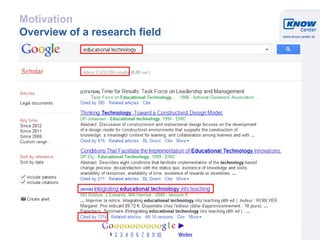
Motivation
Overview of a research field
© Know-Center 2011
3
Motivation
Information overload
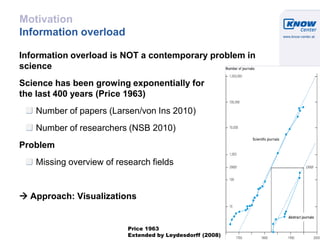
Information overload is NOT a contemporary problem in
science
Science has been growing exponentially for
the last 400 years (Price 1963)
Number of papers (Larsen/von Ins 2010)
Number of researchers (NSB 2010)
Problem
Missing overview of research fields
 Approach: Visualizations
Price 1963
Extended by Leydesdorff (2008)
© Know-Center 2011
4
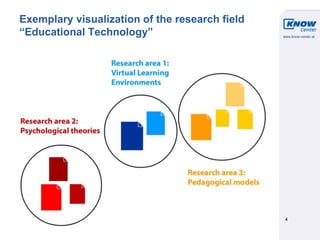
Exemplary visualization of the research field
“Educational Technology”
© Know-Center 2011
5
The „traditional“ way of creating overview
visualizations
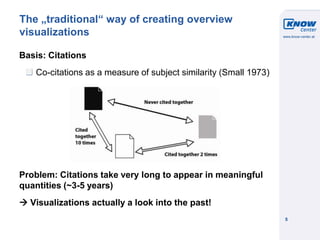
Basis: Citations
Co-citations as a measure of subject similarity (Small 1973)
Problem: Citations take very long to appear in meaningful
quantities (~3-5 years)
 Visualizations actually a look into the past!
© Know-Center 2011
6
A new approach
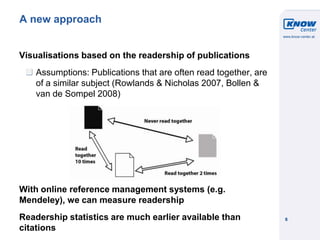
Visualisations based on the readership of publications
Assumptions: Publications that are often read together, are
of a similar subject (Rowlands & Nicholas 2007, Bollen &
van de Sompel 2008)
With online reference management systems (e.g.
Mendeley), we can measure readership
Readership statistics are much earlier available than
citations
© Know-Center 2011
7
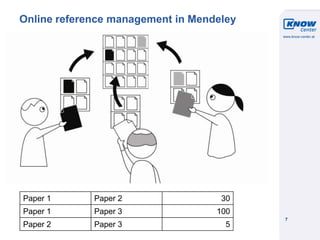
Online reference management in Mendeley
Paper 1 Paper 2 30
Paper 1 Paper 3 100
Paper 2 Paper 3 5
© Know-Center 2011
8
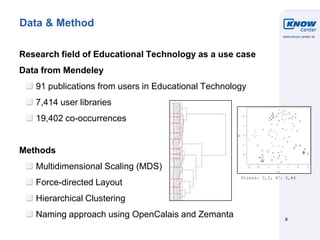
Data & Method
Research field of Educational Technology as a use case
Data from Mendeley
91 publications from users in Educational Technology
7,414 user libraries
19,402 co-occurrences
Methods
Multidimensional Scaling (MDS)
Force-directed Layout
Hierarchical Clustering
Naming approach using OpenCalais and Zemanta
Stress: 0,2; R2: 0,86
© Know-Center 2011
9
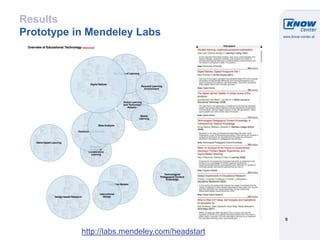
Results
Prototype in Mendeley Labs
http://labs.mendeley.com/headstart
© Know-Center 2011
10
Results
Validation through literature comparison
Qualitative comparison with other forms of literature
analysis of the field of Educational Technology
10 studies: citations, words, qualitative content analysis,
Delphi study, larger streams
• Comparison to citations
• Recent topics are
better covered
• More and more
diverse areas
• Most research areas
from qualitative analyses
are covered as well
• Qualitative studies offer a
more differentiated image
• Areas that are mostly
influenced by computer
science are missing (e.g.
“Adaptive Hypermedia”)
© Know-Center 2011
11
Conclusions and Future Work
Visualizations based on readership statistics offer a more
recent, and a more diverse representation of the field than
visualizations based on citations
Automatization is possible with a few manual interventions
But: Characteristics of readers have an influence on the
visualization
Future Work
Expert interviews
Extension to Web Science (based
on the work of Clare Hooper)
Adaptivity/Personalization
© Know-Center 2011
12
References
Bollen, J., & Van de Sompel, H. (2006). Mapping the structure of science
through usage. Scientometrics, 69(2), 227–258.
Kraker, P., Körner, C., Jack, K., & Granitzer, M. (2012). Harnessing User
Library Statistics for Research Evaluation and Knowledge Domain
Visualization. Proceedings of the 21st International Conference
Companion on World Wide Web (pp. 1017–1024). Lyon: ACM.
Leydesdorff, L. (2008). Journals as retention mechanisms of scientific
growth - Research Trends. Research Trends, 7, 6–7.
Price, D. J. D. S. (1963). Little science, big science (p. 118). Columbia Univ.
Press.
Rowlands, I., & Nicholas, D. (2007). The missing link: journal usage
metrics. Aslib Proceedings, 59(3), 222–228.
Small, H. (1973). Co-citation in the scientific literature: A new measure of
the relationship between two documents. Journal of the American Society
for information Science, 24(4), 265–269.
Images on slides 4, 5, 6, 7, and 11 by Maxi Schramm.
gefördert durch das Kompetenzzentrenprogramm
Web Science Webinar
12 June 2013
know-center.tugraz.at
Thank you very much for your
attention!
pkraker@know-center.at
http://science20.wordpress.com
http://twitter.com/PeterKraker

Head Start: Improving Academic Literature Search with Overview Visualizations based on Readership Statistics

  • 1.
    gefördert durch dasKompetenzzentrenprogramm Web Science Webinar 12 June 2013 know-center.tugraz.at Head Start: Improving Academic Literature Search with Overview Visualizations based on Readership Statistics Peter Kraker, Kris Jack, Christian Schlögl, Christoph Trattner, Stefanie Lindstaedt
  • 2.
  • 3.
    © Know-Center 2011 3 Motivation Informationoverload Information overload is NOT a contemporary problem in science Science has been growing exponentially for the last 400 years (Price 1963) Number of papers (Larsen/von Ins 2010) Number of researchers (NSB 2010) Problem Missing overview of research fields  Approach: Visualizations Price 1963 Extended by Leydesdorff (2008)
  • 4.
    © Know-Center 2011 4 Exemplaryvisualization of the research field “Educational Technology”
  • 5.
    © Know-Center 2011 5 The„traditional“ way of creating overview visualizations Basis: Citations Co-citations as a measure of subject similarity (Small 1973) Problem: Citations take very long to appear in meaningful quantities (~3-5 years)  Visualizations actually a look into the past!
  • 6.
    © Know-Center 2011 6 Anew approach Visualisations based on the readership of publications Assumptions: Publications that are often read together, are of a similar subject (Rowlands & Nicholas 2007, Bollen & van de Sompel 2008) With online reference management systems (e.g. Mendeley), we can measure readership Readership statistics are much earlier available than citations
  • 7.
    © Know-Center 2011 7 Onlinereference management in Mendeley Paper 1 Paper 2 30 Paper 1 Paper 3 100 Paper 2 Paper 3 5
  • 8.
    © Know-Center 2011 8 Data& Method Research field of Educational Technology as a use case Data from Mendeley 91 publications from users in Educational Technology 7,414 user libraries 19,402 co-occurrences Methods Multidimensional Scaling (MDS) Force-directed Layout Hierarchical Clustering Naming approach using OpenCalais and Zemanta Stress: 0,2; R2: 0,86
  • 9.
    © Know-Center 2011 9 Results Prototypein Mendeley Labs http://labs.mendeley.com/headstart
  • 10.
    © Know-Center 2011 10 Results Validationthrough literature comparison Qualitative comparison with other forms of literature analysis of the field of Educational Technology 10 studies: citations, words, qualitative content analysis, Delphi study, larger streams • Comparison to citations • Recent topics are better covered • More and more diverse areas • Most research areas from qualitative analyses are covered as well • Qualitative studies offer a more differentiated image • Areas that are mostly influenced by computer science are missing (e.g. “Adaptive Hypermedia”)
  • 11.
    © Know-Center 2011 11 Conclusionsand Future Work Visualizations based on readership statistics offer a more recent, and a more diverse representation of the field than visualizations based on citations Automatization is possible with a few manual interventions But: Characteristics of readers have an influence on the visualization Future Work Expert interviews Extension to Web Science (based on the work of Clare Hooper) Adaptivity/Personalization
  • 12.
    © Know-Center 2011 12 References Bollen,J., & Van de Sompel, H. (2006). Mapping the structure of science through usage. Scientometrics, 69(2), 227–258. Kraker, P., Körner, C., Jack, K., & Granitzer, M. (2012). Harnessing User Library Statistics for Research Evaluation and Knowledge Domain Visualization. Proceedings of the 21st International Conference Companion on World Wide Web (pp. 1017–1024). Lyon: ACM. Leydesdorff, L. (2008). Journals as retention mechanisms of scientific growth - Research Trends. Research Trends, 7, 6–7. Price, D. J. D. S. (1963). Little science, big science (p. 118). Columbia Univ. Press. Rowlands, I., & Nicholas, D. (2007). The missing link: journal usage metrics. Aslib Proceedings, 59(3), 222–228. Small, H. (1973). Co-citation in the scientific literature: A new measure of the relationship between two documents. Journal of the American Society for information Science, 24(4), 265–269. Images on slides 4, 5, 6, 7, and 11 by Maxi Schramm.
  • 13.
    gefördert durch dasKompetenzzentrenprogramm Web Science Webinar 12 June 2013 know-center.tugraz.at Thank you very much for your attention! pkraker@know-center.at http://science20.wordpress.com http://twitter.com/PeterKraker