Hadoop File System 
B. RAMAMURTHY 
9/4/2014 
1
Reference 
 The Hadoop Distributed File System: Architecture 
and Design by Apache Foundation Inc. 
9/4/2014 
2
Basic Features: HDFS 
 Highly fault-tolerant 
 High throughput 
 Suitable for applications with large data sets 
 Streaming access to file system data 
 Can be built out of commodity hardware 
9/4/2014 
3
Fault tolerance 
 Failure is the norm rather than exception 
 A HDFS instance may consist of thousands of server 
machines, each storing part of the file system’s data. 
 Since we have huge number of components and that 
each component has non-trivial probability of failure 
means that there is always some component that is 
non-functional. 
 Detection of faults and quick, automatic recovery 
from them is a core architectural goal of HDFS. 
9/4/2014 
4
Data Characteristics 
 Streaming data access 
 Applications need streaming access to data 
 Batch processing rather than interactive user access. 
 Large data sets and files: gigabytes to terabytes size 
 High aggregate data bandwidth 
 Scale to hundreds of nodes in a cluster 
 Tens of millions of files in a single instance 
 Write-once-read-many: a file once created, written and 
closed need not be changed – this assumption simplifies 
coherency 
 A map-reduce application or web-crawler application fits 
perfectly with this model. 
9/4/2014 
5
Cat 
Bat 
Dog 
Other 
Words 
(size: 
TByte) 
map 
map 
map 
map 
split 
split 
split 
split 
combine 
combine 
combine 
reduce 
reduce 
reduce 
part0 
part1 
part2 
MapReduce 
9/4/2014 
6
Architecture 
9/4/2014 
7
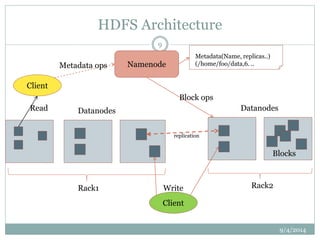
Namenode and Datanodes 
 Master/slave architecture 
 HDFS cluster consists of a single Namenode, a master server that 
manages the file system namespace and regulates access to files by 
clients. 
 There are a number of DataNodes usually one per node in a 
cluster. 
 The DataNodes manage storage attached to the nodes that they run 
on. 
 HDFS exposes a file system namespace and allows user data to be 
stored in files. 
 A file is split into one or more blocks and set of blocks are stored in 
DataNodes. 
 DataNodes: serves read, write requests, performs block creation, 
deletion, and replication upon instruction from Namenode. 
9/4/2014 
8
HDFS Architecture 
9/4/2014 
9 
Namenode 
Datanodes Datanodes 
B replication 
Rack1 Rack2 
Client 
Blocks 
Client 
Write 
Read 
Metadata ops 
Metadata(Name, replicas..) 
(/home/foo/data,6. .. 
Block ops
File system Namespace 
9/4/2014 
10 
 Hierarchical file system with directories and files 
 Create, remove, move, rename etc. 
 Namenode maintains the file system 
 Any meta information changes to the file system 
recorded by the Namenode. 
 An application can specify the number of replicas of 
the file needed: replication factor of the file. This 
information is stored in the Namenode.
Data Replication 
9/4/2014 
11 
 HDFS is designed to store very large files across 
machines in a large cluster. 
 Each file is a sequence of blocks. 
 All blocks in the file except the last are of the same 
size. 
 Blocks are replicated for fault tolerance. 
 Block size and replicas are configurable per file. 
 The Namenode receives a Heartbeat and a 
BlockReport from each DataNode in the cluster. 
 BlockReport contains all the blocks on a Datanode.
Replica Placement 
9/4/2014 
12 
 The placement of the replicas is critical to HDFS reliability and performance. 
 Optimizing replica placement distinguishes HDFS from other distributed file 
systems. 
 Rack-aware replica placement: 
 Goal: improve reliability, availability and network bandwidth utilization 
 Research topic 
 Many racks, communication between racks are through switches. 
 Network bandwidth between machines on the same rack is greater than those in 
different racks. 
 Namenode determines the rack id for each DataNode. 
 Replicas are typically placed on unique racks 
 Simple but non-optimal 
 Writes are expensive 
 Replication factor is 3 
 Another research topic? 
 Replicas are placed: one on a node in a local rack, one on a different node in the 
local rack and one on a node in a different rack. 
 1/3 of the replica on a node, 2/3 on a rack and 1/3 distributed evenly across 
remaining racks.
Replica Selection 
9/4/2014 
13 
 Replica selection for READ operation: HDFS tries to 
minimize the bandwidth consumption and latency. 
 If there is a replica on the Reader node then that is 
preferred. 
 HDFS cluster may span multiple data centers: 
replica in the local data center is preferred over the 
remote one.
Safemode Startup 
9/4/2014 
14 
 On startup Namenode enters Safemode. 
 Replication of data blocks do not occur in Safemode. 
 Each DataNode checks in with Heartbeat and 
BlockReport. 
 Namenode verifies that each block has acceptable 
number of replicas 
 After a configurable percentage of safely replicated 
blocks check in with the Namenode, Namenode exits 
Safemode. 
 It then makes the list of blocks that need to be replicated. 
 Namenode then proceeds to replicate these blocks to 
other Datanodes.
Filesystem Metadata 
9/4/2014 
15 
 The HDFS namespace is stored by Namenode. 
 Namenode uses a transaction log called the EditLog 
to record every change that occurs to the filesystem 
meta data. 
 For example, creating a new file. 
 Change replication factor of a file 
 EditLog is stored in the Namenode’s local filesystem 
 Entire filesystem namespace including mapping of 
blocks to files and file system properties is stored in a 
file FsImage. Stored in Namenode’s local filesystem.
Namenode 
9/4/2014 
16 
 Keeps image of entire file system namespace and file 
Blockmap in memory. 
 4GB of local RAM is sufficient to support the above data 
structures that represent the huge number of files and 
directories. 
 When the Namenode starts up it gets the FsImage and 
Editlog from its local file system, update FsImage with 
EditLog information and then stores a copy of the 
FsImage on the filesytstem as a checkpoint. 
 Periodic checkpointing is done. So that the system can 
recover back to the last checkpointed state in case of a 
crash.
Datanode 
9/4/2014 
17 
 A Datanode stores data in files in its local file system. 
 Datanode has no knowledge about HDFS filesystem 
 It stores each block of HDFS data in a separate file. 
 Datanode does not create all files in the same directory. 
 It uses heuristics to determine optimal number of files 
per directory and creates directories appropriately: 
 Research issue? 
 When the filesystem starts up it generates a list of all 
HDFS blocks and send this report to Namenode: 
Blockreport.
Protocol 
9/4/2014 
18
The Communication Protocol 
9/4/2014 
19 
 All HDFS communication protocols are layered on top of 
the TCP/IP protocol 
 A client establishes a connection to a configurable TCP 
port on the Namenode machine. It talks ClientProtocol 
with the Namenode. 
 The Datanodes talk to the Namenode using Datanode 
protocol. 
 RPC abstraction wraps both ClientProtocol and 
Datanode protocol. 
 Namenode is simply a server and never initiates a 
request; it only responds to RPC requests issued by 
DataNodes or clients.
Robustness 
9/4/2014 
20
Objectives 
 Primary objective of HDFS is to store data reliably in 
the presence of failures. 
 Three common failures are: Namenode failure, 
Datanode failure and network partition. 
9/4/2014 
21
DataNode failure and heartbeat 
 A network partition can cause a subset of Datanodes 
to lose connectivity with the Namenode. 
 Namenode detects this condition by the absence of a 
Heartbeat message. 
 Namenode marks Datanodes without Hearbeat and 
does not send any IO requests to them. 
 Any data registered to the failed Datanode is not 
available to the HDFS. 
 Also the death of a Datanode may cause replication 
factor of some of the blocks to fall below their 
specified value. 
9/4/2014 
22
Re-replication 
 The necessity for re-replication may arise due to: 
 A Datanode may become unavailable, 
 A replica may become corrupted, 
 A hard disk on a Datanode may fail, or 
 The replication factor on the block may be increased. 
9/4/2014 
23
Cluster Rebalancing 
 HDFS architecture is compatible with data 
rebalancing schemes. 
 A scheme might move data from one Datanode to 
another if the free space on a Datanode falls below a 
certain threshold. 
 In the event of a sudden high demand for a 
particular file, a scheme might dynamically create 
additional replicas and rebalance other data in the 
cluster. 
 These types of data rebalancing are not yet 
implemented: research issue. 
9/4/2014 
24
Data Integrity 
 Consider a situation: a block of data fetched from 
Datanode arrives corrupted. 
 This corruption may occur because of faults in a 
storage device, network faults, or buggy software. 
 A HDFS client creates the checksum of every block of 
its file and stores it in hidden files in the HDFS 
namespace. 
 When a clients retrieves the contents of file, it 
verifies that the corresponding checksums match. 
 If does not match, the client can retrieve the block 
from a replica. 
9/4/2014 
25
Metadata Disk Failure 
 FsImage and EditLog are central data structures of HDFS. 
 A corruption of these files can cause a HDFS instance to be 
non-functional. 
 For this reason, a Namenode can be configured to maintain 
multiple copies of the FsImage and EditLog. 
 Multiple copies of the FsImage and EditLog files are 
updated synchronously. 
 Meta-data is not data-intensive. 
 The Namenode could be single point failure: automatic 
failover is NOT supported! Another research topic. 
9/4/2014 
26
Data Organization 
9/4/2014 
27
Data Blocks 
 HDFS support write-once-read-many with reads at 
streaming speeds. 
 A typical block size is 64MB (or even 128 MB). 
 A file is chopped into 64MB chunks and stored. 
9/4/2014 
28
Staging 
 A client request to create a file does not reach 
Namenode immediately. 
 HDFS client caches the data into a temporary file. 
When the data reached a HDFS block size the client 
contacts the Namenode. 
 Namenode inserts the filename into its hierarchy and 
allocates a data block for it. 
 The Namenode responds to the client with the 
identity of the Datanode and the destination of the 
replicas (Datanodes) for the block. 
 Then the client flushes it from its local memory. 
9/4/2014 
29
Staging (contd.) 
 The client sends a message that the file is closed. 
 Namenode proceeds to commit the file for creation 
operation into the persistent store. 
 If the Namenode dies before file is closed, the file is 
lost. 
 This client side caching is required to avoid network 
congestion; also it has precedence is AFS (Andrew 
file system). 
9/4/2014 
30
Replication Pipelining 
 When the client receives response from Namenode, 
it flushes its block in small pieces (4K) to the first 
replica, that in turn copies it to the next replica and 
so on. 
 Thus data is pipelined from Datanode to the next. 
9/4/2014 
31
API (Accessibility) 
9/4/2014 
32
Application Programming Interface 
 HDFS provides Java API for application to use. 
 Python access is also used in many applications. 
 A C language wrapper for Java API is also available. 
 A HTTP browser can be used to browse the files of a 
HDFS instance. 
9/4/2014 
33
FS Shell, Admin and Browser Interface 
 HDFS organizes its data in files and directories. 
 It provides a command line interface called the FS 
shell that lets the user interact with data in the 
HDFS. 
 The syntax of the commands is similar to bash and 
csh. 
 Example: to create a directory /foodir 
/bin/hadoop dfs –mkdir /foodir 
 There is also DFSAdmin interface available 
 Browser interface is also available to view the 
namespace. 
9/4/2014 
34
Space Reclamation 
35 
 When a file is deleted by a client, HDFS renames file 
to a file in be the /trash directory for a configurable 
amount of time. 
 A client can request for an undelete in this allowed 
time. 
 After the specified time the file is deleted and the 
space is reclaimed. 
 When the replication factor is reduced, the 
Namenode selects excess replicas that can be 
deleted. 
 Next heartbeat(?) transfers this information to the 
Datanode that clears the blocks for use. 9/4/2014
Summary 
 We discussed the features of the Hadoop File 
System, a peta-scale file system to handle big-data 
sets. 
 What discussed: Architecture, Protocol, API, etc. 
 Missing element: Implementation 
 The Hadoop file system (internals) 
 An implementation of an instance of the HDFS (for use by 
applications such as web crawlers). 
9/4/2014 
36

Hdfs

  • 1.
    Hadoop File System B. RAMAMURTHY 9/4/2014 1
  • 2.
    Reference  TheHadoop Distributed File System: Architecture and Design by Apache Foundation Inc. 9/4/2014 2
  • 3.
    Basic Features: HDFS  Highly fault-tolerant  High throughput  Suitable for applications with large data sets  Streaming access to file system data  Can be built out of commodity hardware 9/4/2014 3
  • 4.
    Fault tolerance Failure is the norm rather than exception  A HDFS instance may consist of thousands of server machines, each storing part of the file system’s data.  Since we have huge number of components and that each component has non-trivial probability of failure means that there is always some component that is non-functional.  Detection of faults and quick, automatic recovery from them is a core architectural goal of HDFS. 9/4/2014 4
  • 5.
    Data Characteristics Streaming data access  Applications need streaming access to data  Batch processing rather than interactive user access.  Large data sets and files: gigabytes to terabytes size  High aggregate data bandwidth  Scale to hundreds of nodes in a cluster  Tens of millions of files in a single instance  Write-once-read-many: a file once created, written and closed need not be changed – this assumption simplifies coherency  A map-reduce application or web-crawler application fits perfectly with this model. 9/4/2014 5
  • 6.
    Cat Bat Dog Other Words (size: TByte) map map map map split split split split combine combine combine reduce reduce reduce part0 part1 part2 MapReduce 9/4/2014 6
  • 7.
  • 8.
    Namenode and Datanodes  Master/slave architecture  HDFS cluster consists of a single Namenode, a master server that manages the file system namespace and regulates access to files by clients.  There are a number of DataNodes usually one per node in a cluster.  The DataNodes manage storage attached to the nodes that they run on.  HDFS exposes a file system namespace and allows user data to be stored in files.  A file is split into one or more blocks and set of blocks are stored in DataNodes.  DataNodes: serves read, write requests, performs block creation, deletion, and replication upon instruction from Namenode. 9/4/2014 8
  • 9.
    HDFS Architecture 9/4/2014 9 Namenode Datanodes Datanodes B replication Rack1 Rack2 Client Blocks Client Write Read Metadata ops Metadata(Name, replicas..) (/home/foo/data,6. .. Block ops
  • 10.
    File system Namespace 9/4/2014 10  Hierarchical file system with directories and files  Create, remove, move, rename etc.  Namenode maintains the file system  Any meta information changes to the file system recorded by the Namenode.  An application can specify the number of replicas of the file needed: replication factor of the file. This information is stored in the Namenode.
  • 11.
    Data Replication 9/4/2014 11  HDFS is designed to store very large files across machines in a large cluster.  Each file is a sequence of blocks.  All blocks in the file except the last are of the same size.  Blocks are replicated for fault tolerance.  Block size and replicas are configurable per file.  The Namenode receives a Heartbeat and a BlockReport from each DataNode in the cluster.  BlockReport contains all the blocks on a Datanode.
  • 12.
    Replica Placement 9/4/2014 12  The placement of the replicas is critical to HDFS reliability and performance.  Optimizing replica placement distinguishes HDFS from other distributed file systems.  Rack-aware replica placement:  Goal: improve reliability, availability and network bandwidth utilization  Research topic  Many racks, communication between racks are through switches.  Network bandwidth between machines on the same rack is greater than those in different racks.  Namenode determines the rack id for each DataNode.  Replicas are typically placed on unique racks  Simple but non-optimal  Writes are expensive  Replication factor is 3  Another research topic?  Replicas are placed: one on a node in a local rack, one on a different node in the local rack and one on a node in a different rack.  1/3 of the replica on a node, 2/3 on a rack and 1/3 distributed evenly across remaining racks.
  • 13.
    Replica Selection 9/4/2014 13  Replica selection for READ operation: HDFS tries to minimize the bandwidth consumption and latency.  If there is a replica on the Reader node then that is preferred.  HDFS cluster may span multiple data centers: replica in the local data center is preferred over the remote one.
  • 14.
    Safemode Startup 9/4/2014 14  On startup Namenode enters Safemode.  Replication of data blocks do not occur in Safemode.  Each DataNode checks in with Heartbeat and BlockReport.  Namenode verifies that each block has acceptable number of replicas  After a configurable percentage of safely replicated blocks check in with the Namenode, Namenode exits Safemode.  It then makes the list of blocks that need to be replicated.  Namenode then proceeds to replicate these blocks to other Datanodes.
  • 15.
    Filesystem Metadata 9/4/2014 15  The HDFS namespace is stored by Namenode.  Namenode uses a transaction log called the EditLog to record every change that occurs to the filesystem meta data.  For example, creating a new file.  Change replication factor of a file  EditLog is stored in the Namenode’s local filesystem  Entire filesystem namespace including mapping of blocks to files and file system properties is stored in a file FsImage. Stored in Namenode’s local filesystem.
  • 16.
    Namenode 9/4/2014 16  Keeps image of entire file system namespace and file Blockmap in memory.  4GB of local RAM is sufficient to support the above data structures that represent the huge number of files and directories.  When the Namenode starts up it gets the FsImage and Editlog from its local file system, update FsImage with EditLog information and then stores a copy of the FsImage on the filesytstem as a checkpoint.  Periodic checkpointing is done. So that the system can recover back to the last checkpointed state in case of a crash.
  • 17.
    Datanode 9/4/2014 17  A Datanode stores data in files in its local file system.  Datanode has no knowledge about HDFS filesystem  It stores each block of HDFS data in a separate file.  Datanode does not create all files in the same directory.  It uses heuristics to determine optimal number of files per directory and creates directories appropriately:  Research issue?  When the filesystem starts up it generates a list of all HDFS blocks and send this report to Namenode: Blockreport.
  • 18.
  • 19.
    The Communication Protocol 9/4/2014 19  All HDFS communication protocols are layered on top of the TCP/IP protocol  A client establishes a connection to a configurable TCP port on the Namenode machine. It talks ClientProtocol with the Namenode.  The Datanodes talk to the Namenode using Datanode protocol.  RPC abstraction wraps both ClientProtocol and Datanode protocol.  Namenode is simply a server and never initiates a request; it only responds to RPC requests issued by DataNodes or clients.
  • 20.
  • 21.
    Objectives  Primaryobjective of HDFS is to store data reliably in the presence of failures.  Three common failures are: Namenode failure, Datanode failure and network partition. 9/4/2014 21
  • 22.
    DataNode failure andheartbeat  A network partition can cause a subset of Datanodes to lose connectivity with the Namenode.  Namenode detects this condition by the absence of a Heartbeat message.  Namenode marks Datanodes without Hearbeat and does not send any IO requests to them.  Any data registered to the failed Datanode is not available to the HDFS.  Also the death of a Datanode may cause replication factor of some of the blocks to fall below their specified value. 9/4/2014 22
  • 23.
    Re-replication  Thenecessity for re-replication may arise due to:  A Datanode may become unavailable,  A replica may become corrupted,  A hard disk on a Datanode may fail, or  The replication factor on the block may be increased. 9/4/2014 23
  • 24.
    Cluster Rebalancing HDFS architecture is compatible with data rebalancing schemes.  A scheme might move data from one Datanode to another if the free space on a Datanode falls below a certain threshold.  In the event of a sudden high demand for a particular file, a scheme might dynamically create additional replicas and rebalance other data in the cluster.  These types of data rebalancing are not yet implemented: research issue. 9/4/2014 24
  • 25.
    Data Integrity Consider a situation: a block of data fetched from Datanode arrives corrupted.  This corruption may occur because of faults in a storage device, network faults, or buggy software.  A HDFS client creates the checksum of every block of its file and stores it in hidden files in the HDFS namespace.  When a clients retrieves the contents of file, it verifies that the corresponding checksums match.  If does not match, the client can retrieve the block from a replica. 9/4/2014 25
  • 26.
    Metadata Disk Failure  FsImage and EditLog are central data structures of HDFS.  A corruption of these files can cause a HDFS instance to be non-functional.  For this reason, a Namenode can be configured to maintain multiple copies of the FsImage and EditLog.  Multiple copies of the FsImage and EditLog files are updated synchronously.  Meta-data is not data-intensive.  The Namenode could be single point failure: automatic failover is NOT supported! Another research topic. 9/4/2014 26
  • 27.
  • 28.
    Data Blocks HDFS support write-once-read-many with reads at streaming speeds.  A typical block size is 64MB (or even 128 MB).  A file is chopped into 64MB chunks and stored. 9/4/2014 28
  • 29.
    Staging  Aclient request to create a file does not reach Namenode immediately.  HDFS client caches the data into a temporary file. When the data reached a HDFS block size the client contacts the Namenode.  Namenode inserts the filename into its hierarchy and allocates a data block for it.  The Namenode responds to the client with the identity of the Datanode and the destination of the replicas (Datanodes) for the block.  Then the client flushes it from its local memory. 9/4/2014 29
  • 30.
    Staging (contd.) The client sends a message that the file is closed.  Namenode proceeds to commit the file for creation operation into the persistent store.  If the Namenode dies before file is closed, the file is lost.  This client side caching is required to avoid network congestion; also it has precedence is AFS (Andrew file system). 9/4/2014 30
  • 31.
    Replication Pipelining When the client receives response from Namenode, it flushes its block in small pieces (4K) to the first replica, that in turn copies it to the next replica and so on.  Thus data is pipelined from Datanode to the next. 9/4/2014 31
  • 32.
  • 33.
    Application Programming Interface  HDFS provides Java API for application to use.  Python access is also used in many applications.  A C language wrapper for Java API is also available.  A HTTP browser can be used to browse the files of a HDFS instance. 9/4/2014 33
  • 34.
    FS Shell, Adminand Browser Interface  HDFS organizes its data in files and directories.  It provides a command line interface called the FS shell that lets the user interact with data in the HDFS.  The syntax of the commands is similar to bash and csh.  Example: to create a directory /foodir /bin/hadoop dfs –mkdir /foodir  There is also DFSAdmin interface available  Browser interface is also available to view the namespace. 9/4/2014 34
  • 35.
    Space Reclamation 35  When a file is deleted by a client, HDFS renames file to a file in be the /trash directory for a configurable amount of time.  A client can request for an undelete in this allowed time.  After the specified time the file is deleted and the space is reclaimed.  When the replication factor is reduced, the Namenode selects excess replicas that can be deleted.  Next heartbeat(?) transfers this information to the Datanode that clears the blocks for use. 9/4/2014
  • 36.
    Summary  Wediscussed the features of the Hadoop File System, a peta-scale file system to handle big-data sets.  What discussed: Architecture, Protocol, API, etc.  Missing element: Implementation  The Hadoop file system (internals)  An implementation of an instance of the HDFS (for use by applications such as web crawlers). 9/4/2014 36