Running record: HDFS 2950 LAB 1 1
HDFS 2950 Lab 1
Delaney Smith
University of Georgia
HDFS 2950 LAB 1 2
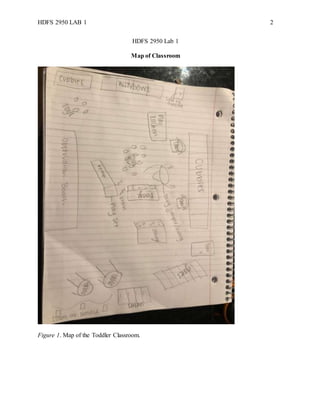
HDFS 2950 Lab 1
Map of Classroom
Figure 1. Map of the Toddler Classroom.
HDFS 2950 LAB 1 3
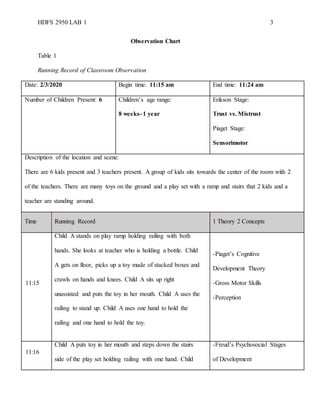
Observation Chart
Table 1
Running Record of Classroom Observation
Date: 2/3/2020 Begin time: 11:15 am End time: 11:24 am
Number of Children Present: 6 Children’s age range:
8 weeks- 1 year
Erikson Stage:
Trust vs. Mistrust
Piaget Stage:
Sensorimotor
Description of the location and scene:
There are 6 kids present and 3 teachers present. A group of kids sits towards the center of the room with 2
of the teachers. There are many toys on the ground and a play set with a ramp and stairs that 2 kids and a
teacher are standing around.
Time Running Record 1 Theory 2 Concepts
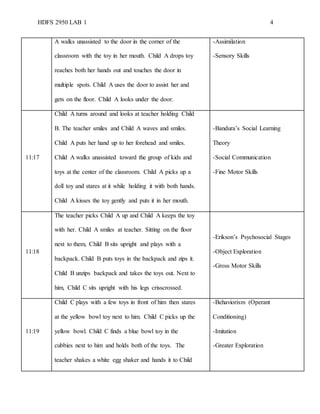
11:15
Child A stands on play ramp holding railing with both
hands. She looks at teacher who is holding a bottle. Child
A gets on floor, picks up a toy made of stacked boxes and
crawls on hands and knees. Child A sits up right
unassisted and puts the toy in her mouth. Child A uses the
railing to stand up. Child A uses one hand to hold the
railing and one hand to hold the toy.
-Piaget’s Cognitive
Development Theory
-Gross Motor Skills
-Perception
11:16
Child A puts toy in her mouth and steps down the stairs
side of the play set holding railing with one hand. Child
-Freud’s Psychosocial Stages
of Development
HDFS 2950 LAB 1 4
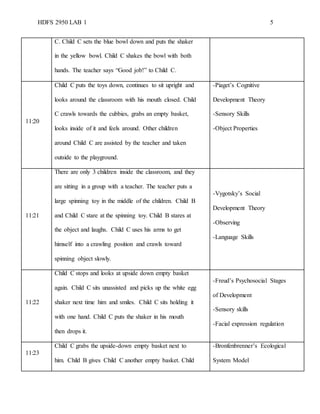
A walks unassisted to the door in the corner of the
classroom with the toy in her mouth. Child A drops toy
reaches both her hands out and touches the door in
multiple spots. Child A uses the door to assist her and
gets on the floor. Child A looks under the door.
-Assimilation
-Sensory Skills
11:17
Child A turns around and looks at teacher holding Child
B. The teacher smiles and Child A waves and smiles.
Child A puts her hand up to her forehead and smiles.
Child A walks unassisted toward the group of kids and
toys at the center of the classroom. Child A picks up a
doll toy and stares at it while holding it with both hands.
Child A kisses the toy gently and puts it in her mouth.
-Bandura’s Social Learning
Theory
-Social Communication
-Fine Motor Skills
11:18
The teacher picks Child A up and Child A keeps the toy
with her. Child A smiles at teacher. Sitting on the floor
next to them, Child B sits upright and plays with a
backpack. Child B puts toys in the backpack and zips it.
Child B unzips backpack and takes the toys out. Next to
him, Child C sits upright with his legs crisscrossed.
-Erikson’s Psychosocial Stages
-Object Exploration
-Gross Motor Skills
11:19
Child C plays with a few toys in front of him then stares
at the yellow bowl toy next to him. Child C picks up the
yellow bowl. Child C finds a blue bowl toy in the
cubbies next to him and holds both of the toys. The
teacher shakes a white egg shaker and hands it to Child
-Behaviorism (Operant
Conditioning)
-Imitation
-Greater Exploration
HDFS 2950 LAB 1 5
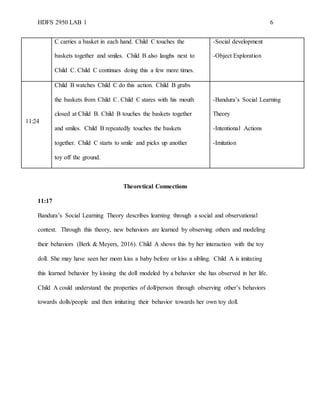
C. Child C sets the blue bowl down and puts the shaker
in the yellow bowl. Child C shakes the bowl with both
hands. The teacher says “Good job!” to Child C.
11:20
Child C puts the toys down, continues to sit upright and
looks around the classroom with his mouth closed. Child
C crawls towards the cubbies, grabs an empty basket,
looks inside of it and feels around. Other children
around Child C are assisted by the teacher and taken
outside to the playground.
-Piaget’s Cognitive
Development Theory
-Sensory Skills
-Object Properties
11:21
There are only 3 children inside the classroom, and they
are sitting in a group with a teacher. The teacher puts a
large spinning toy in the middle of the children. Child B
and Child C stare at the spinning toy. Child B stares at
the object and laughs. Child C uses his arms to get
himself into a crawling position and crawls toward
spinning object slowly.
-Vygotsky’s Social
Development Theory
-Observing
-Language Skills
11:22
Child C stops and looks at upside down empty basket
again. Child C sits unassisted and picks up the white egg
shaker next time him and smiles. Child C sits holding it
with one hand. Child C puts the shaker in his mouth
then drops it.
-Freud’s Psychosocial Stages
of Development
-Sensory skills
-Facial expression regulation
11:23
Child C grabs the upside-down empty basket next to
him. Child B gives Child C another empty basket. Child
-Bronfenbrenner’s Ecological
System Model
HDFS 2950 LAB 1 6
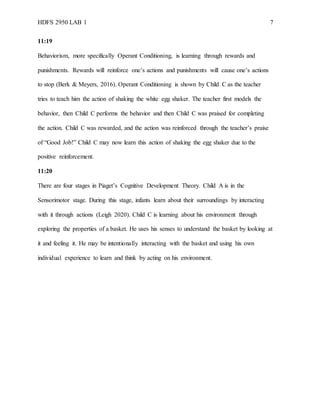
C carries a basket in each hand. Child C touches the
baskets together and smiles. Child B also laughs next to
Child C. Child C continues doing this a few more times.
-Social development
-Object Exploration
11:24
Child B watches Child C do this action. Child B grabs
the baskets from Child C. Child C stares with his mouth
closed at Child B. Child B touches the baskets together
and smiles. Child B repeatedly touches the baskets
together. Child C starts to smile and picks up another
toy off the ground.
-Bandura’s Social Learning
Theory
-Intentional Actions
-Imitation
Theoretical Connections
11:17
Bandura’s Social Learning Theory describes learning through a social and observational
context. Through this theory, new behaviors are learned by observing others and modeling
their behaviors (Berk & Meyers, 2016). Child A shows this by her interaction with the toy
doll. She may have seen her mom kiss a baby before or kiss a sibling. Child A is imitating
this learned behavior by kissing the doll modeled by a behavior she has observed in her life.
Child A could understand the properties of doll/person through observing other’s behaviors
towards dolls/people and then imitating their behavior towards her own toy doll.
HDFS 2950 LAB 1 7
11:19
Behaviorism, more specifically Operant Conditioning, is learning through rewards and
punishments. Rewards will reinforce one’s actions and punishments will cause one’s actions
to stop (Berk & Meyers, 2016). Operant Conditioning is shown by Child C as the teacher
tries to teach him the action of shaking the white egg shaker. The teacher first models the
behavior, then Child C performs the behavior and then Child C was praised for completing
the action. Child C was rewarded, and the action was reinforced through the teacher’s praise
of “Good Job!” Child C may now learn this action of shaking the egg shaker due to the
positive reinforcement.
11:20
There are four stages in Piaget’s Cognitive Development Theory. Child A is in the
Sensorimotor stage. During this stage, infants learn about their surroundings by interacting
with it through actions (Leigh 2020). Child C is learning about his environment through
exploring the properties of a basket. He uses his senses to understand the basket by looking at
it and feeling it. He may be intentionally interacting with the basket and using his own
individual experience to learn and think by acting on his environment.
HDFS 2950 LAB 1 8
References
Berk, L.E., & Adena B.M, (2016). History, Theory, and Research Strategies. In T. Paulken &
J. Ashkenaz (Eds.), Infants, Children, and Adolescents(pp. 2-49). Boston: Pearson.
Leigh, K. (2020). Lab 1- Theory Review [PowerPoint slides].

HDFS 2950 Lab 1

  • 1.
    Running record: HDFS2950 LAB 1 1 HDFS 2950 Lab 1 Delaney Smith University of Georgia
  • 2.
    HDFS 2950 LAB1 2 HDFS 2950 Lab 1 Map of Classroom Figure 1. Map of the Toddler Classroom.
  • 3.
    HDFS 2950 LAB1 3 Observation Chart Table 1 Running Record of Classroom Observation Date: 2/3/2020 Begin time: 11:15 am End time: 11:24 am Number of Children Present: 6 Children’s age range: 8 weeks- 1 year Erikson Stage: Trust vs. Mistrust Piaget Stage: Sensorimotor Description of the location and scene: There are 6 kids present and 3 teachers present. A group of kids sits towards the center of the room with 2 of the teachers. There are many toys on the ground and a play set with a ramp and stairs that 2 kids and a teacher are standing around. Time Running Record 1 Theory 2 Concepts 11:15 Child A stands on play ramp holding railing with both hands. She looks at teacher who is holding a bottle. Child A gets on floor, picks up a toy made of stacked boxes and crawls on hands and knees. Child A sits up right unassisted and puts the toy in her mouth. Child A uses the railing to stand up. Child A uses one hand to hold the railing and one hand to hold the toy. -Piaget’s Cognitive Development Theory -Gross Motor Skills -Perception 11:16 Child A puts toy in her mouth and steps down the stairs side of the play set holding railing with one hand. Child -Freud’s Psychosocial Stages of Development
  • 4.
    HDFS 2950 LAB1 4 A walks unassisted to the door in the corner of the classroom with the toy in her mouth. Child A drops toy reaches both her hands out and touches the door in multiple spots. Child A uses the door to assist her and gets on the floor. Child A looks under the door. -Assimilation -Sensory Skills 11:17 Child A turns around and looks at teacher holding Child B. The teacher smiles and Child A waves and smiles. Child A puts her hand up to her forehead and smiles. Child A walks unassisted toward the group of kids and toys at the center of the classroom. Child A picks up a doll toy and stares at it while holding it with both hands. Child A kisses the toy gently and puts it in her mouth. -Bandura’s Social Learning Theory -Social Communication -Fine Motor Skills 11:18 The teacher picks Child A up and Child A keeps the toy with her. Child A smiles at teacher. Sitting on the floor next to them, Child B sits upright and plays with a backpack. Child B puts toys in the backpack and zips it. Child B unzips backpack and takes the toys out. Next to him, Child C sits upright with his legs crisscrossed. -Erikson’s Psychosocial Stages -Object Exploration -Gross Motor Skills 11:19 Child C plays with a few toys in front of him then stares at the yellow bowl toy next to him. Child C picks up the yellow bowl. Child C finds a blue bowl toy in the cubbies next to him and holds both of the toys. The teacher shakes a white egg shaker and hands it to Child -Behaviorism (Operant Conditioning) -Imitation -Greater Exploration
  • 5.
    HDFS 2950 LAB1 5 C. Child C sets the blue bowl down and puts the shaker in the yellow bowl. Child C shakes the bowl with both hands. The teacher says “Good job!” to Child C. 11:20 Child C puts the toys down, continues to sit upright and looks around the classroom with his mouth closed. Child C crawls towards the cubbies, grabs an empty basket, looks inside of it and feels around. Other children around Child C are assisted by the teacher and taken outside to the playground. -Piaget’s Cognitive Development Theory -Sensory Skills -Object Properties 11:21 There are only 3 children inside the classroom, and they are sitting in a group with a teacher. The teacher puts a large spinning toy in the middle of the children. Child B and Child C stare at the spinning toy. Child B stares at the object and laughs. Child C uses his arms to get himself into a crawling position and crawls toward spinning object slowly. -Vygotsky’s Social Development Theory -Observing -Language Skills 11:22 Child C stops and looks at upside down empty basket again. Child C sits unassisted and picks up the white egg shaker next time him and smiles. Child C sits holding it with one hand. Child C puts the shaker in his mouth then drops it. -Freud’s Psychosocial Stages of Development -Sensory skills -Facial expression regulation 11:23 Child C grabs the upside-down empty basket next to him. Child B gives Child C another empty basket. Child -Bronfenbrenner’s Ecological System Model
  • 6.
    HDFS 2950 LAB1 6 C carries a basket in each hand. Child C touches the baskets together and smiles. Child B also laughs next to Child C. Child C continues doing this a few more times. -Social development -Object Exploration 11:24 Child B watches Child C do this action. Child B grabs the baskets from Child C. Child C stares with his mouth closed at Child B. Child B touches the baskets together and smiles. Child B repeatedly touches the baskets together. Child C starts to smile and picks up another toy off the ground. -Bandura’s Social Learning Theory -Intentional Actions -Imitation Theoretical Connections 11:17 Bandura’s Social Learning Theory describes learning through a social and observational context. Through this theory, new behaviors are learned by observing others and modeling their behaviors (Berk & Meyers, 2016). Child A shows this by her interaction with the toy doll. She may have seen her mom kiss a baby before or kiss a sibling. Child A is imitating this learned behavior by kissing the doll modeled by a behavior she has observed in her life. Child A could understand the properties of doll/person through observing other’s behaviors towards dolls/people and then imitating their behavior towards her own toy doll.
  • 7.
    HDFS 2950 LAB1 7 11:19 Behaviorism, more specifically Operant Conditioning, is learning through rewards and punishments. Rewards will reinforce one’s actions and punishments will cause one’s actions to stop (Berk & Meyers, 2016). Operant Conditioning is shown by Child C as the teacher tries to teach him the action of shaking the white egg shaker. The teacher first models the behavior, then Child C performs the behavior and then Child C was praised for completing the action. Child C was rewarded, and the action was reinforced through the teacher’s praise of “Good Job!” Child C may now learn this action of shaking the egg shaker due to the positive reinforcement. 11:20 There are four stages in Piaget’s Cognitive Development Theory. Child A is in the Sensorimotor stage. During this stage, infants learn about their surroundings by interacting with it through actions (Leigh 2020). Child C is learning about his environment through exploring the properties of a basket. He uses his senses to understand the basket by looking at it and feeling it. He may be intentionally interacting with the basket and using his own individual experience to learn and think by acting on his environment.
  • 8.
    HDFS 2950 LAB1 8 References Berk, L.E., & Adena B.M, (2016). History, Theory, and Research Strategies. In T. Paulken & J. Ashkenaz (Eds.), Infants, Children, and Adolescents(pp. 2-49). Boston: Pearson. Leigh, K. (2020). Lab 1- Theory Review [PowerPoint slides].