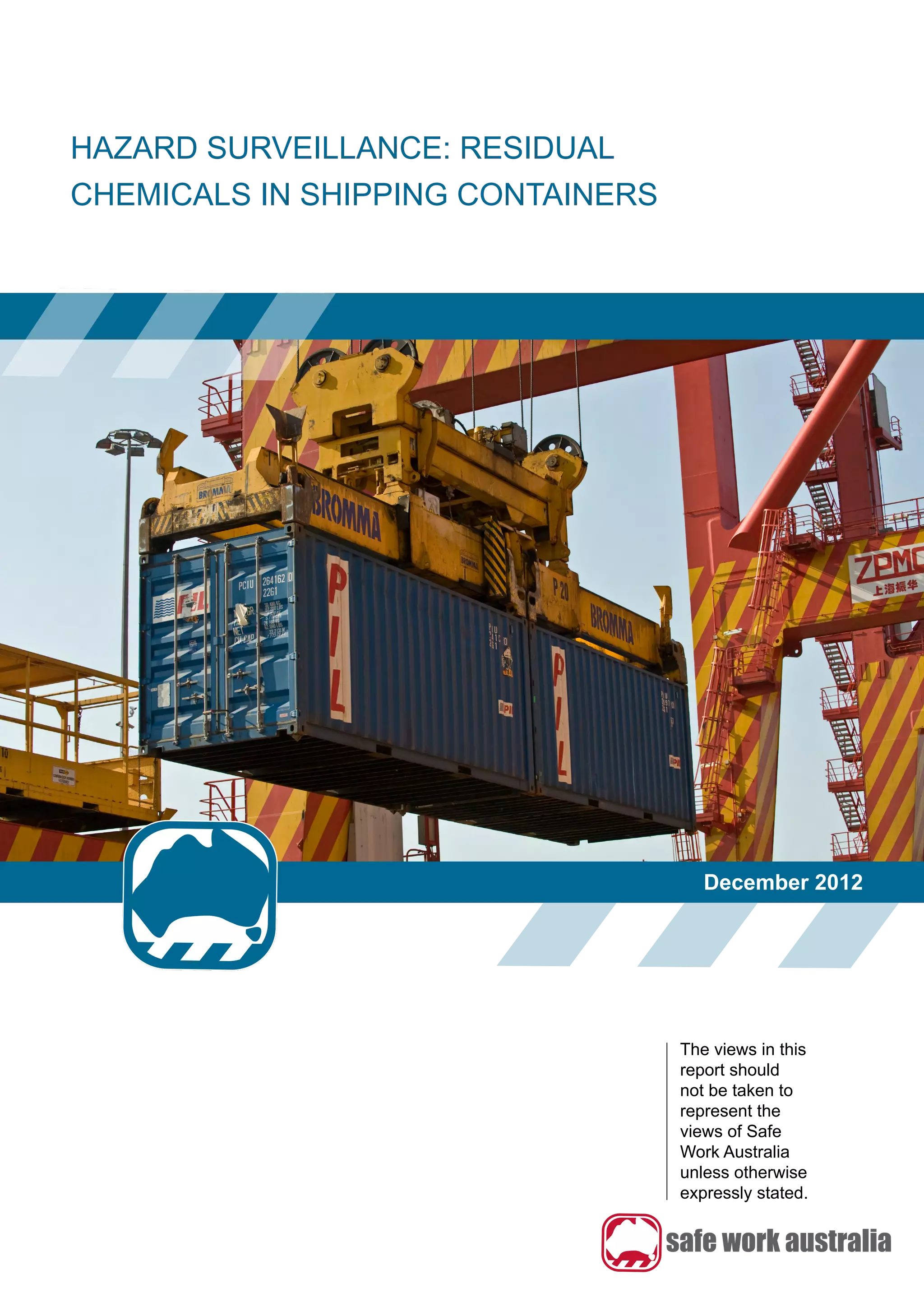
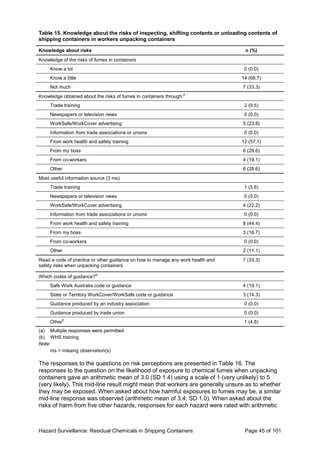
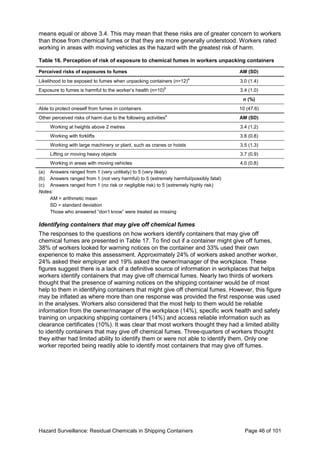
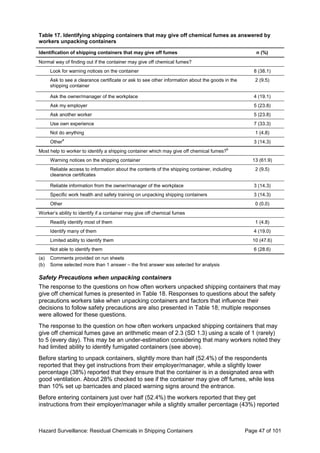
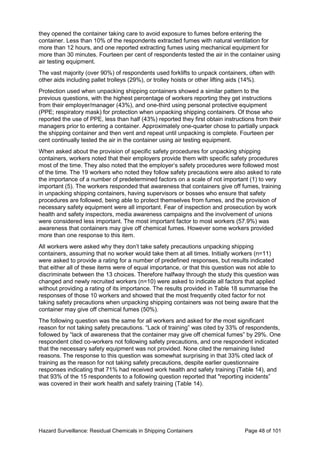
HAZARD SURVEILLANCE: RESIDUAL
CHEMICALS IN SHIPPING CONTAINERS
December 2012
The views in this
report should
not be taken to
represent the
views of Safe
Work Australia
unless otherwise
expressly stated.
Hazard Surveillance: Residual Chemicals in Shipping Containers Page ii of 101
This report was commissioned by Safe Work Australia and was undertaken by Mark
Wagstaffe, Brad Prezant, Sam Keer, Naomi Brewer, and Jeroen Douwes, (Centre for Public
Health Research, Massey University) and James McGlothlin and Mark Scharp (Purdue
University).
The report was peer reviewed by the Monash Centre for Occupational and Environmental
Health, Monash University.
Disclaimer
The information provided in this document can only assist you in the most general way. This
document does not replace any statutory requirements under any relevant state and territory
legislation. Safe Work Australia is not liable for any loss resulting from any action taken or
reliance made by you on the information or material contained on this document. Before
relying on the material, users should carefully make their own assessment as to its accuracy,
currency, completeness and relevance for their purposes, and should obtain any appropriate
professional advice relevant to their particular circumstances. The views in this report should
not be taken to represent the views of Safe Work Australia unless otherwise expressly
stated.
Creative Commons
With the exception of the Safe Work Australia logo, this report is licensed by Safe Work
Australia under a Creative Commons 3.0 Australia Licence. To view a copy of this licence,
visit http://creativecommons.org/licenses/by/3.0/au/deed.en
In essence, you are free to copy, communicate and adapt the work, as long as you attribute
the work to Safe Work Australia and abide by the other licensing terms. The report should be
attributed as the Hazard Surveillance: Residual Chemicals in Shipping Containers.
Enquiries regarding the licence and any use of the report are welcome at:
Copyright Officer
Safe Work Australia
GPO Box 641 Canberra ACT 2601
Email: copyrightrequests@safeworkaustralia.gov.au
ISBN 978-0-642-78705-7 [PDF]
ISBN 978-0-642-78706-4 [RTF]
Hazard Surveillance: Residual Chemicals in Shipping Containers iii
Preface
In 2011 Safe Work Australia commissioned the Centre for Public Health Research at
Massey University to undertake the project: Hazard Surveillance: Residual Chemicals in
Shipping Containers.
The goals of the study were to:
1. determine the level and determinants of personal (breathing zone) exposure to
methyl bromide and other residual chemicals for workers opening, inspecting, and/or
unloading fumigated shipping containers
2. identify sources of peak exposure by examining activities and tasks associated with
these peaks
3. suggest solutions aimed at reducing peak exposures
4. observe general work practices when workers unpack fumigated shipping containers
5. assess workplace air in warehouses where unloading and storage of goods unloaded
from containers takes place, and
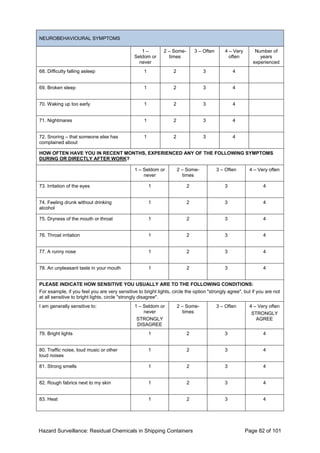
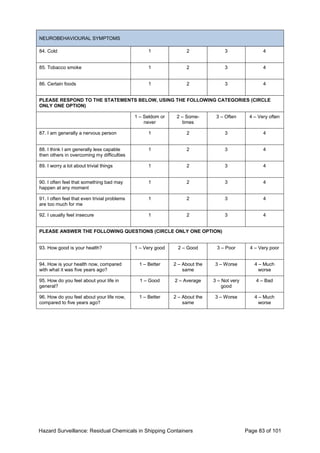
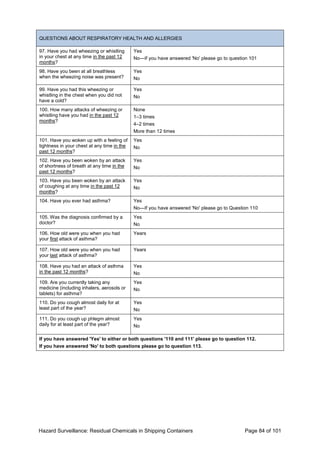
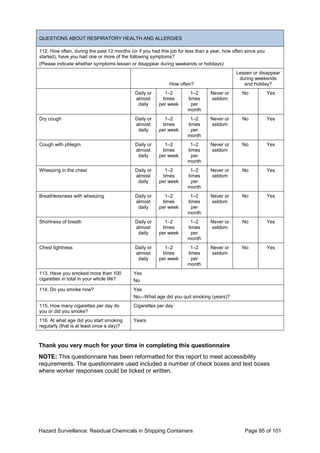
6. assess neurobehavioural, respiratory and other potentially relevant symptoms in a
small group of workers opening, inspecting, and/or unloading fumigated shipping
containers and make comparisons with comparable workers not involved in these
activities.
This report summarises the work completed under this contract.
This study did not:
• investigate residual chemical exposures when shipping containers of dangerous goods
were unpacked, or
• determine whether or not any relationships between worker exposures and self-reported
health symptoms exist.
Hazard Surveillance: Residual Chemicals in Shipping Containers iv
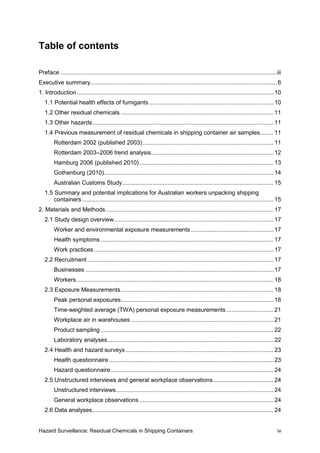
Table of contents
Preface .................................................................................................................................iii
Executive summary...............................................................................................................6
1. Introduction .....................................................................................................................10
1.1 Potential health effects of fumigants .......................................................................... 10
1.2 Other residual chemicals ........................................................................................... 11
1.3 Other hazards............................................................................................................ 11
1.4 Previous measurement of residual chemicals in shipping container air samples........ 11
Rotterdam 2002 (published 2003).............................................................................. 11
Rotterdam 2003–2006 trend analysis......................................................................... 12
Hamburg 2006 (published 2010)................................................................................ 13
Gothenburg (2010)..................................................................................................... 14
Australian Customs Study.......................................................................................... 15
1.5 Summary and potential implications for Australian workers unpacking shipping
containers ..................................................................................................................15
2. Materials and Methods.................................................................................................... 17
2.1 Study design overview............................................................................................... 17
Worker and environmental exposure measurements ................................................. 17
Health symptoms ....................................................................................................... 17
Work practices........................................................................................................... 17
2.2 Recruitment...............................................................................................................17
Businesses ................................................................................................................17
Workers .....................................................................................................................18
2.3 Exposure Measurements........................................................................................... 18
Peak personal exposures........................................................................................... 18
Time-weighted average (TWA) personal exposure measurements ............................ 21
Workplace air in warehouses ..................................................................................... 21
Product sampling ....................................................................................................... 22
Laboratory analyses................................................................................................... 22
2.4 Health and hazard surveys ........................................................................................ 23
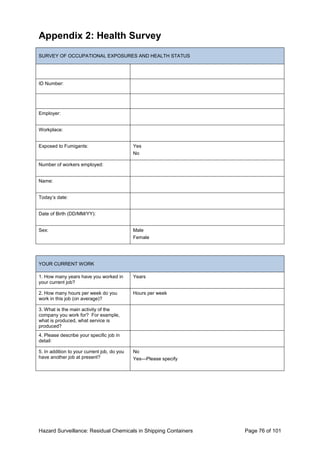
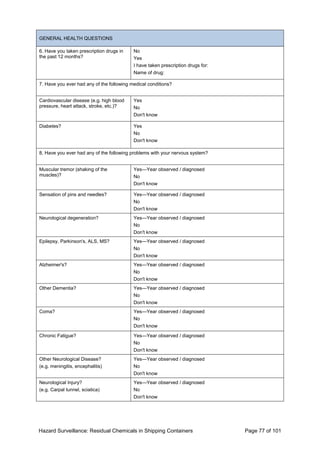
Health questionnaire.................................................................................................. 23
Hazard questionnaire................................................................................................. 24
2.5 Unstructured interviews and general workplace observations.................................... 24
Unstructured interviews.............................................................................................. 24
General workplace observations................................................................................ 24
2.6 Data analyses............................................................................................................ 24
Hazard Surveillance: Residual Chemicals in Shipping Containers v
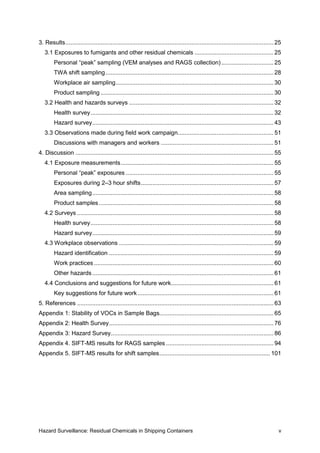
3. Results............................................................................................................................25
3.1 Exposures to fumigants and other residual chemicals ............................................... 25
Personal “peak” sampling (VEM analyses and RAGS collection)............................... 25
TWA shift sampling.................................................................................................... 28
Workplace air sampling.............................................................................................. 30
Product sampling ....................................................................................................... 30
3.2 Health and hazards surveys ...................................................................................... 32
Health survey............................................................................................................. 32
Hazard survey............................................................................................................ 43
3.3 Observations made during field work campaign......................................................... 51
Discussions with managers and workers ................................................................... 51
4. Discussion ......................................................................................................................55
4.1 Exposure measurements........................................................................................... 55
Personal “peak” exposures ........................................................................................ 55
Exposures during 2–3 hour shifts............................................................................... 57
Area sampling............................................................................................................ 58
Product samples ........................................................................................................ 58
4.2 Surveys .....................................................................................................................58
Health survey.............................................................................................................58
Hazard survey............................................................................................................ 59
4.3 Workplace observations ............................................................................................ 59
Hazard identification .................................................................................................. 59
Work practices........................................................................................................... 60
Other hazards............................................................................................................ 61
4.4 Conclusions and suggestions for future work............................................................. 61
Key suggestions for future work................................................................................. 61
5. References .....................................................................................................................63
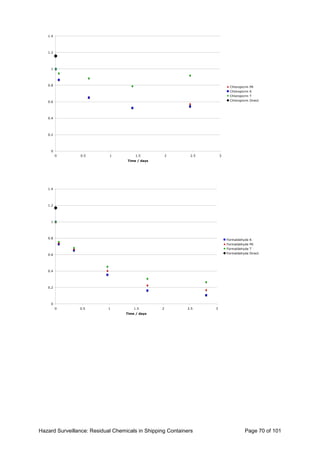
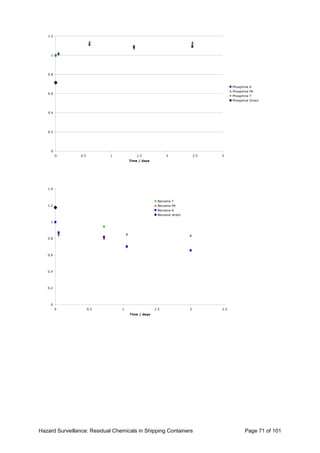
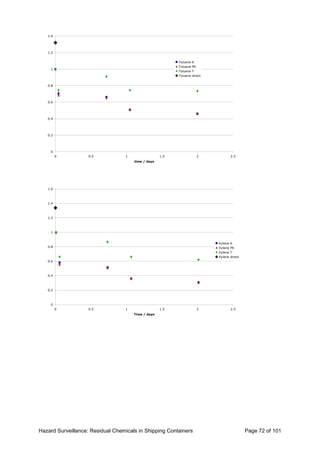
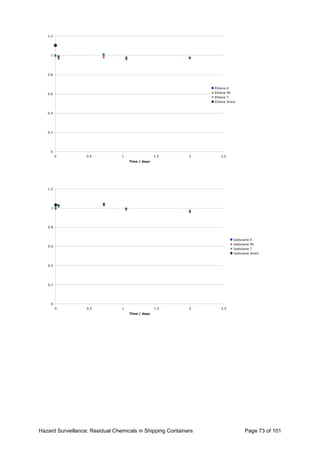
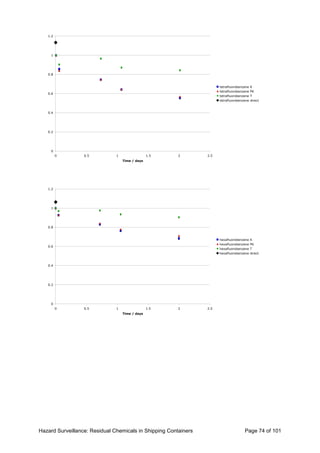
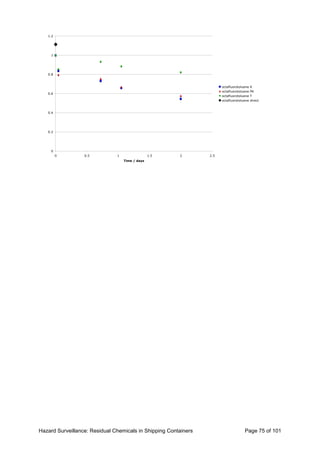
Appendix 1: Stability of VOCs in Sample Bags.................................................................... 65
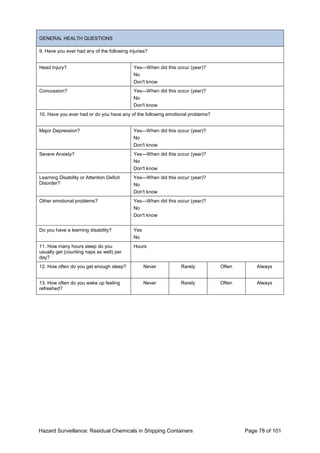
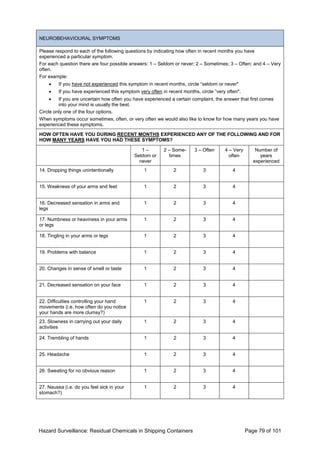
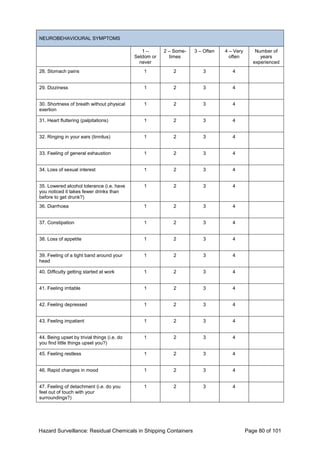
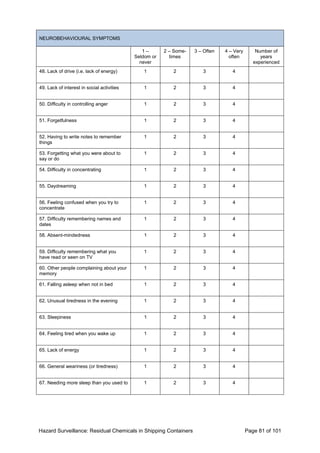
Appendix 2: Health Survey.................................................................................................. 76
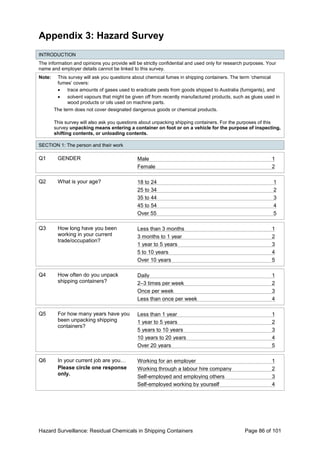
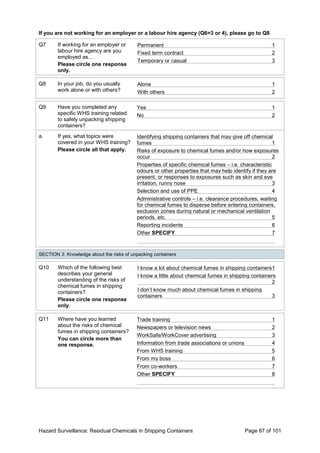
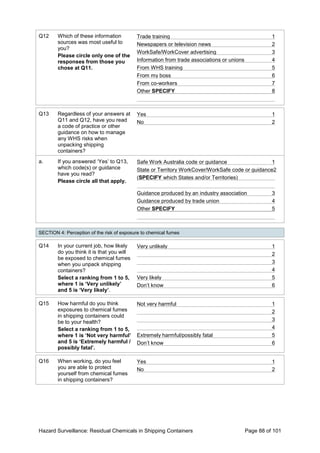
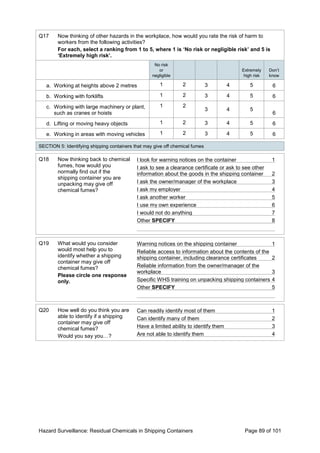
Appendix 3: Hazard Survey................................................................................................. 86
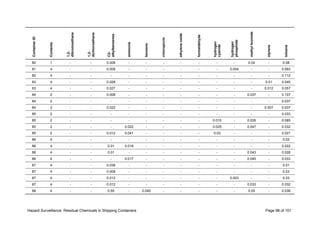
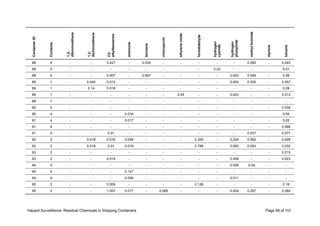
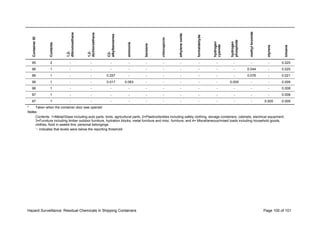
Appendix 4. SIFT-MS results for RAGS samples ................................................................ 94
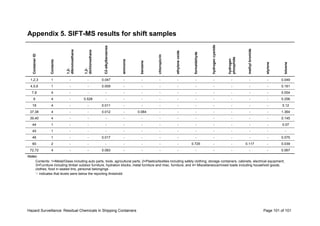
Appendix 5. SIFT-MS results for shift samples.................................................................. 101
Hazard Surveillance: Residual Chemicals in Shipping Containers Page 6 of 101
Executive summary
Background
Approximately seven million shipping containers pass through Australian ports annually,
sourced from a diverse group of overseas countries. For biological security reasons
containers and their contents are often fumigated with gaseous pesticides such as methyl
bromide and phosphine. In addition to intentionally added fumigants, the chemicals used in
the manufacture or packaging of consumer products may off-gas and accumulate in a
sealed container. This presents a potential inhalation hazard to persons entering or
unloading shipping containers. Recent studies suggest that air concentrations of residual
chemicals are present in container air at levels exceeding commonly used occupational
exposure limits, with estimates of the proportion of containers affected ranging from a few
per cent to as high as 20–30%.
The current study has attempted for the first time to assess workers’ exposures to residual
chemicals when inspecting, or unloading fumigated shipping containers. This study also
assessed health effects and hazard awareness in a small group of workers.
Methods
Recruitment
Six businesses in Melbourne and Brisbane were recruited including one large retail outlet,
three distribution centres and two trucking and distribution centres. These businesses were
selected on the basis of their willingness to participate in the study and therefore do not
represent a random sample.
Containers
A total of 76 containers arriving from overseas were included for personal exposure
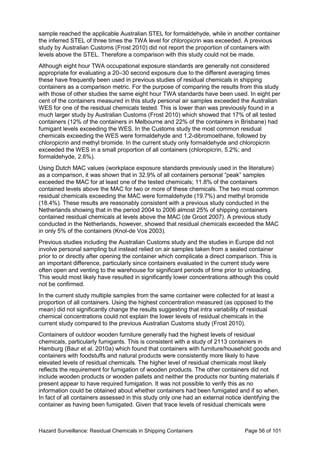
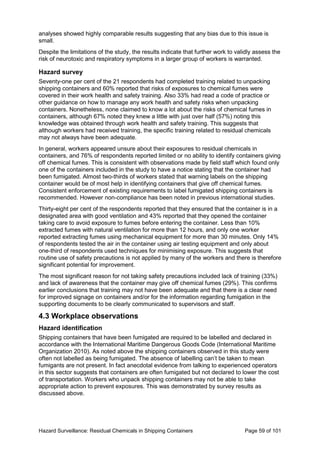
sampling. These containers were filled with non-palletised cardboard boxes with: metal/glass
products (36.8%); plastic/textile products (26.3%); furniture including timber furniture
(26.3%); and miscellanies/mixed (30.6%). Most containers sampled originated from China.
Exposure measurements
Video exposure monitoring with photo ionisation detection was used initially in an attempt to
identify peak personal exposures. However, as no peaks were detected by the photo
ionisation detector (PID) a total of 131 short-term “peak” personal exposure samples were
taken periodically during the unloading or inspection of these containers. In addition, 12
samples representing 2–3 hour time-weighted average (TWA) exposures were collected
from 10 workers.
Monitoring within warehouses was conducted using the PID. Two further air samples were
collected from inside fumigated product boxes containing wooden furniture and additional air
sampling was carried out on product boxes containing ethylene vinyl acetate (EVA) foam
mats on the basis of health concerns expressed by workers.
Analysis was conducted by using selected ion flow tube mass spectrometry (SIFT-MS) with
the following chemicals being analysed: 1,2-dibromoethane, 1,2-dichloroethane, C2-
alkylbenzenes, ammonia, benzene, chloropicrin, ethylene oxide, formaldehyde, hydrogen
cyanide, hydrogen phosphide, methyl bromide, styrene and toluene.
Questionnaire surveys
A survey of occupational exposures and health status was conducted in a sample of
exposed (those that unload or inspect shipping containers; n=22) and non-exposed workers
Hazard Surveillance: Residual Chemicals in Shipping Containers Page 7 of 101
(n=61). An additional risk management survey was conducted in a small sample of exposed
subjects (n=21).
Unstructured interviews and general workplace observations
Informal discussions were held with five experienced managers and 15 workers. In addition
the researchers made observations of workers during work shifts.
Results
Personal exposure measurements
Residual chemicals were detected in “peak” personal samples taken in 74 of the 76
containers (97.4%). Toluene was most commonly identified (92.1% of all containers)
followed by C2-alkylbenzenes (73.7%) and methyl bromide (68.4%).
In eight per cent of the containers levels exceeded the Australian workplace exposure
standard (WES) for one of the residual chemicals tested (i.e. chloropicrin, 5.3%; and
formaldehyde, 2.6%). In one container the air sample reached the applicable Australian
short term exposure levels (STEL) for formaldehyde and in another container the inferred
STEL of three times the TWA level for chloropicrin was exceeded. In one-third of all
containers at least one of the tested residual chemicals in personal air samples exceeded
the Dutch Maximum Allowable Concentration (MAC)—an occupational exposure limit often
reported in the literature as most of the previous research has been conducted in the
Netherlands. The two most common residual chemicals exceeding the MAC were
formaldehyde (19.7%) and methyl bromide (18.4%). Containers with outdoor wooden
furniture had the highest levels of residual chemicals. Only one container displayed an
external notice that it had been fumigated.
Toluene and C2-alkylbenzenes were most frequently detected (91.7% and 50% respectively)
in the 12 TWA samples but levels were low. In no case was an Australian 8 h TWA WES or
STEL exceeded. The MAC value was exceeded for formaldehyde in only one sample. None
of the containers displayed an external notice that they had been fumigated.
Workplace air sampling
Residual chemicals were not detected by PID measurements in any of the warehouses.
Product sampling
One of the two boxes containing wooden furniture (fumigated offshore) contained
chloropicrin (5.29 ppm) and the other box (fumigated onshore) contained methyl bromide
(185.8 ppm)—both orders of magnitude higher than the applicable Australian occupational
exposure standards. The chloropicrin concentration was also above the National Institute of
Occupational Safety and Health (NIOSH) immediate dangerous to life or health (IDLH) level.
Within box testing however cannot be compared directly with workplace exposure standards.
Initial attempts to quantify VOC levels from EVA foam mats using the PID resulted in the PID
overloading, with levels in excess of 8,000 ppm. Despite further SIFT-MS and gas
chromatography–mass spectroscopy (GCMS) analyses the chemicals that contributed to the
high peak could not be conclusively identified.
Questionnaire surveys
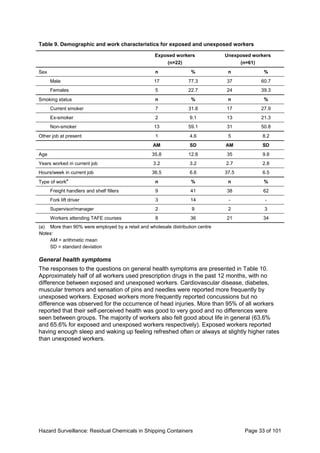
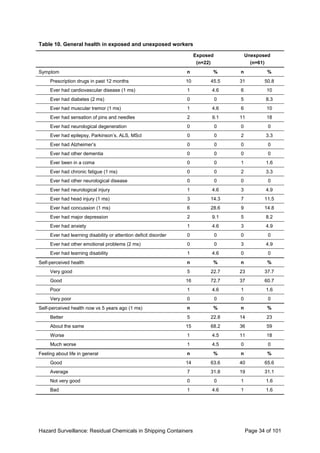
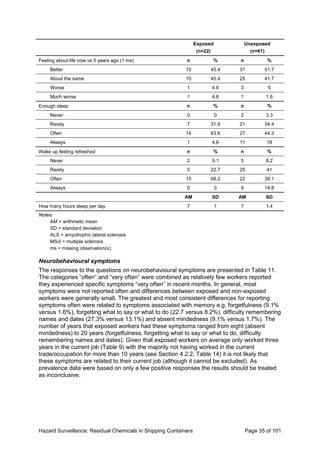
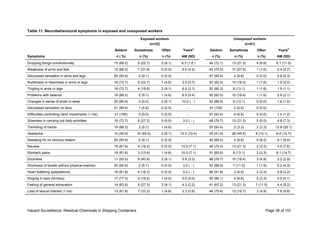
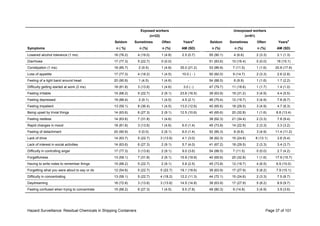
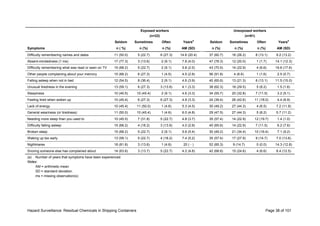
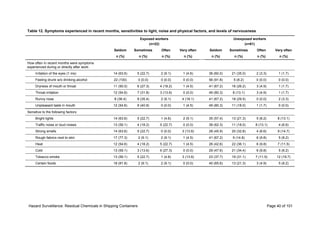
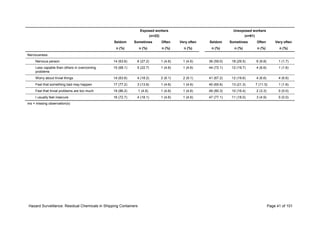
Exposed workers more frequently reported symptoms such as forgetfulness (9.1% versus
1.6%), forgetting what to say or do (22.7 vs 8.2%), difficulty remembering names and dates
(27.3% vs 13.3%) and absent mindedness (9.1% vs 1.7%). Exposed workers also more
frequently reported irritant symptoms such as “irritation of the eyes” (13.6% vs 4.9%),
“dryness of mouth or throat” (22.7% vs 6.6%), “throat irritation” (13.6% vs 6.6%) and a
Hazard Surveillance: Residual Chemicals in Shipping Containers Page 8 of 101
“runny nose” (27.3% vs 3.3%). There were also large differences for “ever having had
asthma” (31.8% vs 13.1%), “asthma confirmed by a doctor” (31.8% vs 11.5%), “asthma
attack in past 12 months” (13.6% vs 3.3%), and “medication for asthma” (13.6% vs 4.9%).
Due to the low number of workers and the lack of control of confounding however, these
results are only indicative of potential differences between exposed and non-exposed
workers.
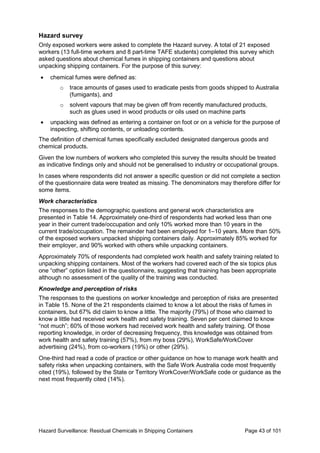
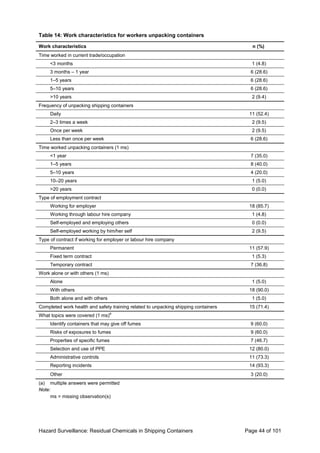
Approximately 70% of the workers had completed specific work health and safety training on
unpacking shipping containers. None knew a lot about the risks of fumes in containers but
67% knew a little. Responses to the question on the likelihood of exposure to chemical
fumes and the question on how harmful those exposures may be to their health suggested
that workers were generally unsure about these issues. Three-quarters of workers either had
limited ability or were not able to identify containers off-gassing fumes. Only 14.3% used
monitoring devices and only 9.5% ventilated the container. One-third reported use of
personal protective equipment. Workers noted that specific safety procedures were provided
most of the time. They also noted that safety procedures were followed most of the time. The
most significant reason for not taking safety precautions was lack of training (33%), followed
by lack of awareness that the container may off-gas chemical fumes (29%).
Workplace observations
Discussions with managers and workers suggested that commercial pressure may
occasionally result in containers being released even if levels of methyl bromide are not
below 5 ppm. There was also a concern that high levels of fumigants in product boxes may
pose a risk for workers opening these boxes. Other concerns included the lack of placards
with information on fumigation and the use of refrigerated containers for general use with
potential for gasses to be trapped. Also workers being paid on a “piece rate” basis felt they
had no option but to continue work even if a problem was discovered. Other observations
included a lack of routine use of PIDs to measure residual chemical levels prior to entering a
container, high temperatures in the containers, and manual handling of heavy loads. The
use of a short strap fixed to the container doors to prevent worker being struck by the doors
when opening overfilled containers was not always used.
Conclusions and suggestions for future work
In conclusion this study shows the potential for workers handling shipping containers to be
exposed to residual chemicals. It is not clear whether full eight hour shift exposures occur at
levels above applicable workplace standards. The few two–three hour TWA shift samples
suggest that eight hour shift exposures may be significantly lower than the personal
exposures measured using 20–30 seconds grab samples. However only 12 shift samples
were collected and none involved workers unloading containers with wooden outdoor
furniture which were shown to have the highest levels of fumigants. More generally because
containers and workers were not randomly selected results of both grab samples and shift
samples may not be representative for the whole industry.
Very high levels of fumigants were present in the small sample of cardboard boxes tested,
which is of concern for workers and consumers opening product boxes.
Exposed workers reported symptoms of memory loss, irritation and asthma more frequently
than non-exposed workers, but due to the low number of workers surveyed and the lack of
control for confounding these data should be considered inconclusive.
Although most workers had received work health and safety training there was still a large
degree of uncertainty regarding the risks associated with fumigated containers and their
ability to identify fumigated containers. Also appropriate safety precautions were not always
taken.
Hazard Surveillance: Residual Chemicals in Shipping Containers Page 9 of 101
Key suggestions for future work
Based on the study results the following research objectives and methods are suggested:
• To conduct a larger study involving more extensive full-shift personal sampling of
workers unpacking a wider and more representative range of containers. This should be
followed by a more targeted study to identify peak exposures in any subsets of
containers associated with high personal exposure levels. It is not recommended to
conduct more sampling in warehouse storage areas.
• To conduct a larger study to assess personal exposure levels of workers and
consumers opening “high risk” product boxes.
• To use stainless steel canisters for sample collection in any future exposure studies.
• To minimise the time between sampling and analyses to a maximum of 12 hours.
• To conduct further measurements to identify the specific chemicals associated with the
high PID readings of air in boxes with EVA foam mats and to measure personal
workers’ exposures to these chemicals. In the absence of further measurements it is
recommended that additional preventive measures, i.e. consistent use of PIDs and
respiratory protection if required, are used in those workplaces where workers unload
EVA foam mats.
• To conduct a health survey focussing on neurotoxic and respiratory symptoms in a
larger group of workers inspecting and/or unpacking shipping containers. This will allow
epidemiological analyses to be conducted with appropriate control for potential
confounders. A population sample of 400 exposed and 200 unexposed would provide
sufficient power to provide conclusive results.
While this study might present indicative results it has highlighted some potential work health
and safety issues. To ensure that workers who unpack shipping containers are adequately
protected against risks associated with residual chemicals and manual tasks, it is suggested
that work health and safety policy makers and practitioners:
• consistently enforce:
o existing requirements to label fumigated shipping containers, and
o health and safety guidelines for inspecting and unpacking shipping containers,
which include using gas monitoring devices to test the air in shipping containers
prior to and during unpacking operations
• develop guidance that:
o encourages routine repeat venting until unpacking is completed for tightly
packed containers as suggested by existing WorkSafe Victoria guidelines, and
o sets a time limit (e.g. two hours) after which unpacking should be stopped so
that container air can be tested and ventilated again where required
• improve health and safety training for managers and workers inspecting and unloading
containers, and
• recommend the use of safety straps when initially opening shipping containers to
prevent shifted contents from forcing doors open and contents falling on workers.
Hazard Surveillance: Residual Chemicals in Shipping Containers Page 10 of 101
1. Introduction
The equivalent of approximately seven million 20 foot containers (measured as 20 foot
equivalent units; TEU) pass through Australian ports annually (Ports Australia 2012). Since
many shipping containers are fumigated for biosecurity reasons and sealed during transit for
an extended period, people opening, inspecting, unloading, or handling contents may be
exposed to residual fumigants. Some of the products packed in the containers may also off-
gas hazardous chemicals that were used during production processes, such as solvents
found in paints, glues and resins. In some cases the fumigants applied or chemicals used
during production overseas may be banned in Australia. Containers that have been
fumigated should be labelled in accordance with the International Maritime Dangerous
Goods Code (International Maritime Organization 2012) but this rarely occurs.
Over the last 10 to 20 years increased awareness of the potential for workers and
bystanders to be exposed to residual chemicals has prompted a number of researchers to
assess whether or not levels of residual chemicals within shipping containers pose risks to
human health. Some of these studies have looked only at fumigants; others have measured
both fumigants and other off-gassing hazardous chemicals. Results of these studies will be
reviewed below.
1.1 Potential health effects of fumigants
Fumigants are widely used against a large variety of pests and have a remarkable capacity
to penetrate porous materials that may house those pests. Fumigants commonly used in
international trade include methyl bromide, (MeBr), formaldehyde (CH2O), phosphine
(hydrogen phosphide, PH3), chloropicrin (Cl3CNO2), carbonyl sulphide (OCS) and sulphuryl
fluoride (SO2F2). The use of dichloromethane (CH2Cl2) as a fumigant for imported textiles
and household goods has also been reported (Preisser et al. 2011). These fumigants are
known to be highly toxic and are rapidly absorbed across the pulmonary membrane, gut and
skin and can give rise to (sometimes severe) neurotoxic, respiratory and skin symptoms
(Anger et al. 1986; Breeman 2009; Burgess et al. 2000; Drawneek et al. 1964; Magnavita
2009; Preisser et al. 2011; Valcin et al. 2007). Chronic occupational exposures to methyl
bromide and sulphuryl fluoride during structural fumigation are associated with significant
health effects (Anger et al. 1986; Calvert et al. 1998). Many case-reports have shown severe
health problems after accidental exposures to fumigants (Breeman 2009; Burgess et al.
2000; Drawneek et al. 1964; Preisser et al. 2006). For example, 26 case studies from an
outpatient clinic specifically investigating fumigant exposures indicated significant
impairment among individuals when opening or unloading shipping containers or working
with fumigated goods. Workers displayed both acute and chronic neurological,
neuropsychological, and respiratory impairment (Preisser et al. 2011). Nine of the 26
patients self-reported exposures to methyl bromide while opening shipping containers and
two had exposures to phosphine (hydrogen phosphide) while unloading containers.
Some evidence suggests that certain fumigants may also be carcinogenic. Three
epidemiology studies (one a cohort study) have suggested an association between methyl
bromide used in agricultural environments and prostate cancer (Budnik et al. 2012). There
has also been controversy about the potential role of methyl bromide fumigants in the
development of motor neuron disease in a cluster of port workers in Nelson New Zealand
(Shaw 2010). However apart from several case studies (Baur et al. 2006; Baur et al. 2010b;
Drawneek et al. 1964; Preisser et al. 2011) no studies have systematically assessed the
chronic health effects of fumigant exposures in exposed workers handling containers or
fumigated products. Nonetheless, exposure to residual fumigants in shipping containers is
now sufficiently common and medically complex that a database for patients with fumigant
intoxication has been established in Germany (Heblich et al. 2009).
Hazard Surveillance: Residual Chemicals in Shipping Containers Page 11 of 101
1.2 Other residual chemicals
A wide variety of industrial chemicals will off-gas from consumer products. Under normal
circumstances, diffusion into the surrounding air results in undetectable levels of these
substances. A 40 foot shipping container packed solid with consumer products may have a
very low volume of airspace thus even minimal emissions can result in significantly elevated
concentrations in container air. This is exacerbated by potentially low air-exchange rates
characteristic of sealed containers.
Aromatic hydrocarbons such as benzene, toluene, xylene, and aldehydes such as
formaldehyde are identified frequently as chemicals off-gassed from consumer products.
Some of these chemicals are carcinogens or suspected carcinogens and many have the
potential in high concentrations to cause serious, irreversible health effects. For example,
formaldehyde is classified by the International Agency for Research on Cancer (IARC) as a
Group 1 (proven human) carcinogen (IARC Working Group on the Evaluation of
Carcinogenic Risks to Humans 2006). Other health effects known to be caused by exposure
to formaldehyde include a range of non-malignant respiratory effects including irritation of
mucous membranes, asthma, and reactive airways dysfunction syndrome (RADS), and
allergic contact dermatitis (Chan-Yeung & Malo 1994).
Other potential chemical hazards include the presence of elevated levels of carbon
monoxide and carbon dioxide, low levels of oxygen, or high levels of combustible gas.
1.3 Other hazards
In addition to hazards posed by residual chemicals, other hazards may be present in
workplaces where shipping containers are unpacked. This is because these workplaces are
high risk environments largely owing to movement of goods with vehicles. Common hazards
include: hazardous placement of containers at the work site; falls from height; falling goods;
manual handling hazards; slips, trips and falls; inadequate pedestrian and mobile plant
separation; palletising of goods for storage or onward transportation; environmental factors
such as temperature; diesel exhaust fumes, and removal of shipping containers from a site
(WorkSafe Victoria 2010). Possible consequences include collisions between mobile plant
and other vehicles or people that result in serious injury; musculoskeletal injuries; and
physical fatigue.
1.4 Previous measurement of residual chemicals in shipping
container air samples
Four European studies assessing the prevalence and concentration of residual fumigants
and other compounds identified in random sealed shipping containers were identified (Baur
et al. 2010a; de Groot 2007; Knol-de Vos 2003; Svedberg & Johanson 2011). The abstract
of a fifth European study (written in German and unavailable for review) suggests similar
experiences in the Port of Genoa to those reported in the other studies discussed here
(Tortarolo 2011). A series of measurements were also conducted in five Australian ports in
2007 and 2008 (Frost 2010) and the results are also discussed below.
Rotterdam 2002 (published 2003)
The first of these studies analysed a total of 303 randomly chosen sealed containers arriving
in the port of Rotterdam in 2002 (Knol-de Vos 2003). A probe inserted between the door
seals permitted field sampling for three commonly used fumigants: methyl bromide (MeBr);
formaldehyde (CH2O); and phosphine (hydrogen phosphide, PH3). Carbon monoxide (CO),
carbon dioxide (CO2), ammonia (NH3), explosive gases, and oxygen (O2) levels were also
measured in the field as these are hazards generally associated with confined spaces. Field
measurements were performed using a combination of detector tubes (CH2O, MeBr), a
Hazard Surveillance: Residual Chemicals in Shipping Containers Page 12 of 101
formaldehyde sensor (CH2O), a formaldehyde Chip Measurement System (CH2O), a
catalytic cell (explosive gases) and electrochemical cell technologies (PH3, NH3, and CO2).
Field measurements were verified for some fumigants by laboratory analyses. Samples
taken from a single point in the centre of containers after opening the doors (presumably
taken immediately after opening and without the container being vented) were collected in
Tedlar bags and analysed for sulphuryl fluoride (SO2F2) and methyl bromide via gas
chromatography–mass spectrometry (GCMS). Samples were analysed within three days of
collection which may have reduced levels within the bags for some substances. The mass
spectrometry library was used to identify other chemicals present in samples.
Dinitrophenylhydrazine (DNPH) cartridges were used for formaldehyde analyses.
Table 1 provides a summary of the results, taking into account adjustments based on
laboratory analyses for methyl bromide, formaldehyde and sulphuryl fluoride and laboratory
results combined with visual observations for phosphine (hydrogen phosphide). The authors
compared their results to Dutch eight hour time weighted average (TWA) occupational
exposure standards, known as the Maximum Allowable Concentration (MAC) values.
Australian eight hour TWA Workplace Exposure Standards (WES) (Safe Work Australia
2012) are provided for comparative purposes.
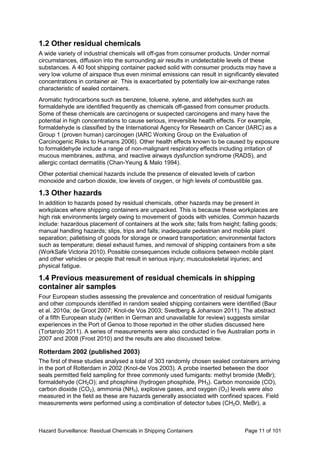
Table 1. Sampling results from 303 random containers tested in Rotterdam, 2002
Residual Chemical
MAC value
(ppm)
Positive
results
Exceed
MAC
WES
(ppm)
Methyl bromide 0.25 19 7 5.0.
Formaldehyde 1.00 42 3 1.0
Sulphuryl fluoride n.s. - - 5.0
Phosphine 0.30 28 6 0.3
Ammonia 20 9 0 25
Carbon dioxide 5000 12 5 5000
Carbon monoxide 25 74 41 30
Explosive atmosphere n.s. 2 NA n.s.
Oxygen deficient atmosphere n.s. 2 NA n.s.
Notes:
MAC = Dutch Maximum Allowable Concentration
WES = Australian Workplace Exposure Standard
n.s. = not specified
Source: adapted from results presented by Knol-de Vos 2003.
The authors noted that methyl bromide, formaldehyde and phosphine were detected in 21%
of shipping containers, with levels in 5% of containers exceeding applicable MAC values.
Sulphuryl fluoride was not identified in any of the containers. An aggregate 15% of the
containers were found to have had low oxygen levels, pose risks of explosion, or have had
elevated levels of carbon monoxide or carbon dioxide.
Only three containers displayed any kind of warning sticker – two were painted over and one
was in Chinese. The authors noted that staff wore personal protective equipment when
opening containers.
Rotterdam 2003–2006 trend analysis
An additional study for which only the summary is available in English was carried out at the
same port over the period 2003–2006. The researchers focused on a trend analysis for the
Hazard Surveillance: Residual Chemicals in Shipping Containers Page 13 of 101
fumigants methyl bromide, phosphine, 1,2-dichloroethane, chloropicrin and sulphuryl fluoride
(de Groot 2007). The researchers measured 71 containers in 2003, 84 containers in 2004,
76 containers in 2006 and 46 containers in 2006. An increase in containers with detectable
fumigant levels was observed (25% in 2003 versus 59% in 2006). This was primarily due to
an increase in the number of containers with 1,2-dichloroethane (8% in 2003 versus 32% in
2006). To a lesser extent, phosphine was also detected more frequently. From 2004 to 2006
almost 25% of all containers contained fumigants at levels above applicable MAC values; in
2003 this occurred in only 7% of the containers but analyses for phosphine and chloropicrin
were not conducted in 2003.
The authors also tested for 40 other hazardous chemicals, including aromatic and
chlorinated hydrocarbons. The percentage of containers with one or more of these
hazardous chemicals detected above applicable MAC values increased from approximately
8% in 2003 to 30% in 2006. Percentages of containers where benzene (4% versus 13%)
and toluene (2% versus 8%) were detected more than tripled over the study period.
Although the authors note that the selection method used to inspect containers had not
changed over the period of the study, it is not clear whether or not the selected containers
were a random sample of all containers arriving in the port of Rotterdam. Therefore, the
reported numbers of containers where MAC values were exceeded may not be
representative of all containers.
Hamburg 2006 (published 2010)
A total of 2113 randomly selected shipping containers entering the port of Hamburg
Germany were analysed in 2006 (Baur et al. 2010a). Sampling was conducted by inserting a
probe through the doors of sealed shipping containers and collecting gas samples in Tedlar
bags. Each bag sample was analysed for fumigants as well as other residual compounds
present by selected ion flow tube mass spectrometry (SIFT-MS) and a transportable GCMS.
Sampling results were compared against chronic and acute reference levels rather than
applicable work health and safety exposure standards. Chronic reference exposure levels
(RELs) defined by the Californian Office of Environmental Health Hazard Assessment
(OEHHA) (OEHHA 2012) were used in this study (results are presented in Table 2). These
chronic RELs are based on the most sensitive health effect reported in the medical and
toxicological literature and are designed as population-based protection standards.
Therefore they are significantly lower than the corresponding eight hour TWA WES. The
researchers also used acute RELs defined by the OEHHA when available. When these were
not available values from the National Institute of Occupational Safety and Health (NIOSH)
were used.
Hazard Surveillance: Residual Chemicals in Shipping Containers Page 14 of 101
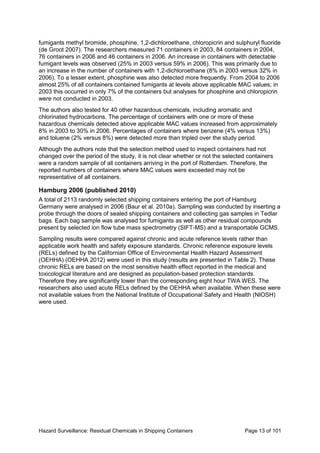
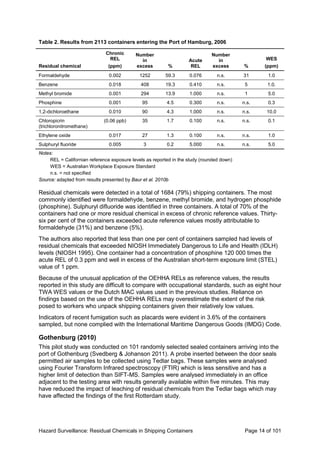
Table 2. Results from 2113 containers entering the Port of Hamburg, 2006
Residual chemical
Chronic
REL
(ppm)
Number
in
excess %
Acute
REL
Number
in
excess %
WES
(ppm)
Formaldehyde 0.002 1252 59.3 0.076 n.s. 31 1.0
Benzene 0.018 408 19.3 0.410 n.s. 5 1.0.
Methyl bromide 0.001 294 13.9 1.000 n.s. 1 5.0
Phosphine 0.001 95 4.5 0.300 n.s. n.s. 0.3
1,2-dichloroethane 0.010 90 4.3 1.000 n.s. n.s. 10.0
Chloropicrin
(trichloronitromethane)
(0.06 ppb) 35 1.7 0.100 n.s. n.s. 0.1
Ethylene oxide 0.017 27 1.3 0.100 n.s. n.s. 1.0
Sulphuryl fluoride 0.005 3 0.2 5.000 n.s. n.s. 5.0
Notes:
REL = Californian reference exposure levels as reported in the study (rounded down)
WES = Australian Workplace Exposure Standard
n.s. = not specified
Source: adapted from results presented by Baur et al. 2010b
Residual chemicals were detected in a total of 1684 (79%) shipping containers. The most
commonly identified were formaldehyde, benzene, methyl bromide, and hydrogen phosphide
(phosphine). Sulphuryl difluoride was identified in three containers. A total of 70% of the
containers had one or more residual chemical in excess of chronic reference values. Thirty-
six per cent of the containers exceeded acute reference values mostly attributable to
formaldehyde (31%) and benzene (5%).
The authors also reported that less than one per cent of containers sampled had levels of
residual chemicals that exceeded NIOSH Immediately Dangerous to Life and Health (IDLH)
levels (NIOSH 1995). One container had a concentration of phosphine 120 000 times the
acute REL of 0.3 ppm and well in excess of the Australian short-term exposure limit (STEL)
value of 1 ppm.
Because of the unusual application of the OEHHA RELs as reference values, the results
reported in this study are difficult to compare with occupational standards, such as eight hour
TWA WES values or the Dutch MAC values used in the previous studies. Reliance on
findings based on the use of the OEHHA RELs may overestimate the extent of the risk
posed to workers who unpack shipping containers given their relatively low values.
Indicators of recent fumigation such as placards were evident in 3.6% of the containers
sampled, but none complied with the International Maritime Dangerous Goods (IMDG) Code.
Gothenburg (2010)
This pilot study was conducted on 101 randomly selected sealed containers arriving into the
port of Gothenburg (Svedberg & Johanson 2011). A probe inserted between the door seals
permitted air samples to be collected using Tedlar bags. These samples were analysed
using Fourier Transform Infrared spectroscopy (FTIR) which is less sensitive and has a
higher limit of detection than SIFT-MS. Samples were analysed immediately in an office
adjacent to the testing area with results generally available within five minutes. This may
have reduced the impact of leaching of residual chemicals from the Tedlar bags which may
have affected the findings of the first Rotterdam study.
Hazard Surveillance: Residual Chemicals in Shipping Containers Page 15 of 101
While the study aimed to identify residual methyl bromide, phosphine, chloropicrin, sulphuryl
fluoride, hydrogen cyanide, and carbonyl sulphide (a potential alternative fumigant to methyl
bromide and phosphine), FTIR analysis also allowed other residual chemicals to be
identified. Results were compared to a number of reference values, including Swedish TWA,
ceiling, and STEL values, American Acute Emergency Guidance Levels (AEGL) (National
Research Council 2001) values and Californian OEHHA REL values, the latter to allow
results to be compared with the Hamburg study.
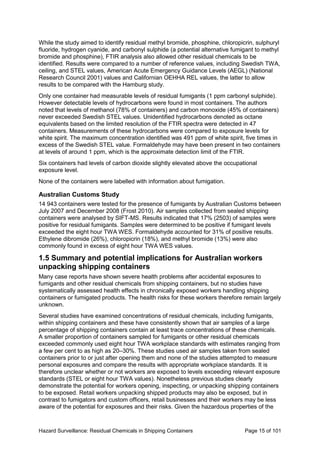
Only one container had measurable levels of residual fumigants (1 ppm carbonyl sulphide).
However detectable levels of hydrocarbons were found in most containers. The authors
noted that levels of methanol (78% of containers) and carbon monoxide (45% of containers)
never exceeded Swedish STEL values. Unidentified hydrocarbons denoted as octane
equivalents based on the limited resolution of the FTIR spectra were detected in 47
containers. Measurements of these hydrocarbons were compared to exposure levels for
white spirit. The maximum concentration identified was 491 ppm of white spirit, five times in
excess of the Swedish STEL value. Formaldehyde may have been present in two containers
at levels of around 1 ppm, which is the approximate detection limit of the FTIR.
Six containers had levels of carbon dioxide slightly elevated above the occupational
exposure level.
None of the containers were labelled with information about fumigation.
Australian Customs Study
14 943 containers were tested for the presence of fumigants by Australian Customs between
July 2007 and December 2008 (Frost 2010). Air samples collected from sealed shipping
containers were analysed by SIFT-MS. Results indicated that 17% (2503) of samples were
positive for residual fumigants. Samples were determined to be positive if fumigant levels
exceeded the eight hour TWA WES. Formaldehyde accounted for 31% of positive results.
Ethylene dibromide (26%), chloropicrin (18%), and methyl bromide (13%) were also
commonly found in excess of eight hour TWA WES values.
1.5 Summary and potential implications for Australian workers
unpacking shipping containers
Many case reports have shown severe health problems after accidental exposures to
fumigants and other residual chemicals from shipping containers, but no studies have
systematically assessed health effects in chronically exposed workers handling shipping
containers or fumigated products. The health risks for these workers therefore remain largely
unknown.
Several studies have examined concentrations of residual chemicals, including fumigants,
within shipping containers and these have consistently shown that air samples of a large
percentage of shipping containers contain at least trace concentrations of these chemicals.
A smaller proportion of containers sampled for fumigants or other residual chemicals
exceeded commonly used eight hour TWA workplace standards with estimates ranging from
a few per cent to as high as 20–30%. These studies used air samples taken from sealed
containers prior to or just after opening them and none of the studies attempted to measure
personal exposures and compare the results with appropriate workplace standards. It is
therefore unclear whether or not workers are exposed to levels exceeding relevant exposure
standards (STEL or eight hour TWA values). Nonetheless previous studies clearly
demonstrate the potential for workers opening, inspecting, or unpacking shipping containers
to be exposed. Retail workers unpacking shipped products may also be exposed, but in
contrast to fumigators and custom officers, retail businesses and their workers may be less
aware of the potential for exposures and their risks. Given the hazardous properties of the
Hazard Surveillance: Residual Chemicals in Shipping Containers Page 16 of 101
residual chemicals studied to date and the potential serious health effects they may cause,
further research investigating personal exposures is warranted.
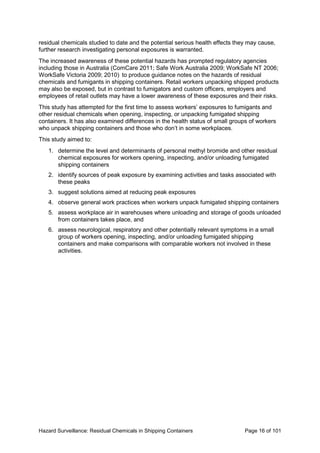
The increased awareness of these potential hazards has prompted regulatory agencies
including those in Australia (ComCare 2011; Safe Work Australia 2009; WorkSafe NT 2006;
WorkSafe Victoria 2009; 2010) to produce guidance notes on the hazards of residual
chemicals and fumigants in shipping containers. Retail workers unpacking shipped products
may also be exposed, but in contrast to fumigators and custom officers, employers and
employees of retail outlets may have a lower awareness of these exposures and their risks.
This study has attempted for the first time to assess workers’ exposures to fumigants and
other residual chemicals when opening, inspecting, or unpacking fumigated shipping
containers. It has also examined differences in the health status of small groups of workers
who unpack shipping containers and those who don’t in some workplaces.
This study aimed to:
1. determine the level and determinants of personal methyl bromide and other residual
chemical exposures for workers opening, inspecting, and/or unloading fumigated
shipping containers
2. identify sources of peak exposure by examining activities and tasks associated with
these peaks
3. suggest solutions aimed at reducing peak exposures
4. observe general work practices when workers unpack fumigated shipping containers
5. assess workplace air in warehouses where unloading and storage of goods unloaded
from containers takes place, and
6. assess neurological, respiratory and other potentially relevant symptoms in a small
group of workers opening, inspecting, and/or unloading fumigated shipping
containers and make comparisons with comparable workers not involved in these
activities.
Hazard Surveillance: Residual Chemicals in Shipping Containers Page 17 of 101
2. Materials and Methods
2.1 Study design overview
Worker and environmental exposure measurements
Workers who unpacked containers in Melbourne and Brisbane were monitored using video
exposure monitoring (VEM). Monitoring was also performed while workers inspected
shipping containers. A photo-ionisation detector (PID) was used to provide real-time
information on relative levels of residual chemicals. The use of the VEM system was
expected to help identify ‘peak exposures’ and trigger the collection of gas samples using a
remote activated grab sampler (RAGS). Samples collected using RAGS were analysed
using selected ion flow tube mass spectrometry (SIFT-MS) to identify and quantify residual
gases and vapours.
Additional gas samples were collected for some workers over typical work shifts of two–three
hours to provide information on time weighted average (TWA) exposures. Workplace air in
several warehouses was screened for volatile organic compounds (VOCs) and air samples
were taken from ethylene vinyl acetate (EVA) mats that had been identified as the source of
worker complaints relating to odours and irritation.
Health symptoms
A Health survey questionnaire was developed and administered to both workers unpacking
containers and a reference group of workers from the same workplace not engaging in
unpacking activities. The survey focused on neurobehavioural symptoms and respiratory
health potentially associated with residual chemical exposure.
Work practices
The use of the VEM system was intended to help identify specific work practices that
resulted in ‘peak exposures’. Workers who unpacked shipping containers were asked to
complete a Hazard survey questionnaire which asked questions on training, controls and
procedures used, perceptions of risks, and factors that influence workplace behaviour.
Unstructured interviews were conducted with some experienced workers and
managers/supervisors on their opinions and experiences unpacking containers. Researchers
also observed general work practices noting compliance with guidance materials issued by
regulators for the safe unpacking of containers, particularly relating to the management of
musculoskeletal risks, heat, and the prevention of loads falling onto workers.
Each element of the study is discussed in greater detail in the following sections.
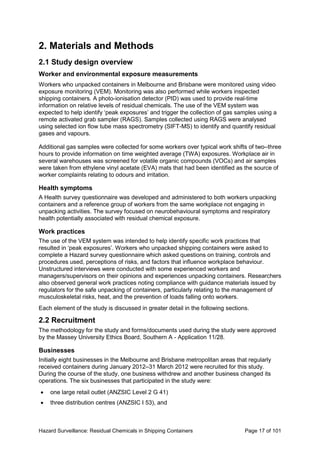
2.2 Recruitment
The methodology for the study and forms/documents used during the study were approved
by the Massey University Ethics Board, Southern A - Application 11/28.
Businesses
Initially eight businesses in the Melbourne and Brisbane metropolitan areas that regularly
received containers during January 2012–31 March 2012 were recruited for this study.
During the course of the study, one business withdrew and another business changed its
operations. The six businesses that participated in the study were:
• one large retail outlet (ANZSIC Level 2 G 41)
• three distribution centres (ANZSIC I 53), and
Hazard Surveillance: Residual Chemicals in Shipping Containers Page 18 of 101
• two trucking and distribution centres (ANZSIC Level 2 I 46).
Employee numbers for these organisations varied between 50 and 8000 full time equivalent
(FTE) staff. Attempts to identify and recruit smaller import businesses were unsuccessful
due to logistical problems in coordinating field work at multiple sites. Therefore businesses
that regularly received shipping containers from overseas were recruited for this study.
Refrigerated containers with frozen cargo were specifically excluded from the study.
Workers
Workers who unpacked shipping containers at the workplaces of participating businesses
were asked if they would like to participate in the study by:
• wearing the VEM and RAGS equipment
• wearing the low flow pump and attached sample bag, and
• completing health and hazard surveys.
A total of 16 workers who worked either by themselves or in teams of up to four workers
agreed to participate in the exposure assessment part of the study. The workers were a
mixture of full-time employees employed by participating businesses, contracted/casual
employees, or workers employed by labour hire companies operating within the participating
workplaces. The majority of the workers participating were from the latter category.
Employment arrangements varied within the same organisation and were site-dependent.
Fourteen of these workers agreed to complete the health and hazard questionnaires.
Forty workers who did not unpack shipping containers at these workplaces also completed
the health questionnaire.
Given the small number of workers who unpacked shipping containers at the participating
businesses, additional workers enrolled in Certificate III in Warehouse Operations courses at
various NSW TAFE campuses were asked to complete health and hazard surveys. This
resulted in the recruitment of eight more exposed subjects and 21 unexposed subjects.
Consent forms were collected from all workers who participated in this study.
2.3 Exposure Measurements
Peak personal exposures
Video exposure monitoring (VEM)
VEM is a personal exposure visualisation method that records worker activity on video while
simultaneously measuring and displaying exposure information. VEM creates a permanent
video record of the worker performing their job and the exposures associated with the work.
For exposures that vary with time and activity VEM provides the ability to view in detail the
pattern of exposure and the effect of worker activities as well as any other potential factors
that modify exposure intensity. Traditional worker exposure monitoring does not record
worker actions, whereas VEM permits the association of exposure peaks with specific
tasks/activities to be assessed. The insights gained may permit engineering or other controls
to be implemented and the effectiveness of these solutions in reducing exposures to be
evaluated. VEM has been employed over the last 20 years to study airborne exposures in a
variety of industries with “peak”, i.e. highly variable, exposures (McGlothlin et al. 2010).
The system used for this study included:
• VEM software developed by Purdue University in Indiana (McGlothlin et al. 2010)
• wireless video cameras: High definition colour video cameras were used to record
worker activities within and immediately outside the container. Workers wearing the PID
Hazard Surveillance: Residual Chemicals in Shipping Containers Page 19 of 101
and RAGS equipped backpack were typically visible for the duration of the sampling
periods, as well as significant periods prior to and following grab (Tedlar bag) sampling.
Video was transmitted to the computer running the VEM software via Wi-Fi
• PID (to assess instantaneous exposures to VOCs) (more information provided below),
and
• RAGS (Remote Activated Grab Sampler) (more information provided below).
Photo-ionisation detector (PID)
A TSI Velocicalc 9565X equipped with a VOC probe and 10.6 eV lamp was used. This lamp
has sufficient ionization energy to derive readings from many common chemicals found off-
gassing from consumer products, including aliphatics (C4–C12), aromatics (benzene, toluene,
xylene), and ketones (acetone, methyl ethyl ketone [MEK]). VOCs with ionization energies
higher than 10.6 eV are detected by the PID but at reduced efficiency. The reduced
sensitivity for VOCs with higher ionization energies was not considered to be of significance
for the study design because the PID readings were not considered to be quantitative
(Tedlar/Kynar bag sampling was employed for this purpose) and grab sampling was
conducted regardless of whether a PID reading was detected during container unloading.
The VOC reading, in parts per million (ppm) isobutylene equivalents, represented the sum
(including any positive or negative interaction) of all residual gases present and was used to
provide information on potential exposure levels while shipping containers were unpacked. A
peak PID reading was intended to be used to manually trigger the grab sample collection
taken during unloading. PID readings were transmitted to the laptop using Bluetooth
protocols, and the readings integrated into the VEM software.
The PID was used to monitor container air, to provide real-time exposure measurements for
VEM and RAGS, and to survey warehouses.
Remote Activated Grab Sampler (RAGS)
For the purpose of this study a RAGS was custom-made to take four independent peak
personal exposure air samples in Tedlar or Kynar bags for SIFT-MS analysis. More
information on SIFT-MS analysis is presented in the laboratory analyses section.
Bag sampling is often conducted by placing the bag inside a sealed rigid-walled container,
such as a suitcase with a gasket closure. A tube from the bag sampling port leads to outside
the container. As air is evacuated from the container the ensuing vacuum draws air through
the sampling tubing into the flexible bag, which expands and fills the vacuum. RAGS utilises
this approach to fill one of four bags contained within the sealed acrylic container with the
addition of the capability to trigger each bag sample independently and remotely using a
radio frequency signal. Teflon sampling tubes and valves and medical grade stainless steel
fittings were used to minimise potential contamination from RAGS and from adsorption or
absorption onto the surfaces of the sampler. RAGS was designed so that the four samples
did not share any of the tubing or valves, thus eliminating the possibility of cross-
contamination.
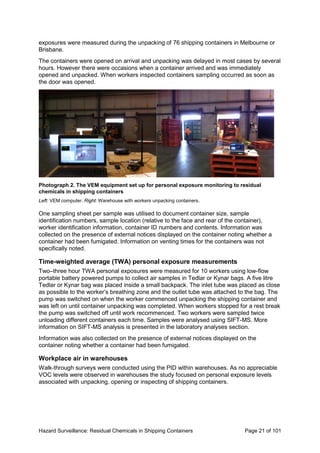
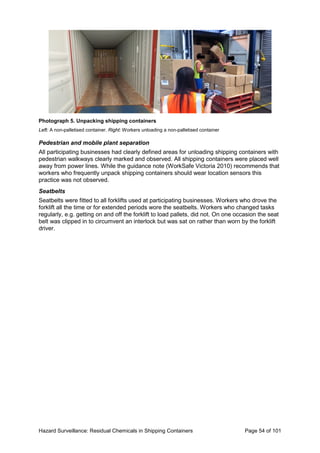
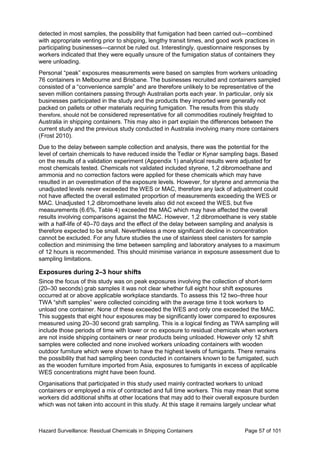
The PID and RAGS were placed inside a backpack worn by workers (see Photograph 1).
Researchers remotely triggered sample collection when peak levels were observed on the
PID providing data to the VEM system. Typically samples were collected over a period of
20–30 seconds which provided sufficient sample volume for analysis. Unfortunately there
were many instances where VEM was unable to be used when containers were unpacked.
This occurred for a number of reasons including occasions when there was electrical
interference with the Bluetooth signal, the distance between the container and the receiving
computer was too great and/or the workers declined to wear the sampling pack. A small
percentage of workers were not willing to wear the RAGS sampler in conjunction with the
PID as this made their tasks too difficult e.g. they could not wear it and drive a forklift or get
Hazard Surveillance: Residual Chemicals in Shipping Containers Page 20 of 101
on/off a forklift to load pallets. In these cases researchers carried the sampler and took an air
sample from the approximate height/breathing zone of the worker.
Photograph 1. Remote Activated Grab Sampler (RAGS)
Left: RAGS system showing chamber, Tedlar or Kynar bags, and remotely activated pump. Right: Backpack as
worn by worker showing the PID probe (left) and four inlet tubes for RAGS (right).
When peak exposures were not detected with the PID samples were taken periodically
during the unpacking process. These samples were typically taken when the container was
opened and when workers had progressed a quarter, half or three-quarters of the way into
the container or to the rear wall of the container. When workers inspected containers for
biosecurity reasons readings were taken as the worker unsealed and opened the container
for inspection.
SIFT-MS analyses (more information on SIFT-MS analysis is presented in the laboratory
analyses section) retrospectively verified that the lack of PID response was due to generally
low levels of residual chemicals (below the levels of detection for the PID).
In summary between one and four samples were collected per container from a mixture of
20 foot and 40 foot containers. A total of 181 personal “peak” exposure samples were
collected using VEM and RAGS. Of these samples 50 could not be analysed due to either
insufficient sample volumes or bag failures.
Sampling
Sampling commenced each day between 5.30 a.m. and 7.00 a.m. and continued until the
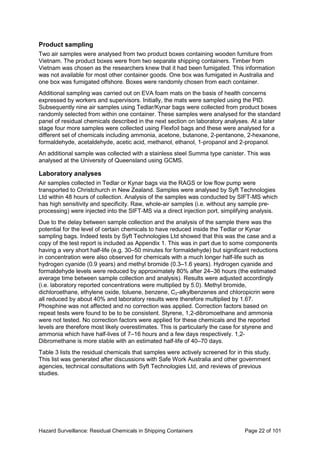
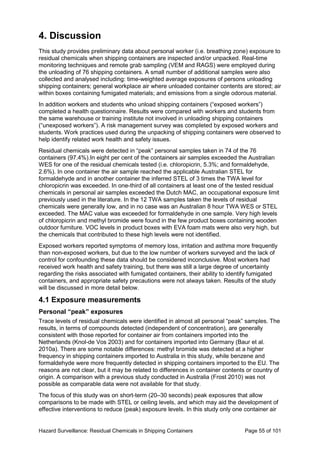
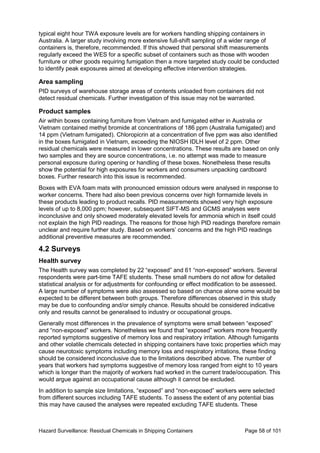
containers delivered that day had been unpacked. Photograph 2 provides an example of the
sampling set-up. The number of containers tested each day varied due to the rate at which
they were released from the docks. Sampling days were random and the percentage of
containers sampled over the course of the study represented only a small fraction of the
containers unpacked at participating facilities. Over the three months of the study worker
Hazard Surveillance: Residual Chemicals in Shipping Containers Page 21 of 101
exposures were measured during the unpacking of 76 shipping containers in Melbourne or
Brisbane.
The containers were opened on arrival and unpacking was delayed in most cases by several
hours. However there were occasions when a container arrived and was immediately
opened and unpacked. When workers inspected containers sampling occurred as soon as
the door was opened.
Photograph 2. The VEM equipment set up for personal exposure monitoring to residual
chemicals in shipping containers
Left: VEM computer. Right: Warehouse with workers unpacking containers.
One sampling sheet per sample was utilised to document container size, sample
identification numbers, sample location (relative to the face and rear of the container),
worker identification information, container ID numbers and contents. Information was
collected on the presence of external notices displayed on the container noting whether a
container had been fumigated. Information on venting times for the containers was not
specifically noted.
Time-weighted average (TWA) personal exposure measurements
Two–three hour TWA personal exposures were measured for 10 workers using low-flow
portable battery powered pumps to collect air samples in Tedlar or Kynar bags. A five litre
Tedlar or Kynar bag was placed inside a small backpack. The inlet tube was placed as close
as possible to the worker’s breathing zone and the outlet tube was attached to the bag. The
pump was switched on when the worker commenced unpacking the shipping container and
was left on until container unpacking was completed. When workers stopped for a rest break
the pump was switched off until work recommenced. Two workers were sampled twice
unloading different containers each time. Samples were analysed using SIFT-MS. More
information on SIFT-MS analysis is presented in the laboratory analyses section.
Information was also collected on the presence of external notices displayed on the
container noting whether a container had been fumigated.
Workplace air in warehouses
Walk-through surveys were conducted using the PID within warehouses. As no appreciable
VOC levels were observed in warehouses the study focused on personal exposure levels
associated with unpacking, opening or inspecting of shipping containers.
Hazard Surveillance: Residual Chemicals in Shipping Containers Page 22 of 101
Product sampling
Two air samples were analysed from two product boxes containing wooden furniture from
Vietnam. The product boxes were from two separate shipping containers. Timber from
Vietnam was chosen as the researchers knew that it had been fumigated. This information
was not available for most other container goods. One box was fumigated in Australia and
one box was fumigated offshore. Boxes were randomly chosen from each container.
Additional sampling was carried out on EVA foam mats on the basis of health concerns
expressed by workers and supervisors. Initially, the mats were sampled using the PID.
Subsequently nine air samples using Tedlar/Kynar bags were collected from product boxes
randomly selected from within one container. These samples were analysed for the standard
panel of residual chemicals described in the next section on laboratory analyses. At a later
stage four more samples were collected using Flexfoil bags and these were analysed for a
different set of chemicals including ammonia, acetone, butanone, 2-pentanone, 2-hexanone,
formaldehyde, acetaldehyde, acetic acid, methanol, ethanol, 1-propanol and 2-propanol.
An additional sample was collected with a stainless steel Summa type canister. This was
analysed at the University of Queensland using GCMS.
Laboratory analyses
Air samples collected in Tedlar or Kynar bags via the RAGS or low flow pump were
transported to Christchurch in New Zealand. Samples were analysed by Syft Technologies
Ltd within 48 hours of collection. Analysis of the samples was conducted by SIFT-MS which
has high sensitivity and specificity. Raw, whole-air samples (i.e. without any sample pre-
processing) were injected into the SIFT-MS via a direct injection port, simplifying analysis.
Due to the delay between sample collection and the analysis of the sample there was the
potential for the level of certain chemicals to have reduced inside the Tedlar or Kynar
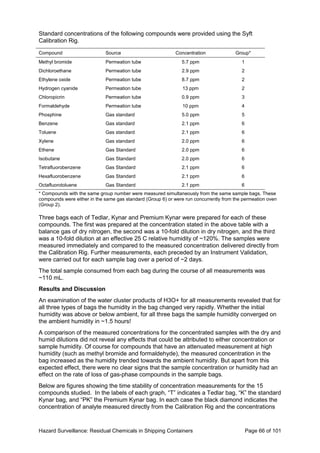
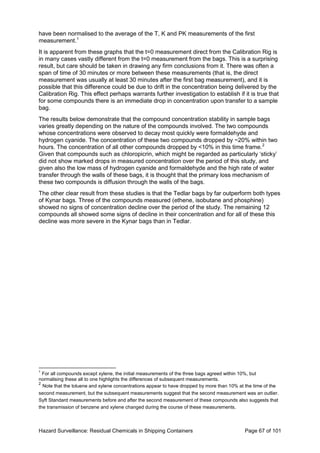
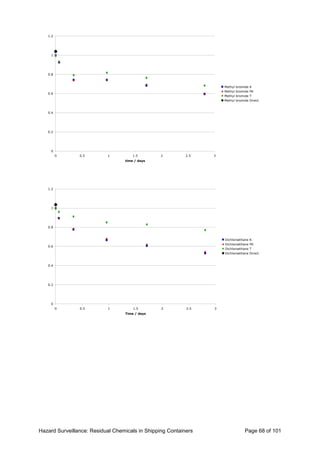
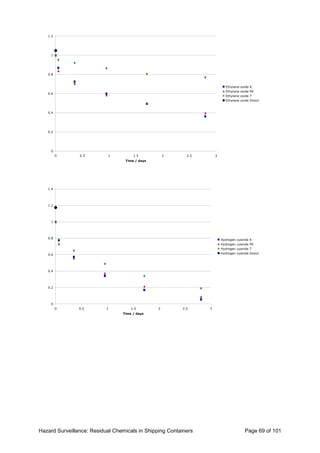
sampling bags. Indeed tests by Syft Technologies Ltd showed that this was the case and a
copy of the test report is included as Appendix 1. This was in part due to some components
having a very short half-life (e.g. 30–50 minutes for formaldehyde) but significant reductions
in concentration were also observed for chemicals with a much longer half-life such as
hydrogen cyanide (0.9 years) and methyl bromide (0.3–1.6 years). Hydrogen cyanide and
formaldehyde levels were reduced by approximately 80% after 24–36 hours (the estimated
average time between sample collection and analysis). Results were adjusted accordingly
(i.e. laboratory reported concentrations were multiplied by 5.0). Methyl bromide,
dichloroethane, ethylene oxide, toluene, benzene, C2-alkylbenzenes and chloropicrin were
all reduced by about 40% and laboratory results were therefore multiplied by 1.67.
Phosphine was not affected and no correction was applied. Correction factors based on
repeat tests were found to be to be consistent. Styrene, 1,2-dibromoethane and ammonia
were not tested. No correction factors were applied for these chemicals and the reported
levels are therefore most likely overestimates. This is particularly the case for styrene and
ammonia which have half-lives of 7–16 hours and a few days respectively. 1,2-
Dibromethane is more stable with an estimated half-life of 40–70 days.
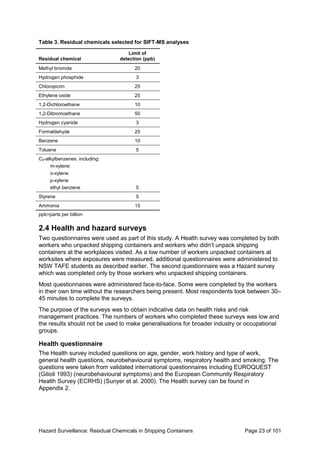
Table 3 lists the residual chemicals that samples were actively screened for in this study.
This list was generated after discussions with Safe Work Australia and other government
agencies, technical consultations with Syft Technologies Ltd, and reviews of previous
studies.
Hazard Surveillance: Residual Chemicals in Shipping Containers Page 23 of 101
Table 3. Residual chemicals selected for SIFT-MS analyses
Residual chemical
Limit of
detection (ppb)
Methyl bromide 20
Hydrogen phosphide 3
Chloropicrin 25
Ethylene oxide 25
1,2-Dichloroethane 10
1,2-Dibromoethane 50
Hydrogen cyanide 3
Formaldehyde 25
Benzene 10
Toluene 5
C2-alkylbenzenes, including:
m-xylene
o-xylene
p-xylene
ethyl benzene 5
Styrene 5
Ammonia 15
ppb=parts per billion
2.4 Health and hazard surveys
Two questionnaires were used as part of this study. A Health survey was completed by both
workers who unpacked shipping containers and workers who didn’t unpack shipping
containers at the workplaces visited. As a low number of workers unpacked containers at
worksites where exposures were measured, additional questionnaires were administered to
NSW TAFE students as described earlier. The second questionnaire was a Hazard survey
which was completed only by those workers who unpacked shipping containers.
Most questionnaires were administered face-to-face. Some were completed by the workers
in their own time without the researchers being present. Most respondents took between 30–
45 minutes to complete the surveys.
The purpose of the surveys was to obtain indicative data on health risks and risk
management practices. The numbers of workers who completed these surveys was low and
the results should not be used to make generalisations for broader industry or occupational
groups.
Health questionnaire
The Health survey included questions on age, gender, work history and type of work,
general health questions, neurobehavioural symptoms, respiratory health and smoking. The
questions were taken from validated international questionnaires including EUROQUEST
(Gilioli 1993) (neurobehavioural symptoms) and the European Community Respiratory
Health Survey (ECRHS) (Sunyer et al. 2000). The Health survey can be found in
Appendix 2.
Hazard Surveillance: Residual Chemicals in Shipping Containers Page 24 of 101
Hazard questionnaire
The Hazard survey was based on a survey developed and used for a previous Safe Work
Australia study on asbestos exposures (Pratt et al. 2010) and adapted for this project. The
survey included questions on work characteristics and history, frequency of unpacking
shipping containers, work health and safety training, knowledge about the risks of
unpacking/opening/inspecting containers, risk perception, the ability to identify containers
which may give off chemical fumes, and safety procedures. The Hazard survey tool can be
found in Appendix 3.
2.5 Unstructured interviews and general workplace observations
Unstructured interviews
Informal discussions were held with five experienced managers/supervisors and 15 workers
regarding their workplace observations and experiences while unloading containers. These
discussions were not structured and took place in or adjacent to the workplace. The issues
discussed included general issues relating to residual chemicals, issues with specific
products, issues with products that leaked during transit and issues with information on the
fumigation status of shipping containers being unpacked.
General workplace observations
General work practices were observed while workers unpacked containers and were
compared to advice provided in Work Safe Victoria guidance (WorkSafe Victoria 2010)
particularly relating to the management of musculoskeletal risks, heat, and the prevention of
loads falling onto workers.
2.6 Data analyses
Personal exposure data were summarised as the proportion of containers in which personal
exposures exceeded one of the following workplace exposure or general population
standards:
• the Australian eight hour TWA WES and STEL (Safe Work Australia 2012) if available
• the Dutch MAC. These have been used in several European studies on shipping
containers, most notably the studies undertaken in the Netherlands (de Groot 2007;
Knol-de Vos 2003). These are considered TWA workplace exposure standards, and
• the chronic inhalation reference exposure levels (chronic RELs) as defined by the State
of California, USA. These are levels at or below which no adverse health effects are
anticipated following long-term exposure. These are not workplace exposure standards,
but presumed to be general population standards. These were used for comparison only
because they have been used in a previous container study (Baur et al. 2010a). Their
applicability to this type of study is problematic and of questionable value.
Multiple exposure measurements per person and therefore per container were averaged
prior to making any comparisons. In some cases multiple samples taken from the same
person had both detectable and non-detectable results. In those instances arithmetic means
(AM) were calculated assuming a zero concentration for those samples which had
concentration below the limit of detection. In addition to expressing exposure levels relative
to an occupational standard, average (AM) exposures and standard deviations (SD) were
calculated for those containers where at least one of the samples had a detectable result. In
cases where multiple exposure levels per container were available the AM was used.
Standard descriptive statistical methods (i.e. AM, SD, maximum values and response choice
percentages) were used to summarise the questionnaire data. Due to the low number of
respondents no further statistical analyses were conducted.
Hazard Surveillance: Residual Chemicals in Shipping Containers Page 25 of 101
3. Results
3.1 Exposures to fumigants and other residual chemicals
As noted previously in the materials and methods section the following was undertaken:
1. VEM analyses and RAGS personal “peak” exposure measurements (n=131) while
workers unpacked 76 containers
2. twelve, 2–3 hour TWA shift sampling for 10 workers during unloading of 20
containers
3. warehouse sampling
4. within cardboard box (source) sampling, and
5. specific product emission sampling.
The results are summarised as follows:
Personal “peak” sampling (VEM analyses and RAGS collection)
Worker exposures were measured as they unpacked a mixture of 20 foot and 40 foot
containers. Containers were of all metal construction and were filled with non-palletised
cardboard boxes containing a wide variety of consumer products that originated from China.
Of the 76 containers included in the study 28 (36.8%) contained metal/glass products
including auto parts, tools, and agricultural parts; 20 containers (26.3%) contained
plastic/textile products including safety clothing, storage containers, cabinets, and electrical
equipment; 6 containers (8.3%) contained furniture including timber outdoor furniture,
hydration blocks, metal furniture and miscellanies furniture; and 22 containers (30.6%)
contained miscellanies/mixed loads including household goods, clothes, food in sealed tins,
and personal belongings.
Generally no peak exposures were detected using the PID-equipped VEM system.
Therefore the RAGS samples were arbitrarily collected as previously described.
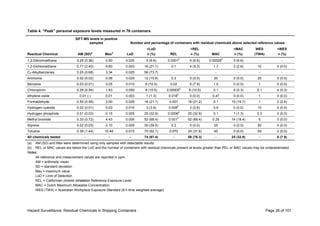
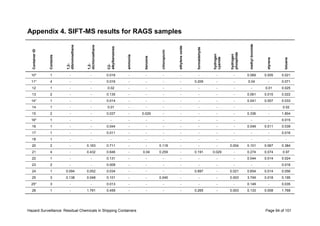
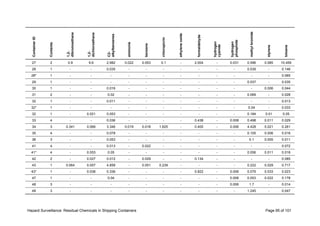
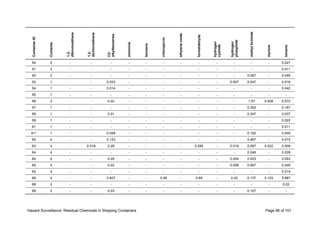
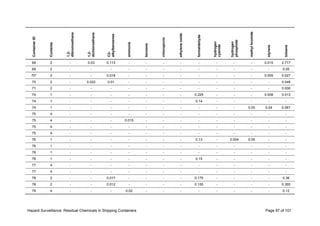
The results of the SIFT-MS analyses for the RAGS samples taken while workers unpacked
the shipping containers are summarised in Table 4. All SIFT-MS results for RAGS samples
are included in Appendix 4.
Hazard Surveillance: Residual Chemicals in Shipping Containers Page 26 of 101
Table 4. “Peak” personal exposure levels measured in 76 containers
SIFT-MS levels in positive
samples Number and percentage of containers with residual chemicals above selected reference values
Residual Chemical AM (SD)
a
Max
a
LoD
>LoD
n (%) REL
>REL
n (%) MAC
>MAC
n (%)
WES
(TWA)
>WES
n (%)
1,2-Dibromoethane 0.29 (0.36) 0.90 0.020 5 (6.6) 0.0001
b
5 (6.6) 0.00025
b
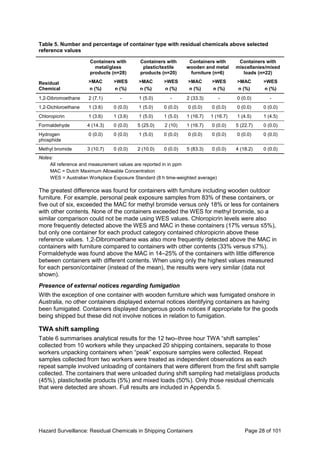
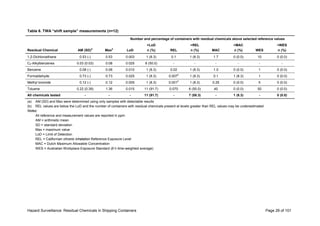
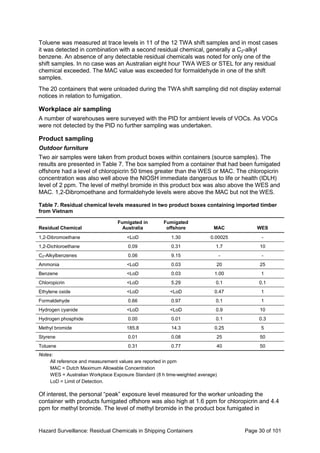
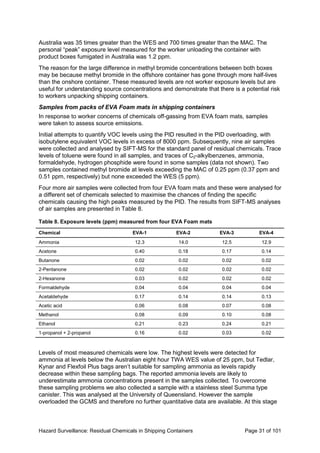
5 (6.6) - -
1,2-Dichloroethane 0.77 (2.40) 9.60 0.003 16 (21.1) 0.1 4 (5.3) 1.7 2 (2.6) 10 0 (0.0)
C2-Alkylbenzenes 0.25 (0.68) 3.34 0.025 56 (73.7) - - - - - -
Ammonia 0.02 (0.02) 0.08 0.025 12 (15.8) 0.3 0 (0.0) 20 0 (0.0) 25 0 (0.0)
Benzene 0.03 (0.01) 0.05 0.010 8 (10.5) 0.02 6 (7.9) 1.0 0 (0.0) 1 0 (0.0)
Chloropicrin 0.29 (0.54) 1.63 0.050 8 (10.5) 0.00005
b
8 (10.5) 0.1 4 (5.3) 0.1 4 (5.3)
ethylene oxide 0.01 (-) 0.01 0.003 1 (1.3) 0.018
b
0 (0.0) 0.47 0 (0.0) 1 0 (0.0)
Formaldehyde 0.50 (0.55) 2.00 0.025 16 (21.1) 0.007 16 (21.2) 0.1 15 (19.7) 1 2 (2.6)
Hydrogen cyanide 0.02 (0.01) 0.03 0.010 3 (3.9) 0.008
b
2 (2.6) 0.9 0 (0.0) 10 0 (0.0)
Hydrogen phosphide 0.01 (0.03) 0.15 0.005 25 (32.9) 0.0006
b
25 (32.9) 0.1 1 (1.3) 0.3 0 (0.0)
Methyl bromide 0.33 (0.72) 4.43 0.005 52 (68.4) 0.001
b
52 (68.4) 0.25 14 (18.4) 5 0 (0.0)
Styrene 0.02 (0.03) 0.10 0.005 30 (39.5) 0.2 0 (0.0) 25 0 (0.0) 50 0 (0.0)
Toluene 0.39 (1.44) 10.46 0.015 70 (92.1) 0.070 24 (31.6) 40 0 (0.0) 50 0 (0.0)
All chemicals tested - - - 74 (97.4) - 58 (76.3) - 25 (32.9) - 6 (7.9)
(a) AM (SD) and Max were determined using only samples with detectable results.
(b) REL or MAC values are below the LoD and the number of containers with residual chemicals present at levels greater than REL or MAC values may be underestimated.
Notes:
All reference and measurement values are reported in ppm
AM = arithmetic mean
SD = standard deviation
Max = maximum value
LoD = Limit of Detection
REL = Californian chronic inhalation Reference Exposure Level
MAC = Dutch Maximum Allowable Concentration
WES (TWA) = Australian Workplace Exposure Standard (8 h time weighted average)
Hazard Surveillance: Residual Chemicals in Shipping Containers Page 27 of 101
Comparison with applicable workplace and general population standards
As noted previously, the SIFT-MS results were compared against the following exposure
standards:
1. the Australian TWA and STEL WES values (Safe Work Australia 2012);
2. the MAC values used in several large Dutch studies (de Groot 2007; Knol-de Vos
2003); and
3. the OEHHA chronic reference levels used in a large German study (Baur et al.
2010a).
Personal “peak” samples taken in 74 of the containers (97.4% of all containers tested)
contained residual chemical levels above the limit of detection. Toluene was the most
commonly identified residual chemical (92.1% of all containers) followed by C2-
alkylbenzenes (73.7%) and methyl bromide (68.4%).
In eight per cent of the containers personal “peak” samples exceeded the WES for one of
the residual chemicals tested (i.e. chloropicrin, 5.3%; and formaldehyde, 2.6%). In one
container the air sample reached the applicable Australian STEL for formaldehyde (2 ppm)
and in another container the inferred STEL of three times the TWA level for chloropicrin was
exceeded.
Levels above the REL for one or more of the tested residual chemicals were observed in
76.3% of the containers; 47% of the containers had samples taken with two or more residual
chemicals in excess of the REL. Methyl bromide was detected at levels above the REL in
68.4% of the containers, followed by hydrogen phosphide (32.9%) and toluene (31.6%).
In approximately one-third of the containers personal samples exceeded the MAC value for
at least one of the tested residual chemicals; 11.8% of the containers contained levels above
the MAC for two or more of these chemicals. The two most common residual chemicals
exceeding the MAC were formaldehyde (19.7%) and methyl bromide (18.4%).
As noted in the data analysis section (Chapter 2.6) when multiple samples were available
per person/container these were averaged prior to comparing them with the exposure
standards. When the analyses were repeated using only the highest value of up to four
exposure measurements taken per container only slightly higher proportions exceeding the
REL and MAC were found (MAC, 35.5% versus 32.9%; REL 77.6% versus 76.3%); no
differences were seen for comparisons with the WES.
Container contents and levels of residual chemicals
The level of exposure to specific residual chemicals may be dependent on container
contents due to differences in fumigation strategies, country of origin, or specific products
off-gassing different chemicals. In this study four broad categories of containers were
defined on the basis of their contents (see above). In Table 5 the number and percentage of
containers with residual chemicals above the WES and MAC are summarised for each of the
four container types. Results are shown only for those chemicals where at least one
container exceeded the WES or MAC.
Hazard Surveillance: Residual Chemicals in Shipping Containers Page 28 of 101
Table 5. Number and percentage of container type with residual chemicals above selected
reference values
Containers with
metal/glass
products (n=28)
Containers with
plastic/textile
products (n=20)
Containers with
wooden and metal
furniture (n=6)
Containers with
miscellanies/mixed
loads (n=22)
Residual
Chemical
>MAC
n (%)
>WES
n (%)
>MAC
n (%)
>WES
n (%)
>MAC
n (%)
>WES
n (%)
>MAC
n (%)
>WES
n (%)
1,2-Dibromoethane 2 (7.1) - 1 (5.0) - 2 (33.3) - 0 (0.0) -
1,2-Dichloroethane 1 (3.6) 0 (0.0) 1 (5.0) 0 (0.0) 0 (0.0) 0 (0.0) 0 (0.0) 0 (0.0)
Chloropicrin 1 (3.6) 1 (3.6) 1 (5.0) 1 (5.0) 1 (16.7) 1 (16.7) 1 (4.5) 1 (4.5)
Formaldehyde 4 (14.3) 0 (0.0) 5 (25.0) 2 (10) 1 (16.7) 0 (0.0) 5 (22.7) 0 (0.0)
Hydrogen
phosphide
0 (0.0) 0 (0.0) 1 (5.0) 0 (0.0) 0 (0.0) 0 (0.0) 0 (0.0) 0 (0.0)
Methyl bromide 3 (10.7) 0 (0.0) 2 (10.0) 0 (0.0) 5 (83.3) 0 (0.0) 4 (18.2) 0 (0.0)
Notes:
All reference and measurement values are reported in in ppm
MAC = Dutch Maximum Allowable Concentration
WES = Australian Workplace Exposure Standard (8 h time-weighted average)
The greatest difference was found for containers with furniture including wooden outdoor
furniture. For example, personal peak exposure samples from 83% of these containers, or
five out of six, exceeded the MAC for methyl bromide versus only 18% or less for containers
with other contents. None of the containers exceeded the WES for methyl bromide, so a
similar comparison could not be made using WES values. Chloropicrin levels were also
more frequently detected above the WES and MAC in these containers (17% versus ≤5%),
but only one container for each product category contained chloropicrin above these
reference values. 1,2-Dibromoethane was also more frequently detected above the MAC in
containers with furniture compared to containers with other contents (33% versus ≤7%).
Formaldehyde was found above the MAC in 14–25% of the containers with little difference
between containers with different contents. When using only the highest values measured
for each person/container (instead of the mean), the results were very similar (data not
shown).
Presence of external notices regarding fumigation
With the exception of one container with wooden furniture which was fumigated onshore in
Australia, no other containers displayed external notices identifying containers as having
been fumigated. Containers displayed dangerous goods notices if appropriate for the goods
being shipped but these did not involve notices in relation to fumigation.
TWA shift sampling
Table 6 summarises analytical results for the 12 two–three hour TWA “shift samples”
collected from 10 workers while they unpacked 20 shipping containers, separate to those
workers unpacking containers when “peak” exposure samples were collected. Repeat
samples collected from two workers were treated as independent observations as each
repeat sample involved unloading of containers that were different from the first shift sample
collected. The containers that were unloaded during shift sampling had metal/glass products
(45%), plastic/textile products (5%) and mixed loads (50%). Only those residual chemicals
that were detected are shown. Full results are included in Appendix 5.
Hazard Surveillance: Residual Chemicals in Shipping Containers Page 29 of 101
Table 6. TWA “shift sample” measurements (n=12)
Number and percentage of containers with residual chemicals above selected reference values
Residual Chemical AM (SD)
a
Max
a
LoD
>LoD
n (%) REL
>REL
n (%) MAC
>MAC
n (%) WES
>WES
n (%)
1,2-Dichloroethane 0.53 (-) 0.53 0.003 1 (8.3) 0.1 1 (8.3) 1.7 0 (0.0) 10 0 (0.0)
C2-Alkylbenzenes 0.03 (0.03) 0.08 0.025 6 (50.0) - - - - - -
Benzene 0.08 (-) 0.08 0.010 1 (8.3) 0.02 1 (8.3) 1.0 0 (0.0) 1 0 (0.0)
Formaldehyde 0.73 (-) 0.73 0.025 1 (8.3) 0.007
b
1 (8.3) 0.1 1 (8.3) 1 0 (0.0)
Methyl bromide 0.12 (-) 0.12 0.005 1 (8.3) 0.001
b
1 (8.3) 0.25 0 (0.0) 5 0 (0.0)
Toluene 0.22 (0.39) 1.36 0.015 11 (91.7) 0.070 6 (50.0) 40 0 (0.0) 50 0 (0.0)
All chemicals tested - - - 11 (91.7) - 7 (58.3) - 1 (8.3) - 0 (0.0)
(a) AM (SD) and Max were determined using only samples with detectable results
(b) REL values are below the LoD and the number of containers with residual chemicals present at levels greater than REL values may be underestimated
Notes:
All reference and measurement values are reported in ppm
AM = arithmetic mean
SD = standard deviation
Max = maximum value
LoD = Limit of Detection
REL = Californian chronic inhalation Reference Exposure Level
MAC = Dutch Maximum Allowable Concentration
WES = Australian Workplace Exposure Standard (8 h time-weighted average)
Hazard Surveillance: Residual Chemicals in Shipping Containers Page 30 of 101
Toluene was measured at trace levels in 11 of the 12 TWA shift samples and in most cases
it was detected in combination with a second residual chemical, generally a C2-alkyl
benzene. An absence of any detectable residual chemicals was noted for only one of the
shift samples. In no case was an Australian eight hour TWA WES or STEL for any residual
chemical exceeded. The MAC value was exceeded for formaldehyde in one of the shift
samples.
The 20 containers that were unloaded during the TWA shift sampling did not display external
notices in relation to fumigation.
Workplace air sampling
A number of warehouses were surveyed with the PID for ambient levels of VOCs. As VOCs
were not detected by the PID no further sampling was undertaken.
Product sampling
Outdoor furniture
Two air samples were taken from product boxes within containers (source samples). The
results are presented in Table 7. The box sampled from a container that had been fumigated
offshore had a level of chloropicrin 50 times greater than the WES or MAC. The chloropicrin
concentration was also well above the NIOSH immediate dangerous to life or health (IDLH)
level of 2 ppm. The level of methyl bromide in this product box was also above the WES and
MAC. 1,2-Dibromoethane and formaldehyde levels were above the MAC but not the WES.
Table 7. Residual chemical levels measured in two product boxes containing imported timber
from Vietnam
Residual Chemical
Fumigated in
Australia
Fumigated
offshore MAC WES
1,2-Dibromoethane <LoD 1.30 0.00025 -
1,2-Dichloroethane 0.09 0.31 1.7 10
C2-Alkylbenzenes 0.06 9.15 - -
Ammonia <LoD 0.03 20 25
Benzene <LoD 0.03 1.00 1
Chloropicrin <LoD 5.29 0.1 0.1
Ethylene oxide <LoD <LoD 0.47 1
Formaldehyde 0.66 0.97 0.1 1
Hydrogen cyanide <LoD <LoD 0.9 10
Hydrogen phosphide 0.00 0.01 0.1 0.3
Methyl bromide 185.8 14.3 0.25 5
Styrene 0.01 0.08 25 50
Toluene 0.31 0.77 40 50
Notes:
All reference and measurement values are reported in ppm
MAC = Dutch Maximum Allowable Concentration
WES = Australian Workplace Exposure Standard (8 h time-weighted average)
LoD = Limit of Detection.
Of interest, the personal “peak” exposure level measured for the worker unloading the
container with products fumigated offshore was also high at 1.6 ppm for chloropicrin and 4.4
ppm for methyl bromide. The level of methyl bromide in the product box fumigated in
Hazard Surveillance: Residual Chemicals in Shipping Containers Page 31 of 101
Australia was 35 times greater than the WES and 700 times greater than the MAC. The
personal “peak” exposure level measured for the worker unloading the container with
product boxes fumigated in Australia was 1.2 ppm.
The reason for the large difference in methyl bromide concentrations between both boxes
may be because methyl bromide in the offshore container has gone through more half-lives
than the onshore container. These measured levels are not worker exposure levels but are
useful for understanding source concentrations and demonstrate that there is a potential risk
to workers unpacking shipping containers.
Samples from packs of EVA Foam mats in shipping containers
In response to worker concerns of chemicals off-gassing from EVA foam mats, samples
were taken to assess source emissions.
Initial attempts to quantify VOC levels using the PID resulted in the PID overloading, with
isobutylene equivalent VOC levels in excess of 8000 ppm. Subsequently, nine air samples
were collected and analysed by SIFT-MS for the standard panel of residual chemicals. Trace
levels of toluene were found in all samples, and traces of C2-alkylbenzenes, ammonia,
formaldehyde, hydrogen phosphide were found in some samples (data not shown). Two
samples contained methyl bromide at levels exceeding the MAC of 0.25 ppm (0.37 ppm and
0.51 ppm, respectively) but none exceeded the WES (5 ppm).
Four more air samples were collected from four EVA foam mats and these were analysed for
a different set of chemicals selected to maximise the chances of finding the specific
chemicals causing the high peaks measured by the PID. The results from SIFT-MS analyses
of air samples are presented in Table 8.
Table 8. Exposure levels (ppm) measured from four EVA Foam mats
Chemical EVA-1 EVA-2 EVA-3 EVA-4
Ammonia 12.3 14.0 12.5 12.9
Acetone 0.40 0.18 0.17 0.14
Butanone 0.02 0.02 0.02 0.02
2-Pentanone 0.02 0.02 0.02 0.02
2-Hexanone 0.03 0.02 0.02 0.02
Formaldehyde 0.04 0.04 0.04 0.04
Acetaldehyde 0.17 0.14 0.14 0.13
Acetic acid 0.06 0.08 0.07 0.08
Methanol 0.08 0.09 0.10 0.08
Ethanol 0.21 0.23 0.24 0.21
1-propanol + 2-propanol 0.16 0.02 0.03 0.02
Levels of most measured chemicals were low. The highest levels were detected for
ammonia at levels below the Australian eight hour TWA WES value of 25 ppm, but Tedlar,
Kynar and Flexfoil Plus bags aren’t suitable for sampling ammonia as levels rapidly
decrease within these sampling bags. The reported ammonia levels are likely to
underestimate ammonia concentrations present in the samples collected. To overcome
these sampling problems we also collected a sample with a stainless steel Summa type
canister. This was analysed at the University of Queensland. However the sample
overloaded the GCMS and therefore no further quantitative data are available. At this stage
Hazard Surveillance: Residual Chemicals in Shipping Containers Page 32 of 101
it is unclear which chemicals in addition to ammonia contributed to the high peak measured
by the PID.
3.2 Health and hazards surveys
Health survey
As noted previously, a total of 22 workers (14 on-site workers, eight part-time TAFE
students) who unpacked shipping containers and therefore were considered “exposed
workers” completed the Health survey. An additional 61 workers from warehouse and
distribution centres (40 on-site workers and 21 part-time TAFE workers) who did not unpack
shipping containers and therefore were considered “unexposed workers” also completed the
health survey and were used as a reference group.
The questionnaire used for this survey focussed on neurotoxic, irritant and respiratory
symptoms because many of the fumigants and other residual chemicals have neurotoxic or
irritant properties. Questions regarding general health and head injuries were also included
because these conditions may affect the reporting of neurological symptoms. However,
given the small sample size their effects were not assessed in the current study. Given the
small number of exposed workers the differences noted between exposed and non-exposed
groups should be treated as indicative findings only. These results should not be generalised
to industry or occupational groups.
In cases where respondents did not answer a specific question or did not complete a section
of the questionnaire data were treated as missing. The denominators may therefore differ for
some items.
Demographic and work characteristics
Responses to questions on demographic and work characteristics are presented in Table 9.
There were slightly higher proportions of men and current smokers in the exposed workers
group and this group had also worked more years in their current job compared to
unexposed workers, but differences were generally small. The small sample size prevents
controlling for demographic differences between groups. Therefore, some of the differences
in health status between the exposed and unexposed workers that are discussed below may
be associated with differences in gender, smoking or other confounders rather than
exposures alone.
Hazard Surveillance: Residual Chemicals in Shipping Containers Page 33 of 101
Table 9. Demographic and work characteristics for exposed and unexposed workers
Exposed workers
(n=22)
Unexposed workers
(n=61)
Sex n % n %
Male 17 77.3 37 60.7
Females 5 22.7 24 39.3
Smoking status n % n %
Current smoker 7 31.8 17 27.9
Ex-smoker 2 9.1 13 21.3
Non-smoker 13 59.1 31 50.8
Other job at present 1 4.6 5 8.2
AM SD AM SD
Age 35.8 12.8 35 9.8
Years worked in current job 3.2 3.2 2.7 2.8
Hours/week in current job 36.5 6.6 37.5 6.5
Type of work
a
n % n %
Freight handlers and shelf fillers 9 41 38 62
Fork lift driver 3 14 - -
Supervisor/manager 2 9 2 3
Workers attending TAFE courses 8 36 21 34
(a) More than 90% were employed by a retail and wholesale distribution centre
Notes:
AM = arithmetic mean
SD = standard deviation
General health symptoms
The responses to the questions on general health symptoms are presented in Table 10.
Approximately half of all workers used prescription drugs in the past 12 months, with no
difference between exposed and unexposed workers. Cardiovascular disease, diabetes,
muscular tremors and sensation of pins and needles were reported more frequently by
unexposed workers. Exposed workers more frequently reported concussions but no
difference was observed for the occurrence of head injuries. More than 95% of all workers
reported that their self-perceived health was good to very good and no differences were
seen between groups. The majority of workers also felt good about life in general (63.6%
and 65.6% for exposed and unexposed workers respectively). Exposed workers reported
having enough sleep and waking up feeling refreshed often or always at slightly higher rates
than unexposed workers.
Hazard Surveillance: Residual Chemicals in Shipping Containers Page 34 of 101
Table 10. General health in exposed and unexposed workers
Exposed
(n=22)
Unexposed
(n=61)
Symptom n % n %
Prescription drugs in past 12 months 10 45.5 31 50.8
Ever had cardiovascular disease (1 ms) 1 4.6 6 10
Ever had diabetes (2 ms) 0 0 5 8.3
Ever had muscular tremor (1 ms) 1 4.6 6 10
Ever had sensation of pins and needles 2 9.1 11 18
Ever had neurological degeneration 0 0 0 0
Ever had epilepsy, Parkinson’s, ALS, MScl 0 0 2 3.3
Ever had Alzheimer’s 0 0 0 0
Ever had other dementia 0 0 0 0
Ever been in a coma 0 0 1 1.6
Ever had chronic fatigue (1 ms) 0 0 2 3.3
Ever had other neurological disease 0 0 0 0
Ever had neurological injury 1 4.6 3 4.9
Ever had head injury (1 ms) 3 14.3 7 11.5
Ever had concussion (1 ms) 6 28.6 9 14.8
Ever had major depression 2 9.1 5 8.2
Ever had anxiety 1 4.6 3 4.9
Ever had learning disability or attention deficit disorder 0 0 0 0
Ever had other emotional problems (2 ms) 0 0 3 4.9
Ever had learning disability 1 4.6 0 0
Self-perceived health n % n %
Very good 5 22.7 23 37.7
Good 16 72.7 37 60.7
Poor 1 4.6 1 1.6
Very poor 0 0 0 0
Self-perceived health now vs 5 years ago (1 ms) n % n %
Better 5 22.8 14 23
About the same 15 68.2 36 59
Worse 1 4.5 11 18
Much worse 1 4.5 0 0
Feeling about life in general n % n %
Good 14 63.6 40 65.6
Average 7 31.8 19 31.1
Not very good 0 0 1 1.6
Bad 1 4.6 1 1.6
Hazard Surveillance: Residual Chemicals in Shipping Containers Page 35 of 101
Exposed
(n=22)
Unexposed
(n=61)
Feeling about life now vs 5 years ago (1 ms) n % n %
Better 10 45.4 31 51.7
About the same 10 45.4 25 41.7
Worse 1 4.6 3 5
Much worse 1 4.6 1 1.6
Enough sleep n % n %
Never 0 0 2 3.3
Rarely 7 31.8 21 34.4
Often 14 63.6 27 44.3
Always 1 4.6 11 18
Wake up feeling refreshed n % n %
Never 2 9.1 5 8.2
Rarely 5 22.7 25 41
Often 15 68.2 22 36.1
Always 0 0 9 14.8
AM SD AM SD
How many hours sleep per day 7 1 7 1.4
Notes:
AM = arithmetic mean
SD = standard deviation
ALS = amyotrophic lateral sclerosis
MScl = multiple sclerosis
ms = missing observation(s).
Neurobehavioural symptoms
The responses to the questions on neurobehavioural symptoms are presented in Table 11.
The categories “often” and “very often” were combined as relatively few workers reported
they experienced specific symptoms “very often” in recent months. In general, most
symptoms were not reported often and differences between exposed and non-exposed
workers were generally small. The greatest and most consistent differences for reporting
symptoms often were related to symptoms associated with memory e.g. forgetfulness (9.1%
versus 1.6%), forgetting what to say or what to do (22.7 versus 8.2%), difficulty remembering
names and dates (27.3% versus 13.1%) and absent mindedness (9.1% versus 1.7%). The
number of years that exposed workers had these symptoms ranged from eight (absent
mindedness) to 20 years (forgetfulness, forgetting what to say or what to do, difficulty
remembering names and dates). Given that exposed workers on average only worked three
years in the current job (Table 9) with the majority not having worked in the current
trade/occupation for more than 10 years (see Section 4.2.2, Table 14) it is not likely that
these symptoms are related to their current job (although it cannot be excluded). As
prevalence data were based on only a few positive responses the results should be treated
as inconclusive.
Hazard Surveillance: Residual Chemicals in Shipping Containers Page 36 of 101
Table 11. Neurobehavioural symptoms in exposed and unexposed workers
Exposed workers
(n=22)
Unexposed workers
(n=61)
Seldom Sometimes Often Years
a
Seldom Sometimes Often Years
a
Symptoms n ( %) n (%) n (%) AM (SD) n (%) n (%) n (%) AM (SD)
Dropping things unintentionally 15 (68.2) 5 (22.7) 2 (9.1) 6.3 (1.8 ) 44 (72.1) 13 (21.3) 4 (6.6) 6.1 (11.0)
Weakness of arms and feet 15 (68.2) 7 (31.8) 0 (0.0) 5.0 (4.2) 43 (70.5) 17 (27.9) 1 (1.6) 2.4 (2.7)
Decreased sensation in arms and legs 20 (90.9) 2 (9.1) 0 (0.0) - 57 (93.4) 4 (6.6) 0 (0.0) 0.6 (0.3)
Numbness or heaviness in arms or legs 16 (72.7) 5 (22.7) 1 (4.6) 2.5 (0.7) 50 (82.0) 10 (16.4) 1 (1.6) 1.9 (2.0)
Tingling in arms or legs 16 (72.7) 4 (18.8) 2 (9.1) 6.5 (2.1) 52 (85.3) 8 (13.1) 1 (1.6) 1.5 (1.1)
Problems with balance 19 (86.3) 2 (9.1) 1 (4.6) 6.5 (5.4) 50 (82.0) 10 (16.4) 1 (1.6) 2.9 (2.1)
Changes in sense of smell or taste 20 (90.9) 0 (0.0) 2 (9.1) 10.0 ( - ) 53 (86.9) 8 (13.1) 0 (0.0) 1.8 (1.5)
Decreased sensation on face 21 (95.4) 1 (4.6) 0 (0.0) - 61 (100) 0 (0.0) 0 (0.0) -
Difficulties controlling hand movements (1 ms) 21 (100) 0 (0.0) 0 (0.0) - 57 (93.4) 4 (6.6) 0 (0.0) 1.4 (1.2)
Slowness in carrying out daily activities 16 (72.7) 6 (27.3) 0 (0.0) 3.0 ( - ) 48 (78.7) 13 (21.3) 0 (0.0) 4.8 (7.3)
Trembling of hands 19 (86.3) 2 (9.1) 1 (4.6) - 57 (93.4) 2 (3.3) 2 (3.3) 12.8 (20.1)
Headache 10 (45.5) 10 (45.4) 2 (9.1) 12.0 (10.4) 25 (41.0) 28 (45.9) 8 (13.1) 9.4 (12.7)
Sweating for no obvious reason 20 (90.9) 2 (9.1) 0 (0.0) - 52 (85.2) 4 (6.6) 5 (8.2) 9.1 (9.4)
Nausea 18 (81.8) 4 (18.2) 0 (0.0) 10.0 (7.1) 46 (75.4) 13 (21.3) 2 (3.3) 4.0 (7.6)
Stomach pains 18 (81.8) 3 (13.6) 1 (4.6) 10.0 (7.1) 51 (83.6) 8 (13.1) 2 (3.3) 9.1 (14.7)
Dizziness 11 (50.0) 9 (40.9) 2 (9.1) 5.8 (3.3) 48 (78.7) 10 (16.4) 3 (4.9) 2.2 (2.9)
Shortness of breath without physical exertion 20 (90.9) 2 (9.1) 0 (0.0) 3.0 ( - ) 53 (86.9) 7 (11.5) 1 (1.6) 5.2 (4.3)
Heart fluttering (palpitations) 18 (81.8) 4 (18.2) 0 (0.0) 5.0 ( - ) 56 (91.8) 3 (4.9) 2 (3.3) 5.8 (3.2)
Ringing in ears (tinnitus) 17 (77.3) 4 (18.2) 1 (4.5) 5.0 (0.0) 55 (90.1) 4 (6.6) 2 (3.3) 4.0 (4.1)
Feeling of general exhaustion 14 (63.6) 6 (27.3) 2 (9.1) 4.3 (2.2) 41 (67.2) 13 (21.3) 7 (11.5) 4.4 (9.2)
Loss of sexual interest (1 ms) 13 (61.9) 7 (33.3) 1 (4.8) 2.3 (0.6) 46 (75.4) 12 (19.7) 3 (4.9) 7.6 (9.8)
Hazard Surveillance: Residual Chemicals in Shipping Containers Page 37 of 101
Exposed workers
(n=22)
Unexposed workers
(n=61)
Seldom Sometimes Often Years
a
Seldom Sometimes Often Years
a
Symptoms n ( %) n (%) n (%) AM (SD) n (%) n (%) n (%) AM (SD)
Lowered alcohol tolerance (1 ms) 16 (76.2) 4 (19.0) 1 (4.8) 2.5 (0.7) 55 (90.1) 4 (6.6) 2 (3.3) 2.1 (1.3)
Diarrhoea 17 (77.3) 5 (22.7) 0 (0.0) - 51 (83.6) 10 (16.4) 0 (0.0) 16 (15.1)
Constipation (1 ms) 18 (85.7) 2 (9.5) 1 (4.8) 35.0 (21.2) 53 (86.9) 7 (11.5) 1 (1.6) 20.8 (17.6)
Loss of appetite 17 (77.3) 4 (18.2) 1 (4.5) 10.0 ( - ) 50 (82.0) 9 (14.7) 2 (3.3) 2.6 (2.8)
Feeling of a tight band around head 20 (90.9) 1 (4.5) 1 (4.6) - 54 (88.5) 6 (9.9) 1 (1.6) 1.7 (2.2)
Difficulty getting started at work (2 ms) 18 (81.8) 3 (13.6) 1 (4.6) 3.0 ( -) 47 (79.7) 11 (18.6) 1 (1.7) 1.4 (1.0)
Feeling irritable 15 (68.2) 5 (22.7) 2 (9.1) 23.8 (16.5) 39 (63.9) 19 (31.2) 3 (4.9) 4.4 (5.5)
Feeling depressed 19 (86.4) 2 (9.1) 1 (4.5) 4.5 (2.1) 46 (75.4) 12 (19.7) 3 (4.9) 7.8 (8.7)
Feeling impatient 13 (59.1) 8 (36.4) 1 (4.5) 13.0 (12.6) 40 (65.6) 18 (29.5) 3 (4.9) 4.7 (8.3)
Being upset by trivial things 14 (63.6) 6 (27.3) 2 (9.1) 12.5 (10.6) 40 (65.6) 20 (32.8) 1 (1.6) 8.8 (13.4)
Feeling restless 14 (63.6) 7 (31.8) 1 (4.6) - 38 (62.3) 21 (34.4) 2 (3.3) 7.8 (9.4)
Rapid changes in mood 18 (81.8) 3 (13.6) 1 (4.6) 6.0 (1.4) 45 (73.8) 14 (22.9) 2 (3.3) 3.3 (3.2)
Feeling of detachment 20 (90.9) 0 (0.0) 2 (9.1) 6.0 (1.4) 52 (85.3) 6 (9.8) 3 (4.9) 11.4 (11.2)
Lack of drive 14 (63.7) 5 (22.7) 3 (13.6) 4.1 (3.0) 38 (62.3) 15 (24.6) 8 (13.1) 3.6 (5.4)
Lack of interest in social activities 14 (63.6) 6 (27.3) 2 (9.1) 5.7 (4.0) 41 (67.2) 18 (29.5) 2 (3.3) 3.4 (3.7)
Difficulty in controlling anger 17 (77.3) 3 (13.6) 2 (9.1) 9.0 (3.6) 54 (88.5) 7 (11.5) 0 (0.0) 2.7 (4.2)
Forgetfulness 13 (59.1) 7 (31.8) 2 (9.1) 15.9 (19.9) 40 (65.6) 20 (32.8) 1 (1.6) 17.9 (15.7)
Having to write notes to remember things 15 (68.2) 5 (22.7) 2 (9.1) 5.8 (2.5) 45 (73.8) 12 (19.7) 4 (6.5) 6.9 (10.0)
Forgetting what you were about to say or do 12 (54.6) 5 (22.7) 5 (22.7) 19.1 (18.6) 39 (63.9) 17 (27.9) 5 (8.2) 7.9 (10.1)
Difficulty in concentrating 13 (59.1) 5 (22.7) 4 (18.2) 12.2 (11.3) 44 (72.1) 15 (24.6) 2 (3.3) 7.5 (8.7)
Daydreaming 16 (72.8) 3 (13.6) 3 (13.6) 14.5 (14.8) 39 (63.9) 17 (27.9) 5 (8.2) 8.9 (9.7)
Feeling confused when trying to concentrate 15 (68.2) 6 (27.3) 1 (4.5) 9.5 (7.8) 49 (80.3) 9 (14.8) 3 (4.9) 3.9 (3.6)
Hazard Surveillance: Residual Chemicals in Shipping Containers Page 38 of 101
Exposed workers
(n=22)
Unexposed workers
(n=61)
Seldom Sometimes Often Years
a
Seldom Sometimes Often Years
a
Symptoms n ( %) n (%) n (%) AM (SD) n (%) n (%) n (%) AM (SD)
Difficulty remembering names and dates 11 (50.0) 5 (22.7) 6 (27.3) 14.6 (20.4) 37 (60.7) 16 (26.2) 8 (13.1) 9.2 (13.2)
Absent-mindedness (1 ms) 17 (77.3) 3 (13.6) 2 (9.1) 7.8 (4.0) 47 (78.3) 12 (20.0) 1 (1.7) 14.1 (12.3)
Difficulty remembering what was read or seen on TV 15 (68.2) 5 (22.7) 2 (9.1) 5.8 (2.5) 43 (70.5) 14 (22.9) 4 (6.6) 19.6 (17.6)
Other people complaining about your memory 15 (68.2) 6 (27.3) 1 (4.5) 4.5 (2.8) 56 (91.8) 4 (6.6) 1 (1.6) 2.5 (0.7)
Falling asleep when not in bed 12 (54.5) 8 (36.4) 2 (9.1) 4.6 (3.9) 40 (65.6) 13 (21.3) 8 (13.1) 11.5 (15.0)
Unusual tiredness in the evening 13 (59.1) 6 (27.3) 3 (13.6) 4.1 (3.3) 38 (62.3) 18 (29.5) 5 (8.2) 1.5 (1.6)
Sleepiness 10 (45.5) 10 (45.4) 2 (9.1) 4.6 (3.3) 34 (55.7) 20 (32.8) 7 (11.5) 3.2 (5.1)
Feeling tired when woken up 10 (45.4) 6 (27.3) 6 (27.3) 4.8 (3.3) 24 (39.4) 26 (42.6) 11 (18.0) 4.4 (6.9)
Lack of energy 10 (45.4) 11 (50.0) 1 (4.6) 5.3 (4.5) 30 (49.2) 27 (44.3) 4 (6.5) 7.2 (11.9)
General weariness (or tiredness) 11 (50.0) 10 (45.4) 1 (4.6) 6.0 (4.8) 29 (47.5) 27 (44.3) 5 (8.2) 5.7 (11.2)
Needing more sleep than you used to 10 (45.5) 7 (31.8) 5 (22.7) 4.8 (3.7) 35 (57.4) 14 (22.9) 12 (19.7) 1.4 (1.0)
Difficulty falling asleep 15 (68.2) 4 (18.2) 3 (13.6) 4.0 (2.8) 40 (65.6) 14 (22.9) 7 (11.5) 6.2 (7.6)
Broken sleep 15 (68.2) 5 (22.7) 2 (9.1) 5.6 (5.4) 30 (49.2) 21 (34.4) 10 (16.4) 7.1 (9.2)
Waking up too early 13 (59.1) 5 (22.7) 4 (18.2) 7.4 (5.2) 35 (57.4) 17 (27.9) 9 (14.7) 7.0 (13.6)
Nightmares 18 (81.8) 3 (13.6) 1 (4.6) 20 ( - ) 52 (85.3) 9 (14.7) 0 (0.0) 14.3 (12.8)
Snoring someone else has complained about 14 (63.6) 3 (13.7) 5 (22.7) 4.2 (4.8) 42 (68.8) 15 (24.6) 4 (6.6) 8.4 (12.5)
(a) Number of years that symptoms have been experienced
Notes:
AM = arithmetic mean
SD = standard deviation
ms = missing observation(s)
Hazard Surveillance: Residual Chemicals in Shipping Containers Page 39 of 101
Symptoms in recent months
Responses to questions on symptoms in recent months are presented in Table 12. Workers
were asked about the frequency of symptoms in recent months as they are easier to recall
by most workers and are therefore less likely to be biased. This approach is often used for
symptoms that are relatively common. Symptoms were broadly related to irritation, being
sensitive to physical factors, light and foods and nervousness. Exposed workers appeared
more likely to frequently (i.e. often and very often) report symptoms of irritation such as
irritation of the eyes (13.6% versus 4.9%), dryness of mouth or throat (22.7% versus 6.6%),
throat irritation (13.6% versus 6.6%) and a runny nose (27.3% versus 3.3%). As noted
previously these results are based on very few responses. Both groups responded similarly
to questions on sensitivity to physical factors, light and foods, and questions related to
nervousness.
Hazard Surveillance: Residual Chemicals in Shipping Containers Page 40 of 101
Table 12. Symptoms experienced in recent months, sensitivities to light, noise and physical factors, and levels of nervousness
Exposed workers
(n=22)
Unexposed workers
(n=61)
Seldom Sometimes Often Very often Seldom Sometimes Often Very often
n (%) n (%) n (%) n (%) n (%) n (%) n (%) n (%)
How often in recent months were symptoms
experienced during or directly after work:
Irritation of the eyes (1 ms) 14 (63.6) 5 (22.7) 2 (9.1) 1 (4.6) 36 (60.0) 21 (35.0) 2 (3.3) 1 (1.7)
Feeling drunk w/o drinking alcohol 22 (100) 0 (0.0) 0 (0.0) 0 (0.0) 56 (91.8) 5 (8.2) 0 (0.0) 0 (0.0)
Dryness of mouth or throat 11 (50.0) 6 (27.3) 4 (18.2) 1 (4.5) 41 (67.2) 16 (26.2) 3 (4.9) 1 (1.7)
Throat irritation 12 (54.6) 7 (31.8) 3 (13.6) 0 (0.0) 49 (80.3) 8 (13.1) 3 (4.9) 1 (1.7)
Runny nose 8 (36.4) 8 (35.4) 2 (9.1) 4 (18.1) 41 (67.2) 18 (29.5) 0 (0.0) 2 (3.3)
Unpleasant taste in mouth 12 (54.6) 9 (40.9) 0 (0.0) 1 (4.5) 49 (80.3) 11 (18.0) 1 (1.7) 0 (0.0)
Sensitive to the following factors:
Bright lights 14 (63.6) 5 (22.7) 1 (4.6) 2 (9.1) 35 (57.4) 13 (21.3) 5 (8.2) 8 (13.1)
Traffic noise or loud noises 13 (59.1) 4 (18.2) 5 (22.7) 0 (0.0) 38 (62.3) 11 (18.0) 8 (13.1) 4 (6.6)
Strong smells 14 (63.6) 5 (22.7) 0 (0.0) 3 (13.6) 28 (45.9) 20 (32.8) 4 (6.6) 9 (14.7)
Rough fabrics next to skin 17 (77.3) 2 (9.1) 2 (9.1) 1 (4.5) 41 (67.2) 9 (14.8) 6 (9.8) 5 (8.2)
Heat 12 (54.6) 4 (18.2) 5 (22.7) 1 (4.5) 26 (42.6) 22 (36.1) 6 (9.8) 7 (11.5)
Cold 13 (59.1) 3 (13.6) 6 (27.3) 0 (0.0) 29 (47.6) 21 (34.4) 6 (9.8) 5 (8.2)
Tobacco smoke 13 (59.1) 5 (22.7) 1 (4.6) 3 (13.6) 23 (37.7) 19 (31.1) 7 (11.5) 12 (19.7)
Certain foods 18 (81.8) 2 (9.1) 2 (9.1) 0 (0.0) 40 (65.6) 13 (21.3) 3 (4.9) 5 (8.2)
Hazard Surveillance: Residual Chemicals in Shipping Containers Page 41 of 101
Exposed workers
(n=22)
Unexposed workers
(n=61)
Seldom Sometimes Often Very often Seldom Sometimes Often Very often
n (%) n (%) n (%) n (%) n (%) n (%) n (%) n (%)
Nervousness:
Nervous person 14 (63.6) 6 (27.2) 1 (4.6) 1 (4.6) 36 (59.0) 18 (29.5) 6 (9.8) 1 (1.7)
Less capable than others in overcoming
problems
15 (68.1) 5 (22.7) 1 (4.6) 1 (4.6) 44 (72.1) 12 (19.7) 4 (6.6) 1 (1.6)
Worry about trivial things 14 (63.6) 4 (18.2) 2 (9.1) 2 (9.1) 41 (67.2) 12 (19.6) 4 (6.6) 4 (6.6)
Feel that something bad may happen 17 (77.2) 3 (13.6) 1 (4.6) 1 (4.6) 40 (65.6) 13 (21.3) 7 (11.5) 1 (1.6)
Feel that trivial problems are too much 19 (86.2) 1 (4.6) 1 (4.6) 1 (4.6) 49 (80.3) 10 (16.4) 2 (3.3) 0 (0.0)
I usually feel insecure 16 (72.7) 4 (18.1) 1 (4.6) 1 (4.6) 47 (77.1) 11 (18.0) 3 (4.9) 0 (0.0)
ms = missing observation(s)
Hazard Surveillance: Residual Chemicals in Shipping Containers Page 42 of 101
Respiratory symptoms
The responses to the questions on respiratory symptoms are presented in Table 13. As
expected for an Australian population sample, the prevalence of asthma and other
respiratory symptoms are relatively high. Australia is has a particularly high prevalence of
asthma compared to most other countries (AIHW Australian Centre for Asthma Monitoring
2005; Asher et al. 2006). Although not consistent for all symptoms, there are relatively large
differences for exposed and unexposed workers for “ever having had asthma” (31.8% versus
13.1%), “asthma confirmed by a doctor” (31.8% versus 11.5%), “asthma attack in past 12
months” (13.6% versus 3.3%), “medication for asthma” (13.6% versus 4.9%). Cough with
phlegm experienced on a daily basis was also more frequently reported by exposed workers
but wheeze symptoms were less frequently reported. The proportion of workers reporting
that symptoms lessened when away from work was also slightly higher in exposed workers
compared to unexposed workers, but this was based on only very few positive responses
and for cough symptoms the reverse was observed.
Table 13. Respiratory symptoms in exposed and unexposed workers
Exposed
workers
(n=22)
Unexposed
workers
(n=61)
Symptoms n % n %
Wheeze in the past 12 months 4 18.2 17 27.9
Breathless when wheezy in past 12 months 2 9.1 7 11.5
Wheezing when not having a cold in past 12 months 3 13.7 13 21.3
Woken up with feeling of chest tightness in past 12 months 3 13.6 9 14.8
Woken by an attack of shortness of breath in past 12 months 2 9.1 7 11.5
Woken by an attack of coughing in past 12 months 4 18.2 16 26.2
Ever asthma 7 31.8 8 13.1
Asthma confirmed by doctor 7 31.8 7 11.5
Attack of asthma in past 12 months 3 13.6 2 3.3
Medication for asthma 3 13.6 3 4.9
Cough daily for at least part of the year (1 ms) 3 13.6 7 11.7
Cough up phlegm daily for at least part of the year (1 ms) 4 18.2 5 8.3
Dry cough > 1/month which lessens when away from work (4 ms) 0 0 6 10.2
Cough with phlegm > 1/month which lessens when away from work (5
ms)
1 5.3 5 8.5
Wheeze > 1/month which lessens when away from work (4 ms) 1 5 1 1.7
Breathlessness with wheeze > 1/month which lessens when away
from work (2 ms)
1 4.8 1 1.7
Shortness of breath > 1/month which lessens when away from work
(3 ms)
1 5 2 3.3
Chest tightness > 1/month which lessens when away from work (3 ms) 0 0 1 1.7
ms = missing observation(s)
Differences in reporting between workers and students
Where part-time students made up approximately one-third of both groups, the analyses
were repeated excluding the part-time students. This allowed investigation of potential bias
that may have resulted from the mixed sample of on-site workers and part-time TAFE
students. These results were highly comparable (data not shown).
Hazard Surveillance: Residual Chemicals in Shipping Containers Page 43 of 101
Hazard survey
Only exposed workers were asked to complete the Hazard survey. A total of 21 exposed
workers (13 full-time workers and 8 part-time TAFE students) completed this survey which
asked questions about chemical fumes in shipping containers and questions about
unpacking shipping containers. For the purpose of this survey:
• chemical fumes were defined as:
o trace amounts of gases used to eradicate pests from goods shipped to Australia
(fumigants), and
o solvent vapours that may be given off from recently manufactured products,
such as glues used in wood products or oils used on machine parts
• unpacking was defined as entering a container on foot or on a vehicle for the purpose of
inspecting, shifting contents, or unloading contents.
The definition of chemical fumes specifically excluded designated dangerous goods and
chemical products.
Given the low numbers of workers who completed this survey the results should be treated
as indicative findings only and should not be generalised to industry or occupational groups.
In cases where respondents did not answer a specific question or did not complete a section
of the questionnaire data were treated as missing. The denominators may therefore differ for
some items.
Work characteristics
The responses to the demographic questions and general work characteristics are
presented in Table 14. Approximately one-third of respondents had worked less than one
year in their current trade/occupation and only 10% worked more than 10 years in the
current trade/occupation. The remainder had been employed for 1–10 years. More than 50%
of the exposed workers unpacked shipping containers daily. Approximately 85% worked for
their employer, and 90% worked with others while unpacking containers.
Approximately 70% of respondents had completed work health and safety training related to
unpacking shipping containers. Most of the workers had covered each of the six topics plus
one “other” option listed in the questionnaire, suggesting that training has been appropriate
although no assessment of the quality of the training was conducted.
Knowledge and perception of risks
The responses to the questions on worker knowledge and perception of risks are presented
in Table 15. None of the 21 respondents claimed to know a lot about the risks of fumes in
containers, but 67% did claim to know a little. The majority (79%) of those who claimed to
know a little had received work health and safety training. Seven per cent claimed to know
“not much”; 60% of those workers had received work health and safety training. Of those
reporting knowledge, in order of decreasing frequency, this knowledge was obtained from
work health and safety training (57%), from my boss (29%), WorkSafe/WorkCover
advertising (24%), from co-workers (19%) or other (29%).
One-third had read a code of practice or other guidance on how to manage work health and
safety risks when unpacking containers, with the Safe Work Australia code most frequently
cited (19%), followed by the State or Territory WorkCover/WorkSafe code or guidance as the
next most frequently cited (14%).
Hazard Surveillance: Residual Chemicals in Shipping Containers Page 44 of 101
Table 14: Work characteristics for workers unpacking containers
Work characteristics n (%)
Time worked in current trade/occupation
<3 months 1 (4.8)
3 months – 1 year 6 (28.6)
1–5 years 6 (28.6)
5–10 years 6 (28.6)
>10 years 2 (9.4)
Frequency of unpacking shipping containers
Daily 11 (52.4)
2–3 times a week 2 (9.5)
Once per week 2 (9.5)
Less than once per week 6 (28.6)
Time worked unpacking containers (1 ms)
<1 year 7 (35.0)
1–5 years 8 (40.0)
5–10 years 4 (20.0)
10–20 years 1 (5.0)
>20 years 0 (0.0)
Type of employment contract
Working for employer 18 (85.7)
Working through labour hire company 1 (4.8)
Self-employed and employing others 0 (0.0)
Self-employed working by him/her self 2 (9.5)
Type of contract if working for employer or labour hire company
Permanent 11 (57.9)
Fixed term contract 1 (5.3)
Temporary contract 7 (36.8)
Work alone or with others (1 ms)
Alone 1 (5.0)
With others 18 (90.0)
Both alone and with others 1 (5.0)
Completed work health and safety training related to unpacking shipping containers 15 (71.4)
What topics were covered (1 ms)
a
Identify containers that may give off fumes 9 (60.0)
Risks of exposures to fumes 9 (60.0)
Properties of specific fumes 7 (46.7)
Selection and use of PPE 12 (80.0)
Administrative controls 11 (73.3)
Reporting incidents 14 (93.3)
Other 3 (20.0)
(a) multiple answers were permitted
Note:
ms = missing observation(s)
Hazard Surveillance: Residual Chemicals in Shipping Containers Page 45 of 101
Table 15. Knowledge about the risks of inspecting, shifting contents or unloading contents of
shipping containers in workers unpacking containers
Knowledge about risks n (%)
Knowledge of the risks of fumes in containers
Know a lot 0 (0.0)
Know a little 14 (66.7)
Not much 7 (33.3)
Knowledge obtained about the risks of fumes in containers through:
a
Trade training 2 (9.5)
Newspapers or television news 0 (0.0)
WorkSafe/WorkCover advertising 5 (23.8)
Information from trade associations or unions 0 (0.0)
From work health and safety training 12 (57.1)
From my boss 6 (28.6)
From co-workers 4 (19.1)
Other 6 (28.6)
Most useful information source (3 ms)
Trade training 1 (5.6)
Newspapers or television news 0 (0.0)
WorkSafe/WorkCover advertising 4 (22.2)
Information from trade associations or unions 0 (0.0)
From work health and safety training 8 (44.4)
From my boss 3 (16.7)
From co-workers 0 (0.0)
Other 2 (11.1)
Read a code of practice or other guidance on how to manage any work health and
safety risks when unpacking containers
7 (33.3)
Which codes of guidance?
a
Safe Work Australia code or guidance 4 (19.1)
State or Territory WorkCover/WorkSafe code or guidance 3 (14.3)
Guidance produced by an industry association 0 (0.0)
Guidance produced by trade union 0 (0.0)
Other
b
1 (4.8)
(a) Multiple responses were permitted
(b) WHS training
Note:
ms = missing observation(s)
The responses to the questions on risk perceptions are presented in Table 16. The
responses to the question on the likelihood of exposure to chemical fumes when unpacking
containers gave an arithmetic mean of 3.0 (SD 1.4) using a scale of 1 (very unlikely) to 5
(very likely). This mid-line result might mean that workers are generally unsure as to whether
they may be exposed. When asked about how harmful exposures to fumes may be, a similar
mid-line response was observed (arithmetic mean of 3.4; SD 1.0). When asked about the
risks of harm from five other hazards, responses for each hazard were rated with arithmetic
Hazard Surveillance: Residual Chemicals in Shipping Containers Page 46 of 101
means equal or above 3.4. This may mean that these risks are of greater concern to workers
than those from chemical fumes or that they are more generally understood. Workers rated
working in areas with moving vehicles as the hazard with the greatest risk of harm.
Table 16. Perception of risk of exposure to chemical fumes in workers unpacking containers
Perceived risks of exposures to fumes AM (SD)
Likelihood to be exposed to fumes when unpacking containers (n=12)
a
3.0 (1.4)
Exposure to fumes is harmful to the worker’s health (n=10)
b
3.4 (1.0)
n (%)
Able to protect oneself from fumes in containers 10 (47.6)
Other perceived risks of harm due to the following activities
c
AM (SD)
Working at heights above 2 metres 3.4 (1.2)
Working with forklifts 3.8 (0.8)
Working with large machinery or plant, such as cranes or hoists 3.5 (1.3)
Lifting or moving heavy objects 3.7 (0.9)
Working in areas with moving vehicles 4.0 (0.8)
(a) Answers ranged from 1 (very unlikely) to 5 (very likely)
(b) Answers ranged from 1 (not very harmful) to 5 (extremely harmful/possibly fatal)
(c) Answers ranged from 1 (no risk or negligible risk) to 5 (extremely highly risk)
Notes:
AM = arithmetic mean
SD = standard deviation
Those who answered “don’t know” were treated as missing
Identifying containers that may give off chemical fumes
The responses to the questions on how workers identify containers that may give off
chemical fumes are presented in Table 17. To find out if a container might give off fumes,
38% of workers looked for warning notices on the container and 33% used their own
experience to make this assessment. Approximately 24% of workers asked another worker,
24% asked their employer and 19% asked the owner/manager of the workplace. These
figures suggest there is a lack of a definitive source of information in workplaces that helps
workers identify containers that may give off chemical fumes. Nearly two thirds of workers
thought that the presence of warning notices on the shipping container would be of most
help to them in identifying containers that might give off chemical fumes. However, this figure
may be inflated as where more than one response was provided the first response was used
in the analyses. Workers also considered that the most help to them would be reliable
information from the owner/manager of the workplace (14%), specific work health and safety
training on unpacking shipping containers (14%) and access reliable information such as
clearance certificates (10%). It was clear that most workers thought they had a limited ability
to identify containers that may give off chemical fumes. Three-quarters of workers thought
they either had limited ability to identify them or were not able to identify them. Only one
worker reported being readily able to identify most containers that may give off fumes.
Hazard Surveillance: Residual Chemicals in Shipping Containers Page 47 of 101
Table 17. Identifying shipping containers that may give off chemical fumes as answered by
workers unpacking containers
Identification of shipping containers that may give off fumes n (%)
Normal way of finding out if the container may give off chemical fumes?
Look for warning notices on the container 8 (38.1)
Ask to see a clearance certificate or ask to see other information about the goods in the
shipping container
2 (9.5)
Ask the owner/manager of the workplace 4 (19.1)
Ask my employer 5 (23.8)
Ask another worker 5 (23.8)
Use own experience 7 (33.3)
Not do anything 1 (4.8)
Other
a
3 (14.3)
Most help to worker to identify a shipping container which may give off chemical fumes?
b
Warning notices on the shipping container 13 (61.9)
Reliable access to information about the contents of the shipping container, including
clearance certificates
2 (9.5)
Reliable information from the owner/manager of the workplace 3 (14.3)
Specific work health and safety training on unpacking shipping containers 3 (14.3)
Other 0 (0.0)
Worker’s ability to identify if a container may give off chemical fumes
Readily identify most of them 1 (4.8)
Identify many of them 4 (19.0)
Limited ability to identify them 10 (47.6)
Not able to identify them 6 (28.6)
(a) Comments provided on run sheets
(b) Some selected more than 1 answer – the first answer was selected for analysis
Safety Precautions when unpacking containers
The response to the questions on how often workers unpacked shipping containers that may
give off chemical fumes is presented in Table 18. Responses to questions about the safety
precautions workers take when unpacking containers and factors that influence their
decisions to follow safety precautions are also presented in Table 18; multiple responses
were allowed for these questions.
The response to the question on how often workers unpacked shipping containers that may
give off chemical fumes gave an arithmetic mean of 2.3 (SD 1.3) using a scale of 1 (rarely)
to 5 (every day). This may be an under-estimation considering that many workers noted they
had limited ability to identify fumigated containers (see above).
Before starting to unpack containers, slightly more than half (52.4%) of the respondents
reported that they get instructions from their employer/manager, while a slightly lower
percentage (38%) reported that they ensure that the container is in a designated area with
good ventilation. About 28% checked to see if the container may give off fumes, while less
than 10% set up barricades and placed warning signs around the entrance.
Before entering containers just over half (52.4%) the workers reported that they get
instructions from their employer/manager while a slightly smaller percentage (43%) reported
Hazard Surveillance: Residual Chemicals in Shipping Containers Page 48 of 101
they opened the container taking care to avoid exposure to fumes before entering the
container. Less than 10% of the respondents extracted fumes with natural ventilation for
more than 12 hours, and one reported extracting fumes using mechanical equipment for
more than 30 minutes. Fourteen per cent of respondents tested the air in the container using
air testing equipment.
The vast majority (over 90%) of respondents used forklifts to unpack containers, often with
other aids including pallet trolleys (29%), or trolley hoists or other lifting aids (14%).
Protection used when unpacking shipping containers showed a similar pattern to the
previous questions, with the highest percentage of workers reporting they get instructions
from their employer/manager (43%), and one-third using personal protective equipment
(PPE; respiratory mask) for protection when unpacking shipping containers. Of those who
reported the use of PPE, less than half (43%) reported they first obtain instructions from their
managers prior to entering a container. Approximately one-quarter chose to partially unpack
the shipping container and then vent and repeat until unpacking is complete. Fourteen per
cent continually tested the air in the container using air testing equipment.
When asked about the provision of specific safety procedures for unpacking shipping
containers, workers noted that their employers provide them with specific safety procedures
most of the time. They also noted that the employer’s safety procedures were followed most
of the time. The 19 workers who noted they follow safety precautions were also asked to rate
the importance of a number of predetermined factors on a scale of not important (1) to very
important (5). The workers responded that awareness that containers give off fumes, training
in unpacking shipping containers, having supervisors or bosses who ensure that safety
procedures are followed, being able to protect themselves from fumes, and the provision of
necessary safety equipment were all important. Fear of inspection and prosecution by work
health and safety inspectors, media awareness campaigns and the involvement of unions
were considered less important. The most important factor to most workers (57.9%) was
awareness that containers may give off chemical fumes. However some workers provided
more than one response to this item.
All workers were asked why they don’t take safety precautions unpacking shipping
containers, assuming that no worker would take them at all times. Initially workers (n=11)
were asked to provide a rating for a number of predefined responses, but results indicated
that either all of these items were of equal importance, or that this question was not able to
discriminate between the 13 choices. Therefore halfway through the study this question was
changed and newly recruited workers (n=10) were asked to indicate all factors that applied
without providing a rating of its importance. The results provided in Table 18 summarise the
responses of those 10 workers and showed that the most frequently cited factor for not
taking safety precautions when unpacking shipping containers was not being aware that the
container may give off chemical fumes (50%).
The following question was the same for all workers and asked for the most significant
reason for not taking safety precautions. “Lack of training” was cited by 33% of respondents,
followed by “lack of awareness that the container may give off chemical fumes” by 29%. One
respondent cited co-workers not following safety precautions, and one respondent indicated
that the necessary safety equipment was not provided. None cited the remaining listed
reasons. The response to this question was somewhat surprising in that 33% cited lack of
training as the reason for not taking safety precautions, despite earlier questionnaire
responses indicating that 71% had received work health and safety training (Table 14), and
that 93% of the 15 respondents to a following question reported that "reporting incidents”
was covered in their work health and safety training (Table 14).
Hazard Surveillance: Residual Chemicals in Shipping Containers Page 49 of 101
Table 18. Safety precautions when unpacking containers
Unpacking shipping containers
AM (SD)
a
How often do workers unpack shipping containers that may give off chemical fumes? 2.3 (1.3)
First thing before start:
b
n (%)
Check to see if container may give off fumes 6 (28.6)
Ensure container is in a designated area with good ventilation 8 (38.1)
Set up barricades and place warning signs around entrance 2 (9.5)
Get instructions from employer/manager 11 (52.4)
Other 1 (4.8)
Before entering shipping containers:
b
n (%)
Open container taking care to avoid exposures to fumes 9 (42.9)
Extract fumes using mechanical equipment >30 mins 1 (4.8)
Extract fumes using natural ventilation for >12 hours 2 (9.5)
Test air in container using air testing equipment 3 (14.3)
Get instructions from my employer/manager 11 (52.4)
Other 1 (4.8)
Tools or equipment used to unpack shipping containers:
b
n (%)
Forklifts 19 (90.5)
Pallet trolleys 6 (28.6)
Trolley hoists 1 (4.8)
Other lifting aids 2 (9.5)
None 1 (4.8)
Protection used when unpacking shipping containers:
b
n (%)
Wear PPE 7 (33.3)
Partially unpack shipping container and then vent and repeat until unpacking is
completed
5 (23.8)
Continually test the air in the container using air testing equipment 3 (14.3)
Ensure rescue procedures are in place 0 (0.0)
Get instructions from my employer/manager 9 (42.9)
Other 2 (9.5)
AM (SD)
c
How often does the employer provide specific safety procedures when unpacking shipping
containers?
4.1 (1.5)
How often are employer’s safety procedures followed? 4.5 (1.0)
For those workers (n=19) who generally follow safety procedures, how important are the
following factors:
AM (SD)
d
Awareness that container may give off fumes 4.3 (1.1)
Media awareness campaigns 2.9 (1.7)
Training in procedures for unpacking shipping containers 4.6 (0.9)
Supervisor/boss ensures that safety procedures are followed 4.3 (1.2)
Co-workers all wear protection and follow the safety rules 4.1 (1.4)
Being able to protect oneself from exposure to fumes 4.5 (0.8)
Hazard Surveillance: Residual Chemicals in Shipping Containers Page 50 of 101
Unpacking shipping containers
Necessary safety equipment is provided 4.4 (1.1)
Involvement of unions on the site 2.9 (1.8)
Fear of inspection and prosecution by work health and safety inspectors 3.5 (1.4)
For those workers (n=19) who generally follow safety procedures, which factors listed below
are most important to the worker:
b
n (%)
Awareness that container may give off fumes 11 (57.9)
Media awareness campaigns 0 (0.0)
Training in procedures for unpacking shipping containers 7 (36.8)
Supervisor/boss ensures that safety procedures are followed 2 (10.5)
Co-workers all wear protection and follow the safety rules 2 (10.5)
Being able to protect oneself from exposure to fumes 5 (26.3)
Necessary safety equipment is provided 2 (10.5)
Involvement of unions on the site 0 (0.0)
Fear of inspection and prosecution by work health and safety inspectors 1 (5.3)
None 0 (0.0)
Why are safety precautions not taken when unpacking containers? (ms 11) n (%)
Not aware that container may give off chemical fumes 5 (50.0)
No training for unpacking shipping containers 0 (0.0)
Supervisor/boss doesn’t enforce safety procedures 1 (10.0)
Co-workers don’t follow safety procedures 0 (0.0)
Not much risk to myself from exposure to fumes 0 (0.0)
I am prepared to take the risk 0 (0.0)
the safety procedures are not very effective 0 (0.0)
Not able to take necessary safety precautions 1 (10.0)
The necessary safety equipment is not provided 1 (10.0)
Wearing protective equipment is uncomfortable or too difficult 0 (0.0)
It takes too long to follow the safety procedures 0 (0.0)
It is too expensive to do everything by the book 0 (0.0)
There is little chance of being detected by work health and safety Inspectors 0 (0.0)
Don’t know 4 (40.0)
Other 0 (0.0)
Which of the following reasons is the most significant for not taking safety precautions?
(3 ms)
n (%)
Not aware that container may give off chemical fumes 6 (28.6)
No training for unpacking shipping containers 7 (33.3)
Supervisor/boss doesn’t enforce safety procedures 0 (0.0)
Co-workers don’t follow safety procedures 1 (4.8)
Not much risk to myself from exposure to fumes 0 (0.0)
I am prepared to take the risk 0 (0.0)
The safety procedures are not very effective 0 (0.0)
Not able to take necessary safety precautions 0 (0.0)
Hazard Surveillance: Residual Chemicals in Shipping Containers Page 51 of 101
Unpacking shipping containers
The necessary safety equipment is not provided 1 (4.8)
Wearing protective equipment is uncomfortable or too difficult 0 (0.0)
It takes too long to follow the safety procedures 0 (0.0)
It is too expensive to do everything by the book 0 (0.0)
There is little chance of being detected by work health and safety Inspectors 0 (0.0)
Don’t know 3 (14.3)
Other 1 (4.8)
(a) Answers ranged from 1 (rarely) to 5 (every day)
(b) Multiple answers were permitted
(c) Answers ranged from 1 (never) to 5 (always)
(d) Answers ranged from 1 (not important) to 5 (very important)
Notes:
AM = arithmetic mean
SD=standard Deviation
ms = missing observation(s)
Those who answered “don’t know” for questions with a rating scale were treated as missing
3.3 Observations made during field work campaign
Discussions with managers and workers
During the course of the study experienced managers (n=5) and workers (n=15) with
extensive knowledge of the logistics sector were interviewed in an informal and unstructured
manner. In particular, issues relating to the unloading, distribution and fumigation of shipping
containers were discussed. These discussions are summarised below:
1. Fumigation of containers onshore in Australia requires that levels of methyl bromide
must be below the 5 ppm level before the container can be released. Several
persons commented that commercial pressures mean that this standard is not
always followed though the situation is better than it had been previously.
2. Even when the container air after onshore fumigation is below 5 ppm for methyl
bromide the levels in the product boxes within the container may be much higher.
This is seen as a particular risk for workers who open these boxes. The current study
has demonstrated this potential risk for a box containing imported timber from
Vietnam which was fumigated onshore. An extremely high level of methyl bromide
was measured (186 ppm) within the box after it had been removed from the shipping
container.
3. Workers being paid on a “piece rate” basis for unloading containers felt as though
they had no option but to continue unloading even if a problem was discovered.
Some workers felt that if they did complain they simply would not be asked to come
back.
4. Containers that had been fumigated offshore often have no placards stating they are
fumigated.
5. No systematic assessment of containers took place prior to entry.
6. The use of refrigerated containers for general use (see Photograph 3) could cause
problems. Some residual chemicals such as methyl bromide are heavier than air and
there is a possibility that they may be trapped in pockets in the floor rails underneath
boxes.
7. Some commented that containers may be fumigated offshore but that this is not
declared on any paper work because it is cheaper to ship ‘unfumigated’ shipping
Hazard Surveillance: Residual Chemicals in Shipping Containers Page 52 of 101
containers. This practice may result in a shipping container being fumigated twice –
once offshore and then in Australia – potentially increasing the levels of fumigants in
shipping containers or the chance those fumigants will be used at high levels. Where
fumigation does occur offshore uncertainty exists as to how fumigations have been
carried out. Goods may be fumigated prior to being placed in the shipping container
or the entire consignment may be fumigated within the shipping container.
Photograph 3. A refrigerated container used for transporting general goods
The channels in the refrigerated container allow cool air to circulate but can trap pockets of residual chemicals.
Observations of work practices
The most important observations related to potential hazards made by field staff during the
field work campaign are summarised below.
PID use to identify residual chemicals
Although a PID will not be suitable on its own when a “soup” of compounds may be present
in shipping containers, it provides some indication of a potential hazardous situation. All
participating businesses made a PID available for workers to use prior to entering a
container. However, in nearly all cases workers did not use a PID routinely to measure VOC
levels prior to entering a container. Those workers who used a PID often wore it in such a
way that the functioning of the PID was impaired—i.e. the PID was worn under protective
clothing.
Thermal Environment
High temperatures were observed sometimes in excess of 45°C. High temperatures and a
lack of ventilation combined with the high work rate encouraged by contractual
arrangements places significant thermal stress on workers unpacking shipping containers.
Anecdotally workers noted that higher temperatures during summer produced higher levels
of fumes/smells inside shipping containers. This could not be confirmed in the current study
as measurements were not conducted over warmer and colder months.
Falling goods
Securing container doors with a short rope that is long enough to see if the goods have
shifted when the doors are partially opened is recommended in some guidance material
(WorkSafe Victoria 2010). An easier to use solution is to regularly use a strap as shown in
Hazard Surveillance: Residual Chemicals in Shipping Containers Page 53 of 101
Photograph 4 rather than a rope. This is a low cost solution that was employed by one of the
businesses that participated in this study.
Photograph 4. A safety strap is used to prevent the cargo from forcing open the container door
and goods falling on workers
Manual Handling
Packing and unpacking shipping containers poses long established and recognised manual
handling risks, with the potential to cause musculoskeletal injuries or disease. The following
examples of high risk manual handling activities were observed: frequent lifting of items that
were above shoulder height or below knee height, lifting and carrying heavy items, carrying
over long distances, and awkward postures for long periods.
The risks posed by these activities can be eliminated or significantly reduced by using
mechanical loading and unloading systems and by handling goods on slip-sheets or pallets.
Of the control practices recommended, only forklifts were used. Workers were not observed
using platform ladders to access goods at height and they were not observed using pallet
jacks, trolleys or adjustable conveyors to ensure goods were handled between knee and
shoulder height. Most workplaces used job rotation where possible to minimise exposure to
manual handling risks.
The majority of containers that workers unpacked were not palletised (see Photograph 5).
The decision to remove pallets from containers appears to have been driven by two factors:
1. removing the need to fumigate shipping containers where only the pallets and not the
goods require fumigation, and
2. enabling more products to be loaded into shipping containers where space is not
taken up by pallets.
When the container loads were not palletised, the containers were unloaded by one or more
workers (see Photograph 5). Workers typically used a forklift to place a pallet in or near the
shipping container and subsequently manually loaded boxes onto the pallet. At some
workplaces all workers had to remain outside the shipping container when the forklift was
driven into it, in others the workers were permitted to remain inside the shipping container.
Generally, these practices resulted in loads that weighed up to 40 kg being lifted above
shoulder height or below knee height.
Hazard Surveillance: Residual Chemicals in Shipping Containers Page 54 of 101
Photograph 5. Unpacking shipping containers
Left: A non-palletised container. Right: Workers unloading a non-palletised container
Pedestrian and mobile plant separation
All participating businesses had clearly defined areas for unloading shipping containers with
pedestrian walkways clearly marked and observed. All shipping containers were placed well
away from power lines. While the guidance note (WorkSafe Victoria 2010) recommends that
workers who frequently unpack shipping containers should wear location sensors this
practice was not observed.
Seatbelts
Seatbelts were fitted to all forklifts used at participating businesses. Workers who drove the
forklift all the time or for extended periods wore the seatbelts. Workers who changed tasks
regularly, e.g. getting on and off the forklift to load pallets, did not. On one occasion the seat
belt was clipped in to circumvent an interlock but was sat on rather than worn by the forklift
driver.
Hazard Surveillance: Residual Chemicals in Shipping Containers Page 55 of 101
4. Discussion
This study provides preliminary data about personal worker (i.e. breathing zone) exposure to
residual chemicals when shipping containers are inspected and/or unpacked. Real-time
monitoring techniques and remote grab sampling (VEM and RAGS) were employed during
the unloading of 76 shipping containers. A small number of additional samples were also
collected and analysed including: time-weighted average exposures of persons unloading
shipping containers; general workplace air where unloaded container contents are stored; air
within boxes containing fumigated materials; and emissions from a single odorous material.
In addition workers and students who unload shipping containers (“exposed workers”)
completed a health questionnaire. Results were compared with workers and students from
the same warehouse or training institute not involved in unloading shipping containers
(“unexposed workers”). A risk management survey was completed by exposed workers and
students. Work practices used during the unpacking of shipping containers were observed to
help identify related work health and safety issues.
Residual chemicals were detected in “peak” personal samples taken in 74 of the 76
containers (97.4%).In eight per cent of the containers air samples exceeded the Australian
WES for one of the residual chemicals tested (i.e. chloropicrin, 5.3%; and formaldehyde,
2.6%). In one container the air sample reached the applicable Australian STEL for
formaldehyde and in another container the inferred STEL of 3 times the TWA level for
chloropicrin was exceeded. In one-third of all containers at least one of the tested residual
chemicals in personal air samples exceeded the Dutch MAC, an occupational exposure limit
previously used in the literature. In the 12 TWA samples taken the levels of residual
chemicals were generally low, and in no case was an Australian 8 hour TWA WES or STEL
exceeded. The MAC value was exceeded for formaldehyde in one sample. Very high levels
of chloropicrin and methyl bromide were found in the few product boxes containing wooden
outdoor furniture. VOC levels in product boxes with EVA foam mats were also very high, but
the chemicals that contributed to these high levels were not identified.
Exposed workers reported symptoms of memory loss, irritation and asthma more frequently
than non-exposed workers, but due to the low number of workers surveyed and the lack of
control for confounding these data should be considered inconclusive. Most workers had
received work health and safety training, but there was still a large degree of uncertainty
regarding the risks associated with fumigated containers, their ability to identify fumigated
containers, and appropriate safety precautions were not always taken. Results of the study
will be discussed in more detail below.
4.1 Exposure measurements
Personal “peak” exposures
Trace levels of residual chemicals were identified in almost all personal “peak” samples. The
results, in terms of compounds detected (independent of concentration), are generally
consistent with those reported for container air from containers imported into the
Netherlands (Knol-de Vos 2003) and for containers imported into Germany (Baur et al.
2010a). There are some notable differences: methyl bromide was detected at a higher
frequency in shipping containers imported to Australia in this study, while benzene and
formaldehyde were more frequently detected in shipping containers imported to the EU. The
reasons are not clear, but it may be related to differences in container contents or country of
origin. A comparison with a previous study conducted in Australia (Frost 2010) was not
possible as comparable data were not available for that study.
The focus of this study was on short-term (20–30 seconds) peak exposures that allow
comparisons to be made with STEL or ceiling levels, and which may aid the development of
effective interventions to reduce (peak) exposure levels. In this study only one container air
Hazard Surveillance: Residual Chemicals in Shipping Containers Page 56 of 101
sample reached the applicable Australian STEL for formaldehyde, while in another container
the inferred STEL of three times the TWA level for chloropicrin was exceeded. A previous
study by Australian Customs (Frost 2010) did not report the proportion of containers with
levels above the STEL. Therefore a comparison with this study could not be made.
Although eight hour TWA occupational exposure standards are generally not considered
appropriate for evaluating a 20–30 second exposure due to the different averaging times
these have frequently been used in previous studies of residual chemicals in shipping
containers as a comparison metric. For the purpose of comparing the results from this study
with those of other studies the same eight hour TWA standards have been used. In eight per
cent of the containers measured in this study personal air samples exceeded the Australian
WES for one of the residual chemicals tested. This is lower than was previously found in a
much larger study by Australian Customs (Frost 2010) which showed that 17% of all tested
containers (12% of the containers in Melbourne and 22% of the containers in Brisbane) had
fumigant levels exceeding the WES. In the Customs study the most common residual
chemicals exceeding the WES were formaldehyde and 1,2-dibromoethane, followed by
chloropicrin and methyl bromide. In the current study only formaldehyde and chloropicrin
exceeded the WES in a small proportion of all containers (chloropicrin, 5.2%; and
formaldehyde, 2.6%).
Using Dutch MAC values (workplace exposure standards previously used in the literature)
as a comparison, it was shown that in 32.9% of all containers personal “peak” samples
exceeded the MAC for at least one of the tested chemicals; 11.8% of the containers
contained levels above the MAC for two or more of these chemicals. The two most common
residual chemicals exceeding the MAC were formaldehyde (19.7%) and methyl bromide
(18.4%). These results are reasonably consistent with a previous study conducted in the
Netherlands showing that in the period 2004 to 2006 almost 25% of shipping containers
contained residual chemicals at levels above the MAC (de Groot 2007). A previous study
conducted in the Netherlands, however, showed that residual chemicals exceeded the MAC
in only 5% of the containers (Knol-de Vos 2003).
Previous studies including the Australian Customs study and the studies in Europe did not
involve personal sampling but instead relied on air samples taken from a sealed container
prior to or directly after opening the container which complicate a direct comparison. This is
an important difference, particularly since containers evaluated in the current study were
often open and venting to the warehouse for significant periods of time prior to unloading.
This would most likely have resulted in significantly lower concentrations although this could
not be confirmed.
In the current study multiple samples from the same container were collected for at least a
proportion of all containers. Using the highest concentration measured (as opposed to the
mean) did not significantly change the results suggesting that intra variability of residual
chemical concentrations could not explain the lower levels of residual chemicals in the
current study compared to the previous Australian Customs study (Frost 2010).
Containers of outdoor wooden furniture generally had the highest levels of residual
chemicals, particularly fumigants. This is consistent with a study of 2113 containers in
Hamburg (Baur et al. 2010a) which found that containers with furniture/household goods and
containers with foodstuffs and natural products were consistently more likely to have
elevated levels of residual chemicals. The higher level of residual chemicals most likely
reflects the requirement for fumigation of wooden products. The other containers did not
include wooden products or wooden pallets and neither the products nor bunting materials if
present appear to have required fumigation. It was not possible to verify this as no
information could be obtained about whether containers had been fumigated and if so when.
In fact of all containers assessed in this study only one had an external notice identifying the
container as having been fumigated. Given that trace levels of residual chemicals were
Hazard Surveillance: Residual Chemicals in Shipping Containers Page 57 of 101
detected in most samples, the possibility that fumigation had been carried out—combined
with appropriate venting prior to shipping, lengthy transit times, and good work practices in
participating businesses—cannot be ruled out. Interestingly, questionnaire responses by
workers indicated that they were equally unsure of the fumigation status of containers they
were unloading.
Personal “peak” exposures measurements were based on samples from workers unloading
76 containers in Melbourne and Brisbane. The businesses recruited and containers sampled
consisted of a “convenience sample” and are therefore unlikely to be representative of the
seven million containers passing through Australian ports each year. In particular, only six
businesses participated in the study and the products they imported were generally not
packed on pallets or other materials requiring fumigation. The results from this study
therefore, should not be considered representative for all commodities routinely freighted to
Australia in shipping containers. This may also in part explain the differences between the
current study and the previous study conducted in Australia involving many more containers
(Frost 2010).
Due to the delay between sample collection and analysis, there was the potential for the
level of certain chemicals to have reduced inside the Tedlar or Kynar sampling bags. Based
on the results of a validation experiment (Appendix 1) analytical results were adjusted for
most chemicals tested. Chemicals not validated included styrene, 1,2 dibromoethane and
ammonia and no correction factors were applied for these chemicals which may have
resulted in an overestimation of the exposure levels. However, for styrene and ammonia the
unadjusted levels never exceeded the WES or MAC, therefore any lack of adjustment could
not have affected the overall estimated proportion of measurements exceeding the WES or
MAC. Unadjusted 1,2 dibromoethane levels also did not exceed the WES, but five
measurements (6.6%, Table 4) exceeded the MAC which may have affected the overall
results involving comparisons against the MAC. However, 1,2 dibromoethane is very stable
with a half-life of 40–70 days and the effect of the delay between sampling and analysis is
therefore expected to be small. Nevertheless a more significant decline in concentration
cannot be excluded. For any future studies the use of stainless steel canisters for sample
collection and minimising the time between sampling and laboratory analyses to a maximum
of 12 hours is recommended. This should minimise variance in exposure assessment due to
sampling limitations.
Exposures during 2–3 hour shifts
Since the focus of this study was on peak exposures involving the collection of short-term
(20–30 seconds) grab samples it was not clear whether full eight hour shift exposures
occurred at or above applicable workplace standards. To assess this 12 two–three hour
TWA “shift samples” were collected coinciding with the average time it took workers to
unload one container. None of these exceeded the WES and only one exceeded the MAC.
This suggests that eight hour exposures may be significantly lower compared to exposures
measured using 20–30 second grab sampling. This is a logical finding as TWA sampling will
include those periods of time with lower or no exposure to residual chemicals when workers
are not inside shipping containers or near products being unloaded. However only 12 shift
samples were collected and none involved workers unloading containers with wooden
outdoor furniture which were shown to have the highest levels of fumigants. There remains
the possibility that had sampling been conducted in containers known to be fumigated, such
as the wooden furniture imported from Asia, exposures to fumigants in excess of applicable
WES concentrations might have been found.
Organisations that participated in this study used mainly contracted workers to unload
containers or employed a mix of contracted and full time workers. This may mean that some
workers did additional shifts at other locations that may add to their overall exposure burden
which was not taken into account in this study. At this stage it remains largely unclear what
Hazard Surveillance: Residual Chemicals in Shipping Containers Page 58 of 101
typical eight hour TWA exposure levels are for workers handling shipping containers in
Australia. A larger study involving more extensive full-shift sampling of a wider range of
containers is, therefore, recommended. If this showed that personal shift measurements
regularly exceed the WES for a specific subset of containers such as those with wooden
furniture or other goods requiring fumigation then a more targeted study could be conducted
to identify peak exposures aimed at developing effective intervention strategies.
Area sampling
PID surveys of warehouse storage areas of contents unloaded from containers did not
detect residual chemicals. Further investigation of this issue may not be warranted.
Product samples
Air within boxes containing furniture from Vietnam and fumigated either in Australia or
Vietnam contained methyl bromide at concentrations of 186 ppm (Australia fumigated) and
14 ppm (Vietnam fumigated). Chloropicrin at a concentration of five ppm was also identified
in the boxes fumigated in Vietnam, exceeding the NIOSH IDLH level of 2 ppm. Other
residual chemicals were measured in lower concentrations. These results are based on only
two samples and they are source concentrations, i.e. no attempt was made to measure
personal exposure during opening or handling of these boxes. Nonetheless these results
show the potential for high exposures for workers and consumers unpacking cardboard
boxes. Further research into this issue is recommended.
Boxes with EVA foam mats with pronounced emission odours were analysed in response to
worker concerns. There had also been previous concerns over high formamide levels in
these products leading to product recalls. PID measurements showed very high exposure
levels of up to 8,000 ppm; however, subsequent SIFT-MS and GCMS analyses were
inconclusive and only showed moderately elevated levels for ammonia which in itself could
not explain the high PID readings. The reasons for those high PID readings therefore remain
unclear and require further study. Based on workers’ concerns and the high PID readings
additional preventive measures are recommended.
4.2 Surveys
Health survey
The Health survey was completed by 22 “exposed” and 61 “non-exposed” workers. Several
respondents were part-time TAFE students. These small numbers do not allow for detailed
statistical analysis or for adjustments for confounding or effect modification to be assessed.
A large number of symptoms were also assessed so based on chance alone some would be
expected to be different between both groups. Therefore differences observed in this study
may be due to confounding and/or simply chance. Results should be considered indicative
only and results cannot be generalised to industry or occupational groups.
Generally most differences in the prevalence of symptoms were small between “exposed”
and “non-exposed” workers. Nonetheless we found that “exposed” workers more frequently
reported symptoms suggestive of memory loss and respiratory irritation. Although fumigants
and other volatile chemicals detected in shipping containers have toxic properties which may
cause neurotoxic symptoms including memory loss and respiratory irritations, these finding
should be considered inconclusive due to the limitations described above. The number of
years that workers had symptoms suggestive of memory loss ranged from eight to 10 years
which is longer than the majority of workers had worked in the current trade/occupation. This
would argue against an occupational cause although it cannot be excluded.
In addition to sample size limitations, “exposed” and “non-exposed” workers were selected
from different sources including TAFE students. To assess the extent of any potential bias
this may have caused the analyses were repeated excluding TAFE students. These
Hazard Surveillance: Residual Chemicals in Shipping Containers Page 59 of 101
analyses showed highly comparable results suggesting that any bias due to this issue is
small.
Despite the limitations of the study, the results indicate that further work to validly assess the
risk of neurotoxic and respiratory symptoms in a larger group of workers is warranted.
Hazard survey
Seventy-one per cent of the 21 respondents had completed training related to unpacking
shipping containers and 60% reported that risks of exposures to chemical fumes were
covered in their work health and safety training. Also 33% had read a code of practice or
other guidance on how to manage any work health and safety risks when unpacking
containers. Nonetheless, none claimed to know a lot about the risks of chemical fumes in
containers, although 67% noted they knew a little with just over half (57%) noting this
knowledge was obtained through work health and safety training. This suggests that
although workers had received training, the specific training related to residual chemicals
may not always have been adequate.
In general, workers appeared unsure about their exposures to residual chemicals in
containers, and 76% of respondents reported limited or no ability to identify containers giving
off chemical fumes. This is consistent with observations made by field staff which found only
one of the containers included in the study to have a notice stating that the container had
been fumigated. Almost two-thirds of workers stated that warning labels on the shipping
container would be of most help in identifying containers that give off chemical fumes.
Consistent enforcement of existing requirements to label fumigated shipping containers is
recommended. However non-compliance has been noted in previous international studies.
Thirty-eight per cent of the respondents reported that they ensured that the container is in a
designated area with good ventilation and 43% reported that they opened the container
taking care to avoid exposure to fumes before entering the container. Less than 10%
extracted fumes with natural ventilation for more than 12 hours, and only one worker
reported extracting fumes using mechanical equipment for more than 30 minutes. Only 14%
of respondents tested the air in the container using air testing equipment and only about
one-third of respondents used techniques for minimising exposure. This suggests that
routine use of safety precautions is not applied by many of the workers and there is therefore
significant potential for improvement.
The most significant reason for not taking safety precautions included lack of training (33%)
and lack of awareness that the container may give off chemical fumes (29%). This confirms
earlier conclusions that training may not have been adequate and that there is a clear need
for improved signage on containers and/or for the information regarding fumigation in the
supporting documents to be clearly communicated to supervisors and staff.
4.3 Workplace observations
Hazard identification
Shipping containers that have been fumigated are required to be labelled and declared in
accordance with the International Maritime Dangerous Goods Code (International Maritime
Organization 2010). As noted above the shipping containers observed in this study were
often not labelled as being fumigated. The absence of labelling can’t be taken to mean
fumigants are not present. In fact anecdotal evidence from talking to experienced operators
in this sector suggests that containers are often fumigated but not declared to lower the cost
of transportation. Workers who unpack shipping containers may not be able to take
appropriate action to prevent exposures. This was demonstrated by survey results as
discussed above.
Hazard Surveillance: Residual Chemicals in Shipping Containers Page 60 of 101
As shown in this study shipping containers may also contain products that off-gas other
hazardous chemicals, such as formaldehyde. There is no requirement to label these
containers. This is exacerbated in workplaces where workers do not use PIDs to test
shipping containers prior to entering them, as is often the case, and rely on olfactory senses
to detect residual chemicals.
As noted above, businesses and their workers will benefit from the consistent enforcement
of existing requirements to label fumigated shipping containers and the development of
and/or better training in the use of, simple, reliable, cost-effective residual gas detection
equipment.
Work practices
Containers were often left to ventilate naturally. For those containers with known high levels
of fumigants, natural ventilation may require supplementation with forced ventilation to
reduce residual chemicals to acceptable concentrations for unloading. Industry
representatives expressed concern that ventilation systems extracting fumigants from
containers were not effective because levels of fumigants within containers simply rose
again after ventilation ended and the containers were closed up. To avoid this happening
WorkSafe Victoria recommends repeat venting until unpacking is completed (WorkSafe
Victoria 2009) but this recommendation is only given for containers that are tightly packed. In
addition to this approach it may be useful to set a time limit (e.g. 2 hours) after which
unloading should be stopped and the container would have to be ventilated again.
PIDs were sometimes worn by workers but were often worn in such a way that the
functioning of the PID was impaired, for example, the PID was worn under protective
clothing. Several organisations commented that while they had PIDs available, the
instruments had given so many false responses or non-specific responses that they were
now ignored. They acknowledged that this was not ideal but could see no other cost
effective solutions. This has resulted in containers not being assessed prior to entry and a
reliance on odours being detected by workers as a warning sign. These odours may be from
products rather than fumigants. Some residual chemicals such as phosphine are not easily
detectable by odour, even well above the workplace exposure standard. Workers may
therefore have a false sense of security regarding fumigant exposure.
The comments by workers that the instrument had given so many false responses appear to
contradict the observations of this study that showed no peak exposures using a PID. This
may be due to the current study not having measured a representative sample of containers.
Similarly, the observations of workers and managers may be related to very specific
situations and/or time periods not included in the current study. PIDs may also produce false
positives due to cross-sensitivities.
Discussions with managers and workers suggested that no systematic assessment of
containers took place prior to entry by workers. In some instances this is indicative of the
relationship between the overseas supplier and the business receiving the container
shipment. In these cases the business knows what to expect for each specific shipment and
it does not expect that the container will be hazardous and assumes the container is safe as
it has not been fumigated. In reality, there is no guarantee that this is the case.
Interestingly, the results of the Hazard survey suggest that at least half the workers get
safety instructions from their employer/manager before entering and/or unpacking containers
and 43% reported that they opened containers taking care to avoid exposure to fumes
before entering the container. This appears inconsistent with the suggestions that no
systematic assessment takes place prior to entry. The reasons for these inconsistent
findings are not clear but could be due to workers providing desirable answers in the written
survey, or the fact that not all workers participating in the unstructured interviews participated
in the written survey and vice versa.
Hazard Surveillance: Residual Chemicals in Shipping Containers Page 61 of 101
Other hazards
In addition to hazards associated with fumigants and other residual chemicals there are
other hazards associated with entering shipping containers. One hazard is the risk of the
worker being struck by the doors where containers have been overfilled or the cargo has
shifted. A simple measure to prevent this is to fix a safety strap to both doors. This is
currently used in one high volume depot and is recommended to be adopted elsewhere as a
low cost intervention.
No evidence was observed of lifting devices other than forklifts being used to reduce manual
handling risk while unloading containers. Given the nature of the contractual arrangements
where speed of unloading is paramount this is perhaps not surprising. Examples of current
practices such as lifting heavy 40 kg boxes, hand lifting 25 kg boxes above shoulder height
or below knee height more than once every five minutes are likely to lead to injury.
Appropriate preventive measures are therefore required.
4.4 Conclusions and suggestions for future work
In conclusion this study, as well as previous studies, demonstrates the potential for workers
handling shipping containers to be exposed to residual chemicals. Because of the limited
scope of this study however, it is not clear whether full eight hour shift exposures occur at
levels at or above applicable workplace standards and/or occur at levels that may cause
adverse health outcomes.
Researchers anticipated that peak exposure levels would be associated with specific tasks
or activities. However, this was not observed when VEM equipment was used.
This study showed very high levels of fumigants present in the very small sample of product
boxes tested. This indicates the potential for high exposures to these substances for workers
and consumers unpacking product boxes.
The Health survey found that exposed workers reported symptoms of memory loss, irritation
and asthma more frequently than non-exposed workers. Due to the low number of workers
surveyed and the lack of control for confounding these data should be considered
inconclusive.
Although most workers had received work health and safety training there was still a large
degree of uncertainty regarding the risks associated with fumigated containers and their
ability to identify fumigated containers. Also safety precautions were often not taken by many
workers.
Key suggestions for future work
Based on the study results the following research objectives and methods are suggested:
• To conduct a larger study involving more extensive full-shift personal sampling of
workers unpacking a wider and more representative range of containers. This should be
followed by a more targeted study to identify peak exposures in any subsets of
containers associated with high personal exposure levels. It is not recommended to
conduct more sampling in warehouse storage areas.
• To conduct a larger study to assess personal exposure levels of workers and
consumers opening “high risk” product boxes.
• To use stainless steel canisters for sample collection in any future exposure studies.
• To minimise the time between sampling and analyses to a maximum of 12 hours.
• To conduct further measurements to identify the specific chemicals associated with the
high PID readings of air in boxes with EVA foam mats and to measure personal
workers’ exposures to these chemicals. In the absence of further measurements it is
Hazard Surveillance: Residual Chemicals in Shipping Containers Page 62 of 101
recommended that additional preventive measures, i.e. consistent use of PIDs and
respiratory protection if required, are used in those workplaces where workers unload
EVA foam mats.
• To conduct a health survey focussing on neurotoxic and respiratory symptoms in a
larger group of workers inspecting or unpacking shipping containers. This will allow
epidemiological analyses to be conducted with appropriate control for potential
confounders. A population sample of 400 exposed and 200 unexposed would provide
sufficient power to provide conclusive results.
While this study might present indicative results, it has highlighted some potential work
health and safety issues. To ensure that workers who unpack shipping containers are
adequately protected against risks associated with residual chemicals and manual tasks, it is
suggested that work health and safety policy makers and practitioners:
• consistently enforce:
o existing requirements to label fumigated shipping containers, and
o health and safety guidelines for inspecting and unpacking shipping containers,
which include using gas monitoring devices to test the air in shipping containers
prior to and during unpacking operations
• develop guidance that:
o encourages routine repeat venting until unpacking is completed for tightly
packed containers as per existing WorkSafe Victoria guidelines (WorkSafe
Victoria 2009), and
o sets a time limit (e.g. two hours) after which unpacking should be stopped so
that container air can be tested and ventilated again where required
• improve health and safety training for managers and workers inspecting and unloading
containers, and
• recommend the use of safety straps when initially opening shipping containers to
prevent shifted contents from forcing doors open and contents falling on workers.
Hazard Surveillance: Residual Chemicals in Shipping Containers Page 63 of 101
5. References
AIHW Australian Centre for Asthma Monitoring (2005). Asthma in Australia 2005. AIHW
Asthma Series 2. AIHW cat. no. ACM 6. Canberra: Australian Institute of Health and
Welfare (AIHW).
Anger, Moody, Burg, Brightwell, Taylor, Russo, et al. (1986). Neurobehavioral evaluation of
soil and structural fumigators using methyl bromide and sulfuryl fluoride.
Neurotoxicology, 7(3):137-56.
Asher, Montefort, Bjorksten, Lai, Strachan, Weiland, et al. (2006). Worldwide time trends in
the prevalence of symptoms of asthma, allergic rhinoconjunctivitis, and eczema in
childhood: ISAAC Phases One and Three repeat multicountry cross-sectional
surveys. Lancet, 368(9537):733-43.
Baur, Yu, Poschadel, Veldman & Vos (2006). Health risks by bromomethane and other toxic
gases in import cargo ship containers. Int Marit Health, 57(1-4):46-55.
Baur, Poschadel & Budnik (2010a). High frequency of fumigants and other toxic gases in
imported freight containers - an underestimated occupational and community health
risk. Occup Environ Med, 67(3):207-12.
Baur, Budnik & Preisser (2010b). [Health risks of residual fumigants in international transport
containers]. Dtsch Med Wochenschr, 135(11):516-21.
Breeman (2009). Methylbromide intoxication: a clinical case study. Adv Emerg Nurs J,
31(2):153-60.
Budnik, Kloth, Velasco-Garrido & Baur (2012). Prostate cancer and toxicity from critical use
exemptions of methyl bromide: Environmental protection helps protect against
human health risks. Environ Health, 11(1):5.
Burgess, Morrissey, Keifer & Robertson (2000). Fumigant-related illnesses: Washington
State's five-year experience. J Toxicol Clin Toxicol, 38(1):7-14.
Calvert, Mueller, Fajen, Chrislip, Russo, Briggle, et al. (1998). Health effects associated with
sulfuryl fluoride and methyl bromide exposure among structural fumigation workers.
Am J Public Health, 88(12):1774-80.
Chan-Yeung & Malo (1994). Aetiological agents in occupational asthma. Eur Respir J,
7(2):346-71.
ComCare (2011). Safety Alert: Methyl Bromide - Toxic Fumigant In Cargo Containers:
Australian Government: ComCare.
de Groot (2007). Trend analysis of harmful gases in shipping containers
(summary)(20070190 IMD gmdg):7: Rijksinstituut voor Volksgezondheid en Milieu
(RIVM).
Drawneek, O'Brien, Goldsmith & Bourdillon (1964). Industrial Methyl-Bromide Poisoning in
Fumigators. A Case Report and Field Investigation. Lancet, 2(7364):855-6.
Frost (2010). Safety in Sea Container Examination - The Australian Experience. WCO
Technology and Innovation Forum. Cairo, Egypt: World Customs Organization.
Gilioli (1993). EURONEST: a concerted action of the European community for the study of
organic solvents neurotoxicity. Environ Res, 62(1):89-98.
Heblich, Preisser, Ruckleben & Baur (2009). Data Base: Patients intoxicated with Fumigants
[Datenbank: Patienten mit Begasungsmittel-Intoxikation]. Zentralblatt fur
Arbeitsmedizin, Arbeitsschutz und Ergonomie, 59(6):166-169.
IARC Working Group on the Evaluation of Carcinogenic Risks to Humans (2006).
Formaldehyde, 2-Butoxyethanol and 1-tert-Butoxypropan-2-ol. IARC Monographs on
the Evaluation of Carcinogenic Risks to Humans Vol. 88. Lyon, France: International
Agency for Research on Cancer.
International Maritime Organization (2012). International Maritime Dangerous Goods (IMDG)
Code. 2010 Edition. Viewed 20 August 2012.
Knol-de Vos (2003). Measuring the amount of gas in import containers(Letter Report 729/02
IEM, RIVM Report 609021025/2003): Dutch National Institute for Public Health and
the Environment (RIVM).
Hazard Surveillance: Residual Chemicals in Shipping Containers Page 64 of 101
Magnavita (2009). A cluster of neurological signs and symptoms in soil fumigators. J Occup
Health, 51(2):159-63.
McGlothlin, Xu & Cole (2010). Real-Time Assessment of Air Contaminants Using Video
Exposure Monitoring Methods and Techniques. In: Vernon E. Rose and Barbara
Cohrssen (Eds.). Patty's Industrial Hygiene (6th Edition). New York: Wiley.
National Research Council (2001). Standing Operating Procedures for Developing Acute
Exposure Guidelines for Hazardous Chemicals. Washington DC: National Academy
Press.
NIOSH (1995). Documentation for Immediately Dangerous To Life or Health Concentrations
(IDLHs): Chemical Listing and Documentation of Revised IDLH Values (as of 3/1/95).
Viewed 30 July 2012.
OEHHA (2012). OEHHA Acute, 8-hour and Chronic Reference Exposure Levels (RELs).
Viewed March 14, 2012.
Ports Australia (2012). Containerised Trade in TEU for 2010/2011. Viewed 30 July 2012.
Pratt, Crespigny & Kyaw-Myint (2010). Asbestos Exposure and Compliance Study of
Construction and Maintenance Workers. Canberra: Safe Work Australia.
Preisser, Poppe, Budnik & Baur (2006). Poisoning during the unloading of import containers
in a machine shop (Intoxikationen beim Entladen von Importcontainern in einer
Maschinenfabrik). Safe handling of import containers. Hamburg Germany.
Preisser, Budnik, Hampel & Baur (2011). Surprises perilous: toxic health hazards for
employees unloading fumigated shipping containers. Sci Total Environ,
409(17):3106-13.
Safe Work Australia (2009). Working Safely with Containers: Commonwealth of Australia.
Safe Work Australia (2012). Hazardous Substances Information System: Safe Work
Australia.
Shaw (2010). Motor neurone disease - a methyl bromide exposure cluster points to a causal
mechanism. Hum Exp Toxicol, 29(3):241-2.
Sunyer, Basagana, Burney & Anto (2000). International assessment of the internal
consistency of respiratory symptoms. European Community Respiratory Health
Study (ECRHS). Am J Respir Crit Care Med, 162(3 Pt 1):930-5.
Svedberg & Johanson (2011). [The presence of gaseous pesticides and chemicals in
containers: Pilot study at the import inspection Port of Gothenburg]([IMM-Report No
1/2011]): Institute of Environmental Medicine, Karolinska Institutet.
Tortarolo (2011). Fumigants and dangerous gases in freight containers - Italian experience.
Zentralblatt fur Arbeitsmedizin, Arbeitsschutz und Ergonomie, 61(11):371-377.
Valcin, Henneberger, Kullman, Umbach, London, Alavanja, et al. (2007). Chronic bronchitis
among nonsmoking farm women in the agricultural health study. J Occup Environ
Med, 49(5):574-83.
WorkSafe NT (2006). 04.02.06 Bulletin - Class 2.3 Toxic Gas: Ventilation of Fumigated
Freight Containers with Methyl Bromide Mixtures: Northern Territory Government:
WorkSafe Northern Territory.
WorkSafe Victoria (2009). A Health and Safety Solution: Fumigated shipping containers -
Venting prior to unpacking (by end user): WorkSafe Victoria.
WorkSafe Victoria (2010). Guidance Note: Unpacking shipping containers: State
Government of Victoria.
Hazard Surveillance: Residual Chemicals in Shipping Containers Page 65 of 101
Appendix 1: Stability of VOCs in Sample Bags
Introduction
This report presents the measured concentration stability of a number of fumigant and other
compounds in sample bags over an approximately two day time frame. The results from
three different types of sample bags are reported:
• 1 L SKC, Tedlar
• 0.5 L Plastic Film Enterprises, Kynar
• 0.5 L Plastic Film Enterprises, Premium Kynar.
The effects of concentration and humidity on the stability of the measured concentrations are
also presented.
Conclusions
• The concentration and humidity of the samples studied had no effect on the stability of
measured concentrations for any of the compounds tested.
• The concentration stability of compounds in sample bags varies greatly, depending on
the nature of the compounds:
o The concentration of ethene, isobutane and phosphine remained stable
throughout the ~2 day study.
o The concentration of methyl bromide, dichloroethane, ethylene oxide,
octafluorotoluene, hexafluorobenzene, tetrafluorobenzene, xylene, toluene and
benzene declined by <70% over the ~2 day period.
o The concentration of hydrogen cyanide and formaldehyde declined more quickly,
dropping by 50% within half a day and by >80% after ~2 days. Based on the
rapid transfer of water through these bags, the primary loss mechanism for these
two (small-molecule) compounds is thought to be permeation through the bag
walls.
• There was little difference in performance between Kynar and Premium Kynar.
• Tedlar bags vastly outperformed the Kynar bags for the storage of the majority of
compounds tested. In no cases did the Kynar bags out-perform the Tedlar bags.
• All three bags tested were highly permeable to water; the humidity converged to
ambient humidity (whether initially more or less humid than ambient) with ~1.5 hours.
Method
The 1 L Tedlar sample bags tested had a larger internal surface area (~660 cm2
) than the
500 mL Kynar bags (~570 cm2
) so to keep the surface-area-to-volume ratio constant for both
samples, the Kynar bags were filled to 500 mL while the Tedlar bags were filled to 600 mL.
SYFT LTD, Christchurch New Zealand
Title:
Filename: Bag life Report BJP 11May12.doc Rev
Scale: n/a Author: Date: Page 1 of 11
Hazard Surveillance: Residual Chemicals in Shipping Containers Page 66 of 101
Standard concentrations of the following compounds were provided using the Syft
Calibration Rig.
Compound Source Concentration Group*
Methyl bromide Permeation tube 5.7 ppm 1
Dichloroethane Permeation tube 2.9 ppm 2
Ethylene oxide Permeation tube 8.7 ppm 2
Hydrogen cyanide Permeation tube 13 ppm 2
Chloropicrin Permeation tube 0.9 ppm 3
Formaldehyde Permeation tube 10 ppm 4
Phosphine Gas standard 5.0 ppm 5
Benzene Gas standard 2.1 ppm 6
Toluene Gas standard 2.1 ppm 6
Xylene Gas standard 2.0 ppm 6
Ethene Gas Standard 2.0 ppm 6
Isobutane Gas Standard 2.0 ppm 6
Tetrafluorobenzene Gas Standard 2.1 ppm 6
Hexafluorobenzene Gas Standard 2.1 ppm 6
Octafluorotoluene Gas Standard 2.1 ppm 6
* Compounds with the same group number were measured simultaneously from the same sample bags. These
compounds were either in the same gas standard (Group 6) or were run concurrently from the permeation oven
(Group 2).
Three bags each of Tedlar, Kynar and Premium Kynar were prepared for each of these
compounds. The first was prepared at the concentration stated in the above table with a
balance gas of dry nitrogen, the second was a 10-fold dilution in dry nitrogen, and the third
was a 10-fold dilution at an effective 25 C relative humidity of ~120%. The samples were
measured immediately and compared to the measured concentration delivered directly from
the Calibration Rig. Further measurements, each preceded by an Instrument Validation,
were carried out for each sample bag over a period of ~2 days.
The total sample consumed from each bag during the course of all measurements was
~110 mL.
Results and Discussion
An examination of the water cluster products of H3O+ for all measurements revealed that for
all three types of bags the humidity in the bag changed very rapidly. Whether the initial
humidity was above or below ambient, for all three bags the sample humidity converged on
the ambient humidity in ~1.5 hours!
A comparison of the measured concentrations for the concentrated samples with the dry and
humid dilutions did not reveal any effects that could be attributed to either concentration or
sample humidity. Of course for compounds that have an attenuated measurement at high
humidity (such as methyl bromide and formaldehyde), the measured concentration in the
bag increased as the humidity trended towards the ambient humidity. But apart from this
expected effect, there were no clear signs that the sample concentration or humidity had an
effect on the rate of loss of gas-phase compounds in the sample bags.
Below are figures showing the time stability of concentration measurements for the 15
compounds studied. In the labels of each graph, “T” indicates a Tedlar bag, “K” the standard
Kynar bag, and “PK” the Premium Kynar bag. In each case the black diamond indicates the
concentration of analyte measured directly from the Calibration Rig and the concentrations
Hazard Surveillance: Residual Chemicals in Shipping Containers Page 67 of 101
have been normalised to the average of the T, K and PK measurements of the first
measurement.1
It is apparent from these graphs that the t=0 measurement direct from the Calibration Rig is
in many cases vastly different from the t=0 measurement from the bags. This is a surprising
result, but care should be taken in drawing any firm conclusions from it. There was often a
span of time of 30 minutes or more between these measurements (that is, the direct
measurement was usually at least 30 minutes after the first bag measurement), and it is
possible that this difference could be due to drift in the concentration being delivered by the
Calibration Rig. This effect perhaps warrants further investigation to establish if it is true that
for some compounds there is an immediate drop in concentration upon transfer to a sample
bag.
The results below demonstrate that the compound concentration stability in sample bags
varies greatly depending on the nature of the compounds involved. The two compounds
whose concentrations were observed to decay most quickly were formaldehyde and
hydrogen cyanide. The concentration of these two compounds dropped by ~20% within two
hours. The concentration of all other compounds dropped by <10% in this time frame.2
Given that compounds such as chloropicrin, which might be regarded as particularly ‘sticky’
did not show marked drops in measured concentration over the period of this study, and
given also the low mass of hydrogen cyanide and formaldehyde and the high rate of water
transfer through the walls of these bags, it is thought that the primary loss mechanism of
these two compounds is diffusion through the walls of the bags.
The other clear result from these studies is that the Tedlar bags by far outperform both types
of Kynar bags. Three of the compounds measured (ethene, isobutane and phosphine)
showed no signs of concentration decline over the period of the study. The remaining 12
compounds all showed some signs of decline in their concentration and for all of these this
decline was more severe in the Kynar bags than in Tedlar.
1
For all compounds except xylene, the initial measurements of the three bags agreed within 10%, but
normalising these all to one highlights the differences of subsequent measurements.
2
Note that the toluene and xylene concentrations appear to have dropped by more than 10% at the time of the
second measurement, but the subsequent measurements suggest that the second measurement was an outlier.
Syft Standard measurements before and after the second measurement of these compounds also suggests that
the transmission of benzene and xylene changed during the course of these measurements.
Hazard Surveillance: Residual Chemicals in Shipping Containers Page 68 of 101
0
0.2
0.4
0.6
0.8
1
1.2
0 0.5 1 1.5 2 2.5 3
time / days
Methyl bromide K
Methyl bromide PK
Methyl bromide T
Methyl bromide Direct
0
0.2
0.4
0.6
0.8
1
1.2
0 0.5 1 1.5 2 2.5 3
Time / days
Dichloroethane K
Dichloroethane PK
Dichloroethane T
Dichloroethane Direct
Hazard Surveillance: Residual Chemicals in Shipping Containers Page 69 of 101
0
0.2
0.4
0.6
0.8
1
1.2
0 0.5 1 1.5 2 2.5 3
Time / days
Ethylene oxide K
Ethylene oxide PK
Ethylene oxide T
Ethylene oxide Direct
0
0.2
0.4
0.6
0.8
1
1.2
1.4
0 0.5 1 1.5 2 2.5 3
Time / days
Hydrogen cyanide K
Hydrogen cyanide PK
Hydrogen cyanide T
Hydrogen cyanide Direct
Hazard Surveillance: Residual Chemicals in Shipping Containers Page 70 of 101
0
0.2
0.4
0.6
0.8
1
1.2
1.4
0 0.5 1 1.5 2 2.5 3
Time / days
Chloropicrin PK
Chloropicrin K
Chloropicrin T
Chloropicrin Direct
0
0.2
0.4
0.6
0.8
1
1.2
1.4
0 0.5 1 1.5 2 2.5 3
Time / days
Formaldehyde K
Formaldehyde PK
Formaldehyde T
Formaldehyde Direct
Hazard Surveillance: Residual Chemicals in Shipping Containers Page 71 of 101
0
0.2
0.4
0.6
0.8
1
1.2
0 0.5 1 1.5 2 2.5 3
Time / days
Phosphine K
Phosphine PK
Phosphine T
Phosphine Direct
0
0.2
0.4
0.6
0.8
1
1.2
1.4
0 0.5 1 1.5 2 2.5
Time / days
Benzene T
Benzene PK
Benzene K
Benzene direct
Hazard Surveillance: Residual Chemicals in Shipping Containers Page 72 of 101
0
0.2
0.4
0.6
0.8
1
1.2
1.4
0 0.5 1 1.5 2 2.5
time / days
Toluene K
Toluene PK
Toluene T
Toluene direct
0
0.2
0.4
0.6
0.8
1
1.2
1.4
1.6
0 0.5 1 1.5 2 2.5
Time / days
Xylene K
Xylene PK
Xylene T
Xylene direct
Hazard Surveillance: Residual Chemicals in Shipping Containers Page 73 of 101
0
0.2
0.4
0.6
0.8
1
1.2
0 0.5 1 1.5 2 2.5
Time / days
Ethene K
Ethene PK
Ethene T
Ethene direct
0
0.2
0.4
0.6
0.8
1
1.2
0 0.5 1 1.5 2 2.5
Time / days
Isobutane K
Isobutane PK
Isobutane T
Isobutane direct
Hazard Surveillance: Residual Chemicals in Shipping Containers Page 74 of 101
0
0.2
0.4
0.6
0.8
1
1.2
0 0.5 1 1.5 2 2.5
Time / days
tetrafluorobenzene K
tetrafluorobenzene PK
tetrafluorobenzene T
tetrafluorobenzene direct
0
0.2
0.4
0.6
0.8
1
1.2
0 0.5 1 1.5 2 2.5
Time / days
hexafluorobenzene K
hexafluorobenzene PK
hexafluorobenzene T
hexafluorobenzene direct
Hazard Surveillance: Residual Chemicals in Shipping Containers Page 75 of 101
0
0.2
0.4
0.6
0.8
1
1.2
0 0.5 1 1.5 2 2.5
Time / days
octafluorotoluene K
octafluorotoluene PK
octafluorotoluene T
octafluorotoluene direct
Hazard Surveillance: Residual Chemicals in Shipping Containers Page 76 of 101
Appendix 2: Health Survey
SURVEY OF OCCUPATIONAL EXPOSURES AND HEALTH STATUS
ID Number:
Employer:
Workplace:
Exposed to Fumigants: Yes
No
Number of workers employed:
Name:
Today’s date:
Date of Birth (DD/MM/YY):
Sex: Male
Female
YOUR CURRENT WORK
1. How many years have you worked in
your current job?
Years
2. How many hours per week do you
work in this job (on average)?
Hours per week
3. What is the main activity of the
company you work for? For example,
what is produced, what service is
produced?
4. Please describe your specific job in
detail:
5. In addition to your current job, do you
have another job at present?
No
Yes—Please specify
Hazard Surveillance: Residual Chemicals in Shipping Containers Page 77 of 101
GENERAL HEALTH QUESTIONS
6. Have you taken prescription drugs in
the past 12 months?
No
Yes
I have taken prescription drugs for:
Name of drug:
7. Have you ever had any of the following medical conditions?
Cardiovascular disease (e.g. high blood
pressure, heart attack, stroke, etc.)?
Yes
No
Don't know
Diabetes? Yes
No
Don't know
8. Have you ever had any of the following problems with your nervous system?
Muscular tremor (shaking of the
muscles)?
Yes—Year observed / diagnosed
No
Don't know
Sensation of pins and needles? Yes—Year observed / diagnosed
No
Don't know
Neurological degeneration? Yes—Year observed / diagnosed
No
Don't know
Epilepsy, Parkinson's, ALS, MS? Yes—Year observed / diagnosed
No
Don't know
Alzheimer's? Yes—Year observed / diagnosed
No
Don't know
Other Dementia? Yes—Year observed / diagnosed
No
Don't know
Coma? Yes—Year observed / diagnosed
No
Don't know
Chronic Fatigue? Yes—Year observed / diagnosed
No
Don't know
Other Neurological Disease?
(e.g. meningitis, encephalitis)
Yes—Year observed / diagnosed
No
Don't know
Neurological Injury?
(e.g. Carpal tunnel, sciatica)
Yes—Year observed / diagnosed
No
Don't know
Hazard Surveillance: Residual Chemicals in Shipping Containers Page 78 of 101
GENERAL HEALTH QUESTIONS
9. Have you ever had any of the following injuries?
Head Injury? Yes—When did this occur (year)?
No
Don't know
Concussion? Yes—When did this occur (year)?
No
Don't know
10. Have you ever had or do you have any of the following emotional problems?
Major Depression? Yes—When did this occur (year)?
No
Don't know
Severe Anxiety? Yes—When did this occur (year)?
No
Don't know
Learning Disability or Attention Deficit
Disorder?
Yes—When did this occur (year)?
No
Don't know
Other emotional problems? Yes—When did this occur (year)?
No
Don't know
Do you have a learning disability? Yes
No
11. How many hours sleep do you
usually get (counting naps as well) per
day?
Hours
12. How often do you get enough sleep? Never Rarely Often Always
13. How often do you wake up feeling
refreshed?
Never Rarely Often Always
Hazard Surveillance: Residual Chemicals in Shipping Containers Page 79 of 101
NEUROBEHAVIOURAL SYMPTOMS
Please respond to each of the following questions by indicating how often in recent months you have
experienced a particular symptom.
For each question there are four possible answers: 1 – Seldom or never; 2 – Sometimes; 3 – Often; and 4 – Very
often.
For example:
• If you have not experienced this symptom in recent months, circle “seldom or never"
• If you have experienced this symptom very often in recent months, circle “very often".
• If you are uncertain how often you have experienced a certain complaint, the answer that first comes
into your mind is usually the best.
Circle only one of the four options.
When symptoms occur sometimes, often, or very often we would also like to know for how many years you have
experienced these symptoms.
HOW OFTEN HAVE YOU DURING RECENT MONTHS EXPERIENCED ANY OF THE FOLLOWING AND FOR
HOW MANY YEARS HAVE YOU HAD THESE SYMPTOMS?
1 –
Seldom or
never
2 – Some-
times
3 – Often 4 – Very
often
Number of
years
experienced
14. Dropping things unintentionally 1 2 3 4
15. Weakness of your arms and feet 1 2 3 4
16. Decreased sensation in arms and
legs
1 2 3 4
17. Numbness or heaviness in your arms
or legs
1 2 3 4
18. Tingling in your arms or legs 1 2 3 4
19. Problems with balance 1 2 3 4
20. Changes in sense of smell or taste 1 2 3 4
21. Decreased sensation on your face 1 2 3 4
22. Difficulties controlling your hand
movements (i.e. how often do you notice
your hands are more clumsy?)
1 2 3 4
23. Slowness in carrying out your daily
activities
1 2 3 4
24. Trembling of hands 1 2 3 4
25. Headache 1 2 3 4
26. Sweating for no obvious reason 1 2 3 4
27. Nausea (i.e. do you feel sick in your
stomach?)
1 2 3 4
Hazard Surveillance: Residual Chemicals in Shipping Containers Page 80 of 101
NEUROBEHAVIOURAL SYMPTOMS
1 –
Seldom or
never
2 – Some-
times
3 – Often 4 – Very
often
Number of
years
experienced
28. Stomach pains 1 2 3 4
29. Dizziness 1 2 3 4
30. Shortness of breath without physical
exertion
1 2 3 4
31. Heart fluttering (palpitations) 1 2 3 4
32. Ringing in your ears (tinnitus) 1 2 3 4
33. Feeling of general exhaustion 1 2 3 4
34. Loss of sexual interest 1 2 3 4
35. Lowered alcohol tolerance (i.e. have
you noticed it takes fewer drinks than
before to get drunk?)
1 2 3 4
36. Diarrhoea 1 2 3 4
37. Constipation 1 2 3 4
38. Loss of appetite 1 2 3 4
39. Feeling of a tight band around your
head
1 2 3 4
40. Difficulty getting started at work 1 2 3 4
41. Feeling irritable 1 2 3 4
42. Feeling depressed 1 2 3 4
43. Feeling impatient 1 2 3 4
44. Being upset by trivial things (i.e. do
you find little things upset you?)
1 2 3 4
45. Feeling restless 1 2 3 4
46. Rapid changes in mood 1 2 3 4
47. Feeling of detachment (i.e. do you
feel out of touch with your
surroundings?)
1 2 3 4
Hazard Surveillance: Residual Chemicals in Shipping Containers Page 81 of 101
NEUROBEHAVIOURAL SYMPTOMS
1 –
Seldom or
never
2 – Some-
times
3 – Often 4 – Very
often
Number of
years
experienced
48. Lack of drive (i.e. lack of energy) 1 2 3 4
49. Lack of interest in social activities 1 2 3 4
50. Difficulty in controlling anger 1 2 3 4
51. Forgetfulness 1 2 3 4
52. Having to write notes to remember
things
1 2 3 4
53. Forgetting what you were about to
say or do
1 2 3 4
54. Difficulty in concentrating 1 2 3 4
55. Daydreaming 1 2 3 4
56. Feeling confused when you try to
concentrate
1 2 3 4
57. Difficulty remembering names and
dates
1 2 3 4
58. Absent-mindedness 1 2 3 4
59. Difficulty remembering what you
have read or seen on TV
1 2 3 4
60. Other people complaining about your
memory
1 2 3 4
61. Falling asleep when not in bed 1 2 3 4
62. Unusual tiredness in the evening 1 2 3 4
63. Sleepiness 1 2 3 4
64. Feeling tired when you wake up 1 2 3 4
65. Lack of energy 1 2 3 4
66. General weariness (or tiredness) 1 2 3 4
67. Needing more sleep than you used to 1 2 3 4
Hazard Surveillance: Residual Chemicals in Shipping Containers Page 82 of 101
NEUROBEHAVIOURAL SYMPTOMS
1 –
Seldom or
never
2 – Some-
times
3 – Often 4 – Very
often
Number of
years
experienced
68. Difficulty falling asleep 1 2 3 4
69. Broken sleep 1 2 3 4
70. Waking up too early 1 2 3 4
71. Nightmares 1 2 3 4
72. Snoring – that someone else has
complained about
1 2 3 4
HOW OFTEN HAVE YOU IN RECENT MONTHS, EXPERIENCED ANY OF THE FOLLOWING SYMPTOMS
DURING OR DIRECTLY AFTER WORK?
1 – Seldom or
never
2 – Some-
times
3 – Often 4 – Very often
73. Irritation of the eyes 1 2 3 4
74. Feeling drunk without drinking
alcohol
1 2 3 4
75. Dryness of the mouth or throat 1 2 3 4
76. Throat irritation 1 2 3 4
77. A runny nose 1 2 3 4
78. An unpleasant taste in your mouth 1 2 3 4
PLEASE INDICATE HOW SENSITIVE YOU USUALLY ARE TO THE FOLLOWING CONDITIONS:
For example, if you feel you are very sensitive to bright lights, circle the option "strongly agree", but if you are not
at all sensitive to bright lights, circle "strongly disagree".
I am generally sensitive to: 1 – Seldom or
never
STRONGLY
DISAGREE
2 – Some-
times
3 – Often 4 – Very often
STRONGLY
AGREE
79. Bright lights 1 2 3 4
80. Traffic noise, loud music or other
loud noises
1 2 3 4
81. Strong smells 1 2 3 4
82. Rough fabrics next to my skin 1 2 3 4
83. Heat 1 2 3 4
Hazard Surveillance: Residual Chemicals in Shipping Containers Page 83 of 101
NEUROBEHAVIOURAL SYMPTOMS
84. Cold 1 2 3 4
85. Tobacco smoke 1 2 3 4
86. Certain foods 1 2 3 4
PLEASE RESPOND TO THE STATEMENTS BELOW, USING THE FOLLOWING CATEGORIES (CIRCLE
ONLY ONE OPTION)
1 – Seldom or
never
2 – Some-
times
3 – Often 4 – Very often
87. I am generally a nervous person 1 2 3 4
88. I think I am generally less capable
then others in overcoming my difficulties
1 2 3 4
89. I worry a lot about trivial things 1 2 3 4
90. I often feel that something bad may
happen at any moment
1 2 3 4
91. I often feel that even trivial problems
are too much for me
1 2 3 4
92. I usually feel insecure 1 2 3 4
PLEASE ANSWER THE FOLLOWING QUESTIONS (CIRCLE ONLY ONE OPTION)
93. How good is your health? 1 – Very good 2 – Good 3 – Poor 4 – Very poor
94. How is your health now, compared
with what it was five years ago?
1 – Better 2 – About the
same
3 – Worse 4 – Much
worse
95. How do you feel about your life in
general?
1 – Good 2 – Average 3 – Not very
good
4 – Bad
96. How do you feel about your life now,
compared to five years ago?
1 – Better 2 – About the
same
3 – Worse 4 – Much
worse
Hazard Surveillance: Residual Chemicals in Shipping Containers Page 84 of 101
QUESTIONS ABOUT RESPIRATORY HEALTH AND ALLERGIES
97. Have you had wheezing or whistling
in your chest at any time in the past 12
months?
Yes
No—If you have answered 'No' please go to question 101
98. Have you been at all breathless
when the wheezing noise was present?
Yes
No
99. Have you had this wheezing or
whistling in the chest when you did not
have a cold?
Yes
No
100. How many attacks of wheezing or
whistling have you had in the past 12
months?
None
1–3 times
4–2 times
More than 12 times
101. Have you woken up with a feeling of
tightness in your chest at any time in the
past 12 months?
Yes
No
102. Have you been woken by an attack
of shortness of breath at any time in the
past 12 months?
Yes
No
103. Have you been woken by an attack
of coughing at any time in the past 12
months?
Yes
No
104. Have you ever had asthma? Yes
No—If you have answered 'No' please go to Question 110
105. Was the diagnosis confirmed by a
doctor?
Yes
No
106. How old were you when you had
your first attack of asthma?
Years
107. How old were you when you had
your last attack of asthma?
Years
108. Have you had an attack of asthma
in the past 12 months?
Yes
No
109. Are you currently taking any
medicine (including inhalers, aerosols or
tablets) for asthma?
Yes
No
110. Do you cough almost daily for at
least part of the year?
Yes
No
111. Do you cough up phlegm almost
daily for at least part of the year?
Yes
No
If you have answered 'Yes' to either or both questions '110 and 111' please go to question 112.
If you have answered 'No' to both questions please go to question 113.
Hazard Surveillance: Residual Chemicals in Shipping Containers Page 85 of 101
QUESTIONS ABOUT RESPIRATORY HEALTH AND ALLERGIES
112. How often, during the past 12 months (or if you had this job for less than a year, how often since you
started), have you had one or more of the following symptoms?
(Please indicate whether symptoms lessen or disappear during weekends or holidays)
How often?
Lessen or disappear
during weekends
and holiday?
Daily or
almost
daily
1–2
times
per week
1–2
times
per
month
Never or
seldom
No Yes
Dry cough Daily or
almost
daily
1–2
times
per week
1–2
times
per
month
Never or
seldom
No Yes
Cough with phlegm Daily or
almost
daily
1–2
times
per week
1–2
times
per
month
Never or
seldom
No Yes
Wheezing in the chest Daily or
almost
daily
1–2
times
per week
1–2
times
per
month
Never or
seldom
No Yes
Breathlessness with wheezing Daily or
almost
daily
1–2
times
per week
1–2
times
per
month
Never or
seldom
No Yes
Shortness of breath Daily or
almost
daily
1–2
times
per week
1–2
times
per
month
Never or
seldom
No Yes
Chest tightness Daily or
almost
daily
1–2
times
per week
1–2
times
per
month
Never or
seldom
No Yes
113. Have you smoked more than 100
cigarettes in total in your whole life?
Yes
No
114. Do you smoke now? Yes
No—What age did you quit smoking (years)?
115. How many cigarettes per day do
you or did you smoke?
Cigarettes per day
116. At what age did you start smoking
regularly (that is at least once a day)?
Years
Thank you very much for your time in completing this questionnaire
NOTE: This questionnaire has been reformatted for this report to meet accessibility
requirements. The questionnaire used included a number of check boxes and text boxes
where worker responses could be ticked or written.
Hazard Surveillance: Residual Chemicals in Shipping Containers Page 86 of 101
Appendix 3: Hazard Survey
INTRODUCTION
The information and opinions you provide will be strictly confidential and used only for research purposes. Your
name and employer details cannot be linked to this survey.
Note: This survey will ask you questions about chemical fumes in shipping containers. The term ‘chemical
fumes’ covers:
• trace amounts of gases used to eradicate pests from goods shipped to Australia (fumigants), and
• solvent vapours that might be given off from recently manufactured products, such as glues used in
wood products or oils used on machine parts.
The term does not cover designated dangerous goods or chemical products.
This survey will also ask you questions about unpacking shipping containers. For the purposes of this
survey unpacking means entering a container on foot or on a vehicle for the purpose of inspecting,
shifting contents, or unloading contents.
SECTION 1: The person and their work
Q1 GENDER Male 1
Female 2
Q2 What is your age? 18 to 24 1
25 to 34 2
35 to 44 3
45 to 54 4
Over 55 5
Q3 How long have you been
working in your current
trade/occupation?
Less than 3 months 1
3 months to 1 year 2
1 year to 5 years 3
5 to 10 years 4
Over 10 years 5
Q4 How often do you unpack
shipping containers?
Daily 1
2–3 times per week 2
Once per week 3
Less than once per week 4
Q5 For how many years have you
been unpacking shipping
containers?
Less than 1 year 1
1 year to 5 years 2
5 years to 10 years 3
10 years to 20 years 4
Over 20 years 5
Q6 In your current job are you…
Please circle one response
only.
Working for an employer 1
Working through a labour hire company 2
Self-employed and employing others 3
Self-employed working by yourself 4
Hazard Surveillance: Residual Chemicals in Shipping Containers Page 87 of 101
If you are not working for an employer or a labour hire agency (Q6=3 or 4), please go to Q8
Q7 If working for an employer or
labour hire agency are you
employed as…
Please circle one response
only.
Permanent 1
Fixed term contract 2
Temporary or casual 3
Q8 In your job, do you usually
work alone or with others?
Alone 1
With others 2
Q9 Have you completed any
specific WHS training related
to safely unpacking shipping
containers?
Yes 1
No 2
a. If yes, what topics were
covered in your WHS training?
Please circle all that apply.
Identifying shipping containers that may give off chemical
fumes 1
Risks of exposure to chemical fumes and/or how exposures
occur 2
Properties of specific chemical fumes – i.e. characteristic
odours or other properties that may help identify if they are
present, or responses to exposures such as skin and eye
irritation, runny nose 3
Selection and use of PPE 4
Administrative controls – i.e. clearance procedures, waiting
for chemical fumes to disperse before entering containers,
exclusion zones during natural or mechanical ventilation
periods, etc. 5
Reporting incidents 6
Other SPECIFY 7
SECTION 3: Knowledge about the risks of unpacking containers
Q10 Which of the following best
describes your general
understanding of the risks of
chemical fumes in shipping
containers?
Please circle one response
only.
I know a lot about chemical fumes in shipping containers1
I know a little about chemical fumes in shipping containers
2
I don’t know much about chemical fumes in shipping
containers 3
Q11 Where have you learned
about the risks of chemical
fumes in shipping containers?
You can circle more than
one response.
Trade training 1
Newspapers or television news 2
WorkSafe/WorkCover advertising 3
Information from trade associations or unions 4
From WHS training 5
From my boss 6
From co-workers 7
Other SPECIFY 8
Hazard Surveillance: Residual Chemicals in Shipping Containers Page 88 of 101
Q12 Which of these information
sources was most useful to
you?
Please circle only one of the
responses from those you
chose at Q11.
Trade training 1
Newspapers or television news 2
WorkSafe/WorkCover advertising 3
Information from trade associations or unions 4
From WHS training 5
From my boss 6
From co-workers 7
Other SPECIFY 8
Q13 Regardless of your answers at
Q11 and Q12, have you read
a code of practice or other
guidance on how to manage
any WHS risks when
unpacking shipping
containers?
Yes 1
No 2
a. If you answered ‘Yes’ to Q13,
which code(s) or guidance
have you read?
Please circle all that apply.
Safe Work Australia code or guidance 1
State or Territory WorkCover/WorkSafe code or guidance2
(SPECIFY which States and/or Territories)
Guidance produced by an industry association 3
Guidance produced by trade union 4
Other SPECIFY 5
SECTION 4: Perception of the risk of exposure to chemical fumes
Q14 In your current job, how likely
do you think it is that you will
be exposed to chemical fumes
when you unpack shipping
containers?
Select a ranking from 1 to 5,
where 1 is ‘Very unlikely’
and 5 is ‘Very likely’.
Very unlikely 1
2
3
4
Very likely 5
Don’t know 6
Q15 How harmful do you think
exposures to chemical fumes
in shipping containers could
be to your health?
Select a ranking from 1 to 5,
where 1 is ‘Not very harmful’
and 5 is ‘Extremely harmful /
possibly fatal’.
Not very harmful 1
2
3
4
Extremely harmful/possibly fatal 5
Don’t know 6
Q16 When working, do you feel
you are able to protect
yourself from chemical fumes
in shipping containers?
Yes 1
No 2
Hazard Surveillance: Residual Chemicals in Shipping Containers Page 89 of 101
Q17 Now thinking of other hazards in the workplace, how would you rate the risk of harm to
workers from the following activities?
For each, select a ranking from 1 to 5, where 1 is ‘No risk or negligible risk’ and 5 is
‘Extremely high risk’.
No risk
or
negligible
Extremely
high risk
Don’t
know
a. Working at heights above 2 metres 1 2 3 4 5 6
b. Working with forklifts 1 2 3 4 5 6
c. Working with large machinery or plant,
such as cranes or hoists
1 2
3 4 5
6
d. Lifting or moving heavy objects 1 2 3 4 5 6
e. Working in areas with moving vehicles 1 2 3 4 5 6
SECTION 5: Identifying shipping containers that may give off chemical fumes
Q18 Now thinking back to chemical
fumes, how would you
normally find out if the
shipping container you are
unpacking may give off
chemical fumes?
I look for warning notices on the container 1
I ask to see a clearance certificate or ask to see other
information about the goods in the shipping container 2
I ask the owner/manager of the workplace 3
I ask my employer 4
I ask another worker 5
I use my own experience 6
I would not do anything 7
Other SPECIFY 8
Q19 What would you consider
would most help you to
identify whether a shipping
container may give off
chemical fumes?
Please circle one response
only.
Warning notices on the shipping container 1
Reliable access to information about the contents of the
shipping container, including clearance certificates 2
Reliable information from the owner/manager of the
workplace 3
Specific WHS training on unpacking shipping containers 4
Other SPECIFY 5
Q20 How well do you think you are
able to identify if a shipping
container may give off
chemical fumes?
Would you say you…?
Can readily identify most of them 1
Can identify many of them 2
Have a limited ability to identify them 3
Are not able to identify them 4
Hazard Surveillance: Residual Chemicals in Shipping Containers Page 90 of 101
SECTION 6: Unpacking shipping containers
Q21 How often do you unpack
shipping containers that may
give off chemical fumes?
Select a ranking from 1 to 5,
where 1 is ‘Rarely’ and 5 is
‘Every day’.
Rarely 1
2
3
4
Every day 5
Don’t know 6
Q22 When you are unpacking shipping containers what safety precautions do you take?
a. Firstly, what do you do before
you start?
Check to see if the shipping container may give off chemical
fumes 1
Ensure the shipping container is in a designated open area
with good ventilation 2
Set up barricades and place warning signs around the
entrance to the shipping container 3
Get instructions from my employer/manager 4
Other SPECIFY 5
b. What do you do before
entering shipping containers?
Open the shipping container taking reasonable care to avoid
exposures to any chemical fumes 1
Extract any chemical fumes using a mechanical equipment
(blower or extractor) for at least 30 minutes 2
Extract any chemical fumes using a natural ventilation for at
least 12 hours 3
Test the air in the container using air testing equipment 4
Get instructions from my employer/manager 5
Other SPECIFY 6
c. What types of tools or
equipment do you use to
unpack shipping containers?
Forklifts 1
Pallet trolleys 2
Trolley hoists 3
Other lifting aids SPECIFY 4
None 5
Hazard Surveillance: Residual Chemicals in Shipping Containers Page 91 of 101
d. How do you protect yourself
from chemical fumes when
unpacking shipping
containers?
Wear PPE SPECIFY 1
Partially unpack a tightly packed shipping container and then
vent it again for a short period of time, repeating the process
until unpacking is completed 2
Continually test the air in the container using air testing
equipment 3
Ensure rescue procedures are in place 4
Get instructions from my employer/manager 5
Other SPECIFY 6
Q23 Does your employer provide
you with specific safety
procedures to follow when
unpacking shipping
containers?
Never 1
2
3
4
Always 5
Don’t know 6
Q24 When unpacking shipping
containers how often do you
follow your employer’s safety
procedures?
Select a ranking from 1 to 5,
where 1 is ‘Never’ and 5 is
‘Always’.
Never 1
2
3
4
Always 5
Don’t know 6
If you responded with a 1-‘Never’, 2, or 6-‘Don’t know’ at Q24 please go to Q27.
Hazard Surveillance: Residual Chemicals in Shipping Containers Page 92 of 101
Q25 How important are the following factors when you take safety precautions when unpacking
shipping containers?
Select a ranking from 1 to 5, where 1 is ‘Not important’ and 5 is ‘Very important’.
Not
important
Very
important
Don’t
know
a. Awareness that the shipping container
may give off chemical fumes
1 2 3 4 5 6
b. Media awareness campaigns 1 2 3 4 5 6
c. Training in procedures for unpacking
shipping containers
1 2 3 4 5 6
d. My supervisor/boss ensures that we
follow safety procedures (good
supervision)
1 2 3 4 5 6
e. My co-workers all wear protection and
follow the safety rules
1 2 3 4 5 6
f. I want to protect myself from exposure
to chemical fumes
1 2 3 4 5 6
g. The necessary safety equipment is
provided
1 2 3 4 5 6
h. Involvement of unions on the site 1 2 3 4 5 6
i. Fear of inspection and prosecution by
WHS inspectors
1 2 3 4 5 6
Q26 Which of these reasons is
most important to you?
Please circle one response
only.
Awareness that the shipping container may give off chemical
fumes 01
Media awareness campaigns 02
Training in procedures for unpacking shipping containers03
My supervisor/boss ensures that we follow safety
procedures (good supervision) 04
My co-workers all wear protection and follow the safety rules
05
I want to protect myself from exposure to chemical fumes06
The necessary safety equipment is provided 07
Involvement of unions on the site 08
Fear of inspection and prosecution by WHS inspectors 01
None 10
Hazard Surveillance: Residual Chemicals in Shipping Containers Page 93 of 101
Q27 Why DON’T you take safety
precautions when unpacking
shipping containers?
ALL workers need to answer
this question.
Please circle all that apply.
I am not aware that the shipping container may give off
chemical fumes 01
I have no training for unpacking shipping containers 02
My supervisor/boss doesn’t enforce safety procedures (poor
supervision) 03
My co-workers don’t follow safety procedures 04
I don’t think there is much risk to myself from exposure to
chemical fumes 05
I am prepared to take the risk (it’s a lottery anyway) 06
I don’t think the safety procedures are very effective (not
worth the effort) 07
I don’t have confidence in being able to take necessary
safety precautions 08
The necessary safety equipment is not provided 09
Wearing the protective equipment is uncomfortable or
makes the task more difficult 10
It takes too long to follow the safety procedures (too difficult,
too complicated) 11
It is too expensive to do everything by the book 12
There is little chance of being detected by WHS Inspectors
13
Don’t know 14
Other SPECIFY 15
Q28 Which of these reasons is the
most significant reason for not
taking safety precautions?
Please circle one response
only.
I am not aware that the shipping container may give off
chemical fumes 01
I have no training for unpacking shipping containers 02
My supervisor/boss doesn’t enforce safety procedures (poor
supervision) 03
My co-workers don’t follow safety procedures 04
I don’t think there is much risk to myself from exposure to
chemical fumes 05
I am prepared to take the risk (it’s a lottery anyway) 06
I don’t think the safety procedures are very effective (not
worth the effort) 07
I don’t have confidence in being able to take necessary
safety precautions 08
The necessary safety equipment is not provided 09
Wearing the protective equipment is uncomfortable or
makes the task more difficult 10
It takes too long to follow the safety procedures (too difficult,
too complicated) 11
It is too expensive to do everything by the book 12
There is little chance of being detected by WHS Inspectors
13
Don’t know 14
Other SPECIFY 15
THANK YOU FOR YOUR PARTICIPATION
Hazard Surveillance: Residual Chemicals in Shipping Containers Page 94 of 101
Appendix 4. SIFT-MS results for RAGS samplesContainerID
Contents
1,2-
dibromoethane
1,2-
dichloroethane
C2-
alkylbenzenes
ammonia
benzene
chloropicrin
ethyleneoxide
formaldehyde
hydrogen
cyanide
hydrogen
phosphide
methylbromide
styrene
toluene
10* 1 - - 0.016 - - - - - - - 0.069 0.005 0.021
11* 4 - - 0.016 - - - - 0.209 - - 0.04 - 0.071
12 1 - - 0.02 - - - - - - - - 0.01 0.025
13 2 - - 0.135 - - - - - - - 0.061 0.015 0.022
14* 1 - - 0.014 - - - - - - - 0.041 0.007 0.033
14 1 - - 0.01 - - - - - - - - - 0.02
15 2 - - 0.037 - 0.029 - - - - - 0.336 - 1.804
16* 1 - - - - - - - - - - - - 0.015
16 1 - - 0.044 - - - - - - - 0.049 0.011 0.039
17 1 - - 0.011 - - - - - - - - - 0.016
18 1 - - - - - - - - - - - - -
20 2 - 0.163 0.711 - - 0.118 - - - 0.004 0.101 0.067 0.384
21 4 - 0.432 0.646 - 0.04 0.259 - 0.191 0.029 - 0.274 0.074 0.97
22 1 - - 0.131 - - - - - - - 0.044 0.014 0.024
23 2 - - 0.009 - - - - - - - - - 0.016
24 1 0.094 0.052 0.034 - - - - 0.897 - 0.021 0.654 0.014 0.056
25 3 0.138 0.048 0.101 - - 0.045 - - - 0.003 3.749 0.018 0.195
25* 3 - - 0.013 - - - - - - - 0.149 - 0.035
26 1 - 1.791 0.459 - - - - 0.265 - 0.003 0.133 0.008 1.768
Hazard Surveillance: Residual Chemicals in Shipping Containers Page 95 of 101
ContainerID
Contents
1,2-
dibromoethane
1,2-
dichloroethane
C2-
alkylbenzenes
ammonia
benzene
chloropicrin
ethyleneoxide
formaldehyde
hydrogen
cyanide
hydrogen
phosphide
methylbromide
styrene
toluene
27 2 0.9 9.6 2.982 0.022 0.053 0.1 - 2.004 - 0.031 0.596 0.085 10.459
28 1 - - 0.035 - - - - - - - 0.039 - 0.146
28* 1 - - - - - - - - - - - - 0.065
29 1 - - - - - - - - - - 0.037 - 0.035
30 1 - - 0.016 - - - - - - - - 0.006 0.044
31 2 - - 0.02 - - - - - - - 0.069 - 0.028
32 1 - - 0.011 - - - - - - - - - 0.013
32* 1 - - - - - - - - - - 0.04 - 0.033
32 1 - 0.021 0.053 - - - - - - - 0.184 0.01 0.05
33 4 - - 0.036 - - - - 0.438 - 0.008 0.498 0.011 0.029
34 3 0.341 0.066 3.346 0.019 0.018 1.625 - 0.405 - 0.006 4.428 0.021 0.261
35 4 - - 0.078 - - - - - - - 0.105 0.006 0.016
36 3 - - 0.053 - - - - - - - 0.1 0.005 0.011
41 4 - - 0.013 - 0.022 - - - - - - - 0.072
41* 4 - 0.053 0.05 - - - - - - - 0.056 0.011 0.018
42 2 - 0.027 0.012 - 0.029 - - 0.134 - - - - 0.085
43 1 0.064 0.057 4.859 - 0.051 0.239 - - - - 0.222 0.029 0.717
43* 1 - 0.038 0.336 - - - - 0.822 - 0.006 0.079 0.033 0.023
47 1 - - 0.04 - - - - - - 0.008 0.053 0.022 0.178
48 3 - - - - - - - - - 0.006 1.7 - 0.014
49 3 - - - - - - - - - - 1.245 - 0.047
Hazard Surveillance: Residual Chemicals in Shipping Containers Page 96 of 101
ContainerID
Contents
1,2-
dibromoethane
1,2-
dichloroethane
C2-
alkylbenzenes
ammonia
benzene
chloropicrin
ethyleneoxide
formaldehyde
hydrogen
cyanide
hydrogen
phosphide
methylbromide
styrene
toluene
50 2 - - - - - - - - - - - - 0.027
51 2 - - - - - - - - - - - - 0.011
52 2 - - - - - - - - - - 0.067 - 0.045
53 1 - - 0.033 - - - - - - 0.007 0.047 - 0.016
54 1 - - 0.014 - - - - - - - - - 0.042
55 1 - - - - - - - - - - - - -
56 3 - - 0.02 - - - - - - - 1.57 0.008 0.572
57 1 - - - - - - - - - - 0.393 - 0.167
58 1 - - 0.01 - - - - - - - 0.347 - 0.037
59 1 - - - - - - - - - - - - 0.022
61 1 - - - - - - - - - - - - 0.011
61* 1 - - 0.048 - - - - - - - 0.192 - 0.045
62 4 - - 0.123 - - - - - - - 0.467 - 0.012
63 4 - 0.018 0.28 - - - - 0.285 - 0.019 0.067 0.022 0.508
64 4 - - - - - - - - - - 0.048 - 0.028
64 4 - - 0.05 - - - - - - 0.004 0.433 - 0.053
65 4 - - 0.02 - - - - - - 0.008 0.667 - 0.045
65 4 - - - - - - - - - - - - 0.014
66 4 - - 0.827 - - 0.06 - 0.69 - 0.02 0.137 0.103 5.887
68 2 - - - - - - - - - - - - 0.02
68 2 - - 0.03 - - - - - - - 0.107 - -
Hazard Surveillance: Residual Chemicals in Shipping Containers Page 97 of 101
ContainerID
Contents
1,2-
dibromoethane
1,2-
dichloroethane
C2-
alkylbenzenes
ammonia
benzene
chloropicrin
ethyleneoxide
formaldehyde
hydrogen
cyanide
hydrogen
phosphide
methylbromide
styrene
toluene
69 2 - 0.03 0.113 - - - - - - - - 0.015 2.717
69 2 - - - - - - - - - - - - 0.05
70* 2 - - 0.018 - - - - - - - - 0.005 0.027
70 2 - 0.022 0.01 - - - - - - - - - 0.048
71 2 - - - - - - - - - - - - 0.006
74 1 - - - - - - - 0.225 - - - 0.008 0.013
74 1 - - - - - - - 0.14 - - - - -
74 1 - - - - - - - - - - 0.05 0.04 0.067
75 4 - - - - - - - - - - - - -
75 4 - - - 0.015 - - - - - - - - -
75 4 - - - - - - - - - - - - -
75 4 - - - - - - - - - - - - -
76 1 - - - - - - - 0.13 - 0.004 0.05 - -
76 1 - - - - - - - - - - - - -
76 1 - - - - - - - - - - - - -
76 1 - - - - - - - 0.15 - - - - -
77 4 - - - - - - - - - - - - -
77 4 - - - - - - - - - - - - -
78 2 - - 0.017 - - - - 0.175 - - - - 0.36
78 2 - - 0.012 - - - - 0.155 - - - - 0.355
79 4 - - - 0.02 - - - - - - - - 0.12
Hazard Surveillance: Residual Chemicals in Shipping Containers Page 98 of 101
ContainerID
Contents
1,2-
dibromoethane
1,2-
dichloroethane
C2-
alkylbenzenes
ammonia
benzene
chloropicrin
ethyleneoxide
formaldehyde
hydrogen
cyanide
hydrogen
phosphide
methylbromide
styrene
toluene
80 1 - - 0.008 - - - - - - - 0.04 - 0.08
81 4 - - 0.008 - - - - - - 0.004 - - 0.093
82 4 - - - - - - - - - - - - 0.112
83 4 - - 0.028 - - - - - - - - 0.01 0.045
83 4 - - 0.027 - - - - - - - - 0.012 0.057
84 2 - - 0.008 - - - - - - - 0.037 - 0.107
84 2 - - - - - - - - - - - - 0.037
84 2 - - 0.022 - - - - - - - - 0.007 0.037
85 2 - - - - - - - - - - - - 0.033
85 2 - - - - - - - - 0.015 - 0.035 - 0.085
85 2 - - - 0.022 - - - - 0.025 - 0.047 - 0.032
85 2 - - 0.012 0.041 - - - - 0.03 - - - 0.027
86 4 - - - - - - - - - - - - 0.02
86 4 - - 0.01 0.018 - - - - - - - - 0.022
86 4 - - 0.01 - - - - - - - 0.043 - 0.028
86 4 - - - 0.017 - - - - - - 0.045 - 0.033
87 4 - - 0.038 - - - - - - - - - 0.01
87 4 - - 0.008 - - - - - - - - - 0.03
87 4 - - 0.012 - - - - - - 0.003 - - 0.03
87 4 - - 0.012 - - - - - - - 0.033 - 0.032
88 4 - - 0.55 - 0.045 - - - - - 0.05 - 0.038
Hazard Surveillance: Residual Chemicals in Shipping Containers Page 99 of 101
ContainerID
Contents
1,2-
dibromoethane
1,2-
dichloroethane
C2-
alkylbenzenes
ammonia
benzene
chloropicrin
ethyleneoxide
formaldehyde
hydrogen
cyanide
hydrogen
phosphide
methylbromide
styrene
toluene
88 4 - - 0.427 - 0.035 - - - - - 0.065 - 0.043
88 4 - - - - - - - - 0.02 - - - 0.01
88 4 - - 0.907 - 0.067 - - - - 0.003 0.045 - 0.06
89 1 - 0.045 0.015 - - - - - - 0.004 0.055 - 0.057
89 1 - 0.14 0.018 - - - - - - - - - 0.09
89 1 - - - - - - 0.05 - - 0.003 - - 0.013
89 1 - - - - - - - - - - - - -
90 4 - - - - - - - - - - - - 0.038
90 4 - - - 0.016 - - - - - - - - 0.04
91 4 - - - 0.017 - - - - - - - - 0.02
91 4 - - - - - - - - - - - - 0.088
91 4 - - 0.01 - - - - - - - 0.037 - 0.077
92 2 - 0.018 0.016 0.048 - - - 2.324 - 0.225 0.062 - 0.028
92 2 - 0.018 0.01 0.019 - - - 0.799 - 0.083 0.063 - 0.032
93 2 - - - - - - - - - - - - 0.015
93 2 - - 0.015 - - - - - - 0.006 - - 0.023
94 4 - - - - - - - - - 0.006 0.04 - -
94 4 - - - 0.147 - - - - - - - - -
94 4 - - - 0.084 - - - - - 0.011 - - -
95 2 - - 0.009 - - - - 0.126 - - - - 0.16
95 2 - - 1.007 0.017 - 0.068 - - - 0.004 0.287 - 0.084
Hazard Surveillance: Residual Chemicals in Shipping Containers Page 100 of 101
ContainerID
Contents
1,2-
dibromoethane
1,2-
dichloroethane
C2-
alkylbenzenes
ammonia
benzene
chloropicrin
ethyleneoxide
formaldehyde
hydrogen
cyanide
hydrogen
phosphide
methylbromide
styrene
toluene
95 2 - - - - - - - - - - - - 0.025
96 1 - - - - - - - - - - 0.044 - 0.025
96 1 - - 0.257 - - - - - - - 0.076 - 0.021
96 1 - - 0.017 0.083 - - - - - 0.005 - - 0.009
96 1 - - - - - - - - - - - - 0.008
97 1 - - - - - - - - - - - - 0.008
97 1 - - - - - - - - - - - 0.005 0.009
* Taken when the container door was opened
Notes:
Contents: 1=Metal/Glass including auto parts, tools, agricultural parts; 2=Plastics/textiles including safety clothing, storage containers, cabinets, electrical equipment;
3=Furniture including timber outdoor furniture, hydration blocks, metal furniture and misc. furniture; and 4= Miscellaneous/mixed loads including household goods,
clothes, food in sealed tins, personal belongings
‘-’ indicates that levels were below the reporting threshold
Hazard Surveillance: Residual Chemicals in Shipping Containers Page 101 of 101
Appendix 5. SIFT-MS results for shift samplesContainerID
Contents
1,2-
dibromoethane
1,2-
dichloroethane
C2-alkylbenzenes
ammonia
benzene
chloropicrin
ethyleneoxide
formaldehyde
hydrogencyanide
hydrogen
phosphide
methylbromide
styrene
toluene
1,2,3 1 - - 0.047 - - - - - - - - - 0.049
4,5,6 1 - - 0.009 - - - - - - - - - 0.161
7,8 4 - - - - - - - - - - - - 0.054
9 4 - 0.528 - - - - - - - - - - 0.256
19 4 - - 0.011 - - - - - - - - - 0.12
37,38 4 - - 0.012 - 0.084 - - - - - - - 1.364
39,40 4 - - - - - - - - - - - - 0.145
44 1 - - - - - - - - - - - - 0.07
45 1 - - - - - - - - - - - - -
46 1 - - 0.017 - - - - - - - - - 0.075
60 2 - - - - - - - 0.725 - - 0.117 - 0.039
72,72 4 - - 0.083 - - - - - - - - - 0.067
Notes:
Contents: 1=Metal/Glass including auto parts, tools, agricultural parts; 2=Plastics/textiles including safety clothing, storage containers, cabinets, electrical equipment;
3=Furniture including timber outdoor furniture, hydration blocks, metal furniture and misc. furniture; and 4= Miscellaneous/mixed loads including household goods,
clothes, food in sealed tins, personal belongings
‘-’ indicates that levels were below the reporting threshold

Hazard-Surveillance-Residual-Chemicals-Shipping-Containers

  • 1.
    HAZARD SURVEILLANCE: RESIDUAL CHEMICALSIN SHIPPING CONTAINERS December 2012 The views in this report should not be taken to represent the views of Safe Work Australia unless otherwise expressly stated.
  • 2.
    Hazard Surveillance: ResidualChemicals in Shipping Containers Page ii of 101 This report was commissioned by Safe Work Australia and was undertaken by Mark Wagstaffe, Brad Prezant, Sam Keer, Naomi Brewer, and Jeroen Douwes, (Centre for Public Health Research, Massey University) and James McGlothlin and Mark Scharp (Purdue University). The report was peer reviewed by the Monash Centre for Occupational and Environmental Health, Monash University. Disclaimer The information provided in this document can only assist you in the most general way. This document does not replace any statutory requirements under any relevant state and territory legislation. Safe Work Australia is not liable for any loss resulting from any action taken or reliance made by you on the information or material contained on this document. Before relying on the material, users should carefully make their own assessment as to its accuracy, currency, completeness and relevance for their purposes, and should obtain any appropriate professional advice relevant to their particular circumstances. The views in this report should not be taken to represent the views of Safe Work Australia unless otherwise expressly stated. Creative Commons With the exception of the Safe Work Australia logo, this report is licensed by Safe Work Australia under a Creative Commons 3.0 Australia Licence. To view a copy of this licence, visit http://creativecommons.org/licenses/by/3.0/au/deed.en In essence, you are free to copy, communicate and adapt the work, as long as you attribute the work to Safe Work Australia and abide by the other licensing terms. The report should be attributed as the Hazard Surveillance: Residual Chemicals in Shipping Containers. Enquiries regarding the licence and any use of the report are welcome at: Copyright Officer Safe Work Australia GPO Box 641 Canberra ACT 2601 Email: copyrightrequests@safeworkaustralia.gov.au ISBN 978-0-642-78705-7 [PDF] ISBN 978-0-642-78706-4 [RTF]
  • 3.
    Hazard Surveillance: ResidualChemicals in Shipping Containers iii Preface In 2011 Safe Work Australia commissioned the Centre for Public Health Research at Massey University to undertake the project: Hazard Surveillance: Residual Chemicals in Shipping Containers. The goals of the study were to: 1. determine the level and determinants of personal (breathing zone) exposure to methyl bromide and other residual chemicals for workers opening, inspecting, and/or unloading fumigated shipping containers 2. identify sources of peak exposure by examining activities and tasks associated with these peaks 3. suggest solutions aimed at reducing peak exposures 4. observe general work practices when workers unpack fumigated shipping containers 5. assess workplace air in warehouses where unloading and storage of goods unloaded from containers takes place, and 6. assess neurobehavioural, respiratory and other potentially relevant symptoms in a small group of workers opening, inspecting, and/or unloading fumigated shipping containers and make comparisons with comparable workers not involved in these activities. This report summarises the work completed under this contract. This study did not: • investigate residual chemical exposures when shipping containers of dangerous goods were unpacked, or • determine whether or not any relationships between worker exposures and self-reported health symptoms exist.
  • 4.
    Hazard Surveillance: ResidualChemicals in Shipping Containers iv Table of contents Preface .................................................................................................................................iii Executive summary...............................................................................................................6 1. Introduction .....................................................................................................................10 1.1 Potential health effects of fumigants .......................................................................... 10 1.2 Other residual chemicals ........................................................................................... 11 1.3 Other hazards............................................................................................................ 11 1.4 Previous measurement of residual chemicals in shipping container air samples........ 11 Rotterdam 2002 (published 2003).............................................................................. 11 Rotterdam 2003–2006 trend analysis......................................................................... 12 Hamburg 2006 (published 2010)................................................................................ 13 Gothenburg (2010)..................................................................................................... 14 Australian Customs Study.......................................................................................... 15 1.5 Summary and potential implications for Australian workers unpacking shipping containers ..................................................................................................................15 2. Materials and Methods.................................................................................................... 17 2.1 Study design overview............................................................................................... 17 Worker and environmental exposure measurements ................................................. 17 Health symptoms ....................................................................................................... 17 Work practices........................................................................................................... 17 2.2 Recruitment...............................................................................................................17 Businesses ................................................................................................................17 Workers .....................................................................................................................18 2.3 Exposure Measurements........................................................................................... 18 Peak personal exposures........................................................................................... 18 Time-weighted average (TWA) personal exposure measurements ............................ 21 Workplace air in warehouses ..................................................................................... 21 Product sampling ....................................................................................................... 22 Laboratory analyses................................................................................................... 22 2.4 Health and hazard surveys ........................................................................................ 23 Health questionnaire.................................................................................................. 23 Hazard questionnaire................................................................................................. 24 2.5 Unstructured interviews and general workplace observations.................................... 24 Unstructured interviews.............................................................................................. 24 General workplace observations................................................................................ 24 2.6 Data analyses............................................................................................................ 24
  • 5.
    Hazard Surveillance: ResidualChemicals in Shipping Containers v 3. Results............................................................................................................................25 3.1 Exposures to fumigants and other residual chemicals ............................................... 25 Personal “peak” sampling (VEM analyses and RAGS collection)............................... 25 TWA shift sampling.................................................................................................... 28 Workplace air sampling.............................................................................................. 30 Product sampling ....................................................................................................... 30 3.2 Health and hazards surveys ...................................................................................... 32 Health survey............................................................................................................. 32 Hazard survey............................................................................................................ 43 3.3 Observations made during field work campaign......................................................... 51 Discussions with managers and workers ................................................................... 51 4. Discussion ......................................................................................................................55 4.1 Exposure measurements........................................................................................... 55 Personal “peak” exposures ........................................................................................ 55 Exposures during 2–3 hour shifts............................................................................... 57 Area sampling............................................................................................................ 58 Product samples ........................................................................................................ 58 4.2 Surveys .....................................................................................................................58 Health survey.............................................................................................................58 Hazard survey............................................................................................................ 59 4.3 Workplace observations ............................................................................................ 59 Hazard identification .................................................................................................. 59 Work practices........................................................................................................... 60 Other hazards............................................................................................................ 61 4.4 Conclusions and suggestions for future work............................................................. 61 Key suggestions for future work................................................................................. 61 5. References .....................................................................................................................63 Appendix 1: Stability of VOCs in Sample Bags.................................................................... 65 Appendix 2: Health Survey.................................................................................................. 76 Appendix 3: Hazard Survey................................................................................................. 86 Appendix 4. SIFT-MS results for RAGS samples ................................................................ 94 Appendix 5. SIFT-MS results for shift samples.................................................................. 101
  • 6.
    Hazard Surveillance: ResidualChemicals in Shipping Containers Page 6 of 101 Executive summary Background Approximately seven million shipping containers pass through Australian ports annually, sourced from a diverse group of overseas countries. For biological security reasons containers and their contents are often fumigated with gaseous pesticides such as methyl bromide and phosphine. In addition to intentionally added fumigants, the chemicals used in the manufacture or packaging of consumer products may off-gas and accumulate in a sealed container. This presents a potential inhalation hazard to persons entering or unloading shipping containers. Recent studies suggest that air concentrations of residual chemicals are present in container air at levels exceeding commonly used occupational exposure limits, with estimates of the proportion of containers affected ranging from a few per cent to as high as 20–30%. The current study has attempted for the first time to assess workers’ exposures to residual chemicals when inspecting, or unloading fumigated shipping containers. This study also assessed health effects and hazard awareness in a small group of workers. Methods Recruitment Six businesses in Melbourne and Brisbane were recruited including one large retail outlet, three distribution centres and two trucking and distribution centres. These businesses were selected on the basis of their willingness to participate in the study and therefore do not represent a random sample. Containers A total of 76 containers arriving from overseas were included for personal exposure sampling. These containers were filled with non-palletised cardboard boxes with: metal/glass products (36.8%); plastic/textile products (26.3%); furniture including timber furniture (26.3%); and miscellanies/mixed (30.6%). Most containers sampled originated from China. Exposure measurements Video exposure monitoring with photo ionisation detection was used initially in an attempt to identify peak personal exposures. However, as no peaks were detected by the photo ionisation detector (PID) a total of 131 short-term “peak” personal exposure samples were taken periodically during the unloading or inspection of these containers. In addition, 12 samples representing 2–3 hour time-weighted average (TWA) exposures were collected from 10 workers. Monitoring within warehouses was conducted using the PID. Two further air samples were collected from inside fumigated product boxes containing wooden furniture and additional air sampling was carried out on product boxes containing ethylene vinyl acetate (EVA) foam mats on the basis of health concerns expressed by workers. Analysis was conducted by using selected ion flow tube mass spectrometry (SIFT-MS) with the following chemicals being analysed: 1,2-dibromoethane, 1,2-dichloroethane, C2- alkylbenzenes, ammonia, benzene, chloropicrin, ethylene oxide, formaldehyde, hydrogen cyanide, hydrogen phosphide, methyl bromide, styrene and toluene. Questionnaire surveys A survey of occupational exposures and health status was conducted in a sample of exposed (those that unload or inspect shipping containers; n=22) and non-exposed workers
  • 7.
    Hazard Surveillance: ResidualChemicals in Shipping Containers Page 7 of 101 (n=61). An additional risk management survey was conducted in a small sample of exposed subjects (n=21). Unstructured interviews and general workplace observations Informal discussions were held with five experienced managers and 15 workers. In addition the researchers made observations of workers during work shifts. Results Personal exposure measurements Residual chemicals were detected in “peak” personal samples taken in 74 of the 76 containers (97.4%). Toluene was most commonly identified (92.1% of all containers) followed by C2-alkylbenzenes (73.7%) and methyl bromide (68.4%). In eight per cent of the containers levels exceeded the Australian workplace exposure standard (WES) for one of the residual chemicals tested (i.e. chloropicrin, 5.3%; and formaldehyde, 2.6%). In one container the air sample reached the applicable Australian short term exposure levels (STEL) for formaldehyde and in another container the inferred STEL of three times the TWA level for chloropicrin was exceeded. In one-third of all containers at least one of the tested residual chemicals in personal air samples exceeded the Dutch Maximum Allowable Concentration (MAC)—an occupational exposure limit often reported in the literature as most of the previous research has been conducted in the Netherlands. The two most common residual chemicals exceeding the MAC were formaldehyde (19.7%) and methyl bromide (18.4%). Containers with outdoor wooden furniture had the highest levels of residual chemicals. Only one container displayed an external notice that it had been fumigated. Toluene and C2-alkylbenzenes were most frequently detected (91.7% and 50% respectively) in the 12 TWA samples but levels were low. In no case was an Australian 8 h TWA WES or STEL exceeded. The MAC value was exceeded for formaldehyde in only one sample. None of the containers displayed an external notice that they had been fumigated. Workplace air sampling Residual chemicals were not detected by PID measurements in any of the warehouses. Product sampling One of the two boxes containing wooden furniture (fumigated offshore) contained chloropicrin (5.29 ppm) and the other box (fumigated onshore) contained methyl bromide (185.8 ppm)—both orders of magnitude higher than the applicable Australian occupational exposure standards. The chloropicrin concentration was also above the National Institute of Occupational Safety and Health (NIOSH) immediate dangerous to life or health (IDLH) level. Within box testing however cannot be compared directly with workplace exposure standards. Initial attempts to quantify VOC levels from EVA foam mats using the PID resulted in the PID overloading, with levels in excess of 8,000 ppm. Despite further SIFT-MS and gas chromatography–mass spectroscopy (GCMS) analyses the chemicals that contributed to the high peak could not be conclusively identified. Questionnaire surveys Exposed workers more frequently reported symptoms such as forgetfulness (9.1% versus 1.6%), forgetting what to say or do (22.7 vs 8.2%), difficulty remembering names and dates (27.3% vs 13.3%) and absent mindedness (9.1% vs 1.7%). Exposed workers also more frequently reported irritant symptoms such as “irritation of the eyes” (13.6% vs 4.9%), “dryness of mouth or throat” (22.7% vs 6.6%), “throat irritation” (13.6% vs 6.6%) and a
  • 8.
    Hazard Surveillance: ResidualChemicals in Shipping Containers Page 8 of 101 “runny nose” (27.3% vs 3.3%). There were also large differences for “ever having had asthma” (31.8% vs 13.1%), “asthma confirmed by a doctor” (31.8% vs 11.5%), “asthma attack in past 12 months” (13.6% vs 3.3%), and “medication for asthma” (13.6% vs 4.9%). Due to the low number of workers and the lack of control of confounding however, these results are only indicative of potential differences between exposed and non-exposed workers. Approximately 70% of the workers had completed specific work health and safety training on unpacking shipping containers. None knew a lot about the risks of fumes in containers but 67% knew a little. Responses to the question on the likelihood of exposure to chemical fumes and the question on how harmful those exposures may be to their health suggested that workers were generally unsure about these issues. Three-quarters of workers either had limited ability or were not able to identify containers off-gassing fumes. Only 14.3% used monitoring devices and only 9.5% ventilated the container. One-third reported use of personal protective equipment. Workers noted that specific safety procedures were provided most of the time. They also noted that safety procedures were followed most of the time. The most significant reason for not taking safety precautions was lack of training (33%), followed by lack of awareness that the container may off-gas chemical fumes (29%). Workplace observations Discussions with managers and workers suggested that commercial pressure may occasionally result in containers being released even if levels of methyl bromide are not below 5 ppm. There was also a concern that high levels of fumigants in product boxes may pose a risk for workers opening these boxes. Other concerns included the lack of placards with information on fumigation and the use of refrigerated containers for general use with potential for gasses to be trapped. Also workers being paid on a “piece rate” basis felt they had no option but to continue work even if a problem was discovered. Other observations included a lack of routine use of PIDs to measure residual chemical levels prior to entering a container, high temperatures in the containers, and manual handling of heavy loads. The use of a short strap fixed to the container doors to prevent worker being struck by the doors when opening overfilled containers was not always used. Conclusions and suggestions for future work In conclusion this study shows the potential for workers handling shipping containers to be exposed to residual chemicals. It is not clear whether full eight hour shift exposures occur at levels above applicable workplace standards. The few two–three hour TWA shift samples suggest that eight hour shift exposures may be significantly lower than the personal exposures measured using 20–30 seconds grab samples. However only 12 shift samples were collected and none involved workers unloading containers with wooden outdoor furniture which were shown to have the highest levels of fumigants. More generally because containers and workers were not randomly selected results of both grab samples and shift samples may not be representative for the whole industry. Very high levels of fumigants were present in the small sample of cardboard boxes tested, which is of concern for workers and consumers opening product boxes. Exposed workers reported symptoms of memory loss, irritation and asthma more frequently than non-exposed workers, but due to the low number of workers surveyed and the lack of control for confounding these data should be considered inconclusive. Although most workers had received work health and safety training there was still a large degree of uncertainty regarding the risks associated with fumigated containers and their ability to identify fumigated containers. Also appropriate safety precautions were not always taken.
  • 9.
    Hazard Surveillance: ResidualChemicals in Shipping Containers Page 9 of 101 Key suggestions for future work Based on the study results the following research objectives and methods are suggested: • To conduct a larger study involving more extensive full-shift personal sampling of workers unpacking a wider and more representative range of containers. This should be followed by a more targeted study to identify peak exposures in any subsets of containers associated with high personal exposure levels. It is not recommended to conduct more sampling in warehouse storage areas. • To conduct a larger study to assess personal exposure levels of workers and consumers opening “high risk” product boxes. • To use stainless steel canisters for sample collection in any future exposure studies. • To minimise the time between sampling and analyses to a maximum of 12 hours. • To conduct further measurements to identify the specific chemicals associated with the high PID readings of air in boxes with EVA foam mats and to measure personal workers’ exposures to these chemicals. In the absence of further measurements it is recommended that additional preventive measures, i.e. consistent use of PIDs and respiratory protection if required, are used in those workplaces where workers unload EVA foam mats. • To conduct a health survey focussing on neurotoxic and respiratory symptoms in a larger group of workers inspecting and/or unpacking shipping containers. This will allow epidemiological analyses to be conducted with appropriate control for potential confounders. A population sample of 400 exposed and 200 unexposed would provide sufficient power to provide conclusive results. While this study might present indicative results it has highlighted some potential work health and safety issues. To ensure that workers who unpack shipping containers are adequately protected against risks associated with residual chemicals and manual tasks, it is suggested that work health and safety policy makers and practitioners: • consistently enforce: o existing requirements to label fumigated shipping containers, and o health and safety guidelines for inspecting and unpacking shipping containers, which include using gas monitoring devices to test the air in shipping containers prior to and during unpacking operations • develop guidance that: o encourages routine repeat venting until unpacking is completed for tightly packed containers as suggested by existing WorkSafe Victoria guidelines, and o sets a time limit (e.g. two hours) after which unpacking should be stopped so that container air can be tested and ventilated again where required • improve health and safety training for managers and workers inspecting and unloading containers, and • recommend the use of safety straps when initially opening shipping containers to prevent shifted contents from forcing doors open and contents falling on workers.
  • 10.
    Hazard Surveillance: ResidualChemicals in Shipping Containers Page 10 of 101 1. Introduction The equivalent of approximately seven million 20 foot containers (measured as 20 foot equivalent units; TEU) pass through Australian ports annually (Ports Australia 2012). Since many shipping containers are fumigated for biosecurity reasons and sealed during transit for an extended period, people opening, inspecting, unloading, or handling contents may be exposed to residual fumigants. Some of the products packed in the containers may also off- gas hazardous chemicals that were used during production processes, such as solvents found in paints, glues and resins. In some cases the fumigants applied or chemicals used during production overseas may be banned in Australia. Containers that have been fumigated should be labelled in accordance with the International Maritime Dangerous Goods Code (International Maritime Organization 2012) but this rarely occurs. Over the last 10 to 20 years increased awareness of the potential for workers and bystanders to be exposed to residual chemicals has prompted a number of researchers to assess whether or not levels of residual chemicals within shipping containers pose risks to human health. Some of these studies have looked only at fumigants; others have measured both fumigants and other off-gassing hazardous chemicals. Results of these studies will be reviewed below. 1.1 Potential health effects of fumigants Fumigants are widely used against a large variety of pests and have a remarkable capacity to penetrate porous materials that may house those pests. Fumigants commonly used in international trade include methyl bromide, (MeBr), formaldehyde (CH2O), phosphine (hydrogen phosphide, PH3), chloropicrin (Cl3CNO2), carbonyl sulphide (OCS) and sulphuryl fluoride (SO2F2). The use of dichloromethane (CH2Cl2) as a fumigant for imported textiles and household goods has also been reported (Preisser et al. 2011). These fumigants are known to be highly toxic and are rapidly absorbed across the pulmonary membrane, gut and skin and can give rise to (sometimes severe) neurotoxic, respiratory and skin symptoms (Anger et al. 1986; Breeman 2009; Burgess et al. 2000; Drawneek et al. 1964; Magnavita 2009; Preisser et al. 2011; Valcin et al. 2007). Chronic occupational exposures to methyl bromide and sulphuryl fluoride during structural fumigation are associated with significant health effects (Anger et al. 1986; Calvert et al. 1998). Many case-reports have shown severe health problems after accidental exposures to fumigants (Breeman 2009; Burgess et al. 2000; Drawneek et al. 1964; Preisser et al. 2006). For example, 26 case studies from an outpatient clinic specifically investigating fumigant exposures indicated significant impairment among individuals when opening or unloading shipping containers or working with fumigated goods. Workers displayed both acute and chronic neurological, neuropsychological, and respiratory impairment (Preisser et al. 2011). Nine of the 26 patients self-reported exposures to methyl bromide while opening shipping containers and two had exposures to phosphine (hydrogen phosphide) while unloading containers. Some evidence suggests that certain fumigants may also be carcinogenic. Three epidemiology studies (one a cohort study) have suggested an association between methyl bromide used in agricultural environments and prostate cancer (Budnik et al. 2012). There has also been controversy about the potential role of methyl bromide fumigants in the development of motor neuron disease in a cluster of port workers in Nelson New Zealand (Shaw 2010). However apart from several case studies (Baur et al. 2006; Baur et al. 2010b; Drawneek et al. 1964; Preisser et al. 2011) no studies have systematically assessed the chronic health effects of fumigant exposures in exposed workers handling containers or fumigated products. Nonetheless, exposure to residual fumigants in shipping containers is now sufficiently common and medically complex that a database for patients with fumigant intoxication has been established in Germany (Heblich et al. 2009).
  • 11.
    Hazard Surveillance: ResidualChemicals in Shipping Containers Page 11 of 101 1.2 Other residual chemicals A wide variety of industrial chemicals will off-gas from consumer products. Under normal circumstances, diffusion into the surrounding air results in undetectable levels of these substances. A 40 foot shipping container packed solid with consumer products may have a very low volume of airspace thus even minimal emissions can result in significantly elevated concentrations in container air. This is exacerbated by potentially low air-exchange rates characteristic of sealed containers. Aromatic hydrocarbons such as benzene, toluene, xylene, and aldehydes such as formaldehyde are identified frequently as chemicals off-gassed from consumer products. Some of these chemicals are carcinogens or suspected carcinogens and many have the potential in high concentrations to cause serious, irreversible health effects. For example, formaldehyde is classified by the International Agency for Research on Cancer (IARC) as a Group 1 (proven human) carcinogen (IARC Working Group on the Evaluation of Carcinogenic Risks to Humans 2006). Other health effects known to be caused by exposure to formaldehyde include a range of non-malignant respiratory effects including irritation of mucous membranes, asthma, and reactive airways dysfunction syndrome (RADS), and allergic contact dermatitis (Chan-Yeung & Malo 1994). Other potential chemical hazards include the presence of elevated levels of carbon monoxide and carbon dioxide, low levels of oxygen, or high levels of combustible gas. 1.3 Other hazards In addition to hazards posed by residual chemicals, other hazards may be present in workplaces where shipping containers are unpacked. This is because these workplaces are high risk environments largely owing to movement of goods with vehicles. Common hazards include: hazardous placement of containers at the work site; falls from height; falling goods; manual handling hazards; slips, trips and falls; inadequate pedestrian and mobile plant separation; palletising of goods for storage or onward transportation; environmental factors such as temperature; diesel exhaust fumes, and removal of shipping containers from a site (WorkSafe Victoria 2010). Possible consequences include collisions between mobile plant and other vehicles or people that result in serious injury; musculoskeletal injuries; and physical fatigue. 1.4 Previous measurement of residual chemicals in shipping container air samples Four European studies assessing the prevalence and concentration of residual fumigants and other compounds identified in random sealed shipping containers were identified (Baur et al. 2010a; de Groot 2007; Knol-de Vos 2003; Svedberg & Johanson 2011). The abstract of a fifth European study (written in German and unavailable for review) suggests similar experiences in the Port of Genoa to those reported in the other studies discussed here (Tortarolo 2011). A series of measurements were also conducted in five Australian ports in 2007 and 2008 (Frost 2010) and the results are also discussed below. Rotterdam 2002 (published 2003) The first of these studies analysed a total of 303 randomly chosen sealed containers arriving in the port of Rotterdam in 2002 (Knol-de Vos 2003). A probe inserted between the door seals permitted field sampling for three commonly used fumigants: methyl bromide (MeBr); formaldehyde (CH2O); and phosphine (hydrogen phosphide, PH3). Carbon monoxide (CO), carbon dioxide (CO2), ammonia (NH3), explosive gases, and oxygen (O2) levels were also measured in the field as these are hazards generally associated with confined spaces. Field measurements were performed using a combination of detector tubes (CH2O, MeBr), a
  • 12.
    Hazard Surveillance: ResidualChemicals in Shipping Containers Page 12 of 101 formaldehyde sensor (CH2O), a formaldehyde Chip Measurement System (CH2O), a catalytic cell (explosive gases) and electrochemical cell technologies (PH3, NH3, and CO2). Field measurements were verified for some fumigants by laboratory analyses. Samples taken from a single point in the centre of containers after opening the doors (presumably taken immediately after opening and without the container being vented) were collected in Tedlar bags and analysed for sulphuryl fluoride (SO2F2) and methyl bromide via gas chromatography–mass spectrometry (GCMS). Samples were analysed within three days of collection which may have reduced levels within the bags for some substances. The mass spectrometry library was used to identify other chemicals present in samples. Dinitrophenylhydrazine (DNPH) cartridges were used for formaldehyde analyses. Table 1 provides a summary of the results, taking into account adjustments based on laboratory analyses for methyl bromide, formaldehyde and sulphuryl fluoride and laboratory results combined with visual observations for phosphine (hydrogen phosphide). The authors compared their results to Dutch eight hour time weighted average (TWA) occupational exposure standards, known as the Maximum Allowable Concentration (MAC) values. Australian eight hour TWA Workplace Exposure Standards (WES) (Safe Work Australia 2012) are provided for comparative purposes. Table 1. Sampling results from 303 random containers tested in Rotterdam, 2002 Residual Chemical MAC value (ppm) Positive results Exceed MAC WES (ppm) Methyl bromide 0.25 19 7 5.0. Formaldehyde 1.00 42 3 1.0 Sulphuryl fluoride n.s. - - 5.0 Phosphine 0.30 28 6 0.3 Ammonia 20 9 0 25 Carbon dioxide 5000 12 5 5000 Carbon monoxide 25 74 41 30 Explosive atmosphere n.s. 2 NA n.s. Oxygen deficient atmosphere n.s. 2 NA n.s. Notes: MAC = Dutch Maximum Allowable Concentration WES = Australian Workplace Exposure Standard n.s. = not specified Source: adapted from results presented by Knol-de Vos 2003. The authors noted that methyl bromide, formaldehyde and phosphine were detected in 21% of shipping containers, with levels in 5% of containers exceeding applicable MAC values. Sulphuryl fluoride was not identified in any of the containers. An aggregate 15% of the containers were found to have had low oxygen levels, pose risks of explosion, or have had elevated levels of carbon monoxide or carbon dioxide. Only three containers displayed any kind of warning sticker – two were painted over and one was in Chinese. The authors noted that staff wore personal protective equipment when opening containers. Rotterdam 2003–2006 trend analysis An additional study for which only the summary is available in English was carried out at the same port over the period 2003–2006. The researchers focused on a trend analysis for the
  • 13.
    Hazard Surveillance: ResidualChemicals in Shipping Containers Page 13 of 101 fumigants methyl bromide, phosphine, 1,2-dichloroethane, chloropicrin and sulphuryl fluoride (de Groot 2007). The researchers measured 71 containers in 2003, 84 containers in 2004, 76 containers in 2006 and 46 containers in 2006. An increase in containers with detectable fumigant levels was observed (25% in 2003 versus 59% in 2006). This was primarily due to an increase in the number of containers with 1,2-dichloroethane (8% in 2003 versus 32% in 2006). To a lesser extent, phosphine was also detected more frequently. From 2004 to 2006 almost 25% of all containers contained fumigants at levels above applicable MAC values; in 2003 this occurred in only 7% of the containers but analyses for phosphine and chloropicrin were not conducted in 2003. The authors also tested for 40 other hazardous chemicals, including aromatic and chlorinated hydrocarbons. The percentage of containers with one or more of these hazardous chemicals detected above applicable MAC values increased from approximately 8% in 2003 to 30% in 2006. Percentages of containers where benzene (4% versus 13%) and toluene (2% versus 8%) were detected more than tripled over the study period. Although the authors note that the selection method used to inspect containers had not changed over the period of the study, it is not clear whether or not the selected containers were a random sample of all containers arriving in the port of Rotterdam. Therefore, the reported numbers of containers where MAC values were exceeded may not be representative of all containers. Hamburg 2006 (published 2010) A total of 2113 randomly selected shipping containers entering the port of Hamburg Germany were analysed in 2006 (Baur et al. 2010a). Sampling was conducted by inserting a probe through the doors of sealed shipping containers and collecting gas samples in Tedlar bags. Each bag sample was analysed for fumigants as well as other residual compounds present by selected ion flow tube mass spectrometry (SIFT-MS) and a transportable GCMS. Sampling results were compared against chronic and acute reference levels rather than applicable work health and safety exposure standards. Chronic reference exposure levels (RELs) defined by the Californian Office of Environmental Health Hazard Assessment (OEHHA) (OEHHA 2012) were used in this study (results are presented in Table 2). These chronic RELs are based on the most sensitive health effect reported in the medical and toxicological literature and are designed as population-based protection standards. Therefore they are significantly lower than the corresponding eight hour TWA WES. The researchers also used acute RELs defined by the OEHHA when available. When these were not available values from the National Institute of Occupational Safety and Health (NIOSH) were used.
  • 14.
    Hazard Surveillance: ResidualChemicals in Shipping Containers Page 14 of 101 Table 2. Results from 2113 containers entering the Port of Hamburg, 2006 Residual chemical Chronic REL (ppm) Number in excess % Acute REL Number in excess % WES (ppm) Formaldehyde 0.002 1252 59.3 0.076 n.s. 31 1.0 Benzene 0.018 408 19.3 0.410 n.s. 5 1.0. Methyl bromide 0.001 294 13.9 1.000 n.s. 1 5.0 Phosphine 0.001 95 4.5 0.300 n.s. n.s. 0.3 1,2-dichloroethane 0.010 90 4.3 1.000 n.s. n.s. 10.0 Chloropicrin (trichloronitromethane) (0.06 ppb) 35 1.7 0.100 n.s. n.s. 0.1 Ethylene oxide 0.017 27 1.3 0.100 n.s. n.s. 1.0 Sulphuryl fluoride 0.005 3 0.2 5.000 n.s. n.s. 5.0 Notes: REL = Californian reference exposure levels as reported in the study (rounded down) WES = Australian Workplace Exposure Standard n.s. = not specified Source: adapted from results presented by Baur et al. 2010b Residual chemicals were detected in a total of 1684 (79%) shipping containers. The most commonly identified were formaldehyde, benzene, methyl bromide, and hydrogen phosphide (phosphine). Sulphuryl difluoride was identified in three containers. A total of 70% of the containers had one or more residual chemical in excess of chronic reference values. Thirty- six per cent of the containers exceeded acute reference values mostly attributable to formaldehyde (31%) and benzene (5%). The authors also reported that less than one per cent of containers sampled had levels of residual chemicals that exceeded NIOSH Immediately Dangerous to Life and Health (IDLH) levels (NIOSH 1995). One container had a concentration of phosphine 120 000 times the acute REL of 0.3 ppm and well in excess of the Australian short-term exposure limit (STEL) value of 1 ppm. Because of the unusual application of the OEHHA RELs as reference values, the results reported in this study are difficult to compare with occupational standards, such as eight hour TWA WES values or the Dutch MAC values used in the previous studies. Reliance on findings based on the use of the OEHHA RELs may overestimate the extent of the risk posed to workers who unpack shipping containers given their relatively low values. Indicators of recent fumigation such as placards were evident in 3.6% of the containers sampled, but none complied with the International Maritime Dangerous Goods (IMDG) Code. Gothenburg (2010) This pilot study was conducted on 101 randomly selected sealed containers arriving into the port of Gothenburg (Svedberg & Johanson 2011). A probe inserted between the door seals permitted air samples to be collected using Tedlar bags. These samples were analysed using Fourier Transform Infrared spectroscopy (FTIR) which is less sensitive and has a higher limit of detection than SIFT-MS. Samples were analysed immediately in an office adjacent to the testing area with results generally available within five minutes. This may have reduced the impact of leaching of residual chemicals from the Tedlar bags which may have affected the findings of the first Rotterdam study.
  • 15.
    Hazard Surveillance: ResidualChemicals in Shipping Containers Page 15 of 101 While the study aimed to identify residual methyl bromide, phosphine, chloropicrin, sulphuryl fluoride, hydrogen cyanide, and carbonyl sulphide (a potential alternative fumigant to methyl bromide and phosphine), FTIR analysis also allowed other residual chemicals to be identified. Results were compared to a number of reference values, including Swedish TWA, ceiling, and STEL values, American Acute Emergency Guidance Levels (AEGL) (National Research Council 2001) values and Californian OEHHA REL values, the latter to allow results to be compared with the Hamburg study. Only one container had measurable levels of residual fumigants (1 ppm carbonyl sulphide). However detectable levels of hydrocarbons were found in most containers. The authors noted that levels of methanol (78% of containers) and carbon monoxide (45% of containers) never exceeded Swedish STEL values. Unidentified hydrocarbons denoted as octane equivalents based on the limited resolution of the FTIR spectra were detected in 47 containers. Measurements of these hydrocarbons were compared to exposure levels for white spirit. The maximum concentration identified was 491 ppm of white spirit, five times in excess of the Swedish STEL value. Formaldehyde may have been present in two containers at levels of around 1 ppm, which is the approximate detection limit of the FTIR. Six containers had levels of carbon dioxide slightly elevated above the occupational exposure level. None of the containers were labelled with information about fumigation. Australian Customs Study 14 943 containers were tested for the presence of fumigants by Australian Customs between July 2007 and December 2008 (Frost 2010). Air samples collected from sealed shipping containers were analysed by SIFT-MS. Results indicated that 17% (2503) of samples were positive for residual fumigants. Samples were determined to be positive if fumigant levels exceeded the eight hour TWA WES. Formaldehyde accounted for 31% of positive results. Ethylene dibromide (26%), chloropicrin (18%), and methyl bromide (13%) were also commonly found in excess of eight hour TWA WES values. 1.5 Summary and potential implications for Australian workers unpacking shipping containers Many case reports have shown severe health problems after accidental exposures to fumigants and other residual chemicals from shipping containers, but no studies have systematically assessed health effects in chronically exposed workers handling shipping containers or fumigated products. The health risks for these workers therefore remain largely unknown. Several studies have examined concentrations of residual chemicals, including fumigants, within shipping containers and these have consistently shown that air samples of a large percentage of shipping containers contain at least trace concentrations of these chemicals. A smaller proportion of containers sampled for fumigants or other residual chemicals exceeded commonly used eight hour TWA workplace standards with estimates ranging from a few per cent to as high as 20–30%. These studies used air samples taken from sealed containers prior to or just after opening them and none of the studies attempted to measure personal exposures and compare the results with appropriate workplace standards. It is therefore unclear whether or not workers are exposed to levels exceeding relevant exposure standards (STEL or eight hour TWA values). Nonetheless previous studies clearly demonstrate the potential for workers opening, inspecting, or unpacking shipping containers to be exposed. Retail workers unpacking shipped products may also be exposed, but in contrast to fumigators and custom officers, retail businesses and their workers may be less aware of the potential for exposures and their risks. Given the hazardous properties of the
  • 16.
    Hazard Surveillance: ResidualChemicals in Shipping Containers Page 16 of 101 residual chemicals studied to date and the potential serious health effects they may cause, further research investigating personal exposures is warranted. The increased awareness of these potential hazards has prompted regulatory agencies including those in Australia (ComCare 2011; Safe Work Australia 2009; WorkSafe NT 2006; WorkSafe Victoria 2009; 2010) to produce guidance notes on the hazards of residual chemicals and fumigants in shipping containers. Retail workers unpacking shipped products may also be exposed, but in contrast to fumigators and custom officers, employers and employees of retail outlets may have a lower awareness of these exposures and their risks. This study has attempted for the first time to assess workers’ exposures to fumigants and other residual chemicals when opening, inspecting, or unpacking fumigated shipping containers. It has also examined differences in the health status of small groups of workers who unpack shipping containers and those who don’t in some workplaces. This study aimed to: 1. determine the level and determinants of personal methyl bromide and other residual chemical exposures for workers opening, inspecting, and/or unloading fumigated shipping containers 2. identify sources of peak exposure by examining activities and tasks associated with these peaks 3. suggest solutions aimed at reducing peak exposures 4. observe general work practices when workers unpack fumigated shipping containers 5. assess workplace air in warehouses where unloading and storage of goods unloaded from containers takes place, and 6. assess neurological, respiratory and other potentially relevant symptoms in a small group of workers opening, inspecting, and/or unloading fumigated shipping containers and make comparisons with comparable workers not involved in these activities.
  • 17.
    Hazard Surveillance: ResidualChemicals in Shipping Containers Page 17 of 101 2. Materials and Methods 2.1 Study design overview Worker and environmental exposure measurements Workers who unpacked containers in Melbourne and Brisbane were monitored using video exposure monitoring (VEM). Monitoring was also performed while workers inspected shipping containers. A photo-ionisation detector (PID) was used to provide real-time information on relative levels of residual chemicals. The use of the VEM system was expected to help identify ‘peak exposures’ and trigger the collection of gas samples using a remote activated grab sampler (RAGS). Samples collected using RAGS were analysed using selected ion flow tube mass spectrometry (SIFT-MS) to identify and quantify residual gases and vapours. Additional gas samples were collected for some workers over typical work shifts of two–three hours to provide information on time weighted average (TWA) exposures. Workplace air in several warehouses was screened for volatile organic compounds (VOCs) and air samples were taken from ethylene vinyl acetate (EVA) mats that had been identified as the source of worker complaints relating to odours and irritation. Health symptoms A Health survey questionnaire was developed and administered to both workers unpacking containers and a reference group of workers from the same workplace not engaging in unpacking activities. The survey focused on neurobehavioural symptoms and respiratory health potentially associated with residual chemical exposure. Work practices The use of the VEM system was intended to help identify specific work practices that resulted in ‘peak exposures’. Workers who unpacked shipping containers were asked to complete a Hazard survey questionnaire which asked questions on training, controls and procedures used, perceptions of risks, and factors that influence workplace behaviour. Unstructured interviews were conducted with some experienced workers and managers/supervisors on their opinions and experiences unpacking containers. Researchers also observed general work practices noting compliance with guidance materials issued by regulators for the safe unpacking of containers, particularly relating to the management of musculoskeletal risks, heat, and the prevention of loads falling onto workers. Each element of the study is discussed in greater detail in the following sections. 2.2 Recruitment The methodology for the study and forms/documents used during the study were approved by the Massey University Ethics Board, Southern A - Application 11/28. Businesses Initially eight businesses in the Melbourne and Brisbane metropolitan areas that regularly received containers during January 2012–31 March 2012 were recruited for this study. During the course of the study, one business withdrew and another business changed its operations. The six businesses that participated in the study were: • one large retail outlet (ANZSIC Level 2 G 41) • three distribution centres (ANZSIC I 53), and
  • 18.
    Hazard Surveillance: ResidualChemicals in Shipping Containers Page 18 of 101 • two trucking and distribution centres (ANZSIC Level 2 I 46). Employee numbers for these organisations varied between 50 and 8000 full time equivalent (FTE) staff. Attempts to identify and recruit smaller import businesses were unsuccessful due to logistical problems in coordinating field work at multiple sites. Therefore businesses that regularly received shipping containers from overseas were recruited for this study. Refrigerated containers with frozen cargo were specifically excluded from the study. Workers Workers who unpacked shipping containers at the workplaces of participating businesses were asked if they would like to participate in the study by: • wearing the VEM and RAGS equipment • wearing the low flow pump and attached sample bag, and • completing health and hazard surveys. A total of 16 workers who worked either by themselves or in teams of up to four workers agreed to participate in the exposure assessment part of the study. The workers were a mixture of full-time employees employed by participating businesses, contracted/casual employees, or workers employed by labour hire companies operating within the participating workplaces. The majority of the workers participating were from the latter category. Employment arrangements varied within the same organisation and were site-dependent. Fourteen of these workers agreed to complete the health and hazard questionnaires. Forty workers who did not unpack shipping containers at these workplaces also completed the health questionnaire. Given the small number of workers who unpacked shipping containers at the participating businesses, additional workers enrolled in Certificate III in Warehouse Operations courses at various NSW TAFE campuses were asked to complete health and hazard surveys. This resulted in the recruitment of eight more exposed subjects and 21 unexposed subjects. Consent forms were collected from all workers who participated in this study. 2.3 Exposure Measurements Peak personal exposures Video exposure monitoring (VEM) VEM is a personal exposure visualisation method that records worker activity on video while simultaneously measuring and displaying exposure information. VEM creates a permanent video record of the worker performing their job and the exposures associated with the work. For exposures that vary with time and activity VEM provides the ability to view in detail the pattern of exposure and the effect of worker activities as well as any other potential factors that modify exposure intensity. Traditional worker exposure monitoring does not record worker actions, whereas VEM permits the association of exposure peaks with specific tasks/activities to be assessed. The insights gained may permit engineering or other controls to be implemented and the effectiveness of these solutions in reducing exposures to be evaluated. VEM has been employed over the last 20 years to study airborne exposures in a variety of industries with “peak”, i.e. highly variable, exposures (McGlothlin et al. 2010). The system used for this study included: • VEM software developed by Purdue University in Indiana (McGlothlin et al. 2010) • wireless video cameras: High definition colour video cameras were used to record worker activities within and immediately outside the container. Workers wearing the PID
  • 19.
    Hazard Surveillance: ResidualChemicals in Shipping Containers Page 19 of 101 and RAGS equipped backpack were typically visible for the duration of the sampling periods, as well as significant periods prior to and following grab (Tedlar bag) sampling. Video was transmitted to the computer running the VEM software via Wi-Fi • PID (to assess instantaneous exposures to VOCs) (more information provided below), and • RAGS (Remote Activated Grab Sampler) (more information provided below). Photo-ionisation detector (PID) A TSI Velocicalc 9565X equipped with a VOC probe and 10.6 eV lamp was used. This lamp has sufficient ionization energy to derive readings from many common chemicals found off- gassing from consumer products, including aliphatics (C4–C12), aromatics (benzene, toluene, xylene), and ketones (acetone, methyl ethyl ketone [MEK]). VOCs with ionization energies higher than 10.6 eV are detected by the PID but at reduced efficiency. The reduced sensitivity for VOCs with higher ionization energies was not considered to be of significance for the study design because the PID readings were not considered to be quantitative (Tedlar/Kynar bag sampling was employed for this purpose) and grab sampling was conducted regardless of whether a PID reading was detected during container unloading. The VOC reading, in parts per million (ppm) isobutylene equivalents, represented the sum (including any positive or negative interaction) of all residual gases present and was used to provide information on potential exposure levels while shipping containers were unpacked. A peak PID reading was intended to be used to manually trigger the grab sample collection taken during unloading. PID readings were transmitted to the laptop using Bluetooth protocols, and the readings integrated into the VEM software. The PID was used to monitor container air, to provide real-time exposure measurements for VEM and RAGS, and to survey warehouses. Remote Activated Grab Sampler (RAGS) For the purpose of this study a RAGS was custom-made to take four independent peak personal exposure air samples in Tedlar or Kynar bags for SIFT-MS analysis. More information on SIFT-MS analysis is presented in the laboratory analyses section. Bag sampling is often conducted by placing the bag inside a sealed rigid-walled container, such as a suitcase with a gasket closure. A tube from the bag sampling port leads to outside the container. As air is evacuated from the container the ensuing vacuum draws air through the sampling tubing into the flexible bag, which expands and fills the vacuum. RAGS utilises this approach to fill one of four bags contained within the sealed acrylic container with the addition of the capability to trigger each bag sample independently and remotely using a radio frequency signal. Teflon sampling tubes and valves and medical grade stainless steel fittings were used to minimise potential contamination from RAGS and from adsorption or absorption onto the surfaces of the sampler. RAGS was designed so that the four samples did not share any of the tubing or valves, thus eliminating the possibility of cross- contamination. The PID and RAGS were placed inside a backpack worn by workers (see Photograph 1). Researchers remotely triggered sample collection when peak levels were observed on the PID providing data to the VEM system. Typically samples were collected over a period of 20–30 seconds which provided sufficient sample volume for analysis. Unfortunately there were many instances where VEM was unable to be used when containers were unpacked. This occurred for a number of reasons including occasions when there was electrical interference with the Bluetooth signal, the distance between the container and the receiving computer was too great and/or the workers declined to wear the sampling pack. A small percentage of workers were not willing to wear the RAGS sampler in conjunction with the PID as this made their tasks too difficult e.g. they could not wear it and drive a forklift or get
  • 20.
    Hazard Surveillance: ResidualChemicals in Shipping Containers Page 20 of 101 on/off a forklift to load pallets. In these cases researchers carried the sampler and took an air sample from the approximate height/breathing zone of the worker. Photograph 1. Remote Activated Grab Sampler (RAGS) Left: RAGS system showing chamber, Tedlar or Kynar bags, and remotely activated pump. Right: Backpack as worn by worker showing the PID probe (left) and four inlet tubes for RAGS (right). When peak exposures were not detected with the PID samples were taken periodically during the unpacking process. These samples were typically taken when the container was opened and when workers had progressed a quarter, half or three-quarters of the way into the container or to the rear wall of the container. When workers inspected containers for biosecurity reasons readings were taken as the worker unsealed and opened the container for inspection. SIFT-MS analyses (more information on SIFT-MS analysis is presented in the laboratory analyses section) retrospectively verified that the lack of PID response was due to generally low levels of residual chemicals (below the levels of detection for the PID). In summary between one and four samples were collected per container from a mixture of 20 foot and 40 foot containers. A total of 181 personal “peak” exposure samples were collected using VEM and RAGS. Of these samples 50 could not be analysed due to either insufficient sample volumes or bag failures. Sampling Sampling commenced each day between 5.30 a.m. and 7.00 a.m. and continued until the containers delivered that day had been unpacked. Photograph 2 provides an example of the sampling set-up. The number of containers tested each day varied due to the rate at which they were released from the docks. Sampling days were random and the percentage of containers sampled over the course of the study represented only a small fraction of the containers unpacked at participating facilities. Over the three months of the study worker
  • 21.
    Hazard Surveillance: ResidualChemicals in Shipping Containers Page 21 of 101 exposures were measured during the unpacking of 76 shipping containers in Melbourne or Brisbane. The containers were opened on arrival and unpacking was delayed in most cases by several hours. However there were occasions when a container arrived and was immediately opened and unpacked. When workers inspected containers sampling occurred as soon as the door was opened. Photograph 2. The VEM equipment set up for personal exposure monitoring to residual chemicals in shipping containers Left: VEM computer. Right: Warehouse with workers unpacking containers. One sampling sheet per sample was utilised to document container size, sample identification numbers, sample location (relative to the face and rear of the container), worker identification information, container ID numbers and contents. Information was collected on the presence of external notices displayed on the container noting whether a container had been fumigated. Information on venting times for the containers was not specifically noted. Time-weighted average (TWA) personal exposure measurements Two–three hour TWA personal exposures were measured for 10 workers using low-flow portable battery powered pumps to collect air samples in Tedlar or Kynar bags. A five litre Tedlar or Kynar bag was placed inside a small backpack. The inlet tube was placed as close as possible to the worker’s breathing zone and the outlet tube was attached to the bag. The pump was switched on when the worker commenced unpacking the shipping container and was left on until container unpacking was completed. When workers stopped for a rest break the pump was switched off until work recommenced. Two workers were sampled twice unloading different containers each time. Samples were analysed using SIFT-MS. More information on SIFT-MS analysis is presented in the laboratory analyses section. Information was also collected on the presence of external notices displayed on the container noting whether a container had been fumigated. Workplace air in warehouses Walk-through surveys were conducted using the PID within warehouses. As no appreciable VOC levels were observed in warehouses the study focused on personal exposure levels associated with unpacking, opening or inspecting of shipping containers.
  • 22.
    Hazard Surveillance: ResidualChemicals in Shipping Containers Page 22 of 101 Product sampling Two air samples were analysed from two product boxes containing wooden furniture from Vietnam. The product boxes were from two separate shipping containers. Timber from Vietnam was chosen as the researchers knew that it had been fumigated. This information was not available for most other container goods. One box was fumigated in Australia and one box was fumigated offshore. Boxes were randomly chosen from each container. Additional sampling was carried out on EVA foam mats on the basis of health concerns expressed by workers and supervisors. Initially, the mats were sampled using the PID. Subsequently nine air samples using Tedlar/Kynar bags were collected from product boxes randomly selected from within one container. These samples were analysed for the standard panel of residual chemicals described in the next section on laboratory analyses. At a later stage four more samples were collected using Flexfoil bags and these were analysed for a different set of chemicals including ammonia, acetone, butanone, 2-pentanone, 2-hexanone, formaldehyde, acetaldehyde, acetic acid, methanol, ethanol, 1-propanol and 2-propanol. An additional sample was collected with a stainless steel Summa type canister. This was analysed at the University of Queensland using GCMS. Laboratory analyses Air samples collected in Tedlar or Kynar bags via the RAGS or low flow pump were transported to Christchurch in New Zealand. Samples were analysed by Syft Technologies Ltd within 48 hours of collection. Analysis of the samples was conducted by SIFT-MS which has high sensitivity and specificity. Raw, whole-air samples (i.e. without any sample pre- processing) were injected into the SIFT-MS via a direct injection port, simplifying analysis. Due to the delay between sample collection and the analysis of the sample there was the potential for the level of certain chemicals to have reduced inside the Tedlar or Kynar sampling bags. Indeed tests by Syft Technologies Ltd showed that this was the case and a copy of the test report is included as Appendix 1. This was in part due to some components having a very short half-life (e.g. 30–50 minutes for formaldehyde) but significant reductions in concentration were also observed for chemicals with a much longer half-life such as hydrogen cyanide (0.9 years) and methyl bromide (0.3–1.6 years). Hydrogen cyanide and formaldehyde levels were reduced by approximately 80% after 24–36 hours (the estimated average time between sample collection and analysis). Results were adjusted accordingly (i.e. laboratory reported concentrations were multiplied by 5.0). Methyl bromide, dichloroethane, ethylene oxide, toluene, benzene, C2-alkylbenzenes and chloropicrin were all reduced by about 40% and laboratory results were therefore multiplied by 1.67. Phosphine was not affected and no correction was applied. Correction factors based on repeat tests were found to be to be consistent. Styrene, 1,2-dibromoethane and ammonia were not tested. No correction factors were applied for these chemicals and the reported levels are therefore most likely overestimates. This is particularly the case for styrene and ammonia which have half-lives of 7–16 hours and a few days respectively. 1,2- Dibromethane is more stable with an estimated half-life of 40–70 days. Table 3 lists the residual chemicals that samples were actively screened for in this study. This list was generated after discussions with Safe Work Australia and other government agencies, technical consultations with Syft Technologies Ltd, and reviews of previous studies.
  • 23.
    Hazard Surveillance: ResidualChemicals in Shipping Containers Page 23 of 101 Table 3. Residual chemicals selected for SIFT-MS analyses Residual chemical Limit of detection (ppb) Methyl bromide 20 Hydrogen phosphide 3 Chloropicrin 25 Ethylene oxide 25 1,2-Dichloroethane 10 1,2-Dibromoethane 50 Hydrogen cyanide 3 Formaldehyde 25 Benzene 10 Toluene 5 C2-alkylbenzenes, including: m-xylene o-xylene p-xylene ethyl benzene 5 Styrene 5 Ammonia 15 ppb=parts per billion 2.4 Health and hazard surveys Two questionnaires were used as part of this study. A Health survey was completed by both workers who unpacked shipping containers and workers who didn’t unpack shipping containers at the workplaces visited. As a low number of workers unpacked containers at worksites where exposures were measured, additional questionnaires were administered to NSW TAFE students as described earlier. The second questionnaire was a Hazard survey which was completed only by those workers who unpacked shipping containers. Most questionnaires were administered face-to-face. Some were completed by the workers in their own time without the researchers being present. Most respondents took between 30– 45 minutes to complete the surveys. The purpose of the surveys was to obtain indicative data on health risks and risk management practices. The numbers of workers who completed these surveys was low and the results should not be used to make generalisations for broader industry or occupational groups. Health questionnaire The Health survey included questions on age, gender, work history and type of work, general health questions, neurobehavioural symptoms, respiratory health and smoking. The questions were taken from validated international questionnaires including EUROQUEST (Gilioli 1993) (neurobehavioural symptoms) and the European Community Respiratory Health Survey (ECRHS) (Sunyer et al. 2000). The Health survey can be found in Appendix 2.
  • 24.
    Hazard Surveillance: ResidualChemicals in Shipping Containers Page 24 of 101 Hazard questionnaire The Hazard survey was based on a survey developed and used for a previous Safe Work Australia study on asbestos exposures (Pratt et al. 2010) and adapted for this project. The survey included questions on work characteristics and history, frequency of unpacking shipping containers, work health and safety training, knowledge about the risks of unpacking/opening/inspecting containers, risk perception, the ability to identify containers which may give off chemical fumes, and safety procedures. The Hazard survey tool can be found in Appendix 3. 2.5 Unstructured interviews and general workplace observations Unstructured interviews Informal discussions were held with five experienced managers/supervisors and 15 workers regarding their workplace observations and experiences while unloading containers. These discussions were not structured and took place in or adjacent to the workplace. The issues discussed included general issues relating to residual chemicals, issues with specific products, issues with products that leaked during transit and issues with information on the fumigation status of shipping containers being unpacked. General workplace observations General work practices were observed while workers unpacked containers and were compared to advice provided in Work Safe Victoria guidance (WorkSafe Victoria 2010) particularly relating to the management of musculoskeletal risks, heat, and the prevention of loads falling onto workers. 2.6 Data analyses Personal exposure data were summarised as the proportion of containers in which personal exposures exceeded one of the following workplace exposure or general population standards: • the Australian eight hour TWA WES and STEL (Safe Work Australia 2012) if available • the Dutch MAC. These have been used in several European studies on shipping containers, most notably the studies undertaken in the Netherlands (de Groot 2007; Knol-de Vos 2003). These are considered TWA workplace exposure standards, and • the chronic inhalation reference exposure levels (chronic RELs) as defined by the State of California, USA. These are levels at or below which no adverse health effects are anticipated following long-term exposure. These are not workplace exposure standards, but presumed to be general population standards. These were used for comparison only because they have been used in a previous container study (Baur et al. 2010a). Their applicability to this type of study is problematic and of questionable value. Multiple exposure measurements per person and therefore per container were averaged prior to making any comparisons. In some cases multiple samples taken from the same person had both detectable and non-detectable results. In those instances arithmetic means (AM) were calculated assuming a zero concentration for those samples which had concentration below the limit of detection. In addition to expressing exposure levels relative to an occupational standard, average (AM) exposures and standard deviations (SD) were calculated for those containers where at least one of the samples had a detectable result. In cases where multiple exposure levels per container were available the AM was used. Standard descriptive statistical methods (i.e. AM, SD, maximum values and response choice percentages) were used to summarise the questionnaire data. Due to the low number of respondents no further statistical analyses were conducted.
  • 25.
    Hazard Surveillance: ResidualChemicals in Shipping Containers Page 25 of 101 3. Results 3.1 Exposures to fumigants and other residual chemicals As noted previously in the materials and methods section the following was undertaken: 1. VEM analyses and RAGS personal “peak” exposure measurements (n=131) while workers unpacked 76 containers 2. twelve, 2–3 hour TWA shift sampling for 10 workers during unloading of 20 containers 3. warehouse sampling 4. within cardboard box (source) sampling, and 5. specific product emission sampling. The results are summarised as follows: Personal “peak” sampling (VEM analyses and RAGS collection) Worker exposures were measured as they unpacked a mixture of 20 foot and 40 foot containers. Containers were of all metal construction and were filled with non-palletised cardboard boxes containing a wide variety of consumer products that originated from China. Of the 76 containers included in the study 28 (36.8%) contained metal/glass products including auto parts, tools, and agricultural parts; 20 containers (26.3%) contained plastic/textile products including safety clothing, storage containers, cabinets, and electrical equipment; 6 containers (8.3%) contained furniture including timber outdoor furniture, hydration blocks, metal furniture and miscellanies furniture; and 22 containers (30.6%) contained miscellanies/mixed loads including household goods, clothes, food in sealed tins, and personal belongings. Generally no peak exposures were detected using the PID-equipped VEM system. Therefore the RAGS samples were arbitrarily collected as previously described. The results of the SIFT-MS analyses for the RAGS samples taken while workers unpacked the shipping containers are summarised in Table 4. All SIFT-MS results for RAGS samples are included in Appendix 4.
  • 26.
    Hazard Surveillance: ResidualChemicals in Shipping Containers Page 26 of 101 Table 4. “Peak” personal exposure levels measured in 76 containers SIFT-MS levels in positive samples Number and percentage of containers with residual chemicals above selected reference values Residual Chemical AM (SD) a Max a LoD >LoD n (%) REL >REL n (%) MAC >MAC n (%) WES (TWA) >WES n (%) 1,2-Dibromoethane 0.29 (0.36) 0.90 0.020 5 (6.6) 0.0001 b 5 (6.6) 0.00025 b 5 (6.6) - - 1,2-Dichloroethane 0.77 (2.40) 9.60 0.003 16 (21.1) 0.1 4 (5.3) 1.7 2 (2.6) 10 0 (0.0) C2-Alkylbenzenes 0.25 (0.68) 3.34 0.025 56 (73.7) - - - - - - Ammonia 0.02 (0.02) 0.08 0.025 12 (15.8) 0.3 0 (0.0) 20 0 (0.0) 25 0 (0.0) Benzene 0.03 (0.01) 0.05 0.010 8 (10.5) 0.02 6 (7.9) 1.0 0 (0.0) 1 0 (0.0) Chloropicrin 0.29 (0.54) 1.63 0.050 8 (10.5) 0.00005 b 8 (10.5) 0.1 4 (5.3) 0.1 4 (5.3) ethylene oxide 0.01 (-) 0.01 0.003 1 (1.3) 0.018 b 0 (0.0) 0.47 0 (0.0) 1 0 (0.0) Formaldehyde 0.50 (0.55) 2.00 0.025 16 (21.1) 0.007 16 (21.2) 0.1 15 (19.7) 1 2 (2.6) Hydrogen cyanide 0.02 (0.01) 0.03 0.010 3 (3.9) 0.008 b 2 (2.6) 0.9 0 (0.0) 10 0 (0.0) Hydrogen phosphide 0.01 (0.03) 0.15 0.005 25 (32.9) 0.0006 b 25 (32.9) 0.1 1 (1.3) 0.3 0 (0.0) Methyl bromide 0.33 (0.72) 4.43 0.005 52 (68.4) 0.001 b 52 (68.4) 0.25 14 (18.4) 5 0 (0.0) Styrene 0.02 (0.03) 0.10 0.005 30 (39.5) 0.2 0 (0.0) 25 0 (0.0) 50 0 (0.0) Toluene 0.39 (1.44) 10.46 0.015 70 (92.1) 0.070 24 (31.6) 40 0 (0.0) 50 0 (0.0) All chemicals tested - - - 74 (97.4) - 58 (76.3) - 25 (32.9) - 6 (7.9) (a) AM (SD) and Max were determined using only samples with detectable results. (b) REL or MAC values are below the LoD and the number of containers with residual chemicals present at levels greater than REL or MAC values may be underestimated. Notes: All reference and measurement values are reported in ppm AM = arithmetic mean SD = standard deviation Max = maximum value LoD = Limit of Detection REL = Californian chronic inhalation Reference Exposure Level MAC = Dutch Maximum Allowable Concentration WES (TWA) = Australian Workplace Exposure Standard (8 h time weighted average)
  • 27.
    Hazard Surveillance: ResidualChemicals in Shipping Containers Page 27 of 101 Comparison with applicable workplace and general population standards As noted previously, the SIFT-MS results were compared against the following exposure standards: 1. the Australian TWA and STEL WES values (Safe Work Australia 2012); 2. the MAC values used in several large Dutch studies (de Groot 2007; Knol-de Vos 2003); and 3. the OEHHA chronic reference levels used in a large German study (Baur et al. 2010a). Personal “peak” samples taken in 74 of the containers (97.4% of all containers tested) contained residual chemical levels above the limit of detection. Toluene was the most commonly identified residual chemical (92.1% of all containers) followed by C2- alkylbenzenes (73.7%) and methyl bromide (68.4%). In eight per cent of the containers personal “peak” samples exceeded the WES for one of the residual chemicals tested (i.e. chloropicrin, 5.3%; and formaldehyde, 2.6%). In one container the air sample reached the applicable Australian STEL for formaldehyde (2 ppm) and in another container the inferred STEL of three times the TWA level for chloropicrin was exceeded. Levels above the REL for one or more of the tested residual chemicals were observed in 76.3% of the containers; 47% of the containers had samples taken with two or more residual chemicals in excess of the REL. Methyl bromide was detected at levels above the REL in 68.4% of the containers, followed by hydrogen phosphide (32.9%) and toluene (31.6%). In approximately one-third of the containers personal samples exceeded the MAC value for at least one of the tested residual chemicals; 11.8% of the containers contained levels above the MAC for two or more of these chemicals. The two most common residual chemicals exceeding the MAC were formaldehyde (19.7%) and methyl bromide (18.4%). As noted in the data analysis section (Chapter 2.6) when multiple samples were available per person/container these were averaged prior to comparing them with the exposure standards. When the analyses were repeated using only the highest value of up to four exposure measurements taken per container only slightly higher proportions exceeding the REL and MAC were found (MAC, 35.5% versus 32.9%; REL 77.6% versus 76.3%); no differences were seen for comparisons with the WES. Container contents and levels of residual chemicals The level of exposure to specific residual chemicals may be dependent on container contents due to differences in fumigation strategies, country of origin, or specific products off-gassing different chemicals. In this study four broad categories of containers were defined on the basis of their contents (see above). In Table 5 the number and percentage of containers with residual chemicals above the WES and MAC are summarised for each of the four container types. Results are shown only for those chemicals where at least one container exceeded the WES or MAC.
  • 28.
    Hazard Surveillance: ResidualChemicals in Shipping Containers Page 28 of 101 Table 5. Number and percentage of container type with residual chemicals above selected reference values Containers with metal/glass products (n=28) Containers with plastic/textile products (n=20) Containers with wooden and metal furniture (n=6) Containers with miscellanies/mixed loads (n=22) Residual Chemical >MAC n (%) >WES n (%) >MAC n (%) >WES n (%) >MAC n (%) >WES n (%) >MAC n (%) >WES n (%) 1,2-Dibromoethane 2 (7.1) - 1 (5.0) - 2 (33.3) - 0 (0.0) - 1,2-Dichloroethane 1 (3.6) 0 (0.0) 1 (5.0) 0 (0.0) 0 (0.0) 0 (0.0) 0 (0.0) 0 (0.0) Chloropicrin 1 (3.6) 1 (3.6) 1 (5.0) 1 (5.0) 1 (16.7) 1 (16.7) 1 (4.5) 1 (4.5) Formaldehyde 4 (14.3) 0 (0.0) 5 (25.0) 2 (10) 1 (16.7) 0 (0.0) 5 (22.7) 0 (0.0) Hydrogen phosphide 0 (0.0) 0 (0.0) 1 (5.0) 0 (0.0) 0 (0.0) 0 (0.0) 0 (0.0) 0 (0.0) Methyl bromide 3 (10.7) 0 (0.0) 2 (10.0) 0 (0.0) 5 (83.3) 0 (0.0) 4 (18.2) 0 (0.0) Notes: All reference and measurement values are reported in in ppm MAC = Dutch Maximum Allowable Concentration WES = Australian Workplace Exposure Standard (8 h time-weighted average) The greatest difference was found for containers with furniture including wooden outdoor furniture. For example, personal peak exposure samples from 83% of these containers, or five out of six, exceeded the MAC for methyl bromide versus only 18% or less for containers with other contents. None of the containers exceeded the WES for methyl bromide, so a similar comparison could not be made using WES values. Chloropicrin levels were also more frequently detected above the WES and MAC in these containers (17% versus ≤5%), but only one container for each product category contained chloropicrin above these reference values. 1,2-Dibromoethane was also more frequently detected above the MAC in containers with furniture compared to containers with other contents (33% versus ≤7%). Formaldehyde was found above the MAC in 14–25% of the containers with little difference between containers with different contents. When using only the highest values measured for each person/container (instead of the mean), the results were very similar (data not shown). Presence of external notices regarding fumigation With the exception of one container with wooden furniture which was fumigated onshore in Australia, no other containers displayed external notices identifying containers as having been fumigated. Containers displayed dangerous goods notices if appropriate for the goods being shipped but these did not involve notices in relation to fumigation. TWA shift sampling Table 6 summarises analytical results for the 12 two–three hour TWA “shift samples” collected from 10 workers while they unpacked 20 shipping containers, separate to those workers unpacking containers when “peak” exposure samples were collected. Repeat samples collected from two workers were treated as independent observations as each repeat sample involved unloading of containers that were different from the first shift sample collected. The containers that were unloaded during shift sampling had metal/glass products (45%), plastic/textile products (5%) and mixed loads (50%). Only those residual chemicals that were detected are shown. Full results are included in Appendix 5.
  • 29.
    Hazard Surveillance: ResidualChemicals in Shipping Containers Page 29 of 101 Table 6. TWA “shift sample” measurements (n=12) Number and percentage of containers with residual chemicals above selected reference values Residual Chemical AM (SD) a Max a LoD >LoD n (%) REL >REL n (%) MAC >MAC n (%) WES >WES n (%) 1,2-Dichloroethane 0.53 (-) 0.53 0.003 1 (8.3) 0.1 1 (8.3) 1.7 0 (0.0) 10 0 (0.0) C2-Alkylbenzenes 0.03 (0.03) 0.08 0.025 6 (50.0) - - - - - - Benzene 0.08 (-) 0.08 0.010 1 (8.3) 0.02 1 (8.3) 1.0 0 (0.0) 1 0 (0.0) Formaldehyde 0.73 (-) 0.73 0.025 1 (8.3) 0.007 b 1 (8.3) 0.1 1 (8.3) 1 0 (0.0) Methyl bromide 0.12 (-) 0.12 0.005 1 (8.3) 0.001 b 1 (8.3) 0.25 0 (0.0) 5 0 (0.0) Toluene 0.22 (0.39) 1.36 0.015 11 (91.7) 0.070 6 (50.0) 40 0 (0.0) 50 0 (0.0) All chemicals tested - - - 11 (91.7) - 7 (58.3) - 1 (8.3) - 0 (0.0) (a) AM (SD) and Max were determined using only samples with detectable results (b) REL values are below the LoD and the number of containers with residual chemicals present at levels greater than REL values may be underestimated Notes: All reference and measurement values are reported in ppm AM = arithmetic mean SD = standard deviation Max = maximum value LoD = Limit of Detection REL = Californian chronic inhalation Reference Exposure Level MAC = Dutch Maximum Allowable Concentration WES = Australian Workplace Exposure Standard (8 h time-weighted average)
  • 30.
    Hazard Surveillance: ResidualChemicals in Shipping Containers Page 30 of 101 Toluene was measured at trace levels in 11 of the 12 TWA shift samples and in most cases it was detected in combination with a second residual chemical, generally a C2-alkyl benzene. An absence of any detectable residual chemicals was noted for only one of the shift samples. In no case was an Australian eight hour TWA WES or STEL for any residual chemical exceeded. The MAC value was exceeded for formaldehyde in one of the shift samples. The 20 containers that were unloaded during the TWA shift sampling did not display external notices in relation to fumigation. Workplace air sampling A number of warehouses were surveyed with the PID for ambient levels of VOCs. As VOCs were not detected by the PID no further sampling was undertaken. Product sampling Outdoor furniture Two air samples were taken from product boxes within containers (source samples). The results are presented in Table 7. The box sampled from a container that had been fumigated offshore had a level of chloropicrin 50 times greater than the WES or MAC. The chloropicrin concentration was also well above the NIOSH immediate dangerous to life or health (IDLH) level of 2 ppm. The level of methyl bromide in this product box was also above the WES and MAC. 1,2-Dibromoethane and formaldehyde levels were above the MAC but not the WES. Table 7. Residual chemical levels measured in two product boxes containing imported timber from Vietnam Residual Chemical Fumigated in Australia Fumigated offshore MAC WES 1,2-Dibromoethane <LoD 1.30 0.00025 - 1,2-Dichloroethane 0.09 0.31 1.7 10 C2-Alkylbenzenes 0.06 9.15 - - Ammonia <LoD 0.03 20 25 Benzene <LoD 0.03 1.00 1 Chloropicrin <LoD 5.29 0.1 0.1 Ethylene oxide <LoD <LoD 0.47 1 Formaldehyde 0.66 0.97 0.1 1 Hydrogen cyanide <LoD <LoD 0.9 10 Hydrogen phosphide 0.00 0.01 0.1 0.3 Methyl bromide 185.8 14.3 0.25 5 Styrene 0.01 0.08 25 50 Toluene 0.31 0.77 40 50 Notes: All reference and measurement values are reported in ppm MAC = Dutch Maximum Allowable Concentration WES = Australian Workplace Exposure Standard (8 h time-weighted average) LoD = Limit of Detection. Of interest, the personal “peak” exposure level measured for the worker unloading the container with products fumigated offshore was also high at 1.6 ppm for chloropicrin and 4.4 ppm for methyl bromide. The level of methyl bromide in the product box fumigated in
  • 31.
    Hazard Surveillance: ResidualChemicals in Shipping Containers Page 31 of 101 Australia was 35 times greater than the WES and 700 times greater than the MAC. The personal “peak” exposure level measured for the worker unloading the container with product boxes fumigated in Australia was 1.2 ppm. The reason for the large difference in methyl bromide concentrations between both boxes may be because methyl bromide in the offshore container has gone through more half-lives than the onshore container. These measured levels are not worker exposure levels but are useful for understanding source concentrations and demonstrate that there is a potential risk to workers unpacking shipping containers. Samples from packs of EVA Foam mats in shipping containers In response to worker concerns of chemicals off-gassing from EVA foam mats, samples were taken to assess source emissions. Initial attempts to quantify VOC levels using the PID resulted in the PID overloading, with isobutylene equivalent VOC levels in excess of 8000 ppm. Subsequently, nine air samples were collected and analysed by SIFT-MS for the standard panel of residual chemicals. Trace levels of toluene were found in all samples, and traces of C2-alkylbenzenes, ammonia, formaldehyde, hydrogen phosphide were found in some samples (data not shown). Two samples contained methyl bromide at levels exceeding the MAC of 0.25 ppm (0.37 ppm and 0.51 ppm, respectively) but none exceeded the WES (5 ppm). Four more air samples were collected from four EVA foam mats and these were analysed for a different set of chemicals selected to maximise the chances of finding the specific chemicals causing the high peaks measured by the PID. The results from SIFT-MS analyses of air samples are presented in Table 8. Table 8. Exposure levels (ppm) measured from four EVA Foam mats Chemical EVA-1 EVA-2 EVA-3 EVA-4 Ammonia 12.3 14.0 12.5 12.9 Acetone 0.40 0.18 0.17 0.14 Butanone 0.02 0.02 0.02 0.02 2-Pentanone 0.02 0.02 0.02 0.02 2-Hexanone 0.03 0.02 0.02 0.02 Formaldehyde 0.04 0.04 0.04 0.04 Acetaldehyde 0.17 0.14 0.14 0.13 Acetic acid 0.06 0.08 0.07 0.08 Methanol 0.08 0.09 0.10 0.08 Ethanol 0.21 0.23 0.24 0.21 1-propanol + 2-propanol 0.16 0.02 0.03 0.02 Levels of most measured chemicals were low. The highest levels were detected for ammonia at levels below the Australian eight hour TWA WES value of 25 ppm, but Tedlar, Kynar and Flexfoil Plus bags aren’t suitable for sampling ammonia as levels rapidly decrease within these sampling bags. The reported ammonia levels are likely to underestimate ammonia concentrations present in the samples collected. To overcome these sampling problems we also collected a sample with a stainless steel Summa type canister. This was analysed at the University of Queensland. However the sample overloaded the GCMS and therefore no further quantitative data are available. At this stage
  • 32.
    Hazard Surveillance: ResidualChemicals in Shipping Containers Page 32 of 101 it is unclear which chemicals in addition to ammonia contributed to the high peak measured by the PID. 3.2 Health and hazards surveys Health survey As noted previously, a total of 22 workers (14 on-site workers, eight part-time TAFE students) who unpacked shipping containers and therefore were considered “exposed workers” completed the Health survey. An additional 61 workers from warehouse and distribution centres (40 on-site workers and 21 part-time TAFE workers) who did not unpack shipping containers and therefore were considered “unexposed workers” also completed the health survey and were used as a reference group. The questionnaire used for this survey focussed on neurotoxic, irritant and respiratory symptoms because many of the fumigants and other residual chemicals have neurotoxic or irritant properties. Questions regarding general health and head injuries were also included because these conditions may affect the reporting of neurological symptoms. However, given the small sample size their effects were not assessed in the current study. Given the small number of exposed workers the differences noted between exposed and non-exposed groups should be treated as indicative findings only. These results should not be generalised to industry or occupational groups. In cases where respondents did not answer a specific question or did not complete a section of the questionnaire data were treated as missing. The denominators may therefore differ for some items. Demographic and work characteristics Responses to questions on demographic and work characteristics are presented in Table 9. There were slightly higher proportions of men and current smokers in the exposed workers group and this group had also worked more years in their current job compared to unexposed workers, but differences were generally small. The small sample size prevents controlling for demographic differences between groups. Therefore, some of the differences in health status between the exposed and unexposed workers that are discussed below may be associated with differences in gender, smoking or other confounders rather than exposures alone.
  • 33.
    Hazard Surveillance: ResidualChemicals in Shipping Containers Page 33 of 101 Table 9. Demographic and work characteristics for exposed and unexposed workers Exposed workers (n=22) Unexposed workers (n=61) Sex n % n % Male 17 77.3 37 60.7 Females 5 22.7 24 39.3 Smoking status n % n % Current smoker 7 31.8 17 27.9 Ex-smoker 2 9.1 13 21.3 Non-smoker 13 59.1 31 50.8 Other job at present 1 4.6 5 8.2 AM SD AM SD Age 35.8 12.8 35 9.8 Years worked in current job 3.2 3.2 2.7 2.8 Hours/week in current job 36.5 6.6 37.5 6.5 Type of work a n % n % Freight handlers and shelf fillers 9 41 38 62 Fork lift driver 3 14 - - Supervisor/manager 2 9 2 3 Workers attending TAFE courses 8 36 21 34 (a) More than 90% were employed by a retail and wholesale distribution centre Notes: AM = arithmetic mean SD = standard deviation General health symptoms The responses to the questions on general health symptoms are presented in Table 10. Approximately half of all workers used prescription drugs in the past 12 months, with no difference between exposed and unexposed workers. Cardiovascular disease, diabetes, muscular tremors and sensation of pins and needles were reported more frequently by unexposed workers. Exposed workers more frequently reported concussions but no difference was observed for the occurrence of head injuries. More than 95% of all workers reported that their self-perceived health was good to very good and no differences were seen between groups. The majority of workers also felt good about life in general (63.6% and 65.6% for exposed and unexposed workers respectively). Exposed workers reported having enough sleep and waking up feeling refreshed often or always at slightly higher rates than unexposed workers.
  • 34.
    Hazard Surveillance: ResidualChemicals in Shipping Containers Page 34 of 101 Table 10. General health in exposed and unexposed workers Exposed (n=22) Unexposed (n=61) Symptom n % n % Prescription drugs in past 12 months 10 45.5 31 50.8 Ever had cardiovascular disease (1 ms) 1 4.6 6 10 Ever had diabetes (2 ms) 0 0 5 8.3 Ever had muscular tremor (1 ms) 1 4.6 6 10 Ever had sensation of pins and needles 2 9.1 11 18 Ever had neurological degeneration 0 0 0 0 Ever had epilepsy, Parkinson’s, ALS, MScl 0 0 2 3.3 Ever had Alzheimer’s 0 0 0 0 Ever had other dementia 0 0 0 0 Ever been in a coma 0 0 1 1.6 Ever had chronic fatigue (1 ms) 0 0 2 3.3 Ever had other neurological disease 0 0 0 0 Ever had neurological injury 1 4.6 3 4.9 Ever had head injury (1 ms) 3 14.3 7 11.5 Ever had concussion (1 ms) 6 28.6 9 14.8 Ever had major depression 2 9.1 5 8.2 Ever had anxiety 1 4.6 3 4.9 Ever had learning disability or attention deficit disorder 0 0 0 0 Ever had other emotional problems (2 ms) 0 0 3 4.9 Ever had learning disability 1 4.6 0 0 Self-perceived health n % n % Very good 5 22.7 23 37.7 Good 16 72.7 37 60.7 Poor 1 4.6 1 1.6 Very poor 0 0 0 0 Self-perceived health now vs 5 years ago (1 ms) n % n % Better 5 22.8 14 23 About the same 15 68.2 36 59 Worse 1 4.5 11 18 Much worse 1 4.5 0 0 Feeling about life in general n % n % Good 14 63.6 40 65.6 Average 7 31.8 19 31.1 Not very good 0 0 1 1.6 Bad 1 4.6 1 1.6
  • 35.
    Hazard Surveillance: ResidualChemicals in Shipping Containers Page 35 of 101 Exposed (n=22) Unexposed (n=61) Feeling about life now vs 5 years ago (1 ms) n % n % Better 10 45.4 31 51.7 About the same 10 45.4 25 41.7 Worse 1 4.6 3 5 Much worse 1 4.6 1 1.6 Enough sleep n % n % Never 0 0 2 3.3 Rarely 7 31.8 21 34.4 Often 14 63.6 27 44.3 Always 1 4.6 11 18 Wake up feeling refreshed n % n % Never 2 9.1 5 8.2 Rarely 5 22.7 25 41 Often 15 68.2 22 36.1 Always 0 0 9 14.8 AM SD AM SD How many hours sleep per day 7 1 7 1.4 Notes: AM = arithmetic mean SD = standard deviation ALS = amyotrophic lateral sclerosis MScl = multiple sclerosis ms = missing observation(s). Neurobehavioural symptoms The responses to the questions on neurobehavioural symptoms are presented in Table 11. The categories “often” and “very often” were combined as relatively few workers reported they experienced specific symptoms “very often” in recent months. In general, most symptoms were not reported often and differences between exposed and non-exposed workers were generally small. The greatest and most consistent differences for reporting symptoms often were related to symptoms associated with memory e.g. forgetfulness (9.1% versus 1.6%), forgetting what to say or what to do (22.7 versus 8.2%), difficulty remembering names and dates (27.3% versus 13.1%) and absent mindedness (9.1% versus 1.7%). The number of years that exposed workers had these symptoms ranged from eight (absent mindedness) to 20 years (forgetfulness, forgetting what to say or what to do, difficulty remembering names and dates). Given that exposed workers on average only worked three years in the current job (Table 9) with the majority not having worked in the current trade/occupation for more than 10 years (see Section 4.2.2, Table 14) it is not likely that these symptoms are related to their current job (although it cannot be excluded). As prevalence data were based on only a few positive responses the results should be treated as inconclusive.
  • 36.
    Hazard Surveillance: ResidualChemicals in Shipping Containers Page 36 of 101 Table 11. Neurobehavioural symptoms in exposed and unexposed workers Exposed workers (n=22) Unexposed workers (n=61) Seldom Sometimes Often Years a Seldom Sometimes Often Years a Symptoms n ( %) n (%) n (%) AM (SD) n (%) n (%) n (%) AM (SD) Dropping things unintentionally 15 (68.2) 5 (22.7) 2 (9.1) 6.3 (1.8 ) 44 (72.1) 13 (21.3) 4 (6.6) 6.1 (11.0) Weakness of arms and feet 15 (68.2) 7 (31.8) 0 (0.0) 5.0 (4.2) 43 (70.5) 17 (27.9) 1 (1.6) 2.4 (2.7) Decreased sensation in arms and legs 20 (90.9) 2 (9.1) 0 (0.0) - 57 (93.4) 4 (6.6) 0 (0.0) 0.6 (0.3) Numbness or heaviness in arms or legs 16 (72.7) 5 (22.7) 1 (4.6) 2.5 (0.7) 50 (82.0) 10 (16.4) 1 (1.6) 1.9 (2.0) Tingling in arms or legs 16 (72.7) 4 (18.8) 2 (9.1) 6.5 (2.1) 52 (85.3) 8 (13.1) 1 (1.6) 1.5 (1.1) Problems with balance 19 (86.3) 2 (9.1) 1 (4.6) 6.5 (5.4) 50 (82.0) 10 (16.4) 1 (1.6) 2.9 (2.1) Changes in sense of smell or taste 20 (90.9) 0 (0.0) 2 (9.1) 10.0 ( - ) 53 (86.9) 8 (13.1) 0 (0.0) 1.8 (1.5) Decreased sensation on face 21 (95.4) 1 (4.6) 0 (0.0) - 61 (100) 0 (0.0) 0 (0.0) - Difficulties controlling hand movements (1 ms) 21 (100) 0 (0.0) 0 (0.0) - 57 (93.4) 4 (6.6) 0 (0.0) 1.4 (1.2) Slowness in carrying out daily activities 16 (72.7) 6 (27.3) 0 (0.0) 3.0 ( - ) 48 (78.7) 13 (21.3) 0 (0.0) 4.8 (7.3) Trembling of hands 19 (86.3) 2 (9.1) 1 (4.6) - 57 (93.4) 2 (3.3) 2 (3.3) 12.8 (20.1) Headache 10 (45.5) 10 (45.4) 2 (9.1) 12.0 (10.4) 25 (41.0) 28 (45.9) 8 (13.1) 9.4 (12.7) Sweating for no obvious reason 20 (90.9) 2 (9.1) 0 (0.0) - 52 (85.2) 4 (6.6) 5 (8.2) 9.1 (9.4) Nausea 18 (81.8) 4 (18.2) 0 (0.0) 10.0 (7.1) 46 (75.4) 13 (21.3) 2 (3.3) 4.0 (7.6) Stomach pains 18 (81.8) 3 (13.6) 1 (4.6) 10.0 (7.1) 51 (83.6) 8 (13.1) 2 (3.3) 9.1 (14.7) Dizziness 11 (50.0) 9 (40.9) 2 (9.1) 5.8 (3.3) 48 (78.7) 10 (16.4) 3 (4.9) 2.2 (2.9) Shortness of breath without physical exertion 20 (90.9) 2 (9.1) 0 (0.0) 3.0 ( - ) 53 (86.9) 7 (11.5) 1 (1.6) 5.2 (4.3) Heart fluttering (palpitations) 18 (81.8) 4 (18.2) 0 (0.0) 5.0 ( - ) 56 (91.8) 3 (4.9) 2 (3.3) 5.8 (3.2) Ringing in ears (tinnitus) 17 (77.3) 4 (18.2) 1 (4.5) 5.0 (0.0) 55 (90.1) 4 (6.6) 2 (3.3) 4.0 (4.1) Feeling of general exhaustion 14 (63.6) 6 (27.3) 2 (9.1) 4.3 (2.2) 41 (67.2) 13 (21.3) 7 (11.5) 4.4 (9.2) Loss of sexual interest (1 ms) 13 (61.9) 7 (33.3) 1 (4.8) 2.3 (0.6) 46 (75.4) 12 (19.7) 3 (4.9) 7.6 (9.8)
  • 37.
    Hazard Surveillance: ResidualChemicals in Shipping Containers Page 37 of 101 Exposed workers (n=22) Unexposed workers (n=61) Seldom Sometimes Often Years a Seldom Sometimes Often Years a Symptoms n ( %) n (%) n (%) AM (SD) n (%) n (%) n (%) AM (SD) Lowered alcohol tolerance (1 ms) 16 (76.2) 4 (19.0) 1 (4.8) 2.5 (0.7) 55 (90.1) 4 (6.6) 2 (3.3) 2.1 (1.3) Diarrhoea 17 (77.3) 5 (22.7) 0 (0.0) - 51 (83.6) 10 (16.4) 0 (0.0) 16 (15.1) Constipation (1 ms) 18 (85.7) 2 (9.5) 1 (4.8) 35.0 (21.2) 53 (86.9) 7 (11.5) 1 (1.6) 20.8 (17.6) Loss of appetite 17 (77.3) 4 (18.2) 1 (4.5) 10.0 ( - ) 50 (82.0) 9 (14.7) 2 (3.3) 2.6 (2.8) Feeling of a tight band around head 20 (90.9) 1 (4.5) 1 (4.6) - 54 (88.5) 6 (9.9) 1 (1.6) 1.7 (2.2) Difficulty getting started at work (2 ms) 18 (81.8) 3 (13.6) 1 (4.6) 3.0 ( -) 47 (79.7) 11 (18.6) 1 (1.7) 1.4 (1.0) Feeling irritable 15 (68.2) 5 (22.7) 2 (9.1) 23.8 (16.5) 39 (63.9) 19 (31.2) 3 (4.9) 4.4 (5.5) Feeling depressed 19 (86.4) 2 (9.1) 1 (4.5) 4.5 (2.1) 46 (75.4) 12 (19.7) 3 (4.9) 7.8 (8.7) Feeling impatient 13 (59.1) 8 (36.4) 1 (4.5) 13.0 (12.6) 40 (65.6) 18 (29.5) 3 (4.9) 4.7 (8.3) Being upset by trivial things 14 (63.6) 6 (27.3) 2 (9.1) 12.5 (10.6) 40 (65.6) 20 (32.8) 1 (1.6) 8.8 (13.4) Feeling restless 14 (63.6) 7 (31.8) 1 (4.6) - 38 (62.3) 21 (34.4) 2 (3.3) 7.8 (9.4) Rapid changes in mood 18 (81.8) 3 (13.6) 1 (4.6) 6.0 (1.4) 45 (73.8) 14 (22.9) 2 (3.3) 3.3 (3.2) Feeling of detachment 20 (90.9) 0 (0.0) 2 (9.1) 6.0 (1.4) 52 (85.3) 6 (9.8) 3 (4.9) 11.4 (11.2) Lack of drive 14 (63.7) 5 (22.7) 3 (13.6) 4.1 (3.0) 38 (62.3) 15 (24.6) 8 (13.1) 3.6 (5.4) Lack of interest in social activities 14 (63.6) 6 (27.3) 2 (9.1) 5.7 (4.0) 41 (67.2) 18 (29.5) 2 (3.3) 3.4 (3.7) Difficulty in controlling anger 17 (77.3) 3 (13.6) 2 (9.1) 9.0 (3.6) 54 (88.5) 7 (11.5) 0 (0.0) 2.7 (4.2) Forgetfulness 13 (59.1) 7 (31.8) 2 (9.1) 15.9 (19.9) 40 (65.6) 20 (32.8) 1 (1.6) 17.9 (15.7) Having to write notes to remember things 15 (68.2) 5 (22.7) 2 (9.1) 5.8 (2.5) 45 (73.8) 12 (19.7) 4 (6.5) 6.9 (10.0) Forgetting what you were about to say or do 12 (54.6) 5 (22.7) 5 (22.7) 19.1 (18.6) 39 (63.9) 17 (27.9) 5 (8.2) 7.9 (10.1) Difficulty in concentrating 13 (59.1) 5 (22.7) 4 (18.2) 12.2 (11.3) 44 (72.1) 15 (24.6) 2 (3.3) 7.5 (8.7) Daydreaming 16 (72.8) 3 (13.6) 3 (13.6) 14.5 (14.8) 39 (63.9) 17 (27.9) 5 (8.2) 8.9 (9.7) Feeling confused when trying to concentrate 15 (68.2) 6 (27.3) 1 (4.5) 9.5 (7.8) 49 (80.3) 9 (14.8) 3 (4.9) 3.9 (3.6)
  • 38.
    Hazard Surveillance: ResidualChemicals in Shipping Containers Page 38 of 101 Exposed workers (n=22) Unexposed workers (n=61) Seldom Sometimes Often Years a Seldom Sometimes Often Years a Symptoms n ( %) n (%) n (%) AM (SD) n (%) n (%) n (%) AM (SD) Difficulty remembering names and dates 11 (50.0) 5 (22.7) 6 (27.3) 14.6 (20.4) 37 (60.7) 16 (26.2) 8 (13.1) 9.2 (13.2) Absent-mindedness (1 ms) 17 (77.3) 3 (13.6) 2 (9.1) 7.8 (4.0) 47 (78.3) 12 (20.0) 1 (1.7) 14.1 (12.3) Difficulty remembering what was read or seen on TV 15 (68.2) 5 (22.7) 2 (9.1) 5.8 (2.5) 43 (70.5) 14 (22.9) 4 (6.6) 19.6 (17.6) Other people complaining about your memory 15 (68.2) 6 (27.3) 1 (4.5) 4.5 (2.8) 56 (91.8) 4 (6.6) 1 (1.6) 2.5 (0.7) Falling asleep when not in bed 12 (54.5) 8 (36.4) 2 (9.1) 4.6 (3.9) 40 (65.6) 13 (21.3) 8 (13.1) 11.5 (15.0) Unusual tiredness in the evening 13 (59.1) 6 (27.3) 3 (13.6) 4.1 (3.3) 38 (62.3) 18 (29.5) 5 (8.2) 1.5 (1.6) Sleepiness 10 (45.5) 10 (45.4) 2 (9.1) 4.6 (3.3) 34 (55.7) 20 (32.8) 7 (11.5) 3.2 (5.1) Feeling tired when woken up 10 (45.4) 6 (27.3) 6 (27.3) 4.8 (3.3) 24 (39.4) 26 (42.6) 11 (18.0) 4.4 (6.9) Lack of energy 10 (45.4) 11 (50.0) 1 (4.6) 5.3 (4.5) 30 (49.2) 27 (44.3) 4 (6.5) 7.2 (11.9) General weariness (or tiredness) 11 (50.0) 10 (45.4) 1 (4.6) 6.0 (4.8) 29 (47.5) 27 (44.3) 5 (8.2) 5.7 (11.2) Needing more sleep than you used to 10 (45.5) 7 (31.8) 5 (22.7) 4.8 (3.7) 35 (57.4) 14 (22.9) 12 (19.7) 1.4 (1.0) Difficulty falling asleep 15 (68.2) 4 (18.2) 3 (13.6) 4.0 (2.8) 40 (65.6) 14 (22.9) 7 (11.5) 6.2 (7.6) Broken sleep 15 (68.2) 5 (22.7) 2 (9.1) 5.6 (5.4) 30 (49.2) 21 (34.4) 10 (16.4) 7.1 (9.2) Waking up too early 13 (59.1) 5 (22.7) 4 (18.2) 7.4 (5.2) 35 (57.4) 17 (27.9) 9 (14.7) 7.0 (13.6) Nightmares 18 (81.8) 3 (13.6) 1 (4.6) 20 ( - ) 52 (85.3) 9 (14.7) 0 (0.0) 14.3 (12.8) Snoring someone else has complained about 14 (63.6) 3 (13.7) 5 (22.7) 4.2 (4.8) 42 (68.8) 15 (24.6) 4 (6.6) 8.4 (12.5) (a) Number of years that symptoms have been experienced Notes: AM = arithmetic mean SD = standard deviation ms = missing observation(s)
  • 39.
    Hazard Surveillance: ResidualChemicals in Shipping Containers Page 39 of 101 Symptoms in recent months Responses to questions on symptoms in recent months are presented in Table 12. Workers were asked about the frequency of symptoms in recent months as they are easier to recall by most workers and are therefore less likely to be biased. This approach is often used for symptoms that are relatively common. Symptoms were broadly related to irritation, being sensitive to physical factors, light and foods and nervousness. Exposed workers appeared more likely to frequently (i.e. often and very often) report symptoms of irritation such as irritation of the eyes (13.6% versus 4.9%), dryness of mouth or throat (22.7% versus 6.6%), throat irritation (13.6% versus 6.6%) and a runny nose (27.3% versus 3.3%). As noted previously these results are based on very few responses. Both groups responded similarly to questions on sensitivity to physical factors, light and foods, and questions related to nervousness.
  • 40.
    Hazard Surveillance: ResidualChemicals in Shipping Containers Page 40 of 101 Table 12. Symptoms experienced in recent months, sensitivities to light, noise and physical factors, and levels of nervousness Exposed workers (n=22) Unexposed workers (n=61) Seldom Sometimes Often Very often Seldom Sometimes Often Very often n (%) n (%) n (%) n (%) n (%) n (%) n (%) n (%) How often in recent months were symptoms experienced during or directly after work: Irritation of the eyes (1 ms) 14 (63.6) 5 (22.7) 2 (9.1) 1 (4.6) 36 (60.0) 21 (35.0) 2 (3.3) 1 (1.7) Feeling drunk w/o drinking alcohol 22 (100) 0 (0.0) 0 (0.0) 0 (0.0) 56 (91.8) 5 (8.2) 0 (0.0) 0 (0.0) Dryness of mouth or throat 11 (50.0) 6 (27.3) 4 (18.2) 1 (4.5) 41 (67.2) 16 (26.2) 3 (4.9) 1 (1.7) Throat irritation 12 (54.6) 7 (31.8) 3 (13.6) 0 (0.0) 49 (80.3) 8 (13.1) 3 (4.9) 1 (1.7) Runny nose 8 (36.4) 8 (35.4) 2 (9.1) 4 (18.1) 41 (67.2) 18 (29.5) 0 (0.0) 2 (3.3) Unpleasant taste in mouth 12 (54.6) 9 (40.9) 0 (0.0) 1 (4.5) 49 (80.3) 11 (18.0) 1 (1.7) 0 (0.0) Sensitive to the following factors: Bright lights 14 (63.6) 5 (22.7) 1 (4.6) 2 (9.1) 35 (57.4) 13 (21.3) 5 (8.2) 8 (13.1) Traffic noise or loud noises 13 (59.1) 4 (18.2) 5 (22.7) 0 (0.0) 38 (62.3) 11 (18.0) 8 (13.1) 4 (6.6) Strong smells 14 (63.6) 5 (22.7) 0 (0.0) 3 (13.6) 28 (45.9) 20 (32.8) 4 (6.6) 9 (14.7) Rough fabrics next to skin 17 (77.3) 2 (9.1) 2 (9.1) 1 (4.5) 41 (67.2) 9 (14.8) 6 (9.8) 5 (8.2) Heat 12 (54.6) 4 (18.2) 5 (22.7) 1 (4.5) 26 (42.6) 22 (36.1) 6 (9.8) 7 (11.5) Cold 13 (59.1) 3 (13.6) 6 (27.3) 0 (0.0) 29 (47.6) 21 (34.4) 6 (9.8) 5 (8.2) Tobacco smoke 13 (59.1) 5 (22.7) 1 (4.6) 3 (13.6) 23 (37.7) 19 (31.1) 7 (11.5) 12 (19.7) Certain foods 18 (81.8) 2 (9.1) 2 (9.1) 0 (0.0) 40 (65.6) 13 (21.3) 3 (4.9) 5 (8.2)
  • 41.
    Hazard Surveillance: ResidualChemicals in Shipping Containers Page 41 of 101 Exposed workers (n=22) Unexposed workers (n=61) Seldom Sometimes Often Very often Seldom Sometimes Often Very often n (%) n (%) n (%) n (%) n (%) n (%) n (%) n (%) Nervousness: Nervous person 14 (63.6) 6 (27.2) 1 (4.6) 1 (4.6) 36 (59.0) 18 (29.5) 6 (9.8) 1 (1.7) Less capable than others in overcoming problems 15 (68.1) 5 (22.7) 1 (4.6) 1 (4.6) 44 (72.1) 12 (19.7) 4 (6.6) 1 (1.6) Worry about trivial things 14 (63.6) 4 (18.2) 2 (9.1) 2 (9.1) 41 (67.2) 12 (19.6) 4 (6.6) 4 (6.6) Feel that something bad may happen 17 (77.2) 3 (13.6) 1 (4.6) 1 (4.6) 40 (65.6) 13 (21.3) 7 (11.5) 1 (1.6) Feel that trivial problems are too much 19 (86.2) 1 (4.6) 1 (4.6) 1 (4.6) 49 (80.3) 10 (16.4) 2 (3.3) 0 (0.0) I usually feel insecure 16 (72.7) 4 (18.1) 1 (4.6) 1 (4.6) 47 (77.1) 11 (18.0) 3 (4.9) 0 (0.0) ms = missing observation(s)
  • 42.
    Hazard Surveillance: ResidualChemicals in Shipping Containers Page 42 of 101 Respiratory symptoms The responses to the questions on respiratory symptoms are presented in Table 13. As expected for an Australian population sample, the prevalence of asthma and other respiratory symptoms are relatively high. Australia is has a particularly high prevalence of asthma compared to most other countries (AIHW Australian Centre for Asthma Monitoring 2005; Asher et al. 2006). Although not consistent for all symptoms, there are relatively large differences for exposed and unexposed workers for “ever having had asthma” (31.8% versus 13.1%), “asthma confirmed by a doctor” (31.8% versus 11.5%), “asthma attack in past 12 months” (13.6% versus 3.3%), “medication for asthma” (13.6% versus 4.9%). Cough with phlegm experienced on a daily basis was also more frequently reported by exposed workers but wheeze symptoms were less frequently reported. The proportion of workers reporting that symptoms lessened when away from work was also slightly higher in exposed workers compared to unexposed workers, but this was based on only very few positive responses and for cough symptoms the reverse was observed. Table 13. Respiratory symptoms in exposed and unexposed workers Exposed workers (n=22) Unexposed workers (n=61) Symptoms n % n % Wheeze in the past 12 months 4 18.2 17 27.9 Breathless when wheezy in past 12 months 2 9.1 7 11.5 Wheezing when not having a cold in past 12 months 3 13.7 13 21.3 Woken up with feeling of chest tightness in past 12 months 3 13.6 9 14.8 Woken by an attack of shortness of breath in past 12 months 2 9.1 7 11.5 Woken by an attack of coughing in past 12 months 4 18.2 16 26.2 Ever asthma 7 31.8 8 13.1 Asthma confirmed by doctor 7 31.8 7 11.5 Attack of asthma in past 12 months 3 13.6 2 3.3 Medication for asthma 3 13.6 3 4.9 Cough daily for at least part of the year (1 ms) 3 13.6 7 11.7 Cough up phlegm daily for at least part of the year (1 ms) 4 18.2 5 8.3 Dry cough > 1/month which lessens when away from work (4 ms) 0 0 6 10.2 Cough with phlegm > 1/month which lessens when away from work (5 ms) 1 5.3 5 8.5 Wheeze > 1/month which lessens when away from work (4 ms) 1 5 1 1.7 Breathlessness with wheeze > 1/month which lessens when away from work (2 ms) 1 4.8 1 1.7 Shortness of breath > 1/month which lessens when away from work (3 ms) 1 5 2 3.3 Chest tightness > 1/month which lessens when away from work (3 ms) 0 0 1 1.7 ms = missing observation(s) Differences in reporting between workers and students Where part-time students made up approximately one-third of both groups, the analyses were repeated excluding the part-time students. This allowed investigation of potential bias that may have resulted from the mixed sample of on-site workers and part-time TAFE students. These results were highly comparable (data not shown).
  • 43.
    Hazard Surveillance: ResidualChemicals in Shipping Containers Page 43 of 101 Hazard survey Only exposed workers were asked to complete the Hazard survey. A total of 21 exposed workers (13 full-time workers and 8 part-time TAFE students) completed this survey which asked questions about chemical fumes in shipping containers and questions about unpacking shipping containers. For the purpose of this survey: • chemical fumes were defined as: o trace amounts of gases used to eradicate pests from goods shipped to Australia (fumigants), and o solvent vapours that may be given off from recently manufactured products, such as glues used in wood products or oils used on machine parts • unpacking was defined as entering a container on foot or on a vehicle for the purpose of inspecting, shifting contents, or unloading contents. The definition of chemical fumes specifically excluded designated dangerous goods and chemical products. Given the low numbers of workers who completed this survey the results should be treated as indicative findings only and should not be generalised to industry or occupational groups. In cases where respondents did not answer a specific question or did not complete a section of the questionnaire data were treated as missing. The denominators may therefore differ for some items. Work characteristics The responses to the demographic questions and general work characteristics are presented in Table 14. Approximately one-third of respondents had worked less than one year in their current trade/occupation and only 10% worked more than 10 years in the current trade/occupation. The remainder had been employed for 1–10 years. More than 50% of the exposed workers unpacked shipping containers daily. Approximately 85% worked for their employer, and 90% worked with others while unpacking containers. Approximately 70% of respondents had completed work health and safety training related to unpacking shipping containers. Most of the workers had covered each of the six topics plus one “other” option listed in the questionnaire, suggesting that training has been appropriate although no assessment of the quality of the training was conducted. Knowledge and perception of risks The responses to the questions on worker knowledge and perception of risks are presented in Table 15. None of the 21 respondents claimed to know a lot about the risks of fumes in containers, but 67% did claim to know a little. The majority (79%) of those who claimed to know a little had received work health and safety training. Seven per cent claimed to know “not much”; 60% of those workers had received work health and safety training. Of those reporting knowledge, in order of decreasing frequency, this knowledge was obtained from work health and safety training (57%), from my boss (29%), WorkSafe/WorkCover advertising (24%), from co-workers (19%) or other (29%). One-third had read a code of practice or other guidance on how to manage work health and safety risks when unpacking containers, with the Safe Work Australia code most frequently cited (19%), followed by the State or Territory WorkCover/WorkSafe code or guidance as the next most frequently cited (14%).
  • 44.
    Hazard Surveillance: ResidualChemicals in Shipping Containers Page 44 of 101 Table 14: Work characteristics for workers unpacking containers Work characteristics n (%) Time worked in current trade/occupation <3 months 1 (4.8) 3 months – 1 year 6 (28.6) 1–5 years 6 (28.6) 5–10 years 6 (28.6) >10 years 2 (9.4) Frequency of unpacking shipping containers Daily 11 (52.4) 2–3 times a week 2 (9.5) Once per week 2 (9.5) Less than once per week 6 (28.6) Time worked unpacking containers (1 ms) <1 year 7 (35.0) 1–5 years 8 (40.0) 5–10 years 4 (20.0) 10–20 years 1 (5.0) >20 years 0 (0.0) Type of employment contract Working for employer 18 (85.7) Working through labour hire company 1 (4.8) Self-employed and employing others 0 (0.0) Self-employed working by him/her self 2 (9.5) Type of contract if working for employer or labour hire company Permanent 11 (57.9) Fixed term contract 1 (5.3) Temporary contract 7 (36.8) Work alone or with others (1 ms) Alone 1 (5.0) With others 18 (90.0) Both alone and with others 1 (5.0) Completed work health and safety training related to unpacking shipping containers 15 (71.4) What topics were covered (1 ms) a Identify containers that may give off fumes 9 (60.0) Risks of exposures to fumes 9 (60.0) Properties of specific fumes 7 (46.7) Selection and use of PPE 12 (80.0) Administrative controls 11 (73.3) Reporting incidents 14 (93.3) Other 3 (20.0) (a) multiple answers were permitted Note: ms = missing observation(s)
  • 45.
    Hazard Surveillance: ResidualChemicals in Shipping Containers Page 45 of 101 Table 15. Knowledge about the risks of inspecting, shifting contents or unloading contents of shipping containers in workers unpacking containers Knowledge about risks n (%) Knowledge of the risks of fumes in containers Know a lot 0 (0.0) Know a little 14 (66.7) Not much 7 (33.3) Knowledge obtained about the risks of fumes in containers through: a Trade training 2 (9.5) Newspapers or television news 0 (0.0) WorkSafe/WorkCover advertising 5 (23.8) Information from trade associations or unions 0 (0.0) From work health and safety training 12 (57.1) From my boss 6 (28.6) From co-workers 4 (19.1) Other 6 (28.6) Most useful information source (3 ms) Trade training 1 (5.6) Newspapers or television news 0 (0.0) WorkSafe/WorkCover advertising 4 (22.2) Information from trade associations or unions 0 (0.0) From work health and safety training 8 (44.4) From my boss 3 (16.7) From co-workers 0 (0.0) Other 2 (11.1) Read a code of practice or other guidance on how to manage any work health and safety risks when unpacking containers 7 (33.3) Which codes of guidance? a Safe Work Australia code or guidance 4 (19.1) State or Territory WorkCover/WorkSafe code or guidance 3 (14.3) Guidance produced by an industry association 0 (0.0) Guidance produced by trade union 0 (0.0) Other b 1 (4.8) (a) Multiple responses were permitted (b) WHS training Note: ms = missing observation(s) The responses to the questions on risk perceptions are presented in Table 16. The responses to the question on the likelihood of exposure to chemical fumes when unpacking containers gave an arithmetic mean of 3.0 (SD 1.4) using a scale of 1 (very unlikely) to 5 (very likely). This mid-line result might mean that workers are generally unsure as to whether they may be exposed. When asked about how harmful exposures to fumes may be, a similar mid-line response was observed (arithmetic mean of 3.4; SD 1.0). When asked about the risks of harm from five other hazards, responses for each hazard were rated with arithmetic
  • 46.
    Hazard Surveillance: ResidualChemicals in Shipping Containers Page 46 of 101 means equal or above 3.4. This may mean that these risks are of greater concern to workers than those from chemical fumes or that they are more generally understood. Workers rated working in areas with moving vehicles as the hazard with the greatest risk of harm. Table 16. Perception of risk of exposure to chemical fumes in workers unpacking containers Perceived risks of exposures to fumes AM (SD) Likelihood to be exposed to fumes when unpacking containers (n=12) a 3.0 (1.4) Exposure to fumes is harmful to the worker’s health (n=10) b 3.4 (1.0) n (%) Able to protect oneself from fumes in containers 10 (47.6) Other perceived risks of harm due to the following activities c AM (SD) Working at heights above 2 metres 3.4 (1.2) Working with forklifts 3.8 (0.8) Working with large machinery or plant, such as cranes or hoists 3.5 (1.3) Lifting or moving heavy objects 3.7 (0.9) Working in areas with moving vehicles 4.0 (0.8) (a) Answers ranged from 1 (very unlikely) to 5 (very likely) (b) Answers ranged from 1 (not very harmful) to 5 (extremely harmful/possibly fatal) (c) Answers ranged from 1 (no risk or negligible risk) to 5 (extremely highly risk) Notes: AM = arithmetic mean SD = standard deviation Those who answered “don’t know” were treated as missing Identifying containers that may give off chemical fumes The responses to the questions on how workers identify containers that may give off chemical fumes are presented in Table 17. To find out if a container might give off fumes, 38% of workers looked for warning notices on the container and 33% used their own experience to make this assessment. Approximately 24% of workers asked another worker, 24% asked their employer and 19% asked the owner/manager of the workplace. These figures suggest there is a lack of a definitive source of information in workplaces that helps workers identify containers that may give off chemical fumes. Nearly two thirds of workers thought that the presence of warning notices on the shipping container would be of most help to them in identifying containers that might give off chemical fumes. However, this figure may be inflated as where more than one response was provided the first response was used in the analyses. Workers also considered that the most help to them would be reliable information from the owner/manager of the workplace (14%), specific work health and safety training on unpacking shipping containers (14%) and access reliable information such as clearance certificates (10%). It was clear that most workers thought they had a limited ability to identify containers that may give off chemical fumes. Three-quarters of workers thought they either had limited ability to identify them or were not able to identify them. Only one worker reported being readily able to identify most containers that may give off fumes.
  • 47.
    Hazard Surveillance: ResidualChemicals in Shipping Containers Page 47 of 101 Table 17. Identifying shipping containers that may give off chemical fumes as answered by workers unpacking containers Identification of shipping containers that may give off fumes n (%) Normal way of finding out if the container may give off chemical fumes? Look for warning notices on the container 8 (38.1) Ask to see a clearance certificate or ask to see other information about the goods in the shipping container 2 (9.5) Ask the owner/manager of the workplace 4 (19.1) Ask my employer 5 (23.8) Ask another worker 5 (23.8) Use own experience 7 (33.3) Not do anything 1 (4.8) Other a 3 (14.3) Most help to worker to identify a shipping container which may give off chemical fumes? b Warning notices on the shipping container 13 (61.9) Reliable access to information about the contents of the shipping container, including clearance certificates 2 (9.5) Reliable information from the owner/manager of the workplace 3 (14.3) Specific work health and safety training on unpacking shipping containers 3 (14.3) Other 0 (0.0) Worker’s ability to identify if a container may give off chemical fumes Readily identify most of them 1 (4.8) Identify many of them 4 (19.0) Limited ability to identify them 10 (47.6) Not able to identify them 6 (28.6) (a) Comments provided on run sheets (b) Some selected more than 1 answer – the first answer was selected for analysis Safety Precautions when unpacking containers The response to the questions on how often workers unpacked shipping containers that may give off chemical fumes is presented in Table 18. Responses to questions about the safety precautions workers take when unpacking containers and factors that influence their decisions to follow safety precautions are also presented in Table 18; multiple responses were allowed for these questions. The response to the question on how often workers unpacked shipping containers that may give off chemical fumes gave an arithmetic mean of 2.3 (SD 1.3) using a scale of 1 (rarely) to 5 (every day). This may be an under-estimation considering that many workers noted they had limited ability to identify fumigated containers (see above). Before starting to unpack containers, slightly more than half (52.4%) of the respondents reported that they get instructions from their employer/manager, while a slightly lower percentage (38%) reported that they ensure that the container is in a designated area with good ventilation. About 28% checked to see if the container may give off fumes, while less than 10% set up barricades and placed warning signs around the entrance. Before entering containers just over half (52.4%) the workers reported that they get instructions from their employer/manager while a slightly smaller percentage (43%) reported
  • 48.
    Hazard Surveillance: ResidualChemicals in Shipping Containers Page 48 of 101 they opened the container taking care to avoid exposure to fumes before entering the container. Less than 10% of the respondents extracted fumes with natural ventilation for more than 12 hours, and one reported extracting fumes using mechanical equipment for more than 30 minutes. Fourteen per cent of respondents tested the air in the container using air testing equipment. The vast majority (over 90%) of respondents used forklifts to unpack containers, often with other aids including pallet trolleys (29%), or trolley hoists or other lifting aids (14%). Protection used when unpacking shipping containers showed a similar pattern to the previous questions, with the highest percentage of workers reporting they get instructions from their employer/manager (43%), and one-third using personal protective equipment (PPE; respiratory mask) for protection when unpacking shipping containers. Of those who reported the use of PPE, less than half (43%) reported they first obtain instructions from their managers prior to entering a container. Approximately one-quarter chose to partially unpack the shipping container and then vent and repeat until unpacking is complete. Fourteen per cent continually tested the air in the container using air testing equipment. When asked about the provision of specific safety procedures for unpacking shipping containers, workers noted that their employers provide them with specific safety procedures most of the time. They also noted that the employer’s safety procedures were followed most of the time. The 19 workers who noted they follow safety precautions were also asked to rate the importance of a number of predetermined factors on a scale of not important (1) to very important (5). The workers responded that awareness that containers give off fumes, training in unpacking shipping containers, having supervisors or bosses who ensure that safety procedures are followed, being able to protect themselves from fumes, and the provision of necessary safety equipment were all important. Fear of inspection and prosecution by work health and safety inspectors, media awareness campaigns and the involvement of unions were considered less important. The most important factor to most workers (57.9%) was awareness that containers may give off chemical fumes. However some workers provided more than one response to this item. All workers were asked why they don’t take safety precautions unpacking shipping containers, assuming that no worker would take them at all times. Initially workers (n=11) were asked to provide a rating for a number of predefined responses, but results indicated that either all of these items were of equal importance, or that this question was not able to discriminate between the 13 choices. Therefore halfway through the study this question was changed and newly recruited workers (n=10) were asked to indicate all factors that applied without providing a rating of its importance. The results provided in Table 18 summarise the responses of those 10 workers and showed that the most frequently cited factor for not taking safety precautions when unpacking shipping containers was not being aware that the container may give off chemical fumes (50%). The following question was the same for all workers and asked for the most significant reason for not taking safety precautions. “Lack of training” was cited by 33% of respondents, followed by “lack of awareness that the container may give off chemical fumes” by 29%. One respondent cited co-workers not following safety precautions, and one respondent indicated that the necessary safety equipment was not provided. None cited the remaining listed reasons. The response to this question was somewhat surprising in that 33% cited lack of training as the reason for not taking safety precautions, despite earlier questionnaire responses indicating that 71% had received work health and safety training (Table 14), and that 93% of the 15 respondents to a following question reported that "reporting incidents” was covered in their work health and safety training (Table 14).
  • 49.
    Hazard Surveillance: ResidualChemicals in Shipping Containers Page 49 of 101 Table 18. Safety precautions when unpacking containers Unpacking shipping containers AM (SD) a How often do workers unpack shipping containers that may give off chemical fumes? 2.3 (1.3) First thing before start: b n (%) Check to see if container may give off fumes 6 (28.6) Ensure container is in a designated area with good ventilation 8 (38.1) Set up barricades and place warning signs around entrance 2 (9.5) Get instructions from employer/manager 11 (52.4) Other 1 (4.8) Before entering shipping containers: b n (%) Open container taking care to avoid exposures to fumes 9 (42.9) Extract fumes using mechanical equipment >30 mins 1 (4.8) Extract fumes using natural ventilation for >12 hours 2 (9.5) Test air in container using air testing equipment 3 (14.3) Get instructions from my employer/manager 11 (52.4) Other 1 (4.8) Tools or equipment used to unpack shipping containers: b n (%) Forklifts 19 (90.5) Pallet trolleys 6 (28.6) Trolley hoists 1 (4.8) Other lifting aids 2 (9.5) None 1 (4.8) Protection used when unpacking shipping containers: b n (%) Wear PPE 7 (33.3) Partially unpack shipping container and then vent and repeat until unpacking is completed 5 (23.8) Continually test the air in the container using air testing equipment 3 (14.3) Ensure rescue procedures are in place 0 (0.0) Get instructions from my employer/manager 9 (42.9) Other 2 (9.5) AM (SD) c How often does the employer provide specific safety procedures when unpacking shipping containers? 4.1 (1.5) How often are employer’s safety procedures followed? 4.5 (1.0) For those workers (n=19) who generally follow safety procedures, how important are the following factors: AM (SD) d Awareness that container may give off fumes 4.3 (1.1) Media awareness campaigns 2.9 (1.7) Training in procedures for unpacking shipping containers 4.6 (0.9) Supervisor/boss ensures that safety procedures are followed 4.3 (1.2) Co-workers all wear protection and follow the safety rules 4.1 (1.4) Being able to protect oneself from exposure to fumes 4.5 (0.8)
  • 50.
    Hazard Surveillance: ResidualChemicals in Shipping Containers Page 50 of 101 Unpacking shipping containers Necessary safety equipment is provided 4.4 (1.1) Involvement of unions on the site 2.9 (1.8) Fear of inspection and prosecution by work health and safety inspectors 3.5 (1.4) For those workers (n=19) who generally follow safety procedures, which factors listed below are most important to the worker: b n (%) Awareness that container may give off fumes 11 (57.9) Media awareness campaigns 0 (0.0) Training in procedures for unpacking shipping containers 7 (36.8) Supervisor/boss ensures that safety procedures are followed 2 (10.5) Co-workers all wear protection and follow the safety rules 2 (10.5) Being able to protect oneself from exposure to fumes 5 (26.3) Necessary safety equipment is provided 2 (10.5) Involvement of unions on the site 0 (0.0) Fear of inspection and prosecution by work health and safety inspectors 1 (5.3) None 0 (0.0) Why are safety precautions not taken when unpacking containers? (ms 11) n (%) Not aware that container may give off chemical fumes 5 (50.0) No training for unpacking shipping containers 0 (0.0) Supervisor/boss doesn’t enforce safety procedures 1 (10.0) Co-workers don’t follow safety procedures 0 (0.0) Not much risk to myself from exposure to fumes 0 (0.0) I am prepared to take the risk 0 (0.0) the safety procedures are not very effective 0 (0.0) Not able to take necessary safety precautions 1 (10.0) The necessary safety equipment is not provided 1 (10.0) Wearing protective equipment is uncomfortable or too difficult 0 (0.0) It takes too long to follow the safety procedures 0 (0.0) It is too expensive to do everything by the book 0 (0.0) There is little chance of being detected by work health and safety Inspectors 0 (0.0) Don’t know 4 (40.0) Other 0 (0.0) Which of the following reasons is the most significant for not taking safety precautions? (3 ms) n (%) Not aware that container may give off chemical fumes 6 (28.6) No training for unpacking shipping containers 7 (33.3) Supervisor/boss doesn’t enforce safety procedures 0 (0.0) Co-workers don’t follow safety procedures 1 (4.8) Not much risk to myself from exposure to fumes 0 (0.0) I am prepared to take the risk 0 (0.0) The safety procedures are not very effective 0 (0.0) Not able to take necessary safety precautions 0 (0.0)
  • 51.
    Hazard Surveillance: ResidualChemicals in Shipping Containers Page 51 of 101 Unpacking shipping containers The necessary safety equipment is not provided 1 (4.8) Wearing protective equipment is uncomfortable or too difficult 0 (0.0) It takes too long to follow the safety procedures 0 (0.0) It is too expensive to do everything by the book 0 (0.0) There is little chance of being detected by work health and safety Inspectors 0 (0.0) Don’t know 3 (14.3) Other 1 (4.8) (a) Answers ranged from 1 (rarely) to 5 (every day) (b) Multiple answers were permitted (c) Answers ranged from 1 (never) to 5 (always) (d) Answers ranged from 1 (not important) to 5 (very important) Notes: AM = arithmetic mean SD=standard Deviation ms = missing observation(s) Those who answered “don’t know” for questions with a rating scale were treated as missing 3.3 Observations made during field work campaign Discussions with managers and workers During the course of the study experienced managers (n=5) and workers (n=15) with extensive knowledge of the logistics sector were interviewed in an informal and unstructured manner. In particular, issues relating to the unloading, distribution and fumigation of shipping containers were discussed. These discussions are summarised below: 1. Fumigation of containers onshore in Australia requires that levels of methyl bromide must be below the 5 ppm level before the container can be released. Several persons commented that commercial pressures mean that this standard is not always followed though the situation is better than it had been previously. 2. Even when the container air after onshore fumigation is below 5 ppm for methyl bromide the levels in the product boxes within the container may be much higher. This is seen as a particular risk for workers who open these boxes. The current study has demonstrated this potential risk for a box containing imported timber from Vietnam which was fumigated onshore. An extremely high level of methyl bromide was measured (186 ppm) within the box after it had been removed from the shipping container. 3. Workers being paid on a “piece rate” basis for unloading containers felt as though they had no option but to continue unloading even if a problem was discovered. Some workers felt that if they did complain they simply would not be asked to come back. 4. Containers that had been fumigated offshore often have no placards stating they are fumigated. 5. No systematic assessment of containers took place prior to entry. 6. The use of refrigerated containers for general use (see Photograph 3) could cause problems. Some residual chemicals such as methyl bromide are heavier than air and there is a possibility that they may be trapped in pockets in the floor rails underneath boxes. 7. Some commented that containers may be fumigated offshore but that this is not declared on any paper work because it is cheaper to ship ‘unfumigated’ shipping
  • 52.
    Hazard Surveillance: ResidualChemicals in Shipping Containers Page 52 of 101 containers. This practice may result in a shipping container being fumigated twice – once offshore and then in Australia – potentially increasing the levels of fumigants in shipping containers or the chance those fumigants will be used at high levels. Where fumigation does occur offshore uncertainty exists as to how fumigations have been carried out. Goods may be fumigated prior to being placed in the shipping container or the entire consignment may be fumigated within the shipping container. Photograph 3. A refrigerated container used for transporting general goods The channels in the refrigerated container allow cool air to circulate but can trap pockets of residual chemicals. Observations of work practices The most important observations related to potential hazards made by field staff during the field work campaign are summarised below. PID use to identify residual chemicals Although a PID will not be suitable on its own when a “soup” of compounds may be present in shipping containers, it provides some indication of a potential hazardous situation. All participating businesses made a PID available for workers to use prior to entering a container. However, in nearly all cases workers did not use a PID routinely to measure VOC levels prior to entering a container. Those workers who used a PID often wore it in such a way that the functioning of the PID was impaired—i.e. the PID was worn under protective clothing. Thermal Environment High temperatures were observed sometimes in excess of 45°C. High temperatures and a lack of ventilation combined with the high work rate encouraged by contractual arrangements places significant thermal stress on workers unpacking shipping containers. Anecdotally workers noted that higher temperatures during summer produced higher levels of fumes/smells inside shipping containers. This could not be confirmed in the current study as measurements were not conducted over warmer and colder months. Falling goods Securing container doors with a short rope that is long enough to see if the goods have shifted when the doors are partially opened is recommended in some guidance material (WorkSafe Victoria 2010). An easier to use solution is to regularly use a strap as shown in
  • 53.
    Hazard Surveillance: ResidualChemicals in Shipping Containers Page 53 of 101 Photograph 4 rather than a rope. This is a low cost solution that was employed by one of the businesses that participated in this study. Photograph 4. A safety strap is used to prevent the cargo from forcing open the container door and goods falling on workers Manual Handling Packing and unpacking shipping containers poses long established and recognised manual handling risks, with the potential to cause musculoskeletal injuries or disease. The following examples of high risk manual handling activities were observed: frequent lifting of items that were above shoulder height or below knee height, lifting and carrying heavy items, carrying over long distances, and awkward postures for long periods. The risks posed by these activities can be eliminated or significantly reduced by using mechanical loading and unloading systems and by handling goods on slip-sheets or pallets. Of the control practices recommended, only forklifts were used. Workers were not observed using platform ladders to access goods at height and they were not observed using pallet jacks, trolleys or adjustable conveyors to ensure goods were handled between knee and shoulder height. Most workplaces used job rotation where possible to minimise exposure to manual handling risks. The majority of containers that workers unpacked were not palletised (see Photograph 5). The decision to remove pallets from containers appears to have been driven by two factors: 1. removing the need to fumigate shipping containers where only the pallets and not the goods require fumigation, and 2. enabling more products to be loaded into shipping containers where space is not taken up by pallets. When the container loads were not palletised, the containers were unloaded by one or more workers (see Photograph 5). Workers typically used a forklift to place a pallet in or near the shipping container and subsequently manually loaded boxes onto the pallet. At some workplaces all workers had to remain outside the shipping container when the forklift was driven into it, in others the workers were permitted to remain inside the shipping container. Generally, these practices resulted in loads that weighed up to 40 kg being lifted above shoulder height or below knee height.
  • 54.
    Hazard Surveillance: ResidualChemicals in Shipping Containers Page 54 of 101 Photograph 5. Unpacking shipping containers Left: A non-palletised container. Right: Workers unloading a non-palletised container Pedestrian and mobile plant separation All participating businesses had clearly defined areas for unloading shipping containers with pedestrian walkways clearly marked and observed. All shipping containers were placed well away from power lines. While the guidance note (WorkSafe Victoria 2010) recommends that workers who frequently unpack shipping containers should wear location sensors this practice was not observed. Seatbelts Seatbelts were fitted to all forklifts used at participating businesses. Workers who drove the forklift all the time or for extended periods wore the seatbelts. Workers who changed tasks regularly, e.g. getting on and off the forklift to load pallets, did not. On one occasion the seat belt was clipped in to circumvent an interlock but was sat on rather than worn by the forklift driver.
  • 55.
    Hazard Surveillance: ResidualChemicals in Shipping Containers Page 55 of 101 4. Discussion This study provides preliminary data about personal worker (i.e. breathing zone) exposure to residual chemicals when shipping containers are inspected and/or unpacked. Real-time monitoring techniques and remote grab sampling (VEM and RAGS) were employed during the unloading of 76 shipping containers. A small number of additional samples were also collected and analysed including: time-weighted average exposures of persons unloading shipping containers; general workplace air where unloaded container contents are stored; air within boxes containing fumigated materials; and emissions from a single odorous material. In addition workers and students who unload shipping containers (“exposed workers”) completed a health questionnaire. Results were compared with workers and students from the same warehouse or training institute not involved in unloading shipping containers (“unexposed workers”). A risk management survey was completed by exposed workers and students. Work practices used during the unpacking of shipping containers were observed to help identify related work health and safety issues. Residual chemicals were detected in “peak” personal samples taken in 74 of the 76 containers (97.4%).In eight per cent of the containers air samples exceeded the Australian WES for one of the residual chemicals tested (i.e. chloropicrin, 5.3%; and formaldehyde, 2.6%). In one container the air sample reached the applicable Australian STEL for formaldehyde and in another container the inferred STEL of 3 times the TWA level for chloropicrin was exceeded. In one-third of all containers at least one of the tested residual chemicals in personal air samples exceeded the Dutch MAC, an occupational exposure limit previously used in the literature. In the 12 TWA samples taken the levels of residual chemicals were generally low, and in no case was an Australian 8 hour TWA WES or STEL exceeded. The MAC value was exceeded for formaldehyde in one sample. Very high levels of chloropicrin and methyl bromide were found in the few product boxes containing wooden outdoor furniture. VOC levels in product boxes with EVA foam mats were also very high, but the chemicals that contributed to these high levels were not identified. Exposed workers reported symptoms of memory loss, irritation and asthma more frequently than non-exposed workers, but due to the low number of workers surveyed and the lack of control for confounding these data should be considered inconclusive. Most workers had received work health and safety training, but there was still a large degree of uncertainty regarding the risks associated with fumigated containers, their ability to identify fumigated containers, and appropriate safety precautions were not always taken. Results of the study will be discussed in more detail below. 4.1 Exposure measurements Personal “peak” exposures Trace levels of residual chemicals were identified in almost all personal “peak” samples. The results, in terms of compounds detected (independent of concentration), are generally consistent with those reported for container air from containers imported into the Netherlands (Knol-de Vos 2003) and for containers imported into Germany (Baur et al. 2010a). There are some notable differences: methyl bromide was detected at a higher frequency in shipping containers imported to Australia in this study, while benzene and formaldehyde were more frequently detected in shipping containers imported to the EU. The reasons are not clear, but it may be related to differences in container contents or country of origin. A comparison with a previous study conducted in Australia (Frost 2010) was not possible as comparable data were not available for that study. The focus of this study was on short-term (20–30 seconds) peak exposures that allow comparisons to be made with STEL or ceiling levels, and which may aid the development of effective interventions to reduce (peak) exposure levels. In this study only one container air
  • 56.
    Hazard Surveillance: ResidualChemicals in Shipping Containers Page 56 of 101 sample reached the applicable Australian STEL for formaldehyde, while in another container the inferred STEL of three times the TWA level for chloropicrin was exceeded. A previous study by Australian Customs (Frost 2010) did not report the proportion of containers with levels above the STEL. Therefore a comparison with this study could not be made. Although eight hour TWA occupational exposure standards are generally not considered appropriate for evaluating a 20–30 second exposure due to the different averaging times these have frequently been used in previous studies of residual chemicals in shipping containers as a comparison metric. For the purpose of comparing the results from this study with those of other studies the same eight hour TWA standards have been used. In eight per cent of the containers measured in this study personal air samples exceeded the Australian WES for one of the residual chemicals tested. This is lower than was previously found in a much larger study by Australian Customs (Frost 2010) which showed that 17% of all tested containers (12% of the containers in Melbourne and 22% of the containers in Brisbane) had fumigant levels exceeding the WES. In the Customs study the most common residual chemicals exceeding the WES were formaldehyde and 1,2-dibromoethane, followed by chloropicrin and methyl bromide. In the current study only formaldehyde and chloropicrin exceeded the WES in a small proportion of all containers (chloropicrin, 5.2%; and formaldehyde, 2.6%). Using Dutch MAC values (workplace exposure standards previously used in the literature) as a comparison, it was shown that in 32.9% of all containers personal “peak” samples exceeded the MAC for at least one of the tested chemicals; 11.8% of the containers contained levels above the MAC for two or more of these chemicals. The two most common residual chemicals exceeding the MAC were formaldehyde (19.7%) and methyl bromide (18.4%). These results are reasonably consistent with a previous study conducted in the Netherlands showing that in the period 2004 to 2006 almost 25% of shipping containers contained residual chemicals at levels above the MAC (de Groot 2007). A previous study conducted in the Netherlands, however, showed that residual chemicals exceeded the MAC in only 5% of the containers (Knol-de Vos 2003). Previous studies including the Australian Customs study and the studies in Europe did not involve personal sampling but instead relied on air samples taken from a sealed container prior to or directly after opening the container which complicate a direct comparison. This is an important difference, particularly since containers evaluated in the current study were often open and venting to the warehouse for significant periods of time prior to unloading. This would most likely have resulted in significantly lower concentrations although this could not be confirmed. In the current study multiple samples from the same container were collected for at least a proportion of all containers. Using the highest concentration measured (as opposed to the mean) did not significantly change the results suggesting that intra variability of residual chemical concentrations could not explain the lower levels of residual chemicals in the current study compared to the previous Australian Customs study (Frost 2010). Containers of outdoor wooden furniture generally had the highest levels of residual chemicals, particularly fumigants. This is consistent with a study of 2113 containers in Hamburg (Baur et al. 2010a) which found that containers with furniture/household goods and containers with foodstuffs and natural products were consistently more likely to have elevated levels of residual chemicals. The higher level of residual chemicals most likely reflects the requirement for fumigation of wooden products. The other containers did not include wooden products or wooden pallets and neither the products nor bunting materials if present appear to have required fumigation. It was not possible to verify this as no information could be obtained about whether containers had been fumigated and if so when. In fact of all containers assessed in this study only one had an external notice identifying the container as having been fumigated. Given that trace levels of residual chemicals were
  • 57.
    Hazard Surveillance: ResidualChemicals in Shipping Containers Page 57 of 101 detected in most samples, the possibility that fumigation had been carried out—combined with appropriate venting prior to shipping, lengthy transit times, and good work practices in participating businesses—cannot be ruled out. Interestingly, questionnaire responses by workers indicated that they were equally unsure of the fumigation status of containers they were unloading. Personal “peak” exposures measurements were based on samples from workers unloading 76 containers in Melbourne and Brisbane. The businesses recruited and containers sampled consisted of a “convenience sample” and are therefore unlikely to be representative of the seven million containers passing through Australian ports each year. In particular, only six businesses participated in the study and the products they imported were generally not packed on pallets or other materials requiring fumigation. The results from this study therefore, should not be considered representative for all commodities routinely freighted to Australia in shipping containers. This may also in part explain the differences between the current study and the previous study conducted in Australia involving many more containers (Frost 2010). Due to the delay between sample collection and analysis, there was the potential for the level of certain chemicals to have reduced inside the Tedlar or Kynar sampling bags. Based on the results of a validation experiment (Appendix 1) analytical results were adjusted for most chemicals tested. Chemicals not validated included styrene, 1,2 dibromoethane and ammonia and no correction factors were applied for these chemicals which may have resulted in an overestimation of the exposure levels. However, for styrene and ammonia the unadjusted levels never exceeded the WES or MAC, therefore any lack of adjustment could not have affected the overall estimated proportion of measurements exceeding the WES or MAC. Unadjusted 1,2 dibromoethane levels also did not exceed the WES, but five measurements (6.6%, Table 4) exceeded the MAC which may have affected the overall results involving comparisons against the MAC. However, 1,2 dibromoethane is very stable with a half-life of 40–70 days and the effect of the delay between sampling and analysis is therefore expected to be small. Nevertheless a more significant decline in concentration cannot be excluded. For any future studies the use of stainless steel canisters for sample collection and minimising the time between sampling and laboratory analyses to a maximum of 12 hours is recommended. This should minimise variance in exposure assessment due to sampling limitations. Exposures during 2–3 hour shifts Since the focus of this study was on peak exposures involving the collection of short-term (20–30 seconds) grab samples it was not clear whether full eight hour shift exposures occurred at or above applicable workplace standards. To assess this 12 two–three hour TWA “shift samples” were collected coinciding with the average time it took workers to unload one container. None of these exceeded the WES and only one exceeded the MAC. This suggests that eight hour exposures may be significantly lower compared to exposures measured using 20–30 second grab sampling. This is a logical finding as TWA sampling will include those periods of time with lower or no exposure to residual chemicals when workers are not inside shipping containers or near products being unloaded. However only 12 shift samples were collected and none involved workers unloading containers with wooden outdoor furniture which were shown to have the highest levels of fumigants. There remains the possibility that had sampling been conducted in containers known to be fumigated, such as the wooden furniture imported from Asia, exposures to fumigants in excess of applicable WES concentrations might have been found. Organisations that participated in this study used mainly contracted workers to unload containers or employed a mix of contracted and full time workers. This may mean that some workers did additional shifts at other locations that may add to their overall exposure burden which was not taken into account in this study. At this stage it remains largely unclear what
  • 58.
    Hazard Surveillance: ResidualChemicals in Shipping Containers Page 58 of 101 typical eight hour TWA exposure levels are for workers handling shipping containers in Australia. A larger study involving more extensive full-shift sampling of a wider range of containers is, therefore, recommended. If this showed that personal shift measurements regularly exceed the WES for a specific subset of containers such as those with wooden furniture or other goods requiring fumigation then a more targeted study could be conducted to identify peak exposures aimed at developing effective intervention strategies. Area sampling PID surveys of warehouse storage areas of contents unloaded from containers did not detect residual chemicals. Further investigation of this issue may not be warranted. Product samples Air within boxes containing furniture from Vietnam and fumigated either in Australia or Vietnam contained methyl bromide at concentrations of 186 ppm (Australia fumigated) and 14 ppm (Vietnam fumigated). Chloropicrin at a concentration of five ppm was also identified in the boxes fumigated in Vietnam, exceeding the NIOSH IDLH level of 2 ppm. Other residual chemicals were measured in lower concentrations. These results are based on only two samples and they are source concentrations, i.e. no attempt was made to measure personal exposure during opening or handling of these boxes. Nonetheless these results show the potential for high exposures for workers and consumers unpacking cardboard boxes. Further research into this issue is recommended. Boxes with EVA foam mats with pronounced emission odours were analysed in response to worker concerns. There had also been previous concerns over high formamide levels in these products leading to product recalls. PID measurements showed very high exposure levels of up to 8,000 ppm; however, subsequent SIFT-MS and GCMS analyses were inconclusive and only showed moderately elevated levels for ammonia which in itself could not explain the high PID readings. The reasons for those high PID readings therefore remain unclear and require further study. Based on workers’ concerns and the high PID readings additional preventive measures are recommended. 4.2 Surveys Health survey The Health survey was completed by 22 “exposed” and 61 “non-exposed” workers. Several respondents were part-time TAFE students. These small numbers do not allow for detailed statistical analysis or for adjustments for confounding or effect modification to be assessed. A large number of symptoms were also assessed so based on chance alone some would be expected to be different between both groups. Therefore differences observed in this study may be due to confounding and/or simply chance. Results should be considered indicative only and results cannot be generalised to industry or occupational groups. Generally most differences in the prevalence of symptoms were small between “exposed” and “non-exposed” workers. Nonetheless we found that “exposed” workers more frequently reported symptoms suggestive of memory loss and respiratory irritation. Although fumigants and other volatile chemicals detected in shipping containers have toxic properties which may cause neurotoxic symptoms including memory loss and respiratory irritations, these finding should be considered inconclusive due to the limitations described above. The number of years that workers had symptoms suggestive of memory loss ranged from eight to 10 years which is longer than the majority of workers had worked in the current trade/occupation. This would argue against an occupational cause although it cannot be excluded. In addition to sample size limitations, “exposed” and “non-exposed” workers were selected from different sources including TAFE students. To assess the extent of any potential bias this may have caused the analyses were repeated excluding TAFE students. These
  • 59.
    Hazard Surveillance: ResidualChemicals in Shipping Containers Page 59 of 101 analyses showed highly comparable results suggesting that any bias due to this issue is small. Despite the limitations of the study, the results indicate that further work to validly assess the risk of neurotoxic and respiratory symptoms in a larger group of workers is warranted. Hazard survey Seventy-one per cent of the 21 respondents had completed training related to unpacking shipping containers and 60% reported that risks of exposures to chemical fumes were covered in their work health and safety training. Also 33% had read a code of practice or other guidance on how to manage any work health and safety risks when unpacking containers. Nonetheless, none claimed to know a lot about the risks of chemical fumes in containers, although 67% noted they knew a little with just over half (57%) noting this knowledge was obtained through work health and safety training. This suggests that although workers had received training, the specific training related to residual chemicals may not always have been adequate. In general, workers appeared unsure about their exposures to residual chemicals in containers, and 76% of respondents reported limited or no ability to identify containers giving off chemical fumes. This is consistent with observations made by field staff which found only one of the containers included in the study to have a notice stating that the container had been fumigated. Almost two-thirds of workers stated that warning labels on the shipping container would be of most help in identifying containers that give off chemical fumes. Consistent enforcement of existing requirements to label fumigated shipping containers is recommended. However non-compliance has been noted in previous international studies. Thirty-eight per cent of the respondents reported that they ensured that the container is in a designated area with good ventilation and 43% reported that they opened the container taking care to avoid exposure to fumes before entering the container. Less than 10% extracted fumes with natural ventilation for more than 12 hours, and only one worker reported extracting fumes using mechanical equipment for more than 30 minutes. Only 14% of respondents tested the air in the container using air testing equipment and only about one-third of respondents used techniques for minimising exposure. This suggests that routine use of safety precautions is not applied by many of the workers and there is therefore significant potential for improvement. The most significant reason for not taking safety precautions included lack of training (33%) and lack of awareness that the container may give off chemical fumes (29%). This confirms earlier conclusions that training may not have been adequate and that there is a clear need for improved signage on containers and/or for the information regarding fumigation in the supporting documents to be clearly communicated to supervisors and staff. 4.3 Workplace observations Hazard identification Shipping containers that have been fumigated are required to be labelled and declared in accordance with the International Maritime Dangerous Goods Code (International Maritime Organization 2010). As noted above the shipping containers observed in this study were often not labelled as being fumigated. The absence of labelling can’t be taken to mean fumigants are not present. In fact anecdotal evidence from talking to experienced operators in this sector suggests that containers are often fumigated but not declared to lower the cost of transportation. Workers who unpack shipping containers may not be able to take appropriate action to prevent exposures. This was demonstrated by survey results as discussed above.
  • 60.
    Hazard Surveillance: ResidualChemicals in Shipping Containers Page 60 of 101 As shown in this study shipping containers may also contain products that off-gas other hazardous chemicals, such as formaldehyde. There is no requirement to label these containers. This is exacerbated in workplaces where workers do not use PIDs to test shipping containers prior to entering them, as is often the case, and rely on olfactory senses to detect residual chemicals. As noted above, businesses and their workers will benefit from the consistent enforcement of existing requirements to label fumigated shipping containers and the development of and/or better training in the use of, simple, reliable, cost-effective residual gas detection equipment. Work practices Containers were often left to ventilate naturally. For those containers with known high levels of fumigants, natural ventilation may require supplementation with forced ventilation to reduce residual chemicals to acceptable concentrations for unloading. Industry representatives expressed concern that ventilation systems extracting fumigants from containers were not effective because levels of fumigants within containers simply rose again after ventilation ended and the containers were closed up. To avoid this happening WorkSafe Victoria recommends repeat venting until unpacking is completed (WorkSafe Victoria 2009) but this recommendation is only given for containers that are tightly packed. In addition to this approach it may be useful to set a time limit (e.g. 2 hours) after which unloading should be stopped and the container would have to be ventilated again. PIDs were sometimes worn by workers but were often worn in such a way that the functioning of the PID was impaired, for example, the PID was worn under protective clothing. Several organisations commented that while they had PIDs available, the instruments had given so many false responses or non-specific responses that they were now ignored. They acknowledged that this was not ideal but could see no other cost effective solutions. This has resulted in containers not being assessed prior to entry and a reliance on odours being detected by workers as a warning sign. These odours may be from products rather than fumigants. Some residual chemicals such as phosphine are not easily detectable by odour, even well above the workplace exposure standard. Workers may therefore have a false sense of security regarding fumigant exposure. The comments by workers that the instrument had given so many false responses appear to contradict the observations of this study that showed no peak exposures using a PID. This may be due to the current study not having measured a representative sample of containers. Similarly, the observations of workers and managers may be related to very specific situations and/or time periods not included in the current study. PIDs may also produce false positives due to cross-sensitivities. Discussions with managers and workers suggested that no systematic assessment of containers took place prior to entry by workers. In some instances this is indicative of the relationship between the overseas supplier and the business receiving the container shipment. In these cases the business knows what to expect for each specific shipment and it does not expect that the container will be hazardous and assumes the container is safe as it has not been fumigated. In reality, there is no guarantee that this is the case. Interestingly, the results of the Hazard survey suggest that at least half the workers get safety instructions from their employer/manager before entering and/or unpacking containers and 43% reported that they opened containers taking care to avoid exposure to fumes before entering the container. This appears inconsistent with the suggestions that no systematic assessment takes place prior to entry. The reasons for these inconsistent findings are not clear but could be due to workers providing desirable answers in the written survey, or the fact that not all workers participating in the unstructured interviews participated in the written survey and vice versa.
  • 61.
    Hazard Surveillance: ResidualChemicals in Shipping Containers Page 61 of 101 Other hazards In addition to hazards associated with fumigants and other residual chemicals there are other hazards associated with entering shipping containers. One hazard is the risk of the worker being struck by the doors where containers have been overfilled or the cargo has shifted. A simple measure to prevent this is to fix a safety strap to both doors. This is currently used in one high volume depot and is recommended to be adopted elsewhere as a low cost intervention. No evidence was observed of lifting devices other than forklifts being used to reduce manual handling risk while unloading containers. Given the nature of the contractual arrangements where speed of unloading is paramount this is perhaps not surprising. Examples of current practices such as lifting heavy 40 kg boxes, hand lifting 25 kg boxes above shoulder height or below knee height more than once every five minutes are likely to lead to injury. Appropriate preventive measures are therefore required. 4.4 Conclusions and suggestions for future work In conclusion this study, as well as previous studies, demonstrates the potential for workers handling shipping containers to be exposed to residual chemicals. Because of the limited scope of this study however, it is not clear whether full eight hour shift exposures occur at levels at or above applicable workplace standards and/or occur at levels that may cause adverse health outcomes. Researchers anticipated that peak exposure levels would be associated with specific tasks or activities. However, this was not observed when VEM equipment was used. This study showed very high levels of fumigants present in the very small sample of product boxes tested. This indicates the potential for high exposures to these substances for workers and consumers unpacking product boxes. The Health survey found that exposed workers reported symptoms of memory loss, irritation and asthma more frequently than non-exposed workers. Due to the low number of workers surveyed and the lack of control for confounding these data should be considered inconclusive. Although most workers had received work health and safety training there was still a large degree of uncertainty regarding the risks associated with fumigated containers and their ability to identify fumigated containers. Also safety precautions were often not taken by many workers. Key suggestions for future work Based on the study results the following research objectives and methods are suggested: • To conduct a larger study involving more extensive full-shift personal sampling of workers unpacking a wider and more representative range of containers. This should be followed by a more targeted study to identify peak exposures in any subsets of containers associated with high personal exposure levels. It is not recommended to conduct more sampling in warehouse storage areas. • To conduct a larger study to assess personal exposure levels of workers and consumers opening “high risk” product boxes. • To use stainless steel canisters for sample collection in any future exposure studies. • To minimise the time between sampling and analyses to a maximum of 12 hours. • To conduct further measurements to identify the specific chemicals associated with the high PID readings of air in boxes with EVA foam mats and to measure personal workers’ exposures to these chemicals. In the absence of further measurements it is
  • 62.
    Hazard Surveillance: ResidualChemicals in Shipping Containers Page 62 of 101 recommended that additional preventive measures, i.e. consistent use of PIDs and respiratory protection if required, are used in those workplaces where workers unload EVA foam mats. • To conduct a health survey focussing on neurotoxic and respiratory symptoms in a larger group of workers inspecting or unpacking shipping containers. This will allow epidemiological analyses to be conducted with appropriate control for potential confounders. A population sample of 400 exposed and 200 unexposed would provide sufficient power to provide conclusive results. While this study might present indicative results, it has highlighted some potential work health and safety issues. To ensure that workers who unpack shipping containers are adequately protected against risks associated with residual chemicals and manual tasks, it is suggested that work health and safety policy makers and practitioners: • consistently enforce: o existing requirements to label fumigated shipping containers, and o health and safety guidelines for inspecting and unpacking shipping containers, which include using gas monitoring devices to test the air in shipping containers prior to and during unpacking operations • develop guidance that: o encourages routine repeat venting until unpacking is completed for tightly packed containers as per existing WorkSafe Victoria guidelines (WorkSafe Victoria 2009), and o sets a time limit (e.g. two hours) after which unpacking should be stopped so that container air can be tested and ventilated again where required • improve health and safety training for managers and workers inspecting and unloading containers, and • recommend the use of safety straps when initially opening shipping containers to prevent shifted contents from forcing doors open and contents falling on workers.
  • 63.
    Hazard Surveillance: ResidualChemicals in Shipping Containers Page 63 of 101 5. References AIHW Australian Centre for Asthma Monitoring (2005). Asthma in Australia 2005. AIHW Asthma Series 2. AIHW cat. no. ACM 6. Canberra: Australian Institute of Health and Welfare (AIHW). Anger, Moody, Burg, Brightwell, Taylor, Russo, et al. (1986). Neurobehavioral evaluation of soil and structural fumigators using methyl bromide and sulfuryl fluoride. Neurotoxicology, 7(3):137-56. Asher, Montefort, Bjorksten, Lai, Strachan, Weiland, et al. (2006). Worldwide time trends in the prevalence of symptoms of asthma, allergic rhinoconjunctivitis, and eczema in childhood: ISAAC Phases One and Three repeat multicountry cross-sectional surveys. Lancet, 368(9537):733-43. Baur, Yu, Poschadel, Veldman & Vos (2006). Health risks by bromomethane and other toxic gases in import cargo ship containers. Int Marit Health, 57(1-4):46-55. Baur, Poschadel & Budnik (2010a). High frequency of fumigants and other toxic gases in imported freight containers - an underestimated occupational and community health risk. Occup Environ Med, 67(3):207-12. Baur, Budnik & Preisser (2010b). [Health risks of residual fumigants in international transport containers]. Dtsch Med Wochenschr, 135(11):516-21. Breeman (2009). Methylbromide intoxication: a clinical case study. Adv Emerg Nurs J, 31(2):153-60. Budnik, Kloth, Velasco-Garrido & Baur (2012). Prostate cancer and toxicity from critical use exemptions of methyl bromide: Environmental protection helps protect against human health risks. Environ Health, 11(1):5. Burgess, Morrissey, Keifer & Robertson (2000). Fumigant-related illnesses: Washington State's five-year experience. J Toxicol Clin Toxicol, 38(1):7-14. Calvert, Mueller, Fajen, Chrislip, Russo, Briggle, et al. (1998). Health effects associated with sulfuryl fluoride and methyl bromide exposure among structural fumigation workers. Am J Public Health, 88(12):1774-80. Chan-Yeung & Malo (1994). Aetiological agents in occupational asthma. Eur Respir J, 7(2):346-71. ComCare (2011). Safety Alert: Methyl Bromide - Toxic Fumigant In Cargo Containers: Australian Government: ComCare. de Groot (2007). Trend analysis of harmful gases in shipping containers (summary)(20070190 IMD gmdg):7: Rijksinstituut voor Volksgezondheid en Milieu (RIVM). Drawneek, O'Brien, Goldsmith & Bourdillon (1964). Industrial Methyl-Bromide Poisoning in Fumigators. A Case Report and Field Investigation. Lancet, 2(7364):855-6. Frost (2010). Safety in Sea Container Examination - The Australian Experience. WCO Technology and Innovation Forum. Cairo, Egypt: World Customs Organization. Gilioli (1993). EURONEST: a concerted action of the European community for the study of organic solvents neurotoxicity. Environ Res, 62(1):89-98. Heblich, Preisser, Ruckleben & Baur (2009). Data Base: Patients intoxicated with Fumigants [Datenbank: Patienten mit Begasungsmittel-Intoxikation]. Zentralblatt fur Arbeitsmedizin, Arbeitsschutz und Ergonomie, 59(6):166-169. IARC Working Group on the Evaluation of Carcinogenic Risks to Humans (2006). Formaldehyde, 2-Butoxyethanol and 1-tert-Butoxypropan-2-ol. IARC Monographs on the Evaluation of Carcinogenic Risks to Humans Vol. 88. Lyon, France: International Agency for Research on Cancer. International Maritime Organization (2012). International Maritime Dangerous Goods (IMDG) Code. 2010 Edition. Viewed 20 August 2012. Knol-de Vos (2003). Measuring the amount of gas in import containers(Letter Report 729/02 IEM, RIVM Report 609021025/2003): Dutch National Institute for Public Health and the Environment (RIVM).
  • 64.
    Hazard Surveillance: ResidualChemicals in Shipping Containers Page 64 of 101 Magnavita (2009). A cluster of neurological signs and symptoms in soil fumigators. J Occup Health, 51(2):159-63. McGlothlin, Xu & Cole (2010). Real-Time Assessment of Air Contaminants Using Video Exposure Monitoring Methods and Techniques. In: Vernon E. Rose and Barbara Cohrssen (Eds.). Patty's Industrial Hygiene (6th Edition). New York: Wiley. National Research Council (2001). Standing Operating Procedures for Developing Acute Exposure Guidelines for Hazardous Chemicals. Washington DC: National Academy Press. NIOSH (1995). Documentation for Immediately Dangerous To Life or Health Concentrations (IDLHs): Chemical Listing and Documentation of Revised IDLH Values (as of 3/1/95). Viewed 30 July 2012. OEHHA (2012). OEHHA Acute, 8-hour and Chronic Reference Exposure Levels (RELs). Viewed March 14, 2012. Ports Australia (2012). Containerised Trade in TEU for 2010/2011. Viewed 30 July 2012. Pratt, Crespigny & Kyaw-Myint (2010). Asbestos Exposure and Compliance Study of Construction and Maintenance Workers. Canberra: Safe Work Australia. Preisser, Poppe, Budnik & Baur (2006). Poisoning during the unloading of import containers in a machine shop (Intoxikationen beim Entladen von Importcontainern in einer Maschinenfabrik). Safe handling of import containers. Hamburg Germany. Preisser, Budnik, Hampel & Baur (2011). Surprises perilous: toxic health hazards for employees unloading fumigated shipping containers. Sci Total Environ, 409(17):3106-13. Safe Work Australia (2009). Working Safely with Containers: Commonwealth of Australia. Safe Work Australia (2012). Hazardous Substances Information System: Safe Work Australia. Shaw (2010). Motor neurone disease - a methyl bromide exposure cluster points to a causal mechanism. Hum Exp Toxicol, 29(3):241-2. Sunyer, Basagana, Burney & Anto (2000). International assessment of the internal consistency of respiratory symptoms. European Community Respiratory Health Study (ECRHS). Am J Respir Crit Care Med, 162(3 Pt 1):930-5. Svedberg & Johanson (2011). [The presence of gaseous pesticides and chemicals in containers: Pilot study at the import inspection Port of Gothenburg]([IMM-Report No 1/2011]): Institute of Environmental Medicine, Karolinska Institutet. Tortarolo (2011). Fumigants and dangerous gases in freight containers - Italian experience. Zentralblatt fur Arbeitsmedizin, Arbeitsschutz und Ergonomie, 61(11):371-377. Valcin, Henneberger, Kullman, Umbach, London, Alavanja, et al. (2007). Chronic bronchitis among nonsmoking farm women in the agricultural health study. J Occup Environ Med, 49(5):574-83. WorkSafe NT (2006). 04.02.06 Bulletin - Class 2.3 Toxic Gas: Ventilation of Fumigated Freight Containers with Methyl Bromide Mixtures: Northern Territory Government: WorkSafe Northern Territory. WorkSafe Victoria (2009). A Health and Safety Solution: Fumigated shipping containers - Venting prior to unpacking (by end user): WorkSafe Victoria. WorkSafe Victoria (2010). Guidance Note: Unpacking shipping containers: State Government of Victoria.
  • 65.
    Hazard Surveillance: ResidualChemicals in Shipping Containers Page 65 of 101 Appendix 1: Stability of VOCs in Sample Bags Introduction This report presents the measured concentration stability of a number of fumigant and other compounds in sample bags over an approximately two day time frame. The results from three different types of sample bags are reported: • 1 L SKC, Tedlar • 0.5 L Plastic Film Enterprises, Kynar • 0.5 L Plastic Film Enterprises, Premium Kynar. The effects of concentration and humidity on the stability of the measured concentrations are also presented. Conclusions • The concentration and humidity of the samples studied had no effect on the stability of measured concentrations for any of the compounds tested. • The concentration stability of compounds in sample bags varies greatly, depending on the nature of the compounds: o The concentration of ethene, isobutane and phosphine remained stable throughout the ~2 day study. o The concentration of methyl bromide, dichloroethane, ethylene oxide, octafluorotoluene, hexafluorobenzene, tetrafluorobenzene, xylene, toluene and benzene declined by <70% over the ~2 day period. o The concentration of hydrogen cyanide and formaldehyde declined more quickly, dropping by 50% within half a day and by >80% after ~2 days. Based on the rapid transfer of water through these bags, the primary loss mechanism for these two (small-molecule) compounds is thought to be permeation through the bag walls. • There was little difference in performance between Kynar and Premium Kynar. • Tedlar bags vastly outperformed the Kynar bags for the storage of the majority of compounds tested. In no cases did the Kynar bags out-perform the Tedlar bags. • All three bags tested were highly permeable to water; the humidity converged to ambient humidity (whether initially more or less humid than ambient) with ~1.5 hours. Method The 1 L Tedlar sample bags tested had a larger internal surface area (~660 cm2 ) than the 500 mL Kynar bags (~570 cm2 ) so to keep the surface-area-to-volume ratio constant for both samples, the Kynar bags were filled to 500 mL while the Tedlar bags were filled to 600 mL. SYFT LTD, Christchurch New Zealand Title: Filename: Bag life Report BJP 11May12.doc Rev Scale: n/a Author: Date: Page 1 of 11
  • 66.
    Hazard Surveillance: ResidualChemicals in Shipping Containers Page 66 of 101 Standard concentrations of the following compounds were provided using the Syft Calibration Rig. Compound Source Concentration Group* Methyl bromide Permeation tube 5.7 ppm 1 Dichloroethane Permeation tube 2.9 ppm 2 Ethylene oxide Permeation tube 8.7 ppm 2 Hydrogen cyanide Permeation tube 13 ppm 2 Chloropicrin Permeation tube 0.9 ppm 3 Formaldehyde Permeation tube 10 ppm 4 Phosphine Gas standard 5.0 ppm 5 Benzene Gas standard 2.1 ppm 6 Toluene Gas standard 2.1 ppm 6 Xylene Gas standard 2.0 ppm 6 Ethene Gas Standard 2.0 ppm 6 Isobutane Gas Standard 2.0 ppm 6 Tetrafluorobenzene Gas Standard 2.1 ppm 6 Hexafluorobenzene Gas Standard 2.1 ppm 6 Octafluorotoluene Gas Standard 2.1 ppm 6 * Compounds with the same group number were measured simultaneously from the same sample bags. These compounds were either in the same gas standard (Group 6) or were run concurrently from the permeation oven (Group 2). Three bags each of Tedlar, Kynar and Premium Kynar were prepared for each of these compounds. The first was prepared at the concentration stated in the above table with a balance gas of dry nitrogen, the second was a 10-fold dilution in dry nitrogen, and the third was a 10-fold dilution at an effective 25 C relative humidity of ~120%. The samples were measured immediately and compared to the measured concentration delivered directly from the Calibration Rig. Further measurements, each preceded by an Instrument Validation, were carried out for each sample bag over a period of ~2 days. The total sample consumed from each bag during the course of all measurements was ~110 mL. Results and Discussion An examination of the water cluster products of H3O+ for all measurements revealed that for all three types of bags the humidity in the bag changed very rapidly. Whether the initial humidity was above or below ambient, for all three bags the sample humidity converged on the ambient humidity in ~1.5 hours! A comparison of the measured concentrations for the concentrated samples with the dry and humid dilutions did not reveal any effects that could be attributed to either concentration or sample humidity. Of course for compounds that have an attenuated measurement at high humidity (such as methyl bromide and formaldehyde), the measured concentration in the bag increased as the humidity trended towards the ambient humidity. But apart from this expected effect, there were no clear signs that the sample concentration or humidity had an effect on the rate of loss of gas-phase compounds in the sample bags. Below are figures showing the time stability of concentration measurements for the 15 compounds studied. In the labels of each graph, “T” indicates a Tedlar bag, “K” the standard Kynar bag, and “PK” the Premium Kynar bag. In each case the black diamond indicates the concentration of analyte measured directly from the Calibration Rig and the concentrations
  • 67.
    Hazard Surveillance: ResidualChemicals in Shipping Containers Page 67 of 101 have been normalised to the average of the T, K and PK measurements of the first measurement.1 It is apparent from these graphs that the t=0 measurement direct from the Calibration Rig is in many cases vastly different from the t=0 measurement from the bags. This is a surprising result, but care should be taken in drawing any firm conclusions from it. There was often a span of time of 30 minutes or more between these measurements (that is, the direct measurement was usually at least 30 minutes after the first bag measurement), and it is possible that this difference could be due to drift in the concentration being delivered by the Calibration Rig. This effect perhaps warrants further investigation to establish if it is true that for some compounds there is an immediate drop in concentration upon transfer to a sample bag. The results below demonstrate that the compound concentration stability in sample bags varies greatly depending on the nature of the compounds involved. The two compounds whose concentrations were observed to decay most quickly were formaldehyde and hydrogen cyanide. The concentration of these two compounds dropped by ~20% within two hours. The concentration of all other compounds dropped by <10% in this time frame.2 Given that compounds such as chloropicrin, which might be regarded as particularly ‘sticky’ did not show marked drops in measured concentration over the period of this study, and given also the low mass of hydrogen cyanide and formaldehyde and the high rate of water transfer through the walls of these bags, it is thought that the primary loss mechanism of these two compounds is diffusion through the walls of the bags. The other clear result from these studies is that the Tedlar bags by far outperform both types of Kynar bags. Three of the compounds measured (ethene, isobutane and phosphine) showed no signs of concentration decline over the period of the study. The remaining 12 compounds all showed some signs of decline in their concentration and for all of these this decline was more severe in the Kynar bags than in Tedlar. 1 For all compounds except xylene, the initial measurements of the three bags agreed within 10%, but normalising these all to one highlights the differences of subsequent measurements. 2 Note that the toluene and xylene concentrations appear to have dropped by more than 10% at the time of the second measurement, but the subsequent measurements suggest that the second measurement was an outlier. Syft Standard measurements before and after the second measurement of these compounds also suggests that the transmission of benzene and xylene changed during the course of these measurements.
  • 68.
    Hazard Surveillance: ResidualChemicals in Shipping Containers Page 68 of 101 0 0.2 0.4 0.6 0.8 1 1.2 0 0.5 1 1.5 2 2.5 3 time / days Methyl bromide K Methyl bromide PK Methyl bromide T Methyl bromide Direct 0 0.2 0.4 0.6 0.8 1 1.2 0 0.5 1 1.5 2 2.5 3 Time / days Dichloroethane K Dichloroethane PK Dichloroethane T Dichloroethane Direct
  • 69.
    Hazard Surveillance: ResidualChemicals in Shipping Containers Page 69 of 101 0 0.2 0.4 0.6 0.8 1 1.2 0 0.5 1 1.5 2 2.5 3 Time / days Ethylene oxide K Ethylene oxide PK Ethylene oxide T Ethylene oxide Direct 0 0.2 0.4 0.6 0.8 1 1.2 1.4 0 0.5 1 1.5 2 2.5 3 Time / days Hydrogen cyanide K Hydrogen cyanide PK Hydrogen cyanide T Hydrogen cyanide Direct
  • 70.
    Hazard Surveillance: ResidualChemicals in Shipping Containers Page 70 of 101 0 0.2 0.4 0.6 0.8 1 1.2 1.4 0 0.5 1 1.5 2 2.5 3 Time / days Chloropicrin PK Chloropicrin K Chloropicrin T Chloropicrin Direct 0 0.2 0.4 0.6 0.8 1 1.2 1.4 0 0.5 1 1.5 2 2.5 3 Time / days Formaldehyde K Formaldehyde PK Formaldehyde T Formaldehyde Direct
  • 71.
    Hazard Surveillance: ResidualChemicals in Shipping Containers Page 71 of 101 0 0.2 0.4 0.6 0.8 1 1.2 0 0.5 1 1.5 2 2.5 3 Time / days Phosphine K Phosphine PK Phosphine T Phosphine Direct 0 0.2 0.4 0.6 0.8 1 1.2 1.4 0 0.5 1 1.5 2 2.5 Time / days Benzene T Benzene PK Benzene K Benzene direct
  • 72.
    Hazard Surveillance: ResidualChemicals in Shipping Containers Page 72 of 101 0 0.2 0.4 0.6 0.8 1 1.2 1.4 0 0.5 1 1.5 2 2.5 time / days Toluene K Toluene PK Toluene T Toluene direct 0 0.2 0.4 0.6 0.8 1 1.2 1.4 1.6 0 0.5 1 1.5 2 2.5 Time / days Xylene K Xylene PK Xylene T Xylene direct
  • 73.
    Hazard Surveillance: ResidualChemicals in Shipping Containers Page 73 of 101 0 0.2 0.4 0.6 0.8 1 1.2 0 0.5 1 1.5 2 2.5 Time / days Ethene K Ethene PK Ethene T Ethene direct 0 0.2 0.4 0.6 0.8 1 1.2 0 0.5 1 1.5 2 2.5 Time / days Isobutane K Isobutane PK Isobutane T Isobutane direct
  • 74.
    Hazard Surveillance: ResidualChemicals in Shipping Containers Page 74 of 101 0 0.2 0.4 0.6 0.8 1 1.2 0 0.5 1 1.5 2 2.5 Time / days tetrafluorobenzene K tetrafluorobenzene PK tetrafluorobenzene T tetrafluorobenzene direct 0 0.2 0.4 0.6 0.8 1 1.2 0 0.5 1 1.5 2 2.5 Time / days hexafluorobenzene K hexafluorobenzene PK hexafluorobenzene T hexafluorobenzene direct
  • 75.
    Hazard Surveillance: ResidualChemicals in Shipping Containers Page 75 of 101 0 0.2 0.4 0.6 0.8 1 1.2 0 0.5 1 1.5 2 2.5 Time / days octafluorotoluene K octafluorotoluene PK octafluorotoluene T octafluorotoluene direct
  • 76.
    Hazard Surveillance: ResidualChemicals in Shipping Containers Page 76 of 101 Appendix 2: Health Survey SURVEY OF OCCUPATIONAL EXPOSURES AND HEALTH STATUS ID Number: Employer: Workplace: Exposed to Fumigants: Yes No Number of workers employed: Name: Today’s date: Date of Birth (DD/MM/YY): Sex: Male Female YOUR CURRENT WORK 1. How many years have you worked in your current job? Years 2. How many hours per week do you work in this job (on average)? Hours per week 3. What is the main activity of the company you work for? For example, what is produced, what service is produced? 4. Please describe your specific job in detail: 5. In addition to your current job, do you have another job at present? No Yes—Please specify
  • 77.
    Hazard Surveillance: ResidualChemicals in Shipping Containers Page 77 of 101 GENERAL HEALTH QUESTIONS 6. Have you taken prescription drugs in the past 12 months? No Yes I have taken prescription drugs for: Name of drug: 7. Have you ever had any of the following medical conditions? Cardiovascular disease (e.g. high blood pressure, heart attack, stroke, etc.)? Yes No Don't know Diabetes? Yes No Don't know 8. Have you ever had any of the following problems with your nervous system? Muscular tremor (shaking of the muscles)? Yes—Year observed / diagnosed No Don't know Sensation of pins and needles? Yes—Year observed / diagnosed No Don't know Neurological degeneration? Yes—Year observed / diagnosed No Don't know Epilepsy, Parkinson's, ALS, MS? Yes—Year observed / diagnosed No Don't know Alzheimer's? Yes—Year observed / diagnosed No Don't know Other Dementia? Yes—Year observed / diagnosed No Don't know Coma? Yes—Year observed / diagnosed No Don't know Chronic Fatigue? Yes—Year observed / diagnosed No Don't know Other Neurological Disease? (e.g. meningitis, encephalitis) Yes—Year observed / diagnosed No Don't know Neurological Injury? (e.g. Carpal tunnel, sciatica) Yes—Year observed / diagnosed No Don't know
  • 78.
    Hazard Surveillance: ResidualChemicals in Shipping Containers Page 78 of 101 GENERAL HEALTH QUESTIONS 9. Have you ever had any of the following injuries? Head Injury? Yes—When did this occur (year)? No Don't know Concussion? Yes—When did this occur (year)? No Don't know 10. Have you ever had or do you have any of the following emotional problems? Major Depression? Yes—When did this occur (year)? No Don't know Severe Anxiety? Yes—When did this occur (year)? No Don't know Learning Disability or Attention Deficit Disorder? Yes—When did this occur (year)? No Don't know Other emotional problems? Yes—When did this occur (year)? No Don't know Do you have a learning disability? Yes No 11. How many hours sleep do you usually get (counting naps as well) per day? Hours 12. How often do you get enough sleep? Never Rarely Often Always 13. How often do you wake up feeling refreshed? Never Rarely Often Always
  • 79.
    Hazard Surveillance: ResidualChemicals in Shipping Containers Page 79 of 101 NEUROBEHAVIOURAL SYMPTOMS Please respond to each of the following questions by indicating how often in recent months you have experienced a particular symptom. For each question there are four possible answers: 1 – Seldom or never; 2 – Sometimes; 3 – Often; and 4 – Very often. For example: • If you have not experienced this symptom in recent months, circle “seldom or never" • If you have experienced this symptom very often in recent months, circle “very often". • If you are uncertain how often you have experienced a certain complaint, the answer that first comes into your mind is usually the best. Circle only one of the four options. When symptoms occur sometimes, often, or very often we would also like to know for how many years you have experienced these symptoms. HOW OFTEN HAVE YOU DURING RECENT MONTHS EXPERIENCED ANY OF THE FOLLOWING AND FOR HOW MANY YEARS HAVE YOU HAD THESE SYMPTOMS? 1 – Seldom or never 2 – Some- times 3 – Often 4 – Very often Number of years experienced 14. Dropping things unintentionally 1 2 3 4 15. Weakness of your arms and feet 1 2 3 4 16. Decreased sensation in arms and legs 1 2 3 4 17. Numbness or heaviness in your arms or legs 1 2 3 4 18. Tingling in your arms or legs 1 2 3 4 19. Problems with balance 1 2 3 4 20. Changes in sense of smell or taste 1 2 3 4 21. Decreased sensation on your face 1 2 3 4 22. Difficulties controlling your hand movements (i.e. how often do you notice your hands are more clumsy?) 1 2 3 4 23. Slowness in carrying out your daily activities 1 2 3 4 24. Trembling of hands 1 2 3 4 25. Headache 1 2 3 4 26. Sweating for no obvious reason 1 2 3 4 27. Nausea (i.e. do you feel sick in your stomach?) 1 2 3 4
  • 80.
    Hazard Surveillance: ResidualChemicals in Shipping Containers Page 80 of 101 NEUROBEHAVIOURAL SYMPTOMS 1 – Seldom or never 2 – Some- times 3 – Often 4 – Very often Number of years experienced 28. Stomach pains 1 2 3 4 29. Dizziness 1 2 3 4 30. Shortness of breath without physical exertion 1 2 3 4 31. Heart fluttering (palpitations) 1 2 3 4 32. Ringing in your ears (tinnitus) 1 2 3 4 33. Feeling of general exhaustion 1 2 3 4 34. Loss of sexual interest 1 2 3 4 35. Lowered alcohol tolerance (i.e. have you noticed it takes fewer drinks than before to get drunk?) 1 2 3 4 36. Diarrhoea 1 2 3 4 37. Constipation 1 2 3 4 38. Loss of appetite 1 2 3 4 39. Feeling of a tight band around your head 1 2 3 4 40. Difficulty getting started at work 1 2 3 4 41. Feeling irritable 1 2 3 4 42. Feeling depressed 1 2 3 4 43. Feeling impatient 1 2 3 4 44. Being upset by trivial things (i.e. do you find little things upset you?) 1 2 3 4 45. Feeling restless 1 2 3 4 46. Rapid changes in mood 1 2 3 4 47. Feeling of detachment (i.e. do you feel out of touch with your surroundings?) 1 2 3 4
  • 81.
    Hazard Surveillance: ResidualChemicals in Shipping Containers Page 81 of 101 NEUROBEHAVIOURAL SYMPTOMS 1 – Seldom or never 2 – Some- times 3 – Often 4 – Very often Number of years experienced 48. Lack of drive (i.e. lack of energy) 1 2 3 4 49. Lack of interest in social activities 1 2 3 4 50. Difficulty in controlling anger 1 2 3 4 51. Forgetfulness 1 2 3 4 52. Having to write notes to remember things 1 2 3 4 53. Forgetting what you were about to say or do 1 2 3 4 54. Difficulty in concentrating 1 2 3 4 55. Daydreaming 1 2 3 4 56. Feeling confused when you try to concentrate 1 2 3 4 57. Difficulty remembering names and dates 1 2 3 4 58. Absent-mindedness 1 2 3 4 59. Difficulty remembering what you have read or seen on TV 1 2 3 4 60. Other people complaining about your memory 1 2 3 4 61. Falling asleep when not in bed 1 2 3 4 62. Unusual tiredness in the evening 1 2 3 4 63. Sleepiness 1 2 3 4 64. Feeling tired when you wake up 1 2 3 4 65. Lack of energy 1 2 3 4 66. General weariness (or tiredness) 1 2 3 4 67. Needing more sleep than you used to 1 2 3 4
  • 82.
    Hazard Surveillance: ResidualChemicals in Shipping Containers Page 82 of 101 NEUROBEHAVIOURAL SYMPTOMS 1 – Seldom or never 2 – Some- times 3 – Often 4 – Very often Number of years experienced 68. Difficulty falling asleep 1 2 3 4 69. Broken sleep 1 2 3 4 70. Waking up too early 1 2 3 4 71. Nightmares 1 2 3 4 72. Snoring – that someone else has complained about 1 2 3 4 HOW OFTEN HAVE YOU IN RECENT MONTHS, EXPERIENCED ANY OF THE FOLLOWING SYMPTOMS DURING OR DIRECTLY AFTER WORK? 1 – Seldom or never 2 – Some- times 3 – Often 4 – Very often 73. Irritation of the eyes 1 2 3 4 74. Feeling drunk without drinking alcohol 1 2 3 4 75. Dryness of the mouth or throat 1 2 3 4 76. Throat irritation 1 2 3 4 77. A runny nose 1 2 3 4 78. An unpleasant taste in your mouth 1 2 3 4 PLEASE INDICATE HOW SENSITIVE YOU USUALLY ARE TO THE FOLLOWING CONDITIONS: For example, if you feel you are very sensitive to bright lights, circle the option "strongly agree", but if you are not at all sensitive to bright lights, circle "strongly disagree". I am generally sensitive to: 1 – Seldom or never STRONGLY DISAGREE 2 – Some- times 3 – Often 4 – Very often STRONGLY AGREE 79. Bright lights 1 2 3 4 80. Traffic noise, loud music or other loud noises 1 2 3 4 81. Strong smells 1 2 3 4 82. Rough fabrics next to my skin 1 2 3 4 83. Heat 1 2 3 4
  • 83.
    Hazard Surveillance: ResidualChemicals in Shipping Containers Page 83 of 101 NEUROBEHAVIOURAL SYMPTOMS 84. Cold 1 2 3 4 85. Tobacco smoke 1 2 3 4 86. Certain foods 1 2 3 4 PLEASE RESPOND TO THE STATEMENTS BELOW, USING THE FOLLOWING CATEGORIES (CIRCLE ONLY ONE OPTION) 1 – Seldom or never 2 – Some- times 3 – Often 4 – Very often 87. I am generally a nervous person 1 2 3 4 88. I think I am generally less capable then others in overcoming my difficulties 1 2 3 4 89. I worry a lot about trivial things 1 2 3 4 90. I often feel that something bad may happen at any moment 1 2 3 4 91. I often feel that even trivial problems are too much for me 1 2 3 4 92. I usually feel insecure 1 2 3 4 PLEASE ANSWER THE FOLLOWING QUESTIONS (CIRCLE ONLY ONE OPTION) 93. How good is your health? 1 – Very good 2 – Good 3 – Poor 4 – Very poor 94. How is your health now, compared with what it was five years ago? 1 – Better 2 – About the same 3 – Worse 4 – Much worse 95. How do you feel about your life in general? 1 – Good 2 – Average 3 – Not very good 4 – Bad 96. How do you feel about your life now, compared to five years ago? 1 – Better 2 – About the same 3 – Worse 4 – Much worse
  • 84.
    Hazard Surveillance: ResidualChemicals in Shipping Containers Page 84 of 101 QUESTIONS ABOUT RESPIRATORY HEALTH AND ALLERGIES 97. Have you had wheezing or whistling in your chest at any time in the past 12 months? Yes No—If you have answered 'No' please go to question 101 98. Have you been at all breathless when the wheezing noise was present? Yes No 99. Have you had this wheezing or whistling in the chest when you did not have a cold? Yes No 100. How many attacks of wheezing or whistling have you had in the past 12 months? None 1–3 times 4–2 times More than 12 times 101. Have you woken up with a feeling of tightness in your chest at any time in the past 12 months? Yes No 102. Have you been woken by an attack of shortness of breath at any time in the past 12 months? Yes No 103. Have you been woken by an attack of coughing at any time in the past 12 months? Yes No 104. Have you ever had asthma? Yes No—If you have answered 'No' please go to Question 110 105. Was the diagnosis confirmed by a doctor? Yes No 106. How old were you when you had your first attack of asthma? Years 107. How old were you when you had your last attack of asthma? Years 108. Have you had an attack of asthma in the past 12 months? Yes No 109. Are you currently taking any medicine (including inhalers, aerosols or tablets) for asthma? Yes No 110. Do you cough almost daily for at least part of the year? Yes No 111. Do you cough up phlegm almost daily for at least part of the year? Yes No If you have answered 'Yes' to either or both questions '110 and 111' please go to question 112. If you have answered 'No' to both questions please go to question 113.
  • 85.
    Hazard Surveillance: ResidualChemicals in Shipping Containers Page 85 of 101 QUESTIONS ABOUT RESPIRATORY HEALTH AND ALLERGIES 112. How often, during the past 12 months (or if you had this job for less than a year, how often since you started), have you had one or more of the following symptoms? (Please indicate whether symptoms lessen or disappear during weekends or holidays) How often? Lessen or disappear during weekends and holiday? Daily or almost daily 1–2 times per week 1–2 times per month Never or seldom No Yes Dry cough Daily or almost daily 1–2 times per week 1–2 times per month Never or seldom No Yes Cough with phlegm Daily or almost daily 1–2 times per week 1–2 times per month Never or seldom No Yes Wheezing in the chest Daily or almost daily 1–2 times per week 1–2 times per month Never or seldom No Yes Breathlessness with wheezing Daily or almost daily 1–2 times per week 1–2 times per month Never or seldom No Yes Shortness of breath Daily or almost daily 1–2 times per week 1–2 times per month Never or seldom No Yes Chest tightness Daily or almost daily 1–2 times per week 1–2 times per month Never or seldom No Yes 113. Have you smoked more than 100 cigarettes in total in your whole life? Yes No 114. Do you smoke now? Yes No—What age did you quit smoking (years)? 115. How many cigarettes per day do you or did you smoke? Cigarettes per day 116. At what age did you start smoking regularly (that is at least once a day)? Years Thank you very much for your time in completing this questionnaire NOTE: This questionnaire has been reformatted for this report to meet accessibility requirements. The questionnaire used included a number of check boxes and text boxes where worker responses could be ticked or written.
  • 86.
    Hazard Surveillance: ResidualChemicals in Shipping Containers Page 86 of 101 Appendix 3: Hazard Survey INTRODUCTION The information and opinions you provide will be strictly confidential and used only for research purposes. Your name and employer details cannot be linked to this survey. Note: This survey will ask you questions about chemical fumes in shipping containers. The term ‘chemical fumes’ covers: • trace amounts of gases used to eradicate pests from goods shipped to Australia (fumigants), and • solvent vapours that might be given off from recently manufactured products, such as glues used in wood products or oils used on machine parts. The term does not cover designated dangerous goods or chemical products. This survey will also ask you questions about unpacking shipping containers. For the purposes of this survey unpacking means entering a container on foot or on a vehicle for the purpose of inspecting, shifting contents, or unloading contents. SECTION 1: The person and their work Q1 GENDER Male 1 Female 2 Q2 What is your age? 18 to 24 1 25 to 34 2 35 to 44 3 45 to 54 4 Over 55 5 Q3 How long have you been working in your current trade/occupation? Less than 3 months 1 3 months to 1 year 2 1 year to 5 years 3 5 to 10 years 4 Over 10 years 5 Q4 How often do you unpack shipping containers? Daily 1 2–3 times per week 2 Once per week 3 Less than once per week 4 Q5 For how many years have you been unpacking shipping containers? Less than 1 year 1 1 year to 5 years 2 5 years to 10 years 3 10 years to 20 years 4 Over 20 years 5 Q6 In your current job are you… Please circle one response only. Working for an employer 1 Working through a labour hire company 2 Self-employed and employing others 3 Self-employed working by yourself 4
  • 87.
    Hazard Surveillance: ResidualChemicals in Shipping Containers Page 87 of 101 If you are not working for an employer or a labour hire agency (Q6=3 or 4), please go to Q8 Q7 If working for an employer or labour hire agency are you employed as… Please circle one response only. Permanent 1 Fixed term contract 2 Temporary or casual 3 Q8 In your job, do you usually work alone or with others? Alone 1 With others 2 Q9 Have you completed any specific WHS training related to safely unpacking shipping containers? Yes 1 No 2 a. If yes, what topics were covered in your WHS training? Please circle all that apply. Identifying shipping containers that may give off chemical fumes 1 Risks of exposure to chemical fumes and/or how exposures occur 2 Properties of specific chemical fumes – i.e. characteristic odours or other properties that may help identify if they are present, or responses to exposures such as skin and eye irritation, runny nose 3 Selection and use of PPE 4 Administrative controls – i.e. clearance procedures, waiting for chemical fumes to disperse before entering containers, exclusion zones during natural or mechanical ventilation periods, etc. 5 Reporting incidents 6 Other SPECIFY 7 SECTION 3: Knowledge about the risks of unpacking containers Q10 Which of the following best describes your general understanding of the risks of chemical fumes in shipping containers? Please circle one response only. I know a lot about chemical fumes in shipping containers1 I know a little about chemical fumes in shipping containers 2 I don’t know much about chemical fumes in shipping containers 3 Q11 Where have you learned about the risks of chemical fumes in shipping containers? You can circle more than one response. Trade training 1 Newspapers or television news 2 WorkSafe/WorkCover advertising 3 Information from trade associations or unions 4 From WHS training 5 From my boss 6 From co-workers 7 Other SPECIFY 8
  • 88.
    Hazard Surveillance: ResidualChemicals in Shipping Containers Page 88 of 101 Q12 Which of these information sources was most useful to you? Please circle only one of the responses from those you chose at Q11. Trade training 1 Newspapers or television news 2 WorkSafe/WorkCover advertising 3 Information from trade associations or unions 4 From WHS training 5 From my boss 6 From co-workers 7 Other SPECIFY 8 Q13 Regardless of your answers at Q11 and Q12, have you read a code of practice or other guidance on how to manage any WHS risks when unpacking shipping containers? Yes 1 No 2 a. If you answered ‘Yes’ to Q13, which code(s) or guidance have you read? Please circle all that apply. Safe Work Australia code or guidance 1 State or Territory WorkCover/WorkSafe code or guidance2 (SPECIFY which States and/or Territories) Guidance produced by an industry association 3 Guidance produced by trade union 4 Other SPECIFY 5 SECTION 4: Perception of the risk of exposure to chemical fumes Q14 In your current job, how likely do you think it is that you will be exposed to chemical fumes when you unpack shipping containers? Select a ranking from 1 to 5, where 1 is ‘Very unlikely’ and 5 is ‘Very likely’. Very unlikely 1 2 3 4 Very likely 5 Don’t know 6 Q15 How harmful do you think exposures to chemical fumes in shipping containers could be to your health? Select a ranking from 1 to 5, where 1 is ‘Not very harmful’ and 5 is ‘Extremely harmful / possibly fatal’. Not very harmful 1 2 3 4 Extremely harmful/possibly fatal 5 Don’t know 6 Q16 When working, do you feel you are able to protect yourself from chemical fumes in shipping containers? Yes 1 No 2
  • 89.
    Hazard Surveillance: ResidualChemicals in Shipping Containers Page 89 of 101 Q17 Now thinking of other hazards in the workplace, how would you rate the risk of harm to workers from the following activities? For each, select a ranking from 1 to 5, where 1 is ‘No risk or negligible risk’ and 5 is ‘Extremely high risk’. No risk or negligible Extremely high risk Don’t know a. Working at heights above 2 metres 1 2 3 4 5 6 b. Working with forklifts 1 2 3 4 5 6 c. Working with large machinery or plant, such as cranes or hoists 1 2 3 4 5 6 d. Lifting or moving heavy objects 1 2 3 4 5 6 e. Working in areas with moving vehicles 1 2 3 4 5 6 SECTION 5: Identifying shipping containers that may give off chemical fumes Q18 Now thinking back to chemical fumes, how would you normally find out if the shipping container you are unpacking may give off chemical fumes? I look for warning notices on the container 1 I ask to see a clearance certificate or ask to see other information about the goods in the shipping container 2 I ask the owner/manager of the workplace 3 I ask my employer 4 I ask another worker 5 I use my own experience 6 I would not do anything 7 Other SPECIFY 8 Q19 What would you consider would most help you to identify whether a shipping container may give off chemical fumes? Please circle one response only. Warning notices on the shipping container 1 Reliable access to information about the contents of the shipping container, including clearance certificates 2 Reliable information from the owner/manager of the workplace 3 Specific WHS training on unpacking shipping containers 4 Other SPECIFY 5 Q20 How well do you think you are able to identify if a shipping container may give off chemical fumes? Would you say you…? Can readily identify most of them 1 Can identify many of them 2 Have a limited ability to identify them 3 Are not able to identify them 4
  • 90.
    Hazard Surveillance: ResidualChemicals in Shipping Containers Page 90 of 101 SECTION 6: Unpacking shipping containers Q21 How often do you unpack shipping containers that may give off chemical fumes? Select a ranking from 1 to 5, where 1 is ‘Rarely’ and 5 is ‘Every day’. Rarely 1 2 3 4 Every day 5 Don’t know 6 Q22 When you are unpacking shipping containers what safety precautions do you take? a. Firstly, what do you do before you start? Check to see if the shipping container may give off chemical fumes 1 Ensure the shipping container is in a designated open area with good ventilation 2 Set up barricades and place warning signs around the entrance to the shipping container 3 Get instructions from my employer/manager 4 Other SPECIFY 5 b. What do you do before entering shipping containers? Open the shipping container taking reasonable care to avoid exposures to any chemical fumes 1 Extract any chemical fumes using a mechanical equipment (blower or extractor) for at least 30 minutes 2 Extract any chemical fumes using a natural ventilation for at least 12 hours 3 Test the air in the container using air testing equipment 4 Get instructions from my employer/manager 5 Other SPECIFY 6 c. What types of tools or equipment do you use to unpack shipping containers? Forklifts 1 Pallet trolleys 2 Trolley hoists 3 Other lifting aids SPECIFY 4 None 5
  • 91.
    Hazard Surveillance: ResidualChemicals in Shipping Containers Page 91 of 101 d. How do you protect yourself from chemical fumes when unpacking shipping containers? Wear PPE SPECIFY 1 Partially unpack a tightly packed shipping container and then vent it again for a short period of time, repeating the process until unpacking is completed 2 Continually test the air in the container using air testing equipment 3 Ensure rescue procedures are in place 4 Get instructions from my employer/manager 5 Other SPECIFY 6 Q23 Does your employer provide you with specific safety procedures to follow when unpacking shipping containers? Never 1 2 3 4 Always 5 Don’t know 6 Q24 When unpacking shipping containers how often do you follow your employer’s safety procedures? Select a ranking from 1 to 5, where 1 is ‘Never’ and 5 is ‘Always’. Never 1 2 3 4 Always 5 Don’t know 6 If you responded with a 1-‘Never’, 2, or 6-‘Don’t know’ at Q24 please go to Q27.
  • 92.
    Hazard Surveillance: ResidualChemicals in Shipping Containers Page 92 of 101 Q25 How important are the following factors when you take safety precautions when unpacking shipping containers? Select a ranking from 1 to 5, where 1 is ‘Not important’ and 5 is ‘Very important’. Not important Very important Don’t know a. Awareness that the shipping container may give off chemical fumes 1 2 3 4 5 6 b. Media awareness campaigns 1 2 3 4 5 6 c. Training in procedures for unpacking shipping containers 1 2 3 4 5 6 d. My supervisor/boss ensures that we follow safety procedures (good supervision) 1 2 3 4 5 6 e. My co-workers all wear protection and follow the safety rules 1 2 3 4 5 6 f. I want to protect myself from exposure to chemical fumes 1 2 3 4 5 6 g. The necessary safety equipment is provided 1 2 3 4 5 6 h. Involvement of unions on the site 1 2 3 4 5 6 i. Fear of inspection and prosecution by WHS inspectors 1 2 3 4 5 6 Q26 Which of these reasons is most important to you? Please circle one response only. Awareness that the shipping container may give off chemical fumes 01 Media awareness campaigns 02 Training in procedures for unpacking shipping containers03 My supervisor/boss ensures that we follow safety procedures (good supervision) 04 My co-workers all wear protection and follow the safety rules 05 I want to protect myself from exposure to chemical fumes06 The necessary safety equipment is provided 07 Involvement of unions on the site 08 Fear of inspection and prosecution by WHS inspectors 01 None 10
  • 93.
    Hazard Surveillance: ResidualChemicals in Shipping Containers Page 93 of 101 Q27 Why DON’T you take safety precautions when unpacking shipping containers? ALL workers need to answer this question. Please circle all that apply. I am not aware that the shipping container may give off chemical fumes 01 I have no training for unpacking shipping containers 02 My supervisor/boss doesn’t enforce safety procedures (poor supervision) 03 My co-workers don’t follow safety procedures 04 I don’t think there is much risk to myself from exposure to chemical fumes 05 I am prepared to take the risk (it’s a lottery anyway) 06 I don’t think the safety procedures are very effective (not worth the effort) 07 I don’t have confidence in being able to take necessary safety precautions 08 The necessary safety equipment is not provided 09 Wearing the protective equipment is uncomfortable or makes the task more difficult 10 It takes too long to follow the safety procedures (too difficult, too complicated) 11 It is too expensive to do everything by the book 12 There is little chance of being detected by WHS Inspectors 13 Don’t know 14 Other SPECIFY 15 Q28 Which of these reasons is the most significant reason for not taking safety precautions? Please circle one response only. I am not aware that the shipping container may give off chemical fumes 01 I have no training for unpacking shipping containers 02 My supervisor/boss doesn’t enforce safety procedures (poor supervision) 03 My co-workers don’t follow safety procedures 04 I don’t think there is much risk to myself from exposure to chemical fumes 05 I am prepared to take the risk (it’s a lottery anyway) 06 I don’t think the safety procedures are very effective (not worth the effort) 07 I don’t have confidence in being able to take necessary safety precautions 08 The necessary safety equipment is not provided 09 Wearing the protective equipment is uncomfortable or makes the task more difficult 10 It takes too long to follow the safety procedures (too difficult, too complicated) 11 It is too expensive to do everything by the book 12 There is little chance of being detected by WHS Inspectors 13 Don’t know 14 Other SPECIFY 15 THANK YOU FOR YOUR PARTICIPATION
  • 94.
    Hazard Surveillance: ResidualChemicals in Shipping Containers Page 94 of 101 Appendix 4. SIFT-MS results for RAGS samplesContainerID Contents 1,2- dibromoethane 1,2- dichloroethane C2- alkylbenzenes ammonia benzene chloropicrin ethyleneoxide formaldehyde hydrogen cyanide hydrogen phosphide methylbromide styrene toluene 10* 1 - - 0.016 - - - - - - - 0.069 0.005 0.021 11* 4 - - 0.016 - - - - 0.209 - - 0.04 - 0.071 12 1 - - 0.02 - - - - - - - - 0.01 0.025 13 2 - - 0.135 - - - - - - - 0.061 0.015 0.022 14* 1 - - 0.014 - - - - - - - 0.041 0.007 0.033 14 1 - - 0.01 - - - - - - - - - 0.02 15 2 - - 0.037 - 0.029 - - - - - 0.336 - 1.804 16* 1 - - - - - - - - - - - - 0.015 16 1 - - 0.044 - - - - - - - 0.049 0.011 0.039 17 1 - - 0.011 - - - - - - - - - 0.016 18 1 - - - - - - - - - - - - - 20 2 - 0.163 0.711 - - 0.118 - - - 0.004 0.101 0.067 0.384 21 4 - 0.432 0.646 - 0.04 0.259 - 0.191 0.029 - 0.274 0.074 0.97 22 1 - - 0.131 - - - - - - - 0.044 0.014 0.024 23 2 - - 0.009 - - - - - - - - - 0.016 24 1 0.094 0.052 0.034 - - - - 0.897 - 0.021 0.654 0.014 0.056 25 3 0.138 0.048 0.101 - - 0.045 - - - 0.003 3.749 0.018 0.195 25* 3 - - 0.013 - - - - - - - 0.149 - 0.035 26 1 - 1.791 0.459 - - - - 0.265 - 0.003 0.133 0.008 1.768
  • 95.
    Hazard Surveillance: ResidualChemicals in Shipping Containers Page 95 of 101 ContainerID Contents 1,2- dibromoethane 1,2- dichloroethane C2- alkylbenzenes ammonia benzene chloropicrin ethyleneoxide formaldehyde hydrogen cyanide hydrogen phosphide methylbromide styrene toluene 27 2 0.9 9.6 2.982 0.022 0.053 0.1 - 2.004 - 0.031 0.596 0.085 10.459 28 1 - - 0.035 - - - - - - - 0.039 - 0.146 28* 1 - - - - - - - - - - - - 0.065 29 1 - - - - - - - - - - 0.037 - 0.035 30 1 - - 0.016 - - - - - - - - 0.006 0.044 31 2 - - 0.02 - - - - - - - 0.069 - 0.028 32 1 - - 0.011 - - - - - - - - - 0.013 32* 1 - - - - - - - - - - 0.04 - 0.033 32 1 - 0.021 0.053 - - - - - - - 0.184 0.01 0.05 33 4 - - 0.036 - - - - 0.438 - 0.008 0.498 0.011 0.029 34 3 0.341 0.066 3.346 0.019 0.018 1.625 - 0.405 - 0.006 4.428 0.021 0.261 35 4 - - 0.078 - - - - - - - 0.105 0.006 0.016 36 3 - - 0.053 - - - - - - - 0.1 0.005 0.011 41 4 - - 0.013 - 0.022 - - - - - - - 0.072 41* 4 - 0.053 0.05 - - - - - - - 0.056 0.011 0.018 42 2 - 0.027 0.012 - 0.029 - - 0.134 - - - - 0.085 43 1 0.064 0.057 4.859 - 0.051 0.239 - - - - 0.222 0.029 0.717 43* 1 - 0.038 0.336 - - - - 0.822 - 0.006 0.079 0.033 0.023 47 1 - - 0.04 - - - - - - 0.008 0.053 0.022 0.178 48 3 - - - - - - - - - 0.006 1.7 - 0.014 49 3 - - - - - - - - - - 1.245 - 0.047
  • 96.
    Hazard Surveillance: ResidualChemicals in Shipping Containers Page 96 of 101 ContainerID Contents 1,2- dibromoethane 1,2- dichloroethane C2- alkylbenzenes ammonia benzene chloropicrin ethyleneoxide formaldehyde hydrogen cyanide hydrogen phosphide methylbromide styrene toluene 50 2 - - - - - - - - - - - - 0.027 51 2 - - - - - - - - - - - - 0.011 52 2 - - - - - - - - - - 0.067 - 0.045 53 1 - - 0.033 - - - - - - 0.007 0.047 - 0.016 54 1 - - 0.014 - - - - - - - - - 0.042 55 1 - - - - - - - - - - - - - 56 3 - - 0.02 - - - - - - - 1.57 0.008 0.572 57 1 - - - - - - - - - - 0.393 - 0.167 58 1 - - 0.01 - - - - - - - 0.347 - 0.037 59 1 - - - - - - - - - - - - 0.022 61 1 - - - - - - - - - - - - 0.011 61* 1 - - 0.048 - - - - - - - 0.192 - 0.045 62 4 - - 0.123 - - - - - - - 0.467 - 0.012 63 4 - 0.018 0.28 - - - - 0.285 - 0.019 0.067 0.022 0.508 64 4 - - - - - - - - - - 0.048 - 0.028 64 4 - - 0.05 - - - - - - 0.004 0.433 - 0.053 65 4 - - 0.02 - - - - - - 0.008 0.667 - 0.045 65 4 - - - - - - - - - - - - 0.014 66 4 - - 0.827 - - 0.06 - 0.69 - 0.02 0.137 0.103 5.887 68 2 - - - - - - - - - - - - 0.02 68 2 - - 0.03 - - - - - - - 0.107 - -
  • 97.
    Hazard Surveillance: ResidualChemicals in Shipping Containers Page 97 of 101 ContainerID Contents 1,2- dibromoethane 1,2- dichloroethane C2- alkylbenzenes ammonia benzene chloropicrin ethyleneoxide formaldehyde hydrogen cyanide hydrogen phosphide methylbromide styrene toluene 69 2 - 0.03 0.113 - - - - - - - - 0.015 2.717 69 2 - - - - - - - - - - - - 0.05 70* 2 - - 0.018 - - - - - - - - 0.005 0.027 70 2 - 0.022 0.01 - - - - - - - - - 0.048 71 2 - - - - - - - - - - - - 0.006 74 1 - - - - - - - 0.225 - - - 0.008 0.013 74 1 - - - - - - - 0.14 - - - - - 74 1 - - - - - - - - - - 0.05 0.04 0.067 75 4 - - - - - - - - - - - - - 75 4 - - - 0.015 - - - - - - - - - 75 4 - - - - - - - - - - - - - 75 4 - - - - - - - - - - - - - 76 1 - - - - - - - 0.13 - 0.004 0.05 - - 76 1 - - - - - - - - - - - - - 76 1 - - - - - - - - - - - - - 76 1 - - - - - - - 0.15 - - - - - 77 4 - - - - - - - - - - - - - 77 4 - - - - - - - - - - - - - 78 2 - - 0.017 - - - - 0.175 - - - - 0.36 78 2 - - 0.012 - - - - 0.155 - - - - 0.355 79 4 - - - 0.02 - - - - - - - - 0.12
  • 98.
    Hazard Surveillance: ResidualChemicals in Shipping Containers Page 98 of 101 ContainerID Contents 1,2- dibromoethane 1,2- dichloroethane C2- alkylbenzenes ammonia benzene chloropicrin ethyleneoxide formaldehyde hydrogen cyanide hydrogen phosphide methylbromide styrene toluene 80 1 - - 0.008 - - - - - - - 0.04 - 0.08 81 4 - - 0.008 - - - - - - 0.004 - - 0.093 82 4 - - - - - - - - - - - - 0.112 83 4 - - 0.028 - - - - - - - - 0.01 0.045 83 4 - - 0.027 - - - - - - - - 0.012 0.057 84 2 - - 0.008 - - - - - - - 0.037 - 0.107 84 2 - - - - - - - - - - - - 0.037 84 2 - - 0.022 - - - - - - - - 0.007 0.037 85 2 - - - - - - - - - - - - 0.033 85 2 - - - - - - - - 0.015 - 0.035 - 0.085 85 2 - - - 0.022 - - - - 0.025 - 0.047 - 0.032 85 2 - - 0.012 0.041 - - - - 0.03 - - - 0.027 86 4 - - - - - - - - - - - - 0.02 86 4 - - 0.01 0.018 - - - - - - - - 0.022 86 4 - - 0.01 - - - - - - - 0.043 - 0.028 86 4 - - - 0.017 - - - - - - 0.045 - 0.033 87 4 - - 0.038 - - - - - - - - - 0.01 87 4 - - 0.008 - - - - - - - - - 0.03 87 4 - - 0.012 - - - - - - 0.003 - - 0.03 87 4 - - 0.012 - - - - - - - 0.033 - 0.032 88 4 - - 0.55 - 0.045 - - - - - 0.05 - 0.038
  • 99.
    Hazard Surveillance: ResidualChemicals in Shipping Containers Page 99 of 101 ContainerID Contents 1,2- dibromoethane 1,2- dichloroethane C2- alkylbenzenes ammonia benzene chloropicrin ethyleneoxide formaldehyde hydrogen cyanide hydrogen phosphide methylbromide styrene toluene 88 4 - - 0.427 - 0.035 - - - - - 0.065 - 0.043 88 4 - - - - - - - - 0.02 - - - 0.01 88 4 - - 0.907 - 0.067 - - - - 0.003 0.045 - 0.06 89 1 - 0.045 0.015 - - - - - - 0.004 0.055 - 0.057 89 1 - 0.14 0.018 - - - - - - - - - 0.09 89 1 - - - - - - 0.05 - - 0.003 - - 0.013 89 1 - - - - - - - - - - - - - 90 4 - - - - - - - - - - - - 0.038 90 4 - - - 0.016 - - - - - - - - 0.04 91 4 - - - 0.017 - - - - - - - - 0.02 91 4 - - - - - - - - - - - - 0.088 91 4 - - 0.01 - - - - - - - 0.037 - 0.077 92 2 - 0.018 0.016 0.048 - - - 2.324 - 0.225 0.062 - 0.028 92 2 - 0.018 0.01 0.019 - - - 0.799 - 0.083 0.063 - 0.032 93 2 - - - - - - - - - - - - 0.015 93 2 - - 0.015 - - - - - - 0.006 - - 0.023 94 4 - - - - - - - - - 0.006 0.04 - - 94 4 - - - 0.147 - - - - - - - - - 94 4 - - - 0.084 - - - - - 0.011 - - - 95 2 - - 0.009 - - - - 0.126 - - - - 0.16 95 2 - - 1.007 0.017 - 0.068 - - - 0.004 0.287 - 0.084
  • 100.
    Hazard Surveillance: ResidualChemicals in Shipping Containers Page 100 of 101 ContainerID Contents 1,2- dibromoethane 1,2- dichloroethane C2- alkylbenzenes ammonia benzene chloropicrin ethyleneoxide formaldehyde hydrogen cyanide hydrogen phosphide methylbromide styrene toluene 95 2 - - - - - - - - - - - - 0.025 96 1 - - - - - - - - - - 0.044 - 0.025 96 1 - - 0.257 - - - - - - - 0.076 - 0.021 96 1 - - 0.017 0.083 - - - - - 0.005 - - 0.009 96 1 - - - - - - - - - - - - 0.008 97 1 - - - - - - - - - - - - 0.008 97 1 - - - - - - - - - - - 0.005 0.009 * Taken when the container door was opened Notes: Contents: 1=Metal/Glass including auto parts, tools, agricultural parts; 2=Plastics/textiles including safety clothing, storage containers, cabinets, electrical equipment; 3=Furniture including timber outdoor furniture, hydration blocks, metal furniture and misc. furniture; and 4= Miscellaneous/mixed loads including household goods, clothes, food in sealed tins, personal belongings ‘-’ indicates that levels were below the reporting threshold
  • 101.
    Hazard Surveillance: ResidualChemicals in Shipping Containers Page 101 of 101 Appendix 5. SIFT-MS results for shift samplesContainerID Contents 1,2- dibromoethane 1,2- dichloroethane C2-alkylbenzenes ammonia benzene chloropicrin ethyleneoxide formaldehyde hydrogencyanide hydrogen phosphide methylbromide styrene toluene 1,2,3 1 - - 0.047 - - - - - - - - - 0.049 4,5,6 1 - - 0.009 - - - - - - - - - 0.161 7,8 4 - - - - - - - - - - - - 0.054 9 4 - 0.528 - - - - - - - - - - 0.256 19 4 - - 0.011 - - - - - - - - - 0.12 37,38 4 - - 0.012 - 0.084 - - - - - - - 1.364 39,40 4 - - - - - - - - - - - - 0.145 44 1 - - - - - - - - - - - - 0.07 45 1 - - - - - - - - - - - - - 46 1 - - 0.017 - - - - - - - - - 0.075 60 2 - - - - - - - 0.725 - - 0.117 - 0.039 72,72 4 - - 0.083 - - - - - - - - - 0.067 Notes: Contents: 1=Metal/Glass including auto parts, tools, agricultural parts; 2=Plastics/textiles including safety clothing, storage containers, cabinets, electrical equipment; 3=Furniture including timber outdoor furniture, hydration blocks, metal furniture and misc. furniture; and 4= Miscellaneous/mixed loads including household goods, clothes, food in sealed tins, personal belongings ‘-’ indicates that levels were below the reporting threshold