Safety and health at work is everyone’s concern. It’s good for you. It’s good for business.
Health risks and prevention practices during
handling of fumigated containers in ports
http://osha.europa.eu
2
Introduction
 EU-OSHA Bilbao:
Tripartite EU body committed to making Europe a safer,
healthier and more productive place to work, by
promoting a culture of risk prevention to improve working
conditions.
 In 2016 this study has been commissioned to:
Helse Bergen, Haukeland Universitetssjukehus (Magne
Bråtveit and Rune Djurhuus).
 Aim of this presentation today:
- to raise awareness of the draft report;
- specifically we are interested in SSDC’s input regarding
the handling of fumigated containers in practice, e.g.
examples of guidelines or good practices related to the
prevention of risks from exposure of fumigated
containers in ports.
http://osha.europa.eu
3
Outline
 Background
 Objectives
 Methods
 Legislation and regulations
 Fumigants and potential health risks
 Preventive actions and strategies
 Conclusions and recommendations
http://osha.europa.eu
4
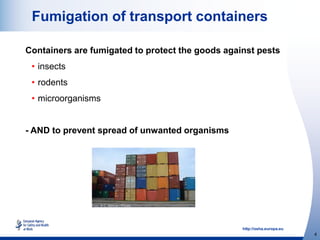
Fumigation of transport containers
Containers are fumigated to protect the goods against pests
• insects
• rodents
• microorganisms
- AND to prevent spread of unwanted organisms
http://osha.europa.eu
5
Objectives
 Provide a review of potential safety and health risks
resulting from exposure to fumigated freight containers in
ports
 Identify prevention gaps
 Suggest recommendations on how these risks can be
minimalized.
 The report describes relevant legislation and policy,
guidance, and examples of preventive actions (good
practices) and strategies that are used, and identifies
health and safety risks including final conclusions and
recommendations.
http://osha.europa.eu
6
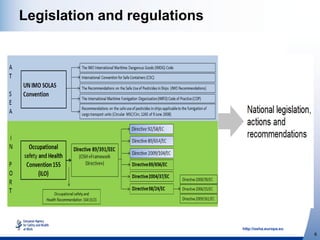
Legislation and regulations
http://osha.europa.eu
7
Relevant fumigants
 Phosphine (PH3) - high acute toxicity, possible long-
term heart effects
 Methyl bromide - acute toxic, long term effects on
CNS
 Formaldehyde - irritating at low concentrations,
severe long-term effects; carcinogenic
 Ethylene oxide - irritating at low concentrations,
severe long-term effects; carcinogenic
Phosphine and Methyl bromide are the major ones today
http://osha.europa.eu
8
Potentially exposed workers
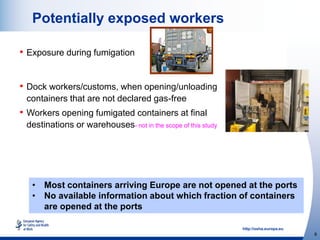
• Exposure during fumigation
• Dock workers/customs, when opening/unloading
containers that are not declared gas-free
• Workers opening fumigated containers at final
destinations or warehouses- not in the scope of this study
• Most containers arriving Europe are not opened at the ports
• No available information about which fraction of containers
are opened at the ports
http://osha.europa.eu
9
Adverse health effects related to fumigated containers
 So far no reports of fatalities
 Several reports describe adverse health effects in workers
opening and unloading containers.
• Representatives from research institutions and regulatory bodies
suggest that a lot of near-accidents and intoxications with serious
outcomes are never reported.
The actual number of incidents with adverse health
effects is not known, severe underreporting is indicated
http://osha.europa.eu
10
Pesticides and types of cargo
Cargo:
• Furniture, wood
• Apparatus, electronics
• Stone
• Plastics, textiles, shoes
• Glass, metal
• Foodstuffs
• Others
General impression:
No consistent distribution of pesticides between types
of cargo - except phosphine in foodstuffs
http://osha.europa.eu
11
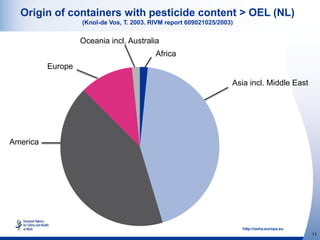
Asia incl. Middle East
America
Africa
Europe
Oceania incl. Australia
Origin of containers with pesticide content > OEL (NL)
(Knol-de Vos, T. 2003. RIVM report 609021025/2003)
http://osha.europa.eu
12
Good practices in opening containers
Have to be based on risk assessments.
 Follow procedures for safe opening, e.g.;
• The Technical Rules for Hazardous Substances“ (TRGS 512) on
Fumigations (BAuA, 2007) https://www.baua.de/EN/Topics/Work-design/Hazardous-
substances/TRGS.html
• Safe handling of gasses in shipping containers (Gezond
Transport, 2011) http://www.kgn-measurement.nl/Protocol%20gasses%20in%20import%20containers.pdf
• Good practice for safely entering shipping containers (WorkSafe
New Zealand, 2017) http://www.worksafe.govt.nz/worksafe/information-guidance/all-guidance-
items/keeping-safe-from-harmful-substances/keeping-safe-from-harmful-substances.pdf
http://osha.europa.eu
13
Preventive actions and strategies
 Identification of risk containers
 Monitoring equipment
 Degasification and ventilation
 Personal protective equipment
http://osha.europa.eu
14
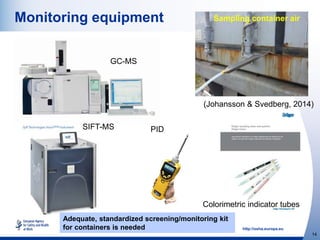
(Johansson & Svedberg, 2014)
GC-MS
SIFT-MS PID
Colorimetric indicator tubes
Monitoring equipment Sampling container air
Adequate, standardized screening/monitoring kit
for containers is needed
http://osha.europa.eu
15
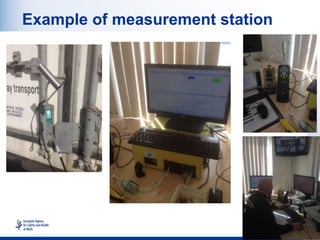
Example of measurement station
http://osha.europa.eu
16
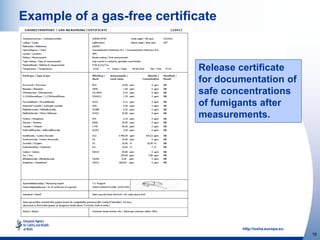
Example of a gas-free certificate
Release certificate
for documentation of
safe concentrations
of fumigants after
measurements.
http://osha.europa.eu
17
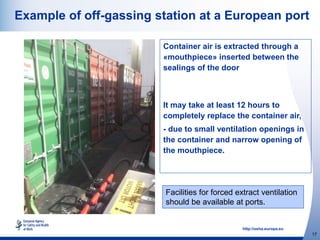
Example of off-gassing station at a European port
Container air is extracted through a
«mouthpiece» inserted between the
sealings of the door
It may take at least 12 hours to
completely replace the container air,
- due to small ventilation openings in
the container and narrow opening of
the mouthpiece.
Facilities for forced extract ventilation
should be available at ports.
http://osha.europa.eu
18
Personal protective equipment (PPE)
 Risk assessments determines when and which type of
PPE to use
 PPE is an option only when other preventive measures
are not sufficient to reduce fumigants below accepted
concentrations
 PPE are recommended when fumigated containers are
opened and entered, e.g. when;
• Inspection by food inspectorate or the customs
• Removing solid residues of phosphine before degasification
Easily understandable information sheets should be available
including figures on what PPE to use for different scenarios
http://osha.europa.eu
19
Conclusions
 The fumigation problem is likely underestimated
 Major problems;
• fumigated containers are almost never labelled
• present practices does not follow safe procedures based on
appropriate risk assessments
 Recommendations and procedures for control
measures should be developed
• measurement technology/strategy, degasification/ventilation
methods and PPE for different scenarios
http://osha.europa.eu
20
Prioritized recommendations
 Containers should not be opened until the risk
assessment concludes that it is safe,
• based on shipping documents or by approved measurements
of the container atmosphere, if necessary after sufficient
ventilation has been performed
 A standardized screening/monitoring procedure
for containers arriving at European harbours
• measurement technology and selection of fumigants, e.g. at
least for MeBr and PH3 with sufficient sensitivity, -at least
below 1/10 of the occupational exposure limit.
 Enforce relevant regulations regarding labelling

Health risks and prevention practices during handling of fumigated containers in ports

  • 1.
    Safety and healthat work is everyone’s concern. It’s good for you. It’s good for business. Health risks and prevention practices during handling of fumigated containers in ports
  • 2.
    http://osha.europa.eu 2 Introduction  EU-OSHA Bilbao: TripartiteEU body committed to making Europe a safer, healthier and more productive place to work, by promoting a culture of risk prevention to improve working conditions.  In 2016 this study has been commissioned to: Helse Bergen, Haukeland Universitetssjukehus (Magne Bråtveit and Rune Djurhuus).  Aim of this presentation today: - to raise awareness of the draft report; - specifically we are interested in SSDC’s input regarding the handling of fumigated containers in practice, e.g. examples of guidelines or good practices related to the prevention of risks from exposure of fumigated containers in ports.
  • 3.
    http://osha.europa.eu 3 Outline  Background  Objectives Methods  Legislation and regulations  Fumigants and potential health risks  Preventive actions and strategies  Conclusions and recommendations
  • 4.
    http://osha.europa.eu 4 Fumigation of transportcontainers Containers are fumigated to protect the goods against pests • insects • rodents • microorganisms - AND to prevent spread of unwanted organisms
  • 5.
    http://osha.europa.eu 5 Objectives  Provide areview of potential safety and health risks resulting from exposure to fumigated freight containers in ports  Identify prevention gaps  Suggest recommendations on how these risks can be minimalized.  The report describes relevant legislation and policy, guidance, and examples of preventive actions (good practices) and strategies that are used, and identifies health and safety risks including final conclusions and recommendations.
  • 6.
  • 7.
    http://osha.europa.eu 7 Relevant fumigants  Phosphine(PH3) - high acute toxicity, possible long- term heart effects  Methyl bromide - acute toxic, long term effects on CNS  Formaldehyde - irritating at low concentrations, severe long-term effects; carcinogenic  Ethylene oxide - irritating at low concentrations, severe long-term effects; carcinogenic Phosphine and Methyl bromide are the major ones today
  • 8.
    http://osha.europa.eu 8 Potentially exposed workers •Exposure during fumigation • Dock workers/customs, when opening/unloading containers that are not declared gas-free • Workers opening fumigated containers at final destinations or warehouses- not in the scope of this study • Most containers arriving Europe are not opened at the ports • No available information about which fraction of containers are opened at the ports
  • 9.
    http://osha.europa.eu 9 Adverse health effectsrelated to fumigated containers  So far no reports of fatalities  Several reports describe adverse health effects in workers opening and unloading containers. • Representatives from research institutions and regulatory bodies suggest that a lot of near-accidents and intoxications with serious outcomes are never reported. The actual number of incidents with adverse health effects is not known, severe underreporting is indicated
  • 10.
    http://osha.europa.eu 10 Pesticides and typesof cargo Cargo: • Furniture, wood • Apparatus, electronics • Stone • Plastics, textiles, shoes • Glass, metal • Foodstuffs • Others General impression: No consistent distribution of pesticides between types of cargo - except phosphine in foodstuffs
  • 11.
    http://osha.europa.eu 11 Asia incl. MiddleEast America Africa Europe Oceania incl. Australia Origin of containers with pesticide content > OEL (NL) (Knol-de Vos, T. 2003. RIVM report 609021025/2003)
  • 12.
    http://osha.europa.eu 12 Good practices inopening containers Have to be based on risk assessments.  Follow procedures for safe opening, e.g.; • The Technical Rules for Hazardous Substances“ (TRGS 512) on Fumigations (BAuA, 2007) https://www.baua.de/EN/Topics/Work-design/Hazardous- substances/TRGS.html • Safe handling of gasses in shipping containers (Gezond Transport, 2011) http://www.kgn-measurement.nl/Protocol%20gasses%20in%20import%20containers.pdf • Good practice for safely entering shipping containers (WorkSafe New Zealand, 2017) http://www.worksafe.govt.nz/worksafe/information-guidance/all-guidance- items/keeping-safe-from-harmful-substances/keeping-safe-from-harmful-substances.pdf
  • 13.
    http://osha.europa.eu 13 Preventive actions andstrategies  Identification of risk containers  Monitoring equipment  Degasification and ventilation  Personal protective equipment
  • 14.
    http://osha.europa.eu 14 (Johansson & Svedberg,2014) GC-MS SIFT-MS PID Colorimetric indicator tubes Monitoring equipment Sampling container air Adequate, standardized screening/monitoring kit for containers is needed
  • 15.
  • 16.
    http://osha.europa.eu 16 Example of agas-free certificate Release certificate for documentation of safe concentrations of fumigants after measurements.
  • 17.
    http://osha.europa.eu 17 Example of off-gassingstation at a European port Container air is extracted through a «mouthpiece» inserted between the sealings of the door It may take at least 12 hours to completely replace the container air, - due to small ventilation openings in the container and narrow opening of the mouthpiece. Facilities for forced extract ventilation should be available at ports.
  • 18.
    http://osha.europa.eu 18 Personal protective equipment(PPE)  Risk assessments determines when and which type of PPE to use  PPE is an option only when other preventive measures are not sufficient to reduce fumigants below accepted concentrations  PPE are recommended when fumigated containers are opened and entered, e.g. when; • Inspection by food inspectorate or the customs • Removing solid residues of phosphine before degasification Easily understandable information sheets should be available including figures on what PPE to use for different scenarios
  • 19.
    http://osha.europa.eu 19 Conclusions  The fumigationproblem is likely underestimated  Major problems; • fumigated containers are almost never labelled • present practices does not follow safe procedures based on appropriate risk assessments  Recommendations and procedures for control measures should be developed • measurement technology/strategy, degasification/ventilation methods and PPE for different scenarios
  • 20.
    http://osha.europa.eu 20 Prioritized recommendations  Containersshould not be opened until the risk assessment concludes that it is safe, • based on shipping documents or by approved measurements of the container atmosphere, if necessary after sufficient ventilation has been performed  A standardized screening/monitoring procedure for containers arriving at European harbours • measurement technology and selection of fumigants, e.g. at least for MeBr and PH3 with sufficient sensitivity, -at least below 1/10 of the occupational exposure limit.  Enforce relevant regulations regarding labelling

Editor's Notes

  • #3 Background: In 2015 the Sectoral Social Dialogue Committee (SSDC) has decided to tackle cargo-related health and safety risks for workers, with a special focus on fumigated containers. The social partners in ports have requested EU–OSHA to perform a review on fumigated containers and their risks for workers in ports. Based on this request EU-OSHA has initiated a study, in which a review will be given of OSH-related risks coming from the exposure from fumigated containers in ports, and recommendations on how such risks can be eliminated or minimalised. Regarding the input: more specific you can think of guidance documents from public institutions, enterprises or trade associations policy documents, best practices and/or campaigns. Also measurement results, inspection campaigns as well as any other national sources of info on the issue, such as reports or annual reporting or monitoring of exposures to supplement the overview study are very welcome. E.g.: Whch risks are reported in published documents? Any accident reports publicly available? Any guidelines? How many containers are not correctly labelled? Why not? What happens at the place of fumigation, why can the fumigation and the obligation of labelling not be better controlled? (better for seafarers and port workers) This includes guidelines that cover the whole process, starting with the fumigation in the harbour of origin.
  • #6 To add to this: It is important to mention that our intention has been to focus on the hándling of Fumigated containers in ports, within the context of the mentioned legislation, guidelines and prevention strategies. In other words, the procedures are there, but not lived upon in many workplaces: we call this the Prevention Gaps.