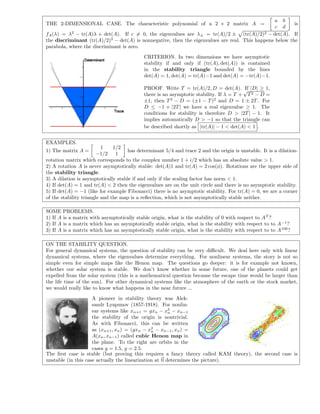
USE OF LINEAR ALGEBRA I                                                                  Math 21b, O. Knill
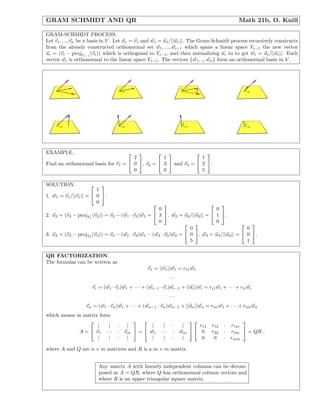
This is not a list of topics covered in the course. It is rather a lose selection of subjects, in which linear algebra is
  useful or relevant. The aim is to convince you that it is worth learning this subject. Most likely, some of this
  handout does not make much sense yet to you. Look at this page at the end of the course again, some of the
                                      content will become more interesting then.

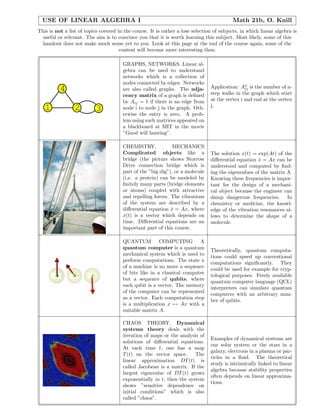
                                       GRAPHS, NETWORKS. Linear al-
                                       gebra can be used to understand
                                       networks which is a collection of
                                       nodes connected by edges. Networks
          4                            are also called graphs. The adja-        Application: An is the number of n-
                                                                                                ij
                                                                                step walks in the graph which start
                                       cency matrix of a graph is defined
                                       by Aij = 1 if there is an edge from      at the vertex i and end at the vertex
   1             2         3           node i to node j in the graph. Oth-      j.
                                       erwise the entry is zero. A prob-
                                       lem using such matrices appeared on
                                       a blackboard at MIT in the movie
                                       ”Good will hunting”.

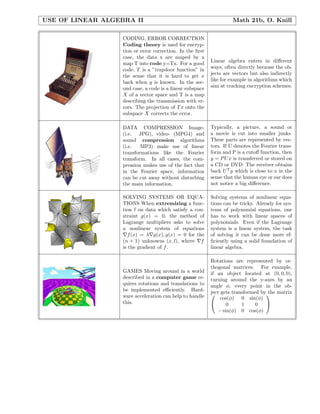
                                       CHEMISTRY,             MECHANICS
                                       Complicated objects like a               The solution x(t) = exp(At) of the
                                       bridge (the picture shows Storrow        differential equation x = Ax can be
                                                                                                      ˙
                                       Drive connection bridge which is         understood and computed by find-
                                       part of the ”big dig”), or a molecule    ing the eigenvalues of the matrix A.
                                       (i.e. a protein) can be modeled by       Knowing these frequencies is impor-
                                       finitely many parts (bridge elements      tant for the design of a mechani-
                                       or atoms) coupled with attractive        cal object because the engineer can
                                       and repelling forces. The vibrations     damp dangerous frequencies. In
                                       of the system are described by a         chemistry or medicine, the knowl-
                                       differential equation x = Ax, where
                                                             ˙                  edge of the vibration resonances al-
                                       x(t) is a vector which depends on        lows to determine the shape of a
                                       time. Differential equations are an       molecule.
                                       important part of this course.

                                       QUANTUM          COMPUTING        A
                                       quantum computer is a quantum
                                                                                Theoretically, quantum computa-
                                       mechanical system which is used to
                                                                                tions could speed up conventional
                                       perform computations. The state x
                                                                                computations significantly. They
                                       of a machine is no more a sequence
                                                                                could be used for example for cryp-
                                       of bits like in a classical computer
                                                                                tological purposes. Freely available
                                       but a sequence of qubits, where
                                                                                quantum computer language (QCL)
                                       each qubit is a vector. The memory
                                                                                interpreters can simulate quantum
                                       of the computer can be represented
                                                                                computers with an arbitrary num-
                                       as a vector. Each computation step
                                                                                ber of qubits.
                                       is a multiplication x → Ax with a
                                       suitable matrix A.

                                       CHAOS THEORY. Dynamical
                                       systems theory deals with the
                                       iteration of maps or the analysis of
                                                                                Examples of dynamical systems are
                                       solutions of differential equations.
                                                                                our solar system or the stars in a
                                       At each time t, one has a map
                                                                                galaxy, electrons in a plasma or par-
                                       T (t) on the vector space.      The
                                                                                ticles in a fluid. The theoretical
                                       linear approximation DT (t) is
                                                                                study is intrinsically linked to linear
                                       called Jacobean is a matrix. If the
                                                                                algebra because stability properties
                                       largest eigenvalue of DT (t) grows
                                                                                often depends on linear approxima-
                                       exponentially in t, then the system
                                                                                tions.
                                       shows ”sensitive dependence on
                                       initial conditions” which is also
                                       called ”chaos”.
USE OF LINEAR ALGEBRA II                                             Math 21b, O. Knill

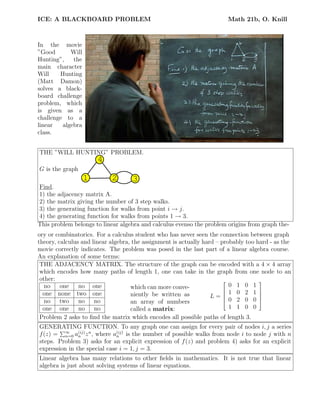
                   CODING, ERROR CORRECTION
                   Coding theory is used for encryp-
                   tion or error correction. In the first
                   case, the data x are maped by a
                   map T into code y=Tx. For a good        Linear algebra enters in different
                   code, T is a ”trapdoor function” in     ways, often directly because the ob-
                   the sense that it is hard to get x      jects are vectors but also indirectly
                   back when y is known. In the sec-       like for example in algorithms which
                   ond case, a code is a linear subspace   aim at cracking encryption schemes.
                   X of a vector space and T is a map
                   describing the transmission with er-
                   rors. The projection of T x onto the
                   subspace X corrects the error.

                   DATA COMPRESSION Image-                 Typically, a picture, a sound or
                   (i.e. JPG), video- (MPG4) and           a movie is cut into smaller junks.
                   sound compression algorithms            These parts are represented by vec-
                   (i.e.   MP3) make use of linear         tors. If U denotes the Fourier trans-
                   transformations like the Fourier        form and P is a cutoff function, then
                   transform. In all cases, the com-       y = P U x is transferred or stored on
                   pression makes use of the fact that     a CD or DVD. The receiver obtains
                   in the Fourier space, information       back U T y which is close to x in the
                   can be cut away without disturbing      sense that the human eye or ear does
                   the main information.                   not notice a big difference.

                   SOLVING SYSTEMS OR EQUA-                Solving systems of nonlinear equa-
                   TIONS When extremizing a func-          tions can be tricky. Already for sys-
                   tion f on data which satisfy a con-     tems of polynomial equations, one
                   straint g(x) = 0, the method of         has to work with linear spaces of
                   Lagrange multipliers asks to solve      polynomials. Even if the Lagrange
                   a nonlinear system of equations         system is a linear system, the task
                     f (x) = λ g(x), g(x) = 0 for the      of solving it can be done more ef-
                   (n + 1) unknowns (x, l), where f        ficiently using a solid foundation of
                   is the gradient of f .                  linear algebra.

                                                           Rotations are represented by or-
                                                           thogonal matrices. For example,
                   GAMES Moving around in a world          if an object located at (0, 0, 0),
                   described in a computer game re-        turning around the y-axes by an
                   quires rotations and translations to    angle φ, every point in the ob-
                   be implemented efficiently. Hard-         ject gets transformed by matrix
                                                                                   the
                   ware acceleration can help to handle    
                                                                cos(φ) 0 sin(φ)
                   this.                                         0      1     0   
                                                              − sin(φ) 0 cos(φ)
USE OF LINEAR ALGEBRA (III)                                       Math 21b, Oliver Knill

                   STATISTICS When analyzing data
                   statistically, one often is interested
                   in the correlation matrix Aij =             For example, if the random variables
                   E[Yi Yj ] of a random vector X =            have a Gaussian (=Bell shaped) dis-
                   (X1 , . . . , Xn ) with Yi = Xi − E[Xi ].   tribution, the correlation matrix to-
                   This matrix is derived from the data        gether with the expectation E[Xi ]
                   and determines often the random             determines the random variables.
                   variables when the type of the dis-
                   tribution is fixed.

                                                               A famous example is the prisoner
                                                               dilemma. Each player has the
                                                               choice to corporate or to cheat.. The
                                                               game is described by a 2x2 matrix
                                                                                      3 0
                                                               like for example                . If a
                                                                                      5 1
                   GAME THEORY Abstract Games                  player cooperates and his partner
                   are often represented by pay-off ma-         also, both get 3 points. If his partner
                   trices. These matrices tell the out-        cheats and he cooperates, he gets 5
                   come when the decisions of each             points. If both cheat, both get 1
                   player are known.                           point. More generally, in a game
                                                               with two players where each player
                                                               can chose from n strategies, the pay-
                                                               off matrix is a n times n matrix
                                                               A. A Nash equilibrium is a vector
                                                               p ∈ S = { i pi = 1, pi ≥ 0 } for
                                                               which qAp ≤ pAp for all q ∈ S.

                   NEURAL NETWORK In part of
                   neural network theory, for exam-
                   ple Hopfield networks, the state
                   space is a 2n-dimensional vector
                   space. Every state of the network
                   is given by a vector x, where each
                                                               For example, if Wij = xi yj , then x
                   component takes the values −1 or
                                                               is a fixed point of the learning map.
                   1. If W is a symmetric nxn matrix,
                   one can define a ”learning map”
                   T : x → signW x, where the sign
                   is taken component wise. The en-
                   ergy of the state is the dot prod-
                   uct −(x, W x)/2. One is interested
                   in fixed points of the map.
USE OF LINEAR ALGEBRA (IV)                                                    Math 21b, Oliver Knill

                         MARKOV. Suppose we have three
                         bags with 10 balls each. Every time              The problem defines a Markov
                         we throw a dice and a 5 shows up,                chain described 
                                                                                             by a matrix
                         we move a ball from bag 1 to bag 2,                 5/6 1/6 0
                         if the dice shows 1 or 2, we move a               0 2/3 1/3 .
                         ball from bag 2 to bag 3, if 3 or 4                 1/6 1/6 2/3
                         turns up, we move a ball from bag 3              From this matrix, the equilibrium
                         to bag 1 and a ball from bag 3 to bag            distribution can be read off as an
                         2. What distribution of balls will we            eigenvector of a matrix.
                         see in average?

                         SPLINES In computer aided de-
                         sign (CAD) used for example to
                                                                          If we write down the conditions, we
                         construct cars, one wants to inter-
                                                                          will have to solve a system of 4 equa-
                         polate points with smooth curves.
                                                                          tions for four unknowns. Graphic
                         One example: assume you want to
                                                                          artists (i.e. at the company ”Pixar”)
                         find a curve connecting two points
                                                                          need to have linear algebra skills also
                         P and Q and the direction is given
                                                                          at many other topics in computer
                         at each point. Find a cubic function
                                                                          graphics.
                         f (x, y) = ax3 + bx2 y + cxy 2 + dy 3
                         which interpolates.

                         SYMBOLIC DYNAMICS Assume
                         that a system can be in three dif-
                                                                          The dynamics of the system is
                         ferent states a, b, c and that tran-
                                                                          coded with a symbolic dynamical
                         sitions a → b, b → a, b → c,
                                                                          system. The transition matrix is
                                                                                     
                         c → c, c → a are allowed. A
                                                                              0 1 0
     a               c   possible evolution of the system is
                         then a, b, a, b, a, c, c, c, a, b, c, a... One
                                                                           1 0 1 .
                                                                              1 0 1
                         calls this a description of the system
                                                                          Information theoretical quantities
                         with symbolic dynamics. This
                                                                          like the ”entropy” can be read off
                         language is used in information the-
             b           ory or in dynamical systems theory.
                                                                          from this matrix.


                         INVERSE PROBLEMS The recon-
                         struction of a density function from             Toy problem: We have 4 containers
                         projections along lines reduces to               with density a, b, c, d arranged in a
                         the solution of the Radon trans-                 square. We are able and measure
 q       r               form. Studied first in 1917, it is to-            the light absorption by by sending
                         day a basic tool in applications like            light through it. Like this, we get
     a       b           medical diagnosis, tokamak moni-                 o = a + b,p = c + d,q = a + c and
                 o
                         toring, in plasma physics or for as-             r = b + d. The problem is to re-
                         trophysical applications. The re-                cover a, b, c, d. The system of equa-
     c       d           construction is also called tomogra-
                 p                                                        tions is equivalent to Ax = b, with
                         phy. Mathematical tools developed                x = (a, b, c, d) and b = (o, p, q, r) and
                                                                                                
                         for the solution of this problem lead                    1 1 0 0
                         to the construction of sophisticated                   0 0 1 1 
                                                                          A=   1 0 1 0 .
                                                                                                 
                         scanners. It is important that the
                         inversion h = R(f ) → f is fast, ac-                     0 1 0 1
                         curate, robust and requires as few
                         datas as possible.
ICE: A BLACKBOARD PROBLEM                                               Math 21b, O. Knill


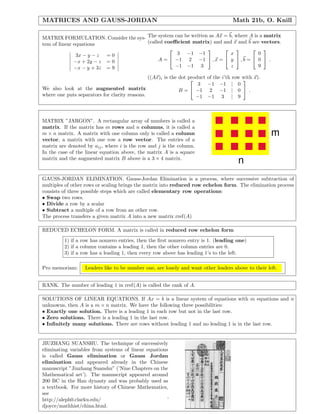
In the movie
”Good       Will
Hunting”,    the
main character
Will    Hunting
(Matt Damon)
solves a black-
board challenge
problem, which
is given as a
challenge to a
linear   algebra
class.


THE ”WILL HUNTING” PROBLEM.
                       4
G is the graph
                   1        2       3
Find.
1) the adjacency matrix A.
2) the matrix giving the number of 3 step walks.
3) the generating function for walks from point i → j.
4) the generating function for walks from points 1 → 3.
This problem belongs to linear algebra and calculus evenso the problem origins from graph the-
ory or combinatorics. For a calculus student who has never seen the connection between graph
theory, calculus and linear algebra, the assignment is actually hard – probably too hard - as the
movie correctly indicates. The problem was posed in the last part of a linear algebra course.
An explanation of some terms:
 THE ADJACENCY MATRIX. The structure of the graph can be encoded with a 4 × 4 array
 which encodes how many paths of length 1, one can take in the graph from one node to an
 other:                                                                             
   no one       no one              which can more conve-                 0 1 0 1
                                                                         1 0 2 1 
  one none two one                  niently be written as          L=
                                                                                    
                                                                                     
   no two no no                     an array of numbers                  0 2 0 0 
  one one       no no               called a matrix:                      1 1 0 0
 Problem 2 asks to find the matrix which encodes all possible paths of length 3.
GENERATING FUNCTION. To any graph one can assign for every pair of nodes i, j a series
f (z) = ∞ a(ij) z n , where a(ij) is the number of possible walks from node i to node j with n
          n=0 n               n
steps. Problem 3) asks for an explicit expression of f (z) and problem 4) asks for an explicit
expression in the special case i = 1, j = 3.
Linear algebra has many relations to other fields in mathematics. It is not true that linear
algebra is just about solving systems of linear equations.
SOLUTION TO 2). [L2 ]ij is by definition of the matrix product the sum Li1 L1j + Li2 L2j +
... + Li4 Lhj . Each term Li1 L1j is 1 if and only if there is a path of length 2 going from i to j
passing through k. Therefore [L2 ]ij is the number of paths of length 2 going from node i to j.
Similarly, [Ln ]ij is the number of paths of length n going from i to j. The answer is
                                                                             
                                                          2 7 2 3
                                                         7 2 12 7            
                                                                             
                                             L3 =                            
                                                         2 12 0 2            
                                                          3 7 2 2


SOLUTION TO 3). The geometric series formula

                                                      xn = (1 − x)−1
                                                  n

holds also for matrices:
                                     ∞                       ∞
                           f (z) =         [Ln ]ij z n = [         Ln z n )]ij = (1 − Lz)−1
                                     n=0                     n=0

Cramers formula for the inverse of a matrix which involves the determinant

                                             A−1 = det(Aij )/det(A)
This leads to an explicit formula

                                           det(1 − zLij )/det(1 − zL)
which can also be written as
                                           det(Lij − z)/det(L − z) .


SOLUTION TO 4). This is the special case, when i = 1 and j = 3.
                                                                    
                                        1 −z 1
                                      
                     det(L − z) = det( 0 2  0 ) = −2 − z + 3z 2 − z 3 .
                                               
                                        1 1 −z
                                                                        
                                           −z 1   0  1
                                           1 −z 2   1                   
                                                                        
                     det(L − z) =                                          = 4 − 2z − 7z 2 + z 4
                                           0  2 −z 0                    
                                            1  1  0 −z
The final result is
                              (z 3 + 3z 2 − z − 2)/(z 4 − 7z 2 − 2z + 4) .
LINEAR EQUATIONS                                                                      Math 21b, O. Knill

SYSTEM OF LINEAR EQUATIONS. A collection of linear equations is called a system of linear equations.
An example is
                                    3x − y − z = 0
                                   −x + 2y − z = 0 .
                                   −x − y + 3z = 9
It consists of three equations for three unknowns x, y, z. Linear means that no nonlinear terms like
x2 , x3 , xy, yz 3 , sin(x) etc. appear. A formal definition of linearity will be given later.

LINEAR EQUATION. More precicely, ax + by = c is the general linear equation in two variables. ax +
by + cz = d is the general linear equation in three variables. The general linear equation in n variables is
 a1 x1 + a2 x2 + ... + an xn = 0 Finitely many such equations form a system of linear equations.

SOLVING BY ELIMINATION.
Eliminate variables. In the example the first equation gives        z = 3x − y. Putting this into the second and
third equation gives
                                      −x + 2y − (3x − y)           =0
                                      −x − y + 3(3x − y)           =9
or
                                          −4x + 3y = 0
                                                                   .
                                           8x − 4y = 9
The first equation gives y = 4/3x and plugging this into the other equation gives 8x − 16/3x = 9 or 8x = 27
which means x = 27/8. The other values y = 9/2, z = 45/8 can now be obtained.

SOLVE BY SUITABLE SUBTRACTION.
Addition of equations. If we subtract the third equation from the second, we get 3y − 4z = −9 and add
three times the second equation to the first, we get 5y − 4z = 0. Subtracting this equation to the previous one
gives −2y = −9 or y = 2/9.

SOLVE BY COMPUTER.
Use the computer. In Mathematica:

                    Solve[{3x − y − z == 0, −x + 2y − z == 0, −x − y + 3z == 9}, {x, y, z}] .

But what did Mathematica do to solve this equation? We will look in this course at some efficient algorithms.


GEOMETRIC SOLUTION.

Each of the three equations represents a plane in
three-dimensional space. Points on the first plane
satisfy the first equation. The second plane is the
solution set to the second equation. To satisfy the
first two equations means to be on the intersection
of these two planes which is here a line. To satisfy
all three equations, we have to intersect the line with
the plane representing the third equation which is a
point.


LINES,    PLANES, HYPERPLANES.
The set   of points in the plane satisfying ax + by = c form a line.
The set   of points in space satisfying ax + by + cd = d form a plane.
The set   of points in n-dimensional space satisfying a 1 x1 + ... + an xn = a0 define a set called a hyperplane.
RIDDLES:
”15 kids have bicycles or tricycles. Together they            Solution. With x bicycles and y tricycles, then x +
count 37 wheels. How many have bicycles?”                     y = 15, 2x + 3y = 37. The solution is x = 8, y = 7.

                                                              Solution If there are x brothers and y systers, then
”Tom, the brother of Carry has twice as many sisters
                                                              Tom has y sisters and x − 1 brothers while Carry has
as brothers while Carry has equal number of systers
                                                              x brothers and y − 1 sisters. We know y = 2(x −
and brothers. How many kids is there in total in this
                                                              1), x = y − 1 so that x + 1 = 2(x − 1) and so x =
family?”
                                                              3, y = 4.

INTERPOLATION.

                                      Solution. Assume the parabola is
Find the equation of the              ax2 + bx + c = 0. So, c = −1, a + b + c =
parabola which passes through         4, 4a+2b+c = 13. Elimination of c gives
the points P       =     (0, −1),     a + b = 5, 4a + 2b = 14 so that 2b = 6
Q = (1, 4) and R = (2, 13).           and b = 3, a = 2. The parabola has the
                                      equation 2x2 + 3x − 1 = 0


TOMOGRAPHY
Here is a toy example of a problem one has to solve for magnetic
resonance imaging (MRI), which makes use of the absorption and
emission of energy in the radio frequency range of the electromag-
netic spectrum.


                                                                                  q         r
Assume we have 4 hydrogen atoms whose nuclei are excited with
intensity a, b, c, d. We measure the spin echo intensity in 4 different                a         b
directions. 3 = a + b,7 = c + d,5 = a + c and 5 = b + d. What                                          o
is a, b, c, d? Solution: a = 2, b = 1, c = 3, d = 4. However,
also a = 0, b = 3, c = 5, d = 2 solves the problem. This system
has not a unique solution even so there are 4 equations and 4                         c         d
unknowns. A good introduction into MRI can be found online at                                          p
(http://www.cis.rit.edu/htbooks/mri/inside.htm).


INCONSISTENT. x − y = 4, y + z = 5, x + z = 6 is a system with no solutions. It is called inconsistent.

                            EQUILIBRIUM. As an example of a system with many
                            variables, consider a drum modeled by a fine net. The
                            heights at each interior node needs the average the
a11     a12   a13     a14   heights of the 4 neighboring nodes. The height at the
                            boundary is fixed. With n2 nodes in the interior, we
a21     x11   x12     a24   have to solve a system of n2 equations. For exam-
                            ple, for n = 2 (see left), the n2 = 4 equations are
                            x11 = a21 + a12 + x21 + x12 , x12 = x11 + x13 + x22 + x22 ,
a31     x21   x22     a34
                            x21 = x31 +x11 +x22 +a43 , x22 = x12 +x21 +a43 +a34 . To
                            the right, we see the solution to a problem with n = 300,
a41     a42   a43     a44   where the computer had to solve a system with 90 000
                            variables.

LINEAR OR NONLINEAR?
a) The ideal gas law P V = nKT for the P, V, T , the pressure, volume and temperature of the gas.
b) The Hook law F = k(x − x0 ) relates the force F pulling a string at position x which is relaxed at x 0 .
MATRICES AND GAUSS-JORDAN                                                             Math 21b, O. Knill

MATRIX FORMULATION. Consider the sys- The system can be written as Ax = b, where A is a matrix
tem of linear equations               (called coefficient matrix) and and x and b are vectors.
                                                                                   
               3x − y − z = 0                      3 −1 −1               x           0
              −x + 2y − z = 0              A =  −1 2 −1  , x =  y  , b =  0  .
              −x − y + 3z = 9                     −1 −1 3                z           9

                                               ((Ax)i is the dot product
                                                                          of the i’th row with x).
                                                                                           
                                                                     3     −1 −1 | 0
We also look at the augmented matrix                         B =  −1       2 −1 | 0  .
where one puts separators for clarity reasons.                      −1     −1 3 | 9


MATRIX ”JARGON”. A rectangular array of numbers is called a
matrix. If the matrix has m rows and n columns, it is called a
m × n matrix. A matrix with one column only is called a column                                        m
vector, a matrix with one row a row vector. The entries of a
matrix are denoted by aij , where i is the row and j is the column.
In the case of the linear equation above, the matrix A is a square
matrix and the augmented matrix B above is a 3 × 4 matrix.
                                                                                         n
GAUSS-JORDAN ELIMINATION. Gauss-Jordan Elimination is a process, where successive subtraction of
multiples of other rows or scaling brings the matrix into reduced row echelon form. The elimination process
consists of three possible steps which are called elementary row operations:
• Swap two rows.
• Divide a row by a scalar
• Subtract a multiple of a row from an other row.
The process transfers a given matrix A into a new matrix rref(A)

REDUCED ECHELON FORM. A matrix is called in reduced row echelon form
         1) if a row has nonzero entries, then the first nonzero entry is 1. (leading one)
         2) if a column contains a leading 1, then the other column entries are 0.
         3) if a row has a leading 1, then every row above has leading 1’s to the left.

Pro memoriam:     Leaders like to be number one, are lonely and want other leaders above to their left.


RANK. The number of leading 1 in rref(A) is called the rank of A.

SOLUTIONS OF LINEAR EQUATIONS. If Ax = b is a linear system of equations with m equations and n
unknowns, then A is a m × n matrix. We have the following three possibilities:
• Exactly one solution. There is a leading 1 in each row but not in the last row.
• Zero solutions. There is a leading 1 in the last row.
• Infinitely many solutions. There are rows without leading 1 and no leading 1 is in the last row.


JIUZHANG SUANSHU. The technique of successively
eliminating variables from systems of linear equations
is called Gauss elimination or Gauss Jordan
elimination and appeared already in the Chinese
manuscript ”Jiuzhang Suanshu” (’Nine Chapters on the
Mathematical art’). The manuscript appeared around
200 BC in the Han dynasty and was probably used as
a textbook. For more history of Chinese Mathematics,
see
http://aleph0.clarku.edu/                            ˜
djoyce/mathhist/china.html.
EXAMPLES. The reduced echelon form of the augmented matrix
B determines on how many solutions the linear system Ax = b
has.

      THE GOOD (1 solution)                                  THE BAD (0 solution)      THE UGLY (∞ solutions)


           0    1           2            |    2                               
                                                                0    1 2 | 2
           1    −1          1            |    5
                                                              1     −1 1 | 5                               
           2    1           −1           |   −2
                                                                1    0 3 | −2                 0 1       2 | 2
           1    −1          1            |    5                                            1 −1      1 | 5 
           0    1           2            |    2                 1    −1 1 | 5                 1 0       3 | 7
           2    1           −1           |   −2               0     1 2 | 2                                
                                                                1    0 3 | −2                 1 −1      1 | 5
        1       −1          1        |        5                                              0 1
        0       1           2        |        2                                                       2 | 2 
                                                                1    −1 1 | 5                 1 0       3 | 7
        0       3           −3       |       −12              0     1 2 | 2                                
           1    −1          1            |    5                 0    1 2 | −7                 1 −1      1 | 5
           0    1           2            |    2                                            0 1       2 | 2 
           0    1           −1           |   −4                 1    −1 1 | 5                 0 1       2 | 2
                                                              0     1 2 | 2                                
            1       0        3       |       7                                                1 −1      1 | 5
            0       1        2       |       2                  0    0 0 | −9
                                                                                           0 1       2 | 2 
            0       0       −3       |       −6                  1   0 3 | 7                  0 0       0 | 0
                1       0    3       |       7                 0    1 2 | 2                                 
                0       1    2       |       2                   0   0 0 | −9                   1   0    3 | 7
                0       0    1       |       2                                               0   1    2 | 2 
                                                              1      0  3 | 7                 0   0    0 | 0
       1            0            0           |     1         0
                                                                      1  2 | 2 
       0            1            0           |    −2                                Rank(A) = 2, Rank(B) = 2.
                                                                0      0  0 | 1
       0            0            1           |     2
Rank(A) = 3, Rank(B) = 3.                                Rank(A) = 2, Rank(B) = 3.


JORDAN. The German geodesist Wilhelm Jordan (1842-1899) applied the Gauss-Jordan method to finding
squared errors to work on surveying. (An other ”Jordan”, the French Mathematician Camille Jordan (1838-
1922) worked on linear algebra topics also (Jordan form) and is often mistakenly credited with the Gauss-Jordan
process.)


GAUSS. Gauss developed Gaussian elimination around 1800 and used it to
solve least squares problems in celestial mechanics and later in geodesic compu-
tations. In 1809, Gauss published the book ”Theory of Motion of the Heavenly
Bodies” in which he used the method for solving astronomical problems. One
of Gauss successes was the prediction of an asteroid orbit using linear algebra.


CERES. On 1. January of 1801, the Italian astronomer Giuseppe Piazzi (1746-
1826) discovered Ceres, the first and until 2001 the largest known asteroid in the
solar system. (A new found object called 2001 KX76 is estimated to have a 1200 km
diameter, half the size of Pluto) Ceres is a rock of 914 km diameter. (The pictures
Ceres in infrared light). Gauss was able to predict the orbit of Ceres from a few
observations. By parameterizing the orbit with parameters and solving a linear
system of equations (similar to one of the homework problems, where you will fit a
cubic curve from 4 observations), he was able to derive the orbit parameters.
ON SOLUTIONS OF LINEAR EQUATIONS                                                  Math 21b, O. Knill

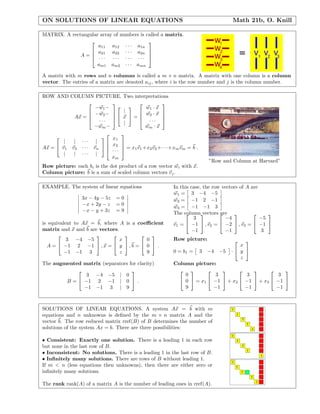
MATRIX. A rectangular array of numbers is called a matrix.
                                                                         w1
                     a11 a12 · · · a1n
                                                                           w2
                   a
              A =  21
                   ···
                           a22 · · · a2n 
                           ··· ··· ··· 
                                           
                                                                           w3            = v v v         1   2   3
                     am1 am2 · · · amn                                     w4
A matrix with m rows and n columns is called a m × n matrix. A matrix with one column is a column
vector. The entries of a matrix are denoted aij , where i is the row number and j is the column number.

ROW AND COLUMN PICTURE. Two interpretations
                                           
                    −w1 −            w1 · x
                   −w2 −     |             
           Ax =                 w2 · x 
                   ...  x =  ... 
                               |
                    −wm −              wm · x
                             
                      x1
        |  | ··· |       x 
Ax =  v1 v2 · · · vn   2  = x1 v1 +x2 v2 +· · ·+xm vm = b .
                         ··· 
        |  | ··· |
                          xm
                                                                         ”Row and Column at Harvard”
Row picture: each bi is the dot product of a row vector wi with x.
Column picture: b is a sum of scaled column vectors vj .

EXAMPLE. The system of linear equations                In this case, the row vectors of A are
                                                       w1 = 3 −4 −5
                3x − 4y − 5z   =0                      w2 = −1 2 −1
                −x + 2y − z    =0
                                                       w3 = −1 −1 3
                −x − y + 3z    =9
                                                       The column
                                                                    vectors 
                                                                             are               
                                                                 3             −4             −5
is equivalent to Ax = b, where A is a coefficient        v1 =  −1  , v2 =  −2  , v3 =  −1 
matrix and x and b are vectors.                                 −1             −1             3
                                      
           3 −4 −5              x        0             Row picture:                  
  A =  −1 2 −1  , x =  y  , b =  0  .                                         x
          −1 −1 3               z        9             0 = b1 =      3   −4 −5   · y 
                                                                                    z
The augmented matrix (separators for clarity)          Column picture:
                                                                                        
               3 −4 −5 | 0                                 0           3           3           3
        B =  −1 2 −1 | 0  .                             0  = x1  −1  + x2  −1  + x3  −1 
              −1 −1 3 | 9                                  9          −1          −1          −1


SOLUTIONS OF LINEAR EQUATIONS. A system Ax = b with m                            1
equations and n unknowns is defined by the m × n matrix A and the                     1
                                                                                         1
vector b. The row reduced matrix rref(B) of B determines the number of                       1
solutions of the system Ax = b. There are three possibilities:                                   1

                                                                                 1
• Consistent: Exactly one solution. There is a leading 1 in each row                 1
but none in the last row of B.                                                           1
                                                                                             1
• Inconsistent: No solutions. There is a leading 1 in the last row of B.
                                                                                                         1
• Infinitely many solutions. There are rows of B without leading 1.
                                                                                 1
If m < n (less equations then unknowns), then there are either zero or               1
infinitely many solutions.                                                                1
                                                                                                 1
                                                                                                     1
The rank rank(A) of a matrix A is the number of leading ones in rref(A).
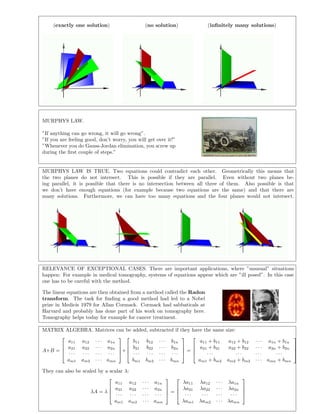
(exactly one solution)                    (no solution)            (infinitely many solutions)


MURPHYS LAW.

”If anything can go wrong, it will go wrong”.
”If you are feeling good, don’t worry, you will get over it!”
”Whenever you do Gauss-Jordan elimination, you screw up
during the first couple of steps.”


MURPHYS LAW IS TRUE. Two equations could contradict each other. Geometrically this means that
the two planes do not intersect. This is possible if they are parallel. Even without two planes be-
ing parallel, it is possible that there is no intersection between all three of them. Also possible is that
we don’t have enough equations (for example because two equations are the same) and that there are
many solutions. Furthermore, we can have too many equations and the four planes would not intersect.


RELEVANCE OF EXCEPTIONAL CASES. There are important applications, where ”unusual” situations
happen: For example in medical tomography, systems of equations appear which are ”ill posed”. In this case
one has to be careful with the method.

The linear equations are then obtained from a method called the Radon
transform. The task for finding a good method had led to a Nobel
prize in Medicis 1979 for Allan Cormack. Cormack had sabbaticals at
Harvard and probably has done part of his work on tomography here.
Tomography helps today for example for cancer treatment.

MATRIX ALGEBRA.         Matrices can be added, subtracted if they have the same   size:
                                                                                                          
        a11 a12         · · · a1n       b11 b12 · · · b1n            a11 + b11     a12 + b12   · · · a1n + b1n
       a21 a22         · · · a2n   b21 b22 · · · b2n   a21 + b21              a22 + b22   · · · a2n + b2n 
A+B = 
       ···
                                  +                         =                                              
            ···         ··· ···   ··· ··· ··· ···                   ···           ···      ···      ···    
        am1 am2         · · · amn       bm1 bm2 · · · bmn           am1 + bm2     am2 + bm2    · · · amn + bmn

They can also be scaled by a scalar λ:
                                                                                   
                               a11 a12       · · · a1n     λa11     λa12   · · · λa1n
                             a21 a22        · · · a2n   λa21     λa22   · · · λa2n 
                     λA = λ 
                             ···
                                                       =                            
                                       ···   ··· ···   ···         ···   ···    ··· 
                               am1 am2       · · · amn     λam1     λam2   · · · λamn
LINEAR TRANSFORMATIONS                                                                  Math 21b, O. Knill

TRANSFORMATIONS. A transformation T from a set X to a set Y is a rule, which assigns to every element
in X an element y = T (x) in Y . One calls X the domain and Y the codomain. A transformation is also called
a map.

LINEAR TRANSFORMATION. A map T from Rn to Rm is called a linear transformation if there is a
m × n matrix A such that
                                   T (x) = Ax .


EXAMPLES.


                                                                                      3 4
   • To the linear transformation T (x, y) = (3x+4y, x+5y) belongs the matrix                . This transformation
                                                                                      1 5
     maps the plane onto itself.

   • T (x) = −3x is a linear transformation from the real line onto itself. The matrix is A = [−3].

   • To T (x) = y · x from R3 to R belongs the matrix A = y = y1 y2 y3 . This 1 × 3 matrix is also called
     a row vector. If the codomain is the real axes, one calls the map also a function. function defined on
     space.
                                                
                                             y1
   • T (x) = xy from R to R3 . A = y =  y2  is a 3 × 1 matrix which is also called a column vector. The
                                             y3
     map defines a line in space.
                                                                         
                                                                      1 0
   • T (x, y, z) = (x, y) from R3 to R2 , A is the 2 × 3 matrix A =  0 1 . The map projects space onto a
                                                                      0 0
     plane.
                                                                                        1 1   2
   • To the map T (x, y) = (x + y, x − y, 2x − 3y) belongs the 3 × 2 matrix A =                        . The image
                                                                                        1 −1 −3
     of the map is a plane in three dimensional space.

   • If T (x) = x, then T is called the identity transformation.


PROPERTIES OF LINEAR TRANSFORMATIONS. T (0) = 0                        T (x + y) = T (x) + T (y)   T (λx) = λT (x)

In words: Linear transformations are compatible with addition and scalar multiplication. It does not matter,
whether we add two vectors before the transformation or add the transformed vectors.

ON LINEAR TRANSFORMATIONS. Linear transformations generalize the scaling transformation x → ax in
one dimensions.
They are important in

   • geometry (i.e. rotations, dilations, projections or reflections)

   • art (i.e. perspective, coordinate transformations),

   • CAD applications (i.e. projections),

   • physics (i.e. Lorentz transformations),

   • dynamics (linearizations of general maps are linear maps),

   • compression (i.e. using Fourier transform or Wavelet trans-
     form),

   • coding (many codes are linear codes),

   • probability (i.e. Markov processes).

   • linear equations (inversion is solving the equation)
LINEAR TRANSFORMATION OR NOT? (The square to the right is the image of the square to the left):


                                                                                                 
                                                                              |   |     ··· |
COLUMN VECTORS. A linear transformation T (x) = Ax with A =  v1 v2                     · · · vn  has the property
                                                                              | |     ·· | 
                                                                                        ·                        
                                                                                   1               0             0
                                                                                 ·              ·           · 
                                                                                                              
that the column vector v1 , vi , vn are the images of the standard vectors e1 =  ·
                                                                                
                                                                                        . e i =  1  . e n =  · .
                                                                                                               
                                                                                 ·              ·           · 
                                                                                   0               0             1

                        In order to find the matrix of a linear transformation, look at the
                        image of the standard vectors and use those to build the columns
                        of the matrix.


QUIZ.
a) Find the matrix belonging to the linear transformation, which rotates a cube around the diagonal (1, 1, 1)
by 120 degrees (2π/3).
b) Find the linear transformation, which reflects a vector at the line containing the vector (1, 1, 1).

INVERSE OF A TRANSFORMATION. If S is a second transformation such that S(T x) = x, for every x, then
S is called the inverse of T . We will discuss this more later.

SOLVING A LINEAR SYSTEM OF EQUATIONS. Ax = b means to invert the linear transformation x → Ax.
If the linear system has exactly one solution, then an inverse exists. We will write x = A −1 b and see that the
inverse of a linear transformation is again a linear transformation.


THE BRETSCHER CODE. Otto Bretschers book contains as a motivation a
”code”, where the encryption happens with the linear map T (x, y) = (x + 3y, 2x +
5y). The map has the inverse T −1 (x, y) = (−5x + 3y, 2x − y).

Cryptologists use often the following approach to crack a encryption. If one knows the input and output of
some data, one often can decode the key. Assume we know, the enemy uses a Bretscher code and we know that
                                                                                                      a b
T (1, 1) = (3, 5) and T (2, 1) = (7, 5). How do we get the code? The problem is to find the matrix A =     .
                                                                                                      c d

2x2 MATRIX. It is useful to decode the Bretscher code in general If ax + by = X and cx + dy = Y , then
                                                                                                    a b
x = (dX − bY )/(ad − bc), y = (cX − aY )/(ad − bc). This is a linear transformation with matrix A =
                                                                                                    c d
                                  −1      d −b
and the corresponding matrix is A =                 /(ad − bc).
                                         −c a

                         ”Switch diagonally, negate the wings and scale with a cross”.
LINEAR TRAFOS IN GEOMETRY                                                                Math 21b, O. Knill


LINEAR TRANSFORMATIONS DE-
FORMING A BODY


A CHARACTERIZATION OF LINEAR TRANSFORMATIONS: a transformation T from R n to Rm which
satisfies T (0) = 0, T (x + y) = T (x) + T (y) and T (λx) = λT (x) is a linear transformation.
Proof. Call vi = T (ei ) and define S(x) = Ax. Then S(ei ) = T (ei ). With x = x1 e1 + ... + xn en , we have
T (x) = T (x1 e1 + ... + xn en ) = x1 v1 + ... + xn vn as well as S(x) = A(x1 e1 + ... + xn en ) = x1 v1 + ... + xn vn
proving T (x) = S(x) = Ax.

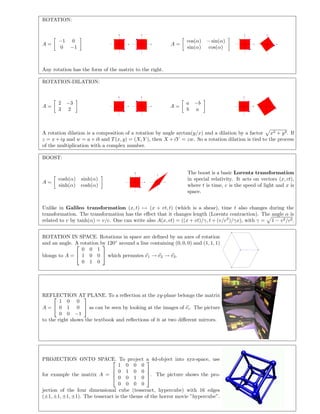
SHEAR:


       1 0                                                         1 1
A=                                                          A=
       1 1                                                         0 1


In general, shears are transformation in the plane with the property that there is a vector w such that T (w) = w
and T (x) − x is a multiple of w for all x. If u is orthogonal to w, then T (x) = x + (u · x)w.

SCALING:


       2 0                                                         1/2 0
A=                                                          A=
       0 2                                                          0 1/2


One can also look at transformations which scale x differently then y and where A is a diagonal matrix.

REFLECTION:


       cos(2α)  sin(2α)                                            1 0
A=                                                          A=
       sin(2α) − cos(2α)                                           0 −1


Any reflection at a line has the form of the matrix to the left. A reflection at a line containing a unit vector u
                                           2u2 − 1 2u1 u2
                                             1
is T (x) = 2(x · u)u − x with matrix A =
                                            2u1 u2 2u2 − 1
                                                       2


PROJECTION:


       1 0                                                         0   0
A=                                                         A=
       0 0                                                         0   1


                                                                                             u1 u1   u2 u1
A projection onto a line containing unit vector u is T (x) = (x · u)u with matrix A =
                                                                                             u1 u2   u2 u2
ROTATION:


       −1   0                                                    cos(α) − sin(α)
A=                                                        A=
        0   −1                                                   sin(α) cos(α)


Any rotation has the form of the matrix to the right.

ROTATION-DILATION:


       2 −3                                                      a   −b
A=                                                        A=
       3 2                                                       b   a


A rotation dilation is a composition of a rotation by angle arctan(y/x) and a dilation by a factor x2 + y 2 . If
z = x + iy and w = a + ib and T (x, y) = (X, Y ), then X + iY = zw. So a rotation dilation is tied to the process
of the multiplication with a complex number.

BOOST:

                                                                  The boost is a basic Lorentz transformation
       cosh(α) sinh(α)                                            in special relativity. It acts on vectors (x, ct),
A=
       sinh(α) cosh(α)                                            where t is time, c is the speed of light and x is
                                                                  space.


Unlike in Galileo transformation (x, t) → (x + vt, t) (which is a shear), time t also changes during the
transformation. The transformation has the effect that it changes length (Lorentz contraction). The angle α is
related to v by tanh(α) = v/c. One can write also A(x, ct) = ((x + vt)/γ, t + (v/c 2 )/γx), with γ = 1 − v 2 /c2 .


ROTATION IN SPACE. Rotations in space are defined by an axes of rotation
and an angle. A rotation by 120◦ around a line containing (0, 0, 0) and (1, 1, 1)
                         
                 0 0 1
blongs to A =  1 0 0  which permutes e1 → e2 → e3 .
                 0 1 0


REFLECTION AT PLANE. To a reflection at the xy-plane belongs the matrix
                 
        1 0 0
A =  0 1 0  as can be seen by looking at the images of ei . The picture
        0 0 −1
to the right shows the textbook and reflections of it at two different mirrors.


PROJECTION ONTO SPACE. To project a 4d-object into xyz-space, use
                                             
                                  1 0 0 0
                               0 1 0 0 
for example the matrix A =                   
                               0 0 1 0 . The picture shows the pro-
                                  0 0 0 0
jection of the four dimensional cube (tesseract, hypercube) with 16 edges
(±1, ±1, ±1, ±1). The tesseract is the theme of the horror movie ”hypercube”.
THE INVERSE                                                                           Math 21b, O. Knill


INVERTIBLE TRANSFORMATIONS. A map T from X
to Y is invertible if there is for every y ∈ Y a unique                             ⇒
point x ∈ X such that T (x) = y.


EXAMPLES.
1) T (x) = x3 is invertible from X = R to X = Y .
2) T (x) = x2 is not invertible from X = R to X = Y .
3) T (x, y) = (x2 + 3x − y, x) is invertible from X = R2 to Y = R2 .
4) T (x) = Ax linear and rref(A) has an empty row, then T is not invertible.
5) If T (x) = Ax is linear and rref(A) = 1n , then T is invertible.

INVERSE OF LINEAR TRANSFORMATION. If A is a n × n matrix and T : x → Ax has an inverse S, then
S is linear. The matrix A−1 belonging to S = T −1 is called the inverse matrix of A.

First proof: check that S is linear using the characterization S(a + b) = S(a) + S(b), S(λa) = λS(a) of linearity.
Second proof: construct the inverse using Gauss-Jordan elimination.

FINDING THE INVERSE. Let 1n be the n × n identity matrix. Start with [A|1n ] and perform Gauss-Jordan
elimination. Then


                                               rref([A|1n ]) = 1n |A−1


Proof. The elimination process actually solves Ax = e i simultaneously. This leads to solutions vi which are the
columns of the inverse matrix A−1 because A−1 ei = vi .

                                           2   6
EXAMPLE. Find the inverse of A =                   .
                                           1   4


  2   6   |   1 0
                                      A | 12
  1   4   |   0 1
  1   3   |   1/2 0
                                      .... | ...
  1   4   |    0 1
  1   3   |    1/2 0
                                      .... | ...
  0   1   |   −1/2 1
  1   0   |     2   −3
                                      12   | A−1
  0   1   |   −1/2 1


                          2      −3
The inverse is A−1 =                   .
                         −1/2    1

THE INVERSE OF LINEAR MAPS R2 → R2 :

                                                                                          a b
                  If ad−bc = 0, the inverse of a linear transformation x → Ax with A =
                                                                                          c d
                                                       d −b
                  is given by the matrix A−1 =                 /(ad − bc).
                                                       −d a


SHEAR:
      1       0                                                   1      0
A=                                                       A−1 =
     −1       1                                                   1      1
DIAGONAL:
     2 0                                                          1/2    0
A=                                                      A−1 =
     0 3                                                           0    1/3

REFLECTION:
     cos(2α)  sin(2α)                                                   cos(2α)  sin(2α)
A=                                                      A−1 = A =
     sin(2α) − cos(2α)                                                  sin(2α) − cos(2α)

ROTATION:
     cos(α)   sin(α)                                              cos(α) − sin(α)
A=                                                      A−1 =
    − sin(α) cos(−α)                                              sin(α) cos(α)

ROTATION-DILATION:
    a −b                                                          a/r2      b/r 2
A=                                                      A−1 =                       , r 2 = a2 + b 2
     b a                                                          −b/r 2    a/r2

BOOST:
    cosh(α) sinh(α)                                                cosh(α) − sinh(α)
A=                                                      A−1 =
    sinh(α) cosh(α)                                               − sinh(α) cosh(α)

                                                                 1 0
NONINVERTIBLE EXAMPLE. The projection x → Ax =                             is a non-invertible transformation.
                                                                 0 0

MORE ON SHEARS. The shears T (x, y) = (x + ay, y) or T (x, y) = (x, y + ax) in R 2 can be generalized. A
shear is a linear transformation which fixes some line L through the origin and which has the property that
T (x) − x is parallel to L for all x.

PROBLEM. T (x, y) = (3x/2 + y/2, y/2 − x/2) is a shear along a line L. Find L.
SOLUTION. Solve the system T (x, y) = (x, y). You find that the vector (1, −1) is preserved.

MORE ON PROJECTIONS. A linear map T with the property that T (T (x)) = T (x) is a projection. Examples:
T (x) = (y · x)y is a projection onto a line spanned by a unit vector y.

WHERE DO PROJECTIONS APPEAR? CAD: describe 3D objects using projections. A photo of an image is
a projection. Compression algorithms like JPG or MPG or MP3 use projections where the high frequencies are
cut away.

MORE ON ROTATIONS. A linear map T which preserves the angle between two vectors and the length of
each vector is called a rotation. Rotations form an important class of transformations and will be treated later
                                                                                       cos(φ) − sin(φ)
in more detail. In two dimensions, every rotation is of the form x → A(x) with A =                         .
                                                                                       sin(φ) cos(φ)
                                                                                            
                                                                         cos(φ) − sin(φ) 0
An example of a rotations in three dimensions are x → Ax, with A =  sin(φ) cos(φ) 0 . it is a rotation
                                                                           0        0      1
around the z axis.

MORE ON REFLECTIONS. Reflections are linear transformations different from the identity which are equal
to their own inverse. Examples:
                                                 −1 0                                          cos(2φ)     sin(2φ)
2D reflections at the origin: A =                         , 2D reflections at a line A =                             .
                                                  0 1                                          sin(2φ) − cos(2φ)
                                                                                                             
                                           −1 0       0                                           −1 0 0
3D reflections at origin: A =  0 −1 0 . 3D reflections at a line A =  0 −1 0 . By
                                            0     0 −1                                             0      0 1
the way: in any dimensions, to a reflection at the line containing the unit vector u belongs the matrix [A] ij =
2(ui uj ) − [1n ]ij , because [B]ij = ui uj is the matrix belonging to the projection onto the line.
                                                                               2                          
                                                                                 u1 − 1 u 1 u2      u1 u3
The reflection at a line containng the unit vector u = [u 1 , u2 , u3 ] is A =  u2 u1 u2 − 1 u2 u3 .
                                                                                           2
                                                                                  u3 u1   u3 u2 u2 − 1
                                                                                                     3
                                                   
                                         1 0 0
3D reflection at a plane A =  0 1 0 .
                                         0 0 −1
Reflections are important symmetries in physics: T (time reflection), P (reflection at a mirror), C (change of
charge) are reflections. It seems today that the composition of TCP is a fundamental symmetry in nature.
MATRIX PRODUCT                                                                     Math 21b, O. Knill
 MATRIX PRODUCT. If B is a m × n matrix and A is a n × p matrix, then BA is defined as the m × p matrix
                       n
 with entries (BA)ij = k=1 Bik Akj .

 EXAMPLE. If B is a 3 × 4 matrix, and A is a 4 × 2 matrix then BA is a 3 × 2 matrix.

                                                                               
                                  1 3                              1        3           
                   1 3 5 7         3 1          1            3 5 7                  15 13
                  3 1 8 1 , A =      , BA =  3                     3       1  
              B=                   1 0                       1 8 1 
                                                                       1
                                                                                   = 14 11 .
                                                                                0 
                   1 0 9 2                        1            0 9 2                   10 5
                                    0 1                                 0       1


 COMPOSING LINEAR TRANSFORMATIONS. If S : Rm → Rn , x → Ax and T : Rn → Rp , y → By are
 linear transformations, then their composition T ◦ S : x → B(A(x)) is a linear transformation from R m to Rp .
 The corresponding matrix is the matrix product BA.

 EXAMPLE. Find the matrix which is a composition of a rotation around the x-axes by an agle π/2 followed
 by a rotation around the z-axes by an angle π/2.
 SOLUTION. The first transformation has the property that e 1 → e1 , e2 → e3 , e3 → −e2 , the second e1 →
 e2 , e2 → −e1 , e3 → e3 . If A is the matrix belonging to the first transformation and B the second, then BA
 is the matrix to the composition. The composition maps  1 → −e2 → e3 → e1 is a rotation around a long
                                                         e          
                    0 −1 0              1 0 0                  0 0 1
 diagonal. B =  1 0 0  A =  0 0 −1 , BA =  1 0 0 .
                    0 0 1               0 1 0                  0 1 0

 EXAMPLE. A rotation dilation is the composition of a rotation by α = arctan(b/a) and a dilation (=scale) by
    √
 r = a2 + b 2 .

 REMARK. Matrix multiplication is a generalization of usual multiplication of numbers or the dot product.

 MATRIX ALGEBRA. Note that AB = BA in general! Otherwise, the same rules apply as for numbers:
 A(BC) = (AB)C, AA−1 = A−1 A = 1n , (AB)−1 = B −1 A−1 , A(B + C) = AB + AC, (B + C)A = BA + CA
 etc.

 PARTITIONED MATRICES. The entries of matrices can themselves be matrices. If B is a m × n matrix and
 A is a n × p matrix, and assume the entries are k × k matrices, then BA is a m × p matrix where each entry
              n
 (BA)ij = k=1 Bik Akj is a k × k matrix. Partitioning matrices can be useful to improve the speed of matrix
 multiplication (i.e. Strassen algorithm).

                        A11 A12
 EXAMPLE. If A =                  , where Aij are k × k matrices with the property that A11 and A22 are
                         0  A22
                        A11 −A11 A12 A−1
                         −1    −1
                                       22
 invertible, then B =                       is the inverse of A.
                         0      A−122

APPLICATIONS. (The material which follows is for motivation puposes only, more applications appear in the
homework).

                           NETWORKS. Let us associate to the computer network (shown at the left) a
                                                 
          4
                                     0 1 1 1
                                   1 0 1 0 
                           matrix                
                                   1 1 0 1  To a worm in the first computer we associate a vector
     1          3
                                     1 0 1 0
                               
          2
                              1
                            0 
                               
                            0 . The vector Ax has a 1 at the places, where the worm could be in the next
                              0
                           step. The vector (AA)(x) tells, in how many ways the worm can go from the first
                           computer to other hosts in 2 steps. In our case, it can go in three different ways
                           back to the computer itself.
                           Matrices help to solve combinatorial problems (see movie ”Good will hunting”).
                           For example, what does [A1000 ]22 tell about the worm infection of the network?
                           What does it mean if A100 has no zero entries?
FRACTALS. Closely related to linear maps are affine maps x → Ax + b. They are compositions of a linear
map with a translation. It is not a linear map if B(0) = 0. Affine maps can be disguised as linear maps
                              x                                       A b                    Ax + b
in the following way: let y =    and defne the (n+1)∗(n+1) matrix B =       . Then By =             .
                              1                                       0 1                      1
Fractals can be constructed by taking for example 3 affine maps R, S, T which contract area. For a given object
Y0 define Y1 = R(Y0 ) ∪ S(Y0 ) ∪ T (Y0 ) and recursively Yk = R(Yk−1 ) ∪ S(Yk−1 ) ∪ T (Yk−1 ). The above picture
shows Yk after some iterations. In the limit, for example if R(Y 0 ), S(Y0 ) and T (Y0 ) are disjoint, the sets Yk
converge to a fractal, an object with dimension strictly between 1 and 2.


                                                       x           2x + 2 sin(x) − y
CHAOS. Consider a map in the plane like T :                   →                          We apply this map again and
                                                       y                    x
again and follow the points (x1 , y1 ) = T (x, y), (x2 , y2 ) = T (T (x, y)), etc. One writes T n for the n-th iteration
of the map and (xn , yn ) for the image of (x, y) under the map T n . The linear approximation of the map at a
                                            2 + 2 cos(x) − 1                x        f (x, y)
point (x, y) is the matrix DT (x, y) =                           . (If T         =            , then the row vectors of
                                                    1                       y        g(x, y)
DT (x, y) are just the gradients of f and g). T is called chaotic at (x, y), if the entries of D(T n )(x, y) grow
exponentially fast with n. By the chain rule, D(T n ) is the product of matrices DT (xi , yi ). For example, T is
chaotic at (0, 0). If there is a positive probability to hit a chaotic point, then T is called chaotic.

FALSE COLORS. Any color can be represented as a vector (r, g, b), where r ∈ [0, 1] is the red g ∈ [0, 1] is the
green and b ∈ [0, 1] is the blue component. Changing colors in a picture means applying a transformation on the
cube. Let T : (r, g, b) → (g, b, r) and S : (r, g, b) → (r, g, 0). What is the composition of these two linear maps?


OPTICS. Matrices help to calculate the motion of light rays through lenses. A
light ray y(s) = x + ms in the plane is described by a vector (x, m). Following
the light ray over a distance of length L corresponds to the map (x, m) →
(x + mL, m). In the lens, the ray is bent depending on the height x. The
transformation in the lens is (x, m) → (x, m − kx), where k is the strength of
the lense.


                 x             x          1 L        x        x             x           1    0      x
                      → AL           =                    ,        → Bk           =                     .
                 m             m          0 1        m        m             m          −k    1      m
Examples:
1) Eye looking far: AR Bk . 2) Eye looking at distance L: AR Bk AL .
3) Telescope: Bk2 AL Bk1 . (More about it in problem 80 in section 2.4).
IMAGE AND KERNEL                                                                         Math 21b, O. Knill

IMAGE. If T : Rn → Rm is a linear transformation, then {T (x) | x ∈ Rn } is called the image of T . If
T (x) = Ax, then the image of T is also called the image of A. We write im(A) or im(T ).

EXAMPLES.                                                           
                                                x        1 0 0         x
1) If T (x, y, z) = (x, y, 0), then T (x) = A  y  =  0 1 0   y . The image of T is the x − y plane.
                                                z        0 0 0         z
2) If T (x, y)(cos(φ)x − sin(φ)y, sin(φ)x + cos(φ)y) is a rotation in the plane, then the image of T is the whole
plane.
3) If T (x, y, z) = x + y + z, then the image of T is R.

SPAN. The span of vectors v1 , . . . , vk in Rn is the set of all combinations c1 v1 + . . . ck vk , where ci are real
numbers.

PROPERTIES.
The image of a linear transformation x → Ax is the span of the column vectors of A.
The image of a linear transformation contains 0 and is closed under addition and scalar multiplication.


KERNEL. If T : Rn → Rm is a linear transformation, then the set {x | T (x) = 0 } is called the kernel of T .
If T (x) = Ax, then the kernel of T is also called the kernel of A. We write ker(A) or ker(T ).

EXAMPLES. (The same examples as above)
1) The kernel is the z-axes. Every vector (0, 0, z) is mapped to 0.
2) The kernel consists only of the point (0, 0, 0).
3) The kernel consists of all vector (x, y, z) for which x + y + z = 0. The kernel is a plane.

PROPERTIES.
The kernel of a linear transformation contains 0 and is closed under addition and scalar multiplication.

IMAGE AND KERNEL OF INVERTIBLE MAPS. A linear map x → Ax, Rn → Rn is invertible if and only
if ker(A) = {0} if and only if im(A) = Rn .

HOW DO WE COMPUTE THE IMAGE? The rank of rref(A) is the dimension of the image. The column
vectors of A span the image. (Dimension will be discussed later in detail).

EXAMPLES. (The 
               same examples as above)
     1          0
                                        cos(φ)                      sin(φ)
1)  0  and  1                2)                        and               3) The 1D vector        1   spans the
                                       − sin(φ)                     cos(φ)
     0          0                                                            image.
                                 span the image.
span the image.

HOW DO WE COMPUTE THE KERNEL? Just solve Ax = 0. Form rref(A). For every column without
leading 1 we can introduce a free variable si . If x is the solution to Axi = 0, where all sj are zero except si = 1,
then x = j sj xj is a general vector in the kernel.

                                                                                         
                                                                                1     3 0
                                                                              2      6 5 
EXAMPLE. Find the kernel of the linear map R3 → R4 , x → Ax with A =         3
                                                                                          . Gauss-Jordan
                                                                                      9 1 
                                                                               −2 −6 0
                                              
                                       1 3 0
                                     0 0 1 
elimination gives: B = rref(A) =              
                                     0 0 0 . We see one column without leading 1 (the second one). The
                                       0 0 0
equation Bx = 0 is equivalent to the system x + 3y = 0, z = 0. After fixing z = 0,  chose y = t freely and
                                                                                   can 
                                                                                     −3
obtain from the first equation x = −3t. Therefore, the kernel consists of vectors t  1 . In the book, you
                                                                                      0
have a detailed calculation, in a case, where the kernel is 2 dimensional.
kernel
                                                               image
                            domain
                                                             codomain


WHY DO WE LOOK AT THE KERNEL?
                                                         WHY DO WE LOOK AT THE IMAGE?
   • It is useful to understand linear maps. To which
                                                           • A solution Ax = b can be solved if and only if b
     degree are they non-invertible?
                                                             is in the image of A.
   • Helpful to understand quantitatively how many
                                                           • Knowing about the kernel and the image is use-
     solutions a linear equation Ax = b has. If x is
                                                             ful in the similar way that it is useful to know
     a solution and y is in the kernel of A, then also
                                                             about the domain and range of a general map
     A(x + y) = b, so that x + y solves the system
                                                             and to understand the graph of the map.
     also.
In general, the abstraction helps to understand topics like error correcing codes (Problem 53/54 in Bretschers
book), where two matrices H, M with the property that ker(H) = im(M ) appear. The encoding x → M x is
robust in the sense that adding an error e to the result M x → M x + e can be corrected: H(M x + e) = He
allows to find e and so M x. This allows to recover x = P M x with a projection P .

PROBLEM. Find ker(A) and im(A) for the 1 × 3 matrix A = [5, 1, 4], a row vector.
ANSWER. A · x = Ax = 5x + y + 4z = 0 shows that the kernel is a plane with normal vector [5, 1, 4] through
the origin. The image is the codomain, which is R.

PROBLEM. Find ker(A) and im(A) of the linear map x → v × x, (the cross product with v.
ANSWER. The kernel consists of the line spanned by v, the image is the plane orthogonal to v.

PROBLEM. Fix a vector w in space. Find ker(A) and image im(A) of the linear map from R 6 to R3 given by
x, y → [x, v, y] = (x × y) · w.
ANSWER. The kernel consist of all (x, y) such that their cross product orthogonal to w. This means that the
plane spanned by x, y contains w.

PROBLEM Find ker(T ) and im(T ) if T is a composition of a rotation R by 90 degrees around the z-axes with
with a projection onto the x-z plane.
ANSWER. The kernel of the projection is the y axes. The x axes is rotated into the y axes and therefore the
kernel of T . The image is the x-z plane.

PROBLEM. Can the kernel of a square matrix A be trivial if A 2 = 0, where 0 is the matrix containing only 0?
ANSWER. No: if the kernel were trivial, then A were invertible and A 2 were invertible and be different from 0.

PROBLEM. Is it possible that a 3 × 3 matrix A satisfies ker(A) = R 3 without A = 0?
ANSWER. No, if A = 0, then A contains a nonzero entry and therefore, a column vector which is nonzero.

PROBLEM. What is the kernel and image of a projection onto the plane Σ : x − y + 2z = 0?
ANSWER. The kernel consists of all vectors orthogonal to Σ, the image is the plane Σ.

PROBLEM. Given two square matrices A, B and assume AB = BA. You know ker(A) and ker(B). What can
you say about ker(AB)?
ANSWER. ker(A) is contained in ker(BA). Similar ker(B) is contained in ker(AB). Because AB = BA, the
                                                                         0 1
kernel of AB contains both ker(A) and ker(B). (It can be bigger: A = B =       .)
                                                                         0 0

                                                           A 0
PROBLEM. What is the kernel of the partitioned matrix               if ker(A) and ker(B) are known?
                                                            0 B
ANSWER. The kernel consists of all vectors (x, y), where x in ker(A) and y ∈ ker(B).
BASIS                                                                                     Math 21b, O. Knill

LINEAR SUBSPACE. A subset X of Rn which is closed under addition and scalar multiplication is called a
linear subspace of Rn .

WHICH OF THE FOLLOWING SETS ARE LINEAR SPACES?

a) The kernel of a linear map.                            d) the line x + y = 0.
b) The image of a linear map.                             e) The plane x + y + z = 1.
c) The upper half plane.                                  f) The unit circle.


BASIS. A set of vectors v1 , . . . , vm is a basis of a linear subspace X of Rn if they are
linear independent and if they span the space X. Linear independent means that
there are no nontrivial linear relations ai v1 + . . . + am vm = 0. Spanning the space
means that very vector v can be written as a linear combination v = a 1 v1 +. . .+am vm
of basis vectors. A linear subspace is a set containing {0} which is closed under
addition and scaling.


                                                            
                                     1            0            1
EXAMPLE 1) The vectors v1 =  1  , v2 =  1  , v3 =  0  form a basis in the three dimensional space.
                                     0            1            1
          
         4
If v =  3 , then v = v1 + 2v2 + 3v3 and this representation is unique. We can find the coefficients by solving
         5
                                                                                       
                                                                    1 0 1        x        4
Ax = v, where A has the vi as column vectors. In our case, A =  1 1 0   y  =  3  had the unique
                                                                    0 1 1        z        5
solution x = 1, y = 2, z = 3 leading to v = v1 + 2v2 + 3v3 .

EXAMPLE      2)   Two nonzero vectors in the plane which are not parallel form a basis.
EXAMPLE      3)   Three vectors in R3 which are in a plane form not a basis.
EXAMPLE      4)   Two vectors in R3 do not form a basis.
EXAMPLE      5)   Three nonzero vectors in R3 which are not contained in a single plane form a basis in R 3 .
EXAMPLE      6)   The columns of an invertible n × n matrix form a basis in R n as we will see.

                                                REASON. There is at least one representation because the vectors
FACT. If v1 , ..., vn is a basis, then every
                                                vi span the space. If there were two different representations v =
vector v can be represented uniquely
                                                a1 v1 +. . .+an vn and v = b1 v1 +. . .+bn vn , then subtraction would
as a linear combination of the vi .
                                                lead to 0 = (a1 − b1 )v1 + ... + (an − bn )vn . This nontrivial linear
v = a 1 v1 + . . . + a n vn .
                                                relation of the vi is forbidden by assumption.

FACT. If n vectors v1 , ..., vn span a space and w1 , ..., wm are linear independent, then m ≤ n.

REASON. This is intuitively clear in dimensions up to 3. You can not have more then 4 vectors in space which
are linearly independent. We will give a precise reason later.

                                                                                                      
                                                              |                          |           |
A BASIS DEFINES AN INVERTIBLE MATRIX. The n × n matrix A =  v1                         v2    . . . vn  is invertible if
                                                              |                          |           |
and only if v1 , . . . , vn define a basis in Rn .

EXAMPLE. In the example 1), the 3 × 3 matrix A is invertible.

FINDING A BASIS FOR THE KERNEL. To solve Ax = 0, we bring the matrix A into the reduced row echelon
form rref(A). For every non-leading entry in rref(A), we will get a free variable t i . Writing the system Ax = 0
with these free variables gives us an equation x = i ti vi . The vectors vi form a basis of the kernel of A.
REMARK. The problem to find a basis for all vectors wi which are orthogonal to a given set of vectors, is
equivalent to the problem to find a basis for the kernel of the matrix which has the vectors w i in its rows.

FINDING A BASIS FOR THE IMAGE. Bring the m × n matrix A into the form rref(A). Call a column a
pivot column, if it contains a leading 1. The corresponding set of column vectors of the original matrix A
form a basis for the image because they are linearly independent and are in the image. Assume there are k of
them. They span the image because there are (k − n) non-leading entries in the matrix.

REMARK. The problem to find a basis of the subspace generated by v 1 , . . . , vn , is the problem to find a basis
for the image of the matrix A with column vectors v 1 , ..., vn .

EXAMPLES.
1) Two vectors on a line are linear dependent. One is a multiple of the other.
2) Three vectors in the plane are linear dependent. One can find a relation av 1 + bv2 = v3 by changing the size
of the lengths of the vectors v1 , v2 until v3 becomes the diagonal of the parallelogram spanned by v 1 , v2 .
3) Four vectors in three dimensional space are linearly dependent. As in the plane one can change the length
of the vectors to make v4 a diagonal of the parallelepiped spanned by v 1 , v2 , v3 .

                                        0 0 1                                                   1 1 0
EXAMPLE. Let A be the matrix A =        1 1 0 . In reduced row echelon form is B = rref(A) = 0 0 1 .
                                        1 1 1                                                   0 0 0
To determine a basis of the kernel we write Bx = 0 as a system of linear equations: x + y = 0, z = 0. The
                     variable. With y  t, x = −t is fixed. The linear system rref(A)x = 0 is solved by
variable yis the free                 =
       x          −1               −1
x =  y  = t  1 . So, v =  1  is a basis of the kernel.
       z           0                0
EXAMPLE. Because the first and third vectors in rref(A) are columns with leading 1’s, the first and third
                           
               0            1
columns v1 =  1  , v2 =  0  of A form a basis of the image of A.
               1            1


WHY DO WE INTRODUCE BASIS VECTORS? Wouldn’t it be just
easier to look at the standard basis vectors e1 , . . . , en only? The rea-
son for more general basis vectors is that they allow a more flexible
adaptation to the situation. A person in Paris prefers a different set
of basis vectors than a person in Boston. We will also see that in many
applications, problems can be solved easier with the right basis.


For example, to describe the reflection of a ray at a
plane or at a curve, it is preferable to use basis vec-
tors which are tangent or orthogonal. When looking
at a rotation, it is good to have one basis vector in
the axis of rotation, the other two orthogonal to the
axis. Choosing the right basis will be especially im-
portant when studying differential equations.


                                 
                         1 2 3
A PROBLEM. Let A =  1 1 1 . Find a basis for ker(A) and im(A).
                         0 1 2
                                                                 
                             1 0 −1                            1
SOLUTION. From rref(A) = 0 1 2 we see that = v =  −2  is in the kernel. The two column vectors
                             0 0 0                             1
   
  1
 1  , 2, 1, 1 of A form a basis of the image because the first and third column are pivot columns.
  0
DIMENSION                                                                               Math 21b, O. Knill

   REVIEW LINEAR SPACE. X linear space: 0 ∈ X                REVIEW BASIS. B = {v1 , . . . , vn } ⊂ X
   closed under addition and scalar multiplication.          B linear independent: c1 v1 +...+cn vn = 0 implies
                                                             c1 = ... = cn = 0.
   Examples: Rn , X = ker(A), X = im(A) are linear           B span X: v ∈ X then v = a1 v1 + ... + an vn .
   spaces.                                                   B basis: both linear independent and span.


                      BASIS: ENOUGH BUT NOT TOO MUCH. The spanning
                      condition for a basis assures that there are enough vectors
                      to represent any other vector, the linear independence condi-
                      tion assures that there are not too many vectors. A basis is,
                      where J.Lo meets A.Hi: Left: J.Lopez in ”Enough”, right ”The
                      man who new too much” by A.Hitchcock


 AN UNUSUAL EXAMPLE. Let X be the space of polynomials up to degree 4.                For example
 p(x) = 3x4 + 2x3 + x + 5 is an element in this space. It is straightforward to check that X is a
 linear space. The ”zero vector” is the function f (x) = 0 which is zero everywhere. We claim that
 e1 (x) = 1, e2 (x) = x, e3 (x) = x2 , e4 (x) = x3 and e5 (x) = x4 form a basis in X.

 PROOF. The vectors span the space: every polynomial f (x) = c 0 + c1 x + c2 x2 + c3 x3 + c4 x4 is a sum f =
 c0 e1 + c1 e2 + c2 e3 + c3 e4 + c4 e5 of basis elements.
 The vectors are linearly independent: a nontrivial relation 0 = c 0 e1 + c1 e2 + c2 e3 + c3 e4 + c4 e5 would mean that
 c0 + c1 x + c2 x2 + c3 x3 + c4 x4 = 0 for all x which is not possible unless all cj are zero.


 DIMENSION. The number of elements in a basis of               UNIQUE REPRESENTATION. v1 , . . . , vn ∈ X ba-
 X is independent of the choice of the basis. It is            sis ⇒ every v ∈ X can be written uniquely as a sum
 called the dimension of X.                                    v = a 1 v1 + . . . + a n vn .

 EXAMPLES. The dimension of {0} is zero. The dimension of any line 1. The dimension of a plane is 2, the
 dimension of three dimensional space is 3. The dimension is independent on where the space is embedded in.
 For example: a line in the plane and a line in space have dimension 1.

 IN THE UNUSUAL EXAMPLE. The set of polynomials of degree ≤ 4 form a linear space of dimension 5.

 REVIEW: KERNEL AND IMAGE. We can construct a basis of the kernel and image of a linear transformation
 T (x) = Ax by forming B = rrefA. The set of Pivot columns in A form a basis of the image of T , a basis for
 the kernel is obtained by solving Bx = 0 and introducing free variables for each non-pivot column.

 EXAMPLE. Let X the linear space from above. Define the linear transformation T (f )(x) = f (x). For
 example: T (x3 + 2x4 ) = 3x2 + 8x3 . Find a basis for the kernel and image of this transformation.

 SOLUTION.
              Because   T (e1 ) = 0, T (e2 ) = e1 , T (e3 ) = 2e2 , T (e4 ) = 3e3 , T (e5 ) = 4e4 , the matrix of T is
                         
      0 1      0 0 0
     0 0      2 0 0      which is almost in row reduced echelon form. You see that the last four columns
                         are pivot columns. The kernel is spanned by e1 which corresponds to the con-
 A= 0 0
              0 3 0     
                          stant function f (x) = 1. The image is the 4 dimensional space of polynomials
     0 0      0 0 4     
                             of degree ≤ 3.
      0 0      0 0 0

Mathematicians call a fact a ”lemma” if it is used to prove a theorem and if does not deserve the be honored by
the name ”theorem”:
LEMMA. If n vectors v1 , ..., vn span a space and w1 , ..., wm are linearly independent, then m ≤ n.

REASON. Assume m > n. Because vi span, each vector wi can be written as j aij vj = wi . After doing
                                                                     a11 . . . a1n | w1
Gauss-Jordan elimination of the augmented (m × (n + 1))-matrix . . . . . . . . . | . . . which belong to
                                                                     am1 . . . amn | wm
these relations, we end up with a matrix, which has in the last line 0 ... 0 | b1 w1 + ... + bm wm . But
this means that b1 w1 + ... + bm wm = 0 and this is a nontrivial relation between the w i . Contradiction. The
assumption m > n was absurd.

THEOREM. Given a basis A = {v1 , ..., vn } and a basis B = {w1 , ..., .wm } of X, then m = n.

PROOF. Because A spans X and B is linearly independent, we know that n ≤ m. Because B spans X and A
is linearly independent also m ≤ n holds. Together, n ≤ m and m ≤ n implies n = m.

DIMENSION OF THE KERNEL. The number of columns in
rref(A) without leading 1’s is the dimension of the kernel               1    *                *
dim(ker(A)): we can introduce a parameter for each such col-                       1           *
umn when solving Ax = 0 using Gauss-Jordan elimination.                                  1
DIMENSION OF THE IMAGE. The number of leading 1                                                *
in rref(A), the rank of A is the dimension of the image                                            1
dim(im(A)) because every such leading 1 produces a differ-
ent column vector (called pivot column vectors) and these
column vectors are linearly independent.

DIMENSION FORMULA: (A :                 Rn   →    Rm )      EXAMPLE: A invertible is equivalant that the
                                                            dimension of the image is n and that the
 dim(ker(A)) + dim(im(A)) = n
                                                            dim(ker)(A) = 0.
PROOF. There are n columns. dim(ker(A)) is the number of columns without leading 1, dim(im(A)) is the
number of columns with leading 1.

EXAMPLE. In the space X of polynomials of degree 4 define T (f )(x) = f (x). The kernel consists of linear
polynomials spanned by e1 , e2 , the image consists of all polynomials of degree ≤ 2. It is spanned by e 3 , e4 , e5 .
Indeed dim(ker(T )) + dim(im(T )) = 2 + 3 = 5 = n.

FRACTAL DIMENSION. Mathematicians study objects with non-integer dimension since the early 20’th cen-
tury. The topic became fashion in the 80’ies, when people started to generate fractals on computers. To define
fractals, the notion of dimension is extended: define a s-volume of accuracy r of a bounded set X in R n as
the infimum of all hs,r (X) = Uj |Uj |s , where Uj are cubes of length ≤ r covering X and |Uj | is the length of
Uj . The s-volume is then defined as the limit hs (X) of hs (X) = hs,r (X) when r → 0. The dimension is the
limiting value s, where hs (X) jumps from 0 to ∞. Examples:
1) A smooth curve X of length 1 in the plane can be covered with n squares U j of length |Uj | = 1/n and
                n
hs,1/n (X) = j=1 (1/n)s = n(1/n)s . If s < 1, this converges, if s > 1 it diverges for n → ∞. So dim(X) = 1.
2) A square X in space of area 1 can be covered with n 2 cubes Uj of length |Uj | = 1/n and hs,1/n (X) =
  n2        s
  j=1 (1/n)     = n2 (1/n)s which converges to 0 for s < 2 and diverges for s > 2 so that dim(X) = 2.
3) The Shirpinski carpet is constructed recur-
sively by dividing a square in 9 equal squares and
cutting away the middle one, repeating this proce-
dure with each of the squares etc. At the k’th step,
we need 8k squares of length 1/3k to cover the car-
pet. The s−volume hs,1/3k (X) of accuracy 1/3k is
8k (1/3k )s = 8k /3ks , which goes to 0 for k → ∞ if
3ks < 8k or s < d = log(8)/ log(3) and diverges if
s > d. The dimension is d = log(8)/ log(3) = 1.893..

INFINITE DIMENSIONS. Linear spaces also can have infinite dimensions. An
example is the set X of all continuous maps from the real R to R. It contains
all polynomials and because Xn the space of polynomials of degree n with
dimension n + 1 is contained in X, the space X is infinite dimensional. By the
                                      ∞
way, there are functions like g(x) = n=0 sin(2n x)/2n in X which have graphs
of fractal dimension > 1 and which are not differentiable at any point x.
COORDINATES                                                                                       Math 21b, O. Knill
                                                                                     
                                                                        | ... |
B-COORDINATES. Given a basis v1 , . . . vn , define the matrix S =  v1 . . . vn . It is invertible. If
                                                                        | . . .  |              
                                                                            c1               x1
x = i ci vi , then ci are called the B-coordinates of v. We write [x]B =  . . . . If x =  . . . , we have
                                                                           cn                xn
x = S([x]B ).

 B-coordinates of x are obtained by applying S −1 to the coordinates of the standard basis:
 [x]B = S −1 (x) .


                       1                      3                  1 3                          6
EXAMPLE. If v1 =            and v2 =               , then S =               . A vector v =          has the coordinates
                       2                      5                  2 5                          9

                                                       −5 3          6           −3
                                         S −1 v =                            =
                                                       2 −1          9            3

Indeed, as we can check, −3v1 + 3v2 = v.

EXAMPLE. Let V be the plane x + y − z = 1. Find a basis, in which every vector in the plane has the form
     
   a
 b . SOLUTION. Find a basis, such that two vectors v1 , v2 are in the plane and such that a third vector
   0
v3 is linearly independent to the first two. Since (1, 0, 1), (0, 1, are points in the plane and (0, 0, 0) is in the
                                                              1)
                              1           0                    1
plane, we can choose v1 =  0  v2 =  1  and v3 =  1  which is perpendicular to the plane.
                              1           1                   −1

                                                    2                                          1          1
EXAMPLE. Find the coordinates of v =                    with respect to the basis B = {v1 =       , v2 =     }.
                                                    3                                          0          1
                1 1                       1       −1                                −1
We have S =              and S −1 =                   . Therefore [v]B = S −1 v =        . Indeed −1v1 + 3v2 = v.
                0 1                       0       1                                  3

                                                                                                      
B-MATRIX. If B = {v1 , . . . , vn } is a basis in                          |          ...        |
Rn and T is a linear transformation on Rn ,                     B =  [T (v1 )]B      . . . [T (vn )]B 
then the B-matrix of T is defined as                                        |          ...        |

COORDINATES HISTORY. Cartesian geometry was introduced by Fermat and Descartes (1596-1650) around
1636. It had a large influence on mathematics. Algebraic methods were introduced into geometry. The
beginning of the vector concept came only later at the beginning of the 19’th Century with the work of
Bolzano (1781-1848). The full power of coordinates becomes possible if we allow to chose our coordinate system
adapted to the situation. Descartes biography shows how far dedication to the teaching of mathematics can go ...:

(...) In 1649 Queen Christina of Sweden persuaded Descartes to go to Stockholm. However the Queen wanted to
draw tangents at 5 a.m. in the morning and Descartes broke the habit of his lifetime of getting up at 11 o’clock.
After only a few months in the cold northern climate, walking to the palace at 5 o’clock every morning, he died
of pneumonia.


Fermat                       Descartes                          Christina                         Bolzano
CREATIVITY THROUGH LAZINESS? Legend tells that Descartes (1596-1650) introduced coordinates
while lying on the bed, watching a fly (around 1630), that Archimedes (285-212 BC) discovered a method
to find the volume of bodies while relaxing in the bath and that Newton (1643-1727) discovered New-
ton’s law while lying under an apple tree. Other examples are August Kekul´’s analysis of the Benzene
                                                                                               e
molecular structure in a dream (a snake biting in its tail revieled the ring structure) or Steven Hawkings discovery that
black holes can radiate (while shaving). While unclear which of this is actually true, there is a pattern:


According David Perkins (at Harvard school of education): ”The Eureka effect”, many creative breakthroughs have in
common: a long search without apparent progress, a prevailing moment and break through, and finally, a
transformation and realization. A breakthrough in a lazy moment is typical - but only after long struggle
and hard work.

EXAMPLE. Let T be the reflection at the plane x + 2y + 3z = 0. Find the transformation matrix B in the
                                     
                 2            1        0
basis v1 =  −1  v2 =  2  v3 =  3 . Because T (v1 ) = v1 = [e1 ]B , T (v2 ) = v2 = [e2 ]B , T (v3 ) = −v3 =
                 0            3       −2
                                      
                                1 0 0
−[e3 ]B , the solution is B =  0 −1 0 .
                                0 0 1
                                                                                        
                                                           |                    ... |
SIMILARITY. The B matrix of A is B = S −1 AS, where S =  v1                    . . . vn . One says B is similar to A.
                                                           |                    ... |

EXAMPLE. If A is similar to B, then A2 +A+1 is similar to B 2 +B +1. B = S −1 AS, B 2 = S −1 B 2 S, S −1 S = 1,
S −1 (A2 + A + 1)S = B 2 + B + 1.

PROPERTIES OF SIMILARITY. A, B similar and B, C similar, then A, C are similar. If A is similar to B,
then B is similar to A.

                                                   0     1
QUIZZ: If A is a 2 × 2 matrix and let S =                    , What is S −1 AS?
                                                   1     0

MAIN IDEA OF CONJUGATION S. The transformation S −1 maps the coordinates from the standard basis
into the coordinates of the new basis. In order to see what a transformation A does in the new coordinates,
we map it back to the old coordinates, apply A and then map it back again to the new coordinates: B = S −1 AS.
                                                S
                                         v      ←        w = [v]B
The transformation in                    A↓                ↓B                   The transformation in
standard coordinates.                          S   −1                           B-coordinates.
                                         Av     →            Bw

QUESTION. Can the matrix A which belongs to a projection from R 3 to a plane x + y + 6z = 0 be similar to
a matrix which is a rotation by 20 degrees around the z axis? No: a non-invertible A can not be similar to an
invertible B: if it were, the inverse A = SBS −1 would exist: A−1 = SB −1 S −1 .

                                                                                                        1              −2
PROBLEM. Find a clever basis for the reflection of a light ray at the line x + 2y = 0. v 1 =                 , v2 =          .
                                                                                                        2              1
                                         1 0                        1 −2
SOLUTION. You can achieve B =                           with S =            .
                                         0 −1                       2 1

                                     1 a
PROBLEM. Are all shears A =                   with a = 0 similar? Yes, use a basis v1 = ae1 and v2 = e2 .
                                     0 1

                                    3 0                                   1 0                     0   −1
PROBLEM. You know A =                         is similar to B =                      with S =               . Find eA =
                                    −1 2                                  0 −1                    1   1
                                                                                                               1/e      0
1+A+A2 +A3 /3!+.... SOLUTION. Because B k = S −1 Ak S for every k we have eA = SeB S −1 =                                   .
                                                                                                             e + 1/e    e
ORTHOGONALITY                                                                             Math 21b, O. Knill

ORTHOGONALITY. v and w are called orthogonal if v · w = 0.
                  1          6
Examples. 1)          and          are orthogonal in R2 . 2) v and w are both orthogonal to v × w in R3 .
                  2         −3
                                      √
v is called a unit vector if ||v|| = v · v = 1. B = {v1 , . . . , vn } are called orthogonal if they are pairwise
orthogonal. They are called orthonormal if they are also unit vectors. A basis is called an orthonormal
basis if it is orthonormal. For an orthonormal basis, the matrix A ij = vi · vj is the unit matrix.

FACT. Orthogonal vectors are linearly independent and n orthogonal vectors in R n form a basis.
Proof. The dot product of a linear relation a1 v1 + . . . + an vn = 0 with vk gives ak vk · vk = ak ||vk ||2 = 0 so
that ak = 0. If we have n linear independent vectors in Rn then they automatically span the space.

ORTHOGONAL COMPLEMENT. A vector w ∈ Rn is called orthogonal to a linear space V if w is orthogonal
to every vector in v ∈ V . The orthogonal complement of a linear space V is the set W of all vectors which
are orthogonal to V . It forms a linear space because v · w 1 = 0, v · w2 = 0 implies v · (w1 + w2 ) = 0.

ORTHOGONAL PROJECTION. The orthogonal projection onto a linear space V with orthnormal basis
v1 , . . . , vn is the linear map T (x) = projV (x) = (v1 · x)v1 + . . . + (vn · x)vn The vector x − projV (x) is in the
orthogonal complement of V . (Note that vi in the projection formula are unit vectors, they have also to be
orthogonal.)
SPECIAL CASE. For an orthonormal basis vi , one can write x = (v1 · x)v1 + ... + (vn · x)vn .

PYTHAGORAS: If x and y are orthogonal, then ||x + y|| 2 = ||x||2 + ||y||2 . Proof. Expand (x + y) · (x + y).
PROJECTIONS DO NOT INCREASE LENGTH: ||projV (x)|| ≤ ||x||. Proof. Use Pythagoras: on x =
projV (x) + (x − projV (x))). If ||projV (x)|| = ||x||, then x is in V .
CAUCHY-SCHWARTZ INEQUALITY: |x · y| ≤ ||x|| ||y|| . Proof: x · y = ||x||||y|| cos(α).
If |x · y| = ||x||||y||, then x and y are parallel.
TRIANGLE INEQUALITY: ||x + y|| ≤ ||x|| + ||y||. Proof: (x + y) · (x + y) = ||x|| 2 + ||y||2 + 2x · y ≤
||x||2 + ||y||2 + 2||x||||y|| = (||x|| + ||y||)2 .


ANGLE. The angle between two vectors x, y is

                                         x·y
                         α = arccos                 .
                                       ||x||||y||
                               x·y
CORRELATION. cos(α) = ||x||||y|| is called the correlation between x
and y. It is a number in [−1, 1].


EXAMPLE. The angle between two orthogonal vectors is 90 degrees or 270 degrees. If x and y represent data
                                             x·y
showing the deviation from the mean, then ||x||||y|| is called the statistical correlation of the data.

QUESTION. Express the fact that x is in the kernel of a matrix A using orthogonality.
ANSWER: Ax = 0 means that wk · x = 0 for every row vector wk of Rn .
REMARK. We will call later the matrix AT , obtained by switching rows and columns of A the transpose of
A. You see already that the image of AT is orthogonal to the kernel of A.

                                                                                                 
                                                                                          1       4
                                                                                         2   5 
QUESTION. Find a basis for the orthogonal complement of the linear space V spanned by            
                                                                                         3  ,  6 .
                                                                                          4       7
                                    
                                   x
                                 y 
ANSWER: The orthogonality of        
                                 z  to the two vectors means solving the linear system of equations x +
                                   u
                                                                                       1 2 3 4
2y + 3z + 4w = 0, 4x + 5y + 6z + 7w = 0. An other way to solve it: the kernel of A =                is the
                                                                                       4 5 6 7
orthogonal complement of V . This reduces the problem to an older problem.
ON THE RELEVANCE OF ORTHOGONALITY.

1) During the pyramid age in Egypt (from -2800 til -2300 BC),
the Egyptians used ropes divided into length ratios 3 : 4 : 5 to
build triangles. This allowed them to triangulate areas quite pre-
cisely: for example to build irrigation needed because the Nile was
reshaping the land constantly or to build the pyramids: for the
great pyramid at Giza with a base length of 230 meters, the
average error on each side is less then 20cm, an error of less then
1/1000. A key to achieve this was orthogonality.
2) During one of Thales (-624 til -548 BC) journeys to Egypt,
he used a geometrical trick to measure the height of the great
pyramid. He measured the size of the shadow of the pyramid.
Using a stick, he found the relation between the length of the
stick and the length of its shadow. The same length ratio applies
to the pyramid (orthogonal triangles). Thales found also that
triangles inscribed into a circle and having as the base as the
diameter must have a right angle.
3) The Pythagoreans (-572 until -507) were interested in the dis-
covery that the squares of a lengths of a triangle with two or-
thogonal sides would add up as a2 + b2 = c2 . They were puzzled
in √
   assigning a length to the diagonal of the unit square, which
                                         √
is 2. This number is irrational because 2 = p/q would imply
that q 2 = 2p2 . While the prime factorization of q 2 contains an
even power of 2, the prime factorization of 2p2 contains an odd
power of 2.

4) Eratosthenes (-274 until 194) realized that while the sun rays
were orthogonal to the ground in the town of Scene, this did no
more do so at the town of Alexandria, where they would hit the
ground at 7.2 degrees). Because the distance was about 500 miles
and 7.2 is 1/50 of 360 degrees, he measured the circumference of
the earth as 25’000 miles - pretty close to the actual value 24’874
miles.

5) Closely related to orthogonality is parallelism. For a long time mathematicians
tried to prove Euclid’s parallel axiom using other postulates of Euclid (-325 until -265).
These attempts had to fail because there are geometries in which parallel lines always
meet (like on the sphere) or geometries, where parallel lines never meet (the Poincar´   e
half plane). Also these geometries can be studied using linear algebra. The geometry on
the sphere with rotations, the geometry on the half plane uses M¨bius transformations,
                                                                   o
2 × 2 matrices with determinant one.
6) The question whether the angles of a right triangle are in reality always add up to
180 degrees became an issue when geometries where discovered, in which the measure-
ment depends on the position in space. Riemannian geometry, founded 150 years ago,
is the foundation of general relativity a theory which describes gravity geometrically:
the presence of mass bends space-time, where the dot product can depend on space.
Orthogonality becomes relative too.
7) In probability theory the notion of independence or decorrelation is used. For
example, when throwing a dice, the number shown by the first dice is independent and
decorrelated from the number shown by the second dice. Decorrelation is identical to
orthogonality, when vectors are associated to the random variables. The correlation
coefficient between two vectors v, w is defined as v · w/(|v|w|). It is the cosine of the
angle between these vectors.

8) In quantum mechanics, states of atoms are described by functions in a linear space
of functions. The states with energy −EB /n2 (where EB = 13.6eV is the Bohr energy) in
a hydrogen atom. States in an atom are orthogonal. Two states of two different atoms
which don’t interact are orthogonal. One of the challenges in quantum computing, where
the computation deals with qubits (=vectors) is that orthogonality is not preserved during
the computation. Different states can interact. This coupling is called decoherence.
GRAM SCHMIDT AND QR                                                                             Math 21b, O. Knill

GRAM-SCHMIDT PROCESS.
Let v1 , ..., vn be a basis in V . Let u1 = v1 and w1 = u1 /||u1 ||. The Gram-Schmidt process recursively constructs
from the already constructed orthonormal set w1 , ..., wi−1 which spans a linear space Vi−1 the new vector
ui = (vi − projVi−1 (vi )) which is orthogonal to Vi−1 , and then normalizing ui to to get wi = ui /||ui ||. Each
vector wi is orthonormal to the linear space Vi−1 . The vectors {w1 , .., wn } form an orthonormal basis in V .


EXAMPLE.                               
                                                              
                                     2           1              1
Find an orthonormal basis for v1 =  0 , v2 =  3  and v3 =  2 .
                                     0           0              5

SOLUTION.                
                        1
1. w1 = v1 /||v1 || =  0 .
                        0
                                                                              
                                                    0                         0
2. u2 = (v2 − projV1 (v2 )) = v2 − (w1 · v2 )w1 =  3 . w2 = u2 /||u2 || =  1 .
                                                    0                       0               
                                                                   0                         0
3. u3 = (v3 − projV2 (v3 )) = v3 − (w1 · v3 )w1 − (w2 · v3 )w2 =  0 , w3 = u3 /||u3 || =  0 .
                                                                   5                         1

QR FACTORIZATION.
The formulas can be written as
                                                 v1 = ||v1 ||w1 = r11 w1
                                                            ···
                     vi = (w1 · vi )w1 + · · · + (wi−1 · vi )wi−1 + ||ui ||wi = ri1 w1 + · · · + rii wi
                                                            ···
                  vn = (w1 · vn )w1 + · · · + (wn−1 · vn )wn−1 + ||un ||wn = rn1 w1 + · · · + rnn wn
which means in matrix form
                                                                                         
                     |    | · |           |               | ·    |     r11        r12   · r1m
             A =  v 1 · · · · v m  =  w1             · · · · wm   0          r22   · r2m  = QR ,
                     |    | · |           |               | ·    |      0          0    · rmm

where A and Q are n × m matrices and R is a m × m matrix.


                        Any matrix A with linearly independent columns can be decom-
                        posed as A = QR, where Q has orthonormal column vectors and
                        where R is an upper triangular square matrix.
       
                                                                                          2 1 1
BACK TO THE EXAMPLE. The matrix with the vectors v1 , v2 , v3                    is A =  0 3 2 .
                                                                                          0 0 5
                                                                                                               
v1 = ||v1 ||w1                                                            1       0 0              2 1          1
v2 = (w1 · v2 )w1 + ||u2 ||w2                               so that Q =  0       1 0  and R =  0 3           2 .
v3 = (w1 · v3 )w1 + (w2 · v3 )w2 + ||u3 ||w3 ,                            0       0 1              0 0          5

PRO MEMORIA.
While building the matrix R we keep track of the vectors u i during the Gram-Schmidt procedure. At the end
you have vectors ui , vi , wi and the matrix R has ||ui || in the diagonal as well as the dot products wi · vj in the
upper right triangle.

                                                          0 −1                   0             −1          0         −1
PROBLEM. Make the QR decomposition of A =                           . w1 =           . u2 =           −        =           .
                                                          1 1                   −1              1          1         0
                  0 −1         1 1
w2 = u 2 . A =                          = QR.
                  1 0          0 1

WHY do we care to have an orthonormal basis?

   • An orthonormal basis looks like the standard basis v 1 = (1, 0, ..., 0), . . . , vn = (0, 0, ..., 1). Actually, we will
     see that an orthonormal basis into a standard basis or a mirror of the standard basis.

   • The Gram-Schmidt process is tied to the factorization A = QR. The later helps to solve linear equations.
     In physical problems like in astrophysics, the numerical methods to simulate the problems one needs to
     invert huge matrices in every time step of the evolution. The reason why this is necessary sometimes is
     to assure the numerical method is stable implicit methods. Inverting A −1 = R−1 Q−1 is easy because R
     and Q are easy to invert.

   • For many physical problems like in quantum mechanics or dynamical systems, matrices are symmetric
     A∗ = A, where A∗ = Aji . For such matrices, there will a natural orthonormal basis.
                     ij

   • The formula for the projection onto a linear subspace V simplifies with an orthonormal basis v j in V :
     projV (x) = (v1 · x)w1 + · · · + (wn · x)wn .

   • An orthonormal basis simplifies compuations due to the presence of many zeros w j · wi = 0. This is
     especially the case for problems with symmetry.

   • The Gram Schmidt process can be used to define and construct classes of classical polynomials, which are
     important in physics. Examples are Chebyshev polynomials, Laguerre polynomials or Hermite polynomi-
     als.

   • QR factorization allows fast computation of the determinant, least square solutions R −1 Q−1 b of overde-
     termined systems Ax = b or finding eigenvalues - all topics which will appear later.


SOME HISTORY.

The recursive formulae of the process were stated by Erhard Schmidt (1876-1959) in 1907. The essence of
the formulae were already in a 1883 paper of J.P.Gram in 1883 which Schmidt mentions in a footnote. The
process seems already have been used by Laplace (1749-1827) and was also used by Cauchy (1789-1857) in 1836.


                  Gram                     Schmidt                    Laplace                   Cauchy
ORTHOGONAL MATRICES 10/27/2002                                                            Math 21b, O. Knill

TRANSPOSE The transpose of a matrix A is the matrix (AT )ij = Aji . If A is a n × m matrix, then AT is a
m × n matrix. For square matrices, the transposed matrix is obtained by reflecting the matrix at the diagonal.

                                               
                                          1
EXAMPLES The transpose of a vector A =  2  is the row vector AT =                  1 2 3 .
                                          3
                            1 2                1 3
The transpose of the matrix     is the matrix         .
                            3 4                2 4

                                                         PROOFS.
A PROPERTY OF THE TRANSPOSE.
                                                         a) Because x · Ay               =      j  i xi Aij yj   and
a) x · Ay = AT x · y.
                                                         AT x · y =       j   i Aji xi yj the two expressions are
                                                         the same by renaming i and j.
b) (AB)T = B T AT .
                                                         b) (AB)kl =        i Aki Bil .   (AB)T =
                                                                                              kl        i Ali Bik =
                                                           T T
                                                         A B .
c) (AT )T = A.
                                                         c) ((AT )T )ij = (AT )ji = Aij .


ORTHOGONAL MATRIX. A n × n matrix A is called orthogonal if AT A = 1. The corresponding linear
transformation is called orthogonal.

INVERSE. It is easy to invert an orthogonal matrix: A−1 = AT .

                                               cos(φ)     sin(φ)
EXAMPLES. The rotation matrix A =                                   is orthogonal because its column vectors have
                                              − sin(φ)    cos(φ)
                                                                      cos(φ)     sin(φ)        cos(φ) − sin(φ)
length 1 and are orthogonal to each other. Indeed: A T A =                                 ·                           =
                                                                     − sin(φ)    cos(φ)        sin(φ) cos(φ)
  1 0
         . A reflection at a line is an orthogonal transformation because the columns of the matrix A have
  0 1
                                                  cos(2φ)  sin(2φ)            cos(2φ)  sin(2φ)             1 0
length 1 and are orthogonal. Indeed: AT A =                               ·                           =            .
                                                  sin(2φ) − cos(2φ)           sin(2φ) − cos(2φ)            0 1


FACTS. An orthogonal transformation preserves the dot product: Ax · Ay = x · y                      Proof: this is a
homework assignment: Hint: just look at the properties of the transpose.

                       Orthogonal transformations preserve the length of vectors as well
                       as the angles between them.

Proof. We have ||Ax||2 = Ax · Ax = x · x ||x||2 . Let α be the angle between x and y and let β denote the angle
between Ax and Ay and α the angle between x and y. Using Ax·Ay = x·y we get ||Ax||||Ay|| cos(β) = Ax·Ay =
x · y = ||x||||y|| cos(α). Because ||Ax|| = ||x||, ||Ay|| = ||y||, this means cos(α) = cos(β). Because this property
holds for all vectors we can rotate x in plane V spanned by x and y by an angle φ to get cos(α + φ) = cos(β + φ)
for all φ. Differentiation with respect to φ at φ = 0 shows also sin(α) = sin(β) so that α = β.

ORTHOGONAL MATRICES AND BASIS. A linear transformation A is orthogonal if and only if the
column vectors of A form an orthonormal basis. (That is what A T A = 1n means.)

COMPOSITION OF ORTHOGONAL TRANSFORMATIONS. The composition of two orthogonal
transformations is orthogonal. The inverse of an orthogonal transformation is orthogonal. Proof. The properties
of the transpose give (AB)T AB = B T AT AB = B T B = 1 and (A−1 )T A−1 = (AT )−1 A−1 = (AAT )−1 = 1.

EXAMPLES.
The composition of two reflections at a line is a rotation.
The composition of two rotations is a rotation.
The composition of a reflections at a plane with a reflection at an other plane is a rotation (the axis of rotation
is the intersection of the planes).
ORTHOGONAL PROJECTIONS. The orthogonal projection P onto a linear space with orthonormal basis
v1 , . . . , vn is the matrix AAT , where A is the matrix with column vectors vi . To see this just translate the
formula P x = (v1 · x)v1 + . . . + (vn · x)vn into the language of matrices: AT x is a vector with components
bi = (vi · x) and Ab is the sum of the bi vi , where vi are the column vectors of A. Orthogonal projections are no
orthogonal transformations in general!
                                                                                                   
                                                                                              0
EXAMPLE.       Find the orthogonal projection P from R3 to the linear space spanned by v1 =  3  1 and
                                                                                                  5
                                                                                        4
        1                          0 1                          1     0       0
                                              0 3/5 4/5
v 2 =  0 .   Solution: AAT =  3/5 0                    =  0 9/25 12/25 .
                                              1 0     0
        0                         4/5 0                         0 12/25 16/25

WHY ARE ORTHOGONAL TRANSFORMATIONS USEFUL?

   • In Physics, Galileo transformations are compositions of translations with orthogonal transformations. The
     laws of classical mechanics are invariant under such transformations. This is a symmetry.

   • Many coordinate transformations are orthogonal transformations. We will see examples when dealing
     with differential equations.

   • In the QR decomposition of a matrix A, the matrix Q is orthogonal. Because Q −1 = Qt , this allows to
     invert A easier.

   • Fourier transformations are orthogonal transformations. We will see this transformation later in the
     course. In application, it is useful in computer graphics (i.e. JPG) and sound compression (i.e. MP3).

   • Quantum mechanical evolutions (when written as real matrices) are orthogonal transformations.


WHICH OF THE FOLLOWING MAPS ARE ORTHOGONAL TRANSFORMATIONS?:
 Yes  No    Shear in the plane.

   Yes    No      Projection in three dimensions onto a plane.

   Yes    No      Reflection in two dimensions at the origin.

   Yes    No      Reflection in three dimensions at a plane.

   Yes    No      Dilation with factor 2.
                                                                       cosh(α) sinh(α)
   Yes    No      The Lorenz boost x → Ax in the plane with A =
                                                                       sinh(α) cosh(α)

   Yes    No      A translation.

CHANGING COORDINATES ON THE EARTH. Problem: what is the matrix which rotates a point on
earth with (latitude,longitude)=(a1 , b1 ) to a point with (latitude,longitude)=(a2 , b2 )? Solution: The ma-
trix which rotate the point (0, 0) to (a, b) a composition of two rotations. The first rotation brings
 point into the right latitude, the second brings the point into the right longitude.
the                                                                                                 R a,b =
   cos(b) − sin(b) 0       cos(a) 0 − sin(a)
 sin(b) cos(b) 0            0   1        0    . To bring a point (a1 , b1 ) to a point (a2 , b2 ), we form
     0         0      1     sin(a) 0 cos(a)
             −1
A = Ra2 ,b2 Ra1 ,b1 .


                                            EXAMPLE:           With     Cambridge     (USA):    (a1 , b1 )   =
                                            (42.366944, 288.893889)π/180        and    Z¨rich
                                                                                        u        (Switzerland):
                                            (a2 , b2 ) = (47.377778, 8.551111)π/180, we get the matrix
                                                                                         
                                                       0.178313 −0.980176 −0.0863732
                                            A =  0.983567 0.180074 −0.0129873 .
                                                       0.028284 −0.082638      0.996178
LEAST SQUARES AND DATA                                                                       Math 21b, O. Knill
GOAL. The best possible ”solution” of an inconsistent linear systems Ax = b will be called the least square
solution. It is the orthogonal projection of b onto the image im(A) of A. The theory of the kernel and the image
of linear transformations helps to understand this situation and leads to an explicit formula for the least square
fit. Why do we care about non-consistent systems? Often we have to solve linear systems of equations with more
constraints than variables. An example is when we try to find the best polynomial which passes through a set of
points. This problem is called data fitting. If we wanted to accommodate all data, the degree of the polynomial
would become too large, the fit would look too wiggly. Taking a smaller degree polynomial will not only be
more convenient but also give a better picture. Especially important is regression, the fitting of data with lines.


The above pictures show 30 data points which are fitted best with polynomials of degree 1, 6, 11 and 16. The
first linear fit maybe tells most about the trend of the data.

THE ORTHOGONAL COMPLEMENT OF im(A). Because a vector is in the kernel of A T if and only if
it is orthogonal to the rows of AT and so to the columns of A, the kernel of AT is the orthogonal complement
of im(A): (im(A))⊥ = ker(AT )

EXAMPLES.
          
         a
1) A =  b . The kernel V of AT =          a b c      consists of all vectors satisfying ax + by + cz = 0. V is a
         c
                                                                                                
                                                                                            a
plane. The orthogonal complement is the image of A which is spanned by the normal vector  b  to the plane.
                                                                                            c
         1 1                                      1                                    0
2) A =          . The image of A is spanned by        the kernel of AT is spanned by       .
         0 0                                      0                                    1

ORTHOGONAL PROJECTION. If b is a vector and V is a linear subspace, then projV (b) is the vector
closest to b on V : given any other vector v on V , one can form the triangle b, v, projV (b) which has a right angle
at projV (b) and invoke Pythagoras.

THE KERNEL OF AT A. For any m × n matrix             ker(A) = ker(AT A)              Proof. ⊂ is clear. On the other
       T                                               T
hand A Av = 0 means that Av is in the kernel of A . But since the image of A is orthogonal to the kernel of
AT , we have Av = 0, which means v is in the kernel of A.

LEAST SQUARE SOLUTION. The least square so-
lution of Ax = b is the vector x∗ such that Ax∗ is
closest to b from all other vectors Ax. In other words,                                          b
                                                                                 T
                                                                                         T
Ax∗ = projV (b), where V = im(V ). Because b − Ax∗                        ker(A )= im(A)
is in V ⊥ = im(A)⊥ = ker(AT ), we have AT (b − Ax∗ ) =                       T
0.    The last equation means that x∗ is a solution of                      A (b-Ax)=0                     T -1
                                                                                                     Ax=A(A A) AT b
                                                                                                       *
   T            T
  A Ax = A b, the normal . If the kernel of A is triv-
  equation of Ax = b                                                       V=im(A)               Ax *
ial, then the kernel of AT A is trivial and AT A can be inverted.
Therefore x∗ = (AT A)−1 AT b is the least square solution.


WHY LEAST SQUARES? If x∗ is the least square solution of Ax = b then ||Ax∗ − b|| ≤ ||Ax − b|| for all x.
Proof. AT (Ax∗ − b) = 0 means that Ax∗ − b is in the kernel of AT which is orthogonal to V = im(A). That is
projV (b) = Ax∗ which is the closest point to b on V .
ORTHOGONAL PROJECTION If v1 , . . . , vn is a basis in V which is not necessarily orthonormal, then
the orthogonal projection is x → A(AT A)−1 AT (x) where A = [v1 , . . . , vn ].
Proof. x = (AT A)−1 AT b is the least square solution of Ax = b. Therefore Ax = A(AT A)−1 AT b is the vector
in im(A) closest to b.

Special case: If w1 , . . . , wn is an orthonormal basis in V , we had seen earlier that AA T with A = [w1 , . . . , wn ]
is the orthogonal projection onto V (this was just rewriting Ax = (w 1 · x)w1 + · · · + (wn · x)wn in matrix form.)
This follows from the above formula because AT A = I in that case.
                               
                  1          0
EXAMPLE Let A =  2          0 . The orthogonal projection onto V = im(A) is b → A(AT A)−1 AT b. We have
                  0          1
                                                     
                                          1/5 2/5 0
          5 0
AT A =           and A(AT A)−1 AT =  2/5 4/5 0 .
          2 1
                                           0    0 1
                                                     
                                     0             2/5                              √
For example, the projection of b =  1  is x∗ =  4/5  and the distance to b is 1/ 5. The point x∗ is the
                                     0              0
point on V which is closest to b.

Remember the formula for the distance of b to a plane V with normal vector n? It was d = |n · b|/||n||. In our
                                                                   √
case, we can take n = [−2, 1, 0] this formula gives the distance 1/ 5. Let’s check: the distance of x∗ and b is
                       √
||(2/5, −1/5, 0)|| = 1/ 5.

                           
                          1
                         2 
EXAMPLE. Let A =           
                         0 . Problem: find the matrix of the orthogonal projection onto the image of A.
                          1
The image of A is a one-dimensional line spanned by the vector v = (1, 2, 0, 1). We calculate A T A = 6. Then
                                                                                 
                                          1                          1 2 0 1
                                        2                        2 4 0 2 
                      A(AT A)−1 AT =                            
                                        0  1 2 0 1 /6 =  0 0 0 0  /6
                                                                                    

                                          1                          1 2 0 1


DATA FIT. Find a quadratic polynomial p(t) = at2 + bt + c which best fits the four data points
(−1, 8), (0, 8), (1, 4), (2, 16).
                                    T
            1 −1 1                  8               Software packages like Mathematica have already
          0 0 1                  8              built in the facility to fit numerical data:
A =                       
          1 1 1  b =  4  .
                                           AT A =

           4 2 1                  16        
  18 8 6                                    3
 8 6 2  and x∗ = (AT A)−1 AT b =  −1 .
  6 2 4                                     5
The series expansion of f showed that indeed, f (t) = 5 − t + 3t 2 is indeed best quadratic fit. Actually,
Mathematica does the same to find the fit then what we do: ”Solving” an inconsistent system of linear
equations as best as possible.

PROBLEM: Prove im(A) = im(AAT ).

SOLUTION. The image of AAT is contained in the image of A because we can write v = AA T x as v = Ay with
y = AT x. On the other hand, if v is in the image of A, then v = Ax. If x = y + z, where y in the kernel of
A and z orthogonal to the kernel of A, then Ax = Az. Because z is orthogonal to the kernel of A, it is in the
image of AT . Therefore, z = AT u and v = Az = AAT u is in the image of AAT .
THE DIMENSION OF THE MASS COAST LINE                                                       Math 21b, O.Knill

To measure the dimension of an object, one can count the number f (n) of boxes of length 1/n needed to cover
the object and see how f (n) grows. If f (n) grows like n 2 , then the dimension is 2, if n(k) grows like n, the
dimension is 1. For fractal objects, like coast lines, the number of boxes grows like n s for a number s between
1 and 2. The dimension is obtained by correlating y k = log2 f (k) with xk = log2 (k). We measure:

                            The Massachusetts coast line is a fractal of dimension 1.3.


We measure the data: f (1) = 5, f (2) = 12,
f (4) = 32 and f (8) = 72. A plot of the data          xk      yk
(xk , yk ) = (log2 (k), log2 f (k)) together with a    0     log2 (5)
least square fit can be seen to the right. The          1    log2 (12)
slope of the line is the dimension of the coast.       2    log2 (32)
It is about 1.295. In order to measure the di-         3    log2 (72)
mension better, one would need better maps.
Finding the best linear fit y = ax + b is equivalent to find the least square solution of the system
                  0a + b = log2 (5), 1a + b = log2 (12), 2a + b = log2 (32), 3a + b = log2 (72)
                                                                 
                                         2.3                  0 1
                            a           3.5               1 1                             14 6
which is Ax = b with x =        ,b=                              
                                        5  and A =  2 1 . We have A A =
                                                                                    T
                                                                                                    , (AT A)−1 =
                            b                                                                  6 4
                                          6                   3 1
   2 −3                                     −3 −1 1 3                                a             1.29
            /10 and B = (AT A)−1 AT =                            /10. We get =           = Bb =          .
  −3 7                                       7     4 1 −2                             b            2.32

 COMPARISON: THE DIMENSION OF THE CIRCLE


Let us compare this with a smooth         xk          yk
curve. To cover a circle with
                                          3     log2 (8) = 3
squares of size 2π/2n , we need
                                          4    log2 (16) = 4
about f (n) = 2n to cover the cir-
                                          5    log2 (32) = 5
cle. We measure that the circle is
                                          6    log2 (64) = 6
not a fractal. It has dimension 1.


 COMPARISON: THE DIMENSION OF THE DISK


For an other comparison, we take          xk            yk
a disk. To cover the disk with
                                          3       log2 (5) = 2.3
squares of size 2π/2n , we need
                                          4      log2 (13) = 3.7
about f (n) = 22n squares. We
                                          5     log2 (49) = 5.61
measure that the disk is not a frac-
                                          6    log2 (213) = 7.73
tal. It has dimension 2.


 REMARKS
Calculating the dimension of coast lines is a classical illustration of ”fractal theory”. The coast of Brittain has
been measured to have a dimension of 1.3 too. For natural objects, it is typical that measuring the length on
a smaller scale gives larger results: one can measure empirically the dimension of mountains, clouds, plants,
snowflakes, the lung etc. The dimension is an indicator how rough a curve or surface is.
DETERMINANTS I                                                                               Math 21b, O. Knill

PERMUTATIONS. A permutation of n elements {1, 2, . . . , n} is a
rearrangement of {1, 2, . . . , n}. There are n! = n · (n − 1)... · 1 different
permutations of {1, 2, . . . , n}: fixing the position of first element leaves
(n − 1)! possibilities to permute the rest.

EXAMPLE.              There        are       6      permutations    of   {1, 2, 3}:
(1, 2, 3), (1, 3, 2), (2, 1, 3), (2, 3, 1), (3, 1, 2), (3, 2, 1).

PATTERNS AND SIGN. The matrix A with zeros everywhere except
Ai,π(i) = 1 is called a permutation matrix or the pattern of π. An
inversion is a pair k < l such that σ(k) < σ(l). The sign of a
permutation π, denoted by (−1)σ(π) is (−1) if there are an odd number
of inversions in the pattern. Otherwise, the sign is defined to be +1.

EXAMPLES. σ(1, 2) = 0, (−1)σ = 1, σ(2, 1) = 1, (−1)σ = −1.
The permutations(1, 2, 3), (3, 2, 1), (2, 3, 1) have sign 1, the permutations
(1, 3, 2), (3, 2, 1), (2, 1, 3) have sign −1.

DETERMINANT The determinant of a n × n matrix A is the sum π (−1)σ(π) A1π(1) A2π(2) · · · Anπ(n) , where
π runs over all permutations of {1, 2, . . . , n} and σ(π) is the sign of the permutation.

                                          a b
2 × 2 CASE. The determinant of A =               is ad − bc. There are two permutations of (1, 2). The identity
                                          c d
permutation (1, 2) gives A11 A12 , the permutation (2, 1) gives A21 A22 .
If you have seen some multi-variable calculus, you know that det(A) is the area of the parallelogram spanned
by the column vectors of A. The two vectors form a basis if and only if det(A) = 0.

                                         a b c
3 × 3 CASE. The determinant of A =       d e f is aei + bf g + cdh − ceg − f ha − bdi corresponding to the
                                         g h i
6 permutations of (1, 2, 3). Geometrically, det(A) is the volume of the parallelepiped spanned by the column
vectors of A. The three vectors form a basis if and only if det(A) = 0.

EXAMPLE DIAGONAL AND TRIANGULAR MATRICES. The determinant of a diagonal or triangular matrix
is the product of the diagonal elements.

EXAMPLE PERMUTATION MATRICES. The determinant of a matrix which has everywhere zeros except
Aiπ(j) = 1 is just the sign (−1)σ(π) of the permutation.

HOW FAST CAN WE COMPUTE THE DETERMINANT?.
                     The cost to find the determinant is the same as for the Gauss-
                     Jordan elimination as we will see below The graph to the left shows
                     some measurements of the time needed for a CAS to calculate the
                     determinant in dependence on the size of the n × n matrix. The
                     matrix size ranges from n=1 to n=300. We also see a best cubic fit
                     of these data using the least square method from the last lesson.
                     It is the cubic p(x) = a + bx + cx2 + dx3 which fits best through
                     the 300 data points.

WHY DO WE CARE ABOUT DETERMINANTS?
    • check invertibility of matrices                               • allow to define orientation in any dimensions
    • have geometric interpretation as volume                       • appear in change of variable formulas in higher
                                                                      dimensional integration.
    • explicit algebraic expressions for inverting a ma-
      trix                                                          • proposed alternative concepts are unnatural,
                                                                      hard to teach and and harder to understand
    • as a natural functional on matrices it appears in
      formulas in particle or statistical physics                   • determinants are fun
PARTITIONED MATRICES.
TRIANGULAR AND DIAGONAL MATRICES.
                                                                      The determinant of a partitioned matrix
The determinant of a diagonal or triangular ma-                         A 0
trix is the product of its diagonal elements.
                                                                              is the product det(A)det(B).
                                                                        0 B
                  1 0 0 0                                                                         
                4 5 0 0                                                            3 4 0 0
Example: det(                 
                2 3 4 0 ) = 20.
                                                                                    1 2 0 0 
                                                                      Example det(                
                                                                                    0 0 4 −2 ) = 2 · 12 = 24.
                  1 1 2 1
                                                                                     0 0 2 2

LINEARITY OF THE DETERMINANT. If the columns of A and B are the same except for the i’th column,

                      det([v1 , ..., v, ...vn ]] + det([v1 , ..., w, ...vn ]] = det([v1 , ..., v + w, ...vn ]] .

In general, one has
                                     det([v1 , ..., kv, ...vn ]] = k det([v1 , ..., v, ...vn ]] .
The same holds for rows. These identities follow directly from the original definition of the determimant.


                                                   det(AB) = det(A)det(B) .                          det(SAS −1 ) = det(A) .     de
PROPERTIES OF DETERMINANTS.
                                                                                                         det(AT ) = det(A)     det(−
                                                       det(A−1 ) = det(A)−1
If B is obtained from A by switching two rows, then det(B) = −det(A). If B is obtained by adding an other
row to a given row, then this does not change the value of the determinant.

PROOF OF det(AB) = det(A)det(B), one brings the n × n matrix [A|AB] into row reduced echelon form.
Similar than the augmented matrix [A|b] was brought into the form [1|A −1 b], we end up with [1|A−1 AB] = [1|B].
By looking at the n × n matrix to the left during Gauss-Jordan elimination, the determinant has changed by a
factor det(A). We end up with a matrix B which has determinant det(B). Therefore, det(AB) = det(A)det(B).
PROOF OF det(AT ) = det(A). The transpose of a pattern is a pattern with the same signature.
                                                                                                          
PROBLEM.    Find the    determi-
                                                                                            1 2 4 5
              0 0 0       2                                                                0 7 2 9 
             1 2 4       5               SOLUTION. Three row transpositions give B =                   
                                                                                           0 0 6 4  a ma-
nant of A = 
             0 7 2
                             .
                          9                                                                 0 0 0 2
              0 0 6       4                trix which has determinant 84. Therefore det(A) = (−1) 3 det(B) = −84.

                                                        1 2
PROBLEM. Determine det(A100 ), where A is the matrix             .
                                                        3 16
SOLUTION. det(A) = 10, det(A100 ) = (det(A))100 = 10100 = 1 · gogool. This name as well as the gogoolplex =
    100                                                                                            51
1010 are official. They are huge numbers: the mass of the universe for example is 10 52 kg and 1/1010 is the
chance to find yourself on Mars by quantum fluctuations. (R.E. Crandall, Scient. Amer., Feb. 1997).

ROW REDUCED ECHELON FORM. Determining rref(A) also determines det(A).
If A is a matrix and αi are the factors which are used to scale different rows and s is the number of times, two
rows are switched, then det(A) = (−1)s α1 · · · αn det(rref(A)) .

INVERTIBILITY. Because of the last formula: A n × n matrix A is invertible if and only if det(A) = 0.

THE LAPLACE EXPANSION.
In order to calculate by hand the determinant of n × n matrices A = a ij for n > 3, the following expansion
is useful. Choose a column i. For each entry aji in that column, take the (n − 1) × (n − 1) matrix Aij called
minor which does not contain the i’th column and j’th row. Then
                                                                                             n
             det(A) = (−1)i+1 ai1 det(Ai1 ) + · · · + (−1)i+n ain det(Ain ) =                j=1 (−1)
                                                                                                      i+j
                                                                                                          aij det(Aij )


ORTHOGONAL MATRICES. Because QT Q = 1, we have det(Q)2 = 1 and so |det(Q)| = 1 Rotations have
determinant 1, reflections have determinant −1.

QR DECOMPOSITION. If A = QR, then det(A) = det(Q)det(R). The determinant of Q is ±1, the determinant
of R is the product of the diagonal elements of R.
DETERMINANTS II,                                                                                        Math 21b, O.Knill

DETERMINANT AND VOLUME. If A is a n × n matrix, then |det(A)| is the volume of the n-dimensional
parallelepiped En spanned by the n column vectors vj of A.

                               Proof. Use the QR decomposition A = QR, where Q is orthogonal and R is
                               upper triangular. From QQT = 1, we get 1 = det(Q)det(QT ) = det(Q)2 see that
                               |det(Q)| = 1. Therefore, det(A) = ±det(R). The determinant of R is the product
                               of the ||ui || = ||vi − projVj−1 vi || which was the distance from vi to Vj−1 . The
                               volume vol(Ej ) of a j-dimensional parallelepiped Ej with base Ej−1 in Vj−1 and
                               height ||ui || is vol(Ej−1 )||uj ||. Inductively vol(Ej ) = ||uj ||vol(Ej−1 ) and therefore
                                               n
                               vol(En ) = j=1 ||uj || = det(R).


          The volume of a k dimensional parallelepiped defined by the vectors v 1 , . . . , vk is                 det(AT A).

                                                                                                                          k
Proof. QT Q = In gives AT A = (QR)T (QR) = RT QT QR = RT R. So, det(RT R) = det(R)2 = (                                   j=1   ||uj ||)2 .
(Note that A is a n × k matrix and that AT A = RT R and R are k × k matrices.)

ORIENTATION. Determinants allow to define the orientation of n vectors in n-dimensional space. This is
”handy” because there is no ”right hand rule” in hyperspace... To do so, define the matrix A with column
vectors vj and define the orientation as the sign of det(A). In three dimensions, this agrees with the right hand
rule: if v1 is the thumb, v2 is the pointing finger and v3 is the middle finger, then their orientation is positive.


 x i det(A) =
                               CRAMER’S RULE. This is an explicit formula for the solution of Ax = b. If Ai
                               denotes the matrix, where the column vi of A is replaced by b, then

det          b                                                xi = det(Ai )/det(A)

                               Proof.          det(Ai ) = det([v1 , . . . , b, . . . , vn ] = det([v1 , . . . , (Ax), . . . , vn ]     =
                               det([v1 , . . . , i xi vi , . . . , vn ] = xi det([v1 , . . . , vi , . . . , vn ]) = xi det(A)
                i


                                                                                                                                5    3
EXAMPLE. Solve the system 5x+3y = 8, 8x+5y = 2 using Cramers rule. This linear system with A =
                                                                                                                                8    5
            8                           8 3                         5 8
and b =             . We get x = det             = 34y = det                  = −54.
            2                           2 5                         8 2

                         GABRIEL CRAMER. (1704-1752), born in Geneva, Switzerland, he worked on geometry
                         and analysis. Cramer used the rule named after him in a book ”Introduction a l’analyse
                                                                                                         `
                         des lignes courbes alg´braique”, where he solved like this a system of equations with 5
                                               e
                         unknowns. According to a short biography of Cramer by J.J O’Connor and E F Robertson,
                         the rule had however been used already before by other mathematicians. Solving systems
                         with Cramers formulas is slower than by Gaussian elimination. The rule is still important.
                         For example, if A or b depends on a parameter t, and we want to see how x depends on
                         the parameter t one can find explicit formulas for (d/dt)x i (t).

THE INVERSE OF A MATRIX. Because the columns of A−1 are solutions of Ax = ei , where ej are basis
vectors, Cramers rule together with the Laplace expansion gives the formula:


                                             [A−1 ]ij = (−1)i+j det(Aji )/det(A)

Bij = (−1)i+j det(Aji ) is called the classical adjoint of A. Note the change ij → ji. Don’t confuse the
classical adjoint with the transpose AT which is sometimes also called the adjoint.
                                                                                      
                  2 3 1                                       14 −21 10
EXAMPLE. A =  5 2 4  has det(A) = −17 and we get A−1 =  −11      8     −3                                     /(−17):
                  6 0 7                                      −12 18 −11
                  2 4                           3 1                                                              3 1
B11 = (−1)1+1 det      = 14. B12 = (−1)1+2 det       = −21. B13 = (−1)1+3 det                                         = 10.
                  0 7                           0 7                                                              2 4
                  5 4                            2 1                                                            2 1
B21 = (−1)2+1 det      = −11. B22 = (−1)2+2 det       = 8. B23 = (−1)2+3 det                                         = −3.
                  6 7                            6 7                                                            5 4
                  5 2                            2 3                                                             2 3
B31 = (−1)3+1 det      = −12. B32 = (−1)3+2 det       = 18. B33 = (−1)3+3 det                                         = −11.
                  6 0                            6 0                                                             5 2

THE ART OF CALCULATING DETERMINANTS. When confronted with a matrix, it is good to go through
a checklist of methods to crack the determinant. Often, there are different possibilities to solve the problem, in
many cases the solution is particularly simple using one method.
     • Is it a 2 × 2 or 3 × 3 matrix?                                     • Do you see duplicated columns or rows?


     • Is it a upper or lower triangular matrix?                          • Can you row reduce to a triangular case?


     • Is it a partitioned matrix?                                        • Are there only a few nonzero patters?


     • Is it a trick: like A1000 ?                                        • Laplace expansion with some row or column?


     • Does geometry imply noninvertibility?                              • Later: Can you see the eigenvalues of A − λIn ?


EXAMPLES.
                                                                                                      
         1         2   3       4     5                                              2   1   0    0   0
        2         4   6       8    10                                            1   1   1    0   0   
                                                                                                      
1) A =  5
                  5   5       5     4     Try row reduction.
                                                                       2) A = 
                                                                                   0   0   2    1   0    Laplace expansion.
                                                                                                         
        1         3   2       7     4                                            0   0   0    3   1   
         3         2   8       4     9                                              0   0   0    0   4
                                                                                               
         1         1   0       0    0                                               1   6 10 1 15
        1         2   2       0    0                                             2   8 17 1 29 
                                                                                               
3) A =  0
                  1   1       0    0     Partitioned matrix.
                                                                       4) A = 
                                                                                   0   0 3 8 12  Make it tridiagonal.
                                                                                                  
        0         0   0       1    3                                             0   0 0 4 9 
         0         0   0       4    2                                               0   0 0 0 5


APPLICATION HOFSTADTER BUTTERFLY. In solid state physics, one is interested in the function f (E) =
det(L − EIn ), where
                                                                                                         
                                       λ cos(α)            1     0    ·        0                    1
                                          1           λ cos(2α) 1    ·        ·                    0     
                                                                                                         
                                          0               1     ·    ·         ·                    ·    
                                   L=                                                                    
                                          ·               ·     ·    ·        1                    0     
                                                                                                         
                                           0               ·     ·    1 λ cos((n − 1)α)             1
                                           1               0     ·    0        1                λ cos(nα)

describes an electron in a periodic crystal, E is the energy and α = 2π/n. The electron can move as a Bloch
wave whenever the determinant is negative. These intervals form the spectrum of the quantum mechanical
system. A physicist is interested in the rate of change of f (E) or its dependence on λ when E is fixed. .

                                              The graph to the left shows the function E →
               6
                                              log(|det(L − EIn )|) in the case λ = 2 and n = 5.
               5

               4
                                              In the energy intervals, where this function is zero,
               3
                                              the electron can move, otherwise the crystal is an in-
               2
                                              sulator. The picture to the right shows the spectrum
               1                              of the crystal depending on α. It is called the ”Hofs-
-4      -2                 2         4
                                              tadter butterfly” made popular in the book ”G¨del,o
                                              Escher Bach” by Douglas Hofstadter.
COMPUTING EIGENVALUES                                                                   Math 21b, O.Knill

THE TRACE. The trace of a matrix A is the sum of its diagonal elements.
                                             
                                   1 2      3
EXAMPLES. The trace of A =  3 4            5  is 1 + 4 + 8 = 13. The trace of a skew symmetric matrix A is zero
                                   6 7      8
because there are zeros in the diagonal.   The trace of I n is n.

CHARACTERISTIC POLYNOMIAL. The polynomial fA (λ) = det(λIn − A) is called the characteristic
polynomial of A.

EXAMPLE. The characteristic polynomial of A above is x 3 − 13x2 + 15x.

 The eigenvalues of A are the roots of the characteristic polynomial f A (λ).
Proof. If λ is an eigenvalue of A with eigenfunction v, then A − λ has v in the kernel and A − λ is not invertible
so that fA (λ) = det(λ − A) = 0.
The polynomial has the form

                                   fA (λ) = λn − tr(A)λn−1 + · · · + (−1)n det(A)


                                                       a b
THE 2x2 CASE. The characteristic polynomial of A =              is fA (λ) = λ2 − (a + d)/2λ + (ad − bc). The
                                                       c d
eigenvalues are λ± = T /2 ± (T /2)2 − D, where T is the trace and D is the determinant. In order that this
is real, we must have (T /2)2 ≥ D. Away from that parabola, there are two different eigenvalues. The map A
contracts volume for |D| < 1.
                                                   1 2
EXAMPLE. The characteristic polynomial of A =              is λ2 − 3λ + 2 which has the roots 1, 2: pA (λ) =
                                                   0 2
(λ − 1)(λ − 2).

THE FIBONNACCI RABBITS. The Fibonacci’s recursion un+1 = un + un−1 defines the growth of the rabbit
                                                          un+1           un             1 1
population. We have seen that it can be rewritten as             =A            with A =     . The roots
                                                           un           un−1            1 0
                                                           √           √
of the characteristic polynomial pA (x) = λ2 − λ − 1. are ( 5 + 1)/2, ( 5 − 1)/2.

ALGEBRAIC MULTIPLICITY. If fA (λ) = (λ − λ0 )k g(λ), where g(λ0 ) = 0 then λ is said to be an eigenvalue
of algebraic multiplicity k.
                           
                1 1       1
EXAMPLE:  0 1            1  has the eigenvalue λ = 1 with algebraic multiplicity 2 and the eigenvalue λ = 2 with
                0 0       2
algebraic multiplicity   1.

HOW TO COMPUTE EIGENVECTORS? Because (λ − A)v = 0, the vector v is in the kernel of λ − A. We
know how to compute the kernel.

                                                            λ± − 1 −1                                    √
EXAMPLE FIBONNACCI. The kernel of λI2 − A =                                is spanned by v+ =     (1 +    5)/2, 1
                                                             −1    λ±
             √
and v− = (1 − 5)/2, 1 . They form a basis B.

                                                                               1                         1     √
SOLUTION OF FIBONNACCI. To obtain a formula for An v with v =                       , we form [v]B =          / 5.
                                                                               0                         −1
        un+1                        √       √            √            √           √           √
Now,              = An v = An (v+ / 5 − v− / 5) = An v+ / 5 − An (v− / 5 = λn v+ / 5 + λn v+ / 5. We see that
                                                                            +           −
         un
          √            √        √
un = [( 1+2 5 )n + ( 1−2 5 )n ]/ 5.

ROOTS OF POLYNOMIALS.
For polynomials of degree 3 and 4 there exist explicit formulas in terms of radicals. As Galois (1811-1832) and
Abel (1802-1829) have shown, it is not possible for equations of degree 5 or higher. Still, one can compute the
roots numerically.
REAL SOLUTIONS. A (2n + 1) × (2n + 1) matrix A always has a real eigenvalue
    because the characteristic polynomial p(x) = x 5 + ... + det(A) has the property
    that p(x) goes to ±∞ for x → ±∞. Because there exist values a, b for which
    p(a) < 0 and p(b) > 0, by the intermediate value theorem, there exists a real x
    with p(x) = 0. Application: A rotation in 11 dimensional space has all eigenvalues
    |λ| = 1. The real eigenvalue must have an eigenvalue 1 or −1.


    EIGENVALUES OF TRANSPOSE. We know (see homework) that the characteristic polynomials of A and A T
    agree. Therefore A and AT have the same eigenvalues.

    APPLICATION: MARKOV MATRICES. A matrix A for which          each column sums up to 1 is called a Markov
                                                                         
                                                                    1
                                                                  1 
    matrix. The transpose of a Markov matrix has the eigenvector        
                                                                  . . .  with eigenvalue 1. Therefore:
                                                                    1

                               A Markov matrix has an eigenvector v to the eigenvalue 1.

    This vector v defines an equilibrium point of the Markov process.

                            1/3 1/2
    EXAMPLE. If A =                     . Then [3/7, 4/7] is the equilibrium eigenvector to the eigenvalue 1.
                            2/3 1/2

                                BRETSCHERS HOMETOWN. Problem 28 in the
                                book deals with a Markov problem in Andelfingen
                                the hometown of Bretscher, where people shop in two
                                shops. (Andelfingen is a beautiful village at the Thur
                                river in the middle of a ”wine country”). Initially
                                all shop in shop W . After a new shop opens, every
                                week 20 percent switch to the other shop M . Missing
                                something at the new place, every week, 10 percent
                                switch back. This leads to a Markov matrix A =
                                   8/10 1/10
                                                 . After some time, things will settle
                                   2/10 9/10
                                down and we will have certain percentage shopping
                                in W and other percentage shopping in M . This is
                                the equilibrium.
.

    MARKOV PROCESS IN PROBABILITY. Assume we have a graph like a
    network and at each node i, the probability to go from i to j in the next step
    is [A]ij , where Aij is a Markov matrix. We know from the above result that
    there is an eigenvector p which satisfies Ap = p. It can be normalized that
       i pi = 1. The interpretation is that p i is the probability that the walker is on
                                                                                           A             C
    the node p. For example, on a triangle, we can have the probabilities: P (A →
    B) = 1/2, P (A → C) = 1/4, P (A → A) = 1/4, P (B → A) = 1/3, P (B → B) =
    1/6, P (B → C) = 1/2, P (C → A) = 1/2, P (C → B) = 1/3, P (C → C) = 1/6.
    The corresponding matrix is
                                                                                                B
                                        1/4 1/3 1/2
                               A =  1/2 1/6 1/3  .
                                        1/4 1/2 1/6

    In this case, the eigenvector             to   the   eigenvalue    1   is   p     =
    [38/107, 36/107, 33/107]T .
CALCULATING EIGENVECTORS                                                                           Math 21b, O.Knill

NOTATION. We often just write 1 instead of the identity matrix 1 n .

COMPUTING EIGENVALUES. Recall: because λ−A has v in the kernel if λ is an eigenvalue the characteristic
polynomial fA (λ) = det(λ − A) = 0 has eigenvalues as roots.

                                                           a b
2 × 2 CASE. Recall: The characteristic polynomial of A =          is fA (λ) = λ2 − (a + d)/2λ + (ad − bc). The
                                                           c d
eigenvalues are λ± = T /2 ± (T /2)2 − D, where T = a + d is the trace and D = ad − bc is the determinant of
A. If (T /2)2 ≥ D, then the eigenvalues are real. Away from that parabola in the (T, D) space, there are two
different eigenvalues. The map A contracts volume for |D| < 1.

NUMBER OF ROOTS. Recall: There are examples with no real eigenvalue (i.e. rotations). By inspecting the
graphs of the polynomials, one can deduce that n × n matrices with odd n always have a real eigenvalue. Also
n × n matrixes with even n and a negative determinant always have a real eigenvalue.

IF ALL ROOTS ARE REAL. fA (λ) = λn − tr(A)λn−1 + ... + (−1)n det(A) = (λ − λ1 )...(λ − λn ), we see that
  i λi = trace(A) and i λi = det(A).


HOW TO COMPUTE EIGENVECTORS? Because (λ − A)v = 0, the vector v is in the kernel of λ − A.

                             a       b                                                            1            0
EIGENVECTORS of                          are v± with eigen-       If c = 0 and d = 0, then             and          are eigen-
                             c       d                                                            0            1
value λ± .                                                        vectors.
If c = 0, then the eigenvectors to λ± are v± =                      If c = 0 and a = d, then the eigenvectors to a and d
   λ± − d                                                                  1         b/(d − a)
          .                                                         are        and               .
     c                                                                     0              1


ALGEBRAIC MULTIPLICITY. If fA (λ) = (λ−λ0 )k g(λ), where g(λ0 ) = 0, then f has algebraic multiplicity
k. The algebraic multiplicity counts the number of times, an eigenvector occurs.
                
           1 1 1
EXAMPLE:  0 1 1  has the eigenvalue λ = 1 with algebraic multiplicity 2.
           0 0 2

GEOMETRIC MULTIPLICITY. The dimension of the eigenspace E λ of an eigenvalue λ is called the geometric
multiplicity of λ.

                                              1 1
EXAMPLE: the matrix of a shear is                  . It has the eigenvalue 1 with algebraic multiplicity 2. The kernel
                                              0 1
                0 1                          1
of A − 1 =               is spanned by          and the geometric multiplicity is 1. It is different from the algebraic
                0 0                          0
multiplicity.
                                            
                            1 1            1
EXAMPLE: The matrix  0 0                  1  has eigenvalue 1 with algebraic multiplicity 2 and the eigenvalue 0
                            0 0            1
with multiplicity 1. Eigenvectors
                                       to  eigenvalue λ = 1 are in the kernel of A − 1 which is the kernel of
                                             the
  0 1 1                                   1
 0 −1 1  and spanned by                0 . The geometric multiplicity is 1.
  0 0 0                                   0

RELATION BETWEEN ALGEBRAIC AND GEOMETRIC MULTIPLICIY. (Proof later in the course). The
geometric multiplicity is smaller or equal than the algebraic multiplicity.
                                                                      √
PRO MEMORIA. Remember that the geometric mean ab of two numbers is smaller or equal to the alge-
braic mean (a + b)/2? (This fact is totally∗ unrelated to the above fact and a mere coincidence of expressions,
but it helps to remember it). Quite deeply buried there is a connection in terms of convexity. But this is rather philosophical. .
                           
                                                                                    2   1       0   0   0
                                                                                   0   2       1   0   0   
                                                                                                           
EXAMPLE. What are the algebraic and geometric multiplicities of A = 
                                                                                   0   0       2   1   0   ?
                                                                                                            
                                                                                   0   0       0   2   1   
                                                                                    0   0       0   0   2
SOLUTION. The algebraic multiplicity of the eigenvalue 2 is 5. To get the kernel of A − 2, one solves the system
of equations x4 = x3 = x2 = x1 = 0 so that the geometric multiplicity of the eigenvalues 2 is 4.

CASE: ALL EIGENVALUES ARE DIFFERENT.

 If all eigenvalues are different, then all eigenvectors are linearly independent and all geometric and alge-
 braic multiplicities are 1.
PROOF. Let λi be an eigenvalue different from 0 and assume the eigenvectors are linearly dependent. We have
vi = j=i aj vj and λi vi = Avi = A( j=i aj vj ) = j=i aj λj vj so that vi = j=i bj vj with bj = aj λj /λi .
If the eigenvalues are different, then aj = bj and by subtracting vi = j=i aj vj from vi = j=i bj vj , we get
0 = j=i (bj − aj )vj = 0. Now (n − 1) eigenvectors of the n eigenvectors are linearly dependent. Use induction.

CONSEQUENCE. If all eigenvalues of a n × n matrix A are different, there is an eigenbasis, a basis consisting
of eigenvectors.

                        1    1                                              1       −1
EXAMPLE. A =                     has eigenvalues 1, 3 to the eigenvectors                   .
                        0    3                                              0       1

EXAMPLE. (See homework problem 40 in the book).


                                                  Photos     of   the
                                                  Swiss lakes in the
                                                  text. The pollution
                                                  story is fiction
                                                  fortunately.

The vector An (x)b gives the pollution levels in the three lakes (Silvaplana, Sils, St Moritz) after n weeks, where
                                      
       0.7 0      0                 100
A =  0.1 0.6 0  and b =  0  is the initial pollution.
        0 0.2 0.8                    0
 100


  80


  60


  40


  20


          4    6    8       10
                                       
                                       
                                     0
There is an eigenvector e3 = v3 =  0  to the eigenvalue λ3 = 0.8.
                                     1
                                                                                                      
                                 0                                                                     1
There is an eigenvector v2 =  1  to the eigenvalue λ2 = 0.6. There is further an eigenvector v1 =  1 
                                −1                                                                    −2
to the eigenvalue λ1 = 0.7. We know An v1 , An v2 and An v3 explicitly.
How do we get the explicit solution An b? Because b = 100 · e1 = 100(v1 − v2 + 3v3 ), we have

       An (b) = 100An (v1 − v2 + 3v3 ) = 100(λn v1 − λn v2 + 3λn v3 )
                                        1  2              3                                  
                              1               0                  0                100(0.7)n
              = 100 0.7n  1  + 0.6n  1  + 3 · 0.8n  0  =            100(0.7n + 0.6n )        
                                                                                   n      n        n
                             −2              −1                  1     100(−2 · 0.7 − 0.6 + 3 · 0.8 )
DIAGONALIZATION                                                                                                              Math 21b, O.Knill

SUMMARY. A n × n matrix, Av = λv with eigenvalue λ and eigenvector v. The eigenvalues are the roots of
the characteristic polynomial fA (λ) = det(λ − A) = λn − tr(A)λn−1 + ... + (−1)n det(A). The eigenvectors to
the eigenvalue λ are in ker(λ − A). The number of times, an eigenvalue λ occurs in the full list of n roots of
fA (λ) is called algebraic multiplicity. It is bigger or equal than the geometric multiplicity: dim(ker(λ − A).
                                       a b
EXAMPLE. The eigenvalues of                     are λ± = T /2 + T 2 /4 − D, where T = a + d is the trace and
                                       c d
                                                                                   λ± − d
D = ad − bc is the determinant of A. If c = 0, the eigenvectors are v ± =                    if c = 0, then a, d are
                                                                                      c
                                     a             −b
eigenvalues to the eigenvectors           and             . If a = d, then the second eigenvector is parallel to the
                                     0            a−d
first and the geometric multiplicity of the eigenvalue a = d is 1.

EIGENBASIS. If A has n different eigenvalues, then A has an eigenbasis, consisting of eigenvectors of A.

DIAGONALIZATION. How does the matrix A look in an eigenbasis? If S is the matrix with the eigenvectors as
columns, then we know B = S −1 AS . We have Sei = vi and ASei = λi vi we know S −1 ASei = λi ei . Therefore,
B is diagonal with diagonal entries λi .

                             2 3                    √                         √
EXAMPLE. A =                                         3 with eigenvector v1 = [ 3, 1] and the eigenvalues
                                         has the eigenvalues λ1 = 2 +
                             1 2
                                                    √      √
        √                          √                  3 − 3
λ2 = 2 − 3 with eigenvector v2 = [− 3, 1]. Form S =              and check S −1 AS = D is diagonal.
                                                     1     1

APPLICATION: FUNCTIONAL CALCULUS. Let A be the matrix in the above example. What is A 100 +
A37 − 1? The trick is to diagonalize A: B = S −1 AS, then B k = S −1 Ak S and We can compute A100 + A37 − 1 =
S(B 100 + B 37 − 1)S −1 .

APPLICATION: SOLVING LINEAR SYSTEMS. x(t+1) = Ax(t) has the solution x(n) = A n x(0). To compute
An , we diagonalize A and get x(n) = SB n S −1 x(0). This is an explicit formula.

SIMILAR MATRICES HAVE THE SAME EIGENVALUES.
One can see this in two ways:

1) If B = S −1 AS and v is an eigenvector of B to the eigenvalue λ, then Sv is an eigenvector of A to the
eigenvalue λ.

2) From det(S −1 AS) = det(A), we know that the characteristic polynomials f B (λ) = det(λ − B) = det(λ −
S −1 AS) = det(S −1 (λ − AS) = det((λ − A) = fA (λ) are the same.

CONSEQUENCES.
1) Because the characteristic polynomials of similar matrices agree, the trace tr(A) of similar matrices agrees.
2) The trace is the sum of the eigenvalues of A. (Compare the trace of A with the trace of the diagonalize
matrix.)

THE CAYLEY HAMILTON THEOREM. If A is diagonalizable, then fA (A) = 0.
PROOF. The DIAGONALIZATION B = S −1 AS has the eigenvalues in the diagonal. So fA (B), which
contains fA (λi ) in the diagonal is zero. From fA (B) = 0 we get SfA (B)S −1 = fA (A) = 0.

By the way: the theorem holds for all matrices: the coefficients of a general matrix can be changed a tiny bit so that all eigenvalues are different. For any such

perturbations one has fA (A) = 0. Because the coefficients of fA (A) depend continuously on A, they are zero 0 in general.


CRITERIA FOR SIMILARITY.


     • If A and B have the same characteristic polynomial and diagonalizable, then they are similar.

     • If A and B have a different determinant or trace, they are not similar.

     • If A has an eigenvalue which is not an eigenvalue of B, then they are not similar.
WHY DO WE WANT TO DIAGONALIZE?

1) FUNCTIONAL CALCULUS. If p(x) = 1 + x + x2 + x3 /3! + x4 /4! be a polynomial and A is a matrix, then
p(A) = 1 + A + A2 /2! + A3 /3! + A4 /4! is a matrix. If B = S −1 AS is diagonal with diagonal entries λi , then
p(B) is diagonal with diagonal entries p(λi ). And p(A) = S p(B)S −1 . This speeds up the calculation because
matrix multiplication costs much. The matrix p(A) can be written down with three matrix multiplications,
because p(B) is diagonal.

                                                                                  ˙
2) SOLVING LINEAR DIFFERENTIAL EQUATIONS. A differential equation v = Av is solved by
         At               At                 2 2        3 3
v(t) = e v(0), where e = 1 + At + A t /2! + A t /3!...)x(0). (Differentiate this sum with respect to t
to get AeAt v(0) = Ax(t).) If we write this in an eigenbasis of A, then y(t) = e Bt y(0) with the diagonal
                                  
               λ1 0 . . . 0
matrix B =  0 λ2 . . . 0 . In other words, we have then explicit solutions y j (t) = eλj t yj (0). Linear
                0    0 . . . λn
differential equations later in this course. It is important motivation.

3) STOCHASTIC DYNAMICS (i.e MARKOV PROCESSES). Complicated systems can be modeled by putting
probabilities on each possible event and computing the probabilities that an event switches to any other event.
This defines a transition matrix. Such a matrix always has an eigenvalue 1. The corresponding eigenvector
is the stable probability distribution on the states. If we want to understand, how fast things settle to this
equilibrium, we need to know the other eigenvalues and eigenvectors.

MOLECULAR VIBRATIONS. While quantum mechanics describes the motion of atoms in molecules, the
vibrations can be described classically, when treating the atoms as ”balls” connected with springs. Such ap-
proximations are necessary when dealing with large atoms, where quantum mechanical computations would be
too costly. Examples of simple molecules are white phosphorus P 4 , which has tetrahedronal shape or methan
CH4 the simplest organic compound or freon, CF2 Cl2 which is used in refrigerants. Caffeine or aspirin form
more complicated molecules.


 Freon CF2 Cl2                             Caffeine C8 H10 N4 O2                  Aspirin C9 H8 O4


WHITE PHOSPHORUS VIBRATIONS. (Differential equations appear later, the context is motivation at this
stage). Let x1 , x2 , x3 , x4 be the positions of the four phosphorus atoms (each of them is a 3-vector). The inter-
atomar forces bonding the atoms is modeled by springs. The first atom feels a force x 2 − x1 + x3 − x1 + x4 − x1
and is accelerated in the same amount. Let’s just chose units so that the force is equal to the acceleration. Then


           x1
           ¨     =   (x2 − x1 ) + (x3 − x1 ) + (x4 − x1 )
                                                                  which has the form x =
                                                                                      ¨
           x2
           ¨     =   (x3 − x2 ) + (x4 − x2 ) + (x1 − x2 )
                                                                  Ax, where the 4 × 4 ma-
           x3
           ¨     =   (x4 − x3 ) + (x1 − x3 ) + (x2 − x3 )         trix
           x4
           ¨     =   (x1 − x4 ) + (x2 − x4 ) + (x3 − x4 )

                                                    
                                                                                              
    −3           1  1       1                       1            −1              −1           −1
   1            −3 1       1                     1          0             0          1     
  
A=                                         v1 =            
                                                   1  , v2 =  0
                                                                       , v3 = 
                                                                      
                                                                                           
                                                                                1  , v4 =  0
                                                                                                    
                                                                                                    
     1           1 −3       1 
     1           1  1      −3                       1             1              0             0
are the eigenvectors to the eigenvalues λ1 = 0, λ2 = −4, λ3 = −4, λ3 = −4. With S = [v1 v2 v3 v4 ],
the matrix B = S −1 BS is diagonal with entries 0, −4, −4, −4. The coordinates y i = Sxi satisfy
y1 = 0, y2 = −4y2 , y3 = −4y3 , y4 = −4y4 which we can solve y0 which is the center of mass satisfies
¨        ¨             ¨             ¨
y0 = a + bt (move molecule with constant speed). The motions y i = ai cos(2t) + bi sin(2t) of the other
eigenvectors are oscillations, called normal modes. The general motion of the molecule is a superposition of
these modes.
COMPLEX EIGENVALUES                                                                   Math 21b, O. Knill


                                          NOTATION. Complex numbers are written as z =
                                          x + iy = r exp(iφ) = r cos(φ) + ir sin(φ). The real
                                          number r = |z| is called the absolute value of z,
                                          the value φ is the argument and denoted by arg(z).
                                          Complex numbers contain the real numbers z =
                                          x+i0 as a subset. One writes Re(z) = x and Im(z) =
                                          y if z = x + iy.


ARITHMETIC. Complex numbers are added like vectors: x + iy + u + iv = (x + u) + i(y + v) and multiplied as
z ∗ w = (x + iy)(u + iv) = xu − yv + i(yu − xv). If z = 0, one can divide 1/z = 1/(x + iy) = (x − iy)/(x 2 + y 2 ).

ABSOLUTE VALUE AND ARGUMENT. The absolute value |z| = x2 + y 2 satisfies |zw| = |z| |w|. The
argument satisfies arg(zw) = arg(z) + arg(w). These are direct consequences of the polar representation z =
r exp(iφ), w = s exp(iψ), zw = rs exp(i(φ + ψ)).

                                                                          x
GEOMETRIC INTERPRETATION. If z = x + iy is written as a vector                , then multiplication with an
                                                                          y
other complex number w is a dilation-rotation: a scaling by |w| and a rotation by arg(w).

THE DE MOIVRE FORMULA. z n = exp(inφ) = cos(nφ) + i sin(nφ) = (cos(φ) + i sin(φ))n follows directly
from z = exp(iφ) but it is magic: it leads for example to formulas like cos(3φ) = cos(φ) 3 − 3 cos(φ) sin2 (φ)
which would be more difficult to come by using geometrical or power series arguments. This formula is useful
for example in integration problems like cos(x)3 dx, which can be solved by using the above deMoivre formula.


THE UNIT CIRCLE. Complex numbers of length 1 have the form z = exp(iφ)
and are located on the unit circle. The characteristic polynomial f A (λ) =
                                            
                        0 1 0 0 0
                      0 0 1 0 0 
                                            
λ − 1 of the matrix  0 0 0 1 0  has all roots on the unit circle. The
 5
                                            
                      0 0 0 0 1 
                        1 0 0 0 0
roots exp(2πki/5), for k = 0, . . . , 4 lye on the unit circle.


THE LOGARITHM. log(z) is defined for z = 0 as log |z| + iarg(z). For example, log(2i) = log(2) + iπ/2.
Riddle: what is ii ? (ii = ei log(i) = eiiπ/2 = e−π/2 ). The logarithm is not defined at 0 and the imaginary part
is define only up to 2π. For example, both iπ/2 and 5iπ/2 are equal to log(i).

                               √
HISTORY. The struggle with −1 is historically quite interesting. Nagging questions appeared for example
when trying to find closed solutions for roots of polynomials. Cardano (1501-1576) was one of the mathemati-
cians who at least considered complex numbers but called them arithmetic subtleties which were ”as refined as
useless”. With Bombelli (1526-1573), complex numbers found some practical use. Descartes (1596-1650) called
roots of negative numbers ”imaginary”.
Although the fundamental theorem of algebra (below) was still not proved in the 18th century, and complex
                                                                   √
numbers were not fully understood, the square root of minus one −1 was used more and more. Euler (1707-
1783) made the observation that exp(ix) = cos x + i sin x which has as a special case the magic formula
eiπ + 1 = 0 which relate the constants 0, 1, π, e in one equation.

For decades, many mathematicians still thought complex numbers were a waste of time. Others used complex
numbers extensively in their work. In 1620, Girard suggested that an equation may have as many roots as its
degree in 1620. Leibniz (1646-1716) spent quite a bit of time trying to apply the laws of algebra to complex
numbers. He and Johann Bernoulli used imaginary numbers as integration aids. Lambert used complex numbers
for map projections, d’Alembert used them in hydrodynamics, while Euler, D’Alembert and Lagrange used them
                                                                                                  √
in their incorrect proofs of the fundamental theorem of algebra. Euler write first the symbol i for −1.
Gauss published the first correct proof of the fundamental theorem of algebra in his doctoral thesis, but still
claimed in 1825 that the true metaphysics of the square root of −1 is elusive as late as 1825. By 1831
Gauss overcame his uncertainty about complex numbers and published his work on the geometric representation
of complex numbers as points in the plane. In 1797, a Norwegian Caspar Wessel (1745-1818) and in 1806 a
Swiss clerk named Jean Robert Argand (1768-1822) (who stated the theorem the first time for polynomials with
complex coefficients) did similar work. But these efforts went unnoticed. William Rowan Hamilton (1805-1865)
(who would also discover the quaternions while walking over a bridge) expressed in 1833 complex numbers as
vectors.

Complex numbers continued to develop to complex function theory or chaos theory, a branch of dynamical
systems theory. Complex numbers are helpful in geometry in number theory or in quantum mechanics. Once
believed fictitious they are now most ”natural numbers” and the ”natural numbers” themselves are in fact the
                                               √
most ”complex”. A philospher who asks ”does −1 really exist?” might be shown the representation of x + iy
     x −y
as             . When adding or multiplying such dilation-rotation matrices, they behave like complex numbers:
     y x
                0 −1
for example              plays the role of i.
                1 0

FUNDAMENTAL THEOREM OF ALGEBRA. (Gauss 1799) A polynomial of degree n has exactly n roots.

CONSEQUENCE: A n × n MATRIX HAS n EIGENVALUES. The characteristic polynomial f A (λ) = λn +
an−1 λn−1 + . . . + a1 λ + a0 satisfies fA (λ) = (λ − λ1 ) . . . (λ − λn ), where λi are the roots of f .

TRACE AND DETERMINANT. Comparing fA (λ) = (λ − λn ) . . . (λ − λn ) with λn − tr(A) + .. + (−1)n det(A)
gives tr(A) = λ1 + · · · + λn , det(A) = λ1 · · · λn .


                                        COMPLEX FUNCTIONS. The characteristic polynomial
                                        is an example of a function f from C to C. The graph of
                                        this function would live in C × C which corresponds to a
                                                                     l   l
                                        four dimensional real space. One can visualize the function
                                        however with the real-valued function z → |f (z)|. The
                                        figure to the left shows the contour lines of such a function
                                        z → |f (z)|, where f is a polynomial.


                                        ITERATION OF POLYNOMIALS. A topic which
                                        is off this course (it would be a course by itself)
                                        is the iteration of polynomials like fc (z) = z 2 + c.
                                        The set of parameter values c for which the iterates
                                                 2                             n
                                        fc (0), fc (0) = fc (fc (0)), . . . , fc (0) stay bounded is called
                                        the Mandelbrot set. It is the fractal black region in the
                                        picture to the left. The now already dusty object appears
                                        everywhere, from photoshop plugins to decorations. In
                                        Mathematica, you can compute the set very quickly (see
                                        http://www.math.harvard.edu/computing/math/mandelbrot.m).

COMPLEX √     NUMBERS IN MATHEMATICA OR MAPLE. In both computer algebra systems, the letter I is
used for i = −1. In Maple, you can ask log(1 + I), in Mathematica, this would be Log[1 + I]. Eigenvalues or
eigenvectors of a matrix will in general involve complex numbers. For example, in Mathematica, Eigenvalues[A]
gives the eigenvalues of a matrix A and Eigensystem[A] gives the eigenvalues and the corresponding eigenvectors.

                                                                                               cos(φ) sin(φ)
EIGENVALUES AND EIGENVECTORS OF A ROTATION. The rotation matrix A =
                                                                                              − sin(φ) cos(φ)
has the characteristic polynomial λ2 − 2 cos(φ) + 1. The eigenvalues are cos(φ) ±       cos2 (φ) − 1 = cos(φ) ±
                                                                −i
i sin(φ) = exp(±iφ). The eigenvector to λ1 = exp(iφ) is v1 =         and the eigenvector to the eigenvector
                                                                1
                         i
λ2 = exp(−iφ) is v2 =       .
                         1
STABILITY                                                                                  Math 21b, O. Knill
LINEAR DYNAMICAL SYSTEM. A linear map x → Ax defines a dynamical system. Iterating the map
produces an orbit x0 , x1 = Ax, x2 = A2 = AAx, .... The vector xn = An x0 describes the situation of the
system at time n.

Where does xn go when time evolves? Can one describe what happens asymptotically when time n goes to
infinity?
In the case of the Fibonacci sequence xn which gives the number of rabbits in a rabbit population at time n, the
population grows essentially exponentially. Such a behavior would be called unstable. On the other hand, if A
is a rotation, then An v stays bounded which is a type of stability. If A is a dilation with a dilation factor < 1,
then An v → 0 for all v, a thing which we will call asymptotic stability. The next pictures show experiments
with some orbits An v with different matrices.


                            0.99    −1                              0.54    −1                              0.99    −1
                              1      0                              0.95    0                               0.99    0
                         stable (not                             asymptotic                              asymptotic
                         asymptotic)                             stable                                  stable


                            0.54    −1                              2.5    −1                               1   0.1
                            1.01     0                               1      0                               0    1

                         unstable                                unstable                                unstable


ASYMPTOTIC STABILITY. The origin 0 is invariant under a linear map T (x) = Ax. It is called asymptot-
ically stable if An (x) → 0 for all x ∈ I n .
                                        R

                           p −q
EXAMPLE. Let A =                      be a dilation rotation matrix. Because multiplication wich such a matrix is
                           q p
analogue to the multiplication with a complex number z = p + iq, the matrix A n corresponds to a multiplication
with (p + iq)n . Since |(p + iq)|n = |p + iq|n , the origin is asymptotically stable if and only if |p + iq| < 1. Because
det(A) = |p+iq|2 = |z|2 , rotation-dilation matrices A have an asymptotic stable origin if and only if |det(A)| < 1.
                                 p −q
Dilation-rotation matrices                 have eigenvalues p ± iq and can be diagonalized in the complex.
                                 q p

EXAMPLE. If a matrix A has an eigenvalue |λ| ≥ 1 to an eigenvector v, then A n v = λn v, whose length is |λn |
times the length of v. So, we have no asymptotic stability if an eigenvalue satisfies |λ| ≥ 1.

STABILITY. The book also writes ”stable” for ”asymptotically stable”. This is ok to abbreviate. Note however
that the commonly used term ”stable” also includes linear maps like rotations, reflections or the identity. It is
therefore preferable to leave the attribute ”asymptotic” in front of ”stable”.

                              cos(φ)     − sin(φ)
ROTATIONS. Rotations                                have the eigenvalue exp(±iφ) = cos(φ) + i sin(φ) and are not
                              sin(φ)      cos(φ)
asymptotically stable.
                           r 0
DILATIONS. Dilations                have the eigenvalue r with algebraic and geometric multiplicity 2. Dilations
                           0 r
are asymptotically stable if |r| < 1.

                  A linear dynamical system x → Ax has an asymptotically stable origin if and
CRITERION.
                  only if all its eigenvalues have an absolute value < 1.
PROOF. We have already seen in Example 3, that if one eigenvalue satisfies |λ| > 1, then the origin is not
asymptotically stable. If |λi | < 1 for all i and all eigenvalues are different, there is an eigenbasis v 1 , . . . , vn .
                                     n                            n            n
Every x can be written as x = j=1 xj vj . Then, An x = An ( j=1 xj vj ) = j=1 xj λn vj and because |λj |n → 0,
                                                                                       j
there is stability. The proof of the general (nondiagonalizable) case will be accessible later.
a b
THE 2-DIMENSIONAL CASE. The characteristic polynomial of a 2 × 2 matrix A =                              is
                                                                                                 c d
fA (λ) = λ2 − tr(A)λ + det(A). If c = 0, the eigenvalues are λ± = tr(A)/2 ± (tr(A)/2)2 − det(A). If
the discriminant (tr(A)/2)2 − det(A) is nonnegative, then the eigenvalues are real. This happens below the
parabola, where the discriminant is zero.
                                            CRITERION. In two dimensions we have asymptotic
                                            stability if and only if (tr(A), det(A)) is contained
                                            in the stability triangle bounded by the lines
                                            det(A) = 1, det(A) = tr(A)−1 and det(A) = −tr(A)−1.

                                            PROOF. Write T = tr(A)/2, D = det(A). √ |D| ≥ 1,
                                                                                         If
                                            there is no asymptotic stability. If λ = T + T 2 − D =
                                            ±1, then T 2 − D = (±1 − T )2 and D = 1 ± 2T . For
                                            D ≤ −1 + |2T | we have a real eigenvalue ≥ 1. The
                                            conditions for stability is therefore D > |2T | − 1. It
                                            implies automatically D > −1 so that the triangle can
                                            be described shortly as |tr(A)| − 1 < det(A) < 1 .


EXAMPLES.
                          1    1/2
1) The matrix A =                    has determinant 5/4 and trace 2 and the origin is unstable. It is a dilation-
                        −1/2 1
rotation matrix which corresponds to the complex number 1 + i/2 which has an absolute value > 1.
2) A rotation A is never asymptotically stable: det(A)1 and tr(A) = 2 cos(φ). Rotations are the upper side of
the stability triangle.
3) A dilation is asymptotically stable if and only if the scaling factor has norm < 1.
4) If det(A) = 1 and tr(A) < 2 then the eigenvalues are on the unit circle and there is no asymptotic stability.
5) If det(A) = −1 (like for example Fibonacci) there is no asymptotic stability. For tr(A) = 0, we are a corner
of the stability triangle and the map is a reflection, which is not asymptotically stable neither.

SOME PROBLEMS.
1) If A is a matrix with asymptotically stable origin, what is the stability of 0 with respect to A T ?
2) If A is a matrix which has an asymptotically stable origin, what is the stability with respect to to A −1 ?
3) If A is a matrix which has an asymptotically stable origin, what is the stability with respect to to A 100 ?

ON THE STABILITY QUESTION.
For general dynamical systems, the question of stability can be very difficult. We deal here only with linear
dynamical systems, where the eigenvalues determine everything. For nonlinear systems, the story is not so
simple even for simple maps like the Henon map. The questions go deeper: it is for example not known,
whether our solar system is stable. We don’t know whether in some future, one of the planets could get
expelled from the solar system (this is a mathematical question because the escape time would be larger than
the life time of the sun). For other dynamical systems like the atmosphere of the earth or the stock market,
we would really like to know what happens in the near future ...
                     A pioneer in stability theory was Alek-
                     sandr Lyapunov (1857-1918). For nonlin-
                     ear systems like xn+1 = gxn − x3 − xn−1
                                                        n
                     the stability of the origin is nontrivial.
                     As with Fibonacci, this can be written
                     as (xn+1 , xn ) = (gxn − x2 − xn−1 , xn ) =
                                                n
                     A(xn , xn−1 ) called cubic Henon map in
                     the plane. To the right are orbits in the
                     cases g = 1.5, g = 2.5.
The first case is stable (but proving this requires a fancy theory called KAM theory), the second case is
unstable (in this case actually the linearization at 0 determines the picture).
SYMMETRIC MATRICES                                                                       Math 21b, O. Knill

SYMMETRIC MATRICES. A matrix A with real entries is symmetric, if AT = A.

                     1 2                           1 1
EXAMPLES. A =                is symmetric, A =             is not symmetric.
                     2 3                           0 3


EIGENVALUES OF SYMMETRIC MATRICES. Symmetric matrices A have real eigenvalues.


PROOF. The dot product is extend to complex vectors as (v, w) =           i v i wi . For real vectors it satisfies
(v, w) = v · w and has the property (Av, w) = (v, AT w) for real matrices A and (λv, w) = λ(v, w) as well as
(v, λw) = λ(v, w). Now λ(v, v) = (λv, v) = (Av, v) = (v, AT v) = (v, Av) = (v, λv) = λ(v, v) shows that λ = λ
because (v, v) = 0 for v = 0.

                    p −q
EXAMPLE. A =                  has eigenvalues p + iq which are real if and only if q = 0.
                    q p


EIGENVECTORS OF SYMMETRIC MATRICES. Symmetric matrices have an orthonormal eigenbasis


PROOF. If Av = λv and Aw = µw. The relation λ(v, w) = (λv, w) = (Av, w) = (v, A T w) = (v, Aw) =
(v, µw) = µ(v, w) is only possible if (v, w) = 0 if λ = µ.

WHY ARE SYMMETRIC MATRICES IMPORTANT? In applications, matrices are often symmetric. For ex-
ample in geometry as generalized dot products v·Av, or in statistics as correlation matrices Cov[X k , Xl ]
or in quantum mechanics as observables or in neural networks as learning maps x → sign(W x) or in graph
theory as adjacency matrices etc. etc. Symmetric matrices play the same role as real numbers do among the
complex numbers. Their eigenvalues often have physical or geometrical interpretations. One can also calculate
with symmetric matrices like with numbers: for example, we can solve B 2 = A for B if A is symmetric matrix
                                                                                                    0 1
and B is square root of A.) This is not possible in general: try to find a matrix B such that B 2 =         ...
                                                                                                    0 0

RECALL. We have seen when an eigenbasis exists, a matrix A can be transformed to a diagonal matrix
B = S −1 AS, where S = [v1 , ..., vn ]. The matrices A and B are similar. B is called the diagonalization of
A. Similar matrices have the same characteristic polynomial det(B − λ) = det(S −1 (A − λ)S) = det(A − λ)
and have therefore the same determinant, trace and eigenvalues. Physicists call the set of eigenvalues also the
spectrum. They say that these matrices are isospectral. The spectrum is what you ”see” (etymologically
the name origins from the fact that in quantum mechanics the spectrum of radiation can be associated with
eigenvalues of matrices.)


SPECTRAL THEOREM. Symmetric matrices A can be diagonalized B = S −1 AS with an orthogonal S.


PROOF. If all eigenvalues are different, there is an eigenbasis and diagonalization is possible. The eigenvectors
are all orthogonal and B = S −1 AS is diagonal containing the eigenvalues. In general, we can change the matrix
A to A = A + (C − A)t where C is a matrix with pairwise different eigenvalues. Then the eigenvalues are
different for all except finitely many t. The orthogonal matrices St converges for t → 0 to an orthogonal matrix
S and S diagonalizes A.

WAIT A SECOND ... Why could we not perturb a general matrix At to have disjoint eigenvalues and At could
                  −1
be diagonalized: St At St = Bt ? The problem is that St might become singular for t → 0. See problem 5) first
practice exam.

                                   a   b                                                                    1    √
EXAMPLE 1. The matrix A =                  has the eigenvalues a + b, a − b and the eigenvectors v1 =           / 2
                                   b   a                                                                    1
            −1     √
and v2 =          / 2. They are orthogonal. The orthogonal matrix S =          v1   v2    diagonalized A.
            1
         
                                            1 1 1
EXAMPLE 2. The 3 × 3 matrix A =  1 1 1  has 2 eigenvalues 0 to the eigenvectors 1 −1 0 ,
                                            1 1 1
  1 0 −1 and one eigenvalue 3 to the eigenvector 1 1 1 . All these vectors can be made orthogonal
and a diagonalization is possible even so the eigenvalues have multiplicities.

SQUARE ROOT OF A MATRIX. How do we find a square root of a given symmetric matrix? Because
S −1 AS = B is diagonal and we know how to take a square root of the diagonal matrix B, we can form
      √                           √       √
C = S BS −1 which satisfies C 2 = S BS −1 S BS −1 = SBS −1 = A.

RAYLEIGH FORMULA. We write also (v, w) = v · w. If v(t) is an eigenvector of length 1 to the eigenvalue λ(t)
of a symmetric matrix A(t) which depends on t, differentiation of (A(t) − λ(t))v(t) = 0 with respect to t gives
(A −λ )v +(A−λ)v = 0. The symmetry of A−λ implies 0 = (v, (A −λ )v)+(v, (A−λ)v ) = (v, (A −λ )v). We
see that the Rayleigh quotient λ = (A v, v) is a polynomial in t if A(t) only involves terms t, t2 , . . . , tm . The
                                                                            1    t2
formula shows how λ(t) changes, when t varies. For example, A(t) =                    has for t = 2 the eigenvector
                                                                            t2   1
           √                                                                              0 4
v = [1, 1]/ 2 to the eigenvalue λ = 5. The formula tells that λ (2) = (A (2)v, v) = (             v, v) = 4. Indeed,
                                                                                          4 0
λ(t) = 1 + t2 has at t = 2 the derivative 2t = 4.

EXHIBITION. ”Where do symmetric matrices occur?” Some informal motivation:

I) PHYSICS: In quantum mechanics a system is described with a vector v(t) which depends on time t. The
evolution is given by the Schroedinger equation v = i¯ Lv, where L is a symmetric matrix and h is a small
                                                       ˙     h                                       ¯
number called the Planck constant. As for any linear differential equation, one has v(t) = e i¯ Lt v(0). If v(0) is
                                                                                                 h

an eigenvector to the eigenvalue λ, then v(t) = eit¯ λ v(0). Physical observables are given by symmetric matrices
                                                   h

too. The matrix L represents the energy. Given v(t), the value of the observable A(t) is v(t) · Av(t). For
example, if v is an eigenvector to an eigenvalue λ of the energy matrix L, then the energy of v(t) is λ.
                                  This is called the Heisenberg picture. In order that v · A(t)v =
                                  v(t) · Av(t) = S(t)v · AS(t)v we have A(t) = S(T )∗ AS(t), where
                                  S ∗ = S T is the correct generalization of the adjoint to complex
                                  matrices. S(t) satisfies S(t)∗ S(t) = 1 which is called unitary
                                  and the complex analogue of orthogonal. The matrix A(t) =
                                  S(t)∗ AS(t) has the same eigenvalues as A and is similar to A.

II) CHEMISTRY. The adjacency matrix A of a graph with n vertices determines the graph: one has A ij = 1
if the two vertices i, j are connected and zero otherwise. The matrix A is symmetric. The eigenvalues λ j are
real and can be used to analyze the graph. One interesting question is to what extent the eigenvalues determine
the graph.
In chemistry, one is interested in such problems because it allows to make rough computations of the electron
density distribution of molecules. In this so called H¨ ckel theory, the molecule is represented as a graph. The
                                                      u
eigenvalues λj of that graph approximate the energies an electron on the molecule. The eigenvectors describe
the electron density distribution.
                                                                      This matrix A has the eigenvalue 0 with
                                                    0 1 1 1 1           multiplicity 3 (ker(A) is obtained im-
                     The Freon molecule for  1 0 0 0 0 
                                                                      mediately from the fact that 4 rows are
                     example has 5 atoms. The  1 0 0 0 0 . the same) and the eigenvalues 2, −2.
                                                                 
                     adjacency matrix is          1 0 0 0 0 
                                                                        The eigenvector to the eigenvalue ±2 is
                                                    1 0 0 0 0                                T
                                                                          ±2 1 1 1 1           .


III) STATISTICS. If we have a random vector X = [X1 , · · · , Xn ] and E[Xk ] denotes the expected value of
Xk , then [A]kl = E[(Xk − E[Xk ])(Xl − E[Xl ])] = E[Xk Xl ] − E[Xk ]E[Xl ] is called the covariance matrix of
the random vector X. It is a symmetric n × n matrix. Diagonalizing this matrix B = S −1 AS produces new
random variables which are uncorrelated.

For example, if X is is the sum of two dice and Y is the value of the second dice then E[X] = [(1 + 1) +
(1 + 2) + ... + (6 + 6)]/36 = 7, you throw in average a sum of 7 and E[Y ] = (1 + 2 + ... + 6)/6 = 7/2. The
matrix entry A11 = E[X 2 ] − E[X]2 = [(1 + 1) + (1 + 2) + ... + (6 + 6)]/36 − 72 = 35/6 known as the variance
of X, and A22 = E[Y 2 ] − E[Y ]2 = (12 + 22 + ... + 62 )/6 − (7/2)2 = 35/12 known as the variance of Y and
                                                                                            35/6 35/12
A12 = E[XY ] − E[X]E[Y ] = 35/12. The covariance matrix is the symmetric matrix A =                        .
                                                                                            35/12 35/12
CONTINUOUS DYNAMICAL SYSTEMS I                                                                 Math 21b, O. Knill


CONTINUOUS DYNAMICAL SYSTMES. A differ-
                 d
ential equation dt x = f (x) defines a dynamical sys-
tem. The solutions is a curve x(t) which has the
velocity vector f (x(t)) for all t. We often write x for
                                                   ˙
 d
dt x.


                        ˙                                ˙            ˙
ONE DIMENSION. A system x = g(x, t) (written in the form x = g(x, t), t = 1) and often has explicit solutions
                                 t
   • If x = g(t), then x(t) =
        ˙                        0
                                     g(t) dt.
                                                        x
   • If x = h(x), then dx/h(x) = dt and so t =
        ˙                                               0
                                                            dx/h(x) = H(x) so that x(t) = H −1 (t).
                                          x                 t
   • If x = g(t)/h(x), then H(x) =
        ˙                                 0
                                                h(x) dx =   0
                                                                g(t) dt = G(t) so that x(t) = H −1 (G(t)).
                                                                                                             t   2
In general, we have no closed form solutions in terms of known functions. The solution x(t) = 0 e−t dt
           2                                                                           √
of x = e−t for example can not be expressed in terms of functions exp, sin, log, · etc but it can be solved
   ˙
                                    2
using Taylor series: because e−t = 1 − t2 + t4 /2! − t6 /3! + . . . taking coefficient wise the anti-derivatives gives:
x(t) = t − t3 /3 + t4 /(32!) − t7 /(73!) + . . ..

HIGHER DIMENSIONS. In higher dimensions, chaos can set in and the dynamical system can become
unpredictable.

                                      The nonlinear Lorentz system to the
                                      right x(t) = 10(y(t) − x(t)), y(t) =
                                              ˙                             ˙
                                      −x(t)z(t) + 28x(t) − y(t), z(t) = x(t) ∗
                                                                     ˙
                                      y(t) − 8z(t)/3 shows a ”strange attractor”.
                                      Evenso completely deterministic: (from
                                      x(0) all the path x(t) is determined), there
                                      are observables which can be used as a ran-
                                      dom number generator. The Duffing sys-
                                      tem x + x.10 − x + x3 − 12 cos(t) = 0 to
                                            ¨ ˙
                                      the left can be written in the form v = f (v)
                                                                          ˙
                                      with a vector v = (x, x, t).
                                                             ˙


1D LINEAR DIFFERENTIAL EQUATIONS. A linear differential equation in one dimension x = λx has the
                                                                                 ˙
solution is x(t) = eλt x(0) . This differential equation appears

   • as population models with λ > 0: birth rate of the popolation is proportional to its size.

   • as a model for radioactive decay with λ < 0: the rate of decay is proportional to the number of atoms.


LINEAR DIFFERENTIAL EQUATIONS IN HIGHER DIMENSIONS. Linear dynamical systems have the form
x = Ax, where A is a matrix. Note that the origin 0 is an equilibrium point: if x(0) = 0, then x(t) = 0
 ˙
for all t. The general solution is x(t) = eAt = 1 + At + A2 t2 /2! + . . . because x(t) = A + 2A2 t/2! + . . . =
                                                                                              ˙
A(1 + At + A2 t2 /2! + . . .) = AeAt = Ax(t).
If B = S −1 AS is diagonal with the eigenvalues λj = aj + ibj in the diagonal, then y = S −1 x satisfies y(t) = eBt
and therefore yj (t) = eλj t yj (0) = eaj t eibj t yj (0). The solutions in the original coordinates are x(t) = Sy(t).

PHASE PORTRAITS. For differential equations x = f (x) in 2D one can draw the vector field x → f (x).
                                                     ˙
The solution x(t) is tangent to the vector f (x(t)) everywhere. The phase portraits together with some solution
1


                 1                            1                               1

                                                                                                                         0.5

                0.5                          0.5                             0.5


   -1   -0.5          0.5   1   -1   -0.5          0.5   1   -1      -0.5          0.5    1            -1         -0.5            0.5   1


               -0.5                         -0.5                            -0.5

                                                                                                                         -0.5

                -1                           -1                              -1


                                                                                                                             -1


UNDERSTANDING A DIFFERENTIAL EQUATION. The closed form solution like x(t) = e At x(0) for x =           ˙
Ax is actually quite useless. One wants to understand the solution quantitatively. Questions one wants to
answer are: what happens in the long term? Is the origin stable, are there periodic solutions. Can one
decompose the system into simpler subsystems? We will see that diagonalisation allows to understand the
system: by decomposing it into one-dimensional linear systems, which can be analyzed seperately. In general,
”understanding” can mean different things:

          Plotting phase portraits.                          Finding special closed form solutions x(t).
          Computing solutions numerically and esti-          Finding a power series x(t) = n an tn in t.
          mate the error.                                    Finding quantities which are unchanged along
          Finding special solutions.                         the flow (called ”Integrals”).
          Predicting the shape of some orbits.               Finding quantities which increase along the
          Finding regions which are invariant.               flow (called ”Lyapunov functions”).


LINEAR STABILITY. A linear dynamical system x = Ax with diagonalizable A is linearly stable if and only
                                                 ˙
if aj = Re(λj ) < 0 for all eigenvalues λj of A.

PROOF. We see that from the explicit solutions yj (t) = eaj t eibj t yj (0) in the basis consisting of eigenvectors.
Now, y(t) → 0 if and only if aj < 0 for all j and x(t) = Sy(t) → 0 if and only if y(t) → 0.

RELATION WITH DISCRETE TIME SYSTEMS. From x = Ax, we obtain x(t + 1) = Bx(t), with the matrix
                                                           ˙
B = eA . The eigenvalues of B are µj = eλj . Now |µj | < 1 if and only if Reλj < 0. The criterium for linear
stability of discrete dynamical systems is compatible with the criterium for linear stability of x = Ax.
                                                                                                 ˙

                                                                      1

EXAMPLE 1. The system x = y, y = −x can in vector
                               ˙     ˙                             0.75
                                                 0 −1
form v = (x, y) be written as v = Av, with A =
                               ˙                         .          0.5
                                                 1 0
The matrix A has the eigenvalues i, −i. After a coordi-            0.25

nate transformation w = S −1 v we get with w = (a, b)                 0
                                      ˙
the differential equations a = ia, b = −i = b which
                             ˙
has the solutions a(t) = eit a(0), b(t) = e−it b(0). The          -0.25


original coordates satisfy x(t) = cos(t)x(0) − sin(t)y(0),         -0.5

y(t) = sin(t)x(0) + cos(t)y(0). Indeed eAt is a rotation          -0.75
in the plane.
                                                                             -0.75 -0.5 -0.25   0   0.25    0.5   0.75   1


EXAMPLE 2. A harmonic oscillator x = −x can be written with y = x as x = y, y = −x (see Example 1).
                                          ¨                       ˙  ˙      ˙
The general solution is therefore x(t) = cos(t)x(0) − sin(t)x(0).
                                                            ˙

EXAMPLE 3. We take two harmonic oscillators and couple them: x1 = −x1 − (x2 − x1 ), x2 = −x2 +
                                                                           ¨                        ¨
 (x2 − x1 ). For small xi one can simulate this with two coupled penduli. The system can be written as v = Av,
                                                                                                         ¨
              −1 +        −                                                                          1
with A =                        . The matrix A has an eigenvalue λ1 = −1 to the eigenvector               and an
                −      −1 +                                                                          1
                                                     1                                         1 1
eigenvalue λ2 = −1 + 2 ∗ to the eigenvector              . The coordinate change S is S =                . It has
                                                    −1                                         1 −1
                         1 1
the inverse S −1 =               /2. In the coordinates w = S −1 v = [y1 , y2 ], we have oscillations y1 = −y1
                                                                                                       ¨
                        −1 1
corresponding to the case x1 − x2 = 0 (the pendula swing synchroneous) and y2 = −(1 − 2 )y2 corresponding
                                                                                 ¨
to x1 + x2 = 0 (the pendula swing against each other).
CONTINUOUS DYNAMICAL SYSTEMS II                                                            Math 21b, O. Knill

COMPLEX LINEAR 1D CASE. x = λx for λ = a + ib has solution x(t) = e at eibt x(0) and norm ||x(t)|| =
                        ˙
eat ||x(0)||.

                                                           √              √        √
OSCILLATOR: The system x = −λx has the solution x(t) = cos( λt)x(0) + sin( λt)x(0)/ λ.
                       ¨                                                      ˙

DERIVATION. x = y, y = −λx and in matrix form as
            ˙      ˙

                                       x
                                       ˙        0 −1        x          x
                                           =                    =A
                                       y
                                       ˙        λ 0         y          y
                                    √                                    √                        √
and because A has eigenvalues ±i λ, the new coordinates move as a(t) = ei λt a(0) and b(t) = e−i λt b(0).
                                        x(t)      a(t)
Writing this in the original coordinaes      =S         and fixing the constants gives x(t), y(t).
                                        y(t)      b(t)


                                 EXAMPLE. THE SPINNER. The spinner is a rigid body attached to
                                 a spring aligned around the z-axes. The body can rotate around the
                                 z-axes and bounce up and down. The two motions are coupled in the
                                 following way: when the spinner winds up in the same direction as the
                                 spring, the spring gets tightend and the body gets a lift. If the spinner
                                 winds up to the other direction, the spring becomes more relaxed and
                                 the body is lowered. Instead of reducing the system to a 4D first order
                                                  d
                                 system, system dt x = Ax, we will keep the second time derivative and
                                                              d2
                                 diagonalize the 2D system dt2 x = Ax, where we know how to solve the
                                                         d2
                                                                                     √               √
                                 one dimensional case dt2 v = −λv as v(t) = A cos( λt) + B sin( λt)
                                 with constants A, B depending on the initial conditions, v(0), v(0).
                                                                                                 ˙


SETTING UP THE DIFFERENTIAL EQUATION.
x is the angle and y the height of the body. We put the coordinate system so that y = 0 is the
point, where the body stays at rest if x = 0. We assume that if the spring is winded up with an an-
gle x, this produces an upwards force x and a momentum force −3x. We furthermore assume that if
the body is at position y, then this produces a momentum y onto the body and an upwards force y.
The differential equations

                 x =
                 ¨       −3x + y                                                         −3            1
                                                    can be written as v = Av =
                                                                      ¨                                             v.
                                                                                          1            −1
                 y =
                 ¨       −y + x

FINDING GOOD COORDINATES w = S −1 v is obtained with√
                                       √               getting the eigenvalues and eigenvectors of A:
                                                                                 √          √
         √             √          −1 − 2          −1 + 2                   −1 − 2 −1 + 2
λ1 = −2 − 2, λ2 = −2 + 2 v1 =             , v1 =             so that S =                         .
                                     1               1                         1          1
                                                                     a            x
SOLVE THE SYSTEM a = λ1 a, ¨ = λ2 b IN THE GOOD COORDINATES
                     ¨       b                                           = S −1       .
                                                                      b           y
                                         √                                                    √
a(t) = A cos(ω1 t) + B sin(ω1 )t, ω1 =    −λ1 , b(t) = C cos(ω2 t) + D sin(ω2 )t, ω2 =          −λ2 .
                                                                                                       y[t]
                                                                                                       1


                                                                   x(t)
THE SOLUTION IN THE ORIGINAL COORDINATES.                                   =
                                                                   y(t)                               0.5


    a(t)
S         . At t = 0 we know x(0), y(0), x(0), y(0). This fixes the constants
                                           ˙      ˙                                                                             x[t]
    b(t)                                                                         -0.6   -0.4   -0.2           0.2   0.4   0.6


in x(t) = A1 cos(ω1 t) + B1 sin(ω1 t)                                                             -0.5

+A2 cos(ω2 t) + B2 sin(ω2 t). The curve (x(t), y(t)) traces a Lyssajoux curve:
                                                                                                      -1


ASYMPTOTIC STABILITY.
A linear system x = Ax in the 2D plane is asymptotically stable if and only if det(A) > 0 and tr(A) < 0.
                ˙

PROOF. If the eigenvalues λ1 , λ2 of A are real then both beeing negative is equivalent with λ 1 λ2 = det(A) > 0
and tr(A) = λ1 + λ2 < 0. If λ1 = a + ib, λ2 = a − ib, then a negative a is equivalent to λ1 + λ2 = 2a < 0 and
λ1 λ2 = a2 + b2 > 0.
ASYMPTOTIC STABILITY COMPARISON OF DISCRETE AND CONTINUOUS SITUATION.
The trace and the determimant are independent of the basis, they can be computed fast, and are real if A
is real. It is therefore convenient to determine the region in the tr − det-plane, where continuous or discrete
dynamical systems are asymptotically stable. While the continuous dynamical system is related to a discrete
system, it is important not to mix these two situations up.

        Continuous dynamical system.                                      Discrete dynamical system.

Stability of x = Ax (x(t + 1) = eA x(t)).
             ˙                                                         Stability of x(t + 1) = Ax


Stability in det(A) > 0, tr(A) > 0                                     Stability in |tr(A)| − 1 < det(A) < 1
Stability if Re(λ1 ) < 0, Re(λ2 ) < 0.                                 Stability if |λ1 | < 1,|λ2 | < 1.

PHASEPORTRAITS. (In two dimensions we can plot the vector field, draw some trajectories)
                          2                                                                        2


                        1.5                                                                      1.5


                         1                                                                        1


                        0.5
                                                  λ1 < 0                                         0.5
                                                                                                                           λ1 < 0
                                                  λ2 < 0,                                                                  λ2 > 0,
-2   -1.5   -1   -0.5         0.5   1   1.5   2
                                                            −2 0         -2   -1.5   -1   -0.5         0.5   1   1.5   2
                                                                                                                                       −2   0
                    -0.5                          i.e A =                                    -0.5                          i.e A =
                                                            0 −3                                                                        0   3
                        -1                                                                       -1


                    -1.5                                                                     -1.5


                         -2                                                                       -2
                          2                                                                        2


                        1.5                                                                      1.5


                         1                                                                        1


                        0.5
                                                  λ1 > 0                                         0.5
                                                                                                                           λ1 = 0
                                                  λ2 > 0,                                                                  λ2 < 0,
-2   -1.5   -1   -0.5         0.5   1   1.5   2
                                                            2 0          -2   -1.5   -1   -0.5         0.5   1   1.5   2
                                                                                                                                       0 0
                    -0.5                          i.e A =                                    -0.5                          i.e A =
                                                            0 3                                                                        0 −3
                        -1                                                                       -1


                    -1.5                                                                     -1.5


                         -2                                                                       -2
                          2                                                                       2


                        1.5                                                                      1.5


                         1                                                                        1


                        0.5
                                                  λ1 = 0                                         0.5
                                                                                                                           λ1 = a + ib, a < 0
                                                  λ2 = 0,                                                                  λ2 = a − ib,
-2   -1.5   -1   -0.5         0.5   1   1.5   2
                                                            0 0          -2   -1.5   -1   -0.5         0.5   1   1.5   2
                                                                                                                                     −1 1
                    -0.5                          i.e A =                                    -0.5                          i.e A =
                                                            1 0                                                                      −1 0
                        -1                                                                       -1


                    -1.5                                                                     -1.5


                         -2                                                                       -2
                          2                                                                       2


                        1.5                                                                      1.5


                         1                                                                        1


                        0.5
                                                  λ1 = a + ib, a > 0                             0.5
                                                                                                                           λ1 = ib
                                                  λ2 = a − ib,                                                             λ2 = −ib,
-2   -1.5   -1   -0.5         0.5   1   1.5   2
                                                             1 1         -2   -1.5   -1   -0.5         0.5   1   1.5   2
                                                                                                                                        0   1
                    -0.5                          i.e A =                                    -0.5                          i.e A =
                                                            −1 0                                                                       −1   0
                        -1                                                                       -1


                    -1.5                                                                     -1.5


                         -2                                                                       -2
NONLINEAR DYNAMICAL SYSTEMS                                                             Math 21b, O. Knill

 SUMMARY. For linear systems x = Ax, the eigenvalues of A determine the behavior completely. For nonlinear
                                   ˙
 systems explicit formulas for solutions are no more available in general. It even also happen that orbits go go
 off to infinity in finite time like in x = x2 with solution x(t) = −1/(t − x(0)). With x(0) = 1 it reaches infinity
                                      ˙
 at time t = 1. Linearity is often too crude. The exponential growth x = ax of a bacteria colony for example is
                                                                       ˙
 slowed down due to lack of food and the logistic model x = ax(1 − x/M ) would be more accurate, where M
                                                            ˙
 is the population size for which bacteria starve so much that the growth has stopped: x(t) = M , then x(t) = 0.
                                                                                                       ˙
 Nonlinear systems can be investigated with qualitative methods. In 2 dimensions x = f (x, y), y = g(x, y),
                                                                                         ˙           ˙
 where chaos does not happen, the analysis of equilibrium points and linear approximation at those
 points in general allows to understand the system. Also in higher dimensions, where ODE’s can have chaotic
 solutions, the analysis of equilibrium points and linear approximation at those points is a place, where linear
 algebra becomes useful.

 EQUILIBRIUM POINTS. A point x0 is called an equilibrium point of x = f (x) if f (x0 ) = 0. If x(0) = x0
                                                                       ˙
 then x(t) = x0 for all times. The system x = x(6−2x−y), y = y(4−x−y) for example has the four equilibrium
                                          ˙              ˙
 points (0, 0), (3, 0), (0, 4), (2, 2).

                                                                                    ∂
 JACOBIAN MATRIX. If x0 is an equilibrium point for x = f (x) then [A]ij =
                                                    ˙                              ∂xj fi (x)   is called the Jacobian
 at x0 . For two dimensional systems

                                                                             ∂f          ∂f
          x
          ˙   =   f (x, y)                                                   ∂x (x, y)   ∂y (x, y)
                                   this is the 2 × 2 matrix           A=     ∂g          ∂g          .
          ˙
          y   =   g(x, y)                                                    ∂x (x, y)   ∂y (x, y)

 The linear ODE y = Ay with y = x − x0 approximates the nonlinear system well near the equilibrium point.
                  ˙
 The Jacobian is the linear approximation of F = (f, g) near x 0 .

 VECTOR FIELD. In two dimensions, we can draw the vector field by hand: attaching a vector (f (x, y), g(x, y))
 at each point (x, y). To find the equilibrium points, it helps to draw the nullclines {f (x, y) = 0}, {g(x, y) = 0}.
 The equilibrium points are located on intersections of nullclines. The eigenvalues of the Jacobeans at equilibrium
 points allow to draw the vector field near equilibrium points. This information is sometimes enough to draw
 the vector field by hand.

 MURRAY SYSTEM (see handout) x = x(6 − 2x − y), y = y(4 − x − y) has the nullclines x = 0, y = 0, 2x + y =
                                        ˙                  ˙
 6, x + y = 5. There are 4 equilibrium points (0, 0), (3, 0), (0, 4), (2, 2). The Jacobian matrix of the system at
                          6 − 4x0 − y0        −x0
 the point (x0 , y0 ) is                                . Note that without interaction, the two systems would be
                              −y0         4 − x0 − 2y0
 logistic systems x = x(6 − 2x), y = y(4 − y). The additional −xy is the competition.
                    ˙              ˙
   Equilibrium        Jacobean        Eigenvalues      Nature of equilibrium
                         6 0
       (0,0)                         λ1 = 6, λ2 = 4       Unstable source
                         0 4
                       −6 −3
       (3,0)                       λ1 = −6, λ2 = 1       Hyperbolic saddle
                        0   1
                        2   0
       (0,4)                       λ1 = 2, λ2 = −4       Hyperbolic saddle
                       −4 −4
                       −4 −2                     √
       (2,2)                         λi = −3 ± 5             Stable sink
                       −2 −2

USING TECHNOLOGY (Example: Mathematica). Plot the vector field:
Needs["Graphics‘PlotField‘"]
f[x_,y_]:={x(6-2x-y),y(5-x-y)};PlotVectorField[f[x,y],{x,0,4},{y,0,4}]
Find the equilibrium solutions:
Solve[{x(6-2x-y)==0,y(5-x-y)==0},{x,y}]
Find the Jacobian and its eigenvalues at (2, 2):
A[{x_,y_}]:={{6-4x,-x},{-y,5-x-2y}};Eigenvalues[A[{2,2}]]
Plotting an orbit:
S[u_,v_]:=NDSolve[{x’[t]==x[t](6-2x[t]-y[t]),y’[t]==y[t](5-x[t]-y[t]),x[0]==u,y[0]==v},{x,y},{t,0,1}]
ParametricPlot[Evaluate[{x[t],y[t]}/.S[0.3,0.5]],{t,0,1},AspectRatio->1,AxesLabel->{"x[t]","y[t]"}]
VOLTERRA-LODKA SYSTEMS
                                                                                It describes for example a tuna
are systems of the form
                                                                                shark population. The tuna pop-
        x =
        ˙        0.4x − 0.4xy                                                   ulation x(t) becomes smaller with
                                                                                more sharks. The shark population
        y
        ˙    =   −0.1y + 0.2xy                                                  grows with more tuna. Volterra ex-
                                                                                plained so first the oscillation of fish
This example has equilibrium
                                                                                populations in the Mediterrian sea.
points (0, 0) and (1/2, 1).


EXAMPLE: HAMILTONIAN SYS- THE PENDULUM: H(x, y) = y 2 /2 −
TEMS are systems of the form cos(x).

            x =
            ˙      ∂y H(x, y)                        x =
                                                     ˙       y
            y =
            ˙      −∂x H(x, y)                       y =
                                                     ˙       − sin(x)

where H is called the energy. Usu- x is the angle between the pendulum
ally, x is the position and y the mo- and y-axes, y is the angular velocity,
mentum.                               sin(x) is the potential.

                                                                               d
(See homework). Hamiltonian systems preserve energy H(x, y) because dt H(x(t), y(t)) = ∂x H(x, y)x +
                                                                                                 ˙
∂y H(x, y)y = ∂x H(x, y)∂y H(x, y) − ∂y H(x, y)∂x H(x, y) = 0. Orbits stay on level curves of H.
          ˙

EXAMPLE: LIENHARD SYSTEMS                VAN DER POL EQUATION x +(x2 −  ¨
are differential equations of the form    1)x + x = 0 appears in electrical
                                           ˙
x + xF (x) + G (x) = 0. With y =
¨    ˙                                   engineering, biology or biochemistry.
x + F (x), G (x) = g(x), this gives
˙                                        Since F (x) = x3 /3 − x, g(x) = x.

             x
             ˙   = y − F (x)                     x
                                                 ˙   = y − (x3 /3 − x)
             y
             ˙   = −g(x)                         y
                                                 ˙   = −x

Lienhard systems have limit cycles. A trajectory always ends up on that limit cycle. This is useful for
engineers, who need oscillators which are stable under changes of parameters. One knows: if g(x) > 0 for x > 0
and F has exactly three zeros 0, a, −a, F (0) < 0 and F (x) ≥ 0 for x > a and F (x) → ∞ for x → ∞, then the
corresponding Lienhard system has exactly one stable limit cycle.

CHAOS can occur for systems x = f (x) in three dimensions. For example, x = f (x, t) can be written with
                                    ˙                                               ¨
(x, y, z) = (x, x, t) as (x, y, z) = (y, f (x, z), 1). The system x = f (x, x) becomes in the coordinates (x, x) the
                ˙         ˙ ˙ ˙                                   ¨         ˙                                 ˙
ODE x = f (x) in four dimensions. The term chaos has no uniform definition, but usually means that one can
        ˙
find a copy of a random number generator embedded inside the system. Chaos theory is more than 100 years
old. Basic insight had been obtained by Poincar´. During the last 30 years, the subject exploded to its own
                                                        e
branch of physics, partly due to the availability of computers.

ROESSLER SYSTEM                                             LORENTZ SYSTEM

 x =
 ˙          −(y + z)                                         x =
                                                             ˙          10(y − x)
 y =
 ˙          x + y/5                                          y =
                                                             ˙          −xz + 28x − y
                                                                             8z
 z =
 ˙          1/5 + xz − 5.7z                                   z
                                                              ˙   =     xy −
                                                                              3
These two systems are examples, where one can observe strange attractors.

THE DUFFING SYSTEM
    x˙
x + 10 − x + x3 − 12 cos(t) = 0
¨                                                                         The Duffing system models a metal-
                                                                          lic plate between magnets. Other
˙
x =     y                                                                 chaotic examples can be obtained
y
˙   =   −y/10 − x + x3 − 12 cos(z)                                        from mechanics like the driven
z
˙   =   1                                                                 pendulum x + sin(x) − cos(t) = 0.
                                                                                       ¨
FUNCTION SPACES/LINEAR MAPS,                                                                 Math 21b, O. Knill

FROM VECTORS TO FUNCTIONS. Vectors can be displayed in different ways:
    
   1
 2                               6
                                                                                         6


    
                                                                         3
                                                                                         5
                                   5

 5                               4
                                                                                 2
                                                                                         4

                                 3
                                                                                     1
                                                                                         3

 3 
                                                                 4

                                   2

                                 1
                                                                                         2


 2                                   1   2   3   4   5   6
                                                                     5
                                                                             6
                                                                                         1


                                                                                              1   2   3   4   5   6


   6
Listing the (i, vi ) can also be interpreted as the graph of a function f : 1, 2, 3, 4, 5, 6 → R, where f (i) = v i .

LINEAR SPACES. A space X in which we can add, scalar multiplications and where basic laws
like commutativity, distributivity and associativity hold is called a linear space. Examples:
   • Lines, planes and more generally, the n-dimensional Euclidean space.

   • Pn , the space of all polynomials of degree n.

   • The space P of all polynomials.

   • C ∞ , the space of all smooth functions on the line

   • C 0 , the space of all continuous functions on the line.

   • C 1 , the space of all differentiable functions on the line.

   • C ∞ (R3 ) the space of all smooth functions in space.

   • L2 the space of all functions on the line for which f 2 is integrable and
      ∞ 2
      ∞
        f (x) dx < ∞.

In all these function spaces, the function f (x) = 0 which is constantly 0 is the zero function.

WHICH OF THE FOLLOWING ARE LINEAR SPACES?

                     The space X of all polynomials of the form f (x) = ax3 + bx4 + cx5

                     The space X of all continuous functions on the unit interval [−1, 1] which vanish at −1
                     and 1. It contains for example f (x) = x2 − |x|.
                     The space X of all smooth periodic functions f (x+1) = f (x). Example f (x) = sin(2πx)+
                     cos(6πx).
                     The space X = sin(x) + C ∞ (R) of all smooth functions f (x) = sin(x) + g, where g is a
                     smooth function.
                     The space X of all trigonometric polynomials f (x) = a 0 + a1 sin(x) + a2 sin(2x) + ... +
                     an sin(nx).
                     The space X of all smooth functions on R which satisfy f (1) = 1. It contains for example
                     f (x) = 1 + sin(x) + x.
                     The space X of all continuous functions on R which satisfy f (2) = 0 and f (10) = 0.

                     The space X of all smooth functions on R which satisfy lim |x|→∞ f (x) = 0.

                     The space X of all continuous functions on R which satisfy lim |x|→∞ f (x) = 1.

                     The space X of all smooth functions on R of compact support: for every f , there exists
                     an interval I such that f (x) = 0 outside that interval.

                     The space X of all smooth functions on R2 .
LINEAR   TRANSFORMATIONS.   A   map      T                             between    linear          spaces      is   called   lin-
ear if T (x + y)  =   T (x) + T (y), T (λx)                             =    λT (x), T (0)          =       0.         Examples:

    • Df (x)= f (x) on C ∞
                                                                    • T f (x) = sin(x)f (x) on C ∞
                  x                   0
    • T f (x) =   0
                      f (x) dx on C                                                  1
                                                                    • T f (x) = (    0
                                                                                         f (x)g(x) dx)g(x) on C 0 [0, 1].
                                                  ∞
    • T f (x) = (f (0), f (1), f (2), f (3)) on C .


WHICH OF THE FOLLOWING MAPS ARE LINEAR TRANSFORMATIONS?

                        The map T (f ) = f (x) on X = C ∞ (T).

                        The map T (f ) = 1 + f (x) on X = C ∞ (R).

                        The map T (f )(x) = sin(x)f (x) on X = C ∞ (R).

                        The map T (f )(x) = f (x)/x on X = C ∞ (R).

                                                 x
                        The map T (f )(x) =      0
                                                     f (x) dx on X = C([0, 1]).
                                                        √
                        The map T (f )(x) = f (x +       2) on X = C ∞ (R).

                                                 ∞
                        The map T (f )(x) =      ∞
                                                      f (x − s) sin(s) ds on C 0 .

                        The map T (f )(x) = f (x) + f (2) on C ∞ (R).

                        The map T (f )(x) = f (x) + f (2) + 1 on C ∞ (R).

                        The map T (f )(x, y, z) = fxx (x, y, z) + fyy (x, y, z) + fzz (x, y, z) + 1/(|x|)f (x, y, z)

                        The map T (f )(x) = f (x2 ).

                        The map T (f )(x) = f (x) − x2 f (x).

                        The map T (f )(x) = f 2 (x) on C ∞ (R).


EIGENVALUES, BASIS, KERNEL, IMAGE. Many concepts work also here.

 X linear space                           f, g ∈ X, f + g ∈ X, λf ∈ X, 0 ∈ X.
 T linear transformation                  T (f + g) = T (f ) + T (g), T (λf ) = λT (f ), T (0) = 0.
 f1 , f2 , ..., fn linear independent        i ci fi = 0 implies fi = 0.
 f1 , f2 , ..., fn span X                 Every f is of the form i ci fi .
 f1 , f2 , ..., fn basis of X             linear independent and span.
 T has eigenvalue λ                       T f = λf
 kernel of T                              {T f = 0}
 image of T                               {T f |f ∈ X}.
Some concepts do not work without modification. Example: det(T ) or tr(T ) are not always defined for linear
transformations in infinite dimensions. The concept of a basis in infinite dimensions has to be defined properly.

INNER PRODUCT. The analogue of the dot product               i fi gi for vectors (f1 , f2 , ..., fn ), (g1 , g2 , ..., gn ) is the
          1
integral 0 f (x)g(x) dx for functions on the interval [0, 1]. One writes (f, g) and ||f || = (f, f ). This inner
                                                                  1
product is defined on L2 or C ∞ ([0, 1]). Example: (x3 , x2 ) = 0 x5 dx = 1/5.
Having an inner product allows to define ”length”, ”angle” in infinite dimensions. One can use it to define
projections, Gram-Schmidt orthogonalization etc.
DIFFERENTIAL EQUATIONS,                                                                     Math 21b, O. Knill

LINEAR DIFFERENTIAL EQUATIONS WITH CONSTANT COEFFICIENTS. Df = T f = f is a
linear map on the space of smooth functions C ∞ . If p(x) = a0 + a1 x + ... + an xn is a polynomial, then
p(D) = a0 + a1 D + ... + an Dn is a linear map on C ∞ (R) too. We will see here how to find the general solution
of p(D)f = g.

EXAMPLE. For p(x) = x2 − x + 6 and g(x) = cos(x) the problem p(D)f = g is the differential equation
f (x) − f (x) − 6f (x) = cos(x). It has the solution c1 e−2x + c2 e3x − (sin(x) + 7 cos(x))/50, where c1 , c2 are
arbitrary constants. How do we find these solutions?

THE IDEA. In general, a differential equation p(D)f = g has many solution. For example, for p(D) = D 3 , the
equation D 3 f = 0 has solutions (c0 + c1 x + c2 x2 ). The constants come from integrating three times. Integrating
means applying D −1 but since D has as a kernel the constant functions, integration gives a one dimensional
space of anti-derivatives (we can add a constant to the result and still have an anti-derivative).
In order to solve D 3 f = g, we integrate g three times. We will generalize this idea by writing T = p(D)
as a product of simpler transformations which we can invert. These simpler transformations have the form
(D − λ)f = g.

FINDING THE KERNEL OF A POLYNOMIAL IN D. How do we find a basis for the kernel of T f = f +2f +f ?
The linear map T can be written as a polynomial in D which means T = D 2 − D − 2 = (D + 1)(D − 2).
The kernel of T contains the kernel of D − 2 which is one-dimensional and spanned by f 1 = e2x . The kernel
of T = (D − 2)(D + 1) also contains the kernel of D + 1 which is spanned by f 2 = e−x . The kernel of T is
therefore two dimensional and spanned by e2x and e−x .

THEOREM: If T = p(D) = D n + an−1 Dn−1 + ... + a1 D + a0 on C ∞ then dim(ker(T )) = n.

PROOF. T = p(D) = (D − λj ), where λj are the roots of the polynomial p. The kernel of T contains the
kernel of D − λj which is spanned by fj (t) = eλj t . In the case when we have a factor (D − λj )k of T , then we
have to consider the kernel of (D − λj )k which is q(t)eλt , where q is a polynomial of degree k − 1. For example,
the kernel of (D − 1)3 consists of all functions (a + bt + ct2 )et .
                                                                                                                       T
SECOND PROOF. Write this as Ag = 0, where A is a n × n matrix and g =
                             ˙                                                                f, f˙, · · · , f (n−1)       , where
 (k)     k
f    = D f is the k’th derivative. The linear map T = AD acts on vectors of functions. If all eigenvalues λ j of
A are different (they are the same λj as before), then A can be diagonalized. Solving the diagonal case BD = 0
is easy. It has a n dimensional kernel of vectors F = [f 1 , . . . , fn ]T , where fi (t) = t. If B = SAS −1 , and F is in
the kernel of BD, then SF is in the kernel of AD.

REMARK. The result can be generalized to the case, when a j are functions of x. Especially, T f = g has a
solution, when T is of the above form. It is important that the function in front of the highest power D n
is bounded away from 0 for all t. For example xDf (x) = e x has no solution in C ∞ , because we can not
integrate ex /x. An example of a ODE with variable coefficients is the Sturm-Liouville eigenvalue problem
T (f )(x) = a(x)f (x) + a (x)f (x) + q(x)f (x) = λf (x) like for example the Legendre differential equation
(1 − x2 )f (x) − 2xf (x) + n(n + 1)f (x) = 0.

BACKUP

   • Equations T f = 0, where T = p(D) form linear differential equations with constant coefficients
     for which we want to understand the solution space. Such equations are called homogeneous. Solving
     differential equations often means finding a basis of the kernel of T . In the above example, a
     general solution of f + 2f + f = 0 can be written as f (t) = a1 f1 (t) + a2 f2 (t). If we fix two values like
     f (0), f (0) or f (0), f (1), the solution is unique.
   • If we want to solve T f = g, an inhomogeneous equation then T −1 is not unique because we have a
     kernel. If g is in the image of T there is at least one solution f . The general solution is then f + ker(T ).
     For example, for T = D 2 , which has C ∞ as its image, we can find a solution to D 2 f = t3 by integrating
     twice: f (t) = t5 /20. The kernel of T consists of all linear functions at + b. The general solution to D 2 = t3
     is at + b + t5 /20. The integration constants parameterize actually the kernel of a linear map.
x −λt
THE SYSTEM T f = (D − λ)f = g has the general solution ceλx + eλx              0
                                                                                 e g(t)    dt .
                            −1
The solution f = (D − λ)         g is the sum of a function in the kernel and a special function.

THE SOLUTION OF (D − λ)k f = g is obtained by applying (D − λ)−1 several times on g. In particular, for
g = 0, we get: the kernel of (D − λ)k as (c0 + c1 x + ... + ck−1 xk−1 )eλx .


THEOREM. The inhomogeneous p(D)f = g has an n-dimensional space of solutions in C ∞ (R).
PROOF. To solve T f = p(D)f = g, we write the equation as (D − λ 1 )k1 (D − λ2 )k2 · · · (D − λn )kn f = g. Since
we know how to invert each Tj = (D − λj )kj , we can construct the general solution by inverting one factor T j
of T one after another.
Often we can find directly a special solution f1 of p(D)f = g and get the general solution as f1 + fh , where fh
is in the n-dimensional kernel of T .

EXAMPLE 1) T f = e3x , where T = D 2 − D = D(D − 1). We first solve (D − 1)f = e3x . It has the solution
                x −t 3t
f1 = cex + ex   0
                  e e     dt = c2 ex + e3x /2. Now solve Df = f1 . It has the solution c1 + c2 ex + e3x /6 .

EXAMPLE 2) T f = sin(x) with T = (D 2 − 2D + 1) = (D − 1)2 . We see that cos(x)/2 is a special solution.
The kernel of T = (D − 1)2 is spanned by xex and ex so that the general solution is (c1 + c2 x)ex + cos(x)/2 .

EXAMPLE 3) T f = x with T = D 2 +1 = (D−i)(D+i) has the special solution f (x) = x. The kernel is spanned
by eix and e−ix or also by cos(x), sin(x). The general solution can be written as c 1 cos(x) + c2 sin(x) + x .

EXAMPLE 4) T f = x with T = D 4 + 2D 2 + 1 = (D − i)2 (D + i)2 has the special solution f (x) = x. The
kernel is spanned by eix , xeix , e−ix , x−ix or also by cos(x), sin(x), x cos(x), x sin(x). The general solution can be
written as (c0 + c1 x) cos(x) + (d0 + d1 x) sin(x) + x .

THESE EXAMPLES FORM 4 TYPICAL CASES.

CASE 1) p(D) = (D − λ1 )...(D − λn ) with real λi . The general solution of p(D)f = g is the sum of a special
solution and c1 eλ1 x + ... + cn eλn x

CASE 2) p(D) = (D − λ)k .                The general solution is the sum of a special solution and a term
(c0 + c1 x + ... + ck−1 xk−1 )eλx

CASE 3) p(D) = (D − λ)(D − λ) with λ = a + ib. The general solution is a sum of a special solution and a
term c1 eax cos(bx) + c2 eax sin(bx)

CASE 4) p(D) = (D − λ)k (D − λ)k with λ = a + ib. The general solution is a sum of a special solution and
(c0 + c1 x + ... + ck−1 xk−1 )eax cos(bx) + (d0 + d1 x + ... + dk−1 xk−1 )eax sin(bx)

We know this also from the eigenvalue problem for a matrix. We either have distinct real eigenvalues, or we
have some eigenvalues with multiplicity, or we have pairs of complex conjugate eigenvalues which are distinct,
or we have pairs of complex conjugate eigenvalues with some multiplicity.

CAS SOLUTION OF ODE’s: Example: DSolve[f [x] − f [x] == Exp[3x], f[x], x]

REMARK. (informal) Operator methods are also useful for ODEs with variable coefficients. For ex-
ample, T = H − 1 = D 2 − x2 − 1, the quantum harmonic oscillator, can be written as T =
A∗ A = AA∗ + 2 with a creation operator A∗ = (D − x) and annihilation operator A =
                                                                                                        2
(D + x). (Hint: use the commutation relation Dx − xD = 1.) The kernel f 0 = Ce−x /2 of
A = (D + x) is also the kernel of T and so an eigenvector of T and H. It is called the vacuum.
 If f is an eigenvector of H with Hf = λf , then A∗ f is an eigenvector with eigenvalue λ + 2 . Proof. Because
HA∗ − A∗ H = [H, A∗ ] = 2A∗ , we have H(A∗ f ) = A∗ Hf + [H, A∗ ]f = A∗ λf + 2A∗ f = (λ + 2)(A∗ f ). We
obtain all eigenvectors fn = A∗ fn−1 of eigenvalue 1 + 2n by applying iteratively the creation operator A ∗ on
                                                                                                  ∞
the vacuum f0 . Because every function f with f 2 dx < ∞ can be written uniquely as f = n=0 an fn , we
can diagonalize H and solve Hf = g with f = n bn /(1 + 2n)fn , where g = n bn fn .
FOURIER SERIES,                                                                               Math 21b, O. Knill

HOW DOES IT WORK? Piecewise smooth functions f (x) on [−π, π] form a linear space. The numbers
       1   π
ck = 2π −π f (x)e−ikx dx are called the Fourier coefficients of f . We can recover f from these coefficients
by f (x) = k ck eikx . When we write √ = feven + fodd , where feven (x) = (f (x) + f (−x))/2 and fodd (x) =
                                          f
                                                                               ∞
((f (x) − f (−x))/2, then feven (x) = a0 / 2 + k=1 ak cos(kx) and fodd (x) = k=1 bk sin(kx). The sum of the
cos-series for feven and the sin-series for fodd up gives the real Fourier series of f . Those coefficients are
                                              √
      1 π                          1 π                     1 π
ak = π −π f (x) cos(kx) dx, a0 = π −π f (x)/ 2 dx, bk = π −π f (x) sin(kx) dx.


While the complex expansion is more elegant, the               SUMMARY.
real expansion has the advantage that one does                       1    π         √
not leave the real numbers.                                    a0 = π     −π
                                                                             f (x)/ 2 dx
                                                                     1    π
                                                               ak = π     −π
                                                                             f (x) cos(kx) dx
       1   π                                                         1    π
ck = 2π    −π
              f (x)e−ikx dx.                                   bk = π    −π
                                                                             f (x) sin(kx) dx
           ∞         ikx                                                 a        ∞                    ∞
f (x) =    k=−∞ ck e     .                                     f (x) =   √0 +
                                                                           2      k=1 ak cos(kx)   +   k=1 bk   sin(kx)


EXAMPLE 1. Let f (x) = x on [−π, π]. This is an odd function (f (−x)+f (x) = 0) so that it has a sin series: with
                                                                                                     k+1
       1 π                                                                                 ∞
bk = π −π x sin(kx) dx = π (x cos(kx)/k + sin(kx)/k 2 |π ) = 2(−1)k+1 /k we get x = k=1 2 (−1)
                             1
                                                       −π                                           k    sin(kx).
For example, π/2 = 2(1 − 1/3 + 1/5 − 1/7...) a formula of Leibnitz.
EXAMPLE 2. Let f (x) = cos(x) + 1/7 cos(5x). This trigonometric polynomial is already the Fourier series.
The nonzero coefficients are a1 = 1, a5 = 1/7.
EXAMPLE 3. Let f (x) = |x| on [−π, π]. This is an even function f (−x) − f (x) = 0 so that it has a cos
                       √        1 π                    2 π                 2
series: with a0 = 1/(2 2), ak = π −π |x| cos(kx) dx = π 0 x cos(kx) dx = π (+x sin(kx)/k + cos(kx)/k 2 |π ) =0
2
π ((−1)k − 1)/k 2 for k > 0.

WHERE ARE FOURIER SERIES USEFUL? Examples:
   • Partial differential equations. PDE’s like u =  ¨            • Chaos theory: Quite many notions in Chaos the-
     c2 u become ODE’s: uk = c2 k2 uk can be solved
                            ¨                                      ory can be defined or analyzed using Fourier theory.
     as uk (t) = ak sin(ckt)uk (0) and lead to solutions           Examples are mixing properties or ergodicity.
     u(t, x) = k ak sin(ckt) sin(kx) of the PDE.
                                                                 • Quantum dynamics: Transport properties of mate-
   • Sound Coefficients ak form the frequency spec-                  rials are related to spectral questions for their Hamil-
     trum of a sound f . Filters suppress frequencies,             tonians. The relation is given by Fourier theory.
     equalizers transform the Fourier space, compres-
     sors (i.e.MP3) select frequencies relevant to the ear.      • Crystallography: X ray Diffraction patterns of
                                                                   a crystal, analyzed using Fourier theory reveal the
   • Analysis:       a sin(kx) = f (x) give explicit expres-
                   k k                                             structure of the crystal.
     sions for sums which would be hard to evaluate other-
     wise. The Leibnitz sum π/4 = 1 − 1/3 + 1/5 − 1/7 + ...      • Probability theory: The Fourier transform χX =
     (Example 1 above) is an example.                              E[eiX ] of a random variable is called characteristic
                                                                   function. Independent case: χx+y = χx χy .
   • Number theory: Example: if α is irrational, then
     the fact that nα (mod1) are uniformly distributed in        • Image formats: like JPG compress by cutting irrel-
     [0, 1] can be understood with Fourier theory.                 evant parts in Fourier space.


                                                                             1            π
WHY DOES IT WORK? One has a dot product on functions with f · g = 2π −π f (x)g(x) dx. The functions
ek = eikx serve as basis vectors. As in Euclidean space, where v · e k = vk is the k’th coordinate of v,
                                        1  π
the Fourier coefficient ck = ek · f = 2π −π e−ikx f (x) dx is the k-th coordinate of f . In the same way as
we wrote v =      k vk ek in Euclidean space, we have f (x) =   k ck ek (x). The vectors ek are orthonormal:
 1  π                      1  π
2π −π ek (x)em (x) dx = 2π −π e(m−k)ix dx which is zero for m = k and 1 for m = k.
                        √
   Also the functions 1/ 2, sin(nx), cos(nx) form an orthonormal basis with respect to the dot product
            1 π
   (f, g) = π −π f (x)g(x) dx. The Fourier coefficients a0 , an , bn are the coordinates of f in that basis.

Fourier basis is not the only one. An other basis which has many applications are Wavelet expansions. The
principle is the same.
1                               π
LENGTH, DISTANCE AND ANGLE. With a dot product, one has a length ||f || 2 = f · f = 2π −π |f (x)|2 dx
and can measure distances between two functions as ||f − g|| and angles between functions f, g by cos(α) =
f ·g/(||f ||||g||). Functions are called orthogonal if (f, g) = f ·g = 0. For example, an even√
                                                                                              function f and an odd
                                                                                                         √
function g are orthogonal. The functions einx form an orthonormal family. The vectors 2 cos(kx), 2 sin(kx)
form an orthonormal family, cos(kx) is in the linear space of even functions and sin(kx) in the linear space of
                                                                                                                       1   π
odd functions. If we work with sin or cos Fourier series, we use the dot product f · g =                               π   −π
                                                                                                                                f (x)g(x) dx
                          √
for which the functions 1/ 2, cos(kx), sin(kx) are orthonormal.

                                                                                            1                              π
REWRITING THE DOT PRODUCT. If f (x) = k ck eikx and g(x) = k dk eikx , then 2π −π f (x)g(x) dx =
 1              −ikx
2π     k,m ck e      dm eimx =      k ck dk . The dot product is the sum of the product √ the coordinates as in
                                                                                         of
                                                          √        ∞
finite dimensions. If f and g are even, then f = f0 / 2 + k=1 fk cos(kx), g = g0 / 2 + k gk cos(kx) and
1 π                        ∞                                                                  ∞
π π f (x)g(x) dx =         k=0 fk gk . If f and g are odd, and f =       k fk sin(kx), g =    k=1 gk sin(kx) then
                           ∞                                                    1   π                 ∞
(f, g) = f · g =           k=1   fk gk . Especially the Perseval equality       π   −π
                                                                                         |f (x)|2 =   k=1
                                                                                                              2
                                                                                                             fk holds. It can be useful
also to find closed formulas for the sum of some series.

EXAMPLE. f (x) = x = 2(sin(x) − sin(2x)/2 + sin(3x)/3 − sin(4x)/4 + ... has coefficients f k = 2(−1)k+1 /k and
                                        1     π
so 4(1 + 1/4 + 1/9 + ...) =             π     −π
                                                   x2 dx = 2π 2 /3 or 1 + 1/4 + 1/9 + 1/16 + 1/25 + ....) = π 2 /6 .

APPROXIMATIONS.
       1.2


                  1                     If    f (x) =       k bk cos(kx),   then fn (x)    =
                                             n
                                             k=1 bk
                                                 cos(kx) is an approximation to f . Be-                0.4
                0.8                                               ∞
                                        cause ||f − fk ||2 =              2
                                                                  k=n+1 bk goes to zero, the           0.3
                0.6
                                        graphs of the functions fn come for large n close to           0.2

                 0.4                    the graph of the function f . The picture to the left          0.1


                0.2
                                        shows an approximation of a piecewise continuous                       2   4       6    8       10   12

                                        even function, the right hand side the values of the          -0.1
                                                          1 π
 -3   -2   -1          1     2      3   coefficients ak = π −π f (x) cos(kx) dx.
                -0.2


SOME HISTORY. The Greeks approximation of planetary motion through epicycles was an early use of
Fourier theory: z(t) = eit is a circle (Aristarchus system), z(t) = eit + eint is an epicycle (Ptolemaeus system),
18’th century Mathematicians like Euler, Lagrange, Bernoulli knew experimentally that Fourier series worked.
                     Fourier’s (picture left) claim of the convergence of the series was con-
                     firmed in the 19’th century by Cauchy and Dirichlet. For continuous
                     functions the sum does not need to converge everywhere. However, as
                     the 19 year old Fej´r (picture right) demonstrated in his theses in 1900,
                                        e
                                                                    n−1
                     the coefficients still determine the function k=−(n−1) n−|k| fk eikx →
                                                                                 n
                     f (x) for n → ∞ if f is continuous and f (−π) = f (π). Partial differ-
                     ential equations, i.e. the theory of heat had sparked early research
                     in Fourier theory.

OTHER FOURIER TRANSFORMS. On a finite interval one obtains a series, on the line an integral, on finite
sets, finite sums. The discrete Fourier transformation (DFT) is important for applications. It can be
determined efficiently by the (FFT=Fast Fourier transform) found in 1965, reducing the n 2 steps to n log(n).

      Domain                            Name                         Synthesis                     Coefficients
  T = [−π, π)                Fourier series                                  ˆ
                                                                f (x) = k fk eikx          ˆ = 1 π f (x)e−ikx dx.
                                                                                           fk    2π −π
                                                                       ∞ ˆ                ˆ        1   ∞ ˆ
 R = (−∞, ∞))              Fourier transforms                f (x) = ∞ f (k)eikx dx       f (k) = 2π ∞ f (k)e−ikx dx
                                                                      n   ˆ               ˆ     1    n
 Zn = {1, .., n}                  DFT                        fm =     k=1 fk eimk2π/n     fk = n m=1 fm e−ikm2π/n
All these transformations can be defined in dimension d. Then k = (k 1 , ..., kd ) etc. are vectors. 2D DFT is for
example useful in image manipulation.

COMPUTER ALGEBRA. Packages like Mathematica have the discrete Fourier transform built in
F ourier[{0.3, 0.4, 0.5}] for example, gives the DFT of a three vector. You can perform a simple Fourier analysis
yourself by listening to a sound like Play[Sin[2000 ∗ x ∗ Floor[7 ∗ x]/12], {x, 0, 20}] ...
HEAT AND WAVE EQUATION                                                                      Math 21b, O. Knill

NOTATION. We write Tx (x, t) and Tt (x, t) for the partial derivatives with respect to x or t.


THE HEAT EQUATION. The temperature distribution T (x, t) in a metal bar [0, T ] satisfies the heat equation
Tt (x, t) = µTxx (x, t). At every point, the rate of change of the temperature is proportional to the second
derivative of x . . . T (x, t) at x. The function T (t, x) is zero at both ends of the bar and f (x) = T (0, x) is a given
initial temperature distribution.

SOLVING IT. This partial differential equation (PDE) is solved by writing T (x, t) = u(x)v(t) which leads
to v(t)u(x) = v(t)u (x) or v(t)/(µv(t)) = u (x)/u(x). Because the LHS does not depend on x and the
    ˙                        ˙
RHS not on t, this must be a constant λ. The ODE u (x) = λu(x) is an eigenvalue problem D 2 u = λu
which has only solutions when λ = −k 2 for integers k. The eigenfunctions of D 2 are uk (x) = sin(kx). The
                                                                                        2
second equation v(t) = k 2 µv is solved by v(t) = e− k 2 µt so that u(x, t) = sin(kx)e−k t is a solution of the
                  ˙
heat equation. Because linear combinations of solutions are solutions too, a general solution is of the form
              ∞              2
T (x, t) = k=1 ak sin(kx)e−k t . For fixed t this is a Fourier series. The coefficients ak are determined from
                     ∞                            2 π
f (x) = T (x, 0) = k=1 ak sin(kx), where ak = π 0 f (x) sin(kx). (The factor 2 comes from the fact that f
should be thought to be extended to an odd function on [−π, π] and the integral from [−π, 0] is the same as the
from [0, π].)

FOURIER: (Solving the heat                  The heat equation Tt (t, x) = µTxx (t, x) with smooth
equation was the birth of Fourier           T (x, 0) = f (x), T (0, 0) = T (π, 0) = 0 has the solution
                                               ∞               −k2 µt           2 π
theory)                                        k=1 ak sin(kx)e        with ak = π 0 f (x) sin(kx) dx.

Remark. If T (0, 0) = a, T (π, 0) = b instead, then the solution is T (x, t) = T 0 (x, t)+a+bx/π, where T0 (x, t) is the
solution in the box using f0 (x) = f (x) − (a + bx/π) which satisfies f (0) = f (π) = 0. (Because T (t, x) = a + bx/π
is a solution of the heat equation, we can add it to any solution and get new solutions. This allows to tune the
boundary conditions).

EXAMPLE. f (x) = x on [−π/2, π/2 π-periodically continued has the Fourier coefficients a k                                =
2 π/2                     2       (k−1)/2
π −π/2 x sin(kx) dx = 4/(k π)(−1)         for odd k and 0 else. The solution is

                                                ∞
                                                      4(−1)m −µ(2m+1)2 t
                                   T (x, t) =                   e        sin((2m + 1)x) .
                                                m=0
                                                    (2m + 1)2 π

The exponential term containing the time makes the function T (x, t) converge to 0: ”The bar cools.” The higher
frequency terms are damped faster because ”Smaller disturbances are smoothed out faster.”

VISUALIZATION. We can just plot the graph of the function T (x, t) or plot the temperature distribution for
different times ti .


1.5

   1                                                    6

 0.5
                                                    4
       0
       0
           0.2
                 0.4                            2
                       0.6
                             0.8
                                       10
DERIVATION OF THE HEAT EQUATION. The temperature T measures the
100
                                       kinetic energy distribution of atoms, and electrons in the bar. Each particle makes
 75
                                       a random walk. We can model that as follows: assume we have n adjacent
 50

 25
                                       cells containing particles and in each time step, a fraction of the particles moves
      2000   4000   6000   8000   10000
                                       randomly either to the right or to the left. If Ti (t) is the energy of particles in cell i
-25                                    at time t, then the energy of particles at time t + 1 is ρ (Ti−1 (t) − 2Ti (t) + Ti+1 )(t)).
                                                                                                  2
-50
                                       This is a discrete version of the second derivative T (x, t) ∼ (T (x + dx, t) −
                                       2T (x, t) + T (x + dx, t))/(dx2 ).

FOURIER TRANSFORM=DIAGONALISATION OF D. Fourier theory actually diagonalizes the linear
map D: write f =                                                                                  ˆ
                             ˆ inx = S −1 f and Sf = f = (. . . , c−1 , c0 , c1 , . . .). SDS −1 f = SD
                                                                ˆ                                              ˆ inx =
                           n fn e                                                                            n fn e
        ˆ
S n nfn e inx
               == (. . . , i(−1)c−1 , 0c0 , ic1 , . . .). This means that differentiation changes the Fourier coefficients
as cn → incn . From this we see that the diagonalisation of D 2 is multiplying with −n2 . Now, if u = D 2 u, then
                                                                                                         ˙
                                       2
˙
un = −µn2 un so that un (t) = e−n t u)n(0). The partial differential equation is transformed into a sequence of
ˆ          ˆ             ˆ                ˆ
ordinary differential equations.                                                                              
                                                                                       · · · · · · ·
                                                                                     · 2i 0 0 0 0 · 
                                  S      ˆ                                                                   
                           f      ←      f                becomes multiplica-        · 0 i 0 0 0 · 
Differentiation of the D ↓                                                                                    
                                      ↓M                  tion with the diago- M =  · 0 0 0 0 0 · 
                                                                                                             
function                         S −1                                                · 0 0 0 i 0 · 
                         Df → M f          ˆ              nal matrix                                         
                                                                                     · 0 0 0 0 2i · 
                                                                                       · · · · · · ·

WAVE EQUATION. The wave equation Ttt (x, t) = c2 Txx (x, t) is solved in a similar way as the heat equation:
writing T (x, t) = u(x)v(t) gives v u = c2 vu or v /(c2 v) = u /u. Because the left hand is independent of x
                                   ¨                ¨
and the right hand side is independent of t, we have v /(c 2 v) = u /u = −k 2 = const. The right equation
                                                          ¨
has solutions uk (x) = sin(kx). Now, vk (t) = ak cos(kct) + bk sin(kct) solves v = −c2 k 2 v so that Tk (x, t) =
                                                                                ¨
uk (x)vk (t) = sin(kx)(ak cos(kct) + bk sin(kct)) is a solution of the wave equation. General solutions can be
                                                                     ∞
obtained by taking superpositions of these waves T (x, t) = k=1 ak (sin(kx) cos(kct) + bk sin(kx) sin(kct).
                                                        ∞                 ˙          ∞
The coefficients ak , bk are obtained from T (x, 0) = k=1 ak sin(kx) and T (x, 0) = k=1 kcbk sin(kx). Unlike in
                                      ˙
the heat equation both T (x, 0) and T (x, 0) have to be specified.

                                                                              ˙
          The wave equation Ttt = c2 Txx with smooth T (x, 0) = f (x), T (x, 0) = g(x), T (0, 0) =
WAVE                                          ∞
          T (π, 0) = 0 has the solution       k=1 ak sin(kx) cos(kct) + bk sin(kx) sin(kct) with ak =
EQUATION: 2 π                               2 π
          π 0   f (x) sin(kx) dx and kcbk = π 0 g(x) sin(kx) dx.


                                                                         
                                                · ·    ·   ·   ·   · ·
QUANTUM MECHANICS = MA-                       · −4 0 0 0
                                                                  0 ·   
TRIX MECHANICS A particle in                  · 0 −1 0 0
                                                                  0 ·  The diagonal entries are
                                                                          
a box is described by a linear map
          2 2
                                          h2
                                     M = 2m  · 0
                                          ¯
                                                      0 0 0       0 ·  the eigenvalues of L as
                                                                          
L = −D h /(2m) acting on func-
            ¯                                 · 0
                                                      0 0 −1 0 ·  usual after diagonalisa-
                                                                          
tions on [0, π]. In the Fourier pic-          · 0     0 0 0 −4 ·  tion.
ture, this linear map is
                                                · ·    ·   ·   ·   · ·
Quantum mech. observables are symmetric linear maps: for example: position, X : f → xf , momentum
P : f → i¯ f , kinetic energy f → P 2 /2m = −¯ 2 ∆/(2m), Coulomb potential energy f → (4π 0 )−1 e2 /rf .
          h                                    h

HIGHER DIMENSIONS. The heat or wave equations can be solved also in higher dimensions using Fourier
theory. For example, on a matellic plate [−π, π] × [−π, π] the temperature distribution T (x, y, t) satisfies
Tt = µ(Txx + Tyy ).
                                                                                 inx+my
The Fourier series of a function f (x, y) in two variables is         n,m cn,m e        , where cn,m =
     −2 π   π           −inx −imy
(2π)    −π −π
              f (x, y)e     e     dx dy.


The Gaussian blur filter applied to each color coordinate of a picture acts very similar than the heat flow.
LAPLACE EQUATION (informal)                                                                              Math 21b, O. Knill
LAPLACE EQUATION. The linear map T → ∆T = Txx + Tyy for smooth functions in the plane is called
the Laplacian. The PDE ∆T = 0 is called the Laplace equation. A solution T is in the kernel of ∆ and
called harmonic. For example T (x, y) = x2 − y 2 is harmonic. One can show that T (x, y) = Re((x + iy)n or
T (x, y) = Im((x + iy)n ) are all harmonic.

DIRICHLET PROBLEM: find a function T (x, y) on a region Ω which satisfies ∆T (x, y) = 0 inside Ω and which
is prescribed function f (x, y) at the boundary. This boundary value problem can be solved explicitly in
many cases.

IN A DISC. {x2 + y 2 ≤ 1}. If f (t) = T (cos(t), sin(t)) is prescribed on the boundary and T satisfies ∆T = 0
inside the disc, then T can be found via Fourier theory:
                         ∞
  If f (t) = a0 + n=1 an cos(nt) + bn sin(nt), PROOF. If f = a is constant on the boundary then
                                               n                        0
  then T (x, y) = a0 +         n an Re((x + iy) ) + T (x, y) = a. If f (t) = sin(nt) on the boundary z =
                 n
  bn Im((x+iy) ) satisfies the Laplace equation and eit = x+iy then T (x, y) = Im(z n ) and if f (t) = cos(nt)
  T (cos(t), sin(t)) = f (t) on the boundary of the on the boundary then T (x, y) = Re(z n ) is a solution.
  disc.


EXAMPLE. Re(z 2 ) = x2 − y 2 + i(2xy) gives the two
harmonic functions f (x, y) = x2 − y 2 and g(x, y) =
                    2    2
2xy: they satisfy (∂x + ∂y )f = 0.


                                                                                                     1   2π
ESPECIALLY: the mean value property for harmonic functions T (0, 0) =                                2   0
                                                                                                              f (t) dt holds.

POISSON FORMULA: With z = x + iy = reiθ and T (x, y) = f (z), the general solution is given also by the
Poisson integral formula:
                                                         2π
                                                 1                    1 − r2
                                  f (reiθ ) =                                        f (eiφ ) dφ .
                                                2π   0        r2 − 2r cos(θ − φ) + 1


PHYSICAL RELEVANCE. If the temperature or charge distribution on the boundary of a region Ω, then
T (x, y) is the stable temperature or charge distribution inside that region. In the later case, the electric field
inside Ω is then U . An other application is that the velocity v of an ideal incompressible fluid satisfies v = U ,
where U satisfies the Laplace differential equation ∆U = 0 in the region.

SQUARE, SPECIAL CASE. We solve first the case,
when T vanishes on three sides x = 0, x = π, y =
0 and T (x, π) = f (x). Separation of variables
gives then T (x, y) = n an sin(nx) sinh(ny), where
the coefficients an are obtained from T (x, π) =
   n bn sin(nx) =        n an sin(nx) sinh(nπ), where
       2 π
bn = π 0 f (x) sin(nx) dx are the Fourier coefficients
of f . The solution is therefore
                  ∞
    Tf (x, y) =         bn sin(nx) sinh(ny)/ sinh(nπ)
                  n=1


SQUARE GENERAL CASE Solutions to general
boundary conditions can be obtained by adding the
solutions in the following cases: Tf (x, π − y) solves
the case, when T vanishes on the sides x = 0, x =
π, y = π and is f on y = 0. The function Tf (y, x)
solves the case, when T vanishes on the sides y =
0, y = π, x = 0 and Tf (π − y, x) solves the case,
when T vanishes on y = 0, y = π and x = π. The
general solution is T (x, y) = Tf (x, y) + Tg (x, π − y)
+Th (y, x) + Tk (π − y, x)
A GENERAL REGION. For a general region, one uses numerical methods. One pos-
 sibility is by conformal transportation: to map the region into the the disc using a
 complex map F , which maps the region Ω into the disc. Solve then the problem in the
 disc with boundary value T (F −1 (x, y)) on the disc.


 If S(x, y) is the solution there, then T (x, y) = S(F −1 (x, y)) is the solution in the region
 Ω. The picture shows the example of the Joukowski map z → (z + 1/z)/2 which has
 been used in fluid dynamics (N.J. Joukowski (1847-1921) was a Russian aerodynamics
 researcher.)


A tourists view on related PDE topics

 POISSON EQUATION. The Poisson equation ∆f = g in a square [0, π]2 can be solved via Fourier theory: If
 f (x, y) = k,m an,m cos(nx) cos(my) and g(x, y) = k,m bn,m cos(nx) cos(my), then fxx + fyy = n,m −(n2 +
 m2 )an,m cos(nx) cos(my) = k,m bn,m cos(nx) cos(my), then an,m = −bn,m /(n2 − m2 ). The poisson equation
 is important in electrostatics, for example to determine the electromagnetic field when the charge and current
 distribution is known: ∆U (x) = −(1/ 0 )ρ, then E = U is the electric field to the charge distribution ρ(x).


 EIGENVALUES. The functions sin(nx) sin(ny)
 are eigenfunctions for the Laplace operator fxx +
 fyy = n2 f on the disc. For a general bounded
 region Ω, we can look at all smooth functions
 which are zero on the boundary of Ω. The possi-
 ble eigenvalues of ∆f = λf are the possible ener-
 gies of a particle in Ω.


 COMPLEX DYNAMICS. Also in complex dy-
 namics, harmonic functions appear. Finding
 properties of complicated sets like the Mandel-
 brot set is done by mapping the exterior to the
 outside of the unit circle. If the Mandelbrot set
 is charged then the contour lines of equal poten-
 tial can be obtained as the corresponding contour
 lines in the disc case (where the lines are circles).

 SCHRODINGER EQUATION. If H is the energy operator, then i¯ f˙ = Hf is called the Schr¨dinger equa-
        ¨                                                                h                            o
 tion. If H = −¯ 2 ∆/(2m), this looks very much like the heat equation, if there were not the i. If f is an
                  h
 eigenvalue of H, then i¯ f˙ = λf and f (t) = ei¯ t f (0). In the heat equation, we would get f (t) = e−µ(t) f (0). The
                        h                       h

 evolution of the Schr¨dinger equation is very smilar to the wave equation.
                      o


 QUANTUM CHAOS studies the eigenvalues and eigenvectors of the Laplacian in a
 bounded region. If the billiard in the region is chaotic, the study of the eigensystem is
 called quantum chaos. The eigenvalue problem ∆f = λf and the billiard problem
 in the region are related. A famous open problem is whether two smooth convex
 regions in the plane for which the eigenvalues λj are the same are equivalent up to
 rotation and translation.


                                                         2
                                                       π
 In a square of size L we know all the eigenvalues L2 (n2 + m2 ). The eigenvectors are
 sin( pi nx) sin( pi mx). We have explicit formulas for the eigenfunctions and eigenvalues.
      L           L
 On the classical level, for the billiard, we have also a complete picture, how a billiard
 path will look like. The square is an example, where we have no quantum chaos.

Harvard_University_-_Linear_Al

  • 1.
    USE OF LINEARALGEBRA I Math 21b, O. Knill This is not a list of topics covered in the course. It is rather a lose selection of subjects, in which linear algebra is useful or relevant. The aim is to convince you that it is worth learning this subject. Most likely, some of this handout does not make much sense yet to you. Look at this page at the end of the course again, some of the content will become more interesting then. GRAPHS, NETWORKS. Linear al- gebra can be used to understand networks which is a collection of nodes connected by edges. Networks 4 are also called graphs. The adja- Application: An is the number of n- ij step walks in the graph which start cency matrix of a graph is defined by Aij = 1 if there is an edge from at the vertex i and end at the vertex 1 2 3 node i to node j in the graph. Oth- j. erwise the entry is zero. A prob- lem using such matrices appeared on a blackboard at MIT in the movie ”Good will hunting”. CHEMISTRY, MECHANICS Complicated objects like a The solution x(t) = exp(At) of the bridge (the picture shows Storrow differential equation x = Ax can be ˙ Drive connection bridge which is understood and computed by find- part of the ”big dig”), or a molecule ing the eigenvalues of the matrix A. (i.e. a protein) can be modeled by Knowing these frequencies is impor- finitely many parts (bridge elements tant for the design of a mechani- or atoms) coupled with attractive cal object because the engineer can and repelling forces. The vibrations damp dangerous frequencies. In of the system are described by a chemistry or medicine, the knowl- differential equation x = Ax, where ˙ edge of the vibration resonances al- x(t) is a vector which depends on lows to determine the shape of a time. Differential equations are an molecule. important part of this course. QUANTUM COMPUTING A quantum computer is a quantum Theoretically, quantum computa- mechanical system which is used to tions could speed up conventional perform computations. The state x computations significantly. They of a machine is no more a sequence could be used for example for cryp- of bits like in a classical computer tological purposes. Freely available but a sequence of qubits, where quantum computer language (QCL) each qubit is a vector. The memory interpreters can simulate quantum of the computer can be represented computers with an arbitrary num- as a vector. Each computation step ber of qubits. is a multiplication x → Ax with a suitable matrix A. CHAOS THEORY. Dynamical systems theory deals with the iteration of maps or the analysis of Examples of dynamical systems are solutions of differential equations. our solar system or the stars in a At each time t, one has a map galaxy, electrons in a plasma or par- T (t) on the vector space. The ticles in a fluid. The theoretical linear approximation DT (t) is study is intrinsically linked to linear called Jacobean is a matrix. If the algebra because stability properties largest eigenvalue of DT (t) grows often depends on linear approxima- exponentially in t, then the system tions. shows ”sensitive dependence on initial conditions” which is also called ”chaos”.
  • 2.
    USE OF LINEARALGEBRA II Math 21b, O. Knill CODING, ERROR CORRECTION Coding theory is used for encryp- tion or error correction. In the first case, the data x are maped by a map T into code y=Tx. For a good Linear algebra enters in different code, T is a ”trapdoor function” in ways, often directly because the ob- the sense that it is hard to get x jects are vectors but also indirectly back when y is known. In the sec- like for example in algorithms which ond case, a code is a linear subspace aim at cracking encryption schemes. X of a vector space and T is a map describing the transmission with er- rors. The projection of T x onto the subspace X corrects the error. DATA COMPRESSION Image- Typically, a picture, a sound or (i.e. JPG), video- (MPG4) and a movie is cut into smaller junks. sound compression algorithms These parts are represented by vec- (i.e. MP3) make use of linear tors. If U denotes the Fourier trans- transformations like the Fourier form and P is a cutoff function, then transform. In all cases, the com- y = P U x is transferred or stored on pression makes use of the fact that a CD or DVD. The receiver obtains in the Fourier space, information back U T y which is close to x in the can be cut away without disturbing sense that the human eye or ear does the main information. not notice a big difference. SOLVING SYSTEMS OR EQUA- Solving systems of nonlinear equa- TIONS When extremizing a func- tions can be tricky. Already for sys- tion f on data which satisfy a con- tems of polynomial equations, one straint g(x) = 0, the method of has to work with linear spaces of Lagrange multipliers asks to solve polynomials. Even if the Lagrange a nonlinear system of equations system is a linear system, the task f (x) = λ g(x), g(x) = 0 for the of solving it can be done more ef- (n + 1) unknowns (x, l), where f ficiently using a solid foundation of is the gradient of f . linear algebra. Rotations are represented by or- thogonal matrices. For example, GAMES Moving around in a world if an object located at (0, 0, 0), described in a computer game re- turning around the y-axes by an quires rotations and translations to angle φ, every point in the ob- be implemented efficiently. Hard- ject gets transformed by matrix the ware acceleration can help to handle  cos(φ) 0 sin(φ) this.  0 1 0  − sin(φ) 0 cos(φ)
  • 3.
    USE OF LINEARALGEBRA (III) Math 21b, Oliver Knill STATISTICS When analyzing data statistically, one often is interested in the correlation matrix Aij = For example, if the random variables E[Yi Yj ] of a random vector X = have a Gaussian (=Bell shaped) dis- (X1 , . . . , Xn ) with Yi = Xi − E[Xi ]. tribution, the correlation matrix to- This matrix is derived from the data gether with the expectation E[Xi ] and determines often the random determines the random variables. variables when the type of the dis- tribution is fixed. A famous example is the prisoner dilemma. Each player has the choice to corporate or to cheat.. The game is described by a 2x2 matrix 3 0 like for example . If a 5 1 GAME THEORY Abstract Games player cooperates and his partner are often represented by pay-off ma- also, both get 3 points. If his partner trices. These matrices tell the out- cheats and he cooperates, he gets 5 come when the decisions of each points. If both cheat, both get 1 player are known. point. More generally, in a game with two players where each player can chose from n strategies, the pay- off matrix is a n times n matrix A. A Nash equilibrium is a vector p ∈ S = { i pi = 1, pi ≥ 0 } for which qAp ≤ pAp for all q ∈ S. NEURAL NETWORK In part of neural network theory, for exam- ple Hopfield networks, the state space is a 2n-dimensional vector space. Every state of the network is given by a vector x, where each For example, if Wij = xi yj , then x component takes the values −1 or is a fixed point of the learning map. 1. If W is a symmetric nxn matrix, one can define a ”learning map” T : x → signW x, where the sign is taken component wise. The en- ergy of the state is the dot prod- uct −(x, W x)/2. One is interested in fixed points of the map.
  • 4.
    USE OF LINEARALGEBRA (IV) Math 21b, Oliver Knill MARKOV. Suppose we have three bags with 10 balls each. Every time The problem defines a Markov we throw a dice and a 5 shows up, chain described   by a matrix we move a ball from bag 1 to bag 2, 5/6 1/6 0 if the dice shows 1 or 2, we move a  0 2/3 1/3 . ball from bag 2 to bag 3, if 3 or 4 1/6 1/6 2/3 turns up, we move a ball from bag 3 From this matrix, the equilibrium to bag 1 and a ball from bag 3 to bag distribution can be read off as an 2. What distribution of balls will we eigenvector of a matrix. see in average? SPLINES In computer aided de- sign (CAD) used for example to If we write down the conditions, we construct cars, one wants to inter- will have to solve a system of 4 equa- polate points with smooth curves. tions for four unknowns. Graphic One example: assume you want to artists (i.e. at the company ”Pixar”) find a curve connecting two points need to have linear algebra skills also P and Q and the direction is given at many other topics in computer at each point. Find a cubic function graphics. f (x, y) = ax3 + bx2 y + cxy 2 + dy 3 which interpolates. SYMBOLIC DYNAMICS Assume that a system can be in three dif- The dynamics of the system is ferent states a, b, c and that tran- coded with a symbolic dynamical sitions a → b, b → a, b → c, system. The transition matrix is   c → c, c → a are allowed. A 0 1 0 a c possible evolution of the system is then a, b, a, b, a, c, c, c, a, b, c, a... One  1 0 1 . 1 0 1 calls this a description of the system Information theoretical quantities with symbolic dynamics. This like the ”entropy” can be read off language is used in information the- b ory or in dynamical systems theory. from this matrix. INVERSE PROBLEMS The recon- struction of a density function from Toy problem: We have 4 containers projections along lines reduces to with density a, b, c, d arranged in a the solution of the Radon trans- square. We are able and measure q r form. Studied first in 1917, it is to- the light absorption by by sending day a basic tool in applications like light through it. Like this, we get a b medical diagnosis, tokamak moni- o = a + b,p = c + d,q = a + c and o toring, in plasma physics or for as- r = b + d. The problem is to re- trophysical applications. The re- cover a, b, c, d. The system of equa- c d construction is also called tomogra- p tions is equivalent to Ax = b, with phy. Mathematical tools developed x = (a, b, c, d) and b = (o, p, q, r) and   for the solution of this problem lead 1 1 0 0 to the construction of sophisticated  0 0 1 1  A=  1 0 1 0 .  scanners. It is important that the inversion h = R(f ) → f is fast, ac- 0 1 0 1 curate, robust and requires as few datas as possible.
  • 5.
    ICE: A BLACKBOARDPROBLEM Math 21b, O. Knill In the movie ”Good Will Hunting”, the main character Will Hunting (Matt Damon) solves a black- board challenge problem, which is given as a challenge to a linear algebra class. THE ”WILL HUNTING” PROBLEM. 4 G is the graph 1 2 3 Find. 1) the adjacency matrix A. 2) the matrix giving the number of 3 step walks. 3) the generating function for walks from point i → j. 4) the generating function for walks from points 1 → 3. This problem belongs to linear algebra and calculus evenso the problem origins from graph the- ory or combinatorics. For a calculus student who has never seen the connection between graph theory, calculus and linear algebra, the assignment is actually hard – probably too hard - as the movie correctly indicates. The problem was posed in the last part of a linear algebra course. An explanation of some terms: THE ADJACENCY MATRIX. The structure of the graph can be encoded with a 4 × 4 array which encodes how many paths of length 1, one can take in the graph from one node to an other:   no one no one which can more conve- 0 1 0 1  1 0 2 1  one none two one niently be written as L=    no two no no an array of numbers  0 2 0 0  one one no no called a matrix: 1 1 0 0 Problem 2 asks to find the matrix which encodes all possible paths of length 3. GENERATING FUNCTION. To any graph one can assign for every pair of nodes i, j a series f (z) = ∞ a(ij) z n , where a(ij) is the number of possible walks from node i to node j with n n=0 n n steps. Problem 3) asks for an explicit expression of f (z) and problem 4) asks for an explicit expression in the special case i = 1, j = 3. Linear algebra has many relations to other fields in mathematics. It is not true that linear algebra is just about solving systems of linear equations.
  • 6.
    SOLUTION TO 2).[L2 ]ij is by definition of the matrix product the sum Li1 L1j + Li2 L2j + ... + Li4 Lhj . Each term Li1 L1j is 1 if and only if there is a path of length 2 going from i to j passing through k. Therefore [L2 ]ij is the number of paths of length 2 going from node i to j. Similarly, [Ln ]ij is the number of paths of length n going from i to j. The answer is   2 7 2 3  7 2 12 7    L3 =    2 12 0 2  3 7 2 2 SOLUTION TO 3). The geometric series formula xn = (1 − x)−1 n holds also for matrices: ∞ ∞ f (z) = [Ln ]ij z n = [ Ln z n )]ij = (1 − Lz)−1 n=0 n=0 Cramers formula for the inverse of a matrix which involves the determinant A−1 = det(Aij )/det(A) This leads to an explicit formula det(1 − zLij )/det(1 − zL) which can also be written as det(Lij − z)/det(L − z) . SOLUTION TO 4). This is the special case, when i = 1 and j = 3.   1 −z 1  det(L − z) = det( 0 2 0 ) = −2 − z + 3z 2 − z 3 .  1 1 −z   −z 1 0 1  1 −z 2 1    det(L − z) =   = 4 − 2z − 7z 2 + z 4  0 2 −z 0  1 1 0 −z The final result is (z 3 + 3z 2 − z − 2)/(z 4 − 7z 2 − 2z + 4) .
  • 7.
    LINEAR EQUATIONS Math 21b, O. Knill SYSTEM OF LINEAR EQUATIONS. A collection of linear equations is called a system of linear equations. An example is 3x − y − z = 0 −x + 2y − z = 0 . −x − y + 3z = 9 It consists of three equations for three unknowns x, y, z. Linear means that no nonlinear terms like x2 , x3 , xy, yz 3 , sin(x) etc. appear. A formal definition of linearity will be given later. LINEAR EQUATION. More precicely, ax + by = c is the general linear equation in two variables. ax + by + cz = d is the general linear equation in three variables. The general linear equation in n variables is a1 x1 + a2 x2 + ... + an xn = 0 Finitely many such equations form a system of linear equations. SOLVING BY ELIMINATION. Eliminate variables. In the example the first equation gives z = 3x − y. Putting this into the second and third equation gives −x + 2y − (3x − y) =0 −x − y + 3(3x − y) =9 or −4x + 3y = 0 . 8x − 4y = 9 The first equation gives y = 4/3x and plugging this into the other equation gives 8x − 16/3x = 9 or 8x = 27 which means x = 27/8. The other values y = 9/2, z = 45/8 can now be obtained. SOLVE BY SUITABLE SUBTRACTION. Addition of equations. If we subtract the third equation from the second, we get 3y − 4z = −9 and add three times the second equation to the first, we get 5y − 4z = 0. Subtracting this equation to the previous one gives −2y = −9 or y = 2/9. SOLVE BY COMPUTER. Use the computer. In Mathematica: Solve[{3x − y − z == 0, −x + 2y − z == 0, −x − y + 3z == 9}, {x, y, z}] . But what did Mathematica do to solve this equation? We will look in this course at some efficient algorithms. GEOMETRIC SOLUTION. Each of the three equations represents a plane in three-dimensional space. Points on the first plane satisfy the first equation. The second plane is the solution set to the second equation. To satisfy the first two equations means to be on the intersection of these two planes which is here a line. To satisfy all three equations, we have to intersect the line with the plane representing the third equation which is a point. LINES, PLANES, HYPERPLANES. The set of points in the plane satisfying ax + by = c form a line. The set of points in space satisfying ax + by + cd = d form a plane. The set of points in n-dimensional space satisfying a 1 x1 + ... + an xn = a0 define a set called a hyperplane.
  • 8.
    RIDDLES: ”15 kids havebicycles or tricycles. Together they Solution. With x bicycles and y tricycles, then x + count 37 wheels. How many have bicycles?” y = 15, 2x + 3y = 37. The solution is x = 8, y = 7. Solution If there are x brothers and y systers, then ”Tom, the brother of Carry has twice as many sisters Tom has y sisters and x − 1 brothers while Carry has as brothers while Carry has equal number of systers x brothers and y − 1 sisters. We know y = 2(x − and brothers. How many kids is there in total in this 1), x = y − 1 so that x + 1 = 2(x − 1) and so x = family?” 3, y = 4. INTERPOLATION. Solution. Assume the parabola is Find the equation of the ax2 + bx + c = 0. So, c = −1, a + b + c = parabola which passes through 4, 4a+2b+c = 13. Elimination of c gives the points P = (0, −1), a + b = 5, 4a + 2b = 14 so that 2b = 6 Q = (1, 4) and R = (2, 13). and b = 3, a = 2. The parabola has the equation 2x2 + 3x − 1 = 0 TOMOGRAPHY Here is a toy example of a problem one has to solve for magnetic resonance imaging (MRI), which makes use of the absorption and emission of energy in the radio frequency range of the electromag- netic spectrum. q r Assume we have 4 hydrogen atoms whose nuclei are excited with intensity a, b, c, d. We measure the spin echo intensity in 4 different a b directions. 3 = a + b,7 = c + d,5 = a + c and 5 = b + d. What o is a, b, c, d? Solution: a = 2, b = 1, c = 3, d = 4. However, also a = 0, b = 3, c = 5, d = 2 solves the problem. This system has not a unique solution even so there are 4 equations and 4 c d unknowns. A good introduction into MRI can be found online at p (http://www.cis.rit.edu/htbooks/mri/inside.htm). INCONSISTENT. x − y = 4, y + z = 5, x + z = 6 is a system with no solutions. It is called inconsistent. EQUILIBRIUM. As an example of a system with many variables, consider a drum modeled by a fine net. The heights at each interior node needs the average the a11 a12 a13 a14 heights of the 4 neighboring nodes. The height at the boundary is fixed. With n2 nodes in the interior, we a21 x11 x12 a24 have to solve a system of n2 equations. For exam- ple, for n = 2 (see left), the n2 = 4 equations are x11 = a21 + a12 + x21 + x12 , x12 = x11 + x13 + x22 + x22 , a31 x21 x22 a34 x21 = x31 +x11 +x22 +a43 , x22 = x12 +x21 +a43 +a34 . To the right, we see the solution to a problem with n = 300, a41 a42 a43 a44 where the computer had to solve a system with 90 000 variables. LINEAR OR NONLINEAR? a) The ideal gas law P V = nKT for the P, V, T , the pressure, volume and temperature of the gas. b) The Hook law F = k(x − x0 ) relates the force F pulling a string at position x which is relaxed at x 0 .
  • 9.
    MATRICES AND GAUSS-JORDAN Math 21b, O. Knill MATRIX FORMULATION. Consider the sys- The system can be written as Ax = b, where A is a matrix tem of linear equations (called coefficient matrix) and and x and b are vectors.       3x − y − z = 0 3 −1 −1 x 0 −x + 2y − z = 0 A =  −1 2 −1  , x =  y  , b =  0  . −x − y + 3z = 9 −1 −1 3 z 9 ((Ax)i is the dot product  of the i’th row with x).  3 −1 −1 | 0 We also look at the augmented matrix B =  −1 2 −1 | 0  . where one puts separators for clarity reasons. −1 −1 3 | 9 MATRIX ”JARGON”. A rectangular array of numbers is called a matrix. If the matrix has m rows and n columns, it is called a m × n matrix. A matrix with one column only is called a column m vector, a matrix with one row a row vector. The entries of a matrix are denoted by aij , where i is the row and j is the column. In the case of the linear equation above, the matrix A is a square matrix and the augmented matrix B above is a 3 × 4 matrix. n GAUSS-JORDAN ELIMINATION. Gauss-Jordan Elimination is a process, where successive subtraction of multiples of other rows or scaling brings the matrix into reduced row echelon form. The elimination process consists of three possible steps which are called elementary row operations: • Swap two rows. • Divide a row by a scalar • Subtract a multiple of a row from an other row. The process transfers a given matrix A into a new matrix rref(A) REDUCED ECHELON FORM. A matrix is called in reduced row echelon form 1) if a row has nonzero entries, then the first nonzero entry is 1. (leading one) 2) if a column contains a leading 1, then the other column entries are 0. 3) if a row has a leading 1, then every row above has leading 1’s to the left. Pro memoriam: Leaders like to be number one, are lonely and want other leaders above to their left. RANK. The number of leading 1 in rref(A) is called the rank of A. SOLUTIONS OF LINEAR EQUATIONS. If Ax = b is a linear system of equations with m equations and n unknowns, then A is a m × n matrix. We have the following three possibilities: • Exactly one solution. There is a leading 1 in each row but not in the last row. • Zero solutions. There is a leading 1 in the last row. • Infinitely many solutions. There are rows without leading 1 and no leading 1 is in the last row. JIUZHANG SUANSHU. The technique of successively eliminating variables from systems of linear equations is called Gauss elimination or Gauss Jordan elimination and appeared already in the Chinese manuscript ”Jiuzhang Suanshu” (’Nine Chapters on the Mathematical art’). The manuscript appeared around 200 BC in the Han dynasty and was probably used as a textbook. For more history of Chinese Mathematics, see http://aleph0.clarku.edu/ ˜ djoyce/mathhist/china.html.
  • 10.
    EXAMPLES. The reducedechelon form of the augmented matrix B determines on how many solutions the linear system Ax = b has. THE GOOD (1 solution) THE BAD (0 solution) THE UGLY (∞ solutions) 0 1 2 | 2   0 1 2 | 2 1 −1 1 | 5  1 −1 1 | 5    2 1 −1 | −2 1 0 3 | −2 0 1 2 | 2 1 −1 1 | 5    1 −1 1 | 5  0 1 2 | 2 1 −1 1 | 5 1 0 3 | 7 2 1 −1 | −2  0 1 2 | 2    1 0 3 | −2 1 −1 1 | 5 1 −1 1 | 5  0 1 0 1 2 | 2   2 | 2  1 −1 1 | 5 1 0 3 | 7 0 3 −3 | −12  0 1 2 | 2    1 −1 1 | 5 0 1 2 | −7 1 −1 1 | 5 0 1 2 | 2    0 1 2 | 2  0 1 −1 | −4 1 −1 1 | 5 0 1 2 | 2  0 1 2 | 2    1 0 3 | 7 1 −1 1 | 5 0 1 2 | 2 0 0 0 | −9    0 1 2 | 2  0 0 −3 | −6 1 0 3 | 7 0 0 0 | 0 1 0 3 | 7  0 1 2 | 2    0 1 2 | 2 0 0 0 | −9 1 0 3 | 7 0 0 1 | 2    0 1 2 | 2    1 0 3 | 7 0 0 0 | 0 1 0 0 | 1  0  1 2 | 2  0 1 0 | −2  Rank(A) = 2, Rank(B) = 2. 0 0 0 | 1 0 0 1 | 2 Rank(A) = 3, Rank(B) = 3. Rank(A) = 2, Rank(B) = 3. JORDAN. The German geodesist Wilhelm Jordan (1842-1899) applied the Gauss-Jordan method to finding squared errors to work on surveying. (An other ”Jordan”, the French Mathematician Camille Jordan (1838- 1922) worked on linear algebra topics also (Jordan form) and is often mistakenly credited with the Gauss-Jordan process.) GAUSS. Gauss developed Gaussian elimination around 1800 and used it to solve least squares problems in celestial mechanics and later in geodesic compu- tations. In 1809, Gauss published the book ”Theory of Motion of the Heavenly Bodies” in which he used the method for solving astronomical problems. One of Gauss successes was the prediction of an asteroid orbit using linear algebra. CERES. On 1. January of 1801, the Italian astronomer Giuseppe Piazzi (1746- 1826) discovered Ceres, the first and until 2001 the largest known asteroid in the solar system. (A new found object called 2001 KX76 is estimated to have a 1200 km diameter, half the size of Pluto) Ceres is a rock of 914 km diameter. (The pictures Ceres in infrared light). Gauss was able to predict the orbit of Ceres from a few observations. By parameterizing the orbit with parameters and solving a linear system of equations (similar to one of the homework problems, where you will fit a cubic curve from 4 observations), he was able to derive the orbit parameters.
  • 11.
    ON SOLUTIONS OFLINEAR EQUATIONS Math 21b, O. Knill MATRIX. A rectangular array of numbers is called a matrix.   w1 a11 a12 · · · a1n w2  a A =  21  ··· a22 · · · a2n  ··· ··· ···   w3 = v v v 1 2 3 am1 am2 · · · amn w4 A matrix with m rows and n columns is called a m × n matrix. A matrix with one column is a column vector. The entries of a matrix are denoted aij , where i is the row number and j is the column number. ROW AND COLUMN PICTURE. Two interpretations     −w1 −   w1 · x  −w2 −  |   Ax =     w2 · x   ...  x =  ...  | −wm − wm · x     x1 | | ··· |  x  Ax =  v1 v2 · · · vn   2  = x1 v1 +x2 v2 +· · ·+xm vm = b .  ···  | | ··· | xm ”Row and Column at Harvard” Row picture: each bi is the dot product of a row vector wi with x. Column picture: b is a sum of scaled column vectors vj . EXAMPLE. The system of linear equations In this case, the row vectors of A are w1 = 3 −4 −5 3x − 4y − 5z =0 w2 = −1 2 −1 −x + 2y − z =0 w3 = −1 −1 3 −x − y + 3z =9 The column  vectors  are    3 −4 −5 is equivalent to Ax = b, where A is a coefficient v1 =  −1  , v2 =  −2  , v3 =  −1  matrix and x and b are vectors. −1 −1 3       3 −4 −5 x 0 Row picture:  A =  −1 2 −1  , x =  y  , b =  0  . x −1 −1 3 z 9 0 = b1 = 3 −4 −5 · y  z The augmented matrix (separators for clarity) Column picture:           3 −4 −5 | 0 0 3 3 3 B =  −1 2 −1 | 0  .  0  = x1  −1  + x2  −1  + x3  −1  −1 −1 3 | 9 9 −1 −1 −1 SOLUTIONS OF LINEAR EQUATIONS. A system Ax = b with m 1 equations and n unknowns is defined by the m × n matrix A and the 1 1 vector b. The row reduced matrix rref(B) of B determines the number of 1 solutions of the system Ax = b. There are three possibilities: 1 1 • Consistent: Exactly one solution. There is a leading 1 in each row 1 but none in the last row of B. 1 1 • Inconsistent: No solutions. There is a leading 1 in the last row of B. 1 • Infinitely many solutions. There are rows of B without leading 1. 1 If m < n (less equations then unknowns), then there are either zero or 1 infinitely many solutions. 1 1 1 The rank rank(A) of a matrix A is the number of leading ones in rref(A).
  • 12.
    (exactly one solution) (no solution) (infinitely many solutions) MURPHYS LAW. ”If anything can go wrong, it will go wrong”. ”If you are feeling good, don’t worry, you will get over it!” ”Whenever you do Gauss-Jordan elimination, you screw up during the first couple of steps.” MURPHYS LAW IS TRUE. Two equations could contradict each other. Geometrically this means that the two planes do not intersect. This is possible if they are parallel. Even without two planes be- ing parallel, it is possible that there is no intersection between all three of them. Also possible is that we don’t have enough equations (for example because two equations are the same) and that there are many solutions. Furthermore, we can have too many equations and the four planes would not intersect. RELEVANCE OF EXCEPTIONAL CASES. There are important applications, where ”unusual” situations happen: For example in medical tomography, systems of equations appear which are ”ill posed”. In this case one has to be careful with the method. The linear equations are then obtained from a method called the Radon transform. The task for finding a good method had led to a Nobel prize in Medicis 1979 for Allan Cormack. Cormack had sabbaticals at Harvard and probably has done part of his work on tomography here. Tomography helps today for example for cancer treatment. MATRIX ALGEBRA. Matrices can be added, subtracted if they have the same size:       a11 a12 · · · a1n b11 b12 · · · b1n a11 + b11 a12 + b12 · · · a1n + b1n  a21 a22 · · · a2n   b21 b22 · · · b2n   a21 + b21 a22 + b22 · · · a2n + b2n  A+B =   ··· + =  ··· ··· ···   ··· ··· ··· ···   ··· ··· ··· ···  am1 am2 · · · amn bm1 bm2 · · · bmn am1 + bm2 am2 + bm2 · · · amn + bmn They can also be scaled by a scalar λ:     a11 a12 · · · a1n λa11 λa12 · · · λa1n  a21 a22 · · · a2n   λa21 λa22 · · · λa2n  λA = λ   ··· =  ··· ··· ···   ··· ··· ··· ···  am1 am2 · · · amn λam1 λam2 · · · λamn
  • 13.
    LINEAR TRANSFORMATIONS Math 21b, O. Knill TRANSFORMATIONS. A transformation T from a set X to a set Y is a rule, which assigns to every element in X an element y = T (x) in Y . One calls X the domain and Y the codomain. A transformation is also called a map. LINEAR TRANSFORMATION. A map T from Rn to Rm is called a linear transformation if there is a m × n matrix A such that T (x) = Ax . EXAMPLES. 3 4 • To the linear transformation T (x, y) = (3x+4y, x+5y) belongs the matrix . This transformation 1 5 maps the plane onto itself. • T (x) = −3x is a linear transformation from the real line onto itself. The matrix is A = [−3]. • To T (x) = y · x from R3 to R belongs the matrix A = y = y1 y2 y3 . This 1 × 3 matrix is also called a row vector. If the codomain is the real axes, one calls the map also a function. function defined on space.   y1 • T (x) = xy from R to R3 . A = y =  y2  is a 3 × 1 matrix which is also called a column vector. The y3 map defines a line in space.   1 0 • T (x, y, z) = (x, y) from R3 to R2 , A is the 2 × 3 matrix A =  0 1 . The map projects space onto a 0 0 plane. 1 1 2 • To the map T (x, y) = (x + y, x − y, 2x − 3y) belongs the 3 × 2 matrix A = . The image 1 −1 −3 of the map is a plane in three dimensional space. • If T (x) = x, then T is called the identity transformation. PROPERTIES OF LINEAR TRANSFORMATIONS. T (0) = 0 T (x + y) = T (x) + T (y) T (λx) = λT (x) In words: Linear transformations are compatible with addition and scalar multiplication. It does not matter, whether we add two vectors before the transformation or add the transformed vectors. ON LINEAR TRANSFORMATIONS. Linear transformations generalize the scaling transformation x → ax in one dimensions. They are important in • geometry (i.e. rotations, dilations, projections or reflections) • art (i.e. perspective, coordinate transformations), • CAD applications (i.e. projections), • physics (i.e. Lorentz transformations), • dynamics (linearizations of general maps are linear maps), • compression (i.e. using Fourier transform or Wavelet trans- form), • coding (many codes are linear codes), • probability (i.e. Markov processes). • linear equations (inversion is solving the equation)
  • 14.
    LINEAR TRANSFORMATION ORNOT? (The square to the right is the image of the square to the left):   | | ··· | COLUMN VECTORS. A linear transformation T (x) = Ax with A =  v1 v2 · · · vn  has the property | | ·· |  ·    1 0 0  ·   ·   ·        that the column vector v1 , vi , vn are the images of the standard vectors e1 =  ·   . e i =  1  . e n =  · .       ·   ·   ·  0 0 1 In order to find the matrix of a linear transformation, look at the image of the standard vectors and use those to build the columns of the matrix. QUIZ. a) Find the matrix belonging to the linear transformation, which rotates a cube around the diagonal (1, 1, 1) by 120 degrees (2π/3). b) Find the linear transformation, which reflects a vector at the line containing the vector (1, 1, 1). INVERSE OF A TRANSFORMATION. If S is a second transformation such that S(T x) = x, for every x, then S is called the inverse of T . We will discuss this more later. SOLVING A LINEAR SYSTEM OF EQUATIONS. Ax = b means to invert the linear transformation x → Ax. If the linear system has exactly one solution, then an inverse exists. We will write x = A −1 b and see that the inverse of a linear transformation is again a linear transformation. THE BRETSCHER CODE. Otto Bretschers book contains as a motivation a ”code”, where the encryption happens with the linear map T (x, y) = (x + 3y, 2x + 5y). The map has the inverse T −1 (x, y) = (−5x + 3y, 2x − y). Cryptologists use often the following approach to crack a encryption. If one knows the input and output of some data, one often can decode the key. Assume we know, the enemy uses a Bretscher code and we know that a b T (1, 1) = (3, 5) and T (2, 1) = (7, 5). How do we get the code? The problem is to find the matrix A = . c d 2x2 MATRIX. It is useful to decode the Bretscher code in general If ax + by = X and cx + dy = Y , then a b x = (dX − bY )/(ad − bc), y = (cX − aY )/(ad − bc). This is a linear transformation with matrix A = c d −1 d −b and the corresponding matrix is A = /(ad − bc). −c a ”Switch diagonally, negate the wings and scale with a cross”.
  • 15.
    LINEAR TRAFOS INGEOMETRY Math 21b, O. Knill LINEAR TRANSFORMATIONS DE- FORMING A BODY A CHARACTERIZATION OF LINEAR TRANSFORMATIONS: a transformation T from R n to Rm which satisfies T (0) = 0, T (x + y) = T (x) + T (y) and T (λx) = λT (x) is a linear transformation. Proof. Call vi = T (ei ) and define S(x) = Ax. Then S(ei ) = T (ei ). With x = x1 e1 + ... + xn en , we have T (x) = T (x1 e1 + ... + xn en ) = x1 v1 + ... + xn vn as well as S(x) = A(x1 e1 + ... + xn en ) = x1 v1 + ... + xn vn proving T (x) = S(x) = Ax. SHEAR: 1 0 1 1 A= A= 1 1 0 1 In general, shears are transformation in the plane with the property that there is a vector w such that T (w) = w and T (x) − x is a multiple of w for all x. If u is orthogonal to w, then T (x) = x + (u · x)w. SCALING: 2 0 1/2 0 A= A= 0 2 0 1/2 One can also look at transformations which scale x differently then y and where A is a diagonal matrix. REFLECTION: cos(2α) sin(2α) 1 0 A= A= sin(2α) − cos(2α) 0 −1 Any reflection at a line has the form of the matrix to the left. A reflection at a line containing a unit vector u 2u2 − 1 2u1 u2 1 is T (x) = 2(x · u)u − x with matrix A = 2u1 u2 2u2 − 1 2 PROJECTION: 1 0 0 0 A= A= 0 0 0 1 u1 u1 u2 u1 A projection onto a line containing unit vector u is T (x) = (x · u)u with matrix A = u1 u2 u2 u2
  • 16.
    ROTATION: −1 0 cos(α) − sin(α) A= A= 0 −1 sin(α) cos(α) Any rotation has the form of the matrix to the right. ROTATION-DILATION: 2 −3 a −b A= A= 3 2 b a A rotation dilation is a composition of a rotation by angle arctan(y/x) and a dilation by a factor x2 + y 2 . If z = x + iy and w = a + ib and T (x, y) = (X, Y ), then X + iY = zw. So a rotation dilation is tied to the process of the multiplication with a complex number. BOOST: The boost is a basic Lorentz transformation cosh(α) sinh(α) in special relativity. It acts on vectors (x, ct), A= sinh(α) cosh(α) where t is time, c is the speed of light and x is space. Unlike in Galileo transformation (x, t) → (x + vt, t) (which is a shear), time t also changes during the transformation. The transformation has the effect that it changes length (Lorentz contraction). The angle α is related to v by tanh(α) = v/c. One can write also A(x, ct) = ((x + vt)/γ, t + (v/c 2 )/γx), with γ = 1 − v 2 /c2 . ROTATION IN SPACE. Rotations in space are defined by an axes of rotation and an angle. A rotation by 120◦ around a line containing (0, 0, 0) and (1, 1, 1)   0 0 1 blongs to A =  1 0 0  which permutes e1 → e2 → e3 . 0 1 0 REFLECTION AT PLANE. To a reflection at the xy-plane belongs the matrix   1 0 0 A =  0 1 0  as can be seen by looking at the images of ei . The picture 0 0 −1 to the right shows the textbook and reflections of it at two different mirrors. PROJECTION ONTO SPACE. To project a 4d-object into xyz-space, use   1 0 0 0  0 1 0 0  for example the matrix A =    0 0 1 0 . The picture shows the pro- 0 0 0 0 jection of the four dimensional cube (tesseract, hypercube) with 16 edges (±1, ±1, ±1, ±1). The tesseract is the theme of the horror movie ”hypercube”.
  • 17.
    THE INVERSE Math 21b, O. Knill INVERTIBLE TRANSFORMATIONS. A map T from X to Y is invertible if there is for every y ∈ Y a unique ⇒ point x ∈ X such that T (x) = y. EXAMPLES. 1) T (x) = x3 is invertible from X = R to X = Y . 2) T (x) = x2 is not invertible from X = R to X = Y . 3) T (x, y) = (x2 + 3x − y, x) is invertible from X = R2 to Y = R2 . 4) T (x) = Ax linear and rref(A) has an empty row, then T is not invertible. 5) If T (x) = Ax is linear and rref(A) = 1n , then T is invertible. INVERSE OF LINEAR TRANSFORMATION. If A is a n × n matrix and T : x → Ax has an inverse S, then S is linear. The matrix A−1 belonging to S = T −1 is called the inverse matrix of A. First proof: check that S is linear using the characterization S(a + b) = S(a) + S(b), S(λa) = λS(a) of linearity. Second proof: construct the inverse using Gauss-Jordan elimination. FINDING THE INVERSE. Let 1n be the n × n identity matrix. Start with [A|1n ] and perform Gauss-Jordan elimination. Then rref([A|1n ]) = 1n |A−1 Proof. The elimination process actually solves Ax = e i simultaneously. This leads to solutions vi which are the columns of the inverse matrix A−1 because A−1 ei = vi . 2 6 EXAMPLE. Find the inverse of A = . 1 4 2 6 | 1 0 A | 12 1 4 | 0 1 1 3 | 1/2 0 .... | ... 1 4 | 0 1 1 3 | 1/2 0 .... | ... 0 1 | −1/2 1 1 0 | 2 −3 12 | A−1 0 1 | −1/2 1 2 −3 The inverse is A−1 = . −1/2 1 THE INVERSE OF LINEAR MAPS R2 → R2 : a b If ad−bc = 0, the inverse of a linear transformation x → Ax with A = c d d −b is given by the matrix A−1 = /(ad − bc). −d a SHEAR: 1 0 1 0 A= A−1 = −1 1 1 1
  • 18.
    DIAGONAL: 2 0 1/2 0 A= A−1 = 0 3 0 1/3 REFLECTION: cos(2α) sin(2α) cos(2α) sin(2α) A= A−1 = A = sin(2α) − cos(2α) sin(2α) − cos(2α) ROTATION: cos(α) sin(α) cos(α) − sin(α) A= A−1 = − sin(α) cos(−α) sin(α) cos(α) ROTATION-DILATION: a −b a/r2 b/r 2 A= A−1 = , r 2 = a2 + b 2 b a −b/r 2 a/r2 BOOST: cosh(α) sinh(α) cosh(α) − sinh(α) A= A−1 = sinh(α) cosh(α) − sinh(α) cosh(α) 1 0 NONINVERTIBLE EXAMPLE. The projection x → Ax = is a non-invertible transformation. 0 0 MORE ON SHEARS. The shears T (x, y) = (x + ay, y) or T (x, y) = (x, y + ax) in R 2 can be generalized. A shear is a linear transformation which fixes some line L through the origin and which has the property that T (x) − x is parallel to L for all x. PROBLEM. T (x, y) = (3x/2 + y/2, y/2 − x/2) is a shear along a line L. Find L. SOLUTION. Solve the system T (x, y) = (x, y). You find that the vector (1, −1) is preserved. MORE ON PROJECTIONS. A linear map T with the property that T (T (x)) = T (x) is a projection. Examples: T (x) = (y · x)y is a projection onto a line spanned by a unit vector y. WHERE DO PROJECTIONS APPEAR? CAD: describe 3D objects using projections. A photo of an image is a projection. Compression algorithms like JPG or MPG or MP3 use projections where the high frequencies are cut away. MORE ON ROTATIONS. A linear map T which preserves the angle between two vectors and the length of each vector is called a rotation. Rotations form an important class of transformations and will be treated later cos(φ) − sin(φ) in more detail. In two dimensions, every rotation is of the form x → A(x) with A = . sin(φ) cos(φ)   cos(φ) − sin(φ) 0 An example of a rotations in three dimensions are x → Ax, with A =  sin(φ) cos(φ) 0 . it is a rotation 0 0 1 around the z axis. MORE ON REFLECTIONS. Reflections are linear transformations different from the identity which are equal to their own inverse. Examples: −1 0 cos(2φ) sin(2φ) 2D reflections at the origin: A = , 2D reflections at a line A = . 0 1 sin(2φ) − cos(2φ)     −1 0 0 −1 0 0 3D reflections at origin: A =  0 −1 0 . 3D reflections at a line A =  0 −1 0 . By 0 0 −1 0 0 1 the way: in any dimensions, to a reflection at the line containing the unit vector u belongs the matrix [A] ij = 2(ui uj ) − [1n ]ij , because [B]ij = ui uj is the matrix belonging to the projection onto the line.  2  u1 − 1 u 1 u2 u1 u3 The reflection at a line containng the unit vector u = [u 1 , u2 , u3 ] is A =  u2 u1 u2 − 1 u2 u3 . 2 u3 u1 u3 u2 u2 − 1 3   1 0 0 3D reflection at a plane A =  0 1 0 . 0 0 −1 Reflections are important symmetries in physics: T (time reflection), P (reflection at a mirror), C (change of charge) are reflections. It seems today that the composition of TCP is a fundamental symmetry in nature.
  • 19.
    MATRIX PRODUCT Math 21b, O. Knill MATRIX PRODUCT. If B is a m × n matrix and A is a n × p matrix, then BA is defined as the m × p matrix n with entries (BA)ij = k=1 Bik Akj . EXAMPLE. If B is a 3 × 4 matrix, and A is a 4 × 2 matrix then BA is a 3 × 2 matrix.       1 3   1 3   1 3 5 7  3 1  1 3 5 7  15 13  3 1 8 1 , A =  , BA =  3 3 1   B=  1 0  1 8 1   1  = 14 11 . 0  1 0 9 2 1 0 9 2 10 5 0 1 0 1 COMPOSING LINEAR TRANSFORMATIONS. If S : Rm → Rn , x → Ax and T : Rn → Rp , y → By are linear transformations, then their composition T ◦ S : x → B(A(x)) is a linear transformation from R m to Rp . The corresponding matrix is the matrix product BA. EXAMPLE. Find the matrix which is a composition of a rotation around the x-axes by an agle π/2 followed by a rotation around the z-axes by an angle π/2. SOLUTION. The first transformation has the property that e 1 → e1 , e2 → e3 , e3 → −e2 , the second e1 → e2 , e2 → −e1 , e3 → e3 . If A is the matrix belonging to the first transformation and B the second, then BA is the matrix to the composition. The composition maps  1 → −e2 → e3 → e1 is a rotation around a long     e  0 −1 0 1 0 0 0 0 1 diagonal. B =  1 0 0  A =  0 0 −1 , BA =  1 0 0 . 0 0 1 0 1 0 0 1 0 EXAMPLE. A rotation dilation is the composition of a rotation by α = arctan(b/a) and a dilation (=scale) by √ r = a2 + b 2 . REMARK. Matrix multiplication is a generalization of usual multiplication of numbers or the dot product. MATRIX ALGEBRA. Note that AB = BA in general! Otherwise, the same rules apply as for numbers: A(BC) = (AB)C, AA−1 = A−1 A = 1n , (AB)−1 = B −1 A−1 , A(B + C) = AB + AC, (B + C)A = BA + CA etc. PARTITIONED MATRICES. The entries of matrices can themselves be matrices. If B is a m × n matrix and A is a n × p matrix, and assume the entries are k × k matrices, then BA is a m × p matrix where each entry n (BA)ij = k=1 Bik Akj is a k × k matrix. Partitioning matrices can be useful to improve the speed of matrix multiplication (i.e. Strassen algorithm). A11 A12 EXAMPLE. If A = , where Aij are k × k matrices with the property that A11 and A22 are 0 A22 A11 −A11 A12 A−1 −1 −1 22 invertible, then B = is the inverse of A. 0 A−122 APPLICATIONS. (The material which follows is for motivation puposes only, more applications appear in the homework). NETWORKS. Let us associate to the computer network (shown at the left) a   4 0 1 1 1  1 0 1 0  matrix    1 1 0 1  To a worm in the first computer we associate a vector 1 3 1 0 1 0   2 1  0     0 . The vector Ax has a 1 at the places, where the worm could be in the next 0 step. The vector (AA)(x) tells, in how many ways the worm can go from the first computer to other hosts in 2 steps. In our case, it can go in three different ways back to the computer itself. Matrices help to solve combinatorial problems (see movie ”Good will hunting”). For example, what does [A1000 ]22 tell about the worm infection of the network? What does it mean if A100 has no zero entries?
  • 20.
    FRACTALS. Closely relatedto linear maps are affine maps x → Ax + b. They are compositions of a linear map with a translation. It is not a linear map if B(0) = 0. Affine maps can be disguised as linear maps x A b Ax + b in the following way: let y = and defne the (n+1)∗(n+1) matrix B = . Then By = . 1 0 1 1 Fractals can be constructed by taking for example 3 affine maps R, S, T which contract area. For a given object Y0 define Y1 = R(Y0 ) ∪ S(Y0 ) ∪ T (Y0 ) and recursively Yk = R(Yk−1 ) ∪ S(Yk−1 ) ∪ T (Yk−1 ). The above picture shows Yk after some iterations. In the limit, for example if R(Y 0 ), S(Y0 ) and T (Y0 ) are disjoint, the sets Yk converge to a fractal, an object with dimension strictly between 1 and 2. x 2x + 2 sin(x) − y CHAOS. Consider a map in the plane like T : → We apply this map again and y x again and follow the points (x1 , y1 ) = T (x, y), (x2 , y2 ) = T (T (x, y)), etc. One writes T n for the n-th iteration of the map and (xn , yn ) for the image of (x, y) under the map T n . The linear approximation of the map at a 2 + 2 cos(x) − 1 x f (x, y) point (x, y) is the matrix DT (x, y) = . (If T = , then the row vectors of 1 y g(x, y) DT (x, y) are just the gradients of f and g). T is called chaotic at (x, y), if the entries of D(T n )(x, y) grow exponentially fast with n. By the chain rule, D(T n ) is the product of matrices DT (xi , yi ). For example, T is chaotic at (0, 0). If there is a positive probability to hit a chaotic point, then T is called chaotic. FALSE COLORS. Any color can be represented as a vector (r, g, b), where r ∈ [0, 1] is the red g ∈ [0, 1] is the green and b ∈ [0, 1] is the blue component. Changing colors in a picture means applying a transformation on the cube. Let T : (r, g, b) → (g, b, r) and S : (r, g, b) → (r, g, 0). What is the composition of these two linear maps? OPTICS. Matrices help to calculate the motion of light rays through lenses. A light ray y(s) = x + ms in the plane is described by a vector (x, m). Following the light ray over a distance of length L corresponds to the map (x, m) → (x + mL, m). In the lens, the ray is bent depending on the height x. The transformation in the lens is (x, m) → (x, m − kx), where k is the strength of the lense. x x 1 L x x x 1 0 x → AL = , → Bk = . m m 0 1 m m m −k 1 m Examples: 1) Eye looking far: AR Bk . 2) Eye looking at distance L: AR Bk AL . 3) Telescope: Bk2 AL Bk1 . (More about it in problem 80 in section 2.4).
  • 21.
    IMAGE AND KERNEL Math 21b, O. Knill IMAGE. If T : Rn → Rm is a linear transformation, then {T (x) | x ∈ Rn } is called the image of T . If T (x) = Ax, then the image of T is also called the image of A. We write im(A) or im(T ). EXAMPLES.      x 1 0 0 x 1) If T (x, y, z) = (x, y, 0), then T (x) = A  y  =  0 1 0   y . The image of T is the x − y plane. z 0 0 0 z 2) If T (x, y)(cos(φ)x − sin(φ)y, sin(φ)x + cos(φ)y) is a rotation in the plane, then the image of T is the whole plane. 3) If T (x, y, z) = x + y + z, then the image of T is R. SPAN. The span of vectors v1 , . . . , vk in Rn is the set of all combinations c1 v1 + . . . ck vk , where ci are real numbers. PROPERTIES. The image of a linear transformation x → Ax is the span of the column vectors of A. The image of a linear transformation contains 0 and is closed under addition and scalar multiplication. KERNEL. If T : Rn → Rm is a linear transformation, then the set {x | T (x) = 0 } is called the kernel of T . If T (x) = Ax, then the kernel of T is also called the kernel of A. We write ker(A) or ker(T ). EXAMPLES. (The same examples as above) 1) The kernel is the z-axes. Every vector (0, 0, z) is mapped to 0. 2) The kernel consists only of the point (0, 0, 0). 3) The kernel consists of all vector (x, y, z) for which x + y + z = 0. The kernel is a plane. PROPERTIES. The kernel of a linear transformation contains 0 and is closed under addition and scalar multiplication. IMAGE AND KERNEL OF INVERTIBLE MAPS. A linear map x → Ax, Rn → Rn is invertible if and only if ker(A) = {0} if and only if im(A) = Rn . HOW DO WE COMPUTE THE IMAGE? The rank of rref(A) is the dimension of the image. The column vectors of A span the image. (Dimension will be discussed later in detail). EXAMPLES. (The     same examples as above) 1 0 cos(φ) sin(φ) 1)  0  and  1  2) and 3) The 1D vector 1 spans the − sin(φ) cos(φ) 0 0 image. span the image. span the image. HOW DO WE COMPUTE THE KERNEL? Just solve Ax = 0. Form rref(A). For every column without leading 1 we can introduce a free variable si . If x is the solution to Axi = 0, where all sj are zero except si = 1, then x = j sj xj is a general vector in the kernel.   1 3 0  2 6 5  EXAMPLE. Find the kernel of the linear map R3 → R4 , x → Ax with A =   3 . Gauss-Jordan 9 1  −2 −6 0   1 3 0  0 0 1  elimination gives: B = rref(A) =    0 0 0 . We see one column without leading 1 (the second one). The 0 0 0 equation Bx = 0 is equivalent to the system x + 3y = 0, z = 0. After fixing z = 0,  chose y = t freely and can  −3 obtain from the first equation x = −3t. Therefore, the kernel consists of vectors t  1 . In the book, you 0 have a detailed calculation, in a case, where the kernel is 2 dimensional.
  • 22.
    kernel image domain codomain WHY DO WE LOOK AT THE KERNEL? WHY DO WE LOOK AT THE IMAGE? • It is useful to understand linear maps. To which • A solution Ax = b can be solved if and only if b degree are they non-invertible? is in the image of A. • Helpful to understand quantitatively how many • Knowing about the kernel and the image is use- solutions a linear equation Ax = b has. If x is ful in the similar way that it is useful to know a solution and y is in the kernel of A, then also about the domain and range of a general map A(x + y) = b, so that x + y solves the system and to understand the graph of the map. also. In general, the abstraction helps to understand topics like error correcing codes (Problem 53/54 in Bretschers book), where two matrices H, M with the property that ker(H) = im(M ) appear. The encoding x → M x is robust in the sense that adding an error e to the result M x → M x + e can be corrected: H(M x + e) = He allows to find e and so M x. This allows to recover x = P M x with a projection P . PROBLEM. Find ker(A) and im(A) for the 1 × 3 matrix A = [5, 1, 4], a row vector. ANSWER. A · x = Ax = 5x + y + 4z = 0 shows that the kernel is a plane with normal vector [5, 1, 4] through the origin. The image is the codomain, which is R. PROBLEM. Find ker(A) and im(A) of the linear map x → v × x, (the cross product with v. ANSWER. The kernel consists of the line spanned by v, the image is the plane orthogonal to v. PROBLEM. Fix a vector w in space. Find ker(A) and image im(A) of the linear map from R 6 to R3 given by x, y → [x, v, y] = (x × y) · w. ANSWER. The kernel consist of all (x, y) such that their cross product orthogonal to w. This means that the plane spanned by x, y contains w. PROBLEM Find ker(T ) and im(T ) if T is a composition of a rotation R by 90 degrees around the z-axes with with a projection onto the x-z plane. ANSWER. The kernel of the projection is the y axes. The x axes is rotated into the y axes and therefore the kernel of T . The image is the x-z plane. PROBLEM. Can the kernel of a square matrix A be trivial if A 2 = 0, where 0 is the matrix containing only 0? ANSWER. No: if the kernel were trivial, then A were invertible and A 2 were invertible and be different from 0. PROBLEM. Is it possible that a 3 × 3 matrix A satisfies ker(A) = R 3 without A = 0? ANSWER. No, if A = 0, then A contains a nonzero entry and therefore, a column vector which is nonzero. PROBLEM. What is the kernel and image of a projection onto the plane Σ : x − y + 2z = 0? ANSWER. The kernel consists of all vectors orthogonal to Σ, the image is the plane Σ. PROBLEM. Given two square matrices A, B and assume AB = BA. You know ker(A) and ker(B). What can you say about ker(AB)? ANSWER. ker(A) is contained in ker(BA). Similar ker(B) is contained in ker(AB). Because AB = BA, the 0 1 kernel of AB contains both ker(A) and ker(B). (It can be bigger: A = B = .) 0 0 A 0 PROBLEM. What is the kernel of the partitioned matrix if ker(A) and ker(B) are known? 0 B ANSWER. The kernel consists of all vectors (x, y), where x in ker(A) and y ∈ ker(B).
  • 23.
    BASIS Math 21b, O. Knill LINEAR SUBSPACE. A subset X of Rn which is closed under addition and scalar multiplication is called a linear subspace of Rn . WHICH OF THE FOLLOWING SETS ARE LINEAR SPACES? a) The kernel of a linear map. d) the line x + y = 0. b) The image of a linear map. e) The plane x + y + z = 1. c) The upper half plane. f) The unit circle. BASIS. A set of vectors v1 , . . . , vm is a basis of a linear subspace X of Rn if they are linear independent and if they span the space X. Linear independent means that there are no nontrivial linear relations ai v1 + . . . + am vm = 0. Spanning the space means that very vector v can be written as a linear combination v = a 1 v1 +. . .+am vm of basis vectors. A linear subspace is a set containing {0} which is closed under addition and scaling.       1 0 1 EXAMPLE 1) The vectors v1 =  1  , v2 =  1  , v3 =  0  form a basis in the three dimensional space. 0 1 1   4 If v =  3 , then v = v1 + 2v2 + 3v3 and this representation is unique. We can find the coefficients by solving 5      1 0 1 x 4 Ax = v, where A has the vi as column vectors. In our case, A =  1 1 0   y  =  3  had the unique 0 1 1 z 5 solution x = 1, y = 2, z = 3 leading to v = v1 + 2v2 + 3v3 . EXAMPLE 2) Two nonzero vectors in the plane which are not parallel form a basis. EXAMPLE 3) Three vectors in R3 which are in a plane form not a basis. EXAMPLE 4) Two vectors in R3 do not form a basis. EXAMPLE 5) Three nonzero vectors in R3 which are not contained in a single plane form a basis in R 3 . EXAMPLE 6) The columns of an invertible n × n matrix form a basis in R n as we will see. REASON. There is at least one representation because the vectors FACT. If v1 , ..., vn is a basis, then every vi span the space. If there were two different representations v = vector v can be represented uniquely a1 v1 +. . .+an vn and v = b1 v1 +. . .+bn vn , then subtraction would as a linear combination of the vi . lead to 0 = (a1 − b1 )v1 + ... + (an − bn )vn . This nontrivial linear v = a 1 v1 + . . . + a n vn . relation of the vi is forbidden by assumption. FACT. If n vectors v1 , ..., vn span a space and w1 , ..., wm are linear independent, then m ≤ n. REASON. This is intuitively clear in dimensions up to 3. You can not have more then 4 vectors in space which are linearly independent. We will give a precise reason later.   | | | A BASIS DEFINES AN INVERTIBLE MATRIX. The n × n matrix A =  v1 v2 . . . vn  is invertible if | | | and only if v1 , . . . , vn define a basis in Rn . EXAMPLE. In the example 1), the 3 × 3 matrix A is invertible. FINDING A BASIS FOR THE KERNEL. To solve Ax = 0, we bring the matrix A into the reduced row echelon form rref(A). For every non-leading entry in rref(A), we will get a free variable t i . Writing the system Ax = 0 with these free variables gives us an equation x = i ti vi . The vectors vi form a basis of the kernel of A.
  • 24.
    REMARK. The problemto find a basis for all vectors wi which are orthogonal to a given set of vectors, is equivalent to the problem to find a basis for the kernel of the matrix which has the vectors w i in its rows. FINDING A BASIS FOR THE IMAGE. Bring the m × n matrix A into the form rref(A). Call a column a pivot column, if it contains a leading 1. The corresponding set of column vectors of the original matrix A form a basis for the image because they are linearly independent and are in the image. Assume there are k of them. They span the image because there are (k − n) non-leading entries in the matrix. REMARK. The problem to find a basis of the subspace generated by v 1 , . . . , vn , is the problem to find a basis for the image of the matrix A with column vectors v 1 , ..., vn . EXAMPLES. 1) Two vectors on a line are linear dependent. One is a multiple of the other. 2) Three vectors in the plane are linear dependent. One can find a relation av 1 + bv2 = v3 by changing the size of the lengths of the vectors v1 , v2 until v3 becomes the diagonal of the parallelogram spanned by v 1 , v2 . 3) Four vectors in three dimensional space are linearly dependent. As in the plane one can change the length of the vectors to make v4 a diagonal of the parallelepiped spanned by v 1 , v2 , v3 . 0 0 1 1 1 0 EXAMPLE. Let A be the matrix A = 1 1 0 . In reduced row echelon form is B = rref(A) = 0 0 1 . 1 1 1 0 0 0 To determine a basis of the kernel we write Bx = 0 as a system of linear equations: x + y = 0, z = 0. The   variable. With y  t, x = −t is fixed. The linear system rref(A)x = 0 is solved by variable yis the free   = x −1 −1 x =  y  = t  1 . So, v =  1  is a basis of the kernel. z 0 0 EXAMPLE. Because the first and third vectors in rref(A) are columns with leading 1’s, the first and third     0 1 columns v1 =  1  , v2 =  0  of A form a basis of the image of A. 1 1 WHY DO WE INTRODUCE BASIS VECTORS? Wouldn’t it be just easier to look at the standard basis vectors e1 , . . . , en only? The rea- son for more general basis vectors is that they allow a more flexible adaptation to the situation. A person in Paris prefers a different set of basis vectors than a person in Boston. We will also see that in many applications, problems can be solved easier with the right basis. For example, to describe the reflection of a ray at a plane or at a curve, it is preferable to use basis vec- tors which are tangent or orthogonal. When looking at a rotation, it is good to have one basis vector in the axis of rotation, the other two orthogonal to the axis. Choosing the right basis will be especially im- portant when studying differential equations.   1 2 3 A PROBLEM. Let A =  1 1 1 . Find a basis for ker(A) and im(A). 0 1 2   1 0 −1 1 SOLUTION. From rref(A) = 0 1 2 we see that = v =  −2  is in the kernel. The two column vectors 0 0 0 1   1  1  , 2, 1, 1 of A form a basis of the image because the first and third column are pivot columns. 0
  • 25.
    DIMENSION Math 21b, O. Knill REVIEW LINEAR SPACE. X linear space: 0 ∈ X REVIEW BASIS. B = {v1 , . . . , vn } ⊂ X closed under addition and scalar multiplication. B linear independent: c1 v1 +...+cn vn = 0 implies c1 = ... = cn = 0. Examples: Rn , X = ker(A), X = im(A) are linear B span X: v ∈ X then v = a1 v1 + ... + an vn . spaces. B basis: both linear independent and span. BASIS: ENOUGH BUT NOT TOO MUCH. The spanning condition for a basis assures that there are enough vectors to represent any other vector, the linear independence condi- tion assures that there are not too many vectors. A basis is, where J.Lo meets A.Hi: Left: J.Lopez in ”Enough”, right ”The man who new too much” by A.Hitchcock AN UNUSUAL EXAMPLE. Let X be the space of polynomials up to degree 4. For example p(x) = 3x4 + 2x3 + x + 5 is an element in this space. It is straightforward to check that X is a linear space. The ”zero vector” is the function f (x) = 0 which is zero everywhere. We claim that e1 (x) = 1, e2 (x) = x, e3 (x) = x2 , e4 (x) = x3 and e5 (x) = x4 form a basis in X. PROOF. The vectors span the space: every polynomial f (x) = c 0 + c1 x + c2 x2 + c3 x3 + c4 x4 is a sum f = c0 e1 + c1 e2 + c2 e3 + c3 e4 + c4 e5 of basis elements. The vectors are linearly independent: a nontrivial relation 0 = c 0 e1 + c1 e2 + c2 e3 + c3 e4 + c4 e5 would mean that c0 + c1 x + c2 x2 + c3 x3 + c4 x4 = 0 for all x which is not possible unless all cj are zero. DIMENSION. The number of elements in a basis of UNIQUE REPRESENTATION. v1 , . . . , vn ∈ X ba- X is independent of the choice of the basis. It is sis ⇒ every v ∈ X can be written uniquely as a sum called the dimension of X. v = a 1 v1 + . . . + a n vn . EXAMPLES. The dimension of {0} is zero. The dimension of any line 1. The dimension of a plane is 2, the dimension of three dimensional space is 3. The dimension is independent on where the space is embedded in. For example: a line in the plane and a line in space have dimension 1. IN THE UNUSUAL EXAMPLE. The set of polynomials of degree ≤ 4 form a linear space of dimension 5. REVIEW: KERNEL AND IMAGE. We can construct a basis of the kernel and image of a linear transformation T (x) = Ax by forming B = rrefA. The set of Pivot columns in A form a basis of the image of T , a basis for the kernel is obtained by solving Bx = 0 and introducing free variables for each non-pivot column. EXAMPLE. Let X the linear space from above. Define the linear transformation T (f )(x) = f (x). For example: T (x3 + 2x4 ) = 3x2 + 8x3 . Find a basis for the kernel and image of this transformation. SOLUTION.  Because T (e1 ) = 0, T (e2 ) = e1 , T (e3 ) = 2e2 , T (e4 ) = 3e3 , T (e5 ) = 4e4 , the matrix of T is  0 1 0 0 0  0 0 2 0 0  which is almost in row reduced echelon form. You see that the last four columns   are pivot columns. The kernel is spanned by e1 which corresponds to the con- A= 0 0  0 3 0   stant function f (x) = 1. The image is the 4 dimensional space of polynomials  0 0 0 0 4  of degree ≤ 3. 0 0 0 0 0 Mathematicians call a fact a ”lemma” if it is used to prove a theorem and if does not deserve the be honored by the name ”theorem”:
  • 26.
    LEMMA. If nvectors v1 , ..., vn span a space and w1 , ..., wm are linearly independent, then m ≤ n. REASON. Assume m > n. Because vi span, each vector wi can be written as j aij vj = wi . After doing a11 . . . a1n | w1 Gauss-Jordan elimination of the augmented (m × (n + 1))-matrix . . . . . . . . . | . . . which belong to am1 . . . amn | wm these relations, we end up with a matrix, which has in the last line 0 ... 0 | b1 w1 + ... + bm wm . But this means that b1 w1 + ... + bm wm = 0 and this is a nontrivial relation between the w i . Contradiction. The assumption m > n was absurd. THEOREM. Given a basis A = {v1 , ..., vn } and a basis B = {w1 , ..., .wm } of X, then m = n. PROOF. Because A spans X and B is linearly independent, we know that n ≤ m. Because B spans X and A is linearly independent also m ≤ n holds. Together, n ≤ m and m ≤ n implies n = m. DIMENSION OF THE KERNEL. The number of columns in rref(A) without leading 1’s is the dimension of the kernel 1 * * dim(ker(A)): we can introduce a parameter for each such col- 1 * umn when solving Ax = 0 using Gauss-Jordan elimination. 1 DIMENSION OF THE IMAGE. The number of leading 1 * in rref(A), the rank of A is the dimension of the image 1 dim(im(A)) because every such leading 1 produces a differ- ent column vector (called pivot column vectors) and these column vectors are linearly independent. DIMENSION FORMULA: (A : Rn → Rm ) EXAMPLE: A invertible is equivalant that the dimension of the image is n and that the dim(ker(A)) + dim(im(A)) = n dim(ker)(A) = 0. PROOF. There are n columns. dim(ker(A)) is the number of columns without leading 1, dim(im(A)) is the number of columns with leading 1. EXAMPLE. In the space X of polynomials of degree 4 define T (f )(x) = f (x). The kernel consists of linear polynomials spanned by e1 , e2 , the image consists of all polynomials of degree ≤ 2. It is spanned by e 3 , e4 , e5 . Indeed dim(ker(T )) + dim(im(T )) = 2 + 3 = 5 = n. FRACTAL DIMENSION. Mathematicians study objects with non-integer dimension since the early 20’th cen- tury. The topic became fashion in the 80’ies, when people started to generate fractals on computers. To define fractals, the notion of dimension is extended: define a s-volume of accuracy r of a bounded set X in R n as the infimum of all hs,r (X) = Uj |Uj |s , where Uj are cubes of length ≤ r covering X and |Uj | is the length of Uj . The s-volume is then defined as the limit hs (X) of hs (X) = hs,r (X) when r → 0. The dimension is the limiting value s, where hs (X) jumps from 0 to ∞. Examples: 1) A smooth curve X of length 1 in the plane can be covered with n squares U j of length |Uj | = 1/n and n hs,1/n (X) = j=1 (1/n)s = n(1/n)s . If s < 1, this converges, if s > 1 it diverges for n → ∞. So dim(X) = 1. 2) A square X in space of area 1 can be covered with n 2 cubes Uj of length |Uj | = 1/n and hs,1/n (X) = n2 s j=1 (1/n) = n2 (1/n)s which converges to 0 for s < 2 and diverges for s > 2 so that dim(X) = 2. 3) The Shirpinski carpet is constructed recur- sively by dividing a square in 9 equal squares and cutting away the middle one, repeating this proce- dure with each of the squares etc. At the k’th step, we need 8k squares of length 1/3k to cover the car- pet. The s−volume hs,1/3k (X) of accuracy 1/3k is 8k (1/3k )s = 8k /3ks , which goes to 0 for k → ∞ if 3ks < 8k or s < d = log(8)/ log(3) and diverges if s > d. The dimension is d = log(8)/ log(3) = 1.893.. INFINITE DIMENSIONS. Linear spaces also can have infinite dimensions. An example is the set X of all continuous maps from the real R to R. It contains all polynomials and because Xn the space of polynomials of degree n with dimension n + 1 is contained in X, the space X is infinite dimensional. By the ∞ way, there are functions like g(x) = n=0 sin(2n x)/2n in X which have graphs of fractal dimension > 1 and which are not differentiable at any point x.
  • 27.
    COORDINATES Math 21b, O. Knill   | ... | B-COORDINATES. Given a basis v1 , . . . vn , define the matrix S =  v1 . . . vn . It is invertible. If | . . .  |   c1 x1 x = i ci vi , then ci are called the B-coordinates of v. We write [x]B =  . . . . If x =  . . . , we have cn xn x = S([x]B ). B-coordinates of x are obtained by applying S −1 to the coordinates of the standard basis: [x]B = S −1 (x) . 1 3 1 3 6 EXAMPLE. If v1 = and v2 = , then S = . A vector v = has the coordinates 2 5 2 5 9 −5 3 6 −3 S −1 v = = 2 −1 9 3 Indeed, as we can check, −3v1 + 3v2 = v. EXAMPLE. Let V be the plane x + y − z = 1. Find a basis, in which every vector in the plane has the form   a  b . SOLUTION. Find a basis, such that two vectors v1 , v2 are in the plane and such that a third vector 0 v3 is linearly independent to the first two. Since (1, 0, 1), (0, 1, are points in the plane and (0, 0, 0) is in the      1) 1 0 1 plane, we can choose v1 =  0  v2 =  1  and v3 =  1  which is perpendicular to the plane. 1 1 −1 2 1 1 EXAMPLE. Find the coordinates of v = with respect to the basis B = {v1 = , v2 = }. 3 0 1 1 1 1 −1 −1 We have S = and S −1 = . Therefore [v]B = S −1 v = . Indeed −1v1 + 3v2 = v. 0 1 0 1 3   B-MATRIX. If B = {v1 , . . . , vn } is a basis in | ... | Rn and T is a linear transformation on Rn , B =  [T (v1 )]B . . . [T (vn )]B  then the B-matrix of T is defined as | ... | COORDINATES HISTORY. Cartesian geometry was introduced by Fermat and Descartes (1596-1650) around 1636. It had a large influence on mathematics. Algebraic methods were introduced into geometry. The beginning of the vector concept came only later at the beginning of the 19’th Century with the work of Bolzano (1781-1848). The full power of coordinates becomes possible if we allow to chose our coordinate system adapted to the situation. Descartes biography shows how far dedication to the teaching of mathematics can go ...: (...) In 1649 Queen Christina of Sweden persuaded Descartes to go to Stockholm. However the Queen wanted to draw tangents at 5 a.m. in the morning and Descartes broke the habit of his lifetime of getting up at 11 o’clock. After only a few months in the cold northern climate, walking to the palace at 5 o’clock every morning, he died of pneumonia. Fermat Descartes Christina Bolzano
  • 28.
    CREATIVITY THROUGH LAZINESS?Legend tells that Descartes (1596-1650) introduced coordinates while lying on the bed, watching a fly (around 1630), that Archimedes (285-212 BC) discovered a method to find the volume of bodies while relaxing in the bath and that Newton (1643-1727) discovered New- ton’s law while lying under an apple tree. Other examples are August Kekul´’s analysis of the Benzene e molecular structure in a dream (a snake biting in its tail revieled the ring structure) or Steven Hawkings discovery that black holes can radiate (while shaving). While unclear which of this is actually true, there is a pattern: According David Perkins (at Harvard school of education): ”The Eureka effect”, many creative breakthroughs have in common: a long search without apparent progress, a prevailing moment and break through, and finally, a transformation and realization. A breakthrough in a lazy moment is typical - but only after long struggle and hard work. EXAMPLE. Let T be the reflection at the plane x + 2y + 3z = 0. Find the transformation matrix B in the       2 1 0 basis v1 =  −1  v2 =  2  v3 =  3 . Because T (v1 ) = v1 = [e1 ]B , T (v2 ) = v2 = [e2 ]B , T (v3 ) = −v3 = 0 3 −2   1 0 0 −[e3 ]B , the solution is B =  0 −1 0 . 0 0 1   | ... | SIMILARITY. The B matrix of A is B = S −1 AS, where S =  v1 . . . vn . One says B is similar to A. | ... | EXAMPLE. If A is similar to B, then A2 +A+1 is similar to B 2 +B +1. B = S −1 AS, B 2 = S −1 B 2 S, S −1 S = 1, S −1 (A2 + A + 1)S = B 2 + B + 1. PROPERTIES OF SIMILARITY. A, B similar and B, C similar, then A, C are similar. If A is similar to B, then B is similar to A. 0 1 QUIZZ: If A is a 2 × 2 matrix and let S = , What is S −1 AS? 1 0 MAIN IDEA OF CONJUGATION S. The transformation S −1 maps the coordinates from the standard basis into the coordinates of the new basis. In order to see what a transformation A does in the new coordinates, we map it back to the old coordinates, apply A and then map it back again to the new coordinates: B = S −1 AS. S v ← w = [v]B The transformation in A↓ ↓B The transformation in standard coordinates. S −1 B-coordinates. Av → Bw QUESTION. Can the matrix A which belongs to a projection from R 3 to a plane x + y + 6z = 0 be similar to a matrix which is a rotation by 20 degrees around the z axis? No: a non-invertible A can not be similar to an invertible B: if it were, the inverse A = SBS −1 would exist: A−1 = SB −1 S −1 . 1 −2 PROBLEM. Find a clever basis for the reflection of a light ray at the line x + 2y = 0. v 1 = , v2 = . 2 1 1 0 1 −2 SOLUTION. You can achieve B = with S = . 0 −1 2 1 1 a PROBLEM. Are all shears A = with a = 0 similar? Yes, use a basis v1 = ae1 and v2 = e2 . 0 1 3 0 1 0 0 −1 PROBLEM. You know A = is similar to B = with S = . Find eA = −1 2 0 −1 1 1 1/e 0 1+A+A2 +A3 /3!+.... SOLUTION. Because B k = S −1 Ak S for every k we have eA = SeB S −1 = . e + 1/e e
  • 29.
    ORTHOGONALITY Math 21b, O. Knill ORTHOGONALITY. v and w are called orthogonal if v · w = 0. 1 6 Examples. 1) and are orthogonal in R2 . 2) v and w are both orthogonal to v × w in R3 . 2 −3 √ v is called a unit vector if ||v|| = v · v = 1. B = {v1 , . . . , vn } are called orthogonal if they are pairwise orthogonal. They are called orthonormal if they are also unit vectors. A basis is called an orthonormal basis if it is orthonormal. For an orthonormal basis, the matrix A ij = vi · vj is the unit matrix. FACT. Orthogonal vectors are linearly independent and n orthogonal vectors in R n form a basis. Proof. The dot product of a linear relation a1 v1 + . . . + an vn = 0 with vk gives ak vk · vk = ak ||vk ||2 = 0 so that ak = 0. If we have n linear independent vectors in Rn then they automatically span the space. ORTHOGONAL COMPLEMENT. A vector w ∈ Rn is called orthogonal to a linear space V if w is orthogonal to every vector in v ∈ V . The orthogonal complement of a linear space V is the set W of all vectors which are orthogonal to V . It forms a linear space because v · w 1 = 0, v · w2 = 0 implies v · (w1 + w2 ) = 0. ORTHOGONAL PROJECTION. The orthogonal projection onto a linear space V with orthnormal basis v1 , . . . , vn is the linear map T (x) = projV (x) = (v1 · x)v1 + . . . + (vn · x)vn The vector x − projV (x) is in the orthogonal complement of V . (Note that vi in the projection formula are unit vectors, they have also to be orthogonal.) SPECIAL CASE. For an orthonormal basis vi , one can write x = (v1 · x)v1 + ... + (vn · x)vn . PYTHAGORAS: If x and y are orthogonal, then ||x + y|| 2 = ||x||2 + ||y||2 . Proof. Expand (x + y) · (x + y). PROJECTIONS DO NOT INCREASE LENGTH: ||projV (x)|| ≤ ||x||. Proof. Use Pythagoras: on x = projV (x) + (x − projV (x))). If ||projV (x)|| = ||x||, then x is in V . CAUCHY-SCHWARTZ INEQUALITY: |x · y| ≤ ||x|| ||y|| . Proof: x · y = ||x||||y|| cos(α). If |x · y| = ||x||||y||, then x and y are parallel. TRIANGLE INEQUALITY: ||x + y|| ≤ ||x|| + ||y||. Proof: (x + y) · (x + y) = ||x|| 2 + ||y||2 + 2x · y ≤ ||x||2 + ||y||2 + 2||x||||y|| = (||x|| + ||y||)2 . ANGLE. The angle between two vectors x, y is x·y α = arccos . ||x||||y|| x·y CORRELATION. cos(α) = ||x||||y|| is called the correlation between x and y. It is a number in [−1, 1]. EXAMPLE. The angle between two orthogonal vectors is 90 degrees or 270 degrees. If x and y represent data x·y showing the deviation from the mean, then ||x||||y|| is called the statistical correlation of the data. QUESTION. Express the fact that x is in the kernel of a matrix A using orthogonality. ANSWER: Ax = 0 means that wk · x = 0 for every row vector wk of Rn . REMARK. We will call later the matrix AT , obtained by switching rows and columns of A the transpose of A. You see already that the image of AT is orthogonal to the kernel of A.    1 4  2   5  QUESTION. Find a basis for the orthogonal complement of the linear space V spanned by      3  ,  6 . 4 7   x  y  ANSWER: The orthogonality of    z  to the two vectors means solving the linear system of equations x + u 1 2 3 4 2y + 3z + 4w = 0, 4x + 5y + 6z + 7w = 0. An other way to solve it: the kernel of A = is the 4 5 6 7 orthogonal complement of V . This reduces the problem to an older problem.
  • 30.
    ON THE RELEVANCEOF ORTHOGONALITY. 1) During the pyramid age in Egypt (from -2800 til -2300 BC), the Egyptians used ropes divided into length ratios 3 : 4 : 5 to build triangles. This allowed them to triangulate areas quite pre- cisely: for example to build irrigation needed because the Nile was reshaping the land constantly or to build the pyramids: for the great pyramid at Giza with a base length of 230 meters, the average error on each side is less then 20cm, an error of less then 1/1000. A key to achieve this was orthogonality. 2) During one of Thales (-624 til -548 BC) journeys to Egypt, he used a geometrical trick to measure the height of the great pyramid. He measured the size of the shadow of the pyramid. Using a stick, he found the relation between the length of the stick and the length of its shadow. The same length ratio applies to the pyramid (orthogonal triangles). Thales found also that triangles inscribed into a circle and having as the base as the diameter must have a right angle. 3) The Pythagoreans (-572 until -507) were interested in the dis- covery that the squares of a lengths of a triangle with two or- thogonal sides would add up as a2 + b2 = c2 . They were puzzled in √ assigning a length to the diagonal of the unit square, which √ is 2. This number is irrational because 2 = p/q would imply that q 2 = 2p2 . While the prime factorization of q 2 contains an even power of 2, the prime factorization of 2p2 contains an odd power of 2. 4) Eratosthenes (-274 until 194) realized that while the sun rays were orthogonal to the ground in the town of Scene, this did no more do so at the town of Alexandria, where they would hit the ground at 7.2 degrees). Because the distance was about 500 miles and 7.2 is 1/50 of 360 degrees, he measured the circumference of the earth as 25’000 miles - pretty close to the actual value 24’874 miles. 5) Closely related to orthogonality is parallelism. For a long time mathematicians tried to prove Euclid’s parallel axiom using other postulates of Euclid (-325 until -265). These attempts had to fail because there are geometries in which parallel lines always meet (like on the sphere) or geometries, where parallel lines never meet (the Poincar´ e half plane). Also these geometries can be studied using linear algebra. The geometry on the sphere with rotations, the geometry on the half plane uses M¨bius transformations, o 2 × 2 matrices with determinant one. 6) The question whether the angles of a right triangle are in reality always add up to 180 degrees became an issue when geometries where discovered, in which the measure- ment depends on the position in space. Riemannian geometry, founded 150 years ago, is the foundation of general relativity a theory which describes gravity geometrically: the presence of mass bends space-time, where the dot product can depend on space. Orthogonality becomes relative too. 7) In probability theory the notion of independence or decorrelation is used. For example, when throwing a dice, the number shown by the first dice is independent and decorrelated from the number shown by the second dice. Decorrelation is identical to orthogonality, when vectors are associated to the random variables. The correlation coefficient between two vectors v, w is defined as v · w/(|v|w|). It is the cosine of the angle between these vectors. 8) In quantum mechanics, states of atoms are described by functions in a linear space of functions. The states with energy −EB /n2 (where EB = 13.6eV is the Bohr energy) in a hydrogen atom. States in an atom are orthogonal. Two states of two different atoms which don’t interact are orthogonal. One of the challenges in quantum computing, where the computation deals with qubits (=vectors) is that orthogonality is not preserved during the computation. Different states can interact. This coupling is called decoherence.
  • 31.
    GRAM SCHMIDT ANDQR Math 21b, O. Knill GRAM-SCHMIDT PROCESS. Let v1 , ..., vn be a basis in V . Let u1 = v1 and w1 = u1 /||u1 ||. The Gram-Schmidt process recursively constructs from the already constructed orthonormal set w1 , ..., wi−1 which spans a linear space Vi−1 the new vector ui = (vi − projVi−1 (vi )) which is orthogonal to Vi−1 , and then normalizing ui to to get wi = ui /||ui ||. Each vector wi is orthonormal to the linear space Vi−1 . The vectors {w1 , .., wn } form an orthonormal basis in V . EXAMPLE.       2 1 1 Find an orthonormal basis for v1 =  0 , v2 =  3  and v3 =  2 . 0 0 5 SOLUTION.   1 1. w1 = v1 /||v1 || =  0 . 0     0 0 2. u2 = (v2 − projV1 (v2 )) = v2 − (w1 · v2 )w1 =  3 . w2 = u2 /||u2 || =  1 . 0   0   0 0 3. u3 = (v3 − projV2 (v3 )) = v3 − (w1 · v3 )w1 − (w2 · v3 )w2 =  0 , w3 = u3 /||u3 || =  0 . 5 1 QR FACTORIZATION. The formulas can be written as v1 = ||v1 ||w1 = r11 w1 ··· vi = (w1 · vi )w1 + · · · + (wi−1 · vi )wi−1 + ||ui ||wi = ri1 w1 + · · · + rii wi ··· vn = (w1 · vn )w1 + · · · + (wn−1 · vn )wn−1 + ||un ||wn = rn1 w1 + · · · + rnn wn which means in matrix form      | | · | | | · | r11 r12 · r1m A =  v 1 · · · · v m  =  w1 · · · · wm   0 r22 · r2m  = QR , | | · | | | · | 0 0 · rmm where A and Q are n × m matrices and R is a m × m matrix. Any matrix A with linearly independent columns can be decom- posed as A = QR, where Q has orthonormal column vectors and where R is an upper triangular square matrix.
  • 32.
     2 1 1 BACK TO THE EXAMPLE. The matrix with the vectors v1 , v2 , v3 is A =  0 3 2 . 0 0 5     v1 = ||v1 ||w1 1 0 0 2 1 1 v2 = (w1 · v2 )w1 + ||u2 ||w2 so that Q =  0 1 0  and R =  0 3 2 . v3 = (w1 · v3 )w1 + (w2 · v3 )w2 + ||u3 ||w3 , 0 0 1 0 0 5 PRO MEMORIA. While building the matrix R we keep track of the vectors u i during the Gram-Schmidt procedure. At the end you have vectors ui , vi , wi and the matrix R has ||ui || in the diagonal as well as the dot products wi · vj in the upper right triangle. 0 −1 0 −1 0 −1 PROBLEM. Make the QR decomposition of A = . w1 = . u2 = − = . 1 1 −1 1 1 0 0 −1 1 1 w2 = u 2 . A = = QR. 1 0 0 1 WHY do we care to have an orthonormal basis? • An orthonormal basis looks like the standard basis v 1 = (1, 0, ..., 0), . . . , vn = (0, 0, ..., 1). Actually, we will see that an orthonormal basis into a standard basis or a mirror of the standard basis. • The Gram-Schmidt process is tied to the factorization A = QR. The later helps to solve linear equations. In physical problems like in astrophysics, the numerical methods to simulate the problems one needs to invert huge matrices in every time step of the evolution. The reason why this is necessary sometimes is to assure the numerical method is stable implicit methods. Inverting A −1 = R−1 Q−1 is easy because R and Q are easy to invert. • For many physical problems like in quantum mechanics or dynamical systems, matrices are symmetric A∗ = A, where A∗ = Aji . For such matrices, there will a natural orthonormal basis. ij • The formula for the projection onto a linear subspace V simplifies with an orthonormal basis v j in V : projV (x) = (v1 · x)w1 + · · · + (wn · x)wn . • An orthonormal basis simplifies compuations due to the presence of many zeros w j · wi = 0. This is especially the case for problems with symmetry. • The Gram Schmidt process can be used to define and construct classes of classical polynomials, which are important in physics. Examples are Chebyshev polynomials, Laguerre polynomials or Hermite polynomi- als. • QR factorization allows fast computation of the determinant, least square solutions R −1 Q−1 b of overde- termined systems Ax = b or finding eigenvalues - all topics which will appear later. SOME HISTORY. The recursive formulae of the process were stated by Erhard Schmidt (1876-1959) in 1907. The essence of the formulae were already in a 1883 paper of J.P.Gram in 1883 which Schmidt mentions in a footnote. The process seems already have been used by Laplace (1749-1827) and was also used by Cauchy (1789-1857) in 1836. Gram Schmidt Laplace Cauchy
  • 33.
    ORTHOGONAL MATRICES 10/27/2002 Math 21b, O. Knill TRANSPOSE The transpose of a matrix A is the matrix (AT )ij = Aji . If A is a n × m matrix, then AT is a m × n matrix. For square matrices, the transposed matrix is obtained by reflecting the matrix at the diagonal.   1 EXAMPLES The transpose of a vector A =  2  is the row vector AT = 1 2 3 . 3 1 2 1 3 The transpose of the matrix is the matrix . 3 4 2 4 PROOFS. A PROPERTY OF THE TRANSPOSE. a) Because x · Ay = j i xi Aij yj and a) x · Ay = AT x · y. AT x · y = j i Aji xi yj the two expressions are the same by renaming i and j. b) (AB)T = B T AT . b) (AB)kl = i Aki Bil . (AB)T = kl i Ali Bik = T T A B . c) (AT )T = A. c) ((AT )T )ij = (AT )ji = Aij . ORTHOGONAL MATRIX. A n × n matrix A is called orthogonal if AT A = 1. The corresponding linear transformation is called orthogonal. INVERSE. It is easy to invert an orthogonal matrix: A−1 = AT . cos(φ) sin(φ) EXAMPLES. The rotation matrix A = is orthogonal because its column vectors have − sin(φ) cos(φ) cos(φ) sin(φ) cos(φ) − sin(φ) length 1 and are orthogonal to each other. Indeed: A T A = · = − sin(φ) cos(φ) sin(φ) cos(φ) 1 0 . A reflection at a line is an orthogonal transformation because the columns of the matrix A have 0 1 cos(2φ) sin(2φ) cos(2φ) sin(2φ) 1 0 length 1 and are orthogonal. Indeed: AT A = · = . sin(2φ) − cos(2φ) sin(2φ) − cos(2φ) 0 1 FACTS. An orthogonal transformation preserves the dot product: Ax · Ay = x · y Proof: this is a homework assignment: Hint: just look at the properties of the transpose. Orthogonal transformations preserve the length of vectors as well as the angles between them. Proof. We have ||Ax||2 = Ax · Ax = x · x ||x||2 . Let α be the angle between x and y and let β denote the angle between Ax and Ay and α the angle between x and y. Using Ax·Ay = x·y we get ||Ax||||Ay|| cos(β) = Ax·Ay = x · y = ||x||||y|| cos(α). Because ||Ax|| = ||x||, ||Ay|| = ||y||, this means cos(α) = cos(β). Because this property holds for all vectors we can rotate x in plane V spanned by x and y by an angle φ to get cos(α + φ) = cos(β + φ) for all φ. Differentiation with respect to φ at φ = 0 shows also sin(α) = sin(β) so that α = β. ORTHOGONAL MATRICES AND BASIS. A linear transformation A is orthogonal if and only if the column vectors of A form an orthonormal basis. (That is what A T A = 1n means.) COMPOSITION OF ORTHOGONAL TRANSFORMATIONS. The composition of two orthogonal transformations is orthogonal. The inverse of an orthogonal transformation is orthogonal. Proof. The properties of the transpose give (AB)T AB = B T AT AB = B T B = 1 and (A−1 )T A−1 = (AT )−1 A−1 = (AAT )−1 = 1. EXAMPLES. The composition of two reflections at a line is a rotation. The composition of two rotations is a rotation. The composition of a reflections at a plane with a reflection at an other plane is a rotation (the axis of rotation is the intersection of the planes).
  • 34.
    ORTHOGONAL PROJECTIONS. Theorthogonal projection P onto a linear space with orthonormal basis v1 , . . . , vn is the matrix AAT , where A is the matrix with column vectors vi . To see this just translate the formula P x = (v1 · x)v1 + . . . + (vn · x)vn into the language of matrices: AT x is a vector with components bi = (vi · x) and Ab is the sum of the bi vi , where vi are the column vectors of A. Orthogonal projections are no orthogonal transformations in general!   0 EXAMPLE. Find the orthogonal projection P from R3 to the linear space spanned by v1 =  3  1 and 5       4 1 0 1 1 0 0 0 3/5 4/5 v 2 =  0 . Solution: AAT =  3/5 0  =  0 9/25 12/25 . 1 0 0 0 4/5 0 0 12/25 16/25 WHY ARE ORTHOGONAL TRANSFORMATIONS USEFUL? • In Physics, Galileo transformations are compositions of translations with orthogonal transformations. The laws of classical mechanics are invariant under such transformations. This is a symmetry. • Many coordinate transformations are orthogonal transformations. We will see examples when dealing with differential equations. • In the QR decomposition of a matrix A, the matrix Q is orthogonal. Because Q −1 = Qt , this allows to invert A easier. • Fourier transformations are orthogonal transformations. We will see this transformation later in the course. In application, it is useful in computer graphics (i.e. JPG) and sound compression (i.e. MP3). • Quantum mechanical evolutions (when written as real matrices) are orthogonal transformations. WHICH OF THE FOLLOWING MAPS ARE ORTHOGONAL TRANSFORMATIONS?: Yes No Shear in the plane. Yes No Projection in three dimensions onto a plane. Yes No Reflection in two dimensions at the origin. Yes No Reflection in three dimensions at a plane. Yes No Dilation with factor 2. cosh(α) sinh(α) Yes No The Lorenz boost x → Ax in the plane with A = sinh(α) cosh(α) Yes No A translation. CHANGING COORDINATES ON THE EARTH. Problem: what is the matrix which rotates a point on earth with (latitude,longitude)=(a1 , b1 ) to a point with (latitude,longitude)=(a2 , b2 )? Solution: The ma- trix which rotate the point (0, 0) to (a, b) a composition of two rotations. The first rotation brings  point into the right latitude, the second brings the point into the right longitude. the   R a,b = cos(b) − sin(b) 0 cos(a) 0 − sin(a)  sin(b) cos(b) 0   0 1 0 . To bring a point (a1 , b1 ) to a point (a2 , b2 ), we form 0 0 1 sin(a) 0 cos(a) −1 A = Ra2 ,b2 Ra1 ,b1 . EXAMPLE: With Cambridge (USA): (a1 , b1 ) = (42.366944, 288.893889)π/180 and Z¨rich u (Switzerland): (a2 , b2 ) = (47.377778, 8.551111)π/180, we get the matrix   0.178313 −0.980176 −0.0863732 A =  0.983567 0.180074 −0.0129873 . 0.028284 −0.082638 0.996178
  • 35.
    LEAST SQUARES ANDDATA Math 21b, O. Knill GOAL. The best possible ”solution” of an inconsistent linear systems Ax = b will be called the least square solution. It is the orthogonal projection of b onto the image im(A) of A. The theory of the kernel and the image of linear transformations helps to understand this situation and leads to an explicit formula for the least square fit. Why do we care about non-consistent systems? Often we have to solve linear systems of equations with more constraints than variables. An example is when we try to find the best polynomial which passes through a set of points. This problem is called data fitting. If we wanted to accommodate all data, the degree of the polynomial would become too large, the fit would look too wiggly. Taking a smaller degree polynomial will not only be more convenient but also give a better picture. Especially important is regression, the fitting of data with lines. The above pictures show 30 data points which are fitted best with polynomials of degree 1, 6, 11 and 16. The first linear fit maybe tells most about the trend of the data. THE ORTHOGONAL COMPLEMENT OF im(A). Because a vector is in the kernel of A T if and only if it is orthogonal to the rows of AT and so to the columns of A, the kernel of AT is the orthogonal complement of im(A): (im(A))⊥ = ker(AT ) EXAMPLES.   a 1) A =  b . The kernel V of AT = a b c consists of all vectors satisfying ax + by + cz = 0. V is a c   a plane. The orthogonal complement is the image of A which is spanned by the normal vector  b  to the plane. c 1 1 1 0 2) A = . The image of A is spanned by the kernel of AT is spanned by . 0 0 0 1 ORTHOGONAL PROJECTION. If b is a vector and V is a linear subspace, then projV (b) is the vector closest to b on V : given any other vector v on V , one can form the triangle b, v, projV (b) which has a right angle at projV (b) and invoke Pythagoras. THE KERNEL OF AT A. For any m × n matrix ker(A) = ker(AT A) Proof. ⊂ is clear. On the other T T hand A Av = 0 means that Av is in the kernel of A . But since the image of A is orthogonal to the kernel of AT , we have Av = 0, which means v is in the kernel of A. LEAST SQUARE SOLUTION. The least square so- lution of Ax = b is the vector x∗ such that Ax∗ is closest to b from all other vectors Ax. In other words, b T T Ax∗ = projV (b), where V = im(V ). Because b − Ax∗ ker(A )= im(A) is in V ⊥ = im(A)⊥ = ker(AT ), we have AT (b − Ax∗ ) = T 0. The last equation means that x∗ is a solution of A (b-Ax)=0 T -1 Ax=A(A A) AT b * T T A Ax = A b, the normal . If the kernel of A is triv- equation of Ax = b V=im(A) Ax * ial, then the kernel of AT A is trivial and AT A can be inverted. Therefore x∗ = (AT A)−1 AT b is the least square solution. WHY LEAST SQUARES? If x∗ is the least square solution of Ax = b then ||Ax∗ − b|| ≤ ||Ax − b|| for all x. Proof. AT (Ax∗ − b) = 0 means that Ax∗ − b is in the kernel of AT which is orthogonal to V = im(A). That is projV (b) = Ax∗ which is the closest point to b on V .
  • 36.
    ORTHOGONAL PROJECTION Ifv1 , . . . , vn is a basis in V which is not necessarily orthonormal, then the orthogonal projection is x → A(AT A)−1 AT (x) where A = [v1 , . . . , vn ]. Proof. x = (AT A)−1 AT b is the least square solution of Ax = b. Therefore Ax = A(AT A)−1 AT b is the vector in im(A) closest to b. Special case: If w1 , . . . , wn is an orthonormal basis in V , we had seen earlier that AA T with A = [w1 , . . . , wn ] is the orthogonal projection onto V (this was just rewriting Ax = (w 1 · x)w1 + · · · + (wn · x)wn in matrix form.) This follows from the above formula because AT A = I in that case.   1 0 EXAMPLE Let A =  2 0 . The orthogonal projection onto V = im(A) is b → A(AT A)−1 AT b. We have 0 1   1/5 2/5 0 5 0 AT A = and A(AT A)−1 AT =  2/5 4/5 0 . 2 1 0 0 1     0 2/5 √ For example, the projection of b =  1  is x∗ =  4/5  and the distance to b is 1/ 5. The point x∗ is the 0 0 point on V which is closest to b. Remember the formula for the distance of b to a plane V with normal vector n? It was d = |n · b|/||n||. In our √ case, we can take n = [−2, 1, 0] this formula gives the distance 1/ 5. Let’s check: the distance of x∗ and b is √ ||(2/5, −1/5, 0)|| = 1/ 5.   1  2  EXAMPLE. Let A =    0 . Problem: find the matrix of the orthogonal projection onto the image of A. 1 The image of A is a one-dimensional line spanned by the vector v = (1, 2, 0, 1). We calculate A T A = 6. Then     1 1 2 0 1  2   2 4 0 2  A(AT A)−1 AT =     0  1 2 0 1 /6 =  0 0 0 0  /6  1 1 2 0 1 DATA FIT. Find a quadratic polynomial p(t) = at2 + bt + c which best fits the four data points (−1, 8), (0, 8), (1, 4), (2, 16).    T 1 −1 1 8 Software packages like Mathematica have already  0 0 1   8  built in the facility to fit numerical data: A =    1 1 1  b =  4  .   AT A =  4 2 1 16   18 8 6 3  8 6 2  and x∗ = (AT A)−1 AT b =  −1 . 6 2 4 5 The series expansion of f showed that indeed, f (t) = 5 − t + 3t 2 is indeed best quadratic fit. Actually, Mathematica does the same to find the fit then what we do: ”Solving” an inconsistent system of linear equations as best as possible. PROBLEM: Prove im(A) = im(AAT ). SOLUTION. The image of AAT is contained in the image of A because we can write v = AA T x as v = Ay with y = AT x. On the other hand, if v is in the image of A, then v = Ax. If x = y + z, where y in the kernel of A and z orthogonal to the kernel of A, then Ax = Az. Because z is orthogonal to the kernel of A, it is in the image of AT . Therefore, z = AT u and v = Az = AAT u is in the image of AAT .
  • 37.
    THE DIMENSION OFTHE MASS COAST LINE Math 21b, O.Knill To measure the dimension of an object, one can count the number f (n) of boxes of length 1/n needed to cover the object and see how f (n) grows. If f (n) grows like n 2 , then the dimension is 2, if n(k) grows like n, the dimension is 1. For fractal objects, like coast lines, the number of boxes grows like n s for a number s between 1 and 2. The dimension is obtained by correlating y k = log2 f (k) with xk = log2 (k). We measure: The Massachusetts coast line is a fractal of dimension 1.3. We measure the data: f (1) = 5, f (2) = 12, f (4) = 32 and f (8) = 72. A plot of the data xk yk (xk , yk ) = (log2 (k), log2 f (k)) together with a 0 log2 (5) least square fit can be seen to the right. The 1 log2 (12) slope of the line is the dimension of the coast. 2 log2 (32) It is about 1.295. In order to measure the di- 3 log2 (72) mension better, one would need better maps.
  • 38.
    Finding the bestlinear fit y = ax + b is equivalent to find the least square solution of the system 0a + b = log2 (5), 1a + b = log2 (12), 2a + b = log2 (32), 3a + b = log2 (72)     2.3 0 1 a  3.5   1 1  14 6 which is Ax = b with x = ,b=     5  and A =  2 1 . We have A A = T , (AT A)−1 = b 6 4 6 3 1 2 −3 −3 −1 1 3 a 1.29 /10 and B = (AT A)−1 AT = /10. We get = = Bb = . −3 7 7 4 1 −2 b 2.32 COMPARISON: THE DIMENSION OF THE CIRCLE Let us compare this with a smooth xk yk curve. To cover a circle with 3 log2 (8) = 3 squares of size 2π/2n , we need 4 log2 (16) = 4 about f (n) = 2n to cover the cir- 5 log2 (32) = 5 cle. We measure that the circle is 6 log2 (64) = 6 not a fractal. It has dimension 1. COMPARISON: THE DIMENSION OF THE DISK For an other comparison, we take xk yk a disk. To cover the disk with 3 log2 (5) = 2.3 squares of size 2π/2n , we need 4 log2 (13) = 3.7 about f (n) = 22n squares. We 5 log2 (49) = 5.61 measure that the disk is not a frac- 6 log2 (213) = 7.73 tal. It has dimension 2. REMARKS Calculating the dimension of coast lines is a classical illustration of ”fractal theory”. The coast of Brittain has been measured to have a dimension of 1.3 too. For natural objects, it is typical that measuring the length on a smaller scale gives larger results: one can measure empirically the dimension of mountains, clouds, plants, snowflakes, the lung etc. The dimension is an indicator how rough a curve or surface is.
  • 39.
    DETERMINANTS I Math 21b, O. Knill PERMUTATIONS. A permutation of n elements {1, 2, . . . , n} is a rearrangement of {1, 2, . . . , n}. There are n! = n · (n − 1)... · 1 different permutations of {1, 2, . . . , n}: fixing the position of first element leaves (n − 1)! possibilities to permute the rest. EXAMPLE. There are 6 permutations of {1, 2, 3}: (1, 2, 3), (1, 3, 2), (2, 1, 3), (2, 3, 1), (3, 1, 2), (3, 2, 1). PATTERNS AND SIGN. The matrix A with zeros everywhere except Ai,π(i) = 1 is called a permutation matrix or the pattern of π. An inversion is a pair k < l such that σ(k) < σ(l). The sign of a permutation π, denoted by (−1)σ(π) is (−1) if there are an odd number of inversions in the pattern. Otherwise, the sign is defined to be +1. EXAMPLES. σ(1, 2) = 0, (−1)σ = 1, σ(2, 1) = 1, (−1)σ = −1. The permutations(1, 2, 3), (3, 2, 1), (2, 3, 1) have sign 1, the permutations (1, 3, 2), (3, 2, 1), (2, 1, 3) have sign −1. DETERMINANT The determinant of a n × n matrix A is the sum π (−1)σ(π) A1π(1) A2π(2) · · · Anπ(n) , where π runs over all permutations of {1, 2, . . . , n} and σ(π) is the sign of the permutation. a b 2 × 2 CASE. The determinant of A = is ad − bc. There are two permutations of (1, 2). The identity c d permutation (1, 2) gives A11 A12 , the permutation (2, 1) gives A21 A22 . If you have seen some multi-variable calculus, you know that det(A) is the area of the parallelogram spanned by the column vectors of A. The two vectors form a basis if and only if det(A) = 0. a b c 3 × 3 CASE. The determinant of A = d e f is aei + bf g + cdh − ceg − f ha − bdi corresponding to the g h i 6 permutations of (1, 2, 3). Geometrically, det(A) is the volume of the parallelepiped spanned by the column vectors of A. The three vectors form a basis if and only if det(A) = 0. EXAMPLE DIAGONAL AND TRIANGULAR MATRICES. The determinant of a diagonal or triangular matrix is the product of the diagonal elements. EXAMPLE PERMUTATION MATRICES. The determinant of a matrix which has everywhere zeros except Aiπ(j) = 1 is just the sign (−1)σ(π) of the permutation. HOW FAST CAN WE COMPUTE THE DETERMINANT?. The cost to find the determinant is the same as for the Gauss- Jordan elimination as we will see below The graph to the left shows some measurements of the time needed for a CAS to calculate the determinant in dependence on the size of the n × n matrix. The matrix size ranges from n=1 to n=300. We also see a best cubic fit of these data using the least square method from the last lesson. It is the cubic p(x) = a + bx + cx2 + dx3 which fits best through the 300 data points. WHY DO WE CARE ABOUT DETERMINANTS? • check invertibility of matrices • allow to define orientation in any dimensions • have geometric interpretation as volume • appear in change of variable formulas in higher dimensional integration. • explicit algebraic expressions for inverting a ma- trix • proposed alternative concepts are unnatural, hard to teach and and harder to understand • as a natural functional on matrices it appears in formulas in particle or statistical physics • determinants are fun
  • 40.
    PARTITIONED MATRICES. TRIANGULAR ANDDIAGONAL MATRICES. The determinant of a partitioned matrix The determinant of a diagonal or triangular ma- A 0 trix is the product of its diagonal elements.   is the product det(A)det(B). 0 B 1 0 0 0    4 5 0 0  3 4 0 0 Example: det(   2 3 4 0 ) = 20.  1 2 0 0  Example det(   0 0 4 −2 ) = 2 · 12 = 24. 1 1 2 1 0 0 2 2 LINEARITY OF THE DETERMINANT. If the columns of A and B are the same except for the i’th column, det([v1 , ..., v, ...vn ]] + det([v1 , ..., w, ...vn ]] = det([v1 , ..., v + w, ...vn ]] . In general, one has det([v1 , ..., kv, ...vn ]] = k det([v1 , ..., v, ...vn ]] . The same holds for rows. These identities follow directly from the original definition of the determimant. det(AB) = det(A)det(B) . det(SAS −1 ) = det(A) . de PROPERTIES OF DETERMINANTS. det(AT ) = det(A) det(− det(A−1 ) = det(A)−1 If B is obtained from A by switching two rows, then det(B) = −det(A). If B is obtained by adding an other row to a given row, then this does not change the value of the determinant. PROOF OF det(AB) = det(A)det(B), one brings the n × n matrix [A|AB] into row reduced echelon form. Similar than the augmented matrix [A|b] was brought into the form [1|A −1 b], we end up with [1|A−1 AB] = [1|B]. By looking at the n × n matrix to the left during Gauss-Jordan elimination, the determinant has changed by a factor det(A). We end up with a matrix B which has determinant det(B). Therefore, det(AB) = det(A)det(B). PROOF OF det(AT ) = det(A). The transpose of a pattern is a pattern with the same signature.  PROBLEM.  Find the determi-  1 2 4 5 0 0 0 2  0 7 2 9   1 2 4 5  SOLUTION. Three row transpositions give B =    0 0 6 4  a ma- nant of A =   0 7 2 . 9  0 0 0 2 0 0 6 4 trix which has determinant 84. Therefore det(A) = (−1) 3 det(B) = −84. 1 2 PROBLEM. Determine det(A100 ), where A is the matrix . 3 16 SOLUTION. det(A) = 10, det(A100 ) = (det(A))100 = 10100 = 1 · gogool. This name as well as the gogoolplex = 100 51 1010 are official. They are huge numbers: the mass of the universe for example is 10 52 kg and 1/1010 is the chance to find yourself on Mars by quantum fluctuations. (R.E. Crandall, Scient. Amer., Feb. 1997). ROW REDUCED ECHELON FORM. Determining rref(A) also determines det(A). If A is a matrix and αi are the factors which are used to scale different rows and s is the number of times, two rows are switched, then det(A) = (−1)s α1 · · · αn det(rref(A)) . INVERTIBILITY. Because of the last formula: A n × n matrix A is invertible if and only if det(A) = 0. THE LAPLACE EXPANSION. In order to calculate by hand the determinant of n × n matrices A = a ij for n > 3, the following expansion is useful. Choose a column i. For each entry aji in that column, take the (n − 1) × (n − 1) matrix Aij called minor which does not contain the i’th column and j’th row. Then n det(A) = (−1)i+1 ai1 det(Ai1 ) + · · · + (−1)i+n ain det(Ain ) = j=1 (−1) i+j aij det(Aij ) ORTHOGONAL MATRICES. Because QT Q = 1, we have det(Q)2 = 1 and so |det(Q)| = 1 Rotations have determinant 1, reflections have determinant −1. QR DECOMPOSITION. If A = QR, then det(A) = det(Q)det(R). The determinant of Q is ±1, the determinant of R is the product of the diagonal elements of R.
  • 41.
    DETERMINANTS II, Math 21b, O.Knill DETERMINANT AND VOLUME. If A is a n × n matrix, then |det(A)| is the volume of the n-dimensional parallelepiped En spanned by the n column vectors vj of A. Proof. Use the QR decomposition A = QR, where Q is orthogonal and R is upper triangular. From QQT = 1, we get 1 = det(Q)det(QT ) = det(Q)2 see that |det(Q)| = 1. Therefore, det(A) = ±det(R). The determinant of R is the product of the ||ui || = ||vi − projVj−1 vi || which was the distance from vi to Vj−1 . The volume vol(Ej ) of a j-dimensional parallelepiped Ej with base Ej−1 in Vj−1 and height ||ui || is vol(Ej−1 )||uj ||. Inductively vol(Ej ) = ||uj ||vol(Ej−1 ) and therefore n vol(En ) = j=1 ||uj || = det(R). The volume of a k dimensional parallelepiped defined by the vectors v 1 , . . . , vk is det(AT A). k Proof. QT Q = In gives AT A = (QR)T (QR) = RT QT QR = RT R. So, det(RT R) = det(R)2 = ( j=1 ||uj ||)2 . (Note that A is a n × k matrix and that AT A = RT R and R are k × k matrices.) ORIENTATION. Determinants allow to define the orientation of n vectors in n-dimensional space. This is ”handy” because there is no ”right hand rule” in hyperspace... To do so, define the matrix A with column vectors vj and define the orientation as the sign of det(A). In three dimensions, this agrees with the right hand rule: if v1 is the thumb, v2 is the pointing finger and v3 is the middle finger, then their orientation is positive. x i det(A) = CRAMER’S RULE. This is an explicit formula for the solution of Ax = b. If Ai denotes the matrix, where the column vi of A is replaced by b, then det b xi = det(Ai )/det(A) Proof. det(Ai ) = det([v1 , . . . , b, . . . , vn ] = det([v1 , . . . , (Ax), . . . , vn ] = det([v1 , . . . , i xi vi , . . . , vn ] = xi det([v1 , . . . , vi , . . . , vn ]) = xi det(A) i 5 3 EXAMPLE. Solve the system 5x+3y = 8, 8x+5y = 2 using Cramers rule. This linear system with A = 8 5 8 8 3 5 8 and b = . We get x = det = 34y = det = −54. 2 2 5 8 2 GABRIEL CRAMER. (1704-1752), born in Geneva, Switzerland, he worked on geometry and analysis. Cramer used the rule named after him in a book ”Introduction a l’analyse ` des lignes courbes alg´braique”, where he solved like this a system of equations with 5 e unknowns. According to a short biography of Cramer by J.J O’Connor and E F Robertson, the rule had however been used already before by other mathematicians. Solving systems with Cramers formulas is slower than by Gaussian elimination. The rule is still important. For example, if A or b depends on a parameter t, and we want to see how x depends on the parameter t one can find explicit formulas for (d/dt)x i (t). THE INVERSE OF A MATRIX. Because the columns of A−1 are solutions of Ax = ei , where ej are basis vectors, Cramers rule together with the Laplace expansion gives the formula: [A−1 ]ij = (−1)i+j det(Aji )/det(A) Bij = (−1)i+j det(Aji ) is called the classical adjoint of A. Note the change ij → ji. Don’t confuse the classical adjoint with the transpose AT which is sometimes also called the adjoint.
  • 42.
       2 3 1 14 −21 10 EXAMPLE. A =  5 2 4  has det(A) = −17 and we get A−1 =  −11 8 −3  /(−17): 6 0 7 −12 18 −11 2 4 3 1 3 1 B11 = (−1)1+1 det = 14. B12 = (−1)1+2 det = −21. B13 = (−1)1+3 det = 10. 0 7 0 7 2 4 5 4 2 1 2 1 B21 = (−1)2+1 det = −11. B22 = (−1)2+2 det = 8. B23 = (−1)2+3 det = −3. 6 7 6 7 5 4 5 2 2 3 2 3 B31 = (−1)3+1 det = −12. B32 = (−1)3+2 det = 18. B33 = (−1)3+3 det = −11. 6 0 6 0 5 2 THE ART OF CALCULATING DETERMINANTS. When confronted with a matrix, it is good to go through a checklist of methods to crack the determinant. Often, there are different possibilities to solve the problem, in many cases the solution is particularly simple using one method. • Is it a 2 × 2 or 3 × 3 matrix? • Do you see duplicated columns or rows? • Is it a upper or lower triangular matrix? • Can you row reduce to a triangular case? • Is it a partitioned matrix? • Are there only a few nonzero patters? • Is it a trick: like A1000 ? • Laplace expansion with some row or column? • Does geometry imply noninvertibility? • Later: Can you see the eigenvalues of A − λIn ? EXAMPLES.     1 2 3 4 5 2 1 0 0 0  2 4 6 8 10   1 1 1 0 0      1) A =  5  5 5 5 4  Try row reduction.  2) A =   0 0 2 1 0  Laplace expansion.   1 3 2 7 4   0 0 0 3 1  3 2 8 4 9 0 0 0 0 4     1 1 0 0 0 1 6 10 1 15  1 2 2 0 0   2 8 17 1 29      3) A =  0  1 1 0 0  Partitioned matrix.  4) A =   0 0 3 8 12  Make it tridiagonal.   0 0 0 1 3   0 0 0 4 9  0 0 0 4 2 0 0 0 0 5 APPLICATION HOFSTADTER BUTTERFLY. In solid state physics, one is interested in the function f (E) = det(L − EIn ), where   λ cos(α) 1 0 · 0 1  1 λ cos(2α) 1 · · 0     0 1 · · · ·  L=   · · · · 1 0    0 · · 1 λ cos((n − 1)α) 1 1 0 · 0 1 λ cos(nα) describes an electron in a periodic crystal, E is the energy and α = 2π/n. The electron can move as a Bloch wave whenever the determinant is negative. These intervals form the spectrum of the quantum mechanical system. A physicist is interested in the rate of change of f (E) or its dependence on λ when E is fixed. . The graph to the left shows the function E → 6 log(|det(L − EIn )|) in the case λ = 2 and n = 5. 5 4 In the energy intervals, where this function is zero, 3 the electron can move, otherwise the crystal is an in- 2 sulator. The picture to the right shows the spectrum 1 of the crystal depending on α. It is called the ”Hofs- -4 -2 2 4 tadter butterfly” made popular in the book ”G¨del,o Escher Bach” by Douglas Hofstadter.
  • 43.
    COMPUTING EIGENVALUES Math 21b, O.Knill THE TRACE. The trace of a matrix A is the sum of its diagonal elements.   1 2 3 EXAMPLES. The trace of A =  3 4 5  is 1 + 4 + 8 = 13. The trace of a skew symmetric matrix A is zero 6 7 8 because there are zeros in the diagonal. The trace of I n is n. CHARACTERISTIC POLYNOMIAL. The polynomial fA (λ) = det(λIn − A) is called the characteristic polynomial of A. EXAMPLE. The characteristic polynomial of A above is x 3 − 13x2 + 15x. The eigenvalues of A are the roots of the characteristic polynomial f A (λ). Proof. If λ is an eigenvalue of A with eigenfunction v, then A − λ has v in the kernel and A − λ is not invertible so that fA (λ) = det(λ − A) = 0. The polynomial has the form fA (λ) = λn − tr(A)λn−1 + · · · + (−1)n det(A) a b THE 2x2 CASE. The characteristic polynomial of A = is fA (λ) = λ2 − (a + d)/2λ + (ad − bc). The c d eigenvalues are λ± = T /2 ± (T /2)2 − D, where T is the trace and D is the determinant. In order that this is real, we must have (T /2)2 ≥ D. Away from that parabola, there are two different eigenvalues. The map A contracts volume for |D| < 1. 1 2 EXAMPLE. The characteristic polynomial of A = is λ2 − 3λ + 2 which has the roots 1, 2: pA (λ) = 0 2 (λ − 1)(λ − 2). THE FIBONNACCI RABBITS. The Fibonacci’s recursion un+1 = un + un−1 defines the growth of the rabbit un+1 un 1 1 population. We have seen that it can be rewritten as =A with A = . The roots un un−1 1 0 √ √ of the characteristic polynomial pA (x) = λ2 − λ − 1. are ( 5 + 1)/2, ( 5 − 1)/2. ALGEBRAIC MULTIPLICITY. If fA (λ) = (λ − λ0 )k g(λ), where g(λ0 ) = 0 then λ is said to be an eigenvalue of algebraic multiplicity k.   1 1 1 EXAMPLE:  0 1 1  has the eigenvalue λ = 1 with algebraic multiplicity 2 and the eigenvalue λ = 2 with 0 0 2 algebraic multiplicity 1. HOW TO COMPUTE EIGENVECTORS? Because (λ − A)v = 0, the vector v is in the kernel of λ − A. We know how to compute the kernel. λ± − 1 −1 √ EXAMPLE FIBONNACCI. The kernel of λI2 − A = is spanned by v+ = (1 + 5)/2, 1 −1 λ± √ and v− = (1 − 5)/2, 1 . They form a basis B. 1 1 √ SOLUTION OF FIBONNACCI. To obtain a formula for An v with v = , we form [v]B = / 5. 0 −1 un+1 √ √ √ √ √ √ Now, = An v = An (v+ / 5 − v− / 5) = An v+ / 5 − An (v− / 5 = λn v+ / 5 + λn v+ / 5. We see that + − un √ √ √ un = [( 1+2 5 )n + ( 1−2 5 )n ]/ 5. ROOTS OF POLYNOMIALS. For polynomials of degree 3 and 4 there exist explicit formulas in terms of radicals. As Galois (1811-1832) and Abel (1802-1829) have shown, it is not possible for equations of degree 5 or higher. Still, one can compute the roots numerically.
  • 44.
    REAL SOLUTIONS. A(2n + 1) × (2n + 1) matrix A always has a real eigenvalue because the characteristic polynomial p(x) = x 5 + ... + det(A) has the property that p(x) goes to ±∞ for x → ±∞. Because there exist values a, b for which p(a) < 0 and p(b) > 0, by the intermediate value theorem, there exists a real x with p(x) = 0. Application: A rotation in 11 dimensional space has all eigenvalues |λ| = 1. The real eigenvalue must have an eigenvalue 1 or −1. EIGENVALUES OF TRANSPOSE. We know (see homework) that the characteristic polynomials of A and A T agree. Therefore A and AT have the same eigenvalues. APPLICATION: MARKOV MATRICES. A matrix A for which  each column sums up to 1 is called a Markov  1  1  matrix. The transpose of a Markov matrix has the eigenvector    . . .  with eigenvalue 1. Therefore: 1 A Markov matrix has an eigenvector v to the eigenvalue 1. This vector v defines an equilibrium point of the Markov process. 1/3 1/2 EXAMPLE. If A = . Then [3/7, 4/7] is the equilibrium eigenvector to the eigenvalue 1. 2/3 1/2 BRETSCHERS HOMETOWN. Problem 28 in the book deals with a Markov problem in Andelfingen the hometown of Bretscher, where people shop in two shops. (Andelfingen is a beautiful village at the Thur river in the middle of a ”wine country”). Initially all shop in shop W . After a new shop opens, every week 20 percent switch to the other shop M . Missing something at the new place, every week, 10 percent switch back. This leads to a Markov matrix A = 8/10 1/10 . After some time, things will settle 2/10 9/10 down and we will have certain percentage shopping in W and other percentage shopping in M . This is the equilibrium. . MARKOV PROCESS IN PROBABILITY. Assume we have a graph like a network and at each node i, the probability to go from i to j in the next step is [A]ij , where Aij is a Markov matrix. We know from the above result that there is an eigenvector p which satisfies Ap = p. It can be normalized that i pi = 1. The interpretation is that p i is the probability that the walker is on A C the node p. For example, on a triangle, we can have the probabilities: P (A → B) = 1/2, P (A → C) = 1/4, P (A → A) = 1/4, P (B → A) = 1/3, P (B → B) = 1/6, P (B → C) = 1/2, P (C → A) = 1/2, P (C → B) = 1/3, P (C → C) = 1/6. The corresponding matrix is   B 1/4 1/3 1/2 A =  1/2 1/6 1/3  . 1/4 1/2 1/6 In this case, the eigenvector to the eigenvalue 1 is p = [38/107, 36/107, 33/107]T .
  • 45.
    CALCULATING EIGENVECTORS Math 21b, O.Knill NOTATION. We often just write 1 instead of the identity matrix 1 n . COMPUTING EIGENVALUES. Recall: because λ−A has v in the kernel if λ is an eigenvalue the characteristic polynomial fA (λ) = det(λ − A) = 0 has eigenvalues as roots. a b 2 × 2 CASE. Recall: The characteristic polynomial of A = is fA (λ) = λ2 − (a + d)/2λ + (ad − bc). The c d eigenvalues are λ± = T /2 ± (T /2)2 − D, where T = a + d is the trace and D = ad − bc is the determinant of A. If (T /2)2 ≥ D, then the eigenvalues are real. Away from that parabola in the (T, D) space, there are two different eigenvalues. The map A contracts volume for |D| < 1. NUMBER OF ROOTS. Recall: There are examples with no real eigenvalue (i.e. rotations). By inspecting the graphs of the polynomials, one can deduce that n × n matrices with odd n always have a real eigenvalue. Also n × n matrixes with even n and a negative determinant always have a real eigenvalue. IF ALL ROOTS ARE REAL. fA (λ) = λn − tr(A)λn−1 + ... + (−1)n det(A) = (λ − λ1 )...(λ − λn ), we see that i λi = trace(A) and i λi = det(A). HOW TO COMPUTE EIGENVECTORS? Because (λ − A)v = 0, the vector v is in the kernel of λ − A. a b 1 0 EIGENVECTORS of are v± with eigen- If c = 0 and d = 0, then and are eigen- c d 0 1 value λ± . vectors. If c = 0, then the eigenvectors to λ± are v± = If c = 0 and a = d, then the eigenvectors to a and d λ± − d 1 b/(d − a) . are and . c 0 1 ALGEBRAIC MULTIPLICITY. If fA (λ) = (λ−λ0 )k g(λ), where g(λ0 ) = 0, then f has algebraic multiplicity k. The algebraic multiplicity counts the number of times, an eigenvector occurs.  1 1 1 EXAMPLE:  0 1 1  has the eigenvalue λ = 1 with algebraic multiplicity 2. 0 0 2 GEOMETRIC MULTIPLICITY. The dimension of the eigenspace E λ of an eigenvalue λ is called the geometric multiplicity of λ. 1 1 EXAMPLE: the matrix of a shear is . It has the eigenvalue 1 with algebraic multiplicity 2. The kernel 0 1 0 1 1 of A − 1 = is spanned by and the geometric multiplicity is 1. It is different from the algebraic 0 0 0 multiplicity.   1 1 1 EXAMPLE: The matrix  0 0 1  has eigenvalue 1 with algebraic multiplicity 2 and the eigenvalue 0 0 0 1 with multiplicity 1. Eigenvectors    to  eigenvalue λ = 1 are in the kernel of A − 1 which is the kernel of the 0 1 1 1  0 −1 1  and spanned by  0 . The geometric multiplicity is 1. 0 0 0 0 RELATION BETWEEN ALGEBRAIC AND GEOMETRIC MULTIPLICIY. (Proof later in the course). The geometric multiplicity is smaller or equal than the algebraic multiplicity. √ PRO MEMORIA. Remember that the geometric mean ab of two numbers is smaller or equal to the alge- braic mean (a + b)/2? (This fact is totally∗ unrelated to the above fact and a mere coincidence of expressions, but it helps to remember it). Quite deeply buried there is a connection in terms of convexity. But this is rather philosophical. .
  • 46.
     2 1 0 0 0  0 2 1 0 0    EXAMPLE. What are the algebraic and geometric multiplicities of A =   0 0 2 1 0 ?   0 0 0 2 1  0 0 0 0 2 SOLUTION. The algebraic multiplicity of the eigenvalue 2 is 5. To get the kernel of A − 2, one solves the system of equations x4 = x3 = x2 = x1 = 0 so that the geometric multiplicity of the eigenvalues 2 is 4. CASE: ALL EIGENVALUES ARE DIFFERENT. If all eigenvalues are different, then all eigenvectors are linearly independent and all geometric and alge- braic multiplicities are 1. PROOF. Let λi be an eigenvalue different from 0 and assume the eigenvectors are linearly dependent. We have vi = j=i aj vj and λi vi = Avi = A( j=i aj vj ) = j=i aj λj vj so that vi = j=i bj vj with bj = aj λj /λi . If the eigenvalues are different, then aj = bj and by subtracting vi = j=i aj vj from vi = j=i bj vj , we get 0 = j=i (bj − aj )vj = 0. Now (n − 1) eigenvectors of the n eigenvectors are linearly dependent. Use induction. CONSEQUENCE. If all eigenvalues of a n × n matrix A are different, there is an eigenbasis, a basis consisting of eigenvectors. 1 1 1 −1 EXAMPLE. A = has eigenvalues 1, 3 to the eigenvectors . 0 3 0 1 EXAMPLE. (See homework problem 40 in the book). Photos of the Swiss lakes in the text. The pollution story is fiction fortunately. The vector An (x)b gives the pollution levels in the three lakes (Silvaplana, Sils, St Moritz) after n weeks, where     0.7 0 0 100 A =  0.1 0.6 0  and b =  0  is the initial pollution. 0 0.2 0.8 0 100 80 60 40 20 4 6 8 10   0 There is an eigenvector e3 = v3 =  0  to the eigenvalue λ3 = 0.8. 1     0 1 There is an eigenvector v2 =  1  to the eigenvalue λ2 = 0.6. There is further an eigenvector v1 =  1  −1 −2 to the eigenvalue λ1 = 0.7. We know An v1 , An v2 and An v3 explicitly. How do we get the explicit solution An b? Because b = 100 · e1 = 100(v1 − v2 + 3v3 ), we have An (b) = 100An (v1 − v2 + 3v3 ) = 100(λn v1 − λn v2 + 3λn v3 )     1  2  3    1 0 0 100(0.7)n = 100 0.7n  1  + 0.6n  1  + 3 · 0.8n  0  =  100(0.7n + 0.6n )  n n n −2 −1 1 100(−2 · 0.7 − 0.6 + 3 · 0.8 )
  • 47.
    DIAGONALIZATION Math 21b, O.Knill SUMMARY. A n × n matrix, Av = λv with eigenvalue λ and eigenvector v. The eigenvalues are the roots of the characteristic polynomial fA (λ) = det(λ − A) = λn − tr(A)λn−1 + ... + (−1)n det(A). The eigenvectors to the eigenvalue λ are in ker(λ − A). The number of times, an eigenvalue λ occurs in the full list of n roots of fA (λ) is called algebraic multiplicity. It is bigger or equal than the geometric multiplicity: dim(ker(λ − A). a b EXAMPLE. The eigenvalues of are λ± = T /2 + T 2 /4 − D, where T = a + d is the trace and c d λ± − d D = ad − bc is the determinant of A. If c = 0, the eigenvectors are v ± = if c = 0, then a, d are c a −b eigenvalues to the eigenvectors and . If a = d, then the second eigenvector is parallel to the 0 a−d first and the geometric multiplicity of the eigenvalue a = d is 1. EIGENBASIS. If A has n different eigenvalues, then A has an eigenbasis, consisting of eigenvectors of A. DIAGONALIZATION. How does the matrix A look in an eigenbasis? If S is the matrix with the eigenvectors as columns, then we know B = S −1 AS . We have Sei = vi and ASei = λi vi we know S −1 ASei = λi ei . Therefore, B is diagonal with diagonal entries λi . 2 3 √ √ EXAMPLE. A = 3 with eigenvector v1 = [ 3, 1] and the eigenvalues has the eigenvalues λ1 = 2 + 1 2 √ √ √ √ 3 − 3 λ2 = 2 − 3 with eigenvector v2 = [− 3, 1]. Form S = and check S −1 AS = D is diagonal. 1 1 APPLICATION: FUNCTIONAL CALCULUS. Let A be the matrix in the above example. What is A 100 + A37 − 1? The trick is to diagonalize A: B = S −1 AS, then B k = S −1 Ak S and We can compute A100 + A37 − 1 = S(B 100 + B 37 − 1)S −1 . APPLICATION: SOLVING LINEAR SYSTEMS. x(t+1) = Ax(t) has the solution x(n) = A n x(0). To compute An , we diagonalize A and get x(n) = SB n S −1 x(0). This is an explicit formula. SIMILAR MATRICES HAVE THE SAME EIGENVALUES. One can see this in two ways: 1) If B = S −1 AS and v is an eigenvector of B to the eigenvalue λ, then Sv is an eigenvector of A to the eigenvalue λ. 2) From det(S −1 AS) = det(A), we know that the characteristic polynomials f B (λ) = det(λ − B) = det(λ − S −1 AS) = det(S −1 (λ − AS) = det((λ − A) = fA (λ) are the same. CONSEQUENCES. 1) Because the characteristic polynomials of similar matrices agree, the trace tr(A) of similar matrices agrees. 2) The trace is the sum of the eigenvalues of A. (Compare the trace of A with the trace of the diagonalize matrix.) THE CAYLEY HAMILTON THEOREM. If A is diagonalizable, then fA (A) = 0. PROOF. The DIAGONALIZATION B = S −1 AS has the eigenvalues in the diagonal. So fA (B), which contains fA (λi ) in the diagonal is zero. From fA (B) = 0 we get SfA (B)S −1 = fA (A) = 0. By the way: the theorem holds for all matrices: the coefficients of a general matrix can be changed a tiny bit so that all eigenvalues are different. For any such perturbations one has fA (A) = 0. Because the coefficients of fA (A) depend continuously on A, they are zero 0 in general. CRITERIA FOR SIMILARITY. • If A and B have the same characteristic polynomial and diagonalizable, then they are similar. • If A and B have a different determinant or trace, they are not similar. • If A has an eigenvalue which is not an eigenvalue of B, then they are not similar.
  • 48.
    WHY DO WEWANT TO DIAGONALIZE? 1) FUNCTIONAL CALCULUS. If p(x) = 1 + x + x2 + x3 /3! + x4 /4! be a polynomial and A is a matrix, then p(A) = 1 + A + A2 /2! + A3 /3! + A4 /4! is a matrix. If B = S −1 AS is diagonal with diagonal entries λi , then p(B) is diagonal with diagonal entries p(λi ). And p(A) = S p(B)S −1 . This speeds up the calculation because matrix multiplication costs much. The matrix p(A) can be written down with three matrix multiplications, because p(B) is diagonal. ˙ 2) SOLVING LINEAR DIFFERENTIAL EQUATIONS. A differential equation v = Av is solved by At At 2 2 3 3 v(t) = e v(0), where e = 1 + At + A t /2! + A t /3!...)x(0). (Differentiate this sum with respect to t to get AeAt v(0) = Ax(t).) If we write this in an eigenbasis of A, then y(t) = e Bt y(0) with the diagonal   λ1 0 . . . 0 matrix B =  0 λ2 . . . 0 . In other words, we have then explicit solutions y j (t) = eλj t yj (0). Linear 0 0 . . . λn differential equations later in this course. It is important motivation. 3) STOCHASTIC DYNAMICS (i.e MARKOV PROCESSES). Complicated systems can be modeled by putting probabilities on each possible event and computing the probabilities that an event switches to any other event. This defines a transition matrix. Such a matrix always has an eigenvalue 1. The corresponding eigenvector is the stable probability distribution on the states. If we want to understand, how fast things settle to this equilibrium, we need to know the other eigenvalues and eigenvectors. MOLECULAR VIBRATIONS. While quantum mechanics describes the motion of atoms in molecules, the vibrations can be described classically, when treating the atoms as ”balls” connected with springs. Such ap- proximations are necessary when dealing with large atoms, where quantum mechanical computations would be too costly. Examples of simple molecules are white phosphorus P 4 , which has tetrahedronal shape or methan CH4 the simplest organic compound or freon, CF2 Cl2 which is used in refrigerants. Caffeine or aspirin form more complicated molecules. Freon CF2 Cl2 Caffeine C8 H10 N4 O2 Aspirin C9 H8 O4 WHITE PHOSPHORUS VIBRATIONS. (Differential equations appear later, the context is motivation at this stage). Let x1 , x2 , x3 , x4 be the positions of the four phosphorus atoms (each of them is a 3-vector). The inter- atomar forces bonding the atoms is modeled by springs. The first atom feels a force x 2 − x1 + x3 − x1 + x4 − x1 and is accelerated in the same amount. Let’s just chose units so that the force is equal to the acceleration. Then x1 ¨ = (x2 − x1 ) + (x3 − x1 ) + (x4 − x1 ) which has the form x = ¨ x2 ¨ = (x3 − x2 ) + (x4 − x2 ) + (x1 − x2 ) Ax, where the 4 × 4 ma- x3 ¨ = (x4 − x3 ) + (x1 − x3 ) + (x2 − x3 ) trix x4 ¨ = (x1 − x4 ) + (x2 − x4 ) + (x3 − x4 )           −3 1 1 1 1 −1 −1 −1  1 −3 1 1   1   0   0   1   A=  v1 =     1  , v2 =  0  , v3 =      1  , v4 =  0   1 1 −3 1  1 1 1 −3 1 1 0 0 are the eigenvectors to the eigenvalues λ1 = 0, λ2 = −4, λ3 = −4, λ3 = −4. With S = [v1 v2 v3 v4 ], the matrix B = S −1 BS is diagonal with entries 0, −4, −4, −4. The coordinates y i = Sxi satisfy y1 = 0, y2 = −4y2 , y3 = −4y3 , y4 = −4y4 which we can solve y0 which is the center of mass satisfies ¨ ¨ ¨ ¨ y0 = a + bt (move molecule with constant speed). The motions y i = ai cos(2t) + bi sin(2t) of the other eigenvectors are oscillations, called normal modes. The general motion of the molecule is a superposition of these modes.
  • 49.
    COMPLEX EIGENVALUES Math 21b, O. Knill NOTATION. Complex numbers are written as z = x + iy = r exp(iφ) = r cos(φ) + ir sin(φ). The real number r = |z| is called the absolute value of z, the value φ is the argument and denoted by arg(z). Complex numbers contain the real numbers z = x+i0 as a subset. One writes Re(z) = x and Im(z) = y if z = x + iy. ARITHMETIC. Complex numbers are added like vectors: x + iy + u + iv = (x + u) + i(y + v) and multiplied as z ∗ w = (x + iy)(u + iv) = xu − yv + i(yu − xv). If z = 0, one can divide 1/z = 1/(x + iy) = (x − iy)/(x 2 + y 2 ). ABSOLUTE VALUE AND ARGUMENT. The absolute value |z| = x2 + y 2 satisfies |zw| = |z| |w|. The argument satisfies arg(zw) = arg(z) + arg(w). These are direct consequences of the polar representation z = r exp(iφ), w = s exp(iψ), zw = rs exp(i(φ + ψ)). x GEOMETRIC INTERPRETATION. If z = x + iy is written as a vector , then multiplication with an y other complex number w is a dilation-rotation: a scaling by |w| and a rotation by arg(w). THE DE MOIVRE FORMULA. z n = exp(inφ) = cos(nφ) + i sin(nφ) = (cos(φ) + i sin(φ))n follows directly from z = exp(iφ) but it is magic: it leads for example to formulas like cos(3φ) = cos(φ) 3 − 3 cos(φ) sin2 (φ) which would be more difficult to come by using geometrical or power series arguments. This formula is useful for example in integration problems like cos(x)3 dx, which can be solved by using the above deMoivre formula. THE UNIT CIRCLE. Complex numbers of length 1 have the form z = exp(iφ) and are located on the unit circle. The characteristic polynomial f A (λ) =   0 1 0 0 0  0 0 1 0 0    λ − 1 of the matrix  0 0 0 1 0  has all roots on the unit circle. The 5    0 0 0 0 1  1 0 0 0 0 roots exp(2πki/5), for k = 0, . . . , 4 lye on the unit circle. THE LOGARITHM. log(z) is defined for z = 0 as log |z| + iarg(z). For example, log(2i) = log(2) + iπ/2. Riddle: what is ii ? (ii = ei log(i) = eiiπ/2 = e−π/2 ). The logarithm is not defined at 0 and the imaginary part is define only up to 2π. For example, both iπ/2 and 5iπ/2 are equal to log(i). √ HISTORY. The struggle with −1 is historically quite interesting. Nagging questions appeared for example when trying to find closed solutions for roots of polynomials. Cardano (1501-1576) was one of the mathemati- cians who at least considered complex numbers but called them arithmetic subtleties which were ”as refined as useless”. With Bombelli (1526-1573), complex numbers found some practical use. Descartes (1596-1650) called roots of negative numbers ”imaginary”. Although the fundamental theorem of algebra (below) was still not proved in the 18th century, and complex √ numbers were not fully understood, the square root of minus one −1 was used more and more. Euler (1707- 1783) made the observation that exp(ix) = cos x + i sin x which has as a special case the magic formula eiπ + 1 = 0 which relate the constants 0, 1, π, e in one equation. For decades, many mathematicians still thought complex numbers were a waste of time. Others used complex numbers extensively in their work. In 1620, Girard suggested that an equation may have as many roots as its degree in 1620. Leibniz (1646-1716) spent quite a bit of time trying to apply the laws of algebra to complex numbers. He and Johann Bernoulli used imaginary numbers as integration aids. Lambert used complex numbers for map projections, d’Alembert used them in hydrodynamics, while Euler, D’Alembert and Lagrange used them √ in their incorrect proofs of the fundamental theorem of algebra. Euler write first the symbol i for −1.
  • 50.
    Gauss published thefirst correct proof of the fundamental theorem of algebra in his doctoral thesis, but still claimed in 1825 that the true metaphysics of the square root of −1 is elusive as late as 1825. By 1831 Gauss overcame his uncertainty about complex numbers and published his work on the geometric representation of complex numbers as points in the plane. In 1797, a Norwegian Caspar Wessel (1745-1818) and in 1806 a Swiss clerk named Jean Robert Argand (1768-1822) (who stated the theorem the first time for polynomials with complex coefficients) did similar work. But these efforts went unnoticed. William Rowan Hamilton (1805-1865) (who would also discover the quaternions while walking over a bridge) expressed in 1833 complex numbers as vectors. Complex numbers continued to develop to complex function theory or chaos theory, a branch of dynamical systems theory. Complex numbers are helpful in geometry in number theory or in quantum mechanics. Once believed fictitious they are now most ”natural numbers” and the ”natural numbers” themselves are in fact the √ most ”complex”. A philospher who asks ”does −1 really exist?” might be shown the representation of x + iy x −y as . When adding or multiplying such dilation-rotation matrices, they behave like complex numbers: y x 0 −1 for example plays the role of i. 1 0 FUNDAMENTAL THEOREM OF ALGEBRA. (Gauss 1799) A polynomial of degree n has exactly n roots. CONSEQUENCE: A n × n MATRIX HAS n EIGENVALUES. The characteristic polynomial f A (λ) = λn + an−1 λn−1 + . . . + a1 λ + a0 satisfies fA (λ) = (λ − λ1 ) . . . (λ − λn ), where λi are the roots of f . TRACE AND DETERMINANT. Comparing fA (λ) = (λ − λn ) . . . (λ − λn ) with λn − tr(A) + .. + (−1)n det(A) gives tr(A) = λ1 + · · · + λn , det(A) = λ1 · · · λn . COMPLEX FUNCTIONS. The characteristic polynomial is an example of a function f from C to C. The graph of this function would live in C × C which corresponds to a l l four dimensional real space. One can visualize the function however with the real-valued function z → |f (z)|. The figure to the left shows the contour lines of such a function z → |f (z)|, where f is a polynomial. ITERATION OF POLYNOMIALS. A topic which is off this course (it would be a course by itself) is the iteration of polynomials like fc (z) = z 2 + c. The set of parameter values c for which the iterates 2 n fc (0), fc (0) = fc (fc (0)), . . . , fc (0) stay bounded is called the Mandelbrot set. It is the fractal black region in the picture to the left. The now already dusty object appears everywhere, from photoshop plugins to decorations. In Mathematica, you can compute the set very quickly (see http://www.math.harvard.edu/computing/math/mandelbrot.m). COMPLEX √ NUMBERS IN MATHEMATICA OR MAPLE. In both computer algebra systems, the letter I is used for i = −1. In Maple, you can ask log(1 + I), in Mathematica, this would be Log[1 + I]. Eigenvalues or eigenvectors of a matrix will in general involve complex numbers. For example, in Mathematica, Eigenvalues[A] gives the eigenvalues of a matrix A and Eigensystem[A] gives the eigenvalues and the corresponding eigenvectors. cos(φ) sin(φ) EIGENVALUES AND EIGENVECTORS OF A ROTATION. The rotation matrix A = − sin(φ) cos(φ) has the characteristic polynomial λ2 − 2 cos(φ) + 1. The eigenvalues are cos(φ) ± cos2 (φ) − 1 = cos(φ) ± −i i sin(φ) = exp(±iφ). The eigenvector to λ1 = exp(iφ) is v1 = and the eigenvector to the eigenvector 1 i λ2 = exp(−iφ) is v2 = . 1
  • 51.
    STABILITY Math 21b, O. Knill LINEAR DYNAMICAL SYSTEM. A linear map x → Ax defines a dynamical system. Iterating the map produces an orbit x0 , x1 = Ax, x2 = A2 = AAx, .... The vector xn = An x0 describes the situation of the system at time n. Where does xn go when time evolves? Can one describe what happens asymptotically when time n goes to infinity? In the case of the Fibonacci sequence xn which gives the number of rabbits in a rabbit population at time n, the population grows essentially exponentially. Such a behavior would be called unstable. On the other hand, if A is a rotation, then An v stays bounded which is a type of stability. If A is a dilation with a dilation factor < 1, then An v → 0 for all v, a thing which we will call asymptotic stability. The next pictures show experiments with some orbits An v with different matrices. 0.99 −1 0.54 −1 0.99 −1 1 0 0.95 0 0.99 0 stable (not asymptotic asymptotic asymptotic) stable stable 0.54 −1 2.5 −1 1 0.1 1.01 0 1 0 0 1 unstable unstable unstable ASYMPTOTIC STABILITY. The origin 0 is invariant under a linear map T (x) = Ax. It is called asymptot- ically stable if An (x) → 0 for all x ∈ I n . R p −q EXAMPLE. Let A = be a dilation rotation matrix. Because multiplication wich such a matrix is q p analogue to the multiplication with a complex number z = p + iq, the matrix A n corresponds to a multiplication with (p + iq)n . Since |(p + iq)|n = |p + iq|n , the origin is asymptotically stable if and only if |p + iq| < 1. Because det(A) = |p+iq|2 = |z|2 , rotation-dilation matrices A have an asymptotic stable origin if and only if |det(A)| < 1. p −q Dilation-rotation matrices have eigenvalues p ± iq and can be diagonalized in the complex. q p EXAMPLE. If a matrix A has an eigenvalue |λ| ≥ 1 to an eigenvector v, then A n v = λn v, whose length is |λn | times the length of v. So, we have no asymptotic stability if an eigenvalue satisfies |λ| ≥ 1. STABILITY. The book also writes ”stable” for ”asymptotically stable”. This is ok to abbreviate. Note however that the commonly used term ”stable” also includes linear maps like rotations, reflections or the identity. It is therefore preferable to leave the attribute ”asymptotic” in front of ”stable”. cos(φ) − sin(φ) ROTATIONS. Rotations have the eigenvalue exp(±iφ) = cos(φ) + i sin(φ) and are not sin(φ) cos(φ) asymptotically stable. r 0 DILATIONS. Dilations have the eigenvalue r with algebraic and geometric multiplicity 2. Dilations 0 r are asymptotically stable if |r| < 1. A linear dynamical system x → Ax has an asymptotically stable origin if and CRITERION. only if all its eigenvalues have an absolute value < 1. PROOF. We have already seen in Example 3, that if one eigenvalue satisfies |λ| > 1, then the origin is not asymptotically stable. If |λi | < 1 for all i and all eigenvalues are different, there is an eigenbasis v 1 , . . . , vn . n n n Every x can be written as x = j=1 xj vj . Then, An x = An ( j=1 xj vj ) = j=1 xj λn vj and because |λj |n → 0, j there is stability. The proof of the general (nondiagonalizable) case will be accessible later.
  • 52.
    a b THE 2-DIMENSIONALCASE. The characteristic polynomial of a 2 × 2 matrix A = is c d fA (λ) = λ2 − tr(A)λ + det(A). If c = 0, the eigenvalues are λ± = tr(A)/2 ± (tr(A)/2)2 − det(A). If the discriminant (tr(A)/2)2 − det(A) is nonnegative, then the eigenvalues are real. This happens below the parabola, where the discriminant is zero. CRITERION. In two dimensions we have asymptotic stability if and only if (tr(A), det(A)) is contained in the stability triangle bounded by the lines det(A) = 1, det(A) = tr(A)−1 and det(A) = −tr(A)−1. PROOF. Write T = tr(A)/2, D = det(A). √ |D| ≥ 1, If there is no asymptotic stability. If λ = T + T 2 − D = ±1, then T 2 − D = (±1 − T )2 and D = 1 ± 2T . For D ≤ −1 + |2T | we have a real eigenvalue ≥ 1. The conditions for stability is therefore D > |2T | − 1. It implies automatically D > −1 so that the triangle can be described shortly as |tr(A)| − 1 < det(A) < 1 . EXAMPLES. 1 1/2 1) The matrix A = has determinant 5/4 and trace 2 and the origin is unstable. It is a dilation- −1/2 1 rotation matrix which corresponds to the complex number 1 + i/2 which has an absolute value > 1. 2) A rotation A is never asymptotically stable: det(A)1 and tr(A) = 2 cos(φ). Rotations are the upper side of the stability triangle. 3) A dilation is asymptotically stable if and only if the scaling factor has norm < 1. 4) If det(A) = 1 and tr(A) < 2 then the eigenvalues are on the unit circle and there is no asymptotic stability. 5) If det(A) = −1 (like for example Fibonacci) there is no asymptotic stability. For tr(A) = 0, we are a corner of the stability triangle and the map is a reflection, which is not asymptotically stable neither. SOME PROBLEMS. 1) If A is a matrix with asymptotically stable origin, what is the stability of 0 with respect to A T ? 2) If A is a matrix which has an asymptotically stable origin, what is the stability with respect to to A −1 ? 3) If A is a matrix which has an asymptotically stable origin, what is the stability with respect to to A 100 ? ON THE STABILITY QUESTION. For general dynamical systems, the question of stability can be very difficult. We deal here only with linear dynamical systems, where the eigenvalues determine everything. For nonlinear systems, the story is not so simple even for simple maps like the Henon map. The questions go deeper: it is for example not known, whether our solar system is stable. We don’t know whether in some future, one of the planets could get expelled from the solar system (this is a mathematical question because the escape time would be larger than the life time of the sun). For other dynamical systems like the atmosphere of the earth or the stock market, we would really like to know what happens in the near future ... A pioneer in stability theory was Alek- sandr Lyapunov (1857-1918). For nonlin- ear systems like xn+1 = gxn − x3 − xn−1 n the stability of the origin is nontrivial. As with Fibonacci, this can be written as (xn+1 , xn ) = (gxn − x2 − xn−1 , xn ) = n A(xn , xn−1 ) called cubic Henon map in the plane. To the right are orbits in the cases g = 1.5, g = 2.5. The first case is stable (but proving this requires a fancy theory called KAM theory), the second case is unstable (in this case actually the linearization at 0 determines the picture).
  • 53.
    SYMMETRIC MATRICES Math 21b, O. Knill SYMMETRIC MATRICES. A matrix A with real entries is symmetric, if AT = A. 1 2 1 1 EXAMPLES. A = is symmetric, A = is not symmetric. 2 3 0 3 EIGENVALUES OF SYMMETRIC MATRICES. Symmetric matrices A have real eigenvalues. PROOF. The dot product is extend to complex vectors as (v, w) = i v i wi . For real vectors it satisfies (v, w) = v · w and has the property (Av, w) = (v, AT w) for real matrices A and (λv, w) = λ(v, w) as well as (v, λw) = λ(v, w). Now λ(v, v) = (λv, v) = (Av, v) = (v, AT v) = (v, Av) = (v, λv) = λ(v, v) shows that λ = λ because (v, v) = 0 for v = 0. p −q EXAMPLE. A = has eigenvalues p + iq which are real if and only if q = 0. q p EIGENVECTORS OF SYMMETRIC MATRICES. Symmetric matrices have an orthonormal eigenbasis PROOF. If Av = λv and Aw = µw. The relation λ(v, w) = (λv, w) = (Av, w) = (v, A T w) = (v, Aw) = (v, µw) = µ(v, w) is only possible if (v, w) = 0 if λ = µ. WHY ARE SYMMETRIC MATRICES IMPORTANT? In applications, matrices are often symmetric. For ex- ample in geometry as generalized dot products v·Av, or in statistics as correlation matrices Cov[X k , Xl ] or in quantum mechanics as observables or in neural networks as learning maps x → sign(W x) or in graph theory as adjacency matrices etc. etc. Symmetric matrices play the same role as real numbers do among the complex numbers. Their eigenvalues often have physical or geometrical interpretations. One can also calculate with symmetric matrices like with numbers: for example, we can solve B 2 = A for B if A is symmetric matrix 0 1 and B is square root of A.) This is not possible in general: try to find a matrix B such that B 2 = ... 0 0 RECALL. We have seen when an eigenbasis exists, a matrix A can be transformed to a diagonal matrix B = S −1 AS, where S = [v1 , ..., vn ]. The matrices A and B are similar. B is called the diagonalization of A. Similar matrices have the same characteristic polynomial det(B − λ) = det(S −1 (A − λ)S) = det(A − λ) and have therefore the same determinant, trace and eigenvalues. Physicists call the set of eigenvalues also the spectrum. They say that these matrices are isospectral. The spectrum is what you ”see” (etymologically the name origins from the fact that in quantum mechanics the spectrum of radiation can be associated with eigenvalues of matrices.) SPECTRAL THEOREM. Symmetric matrices A can be diagonalized B = S −1 AS with an orthogonal S. PROOF. If all eigenvalues are different, there is an eigenbasis and diagonalization is possible. The eigenvectors are all orthogonal and B = S −1 AS is diagonal containing the eigenvalues. In general, we can change the matrix A to A = A + (C − A)t where C is a matrix with pairwise different eigenvalues. Then the eigenvalues are different for all except finitely many t. The orthogonal matrices St converges for t → 0 to an orthogonal matrix S and S diagonalizes A. WAIT A SECOND ... Why could we not perturb a general matrix At to have disjoint eigenvalues and At could −1 be diagonalized: St At St = Bt ? The problem is that St might become singular for t → 0. See problem 5) first practice exam. a b 1 √ EXAMPLE 1. The matrix A = has the eigenvalues a + b, a − b and the eigenvectors v1 = / 2 b a 1 −1 √ and v2 = / 2. They are orthogonal. The orthogonal matrix S = v1 v2 diagonalized A. 1
  • 54.
     1 1 1 EXAMPLE 2. The 3 × 3 matrix A =  1 1 1  has 2 eigenvalues 0 to the eigenvectors 1 −1 0 , 1 1 1 1 0 −1 and one eigenvalue 3 to the eigenvector 1 1 1 . All these vectors can be made orthogonal and a diagonalization is possible even so the eigenvalues have multiplicities. SQUARE ROOT OF A MATRIX. How do we find a square root of a given symmetric matrix? Because S −1 AS = B is diagonal and we know how to take a square root of the diagonal matrix B, we can form √ √ √ C = S BS −1 which satisfies C 2 = S BS −1 S BS −1 = SBS −1 = A. RAYLEIGH FORMULA. We write also (v, w) = v · w. If v(t) is an eigenvector of length 1 to the eigenvalue λ(t) of a symmetric matrix A(t) which depends on t, differentiation of (A(t) − λ(t))v(t) = 0 with respect to t gives (A −λ )v +(A−λ)v = 0. The symmetry of A−λ implies 0 = (v, (A −λ )v)+(v, (A−λ)v ) = (v, (A −λ )v). We see that the Rayleigh quotient λ = (A v, v) is a polynomial in t if A(t) only involves terms t, t2 , . . . , tm . The 1 t2 formula shows how λ(t) changes, when t varies. For example, A(t) = has for t = 2 the eigenvector t2 1 √ 0 4 v = [1, 1]/ 2 to the eigenvalue λ = 5. The formula tells that λ (2) = (A (2)v, v) = ( v, v) = 4. Indeed, 4 0 λ(t) = 1 + t2 has at t = 2 the derivative 2t = 4. EXHIBITION. ”Where do symmetric matrices occur?” Some informal motivation: I) PHYSICS: In quantum mechanics a system is described with a vector v(t) which depends on time t. The evolution is given by the Schroedinger equation v = i¯ Lv, where L is a symmetric matrix and h is a small ˙ h ¯ number called the Planck constant. As for any linear differential equation, one has v(t) = e i¯ Lt v(0). If v(0) is h an eigenvector to the eigenvalue λ, then v(t) = eit¯ λ v(0). Physical observables are given by symmetric matrices h too. The matrix L represents the energy. Given v(t), the value of the observable A(t) is v(t) · Av(t). For example, if v is an eigenvector to an eigenvalue λ of the energy matrix L, then the energy of v(t) is λ. This is called the Heisenberg picture. In order that v · A(t)v = v(t) · Av(t) = S(t)v · AS(t)v we have A(t) = S(T )∗ AS(t), where S ∗ = S T is the correct generalization of the adjoint to complex matrices. S(t) satisfies S(t)∗ S(t) = 1 which is called unitary and the complex analogue of orthogonal. The matrix A(t) = S(t)∗ AS(t) has the same eigenvalues as A and is similar to A. II) CHEMISTRY. The adjacency matrix A of a graph with n vertices determines the graph: one has A ij = 1 if the two vertices i, j are connected and zero otherwise. The matrix A is symmetric. The eigenvalues λ j are real and can be used to analyze the graph. One interesting question is to what extent the eigenvalues determine the graph. In chemistry, one is interested in such problems because it allows to make rough computations of the electron density distribution of molecules. In this so called H¨ ckel theory, the molecule is represented as a graph. The u eigenvalues λj of that graph approximate the energies an electron on the molecule. The eigenvectors describe the electron density distribution.   This matrix A has the eigenvalue 0 with 0 1 1 1 1 multiplicity 3 (ker(A) is obtained im- The Freon molecule for  1 0 0 0 0    mediately from the fact that 4 rows are example has 5 atoms. The  1 0 0 0 0 . the same) and the eigenvalues 2, −2.   adjacency matrix is  1 0 0 0 0  The eigenvector to the eigenvalue ±2 is 1 0 0 0 0 T ±2 1 1 1 1 . III) STATISTICS. If we have a random vector X = [X1 , · · · , Xn ] and E[Xk ] denotes the expected value of Xk , then [A]kl = E[(Xk − E[Xk ])(Xl − E[Xl ])] = E[Xk Xl ] − E[Xk ]E[Xl ] is called the covariance matrix of the random vector X. It is a symmetric n × n matrix. Diagonalizing this matrix B = S −1 AS produces new random variables which are uncorrelated. For example, if X is is the sum of two dice and Y is the value of the second dice then E[X] = [(1 + 1) + (1 + 2) + ... + (6 + 6)]/36 = 7, you throw in average a sum of 7 and E[Y ] = (1 + 2 + ... + 6)/6 = 7/2. The matrix entry A11 = E[X 2 ] − E[X]2 = [(1 + 1) + (1 + 2) + ... + (6 + 6)]/36 − 72 = 35/6 known as the variance of X, and A22 = E[Y 2 ] − E[Y ]2 = (12 + 22 + ... + 62 )/6 − (7/2)2 = 35/12 known as the variance of Y and 35/6 35/12 A12 = E[XY ] − E[X]E[Y ] = 35/12. The covariance matrix is the symmetric matrix A = . 35/12 35/12
  • 55.
    CONTINUOUS DYNAMICAL SYSTEMSI Math 21b, O. Knill CONTINUOUS DYNAMICAL SYSTMES. A differ- d ential equation dt x = f (x) defines a dynamical sys- tem. The solutions is a curve x(t) which has the velocity vector f (x(t)) for all t. We often write x for ˙ d dt x. ˙ ˙ ˙ ONE DIMENSION. A system x = g(x, t) (written in the form x = g(x, t), t = 1) and often has explicit solutions t • If x = g(t), then x(t) = ˙ 0 g(t) dt. x • If x = h(x), then dx/h(x) = dt and so t = ˙ 0 dx/h(x) = H(x) so that x(t) = H −1 (t). x t • If x = g(t)/h(x), then H(x) = ˙ 0 h(x) dx = 0 g(t) dt = G(t) so that x(t) = H −1 (G(t)). t 2 In general, we have no closed form solutions in terms of known functions. The solution x(t) = 0 e−t dt 2 √ of x = e−t for example can not be expressed in terms of functions exp, sin, log, · etc but it can be solved ˙ 2 using Taylor series: because e−t = 1 − t2 + t4 /2! − t6 /3! + . . . taking coefficient wise the anti-derivatives gives: x(t) = t − t3 /3 + t4 /(32!) − t7 /(73!) + . . .. HIGHER DIMENSIONS. In higher dimensions, chaos can set in and the dynamical system can become unpredictable. The nonlinear Lorentz system to the right x(t) = 10(y(t) − x(t)), y(t) = ˙ ˙ −x(t)z(t) + 28x(t) − y(t), z(t) = x(t) ∗ ˙ y(t) − 8z(t)/3 shows a ”strange attractor”. Evenso completely deterministic: (from x(0) all the path x(t) is determined), there are observables which can be used as a ran- dom number generator. The Duffing sys- tem x + x.10 − x + x3 − 12 cos(t) = 0 to ¨ ˙ the left can be written in the form v = f (v) ˙ with a vector v = (x, x, t). ˙ 1D LINEAR DIFFERENTIAL EQUATIONS. A linear differential equation in one dimension x = λx has the ˙ solution is x(t) = eλt x(0) . This differential equation appears • as population models with λ > 0: birth rate of the popolation is proportional to its size. • as a model for radioactive decay with λ < 0: the rate of decay is proportional to the number of atoms. LINEAR DIFFERENTIAL EQUATIONS IN HIGHER DIMENSIONS. Linear dynamical systems have the form x = Ax, where A is a matrix. Note that the origin 0 is an equilibrium point: if x(0) = 0, then x(t) = 0 ˙ for all t. The general solution is x(t) = eAt = 1 + At + A2 t2 /2! + . . . because x(t) = A + 2A2 t/2! + . . . = ˙ A(1 + At + A2 t2 /2! + . . .) = AeAt = Ax(t). If B = S −1 AS is diagonal with the eigenvalues λj = aj + ibj in the diagonal, then y = S −1 x satisfies y(t) = eBt and therefore yj (t) = eλj t yj (0) = eaj t eibj t yj (0). The solutions in the original coordinates are x(t) = Sy(t). PHASE PORTRAITS. For differential equations x = f (x) in 2D one can draw the vector field x → f (x). ˙ The solution x(t) is tangent to the vector f (x(t)) everywhere. The phase portraits together with some solution
  • 56.
    1 1 1 1 0.5 0.5 0.5 0.5 -1 -0.5 0.5 1 -1 -0.5 0.5 1 -1 -0.5 0.5 1 -1 -0.5 0.5 1 -0.5 -0.5 -0.5 -0.5 -1 -1 -1 -1 UNDERSTANDING A DIFFERENTIAL EQUATION. The closed form solution like x(t) = e At x(0) for x = ˙ Ax is actually quite useless. One wants to understand the solution quantitatively. Questions one wants to answer are: what happens in the long term? Is the origin stable, are there periodic solutions. Can one decompose the system into simpler subsystems? We will see that diagonalisation allows to understand the system: by decomposing it into one-dimensional linear systems, which can be analyzed seperately. In general, ”understanding” can mean different things: Plotting phase portraits. Finding special closed form solutions x(t). Computing solutions numerically and esti- Finding a power series x(t) = n an tn in t. mate the error. Finding quantities which are unchanged along Finding special solutions. the flow (called ”Integrals”). Predicting the shape of some orbits. Finding quantities which increase along the Finding regions which are invariant. flow (called ”Lyapunov functions”). LINEAR STABILITY. A linear dynamical system x = Ax with diagonalizable A is linearly stable if and only ˙ if aj = Re(λj ) < 0 for all eigenvalues λj of A. PROOF. We see that from the explicit solutions yj (t) = eaj t eibj t yj (0) in the basis consisting of eigenvectors. Now, y(t) → 0 if and only if aj < 0 for all j and x(t) = Sy(t) → 0 if and only if y(t) → 0. RELATION WITH DISCRETE TIME SYSTEMS. From x = Ax, we obtain x(t + 1) = Bx(t), with the matrix ˙ B = eA . The eigenvalues of B are µj = eλj . Now |µj | < 1 if and only if Reλj < 0. The criterium for linear stability of discrete dynamical systems is compatible with the criterium for linear stability of x = Ax. ˙ 1 EXAMPLE 1. The system x = y, y = −x can in vector ˙ ˙ 0.75 0 −1 form v = (x, y) be written as v = Av, with A = ˙ . 0.5 1 0 The matrix A has the eigenvalues i, −i. After a coordi- 0.25 nate transformation w = S −1 v we get with w = (a, b) 0 ˙ the differential equations a = ia, b = −i = b which ˙ has the solutions a(t) = eit a(0), b(t) = e−it b(0). The -0.25 original coordates satisfy x(t) = cos(t)x(0) − sin(t)y(0), -0.5 y(t) = sin(t)x(0) + cos(t)y(0). Indeed eAt is a rotation -0.75 in the plane. -0.75 -0.5 -0.25 0 0.25 0.5 0.75 1 EXAMPLE 2. A harmonic oscillator x = −x can be written with y = x as x = y, y = −x (see Example 1). ¨ ˙ ˙ ˙ The general solution is therefore x(t) = cos(t)x(0) − sin(t)x(0). ˙ EXAMPLE 3. We take two harmonic oscillators and couple them: x1 = −x1 − (x2 − x1 ), x2 = −x2 + ¨ ¨ (x2 − x1 ). For small xi one can simulate this with two coupled penduli. The system can be written as v = Av, ¨ −1 + − 1 with A = . The matrix A has an eigenvalue λ1 = −1 to the eigenvector and an − −1 + 1 1 1 1 eigenvalue λ2 = −1 + 2 ∗ to the eigenvector . The coordinate change S is S = . It has −1 1 −1 1 1 the inverse S −1 = /2. In the coordinates w = S −1 v = [y1 , y2 ], we have oscillations y1 = −y1 ¨ −1 1 corresponding to the case x1 − x2 = 0 (the pendula swing synchroneous) and y2 = −(1 − 2 )y2 corresponding ¨ to x1 + x2 = 0 (the pendula swing against each other).
  • 57.
    CONTINUOUS DYNAMICAL SYSTEMSII Math 21b, O. Knill COMPLEX LINEAR 1D CASE. x = λx for λ = a + ib has solution x(t) = e at eibt x(0) and norm ||x(t)|| = ˙ eat ||x(0)||. √ √ √ OSCILLATOR: The system x = −λx has the solution x(t) = cos( λt)x(0) + sin( λt)x(0)/ λ. ¨ ˙ DERIVATION. x = y, y = −λx and in matrix form as ˙ ˙ x ˙ 0 −1 x x = =A y ˙ λ 0 y y √ √ √ and because A has eigenvalues ±i λ, the new coordinates move as a(t) = ei λt a(0) and b(t) = e−i λt b(0). x(t) a(t) Writing this in the original coordinaes =S and fixing the constants gives x(t), y(t). y(t) b(t) EXAMPLE. THE SPINNER. The spinner is a rigid body attached to a spring aligned around the z-axes. The body can rotate around the z-axes and bounce up and down. The two motions are coupled in the following way: when the spinner winds up in the same direction as the spring, the spring gets tightend and the body gets a lift. If the spinner winds up to the other direction, the spring becomes more relaxed and the body is lowered. Instead of reducing the system to a 4D first order d system, system dt x = Ax, we will keep the second time derivative and d2 diagonalize the 2D system dt2 x = Ax, where we know how to solve the d2 √ √ one dimensional case dt2 v = −λv as v(t) = A cos( λt) + B sin( λt) with constants A, B depending on the initial conditions, v(0), v(0). ˙ SETTING UP THE DIFFERENTIAL EQUATION. x is the angle and y the height of the body. We put the coordinate system so that y = 0 is the point, where the body stays at rest if x = 0. We assume that if the spring is winded up with an an- gle x, this produces an upwards force x and a momentum force −3x. We furthermore assume that if the body is at position y, then this produces a momentum y onto the body and an upwards force y. The differential equations x = ¨ −3x + y −3 1 can be written as v = Av = ¨ v. 1 −1 y = ¨ −y + x FINDING GOOD COORDINATES w = S −1 v is obtained with√ √ getting the eigenvalues and eigenvectors of A: √ √ √ √ −1 − 2 −1 + 2 −1 − 2 −1 + 2 λ1 = −2 − 2, λ2 = −2 + 2 v1 = , v1 = so that S = . 1 1 1 1 a x SOLVE THE SYSTEM a = λ1 a, ¨ = λ2 b IN THE GOOD COORDINATES ¨ b = S −1 . b y √ √ a(t) = A cos(ω1 t) + B sin(ω1 )t, ω1 = −λ1 , b(t) = C cos(ω2 t) + D sin(ω2 )t, ω2 = −λ2 . y[t] 1 x(t) THE SOLUTION IN THE ORIGINAL COORDINATES. = y(t) 0.5 a(t) S . At t = 0 we know x(0), y(0), x(0), y(0). This fixes the constants ˙ ˙ x[t] b(t) -0.6 -0.4 -0.2 0.2 0.4 0.6 in x(t) = A1 cos(ω1 t) + B1 sin(ω1 t) -0.5 +A2 cos(ω2 t) + B2 sin(ω2 t). The curve (x(t), y(t)) traces a Lyssajoux curve: -1 ASYMPTOTIC STABILITY. A linear system x = Ax in the 2D plane is asymptotically stable if and only if det(A) > 0 and tr(A) < 0. ˙ PROOF. If the eigenvalues λ1 , λ2 of A are real then both beeing negative is equivalent with λ 1 λ2 = det(A) > 0 and tr(A) = λ1 + λ2 < 0. If λ1 = a + ib, λ2 = a − ib, then a negative a is equivalent to λ1 + λ2 = 2a < 0 and λ1 λ2 = a2 + b2 > 0.
  • 58.
    ASYMPTOTIC STABILITY COMPARISONOF DISCRETE AND CONTINUOUS SITUATION. The trace and the determimant are independent of the basis, they can be computed fast, and are real if A is real. It is therefore convenient to determine the region in the tr − det-plane, where continuous or discrete dynamical systems are asymptotically stable. While the continuous dynamical system is related to a discrete system, it is important not to mix these two situations up. Continuous dynamical system. Discrete dynamical system. Stability of x = Ax (x(t + 1) = eA x(t)). ˙ Stability of x(t + 1) = Ax Stability in det(A) > 0, tr(A) > 0 Stability in |tr(A)| − 1 < det(A) < 1 Stability if Re(λ1 ) < 0, Re(λ2 ) < 0. Stability if |λ1 | < 1,|λ2 | < 1. PHASEPORTRAITS. (In two dimensions we can plot the vector field, draw some trajectories) 2 2 1.5 1.5 1 1 0.5 λ1 < 0 0.5 λ1 < 0 λ2 < 0, λ2 > 0, -2 -1.5 -1 -0.5 0.5 1 1.5 2 −2 0 -2 -1.5 -1 -0.5 0.5 1 1.5 2 −2 0 -0.5 i.e A = -0.5 i.e A = 0 −3 0 3 -1 -1 -1.5 -1.5 -2 -2 2 2 1.5 1.5 1 1 0.5 λ1 > 0 0.5 λ1 = 0 λ2 > 0, λ2 < 0, -2 -1.5 -1 -0.5 0.5 1 1.5 2 2 0 -2 -1.5 -1 -0.5 0.5 1 1.5 2 0 0 -0.5 i.e A = -0.5 i.e A = 0 3 0 −3 -1 -1 -1.5 -1.5 -2 -2 2 2 1.5 1.5 1 1 0.5 λ1 = 0 0.5 λ1 = a + ib, a < 0 λ2 = 0, λ2 = a − ib, -2 -1.5 -1 -0.5 0.5 1 1.5 2 0 0 -2 -1.5 -1 -0.5 0.5 1 1.5 2 −1 1 -0.5 i.e A = -0.5 i.e A = 1 0 −1 0 -1 -1 -1.5 -1.5 -2 -2 2 2 1.5 1.5 1 1 0.5 λ1 = a + ib, a > 0 0.5 λ1 = ib λ2 = a − ib, λ2 = −ib, -2 -1.5 -1 -0.5 0.5 1 1.5 2 1 1 -2 -1.5 -1 -0.5 0.5 1 1.5 2 0 1 -0.5 i.e A = -0.5 i.e A = −1 0 −1 0 -1 -1 -1.5 -1.5 -2 -2
  • 59.
    NONLINEAR DYNAMICAL SYSTEMS Math 21b, O. Knill SUMMARY. For linear systems x = Ax, the eigenvalues of A determine the behavior completely. For nonlinear ˙ systems explicit formulas for solutions are no more available in general. It even also happen that orbits go go off to infinity in finite time like in x = x2 with solution x(t) = −1/(t − x(0)). With x(0) = 1 it reaches infinity ˙ at time t = 1. Linearity is often too crude. The exponential growth x = ax of a bacteria colony for example is ˙ slowed down due to lack of food and the logistic model x = ax(1 − x/M ) would be more accurate, where M ˙ is the population size for which bacteria starve so much that the growth has stopped: x(t) = M , then x(t) = 0. ˙ Nonlinear systems can be investigated with qualitative methods. In 2 dimensions x = f (x, y), y = g(x, y), ˙ ˙ where chaos does not happen, the analysis of equilibrium points and linear approximation at those points in general allows to understand the system. Also in higher dimensions, where ODE’s can have chaotic solutions, the analysis of equilibrium points and linear approximation at those points is a place, where linear algebra becomes useful. EQUILIBRIUM POINTS. A point x0 is called an equilibrium point of x = f (x) if f (x0 ) = 0. If x(0) = x0 ˙ then x(t) = x0 for all times. The system x = x(6−2x−y), y = y(4−x−y) for example has the four equilibrium ˙ ˙ points (0, 0), (3, 0), (0, 4), (2, 2). ∂ JACOBIAN MATRIX. If x0 is an equilibrium point for x = f (x) then [A]ij = ˙ ∂xj fi (x) is called the Jacobian at x0 . For two dimensional systems ∂f ∂f x ˙ = f (x, y) ∂x (x, y) ∂y (x, y) this is the 2 × 2 matrix A= ∂g ∂g . ˙ y = g(x, y) ∂x (x, y) ∂y (x, y) The linear ODE y = Ay with y = x − x0 approximates the nonlinear system well near the equilibrium point. ˙ The Jacobian is the linear approximation of F = (f, g) near x 0 . VECTOR FIELD. In two dimensions, we can draw the vector field by hand: attaching a vector (f (x, y), g(x, y)) at each point (x, y). To find the equilibrium points, it helps to draw the nullclines {f (x, y) = 0}, {g(x, y) = 0}. The equilibrium points are located on intersections of nullclines. The eigenvalues of the Jacobeans at equilibrium points allow to draw the vector field near equilibrium points. This information is sometimes enough to draw the vector field by hand. MURRAY SYSTEM (see handout) x = x(6 − 2x − y), y = y(4 − x − y) has the nullclines x = 0, y = 0, 2x + y = ˙ ˙ 6, x + y = 5. There are 4 equilibrium points (0, 0), (3, 0), (0, 4), (2, 2). The Jacobian matrix of the system at 6 − 4x0 − y0 −x0 the point (x0 , y0 ) is . Note that without interaction, the two systems would be −y0 4 − x0 − 2y0 logistic systems x = x(6 − 2x), y = y(4 − y). The additional −xy is the competition. ˙ ˙ Equilibrium Jacobean Eigenvalues Nature of equilibrium 6 0 (0,0) λ1 = 6, λ2 = 4 Unstable source 0 4 −6 −3 (3,0) λ1 = −6, λ2 = 1 Hyperbolic saddle 0 1 2 0 (0,4) λ1 = 2, λ2 = −4 Hyperbolic saddle −4 −4 −4 −2 √ (2,2) λi = −3 ± 5 Stable sink −2 −2 USING TECHNOLOGY (Example: Mathematica). Plot the vector field: Needs["Graphics‘PlotField‘"] f[x_,y_]:={x(6-2x-y),y(5-x-y)};PlotVectorField[f[x,y],{x,0,4},{y,0,4}] Find the equilibrium solutions: Solve[{x(6-2x-y)==0,y(5-x-y)==0},{x,y}] Find the Jacobian and its eigenvalues at (2, 2): A[{x_,y_}]:={{6-4x,-x},{-y,5-x-2y}};Eigenvalues[A[{2,2}]] Plotting an orbit: S[u_,v_]:=NDSolve[{x’[t]==x[t](6-2x[t]-y[t]),y’[t]==y[t](5-x[t]-y[t]),x[0]==u,y[0]==v},{x,y},{t,0,1}] ParametricPlot[Evaluate[{x[t],y[t]}/.S[0.3,0.5]],{t,0,1},AspectRatio->1,AxesLabel->{"x[t]","y[t]"}]
  • 60.
    VOLTERRA-LODKA SYSTEMS It describes for example a tuna are systems of the form shark population. The tuna pop- x = ˙ 0.4x − 0.4xy ulation x(t) becomes smaller with more sharks. The shark population y ˙ = −0.1y + 0.2xy grows with more tuna. Volterra ex- plained so first the oscillation of fish This example has equilibrium populations in the Mediterrian sea. points (0, 0) and (1/2, 1). EXAMPLE: HAMILTONIAN SYS- THE PENDULUM: H(x, y) = y 2 /2 − TEMS are systems of the form cos(x). x = ˙ ∂y H(x, y) x = ˙ y y = ˙ −∂x H(x, y) y = ˙ − sin(x) where H is called the energy. Usu- x is the angle between the pendulum ally, x is the position and y the mo- and y-axes, y is the angular velocity, mentum. sin(x) is the potential. d (See homework). Hamiltonian systems preserve energy H(x, y) because dt H(x(t), y(t)) = ∂x H(x, y)x + ˙ ∂y H(x, y)y = ∂x H(x, y)∂y H(x, y) − ∂y H(x, y)∂x H(x, y) = 0. Orbits stay on level curves of H. ˙ EXAMPLE: LIENHARD SYSTEMS VAN DER POL EQUATION x +(x2 − ¨ are differential equations of the form 1)x + x = 0 appears in electrical ˙ x + xF (x) + G (x) = 0. With y = ¨ ˙ engineering, biology or biochemistry. x + F (x), G (x) = g(x), this gives ˙ Since F (x) = x3 /3 − x, g(x) = x. x ˙ = y − F (x) x ˙ = y − (x3 /3 − x) y ˙ = −g(x) y ˙ = −x Lienhard systems have limit cycles. A trajectory always ends up on that limit cycle. This is useful for engineers, who need oscillators which are stable under changes of parameters. One knows: if g(x) > 0 for x > 0 and F has exactly three zeros 0, a, −a, F (0) < 0 and F (x) ≥ 0 for x > a and F (x) → ∞ for x → ∞, then the corresponding Lienhard system has exactly one stable limit cycle. CHAOS can occur for systems x = f (x) in three dimensions. For example, x = f (x, t) can be written with ˙ ¨ (x, y, z) = (x, x, t) as (x, y, z) = (y, f (x, z), 1). The system x = f (x, x) becomes in the coordinates (x, x) the ˙ ˙ ˙ ˙ ¨ ˙ ˙ ODE x = f (x) in four dimensions. The term chaos has no uniform definition, but usually means that one can ˙ find a copy of a random number generator embedded inside the system. Chaos theory is more than 100 years old. Basic insight had been obtained by Poincar´. During the last 30 years, the subject exploded to its own e branch of physics, partly due to the availability of computers. ROESSLER SYSTEM LORENTZ SYSTEM x = ˙ −(y + z) x = ˙ 10(y − x) y = ˙ x + y/5 y = ˙ −xz + 28x − y 8z z = ˙ 1/5 + xz − 5.7z z ˙ = xy − 3 These two systems are examples, where one can observe strange attractors. THE DUFFING SYSTEM x˙ x + 10 − x + x3 − 12 cos(t) = 0 ¨ The Duffing system models a metal- lic plate between magnets. Other ˙ x = y chaotic examples can be obtained y ˙ = −y/10 − x + x3 − 12 cos(z) from mechanics like the driven z ˙ = 1 pendulum x + sin(x) − cos(t) = 0. ¨
  • 61.
    FUNCTION SPACES/LINEAR MAPS, Math 21b, O. Knill FROM VECTORS TO FUNCTIONS. Vectors can be displayed in different ways:   1  2  6 6   3 5 5  5  4 2 4   3 1 3  3  4 2   1 2  2  1 2 3 4 5 6 5 6 1 1 2 3 4 5 6 6 Listing the (i, vi ) can also be interpreted as the graph of a function f : 1, 2, 3, 4, 5, 6 → R, where f (i) = v i . LINEAR SPACES. A space X in which we can add, scalar multiplications and where basic laws like commutativity, distributivity and associativity hold is called a linear space. Examples: • Lines, planes and more generally, the n-dimensional Euclidean space. • Pn , the space of all polynomials of degree n. • The space P of all polynomials. • C ∞ , the space of all smooth functions on the line • C 0 , the space of all continuous functions on the line. • C 1 , the space of all differentiable functions on the line. • C ∞ (R3 ) the space of all smooth functions in space. • L2 the space of all functions on the line for which f 2 is integrable and ∞ 2 ∞ f (x) dx < ∞. In all these function spaces, the function f (x) = 0 which is constantly 0 is the zero function. WHICH OF THE FOLLOWING ARE LINEAR SPACES? The space X of all polynomials of the form f (x) = ax3 + bx4 + cx5 The space X of all continuous functions on the unit interval [−1, 1] which vanish at −1 and 1. It contains for example f (x) = x2 − |x|. The space X of all smooth periodic functions f (x+1) = f (x). Example f (x) = sin(2πx)+ cos(6πx). The space X = sin(x) + C ∞ (R) of all smooth functions f (x) = sin(x) + g, where g is a smooth function. The space X of all trigonometric polynomials f (x) = a 0 + a1 sin(x) + a2 sin(2x) + ... + an sin(nx). The space X of all smooth functions on R which satisfy f (1) = 1. It contains for example f (x) = 1 + sin(x) + x. The space X of all continuous functions on R which satisfy f (2) = 0 and f (10) = 0. The space X of all smooth functions on R which satisfy lim |x|→∞ f (x) = 0. The space X of all continuous functions on R which satisfy lim |x|→∞ f (x) = 1. The space X of all smooth functions on R of compact support: for every f , there exists an interval I such that f (x) = 0 outside that interval. The space X of all smooth functions on R2 .
  • 62.
    LINEAR TRANSFORMATIONS. A map T between linear spaces is called lin- ear if T (x + y) = T (x) + T (y), T (λx) = λT (x), T (0) = 0. Examples: • Df (x)= f (x) on C ∞ • T f (x) = sin(x)f (x) on C ∞ x 0 • T f (x) = 0 f (x) dx on C 1 • T f (x) = ( 0 f (x)g(x) dx)g(x) on C 0 [0, 1]. ∞ • T f (x) = (f (0), f (1), f (2), f (3)) on C . WHICH OF THE FOLLOWING MAPS ARE LINEAR TRANSFORMATIONS? The map T (f ) = f (x) on X = C ∞ (T). The map T (f ) = 1 + f (x) on X = C ∞ (R). The map T (f )(x) = sin(x)f (x) on X = C ∞ (R). The map T (f )(x) = f (x)/x on X = C ∞ (R). x The map T (f )(x) = 0 f (x) dx on X = C([0, 1]). √ The map T (f )(x) = f (x + 2) on X = C ∞ (R). ∞ The map T (f )(x) = ∞ f (x − s) sin(s) ds on C 0 . The map T (f )(x) = f (x) + f (2) on C ∞ (R). The map T (f )(x) = f (x) + f (2) + 1 on C ∞ (R). The map T (f )(x, y, z) = fxx (x, y, z) + fyy (x, y, z) + fzz (x, y, z) + 1/(|x|)f (x, y, z) The map T (f )(x) = f (x2 ). The map T (f )(x) = f (x) − x2 f (x). The map T (f )(x) = f 2 (x) on C ∞ (R). EIGENVALUES, BASIS, KERNEL, IMAGE. Many concepts work also here. X linear space f, g ∈ X, f + g ∈ X, λf ∈ X, 0 ∈ X. T linear transformation T (f + g) = T (f ) + T (g), T (λf ) = λT (f ), T (0) = 0. f1 , f2 , ..., fn linear independent i ci fi = 0 implies fi = 0. f1 , f2 , ..., fn span X Every f is of the form i ci fi . f1 , f2 , ..., fn basis of X linear independent and span. T has eigenvalue λ T f = λf kernel of T {T f = 0} image of T {T f |f ∈ X}. Some concepts do not work without modification. Example: det(T ) or tr(T ) are not always defined for linear transformations in infinite dimensions. The concept of a basis in infinite dimensions has to be defined properly. INNER PRODUCT. The analogue of the dot product i fi gi for vectors (f1 , f2 , ..., fn ), (g1 , g2 , ..., gn ) is the 1 integral 0 f (x)g(x) dx for functions on the interval [0, 1]. One writes (f, g) and ||f || = (f, f ). This inner 1 product is defined on L2 or C ∞ ([0, 1]). Example: (x3 , x2 ) = 0 x5 dx = 1/5. Having an inner product allows to define ”length”, ”angle” in infinite dimensions. One can use it to define projections, Gram-Schmidt orthogonalization etc.
  • 63.
    DIFFERENTIAL EQUATIONS, Math 21b, O. Knill LINEAR DIFFERENTIAL EQUATIONS WITH CONSTANT COEFFICIENTS. Df = T f = f is a linear map on the space of smooth functions C ∞ . If p(x) = a0 + a1 x + ... + an xn is a polynomial, then p(D) = a0 + a1 D + ... + an Dn is a linear map on C ∞ (R) too. We will see here how to find the general solution of p(D)f = g. EXAMPLE. For p(x) = x2 − x + 6 and g(x) = cos(x) the problem p(D)f = g is the differential equation f (x) − f (x) − 6f (x) = cos(x). It has the solution c1 e−2x + c2 e3x − (sin(x) + 7 cos(x))/50, where c1 , c2 are arbitrary constants. How do we find these solutions? THE IDEA. In general, a differential equation p(D)f = g has many solution. For example, for p(D) = D 3 , the equation D 3 f = 0 has solutions (c0 + c1 x + c2 x2 ). The constants come from integrating three times. Integrating means applying D −1 but since D has as a kernel the constant functions, integration gives a one dimensional space of anti-derivatives (we can add a constant to the result and still have an anti-derivative). In order to solve D 3 f = g, we integrate g three times. We will generalize this idea by writing T = p(D) as a product of simpler transformations which we can invert. These simpler transformations have the form (D − λ)f = g. FINDING THE KERNEL OF A POLYNOMIAL IN D. How do we find a basis for the kernel of T f = f +2f +f ? The linear map T can be written as a polynomial in D which means T = D 2 − D − 2 = (D + 1)(D − 2). The kernel of T contains the kernel of D − 2 which is one-dimensional and spanned by f 1 = e2x . The kernel of T = (D − 2)(D + 1) also contains the kernel of D + 1 which is spanned by f 2 = e−x . The kernel of T is therefore two dimensional and spanned by e2x and e−x . THEOREM: If T = p(D) = D n + an−1 Dn−1 + ... + a1 D + a0 on C ∞ then dim(ker(T )) = n. PROOF. T = p(D) = (D − λj ), where λj are the roots of the polynomial p. The kernel of T contains the kernel of D − λj which is spanned by fj (t) = eλj t . In the case when we have a factor (D − λj )k of T , then we have to consider the kernel of (D − λj )k which is q(t)eλt , where q is a polynomial of degree k − 1. For example, the kernel of (D − 1)3 consists of all functions (a + bt + ct2 )et . T SECOND PROOF. Write this as Ag = 0, where A is a n × n matrix and g = ˙ f, f˙, · · · , f (n−1) , where (k) k f = D f is the k’th derivative. The linear map T = AD acts on vectors of functions. If all eigenvalues λ j of A are different (they are the same λj as before), then A can be diagonalized. Solving the diagonal case BD = 0 is easy. It has a n dimensional kernel of vectors F = [f 1 , . . . , fn ]T , where fi (t) = t. If B = SAS −1 , and F is in the kernel of BD, then SF is in the kernel of AD. REMARK. The result can be generalized to the case, when a j are functions of x. Especially, T f = g has a solution, when T is of the above form. It is important that the function in front of the highest power D n is bounded away from 0 for all t. For example xDf (x) = e x has no solution in C ∞ , because we can not integrate ex /x. An example of a ODE with variable coefficients is the Sturm-Liouville eigenvalue problem T (f )(x) = a(x)f (x) + a (x)f (x) + q(x)f (x) = λf (x) like for example the Legendre differential equation (1 − x2 )f (x) − 2xf (x) + n(n + 1)f (x) = 0. BACKUP • Equations T f = 0, where T = p(D) form linear differential equations with constant coefficients for which we want to understand the solution space. Such equations are called homogeneous. Solving differential equations often means finding a basis of the kernel of T . In the above example, a general solution of f + 2f + f = 0 can be written as f (t) = a1 f1 (t) + a2 f2 (t). If we fix two values like f (0), f (0) or f (0), f (1), the solution is unique. • If we want to solve T f = g, an inhomogeneous equation then T −1 is not unique because we have a kernel. If g is in the image of T there is at least one solution f . The general solution is then f + ker(T ). For example, for T = D 2 , which has C ∞ as its image, we can find a solution to D 2 f = t3 by integrating twice: f (t) = t5 /20. The kernel of T consists of all linear functions at + b. The general solution to D 2 = t3 is at + b + t5 /20. The integration constants parameterize actually the kernel of a linear map.
  • 64.
    x −λt THE SYSTEMT f = (D − λ)f = g has the general solution ceλx + eλx 0 e g(t) dt . −1 The solution f = (D − λ) g is the sum of a function in the kernel and a special function. THE SOLUTION OF (D − λ)k f = g is obtained by applying (D − λ)−1 several times on g. In particular, for g = 0, we get: the kernel of (D − λ)k as (c0 + c1 x + ... + ck−1 xk−1 )eλx . THEOREM. The inhomogeneous p(D)f = g has an n-dimensional space of solutions in C ∞ (R). PROOF. To solve T f = p(D)f = g, we write the equation as (D − λ 1 )k1 (D − λ2 )k2 · · · (D − λn )kn f = g. Since we know how to invert each Tj = (D − λj )kj , we can construct the general solution by inverting one factor T j of T one after another. Often we can find directly a special solution f1 of p(D)f = g and get the general solution as f1 + fh , where fh is in the n-dimensional kernel of T . EXAMPLE 1) T f = e3x , where T = D 2 − D = D(D − 1). We first solve (D − 1)f = e3x . It has the solution x −t 3t f1 = cex + ex 0 e e dt = c2 ex + e3x /2. Now solve Df = f1 . It has the solution c1 + c2 ex + e3x /6 . EXAMPLE 2) T f = sin(x) with T = (D 2 − 2D + 1) = (D − 1)2 . We see that cos(x)/2 is a special solution. The kernel of T = (D − 1)2 is spanned by xex and ex so that the general solution is (c1 + c2 x)ex + cos(x)/2 . EXAMPLE 3) T f = x with T = D 2 +1 = (D−i)(D+i) has the special solution f (x) = x. The kernel is spanned by eix and e−ix or also by cos(x), sin(x). The general solution can be written as c 1 cos(x) + c2 sin(x) + x . EXAMPLE 4) T f = x with T = D 4 + 2D 2 + 1 = (D − i)2 (D + i)2 has the special solution f (x) = x. The kernel is spanned by eix , xeix , e−ix , x−ix or also by cos(x), sin(x), x cos(x), x sin(x). The general solution can be written as (c0 + c1 x) cos(x) + (d0 + d1 x) sin(x) + x . THESE EXAMPLES FORM 4 TYPICAL CASES. CASE 1) p(D) = (D − λ1 )...(D − λn ) with real λi . The general solution of p(D)f = g is the sum of a special solution and c1 eλ1 x + ... + cn eλn x CASE 2) p(D) = (D − λ)k . The general solution is the sum of a special solution and a term (c0 + c1 x + ... + ck−1 xk−1 )eλx CASE 3) p(D) = (D − λ)(D − λ) with λ = a + ib. The general solution is a sum of a special solution and a term c1 eax cos(bx) + c2 eax sin(bx) CASE 4) p(D) = (D − λ)k (D − λ)k with λ = a + ib. The general solution is a sum of a special solution and (c0 + c1 x + ... + ck−1 xk−1 )eax cos(bx) + (d0 + d1 x + ... + dk−1 xk−1 )eax sin(bx) We know this also from the eigenvalue problem for a matrix. We either have distinct real eigenvalues, or we have some eigenvalues with multiplicity, or we have pairs of complex conjugate eigenvalues which are distinct, or we have pairs of complex conjugate eigenvalues with some multiplicity. CAS SOLUTION OF ODE’s: Example: DSolve[f [x] − f [x] == Exp[3x], f[x], x] REMARK. (informal) Operator methods are also useful for ODEs with variable coefficients. For ex- ample, T = H − 1 = D 2 − x2 − 1, the quantum harmonic oscillator, can be written as T = A∗ A = AA∗ + 2 with a creation operator A∗ = (D − x) and annihilation operator A = 2 (D + x). (Hint: use the commutation relation Dx − xD = 1.) The kernel f 0 = Ce−x /2 of A = (D + x) is also the kernel of T and so an eigenvector of T and H. It is called the vacuum. If f is an eigenvector of H with Hf = λf , then A∗ f is an eigenvector with eigenvalue λ + 2 . Proof. Because HA∗ − A∗ H = [H, A∗ ] = 2A∗ , we have H(A∗ f ) = A∗ Hf + [H, A∗ ]f = A∗ λf + 2A∗ f = (λ + 2)(A∗ f ). We obtain all eigenvectors fn = A∗ fn−1 of eigenvalue 1 + 2n by applying iteratively the creation operator A ∗ on ∞ the vacuum f0 . Because every function f with f 2 dx < ∞ can be written uniquely as f = n=0 an fn , we can diagonalize H and solve Hf = g with f = n bn /(1 + 2n)fn , where g = n bn fn .
  • 65.
    FOURIER SERIES, Math 21b, O. Knill HOW DOES IT WORK? Piecewise smooth functions f (x) on [−π, π] form a linear space. The numbers 1 π ck = 2π −π f (x)e−ikx dx are called the Fourier coefficients of f . We can recover f from these coefficients by f (x) = k ck eikx . When we write √ = feven + fodd , where feven (x) = (f (x) + f (−x))/2 and fodd (x) = f ∞ ((f (x) − f (−x))/2, then feven (x) = a0 / 2 + k=1 ak cos(kx) and fodd (x) = k=1 bk sin(kx). The sum of the cos-series for feven and the sin-series for fodd up gives the real Fourier series of f . Those coefficients are √ 1 π 1 π 1 π ak = π −π f (x) cos(kx) dx, a0 = π −π f (x)/ 2 dx, bk = π −π f (x) sin(kx) dx. While the complex expansion is more elegant, the SUMMARY. real expansion has the advantage that one does 1 π √ not leave the real numbers. a0 = π −π f (x)/ 2 dx 1 π ak = π −π f (x) cos(kx) dx 1 π 1 π ck = 2π −π f (x)e−ikx dx. bk = π −π f (x) sin(kx) dx ∞ ikx a ∞ ∞ f (x) = k=−∞ ck e . f (x) = √0 + 2 k=1 ak cos(kx) + k=1 bk sin(kx) EXAMPLE 1. Let f (x) = x on [−π, π]. This is an odd function (f (−x)+f (x) = 0) so that it has a sin series: with k+1 1 π ∞ bk = π −π x sin(kx) dx = π (x cos(kx)/k + sin(kx)/k 2 |π ) = 2(−1)k+1 /k we get x = k=1 2 (−1) 1 −π k sin(kx). For example, π/2 = 2(1 − 1/3 + 1/5 − 1/7...) a formula of Leibnitz. EXAMPLE 2. Let f (x) = cos(x) + 1/7 cos(5x). This trigonometric polynomial is already the Fourier series. The nonzero coefficients are a1 = 1, a5 = 1/7. EXAMPLE 3. Let f (x) = |x| on [−π, π]. This is an even function f (−x) − f (x) = 0 so that it has a cos √ 1 π 2 π 2 series: with a0 = 1/(2 2), ak = π −π |x| cos(kx) dx = π 0 x cos(kx) dx = π (+x sin(kx)/k + cos(kx)/k 2 |π ) =0 2 π ((−1)k − 1)/k 2 for k > 0. WHERE ARE FOURIER SERIES USEFUL? Examples: • Partial differential equations. PDE’s like u = ¨ • Chaos theory: Quite many notions in Chaos the- c2 u become ODE’s: uk = c2 k2 uk can be solved ¨ ory can be defined or analyzed using Fourier theory. as uk (t) = ak sin(ckt)uk (0) and lead to solutions Examples are mixing properties or ergodicity. u(t, x) = k ak sin(ckt) sin(kx) of the PDE. • Quantum dynamics: Transport properties of mate- • Sound Coefficients ak form the frequency spec- rials are related to spectral questions for their Hamil- trum of a sound f . Filters suppress frequencies, tonians. The relation is given by Fourier theory. equalizers transform the Fourier space, compres- sors (i.e.MP3) select frequencies relevant to the ear. • Crystallography: X ray Diffraction patterns of a crystal, analyzed using Fourier theory reveal the • Analysis: a sin(kx) = f (x) give explicit expres- k k structure of the crystal. sions for sums which would be hard to evaluate other- wise. The Leibnitz sum π/4 = 1 − 1/3 + 1/5 − 1/7 + ... • Probability theory: The Fourier transform χX = (Example 1 above) is an example. E[eiX ] of a random variable is called characteristic function. Independent case: χx+y = χx χy . • Number theory: Example: if α is irrational, then the fact that nα (mod1) are uniformly distributed in • Image formats: like JPG compress by cutting irrel- [0, 1] can be understood with Fourier theory. evant parts in Fourier space. 1 π WHY DOES IT WORK? One has a dot product on functions with f · g = 2π −π f (x)g(x) dx. The functions ek = eikx serve as basis vectors. As in Euclidean space, where v · e k = vk is the k’th coordinate of v, 1 π the Fourier coefficient ck = ek · f = 2π −π e−ikx f (x) dx is the k-th coordinate of f . In the same way as we wrote v = k vk ek in Euclidean space, we have f (x) = k ck ek (x). The vectors ek are orthonormal: 1 π 1 π 2π −π ek (x)em (x) dx = 2π −π e(m−k)ix dx which is zero for m = k and 1 for m = k. √ Also the functions 1/ 2, sin(nx), cos(nx) form an orthonormal basis with respect to the dot product 1 π (f, g) = π −π f (x)g(x) dx. The Fourier coefficients a0 , an , bn are the coordinates of f in that basis. Fourier basis is not the only one. An other basis which has many applications are Wavelet expansions. The principle is the same.
  • 66.
    1 π LENGTH, DISTANCE AND ANGLE. With a dot product, one has a length ||f || 2 = f · f = 2π −π |f (x)|2 dx and can measure distances between two functions as ||f − g|| and angles between functions f, g by cos(α) = f ·g/(||f ||||g||). Functions are called orthogonal if (f, g) = f ·g = 0. For example, an even√ function f and an odd √ function g are orthogonal. The functions einx form an orthonormal family. The vectors 2 cos(kx), 2 sin(kx) form an orthonormal family, cos(kx) is in the linear space of even functions and sin(kx) in the linear space of 1 π odd functions. If we work with sin or cos Fourier series, we use the dot product f · g = π −π f (x)g(x) dx √ for which the functions 1/ 2, cos(kx), sin(kx) are orthonormal. 1 π REWRITING THE DOT PRODUCT. If f (x) = k ck eikx and g(x) = k dk eikx , then 2π −π f (x)g(x) dx = 1 −ikx 2π k,m ck e dm eimx = k ck dk . The dot product is the sum of the product √ the coordinates as in of √ ∞ finite dimensions. If f and g are even, then f = f0 / 2 + k=1 fk cos(kx), g = g0 / 2 + k gk cos(kx) and 1 π ∞ ∞ π π f (x)g(x) dx = k=0 fk gk . If f and g are odd, and f = k fk sin(kx), g = k=1 gk sin(kx) then ∞ 1 π ∞ (f, g) = f · g = k=1 fk gk . Especially the Perseval equality π −π |f (x)|2 = k=1 2 fk holds. It can be useful also to find closed formulas for the sum of some series. EXAMPLE. f (x) = x = 2(sin(x) − sin(2x)/2 + sin(3x)/3 − sin(4x)/4 + ... has coefficients f k = 2(−1)k+1 /k and 1 π so 4(1 + 1/4 + 1/9 + ...) = π −π x2 dx = 2π 2 /3 or 1 + 1/4 + 1/9 + 1/16 + 1/25 + ....) = π 2 /6 . APPROXIMATIONS. 1.2 1 If f (x) = k bk cos(kx), then fn (x) = n k=1 bk cos(kx) is an approximation to f . Be- 0.4 0.8 ∞ cause ||f − fk ||2 = 2 k=n+1 bk goes to zero, the 0.3 0.6 graphs of the functions fn come for large n close to 0.2 0.4 the graph of the function f . The picture to the left 0.1 0.2 shows an approximation of a piecewise continuous 2 4 6 8 10 12 even function, the right hand side the values of the -0.1 1 π -3 -2 -1 1 2 3 coefficients ak = π −π f (x) cos(kx) dx. -0.2 SOME HISTORY. The Greeks approximation of planetary motion through epicycles was an early use of Fourier theory: z(t) = eit is a circle (Aristarchus system), z(t) = eit + eint is an epicycle (Ptolemaeus system), 18’th century Mathematicians like Euler, Lagrange, Bernoulli knew experimentally that Fourier series worked. Fourier’s (picture left) claim of the convergence of the series was con- firmed in the 19’th century by Cauchy and Dirichlet. For continuous functions the sum does not need to converge everywhere. However, as the 19 year old Fej´r (picture right) demonstrated in his theses in 1900, e n−1 the coefficients still determine the function k=−(n−1) n−|k| fk eikx → n f (x) for n → ∞ if f is continuous and f (−π) = f (π). Partial differ- ential equations, i.e. the theory of heat had sparked early research in Fourier theory. OTHER FOURIER TRANSFORMS. On a finite interval one obtains a series, on the line an integral, on finite sets, finite sums. The discrete Fourier transformation (DFT) is important for applications. It can be determined efficiently by the (FFT=Fast Fourier transform) found in 1965, reducing the n 2 steps to n log(n). Domain Name Synthesis Coefficients T = [−π, π) Fourier series ˆ f (x) = k fk eikx ˆ = 1 π f (x)e−ikx dx. fk 2π −π ∞ ˆ ˆ 1 ∞ ˆ R = (−∞, ∞)) Fourier transforms f (x) = ∞ f (k)eikx dx f (k) = 2π ∞ f (k)e−ikx dx n ˆ ˆ 1 n Zn = {1, .., n} DFT fm = k=1 fk eimk2π/n fk = n m=1 fm e−ikm2π/n All these transformations can be defined in dimension d. Then k = (k 1 , ..., kd ) etc. are vectors. 2D DFT is for example useful in image manipulation. COMPUTER ALGEBRA. Packages like Mathematica have the discrete Fourier transform built in F ourier[{0.3, 0.4, 0.5}] for example, gives the DFT of a three vector. You can perform a simple Fourier analysis yourself by listening to a sound like Play[Sin[2000 ∗ x ∗ Floor[7 ∗ x]/12], {x, 0, 20}] ...
  • 67.
    HEAT AND WAVEEQUATION Math 21b, O. Knill NOTATION. We write Tx (x, t) and Tt (x, t) for the partial derivatives with respect to x or t. THE HEAT EQUATION. The temperature distribution T (x, t) in a metal bar [0, T ] satisfies the heat equation Tt (x, t) = µTxx (x, t). At every point, the rate of change of the temperature is proportional to the second derivative of x . . . T (x, t) at x. The function T (t, x) is zero at both ends of the bar and f (x) = T (0, x) is a given initial temperature distribution. SOLVING IT. This partial differential equation (PDE) is solved by writing T (x, t) = u(x)v(t) which leads to v(t)u(x) = v(t)u (x) or v(t)/(µv(t)) = u (x)/u(x). Because the LHS does not depend on x and the ˙ ˙ RHS not on t, this must be a constant λ. The ODE u (x) = λu(x) is an eigenvalue problem D 2 u = λu which has only solutions when λ = −k 2 for integers k. The eigenfunctions of D 2 are uk (x) = sin(kx). The 2 second equation v(t) = k 2 µv is solved by v(t) = e− k 2 µt so that u(x, t) = sin(kx)e−k t is a solution of the ˙ heat equation. Because linear combinations of solutions are solutions too, a general solution is of the form ∞ 2 T (x, t) = k=1 ak sin(kx)e−k t . For fixed t this is a Fourier series. The coefficients ak are determined from ∞ 2 π f (x) = T (x, 0) = k=1 ak sin(kx), where ak = π 0 f (x) sin(kx). (The factor 2 comes from the fact that f should be thought to be extended to an odd function on [−π, π] and the integral from [−π, 0] is the same as the from [0, π].) FOURIER: (Solving the heat The heat equation Tt (t, x) = µTxx (t, x) with smooth equation was the birth of Fourier T (x, 0) = f (x), T (0, 0) = T (π, 0) = 0 has the solution ∞ −k2 µt 2 π theory) k=1 ak sin(kx)e with ak = π 0 f (x) sin(kx) dx. Remark. If T (0, 0) = a, T (π, 0) = b instead, then the solution is T (x, t) = T 0 (x, t)+a+bx/π, where T0 (x, t) is the solution in the box using f0 (x) = f (x) − (a + bx/π) which satisfies f (0) = f (π) = 0. (Because T (t, x) = a + bx/π is a solution of the heat equation, we can add it to any solution and get new solutions. This allows to tune the boundary conditions). EXAMPLE. f (x) = x on [−π/2, π/2 π-periodically continued has the Fourier coefficients a k = 2 π/2 2 (k−1)/2 π −π/2 x sin(kx) dx = 4/(k π)(−1) for odd k and 0 else. The solution is ∞ 4(−1)m −µ(2m+1)2 t T (x, t) = e sin((2m + 1)x) . m=0 (2m + 1)2 π The exponential term containing the time makes the function T (x, t) converge to 0: ”The bar cools.” The higher frequency terms are damped faster because ”Smaller disturbances are smoothed out faster.” VISUALIZATION. We can just plot the graph of the function T (x, t) or plot the temperature distribution for different times ti . 1.5 1 6 0.5 4 0 0 0.2 0.4 2 0.6 0.8 10
  • 68.
    DERIVATION OF THEHEAT EQUATION. The temperature T measures the 100 kinetic energy distribution of atoms, and electrons in the bar. Each particle makes 75 a random walk. We can model that as follows: assume we have n adjacent 50 25 cells containing particles and in each time step, a fraction of the particles moves 2000 4000 6000 8000 10000 randomly either to the right or to the left. If Ti (t) is the energy of particles in cell i -25 at time t, then the energy of particles at time t + 1 is ρ (Ti−1 (t) − 2Ti (t) + Ti+1 )(t)). 2 -50 This is a discrete version of the second derivative T (x, t) ∼ (T (x + dx, t) − 2T (x, t) + T (x + dx, t))/(dx2 ). FOURIER TRANSFORM=DIAGONALISATION OF D. Fourier theory actually diagonalizes the linear map D: write f = ˆ ˆ inx = S −1 f and Sf = f = (. . . , c−1 , c0 , c1 , . . .). SDS −1 f = SD ˆ ˆ inx = n fn e n fn e ˆ S n nfn e inx == (. . . , i(−1)c−1 , 0c0 , ic1 , . . .). This means that differentiation changes the Fourier coefficients as cn → incn . From this we see that the diagonalisation of D 2 is multiplying with −n2 . Now, if u = D 2 u, then ˙ 2 ˙ un = −µn2 un so that un (t) = e−n t u)n(0). The partial differential equation is transformed into a sequence of ˆ ˆ ˆ ˆ ordinary differential equations.   · · · · · · ·  · 2i 0 0 0 0 ·  S ˆ   f ← f becomes multiplica-  · 0 i 0 0 0 ·  Differentiation of the D ↓   ↓M tion with the diago- M =  · 0 0 0 0 0 ·    function S −1  · 0 0 0 i 0 ·  Df → M f ˆ nal matrix    · 0 0 0 0 2i ·  · · · · · · · WAVE EQUATION. The wave equation Ttt (x, t) = c2 Txx (x, t) is solved in a similar way as the heat equation: writing T (x, t) = u(x)v(t) gives v u = c2 vu or v /(c2 v) = u /u. Because the left hand is independent of x ¨ ¨ and the right hand side is independent of t, we have v /(c 2 v) = u /u = −k 2 = const. The right equation ¨ has solutions uk (x) = sin(kx). Now, vk (t) = ak cos(kct) + bk sin(kct) solves v = −c2 k 2 v so that Tk (x, t) = ¨ uk (x)vk (t) = sin(kx)(ak cos(kct) + bk sin(kct)) is a solution of the wave equation. General solutions can be ∞ obtained by taking superpositions of these waves T (x, t) = k=1 ak (sin(kx) cos(kct) + bk sin(kx) sin(kct). ∞ ˙ ∞ The coefficients ak , bk are obtained from T (x, 0) = k=1 ak sin(kx) and T (x, 0) = k=1 kcbk sin(kx). Unlike in ˙ the heat equation both T (x, 0) and T (x, 0) have to be specified. ˙ The wave equation Ttt = c2 Txx with smooth T (x, 0) = f (x), T (x, 0) = g(x), T (0, 0) = WAVE ∞ T (π, 0) = 0 has the solution k=1 ak sin(kx) cos(kct) + bk sin(kx) sin(kct) with ak = EQUATION: 2 π 2 π π 0 f (x) sin(kx) dx and kcbk = π 0 g(x) sin(kx) dx.   · · · · · · · QUANTUM MECHANICS = MA-  · −4 0 0 0  0 ·   TRIX MECHANICS A particle in  · 0 −1 0 0  0 ·  The diagonal entries are  a box is described by a linear map 2 2 h2 M = 2m  · 0 ¯  0 0 0 0 ·  the eigenvalues of L as  L = −D h /(2m) acting on func- ¯  · 0  0 0 −1 0 ·  usual after diagonalisa-  tions on [0, π]. In the Fourier pic-  · 0 0 0 0 −4 ·  tion. ture, this linear map is · · · · · · · Quantum mech. observables are symmetric linear maps: for example: position, X : f → xf , momentum P : f → i¯ f , kinetic energy f → P 2 /2m = −¯ 2 ∆/(2m), Coulomb potential energy f → (4π 0 )−1 e2 /rf . h h HIGHER DIMENSIONS. The heat or wave equations can be solved also in higher dimensions using Fourier theory. For example, on a matellic plate [−π, π] × [−π, π] the temperature distribution T (x, y, t) satisfies Tt = µ(Txx + Tyy ). inx+my The Fourier series of a function f (x, y) in two variables is n,m cn,m e , where cn,m = −2 π π −inx −imy (2π) −π −π f (x, y)e e dx dy. The Gaussian blur filter applied to each color coordinate of a picture acts very similar than the heat flow.
  • 69.
    LAPLACE EQUATION (informal) Math 21b, O. Knill LAPLACE EQUATION. The linear map T → ∆T = Txx + Tyy for smooth functions in the plane is called the Laplacian. The PDE ∆T = 0 is called the Laplace equation. A solution T is in the kernel of ∆ and called harmonic. For example T (x, y) = x2 − y 2 is harmonic. One can show that T (x, y) = Re((x + iy)n or T (x, y) = Im((x + iy)n ) are all harmonic. DIRICHLET PROBLEM: find a function T (x, y) on a region Ω which satisfies ∆T (x, y) = 0 inside Ω and which is prescribed function f (x, y) at the boundary. This boundary value problem can be solved explicitly in many cases. IN A DISC. {x2 + y 2 ≤ 1}. If f (t) = T (cos(t), sin(t)) is prescribed on the boundary and T satisfies ∆T = 0 inside the disc, then T can be found via Fourier theory: ∞ If f (t) = a0 + n=1 an cos(nt) + bn sin(nt), PROOF. If f = a is constant on the boundary then n 0 then T (x, y) = a0 + n an Re((x + iy) ) + T (x, y) = a. If f (t) = sin(nt) on the boundary z = n bn Im((x+iy) ) satisfies the Laplace equation and eit = x+iy then T (x, y) = Im(z n ) and if f (t) = cos(nt) T (cos(t), sin(t)) = f (t) on the boundary of the on the boundary then T (x, y) = Re(z n ) is a solution. disc. EXAMPLE. Re(z 2 ) = x2 − y 2 + i(2xy) gives the two harmonic functions f (x, y) = x2 − y 2 and g(x, y) = 2 2 2xy: they satisfy (∂x + ∂y )f = 0. 1 2π ESPECIALLY: the mean value property for harmonic functions T (0, 0) = 2 0 f (t) dt holds. POISSON FORMULA: With z = x + iy = reiθ and T (x, y) = f (z), the general solution is given also by the Poisson integral formula: 2π 1 1 − r2 f (reiθ ) = f (eiφ ) dφ . 2π 0 r2 − 2r cos(θ − φ) + 1 PHYSICAL RELEVANCE. If the temperature or charge distribution on the boundary of a region Ω, then T (x, y) is the stable temperature or charge distribution inside that region. In the later case, the electric field inside Ω is then U . An other application is that the velocity v of an ideal incompressible fluid satisfies v = U , where U satisfies the Laplace differential equation ∆U = 0 in the region. SQUARE, SPECIAL CASE. We solve first the case, when T vanishes on three sides x = 0, x = π, y = 0 and T (x, π) = f (x). Separation of variables gives then T (x, y) = n an sin(nx) sinh(ny), where the coefficients an are obtained from T (x, π) = n bn sin(nx) = n an sin(nx) sinh(nπ), where 2 π bn = π 0 f (x) sin(nx) dx are the Fourier coefficients of f . The solution is therefore ∞ Tf (x, y) = bn sin(nx) sinh(ny)/ sinh(nπ) n=1 SQUARE GENERAL CASE Solutions to general boundary conditions can be obtained by adding the solutions in the following cases: Tf (x, π − y) solves the case, when T vanishes on the sides x = 0, x = π, y = π and is f on y = 0. The function Tf (y, x) solves the case, when T vanishes on the sides y = 0, y = π, x = 0 and Tf (π − y, x) solves the case, when T vanishes on y = 0, y = π and x = π. The general solution is T (x, y) = Tf (x, y) + Tg (x, π − y) +Th (y, x) + Tk (π − y, x)
  • 70.
    A GENERAL REGION.For a general region, one uses numerical methods. One pos- sibility is by conformal transportation: to map the region into the the disc using a complex map F , which maps the region Ω into the disc. Solve then the problem in the disc with boundary value T (F −1 (x, y)) on the disc. If S(x, y) is the solution there, then T (x, y) = S(F −1 (x, y)) is the solution in the region Ω. The picture shows the example of the Joukowski map z → (z + 1/z)/2 which has been used in fluid dynamics (N.J. Joukowski (1847-1921) was a Russian aerodynamics researcher.) A tourists view on related PDE topics POISSON EQUATION. The Poisson equation ∆f = g in a square [0, π]2 can be solved via Fourier theory: If f (x, y) = k,m an,m cos(nx) cos(my) and g(x, y) = k,m bn,m cos(nx) cos(my), then fxx + fyy = n,m −(n2 + m2 )an,m cos(nx) cos(my) = k,m bn,m cos(nx) cos(my), then an,m = −bn,m /(n2 − m2 ). The poisson equation is important in electrostatics, for example to determine the electromagnetic field when the charge and current distribution is known: ∆U (x) = −(1/ 0 )ρ, then E = U is the electric field to the charge distribution ρ(x). EIGENVALUES. The functions sin(nx) sin(ny) are eigenfunctions for the Laplace operator fxx + fyy = n2 f on the disc. For a general bounded region Ω, we can look at all smooth functions which are zero on the boundary of Ω. The possi- ble eigenvalues of ∆f = λf are the possible ener- gies of a particle in Ω. COMPLEX DYNAMICS. Also in complex dy- namics, harmonic functions appear. Finding properties of complicated sets like the Mandel- brot set is done by mapping the exterior to the outside of the unit circle. If the Mandelbrot set is charged then the contour lines of equal poten- tial can be obtained as the corresponding contour lines in the disc case (where the lines are circles). SCHRODINGER EQUATION. If H is the energy operator, then i¯ f˙ = Hf is called the Schr¨dinger equa- ¨ h o tion. If H = −¯ 2 ∆/(2m), this looks very much like the heat equation, if there were not the i. If f is an h eigenvalue of H, then i¯ f˙ = λf and f (t) = ei¯ t f (0). In the heat equation, we would get f (t) = e−µ(t) f (0). The h h evolution of the Schr¨dinger equation is very smilar to the wave equation. o QUANTUM CHAOS studies the eigenvalues and eigenvectors of the Laplacian in a bounded region. If the billiard in the region is chaotic, the study of the eigensystem is called quantum chaos. The eigenvalue problem ∆f = λf and the billiard problem in the region are related. A famous open problem is whether two smooth convex regions in the plane for which the eigenvalues λj are the same are equivalent up to rotation and translation. 2 π In a square of size L we know all the eigenvalues L2 (n2 + m2 ). The eigenvectors are sin( pi nx) sin( pi mx). We have explicit formulas for the eigenfunctions and eigenvalues. L L On the classical level, for the billiard, we have also a complete picture, how a billiard path will look like. The square is an example, where we have no quantum chaos.