Financial Scams
in India
(Comparative Study)
Submitted by:
Vama Sikka (2K20/UMBA/71)
Garima Mehta (2K20/UMBA/77)
KETAN PAREKH SCAM
● Ketan Parekh- Mumbai based former-stockbroker, recognized as 'Bombay Bull’
● Chartered Accountant by profession, trainee under Harshad Mehta
● The K-10 Stocks are:
➢ Himachal Futuristic communications
➢ ZEE Telefilms
➢ Global Telesystems
➢ Pritish Nandy communications
➢ Satyam computers
➢ Silver line technology
➢ Aftek Infosys
➢ Pentamedia Graphics
➢ SSI
➢ DSQ Software
Execution of Parekh Scam
● Invested in the ICE (Information, Communication, and Entertainment) sector
● Traded on the Kolkata stock exchange
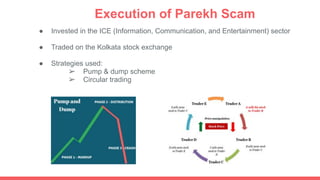
● Strategies used:
➢ Pump & dump scheme
➢ Circular trading
● When the Dot-com-Bubble burst, everyone in the market saw a downturn
in technology stocks - Parekh was unable to challenge the market
anymore now. When stock prices began to fall, he had difficulty raising
funds from banks.
● RBI and SEBI noticed that there was something strange about the profits
made by Ketan and loans taken by him.
● Finally, Parekh's pay order matter came to light, and the scam was
exposed. The scam estimated of ₹40,000 Cr.
Actions and Regulations
● In March 2000 -
Arrested and was held in custody for more than 53 days
Banned from trading in the stock market till 2017 and was also punished
to 1 year jail
● SEBI -
Banned the Badla system & circular trading
Began inspecting all stock exchange accounts on an annual basis
Only allowed collateralized loans through the BSE and NSE
● Ketan Parekh made use of his links and made some companies trade on his
behalf. In 2008, such companies were found by SEBI and were barred from
trading as well.
HARSHAD MEHTA SCAM
• Before 1991, Indian financial system was heavily regulated.
• No online trading in securities markets. Brokers played an important role in bringing
together buyers and sellers.
• Banks were not free to use a large percentage of their time and demand deposits due
to CRR, SLR and priority sector lending.
• In 1991, financial sector reforms were introduced as a part of broad economic reforms
and suddenly profitability became important for banks.
• Banks were dealing in government securities through brokers.
• Harshad Mehta, a broker at BSE, saw this as an opportunity to make quick profits.
Description of Crisis
• Mehta squeezed money out of the banking system through ready forward deals and
diverted it to stock market.
• Mehta, the Big Bull, speculated in select securities and BSE Sensex rose to record
heights.
• Profits were shared with Banks.
• Fake bank receipts were used to siphon off funds from banks.
• Sucheta Dalal, an investigative journalist of TOI, exposed the scam through her
column.
• The Janakiraman Committee set up by the RBI estimated that banks and investors
lost more than ₹ 5,000 crore due to scam.
COMPARATIVE
ANALYSIS
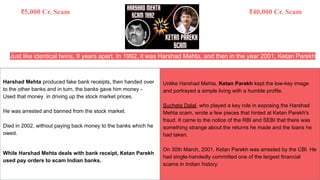
Just like identical twins, 9 years apart. In 1992, it was Harshad Mehta, and then in the year 2001, Ketan Parekh
Harshad Mehta produced fake bank receipts, then handed over
to the other banks and in turn, the banks gave him money -
Used that money in driving up the stock market prices.
He was arrested and banned from the stock market.
Died in 2002, without paying back money to the banks which he
owed.
While Harshad Mehta deals with bank receipt, Ketan Parekh
used pay orders to scam Indian banks.
Unlike Harshad Mehta, Ketan Parekh kept the low-key image
and portrayed a simple living with a humble profile.
Sucheta Dalal, who played a key role in exposing the Harshad
Mehta scam, wrote a few pieces that hinted at Ketan Parekh's
fraud. It came to the notice of the RBI and SEBI that there was
something strange about the returns he made and the loans he
had taken.
On 30th March, 2001, Ketan Parekh was arrested by the CBI. He
had single-handedly committed one of the largest financial
scams in Indian history.
₹5,000 Cr. Scam ₹40,000 Cr. Scam
THANK YOU!

Financial Scam in India

  • 1.
    Financial Scams in India (ComparativeStudy) Submitted by: Vama Sikka (2K20/UMBA/71) Garima Mehta (2K20/UMBA/77)
  • 2.
    KETAN PAREKH SCAM ●Ketan Parekh- Mumbai based former-stockbroker, recognized as 'Bombay Bull’ ● Chartered Accountant by profession, trainee under Harshad Mehta ● The K-10 Stocks are: ➢ Himachal Futuristic communications ➢ ZEE Telefilms ➢ Global Telesystems ➢ Pritish Nandy communications ➢ Satyam computers ➢ Silver line technology ➢ Aftek Infosys ➢ Pentamedia Graphics ➢ SSI ➢ DSQ Software
  • 3.
    Execution of ParekhScam ● Invested in the ICE (Information, Communication, and Entertainment) sector ● Traded on the Kolkata stock exchange ● Strategies used: ➢ Pump & dump scheme ➢ Circular trading
  • 4.
    ● When theDot-com-Bubble burst, everyone in the market saw a downturn in technology stocks - Parekh was unable to challenge the market anymore now. When stock prices began to fall, he had difficulty raising funds from banks. ● RBI and SEBI noticed that there was something strange about the profits made by Ketan and loans taken by him. ● Finally, Parekh's pay order matter came to light, and the scam was exposed. The scam estimated of ₹40,000 Cr.
  • 5.
    Actions and Regulations ●In March 2000 - Arrested and was held in custody for more than 53 days Banned from trading in the stock market till 2017 and was also punished to 1 year jail ● SEBI - Banned the Badla system & circular trading Began inspecting all stock exchange accounts on an annual basis Only allowed collateralized loans through the BSE and NSE ● Ketan Parekh made use of his links and made some companies trade on his behalf. In 2008, such companies were found by SEBI and were barred from trading as well.
  • 6.
    HARSHAD MEHTA SCAM •Before 1991, Indian financial system was heavily regulated. • No online trading in securities markets. Brokers played an important role in bringing together buyers and sellers. • Banks were not free to use a large percentage of their time and demand deposits due to CRR, SLR and priority sector lending. • In 1991, financial sector reforms were introduced as a part of broad economic reforms and suddenly profitability became important for banks. • Banks were dealing in government securities through brokers. • Harshad Mehta, a broker at BSE, saw this as an opportunity to make quick profits.
  • 7.
    Description of Crisis •Mehta squeezed money out of the banking system through ready forward deals and diverted it to stock market. • Mehta, the Big Bull, speculated in select securities and BSE Sensex rose to record heights. • Profits were shared with Banks. • Fake bank receipts were used to siphon off funds from banks. • Sucheta Dalal, an investigative journalist of TOI, exposed the scam through her column. • The Janakiraman Committee set up by the RBI estimated that banks and investors lost more than ₹ 5,000 crore due to scam.
  • 8.
  • 9.
    Just like identicaltwins, 9 years apart. In 1992, it was Harshad Mehta, and then in the year 2001, Ketan Parekh Harshad Mehta produced fake bank receipts, then handed over to the other banks and in turn, the banks gave him money - Used that money in driving up the stock market prices. He was arrested and banned from the stock market. Died in 2002, without paying back money to the banks which he owed. While Harshad Mehta deals with bank receipt, Ketan Parekh used pay orders to scam Indian banks. Unlike Harshad Mehta, Ketan Parekh kept the low-key image and portrayed a simple living with a humble profile. Sucheta Dalal, who played a key role in exposing the Harshad Mehta scam, wrote a few pieces that hinted at Ketan Parekh's fraud. It came to the notice of the RBI and SEBI that there was something strange about the returns he made and the loans he had taken. On 30th March, 2001, Ketan Parekh was arrested by the CBI. He had single-handedly committed one of the largest financial scams in Indian history. ₹5,000 Cr. Scam ₹40,000 Cr. Scam
  • 10.