HARDWARE SECURITY
What is Hardware?
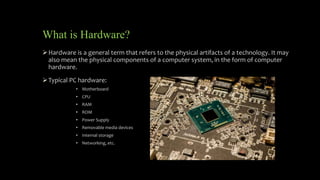
Hardware is a general term that refers to the physical artifacts of a technology. It may
also mean the physical components of a computer system, in the form of computer
hardware.
Typical PC hardware:
• Motherboard
• CPU
• RAM
• ROM
• Power Supply
• Removable media devices
• Internal storage
• Networking, etc.
Computer security
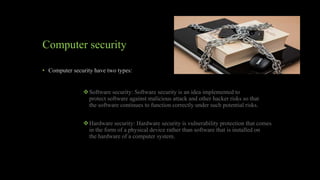
• Computer security have two types:
Software security: Software security is an idea implemented to
protect software against malicious attack and other hacker risks so that
the software continues to function correctly under such potential risks.
Hardware security: Hardware security is vulnerability protection that comes
in the form of a physical device rather than software that is installed on
the hardware of a computer system.
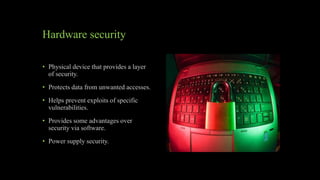
Hardware security
• Physical device that provides a layer
of security.
• Protects data from unwanted accesses.
• Helps prevent exploits of specific
vulnerabilities.
• Provides some advantages over
security via software.
• Power supply security.
Why do we need?
• Modern security work is largely focused on either protecting or attacking target
operating systems.
• Software is not enough to fully protect a system. Security in hardware offers
performance and power consumption advantages over its software equivalents.
• Increasing amounts of data being processed and the complexity of encryption
algorithms slows down security implementations severely.
• Often times these same encryption algorithms can be implemented in hardware.
What does hardware security do?
• Implements encryption algorithms to secure data.
• Store encrypted data in a difficult to access fashion.
• Prevents unencrypted data from existing in an idle state on the system.
• In the US, Hardware security conforms to the Federal Information
Processing Standards (FIPS).
• Provides life to the system so that software used on it can be saved for
larger time.
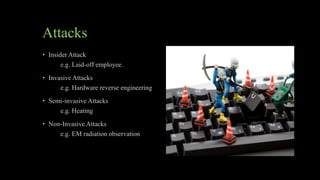
Attacks
• Insider Attack
e.g. Laid-off employee.
• Invasive Attacks
e.g. Hardware reverse engineering
• Semi-invasive Attacks
e.g. Heating
• Non-Invasive Attacks
e.g. EM radiation observation
Types of Hardware Security
• Four types of hardware security:
Cryptoprocessor
Power protection
Heat maintenance
Hardware security modules
Cryptoprocessor
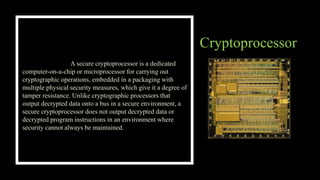
A secure cryptoprocessor is a dedicated
computer-on-a-chip or microprocessor for carrying out
cryptographic operations, embedded in a packaging with
multiple physical security measures, which give it a degree of
tamper resistance. Unlike cryptographic processors that
output decrypted data onto a bus in a secure environment, a
secure cryptoprocessor does not output decrypted data or
decrypted program instructions in an environment where
security cannot always be maintained.
Power protection
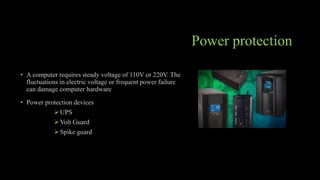
• A computer requires steady voltage of 110V or 220V. The
fluctuations in electric voltage or frequent power failure
can damage computer hardware
• Power protection devices
UPS
Volt Guard
Spike guard
Heat Maintenance
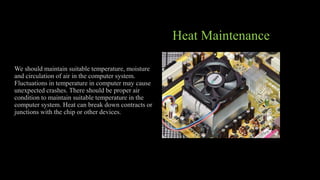
We should maintain suitable temperature, moisture
and circulation of air in the computer system.
Fluctuations in temperature in computer may cause
unexpected crashes. There should be proper air
condition to maintain suitable temperature in the
computer system. Heat can break down contracts or
junctions with the chip or other devices.
Hardware security modules(HSMs)
A hardware security module (HSM) is a physical computing
device that safeguards and manages digital keys,
performs encryption and decryption functions for digital
signatures, strong authentication and other cryptographic
functions. These modules traditionally come in the form of a
plug-in card or an external device that attaches directly to
a computer or network server. A hardware security module
contains one or more secure cryptoprocessor chips.
Hardware security

Hardware security

  • 1.
  • 2.
    What is Hardware? Hardwareis a general term that refers to the physical artifacts of a technology. It may also mean the physical components of a computer system, in the form of computer hardware. Typical PC hardware: • Motherboard • CPU • RAM • ROM • Power Supply • Removable media devices • Internal storage • Networking, etc.
  • 3.
    Computer security • Computersecurity have two types: Software security: Software security is an idea implemented to protect software against malicious attack and other hacker risks so that the software continues to function correctly under such potential risks. Hardware security: Hardware security is vulnerability protection that comes in the form of a physical device rather than software that is installed on the hardware of a computer system.
  • 4.
    Hardware security • Physicaldevice that provides a layer of security. • Protects data from unwanted accesses. • Helps prevent exploits of specific vulnerabilities. • Provides some advantages over security via software. • Power supply security.
  • 5.
    Why do weneed? • Modern security work is largely focused on either protecting or attacking target operating systems. • Software is not enough to fully protect a system. Security in hardware offers performance and power consumption advantages over its software equivalents. • Increasing amounts of data being processed and the complexity of encryption algorithms slows down security implementations severely. • Often times these same encryption algorithms can be implemented in hardware.
  • 6.
    What does hardwaresecurity do? • Implements encryption algorithms to secure data. • Store encrypted data in a difficult to access fashion. • Prevents unencrypted data from existing in an idle state on the system. • In the US, Hardware security conforms to the Federal Information Processing Standards (FIPS). • Provides life to the system so that software used on it can be saved for larger time.
  • 7.
    Attacks • Insider Attack e.g.Laid-off employee. • Invasive Attacks e.g. Hardware reverse engineering • Semi-invasive Attacks e.g. Heating • Non-Invasive Attacks e.g. EM radiation observation
  • 8.
    Types of HardwareSecurity • Four types of hardware security: Cryptoprocessor Power protection Heat maintenance Hardware security modules
  • 9.
    Cryptoprocessor A secure cryptoprocessoris a dedicated computer-on-a-chip or microprocessor for carrying out cryptographic operations, embedded in a packaging with multiple physical security measures, which give it a degree of tamper resistance. Unlike cryptographic processors that output decrypted data onto a bus in a secure environment, a secure cryptoprocessor does not output decrypted data or decrypted program instructions in an environment where security cannot always be maintained.
  • 10.
    Power protection • Acomputer requires steady voltage of 110V or 220V. The fluctuations in electric voltage or frequent power failure can damage computer hardware • Power protection devices UPS Volt Guard Spike guard
  • 11.
    Heat Maintenance We shouldmaintain suitable temperature, moisture and circulation of air in the computer system. Fluctuations in temperature in computer may cause unexpected crashes. There should be proper air condition to maintain suitable temperature in the computer system. Heat can break down contracts or junctions with the chip or other devices.
  • 12.
    Hardware security modules(HSMs) Ahardware security module (HSM) is a physical computing device that safeguards and manages digital keys, performs encryption and decryption functions for digital signatures, strong authentication and other cryptographic functions. These modules traditionally come in the form of a plug-in card or an external device that attaches directly to a computer or network server. A hardware security module contains one or more secure cryptoprocessor chips.