Road to
Success
Happy Fish:
A Case Study
WHO
are Happy Fish’s
target customers?
2
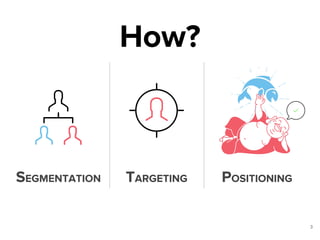
SEGMENTATION TARGETING POSITIONING
How?
3
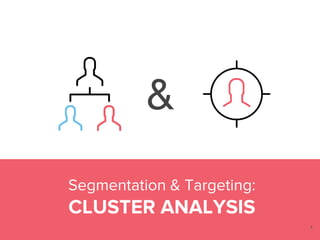
Segmentation & Targeting:
CLUSTER ANALYSIS
&
4
Positioning:
REGRESSION & MULTIDIMENSIONAL
SCALING ANALYSIS 5
6
Results
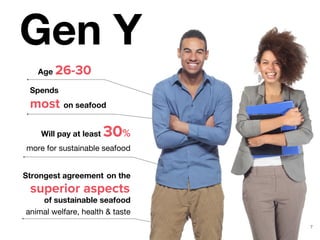
Gen Y
Age 26-30
Will pay at least 30%
more for sustainable seafood
Strongest agreement on the
of sustainable seafood
animal welfare, health & taste
superior aspects
Spends
most on seafood
7
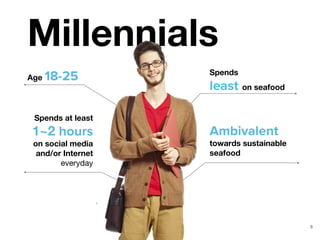
Millennials
8
Age 18-25 Spends
least on seafood
Ambivalent
towards sustainable
seafood
Spends at least
1~2 hours
on social media
and/or Internet
everyday
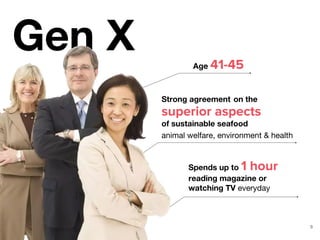
Gen X
9
Age 41-45
Strong agreement on the
of sustainable seafood
animal welfare, environment & health
superior aspects
Spends up to 1 hour
reading magazine or
watching TV everyday
10
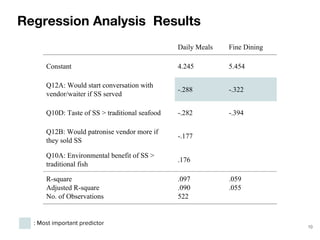
Daily Meals Fine Dining
Constant 4.245 5.454
Q12A: Would start conversation with
vendor/waiter if SS served
-.288 -.322
Q10D: Taste of SS > traditional seafood -.282 -.394
Q12B: Would patronise vendor more if
they sold SS
-.177
Q10A: Environmental benefit of SS >
traditional fish
.176
R-square
Adjusted R-square
No. of Observations
.097
.090
522
.059
.055
Regression Analysis Results
: Most important predictor
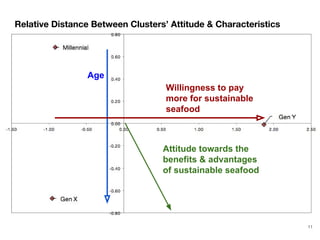
Age
Willingness to pay
more for sustainable
seafood
Attitude towards the
benefits & advantages
of sustainable seafood
11
Relative Distance Between Clusters’ Attitude & Characteristics
12
Moving
Forward
13
14
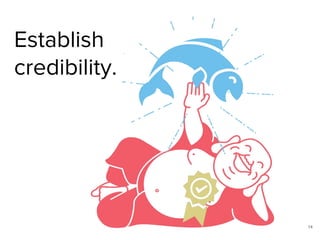
Establish
credibility.
15
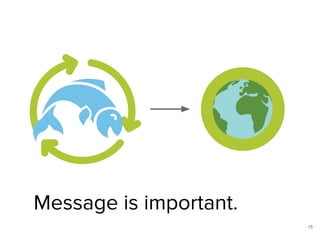
Message is important.
16
Pick the right
channel.
17
Utilise star power.
Y
18
19
Thank You

Happy Fish Project