Are Financial Institutions Optimally Utilizing Their Expenditures on AML
Compliance?
Cambridge Symposium on Financial Crimes
Presentation Notes for Monday – 4:30pm, September 1, 2008
Professor William H. Byrnes, IV
Ass. Dean, online Masters and Ph.D. - Walter H. & Dorothy B. Diamond International Tax &
Financial Services graduate program
Thomas Jefferson School of Law, 2121 San Diego Avenue, California 92110
T +1 (619) 297-9700 (ext. 6955)
E wbyrnes@tjsl.edu I www.llmprogram.org and www.tjsl.edu
Please email me if you want follow up information on this presentation or if you have
suggestions for our new three volume treatise on ANTI MONEY LAUNDERING, FINANCIAL CRIME,
ASSET RECOVERY AND COMPLIANCE.
1. The Regulatory Environment1
For the past several years, the US banking industry has focused on regulatory issues, such
as the corporate governance provisions of the Sarbanes-Oxley Act (enacted in 2002) and the
banking-related parts of the USA Patriot Act (enacted in 2001). Much literature and studies
have been provided regarding the cost impact of the various implemented measures.
Smaller community banks have contended that it is difficult for them to comply with certain
Sarbanes-Oxley provisions, such as the requirement that audit committees be composed
entirely of independent directors and that companies have a “financial expert” on the board of
directors. The provisions of the USA Patriot Act require increased investments in technology
(though many in the industry have questioned the effectiveness of these investments in
preventing the funding of terrorist groups or activities).
2. The Reporting Impact
Resulting from the impetus of the Al Qaeda’s terrorist attacks of 9/11, the US financial
institution regulators became an enforcement hawk of the money laundering provisions of the
Bank Secrecy Act (“BSA”). In turn, hawkish enforcement has led to a drastic increase in the
number of BSA filings. In 2007, the approximate two hundred thousand US financial
institutions filed over 649,176 Suspicious Activity Reports (“SAR”s), as recently reported by
the US Government Accountability Office (“GAO”). In contrast, just two hundred thousand
STRs were filed in the UK in 2006.2
This begs the question: are too many being filed in the USA, clogging the investigatory
system, or are too few filed in the UK?
Notwithstanding this level of apparent US hawkish compliance, the GAO noted that the
federal regulatory authorities cited well over 7,000 BSA violations, leading to over 2,000
various actions against banking institutions. Interestingly, a majority of 2005 actions were
issued against the traditionally smaller credit unions that at first glance may be considered to
carry less risk for money laundering.3
Moreover, these enforcement figures did not include
the actions taken against casinos, jewelry stores, and money service businesses, such as
check-cashing, whose anti money-laundering (“AML”) program compliance is audited by the
IRS.
1
STANDARD AND POOR'S INDUSTRY SURVEYS: BANKING (Dec. 6, 2007).
2
The SAR Activity Review – By the Numbers Issue 10 (FINCEN May 2008); Money Laundering
Regulations 2007: Regulatory Impact Assessment (HM Treasury July 2007).
3
http://www.gao.gov/cgi-bin/getrpt?GAO-07-212
1
3. Managing Risk through Training
International financial centers all have a requirement that firms subject to money laundering
legislation have a designated compliance officer, known by different acronyms such as
MLRO. Further, the legislation requires staff training on a continuing basis. By two
examples, the USA and the UK respectively:
Bank Secrecy Act § 5318:
(h) Anti-Money Laundering Programs.—
(1) In general.— In order to guard against money laundering through financial
institutions, each financial institution shall establish anti-money laundering programs,
including, at a minimum— …
(B) the designation of a compliance officer;
(C) an ongoing employee training program; ….
The Money Laundering Regulations 2007 Training:
21. A relevant person must take appropriate measures so that all relevant employees
of his are—
(a) made aware of the law relating to money laundering and terrorist financing; and
(b) regularly given training in how to recognise and deal with transactions and other
activities which may be related to money laundering or terrorist financing.
KPMG reports that the training of employees to recognize money laundering, which is labour
intensive, has required a big cost increase for banks. Yet, reviewing a few of the high dollar
value civil penalty actions issued by the US regulators in the last two years illustrates that a
lack of money laundering expertise at the management level and a lack of firm wide education
and training at the staff level cuts across both large and small banking firms.
4. Penalties for Lack of Training and Expertise
The highest publicity action this past year occurred against American Express Bank
International (“AMEX”) – shortly thereafter purchased by Standard Chartered. AMEX’s
original sixty-five million dollar penalty resulted partly from the gross amount of errors in just
one year in its SAR filings regarding its private banking services to its high net-worth
individuals (HNWI) and the individuals’ respective businesses throughout Latin America. In
the 12 month period from May 2006, over 2,000 filing error were found for only 1,639 SARs,
not including over 1,000 late SAR filings. Other recent large penalties citing the lack of staff
training include ABN-AMRO’s (forty million dollars) and fines of ten million dollars each for
Bank Atlantic and AmSouth.
Medium size Foster Bank suffered a two million dollar penalty because “management failed to
implement adequate training for appropriate personnel to ensure compliance with the
suspicious activity reporting requirements”. The regulator found that Foster Bank staff was
inadequately trained in suspicious activity identification and monitoring, detection of structured
transactions, and identification of possible money laundering. Israel Discount Bank, with
branches in a few states, paid a twelve million dollar file for inadequately training its staff
regarding the heightened risks associated with its transaction involving Delaware LLC shell
companies. On the opposite size spectrum from AMEX, a one branch bank, Beach Bank of
Miami, with less than $150 million in assets, suffered an eight hundred thousand dollar fine for
its lack of monitoring of high risk accounts, including six foreign correspondent accounts.
5. Are Companies Merely Whitewashing?
Consider that the above regulatory enforcement actions, and those referred to by the GAO
report, were issued at least three years after the US financial institutions were put on initial
notice of the hawkish nature of enforcement of AML programs. Certainly, neither
management nor staff wanted to, by example, be responsible for over 2,000 filing errors for
only 1,639 SARs. Riggs divestiture of its international banking operations certainly provided a
2
resounding warning for boards to take their AML compliance responsibilities seriously.
Enforcement actions generally lead to management and staff level firing holding persons
accountable for their errors.
In a global review of money laundering legislation throughout financial centers, none of the
legislation provides specific benchmarks or at least an assessable minimum standard for a
level of training of the staff or the MLRO. Further, the regulator guidance, where available, is
scant to the issue of quality assurance of training.
The US Federal Financial Institutions Examination Council’s (“FFIEC”) Bank Secrecy Act/Anti
Money Laundering Manual (“Manual”) states that a bank must “[T]rain employees to be aware
of their responsibilities under the BSA regulations and internal policy guidelines” whereas the
UK FSA Handbook states that a firm’s should ensure that its “systems and controls include
(1) appropriate training for its employees in relation to money laundering …”.4
The FFIEC
Manual’s most specific example of what should be contained within a training program is “…
training for tellers should focus on examples involving large currency transactions or other
suspicious activities; training for the loan department should provide examples involving
money laundering through lending arrangements.”
6. But Aren’t Expenditures on Training Going up, uP, UP?
Thus, to avoid enforcement actions and thus being fired, in some markets the training
budgets and the compliance cost per-dollar-of-deposit have more than doubled. By example,
from 2002 – 2005, banks offering international financial services in Miami reported a 160%
increase both in the total costs of staff resources devoted to AML compliance and in the
compliance costs of staff resources per dollar of deposit.5
Senior banking management perceives rising and unpredictable compliance costs that
undermine global competitiveness as the most significant threats to the future growth of
banking.6
The cost of AML compliance increased around 58% globally and 71% in North
America between 2004 and 2007.7
A 2005 survey of Florida banks engaged in international banking estimated the staffing cost of
AML compliance at nearly $25 million. The study concluded that compliance costs are not
uniform across institutions, even after making adjustment for size.8
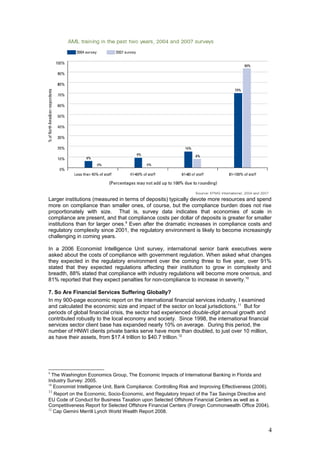
Banks estimate that
training costs and transaction monitoring will require the largest investment of all AML
activities. All North American banks provide AML training for nearly all of their employees.
See KPMG’s Figure below.
4
http://www.ffiec.gov/pdf/bsa_aml_examination_manual2007.pdf and
http://fsahandbook.info/FSA/html/handbook/SYSC/6/3#D78.
5
THE ECONOMIC IMPACTS OF INTERNATIONAL BANKING IN FLORIDA AND INDUSTRY SURVEY: 2005 (Florida
International Bankers Association).
6
The Washington Economics Group, THE ECONOMIC IMPACTS OF INTERNATIONAL BANKING IN FLORIDA AND
INDUSTRY SURVEY: 2005.
7
KPMG'S GLOBAL ANTI-MONEY LAUNDERING SURVEY 2007.
8
The Washington Economics Group, THE ECONOMIC IMPACTS OF INTERNATIONAL BANKING IN FLORIDA AND
INDUSTRY SURVEY: 2005.
3
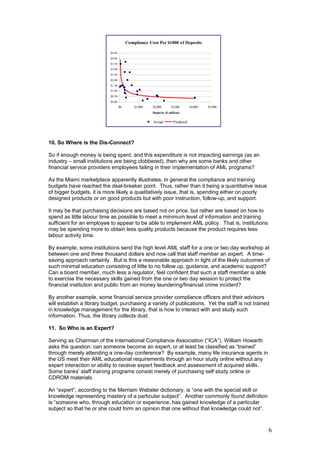
Larger institutions (measured in terms of deposits) typically devote more resources and spend
more on compliance than smaller ones, of course, but the compliance burden does not rise
proportionately with size. That is, survey data indicates that economies of scale in
compliance are present, and that compliance costs per dollar of deposits is greater for smaller
institutions than for larger ones.9
Even after the dramatic increases in compliance costs and
regulatory complexity since 2001, the regulatory environment is likely to become increasingly
challenging in coming years.
In a 2006 Economist Intelligence Unit survey, international senior bank executives were
asked about the costs of compliance with government regulation. When asked what changes
they expected in the regulatory environment over the coming three to five year, over 91%
stated that they expected regulations affecting their institution to grow in complexity and
breadth, 88% stated that compliance with industry regulations will become more onerous, and
81% reported that they expect penalties for non-compliance to increase in severity.10
7. So Are Financial Services Suffering Globally?
In my 900-page economic report on the international financial services industry, I examined
and calculated the economic size and impact of the sector on local jurisdictions.11
But for
periods of global financial crisis, the sector had experienced double-digit annual growth and
contributed robustly to the local economy and society. Since 1998, the international financial
services sector client base has expanded nearly 10% on average. During this period, the
number of HNWI clients private banks serve have more than doubled, to just over 10 million,
as have their assets, from $17.4 trillion to $40.7 trillion.12
9
The Washington Economics Group, The Economic Impacts of International Banking in Florida and
Industry Survey: 2005.
10
Economist Intelligence Unit, Bank Compliance: Controlling Risk and Improving Effectiveness (2006).
11
Report on the Economic, Socio-Economic, and Regulatory Impact of the Tax Savings Directive and
EU Code of Conduct for Business Taxation upon Selected Offshore Financial Centers as well as a
Competitiveness Report for Selected Offshore Financial Centers (Foreign Commonwealth Office 2004).
12
Cap Gemini Merrill Lynch World Wealth Report 2008.
4
8. Well Then - The Future Must Be Dim?
Dim? On the contrary! In just four years, the pool of HNWI clients’ assets will grow another
50% to nearly $60 trillion. The average HNWI, excluding the value of primary residences and
collectables, is worth more than $4 million! HNWI’s continue to leverage offshore skill sets,
growing their assets from $5.8 trillion from 1998 to $11 trillion today.13
That $11 trillion under
management represents, at combined fees of just 1%, at least $100 billion to private bank
firms offshore, and six times that taking all HNWI assets into account.
9. Example Banking Center Market and AML Compliance Costs: Miami
39% of Florida banks surveyed reported that private banking accounted for more than 50% of
their operating revenues. Florida’s international private banking and wealth management
customers predominantly reside, as one would expect, in Latin America and the Caribbean,
with 1/3 residing in Europe. South American residents account for 44% of private banking
and wealth management customers of Florida’s international banks. Approximately 19% of
international private wealth management clients reside in Mexico or Central America, while
4% reside in the Caribbean.
Yet, the international banking industry in Florida has been characterized by consolidation and
contraction since 2000. The number of foreign bank agencies operating in Florida fell from 38
in 2000 to 31 in 2005.14
There were 10 Edge Act banks operating in Florida in 2000, but only
7 in 2005. The number of international banking employees (in foreign agencies, Edge Acts
and the international divisions of domestic banks chartered in Florida) declined from 4,660 in
2000 to 3,027 in 2005.
Based on a survey of banks significantly engaged in international banking Florida
International Bankers Association was able to estimate the Florida international bankers
staffing cost for 271 full-time employees of anti-terrorism/anti-money laundering compliance at
nearly $25 million in 2005. 15
The average survey respondents indicated that it devoted 2.9
FTE employment positions to BSA/AML compliance in 2002 versus 6.8 FTE positions in
2005. The number of full-time employees devoted to compliance represented 9% of the
workforce in 2005. Staff resources devoted to compliance increased by 160% between 2002
and 2005.
13
Tax Haven Abuses: The Enablers, The Tools and Secrecy” (Sen. Rep., Perm. Sub-Comm. On
Investigations, August 1, 2006) and World Wealth Report 2008.
14
In 2005, however, 7 of the 31 international banks had no deposits booked in Florida, while
in 2000 only 2 of the 38 had zero deposits.
15
It is important to note that these cost estimates only include manpower or staffing costs, and do not
include costs such as transaction monitoring software, possible IT investments and services, legal
counsel and similar support.
5
10. So Where is the Dis-Connect?
So if enough money is being spent, and this expenditure is not impacting earnings (as an
industry – small institutions are being clobbered), then why are some banks and other
financial service providers employees failing in their implementation of AML programs?
As the Miami marketplace apparently illustrates, in general the compliance and training
budgets have reached the deal-breaker point. Thus, rather than it being a quantitative issue
of bigger budgets, it is more likely a qualitatively issue, that is, spending either on poorly
designed products or on good products but with poor instruction, follow-up, and support.
It may be that purchasing decisions are based not on price, but rather are based on how to
spend as little labour time as possible to meet a minimum level of information and training
sufficient for an employee to appear to be able to implement AML policy. That is, institutions
may be spending more to obtain less quality products because the product requires less
labour activity time.
By example, some institutions send the high level AML staff for a one or two day workshop at
between one and three thousand dollars and now call that staff member an expert. A time-
saving approach certainly. But is this a reasonable approach in light of the likely outcomes of
such minimal education consisting of little to no follow up, guidance, and academic support?
Can a board member, much less a regulator, feel confident that such a staff member is able
to exercise the necessary skills gained from the one or two day session to protect the
financial institution and public from an money laundering/financial crime incident?
By another example, some financial service provider compliance officers and their advisors
will establish a library budget, purchasing a variety of publications. Yet the staff is not trained
in knowledge management for the library, that is how to interact with and study such
information. Thus, the library collects dust.
11. So Who is an Expert?
Serving as Chairman of the International Compliance Association (“ICA”), William Howarth
asks the question: can someone become an expert, or at least be classified as “trained”
through merely attending a one-day conference? By example, many life insurance agents in
the US meet their AML educational requirements through an hour study online without any
expert interaction or ability to receive expert feedback and assessment of acquired skills.
Some banks’ staff training programs consist merely of purchasing self study online or
CDROM materials.
An “expert”, according to the Merriam Webster dictionary, is “one with the special skill or
knowledge representing mastery of a particular subject”. Another commonly found definition
is “someone who, through education or experience, has gained knowledge of a particular
subject so that he or she could form an opinion that one without that knowledge could not”.
6
Compliance Cost Per $1000 of Deposits
$0.00
$0.50
$1.00
$1.50
$2.00
$2.50
$3.00
$3.50
$4.00
$4.50
$0 $1,000 $2,000 $3,000 $4,000 $5,000
Deposits ($ million)
Actual Predicted
Finally, a commonly applied standard for government recognizing an expert is one
acknowledged as such “by a peer group or professional society certification”.
12. Best Practices for AML
Based on the above definition, a firm must first identify what special skills sets must be
acquired to qualify as mastery of the subject of AML. As of October 2006, the UK
internationally has taken the lead on the issue of defining best practices, and the mastery
thereof, for AML, thanks in large part to the ICA and the Financial Services Skills Council
(FSSC). The FSSC, through joint consultation of industry, regulators, and law enforcement,
agreed “Occupational Standards” for both Compliance and for Money Laundering the
“Standards”).16
These Standards define the level of competence necessary to perform each
particular job function of the staff responsible for the money laundering program, thirty-six
functions in all. Further, the FSSC has an accredited provider program for providing
education pursuant to the Standards.
In order to define a level of competence, the Standards first overview a particular job function,
then set out the “Outcomes of Effective Performance” if the function is performed
competently. The next section for each function “Behaviors Underpinning Effective
Performance” is divided into distinctive skill sets, such as communicating, influencing,
problem solving, professionalism and team working, each one explained in relation to
achieving the expected outcomes. Finally, the Standards list the requisite “Knowledge and
Understanding” to implement the behaviors and for competence to be considered acquired.
Thus, within the UK regulatory environment, a firm and its educational provider now have a
clear platform from which to benchmark, and thus to assess, an employee’s competency on a
per function basis. Mastery may be obtained by acquiring a robust and in-depth knowledge of
the totality of the thirty-six functions. Consequently, industry may with greater certainty and
efficiency allocate training budget amongst various functions based on assessed
weaknesses, merely updating for strength areas, and thus achieving balanced compliance
outcomes.
13. Any Proposals to Discuss at this Symposium?
The industry should enumerate best practice quality assurance for training, in the manner
accreditation works for educational institutions. As a result of adopting and implementing
such standards and corresponding quality assurance, banks and the other industry groups
will reduce wasted compliance dollars and obtain greater certainty as to training outcomes.
Professor William H. Byrnes, IV, is the Dean in charge of the online Walter H. & Dorothy B.
Diamond International tax & Financial Services Graduate Program at Thomas Jefferson
School of Law. He pioneered distributive legal education in the US and abroad. Before
Thomas Jefferson, Prof. Byrnes received tenure and full professor status from St. Thomas
University School of Law (Miami) in 2005, having been lecturing and writing since 1994.
Prior to his tenured academic career, Prof. Byrnes was a senior manager then associate
director, international tax, Coopers and Lybrand, which subsequently amalgamated into Price
Waterhouse. His primary clients at Coopers & Lybrand were FORBES 1000 MNEs and also
private banks, insurance companies, technology companies, and company service providers,
including HSBC PLC, Comparex (Persetel-QData), and Commercial Union. Over the last
fifteen years, he has worked and taught in Asia, Europe, Africa and The Americas. Professor
Byrnes is a licensed attorney.
Professor Byrnes has been employed as a consultant to a number of governments on their
fiscal policy, including South Africa, Botswana, The United Kingdom, The British Virgin
Islands, The Turks and Caicos Islands, Anguilla and Montserrat. He was the primary author
and team leader of the 900-page UK Foreign Commonwealth Office commissioned Report on
the Economic, Socio-Economic, and Regulatory Impact of the Tax Savings Directive and EU
16
http://www.fssc.org.uk/cgi-bin/wms.pl/Standards_and_accreditation/133
7
Code of Conduct on Business Taxation upon Selected Offshore Financial Centers as well as
a Competitiveness Report for Selected Offshore Financial Centers.
Authorship
Besides co-authoring and editing several course books published in cooperation with Kluwer
Law International for the Walter H. & Dorothy B. Diamond graduate program, such as
Principles of International Taxation, Tax Treaties, and also Offshore Financial Centers, he is
the co-author with Dr. Robert J. Munro for INTERNATIONAL TRUST LAWS & ANALYSIS (Kluwer
Law International). Moreover, he co-authored the book TAX REFORM FOR SOUTH AFRICA and
served as Managing Editor of the EXCHANGE CONTROL ENCYCLOPAEDIA, which was
amalgamated into Butterworths’ Exchange Control Encyclopaedia. For Thomson-West, he is
the revisions author of Nonresident Aliens & Foreign Corps (Mertens, no. 45), and a co-author
for Claims for Refund (Mertens, no. 58), Income Tax Returns and Disclosure (Mertens, no.
47) and Alimony and Divorce (Mertens, no. 31A). For Thomson Tax, he is the author for the
US Chapter for INTERNATIONAL TAX SYSTEMS AND PLANNING TECHNIQUES. He served as an
editor to Walter Diamond of the Diamond loose-leaf series, and is now the revising author of
TAX AND TRADE BRIEFS, TAX HAVENS OF THE WORLD, as well as TREATY WITHHOLDING GUIDE,
Matthew Bender (New York).
He has published law review articles on the US and Roman history of charity law and on legal
pedagogy, as well as articles on education in finance magazines. He is currently in
substantial completion of three draft articles: the history of Jewish charity law, the history and
treatment of the company limited by guarantee, and finally, a current survey of legal
pedagogy.
Inhouse Training
In 1996 with EuroMoney-Institutional Investor, he created and taught three and five-day in-
house banking and stock exchange training programs in Hong Kong, Singapore, London,
Miami, Lisbon, Mauritius, Dominica, and South Africa. Also, he has chaired, as well as
presented at, many corporate and private banking conferences globally, including Malaysia,
Bahamas, Cayman Islands, India and South Africa. His over 100 conference and training
presentations have included topics as diverse as forecasting economics of B2B integrated
supply chains to establishing and maintaining a family office department. Professor Byrnes’
dissertation for his three year fellowship at the IBFD and the University of Amsterdam was on
International Transfer Pricing.
Currently he teaches in-house programs through the law school to firms globally.
8

Cambridge anti money laundering lecture 2008

  • 1.
    Are Financial InstitutionsOptimally Utilizing Their Expenditures on AML Compliance? Cambridge Symposium on Financial Crimes Presentation Notes for Monday – 4:30pm, September 1, 2008 Professor William H. Byrnes, IV Ass. Dean, online Masters and Ph.D. - Walter H. & Dorothy B. Diamond International Tax & Financial Services graduate program Thomas Jefferson School of Law, 2121 San Diego Avenue, California 92110 T +1 (619) 297-9700 (ext. 6955) E wbyrnes@tjsl.edu I www.llmprogram.org and www.tjsl.edu Please email me if you want follow up information on this presentation or if you have suggestions for our new three volume treatise on ANTI MONEY LAUNDERING, FINANCIAL CRIME, ASSET RECOVERY AND COMPLIANCE. 1. The Regulatory Environment1 For the past several years, the US banking industry has focused on regulatory issues, such as the corporate governance provisions of the Sarbanes-Oxley Act (enacted in 2002) and the banking-related parts of the USA Patriot Act (enacted in 2001). Much literature and studies have been provided regarding the cost impact of the various implemented measures. Smaller community banks have contended that it is difficult for them to comply with certain Sarbanes-Oxley provisions, such as the requirement that audit committees be composed entirely of independent directors and that companies have a “financial expert” on the board of directors. The provisions of the USA Patriot Act require increased investments in technology (though many in the industry have questioned the effectiveness of these investments in preventing the funding of terrorist groups or activities). 2. The Reporting Impact Resulting from the impetus of the Al Qaeda’s terrorist attacks of 9/11, the US financial institution regulators became an enforcement hawk of the money laundering provisions of the Bank Secrecy Act (“BSA”). In turn, hawkish enforcement has led to a drastic increase in the number of BSA filings. In 2007, the approximate two hundred thousand US financial institutions filed over 649,176 Suspicious Activity Reports (“SAR”s), as recently reported by the US Government Accountability Office (“GAO”). In contrast, just two hundred thousand STRs were filed in the UK in 2006.2 This begs the question: are too many being filed in the USA, clogging the investigatory system, or are too few filed in the UK? Notwithstanding this level of apparent US hawkish compliance, the GAO noted that the federal regulatory authorities cited well over 7,000 BSA violations, leading to over 2,000 various actions against banking institutions. Interestingly, a majority of 2005 actions were issued against the traditionally smaller credit unions that at first glance may be considered to carry less risk for money laundering.3 Moreover, these enforcement figures did not include the actions taken against casinos, jewelry stores, and money service businesses, such as check-cashing, whose anti money-laundering (“AML”) program compliance is audited by the IRS. 1 STANDARD AND POOR'S INDUSTRY SURVEYS: BANKING (Dec. 6, 2007). 2 The SAR Activity Review – By the Numbers Issue 10 (FINCEN May 2008); Money Laundering Regulations 2007: Regulatory Impact Assessment (HM Treasury July 2007). 3 http://www.gao.gov/cgi-bin/getrpt?GAO-07-212 1
  • 2.
    3. Managing Riskthrough Training International financial centers all have a requirement that firms subject to money laundering legislation have a designated compliance officer, known by different acronyms such as MLRO. Further, the legislation requires staff training on a continuing basis. By two examples, the USA and the UK respectively: Bank Secrecy Act § 5318: (h) Anti-Money Laundering Programs.— (1) In general.— In order to guard against money laundering through financial institutions, each financial institution shall establish anti-money laundering programs, including, at a minimum— … (B) the designation of a compliance officer; (C) an ongoing employee training program; …. The Money Laundering Regulations 2007 Training: 21. A relevant person must take appropriate measures so that all relevant employees of his are— (a) made aware of the law relating to money laundering and terrorist financing; and (b) regularly given training in how to recognise and deal with transactions and other activities which may be related to money laundering or terrorist financing. KPMG reports that the training of employees to recognize money laundering, which is labour intensive, has required a big cost increase for banks. Yet, reviewing a few of the high dollar value civil penalty actions issued by the US regulators in the last two years illustrates that a lack of money laundering expertise at the management level and a lack of firm wide education and training at the staff level cuts across both large and small banking firms. 4. Penalties for Lack of Training and Expertise The highest publicity action this past year occurred against American Express Bank International (“AMEX”) – shortly thereafter purchased by Standard Chartered. AMEX’s original sixty-five million dollar penalty resulted partly from the gross amount of errors in just one year in its SAR filings regarding its private banking services to its high net-worth individuals (HNWI) and the individuals’ respective businesses throughout Latin America. In the 12 month period from May 2006, over 2,000 filing error were found for only 1,639 SARs, not including over 1,000 late SAR filings. Other recent large penalties citing the lack of staff training include ABN-AMRO’s (forty million dollars) and fines of ten million dollars each for Bank Atlantic and AmSouth. Medium size Foster Bank suffered a two million dollar penalty because “management failed to implement adequate training for appropriate personnel to ensure compliance with the suspicious activity reporting requirements”. The regulator found that Foster Bank staff was inadequately trained in suspicious activity identification and monitoring, detection of structured transactions, and identification of possible money laundering. Israel Discount Bank, with branches in a few states, paid a twelve million dollar file for inadequately training its staff regarding the heightened risks associated with its transaction involving Delaware LLC shell companies. On the opposite size spectrum from AMEX, a one branch bank, Beach Bank of Miami, with less than $150 million in assets, suffered an eight hundred thousand dollar fine for its lack of monitoring of high risk accounts, including six foreign correspondent accounts. 5. Are Companies Merely Whitewashing? Consider that the above regulatory enforcement actions, and those referred to by the GAO report, were issued at least three years after the US financial institutions were put on initial notice of the hawkish nature of enforcement of AML programs. Certainly, neither management nor staff wanted to, by example, be responsible for over 2,000 filing errors for only 1,639 SARs. Riggs divestiture of its international banking operations certainly provided a 2
  • 3.
    resounding warning forboards to take their AML compliance responsibilities seriously. Enforcement actions generally lead to management and staff level firing holding persons accountable for their errors. In a global review of money laundering legislation throughout financial centers, none of the legislation provides specific benchmarks or at least an assessable minimum standard for a level of training of the staff or the MLRO. Further, the regulator guidance, where available, is scant to the issue of quality assurance of training. The US Federal Financial Institutions Examination Council’s (“FFIEC”) Bank Secrecy Act/Anti Money Laundering Manual (“Manual”) states that a bank must “[T]rain employees to be aware of their responsibilities under the BSA regulations and internal policy guidelines” whereas the UK FSA Handbook states that a firm’s should ensure that its “systems and controls include (1) appropriate training for its employees in relation to money laundering …”.4 The FFIEC Manual’s most specific example of what should be contained within a training program is “… training for tellers should focus on examples involving large currency transactions or other suspicious activities; training for the loan department should provide examples involving money laundering through lending arrangements.” 6. But Aren’t Expenditures on Training Going up, uP, UP? Thus, to avoid enforcement actions and thus being fired, in some markets the training budgets and the compliance cost per-dollar-of-deposit have more than doubled. By example, from 2002 – 2005, banks offering international financial services in Miami reported a 160% increase both in the total costs of staff resources devoted to AML compliance and in the compliance costs of staff resources per dollar of deposit.5 Senior banking management perceives rising and unpredictable compliance costs that undermine global competitiveness as the most significant threats to the future growth of banking.6 The cost of AML compliance increased around 58% globally and 71% in North America between 2004 and 2007.7 A 2005 survey of Florida banks engaged in international banking estimated the staffing cost of AML compliance at nearly $25 million. The study concluded that compliance costs are not uniform across institutions, even after making adjustment for size.8 Banks estimate that training costs and transaction monitoring will require the largest investment of all AML activities. All North American banks provide AML training for nearly all of their employees. See KPMG’s Figure below. 4 http://www.ffiec.gov/pdf/bsa_aml_examination_manual2007.pdf and http://fsahandbook.info/FSA/html/handbook/SYSC/6/3#D78. 5 THE ECONOMIC IMPACTS OF INTERNATIONAL BANKING IN FLORIDA AND INDUSTRY SURVEY: 2005 (Florida International Bankers Association). 6 The Washington Economics Group, THE ECONOMIC IMPACTS OF INTERNATIONAL BANKING IN FLORIDA AND INDUSTRY SURVEY: 2005. 7 KPMG'S GLOBAL ANTI-MONEY LAUNDERING SURVEY 2007. 8 The Washington Economics Group, THE ECONOMIC IMPACTS OF INTERNATIONAL BANKING IN FLORIDA AND INDUSTRY SURVEY: 2005. 3
  • 4.
    Larger institutions (measuredin terms of deposits) typically devote more resources and spend more on compliance than smaller ones, of course, but the compliance burden does not rise proportionately with size. That is, survey data indicates that economies of scale in compliance are present, and that compliance costs per dollar of deposits is greater for smaller institutions than for larger ones.9 Even after the dramatic increases in compliance costs and regulatory complexity since 2001, the regulatory environment is likely to become increasingly challenging in coming years. In a 2006 Economist Intelligence Unit survey, international senior bank executives were asked about the costs of compliance with government regulation. When asked what changes they expected in the regulatory environment over the coming three to five year, over 91% stated that they expected regulations affecting their institution to grow in complexity and breadth, 88% stated that compliance with industry regulations will become more onerous, and 81% reported that they expect penalties for non-compliance to increase in severity.10 7. So Are Financial Services Suffering Globally? In my 900-page economic report on the international financial services industry, I examined and calculated the economic size and impact of the sector on local jurisdictions.11 But for periods of global financial crisis, the sector had experienced double-digit annual growth and contributed robustly to the local economy and society. Since 1998, the international financial services sector client base has expanded nearly 10% on average. During this period, the number of HNWI clients private banks serve have more than doubled, to just over 10 million, as have their assets, from $17.4 trillion to $40.7 trillion.12 9 The Washington Economics Group, The Economic Impacts of International Banking in Florida and Industry Survey: 2005. 10 Economist Intelligence Unit, Bank Compliance: Controlling Risk and Improving Effectiveness (2006). 11 Report on the Economic, Socio-Economic, and Regulatory Impact of the Tax Savings Directive and EU Code of Conduct for Business Taxation upon Selected Offshore Financial Centers as well as a Competitiveness Report for Selected Offshore Financial Centers (Foreign Commonwealth Office 2004). 12 Cap Gemini Merrill Lynch World Wealth Report 2008. 4
  • 5.
    8. Well Then- The Future Must Be Dim? Dim? On the contrary! In just four years, the pool of HNWI clients’ assets will grow another 50% to nearly $60 trillion. The average HNWI, excluding the value of primary residences and collectables, is worth more than $4 million! HNWI’s continue to leverage offshore skill sets, growing their assets from $5.8 trillion from 1998 to $11 trillion today.13 That $11 trillion under management represents, at combined fees of just 1%, at least $100 billion to private bank firms offshore, and six times that taking all HNWI assets into account. 9. Example Banking Center Market and AML Compliance Costs: Miami 39% of Florida banks surveyed reported that private banking accounted for more than 50% of their operating revenues. Florida’s international private banking and wealth management customers predominantly reside, as one would expect, in Latin America and the Caribbean, with 1/3 residing in Europe. South American residents account for 44% of private banking and wealth management customers of Florida’s international banks. Approximately 19% of international private wealth management clients reside in Mexico or Central America, while 4% reside in the Caribbean. Yet, the international banking industry in Florida has been characterized by consolidation and contraction since 2000. The number of foreign bank agencies operating in Florida fell from 38 in 2000 to 31 in 2005.14 There were 10 Edge Act banks operating in Florida in 2000, but only 7 in 2005. The number of international banking employees (in foreign agencies, Edge Acts and the international divisions of domestic banks chartered in Florida) declined from 4,660 in 2000 to 3,027 in 2005. Based on a survey of banks significantly engaged in international banking Florida International Bankers Association was able to estimate the Florida international bankers staffing cost for 271 full-time employees of anti-terrorism/anti-money laundering compliance at nearly $25 million in 2005. 15 The average survey respondents indicated that it devoted 2.9 FTE employment positions to BSA/AML compliance in 2002 versus 6.8 FTE positions in 2005. The number of full-time employees devoted to compliance represented 9% of the workforce in 2005. Staff resources devoted to compliance increased by 160% between 2002 and 2005. 13 Tax Haven Abuses: The Enablers, The Tools and Secrecy” (Sen. Rep., Perm. Sub-Comm. On Investigations, August 1, 2006) and World Wealth Report 2008. 14 In 2005, however, 7 of the 31 international banks had no deposits booked in Florida, while in 2000 only 2 of the 38 had zero deposits. 15 It is important to note that these cost estimates only include manpower or staffing costs, and do not include costs such as transaction monitoring software, possible IT investments and services, legal counsel and similar support. 5
  • 6.
    10. So Whereis the Dis-Connect? So if enough money is being spent, and this expenditure is not impacting earnings (as an industry – small institutions are being clobbered), then why are some banks and other financial service providers employees failing in their implementation of AML programs? As the Miami marketplace apparently illustrates, in general the compliance and training budgets have reached the deal-breaker point. Thus, rather than it being a quantitative issue of bigger budgets, it is more likely a qualitatively issue, that is, spending either on poorly designed products or on good products but with poor instruction, follow-up, and support. It may be that purchasing decisions are based not on price, but rather are based on how to spend as little labour time as possible to meet a minimum level of information and training sufficient for an employee to appear to be able to implement AML policy. That is, institutions may be spending more to obtain less quality products because the product requires less labour activity time. By example, some institutions send the high level AML staff for a one or two day workshop at between one and three thousand dollars and now call that staff member an expert. A time- saving approach certainly. But is this a reasonable approach in light of the likely outcomes of such minimal education consisting of little to no follow up, guidance, and academic support? Can a board member, much less a regulator, feel confident that such a staff member is able to exercise the necessary skills gained from the one or two day session to protect the financial institution and public from an money laundering/financial crime incident? By another example, some financial service provider compliance officers and their advisors will establish a library budget, purchasing a variety of publications. Yet the staff is not trained in knowledge management for the library, that is how to interact with and study such information. Thus, the library collects dust. 11. So Who is an Expert? Serving as Chairman of the International Compliance Association (“ICA”), William Howarth asks the question: can someone become an expert, or at least be classified as “trained” through merely attending a one-day conference? By example, many life insurance agents in the US meet their AML educational requirements through an hour study online without any expert interaction or ability to receive expert feedback and assessment of acquired skills. Some banks’ staff training programs consist merely of purchasing self study online or CDROM materials. An “expert”, according to the Merriam Webster dictionary, is “one with the special skill or knowledge representing mastery of a particular subject”. Another commonly found definition is “someone who, through education or experience, has gained knowledge of a particular subject so that he or she could form an opinion that one without that knowledge could not”. 6 Compliance Cost Per $1000 of Deposits $0.00 $0.50 $1.00 $1.50 $2.00 $2.50 $3.00 $3.50 $4.00 $4.50 $0 $1,000 $2,000 $3,000 $4,000 $5,000 Deposits ($ million) Actual Predicted
  • 7.
    Finally, a commonlyapplied standard for government recognizing an expert is one acknowledged as such “by a peer group or professional society certification”. 12. Best Practices for AML Based on the above definition, a firm must first identify what special skills sets must be acquired to qualify as mastery of the subject of AML. As of October 2006, the UK internationally has taken the lead on the issue of defining best practices, and the mastery thereof, for AML, thanks in large part to the ICA and the Financial Services Skills Council (FSSC). The FSSC, through joint consultation of industry, regulators, and law enforcement, agreed “Occupational Standards” for both Compliance and for Money Laundering the “Standards”).16 These Standards define the level of competence necessary to perform each particular job function of the staff responsible for the money laundering program, thirty-six functions in all. Further, the FSSC has an accredited provider program for providing education pursuant to the Standards. In order to define a level of competence, the Standards first overview a particular job function, then set out the “Outcomes of Effective Performance” if the function is performed competently. The next section for each function “Behaviors Underpinning Effective Performance” is divided into distinctive skill sets, such as communicating, influencing, problem solving, professionalism and team working, each one explained in relation to achieving the expected outcomes. Finally, the Standards list the requisite “Knowledge and Understanding” to implement the behaviors and for competence to be considered acquired. Thus, within the UK regulatory environment, a firm and its educational provider now have a clear platform from which to benchmark, and thus to assess, an employee’s competency on a per function basis. Mastery may be obtained by acquiring a robust and in-depth knowledge of the totality of the thirty-six functions. Consequently, industry may with greater certainty and efficiency allocate training budget amongst various functions based on assessed weaknesses, merely updating for strength areas, and thus achieving balanced compliance outcomes. 13. Any Proposals to Discuss at this Symposium? The industry should enumerate best practice quality assurance for training, in the manner accreditation works for educational institutions. As a result of adopting and implementing such standards and corresponding quality assurance, banks and the other industry groups will reduce wasted compliance dollars and obtain greater certainty as to training outcomes. Professor William H. Byrnes, IV, is the Dean in charge of the online Walter H. & Dorothy B. Diamond International tax & Financial Services Graduate Program at Thomas Jefferson School of Law. He pioneered distributive legal education in the US and abroad. Before Thomas Jefferson, Prof. Byrnes received tenure and full professor status from St. Thomas University School of Law (Miami) in 2005, having been lecturing and writing since 1994. Prior to his tenured academic career, Prof. Byrnes was a senior manager then associate director, international tax, Coopers and Lybrand, which subsequently amalgamated into Price Waterhouse. His primary clients at Coopers & Lybrand were FORBES 1000 MNEs and also private banks, insurance companies, technology companies, and company service providers, including HSBC PLC, Comparex (Persetel-QData), and Commercial Union. Over the last fifteen years, he has worked and taught in Asia, Europe, Africa and The Americas. Professor Byrnes is a licensed attorney. Professor Byrnes has been employed as a consultant to a number of governments on their fiscal policy, including South Africa, Botswana, The United Kingdom, The British Virgin Islands, The Turks and Caicos Islands, Anguilla and Montserrat. He was the primary author and team leader of the 900-page UK Foreign Commonwealth Office commissioned Report on the Economic, Socio-Economic, and Regulatory Impact of the Tax Savings Directive and EU 16 http://www.fssc.org.uk/cgi-bin/wms.pl/Standards_and_accreditation/133 7
  • 8.
    Code of Conducton Business Taxation upon Selected Offshore Financial Centers as well as a Competitiveness Report for Selected Offshore Financial Centers. Authorship Besides co-authoring and editing several course books published in cooperation with Kluwer Law International for the Walter H. & Dorothy B. Diamond graduate program, such as Principles of International Taxation, Tax Treaties, and also Offshore Financial Centers, he is the co-author with Dr. Robert J. Munro for INTERNATIONAL TRUST LAWS & ANALYSIS (Kluwer Law International). Moreover, he co-authored the book TAX REFORM FOR SOUTH AFRICA and served as Managing Editor of the EXCHANGE CONTROL ENCYCLOPAEDIA, which was amalgamated into Butterworths’ Exchange Control Encyclopaedia. For Thomson-West, he is the revisions author of Nonresident Aliens & Foreign Corps (Mertens, no. 45), and a co-author for Claims for Refund (Mertens, no. 58), Income Tax Returns and Disclosure (Mertens, no. 47) and Alimony and Divorce (Mertens, no. 31A). For Thomson Tax, he is the author for the US Chapter for INTERNATIONAL TAX SYSTEMS AND PLANNING TECHNIQUES. He served as an editor to Walter Diamond of the Diamond loose-leaf series, and is now the revising author of TAX AND TRADE BRIEFS, TAX HAVENS OF THE WORLD, as well as TREATY WITHHOLDING GUIDE, Matthew Bender (New York). He has published law review articles on the US and Roman history of charity law and on legal pedagogy, as well as articles on education in finance magazines. He is currently in substantial completion of three draft articles: the history of Jewish charity law, the history and treatment of the company limited by guarantee, and finally, a current survey of legal pedagogy. Inhouse Training In 1996 with EuroMoney-Institutional Investor, he created and taught three and five-day in- house banking and stock exchange training programs in Hong Kong, Singapore, London, Miami, Lisbon, Mauritius, Dominica, and South Africa. Also, he has chaired, as well as presented at, many corporate and private banking conferences globally, including Malaysia, Bahamas, Cayman Islands, India and South Africa. His over 100 conference and training presentations have included topics as diverse as forecasting economics of B2B integrated supply chains to establishing and maintaining a family office department. Professor Byrnes’ dissertation for his three year fellowship at the IBFD and the University of Amsterdam was on International Transfer Pricing. Currently he teaches in-house programs through the law school to firms globally. 8