Module IV Legislation
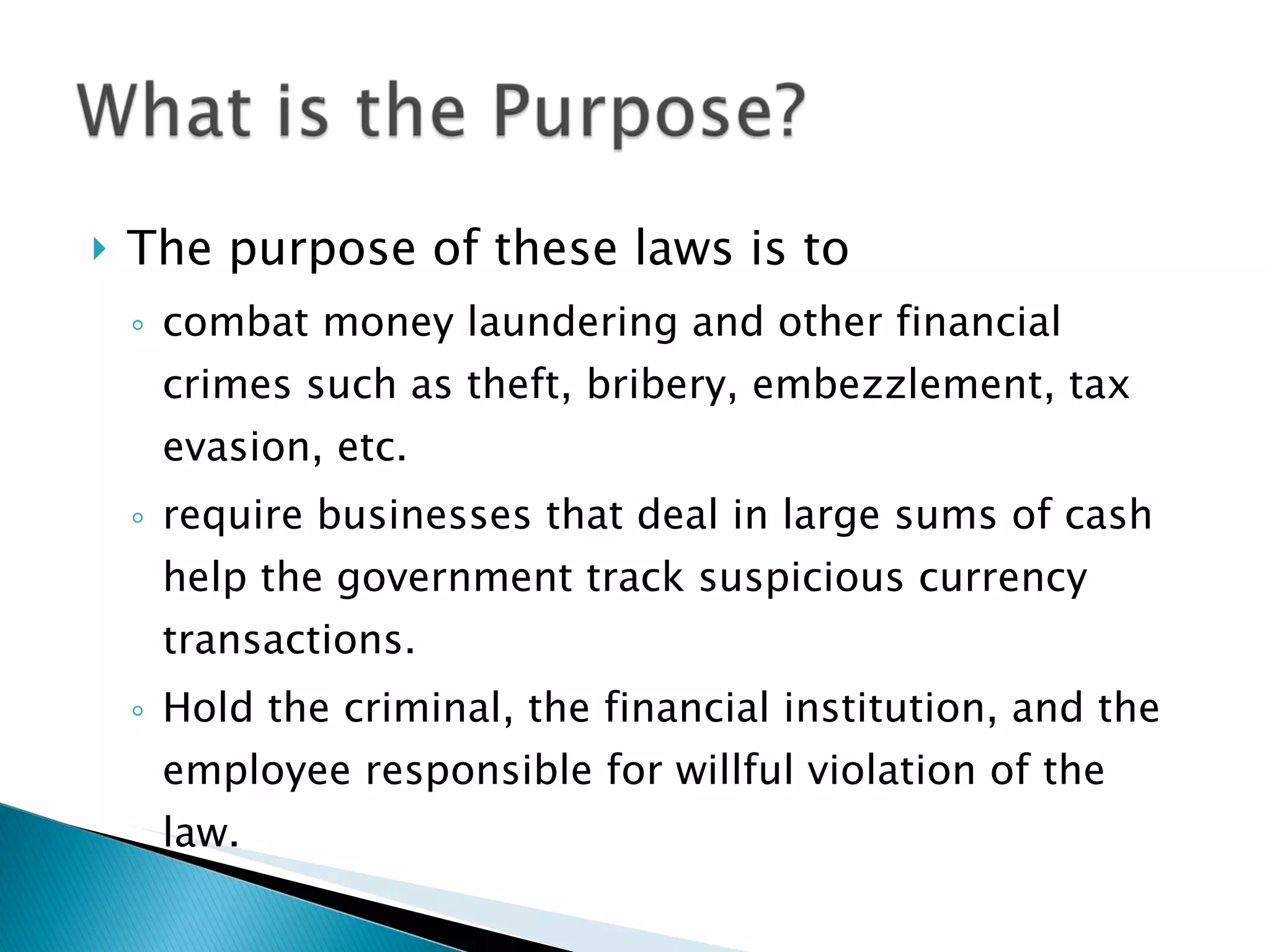
The purpose of these laws is to combat money laundering and other financial crimes such as theft, bribery, embezzlement, tax evasion, etc. require businesses that deal in large sums of cash help the government track suspicious currency transactions. Hold the criminal, the financial institution, and the employee responsible for willful violation of the law.
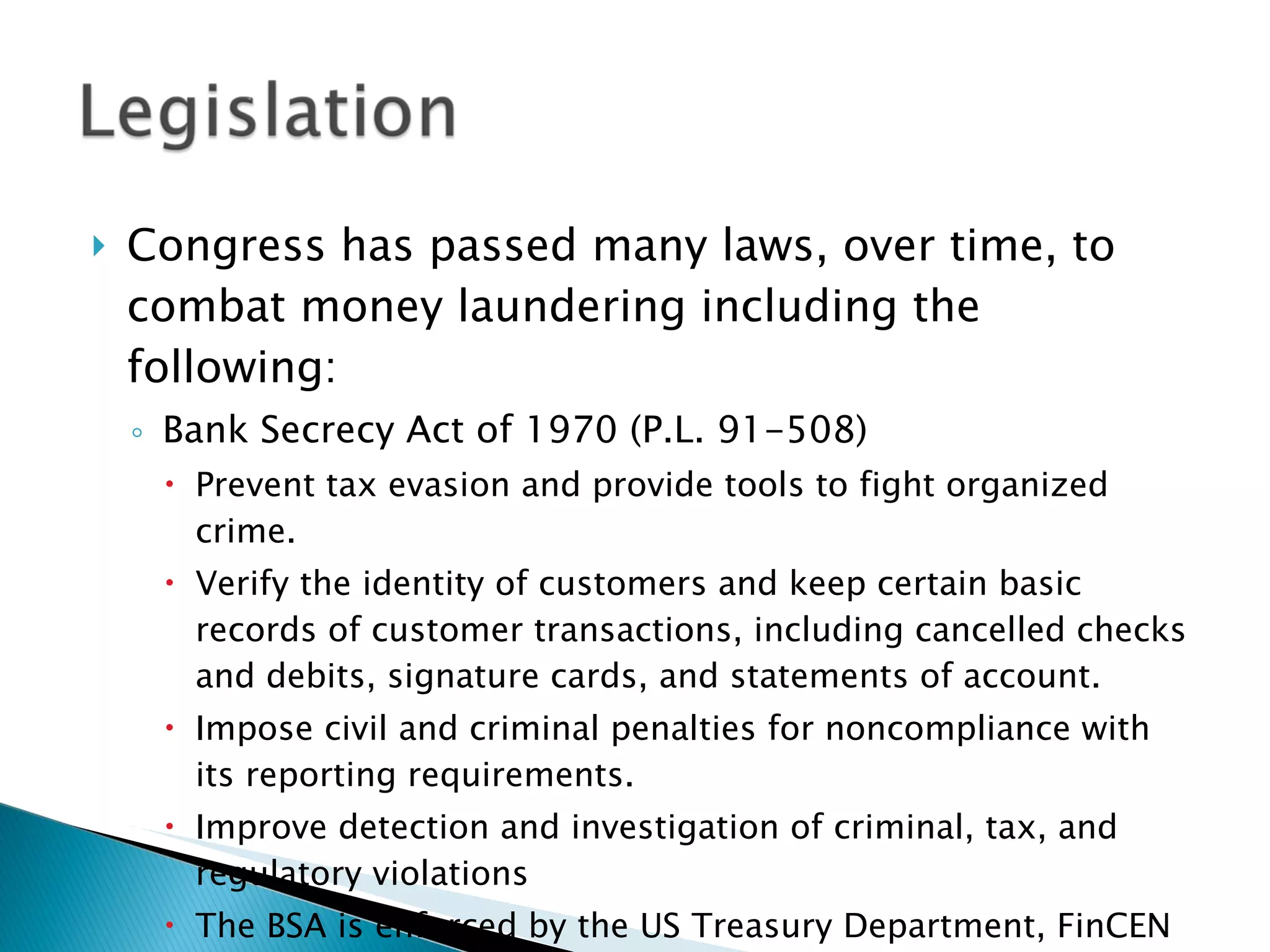
Congress has passed many laws, over time, to combat money laundering including the following: Bank Secrecy Act of 1970 (P.L. 91-508) Prevent tax evasion and provide tools to fight organized crime. Verify the identity of customers and keep certain basic records of customer transactions, including cancelled checks and debits, signature cards, and statements of account. Impose civil and criminal penalties for noncompliance with its reporting requirements. Improve detection and investigation of criminal, tax, and regulatory violations The BSA is enforced by the US Treasury Department, FinCEN
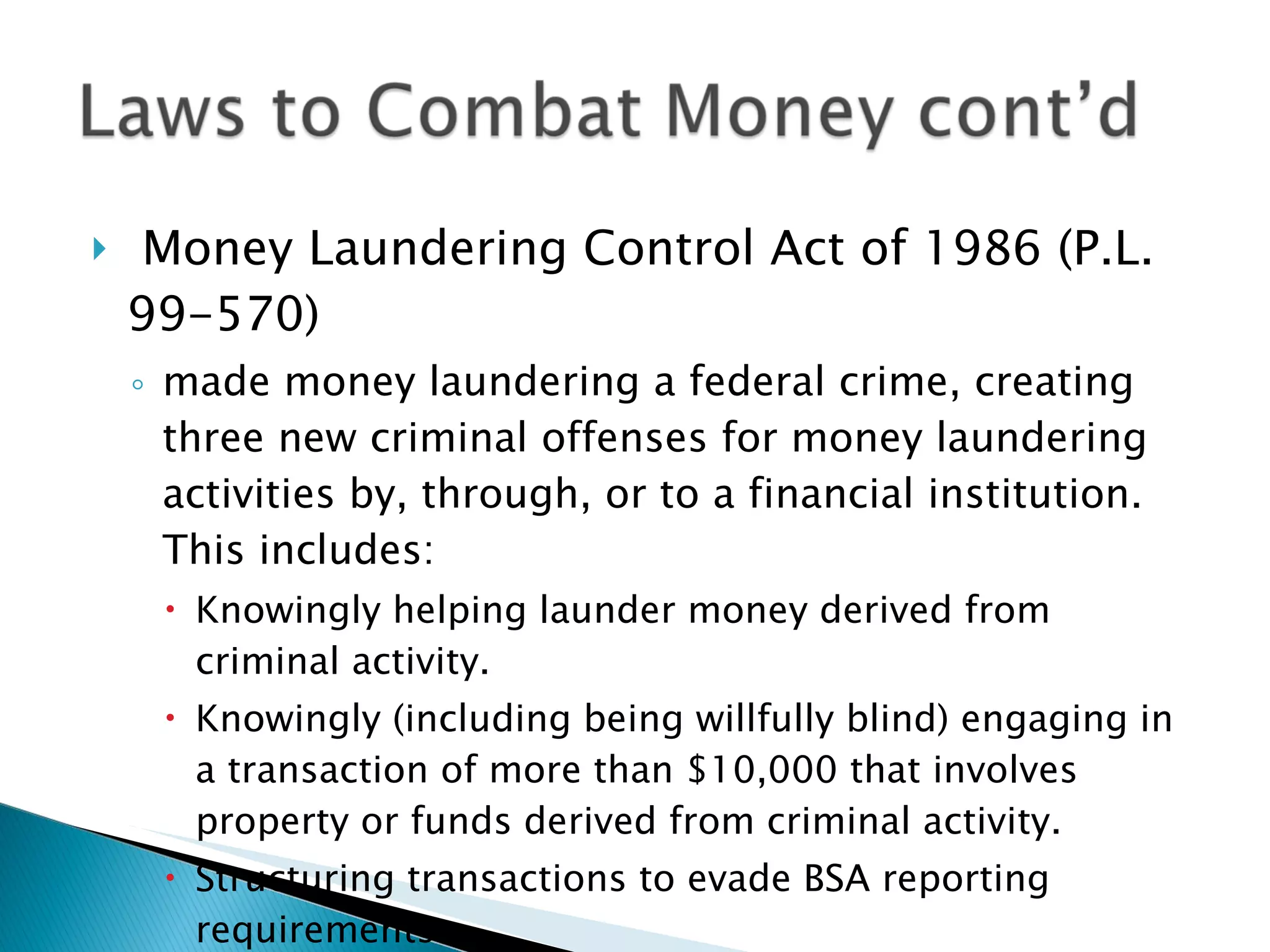
Money Laundering Control Act of 1986 (P.L. 99-570) made money laundering a federal crime, creating three new criminal offenses for money laundering activities by, through, or to a financial institution. This includes: Knowingly helping launder money derived from criminal activity. Knowingly (including being willfully blind) engaging in a transaction of more than $10,000 that involves property or funds derived from criminal activity. Structuring transactions to evade BSA reporting requirements.
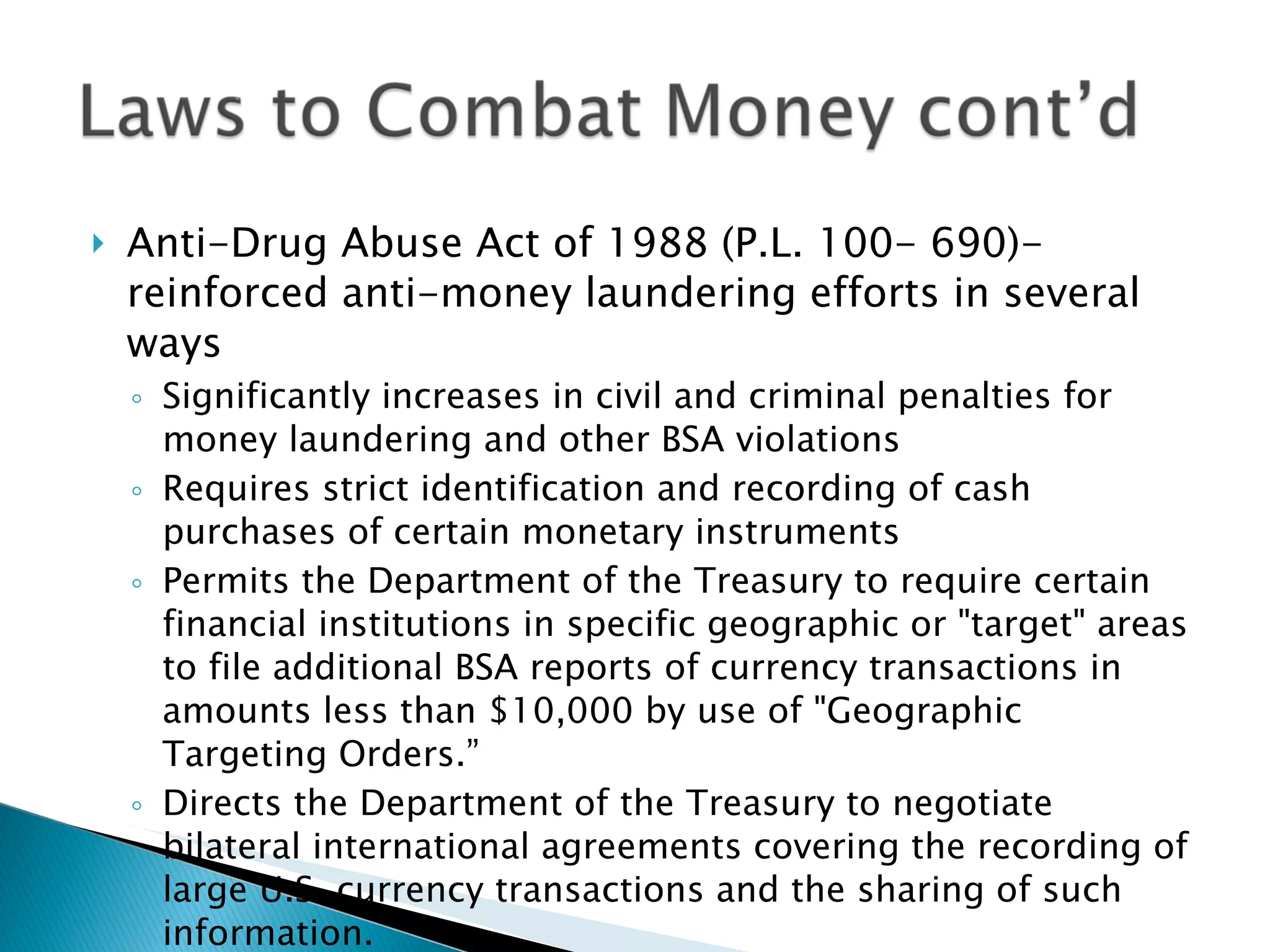
Anti-Drug Abuse Act of 1988 (P.L. 100- 690)-reinforced anti-money laundering efforts in several ways Significantly increases in civil and criminal penalties for money laundering and other BSA violations Requires strict identification and recording of cash purchases of certain monetary instruments Permits the Department of the Treasury to require certain financial institutions in specific geographic or "target" areas to file additional BSA reports of currency transactions in amounts less than $10,000 by use of "Geographic Targeting Orders.” Directs the Department of the Treasury to negotiate bilateral international agreements covering the recording of large U.S. currency transactions and the sharing of such information.
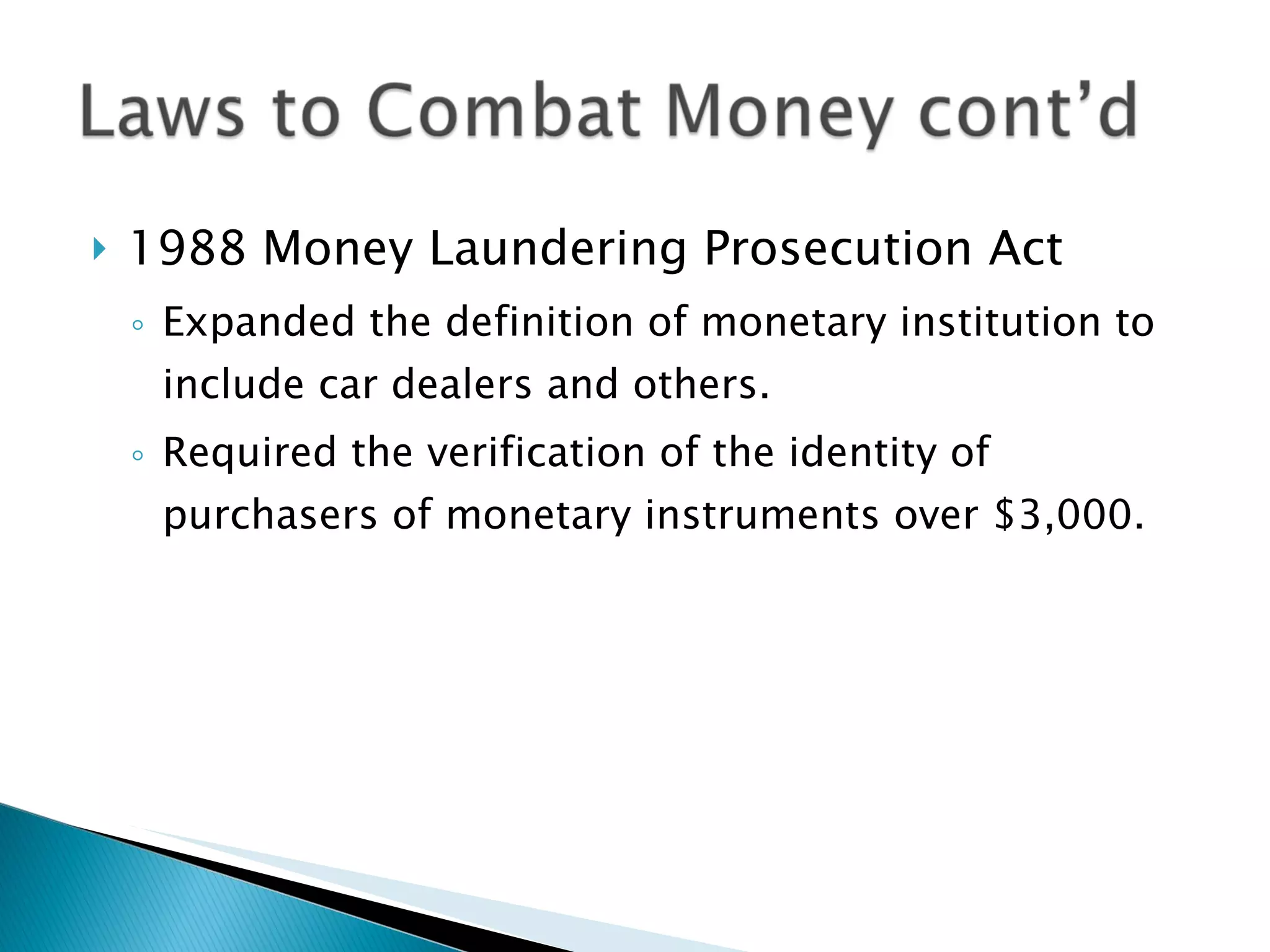
1988 Money Laundering Prosecution Act Expanded the definition of monetary institution to include car dealers and others. Required the verification of the identity of purchasers of monetary instruments over $3,000.
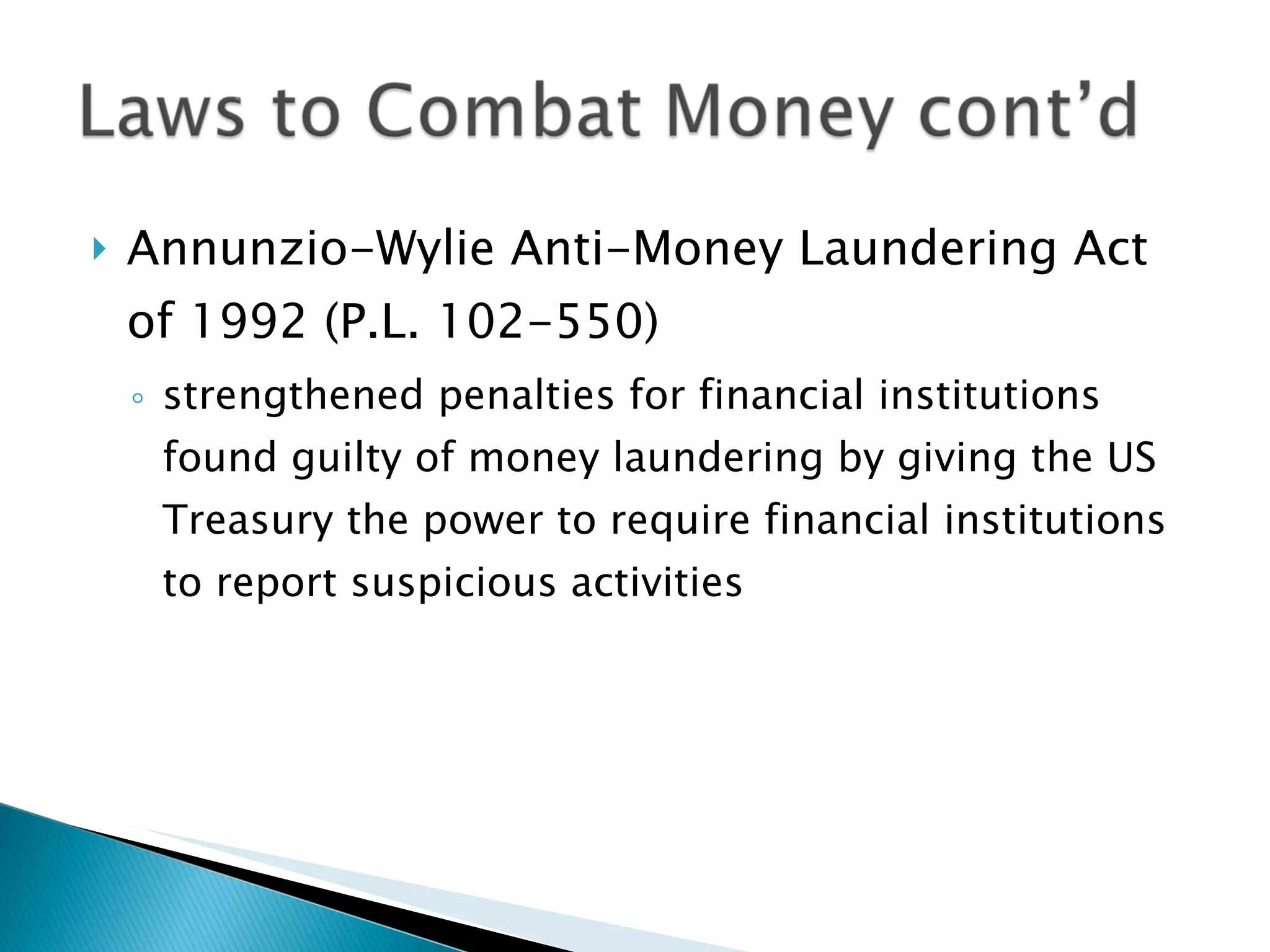
Annunzio-Wylie Anti-Money Laundering Act of 1992 (P.L. 102-550) strengthened penalties for financial institutions found guilty of money laundering by giving the US Treasury the power to require financial institutions to report suspicious activities
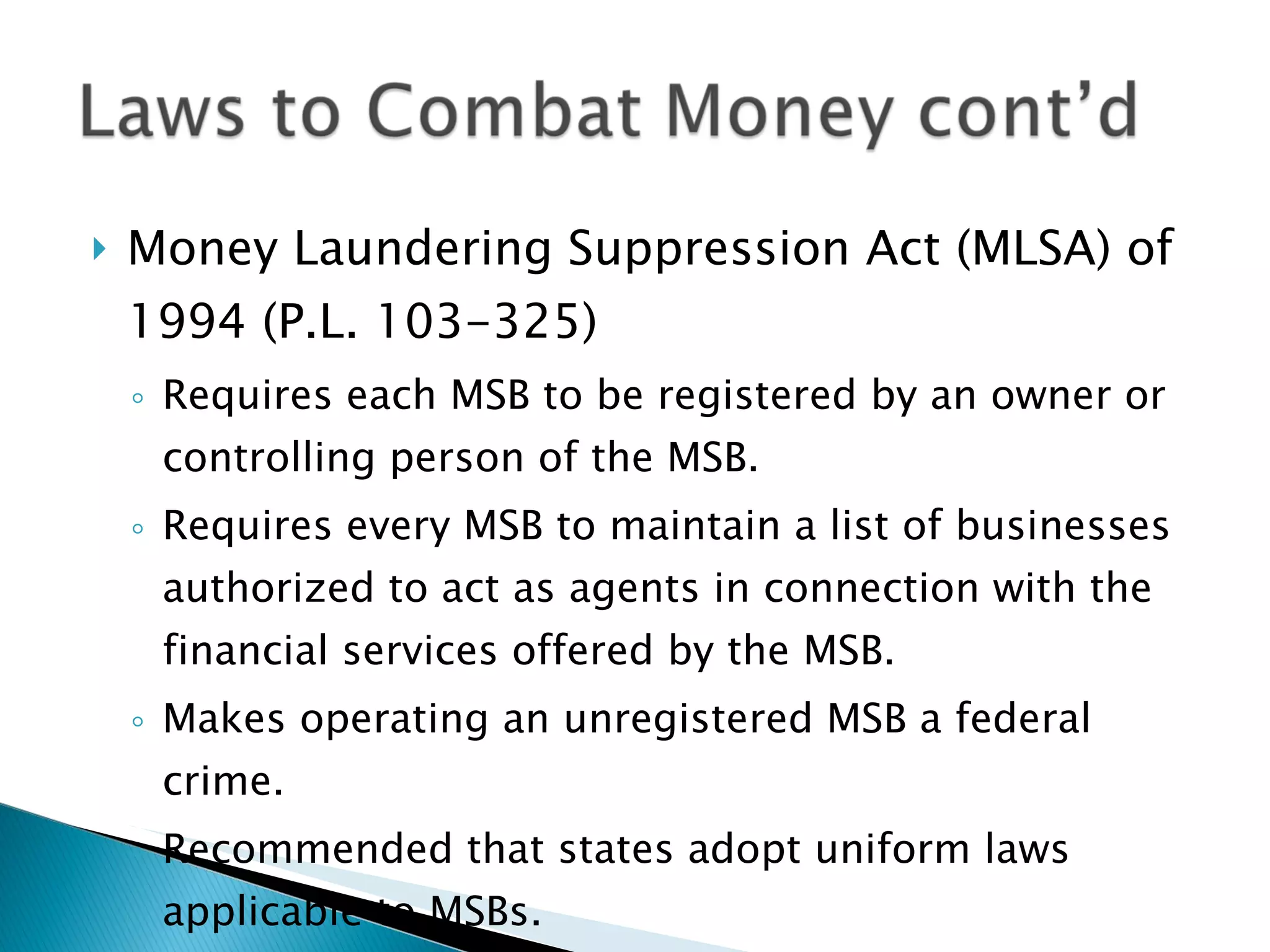
Money Laundering Suppression Act (MLSA) of 1994 (P.L. 103-325) Requires each MSB to be registered by an owner or controlling person of the MSB. Requires every MSB to maintain a list of businesses authorized to act as agents in connection with the financial services offered by the MSB. Makes operating an unregistered MSB a federal crime. Recommended that states adopt uniform laws applicable to MSBs.
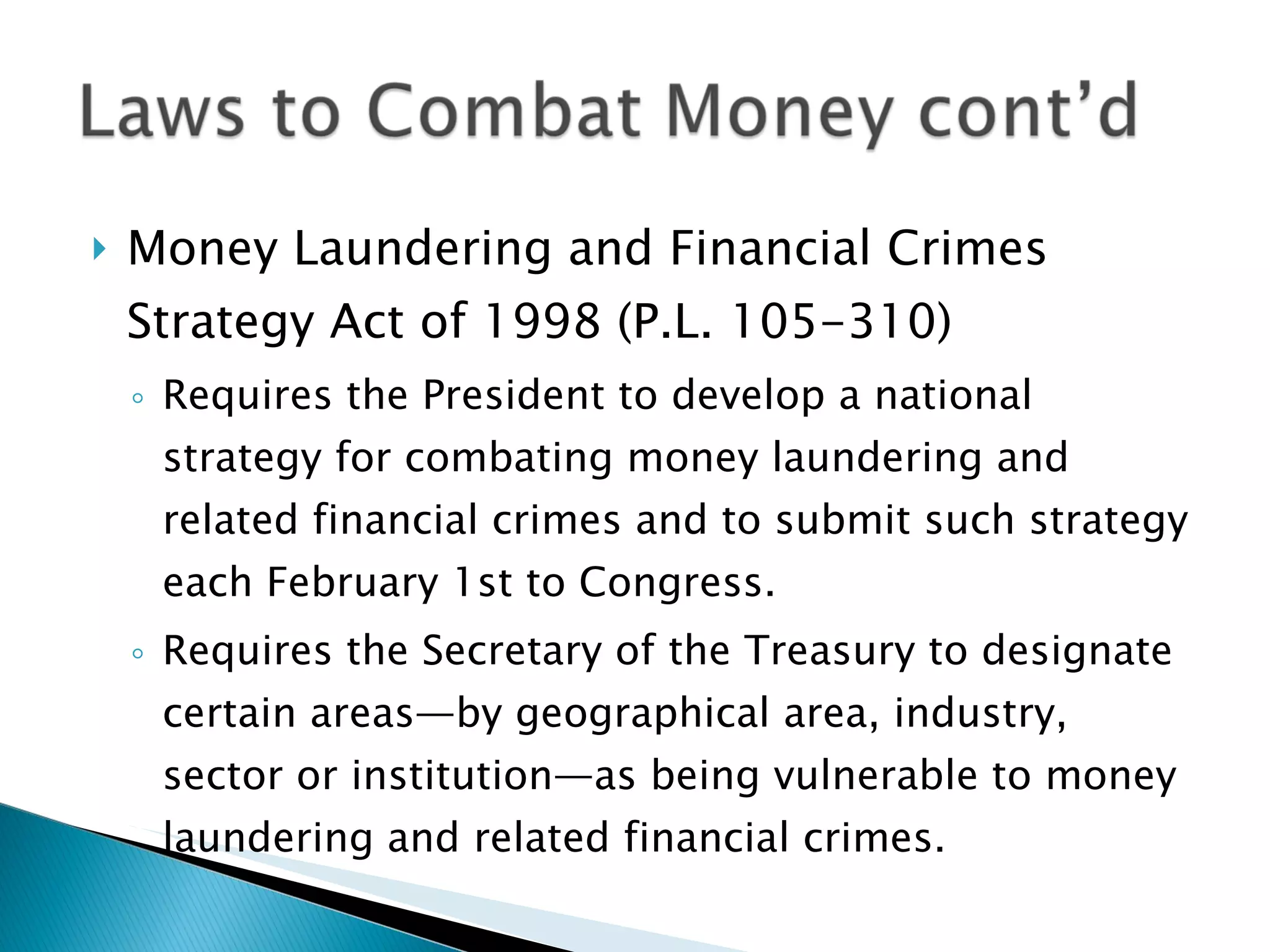
Money Laundering and Financial Crimes Strategy Act of 1998 (P.L. 105-310) Requires the President to develop a national strategy for combating money laundering and related financial crimes and to submit such strategy each February 1st to Congress. Requires the Secretary of the Treasury to designate certain areas—by geographical area, industry, sector or institution—as being vulnerable to money laundering and related financial crimes.
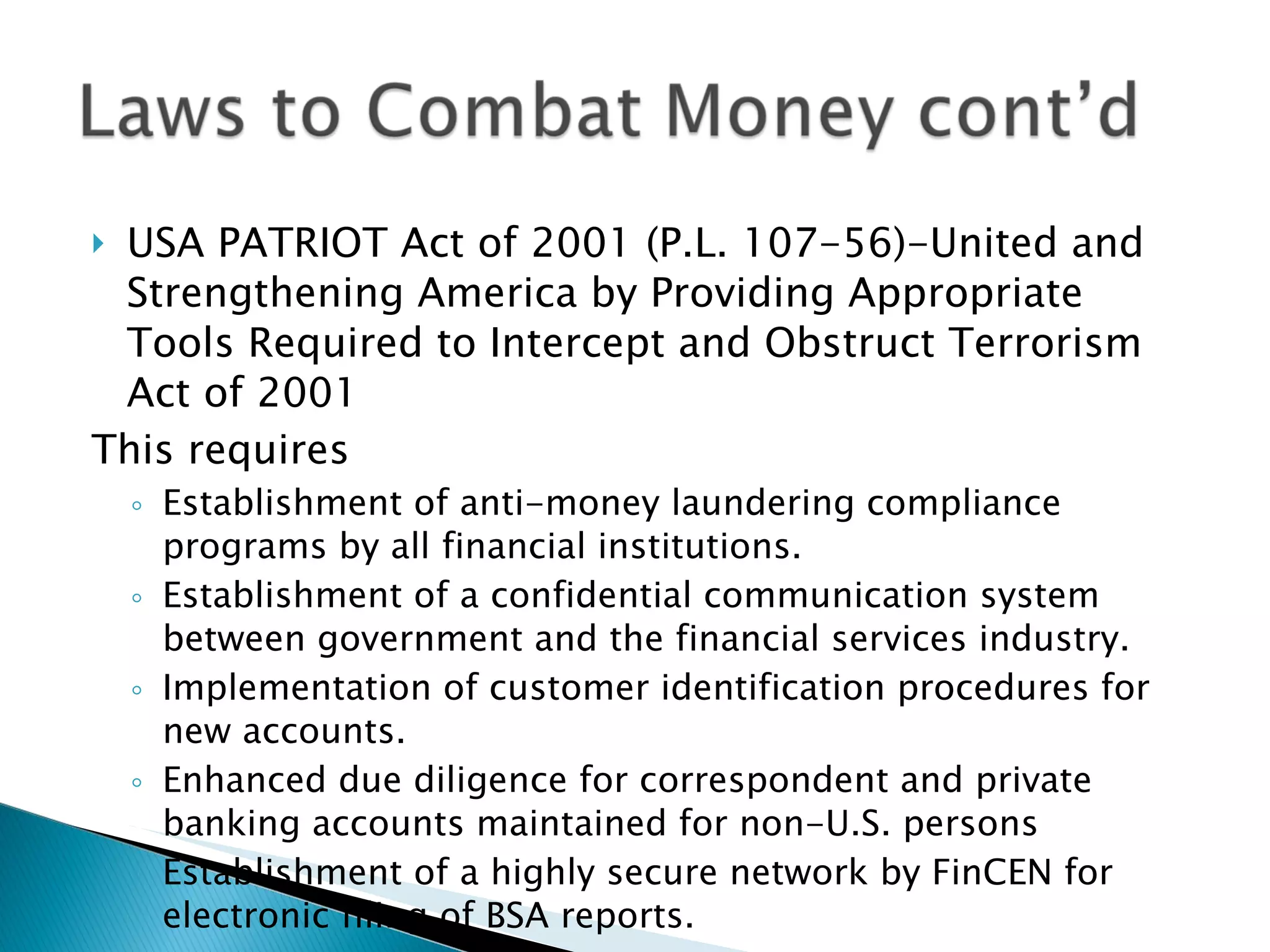
USA PATRIOT Act of 2001 (P.L. 107-56)-United and Strengthening America by Providing Appropriate Tools Required to Intercept and Obstruct Terrorism Act of 2001 This requires Establishment of anti-money laundering compliance programs by all financial institutions. Establishment of a confidential communication system between government and the financial services industry. Implementation of customer identification procedures for new accounts. Enhanced due diligence for correspondent and private banking accounts maintained for non-U.S. persons Establishment of a highly secure network by FinCEN for electronic filing of BSA reports.
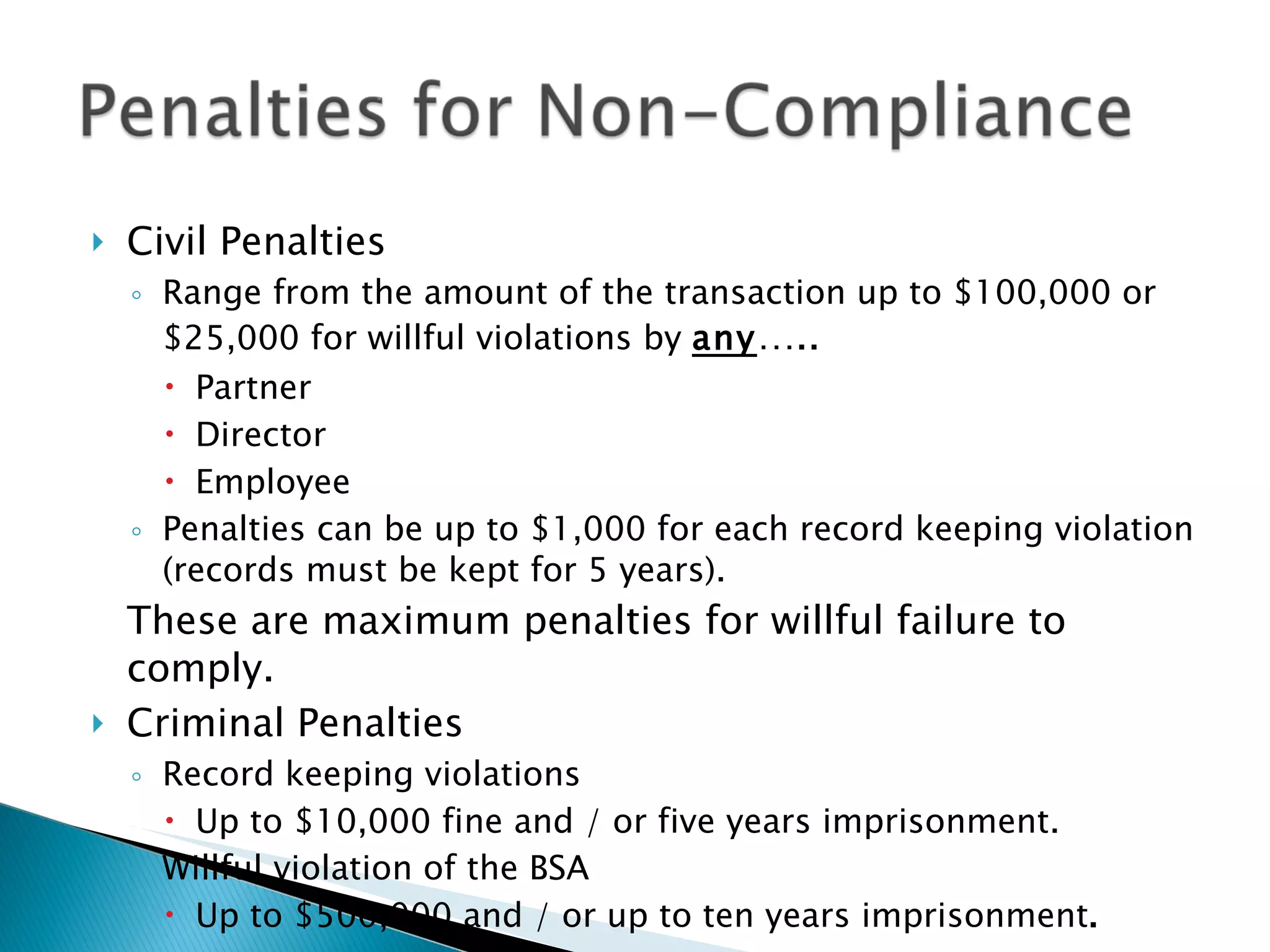
Civil Penalties Range from the amount of the transaction up to $100,000 or $25,000 for willful violations by  any ….. Partner Director Employee Penalties can be up to $1,000 for each record keeping violation (records must be kept for 5 years). These are maximum penalties for willful failure to comply. Criminal Penalties Record keeping violations Up to $10,000 fine and / or five years imprisonment. Willful violation of the BSA Up to $500,000 and / or up to ten years imprisonment .
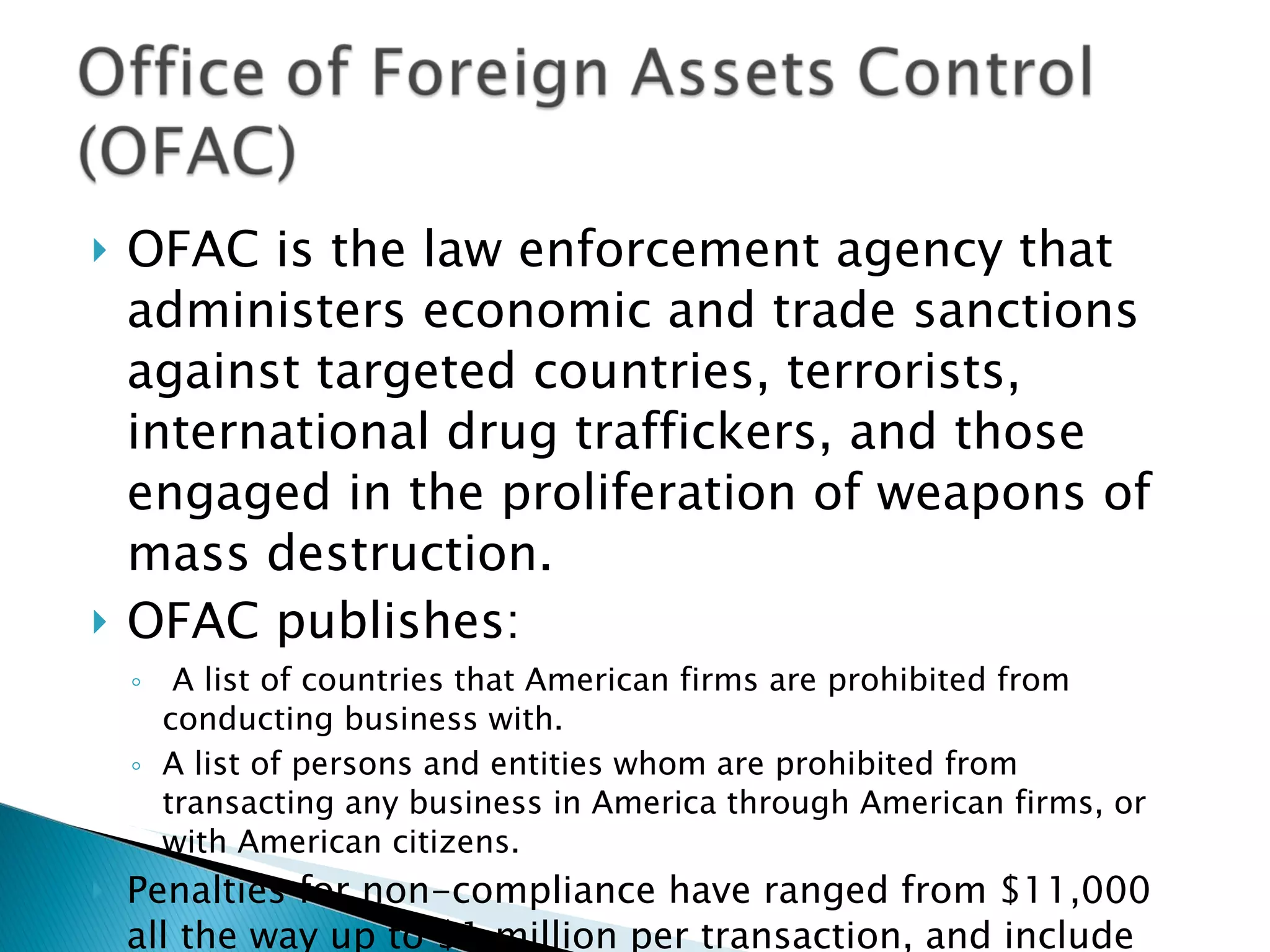
OFAC is the law enforcement agency that administers economic and trade sanctions against targeted countries, terrorists, international drug traffickers, and those engaged in the proliferation of weapons of mass destruction. OFAC publishes: A list of countries that American firms are prohibited from conducting business with. A list of persons and entities whom are prohibited from transacting any business in America through American firms, or with American citizens. Penalties for non-compliance have ranged from $11,000 all the way up to $1 million per transaction, and include possible criminal prosecution.
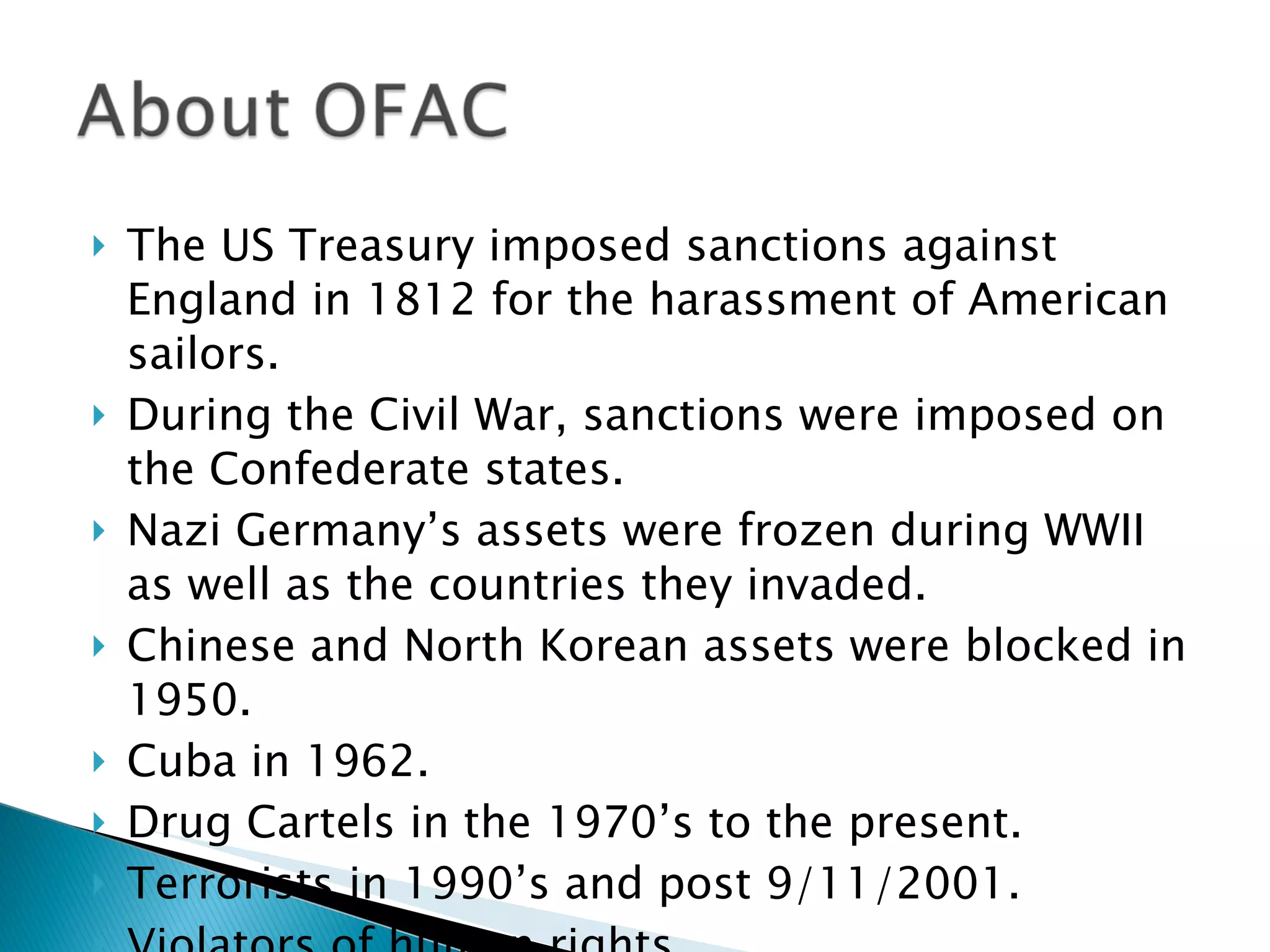
The US Treasury imposed sanctions against England in 1812 for the harassment of American sailors. During the Civil War, sanctions were imposed on the Confederate states. Nazi Germany’s assets were frozen during WWII as well as the countries they invaded. Chinese and North Korean assets were blocked in 1950.  Cuba in 1962. Drug Cartels in the 1970’s to the present. Terrorists in 1990’s and post 9/11/2001. Violators of human rights.
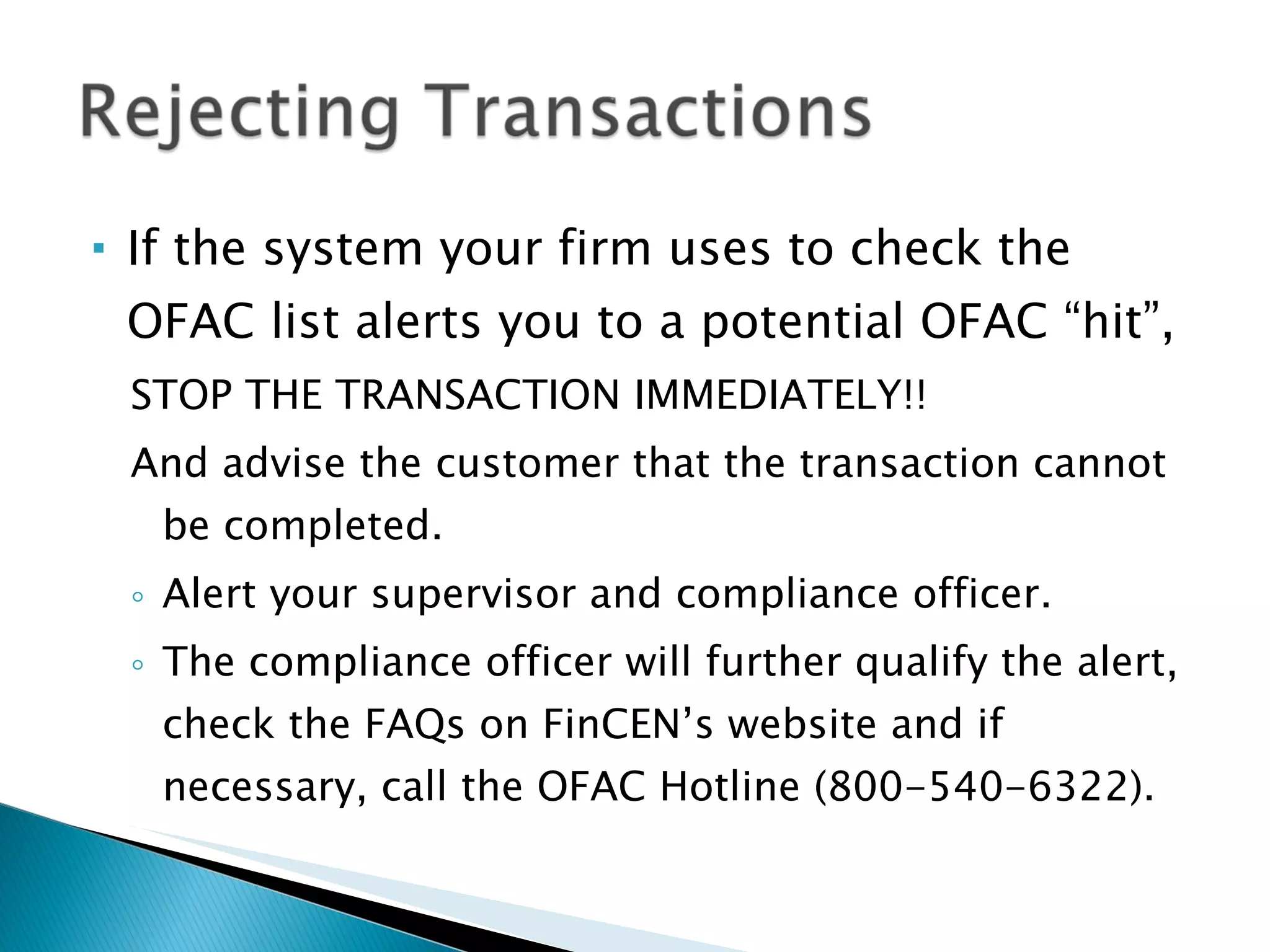
If the system your firm uses to check the OFAC list alerts you to a potential OFAC “hit”, STOP THE TRANSACTION IMMEDIATELY!! And advise the customer that the transaction cannot be completed. Alert your supervisor and compliance officer. The compliance officer will further qualify the alert, check the FAQs on FinCEN’s website and if necessary, call the OFAC Hotline (800-540-6322).

Quickdinero Compliance Training Module 4

  • 1.
  • 2.
    The purpose ofthese laws is to combat money laundering and other financial crimes such as theft, bribery, embezzlement, tax evasion, etc. require businesses that deal in large sums of cash help the government track suspicious currency transactions. Hold the criminal, the financial institution, and the employee responsible for willful violation of the law.
  • 3.
    Congress has passedmany laws, over time, to combat money laundering including the following: Bank Secrecy Act of 1970 (P.L. 91-508) Prevent tax evasion and provide tools to fight organized crime. Verify the identity of customers and keep certain basic records of customer transactions, including cancelled checks and debits, signature cards, and statements of account. Impose civil and criminal penalties for noncompliance with its reporting requirements. Improve detection and investigation of criminal, tax, and regulatory violations The BSA is enforced by the US Treasury Department, FinCEN
  • 4.
    Money Laundering ControlAct of 1986 (P.L. 99-570) made money laundering a federal crime, creating three new criminal offenses for money laundering activities by, through, or to a financial institution. This includes: Knowingly helping launder money derived from criminal activity. Knowingly (including being willfully blind) engaging in a transaction of more than $10,000 that involves property or funds derived from criminal activity. Structuring transactions to evade BSA reporting requirements.
  • 5.
    Anti-Drug Abuse Actof 1988 (P.L. 100- 690)-reinforced anti-money laundering efforts in several ways Significantly increases in civil and criminal penalties for money laundering and other BSA violations Requires strict identification and recording of cash purchases of certain monetary instruments Permits the Department of the Treasury to require certain financial institutions in specific geographic or "target" areas to file additional BSA reports of currency transactions in amounts less than $10,000 by use of "Geographic Targeting Orders.” Directs the Department of the Treasury to negotiate bilateral international agreements covering the recording of large U.S. currency transactions and the sharing of such information.
  • 6.
    1988 Money LaunderingProsecution Act Expanded the definition of monetary institution to include car dealers and others. Required the verification of the identity of purchasers of monetary instruments over $3,000.
  • 7.
    Annunzio-Wylie Anti-Money LaunderingAct of 1992 (P.L. 102-550) strengthened penalties for financial institutions found guilty of money laundering by giving the US Treasury the power to require financial institutions to report suspicious activities
  • 8.
    Money Laundering SuppressionAct (MLSA) of 1994 (P.L. 103-325) Requires each MSB to be registered by an owner or controlling person of the MSB. Requires every MSB to maintain a list of businesses authorized to act as agents in connection with the financial services offered by the MSB. Makes operating an unregistered MSB a federal crime. Recommended that states adopt uniform laws applicable to MSBs.
  • 9.
    Money Laundering andFinancial Crimes Strategy Act of 1998 (P.L. 105-310) Requires the President to develop a national strategy for combating money laundering and related financial crimes and to submit such strategy each February 1st to Congress. Requires the Secretary of the Treasury to designate certain areas—by geographical area, industry, sector or institution—as being vulnerable to money laundering and related financial crimes.
  • 10.
    USA PATRIOT Actof 2001 (P.L. 107-56)-United and Strengthening America by Providing Appropriate Tools Required to Intercept and Obstruct Terrorism Act of 2001 This requires Establishment of anti-money laundering compliance programs by all financial institutions. Establishment of a confidential communication system between government and the financial services industry. Implementation of customer identification procedures for new accounts. Enhanced due diligence for correspondent and private banking accounts maintained for non-U.S. persons Establishment of a highly secure network by FinCEN for electronic filing of BSA reports.
  • 11.
    Civil Penalties Rangefrom the amount of the transaction up to $100,000 or $25,000 for willful violations by any ….. Partner Director Employee Penalties can be up to $1,000 for each record keeping violation (records must be kept for 5 years). These are maximum penalties for willful failure to comply. Criminal Penalties Record keeping violations Up to $10,000 fine and / or five years imprisonment. Willful violation of the BSA Up to $500,000 and / or up to ten years imprisonment .
  • 12.
    OFAC is thelaw enforcement agency that administers economic and trade sanctions against targeted countries, terrorists, international drug traffickers, and those engaged in the proliferation of weapons of mass destruction. OFAC publishes: A list of countries that American firms are prohibited from conducting business with. A list of persons and entities whom are prohibited from transacting any business in America through American firms, or with American citizens. Penalties for non-compliance have ranged from $11,000 all the way up to $1 million per transaction, and include possible criminal prosecution.
  • 13.
    The US Treasuryimposed sanctions against England in 1812 for the harassment of American sailors. During the Civil War, sanctions were imposed on the Confederate states. Nazi Germany’s assets were frozen during WWII as well as the countries they invaded. Chinese and North Korean assets were blocked in 1950. Cuba in 1962. Drug Cartels in the 1970’s to the present. Terrorists in 1990’s and post 9/11/2001. Violators of human rights.
  • 14.
    If the systemyour firm uses to check the OFAC list alerts you to a potential OFAC “hit”, STOP THE TRANSACTION IMMEDIATELY!! And advise the customer that the transaction cannot be completed. Alert your supervisor and compliance officer. The compliance officer will further qualify the alert, check the FAQs on FinCEN’s website and if necessary, call the OFAC Hotline (800-540-6322).