www.pwc.com
Financial
Sanctions
Revisited
From Cuba to Crimea
After 54 years of US sanctions against
Cuba, Iran, Sudan, North Korea,
Russia and others, the on-going crisis
in the Ukraine recently brought the
challenges of dealing with US
sanctions back on the public agenda.
The changing political landscape in
Iran, Sudan and Syria as well as
increasing enforcement by
authorities around the globe poses a
number of challenges for businesses
who are dealing with the imposition
of financial sanctions.
One of these challenges is the rapid
pace of change both on the ground
and in the nature and extent of the
regulatory responses adopted by the
EU and US and the uncertainty which
that creates.
PwC provides its clients with the
expertise of former government
regulators and industry leaders with
extensive experience in effectively
addressing a variety of sanctions
compliance needs.
Our experienced professionals can
assist companies in all aspects of
international trade compliance –
from assessing and managing
compliance risk, to compliance
support and integrating compliance
into daily processes and value
streams.
Our team is also highly experienced
in advising Financial Services
companies on how to navigate the
complexities of multijurisdictional
sanctions regimes. Our experts have
successfully assisted clients to:
• Manage the challenges of
sanctions compliance with
proactive reviews of policies,
procedure and systems. Our team
has also helped clients respond to
suspected sanctions breaches
• Respond to requests of regulators
and conduct sanctions
investigations on a large scale
• Identify and respond to the
practical and operational issues
faced by your organization
Managing sanctions
compliance in the
financial services
industry
We understand that as a senior
stakeholder you must take difficult
business decisions and these may
impact your ability to comply with
sanctions obligations. These
decisions may include:
• The extent of testing to be
performed on your sanctions
screening system to ensure
effectiveness and efficiency of
your compliance environment
• How to deal with potential and
actual matches against sanctions
targets
• How much due diligence should
you do on each transaction
• How to identify the risks to your
organization
• What type of customers to avoid;
and how you identify higher risk
customers and politically exposed
persons (PEPs)
• Whether and how to exit from
customer relationships or even
from the region
Additionally, Financial Services
companies must demonstrate and
promote throughout their global
businesses a strong risk based
compliance culture, which
encourages appropriate behavior by
all staff.
Failure to demonstrate adequate
compliance may result in:
• Regulatory censure
• Deferred prosecutions
• Significant fines
• Imposed oversight of
management from independent
bodies
• Look back reviews and
remediation of data over periods
of up to ten years
• Reputational
The cost and impact on Financial
Services companies which fail to take
account of their sanctions compliance
obligations can be significant.
The imposition of
financial sanctions
is causing many to
re-evaluate their
approach to
financial sanctions
2 | Financial Sanctions Revisited | PwC
We recognize that the sanctions
landscape is evolving, challenging
and complex.
The crisis in the Ukraine is one
example that increased awareness of
the sanction regimes in place and has
led to increased activity by regulators
around the globe causing a wide
range of impacts across all sectors.
Under the current sanctions, the
Financial Services industry has felt a
significant impact as it must balance
regulatory obligations against
efficient and cost effective customer
service and transaction processing.
The Sanctions Cycle
PwC | Financial Sanctions Revisited | 3
„People thought sanctions were
about visas for oligarchs wanting to
visit Disneyland. But they are much
more important […]”
Financial sanctions are
mostly a problem for
the banks, aren’t they?
Focusing on
insurers' and
reinsurers'
compliance with
U.S. economic
sanctions
• Can insurers deal with
counterparties where individuals
listed as a Specially Designated
National (SDN) by the US are
involved as shareholders or in an
operative position?
Generally the US economic sanctions
regime prohibits companies and
individuals from issuing insurance
policies and reinsurance contracts
involving nations, companies,
organizations, individuals or vessels
that would fall under one of the
sanctions programs. Depending on
the program, even approving,
guaranteeing, financing or
facilitating transactions may already
violate US law. Assets and funds that
listed individuals or companies have
direct or indirect interest in have to
be blocked by the insurer,
transferred into a separate account
with a US bank and a report must be
filed immediately.
The tools to guarantee sanctions
compliance that policy makers
adapted for economic sanctions
originally derived from the needs of
non-proliferation sanctions in the
area of anti-money laundering and
prevention of financing for terrorist
organizations. This focus on the
banking industry forced the
institutes to greatly enhance their
control procedures and compliance
regimes. As a matter of fact,
nowadays the banks are far ahead of
the overall Financial Services
industry standard when it comes to
sanctions compliance.
However, recently we have seen
OFAC shifting interest also to the
insurance industry. From maritime
to life insurers, US economic
sanctions pose a significant risk to
insurers and re-insurers and even in
cases where on the first glance no
risks is visible, further analysis
unveils a wide range of potential
sanctions violations. To illustrate
some of the difficult economic
sanctions issues, here are a few
examples:
• A citizen of any of the sanctioned
states living in the US has an
insurance policy with a relative
living still in the sanctioned
country as main beneficiary
making it impossible to pay out
the insurance sum
• A ship registered in a non-
sanctioned country faces
technical problems offshore
forcing the ship to call a port in
any sanctioned country. The
necessary repair work executed
by a local contractor, normally
covered under an ocean
maritime insurance, will now be
subject to US sanctions
• A US person travelling in a
sanctioned country needs
medical treatment in a hospital.
Would a US based insurer be
allowed to reimburse costs for
the treatment provided by
doctors in a sanctioned country?
• Can claims be paid by the insurer
if the payee’s bank account is co-
owned by another person living
in one of the sanctioned
countries?
*Sergio Trigo Paz, BlackRock; from Financial Times article May 16, 2014
“We knew there was a risk, but we
didn't expect it to be that big.”*
Facts:
40,000
Names and aliases in lists
1 day
Average interval of list
updates
20%
Increase in names and aliases
in less than a year
3,000
New aliases in a single EU
update on 19 July 2011
4 billion +
Possible fuzzy logic
combinations
$ 11.8 billion
Total fines levied for
sanctions violations since
2004 – just a fraction of the
total cost of remediation
6 | Financial Sanctions Revisited | PwC
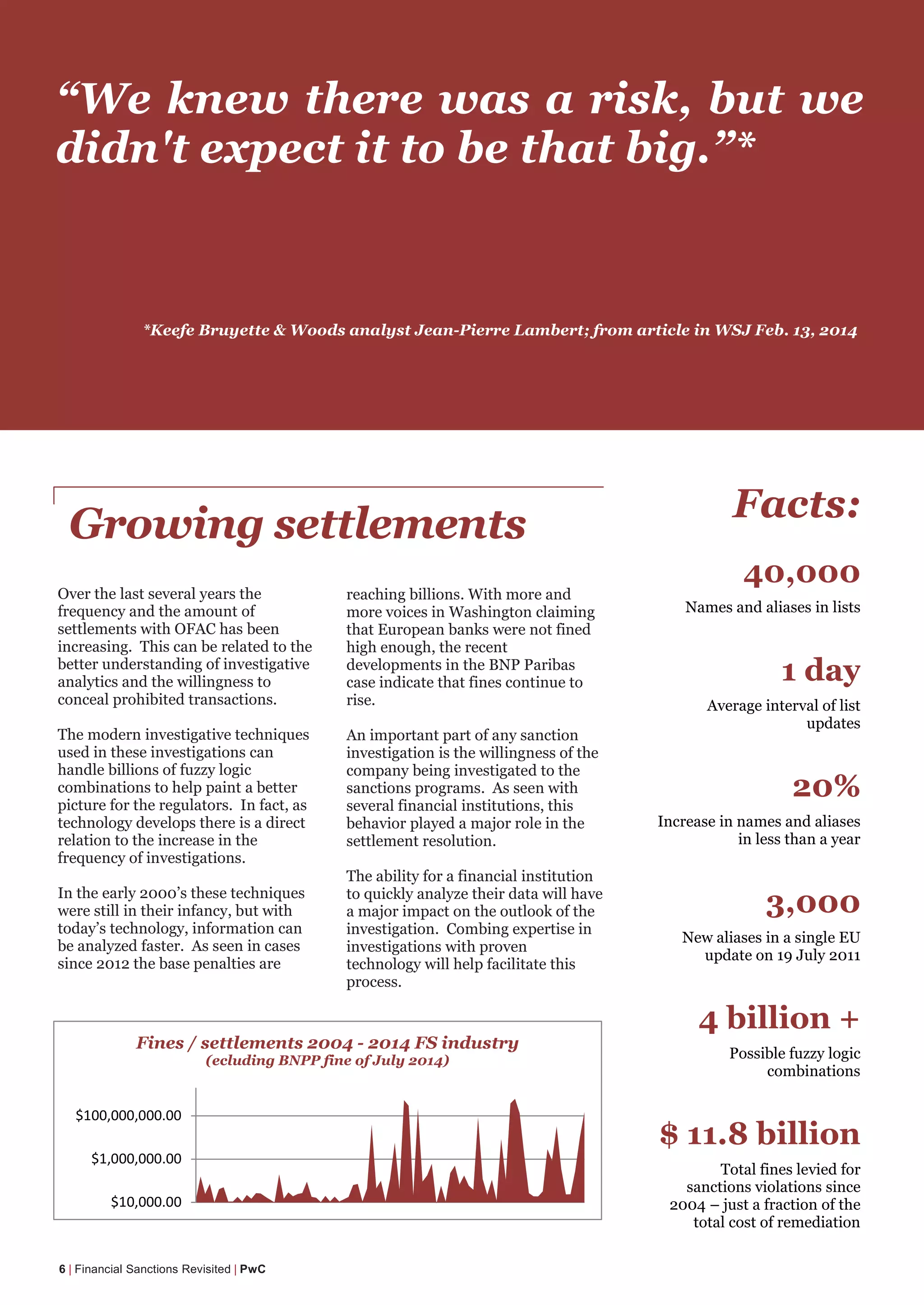
Growing settlements
Over the last several years the
frequency and the amount of
settlements with OFAC has been
increasing. This can be related to the
better understanding of investigative
analytics and the willingness to
conceal prohibited transactions.
The modern investigative techniques
used in these investigations can
handle billions of fuzzy logic
combinations to help paint a better
picture for the regulators. In fact, as
technology develops there is a direct
relation to the increase in the
frequency of investigations.
In the early 2000’s these techniques
were still in their infancy, but with
today’s technology, information can
be analyzed faster. As seen in cases
since 2012 the base penalties are
reaching billions. With more and
more voices in Washington claiming
that European banks were not fined
high enough, the recent
developments in the BNP Paribas
case indicate that fines continue to
rise.
An important part of any sanction
investigation is the willingness of the
company being investigated to the
sanctions programs. As seen with
several financial institutions, this
behavior played a major role in the
settlement resolution.
The ability for a financial institution
to quickly analyze their data will have
a major impact on the outlook of the
investigation. Combing expertise in
investigations with proven
technology will help facilitate this
process.
$10,000.00
$1,000,000.00
$100,000,000.00
Fines / settlements 2004 - 2014 FS industry
(ecluding BNPP fine of July 2014)
*Keefe Bruyette & Woods analyst Jean-Pierre Lambert; from article in WSJ Feb. 13, 2014
How we can help
PwC’s multi-disciplinary team has
developed an approach to help you
assess your risks, plan your response
and identify opportunities in
compliance.
PwC offers a proven methodology
coupled with the ability to efficiently
capture and analyze global data in
multiple languages by our Data
Analytics team.
Subject Matter Experts with industry-
specific insight will leverage their deep
understanding of EU, UN and US
regulations and international
processes around trade sanctions.
Our team also consists of high caliber
individuals with a proven track record
in Corporate Intelligence and
Compliance Investigations to support
an in-depth review of potential
breaches of sanctions or internal
policy.
PwC | Financial Sanctions Revisited | 5
Conduct scenario planning
exercises
Design risk management
procedures to ensure ongoing
compliance
Create a platform for decision
making in an evolving regulatory
landscape
Investigate the nature and breach
extend of a potential sanctions
violation
Multinational companies face a
complex array of EU and US
sanctions and trade compliance
regulations as well as evolving
local watch-lists. Despite general
similarities in the EU and US
approach to Financial Sanctions
nowadays, over time we are
witnessing differing requirements
imposed on companies in each
region.
However, companies, wherever
located, must consider potential
obligations to comply with US
sanctions and watch-lists as US
sanction law allows for global
enforcement whenever a US
person is involved. Furthermore,
OFAC sanctions may apply where
transactions are denominated in
US dollars or where companies
are listed in the US and US
persons are involved in the trades
or deals.
In the EU, compliance infractions
with the financial sanctions are
not as rigidly enforced as in the
US. With no central European
authority taking care of the
sanction regime enforcement, this
task is still left to the national
regulators and authorities of the
member states. Moreover, most of
the settlements with European
banks published by OFAC during
the past years comprehend fines
for alleged Cuba-related deals,
even though the EU put a
blocking statute against the US
Cuba sanctions in place.
In today’s highly globalized world
the risk of being investigated for
violating US sanctions law is
higher than ever.
Understanding your
current and potential
exposure to financial
sanctions
Regulatory litigation
readiness or how to
prepare your
organization for the
worst case scenario
It is quite likely that in the coming
years we will see more fine
settlements amounting to above USD
1 billion.
Proactive risk assessments and what-
if analyses can help prepare your
organization in dealing with these
developments.
In order to increase your regulatory
litigation readiness you can make
sure you verified the following:
• your sanctions compliance
processes are up to date,
• you sample tested your
transaction data from the past,
• you verified all your transaction
and user data within the
organization is archived
properly,
• you finally assured all necessary
evidence can be pulled out of
your IT systems with minimal
costs.
While some of the issues posed by
the increasing risk of being subject to
a US regulatory investigation present
immediate or self-evident business
impact, others will emerge over time.
With every settlement, the US
authorities gain deeper insight into
the business processes of financial
institutions around the globe. At the
same time, the request for higher
fines for Non-US financial
institutions and insurers by the US
increases.
The current BNP Paribas discussions
could significantly raise the
maximum fines applied in the future.
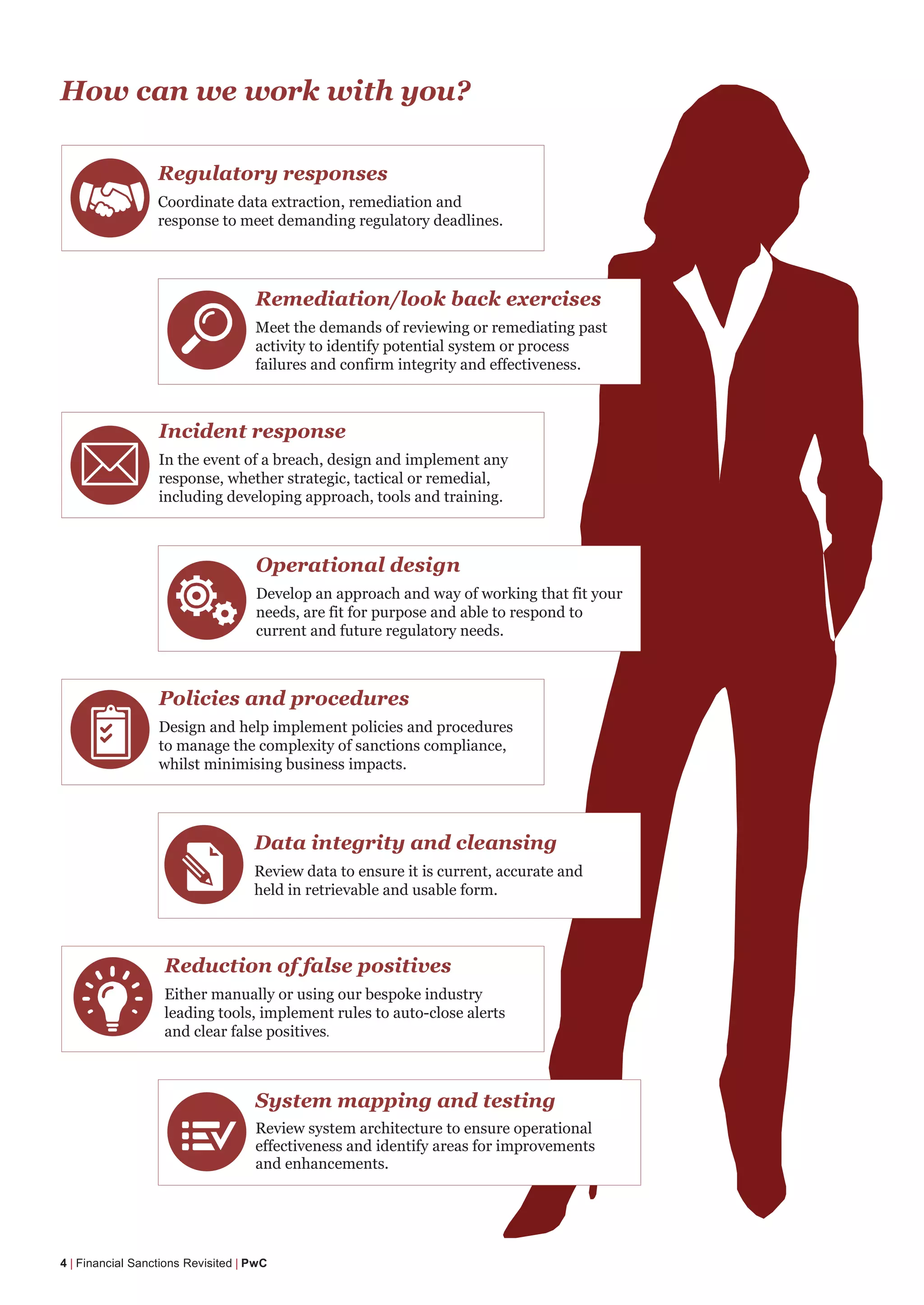
How can we work with you?
4 | Financial Sanctions Revisited | PwC
System mapping and testing
Review system architecture to ensure operational
effectiveness and identify areas for improvements
and enhancements.
Reduction of false positives
Either manually or using our bespoke industry
leading tools, implement rules to auto-close alerts
and clear false positives.
Data integrity and cleansing
Review data to ensure it is current, accurate and
held in retrievable and usable form.
Policies and procedures
Design and help implement policies and procedures
to manage the complexity of sanctions compliance,
whilst minimising business impacts.
Operational design
Develop an approach and way of working that fit your
needs, are fit for purpose and able to respond to
current and future regulatory needs.
Incident response
In the event of a breach, design and implement any
response, whether strategic, tactical or remedial,
including developing approach, tools and training.
Remediation/look back exercises
Meet the demands of reviewing or remediating past
activity to identify potential system or process
failures and confirm integrity and effectiveness.
Regulatory responses
Coordinate data extraction, remediation and
response to meet demanding regulatory deadlines.
Additional information
For additional information, please contact:
PwC | Financial Sanctions Revisited | 7
Jeff Lavine Darren J. Tapp Daniel Tannebaum
Partner, U.S. AML Leader Partner, Forensics Services Director, AML/OFAC Compliance
+1 (202) 494 5694 +1 (646) 471 1384 +1 (646) 471 7159
jeff.lavine@us.pwc.com daren.j.tapp@us.pwc.com daniel.l.tannebaum@us.pwc.com
Claudia Nestler Gerwin Naber Sean Gilpin
Partner, Forensic Services Leader GER Partner, FTS Leader Europe Senior Manager, Export Controls & Sanctions
+49 (0) 69 9585 5552 +31 (0)88 792 63 02 +49 (0) 69 9585 2568
claudia.nestler@de.pwc.com gerwin.naber@nl.pwc.com sean.gilpin@de.pwc.com
Kheng Tek Chan Ramesh Moosa Sebastian Ahrens
Partner, Forensic Services SEAC Partner, FTS Leader HK Associate Director, FTS Leader SEAC
+65 6236 3628 +86 (21) 2323 8688 +41 (0) 58 792 1628
kheng.tek.chan@sg.pwc.com ramesh.mossa@hk.pwc.com sebastian.ahrens@ch.pwc.com
Andrew P. Clark Mark Anderson David Whitehouse
Partner, Financial Crime Leader Partner, Forensic Services UK Director, Export Controls & Sanctions
+44 (0)20 7804 5761 +44 (0)20 7804 2564 +44 (0)20 7212 5994
andrew.p.clark @uk.pwc.com mark.r.anderson@uk.pwc.com david.g.whitehouse@uk.pwc.com
Gianfranco Mautone Christian Westermann Kevin Kirst
Partner, Forensic Services Leader CH Partner, Data Assurance Leader CH Senior Manager, FTS Leader CH
+41 (0) 58 792 1760 +41(0) 58 792 2797 +41 (0) 58 792 2877
gianfranco.mautone@ch.pwc.com christian.westermann@ch.pwc.com kevin.kirst@ch.pwc.com
United States
Europe
Switzerland
United Kingdom
Asia
This publication has been prepared for general guidance on matters of interest only, and does not constitute professional advice. You should not act upon the information contained
in this publication without obtaining specific professional advice. No representation or warranty (express or implied) is given as to the accuracy or completeness of the information
contained in this publication, and, to the extent permitted by law, PricewaterhouseCoopers LLP, its members, employees and agents do not accept or assume any liability,
responsibility or duty of care for any consequences of you or anyone else acting, or refraining to act, in reliance on the information contained in this publication or for any decision
based on it.
© 2014 PricewaterhouseCoopers LLP. All rights reserved. In this document, “PwC” refers to the CH member firm, and may sometimes refer to the PwC network. Each member firm
is a separate legal entity. Pleasesee www.pwc.com/structure for further details.

PwC Global Financial Sanctions

  • 1.
  • 2.
    From Cuba toCrimea After 54 years of US sanctions against Cuba, Iran, Sudan, North Korea, Russia and others, the on-going crisis in the Ukraine recently brought the challenges of dealing with US sanctions back on the public agenda. The changing political landscape in Iran, Sudan and Syria as well as increasing enforcement by authorities around the globe poses a number of challenges for businesses who are dealing with the imposition of financial sanctions. One of these challenges is the rapid pace of change both on the ground and in the nature and extent of the regulatory responses adopted by the EU and US and the uncertainty which that creates. PwC provides its clients with the expertise of former government regulators and industry leaders with extensive experience in effectively addressing a variety of sanctions compliance needs. Our experienced professionals can assist companies in all aspects of international trade compliance – from assessing and managing compliance risk, to compliance support and integrating compliance into daily processes and value streams. Our team is also highly experienced in advising Financial Services companies on how to navigate the complexities of multijurisdictional sanctions regimes. Our experts have successfully assisted clients to: • Manage the challenges of sanctions compliance with proactive reviews of policies, procedure and systems. Our team has also helped clients respond to suspected sanctions breaches • Respond to requests of regulators and conduct sanctions investigations on a large scale • Identify and respond to the practical and operational issues faced by your organization Managing sanctions compliance in the financial services industry We understand that as a senior stakeholder you must take difficult business decisions and these may impact your ability to comply with sanctions obligations. These decisions may include: • The extent of testing to be performed on your sanctions screening system to ensure effectiveness and efficiency of your compliance environment • How to deal with potential and actual matches against sanctions targets • How much due diligence should you do on each transaction • How to identify the risks to your organization • What type of customers to avoid; and how you identify higher risk customers and politically exposed persons (PEPs) • Whether and how to exit from customer relationships or even from the region Additionally, Financial Services companies must demonstrate and promote throughout their global businesses a strong risk based compliance culture, which encourages appropriate behavior by all staff. Failure to demonstrate adequate compliance may result in: • Regulatory censure • Deferred prosecutions • Significant fines • Imposed oversight of management from independent bodies • Look back reviews and remediation of data over periods of up to ten years • Reputational The cost and impact on Financial Services companies which fail to take account of their sanctions compliance obligations can be significant. The imposition of financial sanctions is causing many to re-evaluate their approach to financial sanctions 2 | Financial Sanctions Revisited | PwC We recognize that the sanctions landscape is evolving, challenging and complex. The crisis in the Ukraine is one example that increased awareness of the sanction regimes in place and has led to increased activity by regulators around the globe causing a wide range of impacts across all sectors. Under the current sanctions, the Financial Services industry has felt a significant impact as it must balance regulatory obligations against efficient and cost effective customer service and transaction processing.
  • 3.
    The Sanctions Cycle PwC| Financial Sanctions Revisited | 3 „People thought sanctions were about visas for oligarchs wanting to visit Disneyland. But they are much more important […]” Financial sanctions are mostly a problem for the banks, aren’t they? Focusing on insurers' and reinsurers' compliance with U.S. economic sanctions • Can insurers deal with counterparties where individuals listed as a Specially Designated National (SDN) by the US are involved as shareholders or in an operative position? Generally the US economic sanctions regime prohibits companies and individuals from issuing insurance policies and reinsurance contracts involving nations, companies, organizations, individuals or vessels that would fall under one of the sanctions programs. Depending on the program, even approving, guaranteeing, financing or facilitating transactions may already violate US law. Assets and funds that listed individuals or companies have direct or indirect interest in have to be blocked by the insurer, transferred into a separate account with a US bank and a report must be filed immediately. The tools to guarantee sanctions compliance that policy makers adapted for economic sanctions originally derived from the needs of non-proliferation sanctions in the area of anti-money laundering and prevention of financing for terrorist organizations. This focus on the banking industry forced the institutes to greatly enhance their control procedures and compliance regimes. As a matter of fact, nowadays the banks are far ahead of the overall Financial Services industry standard when it comes to sanctions compliance. However, recently we have seen OFAC shifting interest also to the insurance industry. From maritime to life insurers, US economic sanctions pose a significant risk to insurers and re-insurers and even in cases where on the first glance no risks is visible, further analysis unveils a wide range of potential sanctions violations. To illustrate some of the difficult economic sanctions issues, here are a few examples: • A citizen of any of the sanctioned states living in the US has an insurance policy with a relative living still in the sanctioned country as main beneficiary making it impossible to pay out the insurance sum • A ship registered in a non- sanctioned country faces technical problems offshore forcing the ship to call a port in any sanctioned country. The necessary repair work executed by a local contractor, normally covered under an ocean maritime insurance, will now be subject to US sanctions • A US person travelling in a sanctioned country needs medical treatment in a hospital. Would a US based insurer be allowed to reimburse costs for the treatment provided by doctors in a sanctioned country? • Can claims be paid by the insurer if the payee’s bank account is co- owned by another person living in one of the sanctioned countries? *Sergio Trigo Paz, BlackRock; from Financial Times article May 16, 2014
  • 4.
    “We knew therewas a risk, but we didn't expect it to be that big.”* Facts: 40,000 Names and aliases in lists 1 day Average interval of list updates 20% Increase in names and aliases in less than a year 3,000 New aliases in a single EU update on 19 July 2011 4 billion + Possible fuzzy logic combinations $ 11.8 billion Total fines levied for sanctions violations since 2004 – just a fraction of the total cost of remediation 6 | Financial Sanctions Revisited | PwC Growing settlements Over the last several years the frequency and the amount of settlements with OFAC has been increasing. This can be related to the better understanding of investigative analytics and the willingness to conceal prohibited transactions. The modern investigative techniques used in these investigations can handle billions of fuzzy logic combinations to help paint a better picture for the regulators. In fact, as technology develops there is a direct relation to the increase in the frequency of investigations. In the early 2000’s these techniques were still in their infancy, but with today’s technology, information can be analyzed faster. As seen in cases since 2012 the base penalties are reaching billions. With more and more voices in Washington claiming that European banks were not fined high enough, the recent developments in the BNP Paribas case indicate that fines continue to rise. An important part of any sanction investigation is the willingness of the company being investigated to the sanctions programs. As seen with several financial institutions, this behavior played a major role in the settlement resolution. The ability for a financial institution to quickly analyze their data will have a major impact on the outlook of the investigation. Combing expertise in investigations with proven technology will help facilitate this process. $10,000.00 $1,000,000.00 $100,000,000.00 Fines / settlements 2004 - 2014 FS industry (ecluding BNPP fine of July 2014) *Keefe Bruyette & Woods analyst Jean-Pierre Lambert; from article in WSJ Feb. 13, 2014
  • 5.
    How we canhelp PwC’s multi-disciplinary team has developed an approach to help you assess your risks, plan your response and identify opportunities in compliance. PwC offers a proven methodology coupled with the ability to efficiently capture and analyze global data in multiple languages by our Data Analytics team. Subject Matter Experts with industry- specific insight will leverage their deep understanding of EU, UN and US regulations and international processes around trade sanctions. Our team also consists of high caliber individuals with a proven track record in Corporate Intelligence and Compliance Investigations to support an in-depth review of potential breaches of sanctions or internal policy. PwC | Financial Sanctions Revisited | 5 Conduct scenario planning exercises Design risk management procedures to ensure ongoing compliance Create a platform for decision making in an evolving regulatory landscape Investigate the nature and breach extend of a potential sanctions violation Multinational companies face a complex array of EU and US sanctions and trade compliance regulations as well as evolving local watch-lists. Despite general similarities in the EU and US approach to Financial Sanctions nowadays, over time we are witnessing differing requirements imposed on companies in each region. However, companies, wherever located, must consider potential obligations to comply with US sanctions and watch-lists as US sanction law allows for global enforcement whenever a US person is involved. Furthermore, OFAC sanctions may apply where transactions are denominated in US dollars or where companies are listed in the US and US persons are involved in the trades or deals. In the EU, compliance infractions with the financial sanctions are not as rigidly enforced as in the US. With no central European authority taking care of the sanction regime enforcement, this task is still left to the national regulators and authorities of the member states. Moreover, most of the settlements with European banks published by OFAC during the past years comprehend fines for alleged Cuba-related deals, even though the EU put a blocking statute against the US Cuba sanctions in place. In today’s highly globalized world the risk of being investigated for violating US sanctions law is higher than ever. Understanding your current and potential exposure to financial sanctions Regulatory litigation readiness or how to prepare your organization for the worst case scenario It is quite likely that in the coming years we will see more fine settlements amounting to above USD 1 billion. Proactive risk assessments and what- if analyses can help prepare your organization in dealing with these developments. In order to increase your regulatory litigation readiness you can make sure you verified the following: • your sanctions compliance processes are up to date, • you sample tested your transaction data from the past, • you verified all your transaction and user data within the organization is archived properly, • you finally assured all necessary evidence can be pulled out of your IT systems with minimal costs. While some of the issues posed by the increasing risk of being subject to a US regulatory investigation present immediate or self-evident business impact, others will emerge over time. With every settlement, the US authorities gain deeper insight into the business processes of financial institutions around the globe. At the same time, the request for higher fines for Non-US financial institutions and insurers by the US increases. The current BNP Paribas discussions could significantly raise the maximum fines applied in the future.
  • 6.
    How can wework with you? 4 | Financial Sanctions Revisited | PwC System mapping and testing Review system architecture to ensure operational effectiveness and identify areas for improvements and enhancements. Reduction of false positives Either manually or using our bespoke industry leading tools, implement rules to auto-close alerts and clear false positives. Data integrity and cleansing Review data to ensure it is current, accurate and held in retrievable and usable form. Policies and procedures Design and help implement policies and procedures to manage the complexity of sanctions compliance, whilst minimising business impacts. Operational design Develop an approach and way of working that fit your needs, are fit for purpose and able to respond to current and future regulatory needs. Incident response In the event of a breach, design and implement any response, whether strategic, tactical or remedial, including developing approach, tools and training. Remediation/look back exercises Meet the demands of reviewing or remediating past activity to identify potential system or process failures and confirm integrity and effectiveness. Regulatory responses Coordinate data extraction, remediation and response to meet demanding regulatory deadlines.
  • 7.
    Additional information For additionalinformation, please contact: PwC | Financial Sanctions Revisited | 7 Jeff Lavine Darren J. Tapp Daniel Tannebaum Partner, U.S. AML Leader Partner, Forensics Services Director, AML/OFAC Compliance +1 (202) 494 5694 +1 (646) 471 1384 +1 (646) 471 7159 jeff.lavine@us.pwc.com daren.j.tapp@us.pwc.com daniel.l.tannebaum@us.pwc.com Claudia Nestler Gerwin Naber Sean Gilpin Partner, Forensic Services Leader GER Partner, FTS Leader Europe Senior Manager, Export Controls & Sanctions +49 (0) 69 9585 5552 +31 (0)88 792 63 02 +49 (0) 69 9585 2568 claudia.nestler@de.pwc.com gerwin.naber@nl.pwc.com sean.gilpin@de.pwc.com Kheng Tek Chan Ramesh Moosa Sebastian Ahrens Partner, Forensic Services SEAC Partner, FTS Leader HK Associate Director, FTS Leader SEAC +65 6236 3628 +86 (21) 2323 8688 +41 (0) 58 792 1628 kheng.tek.chan@sg.pwc.com ramesh.mossa@hk.pwc.com sebastian.ahrens@ch.pwc.com Andrew P. Clark Mark Anderson David Whitehouse Partner, Financial Crime Leader Partner, Forensic Services UK Director, Export Controls & Sanctions +44 (0)20 7804 5761 +44 (0)20 7804 2564 +44 (0)20 7212 5994 andrew.p.clark @uk.pwc.com mark.r.anderson@uk.pwc.com david.g.whitehouse@uk.pwc.com Gianfranco Mautone Christian Westermann Kevin Kirst Partner, Forensic Services Leader CH Partner, Data Assurance Leader CH Senior Manager, FTS Leader CH +41 (0) 58 792 1760 +41(0) 58 792 2797 +41 (0) 58 792 2877 gianfranco.mautone@ch.pwc.com christian.westermann@ch.pwc.com kevin.kirst@ch.pwc.com United States Europe Switzerland United Kingdom Asia
  • 8.
    This publication hasbeen prepared for general guidance on matters of interest only, and does not constitute professional advice. You should not act upon the information contained in this publication without obtaining specific professional advice. No representation or warranty (express or implied) is given as to the accuracy or completeness of the information contained in this publication, and, to the extent permitted by law, PricewaterhouseCoopers LLP, its members, employees and agents do not accept or assume any liability, responsibility or duty of care for any consequences of you or anyone else acting, or refraining to act, in reliance on the information contained in this publication or for any decision based on it. © 2014 PricewaterhouseCoopers LLP. All rights reserved. In this document, “PwC” refers to the CH member firm, and may sometimes refer to the PwC network. Each member firm is a separate legal entity. Pleasesee www.pwc.com/structure for further details.