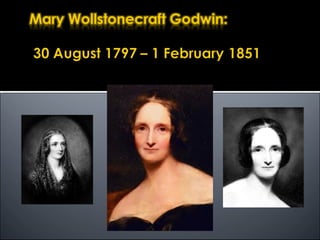
I n the summer of 1816, a young, well-educated woman from England traveled
with her lover to the Swiss Alps. Unseasonable rain kept them trapped inside
their lodgings, where they entertained themselves by reading ghost stories.
At the urging of renowned poet Lord Byron, a friend and neighbor, they set their
own pens to paper, competing to see who could write the best ghost story. The
young woman, Mary Wollstonecraft Godwin only 18 at the time, took the prize,
having composed a story creepy enough not only to take its place alongside the
old German tales that she and her Alpine companions had been reading, but
also to become a bestseller in her time and a Gothic classic that still resonates
with readers almost two centuries later.
•Mary is born in Great Britain in 1797 to Mary Wollstonecraft and William
Godwin but unfortunately, her mother dies in childbirth.
•At the age of 16, Mary meets the young poet Percy Bysshe Shelley who
is married at the time. Later, his wife drowns herself so Mary and Percy
get married.
•They travel around Europe together and it is in Switzerland that Percy’s
close friend, the poet Byron, suggests that Mary, Percy, Polidori (another
friend) and himself each writes a ghost story. Mary’s Frankenstein is the
only story of the four that gets published as a novel.
•The last years of married life are filled with disaster for Mary. Her half
sister dies as do two of her children. Mary becomes depressed, a
tendency she probably inherited from her mother. She is only partly
relieved by the birth of Percy, their only surviving child out of the four she
had given birth to.
•Mary and Percy eventually move to Italy where Percy drowns during a
sailing trip in 1822. Mary is determined to keep the memory of her late
husband alive.
 ‘Frankenstein’ is an epistolary novel
(written as a series of letters between the
main characters) belonging in the Gothic
genre.
 It is a story about a young Swiss student,
who discovers the secret of animating
lifeless matter and, by assembling body
parts, creates a monster who vows
revenge on his creator after being
rejected from society.
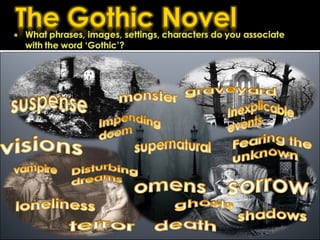
 Popular in the late eighteenth and early
nineteenth centuries, Gothic fiction is a genre
of literature that combines elements of both
horror and romance.
 It is a genre characterized by the use of
intense emotion, the characterization of
nature as a powerful and destructive force,
the use of weather and atmosphere to depict
mood, and the evocation of terror and horror.
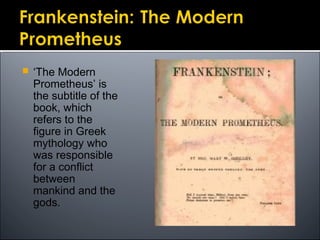
 ‘The Modern
Prometheus’ is
the subtitle of the
book, which
refers to the
figure in Greek
mythology who
was responsible
for a conflict
between
mankind and the
gods.
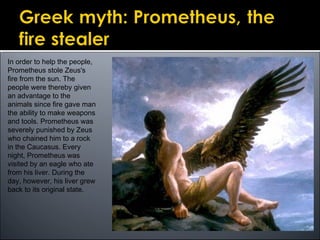
In order to help the people,
Prometheus stole Zeus's
fire from the sun. The
people were thereby given
an advantage to the
animals since fire gave man
the ability to make weapons
and tools. Prometheus was
severely punished by Zeus
who chained him to a rock
in the Caucasus. Every
night, Prometheus was
visited by an eagle who ate
from his liver. During the
day, however, his liver grew
back to its original state.
It also refers to the story of Prometheus plasticator
who was to said to have created and animated
mankind out of clay.
These two myths were eventually fused together: the
fire that Prometheus had stolen is the fire of life with
which he animated his clay models.
Because of the 'creating' aspect, Prometheus became
a symbol for the creating artist in the eighteenth
century.
As you read consider, How can Victor be seen as the
modern Prometheus?
In what way does Victor defy God?
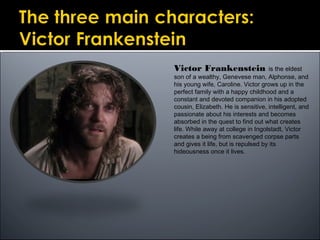
Victor Frankenstein is the eldest
son of a wealthy, Genevese man, Alphonse, and
his young wife, Caroline. Victor grows up in the
perfect family with a happy childhood and a
constant and devoted companion in his adopted
cousin, Elizabeth. He is sensitive, intelligent, and
passionate about his interests and becomes
absorbed in the quest to find out what creates
life. While away at college in Ingolstadt, Victor
creates a being from scavenged corpse parts
and gives it life, but is repulsed by its
hideousness once it lives.
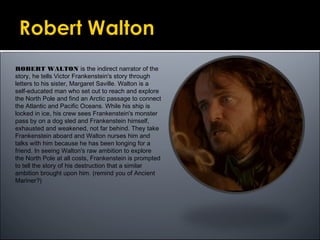
ROBERT WALTON is the indirect narrator of the
story, he tells Victor Frankenstein's story through
letters to his sister, Margaret Saville. Walton is a
self-educated man who set out to reach and explore
the North Pole and find an Arctic passage to connect
the Atlantic and Pacific Oceans. While his ship is
locked in ice, his crew sees Frankenstein's monster
pass by on a dog sled and Frankenstein himself,
exhausted and weakened, not far behind. They take
Frankenstein aboard and Walton nurses him and
talks with him because he has been longing for a
friend. In seeing Walton's raw ambition to explore
the North Pole at all costs, Frankenstein is prompted
to tell the story of his destruction that a similar
ambition brought upon him. (remind you of Ancient
Mariner?)
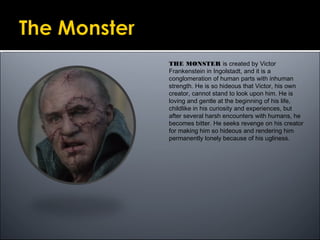
THE MONSTER is created by Victor
Frankenstein in Ingolstadt, and it is a
conglomeration of human parts with inhuman
strength. He is so hideous that Victor, his own
creator, cannot stand to look upon him. He is
loving and gentle at the beginning of his life,
childlike in his curiosity and experiences, but
after several harsh encounters with humans, he
becomes bitter. He seeks revenge on his creator
for making him so hideous and rendering him
permanently lonely because of his ugliness.
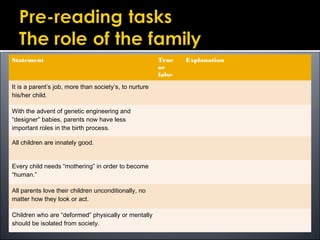
Statement True
or
false
Explanation
It is a parent’s job, more than society’s, to nurture
his/her child.
With the advent of genetic engineering and
“designer” babies, parents now have less
important roles in the birth process.
All children are innately good.
Every child needs “mothering” in order to become
“human.”
All parents love their children unconditionally, no
matter how they look or act.
Children who are “deformed” physically or mentally
should be isolated from society.
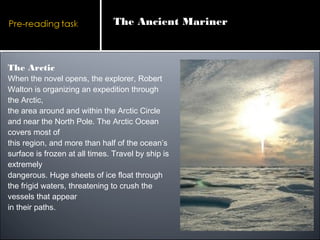
The Arctic
When the novel opens, the explorer, Robert
Walton is organizing an expedition through
the Arctic,
the area around and within the Arctic Circle
and near the North Pole. The Arctic Ocean
covers most of
this region, and more than half of the ocean’s
surface is frozen at all times. Travel by ship is
extremely
dangerous. Huge sheets of ice float through
the frigid waters, threatening to crush the
vessels that appear
in their paths.
The Ancient Mariner
Did You Know?
 In the letters, which set the stage for the novel, Robert Walton
says he has been deeply affected by the narrative poem The
Rime of the Ancient Mariner, written by Samuel Taylor Coleridge,
a leading poet of the Romantic era.
 In the poem, an old sailor, or mariner, tells the story of a horrific
sea voyage that changed his life. Sailing in stormy seas near the
South Pole, the mariner’s ship is surrounded by ice. When the
crewmen spot an albatross, a huge seagull-like bird, flying
through the fog, the ice splits open, freeing the ship. Then,
unexpectedly, the mariner shoots the albatross. After this act of
cruelty, the ship is cursed. Driven north, it becomes stranded in a
hot, windless sea. All of the crew except the mariner die. Ever
since, the remorseful mariner has traveled the world to tell his
story and to teach others to revere God’s creatures.
 Walton’s comments about “The Ancient
Mariner” are examples of allusion. An
allusion is a reference in a written work
to something from history, art, religion,
myth, or another work of literature.
 Writers use allusions to give readers
additional insights about what is
happening in the story and why. Shelley
makes frequent use of literary allusions in
Frankenstein.
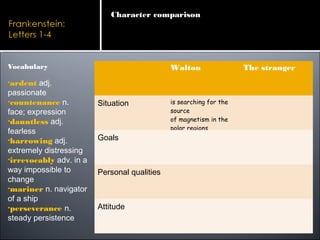
Walton The stranger
Situation is searching for the
source
of magnetism in the
polar regions
Goals
Personal qualities
Attitude
Vocabulary
•ardent adj.
passionate
•countenance n.
face; expression
•dauntless adj.
fearless
•harrowing adj.
extremely distressing
•irrevocably adv. in a
way impossible to
change
•mariner n. navigator
of a ship
•perseverance n.
steady persistence
Character comparison
 1. Is Walton a reliable narrator? Why or why not?
 2. Is Walton’s goal to “confer on all mankind . . . a passage near the pole” noble
or overly ambitious?
 3. How does Robert’s desire for a friend affect his relationship with Dr.
Frankenstein? How might this relationship affect the reader’s trust in Walton as
a reliable narrator?
 4. Why is the poem The Ancient Mariner important to Walton? How is the
stranger similar to the ancient mariner? What mood does Shelley create by
alluding to this poem?
 5. Walton has a thirst for knowledge, as the stranger once did. What details
suggest that both are willing to make sacrifices in the search for knowledge? Do
they seem unusual in this respect?
Vocabulary
 benevolent adj. showing
charity
 commiserate v. to
express sympathy
 consolation n.
something that eases
sorrow or disappointment
 discern v. to detect; to
perceive
 fiend n. evil spirit; devil
 hideous adj. extremely
ugly
 omen n. a sign of future
good or evil
 BACKGROUND
 Two Well-Rounded Characters
 In Chapters 1 through 10, Shelley develops
the two main characters in the novel: Victor
Frankenstein and his creature. She also
introduces a number of minor characters.
Both Frankenstein and the creature have
complex and multifaceted personalities. In
this regard, they stand out from the other
characters in the novel.
 When a fictional character has individuality
and depth, and experiences personal growth
or change, he or she is called a round
character. The opposite of a round
character is a flat character.
 Round characters are life-like and three-
dimensional, while flat characters seem
more like cardboard figures or stereotypes,
and are not as well developed.
Did You Know?
Victor Frankenstein develops an interest in science after
reading about the “wild fancies” of several noted alchemists
who lived 300 to 500 years before his lifetime. Alchemy was
a field of philosophy that speculated about natural processes
and often involved chemical experiments. Medieval
alchemists believed they could find substances that would
enable them to transform ordinary metals, such as lead, into
gold or create a magical drink that would extend life and
youth forever. While alchemy is not true science, the
alchemists did make some scientific contributions. They
discovered mineral acids and alcohol. They also invented
types of laboratory equipment and procedures, which were
later modified and used by scientists.
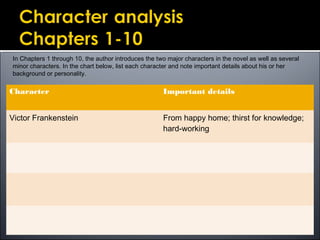
In Chapters 1 through 10, the author introduces the two major characters in the novel as well as several
minor characters. In the chart below, list each character and note important details about his or her
background or personality.
Character Important details
Victor Frankenstein From happy home; thirst for knowledge;
hard-working
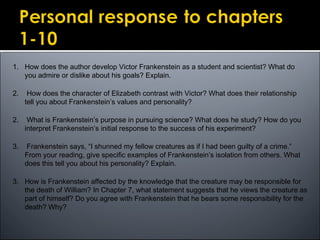
1. How does the author develop Victor Frankenstein as a student and scientist? What do
you admire or dislike about his goals? Explain.
2. How does the character of Elizabeth contrast with Victor? What does their relationship
tell you about Frankenstein’s values and personality?
2. What is Frankenstein’s purpose in pursuing science? What does he study? How do you
interpret Frankenstein’s initial response to the success of his experiment?
3. Frankenstein says, “I shunned my fellow creatures as if I had been guilty of a crime.”
From your reading, give specific examples of Frankenstein’s isolation from others. What
does this tell you about his personality? Explain.
3. How is Frankenstein affected by the knowledge that the creature may be responsible for
the death of William? In Chapter 7, what statement suggests that he views the creature as
part of himself? Do you agree with Frankenstein that he bears some responsibility for the
death? Why?
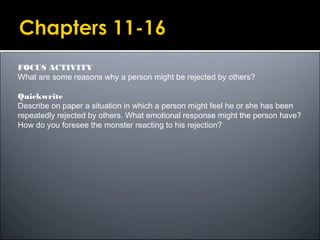
FOCUS ACTIVITY
What are some reasons why a person might be rejected by others?
Quickwrite
Describe on paper a situation in which a person might feel he or she has been
repeatedly rejected by others. What emotional response might the person have?
How do you foresee the monster reacting to his rejection?
There are many definitions of tragedy. In literature, a
tragedy is a story that ends in the downfall of its main
character and arouses pity or fear in the reader. In
general, tragedy also expresses a tragic view of life—
the idea that a noble person inevitably brings on his
or her suffering or death through some failure or
error. As you continue to read Frankenstein, think
about whether the novel fits this definition of a
tragedy.
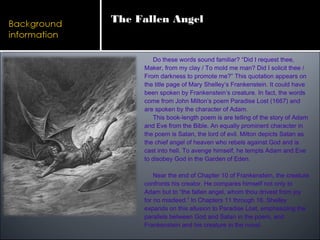
Do these words sound familiar? “Did I request thee,
Maker, from my clay / To mold me man? Did I solicit thee /
From darkness to promote me?” This quotation appears on
the title page of Mary Shelley’s Frankenstein. It could have
been spoken by Frankenstein’s creature. In fact, the words
come from John Milton’s poem Paradise Lost (1667) and
are spoken by the character of Adam.
This book-length poem is are telling of the story of Adam
and Eve from the Bible. An equally prominent character in
the poem is Satan, the lord of evil. Milton depicts Satan as
the chief angel of heaven who rebels against God and is
cast into hell. To avenge himself, he tempts Adam and Eve
to disobey God in the Garden of Eden.
Near the end of Chapter 10 of Frankenstein, the creature
confronts his creator. He compares himself not only to
Adam but to “the fallen angel, whom thou drivest from joy
for no misdeed.” In Chapters 11 through 16, Shelley
expands on this allusion to Paradise Lost, emphasizing the
parallels between God and Satan in the poem, and
Frankenstein and his creature in the novel.
The Fallen Angel
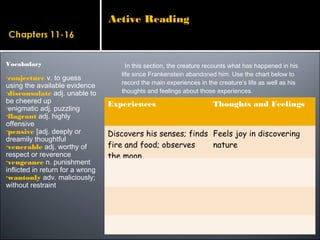
In this section, the creature recounts what has happened in his
life since Frankenstein abandoned him. Use the chart below to
record the main experiences in the creature’s life as well as his
thoughts and feelings about those experiences.
Vocabulary
•conjecture v. to guess
using the available evidence
•disconsolate adj. unable to
be cheered up
•enigmatic adj. puzzling
•flagrant adj. highly
offensive
•pensive [adj. deeply or
dreamily thoughtful
•venerable adj. worthy of
respect or reverence
•vengeance n. punishment
inflicted in return for a wrong
•wantonly adv. maliciously;
without restraint
Experiences Thoughts and Feelings
Discovers his senses; finds
fire and food; observes
the moon
Feels joy in discovering
nature
Active Reading
1. How does the creature get to know the family who lives in the cottage? Why is he
drawn to the family? How does the family’s reaction to the creature affect his view of
himself and the human race?
2. After reading Paradise Lost, why does the creature think he is like Adam in that
book? Why does he think he is like Satan? What are the specific reasons that the
creature gives for hating his creator?
•How does the creature cause the deaths of William and Justine? What does the
murder of William tell the creature about himself? According to the creature, what can
save him from doing evil?
4. Thus far, do you find the creature more or less sympathetic than the character of
Victor Frankenstein? Give evidence to support your opinion.
5. How believable is the account of the creature’s education? Refer to the novel and
your own experience in your answer.
FOCUS ACTIVITY
Why is it important to love and be loved?
Write a short response.
Did You Know?
Tales of horror create suspense by raising questions or uncertainties
about the action in the reader’s mind.
Sometimes we don’t know what will happen. As we read, we wonder
who or what is responsible for the events that take place, or we wonder
how the events came about. In other cases, the tragic outcome is
known or strongly hinted at the beginning of the story. As we read, the
suspense comes from anticipating when the worst will occur or
wondering if it can be prevented. Authors often increase the readers’
feeling of fear or dread through foreshadowing. They give hints
that suggest or prepare the reader for a later event. Such hints,
or foreshadowing, might take the form of a statement by a character, a
mood established in the description of the setting, or the revelation of
an important trait in one of the characters.
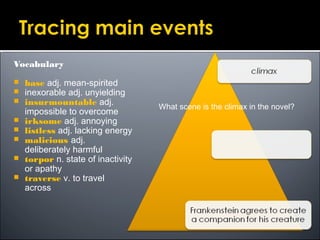
Vocabulary
 base adj. mean-spirited
 inexorable adj. unyielding
 insurmountable adj.
impossible to overcome
 irksome adj. annoying
 listless adj. lacking energy
 malicious adj.
deliberately harmful
 torpor n. state of inactivity
or apathy
 traverse v. to travel
across
What scene is the climax in the novel?
1. Which of the events in this section of the novel surprised you the most and why?
2. What arguments does the creature use to persuade Frankenstein to make the
female creature? How does Frankenstein’s decision affect Frankenstein’s mood
and personal life?
2. What keeps Frankenstein from completing the second creature? In your opinion,
why does the creature direct his revenge to Frankenstein’s wedding?
3. How does Frankenstein become lost at sea? What happens when he lands in
Ireland? Why does he call himself Henry Clerval’s murderer?
3. How does Shelley create a feeling of suspense in Chapters 17 through 21? Did
you find the events in Chapter 21 probable or improbable? Explain.
The Second Time Around
Imagine that Victor Frankenstein has decided to write a letter
to Elizabeth or his father that describes his thoughts about
creating another creature.
Take on the role of Frankenstein as you write a letter of
explanation. You may want to compare Frankenstein’s
creation of the second creature to his creation of the first
one. Does he have the same motives or different ones? Do
you think his attitude toward such ambitious projects has
changed?
Five years after Frankenstein was published, Mary Shelley saw the first dramatic
production of her novel. She liked the actor’s portrayal of her creature.
In the 1931 film Frankenstein, starring English actor Boris Karloff, the monster comes
to life on an operating table after being zapped with electricity. Given a huge, squared-
off skull and pale corpse-like skin, Karloff portrayed the monster as a gentle, almost
childlike character. His interpretation struck a chord with audiences, especially young
children, from whom he received much fan mail.
In the 1995 film version of the novel, Mary Shelley’s Frankenstein, Robert De Niro, an
actor knownfor his violent tough-guy roles, was cast as the creature. The director,
Kenneth Branagh, explained, “I wanted a wise and intelligent and multifaceted
Creature who could be angry and even funny at times, and who would have a sense
of humor, however darkly ironic.”
The movieI,Frankenstein just recently portrayed yet another version of the monster.
Why does a story such as this inspire filmmakers to take creative liberties? How DO you view
the creature based on the description in the novel?
Many people who have not read Shelley’s novel think that
Frankenstein is the name of the creature, not the scientist who
brought him to life. Careful readers of the novel, however, point
out that this mistake has a certain symbolic truth. They see the
two characters as doubles of each other, or two parts of a divided
self.
The idea of the double comes from German folklore and is known
as the doppelgänger (“double goer”). The concept was based on
the ancient belief that each living creature has an exact double
who exists as a spirit or ghost. Many writers of horror stories have
employed the idea of the double.
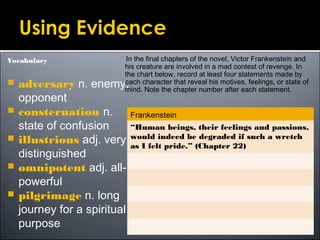
Vocabulary
 adversary n. enemy;
opponent
 consternation n.
state of confusion
 illustrious adj. very
distinguished
 omnipotent adj. all-
powerful
 pilgrimage n. long
journey for a spiritual
purpose
In the final chapters of the novel, Victor Frankenstein and
his creature are involved in a mad contest of revenge. In
the chart below, record at least four statements made by
each character that reveal his motives, feelings, or state of
mind. Note the chapter number after each statement.
Frankenstein
“Human beings, their feelings and passions,
would indeed be degraded if such a wretch
as I felt pride.” (Chapter 22)
1. Did the ending of the novel surprise you? Can you imagine a different ending to the novel?
Explain.
2. What does Frankenstein promise to tell Elizabeth after they are married? How does he
behave in the weeks leading up to their wedding? Why is Frankenstein especially agitated
as evening approaches on their wedding day?
2. What happens to Elizabeth? What is ironic, or unexpected, about the creature’s revenge on
Frankenstein? What does Frankenstein resolve to do?
3. How does Shelley show that Frankenstein and the creature are both obsessed with
revenge? Does either of them win? Explain.
3. How does Shelley return to her frame story in Chapter 24? What effect does she achieve by
using this frame story?
4. How do you think Frankenstein failed or erred as a human being? What traits or attributes,
do you think, led to the creature’s fate?
39
Writing Task
On board Walton’s ship, the creature sees his creator for the last time. If they had
had a chance to talk at this point, what might they say to each other at the end of
their long chase? Write a dialogue that reveals each character’s feelings about
the other and about himself.
You may wish to incorporate or paraphrase quotations from the novel. Make sure
your dialogue accurately conveys the character’s attitudes, feelings, and insights.
The theme of a novel is the main idea, moral, or
message that sticks with the reader long after reading the
book. Themes often explore timeless and universal ideas
and are almost always implied rather than stated
explicitly.
What are the ideas, messages or morals of
‘Frankenstein’?
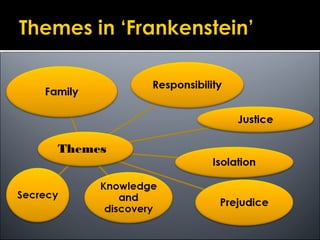
Themes
Look for textual evidence in the novel to support these main ideas:
•Walton’s desire for a friend establishes a major thematic meditation of the text: that
being alone in the world creates the desire to have a circle of family and friends. This
desire of Walton’s mirrors the later desire of the monster to have a companion. (Letter
2)
1.Although Elizabeth is welcomed into Victor’s full, happy family, her status as an
orphan reminds us that family that can be destroyed at any moment. The threat of
being alone is always present. (Chapter 1)
2.Victor establishes his family as a happy one, and his parents as the bringers of
"many delights." Victor knows what a blessing it is to have your creators care about
you, yet this knowledge does not compel him to do the same for the creature to whom
he gives life. (Chapter 2)
• The loss of Victor’s mother serves as an omen of the loss he is going to encounter
again and again as the story progresses. At the same time, her death establishes
that family is what is most dear to Victor, what he most sorely does not want to lose.
(Chapter 3)
1.Loss haunts Victor from a very early point in the book: his mother’s death is an
"irreparable evil" from which all future evil and loneliness spring. (Chapter 3)
2.The monster longs for companionship with the family he observes, but he cannot
engage with them because he is unacceptable to society. Instead, he must remain
entirely alone. (Chapter 12)
1. The monster refers to the family as "my" cottagers, implying his sense of
connection to these people and his desire to be included in their family. Despite
this, he knows he suffers the "fatal effects of this miserable deformity" and will be
kept separate from them. (Chapter 12)
2. The monster’s desire for love and familial affection makes him a deeply human
and sympathetic character. Yet it also drives him to commit his immoral acts.
(Chapter 12)
2. The monster’s desire for a female companion parallels Adam’s asking God for a
woman. (Chapter 17)
3. As the monster learns about the world and becomes educated, he realizes he is
utterly alone and alienated from society. He has no "mutual bonds" to anyone –
except Victor, who has rejected him. (Chapter 13)
45
Theme essay
 Choose any two themes from slide 38 and write an
essay explaining how Shelley develops those themes
and how they interact with one another throughout the
novel.
 Consider the text evidence you found to support the
previous statements on slides 40-42 as a basis for your
support.
45

Frankenstein final

  • 3.
    I n thesummer of 1816, a young, well-educated woman from England traveled with her lover to the Swiss Alps. Unseasonable rain kept them trapped inside their lodgings, where they entertained themselves by reading ghost stories. At the urging of renowned poet Lord Byron, a friend and neighbor, they set their own pens to paper, competing to see who could write the best ghost story. The young woman, Mary Wollstonecraft Godwin only 18 at the time, took the prize, having composed a story creepy enough not only to take its place alongside the old German tales that she and her Alpine companions had been reading, but also to become a bestseller in her time and a Gothic classic that still resonates with readers almost two centuries later.
  • 4.
    •Mary is bornin Great Britain in 1797 to Mary Wollstonecraft and William Godwin but unfortunately, her mother dies in childbirth. •At the age of 16, Mary meets the young poet Percy Bysshe Shelley who is married at the time. Later, his wife drowns herself so Mary and Percy get married. •They travel around Europe together and it is in Switzerland that Percy’s close friend, the poet Byron, suggests that Mary, Percy, Polidori (another friend) and himself each writes a ghost story. Mary’s Frankenstein is the only story of the four that gets published as a novel. •The last years of married life are filled with disaster for Mary. Her half sister dies as do two of her children. Mary becomes depressed, a tendency she probably inherited from her mother. She is only partly relieved by the birth of Percy, their only surviving child out of the four she had given birth to. •Mary and Percy eventually move to Italy where Percy drowns during a sailing trip in 1822. Mary is determined to keep the memory of her late husband alive.
  • 5.
     ‘Frankenstein’ isan epistolary novel (written as a series of letters between the main characters) belonging in the Gothic genre.  It is a story about a young Swiss student, who discovers the secret of animating lifeless matter and, by assembling body parts, creates a monster who vows revenge on his creator after being rejected from society.
  • 7.
     Popular inthe late eighteenth and early nineteenth centuries, Gothic fiction is a genre of literature that combines elements of both horror and romance.  It is a genre characterized by the use of intense emotion, the characterization of nature as a powerful and destructive force, the use of weather and atmosphere to depict mood, and the evocation of terror and horror.
  • 8.
     ‘The Modern Prometheus’is the subtitle of the book, which refers to the figure in Greek mythology who was responsible for a conflict between mankind and the gods.
  • 9.
    In order tohelp the people, Prometheus stole Zeus's fire from the sun. The people were thereby given an advantage to the animals since fire gave man the ability to make weapons and tools. Prometheus was severely punished by Zeus who chained him to a rock in the Caucasus. Every night, Prometheus was visited by an eagle who ate from his liver. During the day, however, his liver grew back to its original state.
  • 10.
    It also refersto the story of Prometheus plasticator who was to said to have created and animated mankind out of clay. These two myths were eventually fused together: the fire that Prometheus had stolen is the fire of life with which he animated his clay models. Because of the 'creating' aspect, Prometheus became a symbol for the creating artist in the eighteenth century. As you read consider, How can Victor be seen as the modern Prometheus? In what way does Victor defy God?
  • 11.
    Victor Frankenstein isthe eldest son of a wealthy, Genevese man, Alphonse, and his young wife, Caroline. Victor grows up in the perfect family with a happy childhood and a constant and devoted companion in his adopted cousin, Elizabeth. He is sensitive, intelligent, and passionate about his interests and becomes absorbed in the quest to find out what creates life. While away at college in Ingolstadt, Victor creates a being from scavenged corpse parts and gives it life, but is repulsed by its hideousness once it lives.
  • 12.
    ROBERT WALTON isthe indirect narrator of the story, he tells Victor Frankenstein's story through letters to his sister, Margaret Saville. Walton is a self-educated man who set out to reach and explore the North Pole and find an Arctic passage to connect the Atlantic and Pacific Oceans. While his ship is locked in ice, his crew sees Frankenstein's monster pass by on a dog sled and Frankenstein himself, exhausted and weakened, not far behind. They take Frankenstein aboard and Walton nurses him and talks with him because he has been longing for a friend. In seeing Walton's raw ambition to explore the North Pole at all costs, Frankenstein is prompted to tell the story of his destruction that a similar ambition brought upon him. (remind you of Ancient Mariner?)
  • 13.
    THE MONSTER iscreated by Victor Frankenstein in Ingolstadt, and it is a conglomeration of human parts with inhuman strength. He is so hideous that Victor, his own creator, cannot stand to look upon him. He is loving and gentle at the beginning of his life, childlike in his curiosity and experiences, but after several harsh encounters with humans, he becomes bitter. He seeks revenge on his creator for making him so hideous and rendering him permanently lonely because of his ugliness.
  • 14.
    Statement True or false Explanation It isa parent’s job, more than society’s, to nurture his/her child. With the advent of genetic engineering and “designer” babies, parents now have less important roles in the birth process. All children are innately good. Every child needs “mothering” in order to become “human.” All parents love their children unconditionally, no matter how they look or act. Children who are “deformed” physically or mentally should be isolated from society.
  • 15.
    The Arctic When thenovel opens, the explorer, Robert Walton is organizing an expedition through the Arctic, the area around and within the Arctic Circle and near the North Pole. The Arctic Ocean covers most of this region, and more than half of the ocean’s surface is frozen at all times. Travel by ship is extremely dangerous. Huge sheets of ice float through the frigid waters, threatening to crush the vessels that appear in their paths. The Ancient Mariner
  • 16.
    Did You Know? In the letters, which set the stage for the novel, Robert Walton says he has been deeply affected by the narrative poem The Rime of the Ancient Mariner, written by Samuel Taylor Coleridge, a leading poet of the Romantic era.  In the poem, an old sailor, or mariner, tells the story of a horrific sea voyage that changed his life. Sailing in stormy seas near the South Pole, the mariner’s ship is surrounded by ice. When the crewmen spot an albatross, a huge seagull-like bird, flying through the fog, the ice splits open, freeing the ship. Then, unexpectedly, the mariner shoots the albatross. After this act of cruelty, the ship is cursed. Driven north, it becomes stranded in a hot, windless sea. All of the crew except the mariner die. Ever since, the remorseful mariner has traveled the world to tell his story and to teach others to revere God’s creatures.
  • 17.
     Walton’s commentsabout “The Ancient Mariner” are examples of allusion. An allusion is a reference in a written work to something from history, art, religion, myth, or another work of literature.  Writers use allusions to give readers additional insights about what is happening in the story and why. Shelley makes frequent use of literary allusions in Frankenstein.
  • 18.
    Walton The stranger Situationis searching for the source of magnetism in the polar regions Goals Personal qualities Attitude Vocabulary •ardent adj. passionate •countenance n. face; expression •dauntless adj. fearless •harrowing adj. extremely distressing •irrevocably adv. in a way impossible to change •mariner n. navigator of a ship •perseverance n. steady persistence Character comparison
  • 19.
     1. IsWalton a reliable narrator? Why or why not?  2. Is Walton’s goal to “confer on all mankind . . . a passage near the pole” noble or overly ambitious?  3. How does Robert’s desire for a friend affect his relationship with Dr. Frankenstein? How might this relationship affect the reader’s trust in Walton as a reliable narrator?  4. Why is the poem The Ancient Mariner important to Walton? How is the stranger similar to the ancient mariner? What mood does Shelley create by alluding to this poem?  5. Walton has a thirst for knowledge, as the stranger once did. What details suggest that both are willing to make sacrifices in the search for knowledge? Do they seem unusual in this respect?
  • 20.
    Vocabulary  benevolent adj.showing charity  commiserate v. to express sympathy  consolation n. something that eases sorrow or disappointment  discern v. to detect; to perceive  fiend n. evil spirit; devil  hideous adj. extremely ugly  omen n. a sign of future good or evil  BACKGROUND  Two Well-Rounded Characters  In Chapters 1 through 10, Shelley develops the two main characters in the novel: Victor Frankenstein and his creature. She also introduces a number of minor characters. Both Frankenstein and the creature have complex and multifaceted personalities. In this regard, they stand out from the other characters in the novel.  When a fictional character has individuality and depth, and experiences personal growth or change, he or she is called a round character. The opposite of a round character is a flat character.  Round characters are life-like and three- dimensional, while flat characters seem more like cardboard figures or stereotypes, and are not as well developed.
  • 21.
    Did You Know? VictorFrankenstein develops an interest in science after reading about the “wild fancies” of several noted alchemists who lived 300 to 500 years before his lifetime. Alchemy was a field of philosophy that speculated about natural processes and often involved chemical experiments. Medieval alchemists believed they could find substances that would enable them to transform ordinary metals, such as lead, into gold or create a magical drink that would extend life and youth forever. While alchemy is not true science, the alchemists did make some scientific contributions. They discovered mineral acids and alcohol. They also invented types of laboratory equipment and procedures, which were later modified and used by scientists.
  • 22.
    In Chapters 1through 10, the author introduces the two major characters in the novel as well as several minor characters. In the chart below, list each character and note important details about his or her background or personality. Character Important details Victor Frankenstein From happy home; thirst for knowledge; hard-working
  • 23.
    1. How doesthe author develop Victor Frankenstein as a student and scientist? What do you admire or dislike about his goals? Explain. 2. How does the character of Elizabeth contrast with Victor? What does their relationship tell you about Frankenstein’s values and personality? 2. What is Frankenstein’s purpose in pursuing science? What does he study? How do you interpret Frankenstein’s initial response to the success of his experiment? 3. Frankenstein says, “I shunned my fellow creatures as if I had been guilty of a crime.” From your reading, give specific examples of Frankenstein’s isolation from others. What does this tell you about his personality? Explain. 3. How is Frankenstein affected by the knowledge that the creature may be responsible for the death of William? In Chapter 7, what statement suggests that he views the creature as part of himself? Do you agree with Frankenstein that he bears some responsibility for the death? Why?
  • 25.
    FOCUS ACTIVITY What aresome reasons why a person might be rejected by others? Quickwrite Describe on paper a situation in which a person might feel he or she has been repeatedly rejected by others. What emotional response might the person have? How do you foresee the monster reacting to his rejection?
  • 26.
    There are manydefinitions of tragedy. In literature, a tragedy is a story that ends in the downfall of its main character and arouses pity or fear in the reader. In general, tragedy also expresses a tragic view of life— the idea that a noble person inevitably brings on his or her suffering or death through some failure or error. As you continue to read Frankenstein, think about whether the novel fits this definition of a tragedy.
  • 27.
    Do these wordssound familiar? “Did I request thee, Maker, from my clay / To mold me man? Did I solicit thee / From darkness to promote me?” This quotation appears on the title page of Mary Shelley’s Frankenstein. It could have been spoken by Frankenstein’s creature. In fact, the words come from John Milton’s poem Paradise Lost (1667) and are spoken by the character of Adam. This book-length poem is are telling of the story of Adam and Eve from the Bible. An equally prominent character in the poem is Satan, the lord of evil. Milton depicts Satan as the chief angel of heaven who rebels against God and is cast into hell. To avenge himself, he tempts Adam and Eve to disobey God in the Garden of Eden. Near the end of Chapter 10 of Frankenstein, the creature confronts his creator. He compares himself not only to Adam but to “the fallen angel, whom thou drivest from joy for no misdeed.” In Chapters 11 through 16, Shelley expands on this allusion to Paradise Lost, emphasizing the parallels between God and Satan in the poem, and Frankenstein and his creature in the novel. The Fallen Angel
  • 28.
    In this section,the creature recounts what has happened in his life since Frankenstein abandoned him. Use the chart below to record the main experiences in the creature’s life as well as his thoughts and feelings about those experiences. Vocabulary •conjecture v. to guess using the available evidence •disconsolate adj. unable to be cheered up •enigmatic adj. puzzling •flagrant adj. highly offensive •pensive [adj. deeply or dreamily thoughtful •venerable adj. worthy of respect or reverence •vengeance n. punishment inflicted in return for a wrong •wantonly adv. maliciously; without restraint Experiences Thoughts and Feelings Discovers his senses; finds fire and food; observes the moon Feels joy in discovering nature Active Reading
  • 29.
    1. How doesthe creature get to know the family who lives in the cottage? Why is he drawn to the family? How does the family’s reaction to the creature affect his view of himself and the human race? 2. After reading Paradise Lost, why does the creature think he is like Adam in that book? Why does he think he is like Satan? What are the specific reasons that the creature gives for hating his creator? •How does the creature cause the deaths of William and Justine? What does the murder of William tell the creature about himself? According to the creature, what can save him from doing evil? 4. Thus far, do you find the creature more or less sympathetic than the character of Victor Frankenstein? Give evidence to support your opinion. 5. How believable is the account of the creature’s education? Refer to the novel and your own experience in your answer.
  • 30.
    FOCUS ACTIVITY Why isit important to love and be loved? Write a short response.
  • 31.
    Did You Know? Talesof horror create suspense by raising questions or uncertainties about the action in the reader’s mind. Sometimes we don’t know what will happen. As we read, we wonder who or what is responsible for the events that take place, or we wonder how the events came about. In other cases, the tragic outcome is known or strongly hinted at the beginning of the story. As we read, the suspense comes from anticipating when the worst will occur or wondering if it can be prevented. Authors often increase the readers’ feeling of fear or dread through foreshadowing. They give hints that suggest or prepare the reader for a later event. Such hints, or foreshadowing, might take the form of a statement by a character, a mood established in the description of the setting, or the revelation of an important trait in one of the characters.
  • 32.
    Vocabulary  base adj.mean-spirited  inexorable adj. unyielding  insurmountable adj. impossible to overcome  irksome adj. annoying  listless adj. lacking energy  malicious adj. deliberately harmful  torpor n. state of inactivity or apathy  traverse v. to travel across What scene is the climax in the novel?
  • 33.
    1. Which ofthe events in this section of the novel surprised you the most and why? 2. What arguments does the creature use to persuade Frankenstein to make the female creature? How does Frankenstein’s decision affect Frankenstein’s mood and personal life? 2. What keeps Frankenstein from completing the second creature? In your opinion, why does the creature direct his revenge to Frankenstein’s wedding? 3. How does Frankenstein become lost at sea? What happens when he lands in Ireland? Why does he call himself Henry Clerval’s murderer? 3. How does Shelley create a feeling of suspense in Chapters 17 through 21? Did you find the events in Chapter 21 probable or improbable? Explain.
  • 34.
    The Second TimeAround Imagine that Victor Frankenstein has decided to write a letter to Elizabeth or his father that describes his thoughts about creating another creature. Take on the role of Frankenstein as you write a letter of explanation. You may want to compare Frankenstein’s creation of the second creature to his creation of the first one. Does he have the same motives or different ones? Do you think his attitude toward such ambitious projects has changed?
  • 35.
    Five years afterFrankenstein was published, Mary Shelley saw the first dramatic production of her novel. She liked the actor’s portrayal of her creature. In the 1931 film Frankenstein, starring English actor Boris Karloff, the monster comes to life on an operating table after being zapped with electricity. Given a huge, squared- off skull and pale corpse-like skin, Karloff portrayed the monster as a gentle, almost childlike character. His interpretation struck a chord with audiences, especially young children, from whom he received much fan mail. In the 1995 film version of the novel, Mary Shelley’s Frankenstein, Robert De Niro, an actor knownfor his violent tough-guy roles, was cast as the creature. The director, Kenneth Branagh, explained, “I wanted a wise and intelligent and multifaceted Creature who could be angry and even funny at times, and who would have a sense of humor, however darkly ironic.” The movieI,Frankenstein just recently portrayed yet another version of the monster. Why does a story such as this inspire filmmakers to take creative liberties? How DO you view the creature based on the description in the novel?
  • 36.
    Many people whohave not read Shelley’s novel think that Frankenstein is the name of the creature, not the scientist who brought him to life. Careful readers of the novel, however, point out that this mistake has a certain symbolic truth. They see the two characters as doubles of each other, or two parts of a divided self. The idea of the double comes from German folklore and is known as the doppelgänger (“double goer”). The concept was based on the ancient belief that each living creature has an exact double who exists as a spirit or ghost. Many writers of horror stories have employed the idea of the double.
  • 37.
    Vocabulary  adversary n.enemy; opponent  consternation n. state of confusion  illustrious adj. very distinguished  omnipotent adj. all- powerful  pilgrimage n. long journey for a spiritual purpose In the final chapters of the novel, Victor Frankenstein and his creature are involved in a mad contest of revenge. In the chart below, record at least four statements made by each character that reveal his motives, feelings, or state of mind. Note the chapter number after each statement. Frankenstein “Human beings, their feelings and passions, would indeed be degraded if such a wretch as I felt pride.” (Chapter 22)
  • 38.
    1. Did theending of the novel surprise you? Can you imagine a different ending to the novel? Explain. 2. What does Frankenstein promise to tell Elizabeth after they are married? How does he behave in the weeks leading up to their wedding? Why is Frankenstein especially agitated as evening approaches on their wedding day? 2. What happens to Elizabeth? What is ironic, or unexpected, about the creature’s revenge on Frankenstein? What does Frankenstein resolve to do? 3. How does Shelley show that Frankenstein and the creature are both obsessed with revenge? Does either of them win? Explain. 3. How does Shelley return to her frame story in Chapter 24? What effect does she achieve by using this frame story? 4. How do you think Frankenstein failed or erred as a human being? What traits or attributes, do you think, led to the creature’s fate?
  • 39.
    39 Writing Task On boardWalton’s ship, the creature sees his creator for the last time. If they had had a chance to talk at this point, what might they say to each other at the end of their long chase? Write a dialogue that reveals each character’s feelings about the other and about himself. You may wish to incorporate or paraphrase quotations from the novel. Make sure your dialogue accurately conveys the character’s attitudes, feelings, and insights.
  • 40.
    The theme ofa novel is the main idea, moral, or message that sticks with the reader long after reading the book. Themes often explore timeless and universal ideas and are almost always implied rather than stated explicitly. What are the ideas, messages or morals of ‘Frankenstein’?
  • 41.
  • 42.
    Look for textualevidence in the novel to support these main ideas: •Walton’s desire for a friend establishes a major thematic meditation of the text: that being alone in the world creates the desire to have a circle of family and friends. This desire of Walton’s mirrors the later desire of the monster to have a companion. (Letter 2) 1.Although Elizabeth is welcomed into Victor’s full, happy family, her status as an orphan reminds us that family that can be destroyed at any moment. The threat of being alone is always present. (Chapter 1) 2.Victor establishes his family as a happy one, and his parents as the bringers of "many delights." Victor knows what a blessing it is to have your creators care about you, yet this knowledge does not compel him to do the same for the creature to whom he gives life. (Chapter 2)
  • 43.
    • The lossof Victor’s mother serves as an omen of the loss he is going to encounter again and again as the story progresses. At the same time, her death establishes that family is what is most dear to Victor, what he most sorely does not want to lose. (Chapter 3) 1.Loss haunts Victor from a very early point in the book: his mother’s death is an "irreparable evil" from which all future evil and loneliness spring. (Chapter 3) 2.The monster longs for companionship with the family he observes, but he cannot engage with them because he is unacceptable to society. Instead, he must remain entirely alone. (Chapter 12)
  • 44.
    1. The monsterrefers to the family as "my" cottagers, implying his sense of connection to these people and his desire to be included in their family. Despite this, he knows he suffers the "fatal effects of this miserable deformity" and will be kept separate from them. (Chapter 12) 2. The monster’s desire for love and familial affection makes him a deeply human and sympathetic character. Yet it also drives him to commit his immoral acts. (Chapter 12) 2. The monster’s desire for a female companion parallels Adam’s asking God for a woman. (Chapter 17) 3. As the monster learns about the world and becomes educated, he realizes he is utterly alone and alienated from society. He has no "mutual bonds" to anyone – except Victor, who has rejected him. (Chapter 13)
  • 45.
    45 Theme essay  Chooseany two themes from slide 38 and write an essay explaining how Shelley develops those themes and how they interact with one another throughout the novel.  Consider the text evidence you found to support the previous statements on slides 40-42 as a basis for your support. 45

Editor's Notes

  • #14 The images are taken from ‘Mary Shelley’s Frankenstein’.
  • #33 Use the pyramid chart below to trace the main events that occur after Frankenstein agrees to create a companion for his creature. Use as many boxes as you need but record the climax, or turning point, of this part of the novel at the peak of the diagram.
  • #45 Teacher, see answer sheet.