Chemistry in Australia20 | August 2015
Citizen
scienceThe New
Enlightenment
BY DAVE SAMMUT
Riding on the ICT
revolution,
recruiting public
help for research is
on the rise, bringing
benefits for both
scientists and
non-scientists.
I
n the wave of scientific
advancement through the
Renaissance, through the
Enlightenment and extending into
the 19th century, independent science
was an inspiring movement. Our
history is replete with men and women
– for example Antoine Lavoisier, Henry
Cavendish, Mary Anning and Charles
Darwin – whose innate curiosity
translated to their direct dedication to
scientific endeavour, using whatever
resources were available to them at the
time.
As the 19th century progressed, the
increasing complexity and cost of
research saw the process become
more institutionalised, and by the
20th century independent science was
virtually extinct.
It might be argued (albeit
simplistically) that by taking science
and sequestering it behind ivy-
covered walls, we have done it a
disservice. By reserving scientific
advancement and recognition largely
to an academic elite, perhaps we have
disenfranchised a significant portion of
the population. In a recent article (May
issue, p. 18), I wrote about the direct
consequences of poor
communications of science prior to the
L’Aquila earthquake, which is at least
partly a consequence of disparity in
understanding and expectation.
iStockphoto/higyou
Chemistry in Australia 21|August 2015
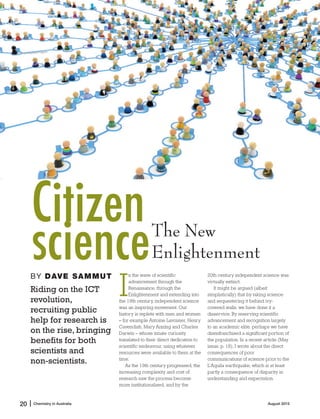
In the past 5–10 years, an emerging
paradigm – citizen science – is
showing promise in bridging the gap.
Its participants are different from the
earlier independent scientists because
the former were scientists first, by
inclination and training. By contrast, the
participants in the modern citizen
science or crowdsourcing projects
come from as wide a range of
backgrounds as can be imagined.
As with any relatively new field, the
terminology is evolving, but a good
working definition of citizen science is
provided by Dr Philip Roetman of the
Australian Citizen Science Association.
He describes citizen science as
projects where scientists work with the
community to conduct research.
Roetman emphasises that a good
citizen science project must include
three key components: research,
engagement and education.
Perhaps the biggest driver in the
rapid growth of citizen science
projects in the 21st century has been
computing and communications
technology, which has become cheap,
rapid and ubiquitous. Information has
become democratised, readily
available to all, in a manner in which
the creation and distribution of
information is no longer ‘top-down’,
but much more shared. Roetman notes
that the IT revolution has been ‘the
catalyst for the explosion of citizen
science around the world.’
Earlier citizen science projects
involved the sharing of computational
resources as ‘distributed computing’,
particularly for intensive calculations
such as astronomy. However, in
Roetman’s opinion, this lies at the edge
of the field, because it can lack
participant engagement. More recent
projects such as those within
Zooniverse (www.zooniverse.org)
provide better examples within
astronomy. Among these projects,
amateurs were encouraged to assist in
laborious tasks such as examining
astronomical images for galaxies and
undiscovered planets. Moving beyond
astronomy, zooniverse has a range of
interesting projects, such as ‘Old
Weather’, which asks volunteers to
transcribe the weather observations
from historical ship logs, valuable data
that could help us understand how the
climate has changed. Critically, it was
found that not only did amateurs
enthusiastically participate in the
requested work, but they also formed
forums in which they interacted with
each other to conceive and contribute
their own hypotheses to carry the
research forward.
A good Australian example is the
Explore the SeaFloor project
(exploretheseafloor.net.au). Nearly
10000 citizen scientists are helping to
analyse nearly 400000 images, initially
to spot a northern sea urchin species
invading Tasmanian waters as part of
an investigation into the effects of
climate change on local kelp and
seaweed ecosystems. Participants are
given online tutorials and support to
identify urchins in images captured by
a robotic underwater vehicle, so that
researchers can then assess the
depths and locations of the urchins,
their number and range. There is
feedback on the progress, and the
opportunity to win a small prize as
reward.
In the National Koala Count,
selected and trained citizen scientists
are provided with a mobile phone app,
and in a ten-day annual program they
locate and photograph koalas across a
wide geographical distribution.
Importantly, these photos are
automatically geo-tagged using the
phones’ GPS location features, so that
the data can be verified and analysed
for bias (such as a predominance of
sightings along roads).
One of the key advantages of citizen
science is that it offers the potential to
gather significantly greater quantities
of data, numerically, spatially and
temporally, than would be achievable
using paid field staff. It therefore lends
itself particularly well to environmental
and ecological studies, where the
greater sampling also increases the
chance of capturing rare or sporadic
events.
Ornithology is particularly
benefitting from citizen science,
drawing on a substantial established
resource of enthusiastic hobbyists.
However, flora and fauna studies and
ecology more generally also gain
substantial participation, and it is
notable that such studies offer great
examples of the multiple models for
citizen science. In ‘Contributory’
models such as the Koala Count, the
research is designed and conducted
by scientists, with data input from the
public. In ‘Collaborative’ models, the
public may help refine the project
design, analyse data or disseminate
findings. In ‘Co-created’ models, the
public are active in all phases of the
research from initiation. This is
particularly the case for local
ecological projects such as studying
contaminated aquatic ecologies.
Across all of these models (most
obviously the co-created projects),
engagement is a crucial component.
This extends beyond the choice of
research topics and emphasis to
engage the interest of the participants,
but also to the use and sharing of the
One of the key
advantages of
citizen science is
that it offers the
potential to gather
significantly
greater quantities
of data,
numerically,
spatially and
temporally, than
would be
achievable using
paid field staff.
Chemistry in Australia22 | August 2015
interim and final results. As such, this
also shows the importance of good
project design and clear definition of
goals, because in a local ecological
project, for example, the community’s
emphasis might be on gathering data
to support or precipitate early action
or intervention, whereas the scientists’
emphasis might instead be on longer-
term evaluation and/or analysis in a
wider context.
The educational component of
good community science is similarly
important. The integrity of the data
captured by citizen scientists is for
preference verifiable, and the use of
technology has been of significant
assistance in this regard. However,
proper training and support for citizen
scientists is important to minimise
observer bias or sampling error, most
particularly as the degree of
complexity in field work increases.
As noted by Janis Dickinson et al.
(Front. Ecol. Environ. doi:
10.1890/110236), ‘A critical component
of this effort is the creation of
educational materials, including
background information that allows the
participants to understand the theory
and ideas behind the research, a
comprehensible description of the
research questions, and clearly
described, tested protocols for how to
carry out observations.’
This reliance on technology means
that citizen science can’t simply be
assumed as a source of ‘free data’. The
growing literature on the subject
routinely emphasises the importance
of good project infrastructure design,
including the website for engagement,
Other citizen science projects
If you are interested in the opportunities, practice
and successes in Australian Citizen Science, check
out the Australian Citizen Science Association
website (www.citizenscience.org.au), which will be
celebrating the success of its July 2015 inaugural
conference.
Links to various projects here and
internationally include:
• Streamwatch (bit.ly/1C9LmHb)
• Who's Living on My Land? (bit.ly/1ej29Tj)
• Weather Detective (bit.ly/1MY1Ybo)
• Donating computer downtime
(stanford.io/1QzTywn)
• National Geographic citizen science
(bit.ly/1GoZ39c)
• scistarter.com
Current citizen science projects in chemistry
seem to be relatively scarce. The RACI is spreading
the word among chemists by sharing the ABC’s call
for citizen science project proposals for National
Science Week in August (bit.ly/1K8zVqd).
... proper training
and support for
citizen scientists is
important to
minimise observer
bias or sampling
error, most
particularly as the
degree of
complexity in field
work increases.
iStockphoto/fotostorm
Chemistry in Australia 23|August 2015
interaction and easy data entry, and (if
appropriate) a mobile phone app for
field use.
The establishment costs for a
citizen science project may be
appreciable, and it is important to
factor in the costs of the appropriate
support, oversight and
engagement/education resources
throughout the tenure of the project.
However, the answer to this may at
least partially lie in the crowdsourcing
model itself. Already there are
specialist sites through which
researchers can pitch their ideas for
crowdsourced funding, often in return
for project trinkets or outputs.
In an era when academic
institutions are under increasing
pressure for funding, citizen science
may be an opportunity for efficiency in
larger projects, particularly where
these involve certain types of labour-
intensive data input (such as weather
observations or image analysis), or
expensive field trials. However, more
importantly than just project
efficiencies, I believe that the inclusion
of the wider public in scientific
endeavour can only lead to improved
outcomes for the communication and
general understanding of science
more generally.
By participating in the scientific
process, community members can
become more familiar with the rigours
of the scientific method, the
importance of repeatable experiment
over anecdote, the importance of
uncertainty and the timeframes of the
development of knowledge. They will
surely become more alert to scientific
news, and more receptive to informed
discourse.
By engaging more directly with the
public, we as scientists should also
become more adept at explaining our
work, more inclusive in our thinking
and (perhaps most importantly) better
at the art of listening, regarding and
adapting to the needs of the
community that supports us. After all,
that hasn’t always been our strong suit.
Dave Sammut FRACI CChem is Principal of DCS
Technical, a boutique scientific consultancy,
providing services to the Australian and international
minerals, waste recycling and general scientific
industries.
Citizen science during
times of war
In World War II, decoding of the Enigma
machine, one of the notable successes at
Bletchley Park, was a massive group project,
involving hundreds of codebreakers
(contrary to the story in the recent film on
the topic), including civilian amateurs who
had been recruited through a newspaper
competition. Although necessarily secret at
the time, this is an example of success in
citizen science.
However, citizen science hasn’t always
been successful. In 1941, actress Hedy
Lamarr conceived an approach to protect
wireless communications from jamming by
‘frequency hopping’, synchronised between
the transmitter and receiver. The idea was
rejected by the US Navy, who told her that
she could better serve the war effort by
using her status as an actress to sell war
bonds. But it was eventually taken up
during the Cuban Missile Crisis in 1962, and
the idea has served as a basis for the
modern spread-spectrum communication
technology, used in Bluetooth and other
wireless communications. She was inducted
into the Inventor’s Hall of Fame in 2014.
iStockphoto/Mouse-ear

Citizen science, The New Enlightenment

  • 1.
    Chemistry in Australia20| August 2015 Citizen scienceThe New Enlightenment BY DAVE SAMMUT Riding on the ICT revolution, recruiting public help for research is on the rise, bringing benefits for both scientists and non-scientists. I n the wave of scientific advancement through the Renaissance, through the Enlightenment and extending into the 19th century, independent science was an inspiring movement. Our history is replete with men and women – for example Antoine Lavoisier, Henry Cavendish, Mary Anning and Charles Darwin – whose innate curiosity translated to their direct dedication to scientific endeavour, using whatever resources were available to them at the time. As the 19th century progressed, the increasing complexity and cost of research saw the process become more institutionalised, and by the 20th century independent science was virtually extinct. It might be argued (albeit simplistically) that by taking science and sequestering it behind ivy- covered walls, we have done it a disservice. By reserving scientific advancement and recognition largely to an academic elite, perhaps we have disenfranchised a significant portion of the population. In a recent article (May issue, p. 18), I wrote about the direct consequences of poor communications of science prior to the L’Aquila earthquake, which is at least partly a consequence of disparity in understanding and expectation. iStockphoto/higyou
  • 2.
    Chemistry in Australia21|August 2015 In the past 5–10 years, an emerging paradigm – citizen science – is showing promise in bridging the gap. Its participants are different from the earlier independent scientists because the former were scientists first, by inclination and training. By contrast, the participants in the modern citizen science or crowdsourcing projects come from as wide a range of backgrounds as can be imagined. As with any relatively new field, the terminology is evolving, but a good working definition of citizen science is provided by Dr Philip Roetman of the Australian Citizen Science Association. He describes citizen science as projects where scientists work with the community to conduct research. Roetman emphasises that a good citizen science project must include three key components: research, engagement and education. Perhaps the biggest driver in the rapid growth of citizen science projects in the 21st century has been computing and communications technology, which has become cheap, rapid and ubiquitous. Information has become democratised, readily available to all, in a manner in which the creation and distribution of information is no longer ‘top-down’, but much more shared. Roetman notes that the IT revolution has been ‘the catalyst for the explosion of citizen science around the world.’ Earlier citizen science projects involved the sharing of computational resources as ‘distributed computing’, particularly for intensive calculations such as astronomy. However, in Roetman’s opinion, this lies at the edge of the field, because it can lack participant engagement. More recent projects such as those within Zooniverse (www.zooniverse.org) provide better examples within astronomy. Among these projects, amateurs were encouraged to assist in laborious tasks such as examining astronomical images for galaxies and undiscovered planets. Moving beyond astronomy, zooniverse has a range of interesting projects, such as ‘Old Weather’, which asks volunteers to transcribe the weather observations from historical ship logs, valuable data that could help us understand how the climate has changed. Critically, it was found that not only did amateurs enthusiastically participate in the requested work, but they also formed forums in which they interacted with each other to conceive and contribute their own hypotheses to carry the research forward. A good Australian example is the Explore the SeaFloor project (exploretheseafloor.net.au). Nearly 10000 citizen scientists are helping to analyse nearly 400000 images, initially to spot a northern sea urchin species invading Tasmanian waters as part of an investigation into the effects of climate change on local kelp and seaweed ecosystems. Participants are given online tutorials and support to identify urchins in images captured by a robotic underwater vehicle, so that researchers can then assess the depths and locations of the urchins, their number and range. There is feedback on the progress, and the opportunity to win a small prize as reward. In the National Koala Count, selected and trained citizen scientists are provided with a mobile phone app, and in a ten-day annual program they locate and photograph koalas across a wide geographical distribution. Importantly, these photos are automatically geo-tagged using the phones’ GPS location features, so that the data can be verified and analysed for bias (such as a predominance of sightings along roads). One of the key advantages of citizen science is that it offers the potential to gather significantly greater quantities of data, numerically, spatially and temporally, than would be achievable using paid field staff. It therefore lends itself particularly well to environmental and ecological studies, where the greater sampling also increases the chance of capturing rare or sporadic events. Ornithology is particularly benefitting from citizen science, drawing on a substantial established resource of enthusiastic hobbyists. However, flora and fauna studies and ecology more generally also gain substantial participation, and it is notable that such studies offer great examples of the multiple models for citizen science. In ‘Contributory’ models such as the Koala Count, the research is designed and conducted by scientists, with data input from the public. In ‘Collaborative’ models, the public may help refine the project design, analyse data or disseminate findings. In ‘Co-created’ models, the public are active in all phases of the research from initiation. This is particularly the case for local ecological projects such as studying contaminated aquatic ecologies. Across all of these models (most obviously the co-created projects), engagement is a crucial component. This extends beyond the choice of research topics and emphasis to engage the interest of the participants, but also to the use and sharing of the One of the key advantages of citizen science is that it offers the potential to gather significantly greater quantities of data, numerically, spatially and temporally, than would be achievable using paid field staff.
  • 3.
    Chemistry in Australia22| August 2015 interim and final results. As such, this also shows the importance of good project design and clear definition of goals, because in a local ecological project, for example, the community’s emphasis might be on gathering data to support or precipitate early action or intervention, whereas the scientists’ emphasis might instead be on longer- term evaluation and/or analysis in a wider context. The educational component of good community science is similarly important. The integrity of the data captured by citizen scientists is for preference verifiable, and the use of technology has been of significant assistance in this regard. However, proper training and support for citizen scientists is important to minimise observer bias or sampling error, most particularly as the degree of complexity in field work increases. As noted by Janis Dickinson et al. (Front. Ecol. Environ. doi: 10.1890/110236), ‘A critical component of this effort is the creation of educational materials, including background information that allows the participants to understand the theory and ideas behind the research, a comprehensible description of the research questions, and clearly described, tested protocols for how to carry out observations.’ This reliance on technology means that citizen science can’t simply be assumed as a source of ‘free data’. The growing literature on the subject routinely emphasises the importance of good project infrastructure design, including the website for engagement, Other citizen science projects If you are interested in the opportunities, practice and successes in Australian Citizen Science, check out the Australian Citizen Science Association website (www.citizenscience.org.au), which will be celebrating the success of its July 2015 inaugural conference. Links to various projects here and internationally include: • Streamwatch (bit.ly/1C9LmHb) • Who's Living on My Land? (bit.ly/1ej29Tj) • Weather Detective (bit.ly/1MY1Ybo) • Donating computer downtime (stanford.io/1QzTywn) • National Geographic citizen science (bit.ly/1GoZ39c) • scistarter.com Current citizen science projects in chemistry seem to be relatively scarce. The RACI is spreading the word among chemists by sharing the ABC’s call for citizen science project proposals for National Science Week in August (bit.ly/1K8zVqd). ... proper training and support for citizen scientists is important to minimise observer bias or sampling error, most particularly as the degree of complexity in field work increases. iStockphoto/fotostorm
  • 4.
    Chemistry in Australia23|August 2015 interaction and easy data entry, and (if appropriate) a mobile phone app for field use. The establishment costs for a citizen science project may be appreciable, and it is important to factor in the costs of the appropriate support, oversight and engagement/education resources throughout the tenure of the project. However, the answer to this may at least partially lie in the crowdsourcing model itself. Already there are specialist sites through which researchers can pitch their ideas for crowdsourced funding, often in return for project trinkets or outputs. In an era when academic institutions are under increasing pressure for funding, citizen science may be an opportunity for efficiency in larger projects, particularly where these involve certain types of labour- intensive data input (such as weather observations or image analysis), or expensive field trials. However, more importantly than just project efficiencies, I believe that the inclusion of the wider public in scientific endeavour can only lead to improved outcomes for the communication and general understanding of science more generally. By participating in the scientific process, community members can become more familiar with the rigours of the scientific method, the importance of repeatable experiment over anecdote, the importance of uncertainty and the timeframes of the development of knowledge. They will surely become more alert to scientific news, and more receptive to informed discourse. By engaging more directly with the public, we as scientists should also become more adept at explaining our work, more inclusive in our thinking and (perhaps most importantly) better at the art of listening, regarding and adapting to the needs of the community that supports us. After all, that hasn’t always been our strong suit. Dave Sammut FRACI CChem is Principal of DCS Technical, a boutique scientific consultancy, providing services to the Australian and international minerals, waste recycling and general scientific industries. Citizen science during times of war In World War II, decoding of the Enigma machine, one of the notable successes at Bletchley Park, was a massive group project, involving hundreds of codebreakers (contrary to the story in the recent film on the topic), including civilian amateurs who had been recruited through a newspaper competition. Although necessarily secret at the time, this is an example of success in citizen science. However, citizen science hasn’t always been successful. In 1941, actress Hedy Lamarr conceived an approach to protect wireless communications from jamming by ‘frequency hopping’, synchronised between the transmitter and receiver. The idea was rejected by the US Navy, who told her that she could better serve the war effort by using her status as an actress to sell war bonds. But it was eventually taken up during the Cuban Missile Crisis in 1962, and the idea has served as a basis for the modern spread-spectrum communication technology, used in Bluetooth and other wireless communications. She was inducted into the Inventor’s Hall of Fame in 2014. iStockphoto/Mouse-ear