Explained

Sunitha Raghurajan
Data…Data….Data….
• We live in a data world ????
• Total FaceBook Users:835,525,280 (March
  31 st 2012)
• The New York Stock Exchange generates
  about one terabyte of new trade data per
• day.
• • Facebook hosts approximately 10 billion
  photos, taking up one petabyte of storage


http://www.internetworldstats.com/facebook.htm
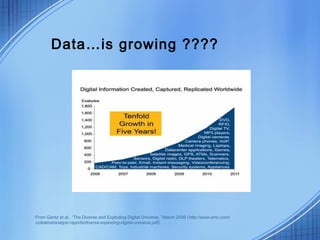
Data…is growing ????


From Gantz et al., “The Diverse and Exploding Digital Universe,” March 2008 (http://www.emc.com/
collateral/analyst-reports/diverse-exploding-digital-universe.pdf).
Problem??
• How do we store and analyze the date???
• one terabyte drives the transfer speed is
  around 100 MB/s- more than two and a half
  hours to read all the data off the disk.
  Writing more slower
• We had 100 drives holding one hundredth of
  the data.
•   Reliability issues ( failure in hard drive)
•   Combine data from 100 drives?.
• Existing Tools inadequate to process large
  data sets
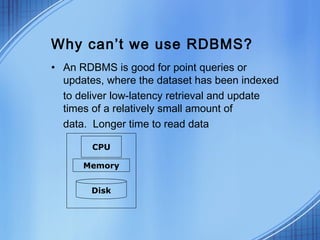
Why can’t we use RDBMS?
• An RDBMS is good for point queries or
  updates, where the dataset has been indexed
  to deliver low-latency retrieval and update
  times of a relatively small amount of
  data. Longer time to read data

        CPU

      Memory


       Disk
Hadoop is the answer!!!!!
• Hadoop is an open source project licensed
  under the Apache v2 license
  http://hadoop.apache.org/

• Used for processing large datasets in parallel
  with the use of low level commodity machines.

•    Hadoop is build on two main parts. An special
    file system called Hadoop Distributed File
    System (HDFS) and the Map Reduce
    Framework.
Hadoop History
• Hadoop was created by Doug Cutting, who named it
  after his son's toy elephant .
• 2002-2004 Nutch Open Source web-scale, crawler-
  based search
• 2004-2006 Google File System & MapReduce papers
  published.Added DFS & MapReduce impl to Nutch
• 2006-2008 Yahoo hired Doug Cutting
• On February 19, 2008, Yahoo! Inc. launched what it
  claimed was the world's largest Hadoop production
  application
• The Yahoo! Search Webmap is a Hadoop application
  that runs on more than 10,000 core Linux cluster and
  produces data that is now used in every Yahoo! Web
  search query.[22]
Who uses Hadoop ?
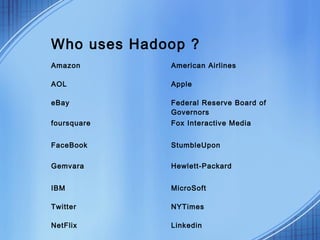
Amazon       American Airlines

AOL          Apple

eBay         Federal Reserve Board of
             Governors
foursquare   Fox Interactive Media


FaceBook     StumbleUpon

Gemvara      Hewlett-Packard


IBM          MicroSoft

Twitter      NYTimes

NetFlix      Linkedin
Why Hadoop?
• Reliable: The software is fault tolerant, it
  expects and handles hardware and software
  failures
• Scalable: Designed for massive scale of
  processors, memory, and local attached
  storage
• Distributed: Handles replication. Offers
  massively parallel programming model,
   MapReduce
What is MapReduce???


 – Programming model used by Google


 – A combination of the Map and Reduce models
   with an associated implementation


 – Used for processing and generating large data
   sets
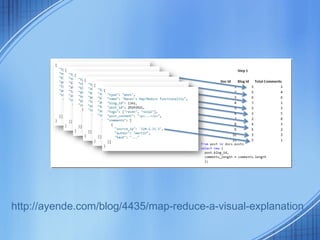
MapReduce Explained
• The basic idea is that you divide the job into
  two parts: a Map, and a Reduce.
• Map basically takes the problem, splits it into
  sub-parts, and sends the sub-parts to different
  machines – so all the pieces run at the same
  time.
• Reduce takes the results from the sub-parts
  and combines them back together to get a
  single answer.
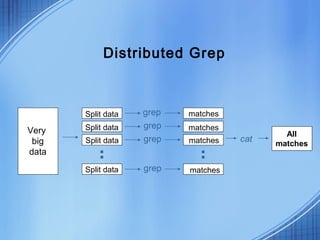
Distributed Grep


       Split data   grep   matches
       Split data   grep   matches
Very                                         All
 big   Split data   grep   matches   cat   matches
data
       Split data   grep   matches
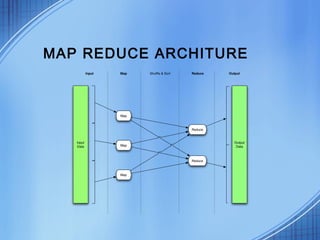
MAP REDUCE ARCHITURE
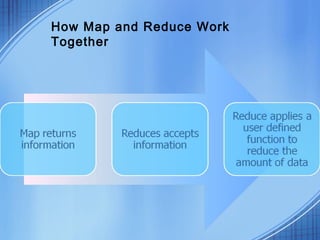
How Map and Reduce Work
Together
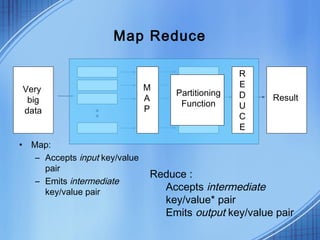
Map Reduce

                                                   R
                               M                   E
Very                                Partitioning
                               A                   D   Result
 big                                 Function
                               P                   U
data
                                                   C
                                                   E
• Map:
   – Accepts input key/value
     pair
                               Reduce :
   – Emits intermediate
     key/value pair              Accepts intermediate
                                 key/value* pair
                                 Emits output key/value pair
http://ayende.com/blog/4435/map-reduce-a-visual-explanation
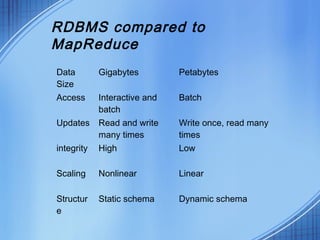
RDBMS compared to
MapReduce
Data        Gigabytes         Petabytes
Size
Access      Interactive and   Batch
            batch
Updates     Read and write    Write once, read many
            many times        times
integrity   High              Low

Scaling     Nonlinear         Linear

Structur    Static schema     Dynamic schema
e
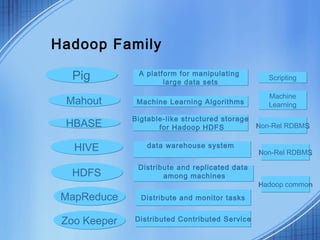
Hadoop Family

  Pig          A platform for manipulating
                      large data sets
                                                  Scripting

                                                  Machine
 Mahout        Machine Learning Algorithms        Learning
              Bigtable-like structured storage
 HBASE               for Hadoop HDFS           Non-Rel RDBMS


   HIVE          data warehouse system
                                                Non-Rel RDBMS

               Distribute and replicated data
  HDFS                among machines
                                                Hadoop common
 MapReduce      Distribute and monitor tasks


 Zoo Keeper   Distributed Contributed Service
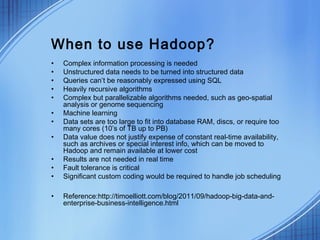
When to use Hadoop?
•   Complex information processing is needed
•   Unstructured data needs to be turned into structured data
•   Queries can’t be reasonably expressed using SQL
•   Heavily recursive algorithms
•   Complex but parallelizable algorithms needed, such as geo-spatial
    analysis or genome sequencing
•   Machine learning
•   Data sets are too large to fit into database RAM, discs, or require too
    many cores (10’s of TB up to PB)
•   Data value does not justify expense of constant real-time availability,
    such as archives or special interest info, which can be moved to
    Hadoop and remain available at lower cost
•   Results are not needed in real time
•   Fault tolerance is critical
•   Significant custom coding would be required to handle job scheduling

•   Reference:http://timoelliott.com/blog/2011/09/hadoop-big-data-and-
    enterprise-business-intelligence.html
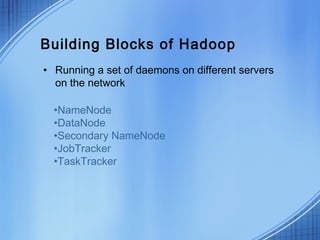
Building Blocks of Hadoop
• Running a set of daemons on different servers
  on the network

  •NameNode
  •DataNode
  •Secondary NameNode
  •JobTracker
  •TaskTracker
• Questions????
References
• Hadoop in Action By Chuck Lam
• Hadoop The Definitive Guide By Tom White
• http://hadoop.apache.org/

Hadoop by sunitha

  • 1.
  • 2.
    Data…Data….Data…. • We livein a data world ???? • Total FaceBook Users:835,525,280 (March 31 st 2012) • The New York Stock Exchange generates about one terabyte of new trade data per • day. • • Facebook hosts approximately 10 billion photos, taking up one petabyte of storage http://www.internetworldstats.com/facebook.htm
  • 3.
    Data…is growing ???? FromGantz et al., “The Diverse and Exploding Digital Universe,” March 2008 (http://www.emc.com/ collateral/analyst-reports/diverse-exploding-digital-universe.pdf).
  • 4.
    Problem?? • How dowe store and analyze the date??? • one terabyte drives the transfer speed is around 100 MB/s- more than two and a half hours to read all the data off the disk. Writing more slower • We had 100 drives holding one hundredth of the data. • Reliability issues ( failure in hard drive) • Combine data from 100 drives?. • Existing Tools inadequate to process large data sets
  • 5.
    Why can’t weuse RDBMS? • An RDBMS is good for point queries or updates, where the dataset has been indexed to deliver low-latency retrieval and update times of a relatively small amount of data. Longer time to read data CPU Memory Disk
  • 6.
    Hadoop is theanswer!!!!! • Hadoop is an open source project licensed under the Apache v2 license http://hadoop.apache.org/ • Used for processing large datasets in parallel with the use of low level commodity machines. • Hadoop is build on two main parts. An special file system called Hadoop Distributed File System (HDFS) and the Map Reduce Framework.
  • 7.
    Hadoop History • Hadoopwas created by Doug Cutting, who named it after his son's toy elephant . • 2002-2004 Nutch Open Source web-scale, crawler- based search • 2004-2006 Google File System & MapReduce papers published.Added DFS & MapReduce impl to Nutch • 2006-2008 Yahoo hired Doug Cutting • On February 19, 2008, Yahoo! Inc. launched what it claimed was the world's largest Hadoop production application • The Yahoo! Search Webmap is a Hadoop application that runs on more than 10,000 core Linux cluster and produces data that is now used in every Yahoo! Web search query.[22]
  • 8.
    Who uses Hadoop? Amazon American Airlines AOL Apple eBay Federal Reserve Board of Governors foursquare Fox Interactive Media FaceBook StumbleUpon Gemvara Hewlett-Packard IBM MicroSoft Twitter NYTimes NetFlix Linkedin
  • 9.
    Why Hadoop? • Reliable:The software is fault tolerant, it expects and handles hardware and software failures • Scalable: Designed for massive scale of processors, memory, and local attached storage • Distributed: Handles replication. Offers massively parallel programming model, MapReduce
  • 10.
    What is MapReduce??? – Programming model used by Google – A combination of the Map and Reduce models with an associated implementation – Used for processing and generating large data sets
  • 11.
    MapReduce Explained • Thebasic idea is that you divide the job into two parts: a Map, and a Reduce. • Map basically takes the problem, splits it into sub-parts, and sends the sub-parts to different machines – so all the pieces run at the same time. • Reduce takes the results from the sub-parts and combines them back together to get a single answer.
  • 12.
    Distributed Grep Split data grep matches Split data grep matches Very All big Split data grep matches cat matches data Split data grep matches
  • 13.
  • 14.
    How Map andReduce Work Together
  • 15.
    Map Reduce R M E Very Partitioning A D Result big Function P U data C E • Map: – Accepts input key/value pair Reduce : – Emits intermediate key/value pair Accepts intermediate key/value* pair Emits output key/value pair
  • 16.
  • 17.
    RDBMS compared to MapReduce Data Gigabytes Petabytes Size Access Interactive and Batch batch Updates Read and write Write once, read many many times times integrity High Low Scaling Nonlinear Linear Structur Static schema Dynamic schema e
  • 18.
    Hadoop Family Pig A platform for manipulating large data sets Scripting Machine Mahout Machine Learning Algorithms Learning Bigtable-like structured storage HBASE for Hadoop HDFS Non-Rel RDBMS HIVE data warehouse system Non-Rel RDBMS Distribute and replicated data HDFS among machines Hadoop common MapReduce Distribute and monitor tasks Zoo Keeper Distributed Contributed Service
  • 19.
    When to useHadoop? • Complex information processing is needed • Unstructured data needs to be turned into structured data • Queries can’t be reasonably expressed using SQL • Heavily recursive algorithms • Complex but parallelizable algorithms needed, such as geo-spatial analysis or genome sequencing • Machine learning • Data sets are too large to fit into database RAM, discs, or require too many cores (10’s of TB up to PB) • Data value does not justify expense of constant real-time availability, such as archives or special interest info, which can be moved to Hadoop and remain available at lower cost • Results are not needed in real time • Fault tolerance is critical • Significant custom coding would be required to handle job scheduling • Reference:http://timoelliott.com/blog/2011/09/hadoop-big-data-and- enterprise-business-intelligence.html
  • 20.
    Building Blocks ofHadoop • Running a set of daemons on different servers on the network •NameNode •DataNode •Secondary NameNode •JobTracker •TaskTracker
  • 21.
  • 22.
    References • Hadoop inAction By Chuck Lam • Hadoop The Definitive Guide By Tom White • http://hadoop.apache.org/