Atoms for the Future 2013 – SFEN Jeune Generation,
Paris, France, 21 – 22 October 2013

Small Modular Reactors
and their use for Specific Power Grids
Dr. M. Hadid Subki
Technical Lead, SMR Technology Development
Division of Nuclear Power, Department of Nuclear Energy

IAEA
International Atomic Energy Agency
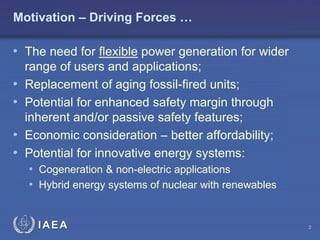
Motivation – Driving Forces …

• The need for flexible power generation for wider

•
•
•
•

range of users and applications;
Replacement of aging fossil-fired units;
Potential for enhanced safety margin through
inherent and/or passive safety features;
Economic consideration – better affordability;
Potential for innovative energy systems:
• Cogeneration & non-electric applications
• Hybrid energy systems of nuclear with renewables

IAEA

2
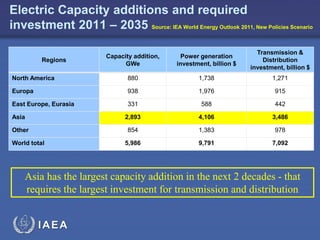
Electric Capacity additions and required
investment 2011 – 2035 Source: IEA World Energy Outlook 2011, New Policies Scenario
Capacity addition,
GWe

Power generation
investment, billion $

Transmission &
Distribution
investment, billion $

North America

880

1,738

1,271

Europa

938

1,976

915

East Europe, Eurasia

331

588

442

Asia

2,893

4,106

3,486

Other

854

1,383

978

5,986

9,791

7,092

Regions

World total

Asia has the largest capacity addition in the next 2 decades - that
requires the largest investment for transmission and distribution
IAEA
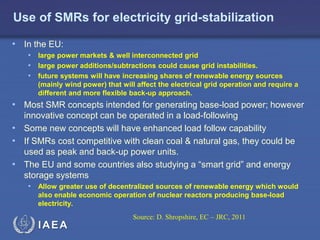
Use of SMRs for electricity grid-stabilization
• In the EU:
• large power markets & well interconnected grid
• large power additions/subtractions could cause grid instabilities.
• future systems will have increasing shares of renewable energy sources
(mainly wind power) that will affect the electrical grid operation and require a
different and more flexible back-up approach.

• Most SMR concepts intended for generating base-load power; however
innovative concept can be operated in a load-following
• Some new concepts will have enhanced load follow capability
• If SMRs cost competitive with clean coal & natural gas, they could be
used as peak and back-up power units.
• The EU and some countries also studying a “smart grid” and energy
storage systems
• Allow greater use of decentralized sources of renewable energy which would
also enable economic operation of nuclear reactors producing base-load
electricity.
Source: D. Shropshire, EC – JRC, 2011

IAEA
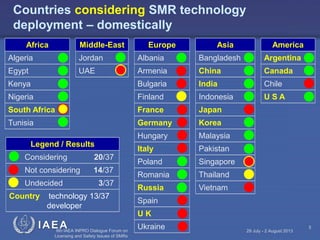
Countries considering SMR technology
deployment – domestically
Middle-East

Africa

Europe

Asia

America

Algeria

Jordan

Albania

Bangladesh

Argentina

Egypt

UAE

Armenia

China

Canada

Kenya

Bulgaria

India

Chile

Nigeria

Finland

Indonesia

USA

South Africa

France

Japan

Tunisia

Germany

Korea

Hungary

Malaysia

Italy

Pakistan

Poland

Singapore

Romania

Thailand

Russia

Vietnam

Legend / Results
Considering

20/37

Not considering

14/37

Undecided

Country

3/37

technology 13/37
developer

Spain
UK

IAEA IAEA INPRO Dialogue Forum on Ukraine
6th
Licensing and Safety Issues of SMRs

29 July - 2 August 2013

5
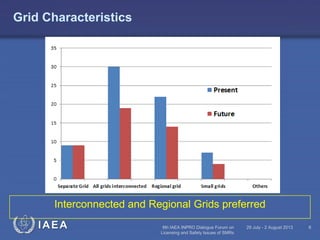
Grid Characteristics

Interconnected and Regional Grids preferred
IAEA

6th IAEA INPRO Dialogue Forum on
Licensing and Safety Issues of SMRs

29 July - 2 August 2013

6
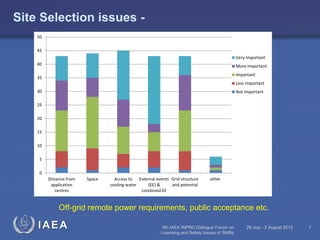
Site Selection issues 50
45

Very Important
40

More Important
Important

35

Less Important
30

Not Important

25
20
15
10
5
0
Distance from
application
centres

Space

Access to External events Grid structure
cooling water
(EE) &
and potential
combined EE

other

Off-grid remote power requirements, public acceptance etc.

IAEA

6th IAEA INPRO Dialogue Forum on
Licensing and Safety Issues of SMRs

29 July - 2 August 2013

7
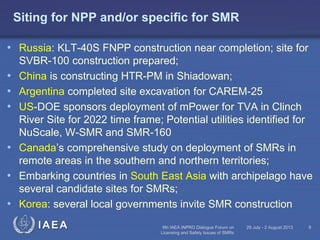
Siting for NPP and/or specific for SMR
• Russia: KLT-40S FNPP construction near completion; site for

•
•
•
•
•
•

SVBR-100 construction prepared;
China is constructing HTR-PM in Shiadowan;
Argentina completed site excavation for CAREM-25
US-DOE sponsors deployment of mPower for TVA in Clinch
River Site for 2022 time frame; Potential utilities identified for
NuScale, W-SMR and SMR-160
Canada’s comprehensive study on deployment of SMRs in
remote areas in the southern and northern territories;
Embarking countries in South East Asia with archipelago have
several candidate sites for SMRs;
Korea: several local governments invite SMR construction
IAEA

6th IAEA INPRO Dialogue Forum on
Licensing and Safety Issues of SMRs

29 July - 2 August 2013

8
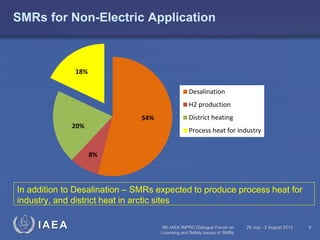
SMRs for Non-Electric Application

18%
Desalination
H2 production
54%
20%

District heating
Process heat for industry

8%

In addition to Desalination – SMRs expected to produce process heat for
industry, and district heat in arctic sites

IAEA

6th IAEA INPRO Dialogue Forum on
Licensing and Safety Issues of SMRs

29 July - 2 August 2013

9
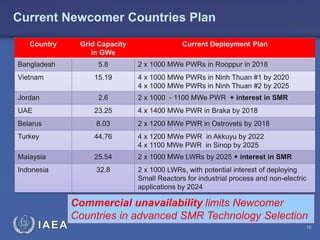
Current Newcomer Countries Plan
Country
Bangladesh

Grid Capacity
in GWe
5.8

Current Deployment Plan
2 x 1000 MWe PWRs in Rooppur in 2018

Vietnam

15.19

4 x 1000 MWe PWRs in Ninh Thuan #1 by 2020
4 x 1000 MWe PWRs in Ninh Thuan #2 by 2025

Jordan

2.6

2 x 1000 - 1100 MWe PWR + interest in SMR

UAE

23.25

4 x 1400 MWe PWR in Braka by 2018

Belarus

8.03

2 x 1200 MWe PWR in Ostrovets by 2018

Turkey

44.76

4 x 1200 MWe PWR in Akkuyu by 2022
4 x 1100 MWe PWR in Sinop by 2025

Malaysia

25.54

2 x 1000 MWe LWRs by 2025 + interest in SMR

Indonesia

32.8

2 x 1000 LWRs, with potential interest of deploying
Small Reactors for industrial process and non-electric
applications by 2024

IAEA

Commercial unavailability limits Newcomer
Countries in advanced SMR Technology Selection
10
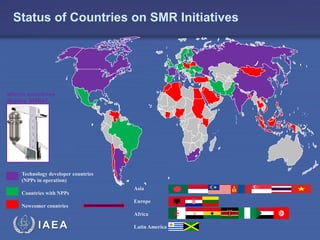
Status of Countries on SMR Initiatives

Which countries
deploy SMRs?

Technology developer countries
(NPPs in operation)
Countries with NPPs
Newcomer countries

Asia
Europe

Africa

IAEA

Latin America

11
Countries preference in particular
SMR design and technology

• Integral-PWR type SMRs with modularization are
•
•
•
•

under in Argentina, China, India, Korea, Russia
and the United States;
RF prioritizes FNPP and LMFR-SVBR-100
France & Russia develop marine-based SMRs
Embarking countries undecided on designs, but
preferred proven-technology.
Some embarking countries have started
deployment of large reactors, due to lack of
commercial availability of advanced SMRs;
IAEA

6th IAEA INPRO Dialogue Forum on
Licensing and Safety Issues of SMRs

29 July - 2 August 2013

12
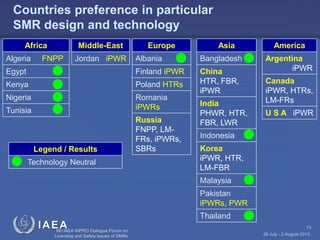
Countries preference in particular
SMR design and technology
Africa
Algeria

Middle-East

FNPP

Jordan iPWR

Europe

Asia

Albania

Bangladesh

Egypt

Finland iPWR

Kenya

Poland HTRs

Nigeria

Romania
iPWRs

China
HTR, FBR,
iPWR

Tunisia

Legend / Results
Technology Neutral

Russia
FNPP, LMFRs, iPWRs,
SBRs

India
PHWR, HTR,
FBR, LWR

America
Argentina
iPWR
Canada
iPWR, HTRs,
LM-FRs

U S A iPWR

Indonesia

Korea
iPWR, HTR,
LM-FBR
Malaysia
Pakistan
iPWRs, PWR
Thailand

IAEA IAEA INPRO Dialogue Forum on
6th
Licensing and Safety Issues of SMRs

13
29 July - 2 August 2013
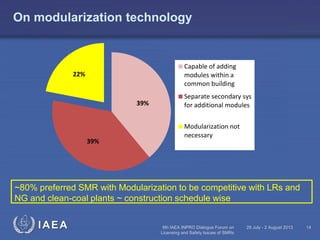
On modularization technology

Capable of adding
modules within a
common building

22%

39%

39%

Separate secondary sys
for additional modules
Modularization not
necessary

~80% preferred SMR with Modularization to be competitive with LRs and
NG and clean-coal plants ~ construction schedule wise

IAEA

6th IAEA INPRO Dialogue Forum on
Licensing and Safety Issues of SMRs

29 July - 2 August 2013

14
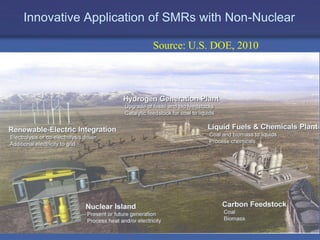
Innovative Application of SMRs with Non-Nuclear
Source: U.S. DOE, 2010

IAEA

15
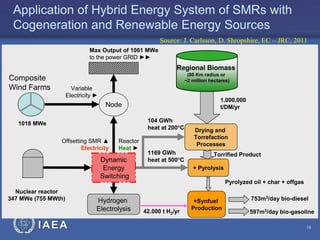
Application of Hybrid Energy System of SMRs with
Cogeneration and Renewable Energy Sources
Source: J. Carlsson, D. Shropshire, EC – JRC, 2011
Max Output of 1061 MWe
to the power GRID ►►

Regional Biomass
(80 Km radius or
~2 million hectares)

Composite
Wind Farms

Variable
Electricity ►

1.000.000
t/DM/yr

Node
104 GWh
heat at 200C

1018 MWe
Offsetting SMR ▲
Electricity

Reactor
Heat ►

Dynamic
Energy
Switching
Nuclear reactor
347 MWe (755 MWth)

IAEA

Hydrogen
Electrolysis

1169 GWh
heat at 500C

Drying and
Torrefaction
Processes
Torrified Product
+ Pyrolysis
Pyrolyzed oil + char + offgas

42.000 t H2/yr

+Synfuel
Production

753m3/day bio-diesel
597m3/day bio-gasoline
16
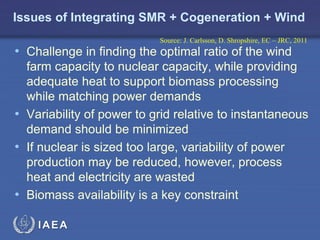
Issues of Integrating SMR + Cogeneration + Wind
Source: J. Carlsson, D. Shropshire, EC – JRC, 2011

• Challenge in finding the optimal ratio of the wind

farm capacity to nuclear capacity, while providing
adequate heat to support biomass processing
while matching power demands
• Variability of power to grid relative to instantaneous
demand should be minimized
• If nuclear is sized too large, variability of power
production may be reduced, however, process
heat and electricity are wasted
• Biomass availability is a key constraint
IAEA
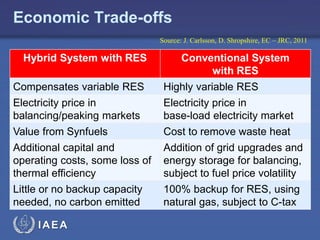
Economic Trade-offs
Source: J. Carlsson, D. Shropshire, EC – JRC, 2011

Hybrid System with RES
Compensates variable RES
Electricity price in
balancing/peaking markets

Conventional System
with RES
Highly variable RES
Electricity price in
base-load electricity market

Value from Synfuels
Additional capital and
operating costs, some loss of
thermal efficiency
Little or no backup capacity
needed, no carbon emitted

Cost to remove waste heat
Addition of grid upgrades and
energy storage for balancing,
subject to fuel price volatility
100% backup for RES, using
natural gas, subject to C-tax

IAEA
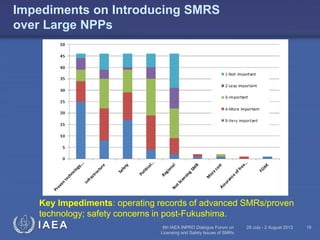
Impediments on Introducing SMRS
over Large NPPs

Key Impediments: operating records of advanced SMRs/proven
technology; safety concerns in post-Fukushima.

IAEA

6th IAEA INPRO Dialogue Forum on
Licensing and Safety Issues of SMRs

29 July - 2 August 2013

19
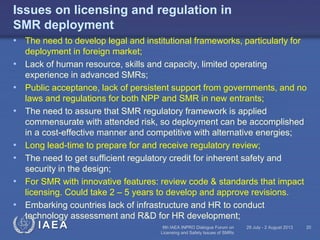
Issues on licensing and regulation in
SMR deployment
• The need to develop legal and institutional frameworks, particularly for
•
•
•
•
•
•
•

deployment in foreign market;
Lack of human resource, skills and capacity, limited operating
experience in advanced SMRs;
Public acceptance, lack of persistent support from governments, and no
laws and regulations for both NPP and SMR in new entrants;
The need to assure that SMR regulatory framework is applied
commensurate with attended risk, so deployment can be accomplished
in a cost-effective manner and competitive with alternative energies;
Long lead-time to prepare for and receive regulatory review;
The need to get sufficient regulatory credit for inherent safety and
security in the design;
For SMR with innovative features: review code & standards that impact
licensing. Could take 2 – 5 years to develop and approve revisions.
Embarking countries lack of infrastructure and HR to conduct
technology assessment and R&D for HR development;

IAEA

6th IAEA INPRO Dialogue Forum on
Licensing and Safety Issues of SMRs

29 July - 2 August 2013

20
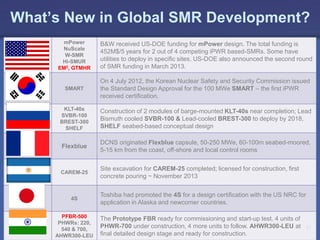
What’s New in Global SMR Development?
mPower
NuScale
W-SMR
Hi-SMUR
EM2, GTMHR

B&W received US-DOE funding for mPower design. The total funding is
452M$/5 years for 2 out of 4 competing iPWR based-SMRs. Some have
utilities to deploy in specific sites. US-DOE also announced the second round
of SMR funding in March 2013.

SMART

On 4 July 2012, the Korean Nuclear Safety and Security Commission issued
the Standard Design Approval for the 100 MWe SMART – the first iPWR
received certification.

KLT-40s
SVBR-100
BREST-300
SHELF

Construction of 2 modules of barge-mounted KLT-40s near completion; Lead
Bismuth cooled SVBR-100 & Lead-cooled BREST-300 to deploy by 2018,
SHELF seabed-based conceptual design

Flexblue

DCNS originated Flexblue capsule, 50-250 MWe, 60-100m seabed-moored,
5-15 km from the coast, off-shore and local control rooms

CAREM-25

Site excavation for CAREM-25 completed; licensed for construction, first
concrete pouring ~ November 2013

4S
PFBR-500
PHWRs: 220,
540 & 700,
AHWR300-LEU

IAEA

Toshiba had promoted the 4S for a design certification with the US NRC for
application in Alaska and newcomer countries.
The Prototype FBR ready for commissioning and start-up test. 4 units of
PHWR-700 under construction, 4 more units to follow. AHWR300-LEU at
final detailed design stage and ready for construction.

21
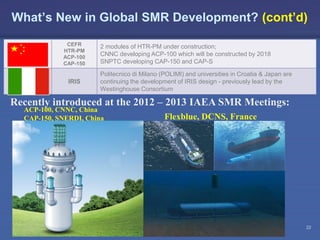
What’s New in Global SMR Development? (cont’d)
CEFR
HTR-PM
ACP-100
CAP-150

IRIS

2 modules of HTR-PM under construction;
CNNC developing ACP-100 which will be constructed by 2018
SNPTC developing CAP-150 and CAP-S
Politecnico di Milano (POLIMI) and universities in Croatia & Japan are
continuing the development of IRIS design - previously lead by the
Westinghouse Consortium

Recently introduced at the 2012 – 2013 IAEA SMR Meetings:
ACP-100, CNNC, China
CAP-150, SNERDI, China

IAEA

Flexblue, DCNS, France

22
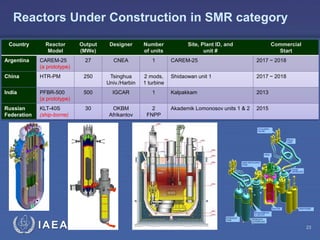
Reactors Under Construction in SMR category
Country

Reactor
Model

Output
(MWe)

Designer

Number
of units

Argentina

CAREM-25
(a prototype)

27

CNEA

1

China

HTR-PM

250

Tsinghua
Univ./Harbin

2 mods,
1 turbine

India

PFBR-500
(a prototype)

500

IGCAR

1

Russian
Federation

KLT-40S
(ship-borne)

30

OKBM
Afrikantov

2
FNPP

IAEA

Site, Plant ID, and
unit #

Commercial
Start

CAREM-25

2017 ~ 2018

Shidaowan unit 1

2017 ~ 2018

Kalpakkam

2013

Akademik Lomonosov units 1 & 2

2015

23
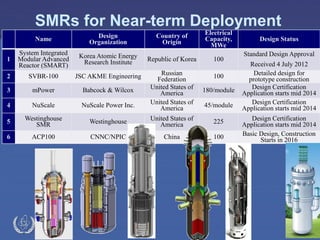
SMRs for Near-term Deployment
Name

Design
Organization

Country of
Origin

Electrical
Capacity,
MWe

1

System Integrated
Modular Advanced
Reactor (SMART)

Korea Atomic Energy
Research Institute

Republic of Korea

100

2

SVBR-100

JSC AKME Engineering

100

3

mPower

Babcock & Wilcox

180/module

4

NuScale

NuScale Power Inc.

Russian
Federation
United States of
America
United States of
America

5

Westinghouse
SMR

Westinghouse

United States of
America

225

6

ACP100

CNNC/NPIC

China

100

IAEA

45/module

Design Status
Standard Design Approval
Received 4 July 2012
Detailed design for
prototype construction
Design Certification
Application starts mid 2014
Design Certification
Application starts mid 2014
Design Certification
Application starts mid 2014
Basic Design, Construction
Starts in 2016
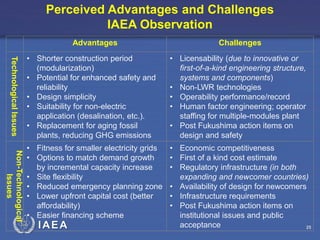
Perceived Advantages and Challenges
IAEA Observation
Advantages

Challenges

Technological Issues
Non-Technological
Issues

• Shorter construction period
(modularization)
• Potential for enhanced safety and
reliability
• Design simplicity
• Suitability for non-electric
application (desalination, etc.).
• Replacement for aging fossil
plants, reducing GHG emissions

• Licensability (due to innovative or
first-of-a-kind engineering structure,
systems and components)
• Non-LWR technologies
• Operability performance/record
• Human factor engineering; operator
staffing for multiple-modules plant
• Post Fukushima action items on
design and safety

• Fitness for smaller electricity grids
• Options to match demand growth
by incremental capacity increase
• Site flexibility
• Reduced emergency planning zone
• Lower upfront capital cost (better
affordability)
• Easier financing scheme

• Economic competitiveness
• First of a kind cost estimate
• Regulatory infrastructure (in both
expanding and newcomer countries)
• Availability of design for newcomers
• Infrastructure requirements
• Post Fukushima action items on
institutional issues and public
acceptance
25

IAEA
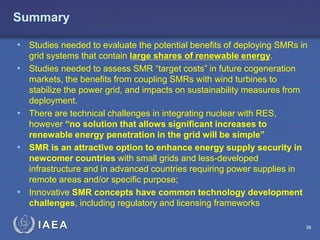
Summary
• Studies needed to evaluate the potential benefits of deploying SMRs in
•

•
•

•

grid systems that contain large shares of renewable energy.
Studies needed to assess SMR “target costs” in future cogeneration
markets, the benefits from coupling SMRs with wind turbines to
stabilize the power grid, and impacts on sustainability measures from
deployment.
There are technical challenges in integrating nuclear with RES,
however “no solution that allows significant increases to
renewable energy penetration in the grid will be simple”
SMR is an attractive option to enhance energy supply security in
newcomer countries with small grids and less-developed
infrastructure and in advanced countries requiring power supplies in
remote areas and/or specific purpose;
Innovative SMR concepts have common technology development
challenges, including regulatory and licensing frameworks

IAEA

26
… Thank you for your attention.

IAEA

For inquiries, please contact:
Dr. M. Hadid Subki <M.Subki@iaea.org>

27

Hadid Subki technical head of the SMR program at the International Atomic Energy Agency (Atoms for the Future 2013)

  • 1.
    Atoms for theFuture 2013 – SFEN Jeune Generation, Paris, France, 21 – 22 October 2013 Small Modular Reactors and their use for Specific Power Grids Dr. M. Hadid Subki Technical Lead, SMR Technology Development Division of Nuclear Power, Department of Nuclear Energy IAEA International Atomic Energy Agency
  • 2.
    Motivation – DrivingForces … • The need for flexible power generation for wider • • • • range of users and applications; Replacement of aging fossil-fired units; Potential for enhanced safety margin through inherent and/or passive safety features; Economic consideration – better affordability; Potential for innovative energy systems: • Cogeneration & non-electric applications • Hybrid energy systems of nuclear with renewables IAEA 2
  • 3.
    Electric Capacity additionsand required investment 2011 – 2035 Source: IEA World Energy Outlook 2011, New Policies Scenario Capacity addition, GWe Power generation investment, billion $ Transmission & Distribution investment, billion $ North America 880 1,738 1,271 Europa 938 1,976 915 East Europe, Eurasia 331 588 442 Asia 2,893 4,106 3,486 Other 854 1,383 978 5,986 9,791 7,092 Regions World total Asia has the largest capacity addition in the next 2 decades - that requires the largest investment for transmission and distribution IAEA
  • 4.
    Use of SMRsfor electricity grid-stabilization • In the EU: • large power markets & well interconnected grid • large power additions/subtractions could cause grid instabilities. • future systems will have increasing shares of renewable energy sources (mainly wind power) that will affect the electrical grid operation and require a different and more flexible back-up approach. • Most SMR concepts intended for generating base-load power; however innovative concept can be operated in a load-following • Some new concepts will have enhanced load follow capability • If SMRs cost competitive with clean coal & natural gas, they could be used as peak and back-up power units. • The EU and some countries also studying a “smart grid” and energy storage systems • Allow greater use of decentralized sources of renewable energy which would also enable economic operation of nuclear reactors producing base-load electricity. Source: D. Shropshire, EC – JRC, 2011 IAEA
  • 5.
    Countries considering SMRtechnology deployment – domestically Middle-East Africa Europe Asia America Algeria Jordan Albania Bangladesh Argentina Egypt UAE Armenia China Canada Kenya Bulgaria India Chile Nigeria Finland Indonesia USA South Africa France Japan Tunisia Germany Korea Hungary Malaysia Italy Pakistan Poland Singapore Romania Thailand Russia Vietnam Legend / Results Considering 20/37 Not considering 14/37 Undecided Country 3/37 technology 13/37 developer Spain UK IAEA IAEA INPRO Dialogue Forum on Ukraine 6th Licensing and Safety Issues of SMRs 29 July - 2 August 2013 5
  • 6.
    Grid Characteristics Interconnected andRegional Grids preferred IAEA 6th IAEA INPRO Dialogue Forum on Licensing and Safety Issues of SMRs 29 July - 2 August 2013 6
  • 7.
    Site Selection issues50 45 Very Important 40 More Important Important 35 Less Important 30 Not Important 25 20 15 10 5 0 Distance from application centres Space Access to External events Grid structure cooling water (EE) & and potential combined EE other Off-grid remote power requirements, public acceptance etc. IAEA 6th IAEA INPRO Dialogue Forum on Licensing and Safety Issues of SMRs 29 July - 2 August 2013 7
  • 8.
    Siting for NPPand/or specific for SMR • Russia: KLT-40S FNPP construction near completion; site for • • • • • • SVBR-100 construction prepared; China is constructing HTR-PM in Shiadowan; Argentina completed site excavation for CAREM-25 US-DOE sponsors deployment of mPower for TVA in Clinch River Site for 2022 time frame; Potential utilities identified for NuScale, W-SMR and SMR-160 Canada’s comprehensive study on deployment of SMRs in remote areas in the southern and northern territories; Embarking countries in South East Asia with archipelago have several candidate sites for SMRs; Korea: several local governments invite SMR construction IAEA 6th IAEA INPRO Dialogue Forum on Licensing and Safety Issues of SMRs 29 July - 2 August 2013 8
  • 9.
    SMRs for Non-ElectricApplication 18% Desalination H2 production 54% 20% District heating Process heat for industry 8% In addition to Desalination – SMRs expected to produce process heat for industry, and district heat in arctic sites IAEA 6th IAEA INPRO Dialogue Forum on Licensing and Safety Issues of SMRs 29 July - 2 August 2013 9
  • 10.
    Current Newcomer CountriesPlan Country Bangladesh Grid Capacity in GWe 5.8 Current Deployment Plan 2 x 1000 MWe PWRs in Rooppur in 2018 Vietnam 15.19 4 x 1000 MWe PWRs in Ninh Thuan #1 by 2020 4 x 1000 MWe PWRs in Ninh Thuan #2 by 2025 Jordan 2.6 2 x 1000 - 1100 MWe PWR + interest in SMR UAE 23.25 4 x 1400 MWe PWR in Braka by 2018 Belarus 8.03 2 x 1200 MWe PWR in Ostrovets by 2018 Turkey 44.76 4 x 1200 MWe PWR in Akkuyu by 2022 4 x 1100 MWe PWR in Sinop by 2025 Malaysia 25.54 2 x 1000 MWe LWRs by 2025 + interest in SMR Indonesia 32.8 2 x 1000 LWRs, with potential interest of deploying Small Reactors for industrial process and non-electric applications by 2024 IAEA Commercial unavailability limits Newcomer Countries in advanced SMR Technology Selection 10
  • 11.
    Status of Countrieson SMR Initiatives Which countries deploy SMRs? Technology developer countries (NPPs in operation) Countries with NPPs Newcomer countries Asia Europe Africa IAEA Latin America 11
  • 12.
    Countries preference inparticular SMR design and technology • Integral-PWR type SMRs with modularization are • • • • under in Argentina, China, India, Korea, Russia and the United States; RF prioritizes FNPP and LMFR-SVBR-100 France & Russia develop marine-based SMRs Embarking countries undecided on designs, but preferred proven-technology. Some embarking countries have started deployment of large reactors, due to lack of commercial availability of advanced SMRs; IAEA 6th IAEA INPRO Dialogue Forum on Licensing and Safety Issues of SMRs 29 July - 2 August 2013 12
  • 13.
    Countries preference inparticular SMR design and technology Africa Algeria Middle-East FNPP Jordan iPWR Europe Asia Albania Bangladesh Egypt Finland iPWR Kenya Poland HTRs Nigeria Romania iPWRs China HTR, FBR, iPWR Tunisia Legend / Results Technology Neutral Russia FNPP, LMFRs, iPWRs, SBRs India PHWR, HTR, FBR, LWR America Argentina iPWR Canada iPWR, HTRs, LM-FRs U S A iPWR Indonesia Korea iPWR, HTR, LM-FBR Malaysia Pakistan iPWRs, PWR Thailand IAEA IAEA INPRO Dialogue Forum on 6th Licensing and Safety Issues of SMRs 13 29 July - 2 August 2013
  • 14.
    On modularization technology Capableof adding modules within a common building 22% 39% 39% Separate secondary sys for additional modules Modularization not necessary ~80% preferred SMR with Modularization to be competitive with LRs and NG and clean-coal plants ~ construction schedule wise IAEA 6th IAEA INPRO Dialogue Forum on Licensing and Safety Issues of SMRs 29 July - 2 August 2013 14
  • 15.
    Innovative Application ofSMRs with Non-Nuclear Source: U.S. DOE, 2010 IAEA 15
  • 16.
    Application of HybridEnergy System of SMRs with Cogeneration and Renewable Energy Sources Source: J. Carlsson, D. Shropshire, EC – JRC, 2011 Max Output of 1061 MWe to the power GRID ►► Regional Biomass (80 Km radius or ~2 million hectares) Composite Wind Farms Variable Electricity ► 1.000.000 t/DM/yr Node 104 GWh heat at 200C 1018 MWe Offsetting SMR ▲ Electricity Reactor Heat ► Dynamic Energy Switching Nuclear reactor 347 MWe (755 MWth) IAEA Hydrogen Electrolysis 1169 GWh heat at 500C Drying and Torrefaction Processes Torrified Product + Pyrolysis Pyrolyzed oil + char + offgas 42.000 t H2/yr +Synfuel Production 753m3/day bio-diesel 597m3/day bio-gasoline 16
  • 17.
    Issues of IntegratingSMR + Cogeneration + Wind Source: J. Carlsson, D. Shropshire, EC – JRC, 2011 • Challenge in finding the optimal ratio of the wind farm capacity to nuclear capacity, while providing adequate heat to support biomass processing while matching power demands • Variability of power to grid relative to instantaneous demand should be minimized • If nuclear is sized too large, variability of power production may be reduced, however, process heat and electricity are wasted • Biomass availability is a key constraint IAEA
  • 18.
    Economic Trade-offs Source: J.Carlsson, D. Shropshire, EC – JRC, 2011 Hybrid System with RES Compensates variable RES Electricity price in balancing/peaking markets Conventional System with RES Highly variable RES Electricity price in base-load electricity market Value from Synfuels Additional capital and operating costs, some loss of thermal efficiency Little or no backup capacity needed, no carbon emitted Cost to remove waste heat Addition of grid upgrades and energy storage for balancing, subject to fuel price volatility 100% backup for RES, using natural gas, subject to C-tax IAEA
  • 19.
    Impediments on IntroducingSMRS over Large NPPs Key Impediments: operating records of advanced SMRs/proven technology; safety concerns in post-Fukushima. IAEA 6th IAEA INPRO Dialogue Forum on Licensing and Safety Issues of SMRs 29 July - 2 August 2013 19
  • 20.
    Issues on licensingand regulation in SMR deployment • The need to develop legal and institutional frameworks, particularly for • • • • • • • deployment in foreign market; Lack of human resource, skills and capacity, limited operating experience in advanced SMRs; Public acceptance, lack of persistent support from governments, and no laws and regulations for both NPP and SMR in new entrants; The need to assure that SMR regulatory framework is applied commensurate with attended risk, so deployment can be accomplished in a cost-effective manner and competitive with alternative energies; Long lead-time to prepare for and receive regulatory review; The need to get sufficient regulatory credit for inherent safety and security in the design; For SMR with innovative features: review code & standards that impact licensing. Could take 2 – 5 years to develop and approve revisions. Embarking countries lack of infrastructure and HR to conduct technology assessment and R&D for HR development; IAEA 6th IAEA INPRO Dialogue Forum on Licensing and Safety Issues of SMRs 29 July - 2 August 2013 20
  • 21.
    What’s New inGlobal SMR Development? mPower NuScale W-SMR Hi-SMUR EM2, GTMHR B&W received US-DOE funding for mPower design. The total funding is 452M$/5 years for 2 out of 4 competing iPWR based-SMRs. Some have utilities to deploy in specific sites. US-DOE also announced the second round of SMR funding in March 2013. SMART On 4 July 2012, the Korean Nuclear Safety and Security Commission issued the Standard Design Approval for the 100 MWe SMART – the first iPWR received certification. KLT-40s SVBR-100 BREST-300 SHELF Construction of 2 modules of barge-mounted KLT-40s near completion; Lead Bismuth cooled SVBR-100 & Lead-cooled BREST-300 to deploy by 2018, SHELF seabed-based conceptual design Flexblue DCNS originated Flexblue capsule, 50-250 MWe, 60-100m seabed-moored, 5-15 km from the coast, off-shore and local control rooms CAREM-25 Site excavation for CAREM-25 completed; licensed for construction, first concrete pouring ~ November 2013 4S PFBR-500 PHWRs: 220, 540 & 700, AHWR300-LEU IAEA Toshiba had promoted the 4S for a design certification with the US NRC for application in Alaska and newcomer countries. The Prototype FBR ready for commissioning and start-up test. 4 units of PHWR-700 under construction, 4 more units to follow. AHWR300-LEU at final detailed design stage and ready for construction. 21
  • 22.
    What’s New inGlobal SMR Development? (cont’d) CEFR HTR-PM ACP-100 CAP-150 IRIS 2 modules of HTR-PM under construction; CNNC developing ACP-100 which will be constructed by 2018 SNPTC developing CAP-150 and CAP-S Politecnico di Milano (POLIMI) and universities in Croatia & Japan are continuing the development of IRIS design - previously lead by the Westinghouse Consortium Recently introduced at the 2012 – 2013 IAEA SMR Meetings: ACP-100, CNNC, China CAP-150, SNERDI, China IAEA Flexblue, DCNS, France 22
  • 23.
    Reactors Under Constructionin SMR category Country Reactor Model Output (MWe) Designer Number of units Argentina CAREM-25 (a prototype) 27 CNEA 1 China HTR-PM 250 Tsinghua Univ./Harbin 2 mods, 1 turbine India PFBR-500 (a prototype) 500 IGCAR 1 Russian Federation KLT-40S (ship-borne) 30 OKBM Afrikantov 2 FNPP IAEA Site, Plant ID, and unit # Commercial Start CAREM-25 2017 ~ 2018 Shidaowan unit 1 2017 ~ 2018 Kalpakkam 2013 Akademik Lomonosov units 1 & 2 2015 23
  • 24.
    SMRs for Near-termDeployment Name Design Organization Country of Origin Electrical Capacity, MWe 1 System Integrated Modular Advanced Reactor (SMART) Korea Atomic Energy Research Institute Republic of Korea 100 2 SVBR-100 JSC AKME Engineering 100 3 mPower Babcock & Wilcox 180/module 4 NuScale NuScale Power Inc. Russian Federation United States of America United States of America 5 Westinghouse SMR Westinghouse United States of America 225 6 ACP100 CNNC/NPIC China 100 IAEA 45/module Design Status Standard Design Approval Received 4 July 2012 Detailed design for prototype construction Design Certification Application starts mid 2014 Design Certification Application starts mid 2014 Design Certification Application starts mid 2014 Basic Design, Construction Starts in 2016
  • 25.
    Perceived Advantages andChallenges IAEA Observation Advantages Challenges Technological Issues Non-Technological Issues • Shorter construction period (modularization) • Potential for enhanced safety and reliability • Design simplicity • Suitability for non-electric application (desalination, etc.). • Replacement for aging fossil plants, reducing GHG emissions • Licensability (due to innovative or first-of-a-kind engineering structure, systems and components) • Non-LWR technologies • Operability performance/record • Human factor engineering; operator staffing for multiple-modules plant • Post Fukushima action items on design and safety • Fitness for smaller electricity grids • Options to match demand growth by incremental capacity increase • Site flexibility • Reduced emergency planning zone • Lower upfront capital cost (better affordability) • Easier financing scheme • Economic competitiveness • First of a kind cost estimate • Regulatory infrastructure (in both expanding and newcomer countries) • Availability of design for newcomers • Infrastructure requirements • Post Fukushima action items on institutional issues and public acceptance 25 IAEA
  • 26.
    Summary • Studies neededto evaluate the potential benefits of deploying SMRs in • • • • grid systems that contain large shares of renewable energy. Studies needed to assess SMR “target costs” in future cogeneration markets, the benefits from coupling SMRs with wind turbines to stabilize the power grid, and impacts on sustainability measures from deployment. There are technical challenges in integrating nuclear with RES, however “no solution that allows significant increases to renewable energy penetration in the grid will be simple” SMR is an attractive option to enhance energy supply security in newcomer countries with small grids and less-developed infrastructure and in advanced countries requiring power supplies in remote areas and/or specific purpose; Innovative SMR concepts have common technology development challenges, including regulatory and licensing frameworks IAEA 26
  • 27.
    … Thank youfor your attention. IAEA For inquiries, please contact: Dr. M. Hadid Subki <M.Subki@iaea.org> 27