HadCM3
Hadley Centre Coupled Model ,version
HadCM3
• Abbreviation for Hadley Centre Coupled Model, version 3
• coupled atmosphere-ocean general circulation model (AOGCM)
developed at the Hadley Centre in the United Kingdom
• the major models used in the IPCC Third Assessment Report in 2001
• HadCM3 does not need flux adjustment (additional "artificial" heat and
freshwater fluxes at the ocean surface) to produce a good simulation
• HadCM3 is composed of two components: the atmospheric model
HadAM3 and the ocean model (which includes a sea ice model).
HadCM3
• HadCM3 atmospheric model (HadAM3) is a grid point model and has
a horizontal resolution of 3.75×2.5 degrees in longitude × latitude
• This gives 96×73 grid points on the scalar (pressure, temperature and
moisture) grid; the vector (wind velocity) grid is offset by 1/2 a grid
box.
• ocean model (HadOM3) has a resolution of 1.25×1.25 degrees,
• HadCM3 deals with the land and sea surface temperatures,
precipitation, ocean circulation and vegetation
HadCM3
• HadCM3 has been heavily used during the last 15 years for a range of
future (and past) climate change studies but is now largely being
replaced by more recent models
HadCM3
Atmosphere
Temperature
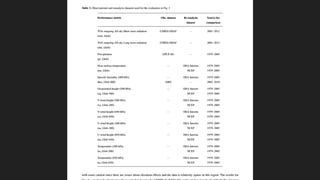
• more than 10 thousand stations for temperature
• More than 25 thousand stations for precipitation
• .The differences between the 1960–1990 climate means compared to
the 1860–1890 climate means
• mean warming between the two periods being 0.6 C◦
HadCM3
Atmosphere
HadCM3
Precipitation
• Deals with frontal, convective and mesoscale.
• Convective precipitation is generally more intense, and of shorter
duration, than stratiform precipitation. Orographic precipitation occurs
when moist air is forced upwards over rising terrain, such as a
mountain. Precipitation can also fall in either liquid or solid phases, or
transition between them.
• Stratiform precipitation, in general, is relatively continuous and uniform in
intensity (i.e., steady rain versus rain showers).
• Mesoscale an intermediate scale between those of weather systems and
of microclimates, on which storms and other phenomena occur
HadCM3
Precipitation
• Monsoonal regions of south-east Asia,Austral-Asia,southern South
America, Westland central Africa, over estimate precipitation by 0.5
mm day−1 to 2 mm day−1
• Precipitation in the Indian and northern arm of the South American
10 region by 1mm day−1 to 4 mm day−1∼
• It is also noted that an increase in resolution does not produce a
noticeable improvement on spatial annual precipitation bias in
certain monsoon regions
HadCM3
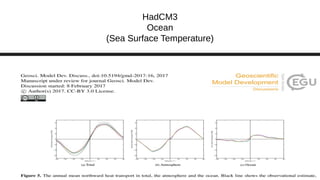
Ocean
(Sea Surface Temperature)
HadCM3
Sea Surface Salinity
• in the global average, the models show a fresh bias of about 0.5
gkg−1
• exhibiting higher salinities (up to 10 gkg−1) in the Kara Sea and
generally north of Russia. Generally lower salinities (of up to 5 gkg−1)
are found in the10 Chukchi and Beaufort seas.
• The largest differences are found in enclosed or semi-enclosed
basins,
HadCM3
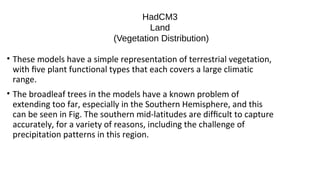
Land
(Vegetation Distribution)
• These models have a simple representation of terrestrial vegetation,
with five plant functional types that each covers a large climatic
range.
• The broadleaf trees in the models have a known problem of
extending too far, especially in the Southern Hemisphere, and this
can be seen in Fig. The southern mid-latitudes are difficult to capture
accurately, for a variety of reasons, including the challenge of
precipitation patterns in this region.
HadCM3
Land
(Vegetation Distribution)
Had cm3 hadley centre coupled model ,version

Had cm3 hadley centre coupled model ,version

  • 2.
  • 3.
    HadCM3 • Abbreviation forHadley Centre Coupled Model, version 3 • coupled atmosphere-ocean general circulation model (AOGCM) developed at the Hadley Centre in the United Kingdom • the major models used in the IPCC Third Assessment Report in 2001 • HadCM3 does not need flux adjustment (additional "artificial" heat and freshwater fluxes at the ocean surface) to produce a good simulation • HadCM3 is composed of two components: the atmospheric model HadAM3 and the ocean model (which includes a sea ice model).
  • 4.
    HadCM3 • HadCM3 atmosphericmodel (HadAM3) is a grid point model and has a horizontal resolution of 3.75×2.5 degrees in longitude × latitude • This gives 96×73 grid points on the scalar (pressure, temperature and moisture) grid; the vector (wind velocity) grid is offset by 1/2 a grid box. • ocean model (HadOM3) has a resolution of 1.25×1.25 degrees, • HadCM3 deals with the land and sea surface temperatures, precipitation, ocean circulation and vegetation
  • 5.
    HadCM3 • HadCM3 hasbeen heavily used during the last 15 years for a range of future (and past) climate change studies but is now largely being replaced by more recent models
  • 6.
    HadCM3 Atmosphere Temperature • more than10 thousand stations for temperature • More than 25 thousand stations for precipitation • .The differences between the 1960–1990 climate means compared to the 1860–1890 climate means • mean warming between the two periods being 0.6 C◦
  • 7.
  • 9.
    HadCM3 Precipitation • Deals withfrontal, convective and mesoscale. • Convective precipitation is generally more intense, and of shorter duration, than stratiform precipitation. Orographic precipitation occurs when moist air is forced upwards over rising terrain, such as a mountain. Precipitation can also fall in either liquid or solid phases, or transition between them. • Stratiform precipitation, in general, is relatively continuous and uniform in intensity (i.e., steady rain versus rain showers). • Mesoscale an intermediate scale between those of weather systems and of microclimates, on which storms and other phenomena occur
  • 10.
    HadCM3 Precipitation • Monsoonal regionsof south-east Asia,Austral-Asia,southern South America, Westland central Africa, over estimate precipitation by 0.5 mm day−1 to 2 mm day−1 • Precipitation in the Indian and northern arm of the South American 10 region by 1mm day−1 to 4 mm day−1∼ • It is also noted that an increase in resolution does not produce a noticeable improvement on spatial annual precipitation bias in certain monsoon regions
  • 11.
  • 12.
    HadCM3 Sea Surface Salinity •in the global average, the models show a fresh bias of about 0.5 gkg−1 • exhibiting higher salinities (up to 10 gkg−1) in the Kara Sea and generally north of Russia. Generally lower salinities (of up to 5 gkg−1) are found in the10 Chukchi and Beaufort seas. • The largest differences are found in enclosed or semi-enclosed basins,
  • 13.
    HadCM3 Land (Vegetation Distribution) • Thesemodels have a simple representation of terrestrial vegetation, with five plant functional types that each covers a large climatic range. • The broadleaf trees in the models have a known problem of extending too far, especially in the Southern Hemisphere, and this can be seen in Fig. The southern mid-latitudes are difficult to capture accurately, for a variety of reasons, including the challenge of precipitation patterns in this region.
  • 14.