SHANDS NEUROSCIENCE INSTITUTE
4555 Emerson Street
Jacksonville, Florida 32207
To schedule and appointment call
(904) 383-1022
...the Science of Hope
Headaches are the #1 reason patients go to
the doctor. It is
estimated that 6% of
men and 18% of women
in the United States
suffer from headaches.
Sometimes the symptoms are so bad the pa-
tient is unable to perform the basic activities of
daily living and/or keep a job.
Physicians at the Neuroscience Institute at
Shands Jacksonville specialize in providing
treatments, therapies and state of the art pro-
cedures that will
1) Reduce the frequency and severity of
headaches,
2) Reduce disability from headaches and
3) Improve the patient’s overall quality of
life!
CHRONIC HEADACHES HEADACHE FACTS
Migraines affect approximately 36
million Americans annually, including
25% of middle aged women and 19%
of Iraqi war veterans.
Cluster Headaches are as prevalent as
Multiple Sclerosis and these attacks are
one of the most painful conditions
known.
The direct and indirect economic cost of
headaches in the U.S. exceeds $31 bil-
lion dollars annually.
Migraine sufferers are
3 times as likely to experience ma-
jor depression,
6 times more likely to have a pan-
ic disorder, and
5 times as likely to have a
generalized anxiety and/or a
bipolar disorder.
THE UF HEADACHE CENTER
RESOURCES
American Headache Society
Committee for Headache Education
(ACHE)
www.achenet.org
National Headache Foundation
www.headaches.org
Migraine Awareness Group
www.migraines.org
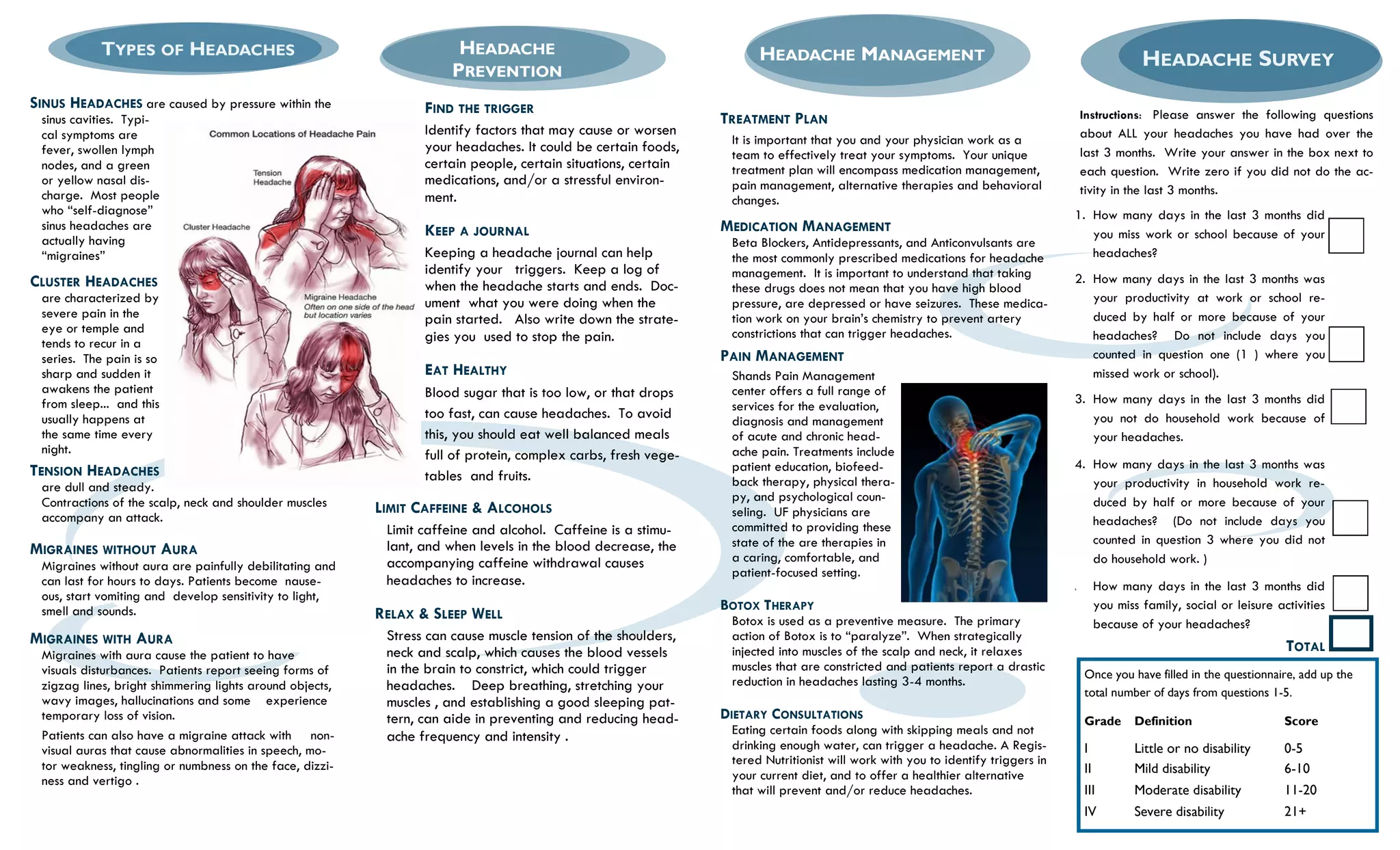
SINUS HEADACHES are caused by pressure within the
sinus cavities. Typi-
cal symptoms are
fever, swollen lymph
nodes, and a green
or yellow nasal dis-
charge. Most people
who “self-diagnose”
sinus headaches are
actually having
“migraines”
CLUSTER HEADACHES
are characterized by
severe pain in the
eye or temple and
tends to recur in a
series. The pain is so
sharp and sudden it
awakens the patient
from sleep... and this
usually happens at
the same time every
night.
TENSION HEADACHES
are dull and steady.
Contractions of the scalp, neck and shoulder muscles
accompany an attack.
MIGRAINES WITHOUT AURA
Migraines without aura are painfully debilitating and
can last for hours to days. Patients become nause-
ous, start vomiting and develop sensitivity to light,
smell and sounds.
MIGRAINES WITH AURA
Migraines with aura cause the patient to have
visuals disturbances. Patients report seeing forms of
zigzag lines, bright shimmering lights around objects,
wavy images, hallucinations and some experience
temporary loss of vision.
Patients can also have a migraine attack with non-
visual auras that cause abnormalities in speech, mo-
tor weakness, tingling or numbness on the face, dizzi-
ness and vertigo .
TYPES OF HEADACHES HEADACHE
PREVENTION
FIND THE TRIGGER
Identify factors that may cause or worsen
your headaches. It could be certain foods,
certain people, certain situations, certain
medications, and/or a stressful environ-
ment.
KEEP A JOURNAL
Keeping a headache journal can help
identify your triggers. Keep a log of
when the headache starts and ends. Doc-
ument what you were doing when the
pain started. Also write down the strate-
gies you used to stop the pain.
EAT HEALTHY
Blood sugar that is too low, or that drops
too fast, can cause headaches. To avoid
this, you should eat well balanced meals
full of protein, complex carbs, fresh vege-
tables and fruits.
LIMIT CAFFEINE & ALCOHOLS
Limit caffeine and alcohol. Caffeine is a stimu-
lant, and when levels in the blood decrease, the
accompanying caffeine withdrawal causes
headaches to increase.
RELAX & SLEEP WELL
Stress can cause muscle tension of the shoulders,
neck and scalp, which causes the blood vessels
in the brain to constrict, which could trigger
headaches. Deep breathing, stretching your
muscles , and establishing a good sleeping pat-
tern, can aide in preventing and reducing head-
ache frequency and intensity .
1. How many days in the last 3 months did
you miss work or school because of your
headaches?
2. How many days in the last 3 months was
your productivity at work or school re-
duced by half or more because of your
headaches? Do not include days you
counted in question one (1 ) where you
missed work or school).
3. How many days in the last 3 months did
you not do household work because of
your headaches.
4. How many days in the last 3 months was
your productivity in household work re-
duced by half or more because of your
headaches? (Do not include days you
counted in question 3 where you did not
do household work. )
5. How many days in the last 3 months did
you miss family, social or leisure activities
because of your headaches?
TOTAL
HEADACHE SURVEY
Instructions: Please answer the following questions
about ALL your headaches you have had over the
last 3 months. Write your answer in the box next to
each question. Write zero if you did not do the ac-
tivity in the last 3 months.
Once you have filled in the questionnaire, add up the
total number of days from questions 1-5.
Grade Definition Score
I Little or no disability 0-5
II Mild disability 6-10
III Moderate disability 11-20
IV Severe disability 21+
HEADACHE MANAGEMENT
TREATMENT PLAN
It is important that you and your physician work as a
team to effectively treat your symptoms. Your unique
treatment plan will encompass medication management,
pain management, alternative therapies and behavioral
changes.
MEDICATION MANAGEMENT
Beta Blockers, Antidepressants, and Anticonvulsants are
the most commonly prescribed medications for headache
management. It is important to understand that taking
these drugs does not mean that you have high blood
pressure, are depressed or have seizures. These medica-
tion work on your brain’s chemistry to prevent artery
constrictions that can trigger headaches.
PAIN MANAGEMENT
Shands Pain Management
center offers a full range of
services for the evaluation,
diagnosis and management
of acute and chronic head-
ache pain. Treatments include
patient education, biofeed-
back therapy, physical thera-
py, and psychological coun-
seling. UF physicians are
committed to providing these
state of the are therapies in
a caring, comfortable, and
patient-focused setting.
BOTOX THERAPY
Botox is used as a preventive measure. The primary
action of Botox is to “paralyze”. When strategically
injected into muscles of the scalp and neck, it relaxes
muscles that are constricted and patients report a drastic
reduction in headaches lasting 3-4 months.
DIETARY CONSULTATIONS
Eating certain foods along with skipping meals and not
drinking enough water, can trigger a headache. A Regis-
tered Nutritionist will work with you to identify triggers in
your current diet, and to offer a healthier alternative
that will prevent and/or reduce headaches.

HA Pamphlet Draft2

  • 1.
    SHANDS NEUROSCIENCE INSTITUTE SHANDSNEUROSCIENCE INSTITUTE 4555 Emerson Street Jacksonville, Florida 32207 To schedule and appointment call (904) 383-1022 ...the Science of Hope Headaches are the #1 reason patients go to the doctor. It is estimated that 6% of men and 18% of women in the United States suffer from headaches. Sometimes the symptoms are so bad the pa- tient is unable to perform the basic activities of daily living and/or keep a job. Physicians at the Neuroscience Institute at Shands Jacksonville specialize in providing treatments, therapies and state of the art pro- cedures that will 1) Reduce the frequency and severity of headaches, 2) Reduce disability from headaches and 3) Improve the patient’s overall quality of life! CHRONIC HEADACHES HEADACHE FACTS Migraines affect approximately 36 million Americans annually, including 25% of middle aged women and 19% of Iraqi war veterans. Cluster Headaches are as prevalent as Multiple Sclerosis and these attacks are one of the most painful conditions known. The direct and indirect economic cost of headaches in the U.S. exceeds $31 bil- lion dollars annually. Migraine sufferers are 3 times as likely to experience ma- jor depression, 6 times more likely to have a pan- ic disorder, and 5 times as likely to have a generalized anxiety and/or a bipolar disorder. THE UF HEADACHE CENTER RESOURCES American Headache Society Committee for Headache Education (ACHE) www.achenet.org National Headache Foundation www.headaches.org Migraine Awareness Group www.migraines.org
  • 2.
    SINUS HEADACHES arecaused by pressure within the sinus cavities. Typi- cal symptoms are fever, swollen lymph nodes, and a green or yellow nasal dis- charge. Most people who “self-diagnose” sinus headaches are actually having “migraines” CLUSTER HEADACHES are characterized by severe pain in the eye or temple and tends to recur in a series. The pain is so sharp and sudden it awakens the patient from sleep... and this usually happens at the same time every night. TENSION HEADACHES are dull and steady. Contractions of the scalp, neck and shoulder muscles accompany an attack. MIGRAINES WITHOUT AURA Migraines without aura are painfully debilitating and can last for hours to days. Patients become nause- ous, start vomiting and develop sensitivity to light, smell and sounds. MIGRAINES WITH AURA Migraines with aura cause the patient to have visuals disturbances. Patients report seeing forms of zigzag lines, bright shimmering lights around objects, wavy images, hallucinations and some experience temporary loss of vision. Patients can also have a migraine attack with non- visual auras that cause abnormalities in speech, mo- tor weakness, tingling or numbness on the face, dizzi- ness and vertigo . TYPES OF HEADACHES HEADACHE PREVENTION FIND THE TRIGGER Identify factors that may cause or worsen your headaches. It could be certain foods, certain people, certain situations, certain medications, and/or a stressful environ- ment. KEEP A JOURNAL Keeping a headache journal can help identify your triggers. Keep a log of when the headache starts and ends. Doc- ument what you were doing when the pain started. Also write down the strate- gies you used to stop the pain. EAT HEALTHY Blood sugar that is too low, or that drops too fast, can cause headaches. To avoid this, you should eat well balanced meals full of protein, complex carbs, fresh vege- tables and fruits. LIMIT CAFFEINE & ALCOHOLS Limit caffeine and alcohol. Caffeine is a stimu- lant, and when levels in the blood decrease, the accompanying caffeine withdrawal causes headaches to increase. RELAX & SLEEP WELL Stress can cause muscle tension of the shoulders, neck and scalp, which causes the blood vessels in the brain to constrict, which could trigger headaches. Deep breathing, stretching your muscles , and establishing a good sleeping pat- tern, can aide in preventing and reducing head- ache frequency and intensity . 1. How many days in the last 3 months did you miss work or school because of your headaches? 2. How many days in the last 3 months was your productivity at work or school re- duced by half or more because of your headaches? Do not include days you counted in question one (1 ) where you missed work or school). 3. How many days in the last 3 months did you not do household work because of your headaches. 4. How many days in the last 3 months was your productivity in household work re- duced by half or more because of your headaches? (Do not include days you counted in question 3 where you did not do household work. ) 5. How many days in the last 3 months did you miss family, social or leisure activities because of your headaches? TOTAL HEADACHE SURVEY Instructions: Please answer the following questions about ALL your headaches you have had over the last 3 months. Write your answer in the box next to each question. Write zero if you did not do the ac- tivity in the last 3 months. Once you have filled in the questionnaire, add up the total number of days from questions 1-5. Grade Definition Score I Little or no disability 0-5 II Mild disability 6-10 III Moderate disability 11-20 IV Severe disability 21+ HEADACHE MANAGEMENT TREATMENT PLAN It is important that you and your physician work as a team to effectively treat your symptoms. Your unique treatment plan will encompass medication management, pain management, alternative therapies and behavioral changes. MEDICATION MANAGEMENT Beta Blockers, Antidepressants, and Anticonvulsants are the most commonly prescribed medications for headache management. It is important to understand that taking these drugs does not mean that you have high blood pressure, are depressed or have seizures. These medica- tion work on your brain’s chemistry to prevent artery constrictions that can trigger headaches. PAIN MANAGEMENT Shands Pain Management center offers a full range of services for the evaluation, diagnosis and management of acute and chronic head- ache pain. Treatments include patient education, biofeed- back therapy, physical thera- py, and psychological coun- seling. UF physicians are committed to providing these state of the are therapies in a caring, comfortable, and patient-focused setting. BOTOX THERAPY Botox is used as a preventive measure. The primary action of Botox is to “paralyze”. When strategically injected into muscles of the scalp and neck, it relaxes muscles that are constricted and patients report a drastic reduction in headaches lasting 3-4 months. DIETARY CONSULTATIONS Eating certain foods along with skipping meals and not drinking enough water, can trigger a headache. A Regis- tered Nutritionist will work with you to identify triggers in your current diet, and to offer a healthier alternative that will prevent and/or reduce headaches.