International Journal Of Mathematics And Statistics Invention (IJMSI)
E-ISSN: 2321 – 4767 P-ISSN: 2321 - 4759
Www.Ijmsi.Org || Volume 2 Issue 10 || November. 2014 || PP-44-51
www.ijmsi.org 44 | P a g e
Spectral Properties of Unitary and Normal Bimatrices
1,
G.Ramesh , 2,
P.Maduranthaki
*Associate Professor of Mathematics, Govt. Arts College(Autonomous), Kumbakonam.
**Assistant Professor of Mathematics, Arasu Engineering College, Kumbakonam.
ABSTRACT: A spectral theory for unitary and normal bimatrices is developed. Some basic results are
derived.
KEYWORDS: eigen bivalues, eigen bivectors, unitary bimatrix, normal bimatrix, unitary similarity
AMS Classification: 15A09, 15A15, 15A57.
I. INTRODUCTION
Let n n
C 
be the space of n n complex matrices of order n . Let n
C be the space of all complex
n-tuples. A matrix 1 2B
A A A  is called a bimatrix if 1
A and 2
A are matrices of same or different orders
[4]. we consider here only matrices of same order. For B n n
A C 
 , let
1
,
,
T
B B B
A A A
 
and ( )B
A denote the
transpose, inverse, conjugate transpose and spectrum of B
A . A bimatrix B
A is called normal if B B B B
A A A A
 

and unitary if B B B B B
A A A A I
 
  [5]. Let B
A be an n n bimatrix. An eigen bivector of B
A is a non-zero
bivector B n
x C such that B B B B
A x x . The scalar B
 is called an eigen bivalue of B
A [5]. The
characteristic polynomial of B
A is the polynomial BA
f defined by ( ) d et( )
BA B B B
f x x I A  . The set
( )B
A of all eigenvalues of B
A is called spectrum of B
A . In this section we have given a characterization of
eigen bivalues of normal bimatrices analogous to that of the results found in [3].
Theorem: 1.1
A normal bimatrix is unitary if and only if its eigen bivalues all have absolute value of 1.
Proof
Let
i B Bi i
B B
A x x , where Bi
 =1 and( , ) (1 , ).
i j ijB B B
x x i j n   For any bivector B n
x C ,
write
1
i i
n
B B B
i
x x

  then it is found that
1
i i
n
B B B B B B B
i
A A x A A x
 

 
  
 

1
i i
n
B B B B
i
A A x


 
  
 

1 2 1 2
1
( )( )
i i i
n
B B
i
A A A x x


 
   
 

1 1 2 2
1
( )
i i i
n
B B
i
A A x A x


 
  
 

1 1 2 2
1
( )
i i i i i
n
B B
i
A x x  


 
  
 

Spectral Properties Of Unitary…
www.ijmsi.org 45 | P a g e
1 2 1 2
1
( )( )
i i i i i
n
B B
i
A x x  


 
   
 

B B B
A A x

1
i i i
n
B B B B
i
A x 


 
  
 
 (1)
We know that ( 1, 2, 3, .., )i
i i
BB B B
A x x i n

  so (1) becomes
B B B
A A x

1
( )
i i i
n
B B B B
i
A x 


 
1
( )
i i i i
n
B B B B
i
x  

 
2
1
i i i
n
B B B
i
x 

 
1
(1)
i i
n
B B
i
x

 
1
i i
n
B B B
i
x x

 
Thus B B B
A A x

= B
x for every B n
x C and therefore, B B B
A A I

 . The relation B B B
A A I

 now
follows since a left inverse is also a right inverse. Hence the bimatrix B
A is unitary.
Conversely, if B B B B
A x x and , 1B B
x x   .
1 2 1 2 1 2 1 2
, ( )( ), ( )( )B B B B
A x A x A A x x A A x x        
1 1 2 2 1 1 2 2
,A x A x A x A x    
1 1 1 1 1 2 2 2 2 2
, ,A x A x A x A x     
1 1 1 1 1 2 2 2 2 2
, ,x A A x x A A x
 
     
1 1 1 1 2 2 2 2
, ,x I x x I x     
1 1 1 2 2 2
, ,x x x x     
1 2 1 2
,x x x x    
,B B
x x  
, 1B B B B
A x A x   (2)
On the other hand , , ,B B B B B B B B
A x A x x x     
1 2 1 2 1 2 1 2
( )( ), ( )( )x x x x         
1 1 2 2 1 1 2 2
1 1 1 1 1 2 2 2 2 2
( ,
, ,
x x x x
x x x x
   
   
    
     
1 1 1 1 1 2 2 2 2 2
, ,x x x x        
2 2
1 1 2 2
I I  
  
2 2
1 2 1 2
I I   
   
2
1 2 1 2
I I   
2
B B
I
Spectral Properties Of Unitary…
www.ijmsi.org 46 | P a g e
2
,B B B B B
A x A x    (3)
Form (2) and (3) ,we get
2
1B
  . Thus 1B
  .
II. UNITARY SIMILARITY
In this section we have generalized some important results of unitary and normal matrices found in [2] to
unitary and normal bimatrices. Also we have given a generalization of a result found in [1]. Here we define
unitary similarity of bimatrices and have proved some theorems on unitary similarity.
Definition: 2.1
Two bimatrices B
A and B
B in n n
C 
are said to be unitarily similar if there exists a unitary
bimatrix B n n
C C 
 such that
1
B B B B B B B
B C A C C A C
 
  .
That is,
1 1
1 2 1 1 1 2 2 2 1 1 1 2 2 2
B B C A C C A C C A C C A C
   
     .
Lemma: 2.2
Unitary similarity on bimatrices is an equivalence relation.
Proof
Let B
A and B
B be any two unitary bimatrices. Bimatrix B
B is unitarily similar to B
A , if there exists a
unitary bimatrix B
C such that
1
B B B B
B C A C

 . To show that this is an equivalence relation , we have to prove
that it is reflexive, symmetric and transitive.
(i) Reflexive
Let B
I be the unit bimatrix, we have
1
B B B B
A I A I


.
Thus as B
I is invertible, B
A is unitarily
similar to itself, showing that the relation of unitary similarity is reflexive.
(ii) Symmetric
If B
A is unitarily similar to B
B then to show that B
B is unitarily similar to B
A . We have
1
B B B B
A C B C


1 1
1 2 1 1 1 2 2 2
A A C B C C B C
 
  
   1 1 1 1
1 2 1 1 1 2 2 2B B B B
C A A C C C B C C B C C
   
  
         
1 11 1
1 2 1 2 1 2 1 2 1 1 1 2 2 2 1 2
C C A A C C C C C B C C B C C C
  
      
         1 1 1 1 1 1
1 2 1 2 1 2 1 2 1 1 1 2 2 2 1 2
C C A A C C C C C B C C B C C C
     
      
1 1 1 1 1 1
1 1 1 2 2 2 1 1 1 1 1 2 2 2 2 2
C A C C A C C C B C C C C B C C
     
  
1 1 1 2 2 2
I B I I B I 
1 2
B B 
    
1
1 2 1 2 1 2 1 2
C C A A C C B B

    
1
B B B B
C A C B


Therefore, B
B is unitarily similar to B
A that is, the relation unitary similarity is symmetric.
(iii) Transitive
Let B
A be unitarily similar to B
B and B
B be unitarily similar to B
C that is, for unitary bimatrices B
P
and B
Q , we have
1
B B B B
A P B P

 (4)
and
1
B B B B
B Q C Q

 (5)
From (4), we have
1
B B B B
A P B P


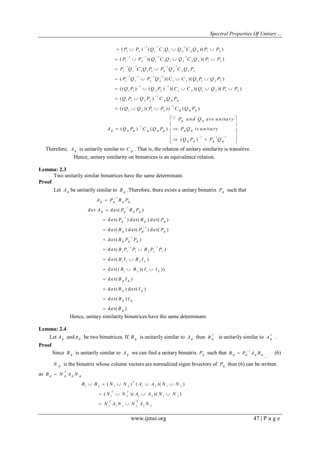
1 1
( )B B B B B
P Q C Q P
 

(by 5)
Spectral Properties Of Unitary…
www.ijmsi.org 47 | P a g e
1 1 1
1 2 1 1 1 2 2 2 1 2
( ) ( )( )P P Q C Q Q C Q P P
  
   
1 1 1 1
1 2 1 1 1 2 2 2 1 2
( )( )( )P P Q C Q Q C Q P P
   
   
1 1 1 1
1 1 1 1 1 2 2 2 2 2
P Q C Q P P Q C Q P
   
 
1 1 1 1
1 1 2 2 1 2 1 1 2 2
( )( )( )P Q P Q C C Q P Q P
   
   
1 1
1 1 2 2 1 2 1 2 1 2
(( ) ( ) )( )( )( )Q P Q P C C Q Q P P
 
    
1
1 1 2 2
( ) B B B
Q P Q P C Q P

 
1
1 2 1 2
(( )( )) ( )B B B
Q Q P P C Q P

  
1
( ) ( )B B B B B B
A Q P C Q P


1 1 1
( )
B B
B B
B B B B
P a n d Q a re u n ita ry
P Q is u n ita ry
Q P P Q
  
 
 
 
   
Therefore, B
A is unitarily similar to B
C . That is, the relation of unitary similarity is transitive.
Hence, unitary similarity on bimatrices is an equivalence relation.
Lemma: 2.3
Two unitarily similar bimatrices have the same determinant.
Proof
Let B
A be unitarily similar to B
B .Therefore, there exists a unitary bimatrix B
P such that
1
B B B B
A P B P


1
d et d et( )B B B B
A P B P


1
d et( ) d et( ) d et( )B B B
P B P


1
d et( ) d et( ) d et( )B B B
B P P


1
d et( )B B B
B P P


1 1
1 1 1 2 2 2
d et( )B P P B P P
 
 
1 1 2 2
d et( )B I B I 
1 2 1 2
d et(( )( ))B B I I  
d et( )B B
B I
d et( ) d et( )B B
B I
d et( )B B
B I
det( )B
B
Hence, unitary similarity bimatrices have the same determinant.
Lemma: 2.4
Let B
A and BB be two bimatrices. If B
B is unitarily similar to B
A then
T
B
B is unitarily similar to
T
B
A .
Proof
Since B
B is unitarily similar to B
A we can find a unitary bimatrix B
P such that
1
B B B B
B P A B


.
(6)
B
N is the bimatrix whose column vectors are normalized eigen bivectors of B
P then (6) can be written
as
T
B B B B
B N A N
1 2 1 2 1 2 1 2
( ) ( )( )
T
B B N N A A N N    
1 2 1 2 1 2
( )( )( )
T T
N N A A N N   
1 1 1 2 2 2
T T
N A N N A N 
Spectral Properties Of Unitary…
www.ijmsi.org 48 | P a g e
1 2 1 1 1 2 2 2
( ) ( )
T T T T
B B N A N N A N  
1 1 1 2 2 2
( ) ( )
T T T T T
B
B N A N N A N 
1 1 1 2 2 2
( ) ( )
T T T T T
B
B N A N N A N 
1 2 1 2 1 2
( )( )( )
T T T T T
B
B N N A A N N   
1 2 1 2 1 2
( ) ( ) ( )
T T T
B
B N N A A N N   
T T T
B B B B
B N A N
Therefore, T
B
B is unitarily similar to T
B
A .
Lemma: 2.5
Let B
A and B
B be unitarily similar. Then B
A is normal iff B
B is normal.
Proof
Let B
P be unitary bimatrix with
1
B B B B
B P A P

 .Then
1
( )B B B B
B P A P
  
 B B B
P A P
 
 and
1
B B
P P
 

So ( )( ) ( )( )B B B B B B B B B B B B B B B B
B B B B P A P P A P P A P P A P
       
  
1 2 1 2 1 2 1 2 1 2 1 2 1 2 1 2 1 2 1 2 1 2 1 2
( ) ( ) ( )( ) ( )( ) ( ) ( )( )( ) ( ) ( )P P A A P P P P A A P P P P A A P P P P A A P P
     
             
1 2 1 2 1 2 1 2 1 2 1 2 1 2 1 2 1 2 1 2 1 2 1 2
( )( )( )( )( )( ) ( )( )( )( )( )( )P P A A P P P P A A P P P P A A P P P P A A P P
           
             
1 1 1 1 1 1 2 2 2 2 2 2 1 1 1 1 1 1 2 2 2 2 2 2
(( ) ( )) (( ) ( ))P A P P A P P A P P A P P A P P A P P A P P A P
           
   
1 1 1 1 1 2 2 2 2 2 1 1 1 1 1 2 2 2 2 2
( ) ( )P A I A P P A I A P P A I A P P A I A P
       
   
1 1 1 1 2 2 2 2 1 1 1 1 2 2 2 2
( ) ( )P A A P P A A P P A A P P A A P
       
   
1 2 1 2 1 2 1 2 1 2 1 2 1 2 1 2
( )( )( )( ) ( )( )( )( )P P A A A A P P P P A A A A P P
       
         
1 2 1 2 1 2 1 2 1 2 1 2 1 2 1 2
( ) ( ) ( )( ) ( ) ( )( ) ( )P P A A A A P P P P A A A A P P
   
         
B B B B B B B B
P A A P P A A P
   
 
( )B B B B B B
P A A A A P
  
 
Thus 0B B B B
B B B B
 
  iff 0B B B B
A A A A
 
 
B B B B
B B B B
 
 iff B B B B
A A A A
 

Hence, B
A is normal iff B
B is normal.
III. SPECTRAL THEORY FOR NORMAL BIMATRICES
In this section the spectral theorem for normal bimatrices basically states that a bimatrix B
A is normal
if and only if it is unitarily diagonolizable that is, there exists a unitary bimatrix B
C and a diagonal bimatrix
B
D such that B B B B
C A C D

 analogous to that of the results found in [6]. It is important to note that the
latter is equivalent to saying that there exists an orthonormal basis (the columns of B
C ) of eigen bivectors of
B
A (the corresponding eigen bivalues being the diagonal elements of B
D ).
Theorem: 3.1
Let B n n
A C 
 . Then B
A is unitarily similar to an upper triangular bimatrix.
Proof
The proof is by induction on n. Since every 1 1 bimatrix is upper triangular, then n=1 case is trivial.
Assume 1n  . Let B
 be an eigen bivalue of B
A afforded by the eigen bivector 1B n
x C 
 .
Since 0B
x  . Therefore, we may assume 1 .B
x 
Spectral Properties Of Unitary…
www.ijmsi.org 49 | P a g e
By theorem 2.9 of [6],  B
x can be extended to an orthonormal basis  2
, , ...,
nB B B
x y y of 1n
C 
.
Let
B
C be the bimatrix whose first column is B
x and whose
th
j column is
jB
y , 1 .j n  Then B B B
C C I

 ,
the n n identity bimatrix. Moreover, the first column of B B B
C A C

is 1B B B B B B B B
C A x C x C 
 
  ,
where 1B
C is the first column of B
I , that is
1
# # #
0
0
0
B
BB B B
AC A C


 
 
 
 
 
 
 
 
Where 1B
A is an (( 1) ( 1)n n   ) bimatrix and #’s stands for unspecified entries. It follows from the
induction hypothesis that there is an (n-1) square unitary bimatrix 1B
C such that 1 1 1B B B
C A C

is upper triangular.
Let 1
(1)B B
D C  that is,
1
1 0 0 0
0
0
0
BB
CD
 
 
 
 
 
 
 
 
.
Then 1 1 1
# # #
0
0( ) ( )
0
B B BB B B B B
C A CC D A C D


 
 
 
 
 
 
 
 
is upper triangular. Since it is a product of
unitary bimatrices. Hence B B
C D is unitary.
Theorem: 3.2
Let B n n
A C 
 . Then B
A is unitarily similar to a diagonal bimatrix if and only if B B B B
A A A A
 
 .
Proof
Let B
C be a unitary bimatrix such that B B B B
C A C D

 is diagonal. Then
( ) ( )B B B B B B B B
A A C D C C D C
   

( )( )B B B B B B
C D C C D C
  

           1 2 1 2 1 2 1 2 1 2 1 2
C C D D C C C C D D C C
  
         
   
          1 2 1 2 1 2 1 2 1 2 1 2
C C D D C C C C D D C C
     
         
   
  1 1 1 2 2 2 1 1 1 2 2 2
C D C C D C C D C C D C
     
  
   1 1 1 1 1 1 2 2 2 2 2 2
C D C C D C C D C C D C
     
 
   1 1 1 1 1 2 2 2 2 2
C D I D C C D I D C
   
 
   1 1 1 1 2 2 2 2
C D D C C D D C
   
 
Spectral Properties Of Unitary…
www.ijmsi.org 50 | P a g e
   1 1 1 1 1 1 2 2 2 2 2 2
C D C C D C C D C C D C
     
 
         1 2 1 2 1 2 1 2 1 2 1 2
C C D D C C C C D D C C
     
      
           1 2 1 2 1 2 1 2 1 2 1 2
C C D D C C C C D D C C
  
      
  B B B B B B
C D C C D C
  

  B B B B B B
C D C C D C

 

B B
A A


Therefore, B B B B
A A A A
 
 .
Hence, B
A is a normal bimatrix.
Conversely, by theorem (3.1) there is a unitary bimatrix B
C such that B B B
C A C

and B B B
C A C
 
are
both upper triangular. Since B B B
C A C
 
is upper triangular, its conjugate transpose, B B B
C A C

must be lower
triangular.
Therefore, B B B
C A C

is both upper and lower triangular. That is, B B B
C A C

is a diagonal bimatrix.
The following result provides an easy -to-check necessary and sufficient condition for normality.
Theorem: 3.3
Given B n
A C , the following statements are equivalent
(i) B
A is normal bimatrix
(ii) B
A is unitarily diagonalizable
(iii)
2 2
1 2 1 2
, ,
1 , 1
i j i j i i
i j n i n
a a  
   
    ,
1 2 1 2
1 1
, ..., n n
     are the eigen bivalues of B
A ,
counting multiplicities.
Proof
( ) ( )i ii : By theorem (3.1), B
A is unitarily similar to a triangular bimatrix B
T . Then
B
A is normal bimatrix iff B
T is normal bimatrix
iff B
T is diagonal bimatrix
iff B
A is unitarily diagonalizable.
( ) ( )ii iii
suppose that B
A is unitarily similar to a diagonal bimatrix B
D . Note that the diagonal entries of
B
D are the eigen bivalues
1 2 1 2
1 1
, ..., n n
     of B
A .Then
2
1 2
, ,
1 ,
( )i j i j B B
i j n
a a tr A A

 
 
( )B B
tr D D


Spectral Properties Of Unitary…
www.ijmsi.org 51 | P a g e
2
1 2
1
i i
i n
 
 
  (7)
( ) ( )iii ii
By theorem (3.1), B
A is unitarily similar to a triangular bimatrix B
T .
2
1 2
, ,
1 ,
( )i j i j B B
i j n
a a tr A A

 
 
( )B B
tr D D


=
2
1 2
, ,
1 ,
i j i j
i j n
t t
 
 (8)
On the other hand , we have
2 2
1 2 1 2
, ,
1 1
i i i i i i
i n i n
t t 
   
    (9)
because the diagonal entries of B
T are the eigen bivalues
1 2 1 2
1 1
, ..., n n
     of B
A .
Thus, the equality between (8) and (9) imply that
1 2
, ,
0i j i j B
t t  whenever ,i j that is, B
T
is a diagonal bimatrix.
Hence, B
A is unitarily diagonalizable.
IV CONCLUSION
A spectral theory for unitary and normal bimatrices is studied. This can be used to study two system
simultaneously.
REFERENCES
[1] Ben Israel.A and Greville T.N.E: “Generalised Inverses: Theory and Applications”, Wiley-Interscience, New York, (1974).
[2] Horn.R.A, Johnson.C.R, Matrix Analysis, Cambridge University Press, New York, 2013.
[3] Peter Lancaster, Miron Tismenetsky, The Theory of Matrices: with Applications, Academic Press, 1985.
[4] Ramesh.G, Maduranthaki.P, On Unitary Bimatrices, International Journal of Current Research, Vol.6, Issue 09, September 2014
(PP 8395-8407).
[5] Ramesh.G, Maduranthaki.P, On some properties of Unitary and Normal Bimatrices, International Journal of Recent Scientific Research,
Vol.5, Issue 10, October 2014 (PP 1936-1940).
[6] Russell Merris, Multilinear algebra, Gordon and Breach Science Puplishers, CRC Press, 1997.

Spectral Properties of Unitary and Normal Bimatrices

  • 1.
    International Journal OfMathematics And Statistics Invention (IJMSI) E-ISSN: 2321 – 4767 P-ISSN: 2321 - 4759 Www.Ijmsi.Org || Volume 2 Issue 10 || November. 2014 || PP-44-51 www.ijmsi.org 44 | P a g e Spectral Properties of Unitary and Normal Bimatrices 1, G.Ramesh , 2, P.Maduranthaki *Associate Professor of Mathematics, Govt. Arts College(Autonomous), Kumbakonam. **Assistant Professor of Mathematics, Arasu Engineering College, Kumbakonam. ABSTRACT: A spectral theory for unitary and normal bimatrices is developed. Some basic results are derived. KEYWORDS: eigen bivalues, eigen bivectors, unitary bimatrix, normal bimatrix, unitary similarity AMS Classification: 15A09, 15A15, 15A57. I. INTRODUCTION Let n n C  be the space of n n complex matrices of order n . Let n C be the space of all complex n-tuples. A matrix 1 2B A A A  is called a bimatrix if 1 A and 2 A are matrices of same or different orders [4]. we consider here only matrices of same order. For B n n A C   , let 1 , , T B B B A A A   and ( )B A denote the transpose, inverse, conjugate transpose and spectrum of B A . A bimatrix B A is called normal if B B B B A A A A    and unitary if B B B B B A A A A I     [5]. Let B A be an n n bimatrix. An eigen bivector of B A is a non-zero bivector B n x C such that B B B B A x x . The scalar B  is called an eigen bivalue of B A [5]. The characteristic polynomial of B A is the polynomial BA f defined by ( ) d et( ) BA B B B f x x I A  . The set ( )B A of all eigenvalues of B A is called spectrum of B A . In this section we have given a characterization of eigen bivalues of normal bimatrices analogous to that of the results found in [3]. Theorem: 1.1 A normal bimatrix is unitary if and only if its eigen bivalues all have absolute value of 1. Proof Let i B Bi i B B A x x , where Bi  =1 and( , ) (1 , ). i j ijB B B x x i j n   For any bivector B n x C , write 1 i i n B B B i x x    then it is found that 1 i i n B B B B B B B i A A x A A x            1 i i n B B B B i A A x           1 2 1 2 1 ( )( ) i i i n B B i A A A x x            1 1 2 2 1 ( ) i i i n B B i A A x A x           1 1 2 2 1 ( ) i i i i i n B B i A x x            
  • 2.
    Spectral Properties OfUnitary… www.ijmsi.org 45 | P a g e 1 2 1 2 1 ( )( ) i i i i i n B B i A x x              B B B A A x  1 i i i n B B B B i A x            (1) We know that ( 1, 2, 3, .., )i i i BB B B A x x i n    so (1) becomes B B B A A x  1 ( ) i i i n B B B B i A x      1 ( ) i i i i n B B B B i x      2 1 i i i n B B B i x     1 (1) i i n B B i x    1 i i n B B B i x x    Thus B B B A A x  = B x for every B n x C and therefore, B B B A A I   . The relation B B B A A I   now follows since a left inverse is also a right inverse. Hence the bimatrix B A is unitary. Conversely, if B B B B A x x and , 1B B x x   . 1 2 1 2 1 2 1 2 , ( )( ), ( )( )B B B B A x A x A A x x A A x x         1 1 2 2 1 1 2 2 ,A x A x A x A x     1 1 1 1 1 2 2 2 2 2 , ,A x A x A x A x      1 1 1 1 1 2 2 2 2 2 , ,x A A x x A A x         1 1 1 1 2 2 2 2 , ,x I x x I x      1 1 1 2 2 2 , ,x x x x      1 2 1 2 ,x x x x     ,B B x x   , 1B B B B A x A x   (2) On the other hand , , ,B B B B B B B B A x A x x x      1 2 1 2 1 2 1 2 ( )( ), ( )( )x x x x          1 1 2 2 1 1 2 2 1 1 1 1 1 2 2 2 2 2 ( , , , x x x x x x x x                    1 1 1 1 1 2 2 2 2 2 , ,x x x x         2 2 1 1 2 2 I I      2 2 1 2 1 2 I I        2 1 2 1 2 I I    2 B B I
  • 3.
    Spectral Properties OfUnitary… www.ijmsi.org 46 | P a g e 2 ,B B B B B A x A x    (3) Form (2) and (3) ,we get 2 1B   . Thus 1B   . II. UNITARY SIMILARITY In this section we have generalized some important results of unitary and normal matrices found in [2] to unitary and normal bimatrices. Also we have given a generalization of a result found in [1]. Here we define unitary similarity of bimatrices and have proved some theorems on unitary similarity. Definition: 2.1 Two bimatrices B A and B B in n n C  are said to be unitarily similar if there exists a unitary bimatrix B n n C C   such that 1 B B B B B B B B C A C C A C     . That is, 1 1 1 2 1 1 1 2 2 2 1 1 1 2 2 2 B B C A C C A C C A C C A C          . Lemma: 2.2 Unitary similarity on bimatrices is an equivalence relation. Proof Let B A and B B be any two unitary bimatrices. Bimatrix B B is unitarily similar to B A , if there exists a unitary bimatrix B C such that 1 B B B B B C A C   . To show that this is an equivalence relation , we have to prove that it is reflexive, symmetric and transitive. (i) Reflexive Let B I be the unit bimatrix, we have 1 B B B B A I A I   . Thus as B I is invertible, B A is unitarily similar to itself, showing that the relation of unitary similarity is reflexive. (ii) Symmetric If B A is unitarily similar to B B then to show that B B is unitarily similar to B A . We have 1 B B B B A C B C   1 1 1 2 1 1 1 2 2 2 A A C B C C B C         1 1 1 1 1 2 1 1 1 2 2 2B B B B C A A C C C B C C B C C                  1 11 1 1 2 1 2 1 2 1 2 1 1 1 2 2 2 1 2 C C A A C C C C C B C C B C C C                    1 1 1 1 1 1 1 2 1 2 1 2 1 2 1 1 1 2 2 2 1 2 C C A A C C C C C B C C B C C C              1 1 1 1 1 1 1 1 1 2 2 2 1 1 1 1 1 2 2 2 2 2 C A C C A C C C B C C C C B C C          1 1 1 2 2 2 I B I I B I  1 2 B B       1 1 2 1 2 1 2 1 2 C C A A C C B B       1 B B B B C A C B   Therefore, B B is unitarily similar to B A that is, the relation unitary similarity is symmetric. (iii) Transitive Let B A be unitarily similar to B B and B B be unitarily similar to B C that is, for unitary bimatrices B P and B Q , we have 1 B B B B A P B P   (4) and 1 B B B B B Q C Q   (5) From (4), we have 1 B B B B A P B P   1 1 ( )B B B B B P Q C Q P    (by 5)
  • 4.
    Spectral Properties OfUnitary… www.ijmsi.org 47 | P a g e 1 1 1 1 2 1 1 1 2 2 2 1 2 ( ) ( )( )P P Q C Q Q C Q P P        1 1 1 1 1 2 1 1 1 2 2 2 1 2 ( )( )( )P P Q C Q Q C Q P P         1 1 1 1 1 1 1 1 1 2 2 2 2 2 P Q C Q P P Q C Q P       1 1 1 1 1 1 2 2 1 2 1 1 2 2 ( )( )( )P Q P Q C C Q P Q P         1 1 1 1 2 2 1 2 1 2 1 2 (( ) ( ) )( )( )( )Q P Q P C C Q Q P P        1 1 1 2 2 ( ) B B B Q P Q P C Q P    1 1 2 1 2 (( )( )) ( )B B B Q Q P P C Q P     1 ( ) ( )B B B B B B A Q P C Q P   1 1 1 ( ) B B B B B B B B P a n d Q a re u n ita ry P Q is u n ita ry Q P P Q              Therefore, B A is unitarily similar to B C . That is, the relation of unitary similarity is transitive. Hence, unitary similarity on bimatrices is an equivalence relation. Lemma: 2.3 Two unitarily similar bimatrices have the same determinant. Proof Let B A be unitarily similar to B B .Therefore, there exists a unitary bimatrix B P such that 1 B B B B A P B P   1 d et d et( )B B B B A P B P   1 d et( ) d et( ) d et( )B B B P B P   1 d et( ) d et( ) d et( )B B B B P P   1 d et( )B B B B P P   1 1 1 1 1 2 2 2 d et( )B P P B P P     1 1 2 2 d et( )B I B I  1 2 1 2 d et(( )( ))B B I I   d et( )B B B I d et( ) d et( )B B B I d et( )B B B I det( )B B Hence, unitary similarity bimatrices have the same determinant. Lemma: 2.4 Let B A and BB be two bimatrices. If B B is unitarily similar to B A then T B B is unitarily similar to T B A . Proof Since B B is unitarily similar to B A we can find a unitary bimatrix B P such that 1 B B B B B P A B   . (6) B N is the bimatrix whose column vectors are normalized eigen bivectors of B P then (6) can be written as T B B B B B N A N 1 2 1 2 1 2 1 2 ( ) ( )( ) T B B N N A A N N     1 2 1 2 1 2 ( )( )( ) T T N N A A N N    1 1 1 2 2 2 T T N A N N A N 
  • 5.
    Spectral Properties OfUnitary… www.ijmsi.org 48 | P a g e 1 2 1 1 1 2 2 2 ( ) ( ) T T T T B B N A N N A N   1 1 1 2 2 2 ( ) ( ) T T T T T B B N A N N A N  1 1 1 2 2 2 ( ) ( ) T T T T T B B N A N N A N  1 2 1 2 1 2 ( )( )( ) T T T T T B B N N A A N N    1 2 1 2 1 2 ( ) ( ) ( ) T T T B B N N A A N N    T T T B B B B B N A N Therefore, T B B is unitarily similar to T B A . Lemma: 2.5 Let B A and B B be unitarily similar. Then B A is normal iff B B is normal. Proof Let B P be unitary bimatrix with 1 B B B B B P A P   .Then 1 ( )B B B B B P A P     B B B P A P    and 1 B B P P    So ( )( ) ( )( )B B B B B B B B B B B B B B B B B B B B P A P P A P P A P P A P            1 2 1 2 1 2 1 2 1 2 1 2 1 2 1 2 1 2 1 2 1 2 1 2 ( ) ( ) ( )( ) ( )( ) ( ) ( )( )( ) ( ) ( )P P A A P P P P A A P P P P A A P P P P A A P P                     1 2 1 2 1 2 1 2 1 2 1 2 1 2 1 2 1 2 1 2 1 2 1 2 ( )( )( )( )( )( ) ( )( )( )( )( )( )P P A A P P P P A A P P P P A A P P P P A A P P                           1 1 1 1 1 1 2 2 2 2 2 2 1 1 1 1 1 1 2 2 2 2 2 2 (( ) ( )) (( ) ( ))P A P P A P P A P P A P P A P P A P P A P P A P                 1 1 1 1 1 2 2 2 2 2 1 1 1 1 1 2 2 2 2 2 ( ) ( )P A I A P P A I A P P A I A P P A I A P             1 1 1 1 2 2 2 2 1 1 1 1 2 2 2 2 ( ) ( )P A A P P A A P P A A P P A A P             1 2 1 2 1 2 1 2 1 2 1 2 1 2 1 2 ( )( )( )( ) ( )( )( )( )P P A A A A P P P P A A A A P P                   1 2 1 2 1 2 1 2 1 2 1 2 1 2 1 2 ( ) ( ) ( )( ) ( ) ( )( ) ( )P P A A A A P P P P A A A A P P               B B B B B B B B P A A P P A A P       ( )B B B B B B P A A A A P      Thus 0B B B B B B B B     iff 0B B B B A A A A     B B B B B B B B    iff B B B B A A A A    Hence, B A is normal iff B B is normal. III. SPECTRAL THEORY FOR NORMAL BIMATRICES In this section the spectral theorem for normal bimatrices basically states that a bimatrix B A is normal if and only if it is unitarily diagonolizable that is, there exists a unitary bimatrix B C and a diagonal bimatrix B D such that B B B B C A C D   analogous to that of the results found in [6]. It is important to note that the latter is equivalent to saying that there exists an orthonormal basis (the columns of B C ) of eigen bivectors of B A (the corresponding eigen bivalues being the diagonal elements of B D ). Theorem: 3.1 Let B n n A C   . Then B A is unitarily similar to an upper triangular bimatrix. Proof The proof is by induction on n. Since every 1 1 bimatrix is upper triangular, then n=1 case is trivial. Assume 1n  . Let B  be an eigen bivalue of B A afforded by the eigen bivector 1B n x C   . Since 0B x  . Therefore, we may assume 1 .B x 
  • 6.
    Spectral Properties OfUnitary… www.ijmsi.org 49 | P a g e By theorem 2.9 of [6],  B x can be extended to an orthonormal basis  2 , , ..., nB B B x y y of 1n C  . Let B C be the bimatrix whose first column is B x and whose th j column is jB y , 1 .j n  Then B B B C C I   , the n n identity bimatrix. Moreover, the first column of B B B C A C  is 1B B B B B B B B C A x C x C      , where 1B C is the first column of B I , that is 1 # # # 0 0 0 B BB B B AC A C                   Where 1B A is an (( 1) ( 1)n n   ) bimatrix and #’s stands for unspecified entries. It follows from the induction hypothesis that there is an (n-1) square unitary bimatrix 1B C such that 1 1 1B B B C A C  is upper triangular. Let 1 (1)B B D C  that is, 1 1 0 0 0 0 0 0 BB CD                 . Then 1 1 1 # # # 0 0( ) ( ) 0 B B BB B B B B C A CC D A C D                   is upper triangular. Since it is a product of unitary bimatrices. Hence B B C D is unitary. Theorem: 3.2 Let B n n A C   . Then B A is unitarily similar to a diagonal bimatrix if and only if B B B B A A A A    . Proof Let B C be a unitary bimatrix such that B B B B C A C D   is diagonal. Then ( ) ( )B B B B B B B B A A C D C C D C      ( )( )B B B B B B C D C C D C                1 2 1 2 1 2 1 2 1 2 1 2 C C D D C C C C D D C C                            1 2 1 2 1 2 1 2 1 2 1 2 C C D D C C C C D D C C                       1 1 1 2 2 2 1 1 1 2 2 2 C D C C D C C D C C D C             1 1 1 1 1 1 2 2 2 2 2 2 C D C C D C C D C C D C            1 1 1 1 1 2 2 2 2 2 C D I D C C D I D C          1 1 1 1 2 2 2 2 C D D C C D D C      
  • 7.
    Spectral Properties OfUnitary… www.ijmsi.org 50 | P a g e    1 1 1 1 1 1 2 2 2 2 2 2 C D C C D C C D C C D C                  1 2 1 2 1 2 1 2 1 2 1 2 C C D D C C C C D D C C                         1 2 1 2 1 2 1 2 1 2 1 2 C C D D C C C C D D C C             B B B B B B C D C C D C       B B B B B B C D C C D C     B B A A   Therefore, B B B B A A A A    . Hence, B A is a normal bimatrix. Conversely, by theorem (3.1) there is a unitary bimatrix B C such that B B B C A C  and B B B C A C   are both upper triangular. Since B B B C A C   is upper triangular, its conjugate transpose, B B B C A C  must be lower triangular. Therefore, B B B C A C  is both upper and lower triangular. That is, B B B C A C  is a diagonal bimatrix. The following result provides an easy -to-check necessary and sufficient condition for normality. Theorem: 3.3 Given B n A C , the following statements are equivalent (i) B A is normal bimatrix (ii) B A is unitarily diagonalizable (iii) 2 2 1 2 1 2 , , 1 , 1 i j i j i i i j n i n a a           , 1 2 1 2 1 1 , ..., n n      are the eigen bivalues of B A , counting multiplicities. Proof ( ) ( )i ii : By theorem (3.1), B A is unitarily similar to a triangular bimatrix B T . Then B A is normal bimatrix iff B T is normal bimatrix iff B T is diagonal bimatrix iff B A is unitarily diagonalizable. ( ) ( )ii iii suppose that B A is unitarily similar to a diagonal bimatrix B D . Note that the diagonal entries of B D are the eigen bivalues 1 2 1 2 1 1 , ..., n n      of B A .Then 2 1 2 , , 1 , ( )i j i j B B i j n a a tr A A      ( )B B tr D D  
  • 8.
    Spectral Properties OfUnitary… www.ijmsi.org 51 | P a g e 2 1 2 1 i i i n       (7) ( ) ( )iii ii By theorem (3.1), B A is unitarily similar to a triangular bimatrix B T . 2 1 2 , , 1 , ( )i j i j B B i j n a a tr A A      ( )B B tr D D   = 2 1 2 , , 1 , i j i j i j n t t    (8) On the other hand , we have 2 2 1 2 1 2 , , 1 1 i i i i i i i n i n t t          (9) because the diagonal entries of B T are the eigen bivalues 1 2 1 2 1 1 , ..., n n      of B A . Thus, the equality between (8) and (9) imply that 1 2 , , 0i j i j B t t  whenever ,i j that is, B T is a diagonal bimatrix. Hence, B A is unitarily diagonalizable. IV CONCLUSION A spectral theory for unitary and normal bimatrices is studied. This can be used to study two system simultaneously. REFERENCES [1] Ben Israel.A and Greville T.N.E: “Generalised Inverses: Theory and Applications”, Wiley-Interscience, New York, (1974). [2] Horn.R.A, Johnson.C.R, Matrix Analysis, Cambridge University Press, New York, 2013. [3] Peter Lancaster, Miron Tismenetsky, The Theory of Matrices: with Applications, Academic Press, 1985. [4] Ramesh.G, Maduranthaki.P, On Unitary Bimatrices, International Journal of Current Research, Vol.6, Issue 09, September 2014 (PP 8395-8407). [5] Ramesh.G, Maduranthaki.P, On some properties of Unitary and Normal Bimatrices, International Journal of Recent Scientific Research, Vol.5, Issue 10, October 2014 (PP 1936-1940). [6] Russell Merris, Multilinear algebra, Gordon and Breach Science Puplishers, CRC Press, 1997.