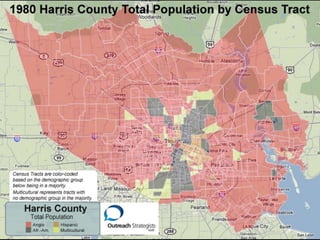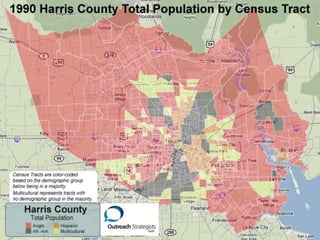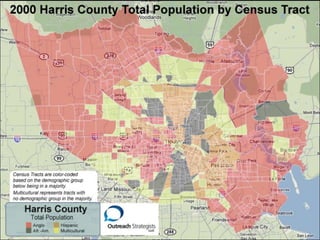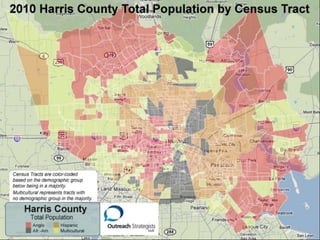
FUTURE DEVELOPMENT:
Tracking Houston’s Economic and Demogra-
 phic Changes through 31 Years of Surveys

            STEPHEN L. KLINEBERG
 The Houston Association of Realtors: H-TOWN DAY
                       2012
                 4 October 2012
KINDER HOUSTON AREA SURVEY (1982-2012)
 Supported by local foundations, corporations, and individuals,
 and now with a permanent home in the Kinder Institute for
 Urban Research, the annual surveys have interviewed 31
 successive representative samples of Harris County residents.
 In May 1982, just two months after the first Houston-area survey
 was completed, the 80-year oil boom suddenly collapsed.
 The region recovered from the deep and prolonged recession of
 the mid 1980s to find itself squarely in the midst of …
               a restructured economy and
               a demographic revolution.

 These are the same transformations that are refashioning all of
 American society. The Houston surveys have tracked area
 residents’ changing perspectives on these remarkable trends.
THE RESTRUCTURED ECONOMY

The “resource economy” of the industrial era, for which this
city was so favorably positioned, has been replaced by a new
high-technology, knowledge-based, fully worldwide
marketplace.

The traditional “blue collar path” to financial security has now
largely disappeared. Almost all the well-paid jobs today require
high levels of technical skills and educational credentials.

In the 2012 survey, 65% of the survey respondents agreed that
“There are very few good jobs in today’s economy for people
without a college education.” In 2011, 78% disagreed that “A
high school education is enough to get a good job.”

In this increasingly unequal, hourglass economy, “What you
earn,” as the saying goes, “depends on what you’ve learned.”
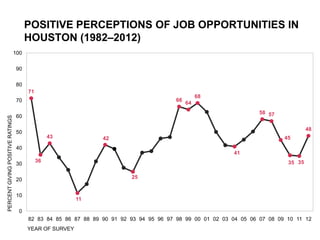
POSITIVE PERCEPTIONS OF JOB OPPORTUNITIES IN
                                        HOUSTON (1982–2012)
                                  100

                                  90

                                  80
                                        71
                                                                                                  68
                                  70                                                    66
                                                                                             64
                                                                                                                   58 57
                                  60
PERCENT GIVING POSITIVE RATINGS


                                                                                                                                    48
                                  50
                                                  43            42                                                         45
                                  40
                                                                                                          41
                                             36                                                                             35 35
                                  30

                                  20                                     25


                                  10
                                                         11

                                   0
                                        82 83 84 85 86 87 88 89 90 91 92 93 94 95 96 97 98 99 00 01 02 03 04 05 06 07 08 09 10 11 12
                                        YEAR OF SURVEY
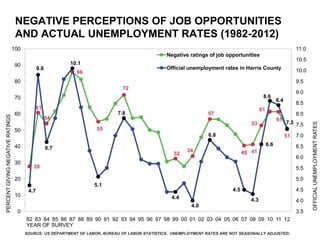
NEGATIVE PERCEPTIONS OF JOB OPPORTUNITIES
                                   AND ACTUAL UNEMPLOYMENT RATES (1982-2012)
                                  100                                                                                                                           11.0
                                                                                                 Negative ratings of job opportunities
                                                                                                                                                                10.5
                                  90                       10.1
                                               9.8                                               Official unemployment rates in Harris County                   10.0
                                                             86
                                  80                                                                                                                            9.5
                                                                               72
                                                                                                                                                                9.0
                                  70                                                                                                       8.6
                                                                                                                                                     8.4
                                                                                                                                                                8.5
                                            61                                                                                            61
                                  60                                         7.8                                 57                                             8.0
PERCENT GIVING NEGATIVE RATINGS


                                                     54                                                                                              61
                                                                                                                                                           7.3 7.5


                                                                                                                                                                       OFFICIAL UNEMPLOYMENT RATES
                                                                                                                                    53
                                  50                                 55
                                                                                                                  6.8                                      51   7.0

                                  40                                                                                                           6.6              6.5
                                                     6.7                                                 34
                                                                                                    32                           40 41
                                                                                                                                                                6.0
                                  30
                                           28                                                                                                                   5.5

                                  20                                                                                                                            5.0
                                                                    5.1
                                         4.7                                                                               4.5                                  4.5
                                  10                                                               4.4                              4.3                         4.0
                                                                                                           4.0
                                   0                                                                                                                            3.5
                                        82 83 84 85 86 87 88 89 90 91 92 93 94 95 96 97 98 99 00 01 02 03 04 05 06 07 08 09 10 11 12
                                        YEAR OF SURVEY
                                        SOURCE: US DEPARTMENT OF LABOR, BUREAU OF LABOR STATISTICS. UNEMPLOYMENT RATES ARE NOT SEASONALLY ADJUSTED.
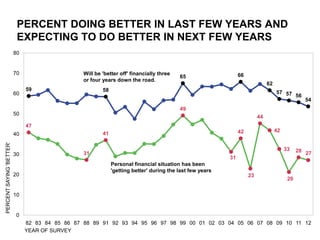
PERCENT DOING BETTER IN LAST FEW YEARS AND
                           EXPECTING TO DO BETTER IN NEXT FEW YEARS
                          80


                          70                     Will be 'better off' financially three                         66
                                                                                          65
                                                 or four years down the road.
                                                                                                                               62
                               59                        58
                          60                                                                                                        57 57
                                                                                                                                          56
                                                                                                                                                  54
                                                                                          49
                          50
                                                                                                                          44
                               47
                                                                                                                42                  42
                          40                             41
PERCENT SAYING 'BETTER'


                                                                                                                                         33    28 27
                          30                     31
                                                                                                           31
                                                              Personal financial situation has been
                                                              'getting better' during the last few years
                          20                                                                                         23
                                                                                                                                          20


                          10


                           0
                               82 83 84 85 86 87 88 89 91 92 93 94 95 96 97 98 99 00 01 02 03 04 05 06 07 08 09 10 11 12
                               YEAR OF SURVEY
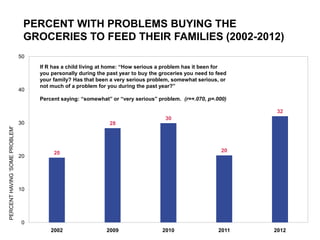
PERCENT WITH PROBLEMS BUYING THE
                                 GROCERIES TO FEED THEIR FAMILIES (2002-2012)
                                50
                                     If R has a child living at home: “How serious a problem has it been for
                                     you personally during the past year to buy the groceries you need to feed
                                     your family? Has that been a very serious problem, somewhat serious, or
                                     not much of a problem for you during the past year?”
                                40
                                     Percent saying: “somewhat” or “very serious” problem. (r=+.070, p=.000)

                                                                                                                  32
                                                                                      30
                                30                              28
PERCENT HAVING ‘SOME PROBLEM'


                                          20                                                                20
                                20


                                10


                                0
                                         2002                  2009                 2010                  2011   2012
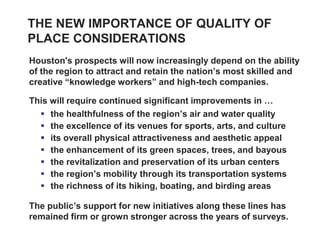
THE NEW IMPORTANCE OF QUALITY OF
PLACE CONSIDERATIONS
Houston's prospects will now increasingly depend on the ability
of the region to attract and retain the nation’s most skilled and
creative “knowledge workers” and high-tech companies.

This will require continued significant improvements in …
   the healthfulness of the region’s air and water quality
   the excellence of its venues for sports, arts, and culture
   its overall physical attractiveness and aesthetic appeal
   the enhancement of its green spaces, trees, and bayous
   the revitalization and preservation of its urban centers
   the region’s mobility through its transportation systems
   the richness of its hiking, boating, and birding areas

The public’s support for new initiatives along these lines has
remained firm or grown stronger across the years of surveys.
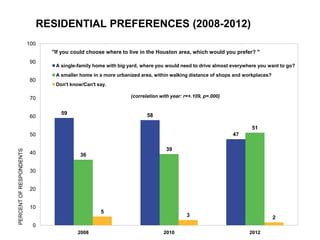
RESIDENTIAL PREFERENCES (2008-2012)
                         100
                                "If you could choose where to live in the Houston area, which would you prefer? "
                         90
                                 A single-family home with big yard, where you would need to drive almost everywhere you want to go?
                                 A smaller home in a more urbanized area, within walking distance of shops and workplaces?
                         80
                                 Don't know/Can't say.

                         70                                     (correlation with year: r=+.109, p=.000)


                                   59                                  58
                         60

                                                                                                                  51
                         50                                                                                47

                                                                               39
PERCENT OF RESPONDENTS


                         40                36

                         30


                         20


                         10
                                                   5
                                                                                         3                                   2
                          0
                                          2008                                2010                               2012
THE INTEREST AMONG ANGLOS IN SOMEDAY
                                                 MOVING FROM SUBURBS TO CITY AND FROM CITY
                                                 TO SUBURBS (1999-2012)
                                                 65
                                                                 If lives in SUBURBS: 'very' or 'somewhat interested' in someday moving to the city.
                                                 60
PERCENT SAYING 'VERY' OR 'SOMEWHAT INTERESTED’


                                                                 If lives in CITY: 'very' or 'somewhat interested' in someday moving to the suburbs.
                                                 55
                                                        52
                                                 50                     48
                                                                                                                                47

                                                 45                                                                                  r= -.092, p=.000
                                                               44                                            40
                                                                                                                                                    39
                                                 40
                                                                                  37
                                                                                           34
                                                 35                                                                                                          33
                                                                                                   31                           31
                                                                                                                     29                             29
                                                 30                              33                                                        28
                                                        26      26                                                                                           28
                                                                                                            29
                                                 25                                                  27              22                    27
                                                                       20
                                                 20                                        22                             r= +.038, p=.009

                                                 15

                                                 10                                    [Anglo respondents only.]

                                                  5
                                                       1999   2000     2003    2004       2005    2006     2007     2008      2009       2010      2011   2012
                                                      YEAR OF SURVEY
THE DEMOGRAPHIC REVOLUTION

 Along with the major immigration capitals of L.A. and N.Y.C.,
  and closely following Miami, San Francisco, and Chicago,
  Houston is at the forefront of the new diversity that is
  rapidly refashioning the socio-political landscape of urban
  America.

 Throughout all of its history …
        • this was essentially a bi-racial Southern city,
        • dominated and controlled, in an automatic, taken-
          for-granted way, by white men.

 Today …
        • Houston is the most culturally diverse metropolitan
          area in the country, and
        • all of its ethnic communities are now minorities.
THE DEMOGRAPHIC TRANSFORMATIONS OF HARRIS
                            COUNTY (U.S. CENSUS, 1960-2010)
                          4.5

                                      Asians/Others                                                                                      7.7%
                          4.0
                                      Hispanics
                          3.5                                                                                        6.3%
                                      Blacks

                          3.0         Anglos                                                    4.1%
                                                                                                                                                40.8%
                          2.5                                                2.1%                      22.7%                32.9%

                                                                                    15.5%
                          2.0
POPULATION, IN MILLIONS


                                                         0.8%
                                                                                                       19.1%                18.3%
                                                                 9.9%               19.7%                                                    18.4%
                          1.5
                                      0.3%                      20.1%
                                             6.0%
                          1.0                19.8%

                                                                                                        54.0%                42.5%              33.0%
                          0.5                73.9%              69.2%               62.7%


                          0.0
                                      1960                1970               1980                1990                 2000              2010
                                  (1,243,258)         (1,741,912)         (2,409,547)         (2,818,199)          (3,400,578)       (4,092,459)

                                SOURCE: US CENSUS. CLASSIFICATIONS BASED ON TEXAS STATE DATA CENTER CONVENTIONS.
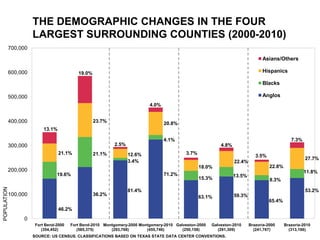
THE DEMOGRAPHIC CHANGES IN THE FOUR
                   LARGEST SURROUNDING COUNTIES (2000-2010)
         700,000

                                                                                                                              Asians/Others

         600,000                        19.0%                                                                                 Hispanics

                                                                                                                              Blacks

         500,000                                                                                                              Anglos
                                                                        4.0%


         400,000                                23.7%                          20.8%
                        13.1%

                                                                               4.1%                                                          7.3%
         300,000                                        2.5%                                             4.8%
                                21.1%           21.1%          12.6%                     3.7%
                                                                                                                           3.5%
                                                                                                                                                    27.7%
                                                               3.4%                                             22.4%
                                                                                                18.0%                             22.8%
         200,000                                                                                                                                    11.8%
                              19.6%                                            71.2%                            13.5%
                                                                                                15.3%                             8.3%
POPULATION


                                                               81.4%                                                                                53.2%
         100,000                                36.2%
                                                                                                63.1%           59.3%
                                                                                                                                  65.4%
                                46.2%
              0
                    Fort Bend-2000   Fort Bend-2010 Montgomery-2000 Montgomery-2010 Galveston-2000   Galveston-2010     Brazoria-2000     Brazoria-2010
                       (354,452)        (585,375)      (293,768)       (455,746)       (250,158)        (291,309)         (241,767)         (313,166)
                   SOURCE: US CENSUS. CLASSIFICATIONS BASED ON TEXAS STATE DATA CENTER CONVENTIONS.
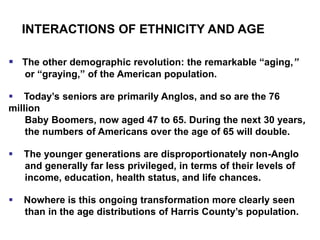
INTERACTIONS OF ETHNICITY AND AGE

 The other demographic revolution: the remarkable “aging,”
    or “graying,” of the American population.

 Today’s seniors are primarily Anglos, and so are the 76
million
    Baby Boomers, now aged 47 to 65. During the next 30 years,
    the numbers of Americans over the age of 65 will double.

   The younger generations are disproportionately non-Anglo
    and generally far less privileged, in terms of their levels of
    income, education, health status, and life chances.

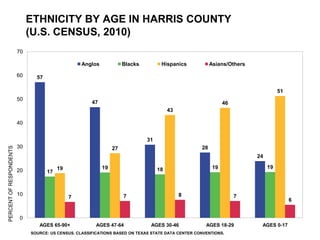
   Nowhere is this ongoing transformation more clearly seen
    than in the age distributions of Harris County’s population.
ETHNICITY BY AGE IN HARRIS COUNTY
                              (U.S. CENSUS, 2010)
                         70

                                                   Anglos             Blacks         Hispanics           Asians/Others

                         60     57

                                                                                                                                   51
                         50
                                                       47                                                      46
                                                                                         43

                         40


                                                                               31
                         30
PERCENT OF RESPONDENTS


                                                                 27                                 28
                                                                                                                         24

                                          19                19                      18                    19                  19
                         20          17


                         10                                           7                       8                     7
                                               7
                                                                                                                                        6


                          0
                                 AGES 65-90+             AGES 47-64             AGES 30-46            AGES 18-29          AGES 0-17
                              SOURCE: US CENSUS. CLASSIFICATIONS BASED ON TEXAS STATE DATA CENTER CONVENTIONS.
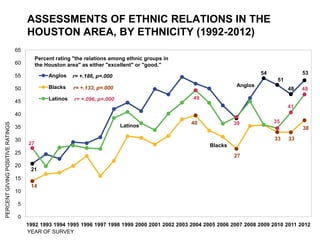
ASSESSMENTS OF ETHNIC RELATIONS IN THE
                                       HOUSTON AREA, BY ETHNICITY (1992-2012)
                                  65
                                            Percent rating "the relations among ethnic groups in
                                  60        the Houston area" as either "excellent" or "good."
                                                                                                                             54              53
                                  55             Anglos    r= +.186, p=.000
                                                                                                                                   51
                                                 Blacks    r= +.133, p=.000                                         Anglos
                                  50                                                                                                    48   48
                                                 Latinos   r= +.096, p=.000                         49
                                  45
                                                                                                                                        41
                                  40
                                                                                                   40              39             35
PERCENT GIVING POSITIVE RATINGS


                                  35                                          Latinos                                                        38

                                  30                                                                                              33    33
                                       27                                                                 Blacks
                                  25
                                                                                                                   27
                                  20
                                        21
                                  15
                                        14
                                  10

                                   5

                                   0
                                       1992 1993 1994 1995 1996 1997 1998 1999 2000 2001 2002 2003 2004 2005 2006 2007 2008 2009 2010 2011 2012
                                       YEAR OF SURVEY
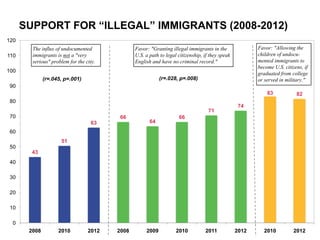
SUPPORT FOR “ILLEGAL” IMMIGRANTS (2008-2012)
120
        The influx of undocumented              Favor: "Granting illegal immigrants in the               Favor: "Allowing the
110     immigrants is not a "very               U.S. a path to legal citizenship, if they speak          children of undocu-
        serious" problem for the city.          English and have no criminal record."                    mented immigrants to
                                                                                                         become U.S. citizens, if
100                                                                                                      graduated from college
              (r=.045, p=.001)                              (r=.028, p=.008)                             or served in military."
90
                                                                                                             83            82
80
                                                                                                   74
                                                                                    71
70                                        66                         66
                                   63                  64
60
                     51
50
        43
40

30

20

10

  0
       2008         2010          2012   2008        2009           2010          2011            2012     2010           2012
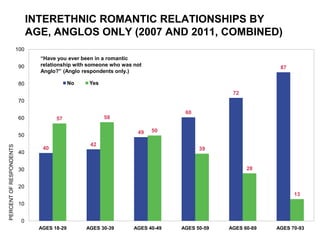
INTERETHNIC ROMANTIC RELATIONSHIPS BY
                               AGE, ANGLOS ONLY (2007 AND 2011, COMBINED)
                         100
                                 “Have you ever been in a romantic
                         90      relationship with someone who was not
                                                                                                           87
                                 Anglo?” (Anglo respondents only.)

                         80                   No    Yes
                                                                                              72
                         70

                                                                                 60
                         60            57                 58

                                                                    49   50
                         50
                                                    42
PERCENT OF RESPONDENTS


                                  40                                                  39
                         40


                         30                                                                        28


                         20
                                                                                                                13
                         10


                           0
                                 AGES 18-29        AGES 30-39      AGES 40-49   AGES 50-59   AGES 60-69   AGES 70-93
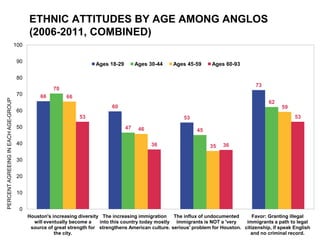
ETHNIC ATTITUDES BY AGE AMONG ANGLOS
                                           (2006-2011, COMBINED)
                                     100


                                     90                                Ages 18-29        Ages 30-44     Ages 45-59      Ages 60-93

                                     80
                                                                                                                                           73
                                                     70
                                     70         66         66
PERCENT AGREEING IN EACH AGE-GROUP


                                                                                                                                                62
                                                                              60                                                                      59
                                     60
                                                                53                                          53                                             53
                                     50                                             47    46                      45

                                     40                                                        36                      35    36

                                     30


                                     20


                                     10


                                       0
                                           Houston's increasing diversity The increasing immigration The influx of undocumented          Favor: Granting illegal
                                             will eventually become a    into this country today mostly immigrants is NOT a 'very     immigrants a path to legal
                                            source of great strength for strengthens American culture. serious' problem for Houston. citizenship, if speak English
                                                      the city.                                                                         and no criminal record.
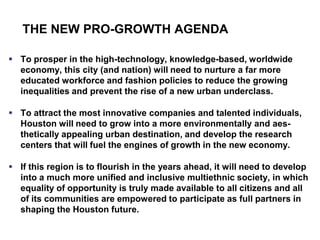
THE NEW PRO-GROWTH AGENDA

 To prosper in the high-technology, knowledge-based, worldwide
  economy, this city (and nation) will need to nurture a far more
  educated workforce and fashion policies to reduce the growing
  inequalities and prevent the rise of a new urban underclass.

 To attract the most innovative companies and talented individuals,
  Houston will need to grow into a more environmentally and aes-
  thetically appealing urban destination, and develop the research
  centers that will fuel the engines of growth in the new economy.

 If this region is to flourish in the years ahead, it will need to develop
  into a much more unified and inclusive multiethnic society, in which
  equality of opportunity is truly made available to all citizens and all
  of its communities are empowered to participate as full partners in
  shaping the Houston future.
CONTACT US FOR MORE
INFORMATION:

THE KINDER INSTITUTE FOR URBAN
RESEARCH AT RICE UNIVERSITY
PROFESSORS STEPHEN KLINEBERG AND MICHAEL EMERSON,
CO-DIRECTORS


www.kinder.rice.edu
kinder@rice.edu
713-348-4132

HTown Day 2012 - Dr. Stephen Klineberg

  • 1.
    FUTURE DEVELOPMENT: Tracking Houston’sEconomic and Demogra- phic Changes through 31 Years of Surveys STEPHEN L. KLINEBERG The Houston Association of Realtors: H-TOWN DAY 2012 4 October 2012
  • 2.
    KINDER HOUSTON AREASURVEY (1982-2012) Supported by local foundations, corporations, and individuals, and now with a permanent home in the Kinder Institute for Urban Research, the annual surveys have interviewed 31 successive representative samples of Harris County residents. In May 1982, just two months after the first Houston-area survey was completed, the 80-year oil boom suddenly collapsed. The region recovered from the deep and prolonged recession of the mid 1980s to find itself squarely in the midst of …  a restructured economy and  a demographic revolution. These are the same transformations that are refashioning all of American society. The Houston surveys have tracked area residents’ changing perspectives on these remarkable trends.
  • 3.
    THE RESTRUCTURED ECONOMY The“resource economy” of the industrial era, for which this city was so favorably positioned, has been replaced by a new high-technology, knowledge-based, fully worldwide marketplace. The traditional “blue collar path” to financial security has now largely disappeared. Almost all the well-paid jobs today require high levels of technical skills and educational credentials. In the 2012 survey, 65% of the survey respondents agreed that “There are very few good jobs in today’s economy for people without a college education.” In 2011, 78% disagreed that “A high school education is enough to get a good job.” In this increasingly unequal, hourglass economy, “What you earn,” as the saying goes, “depends on what you’ve learned.”
  • 4.
    POSITIVE PERCEPTIONS OFJOB OPPORTUNITIES IN HOUSTON (1982–2012) 100 90 80 71 68 70 66 64 58 57 60 PERCENT GIVING POSITIVE RATINGS 48 50 43 42 45 40 41 36 35 35 30 20 25 10 11 0 82 83 84 85 86 87 88 89 90 91 92 93 94 95 96 97 98 99 00 01 02 03 04 05 06 07 08 09 10 11 12 YEAR OF SURVEY
  • 5.
    NEGATIVE PERCEPTIONS OFJOB OPPORTUNITIES AND ACTUAL UNEMPLOYMENT RATES (1982-2012) 100 11.0 Negative ratings of job opportunities 10.5 90 10.1 9.8 Official unemployment rates in Harris County 10.0 86 80 9.5 72 9.0 70 8.6 8.4 8.5 61 61 60 7.8 57 8.0 PERCENT GIVING NEGATIVE RATINGS 54 61 7.3 7.5 OFFICIAL UNEMPLOYMENT RATES 53 50 55 6.8 51 7.0 40 6.6 6.5 6.7 34 32 40 41 6.0 30 28 5.5 20 5.0 5.1 4.7 4.5 4.5 10 4.4 4.3 4.0 4.0 0 3.5 82 83 84 85 86 87 88 89 90 91 92 93 94 95 96 97 98 99 00 01 02 03 04 05 06 07 08 09 10 11 12 YEAR OF SURVEY SOURCE: US DEPARTMENT OF LABOR, BUREAU OF LABOR STATISTICS. UNEMPLOYMENT RATES ARE NOT SEASONALLY ADJUSTED.
  • 6.
    PERCENT DOING BETTERIN LAST FEW YEARS AND EXPECTING TO DO BETTER IN NEXT FEW YEARS 80 70 Will be 'better off' financially three 66 65 or four years down the road. 62 59 58 60 57 57 56 54 49 50 44 47 42 42 40 41 PERCENT SAYING 'BETTER' 33 28 27 30 31 31 Personal financial situation has been 'getting better' during the last few years 20 23 20 10 0 82 83 84 85 86 87 88 89 91 92 93 94 95 96 97 98 99 00 01 02 03 04 05 06 07 08 09 10 11 12 YEAR OF SURVEY
  • 7.
    PERCENT WITH PROBLEMSBUYING THE GROCERIES TO FEED THEIR FAMILIES (2002-2012) 50 If R has a child living at home: “How serious a problem has it been for you personally during the past year to buy the groceries you need to feed your family? Has that been a very serious problem, somewhat serious, or not much of a problem for you during the past year?” 40 Percent saying: “somewhat” or “very serious” problem. (r=+.070, p=.000) 32 30 30 28 PERCENT HAVING ‘SOME PROBLEM' 20 20 20 10 0 2002 2009 2010 2011 2012
  • 8.
    THE NEW IMPORTANCEOF QUALITY OF PLACE CONSIDERATIONS Houston's prospects will now increasingly depend on the ability of the region to attract and retain the nation’s most skilled and creative “knowledge workers” and high-tech companies. This will require continued significant improvements in …  the healthfulness of the region’s air and water quality  the excellence of its venues for sports, arts, and culture  its overall physical attractiveness and aesthetic appeal  the enhancement of its green spaces, trees, and bayous  the revitalization and preservation of its urban centers  the region’s mobility through its transportation systems  the richness of its hiking, boating, and birding areas The public’s support for new initiatives along these lines has remained firm or grown stronger across the years of surveys.
  • 9.
    RESIDENTIAL PREFERENCES (2008-2012) 100 "If you could choose where to live in the Houston area, which would you prefer? " 90 A single-family home with big yard, where you would need to drive almost everywhere you want to go? A smaller home in a more urbanized area, within walking distance of shops and workplaces? 80 Don't know/Can't say. 70 (correlation with year: r=+.109, p=.000) 59 58 60 51 50 47 39 PERCENT OF RESPONDENTS 40 36 30 20 10 5 3 2 0 2008 2010 2012
  • 10.
    THE INTEREST AMONGANGLOS IN SOMEDAY MOVING FROM SUBURBS TO CITY AND FROM CITY TO SUBURBS (1999-2012) 65 If lives in SUBURBS: 'very' or 'somewhat interested' in someday moving to the city. 60 PERCENT SAYING 'VERY' OR 'SOMEWHAT INTERESTED’ If lives in CITY: 'very' or 'somewhat interested' in someday moving to the suburbs. 55 52 50 48 47 45 r= -.092, p=.000 44 40 39 40 37 34 35 33 31 31 29 29 30 33 28 26 26 28 29 25 27 22 27 20 20 22 r= +.038, p=.009 15 10 [Anglo respondents only.] 5 1999 2000 2003 2004 2005 2006 2007 2008 2009 2010 2011 2012 YEAR OF SURVEY
  • 11.
    THE DEMOGRAPHIC REVOLUTION Along with the major immigration capitals of L.A. and N.Y.C., and closely following Miami, San Francisco, and Chicago, Houston is at the forefront of the new diversity that is rapidly refashioning the socio-political landscape of urban America.  Throughout all of its history … • this was essentially a bi-racial Southern city, • dominated and controlled, in an automatic, taken- for-granted way, by white men.  Today … • Houston is the most culturally diverse metropolitan area in the country, and • all of its ethnic communities are now minorities.
  • 12.
    THE DEMOGRAPHIC TRANSFORMATIONSOF HARRIS COUNTY (U.S. CENSUS, 1960-2010) 4.5 Asians/Others 7.7% 4.0 Hispanics 3.5 6.3% Blacks 3.0 Anglos 4.1% 40.8% 2.5 2.1% 22.7% 32.9% 15.5% 2.0 POPULATION, IN MILLIONS 0.8% 19.1% 18.3% 9.9% 19.7% 18.4% 1.5 0.3% 20.1% 6.0% 1.0 19.8% 54.0% 42.5% 33.0% 0.5 73.9% 69.2% 62.7% 0.0 1960 1970 1980 1990 2000 2010 (1,243,258) (1,741,912) (2,409,547) (2,818,199) (3,400,578) (4,092,459) SOURCE: US CENSUS. CLASSIFICATIONS BASED ON TEXAS STATE DATA CENTER CONVENTIONS.
  • 17.
    THE DEMOGRAPHIC CHANGESIN THE FOUR LARGEST SURROUNDING COUNTIES (2000-2010) 700,000 Asians/Others 600,000 19.0% Hispanics Blacks 500,000 Anglos 4.0% 400,000 23.7% 20.8% 13.1% 4.1% 7.3% 300,000 2.5% 4.8% 21.1% 21.1% 12.6% 3.7% 3.5% 27.7% 3.4% 22.4% 18.0% 22.8% 200,000 11.8% 19.6% 71.2% 13.5% 15.3% 8.3% POPULATION 81.4% 53.2% 100,000 36.2% 63.1% 59.3% 65.4% 46.2% 0 Fort Bend-2000 Fort Bend-2010 Montgomery-2000 Montgomery-2010 Galveston-2000 Galveston-2010 Brazoria-2000 Brazoria-2010 (354,452) (585,375) (293,768) (455,746) (250,158) (291,309) (241,767) (313,166) SOURCE: US CENSUS. CLASSIFICATIONS BASED ON TEXAS STATE DATA CENTER CONVENTIONS.
  • 18.
    INTERACTIONS OF ETHNICITYAND AGE  The other demographic revolution: the remarkable “aging,” or “graying,” of the American population.  Today’s seniors are primarily Anglos, and so are the 76 million Baby Boomers, now aged 47 to 65. During the next 30 years, the numbers of Americans over the age of 65 will double.  The younger generations are disproportionately non-Anglo and generally far less privileged, in terms of their levels of income, education, health status, and life chances.  Nowhere is this ongoing transformation more clearly seen than in the age distributions of Harris County’s population.
  • 19.
    ETHNICITY BY AGEIN HARRIS COUNTY (U.S. CENSUS, 2010) 70 Anglos Blacks Hispanics Asians/Others 60 57 51 50 47 46 43 40 31 30 PERCENT OF RESPONDENTS 27 28 24 19 19 18 19 19 20 17 10 7 8 7 7 6 0 AGES 65-90+ AGES 47-64 AGES 30-46 AGES 18-29 AGES 0-17 SOURCE: US CENSUS. CLASSIFICATIONS BASED ON TEXAS STATE DATA CENTER CONVENTIONS.
  • 20.
    ASSESSMENTS OF ETHNICRELATIONS IN THE HOUSTON AREA, BY ETHNICITY (1992-2012) 65 Percent rating "the relations among ethnic groups in 60 the Houston area" as either "excellent" or "good." 54 53 55 Anglos r= +.186, p=.000 51 Blacks r= +.133, p=.000 Anglos 50 48 48 Latinos r= +.096, p=.000 49 45 41 40 40 39 35 PERCENT GIVING POSITIVE RATINGS 35 Latinos 38 30 33 33 27 Blacks 25 27 20 21 15 14 10 5 0 1992 1993 1994 1995 1996 1997 1998 1999 2000 2001 2002 2003 2004 2005 2006 2007 2008 2009 2010 2011 2012 YEAR OF SURVEY
  • 21.
    SUPPORT FOR “ILLEGAL”IMMIGRANTS (2008-2012) 120 The influx of undocumented Favor: "Granting illegal immigrants in the Favor: "Allowing the 110 immigrants is not a "very U.S. a path to legal citizenship, if they speak children of undocu- serious" problem for the city. English and have no criminal record." mented immigrants to become U.S. citizens, if 100 graduated from college (r=.045, p=.001) (r=.028, p=.008) or served in military." 90 83 82 80 74 71 70 66 66 63 64 60 51 50 43 40 30 20 10 0 2008 2010 2012 2008 2009 2010 2011 2012 2010 2012
  • 22.
    INTERETHNIC ROMANTIC RELATIONSHIPSBY AGE, ANGLOS ONLY (2007 AND 2011, COMBINED) 100 “Have you ever been in a romantic 90 relationship with someone who was not 87 Anglo?” (Anglo respondents only.) 80 No Yes 72 70 60 60 57 58 49 50 50 42 PERCENT OF RESPONDENTS 40 39 40 30 28 20 13 10 0 AGES 18-29 AGES 30-39 AGES 40-49 AGES 50-59 AGES 60-69 AGES 70-93
  • 23.
    ETHNIC ATTITUDES BYAGE AMONG ANGLOS (2006-2011, COMBINED) 100 90 Ages 18-29 Ages 30-44 Ages 45-59 Ages 60-93 80 73 70 70 66 66 PERCENT AGREEING IN EACH AGE-GROUP 62 60 59 60 53 53 53 50 47 46 45 40 36 35 36 30 20 10 0 Houston's increasing diversity The increasing immigration The influx of undocumented Favor: Granting illegal will eventually become a into this country today mostly immigrants is NOT a 'very immigrants a path to legal source of great strength for strengthens American culture. serious' problem for Houston. citizenship, if speak English the city. and no criminal record.
  • 24.
    THE NEW PRO-GROWTHAGENDA  To prosper in the high-technology, knowledge-based, worldwide economy, this city (and nation) will need to nurture a far more educated workforce and fashion policies to reduce the growing inequalities and prevent the rise of a new urban underclass.  To attract the most innovative companies and talented individuals, Houston will need to grow into a more environmentally and aes- thetically appealing urban destination, and develop the research centers that will fuel the engines of growth in the new economy.  If this region is to flourish in the years ahead, it will need to develop into a much more unified and inclusive multiethnic society, in which equality of opportunity is truly made available to all citizens and all of its communities are empowered to participate as full partners in shaping the Houston future.
  • 25.
    CONTACT US FORMORE INFORMATION: THE KINDER INSTITUTE FOR URBAN RESEARCH AT RICE UNIVERSITY PROFESSORS STEPHEN KLINEBERG AND MICHAEL EMERSON, CO-DIRECTORS www.kinder.rice.edu kinder@rice.edu 713-348-4132