Ring-­‐Learning	
  With	
  Errors	
  &	
  HElib
Wenjie	
  Lu(陸 文杰)	
  
University	
  of	
  Tsukuba	
  
riku@mdl.cs.tsukuba.ac.jp	
  
1
Outline
1.  Homomorphic	
  EncrypFon	
  &	
  Fully	
  Homomorphic	
  EncrypFon	
  (FHE)	
  
2.  Learning	
  With	
  Errors	
  (LWE)	
  &	
  Ring-­‐LWE	
  	
  
3.  Ring-­‐LWE	
  based	
  FHE	
  operaFons:	
  KeyGen	
  etc.	
  
4.  HElib	
  
1.  BGV’s	
  leveled	
  FHE	
  scheme	
  
2.  OpFmizaFons	
  e.g.	
  modulo-­‐switch	
  in	
  HElib	
  
3.  Example	
  codes	
  
5.  Two	
  kind	
  of	
  packing	
  methods	
  &	
  example	
  codes	
  
6.  Some	
  other	
  rouFnes	
  in	
  HElib	
  	
  &	
  example	
  codes	
  
7.  An	
  applicaFon	
  on	
  epidemiology	
  study	
  	
  
8.  Misc.	
  includes	
  noise-­‐esFmaFon	
  &	
  parameters	
  decision	
  in	
  HElib	
  
2
Privacy	
  Preserving	
  CompuFng
3
Secure	
  MulF-­‐parFes	
  CompuFng
Secure	
  Outsourcing Homomorphic	
  Encryp-on
Homomorphic	
  EncrypFon
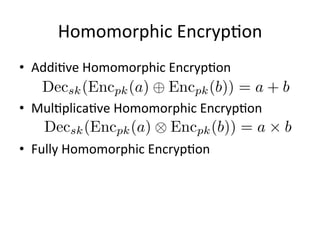
•  AddiFve	
  Hom.	
  EncrypFon,	
  e.g.	
  Paillier	
  	
  
•  MulFplicaFve	
  Hom.	
  EncrypFon,	
  e.g.	
  ElGamal	
  
•  Fully	
  Homomorphic	
  EncrypFon	


  SaFsfies	
  both	
  addiFve	
  and	
  mulFplicaFve
4
Fully	
  homomorphic	
  encrypFon
•  Breakthrough	
  by	
  Gentry	
  in	
  2009	
  
•  Main	
  idea:	
  
1.  First	
  build	
  a	
  somewhat	
  homomorphic	
  encrypFon	
  
2.  Then	
  apply	
  bootstrapping	
  to	
  achieve	
  FHE	
  
•  Common	
  facts	
  of	
  the	
  current	
  FHE	
  schemes	
  
1.  Noise	
  grows	
  with	
  operaFons	
  
2.  MulFplicaFon	
  yields	
  the	
  most	
  noise	
  
3.  DecrypFon	
  will	
  fail	
  with	
  too	
  large	
  noise
5
[A	
  fully	
  homomorphic	
  encrypFon	
  scheme	
  Gentry	
  2009]
Ring-­‐learning	
  With	
  Errors	
  based	
  FHE
•  RLWE	
  schemes:	
  	
  The	
  most	
  efficient	
  schemes	


  for	
  now.	
  
•  Different	
  kinds	
  of	
  RLWE	
  based	
  FHE	
  
1.  BGV’s	
  	
  leveled	
  scheme	
  (implemented	
  by	
  HElib)	
  
2.  Brakerski,	
  Scale-­‐invariant	
  scheme	
  
3.  ……
6
[(Leveled)	
  fully	
  homomorphic	
  encrypFon	
  without	
  bootstrapping]	
  
Brakerski,	
  Gentry,	
  Vaikuntanathan	
  2012
[Fully	
  Homomorphic	
  Encryp-on	
  without	
  Modulus	
  Switching	
  from	
  
Classical	
  GapSVP]	
  Brakerski,2012
Nota-ons
7
•  	


  :	
  Integer	
  modulo	
  q	
  
•  	


  :	
  Vectors	
  consists	
  of	
  n	
  integer	
  modulo	
  q	
  
•  	


  :	
  uniformly	
  sample	


  from	
  
• 	


  :	
  	
  set	
  of	
  polynomials	
  
•  F(x)	
  a	
  polynomial,	


  :	
  a	
  quoFent	
  set	


•  Cyclotomic	
  polynomial:	
  
Nota-ons
8
•  	


  :	
  Integer	
  modulo	
  q	
  
•  	


  :	
  Vectors	
  consists	
  of	
  n	
  integer	
  modulo	
  q	
  
•  	


  :	
  uniformly	
  sample	


  from	
  
• 	


  :	
  	
  set	
  of	
  polynomials	
  
•  F(x)	
  a	
  polynomial,	


  :	
  a	
  quoFent	
  set	


•  Cyclotomic	
  polynomial:	
  
x 1 ⌘ 6x + 6 mod 7
Nota-ons
9
•  	


  :	
  Integer	
  modulo	
  q	
  
•  	


  :	
  Vectors	
  consists	
  of	
  n	
  integer	
  modulo	
  q	
  
•  	


  :	
  uniformly	
  sample	


  from	
  
• 	


  :	
  	
  set	
  of	
  polynomials	
  
•  F(x)	
  a	
  polynomial,	


  :	
  a	
  quoFent	
  set	


•  Cyclotomic	
  polynomial:	
  
Nota-ons
10
•  	


  :	
  Integer	
  modulo	
  q	
  
•  	


  :	
  Vectors	
  consists	
  of	
  n	
  integer	
  modulo	
  q	
  
•  	


  :	
  uniformly	
  sample	


  from	
  
• 	


  :	
  	
  set	
  of	
  polynomials	
  
•  F(x)	
  a	
  polynomial,	


  :	
  a	
  quoFent	
  set	


•  Cyclotomic	
  polynomial:	
  
Cyclotomic	
  polynomial:	
  Some	
  “prime”	
  polynomial
Learning	
  With	
  Errors
•  LWE-­‐AssumpFon	
  
•  Ring-­‐LWE:	
  use	
  a	
  polynomial	
  ring	
  instead	
  
11
[On	
  lajces,	
  learning	
  with	
  errors,	
  random.	
  Regev	
  2005	
  ]
Learning	
  With	
  Errors
•  LWE-­‐AssumpFon	
  
•  Ring-­‐LWE:	
  use	
  a	
  polynomial	
  ring	
  instead	
  
12
[On	
  lajces,	
  learning	
  with	
  errors,	
  random.	
  Regev	
  2005	
  ]
Learning	
  With	
  Errors
•  LWE-­‐AssumpFon	
  
•  Ring-­‐LWE:	
  use	
  a	
  polynomial	
  ring	
  instead	
  
13
[On	
  lajces,	
  learning	
  with	
  errors,	
  random.	
  Regev	
  2005	
  ]
Add.	
  &	
  Mul.	
  On	
  
14
(i.e.	
  n	
  is	
  power	
  of	
  2)
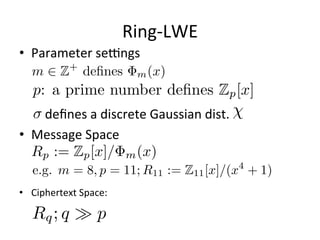
Paremeters	
  in	
  RLWE-­‐based	
  scheme
15
(default	
  3.2)
Security	
  
parameter
The	
  stand	
  deviaFon	
  of	
  the	
  discrete	
  
	
  Gaussian	
  distribuFon
Message	
  Space	
  &	
  Ciphertext	
  Space
•  Message	
  Space:	
  polynomial	
  quoFent	
  ring	
  
•  Ciphertex	
  Space	
  	
  
16
Coefficients	
  
modulo	
  p
Polynomial	
  modulo	
  
Coefficients	
  
modulo	
  q
Polynomial	
  modulo	
  
Basic	
  EncrypFon	
  Scheme	
  OperaFons
•  KeyGeneraFon	
  
17
[Can	
  Homomorphic	
  Encryp-on	
  be	
  Prac-cal?	
  K.	
  Lauter	
  et	
  al.	
  2011]
Basic	
  EncrypFon	
  Scheme	
  OperaFons
•  EncrypFon	
  
•  DecrypFon	
  	
  
18
addi-ons,	
  mul-plica-ons	
  over	
  
polynomial	
  ring.
Homomorphic	
  OperaFons
•  AddiFon	
  
•  MulFplicaFon	
  	
  
The	
  size	
  of	
  ciphertext	
  increases!	
  
19
HElib
•  Purely	
  wrimen	
  in	
  C++	
  
•  Implements	
  the	
  BGV-­‐type	
  encrypFon	
  scheme	
  
•  Supports	
  opFmazaFons	
  such	
  as:	
  reLinearazaFon,	
  
bootstapping,	
  packing	
  
•  Supports	
  mulFthread	
  from	
  this	
  March	
  
20
[hmps://github.com/shaih/Helib]
Architecture	
  of	
  HElib
PAlgebra
Structure of Zm*, §2.4
PAlgebraMod
plaintext-slot algebra, §2.5
NumbTh
miscellaneous
utilities, §2.2
CModulus
polynomials mod p, §2.3
Math
DoubleCRT
polynomial arithmetic, §2.8
FHE
KeyGen/Enc/Dec, §3.2
Ctxt
Ciphertext operations, §3.1
Crypto
EncryptedArray
Routing plaintext slots, §4.1
IndexSet/IndexMap
Indexing utilities, §2.6
FHEcontext
parameters,§2.7
bluestein
FFT/IFFT, §2.3
timing
§2.1
KeySwitching
Matrices for key-switching, §3.3
21*	
  Reference	
  from	
  the	
  HElib	
  design	
  document
Leveled	
  homomorphic	
  encrypFon
The	
  BGV-­‐type	
  scheme	
  is	
  a	
  leveled	
  homomorphic	
  encrypFon	
  
scheme	
  
•  What	
  is	
  levels?	
  
–  The	
  ciphertext	
  space	
  is	
  not	
  fixed.	
  
•  Why	
  need	
  levels	
  ?	
  	
  
–  Bootstrapping	
  is	
  too	
  too	
  heavy	
  	
  
–  To	
  somehow	
  reduce	
  the	
  noise	
  inside	
  ciphertexts	
  	
  
•  When	
  to	
  change	
  the	
  level?	
  
– Majorly	
  arer	
  ciphertexts	
  mulFplicaFon	
  
22
L1
L2
L3
L4
[(Leveled)	
  fully	
  homomorphic	
  encrypFon	
  without	
  bootstrapping]	
  
Brakerski,	
  Gentry,	
  Vaikuntanathan	
  2012
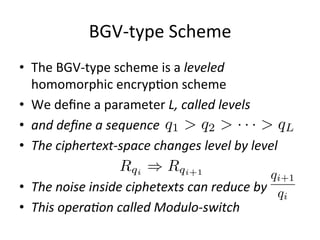
Parameters	
  of	
  the	
  
	
  Leveled	
  homomorphic	
  encrypFon
1. An	
  posi9ve	
  integer	
  L,	
  called	
  levels	
  
2. A	
  prime	
  sequence	
  
•  The	
  ciphertext-­‐space	
  changes	
  level	
  by	
  level	
  
•  The	
  noise	
  inside	
  ciphertexts	
  can	
  reduce	
  by	
  
•  This	
  opera9on	
  called	
  Modulo-­‐switch	
  	
  
23
[(Leveled)	
  fully	
  homomorphic	
  encrypFon	
  without	
  bootstrapping]	
  
Brakerski,	
  Gentry,	
  Vaikuntanathan	
  2012
One	
  mulFplicaFon
How	
  to	
  decide	
  the	
  levels?
•  Majorly	
  depends	
  on	
  the	
  evaluaFon	
  funcFon	
  
24
Need	
  at	
  least	
  2-­‐levels
1-­‐level	
  may	
  also	
  works
1-­‐level	
  may	
  not	
  works
reLinearizaFon	
  (Key	
  switching)
•  What	
  is	
  relinearizaFon?
25
[Efficient	
  fully	
  homomorphic	
  encrypFon	
  from	
  LWE	
  Brakerski,	
  Vaikuntanathan,	
  2011]
The	
  dimension	
  of	
  ciphertext	
  increases!	
  
reLinearizaFon	
  (Key	
  switching)
•  Why	
  want	
  to	
  reLinearize	
  ?	
  
– To	
  reduce	
  the	
  overhead	
  in	
  ciphertext	
  mulFplicaFon	
  
•  Need	
  to	
  add	
  extra	
  informaFon	
  into	
  the	
  public	
  key	
  
•  Should	
  always	
  reLinearize	
  ?	
  
– Depends	
  on	
  the	
  mulFplicaFon	
  depth	
  
26
[Efficient	
  fully	
  homomorphic	
  encrypFon	
  from	
  LWE	
  Brakerski,	
  Vaikuntanathan,	
  2011]
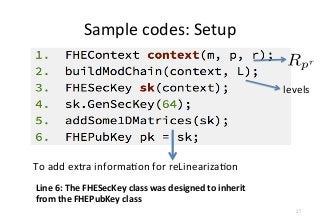
Sample	
  codes:	
  Setup
levels
To	
  add	
  extra	
  informaFon	
  for	
  reLinearizaFon	
  
27
Line	
  6:	
  The	
  FHESecKey	
  class	
  was	
  designed	
  to	
  inherit	
  
from	
  the	
  FHEPubKey	
  class
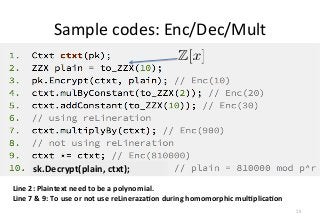
Sample	
  codes:	
  Enc/Dec/Mult
Line	
  2:	
  Plaintext	
  need	
  to	
  be	
  a	
  polynomial.	
  
Line	
  7	
  &	
  9:	
  To	
  use	
  or	
  not	
  use	
  reLineraza-on	
  during	
  homomorphic	
  mul-plica-on	
  
28
sk.Decrypt(plain,	
  ctxt);
Packing
What	
  is	
  packing	
  ?	
  
•  To	
  pack	
  several	
  messages	
  into	
  one	
  ciphertext	
  
Why	
  use	
  packing	
  ?	
  
1.  To	
  reduce	
  the	
  numbers	
  of	
  ciphertext	
  	
  
2.  To	
  amorFze	
  the	
  computaFon	
  Fme	
  
Different	
  kinds	
  of	
  packing	
  
•  Pack	
  into	
  coefficients	
  
•  Pack	
  into	
  subfields	
  (so-­‐called	
  CRT-­‐based	
  packing)	
  
29
I.	
  Pack	
  into	
  coefficients
•  Example	
  Message	
  Space	
  
•  image	
  that	
  8	
  boxes	
  and	
  each	
  can	
  put	
  in	
  a	
  less	
  than	
  
13^2	
  posiFve	
  integer.	
  	
  
1 2 3 4
30
I.	
  Pack	
  into	
  coefficients
•  We	
  need	
  to	
  design	
  how	
  to	
  encode	
  our	
  data	
  into	
  a	
  
useful	
  polynomial	
  form	
  
Enc(	


  )	
   Enc(	


  )	
  
Enc(	


  )	
  
Just	
  the	
  mul-plica-on	
  between	
  polynomials!	
  	
  
mod	
  (13^2,	
  x^8	
  +	
  1)
31
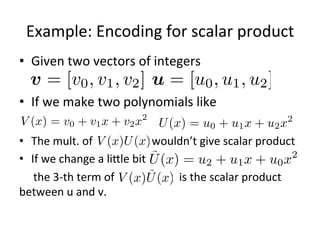
Example:	
  Encoding	
  for	
  scalar	
  product
•  Given	
  
•  If	
  we	
  make	
  two	
  polynomials	
  such	
  as	
  
•  But	


•  Change	
  a	
  limle	
  bit	


32
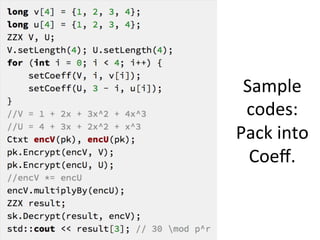
Sample	
  codes:	
  	
  
Pack	
  into	
  
Coefficients
3rd	
  coeff. 33
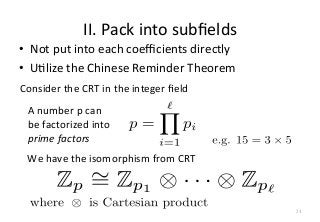
II.	
  Pack	
  into	
  subfields
•  Not	
  put	
  into	
  each	
  coefficients	
  directly	
  
•  UFlize	
  the	
  Chinese	
  Reminder	
  Theorem	
  	
A	
  number	
  p	
  can	
  
be	
  factorized	
  into	
  	
  
prime	
  factors	
  
Consider	
  the	
  CRT	
  in	
  the	
  integer	
  field
We	
  have	
  the	
  isomorphism	
  from	
  CRT
34
II.	
  Pack	
  into	
  subfields
•  Not	
  put	
  into	
  each	
  coefficients	
  directly	
  
•  UFlize	
  the	
  Chinese	
  Reminder	
  Theorem	
  	
A	
  number	
  p	
  can	
  
be	
  factorized	
  into	
  	
  
prime	
  factors	
  
Consider	
  the	
  CRT	
  in	
  the	
  integer	
  field
We	
  have	
  the	
  isomorphism	
  from	
  CRT
35
II.	
  Pack	
  into	
  subfields
•  Polynomial-­‐CRT	
  
The	
  cyclotomic	
  polynomial	
  
can	
  be	
  factorized	
  into	
  disFnct	
  
l	
  	
  irreducible	
  polynomials
For	
  each	
  irreducible	
  polynomial
called	
  slots
36
Euler	
  funcFon
(Some	
  “prime”	
  polynomial)
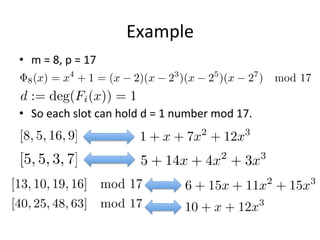
Example:	
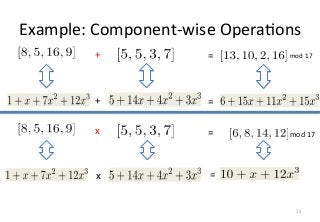
  Component-­‐wise	
  OperaFons
•  m	
  =	
  8,	
  p	
  =	
  17	
  
•  So	
  each	
  slot	
  hold	
  degree	
  0	
  polynomial	
  modulo	
  17.	
  
37


Example:	
  Component-­‐wise	
  OperaFons
38
+ =
+ = mod	
  17
x
x = mod	
  17
=
Example:	
  “RotaFon”	
  OperaFon
39
On	
  field:
An	
  automorphism	
  
Replace
2	
  ler-­‐rotated	
  !!
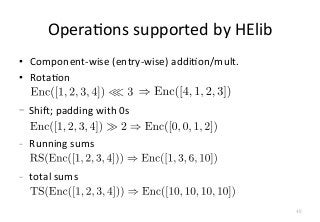
OperaFons	
  supported	
  by	
  HElib
•  Component-­‐wise	
  (entry-­‐wise)	
  addiFon/mult.	
  
•  RotaFon	
  	
  
-  Shir;	
  padding	
  with	
  0s	
  
-  Running	
  sums	
  
-  total	
  sums
40
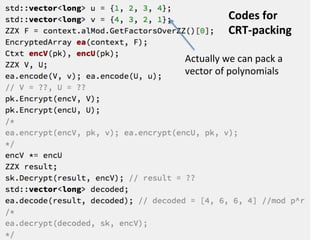
Sample	
  codes
Codes	
  for	
  	
  
CRT-­‐packing
41
Sample	
  codes	
  for	
  other	
  HElib	
  rou-nes	
  
42
Noise	
  EsFmaFon
•  Ok	
  to	
  decrypt:	
  
•  Fresh	
  ciphertext:	
  
•  Modulus-­‐switch:	
  
•  reLineara9on:	
  
•  Ctxt-­‐plain	
  add.:	
  
•  Ctxt-­‐plain	
  mult.:	
  
43
*	
  Reference	
  from	
  the	
  HElib	
  design	
  document
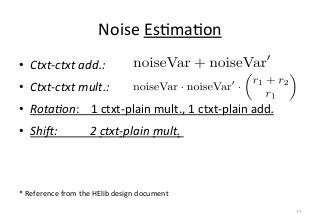
Noise	
  EsFmaFon
•  Ctxt-­‐ctxt	
  add.:	
  	
  
•  Ctxt-­‐ctxt	
  mult.:	
  
•  Rota9on:	


  1	
  ctxt-­‐plain	
  mult.,	
  1	
  ctxt-­‐plain	
  add.	
  
•  ShiP:	


  2	
  ctxt-­‐plain	
  mult.
44
*	
  Reference	
  from	
  the	
  HElib	
  design	
  document
45
on	
  epidemiology	
  	
  
a A a	
  (expected) A(expected) Count
Case o1 o2 e1=n3n1/n e2=n4n1/n n1
Control o3 o4 e3=n3n2/n e4=n4n2/n n2
Count n3 n4 n
Applica-on
observed	
  
46
on	
  epidemiology	
  	
  
a A Count
Case o1 o2 n1
Control o3 o4 n2
Count n3 n4 n
Applica-on
Data:	
  
[AA,	
  Aa,	
  aa,	
  Aa,	
  …..]
x=[	
  	
  	
  2	
  ,	
  	
  	
  1,	
  	
  	
  0,	
  	
  	
  1,	
  	
  …..]
Encoding
[case,	
  control,	
  case,	
  control,	
  ….]
Encoding
y=[	
  	
  	
  1	
  ,	


  0,	


  1,	


  0,	
  	
  	
  …..]
47
on	
  epidemiology	
  	
  
a A Count
Case o1 o2 n1
Control o3 o4 n2
Count n3 n4 n
Applica-on
Data:	
  
[AA,	
  Aa,	
  aa,	
  Aa,	
  …..]
x=[	
  	
  	
  2	
  ,	
  	
  	
  1,	
  	
  	
  0,	
  	
  	
  1,	
  	
  …..]
Encoding
[case,	
  control,	
  case,	
  control,	
  ….]
Encoding
y=[	
  	
  	
  1	
  ,	


  0,	


  1,	


  0,	
  	
  	
  …..]How	
  to	
  efficiently	
  
compute	
  scalar	
  
product??	
  
Packing!
Misc:	
  Example	
  to	
  choose	
  parameters
•  Problem:	
  To	
  	
  calculate	
  chi-­‐square	
  test	
  
•  Main	
  computaFon:	
  scalar	
  product	
  of	
  integer	
  vectors	
  
•  Integer	
  vectors:	


  ;	
  Data	
  set	
  size	
  
1.  Plaintext	
  space	
  parameters:	
  	
  p,	
  r	
  
2.  Polynomial	
  parameter:	
  m	


  >	
  2000	
  to	
  pack	
  N	
  integers	
  	
  
3.  Levels	
  parameter:	
  L	


  Pack	
  into	
  coefficient:	
  Only	
  need	
  1	
  mulF.	
  =>	
  L	
  =	
  1	


  Pack	
  into	
  subfields:	
  Need	
  1	
  mulF.	
  &	
  1	
  running	
  sums	
  =>	
  L	
  =	
  2	
  is	
  bemer	
  
4.	
  	
  	
  Check	
  m	
  again	
  by	
  calling	
  FindM
48
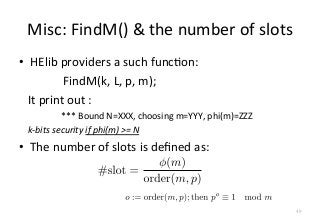
Misc:	
  FindM()	
  &	
  the	
  number	
  of	
  slots
•  HElib	
  providers	
  a	
  such	
  funcFon:	


  FindM(k,	
  L,	
  p,	
  m);	


  It	
  print	
  out	
  :	


  ***	
  Bound	
  N=XXX,	
  choosing	
  m=YYY,	
  phi(m)=ZZZ	


  k-­‐bits	
  security	
  if	
  phi(m)	
  >=	
  N	
  
•  The	
  number	
  of	
  slots	
  is	
  defined	
  as:	
  
49
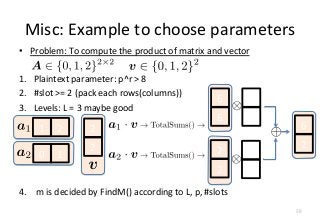
Misc:	
  Example	
  to	
  choose	
  parameters
•  Problem:	
  To	
  compute	
  the	
  product	
  of	
  matrix	
  and	
  vector	
  
1.  Plaintext	
  parameter:	
  p^r	
  >	
  8	
  
2.  #slot	
  >=	
  2	
  (pack	
  each	
  rows(columns))	
  
3.  Levels:	
  L	
  =	
  3	
  maybe	
  good	
  
4.  	
  m	
  is	
  decided	
  by	
  FindM()	
  according	
  to	
  L,	
  p,	
  #slots	


   50
2
1
1
0
2
2
6
6
2
2
1
0
0
1
6
2
Misc.:	
  Rules	
  of	
  thumb	
  
•  By	
  default,	
  only	
  use	
  half	
  of	
  the	
  machine	
  bits	
  for	
  levels	
  
1.  32-­‐bits	
  pla}orm,	
  open	
  –DNOT_HALF_PRIME	
  flag	
  
before	
  building	
  the	
  HElib	
  
2.  64-­‐bits	
  pla}orm:	
  before	
  call	
  buildModChain()	
  
•  Plaintext	
  parameter	
  p^r	
  !=	
  2,	
  bemer	
  to	
  add	
  more	
  levels	


[hmps://github.com/shaih/HElib/issues/52]
51
Misc.:	
  Install	
  HElib
•  Install	
  NTL(Number	
  Theory	
  Library)	
  
	
  hmp://www.shoup.net/ntl/	
  
•  Install	
  GMP,	
  m3	
  library.	
  
•  Install	
  HElib	
  
	
  hmps://github.com/shaih/HElib	
  
•  To	
  use	
  mulFthread,	
  need	
  g++4.9(seems	
  not	
  works	
  
on	
  Mac	
  OS	
  for	
  now)
52
References
•  The	
  design	
  document	
  inside	
  the	
  HElib	
  repo.	
  
•  Fully	
  Homomorphic	
  SIMD	
  opera9ons.	
  N.P.Smart,	
  et.al	
  	
  
•  Can	
  homomorphic	
  be	
  prac9cal?	
  K.	
  Lauter	
  et.	
  al	
  
•  Secure	
  Paern	
  Matching	
  using	
  Somewhat	
  homomorphic	
  encryp9on.	
  
M.	
  Yasusa	
  et.	
  al	
  
•  Fully	
  Homomorphic	
  Encryp9on	
  without	
  Boostrapping.	


  Z.	
  Brakerski	
  et.	
  al	
  
•  Fully	
  Homomorphic	
  Encryp9on	
  with	
  Polylog	
  Overhead.	


  C.	
  Gentry	
  et	
  al.
53
Thank	
  you!
54

Helib

  • 1.
    Ring-­‐Learning  With  Errors  &  HElib Wenjie  Lu(陸 文杰)   University  of  Tsukuba   riku@mdl.cs.tsukuba.ac.jp   1
  • 2.
    Outline 1.  Homomorphic  EncrypFon  &  Fully  Homomorphic  EncrypFon  (FHE)   2.  Learning  With  Errors  (LWE)  &  Ring-­‐LWE     3.  Ring-­‐LWE  based  FHE  operaFons:  KeyGen  etc.   4.  HElib   1.  BGV’s  leveled  FHE  scheme   2.  OpFmizaFons  e.g.  modulo-­‐switch  in  HElib   3.  Example  codes   5.  Two  kind  of  packing  methods  &  example  codes   6.  Some  other  rouFnes  in  HElib    &  example  codes   7.  An  applicaFon  on  epidemiology  study     8.  Misc.  includes  noise-­‐esFmaFon  &  parameters  decision  in  HElib   2
  • 3.
    Privacy  Preserving  CompuFng 3 Secure  MulF-­‐parFes  CompuFng Secure  Outsourcing Homomorphic  Encryp-on
  • 4.
    Homomorphic  EncrypFon •  AddiFve  Hom.  EncrypFon,  e.g.  Paillier     •  MulFplicaFve  Hom.  EncrypFon,  e.g.  ElGamal   •  Fully  Homomorphic  EncrypFon                  SaFsfies  both  addiFve  and  mulFplicaFve 4
  • 5.
    Fully  homomorphic  encrypFon • Breakthrough  by  Gentry  in  2009   •  Main  idea:   1.  First  build  a  somewhat  homomorphic  encrypFon   2.  Then  apply  bootstrapping  to  achieve  FHE   •  Common  facts  of  the  current  FHE  schemes   1.  Noise  grows  with  operaFons   2.  MulFplicaFon  yields  the  most  noise   3.  DecrypFon  will  fail  with  too  large  noise 5 [A  fully  homomorphic  encrypFon  scheme  Gentry  2009]
  • 6.
    Ring-­‐learning  With  Errors  based  FHE •  RLWE  schemes:    The  most  efficient  schemes            for  now.   •  Different  kinds  of  RLWE  based  FHE   1.  BGV’s    leveled  scheme  (implemented  by  HElib)   2.  Brakerski,  Scale-­‐invariant  scheme   3.  …… 6 [(Leveled)  fully  homomorphic  encrypFon  without  bootstrapping]   Brakerski,  Gentry,  Vaikuntanathan  2012 [Fully  Homomorphic  Encryp-on  without  Modulus  Switching  from   Classical  GapSVP]  Brakerski,2012
  • 7.
    Nota-ons 7 •             :  Integer  modulo  q   •             :  Vectors  consists  of  n  integer  modulo  q   •                           :  uniformly  sample            from   •                                                                                   :    set  of  polynomials   •  F(x)  a  polynomial,                                                    :  a  quoFent  set               •  Cyclotomic  polynomial:  
  • 8.
    Nota-ons 8 •             :  Integer  modulo  q   •             :  Vectors  consists  of  n  integer  modulo  q   •                           :  uniformly  sample            from   •                                                                                   :    set  of  polynomials   •  F(x)  a  polynomial,                                                    :  a  quoFent  set               •  Cyclotomic  polynomial:   x 1 ⌘ 6x + 6 mod 7
  • 9.
    Nota-ons 9 •             :  Integer  modulo  q   •             :  Vectors  consists  of  n  integer  modulo  q   •                           :  uniformly  sample            from   •                                                                                   :    set  of  polynomials   •  F(x)  a  polynomial,                                                    :  a  quoFent  set               •  Cyclotomic  polynomial:  
  • 10.
    Nota-ons 10 •             :  Integer  modulo  q   •             :  Vectors  consists  of  n  integer  modulo  q   •                           :  uniformly  sample            from   •                                                                                   :    set  of  polynomials   •  F(x)  a  polynomial,                                                    :  a  quoFent  set               •  Cyclotomic  polynomial:   Cyclotomic  polynomial:  Some  “prime”  polynomial
  • 11.
    Learning  With  Errors • LWE-­‐AssumpFon   •  Ring-­‐LWE:  use  a  polynomial  ring  instead   11 [On  lajces,  learning  with  errors,  random.  Regev  2005  ]
  • 12.
    Learning  With  Errors • LWE-­‐AssumpFon   •  Ring-­‐LWE:  use  a  polynomial  ring  instead   12 [On  lajces,  learning  with  errors,  random.  Regev  2005  ]
  • 13.
    Learning  With  Errors • LWE-­‐AssumpFon   •  Ring-­‐LWE:  use  a  polynomial  ring  instead   13 [On  lajces,  learning  with  errors,  random.  Regev  2005  ]
  • 14.
    Add.  &  Mul.  On   14 (i.e.  n  is  power  of  2)
  • 15.
    Paremeters  in  RLWE-­‐based  scheme 15 (default  3.2) Security   parameter The  stand  deviaFon  of  the  discrete    Gaussian  distribuFon
  • 16.
    Message  Space  &  Ciphertext  Space •  Message  Space:  polynomial  quoFent  ring   •  Ciphertex  Space     16 Coefficients   modulo  p Polynomial  modulo   Coefficients   modulo  q Polynomial  modulo  
  • 17.
    Basic  EncrypFon  Scheme  OperaFons •  KeyGeneraFon   17 [Can  Homomorphic  Encryp-on  be  Prac-cal?  K.  Lauter  et  al.  2011]
  • 18.
    Basic  EncrypFon  Scheme  OperaFons •  EncrypFon   •  DecrypFon     18 addi-ons,  mul-plica-ons  over   polynomial  ring.
  • 19.
    Homomorphic  OperaFons •  AddiFon   •  MulFplicaFon     The  size  of  ciphertext  increases!   19
  • 20.
    HElib •  Purely  wrimen  in  C++   •  Implements  the  BGV-­‐type  encrypFon  scheme   •  Supports  opFmazaFons  such  as:  reLinearazaFon,   bootstapping,  packing   •  Supports  mulFthread  from  this  March   20 [hmps://github.com/shaih/Helib]
  • 21.
    Architecture  of  HElib PAlgebra Structureof Zm*, §2.4 PAlgebraMod plaintext-slot algebra, §2.5 NumbTh miscellaneous utilities, §2.2 CModulus polynomials mod p, §2.3 Math DoubleCRT polynomial arithmetic, §2.8 FHE KeyGen/Enc/Dec, §3.2 Ctxt Ciphertext operations, §3.1 Crypto EncryptedArray Routing plaintext slots, §4.1 IndexSet/IndexMap Indexing utilities, §2.6 FHEcontext parameters,§2.7 bluestein FFT/IFFT, §2.3 timing §2.1 KeySwitching Matrices for key-switching, §3.3 21*  Reference  from  the  HElib  design  document
  • 22.
    Leveled  homomorphic  encrypFon The  BGV-­‐type  scheme  is  a  leveled  homomorphic  encrypFon   scheme   •  What  is  levels?   –  The  ciphertext  space  is  not  fixed.   •  Why  need  levels  ?     –  Bootstrapping  is  too  too  heavy     –  To  somehow  reduce  the  noise  inside  ciphertexts     •  When  to  change  the  level?   – Majorly  arer  ciphertexts  mulFplicaFon   22 L1 L2 L3 L4 [(Leveled)  fully  homomorphic  encrypFon  without  bootstrapping]   Brakerski,  Gentry,  Vaikuntanathan  2012
  • 23.
    Parameters  of  the    Leveled  homomorphic  encrypFon 1. An  posi9ve  integer  L,  called  levels   2. A  prime  sequence   •  The  ciphertext-­‐space  changes  level  by  level   •  The  noise  inside  ciphertexts  can  reduce  by   •  This  opera9on  called  Modulo-­‐switch     23 [(Leveled)  fully  homomorphic  encrypFon  without  bootstrapping]   Brakerski,  Gentry,  Vaikuntanathan  2012 One  mulFplicaFon
  • 24.
    How  to  decide  the  levels? •  Majorly  depends  on  the  evaluaFon  funcFon   24 Need  at  least  2-­‐levels 1-­‐level  may  also  works 1-­‐level  may  not  works
  • 25.
    reLinearizaFon  (Key  switching) • What  is  relinearizaFon? 25 [Efficient  fully  homomorphic  encrypFon  from  LWE  Brakerski,  Vaikuntanathan,  2011] The  dimension  of  ciphertext  increases!  
  • 26.
    reLinearizaFon  (Key  switching) • Why  want  to  reLinearize  ?   – To  reduce  the  overhead  in  ciphertext  mulFplicaFon   •  Need  to  add  extra  informaFon  into  the  public  key   •  Should  always  reLinearize  ?   – Depends  on  the  mulFplicaFon  depth   26 [Efficient  fully  homomorphic  encrypFon  from  LWE  Brakerski,  Vaikuntanathan,  2011]
  • 27.
    Sample  codes:  Setup levels To  add  extra  informaFon  for  reLinearizaFon   27 Line  6:  The  FHESecKey  class  was  designed  to  inherit   from  the  FHEPubKey  class
  • 28.
    Sample  codes:  Enc/Dec/Mult Line  2:  Plaintext  need  to  be  a  polynomial.   Line  7  &  9:  To  use  or  not  use  reLineraza-on  during  homomorphic  mul-plica-on   28 sk.Decrypt(plain,  ctxt);
  • 29.
    Packing What  is  packing  ?   •  To  pack  several  messages  into  one  ciphertext   Why  use  packing  ?   1.  To  reduce  the  numbers  of  ciphertext     2.  To  amorFze  the  computaFon  Fme   Different  kinds  of  packing   •  Pack  into  coefficients   •  Pack  into  subfields  (so-­‐called  CRT-­‐based  packing)   29
  • 30.
    I.  Pack  into  coefficients •  Example  Message  Space   •  image  that  8  boxes  and  each  can  put  in  a  less  than   13^2  posiFve  integer.     1 2 3 4 30
  • 31.
    I.  Pack  into  coefficients •  We  need  to  design  how  to  encode  our  data  into  a   useful  polynomial  form   Enc(                                              )   Enc(                                          )   Enc(                                                                                              )   Just  the  mul-plica-on  between  polynomials!     mod  (13^2,  x^8  +  1) 31
  • 32.
    Example:  Encoding  for  scalar  product •  Given   •  If  we  make  two  polynomials  such  as   •  But     •  Change  a  limle  bit             32
  • 33.
    Sample  codes:     Pack  into   Coefficients 3rd  coeff. 33
  • 34.
    II.  Pack  into  subfields •  Not  put  into  each  coefficients  directly   •  UFlize  the  Chinese  Reminder  Theorem   A  number  p  can   be  factorized  into     prime  factors   Consider  the  CRT  in  the  integer  field We  have  the  isomorphism  from  CRT 34
  • 35.
    II.  Pack  into  subfields •  Not  put  into  each  coefficients  directly   •  UFlize  the  Chinese  Reminder  Theorem   A  number  p  can   be  factorized  into     prime  factors   Consider  the  CRT  in  the  integer  field We  have  the  isomorphism  from  CRT 35
  • 36.
    II.  Pack  into  subfields •  Polynomial-­‐CRT   The  cyclotomic  polynomial   can  be  factorized  into  disFnct   l    irreducible  polynomials For  each  irreducible  polynomial called  slots 36 Euler  funcFon (Some  “prime”  polynomial)
  • 37.
    Example:  Component-­‐wise  OperaFons • m  =  8,  p  =  17   •  So  each  slot  hold  degree  0  polynomial  modulo  17.   37          
  • 38.
    Example:  Component-­‐wise  OperaFons 38 += + = mod  17 x x = mod  17 =
  • 39.
    Example:  “RotaFon”  OperaFon 39 On  field: An  automorphism   Replace 2  ler-­‐rotated  !!
  • 40.
    OperaFons  supported  by  HElib •  Component-­‐wise  (entry-­‐wise)  addiFon/mult.   •  RotaFon     -  Shir;  padding  with  0s   -  Running  sums   -  total  sums 40
  • 41.
    Sample  codes Codes  for     CRT-­‐packing 41
  • 42.
    Sample  codes  for  other  HElib  rou-nes   42
  • 43.
    Noise  EsFmaFon •  Ok  to  decrypt:   •  Fresh  ciphertext:   •  Modulus-­‐switch:   •  reLineara9on:   •  Ctxt-­‐plain  add.:   •  Ctxt-­‐plain  mult.:   43 *  Reference  from  the  HElib  design  document
  • 44.
    Noise  EsFmaFon •  Ctxt-­‐ctxt  add.:     •  Ctxt-­‐ctxt  mult.:   •  Rota9on:        1  ctxt-­‐plain  mult.,  1  ctxt-­‐plain  add.   •  ShiP:                      2  ctxt-­‐plain  mult. 44 *  Reference  from  the  HElib  design  document
  • 45.
    45 on  epidemiology     a A a  (expected) A(expected) Count Case o1 o2 e1=n3n1/n e2=n4n1/n n1 Control o3 o4 e3=n3n2/n e4=n4n2/n n2 Count n3 n4 n Applica-on observed  
  • 46.
    46 on  epidemiology     a A Count Case o1 o2 n1 Control o3 o4 n2 Count n3 n4 n Applica-on Data:   [AA,  Aa,  aa,  Aa,  …..] x=[      2  ,      1,      0,      1,    …..] Encoding [case,  control,  case,  control,  ….] Encoding y=[      1  ,                0,              1,          0,      …..]
  • 47.
    47 on  epidemiology     a A Count Case o1 o2 n1 Control o3 o4 n2 Count n3 n4 n Applica-on Data:   [AA,  Aa,  aa,  Aa,  …..] x=[      2  ,      1,      0,      1,    …..] Encoding [case,  control,  case,  control,  ….] Encoding y=[      1  ,                0,              1,          0,      …..]How  to  efficiently   compute  scalar   product??   Packing!
  • 48.
    Misc:  Example  to  choose  parameters •  Problem:  To    calculate  chi-­‐square  test   •  Main  computaFon:  scalar  product  of  integer  vectors   •  Integer  vectors:                                          ;  Data  set  size   1.  Plaintext  space  parameters:    p,  r   2.  Polynomial  parameter:  m                                    >  2000  to  pack  N  integers     3.  Levels  parameter:  L                    Pack  into  coefficient:  Only  need  1  mulF.  =>  L  =  1                Pack  into  subfields:  Need  1  mulF.  &  1  running  sums  =>  L  =  2  is  bemer   4.      Check  m  again  by  calling  FindM 48
  • 49.
    Misc:  FindM()  &  the  number  of  slots •  HElib  providers  a  such  funcFon:          FindM(k,  L,  p,  m);        It  print  out  :                                        ***  Bound  N=XXX,  choosing  m=YYY,  phi(m)=ZZZ          k-­‐bits  security  if  phi(m)  >=  N   •  The  number  of  slots  is  defined  as:   49
  • 50.
    Misc:  Example  to  choose  parameters •  Problem:  To  compute  the  product  of  matrix  and  vector   1.  Plaintext  parameter:  p^r  >  8   2.  #slot  >=  2  (pack  each  rows(columns))   3.  Levels:  L  =  3  maybe  good   4.   m  is  decided  by  FindM()  according  to  L,  p,  #slots                   50 2 1 1 0 2 2 6 6 2 2 1 0 0 1 6 2
  • 51.
    Misc.:  Rules  of  thumb   •  By  default,  only  use  half  of  the  machine  bits  for  levels   1.  32-­‐bits  pla}orm,  open  –DNOT_HALF_PRIME  flag   before  building  the  HElib   2.  64-­‐bits  pla}orm:  before  call  buildModChain()   •  Plaintext  parameter  p^r  !=  2,  bemer  to  add  more  levels                   [hmps://github.com/shaih/HElib/issues/52] 51
  • 52.
    Misc.:  Install  HElib • Install  NTL(Number  Theory  Library)    hmp://www.shoup.net/ntl/   •  Install  GMP,  m3  library.   •  Install  HElib    hmps://github.com/shaih/HElib   •  To  use  mulFthread,  need  g++4.9(seems  not  works   on  Mac  OS  for  now) 52
  • 53.
    References •  The  design  document  inside  the  HElib  repo.   •  Fully  Homomorphic  SIMD  opera9ons.  N.P.Smart,  et.al     •  Can  homomorphic  be  prac9cal?  K.  Lauter  et.  al   •  Secure  Paern  Matching  using  Somewhat  homomorphic  encryp9on.   M.  Yasusa  et.  al   •  Fully  Homomorphic  Encryp9on  without  Boostrapping.                Z.  Brakerski  et.  al   •  Fully  Homomorphic  Encryp9on  with  Polylog  Overhead.            C.  Gentry  et  al. 53
  • 54.