On Homomorphic Encryption
and Secure Computation
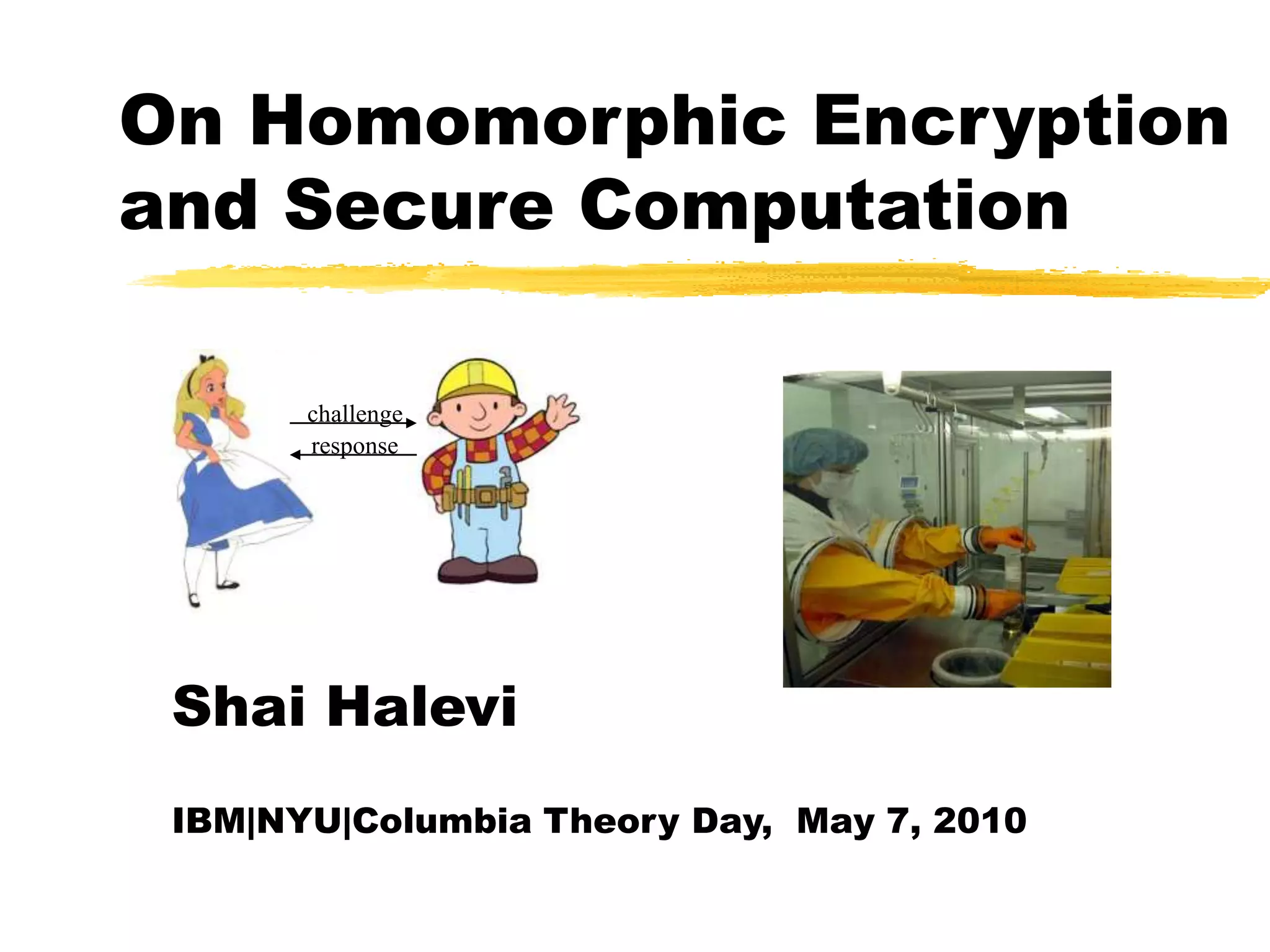
challenge
response
Shai Halevi
IBM|NYU|Columbia Theory Day, May 7, 2010
May 7, 2010 IBM|NYU|Columbia Theory Day 2
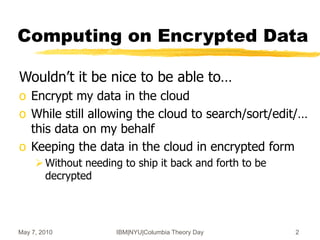
Computing on Encrypted Data
Wouldn’t it be nice to be able to…
o Encrypt my data in the cloud
o While still allowing the cloud to search/sort/edit/…
this data on my behalf
o Keeping the data in the cloud in encrypted form
Without needing to ship it back and forth to be
decrypted
May 7, 2010 IBM|NYU|Columbia Theory Day 3
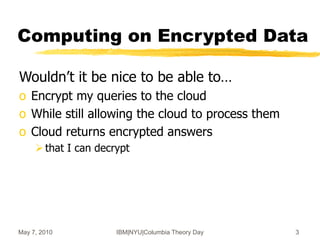
Computing on Encrypted Data
Wouldn’t it be nice to be able to…
o Encrypt my queries to the cloud
o While still allowing the cloud to process them
o Cloud returns encrypted answers
that I can decrypt
May 7, 2010 IBM|NYU|Columbia Theory Day 4
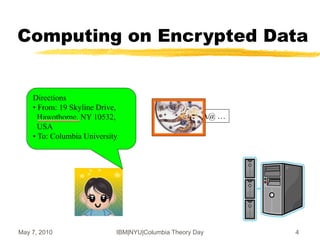
$skj#hS28ksytA@ …
Computing on Encrypted Data
Directions
• From: 19 Skyline Drive,
Hawothorne, NY 10532,
USA
• To: Columbia University
May 7, 2010 IBM|NYU|Columbia Theory Day 5
Computing on Encrypted Data
$kjh9*mslt@na0
&maXxjq02bflx
m^00a2nm5,A4.
pE.abxp3m58bsa
(3saM%w,snanba
nq~mD=3akm2,A
Z,ltnhde83|3mz{n
dewiunb4]gnbTa*
kjew^bwJ^mdns0
typo
Part I:
Constructing
Homomorphic Encryption
May 7, 2010 IBM|NYU|Columbia Theory Day 7
Privacy Homomorphisms [RAD78]
Some examples:
o “Raw RSA”: c  xe mod N (x  cd mod N)
x1
e x x2
e = (x1 x x2)e mod N
o GM84: Enc(0)R QR, Enc(1)R QNR (in ZN*)
Enc(x1) x Enc(x2) = Enc(x1x2) mod N
Plaintext space P Ciphertext space C
x1 x2
ci  Enc(xi) c1 c2
* #
y d
y  Dec(d)
May 7, 2010 IBM|NYU|Columbia Theory Day 8
More Privacy Homomorphisms
o Mult-mod-p [ElGamal’84]
o Add-mod-N [Pallier’98]
o NC1 circuits [SYY’00]
o Quadratic-polys mod p [BGN’06]
o Poly-size branching programs [IP’07]
o See Part II for a “different type of solution”
for any poly-size circuit [Yao’82,…]
May 7, 2010 IBM|NYU|Columbia Theory Day 9
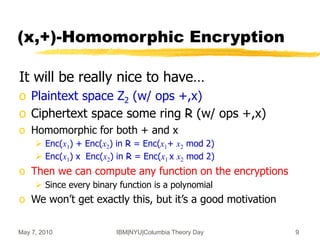
(x,+)-Homomorphic Encryption
It will be really nice to have…
o Plaintext space Z2 (w/ ops +,x)
o Ciphertext space some ring R (w/ ops +,x)
o Homomorphic for both + and x
 Enc(x1) + Enc(x2) in R = Enc(x1+ x2 mod 2)
 Enc(x1) x Enc(x2) in R = Enc(x1 x x2 mod 2)
o Then we can compute any function on the encryptions
 Since every binary function is a polynomial
o We won’t get exactly this, but it’s a good motivation
May 7, 2010 IBM|NYU|Columbia Theory Day 10
Some Notations
o An encryption scheme: (KeyGen, Enc, Dec)
Plaintext-space = {0,1}
(pk,sk) KeyGen($), cEncpk(b), bDecsk(c)
o Semantic security [GM’84]:
(pk, Encpk(0))  (pk, Encpk(1))
 means indistinguishable by efficient algorithms
May 7, 2010 IBM|NYU|Columbia Theory Day 11
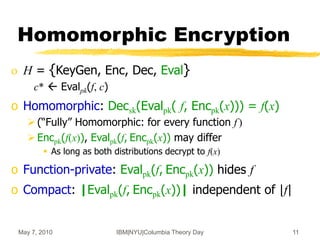
o H = {KeyGen, Enc, Dec, Eval}
c*  Evalpk(f, c)
o Homomorphic: Decsk(Evalpk( f, Encpk(x))) = f(x)
(“Fully” Homomorphic: for every function f )
Encpk(f(x)), Evalpk(f, Encpk(x)) may differ
 As long as both distributions decrypt to f(x)
o Function-private: Evalpk(f, Encpk(x)) hides f
o Compact: |Evalpk(f, Encpk(x))| independent of |f|
Homomorphic Encryption
May 7, 2010 IBM|NYU|Columbia Theory Day 12
(x,+)-Homomorphic Encryption,
the Gentry Way [G’09]
Evaluate any function in four “easy” steps
o Step 1: Encryption from linear ECCs
Additive homomorphism
o Step 2: ECC lives inside a ring
Also multiplicative homomorphism
But only for a few operations (i.e., low-degree poly’s)
o Step 3: Bootstrapping
Few ops (but not too few)  any number of ops
o Step 4: Everything else
May 7, 2010 IBM|NYU|Columbia Theory Day 13
Step One:
Encryption from Linear ECCs
o For “random looking” codes, hard to
distinguish close/far from code
o Many cryptosystems built on this hardness
E.g., [McEliece’78, AD’97, GGH’97, R’03,…]
May 7, 2010 IBM|NYU|Columbia Theory Day 14
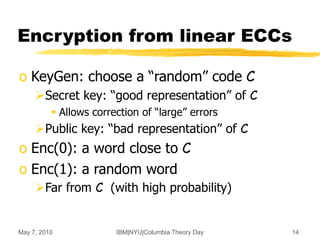
Encryption from linear ECCs
o KeyGen: choose a “random” code C
Secret key: “good representation” of C
 Allows correction of “large” errors
Public key: “bad representation” of C
o Enc(0): a word close to C
o Enc(1): a random word
Far from C (with high probability)
May 7, 2010 IBM|NYU|Columbia Theory Day 15
An Example: Integers mod p
(similar to [Regev’03])
o Code determined by an integer p
Codewords: multiples of p
o Good representation: p itself
o Bad representation:
N = pq, and also many many xi = pqi + ri
o Enc(0): subset-sum(xi’s)+r mod N
o Enc(1): random integer mod N
ri  p
p N
May 7, 2010 IBM|NYU|Columbia Theory Day 16
p is odd
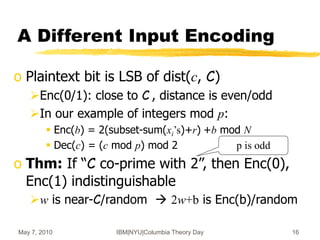
A Different Input Encoding
o Plaintext bit is LSB of dist(c, C)
Enc(0/1): close to C , distance is even/odd
In our example of integers mod p:
 Enc(b) = 2(subset-sum(xi’s)+r) +b mod N
 Dec(c) = (c mod p) mod 2
o Thm: If “C co-prime with 2”, then Enc(0),
Enc(1) indistinguishable
w is near-C/random  2w+b is Enc(b)/random
May 7, 2010 IBM|NYU|Columbia Theory Day 17
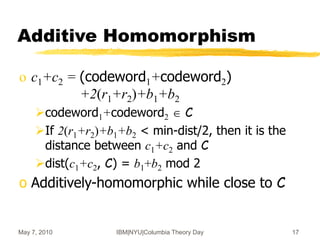
Additive Homomorphism
o c1+c2 = (codeword1+codeword2)
+2(r1+r2)+b1+b2
codeword1+codeword2  C
If 2(r1+r2)+b1+b2 < min-dist/2, then it is the
distance between c1+c2 and C
dist(c1+c2, C) = b1+b2 mod 2
o Additively-homomorphic while close to C
May 7, 2010 IBM|NYU|Columbia Theory Day 18
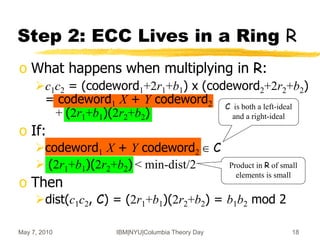
Step 2: ECC Lives in a Ring R
o What happens when multiplying in R:
c1c2 = (codeword1+2r1+b1) x (codeword2+2r2+b2)
= codeword1 X + Y codeword2
+ (2r1+b1)(2r2+b2)
o If:
codeword1 X + Y codeword2  C
 (2r1+b1)(2r2+b2) < min-dist/2
o Then
dist(c1c2, C) = (2r1+b1)(2r2+b2) = b1b2 mod 2
C is both a left-ideal
and a right-ideal
Product in R of small
elements is small
May 7, 2010 IBM|NYU|Columbia Theory Day 19
Integers Rings [vDGHV’10]
o Recall mod-p scheme: ci = qip + 2ri+bi (mod N=qp)
Parameters: |ri|=n, |p|=n2, |q|=|qi|=n5
o c1+c2 mod N = (q1+q2-kq)p + 2(r1+r2)+(b1+b2)
sum mod p = 2(r1+r2) + (b1+b2)
o c1 x c2 mod N = (c1q2+q1c2-q1q2-kq)p
+ 2(2r1r2+r1m2+m1r2) + b1b2
product mod p = 2(2r1r2+…) + b1b2
o Can evaluate polynomials of degree ~ n
before the distance from C exceeds p/2
May 7, 2010 IBM|NYU|Columbia Theory Day 20
Integers Rings [vDGHV’10]
Thm: “Approximate GCD” is hard
 Enc(0), Enc(1) are indistinguishable
o Apprixmate-GCD: Given N=qp and many
xi = pqi + ri, hard to recover p
May 7, 2010 IBM|NYU|Columbia Theory Day 21
Polynomial Rings [G’09]
o R = polynomial ring modulo some f(x)
E.g., f(x) = xn +1
o C is an ideal in R
E.g., random g(x), Cg = { gxh mod f : h  R }
 C is also a lattice
Good representation: g itself
Bad representation: Hermite-Normal-Form
o If g has t-bit coefficients, can evaluate
polynomials of degree O(t/log n)
May 7, 2010 IBM|NYU|Columbia Theory Day 22
Polynomial Rings [G’09]
Thm: Bounded-Distance Decoding in ideal
lattices is hard  Enc(0), Enc(1) are
indistinguishable
o Bounded-Distance-Decoding: Given x close
to the lattice, find dist(x, lattice)
May 7, 2010 IBM|NYU|Columbia Theory Day 23
Matrix Rings* [GHV’10]
o R = ring of mxm matrices over Zq
 q = poly(n), m > n log q (n security-parameter)
o C has low-rank matrices mod q (rank=n)
A is a random nxm matrix, CA = { AX : XR }
Bad representation: A itself
Good representation: full rank Tmxm (over Z),
small entries, TA = 0 mod q
• Problem: CA is left-ideal, but not right-ideal
• Can still evaluate quadratic formulas, no more
*Doesn’t quite fit the mold
May 7, 2010 IBM|NYU|Columbia Theory Day 24
Matrix Rings* [GHV’10]
Thm: Learning with Errors hard
 Enc(0), Enc(1) are indistinguishable
o Learning with Errors: Given A, Ax+e
(random A,x, small error e), find x
*Doesn’t quite fit the mold
May 7, 2010 IBM|NYU|Columbia Theory Day 25
Step 3: Bootstrapping [G’09]
o So far, can evaluate low-degree polynomials
P(x1, x2 ,…, xt)
x1
…
x2
xt
P
May 7, 2010 IBM|NYU|Columbia Theory Day 26
Step 3: Bootstrapping [G’09]
o So far, can evaluate low-degree polynomials
o Can eval y=P(x1,x2…,xn) when xi’s are “fresh”
o But y is an “evaluated ciphertext”
Can still be decrypted
But eval Q(y) will increase noise too much
P(x1, x2 ,…, xt)
x1
…
x2
xt
P
May 7, 2010 IBM|NYU|Columbia Theory Day 27
Step 3: Bootstrapping [G’09]
o So far, can evaluate low-degree polynomials
o Bootstrapping to handle higher degrees:
o For ciphertext c, consider Dc(sk) = Decsk(c)
Hope: Dc(*) is a low-degree polynomial in sk
Then so are Ac1,c2(sk) = Decsk(c1) + Decsk(c2)
and Mc1,c2(sk) = Decsk(c1) x Decsk(c2)
x1
…
x2
xt
P
P(x1, x2 ,…, xt)
May 7, 2010 IBM|NYU|Columbia Theory Day 28
Mc1,c2
Step 3: Bootstrapping [G’09]
o Include in the public key also Encpk(sk)
x1 x2
sk1
sk2
skn
…
c1 c2
Mc1,c2(sk)
= Decsk(c1) x Decsk(c2) = x1 x x2
c
Requires
“circular
security”
May 7, 2010 IBM|NYU|Columbia Theory Day 29
Mc1,c2
Step 3: Bootstrapping [G’09]
o Include in the public key also Encpk(sk)
o Homomorphic computation applied only to
the “fresh” encryption of sk
x1 x2
sk1
sk2
skn
…
c1 c2
Mc1,c2(sk)
= Decsk(c1) x Decsk(c2) = x1 x x2
c
Requires
“circular
security”
May 7, 2010 IBM|NYU|Columbia Theory Day 30
Step 4: Everything Else
o Cryptosystems from [G’09, vDGHV’10]
cannot handle their own decryption as-is
o Apply some tricks to “squash” the
decryption procedure
Part II:
Homomorphic Encryption
vs. Secure Computation
May 7, 2010 IBM|NYU|Columbia Theory Day 32
Client Alice has data x
Server Bob has function f
Alice wants to learn f(x)
1. Without telling Bob what x is
2. Bob may not want Alice to know f
3. Client Alice may also want server Bob
to do most of the work computing f(x)
Secure Function Evaluation (SFE)
May 7, 2010 IBM|NYU|Columbia Theory Day 33
Two-Message SFE [Yao’82,…]
o Many different instantiations are available
Based on hardness of factoring/DL/lattices/…
o Alice’s x and Bob’s f are kept private
o But Alice does as much work as Bob
Bob’s reply of size poly(n) x (|f|+|x|)
(c,s)SFE1(x)
r SFE2(f,c)
r
y SFE3(s,r)
c
Alice(x) Bob(f)
May 7, 2010 IBM|NYU|Columbia Theory Day 34
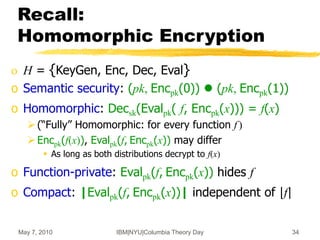
o H = {KeyGen, Enc, Dec, Eval}
o Semantic security: (pk, Encpk(0))  (pk, Encpk(1))
o Homomorphic: Decsk(Evalpk( f, Encpk(x))) = f(x)
(“Fully” Homomorphic: for every function f )
Encpk(f(x)), Evalpk(f, Encpk(x)) may differ
 As long as both distributions decrypt to f(x)
o Function-private: Evalpk(f, Encpk(x)) hides f
o Compact: |Evalpk(f, Encpk(x))| independent of |f|
Recall:
Homomorphic Encryption
May 7, 2010 IBM|NYU|Columbia Theory Day 35
Aside: a Trivial Solution
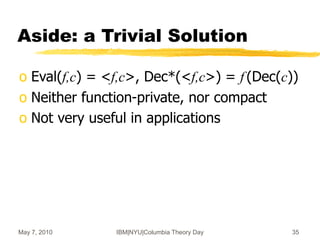
o Eval(f,c) = <f,c>, Dec*(<f,c>) = f (Dec(c))
o Neither function-private, nor compact
o Not very useful in applications
May 7, 2010 IBM|NYU|Columbia Theory Day 36
HE  Two-Message SFE
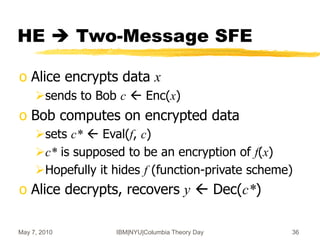
o Alice encrypts data x
sends to Bob c  Enc(x)
o Bob computes on encrypted data
sets c*  Eval(f, c)
c* is supposed to be an encryption of f(x)
Hopefully it hides f (function-private scheme)
o Alice decrypts, recovers y  Dec(c*)
May 7, 2010 IBM|NYU|Columbia Theory Day 37
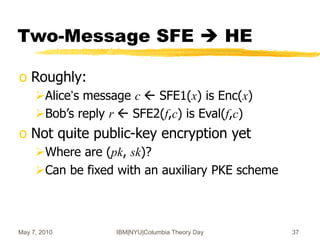
Two-Message SFE  HE
o Roughly:
Alice’s message c  SFE1(x) is Enc(x)
Bob’s reply r  SFE2(f,c) is Eval(f,c)
o Not quite public-key encryption yet
Where are (pk, sk)?
Can be fixed with an auxiliary PKE scheme
May 7, 2010 IBM|NYU|Columbia Theory Day 38
Alice(x)
Two-Message SFE  HE
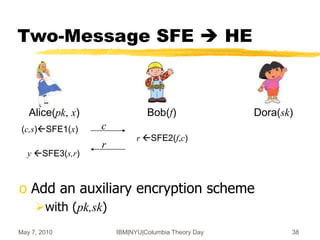
o Add an auxiliary encryption scheme
with (pk,sk)
Alice(pk, x) Bob(f)
(c,s)SFE1(x)
r SFE2(f,c)
r
y SFE3(s,r)
c
Dora(sk)
May 7, 2010 IBM|NYU|Columbia Theory Day 39
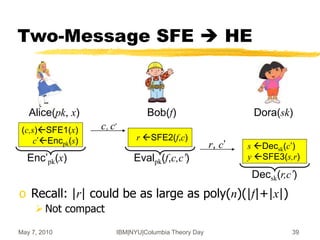
Two-Message SFE  HE
o Recall: |r| could be as large as poly(n)(|f|+|x|)
Not compact
Alice(pk, x) Bob(f) Dora(sk)
Decsk(r,c’)
Evalpk(f,c,c’)
Enc’pk(x)
c, c’
r, c’
(c,s)SFE1(x)
c’Encpk(s) r SFE2(f,c)
s Decsk(c’)
y SFE3(s,r)
May 7, 2010 IBM|NYU|Columbia Theory Day 40
A More Complex Setting:
i-Hop HE [GHV10b]
o c1 is not a fresh ciphertext
May look completely different
o Can Charlie process it at all?
What about security?
Alice(x) Bob(f) Charlie(g) Dora(sk)
c0Enc(x) c1Eval(f,c0) c2Eval(g,c1) yDec(c2)
c0 c1 c2
2-Hop Homomorphic Encryption
May 7, 2010 IBM|NYU|Columbia Theory Day 41
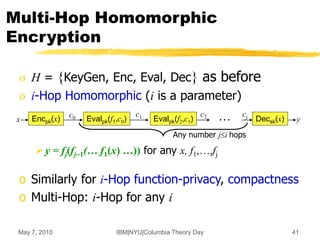
Multi-Hop Homomorphic
Encryption
o H = {KeyGen, Enc, Eval, Dec} as before
o i-Hop Homomorphic (i is a parameter)
y = fj(fj-1(… f1(x) …)) for any x, f1,…,fj
o Similarly for i-Hop function-privacy, compactness
o Multi-Hop: i-Hop for any i
Evalpk(f1,c0)
Encpk(x) Evalpk(f2,c1) Decsk(x)
c0
c1 c2 cj
y
x …
Any number ji hops
May 7, 2010 IBM|NYU|Columbia Theory Day 42
1-Hop  multi-Hop HE
o (KeyGen,Enc,Eval,Dec) is 1-Hop HE
Can evaluate any single function on ctxt
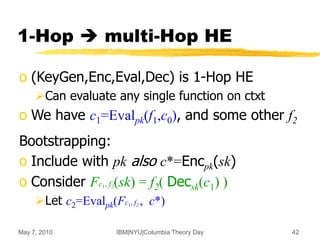
o We have c1=Evalpk(f1,c0), and some other f2
Bootstrapping:
o Include with pk also c*=Encpk(sk)
o Consider Fc1, f2(sk) = f2( Decsk(c1) )
Let c2=Evalpk(Fc1, f2 , c*)
May 7, 2010 IBM|NYU|Columbia Theory Day 43
Fci-1, fi
1-Hop  multi-Hop HE
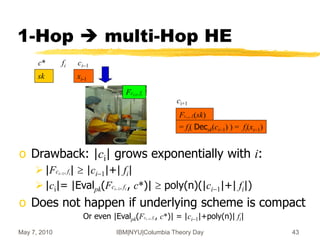
o Drawback: |ci| grows exponentially with i:
|Fci-1, fi|  |ci-1|+| fi|
|ci|= |Evalpk(Fci-1, fi , c*)|  poly(n)(|ci-1|+| fi|)
o Does not happen if underlying scheme is compact
Or even |Evalpk(Fci-1, fi , c*)| = |ci-1|+poly(n)| fi|
xi-1
sk
ci-1
fi
Fci-1, fi(sk)
ci+1
= fi( Decsk(ci-1) ) = fi(xi-1)
c*
May 7, 2010 IBM|NYU|Columbia Theory Day 44
Other Constructions
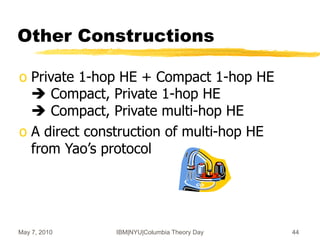
o Private 1-hop HE + Compact 1-hop HE
 Compact, Private 1-hop HE
 Compact, Private multi-hop HE
o A direct construction of multi-hop HE
from Yao’s protocol
May 7, 2010 IBM|NYU|Columbia Theory Day 45
Summary
o Homomorphic Encryption is useful
Especially multi-hop HE
o A method for constructing HE schemes
from linear ECCs in rings
Two (+e) known instances so far
o Connection to two-message protocols for
secure computation
Thank You

On-Homomorphic-Encryption-and-Secure-Computation.ppt

  • 1.
    On Homomorphic Encryption andSecure Computation challenge response Shai Halevi IBM|NYU|Columbia Theory Day, May 7, 2010
  • 2.
    May 7, 2010IBM|NYU|Columbia Theory Day 2 Computing on Encrypted Data Wouldn’t it be nice to be able to… o Encrypt my data in the cloud o While still allowing the cloud to search/sort/edit/… this data on my behalf o Keeping the data in the cloud in encrypted form Without needing to ship it back and forth to be decrypted
  • 3.
    May 7, 2010IBM|NYU|Columbia Theory Day 3 Computing on Encrypted Data Wouldn’t it be nice to be able to… o Encrypt my queries to the cloud o While still allowing the cloud to process them o Cloud returns encrypted answers that I can decrypt
  • 4.
    May 7, 2010IBM|NYU|Columbia Theory Day 4 $skj#hS28ksytA@ … Computing on Encrypted Data Directions • From: 19 Skyline Drive, Hawothorne, NY 10532, USA • To: Columbia University
  • 5.
    May 7, 2010IBM|NYU|Columbia Theory Day 5 Computing on Encrypted Data $kjh9*mslt@na0 &maXxjq02bflx m^00a2nm5,A4. pE.abxp3m58bsa (3saM%w,snanba nq~mD=3akm2,A Z,ltnhde83|3mz{n dewiunb4]gnbTa* kjew^bwJ^mdns0 typo
  • 6.
  • 7.
    May 7, 2010IBM|NYU|Columbia Theory Day 7 Privacy Homomorphisms [RAD78] Some examples: o “Raw RSA”: c  xe mod N (x  cd mod N) x1 e x x2 e = (x1 x x2)e mod N o GM84: Enc(0)R QR, Enc(1)R QNR (in ZN*) Enc(x1) x Enc(x2) = Enc(x1x2) mod N Plaintext space P Ciphertext space C x1 x2 ci  Enc(xi) c1 c2 * # y d y  Dec(d)
  • 8.
    May 7, 2010IBM|NYU|Columbia Theory Day 8 More Privacy Homomorphisms o Mult-mod-p [ElGamal’84] o Add-mod-N [Pallier’98] o NC1 circuits [SYY’00] o Quadratic-polys mod p [BGN’06] o Poly-size branching programs [IP’07] o See Part II for a “different type of solution” for any poly-size circuit [Yao’82,…]
  • 9.
    May 7, 2010IBM|NYU|Columbia Theory Day 9 (x,+)-Homomorphic Encryption It will be really nice to have… o Plaintext space Z2 (w/ ops +,x) o Ciphertext space some ring R (w/ ops +,x) o Homomorphic for both + and x  Enc(x1) + Enc(x2) in R = Enc(x1+ x2 mod 2)  Enc(x1) x Enc(x2) in R = Enc(x1 x x2 mod 2) o Then we can compute any function on the encryptions  Since every binary function is a polynomial o We won’t get exactly this, but it’s a good motivation
  • 10.
    May 7, 2010IBM|NYU|Columbia Theory Day 10 Some Notations o An encryption scheme: (KeyGen, Enc, Dec) Plaintext-space = {0,1} (pk,sk) KeyGen($), cEncpk(b), bDecsk(c) o Semantic security [GM’84]: (pk, Encpk(0))  (pk, Encpk(1))  means indistinguishable by efficient algorithms
  • 11.
    May 7, 2010IBM|NYU|Columbia Theory Day 11 o H = {KeyGen, Enc, Dec, Eval} c*  Evalpk(f, c) o Homomorphic: Decsk(Evalpk( f, Encpk(x))) = f(x) (“Fully” Homomorphic: for every function f ) Encpk(f(x)), Evalpk(f, Encpk(x)) may differ  As long as both distributions decrypt to f(x) o Function-private: Evalpk(f, Encpk(x)) hides f o Compact: |Evalpk(f, Encpk(x))| independent of |f| Homomorphic Encryption
  • 12.
    May 7, 2010IBM|NYU|Columbia Theory Day 12 (x,+)-Homomorphic Encryption, the Gentry Way [G’09] Evaluate any function in four “easy” steps o Step 1: Encryption from linear ECCs Additive homomorphism o Step 2: ECC lives inside a ring Also multiplicative homomorphism But only for a few operations (i.e., low-degree poly’s) o Step 3: Bootstrapping Few ops (but not too few)  any number of ops o Step 4: Everything else
  • 13.
    May 7, 2010IBM|NYU|Columbia Theory Day 13 Step One: Encryption from Linear ECCs o For “random looking” codes, hard to distinguish close/far from code o Many cryptosystems built on this hardness E.g., [McEliece’78, AD’97, GGH’97, R’03,…]
  • 14.
    May 7, 2010IBM|NYU|Columbia Theory Day 14 Encryption from linear ECCs o KeyGen: choose a “random” code C Secret key: “good representation” of C  Allows correction of “large” errors Public key: “bad representation” of C o Enc(0): a word close to C o Enc(1): a random word Far from C (with high probability)
  • 15.
    May 7, 2010IBM|NYU|Columbia Theory Day 15 An Example: Integers mod p (similar to [Regev’03]) o Code determined by an integer p Codewords: multiples of p o Good representation: p itself o Bad representation: N = pq, and also many many xi = pqi + ri o Enc(0): subset-sum(xi’s)+r mod N o Enc(1): random integer mod N ri  p p N
  • 16.
    May 7, 2010IBM|NYU|Columbia Theory Day 16 p is odd A Different Input Encoding o Plaintext bit is LSB of dist(c, C) Enc(0/1): close to C , distance is even/odd In our example of integers mod p:  Enc(b) = 2(subset-sum(xi’s)+r) +b mod N  Dec(c) = (c mod p) mod 2 o Thm: If “C co-prime with 2”, then Enc(0), Enc(1) indistinguishable w is near-C/random  2w+b is Enc(b)/random
  • 17.
    May 7, 2010IBM|NYU|Columbia Theory Day 17 Additive Homomorphism o c1+c2 = (codeword1+codeword2) +2(r1+r2)+b1+b2 codeword1+codeword2  C If 2(r1+r2)+b1+b2 < min-dist/2, then it is the distance between c1+c2 and C dist(c1+c2, C) = b1+b2 mod 2 o Additively-homomorphic while close to C
  • 18.
    May 7, 2010IBM|NYU|Columbia Theory Day 18 Step 2: ECC Lives in a Ring R o What happens when multiplying in R: c1c2 = (codeword1+2r1+b1) x (codeword2+2r2+b2) = codeword1 X + Y codeword2 + (2r1+b1)(2r2+b2) o If: codeword1 X + Y codeword2  C  (2r1+b1)(2r2+b2) < min-dist/2 o Then dist(c1c2, C) = (2r1+b1)(2r2+b2) = b1b2 mod 2 C is both a left-ideal and a right-ideal Product in R of small elements is small
  • 19.
    May 7, 2010IBM|NYU|Columbia Theory Day 19 Integers Rings [vDGHV’10] o Recall mod-p scheme: ci = qip + 2ri+bi (mod N=qp) Parameters: |ri|=n, |p|=n2, |q|=|qi|=n5 o c1+c2 mod N = (q1+q2-kq)p + 2(r1+r2)+(b1+b2) sum mod p = 2(r1+r2) + (b1+b2) o c1 x c2 mod N = (c1q2+q1c2-q1q2-kq)p + 2(2r1r2+r1m2+m1r2) + b1b2 product mod p = 2(2r1r2+…) + b1b2 o Can evaluate polynomials of degree ~ n before the distance from C exceeds p/2
  • 20.
    May 7, 2010IBM|NYU|Columbia Theory Day 20 Integers Rings [vDGHV’10] Thm: “Approximate GCD” is hard  Enc(0), Enc(1) are indistinguishable o Apprixmate-GCD: Given N=qp and many xi = pqi + ri, hard to recover p
  • 21.
    May 7, 2010IBM|NYU|Columbia Theory Day 21 Polynomial Rings [G’09] o R = polynomial ring modulo some f(x) E.g., f(x) = xn +1 o C is an ideal in R E.g., random g(x), Cg = { gxh mod f : h  R }  C is also a lattice Good representation: g itself Bad representation: Hermite-Normal-Form o If g has t-bit coefficients, can evaluate polynomials of degree O(t/log n)
  • 22.
    May 7, 2010IBM|NYU|Columbia Theory Day 22 Polynomial Rings [G’09] Thm: Bounded-Distance Decoding in ideal lattices is hard  Enc(0), Enc(1) are indistinguishable o Bounded-Distance-Decoding: Given x close to the lattice, find dist(x, lattice)
  • 23.
    May 7, 2010IBM|NYU|Columbia Theory Day 23 Matrix Rings* [GHV’10] o R = ring of mxm matrices over Zq  q = poly(n), m > n log q (n security-parameter) o C has low-rank matrices mod q (rank=n) A is a random nxm matrix, CA = { AX : XR } Bad representation: A itself Good representation: full rank Tmxm (over Z), small entries, TA = 0 mod q • Problem: CA is left-ideal, but not right-ideal • Can still evaluate quadratic formulas, no more *Doesn’t quite fit the mold
  • 24.
    May 7, 2010IBM|NYU|Columbia Theory Day 24 Matrix Rings* [GHV’10] Thm: Learning with Errors hard  Enc(0), Enc(1) are indistinguishable o Learning with Errors: Given A, Ax+e (random A,x, small error e), find x *Doesn’t quite fit the mold
  • 25.
    May 7, 2010IBM|NYU|Columbia Theory Day 25 Step 3: Bootstrapping [G’09] o So far, can evaluate low-degree polynomials P(x1, x2 ,…, xt) x1 … x2 xt P
  • 26.
    May 7, 2010IBM|NYU|Columbia Theory Day 26 Step 3: Bootstrapping [G’09] o So far, can evaluate low-degree polynomials o Can eval y=P(x1,x2…,xn) when xi’s are “fresh” o But y is an “evaluated ciphertext” Can still be decrypted But eval Q(y) will increase noise too much P(x1, x2 ,…, xt) x1 … x2 xt P
  • 27.
    May 7, 2010IBM|NYU|Columbia Theory Day 27 Step 3: Bootstrapping [G’09] o So far, can evaluate low-degree polynomials o Bootstrapping to handle higher degrees: o For ciphertext c, consider Dc(sk) = Decsk(c) Hope: Dc(*) is a low-degree polynomial in sk Then so are Ac1,c2(sk) = Decsk(c1) + Decsk(c2) and Mc1,c2(sk) = Decsk(c1) x Decsk(c2) x1 … x2 xt P P(x1, x2 ,…, xt)
  • 28.
    May 7, 2010IBM|NYU|Columbia Theory Day 28 Mc1,c2 Step 3: Bootstrapping [G’09] o Include in the public key also Encpk(sk) x1 x2 sk1 sk2 skn … c1 c2 Mc1,c2(sk) = Decsk(c1) x Decsk(c2) = x1 x x2 c Requires “circular security”
  • 29.
    May 7, 2010IBM|NYU|Columbia Theory Day 29 Mc1,c2 Step 3: Bootstrapping [G’09] o Include in the public key also Encpk(sk) o Homomorphic computation applied only to the “fresh” encryption of sk x1 x2 sk1 sk2 skn … c1 c2 Mc1,c2(sk) = Decsk(c1) x Decsk(c2) = x1 x x2 c Requires “circular security”
  • 30.
    May 7, 2010IBM|NYU|Columbia Theory Day 30 Step 4: Everything Else o Cryptosystems from [G’09, vDGHV’10] cannot handle their own decryption as-is o Apply some tricks to “squash” the decryption procedure
  • 31.
  • 32.
    May 7, 2010IBM|NYU|Columbia Theory Day 32 Client Alice has data x Server Bob has function f Alice wants to learn f(x) 1. Without telling Bob what x is 2. Bob may not want Alice to know f 3. Client Alice may also want server Bob to do most of the work computing f(x) Secure Function Evaluation (SFE)
  • 33.
    May 7, 2010IBM|NYU|Columbia Theory Day 33 Two-Message SFE [Yao’82,…] o Many different instantiations are available Based on hardness of factoring/DL/lattices/… o Alice’s x and Bob’s f are kept private o But Alice does as much work as Bob Bob’s reply of size poly(n) x (|f|+|x|) (c,s)SFE1(x) r SFE2(f,c) r y SFE3(s,r) c Alice(x) Bob(f)
  • 34.
    May 7, 2010IBM|NYU|Columbia Theory Day 34 o H = {KeyGen, Enc, Dec, Eval} o Semantic security: (pk, Encpk(0))  (pk, Encpk(1)) o Homomorphic: Decsk(Evalpk( f, Encpk(x))) = f(x) (“Fully” Homomorphic: for every function f ) Encpk(f(x)), Evalpk(f, Encpk(x)) may differ  As long as both distributions decrypt to f(x) o Function-private: Evalpk(f, Encpk(x)) hides f o Compact: |Evalpk(f, Encpk(x))| independent of |f| Recall: Homomorphic Encryption
  • 35.
    May 7, 2010IBM|NYU|Columbia Theory Day 35 Aside: a Trivial Solution o Eval(f,c) = <f,c>, Dec*(<f,c>) = f (Dec(c)) o Neither function-private, nor compact o Not very useful in applications
  • 36.
    May 7, 2010IBM|NYU|Columbia Theory Day 36 HE  Two-Message SFE o Alice encrypts data x sends to Bob c  Enc(x) o Bob computes on encrypted data sets c*  Eval(f, c) c* is supposed to be an encryption of f(x) Hopefully it hides f (function-private scheme) o Alice decrypts, recovers y  Dec(c*)
  • 37.
    May 7, 2010IBM|NYU|Columbia Theory Day 37 Two-Message SFE  HE o Roughly: Alice’s message c  SFE1(x) is Enc(x) Bob’s reply r  SFE2(f,c) is Eval(f,c) o Not quite public-key encryption yet Where are (pk, sk)? Can be fixed with an auxiliary PKE scheme
  • 38.
    May 7, 2010IBM|NYU|Columbia Theory Day 38 Alice(x) Two-Message SFE  HE o Add an auxiliary encryption scheme with (pk,sk) Alice(pk, x) Bob(f) (c,s)SFE1(x) r SFE2(f,c) r y SFE3(s,r) c Dora(sk)
  • 39.
    May 7, 2010IBM|NYU|Columbia Theory Day 39 Two-Message SFE  HE o Recall: |r| could be as large as poly(n)(|f|+|x|) Not compact Alice(pk, x) Bob(f) Dora(sk) Decsk(r,c’) Evalpk(f,c,c’) Enc’pk(x) c, c’ r, c’ (c,s)SFE1(x) c’Encpk(s) r SFE2(f,c) s Decsk(c’) y SFE3(s,r)
  • 40.
    May 7, 2010IBM|NYU|Columbia Theory Day 40 A More Complex Setting: i-Hop HE [GHV10b] o c1 is not a fresh ciphertext May look completely different o Can Charlie process it at all? What about security? Alice(x) Bob(f) Charlie(g) Dora(sk) c0Enc(x) c1Eval(f,c0) c2Eval(g,c1) yDec(c2) c0 c1 c2 2-Hop Homomorphic Encryption
  • 41.
    May 7, 2010IBM|NYU|Columbia Theory Day 41 Multi-Hop Homomorphic Encryption o H = {KeyGen, Enc, Eval, Dec} as before o i-Hop Homomorphic (i is a parameter) y = fj(fj-1(… f1(x) …)) for any x, f1,…,fj o Similarly for i-Hop function-privacy, compactness o Multi-Hop: i-Hop for any i Evalpk(f1,c0) Encpk(x) Evalpk(f2,c1) Decsk(x) c0 c1 c2 cj y x … Any number ji hops
  • 42.
    May 7, 2010IBM|NYU|Columbia Theory Day 42 1-Hop  multi-Hop HE o (KeyGen,Enc,Eval,Dec) is 1-Hop HE Can evaluate any single function on ctxt o We have c1=Evalpk(f1,c0), and some other f2 Bootstrapping: o Include with pk also c*=Encpk(sk) o Consider Fc1, f2(sk) = f2( Decsk(c1) ) Let c2=Evalpk(Fc1, f2 , c*)
  • 43.
    May 7, 2010IBM|NYU|Columbia Theory Day 43 Fci-1, fi 1-Hop  multi-Hop HE o Drawback: |ci| grows exponentially with i: |Fci-1, fi|  |ci-1|+| fi| |ci|= |Evalpk(Fci-1, fi , c*)|  poly(n)(|ci-1|+| fi|) o Does not happen if underlying scheme is compact Or even |Evalpk(Fci-1, fi , c*)| = |ci-1|+poly(n)| fi| xi-1 sk ci-1 fi Fci-1, fi(sk) ci+1 = fi( Decsk(ci-1) ) = fi(xi-1) c*
  • 44.
    May 7, 2010IBM|NYU|Columbia Theory Day 44 Other Constructions o Private 1-hop HE + Compact 1-hop HE  Compact, Private 1-hop HE  Compact, Private multi-hop HE o A direct construction of multi-hop HE from Yao’s protocol
  • 45.
    May 7, 2010IBM|NYU|Columbia Theory Day 45 Summary o Homomorphic Encryption is useful Especially multi-hop HE o A method for constructing HE schemes from linear ECCs in rings Two (+e) known instances so far o Connection to two-message protocols for secure computation
  • 46.