For any Exam related queries, Call us at : - +1 678 648 4277
You can mail us at : - support@programmingexamhelp.com or
reach us at : - https://www.programmingexamhelp.com
Problem 1. Hash Practice
(a) Insert integer keys A = [47, 61, 36, 52, 56, 33, 92] in order into a hash table of size 7
using the hash function h(k) = (10k + 4) mod 7. Each slot of the hash table stores a
linked list of the keys hashing to that slot, with later insertions being appended to the
end of the list. Draw a picture of the hash table after all keys have been inserted.
Solution:
programmingexamhelp.com
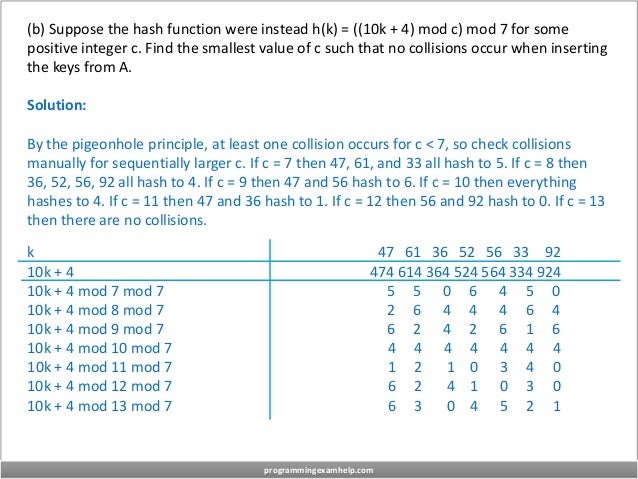
(b) Suppose the hash function were instead h(k) = ((10k + 4) mod c) mod 7 for some
positive integer c. Find the smallest value of c such that no collisions occur when inserting
the keys from A.
Solution:
By the pigeonhole principle, at least one collision occurs for c < 7, so check collisions
manually for sequentially larger c. If c = 7 then 47, 61, and 33 all hash to 5. If c = 8 then
36, 52, 56, 92 all hash to 4. If c = 9 then 47 and 56 hash to 6. If c = 10 then everything
hashes to 4. If c = 11 then 47 and 36 hash to 1. If c = 12 then 56 and 92 hash to 0. If c = 13
then there are no collisions.
k 47 61 36 52 56 33 92
10k + 4 474 614 364 524 564 334 924
10k + 4 mod 7 mod 7 5 5 0 6 4 5 0
10k + 4 mod 8 mod 7 2 6 4 4 4 6 4
10k + 4 mod 9 mod 7 6 2 4 2 6 1 6
10k + 4 mod 10 mod 7 4 4 4 4 4 4 4
10k + 4 mod 11 mod 7 1 2 1 0 3 4 0
10k + 4 mod 12 mod 7 6 2 4 1 0 3 0
10k + 4 mod 13 mod 7 6 3 0 4 5 2 1
programmingexamhelp.com
The table above was generated using this python code:
1 A = [47, 61, 36, 52, 56, 33, 92]
2 for c in range(7, 100):
3 hashes = [((10 * k + 4) % c) % 7 for k in A]
4 print(’t’.join([str(h) for h in hashes]))
5 if len(set(hashes)) == 7: 6 break
Rubric:
• 3 point for c = 13
• Partial credit may be awarded if there is work shown of a correct approach that does not
yield the correct solution.
Problem 2.
Dorm Hashing MIT wants to assign 2n new students to n rooms, numbered 0 to n - 1, in
Pseudorandom Hall. Each MIT student will have an ID: a postive integer less than u, with u
2n. No two students can have the same ID, but new students are allowed to choose their
own IDs after the start of term.
MIT wants to find students quickly given their IDs, so will assign students to rooms by
programmingexamhelp.com
hashing their IDs to a room number. So as not to appear biased, MIT will publish a family
H of hash functions online before the start of term (before new students choose their
IDs), and then after students choose IDs, MIT will choose a rooming hash function
uniformly at random from H.
New MIT freshmen Rony Stark and Tiri Williams want to be roommates. For each hash
family below, show that either:
• Rony and Tiri can choose IDs k1 and k2 so as to guarantee that they’ll be roommates, or
• prove that no such choice is possible and compute the highest probability they could
possibly achieve of being roommates.
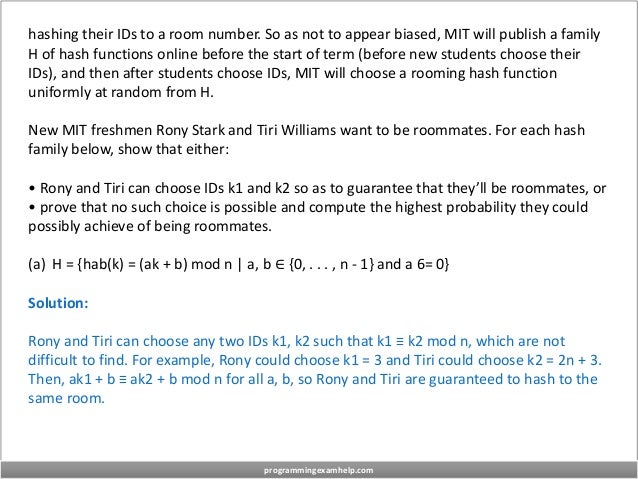
(a) H = {hab(k) = (ak + b) mod n | a, b ∈ {0, . . . , n - 1} and a 6= 0}
Solution:
Rony and Tiri can choose any two IDs k1, k2 such that k1 ≡ k2 mod n, which are not
difficult to find. For example, Rony could choose k1 = 3 and Tiri could choose k2 = 2n + 3.
Then, ak1 + b ≡ ak2 + b mod n for all a, b, so Rony and Tiri are guaranteed to hash to the
same room.
programmingexamhelp.com
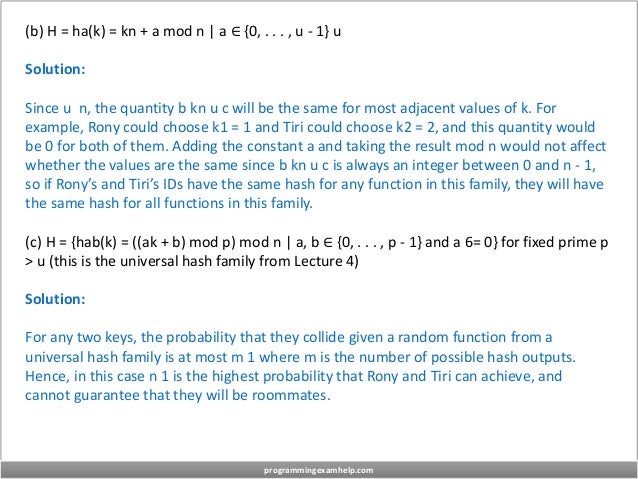
(b) H = ha(k) = kn + a mod n | a ∈ {0, . . . , u - 1} u
Solution:
Since u n, the quantity b kn u c will be the same for most adjacent values of k. For
example, Rony could choose k1 = 1 and Tiri could choose k2 = 2, and this quantity would
be 0 for both of them. Adding the constant a and taking the result mod n would not affect
whether the values are the same since b kn u c is always an integer between 0 and n - 1,
so if Rony’s and Tiri’s IDs have the same hash for any function in this family, they will have
the same hash for all functions in this family.
(c) H = {hab(k) = ((ak + b) mod p) mod n | a, b ∈ {0, . . . , p - 1} and a 6= 0} for fixed prime p
> u (this is the universal hash family from Lecture 4)
Solution:
For any two keys, the probability that they collide given a random function from a
universal hash family is at most m 1 where m is the number of possible hash outputs.
Hence, in this case n 1 is the highest probability that Rony and Tiri can achieve, and
cannot guarantee that they will be roommates.
programmingexamhelp.com
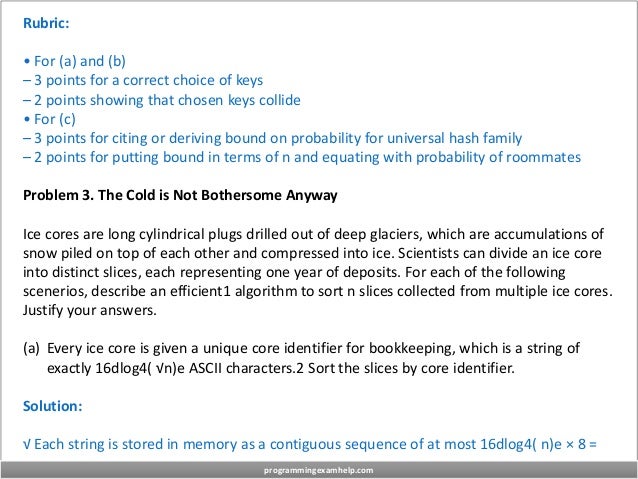
Rubric:
• For (a) and (b)
– 3 points for a correct choice of keys
– 2 points showing that chosen keys collide
• For (c)
– 3 points for citing or deriving bound on probability for universal hash family
– 2 points for putting bound in terms of n and equating with probability of roommates
Problem 3. The Cold is Not Bothersome Anyway
Ice cores are long cylindrical plugs drilled out of deep glaciers, which are accumulations of
snow piled on top of each other and compressed into ice. Scientists can divide an ice core
into distinct slices, each representing one year of deposits. For each of the following
scenerios, describe an efficient1 algorithm to sort n slices collected from multiple ice cores.
Justify your answers.
(a) Every ice core is given a unique core identifier for bookkeeping, which is a string of
exactly 16dlog4( √n)e ASCII characters.2 Sort the slices by core identifier.
Solution:
√ Each string is stored in memory as a contiguous sequence of at most 16dlog4( n)e × 8 =
programmingexamhelp.com
O(log n) bits. In the word-RAM, these bits can then be interpreted as an integer stored in a
constant number of machine words (since w ≥ lg n), n)e×8 33 33 upper bounded by
216dlog4( ) = √ < n , so we can sort them in Θ(n + n logn n Θ(n) time via radix sort.
(b) The deepest ice cores in the database are up to 800,000 years old. Sort the slices by
their age: the integer number of years since the slice was formed.
Solution:
The ages form a constant-bounded range [0, 8·105], so we can use counting sort to order
them in ascending order in worst-case Θ(8·105 +n) = Θ(n) time. (radix sort may also be
used)
(c) Variation in the amount of snowfall each year will cause a glacier to accumulate at
different rates over time. Sort the slices by thickness, a rational number of centimeters of
the form m/n3 between 0 and 4, where m is an integer.
Solution:
Multiplying by n3, these are integers m in a polynomially-bounded range [0, 4n3], so sort
them using Radix Sort in worst-case Θ(n + n logn n3) = Θ(n) time.
programmingexamhelp.com
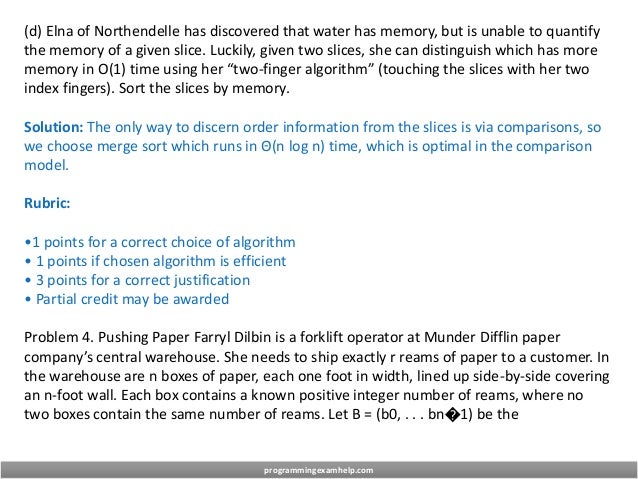
(d) Elna of Northendelle has discovered that water has memory, but is unable to quantify
the memory of a given slice. Luckily, given two slices, she can distinguish which has more
memory in O(1) time using her “two-finger algorithm” (touching the slices with her two
index fingers). Sort the slices by memory.
Solution: The only way to discern order information from the slices is via comparisons, so
we choose merge sort which runs in Θ(n log n) time, which is optimal in the comparison
model.
Rubric:
•1 points for a correct choice of algorithm
• 1 points if chosen algorithm is efficient
• 3 points for a correct justification
• Partial credit may be awarded
Problem 4. Pushing Paper Farryl Dilbin is a forklift operator at Munder Difflin paper
company’s central warehouse. She needs to ship exactly r reams of paper to a customer. In
the warehouse are n boxes of paper, each one foot in width, lined up side-by-side covering
an n-foot wall. Each box contains a known positive integer number of reams, where no
two boxes contain the same number of reams. Let B = (b0, . . . bn�1) be the
programmingexamhelp.com
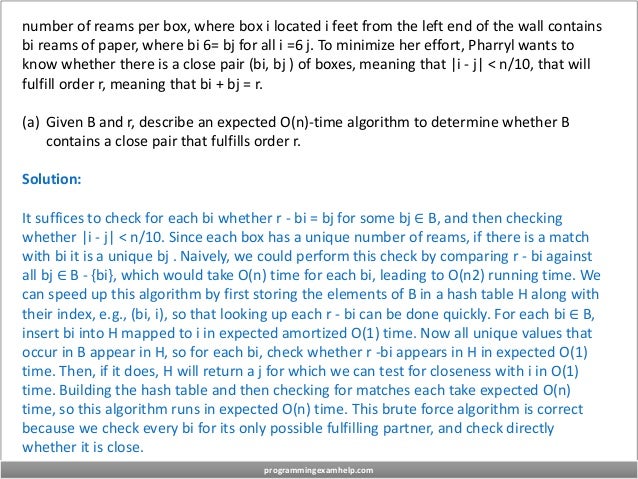
number of reams per box, where box i located i feet from the left end of the wall contains
bi reams of paper, where bi 6= bj for all i =6 j. To minimize her effort, Pharryl wants to
know whether there is a close pair (bi, bj ) of boxes, meaning that |i - j| < n/10, that will
fulfill order r, meaning that bi + bj = r.
(a) Given B and r, describe an expected O(n)-time algorithm to determine whether B
contains a close pair that fulfills order r.
Solution:
It suffices to check for each bi whether r - bi = bj for some bj ∈ B, and then checking
whether |i - j| < n/10. Since each box has a unique number of reams, if there is a match
with bi it is a unique bj . Naively, we could perform this check by comparing r - bi against
all bj ∈ B - {bi}, which would take O(n) time for each bi, leading to O(n2) running time. We
can speed up this algorithm by first storing the elements of B in a hash table H along with
their index, e.g., (bi, i), so that looking up each r - bi can be done quickly. For each bi ∈ B,
insert bi into H mapped to i in expected amortized O(1) time. Now all unique values that
occur in B appear in H, so for each bi, check whether r -bi appears in H in expected O(1)
time. Then, if it does, H will return a j for which we can test for closeness with i in O(1)
time. Building the hash table and then checking for matches each take expected O(n)
time, so this algorithm runs in expected O(n) time. This brute force algorithm is correct
because we check every bi for its only possible fulfilling partner, and check directly
whether it is close.
programmingexamhelp.com
Rubric:
• 3 points for a description of a correct algorithm
• 2 points for analysis of correctness
• 2 points for analysis of running time
• 3 points if correct algorithm is efficient
• Partial credit may be awarded
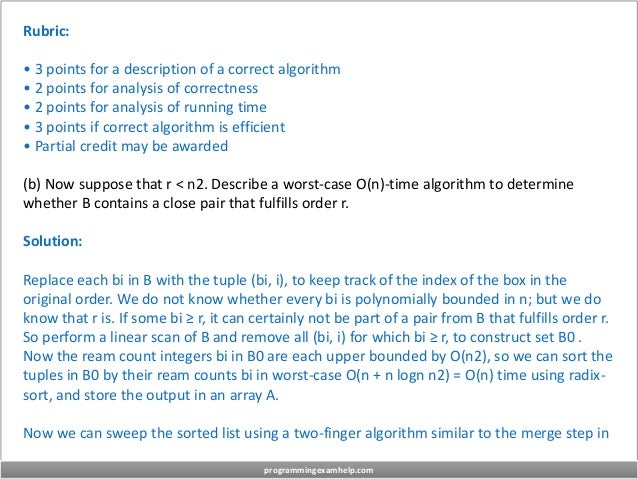
(b) Now suppose that r < n2. Describe a worst-case O(n)-time algorithm to determine
whether B contains a close pair that fulfills order r.
Solution:
Replace each bi in B with the tuple (bi, i), to keep track of the index of the box in the
original order. We do not know whether every bi is polynomially bounded in n; but we do
know that r is. If some bi ≥ r, it can certainly not be part of a pair from B that fulfills order r.
So perform a linear scan of B and remove all (bi, i) for which bi ≥ r, to construct set B0 .
Now the ream count integers bi in B0 are each upper bounded by O(n2), so we can sort the
tuples in B0 by their ream counts bi in worst-case O(n + n logn n2) = O(n) time using radix-
sort, and store the output in an array A.
Now we can sweep the sorted list using a two-finger algorithm similar to the merge step in
programmingexamhelp.com
merge sort to find a pair that sums to r, if such a pair exists. Specifically, initialize indices i =
0 and j = |A| - 1, and repeat the following procedure until i = j. If A[i] = (bk, k), let A[i].b =
bk and A[i].x = k. There are three cases:
• A[i].b + A[j].b = r: a pair that fulfills the order has been found. Check whether |A[i].x �
A[j].x| < n/10 and return True if so; or
• A[i].b + A[j].b < r: A[i].b cannot be part of a pair that fulfills the order with any A[k].b for k
∈ {i + 1, . . . , j}, so increase i; or
• A[i].b + A[j].b > r: A[j].b cannot be part of a pair that fulfills the order with any A[k] for k ∈
{i, . . . , j - 1}, so decrease j.
This loop maintains the invariant that at the start of each loop, we have confirmed that no
pair (A[k].b, A[`].b) is close and fulfills the order, for all k ≤ i ≤ j ≤ `, so if we reach the end
without returning a valid pair, the algorithm will correctly conclude that there is none.
Since each iteration of the loop takes O(1) time and decreases j -i decrease by one, and j -i
= |B0 |-1 starts positive and ends when j - i < 0, this procedure takes at most O(n) time in
the worst case.
Problem 5.
Anagram Archaeology String A is an anagram of another string B if A is a permutation of
the letters in B; for example, (indicatory, dictionary) and (brush, shrub) are pairs of words
programmingexamhelp.com
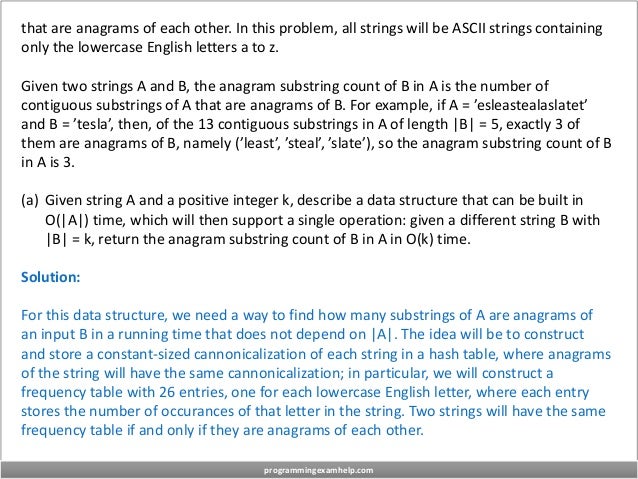
that are anagrams of each other. In this problem, all strings will be ASCII strings containing
only the lowercase English letters a to z.
Given two strings A and B, the anagram substring count of B in A is the number of
contiguous substrings of A that are anagrams of B. For example, if A = ’esleastealaslatet’
and B = ’tesla’, then, of the 13 contiguous substrings in A of length |B| = 5, exactly 3 of
them are anagrams of B, namely (’least’, ’steal’, ’slate’), so the anagram substring count of B
in A is 3.
(a) Given string A and a positive integer k, describe a data structure that can be built in
O(|A|) time, which will then support a single operation: given a different string B with
|B| = k, return the anagram substring count of B in A in O(k) time.
Solution:
For this data structure, we need a way to find how many substrings of A are anagrams of
an input B in a running time that does not depend on |A|. The idea will be to construct
and store a constant-sized cannonicalization of each string in a hash table, where anagrams
of the string will have the same cannonicalization; in particular, we will construct a
frequency table with 26 entries, one for each lowercase English letter, where each entry
stores the number of occurances of that letter in the string. Two strings will have the same
frequency table if and only if they are anagrams of each other.
programmingexamhelp.com
Let S = (S0, . . . , S|A|�k) be the |A|�k+1 contiguous length-k substrings of A, where
substring Si starts at character A[i]. Constructing a frequency table na¨ıvely for each Si ∈ S
would take O(|A|k) time. However, after computing the frequency table of S0 na¨ıvely in
O(k) time, we can construct the frequncy table forSi+1 from the frequency table for Si in
O(1) time by subtracting the letter at A[i] from the frequency table of Si, and adding in the
letter at A[i+k]. In this way, we can compute the constant-sized frequency table for each Si
∈ S in O(k) + (|A| � k)O(1) = O(|A|) time. Then insert each of these frequency tables into
a hash table H, mapped to the number of Si ∈ S having that frequency table in expected
O(|A|) time (each frequency is at most n, so each frequency table can be thought of as a
26dlg ne-sized integer, which fits within a constant number of machine words, that can be
used as a hash key).
Then given our data structure H, we can support the requested operation by first
computing the frequency table f of the input string B na¨ıvely in O(k) time, and then
looking it up in H in O(1) expected time, for a total of expected O(k) time. Since H(f) stores
the number of Si ∈ S with frequency table f, if f is in H, the stored value will be the
anagram substring count of B in A. Otherwise, if f is not in H, f is not an anagram of any
substring of A, so return zero.
(b) Given string T and an array of n length-k strings S = (S0, . . . , Sn�1) satisfying 0 < k <
|T|, describe an O(|T| + nk)-time algorithm to return an array A = (a0, . . . , an�1) for
which ai is the anagram substring count of Si in T for all i ∈ {0, . . . , n � 1}.
programmingexamhelp.com
Solution:
Construct the data structure in part (a) substituting string T for A, and using k in O(|T|)
expected time. Then for each Si ∈ S, we can perform the operation supported by the data
structure in expected O(k) time, storing their outputs in an array A, for a total of expected
O(|T| + nk) time. This algorithm is correct based on the corrctness of the data structure
from (a).
(c) Write a Python function count anagram substrings(T, S) that implements your algorithm
from part (b). Note the built-in Python function ord(c) returns the ASCII integer
corresponding to ASCII character c in O(1) time. You can download a code template
containing some test cases from the website.
Solution:
1 ORD_A = ord(’a’)
2 def lower_ord(c): # map a lowercase letter to range(26)
3 return ord(c) - ORD_A
4
5 def count_anagram_substrings(T, S):
6 m, n, k = len(T), len(S), len(S[0])
7 D = {} # map from freq tables to occurances
programmingexamhelp.com
8 F = [0] * 26 # initial freq table
9 for i in range(m): # compute T freq tables
10 F[lower_ord(T[i])] += 1 # add character
11 if i > k - 1:
12 F[lower_ord(T[i - k])] -= 1 # remove character
13 if i >= k - 1:
14 key = tuple(F) 1
5 if key in D: # increment occurance
16 D[key] += 1 17 else: # add freq table to map 1
8 D[key] = 1
19 A = [0] * n # compute anagram substring counts
20 for i in range(n):
21 F = [0] * 26
22 for c in S[i]: # compute S_i freq table
23 F[lower_ord(c)] += 1
24 key = tuple(F)
25 if key in D: # check in dictionary
26 A[i] = D[key]
27 return tuple(A)
programmingexamhelp.com

Algorithms Exam Help

  • 1.
    For any Examrelated queries, Call us at : - +1 678 648 4277 You can mail us at : - support@programmingexamhelp.com or reach us at : - https://www.programmingexamhelp.com
  • 2.
    Problem 1. HashPractice (a) Insert integer keys A = [47, 61, 36, 52, 56, 33, 92] in order into a hash table of size 7 using the hash function h(k) = (10k + 4) mod 7. Each slot of the hash table stores a linked list of the keys hashing to that slot, with later insertions being appended to the end of the list. Draw a picture of the hash table after all keys have been inserted. Solution: programmingexamhelp.com
  • 3.
    (b) Suppose thehash function were instead h(k) = ((10k + 4) mod c) mod 7 for some positive integer c. Find the smallest value of c such that no collisions occur when inserting the keys from A. Solution: By the pigeonhole principle, at least one collision occurs for c < 7, so check collisions manually for sequentially larger c. If c = 7 then 47, 61, and 33 all hash to 5. If c = 8 then 36, 52, 56, 92 all hash to 4. If c = 9 then 47 and 56 hash to 6. If c = 10 then everything hashes to 4. If c = 11 then 47 and 36 hash to 1. If c = 12 then 56 and 92 hash to 0. If c = 13 then there are no collisions. k 47 61 36 52 56 33 92 10k + 4 474 614 364 524 564 334 924 10k + 4 mod 7 mod 7 5 5 0 6 4 5 0 10k + 4 mod 8 mod 7 2 6 4 4 4 6 4 10k + 4 mod 9 mod 7 6 2 4 2 6 1 6 10k + 4 mod 10 mod 7 4 4 4 4 4 4 4 10k + 4 mod 11 mod 7 1 2 1 0 3 4 0 10k + 4 mod 12 mod 7 6 2 4 1 0 3 0 10k + 4 mod 13 mod 7 6 3 0 4 5 2 1 programmingexamhelp.com
  • 4.
    The table abovewas generated using this python code: 1 A = [47, 61, 36, 52, 56, 33, 92] 2 for c in range(7, 100): 3 hashes = [((10 * k + 4) % c) % 7 for k in A] 4 print(’t’.join([str(h) for h in hashes])) 5 if len(set(hashes)) == 7: 6 break Rubric: • 3 point for c = 13 • Partial credit may be awarded if there is work shown of a correct approach that does not yield the correct solution. Problem 2. Dorm Hashing MIT wants to assign 2n new students to n rooms, numbered 0 to n - 1, in Pseudorandom Hall. Each MIT student will have an ID: a postive integer less than u, with u 2n. No two students can have the same ID, but new students are allowed to choose their own IDs after the start of term. MIT wants to find students quickly given their IDs, so will assign students to rooms by programmingexamhelp.com
  • 5.
    hashing their IDsto a room number. So as not to appear biased, MIT will publish a family H of hash functions online before the start of term (before new students choose their IDs), and then after students choose IDs, MIT will choose a rooming hash function uniformly at random from H. New MIT freshmen Rony Stark and Tiri Williams want to be roommates. For each hash family below, show that either: • Rony and Tiri can choose IDs k1 and k2 so as to guarantee that they’ll be roommates, or • prove that no such choice is possible and compute the highest probability they could possibly achieve of being roommates. (a) H = {hab(k) = (ak + b) mod n | a, b ∈ {0, . . . , n - 1} and a 6= 0} Solution: Rony and Tiri can choose any two IDs k1, k2 such that k1 ≡ k2 mod n, which are not difficult to find. For example, Rony could choose k1 = 3 and Tiri could choose k2 = 2n + 3. Then, ak1 + b ≡ ak2 + b mod n for all a, b, so Rony and Tiri are guaranteed to hash to the same room. programmingexamhelp.com
  • 6.
    (b) H =ha(k) = kn + a mod n | a ∈ {0, . . . , u - 1} u Solution: Since u n, the quantity b kn u c will be the same for most adjacent values of k. For example, Rony could choose k1 = 1 and Tiri could choose k2 = 2, and this quantity would be 0 for both of them. Adding the constant a and taking the result mod n would not affect whether the values are the same since b kn u c is always an integer between 0 and n - 1, so if Rony’s and Tiri’s IDs have the same hash for any function in this family, they will have the same hash for all functions in this family. (c) H = {hab(k) = ((ak + b) mod p) mod n | a, b ∈ {0, . . . , p - 1} and a 6= 0} for fixed prime p > u (this is the universal hash family from Lecture 4) Solution: For any two keys, the probability that they collide given a random function from a universal hash family is at most m 1 where m is the number of possible hash outputs. Hence, in this case n 1 is the highest probability that Rony and Tiri can achieve, and cannot guarantee that they will be roommates. programmingexamhelp.com
  • 7.
    Rubric: • For (a)and (b) – 3 points for a correct choice of keys – 2 points showing that chosen keys collide • For (c) – 3 points for citing or deriving bound on probability for universal hash family – 2 points for putting bound in terms of n and equating with probability of roommates Problem 3. The Cold is Not Bothersome Anyway Ice cores are long cylindrical plugs drilled out of deep glaciers, which are accumulations of snow piled on top of each other and compressed into ice. Scientists can divide an ice core into distinct slices, each representing one year of deposits. For each of the following scenerios, describe an efficient1 algorithm to sort n slices collected from multiple ice cores. Justify your answers. (a) Every ice core is given a unique core identifier for bookkeeping, which is a string of exactly 16dlog4( √n)e ASCII characters.2 Sort the slices by core identifier. Solution: √ Each string is stored in memory as a contiguous sequence of at most 16dlog4( n)e × 8 = programmingexamhelp.com
  • 8.
    O(log n) bits.In the word-RAM, these bits can then be interpreted as an integer stored in a constant number of machine words (since w ≥ lg n), n)e×8 33 33 upper bounded by 216dlog4( ) = √ < n , so we can sort them in Θ(n + n logn n Θ(n) time via radix sort. (b) The deepest ice cores in the database are up to 800,000 years old. Sort the slices by their age: the integer number of years since the slice was formed. Solution: The ages form a constant-bounded range [0, 8·105], so we can use counting sort to order them in ascending order in worst-case Θ(8·105 +n) = Θ(n) time. (radix sort may also be used) (c) Variation in the amount of snowfall each year will cause a glacier to accumulate at different rates over time. Sort the slices by thickness, a rational number of centimeters of the form m/n3 between 0 and 4, where m is an integer. Solution: Multiplying by n3, these are integers m in a polynomially-bounded range [0, 4n3], so sort them using Radix Sort in worst-case Θ(n + n logn n3) = Θ(n) time. programmingexamhelp.com
  • 9.
    (d) Elna ofNorthendelle has discovered that water has memory, but is unable to quantify the memory of a given slice. Luckily, given two slices, she can distinguish which has more memory in O(1) time using her “two-finger algorithm” (touching the slices with her two index fingers). Sort the slices by memory. Solution: The only way to discern order information from the slices is via comparisons, so we choose merge sort which runs in Θ(n log n) time, which is optimal in the comparison model. Rubric: •1 points for a correct choice of algorithm • 1 points if chosen algorithm is efficient • 3 points for a correct justification • Partial credit may be awarded Problem 4. Pushing Paper Farryl Dilbin is a forklift operator at Munder Difflin paper company’s central warehouse. She needs to ship exactly r reams of paper to a customer. In the warehouse are n boxes of paper, each one foot in width, lined up side-by-side covering an n-foot wall. Each box contains a known positive integer number of reams, where no two boxes contain the same number of reams. Let B = (b0, . . . bn�1) be the programmingexamhelp.com
  • 10.
    number of reamsper box, where box i located i feet from the left end of the wall contains bi reams of paper, where bi 6= bj for all i =6 j. To minimize her effort, Pharryl wants to know whether there is a close pair (bi, bj ) of boxes, meaning that |i - j| < n/10, that will fulfill order r, meaning that bi + bj = r. (a) Given B and r, describe an expected O(n)-time algorithm to determine whether B contains a close pair that fulfills order r. Solution: It suffices to check for each bi whether r - bi = bj for some bj ∈ B, and then checking whether |i - j| < n/10. Since each box has a unique number of reams, if there is a match with bi it is a unique bj . Naively, we could perform this check by comparing r - bi against all bj ∈ B - {bi}, which would take O(n) time for each bi, leading to O(n2) running time. We can speed up this algorithm by first storing the elements of B in a hash table H along with their index, e.g., (bi, i), so that looking up each r - bi can be done quickly. For each bi ∈ B, insert bi into H mapped to i in expected amortized O(1) time. Now all unique values that occur in B appear in H, so for each bi, check whether r -bi appears in H in expected O(1) time. Then, if it does, H will return a j for which we can test for closeness with i in O(1) time. Building the hash table and then checking for matches each take expected O(n) time, so this algorithm runs in expected O(n) time. This brute force algorithm is correct because we check every bi for its only possible fulfilling partner, and check directly whether it is close. programmingexamhelp.com
  • 11.
    Rubric: • 3 pointsfor a description of a correct algorithm • 2 points for analysis of correctness • 2 points for analysis of running time • 3 points if correct algorithm is efficient • Partial credit may be awarded (b) Now suppose that r < n2. Describe a worst-case O(n)-time algorithm to determine whether B contains a close pair that fulfills order r. Solution: Replace each bi in B with the tuple (bi, i), to keep track of the index of the box in the original order. We do not know whether every bi is polynomially bounded in n; but we do know that r is. If some bi ≥ r, it can certainly not be part of a pair from B that fulfills order r. So perform a linear scan of B and remove all (bi, i) for which bi ≥ r, to construct set B0 . Now the ream count integers bi in B0 are each upper bounded by O(n2), so we can sort the tuples in B0 by their ream counts bi in worst-case O(n + n logn n2) = O(n) time using radix- sort, and store the output in an array A. Now we can sweep the sorted list using a two-finger algorithm similar to the merge step in programmingexamhelp.com
  • 12.
    merge sort tofind a pair that sums to r, if such a pair exists. Specifically, initialize indices i = 0 and j = |A| - 1, and repeat the following procedure until i = j. If A[i] = (bk, k), let A[i].b = bk and A[i].x = k. There are three cases: • A[i].b + A[j].b = r: a pair that fulfills the order has been found. Check whether |A[i].x � A[j].x| < n/10 and return True if so; or • A[i].b + A[j].b < r: A[i].b cannot be part of a pair that fulfills the order with any A[k].b for k ∈ {i + 1, . . . , j}, so increase i; or • A[i].b + A[j].b > r: A[j].b cannot be part of a pair that fulfills the order with any A[k] for k ∈ {i, . . . , j - 1}, so decrease j. This loop maintains the invariant that at the start of each loop, we have confirmed that no pair (A[k].b, A[`].b) is close and fulfills the order, for all k ≤ i ≤ j ≤ `, so if we reach the end without returning a valid pair, the algorithm will correctly conclude that there is none. Since each iteration of the loop takes O(1) time and decreases j -i decrease by one, and j -i = |B0 |-1 starts positive and ends when j - i < 0, this procedure takes at most O(n) time in the worst case. Problem 5. Anagram Archaeology String A is an anagram of another string B if A is a permutation of the letters in B; for example, (indicatory, dictionary) and (brush, shrub) are pairs of words programmingexamhelp.com
  • 13.
    that are anagramsof each other. In this problem, all strings will be ASCII strings containing only the lowercase English letters a to z. Given two strings A and B, the anagram substring count of B in A is the number of contiguous substrings of A that are anagrams of B. For example, if A = ’esleastealaslatet’ and B = ’tesla’, then, of the 13 contiguous substrings in A of length |B| = 5, exactly 3 of them are anagrams of B, namely (’least’, ’steal’, ’slate’), so the anagram substring count of B in A is 3. (a) Given string A and a positive integer k, describe a data structure that can be built in O(|A|) time, which will then support a single operation: given a different string B with |B| = k, return the anagram substring count of B in A in O(k) time. Solution: For this data structure, we need a way to find how many substrings of A are anagrams of an input B in a running time that does not depend on |A|. The idea will be to construct and store a constant-sized cannonicalization of each string in a hash table, where anagrams of the string will have the same cannonicalization; in particular, we will construct a frequency table with 26 entries, one for each lowercase English letter, where each entry stores the number of occurances of that letter in the string. Two strings will have the same frequency table if and only if they are anagrams of each other. programmingexamhelp.com
  • 14.
    Let S =(S0, . . . , S|A|�k) be the |A|�k+1 contiguous length-k substrings of A, where substring Si starts at character A[i]. Constructing a frequency table na¨ıvely for each Si ∈ S would take O(|A|k) time. However, after computing the frequency table of S0 na¨ıvely in O(k) time, we can construct the frequncy table forSi+1 from the frequency table for Si in O(1) time by subtracting the letter at A[i] from the frequency table of Si, and adding in the letter at A[i+k]. In this way, we can compute the constant-sized frequency table for each Si ∈ S in O(k) + (|A| � k)O(1) = O(|A|) time. Then insert each of these frequency tables into a hash table H, mapped to the number of Si ∈ S having that frequency table in expected O(|A|) time (each frequency is at most n, so each frequency table can be thought of as a 26dlg ne-sized integer, which fits within a constant number of machine words, that can be used as a hash key). Then given our data structure H, we can support the requested operation by first computing the frequency table f of the input string B na¨ıvely in O(k) time, and then looking it up in H in O(1) expected time, for a total of expected O(k) time. Since H(f) stores the number of Si ∈ S with frequency table f, if f is in H, the stored value will be the anagram substring count of B in A. Otherwise, if f is not in H, f is not an anagram of any substring of A, so return zero. (b) Given string T and an array of n length-k strings S = (S0, . . . , Sn�1) satisfying 0 < k < |T|, describe an O(|T| + nk)-time algorithm to return an array A = (a0, . . . , an�1) for which ai is the anagram substring count of Si in T for all i ∈ {0, . . . , n � 1}. programmingexamhelp.com
  • 15.
    Solution: Construct the datastructure in part (a) substituting string T for A, and using k in O(|T|) expected time. Then for each Si ∈ S, we can perform the operation supported by the data structure in expected O(k) time, storing their outputs in an array A, for a total of expected O(|T| + nk) time. This algorithm is correct based on the corrctness of the data structure from (a). (c) Write a Python function count anagram substrings(T, S) that implements your algorithm from part (b). Note the built-in Python function ord(c) returns the ASCII integer corresponding to ASCII character c in O(1) time. You can download a code template containing some test cases from the website. Solution: 1 ORD_A = ord(’a’) 2 def lower_ord(c): # map a lowercase letter to range(26) 3 return ord(c) - ORD_A 4 5 def count_anagram_substrings(T, S): 6 m, n, k = len(T), len(S), len(S[0]) 7 D = {} # map from freq tables to occurances programmingexamhelp.com
  • 16.
    8 F =[0] * 26 # initial freq table 9 for i in range(m): # compute T freq tables 10 F[lower_ord(T[i])] += 1 # add character 11 if i > k - 1: 12 F[lower_ord(T[i - k])] -= 1 # remove character 13 if i >= k - 1: 14 key = tuple(F) 1 5 if key in D: # increment occurance 16 D[key] += 1 17 else: # add freq table to map 1 8 D[key] = 1 19 A = [0] * n # compute anagram substring counts 20 for i in range(n): 21 F = [0] * 26 22 for c in S[i]: # compute S_i freq table 23 F[lower_ord(c)] += 1 24 key = tuple(F) 25 if key in D: # check in dictionary 26 A[i] = D[key] 27 return tuple(A) programmingexamhelp.com