Gyroplanes Gyrocopters and Autogyros Aviation's best kept Secret
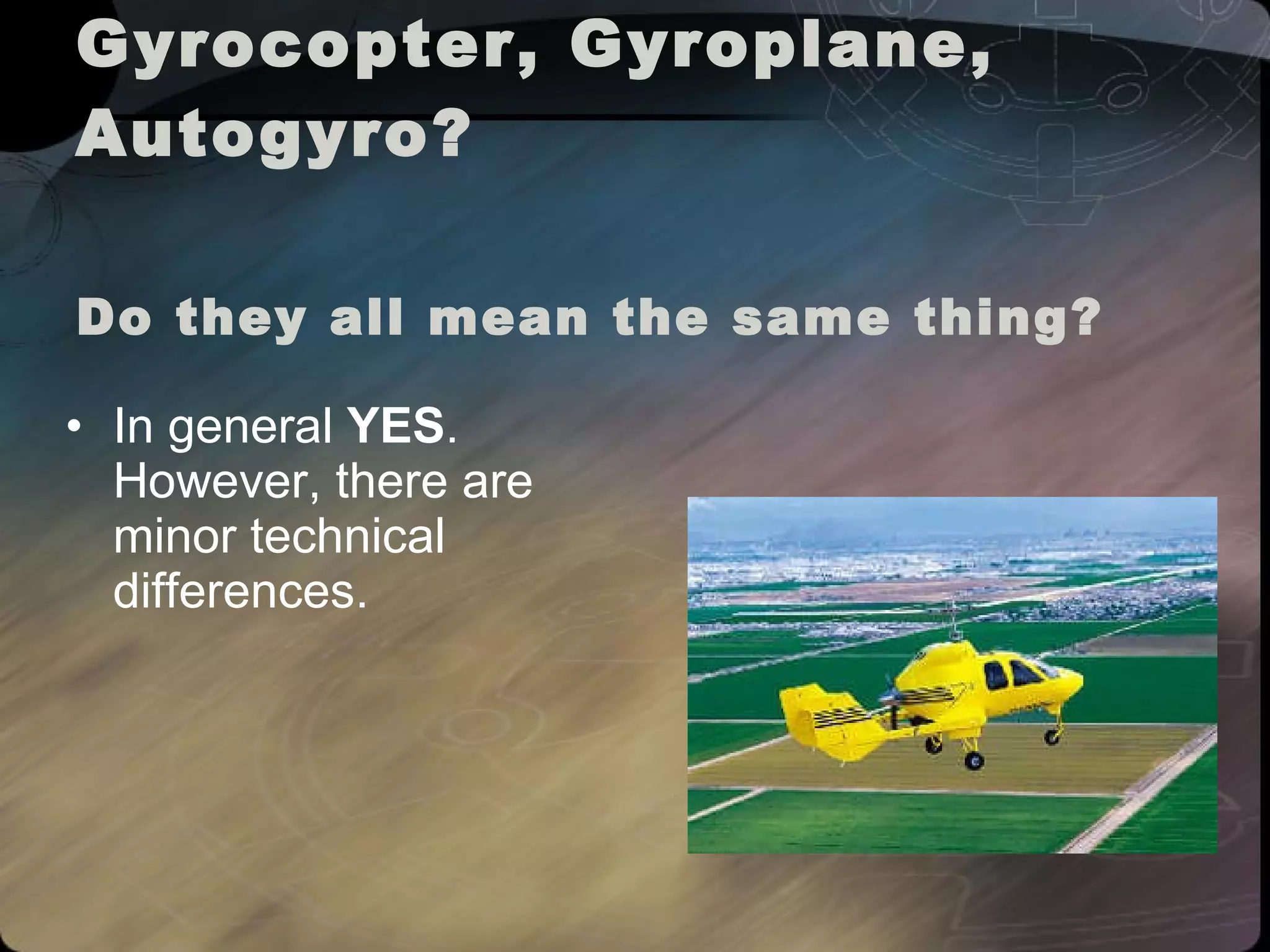
Gyrocopter, Gyroplane, Autogyro?  Do they all mean the same thing?   In general  YES . However, there are minor technical differences.
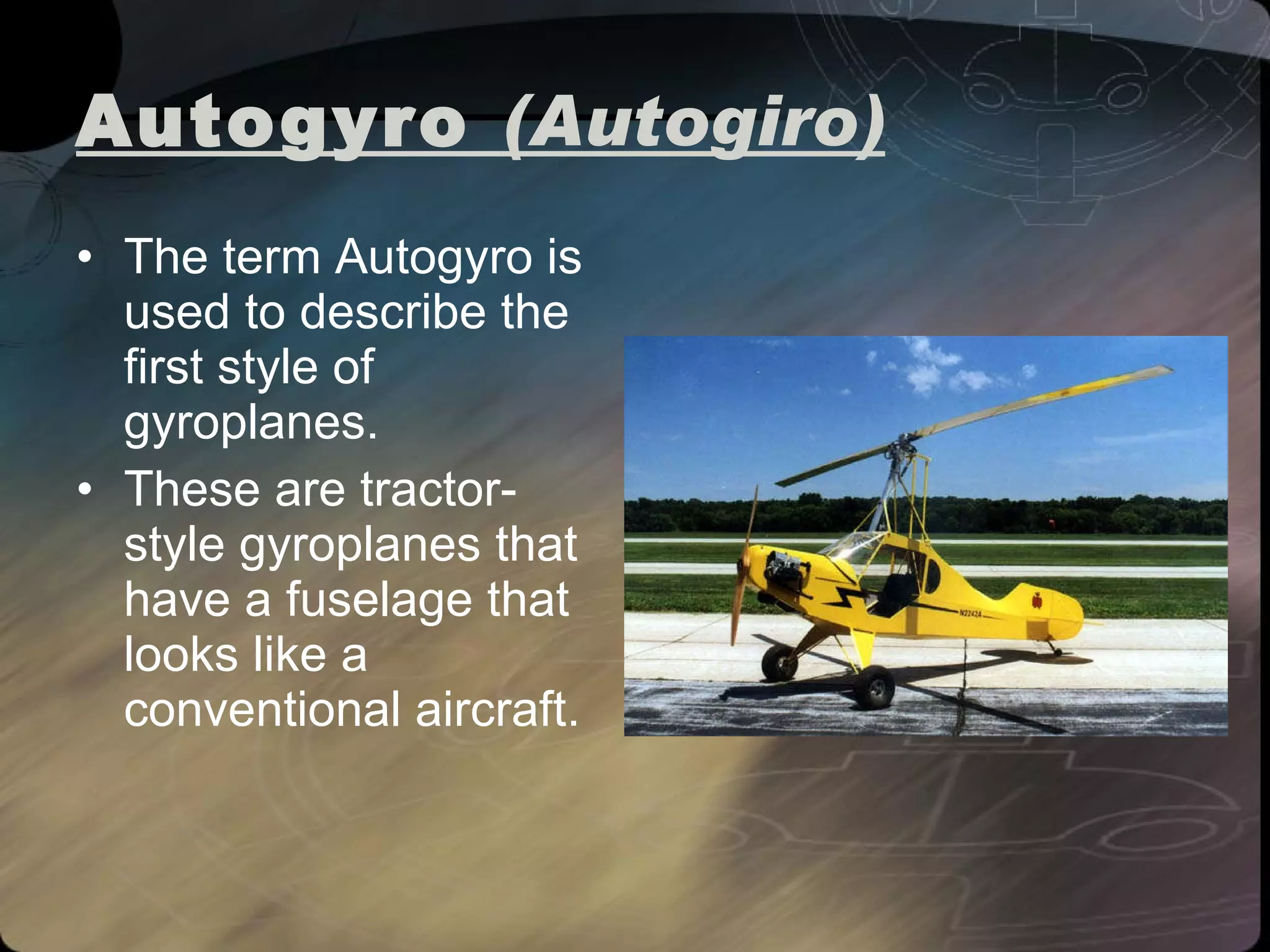
Autogyro  (Autogiro) The term Autogyro is used to describe the first style of gyroplanes.  These are tractor-style gyroplanes that have a fuselage that looks like a conventional aircraft.
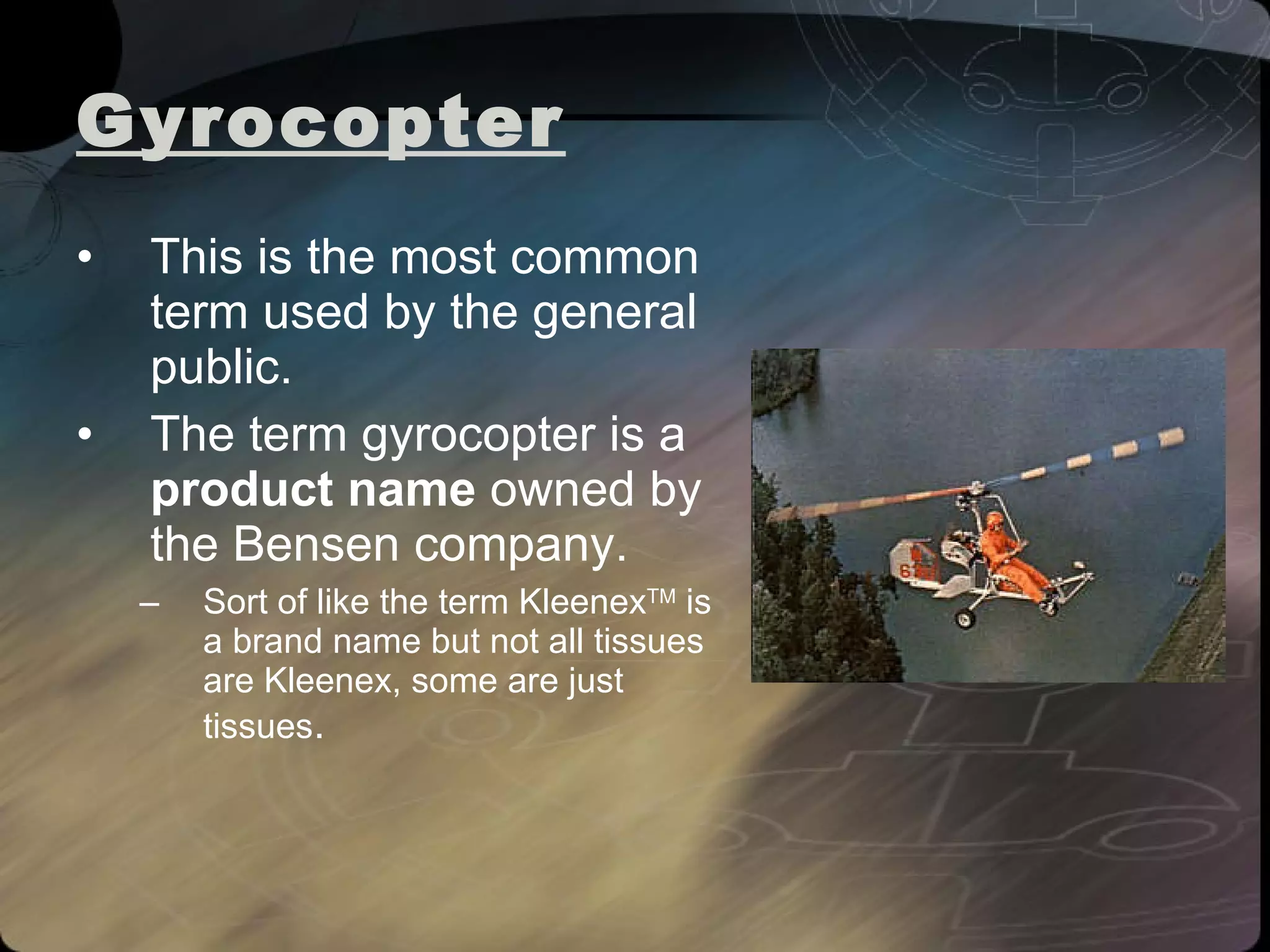
Gyrocopter   This is the most common term used by the general public.  The term gyrocopter is a  product name  owned by the Bensen company.   Sort of like the term Kleenex TM  is a brand name but not all tissues are Kleenex, some are just tissues .
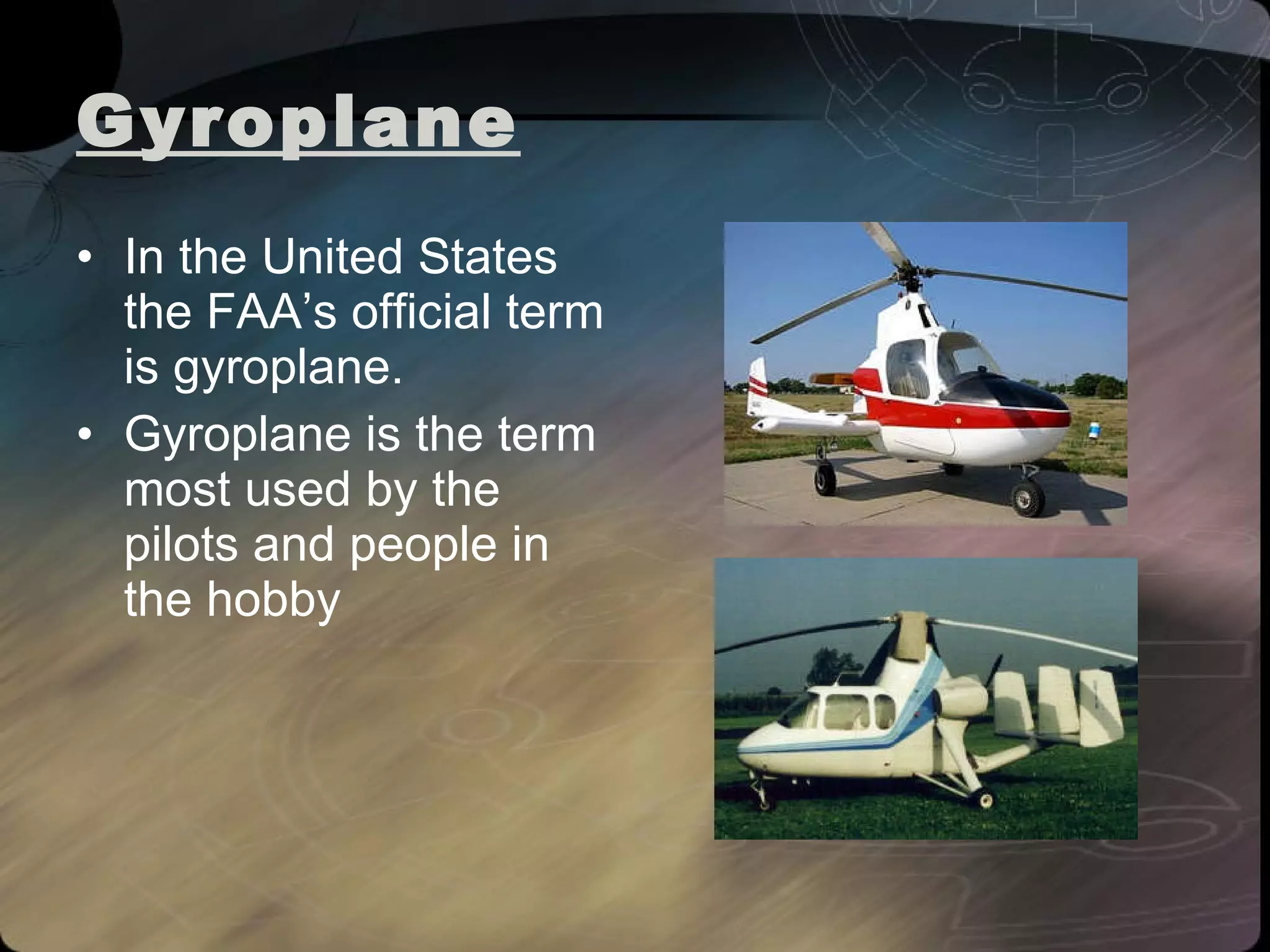
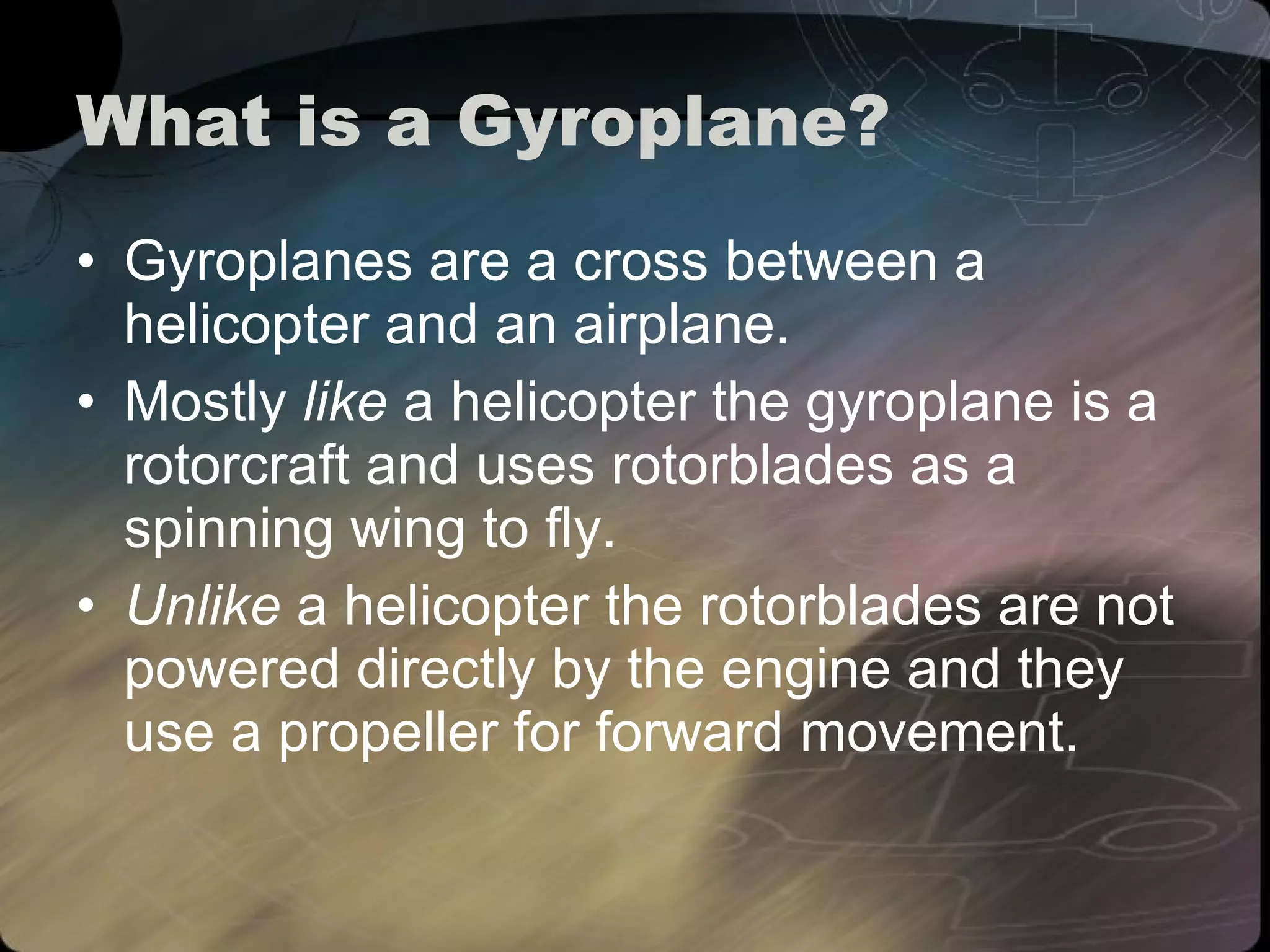
Gyroplane In the United States the FAA’s official term is gyroplane.  Gyroplane is the term most used by the pilots and people in the hobby
What is a Gyroplane? Gyroplanes are a cross between a helicopter and an airplane.  Mostly  like  a helicopter the gyroplane is a rotorcraft and uses rotorblades as a spinning wing to fly.  Unlike  a helicopter the rotorblades are not powered directly by the engine and they use a propeller for forward movement.
So what are we going to talk about? What is so good about gyros? Where did gyros come from? Where are gyros going? Are gyros safe? How much do they cost? What kinds are there? Where do I get info?
What is so good about gyros? Gyros are safe A Gyroplane can maneuver and land in a very small area. A well made and stable gyroplane can handle wind better than almost all general aviation aircraft  if piloted by an experienced pilot. Inexpensive to purchase and easy to build compared to other sport and general aviation aircraft. Easy to store and transport.  It is common practice to keep your gyroplane in the garage and trailer it to a local airport to fly. Gyros are FUN!
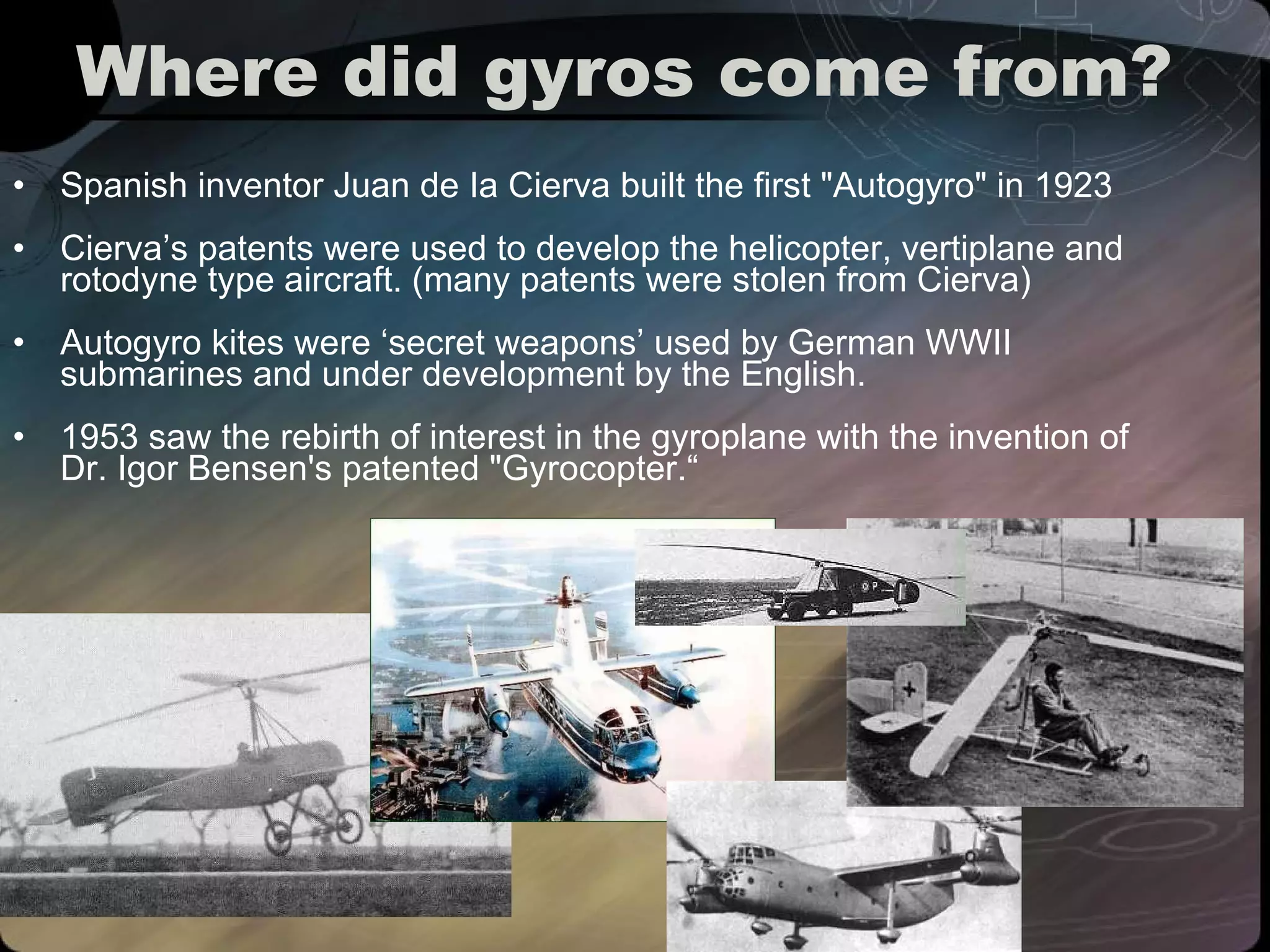
Where did gyros come from? Spanish inventor Juan de Ia Cierva built the first "Autogyro" in 1923 Cierva’s patents were used to develop the helicopter, vertiplane and rotodyne type aircraft. (many patents were stolen from Cierva) Autogyro kites were ‘secret weapons’ used by German WWII submarines and under development by the English. 1953 saw the rebirth of interest in the gyroplane with the invention of Dr. Igor Bensen's patented "Gyrocopter.“
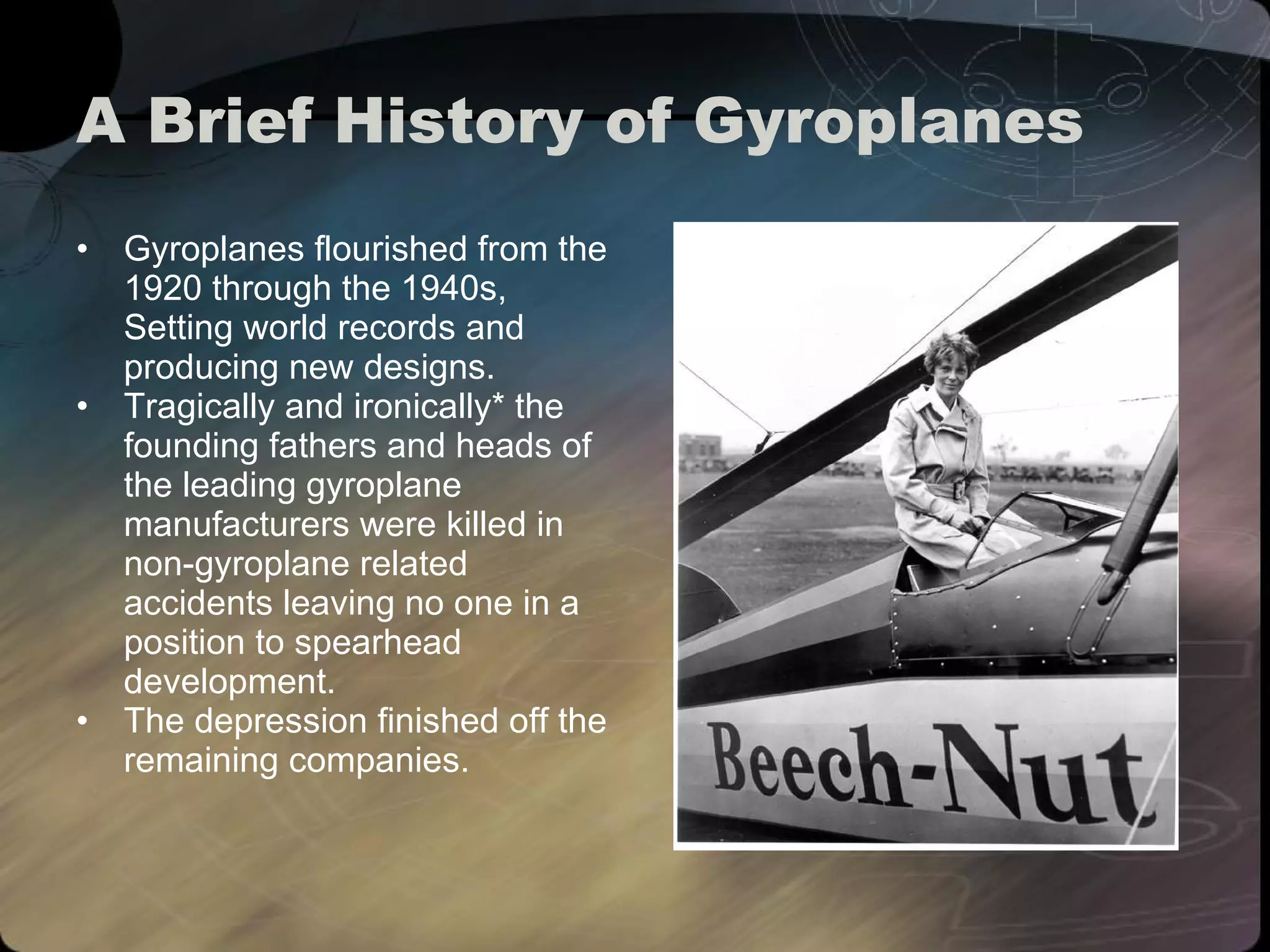
A Brief History of Gyroplanes Gyroplanes flourished from the 1920 through the 1940s, Setting world records and producing new designs. Tragically and ironically* the founding fathers and heads of the leading gyroplane manufacturers were killed in non-gyroplane related accidents leaving no one in a position to spearhead development.  The depression finished off the remaining companies.
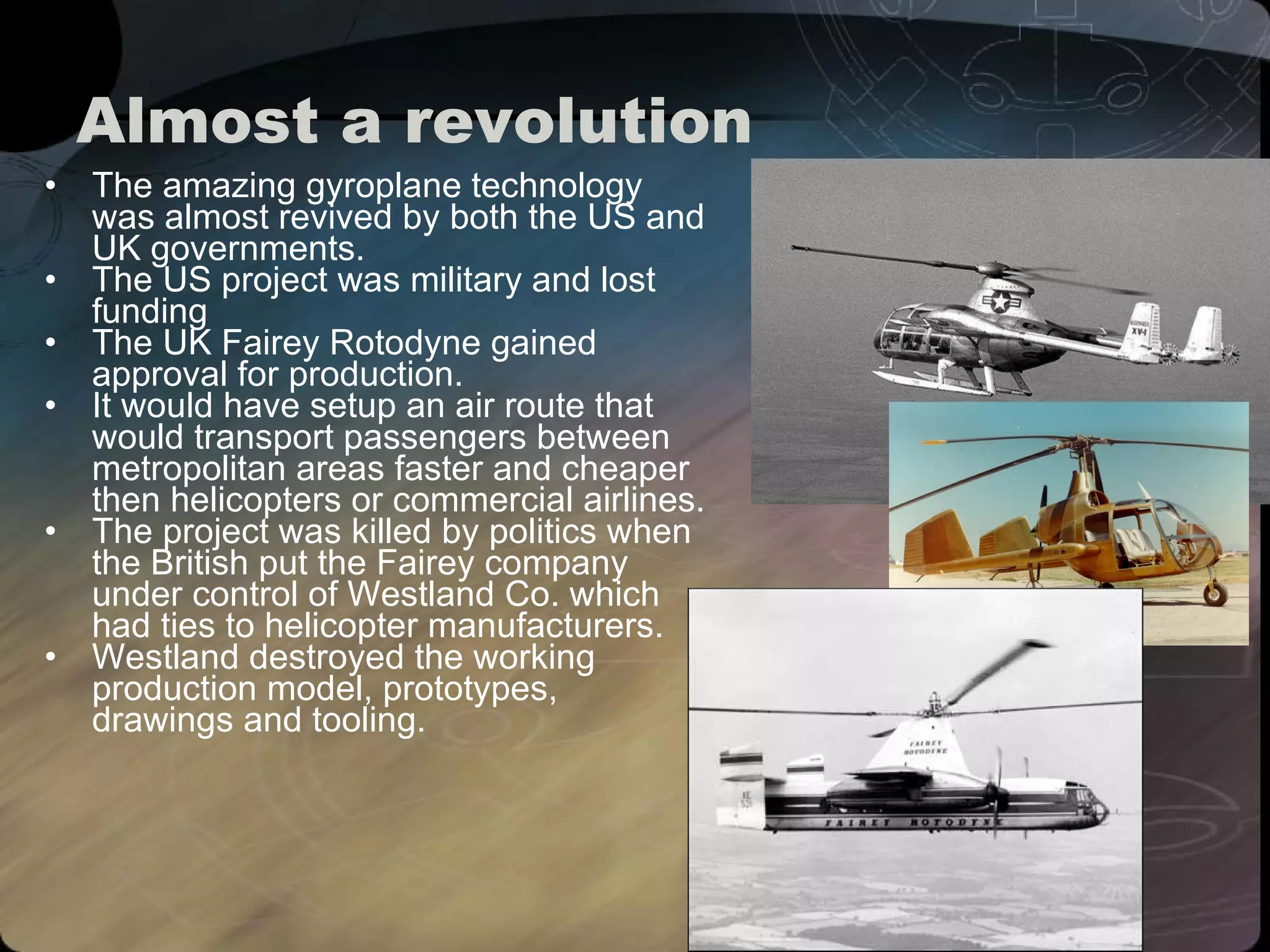
Almost a revolution The amazing gyroplane technology was almost revived by both the US and UK governments. The US project was military and lost funding The UK Fairey Rotodyne gained approval for production.  It would have setup an air route that would transport passengers between metropolitan areas faster and cheaper then helicopters or commercial airlines.  The project was killed by politics when the British put the Fairey company under control of Westland Co. which had ties to helicopter manufacturers. Westland destroyed the working production model, prototypes, drawings and tooling.
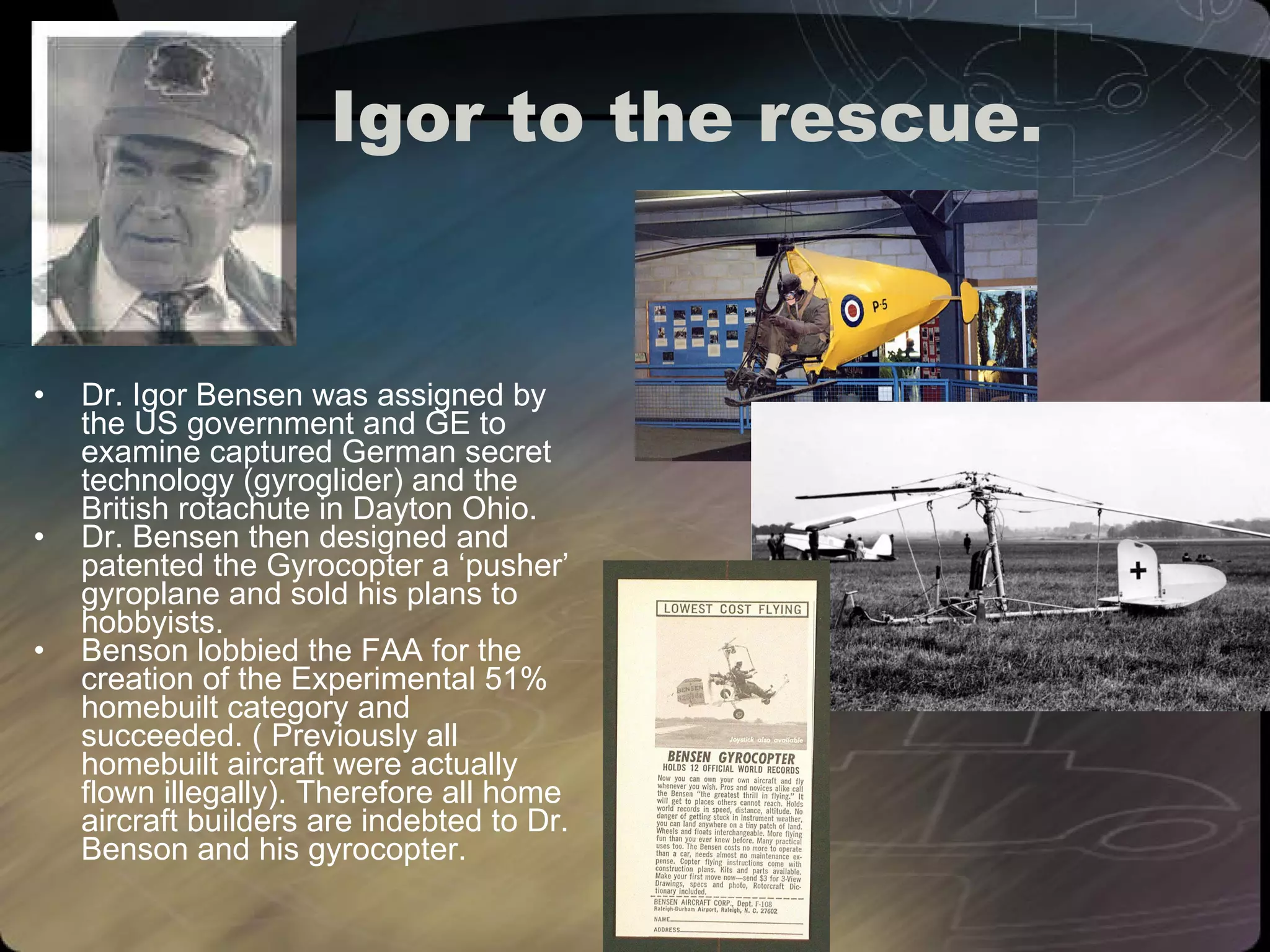
Igor to the rescue. Dr. Igor Bensen was assigned by the US government and GE to examine captured German secret technology (gyroglider) and the British rotachute in Dayton Ohio. Dr. Bensen then designed and patented the Gyrocopter a ‘pusher’ gyroplane and sold his plans to hobbyists.  Benson lobbied the FAA for the creation of the Experimental 51% homebuilt category and succeeded. ( Previously all homebuilt aircraft were actually flown illegally). Therefore all home aircraft builders are indebted to Dr. Benson and his gyrocopter.
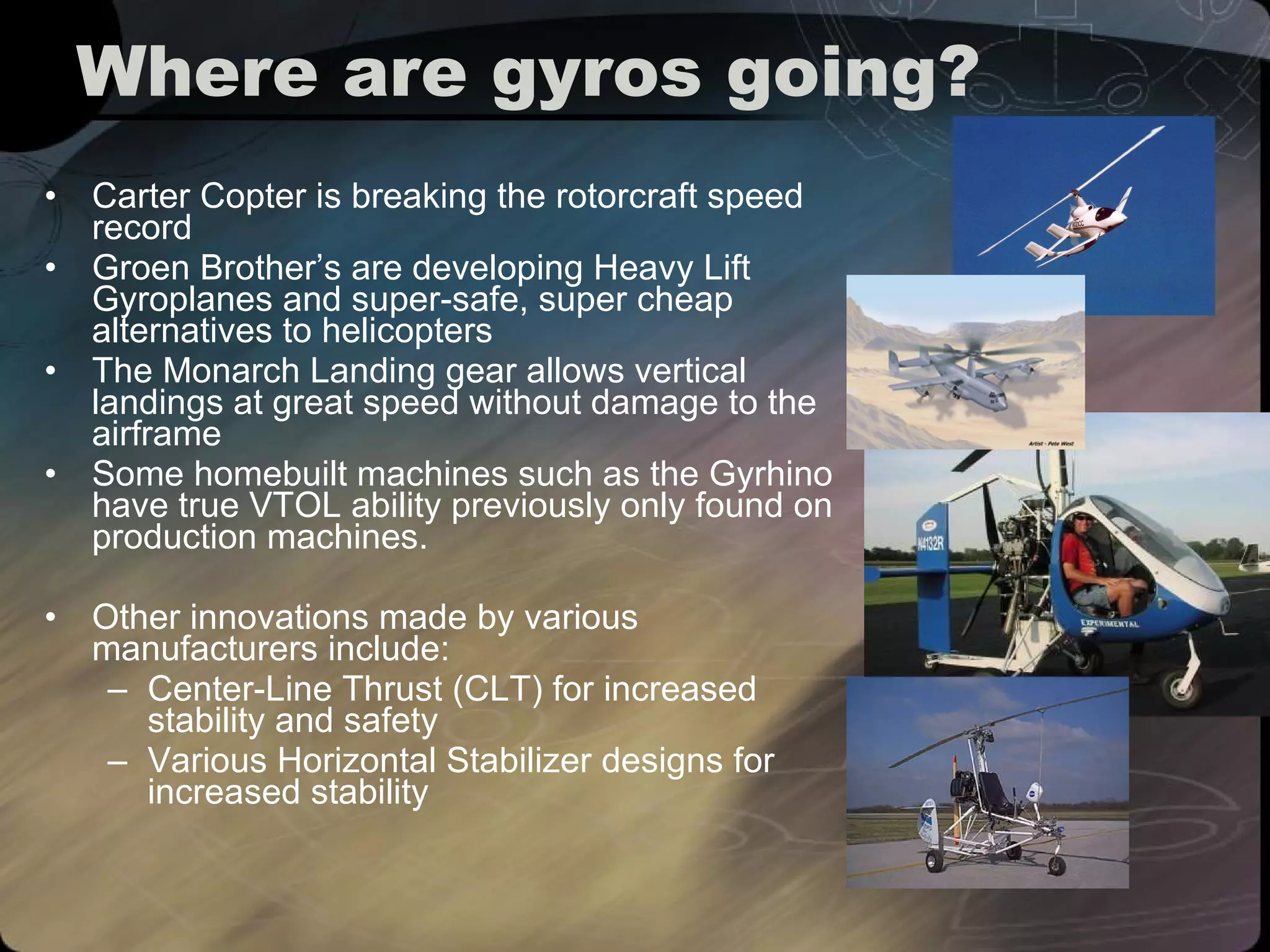
Where are gyros going? Carter Copter is breaking the rotorcraft speed record Groen Brother’s are developing Heavy Lift Gyroplanes and super-safe, super cheap alternatives to helicopters The Monarch Landing gear allows vertical landings at great speed without damage to the airframe Some homebuilt machines such as the Gyrhino have true VTOL ability previously only found on production machines. Other innovations made by various manufacturers include:  Center-Line Thrust (CLT) for increased stability and safety Various Horizontal Stabilizer designs for increased stability
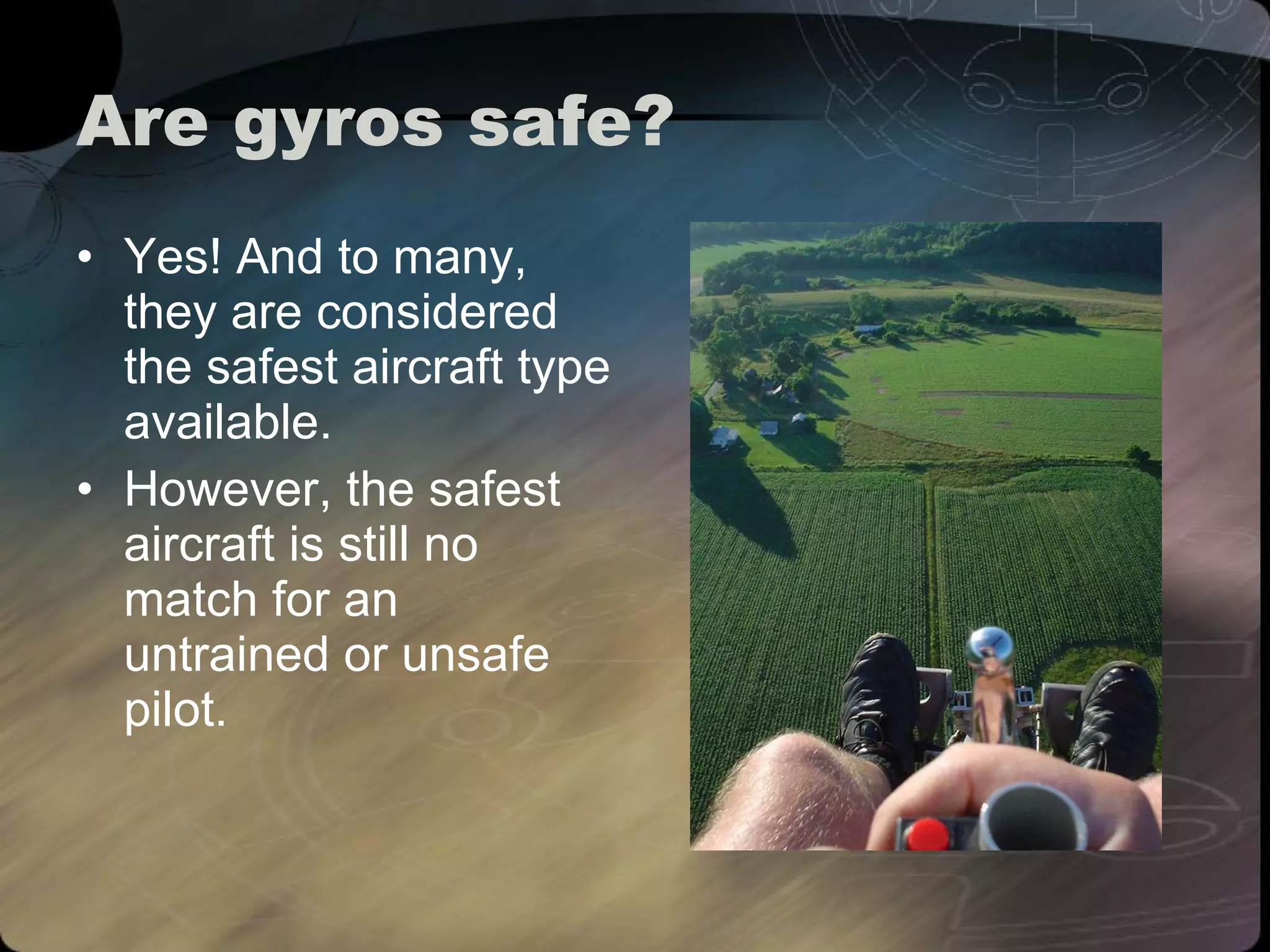
Are gyros safe? Yes! And to many, they are considered the safest aircraft type available. However, the safest aircraft is still no match for an untrained or unsafe pilot.
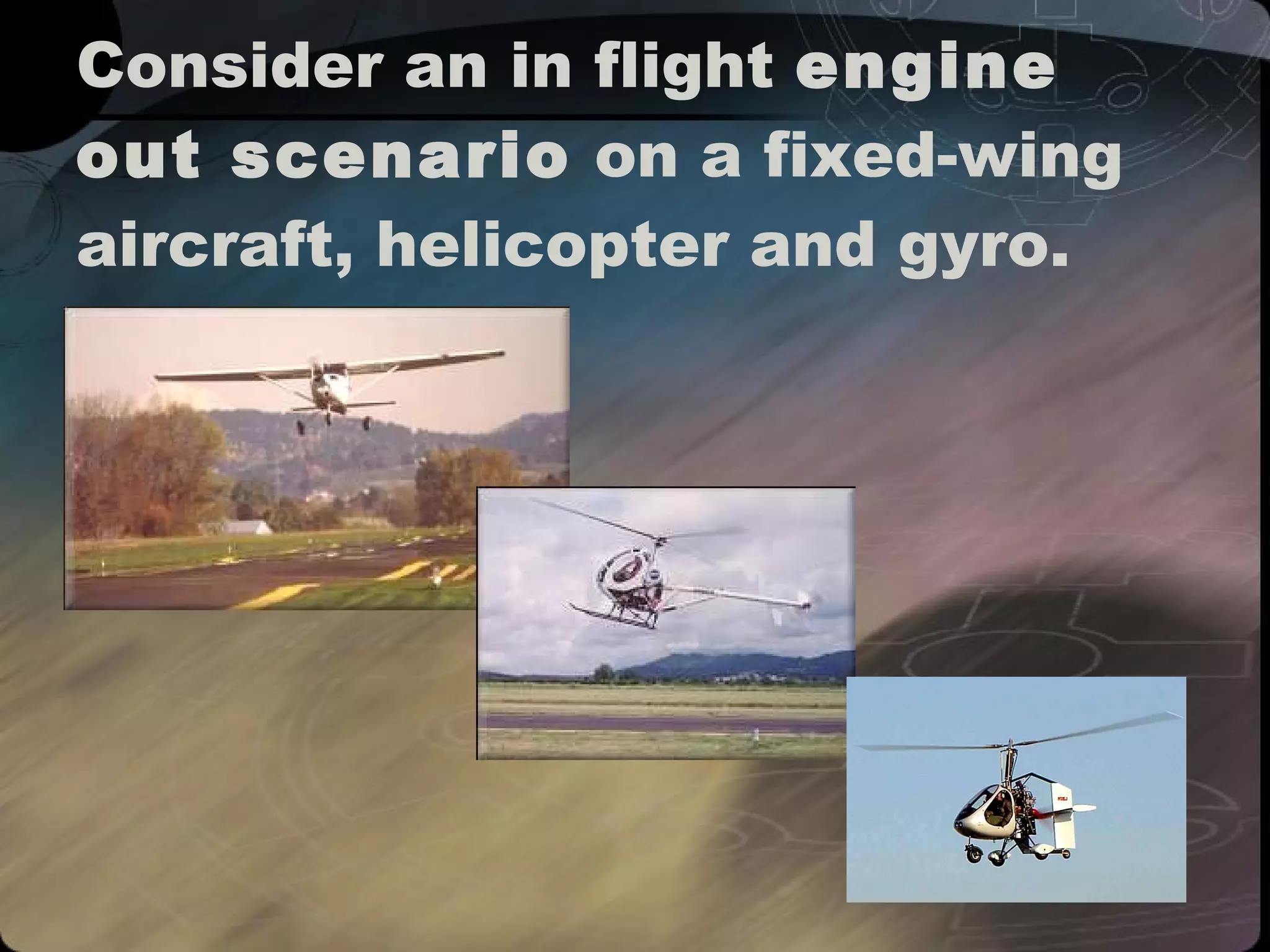
Consider an in flight  engine out scenario  on a fixed-wing aircraft, helicopter and gyro.
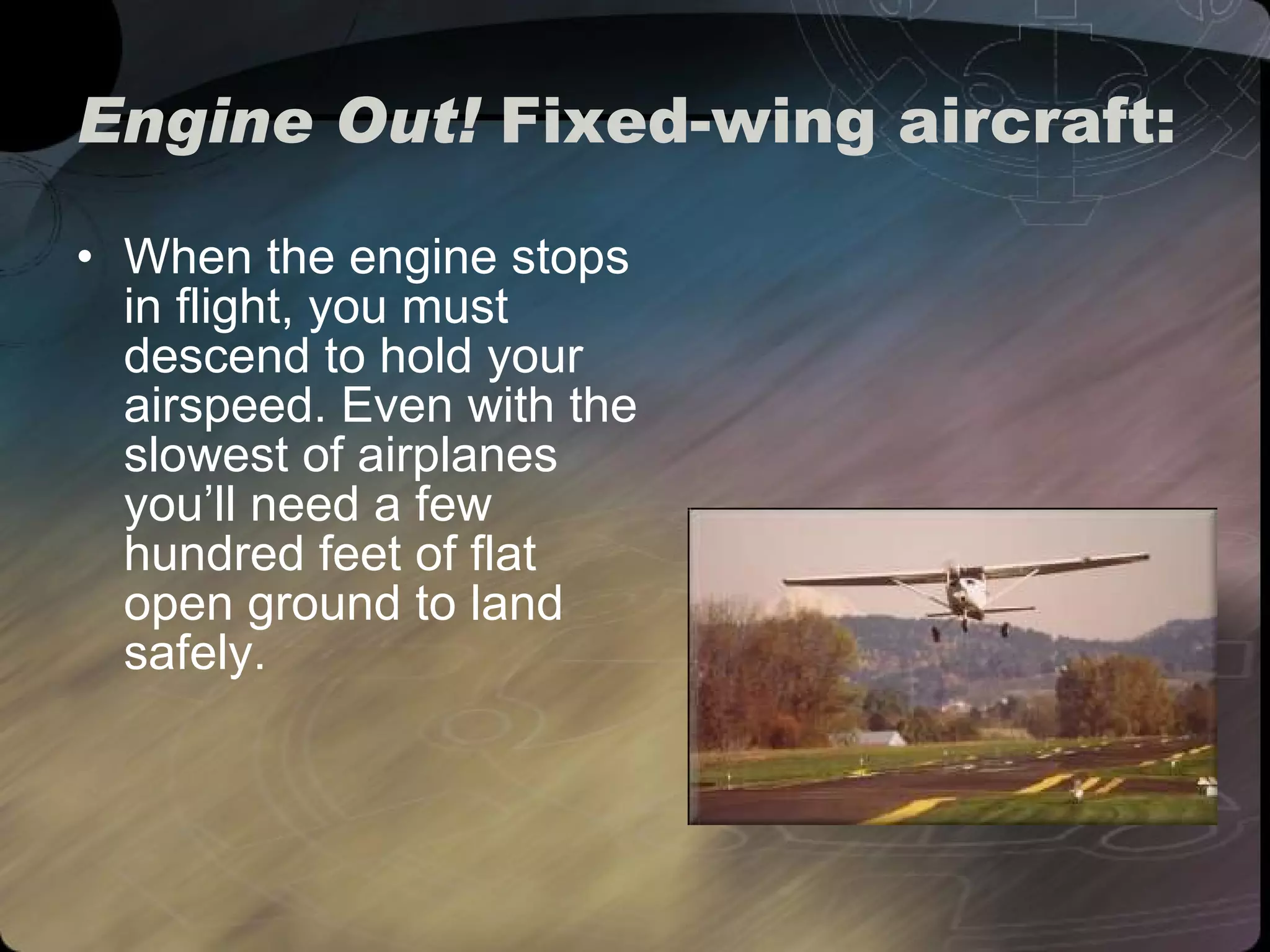
Engine Out!  Fixed-wing aircraft: When the engine stops in flight, you must descend to hold your airspeed. Even with the slowest of airplanes you’ll need a few hundred feet of flat open ground to land safely.
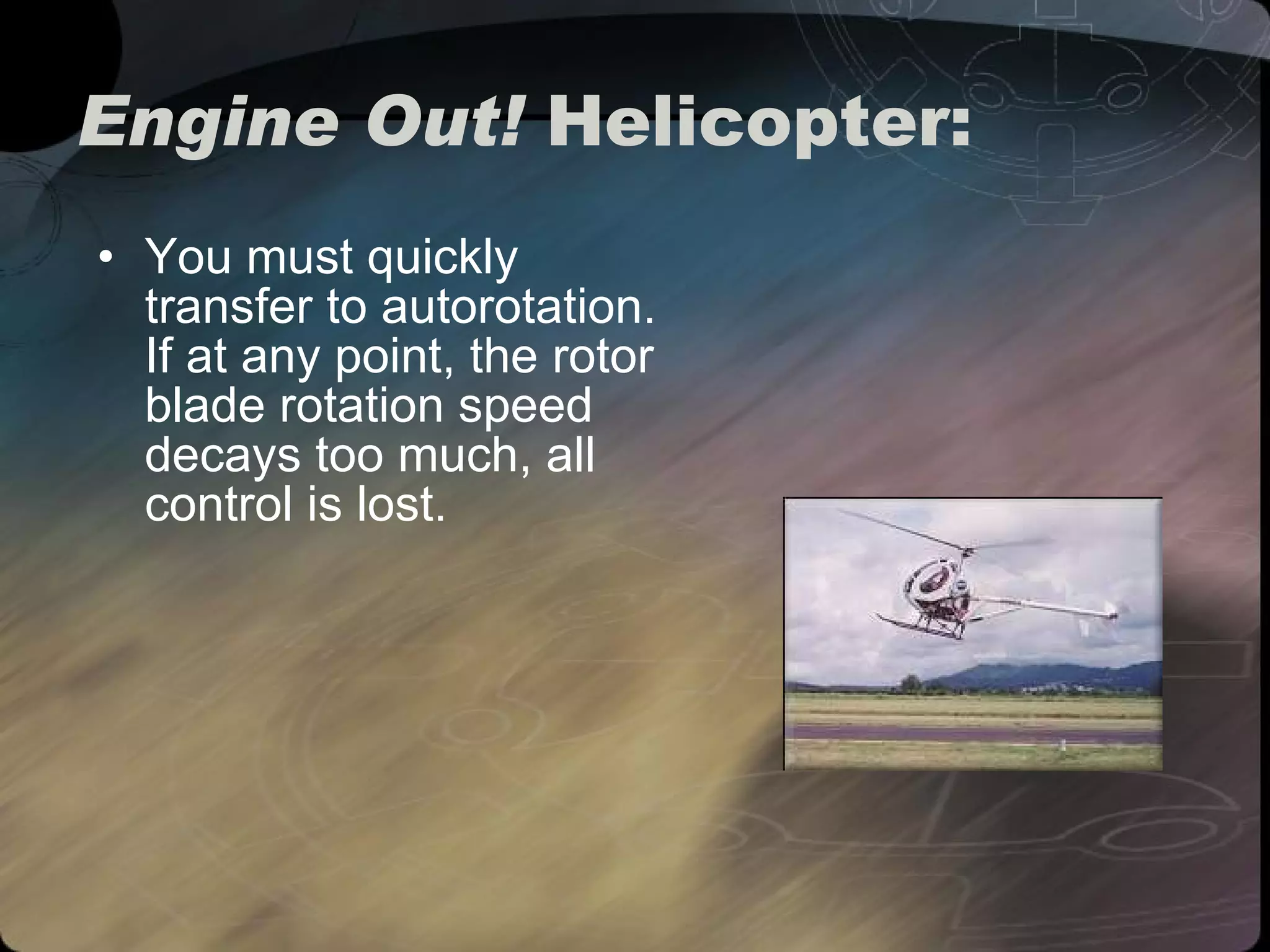
Engine Out!  Helicopter: You must quickly  transfer to autorotation. If at any point, the rotor blade rotation speed decays too much, all control is lost.
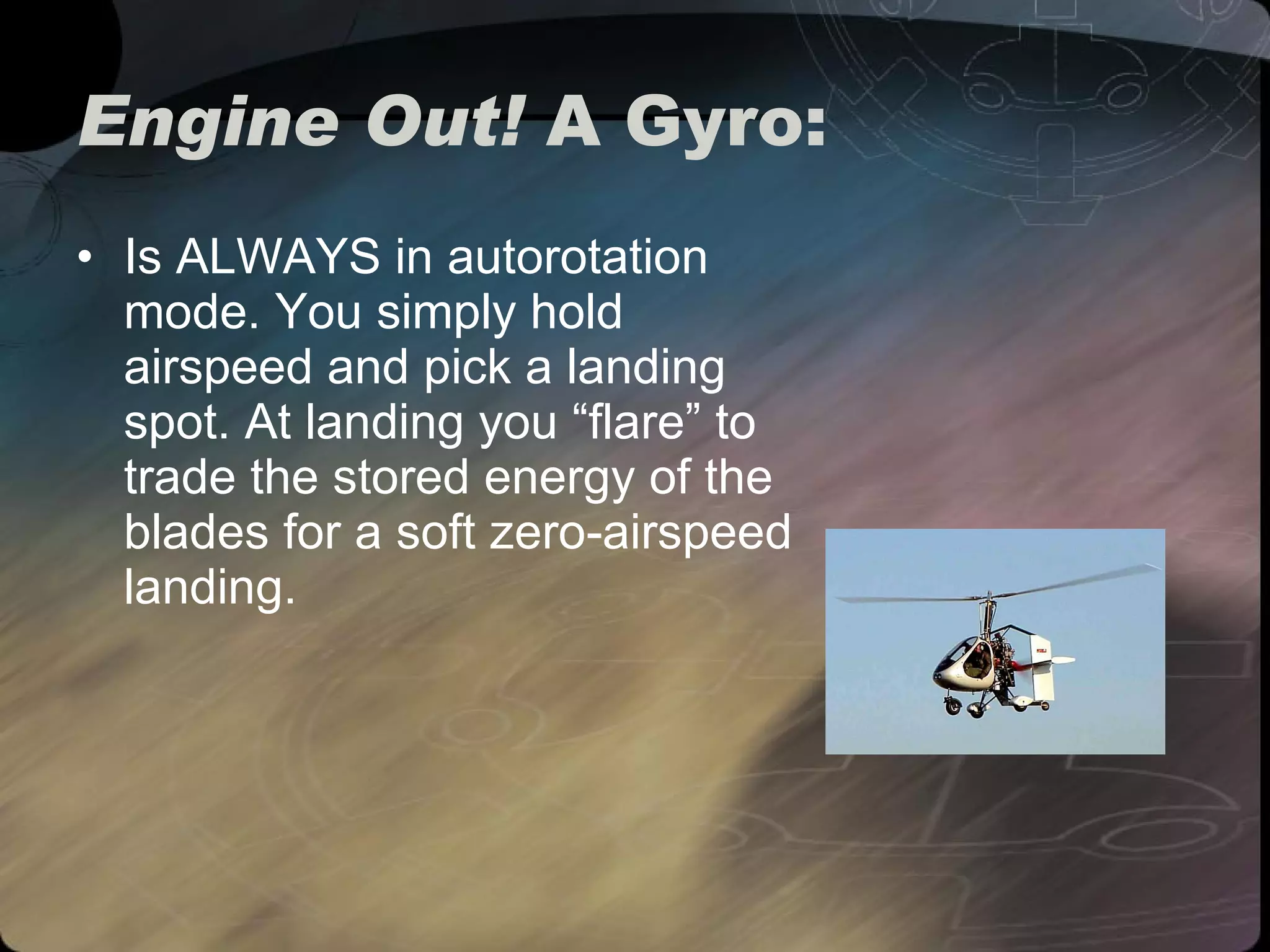
Engine Out!  A Gyro:  Is ALWAYS in autorotation mode. You simply hold airspeed and pick a landing spot. At landing you “flare” to trade the stored energy of the blades for a soft zero-airspeed landing.
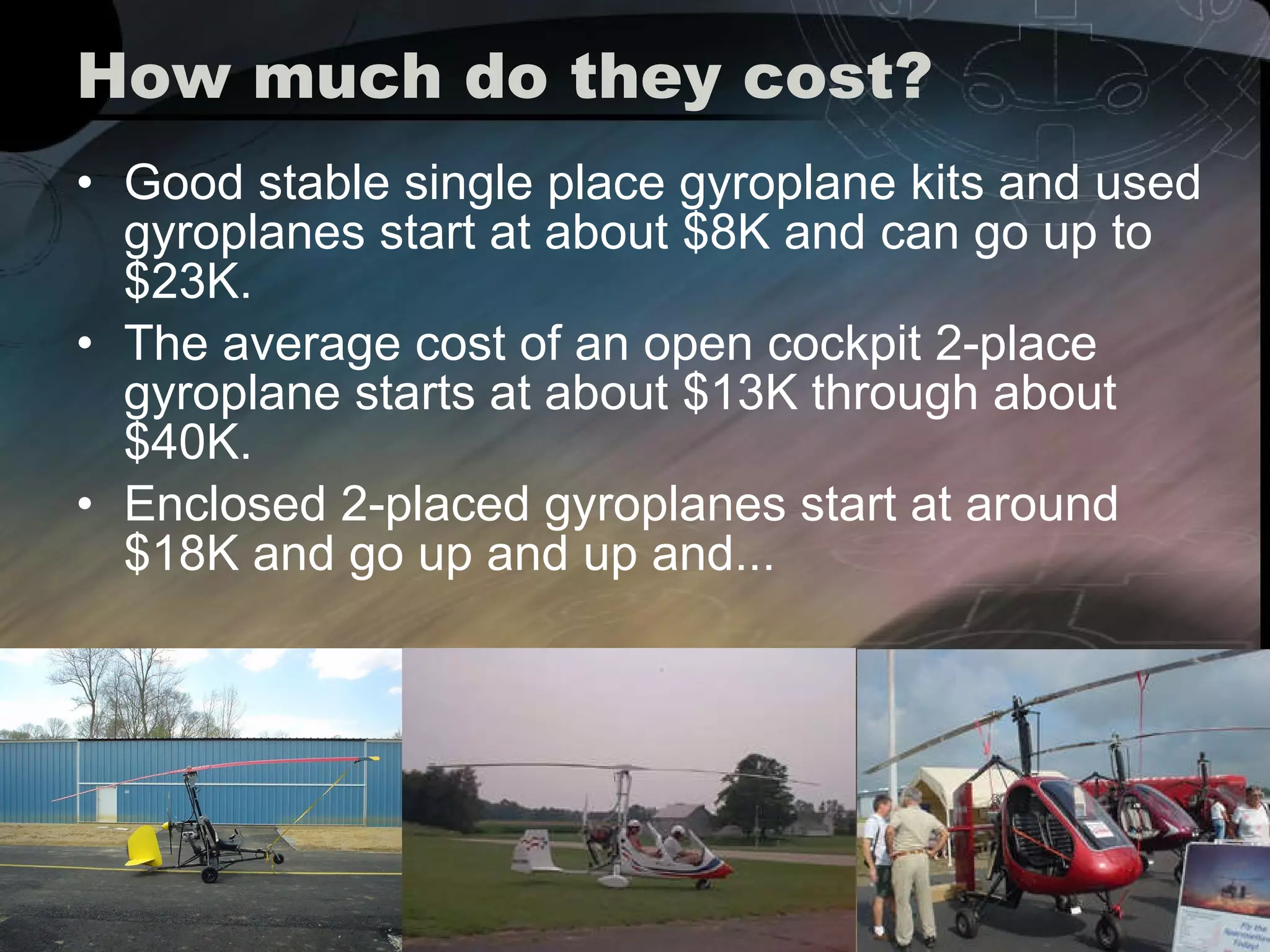
How much do they cost? Good stable single place gyroplane kits and used gyroplanes start at about $8K and can go up to $23K.  The average cost of an open cockpit 2-place gyroplane starts at about $13K through about $40K.  Enclosed 2-placed gyroplanes start at around $18K and go up and up and...
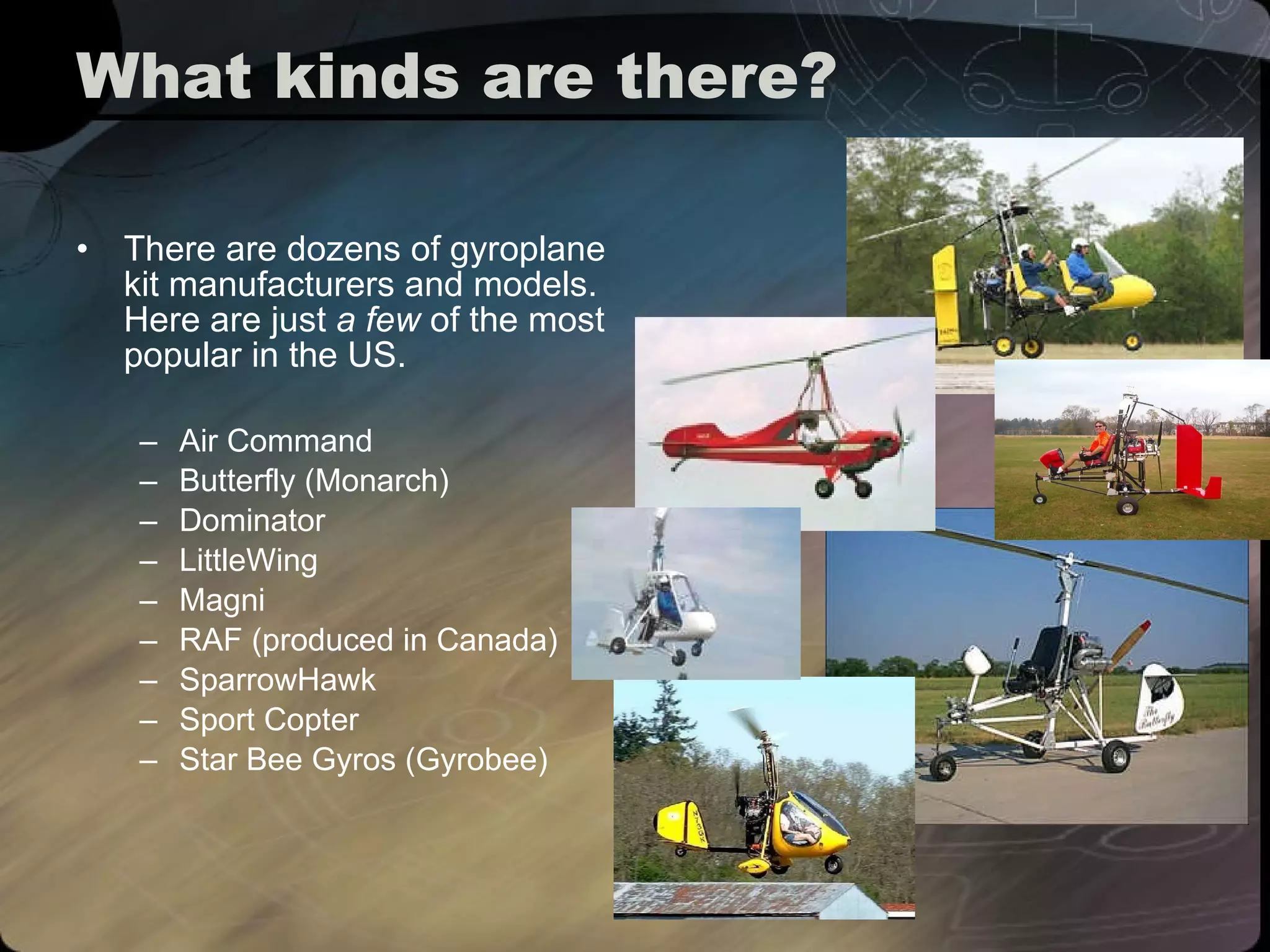
What kinds are there? There are dozens of gyroplane kit manufacturers and models. Here are just  a few  of the most popular in the US. Air Command Butterfly (Monarch) Dominator LittleWing Magni RAF (produced in Canada) SparrowHawk Sport Copter Star Bee Gyros (Gyrobee)
Where do I get info? For more information contact:  www.PRA.org   Popular Rotorcraft Association www.pra73.net  PRA Chapter 73 (Scappoose, OR) www.prachapter34.com  ( Greencastle IN.) http://home.earthlink.net/~cra40/  (Chapter 40, Cincinnati) www. aircommand .com   www.americanautogyro.com www.raf2000.com www. sportcopter .com www.starbeegyros.com Find a local chapter here:  http://www.pra.org/localChapters.php Also join a web forum devoted to rotorcraft: www. rotaryforum .com
Important Note: Even experienced pilots  must  still get lessons from a gyroplane certified instructor.  Gyroplanes are relatively easy to fly but are not fixed-wing aircraft or helicopters. Gyroplanes have some very unique attributes that  require  gyro-specific training!
Extra Credit? How do Gyroplanes compare Pro/Con to other light sport aircraft? Gyros and Powered Parachutes and PPG Gyros and Trikes Gyros and Fixed Wing Ultralights Gyros and Experimental Helicopters Gyros vs. Gyros? Ultralight and Experimental Gyros
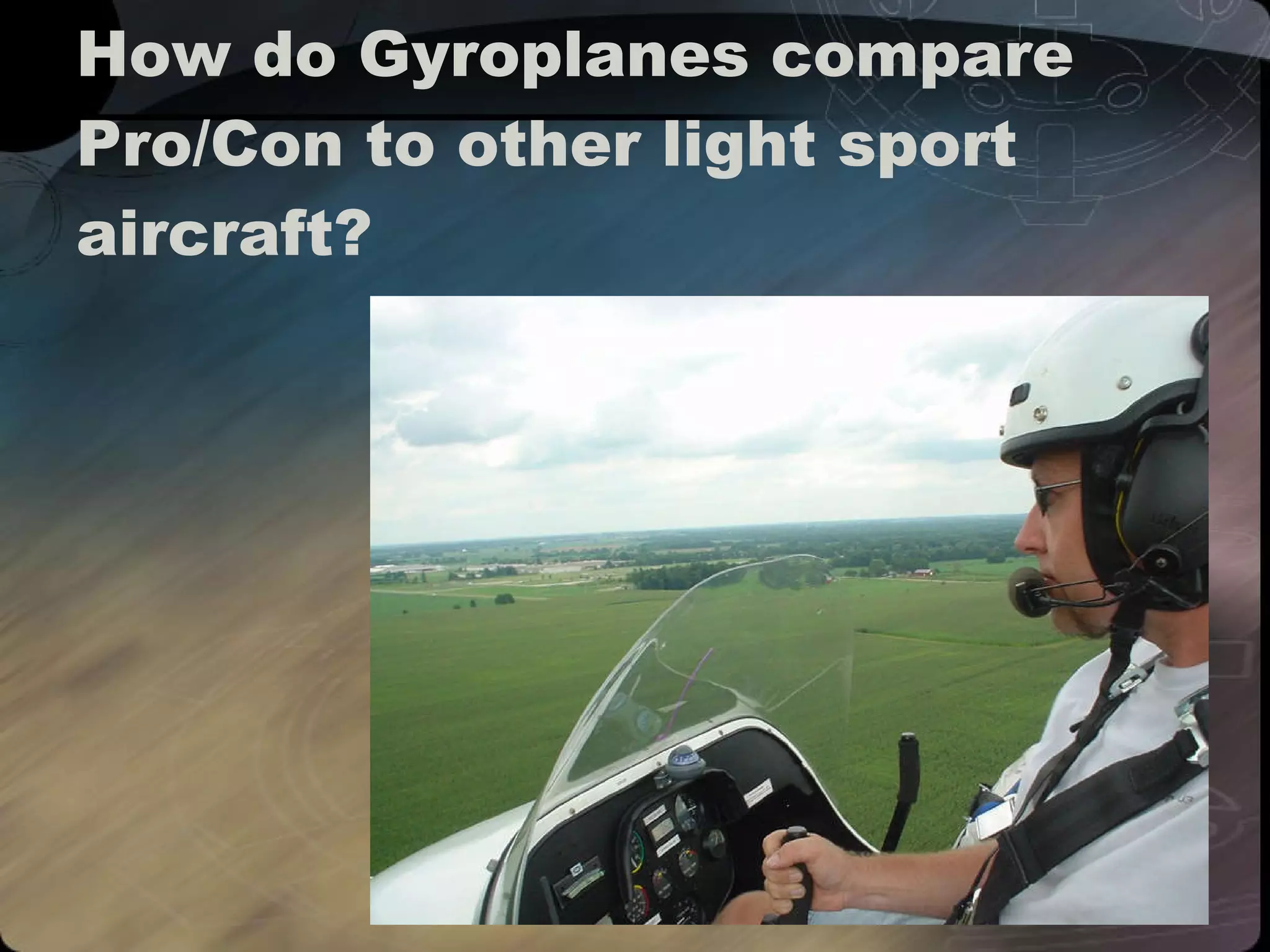
How do Gyroplanes compare Pro/Con to other light sport aircraft?
Gyros and Powered Parachutes and PPG Gyros Faster (PPG/PPC max speed = 30mph) Can fly in windy conditions Greater range Tip overs less likely No strings, no canopy to manage or replace No ‘cell collapse’ PPC, PPG PPG, can be stored in a car Easier to learn to fly Mixes poorly with other aircraft traffic More difficult prep for takeoff
Gyros and Trikes Trikes More fuel efficient Generally faster cruise  Gyros Controls are not reversed Handle wind better No wing material to wear or replace Stronger construction Won’t spin or stall
Gyros and Fixed Wing Ultralights & Experimentals Fixed Wing Ultralights Large used market Easy to find training Generally the best x-country aircraft Gyros Less fuel efficient Harder to find training Safer engine out, No stalls or spins Construction easer to inspect Better in wind gusts and x-winds Quicker to build / easier to build STOVL (Short Take Off Vertical Landing) Requires less storage space, easy to transport
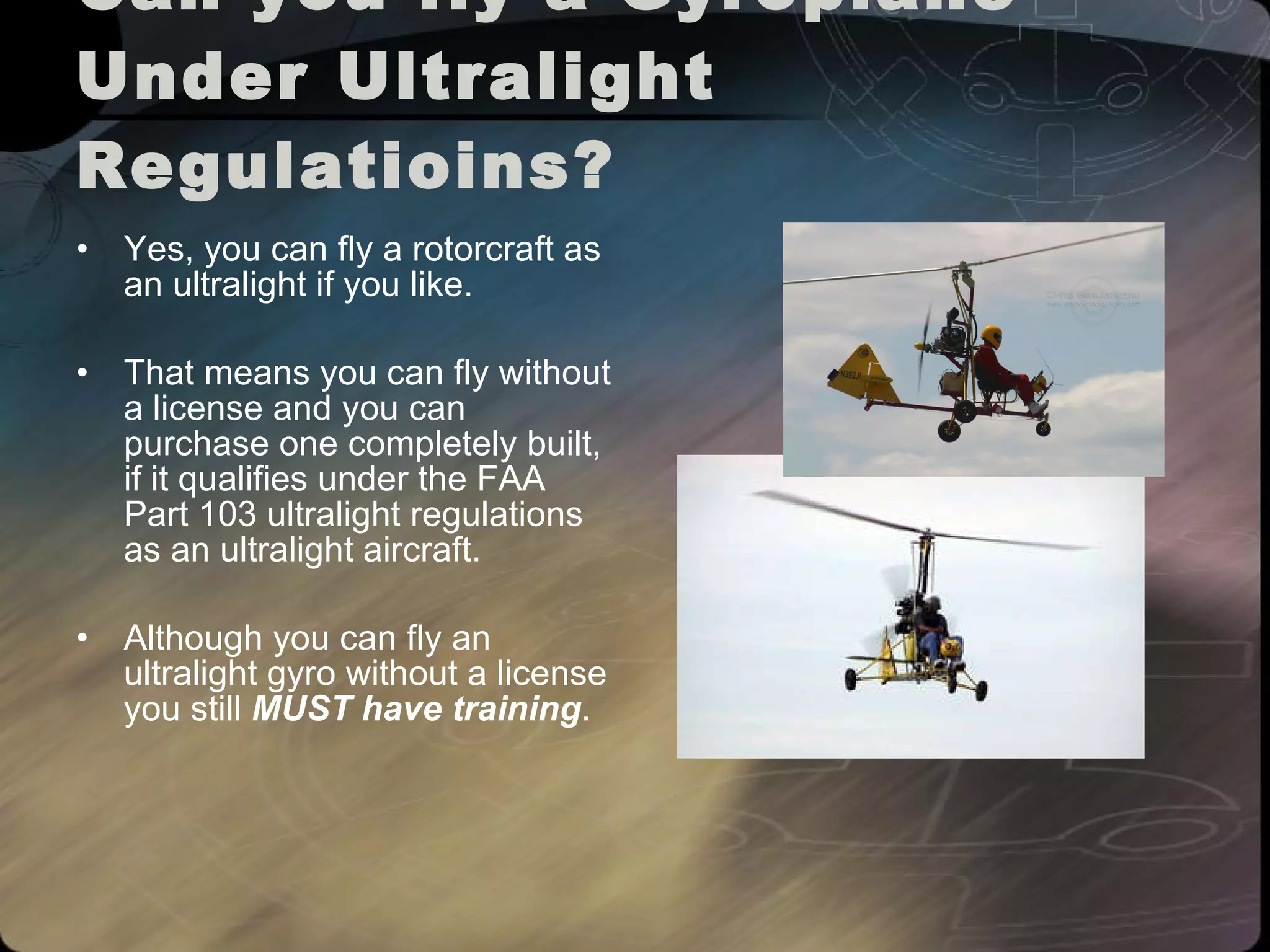
Can you fly a Gyroplane Under Ultralight Regulatioins? Yes, you can fly a rotorcraft as an ultralight if you like.  That means you can fly without a license and you can purchase one completely built, if it qualifies under the FAA Part 103 ultralight regulations as an ultralight aircraft.  Although you can fly an ultralight gyro without a license you still  MUST have training .
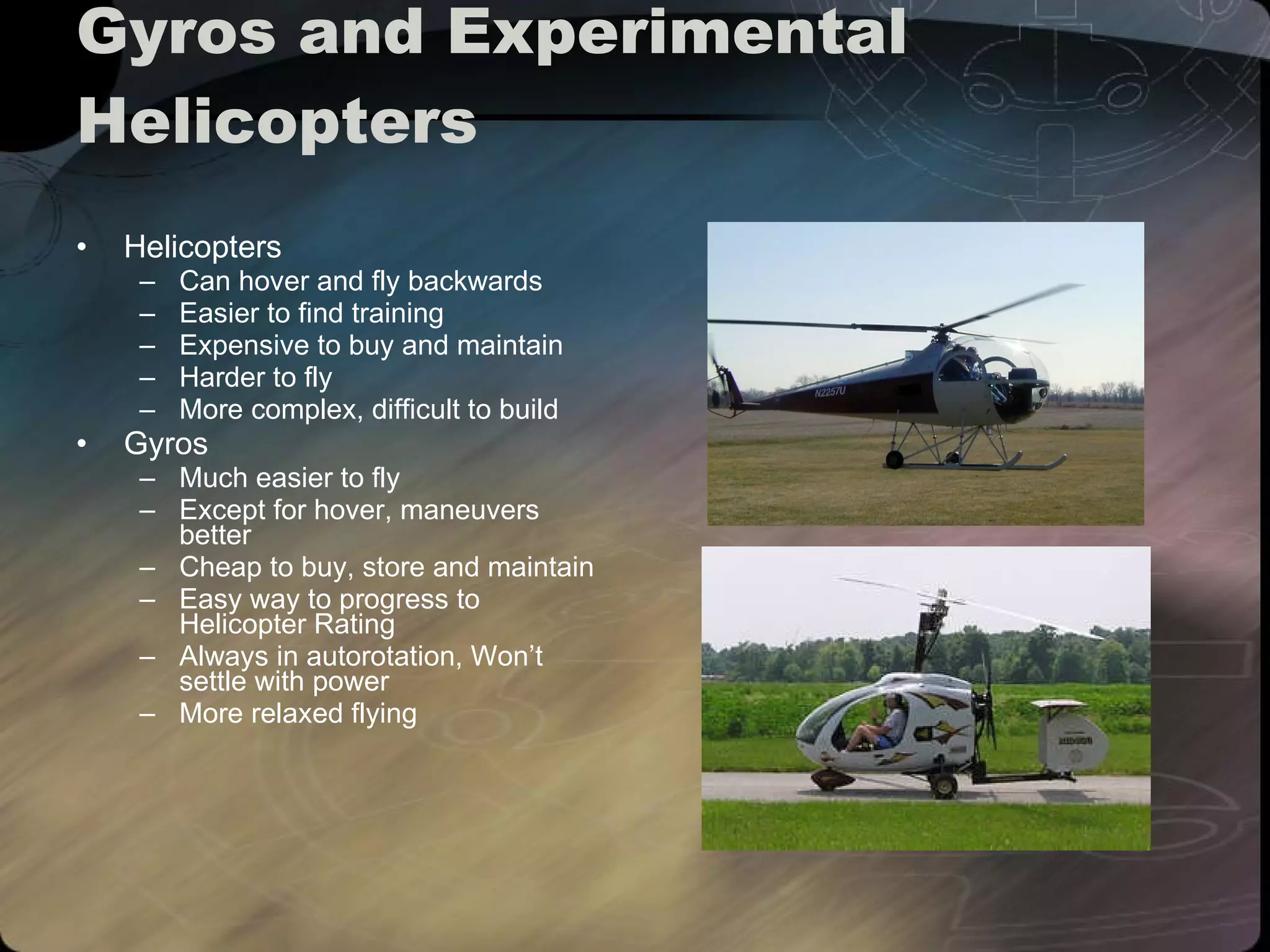
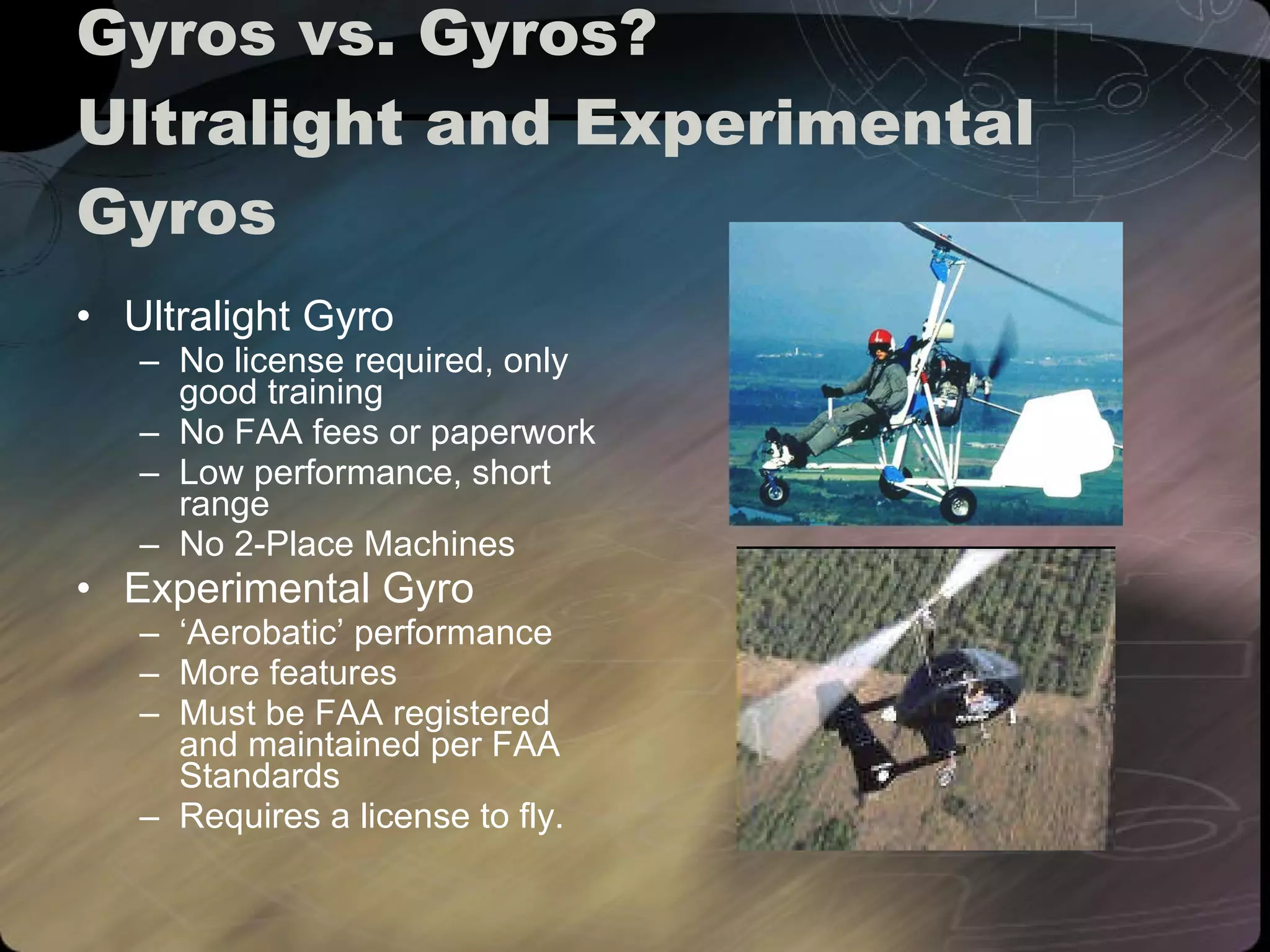
Gyros and Experimental Helicopters Helicopters Can hover and fly backwards Easier to find training Expensive to buy and maintain Harder to fly More complex, difficult to build Gyros Much easier to fly Except for hover, maneuvers better Cheap to buy, store and maintain Easy way to progress to Helicopter Rating Always in autorotation, Won’t settle with power More relaxed flying
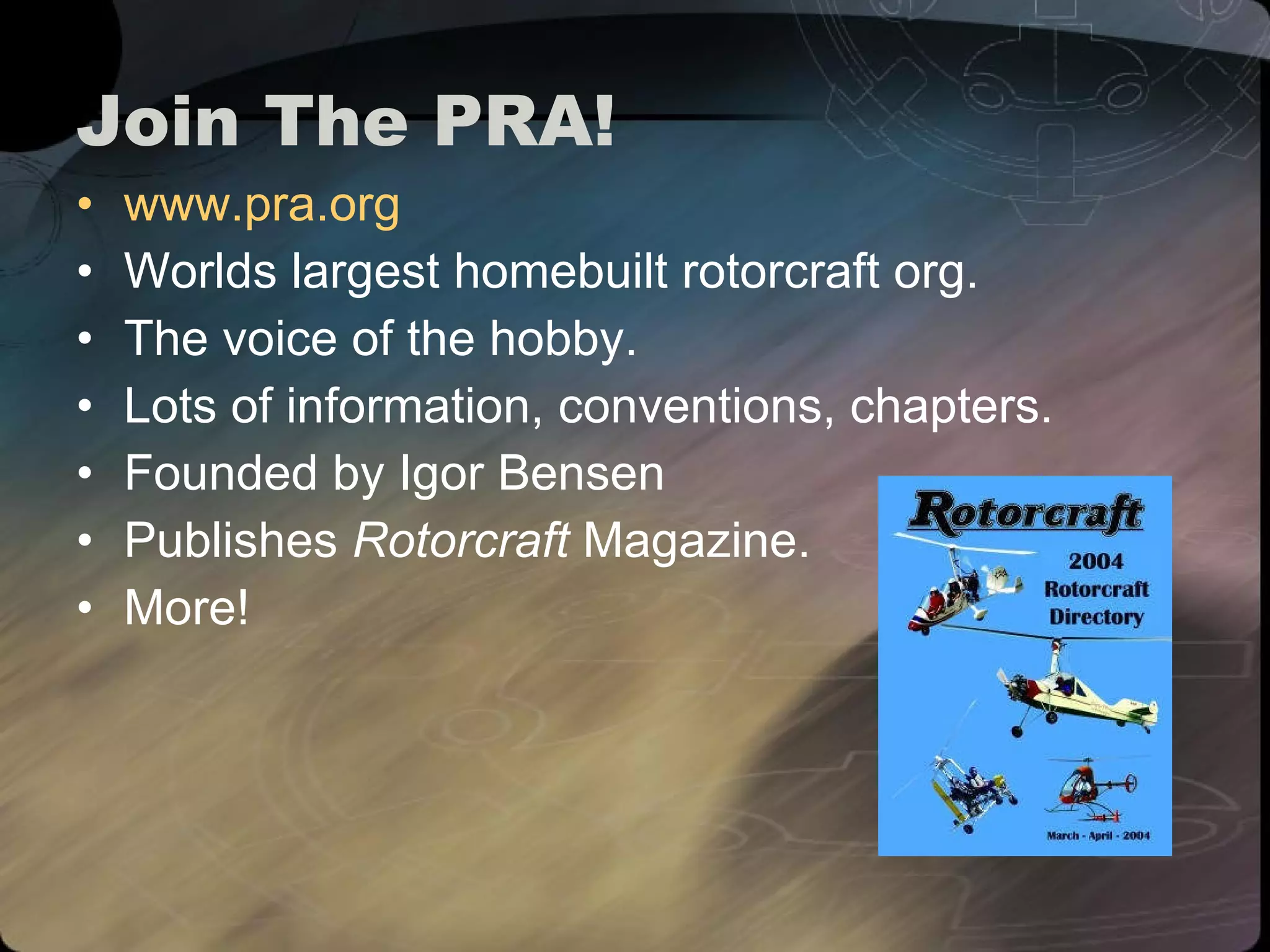
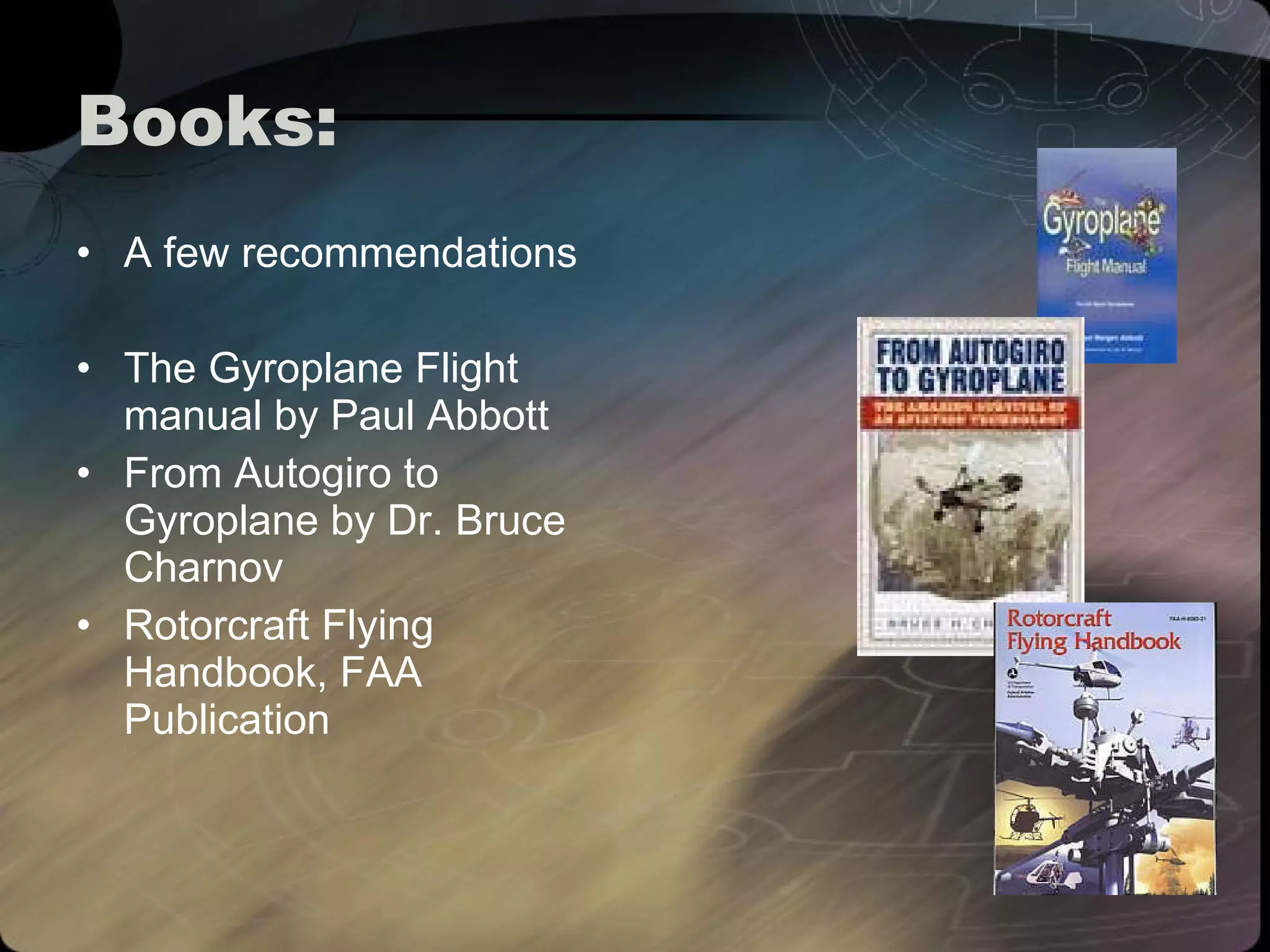
Gyros vs. Gyros? Ultralight and Experimental Gyros Ultralight Gyro No license required, only good training No FAA fees or paperwork Low performance, short range No 2-Place Machines Experimental Gyro ‘ Aerobatic’ performance More features Must be FAA registered and maintained per FAA Standards Requires a license to fly.
Join The PRA! www.pra.org Worlds largest homebuilt rotorcraft org. The voice of the hobby. Lots of information, conventions, chapters. Founded by Igor Bensen Publishes  Rotorcraft  Magazine. More!
Books: A few recommendations The Gyroplane Flight manual by Paul Abbott From Autogiro to Gyroplane by Dr. Bruce Charnov Rotorcraft Flying Handbook, FAA Publication
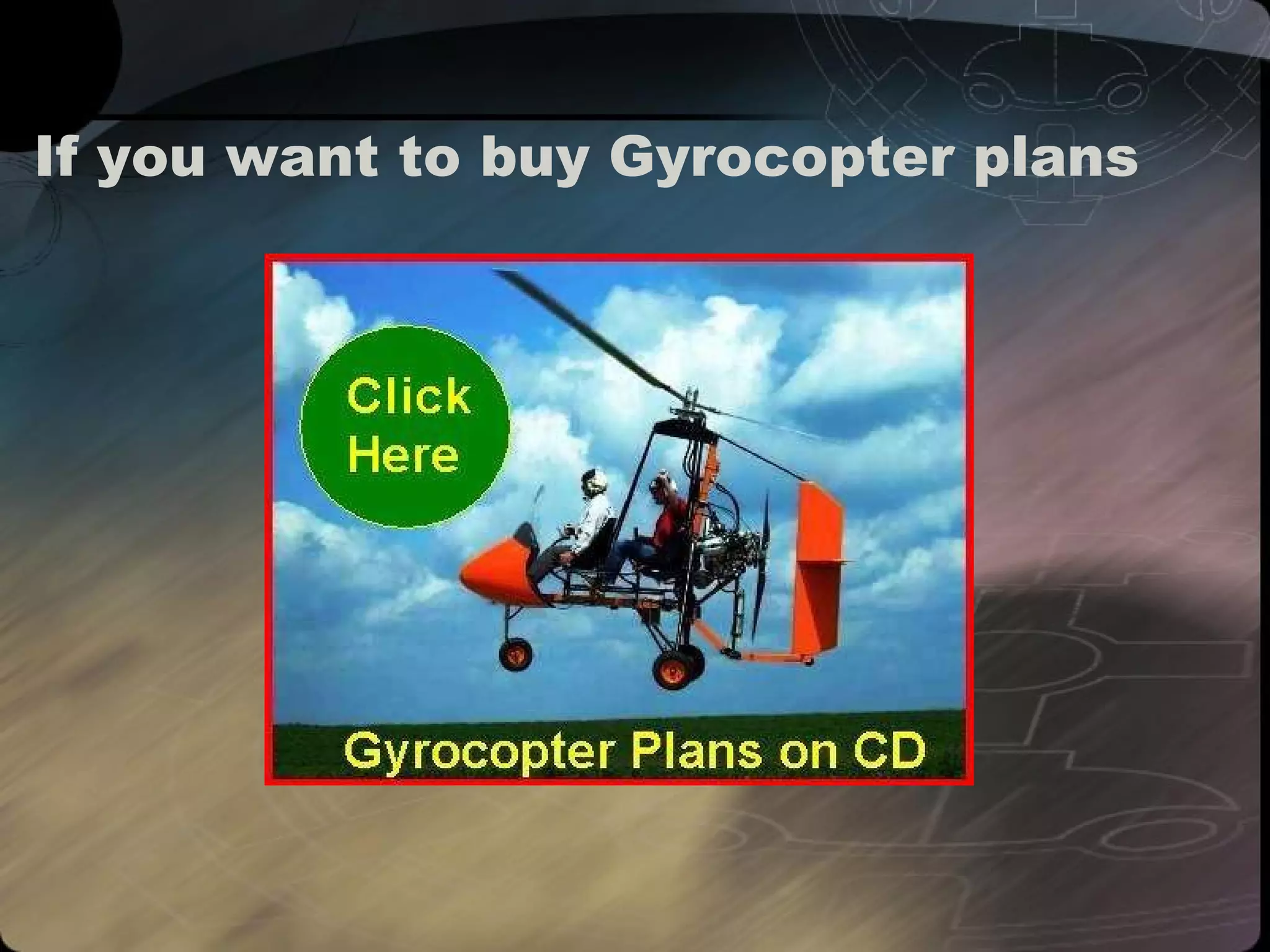
If you want to buy Gyrocopter plans

Gyrocopter An Introduction

  • 1.
    Gyroplanes Gyrocopters andAutogyros Aviation's best kept Secret
  • 2.
    Gyrocopter, Gyroplane, Autogyro? Do they all mean the same thing? In general YES . However, there are minor technical differences.
  • 3.
    Autogyro (Autogiro)The term Autogyro is used to describe the first style of gyroplanes. These are tractor-style gyroplanes that have a fuselage that looks like a conventional aircraft.
  • 4.
    Gyrocopter This is the most common term used by the general public. The term gyrocopter is a product name owned by the Bensen company. Sort of like the term Kleenex TM is a brand name but not all tissues are Kleenex, some are just tissues .
  • 5.
    Gyroplane In theUnited States the FAA’s official term is gyroplane. Gyroplane is the term most used by the pilots and people in the hobby
  • 6.
    What is aGyroplane? Gyroplanes are a cross between a helicopter and an airplane. Mostly like a helicopter the gyroplane is a rotorcraft and uses rotorblades as a spinning wing to fly. Unlike a helicopter the rotorblades are not powered directly by the engine and they use a propeller for forward movement.
  • 7.
    So what arewe going to talk about? What is so good about gyros? Where did gyros come from? Where are gyros going? Are gyros safe? How much do they cost? What kinds are there? Where do I get info?
  • 8.
    What is sogood about gyros? Gyros are safe A Gyroplane can maneuver and land in a very small area. A well made and stable gyroplane can handle wind better than almost all general aviation aircraft if piloted by an experienced pilot. Inexpensive to purchase and easy to build compared to other sport and general aviation aircraft. Easy to store and transport. It is common practice to keep your gyroplane in the garage and trailer it to a local airport to fly. Gyros are FUN!
  • 9.
    Where did gyroscome from? Spanish inventor Juan de Ia Cierva built the first "Autogyro" in 1923 Cierva’s patents were used to develop the helicopter, vertiplane and rotodyne type aircraft. (many patents were stolen from Cierva) Autogyro kites were ‘secret weapons’ used by German WWII submarines and under development by the English. 1953 saw the rebirth of interest in the gyroplane with the invention of Dr. Igor Bensen's patented "Gyrocopter.“
  • 10.
    A Brief Historyof Gyroplanes Gyroplanes flourished from the 1920 through the 1940s, Setting world records and producing new designs. Tragically and ironically* the founding fathers and heads of the leading gyroplane manufacturers were killed in non-gyroplane related accidents leaving no one in a position to spearhead development. The depression finished off the remaining companies.
  • 11.
    Almost a revolutionThe amazing gyroplane technology was almost revived by both the US and UK governments. The US project was military and lost funding The UK Fairey Rotodyne gained approval for production. It would have setup an air route that would transport passengers between metropolitan areas faster and cheaper then helicopters or commercial airlines. The project was killed by politics when the British put the Fairey company under control of Westland Co. which had ties to helicopter manufacturers. Westland destroyed the working production model, prototypes, drawings and tooling.
  • 12.
    Igor to therescue. Dr. Igor Bensen was assigned by the US government and GE to examine captured German secret technology (gyroglider) and the British rotachute in Dayton Ohio. Dr. Bensen then designed and patented the Gyrocopter a ‘pusher’ gyroplane and sold his plans to hobbyists. Benson lobbied the FAA for the creation of the Experimental 51% homebuilt category and succeeded. ( Previously all homebuilt aircraft were actually flown illegally). Therefore all home aircraft builders are indebted to Dr. Benson and his gyrocopter.
  • 13.
    Where are gyrosgoing? Carter Copter is breaking the rotorcraft speed record Groen Brother’s are developing Heavy Lift Gyroplanes and super-safe, super cheap alternatives to helicopters The Monarch Landing gear allows vertical landings at great speed without damage to the airframe Some homebuilt machines such as the Gyrhino have true VTOL ability previously only found on production machines. Other innovations made by various manufacturers include: Center-Line Thrust (CLT) for increased stability and safety Various Horizontal Stabilizer designs for increased stability
  • 14.
    Are gyros safe?Yes! And to many, they are considered the safest aircraft type available. However, the safest aircraft is still no match for an untrained or unsafe pilot.
  • 15.
    Consider an inflight engine out scenario on a fixed-wing aircraft, helicopter and gyro.
  • 16.
    Engine Out! Fixed-wing aircraft: When the engine stops in flight, you must descend to hold your airspeed. Even with the slowest of airplanes you’ll need a few hundred feet of flat open ground to land safely.
  • 17.
    Engine Out! Helicopter: You must quickly transfer to autorotation. If at any point, the rotor blade rotation speed decays too much, all control is lost.
  • 18.
    Engine Out! A Gyro: Is ALWAYS in autorotation mode. You simply hold airspeed and pick a landing spot. At landing you “flare” to trade the stored energy of the blades for a soft zero-airspeed landing.
  • 19.
    How much dothey cost? Good stable single place gyroplane kits and used gyroplanes start at about $8K and can go up to $23K. The average cost of an open cockpit 2-place gyroplane starts at about $13K through about $40K. Enclosed 2-placed gyroplanes start at around $18K and go up and up and...
  • 20.
    What kinds arethere? There are dozens of gyroplane kit manufacturers and models. Here are just a few of the most popular in the US. Air Command Butterfly (Monarch) Dominator LittleWing Magni RAF (produced in Canada) SparrowHawk Sport Copter Star Bee Gyros (Gyrobee)
  • 21.
    Where do Iget info? For more information contact: www.PRA.org Popular Rotorcraft Association www.pra73.net PRA Chapter 73 (Scappoose, OR) www.prachapter34.com ( Greencastle IN.) http://home.earthlink.net/~cra40/ (Chapter 40, Cincinnati) www. aircommand .com www.americanautogyro.com www.raf2000.com www. sportcopter .com www.starbeegyros.com Find a local chapter here: http://www.pra.org/localChapters.php Also join a web forum devoted to rotorcraft: www. rotaryforum .com
  • 22.
    Important Note: Evenexperienced pilots must still get lessons from a gyroplane certified instructor. Gyroplanes are relatively easy to fly but are not fixed-wing aircraft or helicopters. Gyroplanes have some very unique attributes that require gyro-specific training!
  • 23.
    Extra Credit? Howdo Gyroplanes compare Pro/Con to other light sport aircraft? Gyros and Powered Parachutes and PPG Gyros and Trikes Gyros and Fixed Wing Ultralights Gyros and Experimental Helicopters Gyros vs. Gyros? Ultralight and Experimental Gyros
  • 24.
    How do Gyroplanescompare Pro/Con to other light sport aircraft?
  • 25.
    Gyros and PoweredParachutes and PPG Gyros Faster (PPG/PPC max speed = 30mph) Can fly in windy conditions Greater range Tip overs less likely No strings, no canopy to manage or replace No ‘cell collapse’ PPC, PPG PPG, can be stored in a car Easier to learn to fly Mixes poorly with other aircraft traffic More difficult prep for takeoff
  • 26.
    Gyros and TrikesTrikes More fuel efficient Generally faster cruise Gyros Controls are not reversed Handle wind better No wing material to wear or replace Stronger construction Won’t spin or stall
  • 27.
    Gyros and FixedWing Ultralights & Experimentals Fixed Wing Ultralights Large used market Easy to find training Generally the best x-country aircraft Gyros Less fuel efficient Harder to find training Safer engine out, No stalls or spins Construction easer to inspect Better in wind gusts and x-winds Quicker to build / easier to build STOVL (Short Take Off Vertical Landing) Requires less storage space, easy to transport
  • 28.
    Can you flya Gyroplane Under Ultralight Regulatioins? Yes, you can fly a rotorcraft as an ultralight if you like. That means you can fly without a license and you can purchase one completely built, if it qualifies under the FAA Part 103 ultralight regulations as an ultralight aircraft. Although you can fly an ultralight gyro without a license you still MUST have training .
  • 29.
    Gyros and ExperimentalHelicopters Helicopters Can hover and fly backwards Easier to find training Expensive to buy and maintain Harder to fly More complex, difficult to build Gyros Much easier to fly Except for hover, maneuvers better Cheap to buy, store and maintain Easy way to progress to Helicopter Rating Always in autorotation, Won’t settle with power More relaxed flying
  • 30.
    Gyros vs. Gyros?Ultralight and Experimental Gyros Ultralight Gyro No license required, only good training No FAA fees or paperwork Low performance, short range No 2-Place Machines Experimental Gyro ‘ Aerobatic’ performance More features Must be FAA registered and maintained per FAA Standards Requires a license to fly.
  • 31.
    Join The PRA!www.pra.org Worlds largest homebuilt rotorcraft org. The voice of the hobby. Lots of information, conventions, chapters. Founded by Igor Bensen Publishes Rotorcraft Magazine. More!
  • 32.
    Books: A fewrecommendations The Gyroplane Flight manual by Paul Abbott From Autogiro to Gyroplane by Dr. Bruce Charnov Rotorcraft Flying Handbook, FAA Publication
  • 33.
    If you wantto buy Gyrocopter plans

Editor's Notes

  • #2 By Tim O’Connor [email_address] Version 2.0a 2004 Free to all Additional work by Gary (Kaminski) in Ory-gun
  • #11 * Juan de La Cierva was killed when a commercial fixed wing airplane stalled after takeoff. The ability of fixed wing aircraft to stall was what prompted Juan to invent the autogyro as a safer means of travel.