








Cashflow Management –Cashflow Management –
the road to your financial freedomthe road to your financial freedom
About the speaker :
• Graduated from the National University of Singapore in B. Arts and B.
Architecture in 1986, he joined the insurance industry in the same
year.
• Lectured in TAR College between 1986 – 1990
• Trainer/ moderator for MII between 1992 – 1998
• Spoke and trained in various platforms in Malaysia including the
IARFC and in countries like Indonesia, Singapore and Sri Lanka.
• Started designing corporate insurance in 1991 with clients including
Ajinomoto, Carrier, PWC, MAICSA and others
• Qualifications include AAII, ACS, ALHC ( International Claims
Association ), AMTC, ChFC, CLU, RFP, RFC
• As one of the founder member, he is currently the President of the
Malaysian Association of Chartered Financial Consultants
• He is also a member of the Financial Advisor Guidelines Review
committee of MFPC
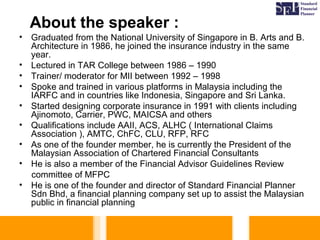
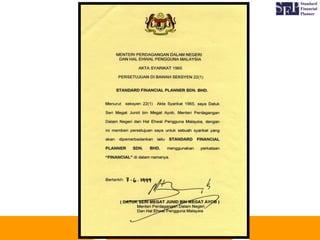
• He is one of the founder and director of Standard Financial Planner
Sdn Bhd, a financial planning company set up to assist the Malaysian
public in financial planning
BackBack
Today’s presentation
This presentation serves as an initiation to
the world of financial planning
Financial Planning areasFinancial Planning areas
 Cashflow Management
 Risk Planning
 Investment Planning
 Tax Planning
 Estate Planning
What is cashflow management?
 It is the methodical analysis of the
inflow and outflow of your cash ie
income and expenses
 It also involves the intelligent
management of a ‘scarce’ resource to
ensure your financial freedom
Why cashflow management?Why cashflow management?
 Limited financial resources,
multiple financial obligations
 Planning for the future
 You have to retire someday
 Inflation and rising costs
3 financial characters3 financial characters
 Financial Indifference
 Financial Imprisonment
 Financial Intelligence
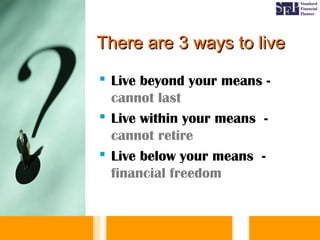
There are 3 ways to liveThere are 3 ways to live
 Live beyond your means -
cannot last
 Live within your means -
cannot retire
 Live below your means -
financial freedom
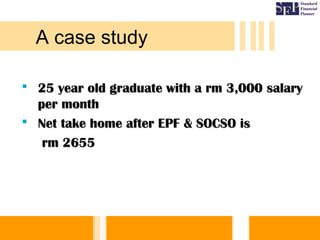
 25 year old graduate with a rm 3,000 salary25 year old graduate with a rm 3,000 salary
per monthper month
 Net take home after EPF & SOCSO isNet take home after EPF & SOCSO is
rm 2655rm 2655
A case study
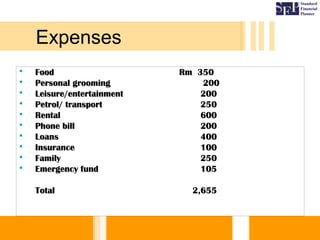
 FoodFood Rm 350Rm 350
 Personal groomingPersonal grooming 200200
 Leisure/entertainmentLeisure/entertainment 200200
 Petrol/ transportPetrol/ transport 250250
 RentalRental 600600
 Phone billPhone bill 200200
 LoansLoans 400400
 InsuranceInsurance 100100
 FamilyFamily 250250
 Emergency fundEmergency fund 105105
TotalTotal 2,6552,655
Expenses
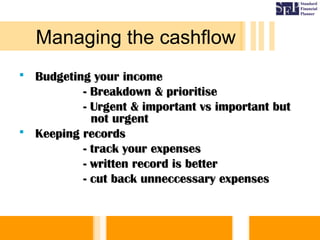
 Budgeting your incomeBudgeting your income
- Breakdown & prioritise- Breakdown & prioritise
- Urgent & important vs important but- Urgent & important vs important but
not urgentnot urgent
 Keeping recordsKeeping records
- track your expenses- track your expenses
- written record is better- written record is better
- cut back unneccessary expenses- cut back unneccessary expenses
Managing the cashflow
 Pay yourself firstPay yourself first
- save at least 10% for your future- save at least 10% for your future
- magic of compounding interest- magic of compounding interest
- read George Clason’s- read George Clason’s ‘The richest‘The richest
man in Babylon’man in Babylon’
- learn from seminars & games- learn from seminars & games
 Don’t lend or borrowDon’t lend or borrow
- you will lose a friend- you will lose a friend
- you will lose sleep & concentration- you will lose sleep & concentration
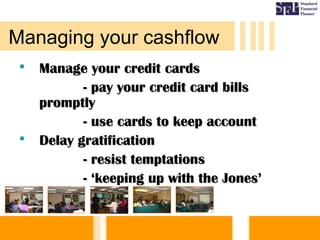
Managing the cashflow
 Manage your credit cardsManage your credit cards
- pay your credit card bills- pay your credit card bills
promptlypromptly
- use cards to keep account- use cards to keep account
 Delay gratificationDelay gratification
- resist temptations- resist temptations
- ‘keeping up with the Jones’- ‘keeping up with the Jones’
Managing your cashflow
 Keep different bank accountsKeep different bank accounts
- for expenses, savings, investment- for expenses, savings, investment
 Set deadlinesSet deadlines
- targets are important- targets are important
- turn it into a game- turn it into a game
Managing your cashflow
 Managing your loans / creditsManaging your loans / credits
- pay off high interest loans first- pay off high interest loans first
- reorganise or refinance- reorganise or refinance
- always pay something even if it is- always pay something even if it is
a small amounta small amount
 Discipline is the path to successDiscipline is the path to success
- sacrifice for the future- sacrifice for the future
- it takes 21 days to build a habit- it takes 21 days to build a habit
Managing your cashflow
 The average EPF contributor has rmThe average EPF contributor has rm
99,000 when he retires99,000 when he retires
 Most retirees will live for between 20Most retirees will live for between 20
and 25 yrsand 25 yrs
 As we age, we will require moreAs we age, we will require more
medical attentionmedical attention
 As more and more are marrying andAs more and more are marrying and
having children later, children’shaving children later, children’s
support and education will reach intosupport and education will reach into
retirement yrs.retirement yrs.
Be aware
 Review your current financialReview your current financial
situationsituation ie income & expensesie income & expenses
 Note down your debtsNote down your debts eg crediteg credit
cardscards
 Start prioritisingStart prioritising
 Cut back where necessaryCut back where necessary egeg
less 1cup of Starbucks coffee perless 1cup of Starbucks coffee per
weekweek
 Make a committmentMake a committment
How to Start
 Increase your knowledgeIncrease your knowledge egeg
learn about financial planninglearn about financial planning
 Start investingStart investing (but not(but not
speculating)speculating)
 Monitor your progressMonitor your progress
 Reward yourselfReward yourself (but no splurging(but no splurging
- that can come when you are- that can come when you are
financially well off! )financially well off! )
How to Start
A story to live by….
All Rights Reserved
Standard Financial Planner Sdn Bhd
14th
Floor Menara Safuan, No 80 Jalan Ampang, 50450 Kuala Lumpur
Tel: 603.20266311 Fax: 603.20266310 email: admin@sfplanner.com URL: www.sfplanner.com
Prepared by Ruzi for BEP. Updated on 7th
July 05
THANK YOUTHANK YOU

Simple ideas on Cashflow management for beginners

  • 1.
    Cashflow Management –CashflowManagement – the road to your financial freedomthe road to your financial freedom
  • 2.
    About the speaker: • Graduated from the National University of Singapore in B. Arts and B. Architecture in 1986, he joined the insurance industry in the same year. • Lectured in TAR College between 1986 – 1990 • Trainer/ moderator for MII between 1992 – 1998 • Spoke and trained in various platforms in Malaysia including the IARFC and in countries like Indonesia, Singapore and Sri Lanka. • Started designing corporate insurance in 1991 with clients including Ajinomoto, Carrier, PWC, MAICSA and others • Qualifications include AAII, ACS, ALHC ( International Claims Association ), AMTC, ChFC, CLU, RFP, RFC • As one of the founder member, he is currently the President of the Malaysian Association of Chartered Financial Consultants • He is also a member of the Financial Advisor Guidelines Review committee of MFPC • He is one of the founder and director of Standard Financial Planner Sdn Bhd, a financial planning company set up to assist the Malaysian public in financial planning
  • 8.
  • 10.
    Today’s presentation This presentationserves as an initiation to the world of financial planning
  • 11.
    Financial Planning areasFinancialPlanning areas  Cashflow Management  Risk Planning  Investment Planning  Tax Planning  Estate Planning
  • 12.
    What is cashflowmanagement?  It is the methodical analysis of the inflow and outflow of your cash ie income and expenses  It also involves the intelligent management of a ‘scarce’ resource to ensure your financial freedom
  • 13.
    Why cashflow management?Whycashflow management?  Limited financial resources, multiple financial obligations  Planning for the future  You have to retire someday  Inflation and rising costs
  • 14.
    3 financial characters3financial characters  Financial Indifference  Financial Imprisonment  Financial Intelligence
  • 15.
    There are 3ways to liveThere are 3 ways to live  Live beyond your means - cannot last  Live within your means - cannot retire  Live below your means - financial freedom
  • 16.
     25 yearold graduate with a rm 3,000 salary25 year old graduate with a rm 3,000 salary per monthper month  Net take home after EPF & SOCSO isNet take home after EPF & SOCSO is rm 2655rm 2655 A case study
  • 17.
     FoodFood Rm350Rm 350  Personal groomingPersonal grooming 200200  Leisure/entertainmentLeisure/entertainment 200200  Petrol/ transportPetrol/ transport 250250  RentalRental 600600  Phone billPhone bill 200200  LoansLoans 400400  InsuranceInsurance 100100  FamilyFamily 250250  Emergency fundEmergency fund 105105 TotalTotal 2,6552,655 Expenses
  • 18.
     Budgeting yourincomeBudgeting your income - Breakdown & prioritise- Breakdown & prioritise - Urgent & important vs important but- Urgent & important vs important but not urgentnot urgent  Keeping recordsKeeping records - track your expenses- track your expenses - written record is better- written record is better - cut back unneccessary expenses- cut back unneccessary expenses Managing the cashflow
  • 19.
     Pay yourselffirstPay yourself first - save at least 10% for your future- save at least 10% for your future - magic of compounding interest- magic of compounding interest - read George Clason’s- read George Clason’s ‘The richest‘The richest man in Babylon’man in Babylon’ - learn from seminars & games- learn from seminars & games  Don’t lend or borrowDon’t lend or borrow - you will lose a friend- you will lose a friend - you will lose sleep & concentration- you will lose sleep & concentration Managing the cashflow
  • 20.
     Manage yourcredit cardsManage your credit cards - pay your credit card bills- pay your credit card bills promptlypromptly - use cards to keep account- use cards to keep account  Delay gratificationDelay gratification - resist temptations- resist temptations - ‘keeping up with the Jones’- ‘keeping up with the Jones’ Managing your cashflow
  • 21.
     Keep differentbank accountsKeep different bank accounts - for expenses, savings, investment- for expenses, savings, investment  Set deadlinesSet deadlines - targets are important- targets are important - turn it into a game- turn it into a game Managing your cashflow
  • 22.
     Managing yourloans / creditsManaging your loans / credits - pay off high interest loans first- pay off high interest loans first - reorganise or refinance- reorganise or refinance - always pay something even if it is- always pay something even if it is a small amounta small amount  Discipline is the path to successDiscipline is the path to success - sacrifice for the future- sacrifice for the future - it takes 21 days to build a habit- it takes 21 days to build a habit Managing your cashflow
  • 23.
     The averageEPF contributor has rmThe average EPF contributor has rm 99,000 when he retires99,000 when he retires  Most retirees will live for between 20Most retirees will live for between 20 and 25 yrsand 25 yrs  As we age, we will require moreAs we age, we will require more medical attentionmedical attention  As more and more are marrying andAs more and more are marrying and having children later, children’shaving children later, children’s support and education will reach intosupport and education will reach into retirement yrs.retirement yrs. Be aware
  • 24.
     Review yourcurrent financialReview your current financial situationsituation ie income & expensesie income & expenses  Note down your debtsNote down your debts eg crediteg credit cardscards  Start prioritisingStart prioritising  Cut back where necessaryCut back where necessary egeg less 1cup of Starbucks coffee perless 1cup of Starbucks coffee per weekweek  Make a committmentMake a committment How to Start
  • 25.
     Increase yourknowledgeIncrease your knowledge egeg learn about financial planninglearn about financial planning  Start investingStart investing (but not(but not speculating)speculating)  Monitor your progressMonitor your progress  Reward yourselfReward yourself (but no splurging(but no splurging - that can come when you are- that can come when you are financially well off! )financially well off! ) How to Start
  • 26.
    A story tolive by….
  • 27.
    All Rights Reserved StandardFinancial Planner Sdn Bhd 14th Floor Menara Safuan, No 80 Jalan Ampang, 50450 Kuala Lumpur Tel: 603.20266311 Fax: 603.20266310 email: admin@sfplanner.com URL: www.sfplanner.com Prepared by Ruzi for BEP. Updated on 7th July 05 THANK YOUTHANK YOU