PM Training
Building Business Acumen®
    Presented by Kenny Snarr


                               1
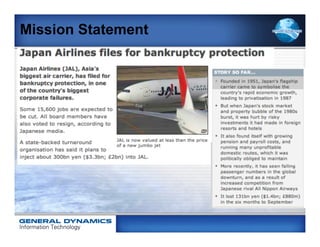
Mission Statement

The Japan Airlines Group, as an
overall air transport enterprise,
will act as a bridge to bring peoples,
their cultures and their hearts closer together and thus contribute to
world peace and prosperity. The Japan Airlines Group, a transport
enterprise with a global reach, will expand its worldwide network as
a key industry supporting travel, tourism and transport in the 21st
century, "an era of exchange.”

We will not only transport people and goods to their respective
destinations safely and on time, but will also bring peoples, their
cultures and their hearts closer together as our contribution to world
peace and prosperity.
Mission Statement
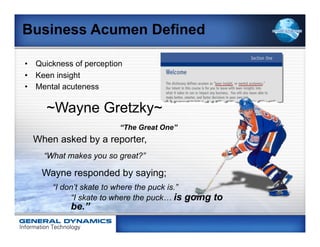
Business Acumen Defined

•  Quickness of perception
•  Keen insight
•  Mental acuteness

     ~Wayne Gretzky~
                         “The Great One”
  When asked by a reporter,
     “What makes you so great?”

    Wayne responded by saying;
       “I don’t skate to where the puck is.”
            “I skate to where the puck… is going to
            be.”
Business	
  Acumen?	
  

•  Quickness	
  of	
  perception	
  
•  Keen	
  insight	
  
•  Mental	
  acuteness	
  

                The image cannot be displayed. Your computer may not have enough memory to open the image, or the image may have been corrupted. Restart your computer, and then open the file again. If the red x still appears, you may have to
                delete the image and then insert it again.


                                                                                                                                                                          Business	
  Acumen	
  101	


                                                                                                                                                                                                                                                   5
Course Outline
  Content / Topic
Introductions / Objectives / Quiz
5-Business Drivers
Strategic Messaging
Differential Management
Financial Statements
   –  Income Statement
   –  Balance Sheet
   –  Cash Flow Statement
Financial Analysis
Competitive Analysis
Action Planning
Learning Objectives…
ü  List and describe what key measures are important
    to ISD and to Tom Kirchmaier.

ü  List and describe the five business drivers all successful
    businesses must focus on.

ü  Teach specific components of the financial statements.


ü  Explain how I can have an impact on growth.

ü  Create a personal action plan that can positively
    impact our results.

                                                                 7
Participant Guide Book


  Write name & phone number
       on the inside cover.


Write name & department
    on the name tent.

                              8
Welcome

 ü  Participation is encouraged
 ü  Please turn off phones, tablets, computers, and/
     or any other devices that may distract during the
     class.
 ü  Be sure to sign the roster for class recognition
     and post class follow-up.
Pop Quiz (GD or ISD numbers)                                   (Page 35)

                                                                             2011
1- What was our Free Cash Flow?
2- What was our DSO, actual or target?
3- What was Cash from Operating Activities?
4- What was Operating Earnings/Program Profit (EBIT $) ?
5- What was Operating Earnings margin (EBIT %)?
6- What was our Profit Margin (%) ?
7- What was Revenue?
8- What was Revenue Per Employee?
9- How much did Revenues grow?
10-How much did Operating Earning (EBIT) grow?
11- How much did Net Earning growth?
          Given all the above, how do we stack up against our competitors?

                                                                                10
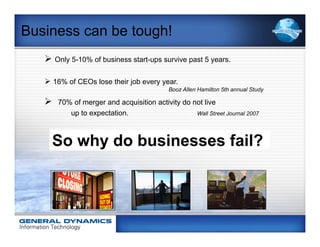
Business can be tough!
   Ø  Only 5-10% of business start-ups survive past 5 years.

   Ø  16% of CEOs lose their job every year.
                                             Booz Allen Hamilton 5th annual Study

   Ø    70% of merger and acquisition activity do not live
            up to expectation.                      Wall Street Journal 2007


     So why do businesses fail?
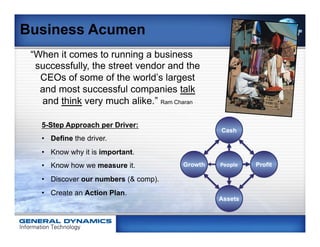
Business Acumen
 “When it comes to running a business
  successfully, the street vendor and the
   CEOs of some of the world’s largest
   and most successful companies talk
   and think very much alike.” Ram Charan

   5-Step Approach per Driver:
   •  Define the driver.
   •  Know why it is important.
   •  Know how we measure it.
   •  Discover our numbers (& comp).
   •  Create an Action Plan.
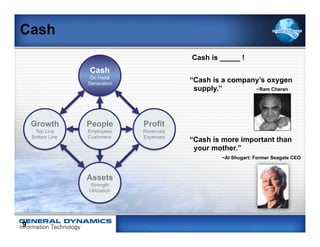
Cash
                                           Cash is _____ !
                  Cash
                   On Hand
                  Generation
                                           “Cash is a company’s oxygen
                                            supply.”        ~Ram Charan


    Growth        People        Profit
     Top Line     Employees     Revenues
    Bottom Line   Customers     Expenses
                                           “Cash is more important than
                                            your mother.”
                                                   ~Al Shugart: Former Seagate CEO


                  Assets
                  Strength
                  Utilization


9
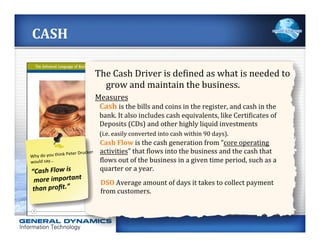
CASH	
  

                                                    The	
  Cash	
  Driver	
  is	
  de;ined	
  as	
  what	
  is	
  needed	
  to	
  
                                                      grow	
  and	
  maintain	
  the	
  business.                                     	


                                                    Measures	
  
                                                     Cash	
  is	
  the	
  bills	
  and	
  coins	
  in	
  the	
  register,	
  and	
  cash	
  in	
  the	
  
                                                      bank.	
  It	
  also	
  includes	
  cash	
  equivalents,	
  like	
  Certi;icates	
  of	
  
                                                      Deposits	
  (CDs)	
  and	
  other	
  highly	
  liquid	
  investments	
  	
  
                                                      (i.e.	
  easily	
  converted	
  into	
  cash	
  within	
  90	
  days).   	
  
                                                      Cash	
  Flow	
  is	
  the	
  cash	
  generation	
  from	
  “core	
  operating	
  
                         	
  Peter	
  Drucker	
       activities”	
  that	
  ;lows	
  into	
  the	
  business	
  and	
  the	
  cash	
  that	
  
Why	
  do	
  you	
  think
would	
  say…	
  	
                                   ;lows	
  out	
  of	
  the	
  business	
  in	
  a	
  given	
  time	
  period,	
  such	
  as	
  a	
  
“Cash	
  Flow	
  is	
                                 quarter	
  or	
  a	
  year.	
  
	
  more	
  important	
                                DSO	
  Average	
  amount	
  of	
  days	
  it	
  takes	
  to	
  collect	
  payment	
  
  than	
  profit.”	
                                    from	
  customers.	
  
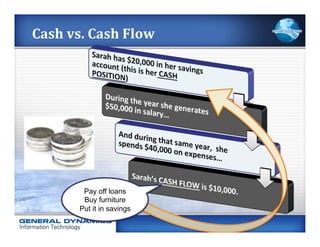
Cash	
  vs.	
  Cash	
  Flow	


            Pay off loans
            Buy furniture
           Put it in savings
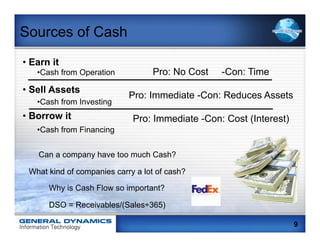
Sources of Cash
•  Earn it
    • Cash from Operation          Pro: No Cost   -Con: Time
•  Sell Assets
                            Pro: Immediate -Con: Reduces Assets
    • Cash from Investing
•  Borrow it                 Pro: Immediate -Con: Cost (Interest)
    • Cash from Financing


    Can a company have too much Cash?

 What kind of companies carry a lot of cash?

       Why is Cash Flow so important?

       DSO = Receivables/(Sales÷365)

                                                                    9
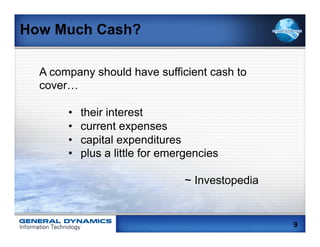
How Much Cash?

  A company should have sufficient cash to
  cover…

       •    their interest
       •    current expenses
       •    capital expenditures
       •    plus a little for emergencies

                                 ~ Investopedia


                                                  9
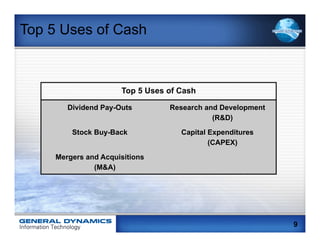
Top 5 Uses of Cash


                      Top 5 Uses of Cash

        Dividend Pay-Outs        Research and Development
                                            (R&D)
         Stock Buy-Back             Capital Expenditures
                                            (CAPEX)
     Mergers and Acquisitions
               (M&A)


                                                            9
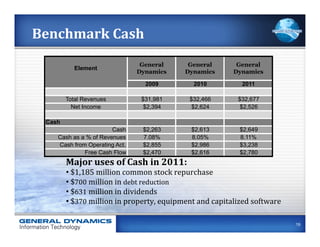
Benchmark	
  Cash	
  
                                       General             General              General
            Element
                                      Dynamics            Dynamics             Dynamics

                                          2009                2010                2011

         Total Revenues                 $31,981             $32,466              $32,677
           Net Income                    $2,394              $2,624               $2,526

  Cash
                        Cash             $2,263              $2,613              $2,649
     Cash as a % of Revenues             7.08%               8.05%               8.11%
     Cash from Operating Act.            $2,855              $2,986              $3,238
              Free Cash Flow             $2,470              $2,616              $2,780
         Major	
  uses	
  of	
  Cash	
  in	
  2011:	
  
         • 	
  $1,185	
  million	
  common	
  stock	
  repurchase	
  
         • 	
  $700	
  million	
  in	
  debt	
  reduction	
  
         • 	
  $631	
  million	
  in	
  dividends	
  
         • 	
  $370	
  million	
  in	
  property,	
  equipment	
  and	
  capitalized	
  software	
  

                                                                                                       19
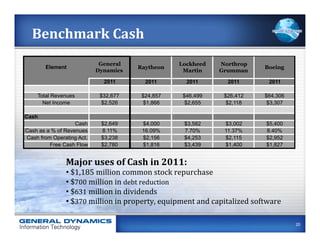
Benchmark	
  Cash	
  
                            General                           Lockheed         Northrop
       Element                               Raytheon                                             Boeing
                           Dynamics                            Martin          Grumman

                              2011              2011             2011             2011              2011

    Total Revenues           $32,677          $24,857           $46,499          $26,412          $64,306
      Net Income              $2,526           $1,866            $2,655           $2,118           $3,307

Cash
                   Cash      $2,649           $4,000            $3,582           $3,002            $5,400
Cash as a % of Revenues      8.11%            16.09%            7.70%            11.37%            8.40%
Cash from Operating Act.     $3,238           $2,156            $4,253           $2,115            $2,952
         Free Cash Flow      $2,780           $1,816            $3,439           $1,400            $1,827


               Major	
  uses	
  of	
  Cash	
  in	
  2011:	
  
               • 	
  $1,185	
  million	
  common	
  stock	
  repurchase	
  
               • 	
  $700	
  million	
  in	
  debt	
  reduction	
  
               • 	
  $631	
  million	
  in	
  dividends	
  
               • 	
  $370	
  million	
  in	
  property,	
  equipment	
  and	
  capitalized	
  software	
  

                                                                                                             20
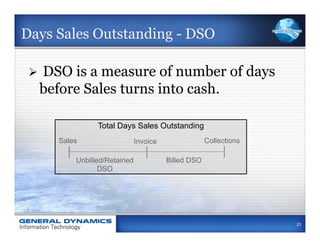
Days Sales Outstanding - DSO

 Ø    DSO is a measure of number of days
       before Sales turns into cash.

                   Total Days Sales Outstanding
         Sales                   Invoice                Collections

             Unbilled/Retained             Billed DSO
                    DSO


                                                                      21
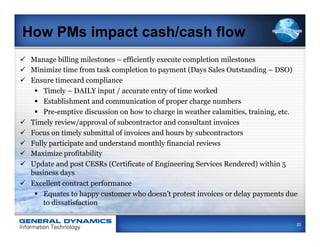
How PMs impact cash/cash flow
ü  Manage billing milestones – efficiently execute completion milestones
ü  Minimize time from task completion to payment (Days Sales Outstanding – DSO)
ü  Ensure timecard compliance
     §  Timely – DAILY input / accurate entry of time worked
     §  Establishment and communication of proper charge numbers
     §  Pre-emptive discussion on how to charge in weather calamities, training, etc.
ü  Timely review/approval of subcontractor and consultant invoices
ü  Focus on timely submittal of invoices and hours by subcontractors
ü  Fully participate and understand monthly financial reviews
ü  Maximize profitability
ü  Update and post CESRs (Certificate of Engineering Services Rendered) within 5
    business days
ü  Excellent contract performance
     §  Equates to happy customer who doesn’t protest invoices or delay payments due
         to dissatisfaction

                                                                                     22
Impacting the Cash Driver

                    Late Timecard Submissions
                 Negatively Impact Our Bottom Line
The annual cost impact to GDIT when people submit their timecards late is in excess
of $600K in administrative and compensation costs.

This comes in the form of the Payroll organization working Saturdays to process
these late cards as well as in the form of administrative personnel across the
company chasing delinquent employees.

In addition, if a timecard is submitted late, costing and invoice generation is
understated, all of which negatively impacts company cash flow.

So PLEASE make sure to submit your timecard and have all your people submit
their timecards each Friday by the close of business.


                                                                                      23
24
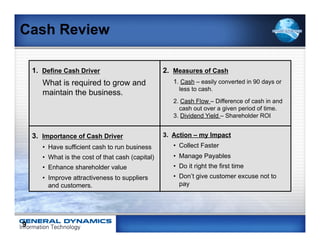
Cash Review

    1. Define Cash Driver                           2. Measures of Cash
       What is required to grow and                    1. Cash – easily converted in 90 days or
                                                         less to cash.
       maintain the business.
                                                       2. Cash Flow – Difference of cash in and
                                                         cash out over a given period of time.
                                                       3. Dividend Yield – Shareholder ROI


    3. Importance of Cash Driver                    3. Action – my Impact
       •  Have sufficient cash to run business         •  Collect Faster
       •  What is the cost of that cash (capital)      •  Manage Payables
       •  Enhance shareholder value                    •  Do it right the first time
       •  Improve attractiveness to suppliers          •  Don’t give customer excuse not to
          and customers.                                  pay


9
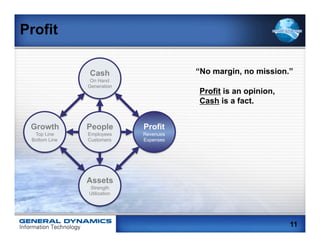
Profit

               Cash                     “No margin, no mission.”
                On Hand
               Generation
                                        Profit is an opinion,
                                        Cash is a fact.


 Growth        People        Profit
  Top Line     Employees     Revenues
 Bottom Line   Customers     Expenses


               Assets
               Strength
               Utilization


                                                                11
Profit
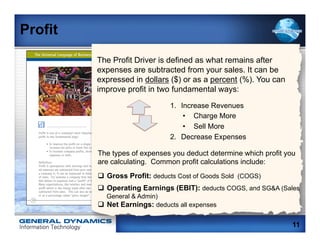
         The Profit Driver is defined as what remains after
         expenses are subtracted from your sales. It can be
         expressed in dollars ($) or as a percent (%). You can
         improve profit in two fundamental ways:

                                1.  Increase Revenues
                                     •  Charge More
                                     •  Sell More
                                2.  Decrease Expenses

         The types of expenses you deduct determine which profit you
         are calculating. Common profit calculations include:
         q  Gross Profit: deducts Cost of Goods Sold (COGS)
         q  Operating Earnings (EBIT): deducts COGS, and SG&A (Sales
             General & Admin)
         q  Net Earnings: deducts all expenses

                                                                   11
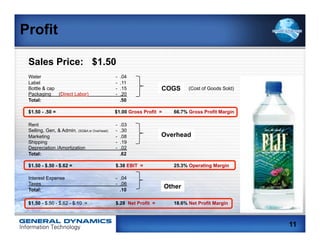
Profit

 Sales Price: $1.50
 Water                                       -   .04
 Label                                       -   .11
 Bottle & cap                                -   .15             COGS       (Cost of Goods Sold)
 Packaging    (Direct Labor)                 -   .20
 Total:                                          .50

 $1.50 - .50 =                               $1.00 Gross Profit =     66.7% Gross Profit Margin

 Rent                                        -   .03
 Selling, Gen, & Admin. (SG&A or Overhead)   -   .30
 Marketing                                   -   .08             Overhead
 Shipping                                    -   .19
 Depreciation /Amortization                  -   .02
 Total:                                          .62

 $1.50 - $.50 - $.62 =                       $.38 EBIT =              25.3% Operating Margin
                                                                                                    Life
 Interest Expense                            - .04                                                 Spring
 Taxes                                       - .06                                                 Artesian Water
 Total:                                        .10
                                                                    Other

 $1.50 - $.50 - $.62 - $.10 =                $.28 Net Profit =        18.6% Net Profit Margin


                                                                                                                11
High Margin vs. Low Margin
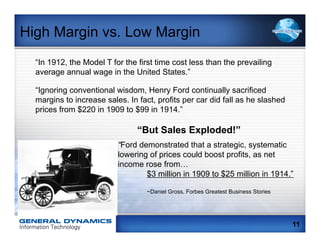
  “In 1912, the Model T for the first time cost less than the prevailing
  average annual wage in the United States.”

  “Ignoring conventional wisdom, Henry Ford continually sacrificed
  margins to increase sales. In fact, profits per car did fall as he slashed
  prices from $220 in 1909 to $99 in 1914.”

                                “But Sales Exploded!”
                          “Ford demonstrated that a strategic, systematic
                          lowering of prices could boost profits, as net
                          income rose from…
                                  $3 million in 1909 to $25 million in 1914.”

                                   ~Daniel Gross, Forbes Greatest Business Stories


                                                                                     11
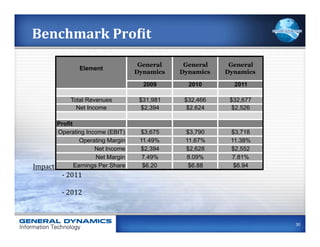
Benchmark	
  ProCit	
  
                                             General            General             General
                            Element
                                            Dynamics           Dynamics            Dynamics

                                                2009               2010                2011

                    Total Revenues            $31,981             $32,466            $32,677
                      Net Income               $2,394              $2,624             $2,526

          Profit
           Operating Income (EBIT)                $3,675           $3,790                $3,718
                     Operating Margin           11.49%             11.67%               11.38%
                             Net Income           $2,394           $2,628                $2,552
                              Net Margin          7.49%             8.09%                7.81%
Impact	
  to	
  Pro;it:	
  Reduce	
  Share and	
  drive	
  operational	
  excellence	
   $6.94
                  Earnings Per costs	
            $6.20             $6.88
           	
  -­‐	
  2011	


  -­‐	
  2012	


                                                                                                  30
Benchmark	
  ProCit	
  
                               General                                Lockheed           Northrop
        Element                                   Raytheon                                           Boeing
                              Dynamics                                 Martin            Grumman

                                  2011                2011                2011               2011     2011

     Total Revenues             $32,677             $24,857             $46,499            $26,412   $64,306
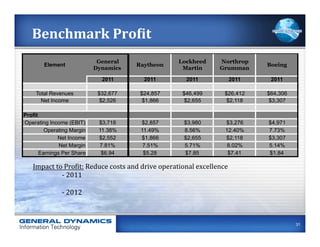
       Net Income                $2,526              $1,866              $2,655             $2,118    $3,307

Profit
Operating Income (EBIT)          $3,718             $2,857               $3,980             $3,276   $4,971
         Operating Margin        11.38%             11.49%               8.56%              12.40%   7.73%
              Net Income         $2,552             $1,866               $2,655             $2,118   $3,307
               Net Margin        7.81%               7.51%               5.71%               8.02%   5.14%
       Earnings Per Share         $6.94              $5.28               $7.85               $7.41   $1.84

   Impact	
  to	
  Pro;it:	
  Reduce	
  costs	
  and	
  drive	
  operational	
  excellence	
  
              	
  -­‐	
  2011	


  -­‐	
  2012	


                                                                                                               31
Profit in Action
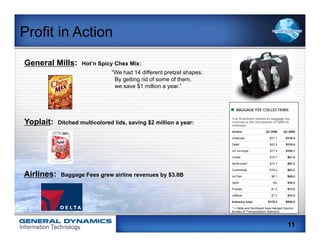
General Mills:       Hot’n Spicy Chex Mix:
                                “We had 14 different pretzel shapes.
                                 By getting rid of some of them,
                                 we save $1 million a year.”


Yoplait:    Ditched multicolored lids, saving $2 million a year:


Airlines:    Baggage Fees grew airline revenues by $3.8B


                                                                       11
Growing Profits
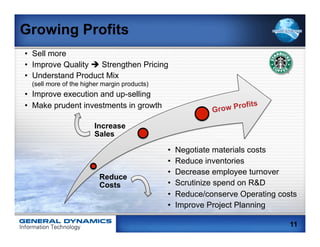
•  Sell more
•  Improve Quality è Strengthen Pricing
•  Understand Product Mix
  (sell more of the higher margin products)
•  Improve execution and up-selling
•  Make prudent investments in growth                                fits
                                                            Gr ow Pro

                       Increase
                       Sales

                                              •    Negotiate materials costs
                                              •    Reduce inventories
                                              •    Decrease employee turnover
                         Reduce
                         Costs                •    Scrutinize spend on R&D
                                              •    Reduce/conserve Operating costs
                                              •    Improve Project Planning

                                                                                11
34
Profit Review

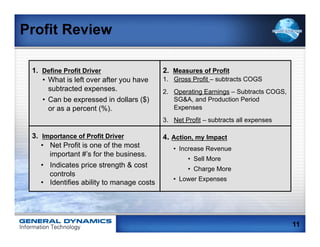
 1. Define Profit Driver                    2. Measures of Profit
    •  What is left over after you have     1.  Gross Profit – subtracts COGS
       subtracted expenses.                 2.  Operating Earnings – Subtracts COGS,
    •  Can be expressed in dollars ($)          SG&A, and Production Period
       or as a percent (%).                     Expenses
                                            3.  Net Profit – subtracts all expenses

 3. Importance of Profit Driver             4. Action, my Impact
    •  Net Profit is one of the most           •  Increase Revenue
       important #’s for the business.
                                                    •  Sell More
    •  Indicates price strength & cost              •  Charge More
       controls
                                               •  Lower Expenses
    •  Identifies ability to manage costs


                                                                                       11
High	
  Margin	
  vs.	
  Low	
  Margin	
  

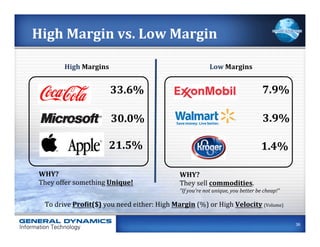
            High	
  Margins	
                                                            Low	
  Margins	


                                   33.6%	
                                                                                   7.9%	
  

                                   30.0%	
                                                                                   3.9%	
  

                                  21.5%	
                                                                                   1.4%	
  

 WHY?	
  	
  	
                                                      WHY?	


 They	
  offer	
  something	
  Unique!	
                             They	
  sell	
  commodities.	
  
                                                                     “If	
  you’re	
  not	
  unique,	
  you	
  better	
  be	
  cheap!”	
  

   To	
  drive	
  ProCit($)	
  you	
  need	
  either:	
  High	
  Margin	
  (%)	
  or	
  High	
  Velocity	
  (Volume)	
  

                                                                                                                                             36
How do PMs impact profit?
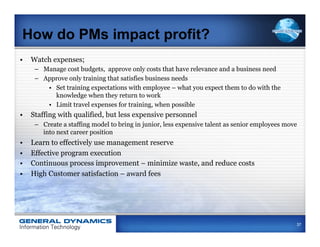
•  Watch expenses;
      –  Manage cost budgets, approve only costs that have relevance and a business need
      –  Approve only training that satisfies business needs
          •  Set training expectations with employee – what you expect them to do with the
             knowledge when they return to work
          •  Limit travel expenses for training, when possible
•  Staffing with qualified, but less expensive personnel
      –  Create a staffing model to bring in junior, less expensive talent as senior employees move
         into next career position
•    Learn to effectively use management reserve
•    Effective program execution
•    Continuous process improvement – minimize waste, and reduce costs
•    High Customer satisfaction – award fees


                                                                                                  37
How PMs impact profit?
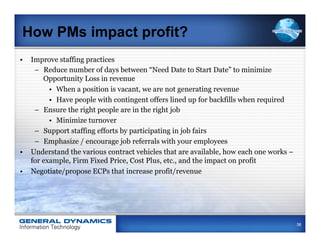
•  Improve staffing practices
    –  Reduce number of days between “Need Date to Start Date” to minimize
       Opportunity Loss in revenue
         •  When a position is vacant, we are not generating revenue
         •  Have people with contingent offers lined up for backfills when required
    –  Ensure the right people are in the right job
         •  Minimize turnover
    –  Support staffing efforts by participating in job fairs
    –  Emphasize / encourage job referrals with your employees
•  Understand the various contract vehicles that are available, how each one works –
   for example, Firm Fixed Price, Cost Plus, etc., and the impact on profit
•  Negotiate/propose ECPs that increase profit/revenue


                                                                                       38
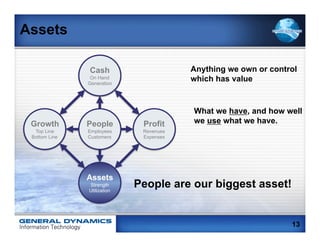
Assets

               Cash                      Anything we own or control
                On Hand
               Generation
                                         which has value


                                         What we have, and how well
 Growth        People         Profit     we use what we have.
  Top Line     Employees      Revenues
 Bottom Line   Customers      Expenses


               Assets
               Strength
               Utilization
                             People are our biggest asset!


                                                                 13
Assets
         Assets are economic resources owned by a business.
         Anything tangible or intangible that one possesses, usually
         considered as applicable to the payment of one's debts, is
         considered an asset. Simplistically stated, assets are things
         of value that can be readily converted into cash.
         When evaluating a company’s assets, both strength and
         utilization should be considered.

           q  Return on Assets (ROA)
             The percent value of sales (revenues) to total assets.


                                                                         13
Strength vs. Utilization


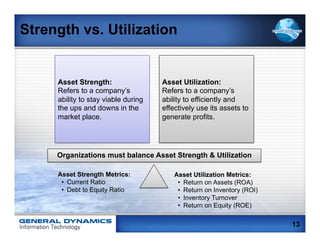
     Asset Strength:                 Asset Utilization:
     Refers to a company’s           Refers to a company’s
     ability to stay viable during   ability to efficiently and
     the ups and downs in the        effectively use its assets to
     market place.                   generate profits.


     Organizations must balance Asset Strength & Utilization

     Asset Strength Metrics:             Asset Utilization Metrics:
      •  Current Ratio                    •  Return on Assets (ROA)
      •  Debt to Equity Ratio             •  Return on Inventory (ROI)
                                          •  Inventory Turnover
                                          •  Return on Equity (ROE)

                                                                         13
Assets in Action
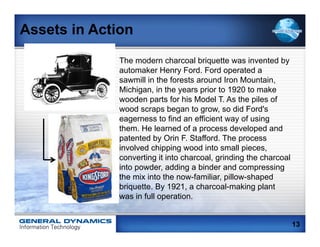
              The modern charcoal briquette was invented by
              automaker Henry Ford. Ford operated a
              sawmill in the forests around Iron Mountain,
              Michigan, in the years prior to 1920 to make
              wooden parts for his Model T. As the piles of
              wood scraps began to grow, so did Ford's
              eagerness to find an efficient way of using
              them. He learned of a process developed and
              patented by Orin F. Stafford. The process
              involved chipping wood into small pieces,
              converting it into charcoal, grinding the charcoal
              into powder, adding a binder and compressing
              the mix into the now-familiar, pillow-shaped
              briquette. By 1921, a charcoal-making plant
              was in full operation.


                                                                   13
Assets in Action
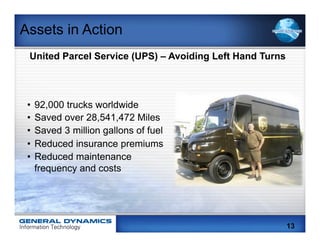
 United Parcel Service (UPS) – Avoiding Left Hand Turns


 •  92,000 trucks worldwide
 •  Saved over 28,541,472 Miles
 •  Saved 3 million gallons of fuel
 •  Reduced insurance premiums
 •  Reduced maintenance
    frequency and costs


                                                          13
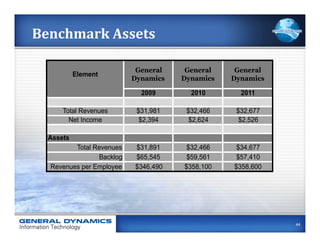
Benchmark	
  Assets	
  

                            General    General    General
           Element
                           Dynamics   Dynamics   Dynamics

                             2009       2010       2011

      Total Revenues        $31,981    $32,466    $32,677
        Net Income           $2,394     $2,624     $2,526

  Assets
          Total Revenues   $31,891     $32,466    $34,677
                 Backlog   $65,545     $59,561    $57,410
   Revenues per Employee   $346,490   $358,100   $358,600


                                                            44
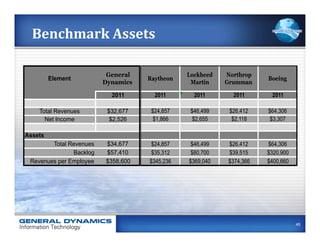
Benchmark	
  Assets	
  

                          General              Lockheed   Northrop
         Element                    Raytheon                          Boeing
                         Dynamics               Martin    Grumman

                           2011       2011       2011       2011       2011

    Total Revenues        $32,677    $24,857    $46,499    $26,412    $64,306
      Net Income           $2,526     $1,866     $2,655     $2,118     $3,307

Assets
        Total Revenues   $34,677     $24,857    $46,499    $26,412    $64,306
               Backlog   $57,410     $35,312    $80,700    $39,515    $320,900
 Revenues per Employee   $358,600   $345,236   $369,040    $374,366   $400,660


                                                                                 45
46
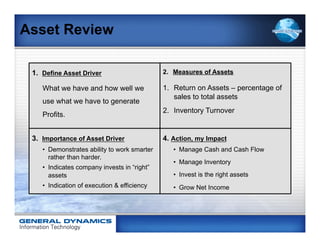
Asset Review

 1. Define Asset Driver                       2.  Measures of Assets

    What we have and how well we              1.  Return on Assets – percentage of
                                                  sales to total assets
    use what we have to generate
                                              2.  Inventory Turnover
    Profits.


 3. Importance of Asset Driver                4. Action, my Impact
    •  Demonstrates ability to work smarter      •  Manage Cash and Cash Flow
       rather than harder.
                                                 •  Manage Inventory
    •  Indicates company invests in “right”
       assets                                    •  Invest is the right assets
    •  Indication of execution & efficiency      •  Grow Net Income
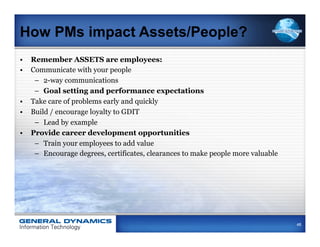
How PMs impact Assets/People?
•  Remember ASSETS are employees:
•  Communicate with your people
    –  2-way communications
    –  Goal setting and performance expectations
•  Take care of problems early and quickly
•  Build / encourage loyalty to GDIT
    –  Lead by example
•  Provide career development opportunities
    –  Train your employees to add value
    –  Encourage degrees, certificates, clearances to make people more valuable


                                                                                  48
Individual Activity                                  (Page 15)


Write down one action you are committed to take
         to positively impact People.
          •  Remember ASSETS are employees:
          •  Communicate with your people
              –  2-way communications
              –  Goal setting and performance expectations
          •  Take care of problems early and quickly
          •  Build / encourage loyalty to GDIT
              –  Lead by example
          •  Provide career development opportunities
              –  Train your employees to add value
              –  Encourage degrees, certificates,
                 clearances to make people more valuable

                                                                 49
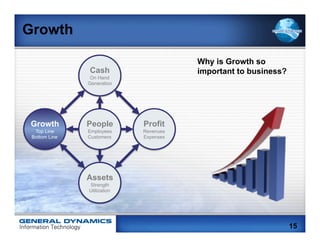
Growth

                                        Why is Growth so
               Cash                     important to business?
                On Hand
               Generation


 Growth        People        Profit
  Top Line     Employees     Revenues
 Bottom Line   Customers     Expenses


               Assets
               Strength
               Utilization


                                                                 15
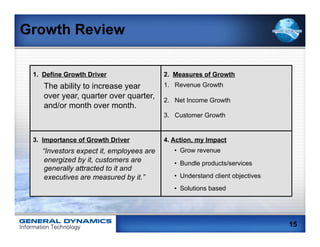
Growth

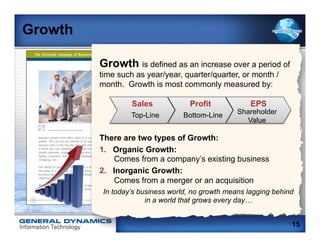
         Growth is defined as an increase over a period of
         time such as year/year, quarter/quarter, or month /
         month. Growth is most commonly measured by:

                  Sales            Profit             EPS
                  Top-Line        Bottom-Line     Shareholder
                                                    Value

         There are two types of Growth:
         1.  Organic Growth:
              Comes from a company’s existing business
         2.  Inorganic Growth:
              Comes from a merger or an acquisition
          In today’s business world, no growth means lagging behind
                       in a world that grows every day…


                                                                  15
Growth

  In today’s business world, no growth means
  lagging behind in a world that grows every
  day…

         •    Investors expect it.
         •    Employees are more energized by it.
         •    Customers are generally attracted to it.
         •     Executives are measured by it.
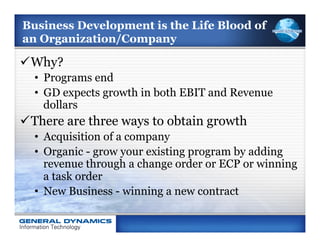
Business Development is the Life Blood of
an Organization/Company

ü Why?
  •  Programs end
  •  GD expects growth in both EBIT and Revenue
     dollars
ü There are three ways to obtain growth
  •  Acquisition of a company
  •  Organic - grow your existing program by adding
     revenue through a change order or ECP or winning
     a task order
  •  New Business - winning a new contract
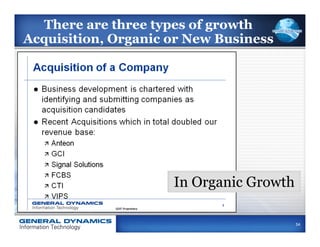
There are three types of growth
Acquisition, Organic or New Business


                     In Organic Growth

                                         54
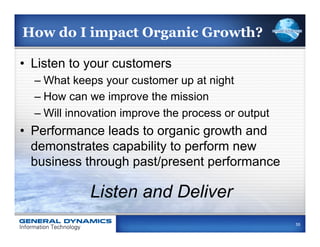
How do I impact Organic Growth?

•  Listen to your customers
  –  What keeps your customer up at night
  –  How can we improve the mission
  –  Will innovation improve the process or output
•  Performance leads to organic growth and
   demonstrates capability to perform new
   business through past/present performance

             Listen and Deliver
                                                     55
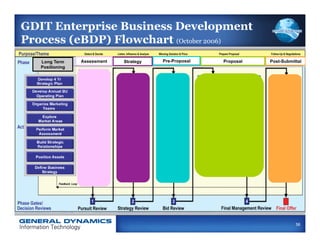
GDIT Enterprise Business Development
Process (eBDP) Flowchart (October 2006)
   Long Term     Assessment   Strategy   Pre-Proposal   Proposal   Post-Submittal
   Positioning


                                                                              56
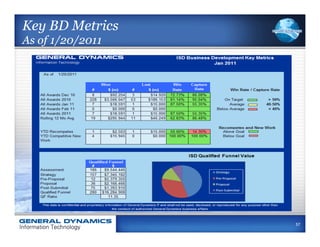
Key BD Metrics
As of 1/20/2011


                  57
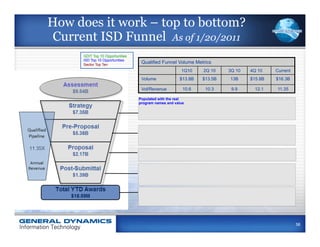
How does it work – top to bottom?
 Current ISD Funnel As of 1/20/2011
      GDIT Top 10 Opportunities
      ISD Top 10 Opportunities
      Sector Top Ten
                                   Qualified Funnel Volume Metrics
                                                       1Q10    2Q 10    3Q 10   4Q 10    Current
                                   Volume             $13.8B   $13.5B   13B     $15.8B   $16.3B

                                   Vol/Revenue          10.6    10.3     9.9      12.1   11.35

                                  Populated with the real
                                  program names and value


                                                                                                   58
What part do PMs
play in ISD Growth?


                      59
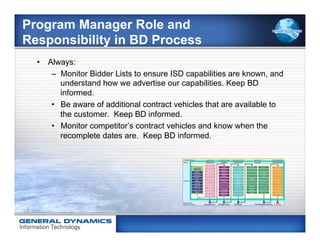
Program Manager Role and
Responsibility in BD Process
  •  Always:
      –  Monitor Bidder Lists to ensure ISD capabilities are known, and
         understand how we advertise our capabilities. Keep BD
         informed.
      •  Be aware of additional contract vehicles that are available to
         the customer. Keep BD informed.
      •  Monitor competitor’s contract vehicles and know when the
         recomplete dates are. Keep BD informed.
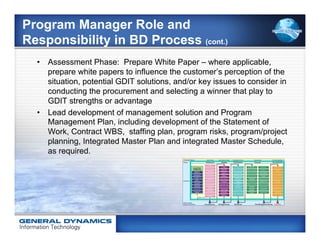
Program Manager Role and
Responsibility in BD Process (cont.)
  •  Assessment Phase: Prepare White Paper – where applicable,
     prepare white papers to influence the customer’s perception of the
     situation, potential GDIT solutions, and/or key issues to consider in
     conducting the procurement and selecting a winner that play to
     GDIT strengths or advantage
  •  Lead development of management solution and Program
     Management Plan, including development of the Statement of
     Work, Contract WBS, staffing plan, program risks, program/project
     planning, Integrated Master Plan and integrated Master Schedule,
     as required.
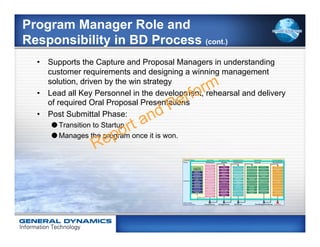
Program Manager Role and
Responsibility in BD Process (cont.)
  •  Supports the Capture and Proposal Managers in understanding
     customer requirements and designing a winning management
     solution, driven by the win strategy
  •  Lead all Key Personnel in the development, rehearsal and delivery
     of required Oral Proposal Presentations
  •  Post Submittal Phase:
      Transition to Startup
      Manages the program once it is won.
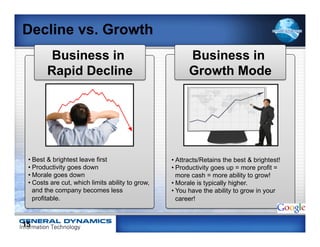
Decline vs. Growth
        Business in                                     Business in
        Rapid Decline                                   Growth Mode


 • Best & brightest leave first                   • Attracts/Retains the best & brightest!
 • Productivity goes down                         • Productivity goes up = more profit =
 • Morale goes down                                 more cash = more ability to grow!
 • Costs are cut, which limits ability to grow,   • Morale is typically higher.
   and the company becomes less                   • You have the ability to grow in your
   profitable.                                      career!


15
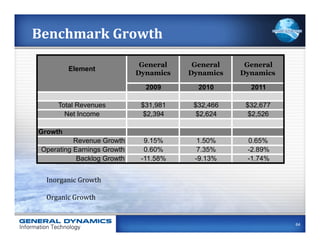
Benchmark	
  Growth	
  
                                                                      General    General     General
                           Element
                                                                     Dynamics   Dynamics    Dynamics

                                                                       2009       2010         2011

               Total Revenues                                         $31,981    $32,466       $32,677
                                                                                      How do we compare?
                 Net Income                                            $2,394     $2,624        $2,526

 Growth
           Revenue Growth                                              9.15%      1.50%       0.65%
 Operating Earnings Growth                                             0.60%      7.35%       -2.89%
            Backlog Growth                                            -11.58%    -9.13%       -1.74%


  Inorganic	
  Growth	


  Organic	
  Growth	


                                                                                                           64
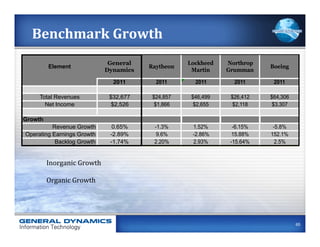
Benchmark	
  Growth	
  
                                                                             General              Lockheed     Northrop
           Element                                                                     Raytheon                           Boeing
                                                                            Dynamics               Martin      Grumman

                                                                              2011       2011       2011         2011      2011

     Total Revenues                                                          $32,677    $24,857    $46,499      $26,412   $64,306
       Net Income                                                             $2,526     $1,866     $2,655       $2,118    $3,307
                                                                                                           How do we compare?
Growth
          Revenue Growth                                                      0.65%     -1.3%      1.52%         -6.15%    -5.8%
Operating Earnings Growth                                                    -2.89%      9.6%      -2.86%        15.88%   152.1%
           Backlog Growth                                                    -1.74%     2.20%      2.93%        -15.64%     2.5%


         Inorganic	
  Growth	


         Organic	
  Growth	


                                                                                                                                    65
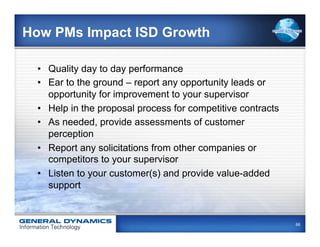
How PMs Impact ISD Growth

  •  Quality day to day performance
  •  Ear to the ground – report any opportunity leads or
     opportunity for improvement to your supervisor
  •  Help in the proposal process for competitive contracts
  •  As needed, provide assessments of customer
     perception
  •  Report any solicitations from other companies or
     competitors to your supervisor
  •  Listen to your customer(s) and provide value-added
     support


                                                              66
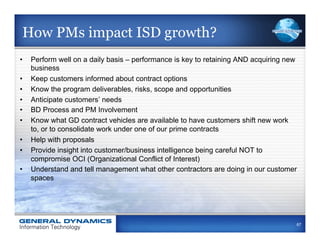
How PMs impact ISD growth?
•    Perform well on a daily basis – performance is key to retaining AND acquiring new
     business
•    Keep customers informed about contract options
•    Know the program deliverables, risks, scope and opportunities
•    Anticipate customers’ needs
•    BD Process and PM Involvement
•    Know what GD contract vehicles are available to have customers shift new work
     to, or to consolidate work under one of our prime contracts
•    Help with proposals
•    Provide insight into customer/business intelligence being careful NOT to
     compromise OCI (Organizational Conflict of Interest)
•    Understand and tell management what other contractors are doing in our customer
     spaces


                                                                                     67
68
Growth Review

 1. Define Growth Driver                 2. Measures of Growth
    The ability to increase year         1.  Revenue Growth
    over year, quarter over quarter,     2.  Net Income Growth
    and/or month over month.
                                         3.  Customer Growth


 3. Importance of Growth Driver          4. Action, my Impact
   “Investors expect it, employees are      •  Grow revenue
    energized by it, customers are          •  Bundle products/services
    generally attracted to it and
    executives are measured by it.”         •  Understand client objectives
                                            •  Solutions based


                                                                              15
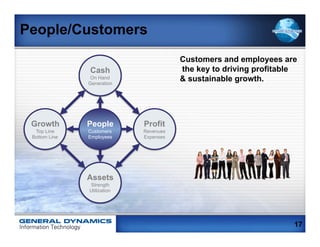
People/Customers
                                        Customers and employees are
               Cash                     the key to driving profitable
                On Hand
               Generation
                                        & sustainable growth.


 Growth        People        Profit
  Top Line     Customers     Revenues
 Bottom Line   Employees     Expenses


               Assets
               Strength
               Utilization


                                                                    17
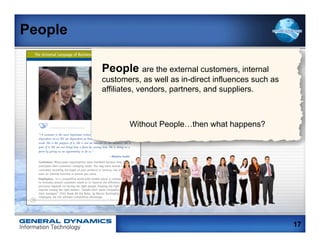
People

         People are the external customers, internal
         customers, as well as in-direct influences such as
         affiliates, vendors, partners, and suppliers.


                Without People…then what happens?


                                                              17
People


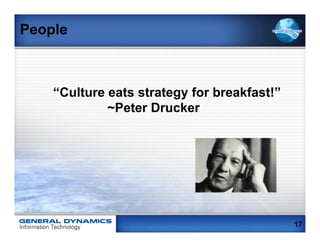
    “Culture eats strategy for breakfast!”
             ~Peter Drucker


                                             17
Internal People


 A’s hire A+’s and B’s hire C’s

    What is the #1 reason a person
       will leave a company?


                                     17
Internal/External Customers

  Listening to our Customers:

  External Customers:
  •  Have a formal process for listening to your customers
  •  Anticipating customer needs is critical!
  •  We must understand their business, and the customers they serve.

  Internal Customers:
  •  Meet with them monthly and ask:
  •  “Are there any gaps in my performance?
  •  Have my priorities changed?”


                                                                        17
External People


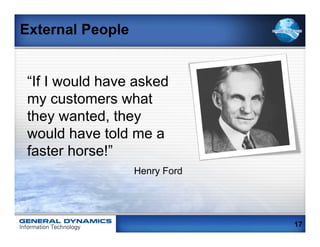
“If I would have asked
my customers what
they wanted, they
would have told me a
faster horse!”
                  Henry Ford


                               17
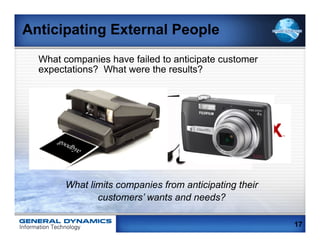
Anticipating External People
  What companies have failed to anticipate customer
  expectations? What were the results?


        What limits companies from anticipating their
               customers’ wants and needs?

                                                        17
Listen to your customers!

    The #1 reason for rework or
      losing an opportunity is
   not listening to your customer.
    BD Process and Program Manager Involvement
                    January 2011


                                                 77
People Review

 1. Define People Driver                   2.  Measures of People

    The External Customer, Vendor/
                                           1.  Employee Count
    Reseller, or Internal Customer that
    has the ability to impact the          2.  Revenue per employee
    success of the business.


 3. Importance of People Driver            4. Action, my Impact
    •  People at the center of the model      •  Give others the benefit of the doubt
    •  Anticipate customers needs
    •  Customer service is for everyone       •  Seek Feedback


                                                                                        17
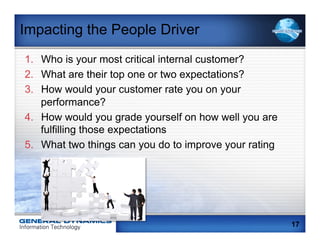
Impacting the People Driver
1.  Who is your most critical internal customer?
2.  What are their top one or two expectations?
3.  How would your customer rate you on your
    performance?
4.  How would you grade yourself on how well you are
    fulfilling those expectations
5.  What two things can you do to improve your rating


                                                        17
Impacting the People Driver
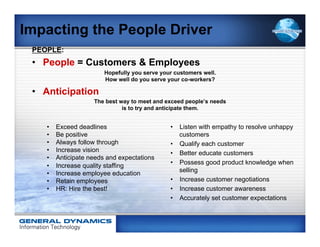
 PEOPLE:
 •  People = Customers & Employees
                         Hopefully you serve your customers well.
                         How well do you serve your co-workers?

 •  Anticipation
                     The best way to meet and exceed people’s needs
                               is to try and anticipate them.


    •    Exceed deadlines                       •  Listen with empathy to resolve unhappy
    •    Be positive                               customers
    •    Always follow through                  •  Qualify each customer
    •    Increase vision                        •  Better educate customers
    •    Anticipate needs and expectations
                                                •  Possess good product knowledge when
    •    Increase quality staffing
                                                   selling
    •    Increase employee education
    •    Retain employees                       •  Increase customer negotiations
    •    HR: Hire the best!                     •  Increase customer awareness
                                                •  Accurately set customer expectations
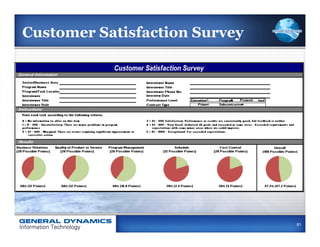
Customer Satisfaction Survey


                               81
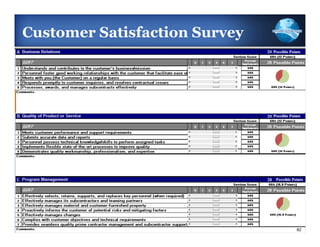
Customer Satisfaction Survey


                               82
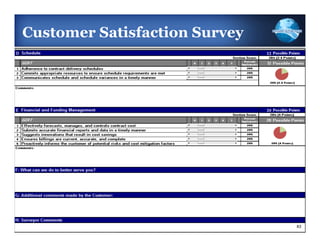
Customer Satisfaction Survey


                               83
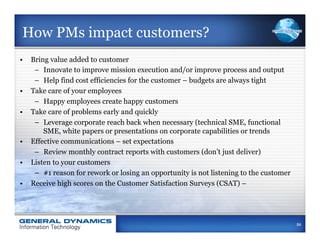
How PMs impact customers?
•  Bring value added to customer
    –  Innovate to improve mission execution and/or improve process and output
    –  Help find cost efficiencies for the customer – budgets are always tight
•  Take care of your employees
    –  Happy employees create happy customers
•  Take care of problems early and quickly
    –  Leverage corporate reach back when necessary (technical SME, functional
       SME, white papers or presentations on corporate capabilities or trends
•  Effective communications – set expectations
    –  Review monthly contract reports with customers (don’t just deliver)
•  Listen to your customers
    –  #1 reason for rework or losing an opportunity is not listening to the customer
•  Receive high scores on the Customer Satisfaction Surveys (CSAT) –


                                                                                        84
85
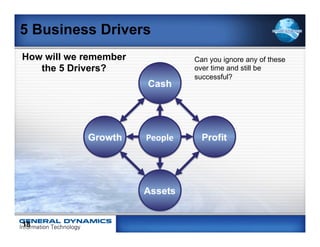
5 Business Drivers
How will we remember   Can you ignore any of these
   the 5 Drivers?      over time and still be
                       successful?


18
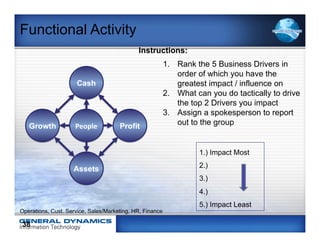
Functional Activity
                                             Instructions:
                                                          1.  Rank the 5 Business Drivers in
                                                              order of which you have the
                                                              greatest impact / influence on
                                                          2.  What can you do tactically to drive
                                                              the top 2 Drivers you impact
                                                          3.  Assign a spokesperson to report
                                                              out to the group


                                                                    1.) Impact Most
                                                                    2.)
                                                                    3.)
                                                                    4.)
                                                                    5.) Impact Least
Operations, Cust. Service, Sales/Marketing, HR, Finance

38
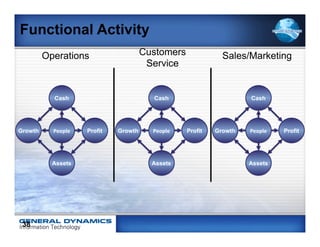
Functional Activity
     Operations   Customers   Sales/Marketing
                   Service


38
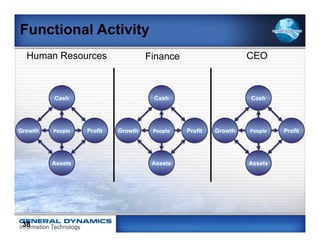
Functional Activity
 Human Resources   Finance   CEO


38
Preparation for Tomorrow

1.  Come ready to teach one of the 5 Drivers to your
   group

2.  Come ready to learn and teach all three financial
   statements

3.  We will be doing analysis on one of the
   competitor/benchmark entities….choose which
   one you would like to analyze (Boeing, Raytheon,
   Northrop Grumman, Lockheed Martin)

                        Day 1 Quiz
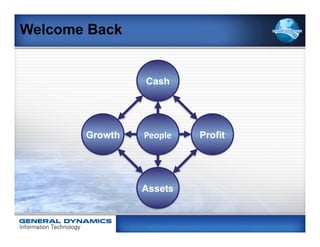
Welcome Back
Cash Example


        When you think of a
       company rich in cash,
        who comes to mind?


9
Cash Example


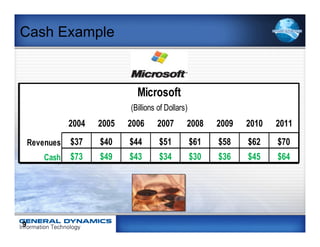
                               Microsoft
                             (Billions of Dollars)
               2004   2005   2006     2007       2008      2009   2010   2011
    Revenues   $37    $40    $44       $51           $61   $58    $62    $70
        Cash   $73    $49    $43       $34           $30   $36    $45    $64


9
Cash Example


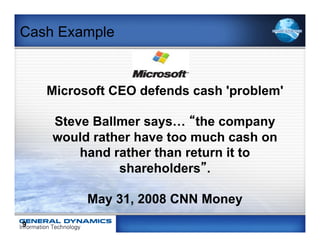
    Microsoft CEO defends cash 'problem'

    Steve Ballmer says… “the company
    would rather have too much cash on
        hand rather than return it to
              shareholders”.

          May 31, 2008 CNN Money
9
Profit Example
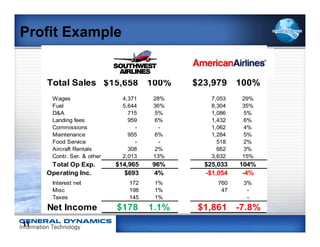
                            Company A             Company B
                                 2011                 2011


     Total Sales $15,658                100%   $23,979       100%
      Wages                   4,371      28%       7,053      29%
      Fuel                    5,644      36%       8,304      35%
      D&A                       715      5%        1,086      5%
      Landing fees              959      6%        1,432      6%
      Commissions                 -        -       1,062      4%
      Maintenance               955      6%        1,284      5%
      Food Service                -        -         518      2%
      Aircraft Rentals          308      2%          662      3%
      Contr. Ser. & other     2,013      13%       3,632      15%
      Total Op Exp.         $14,965     96%      $25,033     104%
     Operating Inc.            $693      4%      -$1,054      -4%
      Interest net              172      1%          760      3%
      Misc                      198      1%           47       -
      Taxes                     145      1%                    -
     Net Income             $178        1.1%    $1,861       -7.8%
11
Assets Example


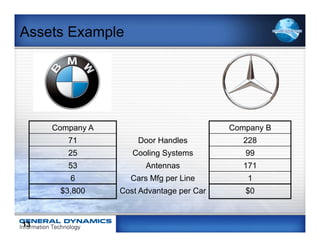
     Company A                            Company B
        71           Door Handles            228
        25          Cooling Systems          99
        53             Antennas              171
         6         Cars Mfg per Line          1
      $3,800     Cost Advantage per Car      $0


13
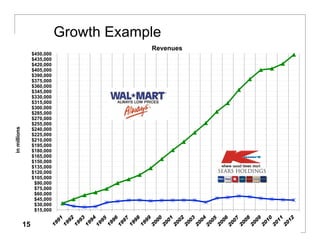
Growth Example
                                          Revenues
                   $450,000
                   $435,000
                   $420,000
                   $405,000
                   $390,000
                   $375,000
                   $360,000
                   $345,000
                   $330,000
                   $315,000
                   $300,000
                   $285,000
                   $270,000
                   $255,000
                   $240,000
in millions


                   $225,000
                   $210,000
                   $195,000
                   $180,000
                   $165,000
                   $150,000
                   $135,000
                   $120,000
                   $105,000
                    $90,000
                    $75,000
                    $60,000
                    $45,000
                    $30,000
                    $15,000


              15
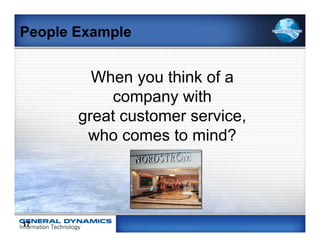
People Example


         When you think of a
           company with
       great customer service,
        who comes to mind?


17
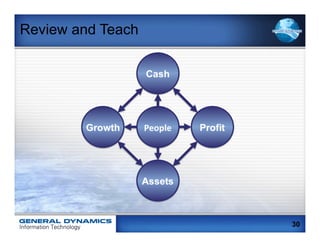
Review and Teach
     For your assigned Driver: (Study Notes 4-5 minutes)
     1.  Define & give examples. How is it measured?
     2.  Importance & relationship to other Drivers?
     3.  How did we do in 2011? Future goals or targets?
     4.  How you plan to influence this driver?

     Be sure to explain:
      CASH: Cash & Cash Flow—Both Cash and Cash Flow are important for different
        reasons
      PROFIT: How to calculate? Gross Margin, Operating Margin, and Net Profit
      ASSETS: Strength & Utilization—balance is critical here
      GROWTH: Organic & Inorganic—where have we grown?
      PEOPLE: Internal & external Customers; meeting, exceeding & anticipating
        needs & expectations

30
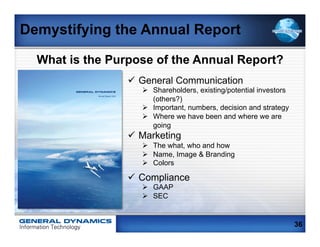
Demystifying the Annual Report

  What is the Purpose of the Annual Report?
                                      ü  General Communication
        GENERAL DYNAMICS                 Ø  Shareholders, existing/potential investors
                                             (others?)
                 Annual Report 2011


                                         Ø  Important, numbers, decision and strategy
                                         Ø  Where we have been and where we are
                                             going
                                      ü  Marketing
                                         Ø  The what, who and how
                                         Ø  Name, Image & Branding
                                         Ø  Colors

                                      ü  Compliance
                                         Ø  GAAP
                                         Ø  SEC


                                                                                          36
Executive Communication

•  Financial Hi-lights
•  To Our Shareholders              GENERAL DYNAMICS
                                             Annual Report 2011


•  Strategic Overview
•  Financial Statement
      •  Income Statement
      •  Balance Sheet
      •  Statement of Cash Flows
•  Notes to the Financial Section

36                                                     22
Executive Communication

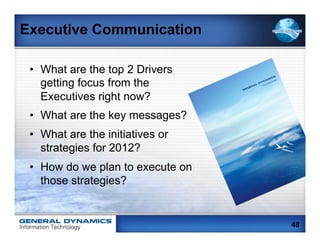
 •  What are the top 2 Drivers
    getting focus from the
    Executives right now?
 •  What are the key messages?
 •  What are the initiatives or
    strategies for 2012?
 •  How do we plan to execute on
    those strategies?


                                   48
Review and Teach


                   30
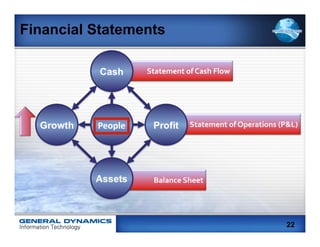
Financial Statements


                 Statement	
  of	
  Cash	
  Flow	


                                     Statement	
  of	
  Operations	
  (P&L)	


                    Balance	
  Sheet	


                                                                          22
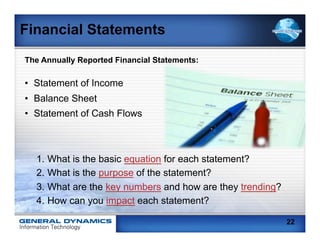
Financial Statements
The Annually Reported Financial Statements:

•  Statement of Income
•  Balance Sheet
•  Statement of Cash Flows


  1.  What is the basic equation for each statement?
  2.  What is the purpose of the statement?
  3.  What are the key numbers and how are they trending?
  4.  How can you impact each statement?

                                                            22
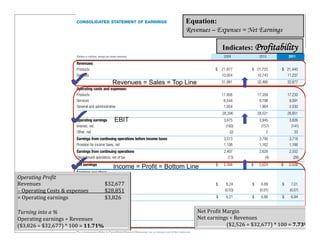
ITEM 8. FINANCIAL STATEMENTS AND SUPPLEMENTARY DATA


                                                                 CONSOLIDATED STATEMENT OF EARNINGS                                                            Equation:
                                                                                                                                                               Revenues – Expenses = Net Earnings
                     Income	
  Statement	
                                                                                                                                             Indicates: Profitability
                                                                                                                                                                                                      Y e ar E nd e d D ec e m b e r 3 1

                                                                 (Dollars in millions, except per-share amounts)                                                                         2009                           2010                   2011
                                                                 Revenues:
                                                                 Products                                                                                                          $   21,977                   $ 21,723                   $ 21,440
                                                                 Services                                                                                                              10,004                     10,743                     11,237
                                                                                                         Revenues = Sales = Top Line                                                   31,981                        32,466                    32,677
                                                                 Operating costs and expenses:
                                                                 Products                                                                                                              17,808                        17,359                    17,230
                                                                 Services                                                                                                               8,544                         9,198                     9,591
                                                                 General and administrative                                                                                             1,954                         1,964                     2,030
                                                                                                                                                                                       28,306                        28,521                    28,851
                                                                 Operating earnings                        EBIT                                                                         3,675                           3,945                   3,826
                                                                 Interest, net                                                                                                           (160)                           (157)                   (141)
                                                                 Other, net                                                                                                                 (2)                             2                      33
                                                                 Earnings from continuing operations before income taxes                                                                 3,513                          3,790                   3,718
                                                                 Provision for income taxes, net                                                                                         1,106                          1,162                   1,166
                                                                 Earnings from continuing operations                                                                                     2,407                          2,628                   2,552
                                                                 Discontinued operations, net of tax                                                                                        (13)                            (4)                    (26)
                                                                 Net earnings                                                                                                      $    2,394                  $       2,624               $    2,526
                                                                                                          Income = Profit = Bottom Line
                                                                 Earnings per share
Operating	
  Pro:it	
                     Basic:
Revenues	


   operations
                                                   Continuing                                            	
  $32,677	
                                                             $      6.24                  $        6.89              $     7.01
–	
  Operating	
  Costs	
  &	
  expenses           Discontinued operations                               	
  $28,851	
                                                                   (0.03)                         (0.01)                  (0.07)
=	
  Operating	
  earnings 	


                                                   Net	
  earnings 	
  $3,826	
                                                                                                    $      6.21                  $         6.88             $     6.94

	
                                                               Diluted:

Turning	
  into	
  a	
  %	
             Continuing operations                                                                                                          Net	
  Pro;it	
  M6.20
                                                                                                                                                                                 $           argin	
          $  6.82          $       6.94
                                        Discontinued operations                                                                                                                           (0.03)Revenues	
   (0.01)
                                                                                                                                                                       Net	
  earnings	
  ÷	
                                         (0.07)
Operating	
  earnings	
  ÷	
  Revenues	
  
                                        Net earnings
($3,826	
  ÷	
  $32,677)	
  *	
  100	
  =	
  11.71%	
                                                                                                                            $       	
  6.17
                                                                                                                                                                                             ($2,526	
  ÷	
  $32,677)	
  *	
  100	
  =6.87
                                                                                                                                                                                                             $   6.81          $       	
  7.73%	
  
                                                                                                                                                                                                                                           106
                                                                 The accompanying Notes to Consolidated Financial Statements are an integral part of this statement.
ITEM 8. FINANCIAL STATEMENTS AND SUPPLEMENTARY DATA
               ITEM 8. FINANCIAL STATEMENTS AND SUPPLEMENTARY DATA


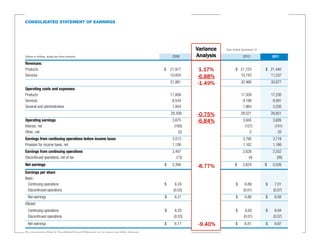
CONSOLIDATED STATEMENT OF EARNINGS OF EARNINGS
             CONSOLIDATED STATEMENT


                                                                                                                                              Variance
                                                                                                                                            Year Ended December 31   Year Ended December 31

(Dollars in millions, except per-share amounts)
                                  (Dollars in millions, except per-share amounts)                                               2009          Analysis
                                                                                                                                                   2009
                                                                                                                                                   2010                     2011
                                                                                                                                                                               2010               2011
Revenues:                        Revenues:
Products                         Products                                                                                $    21,977             1.17%
                                                                                                                                                 $$ 21,977
                                                                                                                                                    21,723             $ 21,440
                                                                                                                                                                         $ 21,723             $ 21,440
Services                         Services                                                                                     10,004                10,004
                                                                                                                                                    10,743
                                                                                                                                                -6.88%                   11,237
                                                                                                                                                                            10,743              11,237
                                                                                                                              31,981                31,981
                                                                                                                                                    32,466
                                                                                                                                                -1.49%                     32,677
                                                                                                                                                                              32,466              32,677
Operating costs and expenses: costs and expenses:
                       Operating
Products               Products                                                                                               17,808                  17,808
                                                                                                                                                      17,359               17,230
                                                                                                                                                                              17,359              17,230
Services               Services                                                                                                8,544                   8,544
                                                                                                                                                       9,198                9,591
                                                                                                                                                                               9,198               9,591
General and administrative
                       General and administrative                                                                              1,954                   1,954
                                                                                                                                                       1,964                2,030
                                                                                                                                                                               1,964               2,030
                                                                                                                              28,306            -0.75%6
                                                                                                                                                    28,30
                                                                                                                                                    28,521                 28,851
                                                                                                                                                                              28,521              28,851
Operating earnings               Operating earnings                                                                             3,675           -6.84%
                                                                                                                                                     3,675
                                                                                                                                                     3,945                   3,826
                                                                                                                                                                                3,945              3,826
Interest, net                    Interest, net                                                                                   (160)                  (160)
                                                                                                                                                         (157)                (141)
                                                                                                                                                                                 (157)              (141)
Other, net                       Other, net                                                                                         (2)                    (2)
                                                                                                                                                            2                   33 2                  33
Earnings from continuing operations continuing operations before income taxes
                         Earnings from before income taxes                                                                      3,513                  3,513
                                                                                                                                                       3,790                 3,718
                                                                                                                                                                                3,790              3,718
Provision for income taxes, net for income taxes, net
                         Provision                                                                                              1,106                  1,106
                                                                                                                                                       1,162                 1,166
                                                                                                                                                                                1,162              1,166
Earnings from continuing operations continuing operations
                         Earnings from                                                                                          2,407                  2,407
                                                                                                                                                       2,628                 2,552
                                                                                                                                                                                 2,628             2,552
Discontinued operations, Discontinued operations, net of tax
                         net of tax                                                                                                (13)                   (13)
                                                                                                                                                            (4)                 (26) (4)              (26)
Net earnings                     Net earnings                                                                            $      2,394            $ 2,394
                                                                                                                                                 $ 2,624
                                                                                                                                                -8.77%                 $ $ 2,526
                                                                                                                                                                              2,624           $    2,526
Earnings per share Earnings per share
Basic:                 Basic:
 Continuing operations Continuing operations                                                                             $        6.24           $$      6.89
                                                                                                                                                         6.24          $ $ 7.016.89           $     7.01
 Discontinued operations Discontinued operations                                                                                 (0.03)                 (0.01)
                                                                                                                                                        (0.03)            (0.07)
                                                                                                                                                                              (0.01)               (0.07)
  Net earnings                     Net earnings                                                                          $           6.21        $$      6.88
                                                                                                                                                         6.21          $ $ 6.94
                                                                                                                                                                              6.88            $     6.94
Diluted:                         Diluted:
  Continuing operations Continuing operations                                                                            $        6.20           $$      6.20
                                                                                                                                                         6.82          $ $ 6.946.82           $     6.94
  Discontinued operations Discontinued operations                                                                                (0.03)                 (0.01)
                                                                                                                                                        (0.03)            (0.07)
                                                                                                                                                                              (0.01)               (0.07)
  Net earnings                     Net earnings                                                                          $           6.17       -9.40%
                                                                                                                                                 $$  6.81
                                                                                                                                                     6.17               $ $ 6.87
                                                                                                                                                                               6.81           $     6.87

The accompanying Notes to Consolidated FinancialNotes to Consolidated Financial Statements are an integral part of this statement.
                            The accompanying Statements are an integral part of this statement.
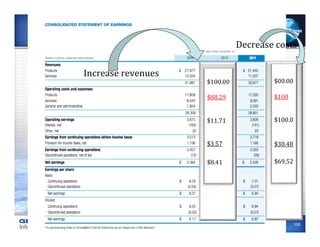
Decrease	
  costs	
  

Increase	
  revenues	


                           $100.00	
                 $00.00	


                           $88.29	
                  $100	


                           $11.71	
                  $100.0	


                           $3.57	
                   $30.48	


                           $8.41	
                   $69.52	


                                                              108
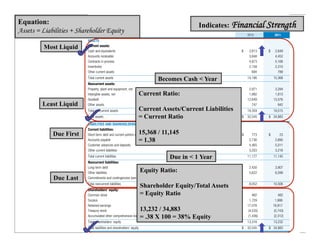
CONSOLIDATED BALANCE SHEET


Equation:                                                                                                                        Indicates: Financial Strength
Assets = Liabilities + Shareholder Equity                                                                                                               December 31


Balance	
  Sheet	
  
    Most Liquid
                           (Dollars in millions)

                           ASSETS
                           Current assets:
                                                                                                                                                 2010                  2011


                           Cash and equivalents                                                                                              $    2,613           $    2,649
                           Accounts receivable                                                                                                    3,848                4,452
                           Contracts in process                                                                                                   4,873                5,168
                           Inventories                                                                                                            2,158                2,310
                           Other current assets                                                                                                     694                  789
                           Total current assets
                                                                                              Becomes Cash < Year                                14,186               15,368
                           Noncurrent assets:
                           Property, plant and equipment, net                                                                                     2,971                3,284
                           Intangible assets, net                          Current Ratio:                                                         1,992                1,813
                           Goodwill                                                                                                              12,649               13,576
         Least Liquid      Other assets                                                                                                             747                  842
                           Total noncurrent assets                         Current Assets/Current Liabilities                                    18,359               19,515
                           Total assets                                    = Current Ratio                                                   $   32,545           $ 34,883

                           LIABILITIES AND SHAREHOLDERS’ EQUITY
                           Current liabilities:
             Due First                                                     15,368 / 11,145
                           Short-term debt and current portion of long-term debt                                                             $      773           $       23
                           Accounts payable                                = 1.38                                                                 2,736                2,895
                           Customer advances and deposits                                                                                         4,465                5,011
                           Other current liabilities                                                                                              3,203                3,216
                           Total current liabilities                                                     Due in < 1 Year                         11,177               11,145
                           Noncurrent liabilities:
                           Long-term debt                                                                                                         2,430                3,907
                           Other liabilities                                Equity Ratio:                                                         5,622                6,599
             Due Last      Commitments and contingencies (see Note N)
                           Total noncurrent liabilities                                                                                           8,052               10,506
                                                                            Shareholder Equity/Total Assets
                           Shareholders’ equity:
                           Common stock                                     = Equity Ratio                                                           482                  482
                           Surplus                                                                                                                 1,729                1,888
                           Retained earnings                                                                                                     17,076               18,917
                           Treasury stock                                   13,232 / 34,883                                                       (4,535)              (5,743)
                           Accumulated other comprehensive loss             = .38 X 100 = 38% Equity                                              (1,436)              (2,312)
                           Total shareholders’ equity                                                                                            13,316               13,232
                                                                                                                                                                                 109
                           Total liabilities and shareholders’ equity                                                                        $   32,545           $ 34,883

                           The accompanying Notes to Consolidated Financial Statements are an integral part of this statement.
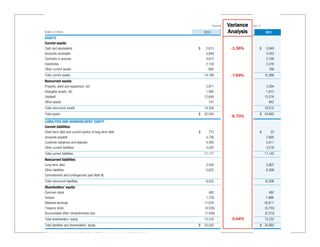
CONSOLIDATED BALANCE SHEET BALANCE SHEET
              CONSOLIDATED


                                                                                                                                                   December 31   Variance e c e m b e r 3 1
                                                                                                                                                                            D

(Dollars in millions)            (Dollars in millions)                                                                                      2010                 Analysis
                                                                                                                                                                  2011 2010                    2011
ASSETS                           ASSETS
Current assets:                  Current assets:
Cash and equivalents             Cash and equivalents                                                                                   $    2,613           $      -1.36%
                                                                                                                                                                     2,649 2,613
                                                                                                                                                                     $                    $    2,649
Accounts receivable              Accounts receivable                                                                                         3,848                  4,452 3,848                4,452
Contracts in process             Contracts in process                                                                                        4,873                  5,168 4,873                5,168
Inventories                      Inventories                                                                                                 2,158                  2,310 2,158                2,310
Other current assets             Other current assets                                                                                          694                    789 694                    789
Total current assets             Total current assets                                                                                       14,186                  -7.69%
                                                                                                                                                                   15,368
                                                                                                                                                                        14,186                15,368
Noncurrent assets:        Noncurrent assets:
Property, plant and equipment, net plant and equipment, net
                          Property,                                                                                                          2,971                  3,284 2,971                3,284
Intangible assets, net    Intangible assets, net                                                                                             1,992                  1,813 1,992                1,813
Goodwill                  Goodwill                                                                                                          12,649                 13,576
                                                                                                                                                                        12,649                13,576
Other assets              Other assets                                                                                                         747                    842 747                    842
Total noncurrent assets          Total noncurrent assets                                                                                    18,359                 19,515
                                                                                                                                                                        18,359                19,515
Total assets                     Total assets                                                                                           $   32,545           $ 34,883
                                                                                                                                                                $ 32,545                  $ 34,883
                                                                                                                                                                    -6.70%
LIABILITIES AND SHAREHOLDERS’ EQUITY
                          LIABILITIES AND SHAREHOLDERS’ EQUITY
Current liabilities:      Current liabilities:
Short-term debt and current portion ofdebt and current portion of long-term debt
                          Short-term long-term debt                                                                                     $      773           $       $ 23 773             $       23
Accounts payable          Accounts payable                                                                                                   2,736                  2,895 2,736                2,895
Customer advances and deposits advances and deposits
                          Customer                                                                                                           4,465                  5,011 4,465                5,011
Other current liabilities Other current liabilities                                                                                          3,203                  3,216 3,203                3,216
Total current liabilities        Total current liabilities                                                                                  11,177                 11,145
                                                                                                                                                                        11,177                11,145
Noncurrent liabilities: Noncurrent liabilities:
Long-term debt          Long-term debt                                                                                                       2,430                  3,907 2,430                3,907
Other liabilities       Other liabilities                                                                                                    5,622                  6,599 5,622                6,599
Commitments and contingencies (see Note N)contingencies (see Note N)
                        Commitments and
Total noncurrent liabilities Total noncurrent liabilities                                                                                    8,052                 10,506 8,052               10,506
Shareholders’ equity: Shareholders’ equity:
Common stock            Common stock                                                                                                            482                    482 482                    482
Surplus                 Surplus                                                                                                               1,729                  1,888 1,729                1,888
Retained earnings       Retained earnings                                                                                                   17,076                 18,91717,076               18,917
Treasury stock          Treasury stock                                                                                                       (4,535)                (5,743)
                                                                                                                                                                          (4,535)              (5,743)
Accumulated other comprehensive loss other comprehensive loss
                        Accumulated                                                                                                          (1,436)                (2,312)
                                                                                                                                                                          (1,436)              (2,312)
Total shareholders’ equity Total shareholders’ equity                                                                                       13,316                  0.64%
                                                                                                                                                                   13,232
                                                                                                                                                                        13,316                13,232
Total liabilities and shareholders’liabilities and shareholders’ equity
                             Total equity                                                                                               $   32,545           $ 34,883
                                                                                                                                                                 $ 32,545                 $ 34,883

The accompanying Notes to Consolidated Financial Statements are an integral part ofStatements are an integral part of this statement.
                              The accompanying Notes to Consolidated Financial this statement.
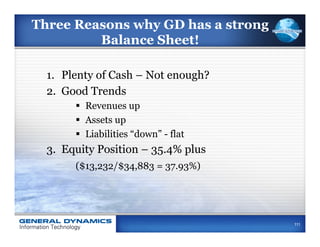
Three Reasons why GD has a strong
         Balance Sheet!

  1.  Plenty of Cash – Not enough?
  2.  Good Trends
       §  Revenues up
       §  Assets up
       §  Liabilities “down” - flat
  3.  Equity Position – 35.4% plus
       ($13,232/$34,883 = 37.93%)


                                       111
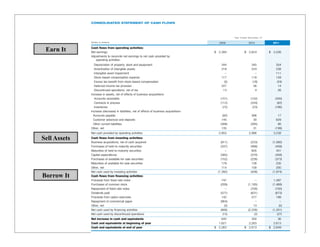
CONSOLIDATED STATEMENT OF CASH FLOWS


                                                                                                                                 Year Ended December 31

              (Dollars in millions)                                                                                   2009                  2010            2011

 Earn It      Cash flows from operating activities:
              Net earnings                                                                                          $ 2,394             $ 2,624           $ 2,526
              Adjustments to reconcile net earnings to net cash provided by
                 operating activities-
                 Depreciation of property, plant and equipment                                                          344                   345              354
                 Amortization of intangible assets                                                                      218                   224              238
                 Intangible asset impairment                                                                               –                     –             111
                 Stock-based compensation expense                                                                       117                   118              128
                 Excess tax benefit from stock-based compensation                                                         (5)                  (18)             (24)
                 Deferred income tax provision                                                                          227                     56               14
                 Discontinued operations, net of tax                                                                     13                      4               26
              Increase in assets, net of effects of business acquisitions-
                 Accounts receivable                                                                                   (151)                 (152)            (420)
                 Contracts in process                                                                                  (112)                 (334)              (62)
                 Inventories                                                                                             (72)                  (23)           (186)
              Increase (decrease) in liabilities, net of effects of business acquisitions-
                Accounts payable                                                                                         (92)                 366               17
                Customer advances and deposits                                                                          145                    30              629
                Other current liabilities                                                                              (306)                 (285)              86
              Other, net                                                                                                135                    31             (199)
              Net cash provided by operating activities                                                               2,855                 2,986           3,238

Sell Assets   Cash flows from investing activities:
              Business acquisitions, net of cash acquired                                                               (811)                (233)          (1,560)
              Purchases of held-to-maturity securities                                                                  (337)                (468)            (459)
              Maturities of held-to-maturity securities                                                                    –                  605              441
              Capital expenditures                                                                                      (385)                (370)            (458)
              Purchases of available-for-sale securities                                                                (152)                (226)            (373)
              Maturities of available-for-sale securities                                                                179                  126              235
              Other, net                                                                                                 114                  158              200
              Net cash used by investing activities                                                                   (1,392)                (408)          (1,974)
Borrow It     Cash flows from financing activities:
              Proceeds from fixed-rate notes                                                                            747                      –           1,497
              Purchases of common stock                                                                                (209)               (1,185)          (1,468)
              Repayment of fixed-rate notes                                                                                 –                (700)            (750)
              Dividends paid                                                                                           (577)                 (631)            (673)
              Proceeds from option exercises                                                                            142                   277              198
              Repayment of commercial paper                                                                            (904)                     –                 –
              Other, net                                                                                                   (5)                 13                 (5)
              Net cash used by financing activities                                                                    (806)               (2,226)          (1,201)
              Net cash used by discontinued operations                                                                   (15)                   (2)             (27)
              Net increase in cash and equivalents                                                                      642                 350                36
              Cash and equivalents at beginning of year                                                               1,621               2,263             2,613
              Cash and equivalents at end of year                                                                   $ 2,263             $ 2,613           $ 2,649

              The accompanying Notes to Consolidated Financial Statements are an integral part of this statement.
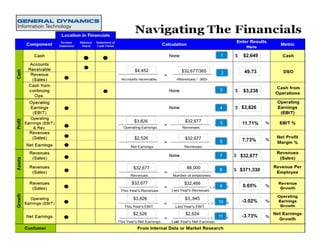
1     $2,649


 $4,452   $32,677/365         49.73
                         2


                        3     $3,238


                        4    $3,826

 $3,826    $32,677      5    11.71%


 $2,526    $32,677           7.73%
                        6


                        7    $32,677

$32,677     88,000      8    $371,330

$32,677    $32,466
                        9     0.65%

$3,826     $3,,945
                        10   -3.02%

$2,526     $2,624
                        11   -3.73%
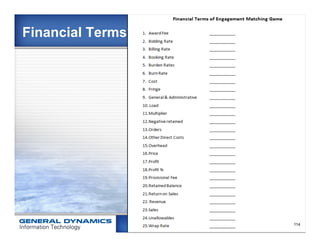
Financial Terms?


                   114
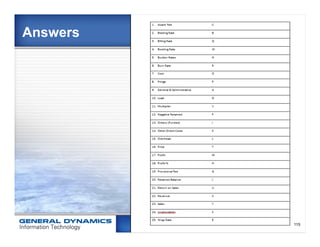
Answers


          115
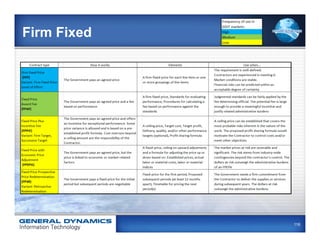
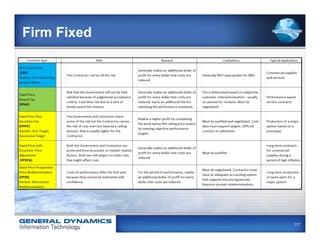
Firm Fixed


             116
Firm Fixed


             117
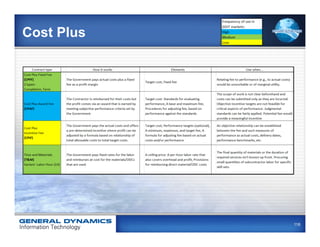
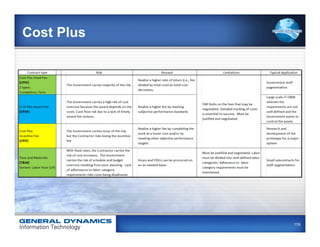
Cost Plus


            118
Cost Plus


            119
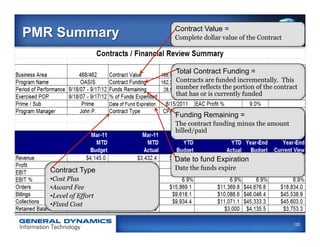
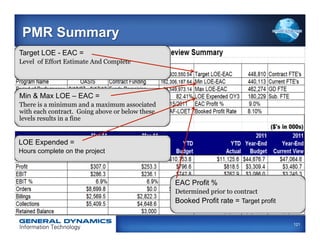
PMR Summary            Contract Value =
                       Complete dollar value of the Contract


                       Total Contract Funding =
                       Contracts are funded incrementally. This
                       number reflects the portion of the contract
                       that has or is currently funded


                       Funding Remaining =
                       The contract funding minus the amount
                       billed/paid


                       Date to fund Expiration
   Contract Type       Date the funds expire
   • Cost Plus
   • Award Fee
   • Level of Effort
   • Fixed Cost


                                                                120
PMR Summary
Target LOE - EAC =
Level of Effort Estimate And Complete


Min & Max LOE – EAC =
There is a minimum and a maximum associated
with each contract. Going above or below these
levels results in a fine


LOE Expended =
Hours complete on the project


                                                 EAC Profit %
                                                 Determined prior to contract
                                                 Booked Profit rate = Target profit


                                                                                      121
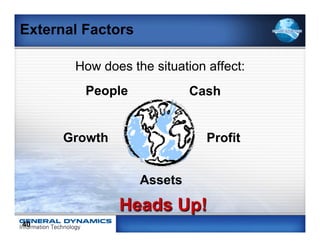
External Factors

       How does the situation affect:
         People             Cash


      Growth                  Profit


                   Assets

               Heads Up!
40
“The best way to predict the future….
           is to create it.”

                       Peter Drucker


                                        123
External Factors

     The best “CEO’s” not only pay attention
         to what is happening inside their
        company, they also have an eye on
       the external factors that could impact
                  their business.


40
External Factors

     The Role of the Stock Market


     1.  What role does the stock market play?
     2.  Who cares about a company’s stock price and why?
        •    Investors
        •    Analysis
        •    The CEO
        •    Employees
     3.  What are the benefits of a higher stock price?


40                                                          40
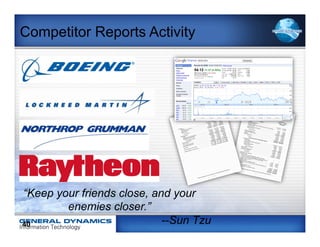
Competitor Reports Activity


“Keep your friends close, and your
        enemies closer.”
40                          --Sun Tzu
Competitor Reports Activity

Resources
1.  Annual Report and/or latest executive
    messaging
2.  Financial Statements
3.  Complete the Navigating the Financials
4.  Corporate Website
5.  www.google.com/finance
Reports – use outline provided
1.  Answer questions on the hand-out
2.  Prepare flip-chart
3.  Teach the rest of the group


40
Individual Action Plan

     à Review:   (Page 52)
       What new insights did you gain,
       as a result of attending?

     à Action Plan:    (Page 53)
        List the things you can commit to do:
           ü  Cash:      (refer to page 9)
           ü  Profit:    (refer to page 11)
           ü  Assets:    (refer to page 13)
           ü  Growth: (refer to page 15)
           ü  People: (refer to page 17)


52                                              52
Acumen Accountability

Find a Partner now and:
     1.  Set up a specific date and time in 30 days to report
         your progress on your action plan.
     2.  Exchange emails
     3.  Exchange phone numbers
     4.  Decide who will initiate the call
     5.  Determine a back-up plan
     6.  Transfer this information to
        your device now.


53                                                              53
Insights

     à Review:   (Page 52)
       What new insights did you gain,
       as a result of attending?


52
Retention of Content
     Content Retention
                                  ü Review
                                  ü Apply
                                  ü Teach

                                15%
                         Time

52                                            52
Locating Financial Information


     Web Sites:
     •    www.nasdaq.com
     •    www.reuters.com
     •    www.yahoo.com
     •    www.finance.google.com
     •    www.hoovers.com
     •    www.smartmoney.com


55                                 55
Learning Objectives…
ü  List and describe what key measures are important
    to ISD and to Tom Kirchmaier.

ü  List and describe the five business drivers all successful
    businesses must focus on.

ü  Teach specific components of the financial statements.


ü  Explain how I can have an impact on growth.

ü  Create a personal action plan that can positively
    impact our results.

                                                                 133
Post Course Business Acumen

 1.  Teach one of the principals learned in class today, to
     someone on your team.
 2.  Discuss your action items with your manager in
       the next 7 days.
 3.  Read the first 90 pages of: “Seeing the BIG Picture“
 4.  Give an account of your progress on your action
             item(s).
 5.  Think and act like owners!
One Final Thought…


   “People will work
            hard for a paycheck,
            harder for a person, and
            hardest for a reason.”
Final Exam
PM Training
Building Business Acumen®


          Kenny Snarr
   ksnarr@acumenlearning.com

Gdit bba 2 day 2012 7-30-90

  • 1.
    PM Training Building BusinessAcumen® Presented by Kenny Snarr 1
  • 2.
    Mission Statement The JapanAirlines Group, as an overall air transport enterprise, will act as a bridge to bring peoples, their cultures and their hearts closer together and thus contribute to world peace and prosperity. The Japan Airlines Group, a transport enterprise with a global reach, will expand its worldwide network as a key industry supporting travel, tourism and transport in the 21st century, "an era of exchange.” We will not only transport people and goods to their respective destinations safely and on time, but will also bring peoples, their cultures and their hearts closer together as our contribution to world peace and prosperity.
  • 3.
  • 4.
    Business Acumen Defined • Quickness of perception •  Keen insight •  Mental acuteness ~Wayne Gretzky~ “The Great One” When asked by a reporter, “What makes you so great?” Wayne responded by saying; “I don’t skate to where the puck is.” “I skate to where the puck… is going to be.”
  • 5.
    Business  Acumen?   • Quickness  of  perception   •  Keen  insight   •  Mental  acuteness   The image cannot be displayed. Your computer may not have enough memory to open the image, or the image may have been corrupted. Restart your computer, and then open the file again. If the red x still appears, you may have to delete the image and then insert it again. Business  Acumen  101   5
  • 6.
    Course Outline Content / Topic Introductions / Objectives / Quiz 5-Business Drivers Strategic Messaging Differential Management Financial Statements –  Income Statement –  Balance Sheet –  Cash Flow Statement Financial Analysis Competitive Analysis Action Planning
  • 7.
    Learning Objectives… ü  Listand describe what key measures are important to ISD and to Tom Kirchmaier. ü  List and describe the five business drivers all successful businesses must focus on. ü  Teach specific components of the financial statements. ü  Explain how I can have an impact on growth. ü  Create a personal action plan that can positively impact our results. 7
  • 8.
    Participant Guide Book Write name & phone number on the inside cover. Write name & department on the name tent. 8
  • 9.
    Welcome ü  Participationis encouraged ü  Please turn off phones, tablets, computers, and/ or any other devices that may distract during the class. ü  Be sure to sign the roster for class recognition and post class follow-up.
  • 10.
    Pop Quiz (GDor ISD numbers) (Page 35) 2011 1- What was our Free Cash Flow? 2- What was our DSO, actual or target? 3- What was Cash from Operating Activities? 4- What was Operating Earnings/Program Profit (EBIT $) ? 5- What was Operating Earnings margin (EBIT %)? 6- What was our Profit Margin (%) ? 7- What was Revenue? 8- What was Revenue Per Employee? 9- How much did Revenues grow? 10-How much did Operating Earning (EBIT) grow? 11- How much did Net Earning growth? Given all the above, how do we stack up against our competitors? 10
  • 11.
    Business can betough! Ø  Only 5-10% of business start-ups survive past 5 years. Ø  16% of CEOs lose their job every year. Booz Allen Hamilton 5th annual Study Ø  70% of merger and acquisition activity do not live up to expectation. Wall Street Journal 2007 So why do businesses fail?
  • 12.
    Business Acumen “Whenit comes to running a business successfully, the street vendor and the CEOs of some of the world’s largest and most successful companies talk and think very much alike.” Ram Charan 5-Step Approach per Driver: •  Define the driver. •  Know why it is important. •  Know how we measure it. •  Discover our numbers (& comp). •  Create an Action Plan.
  • 13.
    Cash Cash is _____ ! Cash On Hand Generation “Cash is a company’s oxygen supply.” ~Ram Charan Growth People Profit Top Line Employees Revenues Bottom Line Customers Expenses “Cash is more important than your mother.” ~Al Shugart: Former Seagate CEO Assets Strength Utilization 9
  • 14.
    CASH   The  Cash  Driver  is  de;ined  as  what  is  needed  to   grow  and  maintain  the  business.   Measures   Cash  is  the  bills  and  coins  in  the  register,  and  cash  in  the   bank.  It  also  includes  cash  equivalents,  like  Certi;icates  of   Deposits  (CDs)  and  other  highly  liquid  investments     (i.e.  easily  converted  into  cash  within  90  days).   Cash  Flow  is  the  cash  generation  from  “core  operating    Peter  Drucker   activities”  that  ;lows  into  the  business  and  the  cash  that   Why  do  you  think would  say…     ;lows  out  of  the  business  in  a  given  time  period,  such  as  a   “Cash  Flow  is   quarter  or  a  year.    more  important   DSO  Average  amount  of  days  it  takes  to  collect  payment   than  profit.”   from  customers.  
  • 15.
    Cash  vs.  Cash  Flow   Pay off loans Buy furniture Put it in savings
  • 16.
    Sources of Cash • Earn it • Cash from Operation Pro: No Cost -Con: Time •  Sell Assets Pro: Immediate -Con: Reduces Assets • Cash from Investing •  Borrow it Pro: Immediate -Con: Cost (Interest) • Cash from Financing Can a company have too much Cash? What kind of companies carry a lot of cash? Why is Cash Flow so important? DSO = Receivables/(Sales÷365) 9
  • 17.
    How Much Cash? A company should have sufficient cash to cover… •  their interest •  current expenses •  capital expenditures •  plus a little for emergencies ~ Investopedia 9
  • 18.
    Top 5 Usesof Cash Top 5 Uses of Cash Dividend Pay-Outs Research and Development (R&D) Stock Buy-Back Capital Expenditures (CAPEX) Mergers and Acquisitions (M&A) 9
  • 19.
    Benchmark  Cash   General General General Element Dynamics Dynamics Dynamics 2009 2010 2011 Total Revenues $31,981 $32,466 $32,677 Net Income $2,394 $2,624 $2,526 Cash Cash $2,263 $2,613 $2,649 Cash as a % of Revenues 7.08% 8.05% 8.11% Cash from Operating Act. $2,855 $2,986 $3,238 Free Cash Flow $2,470 $2,616 $2,780 Major  uses  of  Cash  in  2011:   •   $1,185  million  common  stock  repurchase   •   $700  million  in  debt  reduction   •   $631  million  in  dividends   •   $370  million  in  property,  equipment  and  capitalized  software   19
  • 20.
    Benchmark  Cash   General Lockheed Northrop Element Raytheon Boeing Dynamics Martin Grumman 2011 2011 2011 2011 2011 Total Revenues $32,677 $24,857 $46,499 $26,412 $64,306 Net Income $2,526 $1,866 $2,655 $2,118 $3,307 Cash Cash $2,649 $4,000 $3,582 $3,002 $5,400 Cash as a % of Revenues 8.11% 16.09% 7.70% 11.37% 8.40% Cash from Operating Act. $3,238 $2,156 $4,253 $2,115 $2,952 Free Cash Flow $2,780 $1,816 $3,439 $1,400 $1,827 Major  uses  of  Cash  in  2011:   •   $1,185  million  common  stock  repurchase   •   $700  million  in  debt  reduction   •   $631  million  in  dividends   •   $370  million  in  property,  equipment  and  capitalized  software   20
  • 21.
    Days Sales Outstanding- DSO Ø  DSO is a measure of number of days before Sales turns into cash. Total Days Sales Outstanding Sales Invoice Collections Unbilled/Retained Billed DSO DSO 21
  • 22.
    How PMs impactcash/cash flow ü  Manage billing milestones – efficiently execute completion milestones ü  Minimize time from task completion to payment (Days Sales Outstanding – DSO) ü  Ensure timecard compliance §  Timely – DAILY input / accurate entry of time worked §  Establishment and communication of proper charge numbers §  Pre-emptive discussion on how to charge in weather calamities, training, etc. ü  Timely review/approval of subcontractor and consultant invoices ü  Focus on timely submittal of invoices and hours by subcontractors ü  Fully participate and understand monthly financial reviews ü  Maximize profitability ü  Update and post CESRs (Certificate of Engineering Services Rendered) within 5 business days ü  Excellent contract performance §  Equates to happy customer who doesn’t protest invoices or delay payments due to dissatisfaction 22
  • 23.
    Impacting the CashDriver Late Timecard Submissions Negatively Impact Our Bottom Line The annual cost impact to GDIT when people submit their timecards late is in excess of $600K in administrative and compensation costs. This comes in the form of the Payroll organization working Saturdays to process these late cards as well as in the form of administrative personnel across the company chasing delinquent employees. In addition, if a timecard is submitted late, costing and invoice generation is understated, all of which negatively impacts company cash flow. So PLEASE make sure to submit your timecard and have all your people submit their timecards each Friday by the close of business. 23
  • 24.
  • 25.
    Cash Review 1. Define Cash Driver 2. Measures of Cash What is required to grow and 1. Cash – easily converted in 90 days or less to cash. maintain the business. 2. Cash Flow – Difference of cash in and cash out over a given period of time. 3. Dividend Yield – Shareholder ROI 3. Importance of Cash Driver 3. Action – my Impact •  Have sufficient cash to run business •  Collect Faster •  What is the cost of that cash (capital) •  Manage Payables •  Enhance shareholder value •  Do it right the first time •  Improve attractiveness to suppliers •  Don’t give customer excuse not to and customers. pay 9
  • 26.
    Profit Cash “No margin, no mission.” On Hand Generation Profit is an opinion, Cash is a fact. Growth People Profit Top Line Employees Revenues Bottom Line Customers Expenses Assets Strength Utilization 11
  • 27.
    Profit The Profit Driver is defined as what remains after expenses are subtracted from your sales. It can be expressed in dollars ($) or as a percent (%). You can improve profit in two fundamental ways: 1.  Increase Revenues •  Charge More •  Sell More 2.  Decrease Expenses The types of expenses you deduct determine which profit you are calculating. Common profit calculations include: q  Gross Profit: deducts Cost of Goods Sold (COGS) q  Operating Earnings (EBIT): deducts COGS, and SG&A (Sales General & Admin) q  Net Earnings: deducts all expenses 11
  • 28.
    Profit Sales Price:$1.50 Water - .04 Label - .11 Bottle & cap - .15 COGS (Cost of Goods Sold) Packaging (Direct Labor) - .20 Total: .50 $1.50 - .50 = $1.00 Gross Profit = 66.7% Gross Profit Margin Rent - .03 Selling, Gen, & Admin. (SG&A or Overhead) - .30 Marketing - .08 Overhead Shipping - .19 Depreciation /Amortization - .02 Total: .62 $1.50 - $.50 - $.62 = $.38 EBIT = 25.3% Operating Margin Life Interest Expense - .04 Spring Taxes - .06 Artesian Water Total: .10 Other $1.50 - $.50 - $.62 - $.10 = $.28 Net Profit = 18.6% Net Profit Margin 11
  • 29.
    High Margin vs.Low Margin “In 1912, the Model T for the first time cost less than the prevailing average annual wage in the United States.” “Ignoring conventional wisdom, Henry Ford continually sacrificed margins to increase sales. In fact, profits per car did fall as he slashed prices from $220 in 1909 to $99 in 1914.” “But Sales Exploded!” “Ford demonstrated that a strategic, systematic lowering of prices could boost profits, as net income rose from… $3 million in 1909 to $25 million in 1914.” ~Daniel Gross, Forbes Greatest Business Stories 11
  • 30.
    Benchmark  ProCit   General General General Element Dynamics Dynamics Dynamics 2009 2010 2011 Total Revenues $31,981 $32,466 $32,677 Net Income $2,394 $2,624 $2,526 Profit Operating Income (EBIT) $3,675 $3,790 $3,718 Operating Margin 11.49% 11.67% 11.38% Net Income $2,394 $2,628 $2,552 Net Margin 7.49% 8.09% 7.81% Impact  to  Pro;it:  Reduce  Share and  drive  operational  excellence   $6.94 Earnings Per costs   $6.20 $6.88  -­‐  2011          -­‐  2012         30
  • 31.
    Benchmark  ProCit   General Lockheed Northrop Element Raytheon Boeing Dynamics Martin Grumman 2011 2011 2011 2011 2011 Total Revenues $32,677 $24,857 $46,499 $26,412 $64,306 Net Income $2,526 $1,866 $2,655 $2,118 $3,307 Profit Operating Income (EBIT) $3,718 $2,857 $3,980 $3,276 $4,971 Operating Margin 11.38% 11.49% 8.56% 12.40% 7.73% Net Income $2,552 $1,866 $2,655 $2,118 $3,307 Net Margin 7.81% 7.51% 5.71% 8.02% 5.14% Earnings Per Share $6.94 $5.28 $7.85 $7.41 $1.84 Impact  to  Pro;it:  Reduce  costs  and  drive  operational  excellence    -­‐  2011          -­‐  2012         31
  • 32.
    Profit in Action GeneralMills: Hot’n Spicy Chex Mix: “We had 14 different pretzel shapes. By getting rid of some of them, we save $1 million a year.” Yoplait: Ditched multicolored lids, saving $2 million a year: Airlines: Baggage Fees grew airline revenues by $3.8B 11
  • 33.
    Growing Profits •  Sellmore •  Improve Quality è Strengthen Pricing •  Understand Product Mix (sell more of the higher margin products) •  Improve execution and up-selling •  Make prudent investments in growth fits Gr ow Pro Increase Sales •  Negotiate materials costs •  Reduce inventories •  Decrease employee turnover Reduce Costs •  Scrutinize spend on R&D •  Reduce/conserve Operating costs •  Improve Project Planning 11
  • 34.
  • 35.
    Profit Review 1.Define Profit Driver 2. Measures of Profit •  What is left over after you have 1.  Gross Profit – subtracts COGS subtracted expenses. 2.  Operating Earnings – Subtracts COGS, •  Can be expressed in dollars ($) SG&A, and Production Period or as a percent (%). Expenses 3.  Net Profit – subtracts all expenses 3. Importance of Profit Driver 4. Action, my Impact •  Net Profit is one of the most •  Increase Revenue important #’s for the business. •  Sell More •  Indicates price strength & cost •  Charge More controls •  Lower Expenses •  Identifies ability to manage costs 11
  • 36.
    High  Margin  vs.  Low  Margin   High  Margins   Low  Margins   33.6%   7.9%   30.0%   3.9%   21.5%   1.4%   WHY?       WHY?       They  offer  something  Unique!   They  sell  commodities.   “If  you’re  not  unique,  you  better  be  cheap!”   To  drive  ProCit($)  you  need  either:  High  Margin  (%)  or  High  Velocity  (Volume)   36
  • 37.
    How do PMsimpact profit? •  Watch expenses; –  Manage cost budgets, approve only costs that have relevance and a business need –  Approve only training that satisfies business needs •  Set training expectations with employee – what you expect them to do with the knowledge when they return to work •  Limit travel expenses for training, when possible •  Staffing with qualified, but less expensive personnel –  Create a staffing model to bring in junior, less expensive talent as senior employees move into next career position •  Learn to effectively use management reserve •  Effective program execution •  Continuous process improvement – minimize waste, and reduce costs •  High Customer satisfaction – award fees 37
  • 38.
    How PMs impactprofit? •  Improve staffing practices –  Reduce number of days between “Need Date to Start Date” to minimize Opportunity Loss in revenue •  When a position is vacant, we are not generating revenue •  Have people with contingent offers lined up for backfills when required –  Ensure the right people are in the right job •  Minimize turnover –  Support staffing efforts by participating in job fairs –  Emphasize / encourage job referrals with your employees •  Understand the various contract vehicles that are available, how each one works – for example, Firm Fixed Price, Cost Plus, etc., and the impact on profit •  Negotiate/propose ECPs that increase profit/revenue 38
  • 39.
    Assets Cash Anything we own or control On Hand Generation which has value What we have, and how well Growth People Profit we use what we have. Top Line Employees Revenues Bottom Line Customers Expenses Assets Strength Utilization People are our biggest asset! 13
  • 40.
    Assets Assets are economic resources owned by a business. Anything tangible or intangible that one possesses, usually considered as applicable to the payment of one's debts, is considered an asset. Simplistically stated, assets are things of value that can be readily converted into cash. When evaluating a company’s assets, both strength and utilization should be considered. q  Return on Assets (ROA) The percent value of sales (revenues) to total assets. 13
  • 41.
    Strength vs. Utilization Asset Strength: Asset Utilization: Refers to a company’s Refers to a company’s ability to stay viable during ability to efficiently and the ups and downs in the effectively use its assets to market place. generate profits. Organizations must balance Asset Strength & Utilization Asset Strength Metrics: Asset Utilization Metrics: •  Current Ratio •  Return on Assets (ROA) •  Debt to Equity Ratio •  Return on Inventory (ROI) •  Inventory Turnover •  Return on Equity (ROE) 13
  • 42.
    Assets in Action The modern charcoal briquette was invented by automaker Henry Ford. Ford operated a sawmill in the forests around Iron Mountain, Michigan, in the years prior to 1920 to make wooden parts for his Model T. As the piles of wood scraps began to grow, so did Ford's eagerness to find an efficient way of using them. He learned of a process developed and patented by Orin F. Stafford. The process involved chipping wood into small pieces, converting it into charcoal, grinding the charcoal into powder, adding a binder and compressing the mix into the now-familiar, pillow-shaped briquette. By 1921, a charcoal-making plant was in full operation. 13
  • 43.
    Assets in Action United Parcel Service (UPS) – Avoiding Left Hand Turns •  92,000 trucks worldwide •  Saved over 28,541,472 Miles •  Saved 3 million gallons of fuel •  Reduced insurance premiums •  Reduced maintenance frequency and costs 13
  • 44.
    Benchmark  Assets   General General General Element Dynamics Dynamics Dynamics 2009 2010 2011 Total Revenues $31,981 $32,466 $32,677 Net Income $2,394 $2,624 $2,526 Assets Total Revenues $31,891 $32,466 $34,677 Backlog $65,545 $59,561 $57,410 Revenues per Employee $346,490 $358,100 $358,600 44
  • 45.
    Benchmark  Assets   General Lockheed Northrop Element Raytheon Boeing Dynamics Martin Grumman 2011 2011 2011 2011 2011 Total Revenues $32,677 $24,857 $46,499 $26,412 $64,306 Net Income $2,526 $1,866 $2,655 $2,118 $3,307 Assets Total Revenues $34,677 $24,857 $46,499 $26,412 $64,306 Backlog $57,410 $35,312 $80,700 $39,515 $320,900 Revenues per Employee $358,600 $345,236 $369,040 $374,366 $400,660 45
  • 46.
  • 47.
    Asset Review 1.Define Asset Driver 2.  Measures of Assets What we have and how well we 1.  Return on Assets – percentage of sales to total assets use what we have to generate 2.  Inventory Turnover Profits. 3. Importance of Asset Driver 4. Action, my Impact •  Demonstrates ability to work smarter •  Manage Cash and Cash Flow rather than harder. •  Manage Inventory •  Indicates company invests in “right” assets •  Invest is the right assets •  Indication of execution & efficiency •  Grow Net Income
  • 48.
    How PMs impactAssets/People? •  Remember ASSETS are employees: •  Communicate with your people –  2-way communications –  Goal setting and performance expectations •  Take care of problems early and quickly •  Build / encourage loyalty to GDIT –  Lead by example •  Provide career development opportunities –  Train your employees to add value –  Encourage degrees, certificates, clearances to make people more valuable 48
  • 49.
    Individual Activity (Page 15) Write down one action you are committed to take to positively impact People. •  Remember ASSETS are employees: •  Communicate with your people –  2-way communications –  Goal setting and performance expectations •  Take care of problems early and quickly •  Build / encourage loyalty to GDIT –  Lead by example •  Provide career development opportunities –  Train your employees to add value –  Encourage degrees, certificates, clearances to make people more valuable 49
  • 50.
    Growth Why is Growth so Cash important to business? On Hand Generation Growth People Profit Top Line Employees Revenues Bottom Line Customers Expenses Assets Strength Utilization 15
  • 51.
    Growth Growth is defined as an increase over a period of time such as year/year, quarter/quarter, or month / month. Growth is most commonly measured by: Sales Profit EPS Top-Line Bottom-Line Shareholder Value There are two types of Growth: 1.  Organic Growth: Comes from a company’s existing business 2.  Inorganic Growth: Comes from a merger or an acquisition In today’s business world, no growth means lagging behind in a world that grows every day… 15
  • 52.
    Growth Intoday’s business world, no growth means lagging behind in a world that grows every day… •  Investors expect it. •  Employees are more energized by it. •  Customers are generally attracted to it. •  Executives are measured by it.
  • 53.
    Business Development isthe Life Blood of an Organization/Company ü Why? •  Programs end •  GD expects growth in both EBIT and Revenue dollars ü There are three ways to obtain growth •  Acquisition of a company •  Organic - grow your existing program by adding revenue through a change order or ECP or winning a task order •  New Business - winning a new contract
  • 54.
    There are threetypes of growth Acquisition, Organic or New Business In Organic Growth 54
  • 55.
    How do Iimpact Organic Growth? •  Listen to your customers –  What keeps your customer up at night –  How can we improve the mission –  Will innovation improve the process or output •  Performance leads to organic growth and demonstrates capability to perform new business through past/present performance Listen and Deliver 55
  • 56.
    GDIT Enterprise BusinessDevelopment Process (eBDP) Flowchart (October 2006) Long Term Assessment Strategy Pre-Proposal Proposal Post-Submittal Positioning 56
  • 57.
    Key BD Metrics Asof 1/20/2011 57
  • 58.
    How does itwork – top to bottom? Current ISD Funnel As of 1/20/2011 GDIT Top 10 Opportunities ISD Top 10 Opportunities Sector Top Ten Qualified Funnel Volume Metrics 1Q10 2Q 10 3Q 10 4Q 10 Current Volume $13.8B $13.5B 13B $15.8B $16.3B Vol/Revenue 10.6 10.3 9.9 12.1 11.35 Populated with the real program names and value 58
  • 59.
    What part doPMs play in ISD Growth? 59
  • 60.
    Program Manager Roleand Responsibility in BD Process •  Always: –  Monitor Bidder Lists to ensure ISD capabilities are known, and understand how we advertise our capabilities. Keep BD informed. •  Be aware of additional contract vehicles that are available to the customer. Keep BD informed. •  Monitor competitor’s contract vehicles and know when the recomplete dates are. Keep BD informed.
  • 61.
    Program Manager Roleand Responsibility in BD Process (cont.) •  Assessment Phase: Prepare White Paper – where applicable, prepare white papers to influence the customer’s perception of the situation, potential GDIT solutions, and/or key issues to consider in conducting the procurement and selecting a winner that play to GDIT strengths or advantage •  Lead development of management solution and Program Management Plan, including development of the Statement of Work, Contract WBS, staffing plan, program risks, program/project planning, Integrated Master Plan and integrated Master Schedule, as required.
  • 62.
    Program Manager Roleand Responsibility in BD Process (cont.) •  Supports the Capture and Proposal Managers in understanding customer requirements and designing a winning management solution, driven by the win strategy •  Lead all Key Personnel in the development, rehearsal and delivery of required Oral Proposal Presentations •  Post Submittal Phase:  Transition to Startup  Manages the program once it is won.
  • 63.
    Decline vs. Growth Business in Business in Rapid Decline Growth Mode • Best & brightest leave first • Attracts/Retains the best & brightest! • Productivity goes down • Productivity goes up = more profit = • Morale goes down more cash = more ability to grow! • Costs are cut, which limits ability to grow, • Morale is typically higher. and the company becomes less • You have the ability to grow in your profitable. career! 15
  • 64.
    Benchmark  Growth   General General General Element Dynamics Dynamics Dynamics 2009 2010 2011 Total Revenues $31,981 $32,466 $32,677 How do we compare? Net Income $2,394 $2,624 $2,526 Growth Revenue Growth 9.15% 1.50% 0.65% Operating Earnings Growth 0.60% 7.35% -2.89% Backlog Growth -11.58% -9.13% -1.74% Inorganic  Growth                                   Organic  Growth                                   64
  • 65.
    Benchmark  Growth   General Lockheed Northrop Element Raytheon Boeing Dynamics Martin Grumman 2011 2011 2011 2011 2011 Total Revenues $32,677 $24,857 $46,499 $26,412 $64,306 Net Income $2,526 $1,866 $2,655 $2,118 $3,307 How do we compare? Growth Revenue Growth 0.65% -1.3% 1.52% -6.15% -5.8% Operating Earnings Growth -2.89% 9.6% -2.86% 15.88% 152.1% Backlog Growth -1.74% 2.20% 2.93% -15.64% 2.5% Inorganic  Growth                                   Organic  Growth                                   65
  • 66.
    How PMs ImpactISD Growth •  Quality day to day performance •  Ear to the ground – report any opportunity leads or opportunity for improvement to your supervisor •  Help in the proposal process for competitive contracts •  As needed, provide assessments of customer perception •  Report any solicitations from other companies or competitors to your supervisor •  Listen to your customer(s) and provide value-added support 66
  • 67.
    How PMs impactISD growth? •  Perform well on a daily basis – performance is key to retaining AND acquiring new business •  Keep customers informed about contract options •  Know the program deliverables, risks, scope and opportunities •  Anticipate customers’ needs •  BD Process and PM Involvement •  Know what GD contract vehicles are available to have customers shift new work to, or to consolidate work under one of our prime contracts •  Help with proposals •  Provide insight into customer/business intelligence being careful NOT to compromise OCI (Organizational Conflict of Interest) •  Understand and tell management what other contractors are doing in our customer spaces 67
  • 68.
  • 69.
    Growth Review 1.Define Growth Driver 2. Measures of Growth The ability to increase year 1.  Revenue Growth over year, quarter over quarter, 2.  Net Income Growth and/or month over month. 3.  Customer Growth 3. Importance of Growth Driver 4. Action, my Impact “Investors expect it, employees are •  Grow revenue energized by it, customers are •  Bundle products/services generally attracted to it and executives are measured by it.” •  Understand client objectives •  Solutions based 15
  • 70.
    People/Customers Customers and employees are Cash the key to driving profitable On Hand Generation & sustainable growth. Growth People Profit Top Line Customers Revenues Bottom Line Employees Expenses Assets Strength Utilization 17
  • 71.
    People People are the external customers, internal customers, as well as in-direct influences such as affiliates, vendors, partners, and suppliers. Without People…then what happens? 17
  • 72.
    People “Culture eats strategy for breakfast!” ~Peter Drucker 17
  • 73.
    Internal People A’shire A+’s and B’s hire C’s What is the #1 reason a person will leave a company? 17
  • 74.
    Internal/External Customers Listening to our Customers: External Customers: •  Have a formal process for listening to your customers •  Anticipating customer needs is critical! •  We must understand their business, and the customers they serve. Internal Customers: •  Meet with them monthly and ask: •  “Are there any gaps in my performance? •  Have my priorities changed?” 17
  • 75.
    External People “If Iwould have asked my customers what they wanted, they would have told me a faster horse!” Henry Ford 17
  • 76.
    Anticipating External People What companies have failed to anticipate customer expectations? What were the results? What limits companies from anticipating their customers’ wants and needs? 17
  • 77.
    Listen to yourcustomers! The #1 reason for rework or losing an opportunity is not listening to your customer. BD Process and Program Manager Involvement January 2011 77
  • 78.
    People Review 1.Define People Driver 2.  Measures of People The External Customer, Vendor/ 1.  Employee Count Reseller, or Internal Customer that has the ability to impact the 2.  Revenue per employee success of the business. 3. Importance of People Driver 4. Action, my Impact •  People at the center of the model •  Give others the benefit of the doubt •  Anticipate customers needs •  Customer service is for everyone •  Seek Feedback 17
  • 79.
    Impacting the PeopleDriver 1.  Who is your most critical internal customer? 2.  What are their top one or two expectations? 3.  How would your customer rate you on your performance? 4.  How would you grade yourself on how well you are fulfilling those expectations 5.  What two things can you do to improve your rating 17
  • 80.
    Impacting the PeopleDriver PEOPLE: •  People = Customers & Employees Hopefully you serve your customers well. How well do you serve your co-workers? •  Anticipation The best way to meet and exceed people’s needs is to try and anticipate them. •  Exceed deadlines •  Listen with empathy to resolve unhappy •  Be positive customers •  Always follow through •  Qualify each customer •  Increase vision •  Better educate customers •  Anticipate needs and expectations •  Possess good product knowledge when •  Increase quality staffing selling •  Increase employee education •  Retain employees •  Increase customer negotiations •  HR: Hire the best! •  Increase customer awareness •  Accurately set customer expectations
  • 81.
  • 82.
  • 83.
  • 84.
    How PMs impactcustomers? •  Bring value added to customer –  Innovate to improve mission execution and/or improve process and output –  Help find cost efficiencies for the customer – budgets are always tight •  Take care of your employees –  Happy employees create happy customers •  Take care of problems early and quickly –  Leverage corporate reach back when necessary (technical SME, functional SME, white papers or presentations on corporate capabilities or trends •  Effective communications – set expectations –  Review monthly contract reports with customers (don’t just deliver) •  Listen to your customers –  #1 reason for rework or losing an opportunity is not listening to the customer •  Receive high scores on the Customer Satisfaction Surveys (CSAT) – 84
  • 85.
  • 86.
    5 Business Drivers Howwill we remember Can you ignore any of these the 5 Drivers? over time and still be successful? 18
  • 87.
    Functional Activity Instructions: 1.  Rank the 5 Business Drivers in order of which you have the greatest impact / influence on 2.  What can you do tactically to drive the top 2 Drivers you impact 3.  Assign a spokesperson to report out to the group 1.) Impact Most 2.) 3.) 4.) 5.) Impact Least Operations, Cust. Service, Sales/Marketing, HR, Finance 38
  • 88.
    Functional Activity Operations Customers Sales/Marketing Service 38
  • 89.
    Functional Activity HumanResources Finance CEO 38
  • 90.
    Preparation for Tomorrow 1. Come ready to teach one of the 5 Drivers to your group 2.  Come ready to learn and teach all three financial statements 3.  We will be doing analysis on one of the competitor/benchmark entities….choose which one you would like to analyze (Boeing, Raytheon, Northrop Grumman, Lockheed Martin) Day 1 Quiz
  • 91.
  • 92.
    Cash Example When you think of a company rich in cash, who comes to mind? 9
  • 93.
    Cash Example Microsoft (Billions of Dollars) 2004 2005 2006 2007 2008 2009 2010 2011 Revenues $37 $40 $44 $51 $61 $58 $62 $70 Cash $73 $49 $43 $34 $30 $36 $45 $64 9
  • 94.
    Cash Example Microsoft CEO defends cash 'problem' Steve Ballmer says… “the company would rather have too much cash on hand rather than return it to shareholders”. May 31, 2008 CNN Money 9
  • 95.
    Profit Example Company A Company B 2011 2011 Total Sales $15,658 100% $23,979 100% Wages 4,371 28% 7,053 29% Fuel 5,644 36% 8,304 35% D&A 715 5% 1,086 5% Landing fees 959 6% 1,432 6% Commissions - - 1,062 4% Maintenance 955 6% 1,284 5% Food Service - - 518 2% Aircraft Rentals 308 2% 662 3% Contr. Ser. & other 2,013 13% 3,632 15% Total Op Exp. $14,965 96% $25,033 104% Operating Inc. $693 4% -$1,054 -4% Interest net 172 1% 760 3% Misc 198 1% 47 - Taxes 145 1% - Net Income $178 1.1% $1,861 -7.8% 11
  • 96.
    Assets Example Company A Company B 71 Door Handles 228 25 Cooling Systems 99 53 Antennas 171 6 Cars Mfg per Line 1 $3,800 Cost Advantage per Car $0 13
  • 97.
    Growth Example Revenues $450,000 $435,000 $420,000 $405,000 $390,000 $375,000 $360,000 $345,000 $330,000 $315,000 $300,000 $285,000 $270,000 $255,000 $240,000 in millions $225,000 $210,000 $195,000 $180,000 $165,000 $150,000 $135,000 $120,000 $105,000 $90,000 $75,000 $60,000 $45,000 $30,000 $15,000 15
  • 98.
    People Example When you think of a company with great customer service, who comes to mind? 17
  • 99.
    Review and Teach For your assigned Driver: (Study Notes 4-5 minutes) 1.  Define & give examples. How is it measured? 2.  Importance & relationship to other Drivers? 3.  How did we do in 2011? Future goals or targets? 4.  How you plan to influence this driver? Be sure to explain: CASH: Cash & Cash Flow—Both Cash and Cash Flow are important for different reasons PROFIT: How to calculate? Gross Margin, Operating Margin, and Net Profit ASSETS: Strength & Utilization—balance is critical here GROWTH: Organic & Inorganic—where have we grown? PEOPLE: Internal & external Customers; meeting, exceeding & anticipating needs & expectations 30
  • 100.
    Demystifying the AnnualReport What is the Purpose of the Annual Report? ü  General Communication GENERAL DYNAMICS Ø  Shareholders, existing/potential investors (others?) Annual Report 2011 Ø  Important, numbers, decision and strategy Ø  Where we have been and where we are going ü  Marketing Ø  The what, who and how Ø  Name, Image & Branding Ø  Colors ü  Compliance Ø  GAAP Ø  SEC 36
  • 101.
    Executive Communication •  FinancialHi-lights •  To Our Shareholders GENERAL DYNAMICS Annual Report 2011 •  Strategic Overview •  Financial Statement •  Income Statement •  Balance Sheet •  Statement of Cash Flows •  Notes to the Financial Section 36 22
  • 102.
    Executive Communication • What are the top 2 Drivers getting focus from the Executives right now? •  What are the key messages? •  What are the initiatives or strategies for 2012? •  How do we plan to execute on those strategies? 48
  • 103.
  • 104.
    Financial Statements   Statement  of  Cash  Flow           Statement  of  Operations  (P&L)       Balance  Sheet     22
  • 105.
    Financial Statements The AnnuallyReported Financial Statements: •  Statement of Income •  Balance Sheet •  Statement of Cash Flows 1.  What is the basic equation for each statement? 2.  What is the purpose of the statement? 3.  What are the key numbers and how are they trending? 4.  How can you impact each statement? 22
  • 106.
    ITEM 8. FINANCIALSTATEMENTS AND SUPPLEMENTARY DATA CONSOLIDATED STATEMENT OF EARNINGS Equation: Revenues – Expenses = Net Earnings Income  Statement   Indicates: Profitability Y e ar E nd e d D ec e m b e r 3 1 (Dollars in millions, except per-share amounts) 2009 2010 2011 Revenues: Products $ 21,977 $ 21,723 $ 21,440 Services 10,004 10,743 11,237 Revenues = Sales = Top Line 31,981 32,466 32,677 Operating costs and expenses: Products 17,808 17,359 17,230 Services 8,544 9,198 9,591 General and administrative 1,954 1,964 2,030 28,306 28,521 28,851 Operating earnings EBIT 3,675 3,945 3,826 Interest, net (160) (157) (141) Other, net (2) 2 33 Earnings from continuing operations before income taxes 3,513 3,790 3,718 Provision for income taxes, net 1,106 1,162 1,166 Earnings from continuing operations 2,407 2,628 2,552 Discontinued operations, net of tax (13) (4) (26) Net earnings $ 2,394 $ 2,624 $ 2,526 Income = Profit = Bottom Line Earnings per share Operating  Pro:it   Basic: Revenues                                     operations Continuing  $32,677   $ 6.24 $ 6.89 $ 7.01 –  Operating  Costs  &  expenses Discontinued operations  $28,851   (0.03) (0.01) (0.07) =  Operating  earnings                                 Net  earnings  $3,826   $ 6.21 $ 6.88 $ 6.94   Diluted: Turning  into  a  %   Continuing operations Net  Pro;it  M6.20 $ argin   $ 6.82 $ 6.94 Discontinued operations (0.03)Revenues   (0.01) Net  earnings  ÷   (0.07) Operating  earnings  ÷  Revenues   Net earnings ($3,826  ÷  $32,677)  *  100  =  11.71%   $  6.17 ($2,526  ÷  $32,677)  *  100  =6.87 $ 6.81 $  7.73%   106 The accompanying Notes to Consolidated Financial Statements are an integral part of this statement.
  • 107.
    ITEM 8. FINANCIALSTATEMENTS AND SUPPLEMENTARY DATA ITEM 8. FINANCIAL STATEMENTS AND SUPPLEMENTARY DATA CONSOLIDATED STATEMENT OF EARNINGS OF EARNINGS CONSOLIDATED STATEMENT Variance Year Ended December 31 Year Ended December 31 (Dollars in millions, except per-share amounts) (Dollars in millions, except per-share amounts) 2009 Analysis 2009 2010 2011 2010 2011 Revenues: Revenues: Products Products $ 21,977 1.17% $$ 21,977 21,723 $ 21,440 $ 21,723 $ 21,440 Services Services 10,004 10,004 10,743 -6.88% 11,237 10,743 11,237 31,981 31,981 32,466 -1.49% 32,677 32,466 32,677 Operating costs and expenses: costs and expenses: Operating Products Products 17,808 17,808 17,359 17,230 17,359 17,230 Services Services 8,544 8,544 9,198 9,591 9,198 9,591 General and administrative General and administrative 1,954 1,954 1,964 2,030 1,964 2,030 28,306 -0.75%6 28,30 28,521 28,851 28,521 28,851 Operating earnings Operating earnings 3,675 -6.84% 3,675 3,945 3,826 3,945 3,826 Interest, net Interest, net (160) (160) (157) (141) (157) (141) Other, net Other, net (2) (2) 2 33 2 33 Earnings from continuing operations continuing operations before income taxes Earnings from before income taxes 3,513 3,513 3,790 3,718 3,790 3,718 Provision for income taxes, net for income taxes, net Provision 1,106 1,106 1,162 1,166 1,162 1,166 Earnings from continuing operations continuing operations Earnings from 2,407 2,407 2,628 2,552 2,628 2,552 Discontinued operations, Discontinued operations, net of tax net of tax (13) (13) (4) (26) (4) (26) Net earnings Net earnings $ 2,394 $ 2,394 $ 2,624 -8.77% $ $ 2,526 2,624 $ 2,526 Earnings per share Earnings per share Basic: Basic: Continuing operations Continuing operations $ 6.24 $$ 6.89 6.24 $ $ 7.016.89 $ 7.01 Discontinued operations Discontinued operations (0.03) (0.01) (0.03) (0.07) (0.01) (0.07) Net earnings Net earnings $ 6.21 $$ 6.88 6.21 $ $ 6.94 6.88 $ 6.94 Diluted: Diluted: Continuing operations Continuing operations $ 6.20 $$ 6.20 6.82 $ $ 6.946.82 $ 6.94 Discontinued operations Discontinued operations (0.03) (0.01) (0.03) (0.07) (0.01) (0.07) Net earnings Net earnings $ 6.17 -9.40% $$ 6.81 6.17 $ $ 6.87 6.81 $ 6.87 The accompanying Notes to Consolidated FinancialNotes to Consolidated Financial Statements are an integral part of this statement. The accompanying Statements are an integral part of this statement.
  • 108.
    Decrease  costs   Increase  revenues       $100.00   $00.00       $88.29   $100           $11.71   $100.0         $3.57   $30.48           $8.41   $69.52           108
  • 109.
    CONSOLIDATED BALANCE SHEET Equation: Indicates: Financial Strength Assets = Liabilities + Shareholder Equity December 31 Balance  Sheet   Most Liquid (Dollars in millions) ASSETS Current assets: 2010 2011 Cash and equivalents $ 2,613 $ 2,649 Accounts receivable 3,848 4,452 Contracts in process 4,873 5,168 Inventories 2,158 2,310 Other current assets 694 789 Total current assets Becomes Cash < Year 14,186 15,368 Noncurrent assets: Property, plant and equipment, net 2,971 3,284 Intangible assets, net Current Ratio: 1,992 1,813 Goodwill 12,649 13,576 Least Liquid Other assets 747 842 Total noncurrent assets Current Assets/Current Liabilities 18,359 19,515 Total assets = Current Ratio $ 32,545 $ 34,883 LIABILITIES AND SHAREHOLDERS’ EQUITY Current liabilities: Due First 15,368 / 11,145 Short-term debt and current portion of long-term debt $ 773 $ 23 Accounts payable = 1.38 2,736 2,895 Customer advances and deposits 4,465 5,011 Other current liabilities 3,203 3,216 Total current liabilities Due in < 1 Year 11,177 11,145 Noncurrent liabilities: Long-term debt 2,430 3,907 Other liabilities Equity Ratio: 5,622 6,599 Due Last Commitments and contingencies (see Note N) Total noncurrent liabilities 8,052 10,506 Shareholder Equity/Total Assets Shareholders’ equity: Common stock = Equity Ratio 482 482 Surplus 1,729 1,888 Retained earnings 17,076 18,917 Treasury stock 13,232 / 34,883 (4,535) (5,743) Accumulated other comprehensive loss = .38 X 100 = 38% Equity (1,436) (2,312) Total shareholders’ equity 13,316 13,232 109 Total liabilities and shareholders’ equity $ 32,545 $ 34,883 The accompanying Notes to Consolidated Financial Statements are an integral part of this statement.
  • 110.
    CONSOLIDATED BALANCE SHEETBALANCE SHEET CONSOLIDATED December 31 Variance e c e m b e r 3 1 D (Dollars in millions) (Dollars in millions) 2010 Analysis 2011 2010 2011 ASSETS ASSETS Current assets: Current assets: Cash and equivalents Cash and equivalents $ 2,613 $ -1.36% 2,649 2,613 $ $ 2,649 Accounts receivable Accounts receivable 3,848 4,452 3,848 4,452 Contracts in process Contracts in process 4,873 5,168 4,873 5,168 Inventories Inventories 2,158 2,310 2,158 2,310 Other current assets Other current assets 694 789 694 789 Total current assets Total current assets 14,186 -7.69% 15,368 14,186 15,368 Noncurrent assets: Noncurrent assets: Property, plant and equipment, net plant and equipment, net Property, 2,971 3,284 2,971 3,284 Intangible assets, net Intangible assets, net 1,992 1,813 1,992 1,813 Goodwill Goodwill 12,649 13,576 12,649 13,576 Other assets Other assets 747 842 747 842 Total noncurrent assets Total noncurrent assets 18,359 19,515 18,359 19,515 Total assets Total assets $ 32,545 $ 34,883 $ 32,545 $ 34,883 -6.70% LIABILITIES AND SHAREHOLDERS’ EQUITY LIABILITIES AND SHAREHOLDERS’ EQUITY Current liabilities: Current liabilities: Short-term debt and current portion ofdebt and current portion of long-term debt Short-term long-term debt $ 773 $ $ 23 773 $ 23 Accounts payable Accounts payable 2,736 2,895 2,736 2,895 Customer advances and deposits advances and deposits Customer 4,465 5,011 4,465 5,011 Other current liabilities Other current liabilities 3,203 3,216 3,203 3,216 Total current liabilities Total current liabilities 11,177 11,145 11,177 11,145 Noncurrent liabilities: Noncurrent liabilities: Long-term debt Long-term debt 2,430 3,907 2,430 3,907 Other liabilities Other liabilities 5,622 6,599 5,622 6,599 Commitments and contingencies (see Note N)contingencies (see Note N) Commitments and Total noncurrent liabilities Total noncurrent liabilities 8,052 10,506 8,052 10,506 Shareholders’ equity: Shareholders’ equity: Common stock Common stock 482 482 482 482 Surplus Surplus 1,729 1,888 1,729 1,888 Retained earnings Retained earnings 17,076 18,91717,076 18,917 Treasury stock Treasury stock (4,535) (5,743) (4,535) (5,743) Accumulated other comprehensive loss other comprehensive loss Accumulated (1,436) (2,312) (1,436) (2,312) Total shareholders’ equity Total shareholders’ equity 13,316 0.64% 13,232 13,316 13,232 Total liabilities and shareholders’liabilities and shareholders’ equity Total equity $ 32,545 $ 34,883 $ 32,545 $ 34,883 The accompanying Notes to Consolidated Financial Statements are an integral part ofStatements are an integral part of this statement. The accompanying Notes to Consolidated Financial this statement.
  • 111.
    Three Reasons whyGD has a strong Balance Sheet! 1.  Plenty of Cash – Not enough? 2.  Good Trends §  Revenues up §  Assets up §  Liabilities “down” - flat 3.  Equity Position – 35.4% plus ($13,232/$34,883 = 37.93%) 111
  • 112.
    CONSOLIDATED STATEMENT OFCASH FLOWS Year Ended December 31 (Dollars in millions) 2009 2010 2011 Earn It Cash flows from operating activities: Net earnings $ 2,394 $ 2,624 $ 2,526 Adjustments to reconcile net earnings to net cash provided by operating activities- Depreciation of property, plant and equipment 344 345 354 Amortization of intangible assets 218 224 238 Intangible asset impairment – – 111 Stock-based compensation expense 117 118 128 Excess tax benefit from stock-based compensation (5) (18) (24) Deferred income tax provision 227 56 14 Discontinued operations, net of tax 13 4 26 Increase in assets, net of effects of business acquisitions- Accounts receivable (151) (152) (420) Contracts in process (112) (334) (62) Inventories (72) (23) (186) Increase (decrease) in liabilities, net of effects of business acquisitions- Accounts payable (92) 366 17 Customer advances and deposits 145 30 629 Other current liabilities (306) (285) 86 Other, net 135 31 (199) Net cash provided by operating activities 2,855 2,986 3,238 Sell Assets Cash flows from investing activities: Business acquisitions, net of cash acquired (811) (233) (1,560) Purchases of held-to-maturity securities (337) (468) (459) Maturities of held-to-maturity securities – 605 441 Capital expenditures (385) (370) (458) Purchases of available-for-sale securities (152) (226) (373) Maturities of available-for-sale securities 179 126 235 Other, net 114 158 200 Net cash used by investing activities (1,392) (408) (1,974) Borrow It Cash flows from financing activities: Proceeds from fixed-rate notes 747 – 1,497 Purchases of common stock (209) (1,185) (1,468) Repayment of fixed-rate notes – (700) (750) Dividends paid (577) (631) (673) Proceeds from option exercises 142 277 198 Repayment of commercial paper (904) – – Other, net (5) 13 (5) Net cash used by financing activities (806) (2,226) (1,201) Net cash used by discontinued operations (15) (2) (27) Net increase in cash and equivalents 642 350 36 Cash and equivalents at beginning of year 1,621 2,263 2,613 Cash and equivalents at end of year $ 2,263 $ 2,613 $ 2,649 The accompanying Notes to Consolidated Financial Statements are an integral part of this statement.
  • 113.
    1 $2,649 $4,452 $32,677/365 49.73 2 3 $3,238 4 $3,826 $3,826 $32,677 5 11.71% $2,526 $32,677 7.73% 6 7 $32,677 $32,677 88,000 8 $371,330 $32,677 $32,466 9 0.65% $3,826 $3,,945 10 -3.02% $2,526 $2,624 11 -3.73%
  • 114.
  • 115.
  • 116.
  • 117.
  • 118.
  • 119.
  • 120.
    PMR Summary Contract Value = Complete dollar value of the Contract Total Contract Funding = Contracts are funded incrementally. This number reflects the portion of the contract that has or is currently funded Funding Remaining = The contract funding minus the amount billed/paid Date to fund Expiration Contract Type Date the funds expire • Cost Plus • Award Fee • Level of Effort • Fixed Cost 120
  • 121.
    PMR Summary Target LOE- EAC = Level of Effort Estimate And Complete Min & Max LOE – EAC = There is a minimum and a maximum associated with each contract. Going above or below these levels results in a fine LOE Expended = Hours complete on the project EAC Profit % Determined prior to contract Booked Profit rate = Target profit 121
  • 122.
    External Factors How does the situation affect: People Cash Growth Profit Assets Heads Up! 40
  • 123.
    “The best wayto predict the future…. is to create it.” Peter Drucker 123
  • 124.
    External Factors The best “CEO’s” not only pay attention to what is happening inside their company, they also have an eye on the external factors that could impact their business. 40
  • 125.
    External Factors The Role of the Stock Market 1.  What role does the stock market play? 2.  Who cares about a company’s stock price and why? •  Investors •  Analysis •  The CEO •  Employees 3.  What are the benefits of a higher stock price? 40 40
  • 126.
    Competitor Reports Activity “Keepyour friends close, and your enemies closer.” 40 --Sun Tzu
  • 127.
    Competitor Reports Activity Resources 1. Annual Report and/or latest executive messaging 2.  Financial Statements 3.  Complete the Navigating the Financials 4.  Corporate Website 5.  www.google.com/finance Reports – use outline provided 1.  Answer questions on the hand-out 2.  Prepare flip-chart 3.  Teach the rest of the group 40
  • 128.
    Individual Action Plan à Review: (Page 52) What new insights did you gain, as a result of attending? à Action Plan: (Page 53) List the things you can commit to do: ü  Cash: (refer to page 9) ü  Profit: (refer to page 11) ü  Assets: (refer to page 13) ü  Growth: (refer to page 15) ü  People: (refer to page 17) 52 52
  • 129.
    Acumen Accountability Find aPartner now and: 1.  Set up a specific date and time in 30 days to report your progress on your action plan. 2.  Exchange emails 3.  Exchange phone numbers 4.  Decide who will initiate the call 5.  Determine a back-up plan 6.  Transfer this information to your device now. 53 53
  • 130.
    Insights à Review: (Page 52) What new insights did you gain, as a result of attending? 52
  • 131.
    Retention of Content Content Retention ü Review ü Apply ü Teach 15% Time 52 52
  • 132.
    Locating Financial Information Web Sites: •  www.nasdaq.com •  www.reuters.com •  www.yahoo.com •  www.finance.google.com •  www.hoovers.com •  www.smartmoney.com 55 55
  • 133.
    Learning Objectives… ü  Listand describe what key measures are important to ISD and to Tom Kirchmaier. ü  List and describe the five business drivers all successful businesses must focus on. ü  Teach specific components of the financial statements. ü  Explain how I can have an impact on growth. ü  Create a personal action plan that can positively impact our results. 133
  • 134.
    Post Course BusinessAcumen 1.  Teach one of the principals learned in class today, to someone on your team. 2.  Discuss your action items with your manager in the next 7 days. 3.  Read the first 90 pages of: “Seeing the BIG Picture“ 4.  Give an account of your progress on your action item(s). 5.  Think and act like owners!
  • 135.
    One Final Thought… “People will work hard for a paycheck, harder for a person, and hardest for a reason.”
  • 136.
  • 137.
    PM Training Building BusinessAcumen® Kenny Snarr ksnarr@acumenlearning.com