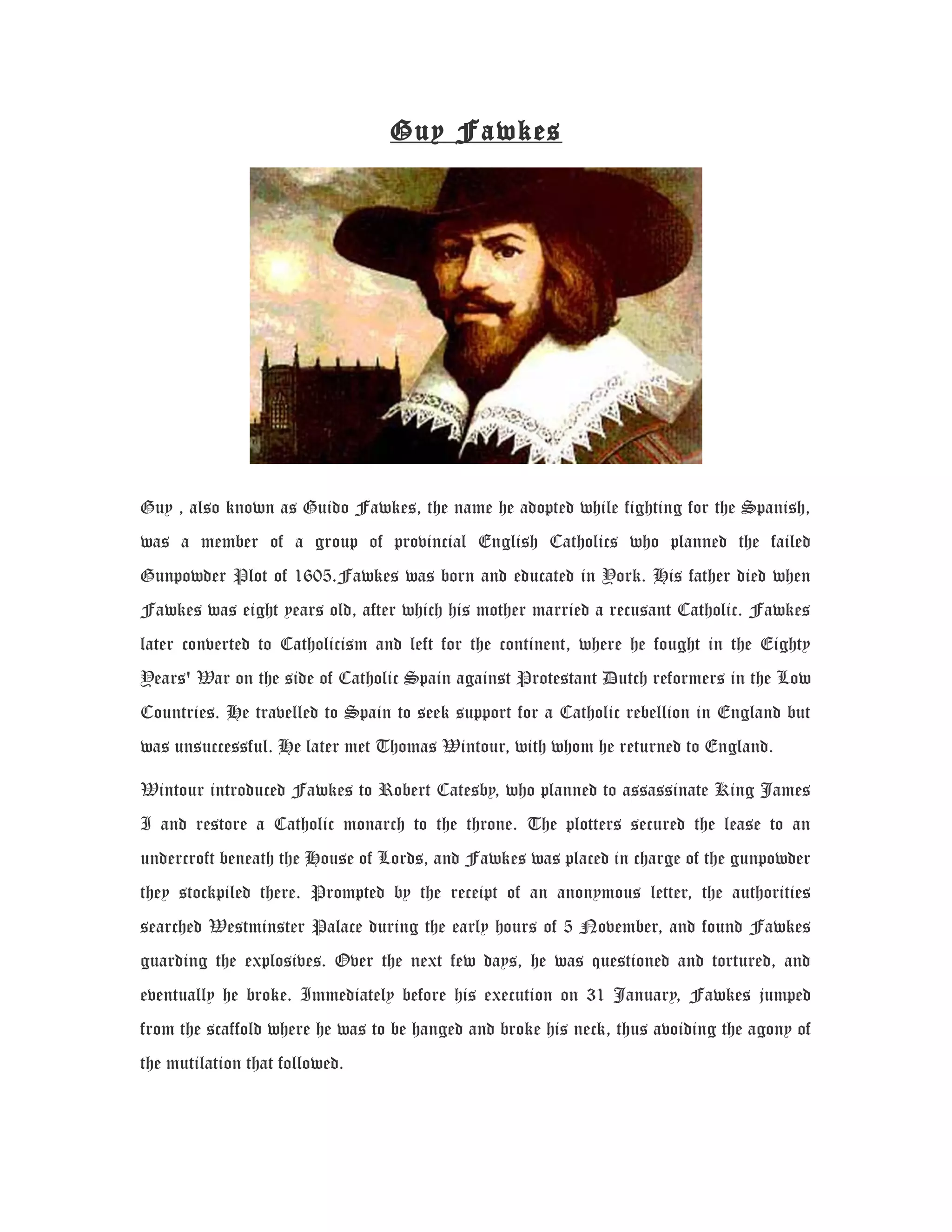
Guy Fawkes
Guy , also known as Guido Fawkes, the name he adopted while fighting for the Spanish,
was a member of a group of provincial English Catholics who planned the failed
Gunpowder Plot of 1605.Fawkes was born and educated in York. His father died when
Fawkes was eight years old, after which his mother married a recusant Catholic. Fawkes
later converted to Catholicism and left for the continent, where he fought in the Eighty
Years' War on the side of Catholic Spain against Protestant Dutch reformers in the Low
Countries. He travelled to Spain to seek support for a Catholic rebellion in England but
was unsuccessful. He later met Thomas Wintour, with whom he returned to England.
Wintour introduced Fawkes to Robert Catesby, who planned to assassinate King James
I and restore a Catholic monarch to the throne. The plotters secured the lease to an
undercroft beneath the House of Lords, and Fawkes was placed in charge of the gunpowder
they stockpiled there. Prompted by the receipt of an anonymous letter, the authorities
searched Westminster Palace during the early hours of 5 November, and found Fawkes
guarding the explosives. Over the next few days, he was questioned and tortured, and
eventually he broke. Immediately before his execution on 31 January, Fawkes jumped
from the scaffold where he was to be hanged and broke his neck, thus avoiding the agony of
the mutilation that followed.
On 5 November 1605 Londoners were encouraged to celebrate the King's escape from
assassination by lighting bonfires, "always provided that 'this testemonye of joy be carefull
done without any danger or disorder'".An Act of Parliament designated each 5 November
as a day of thanksgiving for "the joyful day of deliverance", and remained in force until
1859.Although he was only one of 13 conspirators, Fawkes is today the individual most
associated with the failed Plot.
In Britain, 5 November has variously been called Guy Fawkes Night, Guy Fawkes
Day, Plot Night[62] and Bonfire Night; the latter can be traced directly back to the
original celebration of 5 November 1605.Bonfires were accompanied by fireworks from
the 1650s onwards, and it became the custom to burn an effigy (usually the pope) after
1673, when the heir presumptive, James, Duke of York, made his conversion to
Catholicism public. Effigies of other notable figures who have become targets for the
public's ire, such as Paul Kruger and Margaret Thatcher, have also found their way onto
the bonfires, although most modern effigies are of Fawkes.The "guy" is normally created
by children, from old clothes, newspapers, and a mask. During the 19th century, "guy"
came to mean an oddly dressed person, but in American English it lost any pejorative
connotation, and was used to refer to any male person.
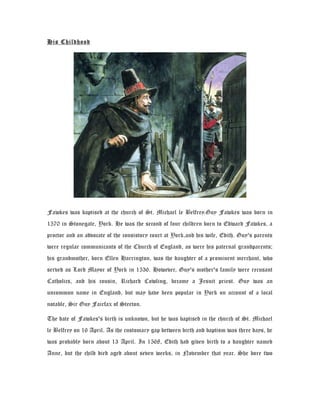
His Childhood
Fawkes was baptised at the church of St. Michael le Belfrey.Guy Fawkes was born in
1570 in Stonegate, York. He was the second of four children born to Edward Fawkes, a
proctor and an advocate of the consistory court at York,and his wife, Edith. Guy's parents
were regular communicants of the Church of England, as were his paternal grandparents;
his grandmother, born Ellen Harrington, was the daughter of a prominent merchant, who
served as Lord Mayor of York in 1536. However, Guy's mother's family were recusant
Catholics, and his cousin, Richard Cowling, became a Jesuit priest. Guy was an
uncommon name in England, but may have been popular in York on account of a local
notable, Sir Guy Fairfax of Steeton.
The date of Fawkes's birth is unknown, but he was baptised in the church of St. Michael
le Belfrey on 16 April. As the customary gap between birth and baptism was three days, he
was probably born about 13 April. In 1568, Edith had given birth to a daughter named
Anne, but the child died aged about seven weeks, in November that year. She bore two
more children after Guy: Anne and Elizabeth .Both were married, in 1599 and 1594
respectively.
In 1579, when Guy was eight years old, his father died. His mother remarried several
years later, to the Catholic Dionis Baynbrigge (or Denis Bainbridge) of Scotton,
Harrogate. Fawkes may have become a Catholic through the Baynbrigge family's recusant
tendencies, and also the Catholic branches of the Pulleyn and Percy families of Scotton,
but also from his time at St. Peter's School in York. A governor of the school had spent
about 20 years in prison for recusancy, and its headmaster, John Pulleyn, came from a
family of noted Yorkshire recusants, the Pulleyns of Blubberhouses. In her 1915 work
The Pulleynes of Yorkshire, author Catharine Pullein suggested that Fawkes's Catholic
education came from his Harrington relatives, who were known for harbouring priests, one
of whom later accompanied Fawkes to Flanders in 1592–1593. Fawkes's fellow students
included John Wright and his brother Christopher (both later involved with Fawkes in the
Gunpowder plot) and Oswald Tesimond, Edward Oldcorne and Robert Middleton, who
became priests (the latter executed in 1601).
After leaving school Fawkes entered the service of Anthony Browne, 1st Viscount
Montagu. The Viscount took a dislike to Fawkes and after a short time dismissed him; he
was subsequently employed by Anthony-Maria Browne, 2nd Viscount Montagu, who
succeeded his grandfather at the age of 18. At least one source claims that Fawkes married
and had a son, but no known contemporary accounts confirm this.
Evi Farleka
Vasiliki Tsiolakidou
Γ'4

Guy fawkes

  • 1.
    Guy Fawkes Guy ,also known as Guido Fawkes, the name he adopted while fighting for the Spanish, was a member of a group of provincial English Catholics who planned the failed Gunpowder Plot of 1605.Fawkes was born and educated in York. His father died when Fawkes was eight years old, after which his mother married a recusant Catholic. Fawkes later converted to Catholicism and left for the continent, where he fought in the Eighty Years' War on the side of Catholic Spain against Protestant Dutch reformers in the Low Countries. He travelled to Spain to seek support for a Catholic rebellion in England but was unsuccessful. He later met Thomas Wintour, with whom he returned to England. Wintour introduced Fawkes to Robert Catesby, who planned to assassinate King James I and restore a Catholic monarch to the throne. The plotters secured the lease to an undercroft beneath the House of Lords, and Fawkes was placed in charge of the gunpowder they stockpiled there. Prompted by the receipt of an anonymous letter, the authorities searched Westminster Palace during the early hours of 5 November, and found Fawkes guarding the explosives. Over the next few days, he was questioned and tortured, and eventually he broke. Immediately before his execution on 31 January, Fawkes jumped from the scaffold where he was to be hanged and broke his neck, thus avoiding the agony of the mutilation that followed.
  • 2.
    On 5 November1605 Londoners were encouraged to celebrate the King's escape from assassination by lighting bonfires, "always provided that 'this testemonye of joy be carefull done without any danger or disorder'".An Act of Parliament designated each 5 November as a day of thanksgiving for "the joyful day of deliverance", and remained in force until 1859.Although he was only one of 13 conspirators, Fawkes is today the individual most associated with the failed Plot. In Britain, 5 November has variously been called Guy Fawkes Night, Guy Fawkes Day, Plot Night[62] and Bonfire Night; the latter can be traced directly back to the original celebration of 5 November 1605.Bonfires were accompanied by fireworks from the 1650s onwards, and it became the custom to burn an effigy (usually the pope) after 1673, when the heir presumptive, James, Duke of York, made his conversion to Catholicism public. Effigies of other notable figures who have become targets for the public's ire, such as Paul Kruger and Margaret Thatcher, have also found their way onto the bonfires, although most modern effigies are of Fawkes.The "guy" is normally created by children, from old clothes, newspapers, and a mask. During the 19th century, "guy" came to mean an oddly dressed person, but in American English it lost any pejorative connotation, and was used to refer to any male person.
  • 3.
    His Childhood Fawkes wasbaptised at the church of St. Michael le Belfrey.Guy Fawkes was born in 1570 in Stonegate, York. He was the second of four children born to Edward Fawkes, a proctor and an advocate of the consistory court at York,and his wife, Edith. Guy's parents were regular communicants of the Church of England, as were his paternal grandparents; his grandmother, born Ellen Harrington, was the daughter of a prominent merchant, who served as Lord Mayor of York in 1536. However, Guy's mother's family were recusant Catholics, and his cousin, Richard Cowling, became a Jesuit priest. Guy was an uncommon name in England, but may have been popular in York on account of a local notable, Sir Guy Fairfax of Steeton. The date of Fawkes's birth is unknown, but he was baptised in the church of St. Michael le Belfrey on 16 April. As the customary gap between birth and baptism was three days, he was probably born about 13 April. In 1568, Edith had given birth to a daughter named Anne, but the child died aged about seven weeks, in November that year. She bore two
  • 4.
    more children afterGuy: Anne and Elizabeth .Both were married, in 1599 and 1594 respectively. In 1579, when Guy was eight years old, his father died. His mother remarried several years later, to the Catholic Dionis Baynbrigge (or Denis Bainbridge) of Scotton, Harrogate. Fawkes may have become a Catholic through the Baynbrigge family's recusant tendencies, and also the Catholic branches of the Pulleyn and Percy families of Scotton, but also from his time at St. Peter's School in York. A governor of the school had spent about 20 years in prison for recusancy, and its headmaster, John Pulleyn, came from a family of noted Yorkshire recusants, the Pulleyns of Blubberhouses. In her 1915 work The Pulleynes of Yorkshire, author Catharine Pullein suggested that Fawkes's Catholic education came from his Harrington relatives, who were known for harbouring priests, one of whom later accompanied Fawkes to Flanders in 1592–1593. Fawkes's fellow students included John Wright and his brother Christopher (both later involved with Fawkes in the Gunpowder plot) and Oswald Tesimond, Edward Oldcorne and Robert Middleton, who became priests (the latter executed in 1601). After leaving school Fawkes entered the service of Anthony Browne, 1st Viscount Montagu. The Viscount took a dislike to Fawkes and after a short time dismissed him; he was subsequently employed by Anthony-Maria Browne, 2nd Viscount Montagu, who succeeded his grandfather at the age of 18. At least one source claims that Fawkes married and had a son, but no known contemporary accounts confirm this. Evi Farleka Vasiliki Tsiolakidou Γ'4