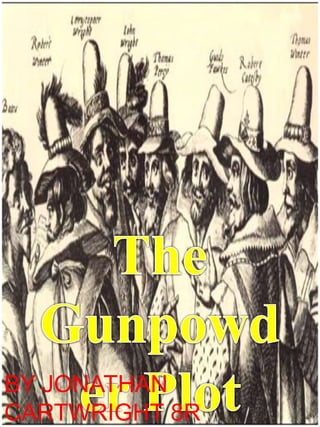
BY JONATHAN
CARTWRIGHT 8R
Introduction
The Gun powder plot was a failed
assassination attempt to kill King
James I.
The plot was lead by an ex soldier and
very strong catholic Guy Fawkes who
also was called Guido Fawkes. He
and some other men(Turn page)
Wanted to kill James I on the evening
of the opening of Parliament on the 5th
November by blowing up Parliament so
anyone inside including James I would
be killed.
People Involved in the
Gunpowder plot
King and his Advisors
James I- King Of England
Robert Cecil- James’s Chief Advisor
Lord Monteagle- Advisor
Sir William Wade- Lieutenant of the Tower of
London
Plotters
Guy Fawkes-most known plotter
Francis Tresham- Plotter/ Monteagle’s brother in law
Thomas Percy-Plotter Thomas Bates- plotter
Robert Catesby-Lead Plotter
Christopher Wright-Plotter
Robert Wintour-Plotter John Grant-Plotter
Thomas Wintour-Plotter John Wright-Plotter
Robert Keyes-Plotter Sir Ambrose Rookwood
Sir Everard Digby-Plotter Hugh Owen-Plotter
Information about the
people involved
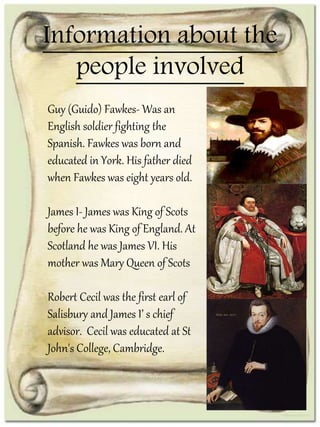
Guy (Guido) Fawkes- Was an
English soldier fighting the
Spanish. Fawkes was born and
educated in York. His father died
when Fawkes was eight years old.
James I- James was King of Scots
before he was King of England. At
Scotland he was James VI. His
mother was Mary Queen of Scots
Robert Cecil was the first earl of
Salisbury and James I’ s chief
advisor. Cecil was educated at St
John's College, Cambridge.
More information about
the people involved
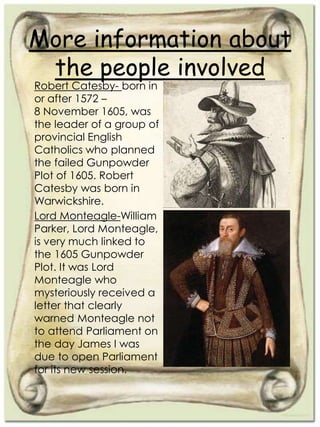
Robert Catesby- born in
or after 1572 –
8 November 1605, was
the leader of a group of
provincial English
Catholics who planned
the failed Gunpowder
Plot of 1605. Robert
Catesby was born in
Warwickshire.
Lord Monteagle-William
Parker, Lord Monteagle,
is very much linked to
the 1605 Gunpowder
Plot. It was Lord
Monteagle who
mysteriously received a
letter that clearly
warned Monteagle not
to attend Parliament on
the day James I was
due to open Parliament
for its new session.
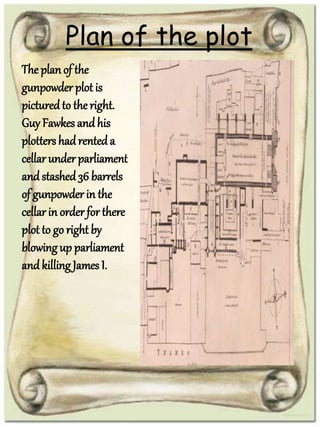
Plan of the plot
The planof the
gunpowder plot is
picturedto the right.
Guy Fawkes andhis
plotters hadrenteda
cellar under parliament
andstashed36 barrels
of gunpowder in the
cellar in order for there
plot to go right by
blowingup parliament
andkilling James I.
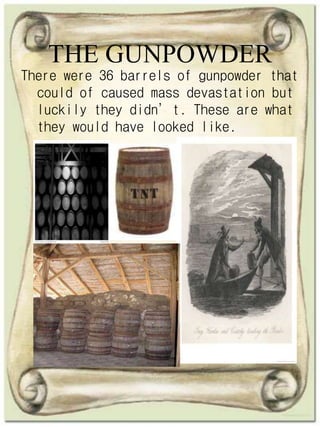
THE GUNPOWDER
There were 36 barrels of gunpowder that
could of caused mass devastation but
luckily they didn’t. These are what
they would have looked like.
Lord
Monteagle’s
Letter
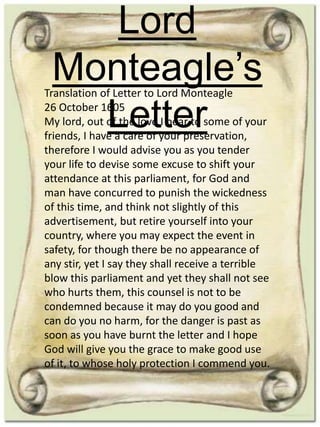
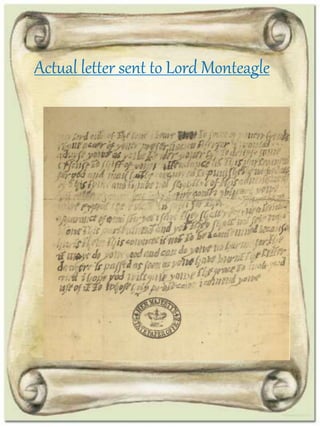
Translation of Letter to Lord Monteagle
26 October 1605
My lord, out of the love I bear to some of your
friends, I have a care of your preservation,
therefore I would advise you as you tender
your life to devise some excuse to shift your
attendance at this parliament, for God and
man have concurred to punish the wickedness
of this time, and think not slightly of this
advertisement, but retire yourself into your
country, where you may expect the event in
safety, for though there be no appearance of
any stir, yet I say they shall receive a terrible
blow this parliament and yet they shall not see
who hurts them, this counsel is not to be
condemned because it may do you good and
can do you no harm, for the danger is past as
soon as you have burnt the letter and I hope
God will give you the grace to make good use
of it, to whose holy protection I commend you.
Actual letter sent to Lord Monteagle
What happened?
James I came to power after his mother Mary queen of Scots died.
James was brought up as a protestant. When Elizabeth I died in
1603 without children, Mary's son, was next in line to the throne. As
James was a Protestant, Parliament was also in favor of him
becoming king. In May 1604, Robert Catesby devised the
Gunpowder Plot, a scheme to kill James and as many Members of
Parliament as possible. Robert Catesby told all the plotters to come
to the duck & drake inn, so they did and had a meeting to discuss
how to plot against James I. Guy Fawkes and his fellow conspirators,
having rented out a house right by the Houses of
Parliament, managed to get 36 barrels of gunpowder into a cellar of
the House of Lords. The explosive expert, Guy Fawkes, had been left
in the cellars to set off the fuse. He was only caught when a group of
guards decided to check the cellars at the last moment.
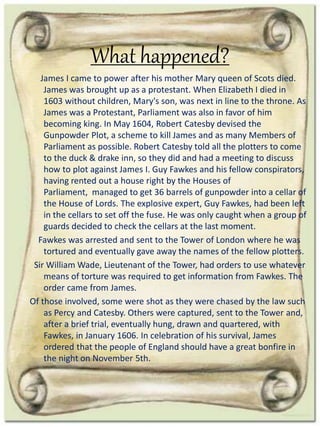
Fawkes was arrested and sent to the Tower of London where he was
tortured and eventually gave away the names of the fellow plotters.
Sir William Wade, Lieutenant of the Tower, had orders to use whatever
means of torture was required to get information from Fawkes. The
order came from James.
Of those involved, some were shot as they were chased by the law such
as Percy and Catesby. Others were captured, sent to the Tower and,
after a brief trial, eventually hung, drawn and quartered, with
Fawkes, in January 1606. In celebration of his survival, James
ordered that the people of England should have a great bonfire in
the night on November 5th.
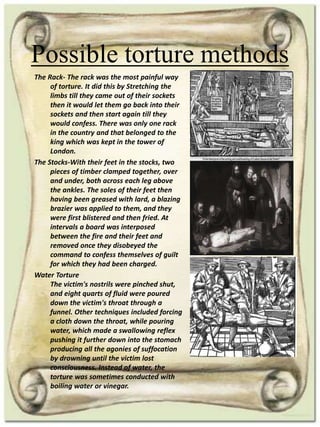
Possible torture methods
The Rack- The rack was the most painful way
of torture. It did this by Stretching the
limbs till they came out of their sockets
then it would let them go back into their
sockets and then start again till they
would confess. There was only one rack
in the country and that belonged to the
king which was kept in the tower of
London.
The Stocks-With their feet in the stocks, two
pieces of timber clamped together, over
and under, both across each leg above
the ankles. The soles of their feet then
having been greased with lard, a blazing
brazier was applied to them, and they
were first blistered and then fried. At
intervals a board was interposed
between the fire and their feet and
removed once they disobeyed the
command to confess themselves of guilt
for which they had been charged.
Water Torture
The victim's nostrils were pinched shut,
and eight quarts of fluid were poured
down the victim's throat through a
funnel. Other techniques included forcing
a cloth down the throat, while pouring
water, which made a swallowing reflex
pushing it further down into the stomach
producing all the agonies of suffocation
by drowning until the victim lost
consciousness. Instead of water, the
torture was sometimes conducted with
boiling water or vinegar.
For reading my presentation on
the Gunpowder Plot
by
Jonathan .C.
Thank
You!!

The Gunpowder Plot

  • 1.
  • 2.
    Introduction The Gun powderplot was a failed assassination attempt to kill King James I. The plot was lead by an ex soldier and very strong catholic Guy Fawkes who also was called Guido Fawkes. He and some other men(Turn page) Wanted to kill James I on the evening of the opening of Parliament on the 5th November by blowing up Parliament so anyone inside including James I would be killed.
  • 3.
    People Involved inthe Gunpowder plot King and his Advisors James I- King Of England Robert Cecil- James’s Chief Advisor Lord Monteagle- Advisor Sir William Wade- Lieutenant of the Tower of London Plotters Guy Fawkes-most known plotter Francis Tresham- Plotter/ Monteagle’s brother in law Thomas Percy-Plotter Thomas Bates- plotter Robert Catesby-Lead Plotter Christopher Wright-Plotter Robert Wintour-Plotter John Grant-Plotter Thomas Wintour-Plotter John Wright-Plotter Robert Keyes-Plotter Sir Ambrose Rookwood Sir Everard Digby-Plotter Hugh Owen-Plotter
  • 4.
    Information about the peopleinvolved Guy (Guido) Fawkes- Was an English soldier fighting the Spanish. Fawkes was born and educated in York. His father died when Fawkes was eight years old. James I- James was King of Scots before he was King of England. At Scotland he was James VI. His mother was Mary Queen of Scots Robert Cecil was the first earl of Salisbury and James I’ s chief advisor. Cecil was educated at St John's College, Cambridge.
  • 5.
    More information about thepeople involved Robert Catesby- born in or after 1572 – 8 November 1605, was the leader of a group of provincial English Catholics who planned the failed Gunpowder Plot of 1605. Robert Catesby was born in Warwickshire. Lord Monteagle-William Parker, Lord Monteagle, is very much linked to the 1605 Gunpowder Plot. It was Lord Monteagle who mysteriously received a letter that clearly warned Monteagle not to attend Parliament on the day James I was due to open Parliament for its new session.
  • 6.
    Plan of theplot The planof the gunpowder plot is picturedto the right. Guy Fawkes andhis plotters hadrenteda cellar under parliament andstashed36 barrels of gunpowder in the cellar in order for there plot to go right by blowingup parliament andkilling James I.
  • 7.
    THE GUNPOWDER There were36 barrels of gunpowder that could of caused mass devastation but luckily they didn’t. These are what they would have looked like.
  • 8.
    Lord Monteagle’s Letter Translation of Letterto Lord Monteagle 26 October 1605 My lord, out of the love I bear to some of your friends, I have a care of your preservation, therefore I would advise you as you tender your life to devise some excuse to shift your attendance at this parliament, for God and man have concurred to punish the wickedness of this time, and think not slightly of this advertisement, but retire yourself into your country, where you may expect the event in safety, for though there be no appearance of any stir, yet I say they shall receive a terrible blow this parliament and yet they shall not see who hurts them, this counsel is not to be condemned because it may do you good and can do you no harm, for the danger is past as soon as you have burnt the letter and I hope God will give you the grace to make good use of it, to whose holy protection I commend you.
  • 9.
    Actual letter sentto Lord Monteagle
  • 10.
    What happened? James Icame to power after his mother Mary queen of Scots died. James was brought up as a protestant. When Elizabeth I died in 1603 without children, Mary's son, was next in line to the throne. As James was a Protestant, Parliament was also in favor of him becoming king. In May 1604, Robert Catesby devised the Gunpowder Plot, a scheme to kill James and as many Members of Parliament as possible. Robert Catesby told all the plotters to come to the duck & drake inn, so they did and had a meeting to discuss how to plot against James I. Guy Fawkes and his fellow conspirators, having rented out a house right by the Houses of Parliament, managed to get 36 barrels of gunpowder into a cellar of the House of Lords. The explosive expert, Guy Fawkes, had been left in the cellars to set off the fuse. He was only caught when a group of guards decided to check the cellars at the last moment. Fawkes was arrested and sent to the Tower of London where he was tortured and eventually gave away the names of the fellow plotters. Sir William Wade, Lieutenant of the Tower, had orders to use whatever means of torture was required to get information from Fawkes. The order came from James. Of those involved, some were shot as they were chased by the law such as Percy and Catesby. Others were captured, sent to the Tower and, after a brief trial, eventually hung, drawn and quartered, with Fawkes, in January 1606. In celebration of his survival, James ordered that the people of England should have a great bonfire in the night on November 5th.
  • 11.
    Possible torture methods TheRack- The rack was the most painful way of torture. It did this by Stretching the limbs till they came out of their sockets then it would let them go back into their sockets and then start again till they would confess. There was only one rack in the country and that belonged to the king which was kept in the tower of London. The Stocks-With their feet in the stocks, two pieces of timber clamped together, over and under, both across each leg above the ankles. The soles of their feet then having been greased with lard, a blazing brazier was applied to them, and they were first blistered and then fried. At intervals a board was interposed between the fire and their feet and removed once they disobeyed the command to confess themselves of guilt for which they had been charged. Water Torture The victim's nostrils were pinched shut, and eight quarts of fluid were poured down the victim's throat through a funnel. Other techniques included forcing a cloth down the throat, while pouring water, which made a swallowing reflex pushing it further down into the stomach producing all the agonies of suffocation by drowning until the victim lost consciousness. Instead of water, the torture was sometimes conducted with boiling water or vinegar.
  • 12.
    For reading mypresentation on the Gunpowder Plot by Jonathan .C. Thank You!!