NSQIP (Gupta) Indices for Predicting
Postoperative Pneumonia and Respiratory
Failure
Terry Shaneyfelt, MD, MPH
Associate Professor, UAB Department of Medicine
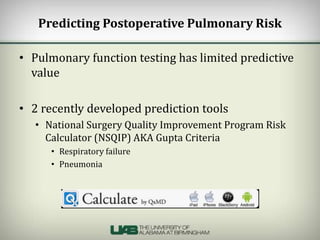
Predicting Postoperative Pulmonary Risk
• Pulmonary function testing has limited predictive
value
• 2 recently developed prediction tools
• National Surgery Quality Improvement Program Risk
Calculator (NSQIP) AKA Gupta Criteria
• Respiratory failure
• Pneumonia
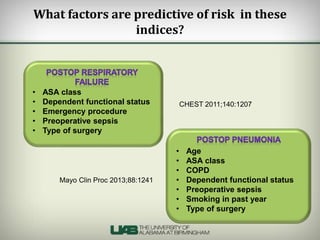
What factors are predictive of risk in these
indices?
CHEST 2011;140:1207
Mayo Clin Proc 2013;88:1241
• ASA class
• Dependent functional status
• Emergency procedure
• Preoperative sepsis
• Type of surgery
• Age
• ASA class
• COPD
• Dependent functional status
• Preoperative sepsis
• Smoking in past year
• Type of surgery
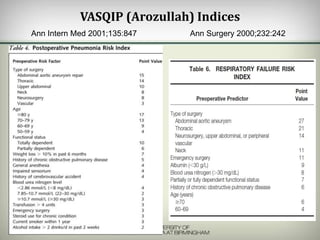
VASQIP (Arozullah) Indices
Ann Intern Med 2001;135:847 Ann Surgery 2000;232:242
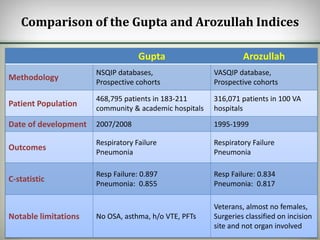
Gupta Arozullah
Methodology
NSQIP databases,
Prospective cohorts
VASQIP database,
Prospective cohorts
Patient Population
468,795 patients in 183-211
community & academic hospitals
316,071 patients in 100 VA
hospitals
Date of development 2007/2008 1995-1999
Outcomes
Respiratory Failure
Pneumonia
Respiratory Failure
Pneumonia
C-statistic
Resp Failure: 0.897
Pneumonia: 0.855
Resp Failure: 0.834
Pneumonia: 0.817
Notable limitations No OSA, asthma, h/o VTE, PFTs
Veterans, almost no females,
Surgeries classified on incision
site and not organ involved
Comparison of the Gupta and Arozullah Indices
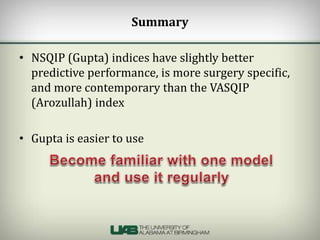
• NSQIP (Gupta) indices have slightly better
predictive performance, is more surgery specific,
and more contemporary than the VASQIP
(Arozullah) index
• Gupta is easier to use
Summary

Gupta indices for postop pulmonary complications

  • 1.
    NSQIP (Gupta) Indicesfor Predicting Postoperative Pneumonia and Respiratory Failure Terry Shaneyfelt, MD, MPH Associate Professor, UAB Department of Medicine
  • 2.
    Predicting Postoperative PulmonaryRisk • Pulmonary function testing has limited predictive value • 2 recently developed prediction tools • National Surgery Quality Improvement Program Risk Calculator (NSQIP) AKA Gupta Criteria • Respiratory failure • Pneumonia
  • 3.
    What factors arepredictive of risk in these indices? CHEST 2011;140:1207 Mayo Clin Proc 2013;88:1241 • ASA class • Dependent functional status • Emergency procedure • Preoperative sepsis • Type of surgery • Age • ASA class • COPD • Dependent functional status • Preoperative sepsis • Smoking in past year • Type of surgery
  • 4.
    VASQIP (Arozullah) Indices AnnIntern Med 2001;135:847 Ann Surgery 2000;232:242
  • 5.
    Gupta Arozullah Methodology NSQIP databases, Prospectivecohorts VASQIP database, Prospective cohorts Patient Population 468,795 patients in 183-211 community & academic hospitals 316,071 patients in 100 VA hospitals Date of development 2007/2008 1995-1999 Outcomes Respiratory Failure Pneumonia Respiratory Failure Pneumonia C-statistic Resp Failure: 0.897 Pneumonia: 0.855 Resp Failure: 0.834 Pneumonia: 0.817 Notable limitations No OSA, asthma, h/o VTE, PFTs Veterans, almost no females, Surgeries classified on incision site and not organ involved Comparison of the Gupta and Arozullah Indices
  • 6.
    • NSQIP (Gupta)indices have slightly better predictive performance, is more surgery specific, and more contemporary than the VASQIP (Arozullah) index • Gupta is easier to use Summary

Editor's Notes

  • #2 In this PowerPoint I will discuss the 2 most recently developed tools for predicting postoperative respiratory failure and pneumonia after major surgery (AKA Gupta criteria).
  • #3 After performing a history and PE, the information gathered is plugged into a risk calculator yielding the individual patient’s predicted risk of pulmonary complications for the planned surgery. The reason these risk prediction tools have been developed is that pulmonary function testing has been found to have limited positive predictive value at predicting who would have pulmonary complications and previously developed tools had limitations. The 2 most recently developed and validated tools are shown here and are available in a wonderful app called Qx Calculate, which is available for multiple platforms. I recommend downloading it to your smartphone or iPad.
  • #4 This slide shows the Gupta criteria (on the top left) for postoperative respiratory failure and the Gupta criteria (on the bottom right) for postoperative pneumonia. You have to make sure you collect this data during your preoperative H&P. While Gupta and colleagues found many more elements predictive they were left out for a more parsimonious model.
  • #5 This slide shows the VASQIP or Arozullah indices that estimate postoperative pneumonia and respiratory failure. Points are added up for factors that patients have to determine their risk class and % probability that they will have the given outcome (e.g. class 1 0-15 points with a 0.24% chance of pneumonia compared to class 5 > 55 points with 16% chance of pneumonia)
  • #6 This table compares the Gupta and Arozullah tools. What I think separates the 2 tools from each other is 2 fold: 1) the limited population in the Arozullah study and the surgical classification, and 2) ease of use of the Gupta tools. The c-statistic is a measure of discrimination (ie that the tool accurately predicted who did and didn’t have a cardiac event). The tool is tested against patients for whom we know the outcome (ie they either did or did not have cardiac complications) and you see if the tool puts them in the right category (ie with and without complications). The c statistic can range from 0.5 (horrible tool, no better than a coin flip) to 1.0 (perfect tool). You can see that the Gupta tool is slightly more accurate than the Arozullah criteria (ie it has a higher c statistic) but this is likely not very important clinically.
  • #7 I prefer the Gupta tools (NSQIP indices) because they are more contemporary and are available in an app. The Arozullah criteria perform equally well and been around for over a decade but are more complex to use as they are not available in an app.