LATEST TRENDS IN SMALLARMS
SMALL ARMS DEVELOPMENTS HAS ALWAYS BEEN
AN EVOLUTION
NOT
REVOLUTION
Development of current technology rather than revolutionary
concept
Technological advances should provide :-
• Desired Target Effect (MUNITIONS)
• Accuracy of range estimation under combat
conditions(FIRE CONTROL)
• Enhanced Armament to launch the munitions
(ARMAMENT)
MUNITIONS
• Small, light weight, exploding fragments(Direct hit not
required)
• Multi-projectile technology to increase hot probability.
• Multi function tuneable projectile to defeat specific
targets.
• Special purpose projectiles (Smoke, Pyropheric,
Chemical etc.,)
• Propellant improvement (High Energy, Combustible
Cartridge Case, Liquid Propellants)
FIRE CONTROL
• Combinations Day/Night Sights
• Electro optical sights for Single Point Aim
• Small light weight Range Finders
• Thermal Imaging Devices
• Single Aim Point/Adjustable Aim Point
ARMAMENT
• Lighter, better materials
• Ease in use & maintenance
• Reduced Audio/Visual Signature
• Multi function with common modular
construction, to reduce weight of weapon &
Fire Control System in a unit.
• Burst/Salvo concept.
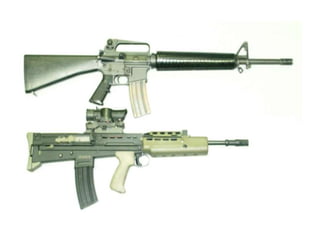
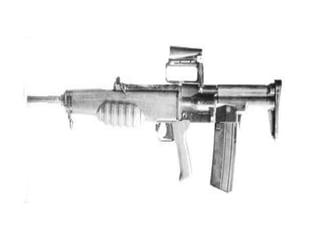
BULL PUP DESIGN
ADVANTAGES OF BULL-PUP
• 8-10” Overall savings in length
• Superior weight balance when UGL and other accessories are fitted.
• 2-in-1 (Rifle & Carbine)
• Good for deployment in helicopters/AFVs
DISADVANTAGES
• Case can be ejected only in RHS(since all firers are RH). Hence cannot
switch the position for LH firer or switch position for firing around corner
of a building
• Magazine change difficult, while wearing body armour.
• Clearing drill for clearing jams slower.
• Increased height of sight increases risk of exposure.
• Muzzle blast/Noise of breech mechanism, closer to the ear.
• Poor ergonomics with Safety, Fire select & Magazine eject controls not
close to hand.
CASELESS AMMUNITION ARMAMENT
4.73 X 33 MM
SQUARE SHAPED AMMUNITION
CONVENTIONAL PROJECTILE 4.73 MM DIA
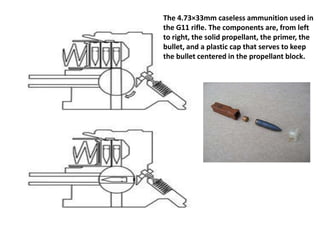
The 4.73×33mm caseless ammunition used in
the G11 rifle. The components are, from left
to right, the solid propellant, the primer, the
bullet, and a plastic cap that serves to keep
the bullet centered in the propellant block.
The weapon itself has three firing modes:
semi-auto,
full-auto at 460 rounds per minute
three-round burst at over 2100 cyclic rounds per minute.
The loading and feed mechanism is physically very complicated but
exceptionally fast and reliable.
Rounds are fed into the weapon from a magazine that lies above
and parallel with the barrel.
The rounds are oriented vertically (at 90 degrees to the bore) and
are fed downwards into the rotary chamber so that they can be
rotated 90 degrees for firing.
The firing cycle process is roughly:
• As the cocking handle on the side is rotated clockwise by the weapon
operator:
• A round is dropped into the revolving chamber vertically (a loading piston
assists this process).
• The chamber rotates 90° until it is lined up with the barrel. This completes
the chambering of the round and cocking of the firing pin.
• When the trigger is pulled, a firing pin ignites the primer, which then ignites
a powder booster charge that pushes the bullet into the barrel. The solid
block of propellant is broken up to increase the ignition surface area and
ignites, accelerating the bullet out of the barrel.
• As the projectile is accelerating up the barrel, recoil forces drive the barrel,
magazine, chamber and operating mechanism rearwards within the
weapon, dissipating energy for single shot and fully automatic modes but
allowing burst mode to deliver three projectiles downrange before buffering
occurs.
• Gas tapped off from the barrel rotates the chamber and actuates the
loading mechanism then rotating the chamber back to the vertical original
position until it is lined up with the feed mechanism and the process
repeats.
• Because the G11 uses caseless ammunition there are
no extraction and ejection steps.
• Even though the rotary chamber doesn't, in the true
sense of the word, lock up, the fact that it has to
rotate in and out of alignment with the barrel, the
G11 can be considered to have a lock/unlock phase.
• If a round fails to fire or the weapon is being used
with training rounds, the rifle can be manually
unloaded by twisting the cocking handle
counterclockwise.
• This pushes the failed/training round out an
emergency ejection port on the bottom of the rifle
and loads the next round.
There were reports that due to the high tolerances
required to seal off the front and rear chamber
openings the expected life of the contacting parts
was around 6000 rounds before maintenance was
required.

LATEST TRENDS IN SA.pptx

  • 1.
  • 2.
    SMALL ARMS DEVELOPMENTSHAS ALWAYS BEEN AN EVOLUTION NOT REVOLUTION
  • 3.
    Development of currenttechnology rather than revolutionary concept Technological advances should provide :- • Desired Target Effect (MUNITIONS) • Accuracy of range estimation under combat conditions(FIRE CONTROL) • Enhanced Armament to launch the munitions (ARMAMENT)
  • 4.
    MUNITIONS • Small, lightweight, exploding fragments(Direct hit not required) • Multi-projectile technology to increase hot probability. • Multi function tuneable projectile to defeat specific targets. • Special purpose projectiles (Smoke, Pyropheric, Chemical etc.,) • Propellant improvement (High Energy, Combustible Cartridge Case, Liquid Propellants)
  • 5.
    FIRE CONTROL • CombinationsDay/Night Sights • Electro optical sights for Single Point Aim • Small light weight Range Finders • Thermal Imaging Devices • Single Aim Point/Adjustable Aim Point
  • 6.
    ARMAMENT • Lighter, bettermaterials • Ease in use & maintenance • Reduced Audio/Visual Signature • Multi function with common modular construction, to reduce weight of weapon & Fire Control System in a unit. • Burst/Salvo concept.
  • 7.
  • 10.
    ADVANTAGES OF BULL-PUP •8-10” Overall savings in length • Superior weight balance when UGL and other accessories are fitted. • 2-in-1 (Rifle & Carbine) • Good for deployment in helicopters/AFVs DISADVANTAGES • Case can be ejected only in RHS(since all firers are RH). Hence cannot switch the position for LH firer or switch position for firing around corner of a building • Magazine change difficult, while wearing body armour. • Clearing drill for clearing jams slower. • Increased height of sight increases risk of exposure. • Muzzle blast/Noise of breech mechanism, closer to the ear. • Poor ergonomics with Safety, Fire select & Magazine eject controls not close to hand.
  • 11.
    CASELESS AMMUNITION ARMAMENT 4.73X 33 MM SQUARE SHAPED AMMUNITION CONVENTIONAL PROJECTILE 4.73 MM DIA
  • 12.
    The 4.73×33mm caselessammunition used in the G11 rifle. The components are, from left to right, the solid propellant, the primer, the bullet, and a plastic cap that serves to keep the bullet centered in the propellant block.
  • 13.
    The weapon itselfhas three firing modes: semi-auto, full-auto at 460 rounds per minute three-round burst at over 2100 cyclic rounds per minute. The loading and feed mechanism is physically very complicated but exceptionally fast and reliable. Rounds are fed into the weapon from a magazine that lies above and parallel with the barrel. The rounds are oriented vertically (at 90 degrees to the bore) and are fed downwards into the rotary chamber so that they can be rotated 90 degrees for firing. The firing cycle process is roughly:
  • 14.
    • As thecocking handle on the side is rotated clockwise by the weapon operator: • A round is dropped into the revolving chamber vertically (a loading piston assists this process). • The chamber rotates 90° until it is lined up with the barrel. This completes the chambering of the round and cocking of the firing pin. • When the trigger is pulled, a firing pin ignites the primer, which then ignites a powder booster charge that pushes the bullet into the barrel. The solid block of propellant is broken up to increase the ignition surface area and ignites, accelerating the bullet out of the barrel. • As the projectile is accelerating up the barrel, recoil forces drive the barrel, magazine, chamber and operating mechanism rearwards within the weapon, dissipating energy for single shot and fully automatic modes but allowing burst mode to deliver three projectiles downrange before buffering occurs. • Gas tapped off from the barrel rotates the chamber and actuates the loading mechanism then rotating the chamber back to the vertical original position until it is lined up with the feed mechanism and the process repeats.
  • 15.
    • Because theG11 uses caseless ammunition there are no extraction and ejection steps. • Even though the rotary chamber doesn't, in the true sense of the word, lock up, the fact that it has to rotate in and out of alignment with the barrel, the G11 can be considered to have a lock/unlock phase. • If a round fails to fire or the weapon is being used with training rounds, the rifle can be manually unloaded by twisting the cocking handle counterclockwise. • This pushes the failed/training round out an emergency ejection port on the bottom of the rifle and loads the next round.
  • 16.
    There were reportsthat due to the high tolerances required to seal off the front and rear chamber openings the expected life of the contacting parts was around 6000 rounds before maintenance was required.