Middle –
East
Countries
•‫ایران‬ ‫اسالمی‬ ‫جمهوری‬
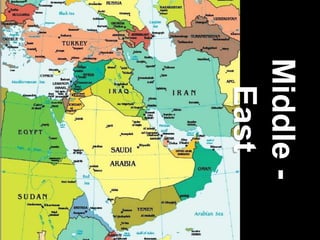
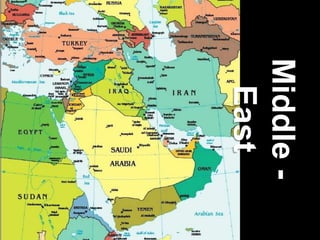
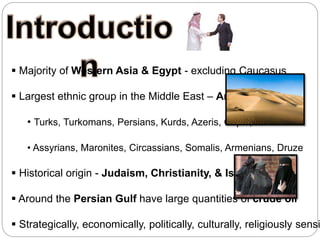
 Majority of Western Asia & Egypt - excluding Caucasus
 Largest ethnic group in the Middle East – Arabs
• Turks, Turkomans, Persians, Kurds, Azeris, Copts, Jews
• Assyrians, Maronites, Circassians, Somalis, Armenians, Druze
 Historical origin - Judaism, Christianity, & Islam
 Around the Persian Gulf have large quantities of crude oil
 Strategically, economically, politically, culturally, religiously sensi
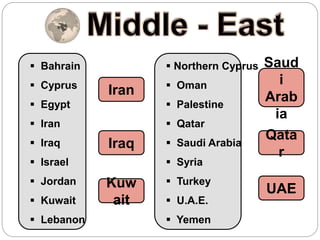
 Bahrain
 Cyprus
 Egypt
 Iran
 Iraq
 Israel
 Jordan
 Kuwait
 Lebanon
 Northern Cyprus
 Oman
 Palestine
 Qatar
 Saudi Arabia
 Syria
 Turkey
 U.A.E.
 Yemen
Iran
Iraq
Kuw
ait
Saud
i
Arab
ia
Qata
r
UAE
 GDP [real] -
• Turkey (US $ 0.794 tn), Saudi Arabia (US $ 0.727 tn),
Iran (US $ 0.548 tn)
 GDP [PPP] -
• Turkey (US $ 1.142 tn), Iran (US $ 1.016 tn), Saudi
Arabia (US $ 0.921 tn)
 GDP per capita [PPP] -
• Qatar (US $ 103,900), UAE (US $ 49,800), Kuwait (US
$ 40,500)
• Israel (US $ 33,900), Saudi Arabia (US $ 31,800)
Middle-
East
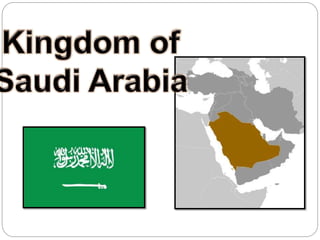
 Kingdom of Saudi Arabia [Monarchy]
 King & Prime Minister – ABDALLAH bin Abd
al-Aziz Al Saud
 Birthplace to Islam, holiest shrines - Mecca &
Medina
 Dry desert – great temperature extremes
 Leverage on shipping – Persian Gulf & Suez
Canal
 Arabs: 90% & Afro-Asian: 10% [Arabic]
[Muslims]
 Leader in OPEC, 17 % of world’s proven petroleum reserves
 Petroleum – Budget [80 %]; GDP [45 %]; Exports [90 %]
 King Abdallah University of Science & Technology – Job Training
& Education
 GDP [real] - $ 727.3 bn
 GDP [PPP] - $ 921.7 bn
 GDP per capita [PPP] - $ 31,800
 GDP real growth rate – 6.8 %crude oil production, petroleum refining, basic petrochemicals,
ammonia, industrial gases, sodium hydroxide (caustic soda),
cement, fertilizer, plastics, metals, commercial ship repair,
commercial aircraft repair, construction
Currency – Saudi
Riyals [SAR]
1 USD = 3.75 SAR
1 SAR = 16.71 INR
Reserves of FE
& Gold
US $ 656.9 bn
 Exports – US $ 395 bn
 Export goods –
• petroleum & its product [90 %]
 Main export partners – US [14.3 %], China [13.7 %], Japan [13.7
%],
S. Korea [9.9 %], India [8.2 %], Singapor
[4.3 %]
 Imports – US $ 136.8 bn
 Import goods –
• machinery & equipments, foodstuffs
• motor vehicles, textiles, chemicals
 Import partners – China [13.5 %], US [13.2 %], S. Korea [6.7 %]
Crude Oil Production – 10 mn
bbl/day [2nd]
Crude Oil Exports – 6.68 mn
bbl/day [1st]
Crude Oil Proved Reserves –
264.6 bn bbl [1st]
Natural Gas Production – 99.23 bn cu
m
Natural Gas Proved Reserves – 8.028
tn cu m [5th]
Mecca Madina
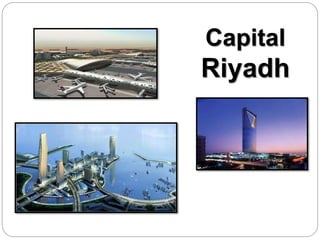
Capital
Riyadh
Attacked and overrun by Iraq on
2nd August 1990
Following several weeks of aerial
bombardment, a `US-led, UN
coalition began a ground assault
on 23 February 1991 - liberated
Kuwait in 4 days
Spent more
than US $ 5 bn to repair oil
infrastructure damaged during
1990-91
Population -
2,695,316
Chief of State
ir SABAH al-Ahmad al - Jabir al-Sabah
Middle-
East
 Area - 17,818 sq km [158th]
 GDP [real] – US $ 173.4 bn [5.1 %]
 GDP [PPP] – US $ 153.4 bn
 GDP per capita [PPP] – US $ 40,500
 Exports – US $ 121 bn
 Imports – US $ 22.79 bn
 Crude Oil Proved Reserves - 101.5 bn bbl
 Crude Oil Exports - 1.365 mn bbl/day
Kuwaiti Dinar
1 KWD = 3.53 USD
1 KWD = 221.56
INR
 Area - 11,586 sq km [166th]
 GDP [real] – US $ 183.4 bn [6.6 %]
 GDP [PPP] – US $ 191 bn
 GDP per capita [PPP] – US $ 103,900 [1st]
 Exports – US $ 133.7 bn
 Crude Oil [PR] – 25 bn bbl [57 yrs]
 Natural Gas [PR] – 25.2 tm cu m [3rd] [13 %]
 Unemployment Rate – 0.5 % [3rd]
 Hamad International Airport – 24 million
Qatari Rials
1 USD = 3.64 QAR
1 QAR = 17.21 INR
Aljazeera News
Network
Assisted Libya
Revolution
Middle-
East
[1990–91] [1980-88]
Persia until 1935
US-Iranian: Iranian students seized
the US Embassy in Tehran in 1979 to
1981
US cut off diplomatic relations -
April 1980
During the period 1980-88: Iran –
Iraq war – US Navy and Iranian
military forces
Designated state sponsor of
terrorism & nuclear weapons
ambitions [IAEA]
Remains subject to US, UN, and
EU economic sanctions and
export
 GDP [real] – US $ 548.9 bn [- 1.9 %]
 GDP [PPP] – US $ 1.016 tn
 GDP per capita [PPP] – US $ 13,300
 Exports – US $ 65.33 bn; Imports – US $
66.97 bn
 Crude Oil [PR] – 151.2 bn bbl [4th]
 Crude Oil Exports – 1.5 mn bbl/day
 Natural Gas [PR] – 33.07 tm cu m [2nd]
 Unemployment Rate – 15.5 %
Iranian Rials
1 USD = 24,833 IRR
1 INR = 397.86 IRR
SADDAM Husayn [2003]
Territorial disputes with Iran -
inconclusive & costly eight year war
[1980-88]
In August 1990, Iraq seized
Kuwait but was expelled by US led,
UN coalition forces during the Gulf
War of 1991
Following Kuwait's liberation, the
UNSC - Iraq to scrap all weapons
of mass destruction
US-led invasion of Iraq in March
2003
US military operations there ended
in
Middle-
East
 GDP [real] – US $ 212.5 bn [8.4 %]
 GDP [PPP] – US $ 242.5 bn
 GDP per capita [PPP] – US $ 7,200
 Exports – US $ 93.91 bn; Imports – US $
56.89 bn
 Crude Oil [PR] – 143.1 bn bbl [5th]
 Crude Oil Exports – 2.6 mn bbl/day
Iraqi Dinars
1 USD = 1,163 IQD
1 INR = 18.6 IQD
KHALIFA bin Zayid Al-Nuhayya
President
1971 - 6 states - Abu Dhabi, 'Ajman,
Al Fujayrah, Ash Shariqah, Dubayy,
and Umm al Qaywayn - merged to
form the United Arab Emirates
(UAE)
Joined in 1972 by Ra's al Khaymah
Hit hard in 2008-09 - falling oil
prices, collapsing real estate
prices & the international banking
crisis
Avoided the "Arab Spring" unrest
seen elsewhere in the Middle East
[ ]
Middle-
East
Country's Free Trade Zones - offering 100%
foreign ownership & zero taxes - helping to
attract foreign investors
Dependence on oil, a large expatriate workforce –
challenges
Open economy - high per capita income - sizable
annual trade surplus
Economic diversification - reduced portion of GDP - oil and
gas output to 25%
Spending - job creation & infrastructure expansion - private
sector involvement
 GDP [real] – US $ 358.9 bn [3.9 %]
 GDP [PPP] – US $ 275.8 bn
 GDP per capita [PPP] – US $ 49,800
 Exports – US $ 300.9 bn; Imports – US $
220.3 bn
 Crude Oil [PR] – 97.8 bn bbl [7th]
 Crude Oil Exports – 2.036 mn bbl/day
 Natural Gas [PR] – 6.089 tn bbl [7th]
 Unemployment Rate – 2.4 %
Emirati Dirhams
1 USD = 3.67 AED
1 AED = 17.1 INR
petroleum and
petrochemicals, fishing,
aluminum, cement,
fertilizers, commercial
ship repair, construction
materials, some boat
building, handicrafts,
textiles
 Cooperation Council for the Arab States of the
Gulf (CCASG)
 Bahrain, Kuwait, Oman, Qatar, Saudi Arabia &
UAE
 Among the stated objectives are:
 Similar regulations - religious, finance, trade,
customs
tourism, legislation &
administration
 Establishing scientific research centers
Saudi Arabia
18%
Iraq
13%
Kuwait
10%UAE
9%Iran
6%
Other Middle
East
6%
Africa
17%
Western
Hemisphere
17%
Others
4%
India - Crude Oil Imports By
Source [2012]
Source – US
EIA
Recent News
Economic
sanctions &
IAEA
Syrian civil war
Iran‘ s currency
Yukiya Amano
IAEA’s director general
U.N. atomic watchdog
will start with “easy”
measures and “move
on to more difficult
things” regarding
Iran’s nuclear issues
15 march 2011
An ongoing armed conflict
in Syria between forces
loyal to
the Ba'ath government and
those seeking to oust it
Syrian government - Russia
& Iran while Qatar & Saudi
Arabia transfer weapons to
rebels; chemical weapons
Death toll - 120,000 by
Economic
sanctions & IAEA
Syrian civil
war
Iran‘ s currency
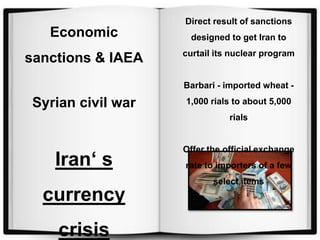
Direct result of sanctions
designed to get Iran to
curtail its nuclear program
Barbari - imported wheat -
1,000 rials to about 5,000
rials
Offer the official exchange
rate to importers of a few
select items
Economic
sanctions & IAEA
Syrian civil war
Iran‘ s
currency
crisis
Famous Cities
Amman
[Jordan]
Cairo
[Egypt]
Dubai
[UAE]
Abu Dhabi
[UAE]
Abu Dhabi
[UAE]
Riyadh
[Saudi Arabia]
Kuwait City
[Kuwait]
Nicosia
[Cyprus]
Tourist Sites
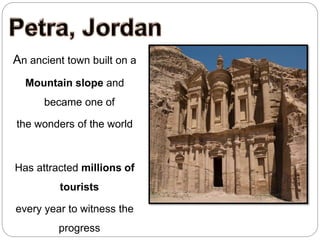
An ancient town built on a
Mountain slope and
became one of
the wonders of the world
Has attracted millions of
tourists
every year to witness the
progress
1000s of monuments and historical sites as one of UNESCO
world heritage
Offers ancient buildings, traditional markets & 1 of the oldest
mosques in the world
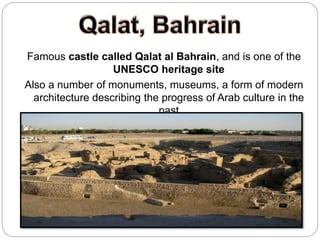
Famous castle called Qalat al Bahrain, and is one of the
UNESCO heritage site
Also a number of monuments, museums, a form of modern
architecture describing the progress of Arab culture in the
past
Burj Khalifa known as Burj
Dubai
a skyscraper in Dubai, UAE,
tallest man-made structure in
the world
829.8 m (2,722 ft)
21st Sept 2004 - 4th Jan 2010
Adrian Smith [CA] & Bill
2 artificial islands in Dubai, UAE in the
shape of palm trees
Palm Jumeirah & Palm Jebel Ali
Large number of residential, leisure and
entertainment centres
Add 520 kms of non-public beaches to the
city of Dubai
Belgian - Jan De Nul & Dutch - Van Oord
Bibliography
 http://www.iaea.org/
 http://www.jodidata.org/
 https://www.cia.gov/library/publications/the-world-
factbook/
 http://www.dubai.com/
 http://www.touristlink.com/
 http://www.gcc-sg.org/eng/
Middle East Countries

Middle East Countries

  • 1.
  • 3.
     Majority ofWestern Asia & Egypt - excluding Caucasus  Largest ethnic group in the Middle East – Arabs • Turks, Turkomans, Persians, Kurds, Azeris, Copts, Jews • Assyrians, Maronites, Circassians, Somalis, Armenians, Druze  Historical origin - Judaism, Christianity, & Islam  Around the Persian Gulf have large quantities of crude oil  Strategically, economically, politically, culturally, religiously sensi
  • 4.
     Bahrain  Cyprus Egypt  Iran  Iraq  Israel  Jordan  Kuwait  Lebanon  Northern Cyprus  Oman  Palestine  Qatar  Saudi Arabia  Syria  Turkey  U.A.E.  Yemen Iran Iraq Kuw ait Saud i Arab ia Qata r UAE
  • 5.
     GDP [real]- • Turkey (US $ 0.794 tn), Saudi Arabia (US $ 0.727 tn), Iran (US $ 0.548 tn)  GDP [PPP] - • Turkey (US $ 1.142 tn), Iran (US $ 1.016 tn), Saudi Arabia (US $ 0.921 tn)  GDP per capita [PPP] - • Qatar (US $ 103,900), UAE (US $ 49,800), Kuwait (US $ 40,500) • Israel (US $ 33,900), Saudi Arabia (US $ 31,800)
  • 8.
  • 9.
     Kingdom ofSaudi Arabia [Monarchy]  King & Prime Minister – ABDALLAH bin Abd al-Aziz Al Saud  Birthplace to Islam, holiest shrines - Mecca & Medina  Dry desert – great temperature extremes  Leverage on shipping – Persian Gulf & Suez Canal  Arabs: 90% & Afro-Asian: 10% [Arabic] [Muslims]
  • 10.
     Leader inOPEC, 17 % of world’s proven petroleum reserves  Petroleum – Budget [80 %]; GDP [45 %]; Exports [90 %]  King Abdallah University of Science & Technology – Job Training & Education  GDP [real] - $ 727.3 bn  GDP [PPP] - $ 921.7 bn  GDP per capita [PPP] - $ 31,800  GDP real growth rate – 6.8 %crude oil production, petroleum refining, basic petrochemicals, ammonia, industrial gases, sodium hydroxide (caustic soda), cement, fertilizer, plastics, metals, commercial ship repair, commercial aircraft repair, construction Currency – Saudi Riyals [SAR] 1 USD = 3.75 SAR 1 SAR = 16.71 INR Reserves of FE & Gold US $ 656.9 bn
  • 11.
     Exports –US $ 395 bn  Export goods – • petroleum & its product [90 %]  Main export partners – US [14.3 %], China [13.7 %], Japan [13.7 %], S. Korea [9.9 %], India [8.2 %], Singapor [4.3 %]  Imports – US $ 136.8 bn  Import goods – • machinery & equipments, foodstuffs • motor vehicles, textiles, chemicals  Import partners – China [13.5 %], US [13.2 %], S. Korea [6.7 %] Crude Oil Production – 10 mn bbl/day [2nd] Crude Oil Exports – 6.68 mn bbl/day [1st] Crude Oil Proved Reserves – 264.6 bn bbl [1st] Natural Gas Production – 99.23 bn cu m Natural Gas Proved Reserves – 8.028 tn cu m [5th]
  • 12.
  • 13.
  • 14.
    Attacked and overrunby Iraq on 2nd August 1990 Following several weeks of aerial bombardment, a `US-led, UN coalition began a ground assault on 23 February 1991 - liberated Kuwait in 4 days Spent more than US $ 5 bn to repair oil infrastructure damaged during 1990-91 Population - 2,695,316 Chief of State ir SABAH al-Ahmad al - Jabir al-Sabah
  • 15.
  • 16.
     Area -17,818 sq km [158th]  GDP [real] – US $ 173.4 bn [5.1 %]  GDP [PPP] – US $ 153.4 bn  GDP per capita [PPP] – US $ 40,500  Exports – US $ 121 bn  Imports – US $ 22.79 bn  Crude Oil Proved Reserves - 101.5 bn bbl  Crude Oil Exports - 1.365 mn bbl/day Kuwaiti Dinar 1 KWD = 3.53 USD 1 KWD = 221.56 INR
  • 17.
     Area -11,586 sq km [166th]  GDP [real] – US $ 183.4 bn [6.6 %]  GDP [PPP] – US $ 191 bn  GDP per capita [PPP] – US $ 103,900 [1st]  Exports – US $ 133.7 bn  Crude Oil [PR] – 25 bn bbl [57 yrs]  Natural Gas [PR] – 25.2 tm cu m [3rd] [13 %]  Unemployment Rate – 0.5 % [3rd]  Hamad International Airport – 24 million Qatari Rials 1 USD = 3.64 QAR 1 QAR = 17.21 INR Aljazeera News Network Assisted Libya Revolution
  • 18.
  • 19.
  • 20.
    Persia until 1935 US-Iranian:Iranian students seized the US Embassy in Tehran in 1979 to 1981 US cut off diplomatic relations - April 1980 During the period 1980-88: Iran – Iraq war – US Navy and Iranian military forces Designated state sponsor of terrorism & nuclear weapons ambitions [IAEA] Remains subject to US, UN, and EU economic sanctions and export
  • 21.
     GDP [real]– US $ 548.9 bn [- 1.9 %]  GDP [PPP] – US $ 1.016 tn  GDP per capita [PPP] – US $ 13,300  Exports – US $ 65.33 bn; Imports – US $ 66.97 bn  Crude Oil [PR] – 151.2 bn bbl [4th]  Crude Oil Exports – 1.5 mn bbl/day  Natural Gas [PR] – 33.07 tm cu m [2nd]  Unemployment Rate – 15.5 % Iranian Rials 1 USD = 24,833 IRR 1 INR = 397.86 IRR
  • 22.
    SADDAM Husayn [2003] Territorialdisputes with Iran - inconclusive & costly eight year war [1980-88] In August 1990, Iraq seized Kuwait but was expelled by US led, UN coalition forces during the Gulf War of 1991 Following Kuwait's liberation, the UNSC - Iraq to scrap all weapons of mass destruction US-led invasion of Iraq in March 2003 US military operations there ended in
  • 23.
  • 24.
     GDP [real]– US $ 212.5 bn [8.4 %]  GDP [PPP] – US $ 242.5 bn  GDP per capita [PPP] – US $ 7,200  Exports – US $ 93.91 bn; Imports – US $ 56.89 bn  Crude Oil [PR] – 143.1 bn bbl [5th]  Crude Oil Exports – 2.6 mn bbl/day Iraqi Dinars 1 USD = 1,163 IQD 1 INR = 18.6 IQD
  • 25.
    KHALIFA bin ZayidAl-Nuhayya President 1971 - 6 states - Abu Dhabi, 'Ajman, Al Fujayrah, Ash Shariqah, Dubayy, and Umm al Qaywayn - merged to form the United Arab Emirates (UAE) Joined in 1972 by Ra's al Khaymah Hit hard in 2008-09 - falling oil prices, collapsing real estate prices & the international banking crisis Avoided the "Arab Spring" unrest seen elsewhere in the Middle East [ ]
  • 26.
  • 27.
    Country's Free TradeZones - offering 100% foreign ownership & zero taxes - helping to attract foreign investors Dependence on oil, a large expatriate workforce – challenges Open economy - high per capita income - sizable annual trade surplus Economic diversification - reduced portion of GDP - oil and gas output to 25% Spending - job creation & infrastructure expansion - private sector involvement
  • 28.
     GDP [real]– US $ 358.9 bn [3.9 %]  GDP [PPP] – US $ 275.8 bn  GDP per capita [PPP] – US $ 49,800  Exports – US $ 300.9 bn; Imports – US $ 220.3 bn  Crude Oil [PR] – 97.8 bn bbl [7th]  Crude Oil Exports – 2.036 mn bbl/day  Natural Gas [PR] – 6.089 tn bbl [7th]  Unemployment Rate – 2.4 % Emirati Dirhams 1 USD = 3.67 AED 1 AED = 17.1 INR petroleum and petrochemicals, fishing, aluminum, cement, fertilizers, commercial ship repair, construction materials, some boat building, handicrafts, textiles
  • 29.
     Cooperation Councilfor the Arab States of the Gulf (CCASG)  Bahrain, Kuwait, Oman, Qatar, Saudi Arabia & UAE  Among the stated objectives are:  Similar regulations - religious, finance, trade, customs tourism, legislation & administration  Establishing scientific research centers
  • 30.
  • 31.
  • 32.
    Economic sanctions & IAEA Syrian civilwar Iran‘ s currency Yukiya Amano IAEA’s director general U.N. atomic watchdog will start with “easy” measures and “move on to more difficult things” regarding Iran’s nuclear issues
  • 33.
    15 march 2011 Anongoing armed conflict in Syria between forces loyal to the Ba'ath government and those seeking to oust it Syrian government - Russia & Iran while Qatar & Saudi Arabia transfer weapons to rebels; chemical weapons Death toll - 120,000 by Economic sanctions & IAEA Syrian civil war Iran‘ s currency
  • 34.
    Direct result ofsanctions designed to get Iran to curtail its nuclear program Barbari - imported wheat - 1,000 rials to about 5,000 rials Offer the official exchange rate to importers of a few select items Economic sanctions & IAEA Syrian civil war Iran‘ s currency crisis
  • 35.
  • 36.
  • 37.
  • 38.
  • 39.
  • 40.
  • 41.
  • 42.
  • 43.
  • 44.
    An ancient townbuilt on a Mountain slope and became one of the wonders of the world Has attracted millions of tourists every year to witness the progress
  • 45.
    1000s of monumentsand historical sites as one of UNESCO world heritage Offers ancient buildings, traditional markets & 1 of the oldest mosques in the world
  • 46.
    Famous castle calledQalat al Bahrain, and is one of the UNESCO heritage site Also a number of monuments, museums, a form of modern architecture describing the progress of Arab culture in the past
  • 47.
    Burj Khalifa knownas Burj Dubai a skyscraper in Dubai, UAE, tallest man-made structure in the world 829.8 m (2,722 ft) 21st Sept 2004 - 4th Jan 2010 Adrian Smith [CA] & Bill
  • 48.
    2 artificial islandsin Dubai, UAE in the shape of palm trees Palm Jumeirah & Palm Jebel Ali Large number of residential, leisure and entertainment centres Add 520 kms of non-public beaches to the city of Dubai Belgian - Jan De Nul & Dutch - Van Oord
  • 49.
    Bibliography  http://www.iaea.org/  http://www.jodidata.org/ https://www.cia.gov/library/publications/the-world- factbook/  http://www.dubai.com/  http://www.touristlink.com/  http://www.gcc-sg.org/eng/

Editor's Notes

  • #30 The Cooperation Council for the Arab States of the Gulf (Arabic: مجلس التعاون لدول الخليج العربية‎ ), also known as the Gulf Cooperation Council, GCC (مجلس التعاون الخليجي), is a political and economic union of Arab states bordering the Persian Gulf, namely Bahrain, Kuwait, Oman,Qatar, Saudi Arabia, and the United Arab Emirates.[1][2] In December 2011, Saudi Arabia proposed that the GCC deepen their integration to form a confederation.[3] Objections have been raised against the proposal by the other countries.[4][5] There have been discussions regarding the future membership of Jordan, Morocco, and Yemen.[6][7] Gulf Cooperation Council (GCC), political and economic alliance of six Middle Eastern countries—Saudi Arabia, Kuwait, the United Arab Emirates, Qatar, Bahrain, and Oman. The GCC was established inRiyadh, Saudia Arabia, in May 1981. The purpose of the GCC is to achieve unity among its members based on their common objectives and their similar political and cultural identities, which are rooted in Islamic beliefs. Presidency of the council rotates annually. Arguably the most important article of the GCC charter is Article 4, which states that the alliance was formed to strengthen relations among its member countries and to promote cooperation among the countries’ citizens. The GCC also has a defense planning council that coordinates military cooperation between member countries. The highest decision-making entity of the GCC is the Supreme Council, which meets on an annual basis and consists of GCC heads of state. Decisions of the Supreme Council are adopted by unanimous approval. The Ministerial Council, made up of foreign ministers or other government officials, meets every three months to implement the decisions of the Supreme Council and to propose new policy. The administrative arm of the alliance is the office of the Secretariat-General, which monitors policy implementation and arranges meetings. Some of the most important achievements of the GCC include the creation of the Peninsula Shield Force, a joint military venture based in Saudi Arabia, and the signing of an intelligence-sharing pact in 2004. At a GCC summit in December 2009, an agreement was reached to launch a single regional currency similar to the euro. Objectives[edit] Among the stated objectives are: Formulating similar regulations in various fields such as religious, finance, trade, customs, tourism, legislation, and administration. Fostering scientific and technical progress in industry, mining, agriculture, water and animal resources. Establishing scientific research centers. Setting up joint ventures. Unified military presence (Peninsula Shield Force). Encouraging cooperation of the private sector. Strengthening ties between their peoples. And establishing a common currency by 2010.[10][11][12][13]