United States            Prevention, Pesticides
Environment Protection
            al           And Toxic Substances     July 1995
Agency                   (7508W)


Reregistration
Eligibility Decision (RED)
                         EGX-101
UNITED STATES ENVIRONMENTAL PROTECTION AGENCY
                                              WASHINGTON, D.C. 20460

                                                                                      OFFICE OF
                                                                              PREVENTION, PESTICIDES
                                                                               AND TOXIC SUBSTANCES


CERTIFIED MAIL


Dear Registrant:

        I am pleased to announce that the Environmental Protection Agency has completed its
reregistration eligibility review and decisions on the pesticide chemical case         EGX-101.
The enclosed Reregistration Eligibility Decision (RED) contains the Agency's evaluation
of the data base of these chemicals, its conclusions of the potential human health and
environmental risks of the current product uses, and its decisions and conditions under which
these uses and products will be eligible for reregistration. The RED includes the data and
labeling requirements for products for reregistration. It may also include requirements for
additional data (generic) on the active ingredients to confirm the risk assessments.

        To assist you with a proper response, read the enclosed document entitled "Summary
of Instructions for Responding to the RED". This summary also refers to other enclosed
documents which include further instructions. You must follow all instructions and submit
complete and timely responses. The first set of required responses are due 90 days from
the date of this letter. The second set of required responses are due 8 months from the
date of this letter. Complete and timely responses will avoid the Agency taking the
enforcement action of suspension against your products.

       If you have questions on the product specific data requirements or wish to meet with
the Agency, please contact the Special Review and Reregistration Division representative
Franklin Rubis at (703) 308-8184. Address any questions on required generic data to the
Special Review and Reregistration Division representative Paul Lewis at (703) 308-8018.

                                                           Sincerely yours,


                                                           Lois Rossi, Director
                                                            Special Review
                                                            and Reregistration Division
Enclosures
SUMMARY OF INSTRUCTIONS FOR RESPONDING TO
               THE REREGISTRATION ELIGIBILITY DECISION (RED)

1. DATA CALL-IN (DCI) OR "90-DAY RESPONSE"--If generic data are required for
reregistration, a DCI letter will be enclosed describing such data. If product specific data are
required, another DCI letter will be enclosed listing such requirements. If both generic and
product specific data are required, a combined Generic and Product Specific letter will be
enclosed describing such data. Complete the two response forms provided with each DCI
letter (or four forms for the combined) by following the instructions provided. You must
submit the response forms for each product and for each DCI within 90 days of the date
of this letter (RED issuance date); otherwise, your product may be suspended.

2. TIME EXTENSIONS AND DATA WAIVER REQUESTS--No time extension requests
will be granted for the 90-day response. Time extension requests may be submitted only with
respect to actual data submissions. Requests for data waivers must be submitted as part of the

90-day response. Requests for time extensions should be submitted in the 90-day response,
but certainly no later than the 8-month response date. All data waiver and time extension
requests must be accompanied by a full justification. All waivers and time extensions must be
granted by EPA in order to go into effect.

3. APPLICATION FOR REREGISTRATION OR "8-MONTH RESPONSE"--You
must submit the following items for each product within eight months of the date of this
letter (RED issuance date).

       a. Application for Reregistration (EPA Form 8570-1). Use only an original
application form. Mark it "Application for Reregistration." Send your Application for
Reregistration (along with the other forms listed in b-e below) to the address listed in item 5.

        b. Five copies of draft labeling which complies with the RED and current regulations
and requirements. Only make labeling changes which are required by the RED and current
regulations (40 CFR 156.10) and policies. Submit any other amendments (such as
formulation changes, or labeling changes not related to reregistration) separately. You may
delete uses which the RED says are ineligible for reregistration. For further labeling
guidance, refer to the labeling section of the EPA publication "General Information on
Applying for Registration in the U.S., Second Edition, August 1992" (available from the
National Technical Information Service, publication #PB92-221811; telephone number 703-
487-4650).

        c. Generic or Product Specific Data. Submit all data in a format which complies
with PR Notice 86-5, and/or submit citations of data already submitted and give the EPA
identifier (MRID) numbers. Before citing these studies, you must make sure that they meet
the Agency's acceptance criteria (attached to the DCI).

       d. Two copies of the Confidential Statement of Formula (CSF) for each basic and
each alternate formulation. The labeling and CSF which you submit for each product must
comply with P.R. Notice 91-2 by declaring the active ingredient as the nominal
concentration. You have two options for submitting a CSF: (1) accept the standard certified
limits (see 40 CFR §158.175) or (2) provide certified limits that are supported by the analysis
of five batches. If you choose the second option, you must submit or cite the data for the five
batches along with a certification statement as described in 40 CFR §158.175(e). A copy of
the CSF is enclosed; follow the instructions on its back.

       e. Certification With Respect to Data Compensation Requirements. Complete
and sign EPA form 8570-31 for each product.

4. COMMENTS IN RESPONSE TO FEDERAL REGISTER NOTICE--Comments
pertaining to the content of the RED may be submitted to the address shown in the Federal
Register Notice which announces the availability of this RED.

5. WHERE TO SEND PRODUCT SPECIFIC DCI RESPONSES (90-DAY) AND
APPLICATIONS FOR REREGISTRATION (8-MONTH RESPONSES)

By U.S. Mail:

       Document Processing Desk (RED-SRRD-PRB)
       Office of Pesticide Programs (7504C)
       EPA, 401 M St. S.W.
       Washington, D.C. 20460-0001

By express:

   Document Processing Desk (RED-SRRD-PRB)
      Office of Pesticide Programs (7504C)
      Room 266A, Crystal Mall 2
      1921 Jefferson Davis Hwy.
      Arlington, VA 22202

6. EPA'S REVIEWS--EPA will screen all submissions for completeness; those which are
not complete will be returned with a request for corrections. EPA will try to respond to data
waiver and time extension requests within 60 days. EPA will also try to respond to all 8-
month submissions with a final reregistration determination within 14 months after the RED
has been issued.
REREGISTRATION ELIGIBILITY DECISION

                            EGX-101

                      LIST C


          ENVIRONMENTAL PROTECTION AGENCY
             OFFICE OF PESTICIDE PROGRAMS
      SPECIAL REVIEW AND REREGISTRATION DIVISION
TABLE OF CONTENTS


               EGX-101 REREGISTRATION ELIGIBILITY DECISION TEAM
           ................................................................... i

EXECUTIVE SUMMARY . . . . . . . . . . . . . . . . . . . . . . . . . . . . . . . . . . . . . . . . . . . . . . . . . . v

I.       INTRODUCTION . . . . . . . . . . . . . . . . . . . . . . . . . . . . . . . . . . . . . . . . . . . . . . . . . . . 1

II.      CASE OVERVIEW . . . . . . . . . . . . . . . . . . . . . . . . . . . . . . . . . . . . . . . . . . . . . . . . . . 2
         A.   Chemical Overview . . . . . . . . . . . . . . . . . . . . . . . . . . . . . . . . . . . . . . . . . . . . . 2
         B.   Use Profile . . . . . . . . . . . . . . . . . . . . . . . . . . . . . . . . . . . . . . . . . . . . . . . . . . . . 2
         C.   Data Requirements . . . . . . . . . . . . . . . . . . . . . . . . . . . . . . . . . . . . . . . . . . . . . 5
         D.   Regulatory History . . . . . . . . . . . . . . . . . . . . . . . . . . . . . . . . . . . . . . . . . . . . . 5

III.     SCIENCE ASSESSMENT . . . . . . . . . . . . . . . . . . . . . . . . . . . . . . . . . . . . . . . . . . . . . 5
         A.   Physical Chemistry Assessment . . . . . . . . . . . . . . . . . . . . . . . . . . . . . . . . . . . 5
         B.   Human Health Assessment . . . . . . . . . . . . . . . . . . . . . . . . . . . . . . . . . . . . . . . 6
              1.    Toxicology Assessment . . . . . . . . . . . . . . . . . . . . . . . . . . . . . . . . . . . . 6
                    a.    Acute Toxicity . . . . . . . . . . . . . . . . . . . . . . . . . . . . . . . . . . . . . . 6
                    b.    Subchronic Toxicity . . . . . . . . . . . . . . . . . . . . . . . . . . . . . . . . . 7
                    c.    Developmental Toxicity . . . . . . . . . . . . . . . . . . . . . . . . . . . . . . 7
                    d.    Mutagenicity . . . . . . . . . . . . . . . . . . . . . . . . . . . . . . . . . . . . . . . 8
                    e.    Toxicology Conclusion . . . . . . . . . . . . . . . . . . . . . . . . . . . . . . . 8
              2.    Exposure Assessment . . . . . . . . . . . . . . . . . . . . . . . . . . . . . . . . . . . . . 8
                    a.    Occupational and Residential . . . . . . . . . . . . . . . . . . . . . . . . . 8
              3.    Risk Assessment . . . . . . . . . . . . . . . . . . . . . . . . . . . . . . . . . . . . . . . . . . 9
                    a.    Dietary . . . . . . . . . . . . . . . . . . . . . . . . . . . . . . . . . . . . . . . . . . . . 9
                    b.    Occupational and Residential . . . . . . . . . . . . . . . . . . . . . . . . . 9
         C.   Environmental Assessment . . . . . . . . . . . . . . . . . . . . . . . . . . . . . . . . . . . . . . 9
              1.    Ecological Toxicity Data . . . . . . . . . . . . . . . . . . . . . . . . . . . . . . . . . . . 9
                    a.    Toxicity to Terrestrial Animals . . . . . . . . . . . . . . . . . . . . . . . 10
                          (1)    Birds: Acute and Subacute Toxicity. . . . . . . . . . . . 10
                          (2)    Mammals . . . . . . . . . . . . . . . . . . . . . . . . . . . . . . . . . . . 11
                    b.    Toxicity to Aquatic Animals . . . . . . . . . . . . . . . . . . . . . . . . . 11
                          (1)    Freshwater Fish . . . . . . . . . . . . . . . . . . . . . . . . . . . . . 11
                          (2)    Freshwater Invertebrates . . . . . . . . . . . . . . . . . . . . . 12
              2.    Environmental Fate . . . . . . . . . . . . . . . . . . . . . . . . . . . . . . . . . . . . . . 12
                    a.    Environmental Fate and Transport . . . . . . . . . . . . . . . . . . . 12
                          (1)    Hydrolysis . . . . . . . . . . . . . . . . . . . . . . . . . . . . . . . . . . 12
                          (2)    Aerobic Soil Metabolism . . . . . . . . . . . . . . . . . . . . . . 13
                          (3)    Leaching-Adsorption/Desorption . . . . . . . . . . . . . . . 13
b.    Environmental Fate and Ground Water Assessment . . . . . 14
               3.        Exposure and Risk Characterization . . . . . . . . . . . . . . . . . . . . . . . . 15
                         a.    Exposure and Risk to Nontarget Terrestrial Animals . . . . 15
                               (1)   Birds . . . . . . . . . . . . . . . . . . . . . . . . . . . . . . . . . . . . . . . 15
                               (2)   Mammals . . . . . . . . . . . . . . . . . . . . . . . . . . . . . . . . . . . 16
                         b.    Exposure and Risk to Nontarget Aquatic Animals . . . . . . . 16
                         c.    Endangered Species . . . . . . . . . . . . . . . . . . . . . . . . . . . . . . . . 16
                         d.    Exposure and Risk to Ground and Surface Water . . . . . . . 16

IV.   RISK MANAGEMENT AND REREGISTRATION DECISION . . . . . . . . . . . . 16
      A.   Determination of Eligibility . . . . . . . . . . . . . . . . . . . . . . . . . . . . . . . . . . . . . 16
      B.   Determination of Eligibility . . . . . . . . . . . . . . . . . . . . . . . . . . . . . . . . . . . . . 17
           1.    Eligibility Decision . . . . . . . . . . . . . . . . . . . . . . . . . . . . . . . . . . . . . . . 17
           2.    Eligible and Ineligible Uses . . . . . . . . . . . . . . . . . . . . . . . . . . . . . . . 17
      C.   Regulatory Position . . . . . . . . . . . . . . . . . . . . . . . . . . . . . . . . . . . . . . . . . . . . 18

V.    ACTIONS REQUIRED OF REGISTRANTS . . . . . . . . . . . . . . . . . . . . . . . . . . . . 19
           1.  Manufacturing-Use Products . . . . . . . . . . . . . . . . . . . . . . . . . . . . . . 19
               a.     Additional Generic Data Requirements . . . . . . . . . . . . . . . . 19
           2.  End-Use Products . . . . . . . . . . . . . . . . . . . . . . . . . . . . . . . . . . . . . . . 19
               a.     Additional Product-Specific Data Requirements . . . . . . . . 19
           3.  Existing Stocks . . . . . . . . . . . . . . . . . . . . . . . . . . . . . . . . . . . . . . . . . . 21
EGX-101 REREGISTRATION ELIGIBILITY DECISION TEAM

Office of Pesticide Programs:

Biological and Economic Analysis Division

Doug Sutherland                           Biological Analysis Branch
Art Grube                                 Economic Analysis Branch
Gabe Patrick                              Biological Analysis Branch

Environmental Fate and Effects Division

Larry Liu                                 Environmental Fate and Groundwater Branch
Renee Costello                            Ecological Effects Branch
Karen Angulo                              Science Analysis and Coordination Staff

Health Effects Division

Winston Dang                              Occupational and Residential Exposure Branch
Alan Levy                                 Toxicology Branch II
Kathryn Boyle                             Risk Characterization and Analysis Branch

Registration Division

Beth Edwards                              PM 14
Shyam Mathur                              Registration Support Branch

Special Review and Reregistration Division

Paul Lewis                                Accelerated Reregistration Branch
Mark Wilhite                              Accelerated Reregistration Branch
Carol Stangel                             Planning and Reregistration Branch

Office of Compliance Monitoring

Beverly Updike

Office of General Counsel

Kevin Lee


                                             i
ii
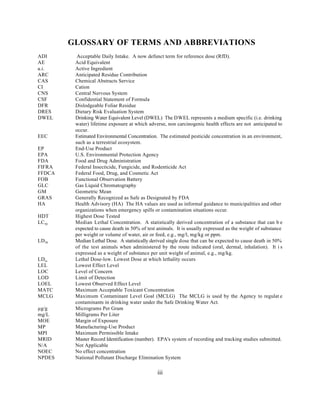
GLOSSARY OF TERMS AND ABBREVIATIONS
ADI       Acceptable Daily Intake. A now defunct term for reference dose (RfD).
AE       Acid Equivalent
a.i.     Active Ingredient
ARC      Anticipated Residue Contribution
CAS      Chemical Abstracts Service
CI       Cation
CNS      Central Nervous System
CSF      Confidential Statement of Formula
DFR      Dislodgeable Foliar Residue
DRES     Dietary Risk Evaluation System
DWEL     Drinking Water Equivalent Level (DWEL) The DWEL represents a medium specific (i.e. drinking
         water) lifetime exposure at which adverse, non carcinogenic health effects are not anticipated to
         occur.
EEC      Estimated Environmental Concentration. The estimated pesticide concentration in an environment,
         such as a terrestrial ecosystem.
EP       End-Use Product
EPA      U.S. Environmental Protection Agency
FDA      Food and Drug Administration
FIFRA    Federal Insecticide, Fungicide, and Rodenticide Act
FFDCA    Federal Food, Drug, and Cosmetic Act
FOB      Functional Observation Battery
GLC      Gas Liquid Chromatography
GM       Geometric Mean
GRAS     Generally Recognized as Safe as Designated by FDA
HA       Health Advisory (HA) The HA values are used as informal guidance to municipalities and other
         organizations when emergency spills or contamination situations occur.
HDT      Highest Dose Tested
LC50     Median Lethal Concentration. A statistically derived concentration of a substance that can b e
         expected to cause death in 50% of test animals. It is usually expressed as the weight of substance
         per weight or volume of water, air or feed, e.g., mg/l, mg/kg or ppm.
LD 50    Median Lethal Dose. A statistically derived single dose that can be expected to cause death in 50%
         of the test animals when administered by the route indicated (oral, dermal, inhalation). It i s
         expressed as a weight of substance per unit weight of animal, e.g., mg/kg.
LDlo     Lethal Dose-low. Lowest Dose at which lethality occurs
LEL      Lowest Effect Level
LOC      Level of Concern
LOD      Limit of Detection
LOEL     Lowest Observed Effect Level
MATC     Maximum Acceptable Toxicant Concentration
MCLG     Maximum Contaminant Level Goal (MCLG) The MCLG is used by the Agency to regulat e
         contaminants in drinking water under the Safe Drinking Water Act.
µg/g     Micrograms Per Gram
mg/L     Milligrams Per Liter
MOE      Margin of Exposure
MP       Manufacturing-Use Product
MPI      Maximum Permissible Intake
MRID     Master Record Identification (number). EPA's system of recording and tracking studies submitted.
N/A      Not Applicable
NOEC     No effect concentration
NPDES    National Pollutant Discharge Elimination System

                                               iii
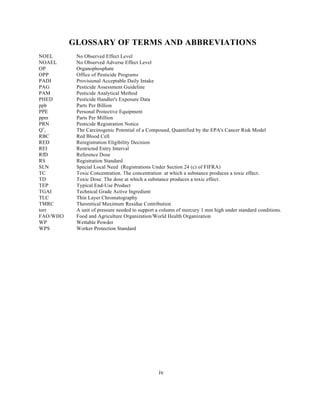
GLOSSARY OF TERMS AND ABBREVIATIONS
NOEL       No Observed Effect Level
NOAEL      No Observed Adverse Effect Level
OP         Organophosphate
OPP        Office of Pesticide Programs
PADI       Provisional Acceptable Daily Intake
PAG        Pesticide Assessment Guideline
PAM        Pesticide Analytical Method
PHED       Pesticide Handler's Exposure Data
ppb        Parts Per Billion
PPE        Personal Protective Equipment
ppm        Parts Per Million
PRN        Pesticide Registration Notice
Q*1        The Carcinogenic Potential of a Compound, Quantified by the EPA's Cancer Risk Model
RBC        Red Blood Cell
RED        Reregistration Eligibility Decision
REI        Restricted Entry Interval
RfD        Reference Dose
RS         Registration Standard
SLN        Special Local Need (Registrations Under Section 24 (c) of FIFRA)
TC         Toxic Concentration. The concentration at which a substance produces a toxic effect.
TD         Toxic Dose. The dose at which a substance produces a toxic effect.
TEP        Typical End-Use Product
TGAI       Technical Grade Active Ingredient
TLC        Thin Layer Chromatography
TMRC       Theoretical Maximum Residue Contribution
torr       A unit of pressure needed to support a column of mercury 1 mm high under standard conditions.
FAO/WHO    Food and Agriculture Organization/World Health Organization
WP         Wettable Powder
WPS        Worker Protection Standard


                                                iv
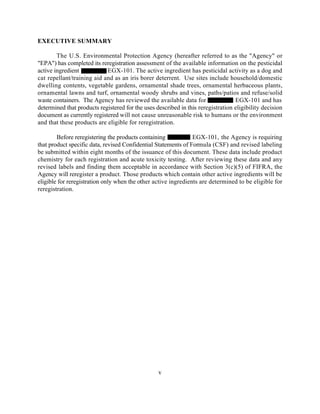
EXECUTIVE SUMMARY

        The U.S. Environmental Protection Agency (hereafter referred to as the "Agency" or
"EPA") has completed its reregistration assessment of the available information on the pesticidal
active ingredient           EGX-101. The active ingredient has pesticidal activity as a dog and
cat repellant/training aid and as an iris borer deterrent. Use sites include household/domestic
dwelling contents, vegetable gardens, ornamental shade trees, ornamental herbaceous plants,
ornamental lawns and turf, ornamental woody shrubs and vines, paths/patios and refuse/solid
waste containers. The Agency has reviewed the available data for                  EGX-101 and has
determined that products registered for the uses described in this reregistration eligibility decision
document as currently registered will not cause unreasonable risk to humans or the environment
and that these products are eligible for reregistration.

        Before reregistering the products containing            EGX-101, the Agency is requiring
that product specific data, revised Confidential Statements of Formula (CSF) and revised labeling
be submitted within eight months of the issuance of this document. These data include product
chemistry for each registration and acute toxicity testing. After reviewing these data and any
revised labels and finding them acceptable in accordance with Section 3(c)(5) of FIFRA, the
Agency will reregister a product. Those products which contain other active ingredients will be
eligible for reregistration only when the other active ingredients are determined to be eligible for
reregistration.


                                                  v
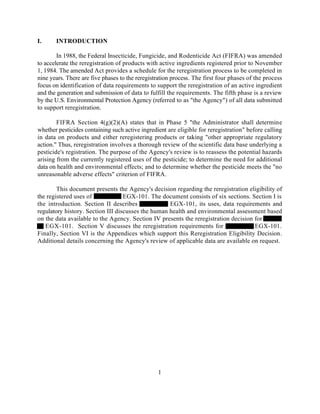
I.     INTRODUCTION

        In 1988, the Federal Insecticide, Fungicide, and Rodenticide Act (FIFRA) was amended
to accelerate the reregistration of products with active ingredients registered prior to November
1, 1984. The amended Act provides a schedule for the reregistration process to be completed in
nine years. There are five phases to the reregistration process. The first four phases of the process
focus on identification of data requirements to support the reregistration of an active ingredient
and the generation and submission of data to fulfill the requirements. The fifth phase is a review
by the U.S. Environmental Protection Agency (referred to as "the Agency") of all data submitted
to support reregistration.

        FIFRA Section 4(g)(2)(A) states that in Phase 5 "the Administrator shall determine
whether pesticides containing such active ingredient are eligible for reregistration" before calling
in data on products and either reregistering products or taking "other appropriate regulatory
action." Thus, reregistration involves a thorough review of the scientific data base underlying a
pesticide's registration. The purpose of the Agency's review is to reassess the potential hazards
arising from the currently registered uses of the pesticide; to determine the need for additional
data on health and environmental effects; and to determine whether the pesticide meets the "no
unreasonable adverse effects" criterion of FIFRA.

        This document presents the Agency's decision regarding the reregistration eligibility of
the registered uses of             EGX-101. The document consists of six sections. Section I is
the introduction. Section II describes              EGX-101, its uses, data requirements and
regulatory history. Section III discusses the human health and environmental assessment based
on the data available to the Agency. Section IV presents the reregistration decision for
   EGX-101. Section V discusses the reregistration requirements for                  EGX-101.
Finally, Section VI is the Appendices which support this Reregistration Eligibility Decision.
Additional details concerning the Agency's review of applicable data are available on request.


                                                 1
II.   CASE OVERVIEW

      A.     Chemical Overview

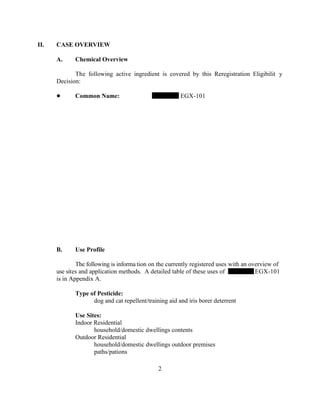
             The following active ingredient is covered by this Reregistration Eligibilit y
      Decision:

             Common Name:                              EGX-101


      B.     Use Profile

              The following is informa tion on the currently registered uses with an overview of
      use sites and application methods. A detailed table of these uses of             EGX-101
      is in Appendix A.

             Type of Pesticide:
                   dog and cat repellent/training aid and iris borer deterrent

             Use Sites:
             Indoor Residential
                    household/domestic dwellings contents
             Outdoor Residential
                    household/domestic dwellings outdoor premises
                    paths/pations

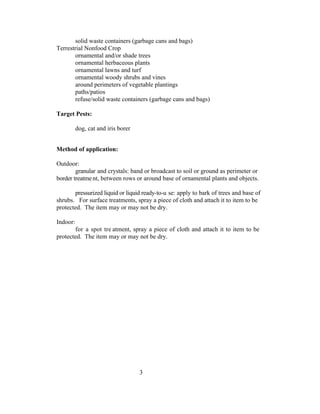
                                               2
solid waste containers (garbage cans and bags)
Terrestrial Nonfood Crop
       ornamental and/or shade trees
       ornamental herbaceous plants
       ornamental lawns and turf
       ornamental woody shrubs and vines
       around perimeters of vegetable plantings
       paths/patios
       refuse/solid waste containers (garbage cans and bags)

Target Pests:

          dog, cat and iris borer


Method of application:

Outdoor:
        granular and crystals: band or broadcast to soil or ground as perimeter or
border treatme nt, between rows or around base of ornamental plants and objects.

       pressurized liquid or liquid ready-to-u se: apply to bark of trees and base of
shrubs. For surface treatments, spray a piece of cloth and attach it to item to be
protected. The item may or may not be dry.

Indoor:
       for a spot tre atment, spray a piece of cloth and attach it to item to be
protected. The item may or may not be dry.


                                    3
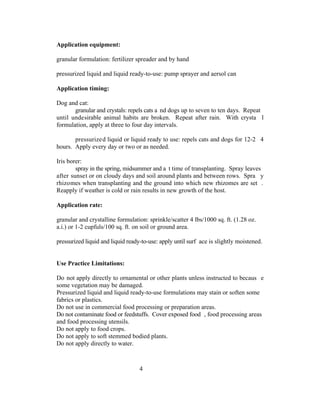
Application equipment:

granular formulation: fertilizer spreader and by hand

pressurized liquid and liquid ready-to-use: pump sprayer and aersol can

Application timing:

Dog and cat:
       granular and crystals: repels cats a nd dogs up to seven to ten days. Repeat
until undesirable animal habits are broken. Repeat after rain. With crysta l
formulation, apply at three to four day intervals.

       pressurized liquid or liquid ready to use: repels cats and dogs for 12-2 4
hours. Apply every day or two or as needed.

Iris borer:
        spray in the spring, midsummer and a t time of transplanting. Spray leaves
after sunset or on cloudy days and soil around plants and between rows. Spra y
rhizomes when transplanting and the ground into which new rhizomes are set .
Reapply if weather is cold or rain results in new growth of the host.

Application rate:

granular and crystalline formulation: sprinkle/scatter 4 lbs/1000 sq. ft. (1.28 oz.
a.i.) or 1-2 cupfuls/100 sq. ft. on soil or ground area.

pressurized liquid and liquid ready-to-use: apply until surf ace is slightly moistened.


Use Practice Limitations:

Do not apply directly to ornamental or other plants unless instructed to becaus e
some vegetation may be damaged.
Pressurized liquid and liquid ready-to-use formulations may stain or soften some
fabrics or plastics.
Do not use in commercial food processing or preparation areas.
Do not contaminate food or feedstuffs. Cover exposed food , food processing areas
and food processing utensils.
Do not apply to food crops.
Do not apply to soft stemmed bodied plants.
Do not apply directly to water.


                                   4
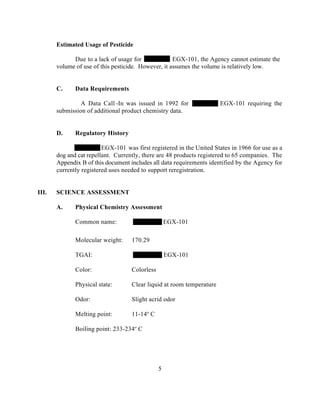
Estimated Usage of Pesticide

             Due to a lack of usage for              EGX-101, the Agency cannot estimate the
       volume of use of this pesticide. However, it assumes the volume is relatively low.


       C.     Data Requirements

                A Data Call -In was issued in 1992 for                 EGX-101 requiring the
       submission of additional product chemistry data.


       D.     Regulatory History

                         EGX-101 was first registered in the United States in 1966 for use as a
       dog and cat repellant. Currently, there are 48 products registered to 65 companies. The
       Appendix B of this document includes all data requirements identified by the Agency for
       currently registered uses needed to support reregistration.


III.   SCIENCE ASSESSMENT

       A.     Physical Chemistry Assessment

              Common name:                          EGX-101

              Molecular weight:     170.29

              TGAI:                                 EGX-101

              Color:                Colorless

              Physical state:       Clear liquid at room temperature

              Odor:                 Slight acrid odor

              Melting point:        11-14o C

              Boiling point: 233-234o C


                                                5
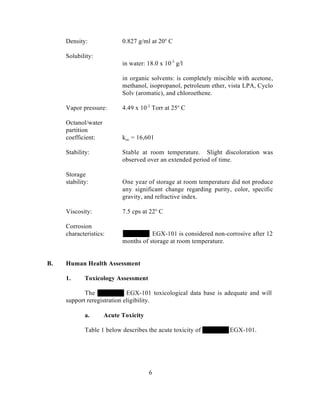
Density:              0.827 g/ml at 20o C

     Solubility:
                           in water: 18.0 x 10⁻³ g/l

                           in organic solvents: is completely miscible with acetone,
                           methanol, isopropanol, petroleum ether, vista LPA, Cyclo
                           Solv (aromatic), and chloroethene.

     Vapor pressure:       4.49 x 10⁻² Torr at 25o C

     Octanol/water
     partition
     coefficient:          koc = 16,601

     Stability:            Stable at room temperature. Slight discoloration was
                           observed over an extended period of time.

     Storage
     stability:            One year of storage at room temperature did not produce
                           any significant change regarding purity, color, specific
                           gravity, and refractive index.

     Viscosity:            7.5 cps at 22o C

     Corrosion
     characteristics:                 EGX-101 is considered non-corrosive after 12
                           months of storage at room temperature.


B.   Human Health Assessment

     1.      Toxicology Assessment

            The              EGX-101 toxicological data base is adequate and will
     support reregistration eligibility.

             a.      Acute Toxicity

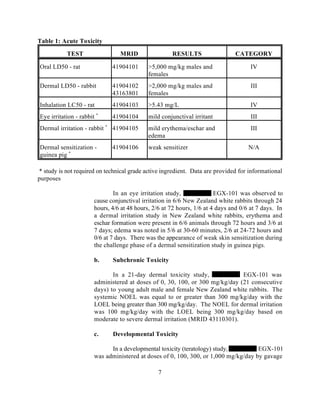
             Table 1 below describes the acute toxicity of         EGX-101.


                                      6
Table 1: Acute Toxicity

           TEST                  MRID                 RESULTS                  CATEGORY

Oral LD50 - rat               41904101      >5,000 mg/kg males and                    IV
                                            females
Dermal LD50 - rabbit          41904102      >2,000 mg/kg males and                    III
                              43163801      females
Inhalation LC50 - rat         41904103      >5.43 mg/L                                IV
Eye irritation - rabbit *     41904104      mild conjunctival irritant                III
Dermal irritation - rabbit * 41904105       mild erythema/eschar and                  III
                                            edema
Dermal sensitization -        41904106      weak sensitizer                          N/A
guinea pig *

* study is not required on technical grade active ingredient. Data are provided for informational
purposes

                               In an eye irritation study,              EGX-101 was observed to
                       cause conjunctival irritation in 6/6 New Zealand white rabbits through 24
                       hours, 4/6 at 48 hours, 2/6 at 72 hours, 1/6 at 4 days and 0/6 at 7 days. In
                       a dermal irritation study in New Zealand white rabbits, erythema and
                       eschar formation were present in 6/6 animals through 72 hours and 3/6 at
                       7 days; edema was noted in 5/6 at 30-60 minutes, 2/6 at 24-72 hours and
                       0/6 at 7 days. There was the appearance of weak skin sensitization during
                       the challenge phase of a dermal sensitization study in guinea pigs.

                       b.     Subchronic Toxicity

                              In a 21-day dermal toxicity study,              EGX-101 was
                       administered at doses of 0, 30, 100, or 300 mg/kg/day (21 consecutive
                       days) to young adult male and female New Zealand white rabbits. The
                       systemic NOEL was equal to or greater than 300 mg/kg/day with the
                       LOEL being greater than 300 mg/kg/day. The NOEL for dermal irritation
                       was 100 mg/kg/day with the LOEL being 300 mg/kg/day based on
                       moderate to severe dermal irritation (MRID 43110301).

                       c.     Developmental Toxicity

                             In a developmental toxicity (teratology) study,         EGX-101
                       was administered at doses of 0, 100, 300, or 1,000 mg/kg/day by gavage

                                                7
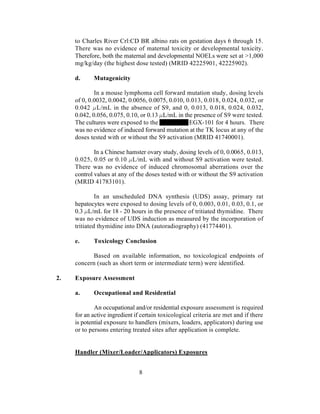
to Charles River Crl:CD BR albino rats on gestation days 6 through 15.
     There was no evidence of maternal toxicity or developmental toxicity.
     Therefore, both the maternal and developmental NOELs were set at >1,000
     mg/kg/day (the highest dose tested) (MRID 42225901, 42225902).

     d.     Mutagenicity

             In a mouse lymphoma cell forward mutation study, dosing levels
     of 0, 0.0032, 0.0042, 0.0056, 0.0075, 0.010, 0.013, 0.018, 0.024, 0.032, or
     0.042 L/mL in the absence of S9, and 0, 0.013, 0.018, 0.024, 0.032,
     0.042, 0.056, 0.075, 0.10, or 0.13 L/mL in the presence of S9 were tested.
     The cultures were exposed to the              EGX-101 for 4 hours. There
     was no evidence of induced forward mutation at the TK locus at any of the
     doses tested with or without the S9 activation (MRID 41740001).

             In a Chinese hamster ovary study, dosing levels of 0, 0.0065, 0.013,
     0.025, 0.05 or 0.10 L/mL with and without S9 activation were tested.
     There was no evidence of induced chromosomal aberrations over the
     control values at any of the doses tested with or without the S9 activation
     (MRID 41783101).

              In an unscheduled DNA synthesis (UDS) assay, primary rat
     hepatocytes were exposed to dosing levels of 0, 0.003, 0.01, 0.03, 0.1, or
     0.3 L/mL for 18 - 20 hours in the presence of tritiated thymidine. There
     was no evidence of UDS induction as measured by the incorporation of
     tritiated thymidine into DNA (autoradiography) (41774401).

     e.     Toxicology Conclusion

            Based on available information, no toxicological endpoints of
     concern (such as short term or intermediate term) were identified.

2.   Exposure Assessment

     a.     Occupational and Residential

             An occupational and/or residential exposure assessment is required
     for an active ingredient if certain toxicological criteria are met and if there
     is potential exposure to handlers (mixers, loaders, applicators) during use
     or to persons entering treated sites after application is complete.


     Handler (Mixer/Loader/Applicators) Exposures


                               8
There is a potential for exposure to mixer/loader/applicators during
             the use-patterns associated with            EGX-101, specifically potential
             exposures arising from applying granulars by hand and lawn spreaders,
             and applying liquid sprays to ornamentals, furniture, and rugs.


             Post-Application Exposures

                     There is a potential for exposure to persons entering treated sites
             after application of          EGX-101 is complete, specifically potential
             post-application exposure arising from re-entering treated lawns, gardens,
             and residences.

             Need for Assessment

                    While there is a potential for exposure to handlers as well as post-
             application exposure, an occupational and/or residential exposure
             assessment for              EGX-101 is not required because there are no
             toxicological endpoints of concern.


      3.     Risk Assessment

             a.     Dietary

                   Based on the current use patterns and exposure profiles for
             EGX-101, residues in/on food and/or feed are not expected to occur.
             Therefore, a dietary risk characterization is not required.

             b.     Occupational and Residential

                     As stated previously, no appropriate endpoints for short term or
             intermediate term occupational or residential risk assessment were
             identified. Therefore, a risk characterization is not required.


C.    Environmental Assessment

       The Agency has adequate data to assess the risk of                  EGX-101 t o
nontarget terrestrial organisms.

      1.     Ecological Toxicity Data


                                      9
a.       Toxicity to Terrestrial Animals


                            (1)   Birds: Acute and Subacute Toxicity.

                                          In order to establish the acute and subacute toxicity
                                  of             EGX-101 to birds, the following tests were
                                  required using the technical grade of the active ingredient
                                  (a.i.): one avian single-dose oral (LD 50) study on one
                                  species (preferably mallard or bobwhite quail) and subacute
                                  dietary studies (LC50) on one species of waterfowl
                                  (preferably the mallard duck) and one species of upland
                                  game bird (preferably bobwhite quail).

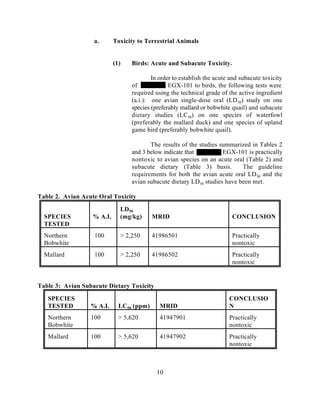
                                         The results of the studies summarized in Tables 2
                                  and 3 below indicate that           EGX-101 is practically
                                  nontoxic to avian species on an acute oral (Table 2) and
                                  subacute dietary (Table 3) basis.          The guideline
                                  requirements for both the avian acute oral LD50 and the
                                  avian subacute dietary LD 50 studies have been met.

Table 2. Avian Acute Oral Toxicity

                              LD50
  SPECIES          % A.I.     (mg/kg)      MRID                           CONCLUSION
  TESTED
  Northern         100        > 2,250      41986501                       Practically
  Bobwhite                                                                nontoxic
  Mallard          100        > 2,250      41986502                       Practically
                                                                          nontoxic


Table 3: Avian Subacute Dietary Toxicity

   SPECIES                                                               CONCLUSIO
   TESTED         % A.I.      LC50 (ppm)     MRID                        N
   Northern       100         > 5,620        41947901                    Practically
   Bobwhite                                                              nontoxic
   Mallard        100         > 5,620        41947902                    Practically
                                                                         nontoxic


                                            10
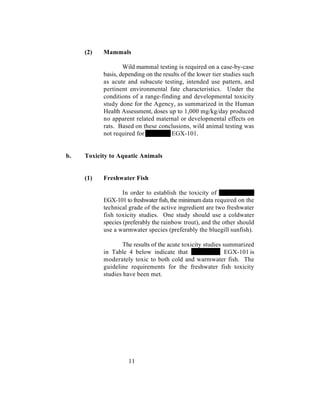
(2)   Mammals

                   Wild mammal testing is required on a case-by-case
           basis, depending on the results of the lower tier studies such
           as acute and subacute testing, intended use pattern, and
           pertinent environmental fate characteristics. Under the
           conditions of a range-finding and developmental toxicity
           study done for the Agency, as summarized in the Human
           Health Assessment, doses up to 1,000 mg/kg/day produced
           no apparent related maternal or developmental effects on
           rats. Based on these conclusions, wild animal testing was
           not required for           EGX-101.


b.   Toxicity to Aquatic Animals


     (1)   Freshwater Fish

                   In order to establish the toxicity of
           EGX-101 to freshwater fish, the minimum data required on the
           technical grade of the active ingredient are two freshwater
           fish toxicity studies. One study should use a coldwater
           species (preferably the rainbow trout), and the other should
           use a warmwater species (preferably the bluegill sunfish).

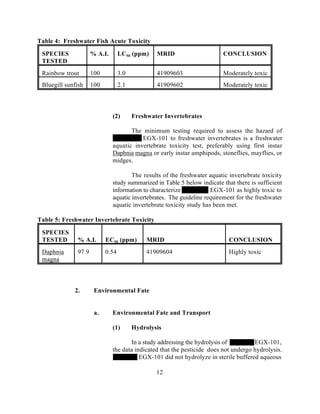
                   The results of the acute toxicity studies summarized
           in Table 4 below indicate that                     EGX-101 is
           moderately toxic to both cold and warmwater fish. The
           guideline requirements for the freshwater fish toxicity
           studies have been met.


                     11
Table 4: Freshwater Fish Acute Toxicity

 SPECIES             % A.I.       LC50 (ppm)    MRID                     CONCLUSION
 TESTED
 Rainbow trout       100          3.0           41909603                 Moderately toxic
 Bluegill sunfish    100          2.1           41909602                 Moderately toxic


                              (2)       Freshwater Invertebrates

                                     The minimum testing required to assess the hazard of
                                         EGX-101 to freshwater invertebrates is a freshwater
                              aquatic invertebrate toxicity test, preferably using first instar
                              Daphnia magna or early instar amphipods, stoneflies, mayflies, or
                              midges.

                                      The results of the freshwater aquatic invertebrate toxicity
                              study summarized in Table 5 below indicate that there is sufficient
                              information to characterize            EGX-101 as highly toxic to
                              aquatic invertebrates. The guideline requirement for the freshwater
                              aquatic invertebrate toxicity study has been met.

Table 5: Freshwater Invertebrate Toxicity

 SPECIES
 TESTED        % A.I.      EC50 (ppm)        MRID                           CONCLUSION
 Daphnia      97.9         0.54              41909604                      Highly toxic
 magna


             2.       Environmental Fate


                      a.      Environmental Fate and Transport

                              (1)       Hydrolysis

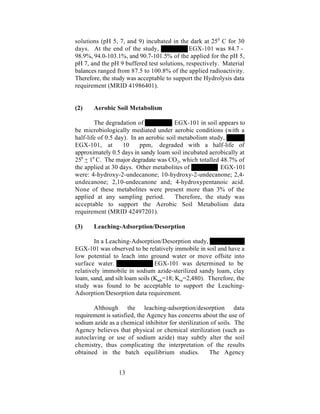
                                     In a study addressing the hydrolysis of         EGX-101,
                              the data indicated that the pesticide does not undergo hydrolysis.
                                         EGX-101 did not hydrolyze in sterile buffered aqueous

                                                12
solutions (pH 5, 7, and 9) incubated in the dark at 25 0 C for 30
days. At the end of the study,               EGX-101 was 84.7 -
98.9%, 94.0-103.1%, and 90.7-101.5% of the applied for the pH 5,
pH 7, and the pH 9 buffered test solutions, respectively. Material
balances ranged from 87.5 to 100.8% of the applied radioactivity.
Therefore, the study was acceptable to support the Hydrolysis data
requirement (MRID 41986401).


(2)    Aerobic Soil Metabolism

        The degradation of              EGX-101 in soil appears to
be microbiologically mediated under aerobic conditions (with a
half-life of 0.5 day). In an aerobic soil metabolism study,
EGX-101, at         10     ppm, degraded with a half-life of
approximately 0.5 days in sandy loam soil incubated aerobically at
250 + 10 C. The major degradate was CO2, which totalled 48.7% of
the applied at 30 days. Other metabolites of              EGX-101
were: 4-hydroxy-2-undecanone; 10-hydroxy-2-undecanone; 2,4-
undecanone; 2,10-undecanone and; 4-hydroxypentanoic acid.
None of these metabolites were present more than 3% of the
applied at any sampling period.          Therefore, the study was
acceptable to support the Aerobic Soil Metabolism data
requirement (MRID 42497201).

(3)    Leaching-Adsorption/Desorption

        In a Leaching-Adsorption/Desorption study,
EGX-101 was observed to be relatively immobile in soil and have a
low potential to leach into ground water or move offsite into
surface water.                   EGX-101 was determined to be
relatively immobile in sodium azide-sterilized sandy loam, clay
loam, sand, and silt loam soils (Kads=18; Koc=2,480). Therefore, the
study was found to be acceptable to support the Leaching-
Adsorption/Desorption data requirement.

       Although the leaching-adsorption/desorption data
requirement is satisfied, the Agency has concerns about the use of
sodium azide as a chemical inhibitor for sterilization of soils. The
Agency believes that physical or chemical sterilization (such as
autoclaving or use of sodium azide) may subtly alter the soil
chemistry, thus complicating the interpretation of the results
obtained in the batch equilibrium studies.            The Agency


                 13
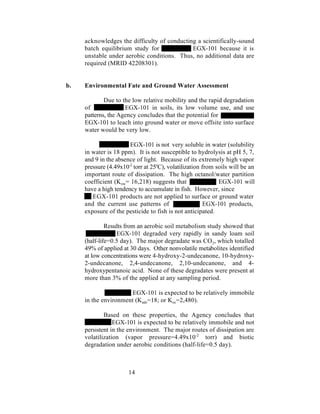
acknowledges the difficulty of conducting a scientifically-sound
     batch equilibrium study for             EGX-101 because it is
     unstable under aerobic conditions. Thus, no additional data are
     required (MRID 42208301).


b.   Environmental Fate and Ground Water Assessment

             Due to the low relative mobility and the rapid degradation
     of              EGX-101 in soils, its low volume use, and use
     patterns, the Agency concludes that the potential for
     EGX-101 to leach into ground water or move offsite into surface
     water would be very low.

                       EGX-101 is not very soluble in water (solubility
     in water is 18 ppm). It is not susceptible to hydrolysis at pH 5, 7,
     and 9 in the absence of light. Because of its extremely high vapor
     pressure (4.49x10⁻² torr at 25oC), volatilization from soils will be an
     important route of dissipation. The high octanol/water partition
     coefficient (Kow= 16,218) suggests that                 EGX-101 will
     have a high tendency to accumulate in fish. However, since
        EGX-101 products are not applied to surface or ground water
     and the current use patterns of                    EGX-101 products,
     exposure of the pesticide to fish is not anticipated.

              Results from an aerobic soil metabolism study showed that
                  EGX-101 degraded very rapidly in sandy loam soil
     (half-life=0.5 day). The major degradate was CO2, which totalled
     49% of applied at 30 days. Other nonvolatile metabolites identified
     at low concentrations were 4-hydroxy-2-undecanone, 10-hydroxy-
     2-undecanone, 2,4-undecanone, 2,10-undecanone, and 4-
     hydroxypentanoic acid. None of these degradates were present at
     more than 3% of the applied at any sampling period.

                       EGX-101 is expected to be relatively immobile
     in the environment (Kads=18; or Koc=2,480).

             Based on these properties, the Agency concludes that
                 EGX-101 is expected to be relatively immobile and not
     persistent in the environment. The major routes of dissipation are
     volatilization (vapor pressure=4.49x10⁻² torr) and biotic
     degradation under aerobic conditions (half-life=0.5 day).


                       14
3.     Exposure and Risk Characterization


                    a.    Exposure and Risk to Nontarget Terrestrial Animals

                          (1)    Birds

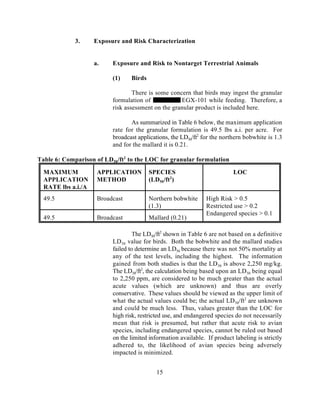
                                  There is some concern that birds may ingest the granular
                          formulation of            EGX-101 while feeding. Therefore, a
                          risk assessment on the granular product is included here.

                                 As summarized in Table 6 below, the maximum application
                          rate for the granular formulation is 49.5 lbs a.i. per acre. For
                          broadcast applications, the LD50/ft2 for the northern bobwhite is 1.3
                          and for the mallard it is 0.21.

Table 6: Comparison of LD50/ft2 to the LOC for granular formulation

  MAXIMUM            APPLICATION         SPECIES                           LOC
  APPLICATION        METHOD              (LD50/ft2)
  RATE lbs a.i./A
  49.5               Broadcast           Northern bobwhite      High Risk > 0.5
                                         (1.3)                  Restricted use > 0.2
                                                                Endangered species > 0.1
  49.5               Broadcast           Mallard (0.21)

                                   The LD50/ft2 shown in Table 6 are not based on a definitive
                          LD 50 value for birds. Both the bobwhite and the mallard studies
                          failed to determine an LD50 because there was not 50% mortality at
                          any of the test levels, including the highest. The information
                          gained from both studies is that the LD 50 is above 2,250 mg/kg.
                          The LD50/ft2, the calculation being based upon an LD50 being equal
                          to 2,250 ppm, are considered to be much greater than the actual
                          acute values (which are unknown) and thus are overly
                          conservative. These values should be viewed as the upper limit of
                          what the actual values could be; the actual LD 50/ft2 are unknown
                          and could be much less. Thus, values greater than the LOC for
                          high risk, restricted use, and endangered species do not necessarily
                          mean that risk is presumed, but rather that acute risk to avian
                          species, including endangered species, cannot be ruled out based
                          on the limited information available. If product labeling is strictly
                          adhered to, the likelihood of avian species being adversely
                          impacted is minimized.


                                           15
(2)    Mammals

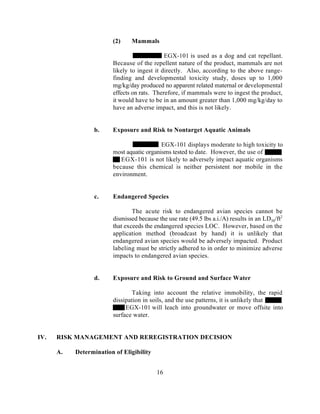
                                             EGX-101 is used as a dog and cat repellant.
                        Because of the repellent nature of the product, mammals are not
                        likely to ingest it directly. Also, according to the above range-
                        finding and developmental toxicity study, doses up to 1,000
                        mg/kg/day produced no apparent related maternal or developmental
                        effects on rats. Therefore, if mammals were to ingest the product,
                        it would have to be in an amount greater than 1,000 mg/kg/day to
                        have an adverse impact, and this is not likely.


                 b.     Exposure and Risk to Nontarget Aquatic Animals

                                           EGX-101 displays moderate to high toxicity to
                        most aquatic organisms tested to date. However, the use of
                           EGX-101 is not likely to adversely impact aquatic organisms
                        because this chemical is neither persistent nor mobile in the
                        environment.


                 c.     Endangered Species

                                The acute risk to endangered avian species cannot be
                        dismissed because the use rate (49.5 lbs a.i./A) results in an LD50/ft2
                        that exceeds the endangered species LOC. However, based on the
                        application method (broadcast by hand) it is unlikely that
                        endangered avian species would be adversely impacted. Product
                        labeling must be strictly adhered to in order to minimize adverse
                        impacts to endangered avian species.


                 d.     Exposure and Risk to Ground and Surface Water

                                Taking into account the relative immobility, the rapid
                        dissipation in soils, and the use patterns, it is unlikely that
                             EGX-101 will leach into groundwater or move offsite into
                        surface water.


IV.   RISK MANAGEMENT AND REREGISTRATION DECISION

      A.   Determination of Eligibility


                                          16
Section 4(g)(2)(A) of FIFRA calls for the Agency to determine, after submission
of relevant data concerning an active ingredient, whether products containing the active
ingredients are eligible for reregistration. The Agency has previously identified and
required the submission of the generic (i.e. active ingredient specific) data required to
support reregistration of products containing           EGX-101 active ingredients. The
Agency has completed its review of these generic data, and has determined that the data
are sufficient to support reregistration of all products containing            EGX-101.
Appendix B identifies the generic data requirements that the Agency reviewed as part of
its determination of reregistration eligibility of               EGX-101, and lists the
submitted studies that the Agency found acceptable.

        The data identified in Appendix B were sufficient to allow the Agency to assess
the registered uses of          EGX-101 and to determine that               EGX-101 can
be used without resulting in unreasonable adverse effects to humans and the environment.
The Agency therefore finds that all products containing           EGX-101 as the active
ingredients are eligible for reregistration. The reregistration of particular products is
addressed in Section V of this document.

        The Agency made its reregistration eligibility determination based upon the target
data base required for reregistration, the current guidelines for conducting acceptable
studies to generate such data, published scientific literature, etc. and the data identified
in Appendix B. Although the Agency has found that all uses of                 EGX-101 are
eligible for reregistration, it should be understood that the Agency may take appropriate
regulatory action, and/or require the submission of additional data to support the
registration of products containing            EGX-101 , if new information comes to the
Agency's attention or if the data requirements for registration (or the guidelines for
generating such data) change.

B.     Determination of Eligibility

       1.      Eligibility Decision

               Based on the reviews of the generic data for the active ingredient
           EGX-101, the Agency has sufficient information on the health effects of
                   EGX-101 and on its potential for causing adverse effects in fish and
       wildlife and the environment. The Agency has determined that
       EGX-101 products, labeled and used as specified in this Reregistration Eligibility
       Decision, will not pose unreasonable risks or adverse effects to humans or the
       environment. Therefore, the Agency concludes that products containing
       EGX-101 for all uses are eligible for reregistration.

       2.      Eligible and Ineligible Uses


                                        17
The Agency has determined that all uses of                     EGX-101 are
      eligible for reregistration.

C.    Regulatory Position

       The following is a summary of the regulatory positions and rationales for
     EGX-101 Where labeling revisions are imposed, specific language is set forth in
Section V of this document.

      1.       Personal Protective Equipment (PPE) for Handlers (Mixer/Loader/
               Applicators)

            At this time there are no engineering control requirements, such as closed
      systems, currently required on labeling for         EGX-101 products.

              For each end-use product, PPE requirements for pesticide handlers will be
      set during reregistration in one of two ways:

           1. If EPA has no special concerns about the acute or other adverse effects of an
           active ingredient, the PPE for pesticide handlers will be established based on
           the acute toxicity of the end-use product. For occupational-use products, PPE
           will be established using the process described in PR Notice 93-7 or more
           recent EPA guidelines.

           2. If EPA has special concerns about an active ingredient due to very high acute
           toxicity or to certain other adverse effects, such as allergic effects, cancer,
           developmental toxicity, or reproductive effects:

           • In the RED for that active ingredient, EPA may establish minimum or
           "baseline" handler PPE requirements that pertain to all or most occupational
           end-use products containing that active ingredient.

           • These minimum PPE requirements must be compared with the PPE that
           would be designated on the basis of the acute toxicity of each end-use product.

           • The more stringent choice for each type of PPE (i.e., bodywear, hand
           protection, footwear, eyewear, etc.) must be placed on the label of the end-use
           product.

         Since there are no special toxicological concerns about             EGX-101,
     the establishment of active-ingredient-based handler PPE requirements is not
     warranted. PPE requirements, if appropriate, will be established based on the acute
     toxicity of the end-use product.


                                        18
2.   Endangered Species Statement

                 The Agency has concerns about the exposure of threatened and endangered bird
             species to         EGX-101 as discussed in the above environmental assessment.
             However, based on the application method of the pesticide, it is unlikely that
             endangered avian species would be adversely impacted.

                  The Endangered Species Protection Program is expected to become final in
             1995. Limitations in the use of                 EGX-101 may be required to protect
             endangered and threatened species, but these limitations have not been defined and
             may be formulation specific. EPA anticipates that a consultation with the Fish and
             Wildlife Service will be conducted in accordance with the species-based priority
             approach described in the Program. After completion of the consultation,
             registrants will be informed if any required label modifications are necessary. Such
             modifications would most likely consist of the generic label statement referring
             pesticide users to use limitations contained in county Bulletins.

V. ACTIONS REQUIRED OF REGISTRANTS

   This section specifies the data requirements and responses necessary for the reregistration of
both manufacturing-use and end-use products.


       1.    Manufacturing-Use Products

             a.   Additional Generic Data Requirements

            The generic data base supporting the reregistration of        EGX-101 for the
       above eligible uses has been reviewed and determined to be complete.


       2.    End-Use Products

             a.   Additional Product-Specific Data Requirements

             Section 4(g)(2)(B) of FIFRA calls for the Agency to obtain any needed product-
       specific data regarding the pesticide after a determination of eligibility has been made.
       The product specific data requirements are listed in Appendix G, the Product Specific
       Data Call-In Notice.

            Registrants must review previous data submissions to ensure that they meet current
       EPA acceptance criteria (Appendix F; Attachment E) and if not, commit to conduct new


                                               19
studies. If a registrant believes that previously submitted data meet current testing
standards, then study MRID numbers should be cited according to the instructions in the
Requirement Status and Registrants Response Form provided for each product.

2.   Entry Restrictions

     The Agency is establishing minimum entry restrictions for all               EGX-101
end-use products, as required for all pesticides, as described below.


          a. Entry Requirements:

          Labeling for sole-active ingredient end-use products that contain          EGX-101
          must be revised to adopt the entry restrictions set forth in this section.
          Any conflicting entry restrictions on their current labeling must be removed.

          The Agency is establishing the following entry restrictions for all homeowner
          uses of         EGX-101 end-use products.

          For liquid applications:

          "Do not allow persons or pets to enter the treated area until sprays have dried."

          For dry applications:

          "Do not allow persons or pets to enter the treated area until dusts have settled."

          Placement on labeling -- Place these statements near the beginning of the
          Directions for Use section of the labeling.


          b. Application Requirements:

          "Do not apply this product in a way that will contact any person or pet,
          either directly or through drift. Keep people and pets out of the area
          during application."

          Placement on labeling -- Place this statement near the beginning of the
          Directions for Use section of the labeling.


                                        20
c. User Safety Requirements:

              • "Follow manufacturer's instructions for cleaning/maintaining personal
              protective equipment. If no such instructions for washables, use detergent and
              hot water. Keep and wash personal protective equipment separately from other
              laundry."

              Placement on labeling -- Place this statement near the beginning of the
              Directions for Use section of the labeling.

              d. User Safety Recommendations:

              • "Users should wash hands before eating, drinking, chewing gum, using
              tobacco, or using the toilet."

              • "Users should remove clothing immediately if pesticide gets on or inside
              clothing. Then wash thoroughly with detergent and hot water separately from
              other laundry and put on clean clothing."

              • "Users should remove personal protective equipment immediately after
              handling this product. Wash the outside of gloves before removing. As soon
              as possible, wash thoroughly and change into clean clothing."

              Placement on labeling -- Place these statements near the beginning of the
              Directions for Use section of the labeling.


    3.    Existing Stocks

    Registrants may generally distribute and sell products bearing old labels/labeling for 26
months from the date of the issuance of this Reregistration Eligibility Decision (RED).
Persons other than the registrant may generally distribute or sell such products for 50 months
from the date of the issuance of this RED. However, existing stocks time frames will be
established case-by-case, depending on the number of products involved, the number of label
changes, and other factors. Refer to "Existing Stocks of Pesticide Products; Statement of
Policy"; Federal Register, Volume 56, No. 123, June 26, 1991.

    The Agency has determined that registrants may distribute and sell             EGX- 101
products bearing old labels/labeling for 26 months from the date of issuance of this RED.
Persons other than the registrant may distribute or sell such products for 50 months from the
date of the issuance of this RED. Registrants and persons other than registrants remain


                                            21
obligated to meet pre-existing Agency imposed label changes and existing stocks
requirements applicable to products they sell or distribute.


                                     22

Mnk us epa red document 29032011

  • 1.
    United States Prevention, Pesticides Environment Protection al And Toxic Substances July 1995 Agency (7508W) Reregistration Eligibility Decision (RED) EGX-101
  • 2.
    UNITED STATES ENVIRONMENTALPROTECTION AGENCY WASHINGTON, D.C. 20460 OFFICE OF PREVENTION, PESTICIDES AND TOXIC SUBSTANCES CERTIFIED MAIL Dear Registrant: I am pleased to announce that the Environmental Protection Agency has completed its reregistration eligibility review and decisions on the pesticide chemical case EGX-101. The enclosed Reregistration Eligibility Decision (RED) contains the Agency's evaluation of the data base of these chemicals, its conclusions of the potential human health and environmental risks of the current product uses, and its decisions and conditions under which these uses and products will be eligible for reregistration. The RED includes the data and labeling requirements for products for reregistration. It may also include requirements for additional data (generic) on the active ingredients to confirm the risk assessments. To assist you with a proper response, read the enclosed document entitled "Summary of Instructions for Responding to the RED". This summary also refers to other enclosed documents which include further instructions. You must follow all instructions and submit complete and timely responses. The first set of required responses are due 90 days from the date of this letter. The second set of required responses are due 8 months from the date of this letter. Complete and timely responses will avoid the Agency taking the enforcement action of suspension against your products. If you have questions on the product specific data requirements or wish to meet with the Agency, please contact the Special Review and Reregistration Division representative Franklin Rubis at (703) 308-8184. Address any questions on required generic data to the Special Review and Reregistration Division representative Paul Lewis at (703) 308-8018. Sincerely yours, Lois Rossi, Director Special Review and Reregistration Division Enclosures
  • 3.
    SUMMARY OF INSTRUCTIONSFOR RESPONDING TO THE REREGISTRATION ELIGIBILITY DECISION (RED) 1. DATA CALL-IN (DCI) OR "90-DAY RESPONSE"--If generic data are required for reregistration, a DCI letter will be enclosed describing such data. If product specific data are required, another DCI letter will be enclosed listing such requirements. If both generic and product specific data are required, a combined Generic and Product Specific letter will be enclosed describing such data. Complete the two response forms provided with each DCI letter (or four forms for the combined) by following the instructions provided. You must submit the response forms for each product and for each DCI within 90 days of the date of this letter (RED issuance date); otherwise, your product may be suspended. 2. TIME EXTENSIONS AND DATA WAIVER REQUESTS--No time extension requests will be granted for the 90-day response. Time extension requests may be submitted only with respect to actual data submissions. Requests for data waivers must be submitted as part of the 90-day response. Requests for time extensions should be submitted in the 90-day response, but certainly no later than the 8-month response date. All data waiver and time extension requests must be accompanied by a full justification. All waivers and time extensions must be granted by EPA in order to go into effect. 3. APPLICATION FOR REREGISTRATION OR "8-MONTH RESPONSE"--You must submit the following items for each product within eight months of the date of this letter (RED issuance date). a. Application for Reregistration (EPA Form 8570-1). Use only an original application form. Mark it "Application for Reregistration." Send your Application for Reregistration (along with the other forms listed in b-e below) to the address listed in item 5. b. Five copies of draft labeling which complies with the RED and current regulations and requirements. Only make labeling changes which are required by the RED and current regulations (40 CFR 156.10) and policies. Submit any other amendments (such as formulation changes, or labeling changes not related to reregistration) separately. You may delete uses which the RED says are ineligible for reregistration. For further labeling guidance, refer to the labeling section of the EPA publication "General Information on Applying for Registration in the U.S., Second Edition, August 1992" (available from the National Technical Information Service, publication #PB92-221811; telephone number 703- 487-4650). c. Generic or Product Specific Data. Submit all data in a format which complies with PR Notice 86-5, and/or submit citations of data already submitted and give the EPA identifier (MRID) numbers. Before citing these studies, you must make sure that they meet the Agency's acceptance criteria (attached to the DCI). d. Two copies of the Confidential Statement of Formula (CSF) for each basic and each alternate formulation. The labeling and CSF which you submit for each product must
  • 4.
    comply with P.R.Notice 91-2 by declaring the active ingredient as the nominal concentration. You have two options for submitting a CSF: (1) accept the standard certified limits (see 40 CFR §158.175) or (2) provide certified limits that are supported by the analysis of five batches. If you choose the second option, you must submit or cite the data for the five batches along with a certification statement as described in 40 CFR §158.175(e). A copy of the CSF is enclosed; follow the instructions on its back. e. Certification With Respect to Data Compensation Requirements. Complete and sign EPA form 8570-31 for each product. 4. COMMENTS IN RESPONSE TO FEDERAL REGISTER NOTICE--Comments pertaining to the content of the RED may be submitted to the address shown in the Federal Register Notice which announces the availability of this RED. 5. WHERE TO SEND PRODUCT SPECIFIC DCI RESPONSES (90-DAY) AND APPLICATIONS FOR REREGISTRATION (8-MONTH RESPONSES) By U.S. Mail: Document Processing Desk (RED-SRRD-PRB) Office of Pesticide Programs (7504C) EPA, 401 M St. S.W. Washington, D.C. 20460-0001 By express: Document Processing Desk (RED-SRRD-PRB) Office of Pesticide Programs (7504C) Room 266A, Crystal Mall 2 1921 Jefferson Davis Hwy. Arlington, VA 22202 6. EPA'S REVIEWS--EPA will screen all submissions for completeness; those which are not complete will be returned with a request for corrections. EPA will try to respond to data waiver and time extension requests within 60 days. EPA will also try to respond to all 8- month submissions with a final reregistration determination within 14 months after the RED has been issued.
  • 5.
    REREGISTRATION ELIGIBILITY DECISION EGX-101 LIST C ENVIRONMENTAL PROTECTION AGENCY OFFICE OF PESTICIDE PROGRAMS SPECIAL REVIEW AND REREGISTRATION DIVISION
  • 6.
    TABLE OF CONTENTS EGX-101 REREGISTRATION ELIGIBILITY DECISION TEAM ................................................................... i EXECUTIVE SUMMARY . . . . . . . . . . . . . . . . . . . . . . . . . . . . . . . . . . . . . . . . . . . . . . . . . . v I. INTRODUCTION . . . . . . . . . . . . . . . . . . . . . . . . . . . . . . . . . . . . . . . . . . . . . . . . . . . 1 II. CASE OVERVIEW . . . . . . . . . . . . . . . . . . . . . . . . . . . . . . . . . . . . . . . . . . . . . . . . . . 2 A. Chemical Overview . . . . . . . . . . . . . . . . . . . . . . . . . . . . . . . . . . . . . . . . . . . . . 2 B. Use Profile . . . . . . . . . . . . . . . . . . . . . . . . . . . . . . . . . . . . . . . . . . . . . . . . . . . . 2 C. Data Requirements . . . . . . . . . . . . . . . . . . . . . . . . . . . . . . . . . . . . . . . . . . . . . 5 D. Regulatory History . . . . . . . . . . . . . . . . . . . . . . . . . . . . . . . . . . . . . . . . . . . . . 5 III. SCIENCE ASSESSMENT . . . . . . . . . . . . . . . . . . . . . . . . . . . . . . . . . . . . . . . . . . . . . 5 A. Physical Chemistry Assessment . . . . . . . . . . . . . . . . . . . . . . . . . . . . . . . . . . . 5 B. Human Health Assessment . . . . . . . . . . . . . . . . . . . . . . . . . . . . . . . . . . . . . . . 6 1. Toxicology Assessment . . . . . . . . . . . . . . . . . . . . . . . . . . . . . . . . . . . . 6 a. Acute Toxicity . . . . . . . . . . . . . . . . . . . . . . . . . . . . . . . . . . . . . . 6 b. Subchronic Toxicity . . . . . . . . . . . . . . . . . . . . . . . . . . . . . . . . . 7 c. Developmental Toxicity . . . . . . . . . . . . . . . . . . . . . . . . . . . . . . 7 d. Mutagenicity . . . . . . . . . . . . . . . . . . . . . . . . . . . . . . . . . . . . . . . 8 e. Toxicology Conclusion . . . . . . . . . . . . . . . . . . . . . . . . . . . . . . . 8 2. Exposure Assessment . . . . . . . . . . . . . . . . . . . . . . . . . . . . . . . . . . . . . 8 a. Occupational and Residential . . . . . . . . . . . . . . . . . . . . . . . . . 8 3. Risk Assessment . . . . . . . . . . . . . . . . . . . . . . . . . . . . . . . . . . . . . . . . . . 9 a. Dietary . . . . . . . . . . . . . . . . . . . . . . . . . . . . . . . . . . . . . . . . . . . . 9 b. Occupational and Residential . . . . . . . . . . . . . . . . . . . . . . . . . 9 C. Environmental Assessment . . . . . . . . . . . . . . . . . . . . . . . . . . . . . . . . . . . . . . 9 1. Ecological Toxicity Data . . . . . . . . . . . . . . . . . . . . . . . . . . . . . . . . . . . 9 a. Toxicity to Terrestrial Animals . . . . . . . . . . . . . . . . . . . . . . . 10 (1) Birds: Acute and Subacute Toxicity. . . . . . . . . . . . 10 (2) Mammals . . . . . . . . . . . . . . . . . . . . . . . . . . . . . . . . . . . 11 b. Toxicity to Aquatic Animals . . . . . . . . . . . . . . . . . . . . . . . . . 11 (1) Freshwater Fish . . . . . . . . . . . . . . . . . . . . . . . . . . . . . 11 (2) Freshwater Invertebrates . . . . . . . . . . . . . . . . . . . . . 12 2. Environmental Fate . . . . . . . . . . . . . . . . . . . . . . . . . . . . . . . . . . . . . . 12 a. Environmental Fate and Transport . . . . . . . . . . . . . . . . . . . 12 (1) Hydrolysis . . . . . . . . . . . . . . . . . . . . . . . . . . . . . . . . . . 12 (2) Aerobic Soil Metabolism . . . . . . . . . . . . . . . . . . . . . . 13 (3) Leaching-Adsorption/Desorption . . . . . . . . . . . . . . . 13
  • 7.
    b. Environmental Fate and Ground Water Assessment . . . . . 14 3. Exposure and Risk Characterization . . . . . . . . . . . . . . . . . . . . . . . . 15 a. Exposure and Risk to Nontarget Terrestrial Animals . . . . 15 (1) Birds . . . . . . . . . . . . . . . . . . . . . . . . . . . . . . . . . . . . . . . 15 (2) Mammals . . . . . . . . . . . . . . . . . . . . . . . . . . . . . . . . . . . 16 b. Exposure and Risk to Nontarget Aquatic Animals . . . . . . . 16 c. Endangered Species . . . . . . . . . . . . . . . . . . . . . . . . . . . . . . . . 16 d. Exposure and Risk to Ground and Surface Water . . . . . . . 16 IV. RISK MANAGEMENT AND REREGISTRATION DECISION . . . . . . . . . . . . 16 A. Determination of Eligibility . . . . . . . . . . . . . . . . . . . . . . . . . . . . . . . . . . . . . 16 B. Determination of Eligibility . . . . . . . . . . . . . . . . . . . . . . . . . . . . . . . . . . . . . 17 1. Eligibility Decision . . . . . . . . . . . . . . . . . . . . . . . . . . . . . . . . . . . . . . . 17 2. Eligible and Ineligible Uses . . . . . . . . . . . . . . . . . . . . . . . . . . . . . . . 17 C. Regulatory Position . . . . . . . . . . . . . . . . . . . . . . . . . . . . . . . . . . . . . . . . . . . . 18 V. ACTIONS REQUIRED OF REGISTRANTS . . . . . . . . . . . . . . . . . . . . . . . . . . . . 19 1. Manufacturing-Use Products . . . . . . . . . . . . . . . . . . . . . . . . . . . . . . 19 a. Additional Generic Data Requirements . . . . . . . . . . . . . . . . 19 2. End-Use Products . . . . . . . . . . . . . . . . . . . . . . . . . . . . . . . . . . . . . . . 19 a. Additional Product-Specific Data Requirements . . . . . . . . 19 3. Existing Stocks . . . . . . . . . . . . . . . . . . . . . . . . . . . . . . . . . . . . . . . . . . 21
  • 8.
    EGX-101 REREGISTRATION ELIGIBILITYDECISION TEAM Office of Pesticide Programs: Biological and Economic Analysis Division Doug Sutherland Biological Analysis Branch Art Grube Economic Analysis Branch Gabe Patrick Biological Analysis Branch Environmental Fate and Effects Division Larry Liu Environmental Fate and Groundwater Branch Renee Costello Ecological Effects Branch Karen Angulo Science Analysis and Coordination Staff Health Effects Division Winston Dang Occupational and Residential Exposure Branch Alan Levy Toxicology Branch II Kathryn Boyle Risk Characterization and Analysis Branch Registration Division Beth Edwards PM 14 Shyam Mathur Registration Support Branch Special Review and Reregistration Division Paul Lewis Accelerated Reregistration Branch Mark Wilhite Accelerated Reregistration Branch Carol Stangel Planning and Reregistration Branch Office of Compliance Monitoring Beverly Updike Office of General Counsel Kevin Lee i
  • 9.
  • 10.
    GLOSSARY OF TERMSAND ABBREVIATIONS ADI Acceptable Daily Intake. A now defunct term for reference dose (RfD). AE Acid Equivalent a.i. Active Ingredient ARC Anticipated Residue Contribution CAS Chemical Abstracts Service CI Cation CNS Central Nervous System CSF Confidential Statement of Formula DFR Dislodgeable Foliar Residue DRES Dietary Risk Evaluation System DWEL Drinking Water Equivalent Level (DWEL) The DWEL represents a medium specific (i.e. drinking water) lifetime exposure at which adverse, non carcinogenic health effects are not anticipated to occur. EEC Estimated Environmental Concentration. The estimated pesticide concentration in an environment, such as a terrestrial ecosystem. EP End-Use Product EPA U.S. Environmental Protection Agency FDA Food and Drug Administration FIFRA Federal Insecticide, Fungicide, and Rodenticide Act FFDCA Federal Food, Drug, and Cosmetic Act FOB Functional Observation Battery GLC Gas Liquid Chromatography GM Geometric Mean GRAS Generally Recognized as Safe as Designated by FDA HA Health Advisory (HA) The HA values are used as informal guidance to municipalities and other organizations when emergency spills or contamination situations occur. HDT Highest Dose Tested LC50 Median Lethal Concentration. A statistically derived concentration of a substance that can b e expected to cause death in 50% of test animals. It is usually expressed as the weight of substance per weight or volume of water, air or feed, e.g., mg/l, mg/kg or ppm. LD 50 Median Lethal Dose. A statistically derived single dose that can be expected to cause death in 50% of the test animals when administered by the route indicated (oral, dermal, inhalation). It i s expressed as a weight of substance per unit weight of animal, e.g., mg/kg. LDlo Lethal Dose-low. Lowest Dose at which lethality occurs LEL Lowest Effect Level LOC Level of Concern LOD Limit of Detection LOEL Lowest Observed Effect Level MATC Maximum Acceptable Toxicant Concentration MCLG Maximum Contaminant Level Goal (MCLG) The MCLG is used by the Agency to regulat e contaminants in drinking water under the Safe Drinking Water Act. µg/g Micrograms Per Gram mg/L Milligrams Per Liter MOE Margin of Exposure MP Manufacturing-Use Product MPI Maximum Permissible Intake MRID Master Record Identification (number). EPA's system of recording and tracking studies submitted. N/A Not Applicable NOEC No effect concentration NPDES National Pollutant Discharge Elimination System iii
  • 11.
    GLOSSARY OF TERMSAND ABBREVIATIONS NOEL No Observed Effect Level NOAEL No Observed Adverse Effect Level OP Organophosphate OPP Office of Pesticide Programs PADI Provisional Acceptable Daily Intake PAG Pesticide Assessment Guideline PAM Pesticide Analytical Method PHED Pesticide Handler's Exposure Data ppb Parts Per Billion PPE Personal Protective Equipment ppm Parts Per Million PRN Pesticide Registration Notice Q*1 The Carcinogenic Potential of a Compound, Quantified by the EPA's Cancer Risk Model RBC Red Blood Cell RED Reregistration Eligibility Decision REI Restricted Entry Interval RfD Reference Dose RS Registration Standard SLN Special Local Need (Registrations Under Section 24 (c) of FIFRA) TC Toxic Concentration. The concentration at which a substance produces a toxic effect. TD Toxic Dose. The dose at which a substance produces a toxic effect. TEP Typical End-Use Product TGAI Technical Grade Active Ingredient TLC Thin Layer Chromatography TMRC Theoretical Maximum Residue Contribution torr A unit of pressure needed to support a column of mercury 1 mm high under standard conditions. FAO/WHO Food and Agriculture Organization/World Health Organization WP Wettable Powder WPS Worker Protection Standard iv
  • 12.
    EXECUTIVE SUMMARY The U.S. Environmental Protection Agency (hereafter referred to as the "Agency" or "EPA") has completed its reregistration assessment of the available information on the pesticidal active ingredient EGX-101. The active ingredient has pesticidal activity as a dog and cat repellant/training aid and as an iris borer deterrent. Use sites include household/domestic dwelling contents, vegetable gardens, ornamental shade trees, ornamental herbaceous plants, ornamental lawns and turf, ornamental woody shrubs and vines, paths/patios and refuse/solid waste containers. The Agency has reviewed the available data for EGX-101 and has determined that products registered for the uses described in this reregistration eligibility decision document as currently registered will not cause unreasonable risk to humans or the environment and that these products are eligible for reregistration. Before reregistering the products containing EGX-101, the Agency is requiring that product specific data, revised Confidential Statements of Formula (CSF) and revised labeling be submitted within eight months of the issuance of this document. These data include product chemistry for each registration and acute toxicity testing. After reviewing these data and any revised labels and finding them acceptable in accordance with Section 3(c)(5) of FIFRA, the Agency will reregister a product. Those products which contain other active ingredients will be eligible for reregistration only when the other active ingredients are determined to be eligible for reregistration. v
  • 13.
    I. INTRODUCTION In 1988, the Federal Insecticide, Fungicide, and Rodenticide Act (FIFRA) was amended to accelerate the reregistration of products with active ingredients registered prior to November 1, 1984. The amended Act provides a schedule for the reregistration process to be completed in nine years. There are five phases to the reregistration process. The first four phases of the process focus on identification of data requirements to support the reregistration of an active ingredient and the generation and submission of data to fulfill the requirements. The fifth phase is a review by the U.S. Environmental Protection Agency (referred to as "the Agency") of all data submitted to support reregistration. FIFRA Section 4(g)(2)(A) states that in Phase 5 "the Administrator shall determine whether pesticides containing such active ingredient are eligible for reregistration" before calling in data on products and either reregistering products or taking "other appropriate regulatory action." Thus, reregistration involves a thorough review of the scientific data base underlying a pesticide's registration. The purpose of the Agency's review is to reassess the potential hazards arising from the currently registered uses of the pesticide; to determine the need for additional data on health and environmental effects; and to determine whether the pesticide meets the "no unreasonable adverse effects" criterion of FIFRA. This document presents the Agency's decision regarding the reregistration eligibility of the registered uses of EGX-101. The document consists of six sections. Section I is the introduction. Section II describes EGX-101, its uses, data requirements and regulatory history. Section III discusses the human health and environmental assessment based on the data available to the Agency. Section IV presents the reregistration decision for EGX-101. Section V discusses the reregistration requirements for EGX-101. Finally, Section VI is the Appendices which support this Reregistration Eligibility Decision. Additional details concerning the Agency's review of applicable data are available on request. 1
  • 14.
    II. CASE OVERVIEW A. Chemical Overview The following active ingredient is covered by this Reregistration Eligibilit y Decision: Common Name: EGX-101 B. Use Profile The following is informa tion on the currently registered uses with an overview of use sites and application methods. A detailed table of these uses of EGX-101 is in Appendix A. Type of Pesticide: dog and cat repellent/training aid and iris borer deterrent Use Sites: Indoor Residential household/domestic dwellings contents Outdoor Residential household/domestic dwellings outdoor premises paths/pations 2
  • 15.
    solid waste containers(garbage cans and bags) Terrestrial Nonfood Crop ornamental and/or shade trees ornamental herbaceous plants ornamental lawns and turf ornamental woody shrubs and vines around perimeters of vegetable plantings paths/patios refuse/solid waste containers (garbage cans and bags) Target Pests: dog, cat and iris borer Method of application: Outdoor: granular and crystals: band or broadcast to soil or ground as perimeter or border treatme nt, between rows or around base of ornamental plants and objects. pressurized liquid or liquid ready-to-u se: apply to bark of trees and base of shrubs. For surface treatments, spray a piece of cloth and attach it to item to be protected. The item may or may not be dry. Indoor: for a spot tre atment, spray a piece of cloth and attach it to item to be protected. The item may or may not be dry. 3
  • 16.
    Application equipment: granular formulation:fertilizer spreader and by hand pressurized liquid and liquid ready-to-use: pump sprayer and aersol can Application timing: Dog and cat: granular and crystals: repels cats a nd dogs up to seven to ten days. Repeat until undesirable animal habits are broken. Repeat after rain. With crysta l formulation, apply at three to four day intervals. pressurized liquid or liquid ready to use: repels cats and dogs for 12-2 4 hours. Apply every day or two or as needed. Iris borer: spray in the spring, midsummer and a t time of transplanting. Spray leaves after sunset or on cloudy days and soil around plants and between rows. Spra y rhizomes when transplanting and the ground into which new rhizomes are set . Reapply if weather is cold or rain results in new growth of the host. Application rate: granular and crystalline formulation: sprinkle/scatter 4 lbs/1000 sq. ft. (1.28 oz. a.i.) or 1-2 cupfuls/100 sq. ft. on soil or ground area. pressurized liquid and liquid ready-to-use: apply until surf ace is slightly moistened. Use Practice Limitations: Do not apply directly to ornamental or other plants unless instructed to becaus e some vegetation may be damaged. Pressurized liquid and liquid ready-to-use formulations may stain or soften some fabrics or plastics. Do not use in commercial food processing or preparation areas. Do not contaminate food or feedstuffs. Cover exposed food , food processing areas and food processing utensils. Do not apply to food crops. Do not apply to soft stemmed bodied plants. Do not apply directly to water. 4
  • 17.
    Estimated Usage ofPesticide Due to a lack of usage for EGX-101, the Agency cannot estimate the volume of use of this pesticide. However, it assumes the volume is relatively low. C. Data Requirements A Data Call -In was issued in 1992 for EGX-101 requiring the submission of additional product chemistry data. D. Regulatory History EGX-101 was first registered in the United States in 1966 for use as a dog and cat repellant. Currently, there are 48 products registered to 65 companies. The Appendix B of this document includes all data requirements identified by the Agency for currently registered uses needed to support reregistration. III. SCIENCE ASSESSMENT A. Physical Chemistry Assessment Common name: EGX-101 Molecular weight: 170.29 TGAI: EGX-101 Color: Colorless Physical state: Clear liquid at room temperature Odor: Slight acrid odor Melting point: 11-14o C Boiling point: 233-234o C 5
  • 18.
    Density: 0.827 g/ml at 20o C Solubility: in water: 18.0 x 10⁻³ g/l in organic solvents: is completely miscible with acetone, methanol, isopropanol, petroleum ether, vista LPA, Cyclo Solv (aromatic), and chloroethene. Vapor pressure: 4.49 x 10⁻² Torr at 25o C Octanol/water partition coefficient: koc = 16,601 Stability: Stable at room temperature. Slight discoloration was observed over an extended period of time. Storage stability: One year of storage at room temperature did not produce any significant change regarding purity, color, specific gravity, and refractive index. Viscosity: 7.5 cps at 22o C Corrosion characteristics: EGX-101 is considered non-corrosive after 12 months of storage at room temperature. B. Human Health Assessment 1. Toxicology Assessment The EGX-101 toxicological data base is adequate and will support reregistration eligibility. a. Acute Toxicity Table 1 below describes the acute toxicity of EGX-101. 6
  • 19.
    Table 1: AcuteToxicity TEST MRID RESULTS CATEGORY Oral LD50 - rat 41904101 >5,000 mg/kg males and IV females Dermal LD50 - rabbit 41904102 >2,000 mg/kg males and III 43163801 females Inhalation LC50 - rat 41904103 >5.43 mg/L IV Eye irritation - rabbit * 41904104 mild conjunctival irritant III Dermal irritation - rabbit * 41904105 mild erythema/eschar and III edema Dermal sensitization - 41904106 weak sensitizer N/A guinea pig * * study is not required on technical grade active ingredient. Data are provided for informational purposes In an eye irritation study, EGX-101 was observed to cause conjunctival irritation in 6/6 New Zealand white rabbits through 24 hours, 4/6 at 48 hours, 2/6 at 72 hours, 1/6 at 4 days and 0/6 at 7 days. In a dermal irritation study in New Zealand white rabbits, erythema and eschar formation were present in 6/6 animals through 72 hours and 3/6 at 7 days; edema was noted in 5/6 at 30-60 minutes, 2/6 at 24-72 hours and 0/6 at 7 days. There was the appearance of weak skin sensitization during the challenge phase of a dermal sensitization study in guinea pigs. b. Subchronic Toxicity In a 21-day dermal toxicity study, EGX-101 was administered at doses of 0, 30, 100, or 300 mg/kg/day (21 consecutive days) to young adult male and female New Zealand white rabbits. The systemic NOEL was equal to or greater than 300 mg/kg/day with the LOEL being greater than 300 mg/kg/day. The NOEL for dermal irritation was 100 mg/kg/day with the LOEL being 300 mg/kg/day based on moderate to severe dermal irritation (MRID 43110301). c. Developmental Toxicity In a developmental toxicity (teratology) study, EGX-101 was administered at doses of 0, 100, 300, or 1,000 mg/kg/day by gavage 7
  • 20.
    to Charles RiverCrl:CD BR albino rats on gestation days 6 through 15. There was no evidence of maternal toxicity or developmental toxicity. Therefore, both the maternal and developmental NOELs were set at >1,000 mg/kg/day (the highest dose tested) (MRID 42225901, 42225902). d. Mutagenicity In a mouse lymphoma cell forward mutation study, dosing levels of 0, 0.0032, 0.0042, 0.0056, 0.0075, 0.010, 0.013, 0.018, 0.024, 0.032, or 0.042 L/mL in the absence of S9, and 0, 0.013, 0.018, 0.024, 0.032, 0.042, 0.056, 0.075, 0.10, or 0.13 L/mL in the presence of S9 were tested. The cultures were exposed to the EGX-101 for 4 hours. There was no evidence of induced forward mutation at the TK locus at any of the doses tested with or without the S9 activation (MRID 41740001). In a Chinese hamster ovary study, dosing levels of 0, 0.0065, 0.013, 0.025, 0.05 or 0.10 L/mL with and without S9 activation were tested. There was no evidence of induced chromosomal aberrations over the control values at any of the doses tested with or without the S9 activation (MRID 41783101). In an unscheduled DNA synthesis (UDS) assay, primary rat hepatocytes were exposed to dosing levels of 0, 0.003, 0.01, 0.03, 0.1, or 0.3 L/mL for 18 - 20 hours in the presence of tritiated thymidine. There was no evidence of UDS induction as measured by the incorporation of tritiated thymidine into DNA (autoradiography) (41774401). e. Toxicology Conclusion Based on available information, no toxicological endpoints of concern (such as short term or intermediate term) were identified. 2. Exposure Assessment a. Occupational and Residential An occupational and/or residential exposure assessment is required for an active ingredient if certain toxicological criteria are met and if there is potential exposure to handlers (mixers, loaders, applicators) during use or to persons entering treated sites after application is complete. Handler (Mixer/Loader/Applicators) Exposures 8
  • 21.
    There is apotential for exposure to mixer/loader/applicators during the use-patterns associated with EGX-101, specifically potential exposures arising from applying granulars by hand and lawn spreaders, and applying liquid sprays to ornamentals, furniture, and rugs. Post-Application Exposures There is a potential for exposure to persons entering treated sites after application of EGX-101 is complete, specifically potential post-application exposure arising from re-entering treated lawns, gardens, and residences. Need for Assessment While there is a potential for exposure to handlers as well as post- application exposure, an occupational and/or residential exposure assessment for EGX-101 is not required because there are no toxicological endpoints of concern. 3. Risk Assessment a. Dietary Based on the current use patterns and exposure profiles for EGX-101, residues in/on food and/or feed are not expected to occur. Therefore, a dietary risk characterization is not required. b. Occupational and Residential As stated previously, no appropriate endpoints for short term or intermediate term occupational or residential risk assessment were identified. Therefore, a risk characterization is not required. C. Environmental Assessment The Agency has adequate data to assess the risk of EGX-101 t o nontarget terrestrial organisms. 1. Ecological Toxicity Data 9
  • 22.
    a. Toxicity to Terrestrial Animals (1) Birds: Acute and Subacute Toxicity. In order to establish the acute and subacute toxicity of EGX-101 to birds, the following tests were required using the technical grade of the active ingredient (a.i.): one avian single-dose oral (LD 50) study on one species (preferably mallard or bobwhite quail) and subacute dietary studies (LC50) on one species of waterfowl (preferably the mallard duck) and one species of upland game bird (preferably bobwhite quail). The results of the studies summarized in Tables 2 and 3 below indicate that EGX-101 is practically nontoxic to avian species on an acute oral (Table 2) and subacute dietary (Table 3) basis. The guideline requirements for both the avian acute oral LD50 and the avian subacute dietary LD 50 studies have been met. Table 2. Avian Acute Oral Toxicity LD50 SPECIES % A.I. (mg/kg) MRID CONCLUSION TESTED Northern 100 > 2,250 41986501 Practically Bobwhite nontoxic Mallard 100 > 2,250 41986502 Practically nontoxic Table 3: Avian Subacute Dietary Toxicity SPECIES CONCLUSIO TESTED % A.I. LC50 (ppm) MRID N Northern 100 > 5,620 41947901 Practically Bobwhite nontoxic Mallard 100 > 5,620 41947902 Practically nontoxic 10
  • 23.
    (2) Mammals Wild mammal testing is required on a case-by-case basis, depending on the results of the lower tier studies such as acute and subacute testing, intended use pattern, and pertinent environmental fate characteristics. Under the conditions of a range-finding and developmental toxicity study done for the Agency, as summarized in the Human Health Assessment, doses up to 1,000 mg/kg/day produced no apparent related maternal or developmental effects on rats. Based on these conclusions, wild animal testing was not required for EGX-101. b. Toxicity to Aquatic Animals (1) Freshwater Fish In order to establish the toxicity of EGX-101 to freshwater fish, the minimum data required on the technical grade of the active ingredient are two freshwater fish toxicity studies. One study should use a coldwater species (preferably the rainbow trout), and the other should use a warmwater species (preferably the bluegill sunfish). The results of the acute toxicity studies summarized in Table 4 below indicate that EGX-101 is moderately toxic to both cold and warmwater fish. The guideline requirements for the freshwater fish toxicity studies have been met. 11
  • 24.
    Table 4: FreshwaterFish Acute Toxicity SPECIES % A.I. LC50 (ppm) MRID CONCLUSION TESTED Rainbow trout 100 3.0 41909603 Moderately toxic Bluegill sunfish 100 2.1 41909602 Moderately toxic (2) Freshwater Invertebrates The minimum testing required to assess the hazard of EGX-101 to freshwater invertebrates is a freshwater aquatic invertebrate toxicity test, preferably using first instar Daphnia magna or early instar amphipods, stoneflies, mayflies, or midges. The results of the freshwater aquatic invertebrate toxicity study summarized in Table 5 below indicate that there is sufficient information to characterize EGX-101 as highly toxic to aquatic invertebrates. The guideline requirement for the freshwater aquatic invertebrate toxicity study has been met. Table 5: Freshwater Invertebrate Toxicity SPECIES TESTED % A.I. EC50 (ppm) MRID CONCLUSION Daphnia 97.9 0.54 41909604 Highly toxic magna 2. Environmental Fate a. Environmental Fate and Transport (1) Hydrolysis In a study addressing the hydrolysis of EGX-101, the data indicated that the pesticide does not undergo hydrolysis. EGX-101 did not hydrolyze in sterile buffered aqueous 12
  • 25.
    solutions (pH 5,7, and 9) incubated in the dark at 25 0 C for 30 days. At the end of the study, EGX-101 was 84.7 - 98.9%, 94.0-103.1%, and 90.7-101.5% of the applied for the pH 5, pH 7, and the pH 9 buffered test solutions, respectively. Material balances ranged from 87.5 to 100.8% of the applied radioactivity. Therefore, the study was acceptable to support the Hydrolysis data requirement (MRID 41986401). (2) Aerobic Soil Metabolism The degradation of EGX-101 in soil appears to be microbiologically mediated under aerobic conditions (with a half-life of 0.5 day). In an aerobic soil metabolism study, EGX-101, at 10 ppm, degraded with a half-life of approximately 0.5 days in sandy loam soil incubated aerobically at 250 + 10 C. The major degradate was CO2, which totalled 48.7% of the applied at 30 days. Other metabolites of EGX-101 were: 4-hydroxy-2-undecanone; 10-hydroxy-2-undecanone; 2,4- undecanone; 2,10-undecanone and; 4-hydroxypentanoic acid. None of these metabolites were present more than 3% of the applied at any sampling period. Therefore, the study was acceptable to support the Aerobic Soil Metabolism data requirement (MRID 42497201). (3) Leaching-Adsorption/Desorption In a Leaching-Adsorption/Desorption study, EGX-101 was observed to be relatively immobile in soil and have a low potential to leach into ground water or move offsite into surface water. EGX-101 was determined to be relatively immobile in sodium azide-sterilized sandy loam, clay loam, sand, and silt loam soils (Kads=18; Koc=2,480). Therefore, the study was found to be acceptable to support the Leaching- Adsorption/Desorption data requirement. Although the leaching-adsorption/desorption data requirement is satisfied, the Agency has concerns about the use of sodium azide as a chemical inhibitor for sterilization of soils. The Agency believes that physical or chemical sterilization (such as autoclaving or use of sodium azide) may subtly alter the soil chemistry, thus complicating the interpretation of the results obtained in the batch equilibrium studies. The Agency 13
  • 26.
    acknowledges the difficultyof conducting a scientifically-sound batch equilibrium study for EGX-101 because it is unstable under aerobic conditions. Thus, no additional data are required (MRID 42208301). b. Environmental Fate and Ground Water Assessment Due to the low relative mobility and the rapid degradation of EGX-101 in soils, its low volume use, and use patterns, the Agency concludes that the potential for EGX-101 to leach into ground water or move offsite into surface water would be very low. EGX-101 is not very soluble in water (solubility in water is 18 ppm). It is not susceptible to hydrolysis at pH 5, 7, and 9 in the absence of light. Because of its extremely high vapor pressure (4.49x10⁻² torr at 25oC), volatilization from soils will be an important route of dissipation. The high octanol/water partition coefficient (Kow= 16,218) suggests that EGX-101 will have a high tendency to accumulate in fish. However, since EGX-101 products are not applied to surface or ground water and the current use patterns of EGX-101 products, exposure of the pesticide to fish is not anticipated. Results from an aerobic soil metabolism study showed that EGX-101 degraded very rapidly in sandy loam soil (half-life=0.5 day). The major degradate was CO2, which totalled 49% of applied at 30 days. Other nonvolatile metabolites identified at low concentrations were 4-hydroxy-2-undecanone, 10-hydroxy- 2-undecanone, 2,4-undecanone, 2,10-undecanone, and 4- hydroxypentanoic acid. None of these degradates were present at more than 3% of the applied at any sampling period. EGX-101 is expected to be relatively immobile in the environment (Kads=18; or Koc=2,480). Based on these properties, the Agency concludes that EGX-101 is expected to be relatively immobile and not persistent in the environment. The major routes of dissipation are volatilization (vapor pressure=4.49x10⁻² torr) and biotic degradation under aerobic conditions (half-life=0.5 day). 14
  • 27.
    3. Exposure and Risk Characterization a. Exposure and Risk to Nontarget Terrestrial Animals (1) Birds There is some concern that birds may ingest the granular formulation of EGX-101 while feeding. Therefore, a risk assessment on the granular product is included here. As summarized in Table 6 below, the maximum application rate for the granular formulation is 49.5 lbs a.i. per acre. For broadcast applications, the LD50/ft2 for the northern bobwhite is 1.3 and for the mallard it is 0.21. Table 6: Comparison of LD50/ft2 to the LOC for granular formulation MAXIMUM APPLICATION SPECIES LOC APPLICATION METHOD (LD50/ft2) RATE lbs a.i./A 49.5 Broadcast Northern bobwhite High Risk > 0.5 (1.3) Restricted use > 0.2 Endangered species > 0.1 49.5 Broadcast Mallard (0.21) The LD50/ft2 shown in Table 6 are not based on a definitive LD 50 value for birds. Both the bobwhite and the mallard studies failed to determine an LD50 because there was not 50% mortality at any of the test levels, including the highest. The information gained from both studies is that the LD 50 is above 2,250 mg/kg. The LD50/ft2, the calculation being based upon an LD50 being equal to 2,250 ppm, are considered to be much greater than the actual acute values (which are unknown) and thus are overly conservative. These values should be viewed as the upper limit of what the actual values could be; the actual LD 50/ft2 are unknown and could be much less. Thus, values greater than the LOC for high risk, restricted use, and endangered species do not necessarily mean that risk is presumed, but rather that acute risk to avian species, including endangered species, cannot be ruled out based on the limited information available. If product labeling is strictly adhered to, the likelihood of avian species being adversely impacted is minimized. 15
  • 28.
    (2) Mammals EGX-101 is used as a dog and cat repellant. Because of the repellent nature of the product, mammals are not likely to ingest it directly. Also, according to the above range- finding and developmental toxicity study, doses up to 1,000 mg/kg/day produced no apparent related maternal or developmental effects on rats. Therefore, if mammals were to ingest the product, it would have to be in an amount greater than 1,000 mg/kg/day to have an adverse impact, and this is not likely. b. Exposure and Risk to Nontarget Aquatic Animals EGX-101 displays moderate to high toxicity to most aquatic organisms tested to date. However, the use of EGX-101 is not likely to adversely impact aquatic organisms because this chemical is neither persistent nor mobile in the environment. c. Endangered Species The acute risk to endangered avian species cannot be dismissed because the use rate (49.5 lbs a.i./A) results in an LD50/ft2 that exceeds the endangered species LOC. However, based on the application method (broadcast by hand) it is unlikely that endangered avian species would be adversely impacted. Product labeling must be strictly adhered to in order to minimize adverse impacts to endangered avian species. d. Exposure and Risk to Ground and Surface Water Taking into account the relative immobility, the rapid dissipation in soils, and the use patterns, it is unlikely that EGX-101 will leach into groundwater or move offsite into surface water. IV. RISK MANAGEMENT AND REREGISTRATION DECISION A. Determination of Eligibility 16
  • 29.
    Section 4(g)(2)(A) ofFIFRA calls for the Agency to determine, after submission of relevant data concerning an active ingredient, whether products containing the active ingredients are eligible for reregistration. The Agency has previously identified and required the submission of the generic (i.e. active ingredient specific) data required to support reregistration of products containing EGX-101 active ingredients. The Agency has completed its review of these generic data, and has determined that the data are sufficient to support reregistration of all products containing EGX-101. Appendix B identifies the generic data requirements that the Agency reviewed as part of its determination of reregistration eligibility of EGX-101, and lists the submitted studies that the Agency found acceptable. The data identified in Appendix B were sufficient to allow the Agency to assess the registered uses of EGX-101 and to determine that EGX-101 can be used without resulting in unreasonable adverse effects to humans and the environment. The Agency therefore finds that all products containing EGX-101 as the active ingredients are eligible for reregistration. The reregistration of particular products is addressed in Section V of this document. The Agency made its reregistration eligibility determination based upon the target data base required for reregistration, the current guidelines for conducting acceptable studies to generate such data, published scientific literature, etc. and the data identified in Appendix B. Although the Agency has found that all uses of EGX-101 are eligible for reregistration, it should be understood that the Agency may take appropriate regulatory action, and/or require the submission of additional data to support the registration of products containing EGX-101 , if new information comes to the Agency's attention or if the data requirements for registration (or the guidelines for generating such data) change. B. Determination of Eligibility 1. Eligibility Decision Based on the reviews of the generic data for the active ingredient EGX-101, the Agency has sufficient information on the health effects of EGX-101 and on its potential for causing adverse effects in fish and wildlife and the environment. The Agency has determined that EGX-101 products, labeled and used as specified in this Reregistration Eligibility Decision, will not pose unreasonable risks or adverse effects to humans or the environment. Therefore, the Agency concludes that products containing EGX-101 for all uses are eligible for reregistration. 2. Eligible and Ineligible Uses 17
  • 30.
    The Agency hasdetermined that all uses of EGX-101 are eligible for reregistration. C. Regulatory Position The following is a summary of the regulatory positions and rationales for EGX-101 Where labeling revisions are imposed, specific language is set forth in Section V of this document. 1. Personal Protective Equipment (PPE) for Handlers (Mixer/Loader/ Applicators) At this time there are no engineering control requirements, such as closed systems, currently required on labeling for EGX-101 products. For each end-use product, PPE requirements for pesticide handlers will be set during reregistration in one of two ways: 1. If EPA has no special concerns about the acute or other adverse effects of an active ingredient, the PPE for pesticide handlers will be established based on the acute toxicity of the end-use product. For occupational-use products, PPE will be established using the process described in PR Notice 93-7 or more recent EPA guidelines. 2. If EPA has special concerns about an active ingredient due to very high acute toxicity or to certain other adverse effects, such as allergic effects, cancer, developmental toxicity, or reproductive effects: • In the RED for that active ingredient, EPA may establish minimum or "baseline" handler PPE requirements that pertain to all or most occupational end-use products containing that active ingredient. • These minimum PPE requirements must be compared with the PPE that would be designated on the basis of the acute toxicity of each end-use product. • The more stringent choice for each type of PPE (i.e., bodywear, hand protection, footwear, eyewear, etc.) must be placed on the label of the end-use product. Since there are no special toxicological concerns about EGX-101, the establishment of active-ingredient-based handler PPE requirements is not warranted. PPE requirements, if appropriate, will be established based on the acute toxicity of the end-use product. 18
  • 31.
    2. Endangered Species Statement The Agency has concerns about the exposure of threatened and endangered bird species to EGX-101 as discussed in the above environmental assessment. However, based on the application method of the pesticide, it is unlikely that endangered avian species would be adversely impacted. The Endangered Species Protection Program is expected to become final in 1995. Limitations in the use of EGX-101 may be required to protect endangered and threatened species, but these limitations have not been defined and may be formulation specific. EPA anticipates that a consultation with the Fish and Wildlife Service will be conducted in accordance with the species-based priority approach described in the Program. After completion of the consultation, registrants will be informed if any required label modifications are necessary. Such modifications would most likely consist of the generic label statement referring pesticide users to use limitations contained in county Bulletins. V. ACTIONS REQUIRED OF REGISTRANTS This section specifies the data requirements and responses necessary for the reregistration of both manufacturing-use and end-use products. 1. Manufacturing-Use Products a. Additional Generic Data Requirements The generic data base supporting the reregistration of EGX-101 for the above eligible uses has been reviewed and determined to be complete. 2. End-Use Products a. Additional Product-Specific Data Requirements Section 4(g)(2)(B) of FIFRA calls for the Agency to obtain any needed product- specific data regarding the pesticide after a determination of eligibility has been made. The product specific data requirements are listed in Appendix G, the Product Specific Data Call-In Notice. Registrants must review previous data submissions to ensure that they meet current EPA acceptance criteria (Appendix F; Attachment E) and if not, commit to conduct new 19
  • 32.
    studies. If aregistrant believes that previously submitted data meet current testing standards, then study MRID numbers should be cited according to the instructions in the Requirement Status and Registrants Response Form provided for each product. 2. Entry Restrictions The Agency is establishing minimum entry restrictions for all EGX-101 end-use products, as required for all pesticides, as described below. a. Entry Requirements: Labeling for sole-active ingredient end-use products that contain EGX-101 must be revised to adopt the entry restrictions set forth in this section. Any conflicting entry restrictions on their current labeling must be removed. The Agency is establishing the following entry restrictions for all homeowner uses of EGX-101 end-use products. For liquid applications: "Do not allow persons or pets to enter the treated area until sprays have dried." For dry applications: "Do not allow persons or pets to enter the treated area until dusts have settled." Placement on labeling -- Place these statements near the beginning of the Directions for Use section of the labeling. b. Application Requirements: "Do not apply this product in a way that will contact any person or pet, either directly or through drift. Keep people and pets out of the area during application." Placement on labeling -- Place this statement near the beginning of the Directions for Use section of the labeling. 20
  • 33.
    c. User SafetyRequirements: • "Follow manufacturer's instructions for cleaning/maintaining personal protective equipment. If no such instructions for washables, use detergent and hot water. Keep and wash personal protective equipment separately from other laundry." Placement on labeling -- Place this statement near the beginning of the Directions for Use section of the labeling. d. User Safety Recommendations: • "Users should wash hands before eating, drinking, chewing gum, using tobacco, or using the toilet." • "Users should remove clothing immediately if pesticide gets on or inside clothing. Then wash thoroughly with detergent and hot water separately from other laundry and put on clean clothing." • "Users should remove personal protective equipment immediately after handling this product. Wash the outside of gloves before removing. As soon as possible, wash thoroughly and change into clean clothing." Placement on labeling -- Place these statements near the beginning of the Directions for Use section of the labeling. 3. Existing Stocks Registrants may generally distribute and sell products bearing old labels/labeling for 26 months from the date of the issuance of this Reregistration Eligibility Decision (RED). Persons other than the registrant may generally distribute or sell such products for 50 months from the date of the issuance of this RED. However, existing stocks time frames will be established case-by-case, depending on the number of products involved, the number of label changes, and other factors. Refer to "Existing Stocks of Pesticide Products; Statement of Policy"; Federal Register, Volume 56, No. 123, June 26, 1991. The Agency has determined that registrants may distribute and sell EGX- 101 products bearing old labels/labeling for 26 months from the date of issuance of this RED. Persons other than the registrant may distribute or sell such products for 50 months from the date of the issuance of this RED. Registrants and persons other than registrants remain 21
  • 34.
    obligated to meetpre-existing Agency imposed label changes and existing stocks requirements applicable to products they sell or distribute. 22