High dose-rate brachytherapy treatment delivery: Report of the AAPM
Radiation Therapy Committee Task Group No. 59
H. Dale Kubo
Department of Radiation Oncology, University of California Davis Cancer Center, Sacramento,
California 95817
Glenn P. Glasgow
Department of Radiotherapy, Loyola University of Chicago, Maywood, Illinois 60153
Timothy D. Pethel
Department of Radiation Oncology, Athens Regional Medical Center, Athens, Georgia 30606
Bruce R. Thomadsen
Department of Medical Physics, University of Wisconsin, Madison, Wisconsin 53792
Jeffrey F. Williamsona)
Department of Radiation Oncology, Washington University, St. Louis, Missouri 63110
͑Received 10 December 1997; accepted for publication 28 January 1998͒
The goals of this task group are to examine the current high dose-rate ͑HDR͒ treatment delivery
practices and to prepare a document to assure safe delivery of HDR treatments. The document
consists of detailed HDR procedures for design of an HDR brachytherapy program, staffing and
training, treatment specific quality assurance, and emergency procedures. The document provides
an extensive quality assurance ͑QA͒ check list. It reviews all aspects of HDR treatment delivery
safety, including prescription, treatment plan, treatment delivery, and radiation safety. © 1998
American Association of Physicists in Medicine. ͓S0094-2405͑98͒01604-6͔
Key words: HDR brachytherapy, staffing and training, treatment delivery safety, quality
assurance, emergency procedures
TABLE OF CONTENTS
I. INTRODUCTION. . . . . . . . . . . . . . . . . . . . . . . . . . . . 376
A. Literature review. . . . . . . . . . . . . . . . . . . . . . . . . 376
B. Summary of NUREG/CR-6125. . . . . . . . . . . . . . 376
C. Advantages and disadvantages of HDR. . . . . . . 377
II. DESIGN OF AN HDR BRACHYTHERAPY
PROGRAM. . . . . . . . . . . . . . . . . . . . . . . . . . . . . . . . 378
A. HDR treatment delivery misadventures and
types of errors. . . . . . . . . . . . . . . . . . . . . . . . . . . . 378
1. Systematic errors. . . . . . . . . . . . . . . . . . . . . . 378
2. Random errors. . . . . . . . . . . . . . . . . . . . . . . . 378
B. Principles of an HDR brachytherapy program
design. . . . . . . . . . . . . . . . . . . . . . . . . . . . . . . . . . 379
1. Use written documentation. . . . . . . . . . . . . . 379
2. Develop a formal procedure. . . . . . . . . . . . . 379
3. Exploit redundancy. . . . . . . . . . . . . . . . . . . . . 379
4. Exploit quality improvement
techniques. . . . . . . . . . . . . . . . . . . . . . . . . . . . 379
C. Treatment documentation, procedure
checklists, and forms. . . . . . . . . . . . . . . . . . . . . . 379
III. STAFFING AND TRAINING. . . . . . . . . . . . . . . . 381
A. Staffing requirements. . . . . . . . . . . . . . . . . . . . . . 381
B. Training requirements. . . . . . . . . . . . . . . . . . . . . 383
C. Recommended training schedule. . . . . . . . . . . . . 385
IV. TREATMENT SPECIFIC QUALITY
ASSURANCE. . . . . . . . . . . . . . . . . . . . . . . . . . . . . 386
A. Applicator preparation. . . . . . . . . . . . . . . . . . . . . 386
B. Applicator insertion. . . . . . . . . . . . . . . . . . . . . . . 386
C. Implant localization and simulation. . . . . . . . . . . 386
D. Treatment prescription. . . . . . . . . . . . . . . . . . . . . 387
E. Implant design and evaluation. . . . . . . . . . . . . . . 388
1. Localization. . . . . . . . . . . . . . . . . . . . . . . . . . 388
2. Computer treatment planning. . . . . . . . . . . . . 388
3. Pretreatment review of HDR treatment
plan. . . . . . . . . . . . . . . . . . . . . . . . . . . . . . . . . 389
4. Manual verification of HDR computer
calculations. . . . . . . . . . . . . . . . . . . . . . . . . . . 389
5. Patient preparation. . . . . . . . . . . . . . . . . . . . . 391
6. Patient setup and treatment. . . . . . . . . . . . . . 392
7. Post-treatment quality assurance. . . . . . . . . . 393
V. EMERGENCY PROCEDURES FOR
HDR REMOTE AFTERLOADING
UNITS. . . . . . . . . . . . . . . . . . . . . . . . . . . . . . . . . . . . 393
A. Routine emergency equipment. . . . . . . . . . . . . . . 393
B. Emergencies. . . . . . . . . . . . . . . . . . . . . . . . . . . . . 393
1. Physical plant emergencies. . . . . . . . . . . . . . 393
2. Minor emergencies involving
the RAU. . . . . . . . . . . . . . . . . . . . . . . . . . . . . 393
3. Major emergencies. . . . . . . . . . . . . . . . . . . . . 394
C. Practical concerns. . . . . . . . . . . . . . . . . . . . . . . . . 396
D. Conclusions. . . . . . . . . . . . . . . . . . . . . . . . . . . . . . 396
APPENDIX: RECOMMENDED CHECK-OFF
LIST . . . . . . . . . . . . . . . . . . . . . . . . . . . . . . . . . . . . . . . . 397
ACKNOWLEDGMENTS . . . . . . . . . . . . . . . . . . . . . . . 402
REFERENCES . . . . . . . . . . . . . . . . . . . . . . . . . . . . . . . 403
375 375Med. Phys. 25 „4…, April 1998 0094-2405/98/25„4…/375/29/$10.00 © 1998 Am. Assoc. Phys. Med.
I. INTRODUCTION
The formation of this task group was prompted by the fol-
lowing developments: ͑1͒ a death related to personnel errors
and malfunction during a high dose-rate ͑HDR͒ treatment,1
͑2͒ greater use of HDR brachytherapy units, ͑3͒ the United
States Nuclear Regulatory Commission’s ͑USNRC͒ proposal
to rewrite 10 CFR 35 to include HDR brachytherapy quality
assurance and safety guidelines, and ͑4͒ the need for educa-
tion on comprehensive HDR safe-treatment-delivery proce-
dures. The goals of this task group are to examine the current
HDR treatment delivery practices and to prepare a document
to assure safe delivery of HDR treatments. The document
consists of detailed HDR procedures and an extensive qual-
ity assurance ͑QA͒ check list. It reviews all aspects of HDR
treatment delivery safety, including prescription, treatment
plan, treatment delivery, and radiation safety.
There are several reported incidents related to HDR
brachytherapy treatments. The USNRC has reviewed these
incidents and analyzed their causes.2
The USNRC is consid-
ering new rules and regulations for HDR treatments. The
USNRC prefers that users, through professional associations,
provide recommendations and practical guidelines.
Three models of HDR units are currently available in the
United States; a microSelectron HDR from Nucletron-
Odelft, a model 12͑i͒ from GammaMed, and Varisource
from Varian Associates. Each unit has unique output formats
for printouts, plots, and information transfer. One goal was
to generate a general suggested QA check form applicable to
all units. The task group members and consultants are a di-
versified group of experienced users and the vendors repre-
senting each different unit.
Terms used in the report are defined below:
RAU: remote afterloading unit. A brachytherapy treat-
ment unit which delivers from a remote control station radio-
active sources to predesignated locations via catheters,
needles, or applicators.
RAB: Remote afterloading brachytherapy. Brachytherapy
treatment using a remote afterloading unit.
HDRB: High dose-rate brachytherapy. HDRB in this re-
port indicates RAB using an In-192 source of up to 10 Ci
(3.7ϫ1011
Bq) producing the dose-rate of 12 Gy/h or higher
at the prescription point.
LDRB: Low dose-rate brachytherapy, where a typical
treatment dose rate is approximately 50 cGy per hour.
Shall and should are used throughout the report to indi-
cate the level of recommendation: Shall indicates a recom-
mendation needs to be adhered in order to meet the currently
accepted standards of HDR treatment delivery. Should indi-
cates a recommendation for a prudent practice.
Operating room or special procedure room: room where
applicator insertion is performed.
A. Literature review
American Association of Physicists in Medicine ͑AAPM͒
Task Group ͑TG͒ Report No. 413
describes HDR units.
Chapter 7 ‘‘Quality Assurance for High Dose Rate Brachy-
therapy’’ by Williamson et al.4
describes HDR quality assur-
ance and provides many references. AAPM TG Report No.
405
offers some QA recommendations while AAPM TG 566
offers a code of practice for brachytherapy including HDRB.
However, none addresses the details and issues related to the
safe delivery of HDR treatments.
Of over 350 remote afterloading units sold in North
America, about 325 are HDR units, most of which use a
nominal 10 Ci lr-192 source. Institutions replace the 73.8 day
half-life lr-192 source three or four times a year.7
Source
activity at replacement is 3 to 4 Ci. A typical dose rate at
treatment distance is 5 Gy in 5–10 min, or 0.5–1.0 Gy per
min for a new source. While RAUs reduce personnel expo-
sure of those performing brachytherapy, this is only one of
several factors that account for their popularity. The technol-
ogy of RAUs and related issues of licensure, quality assur-
ance, source calibration, their medical use, and quality man-
agement and regulatory issues are the subject of recent
publications.4,8–11
B. Summary of NUREG/CR-6125 „Ref. 2…
Even as RAUs have successfully reduced brachytherapy
personnel radiation exposures, a few significant medical in-
cidents have resulted in substantial unplanned radiation ex-
posure to patients and brachytherapy personnel.2
In 1992
four ‘‘misadministrations’’ with RAUs were reported in the
21 states under United States Nuclear Regulatory Commis-
sion jurisdiction. An additional four misadministrations were
reported in 1993, three in 1994, and two in 1995. A misad-
ministration by USNRC-standards consists of delivering
treatment to the wrong patient, using the wrong radioisotope,
treating the wrong site, using leaking sources, failing to re-
move a temporary implant, or delivering a radiation dose
differing more than 20% from the prescribed dose.
The human and mechanical factors contributing to these
incidents and to other less serious incidents are the subject of
a recent comprehensive multiple volume report.2
‘‘Human
Factors Evaluation of Remote Afterloading Brachytherapy’’
is a 526 page document, in three volumes, published in May,
1995, by the USNRC as NUREG/CR-6125. The document
reports the findings of a project in 1994 designed to ͑1͒ iden-
tify ‘‘root causes’’ of human error in the use of RAB, ͑2͒
evaluate the effects these errors had on performance of RAB
functions and tasks, ͑3͒ identify and rank tasks with signifi-
cant safety problems, and ͑4͒ identify and evaluate alterna-
tive approaches for resolving these problems. Volume 1,
‘‘Human Error and Critical Tasks in Remote Afterloading
Brachytherapy and Approaches for Improving System Per-
formance,’’ reports the significant findings; Volume 2,
‘‘Function and Task Analysis,’’ explains the individual tasks
identified; and Volume 3, ‘‘Supporting Analysis of Human
System Interfaces, Procedures and Practices, Training and
Organizational Practices, and Policies,’’ describes RAB units
in detail, and their use. Executive Summaries, totaling 13
pages, offer cogent summaries of each volume.
Volume 1 offers an overview of the contents and conclu-
sions contained in the other two volumes. Twenty-six oppor-
tunities for human error were identified in RAB. Thirty-six
376 Kubo et al.: HDR brachytherapy treatment delivery 376
Medical Physics, Vol. 25, No. 4, April 1998
alternate approaches or suggestion to performing tasks are
offered as a means to reduce human error. Appendix A pre-
sents error tables identifying 76 possible human errors in 14
categories, such as applicator placement. Appendix B offers
an extensive literature review of brachytherapy, misadminis-
tration and error reports, as well as key literature in the field
of human-system interfaces and human factors.
Volume 2 notes that the function and task analysis of
RAB are characterized by 13 items, including task and step
sequence, RAB system used, equipment arrangement, task
performers and supervisors, equipment used, task perfor-
mance times, input requirements, system feedback, possible
errors and their likelihood, staff workload assessment, dis-
traction levels and effects, and skills required. An error
analysis was performed for each of the above. Skills assess-
ment identified 19 skills needed to perform the RAB func-
tions and tasks. A total of 27 tasks were identified for the
major functions of patient preparation, treatment planning
and delivery, post-treatment, and quality assurance and
maintenance procedures. Extensive tables provide details
about each task and identify possible errors and their likeli-
hood. Treatment planning was identified as requiring the
greatest skills. Human-systems interface problems identified
included confusing computer menus and work process struc-
tures. This volume is useful in understanding how RAB pro-
grams often are organized and the process of treatment.
Volume 3 focuses on human-system interfaces and notes
that users often were unfamiliar with the RAB units they
operate. Often operators could not see, during RAB, critical
controls and displays and system status information often
was unavailable. Linkages between sequential tasks often
were overlooked and contributed to errors in execution of
tasks. Verification procedures often were lacking. Training
practices varied widely and little written training material
was available. Most facilities with RAB programs lacked
formal training and retraining courses. Furthermore, the ma-
terials provided in these courses offered minimal informa-
tion. Few written procedures and guidelines existed in most
of the facilities included in the study.
Information presented in the 526 pages of these three vol-
umes indicates numerous opportunities for human errors in
clinical practice. However, suggested alternate approaches to
human system interfaces, job performance aids, procedures,
and improved training can reduce the likelihood of errors in
most of the critical tasks. Suggested organizational modifi-
cations could improve quality assurance and increase the op-
portunity for detecting and correcting human errors.
Those willing to study these volumes will find numerous
suggestions that, if incorporated into an RAB program, likely
will improve the program and markedly reduce the potential
for human error.
C. Advantages and disadvantages of HDR
There are many advantages to HDR. They include:
͑1͒ Dose optimization capability. Allowing better optimiza-
tion of the isodose distributions to the shape of the treat-
ment volume than LDR.
͑2͒ Outpatient treatment. Shorter HDR procedures treating
most ambulatory patients as outpatients, eliminating ex-
pensive overnight hospital costs.
͑3͒ More stable positioning. Reduced positioning uncer-
tainty between localization and the completion of treat-
ment due to better immobilization of applicators.
͑4͒ Adding distance to normal tissue. Short duration of the
procedure allowing some retractors to move normal tis-
sue away from the source track.
͑5͒ Smaller applicators. HDR gynecological tandems’ diam-
eter being approximately 3 mm, compared with 7 mm
for LDR applicators: This smaller size means greater
comfort ͑less pain͒ for the patient during insertion.
͑6͒ Immediate treatment after changes in operating room
rather than waiting for a shipment of sources. Differ-
ences between an executed implant and that planned
only requiring replanning prior to treatment, rather than
ordering a new set of sources.
͑7͒ Better documentation. HDR unit printing out detailed
treatment parameters rather than relying on the diligence
of the person inserting the sources to write in a chart.
͑8͒ Reduction of radiation exposure to health care providers.
Providing better radiation protection for all health care
workers.
Offsetting these advantages, HDRB carries with it the poten-
tial for serious errors due to more unforgiving nature in com-
parison to LDRB: ͑1͒ technical difficulty; and ͑2͒ com-
pressed time frame for a large fraction dose. Specifically;
͑1͒ Relatively complicated treatments system. Because HDR
treatments give large doses in as very short time, HDR
systems require safety interlocks. This makes the units
more complicated and difficult to operate, and requires
longer training periods for physicists, dosimetrists, and
radiation therapists as discussed in next chapter. Conve-
nient dose optimization codes can be difficult for even
experienced physicists to understand.
͑2͒ Compressed time frame. Since each fraction may deliver
a large dose, errors can lead to severe consequences. The
entire procedure often must proceed quickly to prevent
patient movement, to reduce the probability for throm-
bosis due to patient immobility, and, in cases using gen-
eral anesthesia, to minimize the expense and risk to the
patient. Often, an HDR unit coexists with an external
beam treatment machine in the same room. When either
schedule is delayed, those involved in both HDR and
external beam treatments tend to rush.
͑3͒ Radiobiological disadvantages. Radiobiologically, HDR
treatment may be expected to result in more normal-
tissue toxicity than LDR treatments, if the same tumor
effect is maintained with no change in geometry. Many
years of use will be required to determine the successful
use of HDR.
͑4͒ Increased need for accurate dosimetric, anatomic and
geometric information. Maintaining doses below levels
that would compromise healthy tissues ͑being more at
risk than with LDRB͒ requires more accurate anatomic
and geometric information. Optimization, as practiced
377 Kubo et al.: HDR brachytherapy treatment delivery 377
Medical Physics, Vol. 25, No. 4, April 1998
with HDR brachytherapy, requires a better knowledge of
the dose distribution desired than most LDR treatments.
͑5͒ The potential for very high radiation doses to patients
and unit operators following failure of the source to re-
tract.
II. DESIGN OF AN HDR BRACHYTHERAPY
PROGRAM
The Task Group believes that the most effective and prac-
tical strategy for minimizing treatment delivery errors and
other safety hazards is by carefully designing the treatment
delivery process with treatment delivery accuracy and patient
safety end points in mind as well as more traditional design
end points such as clinical efficacy, cost effectiveness, phy-
sician convenience, and patient throughput. The treatment
delivery process encompasses applicator selection and inser-
tion, implant planning and dosimetric evaluation along with
delivery of the treatment itself. The design process includes
developing step-by-step treatment procedures, specification
of personnel along with required credentials and duties, and
design procedure-specific training curricula as well as defin-
ing use of the treatment delivery and planning equipment. In
this approach, the quality assurance program is not an extra
set of activities and checks imposed upon the treatment de-
livery process, but is built in to the process.
A. HDR treatment delivery misadventures and types
of errors
The Task Group prefers the term ‘‘misadventure’’ to de-
scribe treatments which deviate from the safety or accuracy
criteria at the foundation of the institution’s QA program. An
event or incident is a misadventure if it has the potential to
compromise the patient’s clinical outcome, safety of the pa-
tient, caregivers; or public, or if uncorrected, has the poten-
tial to compromise safety or clinical efficacy of future treat-
ments. A misadventure may be a treatment delivery error,
delivery of an incorrect or unintended therapeutic dose, or
failure to adhere to established procedures, which if repeated
could result in future delivery errors. The Task Group be-
lieves good clinical judgment must be used to identify mis-
adventures; it is neither useful nor possible to set exact cri-
teria for such events. Most HDR brachytherapy
misadventures are caused by human errors or misjudgments
made during treatment planning and delivery, rather than by
failure or malfunction of equipment. Generally, treatment de-
livery errors fall into systematic and random errors.
1. Systematic errors
A treatment delivery error is systematic if it is caused by
following treatment delivery procedures based upon incor-
rect assumptions regarding the properties of the treatment
planning or delivery systems. Such errors are systematic be-
cause ͑1͒ no individual lapse of judgment or failure to adhere
to procedure was the cause and ͑2͒ all patients treated ac-
cording to these flawed procedures are at risk for similar
treatment delivery errors. Examples include assuming: ͑1͒
that a 1.8 cm diameter colpostat has a diameter of 2 cm; ͑2͒
that the remote afterloader timer is consistent with the time
standard used for source calibration when, in fact, there is a
10% discrepancy; and ͑3͒ that a 709 mm long source transfer
tube is 712 mm long. The cause of this class of errors often
is inadequate acceptance testing or periodic quality assurance
͑QA͒. The QA program should be designed to ensure that all
systems and devices associated with treatment delivery, in-
cluding applicators, simulation aids, and treatment planning
aids, are functioning correctly with respect to safety, posi-
tional accuracy, temporal accuracy, and dose delivery accu-
racy end points. The device-oriented component of the QA
program should ensure that all devices are functioning cor-
rectly and consistently with the procedures followed by the
treatment delivery team. The recommendations this docu-
ment provides assume that an appropriate device-oriented
QA program is in place and treatment delivery procedures
are based upon an accurate picture of device function. Any
institution practicing HDR brachytherapy shall develop a
device-oriented QA program consistent with the AAPM
Task Group 56 Report, ‘‘Code of practice for brachytherapy
physics,’’ on guidelines on acceptance testing, commission-
ing, and periodic QA of brachytherapy devices.6
2. Random errors
Minimizing randomly occurring treatment delivery errors
is the main subject of this document. Such errors are due to
individual mistakes, lapses in judgment, or device malfunc-
tions rather than to a false belief, shared by the treatment
delivery team, regarding the function of a device. Such errors
may be due to: ͑1͒ transient malfunction of a device ͑after-
loader, applicator, or planning system͒; ͑2͒ failure of a team
member to follow established policies; ͑3͒ making a mistake
while following policies; and ͑4͒ relying on policies and pro-
cedures which inadequately define each team member’s du-
ties and responses to deviations from normally expected out-
comes. The most important causes of misadventures are ͑2͒,
͑3͒, and ͑4͒.
Failure to follow procedures may be caused by inadequate
training, inadequate supervision, or excessive time pressure.
Making mistakes while following policies is often a conse-
quence of inadequate documentation or training, poor in-
trateam communication, poorly designed treatment-planning
and remote-afterloader interfaces, an inexperienced or in-
competent team member, suboptimal working conditions, or
excessive time pressure. The Task Group strongly recom-
mends that institutions make minimization of treatment de-
livery errors a high priority in designing both the HDR
brachytherapy working environment and procedure flow. In
the final analysis, one must accept that individual random
errors and mistakes will occur even when the staff is well
trained and experienced and when the working environment
is ergometrically sound. Only by building redundant checks
at each key decision point in the treatment planning and
delivery process can the incidence of misadventures be re-
duced to an acceptable level.
378 Kubo et al.: HDR brachytherapy treatment delivery 378
Medical Physics, Vol. 25, No. 4, April 1998
B. Principles of an HDR brachytherapy program
design
Usually the physicist’s role is to define the organization
and responsibilities of the treatment delivery team members
and to provide for their training. HDR brachytherapy is often
hectic since the time the applicator remains in the patient
must be minimized, creating an environment in which errors
and miscommunications easily occur. In developing a robust,
error-free HDR treatment delivery program, the following
basic principles should be followed.
1. Use written documentation
Accurate HDR treatment planning and delivery presumes
accurate information transfer among delivery team members
working in the operating room, simulator room, and the
treatment planning and treatment delivery areas. The radia-
tion oncologist, physicist, medical radiation safety officer,
dosimetrist, and treatment unit operator must cooperate
closely and communicate accurately and unambiguously. All
critical information, including applicator types used, relation
of target volume to applicators, dose prescription, simulator
localization information, etc., should be recorded on appro-
priate forms by the individual team member primarily re-
sponsible for each corresponding activity. These forms
should accompany the patient chart and film jacket as the
patient proceeds through applicator insertion, treatment plan-
ning, and treatment delivery.
2. Develop a formal procedure
For each type of HDR treatment, the procedures and du-
ties of each team member should be carefully defined. A
radiation therapist, dosimetrist, or physicist assisting the phy-
sician during the applicator placement should document the
applicators used, and whether bony anatomy, surface mark-
ers, applicator geometry, or surgical clips will be used to
select the active dwell position. For each QA check, the in-
dividual responsible for performing the check and evaluating
the outcome, the item to be tested, the method used, the
expected outcome, and actions to be taken in event of an
undesired outcome should be well understood. To ensure
compliance and to guide the staff, QA check lists should be
used.
3. Exploit redundancy
The physicist should review the proposed treatment deliv-
ery process and isolate the vulnerable actions and decision
points where mistakes could result in serious dose delivery
errors. Each key step and essential piece of information
should be independently verified. How exhaustive, logically
complete, and specific the QA test is depends on the physi-
cist’s estimate on the incidence of the target error and how
serious the consequences are to the patient and staff.
4. Exploit quality improvement techniques
The essential characteristic of a quality improvement or
comprehensive QA program is some mechanism by which
HDR brachytherapy experience is reviewed to ͑1͒ confirm
compliance with the stated program; ͑2͒ assess program ad-
equacy and completeness; and ͑3͒ to introduce improvements
to address any identified weaknesses. All HDR brachy-
therapy programs should have a formal comprehensive QA
programs as described in the Task Group 40 Report No. 465
‘‘Comprehensive QA for Radiation Oncology.’’
C. Treatment documentation, procedure checklists,
and forms
Good documentation is essential to a well-organized HDR
facility. This report recommends that each facility shall de-
velop written procedures which address the issues listed be-
low. For functions ͑1͒, ͑2͒, ͑3͒, and ͑5͒ specially designed
forms to be filled out for each patient treatment are strongly
recommended.
͑1͒ Written prescription and daily treatment record.
͑2͒ Treatment day remote afterloader QA protocol.
͑3͒ QA procedure flow checkoff list.
͑4͒ Physicist’s treatment plan/documentation review.
͑5͒ Depending on the complexity and frequency of each spe-
cific type of procedure, forms to document implant ge-
ometry, simulation data, and verification of computer-
ized dwell-time calculations.
͑6͒ Written protocols or policies of treatment for commonly
treated disease sites, including treatment technique, dose
specification criterion, and dose prescriptions.
Each brachytherapy practice shall develop written proce-
dures and patient-specific documentation for each major type
of procedure, as described above. Treatment documentation
should aim for completeness, such that treatment could be
retrospectively reconstructed if necessary. This treatment
documentation should be filled out as the information be-
comes available during the procedure as its main purpose is
to minimize miscommunication by replacing verbal transfer
of key information by written communication. In addition,
each institution should develop a mechanism, formal or in-
formal, for confirming compliance with the written QA pro-
gram. Formalizing treatment execution by means of QA
check-off forms is often a worthwhile enhancement of the
basic ‘‘integrated’’ QA program. Developing such forms
forces one to systematically conceptualize the treatment de-
livery process. In addition to documenting compliance with
QA requirements, check-off forms are useful for training
new team members, and for guiding the flow of infrequently
performed procedures. However, the Task Group recognizes
that formal documentation of all QA checks constitutes a
significant burden and may not be the only approach to con-
firming QA. For example, a small, highly experienced treat-
ment delivery team, which frequently performs brachy-
therapy procedures and supports an adequate level of
redundancy, may not find comprehensive QA checklists use-
ful.
Probably no form is more critical to the safe execution of
HDR brachytherapy as the treatment prescription and daily
treatment record. In many institutions a separate prescription
is written by the physician for each fraction. A radiation
379 Kubo et al.: HDR brachytherapy treatment delivery 379
Medical Physics, Vol. 25, No. 4, April 1998
therapy summary sheet reflects the current status of treatment
͑total dose and number of fractions given so far͒ and the
written prescription that drives the whole process: more de-
tailed descriptions of individual fractions, e.g., dwell time
distributions, should be filed in separate sections of the chart.
A form could be designed to include the prescription and all
QA procedures. The form should be general so that at a
glance, critical questions such as ‘‘is another fraction
needed?’’ can be quickly answered. Figure 1 illustrates such
a form. Each facility should adapt a similar design to their
individual needs.
The Task Group recommends that the prescription/daily
treatment record form ͑The NRC 10 CFR 35.32͑1͒ requires
that a written directive be prepared prior to any HDR treat-
ment and signed and dated by the authorized user. 10 CFR
35.2 requires that the written directive specify the radioiso-
tope, treatment site, and total dose.͒ should provide the fol-
lowing information for each course of therapy:
͑1͒ An unambiguous method of identifying the patient’s
identity on all treatment records, forms, and radiographs.
At minimum, this should include the patient’s name and
hospital number or radiation oncology patient number.
͑2͒ A clearly defined written prescription, including the frac-
tion size, number of fractions, total absorbed dose, and
dose specification criterion, e.g., dose to Point A, as well
as a well-defined space for the authorized physician to
sign and date. Either by means of a diagram, illustrating
the approximate location of applicator system relative to
the patient’s anatomy, or by means of an anatomic de-
scription, the site of the implant must be included. An
approximate indication of the desired time interval be-
tween fractions and/or total duration of the treatment
time may be useful. Some means of clearly indicating
revisions to the written prescription should be included.
͑3͒ For each fraction, a brief description of the applicators
used. For intracavitary gynecologic implants, the col-
postat or cylinder diameter should be documented along
with the tandem curvature. The type of applicator system
͑e.g., ‘‘Fletcher-Suit,’’ ‘‘ring’’͒ should be indicated. For
interstitial or transluminal implants, the number and type
of catheters should be indicated, e.g., ‘‘two 6 French 100
cm endobronchial applicators.’’ If different HDR treat-
ment modalities or machines are available, the identity
of the desired device ͑e.g., the afterloader serial number͒
should be included.
͑4͒ A daily treatment record, showing the delivery date of
each fraction, the absorbed dose ͑or other quantity deliv-
ered͒, the cumulative total dose, the source strength, total
dwell time, and integrated reference air-kerma ͑IRAK:
see Ref. 12͒. Integrated Reference Air Kerma, or IRAK,
is defined as the product of Air-kerma strength ͑in units
of ␮Gym2
/sϪ1
͒ and dwell time ͑units of seconds͒,
summed over all dwell positions in the implant. The
units of IRAK are ␮Gym2
͑equivalently cGycm2
͒. IRAK
is the quantity endorsed by the American Brachytherapy
Society ͑Ref. 12͒, then the American Endocurietherapy
Society, to replace the obsolete quantity mgRaEq-h. The
ICRU, in its Report 38,13
has recommended a conceptu-
ally equivalent quantity, Reference Air Kerma. For HDR
brachytherapy, IRAK is a useful parameter since it
should remain constant as the source decays for a fixed-
geometry implant. In addition, the daily treatment record
should contain signature blocks for the physicist and
physician to document their pretreatment checks of the
plan and remote afterloader input parameters and a sig-
nature block for the treatment unit operator to sign fol-
lowing treatment delivery.
Preferably, this above information should be contained on
a single page valid for the entire treatment course with sepa-
rate sections or pages for each fraction. Other general
fraction-independent information that should be available, ei-
ther on the prescription form or on other summary forms, are
͑1͒ the diagnosis, including site and stage of disease, and ͑2͒
if HDRB is to be combined with external beam treatment, an
overall description of the integrated treatment ͑e.g., 40 Gy
whole pelvis, 10 Gy split field, 45 Gy periaortics, and 6
HDRB fractions for a total point A dose of 70 Gy͒. The latter
information is useful for physicists and other personnel who
review the proposed HDR treatment so that significant de-
viations from department policies of treatment can be no-
ticed. The American Brachytherapy Society brachytherapy
dose specification recommendations14
contain many useful
FIG. 1. Example of a prescription form that combines the written prescrip-
tion, a generic implant diagram, implant description, and daily treatment
record on a single sheet of paper.
380 Kubo et al.: HDR brachytherapy treatment delivery 380
Medical Physics, Vol. 25, No. 4, April 1998
suggestions for documenting target volume location and
shape, prescription criteria, and applicator characteristics that
are applicable to HDR brachytherapy.
In addition, the Task Group recommends that all docu-
mentation specific to each fraction be filed in a clearly
marked section in the chart. All documents must bear the
patient’s name and date of treatment. At minimum, this in-
formation should include:
͑1͒ For multicatheter interstitial implants, a detailed cross-
section diagram of the implant, documenting the catheter
numbering system relative to externally identifiable
anatomy. The channel number ͑if different from the
catheter number͒, the identity of the simulation marker,
and any information recorded at the time of simulation
͑simulation marker pull-back distances, insertion depths,
catheter lengths, or offsets between most distal active
position and catheter tip͒ needed to compute positional
programming parameters should be described. Through-
out this report, ‘‘distal’’ is used to refer to the direction
towards the applicator tip and away from the treatment
unit head while ‘‘proximal’’ denotes the direction to-
wards the applicator orifice closest to the treatment unit
head.
͑2͒ For all implants, a complete catheter-by-catheter descrip-
tion giving the insertion depth, the active dwell posi-
tions, distance between adjacent dwell positions, and all
dwell times. ‘‘Insertion depth’’ is a general term used to
describe the location of the active dwell-position se-
quence relative to the closed end or orifice of the im-
planted catheter. Insertion depth is specified differently
by the competing HDR remote afterloader manufactur-
ers. This list should contain all information needed to
manually program the treatment unit but should be inde-
pendent of the afterloader so it can be used as the basis
for verifying the accuracy of the program. At least some
treatment planning systems include this information in
the printed documentation associated with each graphic
treatment plan.
͑3͒ Any information needed to identify the active dwell po-
sitions and the programming parameters needed to define
the location of each along the catheter track. For many
treatments, the active dwell positions must be manually
identified from radiographs, prior to the computer plan-
ning and evaluation process. In these cases, the task
group strongly recommends that at least the first and last
dwell position in each catheter, along with any offsets
needed to calculate the programmed insertion depths or
treatment lengths,4,15
be recorded on a separate form ͑see
Fig. 1 for an example͒ as it is extracted from the radio-
graphs. This document can then serve as the basis for
entering data into the planning system and later verifying
its output. For intracavitary surface-dose applicators in
which active dwell positions are fixed in advance, the
desired active dwell distribution should be permanently
defined in applicator-specific forms or written proce-
dures which are used as the basis of entering data into
the planning system.
͑4͒ The graphic treatment plan ͑isodose plots and associated
documentation͒ itself, if distinct from ͑2͒ above.
͑5͒ Second calculations, as described in Sec. IV E 4, used as
the basis of remote-afterloader programming or to verify
computer-based calculations. The calculation should in-
clude the prescribed dose, source strength, and all as-
sumptions made.
͑6͒ QA check-off list, which is discussed further in the Ap-
pendix. All critical QA checks and redundant observa-
tions should be listed on the form. It serves to remind all
treatment delivery personnel of essential checks, pro-
vides a simple and easily auditable record for demon-
strating compliance, and is a useful tool for training
newcomers in system operation.
͑7͒ Any hardcopy printout generated by the treatment deliv-
ery device which documents its performance during
treatment delivery.
III. STAFFING AND TRAINING
A. Staffing requirements
Because HDR brachytherapy planning and treatments
proceed rapidly, the staff needs to be adequately trained with
the system to notice errors in planning or setup before they
actually become treatment-delivery errors. The operational
organization of a treatment facility must also provide cover-
age in sufficient depth to intercept errors. Each facility must
determine what constitutes appropriate balance between pro-
cedures to prevent errors, redundancy, and staffing levels.
The level and intensity of quality assurance procedures often
depends on the complexity of the application and the training
and experience of the team members. The need to intercept
errors quickly, and to provide independent verification, can
stress radiation oncology staffs.
Physicians, department heads, and administrators must re-
alize that development and maintenance of a safe and effec-
tive HDR program requires a significant time commitment
for all staff involved, especially the medical physicist on
whom the burden of acceptance testing the equipment, de-
veloping procedures, and training other staff falls. Adequate
staffing and equipment resources must be provided. For ex-
ample, planning a facility, selecting appropriate equipment,
acceptance testing and commissioning equipment, and devel-
oping procedures may take as much time as installing and
accepting a linear accelerator.
For an experienced HDR medical physicist, 2–4 months
of full time equivalent effort, depending on program com-
plexity, should be budgeted for starting up a new program.
For a qualified medical physicist without prior HDR experi-
ence, additional time should be allowed. Once the program is
operating, demands for physics effort are less consuming,
but still significant. For example, performing four procedures
back-to-back can easily total 4–8 h of medical physicist
time, including treatment supervision and treatment plan re-
view. For an average load of 10 fractions per week, includ-
ing periodic QA, staff training and treatment record audits, 1
FTE of a qualified medical physicist should be allocated.
Departmental management should be aware that efficient ex-
381 Kubo et al.: HDR brachytherapy treatment delivery 381
Medical Physics, Vol. 25, No. 4, April 1998
ecution of several back-to-back treatments in a single day
may require participation of more than one treatment team:
one team to cover applicator insertion, while the other per-
forms treatment planning and delivery.
Figure 2 shows one model for managing an HDR brachy-
therapy case. In this model, a dosimetrist performs the do-
simetry ͑including reconstruction, dose calculation, and op-
timization͒. The medical physicist and a radiation oncologist
perform verification checks on the results of the planning.
The medical physicist performs an independent verification,
and checks that the resultant plan satisfies the prescription,
passes tests for likely correctness, and that the program trans-
fer device, card, or disk contains the correct settings for the
treatment unit. The physician checks that the isodose distri-
bution satisfies the goals of the treatment, and performs some
simple, quick checks that could detect some more-likely er-
rors.
The medical physicist and the physician verify that the
program in the treatment unit matches those settings derived
during the planning session.
Depending on the organization of the department and the
rules of the particular state, the medical physicist, the dosim-
etrist, the therapist, or the physician could operate the unit
during the treatment. One of the persons attending the treat-
ment, preferably the operator, shall be trained, willing, and
ready to enter the room when a high-activity source is ex-
posed in the event of a retraction failure. After the treatment,
the operator must check the patient and unit to assure that the
source completely retracted, and check the record for any
mistakes.
Basically, one physicist model is the central recommen-
dation for minimum safety requirements. However, addi-
tional QA benefits may be acquired by a two physicist
model: A dosimetrist entering the data under the direct ob-
servation of a medical physicist who watches for correct data
entry. A typical case may require the entry of about 350
pieces of information ͑systems that use less information gen-
erally allow less flexibility and/or may make inappropriate
assumptions about application geometry͒. At facilities using
the two-person data entry model, correction of errors at the
time of entry by the second person is a common event. In
this model, the medical physicist and dosimetrist leave the
room after completion of the planning, and a second medical
physicist and a radiation oncologist enter to perform verifi-
cation checks on the results of the planning. The second
medical physicist does not attend the planning session so as
not to be influenced by discussions between the planners,
who could convince themselves that a decision was correct
when it was really in error. The second medical physicist
performs the independent verification and checks as the
FIG. 2. HDR procedure flow: One medical physicist model.
382 Kubo et al.: HDR brachytherapy treatment delivery 382
Medical Physics, Vol. 25, No. 4, April 1998
single medical physicist does in the previous model.
Figure 3 schematically illustrates the flow of events with
the two-medical physicist model. This model requires five
persons ͑two medical physicists, a physician, a dosimetrist,
and a therapist͒ just for treatment planning, neglecting any
nursing assistance needed through the procedure. This really
adds only one person ͑a medical physicist͒ to the crew that
normally develops and treats an LDR case, and does so to
reduce the likelihood of repeating the treatment planning and
dose calculations due to an error found during a check. Dur-
ing an LDR treatment, such repetition adds little to the total
treatment duration, with the patient somewhat comfortable in
bed. For an HDR treatment, the dosimetry can account for a
large portion of the treatment duration, and the patient may
be constrained to a rather uncomfortable position, and, thus,
the proceedings move very quickly.
Figure 3 shows a department with a resident in radiation
oncology, but the presence of a resident is not integral to the
model.
Departments with limited staff, say with one medical
physicist and one radiation oncologist, and a radiographer for
the imaging, must meet the independent verification require-
ment using a second computer system, or some form of
manual calculation. While both the second computer system
and manual calculations assist in the verification when a sec-
ond medical physicist checks the plans ͑or a physicist after a
dosimetrist generates a plan͒, they form the only basis when
one medical physicist performs all roles.
Verification using a second computer system usually en-
tails entering the source activity, dwell times, and dwell po-
sitions to recalculate an isodose distribution for comparison
with that generated by the primary computer system, rather
than regenerating a new, freshly optimized set of dwell
times. This procedure really checks only that the primary
computer’s dose calculational algorithm matches that of the
checking computer, and that the primary computer made no
calculational errors. Such errors are rare, and acceptance test-
ing of the computer system should check the correctness of
the algorithm. Relying of such a comparison to check the
correctness of the HDR plan fails to intercept the most com-
mon human errors, such as mistaken data entries in the op-
timization routine, or incorrectly specified lengths. It is not
clear that verification of isodose distributions on particular
cases using a second computer system serves any purpose.
Table I outlines a typical division of labor for an HDR
brachytherapy program. It should be noted that some labor
will be shared by nurses who assist in assisting equipment
package, applicator insertions and removal, post-treatment
patient care, and equipment cleansing and resterilization.
B. Training requirements
A successful program requires a qualified and integrated
treatment delivery team with substantial experience. Addi-
tional expertise, required above and beyond board certifica-
tion, can often be acquired through focused self-study, care-
ful planning and preparation, and extensive practice with the
devices. All participating members of a HDR brachytherapy
team shall be trained for emergency procedures for each type
of application, with instruction on what to do when the emer-
gency procedures do not go according to the plan. Creden-
tials suggested by this Task Group include:
Radiation Oncologist. A broad-certified radiation oncolo-
gist with special expertise in brachytherapy, preferably HDR
brachytherapy, is required. The physician must be licensed
by the USNRC or an Agreement State to use the HDR unit.
As HDR brachytherapy remains a continuously evolving
technique, this experience should include following patients
and quantifying clinical outcome. This, in turn, requires ap-
propriate biometry resources. Before beginning a HDR prac-
tice on patients, time should be spent visiting facilities with
ongoing programs. In a busy HDR practice, it may not be
practical for the attending radiation oncologist to be avail-
able during each treatment. For example, the radiation on-
cologist may be occupied inserting applicators in the second
patient while the first patient is being treated. In such cases,
an appropriately trained and supervised physician, e.g., resi-
dent radiation oncologist, may take on certain duties, such as
checking setups, attending treatments, and removing applica-
tors.
Medical physicist. A board-certified medical physicist in
radiation oncology physics or therapeutic radiological phys-
ics ͑or radiological physics͒, with expertise in brachytherapy
is required. The medical physicist should spend 1–3 weeks
visiting at an established HDR program. At minimum, the
medical physicist shall have received vendor-supplied train-
ing for both the treatment unit and the radiotherapy
treatment-planning computer system. A medical physicist
FIG. 3. HDR procedure flow: Two medical physicist model.
383 Kubo et al.: HDR brachytherapy treatment delivery 383
Medical Physics, Vol. 25, No. 4, April 1998
TABLE I. One model HDR treatment delivery organization.
Activity
Radiation
oncologist Operator Dosimetrist
Medical
physicist
Pretreatment
preparation
Reviews patient
history
Schedules
patienta
Consults with
physician
Defines
procedure, selects
applicators
Schedules patient
Tests and
packages
applicatorsa
Contacts medical
physicist if nonroutine
treatment
Commissions new
applicators
Designs
procedure for
novel treatment
Applicator insertion Performs procedure Assists
physiciana
Documents
implant
Performs daily
QAb
Simulation/
localization
Label applicators
Record simulation
marker identity
Measure
localization
parameters
Prescription/
localization
Defines active
dwell positionsb
Defines target
volumeb
Writes
prescription
Defines
optimization
criteria
Reviews
radiographs,
prescription
Verifies positional
parameters
Treatment
planning
Reviews treatment
plan
Plans treatment Supervises
planning
Prepares transfer
medium
Does manual
calculation
Checks
calculation
Reviews plan
Treatment unit
preparation
Connects unit to
the catheters
Calculates HDR
positional
programming
parameters
Operates Checks setup
Authorizes treatment unit Reviews daily QA
Treatment delivery treatment
responds to
emergencies as
directed by the
physicist
Monitors
treatment
progress
Programs HDR
Sets up patient
Compares
treatment
program to
prescription
Check treatment
unit program
Monitors
treatment
progress
Reviews
emergency
procedures
Supervises
emergency
procedures
Post-treatment Disconnects
patient and
removes
applicatora
Surveys patient
and room
Removes patient
from room
Completes daily
treatment record
Checks paperwork
completeness
Secures
treatment device
a
May be performed by or with the assistance of a nurse.
b
May be performed by or with the assistance of a medical physicist.
384 Kubo et al.: HDR brachytherapy treatment delivery 384
Medical Physics, Vol. 25, No. 4, April 1998
new to HDR brachytherapy should carefully work through
extensive commissioning tests for both the treatment unit
and the planning system, and become competent at operating
both systems. The medical physicist should carefully work
out procedures for each item mentioned in Table I.
Dosimetrist. An individual with two years training in
brachytherapy treatment planning is required. Formal quali-
fications include certification as a medical dosimetrist, certi-
fication as a radiation therapist with experience in dosimetry,
or an undergraduate degree in physics or radiological sci-
ences with experience in dosimetry. This individual should
have vendor-supplied training operating the treatment plan-
ning system. HDR computerized treatment planning systems
generally are functionally much more sophisticated than their
LDR counterparts. Such systems offer several choices for
reconstructing the implant geometry from radiographic im-
ages, have several dwell-weight optimization options, and
have more sophisticated dose specification procedures, dose
display options, and methods for quantifying implant quality.
Some available systems have poorly designed user interfaces
that contribute to difficulty in learning system operation and
increase the likelihood of making errors. Prior to treating
patients, the dosimetrist should practice extensively with the
system, with the goal of learning to plan treatments indepen-
dently of the medical physicist. For each type of procedure
anticipated, the medical physicist and dosimetrist should
work together closely to develop detailed written procedures
that specify which program options are to be used.
Treatment-unit Operator. This individual should have
vendor-supplied training on the HDR unit, or the equivalent
from an in-house trainer if that expertise exists in the facility,
and must spend extensive time practicing with the unit be-
fore treating patients. If assisting the physician during appli-
cator insertion, this individual needs a good working knowl-
edge of the clinical aspects of the proposed treatment,
including applicator properties, operation and selection, tar-
get volume localization strategies, and a good knowledge of
afterloader-imposed geometric limitations on applicator in-
sertion. A medical physicist, dosimetrist, radiation therapist,
nurse, or physician may be designated to deliver the treat-
ment. Some states may require HDR operators to be licensed
radiation therapists. The operator must be trained to
promptly enter the room and follow the emergency proce-
dures should the source fail to retract into its shielded posi-
tion.
Radiation Safety Officer ͑RSO͒. The RSO has final re-
sponsibility for the safe use of radiation at an institution, and
is responsible for all communications to regulatory agencies
flow. While often the RSO may not be involved in daily
operations of an HDR unit, this person must review and ap-
prove the operational procedures and emergency plans.
As mentioned above, the persons involved in the planning
and execution of an HDR treatment must be able to recog-
nize readily when some aspect of the treatment looks wrong.
All persons involved should be certified by their respective
certifying bodies, unless they are in training ͑such as resi-
dents͒ and under close supervision by one who is certified.
Each of the persons involved needs additional training in
HDRB. Initially, one person in each of the disciplines should
spend time at a facility that has been performing HDR pro-
cedures to gain an understanding of the nature of HDRB. In
addition, all manufacturers of HDR units provide training
that prospective users should attend at the manufacturer’s
training center and/or the user’s site.
C. Recommended training schedule
One person at an institution should be responsible for the
subsequent training and examination of other staff members.
Sample training schedules include:
Operator
͑1͒ Training in programming and operating the unit.
͑2͒ Training in daily quality assurance and safety proce-
dures.
͑3͒ Training in emergency procedures for each type of pa-
tient treated, with instruction on what to do when the
emergency procedures do not go according to plan.
͑4͒ Training in monitoring the unit and patient during a pa-
tient treatment.
͑5͒ Training in detecting errors and potential problem situa-
tions.
͑6͒ Supervised practice.
͑7͒ Unsupervised practice.
͑8͒ Supervised operation during a patient’s treatment.
Radiation therapist
͑1͒ Review of treatment planning system requirements for
localization and imaging.
͑2͒ Practice treatment delivery with a dummy patient.
͑3͒ Supervised operation during a patient’s treatment.
Dosimetrist
͑1͒ Observation of planning for a patient’s treatment.
͑2͒ Introduction to the treatment planning program.
͑3͒ Walking through a sample case.
͑4͒ Practice on sample cases.
͑5͒ Exploration of all parts of the planning software, and
how to recover from inadvertent deviations from the nor-
mal protocol.
͑6͒ Recognition of when optimization has failed to produce
a desirable dose distribution, and interventional tech-
niques.
͑7͒ Supervised operation during a patient’s treatment.
Planning medical physicist
͑1͒ All of the training for a dosimetrist and participation in a
patient’s treatment planning performing the dosimetrist’s
function.
͑2͒ Training in evaluation of all information returned from
the planning computer.
͑3͒ Practice in the use of the nonroutine parts of the soft-
ware.
͑4͒ Practice in optimization in nonroutine situations.
385 Kubo et al.: HDR brachytherapy treatment delivery 385
Medical Physics, Vol. 25, No. 4, April 1998
͑5͒ Recognition of when optimization has failed to produce
a desirable dose distribution, and interventional tech-
niques.
͑6͒ Supervised operation during a patient’s treatment.
Verifying medical physicist
͑1͒ All of the training for the planning medical physicist.
͑2͒ Exploration of possible paths of errors.
͑3͒ Sampling technique to verify accuracy of a treatment
plan.
͑4͒ Instruction in the use of evaluation tools ͑e.g., forms͒.
͑5͒ Supervised operation during a patient’s treatment.
Radiation oncologist
͑1͒ Training in the nature of the applicators
͑2͒ Observation of the placement of an applicator.
͑3͒ Supervised placement of applicators.
͑4͒ Discussion of desired dose distributions.
͑5͒ Instruction on the interpretation of the resultant informa-
tion for a treatment plan ͑e.g., computer printouts, iso-
dose distributions͒.
͑6͒ Instruction in the use of evaluation tools ͑e.g., forms͒.
͑7͒ Supervised operation during a patient’s treatment.
Once certified, a team member must remain active or un-
dergo refresher retraining. The NRC requires annual retrain-
ing for all operators, but persons performing other functions
may also need periodic reviews. Departmental guidelines re-
quiring all authorized persons to participate in at least one
procedure per month help keep the staff current.
IV. TREATMENT SPECIFIC QUALITY ASSURANCE
The following sections describe examples of QA checks
for each phase of the treatment delivery process. General
descriptions of checks recommended by this report are tabu-
lated. Implementation of such measures by a specific facility
will necessarily be individualized taking into account proce-
dure complexity and frequency, staff availability, skill level
of available personnel, and the type of available devices.
A. Applicator preparation
Upon scheduling a procedure, the appropriate applicator
kit should be assembled, reviewed for correct operation and
completeness, and sent for appropriate sterilization. It is use-
ful to make a list of required kit components for each proce-
dure type so that appropriate localization dummies, adapters,
etc., are not forgotten. If single-use applicators are used, they
should be checked for correct and error-free operation on the
HDR and their depths sounded if the localization procedure
requires them to have a fixed length. Until operating room
support personnel become accustomed to the special equip-
ment needs of various HDR procedures, e.g., fluoroscopic
examination table, a particular bronchoscope, topical anes-
thetic, etc., these items should be ordered in advance for each
procedure. Care should be taken to label and sort applicators
of similar appearance. For example, interstitial HDR appli-
cators are frequently of larger diameter ͑1.9 mm o.d. versus
1.7 mm o.d.͒ than their LDR manually afterloaded counter-
parts. All accessories ͑buttons, transfer tubes, adapters, etc.͒
should be carefully checked for compatibility.
B. Applicator insertion
Insertion of intracavitary and interstitial applicators is the
responsibility of the radiation oncologist. For transluminal
applicators, the placement is often done by a pulmonologist.
The physics team involvement in the operative procedure
depends on procedure complexity, physician familiarity with
the equipment, and the receptivity of physician to physicist
participation. The Task Group recommends that a member of
the physics team ͑experienced radiation therapist or dosim-
etrist for routine procedures or a physicist for complex or
unfamiliar ones͒ attend the operative procedure. The essen-
tial operating room responsibilities of the physics team are to
͑1͒ ensure that the appropriate applicators and accessories are
present, handed to the physician in proper order, and in-
stalled in a fashion compatible with the mechanical and geo-
metric requirements of the afterloading device, ͑2͒ ensure
that tumor localization data ͑direct visualization, fluoros-
copy, bronchoscopy, etc.͒ available only in the operating
room are properly recorded and correlated with dwell posi-
tion settings for later use in defining the treatment volume,
͑3͒ document the applicators used and their location on the
prescription form, and ͑4͒ for catheters, after the depth is
sounded the ends should be marked so that it will be noted
later if they have been cut shorter by someone. Physics at-
tendance in the operating room can prevent errors such as
cutting catheters too short for attachment to the afterloader
transfer tubes, neglecting to remove the solid plastic inserts
inside flexible implant catheters used to form 180° loops,
placing miniovoid caps on the applicator tubes with their 4
mm thick rather than 8 mm thick sides directed laterally, and
preventing insertion of LDR- rather than HDR-compatible
gynecological applicators. Especially, in a teaching hospital
in which senior residents or junior staff with limited brachy-
therapy experience perform procedures under the supervision
of an attending radiation oncologist, providing an experi-
enced technical support person is an essential quality assur-
ance measure.
After insertion, all applicators should be marked near the
point of insertion on the patient so that dislocation of the
system during the insertion-to-treatment interval can be de-
tected. For example, endobronchial applicators can be
marked by a tape where they enter the patient’s nares, or the
distance from the applicator orifice to the entry point on the
patient can be measured and recorded. If a gynecological
intracavitary insertion patient is to be moved between local-
ization and treatment, a mark can be placed on the patient’s
inner thigh opposite the proximal aspect of the applicator
assembly.
C. Implant localization and simulation
During radiographic examination of the implant, several
key steps influence positional accuracy of the treatment. For
multiple-catheter transluminal implants or interstitial im-
plants, each applicator should be labeled externally with the
386 Kubo et al.: HDR brachytherapy treatment delivery 386
Medical Physics, Vol. 25, No. 4, April 1998
corresponding channel number. A correctly labeled sketch of
the implant should be drawn on the prescription form or
other document. Generally, each applicator is loaded with a
radiographically distinct or recognizable sequence of dummy
seeds. The identity of each simulation marker should be
carefully recorded on the implant diagram to facilitate
matching of corresponding dwell positions and catheters on
orthogonal or variable-angle radiographs. Finally, the local-
ization procedure may require the depth of each catheter or
catheter-transfer tube combination to be sounded, the results
of which must be correctly recorded on the localization form.
For large interstitial implants, a form ͑see Fig. 4͒ that clearly
defines the needed information is recommended. Incorrect
execution of these steps may deliver the wrong sequence of
dwell positions and times to a catheter. Two persons should
work together to gather the localization information and
verify its correctness, one to perform the labeling and mea-
surement functions and a second to record the information
and check the accuracy of the first person.
Radiographic visualization of plastic intracavitary appli-
cators, e.g., vaginal cylinders, can be achieved by inserting
small radio opaque seeds or spacers near the surface of such
applicators. Such marking systems not only improve ana-
tomic localization of applicator surfaces, but supports radio-
graphic verification of colpostat and vaginal cylinder diam-
eter as well.
Finally, care should be taken to obtain radiographs that
͑1͒ facilitate accurate manual matching of corresponding im-
ages on the two views and ͑2͒ are consistent with input re-
quirements of the selected implant reconstruction algorithm.
For large interstitial implants, oblique views are sometimes
useful for maximizing separation of the projected simulation
markers, which aids manual matching. In contrast to many
LDR interstitial implants, consisting of ribbons of uniform
strength, length, and insertion depth, dwell weight optimiza-
tion always results in unique sequences of dwell times in
each catheter. Accurate reconstruction of the correspondence
between channel number and the radiographic image of each
catheter is essential to ensure delivery of each dwell-time
sequence to the intended catheter. To more easily correlate
the implanted catheters with radiographic anatomy, oblique
radiographs should always be supplemented by anatomical
lateral and AP views. Both a physicist ͑and/or dosimetrist͒
and a radiation oncologist should approve the radiographs as
adequate for implant reconstruction and clinical evaluation
before the patient leaves the table.
D. Treatment prescription
Following simulation, the radiation oncologist reviews the
radiographs along with other pertinent localization data and
͑1͒ defines the target volume or dwell positions to be acti-
vated, ͑2͒ defines where the prescribed dose is to be deliv-
ered or specified, and ͑3͒ selects the prescribed dose and
fractionation scheme, and completes and signs the prescrip-
tion. Unless procedure frequency is high enough to allow
this procedure to be unambiguously routinized, this activity
should involve consultation between the physician and the
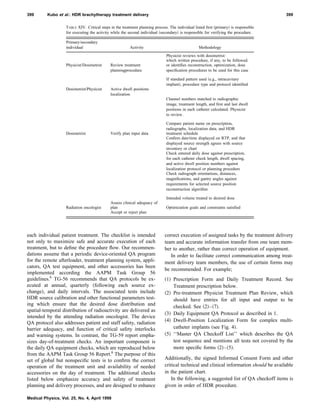
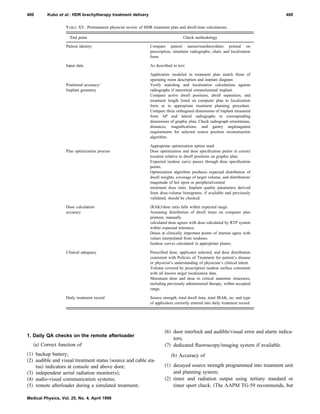
physicist. The physicist’s role is to confirm that all relevant
tumor imaging studies and localization data are correctly
FIG. 4. Example of a form used for recording localization information obtained in the simulator room for calculating positional treatment-unit programming
parameter. This form is intended for interstitial implants using 30 cm long simulation markers marketed by Nucletron. This localization method assumes that
all transfer tubes are of a known uniform length.
387 Kubo et al.: HDR brachytherapy treatment delivery 387
Medical Physics, Vol. 25, No. 4, April 1998
correlated with the simulation marker images, to aid the phy-
sician in articulating clinical intent in terms of quantitative
end points, and to develop a clear strategy for optimizing the
implant dose distribution, e.g., does the volume outlined on
the radiographs indicate the dwell positions to be activated or
a target surface with the dwell positions to be selected to
achieve a compromise between dose nonuniformity and tar-
get volume coverage? Generally, an experienced physicist
should be able to recommend a combination of prescription
criterion and margin of implanted volume about the target
surface necessary to achieve this goal without lengthy com-
puter planning. Verifying that the selected dwell positions
cover the target volume may take some persistence. For ex-
ample, in a transluminal treatment of the esophagus, the dis-
tal and proximal tumor margins can be identified by esopha-
goscopy ͑and stated in terms of insertion depth from the
incisors͒, from barium-swallow radiographs, or from CT.
Having identified the method of target localization, the
physicist should verify that this volume is covered by the
selected dwell positions.
The task group strongly recommends that detailed step-
by-step procedures, describing the simulation, treatment vol-
ume localization, dose prescription, and treatment planning
processes, be written. These procedures should address:
͑1͒ The clinical indications for treatment, including disease
stage, site, previous surgical management, and patho-
logical findings ͑example, definitive radiation therapy for
medically inoperable Stage IB carcinoma of the en-
dometrium͒.
͑2͒ The overall treatment strategy including external beam
and HDR total doses and fractionation.
͑3͒ The applicator type and geometry to be used.
͑4͒ The dose specification and optimization strategy.
͑5͒ The method of treatment planning including: source ge-
ometry reconstruction ͑e.g., pre-entered coordinates, or-
thogonal radiographs, or combination͒, placement of
dose optimization and dose specification points, dose
prescription, stopping points where physicist and physi-
cian input are needed, relationship between manual and
computer calculations, and orientation and location of
isodose calculations.
E. Implant design and evaluation
1. Localization
The first step in the planning phase of treatment delivery
is to describe the active dwell positions in terms of input
parameters used by the treatment planning system and treat-
ment delivery unit, e.g., dwell position numbers and treat-
ment lengths. For intracavitary and transluminal treatments,
such localization calculations may be very straightforward,
e.g., looking up the active dwell position number and treat-
ment lengths in the treatment policies ͑See Fig. 4 for an
example͒. As discussed in Sec. IV C, interstitial implants are
more complex. Whenever optimization is used, accurate
planning and treatment of interstitial implants requires accu-
rately matching the radiographic images of each catheter
with its channel number as defined by the label attached to
its orifice during simulation. If the implanted applicators are
not of uniform length or implanted to the same depth relative
to the target volume boundary, then the positional program-
ming parameter may vary from catheter-to-catheter as well.
The matching process can be a time consuming, error prone
activity requiring intense concentration and freedom from
interruptions. To ameliorate the impact of mismatching,
uniform-length catheters should be used whenever possible
and every effort made by the radiation oncologist to insert
catheters to a uniform depth with respect to the distal margin
of the target volume. For such implants, one person, e.g., the
dosimetrist, should perform the matching and a second per-
son, e.g., the physicist, should verify the catheter image-
channel number correspondence and localization calcula-
tions. For endobronchial implants consisting of two to three
transluminal applicators, each applicator should be labeled in
the operating room and its anatomic location recorded ͑e.g.,
no. 2ϭright upper lobe͒ so that channel number-
radiographic image correspondence can be independently
checked.
Several methods are available for assuring that the treat-
ment unit settings needed to position the radioactive source
at the desired position on a simulator radiograph are cor-
rectly calculated.4,15
The details depend on the afterloader
design, the applicator type ͑interstitial versus intracavitary͒,
the type of simulator marker used, and whether the marker is
referenced to the applicator orifice or its distal closure. Other
factors, e.g., the constancy and uniformity of transfer tube
length, also influence the choice of localization method. For
each type of implant, an appropriate localization method
must be selected and tested in advance. Any additional in-
formation that must be obtained from radiographs or mea-
sured in the simulator must be defined, and methods devel-
oped, e.g., Fig. 4 for capturing and verifying this data.
Testing involves using a single applicator to compare the
location of selected seeds on a radiographic marker to the
autoradiographically defined HDR source center for the pro-
gramming settings defined by the localization calculation.
2. Computer treatment planning
Treatment planning begins with a consultation between
the dosimetrist and physicist regarding the basic approach to
treatment planning. For intracavitary implants, treatment
length settings and active dwell positions may be fixed in
advance or a standard plan, containing the fixed Cartesian
coordinates of each catheter trajectory may be used. For en-
dobronchial or interstitial implants, the catheter numbers and
radiograph images may have to be matched by the dosim-
etrist and physicist. Other issues include the choice of opti-
mization algorithm and selection of dose calculation points
used to specify the prescribed dose and to define the optimi-
zation criteria. Well-defined optimization and dose-
prescription protocols which limit the options available to
the dosimetrist should be used. For example, one approach to
standardizing interstitial implant planning on the Nucletron
planning system is to permit only geometric optimization
388 Kubo et al.: HDR brachytherapy treatment delivery 388
Medical Physics, Vol. 25, No. 4, April 1998
͑eliminating the need for dose point placement͒ and requir-
ing dose to be prescribed as a fixed fraction ͑0.75–0.90͒ of
the central minimum dose defined by placing dose calcula-
tion points in the central transverse plane of implant at a
specified point in the program flow.
3. Pretreatment review of HDR treatment plan
The physicist charged with reviewing the treatment plan-
ning process should ensure that the physician’s clinical intent
has been communicated accurately to the dosimetrist, and
that the resulting plan is consistent with that intent. For ex-
ample, it may not be clear whether a volume marked by the
physician on the localization radiographs describes the treat-
ment volume or the target volume to be enclosed by the
prescription isodose or whether the prescription distance is
specified relative to the applicator center or its surface. It
may seem self-evident that clear communication between
physician, physicist, and planner is necessary, but over time
expectations and assumptions can become implicit and un-
stated, leading to misunderstandings in the event of staff
changes, etc. An effective physics review encompasses much
more than verification of computer plan accuracy: it includes
assessment of clinical appropriateness and consistency of the
final treatment program with target localization data, simula-
tion radiographs, treatment prescription, and a computer
treatment plan.
The specific review of each plan should begin with veri-
fication of input data, including:
͑1͒ name of patient and date of treatment;
͑2͒ source strength matches the decayed value;
͑3͒ correct system file ͑including, e.g., calibration data͒
used;
͑4͒ magnification factors, source-film distances, etc.;
͑5͒ source position reconstruction algorithm used was con-
sistent with the simulation radiograph geometry;
͑6͒ units of all quantities;
͑7͒ step size ͑or length͒;
͑8͒ optimization scheme and prescription criterion chosen
are consistent with implant geometry and clinical intent;
͑9͒ dose per fraction matches the treatment prescription;
͑10͒ reconstructed implant geometry matches radiographic
projections;
͑11͒ distance from machine reference point to distal-most
dwell location;
͑12͒ dwell times and locations programmed in the treatment
unit match those on the plan;
͑13͒ Correctness of treatment unit programs recalled for
treatment of subsequent fractions, including handling of
decay corrections. The GammaMed HDR Treatment
Planning and Treatment Delivery system handles
source decay in a unique way. All treatment plans cre-
ated by the GammaMed computer planning system uti-
lize a 10 Ci (3.7ϫ1011
Bq) source for all calculations.
These nominal dwell time are based on a 10 Ci source.
The treatment console is programmed with the nominal
dwell times based on a 10 Ci source and these appear as
entered. When treatment begins, a factor is automati-
cally applied to each nominal dwell time to correct for
actual source activity. This factor is equal to 100
ϫ10 Ci actual activity. For example, the factor is 100
for a 10 Ci source. For a 5 Ci (1.85ϫ1011
Bq) source,
the factor is 200. This factor is calculated by the physi-
cist during initial calibration of a source and entered
with the date. The system subsequently automatically
adjusts the factor to correct for source decay. The net
result is approximately a 1% increase in this factor each
day. This factor is thus an indicator of actual source
activity. This factor is indicated on treatment console,
and on treatment record printed during treatment.
Especially with respect to positional parameters ͑active dwell
positions chosen, spacing, dwell train location within each
catheter, etc.͒, the simulation radiographs, graphical plan
representation, localization form, and treatment unit printout
should all be intercompared. For those planning systems that
do not completely document the implant reconstruction pro-
cess, e.g., algorithm chosen and radiograph orientation used,
Item ͑10͒ is extremely important as an indirect verification of
appropriate reconstruction algorithm selection and operation.
Finally, the plan should be checked for ‘‘reasonableness’’
using the previous plan, if available, and an appropriate fig-
ure of merit. Just as mgRaEq-h/dose ratio is a useful param-
eter for judging low dose-rate implants using radium substi-
tutes, the ͑source strengthϫdwell time͒/dose, or IRAK/dose,
ratio should fall within the range expected for the given im-
plant geometry. Quantitative verification of computer-
generated dwell time calculations is reviewed below.
The plan should also be assessed for clinical adequacy.
The selected applicator, dose specification criterion, pre-
scribed dose, and choice of optimization approach should be
checked against the department’s policies of treatment or, at
least, customary practices for the given site and stage of
disease. In performing this review, the physicist should be
aware of all treatments previously given to the patient and
check that the cumulative total doses to critical structures
͑vaginal mucosa, bladder neck, anterior rectal wall͒ are
within tolerances. Any significant deviation from these ex-
pectations should be brought to the radiation oncologist’s
attention for their review.
Prior to initiating treatment, the attending physician
should review the treatment plan, treatment unit program-
ming, and associated documentation. The physicist’s signa-
ture documenting plan review, the fraction size, dose pre-
scription site, consistency of dose distribution size and
location with target volume coverage should be reviewed
along with any other factors influencing clinical appropriate-
ness. Satisfactory physician and physicist review should be
documented by signature on the daily treatment record or
QA checkoff list.
4. Verification of HDR computer calculations
As discussed in Sec. III A, relying on a second computer
to check the correctness of the HDR plan fails to intercept
the most common human errors, such as mistaken data en-
tries in the optimization routine, or incorrectly specified
389 Kubo et al.: HDR brachytherapy treatment delivery 389
Medical Physics, Vol. 25, No. 4, April 1998
lengths. It is not clear that verification of isodose distribu-
tions on particular cases using a second computer system
serves any purpose. This section presents an alternative
means of verification. Stepping source remote afterloading
technology allows the treatment time at each active dwell
position to be independently programmed. Mathematically
elegant and clinically appealing optimization algorithms are
widely available that vary the relative dwell times ͑or
weights͒ of each activated dwell position to maximize dose
uniformity, target coverage, or other dosimetric constraints
chosen by the user. The result is often a highly nonuniform
distribution of dwell times. When such algorithms are ap-
plied to conventional implant geometries, dose homogeneity
is often improved and the length of the implanted volume
needed to adequately cover the target volume may be
reduced.16
Such flexibility creates a number of quality assur-
ance problems, many of which have been discussed else-
where in this report. An important issue is how to verify the
accuracy of optimized calculations with verification calcula-
tion techniques. In many cases verification can easily be
done manually, but also it can be done by small computer
codes. ‘‘Practical’’ in this context requires that the assess-
ment take only a few minutes. In addition, the calculation
check must have a high probability of detecting significant
errors.
A standard technique is to evaluate some characteristic
parameter of the plan and compare it to an expected value.
For example, at distances sufficiently far from the implant,
the dose is determined primarily by the source strength and
total treatment time and is insensitive to local dwell time
variations. One group17
calculates the dose at points Ϯ10 cm
from the approximate center of the implant in the direction
most orthogonal to the treatment applicators. The mean dose,
divided by the current source activity and total treatment
time, is then, compared to expected values which depend on
the type of implant geometry. Table II lists representative
numbers. Readers are cautioned that the specific values de-
pend on many variables, such as the quantity used to specify
source strength, single-source dosimetry data selected, and
optimization scheme applied. At such long distances, the
specific form of the tissue attenuation and scatter factor ͑ra-
dial dose factor͒ used by the planning computer needs to be
considered, since some expressions may extrapolate poorly.
The ‘‘dose at a large distance’’ method can detect errors
in source strength input, unauthorized changes in physical
dose factors, or calculation ‘‘bugs’’ which can globally af-
fect dose-calculation accuracy. Its insensitivity to local dose
variations means that it is not capable of detecting some
errors which determine the dose at clinically relevant dis-
tances. For example, consider a situation in which the plan-
ner intended to place active dwell positions at 1.0 cm inter-
vals but inadvertently specified 0.5 cm spacing. If the
number of dwell positions were not doubled then the implant
would be smaller than desired. The next logical step is to
develop expectation values based on doses at typical pre-
scription distances which are sensitive to implant geometry.
The group at the University of Wisconsin has developed
dose indices for a variety of implant types: endobronchial,
gynecological ͑tandem and ovoids, ovoids only, vaginal cyl-
inder͒, and volume implants. For example, Ref. 18 describes
two indices for tandem and ovoid treatments based on the
ratio of dose at the primary prescription point to ͑1͒ the dwell
time in one particular position in the tandem and ͑2͒ the total
dwell time.
Table III also illustrates the University of Wisconsin
method of verifying total treatment time for volume
implants.4,19
This table was derived from the original
Manchester volume implant table,20
by applying the current
values for the exposure rate constant and conversion from
exposure to dose ͑1.065͒, adjusting for the ratio of stated to
minimum dose ͑1.11͒, and conversion from mgRaEq h to
Ci s. The table gives RV , the number of Ci s per Gy required
to the volume enclosed by the implant. When applied to
geometrically optimized ͑distance option͒ volume implants,
the table has an accuracy of better than 8% when the refer-
ence dose is defined to be 90%–95% of the central minimum
dose.
Kubo21
and Kubo and Chin22
have reported simple math-
ematical formulas for checking single catheter treatments
when the dose is prescribed at distances of 7.5 or 10 mm
from the catheter center. For 10 mm dose prescription, the
total treatment time was found to be within Ϯ2%:
Tϭa
D
S
͑2.67•Lϩ78.6͒, ͑1͒
where T is the expected treatment time in seconds, a is the
TABLE II. Manual dose verification methods for optimized implants ͓repro-
duced from Williamson ͑Ref. 4͒ with permission͔. Expected values of dose
index 10 cm from implant in its central transverse plane ͑Ref. 17͒, where the
dose index is defined as, Dose indexϭ͓100ϫAverage of doses at
ϩ10 cm and Ϫ10 cm͑cGy͔͒/͓Activity͑Ci͒ϫTotal time͑s͔͒.
Implant type Expected range of dose index
Pulmonary 1.05–1.20 ͑lower if highly elongated, higher if curved͒
Vaginal cylinder 1.10–1.20 ͑i.e., short single catheter͒
Long esophagus 0.95–1.10 ͑i.e., long single catheter͒
TABLE III. Expected total treatment time for volume implants, calculated by
Total timeϭReference dose ͑cGy͒ϫRVϫelongation factor/Activity ͑Ci͒.
Note: Reference dose chosen to be 90%–95% of central minimum dose for
geometrically optimized volume implants.
Volume (cm3
) RV ͓Ci s/Gy͔ Length/diameter Elongation factor
50 287 1.5 1.03
60 323 2.0 1.06
80 391 2.5 1.10
100 434 3.0 1.15
140 569
180 672
220 768
260 859
300 945
340 1027
380 1105
390 Kubo et al.: HDR brachytherapy treatment delivery 390
Medical Physics, Vol. 25, No. 4, April 1998
conversion constant and is 0.01 Ci s/͑cGy mm͒, D is the pre-
scribed dose in cGy, S is the source activity in Ci, and L is
the total treatment length in millimeters.
For example, the treatment time for the prescribed dose of
1000 cGy and source strength of 7.5 Ci (2.77ϫ1011
Bq) for
the treatment length of 55 mm is 300.6 s from Eq. ͑1͒. The
planned treatment time was 303.9 s, 1.1% more than the
expected time. Again, the numerical values in the formula
depend on the specifics of the dose calculation data and the
optimization algorithm assumed. This single catheter ap-
proach is further expanded so that the prescription distance
and length can be combined into one equation.23
From the
treatment plans generated with treatment lengths of 50, 100,
150, and 200 mm and treatment distances of 2–14 mm with
a step of 2 mm, it was found that the total treatment time
increased linearly with the treatment length whereas the
treatment time varied supralinearly with the treatment dis-
tance. Therefore, using the prescription dose of 500 cGy and
a source strength of 10 Ci (3.7ϫ1011
Bq) as a reference, the
treatment time was first fit with a second-order polynomial as
a function of a treatment distance, d. For the smallest treat-
ment length of L1ϭ50 mm, the best fit for treatment time
was obtained with
T͑d,L1ϭ50͒ϭϪ5.24ϩ8.80•dϩ0.263•d2
. ͑2͒
Similarly, for the largest treatment length of L2ϭ200 mm,
the best fit was obtained with,
T͑d,L2ϭ200͒ϭϪ14.9ϩ31.2•dϩ0.236•d2
. ͑3͒
The correlation coefficient for Eqs. ͑2͒ and ͑3͒ was better
than 0.999.
Using a linear relation between the treatment time and
treatment length, a total treatment time formula for treatment
length of L and treatment distance of d is generated,
T͑d,L͒refϭT͑d,L1͒ϩͩLϪL1
L2ϪL1
ͪ•͓T͑d,L2͒ϪT͑d,L1͔͒.
͑4͒
For nonreference cases where source strength is S ͑Ci͒ and
the prescription dose is Dp ͑cGy͒, the total treatment time
can be calculated by,
T͑d,L͒nonrefϭT͑d,L͒ref•
Dp͑cGy͒•10 Ci
500 cGy•S͑Ci͒
. ͑5͒
A different formulation for checking total treatment time has
been used by Ezzell at Wayne State University,24
where a
simple dwell time pattern for single catheter implants was
developed using film dosimetry instead of a mathematical
optimization scheme. Ezzell’s relationship between the same
parameters defined in Eq. ͑1͒ is given by
Tϭ
D
S
•ͩ L
0.0537•Lϩ23.09ͪ. ͑6͒
Equation ͑6͒ assumes anisotropy corrections, active lengths
of 50–230 mm, a 5 mm separation between adjacent dwell
positions and the following pattern of relative dwell weights:
1.5,1.4,1.3,1.2,1.1,1.0,...,1.0,1.1,1.2,1.3,1.4,1.5.
Optimized square and rectangular single-plane implants
have also been systematically analyzed and dose indices de-
veloped in support of dose calculation verification.25
Define
the dose index I as
Iϭ
D•A
S•T
, ͑7͒
where D is the dose in cGy at a distance d from the plane of
the implant, A is the area of the implant in cm2
, S is the
source activity in Ci, and T is the total dwell time in seconds.
The expected value of I is a simple quadratic function of
the side, E, of the equivalent square implanted area which, in
turn, is calculated from the familiar area/perimeter rule.
Table IV gives the quadratic coefficients A, B, and C for
several different reference distances d assuming inter cath-
eter spacings of 1–1.5 cm and geometric optimization. For
idealized implants, ranging in area from 3.0ϫ3.5 cm2
to
25.5ϫ22.5 cm2
, Table IV provided the index, I, to within
5%. The index I was calculated for a series of clinical im-
plants, most of which were used to treat the tumor bed fol-
lowing surgical excision of extremity sarcomas. Despite sig-
nificant deviation from ideal planar geometry following
closure of the operative wound, the observed index agreed
with the predicted value within 10% for all cases.
In practice, applying these methods requires that the im-
plant dimensions be determined independently from the lo-
calization radiographs and the activity be taken from a pre-
calculated table. If these parameters are taken directly from
the computer output, errors in the computation may go un-
noticed ͑see the first paragraph of this section͒.
5. Patient preparation
Prior to patient treatment the applicators must be installed
and treatment planning and treatment unit programming
must be complete. This usually necessitates that the patient
lie on a table or stretcher for times on the order of minutes, to
possibly an hour. This wait time is often directly related to
TABLE IV. Expected values of dose index for geometrically optimized pla-
nar implants, where the dose index is defined as, Dose index Iϭ͓dose at
distance d from plane ͑cGy͒•area (cm2
͔͒/͓activity ͑Ci͒•total time ͑s͔͒.
Equivalent side E is Eϭ2•͓L•W/(LϩW)͔ (cm), where L and W are
length and width in cm of the implanted area L•W. IϭAϩB•EϩC•E2
,
where A, B, and C depend on d. Note: for a curved implant surface, in-
crease I by 10%; for implants with deviated catheters and significant cold
spots, decrease I by 5%.
d ͓cm͔ A B C
1.5 0.402 0.923 Ϫ0.0171
2.0 Ϫ0.258 0.836 Ϫ0.0148
2.5 Ϫ0.619 0.751 Ϫ0.0126
3.0 Ϫ0.822 0.673 Ϫ0.0106
391 Kubo et al.: HDR brachytherapy treatment delivery 391
Medical Physics, Vol. 25, No. 4, April 1998
the treatment planning and unit programming time required.
Patients should be cared for and kept as comfortable as pos-
sible while maintaining applicator positioning. Upon
completion of treatment planning and treatment unit pro-
gramming, the patient applicators are connected to the treat-
ment unit. Applicator positioning should be verified and all
connections verified. It is the strong recommendation of this
Task Group that treatment planning and treatment unit pro-
gramming activities not be routinely subject to time con-
straints.
6. Patient setup and treatment
While the physician and physicist are reviewing the treat-
ment documentation, the radiation therapist can move the
patient into the HDR room and proceed with positioning and
connection of the applicators to the indexer. The radiation
therapist should verify that all emergency equipment is
present, that the survey meter ͓Geiger–Mueller ͑GM͒ detec-
tor and/or ion chamber survey instrument͔ is present and in
good operating order, and that informed consent forms are
properly signed and filed in the chart. The Task Group notes
that some GM meters register zero exposure in response to
saturation-level radiation fields: the selected instrument
should have a range from 0.1 mR/h to at least 1000 mR/h
and should be checked by the medical physicist for appro-
priate response near the exposed HDR source. This check
can be performed by placing a survey instrument at specific
distances from the source, say, 100 cm, 200 cm, etc., and by
taking the readings using a TV camera. A good practice is to
know the radiation level just inside the entrance door to the
treatment room when the source is exposed. This measure-
ment can also be done using a TV camera. This measurement
most likely excludes the meter saturation problem since the
reading inside the door should be substantially low. If the
upper range of the available GM meters is 100 mR/h, or if
false readings in high intensity fields are of concern, an ion
chamber should be used to cover the upper extreme of the
exposure-rate range. Before each treatment, the detectors
should be checked for correct function using the classical
three-step process ͑battery function, acceptable background
reading when no radiation exposure is present, and correct
response to a radioactive check source͒.
The identity of the patient shall be confirmed by an ap-
propriate method. The USNRC Quality Management
Program10
has adopted a more rigorous and inflexible stan-
dard, requiring that the patient be identified by two means:
͑1͒ by comparing the patient’s appearance with a photo-
graph; and ͑2͒ by asking the patient’s name or social security
number and comparing this response with the chart. A sec-
ond individual, e.g., physicist, should check that transfer
tubes are free of kinks and that the applicator-treatment unit
channel number correspondence agrees with the source lo-
calization documentation. In addition, the physicist should
check that transfer tubes of the correct length ͑for the Nucle-
tron system, 1500 or 1000 mm transfer tubes are available
for interstitial and intracavitary applicators͒ have been se-
lected. Finally, applicator positioning in the patient should be
checked against the marks or measurements obtained in the
operating room.
At this point, all treatment documentation should be fully
reviewed and available to the machine operator, including
the written prescription, a table of dwell times and position
settings, and the treatment plan. Prior to initiating treatment,
the operator should check that ͑1͒ a signed prescription is
available, ͑2͒ physicist and physician have signed off on plan
review, ͑3͒ the fraction size listed on the computer plan and
the prescription agree, ͑4͒ the treatment to be given is con-
sistent with the written prescription and the cumulative dose
delivered by previous fractions, and ͑5͒ dwell times, length
settings, and step sizes programmed into the treatment unit
agree with the computer plan listing or table prepared by the
physicist. It is helpful for one individual to read the dwell
times from the HDR printout, while the other compares these
values to the treatment plan. Since manual keyboard entry of
the treatment parameters describing a complex implant may
require several hundred keystrokes, the likelihood of data
entry error is high. Meticulous checking of such manually
entered data is essential: whenever possible, prestored stan-
dard configurations or direct entry from the treatment plan-
ning computer should be used. In any case, at least one per-
son ͑usually the physicist͒ must check the printed treatment
program against the treatment plan.
The Task Group recommends that the physicist and an
individual qualified to remove the applicators from the pa-
tient under emergency conditions shall attend the treatment
and be prepared to detect emergency conditions and imple-
ment the appropriate responses. This second person will usu-
ally be the attending radiation oncologist who shall be re-
sponsible for safe and rapid execution of applicator removal.
However, the attending radiation oncologist may delegate
this duty to an appropriate medical professional, e.g., nurse
or resident physician, who has appropriate training in appli-
cator removal and radiation safety procedures. The recom-
mended approach is more flexible than that imposed by the
USNRC in May 1993. USNRC requires that both an autho-
rized user ͑a radiation oncologist authorized to prescribe
brachytherapy͒ and a medical physicist ͑or radiation safety
officer͒ be physically present at all HDR treatments.11
The
Task Group strongly condemns the use of any health profes-
sionals, who are not properly trained with HDR device op-
eration and treatment delivery as an alternative to staffing
HDR treatments by a qualified medical physicist. If war-
ranted by the patient’s medical condition, a nurse and proper
monitoring equipment should be present. Emergency proce-
dures should be planned and reviewed annually by the team
including how and under what conditions applicators are to
be removed and who is responsible for what. Upon initiating
treatment, the physicist should observe the treatment console
and should be aware of which catheter is involved should an
alarm condition interrupt treatment. Whenever treatment is
interrupted, it is essential to check the area monitor to con-
firm that the source has been retracted.
392 Kubo et al.: HDR brachytherapy treatment delivery 392
Medical Physics, Vol. 25, No. 4, April 1998
7. Post-treatment quality assurance
After treatment is completed and the area monitor indi-
cates no exposure in the room, the room and patient should
be surveyed with an appropriate hand-held detector to con-
firm that the source is fully retracted into its shielded storage
position. As a final check of treatment accuracy, the admin-
istered dwell times listed on the treatment unit printout,
should be compared to the originally programmed time. All
QA checklists and documentation should be reviewed for
completeness and filed away in the chart along with the treat-
ment history printed out by the HDR unit. The room and
HDR key should be secured as specified by the user’s li-
cense.
V. EMERGENCY PROCEDURES FOR HDR
REMOTE AFTERLOADING UNITS
Even though the likelihood of major emergencies, i.e.,
source detachment during treatment is exceedingly low, this
report strongly recommends that all HDR brachytherapy
treatment users shall learn and periodically retrain to operate
the devices and to respond properly to emergencies, as re-
cently reviewed.26
For HDRB the USNRC has required that
licensees have ‘‘written emergency procedures describing
actions to be taken, including surgical intervention, should
the source not return to the shielded container at the conclu-
sion of treatment.’’ 9
The USNRC also directs the licensee to
have ‘‘appropriate staff and equipment available in support
of these procedures.’’ 9
This directive, and other USNRC
regulations, applies in the 21 states in which the USNRC has
jurisdiction. In the 29 Agreement States this directive and
other USNRC regulations may not currently apply as each
Agreement State has some time and flexibility in adopting
USNRC directives and regulations. However, it is likely that
more Agreement States will be adopting current and pro-
posed USNRC regulations, perhaps in modified form, for
RAUs in the next few years.
A. Routine emergency equipment
Routine emergency safety precautions require either hav-
ing an emergency container available in the treatment room,
as well as an emergency kit containing Kelly surgical clamps
and long-handled positive spring action forceps for manipu-
lation of the source guide tubes and applicators if the source
fails to return to the safe. These forceps must be readily
available for use. The emergency container should be placed
close to the patient and should be large enough to accept the
entire applicator assembly, containing the source, removed
from any patient. Additional medical supplies ͑described
later͒ and associated devices to assist with emergency appli-
cator removal should be readily available.
B. Emergencies
What constitutes an emergency? We consider emergen-
cies separated into three categories: conventional physical
plant emergencies not directly related to the RAU, and minor
and major emergencies associated with the RAU.
1. Physical plant emergencies
These emergencies include fire, physical disasters
͑storms, tornadoes, floods, earthquakes, etc.͒, and transient
power interruptions or longer power failures. All medical
facilities will have planned responses to physical plant emer-
gencies. These are usually well established separate response
sequences for fire, storms, and power failures that generally
involve, not necessarily always in this sequence, removing
the patient from the area, securing the area, reporting the
problem to the appropriate authorities in the medical facility,
and then recovery from the incident. RAUs meet FDA stan-
dards and are well designed to withstand physical damage
during these conventional emergencies; however, those re-
sponding to the emergency must know, generally through
posted signs, that the area contains a radioactive device, re-
quiring certain additional precautions. Generally confirma-
tion ͑by inspection or radiation survey͒ by knowledgeable
staff that the RAU is in a safe condition is usually required.
Conventional emergencies such as power loss or a fire in
the device may well effect operation of the device. Loss of
power is handled differently by each manufacturer. How-
ever, usually the RAUs have backup batteries or power packs
designed to retract the source during a power failure and to
provide power to the computer or microprocessor to retain
memory and treatment information on the partially delivered
treatment.
2. Minor emergencies involving the RAU
This less serious category constitutes abnormal perfor-
mance of the device that prevents or interrupts treatment
͑e.g., loose source guide tube connector, vault door not prop-
erly closed, etc.͒, followed by recovery actions that correct
the abnormality allowing treatment to resume to termination.
The more serious category involves operator physical inter-
vention ͑e.g., room entry͒ to retract the radioactive source
into the RAU’s protective safe. While major emergencies
have greater possibility for unplanned radiation exposure to
both the patient and operator personnel, minor emergencies
occur more frequently.
Manufacturers offer the operator, through displayed mes-
sages or error codes, instructions on how to respond to an
abnormal occurrences or machine malfunction. The type and
number of these error messages usually varies with the com-
plexity of the equipment. Ideally, operators should immedi-
ately recognize the meanings of all status lamps, audible
alarms, and printed or displayed messages that indicate mal-
functions. However, if the number of error codes is large,
training should focus on recognizing those most likely to
occur most frequently during routine treatments. However, a
complete status code list must be readily available at the
operator’s console for instant access during emergencies.
Any status messages displayed in numeric code must be
identified in well-understood terms, e.g., kinked tube,
jammed cable, etc. Often, it is useful to recast the vendor’s
numeric status message codes into tables that clearly indicate
the status of all indicators ͑lamps, audible signals, printed
393 Kubo et al.: HDR brachytherapy treatment delivery 393
Medical Physics, Vol. 25, No. 4, April 1998
tape message, etc.͒ when the code occurs, and clearly state
the recovery actions.
Operators must recognize messages to answer the ques-
tion ‘‘Can I recover or must I abort the treatment?’’ Recov-
ery actions and operation sequences must be clearly under-
stood and practiced. One reported misadministration
occurred because operators failed to properly respond to a
minor malfunction. For training it is useful to know which
error codes can be safely and readily simulated by the RAU
so operators can be trained to respond to those codes. How-
ever, simulation of the emergency must not place the equip-
ment or the operators at risk. Conversely, those malfunctions
that produce error codes that cannot be simulated on the
RAU must be identified so the operators can be trained to
recognize and respond to these situations. A degree of real-
ism is lost in training sessions when the console display can-
not produce the indicators for the emergency.
3. Major emergencies
The more serious emergencies, e.g., source retraction fail-
ure, patient medical emergency, total computer failure, etc.,
involve operator physical intervention, and possibly the
physical intervention of the radiation oncologist, operators,
and the physicist to retract the high dose rate source into the
safe or to clean a blockage or system fault that is preventing
proper source retraction.
Establishing emergency procedures ͑EPs͒ for these more
serious emergencies generally involves the following steps:
͑1͒ establishing policy about EPs; ͑2͒ preparing initial action
sequences for written EPs; ͑3͒ identifying and obtaining
equipment necessary to perform EPs; ͑4͒ testing initial writ-
ten EPs; ͑5͒ revising action sequences and written EPs fol-
lowing tests and written final EPs; ͑6͒ preparation of training
materials and didactic education of staff in EPs; ͑7͒ applied
͑hands-on͒ execution of EPs; ͑8͒ necessary revisions in EPs
identified during training; and ͑9͒ repeat EP training at speci-
fied intervals.
The emergency may be observed by activation of emer-
gency indicators at the console, by simple observation that a
treatment is too long, by noticing that the computer system
clearly has failed, or that an excessive radiation level exists
after treatment.
In the design of EPs that require personnel intervention
and possible entry into the vault, the procedures must be
designed to reduce the radiation dose to the patient by re-
tracting the source from the patient as soon as possible while
minimizing the radiation exposure to personnel performing
the source retraction. Figure 5 graphs the dose rate, in cGy/
min, as a function of distance, in cm, from 10 and 5 Ci
sources. Table V shows the dose to personnel as a function
of distance and time, for both 10 and 5 Ci sources. Figure 6
shows dose rates at the periphery of the volume of tissue
irradiated by a static 10 Ci source. The dose rate is about 400
cGy/min at the periphery of a sphere of 10 cm3
. Clearly
speed is of the essence in removing the source from the
patient in order to limit the dose to small volumes of local
tissue.
Generally, during an emergency, the goal should be to
keep effective dose equivalents to personnel to less than the
5 Sv ͑or 5000 mrem͒ per year limit. As shown in Table V, if
one’s distance is 25 cm from the source during an emer-
FIG. 5. Approximate dose rate versus distance for 10 Ci (3.7ϫ1011
Bq) and
5 Ci (1.85ϫ1011
Bq) Ir-192 sources.
TABLE V. Approximate doses ͑cGy͒ delivered at distances ͑cm͒, from 10 Ci
(3.7ϫ1011
Bq) and 5 Ci (1.85ϫ1011
Bq) Ir-192 sources in elapsed time
͑minutes͒.
Time
͑min͒
Activity
͑Ci͒
Distances ͑cm͒
1 10 25 50 100
0.5 10 366 3.7 0.60 0.15 0.037
5 183 1.9 0.30 0.08 0.019
1.0 10 732 7.5 1.2 0.30 0.075
5 366 3.7 0.60 0.15 0.037
2.0 10 1460 15 2.4 0.60 0.150
5 730 7.5 1.2 0.30 0.075
5.0 10 3660 37 6.0 1.5 0.370
5 1830 19 3.0 0.75 0.19
10 10 7320 75 12 3.0 0.75
5 3660 37 6.0 1.5 0.37
FIG. 6. Dose rates at the periphery of volumes of tissue irradiated by a static
10 Ci (3.7ϫ1011
Bq) Ir-192 source.
394 Kubo et al.: HDR brachytherapy treatment delivery 394
Medical Physics, Vol. 25, No. 4, April 1998
gency, depending on source activity, one would receive a
3–6 cGy dose in about 5 min while resolving the emergency.
However, at 1 cm, the dose to the patient would be about
1830–3660 cGy of undesired dose. Clearly, depending on
source activity, the source must be retracted within 1 to 2
min to keep the dose to the patient to within nominal values
of several hundreds of centigrays normally associated with
various fractionation regimens. While the radiobiology of
dose and fractionation is beyond the scope of this paper, an
unplanned local dose approximately equivalent to a planned
treatment dose fraction, while undesired, is unlikely to cause
serious consequences, such as the death of the patient. Hence
speed is all important in executing emergency procedures to
minimize not only the dose to the patient but also the expo-
sure to personnel.
Manufacturers provide suggested emergency procedures
if the source fails to return to the safe. These generally are
short single page synopsis, suitable for posting, of the nec-
essary sequential steps involved in the emergency procedure.
They assume the physical integrity of the applicator is main-
tained. These EPs are specific to the RAU but generally in-
volve the following sequence, assuming that if the initial
action fails to lead to recovery, that the following action is
required. The generic sequence is ͑1͒ observation at console
of error message and emergency indicators ͑audible and vis-
ible alarms͒; ͑2͒ recovery at the console ͑e.g., pressing an
emergency off button͒; ͑3͒ entry into the room with a por-
table radiation survey meter ͑opening the door activates the
interlock that retracts the source͒; ͑4͒ observation of radia-
tion levels in the room ͑by mounted monitors or portable
survey meters͒; ͑5͒ recovery at the RAU ͑pressing an emer-
gency off button on the RAU͒; ͑6͒ manual retraction of the
source ͑using a hand crank͒; ͑7͒ patient survey and RAU
survey ͑confirming source is in the safe͒; ͑8͒ applicator re-
moval and placement in the emergency container; ͑9͒ patient
survey and emergency container survey ͑to confirm source is
not in the patient and is in the emergency container͒; and
͑10͒ removal of patient from the vault ͑with subsequent re-
dundant survey with a GM meter͒.
Glasgow26
has described the emergency equipment for a
GammaMed IIi HDR unit, assuming the integrity of the ap-
plicator is maintained. The emergency kit consists of equip-
ment ͑GM meter, ionization survey meter, Danger: Open
Radiation Source - Keep Out! sign͒ to be at the operating
console outside the treatment vault and equipment, listed in
Table VI, to be placed in the vault in the emergency kit prior
to the treatment. If, for any reason applicator removal is not
the first choice, then, ͑1͒ extract the source from the appli-
cator ͑first attempted from the distal end connection from the
applicator, failing that, from the proximal end connection of
the applicator͒; if the source cannot be removed from the
applicator, ͑2͒ remove applicators by a qualified radiation
oncologist. The applicator removal procedures are identified
by applicator type ͑e.g., small intraluminal, large intracavi-
tary, and sutured interstitial applicators.͒ Table VII lists an
abbreviated sequence of general steps for the removal of the
small intraluminal and large intracavitary applicators. Table
VIII lists the explicit steps for the removal of a sutured in-
terstitialapplicator. Table IX lists the specific components of
the suture removal and resuturing kit.
All of these discussions of emergency procedures as-
sumed that the integrity of the applicator was maintained.
However, applicators can fail, as occurred when a source
jammed in a bent plastic catheter.27
This illustrates the im-
portance of the fundamental rule of EPs: EPs must be pre-
TABLE VI. Suggested components for an emergency kit for an RAU.
A. At the console outside the room:
Sign-‘‘Danger-Open Radiation Source-Keep Out!’’
Geiger–Muller meter ͑0.1–100 mR/h range͒
Ionization survey meter ͑1–1000 mR/h range͒
B. Inside the room:
Short handle ͑12–15 in.͒ positive spring action forceps
Long handle ͑18–24 in.͒ positive spring action forceps
Kelly surgical clamps
High quality flashlight and fresh spare batteries
Suture removal kit
Suture kit
TABLE VII. Physician surgical intervention procedures.
The procedures assume that:
͑1͒ the applicator has not ruptured and that the source is in the
applicator;
͑2͒ all attempts to remove the source drive cable with source from
the applicator failed;
͑3͒ the applicator can be quickly removed in a medically safe
manner;
͑4͒ the physician has direct responsibility for removing any
applicator; other personnel can assist, but minimize the number
of personnel present;
͑5͒ the applicator must be removed as quickly as possible;
͑6͒ all procedures required to protect personnel from blood apply.
SMALL INTRALUMINAL TUBE OR LARGE
INTRACAVITARY APPLICATORS
͑1͒ Release the tube or applicator from any retaining device.
͑2͒ Using the Kelly clamps or other remote manipulators grasp the
tube or applicator near the connection to the source guide tube
to the tube or applicator.
͑3͒ Extract the tube or applicator from the patient. Do NOT grasp
the tube or applicator with your hand. With a second set of
Kelly clamps or remote manipulators grasp the tube or
applicator near its end and place it into the emergency
container.
͑4͒ Place the shield cover on the top of the emergency container.
͑5͒ Remove the patient from the interior of the treatment room to
the maze, away from the emergency container, but still in the
shielded portion of the maze. Survey the patient with the
ionization survey meter to ensure the source is out. Remove the
patient from the room and repeat the survey with the GM
meter.
͑6͒ Lock the door; post the door with the sign ‘‘Danger-Open
Radiation Source-Keep Out!’’. Notify posted list of
personnel.
395 Kubo et al.: HDR brachytherapy treatment delivery 395
Medical Physics, Vol. 25, No. 4, April 1998
pared assuming that the initial recovery action sequence
fails, that subsequent recovery action sequences fail, and that
the assumptions on which the EPs are based may be invali-
dated during the emergency. Emergency procedures should
be prepared, if possible, for the worst case scenarios.
What emergency actions are required if the source sepa-
rates from the cable and falls on the floor, or, if the source
capsule ruptures and disperses the source element on the
floor? Retrieval of just the source or source element gener-
ally may require special retrieval equipment and radiation
precautions, and should not be considered as part of the nor-
mal emergency action sequence involving the radiation
therapy operators and radiation oncologists. If radiation sur-
veys reveal the source is not in the patient, the safe, nor the
emergency can, but is elsewhere in the vault, speedy evacu-
ation of the patient and personnel from the room will mini-
mize radiation exposure. However, one must ensure, by care-
ful radiation surveys, that no radioactive material has been
tracked out of the vault on the bottoms of shoes. The vault
should be secured, posted with a Danger: Open Radioactive
Source - Keep Out! sign, and a notification process begun of
those responsible for source retrieval. Normally, the vendor
will assume responsibility for source retrieval.
The ultimate emergency would be to lose a source in a
patient; some accident in which the applicator fails, and the
source breaks loose and lodges in the patient. Theoretically,
this would not occur because the license application commits
the user that they shall not conduct any treatment procedure
for which a decoupled or jammed source could not be re-
moved expeditiously from the patient and placed in the
shielded container.27
Following an emergency procedure, it
is essential that the users know the dose delivered if the
treatment was interrupted and how to program the unit for
the remaining portion of the treatment.
C. Practical concerns
Practice of EPs generally will cause their revision to make
them more practical. The contents of the emergency kit must
be carefully selected and tested. For example, the original
emergency kit contents described by Glasgow26
subsequently
was reduced to the 9 items listed in Table VI. Personnel
should use their wristwatches for estimating all elapsed times
during emergencies, as wall clocks generally display differ-
ent times in different rooms.
Personnel should know the status of all radiation indica-
tors in the room at the successful completion of an emer-
gency procedure. If radiation alarms are to be activated for
HDRB, they should be off when the source is properly in the
emergency container. They should be tested to ensure that is
the case. The exposure rate around a 4 in. diameter emer-
gency lead can with a 1 in. thick wall, containing a 10 Ci
source, is about 1 mR/h at 0.5 m and exceeds 10 mR/h only
near the edge of the emergency container. A radiation survey
of the radiation exposure rates around an emergency con-
tainer containing a 10 Ci source should be made to confirm
that the container shields properly and that radiation moni-
tors cease alarming when the source is placed in the con-
tainer.
D. Conclusions
The RAUs are complex devices that require that the person-
nel operating, using, and caring for patients with these de-
vices be exceptionally well-trained in normal operation of
the units and be equally well-trained to respond to minor and
major emergencies. Properly trained staff must be able to
recognize errors and to recover from minor emergencies
without incident. They must also be able to respond to seri-
ous emergencies that involve vault entry and emergency
TABLE VIII. Physician surgical intervention procedures.
The procedures assume the same assumption as in Table VII.
SUTURED CATHETER OR NEEDLE APPLICATORS
͑1͒ Identify at the console, by display or by visible inspection by
the CCTV of the transparent source guide tubes, the source
guide tube that contains the source drive cable and source and
the catheter or needle to which it is attached.
͑2͒ Use the suture removal kit; working as quickly as possible, cut
all sutures retaining the identified catheter, needle, or, if
necessary, the device holding the catheters and needles.
͑3͒ Using the Kelly clamps or other remote manipulators grasp the
catheter or needle and carefully extract it from the patient and
place it in the emergency container. DO NOT grasp the
catheter or needles with your hand. If the patient could bleed, a
second person should have swabs available to apply
compression.
͑4͒ Place the shield cover on the top of the emergency container.
͑5͒ Institute the patient removal and survey sequence and room
security sequence described in Table VII, steps ͑5͒ and ͑6͒.
TABLE IX. Suggested items for removal of sutured applicators and resutur-
ing the anatomic site, if necessary. All items are in sterile packages.
A. Sutured Applicator Removal Three suture removal kits with
scissors and overwrap
Four betadine swab sticks
Ten 4ϫ4 in. 12-ply gauze
Ten cotton tip applicators
Six latex glove sets
B. Suture Kit
Small towel clips
Blair brown needle holder
Webster needle holder
5 1/2 in. SB scissors
6 in. tissue forceps
Adson tissue forceps
Curved mosquito forceps
Straight mosquito forceps
4ϫ4 in. gauze sponge
Drape sheet
Green towel
Chromic gut suture
4-0 silk suture
Proline polypropylene suture
396 Kubo et al.: HDR brachytherapy treatment delivery 396
Medical Physics, Vol. 25, No. 4, April 1998
source retraction. Staff properly executing recovery actions
during these emergencies are not likely to receive dose
equivalents that exceed annual regulatory limits for whole
body exposure. Unplanned local doses to the patients are
likely to be similar to prescribed doses if recovery actions are
executed promptly. Proper, well tested, readily available
emergency equipment will facilitate speedy recovery during
serious emergencies. Personnel must receive appropriate and
frequent training, including practice sessions with simulated
emergencies, to be properly prepared for emergencies.
Any single major abnormal occurrence or unit malfunc-
tion must be thoroughly investigated, usually by contacting
the vendor, and corrected before the unit is used for addi-
tional treatment. Thorough quality assurance is required after
such incidents occur.
APPENDIX: RECOMMENDED CHECK-OFF LIST
The TG-59 recommends that institutional HDR brachy-
therapy treatment delivery procedures address the safety and
TABLE X. Pretreatment QA checks. For routine applications, these tests can be performed by the radiation
therapist or source curator.
System tested Test end point Test methodology
Reusable applicators,
e.g., intracavitary
applicators
Completeness,
operable condition, and
structural integrity
All applicator components, caps, cylinder segments,
clamps, tools, and other accessories available. Plastic
components not cracked or abraded and fit tightly over
metal tubes. Applicator appropriately sterilized.
Single-use interstitial
and transluminal
applicators
Identity
Correct function
Correct diameter and length
Buttons, connectors, etc., fit on applicators. Applicators
not kinked. If indicated, perform simulated treatment on
machine.
Completeness All accessories present
Positional accuracy If active source positioning requires fixed length, sound
each applicator
Templates and other
custom devices
Correct function
Identity
Correct hole diameter
Review spacing, dimensions, etc., with physician or
physicist
Operating room
readiness
All required equipment
and medical resources
available
Arrangement in advance. Verify on day of procedure.
Remote afterloader Correct function of
device and safety
accessories
Execute daily QA protocol the morning of the procedure
TABLE XI. Essential physics and QA duties during applicator insertion.
System tested Test end point Test methodology
Applicator identity Applicator type and dimensions
͑e.g., cylinder or colpostat
diameter͒ consistent with
clinician’s intent
Hand requested applicator to physician, make certain
physician knows which one is inserted into patient and is
compatible with selected modality ͑HDR, LDR, Manual,
etc.͒
Applicator insertion
Limitations of afterloader respected Adequate distal margin and proximal leader to allow
connection to treatment unit. Treatment volume within
programmable range. Catheters not kinked or constricted
during insertion.
All adapters, radiographic
markers, clamps correctly
assembled
Direct visualization
Location of target
volume
Operating room data relevant to
defining distal- and proximal-
most dwell positions in each
catheter identified
Ask radiation oncologist how target volume/area is
identified. Record all relevant information, e.g., surgical
clip location, bronchoscope insertion depth to tumor
margin, radiographic landmarks, etc.
Treatment record Inserted applicators accurately
recorded
Verify diagram drawn against observations
397 Kubo et al.: HDR brachytherapy treatment delivery 397
Medical Physics, Vol. 25, No. 4, April 1998
QA checks listed below. The Task Group notes that not all
items are applicable to all types of equipment and procedures
and that individual users may wish to augment this list to
reflect their institutional practice patterns, staffing level and
cost-benefit analyses. Individual users should adapt the rec-
ommended QA procedures to suit their needs. The check-off
list summarizes the TG-59 Report recommendations con-
tained in Tables X–XVII.
The central purpose of the check-off list is to define QA
and safety checks to be performed during the execution of
TABLE XIII. Essential elements of the treatment prescription process. The individual listed first is responsible
for executing the activity while the second individual is responsible for verifying the procedure.
Responsible
individual Activity Methodology
Radiation oncologist Complete, sign, and date
prescription
Physicist/Dosimetrist: Question deviations
Review radiographs and mark from treatment policies or customary practice
Physicist treatment and/or target
volume and sign
Define dose prescription and If high-frequency procedure or clinical indication
optimization criteria for treatment, written treatment policies which
Radiation oncologist describe the dose specification and optimization
and physicist Define treatment planning processes should be available
constraints ͑maximum and
minimum doses, normal If procedure is infrequent, customized, or
tissue tolerances, etc.͒ otherwise unusual, physician and physicist
should work together to address these
questions
If standard pattern used ͑e.g., intracavitary
implant͒, procedure type and protocol identified
Physicist Active dwell positions selected
and documented If identified and marked radiographically
Dosimetrist confirm that the all relevant data defining target
volume is consistent with proposed dwell
position distribution
TABLE XII. Essential physics and QA duties during radiographic examination of the implant.
System tested Test end point Test methodology
Applicator identity Applicator numbering system
matches diagram
One person attaches labels, another observes
and records data on diagram. Recorded data
checked.
Simulation marker
identity
Radiographically distinct
markers distributed so as to
enhance matching on two
radiographs
Consult experienced dosimetrist or physicist for
complex cases
Applicator-marker identity
correctly recorded. Markers
correctly inserted
One person inserts markers, another observes,
verifies, and records data on diagram
Treatment record Inserted applicators accurately
recorded
Verify diagram drawn against observations
Radiographs Beam geometry satisfies
reconstruction algorithm,
adequate quality and catheter
separation for matching
Dosimetrist reviews radiographs
Radiograph quality adequate
for clinical evaluation
Radiation oncologist reviews radiographs. AP
and lateral views obtained if oblique views used
for implant reconstruction
398 Kubo et al.: HDR brachytherapy treatment delivery 398
Medical Physics, Vol. 25, No. 4, April 1998
each individual patient treatment. The checklist is intended
not only to maximize safe and accurate execution of each
treatment, but to define the procedure flow. Our recommen-
dations assume that a periodic device-oriented QA program
for the remote afterloader, treatment planning system, appli-
cators, QA test equipment, and other accessories has been
implemented according the AAPM Task Group 56
guidelines.6
TG-56 recommends that QA protocols be ex-
ecuted at annual, quarterly ͑following each source ex-
change͒, and daily intervals. The associated tests include
HDR source calibration and other functional parameters test-
ing which ensure that the desired dose distribution and
spatial-temporal distribution of radioactivity are delivered as
intended by the attending radiation oncologist. The device
QA protocol also addresses patient and staff safety, radiation
barrier adequacy, and function of critical safety interlocks
and warning systems. In contrast, the TG-59 report empha-
sizes day-of-treatment checks. An important component is
the daily QA equipment checks, which are reproduced below
from the AAPM Task Group 56 Report.6
The purpose of this
set of global but nonspecific tests is to confirm the correct
operation of the treatment unit and availability of needed
accessories on the day of treatment. The additional checks
listed below emphasize accuracy and safety of treatment
planning and delivery processes, and are designed to enhance
correct execution of assigned tasks by the treatment delivery
team and accurate information transfer from one team mem-
ber to another, rather than correct operation of equipment.
In order to facilitate correct communication among treat-
ment delivery team members, the use of certain forms may
be recommended. For example;
͑1͒ Prescription Form and Daily Treatment Record. See
Treatment prescription below.
͑2͒ Pre-treatment Physicist Treatment Plan Review, which
should have entries for all input and output to be
checked. See ͑2͒–͑7͒.
͑3͒ Daily Equipment QA Protocol as described in 1.
͑4͒ Dwell-Position Localization Form for complex multi-
catheter implants ͑see Fig. 4͒.
͑5͒ ‘‘Master QA Checkoff List’’ which describes the QA
test sequence and mentions all tests not covered by the
more specific forms ͑2͒–͑5͒.
Additionally, the signed Informed Consent Form and other
critical technical and clinical information should be available
in the patient chart.
In the following, a suggested list of QA checkoff items is
given in order of HDR procedure.
TABLE XIV. Critical steps in the treatment planning process. The individual listed first ͑primary͒ is responsible
for executing the activity while the second individual ͑secondary͒ is responsible for verifying the procedure.
Primary/secondary
individual Activity Methodology
Physicist reviews with dosimetrist:
which written procedure, if any, to be followed.
Physicist/Dosimetrist Review treatment
planningprocedure
or identifies reconstruction, optimization, dose
specification procedures to be used for this case
If standard pattern used ͑e.g., intracavitary
implant͒, procedure type and protocol identified
Dosimetrist/Physicist Active dwell positions
localization
Channel numbers matched to radiographic
image, treatment length, and first and last dwell
positions in each catheter calculated. Physicist
to review.
Compare patient name on prescription,
radiographs, localization data, and HDR
Dosimetrist Verify plan input data treatment schedule
Confirm date/time displayed on RTP, and that
displayed source strength agrees with source
inventory or chart
Check entered daily dose against prescription,
for each catheter check length, dwell spacing,
and active dwell position numbers against
localization protocol or planning procedure
Check radiograph orientations, distances,
magnifications, and gantry angles against
requirements for selected source position
reconstruction algorithm
Intended volume treated to desired dose
Assess clinical adequacy of
Radiation oncologist plan Optimization goals and constraints satisfied
Accept or reject plan
399 Kubo et al.: HDR brachytherapy treatment delivery 399
Medical Physics, Vol. 25, No. 4, April 1998
1. Daily QA checks on the remote afterloader
͑a͒ Correct function of
͑1͒ backup battery;
͑2͒ audible and visual treatment status ͑source and cable sta-
tus͒ indicators at console and above door;
͑3͒ independent aerial radiation monitor͑s͒;
͑4͒ audio-visual communication systems;
͑5͒ remote afterloader during a simulated treatment;
͑6͒ door interlock and audible/visual error and alarm indica-
tors;
͑7͒ dedicated fluoroscopy/imaging system if available.
͑b͒ Accuracy of
͑1͒ decayed source strength programmed into treatment unit
and planning system;
͑2͒ timer and radiation output using tertiary standard or
timer sport check. ͑The AAPM TG-59 recommends, but
‘TABLE XV. Pretreatment physicist review of HDR treatment plan and dwell-time calculations.
End point Check methodology
Patient identity Compare patient names/numbers/dates printed on
prescription, simulator radiographs, chart, and localization
form
Input data As described in text
Applicators modeled in treatment plan match those of
operating room description and implant diagram
Positional accuracy/
Implant geometry
Verify matching and localization calculations against
radiographs if interstitial ortransluminal implant.
Compare active dwell positions, dwell separation, and
treatment length listed on computer plan to localization
form or to appropriate treatment planning procedure.
Compare three orthogonal dimensions of implant measured
from AP and lateral radiographs to corresponding
dimensions of graphic plan. Check radiograph orientations,
distances, magnifications, and gantry anglesagainst
requirements for selected source position reconstruction
algorithm.
Appropriate optimization option used.
Plan optimization process Dose optimization and dose specification points in correct
location relative to dwell positions on graphic plan.
Expected isodose curve passes through dose specification
points.
Optimization algorithm produces expected distribution of
dwell weights, coverage of target volume, and distribution/
magnitude of hot spots or peripheral/central
minimum dose ratio. Implant quality parameters derived
from dose-volume histograms, if available and previously
validated, should be checked.
Dose calculation
accuracy
͑RAK͒/dose ratio falls within expected range.
Assuming distribution of dwell times on computer plan
printout, manually
calculated dose agrees with dose calculated by RTP system
within expected tolerance.
Doses at clinically important points of interest agree with
values interpolated from isodoses.
Isodose curves calculated in appropriate planes.
Clinical adequacy Prescribed dose, applicator selected, and dose distribution
consistent with Policies of Treatment for patient’s disease
or physicist’s understanding of physician’s clinical intent.
Volume covered by prescription isodose surface consistent
with all known target localization data.
Maximum dose and dose to critical anatomic structures,
including previously administered therapy, within accepted
range.
Daily treatment record Source strength, total dwell time, total IRAK, no. and type
of applicators correctly entered into daily treatment record.
400 Kubo et al.: HDR brachytherapy treatment delivery 400
Medical Physics, Vol. 25, No. 4, April 1998
does not require, a global test of timer accuracy and
source output by obtaining an integrated reading using a
radiation detector and jig for fixing the source-detector
geometry which has been previously calibrated against
the secondary standard used for quarterly source calibra-
tion.͒
͑3͒ Source positioning.
͑c͒ Availability, condition, and correct function of
͑1͒ Emergency Procedures Kit and Emergency Safe;
͑2͒ Emergency procedures or instructions;
͑3͒ Treatment unit operator’s manual;
͑4͒ Handheld GM counter and/or survey meter.
2. Applicator preparation
͑1͒ All applicator components and accessory available.
͑2͒ Plastic components in good condition.
͑3͒ Applicators’ correct length and diameters.
͑4͒ Applicator properly sterilized and valid date of steriliza-
tion.
3. Applicator insertion
͑1͒ Patient identification.
͑2͒ Label dummy markers.
͑3͒ Hand and check-off requested applicator to physician.
͑4͒ Applicator configuration same as preplan ͑predesign or
plan intention͒.
͑5͒ Record all relevant information and draw diagram
against observation and compare with preplan.
4. Implant localization and simulator
͑1͒ Patient identification.
͑2͒ Labels on dummy markers.
͑3͒ Compare dummy marker drawing against the plan draw-
ing.
͑4͒ Quality of the localization radiographs.
TABLE XVI. Pretreatment safety checks to be performed after patient setup and treatment programming.
End point Individual Methodology
Patient identity Operator Any method appropriate to patient mental
condition and degree of operator familiarity with
patient. Check patient name against that on
chart and treatment plan.
Prescription followed Operator Compare dose/fraction on treatment plan and prescription.
Compare total dose and no. of fractions against treatment
previously given.
Compare source strength on treatment plan and remote
afterloader.
Check: Prescription filled out and signed, physician and
physicist have signed off on treatment documentation.
Correct length transfer tubes used; applicator no.-channel
no. correspondence correct.
Dwell times and positional settings printed by afterloader
match treatment plan.
Setup accuracy Physicist Programmed afterloader settings match treatment plan.
Correct length transfer tubes used; applicator no.-channel
no. correspondence correct.
Operator Applicator positioning checked against operating room
measurements, reference marks
TABLE XVII. Post-treatment QA checks.
End point Individual Methodology
Area monitor checked before entering the room.
Patient/personnel
safety
Operator Enter room leading with survey instrument to
confirm complete retraction of source
HDR device shut down and secured after
patient removed
Fill in daily treatment record.
Treatment accuracy Operator Compare total dwell time on treatment unit
printout agrees with calculation.
Chart order Operator All forms and checklists complete and properly
filed in chart.
401 Kubo et al.: HDR brachytherapy treatment delivery 401
Medical Physics, Vol. 25, No. 4, April 1998
͑5͒ Label the radiographs.
͑6͒ Depict or draw treatment volume on radiographs or else-
where.
5. Treatment prescription
͑1͒ Physician’s signature and the date.
͑2͒ Patient identity.
͑3͒ Applicator specifications.
͑4͒ Type of treatment and the treatment site.
͑5͒ Total dose, fraction size, and a number of fractions.
͑6͒ Treatment date and time.
͑7͒ Overall treatment strategy including HDR and external
beam.
͑8͒ Optimization goals and constraints satisfactory.
͑9͒ Check if extra dummy wire test is needed because of
tight bends.
6. Treatment plan
͑1͒ Software version number, source calibration date, source
strength.
͑2͒ Today’s date, and source strength against decayed
strength.
͑3͒ Correct system data file.
͑4͒ Default parameters used for dose calculations.
7. Pretreatment review „independent check…
A. General
Should have
͑1͒ Physician Prescription Form, completed, signed, and
dated;
͑2͒ HDR Physics Form, filled out, signed, and dated;
͑3͒ all simulator radiographs;
͑4͒ patient chart, including all previous HDR plans;
͑5͒ isodose plot of current plan, signed by physician;
͑6͒ printout of current plan;
͑7͒ printout from the program card for the current plan.
B. Radiographs
͑1͒ Proper set͑s͒ of radiographs.
͑2͒ Correct radiograph orientation on the digitizer.
͑3͒ Correct numbering of catheters and dwell positions.
͑4͒ Information transferred from initial planner to radio-
graphs.
͑5͒ All desired patient dose points properly defined and
marked.
͑6͒ Correct dose origin in the same place on all radiographs.
C. Plan and plot
͑1͒ Patient identification.
͑2͒ Source activities from the table and from the planning
system agree to within 0.5%.
͑3͒ Source strength, ID, date of calibration.
͑4͒ Correct number of catheters.
͑5͒ Step size.
͑6͒ Source geometry reconstruction.
͑7͒ Start and end dwell positions.
͑8͒ Correct Indexer Length for each catheter.
͑9͒ Radiograph orientation, magnifications, and film-to-
source distance.
͑10͒ Applicator points coordinates.
͑11͒ Correct dose optimization points on printout and plot.
͑12͒ Correct prescription-point dose on printout and plot.
͑13͒ Reasonable plot for the positions of the patient points.
͑14͒ Check on the printout that the doses to the patient
points are reasonable.
͑15͒ Reasonable agreement with previous plan.
͑16͒ Smooth dummy wire travel.
D. Program card printout
Check that the information on the program card printout
is correct and the same as that in the prescription and plan
printout.
͑1͒ Same step size as in plan printout.
͑2͒ Total number of catheters agreeing with that in the plan
printout.
͑3͒ Total treatment time agreeing with that in the plan print-
out.
͑4͒ Indexer length agreeing with that in the plan printout.
͑5͒ Correct channel number͑s͒.
͑6͒ First and last dwell positions agreeing with the plan
printout.
͑7͒ Correct indexer length and offset for each catheter.
8. Post-treatment QA
͑1͒ Verify each treatment time on the printout.
͑2͒ Verify radiation level at console ͑background͒, on pa-
tient, and on the unit.
͑3͒ Detach treatment applicator from the unit.
͑4͒ Retrieve metal adapters on bronchial catheter.
͑5͒ Clean all coupling mechanisms.
͑6͒ Return the treatment unit to storage area.
͑7͒ Retrieve treatment printout file appropriately.
͑8͒ Document total treatment interruption time and number
of error conditions.
͑9͒ Turn off control panel and lock keys in designated area.
͑10͒ File daily treatment record.
9. Others
͑1͒ Periodic check on staff annual retraining.
͑2͒ Periodic emergency test.
ACKNOWLEDGMENTS
The Task Group appreciates the following consultants,
representing the US Government, the Health Physics com-
munity and industries who have contributed to this report:
Ralph E. Shuping, Ph.D., U.S. Food and Drug Administra-
402 Kubo et al.: HDR brachytherapy treatment delivery 402
Medical Physics, Vol. 25, No. 4, April 1998
tion; James A. Smith, MS., U.S. Nuclear Regulatory Com-
mission; Marcia B. Hartman, MS., University of California
Davis Medical Center; Dan Hardesty, Varian Associates;
Steve Teague, Nucletron-Odelft Corporation; Steve Wood-
ruff, Frank Barker Associates.
a͒
Electronic-mail: williamson_jf@castor.wustl.edu
1
United States Nuclear Regulatory Commission, ‘‘Loss of an Iridium-192
Source and Therapy Misadministration at Indiana Regional Cancer Cen-
ter, Indiana, Pennsylvania on November 16, 1992,’’ Report NUREG-
1480, Washington, D.C., 1993.
2
United States Nuclear Regulatory Commission, ‘‘Human Factors Evalu-
ation of Remote Afterloading Brachytherapy,’’ J. R. Allan, R. T. Kelley,
M. L. Quinn, J. W. Gwynne III, R. A. Moore, F. A. Muckler, J. Kasu-
movic, W. M. Saunders, R. P. Lepage, E. Chin, I. Schoenfield, and D. I.
Serig, NUREG/CR-6125 ͑Vols. 1, 2, and 3͒, United States Nuclear Regu-
latory Commission, Washington, D.C., May, 1995.
3
G. P. Glasgow, J. D. Bourland, P. W. Grigsby, J. A. Meli, and K. A.
Weaver, ‘‘Remote Afterloading Technology, Report No. 41 of the Ameri-
can Association of Physicists in Medicine Task Group No. 41’’ ͑Ameri-
can Institute of Physics, New York, 1993͒.
4
J. F. Williamson, G. A. Ezzell, A. O. Olch, and B. T. Thomadsen, ‘‘Qual-
ity Assurance for High Dose Rate Brachytherapy,’’ in Textbook on High
Dose Rate Brachytherapy, edited by S. Nag ͑Futura, Armonk, NY, 1994͒,
pp. 147–212.
5
G. J. Kutcher, L. Coia, M. Gillin, W. F. Hanson, S. Leibel, R. J. Morton,
J. R. Palta, J. A. Purdy, L. E. Reinstein, G. K. Svensson, M. Weller, and
L. Wingfield, Comprehensive QA for Radiation Oncology: AAPM Ra-
diation Therapy Committee Task Group 40, AAPM Report No. 46,
American Association of Physicists in Medicine ͑American Institute of
Physics, New York, 1994͒.
6
R. Nath, L. L. Anderson, J. A. Meli, A. J. Olch, J. A. Stitt, and J. F.
Williamson, ‘‘Code of practice for brachytherapy physics: AAPM Radia-
tion Therapy Committee Task Group 56,’’ Med. Phys. 24, 1557–1598
͑1997͒.
7
M. B. Podgorsak, L. A. DeWerd, and B. R. Paliwal, ‘‘The half-life of
high dose rate Ir-192 source,’’ Med. Phys. 20, 1257–1259 ͑1993͒.
8
United States Nuclear Regulatory Commission, ‘‘Enforcement Actions:
Significant Actions Resolved-Medical Licenses,’’ NUREG-094: Vol. 13,
No. 3, Part 2; July–Sept., Washington, D.C., 1994.
9
United States Nuclear Regulatory Commission, ‘‘Quality Management in
Remote Afterloading Brachytherapy,’’ United States Nuclear Regulatory
Commission. NUREG/CR-6276, Washington, D.C., 1995.
10
United States Nuclear Regulatory Commission, ‘‘Quality Management
Program and Misadministrations,’’ Federal Register 56 ͑143͒: 34104–
34122, Thursday, 25 July 1991.
11
United States Nuclear Regulatory Commission, ‘‘Release of Patients after
Brachytherapy Treatment with Remote Afterloading Devices,’’ NRC Bul-
letin 93-01 20 April 1993, U.S. Nuclear Regulatory Commission, Wash-
ington, D.C.
12
J. F. Williamson, L. L. Anderson, P. W. Grigsby, A. Martinez, R. Nath,
D. Neblett, A. Olch, and K. Weaver, ‘‘American Endocurietherapy Soci-
ety recommendations for specification of brachytherapy source strength,’’
Endocurietherapy/Hyperthermia Oncology 9, 1–7 ͑1993͒.
13
International Commission on Radiation Units and Measurement Report
No. 38, ‘‘Dose and volume specification for reporting intracavitary
therapy in gynecology,’’ Bethesda, MD, 1985.
14
L. L. Anderson, R. Nath, A. J. Olch, and J. Roy, ‘‘American Endocuri-
etherapy recommendations for dose specification in brachytherapy,’’
Endocurietherapy/Hyperthermia Oncology 7, 1–12 ͑1991͒.
15
J. F. Williamson, ‘‘Simulation and source localization procedures for
pulsed and high dose-rate brachytherapy,’’ in Quality Assurance: Activity
Special Report No. 7 ͑Nucletron-Odelft International B. V., Veenendaal,
The Netherlands, 1995͒, pp. 57–65.
16
B. R. Thomadsen, P. V. Houdek, R. van der Laarse, G. Edmundson, I. K.
Kolkman-Duerloo, and A. G. Vissar, ‘‘Treatment planning and optimiza-
tion,’’ in Textbook on High Dose Rate Brachytherapy, edited by S. Nag
͑Futura, Armonk, NY, 1994͒, pp. 79–145.
17
G. A. Ezzell and R. W. Luthmann, ‘‘Clinical implementation of dwell-
time optimization techniques for single stepping-source remote afterload-
ers,’’ in Brachytherapy Physics, edited by J. F. Williamson, B. T. Tho-
madsen, and R. Nath ͑Medical Physics, Madison, 1995͒, pp. 617–640.
18
B. R. Thomadsen, S. Shahabi, J. A. Stitt, D. A. Buchler, F. J. Fowler, B.
R. Paliwal, and T. J. Kinsella, ‘‘High dose rate intracavitary brachy-
therapy for carcinoma of the cervix: the Madison system: II. Procedural
and physical considerations,’’ Int. J. Radiat. Oncol., Biol., Phys. 24, 349–
357 ͑1992͒.
19
B. R. Thomadsen, Chapter 32, ‘‘Clinical implication of remote afterload-
ing, interstitial brachytherapy,’’ in Brachytherapy Physics, edited by J. F.
Williamson, B. R. Thomadsen, and R. Nath ͑Medical Physics Publishing,
Madison, 1995͒, pp. 647–677.
20
Radium dosage, the Manchester system, edited by W. J. Meredith ͑Liv-
ingstone, Edinburgh, 1967͒.
21
H. Kubo, ‘‘Verification of treatment plans by mathematical formulas for
single catheter HDR brachytherapy,’’ Med. Dosimetry 17, 151–155
͑1992͒.
22
H. Kubo and R. B. Chin, ‘‘Simple mathematical formulas for quick-
checking of single-catheter high dose rate brachytherapy treatment
plans,’’ Endocurietherapy/Hyperthermia Oncol. 8, 165–169 ͑1992͒.
23
R. D. Rogus, M. J. Smith, and H. D. Kubo, ‘‘An equation to QA check
the total treatment time for single-catheter HDR brachytherapy of known
length and dose prescription depth,’’ Int. J. Radiat. Oncol., Biol., Phys.
40, 245–248 ͑1998͒.
24
See, for example, J. F. Williamson, G. A. Ezzell, A. Olch, and B. R.
Thomadsen, ‘‘Quality assurance for high dose rate brachytherapy,’’ in
High dose rate brachytherapy: A textbook, edited by S. Nag ͑Futura,
Armonk, NY, 1994͒, pp. 147–212.
25
G. A. Ezzell, ‘‘Quality assurance of treatment plans for optimized high
dose rate brachytherapy,’’ Med. Phys. 21, 659–661 ͑1994͒.
26
G. P. Glasgow, ‘‘Radiation control, personnel training and emergency
procedures for remote afterloading units,’’ Endocurietherapy/
Hyperthermia Oncology 12, 67–79 ͑1996͒.
27
United States Nuclear Regulatory Commission Informational Notice 94-
37: ‘‘Misadministration caused by a bent interstitial needle during
brachytherapy procedure,’’ Office of Nuclear Materials Safety and Safe-
guards, Washington, D.C., 1994.
403 Kubo et al.: HDR brachytherapy treatment delivery 403
Medical Physics, Vol. 25, No. 4, April 1998

AAPM REPORT 61

  • 1.
    High dose-rate brachytherapytreatment delivery: Report of the AAPM Radiation Therapy Committee Task Group No. 59 H. Dale Kubo Department of Radiation Oncology, University of California Davis Cancer Center, Sacramento, California 95817 Glenn P. Glasgow Department of Radiotherapy, Loyola University of Chicago, Maywood, Illinois 60153 Timothy D. Pethel Department of Radiation Oncology, Athens Regional Medical Center, Athens, Georgia 30606 Bruce R. Thomadsen Department of Medical Physics, University of Wisconsin, Madison, Wisconsin 53792 Jeffrey F. Williamsona) Department of Radiation Oncology, Washington University, St. Louis, Missouri 63110 ͑Received 10 December 1997; accepted for publication 28 January 1998͒ The goals of this task group are to examine the current high dose-rate ͑HDR͒ treatment delivery practices and to prepare a document to assure safe delivery of HDR treatments. The document consists of detailed HDR procedures for design of an HDR brachytherapy program, staffing and training, treatment specific quality assurance, and emergency procedures. The document provides an extensive quality assurance ͑QA͒ check list. It reviews all aspects of HDR treatment delivery safety, including prescription, treatment plan, treatment delivery, and radiation safety. © 1998 American Association of Physicists in Medicine. ͓S0094-2405͑98͒01604-6͔ Key words: HDR brachytherapy, staffing and training, treatment delivery safety, quality assurance, emergency procedures TABLE OF CONTENTS I. INTRODUCTION. . . . . . . . . . . . . . . . . . . . . . . . . . . . 376 A. Literature review. . . . . . . . . . . . . . . . . . . . . . . . . 376 B. Summary of NUREG/CR-6125. . . . . . . . . . . . . . 376 C. Advantages and disadvantages of HDR. . . . . . . 377 II. DESIGN OF AN HDR BRACHYTHERAPY PROGRAM. . . . . . . . . . . . . . . . . . . . . . . . . . . . . . . . 378 A. HDR treatment delivery misadventures and types of errors. . . . . . . . . . . . . . . . . . . . . . . . . . . . 378 1. Systematic errors. . . . . . . . . . . . . . . . . . . . . . 378 2. Random errors. . . . . . . . . . . . . . . . . . . . . . . . 378 B. Principles of an HDR brachytherapy program design. . . . . . . . . . . . . . . . . . . . . . . . . . . . . . . . . . 379 1. Use written documentation. . . . . . . . . . . . . . 379 2. Develop a formal procedure. . . . . . . . . . . . . 379 3. Exploit redundancy. . . . . . . . . . . . . . . . . . . . . 379 4. Exploit quality improvement techniques. . . . . . . . . . . . . . . . . . . . . . . . . . . . 379 C. Treatment documentation, procedure checklists, and forms. . . . . . . . . . . . . . . . . . . . . . 379 III. STAFFING AND TRAINING. . . . . . . . . . . . . . . . 381 A. Staffing requirements. . . . . . . . . . . . . . . . . . . . . . 381 B. Training requirements. . . . . . . . . . . . . . . . . . . . . 383 C. Recommended training schedule. . . . . . . . . . . . . 385 IV. TREATMENT SPECIFIC QUALITY ASSURANCE. . . . . . . . . . . . . . . . . . . . . . . . . . . . . 386 A. Applicator preparation. . . . . . . . . . . . . . . . . . . . . 386 B. Applicator insertion. . . . . . . . . . . . . . . . . . . . . . . 386 C. Implant localization and simulation. . . . . . . . . . . 386 D. Treatment prescription. . . . . . . . . . . . . . . . . . . . . 387 E. Implant design and evaluation. . . . . . . . . . . . . . . 388 1. Localization. . . . . . . . . . . . . . . . . . . . . . . . . . 388 2. Computer treatment planning. . . . . . . . . . . . . 388 3. Pretreatment review of HDR treatment plan. . . . . . . . . . . . . . . . . . . . . . . . . . . . . . . . . 389 4. Manual verification of HDR computer calculations. . . . . . . . . . . . . . . . . . . . . . . . . . . 389 5. Patient preparation. . . . . . . . . . . . . . . . . . . . . 391 6. Patient setup and treatment. . . . . . . . . . . . . . 392 7. Post-treatment quality assurance. . . . . . . . . . 393 V. EMERGENCY PROCEDURES FOR HDR REMOTE AFTERLOADING UNITS. . . . . . . . . . . . . . . . . . . . . . . . . . . . . . . . . . . . 393 A. Routine emergency equipment. . . . . . . . . . . . . . . 393 B. Emergencies. . . . . . . . . . . . . . . . . . . . . . . . . . . . . 393 1. Physical plant emergencies. . . . . . . . . . . . . . 393 2. Minor emergencies involving the RAU. . . . . . . . . . . . . . . . . . . . . . . . . . . . . 393 3. Major emergencies. . . . . . . . . . . . . . . . . . . . . 394 C. Practical concerns. . . . . . . . . . . . . . . . . . . . . . . . . 396 D. Conclusions. . . . . . . . . . . . . . . . . . . . . . . . . . . . . . 396 APPENDIX: RECOMMENDED CHECK-OFF LIST . . . . . . . . . . . . . . . . . . . . . . . . . . . . . . . . . . . . . . . . 397 ACKNOWLEDGMENTS . . . . . . . . . . . . . . . . . . . . . . . 402 REFERENCES . . . . . . . . . . . . . . . . . . . . . . . . . . . . . . . 403 375 375Med. Phys. 25 „4…, April 1998 0094-2405/98/25„4…/375/29/$10.00 © 1998 Am. Assoc. Phys. Med.
  • 2.
    I. INTRODUCTION The formationof this task group was prompted by the fol- lowing developments: ͑1͒ a death related to personnel errors and malfunction during a high dose-rate ͑HDR͒ treatment,1 ͑2͒ greater use of HDR brachytherapy units, ͑3͒ the United States Nuclear Regulatory Commission’s ͑USNRC͒ proposal to rewrite 10 CFR 35 to include HDR brachytherapy quality assurance and safety guidelines, and ͑4͒ the need for educa- tion on comprehensive HDR safe-treatment-delivery proce- dures. The goals of this task group are to examine the current HDR treatment delivery practices and to prepare a document to assure safe delivery of HDR treatments. The document consists of detailed HDR procedures and an extensive qual- ity assurance ͑QA͒ check list. It reviews all aspects of HDR treatment delivery safety, including prescription, treatment plan, treatment delivery, and radiation safety. There are several reported incidents related to HDR brachytherapy treatments. The USNRC has reviewed these incidents and analyzed their causes.2 The USNRC is consid- ering new rules and regulations for HDR treatments. The USNRC prefers that users, through professional associations, provide recommendations and practical guidelines. Three models of HDR units are currently available in the United States; a microSelectron HDR from Nucletron- Odelft, a model 12͑i͒ from GammaMed, and Varisource from Varian Associates. Each unit has unique output formats for printouts, plots, and information transfer. One goal was to generate a general suggested QA check form applicable to all units. The task group members and consultants are a di- versified group of experienced users and the vendors repre- senting each different unit. Terms used in the report are defined below: RAU: remote afterloading unit. A brachytherapy treat- ment unit which delivers from a remote control station radio- active sources to predesignated locations via catheters, needles, or applicators. RAB: Remote afterloading brachytherapy. Brachytherapy treatment using a remote afterloading unit. HDRB: High dose-rate brachytherapy. HDRB in this re- port indicates RAB using an In-192 source of up to 10 Ci (3.7ϫ1011 Bq) producing the dose-rate of 12 Gy/h or higher at the prescription point. LDRB: Low dose-rate brachytherapy, where a typical treatment dose rate is approximately 50 cGy per hour. Shall and should are used throughout the report to indi- cate the level of recommendation: Shall indicates a recom- mendation needs to be adhered in order to meet the currently accepted standards of HDR treatment delivery. Should indi- cates a recommendation for a prudent practice. Operating room or special procedure room: room where applicator insertion is performed. A. Literature review American Association of Physicists in Medicine ͑AAPM͒ Task Group ͑TG͒ Report No. 413 describes HDR units. Chapter 7 ‘‘Quality Assurance for High Dose Rate Brachy- therapy’’ by Williamson et al.4 describes HDR quality assur- ance and provides many references. AAPM TG Report No. 405 offers some QA recommendations while AAPM TG 566 offers a code of practice for brachytherapy including HDRB. However, none addresses the details and issues related to the safe delivery of HDR treatments. Of over 350 remote afterloading units sold in North America, about 325 are HDR units, most of which use a nominal 10 Ci lr-192 source. Institutions replace the 73.8 day half-life lr-192 source three or four times a year.7 Source activity at replacement is 3 to 4 Ci. A typical dose rate at treatment distance is 5 Gy in 5–10 min, or 0.5–1.0 Gy per min for a new source. While RAUs reduce personnel expo- sure of those performing brachytherapy, this is only one of several factors that account for their popularity. The technol- ogy of RAUs and related issues of licensure, quality assur- ance, source calibration, their medical use, and quality man- agement and regulatory issues are the subject of recent publications.4,8–11 B. Summary of NUREG/CR-6125 „Ref. 2… Even as RAUs have successfully reduced brachytherapy personnel radiation exposures, a few significant medical in- cidents have resulted in substantial unplanned radiation ex- posure to patients and brachytherapy personnel.2 In 1992 four ‘‘misadministrations’’ with RAUs were reported in the 21 states under United States Nuclear Regulatory Commis- sion jurisdiction. An additional four misadministrations were reported in 1993, three in 1994, and two in 1995. A misad- ministration by USNRC-standards consists of delivering treatment to the wrong patient, using the wrong radioisotope, treating the wrong site, using leaking sources, failing to re- move a temporary implant, or delivering a radiation dose differing more than 20% from the prescribed dose. The human and mechanical factors contributing to these incidents and to other less serious incidents are the subject of a recent comprehensive multiple volume report.2 ‘‘Human Factors Evaluation of Remote Afterloading Brachytherapy’’ is a 526 page document, in three volumes, published in May, 1995, by the USNRC as NUREG/CR-6125. The document reports the findings of a project in 1994 designed to ͑1͒ iden- tify ‘‘root causes’’ of human error in the use of RAB, ͑2͒ evaluate the effects these errors had on performance of RAB functions and tasks, ͑3͒ identify and rank tasks with signifi- cant safety problems, and ͑4͒ identify and evaluate alterna- tive approaches for resolving these problems. Volume 1, ‘‘Human Error and Critical Tasks in Remote Afterloading Brachytherapy and Approaches for Improving System Per- formance,’’ reports the significant findings; Volume 2, ‘‘Function and Task Analysis,’’ explains the individual tasks identified; and Volume 3, ‘‘Supporting Analysis of Human System Interfaces, Procedures and Practices, Training and Organizational Practices, and Policies,’’ describes RAB units in detail, and their use. Executive Summaries, totaling 13 pages, offer cogent summaries of each volume. Volume 1 offers an overview of the contents and conclu- sions contained in the other two volumes. Twenty-six oppor- tunities for human error were identified in RAB. Thirty-six 376 Kubo et al.: HDR brachytherapy treatment delivery 376 Medical Physics, Vol. 25, No. 4, April 1998
  • 3.
    alternate approaches orsuggestion to performing tasks are offered as a means to reduce human error. Appendix A pre- sents error tables identifying 76 possible human errors in 14 categories, such as applicator placement. Appendix B offers an extensive literature review of brachytherapy, misadminis- tration and error reports, as well as key literature in the field of human-system interfaces and human factors. Volume 2 notes that the function and task analysis of RAB are characterized by 13 items, including task and step sequence, RAB system used, equipment arrangement, task performers and supervisors, equipment used, task perfor- mance times, input requirements, system feedback, possible errors and their likelihood, staff workload assessment, dis- traction levels and effects, and skills required. An error analysis was performed for each of the above. Skills assess- ment identified 19 skills needed to perform the RAB func- tions and tasks. A total of 27 tasks were identified for the major functions of patient preparation, treatment planning and delivery, post-treatment, and quality assurance and maintenance procedures. Extensive tables provide details about each task and identify possible errors and their likeli- hood. Treatment planning was identified as requiring the greatest skills. Human-systems interface problems identified included confusing computer menus and work process struc- tures. This volume is useful in understanding how RAB pro- grams often are organized and the process of treatment. Volume 3 focuses on human-system interfaces and notes that users often were unfamiliar with the RAB units they operate. Often operators could not see, during RAB, critical controls and displays and system status information often was unavailable. Linkages between sequential tasks often were overlooked and contributed to errors in execution of tasks. Verification procedures often were lacking. Training practices varied widely and little written training material was available. Most facilities with RAB programs lacked formal training and retraining courses. Furthermore, the ma- terials provided in these courses offered minimal informa- tion. Few written procedures and guidelines existed in most of the facilities included in the study. Information presented in the 526 pages of these three vol- umes indicates numerous opportunities for human errors in clinical practice. However, suggested alternate approaches to human system interfaces, job performance aids, procedures, and improved training can reduce the likelihood of errors in most of the critical tasks. Suggested organizational modifi- cations could improve quality assurance and increase the op- portunity for detecting and correcting human errors. Those willing to study these volumes will find numerous suggestions that, if incorporated into an RAB program, likely will improve the program and markedly reduce the potential for human error. C. Advantages and disadvantages of HDR There are many advantages to HDR. They include: ͑1͒ Dose optimization capability. Allowing better optimiza- tion of the isodose distributions to the shape of the treat- ment volume than LDR. ͑2͒ Outpatient treatment. Shorter HDR procedures treating most ambulatory patients as outpatients, eliminating ex- pensive overnight hospital costs. ͑3͒ More stable positioning. Reduced positioning uncer- tainty between localization and the completion of treat- ment due to better immobilization of applicators. ͑4͒ Adding distance to normal tissue. Short duration of the procedure allowing some retractors to move normal tis- sue away from the source track. ͑5͒ Smaller applicators. HDR gynecological tandems’ diam- eter being approximately 3 mm, compared with 7 mm for LDR applicators: This smaller size means greater comfort ͑less pain͒ for the patient during insertion. ͑6͒ Immediate treatment after changes in operating room rather than waiting for a shipment of sources. Differ- ences between an executed implant and that planned only requiring replanning prior to treatment, rather than ordering a new set of sources. ͑7͒ Better documentation. HDR unit printing out detailed treatment parameters rather than relying on the diligence of the person inserting the sources to write in a chart. ͑8͒ Reduction of radiation exposure to health care providers. Providing better radiation protection for all health care workers. Offsetting these advantages, HDRB carries with it the poten- tial for serious errors due to more unforgiving nature in com- parison to LDRB: ͑1͒ technical difficulty; and ͑2͒ com- pressed time frame for a large fraction dose. Specifically; ͑1͒ Relatively complicated treatments system. Because HDR treatments give large doses in as very short time, HDR systems require safety interlocks. This makes the units more complicated and difficult to operate, and requires longer training periods for physicists, dosimetrists, and radiation therapists as discussed in next chapter. Conve- nient dose optimization codes can be difficult for even experienced physicists to understand. ͑2͒ Compressed time frame. Since each fraction may deliver a large dose, errors can lead to severe consequences. The entire procedure often must proceed quickly to prevent patient movement, to reduce the probability for throm- bosis due to patient immobility, and, in cases using gen- eral anesthesia, to minimize the expense and risk to the patient. Often, an HDR unit coexists with an external beam treatment machine in the same room. When either schedule is delayed, those involved in both HDR and external beam treatments tend to rush. ͑3͒ Radiobiological disadvantages. Radiobiologically, HDR treatment may be expected to result in more normal- tissue toxicity than LDR treatments, if the same tumor effect is maintained with no change in geometry. Many years of use will be required to determine the successful use of HDR. ͑4͒ Increased need for accurate dosimetric, anatomic and geometric information. Maintaining doses below levels that would compromise healthy tissues ͑being more at risk than with LDRB͒ requires more accurate anatomic and geometric information. Optimization, as practiced 377 Kubo et al.: HDR brachytherapy treatment delivery 377 Medical Physics, Vol. 25, No. 4, April 1998
  • 4.
    with HDR brachytherapy,requires a better knowledge of the dose distribution desired than most LDR treatments. ͑5͒ The potential for very high radiation doses to patients and unit operators following failure of the source to re- tract. II. DESIGN OF AN HDR BRACHYTHERAPY PROGRAM The Task Group believes that the most effective and prac- tical strategy for minimizing treatment delivery errors and other safety hazards is by carefully designing the treatment delivery process with treatment delivery accuracy and patient safety end points in mind as well as more traditional design end points such as clinical efficacy, cost effectiveness, phy- sician convenience, and patient throughput. The treatment delivery process encompasses applicator selection and inser- tion, implant planning and dosimetric evaluation along with delivery of the treatment itself. The design process includes developing step-by-step treatment procedures, specification of personnel along with required credentials and duties, and design procedure-specific training curricula as well as defin- ing use of the treatment delivery and planning equipment. In this approach, the quality assurance program is not an extra set of activities and checks imposed upon the treatment de- livery process, but is built in to the process. A. HDR treatment delivery misadventures and types of errors The Task Group prefers the term ‘‘misadventure’’ to de- scribe treatments which deviate from the safety or accuracy criteria at the foundation of the institution’s QA program. An event or incident is a misadventure if it has the potential to compromise the patient’s clinical outcome, safety of the pa- tient, caregivers; or public, or if uncorrected, has the poten- tial to compromise safety or clinical efficacy of future treat- ments. A misadventure may be a treatment delivery error, delivery of an incorrect or unintended therapeutic dose, or failure to adhere to established procedures, which if repeated could result in future delivery errors. The Task Group be- lieves good clinical judgment must be used to identify mis- adventures; it is neither useful nor possible to set exact cri- teria for such events. Most HDR brachytherapy misadventures are caused by human errors or misjudgments made during treatment planning and delivery, rather than by failure or malfunction of equipment. Generally, treatment de- livery errors fall into systematic and random errors. 1. Systematic errors A treatment delivery error is systematic if it is caused by following treatment delivery procedures based upon incor- rect assumptions regarding the properties of the treatment planning or delivery systems. Such errors are systematic be- cause ͑1͒ no individual lapse of judgment or failure to adhere to procedure was the cause and ͑2͒ all patients treated ac- cording to these flawed procedures are at risk for similar treatment delivery errors. Examples include assuming: ͑1͒ that a 1.8 cm diameter colpostat has a diameter of 2 cm; ͑2͒ that the remote afterloader timer is consistent with the time standard used for source calibration when, in fact, there is a 10% discrepancy; and ͑3͒ that a 709 mm long source transfer tube is 712 mm long. The cause of this class of errors often is inadequate acceptance testing or periodic quality assurance ͑QA͒. The QA program should be designed to ensure that all systems and devices associated with treatment delivery, in- cluding applicators, simulation aids, and treatment planning aids, are functioning correctly with respect to safety, posi- tional accuracy, temporal accuracy, and dose delivery accu- racy end points. The device-oriented component of the QA program should ensure that all devices are functioning cor- rectly and consistently with the procedures followed by the treatment delivery team. The recommendations this docu- ment provides assume that an appropriate device-oriented QA program is in place and treatment delivery procedures are based upon an accurate picture of device function. Any institution practicing HDR brachytherapy shall develop a device-oriented QA program consistent with the AAPM Task Group 56 Report, ‘‘Code of practice for brachytherapy physics,’’ on guidelines on acceptance testing, commission- ing, and periodic QA of brachytherapy devices.6 2. Random errors Minimizing randomly occurring treatment delivery errors is the main subject of this document. Such errors are due to individual mistakes, lapses in judgment, or device malfunc- tions rather than to a false belief, shared by the treatment delivery team, regarding the function of a device. Such errors may be due to: ͑1͒ transient malfunction of a device ͑after- loader, applicator, or planning system͒; ͑2͒ failure of a team member to follow established policies; ͑3͒ making a mistake while following policies; and ͑4͒ relying on policies and pro- cedures which inadequately define each team member’s du- ties and responses to deviations from normally expected out- comes. The most important causes of misadventures are ͑2͒, ͑3͒, and ͑4͒. Failure to follow procedures may be caused by inadequate training, inadequate supervision, or excessive time pressure. Making mistakes while following policies is often a conse- quence of inadequate documentation or training, poor in- trateam communication, poorly designed treatment-planning and remote-afterloader interfaces, an inexperienced or in- competent team member, suboptimal working conditions, or excessive time pressure. The Task Group strongly recom- mends that institutions make minimization of treatment de- livery errors a high priority in designing both the HDR brachytherapy working environment and procedure flow. In the final analysis, one must accept that individual random errors and mistakes will occur even when the staff is well trained and experienced and when the working environment is ergometrically sound. Only by building redundant checks at each key decision point in the treatment planning and delivery process can the incidence of misadventures be re- duced to an acceptable level. 378 Kubo et al.: HDR brachytherapy treatment delivery 378 Medical Physics, Vol. 25, No. 4, April 1998
  • 5.
    B. Principles ofan HDR brachytherapy program design Usually the physicist’s role is to define the organization and responsibilities of the treatment delivery team members and to provide for their training. HDR brachytherapy is often hectic since the time the applicator remains in the patient must be minimized, creating an environment in which errors and miscommunications easily occur. In developing a robust, error-free HDR treatment delivery program, the following basic principles should be followed. 1. Use written documentation Accurate HDR treatment planning and delivery presumes accurate information transfer among delivery team members working in the operating room, simulator room, and the treatment planning and treatment delivery areas. The radia- tion oncologist, physicist, medical radiation safety officer, dosimetrist, and treatment unit operator must cooperate closely and communicate accurately and unambiguously. All critical information, including applicator types used, relation of target volume to applicators, dose prescription, simulator localization information, etc., should be recorded on appro- priate forms by the individual team member primarily re- sponsible for each corresponding activity. These forms should accompany the patient chart and film jacket as the patient proceeds through applicator insertion, treatment plan- ning, and treatment delivery. 2. Develop a formal procedure For each type of HDR treatment, the procedures and du- ties of each team member should be carefully defined. A radiation therapist, dosimetrist, or physicist assisting the phy- sician during the applicator placement should document the applicators used, and whether bony anatomy, surface mark- ers, applicator geometry, or surgical clips will be used to select the active dwell position. For each QA check, the in- dividual responsible for performing the check and evaluating the outcome, the item to be tested, the method used, the expected outcome, and actions to be taken in event of an undesired outcome should be well understood. To ensure compliance and to guide the staff, QA check lists should be used. 3. Exploit redundancy The physicist should review the proposed treatment deliv- ery process and isolate the vulnerable actions and decision points where mistakes could result in serious dose delivery errors. Each key step and essential piece of information should be independently verified. How exhaustive, logically complete, and specific the QA test is depends on the physi- cist’s estimate on the incidence of the target error and how serious the consequences are to the patient and staff. 4. Exploit quality improvement techniques The essential characteristic of a quality improvement or comprehensive QA program is some mechanism by which HDR brachytherapy experience is reviewed to ͑1͒ confirm compliance with the stated program; ͑2͒ assess program ad- equacy and completeness; and ͑3͒ to introduce improvements to address any identified weaknesses. All HDR brachy- therapy programs should have a formal comprehensive QA programs as described in the Task Group 40 Report No. 465 ‘‘Comprehensive QA for Radiation Oncology.’’ C. Treatment documentation, procedure checklists, and forms Good documentation is essential to a well-organized HDR facility. This report recommends that each facility shall de- velop written procedures which address the issues listed be- low. For functions ͑1͒, ͑2͒, ͑3͒, and ͑5͒ specially designed forms to be filled out for each patient treatment are strongly recommended. ͑1͒ Written prescription and daily treatment record. ͑2͒ Treatment day remote afterloader QA protocol. ͑3͒ QA procedure flow checkoff list. ͑4͒ Physicist’s treatment plan/documentation review. ͑5͒ Depending on the complexity and frequency of each spe- cific type of procedure, forms to document implant ge- ometry, simulation data, and verification of computer- ized dwell-time calculations. ͑6͒ Written protocols or policies of treatment for commonly treated disease sites, including treatment technique, dose specification criterion, and dose prescriptions. Each brachytherapy practice shall develop written proce- dures and patient-specific documentation for each major type of procedure, as described above. Treatment documentation should aim for completeness, such that treatment could be retrospectively reconstructed if necessary. This treatment documentation should be filled out as the information be- comes available during the procedure as its main purpose is to minimize miscommunication by replacing verbal transfer of key information by written communication. In addition, each institution should develop a mechanism, formal or in- formal, for confirming compliance with the written QA pro- gram. Formalizing treatment execution by means of QA check-off forms is often a worthwhile enhancement of the basic ‘‘integrated’’ QA program. Developing such forms forces one to systematically conceptualize the treatment de- livery process. In addition to documenting compliance with QA requirements, check-off forms are useful for training new team members, and for guiding the flow of infrequently performed procedures. However, the Task Group recognizes that formal documentation of all QA checks constitutes a significant burden and may not be the only approach to con- firming QA. For example, a small, highly experienced treat- ment delivery team, which frequently performs brachy- therapy procedures and supports an adequate level of redundancy, may not find comprehensive QA checklists use- ful. Probably no form is more critical to the safe execution of HDR brachytherapy as the treatment prescription and daily treatment record. In many institutions a separate prescription is written by the physician for each fraction. A radiation 379 Kubo et al.: HDR brachytherapy treatment delivery 379 Medical Physics, Vol. 25, No. 4, April 1998
  • 6.
    therapy summary sheetreflects the current status of treatment ͑total dose and number of fractions given so far͒ and the written prescription that drives the whole process: more de- tailed descriptions of individual fractions, e.g., dwell time distributions, should be filed in separate sections of the chart. A form could be designed to include the prescription and all QA procedures. The form should be general so that at a glance, critical questions such as ‘‘is another fraction needed?’’ can be quickly answered. Figure 1 illustrates such a form. Each facility should adapt a similar design to their individual needs. The Task Group recommends that the prescription/daily treatment record form ͑The NRC 10 CFR 35.32͑1͒ requires that a written directive be prepared prior to any HDR treat- ment and signed and dated by the authorized user. 10 CFR 35.2 requires that the written directive specify the radioiso- tope, treatment site, and total dose.͒ should provide the fol- lowing information for each course of therapy: ͑1͒ An unambiguous method of identifying the patient’s identity on all treatment records, forms, and radiographs. At minimum, this should include the patient’s name and hospital number or radiation oncology patient number. ͑2͒ A clearly defined written prescription, including the frac- tion size, number of fractions, total absorbed dose, and dose specification criterion, e.g., dose to Point A, as well as a well-defined space for the authorized physician to sign and date. Either by means of a diagram, illustrating the approximate location of applicator system relative to the patient’s anatomy, or by means of an anatomic de- scription, the site of the implant must be included. An approximate indication of the desired time interval be- tween fractions and/or total duration of the treatment time may be useful. Some means of clearly indicating revisions to the written prescription should be included. ͑3͒ For each fraction, a brief description of the applicators used. For intracavitary gynecologic implants, the col- postat or cylinder diameter should be documented along with the tandem curvature. The type of applicator system ͑e.g., ‘‘Fletcher-Suit,’’ ‘‘ring’’͒ should be indicated. For interstitial or transluminal implants, the number and type of catheters should be indicated, e.g., ‘‘two 6 French 100 cm endobronchial applicators.’’ If different HDR treat- ment modalities or machines are available, the identity of the desired device ͑e.g., the afterloader serial number͒ should be included. ͑4͒ A daily treatment record, showing the delivery date of each fraction, the absorbed dose ͑or other quantity deliv- ered͒, the cumulative total dose, the source strength, total dwell time, and integrated reference air-kerma ͑IRAK: see Ref. 12͒. Integrated Reference Air Kerma, or IRAK, is defined as the product of Air-kerma strength ͑in units of ␮Gym2 /sϪ1 ͒ and dwell time ͑units of seconds͒, summed over all dwell positions in the implant. The units of IRAK are ␮Gym2 ͑equivalently cGycm2 ͒. IRAK is the quantity endorsed by the American Brachytherapy Society ͑Ref. 12͒, then the American Endocurietherapy Society, to replace the obsolete quantity mgRaEq-h. The ICRU, in its Report 38,13 has recommended a conceptu- ally equivalent quantity, Reference Air Kerma. For HDR brachytherapy, IRAK is a useful parameter since it should remain constant as the source decays for a fixed- geometry implant. In addition, the daily treatment record should contain signature blocks for the physicist and physician to document their pretreatment checks of the plan and remote afterloader input parameters and a sig- nature block for the treatment unit operator to sign fol- lowing treatment delivery. Preferably, this above information should be contained on a single page valid for the entire treatment course with sepa- rate sections or pages for each fraction. Other general fraction-independent information that should be available, ei- ther on the prescription form or on other summary forms, are ͑1͒ the diagnosis, including site and stage of disease, and ͑2͒ if HDRB is to be combined with external beam treatment, an overall description of the integrated treatment ͑e.g., 40 Gy whole pelvis, 10 Gy split field, 45 Gy periaortics, and 6 HDRB fractions for a total point A dose of 70 Gy͒. The latter information is useful for physicists and other personnel who review the proposed HDR treatment so that significant de- viations from department policies of treatment can be no- ticed. The American Brachytherapy Society brachytherapy dose specification recommendations14 contain many useful FIG. 1. Example of a prescription form that combines the written prescrip- tion, a generic implant diagram, implant description, and daily treatment record on a single sheet of paper. 380 Kubo et al.: HDR brachytherapy treatment delivery 380 Medical Physics, Vol. 25, No. 4, April 1998
  • 7.
    suggestions for documentingtarget volume location and shape, prescription criteria, and applicator characteristics that are applicable to HDR brachytherapy. In addition, the Task Group recommends that all docu- mentation specific to each fraction be filed in a clearly marked section in the chart. All documents must bear the patient’s name and date of treatment. At minimum, this in- formation should include: ͑1͒ For multicatheter interstitial implants, a detailed cross- section diagram of the implant, documenting the catheter numbering system relative to externally identifiable anatomy. The channel number ͑if different from the catheter number͒, the identity of the simulation marker, and any information recorded at the time of simulation ͑simulation marker pull-back distances, insertion depths, catheter lengths, or offsets between most distal active position and catheter tip͒ needed to compute positional programming parameters should be described. Through- out this report, ‘‘distal’’ is used to refer to the direction towards the applicator tip and away from the treatment unit head while ‘‘proximal’’ denotes the direction to- wards the applicator orifice closest to the treatment unit head. ͑2͒ For all implants, a complete catheter-by-catheter descrip- tion giving the insertion depth, the active dwell posi- tions, distance between adjacent dwell positions, and all dwell times. ‘‘Insertion depth’’ is a general term used to describe the location of the active dwell-position se- quence relative to the closed end or orifice of the im- planted catheter. Insertion depth is specified differently by the competing HDR remote afterloader manufactur- ers. This list should contain all information needed to manually program the treatment unit but should be inde- pendent of the afterloader so it can be used as the basis for verifying the accuracy of the program. At least some treatment planning systems include this information in the printed documentation associated with each graphic treatment plan. ͑3͒ Any information needed to identify the active dwell po- sitions and the programming parameters needed to define the location of each along the catheter track. For many treatments, the active dwell positions must be manually identified from radiographs, prior to the computer plan- ning and evaluation process. In these cases, the task group strongly recommends that at least the first and last dwell position in each catheter, along with any offsets needed to calculate the programmed insertion depths or treatment lengths,4,15 be recorded on a separate form ͑see Fig. 1 for an example͒ as it is extracted from the radio- graphs. This document can then serve as the basis for entering data into the planning system and later verifying its output. For intracavitary surface-dose applicators in which active dwell positions are fixed in advance, the desired active dwell distribution should be permanently defined in applicator-specific forms or written proce- dures which are used as the basis of entering data into the planning system. ͑4͒ The graphic treatment plan ͑isodose plots and associated documentation͒ itself, if distinct from ͑2͒ above. ͑5͒ Second calculations, as described in Sec. IV E 4, used as the basis of remote-afterloader programming or to verify computer-based calculations. The calculation should in- clude the prescribed dose, source strength, and all as- sumptions made. ͑6͒ QA check-off list, which is discussed further in the Ap- pendix. All critical QA checks and redundant observa- tions should be listed on the form. It serves to remind all treatment delivery personnel of essential checks, pro- vides a simple and easily auditable record for demon- strating compliance, and is a useful tool for training newcomers in system operation. ͑7͒ Any hardcopy printout generated by the treatment deliv- ery device which documents its performance during treatment delivery. III. STAFFING AND TRAINING A. Staffing requirements Because HDR brachytherapy planning and treatments proceed rapidly, the staff needs to be adequately trained with the system to notice errors in planning or setup before they actually become treatment-delivery errors. The operational organization of a treatment facility must also provide cover- age in sufficient depth to intercept errors. Each facility must determine what constitutes appropriate balance between pro- cedures to prevent errors, redundancy, and staffing levels. The level and intensity of quality assurance procedures often depends on the complexity of the application and the training and experience of the team members. The need to intercept errors quickly, and to provide independent verification, can stress radiation oncology staffs. Physicians, department heads, and administrators must re- alize that development and maintenance of a safe and effec- tive HDR program requires a significant time commitment for all staff involved, especially the medical physicist on whom the burden of acceptance testing the equipment, de- veloping procedures, and training other staff falls. Adequate staffing and equipment resources must be provided. For ex- ample, planning a facility, selecting appropriate equipment, acceptance testing and commissioning equipment, and devel- oping procedures may take as much time as installing and accepting a linear accelerator. For an experienced HDR medical physicist, 2–4 months of full time equivalent effort, depending on program com- plexity, should be budgeted for starting up a new program. For a qualified medical physicist without prior HDR experi- ence, additional time should be allowed. Once the program is operating, demands for physics effort are less consuming, but still significant. For example, performing four procedures back-to-back can easily total 4–8 h of medical physicist time, including treatment supervision and treatment plan re- view. For an average load of 10 fractions per week, includ- ing periodic QA, staff training and treatment record audits, 1 FTE of a qualified medical physicist should be allocated. Departmental management should be aware that efficient ex- 381 Kubo et al.: HDR brachytherapy treatment delivery 381 Medical Physics, Vol. 25, No. 4, April 1998
  • 8.
    ecution of severalback-to-back treatments in a single day may require participation of more than one treatment team: one team to cover applicator insertion, while the other per- forms treatment planning and delivery. Figure 2 shows one model for managing an HDR brachy- therapy case. In this model, a dosimetrist performs the do- simetry ͑including reconstruction, dose calculation, and op- timization͒. The medical physicist and a radiation oncologist perform verification checks on the results of the planning. The medical physicist performs an independent verification, and checks that the resultant plan satisfies the prescription, passes tests for likely correctness, and that the program trans- fer device, card, or disk contains the correct settings for the treatment unit. The physician checks that the isodose distri- bution satisfies the goals of the treatment, and performs some simple, quick checks that could detect some more-likely er- rors. The medical physicist and the physician verify that the program in the treatment unit matches those settings derived during the planning session. Depending on the organization of the department and the rules of the particular state, the medical physicist, the dosim- etrist, the therapist, or the physician could operate the unit during the treatment. One of the persons attending the treat- ment, preferably the operator, shall be trained, willing, and ready to enter the room when a high-activity source is ex- posed in the event of a retraction failure. After the treatment, the operator must check the patient and unit to assure that the source completely retracted, and check the record for any mistakes. Basically, one physicist model is the central recommen- dation for minimum safety requirements. However, addi- tional QA benefits may be acquired by a two physicist model: A dosimetrist entering the data under the direct ob- servation of a medical physicist who watches for correct data entry. A typical case may require the entry of about 350 pieces of information ͑systems that use less information gen- erally allow less flexibility and/or may make inappropriate assumptions about application geometry͒. At facilities using the two-person data entry model, correction of errors at the time of entry by the second person is a common event. In this model, the medical physicist and dosimetrist leave the room after completion of the planning, and a second medical physicist and a radiation oncologist enter to perform verifi- cation checks on the results of the planning. The second medical physicist does not attend the planning session so as not to be influenced by discussions between the planners, who could convince themselves that a decision was correct when it was really in error. The second medical physicist performs the independent verification and checks as the FIG. 2. HDR procedure flow: One medical physicist model. 382 Kubo et al.: HDR brachytherapy treatment delivery 382 Medical Physics, Vol. 25, No. 4, April 1998
  • 9.
    single medical physicistdoes in the previous model. Figure 3 schematically illustrates the flow of events with the two-medical physicist model. This model requires five persons ͑two medical physicists, a physician, a dosimetrist, and a therapist͒ just for treatment planning, neglecting any nursing assistance needed through the procedure. This really adds only one person ͑a medical physicist͒ to the crew that normally develops and treats an LDR case, and does so to reduce the likelihood of repeating the treatment planning and dose calculations due to an error found during a check. Dur- ing an LDR treatment, such repetition adds little to the total treatment duration, with the patient somewhat comfortable in bed. For an HDR treatment, the dosimetry can account for a large portion of the treatment duration, and the patient may be constrained to a rather uncomfortable position, and, thus, the proceedings move very quickly. Figure 3 shows a department with a resident in radiation oncology, but the presence of a resident is not integral to the model. Departments with limited staff, say with one medical physicist and one radiation oncologist, and a radiographer for the imaging, must meet the independent verification require- ment using a second computer system, or some form of manual calculation. While both the second computer system and manual calculations assist in the verification when a sec- ond medical physicist checks the plans ͑or a physicist after a dosimetrist generates a plan͒, they form the only basis when one medical physicist performs all roles. Verification using a second computer system usually en- tails entering the source activity, dwell times, and dwell po- sitions to recalculate an isodose distribution for comparison with that generated by the primary computer system, rather than regenerating a new, freshly optimized set of dwell times. This procedure really checks only that the primary computer’s dose calculational algorithm matches that of the checking computer, and that the primary computer made no calculational errors. Such errors are rare, and acceptance test- ing of the computer system should check the correctness of the algorithm. Relying of such a comparison to check the correctness of the HDR plan fails to intercept the most com- mon human errors, such as mistaken data entries in the op- timization routine, or incorrectly specified lengths. It is not clear that verification of isodose distributions on particular cases using a second computer system serves any purpose. Table I outlines a typical division of labor for an HDR brachytherapy program. It should be noted that some labor will be shared by nurses who assist in assisting equipment package, applicator insertions and removal, post-treatment patient care, and equipment cleansing and resterilization. B. Training requirements A successful program requires a qualified and integrated treatment delivery team with substantial experience. Addi- tional expertise, required above and beyond board certifica- tion, can often be acquired through focused self-study, care- ful planning and preparation, and extensive practice with the devices. All participating members of a HDR brachytherapy team shall be trained for emergency procedures for each type of application, with instruction on what to do when the emer- gency procedures do not go according to the plan. Creden- tials suggested by this Task Group include: Radiation Oncologist. A broad-certified radiation oncolo- gist with special expertise in brachytherapy, preferably HDR brachytherapy, is required. The physician must be licensed by the USNRC or an Agreement State to use the HDR unit. As HDR brachytherapy remains a continuously evolving technique, this experience should include following patients and quantifying clinical outcome. This, in turn, requires ap- propriate biometry resources. Before beginning a HDR prac- tice on patients, time should be spent visiting facilities with ongoing programs. In a busy HDR practice, it may not be practical for the attending radiation oncologist to be avail- able during each treatment. For example, the radiation on- cologist may be occupied inserting applicators in the second patient while the first patient is being treated. In such cases, an appropriately trained and supervised physician, e.g., resi- dent radiation oncologist, may take on certain duties, such as checking setups, attending treatments, and removing applica- tors. Medical physicist. A board-certified medical physicist in radiation oncology physics or therapeutic radiological phys- ics ͑or radiological physics͒, with expertise in brachytherapy is required. The medical physicist should spend 1–3 weeks visiting at an established HDR program. At minimum, the medical physicist shall have received vendor-supplied train- ing for both the treatment unit and the radiotherapy treatment-planning computer system. A medical physicist FIG. 3. HDR procedure flow: Two medical physicist model. 383 Kubo et al.: HDR brachytherapy treatment delivery 383 Medical Physics, Vol. 25, No. 4, April 1998
  • 10.
    TABLE I. Onemodel HDR treatment delivery organization. Activity Radiation oncologist Operator Dosimetrist Medical physicist Pretreatment preparation Reviews patient history Schedules patienta Consults with physician Defines procedure, selects applicators Schedules patient Tests and packages applicatorsa Contacts medical physicist if nonroutine treatment Commissions new applicators Designs procedure for novel treatment Applicator insertion Performs procedure Assists physiciana Documents implant Performs daily QAb Simulation/ localization Label applicators Record simulation marker identity Measure localization parameters Prescription/ localization Defines active dwell positionsb Defines target volumeb Writes prescription Defines optimization criteria Reviews radiographs, prescription Verifies positional parameters Treatment planning Reviews treatment plan Plans treatment Supervises planning Prepares transfer medium Does manual calculation Checks calculation Reviews plan Treatment unit preparation Connects unit to the catheters Calculates HDR positional programming parameters Operates Checks setup Authorizes treatment unit Reviews daily QA Treatment delivery treatment responds to emergencies as directed by the physicist Monitors treatment progress Programs HDR Sets up patient Compares treatment program to prescription Check treatment unit program Monitors treatment progress Reviews emergency procedures Supervises emergency procedures Post-treatment Disconnects patient and removes applicatora Surveys patient and room Removes patient from room Completes daily treatment record Checks paperwork completeness Secures treatment device a May be performed by or with the assistance of a nurse. b May be performed by or with the assistance of a medical physicist. 384 Kubo et al.: HDR brachytherapy treatment delivery 384 Medical Physics, Vol. 25, No. 4, April 1998
  • 11.
    new to HDRbrachytherapy should carefully work through extensive commissioning tests for both the treatment unit and the planning system, and become competent at operating both systems. The medical physicist should carefully work out procedures for each item mentioned in Table I. Dosimetrist. An individual with two years training in brachytherapy treatment planning is required. Formal quali- fications include certification as a medical dosimetrist, certi- fication as a radiation therapist with experience in dosimetry, or an undergraduate degree in physics or radiological sci- ences with experience in dosimetry. This individual should have vendor-supplied training operating the treatment plan- ning system. HDR computerized treatment planning systems generally are functionally much more sophisticated than their LDR counterparts. Such systems offer several choices for reconstructing the implant geometry from radiographic im- ages, have several dwell-weight optimization options, and have more sophisticated dose specification procedures, dose display options, and methods for quantifying implant quality. Some available systems have poorly designed user interfaces that contribute to difficulty in learning system operation and increase the likelihood of making errors. Prior to treating patients, the dosimetrist should practice extensively with the system, with the goal of learning to plan treatments indepen- dently of the medical physicist. For each type of procedure anticipated, the medical physicist and dosimetrist should work together closely to develop detailed written procedures that specify which program options are to be used. Treatment-unit Operator. This individual should have vendor-supplied training on the HDR unit, or the equivalent from an in-house trainer if that expertise exists in the facility, and must spend extensive time practicing with the unit be- fore treating patients. If assisting the physician during appli- cator insertion, this individual needs a good working knowl- edge of the clinical aspects of the proposed treatment, including applicator properties, operation and selection, tar- get volume localization strategies, and a good knowledge of afterloader-imposed geometric limitations on applicator in- sertion. A medical physicist, dosimetrist, radiation therapist, nurse, or physician may be designated to deliver the treat- ment. Some states may require HDR operators to be licensed radiation therapists. The operator must be trained to promptly enter the room and follow the emergency proce- dures should the source fail to retract into its shielded posi- tion. Radiation Safety Officer ͑RSO͒. The RSO has final re- sponsibility for the safe use of radiation at an institution, and is responsible for all communications to regulatory agencies flow. While often the RSO may not be involved in daily operations of an HDR unit, this person must review and ap- prove the operational procedures and emergency plans. As mentioned above, the persons involved in the planning and execution of an HDR treatment must be able to recog- nize readily when some aspect of the treatment looks wrong. All persons involved should be certified by their respective certifying bodies, unless they are in training ͑such as resi- dents͒ and under close supervision by one who is certified. Each of the persons involved needs additional training in HDRB. Initially, one person in each of the disciplines should spend time at a facility that has been performing HDR pro- cedures to gain an understanding of the nature of HDRB. In addition, all manufacturers of HDR units provide training that prospective users should attend at the manufacturer’s training center and/or the user’s site. C. Recommended training schedule One person at an institution should be responsible for the subsequent training and examination of other staff members. Sample training schedules include: Operator ͑1͒ Training in programming and operating the unit. ͑2͒ Training in daily quality assurance and safety proce- dures. ͑3͒ Training in emergency procedures for each type of pa- tient treated, with instruction on what to do when the emergency procedures do not go according to plan. ͑4͒ Training in monitoring the unit and patient during a pa- tient treatment. ͑5͒ Training in detecting errors and potential problem situa- tions. ͑6͒ Supervised practice. ͑7͒ Unsupervised practice. ͑8͒ Supervised operation during a patient’s treatment. Radiation therapist ͑1͒ Review of treatment planning system requirements for localization and imaging. ͑2͒ Practice treatment delivery with a dummy patient. ͑3͒ Supervised operation during a patient’s treatment. Dosimetrist ͑1͒ Observation of planning for a patient’s treatment. ͑2͒ Introduction to the treatment planning program. ͑3͒ Walking through a sample case. ͑4͒ Practice on sample cases. ͑5͒ Exploration of all parts of the planning software, and how to recover from inadvertent deviations from the nor- mal protocol. ͑6͒ Recognition of when optimization has failed to produce a desirable dose distribution, and interventional tech- niques. ͑7͒ Supervised operation during a patient’s treatment. Planning medical physicist ͑1͒ All of the training for a dosimetrist and participation in a patient’s treatment planning performing the dosimetrist’s function. ͑2͒ Training in evaluation of all information returned from the planning computer. ͑3͒ Practice in the use of the nonroutine parts of the soft- ware. ͑4͒ Practice in optimization in nonroutine situations. 385 Kubo et al.: HDR brachytherapy treatment delivery 385 Medical Physics, Vol. 25, No. 4, April 1998
  • 12.
    ͑5͒ Recognition ofwhen optimization has failed to produce a desirable dose distribution, and interventional tech- niques. ͑6͒ Supervised operation during a patient’s treatment. Verifying medical physicist ͑1͒ All of the training for the planning medical physicist. ͑2͒ Exploration of possible paths of errors. ͑3͒ Sampling technique to verify accuracy of a treatment plan. ͑4͒ Instruction in the use of evaluation tools ͑e.g., forms͒. ͑5͒ Supervised operation during a patient’s treatment. Radiation oncologist ͑1͒ Training in the nature of the applicators ͑2͒ Observation of the placement of an applicator. ͑3͒ Supervised placement of applicators. ͑4͒ Discussion of desired dose distributions. ͑5͒ Instruction on the interpretation of the resultant informa- tion for a treatment plan ͑e.g., computer printouts, iso- dose distributions͒. ͑6͒ Instruction in the use of evaluation tools ͑e.g., forms͒. ͑7͒ Supervised operation during a patient’s treatment. Once certified, a team member must remain active or un- dergo refresher retraining. The NRC requires annual retrain- ing for all operators, but persons performing other functions may also need periodic reviews. Departmental guidelines re- quiring all authorized persons to participate in at least one procedure per month help keep the staff current. IV. TREATMENT SPECIFIC QUALITY ASSURANCE The following sections describe examples of QA checks for each phase of the treatment delivery process. General descriptions of checks recommended by this report are tabu- lated. Implementation of such measures by a specific facility will necessarily be individualized taking into account proce- dure complexity and frequency, staff availability, skill level of available personnel, and the type of available devices. A. Applicator preparation Upon scheduling a procedure, the appropriate applicator kit should be assembled, reviewed for correct operation and completeness, and sent for appropriate sterilization. It is use- ful to make a list of required kit components for each proce- dure type so that appropriate localization dummies, adapters, etc., are not forgotten. If single-use applicators are used, they should be checked for correct and error-free operation on the HDR and their depths sounded if the localization procedure requires them to have a fixed length. Until operating room support personnel become accustomed to the special equip- ment needs of various HDR procedures, e.g., fluoroscopic examination table, a particular bronchoscope, topical anes- thetic, etc., these items should be ordered in advance for each procedure. Care should be taken to label and sort applicators of similar appearance. For example, interstitial HDR appli- cators are frequently of larger diameter ͑1.9 mm o.d. versus 1.7 mm o.d.͒ than their LDR manually afterloaded counter- parts. All accessories ͑buttons, transfer tubes, adapters, etc.͒ should be carefully checked for compatibility. B. Applicator insertion Insertion of intracavitary and interstitial applicators is the responsibility of the radiation oncologist. For transluminal applicators, the placement is often done by a pulmonologist. The physics team involvement in the operative procedure depends on procedure complexity, physician familiarity with the equipment, and the receptivity of physician to physicist participation. The Task Group recommends that a member of the physics team ͑experienced radiation therapist or dosim- etrist for routine procedures or a physicist for complex or unfamiliar ones͒ attend the operative procedure. The essen- tial operating room responsibilities of the physics team are to ͑1͒ ensure that the appropriate applicators and accessories are present, handed to the physician in proper order, and in- stalled in a fashion compatible with the mechanical and geo- metric requirements of the afterloading device, ͑2͒ ensure that tumor localization data ͑direct visualization, fluoros- copy, bronchoscopy, etc.͒ available only in the operating room are properly recorded and correlated with dwell posi- tion settings for later use in defining the treatment volume, ͑3͒ document the applicators used and their location on the prescription form, and ͑4͒ for catheters, after the depth is sounded the ends should be marked so that it will be noted later if they have been cut shorter by someone. Physics at- tendance in the operating room can prevent errors such as cutting catheters too short for attachment to the afterloader transfer tubes, neglecting to remove the solid plastic inserts inside flexible implant catheters used to form 180° loops, placing miniovoid caps on the applicator tubes with their 4 mm thick rather than 8 mm thick sides directed laterally, and preventing insertion of LDR- rather than HDR-compatible gynecological applicators. Especially, in a teaching hospital in which senior residents or junior staff with limited brachy- therapy experience perform procedures under the supervision of an attending radiation oncologist, providing an experi- enced technical support person is an essential quality assur- ance measure. After insertion, all applicators should be marked near the point of insertion on the patient so that dislocation of the system during the insertion-to-treatment interval can be de- tected. For example, endobronchial applicators can be marked by a tape where they enter the patient’s nares, or the distance from the applicator orifice to the entry point on the patient can be measured and recorded. If a gynecological intracavitary insertion patient is to be moved between local- ization and treatment, a mark can be placed on the patient’s inner thigh opposite the proximal aspect of the applicator assembly. C. Implant localization and simulation During radiographic examination of the implant, several key steps influence positional accuracy of the treatment. For multiple-catheter transluminal implants or interstitial im- plants, each applicator should be labeled externally with the 386 Kubo et al.: HDR brachytherapy treatment delivery 386 Medical Physics, Vol. 25, No. 4, April 1998
  • 13.
    corresponding channel number.A correctly labeled sketch of the implant should be drawn on the prescription form or other document. Generally, each applicator is loaded with a radiographically distinct or recognizable sequence of dummy seeds. The identity of each simulation marker should be carefully recorded on the implant diagram to facilitate matching of corresponding dwell positions and catheters on orthogonal or variable-angle radiographs. Finally, the local- ization procedure may require the depth of each catheter or catheter-transfer tube combination to be sounded, the results of which must be correctly recorded on the localization form. For large interstitial implants, a form ͑see Fig. 4͒ that clearly defines the needed information is recommended. Incorrect execution of these steps may deliver the wrong sequence of dwell positions and times to a catheter. Two persons should work together to gather the localization information and verify its correctness, one to perform the labeling and mea- surement functions and a second to record the information and check the accuracy of the first person. Radiographic visualization of plastic intracavitary appli- cators, e.g., vaginal cylinders, can be achieved by inserting small radio opaque seeds or spacers near the surface of such applicators. Such marking systems not only improve ana- tomic localization of applicator surfaces, but supports radio- graphic verification of colpostat and vaginal cylinder diam- eter as well. Finally, care should be taken to obtain radiographs that ͑1͒ facilitate accurate manual matching of corresponding im- ages on the two views and ͑2͒ are consistent with input re- quirements of the selected implant reconstruction algorithm. For large interstitial implants, oblique views are sometimes useful for maximizing separation of the projected simulation markers, which aids manual matching. In contrast to many LDR interstitial implants, consisting of ribbons of uniform strength, length, and insertion depth, dwell weight optimiza- tion always results in unique sequences of dwell times in each catheter. Accurate reconstruction of the correspondence between channel number and the radiographic image of each catheter is essential to ensure delivery of each dwell-time sequence to the intended catheter. To more easily correlate the implanted catheters with radiographic anatomy, oblique radiographs should always be supplemented by anatomical lateral and AP views. Both a physicist ͑and/or dosimetrist͒ and a radiation oncologist should approve the radiographs as adequate for implant reconstruction and clinical evaluation before the patient leaves the table. D. Treatment prescription Following simulation, the radiation oncologist reviews the radiographs along with other pertinent localization data and ͑1͒ defines the target volume or dwell positions to be acti- vated, ͑2͒ defines where the prescribed dose is to be deliv- ered or specified, and ͑3͒ selects the prescribed dose and fractionation scheme, and completes and signs the prescrip- tion. Unless procedure frequency is high enough to allow this procedure to be unambiguously routinized, this activity should involve consultation between the physician and the physicist. The physicist’s role is to confirm that all relevant tumor imaging studies and localization data are correctly FIG. 4. Example of a form used for recording localization information obtained in the simulator room for calculating positional treatment-unit programming parameter. This form is intended for interstitial implants using 30 cm long simulation markers marketed by Nucletron. This localization method assumes that all transfer tubes are of a known uniform length. 387 Kubo et al.: HDR brachytherapy treatment delivery 387 Medical Physics, Vol. 25, No. 4, April 1998
  • 14.
    correlated with thesimulation marker images, to aid the phy- sician in articulating clinical intent in terms of quantitative end points, and to develop a clear strategy for optimizing the implant dose distribution, e.g., does the volume outlined on the radiographs indicate the dwell positions to be activated or a target surface with the dwell positions to be selected to achieve a compromise between dose nonuniformity and tar- get volume coverage? Generally, an experienced physicist should be able to recommend a combination of prescription criterion and margin of implanted volume about the target surface necessary to achieve this goal without lengthy com- puter planning. Verifying that the selected dwell positions cover the target volume may take some persistence. For ex- ample, in a transluminal treatment of the esophagus, the dis- tal and proximal tumor margins can be identified by esopha- goscopy ͑and stated in terms of insertion depth from the incisors͒, from barium-swallow radiographs, or from CT. Having identified the method of target localization, the physicist should verify that this volume is covered by the selected dwell positions. The task group strongly recommends that detailed step- by-step procedures, describing the simulation, treatment vol- ume localization, dose prescription, and treatment planning processes, be written. These procedures should address: ͑1͒ The clinical indications for treatment, including disease stage, site, previous surgical management, and patho- logical findings ͑example, definitive radiation therapy for medically inoperable Stage IB carcinoma of the en- dometrium͒. ͑2͒ The overall treatment strategy including external beam and HDR total doses and fractionation. ͑3͒ The applicator type and geometry to be used. ͑4͒ The dose specification and optimization strategy. ͑5͒ The method of treatment planning including: source ge- ometry reconstruction ͑e.g., pre-entered coordinates, or- thogonal radiographs, or combination͒, placement of dose optimization and dose specification points, dose prescription, stopping points where physicist and physi- cian input are needed, relationship between manual and computer calculations, and orientation and location of isodose calculations. E. Implant design and evaluation 1. Localization The first step in the planning phase of treatment delivery is to describe the active dwell positions in terms of input parameters used by the treatment planning system and treat- ment delivery unit, e.g., dwell position numbers and treat- ment lengths. For intracavitary and transluminal treatments, such localization calculations may be very straightforward, e.g., looking up the active dwell position number and treat- ment lengths in the treatment policies ͑See Fig. 4 for an example͒. As discussed in Sec. IV C, interstitial implants are more complex. Whenever optimization is used, accurate planning and treatment of interstitial implants requires accu- rately matching the radiographic images of each catheter with its channel number as defined by the label attached to its orifice during simulation. If the implanted applicators are not of uniform length or implanted to the same depth relative to the target volume boundary, then the positional program- ming parameter may vary from catheter-to-catheter as well. The matching process can be a time consuming, error prone activity requiring intense concentration and freedom from interruptions. To ameliorate the impact of mismatching, uniform-length catheters should be used whenever possible and every effort made by the radiation oncologist to insert catheters to a uniform depth with respect to the distal margin of the target volume. For such implants, one person, e.g., the dosimetrist, should perform the matching and a second per- son, e.g., the physicist, should verify the catheter image- channel number correspondence and localization calcula- tions. For endobronchial implants consisting of two to three transluminal applicators, each applicator should be labeled in the operating room and its anatomic location recorded ͑e.g., no. 2ϭright upper lobe͒ so that channel number- radiographic image correspondence can be independently checked. Several methods are available for assuring that the treat- ment unit settings needed to position the radioactive source at the desired position on a simulator radiograph are cor- rectly calculated.4,15 The details depend on the afterloader design, the applicator type ͑interstitial versus intracavitary͒, the type of simulator marker used, and whether the marker is referenced to the applicator orifice or its distal closure. Other factors, e.g., the constancy and uniformity of transfer tube length, also influence the choice of localization method. For each type of implant, an appropriate localization method must be selected and tested in advance. Any additional in- formation that must be obtained from radiographs or mea- sured in the simulator must be defined, and methods devel- oped, e.g., Fig. 4 for capturing and verifying this data. Testing involves using a single applicator to compare the location of selected seeds on a radiographic marker to the autoradiographically defined HDR source center for the pro- gramming settings defined by the localization calculation. 2. Computer treatment planning Treatment planning begins with a consultation between the dosimetrist and physicist regarding the basic approach to treatment planning. For intracavitary implants, treatment length settings and active dwell positions may be fixed in advance or a standard plan, containing the fixed Cartesian coordinates of each catheter trajectory may be used. For en- dobronchial or interstitial implants, the catheter numbers and radiograph images may have to be matched by the dosim- etrist and physicist. Other issues include the choice of opti- mization algorithm and selection of dose calculation points used to specify the prescribed dose and to define the optimi- zation criteria. Well-defined optimization and dose- prescription protocols which limit the options available to the dosimetrist should be used. For example, one approach to standardizing interstitial implant planning on the Nucletron planning system is to permit only geometric optimization 388 Kubo et al.: HDR brachytherapy treatment delivery 388 Medical Physics, Vol. 25, No. 4, April 1998
  • 15.
    ͑eliminating the needfor dose point placement͒ and requir- ing dose to be prescribed as a fixed fraction ͑0.75–0.90͒ of the central minimum dose defined by placing dose calcula- tion points in the central transverse plane of implant at a specified point in the program flow. 3. Pretreatment review of HDR treatment plan The physicist charged with reviewing the treatment plan- ning process should ensure that the physician’s clinical intent has been communicated accurately to the dosimetrist, and that the resulting plan is consistent with that intent. For ex- ample, it may not be clear whether a volume marked by the physician on the localization radiographs describes the treat- ment volume or the target volume to be enclosed by the prescription isodose or whether the prescription distance is specified relative to the applicator center or its surface. It may seem self-evident that clear communication between physician, physicist, and planner is necessary, but over time expectations and assumptions can become implicit and un- stated, leading to misunderstandings in the event of staff changes, etc. An effective physics review encompasses much more than verification of computer plan accuracy: it includes assessment of clinical appropriateness and consistency of the final treatment program with target localization data, simula- tion radiographs, treatment prescription, and a computer treatment plan. The specific review of each plan should begin with veri- fication of input data, including: ͑1͒ name of patient and date of treatment; ͑2͒ source strength matches the decayed value; ͑3͒ correct system file ͑including, e.g., calibration data͒ used; ͑4͒ magnification factors, source-film distances, etc.; ͑5͒ source position reconstruction algorithm used was con- sistent with the simulation radiograph geometry; ͑6͒ units of all quantities; ͑7͒ step size ͑or length͒; ͑8͒ optimization scheme and prescription criterion chosen are consistent with implant geometry and clinical intent; ͑9͒ dose per fraction matches the treatment prescription; ͑10͒ reconstructed implant geometry matches radiographic projections; ͑11͒ distance from machine reference point to distal-most dwell location; ͑12͒ dwell times and locations programmed in the treatment unit match those on the plan; ͑13͒ Correctness of treatment unit programs recalled for treatment of subsequent fractions, including handling of decay corrections. The GammaMed HDR Treatment Planning and Treatment Delivery system handles source decay in a unique way. All treatment plans cre- ated by the GammaMed computer planning system uti- lize a 10 Ci (3.7ϫ1011 Bq) source for all calculations. These nominal dwell time are based on a 10 Ci source. The treatment console is programmed with the nominal dwell times based on a 10 Ci source and these appear as entered. When treatment begins, a factor is automati- cally applied to each nominal dwell time to correct for actual source activity. This factor is equal to 100 ϫ10 Ci actual activity. For example, the factor is 100 for a 10 Ci source. For a 5 Ci (1.85ϫ1011 Bq) source, the factor is 200. This factor is calculated by the physi- cist during initial calibration of a source and entered with the date. The system subsequently automatically adjusts the factor to correct for source decay. The net result is approximately a 1% increase in this factor each day. This factor is thus an indicator of actual source activity. This factor is indicated on treatment console, and on treatment record printed during treatment. Especially with respect to positional parameters ͑active dwell positions chosen, spacing, dwell train location within each catheter, etc.͒, the simulation radiographs, graphical plan representation, localization form, and treatment unit printout should all be intercompared. For those planning systems that do not completely document the implant reconstruction pro- cess, e.g., algorithm chosen and radiograph orientation used, Item ͑10͒ is extremely important as an indirect verification of appropriate reconstruction algorithm selection and operation. Finally, the plan should be checked for ‘‘reasonableness’’ using the previous plan, if available, and an appropriate fig- ure of merit. Just as mgRaEq-h/dose ratio is a useful param- eter for judging low dose-rate implants using radium substi- tutes, the ͑source strengthϫdwell time͒/dose, or IRAK/dose, ratio should fall within the range expected for the given im- plant geometry. Quantitative verification of computer- generated dwell time calculations is reviewed below. The plan should also be assessed for clinical adequacy. The selected applicator, dose specification criterion, pre- scribed dose, and choice of optimization approach should be checked against the department’s policies of treatment or, at least, customary practices for the given site and stage of disease. In performing this review, the physicist should be aware of all treatments previously given to the patient and check that the cumulative total doses to critical structures ͑vaginal mucosa, bladder neck, anterior rectal wall͒ are within tolerances. Any significant deviation from these ex- pectations should be brought to the radiation oncologist’s attention for their review. Prior to initiating treatment, the attending physician should review the treatment plan, treatment unit program- ming, and associated documentation. The physicist’s signa- ture documenting plan review, the fraction size, dose pre- scription site, consistency of dose distribution size and location with target volume coverage should be reviewed along with any other factors influencing clinical appropriate- ness. Satisfactory physician and physicist review should be documented by signature on the daily treatment record or QA checkoff list. 4. Verification of HDR computer calculations As discussed in Sec. III A, relying on a second computer to check the correctness of the HDR plan fails to intercept the most common human errors, such as mistaken data en- tries in the optimization routine, or incorrectly specified 389 Kubo et al.: HDR brachytherapy treatment delivery 389 Medical Physics, Vol. 25, No. 4, April 1998
  • 16.
    lengths. It isnot clear that verification of isodose distribu- tions on particular cases using a second computer system serves any purpose. This section presents an alternative means of verification. Stepping source remote afterloading technology allows the treatment time at each active dwell position to be independently programmed. Mathematically elegant and clinically appealing optimization algorithms are widely available that vary the relative dwell times ͑or weights͒ of each activated dwell position to maximize dose uniformity, target coverage, or other dosimetric constraints chosen by the user. The result is often a highly nonuniform distribution of dwell times. When such algorithms are ap- plied to conventional implant geometries, dose homogeneity is often improved and the length of the implanted volume needed to adequately cover the target volume may be reduced.16 Such flexibility creates a number of quality assur- ance problems, many of which have been discussed else- where in this report. An important issue is how to verify the accuracy of optimized calculations with verification calcula- tion techniques. In many cases verification can easily be done manually, but also it can be done by small computer codes. ‘‘Practical’’ in this context requires that the assess- ment take only a few minutes. In addition, the calculation check must have a high probability of detecting significant errors. A standard technique is to evaluate some characteristic parameter of the plan and compare it to an expected value. For example, at distances sufficiently far from the implant, the dose is determined primarily by the source strength and total treatment time and is insensitive to local dwell time variations. One group17 calculates the dose at points Ϯ10 cm from the approximate center of the implant in the direction most orthogonal to the treatment applicators. The mean dose, divided by the current source activity and total treatment time, is then, compared to expected values which depend on the type of implant geometry. Table II lists representative numbers. Readers are cautioned that the specific values de- pend on many variables, such as the quantity used to specify source strength, single-source dosimetry data selected, and optimization scheme applied. At such long distances, the specific form of the tissue attenuation and scatter factor ͑ra- dial dose factor͒ used by the planning computer needs to be considered, since some expressions may extrapolate poorly. The ‘‘dose at a large distance’’ method can detect errors in source strength input, unauthorized changes in physical dose factors, or calculation ‘‘bugs’’ which can globally af- fect dose-calculation accuracy. Its insensitivity to local dose variations means that it is not capable of detecting some errors which determine the dose at clinically relevant dis- tances. For example, consider a situation in which the plan- ner intended to place active dwell positions at 1.0 cm inter- vals but inadvertently specified 0.5 cm spacing. If the number of dwell positions were not doubled then the implant would be smaller than desired. The next logical step is to develop expectation values based on doses at typical pre- scription distances which are sensitive to implant geometry. The group at the University of Wisconsin has developed dose indices for a variety of implant types: endobronchial, gynecological ͑tandem and ovoids, ovoids only, vaginal cyl- inder͒, and volume implants. For example, Ref. 18 describes two indices for tandem and ovoid treatments based on the ratio of dose at the primary prescription point to ͑1͒ the dwell time in one particular position in the tandem and ͑2͒ the total dwell time. Table III also illustrates the University of Wisconsin method of verifying total treatment time for volume implants.4,19 This table was derived from the original Manchester volume implant table,20 by applying the current values for the exposure rate constant and conversion from exposure to dose ͑1.065͒, adjusting for the ratio of stated to minimum dose ͑1.11͒, and conversion from mgRaEq h to Ci s. The table gives RV , the number of Ci s per Gy required to the volume enclosed by the implant. When applied to geometrically optimized ͑distance option͒ volume implants, the table has an accuracy of better than 8% when the refer- ence dose is defined to be 90%–95% of the central minimum dose. Kubo21 and Kubo and Chin22 have reported simple math- ematical formulas for checking single catheter treatments when the dose is prescribed at distances of 7.5 or 10 mm from the catheter center. For 10 mm dose prescription, the total treatment time was found to be within Ϯ2%: Tϭa D S ͑2.67•Lϩ78.6͒, ͑1͒ where T is the expected treatment time in seconds, a is the TABLE II. Manual dose verification methods for optimized implants ͓repro- duced from Williamson ͑Ref. 4͒ with permission͔. Expected values of dose index 10 cm from implant in its central transverse plane ͑Ref. 17͒, where the dose index is defined as, Dose indexϭ͓100ϫAverage of doses at ϩ10 cm and Ϫ10 cm͑cGy͔͒/͓Activity͑Ci͒ϫTotal time͑s͔͒. Implant type Expected range of dose index Pulmonary 1.05–1.20 ͑lower if highly elongated, higher if curved͒ Vaginal cylinder 1.10–1.20 ͑i.e., short single catheter͒ Long esophagus 0.95–1.10 ͑i.e., long single catheter͒ TABLE III. Expected total treatment time for volume implants, calculated by Total timeϭReference dose ͑cGy͒ϫRVϫelongation factor/Activity ͑Ci͒. Note: Reference dose chosen to be 90%–95% of central minimum dose for geometrically optimized volume implants. Volume (cm3 ) RV ͓Ci s/Gy͔ Length/diameter Elongation factor 50 287 1.5 1.03 60 323 2.0 1.06 80 391 2.5 1.10 100 434 3.0 1.15 140 569 180 672 220 768 260 859 300 945 340 1027 380 1105 390 Kubo et al.: HDR brachytherapy treatment delivery 390 Medical Physics, Vol. 25, No. 4, April 1998
  • 17.
    conversion constant andis 0.01 Ci s/͑cGy mm͒, D is the pre- scribed dose in cGy, S is the source activity in Ci, and L is the total treatment length in millimeters. For example, the treatment time for the prescribed dose of 1000 cGy and source strength of 7.5 Ci (2.77ϫ1011 Bq) for the treatment length of 55 mm is 300.6 s from Eq. ͑1͒. The planned treatment time was 303.9 s, 1.1% more than the expected time. Again, the numerical values in the formula depend on the specifics of the dose calculation data and the optimization algorithm assumed. This single catheter ap- proach is further expanded so that the prescription distance and length can be combined into one equation.23 From the treatment plans generated with treatment lengths of 50, 100, 150, and 200 mm and treatment distances of 2–14 mm with a step of 2 mm, it was found that the total treatment time increased linearly with the treatment length whereas the treatment time varied supralinearly with the treatment dis- tance. Therefore, using the prescription dose of 500 cGy and a source strength of 10 Ci (3.7ϫ1011 Bq) as a reference, the treatment time was first fit with a second-order polynomial as a function of a treatment distance, d. For the smallest treat- ment length of L1ϭ50 mm, the best fit for treatment time was obtained with T͑d,L1ϭ50͒ϭϪ5.24ϩ8.80•dϩ0.263•d2 . ͑2͒ Similarly, for the largest treatment length of L2ϭ200 mm, the best fit was obtained with, T͑d,L2ϭ200͒ϭϪ14.9ϩ31.2•dϩ0.236•d2 . ͑3͒ The correlation coefficient for Eqs. ͑2͒ and ͑3͒ was better than 0.999. Using a linear relation between the treatment time and treatment length, a total treatment time formula for treatment length of L and treatment distance of d is generated, T͑d,L͒refϭT͑d,L1͒ϩͩLϪL1 L2ϪL1 ͪ•͓T͑d,L2͒ϪT͑d,L1͔͒. ͑4͒ For nonreference cases where source strength is S ͑Ci͒ and the prescription dose is Dp ͑cGy͒, the total treatment time can be calculated by, T͑d,L͒nonrefϭT͑d,L͒ref• Dp͑cGy͒•10 Ci 500 cGy•S͑Ci͒ . ͑5͒ A different formulation for checking total treatment time has been used by Ezzell at Wayne State University,24 where a simple dwell time pattern for single catheter implants was developed using film dosimetry instead of a mathematical optimization scheme. Ezzell’s relationship between the same parameters defined in Eq. ͑1͒ is given by Tϭ D S •ͩ L 0.0537•Lϩ23.09ͪ. ͑6͒ Equation ͑6͒ assumes anisotropy corrections, active lengths of 50–230 mm, a 5 mm separation between adjacent dwell positions and the following pattern of relative dwell weights: 1.5,1.4,1.3,1.2,1.1,1.0,...,1.0,1.1,1.2,1.3,1.4,1.5. Optimized square and rectangular single-plane implants have also been systematically analyzed and dose indices de- veloped in support of dose calculation verification.25 Define the dose index I as Iϭ D•A S•T , ͑7͒ where D is the dose in cGy at a distance d from the plane of the implant, A is the area of the implant in cm2 , S is the source activity in Ci, and T is the total dwell time in seconds. The expected value of I is a simple quadratic function of the side, E, of the equivalent square implanted area which, in turn, is calculated from the familiar area/perimeter rule. Table IV gives the quadratic coefficients A, B, and C for several different reference distances d assuming inter cath- eter spacings of 1–1.5 cm and geometric optimization. For idealized implants, ranging in area from 3.0ϫ3.5 cm2 to 25.5ϫ22.5 cm2 , Table IV provided the index, I, to within 5%. The index I was calculated for a series of clinical im- plants, most of which were used to treat the tumor bed fol- lowing surgical excision of extremity sarcomas. Despite sig- nificant deviation from ideal planar geometry following closure of the operative wound, the observed index agreed with the predicted value within 10% for all cases. In practice, applying these methods requires that the im- plant dimensions be determined independently from the lo- calization radiographs and the activity be taken from a pre- calculated table. If these parameters are taken directly from the computer output, errors in the computation may go un- noticed ͑see the first paragraph of this section͒. 5. Patient preparation Prior to patient treatment the applicators must be installed and treatment planning and treatment unit programming must be complete. This usually necessitates that the patient lie on a table or stretcher for times on the order of minutes, to possibly an hour. This wait time is often directly related to TABLE IV. Expected values of dose index for geometrically optimized pla- nar implants, where the dose index is defined as, Dose index Iϭ͓dose at distance d from plane ͑cGy͒•area (cm2 ͔͒/͓activity ͑Ci͒•total time ͑s͔͒. Equivalent side E is Eϭ2•͓L•W/(LϩW)͔ (cm), where L and W are length and width in cm of the implanted area L•W. IϭAϩB•EϩC•E2 , where A, B, and C depend on d. Note: for a curved implant surface, in- crease I by 10%; for implants with deviated catheters and significant cold spots, decrease I by 5%. d ͓cm͔ A B C 1.5 0.402 0.923 Ϫ0.0171 2.0 Ϫ0.258 0.836 Ϫ0.0148 2.5 Ϫ0.619 0.751 Ϫ0.0126 3.0 Ϫ0.822 0.673 Ϫ0.0106 391 Kubo et al.: HDR brachytherapy treatment delivery 391 Medical Physics, Vol. 25, No. 4, April 1998
  • 18.
    the treatment planningand unit programming time required. Patients should be cared for and kept as comfortable as pos- sible while maintaining applicator positioning. Upon completion of treatment planning and treatment unit pro- gramming, the patient applicators are connected to the treat- ment unit. Applicator positioning should be verified and all connections verified. It is the strong recommendation of this Task Group that treatment planning and treatment unit pro- gramming activities not be routinely subject to time con- straints. 6. Patient setup and treatment While the physician and physicist are reviewing the treat- ment documentation, the radiation therapist can move the patient into the HDR room and proceed with positioning and connection of the applicators to the indexer. The radiation therapist should verify that all emergency equipment is present, that the survey meter ͓Geiger–Mueller ͑GM͒ detec- tor and/or ion chamber survey instrument͔ is present and in good operating order, and that informed consent forms are properly signed and filed in the chart. The Task Group notes that some GM meters register zero exposure in response to saturation-level radiation fields: the selected instrument should have a range from 0.1 mR/h to at least 1000 mR/h and should be checked by the medical physicist for appro- priate response near the exposed HDR source. This check can be performed by placing a survey instrument at specific distances from the source, say, 100 cm, 200 cm, etc., and by taking the readings using a TV camera. A good practice is to know the radiation level just inside the entrance door to the treatment room when the source is exposed. This measure- ment can also be done using a TV camera. This measurement most likely excludes the meter saturation problem since the reading inside the door should be substantially low. If the upper range of the available GM meters is 100 mR/h, or if false readings in high intensity fields are of concern, an ion chamber should be used to cover the upper extreme of the exposure-rate range. Before each treatment, the detectors should be checked for correct function using the classical three-step process ͑battery function, acceptable background reading when no radiation exposure is present, and correct response to a radioactive check source͒. The identity of the patient shall be confirmed by an ap- propriate method. The USNRC Quality Management Program10 has adopted a more rigorous and inflexible stan- dard, requiring that the patient be identified by two means: ͑1͒ by comparing the patient’s appearance with a photo- graph; and ͑2͒ by asking the patient’s name or social security number and comparing this response with the chart. A sec- ond individual, e.g., physicist, should check that transfer tubes are free of kinks and that the applicator-treatment unit channel number correspondence agrees with the source lo- calization documentation. In addition, the physicist should check that transfer tubes of the correct length ͑for the Nucle- tron system, 1500 or 1000 mm transfer tubes are available for interstitial and intracavitary applicators͒ have been se- lected. Finally, applicator positioning in the patient should be checked against the marks or measurements obtained in the operating room. At this point, all treatment documentation should be fully reviewed and available to the machine operator, including the written prescription, a table of dwell times and position settings, and the treatment plan. Prior to initiating treatment, the operator should check that ͑1͒ a signed prescription is available, ͑2͒ physicist and physician have signed off on plan review, ͑3͒ the fraction size listed on the computer plan and the prescription agree, ͑4͒ the treatment to be given is con- sistent with the written prescription and the cumulative dose delivered by previous fractions, and ͑5͒ dwell times, length settings, and step sizes programmed into the treatment unit agree with the computer plan listing or table prepared by the physicist. It is helpful for one individual to read the dwell times from the HDR printout, while the other compares these values to the treatment plan. Since manual keyboard entry of the treatment parameters describing a complex implant may require several hundred keystrokes, the likelihood of data entry error is high. Meticulous checking of such manually entered data is essential: whenever possible, prestored stan- dard configurations or direct entry from the treatment plan- ning computer should be used. In any case, at least one per- son ͑usually the physicist͒ must check the printed treatment program against the treatment plan. The Task Group recommends that the physicist and an individual qualified to remove the applicators from the pa- tient under emergency conditions shall attend the treatment and be prepared to detect emergency conditions and imple- ment the appropriate responses. This second person will usu- ally be the attending radiation oncologist who shall be re- sponsible for safe and rapid execution of applicator removal. However, the attending radiation oncologist may delegate this duty to an appropriate medical professional, e.g., nurse or resident physician, who has appropriate training in appli- cator removal and radiation safety procedures. The recom- mended approach is more flexible than that imposed by the USNRC in May 1993. USNRC requires that both an autho- rized user ͑a radiation oncologist authorized to prescribe brachytherapy͒ and a medical physicist ͑or radiation safety officer͒ be physically present at all HDR treatments.11 The Task Group strongly condemns the use of any health profes- sionals, who are not properly trained with HDR device op- eration and treatment delivery as an alternative to staffing HDR treatments by a qualified medical physicist. If war- ranted by the patient’s medical condition, a nurse and proper monitoring equipment should be present. Emergency proce- dures should be planned and reviewed annually by the team including how and under what conditions applicators are to be removed and who is responsible for what. Upon initiating treatment, the physicist should observe the treatment console and should be aware of which catheter is involved should an alarm condition interrupt treatment. Whenever treatment is interrupted, it is essential to check the area monitor to con- firm that the source has been retracted. 392 Kubo et al.: HDR brachytherapy treatment delivery 392 Medical Physics, Vol. 25, No. 4, April 1998
  • 19.
    7. Post-treatment qualityassurance After treatment is completed and the area monitor indi- cates no exposure in the room, the room and patient should be surveyed with an appropriate hand-held detector to con- firm that the source is fully retracted into its shielded storage position. As a final check of treatment accuracy, the admin- istered dwell times listed on the treatment unit printout, should be compared to the originally programmed time. All QA checklists and documentation should be reviewed for completeness and filed away in the chart along with the treat- ment history printed out by the HDR unit. The room and HDR key should be secured as specified by the user’s li- cense. V. EMERGENCY PROCEDURES FOR HDR REMOTE AFTERLOADING UNITS Even though the likelihood of major emergencies, i.e., source detachment during treatment is exceedingly low, this report strongly recommends that all HDR brachytherapy treatment users shall learn and periodically retrain to operate the devices and to respond properly to emergencies, as re- cently reviewed.26 For HDRB the USNRC has required that licensees have ‘‘written emergency procedures describing actions to be taken, including surgical intervention, should the source not return to the shielded container at the conclu- sion of treatment.’’ 9 The USNRC also directs the licensee to have ‘‘appropriate staff and equipment available in support of these procedures.’’ 9 This directive, and other USNRC regulations, applies in the 21 states in which the USNRC has jurisdiction. In the 29 Agreement States this directive and other USNRC regulations may not currently apply as each Agreement State has some time and flexibility in adopting USNRC directives and regulations. However, it is likely that more Agreement States will be adopting current and pro- posed USNRC regulations, perhaps in modified form, for RAUs in the next few years. A. Routine emergency equipment Routine emergency safety precautions require either hav- ing an emergency container available in the treatment room, as well as an emergency kit containing Kelly surgical clamps and long-handled positive spring action forceps for manipu- lation of the source guide tubes and applicators if the source fails to return to the safe. These forceps must be readily available for use. The emergency container should be placed close to the patient and should be large enough to accept the entire applicator assembly, containing the source, removed from any patient. Additional medical supplies ͑described later͒ and associated devices to assist with emergency appli- cator removal should be readily available. B. Emergencies What constitutes an emergency? We consider emergen- cies separated into three categories: conventional physical plant emergencies not directly related to the RAU, and minor and major emergencies associated with the RAU. 1. Physical plant emergencies These emergencies include fire, physical disasters ͑storms, tornadoes, floods, earthquakes, etc.͒, and transient power interruptions or longer power failures. All medical facilities will have planned responses to physical plant emer- gencies. These are usually well established separate response sequences for fire, storms, and power failures that generally involve, not necessarily always in this sequence, removing the patient from the area, securing the area, reporting the problem to the appropriate authorities in the medical facility, and then recovery from the incident. RAUs meet FDA stan- dards and are well designed to withstand physical damage during these conventional emergencies; however, those re- sponding to the emergency must know, generally through posted signs, that the area contains a radioactive device, re- quiring certain additional precautions. Generally confirma- tion ͑by inspection or radiation survey͒ by knowledgeable staff that the RAU is in a safe condition is usually required. Conventional emergencies such as power loss or a fire in the device may well effect operation of the device. Loss of power is handled differently by each manufacturer. How- ever, usually the RAUs have backup batteries or power packs designed to retract the source during a power failure and to provide power to the computer or microprocessor to retain memory and treatment information on the partially delivered treatment. 2. Minor emergencies involving the RAU This less serious category constitutes abnormal perfor- mance of the device that prevents or interrupts treatment ͑e.g., loose source guide tube connector, vault door not prop- erly closed, etc.͒, followed by recovery actions that correct the abnormality allowing treatment to resume to termination. The more serious category involves operator physical inter- vention ͑e.g., room entry͒ to retract the radioactive source into the RAU’s protective safe. While major emergencies have greater possibility for unplanned radiation exposure to both the patient and operator personnel, minor emergencies occur more frequently. Manufacturers offer the operator, through displayed mes- sages or error codes, instructions on how to respond to an abnormal occurrences or machine malfunction. The type and number of these error messages usually varies with the com- plexity of the equipment. Ideally, operators should immedi- ately recognize the meanings of all status lamps, audible alarms, and printed or displayed messages that indicate mal- functions. However, if the number of error codes is large, training should focus on recognizing those most likely to occur most frequently during routine treatments. However, a complete status code list must be readily available at the operator’s console for instant access during emergencies. Any status messages displayed in numeric code must be identified in well-understood terms, e.g., kinked tube, jammed cable, etc. Often, it is useful to recast the vendor’s numeric status message codes into tables that clearly indicate the status of all indicators ͑lamps, audible signals, printed 393 Kubo et al.: HDR brachytherapy treatment delivery 393 Medical Physics, Vol. 25, No. 4, April 1998
  • 20.
    tape message, etc.͒when the code occurs, and clearly state the recovery actions. Operators must recognize messages to answer the ques- tion ‘‘Can I recover or must I abort the treatment?’’ Recov- ery actions and operation sequences must be clearly under- stood and practiced. One reported misadministration occurred because operators failed to properly respond to a minor malfunction. For training it is useful to know which error codes can be safely and readily simulated by the RAU so operators can be trained to respond to those codes. How- ever, simulation of the emergency must not place the equip- ment or the operators at risk. Conversely, those malfunctions that produce error codes that cannot be simulated on the RAU must be identified so the operators can be trained to recognize and respond to these situations. A degree of real- ism is lost in training sessions when the console display can- not produce the indicators for the emergency. 3. Major emergencies The more serious emergencies, e.g., source retraction fail- ure, patient medical emergency, total computer failure, etc., involve operator physical intervention, and possibly the physical intervention of the radiation oncologist, operators, and the physicist to retract the high dose rate source into the safe or to clean a blockage or system fault that is preventing proper source retraction. Establishing emergency procedures ͑EPs͒ for these more serious emergencies generally involves the following steps: ͑1͒ establishing policy about EPs; ͑2͒ preparing initial action sequences for written EPs; ͑3͒ identifying and obtaining equipment necessary to perform EPs; ͑4͒ testing initial writ- ten EPs; ͑5͒ revising action sequences and written EPs fol- lowing tests and written final EPs; ͑6͒ preparation of training materials and didactic education of staff in EPs; ͑7͒ applied ͑hands-on͒ execution of EPs; ͑8͒ necessary revisions in EPs identified during training; and ͑9͒ repeat EP training at speci- fied intervals. The emergency may be observed by activation of emer- gency indicators at the console, by simple observation that a treatment is too long, by noticing that the computer system clearly has failed, or that an excessive radiation level exists after treatment. In the design of EPs that require personnel intervention and possible entry into the vault, the procedures must be designed to reduce the radiation dose to the patient by re- tracting the source from the patient as soon as possible while minimizing the radiation exposure to personnel performing the source retraction. Figure 5 graphs the dose rate, in cGy/ min, as a function of distance, in cm, from 10 and 5 Ci sources. Table V shows the dose to personnel as a function of distance and time, for both 10 and 5 Ci sources. Figure 6 shows dose rates at the periphery of the volume of tissue irradiated by a static 10 Ci source. The dose rate is about 400 cGy/min at the periphery of a sphere of 10 cm3 . Clearly speed is of the essence in removing the source from the patient in order to limit the dose to small volumes of local tissue. Generally, during an emergency, the goal should be to keep effective dose equivalents to personnel to less than the 5 Sv ͑or 5000 mrem͒ per year limit. As shown in Table V, if one’s distance is 25 cm from the source during an emer- FIG. 5. Approximate dose rate versus distance for 10 Ci (3.7ϫ1011 Bq) and 5 Ci (1.85ϫ1011 Bq) Ir-192 sources. TABLE V. Approximate doses ͑cGy͒ delivered at distances ͑cm͒, from 10 Ci (3.7ϫ1011 Bq) and 5 Ci (1.85ϫ1011 Bq) Ir-192 sources in elapsed time ͑minutes͒. Time ͑min͒ Activity ͑Ci͒ Distances ͑cm͒ 1 10 25 50 100 0.5 10 366 3.7 0.60 0.15 0.037 5 183 1.9 0.30 0.08 0.019 1.0 10 732 7.5 1.2 0.30 0.075 5 366 3.7 0.60 0.15 0.037 2.0 10 1460 15 2.4 0.60 0.150 5 730 7.5 1.2 0.30 0.075 5.0 10 3660 37 6.0 1.5 0.370 5 1830 19 3.0 0.75 0.19 10 10 7320 75 12 3.0 0.75 5 3660 37 6.0 1.5 0.37 FIG. 6. Dose rates at the periphery of volumes of tissue irradiated by a static 10 Ci (3.7ϫ1011 Bq) Ir-192 source. 394 Kubo et al.: HDR brachytherapy treatment delivery 394 Medical Physics, Vol. 25, No. 4, April 1998
  • 21.
    gency, depending onsource activity, one would receive a 3–6 cGy dose in about 5 min while resolving the emergency. However, at 1 cm, the dose to the patient would be about 1830–3660 cGy of undesired dose. Clearly, depending on source activity, the source must be retracted within 1 to 2 min to keep the dose to the patient to within nominal values of several hundreds of centigrays normally associated with various fractionation regimens. While the radiobiology of dose and fractionation is beyond the scope of this paper, an unplanned local dose approximately equivalent to a planned treatment dose fraction, while undesired, is unlikely to cause serious consequences, such as the death of the patient. Hence speed is all important in executing emergency procedures to minimize not only the dose to the patient but also the expo- sure to personnel. Manufacturers provide suggested emergency procedures if the source fails to return to the safe. These generally are short single page synopsis, suitable for posting, of the nec- essary sequential steps involved in the emergency procedure. They assume the physical integrity of the applicator is main- tained. These EPs are specific to the RAU but generally in- volve the following sequence, assuming that if the initial action fails to lead to recovery, that the following action is required. The generic sequence is ͑1͒ observation at console of error message and emergency indicators ͑audible and vis- ible alarms͒; ͑2͒ recovery at the console ͑e.g., pressing an emergency off button͒; ͑3͒ entry into the room with a por- table radiation survey meter ͑opening the door activates the interlock that retracts the source͒; ͑4͒ observation of radia- tion levels in the room ͑by mounted monitors or portable survey meters͒; ͑5͒ recovery at the RAU ͑pressing an emer- gency off button on the RAU͒; ͑6͒ manual retraction of the source ͑using a hand crank͒; ͑7͒ patient survey and RAU survey ͑confirming source is in the safe͒; ͑8͒ applicator re- moval and placement in the emergency container; ͑9͒ patient survey and emergency container survey ͑to confirm source is not in the patient and is in the emergency container͒; and ͑10͒ removal of patient from the vault ͑with subsequent re- dundant survey with a GM meter͒. Glasgow26 has described the emergency equipment for a GammaMed IIi HDR unit, assuming the integrity of the ap- plicator is maintained. The emergency kit consists of equip- ment ͑GM meter, ionization survey meter, Danger: Open Radiation Source - Keep Out! sign͒ to be at the operating console outside the treatment vault and equipment, listed in Table VI, to be placed in the vault in the emergency kit prior to the treatment. If, for any reason applicator removal is not the first choice, then, ͑1͒ extract the source from the appli- cator ͑first attempted from the distal end connection from the applicator, failing that, from the proximal end connection of the applicator͒; if the source cannot be removed from the applicator, ͑2͒ remove applicators by a qualified radiation oncologist. The applicator removal procedures are identified by applicator type ͑e.g., small intraluminal, large intracavi- tary, and sutured interstitial applicators.͒ Table VII lists an abbreviated sequence of general steps for the removal of the small intraluminal and large intracavitary applicators. Table VIII lists the explicit steps for the removal of a sutured in- terstitialapplicator. Table IX lists the specific components of the suture removal and resuturing kit. All of these discussions of emergency procedures as- sumed that the integrity of the applicator was maintained. However, applicators can fail, as occurred when a source jammed in a bent plastic catheter.27 This illustrates the im- portance of the fundamental rule of EPs: EPs must be pre- TABLE VI. Suggested components for an emergency kit for an RAU. A. At the console outside the room: Sign-‘‘Danger-Open Radiation Source-Keep Out!’’ Geiger–Muller meter ͑0.1–100 mR/h range͒ Ionization survey meter ͑1–1000 mR/h range͒ B. Inside the room: Short handle ͑12–15 in.͒ positive spring action forceps Long handle ͑18–24 in.͒ positive spring action forceps Kelly surgical clamps High quality flashlight and fresh spare batteries Suture removal kit Suture kit TABLE VII. Physician surgical intervention procedures. The procedures assume that: ͑1͒ the applicator has not ruptured and that the source is in the applicator; ͑2͒ all attempts to remove the source drive cable with source from the applicator failed; ͑3͒ the applicator can be quickly removed in a medically safe manner; ͑4͒ the physician has direct responsibility for removing any applicator; other personnel can assist, but minimize the number of personnel present; ͑5͒ the applicator must be removed as quickly as possible; ͑6͒ all procedures required to protect personnel from blood apply. SMALL INTRALUMINAL TUBE OR LARGE INTRACAVITARY APPLICATORS ͑1͒ Release the tube or applicator from any retaining device. ͑2͒ Using the Kelly clamps or other remote manipulators grasp the tube or applicator near the connection to the source guide tube to the tube or applicator. ͑3͒ Extract the tube or applicator from the patient. Do NOT grasp the tube or applicator with your hand. With a second set of Kelly clamps or remote manipulators grasp the tube or applicator near its end and place it into the emergency container. ͑4͒ Place the shield cover on the top of the emergency container. ͑5͒ Remove the patient from the interior of the treatment room to the maze, away from the emergency container, but still in the shielded portion of the maze. Survey the patient with the ionization survey meter to ensure the source is out. Remove the patient from the room and repeat the survey with the GM meter. ͑6͒ Lock the door; post the door with the sign ‘‘Danger-Open Radiation Source-Keep Out!’’. Notify posted list of personnel. 395 Kubo et al.: HDR brachytherapy treatment delivery 395 Medical Physics, Vol. 25, No. 4, April 1998
  • 22.
    pared assuming thatthe initial recovery action sequence fails, that subsequent recovery action sequences fail, and that the assumptions on which the EPs are based may be invali- dated during the emergency. Emergency procedures should be prepared, if possible, for the worst case scenarios. What emergency actions are required if the source sepa- rates from the cable and falls on the floor, or, if the source capsule ruptures and disperses the source element on the floor? Retrieval of just the source or source element gener- ally may require special retrieval equipment and radiation precautions, and should not be considered as part of the nor- mal emergency action sequence involving the radiation therapy operators and radiation oncologists. If radiation sur- veys reveal the source is not in the patient, the safe, nor the emergency can, but is elsewhere in the vault, speedy evacu- ation of the patient and personnel from the room will mini- mize radiation exposure. However, one must ensure, by care- ful radiation surveys, that no radioactive material has been tracked out of the vault on the bottoms of shoes. The vault should be secured, posted with a Danger: Open Radioactive Source - Keep Out! sign, and a notification process begun of those responsible for source retrieval. Normally, the vendor will assume responsibility for source retrieval. The ultimate emergency would be to lose a source in a patient; some accident in which the applicator fails, and the source breaks loose and lodges in the patient. Theoretically, this would not occur because the license application commits the user that they shall not conduct any treatment procedure for which a decoupled or jammed source could not be re- moved expeditiously from the patient and placed in the shielded container.27 Following an emergency procedure, it is essential that the users know the dose delivered if the treatment was interrupted and how to program the unit for the remaining portion of the treatment. C. Practical concerns Practice of EPs generally will cause their revision to make them more practical. The contents of the emergency kit must be carefully selected and tested. For example, the original emergency kit contents described by Glasgow26 subsequently was reduced to the 9 items listed in Table VI. Personnel should use their wristwatches for estimating all elapsed times during emergencies, as wall clocks generally display differ- ent times in different rooms. Personnel should know the status of all radiation indica- tors in the room at the successful completion of an emer- gency procedure. If radiation alarms are to be activated for HDRB, they should be off when the source is properly in the emergency container. They should be tested to ensure that is the case. The exposure rate around a 4 in. diameter emer- gency lead can with a 1 in. thick wall, containing a 10 Ci source, is about 1 mR/h at 0.5 m and exceeds 10 mR/h only near the edge of the emergency container. A radiation survey of the radiation exposure rates around an emergency con- tainer containing a 10 Ci source should be made to confirm that the container shields properly and that radiation moni- tors cease alarming when the source is placed in the con- tainer. D. Conclusions The RAUs are complex devices that require that the person- nel operating, using, and caring for patients with these de- vices be exceptionally well-trained in normal operation of the units and be equally well-trained to respond to minor and major emergencies. Properly trained staff must be able to recognize errors and to recover from minor emergencies without incident. They must also be able to respond to seri- ous emergencies that involve vault entry and emergency TABLE VIII. Physician surgical intervention procedures. The procedures assume the same assumption as in Table VII. SUTURED CATHETER OR NEEDLE APPLICATORS ͑1͒ Identify at the console, by display or by visible inspection by the CCTV of the transparent source guide tubes, the source guide tube that contains the source drive cable and source and the catheter or needle to which it is attached. ͑2͒ Use the suture removal kit; working as quickly as possible, cut all sutures retaining the identified catheter, needle, or, if necessary, the device holding the catheters and needles. ͑3͒ Using the Kelly clamps or other remote manipulators grasp the catheter or needle and carefully extract it from the patient and place it in the emergency container. DO NOT grasp the catheter or needles with your hand. If the patient could bleed, a second person should have swabs available to apply compression. ͑4͒ Place the shield cover on the top of the emergency container. ͑5͒ Institute the patient removal and survey sequence and room security sequence described in Table VII, steps ͑5͒ and ͑6͒. TABLE IX. Suggested items for removal of sutured applicators and resutur- ing the anatomic site, if necessary. All items are in sterile packages. A. Sutured Applicator Removal Three suture removal kits with scissors and overwrap Four betadine swab sticks Ten 4ϫ4 in. 12-ply gauze Ten cotton tip applicators Six latex glove sets B. Suture Kit Small towel clips Blair brown needle holder Webster needle holder 5 1/2 in. SB scissors 6 in. tissue forceps Adson tissue forceps Curved mosquito forceps Straight mosquito forceps 4ϫ4 in. gauze sponge Drape sheet Green towel Chromic gut suture 4-0 silk suture Proline polypropylene suture 396 Kubo et al.: HDR brachytherapy treatment delivery 396 Medical Physics, Vol. 25, No. 4, April 1998
  • 23.
    source retraction. Staffproperly executing recovery actions during these emergencies are not likely to receive dose equivalents that exceed annual regulatory limits for whole body exposure. Unplanned local doses to the patients are likely to be similar to prescribed doses if recovery actions are executed promptly. Proper, well tested, readily available emergency equipment will facilitate speedy recovery during serious emergencies. Personnel must receive appropriate and frequent training, including practice sessions with simulated emergencies, to be properly prepared for emergencies. Any single major abnormal occurrence or unit malfunc- tion must be thoroughly investigated, usually by contacting the vendor, and corrected before the unit is used for addi- tional treatment. Thorough quality assurance is required after such incidents occur. APPENDIX: RECOMMENDED CHECK-OFF LIST The TG-59 recommends that institutional HDR brachy- therapy treatment delivery procedures address the safety and TABLE X. Pretreatment QA checks. For routine applications, these tests can be performed by the radiation therapist or source curator. System tested Test end point Test methodology Reusable applicators, e.g., intracavitary applicators Completeness, operable condition, and structural integrity All applicator components, caps, cylinder segments, clamps, tools, and other accessories available. Plastic components not cracked or abraded and fit tightly over metal tubes. Applicator appropriately sterilized. Single-use interstitial and transluminal applicators Identity Correct function Correct diameter and length Buttons, connectors, etc., fit on applicators. Applicators not kinked. If indicated, perform simulated treatment on machine. Completeness All accessories present Positional accuracy If active source positioning requires fixed length, sound each applicator Templates and other custom devices Correct function Identity Correct hole diameter Review spacing, dimensions, etc., with physician or physicist Operating room readiness All required equipment and medical resources available Arrangement in advance. Verify on day of procedure. Remote afterloader Correct function of device and safety accessories Execute daily QA protocol the morning of the procedure TABLE XI. Essential physics and QA duties during applicator insertion. System tested Test end point Test methodology Applicator identity Applicator type and dimensions ͑e.g., cylinder or colpostat diameter͒ consistent with clinician’s intent Hand requested applicator to physician, make certain physician knows which one is inserted into patient and is compatible with selected modality ͑HDR, LDR, Manual, etc.͒ Applicator insertion Limitations of afterloader respected Adequate distal margin and proximal leader to allow connection to treatment unit. Treatment volume within programmable range. Catheters not kinked or constricted during insertion. All adapters, radiographic markers, clamps correctly assembled Direct visualization Location of target volume Operating room data relevant to defining distal- and proximal- most dwell positions in each catheter identified Ask radiation oncologist how target volume/area is identified. Record all relevant information, e.g., surgical clip location, bronchoscope insertion depth to tumor margin, radiographic landmarks, etc. Treatment record Inserted applicators accurately recorded Verify diagram drawn against observations 397 Kubo et al.: HDR brachytherapy treatment delivery 397 Medical Physics, Vol. 25, No. 4, April 1998
  • 24.
    QA checks listedbelow. The Task Group notes that not all items are applicable to all types of equipment and procedures and that individual users may wish to augment this list to reflect their institutional practice patterns, staffing level and cost-benefit analyses. Individual users should adapt the rec- ommended QA procedures to suit their needs. The check-off list summarizes the TG-59 Report recommendations con- tained in Tables X–XVII. The central purpose of the check-off list is to define QA and safety checks to be performed during the execution of TABLE XIII. Essential elements of the treatment prescription process. The individual listed first is responsible for executing the activity while the second individual is responsible for verifying the procedure. Responsible individual Activity Methodology Radiation oncologist Complete, sign, and date prescription Physicist/Dosimetrist: Question deviations Review radiographs and mark from treatment policies or customary practice Physicist treatment and/or target volume and sign Define dose prescription and If high-frequency procedure or clinical indication optimization criteria for treatment, written treatment policies which Radiation oncologist describe the dose specification and optimization and physicist Define treatment planning processes should be available constraints ͑maximum and minimum doses, normal If procedure is infrequent, customized, or tissue tolerances, etc.͒ otherwise unusual, physician and physicist should work together to address these questions If standard pattern used ͑e.g., intracavitary implant͒, procedure type and protocol identified Physicist Active dwell positions selected and documented If identified and marked radiographically Dosimetrist confirm that the all relevant data defining target volume is consistent with proposed dwell position distribution TABLE XII. Essential physics and QA duties during radiographic examination of the implant. System tested Test end point Test methodology Applicator identity Applicator numbering system matches diagram One person attaches labels, another observes and records data on diagram. Recorded data checked. Simulation marker identity Radiographically distinct markers distributed so as to enhance matching on two radiographs Consult experienced dosimetrist or physicist for complex cases Applicator-marker identity correctly recorded. Markers correctly inserted One person inserts markers, another observes, verifies, and records data on diagram Treatment record Inserted applicators accurately recorded Verify diagram drawn against observations Radiographs Beam geometry satisfies reconstruction algorithm, adequate quality and catheter separation for matching Dosimetrist reviews radiographs Radiograph quality adequate for clinical evaluation Radiation oncologist reviews radiographs. AP and lateral views obtained if oblique views used for implant reconstruction 398 Kubo et al.: HDR brachytherapy treatment delivery 398 Medical Physics, Vol. 25, No. 4, April 1998
  • 25.
    each individual patienttreatment. The checklist is intended not only to maximize safe and accurate execution of each treatment, but to define the procedure flow. Our recommen- dations assume that a periodic device-oriented QA program for the remote afterloader, treatment planning system, appli- cators, QA test equipment, and other accessories has been implemented according the AAPM Task Group 56 guidelines.6 TG-56 recommends that QA protocols be ex- ecuted at annual, quarterly ͑following each source ex- change͒, and daily intervals. The associated tests include HDR source calibration and other functional parameters test- ing which ensure that the desired dose distribution and spatial-temporal distribution of radioactivity are delivered as intended by the attending radiation oncologist. The device QA protocol also addresses patient and staff safety, radiation barrier adequacy, and function of critical safety interlocks and warning systems. In contrast, the TG-59 report empha- sizes day-of-treatment checks. An important component is the daily QA equipment checks, which are reproduced below from the AAPM Task Group 56 Report.6 The purpose of this set of global but nonspecific tests is to confirm the correct operation of the treatment unit and availability of needed accessories on the day of treatment. The additional checks listed below emphasize accuracy and safety of treatment planning and delivery processes, and are designed to enhance correct execution of assigned tasks by the treatment delivery team and accurate information transfer from one team mem- ber to another, rather than correct operation of equipment. In order to facilitate correct communication among treat- ment delivery team members, the use of certain forms may be recommended. For example; ͑1͒ Prescription Form and Daily Treatment Record. See Treatment prescription below. ͑2͒ Pre-treatment Physicist Treatment Plan Review, which should have entries for all input and output to be checked. See ͑2͒–͑7͒. ͑3͒ Daily Equipment QA Protocol as described in 1. ͑4͒ Dwell-Position Localization Form for complex multi- catheter implants ͑see Fig. 4͒. ͑5͒ ‘‘Master QA Checkoff List’’ which describes the QA test sequence and mentions all tests not covered by the more specific forms ͑2͒–͑5͒. Additionally, the signed Informed Consent Form and other critical technical and clinical information should be available in the patient chart. In the following, a suggested list of QA checkoff items is given in order of HDR procedure. TABLE XIV. Critical steps in the treatment planning process. The individual listed first ͑primary͒ is responsible for executing the activity while the second individual ͑secondary͒ is responsible for verifying the procedure. Primary/secondary individual Activity Methodology Physicist reviews with dosimetrist: which written procedure, if any, to be followed. Physicist/Dosimetrist Review treatment planningprocedure or identifies reconstruction, optimization, dose specification procedures to be used for this case If standard pattern used ͑e.g., intracavitary implant͒, procedure type and protocol identified Dosimetrist/Physicist Active dwell positions localization Channel numbers matched to radiographic image, treatment length, and first and last dwell positions in each catheter calculated. Physicist to review. Compare patient name on prescription, radiographs, localization data, and HDR Dosimetrist Verify plan input data treatment schedule Confirm date/time displayed on RTP, and that displayed source strength agrees with source inventory or chart Check entered daily dose against prescription, for each catheter check length, dwell spacing, and active dwell position numbers against localization protocol or planning procedure Check radiograph orientations, distances, magnifications, and gantry angles against requirements for selected source position reconstruction algorithm Intended volume treated to desired dose Assess clinical adequacy of Radiation oncologist plan Optimization goals and constraints satisfied Accept or reject plan 399 Kubo et al.: HDR brachytherapy treatment delivery 399 Medical Physics, Vol. 25, No. 4, April 1998
  • 26.
    1. Daily QAchecks on the remote afterloader ͑a͒ Correct function of ͑1͒ backup battery; ͑2͒ audible and visual treatment status ͑source and cable sta- tus͒ indicators at console and above door; ͑3͒ independent aerial radiation monitor͑s͒; ͑4͒ audio-visual communication systems; ͑5͒ remote afterloader during a simulated treatment; ͑6͒ door interlock and audible/visual error and alarm indica- tors; ͑7͒ dedicated fluoroscopy/imaging system if available. ͑b͒ Accuracy of ͑1͒ decayed source strength programmed into treatment unit and planning system; ͑2͒ timer and radiation output using tertiary standard or timer sport check. ͑The AAPM TG-59 recommends, but ‘TABLE XV. Pretreatment physicist review of HDR treatment plan and dwell-time calculations. End point Check methodology Patient identity Compare patient names/numbers/dates printed on prescription, simulator radiographs, chart, and localization form Input data As described in text Applicators modeled in treatment plan match those of operating room description and implant diagram Positional accuracy/ Implant geometry Verify matching and localization calculations against radiographs if interstitial ortransluminal implant. Compare active dwell positions, dwell separation, and treatment length listed on computer plan to localization form or to appropriate treatment planning procedure. Compare three orthogonal dimensions of implant measured from AP and lateral radiographs to corresponding dimensions of graphic plan. Check radiograph orientations, distances, magnifications, and gantry anglesagainst requirements for selected source position reconstruction algorithm. Appropriate optimization option used. Plan optimization process Dose optimization and dose specification points in correct location relative to dwell positions on graphic plan. Expected isodose curve passes through dose specification points. Optimization algorithm produces expected distribution of dwell weights, coverage of target volume, and distribution/ magnitude of hot spots or peripheral/central minimum dose ratio. Implant quality parameters derived from dose-volume histograms, if available and previously validated, should be checked. Dose calculation accuracy ͑RAK͒/dose ratio falls within expected range. Assuming distribution of dwell times on computer plan printout, manually calculated dose agrees with dose calculated by RTP system within expected tolerance. Doses at clinically important points of interest agree with values interpolated from isodoses. Isodose curves calculated in appropriate planes. Clinical adequacy Prescribed dose, applicator selected, and dose distribution consistent with Policies of Treatment for patient’s disease or physicist’s understanding of physician’s clinical intent. Volume covered by prescription isodose surface consistent with all known target localization data. Maximum dose and dose to critical anatomic structures, including previously administered therapy, within accepted range. Daily treatment record Source strength, total dwell time, total IRAK, no. and type of applicators correctly entered into daily treatment record. 400 Kubo et al.: HDR brachytherapy treatment delivery 400 Medical Physics, Vol. 25, No. 4, April 1998
  • 27.
    does not require,a global test of timer accuracy and source output by obtaining an integrated reading using a radiation detector and jig for fixing the source-detector geometry which has been previously calibrated against the secondary standard used for quarterly source calibra- tion.͒ ͑3͒ Source positioning. ͑c͒ Availability, condition, and correct function of ͑1͒ Emergency Procedures Kit and Emergency Safe; ͑2͒ Emergency procedures or instructions; ͑3͒ Treatment unit operator’s manual; ͑4͒ Handheld GM counter and/or survey meter. 2. Applicator preparation ͑1͒ All applicator components and accessory available. ͑2͒ Plastic components in good condition. ͑3͒ Applicators’ correct length and diameters. ͑4͒ Applicator properly sterilized and valid date of steriliza- tion. 3. Applicator insertion ͑1͒ Patient identification. ͑2͒ Label dummy markers. ͑3͒ Hand and check-off requested applicator to physician. ͑4͒ Applicator configuration same as preplan ͑predesign or plan intention͒. ͑5͒ Record all relevant information and draw diagram against observation and compare with preplan. 4. Implant localization and simulator ͑1͒ Patient identification. ͑2͒ Labels on dummy markers. ͑3͒ Compare dummy marker drawing against the plan draw- ing. ͑4͒ Quality of the localization radiographs. TABLE XVI. Pretreatment safety checks to be performed after patient setup and treatment programming. End point Individual Methodology Patient identity Operator Any method appropriate to patient mental condition and degree of operator familiarity with patient. Check patient name against that on chart and treatment plan. Prescription followed Operator Compare dose/fraction on treatment plan and prescription. Compare total dose and no. of fractions against treatment previously given. Compare source strength on treatment plan and remote afterloader. Check: Prescription filled out and signed, physician and physicist have signed off on treatment documentation. Correct length transfer tubes used; applicator no.-channel no. correspondence correct. Dwell times and positional settings printed by afterloader match treatment plan. Setup accuracy Physicist Programmed afterloader settings match treatment plan. Correct length transfer tubes used; applicator no.-channel no. correspondence correct. Operator Applicator positioning checked against operating room measurements, reference marks TABLE XVII. Post-treatment QA checks. End point Individual Methodology Area monitor checked before entering the room. Patient/personnel safety Operator Enter room leading with survey instrument to confirm complete retraction of source HDR device shut down and secured after patient removed Fill in daily treatment record. Treatment accuracy Operator Compare total dwell time on treatment unit printout agrees with calculation. Chart order Operator All forms and checklists complete and properly filed in chart. 401 Kubo et al.: HDR brachytherapy treatment delivery 401 Medical Physics, Vol. 25, No. 4, April 1998
  • 28.
    ͑5͒ Label theradiographs. ͑6͒ Depict or draw treatment volume on radiographs or else- where. 5. Treatment prescription ͑1͒ Physician’s signature and the date. ͑2͒ Patient identity. ͑3͒ Applicator specifications. ͑4͒ Type of treatment and the treatment site. ͑5͒ Total dose, fraction size, and a number of fractions. ͑6͒ Treatment date and time. ͑7͒ Overall treatment strategy including HDR and external beam. ͑8͒ Optimization goals and constraints satisfactory. ͑9͒ Check if extra dummy wire test is needed because of tight bends. 6. Treatment plan ͑1͒ Software version number, source calibration date, source strength. ͑2͒ Today’s date, and source strength against decayed strength. ͑3͒ Correct system data file. ͑4͒ Default parameters used for dose calculations. 7. Pretreatment review „independent check… A. General Should have ͑1͒ Physician Prescription Form, completed, signed, and dated; ͑2͒ HDR Physics Form, filled out, signed, and dated; ͑3͒ all simulator radiographs; ͑4͒ patient chart, including all previous HDR plans; ͑5͒ isodose plot of current plan, signed by physician; ͑6͒ printout of current plan; ͑7͒ printout from the program card for the current plan. B. Radiographs ͑1͒ Proper set͑s͒ of radiographs. ͑2͒ Correct radiograph orientation on the digitizer. ͑3͒ Correct numbering of catheters and dwell positions. ͑4͒ Information transferred from initial planner to radio- graphs. ͑5͒ All desired patient dose points properly defined and marked. ͑6͒ Correct dose origin in the same place on all radiographs. C. Plan and plot ͑1͒ Patient identification. ͑2͒ Source activities from the table and from the planning system agree to within 0.5%. ͑3͒ Source strength, ID, date of calibration. ͑4͒ Correct number of catheters. ͑5͒ Step size. ͑6͒ Source geometry reconstruction. ͑7͒ Start and end dwell positions. ͑8͒ Correct Indexer Length for each catheter. ͑9͒ Radiograph orientation, magnifications, and film-to- source distance. ͑10͒ Applicator points coordinates. ͑11͒ Correct dose optimization points on printout and plot. ͑12͒ Correct prescription-point dose on printout and plot. ͑13͒ Reasonable plot for the positions of the patient points. ͑14͒ Check on the printout that the doses to the patient points are reasonable. ͑15͒ Reasonable agreement with previous plan. ͑16͒ Smooth dummy wire travel. D. Program card printout Check that the information on the program card printout is correct and the same as that in the prescription and plan printout. ͑1͒ Same step size as in plan printout. ͑2͒ Total number of catheters agreeing with that in the plan printout. ͑3͒ Total treatment time agreeing with that in the plan print- out. ͑4͒ Indexer length agreeing with that in the plan printout. ͑5͒ Correct channel number͑s͒. ͑6͒ First and last dwell positions agreeing with the plan printout. ͑7͒ Correct indexer length and offset for each catheter. 8. Post-treatment QA ͑1͒ Verify each treatment time on the printout. ͑2͒ Verify radiation level at console ͑background͒, on pa- tient, and on the unit. ͑3͒ Detach treatment applicator from the unit. ͑4͒ Retrieve metal adapters on bronchial catheter. ͑5͒ Clean all coupling mechanisms. ͑6͒ Return the treatment unit to storage area. ͑7͒ Retrieve treatment printout file appropriately. ͑8͒ Document total treatment interruption time and number of error conditions. ͑9͒ Turn off control panel and lock keys in designated area. ͑10͒ File daily treatment record. 9. Others ͑1͒ Periodic check on staff annual retraining. ͑2͒ Periodic emergency test. ACKNOWLEDGMENTS The Task Group appreciates the following consultants, representing the US Government, the Health Physics com- munity and industries who have contributed to this report: Ralph E. Shuping, Ph.D., U.S. Food and Drug Administra- 402 Kubo et al.: HDR brachytherapy treatment delivery 402 Medical Physics, Vol. 25, No. 4, April 1998
  • 29.
    tion; James A.Smith, MS., U.S. Nuclear Regulatory Com- mission; Marcia B. Hartman, MS., University of California Davis Medical Center; Dan Hardesty, Varian Associates; Steve Teague, Nucletron-Odelft Corporation; Steve Wood- ruff, Frank Barker Associates. a͒ Electronic-mail: williamson_jf@castor.wustl.edu 1 United States Nuclear Regulatory Commission, ‘‘Loss of an Iridium-192 Source and Therapy Misadministration at Indiana Regional Cancer Cen- ter, Indiana, Pennsylvania on November 16, 1992,’’ Report NUREG- 1480, Washington, D.C., 1993. 2 United States Nuclear Regulatory Commission, ‘‘Human Factors Evalu- ation of Remote Afterloading Brachytherapy,’’ J. R. Allan, R. T. Kelley, M. L. Quinn, J. W. Gwynne III, R. A. Moore, F. A. Muckler, J. Kasu- movic, W. M. Saunders, R. P. Lepage, E. Chin, I. Schoenfield, and D. I. Serig, NUREG/CR-6125 ͑Vols. 1, 2, and 3͒, United States Nuclear Regu- latory Commission, Washington, D.C., May, 1995. 3 G. P. Glasgow, J. D. Bourland, P. W. Grigsby, J. A. Meli, and K. A. Weaver, ‘‘Remote Afterloading Technology, Report No. 41 of the Ameri- can Association of Physicists in Medicine Task Group No. 41’’ ͑Ameri- can Institute of Physics, New York, 1993͒. 4 J. F. Williamson, G. A. Ezzell, A. O. Olch, and B. T. Thomadsen, ‘‘Qual- ity Assurance for High Dose Rate Brachytherapy,’’ in Textbook on High Dose Rate Brachytherapy, edited by S. Nag ͑Futura, Armonk, NY, 1994͒, pp. 147–212. 5 G. J. Kutcher, L. Coia, M. Gillin, W. F. Hanson, S. Leibel, R. J. Morton, J. R. Palta, J. A. Purdy, L. E. Reinstein, G. K. Svensson, M. Weller, and L. Wingfield, Comprehensive QA for Radiation Oncology: AAPM Ra- diation Therapy Committee Task Group 40, AAPM Report No. 46, American Association of Physicists in Medicine ͑American Institute of Physics, New York, 1994͒. 6 R. Nath, L. L. Anderson, J. A. Meli, A. J. Olch, J. A. Stitt, and J. F. Williamson, ‘‘Code of practice for brachytherapy physics: AAPM Radia- tion Therapy Committee Task Group 56,’’ Med. Phys. 24, 1557–1598 ͑1997͒. 7 M. B. Podgorsak, L. A. DeWerd, and B. R. Paliwal, ‘‘The half-life of high dose rate Ir-192 source,’’ Med. Phys. 20, 1257–1259 ͑1993͒. 8 United States Nuclear Regulatory Commission, ‘‘Enforcement Actions: Significant Actions Resolved-Medical Licenses,’’ NUREG-094: Vol. 13, No. 3, Part 2; July–Sept., Washington, D.C., 1994. 9 United States Nuclear Regulatory Commission, ‘‘Quality Management in Remote Afterloading Brachytherapy,’’ United States Nuclear Regulatory Commission. NUREG/CR-6276, Washington, D.C., 1995. 10 United States Nuclear Regulatory Commission, ‘‘Quality Management Program and Misadministrations,’’ Federal Register 56 ͑143͒: 34104– 34122, Thursday, 25 July 1991. 11 United States Nuclear Regulatory Commission, ‘‘Release of Patients after Brachytherapy Treatment with Remote Afterloading Devices,’’ NRC Bul- letin 93-01 20 April 1993, U.S. Nuclear Regulatory Commission, Wash- ington, D.C. 12 J. F. Williamson, L. L. Anderson, P. W. Grigsby, A. Martinez, R. Nath, D. Neblett, A. Olch, and K. Weaver, ‘‘American Endocurietherapy Soci- ety recommendations for specification of brachytherapy source strength,’’ Endocurietherapy/Hyperthermia Oncology 9, 1–7 ͑1993͒. 13 International Commission on Radiation Units and Measurement Report No. 38, ‘‘Dose and volume specification for reporting intracavitary therapy in gynecology,’’ Bethesda, MD, 1985. 14 L. L. Anderson, R. Nath, A. J. Olch, and J. Roy, ‘‘American Endocuri- etherapy recommendations for dose specification in brachytherapy,’’ Endocurietherapy/Hyperthermia Oncology 7, 1–12 ͑1991͒. 15 J. F. Williamson, ‘‘Simulation and source localization procedures for pulsed and high dose-rate brachytherapy,’’ in Quality Assurance: Activity Special Report No. 7 ͑Nucletron-Odelft International B. V., Veenendaal, The Netherlands, 1995͒, pp. 57–65. 16 B. R. Thomadsen, P. V. Houdek, R. van der Laarse, G. Edmundson, I. K. Kolkman-Duerloo, and A. G. Vissar, ‘‘Treatment planning and optimiza- tion,’’ in Textbook on High Dose Rate Brachytherapy, edited by S. Nag ͑Futura, Armonk, NY, 1994͒, pp. 79–145. 17 G. A. Ezzell and R. W. Luthmann, ‘‘Clinical implementation of dwell- time optimization techniques for single stepping-source remote afterload- ers,’’ in Brachytherapy Physics, edited by J. F. Williamson, B. T. Tho- madsen, and R. Nath ͑Medical Physics, Madison, 1995͒, pp. 617–640. 18 B. R. Thomadsen, S. Shahabi, J. A. Stitt, D. A. Buchler, F. J. Fowler, B. R. Paliwal, and T. J. Kinsella, ‘‘High dose rate intracavitary brachy- therapy for carcinoma of the cervix: the Madison system: II. Procedural and physical considerations,’’ Int. J. Radiat. Oncol., Biol., Phys. 24, 349– 357 ͑1992͒. 19 B. R. Thomadsen, Chapter 32, ‘‘Clinical implication of remote afterload- ing, interstitial brachytherapy,’’ in Brachytherapy Physics, edited by J. F. Williamson, B. R. Thomadsen, and R. Nath ͑Medical Physics Publishing, Madison, 1995͒, pp. 647–677. 20 Radium dosage, the Manchester system, edited by W. J. Meredith ͑Liv- ingstone, Edinburgh, 1967͒. 21 H. Kubo, ‘‘Verification of treatment plans by mathematical formulas for single catheter HDR brachytherapy,’’ Med. Dosimetry 17, 151–155 ͑1992͒. 22 H. Kubo and R. B. Chin, ‘‘Simple mathematical formulas for quick- checking of single-catheter high dose rate brachytherapy treatment plans,’’ Endocurietherapy/Hyperthermia Oncol. 8, 165–169 ͑1992͒. 23 R. D. Rogus, M. J. Smith, and H. D. Kubo, ‘‘An equation to QA check the total treatment time for single-catheter HDR brachytherapy of known length and dose prescription depth,’’ Int. J. Radiat. Oncol., Biol., Phys. 40, 245–248 ͑1998͒. 24 See, for example, J. F. Williamson, G. A. Ezzell, A. Olch, and B. R. Thomadsen, ‘‘Quality assurance for high dose rate brachytherapy,’’ in High dose rate brachytherapy: A textbook, edited by S. Nag ͑Futura, Armonk, NY, 1994͒, pp. 147–212. 25 G. A. Ezzell, ‘‘Quality assurance of treatment plans for optimized high dose rate brachytherapy,’’ Med. Phys. 21, 659–661 ͑1994͒. 26 G. P. Glasgow, ‘‘Radiation control, personnel training and emergency procedures for remote afterloading units,’’ Endocurietherapy/ Hyperthermia Oncology 12, 67–79 ͑1996͒. 27 United States Nuclear Regulatory Commission Informational Notice 94- 37: ‘‘Misadministration caused by a bent interstitial needle during brachytherapy procedure,’’ Office of Nuclear Materials Safety and Safe- guards, Washington, D.C., 1994. 403 Kubo et al.: HDR brachytherapy treatment delivery 403 Medical Physics, Vol. 25, No. 4, April 1998