MANUFACTURING AND ENGINEERING TECHNOLOGY
IT Software Solutions for Business
INFORMATION AND COMMUNICATION TECHNOLOGY
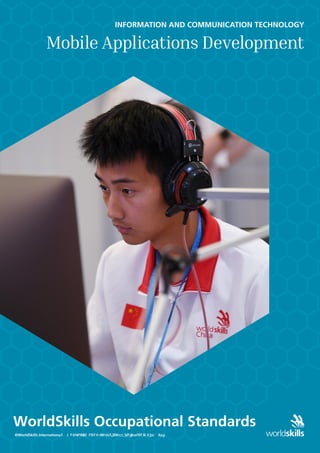
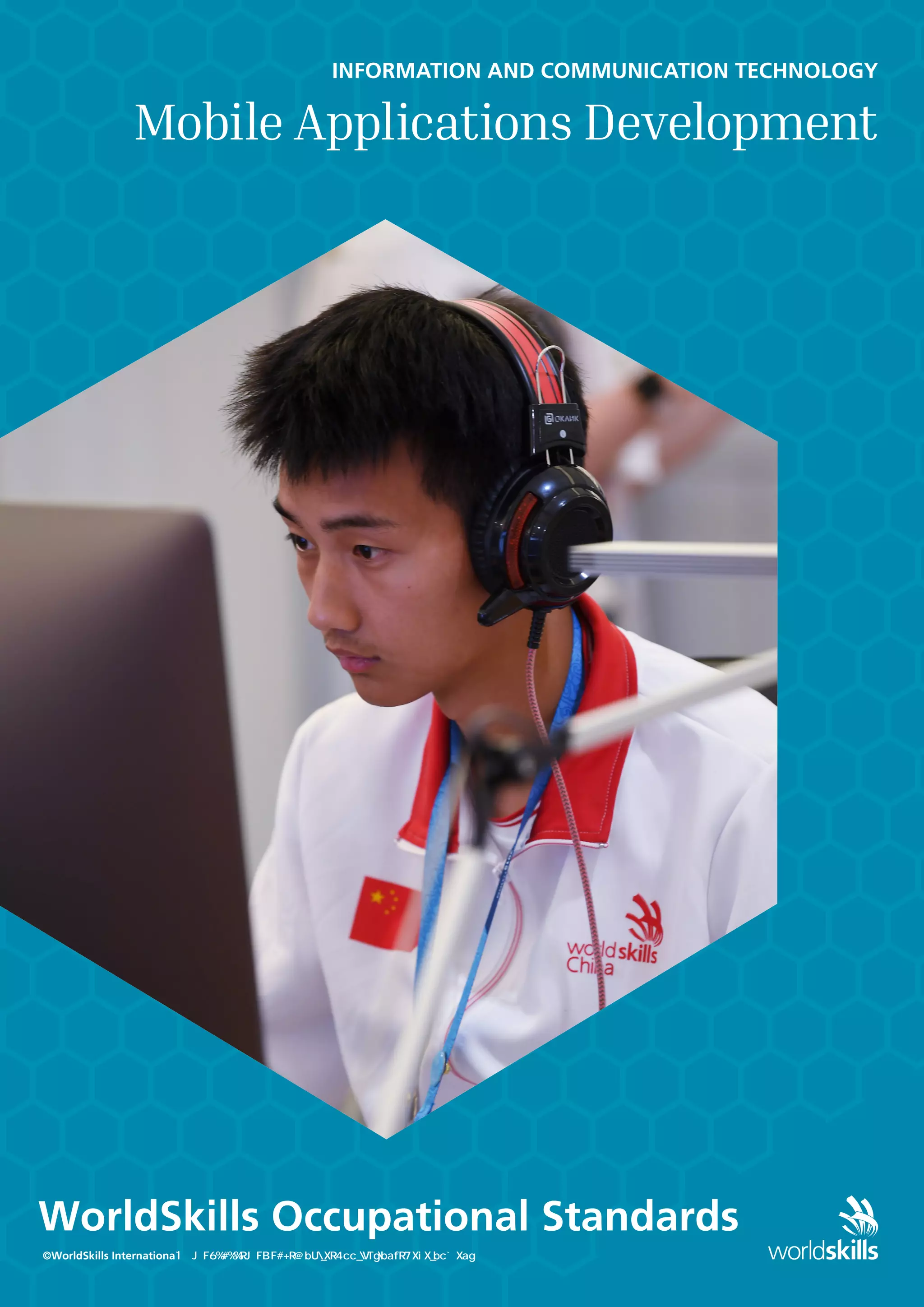
Mobile Applications Development
WorldSkills Occupational Standards
©WorldSkills International 95%A9515A/QDKNGA#RRNKECVKQPUAGXGNQROGPV
WSC2022_WSOS08_Mobile_Applications_Development Version: 1.1
Date: 25.01.21
1 of 8
WorldSkills Occupational Standards (WSOS)
General notes on the WSOS
The WSOS specifies the knowledge, understanding, and specific skills that underpin international best practice in
technical and vocational performance. It should reflect a shared global understanding of what the associated
work role(s) or occupation(s) represent for industry and business (www.worldskills.org/WSOS).
The skill competition is intended to reflect international best practice as described by the WSOS, and to the
extent that it is able to. The Standard is therefore a guide to the required training and preparation for the skill
competition.
In the skill competition the assessment of knowledge and understanding will take place through the assessment
of performance. There will only be separate tests of knowledge and understanding where there is an
overwhelming reason for these.
The Standard is divided into distinct sections with headings and reference numbers added.
Each section is assigned a percentage of the total marks to indicate its relative importance within the Standards.
This is often referred to as the “weighting”. The sum of all the percentage marks is 100. The weightings
determine the distribution of marks within the Marking Scheme.
Through the Test Project, the Marking Scheme will assess only those skills that are set out in the Standards
Specification. They will reflect the Standards as comprehensively as possible within the constraints of the skill
competition.
The Marking Scheme will follow the allocation of marks within the Standards to the extent practically possible. A
variation of up to five percent is allowed, provided that this does not distort the weightings assigned by the
Standards.
WSC2022_WSOS08_Mobile_Applications_Development Version: 1.1
Date: 25.01.21
2 of 8
WorldSkills Occupational Standards
Section Relative
importance
(%)
1 Work organization and management 5
The individual needs to know and understand:
• Principles, regulations and standards relating to safe working space
and practices
• The importance of personal integrity and ethical standards
• Obligations to clients and users for the security of their data,
information, and other types of property
• The need for self-appraisal relative to work demands and expectations
• Options for filling gaps in personal expertise relative to the work in
hand
• The nature of contracts and agreements, and the rights and
obligations that accompany them
• The availability of the resources required to fulfil clients’ requirements
• Good practice in relation to the acquisition, use, storage and
maintenance of equipment and materials
• Techniques and options for work planning, scheduling and
prioritization
• The importance of methodical work practice, including attention to
detail, accuracy, and checking
• The importance of continuing and proactive professional development
The individual shall be able to:
• Organize and maintain a safe and efficient workspace
• Maintain the integrity and confidentiality of systems, data, information
and documents at all times
• Acquire, use, maintain, and store all equipment and materials to
ensure optimal and sustained performance
• Read, appraise and clarify the rights and obligations tied to formal
documentation of all kinds
• Review opportunities, expectations and offers, relative to personal
professional capacity, in order to make open, informed choices
• Select, use and keep up to date selected measures for work planning,
scheduling and prioritization
• Check and ensure that all specific resources are available for the work
in hand
• Meet or enhance the satisfaction of clients and others through self-
knowledge, expectation management, and personal efficiency and
effectiveness
• Proactively grow personal expertise through research and, professional
development.
WSC2022_WSOS08_Mobile_Applications_Development Version: 1.1
Date: 25.01.21
3 of 8
Section Relative
importance
(%)
2 Business, communication, and interpersonal skills for clients and
project fulfilment
5
The individual needs to know and understand:
• Principles and applications of costing, budgeting and charging, relative
to market factors
• The importance of speaking, listening, and writing skills to
communicate with clients, colleagues and others
• Communication and behavioural techniques for preventing and, if
necessary, resolving misunderstandings
• The need for discretion and confidentiality when dealing with clients
and others
• The importance of establishing and maintaining productive working
relationships with colleagues, and team members where relevant
• Conventions and protocols for software documentation
• The principles and applications of record keeping and report writing in
relation to the entire work process, from receiving a brief to
completion and handover of the agreed work.
The individual shall be able to:
• Prepare for meetings with clients and associates
• Gather, clarify, and confirm client requirements
• Receive, clarify, and interpret briefs and specifications
• Offer and discuss options and alternatives
• Discuss time, costs and fees with client, to reach mutual acceptance
• Document and sort out customer needs
• Use project management skills and techniques to make the most of
workplace organization and resources
• Follow instructions from available guidance documentation
• Record each stage of work development
• Keep client regularly updated on progress
• Present proposed and final software solutions
• Prioritize and schedule tasks
• Allocate resources to tasks
WSC2022_WSOS08_Mobile_Applications_Development Version: 1.1
Date: 25.01.21
4 of 8
Section Relative
importance
(%)
3 Initial planning, design, and test framework 10
The individual needs to know and understand:
• Characteristics and advantages of various development platforms (e.g.
iOS, Android)
• The behaviours of mobile application users
• Impact of the features on mobile application products (e.g. size and
various parameters)
• Principles and applications of design thinking processes
• The design methods of user interface (UI)
• The design methods of user experience (UE/UX)
• Principles and applications of framework design
• The means of selecting “what works best”
• Principles and applications for flow diagrams
• The principles and applications of version control
• The design of test plans and procedures
• A range of testing methods and tools (e.g. unit test, functional test,
performance test, etc.)
• Specifications for writing codes
• Methods for writing detection program documentation.
The individual shall be able to:
• Choose the most suitable development platforms
• Use UI design software such as Adobe XD, Sketch and Sigma
• Conduct prototype and visual design on the application user interface
(UI)
• Use UI application specifications of iOS or Android systems
• Produce user experience (UE) documentation for applications
• Produce standardized documentation of applications’ brand image,
following clients’ brand guidelines
• Plan and design marketing solutions for mobile applications store
• Plan test cases
• design specifications for writing test reports.
WSC2022_WSOS08_Mobile_Applications_Development Version: 1.1
Date: 25.01.21
5 of 8
Section Relative
importance
(%)
4 Systems architecture planning 40
The individual needs to know and understand:
• Principles and applications for creating systems architecture
• The interaction of platforms and systems architecture
• The basis for the choice of Flutter or React Native
• The basis for selecting modules provided by the web services
• Mobile platform system mechanism (Android or iOS)
• SDK architecture and its usage
• Application code frameworks
• Commonly used underlying libraries
• Programme compatibility on various terminal devices
• Web service, Socket, http(s) protocols
• Database design, SQL query language
• RESTful API design, XML and JSON data format
• Architecture design, development, testing, tuning and other
technologies, and the use of related tools
• Basic principles and common design patterns of object-oriented design
• Industry trends and developments, including new platforms,
development languages, protocols, and technologies
The individual shall be able to:
• Design the interface based on visual design drafts
• Review, select and use open source libraries and frameworks (e.g.
using Google Map)
• Develop corresponding functions according to the features of different
mobile devices
• Obtain the mobile terminal device’s performance parameters from
mobile applications
• Implement visualized data statistical analysis and screening in mobile
applications
• Handle common issues caused by servers, databases, etc.
5 Implementation and product development 10
The individual needs to know and understand:
• The coding specifications and importance of mobile application codes
• Capability of smart terminals such as cameras, GPS, gyroscopes,
accelerometers, and Bluetooth
• Visualized data presentation skills (e.g. pie charts, histograms, line
graphs, etc.)
• Prompted issues from the system and intelligent terminals
• Principle of 2D and 3D design of animation
• Mathematical aptitude
• Mobile applications’ fault-finding skills.
• Encryption, decryption, signature, etc. of data communication
between user terminal and server
WSC2022_WSOS08_Mobile_Applications_Development Version: 1.1
Date: 25.01.21
6 of 8
Section Relative
importance
(%)
The individual shall be able to:
• Conduct integrated development with existing code using API
• (application programming interface)
• Realize user interaction effects, animation, and data interaction via
programming
• Create modular and reusable development codes
• Develop Android or iOS interface, and complete compatibility testing
• Use Android or iOS development language to implement application
development in common design patterns
• Use high-performance programming and performance tuning on
Android or iOS platform
• Apply the test cases
• Plan and implement frequent tests to ensure efficient development
• Record test results and resolve issues
• Debug the mobile applications to identify issues and write normalized
codes to resolve the issues
• Complete interface and functional compatibility testing on different
platforms and screen resolutions
• Simulate testing and troubleshooting of sensors on different devices
• Record test results
• Implement automated tests of the standardized application
programming interfaces
• Conduct performance testing and performance tuning (APIs).
6 Final product tests, troubleshooting, and optimization 15
The individual needs to know and understand:
• Principles and procedures for product reviews using a range of
specialized measures and procedures
• Principles and applications for evaluating efficiency and effectiveness
• Principles and methods for personal performance review
• Principles and techniques for continuous improvement and
optimization.
WSC2022_WSOS08_Mobile_Applications_Development Version: 1.1
Date: 25.01.21
7 of 8
Section Relative
importance
(%)
The individual shall be able to:
• Complete all tests to verify functionality
• Bring together all aspects of the project
• Analyse and evaluate each stage of the project, relative to
• The client’s specification
• The quality of the user experience
• ring together test results to produce a final report
• Evaluate own performance relative to the given brief
• Review the completed project in order to ask “how would I move this
on?” “How would I take this to the next stage?”
• Prepare and present proposals for optimization to line managers
and/or clients
WSC2022_WSOS08_Mobile_Applications_Development Version: 1.1
Date: 25.01.21
8 of 8
References for industry consultation
WorldSkills is committed to ensuring that the WorldSkills Occupational Standards fully reflect the dynamism of
internationally recognized best practice in industry and business. To do this WorldSkills approaches a number of
organizations across the world that can offer feedback on the draft Description of the Associated Role and
WorldSkills Occupational Standards on a two-yearly cycle.
In parallel to this, WSI consults three international occupational classifications and databases:
• ISCO-08: (http://www.ilo.org/public/english/bureau/stat/isco/isco08/)
• ESCO: (https://ec.europa.eu/esco/portal/home )
• O*NET OnLine (www.onetonline.org/)
There were no responses to the requests for feedback this cycle.

Wsc2022 wsos08 mobile_applications_development

  • 1.
    MANUFACTURING AND ENGINEERINGTECHNOLOGY IT Software Solutions for Business INFORMATION AND COMMUNICATION TECHNOLOGY Mobile Applications Development WorldSkills Occupational Standards ©WorldSkills International 95%A9515A/QDKNGA#RRNKECVKQPUAGXGNQROGPV
  • 2.
    WSC2022_WSOS08_Mobile_Applications_Development Version: 1.1 Date:25.01.21 1 of 8 WorldSkills Occupational Standards (WSOS) General notes on the WSOS The WSOS specifies the knowledge, understanding, and specific skills that underpin international best practice in technical and vocational performance. It should reflect a shared global understanding of what the associated work role(s) or occupation(s) represent for industry and business (www.worldskills.org/WSOS). The skill competition is intended to reflect international best practice as described by the WSOS, and to the extent that it is able to. The Standard is therefore a guide to the required training and preparation for the skill competition. In the skill competition the assessment of knowledge and understanding will take place through the assessment of performance. There will only be separate tests of knowledge and understanding where there is an overwhelming reason for these. The Standard is divided into distinct sections with headings and reference numbers added. Each section is assigned a percentage of the total marks to indicate its relative importance within the Standards. This is often referred to as the “weighting”. The sum of all the percentage marks is 100. The weightings determine the distribution of marks within the Marking Scheme. Through the Test Project, the Marking Scheme will assess only those skills that are set out in the Standards Specification. They will reflect the Standards as comprehensively as possible within the constraints of the skill competition. The Marking Scheme will follow the allocation of marks within the Standards to the extent practically possible. A variation of up to five percent is allowed, provided that this does not distort the weightings assigned by the Standards.
  • 3.
    WSC2022_WSOS08_Mobile_Applications_Development Version: 1.1 Date:25.01.21 2 of 8 WorldSkills Occupational Standards Section Relative importance (%) 1 Work organization and management 5 The individual needs to know and understand: • Principles, regulations and standards relating to safe working space and practices • The importance of personal integrity and ethical standards • Obligations to clients and users for the security of their data, information, and other types of property • The need for self-appraisal relative to work demands and expectations • Options for filling gaps in personal expertise relative to the work in hand • The nature of contracts and agreements, and the rights and obligations that accompany them • The availability of the resources required to fulfil clients’ requirements • Good practice in relation to the acquisition, use, storage and maintenance of equipment and materials • Techniques and options for work planning, scheduling and prioritization • The importance of methodical work practice, including attention to detail, accuracy, and checking • The importance of continuing and proactive professional development The individual shall be able to: • Organize and maintain a safe and efficient workspace • Maintain the integrity and confidentiality of systems, data, information and documents at all times • Acquire, use, maintain, and store all equipment and materials to ensure optimal and sustained performance • Read, appraise and clarify the rights and obligations tied to formal documentation of all kinds • Review opportunities, expectations and offers, relative to personal professional capacity, in order to make open, informed choices • Select, use and keep up to date selected measures for work planning, scheduling and prioritization • Check and ensure that all specific resources are available for the work in hand • Meet or enhance the satisfaction of clients and others through self- knowledge, expectation management, and personal efficiency and effectiveness • Proactively grow personal expertise through research and, professional development.
  • 4.
    WSC2022_WSOS08_Mobile_Applications_Development Version: 1.1 Date:25.01.21 3 of 8 Section Relative importance (%) 2 Business, communication, and interpersonal skills for clients and project fulfilment 5 The individual needs to know and understand: • Principles and applications of costing, budgeting and charging, relative to market factors • The importance of speaking, listening, and writing skills to communicate with clients, colleagues and others • Communication and behavioural techniques for preventing and, if necessary, resolving misunderstandings • The need for discretion and confidentiality when dealing with clients and others • The importance of establishing and maintaining productive working relationships with colleagues, and team members where relevant • Conventions and protocols for software documentation • The principles and applications of record keeping and report writing in relation to the entire work process, from receiving a brief to completion and handover of the agreed work. The individual shall be able to: • Prepare for meetings with clients and associates • Gather, clarify, and confirm client requirements • Receive, clarify, and interpret briefs and specifications • Offer and discuss options and alternatives • Discuss time, costs and fees with client, to reach mutual acceptance • Document and sort out customer needs • Use project management skills and techniques to make the most of workplace organization and resources • Follow instructions from available guidance documentation • Record each stage of work development • Keep client regularly updated on progress • Present proposed and final software solutions • Prioritize and schedule tasks • Allocate resources to tasks
  • 5.
    WSC2022_WSOS08_Mobile_Applications_Development Version: 1.1 Date:25.01.21 4 of 8 Section Relative importance (%) 3 Initial planning, design, and test framework 10 The individual needs to know and understand: • Characteristics and advantages of various development platforms (e.g. iOS, Android) • The behaviours of mobile application users • Impact of the features on mobile application products (e.g. size and various parameters) • Principles and applications of design thinking processes • The design methods of user interface (UI) • The design methods of user experience (UE/UX) • Principles and applications of framework design • The means of selecting “what works best” • Principles and applications for flow diagrams • The principles and applications of version control • The design of test plans and procedures • A range of testing methods and tools (e.g. unit test, functional test, performance test, etc.) • Specifications for writing codes • Methods for writing detection program documentation. The individual shall be able to: • Choose the most suitable development platforms • Use UI design software such as Adobe XD, Sketch and Sigma • Conduct prototype and visual design on the application user interface (UI) • Use UI application specifications of iOS or Android systems • Produce user experience (UE) documentation for applications • Produce standardized documentation of applications’ brand image, following clients’ brand guidelines • Plan and design marketing solutions for mobile applications store • Plan test cases • design specifications for writing test reports.
  • 6.
    WSC2022_WSOS08_Mobile_Applications_Development Version: 1.1 Date:25.01.21 5 of 8 Section Relative importance (%) 4 Systems architecture planning 40 The individual needs to know and understand: • Principles and applications for creating systems architecture • The interaction of platforms and systems architecture • The basis for the choice of Flutter or React Native • The basis for selecting modules provided by the web services • Mobile platform system mechanism (Android or iOS) • SDK architecture and its usage • Application code frameworks • Commonly used underlying libraries • Programme compatibility on various terminal devices • Web service, Socket, http(s) protocols • Database design, SQL query language • RESTful API design, XML and JSON data format • Architecture design, development, testing, tuning and other technologies, and the use of related tools • Basic principles and common design patterns of object-oriented design • Industry trends and developments, including new platforms, development languages, protocols, and technologies The individual shall be able to: • Design the interface based on visual design drafts • Review, select and use open source libraries and frameworks (e.g. using Google Map) • Develop corresponding functions according to the features of different mobile devices • Obtain the mobile terminal device’s performance parameters from mobile applications • Implement visualized data statistical analysis and screening in mobile applications • Handle common issues caused by servers, databases, etc. 5 Implementation and product development 10 The individual needs to know and understand: • The coding specifications and importance of mobile application codes • Capability of smart terminals such as cameras, GPS, gyroscopes, accelerometers, and Bluetooth • Visualized data presentation skills (e.g. pie charts, histograms, line graphs, etc.) • Prompted issues from the system and intelligent terminals • Principle of 2D and 3D design of animation • Mathematical aptitude • Mobile applications’ fault-finding skills. • Encryption, decryption, signature, etc. of data communication between user terminal and server
  • 7.
    WSC2022_WSOS08_Mobile_Applications_Development Version: 1.1 Date:25.01.21 6 of 8 Section Relative importance (%) The individual shall be able to: • Conduct integrated development with existing code using API • (application programming interface) • Realize user interaction effects, animation, and data interaction via programming • Create modular and reusable development codes • Develop Android or iOS interface, and complete compatibility testing • Use Android or iOS development language to implement application development in common design patterns • Use high-performance programming and performance tuning on Android or iOS platform • Apply the test cases • Plan and implement frequent tests to ensure efficient development • Record test results and resolve issues • Debug the mobile applications to identify issues and write normalized codes to resolve the issues • Complete interface and functional compatibility testing on different platforms and screen resolutions • Simulate testing and troubleshooting of sensors on different devices • Record test results • Implement automated tests of the standardized application programming interfaces • Conduct performance testing and performance tuning (APIs). 6 Final product tests, troubleshooting, and optimization 15 The individual needs to know and understand: • Principles and procedures for product reviews using a range of specialized measures and procedures • Principles and applications for evaluating efficiency and effectiveness • Principles and methods for personal performance review • Principles and techniques for continuous improvement and optimization.
  • 8.
    WSC2022_WSOS08_Mobile_Applications_Development Version: 1.1 Date:25.01.21 7 of 8 Section Relative importance (%) The individual shall be able to: • Complete all tests to verify functionality • Bring together all aspects of the project • Analyse and evaluate each stage of the project, relative to • The client’s specification • The quality of the user experience • ring together test results to produce a final report • Evaluate own performance relative to the given brief • Review the completed project in order to ask “how would I move this on?” “How would I take this to the next stage?” • Prepare and present proposals for optimization to line managers and/or clients
  • 9.
    WSC2022_WSOS08_Mobile_Applications_Development Version: 1.1 Date:25.01.21 8 of 8 References for industry consultation WorldSkills is committed to ensuring that the WorldSkills Occupational Standards fully reflect the dynamism of internationally recognized best practice in industry and business. To do this WorldSkills approaches a number of organizations across the world that can offer feedback on the draft Description of the Associated Role and WorldSkills Occupational Standards on a two-yearly cycle. In parallel to this, WSI consults three international occupational classifications and databases: • ISCO-08: (http://www.ilo.org/public/english/bureau/stat/isco/isco08/) • ESCO: (https://ec.europa.eu/esco/portal/home ) • O*NET OnLine (www.onetonline.org/) There were no responses to the requests for feedback this cycle.