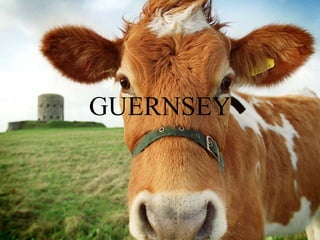
GUERNSEY
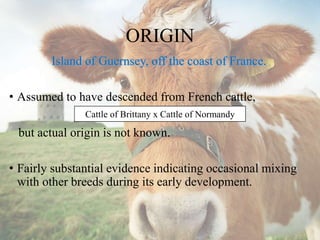
ORIGIN
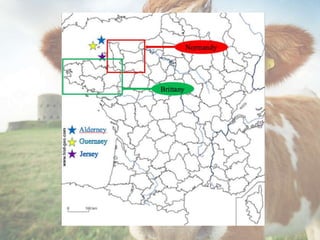
Island of Guernsey, off the coast of France.
• Assumed to have descended from French cattle,
but actual origin is not known.
• Fairly substantial evidence indicating occasional mixing
with other breeds during its early development.
Cattle of Brittany x Cattle of Normandy
DISTRIBUTION
UK, USA, Canada, South Africa, Australia and New
Zealand.
• Were taken to the UK in considerably large numbers
but because of their COMPARATIVELY small
numbers, are of little importance.
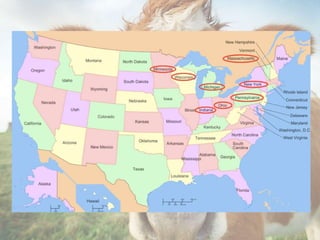
• In the USA, popular in New York, Massachusetts,
Pennsylvania, Wisconsin, Minnesota, Ohio, Indiana
and Michigan. Their rapid increase in popularity is
owed to the American Guernsey Cattle Club.
MORPHOLOGICAL
CHARACTERISTICS
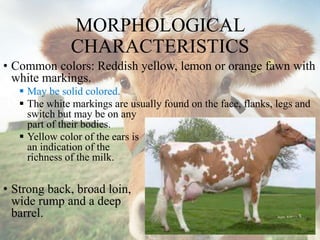
• Common colors: Reddish yellow, lemon or orange fawn with
white markings.
 May be solid colored.
 The white markings are usually found on the face, flanks, legs and
switch but may be on any
part of their bodies.
 Yellow color of the ears is
an indication of the
richness of the milk.
• Strong back, broad loin,
wide rump and a deep
barrel.
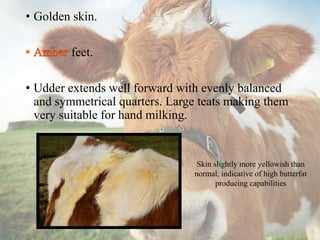
• Golden skin.
feet.
• Udder extends well forward with evenly balanced
and symmetrical quarters. Large teats making them
very suitable for hand milking.
Skin slightly more yellowish than
normal, indicative of high butterfat
producing capabilities
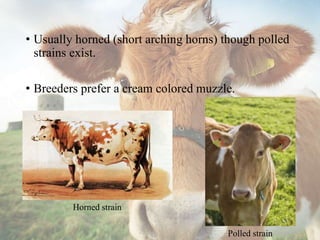
• Usually horned (short arching horns) though polled
strains exist.
• Breeders prefer a cream colored muzzle.
Horned strain
Polled strain
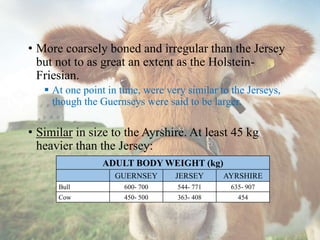
• More coarsely boned and irregular than the Jersey
but not to as great an extent as the Holstein-
Friesian.
 At one point in time, were very similar to the Jerseys,
though the Guernseys were said to be larger.
• Similar in size to the Ayrshire. At least 45 kg
heavier than the Jersey:
ADULT BODY WEIGHT (kg)
GUERNSEY JERSEY AYRSHIRE
Bull 600- 700 544- 771 635- 907
Cow 450- 500 363- 408 454
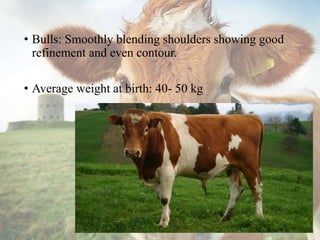
• Bulls: Smoothly blending shoulders showing good
refinement and even contour.
• Average weight at birth: 40- 50 kg
DIFFERENCES BETWEEN
GUERNSEY AND A FEW OTHER
BREEDS
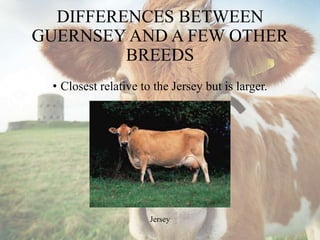
• Closest relative to the Jersey but is larger.
Jersey
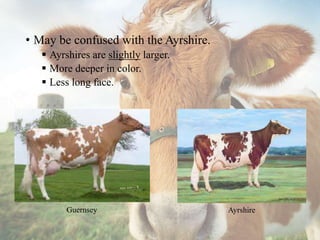
• May be confused with the Ayrshire.
 Ayrshires are slightly larger.
 More deeper in color.
 Less long face.
Guernsey Ayrshire
DAIRY CHARACTERISTICS
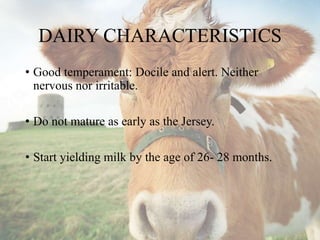
• Good temperament: Docile and alert. Neither
nervous nor irritable.
• Do not mature as early as the Jersey.
• Start yielding milk by the age of 26- 28 months.
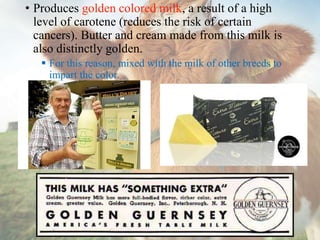
• Produces golden colored milk, a result of a high
level of carotene (reduces the risk of certain
cancers). Butter and cream made from this milk is
also distinctly golden.
 For this reason, mixed with the milk of other breeds to
impart the color.
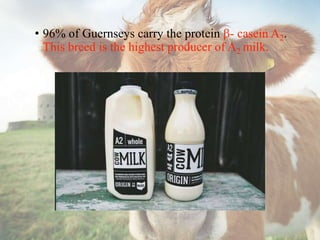
• 96% of Guernseys carry the protein b- casein A2.
This breed is the highest producer of A2 milk.
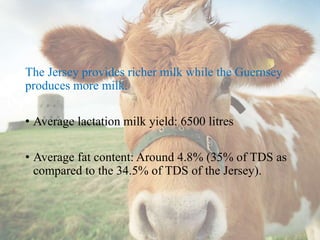
The Jersey provides richer milk while the Guernsey
produces more milk.
• Average lactation milk yield: 6500 litres
• Average fat content: Around 4.8% (35% of TDS as
compared to the 34.5% of TDS of the Jersey).
ADVANATGES
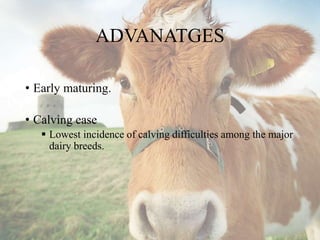
• Early maturing.
• Calving ease
 Lowest incidence of calving difficulties among the major
dairy breeds.
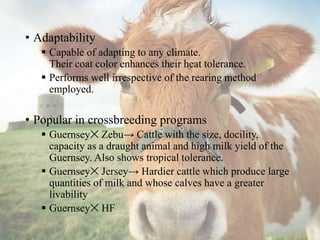
• Adaptability
 Capable of adapting to any climate.
Their coat color enhances their heat tolerance.
 Performs well irrespective of the rearing method
employed.
• Popular in crossbreeding programs
 Guernsey✕ Zebu→ Cattle with the size, docility,
capacity as a draught animal and high milk yield of the
Guernsey. Also shows tropical tolerance.
 Guernsey✕ Jersey→ Hardier cattle which produce large
quantities of milk and whose calves have a greater
livability
 Guernsey✕ HF
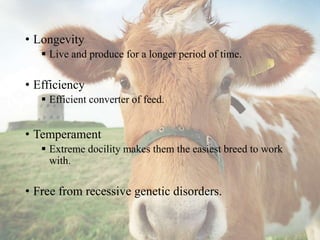
• Longevity
 Live and produce for a longer period of time.
• Efficiency
 Efficient converter of feed.
• Temperament
 Extreme docility makes them the easiest breed to work
with.
• Free from recessive genetic disorders.
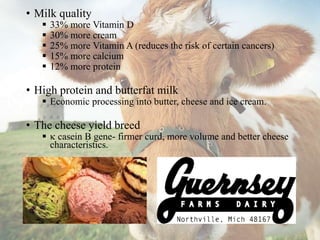
• Milk quality
 33% more Vitamin D
 30% more cream
 25% more Vitamin A (reduces the risk of certain cancers)
 15% more calcium
 12% more protein
• High protein and butterfat milk
 Economic processing into butter, cheese and ice cream.
• The cheese yield breed
 k casein B gene- firmer curd, more volume and better cheese
characteristics.
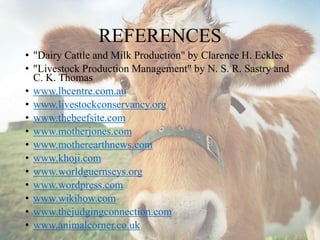
REFERENCES
• "Dairy Cattle and Milk Production" by Clarence H. Eckles
• "Livestock Production Management" by N. S. R. Sastry and
C. K. Thomas
• www.lbcentre.com.au
• www.livestockconservancy.org
• www.thebeefsite.com
• www.motherjones.com
• www.motherearthnews.com
• www.khoji.com
• www.worldguernseys.org
• www.wordpress.com
• www.wikihow.com
• www.thejudgingconnection.com
• www.animalcorner.co.uk
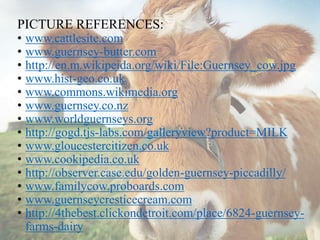
PICTURE REFERENCES:
• www.cattlesite.com
• www.guernsey-butter.com
• http://en.m.wikipeida.org/wiki/File:Guernsey_cow.jpg
• www.hist-geo.co.uk
• www.commons.wikimedia.org
• www.guernsey.co.nz
• www.worldguernseys.org
• http://gogd.tjs-labs.com/galleryview?product=MILK
• www.gloucestercitizen.co.uk
• www.cookipedia.co.uk
• http://observer.case.edu/golden-guernsey-piccadilly/
• www.familycow.proboards.com
• www.guernseycresticecream.com
• http://4thebest.clickondetroit.com/place/6824-guernsey-
farms-dairy
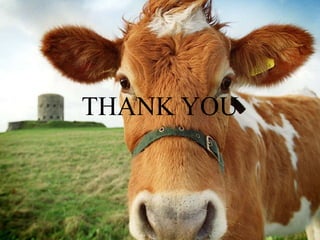
THANK YOU

Guernsey

  • 1.
  • 2.
    ORIGIN Island of Guernsey,off the coast of France. • Assumed to have descended from French cattle, but actual origin is not known. • Fairly substantial evidence indicating occasional mixing with other breeds during its early development. Cattle of Brittany x Cattle of Normandy
  • 4.
    DISTRIBUTION UK, USA, Canada,South Africa, Australia and New Zealand. • Were taken to the UK in considerably large numbers but because of their COMPARATIVELY small numbers, are of little importance. • In the USA, popular in New York, Massachusetts, Pennsylvania, Wisconsin, Minnesota, Ohio, Indiana and Michigan. Their rapid increase in popularity is owed to the American Guernsey Cattle Club.
  • 6.
    MORPHOLOGICAL CHARACTERISTICS • Common colors:Reddish yellow, lemon or orange fawn with white markings.  May be solid colored.  The white markings are usually found on the face, flanks, legs and switch but may be on any part of their bodies.  Yellow color of the ears is an indication of the richness of the milk. • Strong back, broad loin, wide rump and a deep barrel.
  • 7.
    • Golden skin. feet. •Udder extends well forward with evenly balanced and symmetrical quarters. Large teats making them very suitable for hand milking. Skin slightly more yellowish than normal, indicative of high butterfat producing capabilities
  • 8.
    • Usually horned(short arching horns) though polled strains exist. • Breeders prefer a cream colored muzzle. Horned strain Polled strain
  • 9.
    • More coarselyboned and irregular than the Jersey but not to as great an extent as the Holstein- Friesian.  At one point in time, were very similar to the Jerseys, though the Guernseys were said to be larger. • Similar in size to the Ayrshire. At least 45 kg heavier than the Jersey: ADULT BODY WEIGHT (kg) GUERNSEY JERSEY AYRSHIRE Bull 600- 700 544- 771 635- 907 Cow 450- 500 363- 408 454
  • 10.
    • Bulls: Smoothlyblending shoulders showing good refinement and even contour. • Average weight at birth: 40- 50 kg
  • 11.
    DIFFERENCES BETWEEN GUERNSEY ANDA FEW OTHER BREEDS • Closest relative to the Jersey but is larger. Jersey
  • 12.
    • May beconfused with the Ayrshire.  Ayrshires are slightly larger.  More deeper in color.  Less long face. Guernsey Ayrshire
  • 13.
    DAIRY CHARACTERISTICS • Goodtemperament: Docile and alert. Neither nervous nor irritable. • Do not mature as early as the Jersey. • Start yielding milk by the age of 26- 28 months.
  • 14.
    • Produces goldencolored milk, a result of a high level of carotene (reduces the risk of certain cancers). Butter and cream made from this milk is also distinctly golden.  For this reason, mixed with the milk of other breeds to impart the color.
  • 15.
    • 96% ofGuernseys carry the protein b- casein A2. This breed is the highest producer of A2 milk.
  • 16.
    The Jersey providesricher milk while the Guernsey produces more milk. • Average lactation milk yield: 6500 litres • Average fat content: Around 4.8% (35% of TDS as compared to the 34.5% of TDS of the Jersey).
  • 17.
    ADVANATGES • Early maturing. •Calving ease  Lowest incidence of calving difficulties among the major dairy breeds.
  • 18.
    • Adaptability  Capableof adapting to any climate. Their coat color enhances their heat tolerance.  Performs well irrespective of the rearing method employed. • Popular in crossbreeding programs  Guernsey✕ Zebu→ Cattle with the size, docility, capacity as a draught animal and high milk yield of the Guernsey. Also shows tropical tolerance.  Guernsey✕ Jersey→ Hardier cattle which produce large quantities of milk and whose calves have a greater livability  Guernsey✕ HF
  • 19.
    • Longevity  Liveand produce for a longer period of time. • Efficiency  Efficient converter of feed. • Temperament  Extreme docility makes them the easiest breed to work with. • Free from recessive genetic disorders.
  • 20.
    • Milk quality 33% more Vitamin D  30% more cream  25% more Vitamin A (reduces the risk of certain cancers)  15% more calcium  12% more protein • High protein and butterfat milk  Economic processing into butter, cheese and ice cream. • The cheese yield breed  k casein B gene- firmer curd, more volume and better cheese characteristics.
  • 21.
    REFERENCES • "Dairy Cattleand Milk Production" by Clarence H. Eckles • "Livestock Production Management" by N. S. R. Sastry and C. K. Thomas • www.lbcentre.com.au • www.livestockconservancy.org • www.thebeefsite.com • www.motherjones.com • www.motherearthnews.com • www.khoji.com • www.worldguernseys.org • www.wordpress.com • www.wikihow.com • www.thejudgingconnection.com • www.animalcorner.co.uk
  • 22.
    PICTURE REFERENCES: • www.cattlesite.com •www.guernsey-butter.com • http://en.m.wikipeida.org/wiki/File:Guernsey_cow.jpg • www.hist-geo.co.uk • www.commons.wikimedia.org • www.guernsey.co.nz • www.worldguernseys.org • http://gogd.tjs-labs.com/galleryview?product=MILK • www.gloucestercitizen.co.uk • www.cookipedia.co.uk • http://observer.case.edu/golden-guernsey-piccadilly/ • www.familycow.proboards.com • www.guernseycresticecream.com • http://4thebest.clickondetroit.com/place/6824-guernsey- farms-dairy
  • 23.