GOODS AND SERVICE TAX
(GST)
GOODS AND SERVICE TAX (GST)
 GST is a tax on SUPPLY of goods and services.
 Under GST no distinction is made between goods and services for levying of tax.
 It will mostly substitute all indirect taxes by Central and State governments in
India.
 GST is a single tax at a national level tobe levied at all stages of supply.
 Under GST every person is liable to pay tax onhis output and is entitled to get
input tax credit (ITC) onthe tax paid on its inputs.
 It is a tax onVALUE ADDITION only.
 Ultimately the final consumershall bearthe burden oftax underGST.
2
JyotiRastogi(AssistantProfessor)
CHARACTERISTICS OF GST
3
JyotiRastogi(AssistantProfessor)
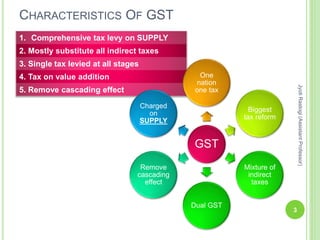
1. Comprehensive tax levy on SUPPLY
2. Mostly substitute all indirect taxes
3. Single tax levied at all stages
4. Tax on value addition
5. Remove cascading effect
GST
One
nation
one tax
Biggest
tax reform
Mixture of
indirect
taxes
Dual GST
Remove
cascading
effect
Charged
on
SUPPLY
THE SALIENT FEATURES OF GST
4
JyotiRastogi(AssistantProfessor)
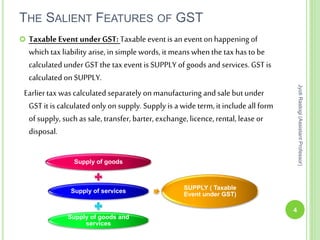
 Taxable Event underGST: Taxable eventis an event on happening of
which tax liability arise, in simple words, it means when the tax has to be
calculated underGST the tax event is SUPPLY of goods and services. GST is
calculated on SUPPLY.
Earliertax was calculated separately on manufacturing and sale butunder
GST it is calculated only on supply. Supply is a wide term, it include all form
of supply, such as sale, transfer, barter, exchange,licence,rental, lease or
disposal.
Supply of goods
Supply of services
Supply of goods and
services
SUPPLY ( Taxable
Event under GST)
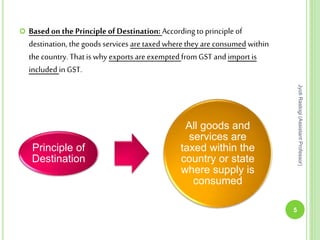
 Based on the PrincipleofDestination: According to principle of
destination, the goods services are taxed where they are consumed within
the country. That is why exports are exempted from GST and import is
included in GST.
5
JyotiRastogi(AssistantProfessor)
Principle of
Destination
All goods and
services are
taxed within the
country or state
where supply is
consumed
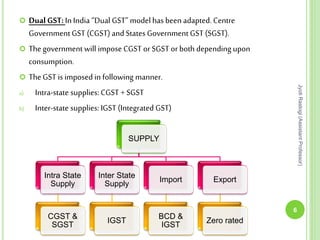
 Dual GST:In India “Dual GST” model has been adapted.Centre
GovernmentGST (CGST) and States GovernmentGST (SGST).
 Thegovernment will impose CGST orSGST orboth depending upon
consumption.
 TheGST is imposed in following manner.
a) Intra-state supplies: CGST + SGST
b) Inter-state supplies: IGST (Integrated GST)
6
JyotiRastogi(AssistantProfessor)
SUPPLY
Intra State
Supply
CGST &
SGST
Inter State
Supply
IGST
Import
BCD &
IGST
Export
Zero rated
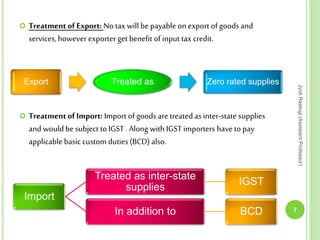
 TreatmentofExport: No tax will bepayable onexport of goods and
services, howeverexporter get benefit of input tax credit.
 TreatmentofImport: Import of goods are treated as inter-state supplies
and wouldbe subject toIGST .Along with IGST importers havetopay
applicable basic custom duties (BCD) also.
7
JyotiRastogi(AssistantProfessor)
Export Treated as Zero rated supplies
Import
Treated as inter-state
supplies
IGST
In addition to BCD
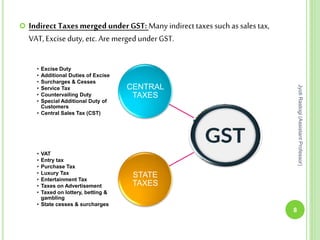
 Indirect Taxesmerged underGST: Many indirect taxes such as sales tax,
VAT, Excise duty, etc.Are mergedunder GST.
8
JyotiRastogi(AssistantProfessor)
CENTRAL
TAXES
• Excise Duty
• Additional Duties of Excise
• Surcharges & Cesses
• Service Tax
• Countervailing Duty
• Special Additional Duty of
Customers
• Central Sales Tax (CST)
STATE
TAXES
• VAT
• Entry tax
• Purchase Tax
• Luxury Tax
• Entertainment Tax
• Taxes on Advertisement
• Taxed on lottery, betting &
gambling
• State cesses & surcharges
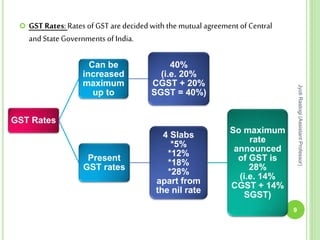
GST Rates
Can be
increased
maximum
up to
40%
(i.e. 20%
CGST + 20%
SGST = 40%)
Present
GST rates
4 Slabs
*5%
*12%
*18%
*28%
apart from
the nil rate
So maximum
rate
announced
of GST is
28%
(i.e. 14%
CGST + 14%
SGST)
 GST Rates:Rates of GST are decided with the mutual agreement of Central
and State Governments of India.
9
JyotiRastogi(AssistantProfessor)
10
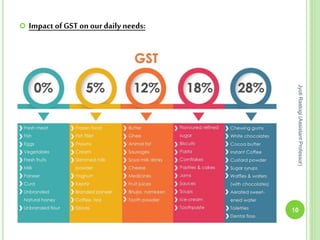
 Impact ofGST on ourdaily needs:
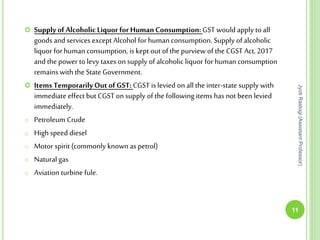
 Supply of Alcoholic Liquor for HumanConsumption: GST would apply to all
goods and services except Alcohol for human consumption. Supply of alcoholic
liquor for humanconsumption, is kept out of the purview of the CGST Act, 2017
and the power to levy taxes on supply of alcoholic liquor for human consumption
remains with the State Government.
 Items TemporarilyOut of GST: CGST is levied on all the inter-state supply with
immediate effect but CGST on supply of the following items has not been levied
immediately.
o Petroleum Crude
o High speed diesel
o Motor spirit (commonly known as petrol)
o Natural gas
o Aviation turbine fule.
11
JyotiRastogi(AssistantProfessor)
THANKS
12
JyotiRastogi(AssistantProfessor)

Gst

  • 1.
  • 2.
    GOODS AND SERVICETAX (GST)  GST is a tax on SUPPLY of goods and services.  Under GST no distinction is made between goods and services for levying of tax.  It will mostly substitute all indirect taxes by Central and State governments in India.  GST is a single tax at a national level tobe levied at all stages of supply.  Under GST every person is liable to pay tax onhis output and is entitled to get input tax credit (ITC) onthe tax paid on its inputs.  It is a tax onVALUE ADDITION only.  Ultimately the final consumershall bearthe burden oftax underGST. 2 JyotiRastogi(AssistantProfessor)
  • 3.
    CHARACTERISTICS OF GST 3 JyotiRastogi(AssistantProfessor) 1.Comprehensive tax levy on SUPPLY 2. Mostly substitute all indirect taxes 3. Single tax levied at all stages 4. Tax on value addition 5. Remove cascading effect GST One nation one tax Biggest tax reform Mixture of indirect taxes Dual GST Remove cascading effect Charged on SUPPLY
  • 4.
    THE SALIENT FEATURESOF GST 4 JyotiRastogi(AssistantProfessor)  Taxable Event underGST: Taxable eventis an event on happening of which tax liability arise, in simple words, it means when the tax has to be calculated underGST the tax event is SUPPLY of goods and services. GST is calculated on SUPPLY. Earliertax was calculated separately on manufacturing and sale butunder GST it is calculated only on supply. Supply is a wide term, it include all form of supply, such as sale, transfer, barter, exchange,licence,rental, lease or disposal. Supply of goods Supply of services Supply of goods and services SUPPLY ( Taxable Event under GST)
  • 5.
     Based onthe PrincipleofDestination: According to principle of destination, the goods services are taxed where they are consumed within the country. That is why exports are exempted from GST and import is included in GST. 5 JyotiRastogi(AssistantProfessor) Principle of Destination All goods and services are taxed within the country or state where supply is consumed
  • 6.
     Dual GST:InIndia “Dual GST” model has been adapted.Centre GovernmentGST (CGST) and States GovernmentGST (SGST).  Thegovernment will impose CGST orSGST orboth depending upon consumption.  TheGST is imposed in following manner. a) Intra-state supplies: CGST + SGST b) Inter-state supplies: IGST (Integrated GST) 6 JyotiRastogi(AssistantProfessor) SUPPLY Intra State Supply CGST & SGST Inter State Supply IGST Import BCD & IGST Export Zero rated
  • 7.
     TreatmentofExport: Notax will bepayable onexport of goods and services, howeverexporter get benefit of input tax credit.  TreatmentofImport: Import of goods are treated as inter-state supplies and wouldbe subject toIGST .Along with IGST importers havetopay applicable basic custom duties (BCD) also. 7 JyotiRastogi(AssistantProfessor) Export Treated as Zero rated supplies Import Treated as inter-state supplies IGST In addition to BCD
  • 8.
     Indirect TaxesmergedunderGST: Many indirect taxes such as sales tax, VAT, Excise duty, etc.Are mergedunder GST. 8 JyotiRastogi(AssistantProfessor) CENTRAL TAXES • Excise Duty • Additional Duties of Excise • Surcharges & Cesses • Service Tax • Countervailing Duty • Special Additional Duty of Customers • Central Sales Tax (CST) STATE TAXES • VAT • Entry tax • Purchase Tax • Luxury Tax • Entertainment Tax • Taxes on Advertisement • Taxed on lottery, betting & gambling • State cesses & surcharges
  • 9.
    GST Rates Can be increased maximum upto 40% (i.e. 20% CGST + 20% SGST = 40%) Present GST rates 4 Slabs *5% *12% *18% *28% apart from the nil rate So maximum rate announced of GST is 28% (i.e. 14% CGST + 14% SGST)  GST Rates:Rates of GST are decided with the mutual agreement of Central and State Governments of India. 9 JyotiRastogi(AssistantProfessor)
  • 10.
  • 11.
     Supply ofAlcoholic Liquor for HumanConsumption: GST would apply to all goods and services except Alcohol for human consumption. Supply of alcoholic liquor for humanconsumption, is kept out of the purview of the CGST Act, 2017 and the power to levy taxes on supply of alcoholic liquor for human consumption remains with the State Government.  Items TemporarilyOut of GST: CGST is levied on all the inter-state supply with immediate effect but CGST on supply of the following items has not been levied immediately. o Petroleum Crude o High speed diesel o Motor spirit (commonly known as petrol) o Natural gas o Aviation turbine fule. 11 JyotiRastogi(AssistantProfessor)
  • 12.