GSM and UMTS
GSM and UMTS
The Creation of Global Mobile Communication
Edited by
Friedhelm Hillebrand
Consulting Engineer, Germany
With contributions from 37 key players involved in the work for GSM and UMTS
JOHN WILEY & SONS, LTD
Copyright q 2002 by John Wiley & Sons, Ltd
Baffins Lane, Chichester,
West Sussex, PO19 1UD, England
National 01243 779777
International (+44) 1243 779777
e-mail (for orders and customer service enquiries): cs-books@wiley.co.uk
Visit our Home Page on http://www.wiley.co.uk or http://www.wiley.com
All Rights Reserved. No part of this publication may be reproduced, stored in a retrieval system, or
transmitted, in any form or by any means, electronic, mechanical, photocopying, recording, scanning or
otherwise, except under the terms of the Copyright Designs and Patents Act 1988 or under the terms of a
licence issued by the Copyright Licensing Agency, 90 Tottenham Court Road, London, W1P 9HE, UK,
without the permission in writing of the Publisher, with the exception of any material supplied speci-
fically for the purpose of being entered and executed on a computer system, for exclusive use by the
purchaser of the publication.
Neither the author(s) nor John Wiley & Sons Ltd accept any responsibility or liability for loss or damage
occasioned to any person or property through using the material, instructions, methods or ideas
contained herein, or acting or refraining from acting as a result of such use. The author(s) and Publisher
expressly disclaim all implied warranties, including merchantability of fitness for any particular
purpose. There will be no duty on the authors or Publisher to correct any errors or defects in the
software.
Designations used by companies to distinguish their products are often claimed as trademarks. In all
instances where John Wiley & Sons is aware of a claim, the product names appear in initial capital or
capital letters. Readers, however, should contact the appropriate companies for more complete informa-
tion regarding trademarks and registration.
Other Wiley Editorial Offices
John Wiley & Sons, Inc., 605 Third Avenue,
New York, NY 10158-0012, USA
WILEY-VCH Verlag GmbH
Pappelallee 3, D-69469 Weinheim, Germany
John Wiley & Sons Australia Ltd, 33 Park Road, Milton,
Queensland 4064, Australia
John Wiley & Sons (Canada) Ltd, 22 Worcester Road
Rexdale, Ontario, M9W 1L1, Canada
John Wiley & Sons (Asia) Pte Ltd, 2 Clementi Loop #02-01,
Jin Xing Distripark, Singapore 129809
British Library Cataloguing in Publication Data
A catalogue record for this book is available from the British Library
ISBN 0470 84322 5
Typeset in Times by Deerpark Publishing Services Ltd, Shannon, Ireland.
Printed and bound in Great Britain by T. J. International Ltd, Padstow, Cornwall.
This book is printed on acid-free paper responsibly manufactured from sustainable forestry, in which at
least two trees are planted for each one used for paper production.
Contents
Chapter 1 GSM’s Achievements . . . . . . . . . . . . . . . . . . . . . . . . . . . . . . . . . . 1
Friedhelm Hillebrand
Section 1 Introduction . . . . . . . . . . . . . . . . . . . . . . . . . . . . . . . . . . . . . . . 1
Section 2 GSM and UMTS Milestones . . . . . . . . . . . . . . . . . . . . . . . . . . . . . 5
Section 3 GSM Success Measured by Numbers . . . . . . . . . . . . . . . . . . . . . . . . 7
Chapter 2 The Agreement on the Concepts and the Basic Parameters of the GSM Standard
(Mid-1982 to Mid-1987). . . . . . . . . . . . . . . . . . . . . . . . . . . . . . . . . 11
Section 1 The Market Fragmentation in Europe and the CEPT Initiatives in 1982 . . . 11
Thomas Haug
Section 2 The GSM Standardisation Work 1982–1987 . . . . . . . . . . . . . . . . . . . . 15
Thomas Haug
Section 3 The Franco-German, Tripartite and Quadripartite Co-operation from 1984 to 1987 23
Philippe Dupuis
Section 4 The GSM Memorandum of Understanding the Engine that Pushed GSM to the
Market . . . . . . . . . . . . . . . . . . . . . . . . . . . . . . . . . . . . . . . . . . 36
Stephen Temple
Section 5 The Role of the European Commission . . . . . . . . . . . . . . . . . . . . . . . 52
Philippe Dupuis
Chapter 3 The Detailed Specification Work Leading to the GSM Phase 1 Standard used for
the Opening of Service (1987–1991) . . . . . . . . . . . . . . . . . . . . . . . . . 57
Thomas Haug
Chapter 4 Consolidating GSM Phase 1 and Evolving the Services and System Features to
GSM Phase 2 in ETSI SMG (1992–1995). . . . . . . . . . . . . . . . . . . . . . 61
Philippe Dupuis
Chapter 5 Evolving the Services and System Features to Generation 2.5 by the GSM Phase
2+ Program (1993–2000) . . . . . . . . . . . . . . . . . . . . . . . . . . . . . . . . 73
Section 1 The GSM Phase 2+ Work in ETSI SMG from 1993 to 1996 . . . . . . . . . . 73
Philippe Dupuis
Section 2 The GSM Work in ETSI SMG from May 1996 to July 2000 . . . . . . . . . . 80
Friedhelm Hillebrand
Section 3 GSM Railway . . . . . . . . . . . . . . . . . . . . . . . . . . . . . . . . . . . . . . 99
Ansgar Bergmann
Chapter 6 GSM Goes to North America . . . . . . . . . . . . . . . . . . . . . . . . . . . . . 105
Don Zelmer
Contents
Chapter 7 The UMTS Related Work of the European Commission, UMTS Taskforce,
UMTS Forum and GSM Association. . . . . . . . . . . . . . . . . . . . . . . . 115
Section 1 The European Research. . . . . . . . . . . . . . . . . . . . . . . . . . . . . . . . . 115
Joa˜o Schwarz da Silva
Section 2 The European Regulation. . . . . . . . . . . . . . . . . . . . . . . . . . . . . . . . 128
Ruprecht Niepold
Section 3 The UMTS Taskforce. . . . . . . . . . . . . . . . . . . . . . . . . . . . . . . . . . 147
Bosco Fernandez
Section 4 The UMTS Forum. . . . . . . . . . . . . . . . . . . . . . . . . . . . . . . . . . . . 156
Thomas Beijer
Section 5 Spectrum Aspects . . . . . . . . . . . . . . . . . . . . . . . . . . . . . . . . . . . . 165
Josef Huber
Chapter 8 The UMTS Standardisation Work in ETSI. . . . . . . . . . . . . . . . . . . . 179
Section 1 The Initial Work in ETSI SMG (up to Spring 1996) . . . . . . . . . . . . . . . 179
Philippe Dupuis
Section 2 The Creation of the UMTS Foundations in ETSI from April 1996 to February
1999 . . . . . . . . . . . . . . . . . . . . . . . . . . . . . . . . . . . . . . . . . . . . . . 184
Friedhelm Hillebrand
Chapter 9 The Third Generation Partnership Project (3GPP) . . . . . . . . . . . . . . 221
Section 1 The Creation of 3GPP. . . . . . . . . . . . . . . . . . . . . . . . . . . . . . . . . . 221
Karlheinz Rosenbrock
Section 2 UMTS in 3GPP (December 1998 to May 2001) . . . . . . . . . . . . . . . . . . 247
Niels P.S. Andersen
Chapter 10 Services and Services’ Capabilities . . . . . . . . . . . . . . . . . . . . . . . . 263
Section 1 The Early Years up to the Completion of the First Set of Specifications for
Tendering of Infrastructure (1982 to March 1988) . . . . . . . . . . . . . . . . . . . 263
Friedhelm Hillebrand
Section 2 The Years from Mid-1988 to early 2001 . . . . . . . . . . . . . . . . . . . . . . 286
Alan Cox
Chapter 11 System Architecture Evolution. . . . . . . . . . . . . . . . . . . . . . . . . . . 301
Michel Mouly
Chapter 12 Radio Aspects . . . . . . . . . . . . . . . . . . . . . . . . . . . . . . . . . . . . . 309
Section 1 The Early Years from 1985 to 1995 . . . . . . . . . . . . . . . . . . . . . . . . . 309
Didier Verhulst
Section 2 The Development from 1995 to 2000 . . . . . . . . . . . . . . . . . . . . . . . . 319
Michael Fa¨rber
Chapter 13 The Subscriber Identity Module, Past, Present and Future . . . . . . . . . 341
Klaus Vedder
Chapter 14 Voice Codecs . . . . . . . . . . . . . . . . . . . . . . . . . . . . . . . . . . . . . . 371
Kari Ja¨rvinen
Chapter 15 Security Aspects . . . . . . . . . . . . . . . . . . . . . . . . . . . . . . . . . . . . 385
Mike Walker
Chapter 16 Short Message and Data Services. . . . . . . . . . . . . . . . . . . . . . . . . . 407
Section 1 The Early Years up to the Completion of the First Set of Specifications in March
1988 for Tendering . . . . . . . . . . . . . . . . . . . . . . . . . . . . . . . . . . . 407
Friedhelm Hillebrand
Section 2 The Development from Mid-1988 to 2000 . . . . . . . . . . . . . . . . . . . . . 417
Kevin Holley
Section 3 General Packet Radio Service (GPRS) . . . . . . . . . . . . . . . . . . . . . . . 425
Wolfgang Roth and Ju¨rgen Baumann
Chapter 17 Mobile Stations Type Approval . . . . . . . . . . . . . . . . . . . . . . . . . . . 431
Remi Thomas and David Barnes
Chapter 18 Operation and Maintenance . . . . . . . . . . . . . . . . . . . . . . . . . . . . . 445
Gisela Hertel
Chapter 19 Professional Technical Support and its Evolution . . . . . . . . . . . . . . . 451
Section 1 The PN in the CEPT Environment . . . . . . . . . . . . . . . . . . . . . . . . . . 451
Bernard Mallinder
Section 2 PT12 and PT SMG in the ETSI Environment . . . . . . . . . . . . . . . . . . . 453
Ansgar Bergmann
Section 3 MCC in the 3GPP and ETSI Environment . . . . . . . . . . . . . . . . . . . . . 457
Adrian Scrase
Chapter 20 Working Methods and their Evolution . . . . . . . . . . . . . . . . . . . . . . 463
Ansgar Bergmann
Chapter 21 The Contributions of the GSM Association . . . . . . . . . . . . . . . . . . . 481
Section 1 Co-operation of the Operators from the Agreement of the GSM MoU to the
Opening of Service in 1991/1992 . . . . . . . . . . . . . . . . . . . . . . . . . . 481
Renzo Failli
Section 2 God Send Mobiles, the Experiences of an Operator Pioneer. . . . . . . . . . . 490
George Schmitt
Section 3 The Evolution from the Informal GSM MoU Group to the GSM Association from
1992 to 1998. . . . . . . . . . . . . . . . . . . . . . . . . . . . . . . . . . . . . . . 495
Arne Foxman
Section 4 The Evolution of the GSM Association from 1998 to 2000 . . . . . . . . . . . 506
Petter Bliksrud
Section 5 The Work on Services Aspects . . . . . . . . . . . . . . . . . . . . . . . . . . . . 511
Armin Toepfer
Section 6 The Work on Data Interchange for International Roaming . . . . . . . . . . . 516
Michael Gießler
Section 7 The Third Generation Interest Group . . . . . . . . . . . . . . . . . . . . . . . . 525
Neil Lilly
Chapter 22 GSM and UMTS Acceptance in the World. . . . . . . . . . . . . . . . . . . . 531
Section 1 Global Acceptance of GSM . . . . . . . . . . . . . . . . . . . . . . . . . . . . . . 531
Friedhelm Hillebrand
Section 2 Global Acceptance of UMTS . . . . . . . . . . . . . . . . . . . . . . . . . . . . . 542
Bernd Eylert
Chapter 23 GSM Success Factors . . . . . . . . . . . . . . . . . . . . . . . . . . . . . . . . . 547
Friedhelm Hillebrand
Contents
Annex 1 Plenary Meetings of GSM, SMG, TSG SA, GSM MoU, GSMA . . . . . . . . . . 549
Annex 2 Organisation Evolution of the Technical Groups . . . . . . . . . . . . . . . . . . . 555
Annex 3 Lists of Chairpersons. . . . . . . . . . . . . . . . . . . . . . . . . . . . . . . . . . . . 568
Annex 4 List of Key Abbreviations. . . . . . . . . . . . . . . . . . . . . . . . . . . . . . . . . 573
Index 577
Chapter 1: GSM’s Achievements
Section 1: Introduction
Friedhelm Hillebrand
1.1.1 Introduction to the Content of the Book
This book describes how global mobile communication was made. It is written for those who
want or need to know how this was achieved e.g.:
† Young professionals who want to build their career on GSM and UMTS and need to
understand the basics
† Strategic and technical planners who want to drive the future GSM and UMTS develop-
ment
† Strategists who plan to repeat GSM’s success in the fourth generation
† Academics, who want to understand and analyse the development of GSM and UMTS;
† Activists in other large scale international communication projects who want to use
experiences gained
But the book is also written for those about two thousand colleagues who participated in
the work and want to have a record of the events or to have a more comprehensive image, of
what happened in the different branches of the very big network of groups.
GSM is the system which started in Europe and was accepted by the world. It provides
global mobile communication to:
† anybody: 500 million users from professionals to children in May 2001
† anywhere: 168 countries in all continents in May 2001
† any media: voice, messaging, data, multimedia
UMTS is built on the GSM footprint and plans to repeat the GSM success.
This book is focused on the pre-competitive sphere, the big co-operative effort, which
enabled the huge market success world-wide. The clarification of the strategies, the strategic
decisions on the broad avenues in service and system design and commercial concepts are
described. This book provides an insight into the process of how this was achieved and when.
In selected cases it shows the complexity of the process and the antagonism of the interests of
the different parties and the consensus building process in detail. The output of the process is
well documented in the technical specifications produced by the different groups. They can be
retrieved from the Internet.1
1
www.ETSI.org, www.3GPP.org, www.gsmworld.org or www.umtsforum.org. The GSM phase 1 standard can be
found on the attached CD ROM in folder A3, since it is not available from the Internet.
This book describes the building of the will and momentum to create a Pan-European
system to end the market segmentation and barriers to growth. Principles were agreed.
Advanced services’ requirements including international roaming were agreed. To fulfil
these requirements an advanced new digital system was developed. The system provided
for a competition of several operators in a country. Advanced low cost terminals were
achieved by large markets and manufacturers competition. Advanced low cost infrastructure
was enabled by large markets, multivendor concepts and manufacturers competition. All
major decisions were made in time, even the most difficult ones. A far-reaching system
evolution – even leading from second to third generation – was implemented. Manufacturers
and operators promoted GSM in Europe and beyond. The world was invited to become a
partner with equal rights in this process.
The book covers intensively the two phases which lead to the long-term strategic orienta-
tion of GSM and UMTS. There were protracted and deep controversial debates, which lead to
a consensus:
† The debate about the concepts and the basic parameters of the GSM standard from the end
of 1986 to mid-1987 showed that the Europeans could agree on one solution and meant
business with GSM. It lead to the creation of a new more open organisation by moving all
work from CEPT GSM to ETSI GSM opening the doors for manufacturers to participate
with equal rights and the GSM MoU Group to participate as the operators’ club.
† The debate about the strategy, the concepts and the basic parameters of UMTS in 1996–
1997 lead to a re-orientation of the UMTS concept and an agreement on its cornerstones
within ETSI and with key players in North America and in Asia. This required also a new
more open and more efficient organisation of the work in 3GPP, which allowed access
with equal rights to non-European players.
In both cases a stable base and framework for the following phase of more detailed work
was achieved.
The much more competitive situation in the market created by the licensing of several
operators in a country did in principle not deteriorate the consensus building process, since
the new players understood very quickly that a constructive co-operation in the pre-compe-
titive sphere was the prerequisite of the success. These new players brought often more
demanding requirements. This was essential for the vivid and fertile system evolution.
The founding documents of the GSM/UMTS system are the GSM/UMTS Technical Speci-
fications and Standards and the Permanent Reference Documents (PRDs). The Technical
Specifications contain the basic technical definitions: services, system architecture, selected
interfaces and operation and maintenance functions, and test specifications. Some of these,
which are needed for regulatory purposes, are converted into formal Standards. The Tech-
nical Specifications and Standards were elaborated by groups who varied over time: CEPT
GSM, ETSI GSM and SMG, ANSI T1P1 and 3GPP. The PRDs cover commercial and
operational aspects, e.g. service and commercial requirements, test specifications for roam-
ing, security algorithms, protocols for the interchange of charging data for roamers. They
were elaborated by working groups in the GSM MoU Group, later called GSM MoU Asso-
ciation and now GSM Association.
The book provides in the rest of Chapter 1 key milestones and success statistics. It
describes in Chapters 2–9 the GSM phases and the evolution towards UMTS built on
GSM. Chapters 10–20 provide more details on technical aspects and working methods.
GSM and UMTS: The Creation of Global Mobile Communication2
Chapter 21 deals with operators co-operation and the elaboration of the PRDs. Chapter 22
describes the world-wide acceptance of GSM and UMTS. Chapter 23 tries to explain from
our point of view, which factors enabled this success which surpassed all expectations. A CD-
ROM is attached to the book, which contains all reference documents mentioned in the
footnotes of the different contributions.
The success of GSM and UMTS was created by the working together of a very large
number of people in a network. The catalyst of this process was the co-operation of a smaller
number of people in the pre-competitive sphere using different forums. All these colleagues
created the technical system specifications for GSM and UMTS and the technical and
commercial documents needed for the marketing and operation of GSM and UMTS with
special emphasis on international roaming. All these people worked in a network. They
shared visions and strategy. It was for all of them a privilege to have the opportunity to
contribute to this ‘‘inner circle’’.
The book is structured into contributions, which are written as named contributions by key
players who played a long-term key role in the development of GSM and UMTS. The views
expressed in the different contributions are those of the authors and do not necessarily reflect
the views of their respective affiliation entities. There has been a lot of dialogue between all
authors during the writing of the book. However, it was the intention to provide different
views from different perspectives to the reader. We did not try to iron out all differences of
opinion. The book shows how different personalities could work together like a big orchestra,
create and play a great symphony. In selected cases the reader will find cross references by the
editor in footnotes highlighting to key differences. It is a major achievement of this book that
so many people – despite their loaded agenda took the time to report about their experiences
and views.
It was a pleasure for me to act as editor of this book and work together with so many
excellent colleagues to provide this record of events and our explanations. We are open to
dialogue with our readers. Our CVs and e-mail addresses are provided in the attached CD
ROM File G.
1.1.2 Practical Advice on how to use the Book
The content list is structured into chapters and sections containing the individual contribu-
tions written by named authors. A short CV and e-mail address of each author is provided in
the attached CD ROM file G. All footnotes in a contribution are numbered locally.
The decision making plenary meetings changed over time from GSM (Groupe Spe´cial
Mobil) to SMG (Special Mobile Group) to 3GPP TSG SA (Technical Specification Group
Services and System Aspects). The Plenary meetings are numbered in sequence: GSM#1 to
32, SMG#1 to 32 and SA#1...
Similarly the subgroups reporting to the plenary changed their names. The group
responsible for services was WP1 (Working Party), then GSM1, then SMG1 and finally
TSG SA WG SA1. Equal developments had the radio groups using the number 2 and the
network aspects group using the number 3. The data group started as IDEG and became
GSM4 and SMG4.
Reference documents, which are relevant and often difficult to retrieve are provided on
the attached CD-ROM. Reference documents are mentioned in footnotes in the sections. The
Chapter 1: GSM’s Achievements 3
vast majority are temporary documents of the different standardisation groups. Their number
contains a serial number and a year number. Often the format is SSS/YY (e.g. 123/87 ¼
temporary document 123 of 1987). This was changed in later years to YY-SSS. The CD-
ROM uses file names of uniform format with the year followed by the serial number for an
easy automatic sorting. The CD-ROM provides the quoted reference documents and all
Plenary Meeting Reports of the technical standardisation groups: CEPT, ETSI GSM and
SMG and 3GPP. In addition key documents of other areas are provided e.g. the GSM
Memorandum of Underatanding and the UMTS Task Force report. Finally a folder F contains
funny things and a video and some photographs. More details are given in the contents list of
the CD-ROM in the file ‘‘Introduction’’.
Several overview lists and descriptions are provided:
† Milestones: Chapter 1, Section 2
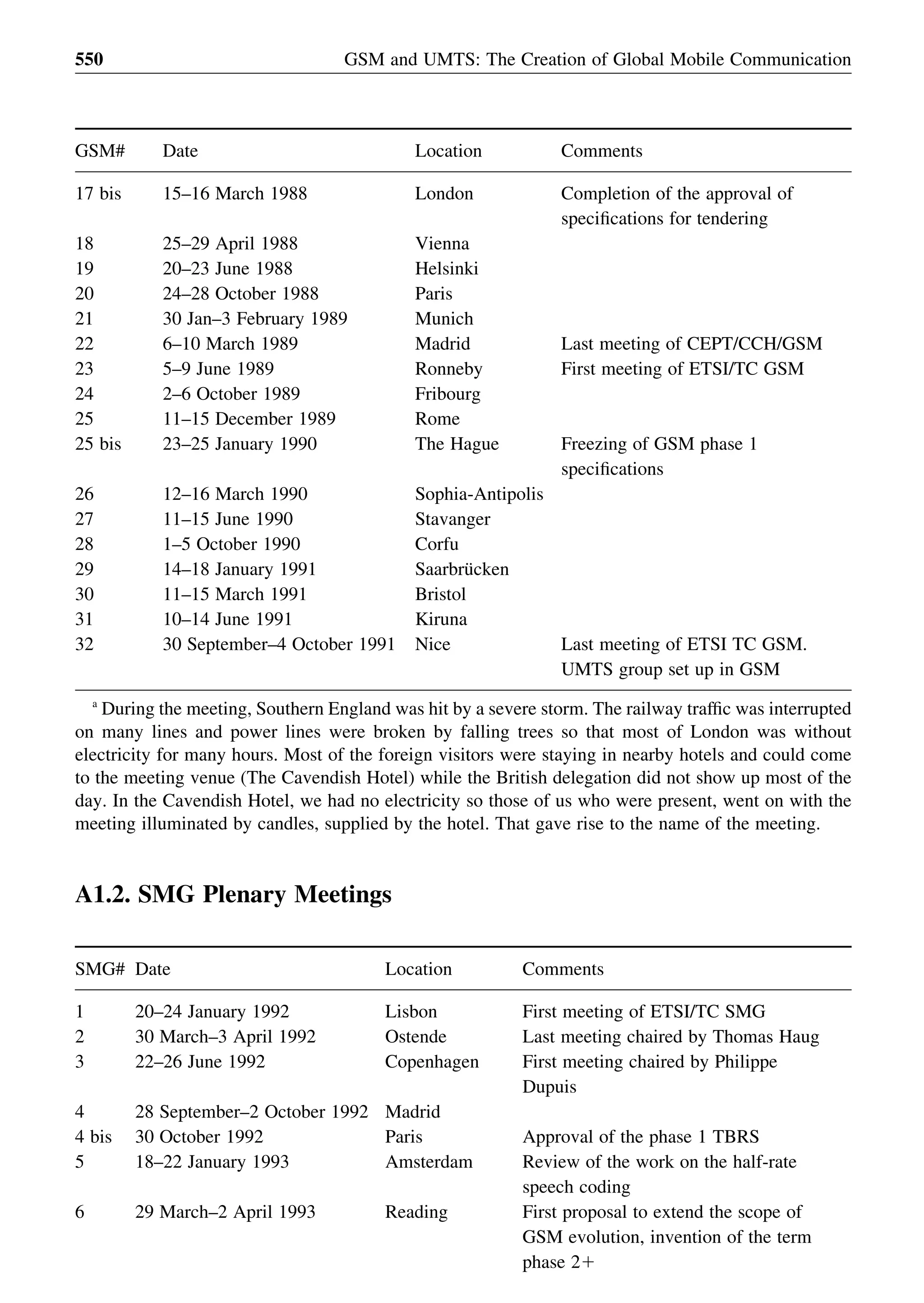
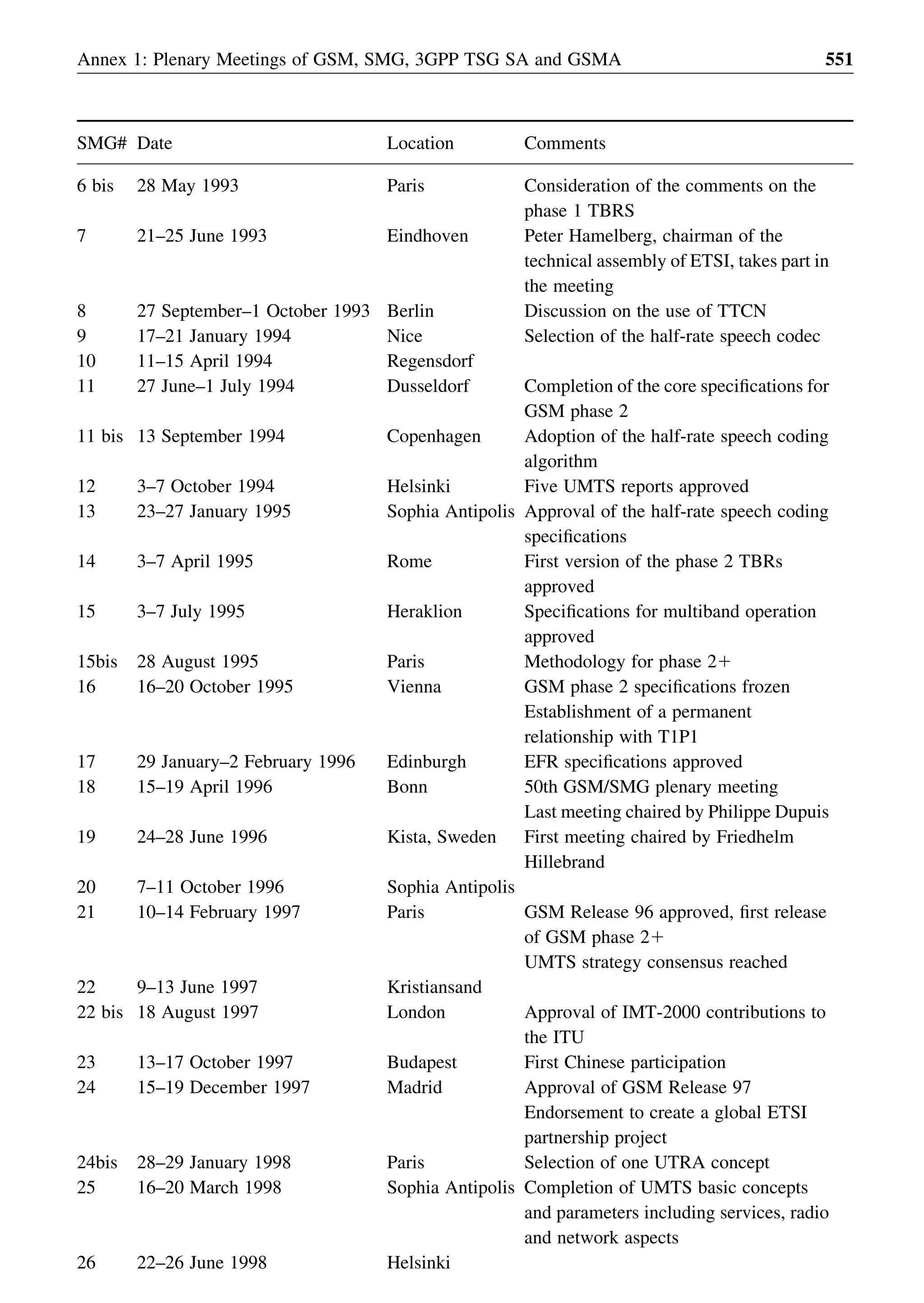
† Plenary Meeting Lists in Annex 1
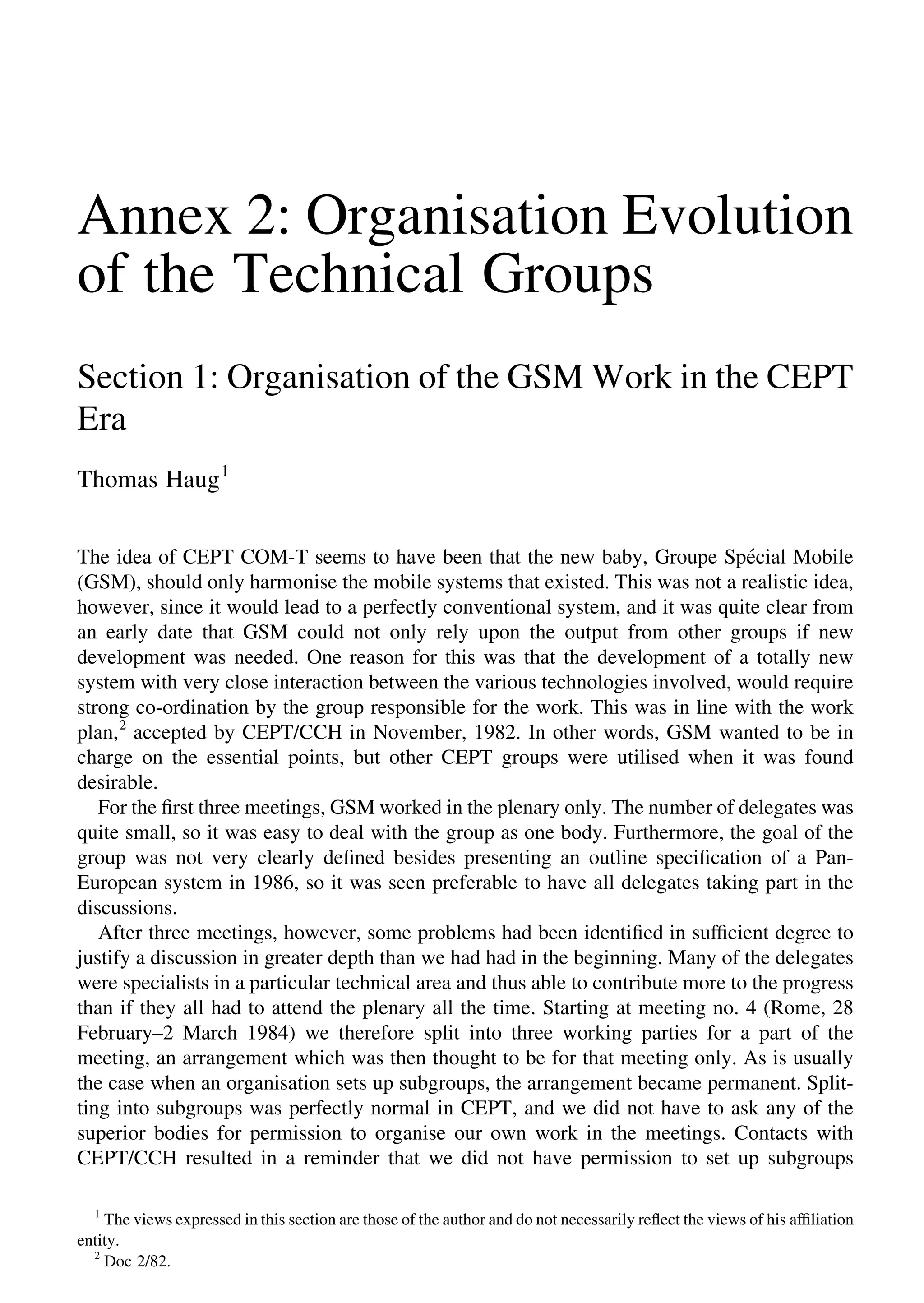
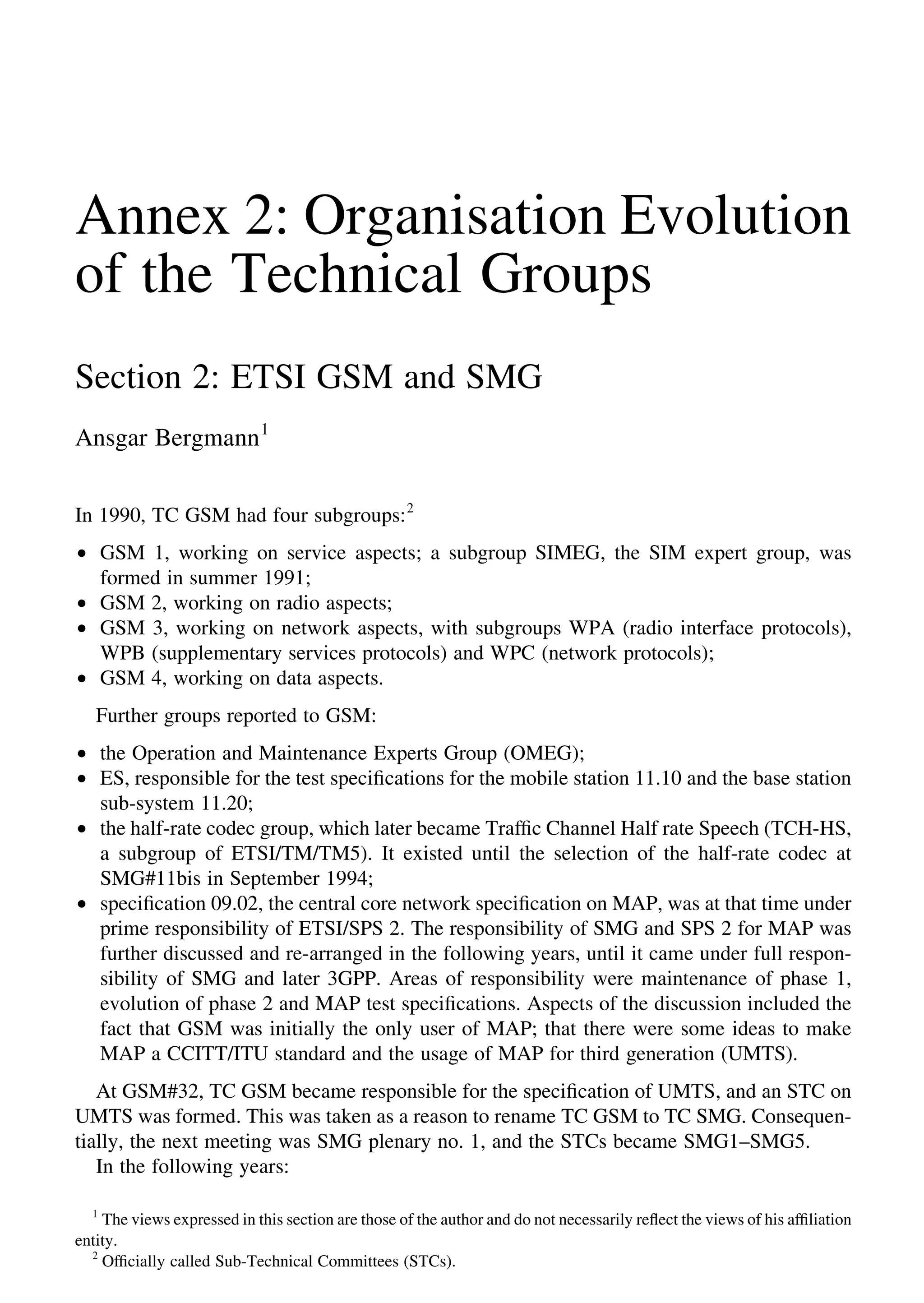
† Technical groups and their evolution in Annex 2
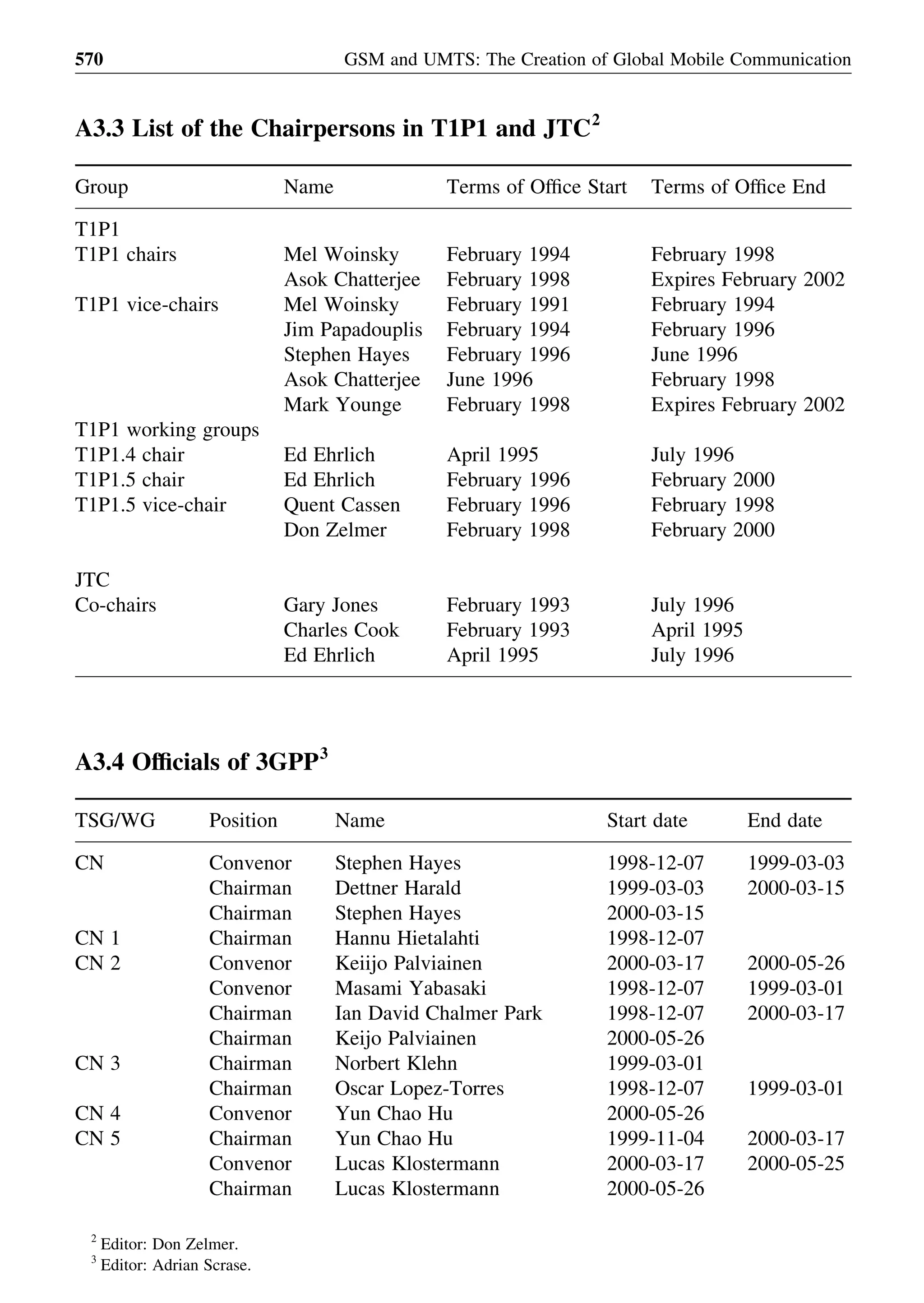
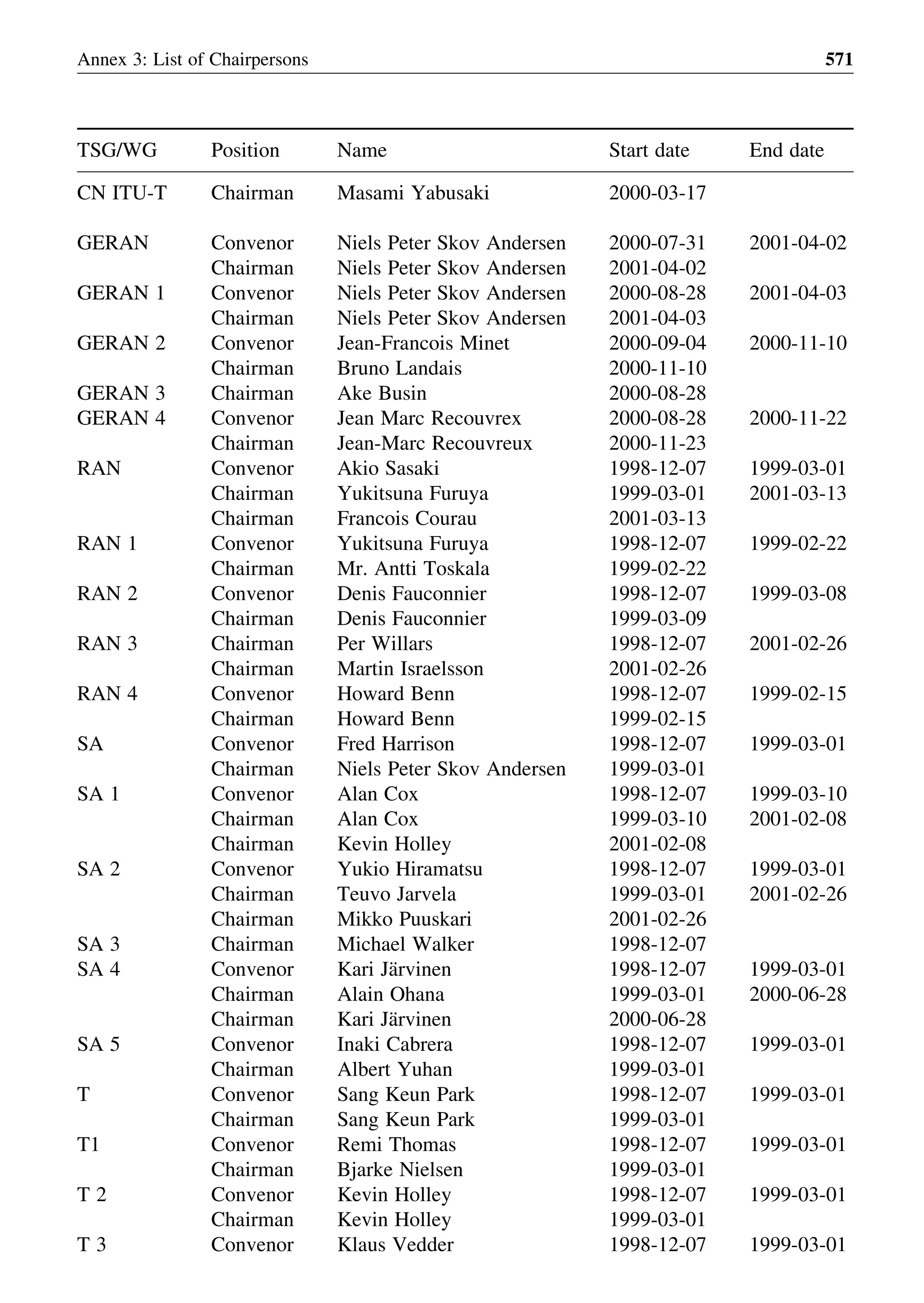
† Chairpersons lists in Annex 3
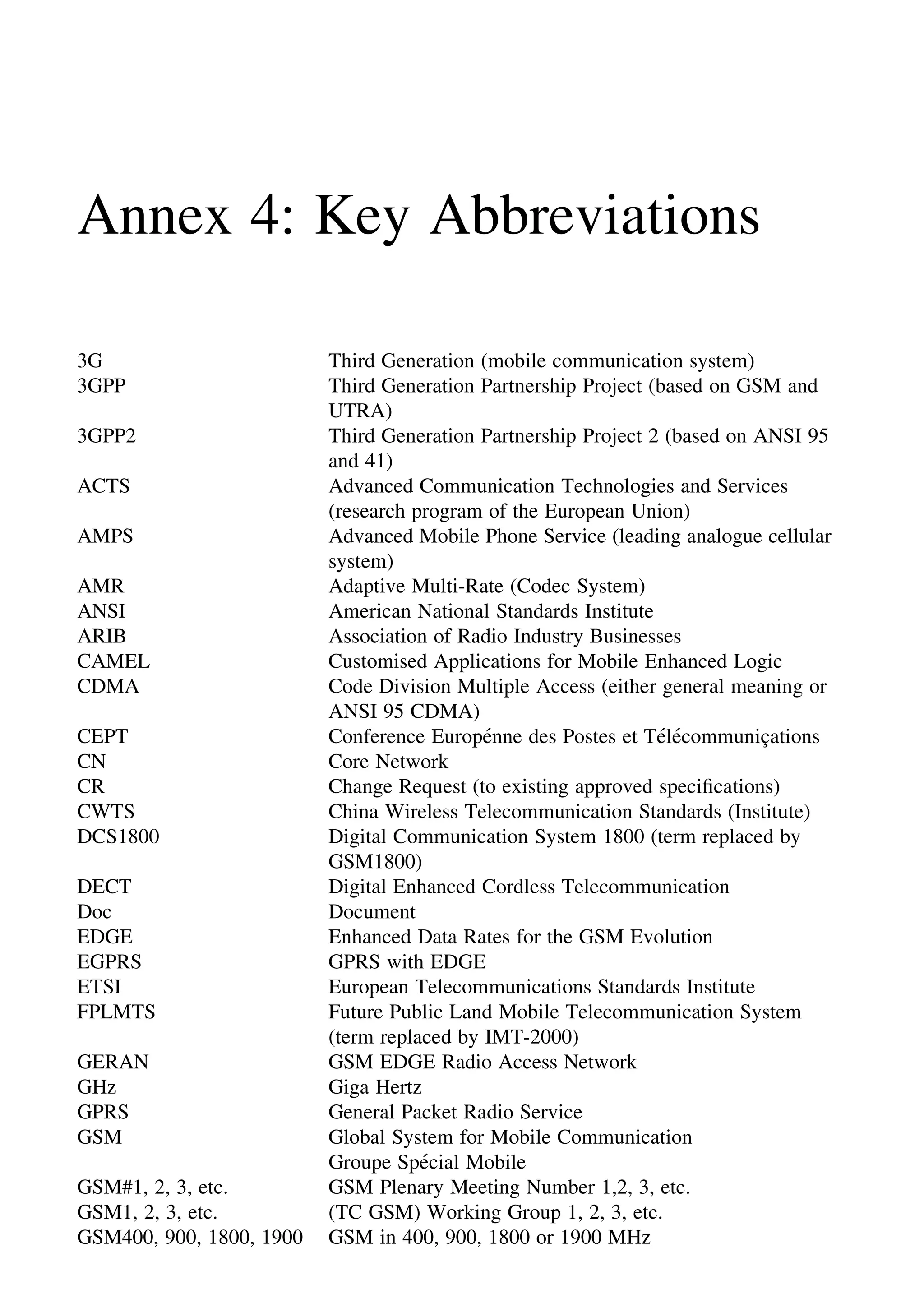
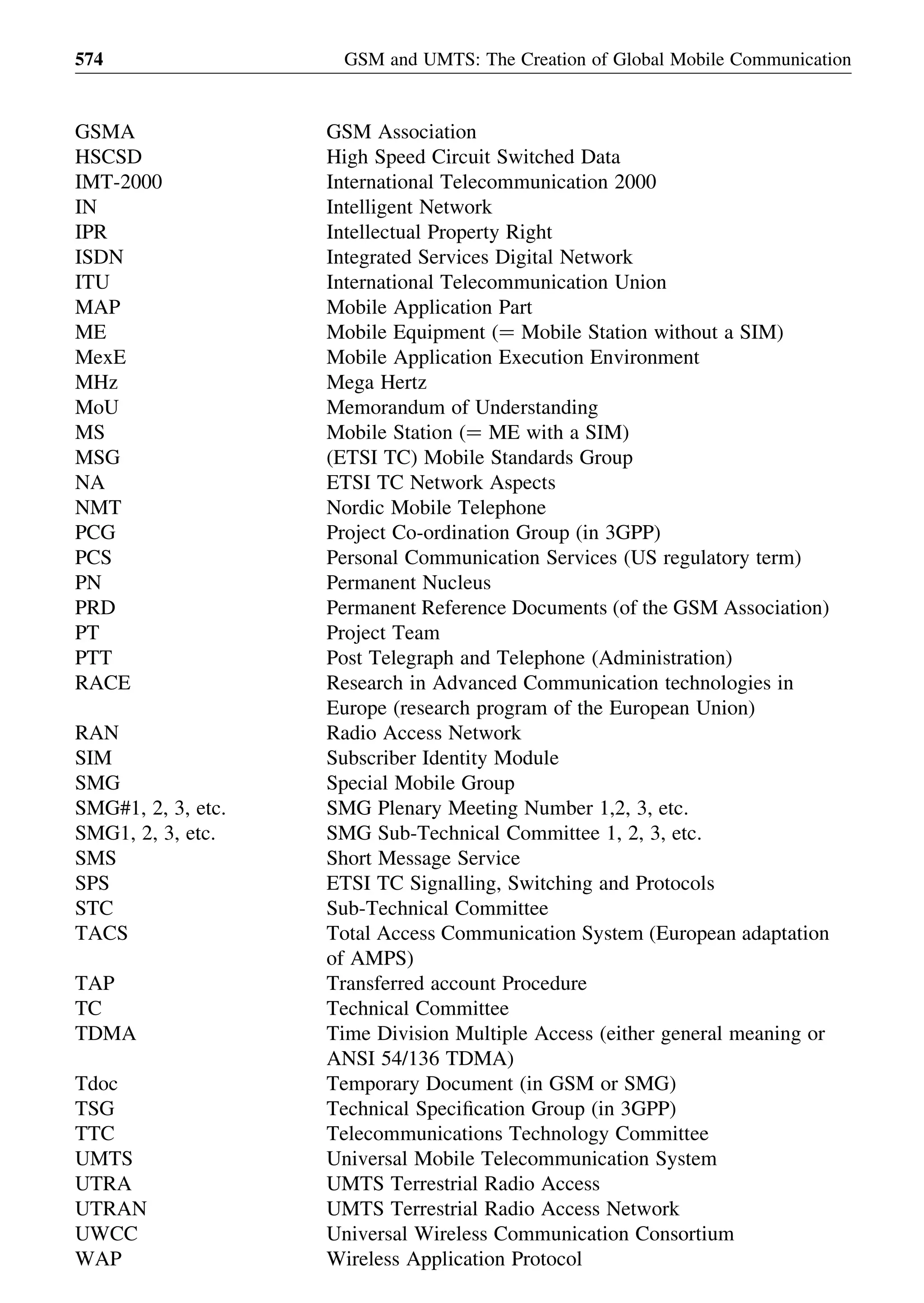
† Key abbreviations in Annex 4
The current version of the complete GSM and UMTS Specifications can be found at the
following website: www.3gpp.org. The GSM Phase 1 specifications of 1990/1 can be found
on the attached CD-ROM in folder A3.
GSM and UMTS: The Creation of Global Mobile Communication4
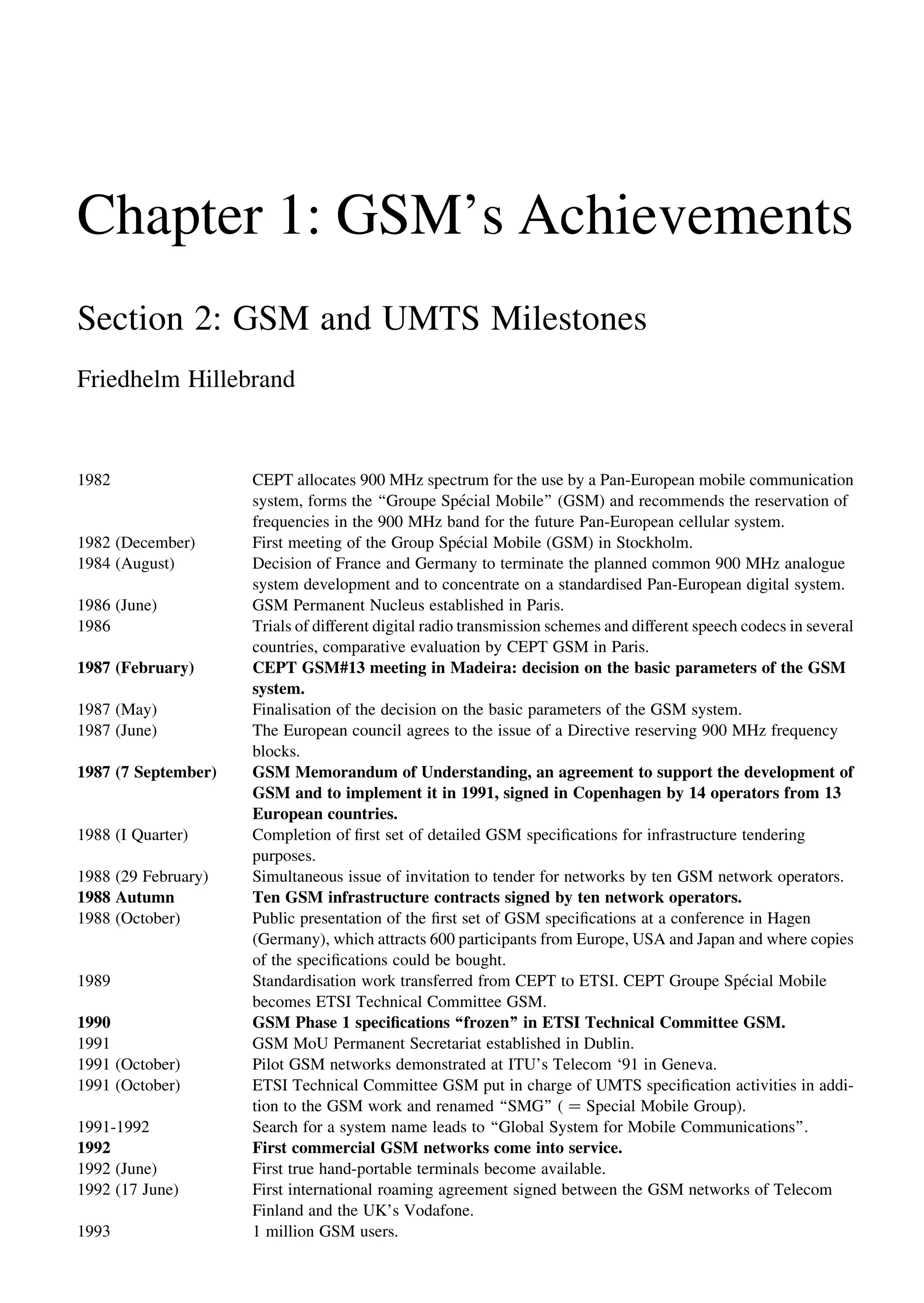
Chapter 1: GSM’s Achievements
Section 2: GSM and UMTS Milestones
Friedhelm Hillebrand
1982 CEPT allocates 900 MHz spectrum for the use by a Pan-European mobile communication
system, forms the ‘‘Groupe Spe´cial Mobile’’ (GSM) and recommends the reservation of
frequencies in the 900 MHz band for the future Pan-European cellular system.
1982 (December) First meeting of the Group Spe´cial Mobile (GSM) in Stockholm.
1984 (August) Decision of France and Germany to terminate the planned common 900 MHz analogue
system development and to concentrate on a standardised Pan-European digital system.
1986 (June) GSM Permanent Nucleus established in Paris.
1986 Trials of different digital radio transmission schemes and different speech codecs in several
countries, comparative evaluation by CEPT GSM in Paris.
1987 (February) CEPT GSM#13 meeting in Madeira: decision on the basic parameters of the GSM
system.
1987 (May) Finalisation of the decision on the basic parameters of the GSM system.
1987 (June) The European council agrees to the issue of a Directive reserving 900 MHz frequency
blocks.
1987 (7 September) GSM Memorandum of Understanding, an agreement to support the development of
GSM and to implement it in 1991, signed in Copenhagen by 14 operators from 13
European countries.
1988 (I Quarter) Completion of first set of detailed GSM specifications for infrastructure tendering
purposes.
1988 (29 February) Simultaneous issue of invitation to tender for networks by ten GSM network operators.
1988 Autumn Ten GSM infrastructure contracts signed by ten network operators.
1988 (October) Public presentation of the first set of GSM specifications at a conference in Hagen
(Germany), which attracts 600 participants from Europe, USA and Japan and where copies
of the specifications could be bought.
1989 Standardisation work transferred from CEPT to ETSI. CEPT Groupe Spe´cial Mobile
becomes ETSI Technical Committee GSM.
1990 GSM Phase 1 specifications ‘‘frozen’’ in ETSI Technical Committee GSM.
1991 GSM MoU Permanent Secretariat established in Dublin.
1991 (October) Pilot GSM networks demonstrated at ITU’s Telecom ‘91 in Geneva.
1991 (October) ETSI Technical Committee GSM put in charge of UMTS specification activities in addi-
tion to the GSM work and renamed ‘‘SMG’’ ( ¼ Special Mobile Group).
1991-1992 Search for a system name leads to ‘‘Global System for Mobile Communications’’.
1992 First commercial GSM networks come into service.
1992 (June) First true hand-portable terminals become available.
1992 (17 June) First international roaming agreement signed between the GSM networks of Telecom
Finland and the UK’s Vodafone.
1993 1 million GSM users.
1993 Australian operators are first non-European operators who decide to implement
GSM and to sign the MoU.
1993 ETSI Technical Committee SMG agrees objectives and methodology for an open
evolution of GSM beyond phase 2, to be implemented as phase 2 1 .
1993 (September) The world’s first DCS 1800 (now GSM 1800) personal communication network opened in
the UK by Mercury One-2-One (now One 2 One).
1994 Data capabilities launched in GSM networks.
1995 (June) GSM MoU Group becomes a legal body, registered as a GSM MoU Association in
Switzerland.
1995 (Autumn) 10 million GSM users in 100 GSM networks on air in (60) countries world-wide
1995 (October) GSM Phase 2 standardisation frozen in ETSI Technical Committee SMG.
1995 (November) The first North American PCS 1900 (now GSM 1900) network opened by American
Personal Communications in Washington, DC.
1995 Fax, data and SMS services started, video over GSM demonstrated.
1996 (March) UMTS Task Force Report on a UMTS strategy for Europe completed.
1996 (Summer) PCS-1900 (now GSM 1900) service, provided to the US Republican National
Convention which was held in San Diego, CA.
1996 (Spring) Creation of the UMTS Forum as a world-wide body, dealing with market, regulation and
spectrum aspects of UMTS.
1996 (August) GSM MoU Association signs co-operation agreement with ETSI.
1996 DCS 1800 renamed GSM 1800 and PCS 1900 renamed GSM1900.
1997 (February) GSM release 96, the first release of phase 2 1 , completed by ETSI Technical Committee
SMG.
1997 (February) Consensus on UMTS strategy achieved by ETSI Technical Committee SMG.
1997 (Autumn) 100 countries on air (70 million users in 200 networks).
1997 (End) GSM release 97 completed by ETSI Technical Committee SMG.
1998 (I Quarter) Decision on the basic concepts of the UMTS standard including services, radio and
network aspects.
1998 (Mid) 100 million GSM users world-wide.
1998 (End) GSM release 98 completed by ETSI Technical Committee SMG.
1998 (December) Creation of the Third Generation Partnership Project (3GPP), transfer of the UMTS
standardisation work.
2000 (March) GSM/UMTS release 99, the basis for GSM evolution and UMTS opening in 2002,
completed by 3GPP and ETSI Technical Committee SMG and ANSI T1P1.
2000 (June) Transfer of the remaining GSM specification work to 3GPP, closing of ETSI Technical
Committee SMG, creation of a new Technical Committee MSG ( ¼ Mobile Standards
Group) responsible for European regulatory standards for terminals.
2001 (May) 500 million GSM users world-wide.
GSM and UMTS: The Creation of Global Mobile Communication6
Chapter 1: GSM’s Achievements
Section 3: GSM’s Success Measured in Numbers
Friedhelm Hillebrand
This section presents figures achieved in the years from 1992 to the end of 2000. It looks at
the values for GSM in total, i.e. GSM 900, 1800 and 1900.
1.3.1 GSM User Numbers World-wide
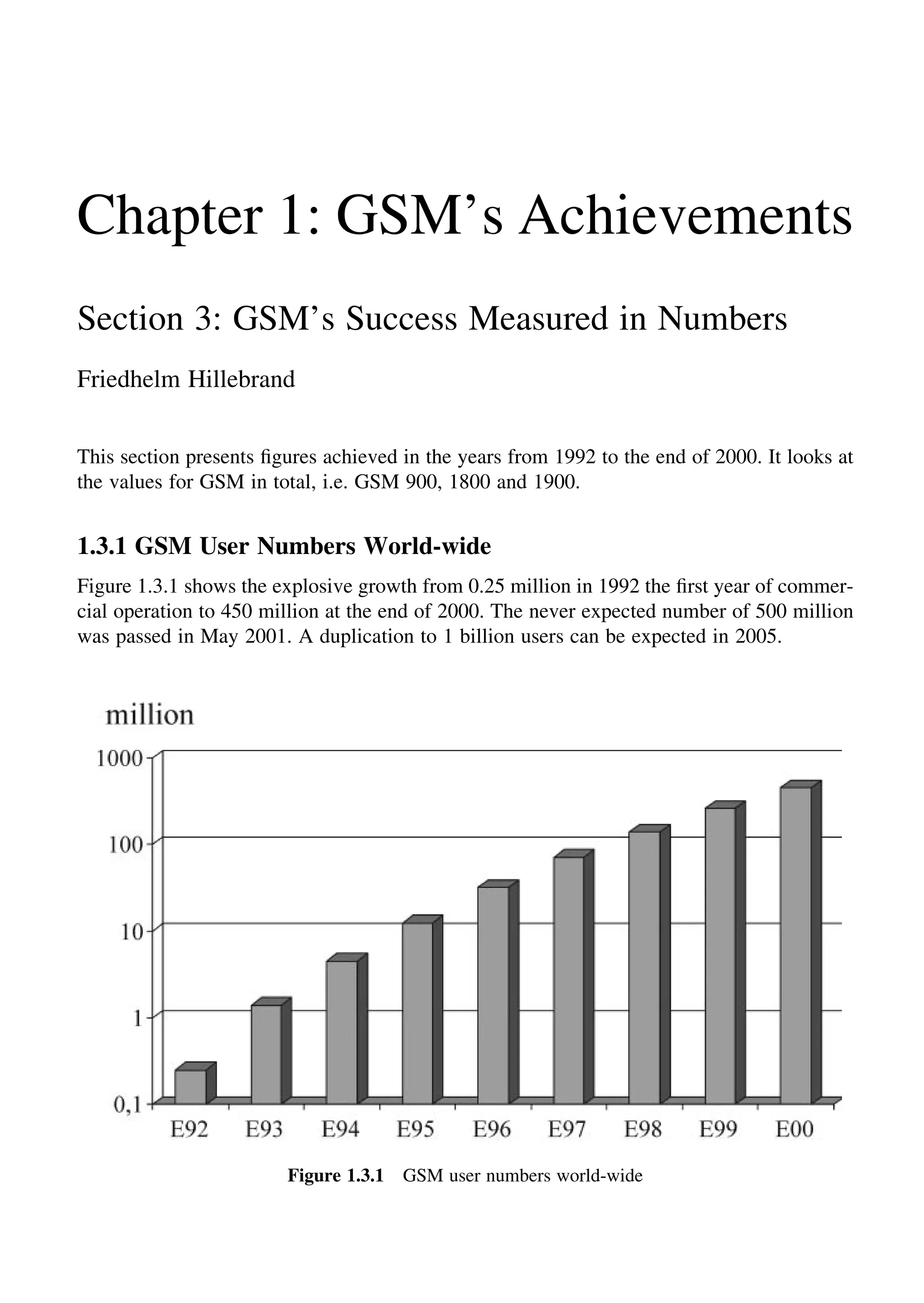
Figure 1.3.1 shows the explosive growth from 0.25 million in 1992 the first year of commer-
cial operation to 450 million at the end of 2000. The never expected number of 500 million
was passed in May 2001. A duplication to 1 billion users can be expected in 2005.
Figure 1.3.1 GSM user numbers world-wide
1.3.2 GSM Networks and Countries on Air (Figure 1.3.2)
From the initial base of 13 networks in seven European countries in 1992 these figures grew
to 392 networks in 147 countries on all continents. International roaming connects all these
countries. This means that GSM is present in more countries than nearly all the famous mass
market brands like Coca Cola, McDonalds.
1.3.3 International Roaming
The GSM user enjoys a truly global infrastructure.1
All GSM operators have international
roaming. The advanced operators have 100 or more roaming relations working. Every new
operator has typically after 6 months of operation at least ten roaming relations in operation.
In total more than 20 000 roaming agreements were concluded in Autumn 1999.
There were 40 operators, who have roaming with 70 or more countries, based on 5600
roaming agreements.
The roaming traffic exceeded the expectations. In August 1999 there were more than 400
million calls/month originated by roamers in visited networks. Many networks have 10% or
more of their traffic from roamers.
1.3.4 Short Message Service
The GSM Short Message Service is the first mobile data service that reached the mass market.
Mainly young people love to exchange text messages and little drawings. Large European
operators transmitted between 500 and 1000 million short messages in December 2000.
World-wide 50 billion short messages were sent in the first quarter of 2001 after 12 billion
in the first quarter of 2000 (source: GSMA)
GSM and UMTS: The Creation of Global Mobile Communication8
Figure 1.3.2 GSM networks and countries on air
1
Japan and Korea have not admitted GSM. Japan offers interstandard roaming GSM/PDC.
1.3.5 Competition with other Standards
The competition on the world market in the first half of the 1990s was mainly between GSM
and analogue systems since the other digital systems were either not available outside their
home market or not yet ready. In most developed market the digital systems dominated
clearly at the end of 2000. In Europe GSM serves 98% of the mobile users.
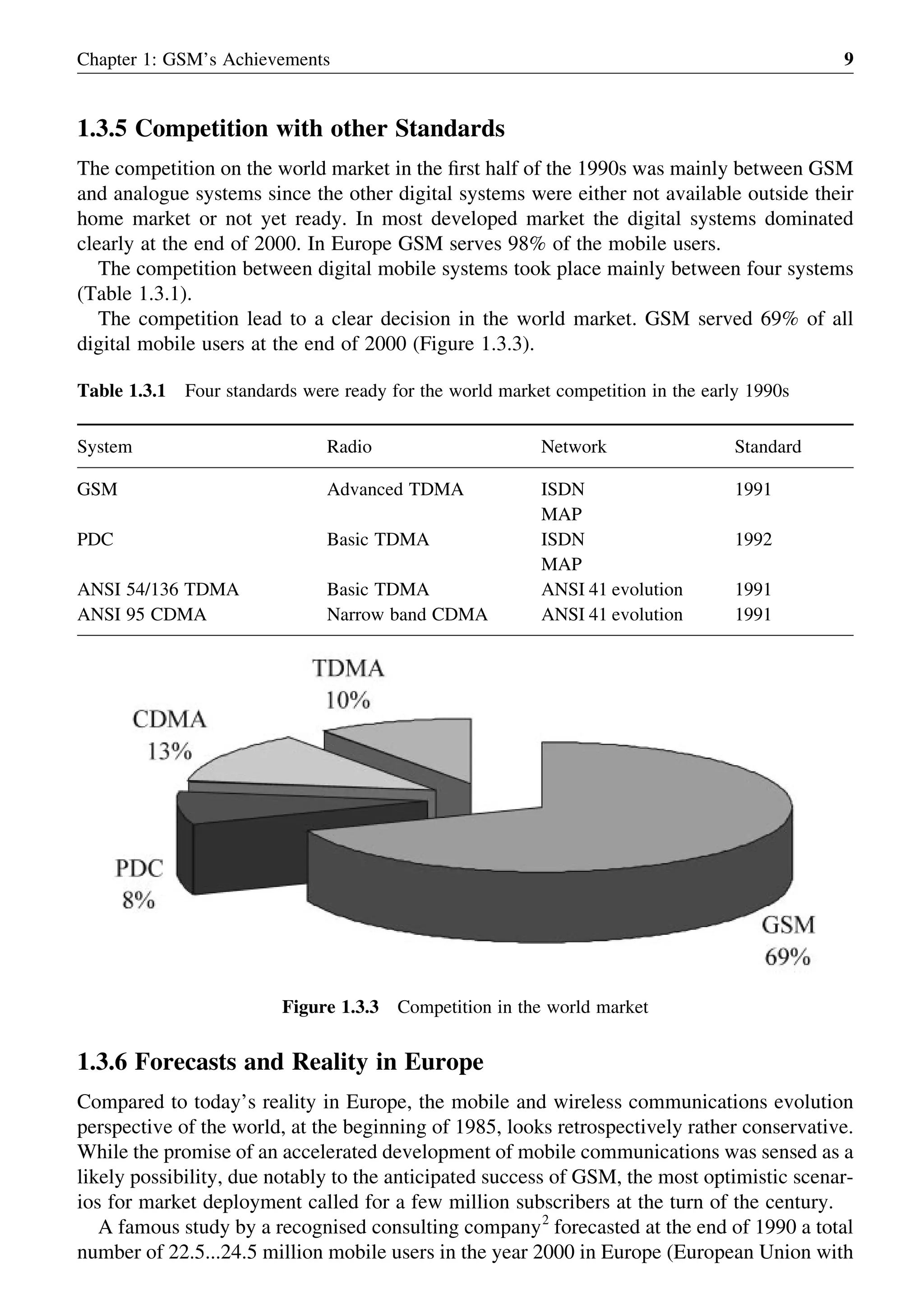
The competition between digital mobile systems took place mainly between four systems
(Table 1.3.1).
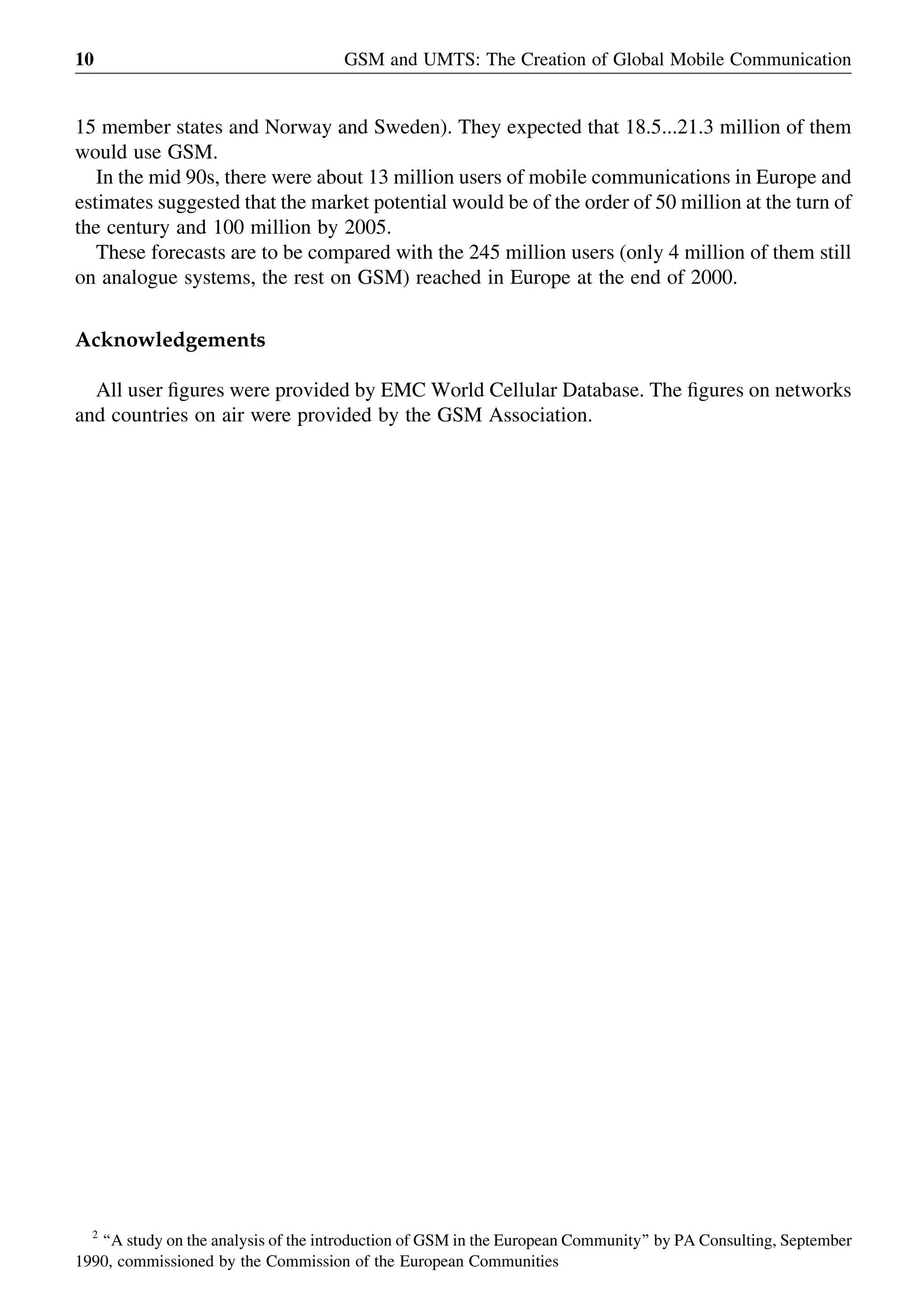
The competition lead to a clear decision in the world market. GSM served 69% of all
digital mobile users at the end of 2000 (Figure 1.3.3).
1.3.6 Forecasts and Reality in Europe
Compared to today’s reality in Europe, the mobile and wireless communications evolution
perspective of the world, at the beginning of 1985, looks retrospectively rather conservative.
While the promise of an accelerated development of mobile communications was sensed as a
likely possibility, due notably to the anticipated success of GSM, the most optimistic scenar-
ios for market deployment called for a few million subscribers at the turn of the century.
A famous study by a recognised consulting company2
forecasted at the end of 1990 a total
number of 22.5...24.5 million mobile users in the year 2000 in Europe (European Union with
Chapter 1: GSM’s Achievements 9
Table 1.3.1 Four standards were ready for the world market competition in the early 1990s
System Radio Network Standard
GSM Advanced TDMA ISDN 1991
MAP
PDC Basic TDMA ISDN 1992
MAP
ANSI 54/136 TDMA Basic TDMA ANSI 41 evolution 1991
ANSI 95 CDMA Narrow band CDMA ANSI 41 evolution 1991
Figure 1.3.3 Competition in the world market
15 member states and Norway and Sweden). They expected that 18.5...21.3 million of them
would use GSM.
In the mid 90s, there were about 13 million users of mobile communications in Europe and
estimates suggested that the market potential would be of the order of 50 million at the turn of
the century and 100 million by 2005.
These forecasts are to be compared with the 245 million users (only 4 million of them still
on analogue systems, the rest on GSM) reached in Europe at the end of 2000.
Acknowledgements
All user figures were provided by EMC World Cellular Database. The figures on networks
and countries on air were provided by the GSM Association.
GSM and UMTS: The Creation of Global Mobile Communication10
2
‘‘A study on the analysis of the introduction of GSM in the European Community’’ by PA Consulting, September
1990, commissioned by the Commission of the European Communities
Chapter 2: The Agreement on the
Concepts and the Basic
Parameters of the GSM Standard
(mid-1982 to mid-1987)
Section 1: The Market Fragmentation in Europe and
the CEPT Initiatives in 1982
Thomas Haug1
2.1.1 The Situation in the Early 1980s: A Spectrum Allocation Opens the
Possibility to Overcome the European Patchwork of Incompatible
Systems
At the World Administrative Radio Conference in 1979 (WARC ’79), a decision was taken to
set aside a block of radio spectrum in the 900 MHz range for use in land mobile commu-
nication systems in Zone 1, which in the terminology of the Radio Regulations means Europe.
Beyond this, little was said about how the spectrum should be used, such as the allocation to
public systems versus private ones.
The European telecommunications market was for a long time badly fragmented. In an
attempt to improve the situation, the organisation of 26 PTT Administrations of Western
Europe and a few other countries (Confe´rence Europe´enne des Postes et Te´le´communica-
tions, abbreviated (CEPT)) was since 1959 actively engaged in standardisation of telecom-
munications, but the progress was often hampered by differences in policy in the member
countries. It is, however, of interest to note that contrary to what is often assumed by
observers outside the PTTs, CEPT was not at all a purely regulatory body, but dealt exten-
sively with technical issues in many fields and had for that purpose set up a large number of
working groups. (In 1989, the technical specification work was transferred to the then newly
created European Telecommunication Specification Institute (ETSI).)
Around 1980 the European situation in mobile communications was that a number of
mutually incompatible mobile systems were in operation or in preparation. The lack of
1
The views expressed in this sectiom are those of the author and do not necessarily reflect the views of his
affiliation entity.
compatibility led to other problems, such as small market segments, small number of users in
most systems, high terminal cost and high subscription fees. Consequently, mobile commu-
nications was seen as ‘‘the rich man’s toy’’ in many countries. The idea of one standardised
system, capable of being used throughout a large part of Europe, such as the CEPT member
countries, had never really caught on among the authorities. Unfortunately, the entire tele-
communications field had often been used as an instrument for protecting the national manu-
facturing and operating companies, a fact which had led to a situation where each country
more or less had its own telecom standard, incompatible with the standards in other countries.
The effect of this policy was no exception from the general rule that implementation of
protectionist policies at the expense of standardisation leads to a loss of the economy-of-
scale benefits, a loss borne by but not always directly observable by the user. In the field of
mobile communications, however, (as opposed to standards in the fixed network), interna-
tional standardisation would in addition to the economy-of-scale benefits offer a benefit
which would be directly observable by the user, i.e. the ability to use one’s own equipment
when moving around in foreign networks. This feature was not implemented in any network
except the Nordic NMT system, opened in 1981, which allowed users in Denmark, Finland,
Iceland, Norway and Sweden (later expanded to the Netherlands and Switzerland) to use their
terminals in the countries where the NMT system was installed, and in the German Network
B, which was built in the Benelux countries and Austria. In general, however, the political
and regulatory difficulties concerning use of radio equipment in foreign countries were very
much against creating a Pan-European system which could be used when travelling abroad.
2.1.2 Vienna Meeting of CEPT Telecommunications Commission
(COM-T) in 1982
The NMT network was only in the start-up phase when the Netherlands presented a proposal2
at the meeting of the CEPT Telecommunications Commission in Vienna in June 1982. The
proposal pointed out that unless a concerted action to work out plans for a common European
system was started very soon, there would be a serious risk that the 900 MHz band would be
taken into use for various incompatible systems of many kinds in Europe. The last chance to
build a Pan-European system in the 20th Century would then be lost, since there would be no
sufficiently wide spectrum available below 1 GHZ, i.e. in a part of the radio spectrum which
could be considered suitable for mobile communications, given the state of the technology in
1982.
The Nordic Administrations had recently put the 450 MHz NMT system into operation and
there were already indications that a large number of users would be interested in the feature
of international roaming, a new feature at that time. In addition, a common standard would
obviously result in considerable economic gains. To build a new European network along
these lines had been discussed by the Nordic Administrations, which therefore strongly
supported the Dutch point of view and proposed3
that the total responsibility for progress
and co-ordination of the specification task for a new Pan-European system should be left to a
group of experts.
The CEPT Telecommunications Commission accepted this proposal and decided to start a
new study question, entitled ‘‘Harmonisation of the technical and operational characteristics
GSM and UMTS: The Creation of Global Mobile Communication12
2
GSM Doc 3/82 and GSM Doc 5/82.
3
GSM Doc 4/82.
of a public mobile communications system in the 900 MHz band’’. Rather than setting up a
new committee, reporting directly to the Com-T according to the proposal, however, it was
decided to entrust the Committee for Co-ordination of Harmonisation (CCH) with the task of
setting up a Special Group for the purpose of studying the question4
and the Swedish offer of
making Thomas Haug available for the chairmanship of the group was accepted. (I was a bit
surprised when I heard this, since nobody had asked me in advance.) In line with the CEPT
naming rules, the new group was given the name Groupe Spe´cial Mobile, GSM for short.
2.1.3 The Com-T Decision and its Consequences
The decision taken by the CEPT Telecommunication Commission was very vague, and in
effect left it to the new group to propose its own terms of reference. Representatives of the
Netherlands and the Nordic Administrations therefore met during the summer of 1982 in
order to write a proposal for an Action Plan, which was subsequently presented to CCH for
approval in November of that year. That document5
was approved and was used as the basis
for the work of GSM for a long time, with a mainly editorial updating of Section 3 in 19856
.
The decision only mentioned ‘‘harmonisation’’, which indicates that the compatibility
aspect was the dominating factor behind the decision, and there is considerable doubt that
the delegates at the CEPT Telecommunications Commission meeting believed that free
circulation of radio users across international borders could be achieved within the foresee-
able future, given the formidable obstacles that existed.
It was clear, anyway, that many more aspects than the mere harmonisation had to be given
great attention if the goal of creating a Pan-European service, acceptable to the broad
European public, was to be reached. When the above mentioned proposal for an Action
Plan was presented by the newly appointed GSM Chairman to CCH in November 1982, it
was therefore stressed that the goal envisaged in the decision taken by the CEPT Telecom-
munications Commission in Vienna, according to which the work should be completed by the
end of 1996, could not be met if major new developments were to be taken into consideration.
A ‘‘harmonisation’’ of mobile communication systems would mainly consist of specifying a
system according to the techniques already established, in other words an analogue system. It
was therefore proposed to the CCH that by the end of 1986, only an outline specification
comprising the basic system parameters for the various parts of the system and their interfaces
should be finalised. Furthermore, it was proposed that at the same time, technical specifica-
tions should be established for the system as a whole, to the point of guaranteeing compat-
ibility. They should comprise the main building blocks of the system, which then were
understood to be the switching centre, the base station, the mobile station and the man–
machine interface. The proposal was accepted by the CCH and subsequently by the CEPT
Telecommunications Commission.
In retrospect, I think that it was a very wise decision which was taken when the aim was
changed to present just an outline specification, not a final, detailed one, by the end of 1986.
Had that not been done, we would probably have been stuck with an analogue system today,
based on somewhat modified versions of the technical solutions that existed in the early
Chapter 2: The Agreement on the Concepts and Parameters of the GSM Standard 13
4
GSM Doc 1/82.
5
Doc T/CCH (82) 21 R, later renamed GSM Doc 2/82.
6
GSM Doc 73/85.
1980s. That system would have been unable to fulfil many of the requirements now placed on
the GSM system.
In the CCH meeting in November 1982, there was a fairly long discussion on whether
GSM should also be mandated to study the possibility of an interim system which would meet
the needs until the new GSM system could be put into operation. Such ideas had been
presented at the CEPT Telecommunications Commission meeting and several countries
felt a need for such a system. In particular Dr Klaus Spindler of the Deutsche Bundespost
warned against spending time and resources on an interim system, and in the end CCH
decided that the resources available to GSM should be concentrated on the new system
since work on an interim system would be a waste of time. Seeing afterwards how much
work there was to be done on the new system, this was undoubtedly the right decision.
2.1.4 Basic Requirements for the New System
The essential contents of the Basic Requirements in the Study Plan of 1982 are given below.
† The system must be able to operate in the entire frequency bands 890–915 and 935–960
MHz.
† Co-existence with the already existing systems in the 900 MHz band must be guaranteed.
† The GSM mobile stations must be able to operate in all participating countries, preferably
all CEPT countries.
† Services other than speech will be required in the new system. Since there is uncertainty
about those services, however, a modular system structure allowing for a maximum of
flexibility will be required. In order to reach this goal, the same philosophy as for ISDN
and OSI should be applied, and standards for protocols, etc. should as far as practicable
seek to obtain compatibility with such developments.
† High spectrum efficiency and state-of-the-art subscriber facilities must be achieved.
† The same facilities as those offered in the public switched telephone and data networks
should be available in the mobile system.
† An identification plan, compatible with the numbering plan and routing possibilities in the
PSTN and PSDN, must be worked out.
† The system must be capable of providing for handheld mobile stations.
† The demand for voice security (encryption) must be taken into account.
† No significant modification of the fixed national telephone networks must be necessary.
† The system must allow the participating countries to maintain their existing charging
systems.
† An internationally standardised signalling system must be used for interconnection of the
switching centres.
The influence of the NMT principles from 1971 in this set of requirements is obvious to
anyone familiar with that system.
Furthermore, an action plan was prepared, listing the various other bodies in and outside
CEPT with whom the GSM should stay in contact in order to avoid repeating work that was
already being done.
GSM and UMTS: The Creation of Global Mobile Communication14
Chapter 2: The Agreement on the
Concepts and the Basic
Parameters of the GSM Standard
(mid-1982 to mid-1987)
Section 2: The GSM Standardisation Work 1982–1987
Thomas Haug1
2.2.1 The Start of the Work
The first meeting of the new Groupe Spe´cial Mobile (GSM) was held in Stockholm in
December 1982.2
The interest in this new activity was great, as can be seen from the fact
that no less than 31 delegates from 11 CEPT Administrations participated. The starting points
for the various administrations were very different. Some countries had First Generation
systems in operation while other countries had none, and most of those systems were different
from each other in one way or another as was mentioned earlier. A certain amount of
operational experience was available from those systems, but it was agreed that much of it
would not be applicable.
The meeting discussed at length the spectrum situation in the CEPT countries, and there
was a great concern that it might prove impossible to avoid using the 900 MHz band for other
purposes for such a long time as envisaged in the work plan for GSM. The pressure for
spectrum was just too great, and there was a clear risk that allocating parts of the spectrum to
other systems might become a serious threat to the future Pan-European system.
Another issue which was taken up at the first meeting was the question of free circulation of
users. The idea of free international roaming was very much in line with the views of the
delegates, but the existing restrictions in most European countries on the use of radio equip-
ment by foreign visitors would clearly be a serious obstacle to the system since free circula-
tion was one of the great advantages in the standardisation process. A French contribution3
to
the meeting pointed out that this was a purely political question which would not present very
1
The views expressed in this module are those of the autor and do not necessarily reflect the views of his affiliation
entity.
2
Meeting report of GSM#1 in folder A1 of the attached CD ROM.
3
GSM Doc 8/82.
difficult technical problems once the political issues had been cleared. As this question was
already under study by the R 21 working group, there was no immediate need for GSM to take
any action beyond following the studies in R 21. However, the group agreed that elimination
of those obstacles as far as possible would have to be one of the key goals of the work.
2.2.2 Work Rules and Working Language(s)
The written and unwritten work rules of CEPT were quite different from those generally
used in purely national bodies, but this fact caused very little trouble. It was understood that
we had to work on the basis of consensus, so there would be no voting. This principle may
not be the speediest way to reach a decision, but on the other hand, a consensus makes it
almost certain that everyone is going to stick to the decision. Another rule which was to
prove important for the working conditions of the group but which had nothing to do with
the technical problems, was the issue of working language. It was specified by CEPT that
committees and working groups (but not their subgroups) would have three official
languages, English, French and German, with simultaneous translation. I thought from
the start that it would be necessary to make English the only working language in GSM,
even if that would violate the CEPT rules.
There were several reasons for this approach. Firstly, in the mobile telecommunication
field (as opposed to e.g. the political field), it could safely be assumed that just about
everybody would have a reasonably good command of the English language, at least
good enough to communicate more efficiently than through interpreters who would have
no idea about the technical field we were to discuss. Secondly, it would be far easier to
arrange meetings without all the equipment and personnel required for simultaneous trans-
lation in three languages, and I expected that there would be a lot of meetings. Thirdly,
there would inevitably be a large number of points in the specifications on which we would
have to make precise definitions, and to carry on discussions of definitions through inter-
preters would be very awkward, to say the least. I did not expect this to go unchallenged
(despite the fact that it was tacitly accepted by the delegates), and before meetings 1 and 2
there were official objections from some administrations which felt that simultaneous
translation would be necessary in order to make things easier for all delegates. The GSM
delegates themselves found that the principle of one language worked very well, however.
The French and German delegates were not allowed by their administrations to agree to a
permanent change in the CEPT working procedures, but they could accept an exception for
any particular meeting.
After a few years the issue resurfaced because of some decisions in the CEPT to make
multi-language working mandatory. A compromise solution was found with the help of some
GSM delegates who informed their superiors that the work in the group went very well with
just one language and that the work would actually be hampered if the group was forced to
use several languages. The solution was that the chairman was to ask GSM at the end of each
meeting if simultaneous translation in the next meeting was required. If nobody demanded
translation, one language would suffice. This was done, and since nobody ever asked for
translation the whole issue was quietly dropped after some time. I am convinced that the
single language mode of operation was of great value for creating an environment which
enabled us to work very informally and efficiently.
GSM and UMTS: The Creation of Global Mobile Communication16
2.2.3 Political Direction
During the first few meetings of GSM, there was a great deal of uncertainty as to what course
to pursue and what would be politically possible. Since the superior bodies in CEPT had
given no directive as to the choice of an analogue or digital solution, it was obviously up to
GSM itself to propose a solution. Clearly, an analogue system would be quite straightforward,
offering no really difficult problems. A proposal for a digital system, however, would in order
to convince the operators and the manufacturers, have to be based on compelling arguments
showing the advantages in choosing a technology which had never been tried before in
terrestrial public mobile communications. Moreover, any new analogue system would not
have represented a sufficient breakthrough from the already existing systems such as NMT
and AMPS to justify its adoption by the market. Thus, it was natural that the focus of the
studies would be on a thorough investigation of the characteristics of the digital solution.
Regardless of whether the future system would be analogue or digital, some assumptions
had to be made for testing the technical solutions, one of them would be a traffic model. Thus,
a traffic model was a very important issue during the first year of the group. In retrospect, of
course, those traffic figures look almost ridiculously low today.
2.2.4 Co-operation with other Groups in CEPT and other European
Bodies
The goals described in GSM Doc 2/82 were, as someone said, ‘‘a tall order’’ which involved
far more work than could be managed within GSM alone, so it was necessary to enlist the
assistance of a number of other bodies. Within CEPT, there were working groups, active in
fields of interest to GSM, e.g. data transmission, signalling, services and facilities and also
groups dealing with commercial issues such as tariff harmonisation, etc. In addition to CEPT
groups, there were bodies set up in co-operation with the EEC, such as the COST groups,
which were studying wave propagation, modulation techniques, etc, and we were to liase with
some industrial groups like EUCATEL. Also, it was felt necessary to follow the develop-
ments in certain fields which were not covered by other CEPT or COST groups, but which
were nonetheless considered to be important to the future mobile system. An example is the
field of radiation hazards, an issue which since the early 1980s had attracted great interest
after some results had been published in a Soviet journal. The hazards – perceived or real – in
the use of mobile telephones would no doubt be a potential threat to the entire field of mobile
communications, so the results had to be studied. The GSM group obviously had no resources
to pursue this matter, so a rapporteur was appointed to follow what was being published on
this question. However, it was found after some years that the results were very inconclusive,
so we dropped the question. As far as I can see, the issue regarding the radiation hazards to the
user of mobile handsets is still (January 2001) open, but there is concern in many areas and
several bodies are dealing with all aspects of this issue.
One final point must be mentioned here. The contacts with the Quadri-partite group, which
have been described by Philippe Dupuis in his chapter (Chapter 2, Section 3), were of great
value to us in the critical decision-making period, since they helped us develop a common
strategy. Our contacts with the group were not of the formal kind, of course, but much more
efficient since so many Quadri-partite delegates were also delegates to GSM meetings.
Chapter 2: The Agreement on the Concepts and Parameters of the GSM Standard 17
2.2.5 The Advent of Competition
During the late 1970s, a political factor became noticeable which would gradually turn out to
be very important, namely the pressure in many countries (starting in the US) for the intro-
duction of competition in the telecom field. Traditionally, the European telecom operators
had always been state monopolies, but in 1982, the UK government decided to open the field
of mobile communications for competition. The first system to be used this way would be
TACS, a modified version of the AMPS system used in the US. Today, when there is
competition in the telecom field in most countries, it is a bit strange to read the discussions
of the early 1980s with predictions of the dire consequences of competition in telecommu-
nications. Human nature is such that when a novel feature with political implications is
proposed, there is usually a great deal of resistance from those who feel threatened and
there is no doubt that most PTTs were very much against the competition and they did not
do much to promote it. In this context, it is interesting to read the description of some of the
features in the then tentatively specified TACS system (report of meeting number 2, p. 54
)
where it is rather optimistically said that there will be ‘‘automatic handover between compet-
ing companies’’. That feature was considered to be of vital importance for the spectrum
economy, and it was thought by the UK authorities that it would be easy to implement as
indeed it probably would, technically. For many years, however, automatic handover
between competing operators in the same country was not implemented anywhere, since
the operators resisted the idea of accepting subscribers from a competitor. (Lately, an agree-
ment has been worked out in Germany between the T-Mobil network and Viag Interkom for
national roaming between the networks without any pressure from the regulator.) In compar-
ison, handover agreements between companies in different countries, i.e. in a non-competi-
tive situation, have normally caused very little difficulty, although the national and the
international roaming features are technically quite similar.
2.2.6 The Creation of Working Parties and a Permanent Nucleus in GSM
Gradually, the workload increased and it became clear that it was no longer possible to deal
with all issues in the plenary, so GSM decided to set up three ad-hoc working parties, namely
WP 1 for services and facilities, WP 2 for radio questions and WP 3 for network aspects,
mainly in order to prepare proposals for the plenary. The WPs were intended for that meeting
alone, but as might be expected, they had to continue during several meetings as the workload
increased. The CCH was anxious to prevent the proliferation of groups and decided that the
WPs should not meet outside the ordinary meetings of GSM. However, after some time it
became obvious that the workload made it necessary for the WPs to meet between the GSM
meetings, and in 1985, the CCH accepted this.
In addition, it became obvious that there was a need for a body working on a permanent
basis in order to take care of the co-ordination of the WPs, issuing documents and many other
tasks that were difficult to handle for groups that only met at intervals of several months. The
solution to this problem was to set up a Permanent Nucleus (PN) whose Terms of Reference
are given in Doc 126/85, which after lengthy discussions between the CEPT Administrations
concerning the location of the new body was set up in Paris and started operations in June,
1986 with Bernard Mallinder of BT as co-ordinator. Many of the countries which participated
GSM and UMTS: The Creation of Global Mobile Communication18
4
Meeting report of GSM#2 in folder A1 of the attached CD ROM.
in the GSM work contributed to the work of the PN. The use of a PN is not uncommon in
international co-operation, of course, but this case was somewhat unusual in the sense that
GSM already had its very strong WPs 1, 2 and 3, a fact which to some extent might limit the
authority of the PN. Thus, one of the tasks of the PN was to assist the WPs in their work by
supporting them with Program Managers. The burden of seconding skilled engineers to the
PN would be totally borne by the PTTs themselves (later even the manufacturers), and the PN
was to be hosted by the French Administration which (in addition to manpower seconded to
the technical work of GSM) supplied the premises, secretarial assistance and telecommuni-
cation facilities. Thus, we never dealt with support in terms of money, a fact which relieved us
of the tedious work with budgets, accounting. etc.
2.2.7 Co-operation with the European Commission and with
Manufacturers
The European Commission had indicated their willingness to support the activity financially,
but the PTTs found that it would be better for them to carry that burden themselves. By and
large the contacts between GSM and the European Commission were relatively few, since the
PTTs had sufficient resources to deal with the technical problems that arose. It was also my
personal conviction, based on the experience from the NMT work, that despite the criticism
for slowness often raised against CEPT, the PTTs were perfectly capable of carrying the
project through. I was for that reason reluctant to accept EEC intervention in the work. On the
political level, however, there were many contacts, and one contribution by the EEC was
going to be of fundamental importance for the future of the GSM system. That was when the
Frequency Directive was approved, reserving the GSM frequency spectrum for use by that
system. This action stopped any attempts, not only in the EEC countries but also in many
countries bordering on the EEC area, to use the spectrum for other purposes and it thereby
made the success of the system possible.
On several occasions, there was pressure from the outside world to speed up the work so as
to prepare the detailed specifications earlier than decided. Understandably, the manufacturing
industries were concerned about a late delivery of the specifications, since they knew how
much time they would need to implement the system. This question was to crop up several
times during the mid-1980s and had to be discussed by GSM, but the result always was that it
would not be possible to advance the starting date of the system, but preliminary specifica-
tions might be produced. After the creation of ETSI, this question became of less importance
since there was then far more openness in the way GSM worked and hence, the manufacturers
were well informed about the progress of the work.
2.2.8 Co-operation with non-European Bodies
The thought of spreading GSM to non-European countries was hardly in the minds of anyone
in the early days. However, some ideas of co-operation with non-European bodies emerged
now and then. For instance, there was a proposal from Bellcore5
in late 1984 for co-operation,
but CCH turned it down. The idea was discussed again in the Berlin meeting in October 1985,
when delegates from Bellcore visited GSM for a discussion, but it was found that the
difference in time plans and ideas was too great. Also, there was a discussion in early
Chapter 2: The Agreement on the Concepts and Parameters of the GSM Standard 19
5
GSM Doc 72/84.
1986 on whether co-operation should be sought with a Working Party (IWP 8/13) in CCIR in
order to find a way to launch GSM as a world standard. The conclusion of that discussion was
that GSM must not in any circumstances allow its time schedule to be affected, and the
conclusion was that although contacts with IWP 8/13 would be useful in order to spread
information about the GSM system, something which could easily be achieved since many
GSM delegates also took part in the CCIR meetings, the different time schedules of the two
fora made it unrealistic to aim for acceptance of GSM in IWP 8/13.
2.2.9 Other Important Issues
The question of IPRs emerged early in the work of GSM. The first occurrence was probably
when it was found that some areas, above all speech coding, were loaded with patents. In
1985 this question was brought to the attention of CCH, which stated that the policy of CEPT
was to avoid standardising a feature or a method which was not freely available without
royalties. On two points, GSM succeeded in securing royalty free agreements with the holders
of two patents, i.e. the speech encoder and the Voice Activity Detector. Apart from those
cases, the IPR issue was going to cause a lot of difficulties in the work on the new Pan-
European system. After 1988, the question was taken over by the MoU, and the ensuing
struggle is described in Stephen Temple’s chapter on that body (Chapter 2, Section 4).
Among the required features of the system was the ability to protect the transmitted speech.
Therefore, after discussions with the CEPT group on data transmission, it was decided to set
up an expert group on security issues (SEG), which started working in May 1985, chaired by
the GSM Chairman. It worked out basic protocols for authentication and for protection of
speech, location and subscriber identity, which were presented in 1988 and subsequently
accepted as GSM standards6
. Among the results of the work of this group was the first
specification of the subscriber identity module (SIM), a kind of smart card. The SIM was
to perform a number of functions, not only those which concerned the identity of the subscri-
ber, but also several important functions concerning the protection of the information,
subscriber and network operator data, etc. The SEG also initiated a subgroup, the Algorithm
Experts Group (AEG), which worked in great secrecy because of the sensitive nature of the
material. The other parts of the SEG were in 1988 converted into the SIM Experts Group
(SIMEG) in order to prepare specifications in co-operation with the manufacturers.
2.2.10. Choice of Speech Codec, Access Method and Modulation
The crucial issue during the first 5 years of the GSM work was the question concerning the
choice of access and modulation system, a question which as described earlier was not
decided by CEPT in 1982. The tests of the various proposals, eight in total, were performed
in Paris by CNET assisted by the PN in late 1986 as described by Philippe Dupuis in his
section about the tripartite and quadripartite activity (Chapter 2, Section 3), and the results
were presented to GSM for discussion and decision in February 1987 in Funchal, Madeira.
That meeting, which coincidentally happened to bear the ominous number 13 in the series of
GSM meetings, turned out to be a very difficult meeting and very different from all the other
GSM meetings before and after. The reason for this was that it concerned the choice of
technology in an area where many countries had been very active and had invested a lot of
GSM and UMTS: The Creation of Global Mobile Communication20
6
GSM Specs. 02.09 and 03.20 (see attached CD ROM folder A3).
money and therefore had an interest in advocating and defending their preferences. Further-
more, the views differed concerning what the main use of the system would be. It was known
from earlier discussions that some countries would prefer to put the emphasis on use in
densely populated areas, while others wanted to consider use even in very thinly populated
areas. This would necessarily have an impact on the choice of access system.
Several important issues concerning the access and modulation methods were to be
decided and a number of documents were presented, perhaps the most important documents
being the WP 2 contributions dealing with e.g. the Paris trials7
.
The question concerning analogue versus digital modulation was unanimously decided in
favour of a digital solution, since the tests pointed clearly at the digital solution as superior to
the analogue one. Thus, a question which had been on GSM’s agenda for more than 4 years
had finally been decided. The next question, however, turned out to be an intractable one,
since most delegations were in favour of a narrowband TDMA system, but France and
Germany were in favour of wideband TDMA. They had been working on several proposals
for a long time, and there was substantial political pressure behind the Alcatel proposal for a
wideband system, while the working level was behind the narrowband proposal.
As to the characteristics of the two proposed solutions, the view was that a system based on
a bandwidth sufficiently narrow to make channel equalisation unnecessary, would result in a
very low speech quality, while a wideband system (2 MHz) would require very advanced
equalisation to avoid multipath fading. The system chosen was somewhere between those two
extremes, i.e. an FDM channel with a bandwidth of 200 kHz, in which eight speech channels
were put on a TDMA basis. The choice of TDMA had several advantages, one of them being
that seamless handover between base stations was easily implemented. Also, a grouping of
speech channels to facilitate HSCSD was possible.
GSM spent long nights discussing this – I recall one night when we went on until 2.30 in
the morning and since we were almost dying for something to eat, somebody had the brilliant
idea of raiding the refrigerators in the kitchen, adjoining the meeting hall. Unfortunately,
there was nothing to eat except a large supply of sardine tins, so we had to eat a lot of sardines.
If the hosts noticed the lack of sardines the following morning, they did not say anything. I
hope they – when and if they read this – will forgive us in view of the hard work we put in.
Sardines or no sardines, we had arrived at an impasse. So on that point, by the end of the
meeting it was still an open question whether there would be a common European system or
not. In fact, those who held the key that could resolve the deadlock were not present, since it
was a question on the highest political level in France and Germany, while there was no doubt
that the people on the working level were quite happy to go along with the narrowband
proposal.
At that moment, an innovation which would prove to be of major importance in our work,
both in Funchal and later, was put forward by Stephen Temple of DTI. He proposed that we
could at least agree on what he called a Working Assumption, a concept which enabled GSM
to go on with the technical work on a narrowband TDMA system on a more or less temporary
basis without actually deciding in favour of a system which some delegates were not
authorised to accept. This concept was fruitfully used many times, and was often compared
with slowly hardening concrete, i.e. it was stated that a parameter, covered by a Working
Assumption, would be easily changed at an early date if there was reason to do so, but it
would be more and more difficult as time went by.
Chapter 2: The Agreement on the Concepts and Parameters of the GSM Standard 21
7
GSM Doc 21/87 and GSM 22/87.
This was a big step forward. The meeting could, based on the principle described above,
agree on a final report8
concerning the technical standard for a Pan-European digital cellular
radio system, which describes the unanimous decision on a TDMA system and the 13 to 2
decision on a narrowband approach. Furthermore, a set of Working Assumptions for a
particular characteristics of a narrowband TDMA system were agreed unanimously, in
other words, it was agreed that if there was to be a narrowband system, that was the way
to do it. In a package deal, GSM agreed to specify a narrowband TDMA system with a coder
from PKI (the German division of Philips), ADPM9
according to the WP 2 proposal,
frequency hopping, possibility of a half rate coder and a number of eight time slots per
carrier. This way, GSM had found a way to move forward in the technical work without
formally agreeing on everything.
Thus, the meeting was a success after all, but the struggle was not over, of course, since the
most important issue of narrowband versus broadband had been left open. During the follow-
ing months, the activity behind the stage did not stop, and there was a lot of discussion going
on at the highest levels in the major countries. Also the EEC was very concerned about the
risk of failure to reach agreement and they exerted a lot of pressure on the various govern-
ments involved. Finally, in a meeting of the ministers of communication of France, Germany,
Italy and the UK in May, a decision10
was taken to accept the narrowband TDMA solution
agreed in Funchal, ‘‘enhanced in the areas of modulation and coding…’’. This meant that the
SEL delay equalisation, which was not compatible with the ADPM method chosen in
Funchal, should not be excluded. The consequence of this was that there would be a change
to another modulation method, i.e. GMSK.11
Probably even those who were in favour of
ADPM found that the change to GMSK was a small price to pay for European unity, and in
the next meeting of GSM in Brussels in June 1987, we could therefore start working on a very
sound basis to work out a tremendous amount of detail, safely convinced that in a few years
we would be able to present a complete system that would be suitable for all of Europe.
GSM and UMTS: The Creation of Global Mobile Communication22
8
GSM Doc 46/87.
9
Adaptive differential phase modulation.
10
GSM Doc 68/87.
11
Gaussian minimum shift keying.
Chapter 2: The Agreement on the
Concepts and the Basic
Parameters of the GSM Standard
(mid-1982 to mid-1987)
Section 3: The Franco-German, tripartite and quadri-
partite co-operation from 1984 to 1987
Philippe Dupuis1
2.3.1 Introduction
As explained in Chapter 2, Section 1, the development of a common European standard for a
mobile telecommunication system in the 900 MHz frequency bands designated for cellular
communications by the ITU World Administrative Radio Conference (WARC) in 1979 has
been proposed initially by the Nordic countries and the Netherlands. In the major European
countries the main actors of the telecommunication sector, monopolistic operators and their
favoured national equipment manufacturers, had not thought of a European standard before
and certainly doubted that CEPT could produce one. Despite this France, Germany, Italy and
the UK in the following years decided to support the GSM concept, and gave a decisive
contribution to its success.
This section attempts to show how this evolution took place.
As assistant for mobile communications to the French Director General of Telecommuni-
cations from 1981 to 1988, I have been deeply involved in this process on the French side.
Through the various co-operation efforts in which DGT took part I could also witness the
events taking place in the other three countries.
As the four quadripartite countries are members of the European Communities it is also
appropriate to review the contribution of the Commission of the European Communities. This
is the subject of Section 5 of this chapter.
1
The views expressed in this section are those of the author and do not necessarily reflect the views of his affiliation
entity.
2.3.2 An Unsuccessful Co-operation Attempt in 1982
When Jacques Dondoux took over as French DGT in 1981 he became rapidly aware that some
other European countries had done better than France in the area of mobile telephony.
Because of this he was of the opinion that DGT should not follow in this particular field its
traditional approach of developing a national solution in co-operation with French manufac-
turers, and trying to export it to other countries later. This traditional approach had for
instance been used for time division switching and videotex.
At the same time a consensus was emerging among the engineers in charge of operation
and those in charge of R&D at CNET in favour of pursuing an ‘‘interim’’ solution which
would be an adaptation of the NMT standard to the 900 MHz band. The term ‘‘interim’’ was
already used because one started to understand that a 900 MHz digital solution would soon
become feasible. A CNET research project on digital cellular technology was indeed
proposed to be launched in parallel.
In October 1981 I led a French DGT delegation to Stockholm. The purpose was to receive
more information about the NMT system. We met people from both Televerket and Ericsson.
I have a vivid recollection of the meeting we had with Thomas Haug. We presented our plans
to develop an adaptation of the NMT standard to the 900 MHz band. Thomas Haug explained
that for the 900 MHz band the Nordic countries had in mind to go directly to a digital solution,
but that they would nevertheless help us to develop an NMT variant at 900 MHz.2
Regarding
the digital solution he revealed that a Nordic group was even already conducting some
preliminary work3
Very soon we discovered that the French equipment manufacturers were reluctant to
produce equipment based on the NMT standard. Instead they offered to develop a new
analogue cellular standard which would be better than the two existing ‘‘foreign’’ standards,
AMPS and NMT.
At the same time British Telecom appeared to have an interest in implementing NMT at
900 MHz and started some joint activities with DGT in this area. This culminated in a
meeting in London in June 1982 where BT and the DGT exposed their plans to representa-
tives of other European countries. David Court of the DTI also made a presentation proposing
that out of the 2 £ 25 MHz set aside by CEPT for cellular systems in the 900 MHz band, 2 £
15 MHz would be used by the proposed interim system, while 2 £ 10 MHz would be reserved
for the later introduction of the harmonised European system that the GSM was mandated to
specify, the scheme which later regulated the coexistence of the early analogue systems and
of the GSM.
In the summer of 1982 the British scene was considerably modified. The Government
decided to licence two competing operators. At the same time views were expressed, both in
the UK and France, that an alternative solution would be to use an adaptation of the US
cellular system known as AMPS. Philips and CIT-Alcatel were also actively campaigning in
favour of their proposed cellular standard called MATS-E. In the UK the government decided
that the two operators would have to select a compatible air interface among these different
proposals.
GSM and UMTS: The Creation of Global Mobile Communication24
2
The tremendous success of NMT eventually forced the Nordic operators to introduce NMT 900, which was also
adopted in countries like Switzerland and the Netherlands.
3
I remember that, to make sure I had correctly understood, I asked the question: ‘‘Do you have in mind a fully
digital system which could for instance work in TDMA?’’. Thomas confirmed that this was the case... and TDMA was
indeed adopted 6 years later by the GSM group.
BT and the DGT arranged a second meeting in Paris in October 1982 to inform the
participants of the June meeting of these new developments. A report of this October meeting
was presented at the GSM inaugural meeting in Stockholm in December 1982.4
In the meantime the selection of an air interface was even brought up at the ministers level.
Under the pressure of Philips and CIT-Alcatel the French minister Louis Mexandeau wrote to
his UK counterpart, Kenneth Baker, to inform him that France had made the decision to use
MATS-E. The reply explained that the UK operators, Cellnet and Vodafone, had decided to
use an adaptation of AMPS which was then named TACS.
2.3.3 The Franco-German Co-operation on a 900 MHz Interim Analogue
System
The diverging decisions announced by the French and UK ministers marked the end of the
Franco-British co-operation. Soon after DGT received an offer from the German Bundespost
(DBP) to select a common 900 MHz analogue interim standard. Both countries had a need for
a future solution with high capacities. France needed capacity in the Paris area in the near
future and then capacity for the whole country. Germany was in the process of introducing the
C network in the 450 MHz band. But since there were only 2 £ 4.4 MHz of spectrum
available, this solution provided only a very limited capacity (initial target 100000 custo-
mers). Therefore DBP started an activity for a next generation system in the 900 MHz band.
An agreement was reached by French PTT and DBP and signed on 15 July 1983 in Bonn to
jointly develop and introduce the same radio communication system in France and Germany
in order to cover the demand for 15 years in both countries and possibly in other European
countries. A work programme was agreed which consisted of jointly elaborating technical
requirements for an interim system, launching co-ordinated Requests for Proposals in the two
countries for the construction of the first phase of the network’s implementation. Manufac-
turers were free to select any air interface but encouraged to produce joint, or at least co-
ordinated, proposals allowing full roaming between France and Germany. A positive aspect is
that preparation of the co-ordinated requests for proposals gave the French and German
engineers the opportunity to know each other and to learn to work together. At that time
Jean-Luc Garneau joined my team to act as project manager on the French side. My counter-
part on the German side was Klaus Spindler who was responsible for all public and private
radio communication services in Germany. He later became one of the most convinced
supporters of GSM. The project manager on the German side was Friedhelm Hillebrand,
the deputy project manager was Frieder Pernice.
The Franco-German teams developed and agreed concepts for services and for the
network. A complete specification for an interim 900 MHz analogue system was developed.
A request for proposals was issued on 15th December 1983. Five proposals were received on
26th March 1984. Among them four proposals were for analogue systems and one for the
digital system CD900 from SEL. The evaluation and negotiations lead to MATS-E offered by
Philips, Siemens and CIT of France as the preferred solution.
During the evaluation of the proposals doubts arose as to whether a Franco-German
analogue 900 MHz system would be sufficiently future proof. It also became also obvious
that a new analogue system could not be developed in time to meet urgent capacity require-
Chapter 2: The Agreement on the Concepts and Parameters of the GSM Standard 25
4
Report of the meeting on an interim public land mobile system in the 900 MHz band, GSM Doc 18/82.
ments. At the same time, in the research centre of DGT, CNET, the R&D programme on
digital cellular communications, named Marathon, was gathering momentum. The results of
other research projects and the digital proposal by SEL also showed that the feasibility of a
digital technology was not far away.
Because of this, both DGT and the Bundespost started considering abandoning the project
to implement an interim 900 MHz solution and wait for the 900 MHz European digital
standard elaborated by the GSM. Both had developed solutions for the limited spectrum
available to them in the 400 MHz band, Radiocom 2000 in France and system C in Germany
and could attempt to boost their capacity. Both realised also that the GSM group needed much
more support and momentum to achieve the definition of a European standard.
The major move in this direction came from the German side. On 4th June the German
evaluation team lead by F. Hillebrand and F. Pernice proposed to withdraw the request for
proposals, to concentrate all efforts on a Pan-European digital system and to seek offers for
different radio transmission schemes. This was discussed with the French team on 13th–14th
June 84 in Paris. The discussions on this far reaching proposal continued during the summer
in parallel with the continued evaluation and negotiations of the analogue system offers. In
August 1984, the Bundespost director in charge of telecommunications, Waldemar Haist,
brought the matter to the Bundespost Minister, Christian Schwarz-Schilling. They decided to
formally propose France to re-direct the Franco-German co-operation towards digital cellular
technology, with the aim of France and Germany to give a more powerful contribution to the
GSM group, and possibly accelerate its work.
2.3.4 The Franco-German Co-operation on Digital Cellular Technology
To formulate this proposal Christian Schwarz-Schilling immediately tried to reach on the
telephone his French opposite, Louis Mexandeau. In his absence, he spoke to the French
DGT, Jacques Dondoux, then at his vacation place in the mountains of Arde`che. Jacques
Dondoux was immediately in favour of the German proposal.5
During a high level Franco-German co-ordination meeting on 18th–19th September 1984
the new scheme was fully endorsed by both sides. The French and German engineers thus met
again, but this time to elaborate the framework of a joint R&D programme on digital cellular
technology. They rapidly agreed on the contents of the programme. DGT and the DBP were
to fund the construction of several cellular digital technology demonstrators by the French
and German manufacturers, with the purpose of demonstrating the feasibility of a digital
solution and give indications for the selection of the more appropriate radio techniques. The
results obtained were to be made available to the GSM group. The following time schedule
was agreed:
December 1984 Request for proposals.
March 1985 Contracts awarded.
End 1985 Beginning of the field testing of the demonstrators.
At the political level the initiation of this programme was given full recognition by a joint
declaration by Christian Schwarz-Schilling and Louis Mexandeau on the occasion of a
Franco-German summit meeting in Bad Kreuznach on the 30th October 1984.
GSM and UMTS: The Creation of Global Mobile Communication26
5
Mrs Dondoux, who was born in Germany, acted as an interpreter during the conversation.
The program was also presented to GSM#6 in November 1984 in London6
This was an
important kick for the momentum of GSM, since it indicated clearly that France and Germany
would not continue to develop another interim system, but that they instead intended to
implement the Pan-European standardised (digital) GSM system. Furthermore it was
proposed to carry out trials on radio transmission and speech coding, the two most critical
new technologies. This initiative was received well. A number of other proposals for field
trials were made by other parties.
The French and German engineers went on meeting each month for several days, alter-
natively in Paris and Bonn. The CNET engineers in charge the Marathon project became
actively involved, in particular Bernard Ghillebaert and Alain Maloberti who were also
taking part in the GSM work. On the German side Friedhelm Hillebrand and Frieder Pernice
continued to be the leading technical representatives.
Proposals from the manufacturers were received in March 1985. After a joint evaluation
the Franco-German Working Group recommended to award four contracts, two by DGT and
two by the DBP, for the construction of the four demonstrators briefly described in Table
2.3.1.
DGT was to issue the CD 900 and SFH 900 contracts and the DBP the S 900-D and the
MATS-D contracts.
This raised some problems inside DGT. SEL, then still an ITT company was the leader of
the CD 900 project but Alcatel was a partner. Alcatel having the full backing of the French
government, the CD 900 scheme had the favour of the DGT director in charge of industrial
policy, to such an extent that he was opposed to the award of a second contract to LCT for
SFH 900. LCT, a recently nationalised ex-ITT company, later to be bought by Matra, was still
considered to be ‘‘foreign’’. I spent weeks arguing that the purpose of the Franco-German
programme was to test different radio techniques and that both projects were based on widely
Chapter 2: The Agreement on the Concepts and Parameters of the GSM Standard 27
6
Meeting report of GSM#6 section 8 in the attached CD ROM folder A1, document GSM 76/84 submitted by
France and Germany in Folder A2. A progress report with more details was given to GSM#7 (document GSM 6/
85).
Table 2.3.1 The four Franco-German demonstrators
Name Manufacturers Access technique
CD 900 Alcatel/SEL/ANT/SAT Wideband TDMA (24 channels per carrier,
1.65 MHz spacinga
) combined with spectrum spreading
MATS-D Philips (Tekade) Downlink: wideband TDMA (32 channels per carrier,
1.25 MHz spacing) combined with spectrum spreading
Uplink: FDMA (25 kHz spacing)
S 900-D ANT/Bosch Narrowband TDMA (ten channels per carrier,
250 kHz or 150 kHz spacing)
SFH 900 LCT (later Matra) Narrowband TDMA (three channels, 150 kHz spacing)
combined with slow frequency hopping
a
Or 63 channels per carrier with 4.5 MHz spacing.
different technical approaches which had to be investigated. In May 1985 Jacques Dondoux
eventually followed my advice and the four contracts could proceed.7
When they were ready for signature an agreement between the DGT and DBP was elabo-
rated to deal with the various commercial implications: sharing of the cost, ownership of the
results, etc. This agreement started by defining the objectives of the co-operation:
The French PTT and the Deutsche Bundespost have decided to introduce before the end of the
present decade a common digital cellular radio communication system based on a European
standard the definition of which is presently under way in CEPT. This agreement relates to the
first phase of the work to be carried out to reach this objective.
In this first phase both parties will support the work of CEPT with a joint experimental
programme aiming at a comparative evaluation of some digital radio transmission techniques
among which CEPT will have to make a choice before the end of 1986.
The agreement was signed by correspondence in July-August 1985 by Jacques Dondoux
and Waldemar Haist. The total cost was 18 million ECU.8
The text stipulated in particular
that:
1. the expenses would be shared evenly between DGT and DBP;9
2. the contracts would contain harmonised intellectual property clauses giving DBP and
DGT the right to exchange all technical information between them, allowing all technical
information relevant to the elaboration of the specifications of the European system to be
passed to CEPT and committing manufacturers to grant free and non-exclusive licences on
possible patents essential to the implementation of the European standard to any party
belonging to CEPT.
An annex also described in broad terms the procedure to be applied for a comparative
evaluation of the techniques demonstrated by the different projects. It is interesting to note
that the principles set forth there were later endorsed by the GSM group when they had to
conduct this comparative evaluation.
2.3.4.1 Field Testing in Paris
The demonstrators were delivered during 1986 and tested according to the individual
contracts. The comparative evaluation mentioned above was in fact made in the GSM frame-
work. GSM WP 2, in charge of the radio aspects of the future system, defined the methodol-
ogy. It included field tests. At the GSM#11 meeting (Copenhagen, June 1986) Klaus Spindler
proposed that all demonstrators, including the four Franco-German and others built by Elab,
Ericsson, Mobira and Televerket, thus a total of eight, be tested at the same location under the
supervision of the same team of engineers. He suggested CNET in Issy-les-Moulineaux, near
Paris, as the place where the required infrastructure and expertise was more easily available.
GSM and UMTS: The Creation of Global Mobile Communication28
7
It is interesting to note that it is in Singapore that the decision was made. Jacques Dondoux, the DGT director in
charge of industrial policy in DGT and I were there on the occasion of the ITU Asia Telecom forum. At a cocktail
party Jacques Dondoux took us aside to resolve the dispute and after hearing our views decided to let the SFH 900
contract go.
8
Equivalent to 18 million Euro.
9
As the cost of the contracts awarded by DGT was more than the cost of the contracts awarded by DBP this
resulted at the end of the programme in a large payment by DBP to DGT.
An additional advantage was that the Permanent Nucleus of the GSM group, led by Bernard
Mallinder, was being installed in Paris, only about 2 km away from CNET, and could there-
fore be associated with the testing activities.
The results of the tests have been reported by Thomas Haug in the preceding section. If one
considers more precisely the impact of the Franco-German co-operation two remarks can be
made. The first one is that the four Franco-German demonstrators were certainly among the
better engineered, as the project had been properly funded and managed in the framework of
formal procurement contracts. Because of this they have certainly contributed to establishing
the necessary confidence in the feasibility of a digital solution. The second is that the SFH 900
project has played a vital role in demonstrating the value and feasibility of slow frequency
hopping combined with narrowband TDMA. Narrowband TDMA was eventually selected,
rather than wideband TDMA as used in CD 900, because it was a technology easily accessible
to most manufacturers. It also offered a greater flexibility with respect to spectrum usage and
had lower requirements on signal processing in the terminals. But it is less powerful to
counter the effect of either multipath propagation or co-channel interference. This why
slow frequency hopping was needed. With slow frequency hopping narrowband TDMA
can effectively compete with a wideband solution.
2.3.5 Extension to Italy: the Tripartite Co-operation
Extending the Franco-German experimental programme itself to other countries would have
raised problems, and would have delayed the process. But most of the other components of
the Franco-German co-operation agreement could easily be extended to other European
countries. The first one to join was Italy. A tripartite agreement was signed on 20th June
1985 by Jacques Dondoux for DGT, W. Florian for DBP, D. Gagliardi for the Italian Ministry
and P. Giacometti for SIP.
The stated objectives were to jointly support the work of the GSM group, to place manu-
facturers of the three countries in a position to resist competition from extra-European
manufacturers and to set up co-ordinated plans for the earliest possible implementation of
a compatible service covering the three countries. Two areas for co-operation were identified:
the co-ordination of R&D activities and the co-ordination of operation plans. With regard to
the first one the agreement included the same clauses on the circulation of information and
intellectual property conditions of the R&D contracts as in the Franco-German agreement.
One annex described the work undertaken by DBP and DGT in the framework of their joint
experimental programme. Another one described the various R&D activities of SIP.
Compared to the Franco-German agreement, this agreement was of course lacking the
substance of a joint R&D programme but it went further in two directions: co-ordinating the
views of the three countries on the issues debated at CEPT level, and co-ordinating the future
implementation of the standard, something which later became the mission of the GSM MoU
group of signatories.
2.3.6 Extension to the UK: the Quadripartite Co-operation
Very soon after Stephen Temple succeeded in making the UK join. This took the form of an
additional protocol to the tripartite agreement signed in April 1986 by John Butler for the
Chapter 2: The Agreement on the Concepts and Parameters of the GSM Standard 29
DTI, Gerry Whent for Racal-Vodafone Ltd and John Carrington for Telecom Securicor
Cellular Radio Ltd. Racal-Vodafone and Telecom Securicor were by then two successful
analogue cellular operators. That they expressed a commitment to the future European digital
standard was certainly an encouragement to those working on GSM. At the same time a new
annex was attached describing the relevant R&D activities in the UK. It was certainly too late
to expect new technical concepts to emerge from these activities. The contribution of the
quadripartite co-operation has been indeed at a different level. Four examples given below
illustrate some of the different areas in which it had the most positive impact.
2.3.6.1 The Top Down Study
The R&D activities listed in the annex to the quadripartite agreement included the construc-
tion of a TDMA test bed, used to assess different speech coding and modulation techniques.
But the most remarkable contribution of the UK was probably the ‘‘Top Down’’ study
conducted by Plessey and funded by the DTI. In 1986 the two UK TACS networks were
in operation and met with a tremendous success. The various market actors had thus very
little ground to immediately commit themselves to a new Pan-European approach. The study
helped them acquire support for the GSM work. It also provided a firm basis for the formation
of the consensus on the selection of the radio and speech coding.
On this subject the study made the point that the new second generation system should be
‘‘as good as TACS in six respects, and better in at least one respect of:
1. subjective voice quality;
2. base station cost;
3. mobile cost;
4. spectrum efficiency;
5. viability to support handportables;
6. new services.’’
These criteria were not new to GSM. Most of them were already included in a document
that Stephen Temple had tabled at a GSM meeting in 198510
.
In addition a legitimate UK requirement was stated which was ‘‘the ability of the second
generation system to co-exist or overlay with the existing and planned TACS network for a
period of approximately 10 years’’.
These criteria thus served two purposes. They helped build the confidence of the British
industry in GSM and, the following year, when GSM had to make the difficult choice among
the proposed radio technologies, and finally decide to go digital, these criteria were indeed
used as benchmarks and were extremely useful in helping to arrive at a consensus.
2.3.6.2 The Creation of the GSM Permanent Nucleus in 1986
Another value of the quadripartite co-operation is that it created a forum where the four
countries could co-ordinate their views on some issues discussed in the GSM group. The four
Nordic countries had done so since the creation of the GSM and this certainly had had a
positive impact on the GSM decision making process.
An instance in which the quadripartite co-ordination helped to achieve a decision is the
GSM and UMTS: The Creation of Global Mobile Communication30
10
GSM 10/85
location of the Permanent Nucleus of the GSM, i.e. the team of full-time experts then about to
be set up to manage the production of the GSM specifications. According to the CEPT rules
one of the CEPT members had to offer the required office space and equipment, secretariat
staff, etc. at no cost to the other members. A difficulty arose as there were two competing
offers, one by the Danish telecoms to house the GSM Permanent Nucleus in Copenhagen and
one by the French DGT in Paris. The first offer was backed by the Nordic group and the
second one by the quadripartite group. At the same time the UK offered to second Bernard
Mallinder as the co-ordinator of the permanent nucleus and Germany offered Eike Haase as
deputy co-ordinator. The choice of Paris versus Copenhagen was the subject of numerous
telephone meetings over a period of nearly 6 months. Thomas Haug did not press to have a
quick decision as the question had been raised early enough. Eventually the determination of
the quadripartite group helped to achieve a consensus on Paris, which was formally endorsed
by the GSM group at GSM#10 (Athens, February 1986). When it was done I shook hands
with Marius Jacobsen the head of the Danish delegation who said: ‘‘Thank you for a good
fight’’. I think that more than anything else it had been a good exercise in consensus forma-
tion, an area where the GSM had still a lot to learn, and actually learned a lot in the following
years.
2.3.6.3 The Resolution of the Madeira Dispute in the First Half of 1987
Section 2 has reported about the dispute which arose at the Madeira meeting of the GSM
Group (16th–20th February 1987) where France and Germany supported the broadband
TDMA approach against the majority of the GSM delegations from 13 other European
countries who favoured the narrowband one. The earthworks for resolving the dispute had
to be done in France and Germany. Armin Silberhorn, who had then taken over from Klaus
Spindler as head of the German GSM delegation, and myself in France had to convince our
high level management that there was no alternative to rallying the European majority.
On the French side, this was quite difficult. Marcel Roulet had succeeded Jacques
Dondoux. It was difficult for him to go against Alcatel who were pushing their CD 900
concept even more energetically since Alcatel had bought the ITT telecom activities with
the consequence that SEL, the inventor of CD 900, had become an Alcatel company.
The narrowband solution had been favoured on both the French and German sides at the
working level represented in Madeira, but there were clear directions to support the wideband
solution due to preferences at the political level.
After the Madeira meeting the German minister ordered a review of the position taken by
the technical level. This review was carried out under the Chairmanship of the President of
the Technical Engineering Centre of DBP (FTZ) in a 2-day meeting by the Research Institute
of DBP on 24th and 25th February in Lahnstein (near Koblenz). The narrowband TDMA
solution was confirmed as the technical and economic optimal solution. This result was
presented to the minister Schwarz-Schilling on 17th March. The minister endorsed the result.
This meant giving up the broadband solution in order to reach the common single European
solution.
On 18th March I hosted a ‘‘tripartite’’ meeting of the French team, the German team led by
Armin Silberhorn and an Alcatel delegation (France and Germany) led by Philippe Glotin.
After an intensive discussion the French and German teams confirmed their view, that
Chapter 2: The Agreement on the Concepts and Parameters of the GSM Standard 31
narrowband TDMA is superior to the broadband solution considering technical, operational
and economic criteria.
The two Director Generals of telecommunication, Marcel Roulet and Waldemar Haist met
in Paris on 25th March. Marcel Roulet requested, that the trials should be continued or that as
a fallback position the development of both systems should be continued and the final
decision be postponed to December 1987.
Finally Christian Schwarz-Schilling informed the French minister Ge´rard Longuet on 3rd
April that Germany would not continue to support the wideband scenario and would also not
support the proposed additional trials, since they would lead to a delay of the whole program.
He invited his French colleague to propose a solution based on the narrowband scenario.
Minister Schwarz Schilling also talked to the British minister Geoffrey Pattie on the same
day. They agreed that a narrowband solution should be supported and that the further discus-
sions should be carried out in the quadripartite framework.
After his conversation with Christian Schwarz-Schilling, Ge´rard Longuet did not pass any
message to the DGT. At this time he took more interest in the award of a second analogue
cellular licence than in the work on GSM. The final inflexion in the French position came a
few days later when Alcatel agreed to accept the solution supported by the majority in the
GSM group. The decision was taken at a meeting in the Alcatel (ex-ITT) headquarters in
Brussels on 9th April 1987. It is interesting to note that it was influenced by the European
Seminar on Mobile Communications organised in Brussels by the French Socie´te´ des Elec-
triciens et Electroniciens on 7th–8th April.11
Various presentations on markets, technology
and the work of the GSM Group were made by speakers from different European countries. It
ended with a panel discussion on the way forward for Europe, which quite naturally centred
on the resolution of the Madeira dispute. Philippe Glotin, head of mobile communications in
Alcatel, took part in this discussion and was impressed by the determination of the majority of
European players to go ahead on the basis of the GSM preferred solution, with or without
Alcatel. When he reported this the next day, Alcatel decided to stop a hopeless fight.
For the final negotiations a quadripartite meeting at Director General level took place on
22nd–23rd April in Bonn. This freed the way to the final agreement.
On 5th–6th May a quadripartite meeting took place at the working level in Paris. A
technical contribution to CEPT GSM WP 2 and a draft for the common declaration of the
four ministers were agreed. Furthermore, the creation of a memorandum of understanding for
the introduction of the service in 1991, which would be open to other countries was discussed.
The Chairman of CEPT GSM and the head of the Swedish delegation in GSM participated as
observers.
The signature of the common declaration took place in Bonn on the 19th May 1987.
Several points in the declaration are interesting.12
Probably the more important strategic item was the confirmation that the Pan-European
digital system should be built on the basis of narrowband TDMA with the agreed technical
improvements and that the four countries would take every necessary measure to secure the
opening of a service in their countries in 1991. It was further recognised that it was vital for
GSM and UMTS: The Creation of Global Mobile Communication32
11
The meeting was organised by Jean-Paul Aymar who was in charge of mobile communications in SEE, assisted
by Didier Verhulst who had been the first chairman of GSM WP 2. Among the authors of presentations were W.
Fuhrmann, Fred Hillebrand, Bernard Mallinder, Stephen Temple and Didier Verhulst.
12
There were two originals, one in English and one in French. I have kept the French one. The English version and
a German translation can be found in GSM Doc 68/87.
the success of the European system that operators jointly develop co-ordinated plans for its
implementation. Furthermore, they were invited to record these plans in a Memorandum of
Understanding to be signed at the latest in September 1987 and to be opened for signature by
other CEPT countries. This article which had been suggested by Stephen Temple has indeed
been the foundation stone of the GSM MoU, now known as the GSM Association.
It is also worth mentioning that the text also dealt with two technical points, the modulation
method and the use of slow frequency hopping.
The narrowband TDMA concept defined by the working assumptions of the Madeira
meeting included a modulation method proposed by Norway. But further studies in WP 2
had shown that another approach might be preferable. To make sure that this possibility
would be fully explored the French engineers had suggested to add to the reference of the
Madeira narrowband TDMA concept in the common declaration the words:’’enhanced in the
area of modulation and coding to provide the greatest flexibility in receiving equipment
implementation’’. WP 2 actually decided in their May meeting to adopt the GMSK modula-
tion scheme. GMSK is based on a Japanese patent by an engineer of NTT and our Japanese
colleagues later were delighted to hear that they had contributed a component of the GSM
technology.
The working assumptions of the Madeira meeting stated that slow frequency hopping
(SFH) would be used as an operator’s option. This meant in particular that SFH had to be
specified, that a SFH capability had to be included in all mobile stations, but it had not been
explicitly written. The French engineers were worrying that this may not be enforced if a
majority of operators decided that they would not use SFH in their network. Therefore, they
insisted that a mention of SFH would be made. It was actually inserted in the article asking
operators to agree on an harmonised approach to the implementation of network features.
The declaration was signed by the ministers, or their representatives. In France, Germany
and Italy the ministers could also commit the state owned monopoly operators. This was not
the case in the UK and therefore the British operators also signed the declaration. That way
they eventually became firmly committed to the introduction of GSM.
2.3.6.4 Advertising GSM: the Hagen Seminar in 1988
After the signature of the quadripartite declaration there was a huge amount of work to
complete, essentially produce the detailed specifications and ensure their adoption as stan-
dards by the market actors. With respect to this second objective, there was a well-defined
strategy to enrol European operators in the proposed memorandum of understanding. But it
was also necessary to encourage manufacturers to develop products based on the GSM
specifications. A first step was to make them known. During the GSM meeting in Brussels
in June 1987 we started discussing the organisation of a seminar to be held in 1988 where a
comprehensive presentation of the GSM specifications would be made.13
It was agreed that it
would take place in Germany and Armin Silberhorn was put in charge.
There was of course a more immediate opportunity as Renzo Failli had organised, with the
support of the quadripartite group, a conference on Mobile Radio in Venice from the 1st
to the
3rd
July 1987. The venue was prestigious. It was the Foundation Cini in San Giorgio
Maggiore, formerly a Benedictine convent. Although the scope of the conference was
much broader, there were numerous presentations related to the work on GSM. I was
Chapter 2: The Agreement on the Concepts and Parameters of the GSM Standard 33
13
Doc. GSM 187/87
surprised to see there a group of top scientists of Motorola led by Dr Mikulski who had made
the trip from Motorola headquarters in Schaumburg, Illinois. I had seen them in 1982 on a fact
finding mission on the US analogue cellular standard, AMPS. I commented that five years
earlier we had come to learn from them and now it was the other way round. They were not
too happy about this comment. Motorola accepted GSM as a standard for Europe, but
strongly opposed the idea of having it used elsewhere. The presence of this delegation at
least proved that they were taking it seriously. It was a good indication of what was going to
happen in the following months.
At the same time, in Germany, Armin Silberhorn had difficulty organising the proposed
seminar. The best solution would have been to have it managed by the German engineering
society, VDE/ITG, but they said that it was too late to plan any event in 1988. Fortunately I
was then contacted by Prof. Ludwig Kittel of the Fernuniversita¨t of Hagen, a city of 200 000
inhabitants in Westphalia. The university of Hagen was planning their 1988 annual event, the
‘‘Dies Academicus 1988’’. The theme was Franco-German politics and Ludwig Kittel invited
me to speak about the Franco-German cooperation in the field of digital mobile radio. I
agreed to give a speech on ‘‘ The human factors in Franco-German cooperation’’ and reported
this to Armin Silberhorn who immediately saw the opportunity to hold our seminar in Hagen
in October 1988, in conjunction with the Dies Academicus. There was in Hagen a beautiful
multipurpose building, the Stadthalle, which could be converted very quickly from a congress
centre into a concert hall or a banquet room and could accommodate more than 1000
participants. When I saw it I had no hesitation. Ludwig Kittel volunteered to take care of
all details, with the support of the regional Bundespost directorate and of an organising
committee composed of himself, Armin Silberhorn and myself. We had frequent meetings
in Hagen during the spring and summer and I came to know the city quite well. The
programme of the Digital Cellular Radio Conference, as we decided to call it, was finalised
during the GSM meeting in Vienna in April 198814
and we started advertising. We soon got
more than 600 registered participants.
Even with this big attendance, the conference went very smoothly, thanks to the efficiency
of the Bundespost team and to the careful planning of Ludwig Kittel. There was a compre-
hensive set of lectures on the various technical aspects of the GSM by people who had
contributed themselves to the selection of the technical solutions. This was the time at
which the discussion of Intellectual Property Rights was the most active, in particular with
Motorola who, in the meantime, had filed a set of over 100 patent applications on some of the
features included in the GSM. For this reason one additional purpose of the seminar was to
reveal all technical information so that it would not be possible to file more patent applica-
tions on GSM technical solutions. To this end we had even decided that participants could
buy copies of the draft specifications. The French secretary of the Permanent Nucleus,
Sylviane Poli, had come from Paris to run the sale office. The first afternoon we were
asked to close the conference strictly on time as the main auditorium had to be arranged
for a concert in the evening. It was a Richard Strauss concert by the Hagen Symphony
Orchestra. They played the Metamorphoses for 23 string instruments and the Alpine Symph-
ony. Finally the famous Gundula Janowitz sang the Last Four Songs for high voice and
orchestra. She had rehearsed in the building in the afternoon and from time to time her
beautiful voice in the distance had distracted us from the technical presentations. The second
afternoon again we were asked to close the presentations on schedule, as the auditorium had
GSM and UMTS: The Creation of Global Mobile Communication34
14
Doc. GSM 120/88
to be arranged for the conference dinner in the evening. I have a vivid recollection of this
evening as I had the mission to give the dinner speech. There was a band playing continuously
and I had been told to pick the right moment, at the time dessert would be served, go the band,
ask them to stop playing, pick a microphone and deliver my speech. Getting the attention of
about 600 diners had seemed to me a formidable task, but it was a good audience. I explained,
and I think everybody agreed, that we had come to the crucial point where the GSM fathers
were handing over the result of their work to operators and manufacturers to develop products
and services and offer them to their clients. On the last day there was a panel discussion led by
a journalist from the Financial Times. Stephen Temple was one of the panellists and he made
a short presentation the title of which was: ‘‘Selling GSM to the world’’. When he had
proposed this subject I had thought it was a bit premature, or too arrogant. Later we under-
stood that it was right to raise this question, even if this was upsetting our friends in Motorola.
Chapter 2: The Agreement on the Concepts and Parameters of the GSM Standard 35
Chapter 2: The Agreement on the
Concepts and the Basic
Parameters of the GSM Standard
(mid-1982 to mid-1987)
Section 4: The GSM Memorandum of Understanding –
the Engine that Pushed GSM to the Market
Stephen Temple1
2.4.1 Introduction
In the 1980s there was a significant transformation of the European telecommunications
market. The decade began with strongly national focussed structures in place. The PTT
(Posts, Telephone and Telegraph Administration) was at the centre of power of this structure.
In some EU countries the PTT was a government department. In other countries it was a state
owned industry sponsored by a ministry that worked closely with it. In the larger countries of
Europe the PTT had an important role in fostering the local telecommunications manufactur-
ing industry. A technology initiative would usually comprise a close co-operation between
the national PTT and one or more of the major national manufacturers. The partnerships often
involved the PTT providing R&D funding and entailed either a guaranteed supply contract or
the strong expectation of one.
There were examples of good European and international co-operation in telecommunica-
tions standards. The examples were usually driven by the expanding and profitable interna-
tional telecommunications traffic. However there were also examples of technical standards
being used as technical barriers to trade. For example, an effort would be made by the
government in one European country to use a technical standard for a new technology to
help secure a lead for its supply industry. The response from other countries would be to
select a different technical standard. The reason for this was to thwart the industries in the first
country from getting any sort of first mover advantage. The worst example of this was the
videotext standards in Europe. Cellular radio was also a victim of these national industrial
1
The views expressed in this section are those of the author and do not necessarily reflect the views of his affiliation
entity.
tensions. Prior to GSM, the efforts at the European level to arrive at a common technical
standard or even frequency band of operation had been a failure. There was not even any
pretence at the global level, in the International Telecommunications Union, to seek a
common technical standard for cellular mobile radio.
The UK can claim some credit for breaking the mould in respect of the national PTT and
national supplier relationship. The government of Mrs Thatcher had put privatisation of
British Telecom (BT) at the top of its political agenda for telecommunications. This inevi-
tably shattered the bond between BT and its local (UK) supply industry. BT from that point
on would only buy from UK owned companies if they had world class products at the lowest
prices. The UK telecommunications equipment supply market rapidly became open and very
competitive. The second political priority was to provide BT itself with competition. Cable &
Wireless was given the chance and Mercury was born to take on BT in the wire-line market.
In cellular radio the chance was given to Racal and Vodafone emerged.
The UK Government’s approach to the promotion of competition in the telecommunica-
tions market was not helpful in trying to achieve a common European cellular radio standard.
In fact it started off by making it much more difficult. The overwhelming pressure to enter the
market quickly did not provide the time for Europe to achieve a common European standard
for its first generation analogue cellular radio networks. The UK’s competitive telecommu-
nications market did make one contribution. This was to inject into the European strategic
thinking in standards making a strong dose of market realism. However, this alone would not
have got Europe the world lead in mobile radio that it enjoys today. What secured for Europe
this leadership was the combination of:
† The technology development efforts of France, Germany, Sweden and Finland;
† Efforts of the French and German operators to plan a next generation system for a mass
market;
† The very positive market take-up of cellular radio services in the Nordic countries;
† The effort that had to be made by the DTI to bridge between its European partners and its
domestic competitive players Cellnet and Vodafone;
† A shrewd move by the Commission to table a directive on safeguarding the frequency
bands for a Pan-European cellular radio system;
† The close working relationship that the GSM group achieved between key national offi-
cials
† A slice of good luck and well judged timing.
All of these positive forces coalesced around the ‘‘GSM Memorandum of Understanding’’
for introducing the GSM system by a common date. The GSM Memorandum of Under-
standing (MoU) was a product of its time. For this reason some background of the happenings
prior to the Memorandum being drawn up is essential. The story begins where so many
imaginative European initiatives of the time used to begin. A summit between the Heads
of State of France and Germany was held in November 1984. It brought to fruition discus-
sions between PTT officials for a Franco-German initiative on a new digital cellular radio
technology.
Chapter 2: The Agreement on the Concepts and Parameters of the GSM Standard 37
2.4.2 Getting GSM to Market – The 1994 French and German
Perspective
The strategy of the French and German Governments was announced to the GSM Group in
late 1984. Their representatives at the GSM Plenary in October/November 1984 in London
explained that they had given up the project of a Franco-German S900 analogue system and
intended instead to focus on a Pan-European digital system. The two governments would
fund the development of digital technology with their respective industries in some form of
collaborative programme and trials would be carried out. The CEPT organisation would be
expected to produce a technical standard around the result and PTTs needing to expand their
capacity in the 900 MHz range of frequency channels would use the CEPT standard.
There were some subtle sub-texts to the agreed approach by the two political Heads of
State. The German Research Ministry had in mind that the technology would be based upon
work they were funding with SEL. This was a broadband Time Division Multiple Access
(TDMA) technology. The French PTT were doing their own R&D and at this stage were very
open minded on the choice of technology. (After Alcatel bought SEL the French Government
favoured the SEL system). The political levels that set up the 1985 Franco-German technol-
ogy co-operation were not aware of just how many dialects of digital technology were in the
process of development in research laboratories around Europe.
There were also significant differences at the commercial level between the telecommu-
nications operators of the two countries. At the root of these differences was the spare
network capacity that the German and French operators each had in hand to meet future
growth of their mobile radio customer base. The Germans had just introduced their C-System.
They estimated that they had enough capacity to see them through to the turn of the decade.
The French PTT on the other hands had put into service a system of much more limited
capacity. Their internal forecasts were that they would need a new system to be brought on-
stream perhaps as early as 1988. Thus, the Franco-German strategy of 1984 was essentially
running on the premise that the French PTT would be the first to bring a new technology into
serious commercial use, this might be paralleled by Germany as a token German network and
other European PTTs might follow in due course. This assumption would have left it to the
French PTT to bear the main brunt of bringing new immature technology into service.
2.4.3 The Perspective in 1984 of other European Countries
It was not evident in early 1984 that the Franco-German strategy would intercept the path the
rest of Europe was on. The perspectives from the UK and Nordic countries were quite
different from those of France and Germany.
The Nordic countries were just in the process of introducing their new NMT900 analogue
cellular radio system. By any measure the Nordic countries led the rest of Europe in the
development of a cellular radio service. Their customer penetration figures inspired the rest of
Europe and gave confidence to invest in the service. Whilst the Nordic countries had some
excellent research in digital cellular radio there were no serious attempts at plotting a strategy
to introduce the technology into service. The focus was in persuading customers to move
from the highly popular but rapidly congesting NMT450 systems to the new NMT900 system
that provided a lot of spare network capacity to accommodate growth in the number of
customers. This would meet foreseen customer demand for many years.
GSM and UMTS: The Creation of Global Mobile Communication38
In many other European countries those responsible for running mobile services in their
PTTs were having a hard job persuading their fixed wire-line dominated organisations to
make investment in mobile radio a high enough priority. There was no evidence of any
serious studies on the introduction of digital cellular radio services from any other quarter
in Europe. It was left to a few individual engineers who attended the GSM meetings to form
their own views on the importance of digital cellular radio technology.
Within the UK competition had started. The customer was very much in the driving seat.
Cellnet and Vodafone brought their TACS analogue cellular radio systems into service in
1985. The UK operators viewed 1993/94 as the next likely opportunity point for introducing
any new technology based on the demand for additional capacity. One forecast made by
Cellnet in late 1984 stated that it would not prove feasible to introduce a new European
standard until after the turn of the century. This dispersion of dates when the ‘‘natural’’
window of opportunity to introduce a new network technology would arise in different
European countries was a crucial factor in any strategy for introducing a Pan-European
system. In 1984 little thought had been given to this factor. One reason for this was the
priority the PTT tended to give to the needs of its supply industry over that of its customers.
The monopoly enjoyed by the PTT enabled them to control the time when new technology
was introduced. The customer was often simply made to wait.
2.4.4 Why the MoU Emerged from the UK
In the 1982–1984 period a cultural divide opened up between the UK and the rest of Europe in
the telecommunications field. The UK government was in the business of promoting open
markets and competition. It had turned its back on ‘‘picking winners’’ amongst emerging
technologies. The concern of other governments in Europe remained to promote the strength
of their national manufacturing champion. This was a part of the national consensus in these
countries. At the time, some viewed competition in telecommunications as an idiosyncrasy of
the British. It fell to the Department of Trade and Industry to build bridges between the two
ideologies. The single European market was just emerging on the EC agenda. The UK had the
opportunity to engage and shape opinions. An open and competitive market across the whole
of Europe would bring huge benefits not just for the UK but for the whole of Europe. This in
turn would make a powerful contribution to world trade.
It was this space created by the events at the time that put the DTI in a unique position. It
understood the workings of a competitive cellular radio market. Its positive engagement with
Europe provided insight on the potential of digital cellular radio technology to provide
consumer benefits and achieve a mass consumer market. This was the stimulus to think
ahead on how the GSM standard could be brought to market. The French and Germans
had already thought the game plan through of linking research activities to the process of
standardisation. It fell to the UK to work out the strategy to move from the process of
standardisation to the process of launching, on a commercial basis, a new technology into
an emerging competitive European cellular radio market.
It was evident that the emergence of a technical standard would not in itself create a market
or force cellular radio operators to invest in new networks. Most were still investing heavily
in the analogue networks that they already had recently introduced. A mechanism had to be
found to capture the drive towards digital cellular technology being created by the French and
German Governments and harness, at the same time, the dynamism of a competitive market
Chapter 2: The Agreement on the Concepts and Parameters of the GSM Standard 39
of the sort emerging in the UK. The key was to identify exactly what drove a cellular radio
market forward and build the strategy around that ‘‘driver’’.
2.4.5 What Drove a Cellular Radio Market Forward?
A key element of the DTI analysis of the mobile radio market was that it was a two-tier
market. The cellular radio operator provided the ‘‘service’’ that customers wanted to buy. The
manufacturing industry supplied the equipment to enable the operators to mount the service.
The availability of network equipment and cell phones alone would not in itself create a new
market. An entity had to raise the capital, organise the human resources to find base stations
sites and roll out the network. Efficient retail distribution channels had to be organised for the
cell phones. IT systems had to be in place to register customers, collate their calls and
regularly bill them. The service had to be sold to the public. These were the essential
functions provided by the cellular radio operators. The cellular radio operators were the
key players needed to drive a new network technology into the market.
Another emerging trend observable in 1984 was the popularity of the hand portable cellular
phone. Prior to this, the cellular radio was known for good reason as a ‘‘car phone’’. There
were practical factors behind this. The car battery was large enough to supply the power-
hungry early cellular phones. The aerial mounted on a car was more efficient than a hand
portable aerial. This provided the power to cover the typical distance to the local base station.
Physical size was not an issue for the car phone. The bulk of the equipment could be
accommodated in the boot of the car. The very first cellular mobile hand portables were
certainly bulky. One became affectionately known as ‘‘the brick’’. The first sets small enough
to be put into a (large) pocket achieved the size reduction by simply reducing the size of the
battery. This had serious disadvantage for the customer. The battery only lasted 5–6 hours
before it needed to be recharged. Even so, 6 hours was only achieved if the user didn’t make
or receive any calls. If the set was used, the transmitter drew off additional energy from the
battery and the time before the battery needed to be recharged was significantly shortened.
In spite of these severe constraints the popularity of the hand portable cell phones was
rising. GSM had recognised hand portables in its terms of reference as early as 1982. In
1986 the number of hand portable cell phones only represented 16% of the total population
of cellular radios but was 40% of all new connections. Improved designs were starting to
emerge. The market trend was recognised in the both the Nordic and UK markets. Pressure
from these countries elevated ‘‘ability to support hand portable’’ cell phones to one of the
key six CEPT criteria for evaluating the proposed GSM technology. This trend had signifi-
cant implications for bringing the GSM technology to market. The hand portable was
pushing cellular radio in the direction of a mass consumer item. As such, the rules of the
consumer electronics industries had to be applied. First and foremost, huge volumes were
essential to interest and excite the semi-conductor industry. The role of the chip manufac-
turers was to invest in advanced chips to allow the size of cellular mobile phones to be
shrunk and their thirst for electrical power to be dramatically reduced. Their large R&D
costs for doing this, in turn, had implications for the size of market that would be necessary
to drive such volumes. A view emerged that a single European country, no matter how
large, was not of a sufficient size alone to create the size of market needed to lift off a new
immature technology. This was an important realisation and a turning point in the European
telecommunications market.
GSM and UMTS: The Creation of Global Mobile Communication40
These interdependencies between the different parts of the industry had to be rationalised
into a structured road map that all parts of the industry understood and responded to.
2.4.6 The European Strategy to get GSM to Market
The road map to get the GSM technology to market required four parallel planes of activity:
The top plane was the political level. The European telecommunications market in 1985
was a heavily regulated market divided strongly along the lines of the member states. The
political will had to be generated to make an agreement on GSM to happen. This was
particularly important since markets were all out of phase. The French and German Heads
of State agreement of November 1984 had started the process. The UK made its contribution
through facilitating a statement in the report of the 1986 meeting of the European Heads of
State. This created the political support the European Commission needed to table the direc-
tive reserving frequency bands for the GSM technology. The opening up of a new range of
frequencies for cellular radio itself is a powerful stimulus for cellular radio operators. One of
the neatest tricks of industrial strategy in a market economy is to link the release of new
spectrum to the market with a new technology. Since nobody in the market is obliged to ask
for the frequencies there is no coercion to use the technology. It is a voluntary act by the
market actors. Where the market actors themselves have been directly involved in the selec-
tion of the technology the voluntary approach is re-enforced. The net effect is to channel the
market drive towards the common technology and widen the public good.
This approach contrasts with forcing market actors to reverse direction on the technology
that they had already chosen. The European Commission together with some member states
tried this with the MAC technology for broadcasting satellites in the late 1980s. It also
contrasts with the approach of Governments abrogating any responsibility and leaving it to
‘‘market forces’’. Where no player is dominant in the market that market will inevitably
fragment amongst a number of technologies. This happened in the US in the 1980s when
the FCC elected not to support a unique cellular radio standard, including the one from its
own industry standards body. Its policy was to leave the choice of the digital cellular radio
technical standard to the market. This FCC decision not to come behind a single technical
standard in the mid-1980s lost US industry the premier position for the supply of cellular
radio technology. A more serious consequence arose from the FCC’s decision not to embrace
the GSM technology and to allocate the same 900 MHz frequency bands for new digital
cellular radio that were to be used in Europe. This would have involved moving some
unrelated radio services to other radio spectrum. This is always difficult to do and so it is
easy to see why the FCC took the view that they did. But the consequence was to leave its
business community (and indeed all US citizens) with inferior communications tools when
travelling abroad. Whilst the European business man abroad in the 1990s could enjoy sitting
in a warm restaurant making a GSM call home, a US traveller would be seen queuing in the
street in the pouring rain outside a public payphone with a telephone card in hand. This
slightly exaggerated imagery sums up a true disparity of mobile radio support to the global
travellers from the respective regions over the past decade. Only recently have the handset
manufacturers closed the gap with multi-standard multi-band cellular radio hand portables.
The European political leadership of the 1980s moved Europe ahead of the game by getting
the right balance.
The second plane of activity was to obtain the commitment of the cellular radio operators
Chapter 2: The Agreement on the Concepts and Parameters of the GSM Standard 41
to purchase the new networks and open a service on a common date. This was a crucial
commercial agreement. Vague promises to open a service at some future time were simply
not good enough. It was estimated that at least three large markets had to come on stream at
the same time to generate enough economies of scale. The risks were too high to make it
tenable for one operator to try and lift an immature technology on their own. The synchro-
nised introduction into service by a number of European operators was needed to kick-start
the whole industrialisation process. To launch the GSM network was by no means an assured
success. Far from it, the analogue cellular radio technologies were advancing fast. Economies
of scale were building up behind the NMT 900 (used in the Nordic countries and Netherlands)
and TACS standards (used in the UK, Italy and Austria). Hand portable cell phone prices
were falling rapidly. In the silicon driven world emerging in the 1980s nothing bred success
like success. Nothing was more likely to lead to rapid death than for a new technology to find
itself on a downward spiral of low volumes leaving prices high that in turn left volumes low.
There had to be a commitment by the cellular radio operators to invest quite large sums of
money in GSM networks of a geographic size to attract enough customers. Even better was to
have this under competitive conditions, where operators would speed up the process of
introducing GSM networks to get ahead of the competition.
It was also realised that a number of European operators using networks to a common
standard would create the conditions to generate entirely new revenues from European
roaming. Whilst it was not economical to build a cellular radio network solely for those
travelling between European countries – the mere fact of having networks on an identical
technology would allow these new revenues from roaming to be generated at almost zero
incremental capital cost. Again tribute has to be paid to the example set by the Nordic
countries that pioneered roaming between their respective countries. The concept of
European roaming came at the same time as the political initiative for the single European
market. Indeed cellular radio roaming across the European Union was probably one of the
best examples of the benefits of a single market without frontiers.
The third plane of activity was the technical standardisation effort. Failure to agree a
common technical standard would leave Europe with the continuation of its fragmented
cellular radio markets. The standardisation process created the focus for the R&D efforts
of the supply industry. The standardisation process started in CEPT and was later absorbed
into the European Telecommunications Standards Institute. It essentially served three func-
tions. The first was to produce technical specifications that would allow any cellular mobile
radio to function with any cellular radio network. It also provided a place of mediation
between the buyers of networks and suppliers of networks. A third task was to design
substantial parts of the technology and its architecture. It is probably quite unique in standards
making history for a system of this size and complexity to have been designed ‘‘in a commit-
tee’’. The insight into this remarkable achievement of technical leadership is to be found
elsewhere in this book.
Finally the fourth plane of activity was the industrialisation by the supply industry. They
needed to see a market and have the confidence to invest large sums of money to make it
happen. In fact three industries had to be galvanised. The major systems companies had to
develop the core network software. The equipment suppliers had to play their role in produ-
cing base stations and mobile equipment in good time. Finally, the semi-conductor industry
was pulled behind the equipment manufacturers to shrink the complex new technology into a
few a chips drawing as little electrical current as possible.
GSM and UMTS: The Creation of Global Mobile Communication42
One significant difference between the GSM technology and the alternative US technical
standards of the time was that the US digital cellular standards were only radio interfaces.
GSM was both a radio interface and a well-defined intelligent network sitting behind it. This
was a reflection of the different standards making structures in the US and Europe at the time.
In the US the telecommunications network standards were made in the T1 Committee and the
radio standards in the Telecommunications Industry Associations. In Europe first CEPT and
then ETSI had both functions under the same roof. Europe therefore had the standards
machinery to embrace a coherent set of technical standards for the complete cellular radio
platform. The process of standards making in ETSI included both the cellular radio operators
and the supply industry. This allowed the process of industrialisation to proceed in parallel
with the standardisation effort.
2.4.7 The Construction of the MoU2
At one level the MoU was a simple concept. ‘‘We the undersigned cellular radio operators
agree to purchase our next generation of cellular radio network to a common agreed technical
standard. Furthermore we agree to open service in 1991.’’ The first commitment created the
market that allowed the industry to plan its investments. The second commitment of the
common date generated the vital momentum. It also reduced the risks for all the parties
involved.
The choice of 1991 was a fine judgement by all concerned. It put pressure on those with a
pressing market requirement, namely France, to delay their entry into the market with new
capacity until the supply industry was ready to deliver the new technology. Here is one area
where history could not easily repeat itself. France should have launched a new network in
1988/89 to meet its growing customer base. It sacrificed the short-term needs of its customers
for the longer-term benefits of a digital Pan-European technology and the requirement to
position its industries to benefit from a new technology. In the very competitive cellular radio
market in France today it would be difficult to imagine this happening again. On the other
hand countries like Italy and the UK did not need the additional capacity that GSM offered
until 1993. The 1991 date represented a different sort of sacrifice. The operators had to
advance their investment by a few years. The emergence of new market entrants such as
Mannesman in Germany, SFR in France and Omnitel Pronto Italia in Italy created additional
pressure for an early date.
The date also had to be credible for the supply industry. They had to believe it and play
their part in making it happen. Had an earlier date been chosen then the supply industry would
not have had time to develop the system and components. GSM might have been damaged by
broken delivery promises. Had a later date been chosen then the market pressure may have
become intolerable and operators sought political dispensation to introduce an ‘‘interim’’
technology to market. This would have blown away the initiative. The date of 1991 proved
to have been a good compromise.
The next feature of the MoU was the balance between what went into the agreement and
what was left out. In a competitive market operators had to be free to exercise their own
commercial judgements on a whole range of issues. However, there were some areas where
the operators had to be prepared to bind themselves to common decisions. The technical
Chapter 2: The Agreement on the Concepts and Parameters of the GSM Standard 43
2
The text of the GSM MOU can be found on the attached CD-ROM in folder D.
infrastructure and protocols to support roaming was one such area. Great care was taken to get
this balance right. The agreement had to look to the future of a fully competitive cellular radio
market and not model itself on the cartel-like features of the old CEPT. Yet the telecommu-
nications operators who were still part of the old CEPT way of thinking had to be comfortable
with the MoU. The DTI was uniquely qualified in the 1986 time period to understand both
worlds and find a framework that would work for both.
One element of the MoU was a break with the prevailing CEPT culture of the time. It
stipulated that ‘‘operational networks shall be procured by the signatories with the objective
of providing public commercial services during 1991’’. This made sense. If all the operators
were under the same time constraint and taking on the same level of risk they were far more
likely to converge on the same decisions. Pressure was to come later from some CEPT
countries to soften this clause. They wanted to sign the MoU and enjoy the status of being
in the vanguard of European technological development but then procure their systems at a
later more convenient date. They pressed for the word ‘‘shall’’ to be changed into a ‘‘best
endeavour’’ language. This was firmly resisted. As a result the GSM opportunity was brought
to the top of the agenda of the boardrooms of the European PTTs and minds were crystallised.
The chosen instrument of a ‘‘MoU’’ also was a matter of getting the balance right. CEPT
traditionally expressed its agreements in the form of a CEPT Recommendation. A ‘‘Recom-
mendation’’ was something that could be ignored when it became inconvenient to a national
authority. Using this instrument could have been interpreted by the supply industry as being
too weak. There were too many CEPT Recommendations not being followed. Industry was
being asked to make enormous risk investments to bring the technology to market. Something
stronger was needed. Another option might have been a commercial contract. The risk with a
commercial contract was to have got drawn into far too much detail. The MoU allowed the
essentials to be described in plain language. The objectives and obligations could be set out in
a clear and understandable way to all the parties who depended on each other to make the
GSM project a success. The detail could be defined later by the signatories to the MoU bound
together by a common objective.
The focus of the Memorandum at the time of drafting was very European centric. A
provision was put in for signatories to work co-operatively to provide advice and other
appropriate support to operators in other parts of the world who were considering using
the GSM standard. But the pressure for this to be included was largely coming from the
supply industry partners. Vodafone was possibly the main exception amongst the European
cellular radio operators. They were well in the vanguard of having a well-defined global
vision. But for the other operators and governments the prize was a Pan-European cellular
radio area stretching from Athens to Stockholm, from Bonn to Madrid and from Rome to
London. This resonated with that huge project of the 1980s – the single European market. The
globalisation agenda was still to come to the fore. In 1986 it was a ‘‘nice to have feature’’ that
nobody could take exception to. There was also a feeling at the time that a Pan-European
system would itself be a huge accomplishment. To set global ambitions, at that point in time,
would have seemed over ambitious.
2.4.8 The MoU and its Impact on Intellectual Property Rights
The only clause that went into the text that was to have explosive consequences later was a
clause calling for the signatories to co-ordinate their intellectual property right policies.
GSM and UMTS: The Creation of Global Mobile Communication44
Specifically, those that affected the ‘‘open’’ interfaces defined in the GSM technical standard.
Whilst the seeds for this conflict were sown in the Memorandum, the explosion actually took
place in the European Telecommunications Standards Institute a few years later.
The intellectual property rights clause was included at the request of the French and
German governments. The two governments had funded a joint R&D programme with a
view to producing an open standard. They had put in their R&D contracts a condition that any
intellectual property rights generated from their funded R&D programme needed for the
technical standard must be licensed to third parties ‘‘royalty free’’. Since both governments
were paying for the R&D trials it was entirely reasonable that they could set down the terms
for dealing with any intellectual property rights generated as a result of the trials. However,
they did not want imbalances occurring in the GSM standard where French and German
companies were required to licence their patents royalty free but industries from other
countries could charge for any of their patents included in the technical standard. The plan
was to use the procurement contracts of the cellular radio operators who were signatories to
the MoU to enforce royalty free conditions on any company who was successful in winning
contracts.
This infuriated a number of industrial companies. Motorola led the charge and were some-
what unfairly characterised as the villains by a number of European Operators. In fact a
number of European companies were equally upset but kept their heads down since they had
been parties to the funded R&D programme. What annoyed all of them was that cross
licensing of intellectual property rights is an important part of modern high technology
industry. Enforced royalty free licensing clauses tipped the balance in favour of companies
not investing any money on R&D. In the end one of the cellular radio operators broke rank
and placed a procurement contract without the offending intellectual property rights condi-
tions.
Life moved on. But the issue did not go away. It was carried into the European Telecom-
munications Standards Institute together with the GSM Group itself. Since the telecommu-
nications world had lived with intellectual property rights without undue problems the
decision taken by the ETSI management (which by then I was a part) was to park the
GSM issue and try to find an intellectual property rights policy for all areas of ETSI’s activity.
The expectation was that the friction generated in the GSM Group would be damped down in
a much wider industry group. The opposite turned out to be the case. The GSM generated
tensions in this area ignited the entire European telecommunications industry. A major row
ensued.
The ETSI membership split into three factions. The bulk of the European telecommunica-
tions industry (operators and manufacturers) supported an ambitious ‘‘patent pool’’ concept
based upon ‘‘licensing by default’’ of intellectual property rights caught up in a public
standard. A company kept its rights to exclusively exploit its own intellectual property rights,
providing it made this clear to ETSI before work began on a new standard. Where no such
declarations were made, members were obliged to licence any of their intellectual property
rights caught up in that new standard on ‘‘fair and reasonable’’ terms.
A number of US multinational companies led by Motorola and Digital strongly opposed
any such restriction on their intellectual property rights licensing freedom.
The third faction was the Italian industry led by the main telecommunications operator
STET but widely supported by the rest of Italian industry. STET took what many in ETSI
viewed as an extreme position, favouring those not having any intellectual property rights.
Chapter 2: The Agreement on the Concepts and Parameters of the GSM Standard 45
Agreement was nearly reached by ETSI on the ambitious scheme but the Italian members
of ETSI held out too long for too much. Pressure from the US trade authorities built up behind
the position of Motorola, Digital and others. The European Commission’s internal view split
between the directorates responsible for intellectual property rights, international trade and
telecommunications. In the end, the ‘‘middle ground’’ consensus broke in ETSI and the US
view prevailed.
One of the consequences of this outcome is to leave buried an unresolved conflict when
complex technical standards are enforced upon the market as regulations. Such standards
inevitably have patents buried in them. The owners of these patents are not only granted a
monopoly through the granting of the patent itself but competitors are precluded by the
regulation from finding alternative non-infringing solutions to enter a market. One result is
that the old ‘‘national’’ technical barriers to trade abolished under the World Trade Agree-
ments are effectively replaced by regulatory enforced ‘‘private’’ technical barriers to trade.
There is some anecdotal evidence that this happened in the early stages of the GSM handset
market.
2.4.9 Other Issues of Interest in the Memorandum
During the drafting of the Memorandum there was a debate on whether the agreement was for
signature by the cellular operators only or by governments as well. The DTI had in mind a
purely commercial operator’s agreement. The Italian Ministry insisted that governments
should also sign. The French and Germans specifically wanted the DTI to sign. The public
argument in 1987 between Vodafone and BT/Cellnet over some frequency channels Voda-
fone had been given temporary use of was fresh in their mind. They found it difficult to
comprehend that competitors could still co-operate on a self-enlightened basis. For them the
DTI represented some necessary glue for the co-operation. This was agreed subject to care-
fully separating out the respective obligations. The commercial operators were to carry the
commercial risks and responsibilities. The government’s role was limited to appropriate
supportive actions such as technical standards. The intention was that the government repre-
sentatives should not be able to influence the commercial decisions.
The voting provision on technical issues in the Memorandum reflected another watershed
of European telecommunications policy. Everyone was appalled that a dispute on the choice
of digital cellular radio technology had to go all the way up to the level of ministers to resolve
it. The Germans in particular insisted that a better way had to be found to resolve the sort of
dispute over the selection of a technology that had just taken place. Others were also fed up
with the principle of unanimity that allowed one delegate to block the work of an entire group.
As a result a provision was put in for ‘‘weighted’’ national voting on technical issues. The
‘‘weighting’’ was modelled on the European Union model, where the number of votes tended
to reflect the size of the country. However, the weighting values left the smaller countries
with a lot of influence. It signalled for the first time the willingness of the powerful European
PTTs to cede their sovereignty over technical standards. It laid down the foundation for the
voting arrangements in the European Telecommunications Standards Institute. National
voting was to come under pressure later in ETSI from the European supply industry.
There is no doubt that, if such a memorandum was to be drafted today, voting rights
would be given to individual cellular radio operators. However, in 1987 it was a pragmatic
solution for the GSM MoU and the European Telecommunications Standards Institute to
GSM and UMTS: The Creation of Global Mobile Communication46
have identical voting rules on technical issues. It eliminated any risks of the lock-up between
the Memorandum signatories and ETSI over technical issues as the complex GSM standard
was being drafted.
Both these issues were resolved at one meeting of officials from the four countries
(Germany, France, Italy and the UK) plus Sweden. Indeed the entire MoU was agreed at
this one meeting based upon a draft submitted by the DTI. This reflected a very close working
relationship built-up between the key officials that attended the GSM meetings over the
1984–1987 period.
2.4.10 The People who Created the MoU
The GSM was an unusual forum in standards making terms. Even within CEPT it had a
special status (the original ‘‘S’’ in GSM). As a result it was self-contained. It handled the
politics and commercial considerations alongside the purely technical function of making
standards. Thomas Haug from Sweden skilfully chaired the group. His method of dealing
with the political ‘‘hot potatoes’’ was to have informal ‘‘coffee break’’ meetings with senior
officials from the leading countries in CEPT. For the most part this comprised Phillip Dupuis
from France, Armin Silberhorn from Germany (who took over from Klaus Spindler), Renzo
Failli from Italy and myself representing the UK. The reason for this ‘‘group of four’’ was that
in parallel with the CEPT, a ‘‘quadripartite agreement’’ had been set up at a political level for
support for the R&D and standardisation activities. This ‘‘quadripartite agreement’’ began its
life as the Franco-German partnership announced in 1984. It was extended in 1985 to include
Italy (principally the Telephone Company SIP). After some diplomatic gymnastics this had
been extended to include the UK by 1986. The ‘‘group of four’’ senior officials essentially
drove the strategy. It was entirely appropriate that I first floated the idea for a MoU in this
forum.
In early 1987 the GSM project was getting a very high level of public and political
visibility due to the row over the choice of technology. The CEPT found itself impotent to
resolve the disagreement that emerged at the Madeira (Funchal) meeting of the GSM. CEPT
worked by unanimity. The only way the impasse could be broken was through political
means.
The ministers from the quadripartite countries provided the only forum that could effec-
tively deal with the impasse. The meeting of the four ministers or their very senior officials
was chaired by the German minister, Dr Schwarz-Schilling and took place on the 19th May
1987. Senior officials had prepared the way in the previous week. They hammered out a deal
on the technology. The need for an Operators Agreement in the form of an MoU was also
agreed. The meeting under the German minister confirmed the deal on the choice of the
technology. There was then a short speech from each party. It fell to the UK minister, Mr
Geoffrey Pattie, to raise the need for a commercial operator’s agreement. The ministers
agreed to instruct their officials to have such an agreement drawn up in the form of a MoU
ready for director-generals to sign by September 1987. The signing of a four-country agree-
ment on the technology deal then followed. The foundation of the GSM technical standard
had been laid.
At the end of July 1987 the Italians had arranged a large technical conference on digital
cellular radio in Venice. I agreed with Armin Silberhorn, Phillip Dupuis and Renzo Failli to
take advantage of the event to draw up the MoU. We all agreed we should extend the co-
Chapter 2: The Agreement on the Concepts and Parameters of the GSM Standard 47
operation at this critical stage to include Sweden. Through them there was a good chance of
bringing in the Scandinavian countries. Senior representatives from our two cellular radio
companies accompanied me. Peter Carpenter represented Cellnet although strictly speaking
he was from BT. John Peett represented Vodafone. Renzo Failli had arranged for us to meet in
the head office of the local Telephone Company SIP. They were housed in a magnificent old
Venetian building, which they were in the middle of renovating. This blend of modern
telecommunications company headquarters and a very historic building made an appropriate
setting for an MoU that was bridging the old and the new structures in European telecom-
munications. I tabled a draft and we rapidly worked through it in the director’s office,
resplendent in dark oak panelling.
In the run up to the CEPT director general’s meeting in Copenhagen there was speculation
on how many operators would sign the MoU. The Memorandum only came into force when
the ‘‘weighted’’ votes of the members exceeded 30. At that time a large European Community
member had ten weighted votes. In other words the operators from three large countries or
some combination of smaller countries and one or two large countries had to sign to make the
Memorandum valid. The Scandinavian countries were known to be vacillating. They didn’t
need the capacity of a new system until well into the 1990s. On the other hand they had
hitherto led Europe in the development of cellular radio. The idea of the large central
European countries stealing the lead with the new technology would be a blow. The prevail-
ing speculation was that the operators from between four to eight countries might sign.
The director general’s meeting had been ostensibly called to discuss the establishment of a
European Telecommunications Standards Institute. The current chairman of the CEPT Tele-
communications Commission, Mr Loenberg, had agreed to also include the Pan-European
digital cellular radio item. It took most of the morning to deal with a last minute argument on
whether French (the official language of CEPT) or English (in which the Memorandum had
been drafted) should be the official language of the Memorandum. This was solved by making
both the English and French languages equally authoritative. The CEPT chairman then asked
who intended to sign. Everyone was truly amazed at the number of hands that went up – 13
operators from 12 countries. The Spanish operator had still to receive authorisation from his
board. The Memorandum was tidied up and the sheets prepared for the director generals to
sign. By lunchtime I thought the job was done but not quite. The Portuguese delegate
announced that he had just got authorisation from his company to sign. The Memorandum
was launched with 13 operators from 14 countries. A Spanish signature was only a few weeks
away. The GSM bandwagon had been launched in grand style.
2.4.11 The First Few Meetings of the MoU
The first meeting of MoU signatories was to be chaired by a representative nominated by
Germany. We all pressed the German Administration hard for this to be Armin Silberhorn. He
had been a representative on the Intelsat board of governors at an earlier stage of his career.
This gave him a good background to get the MoU meetings on a businesslike footing. An
early sign that the MoU was functioning as a market led organisation was the way Vodafone
representatives were made welcome as equal partners by the other operating companies.
Mercury experienced more difficulties in CEPT groups.
The only government representatives at these early meetings were from the Italian ministry
and the DTI. Whilst the Memorandum had carefully delineated the role of government
GSM and UMTS: The Creation of Global Mobile Communication48
representatives from that of the cellular radio operators, sometimes the boundary was not so
clear cut.
An exciting dimension of the GSM system was the opportunity it gave to businessmen and
ordinary citizens to travel around Europe and use their cellular radio wherever they were. At
one of the early MoU meetings the tariff experts from the signatory operators started to
discuss the commercial principles on which this would be based.
A proposal came from several operators to apply the model used in many European
countries for paging networks. Here the customer would pay a subscription according to
the number of paging ‘‘cells’’ over which he or she wanted to be paged. To be paged over one
cell covering one city would be the lowest subscription. To be paged over two cities would
cost double the subscription and so on. To be paged over the whole of a country would cost
the most money. The idea was that a GSM customer would contract with his or her cellular
radio operator to have a service only in the home country for the lowest subscription. Then a
subscription supplement would be paid for each additional country they wanted a service in.
Thus, to have a roaming service over the entirety of Europe would be likely to cost the
consumer a substantial amount of money.
The idea appalled me. Throughout my numerous visits to countries around Europe to
overcome the difficulties of making GSM a reality I always found myself back in the immi-
gration queue for UK and EC citizens at Heathrow airport. In those days the queues were very
long. I could see a potential market for GSM phones standing in front of me. They would all
want to use a GSM phone if it could be used anywhere in Europe. It contributed to my
motivation to make GSM succeed. When I heard the paging model being elaborated in the
MoU group I could see that vision slipping away. In any business organisation the pressure
would always be on staff to minimise the number of countries they took a roaming subscrip-
tion for. This was no less true for civil servants. Brussels maybe but forget anywhere else. It
would certainly be true for tourists. How many people would go through the hassle of buying
a temporary roaming subscription just prior to travelling? Who would bother to take their
cellular phone with them on their holidays? It also had the perverse characteristic that an
Italian who was put off buying a roaming subscription for UK by a high subscription rate set
by an Italian operator was actually losing call revenue income for the UK operators. I
believed that the net effect of applying a ‘‘paging type’’ tariff regime would be to depress
the overall level of roaming across Europe. I expressed my dismay to Armin Silberhorn
during the next coffee break. To my great relief I found that he shared my concerns. So
we decided on a joint intervention.
When the MoU signatory meeting re-convened I asked for the floor. I said that all the
efforts that Europe’s engineers had made in GSM to remove the technology barriers to
roaming was now being replaced by the tariff experts with commercial barriers. My argu-
ments were couched in forceful terms. The speech cumulated in a simple proposition – one
subscription, whole of Europe! As I made this point I banged the table slightly too hard and all
the coffee cups around the table jumped up. As they landed the noise startled all the delegates.
There was a shocked silence. Right on cue Armin Silberhorn came in. He admonished the
experts for their backsliding. The proponents for paging tariff principles were vanquished.
There was no further discussion. From that point on it was ‘‘one home subscription – whole of
Europe roaming’’.
This decision has been questioned by some of those joining the MoU later. Others might
reasonably have argued that tariff principles were a purely commercial matter between
Chapter 2: The Agreement on the Concepts and Parameters of the GSM Standard 49
operators. It was arguably well off-limits for a government representative in the MoU to have
intervened on the matter. A speaker at one of the early GSM congresses in Cannes said that
the decision was over simplistic and lost some flexibility for differentiating tariff packages. I
happened to be chairing that conference session. It gave me some food for thought.
Many years later I read in a newspaper of some German climbers in the French Alps who
had been buried by an avalanche. France Telecom engineers had located them by triangulat-
ing on their GSM cellular radio calls. I like to think that but for GSM and the ‘‘one subscrip-
tion, whole of Europe’’ those climbers would not have bothered to carry their cellular phones.
Over the years the benefit of roaming has extended to most of Asia, the Middle East and
Africa. This has thrown up other such dramatic news items. One was a reporter in a war
wracked Asian country. He leapt into the undergrowth under fire from rebels. He was able to
phone the authorities for help on his GSM mobile. A more recent example was a girl on board
a boat that had lost its power and was drifting in stormy waters off the coast of Indonesia. The
ship to shore radio had broken down. She sent a Short Messaging Service (SMS) message to
her boyfriend half way around the world in England to raise the alert of her plight. Informa-
tion of the plight was relayed around the world to the Indonesian authorities who launched a
rescue.
The world’s media picked up on the SMS aspect of this event. Everyone loved the idea of
how SMS helped the boyfriend provide assistance from thousands of miles away to his
girlfriend who was in difficulty. The media did not stop to marvel how it happened that
the complex technology used to link both ends of the cellular radio call was absolutely
compatible. There was not a second thought on the fact that when she switched on, the
local GSM operator instantly accepted her as a valid customer. They may not have been
aware that, just as soon as her mobile handset locked to the nearest base station, the local
Indonesian GSM network and her UK home network had automatically sent a series of
messages back and forth. Within a few seconds her UK operator had confirmed she was
their customer and sent a complex set of data to ensure the security and privacy of all the local
calls she may have wanted to make. The trust existing between the GSM operators on
different sides of the globe that the call would be paid for is now assumed to be just all
part of the service.
Even without such dramatic examples, there have been numerous times when the GSM
hand portable has been a boon to phone home, reschedule a travel itinerary that is going
wrong or maintain contact with the office. The very first article in the memorandum sets the
objective of establishing an international roaming service whereby ‘‘a user provided with a
service in one country by one of the network operators can also gain access to the service of
any of the other network operators in their respective countries’’. Whatever the commercial
arguments, the evidence is overwhelming that the consumer has been well served by the GSM
international roaming. It is heartening that Europe has been able to share the benefits of this
service with the citizens of so many other countries in Asia, Africa, Australia and other
locations around the globe. It is a clear example where one technology being better that
another is far less important than the major customer benefit of simply using the same
technology. It is a lesson that some companies and even countries have still to learn in the
cellular mobile radio market.
GSM and UMTS: The Creation of Global Mobile Communication50
2.4.12 Was the GSM MoU a Vital Ingredient in GSM’s Success?
A fair test of what the essential ingredients of the GSM success were is to remove each of the
candidate ingredients and ask the question – without that ingredient would GSM still have
succeeded? The technology was the raw ingredient but there were a number of candidate
technologies. The directive reserving the frequency channels for the GSM technology
certainly passes this test. It channelled Europe’s market along a common technological
path. Competition has to be mentioned as an essential success factor. Companies like
Mannesman and Orange kept the incumbents on their toes. But the sheer weight of the
whole of Europe pulling in the same direction and focussing its technological skills on a
common market led project was the most vital success ingredient of them all. If today the
CEO of any of the largest US technology companies were to be asked – in which area of
technology is Europe ahead of the US they would all immediately say ‘‘mobile radio’’ and
then hesitate to think of another example. This was another achievement of the MoU.
Chapter 2: The Agreement on the Concepts and Parameters of the GSM Standard 51
Chapter 2: The Agreement on the
Concepts and the Basic
Parameters of the GSM Standard
(mid-1982 to mid-1987)
Section 5: The Role of the Commission of the
European Communities
Philippe Dupuis1
2.5.1 The Early CEC Initiatives and Doubts
In the early 1980s the Commission of the European Communities took a close interest in
telecommunications and information technology. This led to the creation of a taskforce which
soon evolved into a general directorate, DG XIII, led by Michel Carpentier. When DG XIII
officers heard about the work of the GSM Group, two of them Christian Garric and Jorgen
Richter came to visit me in Paris to learn a little more. They were obviously interested.
Christian Garric had a lot of sympathy for our efforts and later tried to help resolve the
1987 dispute. Jorgen Richter was put in charge of the mobile telecommunication sector in
DG XIII and followed the GSM work for many years, even sitting at several GSM meetings
as an observer.
In the same time frame a group was created called SOGT (Senior Officials Group for
Telecommunications) consisting of representatives of the telecommunication administrations
of the member states to advise the CEC on policy issues. SOGT created a working group
called GAP (Groupe d’Analyse et de Pre´vision). It was chaired by a French colleague, Jean-
Joseph Viard. GAP produced a first report on ISDN and then started to work on mobile
telecommunications. I took part in the meetings on mobile communications. The CEC was
then attempting to define guidelines for the European harmonisation. Ideally they would have
liked to influence the work programme of the GSM. This was, however, difficult as the CEPT
geographical basis was broader than the European Communities. Nonetheless they attempted
to impose their vision that the mobile network should be an extension of the ISDN. Of course
1
The views expressed in this section are those of the author and do not necessarily reflect the views of his affiliation
entity.
the GSM group itself was trying to re-use the ISDN concepts to the greatest extent possible
but had a slightly different vision in which the mobile network was interworking with, rather
than integrated into, the ISDN. There was indeed no other way to proceed as some ISDN
specifications were either not available or not fully harmonised on a European basis, or did
not provide essential functions (e.g. mobility management and roaming). The GSM Group
thus followed the spirit rather than the words of the GAP recommendations and eventually
managed to stay independent from the ‘‘political’’ forces represented by the CEC. It is thus
unfair to accuse it of having been ‘‘politically driven’’.
During the GAP meetings it also appeared that some of the DG XIII officers had doubts as
to whether the work of the GSM group would eventually produce a viable and successful
cellular communication standards, although this opinion was not explicitly expressed. The
CEPT, a gathering of the historical telecommunications administrations operators did not
have a good reputation in Brussels circles. CEPT was working on the basis of consensus
which sometimes made it difficult to reach a final agreement. It was also criticised for
‘‘overspecifying’’, thus blocking innovation. Finally the ambition of the GSM Group was
to introduce a digital standard and some people were not convinced that it was actually
feasible.
Those who did not believe in the success of the GSM Group had ready-made contin-
gency plans. In 1986 two 900 MHz analogue cellular standards were operating success-
fully in Europe, TACS in the UK and NMT 900 in the Nordic countries. If the GSM
Group had failed to deliver a workable solution then either one could have been adopted
as the ‘‘Pan-European’’ cellular system. In the competition which would have developed
NMT 900 would have led. It had been developed in Europe, although outside of the EC
countries. But Denmark had since joined the European Communities. Jorgen Richter was
Danish.2
The Danish representative in the GAP indeed stated that Denmark was perfectly
happy with NMT 900 and did not need the GSM system. Denmark would, however, he
said, build a GSM infrastructure for roaming subscribers. He also said that a danger of the
GSM system was that it would be like a ‘‘ripe plum for the Japanese manufacturers to
pick’’.3
The doubts expressed in the GAP were just an echo of those appearing in magazines, at
conferences or in the report of studies made by international consultants. Typical statements
were that the national delegations in CEPT would never succeed in reaching an agreement on
a common technology, or that the system would be over-specified, or simply that a digital
cellular radio technology would never work, or would require bulky terminals. The GSM
Group was accused of being politically driven, of producing a ‘‘white elephant’’ as well as of
being driven by ‘‘technology push’’ rather than ‘‘market pull’’. Whether such criticism was
really spontaneous or inspired by the supporters of the analogue systems is difficult to
determine. Opinions expressed in the communication satellite arena were not more positive.
Chapter 2: The Agreement on the Concepts and Parameters of the GSM Standard 53
2
In a presentation given at the ‘‘8e Journe´es internationales de l’IDATE’’ (J.A. Richter: ISDN and Mobile
Services, Proceedings of the 8e Journe´es internationales de l’IDATE, p. 67, Montpellier, November 1986), Jorgen
Richter gave a summary of the GAP report. During the discussion which followed there was a question about the
signalling requirements for the support of the mobility management in the mobile network. As an answer, to the great
surprise of the audience, he just stated that the solution which the GSM Group had adopted would never work.
3
This of course never happened. When the GSM specifications were released European manufacturers were
actually at advantage because they had been associated with the elaboration of the specifications, either when taking
part in the various R&D programmes or later through their participation in the GSM group or its working parties
which were progressively opened to them starting in 1986, thus anticipating the future ETSI regime.
I remember making a presentation of the work of the GSM Group at a colloquium on mobile
communications organised by the European Space Agency in 1986. The comment of the
session chairman was that the GSM approach would never work and that only a satellite
based system could provide a European wide service. Then he gave the floor to representa-
tives of the American Mobile Satellite Consortium who were proposing to extend their
service to Europe.4
The same negative conclusion was reached in a thesis on mobile commu-
nications written the same year by two students of Ecole des Mines,5
one of the top scientific
and management schools in France.
2.5.2 CEC Contribution to a Single Pan-European Cellular
Telecommunication System
Despite this lack of faith in the GSM Group the CEC gave a very positive support to the
introduction of the GSM on the European market. A few administrative or regulatory
prerequisites had to be satisfied for the introduction of a Pan-European cellular telecom-
munication system, be it digital or analogue, such as the availability of common frequency
bands, the mutual recognition of the type approval of mobile terminals as well their free
circulation.
In countries where 900 MHz analogue systems were operated they met with a tremendous
success and the operators were requesting more spectrum. There was thus a risk that not
enough spectrum would be kept aside for the initial introduction of the GSM system. A
directive adopted in June 19876
requested member states to reserve the 905–914 and 945–
959 MHz bands or equivalent bands ‘‘for a public Pan-European cellular digital mobile
service by 1st January 1991’’ as well, in a second stage, to free the whole of the 890–915
and 935–960 MHz bands. The word ‘‘digital’’ had been added in the final text as the GSM
Group had then selected a digital radio technique a few weeks before.
On the mutual recognition of the type approval of mobile terminals the CEC co-operated
with the CEPT to implement a comprehensive scheme including the TRAC (Technical
Recommendations Approval Committee), the NETs (Normes Europe´ennes de Te´le´commu-
nications), as well as a network of testing laboratories. The domain covered by this scheme
was of course broader than mobile telecommunications. It was in particular intended to also
regulate the ISDN. The difficulty was there again that the CEPT had a broader geographical
basis than the European Community.
The free circulation of mobile terminals was easier to establish as it was just a radio
regulatory matter for which the CEPT was fully competent.
The role of the CEC in supporting the adoption of the GSM in its member states through
these various actions must be acknowledged. The GSM was expected to reach the market in
1991. Whether this date would be met and whether GSM would be able then to compete
effectively with mature analogue systems could be questioned. Looking at the success of the
cellular service in the UK and in the Nordic countries, there was thus at the end of the 1980s
still a strong business incentive for telecommunication mobile operators in the other countries
GSM and UMTS: The Creation of Global Mobile Communication54
4
The American Mobile Satellite Consortium project was eventually cancelled a few years later.
5
This thesis, by Marie-Pierre Boisseau and Ste´phane Bauge´, is probably still available at the Bibliothe`que de
l’Ecole des Mines, Paris.
6
Council Directive of 25th June 1987 on the frequency bands to be reserved for the co-ordinated introduction of
public Pan-European cellular digital land-based mobile communications in the European Community (87/372/EEC).
to also introduce a TACS or NMT 900 service at the risk of jeopardising the future market and
spectrum for GSM. TACS networks were introduced for instance in Italy and Spain during
this time frame. The frequency directive and the political pressure exercised by the CEC were
then extremely useful to ensure that a sufficiently large initial market would remain open to
GSM.
Chapter 2: The Agreement on the Concepts and Parameters of the GSM Standard 55
Chapter 3: The Detailed
Specification Work Leading to
the GSM Phase 1 Standard used
for the Opening of Service
(1987–1991)
Thomas Haug1
Mid-1987 was a milestone in the work of GSM. I think everybody in the group felt, despite
what they might have felt earlier, that the agreement on the basic parameters in the air
interface marked the turning point in the work. Another very important event took place in
1987 after years of preparations, i.e. the Memorandum of Understanding (MoU), signed by –
initially – 14 operators who made a firm commitment to implement the system by 1991. This
is described by Stephen Temple (Chapter 2, section 4), and I shall not go into it here. Suffice it
to say that without a commitment on the part of the operators along those lines, there would
hardly ever have been a GSM system in the real world, only on paper, simply because the
manufacturers would never have dared to invest the huge sums in hard- and software work
required to implement the system. The first set of specifications (or ‘‘Recommendations’’ as
we used to call them at that time, keeping in line with the ITU and CEPT terminology) used
for tendering is seen in the document GSM 31/88 in the acompanying CD-ROM. Another
example of our intention to make the work better known was the Hagen seminar in October
1988 as seen in the documents GSM 187/87 and GSM 120/88. This activity is covered in
Philippe Dupuis’s chapter and I need not go into details here.
One change in the work rules of CEPT was very beneficial to GSM. Originally, CEPT
had always worked as a very closed organisation, not open to outside bodies, and its results
were not made public (although they often leaked out). Therefore, many CEPT standards
were known to the manufacturers only if a PTT wanted to use a particular standard in
connection with a contract for delivery of equipment, and usually they had very little
influence in the preparation of standards. In December 1986, however, the UK representa-
tive (Stephen Temple, DTI) proposed to CCH that in the future, each delegation to CEPT
working groups could bring along up to two representatives of their national manufacturing
industry as technical advisors. The argument presented was that the situation had changed
1
The views expressed in this section are those of the autor and do not necessarily reflect the views of his affiliation
entity.
since the early days of CEPT, which was conceived in the days of the monopolies, and
CEPT could no longer work in a secluded environment. I think it was natural for DTI to
propose this since the UK was the country where the break-up of the telecom monopoly
first became a reality. The change was implemented by GSM for the first time in June
1987, as it was felt that the crucial meeting in Funchal in February 1987 should be handled
by the CEPT members alone.
A number of activities were gradually moved from GSM to the MoU forum, above all
issues of an operational and commercial nature, and also the IPR questions, which eventually
became a very difficult area to deal with. The problems were not yet solved when the Phase 1
version of the system was opened.
The technical work of GSM during this period was characterised by an ever increasing
workload as more and more problems concerning details became apparent. It also became
clear that the group had to rely on its own competence and if necessary its ability to enlist
qualified assistance which could work under the leadership of the group, the subgroups, or the
Permanent Nucleus (PN). The original idea of CEPT was that GSM should as far as possible
‘‘subcontract’’ work to other, existing groups in CEPT, but the way in which those groups
worked was not usually suitable for the time schedule of GSM. Therefore, GSM and MoU
had to start a number of activities in order to deal with those questions.
The setting up of ETSI in 1988 did not have an immediate effect on GSM, which remained
a CEPT working group until March 1989. The work then proceeded by and large as before,
but with the difference that many more delegates took part in the meetings since ETSI was
open to all manufacturers. This was in some respects a great advantage, since many of the
new members contributed a great deal to the work. The PN changed its name to Project Team
12, but stayed in Paris and went on with its work as before. The PN had a very important task
to fulfil, and did it brilliantly. One of its most important tasks was to keep an eye on the
various specifications which without exception went through a series of modifications, and it
became a substantial burden for the staff at the PN. An efficient tool for keeping the files
updated was the system of Rules for Change Requests, most of which came through the
subgroups. In some meetings of GSM (SMG) there were more than 150 changes to the
specifications, and all those which were approved, which means most of them, had to be
worked into the specifications as soon as possible. The tools used today, when everybody has
e-mail and a PC, were mostly unknown at that time, so everything had to be copied on paper
and distributed in the meetings or shortly after.
One change was that the responsibility for the circulation of the security algorithms was
moved to the MoU forum. Although this concerned a subject which was more technical than
commercial in nature, it was considered preferable to secure the confidentiality of the algo-
rithms, since ETSI was to be a totally open body, and it was then felt that the subject belonged
to the operators’ group. The specification of the SIM, however, clearly belonged in the ETSI
sphere, since the manufacturers were members of that body.
Of course, there was an immense amount of work on details to be done in the years that
followed, as always in a large project. In addition, the technology of miniaturisation devel-
oped quickly as we went along. Therefore, the emphasis on hand-held terminals, which is so
natural today, made several changes to our specifications necessary, since we had originally
based much of our work on car installed terminals, with quite different parameters in output
power, current consumption, volume and weight. However, the foundation that was laid in the
spring of 1987 was very firm, and despite many struggles, the goal of our work was never in
GSM and UMTS: The Creation of Global Mobile Communication58
doubt. It would be tedious to go through all the details of the meetings – those who are
interested can study the reports of the meetings, contained on the CD – but as we all hoped,
more and more bits fell into place through the following years, and the aim of the MoU to
open the system by 1 July 1991, was felt to be within reach, provided a liberal interpretation
of what was meant by ‘‘the system’’ was acceptable to the operators. In other words, it was
seen that a system with a full set of features could not possibly be opened at that date, but a
limited one with only the basic features could. That was what is generally termed ‘‘Phase 1’’.
In order to do that, a freeze of the specifications had to be implemented, so that after 1990,
changes should not be made to the specifications of Phase 1 unless it was absolutely neces-
sary. However, since there was improvement and elaboration of the features going on all the
time, it was necessary to start work on specifications for Phase 2. One very important
objective was then to secure the compatibility between the two phases. To a large extent,
this was achieved, but in some cases it proved impossible.
One problem which was not wholly within the responsibility of the committee, was the
issue of type approval. This question was obviously of very great importance for the
implementation of the system, in particular because the Pan-European character of the
system necessitated mutual recognition of type approval between all the participating.
Consequently, type approval in one country would therefore be a final stamp of approval
and it would be very difficult to withdraw the approval once it had been granted. To work
out the requirements for type approval was the task of the committee, while the MoU
followed the development of the test equipment itself. This split in the responsibility may
have been one of the reasons for the delay which the manufacturers and the operators
complained about, and for a long time, the terminals had to be sold with only an interim
type approval. The work on the specifications is further described by Remi Thomas and
David Barnes in Chapter 17.
At the same time, there was a new task allocated to GSM. The UK expressed a need to have
a Personal Communication Network (PCN) for the 1800 MHz range in place quickly. ETSI
found after studying the question that since there already was a system specification available
which was almost completed and could be considered stable, namely that of GSM, an update
of that specification to the PCS frequency range would be the fastest way to meet the UK
demand, and so, the 1800 MHz GSM was born. The change mainly involved changes in the
radio parameters, channel numbering and so on, but basically, the new 1800 MHz system was
a GSM system.
The first Phase 1 network to be opened was an experimental one in Finland, an event which
occurred on 1 July 1991, as stated in the MoU.
In the last meeting of GSM (GSM#32, 30 September – 10 October 1991) a decision was
taken to go into a new study area, i.e. the UMTS system, aiming at the next generation of
mobile systems to be implemented after the year 2000, and a new Sub-Technical Commit-
tee was created for that purpose. Stein Hansen of Norway was appointed chairman of that
group2
.
With the decision of ETSI to allocate the work on the UMTS to GSM, it was also decided
that the name of the group should be changed to SMG as of January 1992. After meeting No.
2 of SMG in Oostend in April 1992, the author of these lines went into retirement and
Philippe Dupuis of France Telecom took over the chairmanship of SMG.
Chapter 3: The Specification Work Leading to the GSM Phase 1 Standard 59
2
GSM#32 meeting report in the attached CD ROM folder A1, input document GSM 359/91 in folder A2.
Chapter 4: Consolidating GSM
Phase 1 and Evolving the
Services and Features to GSM
Phase 2 in ETSI SMG
(1992–1995)
Philippe Dupuis1
4.1 General
When the agreement on the selection of the GSM technology had been achieved some people
thought that the rest would be easy. We knew however that producing a set of specifications
that would ensure the interpretability of mobile stations produced by any mobile terminal
manufacturer, and network infrastructure produced by any manufacturer of network infra-
structure, or the interoperability of different elements of the network infrastructure produced
by different manufacturers, would be a formidable task, particularly in the relatively short
time frame agreed. It is thus not surprising that, when the first set of specifications was
released in 1990 with a total volume of about 5000 pages, it was incomplete and contained
many imperfections or errors. It was thus decided to call it phase 1 and to immediately start
working on a second release called phase 2. After the testing of pre-operational phase 1
networks in 1991, followed by their commercial opening in 1992, the work of the GSM group
focused on the development of the phase 2 specifications which actually lasted until 1995.
Several new specifications had to be written, but more importantly, all existing specifica-
tions had to be reviewed and checked for completeness, correctness and consistency as well
as their ability to evolve in the future. The accent was on the management of the documenta-
tion. Precise procedures had to be put in force. This work was possibly less glamorous than
the work done during the previous period but it was certainly equally important to the success
of GSM, particularly outside of Europe. Australia had been one of the first non-European
countries to adopt GSM and some Australian colleagues were sitting at our meetings to make
sure that we would deliver a workable product. The volume of the work on phase 2 was
formidable. In addition we invented a concept for further evolution, known as phase 2 1 , and
1
The views expressed in this section are those of the author and do not necessarily reflect the views of his affiliation
entity.
had been put in charge of early work on UMTS. The work which took place in parallel with
these two other areas is reported in the following chapters. Needless to say there was never a
dull moment at our meetings.
At the same time the GSM group had become an ETSI technical committee, it was
renamed SMG and I took over from Thomas Haug as chairman in spring 1992. SMG had
to cope with the new ETSI environment. This was an additional challenge. While it entailed
some bureaucratic burden the integration within ETSI has had some very positive effects as it
enabled us to have fruitful exchanges with colleagues in other fields on the specification and
testing methodology and opened new channels for mobilising the necessary resources. The
old Permanent Nucleus (PN) for instance had been transferred to ETSI headquarters as a
‘‘project team’’. It became PT12 and was funded by the ETSI budget, through which some
financial support from the CEC was made available. The various ETSI forums also provided
opportunities to advertise our work and to attract contributions from companies represented
in ETSI.
This section shows how a second GSM battle was won thanks to the excellence of the work
done in the various sub-technical committees (STCs) of SMG, where hundreds of engineers
from the European industry contributed their expertise, time and efforts. This whole process
was supported by PT12. They integrated all the contributions and checked them for consis-
tency.
4.2 SMG Within ETSI
ETSI had been created in 1988. The initiative came from the CEPT as an answer to the wishes
of both the CEC and the European Free Trade Association (EFTA) who considered European
standardisation in telecommunications as an important step towards the establishment of a
single market.
ETSI pioneered the concept of involving in the creation of standards all concerned parties.
In 1993 there were 316 full members from 25 countries comprising administrations, national
standards organisations, public network operators, manufacturers, research bodies, service
providers, users, etc. It was thus a large organisation and had to be ruled with well defined
procedures. It was governed by a General Assembly (GA), a Technical Assembly (TA) and a
Director General assisted by a permanent secretariat based at ETSI’s headquarters in Sophia
Antipolis, in the South of France.
The SMG chairman had to report to the TA. The meetings of the TA, usually in Nice, were
actually prepared by meetings of the Technical Committee Chairmen (TCC) which took
place in Sophia Antipolis. Thomas Haug, because he had been in charge long before ETSI
existed, could take the liberty not to attend all of these meetings.. One factor which made
things easier for him and later for me was that in the early years of ETSI the chairman of the
TA was Stephen Temple who was of course convinced that ETSI had to support effectively
the work of GSM/SMG. The Director General, D. Gagliardi, as former chairman of the CCH
in CEPT also had some sympathy.
It was obvious however that this situation would not last for ever and that I had to attend the
TCC and TA meetings on a regular basis, and ‘‘play the game’’.2
One issue in the TA was the
approval of our work programme. It was very difficult for SMG to comply with the proce-
GSM and UMTS: The Creation of Global Mobile Communication62
2
TDoc SMG 31/94, TDoc SMG 179/94 and TDoc SMG 508/94, chairman’s reports to SMG describe typical issues
discussed at Technical Assembly meetings.
dures as our work programme included a large number of items and was constantly updated. I
was often criticised for this. Some of the ETSI members, mostly manufacturers, were indeed
concerned that SMG was going too fast and that it was difficult for them to follow in
developing the products. Because of this they would have liked to be able to control our
work programme at the TA level. They were typically those who had not initially believed in
the success of GSM and were then behind schedule in the development of GSM products.
Another important issue at TCC and TA meetings was the funding of the ‘‘Project Teams’’,
the teams of experts who worked fulltime at Sophia Antipolis to assist the Technical Commit-
tees in the development of specifications. We had been able to keep the same level of support
that we had before with the CEPT Permanent Nucleus. With a total at some times of up to ten
full-time experts SMG was among the largest spenders in ETSI and I was also criticised for
this. Another criticism was that we were using our PTs for the programme management,
while the rule was that they should deal only with the drafting of specifications. The running
cost of the PTs was paid by the ETSI budget itself funded by the members fees, or by special
financial contributions from ETSI members interested in a particular project. The major part
of such voluntary funding came from the Commission of the European Communities (CEC)
interested in specifications needed for mobile station type approval testing. At the most
difficult time the GSM MoU and some manufacturers also contributed financially to make
sure that PT12 would stay alive.
The funding of PTs working in the SMG area was thus an annual headache for the chair-
man of SMG and the co-ordinator of PT12, without mentioning the experts themselves who
often lived in Sophia Antipolis with their family, and had to know in advance whether their
contract would be renewed.
It led to endless and passionate discussions with Peter Hamelberg who succeeded Stephen
Temple as TA chairman and with the new director general, Karl-Heinz Rosenbrock. With the
success of GSM both in Europe and outside of Europe they realised the importance of our
work and things were easier. However, at the beginning I had to fight hard. I still remember an
argument with Peter Hamelberg in which he had said that we were possibly overdoing it when
seeking a full European harmonisation, as he thought that mobile users were mostly using the
service in their home country. I told him, using words that Thomas Haug had often used in the
past, that he had yet to ‘‘see the light’’. A few months later he started using a GSM handset and
called me to say that he had ‘‘seen the light’’, which made our collaboration much easier.
Another problem we had with the ETSI rules was that, when GSM was adopted in many
countries outside of CEPT, these countries wanted to send delegates to the SMG meetings.
This had started with Australia. Later representatives of the American PCS 1900 operators
became regular participants, and contributors, in the SMG meetings. The objective of this
participation was of course to fully align the GSM and PCS 1900 specifications, with a view
to the later introduction of tri-band operation. We also had occasional delegates from Russia
and Hong Kong. ETSI meetings were in principle restricted to ETSI full members, belonging
to CEPT countries, and therefore, for each of them, I had to negotiate exceptions with the
ETSI secretariat. ETSI at large was however proud of the GSM world-wide success and tried
to become more open to non-European participation.
4.3 Co-operation with the GSM MoU
SMG also had a close relationship to the GSM MoU Association. The chairman of SMG
Chapter 4: Evolving GSM Phase 2 63
presented a report at each MoU plenary meeting.3
Having chaired the GSM MoU in 1988 I
was even invited at one time to sit in a small GSM MoU steering group including the past
chairmen. A representative of the GSM MoU also took part in SMG meetings. Initially the
MoU chairman attended our meetings, or was represented by John Moran, the MoU Secretary
based in Dublin. Later Fred Hillebrand became the full-time GSM MoU technical executive
and was put in charge of the co-operation with SMG.
This co-operation included several areas. Firstly, the operators in the GSM MoU co-
ordinated their views on the introduction in GSM of new services or features and the GSM
MoU thus provided a most important input to SMG on what to include in the work
programme. The GSM MoU was also in charge of some ‘‘administrative’’ matters primarily
concerning the operators, such as allocating various network or base stations codes, as well as
managing the circulation of the security algorithm. The GSM MoU had also accepted to fund
the development of the type approval test equipment, which required a strong co-ordination
with SMG itself in charge of the elaboration of the test specifications. This co-ordination is
described in more details below. The GSM MoU was also in charge of developing specifica-
tions of interest to them only, such as the one concerning the exchange of charging informa-
tion between networks for roaming users, but this was clearly a separate area.
During this period the GSM MoU grew from a European to a world-wide organisation but
the excellent co-operation spirit remained what it had been in the early days.
4.4 SMG Working Structure in 1993
4.4.1 Working Structure
Like the 11 other TCs of ETSI, SMG had set up some subcommittees (STCs), actually six of
them. They are represented in Figure 4.1 below. In addition to them, two expert groups dealt,
respectively, with test specifications and speech coding. All groups, except SMG5 were
contributing to the GSM standard, SMG5 being dedicated to the co-ordination of the work
on UMTS.
4.4.2 PT12
Possibly the most important element of the working structure was PT12, the successor of the
PN who had moved from Paris to ETSI headquarters in Sophia Antipolis in the South of
France. It used to be known in SMG as PT12 although in ETSI’s terminology it was a set of
Project Teams (PTs) contributing to the work programme of SMG, each one being assigned a
specific task, as represented in Figure 4.1.
This aggregation of PTs consisted of seven experts seconded to ETSI by ETSI members.
Each of them was in charge of assisting one STC, organising the meetings, keeping track of
the work programme and documentation. One of the PT12 experts acted as co-ordinator. The
first co-ordinator had been Eike Haase, who had joined the initial PN in Paris as deputy to
Bernard Mallinder. When he left in 1992, Jonas Twingler of Sweden took over until 1995, and
then Ansgar Bergmann from Germany. The role of the co-ordinator was fundamental. He was
in the best position to propose improvements to the working methodology. He had at the same
GSM and UMTS: The Creation of Global Mobile Communication64
3
TDoc SMG 278/93, TDoc SMG 115/94 and Tdoc SMG 125/96 are examples of such reports.
time the responsibility of selecting the individuals proposed for the SMG PTs and maintain a
good team spirit. For the period from 1992 to 1995 which is considered in this section one
must particularly acknowledge the work done by Jonas Twingler on GSM phase 2.
4.4.3 Working Procedures
In SMG, like in other TCs of ETSI the detailed work was done in the STCs. SMG itself was
thus mostly co-ordinating the work of STCs, defining their work programme, approving their
deliverables and deciding about policy issues.
The GSM standard consisted then of 140 specifications and ten reports. The primary
responsibility of each of these deliverables was allocated to a particular STC and to a
rapporteur. Once the draft had reached a sufficient state of completeness and stability it
was submitted to TC SMG for approval. From then on, other STCs based their work on
this draft. This implied that any change must be brought to the attention of, and approved by,
TC SMG. Proposed changes were presented in documents called Change Requests (CRs)
complying with a precise format defined by PT12.
To give an impression of the amount of work, Figure 4.2 indicates the number of CRs
approved by TC SMG at its Meeting Nos. 4–8. One notes the steady decrease of the number
of CRs relative to GSM phase 1, corresponding to a maintenance phase in which they were
mostly of an editorial nature and related to testing. For GSM phase 2 the number of CRs
reached almost 300 at the SMG Meeting No. 8 at the end of 1993. Later it fluctuated around
Chapter 4: Evolving GSM Phase 2 65
Figure 4.1 SMG working structure in 1993
200 CRs per meeting. Of course not each of them was actually presented and discussed at the
meeting. The fact that, despite this, any participant could object to it was considered as part of
the ‘‘democratic’’ process as it allowed a small organisation not capable of sending repre-
sentatives to all the STC meetings to have a say in the final decision.
4.5 The Phased Approach Concept
The concept of the phased approach had been introduced during the course of the develop-
ment of the GSM specifications. In 1990 it became apparent that all the intended features
could not be specified in time for the commercial opening of the first GSM networks in 1991.
It was also recognised that there was still room for improvement in many areas of the
signalling and procedures, as well as weaknesses to be corrected and enhancements to be
included for the future proofing of the system.
It was then decided to finalise a self contained version of the specifications supporting only
a subset of the planned services and called GSM phase 1, with phase 2, the complete, and at
this time one thought final, version of the GSM specifications, intended for release some time
later.
4.5.1 Cross Phase Compatibility
A major subject for debate was of course upward compatibility. The main requirement was
that phase 1 services should remain available to phase 1 mobile stations accessing a phase 2
infrastructure. The obvious way to achieve this was for the phase 2 infrastructure to be able to
identify a phase 1 MS and, once it had done so, to revert to phase 1 signalling.
Such a solution was of course feasible because added complexity on the infrastructure side
was not considered to be an obstacle. On the MS side on the contrary all efforts were then
made to limit complexity and such an approach could not be used. It was therefore agreed that
the reverse upward compatibility objective, i.e. that the phase 1 services be available to a
phase 2 MS in a phase 1 infrastructure, could necessitate some upgrading of such infrastruc-
ture.
GSM and UMTS: The Creation of Global Mobile Communication66
Figure 4.2 Number of CRs approved at SMG meetings
4.5.2 Transition
In the networks the transition from phase 1 to phase 2 was expected to proceed in a gradual
way and indeed started very early as most of the products designed after 1992 were already
compliant with some parts of the phase 2 specifications.
On the MS side however, a clear distinction between a phase 1 mobile station and a phase 2
MS was needed as the infrastructure had to give a different treatment to both categories.
There has thus been a stepwise transition at the date at which the first phase 2 mobile station
entered a GSM PLMN. This of course was closely linked to the initiation of the phase 2 type
approval and took place only in early 1996.
For the reverse case of a phase 2 MS operating in a phase 1 network, report GSM 09.90
released in March 1993 had given guidance to the early PLMN operators as to the modifica-
tions which should be introduced in their networks to remove possible incompatibilities. This
report was remarkably short showing that it was not a difficult issue.
4.6 The Work on the Core Specifications
4.6.1 Phase 1 Maintenance
Before going into the work on phase 2 let us recall that SMG had also the responsibility of the
maintenance of the phase 1 specifications, e.g. to correct errors or ambiguities that would be
discovered, normally this concerned the test specifications. One interesting issue came at the
time Slow Frequency Hopping (SFH) was activated in the networks. Although all mobile
equipment has been tested for SFH it was discovered that certain units did not behave well.
When it was discovered that a first mobile equipment manufacturer had put faulty units on the
market, the other manufacturers were rather inflexible and did not want to seek a solution that
would avoid recalling such mobile units. Very soon after it was discovered that most units on
the market had problems. Then with a remarkable co-operation spirit, mobile equipment
manufacturers, base station manufacturers and operators agreed to jointly identify solutions
which could be implemented in the base stations to minimise the inconvenience. Report GSM
09.94 was presented on this subject at SMG#15 in July 1995. That competitors could work
together to jointly correct their respective mistakes is another demonstration of the value of
open standardisation forums.
4.6.2 Phase 2 Additional Services
It is often thought that the GSM phase 1 specifications contained a drastically reduced set of
services. This is not true. The phase 1 specifications indeed included the basic voice services,
almost all data services initially planned, fax services, a set of supplementary services, such
as call forwarding and call barring, and even Slow Frequency Hopping (SFH). The support of
multiple encryption algorithms, to suit the requirements of the law enforcing agencies, was
even added later. The most likely reason why fax and data services were offered, and features
such as SFH activated much later, is that operators and manufacturers attempted to spread the
huge development efforts and costs required by the introduction of GSM over time. They also
had to concentrate all their available R&D resources on the development and debugging of
the basic telephony service.
Chapter 4: Evolving GSM Phase 2 67
The inclusion of additional services was thus not actually the main objective. New phase 2
services, however, included now popular supplementary services such as calling line identi-
fication, call waiting,as well as multiparty communicationsand closed user group. It is also
worth noting that many new or improved functions were defined for the Short Message
Service (SMS) as well as for the Subscriber Identity Module (SIM).
4.6.3 Optimisation
Optimisation aimed at the correction of errors or limitations discovered in the phase 1
specifications, as well as the improvement of some key functions such as cell selection
and re-selection for a Mobile Station (MS) in idle mode, and handover. It also included
the merging of the GSM and DCS 1800. When DCS 1800 had been introduced in the UK
the specifications were urgently needed and for this reason were managed separately from
GSM phase 1, leading to divergence in some areas. In phase 2 it was decided to fully merge
both, thus paving the way for the future dual band operation.
4.6.4 Future Proofing
This concerned in particular the addition of hooksintended to allow the later introduction of
new elements, in the same way the introduction of multiple encryption algorithms has been
made possible.
4.6.5 Specification Methodology
Such a huge amount of work could not have been achieved without a clear methodology.
SMG 3, the STC in charge of network aspects, particularly under Michel Mouly’s chairman-
ship was more particularly involved in this.
Initially there had been a debate as to whether GSM would follow the OSI layered model.
Some argued that it would make the signalling more complex but eventually GSM followed
the OSI model. More apparent at our meetings was the use of the Stage 1, 2 and 3 methodol-
ogy. To illustrate it in simple terms, if SMG was asked to specify a new service, the work
would start with the drafting of a precise functional specification, which was called Stage 1,
normally under the responsibility of SMG 1. On the basis of this specification one would then
identify the required information exchanges between network elements, which were the
subject of the Stage 2 specification. Finally SMG 3 would produce the detailed specification
of the corresponding signalling messages known as the Stage 3 specification. This was the
basis on which SMG and its STCs worked as a well-oiled machine.
4.6.6 The Half-Rate Speech Codec
When the speech codec, later known as ‘‘full-rate speech codec’’, was adopted in 1987 one
believed that a more efficient speech codec with a much lower bit rate would soon be feasible.
Radio channels were thus designed in a way which would allow the later introduction of a
half-rate speech codec, thus doubling the capacity of the networks, as well as the spectrum
efficiency of the system. It was thought that half-rate speech was needed to make GSM
competitive on the world market.
GSM and UMTS: The Creation of Global Mobile Communication68
The rationale behind this plan was that the progress in the state-of-the-art of speech coding
would produce more sophisticated coding algorithms achieving a greater data compression.
Such algorithms would of course require more computing power and memory space but the
progress of microelectronics allowed the packing of more of this into a GSM handset.
Because this evolution did not proceed as fast as expected, or the GSM requirements were
to difficult to meet, workable solutions emerged only in 1992. A pre-evaluation was
conducted which in early 1993 concluded that the two best proposals originated from Motor-
ola and ANT. Both companies then proceeded to fully develop their proposal and delivered a
hardware implementation as well as a C-code description of their algorithm for the final round
of tests. Both candidates had a complexity of 3–4 times the complexity of the full-rate speech
codec. It should be noted in this respect that SMG had decided that half-rate mobile stations
should have the full-rate capability, and the codec had thus in fact to be ‘‘dual-rate’’.
An argument arose at SMG#8 in October 1993 as Motorola had been late in delivering
these elements but they were forgiven. The big argument came at the next meeting, SMG#9 in
Nice in January 1994.4
The results of the subjective tests indicated that the Motorola codec
was better that the ANT one but it did not meet all the agreed requirements. Both candidates
had also poor performances in high acoustical background noise and in tandeming conditions,
i.e. on mobile-to-mobile calls. It was thus not possible to make a decision based on the
previously agreed rule of the competition. There was a strong Motorola delegation led by
Dr Mikulski from Motorola headquarters in Schaumburg, where I remember having met him
as early as 1982. There was certainly among us a willingness to reach a conclusion on a
matter which had been on the agenda for too long. On this basis we could possibly have
forced a decision to adopt the Motorola codec, but Dr Mikulski demonstrated his co-operation
spirit in agreeing with Dr Guels of ANT that both companies would work together to develop
an improved version of the Motorola codec. Eventually its specifications were approved by
correspondence in February 1995.
What happened later is another story. To my knowledge there has thus been no large scale
implementation of the half-rate speech codec. The market decided that there was more
straightforward solutions to increase the capacity of the networks, in particular the introduc-
tion of micro-cells. One reason may also have been that a high quality full-rate codec was
adopted by SMG soon after as we will see in Chapter 5.
4.7 The Work on the Test Specifications
4.7.1 Back on the Type Approval of Phase 1 Mobile Equipment
The GSM phase 1 specifications were frozen in 1990, in order for the first networks to start
service in mid-1991. Commercial operation was, however, postponed until spring 1992,
because of the delay in the development of the mobile stations and test tools for their type
approval. Eventually type approval started in early 1992, but it was considered only as an
interim type approval. A new European type approval regulatory regime had indeed been
defined, to be enforced starting on the 1 January 1994. GSM phase 1 full type approval had
thus to be based on the European Directive on telecommunication terminal equipment
(Directive 91/263/EEC) and at the same time to include a more comprehensive set of tests.
Chapter 4: Evolving GSM Phase 2 69
4
TDoc SMG 524/93 deals with the decision making procedure to be followed at this meeting.
In 1992 and 1993 SMG produced the corresponding test specifications. The final version of
the corresponding Technical Basis for Regulation (TBRs) was approved at an extraordinary
meeting held in Paris on the 28 May 1993. These TBRs were later incorporated into the
Common Technical Regulations (CTRs) 5 and 9, the first ever CTRs of the new regime,
adopted on the 28 September 1993.
4.7.2 The Development of the Test Tools
To ensure the full interoperability of mobile equipment produced throughout the world it was
important that all type approval laboratories use the same test equipment, at least that there
exists a set of reference test tools.
SMG was not in charge of the development of such testing tools, be they hardware or
software. The responsibility of SMG ended with the delivery of the test specifications. Of
course, the development of the specifications had to be done in close liaison with the entities
in charge of the development of the test tools, e.g. giving the higher priority to the develop-
ment of the test most likely to be performed for type approval.
For GSM phase 1 the initiative had come within the GSM MoU where a group of operators
and administrations agreed to fund the development of the System Simulator (SS) used for
type approval testing and entered a contract to this purpose with Rhode & Schwartz of
Germany. The corresponding phase 2 activities were again initiated in the MoU even if
there was an increased involvement of other actors, such as the test houses, and the CEC
who provided part of the necessary funding.
4.7.3 Issues Related to Type Approval Testing
Several difficulties as well as other important issues were debated regarding type approval
testing.
One difficulty was that tests of a quite different nature were required. The verification of the
radio characteristics on one side was mostly a matter of hardware, while on the other side the
tests of the signalling protocols were essentially a matter of software. In GSM phase 1 it was
attempted to use a unique system simulator for all tests. This was a challenge in a way that the
expertise on radio hardware and signalling protocol was in general located in different
companies. Therefore for GSM phase 2 it was decided to use several machines.
One issue was the depth of testing. The appropriate depth of testing for type approval is a
matter of judgement as it is known that no finite set of tests can guarantee the full confor-
mance of the implementation of a complex protocol. Operators were in favour of a large
number of tests as they expected that it would save them future trouble in the operation of
their networks. Manufacturers were not far from the same position as they were afraid to have
to recall later large quantities of mobile stations needing a software correction. But regulators
were just interested in the verification of ‘‘essential requirements’’, such as user safety,
electromagnetic compatibility, effective use of the spectrum, etc. This was the subject of
endless discussions leading to thinking that in the future it would be necessary to create an
‘‘industry certification’’ complementing the regulatory type approval.
Another issue concerned the extent to which the development of the test specification
should be based on the use of the Tree and Tabular Combined Notation (TTCN) test descrip-
tion language. TTCN had been developed in ETSI with the support of the CEC and its use was
GSM and UMTS: The Creation of Global Mobile Communication70
actively encouraged by both.5
A problem was that we had deadlines to meet and there were
few experts familiar with TTCN. It was also felt that the use of TTCN would pay off only
when TTCN compilers would be available to produce executable test software directly from a
TTCN test description. This again led to passionate arguments between the involved experts
in the GSM MoU and SMG.
Eventually the CEC had the last word as they were funding part of this work and SMG went
to TTCN. A PT was created to convert some of the layer 3 tests from prose to TTCN.
SMG#16 in October 1995 released the phase 2 mobile station test specification, GSM
11.10, consisting of three parts: prose specifications in Part 1, Implementation Conformance
Statements in Part 2 and layer 3 TTCN test cases in Part 3. Part 3 was of course available as a
computer file. This allowed the phase 2 type approval to start in early 1996. This result had
been achieved thanks to the patience and dedication of many experts, more particularly David
Freeman, John Alsoe and Re´mi Thomas who successively chaired the group in charge of
developing the test specifications. This group eventually became a full STC, SMG7.
Chapter 4: Evolving GSM Phase 2 71
5
SMG TDoc 145/93 from Tele Danmark supports the use of TTCN for protocol testing.
Chapter 5: Evolving the Services
and System Features to
Generation 2.5 by the GSM
Phase 21 Program
Section 1: The GSM Phase 21 Work in ETSI SMG
(1993–1996)
Philippe Dupuis1
5.1.1 The Invention of Phase 21
5.1.1.1 The Invention of the Phase 21 Concept
In 1992 SMG had to stop adding new items to the phase 2 work programme. It was never-
theless clear that there would be something after phase 2. Some proposed to call it ‘‘phase 3’’.
This would of course have later caused some confusion with third generation. But the actual
reason why SMG rejected this expression is that it would have suggested a phase 2/phase 3
transition similar to the phase 1/phase 2 transition, while it was thought that, for this further
evolution, one should aim at a full cross phase compatibility. It would not have been indeed
acceptable to impose a retrofit or upgrading to all networks each time a category of mobile
equipment with novel features is introduced to suit a particular market requirement. As
explained in Chapter 4 such a full cross phase compatibility required more complexity in
the mobile equipment but this was now feasible in most cases. Even in phase 2, a trend in this
direction existed with the decision to have mobile equipment with multiple encryption algo-
rithms or multiple speech codecs. The expression ‘‘phase 3’’ having been rejected different
periphrases were used such as ‘‘beyond phase 2’’, or ‘‘the further work programme’’. Then at
the beginning of 1993 PT12 invented the expression ‘‘phase 21’’ which was immediately
adopted without debate. It appeared for the first time in the meeting report of SMG#6 (Read-
ing, March 1993).
Phase 21 was considered to be open ended. Its objective was to allow GSM to adapt to new
1
The views expressed in this section are those of the author and do not necessarily reflect the views of his affiliation
entity.
market requirements coming from users, operators or manufacturers and resulting from
growing users expectation or from the progress in microelectronics which, for instance,
makes it possible to introduce terminals with enhanced features and functionality.
In 1996 it was decided that phase 21 would be organised in annual releases. The objective
here was to maintain a full internal consistency of the GSM core specifications and test
specifications throughout the various stages of their evolution. At SMG#17 (Edinburgh,
January–February 1996) an ad hoc group composed of Ansgar Bergmann, Simon Pike,
Re´mi Thomas and Jonas Twingler made proposals in this direction2
which were agreed at
SMG#18 (Bonn, April 1996). The first release was the 1996 release.
5.1.1.2 The Content of Phase 21
Phase 21 in March 1993 was just an extension of phase 2.3
The phase 21 workplan
contained new supplementary services such as ‘‘Completion of calls to a busy subscriber’’,
‘‘Malicious Call Identification’’, ‘‘Compression of user data’’. One work item, ‘‘Three-Volt
technology SIM’’, was a consequence of the progress of microelectronics, as is explained
below. There was nothing really revolutionary even if other items were already more future
oriented such as ‘‘Extension to the SMS alphabet’’ because of the adoption of GSM in the
Arab countries, and an expected similar move in China. ‘‘Service to GSM handportable
Mobile Stations in fast trains’’ was also triggered by the growth in the use of GSM in Europe.
‘‘Operation of Dual Band GSM/DCS by a single operator ‘‘ was already a precursor of the
future work on dual-band operation. Finally there were other work items required by actors in
other areas, such as GSM-DECT interworking or the support of Universal Personal Tele-
communications (UPT). This last category of work items never resulted in market products as
eventually GSM networks themselves succeeded to serve the various underlying user require-
ments.
It is only at SMG#6 that a process was started through which phase 21 would acquire its
full dimension. It started with a document4
tabled by Nokia suggesting that we could evolve
GSM beyond what we had previously envisaged. This document was only 2 pages long and
entitled ‘‘GSM in a future competitive environment’’. When it was first circulated everybody
was puzzled by the title and read it. Several participants immediately expressed their
disagreement very loudly. The document was indeed putting in question all the mainstream
ideas about the following generation, or UMTS. It was for instance proposing to adopt
improved speech coding algorithms, to introduce higher bit rate data services, etc. Many
of the meeting participants therefore objected that what was proposed in the document
actually belonged to the third generation and said they were very much against transforming
GSM into a 2.5 generation system. Passionate discussions took place during the coffee
breaks. Eventually we had to agree that all this was making sense. When the document
came for discussion and was presented by Heikki Ahava it received significant support.
Following a course of action which had been taken in similar circumstances in the past it
was proposed to arrange an extraordinary meeting to discuss the matter further. I had a
different idea. I thought that what was needed was brain storming rather that quick decisions
and suggested to hold an open workshop to which we could invite experts from non-ETSI
GSM and UMTS: The Creation of Global Mobile Communication74
2
Report of the ad hoc group on working procedures, TDoc SMG 173/96, January 1996.
3
The first phase 2 1 work plan was produced by PT12 for SMG#7 (June 1993), see Tdoc SMG 475/93 and 517/93.
4
GSM in a future competitive environment, TDoc SMG 234/93, March 1993.
companies. Nokia was put in charge of arranging that workshop in co-operation with the
SMG chairman. I remember reviewing with Heikki Ahava during the following coffee break
a list of possible topics and speakers on each of them and adding to the list the integration of
Intelligent Networks (IN) concepts in GSM.
5.1.1.3 The Helsinki Workshop in October 1993
The workshop on ‘‘GSM in a future competitive environment’’ took place on the 12–13
October 1993 in Helsinki. It attracted 64 participants including some from organisations
not belonging to ETSI. The report5
was submitted to SMG#9 (Nice, January 1994).
It is difficult to summarise the results as proposals addressing a large number of different
areas were discussed. Most of them were not entirely new. However, putting them together in
perspective gave a striking effect. It made it clear that it was possible to design an evolu-
tionary path from GSM to the next generation of mobile communications. This was indeed
what Nokia had in mind.6
They thought that the mobile communications industry, having
invested so much in GSM, could not one day abandon it to adopt an entirely new system, as
UMTS was then expected to be. The point was made that in other regions of the world more
consideration was given to an evolutionary approach. In this respect an interesting paper was
presented by Dr Tiedeman of Qualcomm. I had invited him because he had inspired in the
ITU a paper from Korea suggesting the association of Qualcomm’s CDMA radio technology
with the GSM platform. This could have been a part of another evolutionary path towards a
single world standard.
Looking at the different evolution areas I was impressed by the fact that different features
that we had thought of to materialise only in UMTS7
could be implemented in GSM, such as
high quality speech, the integration of IN concepts, the integration of satellite and terrestrial
mobile communications, etc.
On the first day a dinner was hosted by Sari Baldauf of Nokia whom we had met in similar
circumstances at a GSM dinner in Helsinki in 1988. Her belief in the success of GSM and the
growth of mobile communications was certainly an encouragement to all of us.
5.1.2 Major Phase 21 Work Areas
It is not easy to make a comprehensive presentation of the work done in 1993–1996 on phase
21. Work was undertaken on so many different items that it would be too long to list them all.
In many cases also the results materialised some time later. In this section we just give some
indication of some of the work areas which are representative of the diversity of the content of
phase 21 or of the general trend in GSM evolution.
5.1.2.1 3-Volt SIM
This is a typical example of a technology driven evolution. As the reader knows, the SIM is
one of the most interesting elements of GSM. It carries all user specific data and can be
inserted in any type of Mobile Equipment (ME).
Chapter 5: Evolving the Services and System Features to Generation 2.5 75
5
TDoc SMG 2/94
6
TDoc SMG 234/93
7
See Chapter 8, Section 1.
For this purpose it was necessary to specify the SIM/ME interface and this was done in
1990 on the basis of the current 5-Volt technology. Having left this unchanged would
have prevented the manufacturers of mobile terminals from exploiting the benefits of the
new 3-Volt technology, in particular a lower power consumption. In 1995 SMG thus
specified a new interface and, more importantly, reached a consensus on transitional
arrangements.
5.1.2.2 New Speech Codecs
The introduction of new speech codecs was needed to enable GSM to offer a speech quality
fully comparable to the quality of the fixed networks and to effectively compete against them.
It was decided to undertake preliminary studies for the introduction of an Enhanced Full-Rate
(EFR) speech codec already at the SMG#9 meeting. Very soon after this, introduction was
urgently required by North American PCS operators who were planning 1900 MHz networks
using the GSM based ANSI J-STD-007 standard. Several manufacturers, including Alcatel,
Ericsson, Motorola and Ericsson tabled a proposal which was adopted at SMG#16 (Vienna,
October 1995). In Europe the DCS 1800 operators were the first to implement it.
5.1.2.3 Interoperability within the GSM Family and Multi-band Operation
In 1995 the GSM family consisted of GSM at 900 MHz, DCS1800 at 1800 MHz, which was
then renamed GSM 1800,8
and of the recently adopted ANSI standard J-STD-007 for Amer-
ican PCS systems at 1900 MHz.
The early form of interoperability between GSM and DCS 18000 networks was ‘‘SIM
roaming’’. By inserting a GSM SIM in a DCS 1800 mobile equipment, or vice versa, an user
could indeed access networks of the two categories. The same procedure was also extended to
the US 1900 MHz networks. To allow this form of interoperability the network specifications
of the three variants had only to be aligned to the greatest extent possible. For GSM and 900
and GSM 1800 this was part of phase 2. For J-STD-007 it was decided that European and
American experts would co-operate to remove all possible incompatibilities.
Later manufacturers developed 900–1800 MHz dual-band mobile stations, followed by
900–1800–1900 MHz tri-band mobile stations. This required in addition the use of a unique
radio channel numbering plan, a point that T. Ljunggren had already addressed in a presenta-
tion at the Helsinki seminar in 1993.
Beyond this it was recognised that, in Europe, it would be possible to operate mixed 900–
1800 MHz networks in which dual band mobile stations would switch bands as often as
required, even on the occasion of a handover. This perspective was quite attractive to 900
MHz operators who could gain capacity in high density urban areas as well as to 1800 MHz
operators who could benefit from international roaming onto 900 MHz networks. For regu-
lators it provided a way to harmonise the spectrum allocations of the different competitors. It
required a further set of specifications. Thanks to the dedication of T. Ljunggren to this
subject they were adopted at SMG#15 (Heraklion, July 1995). A few weeks later a live
GSM and UMTS: The Creation of Global Mobile Communication76
8
The expression DCS 1800 had initially been used. It was proposed by the Mobile Expert Group in 1990 following
a request of some manufacturers who thought that GSM 1800 would deprive them from any flexibility in IPR
negotiations. The 1800 MHz operators also preferred it as they hoped to be able to offer a more advanced set of
services.
demonstration of a dual-band handover was made in Stockholm by Telia using a prototype
dual-band mobile station built by Motorola.
5.1.2.4 CAMEL
In 1993 some GSM operators already offered customised services. In most cases their users
could not access these services when roaming in a foreign network. The reason was that
service customisation required the implementation of some IN concepts and this implemen-
tation had then been carried out by the different GSM infrastructure manufacturers on the
basis of proprietary solutions. The answer was obviously to integrate IN concepts into GSM
in an harmonised manner. The far reaching implications of this issue were obvious. This is
why I had insisted on having a first discussion on the subject at the Helsinki workshop.
In 1994 SMG1 proposed a first step in this direction in a work item called Customised
Application for Mobile Enhanced Logic (CAMEL). But operators in the GSM MoU had
eventually understood the value of the IN approach and were proposing to go even further. A
joint SMG/MoU workshop was then called to discuss the various proposals and ideas. The
organiser on the GSM MoU side was Michael Davies of BellSouth in New Zealand. It was
entitled ‘‘The evolution of GSM towards IN’’ and took place in Brussels in February 1995. I
had invited Nicola Gatti of Telecom Italia, the chairman of the NA6 group responsible for IN
within ETSI, to take part. Ambitious proposals were made including a service creation
environment for mobile operators.
This integration of IN concepts was a formidable task. It was not possible to rely on the
work done for fixed networks because it did not include the mobility component. It was
therefore undertaken to enhance the GSM Mobile Application Part (MAP) with IN compo-
nents, rather than using the Intelligent Network Application Part (INAP) under development
for the fixed networks. All this took time and only a first phase of CAMEL was included in the
1996 phase 21 release. In the meantime operators and manufacturers could not wait and
continued to introduce services based on solutions which were not standardised, or ‘‘quick
and dirty’’ according to an Ericsson colleague. But a trend had been set which was eventually
going to bring GSM further along the evolutionary path towards third generation.
5.1.2.5 GPRS
All GSM data services were initially based on circuit switched solutions and consequently
charged on the basis of the connection time. The attraction of packet based data services is the
ability to avoid the connection set-up time and to be charged on the basis of the amount of
data transferred, irrespective of the connection time, which makes it possible to keep a
permanent connection.
In the early days of GSM, probably around 1988, two companies IBM and Motorola had
suggested that the GSM should include packet mode data services. This was rejected. As
GSM was based on a circuit switched architecture it was not so easy to accommodate packet
mode services.
In 1992–1993 SMG was again under pressure to introduce packet mode services in GSM,
both by the CEC who had a special interest in road transport telematics applications and by
the UIC (Union Internationale des Chemins de fer) who were about to select GSM as the
technology on which applications for the European railways would be developed. Another
Chapter 5: Evolving the Services and System Features to Generation 2.5 77
reason for SMG to start working in this area was that CDPD, a packet mode service, had been
introduced in some US cellular networks. A packet mode service was therefore needed for
GSM to be competitive on the world scene. The General Packet Radio Service (GPRS) was
then adopted as a phase 21 work item. Work was initially expected to be completed in 1994
but later it was recognised that it could not be finalised before 1996. In the meantime another
objective of GPRS had emerged which was to provide an efficient access to the Internet or
other IP networks. This has now become the major stake of GPRS.
More details can be found in the dedicated description in Chapter 7, Section 8.
5.1.2.6 SIM Application Toolkit
Initially called ‘‘proactive SIM’’ the aim of the SIM application toolkit is to take advantage of
the unused computing power available in the SIM. To do this a major obstacle was that the
protocol used at the SIM–ME interface includes commands from the ME to the SIM, not vice
versa. This protocol had thus to be expanded to allow for instance the SIM to control the
display of information on the ME screen (e.g. a menu) or the transmission of short messages
(SMS). With this it becomes possible to run in the SIM a simple application allowing for
instance a mobile user to access a banking server via automatically generated SMS and
perform simple transactions. One of the first applications of this technology has indeed
been developed by Cellnet and Barclays bank.
5.1.2.7 Extension to the SMS Alphabet
The first countries who adopted GSM and did not use the Latin alphabet were the Arab
countries. This was in 1992 and therefore work in this area started early in SMG4. Initially
we were following the work in CCITT which was expected to produce alternative alphabets.
Progress was very slow. But in 1995 we discovered that the ISO (International Standards
Organisation) had almost completed the development of a Universal multi-octet Character
Set. The basic plane consisted of a set of more than 65 000 two-octet characters known as
Unicode. It was then just a matter of a few meetings for SMG4 to finalise a specification
allowing short messages to use either our initial alphabet, then called the default alphabet, or
Unicode. Of course with two-octet characters it meant that the maximum length of a message
was 80 instead of 160 characters. But it was understood that it would be easy to implement a
compression algorithm. My major concern at this time was not to disappoint our Chinese
colleagues who were then building GSM networks at full speed. It was solved immediately
and I still remember an MoU plenary meeting at which representatives from Hong Kong,
China and Taiwan came to me together to learn more about this solution. I also remember that
a few months later one of the leading GSM mobile handset manufacturers gave live demon-
strations in Beijing of the transmission of SMS in Chinese ideograms. This story also illus-
trates the convergence of telecommunications and information technology. We were
expecting a solution to come from the telecommunications world and it came from the
computer industry.
5.1.2.8 DECT-GSM Interoperability
Following the model of the British CT2, DECT had been intended as a radio technology
GSM and UMTS: The Creation of Global Mobile Communication78
which would be simpler, and hopefully cheaper, than GSM and be suitable for cordless
phones and for short distance radio communication services either public, as the UK Tele-
point, or Wireless PABXs at industry or business sites. Many ideas emerged about possible
forms of interworking between DECT and GSM. Within ETSI, SMG was asked to develop
the necessary specifications. This never went too far as there was never a clear statement of
the functional requirements. Other factors contributed to lessen the interest of DECT for short
range radio services. One was that DECT did not include any feature to combat the effect of
multipath, and even in short range applications this was a severe limitation. Eventually also
one of the reason for using DECT, which was its superior speech quality, disappeared when
GSM adopted the EFR. DECT is now in use in cordless telephones and there exists even a
combined GSM-DECT handset which enables users at home to receive or originate calls
either on the GSM network or on their wire telephone line. But this particular application
does not involve any form of interoperability. DECT-GSM interoperability is thus another
example of work undertaken without resulting in the successful introduction of market
products. The main reason is that GSM alone could meet most of the requirements.
5.1.2.9 Support of UPT
A similar example is the work undertaken for the support of UPT. UPT was a concept
invented in the 1980s in which a user would receive a ‘‘personal’’ user number. A call attempt
using this number would be re-directed towards the current location of the user, either in the
PSTN, ISDN, a GSM network, etc. SMG was asked to develop specifications for the support
of UPT in the GSM networks. Again the large adoption of GSM by telecommunications users
and the broad coverage of GSM networks made UPT lose its interest, as the basic requirement
could be met more simply by just using a GSM handset.
Chapter 5: Evolving the Services and System Features to Generation 2.5 79
Chapter 5: Evolving the Services
and System Features to
Generation 2.5 by the GSM
Phase 21 Programme (1993–
2000)
Section 2: The GSM Work in ETSI SMG from April
1996 to July 2000
Friedhelm Hillebrand1
5.2.1 GSM Specification Work to Meet the Market Needs
The market provided tough challenges to the specification work. The explosive growth in
users, networks and countries covered2
called for new services, improved quality of service,
higher security and capacity. Major efforts were needed to secure the integrity of the GSM
specifications at the global level. The take-off of the Short Message Service (SMS) and data
services and the potential of mobile Intranet and Internet access called for an accelerated
GSM evolution.
The standardisation work needed to support the high growth by providing
† new services
† higher quality of service
† higher capacity
† higher security
The wide global acceptance of GSM required special attention to maintain the compat-
ibility and integrity of GSM world-wide.
1
The Technical Committee SMG in ETSI responsible for GSM and UMTS ceased to exist at the end of 31 July
2000, since all GSM and UMTS specification work has been transferred to 3GPP. I was elected SMG Chairman in
April 1996 and was twice re-elected. The views expressed in this section are those of the author and do not necessarily
reflect the views of his affiliation entity.
2
For exact figures see Chapter 1, Section 3.
5.2.2 The Four GSM Releases: 96, 97, 98 and 99
ETSI Technical Committee SMG (Special Mobile Group) produced four major releases of
the GSM Technical Specifications during the years 1996–2000. They cover nearly the
complete GSM Phase 21 program, the continued evolution of the basic phase 2 system.
The four specification releases were: Release 96, 97, 98 and 99. The core specifications were
completed at the end of the year which gave the name to the release. Often smaller parts could
only be approved in the first quarter of the following year.
Typically 6 months after the completion of the core specifications the necessary operation
and maintenance specifications were completed. Typically 1 year after the completion of the
core specifications the Mobile Station test specifications for type approval were completed.
Stabilisation lasted typically around 4 years, depending on complexity of the tested features,
the number of tests, the date of implementation of test tools and arrival of mobiles in the
market.
A surprise was the ever growing flow of innovative new work items, which demonstrated
the vitality and evolution potential of the GSM platform. Nearly all work items were usable in
UMTS. Many were critical for the UMTS success (Table 5.2.1).
5.2.3 Selected GSM Phase 21 Work Areas
The details of the production of the four releases can be found in the SMG plenary meeting
reports from Plenaries SMG#19–SMG#32. These reports are contained as reference docu-
ments in the attached CD-ROM. Each meeting report provides a snapshot of all GSM and
UMTS activities at the time of the meeting. In order to illustrate the development over time
the following sections provide a chronological report about selected work items. The issues
are presented from the perspective of the plenary as the highest decision making body.
5.2.3.1 The Inquiry of the European Commission into ‘‘SIM Lock’’ and the Legal Review
of the Standardisation Results
The European Commission started in early 1996 an ex-officio investigation into ‘‘alleged
anti-competitive conduct’’ by several manufacturers, operators, ETSI and the GSM MoU
Association. The subject investigated was the so called ‘‘SIM lock’’ feature and its use.
ETSI SMG had elaborated a specification GSM 02.22 in response to operators’ and manu-
facturers’ requests in order to avoid a fragmentation of the market by proprietary solutions.
The feature allowed the firm coupling of to one mobile equipment to one SIM, so that this
handset would work only with this SIM. Operators wanted to use this in order to protect their
commercial interest for subsidised handsets or in case of leased handsets.
Very comprehensive material was submitted to the Commission explaining the functions
and possible applications as well as details of the standardisation process. Three SMG plenary
meetings and an ETSI General Assembly dealt with the matter.
During the investigation SMG amended its draft standard, deleting certain wording relating
to the use of the SIM lock without changing the functionality of the feature. As the discus-
sions became more heated, SMG suspended the work on 27 June 1996 until the completion of
the investigation at the end of July 1996.
Finally a meeting was granted by the Commission on 25 July. The Chairmen of SMG and
Chapter 5: Evolving the Services and System Features to Generation 2.5 81
GSM and UMTS: The Creation of Global Mobile Communication82
Table 5.2.1 Overview of the GSM Releases 96–99
GSM Release 96 Core specifications completed in December 1996 contains 26 work items, e.g.:
14.4 kbit/s data transmission (including n £ 14.4. kbit/s)
SIM ME personalisation (including a review under competition law by the European
Commission)
CAMEL phase 1 (service creation and portability based in IN)
EFR (Enhanced Full-Rate Codec) (taken over from ANSI T1P1)
HSCSD (High Speed Circuit Switched Date)
SIM toolkit
Support of Optimal Routing phase 1
ASCI (Advanced Speech Call Items) phase 1: functions for workgroups to be used by the European
railways
GSM Release 97 core specifications completed in March 1998 contains 20 work items, e.g.:
CAMEL phase 2: additional service creation tools based on IN
GPRS (General Racket Radio Service) phase 1
CCBS (Call Completion to Busy Subscriber
ASCI phase 2 (Advanced Speech Call Items)
SPNP (Support of Private Numbering Plan)
SMS enhancements
SIM security mechanisms for the SIM toolkit
GSM Release 98 core specifications completed in February 1999 contains 30 work items, e.g.:
AMR (Adaptive Multi-rate Codec)
EDGE (Enhanced Data Rates for GSM Evolution): basic functions
FIGS (Fraud Information Gathering System)
MNP (Mobile Number Portability
MExE (Mobile Application Execution Environment)/WAP phase 1
TFO (Tandem Free Operation) phase 1 (in-band signalling)
CTS (Cordless Telephony System)
GSM Release 99 core specifications completed in February 2000 contains new services, e.g.:
SMS Advanced Cell Broadcast Service
MEXE/WAP phase 2: Mobile Station Execution Environment
CAMEL phase 3
GPRS phase 2: General Packet Radio Service
EDGE phase 1: Enhanced Data Rates for GSM Evolution
GSM400: GSM in 450 and 480 MHz bands
LCS: Location Services (R98, completion in 1999)
Quality enhancements, e.g.:
TFO (Trancoder free Operation) phase 2: enhancements and out of band signalling
AMR (Adaptive Multi Rate Codec): enhancements
Security enhancements, e.g.:
Signalling System No. 7 Security Review
IMEI Security: stricter principles
A5/1: use of full key length
SMG1, the ETSI legal advisors and representatives of the operators and manufacturers
Associations met representatives of the European Commission. The main results were:3
† The Commission had sent a letter to the manufacturers on 22 July allowing the manufac-
ture of mobiles with a SIM lock provided that a simple unlocking by the user is possible
† The Commission agreed that ETSI could continue standardisation provided an unlocking
feature is included (it was confirmed that this was already the case)
ETSI issued a press announcement about the continuation of the work on 14 August 1996.4
Based on this experience I asked the legal advisor of ETSI to perform a legal review of all
SMG output documents under competition law aspects. The result showed that the work was
in line with the requirements of competition law.5
It identified a part of a single sentence in
one Specification which might have lead to problems. This text was deleted.
5.2.3.2 New Services
5.2.3.2.1 Customised Applications for Mobile Enhanced Logic (CAMEL)
The basic operator requirements to find a means of services customisation in order to
differentiate themselves in competition and the creation of the work item for CAMEL is
described in Chapter 5, Section 1, paragraph 2.4.
It turned out that the CAMEL concept of offering services creation and portability based on
Intelligent Network (IN) concepts was such a formidable task that it had to be developed in
phases. The service requirements of CAMEL phase 1 was approved by SMG#19 in June
1996. These service requirements contained basic mechanisms: trigger detection points,
event detection points and operations of the Intelligent Network Application Part (INAP)
protocol.
Regarding the protocol specification a discussion emerged between the ETSI Technical
Committees– SMG and SPS (signalling protocols and switching). SPS was responsible for all
protocols in ISDN. This included Signalling System No. 7 used in ISDN. The key mobility
handling protocol in GSM is MAP (Mobile Application Part) a high level protocol using the
transport capabilities of Signalling System No. 7. In the past SMG had produced stage 2 MAP
specifications (architecture aspects) and SPS stage 3 MAP specifications. SPS had handed
back the MAP stage 3 to SMG in 1995, since they saw INAP, the Intelligent Network
Application Part, as the main avenue into the future also providing mobility management
in broadband-ISDN and UMTS. CAMEL, however, needed to use some existing INAP
functions and to create new INAP functions. SPS wanted to take over this work. SMG
however felt that it was so deeply connected to MAP and the rest of the GSM work that it
could not be separated. Another mismatch was the timing. The SMG demand was much more
urgent than the demand for the INAP development, which was driven by the fixed network
demand and was aligned with the ITU INAP development.
After a longer dialogue between SPS and SMG the following solution was found: SMG3
produces CAMEL stage 3 specifications under the heading CAMEL Application Part (CAP).
SPS takes this work and mirrors it into the ETSI INAP specification, which is aligned with the
ITU INAP. SPS would introduce as much of the CAP material into INAP as possible. The
Chapter 5: Evolving the Services and System Features to Generation 2.5 83
3
SMG 567/96.
4
SMG 570/96.
5
SMG 765/96.
serious background of this difficult balancing act was, that major manufacturers wanted to
maintain fixed-mobile convergence and a single generic CAP/INAP platform in the core
networks. To achieve this co-operation a lot of discussion between the Sub-Committee
Chairmen (Michel Mouly, SMG3 and Hans van der Veer, SPS3) was necessary. But it
would not have been successful without the support and help of Dieter Kaiser, the SPS
Chairman and the constructive dialogue we had.
The ETSI reform had offered as a new means of co-operation within ETSI subcontracts
between Technical Committees. SMG and SPS agreed on a subcontract for CAMEL phase 1.
This was approved by SMG#21 in February 1997.6
It was extended to later CAMEL phases.
This was the first use of this innovative concept of the ETSI reform.
All specifications for CAMEL phase 1 were approved by SMG#21 in February 1997.
A first discussion on a feature list for CAMEL phase 2, which should follow 1 year after
phase 2, was held by SMG#20 in October 1996. A very comprehensive list of features was
elaborated. This initiated a very controversial discussion on the timing of phase 2 in February
1997 (SMG#21). Several operators wanted the very comprehensive phase 2 in Release 97.
Several manufacturers pleaded for phase 2 in Release 98 in order to have sufficient time for a
proper standardisation. The debate became heated. Both parties supported their case by
documents. It became impossible to reach a consensus decision between the two alternatives.
A show of hands resulted in a clear majority of operators who wanted CAMEL Phase 2 in
Release 97 (10:3) and an equal split amongst manufacturers (4:4). In the discussion T-Mobil
had made a compromise proposal for a way forward.7
Based on the T-Mobil proposal and the
discussion SMG agreed on a way forward to define a subset of the existing comprehensive
phase 2 list as CAMEL phase 2 in Release 97 and to work withSMG1 and 3 towards that goal
and to review the situation in the next plenary.8
This proposal was approved. It opened
effectively a race of members contributions against a fixed schedule.
SMG#22 in June 1997 was able to approve the feature list for CAMEL phase 2 and a
subcontract with SPS for CAMEL phase 2.
At this meeting Alan Cox, SMG1 Chairman, proposed to introduce SPNP (Support of
Private Numbering Plan) by CAMEL only.9
This showed the potential of the CAMEL
concept to end the standardisation of a never ending sequence of supplementary services
by using the service creation potential of CAMEL. It was also reported that FIGS (Fraud
Information Gathering System) specified by SMG10 would be based on the CAMEL plat-
form.
The work was complex and needed an elaborated work item management. SMG#24 in
December 1997 approved a revised version of GSM 10.78 ‘‘CAMEL Project Scheduling and
Open Issues’’ as an excellent example of a project monitoring specification.10
CAMEL phase
2 was completed as part of Release 97, and CAMEL phase 3 as part of Release 99.
GSM and UMTS: The Creation of Global Mobile Communication84
6
SMG 183/97.
7
SMG 205/97.
8
SMG 237/97.
9
SMG 470/97.
10
SMG 916/97.
5.2.3.2.2 Mobile Station Execution Environment (MExE) and Wireless Application
Protocol (WAP)
SMG#22 agreed in June 1997 to establish a small project team to elaborate a work item
description backed by a feasibility study on the mobile station application execution envir-
onment (MExE). This work item intended to use the intelligence of the mobile station to
enable a comfortable Internet access.
In parallel the WAP Forum was established by a small number of companies. It became
obvious that the work of this forum was of great relevance to the MExE work item. But the
forum was not fully open to all companies. SMG#23 approved in October 19997 the work
item and a feasibility study under the condition that the relationship between the SMG work
and the WAP consortium is clarified before WAP is taken into account. At SMG#24 in
December 1997 the work item description11
was revised. But no full clarification regarding
the co-operation with the WAP Forum could be achieved. The complaints of two companies
continued at SMG#25 in March 1998.
SMG4 was asked to organise a technical workshop to review the WAP Forum results. This
workshop came to the conclusion that WAP has the potential to fulfil the MExE requirements.
SMG4 proposed a co-operation method between SMG and the WAP Forum. SMG4 and 9
should liase directly with the WAP Forum. The Chairmen of these groups should explore with
representatives of the WAP Forum the most appropriate way to standardise WAP. It was
clarified that (parts of) the WAP documents should be approved directly as SMG documents.
SMG#26 agreed in June 1998 that SMG4, 9 and 12 should develop a paper on working
methods between SMG and the WAP Forum, which could be approved by SMG and the WAP
Forum and form the basis for a co-operation agreement between the WAP Forum and ETSI.
The ETSI Board was informed.
This cleared the way for a constructive working relationship between SMG and the WAP
Forum, which lead to the completion of MExE at SMG#29 in June 1999 as a Release 98 work
item. The openness issue of the WAP Forum had been sorted out in the background. The
successful process between SMG and the WAP Forum was certainly a catalyst for this.
5.2.3.2.3 GSM Cordless Telephony System (CTS)
The idea to use standard GSM for wide-area mobility and a ‘‘cordless’’ solution at home or in
the office attracted support. The first attempt lead to a dual-mode DECT/GSM handset, which
could operate on GSM and DECT.12
There was very little interoperation between GSM and
DECT. The work was mainly done in ETSI Project DECT and accompanied by SMG.
The next push to deal with such a concept came from the world market. The American
National Standards Institute (ANSI) had specified a concept for wide-area mobility in stan-
dard cellular mode (ANSI136 TDMA) and for a cordless mode at home or in the office using
cellular channels not occupied by the public mode with very low transmission power.
A GSM solution was proposed under the name ‘‘GSM Compatible Home Base Station
System’’ by Ericsson to SMG#21 in February 1997.13
The idea was to provide a cordless
Chapter 5: Evolving the Services and System Features to Generation 2.5 85
11
SMG 1032/97.
12
See description in Chapter 5, Section 1.
13
SMG 87/97 and 88/97.
functionality to a standard GSM mobile station with minimum impact on it (update of soft-
ware only). The home base station would be connected to the PSTN or ISDN.
This proposal created a lively discussion by operators and regulators mainly focussed on
frequency usage matters. The immediate killing of the work item could only be prevented by
the proposal to enter into a feasibility study phase to analyse an agreed catalogue of relevant
questions.14
The study was undertaken by an ad-hoc group formed of SMG1, 2 and 3 delegates. They
completed the feasibility study and a work item description which proposed a phased
approach starting with Phase 1 (speech and DTMF). These results and a name change to
‘‘GSM Cordless Telephony System’’ (CTS) could be approved already atSMG#22 in June
1997.15
At SMG#23 in October 1997 progress was reported and a majority view expressed as
guidance for the work: The CTS operation should be tied to a GSM subscription and operate
in the spectrum of the home network of that subscription. A completion of CTS phase 1 was
foreseen in Release 98.
During late summer 1998 the interest of Ericsson as the leading company disappeared.
Alcatel jumped in and provided the work item manager and most rapporteurs. All specifica-
tions of CTS phase 1 were approved by SMG#28 in February 1999 and by SMG#29 in June
1999. The work item is a part of Release 98.
The success in the market remains from my point of view a bit doubtful, since this solution
requires two subscriptions (GSM and ISDN) with monthly fees. The competition comes
mainly from the GSM charges. The operators are lowering the call charges and introducing
local tariffs.
5.2.3.2.4 Interworking between GSM and Mobile Satellite Services
Several consortia had planned mobile satellite services for small hand-held terminals in the
late 1980s and early 1990s (e.g. Iridium, ICO, Globalstar, ACeS, Odyssey, ASC). Originally
the idea had been to compete with terrestrial cellular networks. But during the early devel-
opment of these systems it was realised that cost and time to market was very critical.
Therefore they all decided to use a standard GSM core network with the necessary minimal
modifications required for satellite operation. GSM was the only complete available system
standard and GSM network components were in volume production in the early 1990s. Even
by using GSM core networks the cost remained high. In addition it became clear that mobile
satellite services would not be able to provide in-building coverage. Therefore these parties
repositioned their service as a complement for terrestrial cellular services in areas which
could not be covered economically by terrestrial means (e.g. deserts16
or oceans). This lead to
the desire to offer roaming between MSS and GSM based on dual-mode/dual-band terminals
and dual-mode/dual-band of operation in the networks. For this purpose most mechanisms
existed already in GSM.17
The mobile satellite services operators approached the GSM
Association (GSMA) in order to get contacts to many GSM operators and the GSMA Perma-
GSM and UMTS: The Creation of Global Mobile Communication86
14
SMG 287/97.
15
SMG 382/97.
16
In Australia GSM covers 95% of the population, but only 5% of the territory.
17
See Chapter 5, Section 1, paragraph 2.3.
nent Reference Documents needed for this purpose. They concluded co-operation agreements
which lead to full membership.
GSMA proposed to SMG#19 in June 1996 a work item dealing with GSM/mobile satellite
services interworking and offered to find a work item rapporteur in PT SMG.18
The work item
was approved by SMG#19 in June 1996.
During our bilateral discussions between Technical Committees SMG and SES (satellite
and earth stations) a work split was found for the work item.
A point of special interest for the mobile satellite services operators was a defined space in
the SIM directories. This was elaborated by SMG9 and approved by SMG#21 in February
1997. The other necessary small changes were elaborated by the Technical Committees SMG
and SES in due course. Therefore all mobile satellite services operators mentioned above
were able to offer roaming with GSM operators.
But the very high cost burden made the future life of mobile satellite services operators
very difficult as we know today.
5.2.3.2.5 GSM Number Portability (MNP)
Identification of Requirements and Agreement on a Process
The European Commission prepared a mandate for ETSI to standardise a solution for
number portability within GSM. I learned this during a visit of the Commission in autumn
1996. The requirements of the Commission were to be implemented in all European GSM
networks by January 2000. I informed the Technical Committee SMG and provided the draft
mandate of the Commission19
for ETSI work to SMG#20 in October 1996.20
SMG agreed that
in order to gain time for the work the official arrival of the mandate should not be awaited and
that SMG1 should start the work immediately.
In SMG1 a controversial debate arose and the work was not started since the status of the
mandate and the commercial basis of number portability was seen as unclear. The GSM MoU
Association tried to establish their views. During SMG#21 in February 1997 an ad-hoc group
studied the matter. The main conclusion was, that more regulatory and commercial guidance
was needed for firm conclusions. However, a work item description for local number port-
ability required by the Federal Communication Commission in the US was approved. In the
discussion a common solution fulfilling both the American and European requirements was
favoured. It was noted that technical work needed to start urgently, but that a commercial
framework is needed prior to a technical solution.
After the meeting it became known, that the Dutch regulator requested an implementation
by 1 January 1999. The Dutch actors did not like an isolated activity and offered their results
to SMG. Some work had started in the UK. The GSM MoU Association’s European Interest
Group started to work. The Commission mandate was not yet officially sent. Based on this
Chapter 5: Evolving the Services and System Features to Generation 2.5 87
18
SMG 461/96.
19
ETSI is a voluntary standardisation organisation. It is organised as a non-profit association under French law.
There is an agreement between ETSI and the European Commission. The Commission is entitled to award mandates
to ETSI for work the Commission needs, mainly for regulatory purposes. ETSI is committed to fulfil such mandates.
The Commission finances this work. The Commission grants mandates in the field of telecommunication standards to
ETSI on an exclusive basis.
20
SMG 684/96.
information I asked the SMG ad-hoc group to prepare an input to SMG#22 in early May
1997.21
At SMG#22 in June 1997, the ad-hoc group reported22
and proposed SMG to task SMG1, 3
and 10 to study the matter under SMG 1 co-ordination and to establish liaison with other ETSI
groups and the GSM MoU Association. A liaison statement from the GSM MoU Associa-
tion23
requested to pick up the work with urgency. The Dutch situation and requirements were
described to SMG.24
Enabled by this level of built-up requirements SMG#22 agreed in June
1997 to start the work on GSM number portability as a matter of urgency and to agree to
consider the number portability with other networks in the future. The ad-hoc group presented
an action plan25
proposing a feasibility study, which should identify the regulatory require-
ments, consider charging aspects and a phased introduction and as one of the first actions of
an open workshop. This action plan was approved by SMG#22. This decision provided the
way forward after a very difficult phase of clarification of regulatory and other requirements.
The Standardisation Work for GSM Number Portability
SMG#23 received the report26
of the workshop on GSM number portability in October
1997. It proposes a feasibility study by the end of 1997 and the actual standardisation work
during 1998. A work item description had been elaborated by SMG1. It was approved.27
A
preliminary stage 1 specification (i.e. the service requirements) was presented for informa-
tion. SMG#24 in December 1997 approved the stage 1 specification, which serves as ‘‘polar
star’’ for the elaboration of the technical solution.
SMG#25 received a progress report in March 1998 from SMG3-SA (system architecture)
indicating that two main alternatives had been identified which needed further study.
During the second quarter of 1998 the work of SMG12 system architecture got into
difficulties. The recommendation of the European Commission, that number portability in
general should be implemented soon, lead to requirements by some national regulators to
implement the GSM number portability very soon. Other regulators had no such requirement.
The differences in national requirements and regulations (including timing) did not allow just
one solution. SMG12 proposed therefore two solutions for circuit switched applications:
† A signalling relay function solution
† An IN based solution
On the other hand it was stressed that a unified solution for the GSM number portability
requirements is strongly desirable to avoid interworking problems between different port-
ability clusters of networks.28
The debate at SMG#26 in June 1998 was between those who wanted a solution very soon
and saw less value in international and fixed to mobile NP interworking and those who placed
great value on interworking within GSM and with other networks and less value on a very
GSM and UMTS: The Creation of Global Mobile Communication88
21
SMG 322/97.
22
SMG 463/97.
23
SMG 420/97.
24
SMG 510/97.
25
SMG 547/97.
26
SMG 724/97.
27
SMG 867/97.
28
Report of SMG12 in SMG 298/98.
early availability. The first group supported the solution based on signalling relay function
and the second group supported the IN based solution.
The difficulty in the decision situation had been created by an insufficient harmonisation of
the requirements on the standardisation. Therefore, the only way forward for SMG was to
approve both solutions mentioned above and to produce specifications for both solutions for
all GSM services.
SMG#28 approved the stage 2 specification dealing with fundamental architecture aspects
in February 1998. The detailed stage 3 specifications were approved by SMG#29 in June
1999.
5.2.3.2.6 New High-Speed Data Services
The explosion in processing power of laptops and in the use of the Internet requested higher
data rates than the 9.6 kbit/s provided by the GSM system in the beginning (see Chapter 13,
Section 1) or 14.4 kbit/s specified later by ANSI T1P1 and endorsed by ETSI SMG. An
evolutionary concept is provided by High Speed Circuit Switched Data Services (HSCSD),
and by the General Packet Radio Service (GPRS). Enhanced data rates for the GSM Evolu-
tion (EDGE) enables HSCSD and EDGE to offer even higher data rates.
High Speed Circuit Switched Data (HSCSD)
HSCSD is not an appealing abbreviation and the service is not regarded as ‘‘sexy’’. But it is
a real high speed service which can be easily implemented. The basic idea was that the
growing processing power of the digital signal processors in the terminals would allow the
processing of more than one time slot with the same hardware. This would allow the combi-
nation of the bit-rates of the slots and offer users n £ 9.6 or n £ 14.4 kbit/s, the rate of one
GSM full-rate traffic channel. This can be easily implemented in terminals and networks.
HSCSD was driven by Nokia contributions. The work was completed as part of GSM
Release 96. It was approved atSMG#21 in February 1997. Some small alignments with ASCI
and GPRS were endorsed atSMG#23 in October 1997. Some error corrections were approved
in the two following plenary meetings. These error corrections were detected by the initial
product development. The number of corrections was very low.
The Damocles sword hanging over HSCSD during standardisation was the question,
whether operators would charge n times the charge of a phone call for n times the rate of
the basic traffic channel. In the meantime some operators realised that more user friendly
charging solutions are needed for HSCSD. This was relatively easy for some ‘‘spectrum rich’’
operators. But another aspect was also helpful to enable such solutions. In the fixed network a
circuit switched connection occupies the full resources for the time of the call. In a GSM
network, however, with its clever implementation the call needs the full resources at the radio
interface only when it transmits data. When no data are transmitted the feature DTX (discon-
tinuous transmission) stops the use of radio resources. Slow frequency hopping leads to
reduction of the interference. Therefore, the capacity occupied sinks, when no data are
transmitted.
Much time has been lost in standardisation with the complexity needed for high rates
requiring more than one 64 kbit/s channel in the fixed part of a GSM network and the
interworking to the ISDN. It would have been more efficient to limit the standard to bit-
rates of up to 64 kbit/s in the fixed part. At the time of writing several operators have
Chapter 5: Evolving the Services and System Features to Generation 2.5 89
introduced HSCSD with innovative charging solutions and bit rates of up to about 42 kbit/s.
The service is popular, e.g. for a fast e-mail download.
General Packet Radio Service (GPRS)
Complexity of the Issue The motivation and demand for GPRS is already described in
Chapter 5, Section 1, paragraph 2.5. A detailed report can be found in Chapter 16, Section 3.
The standardisation work started in 1994. The initial ideas were to complete the GPRS
standards in 1995. But it soon turned out that GPRS had major impacts on GSM.
Substantial changes were needed in the radio subsystem. In the core network an overlay
network needed to be developed.
A new higher layer radio transmission mechanism needed to be embedded into the lower
layer capabilities of the GSM radio interface. It allows the use of either one or several time
slots or a complete radio carrier for packet transmission. This provides a data rate of about
100 kbit/s which is shared by several users. Therefore to my mind the main advantages of
GPRS is ‘‘always on’’ and ‘‘charged according to use’’. ‘‘High speed’’ is not in the foreground
of my thinking.
In the core network a packet overlay was needed. Two new types of nodes were defined:
† Serving GPRS Support Node
† Gateway GPRS Support Node
GPRS Phase 1 Specification Work for the Basic Functions The work was so complex that
it was split into several phases. The standardisation for GPRS phase 1 provided the basic
packet transmission and switching functions within the GSM network. This phase lasted from
1994 to 1997. GPRS phase 1, which had started in 1994, became a feature of Release 97. The
timing was over-ambitions. It became obvious from the volume of change requests which
flew back from the initial implementations by all major manufacturers (see Chapter 16,
Section 3, paragraph 6).
Therefore the stabilisation of GPRS phase 1 became a priority over the elaboration of
enhanced features. This situation was not allowed to continue with phase 2 for Release 98.
Instead GPRS phase 2 had to be postponed to Release 99. This is a good example for the case
that an over-ambitious target does not lead to an acceleration of the work, since changes
follow suit.
GPRS Phase 2 Provides Enhancements of Phase 1 Examples are:
† point to multipoint services
† real time services in the packet domain
† enhanced quality of service support
† advanced charging and billing: advice of charge, hot billing, pre-paid
† GPRS to mobile IP interworking
† enhanced access to Internet service providers and intranets
† FIGS (fraud Information Gathering System) on GPRS
† adaptations for the use in UMTS
Enhanced Data Rates for the GSM Evolution (EDGE)
EDGE is a new GSM radio technique for higher bit rates: It re-uses the GSM radio channel
GSM and UMTS: The Creation of Global Mobile Communication90
structure and TDMA framing and introduces new modulation and coding and the combina-
tion of timeslots.
EDGE phase 1 in Release 1999 is applicable to GPRS and HSCSD:
† EGPRS: single and multislot packet switched services: 384 kbit/s up to 100 km/h, 144
kbit/s up to 250 k m/h
† ECSD: single and multislot circuit switched services up to 64 kbit/s (limited by the fixed
part of the network)
The ANSI 136 TDMA community plans to have EDGE as their 3G solution and had two
major additional requirements for the deployment possibilities: the use of the 800 MHz band
and a low amount of initially available spectrum (1 MHz). The latter requirement lead to the
development of EDGE Compact.
EDGE phase 2 will be part of Release 2000; it provides enhancements, e.g. real time
services.
5.2.3.3 Enhanced Speech Quality
5.2.3.3.1 The Strategy
There had been some dissatisfaction with the speech quality of the half-rate codec and the
enhanced full-rate codec under difficult radio conditions, since they do not achieve wireline
quality under these circumstances.
The Speech Quality Strategy Group (SQSG) had been set up by SMG#16 in October 1995
with the task of elaborating a strategy and an action plan for new GSM speech codec(s) and
for effecting enhancements to other aspects of end-to-end speech quality. The group delivered
their final report to SMG#19 in June 1996.29
It contained the following proposal to avoid a
proliferation of codecs:
† To develop a single integrated codec system providing ‘‘wireline’’ quality at half- and full-
rate modes under a wide range of operating conditions.
† To provide a real-time adaptation which selects the bit-rate to provide the best combina-
tion of capacity and quality possible.
This solution was called AMR (Adaptive Multi-Rate codec system). To achieve the targets
a 15-month feasibility study was initiated. In addition a new subgroup on end-to-end perfor-
mance was proposed. For an integrated management the establishment of a new Sub-Tech-
nical Committee SMG11 with three subgroups was proposed.
The program found a strong interest in the GSM MoU Association and the North American
GSM community. The strategy, the work program and the revised organisation were
endorsed by SMG#20 in October 1996.
5.2.3.3.2 The Path to AMR
The AMR study phase report was presented to SMG#23 in October 1997.30
The report
predicts a higher robustness in full-rate mode, a quality improvement in half-rate mode
Chapter 5: Evolving the Services and System Features to Generation 2.5 91
29
SMG 447/96.
30
SMG 740/97.
and a capacity improvement compared to the full-rate codecs. In addition the concept of
wideband AMR (up to 7 kHz audio instead of 3.4 kHz) was introduced.
It was very difficult to find a compromise way forward between those who wanted the
advantages of the narrowband AMR as soon as possible and those, who wanted to add the
wideband capabilities. SMG#23 agreed the following strategy:31
† To start the narrowband AMR work immediately
† To assess the feasibility of a wideband AMR and decide later about the introduction/
integration based on more information
After intensive work in SMG11 the results of the narrowband AMR qualification phase
was completed and reported to SMG#26 in June 1998. It included performance results and a
proposal for a short list of the codec systems to be used. After a difficult discussion and a show
of hands a shortlist was agreed.
In a subsequent narrowband AMR selection phase a proposal for a decision on a candidate
selection was made to SMG#27 in October 1998. After a very intensive discussion SMG#27
unanimously selected the codec system for the AMR. After that an optimisation and detailed
specification phase took place. These were completed as part of Release 97.
As asked by SMG in October 1997, SMG11 made a feasibility study on a wideband AMR
providing an audio band width of 7 kHz on a GSM full-rate channel (22.8 kbit/s gross rate).32
While current GSM codecs achieve a good performance for narrowband speech (up to 3.4
kHz), the introduction of a wideband speech service audio (up to 7 kHz) would improve the
naturalness in voice. The study performed showed that the target is feasible. The possible
higher bit-rates of EDGE and the possibilities of UMTS were also considered. Based on the
feasibility study SMG#29 in June 1999 approved the work item. The work was jointly
performed by SMG11 and 3GPP TSG S4. Nine proposals were received. The definition
was performed in two stages: qualification and selection. The final decisions were taken in
3GPP.
5.2.3.3.3 Transcoder-free Operation (TFO) to Improve the Quality of Mobile-to-Mobile
Calls
With the growth of the GSM user numbers, the number and share of mobile-to mobile calls
grew. A major quality limiting factor was the transcoding from GSM full- or half-rate to
ISDN coding in the GSM core network and from ISDN to GSM full- or half-rate. In order to
eliminate this double transcoding, work called initially ‘‘tandem-free operation’’ and later
‘‘transcoder-free operation’’ (TFO) was initiated in 1996. Initially tests were performed in
order to verify the quality gain (reported to SMG#20 in October 1996). There was a strong
interest in having TFO soon (SMG#22 in June 1997). In order to reach an earlier implementa-
tion a TFO phase 1 with in-band signalling was defined. Results were presented at SMG#23,
24, 25, 27 and 28 in February 1999. TFO phase 1 became part of Release 98. TFO phase 2
(out-of-band signalling) was completed in Release 99.
GSM and UMTS: The Creation of Global Mobile Communication92
31
SMG 860/97.
32
SMG P-99-42.9
5.2.4 Work Management
5.2.4.1 New Plenary Format
Before 1996, the plenary did not allocate sufficient time to UMTS. The new change request
procedure (see paragraph 4.5) and more focussed debates on all subjects gained time for the
adequate treatment of UMTS.
Then there was not sufficient time for consultations between the delegates and the dele-
gates and their companies in the case of critical controversial items. Therefore the treatment
of controversial items was reorganised. In these cases all arguments were presented at the
plenary. Then I tried to reach a decision. I frequently used an indicative voting by a show of
hands. If this did not lead to an agreement, this issue was declared a postponed item, which
would be treated again on the last day of the meeting in a session dedicated to postponed
items. One delegate was made responsible for trying to reach an agreement during the plenary
week outside the main meeting and to report in the special session on Friday. In this special
session only reports supported by a document were accepted. This allowed firm decisions
which were well documented. Normally we had between 20 and 50 postponed items. It was
nearly always possible to reach a consensus decision, since this process created sufficient time
for consultation during the week.
This lead to a new plenary format:33
GSM was treated from Monday morning to Wednes-
day noon, UMTS from Wednesday noon to Thursday evening. Friday was reserved for
postponed controversial issues, which could not be resolved earlier in the week. This new
format was already introduced at SMG#19 in June 1996.
5.2.4.2 Work Item Pruning
Often work items are introduced by members with great enthusiasm. Later sometimes the
initial supporters lose interest. Often others step in. But there are also cases that work items
fall into a ‘‘sleep mode’’. In order to avoid unnecessary administrative overhead but perhaps
more to generate new interest, I proposed a regular review of all work items and a deletion of
sleeping work items. SMG#20 in October 1996 performed the first deep discussion on this
and deleted 20 work items. This was about 10% of the existing data base of all not (yet)
completed work items. Such exercises were repeated regularly.
5.2.4.3 Number of Documents and Change Requests
There was an ever growing flood of documents. In GSM#16 in December 1987 the first set of
specifications for tendering was approved, the plenary needed 150 000 copies. In my Chair-
man’s period we needed between 400 000 and 600 000 copies per plenary. Copying cost was
the most costly item of the hosts.
The number of temporary documents grew over time mainly caused by the number of
specifications and the Change Requests (see Chapter 20) (Figure 5.2.1).
The first specification release for tendering was produced in 1988. From 1988 onwards a
wave of change to the existing specifications created large numbers of documents. The peak
in 1997 was driven by GSM phase 21 and the initial UMTS specification work. The 1999 and
2000 figures exclude UMTS, since it was transferred to 3GPP. The 1999 and 2000 figures are
Chapter 5: Evolving the Services and System Features to Generation 2.5 93
blown up by the wave of changes in GPRS. 2000 covers only half a year, since all remaining
GSM work was transferred to 3GPP.
Included in these documents was a large number of Change Requests (CRs) (normally
there are several Change Requests in one Temporary Document) (Table 5.2.2).
5.2.4.4 Electronic Working
These volumes requested the intensive use of electronic means in the production. But there
was strong resistance by some delegates against, using in the approval process, electronic
versions only since there were incompatibilities between different computers which could
corrupt the meaning of a document. This problem became better over time. A breakthrough
happened at SMG#21 (February 1997), when three thick detailed test specifications were not
copied for all delegates. It was agreed to avoid the copying of thick test specifications under
the condition that every delegate was entitled to request a paper copy at the meeting secre-
tariat. This process slowly expanded and from the beginning of 2000 onwards no paper copies
were provided to the delegates.
Another landmark in electronic working was the distribution of the meeting report, updated
specifications and temporary documents on a CD-ROM after each plenary. The premiere was
SMG#21 in February 1997.
Then during 1999 the first local area networks appeared in the SMG Plenaries. A main
driver of this development was Kevin Holley the Chairman of SMG4 (data services).
GSM and UMTS: The Creation of Global Mobile Communication94
Figure 5.2.1 Number of temporary documents per year in the GSM and SMG plenary
Table 5.2.2 Change requests
Year Number
of CRs
Comments
1996 887
1997 1187
1998 1014
1999 2194 Without UMTS (transferred to 3GPP)
2000 793 Until the end of July (closure of SMG)
Total 6075
5.2.4.5 New Change Request (CR) Procedure
The large wave of CRs had eaten up more and more meeting time by the presentation and
sometimes detailed discussions in the first half of the 1990s in the SMG plenary. When I came
into office I wanted more meeting time for strategic issues (mainly UMTS) but I wanted also
to avoid the repetition of discussions held in the subgroups in the plenary. I proposed there-
fore immediately before I came into office as Chairman to distinguish between two classes of
CRs:34
† ‘‘Strategic’’ CRs should be presented individually, discussed and approved.
† ‘‘Non-strategic’’ CRs should be submitted as documents and be approved without presen-
tation and discussion.
The class should be selected by the subgroup, but each plenary member should have the
right to request a presentation and discussion of ‘‘non-strategic’’ CRs. This concept was
endorsed on a trial basis by SMG#18 in April 1996 and confirmed later.
It turned out that about 90% of all CRs were ‘‘non-strategic’’. This saved considerable
meeting time. In addition this process provided an implicit delegation of decision power to
the subgroups, since 90% of all CRs were effectively approved by them.
5.2.5 The Global Co-operation was Intensified and Re-structured to
Secure the Integrity and Consistency of the Specifications
The global co-operation was re-structured to secure the integrity and consistency of GSM and
UMTS world-wide by four major measures:
† Co-operation agreement between ETSI and the GSM MoU Association
† New working-together for GSM between ETSI SMG and ANSI T1P1
† Integration of all Chinese GSM requirements
† Close co-operation with the ANSI 136 community to evolve EDGE and GPRS as a
common technology
5.2.5.1 Co-operation Agreement between ETSI and the GSM MoU Association
During the years from 1987 to March 1989 a very close liaison between the standardisation
group CEPT GSM and the GSM MoU group existed, since regulators and network operators
were members of both groups. Often the heads of delegations were the same persons.
After March 1989 the standardisation work was transferred to ETSI. There also the manu-
facturers were members. Since the strategic decisions had been made, ETSI GSM (later
SMG) and the GSM MoU group worked relatively independently during the more detailed
work from 1989 to the mid 1990s.
ETSI discussed and agreed new models for standardisation work in the strategic review by
the High Level Task Force. A far reaching autonomy was agreed for Technical Committees
on all technical matters. The concept of ETSI Partnership Projects was created. This was an
activity when there is a need to co-operate with an external body and where such co-operation
Chapter 5: Evolving the Services and System Features to Generation 2.5 95
34
SMG 283/96.
cannot be accommodated within an ETSI Project or Technical Committee. This model had
been designed within ETSI with the GSM and UMTS work in mind.
Within the GSM MoU group there was a great dissatisfaction that no non-European
GSM operators could participate in the GSM work in Technical Committee SMG in
ETSI. In addition there was displeasure with the influence of the ETSI General Assembly
and Technical Assembly on the GSM standardisation work in Technical Committee
SMG. The membership of Technical Committee SMG and GSM MoU Group comprised
companies committed to the GSM work. Whereas the ETSI GA and TA was open to the
general ETSI membership and every member could have influence or interfere in the
GSM work.
The professional technical support (PN, PT, MCC, see Chapter 16) used for project
management, consistency checking, document management, etc. was a key element of the
working methods in Technical Committee SMG. No other technical body in ETSI used such a
support function. Regularly delegates in the ETSI Technical Assembly questioned the need of
the technical support for the GSM work. The annual budget approval in the ETSI Technical
Assembly and General Assembly was a regular big fight. In addition the influence of the
Technical Assembly in technical matters of Technical Committee SMG led to difficult
debates (e.g. work item approval).
In the GSM MoU group remedy was sought. There was one group who wanted to transfer
the GSM and UMTS work to an ETSI Partnership Project, a concept newly invented in the
ETSI reform for cases with much non-ETSI participation. Another group, where I was a
leading member, was appealed by several elements of the ETSI reform (opening of ETSI for
non European organisations as Associate Members, autonomy of Technical Committees in
technical matters, recognition of the PN concept as a valid working method in the ETSI
Directives). This group thought that the existing problems could be solved by using these
means. After a very intensive discussion in the GSM MoU group the second way forward did
win the support of the Chairman and the majority.
In order to stabilise the situation I drafted, in consultation with Karl Heinz Rosenbrock, the
ETSI Director General, a co-operation agreement between ETSI and the GSM MoU group,
which was endorsed by the GSM MoU ex-chairmen group (a Steering Group) and the ETSI
Interim Board and then approved by the plenary of the GSM MoU group in Atlanta in 1996
and the ETSI General Assembly.35
In the ‘‘considering’’ section it recognises the role of both organisations and their contribu-
tions to GSM: ETSI standards and GSM MoU Permanent Reference Documents on services,
charging /accounting, international roaming, security and fraud. It confirms relevant elements
of the ETSI reform. In the ‘‘agreement’’ section on information document exchange was
agreed. GSM MoU is entitled to send observers who can submit documents and have the right
to speak to relevant ETSI Technical Committees (i.e. mainly SMG). GSM MoU members
outside of Europe got access to all GSM documents without additional payments. GSM MoU
contributes a substantial fixed sum to the SMG Project Team budget. It was further agreed to
‘‘make any effort necessary in order to maintain the integrity of the GSM standards by close
liaison with ANSI...’’.
This co-operation agreement formed a stable environment for the work of Technical
Committee SMG for some time. It confirmed the leading role of the GSM MoU group
GSM and UMTS: The Creation of Global Mobile Communication96
35
SMG 479/96.
regarding services requirements. It allowed a limited access of non-European GSM operators.
It was agreed in the framework of the ETSI reform principles:
† Openness of ETSI for non-European organisations as Associate Members.
† Autonomy of the TC in all technical matters.
† PT as a recognised working method funded by ETSI and contributions from GSM MoU,
CEC, etc.
Difficulties within ETSI arose when several key elements of the ETSI reform were forgot-
ten by certain ETSI delegates and the spirit of the old Technical Assembly and the related
debates on competence, technical support and funding resurrected.
But the global acceptance of GSM continued and when a global UMTS was emerging the
consistency and integrity of the GSM and standardisation work needed a new globally open
organisation (see Chapter 6, Sections 3 and 4).
5.2.5.2 New Co-operation for GSM between ANSI T1P1 and ETSI SMG
A new working-together method for GSM specifications between ANSI T1P1 and ETSI SMG
was introduced in 1996/1997 (see also Chapter 6). Before this time there were two indepen-
dent sets of Technical Specifications with different scope and structure for GSM900/1800 and
GSM1900 (used in the US). This bore the risk of incompatibilities. In addition there were
differences in services and features caused by the fact that the development speed was
different. This impacts on the roaming between the two GSM parts of the GSM world.
Based on a initiative by Ansgar Bergman (the leader of PT SMG) and me, ANSI T1P1 and
ETSI SMG agreed to merge the two independent sets of specifications into one common set
and to evolve it using an innovative co-ordinated working method by both committees. Each
work item was approved by both committees. A lead committee for the work was agreed. The
other committee accompanied the work by review and comments. The results were approved
in both committees and incorporated into the common technical specifications.
The agreement was made in 1997 and then implemented in steps. This measure improved
the integrity of GSM between the US and the rest of the world. But the working process was
not very efficient, since great efforts from both sides were needed for co-ordination.
5.2.5.3 Integration of all Chinese Requirements to the GSM Specifications
The integration of all Chinese requirements to the GSM specifications was essential, since it
was visible that China would become a very large market. The Chinese network operators had
implemented large GSM networks based on the existing ETSI specifications. In order to get
some specific additional requirements fulfilled, they had started independent specification
work on the MAP (Mobile Application Part), the key protocol in the GSM core network
subsystem. This had been done without contact with the GSM development in SMG. SMG
took the initiative and agreed with the Chinese authorities, that they could introduce their
requirements fully into the SMG work process and that they could participate fully in the
work. This was implemented in 1997.36
This measure secured the integrity of GSM between
China and the rest of the world.
Chapter 5: Evolving the Services and System Features to Generation 2.5 97
36
See meeting report of SMG#22, p. 4.
5.2.5.4 The Co-operation with the ANSI 136 TDMA Community
A close co-operation with the ANSI 136 TDMA community was essential to narrow the
differences between the GSM community and the second largest community in terms of user
numbers. In order to realise synergies they chose EDGE and the GPRS evolution as their
solution for the third generation. This was enabled/supported by an intensive co-operation
between SMG and UWCC. A framework agreement was concluded between ETSI and
UWCC. SMG took the UWCC requirements into consideration in the development of
EDGE and GPRS. This included a version EDGE Compact, which could be implemented
with very little spectrum and a 800 MHz EDGE version. UWCC delegates took part regularly
in SMG meetings.
5.2.6 Conclusions
The four GSM Releases 96, 97, 98 and 99 produced by Technical Committee SMG during the
period from 1996 to 2000 contain nearly the complete GSM phase 21 program. There are
new services and network features as well as the evolution of existing services and features.
They improve the services portfolio, the quality of service, the capacity and security of GSM
networks. Enhanced customisation and portability is provided by CAMEL. Internet in mobile
phones is enabled by WAP/MEXE. Packet network Internet access is provided by GPRS:
more than 64 kbit/s, always on-line, charging per usage. High speed Internet access up to 384
kbit/s is realised by EDGE. HSCSD provides high speed high throughput data transmission.
The quantity of innovations leads to a change in quality. GSM mobile telephony networks
will be transformed into mobile Internets by implementing these four releases. The GSM
phase 21 program has achieved the major goals of the third generation already and has
evolved, therefore, GSM from a second generation system to a generation 2.5 system.
With these achievements Technical Committee SMG had fulfilled its mission within ETSI.
The global market success of GSM and the need to secure the integrity of GSM world-wide
and the cohesion with UMTS called for a global specification organisation to perform the
further evolution of the GSM specifications in one structure with the UMTS work. The work
was therefore transferred to 3GPP and SMG was closed at the end of July 2000.
GSM and UMTS: The Creation of Global Mobile Communication98
Chapter 5: Evolving the Services
and System Features to
Generation 2.5 by the GSM
Phase 21 Programme
Section 3: GSM Railway (GSM-R)
Ansgar Bergmann1
GSM is not only by far most successful system for public mobile cellular networks: European
railways are currently introducing GSM as the harmonised platform for their (non-public)
mobile telecommunication networks. The new platform GSM-R (GSM-Railways) will
replace the various, mutually incompatible, national railways radio networks, which are
based on analogue transmission techniques. In several countries outside of Europe, railways
are also preparing the introduction of GSM-R. A Memorandum of Understanding (MoU) has
been signed in most European countries (see Figure 5.3.1) and implementation is progressing
well.
The main applications for GSM-R are at present:
† Voice Group Call Service and Voice Broadcast service for voice communication of the
operational staff
† Data services for ETCS, the European Train Control System.
In future there will be a wide range of railway applications based on GSM-R.
5.3.1 GSM-R Features
UIC (Union Internationale des Chemins de Fer), the international railway body, started to
investigate the introduction of a Pan-European mobile railways communication system in
1987/1888.
The identification of features for mobile railways communication and their characteristics
was an ongoing task for several years, due to the differences in railways operation in the
1
The views expressed in this section are those of the author and do not necessarily reflect the views of his affiliation
entity.
different countries. It resulted in the FRS (Functional Requirements Specification) and SRS
(System Requirements Specification).2
Essential applications include:
† ATC (Automatic Train Control)
† Voice communication for shunting groups (the people arranging coaches for passenger
and freight trains) and between train drivers and shunting staff
† Communication between train drivers and ground staff
† Multiple driver communications within the same train
† Railways emergency calls: this feature enables the set-up of a group call in case of
dangerous situations; the addressed parties have to receive the call with high priority;
the call set-up is performed in less than 2 s.
SRS and FRS also contain requirements for specific features, for operation, performance
and quality of service, including:
† Communication for train speeds of up to 500 km/h;
† Fast and guaranteed call set-up;
GSM and UMTS: The Creation of Global Mobile Communication100
Figure 5.3.1 Implementation of GSM-R in Europe
2
See www.eirene-uic.org.
† Usage of functional addressing (e.g. a train number or coach number) for setting up a call
and for display of calling/called party;
† Link assurance, an indication that the connection is maintained;
† Push-to-talk button for the group communication;
† Set-up of urgent or frequent calls through a single keystroke or similar;
† Automatic and manual test modes with fault indications;
† Automatic mobile network management;
† Control over system configuration;
† Location dependent functions, e.g. connection to the local ground.
These requirements were not on the table when work started. As it happens often, they
were elaborated in parallel with the realisation, always ahead and leading the development,
but subject to adaptation and improvement due to feedback.
The study initiated by UIC at the end of the 1980s included:
† the identification of a suitable radio band in Europe;
† the choice of an appropriate radio communication system.
5.3.2 Identification of a Radio Band
The identification of a common frequency band was a key prerequisite for international
operation as well as for economies of scale.
As a result of studies within the UIC and of discussions with CEPT, co-ordinating the
management of radio frequencies in Europe, the 900 band was shown to be most suitable for
several reasons such as favourable radio propagation conditions and ease of applying GSM
technologies.3
CEPT agreed in 1990 to reserve the bands 870–876 MHz (for uplink, i.e. mobile station
transmit) and 915–919 MHz (for downlink, i.e. base station transmit). Later, severe problems
were discovered because the railways downlink band would have been to close to the GSM
uplink band. After lengthy investigations, CEPT changed the recommendation in 1995 and
assigned 876–880 MHz as the uplink band and 921–925 MHz as the downlink band.
5.3.3 Choice of a Radio Communication System
The European railways had to overcome the situation of a multitude of railways commu-
nication networks, using different analogue techniques and different frequency bands. The
solution had to be a common standard. Development of an own standard was not an option.
The major goals for a Pan-European railways communication systems were identified:4
† digital technology;
† integration of services;
† usage of a proved standard system;
† European wide roaming and mobility management;
† suitability for railway specific services and performance;
Chapter 5: Evolving the Services and System Features to Generation 2.5 101
3
cf. Evald, J., Frequencies. In: EIRENE newsletter No. 1 (http://www.eirene-uic.org/eirene/).
4
cf. Grethe, W., Gu¨ner, T., Mu¨nning, D., GSM-R – The New Mobile Radio Standard For Railways, Vehicular
Technology Conference, IEEE, Boston, MA, Fall 2000.
† interworking with railway and public fixed networks;
† the possibility to use public mobile networks.
In 1993, Commission 7 of UIC approved a recommendation to choose GSM as the basis for
the new standard. This was the result of a thorough study; there were technical and econom-
ical reasons for the selection. This recommendation was re-examined and re-confirmed in
1995.
The final choice had had to be made between
† GSM, already in 1993 the de facto standard for public cellular mobile communication (end
of 1993: 1.4 million subscribers), and
† emerging standards for Private Mobile Radio (PMR), in particular TETRA, only existing
as draft paper work at that point in time.
5.3.4 Standardisation in SMG
In 1993, the project EIRENE5
was set up by UIC to co-ordinate the development of the
planned Pan-European mobile railways communication and to elaborate the framework for
interoperability (Figure 5.3.2).
Based on the UIC requirements, work started in SMG to add the GSM features necessary
for railways operation. The development was driven by interested companies and by PT 61V
and later STF 139, sub-projects of PT12/PT SMG funded by UIC and the EC.
In the first phase of GSM railways standardisation, the main features to be added were:
† voice broadcast service
GSM and UMTS: The Creation of Global Mobile Communication102
5
The acronym stands for European Integrated Railway radio Enhanced Network (and the word means ‘‘peace’’ in
Greek).
Figure 5.3.2 GSM-R Network Structure
† voice group call services
† call priority
† fast call set-up
All these features have been specified so that they can be introduced into public GSM
networks as well.
In addition, the railways frequency band had to be added to the GSM standard. This had
been done in such a way that a GSM mobile station supporting the railways band has also to
support the GSM 900 primary band and the GSM 900 extension band (see Table 5.3.1).
As a consequence, roaming into public GSM networks is possible where GSM-R coverage
is not feasible or not sufficient.
Another important issue in the development was the radio channel performance. The main
aspects are:
† High speed
† Railways specific radio environment
High-speed trains are intended to reach velocities of up to 500 km/h, whereas GSM had
been designed for velocities of up to 250 km/h. The main consequences of high speed relate to
Doppler effects and handover performance. The railways specific radio environment is deter-
mined by longish cells along the railway line, antennas located close to the tracks, embank-
ments, cuttings and tunnels.
These aspects have been analysed in detail in Research and Development projects like:
† DIBMOF (Dienste Integrierender Bahn MObilFunk, Integrated Services Railway Mobile
Radio), conducted in 1990–1997 by the German railways together with partners from the
industry and funded by the German Ministry of Research and Technology.
† DEUFRAKO-M, a co-operation project of French and German railways from 1990 to
1993, an important step towards a joint European approach.
GSM usage by fast moving mobile stations has also been an SMG work item. Radio
channel measurements have been carried out on railways including high velocity lines.
Based on the radio channel analysis, simulations have been performed for various GSM
channel types.
As a result, it has been shown that the channel performance required by railways applica-
tions can be achieved with a suitable planning of the radio coverage along the railway line.
Enhanced receiver concepts have been shown to be unnecessary.6
Chapter 5: Evolving the Services and System Features to Generation 2.5 103
Table 5.3.1 GSM 900 frequency bands
Band Uplink (MHz) Downlink (MHz)
GSM-R 876–915 921–960
GSM-E 880–915 925–960
GSM-P 890–915 9935–960
6
Go¨ller, M. Application of GSM in High Speed Trains: Measurements and Simulations. In: Proceedings of the IEE
Colloquium and Communications in Transportations, London, May 1995.
5.3.5 Completion of the work
Work went on to cover further railways requirements in the GSM standard. Among the new
features were
† train registration procedures, realised based on supplementary service FOLLOW ME;
† AT commands for the interface between the mobile station and computer;
† availability of user information for the dispatchers.
The development in SMG benefited from the feedback from MORANE (MObile RAdio for
railway Networks in Europe), a project of six European railways and various industrial
partners launched in 1996, responsible for the specification, development, testing and valida-
tion of GSM-R. MORANE had trial sites in France, Germany and Italy. It successfully
completed work in 2000.
The intention of GSM-R had been to develop a mobile communication system fulfilling the
railways requirements and using the GSM standard without deviation. This has been
achieved.
GSM and UMTS: The Creation of Global Mobile Communication104
Chapter 6: GSM Goes to North
America
Don Zelmer1
6.1 US Regulatory Status in the 1990s
During the first part of the 1990s, the regulatory climate in the US cellular environment was
fashioned by the components of the time. The migration from analogue to digital was under-
way. The TDMA/FDMA debate had finished and a decision had been made (with TDMA
winning) and the TDMA/CDMA public relations wars were in full swing. CDMA was
thought by some to be the saviour of the world, capacity wise, and others were firmly
committed to TDMA and some even to enhancements of TDMA.
A new US President took office in 1993 and one of the concepts that was brought forward,
by his administration, was the idea of auctioning spectrum to the highest bidder within certain
bounds. The concept was further elaborated in that a portion of spectrum, in the 1900 MHz
band, that had historically been used for point to point microwave, and had recently been
designated as Future Public Land Mobile Telecommunications System (FPLMTS) spectrum
by the ITU, would be auctioned by the US government. The idea was to relieve increasing
capacity problems in the 850 MHz wireless band and to increase revenue to help to balance
the US budget.
With so many different options apparently available, the US Federal Communications
Commission (FCC), under the leadership of Reed Hundt, came up with some novel concepts
for licensing a portion of the FPLMTS band, which eventually became known as Personal
Communication Services (PCS). A plan was put into place that would grant companies, that
proposed new and innovative technological concepts, commercial licenses to try, build, and
perfect their concepts, which were called ‘‘Pioneer Preference Licenses’’. The licenses were
to be sold at a discount compared to the auctioned commercial licenses. In January 1994,
three of the 50 candidates were successful and received licenses at a discounted cost based on
a ‘‘technology beauty contest’’: Omnipoint, American Personal Communications and Cox
Enterprises.
1
Editor: Don Zelmer, Cingular Wireless (don.zelmer@cingular.com); Contributors: Chris Wallace, Nokia (chris.-
wallace@nokia.com), Ed Ehrlich, Nokia (ed.ehrlich@nokia.com), Gary Jones, VoiceStream (gary.jones@voices-
tream.com), Mark Younge, VoiceStream (mark.younge@voicestream.com), Quent Cassen, Conexant
(quent.cassen@conexant.com), Alain Ohana, Cingular Wireless (alain.ohana@cingular.com), Mel Woinsky, Tele-
com Standards Consulting (mel@woinsky.com), Asok Chatterjee, Ericsson (asok.chatterjee@ericsson.com), The
views expressed in this module are those of the author and do not necessarily reflect the views of his affiliation entity.
During this time, the FCC continued its historical approach to licensing by letting the
market place decide what technology to implement into any particular licensed band. This
helped to open the floodgates for multiple technologies ultimately being implemented in the
wireless marketplace in the US by not creating a selection criteria for the standards process.
As part of the vision supplied by the FCC that shared many FPLMTS concepts, PCS was to
enable wireless communications for the masses. At the time, cellular was primarily a business
tool, still quite expensive and cumbersome to use. PCS was to allow robust and ubiquitous
service to small, inexpensive portable devises with wireline voice quality supporting many
advanced features. The FCC wanted to use this commercial potential of PCS to stimulate
technical creativity to surpass the current analogue and digital technologies. Unfortunately,
there were also aggressive PCS auction dates associated with this activity. These dates
eventually compromised the technical revolution aspects of PCS.
In September 1993, the FCC released their Report & Order, formally authorising PCS in
the 2 GHz ‘‘emerging technologies’’ band. The Commission allocated 120 MHz for licensed
PCS services and 20 MHz for unlicensed PCS devices in the 1850–1990 MHz band.
One aspect of the auction process, which was to have significant consequences for GSM,
was the requirement that the technology choice for a prospective bidder had to be declared
prior to the beginning of the auction process. As the various potential bidders were building
their business cases, there was initially great reluctance to declare a technology choice. As
GSM represented the greatest viable commercial threat to the incumbent digital technologies,
it was important to have a commercial entity supporting the GSM technology through the
standards process. The first company to declare its technology choice was MCI, Inc. This
November 1993 decision by MCI proved to be crucial in helping GSM survive the early days
of the standards process as it withstood assaults on all fronts from US incumbents.
The first broadband PCS auctions for the PCS A and B bands began in December 1994.
And by March 1995, bids for this 60 MHz of spectrum totalled $7.7 billion.
6.2 Wireless Standards in the US
Standardisation in the US is generally limited to an industry agreement to a particular
architecture and related interfaces to which conformance is voluntary. ANSI2
accreditation
of an organisation means that the standards developed by that organisation adhere to ANSI
approved guidelines and procedures for standards development.
However, there was a perception in the American market place that if a technology was
standardised, it would meet end user expectations. Further, that it would interoperate seam-
lessly with another product that also meets the same standard. Neither of these perceptions
was necessarily true. American standards are usually written to allow for significant flex-
ibility in implementation and proprietary feature development.
In the US, standards development for wireline products and services has traditionally been
done in Committee T1,3
an ANSI accredited standards body sponsored by the Alliance for
Telecommunications Industry Solutions (ATIS). Committee T1 was formed shortly after the
GSM and UMTS: The Creation of Global Mobile Communication106
2
The American National Standards Institute (ANSI) is a private, non-profit organization that administers and
coordinates the US voluntary standardization and conformity assessment system. ANSI has served in its capacity as
administrator and coordinator of the US private sector voluntary standardization system for more than 80 years.
3
Accredited by ANSI, Committee T1 develops standards and other deliverables that facilitate the deployment of
interoperable telecommunications systems and services in North America and throughout the world.
divestiture of AT&T in 1984 in order to allow broad industry participation in the development
of standards and to plan the development of standards going forward to meet industry needs.
Traditional cellular standards were being developed in the Telecommunications Industry
Association, a manufacturers trade association. This group was responsible for all cellular
and mobile radio standards development in North America.
6.3 The Formation of the Joint Technical Committee (JTC)
The development of standards to support the PCS market was significantly appealing to both
US standards bodies and each was able to argue the right to claim them as their own. The
architecture and network interfaces required to support full service PCS was thought to
probably more closely emulate those of the wireline network. However, wireless air inter-
faces and mobility management issues were clearly the domain of the cellular group. Rather
than perform redundant work in each organisation along with creating unnecessarily devia-
tions, both groups agreed to a T1 proposal to work together in the development of air
interfaces for PCS. The resulting entity, the Joint Technical Committee on Wireless Access
(JTC), was formed between TIA4
TR45 and Technical Subcommittee (TSC) T1E1 under
Committee T1. The JTC was later moved to TSC T1P1 and TR46 as PCS continued to evolve
in TIA and Committee T1.
Initially, the objective of the JTC was to develop a unified Common Air Interface (CAI) for
the provision of PCS. While this was an admirable goal, it may have been a little naive based
on the potential size of the PCS market and the number of different commercial interests
involved. In addition, the industry was polarised between those who had significant cellular
interests and those that were new entrants. Also, the available time was compressed by the
auction schedule.
In November 1993, 16 proposals for air interfaces were submitted to the JTC. Within 6
weeks, the JTC successfully consolidated the number of air interface proposals to eight (the
total number was later reduced to seven). The final air interface candidates included:
† Composite CDMA/TDMA which was the technology proposed by Omnipoint
† CDMA (Upbanded IS-95) which was proposed by Qualcomm and Lucent
† Personal Access Communications System (PACS), a combination of PHPS and WACS
which was proposed by Bellcore and Hughes
† North American TDMA (Upbanded IS-54) proposed by Ericsson
† PCS 1900 (Modified DCS 1800 or Upbanded GSM) proposed by Ericsson, Nokia, Nortel,
and Siemens
† DECT based proposed by Ericsson
† Wide Band CDMA proposed by Oki
Seven air interfaces was still a long way from the original goal of a single CAI solution
expected from the JTC by the industry. Many of the proposed technologies were thought to be
more appropriate for low tier (low mobility) operation than for high tier operation. This
combined with the aforementioned cellular/non-cellular view of the PCS market formed a
market view in which no single technology appeared to be able to serve. In addition, each
Chapter 6: GSM Goes to North America 107
4
Also accredited by ANSI, the Telecommunications Industry Association (TIA) is a US based communications
and information technology trade association industry that plays an important role in the development of commu-
nications standards.
technology was at a different level of maturity with respect to commercial viability at 2 GHz
and no proponent was interested in withdrawing their proposal in the interest of unifying the
industry around a common solution.
The multiplicity and the inability to reduce the number of air interfaces was an issue which
plagued the JTC throughout its existence. This was especially irritating to several commercial
interests who had hoped that PCS would follow an air interface evolution similar to cellular.
The JTC repeatedly attempted to seek guidance from Committee T1 and TIA on further
minimising the number of air interfaces but neither committee was able to provide criteria for
further reducing the number of proposed standard air interfaces. In addition, multiple tech-
nical standards were consistent with the FCC policy of letting a competitive market place
determine the winners.
In an effort to gain characterisation information and to possibly reduce the number of
proposed technologies for standardisation, the JTC considered requiring RF propagation
simulations and the subsequent testing at a common environment be completed by each
technology proposed for standardisation. This was opposed by manufacturers of cellular
based technologies who felt that it was a waste of resources because their technologies had
been previously proven in other trials and deployments. Further, they argued that the JTC did
not have the authority to require the simulations and testing as a condition for standardisation.
However, there was significant support for the simulations and testing especially from the
operator community who wanted as much information about each technology as possible in
order to help with deployment decisions. US West volunteered their Boulder (Colorado)
Industry Test Bed (BITB) for the field-testing. Subsequently, the JTC decided to require
each technology to perform simulations and to commit to testing at BITB as a condition to go
to letter ballot unless it presented an ‘‘onerous burden’’ on that technology.
Despite the discord, individual air interface work progressed rapidly as some technologies
were already standardised at 900 MHz and only needed to be modified to operate at PCS
frequencies. This was especially true for PCS 1900 that had a close cousin; DCS 1800 already
deployed in the 2 GHz region.
6.4 Americanisation of GSM
The ETSI GSM standard is a complete architectural specification for a wireless mobile
telecommunications network. All that was required to satisfy the JTC requirements was an
air interface specification that was a subset of the complete GSM works. As a result, PCS
1900 set the pace for standards development in the JTC based largely on Phase 2 specifica-
tions. PCS 1900 was the first technology to complete its simulation work and to be tested at
BITB. However, it was difficult to describe the air interface without hincluding some addi-
tional supporting information. Some of that information included certain regulatory require-
ments, removal of references which were relevant only to Europe and the addition of
references that were relevant to the US market. One area of considerable concern by the
US editors was the use of a UK dictionary for spell check purposes. It was agreed that a US
dictionary would be used to facilitate the translation process.5
As a result, the complete ANSI
standard for the PCS1900 radio interface, J-STD-007, is approximately 2400 pages. By
March 1995, PCS 1900 had received approval for publication as an ANSI standard. And
GSM and UMTS: The Creation of Global Mobile Communication108
5
This chapter, written by Americans, was translated into the King’s English by the editor of this book.
in November 1995, Vice President Al Gore inaugurated the nation’s first PCS system – the
PCS1900 network from American Personal Communications (APC) – with a phone call from
the White House.
Work to develop American versions of the GSM MAP and SS7 A interface was initiated in
TR46 as it was outside of the scope of the JTC. In addition, Stage 1 service description and A-
interface projects were initiated as well as an Interworking & Interoperability (I&I) project
between GSM and IS 41 MAPs in TR46. These three standards were sent out for letter ballot
approval in late 1994.
6.5 The Conclusion of the JTC
The simulation and testing decision turned out to be the beginning of the end for the JTC. The
opponents of the simulation and testing program escalated their objections within the TIA.
This coupled with baseless accusations of TIA procedural violations within the JTC formed
the basis for the TIA decision to stop its participation in the JTC.
As a result of this decision, it was necessary to find an appropriate standards fora from
which the maintenance and evolution could be continued. The TIA had assumed that all the
air interface standards proponents would elect to perform the document maintenance and
future work in TIA. However, this was not necessarily the case for many of air interface
groups especially among potential operators. The PCS 1900 group was one of those air
interfaces that did not support a move to TIA.
The Committee T1 reaction to the TIA resolution was to pass a resolution of their own in
support of the JTC. Several discussions between the TIA and the Committee T1 yielded little
progress and the matter was escalated within the TIA to the Technical Standards Sub
Committee (TSSC) and a special meeting was called to hear arguments.
The special meeting of the TSSC heard the arguments from the interested parties and then
deliberated privately. The result was a recommendation that after completing its work a TAG
would transition to a Joint Project Committee (JPC) managed between Committee T1 and
TIA. The JPC was a new concept developed by the TSSC for future joint work. Unlike the
JTC these JPCs would be unique entities supporting a single project. Further, a JPC would be
led by either TIA or Committee T1 which was not the case with the JTC. The TSSC proposed
that the upbanded cellular technologies (e.g. NA TDMA, CDMA) and Wideband CDMA and
DECT based technologies form JPCs under TIA. Conversely, PCS 1900, Composite CDMA/
TDMA, and PACS would be under Committee T1.
The Committee T1 response to the TSSC proposal was generally positive. The T1 Advi-
sory (T1AG) group held several conference calls to discuss the TSSC proposal and a response
suggesting some minor modifications to the plan was sent to the TSSC. Meanwhile, the
cellular based technologies grew impatient and initiated a move back to TR45 where their
technologies were initially developed. The DECT based technology had long been doing its
work in TR41, a CPE (Customer Premise Equipment) development group. Based upon
participant preference, this left PCS 1900 and Composite CDMA/TDMA (both use GSM
network architectures), Wideband CDMA and PACS in a T1P1 led JPC.
The movement of the cellular technologies from TR46 to TR45 prompted the TIA to host
a joint meeting between the groups to eliminate duplication of effort. The resulting deci-
sions left the PCS 1900 services and network and air interface work along with the
Composite CDMA/TDMA, PACS and Wideband CDMA air interface work alone in TR
Chapter 6: GSM Goes to North America 109
46 jointly with TSC T1P1 as the lead group. TSC T1P1 assumed a leadership role in the
development of these standards with TR46 concentrating on issues of common interest
between CDMA/TDMA based and GSM systems such as PCS interference and intersystem
interworking.
The PCS 1900 standards were successfully developed in an environment where some
parties did everything possible to delay or block the development of PCS 1900 standards.
6.6 The North American PCS 1900 Action Group (NPAG)
About half way through the standards development cycle market pressures necessitated the
development of more features for PCS 1900 for the North American market. Many of these
features could not be developed in the standards bodies in time for service rollout. This and
the need for PCS 1900 proponents to be able to work out common issues led to the formation
of the North American PCS 1900 Action Group (NPAG) which was a logical step in the
evolution of PCS 1900 as a North American technology.
The NPAG membership was composed of operators who were actively promoting PCS
1900 for deployment in North America. The intent was to identify and resolve issues that
affected the deployment of PCS 1900 in North America. The NPAG formed Technical
Advisory Groups (TAGs) composed of experts from the manufacturers and operator commu-
nities. The TAGs worked under well-defined scope and charter and reported results to the
plenary.
The NPAG initiated TAGs to address Vocoder, Data, Services, Handset, Billing, Stan-
dards, EMC, and Roaming issues as well as ad-hoc groups to investigate E911, Lawful
Intercept, and Network Management. The vocoder TAG was the steward of the US-1
EFR, which became commercially available in 3Q96.
The turmoil in the standards fora had concerned NPAG for quite some time. In addition,
GSM related issues that required intervention were continually surfacing. The standards TAG
was initiated to monitor these for the PCS 1900 community. The TAG became very active in
the JTC issue by authoring several contributions to TIA and Committee T1 that presented the
view of the PCS1900 community. In addition, the group successfully co-ordinated the alloca-
tion of an E.164 global title translation from T1S1 after two previous attempts had failed.
6.7 The Enhanced Full Rate Vocoder (EFR)
North American PCS operators had generally recognised that wireline quality speech would
be a critical element in the success of PCS in their markets. The NPAG believed that is was
feasible to develop this capability in PCS 1900 systems in time for the North American PCS
rollout. Traditional environments and processes for vocoder development had yielded satis-
factory results in the past. It was recognised that the development process for a new vocoder
would have to be expedited significantly in order to meet the aggressive time to market
requirements. NPAG felt that a market driven, task oriented forum was required for the
vocoder development in order to increase the probability of success.
NPAG initiated a TAG to work with equipment manufacturers and develop an improved
quality speech vocoder that would be commercially available in time for service rollout. The
participation in the TAG consisted of those companies who had committed to market GSM
GSM and UMTS: The Creation of Global Mobile Communication110
based PCS 1900 systems in North America. There were five proposals presented in the first
TAG meeting.
NPAG shared the proposed development schedule for the vocoder with the manufacturers.
There was significant concern about being able to meet the schedule without compromising
the quality of the vocoder. Further, it became evident that there were critical areas in the
development process that, if not managed aggressively, would delay the availability of the
vocoder. Eventually the process was slowed significantly while trying to reach consensus on
the evaluation criteria for vocoder selection.
The resulting delay postponed the vocoder selection and jeopardised the commercial
availability of the vocoder. In order to break the deadlock, the operators authored a joint
letter to each of the manufacturers reiterating the need for the earliest possible commercial
availability of the new vocoder. The letter directed the manufacturers to collectively decide
which of them had the best solution.
The manufacturers met and individually evaluated each others design in their laboratories.
At the completion of their tests and they collectively selected the Nokia Sherbrook design for
the EFR vocoder, whose specification had been completed in August 1995. The EFR was
later tested at an independent laboratory. The results indicated that the EFR had achieved the
desired quality improvement within the complexity objectives. The EFR was then proposed
to the JTC for standardisation. The standard was forwarded on for letter ballot and was
approved as the ‘‘US-1’’ EFR.
The EFR was also proposed to the ETSI SMG for standardisation. However, the Speech
Experts Group (SEG) had been working on several proposals and were considering conduct-
ing an extensive testing program to select an EFR vocoder. Proponents of adopting the US-1
EFR pointed out that it had been thoroughly tested and was in the final balloting stages in TSC
T1P1 in the US and could quickly be adopted and deployed. The GSM MoU Association sent
a liaison to ETSI requesting that the US-1 be adopted as the EFR as well. In October 1995 at
ETSI SMG plenary in Vienna the US-1 EFR was accepted as the ETSI SMG EFR. The
selection of US-1 was a significant milestone as it represented the first time that ETSI SMG
had accepted technical work from another standards development organisation. This agree-
ment set the stage for closer co-operation between TSC T1P1 and ETSI SMG.
6.8 AMR Codec
In late 1995 some of the NPAG companies were having problems with their business cases
for future expansion. The issue was that with the explosion of users of wireless, it was
apparent that system capacity would be a problem in the near future. Studies in the US
had shown that an additional 160 MHz of new spectrum would be required to satisfy the
demand for wireless services but at that point in time, no spectrum relief from the regulatory
bodies was on the horizon. Additionally, as a result of the PCS license auction process, some
GSM operators ended up with only 10 MHz of spectrum (5 MHz uplink and 5 MHz down-
link). One of the solutions to compensate for the small amount of spectrum available was to
introduce a half-rate speech codec. However, the competitive picture in North America and
the necessity to offer a high speech quality was making the existing GSM half-rate speech
codec (VSELP at 5.6 kbit/s) simply unacceptable. Consequently, the US marketplace
requested that an Enhanced Half Rate (EHR) speech codec be standardised as soon as
possible and immediately after the approval of the EFR standard.
Chapter 6: GSM Goes to North America 111
In response to that request and others coming from Europe, SMG set up a Speech Quality
Strategy Group (SQSG) to evaluate and refine the future strategy for the development of new
speech codecs (ex: narrowband or wideband) and new advanced speech related features
(Tandem Free Operation (TFO)). The SQSG released its report in mid-1996 and recom-
mended to start a feasibility study on a new multi-rate and adaptive6
speech codec, later
called Adaptive Multi-Rate Speech Codec or AMR. The key objective of AMR was to
provide at the same time a high quality half-rate mode in good to very good propagation
conditions and a very robust full-rate mode so that the same high quality could be offered
down to the cell edge. Both modes had the potential to significantly increase the GSM
capacity without an impact on the offered quality.
When the feasibility study was completed in late 1997, the final approval of the AMR as a
new work item was still not considered as critical in Europe because most operators there
were barely starting to implement EFR and were not ready to support a new speech codec and
its possible impact on the installed base. At the same time, SMG was defining the basis for the
selection of the UMTS standard and it was clear that a speech codec with the same flexibility
as that offered by AMR would also be required for UMTS. It was then natural to consider
AMR as a strong candidate for the future GSM speech codec as well as UMTS. The work
item was approved under this assumption.
Because it was a major driver behind the new speech codec, the GSM Alliance7
was
particularly interested and consequently highly involved in the development of AMR.
The development of AMR was completed as part of the GSM Release 98. The codec
specifications were approved in February 1999. The development was very successful, all
requirements being met by the selected candidate. In half-rate mode, AMR provides a very
high quality down to 13–16 dB C/I. In full-rate mode, AMR will provide the same high
quality level down to 4 dB C/I.
In the following months, on the basis of comparative tests performed in Europe and Japan,
the codec group of 3GPP recommended that AMR be also selected as the default speech
codec for the new UMTS standard. This recommendation was approved by TSG-SA in early
1999.
AMR is now the centre piece for the development of the speech service in all future
evolutions of the GSM and UMTS standard. This includes voiceover 8-PSK EDGE in
GSM or voiceover IP for both GSM and UMTS.
6.9 The GSM Alliance
With the PCS auctions complete, the executives of companies that had committed to deploy
PCS1900 turned their attention to the task of knitting together a North American GSM
network that could effectively compete against the nation-wide TDMA and CDMA carriers.
GSM and UMTS: The Creation of Global Mobile Communication112
6
The concept of an adaptive speech codec is one that changes voice coding (or source coding) rates depending on
some external constraint like the RF environment or the required capacity. For example, in a poor RF environment
more bits are directed to the protection of the encoded voice channel, while in a good RF environment fewer bits are
directed to RF protection and the highest possible speech quality can be provided to the subscriber. Similarly, by
reducing the coding rate, it is also possible to use less of the available radio bandwidth (half-rate channels in GSM or
higher spreading factor in W-CDMA) and increase the system capacity accordingly.
7
The GSM Alliance consisted of seven major companies from North America which were: Aerial, Omnipoint,
BellSouth PCS, Microcell 1-2-1, Pacific Bell Wireless, Powertel, and Western Wireless. Note: Aerial, Omnipoint,
Powertel, and the PCS portion of Western Wireless have all been absorbed by Voicestream Wireless.
The NPAG had been very successful in advancing the technical capabilities of GSM;
however, it lacked the administrative horsepower required to make the business decisions
and commitments required to forge a GSM footprint over North America. The GSM Alliance
LLP was formed so that the companies that declared to deploy PCS1900 could form a
business partnership to facilitate roaming and other interconnectivity agreements. In addition,
the Alliance served as GSM public relations by promoting the technology and recruiting
prospective GSM operators.
At about the same time the GSM operators took the opportunity to formalise the NPAG
structure by establishing it as a regional interest group under the GSM Association (at that
time the GSM MoU Association). The NPAG TAGs were reorganised into Sub Working
Groups similar to the structure of the GSM Association. The re-organised entity was called
GSM North America.
6.10 US Committee T1 and ETSI SMG Co-operation
Official representatives from the US operator community began attending ETSI SMG at
SMG#9. These early meetings were attended on an observer basis by kind permission of
the Chair of ETSI SMG. As the standardisation process continued in the US, it became
apparent to the US representatives that a more formal arrangement was needed between
TSC T1P1 and ETSI SMG. This arrangement was negotiated over a number of SMG plenary
meetings and eventually resulted in a working procedures agreement. These procedures
became the basis of an excellent and practical working partnership between these two tech-
nical groups.
In an effort to contribute to the GSM specification development, TSC T1P1 proposed and
agreed within the SMG community, to develop standards for areas of US need such as 14.4
kbs per time slot, terminal location, calling name identification, and emergency services
which were to be standardised in the US and submitted to SMG for inclusion into the
ETSI GSM standardisation process. These services would be accepted by SMG and SMG
would have the ultimate responsibility for ensuring that the TSC T1P1 developed services
would be properly incorporated into the base GSM specifications. One of the most important
additions to the base GSM specifications was the inclusion of the 1900 MHz radio specific
aspects. This addition formally integrated the US PCS1900 system as part of the GSM family.
Calling name identification, 14.4 kbs per time slot, and EFR were completed in North
America and submitted and accepted by SMG. Location and emergency services were
worked and eventually transferred to 3GPP where they are being standardised as this is
being written (mid-2001). Some issues, such as location, are not trivial and have required
a significant amount of development with some ‘‘false starts’’. Completion of the standardi-
sation of location services will probably be completed by the end of 2001.
6.11 A Change to the US Process
As a result of the standards efforts by TSC T1P1, it also became apparent that the differing
processes between the two standards bodies were making maintenance of the US standards an
impractical burden. The speed and scope of change at each SMG plenary made the US
maintenance process impractical. Another method was needed to maintain the relevancy of
Chapter 6: GSM Goes to North America 113
the US documents and keep within the guidelines of the ANSI process. After much discus-
sion, the concept of using ETSI SMG documents as normative reference in the US standards
documents was finally agreed. This allowed the maintenance and evolution to continue
unimpeded without unnecessary duplication of resources and effort. In fact, this concept
would form the basis of the SDO relationship to the 3GPP.
6.12 Closing
The success of the co-operation between ETSI SMG and TSC T1P1 was a brilliant counter-
example to the sometimes intense inter-regional standards competition that has marred many
international standards efforts. In fact, the experience gained, during the GSM standards
process, provided the basis for key elements of the co-operational working methods for
3GPP.
GSM and UMTS: The Creation of Global Mobile Communication114
Chapter 7: The UMTS Related
Work of the European
Commission, UMTS Task Force,
UMTS Forum and GSM
Association
Section 1: The European Research
Joa˜o Schwarz da Silva1
7.1.1 Introduction
Compared to today’s reality, the mobile and wireless communications evolution perspective
of the world, at the start of 1985, looks retrospectively rather conservative. While the promise
of an accelerated development of mobile communications was sensed as a likely possibility,
due notably to the anticipated success of GSM, the most optimistic scenarios for market
deployment called for a few million subscribers at the turn of the century. Some 10 years
later, there were about 13 million users of mobile communications in Europe and estimates
suggested that the market potential was of the order of 50 million at the turn of the century
and will be 100 million by 2005. Back than it was also felt that while the fixed telephones
penetration rate would not exceed 50%, personal mobile communications, in all forms, would
perhaps reach nearly 80% of Europe’s population.
7.1.2 Research into Advanced Communications in Europe (RACE)
7.1.2.1 RACE Definition Phase
In 1985, the telecommunications, computing and broadcasting sectors accounted for an
annual turnover of over 500 billion Euros world-wide. Telecommunications were central
to the performance of the services sector and crucial to the business competitiveness. It
1
The views expressed in this section are those of the author and do not necessarily reflect the views of his affiliation
entity.
was clearly felt that the prosperity of Europe was critically dependent of good communica-
tions. On the demand side, the call for new and more sophisticated services and applications
was expected to change rather rapidly, with businesses needing more flexible services, higher
transmission capacities for fast data and image transmission at more competitive tariffs. On
the supply side, the lowering of the internal barriers to trade was going to present new
opportunities for network operators and service providers that would be looking to distin-
guish themselves from their competitors.
Recognising these trends, European industry ministers2
, launched a ‘‘Definition Phase’’ of
the RACE programme. This definition phase established that there was scope and need for a
European framework for collaboration in R&D in telecommunications and led to a decision
adopted by the European Council in December 19873
calling for the first phase of RACE
within the Second Framework for Research and Development.
7.1.2.2 RACE Phase I (1988–1992)
While the main objective of RACE was to contribute to the introduction of Integrated Broad-
band Communications (IBC) progressing to Community-wide services by 1995, specific
objectives of phase I included inter alia:
† To promote the Community’s telecommunications industry
† To enable European network operators to compete under the best possible conditions
† To enable a critical number of member states to introduce commercially viable IBC
services
† To support the formation of a single European market for telecommunications equipment
and services
In the RACE community it was recognised at the time, well before the commercial
introduction of GSM, that a new generation of mobile technology would be necessary to
cater for the perceived challenges of the 21st Century. Such a new generation was seen as
comprising not only novel radio techniques, but also an open and flexible fixed infra-
structure based on state-of-the-art technology. A work plan was hence developed in June
1987, a Call for Proposals on mobile communications was launched and as a result the
RACE’s Mobile Project (R1043) was launched. Bringing together some 20 partners
(comprising industrial organisations, operators and academic partners), the project identi-
fied two main classes of mobile communication services, namely; UMTS (targeted to
provide speech and low to medium data rate services, with virtually complete geographical
coverage) and MBS (targeted to provide mobile units with very high bit rate services in
hot spot areas). The primary aims of the project included the specification of air interface
parameters, the specification of signalling system functions and the supporting networking
infrastructure, the identification of the required frequency spectrum (later on made avail-
able at the WARC 92), the submission of contributions towards ETSI, and the ITU (both
CCIR and CCITT) and the identification of evolution scenarios from second generation
systems.
GSM and UMTS: The Creation of Global Mobile Communication116
2
Council decision of 25 July 1985 on a definition phase for a Community action in the field of telecommunications
technologies.
3
Council decision of 14 December 1987 on a Community programme in the field of telecommunications tech-
nologies – R&D in advanced communications technologies in Europe (RACE programme).
On its completion the project presented its key achievements4
including the main concepts
of UMTS. The driving forces for UMTS were seen to be the requirement for better quality,
universal coverage, additional services and higher capacity. The UMTS concept included a
standardised system, supporting mobile access in almost any location, indoors or outdoors,
city or rural areas, in the home, office or street, a wide range of terminals and services, a low
cost pocket size personal communicator for the mass market. It was then estimated that the
UMTS penetration rate would reach 50% of the European population in 2005, corresponding
to a subscriber base of 100 million.
It is no doubt clear that, in setting up an ambitious objective, namely the development of a
Community-wide market for telecommunications services and equipment, the RACE I
programme, did stimulate the commitment of the major European telecommunication opera-
tors, equipment manufacturers and leading-edge users, to pursue mutually beneficial goals.
The quality and cost/effectiveness of traditional services was enhanced and a new generation
of innovative services was introduced. In the area of mobile communications, Project R1043
laid the ground for the second phase of the RACE programme having made seminal contri-
butions to the development of UMTS.
7.1.2.3 RACE Phase II (1990–1994)
Following the success of the first phase of RACE, its second phase was launched5
in the
context of the Third European Framework Programme (1990–1994) of research and techno-
logical developments. RACE phase II envisaged that a number of actions would be launched,
particularly in the area of communication technologies, with the principal objective of
enabling the broadband network to take on the emerging new services, constructed on
‘open standards’, and to make use of flexible and cheaper integrated services. Such actions
included a community research effort of a pre-normative and pre-competitive type in order to
ensure the inter-operability of systems on the basis of common standards and protocols. Very
much at the core of the RACE II programme were the research activities on UMTS and MBS.
Further to a Call for Proposals, a number of UMTS related projects were retained (projects
PLATON, MONET, CODIT, MAVT, ATDMA) with one project (MBS) specifically addres-
sing the concept of a mobile broadband system operating in the 60 GHz frequency band.
Close collaboration was established with ETSI, and the mobile projects were requested to
devote a significant effort to standardisation issues. It was also felt essential to ensure that
different projects carried out collaborative work, particularly in joint systems engineering and
in the preparation of Common Functional Specifications. Issues for which collaboration was
required included propagation prediction and channel modelling, air interface definition,
source and channel coding, error correction and modulation, cell design, architecture and
coverage, handover, channel and resource management, network and mobility management,
security and authentication, performance assessment scenarios and quality measures. Other
crucial aspects also dealt with were the ones dealing with marketing studies, service require-
ments, evolution and implementation strategies, operational and functional requirements.
In light of their achievements, three particular projects will be briefly described, namely
CODIT, ATDMA and MONET.
Chapter 7: The UMTS Related Work of International Organisations 117
4
RACE Mobile Telecommunications Workshop, 5–6 May 1992, Nurnberg, Germany.
5
Council decision of 7 June 1991, adopting a specific research and technological development programme in the
field of communications technologies (1990–1994) (91/352/EEC; OJ L192.8, 16.07.91).
7.1.2.3.1 CODIT
The overall objective of UMTS Code Division Testbed (CODIT) was to explore the potential
of Code Division Multiple Access (CDMA) for the Universal Mobile Telecommunication
System (UMTS). An advanced system concept based on CDMA was sought including
advanced radio technologies (radio interface, radio transceivers, etc.) and advanced subsys-
tem architectures (micro- and picocells, macro-diversity, fast and soft handover, frequency
management, radio network planning methods, etc). The first European CDMA system
demonstrator (testbed) comprising test mobile stations, radio base stations and a radio
network controller was designed and built, and the CODIT system concept was validated
in laboratory and field trials.
The CODIT project also succeeded in the development of a system concept aimed at
meeting the major requirements of a third generation UMTS which were:
† handling of pico-, micro- and macrocells with a simple deployment of spectrum resources
allowing multiple operators as well as private networks;
† indoor and outdoor operation with a high grade of service;
† support of low power pocket terminals for high quality speech services;
† easy access to (known) data networks;
† variable bit rate bearer for advanced data services;
† ability to support a large number of users (50% penetration rate).
7.1.2.3.2 ATDMA
The overall objective of the Advanced TDMA Mobile Access (ATDMA) project was to
contribute to the identification of the most appropriate radio access system for provision of
mobile narrowband service connections to IBCN. The project concentrated upon advanced
TDMA techniques such as the concept of an adaptive TDMA air interface which automati-
cally adapts to suit different operating environments and service needs for UMTS. A simula-
tion testbed comprising a radio network control and signalling traffic model and a radio
system capacity model was built to evaluate different aspects of the radio access concepts
for the ATDMA system concept. Key issues to which the project ATDMA system concept
contributed included:
† Support of the required services under different operating environments and fulfilment of
the needs of multiple operators with low infrastructure and low terminal costs;
† Flexible air interface capable of recognising and supporting different cell types and allow-
ing high bit rate services;
† Different base station interconnection interfaces were required for various operators;
† An adaptive air interface with ability to accommodate the varying needs of different
environments, services and quality;
† Transmission bandwidth for various cell types;
† Use of linear or non-linear modulation schemes;
† Radio control issues such as DCA or central frequency planning, packet or call reserva-
tion, inband or dedicated signalling channels, degree and response time of power control;
† Balance between allowable interference and noise levels, forward error correction codes,
robustness of the speech codec and ARQ;
GSM and UMTS: The Creation of Global Mobile Communication118
† Demonstration of a fair basis of comparison between the CDMA and TDMA radio access
techniques.
7.1.2.3.3 MONET
While the previous two projects sought to develop the systems concepts for UMTS and
devoted significant resources towards the definition of the air interface, project Mobile
Network (MONET) aimed to develop network standards for UMTS. Two important goals
in UMTS were (1) to integrate the infrastructure for mobile and fixed communications, and
(2) to offer the same range of services as provided by fixed communication networks. An
additional benefit of mobile networks was the possibility to offer unique services such as
navigation, vehicle location, and road traffic information. Given that it was expected that
within the next two decades, UMTS pocket telephones would become a mass market consu-
mer item, the basic challenge was, therefore, to define a fixed infrastructure capable of
supporting a huge volume of mobile connected traffic. Project MONET achieved the follow-
ing results:
† Development and specification of new concepts for handover, call handling, location
management, security, telecommunications management, databases and base station inter-
connection, to limit the signalling load due to the mobility of the user and to allow UMTS
terminals to be used anywhere (public, home, business and vehicle environment);
† Definition of a UMTS network architecture as part of IBCN, permitting maximum exploi-
tation of the IN and commonalties with UPT;
† Validation of performance and signalling load of the proposed network architecture and
protocols by means of simulation.
7.1.2.4 Consensus work in RACE
To reach a common understanding regarding the key issues confronting the various projects,
and speed-up consensus development in anticipation of the discussions that were taking place
within ETSI, special interest groups were established in some key areas including:
Radio network modelling: this area of activity comprised the reference scenarios defining
the environment in which UMTS was expected to operate, the mobility models, the traffic
models, the radio channel characteristics, the interference models and radio resource
management procedures.
Base station system functions: this area comprised issues such as synchronisation of base
stations, backward-forward handover, multichannel handover for multimedia services,
adjustable parameters of the radio interfaces, flexible assignment of capacity, flexible
power transmission, minimisation of signalling load, etc.
Propagation and channel characterisation: the basic objective of this activity was to
achieve common models for propagation and channel characterisation based on measure-
ments and analysis. This entailed the harmonisation of the measurements campaigns, the
exchange of the measured data, and the comparison of the analysis carried out in different
propagation environments for macro, micro and pico cells.
Common testing requirements: since for UMTS two distinct air interface schemes were
Chapter 7: The UMTS Related Work of International Organisations 119
considered, work was initiated towards the establishment of a common platform for testing
requirements and a common basis for system comparison taking into account the limited
total spectrum availability, the cost of implementation of terminals, infrastructures and
services, the network evolution and the network complexity.
7.1.2.5 The RACE Vision of UMTS
Throughout the R&D work in RACE phase II, it was realised that in order to be successful,
UMTS should offer significant added value compared to its predecessors. The approach
adopted was therefore not to start from the current or near telecommunications scene, but
to position UMTS in a situation around the year 2000 when significant advances in both fixed
and mobile communications would have been achieved. A key driver for the work in UMTS
was the concept of integration. Whereas mobile systems such as GSM and DECT had been
designed as stand-alone systems, the UMTS network was defined as an integrated part of
networks for fixed telecommunications. This way, services made available for fixed users
were accessible by mobile users as well, and infrastructure costs could be reduced by sharing
expensive network resources. Integration with broadband ISDN was defined as the target
scenario. The principles of the Intelligent Network (IN) concept were to be used to provide
the necessary flexibility in the network, to provide rapidly the services and applications the
various user segments were demanding. This integration philosophy was backed by the
following observations: firstly, requirements for prospective fixed and mobile networks
were very similar. Many important trends in telecommunications, like customisation, inter-
active control, high quality, tailor made service offerings, etc. applied to both fixed and
mobile environments. Secondly, a development towards an integrated personal communica-
tion environment was envisaged, in which users would be able to have access to telecom-
munication services, irrespective of whether the means of access were fixed or mobile. Users
would expect that services available on the fixed networks would also be available on mobile
networks and vice versa. Moreover, there should be no noticeable difference in user-interface
and control procedures. For network operators and/or service providers, integration implied
that they did not have to install and maintain duplicate platforms for service creation, service
management and service control.
The vision of UMTS as it emerged from the work undertaken within RACE,6
called for
UMTS to support all those services, facilities and applications which customers already
enjoyed while having the potential to accommodate, yet undefined, broadband multimedia
services and applications with quality levels commensurate to those of fixed IBC networks. A
thorough discussion on the above issues took place in the context of the RACE mobile
projects, which concluded on the need to offer to the wider European community of mobile
sector actors, a vision of UMTS. A document was hence drafted which was the subject of
agreement by all projects. Given the significant impact that such a document was expected to
have, the RACE projects advocated a gradual evolutionary path which called for the estab-
lishment of a UMTS Task Force, to be followed, if required by the creation of a UMTS
Forum.
GSM and UMTS: The Creation of Global Mobile Communication120
6
RACE Vision of UMTS, Workshop on Third Generation Mobile Systems, DGXIII-B, European Commission,
Brussels, January 1995.
7.1.3 Advanced Communications Technologies and Services ACTS
(1994–1998)
The RACE mobile programme concluded its activities in 1995 but by then the European
Fourth Framework Programme was supporting the next phase of collaborative mobile R&D
into ACTS. This new programme while capitalising on the RACE experience, was conceived
as a demand-driven R&D programme of demonstration trials that would prepare the ground
for a European-wide, internationally competitive, broadband telecommunications infrastruc-
ture that naturally had a mobile communication dimension. The ACTS mission was to
articulate potential solutions to those remaining technological issues seen to be impeding
evolution to the wide-scale use of advanced digital broadband communications throughout
Europe. Within the ACTS programme, the mobile and wireless communication dimension
related to the need to provide seamless service across various radio-environments and opera-
tional conditions for a range of user-defined and customised advanced multimedia services.
Key issues included system and service integration with the relevant fixed network to ensure
continuity of multimedia service provision. Three particular aspects namely, services, plat-
forms and technologies were considered as prime objectives of the ACTS programme in the
area of mobile and satellite communications.
Services: the demonstration and proving of new novel services and applications taking into
account the full implications of user environment, system characteristics and service
provision and control.
Platforms: demonstration of the viability of a major system or service-provision architec-
ture using technology demonstrators that would consider issues such as: feasibility, accept-
ability, quality of service, general fit-for-purpose, interworking and integration capability
of the demonstrated radio system or integrated network.
Technologies: proving the validity of new, or novel, components or sub-system technol-
ogies, including multi-mode transceivers, tools for network planning, methods to achieve
secure communications and system concepts.
7.1.3.1 UMTS System Platform
Further to the development of the UMTS vision elaborated in the RACE programme, UMTS
was seen as needing to support all those services, facilities and applications which customers
already enjoyed (e.g. GSM) but also had to accommodate, yet undefined, broadband multi-
media services and applications with quality levels commensurate to those of fixed IBC
networks. In this context the leading questions were:
† What were the cardinal services that UMTS should support?
† What were the ‘‘future-proofing’’ UMTS bearer requirements in macro-, micro- and pico-
cell environments?
† What were the applications likely to be supported from UMTS?
† How would second generation technologies evolve towards UMTS?
UMTS was seen as an opportunity to exploit the 2 GHz band with a unified and universal
personal mobile telecommunications system for multi-operator environments. It was a multi-
function, multi-service, multi-application digital system that would use end-of-the-century
Chapter 7: The UMTS Related Work of International Organisations 121
technology to support universal roaming and offer broadband multimedia services with up to
2 Mb/s throughput. Figure 7.1.1 illustrates the range of service environments, from in-build-
ing to global, in which UMTS was to be deployed while Figure 7.1.2 portrays the technolo-
gical capabilities of UMTS, measured in terms of terminal mobility and required bit rates as
compared to those of second generation platforms such as GSM.
7.1.3.2 Evolving from Second to Third Generation
Finding the solution to the issue of evolution and migration path from second to third
generation (see Figure 7.1.3), particularly from a service provision point of view, was also
GSM and UMTS: The Creation of Global Mobile Communication122
Figure 7.1.1 System environments
Figure 7.1.2 Mobility versus bit rates
the subject of intense debate within the ACTS community. Agreement was reached on the
need to ensure a smooth market-led transition between second and third generation systems.
Indeed these standards needed to ensure a smooth customer, operator and industry-sensitive
transition at the appropriate time with multi-mode, hybrid, transceiver technology used to
provide multi-standard terminal equipment. Thus enhanced second generation technology
could offer some of the lower bit-rate user and service requirements but UMTS would also
satisfy the advanced-service, broadband, multimedia demand (Figure 7.1.3).
7.1.3.3 Key UMTS Projects in ACTS
As for the RACE programme, a number of key UMTS related projects are briefly described
below.
7.1.3.3.1 FIRST
It was the primary objective of project FIRST to develop and deploy Intelligent Multimode
Terminals (IMT) capable of operation with UMTS as well as with multiple standards and
with the ability to deliver multimedia services to mobile users. Secondary objectives arising
from the primary objective included the feasibility of delivering multimedia services to the
mobile user and the investigation of requirements for such services. The project undertook
activities aimed at the innovation of key IMT sub-systems (e.g. adaptive transceivers) capable
of operation with multiple second generation standards and with those air interface standards
expected to emerge for UMTS. IMT technology demonstrators were produced and tested as a
result of these activities and the groundwork for the development of reconfigurable radio in
Europe was established.
Chapter 7: The UMTS Related Work of International Organisations 123
Figure 7.1.3 Evolution from second to third generation
7.1.3.3.2 OnTheMove
The project aimed at the development of a standardised mobile application program interface
(Mobile API) to facilitate and promote the development of a wide spectrum of mobile multi-
media applications. An architecture, the Mobile Applications Support Environment (MASE),
to support both mobile-aware and legacy (i.e. non-mobile-aware) applications was devel-
oped. Some of the project challenges included adaptation to varying quality of service,
robustness in the face of disconnected links, roaming between different operators and network
types, reconfigurable real-time multi-party connections, flexible coding, personalised infor-
mation filtering, and support for heterogeneous user equipment. A sequence of field trials and
demonstrations of an interactive mobile business system offering time critical financial
information services to business users were carried out, in order to capture user requirements,
to validate results on the interface specification and to develop inputs to standardisation
bodies.
7.1.3.3.3 FRAMES
This project comprised two technical objectives namely UMTS system specification and
demonstration. System specification included requirements and synthesis, by means of
liaison with the GSM MoU group (and later with the anticipated UMTS MoU group).
The project defined a number of hybrid multiple access based adaptive air interfaces
(which were the basis for the ETSI decision on UTRA in January 1998), the radio network
functions and their implications upon the access networks. The project developed an imple-
mentation platform which was capable of validating the feasibility of the UMTS system
definition, capable of supporting and substantiating the technical specification towards third
generation of mobile communication as a basis for UMTS definition, validation as well as
standardisation. Validation tests of the UMTS air interface using the demonstrator and
demonstrations of the selected applications were carried out and lead to contributions to
standardisation bodies.
7.1.3.3.4 STORMS
The objective of this project was to define, implement and validate a software tool to be used
in the phases of designing and planning of the UMTS network. The set of reference environ-
ments considered, ranged from indoor coverage (picocells) to regional coverage as supplied
by satellite systems integrated with the terrestrial cellular structure. The set of spatial traffic
distributions and traffic intensities ranged from typical office/business to residential in rural
and low-density areas. The work also involved a comprehensive definition of the categories
of UMTS environments with the corresponding identification of the most appropriate propa-
gation models, so that the environment and radio channel model were logically mapped. The
combined electromagnetic and traffic description was the starting point of the dimensioning
process for the cellular structure which also took into account those system features (e.g.
handover strategies, macrodiversity) that imply a particular usage of radio and network
resources.
GSM and UMTS: The Creation of Global Mobile Communication124
7.1.3.3.5 RAINBOW
In the perspective of an heterogeneous and mass market for mobile communications, several
architectural and service issues remained still to be solved in the framework of UMTS. This
project hence addressed some of these crucial topics, representing significant turning points
in the migration to the third generation mobile network and services. Specifically, the project
demonstrated the feasibility of a ‘‘generic’’ radio independent UMTS network infrastructure,
able to supply mobility transport and control functions for different radio access techniques,
defined the boundary between radio dependent and radio independent parts of UMTS, studied
the integration/interworking configurations of such an infrastructure within the IBC context
and the expected IN based functionality located in the core network, identified solutions for
the migration from second generation mobile systems to UMTS through the above infra-
structure, and verified the impact and suitability of multimedia services, including variable bit
rate services on the fixed UMTS network architecture.
7.1.4 Conclusions
As we are about to approach the 1 January 2002, from which date onwards UMTS networks
are expected to be commercially introduced in Europe, it is important to reflect on the last 10
years of R&D in the context of the European Union research programmes. Thanks to the
efforts of the RACE and ACTS research community, what was considered in 1988 as a wild
wireless dream, is about to be realised. The major milestones met over these years are
depicted in Figure 7.1.4. Starting from the decisions on frequency spectrum taken by the
WARC 92 in which the EU R&D effort was instrumental, following with the development of
the seminal UMTS vision document that raised the key issues to be tackled and defined the
Chapter 7: The UMTS Related Work of International Organisations 125
Figure 7.1.4 Major UMTS R&D milestones
challenges ahead, culminating with the ETSI decision on UTRA in January 1998 to which
key contributions were made by the ACTS community. All projects have contributed signif-
icantly towards the definition and development of UMTS and numerous major contributions
were made on key enabling technologies, service platforms, network aspects, planning tools,
some of which have been introduced in second generation systems. These significant achieve-
ments made in these years illustrate the profound impact that collaborative precompetitve and
prenormative research and development work can have.
However, research and development alone cannot be considered in isolation from the
regulatory and policy framework, particularly when the issues under consideration have
Pan-European and global implications. Very early on the RACE and ACTS community
did recognise the need to strongly articulate R&D with the regulatory and policy initiatives
and has hence actively contributed to the setting up of the required framework. In a compa-
nion chapter a description is given of the work on the regulatory and policy framework that
has culminated in the UMTS decision of December 1998.
Today Europe has an undisputed expertise in mobile and wireless communications, its
mobile communication operators and equipment manufacturers benefit from a clear compe-
titive edge when compared to other world regions, and it is very well positioned to shape the
evolution and development towards the next wireless generation. Both the number of cellular
subscribers and penetration rate at the end of the year 2000, exceed by orders of magnitude
the expectations of 10 years ago and it is expected that world-wide the overall number of
cellular subscribers will reach 1 billion in 2003, far exceeding the number of fixed Internet
users. It is widely believed that, in the near term, the preferred means of access to the Web and
its resources will be wireless, with mobile e-commerce and e-working gradually replacing
today’s business and work models.
Much like in 1988, and in light of the technological and market developments that have
taken place since then, the issues on today’s research agenda, include inter alia; (1) the
consideration of the requirements for additional spectrum to support the emergence of infor-
mation society services and applications in both licensed and unlicensed frequency bands, (2)
the requirement to investigate how a number of competing and complimentary heterogeneous
wireless systems and networks can be alternatively used to convey services in optimised cost/
effective ways, (3) the pressing need to develop new wireless architectures particularly for ad-
hoc networks for personal and home environments, (4) the need to maintain the momentum
on R&D in reconfigurable and cognitive radio systems and networks, (5) the increasing
emphasis that needs to be placed on service development and middleware issues, and finally
(6) the continuous search for innovative ways to maximise transmission capacity, optimise air
interface schemes and develop the underpinning enabling wireless technologies.
Acknowledgements
Thousands of researchers and engineers have over the years contributed to the design and
development of UMTS. Credit to this superb team effort is not only due to my colleagues in
the European Commission who helped steer and integrate the work, but is mainly due to the
RACE and ACTS project managers who spared no efforts to reach the stated objectives of
their projects and who understood the need to collaborate and share their research results. In
so doing they contributed to the creation and dissemination of a wealth of knowledge, that is
GSM and UMTS: The Creation of Global Mobile Communication126
today fully recognised world-wide. Amongst these researchers, particular tribute should be
paid to Morrison Sellar, Rodney Gibson, Ed Candy, Bob Swain, Per Goran Andermo, Alfred
Baier, Allistair Urie, Cengiz Evci, Frank Reichert, Bosco Fernandes, Giovanni Colombo,
Ermano Berruto, Heiki Huomo, Werner Mohr, Evert Buitenwerf, and Hans de Boer. The
reader is invited to consult the following references for further detailed information on the EU
R&D approach to UMTS.
Further Reading
1 RACE Mobile Telecommunications Workshop, 5–6 May 1992, Nurnberg, Germany.
2 RACE Mobile Telecommunications Workshop, 16–18 June 1993, Metz, France.
3 RACE Mobile Telecommunications Workshop, 17–19 May 1994, Amsterdam, Germany.
4 IEEE Personal Communications Magazine, Vol. 2, No. 1, February 1995.
5 RACE Mobile Telecommunications Summit, 22–24 November 1995, Lisbon, Portugal.
6 IEEE Communications Magazine, Vol. 34, No. 2, February 1996.
7 ACTS Mobile Telecommunications Summit, 27–29 November 1996, Granada, Spain.
8 ACTS Mobile Telecommunications Summit, 7–10 October 1997, Aalborg, Denmark.
9 IEEE Communications Magazine, Vol. 36, No. 2, February 1998.
10 ACTS Mobile Telecommunications Summit, 8–11 June 1998, Rhodes, Greece.
11 IEEE Personal Communications Magazine, Vol. 6, No. 2, April 1999.
12 ACTS Mobile Telecommunications Summit, 8–11 June 1999, Sorrento, Italy.
13 The European Co-ordinated Approach to 3G, 9–10 September 1999, Beijing, China.
14 Mobile Communications in ACTS, Infowin Report, October 1999.
15 IEEE Communications Magazine, Vol. 37, No. 12, December 1999.
16 IST Mobile Telecommunications Summit, 1–4 October 2000, Galway, Ireland.
Chapter 7: The UMTS Related Work of International Organisations 127
Chapter 7: The UMTS Related
Work of the European
Commission, UMTS Task Force,
UMTS Forum and GSM
Association
Section 2: UMTS from a European Community
Regulatory Perspective
Ruprecht Niepold1
7.2.1 The Significance of UMTS from a European Community Policy
Perspective
7.2.1.1 Mobile Communication – an Important Society Phenomenon and an Economical
Success
With nearly 250 million GSM users in Europe and an average penetration of over 60% of the
population at the end of 2000, mobile communications has become a true mass market
phenomenon which has a double significance for the European economy:
† It represents by itself a remarkably dynamic sector. Telecommunications service in
western Europe in 2000 accounted for a market of some e200 billion with about 12.5%
growth rate, 38% of which is accountable to mobile communications. The GSM Associa-
tion estimates that since 1996 some 445 000 jobs have been created by the GSM sector and
that the cumulative investment amounts to some e70 billion.
† Mobile communications are becoming pervasive to all activities of society. Changing
private and professional lifestyles have created a surging demand for communications
‘‘on the move‘‘ and ‘‘reachability‘‘. Mobile communications in that sense have therefore
already today – although essentially limited to voice communication – contributed to an
1
The views expressed in this paper are those of the author and do not necessarily reflect the views of the European
Commission.
increased efficiency of economic and private activities, well beyond the mobile commu-
nication sector itself.
7.2.1.2 UMTS – a Truly New Generation of Services
Third generation mobile communication (3G) has the potential to allow higher transmission
bandwidth and allowing for a better efficiency in radio spectrum usage. Enabled by UMTS
but not limited to this specific technology platform a new quality of wireless services is about
to emerge. Although the exact profile of the new applications remains largely untested, the
following characteristics are relevant for the new service generation:
† The possibility to convey data with a large bandwidth enables the wireless transmission of
a vast range of content forms such as high quality audio, still and moving pictures, large
data streams including access to the Internet. A vast range of range of multimedia services
as opposed to a simple voice communications is both technically and economically at
reach.
† 3G communications aim at realising for the first time a truly global access capability.
Roaming, which was offered for the first time in the case of GSM, was an essential
ingredient of its success as it gradually became a pervasive feature, is aimed at from
the outset in the case of 3G.
† As an innovative feature compared to GSM, the large service offer with ubiquitous access
will allow for a personalised service profile.
† Location determination of 3G terminals will become a key feature of the new services. The
position information is expected to add significant value to services requested by an
individual user, as information can be targeted with respect to the physical location of
the terminal.
† Integrating smart cards in 3G terminals will effectively support transaction type opera-
tions, based on personal identification and security features embedded in the future mobile
terminals.
These new dimensions clearly qualify 3G as a key element in realising the Information
Society.
7.2.1.3 The Policy Objective Associated with UMTS
The overall policy objective for the European Community2
is to create the environment,
which enables the development of the new networks and services in accordance with a
demand by users, and thereby to contribute to developing this sector and the added value
Chapter 7: The UMTS Related Work of International Organisations 129
2
The European Community consists presently of 15 member states (Austria, Belgium, Denmark, Finland, France,
Germany, Greece, Ireland, Italy, Luxembourg, The Netherlands, Portugal, Spain, Sweden, and United Kingdom). In
many policy areas, among them activities related to information society, the European Community co-operates
closely with non-Community neighbouring countries through the European Economic Area (EEA, including Switzer-
land, Norway, Iceland, Liechtenstein); these countries incorporate in certain cases Community legislation and
participate in Community research programmes. In the context of new countries in the process of becoming new
members of the Community (Tcheky, Hungary, Poland, Cyprus, Lithuania, Slovenia, Romania, Bulgaria, Malta,
Turkey, Slovakia), the existing Community legislation will become applicable to these countries upon accession.
Many of them already today participate in Community R&D programmes.
it generates in many societal activities. As a side effect, it helps to maintain a high level of
industrial competitiveness and fosters technological progress. Building on the success of the
second-generation mobile communication to enter the age of 3G has therefore been recog-
nised at an early stage as an important Community interest.
The challenge for the European Commission was to accompany the preparation of 3G with
regulatory measures applicable in the European Community in order to support the develop-
ment of an interoperable service platform at Pan-European level via minimum regulatory
intervention, thereby creating a market at the European scale.
7.2.1.4 Layers of Political Action to Prepare for and Realise UMTS
To achieve this objective, political action at Community level is essentially anchored around
four layers:
† Support of technology development at pre-competitive level: research and development
help to prepare new technologies and to develop and validate the innovative equipment
and methods. For the Community, this has been undertaken under the successive Commu-
nity Framework Programmes.3
† Encourage a common technical platform: although the Community institutions are not
directly engaged in establishing standards, the policy objective is to encourage all relevant
players to identify, if possible, an open platform based on a common set of specifications,
which would allow for roaming capability and interoperable networks, and thereby open
the way for a competitive multi-vendor environment while potentially reducing the cost of
equipment through economies-of-scale.
† Harmonisation of spectrum usage: sufficient spectrum bands must be made available for
3G services; moreover, the use of such spectrum needs to be harmonised, in order to
facilitate roaming and to support an efficient use of such scarce resources. Overcoming
fragmentation of spectrum simplifies the design of terminal equipment, as multi-band
technology can be avoided.
† Offering an appropriate regulatory environment: it determines the legal conditions under
which services can be offered and spectrum can be used. This implies also to organising
the relations with other service providers and networks operators (e.g. interconnection
modalities) as well as the rules for certifying equipment to allow free movement and
placing on the market. The regulatory environment significantly influences the conditions
under which the industry invests in the new market opportunities and therefore is critical
for a sound development of the new sector.
7.2.2 The Background of the Community Telecommunications
Regulatory Environment
In order to understand the involvement of the Community in 3G, it is useful to recall the
milestones of the Community telecommunication regulatory environment, which set the
boundaries for UMTS to become a reality today.
GSM and UMTS: The Creation of Global Mobile Communication130
3
Refer to Chapter 7, Section 1.
7.2.2.1 Regulatory Environment at Community Level: Harmonisation and Liberalisation
At the outset of the 1980s, the telecommunications sector was characterised by state mono-
polies in the member states. The first decisive step to deregulate the sector was the Green
Paper on Telecommunications (1987) [1],4
which proposed a step-wise implementation of a
series of principles aimed at liberalising and harmonising the sector throughout the Commu-
nity.
A concrete roadmap was established with the ‘‘Telecommunications Review’’ in 1992 [1].
It set out the pivotal date of 1998 to achieve a full liberalisation of all telecommunications
services (including voice) as well as of infrastructures.
The subsequent period of 6 years (1992–1998) was one of the most intensive ones in terms
of regulatory reform, but it also coincided with new forms of services reaching maturity at the
market level, in particular the launch of the second generation mobile services (GSM) in
1992, the rapid deployment of cable networks and the availability of satellite communication
services.
From the regulatory perspective, the Community reacted to these developments by setting
an advanced agenda for liberalisation of the new services. A series of Green Papers initiated
public consultations and the subsequent adoption of specific measures, such as for the satellite
sector [2], the mobile sector [3], and the cable sector [4].
In parallel, a first attempt was made to establish the Community legislation, which would
provide for the harmonised regulatory frame of the sector. In particular, principles were
established governing the licensing telecommunications services (Licensing Directive 1997
[5], the Directive on interconnection of networks 1996 [6], and the provision of universal
service (ONP Directive applied to voice telephony and universal service, 1996 [7]). Legally
speaking, all Directives require a transposition into national law, which can take different
forms taking into account the specific national legal environment. The Commission verifies
regularly the transposition and publishes results in the form of Implementation Reports since
1998 [8].
In parallel with the harmonisation measures, the application of the competition rules to the
telecommunications sector was set out. In this context, the Mobile Directive [9], which
eliminated all historical exclusive and special rights, only allows a limitation in the number
of licences based on essential requirements and on the lack of frequency available. These
limitations have to be justified and based on objective, proportionate and non-discriminatory
criteria.
As a consequence of these undertakings, the mobile sector was already fully liberalised in
1996, i.e. 2 years in advance to the fixed voice services. By encouraging competition from the
outset, this early liberalisation certainly contributed to the success of the deployment of GSM
services and networks.
7.2.2.2 International Environment: WTO General Agreement on Trade and Services
(GATS)
In parallel with the European liberalisation process, the WTO GATS negotiations (Uruguay
Round) resulted in the conclusion of the Agreement on Basic Telecommunications Services
Chapter 7: The UMTS Related Work of International Organisations 131
4
All superscript indications in square brackets correspond to the reference documents listed in the table at the end
of the chapter.
in February 1997. Its entry into force in 1998 coincided with the full liberalisation of tele-
communications in the Community, which corresponds to the Community commitment
under WTO GATS.
According to the international obligations enshrined in the WTO GATS agreement (partly
also in the WTO Technical Barriers to Trade Agreement (TBT)), market access may not be
limited and national treatment has to be ensured for mobile communications services from
other trading partners. Since frequencies are an indispensable condition for access to a mobile
market, disciplines have been laid down. GATS allows some freedom to allocate and assign
frequencies subject to the obligation to do so in a reasonable, objective and impartial manner;
restrictions may not be more burdensome that necessary to ensure the quality of the services
and cannot be used as a disguised barrier to trade.
7.2.2.3 Origins of the Community Policy on Information Society
Politically, the reform effort in the telecommunication sector was embedded in and supported
by the overall movement towards implementing the single market, which included services.
The White Paper on growth, competitiveness and employment of 1993 [10] made this link
particularly visible as it contained a whole section on the Information society. As a follow-up,
the so-called Bangemann Report [11] to the Council launched an Action Plan, which contrib-
uted to paving the way to realising the Information Society. These early efforts have been
pursued since and are today conducted inter alia under the eEurope Initiative [12] and the
eContent Programme [13].
7.2.2.4 Community Co-ordination on Standardisation
An important transition towards a harmonised environment at Community level was the
creation of the European Telecommunication Standardisation Institute (ETSI) at the initiative
of the Commission in 1988. Until then, standardisation in telecommunications at Community
level was undertaken by the Confe´rence Europe´enne des Postes et Te´le´communications
(CEPT). The main novelty introduced with the creation of ETSI as an independent body
was the possibility of all actors (and not only administrations) to contribute to standardisation
efforts.5
ETSI closely co-operates with the standardisation efforts undertaken by the ITU.
ETSI’s mandate includes not only the development of standards as open and common plat-
forms where innovative systems and services are emerging, but also producing so-called
harmonised standards where legislation of the European Community requires legally binding
specifications (e.g. security specifications, tolerable interference levels, etc.).
One of the first and most successful undertaking by ETSI was the elaboration of the GSM
platform which allowed the launch of GSM in 1992. The standardisation work undertaken by
ETSI since then which has resulted in continuous revisions and gradual evolution towards
upgraded functionalities (speech codecs, SMS messaging, GPRS, application development
tools, etc.) has been the key to achieving today’s world-wide acceptance of GSM.6
GSM and UMTS: The Creation of Global Mobile Communication132
5
ETSI has acquired a global membership. Its CEPT origin comprised from the outset the CEPT ‘‘footprint’’ (CEPT
presently has 43 members, i.e. includes the 15 members of the European Community, the EEA countries as well as
the accession countries). However, ETSI is also open to members from outside this geographical region.
6
Refer in particular to Chapter 2, Section 2 and Chapters 3–5.
7.2.2.5 Community Approach to Radio Spectrum Management
With respect to spectrum management and grants of authorisations to use spectrum, the
responsibility lies with national administrations of the Community. Until the end of the
1980s, harmonisation of spectrum usage was achieved on a case by case basis through
Community legislative acts, where Community co-ordination was deemed necessary. This
was notably the case for achieving the harmonisation of radio spectrum for cellular digital
land-based mobile communications in 1987 [14]. After WARC 92, the member states
entrusted the CEPT with this task, in close co-operation with the Community institutions
such as the European Commission, where Community interests are at stake. A Memorandum
of Understanding (MoU) between the European Commission and CEPT was concluded, as
well a Framework Agreement covering studies to be conducted to identify harmonisation
needs in the radio spectrum area. Legally speaking decisions taken by the CEPT are not
binding to its members. This has facilitated in many cases compromises since individual
CETP members can opt out, but may also result in a lack of legal certainty as for the
implementation of harmonisation measures advocated by CEPT.
7.2.2.6 Community Approach on Equipment Certification
The legal basis necessary to ensure the free movement, placing on the market and putting into
service of IMT2000 equipment, is laid down in the Radio and Telecommunication Terminal
Equipment Directive (R&TTE Directive [15]). It entered into force in April 1999 and intro-
duced a new approach facilitating the complex procedures of telecommunications terminal
type approval developed during the 1980s. It included for the first time radio equipment. This
R&TTE Directive allows the manufacturer to proceed by self-certification of equipment
against harmonised standards, which describe certain essential requirements to be met in
order to avoid harmful interference and or to ensure the protection of health. Once complying
with the essential requirements, equipment can be circulated freely through the Community,
can be placed on the market and operated.
7.2.3 Preparing and Implementing the Regulatory Environment for
UMTS
From the outset, the European Commission considered that the introduction of 3G was an
industry and market-led process.
Before deciding on new regulation, the European Commission supported the creation of an
independent industry-led association that gathered all interested players and competitors
(manufacturers, operators, content providers, and administration representatives). The
UMTS Forum7
was launched in 1996 and did pioneering work to determine the basic factors,
which were to impact on the development of 3G services. The Forum elaborated market and
communications traffic predictions and formulated requests concerning regulation.
In 1997, the European Commission launched a public discussion via a Communication to
the Council and the European Parliament [16] and summarised its policy proposal [17],
based on comments received and on input from the UMTS Forum. The generally advocated
approach was to rely on existing legislation for licensing and competition issues, while
Chapter 7: The UMTS Related Work of International Organisations 133
7
Refer to Chapter &, Sections 3 and 4.
adopting specific harmonisation measures in view of a co-ordinated introduction of 3G in the
Community. In 1998, a Harmonisation Decision (‘‘UMTS Decision’’ [18]) was proposed to
Council and the European Parliament. This was subsequently discussed and adopted in a
record time of 9 months. The UMTS Decision entered into force in January 1999. This
Decision, together with the Licensing Directive [5] and the Mobile Directive [9], constitutes
today the basic legal reference for the adoption by member states of their national licensing
modalities.
7.2.3.1 Key General Provisions Governing the Licensing of Operators of Third
Generation Networks and Services
† The Licensing Directive requires member states to issue licenses on request.
† In the case of scarce resources such as spectrum, the number of licenses can be limited, but
national administrations must ensure a transparent, non-discriminatory and pro-competi-
tion decision process in doing so and in attributing licences.
† Spectrum assignment decisions must ensure an efficient usage of the spectrum and promote
competition.
† The Licensing Directive further specifies the conditions under which member states can
impose fees (to cover administrative costs of spectrum management) or charges (for the
utilisation of spectrum in case of scarcity).
7.2.3.2 Harmonisation Conditions Provided for by the UMTS Decision
† It sets out a time frame within which member states must prepare their licensing conditions
(by 1 January 2000) so that applicants who wish to do so can start 3G services (by 1
January 2002 at the latest). This time frame was based on the results of public consultation.
The UMTS Decision does not impose the start of 3G services by a certain date.
† It identifies ETSI as the body delivering an open common 3G-platform proposal, UMTS,
which needs to be compatible with the standardisation concept, which was under prepara-
tion within ITU and called IMT2000.
† In order to benefit from the advantages of a common platform in terms of roaming, the
UMTS Decision asks member states to license at least one network according to ETSI’s
UMTS proposal. Otherwise, license applicants can adopt any platform within IMT2000
recommendations.
† The UMTS Decision incorporates a mechanism aimed at reinforcing the legal certainty of
CEPT Decisions to be adopted by the Community member states. The UMTS Decision
foresees the possibility for the Commission to issue mandates to CEPT in view of harmo-
nising the spectrum utilisation throughout the Community. The provisions of the UMTS
Decision make CEPT deliverables pursuant to these mandates applicable within the
Community, since CEPT Decisions by themselves do not have a mandatory effect on
CEPT members.
† Trans-border roaming is encouraged, but is not made mandatory as it is considered to be
in the economic interest of operators and users.
† Member states can take measures in cases where it is necessary to ensure coverage of less
populated areas with UMTS services.
GSM and UMTS: The Creation of Global Mobile Communication134
7.2.3.3 Spectrum for UMTS8
After the UMTS Decision entered into force in January 1999, the Commission issued four
mandates to CEPT in relation to spectrum harmonisation.
† A first mandate addressed the amount of spectrum needed for 3G and has resulted in
member states agreeing to make available 155 MHz of spectrum (nearly identical with the
IMT2000 core band) as of 1 January 2002.
† A second mandate covers the spectrum scheme subsequently worked out by CEPT.
† The third mandate asked CEPT to prepare a harmonised position in view of the decisions
which were to be taken by WRC2000 on identifying IMT2000 extension bands to be made
available beyond the IMT2000 core band. CEPT delivered in the form of a European
Common Proposal which was in substance adopted by WRC2000.
The Decisions adopted by CEPT pursuant to these three mandates can be found under [19].
† A more recent fourth mandate [20] launched the process of CEPT to identify the spectrum
bands which the Community intends to make available in addition to the present IMT2000
core band, subject to market demand. CEPT was asked to deliver in iterative steps, to
allow for a suitable adjustment of the envisaged time frame and choice of bands according
to the 3G market development.
7.2.3.4 UMTS Equipment Certification: a Pre-Condition to Free Movement and Placing
on the Market within the Community
Following the adoption of R&TTE Directive in 1999 ETSI was requested to establish the
technical specifications against which manufacturers could certify their equipment. UMTS
equipment was listed among the product categories requiring specifications. At that time, ITU
was just about to finalise its IMT2000 recommendations.
In December 1999, the European Commission invited ETSI to work out a Harmonised
Standard for IMT2000 equipment. A formal request (mandate from the Commission to ETSI
in July 2000) confirmed this request. The technical work is currently under way, and a
specialised Technical Working Group has submitted a draft set of recommendations to
ETSI. While these specifications are, once formally adopted, the legal basis for applying
the provisions of the R&TTE Directive in the Community, they will at the same time be
proposed for consideration to the ITU (Working Party 8F) as a reference basis for free
movement of 3G equipment world-wide.
7.2.3.5 Intellectual Property Rights (IPRs)
The debate on standards for 3G both in ETSI and in the ITU revealed two potential problems
resulting from the conditions of access to patents covering technology which is necessary to
implement 3G networks of terminals.
The possible blockage of a standard where the rights in connection with used technical
solutions are not made available by holders of essential patents is, under the present IPR
policy of ETSI or the ITU, addressed by obligations for parties to declare essential patents
Chapter 7: The UMTS Related Work of International Organisations 135
8
Refer also to Chapter 7, Section 5.
during the standard development process. However, these rules do not provide for a mechan-
ism to assess whether patents claimed to be essential are effectively so. This absence of
procedures can result in lengthy and costly disputes.
A further issue became visible in the case of IMT2000, which is a complex technical
platform. Some feared that the cumulative royalty payments for all essential patents involved
would become prohibitively high and could even jeopardise the business case as a whole.
National regulators as well as the European Commission have not proposed specific
measures to meet these two challenges, considering that the matter needs to be solved
among industrial actors themselves. Ultimate safeguard measures are under the current
Community competition rules, provided evidence is given that a patent holder abuses a
dominant position.
However, industry itself has since 1998 worked on finding a suitable scheme for IMT2000.
A group of industrial players (manufacturers, operators) has proposed a ‘‘3G Patent Plat-
form’’ [21] which attempts to ensure stable and reasonable royalty conditions to all players
adhering to the platform and proposes a method to assess the essentiality of patents. Given the
competition aspects underlying this proposal, the Patent Platform is currently subject to
clearance by regional or national competition authorities (Japan Fair Trade Commission,
US Department of Justice, European Commission).
7.2.4 The Present Situation
At the time of writing (March 2001), 11 out of 15 member states have issued 3G licenses.
Table 7.2.1 gives an overview of the outcome of these licensing processes. These member
states represent more than 90% of the present GSM user population in the Community.
7.2.4.1 Results of the Licensing Process
The number of licences differs in the member states. In most cases the regulators proposed
four to six 3G licences, to exceed (or at least equal) the number of existing 2G operators.
However, over the period of licensing (1999–2001) the interest of potential applicants
decreased, leaving for the time being two member states, France and Belgium with less
3G licences issued than offered.
As for the technical platform of IMT2000, so far all licensed operators in the EU have opted
for UMTS.
Closely, but not exclusively linked to the number of licensed operators, the amount of radio
frequencies to be assigned per operator is not homogeneous among member states. The
choices result from the influence of several factors, weighed differently by national admin-
istrations: the overall available spectrum in each member state, the number of licences
retained by each member state (e.g. including provisions to ‘‘float’’ the number of licenses
within certain limits and to let the auction process determine the degree of competition in the
case of Germany and Austria), specific asymmetries of spectrum assignment foreseen to
promote the market entry of newcomers, etc. From a user point of view, the variations in
spectrum allocation should not affect the 3G operation or impose constraints to the terminal
design. All member states have adhered to the CEPT Decisions on the availability of spec-
trum and on the spectrum scheme taken subsequent to mandates 1 and 2 issued by the
GSM and UMTS: The Creation of Global Mobile Communication136
Chapter 7: The UMTS Related Work of International Organisations 137
Table7.2.1Currentsituationof3Glicensinginmemberstates(asof31March2001)
MSAppa
Statusb
DateNumber
oflicensesc
Totalprice
(ebillion)
Durationof
licenses
(years)
Population
coverage
obligation
Frequencies
allocation
perlicensed
Roaming
2G.3G
AUSADone11.006(4)0.8320from
licence
award
25%by
31.12.2003
50%by
31.12.2005
12packages
of2£5MHz,
andfivepackages
of1£5MHz
Yes
BADone3.013(3)(four
licences
offered)
0.45
(three
licences)
2030%.3years
40%.4years
50%.5years
85%.6years
Alllicences:
2£15MHz
11£5MHz
Yes
DKAPending10.014(4)t.b.dt.b.dt.b.dt.b.dt.b.d
FINCBDone3.994(3)0Network
license:
20freq.Lic.
10renewable
Nospecific
obligation,
butMinistry
toensure
implementation
oflicenses
Alllicences:
2£15MHz
11£5MHz
Yes
FCB1PUnder
way
7.014–2(3)
(four
licences
offered)
9.8(two
licences)
15Voice:25%.2
years;80%.8
years
Data:20%.2
years;60%.8
years
Alllicences:2002:
2£10MHz2004:
2£15MHz
11£5MHz
Yes
GSM and UMTS: The Creation of Global Mobile Communication138
Table7.2.1(continued)
MSAppa
Statusb
DateNumber
oflicensesc
Totalprice
(ebillion)
Durationof
licenses
(years)
Population
coverage
obligation
Frequencies
allocation
perlicensed
Roaming
2G.3G
DEADone8.006(4)50.82025%by
end2003
50%by
end2005
Numberwas
determinedby
auction:five
licences:
2£10MHz
11£5MHz;
1license:
2£10MHzp.
Possible
butno
obligation
GRt.b.dPendingt.b.dt.b.d(3)t.b.dt.b.dt.b.dt.b.dt.b.d
IRLCB1PPending7.014(3)t.b.dt.b.dClassA:June
2004:53%;
2005:80%
Alllicences:
2£15MHz
11£5MHz
Yes
ClassB:end
2004:33%;
end2006:53%
IADone10.005(4)13.82157.2004:
regional
capitals
1.2007:
mainprovincial
towns
Twolicences:
2£10MHz;
twolicences
(newentrants):
2£15MHz
Yes
Chapter 7: The UMTS Related Work of International Organisations 139
Table7.2.1(continued)
MSAppa
Statusb
DateNumber
oflicensesc
Totalprice
(ebillion)
Durationof
licenses
(years)
Population
coverage
obligation
Frequencies
allocation
perlicensed
Roaming
2G.3G
LUXCBPending,6.014(2)–t.b.dSubjectto
market
development
t.b.dt.b.d
NLADone7.005(5)2.7Untilend
2016
1.1.2007:
cities.25000
inh.1main
communication
points
Twolicenses:
2£15MHZ
11£5MHz
Threelicenses:
2£10MHz
11£5MHz
Inprinciple
yes(w.o
object)
PCB1PDone11.004(3)0.41
yearlyfee
1520%.1year
40%,3years
60%.5years
Alllicences:
2£15MHz
11£5MHz
Yes
SPCB1PDone3.004(3)0.51yearly
fee(14.1)e
Until8.2020;
10extendable
1.8.2001:
cities.250000
inhabitants
Alllicences:
2£15MHz
11£5MHz
(progressive
freeingof
spectrum)
Yes
GSM and UMTS: The Creation of Global Mobile Communication140
Table7.2.1(continued)
MSAppa
Statusb
DateNumber
oflicensesc
Totalprice
(ebillion)
Durationof
licenses
(years)
Population
coverage
obligation
Frequencies
allocation
perlicensed
Roaming
2G.3G
SUECB1PUnderway11.004(3)0.0510.15%
turnoverannual
fee
15(network
license)
Selection
criterion
Alllicences:2£15
MHz11£5MHz;
maxoftwonew
entrantsreceiveGSM
frequency(900and
1800MHz)
AccesstoGSM
spectrum
UKADone4.005(4)38.5Until
31.12.2021
80%population
byend2007
A:2£15MHz
11£5MHz
Yes
B:2£15MHz
C,D,E:2£10MHz1
5MHz
a
Approachforlicensingdecision:A,auction;CB,comparativebidding;P,paymentoffees.
b
Done,licenseeshavebeendesignated;underway,formalprocessoflicensingengaged;pending,licensingconditionsnotyetdetermined.
c
Numberof3Glicensesissued;inbrackets:numberofcurrent2Goperators.
d
2£…MHz,pairedbands(FDD);1£…MHz,unpairedbands(TDD).
e
Estimatebasedonthelevelofyearlyfeefor2001extendedoveranassumedlicencedurationof20years.
European Commission to CEPT. There are, however, some differences on the date of effec-
tive availability of spectrum between member states.
Specific licensing conditions vary among member states. Most member states favour
‘‘national roaming’’ as a means to re-equilibrate competition between existing 2G operators
applying for 3G licenses and 3G new entrants. In most cases, the rights for a new 3G entrant
to access the 2G network of an incumbent 2G operator who has obtained a 3G licence are
conditioned (‘‘sunset clause’’ terminating the access rights under specific conditions or after a
certain period, minimum deployment required to enjoy the access rights, etc).
Licence duration (including the effective start of the licensing period) as well as deploy-
ment obligations also vary significantly. These conditions reflect specific policy objectives
pursued by member states, (e.g. ensuring a rapid infrastructure deployment in all regions).
The options for 3G licensees to share part of their network infrastructure are not regulated in a
uniform way. While network infrastructure sharing appears feasible in some member states,
it seems de facto ruled out in others who apply very strict rules to preserve competition in the
new market.
Member states have made different choices for the licensing method. About half chose
auctions whereas the other used comparative bidding (with or without payments). The licen-
sing method is not prescribed by Community legislation, and both methods are a priori
compatible, as long as the detailed implementation conditions remain in line with the prin-
ciples set out in the Licensing Directive and the UMTS Decision.
Consequently, and depending on which approach was adopted, the price for spectrum to be
paid by successful bidders varied significantly (e0–650 on a per capita basis). Whereas
auctions immediately make the value of spectrum visible, this is not the case for those
comparative bidding exercises where no payment is required. In these cases, the value of
spectrum remains undetermined and is transferred as such to the future licensees. In certain
member states where administrations used comparative bidding procedures and fixed a price
for spectrum, the objective was to establish comparatively moderate ‘‘entry’’ thresholds. In
some member states calculations of prices were based on the results from auctions in other
member states. In doing so, administrations had to consider specific national conditions
including various factors such as anticipated size of the 3G market, number of licences
impacting on the future competition situation, duration of license, investments needed for
establishing the network depending on geography/demography. In the case of auctions, such
modelling is undertaken by the future market players themselves (often together with their
investment partners), who are closer to the market reality than administrations.
7.2.4.2 First Assessment of the Licensing Results
The process of 3G licences has attracted considerable attention for several reasons. The
comparatively high price paid in certain auction cases was a new experience for players in
the Community. Furthermore, the different 3G licensing exercises took place at a moment
when – at the outset independently from the 3G market perspective – the financial environ-
ment of the communications and the Internet sector experienced a phase of readjusting
following a period of sharp market evaluation. Finally, operators acquired 3G licences
while the 3G market remains largely untested. While it is too early to draw final conclusions,
three aspects have already been highlighted:
Chapter 7: The UMTS Related Work of International Organisations 141
† Competition: a debate has started on whether the licensing procedures ensured neutral
market access conditions, in terms of competition, when considering the variety of licen-
sing conditions imposed by member states and the differences in licensing decision
approaches. With three exceptions (France, Sweden and Italy), all incumbent GSM opera-
tors applied successfully for a 3G licence. The pattern of licence applicants for 3G shows a
clear Pan-European strategy by a few incumbent 2G operators attempting to secure a Pan-
European footprint. Their number approximately corresponds to the number of networks
which can be accommodated in the available spectrum (IMT2000 core band). However,
they do not cover all member states and are in some of them only present through minority
participation in 3G consortia. This leaves room for competition with ‘‘local’’ 3G licensees.
All licensees have a record of telecommunications activities, although there are frequent
cases of ‘‘new entrants’’, i.e. operators not present so far on the market of a specific
member state. It is too early to assess the degree of competition which will eventually
emerge. While it is clear that the unexpected high costs of the licences in some cases and
high investments required to deploy 3G networks put pressure on 3G licensees, some
observers indicate that these difficulties are temporary and will be by far compensated
by the market potential and the resulting promising revenue streams. Others predict
consolidations as inevitable and put forward their fear of oligopolistic structures devel-
oping in the mobile sector.
† Fragmentation of licensing conditions: the present situation shows that licensing condi-
tions and approaches to the decision process vary widely. This is rooted in the legal
framework in place, which does not attempt to regulate in detail the 3G licensing modal-
ities, and widely leaves it to the member states to determine the conditions applicable to
3G licenses. The regulator was generally decided on the basis of public consultations
launched at national level. This fragmentation will inevitably create distortions in the
way 3G networks and services will be deployed in Europe and could affect the way a
Pan-European market for 3G develops. Not only will 3G markets in individual member
states pick up at different speeds. There may also be trans-border effects in that costs and
other conditions of licences in one country may influence Pan-European operators in their
decision to enter another market.
† Market evolution: the business case of 3G cannot be predicted with certainty, as future 3G
operators lack a feedback on the market acceptance of the services which 3G promises to
deliver. 3G offers through technological innovation the potential of a new service genera-
tion, but it has become visible that the current 2G networks – for instance by introducing
high bit-rate and packet-switched modes by upgrading GSM networks with GPRS tech-
nology – can provide for services which partly overlap with the scope of 3G services. The
higher than expected costs and difficulties in launching 3G networks and services have
contributed to raising expectations on these intermediate technical solutions. The bound-
aries of 2G and 3G markets will become blurred.
7.2.5 Open Challenges
The Commission issued a Communication on the introduction of third generation mobile
communications in March 2001 [22]. While taking stock of the situation and identifying
critical layers possibly affecting the deployment of 3G, the Commission confirmed the
GSM and UMTS: The Creation of Global Mobile Communication142
confidence in the 3G market perspectives and proposed some action lines to help ease the
transition from 2G to 3G.
Taking into account the lessons learned so far and anticipating the future evolution of
wireless communications, two main undertakings proposed by the Commission and currently
under the institutional decision process are particularly relevant: the reform of the existing
communication legislation for communication and the proposal to establish the operational
foundation for a spectrum policy at Community level.
7.2.5.1 Review ‘99
Following the telecommunications legislation put in place in view of the full liberalisation of
the telecommunications sector in 1998, the European Commission last July proposed a new
regulatory framework, after intensive consultation with the concerned sector. This process
labelled ‘‘Review ‘99’’ simplifies the existing legislation and aims at promoting a competitive
European market for telecommunications services. Several of its provisions will have an
impact on the 3G development, depending on the date of implementation (2002–2003 as
proposals are under the co-decision procedure at the time of writing).
The following scope and general principles characterise the Review ‘99:
† the new legislation is to cover communications and access services as well as commu-
nication infrastructure; services content is not regulated by the Review, but all forms of
networks are covered (e.g. telecommunications, broadcasting);
† EU legislation is to set out principles, not details;
† increased autonomy of the National Regulatory Authorities, in combination with safe-
guard measures to ensure Community consistency of regulation;
† simplification and clarification of legal framework;
† minimum ex ante rules, reliance on competition rules otherwise: as competition increases,
regulation decreases.
Five Directives have been proposed [23]: a Framework Directive as well as Directives on
Authorisation, Access and Interconnection, Data Protection and Universal Service. In addi-
tion a Regulation has been proposed (adopted in December 2000 [24]) to make the unbund-
ling of the local loop mandatory.
The Review proposes important new rules that are relevant in the context of 3G. In order to
simplify the licensing, a separation of service licenses from granting rights to use radio
spectrum is advocated. Only for the latter will member states continue to use individual
licences, whereas otherwise use of general authorisation should be generalised. This separa-
tion will allow as an optional measure member states to adopt the implementing frequency
trading (secondary spectrum market). This will open the way for a more flexible and efficient
usage of spectrum, and allow 3G operators to manage the spectrum asset to maximise the
economic advantage of spectrum pursuant to their evolving needs and the market reality. For
cases where the market does not function, it allows the imposition of asymmetric measures on
players with a significant market power (SMP). However, the threshold for significant market
power has been raised compared to the present regulation. In addition, relevant markets will
have to be defined by the regulators when scrutinising significant market power. This flexible
regulatory approach seems to be particularly indicated for 3G markets, the definition of which
may evolve. Number portability will be extended to the mobile sector, including 3G, which
Chapter 7: The UMTS Related Work of International Organisations 143
should increase competition among wireless operators. Location-based data are referred to in
the proposed new Data Protection Directive where basic principles on the use of these data
are outlined. The Framework Directive encourages agreements for co-location and facility
sharing. It is expected that the provision will contribute to easing the problems encountered
by the mobile network operators in finding base station locations.
7.2.5.2 Spectrum Decision
The experience with 3G in Europe has shown that where a political consensus exists, spec-
trum harmonisation can be achieved within the framework of spectrum management by
CEPT. Legal certainty of the results of such a harmonisation process could be ensured
through the mandate mechanism already in place in the UMTS Decision. The conditions
of access to 3G spectrum however show the need to reflect generic issues such as spectrum
pricing or licensing conditions.
In order to set up a Community frame to discuss spectrum policy aspects relevant to
Community policies, the European Commission started a reflection process on a radio spec-
trum policy for the European Community. Following the publication of a Spectrum Green
Paper in 1998 [25] and a subsequent public consultation [26], a proposal for a Decision was
submitted to Council and the European Parliament. This so-called Spectrum Decision [27]
lays the foundation for a spectrum policy in the Community:
† putting into place a policy platform (i.e. Senior Official Spectrum Policy Group) which is
responsive to technological, market and regulatory developments in the area of radio
communications and which appropriately consults all relevant radio spectrum user
communities. The group will provide guidance to the Commission on the need for harmo-
nisation of the use of radio spectrum in the general context of Community policy and on
regulatory and other issues related to the use of radio spectrum which impact on Commu-
nity policies;
† establishing a legal framework for the harmonisation of the use of radio spectrum, where
necessary to implement Community policies in the areas of communications, broadcast-
ing, transport and R&D. In accordance with the provisions of the Spectrum Decision and
on the basis of the advice from the group referred to above, the Commission will grant
mandates to the CEPT to achieve this aim. Where required, the implementation of the
solutions worked out by the CEPT in response to the Commission mandates shall be
legally ensured;
† ensuring co-ordinated and timely provision of information on radio spectrum use and
availability in the EC. This is necessary for investments and policy making. Existing
Community and international (e.g. WTO) requirements for publication of information
on the use of radio spectrum need to be complemented and the information needs to be
aggregated at a European level in a user-friendly manner;
† ensuring that appropriate Community and European positions are developed in view of
international negotiations relating to radio spectrum (e.g. ITU/WRC, WTO) where issues
at stake are covered by Community policies. The Community should make sure to adopt
common positions in advance of such negotiations with regard to the objectives to be
achieved.
The Spectrum Decision applicability is not limited to the communication sector but covers
GSM and UMTS: The Creation of Global Mobile Communication144
all areas where Community interests depend on the availability of spectrum. For 3G, the
Decision will allow the continuation of the practice of mandating ERC on spectrum issues in
the same manner as so far undertaken pursuant to the UMTS Decision. However, the High
Level Group is expected, besides helping to identify spectrum requirements for specific
Community policies, to provide for a political frame establishing consensual recommendation
on more generic spectrum policy aspects. The 3G case has revealed that there is a need to
attempt to find common answers at Community level to approach with respect to best
practices of pricing of spectrum, of relocation of spectrum, of efficient usage of spectrum,
etc. The proposal to increase transparency of the usage of spectrum by gathering and making
available relevant information has been recognised as crucial when attempting to price
spectrum and is a necessary complement to a possible future secondary market for spectrum.
References
[1] Towards a dynamic European economy: Green Paper on the development of the common market for tele-
communications services and equipment, COM (1987) 290, 30.06.87; Commission Directive of 16 May 1998
on competition in the markets in telecommunications equipment, 88/301/EEC, OJ L131, 25.5.1988; Commis-
sion Directive on 28 June 1990 on competition in the markets for telecommunications services, 90/388/EEC, OJ
L192/10, 24.7.1990.
[2] Towards Europe-wide systems and services: Green Paper on a common approach in the field of satellite
communications in the European Community, COM (1990) 490, 20.11.1990.
[3] Towards the Personal Communications Environment: Green Paper on a common approach to mobile and
personal communications in the European Union, COM (1994) 145, 27.4.94.
[4] Green Paper on the liberalisation of telecommunications infrastructure and cable TV networks: Part I: Principle
and timetable, COM (1994) 440, 25.10.1994; Part II: A common approach to the provision of infrastructure in
the European Union, COM (1994) 682, 25.1.1995.
[5] European Parliament and Council Directive 97/13/EC of 10 April 1997 on a common framework for general
authorisations and individual licenses in the field of telecommunications services; OJ L 117, 07.05.1997.
[6] European Parliament and Council Directive 97/33/EC of 30 June 1997 on Interconnection in Telecommunica-
tions with regard to ensuring universal service and interoperability through application of the principles of Open
Network Provision (ONP), OJ L199/32, 26.7.97.
[7] Proposal for a European Parliament and Council Directive on the application of open network provision (ONP)
to voice telephony and on universal service for telecommunications in a competitive environment, COM (1996)
419, 11.9.1996.
[8] Communication from the Commission to the European Parliament, the Council, the Economic and Social
Committee and the Committee of the Regions: Sixth Report on the Implementation of the Telecommunications
Regulatory Package, COM (2000) 814, 7.12.2000.
[9] Commission Directive 96/2/EC of 16 January 1996 amending Directive 90/388/EEC with regard to mobile and
personal communications; OJ L 20, 26.01.1996, p. 59.
[10] White Paper on growth, competitiveness, employment – the challenges and ways forward into the 21st Century,
COM (1993) 700, 5.12.1993.
[11] Europe and the global information society – recommendations to the European Council, 26.5.1994.
[12] ‘‘eEurope Action Plan’’, prepared by the Council and the European Commission for the Feira European Council
of 19–20 June 2000 (Brussels, 14.6.2000). An ‘‘eEurope1’’ plan is about to be established under which the
accession countries will promote in parallel with eEurope comparable actions.
[13] Council Decision adopting a multi-annual Community programme to stimulate the development and use of
European digital content on the global networks and to promote the linguistic diversity of the information
society, 2001/48/EC, 18.1.2001.
[14] Council Directive 87/372/EEC on the frequency bands to be reserved for the co-ordinated introduction of public
Pan-European cellular digital land-based mobile communications in the European Community, OJ L196/85,
17.07.87. This Directive was adopted in parallel with: Council Recommendation 87/371/EEC of 25 June 1987
Chapter 7: The UMTS Related Work of International Organisations 145
on the co-ordinated introduction of public Pan-European cellular digital land-based mobile communications in
the European Community, OJ L196/81, 17.07.87.
[15] European Parliament and Council Directive 1999/5/EC of 9 March 1999 on radio equipment and telecommu-
nications terminal equipment and the mutual recognition of their conformity; OJ L 91, 07.04.1999.
[16] Communication from the Commission to the European Parliament, the Council, the Economic and Social
Committee and the Committee of the Regions of 29 May 1997 on the further development of mobile and
wireless communications; OJ C 131, 29.04.1998, p. 9 and OJ C 276, 04.09.1998.
[17] Communication from the Commission on strategy and policy orientations with regard to the further develop-
ment of mobile and wireless communications (UMTS); OJ C 214, 10.07.1998.
[18] European Parliament and Council Decision 128/1999/EC of 14 December 1998 on the co-ordinated introduc-
tion of a third generation mobile and wireless communications system (UMTS) in the Community; OJ L 17,
22.01.1999.
[19] CEPT/ERC/DEC/(97)07 on the frequency bands for the introduction of terrestrial Universal Mobile Telecom-
munications System (UMTS); CEPT/ERC/DEC(99)25 on the harmonised utilisation of spectrum for terrestrial
Universal Mobile Telecommunications System (UMTS) operating within the bands 1900–1980 MHz, 2010–
2025 MHz and 2110–2170 MHz; CEPT/ERC/DEC(00)01 extending ERC/DEC/(97)07 on the frequency bands
for the introduction of terrestrial Universal Mobile Telecommunications System (UMTS).
[20] Mandate to CEPT to harmonise frequency usage in order to facilitate a co-ordinated implementation in the
community of third generation mobile and wireless communication systems operating in additional frequency
bands as identified by the WRC-2000 for IMT-2000 systems, LC 01 /02, 9.3.2001.
[21] European Parliament and Council Directive 1999/5/EC of 9 March 1999 on radio equipment and telecommu-
nications terminal equipment and the mutual recognition of their conformity; OJ L 91, 07.04.1999.
[22] Communication from the Commission to the Council, the European Parliament, the Economic and Social
Committee and the Committee of Regions: the introduction of third generation mobile communications in
the European Union: state of play and the way forward, COM (2001) 141, 20.3.2001.
[23] ‘‘Review 99’’ Directive proposals: Proposal for a Directive of the European Parliament and the Council on a
common regulatory framework for electronic communications and services, COM (2000) 393, 12.07.2000;
Proposal for a Directive of the European Parliament and of the Council on the authorisation of electronic
communications networks and services, COM (2000) 386, 12.07.2000; Proposal for a Directive of the European
Parliament and of the Council on access to, and interconnection of, electronic communications networks and
associated facilities, COM (2000) 384, 12.07.2000; Proposal for a Directive of the European Parliament and of
the Council on universal service and users’ rights relating to electronic communications networks and services,
COM (2000)392, 12.07.2000; Proposal for a Directive of the European Parliament and of the Council concern-
ing the processing of personal data and the protection of privacy in the electronic communications sector, COM
(2000) 385, 12.07.2000.
[24] Regulation of the European Parliament and of the Council on unbundled access to the local loop (adopted by
Council on 5.12.2000).
[25] Green Paper on radio spectrum policy in the context of European Community policies such as telecommunica-
tions, broadcasting, transport, and R&D, COM (1998) 596, 9.12.1998.
[26] Communication from the Commission to the European Parliament, the Council the Economic and Social
Committee and the Committee of the Regions: next steps in radio spectrum policy results of the public
consultation on the Green Paper, COM (1999) 538, 10.11.1999.
[27] Proposal for a Decision of the European Parliament and the Council on a regulatory framework for radio
spectrum policy in the European Community, COM (2000) 407, 12.7.2000.
GSM and UMTS: The Creation of Global Mobile Communication146
Chapter 7: The UMTS Related
Work of the European
Commission, UMTS Task Force,
UMTS Forum and GSM
Association
Section 3: The UMTS Task Force
Bosco Eduardo Fernandes1
7.3.1 The Building-up of an International Momentum
By 1994 the close collaboration between the European R&D projects and ETSI’s Special
Mobile Group (SMG) was well established with substantial contributions in all areas of
mobile communications work but especially in UMTS Radio aspects. ETSI was considered
to be the main forum to address telecommunications standards issues arising from the
research projects. Links between the European R&D mobile project line and ETSI, in parti-
cular ETSI’s SMG5, were maintained on the basis of an agreement between the European
Commission (EC), ETSI and European Telecommunications Industrial Consortium (ETIC).
Close collaboration with CEPT took place on a number of issues such as frequency alloca-
tion, satellite operation and network evolution. There was also a close link to the ITU-R Task
Group 8/1 (TG 8/1) originally called CCIR Interim Working Party 8/13, this group was
formed at the end of 1985 to define the Future Public Land Mobile Telecommunication
Systems (FPLMTS). Over 30 countries and most relevant major international organisations
participated in the work on FPLMTS. The World Administrative Radio Conference (WARC)
of the International Telecommunication Union (ITU), in March 1992, identified global bands
1885–2025 and 2110–2200 MHz for FPLMTS, including 1980–2100 and 2170–2200 MHz
for the mobile satellite component.
The major challenge facing TG 8/1, however, was the relationship between FPLMTS and
the emerging Personal Communications Networks (PCNs), the European implementation of
1800 GSM, Digital European Cordless Telecommunication System (DECT) and the as yet
1
The views expressed in this section are those of the author and do not necessarily reflect the views of his affiliation
entity.
undefined third generation of the European system (UMTS) and the events in the rapidly
changing Japanese and North American arenas.
7.3.2 The Trilateral FAMOUS Initiative
In Europe, the EC’s Green Paper on Mobile and Personal Communication2
, a major step for a
common vision was open to public consultation. This document called for continuing support
for the evolution towards UMTS as a common future basis for personal communications.
Since 1991, a group of administration representatives and experts from Japan, the US and
the EU had pursued yearly exchanges on issues related to third generation mobile commu-
nication systems, this group adopted the name FAMOUS (Future Advanced Mobile Univer-
sal System). The main objective of this group was to provide a forum for discussion on
matters related to system development activities, how standardisation and frequency alloca-
tion in the different regions are concerned and how to foster international co-operation
regarding in particular interoperability on a global basis of third generation mobile commu-
nications systems. However, barriers were obviously expected due to regional industrial
interest and questions of system revolution, evolution or migration were not technical
problems and could only be seen as those of a long-term European strategic telecommunica-
tions policy.
At the Fifth Trilateral FAMOUS Meeting in Lisbon in May 1995, a recommendation was
made for region and nation standards bodies to promote a consensual standardisation process
which was to be market-led and which encouraged open interfaces. Due to the fact that
markets in different countries/regions differed, global standards should address the kernel
of services and interfaces necessary for international compatibility. Regional extensions
could specify more detail. And all standards should be flexible (technology agile) to allow
for evolution/migration and to reflect user needs as expected by the market place in devel-
oping as well as developed countries. This would lead to an open and formal process in order
to adopt technical standards considering efficient use of spectrum and there would be no
formal policy restrictions to prevent the consideration for introduction of any technologies
into regions, including those originated in the US.3
This was the beginning of what was later to be known as the IMT-2000 family concept.
7.3.3 The MoU Personal Mobile Telecommunications
Other national groupings were beginning to appear around the same time. This could have
developed into a complete fragmented opinion and divergence in an overall European strat-
egy introducing third generation mobile systems and its requirements.
In December 1993, a Memorandum of Understanding (MoU) for Personal Mobile Tele-
communications (PMT) was signed in Germany, a new body! It was an open forum with 31
members from different national industry sectors or subsidiaries of international industry
located in Germany. The MoU PMT developed short- and long-term aggressive objectives
with a phased roadmap indicating goals up to 2005. The European presence were mostly
GSM and UMTS: The Creation of Global Mobile Communication148
2
Towards the Personal Communications Environment: Green Paper on a common approach to mobile and
personal communications in the European Union, COM(94) 145 Final. European Commission.
3
A report from this meeting and copies of the recommendations agreed can be found in the CD ROM folder E.
sceptical observers who would have registered should the activity have caught momentum. It
did not gain European support and was closed later.
7.3.4 Empirical Findings
The EC research community felt that a lack of a common vision and the ultimate transition
strategy from GSM to UMTS was missing and had yet to be developed. The industry and
ETSI were totally involved in second generation systems and did not take third generation
seriously. The RACE vision of UMTS that advocated a gradual evolutionary path from
second towards third generation mobile broadband networks was still a consensus of the
European Research Programme and although presented to ETSI and other standard bodies as
well at many international conferences, it was not taken seriously enough. A lack of accep-
tance of the key messages of the European research community could be sensed. This was
further aggravated by lack of firm industrial commitment in the Standards bodies and the
regional European representation in the ITU TG 8/1 who were from administrations but not
necessarily participants at ETSI. The development of UMTS standards within ETSI SMG5
was beginning to stagnate in the technical definition of UMTS. Some operators and also
participants in ETSI SMG5 expressed concerns at the EC about the slow progress ((e.g. no
clear understanding of UMTS radio system)) and avenues for making effective use of infor-
mation were not being opened ((e.g. establishing a full European influence in ITU-TG8/1))
due to lack of a clear supporting policy and process.
European UMTS work paralleled ITU’s FPLMTS activities and consequently the primary
standards decision forum laid outside Europe’s direct control. Europe, therefore, had a choice
† to stand back from the ITU process except for fundamental networking decisions, or
† to use its full experience to influence, or produce, global standards.
The latter option was the sensible course and yet ETSI-SMG5, the centre of European
expertise, had not the power to defend Europe’s position in the ITU. Indeed ETSI was unable
to express its voice on behalf of ETSI in the ITU even though it had a standardisation group
for UMTS. No other European body was able or willing to pick up the reins to play this role of
expressing a single European voice either. This was a major weakness that needed a quick
solution.
7.3.5 The RACE UMTS Vision
At this stage the RACE community decided to refine its ‘‘RACE UMTS Vision’’ paper and to
present it in a workshop called ‘‘Towards Third Generation Mobile Communication
Systems’’ in Brussels on 31 January 1995. The main objective was to achieve European
industrial consensus and support on how to proceed. The real need, however, was to find a
quick solution to the above problem and harmonious development of GSM’s, DCS1800’s,
DECT’s, etc. full exploitation in commercial or technological terms, with seamless service
transition and enhancement beyond the year 2000, coupled with the intention of maintaining
Europe’s commanding position of personal mobile communications in third generation deep
into the 21st Century.
Chapter 7: The UMTS Related Work of International Organisations 149
7.3.6 Doom’s day!
A day’s workshop was organised at the invitation of the EC with distinguished speakers from
different industry sectors and standards bodies to present their views on the evolution towards
UMTS and also the research vision paper on 31 January 1995. The audience were project
managers of the RACE community and some 180 high ranked registered guests from all over
Europe. The clear message was:
UMTS’s development needed a clear European strategic direction on a number of issues.
Figure 7.3.1 illustrates the requirement and core issues.
Figure 7.3.1 shows an Advisory Board with the role to guide, co-ordinate, and focus on
disseminating the UMTS strategy for the four issues. In some cases, e.g. migration, it might
have had the responsibility for forming strategy. On the other hand the ERC/ERO would play
a lead role concerning frequency allocation matters.
The Advisory Board would guide (and lead?) UMTS contributions to the ITU and gener-
ally act as a quick-responding focal point for such matters. This activity needed to be co-
ordinated with national administrations since it was highly desirable for Europe to balance the
single-minded effectiveness demonstrated by the US, Japan, Canada, etc. towards FPLMTS.
In the US the FCC co-ordinates participation and there was an ‘‘International Co-ordination
Group’’ within their standards bodies chaired by Qualcom Inc.
After setting the scene, a drop out of the electrical power supply in the middle of the
workshop led to security measures of everyone having to immediately leave the room and
resuming the workshop a couple of hours later. Of course, it was undoubtedly important to
accomplish the mission of the workshop. Was this a bad omen? A quick decision to reduce
the speakers time to 10 min with key messages made it possible for a good end discussion to
derive a conclusion.
The outlook was bright and in spite of uncertainties, reserved opinions and objections the
majority of the people present, from both the manufacturers and the operators agreed
† that it was important to pursue the matter;
GSM and UMTS: The Creation of Global Mobile Communication150
Figure 7.3.1 UMTS requirement and core issues
† that UMTS should be retained as its brand name;
† to create a UMTS Task Force as an advisory group and task them to propose a European
strategy for UMTS was the right way forward.
This was a clear signal with the mission statement and objectives of the Task Force yet to
be developed.
7.3.7 The Launch of the UMTS Task Force
The Task Force was established in February 1995 as a consequential conclusion of the
‘‘Towards Third Generation Mobile Communications System Workshop (Brussels, 31 Janu-
ary 1995)’’ which involved all parties relevant to UMTS. Its mandate issued by the EC was
later confirmed by the European Parliament and Council. It was charged to carry out its
mission and objectives as an advisory group who should propose a UMTS strategy for
Europe. The details should be defined by the participants and it should produce a report
within 6 months. At the first meeting on 24 March 1995 the chairman and the secretary were
installed in a common agreement of the participants and EC as observers.
The rest of its members were people with a collective background and who had the
following qualifications:
† expertise in terms of industrial issues (manufacturers, mobile and fixed network opera-
tors);
† standards and R&D;
† policy and regulatory issues.
7.3.7.1 Establishing Common Grounds
The Task Force first developed and agreed on a common Mission Statement:
To propose a European migration strategy and policy towards the implementation of
UMTS that includes consideration of:
† user/service requirements of UMTS
† the path to UMTS
† European ITU representation
† frequency allocation philosophy
† regulatory and licensing issues
Then based on the outcome of the workshop it agreed on its Prime Objectives:
The initial study objectives were:
† To characterise UMTS’s service, application and networking capabilities, requirements
and potential.
† To map a European strategy for the introduction of UMTS in a customer, operator,
industrial, technology and time sensitive manner.
† To propose procedural structure(s), with broad representation, for steering UMTS towards
service introduction.
Chapter 7: The UMTS Related Work of International Organisations 151
The secondary Objectives being Publicity Objectives:
† To make public its final consensus views by means of a workshop and/or report, and to
consider targeted reports.
† To distribute progress reports from time-to-time with the Task Force’s agreement.’’
It was also essential to develop a Position Statement that could be followed during coarse
of the work:
‘The Task Force saw UMTS as the next distinct mobile development that will support
convergence of wired and wireless services, including personal communications services; it
aims to match wired capability (recognising radio environment limitations), significantly
extend user communication capabilities beyond that of a fully enhanced second generation
mobile technology.
The Task Force saw mass commercial introduction of UMTS in 2005 with a life extending to
2025. Some services associated with UMTS may be emulated by enhanced second generation
technology but some broadband needs may demand UMTS presence by 2002.
The Task Force sees UMTS as having considerable service enhancement potential during its
life.
7.3.7.2 The First Challenge
The Task Force was confronted all of a sudden with a new situation that arose, i.e. European
Radio Office (ERO) were about to launch a study of the ‘‘transition towards UMTS’’. Critical
inputs to this exercise were needed by November 1995 and April 1996. ERO needed to know
what the frequency requirement was, when and how. UMTS timing was important from a
frequency planning point-of-view to clear the spectrum in a way that does not leave empty
spectrum. Indeed, administrations would well insist on an operator’s commitment to use the
spectrum before giving the instruction to present users to clear the band. ERC was preparing
for WRC 95. ETSI SMG5 had received a number of proposals but not everyone agreed to the
figures.
It was vital to secure the common harmonised spectrum bands allocated for FPLMTS in
WRC 92, however, the assignment of the 180 MHz band was not known and when it would to
be made available for the use of third generation. The Task force was confronted with a very
difficult situation at its very first meeting.
7.3.7.3 Highlights of the Path to Completion
The following meetings were very progressive in a way but also became very political. Of
course, there was a lot of criticism by those who were not participants of the Task Force but to
some extent also from the members of the Task Force, e.g. there was no way Europe was
going to destroy the world-wide successful footprint of GSM and of course forget DECT that
felt a lack of standards support and the threat of PHS down its neck. At same time, the ETSI
GSM and UMTS: The Creation of Global Mobile Communication152
Programme Advisory Committee4
announced the establishment of the ’’Global Multimedia
Mobility’’ (GMM) project.
What the Task Force lacked was a clear market study forecast of the UMTS development
and revenue predictions. What role was the Internet to play in data delivery services and were
the spectrum estimates submitted to SMG5 correct? What were the services and applications
the market was excepting to see in the time frame of 2005? As a result, the EC decided to
exude a market study and an RFQ with clear requirements generated within the Task Force
was sent out to potential analysts/consultants.
Was ETSI going to complete a stable standards release in time for deployment? This
discussion led to the development of a very realistic phased approach to the UMTS schedule.
It was clear that those who provided mobile services, their equipment providers and their
customers must see a continually improving mobile marketplace without major dislocations
as radio technologies and regulatory scenarios evolve in the future.
A common 2 GHz RF front end arrangement, e.g. based on basic 5 MHz FDMA (FDD/
TDD) channels, should be standardised as part of a general UMTS spectrum core organisa-
tional structure, with specific base band processing schemes as required in various IMT200
operational environments besides in Europe. However, none of the, at that time used, multi-
ple-access schemes, i.e. FDMA, TDMA or CDMA on their own appeared ideal for all
IMT2000 operating environments; high rate services in particular, even in very small cell
coverage areas, were likely to require hybrid access schemes which also made full use of the
directional properties of each user’s signals.
Radio interface had to be revolutionary and the Future Radio Wideband Multiple Access
Systems (FRAMES) R&D project was established to deliver the necessary input to standards.
There were also a number of other reasons why and how FRAMES was created.
In order to retain the huge investments in the network infrastructure the consensus was to
maintain the evolutionary/migration of the second generation system components. Further-
more, the evolution of services with the need to develop good high quality multimedia
services was the way forward. The investigations within the R&D projects of RACE clearly
Chapter 7: The UMTS Related Work of International Organisations 153
4
Chapter 8, Section 1, Paragraph 4.
Figure 7.3.2 The evolution of UMTS
indicated that high quality multimedia services of at least 20 MHz per network operator was
required (Figure 7.3.2).
The Task Force felt that a much lighter regulatory policy, licensing policy and co-ordina-
tion procedures should be laid down in a document named ‘‘European Regulatory Framework
for UMTS’’. This would generate a policy framework to give sector actors an information
base for key decisions on:
† Harmonised SPECTRUM for global roaming;
† Promulgate European concepts into a wider arena and harmonise with global requirements
† Achieving harmonised national licences, or single European licences.
The Task Force was to urge the regulatory authorities to avoid auctioning of licences for
UMTS services and/or spectrum to ensure the highest possible growth of mobile commu-
nications.
At this time, a fear of a erecting a new regulatory body at the EC level was sensed and led to
major discussions. It was alleged to be a territory of national interest and legislation and not
an issue for the EC.
The Task Force paved the way to completing its work within the allocated extended time
frame of 12 months and ignored all political interferences and smartly overcame the huddles.
By 1 March 1996 the one time historical event for presentation of the UMTS Task Force
Report5
– the future of wireless as envisioned by a consensus building process was completed
and its goal met.
7.3.8 Key Findings
The Universal Mobile Telecommunication System (UMTS), will take the personal commu-
nications user into the new information society. It will deliver information, pictures and
graphics direct to people and provide them with access to the next generation of informa-
tion-based services. It will move mobile and personal communications forward from second
generation systems that are delivering mass-market low-cost digital telecommunication
services.
The principal recommendations were:
† The development and specification of the UMTS such that it offers true third generation
services and systems.
† UMTS standards must be open to global network operators and manufacturers.
† UMTS will offer a path from existing second generation digital systems, GSM900,
DCS1800 and DECT.
† Basic UMTS, for broadband needs up to 2 Mb/s, should be available in 2002.
† Full UMTS services and systems for mass-market services in 2005.
† GSM900, DCS1800 and DECT should be enhanced to achieve their full individual and
combinational commercial potential.
† UMTS regulatory framework (services and spectrum) was to be defined by the end of 1997
to reduce the risks and uncertainties for the telecommunications industry and thereby
stimulate the required investment.
GSM and UMTS: The Creation of Global Mobile Communication154
5
The road to UMTS ‘‘in contact anytime, anytime, anywhere, with any one’’, Brussels, 1 March 1996.
† Additional spectrum (estimated at 2 £ 180 MHz) must be made available by 2008 to allow
the UMTS vision to prosper in the mass market.
According to the mandate given by the European Parliament and Council, the Task Force6
recommended the establishment of an open UMTS Forum as the central body charged with
the elaboration of European policy towards the implementation of UMTS and based on
industry-wide consensus. It was not foreseen what would happen to the Forum after it
completed its task.
The road to UMTS ‘‘in contact anytime, anywhere, with any one’’ had been built. What
once was only speculation of future technology was becoming a reality. Of course there is a
risk of the availability of the standard and regulatory framework being put in place to achieve
the agreed milestones in a reasonable time schedule. Nevertheless, it was also now up to the
EC to table a ‘‘Communications’’ paper, followed by a ‘‘Directive’’ for its member states to
accept. At this time, a call for tender for a ‘‘Market Study’’ was also out and a potential winner
in sight. A convenor was appointed to establish the articles of association and create the
UMTS Forum. It was now time to create a Forum and to build on the recommendations above
and move on.
The Report was well received by a number of organisations including the ITU-TG8/1
group.
Chapter 7: The UMTS Related Work of International Organisations 155
6
The following are acknowledged: the members of the European Parliament and Council in 1995/1996. Without
their trust and support the Task Force would never have been created nor could it have survived; the EC who inspired
the RACE and ACTS project managers to share their research results and support this activity and to the project
managers of the RACE and ACTS Mobile project line who gave me their strong support; the members of the UMTS
TF: J. da Silva, R.S. Swain, E. Candy, E. Buitenwerf, D. Court, J. Desplanque, A. Geiss, F. Hillebrand, L. Koolen, V.
Kumar, B. Eylert, J.Y. Montfort, M. Nilsson, P. Olanders, J. Rapeli, G. Rolle, E. Vallstro¨m, M.T. Hewitt and P.
Dupuis.
Chapter 7: The UMTS Related
Work of the European
Commission, UMTS Task Force,
UMTS Forum and GSM
Association
Section 4: The UMTS Forum
Thomas Beijer1
7.4.1 The Creation of the UMTS Forum
The telecommunications industry has seen numerous organisations and groups come and go
during the last 30 years. It is impossible to remember them all. In spite of this, I am not aware
of any other organisation before the UMTS Forum with the same kind of mission, member-
ship or working style. The concept of ‘‘fora’’ did exist long before the UMTS Forum, but
those organisations were mostly dealing with technical matters, often with the purpose to
create de facto standards outside the recognised standardisation bodies. The UMTS Forum
had a totally different mission and at the time it was started it did not resemble anything else.
The story – as far as it was visible to a wider community – starts in late January 1995. A
workshop was organised in Brussels with the purpose of discussing the evolution towards
third generation mobile systems. I attended that workshop being (as I guess were most other
participants) rather puzzled about the purpose of the meeting. Listening to the discussion did
not help, in fact it was the other way around. At the very end of the meeting, Bosco Fernandes
who was leading the workshop drew the conclusion that there was a need to create a ‘‘UMTS
Task Force’’, referring to discussions he had had with a few senior people in the telecom
business. In particular he referred to Jan Uddenfeldt, head of Ericsson technical development,
who according to Bosco had recommended this move. Of course I asked Jan about this, but it
turned out that he was as surprised as me, saying that he was not aware of having ever
expressed an opinion on this proposal.
1
The views expressed in this section are those of the author and do not necessarily reflect the views of his affiliation
entity.
Anyway, the UMTS Task Force was set up. Bosco Fernandes describes this part of the
UMTS Forum history in Chapter 7, Section 3. His description will most probably look
different (and better informed) than my more anecdotal version above. But the truth has
many facets. One of them is the way it looks when looking at the events from the outside.
The UMTS Task Force was a precursor to the UMTS Forum. It was a closed group
consisting of 19 handpicked persons. It worked for about 1 year, without leaking much
information about what was going on to the wider communications community. At the
end, in March 1996, the so-called ‘‘UMTS Task Force Report’’ was published. This is
where the UMTS Forum was born.
For completeness it is worth noting that besides the UMTS Task Force, there was also
another precursor of the UMTS Forum. In the middle of the 1990s an initiative was taken by
some German players to form the ‘‘Personal Mobile Telecommunications MoU’’ (PMT
MoU). This organisation went on until late 1996. It tried to build a vision for the future
that emphasised the personal nature and the convergence between fixed and mobile services.
Its membership never spread much internationally.
Going back to the UMTS Task Force, the report they produced became an important
turning point in the development of third generation systems. It painted a new picture of
the future of mobile communications, different from those being discussed in standardisation.
To materialise that vision it was necessary to change the mindset of people and companies; to
learn to think more in terms of multimedia rather than ordinary telephony. There was also a
need to back up this vision by other means, in terms of spectrum, regulatory support and to
achieve a commercial kick-start. This is why the Task Force suggested the establishment of a
UMTS Forum to help the process.
Recent experiences from the GSM development and from the GSM MoU had also taught
the industry that having a technical standard is far from all that is needed for a commercial
success. There is also a need to take care of the ‘‘everything else’’, whatever it may be. A
UMTS Forum could do that. A totally open forum with the mandate to discuss whatever it
found appropriate was an excellent idea, since it allowed participation by everybody in all
sorts of debates provided he or she supported the UMTS vision. No more spectrum discus-
sions behind closed CEPT doors! No more service and business discussions behind closed
GSM MoU doors!
The UMTS Forum was initially established as a fairly loosely organised body. A group of
people, recruited mainly from the remains of the UMTS Task Force, formed the initial UMTS
Forum Steering Group. This group prepared the first meetings of the Forum. It was chaired by
Ed Candy of Orange, who was also the first UMTS Forum chairman.
Starting an organisation without having any membership, mandate, procedures or rules is
certainly a challenge. It is not surprising if the first meetings were rather confusing and
sometimes even chaotic. I believe that the people attending the first 2–3 meetings had rather
vague ideas about what the whole thing was really about and they probably had different
expectations. Both organisational matters and matters related to the mission had to be taken
care of. One of the more interesting discussions during those first meetings was the one about
the establishment of working groups. The Steering Group proposed four different groups,
dealing with regulation, spectrum, market and technology, respectively. There was no
problem in agreeing on the first two of those. The market group was accepted with some
hesitation. Concerning the technology group there were a lot of objections, mainly based on
the fact that there was already enough technology oriented bodies around to take care of
Chapter 7: The UMTS Related Work of International Organisations 157
standardisation and research, much more than the members had resources to attend. The
purpose and mission of such a group was unclear. Still, at the end it was decided to have
it. My recollection of those decisions is that they were not brilliant examples of a democratic
procedure. But again, it is difficult to apply rules that do still not exist. The decisions were
accepted, leaving to the working groups themselves to find out what to do.
It was a lucky move that those working groups were formed at an early date, without
getting stuck on formalities. Most of them managed to get started immediately, producing
useful output without being too concerned about the fact that they reported to a body that –
strictly speaking – did not exist.
In the Forum plenary much of the time during that first year was spent on organisational
matters; legal status, articles of association, finances, document handling, etc. Necessary
things but not very exciting. Assuming that the reader is less interested in these questions I
will not discuss them here. It remains to be noted that at the end of the day – on 16 January
1996 – the Forum was established as a legal entity, with all the administrative requisites
requested by Swiss law. It had a set of officers appointed for various purposes and shortly
after the start it also had a secretariat set up. Ed Candy changed employer at that time and had
to terminate his office as chairman. I was appointed chairman of the Forum. Belonging to
Telia, Sweden, I was a representative of the operator community at that time, something that
the membership (and in particular the manufacturers?) apparently found important. My
feeling is that they were anxious to avoid every suspicion that the UMTS Forum was a
show run by any particular manufacturer. It must be kept in mind that the purpose of the
Forum was still not widely understood.
Who were the members? On the day the Forum was formally established it had around 60
members. As mentioned earlier, it was open to any company or organisation that supported
the UMTS vision, as described in the Articles of Association. No geographical restriction
applied. However, in reality the membership was unbalanced: it had a very strong dominance
of European players; almost all of us belonged to the telecom sector; regulators and to some
extent also operators were underrepresented.
During the next few years there were several attempts to rebalance the membership of the
Forum and to live up to its ambitions of a global organisation. This was not entirely success-
ful. Improvements were certainly made with respect to participation from operators and
regulators but when it comes to the ‘‘globalisation’’ and the participation of the Information
and Communications Technology (ICT) things developed very slowly. Interest from the ICT
industry was low. There are several reasons for this: first, the awareness of UMTS in the ICT
industry was still relatively low in those days. Secondly, the Forum followed very much the
legacy working methods from the telecom world and – it must be admitted – the Forum’s
discussions were extremely telecom oriented, all the members being obsessed by the
problems surrounding licensing and spectrum. On top of it all came the strong pressure to
produce the first report matching the schedule of the European Parliaments Decision on
UMTS, an activity that by definition is both Eurocentric and telecom regulations driven.
The few ICT members that participated at that time must have found those discussions very
uninteresting from their point of view.
The globalisation of the Forum’s membership started to happen only during 1998, and
slowly. The ICT industry did not join the Forum during my chairmanship. Nowadays this has
improved.
GSM and UMTS: The Creation of Global Mobile Communication158
7.4.2 The Forum’s Mission and Work
The Articles of Association outline the mission of the Forum. In essence, it all boils down to
the following concrete points:
† Create momentum and commitment from all players involved
† Ensure the awareness and endorsement of UMTS at the highest political level as a key
building block for the future information society
† Promote a favourable regulatory environment for UMTS
† Speed up the licensing process and ensure early spectrum availability
† Promote the long-term spectrum supply
† Ensure, promote and globalise a common vision of UMTS
† Co-ordinate views towards international fora such as ITU
Looking at those different tasks it is apparent to everyone that one of the most important
target audiences of the Forum were regulators and various political instances. Also, the text of
the Articles of Associations contains numerous references to European regulatory institutions
and activities. To avoid any misunderstanding it must therefore be emphasised that the UMTS
Forum is an independent body. It does not report to any other organisation and it writes its
own mandate.
Notwithstanding this, the Forum was in the beginning largely driven by events on the
European arena. The European Commission and Council were preparing for a Council
Decision on the next generation mobile service and it was seen as a top priority for the
Forum to state the view of the industry on this subject. The Forum decided to produce a
report ‘‘A Regulatory Framework for UMTS’’. During the first half of 1997 this report
consumed almost all the energy of the Forum and all the working groups contributed to it.
The report covers a wide range of topics: vision, market, technology, business structure,
economy, spectrum and regulation.
The work was carried out under great pressure and also some nervousness. There was a
strong desire to meet the expectations of the European Commission, but those expectations
were not fully understood and the schedule of the EU kept changing all the time. Sometimes
the Commission pushed for an interim report to be produced in a couple of days, only to come
back the day after, stating that the schedule had been changed. The situation was sometimes
rather frustrating. In any case, at the end of the day, in June 1997 the report was finalised and
published.
Browsing trough Report 1 today it must be admitted that it is rather general. All the content
is trivial knowledge today, but it was not at the time it was written. It must also be borne in
mind that the strength of this document – rather than the degree of inventive thinking – was
the fact that it did represent the consensus view of the entire industry. Of course, to achieve
this the Forum sometimes had to make compromises. To understand how this worked it must
also be recalled that the Forum unlike most other industry constellations did not have any area
where it had a decisive power of its own. It was a pressure group trying to play the role of a
glue between different kinds of activities. It touched the domains of other bodies, but without
having the final say on anything. As a consequence of this, differences of opinion between the
members never became very critical, but they could always be resolved (after some smaller
fights) by diluting the texts of the reports. Taking the discussions about national roaming as an
example (this issue was extremely controversial between operators and regulators at that time
Chapter 7: The UMTS Related Work of International Organisations 159
and maybe still), there was no reason to shed much blood for the sake of a few words in a
piece of text, when the final decision would be taken elsewhere anyway. Hence, the really
tough fights never happened in the UMTS Forum.
Report 1 was certainly produced ahead of the Council Decision (No. 128/1999/EC) so
there was full opportunity to take its advice into account. However, when reading the Council
Decision it is not obvious on which points this report has influenced it. The Council Decision
itself is also very general. However, as many times before the Taoist philosophy applies: the
Road is more important than the Goal, or – if you prefer – the process of writing this report
was as important as the report itself. The work of the Forum during this period did attract
strong attention and there were numerous occasions to present and discuss this work in all
sorts of constellations. Just to mention one example: the Forum was the first organisation in
the history of the European Union to be invited to speak at a Council working group, being
offered the opportunity to present its case. This was a nice indication of the importance the
highest European level attributed to UMTS.
Another pleasant example of this kind of attention came from Japan. The first steps to build
the 3GPP had started in spring 1997, and the Forum was active in that process. Of course
Report 1 was sent to the Japanese colleagues as soon as it was finished. At all meetings during
the next 6 months following that, Japanese delegates were seen carrying around a small
booklet in A5 format that they consulted from time to time during discussions with
Europeans. Report 1! This was by the way what inspired the UMTS Forum to print all its
reports in that format afterwards.
Report 1 was produced under extreme time pressure and time had not allowed full pene-
tration of the more difficult issues. Now that the Forum was no longer being chased by the
time schedule of an external body it was felt that there was time to dig deeper into those issues
and to produce some more specialised reports. Several items for deeper study were identified,
such as the technical vision, spectrum pricing, licence conditions, business case, minimum
spectrum per operator at the start-up phase, spectrum requirements in general and market
research.
All these studies started at the same time in early autumn 1997. It took more than 1 year
before any output of that work was ready and then all the reports came more or less at the
same time.
7.4.2.1 Technical vision
Going back to the UMTS Task Force Report for a moment, this was as mentioned earlier as an
important turning point in the development of third generation systems. At the time it was
written the development of third generation had already been going on for about 10 years,
without making much progress from a standardisation point of view. (The achievements with
regard to spectrum must be recognised however!) The reason for that is to be found in a lack
of business incentive. The earlier development focussed on plain old mobile telephony,
offering hardly anything more than what could already be achieved by second generation
systems. The Internet explosion had still not influenced the standardisation. Hence, the
business motivation for going to third generation was low. One of the most important contri-
butions of the UMTS Task Force Report was that it brought the concept of mobile multimedia
into the picture. A new business idea became visible.
Hence, one of the more urgent tasks of the Forum after Report 1 was to launch the new
GSM and UMTS: The Creation of Global Mobile Communication160
ideas about mobile Internet on the global scene in a powerful and convincing way. To do this
the Forum produced a second report ‘‘The Path Toward UMTS – Technologies for the
Information Society’’. Picking a few sentences from the scope statement, the report aimed
to crystallise what the critical technologies required for UMTS were and how they would be
integrated to achieve the goals. The report focused on the introductory years from 2002, but
the longer-term potential beyond 2005 was also addressed, seeking to position UMTS not
only against today’s mobile and fixed systems but also against the backdrop of future devel-
opments in communications. Among things the report covered were things like the IMT 2000
family, relations to 2G technologies, service creation, business structure, key technologies,
terminal aspects and support of IP traffic and IP addressing.
The most striking difference between the vision of UMTS as painted in Report 2 and the
perception we have today 21/2 years later is that the all-IP network – now widely accepted –
is not reflected there. Neither is the horizontally layered network architecture, and the sepa-
rate service layer. Those developments were not generally accepted at the time Report 2 was
written. The layered architecture had been discussed and recommended in the ETSI GMM
Report in the context of Global Information Infrastructure (GII) but it had still not gained full
acceptance in the sense that it had influenced the standardisation in practice. The all-IP
approach was at an even more embryonic stage, so far only considered within a few indivi-
dual companies.
Report 2 was produced within the Technical Aspects Group of the Forum. That group had
since the beginning been struggling to find its role in the Forum. With the work on Report 2
those problems were brought to a happy end.
7.4.2.2 Spectrum pricing
One of the aspects that had been swept under the carpet in Report 1 was the issue of spectrum
auctions. It was well known that it would never be possible to reach a unanimous agreement
on any sort of strong statement in favour or against this concept. The position was locked. For
operators the spectrum auction idea was nothing less than the Devil’s invention. Manufac-
turers were also against this, while regulators – whatever their opinion was officially or
unofficially – would never subscribe to any definitive statement on this subject. The general
impression was that most telecom regulators were not very enthusiastic about these new
directions, but other higher order governmental powers were driving the issue and telecom
regulators did not control the decisions themselves. Anyway, after some discussion the
Forum decided to address also spectrum pricing. The regulators resolved their problem by
doing as Pontius Pilatus. They stated already from the start that they were not part of this
activity and not bound by any statement whatsoever.
Report 3 ‘‘The Impact of Licence Cost Levels on the UMTS Business Case’’ was written.
To avoid stepping on anyone’s sensitive toes the words ‘‘spectrum auction’’ were carefully
avoided. Instead, the concept of ‘‘high up-front licence charges’’ was invented and used as a
fig leaf. The recommendation was of course to avoid such charges and a large number of
arguments in that direction were presented.
7.4.2.3 UMTS Business Case
The idea of modelling the operator business case for UMTS was extensively discussed
Chapter 7: The UMTS Related Work of International Organisations 161
already during the production of Report 1. The discussion came up in various contexts, such
as the time of validity of spectrum licences, the impact of excessive spectrum prices and the
need for new service pricing schemes. It was also driven by a concern that the roll-out of
UMTS may become costly. Some estimations were presented already in Report 1. They
indicated that UMTS would render significantly longer pay-off times than second generation
system. An attempt was made to assess this with more accuracy by having a group looking
specifically at this aspect. This was never successful. To make it short, this work trespassed
far too deep into the confidential area of the members.
7.4.2.4 Licensing Conditions
The work on licensing conditions started in the Regulatory Aspects Group, and it resulted in
Report 4 ‘‘Considerations of Licensing Conditions for UMTS Network Operations’’. A portal
statement of that report said that licensing must be market driven within a regulatory envir-
onment that takes account of the two overriding principles of encouraging competition at both
the infrastructure and service level along with the wider picture of the legitimate interests of
consumers, business and society. It also raised the general principle that any qualification
process prior to the main selection should be open and non-discriminatory to remove only
obviously unsuitable candidates. The latter statement goes back to a concern that existing
operators of second generation systems would not be entitled to even apply for UMTS
licences. There were rumours around at that time that this was the position of the European
Competition Authority. Those rumours were probably true, but such a regulation was never
officially suggested. The objections came before the suggestion itself.
Among the topics of Report 4 were eligible candidates, roll-out and coverage obligations,
roaming (and in particular national roaming), infrastructure sharing, experimental licences
and regional licences.
The report caused a lot of animated discussions in the Forum. Many of the issues addressed
in Report 4 go back to the rather widespread concern about the cost of the UMTS infra-
structure. In Europe there was a continuous debate going on for years about licence condi-
tions for second generation mobile systems through initiatives such as the Mobile Green
Book, Code of Conduct for mobile operators and the 1999 Regulatory Review. Ideas concern-
ing Universal Service Obligation for mobile services, national roaming obligations, manda-
tory split of network operations and service provision, etc. were floating around in that
debate. On top of it all came the spectrum auction proposal and the concerns about the
cost for the UMTS roll-out, due to the high frequency band. Hence, the industry and in
particular the operators were somewhat nervous about the costs and did whatever they
could to avoid any extra, non-business driven burden that may occur through excessive
licence conditions.
7.4.2.5 Spectrum
The spectrum issues were – and still are – of outstanding importance for the Forum. There
were three main tasks in this area: to define a strategy for the use of the spectrum that was
already allocated to UMTS; to estimate the need for additional spectrum and to find a strategy
to obtain this, and finally; to define a strategy for spectrum assignments to operators, taking
account of the need to reconcile two conflicting requirements, the need of regulators to ensure
GSM and UMTS: The Creation of Global Mobile Communication162
adequate competition and the need of operators to have enough spectrum to work with during
the first years.
I will not talk more about the Forums deliberations on spectrum. This is covered in Chapter
7, Section 5 by Josef Huber of Siemens who lead this work and who is clearly the best person
to describe what happened in this area.
7.4.3 Has the Forum Been Successful?
Let’s admit that it is far too early to write the history of UMTS and also a bit early to write the
history of the UMTS Forum. If everything develops the way the industry expects, the UMTS
history has in fact hardly even started. Concerning the UMTS Forum it must be kept in mind
that it is still a living, active organisation. Hence, what is said below concerning the Forum,
refers only to the events up to the beginning of 1999 when I handed over the chairmanship to
my successor. In spite of the short period, I think that there is a possibility to apply a
‘‘historical perspective’’ on the work of the Forum up to that date. 1999 was a turning
point for the Forum in the sense that it brought a change of the nature of the Forum’s
work and a shift of focus from regulation to ICT industry matters.
Having said that, it is already admitted that one area where the Forum did not fully reach its
goals in the 1996–1999 time frame, was the development of relations with the ICT industry. I
have already explained the problems we had with that. It remains to be noted that fortunately,
considerable progress was made in that area later.
Looking again at the list of tasks describing the mission of the Forum, I believe that the
Forum has been successful in most of them. It did contribute very strongly to the globalisation
of the vision of UMTS. To be precise and fair, the Forum did not create the vision on its own,
but we did a major job in communicating it. The formation of 3GPP was no doubt the most
important step to ensure the global vision of UMTS and to ensure that at least one of the IMT
2000 family members would have sufficient strength to become a global standard. The credit
for this should go to ARIB and ETSI in the first place, but the UMTS Forum became an
important catalyst in the process. Discussions on co-operative arrangements in standardisa-
tion across regions had taken place before the Forum entered the scene, but due to uncertainty
and some disagreements in the ETSI camp they were more or less put on hold, resulting in
extremely valuable time being lost. The Forum’s involvement in this made the ball roll again.
But that was not all that helped to launch the UMTS vision. I have already mentioned the
reports. The Forums newsletter ‘‘Mobilennium’’ was a best seller. In addition to that, there
was an endless stream of conferences and other types of events where the Forum carried out
its ‘‘missionary’’ tasks. These included customised visits to China and South Africa, presen-
tations to individual ministries and national events, presentations at research fora, presenta-
tions at GSM Association plenary meetings, discussions with CEPT and participation at
several kinds of ITU events, including the WRC 97 and TG 8/1 meetings. There was always
a great interest in what the UMTS Forum was doing and many doors were opened.
I wish I could say that everything the Forum did was a success, but I am afraid I cannot.
The sad thing is that on one of our more important missions, I think we failed. Not because we
did a bad job, but because the political institutions did not understand or they did not listen to
us. Or was there something wrong with our strategy?
As the reader has most probably noticed, much of the efforts of the Forum were spent on
regulation and spectrum licensing. The ambition was – it was repeated like a mantra – ‘‘to
Chapter 7: The UMTS Related Work of International Organisations 163
establish a common regulatory framework, bringing a favourable regulatory environment for
the successful introduction and growth of UMTS’’. To do this, it was felt necessary to raise
the political awareness of UMTS and the awareness of the importance UMTS will play in the
development of the information society. Was this successful? Well, we certainly managed to
raise the political awareness of mobile communications. But political attention is something
double-edged, and the result of that political attention was not always what we were really
looking for.
The common regulatory framework did not happen. Now that the UMTS licensing has
happened in most countries (or at least the selection rules and licence conditions are known)
we can observe that the approaches adopted in different countries have never before been so
different from each other as they are today with UMTS. And most regrettably we have to note
that in many countries the use of that double-edged weapon of political attention, only led to
the mobile industry hitting itself in the head. Regulation has imposed extremely expensive
arrangements on the industry in some countries, arrangements that will no doubt damage the
business for many years. Not all countries have adopted such regimes, but there is a consider-
able risk that the entire industry – operators as well as manufacturers, wherever they are
located – will suffer from it. Today, in mid-February 2001 at the time of writing, the financial
papers are full of concerns about the cost of the UMTS role-out and full of bad news about the
finances of the communications industry. Figures from the stock market speak loud and clear.
A lot of this could have been avoided.
But the game is not over. I am sure the industry will recover. UMTS is just too strong a
concept to succumb to this kind of backlash. Besides, we have seen this pessimism and
nervousness before. It was there in Scandinavia in the early 1980s, the year before the
start of the NMT system and it was there in Europe in the early 1990s before the GSM
system took off.
Let’s finally shift to the happiest part of the UMTS Forum story. Spectrum! The most
important and successful contribution of the Forum to the development of the mobile industry
was – in my opinion – the spectrum area. The Forum laid the foundation for the estimation of
the future spectrum needs. That work was almost entirely accepted by European regulators.
The results and the proposals went further to the ITU TG8/1 where they were accepted. They
went further again to the WRC 2000 where the spectrum was allocated as proposed. This was
a great success for the entire community of the mobile industry and users.
The UMTS Forum was a team with numerous persons involved, contributing in different
ways. It is therefore with great hesitation I specifically point to the contribution of an
individual. However, when it comes to the extremely hard and skilled work of Josef
Huber, I think that is something really special, which must not disappear into oblivion.
Josef worked for many years as the chairman of the Spectrum Aspects Group. Using his
breathtaking energy and personal charm he managed to find a way into the future for the
mobile business by ensuring supply of spectrum, the raw material on which all radio commu-
nication is built. This was also part of the globalisation activities, many of which happened
due to Josef’s initiatives. Hats off!
Visit the Forums web site at www.umts-forum.org
GSM and UMTS: The Creation of Global Mobile Communication164
Chapter 7: The UMTS Related
Work of the European
Commission, UMTS Task Force,
UMTS Forum and GSM
Association
Section 5: Spectrum Aspects
Josef Huber1
One of the most difficult tasks in spectrum management of the 1990s was and still is dealing
with the forecasts: user penetration and user demand, globalisation, service and technology
innovation are some main criteria impacting the planning of this basic resource, which has to
be long-term due to its global relevance. Up to now, we realise the mobile market has always
been underestimated. It is exploding and turning into the fastest growing and largest field in
communications. The present forecasts estimate that between 2003 and 2004 the number of
mobile terminals will surpass the number of fixed line subscriptions. The year 2001 will add a
new market stimulating technology to the mobile networks, the third generation component
UMTS [6,8]. At this very significant moment of the development of mobile communications
world-wide, it is important to have a look at the frequency situation. Frequencies are a limited
resource, like pieces of land, they are available just once. It is difficult not to exaggerate the
importance of frequency planning and management, but probably the most important lesson
that the industry learned so far in the past is to seriously consider identifying more frequency
spectrum than appears necessary at the planning stage. Mobile communications in general –
and GSM in particular – have been more successful than anyone foresaw and they are going
to be extended coming initially from pure voice, then data and then to Internet/Intranet related
services. Data traffic including the Internet/Intranet will have a tremendous impact around the
world. Various forecasts signal higher subscription numbers than for voice, and also far
higher data traffic. Voice and data traffic have different characteristics and will therefore
be handled differently. Such developments change the traditional way of calculating
frequency spectrum demand.
1
The views expressed in this section are those of the author and do not necessarily reflect the views of his affiliation
entity.
With the foundation of the UMTS Forum the industry work on spectrum aspects was
concentrated in the Forum’s Spectrum Aspects Group. The UMTS Forum took up its inves-
tigations on spectrum issues in 1996 and concentrated on three main questions:
1. How much frequency spectrum will be needed in the timeframe of 10–15 years for mobile
cellular services?
2. What is the UMTS-specific spectrum demand for the public operator in the initial phase up
to the year 2005/06?
3. To what extent is global harmonisation of frequency spectrum necessary and feasible?
In the light of various individual estimates on frequency demand [1–4,7] it deemed neces-
sary to develop an appropriate methodology and traffic models for spectrum calculations
based on an industry-wide consensus. This methodology should be common in order to make
it applicable for terrestrial as well as for satellite spectrum investigations; the traffic models
and the data base should also be useable for regional adaptations considering a country’s
needs.
7.5.1 The Global Frequency Situation for Cellular Mobile Services
Towards Third Generation
Already in 1996 the world-wide growth of GSM in the 900/1800/1900 MHz bands was giving
a clear vote for allocating new frequency spectrum for the upcoming new services. This
opened the door for a global UMTS frequency band world-wide identified as IMT 2000 Core
Band. It avoids impacts on existing services networks except for countries which have fully
adopted the PCS spectrum plan including the US. The introduction of third generation
services in these countries needs a series study which takes into consideration the national
demand and global roaming as an essential IMT 2000 requirement. The IMT 2000 band plans
are shown in Figure 7.5.1.
The diagram shows the ITU identification from the Worlds Radio Conference in 1992 and
GSM and UMTS: The Creation of Global Mobile Communication166
Figure 7.5.1 Global spectrum situation in the 2 GHz range before WRC-2000
1995 and the planning/allocation in some main countries which will go forward from GSM or
other standards to IMT 2000/UMTS. It has to be kept in mind that the IMT 2000 Core Band
(earlier FPLMTS band) was harmonised world-wide in 1992 through WARC 92, and that in
1993 the US adopted the 1.9 GHz PCS frequency plan which overlaps with the IMT 2000
Core Band. The consequences of this development are:
† CEPT in Europe can make available nearly all the ITU spectrum (except 15 MHz, already
allocated for DECT). This results in 155 MHz of spectrum for terrestrial services with
additional 60 MHz set aside for UMTS satellite services. A number of European countries
have granted UMTS terrestrial licenses.
† China considers the ITU allocations as being quite similar to those in Japan and Korea. It
may be assured that the major part of the ITU bands could be made available. Some
segments are designated for wireless access systems (PHS, DECT). No final plan or
decision has been made yet.
† South Korea already indicated full IMT 2000 spectrum allocations for paired and unpaired
use: 1885–1920 MHz, 1920–1980 MHz, 2010–2025 MHz, 2110–2170 MHz. The license
process has already been finalised.
† The Japanese Ministry of Post and Telecommunications (MPT) did its planning for third
generation systems in nearly the same way as the Europeans with the difference, that the
frequency band 1895–1918.1 MHz is already allocated to PHS services. Three IMT 2000
licenses were granted on 12 July 2000.
† Thailand, Hong Kong, Singapore, Australia, New Zealand and Indonesia have started to
prepare the license process for IMT 2000/UMTS, some licenses are meanwhile already
decided.
† North America: the introduction of PCS services and the auctioning led to a split into
licenses of 2 £ 15 MHz and 2 £ 5 MHz up to 1980 MHz blocking the up-link part of the
IMT 2000 Core Band.
The PCS 1.9 GHz plan was adopted mainly in North America and partly in South Amer-
ican states. It allows the operators to make their own choices of standards and technologies. A
number of different systems (IS 95, IS 136, GSM, etc.) can be deployed, along with second
and third generation systems. In order to avoid market fragmentation, several countries in
Latin America kept both IMT 2000 Core Band and the PCS 1.9 GHz band reserved for future
mobile systems, while waiting for a solution. One solution towards harmonisation with the
world-wide IMT 2000 developments was decided in the year 2000 by the largest state in
South America, Brazil and by Venezuela, some others followed.
As shown, the GSM 1.8 GHz band (1710–1850 MHz) leaves the 2 GHz IMT 2000/UMTS
band unblocked for the deployment of third generation systems. It is a fact that due to the
GSM market success more and more countries are granting licenses in this band world-wide,
it will be the dominant second generation band after the 900 MHz band allocations.
7.5.2 How Much Frequency Spectrum will be Needed in Future?
Since the beginning of the successful growth in mobile cellular networks, repeated discus-
sions took place on the amount of spectrum which will be needed to satisfy the users’
demand. In parallel, research and development work increasingly dealt with better spectral
efficient technologies.
Chapter 7: The UMTS Related Work of International Organisations 167
The UMTS Forum’s Working Group on spectrum issues recognised the discrepancies in
both areas, in the spectrum demand estimations as well as in the area of spectral efficiency [1–
5]. It realised, that a world-wide common approach and industry consensus will be the only
means in order to achieve acceptable world-wide and regional spectrum requirements. It was
obvious, that the priority consideration has to be in the context of spectrum utilisation based
mainly on three inputs:
† Market (public, private) figures
† Service and traffic database
† Standards and technology spectral efficiency values
It was quite clear from the first analysis of various scenarios, that the spectral efficiency
could be impacted by the number of operators, either by sharing a common spectrum or being
owners of public licensed spectrum. The realistic assumption was to follow the conventional
model where spectrum would be allocated on a per-operator basis (‘‘public licensed frequen-
cies’’) and for private/corporate use spectrum would be shared amongst operators (‘‘self-
provided applications’’).
7.5.2.1 Spectrum Investigations
In order to come to a stepwise industry consensus, it was agreed to develop the market model
on the European scenario and then bring it onto the global level with the appropriate modi-
fications. Thus, co-operation with various organisations, the GSMA, CEPT-ERC, ETSI,
3GPP was required.
7.5.2.1.1 Market Model
The market model was built using the first substantial study on the global mobile market with
a European focus, which was done in the UMTS Forum [12]. Several market scenarios were
considered and finally one scenario was selected as a basis for spectrum investigations. This
scenario considers exclusive spectrum per operator and includes the license exempt networks
for corporate networks and private homes.
7.5.2.1.2 Services and Traffic
The market study has shown in contrast to the past, that in future there will be a multiplicity of
applications/services in addition to a single service ‘‘mobile telephony’’. In order to come to a
simplified services and traffic model for a global consensus, a limited number of service
categories was chosen representing the variety of future services with typical traffic bitrates
(see Table 7.5.1) and expected penetration rates for 2005 and 2010.
7.5.2.1.3 Standards and Technology
The third step was to define an appropriate methodology for calculating spectrum. All
different environments from rural to urban outdoor and indoor were taken into account.
The methodology is shown in Figure 7.5.2. It was accepted with some minor additions and
modifications on a world-wide discussion level in the ITU-R. As shown, it takes into account
GSM and UMTS: The Creation of Global Mobile Communication168
Chapter 7: The UMTS Related Work of International Organisations 169
Table 7.5.1 Penetration rate urban environment year 2005/year 2010
Service categories User net
bit rate
Penetration
urban year
2005 (%)
Rate environment
year 2010 (%)
Applications
High interactive
multimedia
128 kbps 0.5 5 Videophone, real time
services
High multimedia #2 Mbps 5 18 WWW type services
Medium multimedia ,384 kbps 8 18 WWW documents, video
streaming, Internet/
Intranet access
Switched data 14.4 kbps 10 10 e-mail access, data
Simple messaging 14.4 kbps 25 40 SMS, enhanced messaging
Speech 16 kbps 60 75 Voice
Figure 7.5.2 Calculation methodology spectrum
the population density distribution, market assumptions like penetration rate and busy hour
calls, etc. It uses a traffic model with the described service categories for different applica-
tions. Finally, the technology values came in. Here typical cell sizes for pico, micro and
macro cells and spectral efficiency figures are estimated. The technology related spectral
efficiency values are assumed on a network level. GSM is used as a basis, added with a
spectral efficiency factor dealing with the technology improvements expected in the third
generation. The spectral efficiency factor expresses an average spectral efficiency due to the
fact, that the total mobile market will be served by a mix of 2G/3G technology.
As already mentioned, the total spectrum calculation included all services as presently
covered by second generation systems (mainly speech) and future multimedia services
covered by third generation systems. Also, terrestrial as well as satellite components were
considered.
7.5.2.2 Spectrum Calculation Results
The calculation results for the European terrestrial and satellite spectrum demand are shown
for the years 2005 and 2010 in Figures 7.5.3 and 7.5.4.
If already available spectrum is deducted from the total values, an additional spectrum
demand of
† 185 MHz for terrestrial services
† 30 MHz for satellite services
can be calculated in the year 2010 [10]. In the year 2005, it appears that the total available
terrestrial spectrum for GSM 900 (2 £ 35 MHz), GSM 1800 (2 £ 75 MHz), DECT (20 MHz)
and UMTS (155 MHz), which is 395 MHz, may satisfy the upcoming demand. More or less the
same can be said for the satellite side. Thus, the main conclusion of this investigation is, that
additional spectrum will be needed – at least for terrestrial mobile services – in the years
between 2005 and 2010.
GSM and UMTS: The Creation of Global Mobile Communication170
Figure 7.5.3 Terrestrial spectrum estimates for the years 2005/2010 (EU 15)
7.5.2.2.1 World-wide Achievements
As the UMTS Forum approved its report [10] on spectrum calculations a way of achieving
world-wide consensus between industry and administrations had to be found. One of the
contributory factors to the global spectrum discussions has been that the ITU has approached
IMT 2000 in a focussed manner. A Task Group (8/1) was formed in the ITU-R. Maintaining
Chapter 7: The UMTS Related Work of International Organisations 171
Figure 7.5.4 Satellite spectrum estimates for the years 2005/2010 (EU 15)
Figure 7.5.5 ITU-R agreement (March 1999, Fortalezza) on terrestrial spectrum estimates (year 2010)
this focus was considerably assisted by the fact that WARC 922
identified specific frequency
bands for IMT 2000. The existence of a footnote identifying IMT 2000 spectrum, the timing
of the availability of the spectrum, from the year 2000 onwards, was also a factor in devel-
oping this focus. Thus, the UMTS Forum submitted inputs into ITU-R TG 8/1 and started to
promote its recommendations on how to proceed in order to come to a global agreement. IMT
2000 Seminars were organised in the regions of the world and supported with the focus on
spectrum issues. The outcome was a final agreement in the ITU-R meeting in Fortalezza,
Brazil in March 1999. It resulted in the release of the ITU-R document M.1390/1391 [13,14]
providing the methodology to calculate terrestrial/satellite IMT 2000 spectrum requirements.
Further, a general consensus was achieved using parameters for spectrum calculations in the
regions, and the additional spectrum has been calculated. These results are contained in
Report ITU-R [15], which was approved and adopted by Study Group 8 (SG 8). They are
shown in Figure 7.5.5.
It can be seen, that the total mobile spectrum demand differs from region to region. Nearly
the same relation exists for the already identified spectrum. The UMTS Forum’s total esti-
mate is the highest and there is still the belief in the industry, that the Forum’s figures are
reasonable. The world-wide achievement on the ITU-R level was not on the figures for total
spectrum demand, as it was understood, that the regions have to reflect their demographic
situation and their needs for mobile spectrum. On the basis of this agreement, the regional
organisations developed their positions on the identification of future extension bands.
7.5.2.2.2 Region 1
CEPT3
represents 43 member states in Europe. It supported the UMTS Forum’s methodology
and views with minor modifications in the database. Priority was given to the band 2500–
2690 MHz as additional spectrum for IMT 2000/UMTS with the band 2520–2670 MHz
specifically for the terrestrial component. In addition, the GSM 900/1800 bands should be
secured for migration to IMT 2000/UMTS in the longer term. Arab states and African states
in principle supported the position of CEPT. However, the extension band 2520–2670 MHz
allocation seems to be difficult in African states even for later allocations.
7.5.2.2.3 Region 2
The calculation methodology was supported, however, with different parameter assumptions
– especially for data services and user densities in the various environments. Thus, the
outcome of the spectrum calculations was considerably lower than for the other regions.
CITEL4
developed positions mainly supporting the extension band 1710–1885 MHz. There
was no common position because of the difficulties in the harmonisation of existing
frequency band use. The US recognised the urgent need for spectrum and that spectrum
discussions are vital for administrations in order to meet their own needs as they develop
and supported considering multiple standards in the context of IMT 2000.
GSM and UMTS: The Creation of Global Mobile Communication172
2
WARC 92 – World Administration Radio Conference in 1992.
3
CEPT – European Conference of Postal and Telecommunication Administrations. Its task is to develop radio
communication policies and to co-ordinate frequencies.
4
CITEL – Inter-American Telecommunication Commission belongs to the Organization of American States
(OAS), represents the needs and interests of the 34 member states of the region.
7.5.2.2.4 Region 3
APT5
represents 30 member states, four associate members and 40 affiliates. APT accepted
the methodology and supported the UMTS Forum’s view with modifications on the para-
meters in the traffic model resulting in a total spectrum demand of 480 MHz. Also, the 2520–
2670 MHz extension band was supported. The bands from 806–960 MHz and 1710–1885
MHz were considered for later migration to IMT 2000.
7.5.2.2.5 The World Radio Conference 2000 (WRC 2000)
In May 2000, the World Radio Administrations met to discuss the overall spectrum situation
with a main focus on IMT 2000/UMTS. The agenda item 1.6.1 was already created in the
WRC 97, where the Spectrum Aspects Group together with the ERC Task Group 1 (ERC
TG1)6
took the initiative. Comprehensive regional preparations started long before the actual
convention. The UMTS Forum’s contributions continued with another Report [11] on Candi-
date Extension Bands for UMTS/IMT 2000, Terrestrial Component. A number of promotion
activities took place in co-operation with the ITU, with the GSM Association, the Global
Mobile Suppliers Association (GSA), with CEPT, etc. In its Report [11], the UMTS Forum
examined all candidate bands for IMT 2000 proposed by ITU-R TG8/1 in the Draft CPM
Report. This review was made from an industry point of view giving particular attention to
the interests of end-users world-wide. The final result of WRC 2000 was a success for the
mobile community:
† It is a clear and stable identification of 160 MHz of additional spectrum, on a global basis,
for the terrestrial component of IMT 2000/UMTS. It should be made available in the time
frame up to 2010, subject to market demand;
† It identifies certain second generation mobile bands for IMT 2000 to support future
evolution to third generation systems;
† It identifies existing MSS bands ,3 GHz for the IMT 2000 satellite component; and
† It allows access to the ‘‘Core Bands’’ for High Altitude Platform Stations (HAPS) acting as
a platform for base stations of the IMT 2000 terrestrial component (Figure 7.5.6).
An important element of the WRC 2000 result was the flexibility, set out in the WRC 2000
resolutions:
† The administrations remain free to decide, whether they wish to implement IMT 2000.
† If they do, then the choice of band(s), the amount of spectrum and the timing of its
availability – all remain under the administration’s control.
† If not, identification for IMT 2000 does not prevent the bands from being used for other
applications instead.
WRC 2000 agreed on the following for the terrestrial spectrum:
† Protection of existing IMT 2000 ‘‘Core Bands’’: the status of these bands remains
unchanged.
† Identification of 2500–2690 MHz extension band in all three ITU regions: this will be the
Chapter 7: The UMTS Related Work of International Organisations 173
5
APT – Asia-Pacific Telecommunity, founded in 1979 by intergovernmental agreement, responsible for regula-
tory recommendations in telecommunications.
6
ERC – European Radio Committee is part of CEPT and is responsible for radiocommunication matters.
main extension band for Europe and Asia for the terrestrial IMT 2000 (initially only 2520–
2670 MHz).
† Identification of 1710–1885 MHz in all three ITU regions: this is the preferred IMT 2000
band for the CITEL countries, it will allow eventual evolution of GSM 1800 to IMT 2000
at a later stage.
† First and second generation mobile bands ,1 GHz: specifically 806–960 MHz are iden-
tified for global IMT 2000 for migration in the longer term.
The WRC 2000 achievements opened the discussions on the review of the use for third
generation services. In this discussion, care needs to be taken especially for the GSM bands
and the PCS bands for two reasons:
† world-wide roaming plays an increasing role, thus a harmonised migration of currently
used bands towards UMTS seems obligatory;
† the potential overlap of the PCS plan with the IMT 2000/UMTS Core Band and the GSM
1800 band leads to compatibility problems.
The US has started already with two interim reports (NTIA, FCC from 15 November 2000)
following President Clinton’s memorandum from 13 October 2000 requesting a strategy for
3G telecommunications. The first results are expected in the year 2001.
7.5.3 What is the UMTS-Specific Spectrum Demand per Operator in the
Initial Phase?
One of the most important issues in the UMTS licensing process is the amount of frequency
spectrum per operator. Of course, this question has to be investigated under the assumption,
that second generation spectrum will still be in use by second generation systems including
their services, mainly voice. Thus, it was necessary to make a market split between 2G and 3G
radio networks in order to come to reasonable calculation results. The UMTS Forum market
forecasts for Western Europe from the Market Report [12] were used in the calculations for
minimum spectrum per operator. First of all, it was necessary to define traffic for UMTS out
of the forecasts in total. For speech and low speech data it has been assumed that 90% of
GSM and UMTS: The Creation of Global Mobile Communication174
Figure 7.5.6 IMT 2000/UMTS frequency spectrum after WRC 2000
speech services as well as low speed data services will go via GSM radio networks in the
respective GSM spectrum. This results in a UMTS scenario with 20 million medium/high
multimedia and 17 million speech users and low speed data for the year 2005 (EU15).
The work of the Spectrum Aspects Group used the methodology which was developed for
the total spectrum calculations and assumed further, that in the specific UMTS case the
Erlang B resource calculation would not be relevant. However, instead of using Erlang B a
‘‘Quality of Service’’ factor was introduced in order to secure the expected QoS level for
packet transmission. All this information is laid down in Report No. 5 [9] on ‘‘Minimum
spectrum demand per public terrestrial UMTS operator in the initial phase’’! The report
studies the minimum frequency bandwidth per operator from the following points of view:
† Spectrum point of view: there are limited paired and unpaired bands available for UMTS.
They have to be subdivided by the expected number of UMTS licenses per country. Some
reserves for operators with fast market development may be taken into account.
† Market point of view: subscriber and traffic forecasts made by the UMTS Forum lead to the
spectrum requirements as calculated. This determines the amount of spectrum an operator
will need to satisfy an equal share of the market. It is assumed that the full scope of service
classes will be offered by UMTS operators.
† Technical point of view: the preferred frequency raster is 5 MHz, 2 £ 5 MHz will be the
basis for the Frequency Duplex Mode (FDD) considerations. It is assumed that channel
spacing can vary by around 4.4–5 MHz depending on the deployment scenario. Thus the
figure of 5 MHz includes an allowance for guard bands.
The UMTS Forum studied eight different deployment scenarios. Traffic asymmetry, which
appears with Internet-based multimedia services was included. Parameter assumptions were
made according to the standardisation of UMTS including higher spectral efficiency figures
than used in the earlier studies. The outcome of these calculations is shown in Table 7.5.2.
Chapter 7: The UMTS Related Work of International Organisations 175
Table 7.5.2 Outcome of studies on minimum spectrum per UMTS operator
Scenario Operator frequencies
[MHz]
Radio
cell
layers
Factor for
traffic
capacitya
UMTS service
capability
Paired Unpaired
1 2 £ 5 – 1
2 2 £ 5 5 2 1–2 Limited
3 2 £ – 2
4 2 £ 10 5 3 2–3 Some restrictions
5 2 £ 15 – 3
6 2 £ 15 5 4
7 2 £ 20 – 4 3–4 Full
8 2 £ 20 5b
5
a
Traffic capacity factor ¼ 1 corresponds to a calculated traffic requirement of 6 Mbps/km2
during the
busy hour. The overall radio capacity is higher, it goes up with the MHz per operator. It is used to fulfill
QoS requirements and to cover traffic peaks.
b
Optional 10 MHz for more capacity.
The deployment scenarios provide different service capabilities and traffic capacities. All
these scenarios are feasible from a technical viewpoint. The scenarios with limited capabil-
ities will impact the business plan of the operator. As the purpose of the report is to examine
the minimum spectrum required to start up a UMTS service and cater for demand up to the
year 2005, some judgement must be made on the suitability of these scenarios. The choice of
which figure will be used cannot be the same for all countries and markets. There will be a
trade off between the cost of rolling out a network and the benefits of having extra operators,
since extra spectrum (all other things remaining equal) should lead to a less costly roll-out.
Scenarios 1, 2 and 3 do not cater for the projected demand for all UMTS services. However, if
an operator should go into a specific service segment, the scenarios cannot be excluded as not
being possible. Scenarios 4 and 5 allow the deployment of a complete hierarchical cell
structure with a full range of services. Pico cells might only be deployed in a small percentage
of a city. The remaining scenarios 6–8 allow the operator full service offerings and capacity if
it captures a larger market share than the forecasted figures equally shared by the assumed
number of operators per country.
7.5.4 Global Harmonisation of Frequency Bands for Mobile Services
With the introduction of IMT 2000/UMTS from the year 2001 onwards, the rapid globalisa-
tion of the mobile telecommunications industry is anticipated to continue. Global standards
and spectrum, which is common globally, are critical elements in the realisation of a global
system providing the highest benefits to the users through globally competitive sources of
equipment (due to large-scale product implementation, minimum cost and complexity, etc.)
and rapid deployment. This in turn is critical to realising the ITU’s vision and efforts, in
collaboration with the global industry, to developing a world-wide mobile communications
system and service. It is therefore suggested that the additional global spectrum should be
contiguous and common in all three regions.
It is important to note that ‘‘identifying’’ spectrum for IMT 2000 through footnotes does not
preclude the use of this spectrum for other services in accordance with the radio regulations
and other regional and national regulations. Thus the systems currently deployed and their
associated investments should be protected. Based on market demand and national require-
ments, national administrations can make available for IMT 2000 part or all of the spectrum
identified. So for example, some countries may not require all of the band, some may make
the spectrum available in ‘‘hot spot’’ city centre areas and some may allow operators to evolve
or migrate their current systems to IMT 2000 as required by market developments.
7.5.5 Outlook for the Future
It is certain that spectrum-related work will continue. It is forecasted for the year 2010, that
there will be more than 2 billion mobile users on the globe and probably 1 billion subscrip-
tions for Internet-based services. These services will produce a high amount of traffic far
beyond the traffic volume coming from voice communications. There will also be computer
to computer communications driving the mobile penetration rates even higher than expected.
Also, the technology side has to make its contributions on improving spectral efficiency and
providing flexibility regarding the multiplicity of UMTS services. QoS will be an essential
GSM and UMTS: The Creation of Global Mobile Communication176
impact on spectrum demand as it determines the allocation of spectrum resources consider-
ably. The UMTS Forum’s spectrum investigations in the past have shown, that the ‘‘packet
transport’’ of information over the air-interface brings better spectrum utilisation – as long as
the additional overhead is not dominating. The latter has to be proven in the future.
The UMTS Forum’s work has shown, that industry consensus is an important factor in
stabilising the frequency planning process in order to achieve successful results. It cannot
take the uncertainties fully away from the market forecasts and it is a comprehensive job to
synchronise the views in the industry – but it is worth it for the high responsibility frequency
management implies. Thus, the UMTS Forum will continue to work in the spectrum field
making contributions to public consultations and to the ITU-R. ITU-R itself has started
follow-up activities, which are concentrated in the ITU-R Working Party 8 F. Here, the
implementation of IMT 2000 in the newly identified bands, the further evolution of IMT
2000, frequency sharing, traffic asymmetry issues, etc. will be studied over the next years.
References
[1] Ramsdale P., One2One Spreadsheet, number of operators, total GSM 900/1800, DECT UMTS spectrum
requirements for the universal mobile telecommunications system, 24 May 1996.
[2] Harris J., Davis J., Spreadsheet model for TGMS spectrum analysis, Cellular Systems Unit, BT Labs, BT
Laboratories, 16 November 1995.
[3] Telia Research AB, Technical Report UMTS Frequency Estimation, 24 May 1996.
[4] DTR/RES-03077, Vers. 0.4.6 ETSI Technical Report, Traffic capacity and spectrum requirements for multi-
system and multi-service applications co-existing in a common frequency band (DECT), 03 June 1996.
[5] Satellite Spectrum Requirements, ICO Global Communications, 18 July 1996.
[6] UMTS Task Force Report, Brussels, 1 March 1996.
[7] ETSI/SMG Task Force on UMTS Frequencies, Vers. 6, 06–07 May 1996, Malmo¨, Sweden.
[8] UMTS Forum Report No. 1, A regulatory framework for UMTS, June 1997.
[9] UMTS Forum Report No. 5, Minimum spectrum demand per public terrestrial UMTS operator in the initial
phase, September 1998.
[10] UMTS Forum Report No. 6, UMTS/IMT 2000 spectrum, December 1998.
[11] UMTS Forum Report No. 7, Candidate extension bands for UMTS/IMT 2000 terrestrial component, March
1999.
[12] UMTS Forum Report No. 8, The future mobile market, global trends and developments with a focus on Western
Europe, March 1999.
[13] ITU-R Document M. 1390 (2000) 1999.
[14] ITU-R Document M. 1391. Methodology for the calculation of IMT satellite spectrum requirements, March
(2000) 1999.
[15] ITU-R [IMT-SPEC] approved by SG 8.
Chapter 7: The UMTS Related Work of International Organisations 177
Chapter 8: The UMTS
Standardisation Work in ETSI
Section 1: The Initial Work (up to Spring 1996)
Philippe Dupuis1
8.1.1 Introduction
Some experts started working on, or maybe we should say dreaming about, third generation
mobile communications in the mid-1980s, even before second generation mobile commu-
nications took shape in GSM. UMTS was invented then. It was initially just a vague concept,
something which had to one day take over from GSM and therefore had to be superior to
GSM. There was also a view that the capacity of GSM would be exhausted just after a few
years and that UMTS should thus follow very quickly. This was not a workable proposal as
the industry could not throw away GSM developments and adopt a new system so rapidly.
This initial UMTS concept had to evolve into a workable proposal. The main purpose of this
section is to show how this happened.
8.1.2 The Genesis of the UMTS Concept
The UMTS concept has emerged from the R&D work funded by the CEC under the RACE
program. In parallel at the ITU and particularly in the Comite´ Consultatif International Radio
(CCIR) interest emerged for the elaboration of a single world standard for public mobile
communications. This rapidly focused on next generation, i.e. digital solutions. It is inter-
esting to recall the various activities which took place in these two areas.
8.1.2.1 The RACE Projects
The RACE programme was initiated by the CEC to fund R&D in the area of telecommunica-
tions. It consisted of a collection of precompetitive co-operative R&D projects associating
companies, laboratories and universities belonging to several countries of the European
communities. It generally addressed broadband communications. Initially the goal was called
B-ISDN but later it became Integrated Broadband Communications (IBC). There was a
1
The views expressed in this section are those of the author and do not necessarily reflect the views of his affiliation
entity.
mobile component which included Mobile Broadband System (MBS) and an advanced digital
cellular system called UMTS, limited to about 2 Mb/s.
A first RACE project on future mobile systems had been awarded around 1987. The project
leader was Philips Research in Cambridge.2
It seems strange a posteriori that, at the very time that the GSM group was working on the
specification of a digital cellular system, work could start independently. Many reasons can
explain or justify this. First the RACE project was led by manufacturers while GSM was an
initiative of the traditional telecom operators. Some probably thought that RACE would limit
itself to supplementing and supporting the work on GSM with some basic research. But others
had certainly in mind the design of a system which would compete with GSM.
In 1989 RACE 1043, a full phase 1 RACE project, was launched to continue the work
undertaken by the first project. It covered the same area with a more important budget and in
total 26 partners from 13 countries. It is probably within RACE 1043 that the expression
UMTS was used for the first time. In 1990 I chaired the Mobile Expert Group of ETSI whose
task was to review activities in the sector of mobile telecommunications. I remember that we
had a tense meeting with a representative of RACE 1043, Ed Candy of Philips Research. The
GSM and UMTS visions obviously belonged to different worlds. On ETSI’s side the current
assumptions were that UMTS was to be considered as third generation, emerge around 1996
and that standardisation activities had to be carried out within ETSI, or within CCIR if one
was aiming at a world standard.
In 1992 RACE phase 2 was launched to cover the 1992–1996 time frame, including a
‘‘mobile project line’’, a set of projects in the area of mobile communications. The budget of
this mobile project line was quite impressive totalling thousands of man £ months of effort.
At this time I was involved in a small group whose task was to establish the overall relevance
of RACE 2. To this end I made sure that there was a clear understanding of the features by
which UMTS would differentiate from GSM. Among these features were an enhanced speech
quality, the integration of IN concepts, multimedia services, increased capacity to allow the
emergence of a mass market, etc. Nobody was expecting at this time that GSM phase 2 1
would eventually meet some of these requirements. We also clearly stated that the objective
of the RACE projects was not to produce a full specification of UMTS, only possibly to
provide an input to the standardisation group in ETSI.
Despite this the RACE office in the CEC, headed by Roland Hueber, had in mind to control
or at least play a major role in the process that would bring UMTS to the market. This was
indeed their last opportunity to influence the future of the telecommunication industry as the
Integrated Broadband Communications were then being eclipsed by the dominance of the
Internet. In 1995 Roland Hueber invited representatives of the mobile industry, operators, and
manufacturers to a meeting in Brussels, the purpose of which was to propose to set up an
UMTS Memorandum of Understanding (MoU) quite similar to the GSM MoU. This MoU
would have defined the conditions of the introduction of UMTS in Europe. In the opening
speech Roland Hueber, the head of the RACE office made several agressive statements. In
particular he said that the time taken to bring GSM to the market had been unduly long. The
proposal to set up a MoU with the support the CEC was not well received by the audience. At
that time it was generally understood that UMTS could only come as an evolution of GSM.
The GSM MoU had also started activities on third generation and one tended to assume that a
GSM and UMTS: The Creation of Global Mobile Communication180
2
At the European Seminar on Mobile Radio Communications (Brussels, 7–8 April 1987), already mentioned in
Chapter 2, a presentation on the project was made by R. Gibson of Philips Research.
possible UMTS MoU would have to be brought under the same roof as the GSM MoU.
Finally, as a compromise, the meeting eventually agreed to create an UMTS Task Force to
investigate the matter further. The work of this Task Force is reported in Chapter 7 section 3.
In the meantime CEC funded R&D projects continued within the framework of the ACTS
programme.3
8.1.2.2 ITU, FPLMTS and IMT200
In the mid-1980s, even before producing results, the work of the GSM had attracted the
attention of observers outside of Europe. That the Europeans had undertaken to develop a
common cellular standard was indeed something unusual. At the same time the interest of
international roaming had been demonstrated in the NMT system. Emerging countries were
also in favour of a unique standard which would stimulate competition between the interna-
tional equipment suppliers. I remember a high level panel discussion during the opening
session of the ITU’s Asia Telecom 1985 conference in Singapore during which the CEO of
Telecom Singapore made a plea in this direction. Richard Butler, the Secretary General of
ITU, said his organisation would be ready to work in this area but the representatives of Bell
Labs and NTT both stated that the cellular market was growing so quickly that it was not
possible to lose time on developing an international standard. Initiatives in ITU indeed came
from the working level in CCIR. A working party was set up which was successively called
CCIR TG 8/1, CCIR IWP 8/13, and eventually ITU-R TG 8/1. It was chaired by Mike
Callendar of BC Tel in Canada. For many years Mike Callendar was the apostle of a single
world-wide next generation mobile standard. The working party invented an unpronounce-
able acronym FPLMTS (Future Public Land Mobile Telecommunication System) which later
was replaced by IMT 2000.4
In the mean time a World Administrative Radio Conference in
1992 had designated frequencies around 2000 MHz to be used by a future world mobile
telecommunication system. I remember several discussions with Mike Callendar in the early
1990s. He had been impressed by the work done in the GSM Permanent Nucleus, or later in
PT12, and would have liked to see the same arrangements in ITU. But at the same time people
expressed doubts on the capability of ITU to agree on a single standard and produce a full
specification. One started then to mention a ‘‘family’’ of standards, the IMT 2000 family, of
which UMTS would be the European component.
8.1.3 The Early Work in SMG
As explained earlier, ETSI’s Mobile Expert Group in 1990 had reviewed the whole area of
mobile telecommunications. On UMTS the report recommended that ETSI set up a technical
committee in charge of UMTS standardisation. It took some time before ETSI acted on this
recommendation5
and it was eventually decided in 1991 that the terms of reference of
technical committee GSM would be extended to include UMTS standardisation. As reported
earlier the name of the committee was then changed and became SMG. Not everybody in
Chapter 8: The UMTS Standardisation Work in ETSI 181
3
TDoc SMG 487/94: preliminary information on ACTS.
4
TDoc SMG 306/94: developing a roadmap to FPLMTS (ITU).
5
The main reason why the Mobile Expert Group study had been undertaken was to decide whether ETSI should
work on the development of the DCS 1800 specifications although at this time only the UK had the intention of
building 1800 MHz. All the other issues addressed in the report were considered less urgent.
ETSI was happy about this decision. Some would have preferred responsibility for UMTS to
be given to technical committee Radio Equipment and Systems (RES) who dealt with radio
specifications in general, or to a new committee.
However, putting GSM and UMTS under the same roof made sense. First it ensured that
the experience acquired on GSM would more surely benefit UMTS. But more important even
was the fact that SMG would be in a position to determine the relative positioning of GSM
and UMTS both in terms of features and timing.
But in 1992 SMG had still a lot to do on GSM which was just starting commercial
operation. Not much time could be spared in plenary meetings to discuss UMTS. An easy
solution was adopted which was to delegate UMTS matters to a new subcommittee, SMG 5.
SMG 5 was chaired by Stein Hansen of Norway in 1992–1993 and Juha Rapeli from
Finland in 1993–1996. SMG5 meetings attracted representatives of the RACE projects, as
well as from the research departments of operators or manufacturers. Members of this UMTS
community, as we may call it, were quite different from those of the GSM community who
were closer to operational matters. Often companies sent junior staff or even beginners to
these meetings. As the chairman of SMG I regret that we did not succeed in achieving the
unification of these two populations.
As a consequence, the presentation of the SMG 5 report, usually on the last day of the SMG
plenary meeting, did not generate a huge interest from the SMG participants. In such condi-
tions SMG 5 tended to consider itself as an independent body. Quite often we had to remind
them that some liaisons with ETSI had to be channelled via SMG. They also would have liked
to have an independent project team rather than using the services of PT12. Another argument
revolved around the fact that they had created subgroups to deal with services, radio aspects,
etc. while some felt that in most cases the expertise should be sought in the other subcom-
mittees particularly SMG 1–3.
SMG 5 had also the task of attempting to unify the views of European participants in the
ITU meetings on FPLMTS/IMT 2000 or in some cases to elaborate a European input to such
meetings.
SMG 5 undertook to issue framework documents defining the objectives or requirements
for the various aspects of UMTS.6
The first versions of such documents were approved by
SMG in 1993. Through these documents the same vision of UMTS still emerged: an entirely
new system based on the GSM model but different which would one day replace GSM.
No one of those who had an experience in operational matters in SMG could imagine how
such a scenario could work. As a result in 1995 SMG had not yet a clear vision of the
introduction of third generation mobile services. Nor had the GSM MoU Association who
had undertaken to study the matter (see Chapter 6, paragraph 2.6). This was going to come
from another ETSI initiative.
8.1.4 The Global Multimedia Mobility Concept
In 1995 ETSI created a Programme Advisory Committee (PAC). At the November 1995
Technical Assembly of ETSI, PAC suggested that a small expert group make proposals on the
migration from the second to the third generation of personal communication systems. This
group was chaired by Bernard Depouilly of Alcatel and worked very actively. SMG was
represented by Gunnar Sandegren of Ericsson.
GSM and UMTS: The Creation of Global Mobile Communication182
6
TDoc SMG 477/93: UMTS work programme.
At the beginning of 1996 a draft report was circulated which was formulating a concept, or
vision, called Global Multimedia Mobility (GMM).7
It was based on the postulate that
different access networks and core networks can be associated in a flexible manner, provided
a suitable interface specification exists. Among ‘‘core networks’’ the report identified ISDN,
GSM, B-ISDN, ATM, TCP/IP. SMG was well prepared to accept this vision having specified
the A-interface at the junction of the GSM radio access network and the GSM core network
and undertaken to develop for GPRS an interface between the GSM radio access network and
TCP/IP based networks.
Quite concretely this concept enabled the visualisation of the following step by step
approach to UMTS.
In a first phase the UMTS Radio Access Network (UTRAN) would be developed and
associated with an evolution of the GSM core network, including a TCP/IP component. This
approach could be implemented in both new and pre-existing networks, thus allowing the
building of new UMTS networks as well upgrading pre-existing GSM networks where
UTRAN could be introduced progressively to boost capacity and/or functionality. UTRAN
would of course interwork directly with Internet Protocol (IP) networks, a capability that
GSM networks were to acquire already with the introduction of the General Packet Radio
Service (GPRS).
In a second phase a UMTS core network could be specified to focus mostly on broadband
multimedia services and applications.
With this approach the introduction of UMTS became a viable proposal. It indeed
preserved the investments made by manufacturers and operators in the GSM technology
while moving forward in the area of both radio technology and networking concepts, as
well as eventually making multimedia services available in the most cost effective way.
The GMM concept thus played an important role in the re-orientation of the work towards
realistic objectives and scenarios even if it was not favourably received in the GA (see
Chapter 8, Section 2).
Chapter 8: The UMTS Standardisation Work in ETSI 183
7
TDoc SMG 194/96: global multimedia mobility (ETSI/TA24(96)45).
Chapter 8: The UMTS
Standardisation Work in ETSI
Section 2: The Creation of the UMTS Foundations in
ETSI from April 1996 to February 1999
Friedhelm Hillebrand1
The foundations of UMTS were created in ETSI, mainly in the Technical Committee SMG,
during the period from 1996 to 1998. This standardisation work had four major phases, which
are treated in the first four paragraphs of this section:
† UMTS priorities and work distribution: in 1996 (see paragraph 8.2.1)
† The UMTS strategy consensus: from April 1996 to February 1997 (see paragraph 8.2.2)
† Basic concepts of the UMTS standard: from March 1997 to March 1998 (see paragraph
8.2.3)
† UMTS reports and raw specifications: from February 1998 to February 1999 (see para-
graph 8.2.4)
Then the UMTS work was transferred to the Third Generation Partnership Project in early
1999.
The rest of this section treats legal and organisational issues and conclusions:
† IPR issues (see paragraph 8.2.5)
† The initiation of 3GPP, the new global organisation (see paragraph 8.2.6)
† The work in ETSI complementing the 3GPP work (see paragraph 8.2.7)
† Conclusions (see paragraph 8.2.8)
This whole section treats the development from April 1996 to the end of 1998 from an
SMG plenary perspective. I was chairman of SMG during this period. The report is focussed
on the SMG related aspects: strategy and decisions. The report follows closely the events
visible at the SMG plenary and points frequently to reference documents, which can be found
on the attached CD-ROM. More information about the technical work can be found in
Chapters 10–20.
1
The views expressed in this section are those of the author and do not necessarily reflect the views of his affiliation
entity.
8.2.1 The Agreement on the UMTS Priorities and UMTS Work
Distribution in ETSI in 1996
8.2.1.1 The Global Multimedia Mobility Report (GMM Report)
The ‘‘Global Multimedia Mobility’’ report2
was produced by ETSI’s Programme Advisory
Committee as described in Chapter 8, Section 1, paragraph 4. It describes ‘‘a standardisation
framework for multimedia mobility in the information society’’. It reviewed medium- to
long-term trends in the telecommunication environment and technology. It recognised the
variety of technologies and competition also in network operation. It proposed a framework
architecture and described four domains: terminal equipment, access network, core transport
network and application services. The report states explicitly that there is and will be a
multiplicity of core networks and it recognises competition as a key element. The essence
for the ongoing standardisation work is in the part ‘‘Conclusions and Recommendations’’.
8.2.1.2 Reactions by ETSI Members and Responses of the ETSI Technical Bodies
The elaboration of the GMM report triggered a controversial debate in ETSI about a reorga-
nisation of UMTS work. One manufacturer launched an initiative to take UMTS out of
Technical Committee SMG and to create a new organisation in ETSI in June 1996.3
All technical committees in ETSI were invited to comment on the draft report. SMG#19
(June 1996) received a report and proposal by Gunnar Sandegren, the SMG vice-chairman,
who had represented SMG in the Program Advisory Committee.4
SMG elaborated and agreed
on a full set of comments on the conclusions and recommendations for the ETSI General
Assembly.5
SMG endorsed the conclusions and recommendations in principle and offered to
bear the responsibility for specifying the radio access network for UMTS. SMG saw no need
for a (superior) co-ordination committee. Instead SMG proposed to implement technical co-
ordination by bilateral mechanisms between the technical bodies involved.
In a second General Assembly contribution6
SMG offered to keep the responsibility for the
standardisation of all UMTS services and particularly that of the UMTS radio access network.
SMG offered to serve in these areas the interest of the entire ETSI community. The main
reasons given were:
† To maintain Europe’s leading position in mobile communication by building UMTS on
the footprint of GSM.
† Competence for carrying out such work can be found in SMG only.
† GSM is the system best aligned to the GMM.
† Technical Committee SMG has developed a working methodology for the handling of
evolving complexity in a changing environment
It should be noted that Technical Committee SMG was the only technical body, who fully
considered the GMM report and produced a written response to the General Assembly.
Chapter 8: The UMTS Standardisation Work in ETSI 185
2
GMM Report Part A: Executive Summary, Conclusions and Recommendations in SMG 194/96 and ETSI/
GA26(96)7.
3
Meeting of the Interim Board.
4
SMG 517/96.
5
SMG 560/96 (revision of 554 and 539) (General Assembly #26 Temporary Document 16).
6
SMG 549/96 (Annex 2 in General Assembly #26 Temporary Document 15).
8.2.1.3 The Decisions on the GMM Report in the ETSI General Assembly 26 in June 1996
The General Assembly received several input documents and had an intensive debate. The
report was noted. The range of subjects was very wide, therefore an approval was not
possible. Regarding the conclusions and recommendations the following agreements were
reached:
1. The modular architecture framework for all services and a multiplicity of networks was
endorsed in principle (Conclusions 1 and 2).
2. Recommendation 1 to refine the GMM architecture and to establish or identify a group for
it was referred back to the ETSI Board.
3. Conclusion 3 and Recommendation 2 regarding the provision of harmonised spectrum
were seen as not relevant in ETSI.
4. The promotion of the GMM concept to other standardisation organisations was agreed
(Conclusion 4 and Recommendation 3).
5. Conclusion 5, that the UMTS core network should be based on the evolving existing core
network standards (e.g. GSM or ISDN) was referred back to the ETSI Board. Also
Recommendation 4B to make sure that the evolving core network standards comply
with the GMM framework was referred back to the ETSI Board.
6. It was endorsed, that it is an ETSI priority to develop the radio access network for UMTS
(Recommendation 4).
This means that the General Assembly saw the framework architecture principles as useful
and confirmed the priority to develop the UMTS radio access network. All other issues were
referred back to the ETSI Board. This outcome showed that no ETSI consensus in key areas
had been reached during the elaboration of the report.
8.2.1.4 The ETSI Board Meeting #1 in August 1996
The Board agreed additional guidance mainly regarding the UMTS network aspects, which
was added to the Executive Summary of the GMM Report:
When continuing the work on the ‘GMM standardisation framework’, it must be taken into
consideration that UMTS services require standards for new terminals, a new access network
andenhanced or new network capabilities in existing core transport networks, e.g. GSM and
narrowband ISDN. There will be a planned evolution path from existing GSM and narrowband
ISDN networks to support UMTS and other future mobile services (Annex E to the Meeting
Report).
In addition the creation of a ‘‘GMM co-ordination group’’ was initiated. This group should
at least:
ensure an overview of the relevant work of Technical Committees NA and SMG....and that the
relevant bodies were proceeding in the same direction (Meeting Report 5.2).
Based on an SMG input document,7
which I presented, the ETSI Board confirmed the
Technical Committee SMG proposals and invited SMG to produce revised terms of reference
to cover the existing GSM and UMTS work and make clear provision for the necessary
liaison with other ETSI technical committees and projects concerning UMTS. The revised
GSM and UMTS: The Creation of Global Mobile Communication186
7
SMG 564/96, 558/96 and 549/96, identical with ETSI/B1(96)9.
SMG terms of reference were elaborated and agreed in due course by the SMG#20 in October
1996 and approved by the Board#2 in October 1996.8
8.2.1.5 Bilateral Agreements between Technical Committees NA and SMG
In bilateral talks between delegations of Technical Committee NA (network aspects) and
Technical Committee SMG, Technical Committee NA confirmed that they saw the UMTS
core network evolution based on ISDN as their responsibility. Technical Committee SMG
invited NA1 (services) to participate in the SMG1 work on UMTS services. NA1 sent
regularly a liaison person. SMG offered NA a subcontract in order to fulfil their additional
requirements on the UMTS radio access network. This subcontract was not elaborated
further. SMG invited NA regularly to provide their additional requirements. But it turned
out that there were no additional needs for the use of the UMTS radio access in a ISDN based
core network.
8.2.1.6 Conclusions on a Core Network Evolution and Work Distribution
At the end of a cumbersome process an agreement within ETSI on strategic targets was
reached in October 1996, which is fully reflected in the revised Technical Committee
SMG terms of reference:
1. Specification of all UMTS services aspects in Technical Committee SMG with the widest
possible participation;
2. Specification of one new UMTS radio access network in Technical Committee SMG;
3. Specification of the GSM core network evolution for UMTS in Technical Committee
SMG;
4. Specification of the core ISDN core network evolution for UMTS in Technical Committee
NA;
5. A loose co-ordination by the GMM Co-ordination Group with participation from all
involved groups
Technical Committee NA and other forces coming from the ‘‘fixed network world’’ tried to
change this agreement in 1997 and to establish a completely new organisation for UMTS,
which had meant a disbanding of SMG and the distribution of all GSM and UMTS work on
several other new bodies (see e.g. ETSI Board#7 and #8 Reports). But these initiatives did not
lead to a success since they did not gain sufficient support in ETSI.
In addition even the activities on the ISDN based core network evolution did not lead to
specifications for a services’ opening in 2002, since the community interested in this matter
did not find sufficient momentum and support from their membership.
8.2.2 The Strategy Consensus for UMTS Achieved from April 1996 to
February 1997 (SMG#19–#21)
The original UMTS concept was developed in the framework of the RACE program in 1986.
It described UMTS as ‘‘mobile access to broadband ISDN’’. This concept was transformed
into a more market-oriented ‘‘New UMTS’’ strategy based on the agreements reached in the
Chapter 8: The UMTS Standardisation Work in ETSI 187
8
SMG revised terms of reference in SMG 662/96.
UMTS Task Force Report, and the results of the UMTS Forum in close co-operation with the
GSM Association in 1996/7. The main elements of the ‘‘New UMTS’’ are:
† Services’ innovation (e.g. VHE concept)
† Continuity for GSM services and evolution from GSM
† High performance interworking with the Internet
The process to take back the lead and to build an initial consensus on the UMTS strategy
needed three SMG plenary meetings: SMG#19 in June 1996, SMG#20 in October 1996 and
SMG#21 in February 1997. Sections 2.1–2.3 describe this process in chronological order.
They try to highlight the main aspects of this difficult transition and re-orientation process.
Section 2.4 summarises the results.
8.2.2.1 The Initiative on UMTS taken back by SMG at SMG#19 in June 1996 at Kista,
Sweden
The UMTS work had been dealt with in the meetings before June 1996 by the sub-group
SMG5, a community working relatively independently from the rest of SMG as described in
Chapter 8, Section 1, paragraph 3. The SMG plenary was so loaded with GSM work that little
time was left for UMTS. The biggest problem was the lack of a clear vision and strategy for
third generation mobile services as identified in Chapter 8, Section 1, paragraph 3.
In spring 1996 many SMG members realised that it was of strategic importance to deal
properly at the SMG plenary with UMTS. When I came into office as chairman I changed the
format of the SMG plenary, in order to gain sufficient time for UMTS. The time for GSM was
shortened by enabling a new change request procedure which delegated decision power to the
subgroups and saved plenary time.9
In addition the treatment of controversial items was
reorganised.10
This allowed a new plenary format:11
GSM was treated from Monday morning
to Wednesday noon, UMTS from Wednesday noon to Thursday evening. Friday was reserved
for postponed controversial issues, which could not be resolved earlier in the week. Small
teams were charged to seek a solution for these postponed controversial items.
SMG received a presentation of the UMTS Task Force report.12
A full working relationship
was established with the UMTS Forum and its working groups. I invited the chairmen to
present their ideas to the SMG#19 and to all following plenaries. I was offered a seat in the
Forum’s Steering Group. A co-operation agreement13
between ETSI and the UMTS Forum
was endorsed by SMG and approved by the ETSI Board. The overlap in work was removed.
The activities of SMG on spectrum issues (in SMG5 and in the SMG spectrum task force)
were closed and a close liaison to the Forum’s Spectrum Aspects Group established.14
I
became the official ETI representative in the Steering Group of the UMTS Forum, in order
to ensure a close co-operation between the UMTS Forum and ETSI SMG.
The chairman of SMG5 responsible for UMTS covered a wide range of subjects which had
been treated by SMG5 in his status report. He presented several ETSI telecommunication
reports and ETSI telecommunication specifications for approval: vocabulary, introduction,
GSM and UMTS: The Creation of Global Mobile Communication188
9
See Chapter 5, Section 2, paragraph 5.2.4.5
10
See Chapter 5, Section 2, paragraph 5.2.4.1
11
SMG 352/96 rev.1.
12
See Chapter 7. Section 3 and text of the report in the CD ROM folder E.
13
SMG 547/96.
14
See Chapter 7, Section 5.
security principles, USIM. The plenary felt uneasy in approving these documents, since the
plenary had not reached an earlier agreement on strategic questions, in addition some docu-
ments were seen as too detailed and oriented too much towards the old UMTS philosophy
which considered UMTS as an access network providing access to broadband ISDN, comple-
tely separated from GSM. On the other hand there was the intention to honour the work of
SMG5. Therefore these documents were approved for publication.
SMG5 requested guidance on the relationship between UMTS and FPLMTS. A list of
questions15
was asked by SMG5. The SMG5 chairman had asked SMG#18 (April19 96)16
on
positions regarding ITU without receiving an answer. It was stated and agreed that SMG
should influence the ITU FPLMTS17
work. But SMG had no relationship with ITU groups. It
was also not possible to agree on a way forward at SMG#19. But it was agreed to come back
to these issues in the following plenary and also to discuss relevant inputs to the ITU in that
meeting.18
SMG had shifted the work of the working groups reporting to SMG5 on services, radio and
network aspects to the ‘‘normal’’ SMG subgroups responsible for GSM work: SMG1, 2 and 3
and re-focussed SMG5 into a co-ordinating role.19
SMG#19 received the first SMG1, 2 and 3
reports on UMTS. Some other subgroups expressed interest in UMTS work (security, data,
testing).
In addition SMG#19 had a full debate on the GMM report and reached conclusions on the
strategic orientation of UMTS as described in paragraph 1.2.
During SMG#19 the SMG plenary managed to win back the initiative on UMTS strategy.
Initial results were reached and a way forward became visible. In the parallel activities in the
ETSI General Assembly and Board (see paragraph 1) the responsibility of SMG for the
leading role in UMTS was defended. But it was clear to me that this lead role needed to
be justified by rapid progress with demonstrable results.
8.2.2.2 The UMTS Strategy Debate at SMG#20 in October 199 96 at Sophia Antipolis
8.2.2.2.1 Strategic Agreements
The UMTS key features20
and proposals to seek a focus on wideband and multimedia
services21
were discussed. The initial conclusions were that the UMTS servicessupport the
full range of applications from narrowband to wideband (2 Mbit/s as a target) services and
that multimedia services need a high bitrate and a high degree of flexibility (see Meeting
Report 7.6.3). This was the first strategic agreement in SMG on the orientation of the UMTS
services. It is a ‘‘soft’’ conclusion, but it provides direction. Standardisation is all about
consensus building! Here is the beginning of the UMTS services consensus.
Chapter 8: The UMTS Standardisation Work in ETSI 189
14
See Chapter 7, Section 5.
15
SMG 416/96 and 524/96.
16
SMG 349/96.
17
FPLMTS ¼ Future Public Land Mobile Telecommunication System, a term replaced later by IMT-2000.
18
The situation regarding ETSI ITU contributions was difficult. Previously the Technical Assembly would have
approved ETSI contributions. The ETSI reform had delegated all technical matters to the technical bodies. This
would implicitly mean that technical committees could approve ETSI contributions to the ITU. But several delegates
were reluctant to do this since no explicit rules existed for this case.
19
See new SMG5 terms of reference approved by SMG#18 in April 1996 in SMG 231/96.
20
SMG 725/96.
21
SMG 718/96, 729/96, 727/96.
A meeting on the focus of UMTS work had been held and results were noted by SMG#20.22
The first firm agreements on UMTS phases and milestones were triggered by a contribution of
Mannesmann, Orange, E Plus, Vodafone and DeTeMobil. It contained principles, a phases
definition, and a UMTS development schedule on key requirements for the radio interface.
This document had been prepared to provide strategic guidance to the UMTS standardisation
work.23
It was aligned with the results of the UMTS Task Force and the Third Generation
Interest Group (3GIG) of the GSM MoU Group. It was presented to the GSM MoU plenary in
due course. The paper presents a UMTS concept which is oriented to market needs as seen by
network operators. It proposes a modular approach and a phases and milestones concept.
SMG drew some firm conclusions from it. The major elements were:24
† The UMTS development should follow a phased approach
† UMTS should have a modular approach (separation of access and core network)
† UMTS phase 1 uses a new BSS and an evolved GSM core network and should be opera-
tional by 2002
† UMTS phase 2 (with a new core network) around 2005
† UMTS concept (basic studies including selection of the radio interface) during 1996–1997
† UMTS detailed standardisation in 1998-1999
These key milestones became the polar star of the future UMTS work program. What is
even more remarkable, they were achieved!
8.2.2.2.2 Results of the SMG Subgroups
A number of documents elaborated by SMG5 were presented for information. They covered
areas like work program, framework of network requirements, overall radio requirements,
framework for the telecommunication management, satellite integration. SMG5 provided
information about the ITU work and contributions sent to the ITU by SMG5. Several other
contributions to the ITU were endorsed.
The first specification on services principles presented by SMG1 was approved.
The work plan for the access technology selection25
proposed by SMG2 was endorsed. A
paper on radio selection procedures was presented for information.
It was decided to charge the SMG3 System Architecture Group (the later SMG12) with
UMTS network architecture aspects in addition to GSM architecture. The task was previously
taken care of by SMG5. This transfer, allowed the exploitation of the GSM know-how for
UMTS.
8.2.2.3 The Agreement on the Strategy for the Relationship between FPLMTS and UMTS
and the UTRA Definition Procedure Reached at SMG#21 in February 1997 in Paris
SMG#21 received reports from the chairmen of the UMTS Forum and the Third Generation
Interest Group (3GIG) of the GSM MoU Group.
GSM and UMTS: The Creation of Global Mobile Communication190
22
SMG 641/96.
23
SMG 682/96. I had produced the first draft and circulated it to the mentioned operators.
24
See Meeting Report of SMG#20 in the CD ROM folder B1.
25
SMG 601/96, Annex II.
8.2.2.3.1 Private Cordless Systems
A discussion on the impact of private and cordless systems took place based on an input of the
UMTS Forum. It was referred to SMG1 and 2 for further study. This was a difficult subject for
a technical committee focussed on a public cellular system.
8.2.2.3.2 Strategy for the Relationship between FPLMTS and UMTS and Process for
Contributions to the ITU
The relationship between UMTS and FPLMTS and also the roles of ETSI and the ITU in
these programs were hot potatoes. The role of the ITU was indispensable for several funda-
mental aspects such as free circulation, spectrum harmonisation, etc. It was however clear to
most participants that the ITU would not be able to reach a decision on one radio solution due
to the diverging interest of the members. There were also serious doubts, whether ITU would
be able to deliver the necessary detailed specification for services opening and system evolu-
tion on time. On the other hand a recognition by the ITU was necessary for access to the
market and spectrum in many countries.
After the ETSI reform 1995/1996 no explicit procedures for ETSI contributions to the ITU
existed any more. Before the reform they had to be endorsed by the Technical Assembly. This
body had been disbanded and the decisions on all technical matters had been allocated to the
technical bodies. But the technical committees had not been explicitly authorised to submit
contributions on behalf of ETSI. The ETSI Board had no decision competence in these
matters. But there were people who were reluctant to endorse technical contributions to
the ITU in a technical committee and to submit them with the source ‘‘ETSI’’.
Therefore, both was needed: a strategy for the relationship between FPLMTS and UMTS
and the roles of the ITU and ETSI and a process for contributions to the ITU.
The Strategy for the Relationship between FPLMTS and UMTS
Based on the trilateral discussions of the European Union, US and Japan on ‘‘Future
Advanced Mobile Universal Systems (FAMOUS)’’,26
I drafted a strategy paper on ‘‘Third
Generation Standardisation Policy: The Role of the ITU and ETSI, the Relationship between
FPLMTS and UMTS’’ and agreed it with key persons in the Technical Committee SMG.27
The paper was submitted in their names and my name. It described the interest of the US,
Japan and Europe. It summarised the FAMOUS agreements of May 1995 on the standardisa-
tion of the third generation, which had not been implemented but instead had fallen into a
‘‘sleep mode’’. The FAMOUS recommendations of May 1995 recognised the different market
needs in different regions. They called for:
† Evolution paths from all second generation systems
† Global standards should address the kernel of services
† Regional standardisation organisations should specify the details
The contribution proposes to recognise that there will be several different FPLMTS
systems. Efforts should be made to enable roaming. These systems should be seen as an
FPLMTS family of systems. The paper identifies the first family members.
Chapter 8: The UMTS Standardisation Work in ETSI 191
26
Report on FAMOUS, see Chapter 7, Section 3.
27
G. Sandegren (SMG vice-chairman), J. Rapeli (SMG5 chairman), A. Bergmann (PT SMG leader) and A.
Samukic (UMTS program manager), see SMG 63/97.
A new focus for the ITU work was proposed. It included the following: recognise family
members, facilitate roaming between family members, framework standardisation, seek
commonalties between members, free circulation, spectrum issues.
A proposal for the work focus of a ‘‘regional’’ standardisation organisation like ETSI was
made. It included the following: standardisation of UMTS, contributions on framework
standardisation and roaming between family members to the ITU, submission of an air-
interface candidate, which meets or exceeds the essential ITU requirements as a member
of the FPLMTS family.
Regarding the relationship between FPLMTS and UMTS, it was proposed that ETSI
standardises UMTS as a true third generation system with evolution paths from GSM and
ISDN.28
UMTS should be designed and planned as an FPLMTS family member and the
UMTS radio interface should be submitted as a candidate to the ITU for approval as one
member of the FPLMTS family.
The document was discussed intensively. There were questions whether ETSI could
‘‘prescribe’’ what the ITU should do. The response was that the document ‘‘proposes’’
elements for discussion. But a consensus could be reached on the principles. The document
was updated and approved as an SMG strategy document.29
It was agreed to distribute the
document widely to the ETSI Board, UMTS Forum, GSM MoU Group, ANSI T1P1, ITU low
level groups, etc. for information. It was slightly revised at SMG#22. The substance was
submitted to the ITU.30
After an intensive discussion with other regional standardisation
organisations, the ITU accepted an FPLMTS family of systems (later called the IMT-2000
family of systems) as a realistic and implementable approach.31
A new orientation was given
to the international co-operation between ITU, ANSI T1, TIA, ARIB and TTC by the IMT-
2000 family of systems concept. It proposes a viable way forward:
† Acknowledgement that one standard for IMT-2000 is not acceptable for the different
market needs and business interests
† Modular framework as a target
† Search for as much commonalties as possible in functions, modules, etc.
This concept ended the strong confrontation between the different communities of interest
and opened the way to a reasonable and successful co-operation between the previously
hostile parties. It enabled the recognition of several radio technologies by the ITU. A substan-
tial harmonisation of third generation systems was achieved.
Process for the Approval of Contributions to the ITU
It was not possible to agree on a process to submit contributions to the ITU which were
approved by SMG with the source ‘‘ETSI’’. Since it was urgent to have a process available,
SMG avoided the discussion on principles in ETSI by seeking a pragmatic procedure. In 1996
SMG approved contributions that had been submitted in the name of one or several ITU
member companies. This was felt to be inadequate, since it did not show the level of support
reached in ETSI. Therefore, a new form was developed: the document was submitted by one
or several ITU member companies, e.g. ‘‘member xyz in the name of ETSI SMG’’. This form
was used frequently in the following years, e.g. for the submission of the UMTS radio access.
GSM and UMTS: The Creation of Global Mobile Communication192
28
ISDN was mentioned in line with the ETSI agreements on UMTS priorities, see paragraph 8.2.1 above.
29
SMG 290/97.
30
These formal contributions were elaborated in due course and endorsed by SMG#22bis in August 1997.
31
The first agreement in the ITU was reached in the SG11 Rapporteur’s meeting in June 1997.
It showed clearly to the ITU, that a consensus of the technical committee responsible for
UMTS backed such a document.
8.2.2.3.3 Relations with Japanese Standardisation Organisations
G. Sandegren of Ericsson proposed a co-operation with the Japan FPLMTS activities includ-
ing an opening of the ETSI SMG work for Japanese and ANSI T1P1 participation and
contributions.32
An ad hoc group with participation from France Telecom, Alcatel, Nortel,
Siemens and others drafted a mandate for a mission of the SMG chairman to Japan in March
1997 with the following tasks:
† to present and discuss the ETSI vision based on the SMG strategy paper FPLMTS/UMTS
(see paragraph 2.3.2);
† to invite ARIB/TTC to present their views in ETSI;
† to report back on the perceived willingness of Japanese representatives.
The proposed mandate was approved by SMG#21.33
This mission was approved by the
ETSI Board#5 in February 1997, since this initiative opened a new external relationship.
This mission lead to a close co-operation with the Japanese standardisation organisations
(for details see paragraph 3.6). For the UMTS strategy this initiative meant that a solution
would be sought, which included Japan. This was an important opening towards a fully
globally applicable solution.
8.2.2.3.4 UMTS Radio Aspects
SMG#21 in February 1997 provided guidance on strategic aspects of the UMTS Terrestrial
Radio Access (UTRA):
† SMG2 shall focus on the UMTS UTRA, this means not considering satellite or aeronau-
tical requirements;
† SMG2 shall consider wireless fixed access only in so far as this does not add additional
complexity or performance degradation;
† UTRA shall meet the essential ITU requirements;
† SMG confirmed 384 kbit/s as a requirement for the pedestrian environment.
SMG approved the ‘‘UTRA definition procedure and time schedule’’.34
The main elements
were:
† UTRA definition procedure instead of a selection procedure, i.e. co-operation from the
beginning instead of competition, which leads to large confrontations.
† Every company can contribute to every aspect of every proposed solution.
† Planned agreement on groupings at SMG#22 in June 1997.
† Planned selection of one UTRA concept at SMG#24 in December 1997.
† Submission of UTRA to the ITU as an FPLMTS candidate.
Chapter 8: The UMTS Standardisation Work in ETSI 193
32
SMG 222/97.
33
SMG 240/97.
34
SMG 163/97 and 164/97. Early versions of these documents had been prepared in two meetings as an input to
SMG by a subset of the SMG steering group: N.P.S. Andersen the SMG2 chairman and me as SMG chairman,
G.Sandegren and A. Maloberti the SMG vice-chairmen and supported by A. Bergmann the PT SMG co-ordinator.
† Further elaboration of the selected UTRA concept as a joint activity with contributions
from all interested parties in 1998.
It was further agreed not to perform comprehensive hardware validation tests in the public
sphere as it had been done for GSM in 1986 since many aspects can be clarified by simula-
tions. In addition it was assumed that each contributing company would perform the neces-
sary validation tests and report results.35
8.2.2.3.5 The Transfer of UMTS Work from SMG5 to the SMG Plenary and the other
Subgroups
It was agreed to transfer the work on a role model from SMG5 to SMG1 (services) and the
work on an architecture reference model from SMG5 to SMG3 (network aspects).
In order to streamline the UMTS work further, to progress the UMTS document struc-
ture and work program and to examine the SMG5 mandate an extraordinary meeting of
the ‘‘SMG Steering Group’’36
was held at the request of SMG in March 1997. It agreed on
a revised draft work plan and came to the conclusion to close SMG5 since the work had
been successfully integrated into the other subgroups. SMG endorsed this conclusion by
correspondence.
8.2.2.3.6 The Initiation of the UMTS Baseline Document
In order not to ‘‘loose’’ strategic agreements, which were documented in meeting reports,
SMG charged me as SMG chairman, A. Bergmann the PT SMG leader and A. Samukic the
UMTS program manager, to produce the ‘‘UMTS Baseline Document UMTS 30.01’’. The
first version was submitted to SMG#22 in June 1997.37
It was updated regularly and served as an orientation document during the UMTS work in
SMG. It was also a valuable reference, to show external groups the agreements reached. The
further strategy decisions were documented in the meeting reports and saved in the UMTS
Baseline Document. It evolved substantially over time. Every SMG plenary endorsed a new
version.38
8.2.2.3.7 The New UMTS Work Plan and the First Structure of the Permanent Output
Documents
The new UMTS focus needed a new work plan focussed on the essential work items and a
new structure of the permanent output documents. It had been drafted by the SMG Steering
Group (see paragraph 8.2.3.6) and was endorsed by correspondence.39
GSM and UMTS: The Creation of Global Mobile Communication194
35
SMG 165/97.
36
SMG chairman, vice-chairmen, subgroup chairmen, PT SMG co-ordinator.
37
SMG 384/97 shows the first version submitted to SMG#22.
38
An early version is in SMG 384/97, the last version is in SMG 112/99.
39
SMG 385/97 shows the version submitted to SMG#22.
8.2.2.4 Conclusion: UMTS Strategy Consensus Reached in the Period from April 1996 to
February 1997 bySMG#19–21
8.2.2.4.1 Strategy Consensus on a ‘‘New’’ UMTS Vision
The following agreements in substance were reached:
† Key UMTS characteristics
† Key services aspects (including the evolution from GSM services)
† Key requirements for the UMTS Terrestrial Radio Access
† Modular system concept:
– Separation of core and access network
– New UMTS radio system
– GSM core network evolution
† Strategy on the relation between FPLMTS and UMTS
The following work and organisation agreements were reached:
† Creation of the UMTS baseline document to save strategic decisions
† UMTS phases and milestones
† UTRA definition process
† New work plan with new streamlined work item and document structure
† Streamlined organisation: all work in the proven structure for GSM in order to exploit the
know-how and resources and to secure cross-fertilisation
† Work distribution between ETSI and ITU
† Opening towards a co-operation with Japan
These cornerstones formed a firm base for the following work phases.
8.2.2.4.2 The Evolution of the UMTS Vision
Chapter 8: The UMTS Standardisation Work in ETSI 195
Table 8.2.1 The evolution of the UMTS vision
UMTS vision in the late 1980s ‘‘New’’ UMTS vision in 1997
Core Ideas Integration of all existing and new
services into one new universal network
Focus on innovative services and
Support of GSM services
Partner networks Broadband-ISDN Intranets and Internet
Introduction Migration from existing networks Evolution from GSM services and
networks
Roaming New development, INAP based Evolution of GSM roaming, MAP based
Standardisation FPLMTS as one monolithic standard in
the ITU
IMT-2000 family of systems as
framework standard in the ITU
UMTS in ETSI for filling of gaps and
option selection
Detailed specifications in ANSI, ETSI,
ARIB/TTC
8.2.3 The Elaboration of the Basic Concepts of the UMTS Standard from
March 1997 to March 1998 (SMG#22–25)
This work phase achieved – starting from the strategy consensus described in paragraph 8.2.4
– the agreement on key services’ concepts, the decision on one UTRA concept and the
agreement on several network concepts. They formed the basis for the elaboration of the
UMTS reports and raw specifications in the following phase (see paragraph 8.2.4).
This paragraph describes selected issues and is structured according to the major subject
areas: 8.2.3.1, work management, 8.2.3.2, services, 8.2.3.3, system architecture, 8.2.3.4,
radio, 8.2.3.5, ITU, 8.2.3.6, relations with Japan. All other technical subjects not treated
here are dealt with in Chapters 10–20.
During this work phase SMG received regular progress reports and many contributions
from the UMTS Forum and the GSM MoU Group’s Third Generation Interest Group (3GIG).
In autumn 1997 the GSM MoU Group agreed to extend the co-operation agreement with
ETSI to third generation and to provide some funding for the UMTS work of PT SMG.
8.2.3.1 UMTS Work Management
The UMTS work plan contained a framework planning. Since standardisation is contribution
driven, a work plan of a standardisation group provides visibility to members for areas and
timing of sensible contributions and an invitation to contribute.
The second important content of the UMTS work plan is the identification of work items as
well as the definition of the structure of the output documents (technical reports and technical
specifications).
The UMTS work plan evolved during the period. It was updated at every plenary meet-
ing40
.
Another important tool for the work management was the ITU work program. This was
driven by needs of the ITU (see paragraph 8.2.3.5).
8.2.3.2 The Clarification of the UMTS Services Concept
Further clarification on services was reached at SMG#22 in June 1997 by an agreement on
dual mode of operation between GSM and UMTS and handover between GSM and UMTS as
mandatory features.
† GSM only, UMTS only and GSM/UMTS terminals should be allowed.
† GSM-UMTS handover is needed in both directions, i.e. from and to UMTS or from and to
GSM.
A UMTS role model was approved by SMG#22.41
But it became clear that more study was
needed, to clarify the model’s validity for private environments, etc. Questions were asked
about the role of the UMTS role model. After many controversial discussions the deletion of
the UMTS role model was agreed at SMG#26 in June 1998, since it was seen as being outside
the scope of standardisation.
GSM and UMTS: The Creation of Global Mobile Communication196
40
An early version is in SMG 385/97, the last version is in SMG 111/99.
41
SMG 302/97.
In order to make a sensible use of the GSM/UMTS handovers, the services must
‘‘continue’’ between GSM and UMTS. In order to secure this, the work item ‘‘Service
Continuity and Provision of VHE (Virtual Home Environment) via GSM/UMTS’’ was
approved by SMG#24 in December 1997.42
Another important agreement was the approval of the basic UMTS services philosophy at
SMG#24:43
UMTS specifies service capabilities, not complete services in order to offer more
flexibility. This text was inserted into the UMTS baseline document in order to serve as a
‘‘polar star’’ for the further UMTS services work.
In order to progress the UMTS services work a program of technical reports in key
innovation areas had been agreed. But it was very difficult to find the necessary resources
and contributions for this work. This was discussed with concern at SMG#23 in October
1997. This mobilised members’ efforts. SMG1 was then able to present some first drafts for
information to SMG#24 in December 1997. It was possible to complete key documents for
approval by SMG#25 in March 1998:
† Services and services capabilities (UMTS 22.05)
† Terminals and smart card concepts (UMTS 22.07)
† New charging and accounting mechanism (UMTS 22.24)
† Mobile multimedia services including mobile Internet and intranet services (UMTS 22.60)
† Virtual home environment (UMTS 22.70)
† Automatic establishment of roaming relationships (UMTS 22.71)
† Advanced addressing (UMTS 22.75)
8.2.3.3 UMTS System Architecture
8.2.3.3.1 UMTS System Architecture Aspects at SMG#22 and 23
The progress in architecture and network aspects was so slow that SMG#23 in October
1997 charged the SMG chairman to call for an extraordinary SMG Co-ordination Group44
meeting in order to plan the work on UMTS network aspects. This activity lead to the
proposals to define an evolving GSM-UMTS core network and to create a subgroup
SMG12 System Architecture.
8.2.3.3.2 The Agreement on Evolution in the GSM-UMTS Core Network at SMG#24 in
December 1997
SMG approved a contribution of the PT SMG co-ordinator45
which established the formal
requirement that the UMTS core network is an evolution of the GSM core network and that
therefore the GSM core network should be treated as a subset of the UMTS core network
from Release 99 onwards.
Another contribution46
called for evolution as a formal requirement, the definition of
guiding principles and a clearer responsibility for the definition of these.
Chapter 8: The UMTS Standardisation Work in ETSI 197
42
SMG 1044/97.
43
SMG 1041/97.
44
SMG chairman, subgroup chairmen, PT SMG leader.
45
SMG 882/97 elaborated by Ansgar Bergmann, endorsed by me, submitted with source ‘‘SMG Chairman’’.
46
SMG 1043/97.
Several delegates proposed to establish the System Architecture Subgroup of SMG3 as an
autonomous subgroup.
Some progress in substance was reached by the approval of a work item description for a
new interface between the network subsystem and the base station system.47
NTT DoCoMo described their plans for migration to the third generation core network at
the request of SMG.48
The basic idea is to attach the IMT-2000 radio access network to the
GSM-UMTS core network and to provide an interworking function between the PDC core
network and the GSM-UMTS core network. The project plan foresaw the elaboration of
additional specifications to the GSM specifications in TTC, the Japanese standardisation
organisation for network aspects.
8.2.3.3.3 The Creation of the SMG Subgroup SMG12 Responsible for System
Architecture at SMG#25 in March 1998
SMG3 reported that the progress was very slow. The work moved towards a common Release
99 for UMTS and GSM.
After thorough discussions between the SMG management and key contributors a proposal
was made to SMG#25 to ‘‘promote’’ the SMG3 subgroup on system architecture into a SMG
subgroup SMG12 with a lead responsibility on system architecture matters.49
SMG12 would
work under services requirements coming from SMG1 and would make the basic architec-
tural decisions which would serve as guidance to the other subgroups. SMG endorsed this
proposal. This re-organisation was crucial for the future system architecture work.
8.2.3.4 UMTS Terrestrial Radio Access (UTRA)
8.2.3.4.1 The Agreement on the UTRA Requirements and on Five UTRA Concepts
Reached atSMG#22 in June 1997
As planned the elaboration and approval of the requirements for UTRA (high level and
detailed) and the selection procedure for the choice of radio transmission technology could
be achieved at SMG#22 in June 1997. It was possible to approve the relevant SMG2 input
documents50
in this meeting unanimously.
It was also planned to agree on a limited number of concepts in this meeting. SMG2 had
studied a wide variety of possible solutions since December 1996 and proposed five concept
groups for UTRA.51
† Alpha: Wideband CDMA (Code Division Multiple Access)
† Beta: OFDMA (Orthogonal Frequency Division Multiple Access)
† Gamma: Wideband TDMA
† Delta: Wideband TDMA/CDMA
† Epsilon: ODMA (Opportunity Driven Multiple Access)
GSM and UMTS: The Creation of Global Mobile Communication198
47
SMG 1112/97.
48
SMG 1118/97. (not available in the CD-ROM, can be retrieved from the ETSI archive).
49
SMG 247/98.
50
SMG 478/97, 431/97 and 432/97.
51
SMG 480/97.
These five concept groups were approved by SMG. It was stressed that they are open to
contributions by all companies.
During the summer and early autumn the initial technical proposals which showed great
variations were analysed and integrated into one common technical concept per concept
group.
8.2.3.4.2 The Agreement on the UTRA Decision Procedure at SMG#23 in October 1997
It was expected that the UTRA decision planned at SMG#24 in December 1997 would be
highly controversial, since there was so much interest from different manufacturers involved,
and that a consensus would be very difficult to achieve. I proposed therefore a procedure to
SMG#23 in October 1997 with the following main elements:
† SMG#24 should make all efforts to reach a consensus solution
† SMG#24 may hold an indicative voting using the same procedures as in the decisive
voting
† If no consensus can be achieved atSMG#24, a SMG#24bis meeting should be held on 28–
29 January 1998 in order to vote
† The a.m. voting processes should be supervised by ETSI’s legal adviser
This proposal52
was approved by SMG.
The procedure provided planning security to all interested parties, since it was announced
and agreed well in advance of the decision. In addition the process was designed as a process
of ‘‘slowly drying cement’’, which showed the picture clearer over time. Moreover, this
process allowed all parties to communicate intensively within the agreed schedule.53
The process needed to be waterproof against formal complaints to the General Assembly.54
Therefore, in order to ensure a high level of neutrality and formal/legal correctness, I had
asked the ETSI legal adviser to supervise it.
The indicative voting is performed normally as a show of hands, i.e. one vote per ETSI
member. This may lead to other results than the formal voting procedure, which uses
weighted voting.55
Therefore, I proposed that the indicative voting at SMG#24 should use
the same procedure as the weighted voting. Technical Committee GSM and SMG had used
such a voting process for the first time in the election of the second SMG vice-chairman
during the summer of 1997.56
In order to make the voting on UMTS waterproof, I reviewed the rules in the ETSI
Directives. It turned out that there were a number of unclear items and missing rules. There-
fore, I produced in co-operation with the SMG Co-ordination Group and ETSI’s legal advisor
a document ‘‘Procedure of voting for indication of intent of UTRA in SMG#24’’. This
document explained also the existing rules for the SMG delegates, who were not familiar
Chapter 8: The UMTS Standardisation Work in ETSI 199
52
SMG 858/97.
53
G. Sandegren called this process later ‘‘‘‘the extended coffee break’’. Thomas Haug had used coffee breaks
intensively to resolve controversial matters.
54
Many colleagues mentioned to me that all such efforts would be useless, since somebody would complain to the
General Assembly anyhow.
55
The number of votes depends on the telecommunication turn-over of an ETSI member. The financial contribu-
tion to ETSI is proportional to the number of votes a member has.
56
Alistair Urie commented later, that this has been done in order to exercise the weighted voting procedure.
with formal voting. The document was approved after a lively question and answer session at
SMG#24.57
An update approved at SMG#2458
was used for the vote at SMG#24bis.
8.2.3.4.3 The Alternatives for the UTRA Decision
SMG2 had dealt with UTRA at many SMG2 plenaries, ad-hoc meetings and concept group
meetings. The requirements on UTRA and a grouping into five concepts had been endorsed
by SMG#22 in June. Since then a detailed evaluation of the proposals has been performed and
the different original proposals have been combined into one single proposal for UTRA per
concept group. SMG2 had not been able to agree on a single proposal or to merge the different
proposals into one.
It was claimed that all concepts fulfil the high level UTRA requirements. However, SMG2
remarked that the area of private and residential operation and the use of unpaired spectrum
were ‘‘not areas on which the concept groups have placed the highest attention’’ and ‘‘that it
may be necessary to consider modification of any adapted UTRA concept to improve these
aspects...’’.59
In a first step SMG#24 qualified the Epsilon concept (ODMA) as an advanced relay
protocol applicable to all other concepts. Therefore, the selection needed to be made between
the four concepts: Alpha, Beta, Gamma and Delta.
8.2.3.4.4 The Debate at SMG#24
The meeting was attended by 270 delegates including delegations from ANSI T1P1 (US),
RITT (China), ARIB (Japan), GSM MoU Association, UMTS Forum and five ETSI board
members.
Contribution from other Organisations
Thomas Beijer, the UMTS Forum chairman stressed the need to select only one radio
interface for UTRA. Adriana Nugter, the GSM MoU Association chairperson stressed the
requirement to select only one global radio interface and that all GSM MoU members should
have an influence on this decision.60
The European Commission expressed their deep concern
about the IPR situation and called for transparency61
. The DECT Forum stressed the need that
fixed and private services need to be provided by UTRA with at least the flexibility DECT
offers. The chairman of ANSI T1P1 said that they were evaluating the different alternatives.
A group of 18 operators co-operating in SMG2 expressed their concern on open technical
issues, e.g. guard bands.
Akio Sasaki (ARIB, Japan) spoke about the situation and principle attitude in ARIB.
ARIB prepared a WCDMA solution for the IMT-2000 radio access. A principal decision
for Direct Sequence CDMA (WCDMA) had been made in January 1997. This is the only
solution studied in detail. ARIB has succeeded in having nearly the same parameters as the
Alpha concept. There is also work on other solutions in Japan (e.g. IS95 evolution, OFDMA).
GSM and UMTS: The Creation of Global Mobile Communication200
57
SMG 995/97.
58
SMG 1157/97.
59
Meeting Report of SMG#24 (CD ROM folder B1), Section 4.1.1.
60
The last ETSI General Assembly had decided not to grant (non-European) associate members voting rights in
technical matters.
61
The IPR issue is treated systematically in paragraph 8.2.5.
NTT DoCoMo presented a letter to SMG confirming its support of WCDMA and the GSM
core network evolution. They have an MoU for co-operation on third generation issues with
Telecom Italia and Telecom Finland and with several parties in Asia and the Pacific.
The Contributions by SMG Members
Ericsson, Nokia and NEC submitted documents stating the superiority of the Alpha
conceptover all other concepts in respect of capacity, coverage, maturity, etc. Siemens and
Motorola objected. No additional documents were submitted regarding the Beta and Gamma
concepts.
The Delta conceptwas supported by Alcatel, Bosch, Italtel, Motorola, Nortel, Siemens and
Sony. The GSM compatible evolution, the inherent TDD solution and the much less critical
IPR situation were stressed62
.
Fujitsu objected to some aspects. Nortel and Motorola objected to Fujitsu. France Telecom
presented results of their technical work which favours the Delta concept. Philips saw a
superiority of the Delta concept for private application and terminal cost.
The Indicative Voting at SMG#24
Since no consensus could be reached an indicative voting took place as agreed (see para-
graph 8.2.3.3.2). One hundred and forty-one ETSI members cast their vote as indicated in
Table 8.2.2.
There were 19 abstentions of with a total weighting of 167 votes. According to the ETSI
rules the abstentions are not considered for the decision. The necessary majority of 71% of the
votes cast was not reached by any concept. The spread of votes clearly showed a polarisation
and deep division of the ETSI membership. Therefore I called the SMG#24bis meeting to
resolve the issue. The agenda and an update of the voting procedure document63
was already
approved at the end of SMG#24.
8.2.3.4.5 The UTRA Decision at SMG#24bis on 28–29 January 1998 in Paris
The period between SMG#24 and SMG#24bis had seen intensive lobby campaigns by both
camps.64
Six manufacturers of the TD-CDMA camp formed the UMTS Alliance. But the
Chapter 8: The UMTS Standardisation Work in ETSI 201
62
The IPR issue is treated systematically in paragraph 5.
63
SMG 1157/97.
64
The heat of the controversy and the firm grouping of supporters justifies to my mind the term ‘‘camp’’.
Table 8.2.2 The indicative voting at SMG#24
Concept Solution Votes %
Alpha WCDMA 716 58.45
Beta OFDMA 0 0
Gamma WTDMA 0 0
Delta TD-CDMA 509 41.55
WCDMA camp convinced more operators using the argument that only WCDMA would
allow a global solution.
There were also efforts by several parties to act as mediators to reach a consensus solution
without a result. I was also involved in numerous discussions. But it was not possible to come
to a consensus. Therefore the SMG#24bis meeting needed to take place. It is interesting to
note that nobody requested a postponement. Obviously a decision was expected by the voting
at the meeting.
The SMG#24bis meeting attracted an all-time high number of 316 delegates including
delegations from North America and Japan as well as the chairpersons of the GSM MoU
Association and the UMTS Forum. In terms of the number of delegates, but also the number
of weighted votes represented, this was equal to a well attended General Assembly of ETSI.
Concept Enhancements
Both camps presented enhancements to their solutions. The TD-CDMA camp described
their relevant results. The WCDMA camp described enhancements of the WCDMA concept
by the introduction of key aspects from the TD-CDMA concept in order to improve the
capabilities for uncoordinated operation. Motorola reviewed this proposal and objected to
several findings.
Position Papers
BT supported the selection of the Alpha concept reasoning it to have the highest potential
to become a global standard. BT also proposed that SMG should transfer the issue to the ETSI
General Assembly in March in case SMG could not find a solution. Several speakers stated
that this would also not help since SMG#24bis had already the voting participation of a
General Assembly.
A document with 16 GSM operators in Asia-Pacific supported WCDMA reasoning it
would offer the potential of a common standard with Japan. It was commented that these
were 16 out of 84 GSM operators in the region and therefore a minority.
Several operators pleaded for a delay of 8 weeks in order to give sufficient time to the
ongoing efforts to find a compromise solution and to resolve IPR issues. This proposal did not
find the consensus of the meeting.
Alcatel stressed the advantages of TD-CDMA for cordless applications. NTT DoCoMo
presented their view that WCDMA is best suited for mobile multimedia services. Motorola
stressed the advantages of TD-CDMA for (dual-mode) terminals.
Weighted Voting at SMG#24bis in Paris
Since no consensus was reached a weighted voting took place65
with the following results:
198 ETSI members voted. One thousand, five hundred and twenty-three weighted votes
expressed an opinion (i.e. they did not abstain) (Table 8.2.3).
One hundred and sixty-three votes abstained. This result mean that no decision was
reached since the necessary 71% majority was not achieved.
Building of the Consensus between Major Manufacturers Outside the Plenary
The meeting was adjourned in the late afternoon of 28 January until the next morning in
order provide time for discussions between interested parties. The major companies involved
had their SMG delegations and one or several high level executives in Paris. The companies
GSM and UMTS: The Creation of Global Mobile Communication202
65
SMG 1157/97: agreed voting procedure.
resided in hotels in the neighbourhood of the meeting place. They had rented meeting rooms
and worked there like control centres of armed forces in a battle. I had met most senior
representatives before the SMG meeting or at coffee breaks. So I was aware that they closely
followed the proceedings.
Since the share of votes cast was nearly unchanged between the two meetings (58.5 and
61.1%) and since this was far from the necessary 71%, both camps came to the conclusion
that a solution could not be reached by another voting, since there was no possibility of
bringing in more voters or convincing supporters of the other side. However, the vote was not
unnecessary because its result did set the starting points for final negotiations.
Such a situation can easily lead to a blocking or a falling apart of a whole standardisation
program. But the GSM community shares large successes and saw a huge market ahead.
Therefore, soon after the voting both Alfa and Delta groups met in their own meeting rooms
to prepare compromise proposals to the competing camp. After the Alfa group had drafted
their proposal on a flip-chart in a bullet-point format they called to Dr. Konha¨user of Siemens
and asked him to come for discussions. Dr. Konha¨user said that they also had a proposal and
that the whole Delta group wanted to join in the discussions. When both groups met at 8 p.m.
the discussion was based on the bullet-point presentation prepared by the Alfa group. Some
small improvements were made and the agreement was ready in less than 30 minutes. The
agreement identified a way forward by merging WCDMA as an FDD solution with the TDD
part of TD-CDMA. This removed a weakness of WCDMA with regard to UMTS require-
ments and integrated a key module of the competing TD-CDMA solution. Due to the extra-
ordinary importance of the issue some high level executives like Mr. A˚ . Persson and Dr.
Uddenfeldt of Ericsson, Dr. Neuvo of Nokia and Dr. Konha¨user of Siemens were present to
confirm that the agreement also reflected the true position of these key companies.
I was invited to participate in these talks at 10 p.m. when the agreement in principle had
been reached and asked to advise on the formulation of the proposal, the presentation and
treatment in SMG66
.
Then the key players lobbied for the proposal and found the support of a number of
operators: Cellnet, Deutsche Telekom, France Telecom, Mannesmann Mobilfunk, NTT
DoCoMo, Telia, Telecom Italia Mobile, T-Mobil and Vodafone. In addition it was supported
by the Japanese manufacturers Matsushita (Panasonic), Mitsubishi Electric and NEC.
Building the Consensus at SMG#24bis on 29 January 1998
The consensus proposal was presented to the meeting on 29 January in the morning.67
Chapter 8: The UMTS Standardisation Work in ETSI 203
66
Photos of this historic event can be found in the CD ROM folder F.
67
SMG 29/98.
Table 8.2.3 Weighted voting at SMG#24bis
Concept Solution Votes %
Alpha WCDMA 931 61.1
Beta OFDMA 0 0.0
Gamma WTDMA 3 0.2
Delta TD-CDMA 589 38.7
Since this was a far reaching proposal, first an intensive round of discussions was held with
questions and comments for clarifications. Several interventions showed support already.
Then the meeting was interrupted for about 2 hours to allow all delegates to discuss the
proposal with their colleagues present in Paris or at home.
When the meeting was continued it was clarified that an approval of the consensus proposal
meant that it would ‘‘set the basis for the future development of UTRA performed by SMG2
together with the already approved SMG documents, which are under change control: high
level requirements, procedure for the UTRA definition, UMTS 21.01, UMTS 30.03 (Evolu-
tion)’’.68
The technical content of the consensus proposal was presented in a separate document:69
‘‘This consensus agreement contains the key elements and advantages of WCDMA and
TD/CDMA, and contains the following elements:
1. In the paired band we adopt the radio access technique proposed by the ETSI Alpha group,
that is WCDMA (Wideband Code Division Multiple Access), TDoc SMG 903/97.70
2. In the unpaired band, we adopted the radio access technique proposed by the ETSI Delta
group, that is TD/CDMA (Time Division/Code Division Multiple Access), TDoc SMG
897/97.71
3. In the process of selecting the technical parameters the following shall be the objectives:
– Low cost terminal
– Harmonisation with GSM
– FDD/TDD dual mode operation
– Fit into 2 £ 5 MHz spectrum allocation’’
This proposal was approved by all ETSI members present.72
There were no abstentions.
NTT DoCoMo stated support for this decision as the basis for the development of IMT-2000.
It was noted that the companies who had proposed the consensus agreement had committed
themselves to co-operating to resolve the IPR issues and providing a progress report to
SMG#25 in March 1998.
The Relationship with the Press
Since the press followed the activities around the UTRA decision very closely since late
1997, the SMG Co-ordination Group73
discussed the proceeding and proposed a process,
which was endorsed by SMG#24bis at the beginning of the meeting:
† Only ETSI should inform about the results
† A press release would be elaborated by the ETSI press officer and me as SMG chairman
and be presented to SMG for approval
† The press will be invited on 29 January at 5 p.m.
† No intern results should be communicated to the press
GSM and UMTS: The Creation of Global Mobile Communication204
68
SMG#24bis Meeting Report (CD ROM folder B1), Section 2.5.
69
SMG 39/98 (also Annex 5 of the Meeting Report) is an extract of the technical proposal from SMG 29/98.
70
SMG 903/97 copied on the attached CD-ROM in folder B2.
71
SMG 897/97 copied on the attached CD-ROM.
72
This included also Qualcomm.
73
Chairs of all SMG groups and liaison persons to network operators ‘and manufacturers’ associations.
There was no information or leakage of information to the press during the SMG#24bis
meeting. At the end of the meeting a press release was elaborated and endorsed.74
A press conference was held immediately after the meeting. I was charged by SMG with
informing the press. The UTRA decision generated a lot of attention in the press. It was
designated as a timely landmark decision.
8.2.3.4.6 Observations
It is remarkable that, except for France Telecom, no GSM operator presented a contribution
or declared a position at SMG#24. There were very few position papers by operators using
political arguments only at SMG#24bis. No technical, operational or planning aspects were
addressed by other operators other than France Telecom. This was a complete change
compared to the situation in the GSM radio decision in 1987.
8.2.3.5 Contributions to the IMT-2000 Programme of the ITU
8.2.3.5.1 Introduction
The ITU had a program to develop world-wide standards for FPLMTS (Future Public Land
Mobile Telecommunication System) since the late 1980s. This program was later called IMT-
2000 (International Mobile Telecommunications 2000). It was the intention to develop one
global system with one radio interface, which would allow global roaming. Spectrum in the 2
GHz band had been designated for this purpose (see Chapter 7, Section 5). But the progress
was slow and no way was visible to come to a decision on one radio interface given the great
divergence of interest of the participants.
The solution for a way forward for the ITU program was the concept of a FPLMTS/IMT-
2000 family of systems (see 8.2.2.3). On the basis of this concept agreed in the ITU Technical
Committee SMG was very active in providing contributions to the ITU.
8.2.3.5.2 Urgency to Contribute, Work Program, Co-ordinators
Nokia, Siemens, Ericsson and Alcatel stressed the need for a sufficient priority for ITU
contributions at SMG#22 in June 1997.75
The meeting established a work program for
contributions to ITU-R and ITU-T76
and appointed two full-time ITU co-ordinators.77
8.2.3.5.3 SMG2 as ITU Radio Transmission Technology Evaluation Group
There was also an agreement in principle at SMG#22 to offer to ITU SMG2 as an ITU RTT
(Radio Transmission Technology) evaluation group. Due to lack of resources SMG2 would
however focus their work on the evaluation of the RTT candidate proposed by SMG.78
Chapter 8: The UMTS Standardisation Work in ETSI 205
74
Press release at SMG#24bis Meeting Report (CD ROM folder B1), Annex 4.
75
SMG 519/97.
76
SMG 570/97.
77
Makis Kokos and David Williams, sponsored by Nokia resp. Lucent.
78
SMG 753/97.
8.2.3.5.4 The Approval of Contributions to the ITU September 1997 Meetings
To discuss and approve the contributions to the ITU-T and ITU-R meetings in September it
became necessary to call an extraordinary SMG Plenary SMG#22bis on 18 August in
London. It was attended by around 50 delegates. The chairman of the SPS ITU co-ordination
group participated at the meeting.
The meeting studied 33 potential input papers to the ITU-T SG11 WP3 meeting in Septem-
ber 1997 and to the ITU-R TG8/1 meeting and workshop in September 1997. It compared the
documents with agreed SMG positions and identified 12 papers to fully present the agreed
positions. The meeting approved these papers to be presented to the mentioned ITU meetings
by supporting and originating companies with the indication of these companies as source on
behalf of SMG. The main focus of the endorsed papers is
† Reporting on the UTRA definition process; and
† Contributions to the IMT-2000 family of systems concept
The meeting also identified that whereas all studied European and American contributions
featured the IMT-2000 family of systems concept, several papers contained
† Controversial material;
† Contradictions to agreed ETSI/SMG positions; and
† Technical proposals at a much higher level of detail than the status of work in SMG, where
SMG will possibly or likely come to different conclusions during its future work.
It became clear that a closer link of all direct ITU inputs of the different companies to ETSI
work was needed, in order to secure the commonality between IMT-2000 and UMTS.
8.2.3.5.5 The Approval of the Contributions to the ITU December 1997 Meetings
The co-ordinators reported that the IMT-2000 family concept was anchored in the ITU-R
recommendations.79
The contributions to the December 1997 meetings of ITU-R and T could
be approved during SMG#23 in October 1997.
The following SMG plenaries approved regularly ITU contributions mainly regarding the
IMT-2000 family concepts both in ITU-R and T. The contributions in the next work phase
were mainly related to UTRA (see paragraph 8.2.4.4.1).
8.2.3.5.6 IMT-2000 Results in the ITU
The ITU developed framework standards for IMT-2000, which were applicable globally. ‘‘A
key objective of the ITU efforts to promote 3G standards is to allow for the incorporation of a
wide variety of systems while also promoting a high degree of commonalty of design bene-
ficial to fostering world-wide use and achieving economies of scale. Within this framework
the ITU has defined five radio interface standards for the terrestrial component of IMT-2000.
These radio interfaces have been designed to provide compatibility with existing services and
also to provide broadband services at high data rates, up to 2 Mbps. It is envisioned that these
data rates will permit operators to provide a wide range of services...’’.80
GSM and UMTS: The Creation of Global Mobile Communication206
79
SMG 833/97.
80
Text quoted from Federal Communication Commission’s (US) Notice of Proposed Rule Making FCC 00-455,
no. 17, the consultation document for the US 3G spectrum hearing process.
ETSI SMG submitted UTRA FDD and UTRA TDD. ETSI Project DECT submitted
DECT. All three were accepted and endorsed as IMT-2000 family members.
8.2.3.6 Co-operation with ARIB and TTC in Japan
8.2.3.6.1 The Exploratory Mission of May 1997 showed a Strong Japanese Interest in co-
operating with ETSI
The exploratory mission as mandated by SMG#21 in February 1997 had been performed
by the SMG chairman supported by the PT SMG co-ordinator. It was carried out together
with a mission of the UMTS Forum’s chairman in May 1997.81
Very open and constructive
discussions were held with the Ministry of Post and Telecommunication, the standardisation
organisations ARIB and TTC and NTT DoCoMo, the leading mobile network operator in
Japan. There was a strong interest on the Japanese side to co-operate with the UMTS Forum
and ETSI SMG.82
.The next steps in the dialogue were agreed: radio workshop in Europe,
experts meeting on network aspects, information exchange on spectrum issues and a next
‘‘general meeting’’ in August.83
The ongoing activities were covered by an extended mandate
approved by SMG.84
8.2.3.6.2 The First Co-operation Steps Lead to Firm Agreements and a Close Co-
operation
A joint radio workshop was held by SMG2 and ARIB on 30 June and 1 July 1997. The experts
meeting between TTC and SMG on network aspects took place on 22–23 July. The general
meeting between the two sides85
took place in London on 25–26 August 1997.86
As a result a
proposal for an ‘‘Agreement on Common Working Procedures between ARIB and SMG’’87
was agreed. This foresaw mutual participation in the relevant ARIB and SMG groups as
active observers with the right to speak and submit documents.
Furthermore, it was agreed to organise multilateral meetings between ARIB, SMG and
relevant North American standards organisations starting in February 1998 (i.e. after the
ETSI decision on UTRA). This process was endorsed by ARIB in October and by
SMG#23 in October 1997 and the ETSI Board.
Regarding network aspects it was agreed to continue the ‘‘SMG-TTC network aspects
working group’’ in order to identify modules which would ease global roaming, study a
universal A-interface, examine the potential of the SIM. The proposal88
was approved by
SMG and TTC.
Chapter 8: The UMTS Standardisation Work in ETSI 207
81
No other SMG official joined me. The whole issue was seen as a ‘‘‘‘hot potato’’. It attracted heavy attacks by
some ETSI delegates, who did not participate in SMG, during the summer and autumn.
82
It was visible during the talks that European companies with business in Japan had prepared the ground.
Otherwise the rapid progress would not have been possible. Gunnar Sandegren informed SMG#23 in June 1997
that the FRAMES project and NTT DoCoMo had agreed to harmonise their W-CDMA proposals for Japan and SMG.
83
SMG 398/97 contains the Executive Summary of the report. The full report is contained on the CD-ROM in B2
as file ‘‘Exploratory Mission Japan 97’’.
84
SMG 571/97.
85
The ‘‘Japanese side’’ formed by ARIB and TTC delegates and the ‘‘UMTS side’’ formed by delegates from
SMG, UMTS Forum, ECTEL TMS and GSM MoU Association.
86
SMG 757/97 Meeting Report.
87
SMG 757/97 Annex 2.
88
SMG 757/97 Annex 3.
In practical terms this allowed NTT DoCoMo to participate in SMG and SMG2 meetings
and European companies to participate in ARIB meetings, both as active observers.
8.2.4 The Production of the UMTS Reports and Raw Specifications in
ETSI from February 1998 to February 1999 (from SMG#25 to SMG#28)
8.2.4.1 Strategy Evolution
8.2.4.1.1 DECT Evolution as an IMT-2000 Candidate
ETSI Project DECT89
had the intention of submitting a solution based on the DECT
evolution as an IMT-2000 candidate. DECT has had a remarkable succesds based in the
world market. It is the leading cordless technology. The interested companies wanted to
ensure a long-term evolution by integrating 3G features into DECT. In order to achieve
this, the recognition of the ITU as an IMT-2000 family member, the ongoing access to the
existing spectrum and get access to a part of the 3G unpaired spectrum was needed. Since
SMG held the prime responsibility in ETSI with regard to contributions on radio aspects to
the ITU for IMT-2000, ETSI Project DECT needed to involve SMG.
In the discussions before SMG#26 (June 1998) I sensed substantial opposition in SMG to
present another ETSI IMT-2000 candidate to the ITU, especially after the difficult agreement
on one UTRA candidate.
On the other side I learnt from Gu¨nter Kleindl, the ETSI Project DECT chairman, that they
intended to address the cordless/private market with a TDD solution and that they needed a
way forward and an evolution for DECT, which had gained a substantial acceptance in the
world market.
The DECT chairman wrote a letter to SMG.90
At my proposal SMG#26 (June 1998) noted
the intention of ETSI Project DECT to propose DECT as an IMT-2000 family member. It was
clarified, that DECT had not been submitted to the UTRA definition procedure and could
therefore not be a part of UMTS, but needed to be an independent IMT-2000 family member.
This common understanding was also confirmed by an additional contribution from ETSI
Project DECT.91
SMG sent a letter to ETSI Project DECT confirming the common under-
standing and endorsing the plans of ETSI Project DECT.92
This was a fine example of the peace making potential of the IMT-2000 family of systems
concept.
8.2.4.1.2 The Agreement in Principle on the Default Speech Coding Algorithm for
UMTS
The subgroup SMG11 proposed to use the AMR speech coding algorithm as the default
solution in UMTS. SMG#26 (June 1998) saw AMR as a good candidate and agreed to support
it as a working assumption. More information was requested for a firm decision. It was agreed
that work with ARIB (Japan) on the default speed coding algorithm should proceed.
GSM and UMTS: The Creation of Global Mobile Communication208
89
Digital Enhanced Cordless Telecommunication.
90
SMG 374/98.
91
SMG 296/98.
92
SMG 509/98.
8.2.4.1.3 Use of SIM and Smart Cards in UMTS
The subgroup SMG9 proposed a smart cards strategy to SMG#27 (October 1998).93
Derived
from the requirement that UMTS evolves from GSM it was requested that UMTS terminals
support existing GSM SIMs. Furthermore, it was confirmed that the UMTS Integrated Circuit
Card (UICC) is a mandatory element of UMTS. This was endorsed by SMG.
The existing GSM SIM technology was confirmed as the basis of the UMTS SIM technol-
ogy. This includes also the SIM tool kit and the associated security mechanisms. It was
estimated that the necessary modifications for UMTS would not be difficult.
A revised smart cards strategy paper was approved by SMG#28 in February 1999.94
Security review
All security issues were reviewed and problems were listed by SMG10. This list became
the basis for security requirements and lead to a complete review of the existing report on
UMTS security (UMTS 33.20). This document was endorsed in SMG#25 in March 1997.
8.2.4.2 The Services Work for UMTS Release 99
The debate on the precise content of UMTS Release 99 started at SMG#25 in March 1998 and
continued at the following SMG#26 plenary in June 1998. A first draft of the specification
UMTS 22.00 ‘‘UMTS phase 1’’ was presented for information and discussion to SMG#27
(October 1998).95
SMG#27 approved the basic lines and main direction in principle. SMG#28
in February 1999 approved the final version.96
SMG1 had also updated all work items in order
to support the definition of the content of UMTS phase 1.97
The two reports on Advanced Addressing and Automatic Establishment of Roaming
Relations were approved by SMG#27 in October 1998.
The specification UMTS 22.15 ‘‘Charging and Billing’’ was completed by the end of 1998
and approved by SMG#28 in February 1999.
After SMG#28 in February 1999 all UMTS services work was transferred to 3GPP.
8.2.4.3 UMTS System Architecture Work
8.2.4.3.1 UMTS System and Network Aspects at SMG#26 in June 1998
SMG12 had joint meetings with other subgroups and a meeting with officials of Technical
Committee NA responsible for the ISDN core network evolution for UMTS, and discussions
with TTC, the Japanese standardisation organisation for network aspects.
8.2.4.3.2 UMTS System and Network Aspects at SMG#27 in October 1998
Finally a first stable draft of UMTS 23.01 ‘‘General UMTS Architecture’’ was presented to
SMG#27 with the intention of getting it approved in the next meeting. Also the specification
Chapter 8: The UMTS Standardisation Work in ETSI 209
93
SMG 624/98 (revised version of the original input in SMG 668/98).
94
SMG 178/99, Annex B.
95
SMG 555/98.
96
SMG 38/99.
97
SMG 681/98.
UMTS 23.10 ‘‘UMTS Access Stratum: Services and Functions’’ as well as UMTS 23.20
‘‘Evolution of the GSM Platform towards UMTS’’ were presented for information.
8.2.4.3.3 UMTS System and Network Aspects at SMG#28 in February 1999
In addition the specification UMTS 23.30 ‘‘Iu Principles’’ was presented for information.
8.2.4.3.4 Transfer of the Work to 3GPP
Th work items and specifications relevant to UMTS system architecture were transferred to
3GPP in the beginning of 1999. The work relevant to GSM and UMTS was transferred in
mid-1999. Much work was left to 3GPP, since the progress in SMG was not overwhelming.
8.2.4.4 The UMTS Radio Work from the UTRA Decision in January 1998 to the End of
1998
8.2.4.4.1 The Contributions to the ITU and the SMG Specification Work
SMG2 finalised the description of UTRA as a Radio Transmission Technology (RTT)
proposal for IMT-2000 in June 1998. It was unanimously approved by SMG#26 (in June
1998). SMG declared their willingness to participate actively in the future ITU consensus
building process.98
The evaluation report needed for the ITU was completed in September
1998.
During the 1998 the selected UTRA concept was refined and the FDD and TDD modes
were harmonised. The names used were no longer WCDMA and TD-CDMA, but instead
UTRA FDD and UTRA TDD. This lead to detailed descriptions of the UMTS Terrestrial
Radio Access Network (UTRAN) including the mobile station. This included all radio proto-
cols terminated in UTRAN and the interfaces as well as the description of the functionality
requirements of the network nodes and the terminal. The results were endorsed by SMG#28
in February 1999 and transferred to 3GPP as the basis to write actual technical specifications
to be completed by the end of 1999.
8.2.4.4.2 An Initiative Towards Harmonisation at SMG#27 in October 1998
Qualcomm repeated their proposal from June 1998 to create a Convergence Working Group
to work on the convergence of the W-CDMA and cdma2000 radio access standards.99
In the
attachments a letter to a US Senator was copied for information and the IPR position was
repeated saying that Qualcomm would license their IPR only for standards meeting a set of
technical criteria based on three ‘‘fairness’’ principles:
† A single converged world-wide CDMA standard should be selected;
† The converged standard must accommodate IS41 and GSM core networks equally;
† Disputes on technological issues should be resolved on demonstrably better performance,
features, cost; or else on compatibility with existing technology.100
GSM and UMTS: The Creation of Global Mobile Communication210
98
The three actions proposed at the end of SMG 488/98 were endorsed.
99
SMG 564/98.
100
i.e. ANSI95, formerly named IS95.
In the discussions many members strongly commented in favour of convergence, in parti-
cular to resolve outstanding IPR issues. Different views were expressed regarding the right
forum: ITU-R, SMG2, outside ETSI.
Joint Motorola and Nokia results were presented concluding that for dual-mode terminal
implementations, complexity due to two chip rates, etc. were insignificant. The real issues
were the added complexity and cost in the radio part due to different frequency allocations
and bandwidths. Based on these results new topics for harmonisation were proposed, that
would have greater impact than issues discussed earlier like chip rate, etc.
ARIB (Japan) reported on their efforts and achievements to harmonise the two CDMA
solutions.101
It was also stated that already a high degree of harmonisation had been achieved and that
SMG is not the right forum for the negotiation of IPR issues.
Niels P. S. Andersen, the SMG2 chairman commented that from the discussion it was clear
that SMG wanted to continue harmonisation and convergence of radio transmission technol-
ogies and that the detailed work since June had not shown the optimum way forward. He
proposed to allocate at the next SMG2 plenary an agenda item and sufficient time to deal with
the issue in a top down approach. He stressed that this would be a contribution driven process.
This proposal was endorsed by SMG. It was accepted by Qualcomm under certain caveats,
which were agreed by SMG.
8.2.4.4.3 The Initiative of the Operator’s Harmonisation Group
During the course of 1998, some major mobile operators (Airtouch, Bell Atlantic, Bell
Mobility, BT, France Te´le´com, NTT DoCoMo, Sprint PCS, TIM, T-Mobil, Vodafone) shared
concerns about the still unresolved IPR situation for W-CDMA and the potential threats to the
entire mobile community in case they weren’t cleared. Some informal talks on how to over-
come all this were started. Quite naturally, it took some time to establish an entirely open
discussion between members of different camps, but in a series of meetings (called Operators
Harmonisation Group (OHG) meetings,) resulting from these contacts, mainly in Beijing (14/
15 January 1999) and in London (22/23 March 1999), a framework for a world-wide harmo-
nised CDMA standard was achieved.102
The main goal was to agree on unique basic para-
meters for each of the three CDMA modes:
† the Direct Spread (DS) mode, to be standardised by 3GPP;
† the Multi-Carrier (MC) mode, to be standardised by 3GPP2; and
† the Time Division Duplex (TDD) mode, to be standardised by 3GPP.
In the 25/26 May 1999 meeting at Toronto, the agreement was joined by the major
manufacturers. In addition to the basic parameters of the air-interface modes, the agreement
paved the way for all Access Network/Core Network interoperability scenarios
† Multi-carrier and evolved TIA/EIA-41;
† Multi-carrier and evolved GSM MAP;
† Direct spread and evolved TIA/EIA-41;
† Direct spread and evolved GSM MAP.
Chapter 8: The UMTS Standardisation Work in ETSI 211
101
SMG 641/98.
102
Main elements of these results were integrated immediately in the SMG2 specifications (see e.g. SMG2 status
report of February 1999.
by mutually including suitable ‘‘hooks’’ and ‘‘extensions’’ in both the 3GPP and 3GPP2
specifications.
8.2.5 Intellectual Property Right (IPR) Issues
8.2.5.1 The IPR Situation in ETSI and in ETSI Technical Committee SMG
ETSI established an IPR policy.103
This provided a clear framework for the activities of
Technical Committee SMG. ETSI members have obligations to inform ETSI about essential
IPR they hold in a standardisation work item. I reminded all SMG participants regularly to
fulfil their duties (e.g. at SMG#23 and #24) by quoting the ETSI Directive: ‘‘Each member
shall use its reasonable endeavours to timely inform ETSI of essential IPRs it becomes aware
of. In particular, a member submitting a technical proposal for a standard shall, on a bona fide
basis, draw the attention of ETSI to any of that member’s IPR which might be essential if that
proposal is adopted.’’ The ETSI legal adviser produced a document on a regular basis
containing the information received from members.
An ETSI Technical Committee has no leverage to resolve IPR issues. It can contribute to
ease a solution by organising an open system specification process, where every interested
company can register IPR so that they get negotiation power in licensing negotiations. This
has been done by the whole UMTS specification process. A special feature of the UTRA
definition process was, that every company was able to contribute to every concept and to
secure IPR which could be used in cross-licensing agreements.
8.2.5.2 The Lack of Declarations to ETSI and the Lack of an Initiative to Deal with the
Issue (IPR at SMG#24 in December 1997)
A ‘‘Report on Essential IPRs Declared in Relation to the Work of SMG#24’’ was given by
ETSI’s legal advisor to SMG#24.104
She informed the meeting that the ETSI Secretariat had
been given on a confidential basis a list of companies possibly having UTRA relevant IPR.
I reminded the ETSI members present to fulfil their duties with regard to the ETSI IPR
policy to inform ETSI of any essential IPR they possess in relation to UMTS.
For several UTRA concepts no IPR had been declared. It was noted that the list presented
‘‘is far from being complete’’. Concerns were expressed by some network operators.105
It was
recognised by the meeting that the concerns expressed by the network operator cannot be
resolved by the ETSI rules. As chairman I remembered at the meeting that the ice breaking
activity on IPR matters for GSM had been conducted by the GSM MoU Group in the late
1980s. But no reaction occurred to this.
8.2.5.3 The Emerging Will to Co-operate on a Solution in Order to Stabilise the Reached
UTRA Decision (IPR at SMG#24bis in January 1998)
As chairman I reminded the delegates to fulfil the duties of ETSI members to inform ETSI
GSM and UMTS: The Creation of Global Mobile Communication212
103
See ETSI Rules of Procedure, Annex 6 (available on the ETSI server). The background is explained in the book
by Stephen Temple, ETSI, a Revolution in European Telecommunication Standards Making, 1991, p. 44.
104
SMG 1066/97.
105
SMG 1061/97 statement of the three German operators.
about essential IPR they hold in respect of UMTS. About 60 companies were estimated to
hold IPR on UTRA, but only 20 had informed ETSI.
The chairperson of the GSM MoU Group declared that due to the uncertainty about the
situation ‘‘IPR questions are not considered in GSM MoU as a decisive point at this time’’.106
Motorola stated that the IPR situation was strongly in favour of TD-CDMA. Major manu-
facturers of the WCDMA camp informed the meeting of their activities to resolve IPR issues.
Qualcomm claimed to have a strong IPR position in WCDMA and TD-CDMA, but needed to
investigate this and to prepare an IPR position. Siemens answered that their investigations
had not identified any essential IPR of Qualcomm relevant for the Delta concept (TD-
CDMA).
The European Commission presented a ‘‘Declaration on UMTS’’107
declaring that the
Commission intends to combat misuses of a dominant UMTS IPR holder by means of the
competition law, should they happen.
The meeting ‘‘concluded that, on the IPR question, ETSI/SMG cannot go further than the
ETSI IPR policy defines; further IPR arrangements have to be found outside of SMG, e.g.
between the big commercial players’’.108
Later in the meeting a commitment of 23 major manufacturers and network operators was
given to co-operate on reasonable guidelines for IPR problems and to report progress at the
next meeting.109
8.2.5.4 The Creation of the UMTS IPR Working Group and the Announcement of
Qualcomm’s IPR Position (IPR at SMG#25 in March 1998)
A large number of manufacturers and network operators informed the meeting that they had
created an IPR Working Group.110
This lead later to the creation of the UMTS Intellectual
Property Association (UIPA).
Qualcomm stated their position111
that they would be willing to enter into licensing
arrangements provided that convergence would be achieved between the Wideband
(CDMA) proposals that have been developed in the US, Japan and Europe. The convergence
should be achieved in such a way that operators who so choose can deploy CDMA radio
access in an evolutionary manner (i.e. the IS95 operators).
8.2.5.5 Qualcomm’s Request to Change Five Points in UTRA and SMG’s Response (IPR
at SMG#26 in June 1998)
Qualcomm had denied to grant licenses for essential IPR they own for WCDMA and
confirmed their request to change WCDMA before SMG#26.112
In addition Qualcomm
had launched a campaign in the US Government and Parliament. Even though ETSI was
Chapter 8: The UMTS Standardisation Work in ETSI 213
106
SMG#24bis report (CD ROM folder B1), p. 3.
107
SMG 22/98. The European Commission is a counsellor in ETSI and has the right to participate in ETSI
meetings as an observer with the right to speak and submit contributions.
108
SMG#26bis Meeting Report (CD ROM folder B1), end of Section 2.2.
109
SMG#24bis Meeting Report (CD ROM folder B1), Annex 6.
110
SMG 241/98.
111
SMG 240/98.
112
SMG 493/98.
accused heavily, ETSI was not heard. Therefore an open letter was produced responding to
several accusations.113
At the request of Qualcomm I offered an agenda item to present their position at
SMG#26.114
They requested to change five points in UTRA.115
A presentation and a question
and answer session took place. The first conclusions of it were:
† The proposal for a single chip rate was transferred to SMG2 for a technical analysis.
Qualcomm was invited to provide a proper technical documentation of the resulting
improvements.
† Regarding the openness for other core networks it was commented that this is more an
IMT-2000 question to be treated in the ITU.
† Regarding the request for synchronised base stations it was clarified that UTRA allows
both synchronised and non-synchronised operation.
† Regarding the optimal speech codec Qualcomm was invited to participate in the work of
SMG11.
† The request on emissions in the audio spectrum was already resolved.
It should also be noted that the North American GSM Alliance objected to several Qual-
comm proposals to change WCDMA. The Alliance claimed that the changes would reduce
system capacity and limit system capabilities and performance.116
SMG declared their general openness to contribute to the further harmonisation of the
IMT-2000 CDMA proposals.
8.2.5.6 The Re-enforcement of Qualcomm’s IPR Position at SMG#27 in October 1998
A statement of Qualcomm was presented which re-enforced their IPR position.117
They
pointed to a proposal for a resolution.
The UMTS IPR Working Group has identified three alternative approaches for the resolu-
tion of IPR issues related to third generation.118
Comments from the industry were expected
in December 1998.
8.2.6 The Global Co-operation was Intensified and Completely Re-
structured to Secure the Integrity and Consistency of GSM and UMTS
Specifications
8.2.6.1 Agreement on the Cornerstones of UMTS between ETSI, ARIB and TTC (Japan)
as well as ANSI T1P1 (US)
During discussions in bilateral contacts with ARIB/TTC and ANSI T1P1 it became visible at
the end of 1997, that a common UMTS concept could become possible between ETSI
territory and the leading grouping in Japan and the GSM community in North America.
GSM and UMTS: The Creation of Global Mobile Communication214
113
SMG 446/98.
114
SMG 471/98.
115
SMG 482/98 in combination with 471/98.
116
SMG 450/98.
117
SMG 601/98.
118
SMG 608/98.
This common concept would be based on UMTS service innovation, UTRA and the GSM
core network evolution. This result had been prepared and enabled by a network of interested
companies active at the global level.
8.2.6.2 The Efficient Global Open Organisation of the UMTS and GSM Specification
Work in the Third Generation Partnership Project (3GPP)
8.2.6.2.1 Problem Situation
The implementation of the agreement on the UMTS cornerstones within the existing
organisations would have been unmanageable. Three committees in different continents
would have worked on the UMTS radio specifications (SMG2, T1P1.5 radio sub-working
group, ARIB), several other committees would have worked on network aspects (SMG12 and
SMG3, T1P1.5 network sub-working group, TTC). The situation in other key areas like
services, SIM, O&M would have been comparably difficult. There would have been no
overall decision-making body for conflict resolution. Therefore, the global strategic agree-
ment on the UMTS cornerstones called for a new more efficient global organisational solu-
tion, in order to lead the agreement on the cornerstones to a complete and consistent UMTS
system specification available in time for the market.
8.2.6.2.2 Proposal to Initiate a Partnership Project for GSM and UMTS
In order to secure the integrity of GSM and UMTS, the cohesion between GSM and UMTS,
the ongoing cross-fertilisation between UMTS and GSM and an efficient specification work,
I proposed in the fourth quarter of 1997 to create an ETSI Partnership Project for UMTS
and GSM to several network operators and manufacturers. This would provide a single lean
working structure and would be open to all committed parties world-wide. This Partnership
Project model had been developed in the ETSI reform in 1996, but had never been used.
This Partnership Project for GSM and UMTS was proposed by several GSM network
operators at SMG#24 in December 1997.119
The document ‘‘Future Organisation for GSM
and UMTS Standardisation’’, source T-Mobil, Mannesmann Mobilfunk, E-Plus Mobilfunk,
aimed at a smooth and efficient standardisation process for the evolution of GSM and towards
UMTS. The GSM community is now a global community of operators and manufacturers but
has experienced difficulties in opening up for a wider participation in ETSI/SMG. Organisa-
tions from outside Europe still cannot become full ETSI members. Even voting rights for
associate members in Technical Bodies were not endorsed by ETSI’s General Assembly in
November 1997. Present working methods with ANSI T1P1 on common GSM specifications
are proven as a best possible solution for co-operation with other standard bodies, but they are
very complex. This situation calls for a closer and more efficient overall co-operation. The
GSM MoU Association and especially the Asian Pacific Interest Group (APIG) of GSM MoU
have expressed their desire to participate fully in GSM work and in third generation stan-
dardisation and to ensure roaming with Japan.
For these reasons, these three companies proposed the establishment of SMG as the joint
working structure among the interested bodies to produce GSM and UMTS standards for
ETSI (as an ETSI partnership project) and for the other interested bodies, avoiding parallel
work and overhead co-ordination; current budget allocations for ETSI/SMG to be considered
Chapter 8: The UMTS Standardisation Work in ETSI 215
119
SMG P-97-1062 submitted by T-Mobil, Mannesmann and Eplus.
as an asset for this possible joint working structure; the SMG chairman to carry out an
exploratory mission in this sense.’’120
8.2.6.2.3 Endorsement of the Partnership Project by Technical Committee SMG and
Mandate for Exploratory Missions
After an intensive discussion and some revisions of the document it was approved by
SMG#24 in December 1997.121
This included a mandate for exploratory missions to Japan
and the US. This mission mandate was endorsed by the chairman of the ETSI General
Assembly and Board as well as the ETSI director general in a meeting on 13 January 1997
in Sophia Antipolis.
I gave a first progress report to SMG#24bis in January 1999.122
Then I led – as mandated by
SMG – an exploratory mission to Japan on 3–11 February 1998. We found a strong interest in
such an intensified co-operation123
. The following summary was agreed in the meeting on 5-6
February 1998 between ETSI SMG, UMTS Forum, GSMA, ARIB, TTC and ANSI T1P1:
‘‘1. There is interest to create common specifications for IMT -2000 in the areas of terminals,
radio access networks and core networks
2. It was recognised that the development of these standards in parallel organisations would be
slow and could lead to unnecessary differences
3. It was agreed that the best way to proceed would be to further explore the creation of a
common working structure (a ‘‘Project’’) to produce common specifications.
4. Such a Project, built on agreed common interests, would need appropriate recognition by as
well as re1ationship / membership to the standardisation bodies.
5. A procedure for a transition phase into the full implementation of the Project would need to be
worked out.’’124
This was the basic agreement for the creation of the Third Generation Partnership Project.
8.2.6.2.4 Lead Taken by the ETSI Board
Creation of the UMTS Globalisation Group
Due to the fundamental importance the creation of such a Partnership Project had for ETSI,
the ETSI Board created the UMTS Globalisation Group with a strong SMG participation,
who undertook the negotiations for the implementation (see Chapter 9, Section 1). This group
was chaired by Karl Heinz Rosenbrock, the ETSI director general.
The interest of the GSM and UMTS community was especially actively supported by three
members of the ETSI Board in the UMTS Globalisation Group and in ETSI Board meetings:
Wolf Haas of Mannesmann Mobilfunk, Kari Lang of Nokia and Tom Lindstro¨m of Ericsson.
Their contribution was decisive for the ultimate success, the creation of 3GPP.
Great help for the ultimate resolution came also from the UMTS Forum and the chairman
GSM and UMTS: The Creation of Global Mobile Communication216
120
Extract from the SMG#24 Meeting Report (CD ROM folder B1), Section 3.3
121
SMG P-97-1154.
122
SMG P-98-0009.
123
Report on the Japan mission in SMG P-98-0112.
124
This summary is contained in SMG P-98-0112 as appendix B13. It was also presented to SMG and the ETSI
Board in February 1998.
Thomas Beijer. His diplomacy, bridge building ability and the ability not to give up strategic
targets was an indispensable key to the ultimate success.
SMG was represented in the UMTS Globalisation Group by Gunnar Sandegren (SMG vice
chairman), Francois Grassot (ECTEL TMS chairman) and me as SMG chairman.
Factions in the UMTS Globalisation Group
There was a very strong polarisation between three factions in the UMTS Globalisation
Group. They were not officially organised. Therefore, I will name and describe them briefly:
‘‘Greater ETSI faction’’: they wanted an even stronger and greater role for ETSI in the
future in UMTS. They feared a big loss, if SMG the greatest producer of deliverables in ETSI
were to ‘‘emigrate’’ to the Partnership Project. They tried to bring non-European partners into
ETSI. But after the decision of the ETSI General Assembly to grant these parties only
associate membership without voting rights, this was not attractive to the non-Europeans.
In the UMTS Globalisation Group they tried in the beginning to block the Partnership Project
and later to minimise the scope of work to be transferred to the Partnership Project.
‘‘Fixed-mobile convergence faction’’: this community came from a fixed network back-
ground. They hoped to reach fixed-mobile convergence by bringing the relatively indepen-
dent GSM/UMTS work into an organisation which would be created by melting the existing
fixed network committees with SMG under the leadership of the fixed side. Their UMTS
vision was dominated by fixed-mobile convergence as a high priority. They lacked in their
groups dealing with the fixed network evolution towards third generation a sufficient support
and momentum. They wanted to keep GSM and UMTS in ETSI in order to reach their targets
and to exploit the SMG momentum and know-how. They tried in the beginning to block the
creation of the Partnership Project. Later they tried to limit the scope of the transferred work
as much as possible.
‘‘GSM-UMTS faction’’: due to the global acceptance of GSM and the UMTS cornerstones
they needed an efficient globally open work structure which dealt with all system aspects.
Their prime concern was the progress of their GSM-based UMTS vision. This was comple-
mented with work on the ‘‘mobile-fixed convergence’’. They saw that the number of mobile
users would very soon be much bigger than the number of fixed users. They wanted to transfer
all GSM and UMTS work into the Partnership Project.
The Decision of the ETSI General Assembly Which Freed the Way for 3GPP
Due to the strong polarisation in ETSI a decision of the General Assembly on principles
was needed in September 1998. During this General Assembly I was charged with negotiat-
ing a compromise, which was acceptable to the whole ETSI membership. The compromise
proposal foresaw:
† to create 3GPP for an initial phase of UMTS;
† to keep GSM in ETSI; and
† to create the ETSI Project UMTS for long-term UMTS aspects.
This proposal was endorsed with a very high majority. It cleared the way to the 3GPP
agreement signed in December 1998.
The Success of 3GPP
The first 3GPP Technical Meeting in December 1998 attracted 350 delegates and the level
Chapter 8: The UMTS Standardisation Work in ETSI 217
of participation and contributions remained high. 3GPP produced a common set of Technical
Specifications for UMTS based on service innovation, UTRA and the GSM core network
evolution. The work was started in December 1998. The Technical Specifications of UMTS
Release 99 were completed in December 1999. Some smaller issues were resolved by March
2000. For this purpose all pure UMTS work was transferred from SMG to 3GPP during the
first quarter of 1999. The responsibility for the common GSM and UMTS specifications was
transferred in the third quarter of 1999. 3GPP was supported by a large number of SMG
contributors and SMG leaders. The full-time program managers of the SMG technical support
were made available to 3GPP. All proven SMG working methods were made available to
3GPP.
In autumn 1999 ANSI T1P1 and TIA with UWCC proposed the transfer of the remaining
GSM work (mainly EDGE, SIM and mobile station testing) to 3GPP in order to ensure the
cohesion between the classic GSM and UMTS. The ETSI Board endorsed this proposal based
on a review and recommendation of SMG. A Board ad-hoc group was installed with SMG
representation. The negotiations between the partners led to an acceptance in principle in
May 2000. Therefore, the remaining GSM activities were transferred to 3GPP in mid-2000.
ETSI Project UMTS attracted 30–50 delegates and did not have the momentum to produce
UMTS specifications. It was closed in 2000.
So finally the SMG vision of 3GPP was realised. The creation of 3GPP ensures the integrity
of GSM and UMTS, the cohesion between GSM and UMTS and the cross-fertilisation of
GSM and UMTS. 3GPP allows all interested and committed organisations, e.g. regulators,
network operators and manufacturers world-wide to participate in the work with equal rights.
8.2.7 Complementary Work to 3GPP in ETSI
8.2.7.1 The Transposition of 3GPP Documents in ETSI Documents
After the creation of 3GPP the question arose, how to ‘‘transpose’’ the 3GPP documents into
ETSI documents and whether there is a need for additional documents. 3GPP elaborates and
approves common Technical Specifications and Technical Reports, which should be trans-
posed into ETSI documents. I developed the following concept, which was endorsed by SMG
and the ETSI Board.125
3GPP is acknowledged by the ETSI internal rules as an ETSI Technical Body. Therefore
Technical Specifications and Reports approved by 3GPP are to be recognised directly as ETSI
Technical Specifications and Reports without another ‘‘ETSI internal approval’’. They can be
published directly by the ETSI Secretariat.
Besides Technical Specifications and Reports there are in ETSI European Standards (ENs).
They are approved by an ETSI Technical Body and then in a second step by the whole ETSI
membership with the assistance of the National Standardisation Organisations.
A broad demand survey126
regarding the demand for ENs in autumn 1999 showed that a
demand for ENs exists for the purposes of the R&TTE-Directive only (access of terminals to
the market). All other demand can be covered by Technical Specifications.
These ENs should be elaborated and approved by a ‘‘pure’’ European Committee (e.g.
GSM and UMTS: The Creation of Global Mobile Communication218
125
P-99-751.
126
P-99-736.
Technical Committee SMG). In this process 3GPP results should be referred to as much as
possible.
8.2.7.2 The Elaboration of European UMTS/IMT-2000 Harmonised Standards for
Terminals Pursuant to the R&TTE Directive
In order to avoid barriers to international trade the European Commission requested ETSI in a
letter in December 1999 to produce European harmonised standards pursuant to the R&TTE
Directive, which ‘‘would typically describe emission masks ensuring proper coexistence of
the different members of the IMT-2000 family and that it would be aligned with similar
standards outside the Community’’.
I was charged by SMG with forming a small delegation and to talk to the different parties
involved to explore a way forward. A strategic framework and several technical documents
were elaborated and endorsed by SMG. The principles were endorsed by the ETSI Board. A
joint ERM/SMG Task Force was formed in May 2000 to do the technical work.
The strategic framework document developed by me and endorsed by Technical Commit-
tee SMG127
identifies the regulatory requirements and contains the following key targets for
the standardisation work:
† ETSI needs to produce harmonised standards for all IMT-2000 systems.
† The work can reference ITU, 3GPP2 and TIA specifications directly. There is no need to
transpose these into ETSI documents.
† The harmonised standards will be produced by a joint ERM/SMG Task Force and EP
DECT.
† The first release of the harmonised standard needs to be completed ideally in October
2000.
8.2.7.3 Technical Committee MSG, the New Body for ENs
The work, which remains in ETSI, is the elaboration and approval of ENs needed for
regulatory purposes. For this task I proposed to create a new body Technical Committee
MSG (Mobile Standards Group) and its terms of reference. This was endorsed by SMG128
and
approved by the ETSI Board. It started in June 2000.
8.2.7.3.1 EP SCP (ETSI Project Smart Card Platform)
The generic smart-card work and the work on common lower layer functions for smart-cards
of all 3G systems was transferred to EP SCP which was created in March 2000.
8.2.8 Conclusions
During the period from April 1996 to February 1999 ETSI Technical Committee SMG
created a UMTS strategy consensus on a vision which was based on services’ innovation,
GSM evolution and Internet orientation. All basic concepts for the UMTS standard were
Chapter 8: The UMTS Standardisation Work in ETSI 219
127
SMG P-00-194.
128
SMG P-00-183.
elaborated and agreed. Very difficult decisions like the UTRA decision were taken. On this
basis a set of reports and raw specifications were produced. The creation of a globally open
efficient new working structure, the 3GPP, was initiated and brought to life. All UMTS and
GSM work was transferred to 3GPP. The necessary changes in ETSI were initiated. Then
the Technical Committee SMG was closed at the end of July 2000 since its mission was
fulfilled.
GSM and UMTS: The Creation of Global Mobile Communication220
Chapter 9: The Third Generation
Partnership Project (3GPP)
Section 1: The Creation of 3GPP
Karl Heinz Rosenbrock1
Having read the title, it should not surprise you that this section deals with the creation of the
Partnership Project for the standardisation of a Third Generation Mobile Communications
System (3GPP).
Why, you may ask, in a history book about the GSM and UMTS development, do I want to
talk about the establishment of a partnership project? Isn’t it the most natural thing to do?
This is, of course, a stance an insider can take today – after nearly 30 months of 3GPP’s
creation and the smooth and successful running of this project.
As this section will eventually show, it took quite some time, filled with tough and even
passionate discussions, before the goal was achieved. Approaching this idea from a rather
philosophical point of view, one should not be too surprised about the big efforts needed,
because already the old Greek ancestors knew that ‘‘prior to being successful the Gods will
demand some sweat’’…2
This section starts with some general considerations leading the European Telecommuni-
cations Standards Institute (ETSI) membership towards a global approach in standardisation
and then deals with the establishment of an ad hoc group of the ETSI Board (UGG ¼ UMTS
Globalisation Group) to address the matter of global standardisation in this context and the
related meetings and discussions. Afterwards, the 3GPP will be described in a rather general
manner, highlighting how it works, who the stakeholders are and dealing with the results
achieved so far. The section is rounded up with the relationship towards the International
Telecommunication Union (ITU) and other initiatives as well as a few concluding remarks.
9.1.1 First Approaches to Globalisation
The re-engineering process ETSI, the ‘‘Excellent’’ Telecommunications Standards Institute
in Europe, undertook in the years 1995/1996 – only 7 years after its creation – resulted in
among others a kind of mission statement for the Institute: ‘‘Making international standards
happen first in Europe’’.
1
The views expressed in this section are those of the author and do not necessarily reflect the views of his affiliation
entity.
2
One of my cruel translations of a German idiom ‘‘Vor den Erfolg haben die Go¨tter den Schweiß gesetzt’’…
Classical examples of ETSI success stories that witness this slogan are among others: the
Global System for Mobile Communication (GSM); Digital Enhanced Cordless Telecommu-
nications (DECT); Digital Audio Broadcasting (DAB); Digital Video Broadcasting (DVB);
Terrestrial Trunked Radio (TETRA), just to name a few of them.
In positioning ETSI in the standardisation landscape, it became clear that the trends and
changes towards globalisation, convergence and new value chains would lead to the creation
of a huge volume of standards making space. Furthermore, it was not tenable for ETSI to try
to fill the entire space. Choices had to be made. In addition, the investigations revealed that
collaboration by means of appropriate partnerships could be a promising formula.
ETSI consciously withstood the temptation to become a global standards body. But it has
always undertaken great efforts to ensure that all of its products, i.e. deliverables, such as
European Norms (ENs), ETSI Standards (ESs), ETSI Technical Specifications (TSs), etc.
satisfy real market needs and have the potential to become global standards. The ITU remains
ETSI’s global partner of choice. But the fast moving markets were expected to require ETSI
to supplement this with various international partnerships on a case-by-case basis.
The high level task force that undertook the ETSI review in 1995/1996 advised the Institute
that it had to sustain its core competence of making high quality standards for large and
complex telecommunications systems. But, if neat demarcation lines are going to cease to
exist, then ETSI must inevitably move more into the IT, audio-visual and other fields. It
should do this in good partnerships, where other Standards Developing Organisations (SDOs)
or appropriate fora and consortia are willing to co-operate with ETSI. Retrenchment by ETSI
was not considered to be in Europe’s interest.
Other results of interest here, of ETSI’s re-engineering process after 7 years of existence
were:
† to reduce the hierarchical structure in the Technical Organisation to a minimum;
† to delegate power (of approval, etc.) to the Technical Bodies where the main work is being
done;
† to focus on semi-autonomous projects;
† to aim at proper project management;
† to allow the creation of ETSI Partnerships Projects (EPPs);
† to streamline and rationalise the ETSI Working Procedures;
† to improve the use of electronic tools for further rationalisation and innovation;
† to use audio and video conferencing;
† to broadcast inter-active meetings;
† to increase standards promotion activities;
† to facilitate and to promote direct electronic access to ETSI documents and deliverables,
free of charge.
Regarding ETSI’s external relations the advice given was: that ETSI should add to its
strength through partnerships in complementing areas, ceding some sovereignty on a case-by-
case basis to achieve common purposes.
ETSI should continue its dialogue (in GSC/RAST) with its major regional/national coun-
terparts, with the objective of strengthening arrangements for effective co-operation and be
prepared to enter into bilateral co-operation on a case-by-case basis.
With this short excerpt of some basic results stemming from the ETSI re-engineering
GSM and UMTS: The Creation of Global Mobile Communication222
process undertaken in the middle of the 1990s, we have the fertile soil, i.e. the driving forces,
motivations, basic elements needed in order to establish a partnership project.
The tremendous success story of GSM may have even led some ETSI members to believe
that it would have been the most natural choice to repeat this with the third generation mobile
communication system within ETSI, too. But for insiders it became clear that such a success
could not be guaranteed another time.
After having dealt with the ETSI internal change in orientation from Europe-centric to
international and global, let’s have a short look at the first attempts at getting into closer
contact with our partners. Let’s start with our American friends.
In Sections 5.3 and 5.4 the standardisation work on PCS 1900 in ANSI T1P1 as well as the
new co-operation between ANSI T1P1 and ETSI Technical Committee SMG are described.
The relationship between ANSI T1P1 and ETSI TC SMG started in 1996/1997. Both
Technical Committees were working on independent sets of Technical Specifications, i.e.
GSM 1900 in the US and GSM 900/1800 in Europe, etc. Parallel working with different
speeds includes the risk of differences that may result in incompatibilities. In order to avoid
these difficulties both SDOs agreed to merge the two independent sets of specifications into a
common one and to further develop it commonly using a co-ordinated approach, i.e. each
work item and the results were approved in both committees and incorporated into the
common specifications.
Despite the fact that the co-operation between T1P1 and SMG was excellent, it suffered a
little from the fact that the double approval process and the difficult co-ordination process at
several levels, e.g. first in T1P1 and then within SMG, were not very efficient and too time
consuming. One of the lessons learnt from this exercise was: Why don’t we really co-operate,
i.e. work together, from the very beginning – then avoiding any type of ‘‘approval ping-
pong’’? This was another good reason to consider what and how to improve the standardisa-
tion work for the third generation…
Now let’s have a look at the relationships with our friends from Asia.
In the People’s Republic of China, network operators had implemented large GSM
networks based on existing ETSI standards. In order to avoid divergence, Chinese authorities
(RITT) joined ETSI as an associate member and participated fully in the work of ETSI TC
SMG since 1997. Thus, it was possible to fully integrate the Chinese requirements into the
standardisation process within TC SMG in order to secure the integrity of GSM between
China and the ‘‘rest of the world’’.
In the meantime – with the Universal Terrestrial Radio Access (UTRA) decision in January
1998 – contacts with Japanese ARIB/TTC colleagues had been established within ETSI TC
SMG. These contacts had started in spring 1997, 1 year earlier
Discussions on the Technical Committee working level at the end of 1997 and the begin-
ning of 1998 between ETSI, ARIB/TTC, and T1P13
led to the hope that the creation of a
common UMTS concept applicable in all territories – and thus de facto globally – was
possible. Such a concept could be based on UMTS service innovation, UTRA and the
GSM core network evolution.
In other words, there was from the beginning a lot of goodwill available from all sides to
do/undertake something in common. But how to do it? It became clear that to perform the
UMTS standardisation within the three (or more) existing organisations would have been
nearly unmanageable. Three committees in different continents could have developed the
Chapter 9: The Third Generation Partnership Project (3GPP) 223
3
More information is in Chapter 8, Section 8.2.6.2.3
UMTS radio specifications whilst several other committees would have worked on network
aspects. The situation in other key areas, such as services, Subscriber Identification Module
(SIM), and Operation and Maintenance would have been equally difficult. Furthermore, there
would have been no overall decision-making body for the resolution of possible conflicts. All
these difficulties sketched out here simply called for a new and much more effective global
organisational solution.
As the friends from ARIB were quite interested in developing a common radio interface
whose key parameters had been agreed in Japan and in the UTRA radio interface decision in
January 1997, a delegation from the ETSI TC SMG undertook an exploratory mission to
Japan on 5 and 6 February 1998 in order to find out whether or not a kind of co-operation with
them would be possible. Further information is given in Chapter 8, Section 8.2.6.2.3.
These informal contacts on the working level revealed that there was a good resonance on
the Japanese side. In an association like ETSI, there is not only the working level, there are
other levels as well, e.g. the General Assembly (GA), the highest ETSI authority, and the
Board, a body with some 25 clearly identified powers delegated by the GA. In 1997/1998 the
first ETSI Board could have looked back at about 18 months of existence and had, of course,
to play its role… Without acting like a ‘‘donkey who eats up the grass that has grown over
(above) an old and nasty story,4
one has to admit that the communication/co-operation
between the ETSI Board and the ETSI TC SMG suffered a little bit from irritations, mis-
understandings, mal-perceptions, etc. In other words, it was far from optimum at that time…
Nevertheless, there was a role to play from a more political strategic point of view. And now
the question was what to do in order to make something useful happen?
What do you do, when you do not exactly know how to proceed? You create a committee.
At least the politicians are supposed to do so. Well, within ETSI it was the Board that – after
an interesting extraordinary meeting at the Frankfurt Airport on 27 February 1998 – decided
to create an ETSI UMTS Globalisation Group (UGG), i.e. not a committee but an ad-hoc
group, but what is the difference? The next section will tell you more.
Coming back to the extraordinary ETSI Board meeting on 27 February 1998, to simply
mention ‘‘it was an interesting one’’ is, of course, correct, but an understatement. We had
already quite an emotional ETSI Board#11 meeting dealing, with among other items, the
question of how to standardise UMTS in the most useful manner. As no consensus could be
achieved, a specially convened Board meeting was required.
At the beginning, a recall of the ETSI Board#11 results concerning the third generation
mobile standardisation was made. In addition, reports from ETSI TC SMG were given,
especially about their exploratory contacts with potential partners.
Regarding the ETSI strategy and policy for the standardisation of a third generation mobile
communications system, there were quite differing opinions and fears expressed. The two
extreme positions were something like:
† create a new and independent 3G forum; and
† keep all 3G standardisation within ETSI.
With all shades of compromise in between – among others why not use an ETSI Partner-
ship Project (EPP)? By the way, at that time it was not very clear what an EPP was. There
existed a general description in the ETSI Rules of Procedure, but it dated from 1995/1996 and
covered some basic characteristics only, allowing for a great variety of different implementa-
GSM and UMTS: The Creation of Global Mobile Communication224
4
Wenn endlich Gras u¨ber eine (traurige) Angelegenheit gewachsen ist, kommt ein Esel, der das Gras auffrißt.
tions… Thus, asking three people about their interpretations, one could well be confronted
with four descriptions…
The result of this heated discussion was the idea to create a kind of starter group, UGG.
And the Board agreed that the group should consider the requirements for the globalisation of
GSM-based UMTS and make recommendations as to how this may be achieved.
9.1.2 The ETSI UMTS Globalisation Group
The UMTS Globalisation Group (UGG) was an ad-hoc group established by the ETSI Board
from where it got its first draft Terms of Reference. They have been refined since based on the
experience gained in the meantime.
9.1.2.1 Terms of Reference of UGG
In the following you will find the UGG Terms of Reference as revised during the first UGG
meeting and approved by correspondence by the ETSI Board.
9.1.2.1.1 Objectives of the Group
The objective of this Group was to consider the actions, which are required to enable UTRA
and ‘‘GSM-based’’ UMTS specifications to be prepared and promoted in a manner, which
makes them attractive to global partners such that they will be implemented world-wide.
To achieve this objective the Group should:
† provide strategic management of those activities which fall within the scope of this Group;
† investigate the development of relationships with external partners and identify their
expectations for UMTS;
† propose an organisational structure which meets the expectations of the Institute and
external partners, taking into account the recommendations of the ETSI GA ad-hoc
Group on fixed/mobile convergence (after their approval by the ETSI GA);
† consider what transition arrangements are necessary to move towards a new organisational
structure;
† propose a mechanism, which enables all active partners to take part in the approval of
related specifications.
In their work the Group may need to take into account the following factors:
1. Management characteristics (How do stakeholders define and approve strategic direction?
How is the ‘‘work-programme’’ defined and approved to carry out the strategic objec-
tives?)
2. Business model (How are ‘‘regional’’ priorities, based on their business model, defined
such that the standards are truly global?)
3. Financial model (How are ‘‘overhead’’ costs assigned?)
4. Operating principles (How is actual standardisation work carried out? How are the
standards approved in different regions/countries?)
5. Maintenance work (How are improvements, maintenance of standards performed?)
6. European fall-back (What is the fall-back solution for Europe if there are disagreements at
Chapter 9: The Third Generation Partnership Project (3GPP) 225
strategic/operational level? How can European interests be safeguarded if other regions
do not want ‘‘European solutions’’ and if they retain the right to develop their own solution
since they have a ‘‘multi-standards’’ market?)
7. IPR policy (Is the ETSI IPR policy the one to use?)
8. Relationship with other ETSI activities
9. Relationship with ITU (How to maximise the effectiveness of ETSI’s input into the IMT-
2000 activities of the ITU?)
9.1.2.1.2 Composition of the Group
The Group will have the following composition:5
Chairman ETSI director-general
Vice-chairmen Two to be elected by, and from, the group.
Eight board members Mr Davidson, Mr Etesse, Dr Haas, Mr Kaiser, Mr Lang, Mr
Lathia, Mr Lindstro¨m, Mr Salles
SMG Two representatives (Mr Hillebrand and one to be advised)
GSM MoU Association One representative (Dr Nugter)6
UMTS Forum One representative (Mr Beijer)
FMC Group FMC Group chairman (Mr Hearnden)7
9.1.2.1.3 Reporting Arrangements
The Group will report to the ETSI Board.
9.1.2.1.4 Duration of the Group
Since the detailed GSM-based UMTS phase 1 specifications will be completed by the end of
1999, the Group should aim to complete its work in the fastest timeframe, with the objective
of producing their final recommendations no later than the September 1998 Board meeting.
This should enable relationships with external partners to be established, and organisational
changes to be implemented by autumn 1998.
Commenting a little on these Terms of Reference, the following needs to be said.
The additional text in italics and brackets is explanatory and had been added by the UGG
secretary in order to facilitate understanding.
Regarding the duration, to finish the work by September 1998 was extremely ambitious.
This time pressure came from the fact that the Japanese partners were seeking to have an
operational 3G system by the year 2001!
Despite an awkward UGG meeting schedule (see paragraph 9.1.2.3), that prevented the key
GSM and UMTS: The Creation of Global Mobile Communication226
5
The chairman may co-opt additional representatives as required to assist in the completion of the tasks of the
group.
6
The representatives of the GSM MoU Association and the UMTS Forum are guests, invited to assist the Group,
but which are not bound by the governing rules of ETSI.
7
The FMC Group chairman will participate for as long as the FMC Group exists. It is expected that the FMC
Group will be closed during ETSI GA#30.
people from taking any summer vacation, it was not possible to fully meet that ambitious
goal. Nevertheless, as you will read in the following, 3GPP was able to have their first
meetings at the beginning of December 1998 at Sophia Antipolis.
9.1.2.2 Composition of UGG
The UGG ad-hoc group met very often (13 times) in the period between March and Novem-
ber 1998! This was the reason that the UGG members had some difficulties in attending all the
meetings. This situation again led to repetitive discussions owing to the fact that some results
of meeting X were challenged by members in meeting X 1 1 who were unable to participate
in the previous one.
The UGG meetings were chaired by myself, the ETSI director-general.
The Vice-chairmen were Mr. Phil Davidson and Mr. Kirit Lathia. Mr. Adrian Scrase acted
as secretary.
The eight ETSI Board members were already mentioned in paragraph 9.1.2.1. It happened
that at some UGG meetings additional Board members participated.
The ETSI TC SMG was basically represented by Messrs. Friedhelm Hillebrand, the SMG
chairman, by the SMG vice-chairmen, Messrs. Alan Cox and Gunnar Sandegren and by
Franc¸ois Grassot, the chairman of a manufacturers’ co-ordination group for the SMG work.
When the constitution of the Group was discussed for the first time, it was immediately
agreed that the GSM MoU Association and the UMTS Forum were to be invited to participate
in the ETSI Board ad-hoc group UGG. Under this arrangement, the benefit of the GSM MoU
Association and UMTS Forum expertise could be fully realised without them being bound by
the governing rules of ETSI. The GSM MoU Association was represented by Ms Adriana
Nugter and the UMTS Forum by Mr. Thomas Beijer, its chairman.
Mr. Chris Roberts acted on behalf of the European Commission as ETSI counsellor.
As the Fixed Mobile Convergence Group (FMC) was closed by the ETSI GA #30 in Spring
1998, there was no FMC delegate participating in UGG. But in the later meetings there was
some representation from the ETSI TC NA (Network Aspects), e.g. Messrs. Franc¸ois Lucas
and Hans van der Veer.
In general, there were between 10 and 17 delegates present, except for UGG meeting #12
where we reached 29 delegates including the SMG STC chairmen and vice-chairmen.
9.1.2.3 UGG Meeting Schedule
UGG met 13 times in 1998 as regular UGG meetings as follows:
UGG#1 On 13 March in Brussels, hosted by Airtouch
UGG#2 On 24 March in Sophia Antipolis, hosted by ETSI
UGG#3 On 08 April in Brussels, hosted by Airtouch
UGG#4 On 20 April in Sophia Antipolis, hosted by ETSI
UGG#5 On 12 May in Brussels, hosted by Airtouch
UGG#6 On 08 June in Sophia Antipolis, hosted by ETSI
UGG#7 On 29 June in Frankfurt, hosted by ETSI
UGG#8 On 28 July in London, hosted by DTI
UGG#9 On 19 and 20 August in Brussels, hosted by Ericsson
UGG#10 On 14 September in Munich, hosted by Siemens
Chapter 9: The Third Generation Partnership Project (3GPP) 227
UGG#11 On 30 September to 02 October in Sophia Antipolis, hosted
by ETSI
UGG#12 On 28–29 October in Amsterdam, hosted by Lucent
UGG#13 On 23 November in Frankfurt, hosted by Nokia
In addition, it was basically UGG that conducted exploratory and negotiation meetings
with potential partners as described in the following.
9.1.2.3.1 GSC/RAST
GSC stands for Global Standards Collaboration and RAST for Global Radio Standardisation.
These are loose co-operations between recognised Standards Developing Organisations
(SDOs) from different regions in the world: ACIF (Australia), ARIB (Japan), ETSI (Europe),
ITU (global, with its two sectors radiocommunications & telecommunications), TIA (US),
TSACC (Canada), TTA (Korea), and TTC (Japan). The GSC/RAST activities date back to
February 1990 to a meeting of the former ITSC (Interregional Telecommunications Stan-
dards Conference) at Fredericksburg, VA, where ITU-T, T1, TTC and ETSI delegates met for
the first time.
In the meantime the activities within GSC/RAST have resulted in a number of bilateral and
multilateral actions/collaborations and a considerable creation of trust between the partici-
pating organisations.
One can even state that without the mutual exchange of information and co-operation
within ITSC/GSC/RAST and the creation of trust between the bodies from different regions,
the establishment of the third generation partnership project would have been more difficult
and complicated if not impossible…
During the GSC/RAST meetings that took place from 30 March to 1 April 1998 at the ETSI
premises in Sophia Antipolis, a lot of discussion focussed on the question about how best to
standardise the next generation of mobile communication. That meeting offered additional
occasions for exploratory discussions with potential partners.
9.1.2.3.2 Meeting the Japanese Partners
In Japan standardisation in the area of telecommunications is undertaken by two SDOs:
† ARIB (Association of Radio Industry and Businesses) for radio matters, and
† TTC (Telecommunication Technology Committee) for the fixed network part.
After the ETSI TC SMG delegation that visited Japan on 5 and 6 February 1998, UGG met
as follows with the Japanese partners:
† on 2 and 3 April 1998 in connection with the GSC/RAST meeting at Sophia Antipolis
† on 28 and 29 May 1998 in Tokyo
† on 29–31 July 1998 in London
† on 7-9 October 1998 in Tokyo together with T1, TTA and
† on 2–4 December 1998 in Copenhagen together with T1, TTA and CWTS.
GSM and UMTS: The Creation of Global Mobile Communication228
9.1.2.3.3 Meeting the American Partners
In the US, there is the American National Standards Institute (ANSI), responsible for stan-
dardisation. The actual standardisation work is performed by more than 300 SDOs that got the
ANSI accreditation.
In the telecommunications area, the SDOs with which ETSI has the closest links are:
† The T1 Committee; and
† The Telecommunications Industry Association (TIA).
On 19 March 1998, in conjunction with an ETSI TC SMG Plenary that took place at Sophia
Antipolis, a discussion on the working level with representatives of T1P1 and TC SMG took
place in order to explore how to standardise UMTS in the future. The GSC/RAST meeting in
1998 at Sophia Antipolis allowed for further exchange of information with both T1 and TIA
representatives. At the end of May/beginning of June, Mr. Franc¸ois Grassot was authorised by
UGG to represent ETSI at a meeting with T1P1 and inform them about the UGG work as well
as the negotiations that took place on 28 and 29 May with the Japanese partners.
Afterwards, UGG undertook the following negotiations with the Americans:
† 25 and 26 June 1998 in Seattle. The T1 Committee was officially informed about the UGG
work and was invited to join the UMTS standardisation initiative.
† 10 July 1998 in London. An ANSI delegation met UGG and welcomed the UMTS initia-
tive.
† 25 September 1998 in Washington. UGG met the ANSI delegation again, which was
enriched by a few T1 and TIA representatives. The idea of the UMTS initiative to be
treated by means of a common partnership project was addressed as ‘‘paradigm shift’’ by
the Americans.
† 26 and 27 August in Paris. This meeting between UGG and T1 (P1) Committee repre-
sentatives resulted in a breakthrough regarding the engagement of T1 delegates in the
further preparation of the 3GPP. The T1 delegates then took part in the meetings with all
other potential 3GPP partners, i.e.
† 7–9 October 1998 in Tokyo; and
† 2–4 December 1998 in Copenhagen.
9.1.2.3.4 Meeting the Korean Partners
In Korea the SDO responsible for standardisation in the fields of telecommunications is the
Telecommunications Technology Association (TTA).
After the ARIB/ETSI/TTC meeting on 28/29 May 1998 in Tokyo, Mr Kirit Lathia was
authorised by UGG to inform the Korean colleagues about the 3GPP preparations. Further
contacts were maintained by the ARIB/TTC colleagues that resulted in inviting TTA to the
next common meetings:
† 7–9 October in Tokyo; and
† 2–4 December in Copenhagen.
Chapter 9: The Third Generation Partnership Project (3GPP) 229
9.1.2.3.5 Meeting the Chinese Partners
The Research Institute of Telecommunications Technology (RITT) of China via the Chinese
Academy of Telecommunications Research (CATR) joined ETSI as an associate member and
represented the de facto SDO of the People’s Republic of China.
In the meantime, since 1999, standardisation in the UMTS related area is being performed
by the China Wireless Telecommunication Standard (CWTS) group.
The Chinese authorities are currently considering the creation of a Chinese Telecommu-
nications Standards Institute (CTSI)) and have consulted ETSI for support…
In addition to the contacts mentioned already in paragraph 9.1.1, the following was done in
order to involve the Chinese partners:
26 May 1998 in Beijing. In conjunction with a UMTS seminar organised by the UMTS
Forum, some unofficial meetings took place with RITT and CATR representatives in order to
inform them about the UMTS standardisation initiative and the plans to create a 3GPP.
Afterwards, some contacts were established between the Japanese and the Chinese part-
ners. With assistance from ARIB/TTC the Chinese partners were invited to the next common
meetings:
† 7–9 October in Tokyo; and
† 2–4 December in Copenhagen.
9.1.2.4 Discussions within UGG
9.1.2.4.1 General
The discussions within UGG have been tough and passionate. None of the UGG members
held the monopoly to be nice or nasty. In cases where it was impossible to achieve consensus
within UGG, the ETSI Board and even the ETSI GA had to play their decisive role, and that
has been necessary a few times...
The ETSI internal discussions within UGG and the negotiations with the different partners
– as described in paragraph 9.1.2.3 – as well as the feedback/decisions stemming from the
ETSI Board and GA meetings resulted in the establishment of the documents that were
approved during the final preparatory 3GPP meeting in Copenhagen on 2–4 December 1998:
† The 3GPP Description;
† The 3GPP Agreement; and
† The 3GPP Working Procedures.
The exact wording of these basic papers for the creation of the 3GPP can be found on the
3GPP website at http://www.3gpp.org.
In paragraph 9.1.3 and its sub-paragraphs a rather general description of 3GPP will be
given without going in to too much detail.
It is not the intention to record here all discussions that took place because what counts at
the end of the day are the results aren’t they? Furthermore, as history very often proves the
heated discussions of yesterday may even be regarded as ‘‘water under the bridge’’, especially
when the development of events have proven that fears that may have existed at the begin-
ning, either have not materialised of are of no more relevance today…
GSM and UMTS: The Creation of Global Mobile Communication230
9.1.2.4.2 The Start of UGG Discussions
During the second UGG meeting Mr Dieter Kaiser prepared schematic diagrams to show a
possible structure for the proposed project as viewed from the ETSI side, and from the side of
potential partners. These diagrams were discussed in depth and the following points were
noted:
† The potential partners would need to be willing to adjust their own internal organisational
structures in order to contribute to the new project (to avoid duplication of effort within the
partner organisations).
† Some parts of the existing ETSI TC SMG would need to be moved into the new project.
† The remaining work would be undertaken within ETSI TC SMG as normal.
† The ETSI TC SMG structure would remain largely unchanged, since the output of the new
project would be passed to SMG for further regional treatment, particularly for regulatory
deliverables.
† The membership of the existing ETSI TC SMG could be widened to include external
partners, rather than creating a new project. This option was not supported by the UGG,
particularly since there would be no fallback position.
† Participation in ETSI TC SMG, from potential partners for the new project, could be
increased on an interim basis pending the creation of the project.
† The participation within the new project should be on an individual members basis, and the
creation of regional views should be avoided (i.e. there should not be regional blocking).
† The new project could be structured in a similar manner to the EP TIPHON.
† The new project must be made attractive to potential partners.
From the points listed above, the diagrams were updated and served as a basis for the
development of the 3GPP structure.
In addition, Mr Friedhelm Hillebrand prepared a document, whose principles had been
endorsed by TC SMG, giving the proposed responsibilities of the new project. The text was
edited during the meeting and a revised draft agreed as follows:
The UMTS Project elaborates, approves and maintains the necessary set of common specifica-
tions for:
† UMTS terrestrial radio access (UTRA): W-CDMA in Frequency Division Duplex (FDD)
mode and TD-CDMA in Time Division Duplex (TDD) mode.
† GSM platform evolution towards UMTS (including mobility management and global
roaming).
The common specifications will be developed in view of global roaming and global circula-
tion of terminals.The common specifications aim at forming the technical basis of an IMT-
2000 family member. The UMTS project elaborates contributions to the ITU on relevant
aspects of the IMT-2000 family.In the framework of agreed relationships the UMTS project
elaborates common specifications for approval and publication as standards, or parts of
standards, by ETSI and/or other standards bodies (such as ANSI, ARIB/TTC and RITT).
This can be considered a starting point for the 3GPP scope and project description.
Furthermore, Mr Hillebrand also prepared a document giving the proposed responsibilities
of SMG following the creation of the new project. It was agreed that this document should be
further discussed during the next meetings of the Group.
Chapter 9: The Third Generation Partnership Project (3GPP) 231
Mr Tom Lindstro¨m and Mr Gunnar Sandegren prepared a draft Project Requirements
Definition for the new project. Some preliminary work was undertaken to edit the draft but
this was not completed due to time constraints. Members were requested to study the draft
and to make proposals for amendments.
UGG noted that in accordance with an action requested during its first meeting, a press
release had been made immediately prior to ETSI GA meeting #30 in Spring 1998 announ-
cing ETSI’s plans to globalise its work on UMTS.
9.1.2.4.3 First Contacts with the Partners
The recent GSC and RAST meetings in March/April 1998 at Sophia Antipolis made good
progress and experienced a good collaborative atmosphere that ran through both meetings.
The meetings had been well attended (approximately 80 participants) from Europe, Canada,
US, Australia, Korea, and Japan.
The informal meetings that had taken place with T1 representatives during the SMG
plenary (19 March) and with T1 and TIA representatives on 31 March had been positive,
with the US representatives expressing an interest in participating in the proposed ETSI
Partnership Project. There had also been good support for the offer made by ETSI to provide
the administrative umbrella under which the new activity could be launched.
A more extensive discussion had taken place with delegates from ARIB and TTC on 2/3
April, immediately after the GSC/RAST meeting. Views had been exchanged on how such an
ETSI Partnership Project could be structured and operated. The concerns of most importance
to the Japanese delegates appeared to be the following:
1. The name of the ETSI Partnership Project. ‘‘UMTS’’ was seen as a European term, which
would be inappropriate in a global environment.
2. ETSI dominance. The Japanese wished to participate as equal partners, with equal rights,
and equal responsibilities.
3. Use existing structures. The benefits of using existing ETSI structures (rather than creating
a new forum for example) were supported by the Japanese representatives.
4. IPR issues.
9.1.2.4.4 Continuation of UGG discussions
Mr Tom Lindstro¨m and Mr Gunnar Sandegren had prepared a revised Project Requirements
Definition which took into account the comments made during the last meeting and those
received subsequently.
The Group focused on the matter of partnerships and memberships of the proposed ETSI
Partnership Project. There were differing views expressed concerning the relationship
between partners and members and whether each member should be required to be associated
with a partner. After some discussion a clear view emerged that the ETSI Partnership Project
should be established with one or more partners who must be a recognised standards body to
be eligible. It was understood that the term ‘‘recognised’’ meant different things in different
regions but the intention was clear. Members could be any entity that wished to contribute to
the work of the ETSI Partnership Project but must be members of a partner organisation, with
the fall back position that they would in any case be eligible for ETSI associate membership
GSM and UMTS: The Creation of Global Mobile Communication232
and could through that route obtain membership of the new activity. It was agreed that the
principles of the two terms ‘‘member’’ and ‘‘partner’’ should be included within the Project
Requirements Definition. It was understood that the formation of an ETSI Partnership Project
would not require the creation of a new legal entity since the existing ETSI structure provided
a suitable framework to operate within.
It was understood that a literal reading of the terms ‘‘member’’ and ‘‘partner’’ could exclude
bodies such as the GSM MoU Association and the UMTS Forum. Dr Adriana Nugter and Mr
Thomas Beijer agreed to consider how best their organisations could be included within the
proposed organisational scenario.
A brief discussion took place on how voting could be conducted within the new activity
and a clear preference for one member one vote was expressed. It was agreed that consensus
should be the normal method of decision-making.
At UGG meeting #4, Mr Tom Lindstro¨m presented a revised Project Requirements Defini-
tion for the ETSI Partnership Project which took into account the comments received from
UGG members. Mr Kari Lang proposed a complementary pictorial representation of the
proposed ETSI Partnership Project which was noted.
Also proposed were methods for funding the ETSI Partnership Project. A long discussion
followed during which the advantages of member or partner funding were considered. At this
stage it was not clear what the funding was required for, nor what magnitude of funding was
required, but some difficulties were envisaged with the concept of individual member fund-
ing. It was believed that the funding requirements were low and were probably restricted to
additional secretariat assistance and a small STF. After full discussion it was agreed that the
starting point should be that ETSI is prepared to absorb the cost of running this Partnership
Project for a duration of say 2 years. This starting point could be re-discussed on the basis of
unexpectedly high costs, or the wish of potential partners to take part in funding the activity.
It is interesting in this context to note – looking back with hindsight and without anger –
that the costs for the Mobile Competence Centre within ETSI reached the order of magnitude
of 5 million EUR already in the year 2000 and will exceed 6 million EUR in the year 2001…
A short discussion took place on the voting principles to be applied within the ETSI
Partnership Project. It was basically agreed that one member one vote should be applied,
but some precaution should be included to stop decisions being taken which were unlikely to
be acceptable to specific regions. It was not proposed that regional voting should be applied,
but some care be taken to ensure that decisions were generally acceptable to all participating
regions.
By the way, the topic of voting has been discussed with changing focus during nearly all
UGG meetings as well as during the meetings with the 3GPP partners.
9.1.2.4.5 Further Discussions with the Japanese Partners
During the meeting with ARIB and TTC on 28 and 29 May 1998, the talks had centred around
two proposals; one prepared by ARIB/TTC and the other prepared by ETSI based on the
results of UGG#5. After a long discussion, all three parties agreed to base their further
discussions on the ETSI proposal which had been modified during the meeting to take
account of concerns raised by the ARIB/TTC. The proposal was endorsed in principle by
the three parties subject to final approval.
UGG discussed whether a task force should be created to accelerate the technical work
Chapter 9: The Third Generation Partnership Project (3GPP) 233
pending the creation of the partnership project. However, it was felt that the existing SMG
structure provided a good basis for the technical work to proceed until overtaken by the
partnership project.
UGG noted that whilst the ETSI proposal had been endorsed by all three parties there
remained a significant amount of work to be done in defining clearly the work to be under-
taken and the working rules under which that would be done.
Nevertheless, this meeting with the Japanese partners was a kind of first breakthrough in
the direction of 3GPP and led to unofficial and official contacts with the SDOs of the US,
Korea and China.
9.1.2.4.6 Back to UGG discussions
Within UGG meeting #6 it was agreed that a collective letter should be sent to the member-
ship informing them of the progress made so far and the expectations for the future. This
should include a request for support from the membership and an invitation to provide
constructive comments.
Furthermore, it was concluded that the SMG representatives to the UGG would keep ETSI
TC SMG fully informed of the progress being made, i.e. something self-evident.
The UGG chairman agreed that the ETSI secretariat would prepare a draft 3GPP partner-
ship agreement, but sought guidance on the format that should be used. It was thought that
either a common agreement signed by all partners could be used or a declaration could be
established which each joining partner could sign. Finally, the chairman volunteered to
prepare a draft based on ideas presented by UGG members. Well, whether we talk here
about the ETSI secretariat or later about the chairman preparing some drafts, in plane English
it basically meant that the UGG secretary, Mr Adrian Scrase, did an excellent job in perform-
ing all these and other tasks!
Furthermore, it was agreed that Mr Adrian Scrase would undertake to prepare draft work-
ing procedures based on the ETSI Directives. In addition, it was concluded that voting
procedures would be contained within the draft working procedures and that options
would be provided, where necessary, for decision at a later stage.
9.1.2.4.7 Discussions with ARIB and TTC in London
During the meeting with the Japanese partners in London on 29 and 30 July, the draft 3GPP
project description and the remainder of the draft 3GPP documentation was discussed,
reviewed and further refined.
Regarding the meetings of ETSI’s UMTS Globalisation Group representatives with the
future 3GPP partners, one has to state with great satisfaction and relief that they have always
been – in quite some difference to the tough ETSI internal discussions within UGG – guided
by great openness, a lot of trust and a very good spirit of co-operation!
A big compliment and expression of gratitude is extended to all who participated in these
fruitful discussions!
GSM and UMTS: The Creation of Global Mobile Communication234
9.1.2.4.8 Looking Back at UGG Discussions – Without Anger
Back to reality, in UGG meeting #9, four contributions were presented proposing different
3GPP scopes and different work areas to be included in 3GPP.
During the presentation of these documents, UGG considered whether the 3GPP scope
should include all of the work currently within ETSI TC SMG. The inclusion or exclusion of
VHE was also considered. This led to the development of two different basic opinions:
1. that 3GPP should contain only those work items falling within the ‘‘three bullet points’’ as
per document ETSI/BOARD-Global#9(98)08:
– UTRA – wideband CDMA in FDD mode and TD-CDMA in TDD mode
– GSM core network evolution
– Terminals for the above, and
2. that 3GPP should include the majority of the work currently being performed in SMG but
excluding those items of a European regulatory nature.
It was not possible to reach consensus on either of these views. UGG also considered
keeping ETSI TC SMG in its current form but opening up the membership to include other
players by means of associate memberships and co-operation agreements.
UGG was unable to reach consensus on any of the views expressed but agreed to raise the
issue to the Board for resolution.
Commenting on this today with hindsight and the knowledge of the further evolution
within 3GPP, we can only smile… But at that time, i.e. August/September 1998, the matter
was discussed like the question within Macbeth: ‘‘…to be or not to be?’’
9.1.2.4.9 An Extraordinary ETSI GA was Needed
Not only UGG, but the ETSI Board, too were unable to solve these problems. This situation
necessitated calling for an extraordinary meeting of the ETSI GA to decide on the structure
and scope of the Partnership Project. That meeting took place at the ETSI headquarters on 29
September 1998.
After explanations of the current situation on third generation mobile systems by the ETSI
Board chairmen, Mr David Hendon, and a number of documents related to the proposed
3GPP by the ETSI director-general, an intensive discussion on the proposed Partnership
Project followed.
Afterwards, the ETSI GA chairman, Dr Antonio Castillo, put the following three questions
to a vote:
Vote #1: Are you in favour of the principle of the creation of an ETSI Partnership Project
for a Third Generation Mobile System (3GPP)?
Result: 92.62% of the votes cast were in favour.
Vote #2: Do you agree with the creation of an ETSI Partnership Project (3GPP) that
includes: GSM core network evolution towards a third generation mobile system?
Whilst 63.4% of the votes cast were in favour, vote #2 failed to reach the required 71%.
Vote #3: Do you agree with the creation of an ETSI Partnership Project (3GPP) that
includes UTRA (W-CDMA in FDD mode and TD-CDMA in TDD mode)?
Result: 95.9% of the votes cast were in favour.
Chapter 9: The Third Generation Partnership Project (3GPP) 235
The GA chairman then stated that in view of the fact that Vote #2 had failed to reach the
necessary 71%, the Assembly had to return to that question for re-discussion and to try and
reach an agreement on that point.
An interesting discussion ensued and the GA chairman then asked the ETSI TC SMG
chairman, Mr Friedhelm Hillebrand, to convene an ad-hoc group with those ETSI members
concerned to reach a compromise proposal, which might achieve a successful vote result.
Mr Hillebrand reported back that the ad-hoc group had reached an agreement by consen-
sus, based on BT and Ericsson contributions and combining the ideas of those who looked for
a short-term solution with those who looked towards the longer term. He stated that they had
achieved a strategy statement and that the final (detailed) decisions were to be taken at future
normal General Assemblies with the full 3GPP documentation available.
The GA chairman then put the following question for a vote:
Vote #4: Do you agree that the GA endorses the following principles for the forthcoming
negotiations:
1. to recommend ETSI to initiate an ETSI Partnership Project (EPP) to be known as ‘‘3GPP’’
for third generation mobile system specification work.
– The 3GPP will be a partnership between ETSI and recognised Standards Developing
Organisations and other partners; industrial entities are members of 3GPP and provide
the technical input.
– The 3GPP will develop specifications for the initial phase of a complete third genera-
tion mobile system based on UTRAN and evolved GSM core network (a ‘‘G-UMTS’’
system).
2. To initiate the setting up of an ETSI Project (EP) for UMTS:
– the new ETSI Project UMTS will collect current and future ETSI activities relevant to
UMTS outside those G-UMTS areas to be handled in the 3GPP.
3. Furthermore it is agreed that:
– Work on GSM standardisation needs to continue, for example, for those network
operators who do not get a UMTS licence. It is proposed that this work should remain
in ETSI itself for the time being at least. For this and other reasons, it is proposed that
ETSI SMG should continue to exist.
– No duplication of work between 3GPP and ETSI EP UMTS, new SMG.
Result: 94.5% of the votes were cast in favour. Thus, a solution for the scope and further
pursuit of 3GPP was, eventually, found… What a heavy birth!
9.1.2.4.10 Back to UGG
Despite these ETSI GA decisions, the next UGG meeting #12, immediately following was not
very effective – owing to some personal polarisation…
9.1.2.4.11 Discussions with Nearly all the Partners in Tokyo
For the period from 7 to 9 October 1998 all six 3GPP Organisational Partners (OPs), ARIB,
GSM and UMTS: The Creation of Global Mobile Communication236
CWTS, ETSI, T1, TTA and TTC, had been invited to a preparatory OP meeting in Tokyo.
Unfortunately, the Chinese partners were unable to join. The other OPs met for the first time
in this 3GPP context. A TIA delegate and a delegate from the European Commission acted as
observers.
After a detailed review of 3G related activities of each SDO, an in-depth discussion and
further detailed elaboration of the recent draft 3GPP documentation took place.
The following results were achieved:
† The formation of the 3GPP was approved by ARIB, ETSI, T1, TTA and TTC.
† The draft Partnership Project Description was written and was agreed upon by the OPs as a
framework document subject to formal confirmation.
† The principles for a Draft Partnership Project Working Procedures were agreed upon by
the OPs.
† The project start date was set to 7 December 1998.
For the final preparatory meeting in Copenhagen from 2 to 4 December 1998, the following
steps were agreed:
† The head of SDO delegations (HoDs) to get together to produce the Terms of Reference
for Technical Specification Groups (TSGs) prior to the next meeting and this proposal was
approved.
† Project Co-ordination Group (PCG) meetings will be rotated among different regions to
minimise the burden on one region.
† When created, the 3GPP website will be open to all members.
† PCG will be formed on 2–4 December and TSG meetings will start on 7–8 December
1998.
9.1.2.4.12 UGG Fine-tuning
During UGG meeting #12, some further fine-tuning of the basic 3GPP documentation was
done. In addition, in the presence of SMG Technical Subcommittee (STC) chairmen and
vice-chairmen, an exchange of views on the 3GPP start-up took place, such as:
† Responsibilities of 3GPP and ETSI TC SMG
† Co-operation between 3GPP TSGs and ETSI SMG STCs
† Achieving a smooth work transfer
† Future TSG chairmanships
9.1.2.4.13 Approval by the ETSI GA
During ETSI GA meeting #31 on 19 and 20 November 1998, the following decisions related
to 3GPP were taken as a briefing for the ETSI delegation:
The ETSI GA:
† unanimously approved the creation of an ETSI Partnership Project for the third generation
mobile system (to be known as 3GPP);
† unanimously endorsed the draft Partnership Project Description;
Chapter 9: The Third Generation Partnership Project (3GPP) 237
† unanimously requested the ETSI Board (through its UMTS Globalisation Group) to
complete the negotiations with potential partners and to oversee the creation of the Part-
nership Project;
† unanimously requested the ETSI Board to agree and maintain on behalf of ETSI the final
versions of the Partnership Project Description, the Partnership Project Working Proce-
dures, and the Partnership Project Agreement;
† unanimously authorised the director-general to sign the Partnership Project Agreement.
9.1.2.4.14 Happy End in Copenhagen
It was in Copenhagen where the last 3GPP preparatory meeting with all six OPs took place on
2–4 December 1998.
Here, the final fine-tuning of the 3GPP documentation was achieved. In addition, the 3GPP
agreement8
was signed (in a nice framework provided by the host, TeleDenmark) by the
following OPs: ARIB, ETSI, T1, TTA, and TTC.
Unfortunately, the partners from CWTS (China) were not authorised to sign the 3GPP
agreement yet. Furthermore, owing to the fact that the UMTS Forum was unable to partici-
pate in Copenhagen, they were prevented from co-signing the 3GPP agreement as a first
Market Representative Partner (MRP).
During that Copenhagen meeting, another discussion ensued about the role the MRPs
should play. Finally, it was concluded that the high competence of MRPs should be used
in order to identify market requirements, thus enabling 3GPP standardisation to meet the
needs of the market. An MRP is an organisation invited by the OPs to participate in 3GPP
with the objective of offering market advice to 3GPP and to bring into 3GPP a consensus view
of market requirements.
9.1.3 What is 3GPP?
The 3GPP is a global standardisation initiative created in December 1998. Its task was to
develop a complete set of globally applicable Technical Specifications for a third generation
(3G) mobile telecommunications system based on the evolved GSM core network and an
innovative radio interface known as UTRA. The Project is based on a concept devised by
ETSI aimed at facilitating better co-operation between regional standards organisations, fora
and other industry groupings. 3GPP is a collaborative activity between officially recognised
SDOs, with the participation of other industry groups and individual members.
Partnership in 3GPP is open to all national, regional or other SDOs, irrespective of their
geographical location – within the project the participating SDOs are referred to as OPs. The
OPs may invite MRPs to participate: these may be any organisation from anywhere in the
world that can offer market advice to 3GPP and bring a consensus view of market require-
ments that fall within the project’s scope. Individual membership is open to companies and
organisations within the communications industry that are active members of one of the OPs.
The truly global nature and the breadth of the market interest in the task of specifying this 3G
system is evident from the identity of the 3GPP partners (see further in sub-paragraph 9.13.2)
and all agree that 3GPP is proving a highly successful initiative.
GSM and UMTS: The Creation of Global Mobile Communication238
8
The 3GPP Agreement and the 3GPP Project Description can be found on the attached CD-ROM in folder C1.
The 3GPP has no legal status. Ownership (including copyright) of the specifications and
reports it produces is shared between the partners. The 3GPP process includes a conversion
(transposition) of the project’s output into official standards and reports by one or more of the
OPs.
The specifications being prepared by 3GPP are evolved in part from the enormously
successful GSM standard, which is currently (February 2001) serving over 400 million
subscribers in more than 140 countries. Building on this massive installed base, the system
being specified by 3GPP will be an attractive upgrade path for existing operators and users. It
also has an assured compatibility with GSM – good news for both operators and users who are
unable, or unwilling, to upgrade to 3G.
Paramount among the 3GPP specifications is the definition of UTRA, the innovative radio
access technology that is the key to the new system’s high data rates and dramatically
improved performance. UTRA is spectrum-efficient and supports FDD and TDD modes.
This interface has been accepted by ITU as a member of the IMT-2000 family – or more
correctly, as two family members: IMT-DS, the FDD mode; and IMT-TC, the TDD mode.
IMT-2000 family membership requires the ability for users to roam globally and seamlessly,
which implies interoperability with other family members: 3GPP thus co-operates closely
with the 3GPP2 project which is specifying another family member, a 3G CDMA system
based on an evolution of the ANSI-41 architecture.
9.1.3.1 How Does 3GPP Work?
3GPP has been designed to minimise delays and inefficiencies. As a result, it has a ‘‘flat’’
organisational structure and a large degree of distributed autonomy. Overall project planning
and co-ordination is the responsibility of the PCG, with input primarily from the OPs, guided
by the MRPs. It is mainly at this level that regulatory requirements, provided by the tele-
communications administrations and governments around the world, are taken into account.
The development of the specifications is performed by TSGs and their subordinate working
groups. Here, the main participation is by technical experts from the individual members of
the OPs. Individual members in their capacity as ITU members are also responsible for
carrying the results of the 3GPP work to the ITU.
At the time of the creation, 3GPP had structured around four principal aspects of the 3G
system being defined as TSGs:
† TSG CN: core network
† TSG RAN: radio access network
† TSG SA: services and systems aspects
† TSG T: terminals
Each TSG is authorised to develop and approve specifications and reports within its scope,
and TSG SA also has a role of co-ordinating the work of the TSGs at a more detailed level
than the PCG. The result is a process that is able to rapidly produce and approve specifications
and reports in response to the needs of the market, although it is important to note that the
deliverables do not have a formal status until they have been transposed by one or more of the
OPs.
The formal status is necessary for regulatory and other purposes in the various regions, and
all the OPs have committed themselves to complete this process rapidly. Each OP will apply
Chapter 9: The Third Generation Partnership Project (3GPP) 239
its own procedures, appropriate to their respective regions. As the official European SDO
within 3GPP, ETSI recognises the 3GPP output as ETSI Technical Specifications and ETSI
Technical Reports without a need for any further endorsement within the Institute. This
means that the 3GPP documents are published – within a matter of a few weeks – as identical
text directly as ETSI deliverables. In addition, ETSI is transposing, i.e. adapting, a few of the
initial 3GPP specifications into ENs for specific European regulatory requirements. This is
happening in parallel with the publication of the initial Technical Specifications and will not
impede the implementation of 3G in Europe.
9.1.3.1.1 Electronic Working
3GPP has taken a leading role in changing the traditional ways of standards making. A very
heavy dependence is now placed on electronic working, both outside and within meetings,
advancing a trend that started in ETSI a year or two ago. This means that paper copies of draft
documents have been almost entirely eliminated, saving time and expense, and making a
significant contribution to the environment.
Given that 3GPP has participants from all over the world, the use of the Internet, e-mail
exploders and other such facilities have proved invaluable for distributing and sharing infor-
mation, working drafts and so on. Delegates to meetings had already become used to down-
loading working documents from the Internet and having updates to the documents
distributed in meetings on CD-ROM. But in recent months, in meetings around the world,
participants have experienced the benefits of a local area network (LAN) solution as the latest
step in improving working methods. ETSI’s headquarters premises already have LANs in all
its meeting rooms, but most other venues currently rely on temporary LANs (wired or radio),
using equipment and support kindly donated by individual members.
Such facilities permit delegates to access all the meeting documents electronically from
their laptop computers. As a result, the huge burden of producing paper copies (as many as 10
000 pages per delegate for some meetings) can be eliminated. Delegates can access new
documents as soon as they are available, rather than having to wait for paper copies to be
made or for the documents to be distributed by other means, such as diskette or CD-ROM.
9.1.3.1.2 Project Support
For administrative and support purposes the 3GPP Partners have established a Mobile
Competence Centre (MCC) which is hosted by ETSI at its premises in Sophia Antipolis,
Southern France. The MCC was created in March 1999 to provide support not only to the
3GPP but also to ETSI’s own studies in mobile technologies. A full description of MCC
including the financing is given in Chapter 15, Section 3.
9.1.3.2 Who are the Stakeholders in 3GPP?
3GPP has attracted a very strong commitment from organisations and companies around the
world, reflecting the truly global nature of the project. There are currently six OPs (in
alphabetical order):
† The Association of Radio Industries and Businesses (ARIB), Japan
GSM and UMTS: The Creation of Global Mobile Communication240
† The China Wireless Telecommunication Standards Organisation (CWTS)
† The European Telecommunications Standards Institute (ETSI)
† Committee T1, US
† The Telecommunications Technology Association (TTA), Korea
† The Telecommunication Technology Committee (TTC), Japan
ARIB, ETSI, T1, TTA and TTC can be considered as founding OPs of 3GPP who signed
the agreement in Copenhagen on 4 December 1998. CWTS signed the 3GPP agreement
during the OP meeting #1 in Seoul on 8 June 1999.
In addition to the six OPs mentioned above, there are now seven MRPs (in chronological
order of joining 3GPP):
† The UMTS Forum (December 1998 at Antibes/Juan les Pins)
† The Global Mobile Suppliers Association (GSA) (February 1999 at Cannes)
† The GSM Association (OP meeting #1 in Seoul)
† The Universal Wireless Communications Consortium (UWCC) (September 1999 at
Geneva)
† The IPv6 Forum (OP meeting #2 at Sophia Antipolis)
† The Multimedia Wireless Internet Forum (MWIF) (during OP meeting #3 in Beijing)
† The 3G.IP Focus Group (during OP meeting #3 in Beijing)
In addition, by January 2000 3GPP had 284 companies participating as individual
members, and the numbers continue to grow; their affiliation with the OPs is as follows:
ETSI (Europe) 173 companies (61%)
T1 (US) 22 companies (8%)
ARIB (Japan) 37 companies (13%)
TTC (Japan) 18 companies (6%)
TTA (Korea) 25 companies (9%)
CWTS (China) nine companies (3%)
The brackets at the end indicate the percentage of individual OP members active in 3GPP.
From this, one can deduce that the representation from the three continents involved in 3GPP
is as follows:
Asia 89 (31%)
Europe 173 (61%)
North America 22 (8%)
9.1.3.2.1 Leadership positions
During the first meeting of the 3GPP PCG and the OPs in Fort Lauderdale, US in March 1999,
a lot of effort was undertaken in order to establish a good regional balance regarding the
leadership positions within 3GPP. Fortunately, that goal was achieved as can be seen in the
following:
PCG for the first 2 years: chairman from Europe, vice-chairmen from Asia (ARIB) and
North America.
Chapter 9: The Third Generation Partnership Project (3GPP) 241
From 2001 on there will be an annual rotation. For 2001 the PCG chairman comes from
Asia (ARIB).
Regarding the four TSGs: CN, RAN, SA&T, with one chairman and two vice-chairmen
each, we can register the following situation as of the end of the year 2000:
† Europe has five (of 12) leadership positions;
† North America has four (of 12) leadership positions;
† Asia has three (of 12) leadership positions.
9.1.3.3 3GPP Meetings
Regarding the meetings within 3GPP, we have to distinguish basically between three differ-
ent levels:
† PCG/OP meetings;
† TSG meetings; and
† WG meetings underneath the TSG level.
PCG/OP meetings are not that frequent. Until April 2001, the following meetings took
place:
PCG#1 1–4 March 1999 in Fort Lauderdale, US
PCG#2 6–7 July 1999 at Sophia Antipolis, France
PCG#3 19–20 January 2000 at Sophia Antipolis, France
PCG#4 17 July 2000 in Beijing, China
PCG#5 14 November 2000 in San Francisco, US
PCG#6 10 April 2001 at Sophia Antipolis, France
The composition of PCG, the project co-ordination group, is as follows:
Six OPs with a maximum five delegates each;
Seven MRPs with a maximum of three delegates each;
Five TSGs with one chairman and two vice-chairmen each;
Two observers with one delegate each;
ITU-T and -R with three delegates as special observers,
One secretary, Mr Adrian Scrase.
Thus – ignoring any guests – the PCG may encompass up to about 70 delegates. This high
amount of delegates within PCG – although most of the delegations do not send the maximum
number of delegates allowed – does not correspond anymore to the ‘‘light structure’’ origin-
ally intended.
Decisions within PCG are taken by consensus among the OPs. In ‘‘unavoidable cases’’ a
vote may be taken.
Most of the OP meetings were organised in connection with the PCG meetings as follows:
OP#1 27–28 May 1999 in Seoul, Korea
OP#2 18 January 2000 at Sophia Antipolis, France
OP#3 18–19 July 2000 in Beijing, China
OP#4 15 November 2000 in San Francisco, US
OP#5 11 April 2001 at Sophia Antipolis, France
GSM and UMTS: The Creation of Global Mobile Communication242
The OP meetings are composed of delegations stemming from the participating OPs. They
are normally chaired by a representative of the hosting OP. The delegation number is not
fixed, but as most OP meetings are joined with a PCG meeting, the delegations from the OPs
do not differ very much from PCG meetings with the difference that the TSG chairmen and
vice-chairmen are now part of the OP delegations. Up to now the MRPs have been invited to
participate as guests within the OP meetings.
There is a 3GPP Funding and Finance Group, chaired by Mr Phil Davidson, active and
reporting to the OP meetings providing appropriate advice.
The TSGs meet quarterly in parallel (CN, RAN, T) and in sequence with SA. The TSGs
have met 11 times since the creation of 3GPP.
TSG#1 Sophia Antipolis (December 1998), France
TSG#2 Fort Lauderdale (March 1999), US
TSG#3 Yokohama (April 1999), Japan
TSG#4 Miami (June 1999), US
TSG#5 Kyongju (October 1999), South Korea
TSG#6 Nice (December 1999), France
TSG#7 Madrid (March 00), Spain
TSG#8 Du¨sseldorf (June 00), Germany
TSG#9 Hawaii (September 00), US
TSG#10 Bangkok (December 00), Thailand
TSG#11 Palm Springs (March 01), US
At those TSG meetings between 400 and 600 delegates can be expected. During the recent
ones we have been closer to 600 – quite a challenge from the logistics point of view!
The working groups belonging to the TSGs may even meet more frequently. Therefore, it
does not make much sense to refer to them here in more detail. But it should be clearly
pointed out that the bulk of the 3GPP work is being done there…
9.1.3.4 What Progress has been Made in 3GPP?
In little over 1 year, the project had already produced the first series of more than 300
specifications and reports in what is called Release 99. The specifications in Release 99
include those that define UTRA, the radio interface, and these have been submitted by the
3GPP OPs to the ITU-R for reference in its IMT.RSPC Recommendation, which forms the
compendium of 3G terrestrial radio interfaces.
In addition to UTRA, this initial release of specifications includes the definition of around
50 services including multimedia messaging, plus architectural aspects, other features and
enhancements. Release 99 has enabled industry to proceed with the development of the
system, which, as noted earlier, is planned to come into service in Japan in 2001, with
progressive launches around the world thereafter. These incredibly short timescales have
necessitated an extremely efficient, and yet open, specification process. The fact that around
300 vital specifications have been produced so quickly confirms both the commitment of all
concerned and the effectiveness of the 3GPP process.
The Project’s specification activities will continue as it develops Release No. 4 (scheduled
for March 2001) and beyond, providing more enhancements and features including an ‘‘all-
IP’’ based network, specification of a UTRA repeater, further refinements of radio access
Chapter 9: The Third Generation Partnership Project (3GPP) 243
modes, seamless service provisioning, enhancements to security, emergency calls, languages
and alphabets, optimisation of power, spectrum and quality of service, and numerous other
aspects. The task also entails an updating of the Release 99 specifications as needed (the
technology is still evolving), for which a mechanism for handling quarterly updates has been
established.
9.1.4 What is the Relationship Between 3GPP and ITU?
The 3GPP has been recognised by the ITU as one of the sources of technical specifications for
the IMT-2000 family. There is thus a clear understanding between the two parties, which
includes that 3GPP results will be submitted to the ITU where appropriate. However, because
of the Project’s status it does not contribute directly to the ITU. Formal contributions to ITU
Study Groups, based on 3GPP Technical Specifications and Technical Reports, are made by
individual members or OPs who are also members of the ITU.
The ITU entrusts the work of developing the standards needed for 3G systems to groups
such as 3GPP, 3GPP2, UWCC and ETSI. For its part, the ITU is focusing on the interfaces
between IMT-2000 family members to ensure seamless operation for users. A large number
of 3GPP specifications, notably those for UTRA, have been accepted by the ITU as an
essential component of its IMT.RSPC Recommendation, and 3GPP will continue to contri-
bute to this process as the ITU updates and enhances the Recommendation.
In order to improve the exchange of information with the two sectors of the ITU, ITU-R
and ITU-T, 3GPP agreed during its recent PCG/OP meetings in San Francisco to provide a
special observer status for the ITU within the PCG of 3GPP.
9.1.5 What is the Relationship Between 3GPP and Other Initiatives?
The technologies that form the terrestrial component of IMT-2000 are being developed in
several different communities: 3GPP is producing the specifications for the UTRA FDD (W-
CDMA) mode and the UTRA TDD modes (high and low chip rates, the low chip rate mode
GSM and UMTS: The Creation of Global Mobile Communication244
Figure 9.1.1 The five IMT-2000 terrestrial interfaces agreed by ITU-R
being TD-SCDMA, proposed by CWTS. A similar group, 3GPP2, is preparing the cdma2000
specifications, UWC-136 TDMA specifications are being developed principally by UWCC,
and DECT specifications are defined by a set of ETSI standards (Figure 9.1.1).
Since the UWCC and ETSI are both partners in 3GPP (as an MRP and OP respectively),
there is direct liaison between the Project and these two sources of specifications for other
IMT-2000 family members.
When 3GPP and 3GPP2 were created it was felt that the interests of each group were
sufficiently different to require them to remain separate but here again many of the OPs and
MRPs are common to both groups, so there are natural channels for information exchange.
Particular instances of formal co-operation between the groups were the two joint 3GPP-
3GPP2 workshops held in 1999 to address the ‘‘Hooks and Extensions’’ issue aimed at
ensuring interworking between the respective technologies.
In addition to all this, the 3GPP TSGs and their working groups are encouraged to liase
directly with relevant technical bodies within the Project as well as among the Partners.
9.1.6 Conclusions
The attentive reader, and let’s assume that you are one, may still be astonished to learn what
big efforts have been necessary in order to establish 3GPP.
In the meantime, i.e. in the course of year 2000 nearly the whole work of the former ETSI
TC SMG has been incorporated into 3GPP, to a large extent within the new TSG GERAN.
Well, our Japanese friends were not happy about this shift because they feared that it could
result in delays in the 3G introduction in their country. They accepted this because a separate
TSG for the GSM work was created.
Trying to recall the heated discussions within ETSI about the scope of 3GPP from 1998,
one has to admit that such a move would have been violently rejected by a lot of ETSI
members, maybe even by the majority. Using a philosophic approach, one can, of course,
state that time helps healing (even wounds).
Today, i.e. February 2001, we can conclude from ETSI’s point of view that all standardi-
sation work related to further evolution of the second generation mobile system, i.e. GSM,
and to UMTS is being done well within 3GPP. Thus, the objective to avoid parallel work
within ETSI TBs and 3GPP has been fully achieved.
The ability of organisations and individuals around the world to co-operate and make
available a full set of stable, agreed 3GPP specifications in 1 year is a remarkable achieve-
ment, one that is unprecedented in the world of standardisation. 3GPP meetings have taken
place in many parts of the world, emphasising the strong commitment of the SDOs from
China, Europe, Japan, Korea and the US. The MRPs have also lent very strong support to the
work. Thanks to this widespread and determined commitment it has been possible to meet the
very aggressive targets for 3G.
But Release 99 was only the first step – the workload has continued to intensify this year, as
the initial specifications are refined and many new ones added, opening the path to full,
seamless, global 3G services, changing forever the way that people communicate.
In the meantime, 3GPP has changed the designation of the releases and dropped to mention
the year in order to avoid irritations and wrong expectations. Release 99 was first established
in December 1999 and got its maturity in the course of year 2000. In 2000, more than 5700
change requests were implemented. The next big event will be Release #4 as a result of the
Chapter 9: The Third Generation Partnership Project (3GPP) 245
series of TSG meetings scheduled for March 2001 in Palm Springs, US. This will obviously
result in a further stabilisation and extension of the UMTS specifications.
3GPP is running very well. The individual members from the six OPs seem to be very
satisfied with this arrangement – and the production line is in full swing.
Without exaggeration, one can give 3GPP the attribute of a success story. One may quote
again here Mr Ed Roney who even addressed the 3GPP concept – prior to its realisation – as a
‘‘paradigm shift’’.
As the results of the GSM and UMTS related standardisation work represent a great part of
ETSI’s deliverables, it might be justified to note here that during the year 2000, ETSI
published more than seven new deliverables each working day (Monday through Friday),
i.e. one deliverable per hour!
Further information may be found on the 3GPP website at http://www.3gpp.org.
GSM and UMTS: The Creation of Global Mobile Communication246
Chapter 9: The Third Generation
Partnership Project (3GPP)
Section 2: UMTS in 3GPP (December 1998–May
2001)
Niels Peter Skov Andersen1
9.2.1 A Change of Environment
In the period 1982 until end of 1998 the work on the GSM standard, and in the later part of the
period on UMTS, had been performed in the same environment, starting under CEPT and
later transferred into ETSI. The Technical Committee GSM, during this period renamed to
SMG, and its working groups (Sub Technical Committees) had continuously existed and
evolved. The same was the case for the working methods and procedures used within the
work. Over time with the success of the GSM system more and more interested parties
became involved in the work including parties from outside the original CEPT area.
However, this was all a relatively slow evolution and no major revolutions in the organisation
or the working methods occurred in this period.
After all these years of continuity in the work the discussions around the creation of 3GPP
and the decision to establish 3GPP for the initial phase of UMTS2
naturally created some
uncertainty amongst the members of SMG. Especially the resulting split of the GSM stan-
dardisation, with the responsibility for the GSM core network transferred to 3GPP, but the
responsibility for the GSM radio access Network maintenance remained in ETSI in SMG.
This caused some concern amongst many delegates. Also the internal structure for the
technical work within 3GPP was different from the well-known structure in SMG. SMG
was based on a technical plenary with a number of working groups (SMG1, SMG2, …,
SMG12) performing the detailed technical work. The SMG plenary was the approving
authority for the results of the work performed by the working groups. Also the plenary
was the group responsible for approval of all new work items and the content of the releases.
The structure for the work in 3GPP, as agreed by the partners, was quite different. The project
1
The views expressed in this section are those of the author and do not necessarily reflect the views of his affiliation
entity.
2
The term UMTS is throughout this section used to keep consistency of terminology with the other chapters and
sections. The term UMTS do not appear in the in 3GPP agreement, which defines the system as a third generation
mobile system based on an evolved GSM core network and UTRAN (including UTRAN (FDD and TDD modes)).
was organised with four equal Technical Specification Groups (TSGs), who had complete
autonomy for their area of responsibility, i.e. they were responsible for approval of new work
items and final approval of deliverables. The four technical groups originally defined were:
TSG CN Responsible for the core network development
TSG-RAN Responsible for the radio access network based on UTRAN (FDD and TDD
modes)
TSG-SA Responsible for services and system aspects
TST-T Responsible for Terminal and UIM
In addition to the technical groups the 3GPP organisation has a Project Coordination Group
(PCG). However, the role of this PCG cannot be compared to the role the SMG plenary
played. The SMG plenary was an open technical group with the approving authority in all
technical questions including approval of new work items. The 3GPP PCG is a closed group
with a defined membership consisting of a limited number representative of each of the
partners (SDOs, MRPs) and the leadership (chairman and two vice-chairmen) of each
TSG. Thus as a closed group the role of the PCG becomes more like a board overlooking
the overall well being of the project.
This structure made many long-term SMG delegates concerned about how the overall
coordination of the project could be ensured. This new structure was not introduced to
overcome known deficits of the SMG organisation, but in my opinion, by political considera-
tions to ensure than no single individual, individual member, organisational partner could
obtain a controlling position in the project.
9.2.2 The First Two TSG Meetings
The inauguration meeting of the 3GPP TSGs was held in December 1998 in Sophia Antipolis,
France. In the process of creation of 3GPP this was the first time that the 3GPPs real work
force – the technical experts – met. The main objectives for this first meeting was to get the
work started. One of the elements of the meeting was a presentation from the different
partners on the status of their work on the third generation mobile system, the work, which
they now were in the process of handing over to 3GPP.
Listening to the presentations and the discussions during the breaks it was very obvious
that the background for standardization amongst the delegates was quite different. As an
example, I remember that during the coffee break just after I, as chairman of ETSI SMG2, had
presented the status of the UMTS radio work in ETSI, and had ended my presentation by
stating that the UMTS radio work would only be on the agenda of one more meeting of ETSI
SMG2. This was in order to complete the documentation to be handed over to 3GPP and then
the work on UMTS radio in ETSI would cease, a small group of non-ETSI delegates came to
me and asked ‘‘if all work on UMTS radio in ETSI ceases, how do the Europeans then co-
ordinate their views on 3GPP?’’ Coming from the ETSI SMG background this was a comple-
tely unexpected question, as the working procedures for 3GPP were very similar to those of
ETSI, it was clear to me that the contributions to 3GPP in general should come from the
individual members – the companies, regulators etc. – in their own name and not as regional
contributions. I explained this, but I also understood that for delegates with a background in
international standardization from, e.g. ITU this was the normal way of thinking. During this
GSM and UMTS: The Creation of Global Mobile Communication248
first meeting a lot of small explanations similar to this were given over a cup of coffee and
already by the second meeting there was a far better common understanding on how the work
in the groups was intended to be performed.
Even though the partners, already before the first meeting of the TSGs, had made the
principle decision of having four TSGs and had elaborated draft terms of references for
the groups, the definition of the area of responsibility for the TSGs and refinement of the
terms of references was a key item on the agenda. Each of the TSGs adjusted their terms of
references and with some subsequent adjustments at the second meeting, the terms of refer-
ence for the TSGs have until now (March 2001) stayed the same except for few minor
adjustments.
In order to get the detailed work started and not loose the momentum, which had existed in
the SDOs before the creation of 3GPP, it was a very important task at the first meeting of the
TSGs to get the detailed work within the TSGs organised so technical work could commence
and progress in the period up to the second meetings of the TSGs in March 1999 in Fort
Lauderdale. This part of the programme for the first meetings of the TSGs went well, and by
the end of the meeting each of the TSGs had established between three and five working
groups, outlined their area of responsibility and appointed convenors for the groups. With the
establishment of the working groups the detailed technical work was ready to start, and
already by the second meeting of the TSGs significant progress was reported.
By the second meeting of the TSGs, which took place in Fort Lauderdale, the complete
atmosphere had changed from the general uncertainty and procedural questions to a far more
technical focus, even though a few items of a management and organisational nature still
needed to be sorted out. In addition, at this second meeting the leadership (chairman and vice-
chairmen) for the individual TSGs was elected for the next 2-year period.
As indicated, one of the main differences with the 3GPP organisation compared to the
organisation of SMG was the lack of a superior technical group with an open plenary with
responsibility for the technical coordination, final decision making, conflict resolution and the
project management including adaptation of work items, etc. Already the original description
for the role of TSG SA, which was elaborated by partners together with the 3GPP agreement
in Copenhagen in early December 1998, contained a paragraph on giving TSG SA the role of
– ‘‘High level co-ordination of the work performed in other TSGs and monitoring of
progress’’. This role was subsequently reflected in the terms of references for TSG SA agreed
at the first meeting of TSG SA (TSG SA#01). At the second meeting of TSG SA the TSG SA
convenor Mr Fred Harrison, BT, provide a proposal3
for how the TSG SA could fulfil its
project coordination role. The key principles of the proposal were:
† To establish a project management function to create and maintain a cross TSG project
programme including status of technical specification and reports.
† To establish close co-operation with TSG CN; TSG RAN and TSG T. Requiring the
chairman or vice-chairman of each TSG to attend the TSG-SA meetings and bring new
work items, issues and progress information to the attention of TSG-SA.
At the meeting another proposal4
was received from a group of companies5
who suggested
that a TSG plenary be created, i.e. a fifth TSG with plenary function similar to that of ETSI
Chapter 9: The Third Generation Partnership Project (3GPP) 249
3
SP-99050: proposals for managing the TSG project co-ordination role.
4
SP-99068: TSG plenary.
5
AT&T, BT, FRANCE TELECOM, NTT DOCOMO, TIM, TMOBIL.
SMG. The argument for this proposal was that a TSG plenary would help to ensure overall
project coordination and elaboration of a consistent and complete set of UMTS specifications.
After long discussions a compromise not requiring changes to the TSG structure was found
and agreed. This comprise6
was based on the following principles for the TSG SA’s project
coordination role:
† At least while performing its project co-ordination role, the TSG SA will not meet at the
same time as other TSGs.
† At least one representative of TSGs RAN, CN and T and their working groups will attend
each TSG SA meeting, to report on the activities of their respective TSG. They shall be
responsible for bringing new work items, issues and progress statements on work such as
specifications and existing work items from their respective TSGs to the attention of TSG
SA.
† The TSG SA plenary will also include reports from its own working groups and facilitate
information exchange between those working groups and the other TSGs.
† The TSG SA shall have arbitration responsibility to resolve disputes between TSGs.
As can be seen from the principles, the independence and the rights of the other TSGs was
not touched by the compromise. Each TSG maintained its right to approve work items and
deliverables, etc. As a result of the way forward on the TSG SA management role, the TSG
meetings in Fort Lauderdale were the last meetings where all four TSGs met in parallel. At
the subsequent TSG meetings in Shin-Yokohama in Japan at the end of April TSG CN, TSG
RAN and TSG T met in parallel followed by TSG SA and the chairmen of TSG CN; TSG
RAN and TSG T provided to TSG SA a status report on the work and progress in their
respective TSGs. The TSG SA meetings starting from the third meeting in Shin-Yokohama
then had a three part structure. A part related to TSG SA internal matters where the different
TSG SA working groups report the progress of their work and submit their contributions for
approval, this part is similar to the work in the other TSGs. A second part related to the
technical coordination with the other TSGs and a third part dealt with general project
management issues such as working methods, document handling, etc.
By the end of the second TSG meetings most of the ‘‘beginners’’ difficulties had been
resolved, the interaction between the TSGs defined and TSG SA was ready to take on-board is
role in the coordination role. Also the second TSG meetings showed that the detailed work in
the working groups had got a good start, the work handed over from the partners was well
received and progressing well. All in all, the definition and establishment phase of the
technical work in 3GPP had been completed successfully and the transfer of work from
the partners to 3GPP had been performed without causing any major disruption in the
ongoing technical work.
9.2.3 The First Release – Release 99
After the two first two meetings of the TSGs where especially TSG SA had used time to
organise the work, the third meetings were into their routine and could fully concentrate on
the technical specification work.
The work in 3GPP followed the same basic methodology as was used for the GSM work in
ETSI. The specifications generally are based on a three stage approach, with a stage 1
GSM and UMTS: The Creation of Global Mobile Communication250
6
SP-99087: proposals for managing the TSG project co-ordination role.
description containing the functional requirements, stage 2 containing the overall functional
description and architecture for a given functionality and stage 3 being the detailed technical
specification down to the bit level. Working with this methodology the idea is of course that
the stage 1 description is first completed or nearly completed so the requirements are clear.
The next step is then to complete the stage 2 description and thereby define the overall
architecture and functional split for the technical realisation of the functionality. When
stage 2 is complete or close to completion the third step the stage 3 specifications containing
the detailed technical specification is complete.
However, it was not possible for 3GPP to do this work serially, because of the very short
timescale for completion of the first set of specifications in December 1999 only 1 year from
3GPP’s creation in December 1998. Thus the work on stage 1, 2 and 3 specifications had to a
large degree to be performed in parallel. Doing so TSG SA WG2, which is responsible for
system architecture, quickly became a bottleneck in the process, as it was difficult, especially
for TSG CN (core network) to draft the detailed specification before the architectural deci-
sions were made. This problem peaked at the fourth TSG SA meeting in June 1999, when
going through the status report from TSG SA WG2, where it became clear to the full
membership that an extraordinary effort was needed to ensure that the architectural work
was speeded up.
Standardisation by committee is not a traditional project, where the project leader can
reallocate resources to the most urgent task. In standardisation the important task is to ensure
that all the participants know and understand where additional effort is most urgently needed,
so the volunteer work effort is pointed in the right direction. The recognition of the need for
an extraordinary effort in TSG SA WG2 helped to speed up the architectural work and
minimise the problem of TSG SA WG2 being a bottleneck. The initial delay of course
made the work schedule even tougher for the groups responsible for the detailed stage 3
specifications.
As you can imagine it is not possible here to go into the details of the work, which led to the
first set of specification from 3GPP in December 1999. In the following I will therefore only
provide a few of examples of items, which required resolution by TSG SA.
For UMTS a new ciphering and authentication mechanism providing a higher degree of
security has been developed. The SIM card (for UMTS USIM) is involved in the authentica-
tion process and calculates the necessary keys for the authentication and ciphering. Thus new
SIM cards are required, or to be technically correct, cards with the USIM application are
required. In the following I will use the short term USIM to indicate the card supporting the
new security algorithms and SIM for the old cards supporting the GSM level of security. At
the third meeting of the TSGs there was the question of whether the UMTS networks should
only support USIM and thus always provide the highest possible degree of security or
whether it should be possible to access a UMTS network with terminals with a SIM only.
On one hand a number of delegates believed that it was preferable only to allow the usage of
USIMs in the UMTS terminals, this on the other hand was questioned by operators that could
foresee a slower roll-out of UMTS, e.g. due to the expected licensing time. For them a
requirement for usage of USIM only in the UMTS terminals would leave them with two
alternatives; either to issue USIMs even though they did not yet have a UMTS network, or be
in a situation where their customers could not roam to, e.g. Japan and Korea with no GSM
networks but only UMTS networks. This lead to a long discussion where it could have been
tempting to perform a quick vote; however, to keep the good spirit of cooperation and
Chapter 9: The Third Generation Partnership Project (3GPP) 251
consensus based work I as 3GPP TSG SA chairman considered voting as an emergency
solution if everything else failed. As almost always the attempt to find a solution for
which consensus could be obtained succeeded. The comprise was found based on the follow-
ing elements:7
† Support access to UMTS access networks while using cards equipped with either the SIM,
the USIM functionality or both; and
† Allow a serving UMTS operator the option to block access to the UMTS access network
when a card equipped only with a SIM functionality is used.
As usual when compromises of this type were obtained it was the assumption of the
meeting that the companies/members who required the capability should do the work to
specify the signalling and other mechanisms required.
At the fourth TSG meetings the very rare situation of one of the other TSGs raising an issue
to TSG SA for resolution occurred. TSG CN had completed the feasibility study of the
Gateway Location Register (GLR). TSG CN had then decided not to start specification
work for the GLR. However, as some members of TSG CN had expressed strong interest
in the GLR, it had been proposed to let the interested parties elaborate the specifications
required for the GLR outside TSG CN and submit the result to TSG CN. This decision had
caused some problems and the TSG CN raised the question to TSG SA of how to proceed, e.g.
should a vote be taken. I as chairman of TSG SA indicated to the meeting that votes were to
be seen as an emergency solution when everything else has failed. First, an attempt should be
made to find a solution for which consensus can be obtained. For this explicit case it seemed
clear that the resistance to start work on the GLR was coming from operators not seeing the
need for a GLR and fearing that the introduction would impact existing networks and other
networks without a GLR. On the other hand especially operators with no GSM legacy
network showed a strong interest in the GLRs as a way to reduce the amount of international
signalling caused by roamers moving around in very densely populated areas. Taking into
account the strong interest and the concerns expressed, it was found, that there would be no
problem, if a GLR could be done in such a way, that it had no impact on an existing HLR8
(pre-3G), if a subscriber belonging to a HLR roamed onto a network utilising a GLR.
Similarly the support of the GLR in one network should not impact networks not utilising
the GLR. Based on this analysis, TSG SA recommended that TSG CN adopt a work item on
GLR requiring a GLR to be fully compatible with old and new non-GLR networks. As
hopefully can be seen from this example it is and has been a key priority in 3GPP to as far
as possible base decisions on consensus as it also was the case for the GSM development in
ETSI.
Another type of problem, which every now and then needs resolution at TSG level is the
specific national or regional requirement often caused by the local regulation. Requirements
that often can cause problems in relation to roaming. One example of this is the emergency
call where TSG SA at meeting number 5 received a proposal9
for national variation on
terminals to cater for the differences in emergency call requirements. When GSM was
introduced one unique number for initiating emergency calls had been defined (112); this
ensured that a roaming user would always be able to perform a emergency call without
GSM and UMTS: The Creation of Global Mobile Communication252
7
SP-99208.
8
HLR ¼ home location register.
9
SP-99481.
knowing a any specific local situation. When GSM entered into new parts of the world this
function had been improved by letting the local operator store a number on the SIM card
which should be considered as the emergency call number, and thus, e.g. and American user
could use 911 wherever he brought his mobile. However, there are other differences in the
handling of emergency calls other than just the number to dial. The GSM solution only allows
routing of emergency calls to one central emergency centre and does not differentiate the type
of service needed such as ambulance, fire brigade or police. However, some operators had a
regulatory requirement to route directly emergency calls to the relevant service and thus
needed different numbers per service. Therefore, they had suggested having a national varia-
tion of terminals. After some discussion in TSG SA the proposal was rejected. The main
reasons for this was that it was seen as essential to avoid local variations of terminals and
secondly a solution based on local variation of terminals would not solve the problem of
subscribers roaming from other parts of the world with terminals without the specific local
variation. Anyhow, the rejection of the proposal did not mean that the problem was ignored;
on the contrary the relevant working groups were tasked to find a generic solution, which
would satisfy the local regulations without causing problems with roaming or requiring
variation in terminals.
That the previous examples from the elaboration of 3GPP Release 99 all come from the
TSG SA does not mean that this type of problem does not appear in the other TSGs. As also
can be imagined, the specification of a complete new radio access network in TSG RAN in
the timeframe of 1 year was one of the most demanding tasks during the elaboration of the
first set of specifications from 3GPP (Release 99).
As mentioned earlier, when 3GPP started in December 1998 a target date of December
1999 was set for the first set of specifications. So the sixth meetings of the TSGs in Nice,
France in December 1999 were the meetings where the status for the first year of 3GPP was to
be made. In order to get a full overview of the status of the work and the degree of completion,
the process for documenting the remaining open issues had been agreed amongst the chairs
and vice-chairs of all of the TSGs.
The principle for this was relatively simple and building on the assumption and desire that
a set of specifications should be completed and frozen at the sixth meetings of the TSGs. The
term frozen meant that there should be no functional changes or additions made to the set of
specifications, but only strictly necessary corrections of errors or omissions which if uncor-
rected risk making the system malfunction. The idea behind the principle was that at the next
meetings of the TSGs all proposed changes to the specifications, which could not be justified
as an essential correction should be rejected, unless an exception for that specific item had
been given in December 1999. In order to document these exceptions all working groups and
TSGs had prepared and forwarded to TSG SA sheets describing the non-completed function-
ality for which they wished to have granted an exception from the general rule of no func-
tional changes. In addition to the description of the functionality, the sheet also indicated the
consequences if this functionality was completely removed from Release 99.
TSG SA collected the status reports from the different groups and created a relatively large
table10
where on one side was the different functionalities and on the other side the different
groups and in the table an indication if a group had requested an exception for completion of
the functionality. After having created this table based on the status reports, TSG SA went
through the table on a per functionality basis and evaluated the expected completion date and
Chapter 9: The Third Generation Partnership Project (3GPP) 253
10
SP-99639.
the necessity of the function in Release 99. In order to maximise the stability of the set of
specifications, especially in the case where several groups had items open for the same
functionality, specifications were scrutinised in detail and in several cases the functionality
was completely removed from 3GPP Release 99. This review led to the removal of function-
alities such as Enhanced Cell Broadcast, Tandem Free Operation for AMR, Support of
Localised Service Area and a reduction in the location service functionality in Release 99.
At the end of the December 1999 TSG SA meeting approximately 80 exceptions from the
rule of no functional changes were granted. At the following meeting of the TSGs in Madrid
in March 2000 the status and the list of open items was once again reviewed and the number
of open items was reduced from 80 to approximately 30. At the TSG meetings in June 2000
the remaining open items were completed and since then only necessary corrections could be
made. However, it is to be understood, that when such a substantial set of specifications for
the 3GPP Release 99 have been elaborated in the time frame of approximately 1 year, it is
unavoidable that there are some ambiguities and errors in the specifications. It is a very
important task to have these errors corrected in the specification as soon as they are discov-
ered, as this is the only way to avoid small differences in implementation due to different
solutions to errors. Differences which if not avoided could lead to problems of interoper-
ability, etc. Also it should be noted that there will continuously be errors discovered in the
specifications which need to be corrected, at least until every detail has been implemented and
made operational in the field.
9.2.4 Introduction of Project Management
As indicated, one of the main differences with the 3GPP organisation compared to the
organisation of SMG was the lack of a superior technical group with an open plenary with
responsibility for the technical coordination, final decision making, conflict resolution and the
project management including adaptation of work items, etc. Instead the different TSGs
approved work items and technical work on their own. Even though they reported the status
of their work to TSG SA there was no simple way to for linking a given functionality with the
work being performed in the different TSGs. This was clearly a problem during the elabora-
tion of Release 99, as it was difficult for the delegates to get an overview of which function-
alities were on the critical path for completion. To get an overview actually required that key
experts from the different areas sit together and fit the different parts of the puzzle. It there-
fore, required quite some effort in and outside the TSG meetings of December 1999 to
provide an overview, which allowed the meetings to make conscious decisions.
As this potential problem was clear to me from the start of the project, I had, already at the
second meeting of the TSGs in March 1999, had discussions with the chairmen of TSG SA
WG1 and TSG SA WG2 on introducing a model for the project co-ordination which would
follow the work from the initial requirements to completion. This model was then introduced
for initial discussion to the leadership (chairmen and vice-chairmen) of the other TSGs at the
third meeting of the TSGs. During the rest of 1999 additional background work was done in
order to prepare for the introduction of the model for project co-ordination. At the December
1999 TSG SA the model was presented to TSG SA for approval and became the model for the
organization of the work for the following releases and the basis for the overall project plan.
The model was based on the introduction of the Feature, Building Block and Work Task
concept, and categorization and linkage of the work items. The model was thought of as a
GSM and UMTS: The Creation of Global Mobile Communication254
reference model for structuring the work. It was not the intention to rigorously enforce the
usage of the model on all ongoing work, but merely to use the model as a common reference
model across the TSGs and to structure future work. The model took its origin from the
typical flow for creation of a new feature or service and can briefly be described as follows.
TSG SA is through TSG SA WG1 responsible for defining the features and services
required in the 3GPP specifications. TSG SA WG1 is responsible for producing the stage
1 descriptions (requirement) for the relevant features and passing them on to TSG SA WG2.
TSG SA WG1 can also forward their considerations on possible architecture and implemen-
tation to TSG SA WG2, but is not responsible for this part of the work.
TSG SA WG2 should then define the architecture for the features and the system, and then
divide the features into building blocks based on the architectural decisions made in TSG SA
WG2. TSG SA WG2 will then forward the building blocks to the relevant TSGs for the
detailed work. These proposals will be reviewed and discussed in an interactive way together
with TSGs/WGs, until a common understanding of the required work is reached. During the
detailed work of the TSGs and their working groups, TSG SA WG2 is kept informed about
the progress.
The TSGs and their WGs treat the building block as one or several dedicated Work Tasks
(WTs). The typical output of a given WT would be new specification(s), updated specifica-
tion(s), technical report(s) or the conclusion that the necessary support is already provided in
the existing specifications.
A part of TSG SA WG2’s role is in co-operation with the TSGs and their WGs to identify if
synergy can be obtained by using some of the building blocks or extended building blocks for
more than one feature. Part of TSG SA WG2’s task is to verify, that all required work for a
full system specification of the features relevant take place within 3GPP without overlap
between groups. In order for TSG SA WG2 to be successful, this has to be done in co-
operation with other TSGs/WGs.
About the project scheduling: TSG SA WG1 sets a target, TSG SA WG2 performs a first
technical review and comments on the target. TSG SA WG2 indicates some target for time
schedule together with allocation of the defined building blocks. The TSGs and their WGs
comment back on these targets. TSG SA WG2 tries if necessary to align the new target
between the involved parties. TSG SA WG1 and TSG SA are kept informed of the overall
schedule.
It was also in the model, it was identified as a task for TSG SA, TSG SA WG1 and TSG SA
WG2 to ensure early involvement of TSG SA WG3 (working group responsible for security)
to ensure that the potential security requirements, service requirements and the architectural
requirements are aligned and communicated to the TSGs and their WGs.
In order for TSG T and its subgroups to plan and perform its horizontal tasks on confor-
mance testing and mobile station capabilities, it was foreseen to invite TSG T to evaluate the
potential impact of a new feature. Also work on the horizontal tasks is required to be included
in the overall work plan.
With the acceptance of the modeling of the work based on the work breakdown into
features, building blocks and work tasks, the next step was to map the work onto the
model, create the corresponding work items for the features and building blocks and establish
a first version of an overall project plan for 3GPP. In order to kick-start this process a number
of Inter Group Coordination groups were establish within TSG SA WG2. The purpose of
these groups was to try to establish a first version of a project plan for a given area. To ensure
Chapter 9: The Third Generation Partnership Project (3GPP) 255
the correctness of the information rapporteurs and representatives from the different working
groups were invited to either participate or provide status and planning information, which
then was used to establish a ‘‘traditional’’ project plan. Also the groups identified and
informed the relevant groups if, e.g. building blocks or WTs were missing.
After the establishment of stable versions of the project plan covering ongoing activities
for all of the TSGs and their working groups. The responsibility for maintenance of the
project plan, was shifted so each TSG was made responsible for keeping updated the parts
of the work plan, which correspond to their work. The practical maintenance of the project
plan was then transferred to the MCC, the team of technical experts functioning as technical
secretaries for the groups and responsible for implementation of the decisions of the meet-
ings. The MCC corresponds to the Permanent Nucleus later known as PT12 during the
elaboration of GSM.
Today the project plan is just another well functioning and convenient tool, which allows
delegates and their organizations a quick overview of the status of the ongoing activities.
However, this is only possible because the different groups and the MCC make a significant
effort in keeping the plan up to date.
In the August 2000 TSG SA held an ad-hoc release planning, which recommended entirely
controlling the 3GPP work program via the work plan, and doing this independent of releases.
This recommendation, which later was confirmed by TSG SA further proposed that approved
work items introduced into the plan are given calendar target dates and not particular release
target dates. These ‘‘calendar’’ work item target dates will need to monitored and adjusted as
work and knowledge about the work items progress. For this purpose reasonable milestones
shall be defined. The work plan calendar should then also indicate planned future release
dates with reasonable frequency to allow for stability, e.g. approximately every 12 months,
depending on whether there would be enough completed work to justify the issue of a release.
The content of each release could then be easily deduced from the work plan, i.e. those
items scheduled for completion by the closing day for the release being included in that
particular release, a 3GPP road map. The definition of the content of a release could then be
based upon the work plan, with a review of the release content starting approximately 6–9
months before the initial predicted closing date of the release. Work items not completed at
the chosen closing time of the release are not included in that particular release. Maintaining
the closing date of a release is a priority. Only when it is identified that no substantial new
features would be available at the target date, is shifting the date considered to be an option.
In addition, independently of the actual release date, upon completion of a particular work
item, the work item is frozen, denying any further functional change on the completed work
item, permitting only essential technical corrections. This helps stabilize the specifications
and the availability of the draft new release versions of the specifications can assist companies
wanting to start developing the new features.
In all, the definition and establishment of an overall project plan was successful and has
provided a high degree of visibility of 3GPP’s activities. Especially, when the second set of
specifications from 3GPP (Release 4) was completed in March 2001. The advantage of
having the project plan to identify the completed features showed a major advantage and
helped simplify the work compared to when Release 99 was completed. Also the process has
changed from a release centric approach to a project plan approach with individual planning
for each function or feature. To mark this change the naming of the releases was decoupled
from the calendar and changed to refer to the version number on the specification and thus
GSM and UMTS: The Creation of Global Mobile Communication256
what would in the old philosophy have been called Release 2000 is called Release 4, which
then is to be followed by Release 5, etc.
9.2.5 Technical Work in 3GPP Following the First Release
About the first release of specification from 3GPP, one can in short describe the system
specified as a core network evolution where the circuit switched domain provides circuit
oriented services based on nodal MSCs (an evolution of GSM). Similarly the packet switched
domain provides IP-connectivity between the mobiles and IP-networks based on an evolved
GSM GPRS core network. In contrast to this the radio access network is a complete revolu-
tion with a brand new radio access technology. From this background it was not a major
surprise that the most significant changes to come in the next releases are focused on the core
network side.
Already when the work after Release 99 was discussed for the first time at the fourth
meeting of the TSGs in Miami, this trend was clear. It was at this meeting that 3GPP accepted
the idea of specifying an all IP based architecture option, i.e. an architectural option not
requiring the traditional nodal MSC. The work on an all IP based architectural option started
with a short feasibility study to identify the implications and to plan the time-scales.
However, this work progressed so fast and in parallel with the time critical task of completing
Release 99 that several organization, especially those amongst the smaller operators had
problems following the work. Also the architectural analysis progressed much faster than
the work on requirements. Therefore, in order to bring everybody level again, it was, at the
TSG meetings in December 1999, decided to hold a workshop on the subject of the ‘‘All IP’’
option. This workshop took place in Nice, France in February 2000.
The ‘‘All IP’’ workshop in February 2000 was organized as a two part event, the first part
where members were invited to present their vision for the ‘‘All IP’’ work, being about
operational scenarios, technical visions, etc. The second part of the workshop was used to
draw up the general trends from the presentations and thereby identify the goals by going
‘‘All IP’’, the requirements for the solutions and the way forward.
From the discussions it was clear that the key motivator for moving toward the ‘‘All IP’’
option was to establish a flexible service creation environment, allowing for quick service/
application creation with well defined APIs allowing for third party applications and thus
allowing gain from Internet as well as intranet services. Further, the development should
provide for real time applications including multimedia services, this to allow the operators to
market new and interesting services allowing the creation of additional revenue streams.
Further, the introduction of IP based architecture was seen as providing the option for
independence of access type and thus allowing seamless services across different access
networks. Also the independence of access type could allow savings through the common
development of services for several access types. Clearly one of the key motivators for the
operators’ interest in an IP based architecture was the expectation of cost reduction due to the
possibility of leveraging the IP technology cost factor and the expected gains from the better
scalability compared to nodal switched based networks.
From the discussions at the workshop it was also clear that a hybrid circuit switched and
packet switched network would exist for a long time. It was also clear that the changes
towards the IP based architecture should not be done at any price. Especially, the need for
an open multi-vendor environment with at least the same quality and security levels as the
Chapter 9: The Third Generation Partnership Project (3GPP) 257
‘‘state of the art’’ mobile networks at the time of introduction. Another requirement identified
due to the co-existence of the circuit switched and packet switched domains was the require-
ment for service transparency across domains. Finally, an important and far from trivial
requirement to fulfill, was the need to respect spectrum efficiency. It was noted at the work-
shop, that the IP header was actually larger than a standard 20 ms speech frame in the cellular
system, which on its own clearly made the spectrum efficiency requirement a challenge.
During 2000 the need for being economical with spectrum was clearly illustrated by the
prices paid at the 3G spectrum auctions, with payments of approximately US$35 billion in the
UK and approximately US$50 billion in Germany for the licenses to install and operate 3G
networks.
At the workshop in February 2000, there were different opinions about what would be a
reasonable and realistic timescale for the specification of the IP based architecture option.
Some of the large operators indicated that they felt that a target date of December 2000 was
too aggressive and not realistic, whilst other large operators indicated that they believed it
could be completed by December 2000 and wanted to keep a target date of December 2000.
Even though it was never said, one of the reasons for the aggressive timescale was clearly to
ensure that the focus especially from the manufacturers was kept on this development, and
not risk unnecessary delays, due to a time schedule, which people might regard as relaxed.
Even though the initial time schedule kept a target date of December 2000, in the further
work the size of the task quickly became clear and some more realism appeared in the
definition of targets in terms of content and completion dates. With respect to this it should
not be forgotten that in difference to when working on the creation of the first release (Release
99), 3GPP now had a major task to perform in parallel to all new developments, that was the
maintenance and error correction of Release 99. As mentioned earlier the first years of
maintenance of a brand new standard are very time consuming, and thus it was very ambitious
to plan for a next release already 1 year after the first. Even though the GSM work in ETSI
used an annual release schedule, one should not forget that it took more than 3 years from the
stable specification for GSM phase 1 before it was followed by the second set of specification
for GSM phase 2.
Anyhow the second release (Release 4) was planned for and completed in March 2001, this
without the result of the ongoing IP based work, which is the target for the next release
(Release 5) expected approximately 1 year later than Release 4. Thus Release 4 does not
contain significant revolutionary news, but instead it contains a number of smaller features
and functionalities, which can be seen as an important complement to Release 99.
The work on the IP based architecture for Release 5 is focusing on the introduction of an IP
multimedia subsystem, the part of the IP based network providing the capabilities for multi-
media services. This choice has been made in order to ensure that the first results of the ‘‘All
IP’’ work do not only provide for alternative methods of providing already existing and well
known services, but also allow the operators to create new innovative services and new
revenue streams which can justify the investment in the IP based architecture. The service
drivers for Release 5 have evolved to be compatible with Release 99 and Release 4, with the
addition of IP based multimedia services, including efficient support for voice over IP over
the radio for the multimedia services. In Release 5 it is foreseen that the circuit switched
domain is retained and provides 100% backward compatibility for the circuit switched
services. Similarly the existing packet service domain is kept and the IP multi-subsystem
GSM and UMTS: The Creation of Global Mobile Communication258
is added and provides new IP multimedia services that complement the already existing
services.
In the longer term, the IP multimedia subsystem might evolve to the extent to where it can
provide all services previously provided by the CS-domain, and thus the specification will
need to support all the commercial interesting services from today’s circuit switched domain
in the packet switched domain in the IP based architecture.
9.2.6 The Transfer of the Remaining GSM Activities into 3GPP
As described earlier, the original terms of reference for 3GPP covered a third generation
mobile system based on an evolved GSM core network and UTRAN (including UTRAN
(FDD and TDD modes)) and not covering the GSM/EDGE Radio Access Network (GERAN)
part. This work together with a few other GSM only items remained in ETSI under the
responsibility of SMG. This resulting split of the GSM standardization caused concern
when 3GPP was created. However, time showed that it was possible to co-ordinate the
work between 3GPP and SMG. For most areas, except for the GERAN specific work, co-
locating the meetings of the SMG working groups with their corresponding 3GPP groups
enabled the co-ordination. However, it was also clear that there was no longer one single
forum with an overall responsibility for GSM as a system. This overall co-ordination was to
some degree made during the TSG meetings, in the corridors and in the meetings by dele-
gates, who ensured that the service, architectural and core network decisions would be
compatible with the GERAN. However, this way of working reduced transparency of the
background for arguments and decisions, both for those interested in the further development
of GSM as a system and for those not interested in the GSM legacy.
In September 1999, Committee T1 sent a liaison to its 3GPP Organizational Partners
requesting that the terms of reference of 3GPP be expanded to include evolved GSM radio
access; that all evolutionary work of GSM should be transferred to 3GPP. The reasoning
provided was that for the foreseeable future, the GSM/EDGE radio access would co-exist
with the 3G radio access and there would be a clear benefit for all parties in ensuring co-
ordination between the further GSM/EDGE development and the work related to the UTRAN
access. Also the liaison statement indicated that by including the remaining GSM/EDGE
radio work in 3GPP the overall number of meetings, liaison statements, etc. could be reduced
and thus the efficiency increased.
At the 3GPP PCG meeting in January 2000, the responses from the other partners was
tabled and discussed. ETSI indicated that they could support the proposal from T1 and
suggested that the transfer should be effective from June 2000. ARIB indicated that 3GPP
activities were based on common interest, meaning that each participating SDO and indivi-
dual member needs to commit to the 3GPP objective and scope. ARIB continued that
unfortunately, ARIB had no requirements to produce standards of GSM radio access includ-
ing EGPRS in Japan. In conclusion ARIB could not support the request of ARIB individual
members to take part in the study related to GSM radio access in 3GPP. Also the response
from ARIB indicated concerns regarding potential impact on the timescales for the UMTS
work as well as concern regarding financing of the project if not all parties had equal benefit
of the work performed. TTA’s response was very similar to that of ARIB additionally
commenting that the existing process was functioning well.
At the PCG meeting CWTS indicated that they could support a transfer of the GSM radio
Chapter 9: The Third Generation Partnership Project (3GPP) 259
work into 3GPP. After some short discussions it was agreed to form an ‘‘Ad-Hoc Group on
Movement of Work into 3GPP’’ to assess the impacts and appropriate program structure to
support the transfer of appropriate ETSI/SMG and T1 programs related to the GSM/EDGE
radio access into a 3GPP. It was agreed that the work should be based on the following key
assumptions:
† Any proposed new 3GPP work items should have no negative impact on current Release
99/Release 4 schedules, resources and funding.
† Only those parties within 3GPP interested in contributing to 3GPP developments in the
area of GSM/EDGE radio access will be required to resource and fund this specific
activity.
The ad-hoc group, which was lead by a member of the T1 delegation to 3GPP, meet three
times in order to elaborate on a detailed report covering the concerns, potential advantages
and disadvantages of the transfer, and the proposal for how the transfer could be performed,
in terms of organization, funding, timing, etc. At the final meeting of the ad-hoc group in late
March 2000 in Tokyo the report of the ad-hoc group was completed and contained the
following proposals:
† A new TSG should be created – TSG GERAN – into which essentially all current SMG2
work would be moved.
† The work of SMG7 would be moved into the proposed TSG GERAN.
† The generic operations and maintenance work of SMG 6 would be transferred to 3GPP
TSG SA WG5, while radio-specific GERAN work in SMG 6 would be transferred into the
proposed TSG GERAN.
† The work of SMG9 that is specific to GSM and 3GPP systems would be transferred into
3GPP T3.
† The other ETSI SMG groups already have direct SMG-3GPP correlation, and the corre-
sponding groups are already meeting in parallel or at least in close collaboration. There-
fore this proposal recommends the formal transfer of this work.
This proposal from the ad-hoc group was accepted by all the partners in 3GPP at the PCG
and OP meetings in July 2000 in Beijing. At these meetings also the corresponding modifica-
tions to the 3GPP working procedures, project description, and partnership agreement was
approved. At this meeting, terms of references for TSG GERAN was approved and I was
appointed convenor for TSG GERAN with the task of convening the first meetings of TSG
GERAN.
TSG GERAN held its first meeting in Seattle at the end of August 2000 on the days
originally planned for the meeting of ETSI SMG2, which held its last meeting in late May
2000. With the transfer of the remaining GSM work from ETSI to 3GPP, the first part of the
GSM era in standardization had finished and the forming of 3GPP completed.
The transfer of the GSM/EDGE radio activities to 3GPP went without any major problems
and without causing any delays to ongoing GSM/EDGE or UMTS activities. The work in
TSG GERAN is now focusing on upgrading the GSM/EDGE radio access network to support
the Iu interface as defined for UMTS, as well as supporting the IP multimedia subsystem. This
is in order to allow full independence for the core network from the type of radio access
network used, being either UTRAN or GERAN. This of course only as long as the required
GSM and UMTS: The Creation of Global Mobile Communication260
service from the radio access network is within the physical limitations of the radio access
network in question.
As a part of the decision of transferring the remaining GSM activities into 3GPP it was
agreed to perform an organizational review in a 6 month time frame after the transfer. This
review was performed during early 2001 and at the PCG meeting in April 2001 it was as a
result of this review concluded, that there was no need for changes to the 3GPP organizations.
It was further noted that the current organization of 3GPP had been able to evolve and handle
the changes and challenges appearing.
In all, 3GPP is now a mature organization able to continue the good work and the co-
operative spirit, which was always the trademark of the GSM/SMG group.
Chapter 9: The Third Generation Partnership Project (3GPP) 261
Chapter 10: Services and
Services’ Capabilities
Section 1: The Early Years up to the Completion of the
First Set of Specifications for Tendering of
Infrastructure (1982 to March 1988)
Friedhelm Hillebrand1
10.1.1 Introduction
This section reports about the early discussions in the 1882–1985 timeframe, the agreement
on a service concept in February 1985 and the elaboration of the first set of specifications
needed for tendering of infrastructure by the operators in early 1988.
A well structured and future-proof portfolio of tele-, bearer and supplementary services
was specified. The principles for charging and accounting of international roamers were
agreed. Innovative solutions for mobile station licensing, circulation and type approval
recommendations were developed. They needed to be implemented by national or interna-
tional regulatory authorities.
This intensive services’ work provided guidance to the technical work on radio, network
and data aspects. During this period the culture of service-lead standardisation was developed
in GSM. This was a major achievement in the GSM work, since it ensured market orientation.
10.1.2 Overall Guidance is Provided by the CEPT Mandate and the First
GSM Action Plan of December 1982
The mandate of CEPT for the GSM work requests the ‘‘Harmonisation of the technical and
operational characteristics of a public mobile communication system in the 900 MHz band’’.2
The first action plan prepared by the Nordic and Dutch PTTs was approved at GSM#1 in
December 1982.3
It contained basic requirements. Those related to services were:
1
GSM Working Party 1 ‘‘Services Aspects’’ (WP1) was chaired by Martine Alvernhe (France Telecom) from
February 1985 to April 1991 with great engagement. I was an active contributor and participant in the work of WP1
duringtheperiodtreatedinthissection.Theviewsexpressedinthismodulearethoseoftheauthoranddonotnecessarily
reflecttheviewsofhisaffiliationentity.AllquotedGSMPlenarydocumentscanbefoundontheattachedCDROM.The
quoted GSM WP1 documents are not copied on the CD ROM. They can be retrieved from the ETSI archive.
2
Quoted in GSM 2/82, see also GSM 1/82.
3
GSM 2/82.
10.1.2.1 Basic requirements for GSM services in the first action plan (December 1982)4
:
† ‘‘Mobile stations can be used in all participating countries, preferably all CEPT countries
† It is expected that in addition to normal telephone traffic, other types of services (non-
speech) will be required in the system.
† ..state-of-the-art subscriber facilities at reasonable cost.
† The services and facilities offered in the public switched telephone networks and the
public data networks...should be available in the mobile system.
† The system may also offer additional facilities (e.g. special barring functions, rerouting of
calls and special message handling facilities).
† It should be possible for mobile stations...to be used on board ships, as an extension of the
land mobile service.
† The system shall be capable of providing for portable (handheld) mobile stations, but the
consequential impact on the system shall be assessed.
† ..voice security...must be taken into account.’’
GSM#1 also discussed whether a harmonisation of the emerging analogue 900 MHz interim
systems5
should be studied. It was concluded that this would not be reachable due to the
necessary short implementation periods and the commitments made by the PTTs and that the
work should be focussed on a new mobile communication system. This was an important
decision on a viable work focus.
10.1.3 Discussions from the Beginning of 1983 to the End of 1984
(GSM#2–6)
10.1.3.1 Interactions with CEPT Working Group Services and Facilities
CEPT working group services and facilities produced several versions of a report on mobile
services. The report gave rise to many questions by GSM. Towards the end of 1984 GSM
came to the conclusion that this dialogue would not lead to results, since the CEPT group
services and facilities had too broad a scope and a lack of know-how in mobile communica-
tion. It was agreed to make their own efforts in GSM and a special focus on services was
agreed for GSM#7 in February/March 1985.
10.1.3.2 The ‘‘Coexistence Between Vehicle-borne and Hand-held Stations’’
The big theme of the period 1982–1985 was the ‘‘Coexistence of vehicle-borne and hand-held
stations’’. This was a hot issue, since most mobile systems had a very limited capacity and
used call duration limitations. No existing European system supported hand-helds. This
existed only in the American AMPS.6
Several countries in Europe planned the support of
hand-helds in analogue systems.7
In others, mainly in the centre of Europe, spectrum was
much scarcer due to the large demand by the many large armed forces in cold war times.
GSM and UMTS: The Creation of Global Mobile Communication264
4
GSM 2/82.
5
NMT-900 in the Nordic countries, TACS (an AMPS derivative) in the UK and later in Italy and Austria, later the
planned Franco-German S900 system.
6
Advanced mobile phone system.
7
The Nordic countries planned the introduction of NMT900 mainly for this purpose. The UK planned the
introduction of TACS (an AMPS derivative) with an integrated hand-held support. France and Germany planned
a 900 MHz interim system IS900 which would also support hand-helds.
Several delegates clearly proposed not to admit hand-helds. Should there be a sufficient
demand, a separate system evolved from cordless systems working in another part of the
spectrum should be developed.
‘‘... several people believe that the majority of the mobile stations will be hand-held
portables.’’8
A special working party was set up during GSM#5 and 6. They produced an
exhaustive study.9
It was realised that personal communication would be an important future
demand. Issues like in-building coverage were studied. The fears on the negative effect of
hand-helds on high-rise buildings and in aircraft on the spectrum re-use pattern and this
network capacity were addressed.
In the end ‘‘the meeting agreed that the GSM mandate (Doc 2/82) clearly states that hand-
held stations should be catered for in the system.’’10
This was to my judgement a decision effected by exhaustion of the participants. But it
opened the way to GSM as we know it today, where hardly any dedicated vehicle-borne
stations exist any more. But the discussion continued for some time before it was formally
closed (see paragraph 10.1.5.4.1)
10.1.3.3 Discussions on Other Issues
Other service related issues which attracted substantial interest were market surveys, the
discussion of traffic models and a comparative evaluation of the tariffs in existing systems
which showed large differences in the charging criteria and charging levels.11
10.1.4 The First Concept for Services Agreed in February/March 1985
(GSM#7)
10.1.4.1 A Concept Proposal by Germany and France
A major step forward in the definition of services was reached at GSM#7 (February/March
1985) in Oslo. Germany and France presented a input document12
which proposed to use the
ISDN differentiation of tele-, bearer and supplementary services and to use the description
method using attributes within the GSM framework.
The document clearly stressed that radiotelephony would be the most important service.13
It proposed realistic quality of service targets (e.g. a delay which should not exceed 80–100
ms) and a low bitrate bearer capability (8–16 kbit/s) to support radio-telephony.
A comprehensive list of supplementary services was given. A classification as E (essential,
i.e. mandatory for all networks) and A (additional, i.e. optional) was proposed.
Chapter 10: Services and Services’ Capabilities 265
7
The Nordic countries planned the introduction of NMT900 mainly for this purpose. The UK planned the
introduction of TACS (an AMPS derivative) with an integrated hand-held support. France and Germany planned
a 900 MHz interim system IS900 which would also support hand-helds.
8
Report of GSM#4 in February/March 1984, pp. 3, 2.j.
9
GSM 58/84 rev. 1.
10
GSM#7 Report, Section 13, second last paragraph.
11
Details can be found in the meeting reports on the attached CD-ROM.
12
GSM Doc 19/85.
13
This was an implicit rejection of the ISDN concept of a universal integrated network equally suited for all
services.
The document contained an initial list of possible telematic and data services. These were
tailored to the market needs and the possibilities in a GSM system.
An overall target of the proposed data service concept was to recognise that GSM is not a
mobile ISDN. There were strong proponents of this concept, who wanted to implement an
ISDN channel structure (2B 1 D with 2 £ 64 kbit/s 1 16 kbit/s) on the radio interface. This
would have severely deteriorated the spectrum efficiency and the system capacity.
The discussions in GSM on speech coding had led to a vision of low bitrate speech codecs
(about 16 kbit/s). The system architecture discussion had led to an emerging vision to use
ISDN in the core network. The German/French input document was based on these assump-
tions and proposed a rich data services portfolio, which respected the overall target that GSM
must be optimised for telephony and offer attractive data services for the ‘‘mobile office’’.
A range of circuit switched data services with rates of up to 9.6 kbit/s was envisaged, since
this was the maximum possible on a single traffic channel.
No packet switched services were proposed, since packet switching was not possible on the
traffic channels of ISDN switches.
Instead the concept of short message transmission was proposed. The application envi-
saged was the following: GSM was seen at that time as a car telephone system (the discussion
on the viability of hand portables in the same network was still ongoing). So a typical
application scenario was a plumber or other technician doing some repair work in the custo-
mers home could receive short messages in his car waiting in front of the home. Another
scenario was to enable a user to receive a short notice while he was engaged in a call.
It was envisaged to carry all short messages on signalling links of the system with low
priority. This signalling network in an ISDN-type GSM core network and the signalling links
on the radio network form essentially an embedded packet switching network in an ISDN.
Therefore SMS can be seen as the first packet switched service in GSM. The length of the
signalling packets on the GSM radio interface is shorter than in the ISDN in order to allow an
efficient transmission over the radio channel with its difficult transmission quality. Therefore
the length of short messages was limited. Initially 128 bytes were envisaged. The detailed
work allowed it to be extended to 160 characters (seven bit coding).
The document also proposed several types of mobile stations: vehicle-mounted stations,
hand-held stations, combined vehicle-mounted and hand-held stations, mobile payphones and
mobile PBX.
The first draft of this document had been elaborated by me. Very valuable comments and
contributions were received from Bernard Ghillebaert (France Telecom). The document was
then agreed and presented as an input with source ‘‘Federal Republic of Germany and
France’’. This was the first example of a series of co-ordinated input documents, where the
lead could lie on either side. They were called ‘‘Ghillebrand-Documents’’ by Philippe
Dupuis.
The significance of such a contribution is not the level of innovation, but the provision of a
viable market-oriented concept, which can be agreed in the standardisation group and can
provide direction to the future work of the group. And these criteria were fulfilled by this
contribution.
10.1.4.2 Proposals for Services by the Nordic Countries
A list of basic functions and capabilities of the GSNM system was proposed by Denmark,
GSM and UMTS: The Creation of Global Mobile Communication266
Finland, Norway and Sweden.14
Access capabilities made up of a control and a traffic channel
with 16 kbit/s were proposed. Services should be telephony and several data services.
Network functions were mentioned. A catalogue of types of mobile stations (identical to
10.1.4.1) was added.
A initial list of supplementary services to be performed by the network was proposed by
Denmark, Finland, Norway and Sweden.15
It contained, e.g.
† barring services
† absent subscriber services
† mailbox services
† group services: closed user group, group calls, conference calls
In addition services and functions implemented in mobile stations were proposed, e.g.
† dialling functions: abbreviated dialling, number repetition
† hands-free operation
† barring of outgoing calls
† prevention of unauthorised use
This work was based on the ISDN definitions and experiences of NMT.
10.1.4.3 The first Agreement on a Concept for Services at GSM#7 (February/March
1985)
During GSM#7 a new Working Party WP1 ‘‘Services’’ met and elaborated a document on
‘‘Services and facilities of the GSM System’’ which was endorsed by GSM16
based on the
input documents mentioned in 10.1.4.1 and 10.1.4.2. The output document contains a refer-
ence model for services, definitions of tele-, bearer and supplementary services, network
connections and types of mobile stations. The reference model introduces Terminal Adaptor
(TA) functions at the mobile station and an Interworking Unit (IWU) between the mobile and
the fixed network. The diagram is shown in Figure 10.1.1.
The annexes of the document contain lists of teleservices including the Short Message
Service (SMS). SMS had three services: mobile originated, mobile terminated and point to
multipoint. It foresaw a maximum message length of, e.g. 128 octets, and an interworking
with a message handling systems. Several other non-voice teleservices were proposed.
A comprehensive range of circuit switched bearer services with speeds up to 9600 bit/s
was proposed.
The significance of this document was, that it was the first consensus in the Groupe Spe´cial
Mobile on the service concept. The document provided the first ‘‘permanent’’ definition of
services which could be enhanced by WP1 ‘‘Services’’. It could be used by other groups, e.g.
WP2 ‘‘Radio Aspects’’, WP3 ‘‘Network Aspects’’ or later WP4 ‘‘data’’.
10.1.5 The Work on Services Aspects from March 1985 to March 1988
This work was carried out in WP1 ‘‘Services Aspects’’.
Chapter 10: Services and Services’ Capabilities 267
14
GSM Doc 7/85.
15
GSM Doc 8/85.
16
GSM Doc 28/85 rev 2.
10.1.5.1 Teleservices
10.1.5.1.1 Broad Services Portfolio
The target to have all ‘‘services and facilities offered in the public switched networks and
the public data networks...’’17
lead to a rich portfolio of teleservices (see Table 10.1.1)).
The great variety in this portfolio was caused to a large extent by the inability in certain
fixed network services to agree on one technical solution.
In the category of speech transmission the speech mail access teleservice was deleted later.
Also the teleservice ‘‘Data Message Handling System Access’’ was deleted later. In both
cases it turned out that a simple transparent dial-up bearer service was sufficient and no need
for further standardisation existed.
In Videotex three different standards (‘‘profiles’’) were used in different European coun-
tries since they had not reached an agreement on a single solution. This lead initially to the
definition of three teleservices, which would allow only a very limited international roaming.
Videotex was in the fixed networks a success only in France and to a lesser extent in
Germany. In the end the standardisation of these services was stopped and later on those
teleservices were even erased from the list,18
since a data bearer service was seen as sufficient
for access in the relevant countries.
The Teletex service was defined for a circuit switched data network in several countries
and for a packet switched network in others. In the end Teletex died in the fixed networks
caused by over-regulation and the inability to agree on Pan-European common solutions. The
GSM and UMTS: The Creation of Global Mobile Communication268
17
See above paragraph 10.1.2, bullet 4 in list.
18
This exercise to ‘‘prune’’ services without functionality or with very low likelihood to come into use was
initiated by the new privately owned license holder against resistance by some of the old public operators.
19
GSM WP1 Doc 21/86, Section 4.
Figure 10.1.1 Reference model for mobile communication (February 1985)
GSM standardisation was stopped. The Teletex development was eventually surpassed by e-
mail.
Facsimile foresaw four teleservices, since the ITU had standardised four types of fax
machines. It was possible to reduce this in the GSM networks to the support of one type
(see paragraph 10.1.5.1.4).
10.1.5.1.2 Emergency Calls
Agreement on Principles
At the time of standardisation and still many years later the emergency numbers were
different in the fixed networks of different European countries. A mobile user would need to
know the different emergency numbers and from which country he receives coverage. In
border areas a user could already be in a foreign country, while his mobile could still receive
service from his home network.
Therefore a uniform access in all GSM networks would be desirable for a user friendly
service. After an intensive discussion the following principles were agreed in the GSM WP1
meeting in April 1986:19
It was considered that the following attributes were desirable for emergency services
access:
Instant access without the use of unlock code subscriber identity cards, etc.
A common means of access regardless of the country in which a mobile was
working.
Chapter 10: Services and Services’ Capabilities 269
Table 10.1.1 Teleservices (status spring 1987)
Category Individual teleservice
Speech transmission Telephony
Emergency calls
Speech mail access
Short message transmission Point-to-point
Mobile terminated
Mobile originated
Point-to-multipoint
Data message handling systems 300 bit/s
1200 bit/s
Videotex access Profile 1
Profile 2
Profile 3
Teletex transmission Circuit switched
Packet switched
Facsimile transmission Group 1
Group 2
Group 3
Group 4
19
GSM WP1 Doc 21/86, Section 4.
Use of the same means of access as used in the fixed network of the country in
which the mobile was working.
Following the discussion it was agreed that a common means of access should
be implemented by the provision of an ‘‘SOS’’ button in conjunction with a
‘‘SEND’’ button. Therefore when the mobile was switched on a user need only
press ‘‘SOS’’ followed by ‘‘SEND’’ to initiate an emergency call. It would then
be the responsibility of the GSM network operator to make suitable provision
for delivering this call to the relevant emergency services.
It should also be possible to initiate emergency calls by means of the standard
PSTN access method over the GSM system.
The question of automatic transmission of the user identity was also discussed
but was considered to conflict with the need for instant access.
Later on after consultation with the UK emergency services the UK delegation requested a
better protection by the need to overcome a mechanical barrier (e.g. breaking a glass cover) or
dialling a preceding function key.20
The Netherlands was opposed to it.21
Later on no addi-
tional protection means were specified.
It was possible to find an agreement on the principle ‘‘...that in addition to established
national dialling procedures a single mandatory uniform method of access to emergency
services will be defined’’ and ‘‘The single method will require the customer to input a unique
key-sequence...’’22
. This was used as guidance for a dedicated group. The discussion was
fertilised in 1988, when the fixed network operators agreed on 112 as a uniform emergency
number. Then this was standardised for GSM and implemented from the start of service,
much earlier than in most fixed networks (see Chapter 10, Section 2).
Emergency Calls With or Without SIM
The debate was whether a mobile station without a SIM should be able to place an
emergency call. Charging of such calls was possible only with the SIM inserted.
Italy requested that all calls should be chargeable. This meant as a consequence that a
mobile station without a SIM could not place an emergency call.
The majority in GSM thought it would be unacceptable that, e.g. in a traffic accident a
vehicle-mounted mobile station would not be able to call help without the SIM inserted in the
mobile station.
It was not possible to reach a unanimous decision. Therefore both options were specified
for the operator to choose and approved in early 1988. Later it was agreed that all mobile
stations must be able to place emergency calls whether a SIM is inserted or not. As a
compromise those countries who initially insisted on retrieving the identity of the subscriber
who dials an emergency call later accepted the possibility of identifying the mobile station by
retrieving its International Mobile Equipment Identity (IMEI).
The free-of-charge emergency calls were misused as free-of-charge test calls in Germany
in 2000. The emergency services operators requested that emergency calls should be charged.
But the standard was not changed.
GSM and UMTS: The Creation of Global Mobile Communication270
20
GSM WP1 Doc 44/87.
21
GSM WP1 Doc 88/87.
22
GSM Doc 190/87
10.1.5.1.3 Short Message Service
Based on the concept (see paragraph 10.1.4.3) a more detailed description was developed in
the early draft of recommendation GSM 02.03 Teleservices of September 1985.23
The next small progress reached in April 1986 was to define a bit more precisely the service
‘‘short message, mobile terminated, point to multipoint’’ by the term ‘‘cell broadcast’’. This
described the ability to send a given message to all mobiles in a particular cell or several
cells.24
The next big step in the definition of the short message service came from a comprehensive
common Franco-German contribution to the November 1986 meeting of GSM WP1.25
It
dealt with the teleservice ‘‘short message, mobile terminated, point-to-point’’. It proposed a
more detailed definition of the service and proposed implementation aspects such as the
functional architecture and protocols. The contribution was also submitted to WP3 ‘‘Network
Aspects’’.
WP1 accepted the service related proposals with small modifications:26
† Basic service definition including:
– message length, alphabet
– levels of acknowledgement (delivery, user)
– definition of a short message service centre
– delivery mechanisms, if a mobile is not reachable
† Principles of international operation
The main boost for the progress of the short message service came from the technical work
in WP4 in 1987–1999, which implemented the service requirements agreed in WP1 (see
Chapter 16, Sections 1 and 2).
10.1.5.1.4 Facsimile
Fax was becoming popular in the fixed networks in the mid-1980s, since the ITU had
completed successfully several standards on fax (group 1, 2, 3 and 4). The service concept
(see paragraph 10.1.5.1.1) had foreseen to define four teleservices for all four ITU standards.
In order to progress this matter I studied it. A joint contribution of Germany and France
was submitted to the November 1986 meeting of WP1. It proposed not to consider fax group 1
and 2 using analogue transmission. Half of the installed machines belonged to these groups,
but nearly all new machines belonged to group 3. In addition group 3 machines used digital
transmission and were better standardised and therefore world-wide compatible. It could be
expected that in the early 1990s the vast majority of fax machines would belong to group 3.
Group 4 machines were foreseen for ISDN. It was therefore proposed to focus the GSM
teleservice fax on group 3 machines and foresee group 4 as an evolution possibility to be
studied later. Several implementation scenarios were discussed.27
Chapter 10: Services and Services’ Capabilities 271
23
GSM WP1 Doc 12/85.
24
GSM WP1 Doc 21/86, para 3 and attached draft recommendation with data sheet.
25
GSM WP1 Doc 66/86.
26
GSM WP1 Doc 86/86, Section 4 and Annex 5.
27
GSM WP1 Doc 47/86.
GSM WP1 endorsed this service concept and asked the other working parties to study the
implementation aspects.28
Later on intensive studies were made in WP4 ‘‘Data Services’’ in the 88–90 time frame on a
technical support offering a sufficient quality of service (see Chapter 16, Section 2). But
despite all efforts in standardisation, the GSM teleservice fax did not become a big success in
the market.
10.1.5.2 Bearer Services
10.1.5.2.1 Broad Services Portfolio
The target to have all ‘‘services and facilities offered in the public switched networks and
the public data networks...’’29
lead to a rich portfolio of bearer services with data rates of 300,
1200, 1200/75, 2400, 4800 and 9600 bit/s duplex asynchronous and synchronous and inter-
working scenarios with many network types: other GSM networks, Public Switched Tele-
phone Networks, ISDNs, Public Circuit and Packet Switched Networks. This allowed the
support of a wide range of existing terminals.
When GSM data bearer services became available the normal terminal connected to a
mobile station was a laptop computer. Users wanted the maximum possible speed of 9600 bit/
s.
Several attempts have been made to simplify the broad portfolio. I tried to propose and
promote a single asynchronous duplex 9.6 kbit/s high speed service with high quality (inte-
grated ARQ protocol, later called non-transparent). But such concepts were seen as too
narrow. On hindsight I would say that such a solution could have been available earlier
and would have allowed a higher volume.
Finally in 2000 the issue was re-discussed. Everybody recognised that the lower bitrates
were not used and hence not needed. But there was agreement not to change the standard and
the products, since nobody was ready to bear these cost.
10.1.5.2.2 Support of 9.6 kbit/s
Several delegations wanted this bitrate as a mandatory service, so that it could be used by
international roamers. But there were doubts in Italy whether the necessary quality of service
could be achieved in the whole coverage area. This was a discussion from 1986 to early 1988.
Since unanimity was needed, the majority gave in and accepted a classification as A (addi-
tional), when the specifications for tendering were approved in early 1988.
10.1.5.3 Supplementary Services
Supplementary services ‘‘supplement’’ the basic telecommunication services (tele- and bearer
services).
10.1.5.3.1 Harmonisation with ISDN Standardisation
In order to maintain a harmonised services portfolio with fixed ISDN networks it was tried to
GSM and UMTS: The Creation of Global Mobile Communication272
28
GSM WP1 59/86, Section 3.2 and Annex 5.
29
See above paragraph 10.1.2, bullet 4 in list.
take over as many ISDN supplementary services as possible and not to change them unne-
cessarily.
This was difficult, since the ISDN side saw the GSM service as a small service compared to
ISDN and did not co-operate intensively. The ISDN colleagues had their own rhythm of
specifications and deadlines. This was influenced very much by ITU time tables. The market
needs of GSM had no weight in the definition of such timetables.
In addition the need to agree on single solutions was lower in ISDN than in GSM since the
subscribers were connected to one access line in one network and did not roam to other
networks. All ISDN supplementary services were executed by the subscriber’s network.
Foreign networks were not involved. As a consequence the ITU ISDN standards contained
too many options for a direct use in GSM. Therefore GSM had to choose between these
options in order to enable international roaming.
This situation lead to incompatibilities between ISDN and GSM supplementary services.
10.1.5.3.2 Mobile Specific Supplementary Services
In addition there was the need for mobile specific supplementary services. Examples are:
† Conditional call forwarding on mobile not reachable
† Call barring of incoming or outgoing calls, when roaming
10.1.5.3.3 Conclusion
GSM WP1 elaborated a fairly comprehensive list of supplementary services in recommenda-
tion GSM 02.04 in the set of specifications for tendering of infrastructure in March 1988. But
the detailed technical specification work was cumbersome and time consuming. Therefore
GSM phase 1, the specification used for the opening service in 1991/1992 contained only
some barring and call forwarding services. The rest was specified and implemented in GSM
phase 2 only.
10.1.5.4 General Services’ Aspects
10.1.5.4.1 Hand-held Station Support Mandatory
After the initial discussion and conclusion (see paragraph 10.1.3.2) the impact of hand-
helds on the system was studied in depth.30
The final conclusion came when the revised
strategy targets was agreed at GSM#8 in June 1985.31
This document made the support of
hand-helds mandatory.
But for a long time it remained unclear, whether the basic technology choices would really
allow the building of small and cheap hand-helds with a low power consumption. A dedicated
hand-held ad hoc group provided a report on the viability of hand-helds in the GSM system in
198732
. A complexity review was performed in 1988 (see Chapter 19, Section 1, paragraph
19.1.4). Such studies created some certainty that viable GSM hand-helds could be expected.
Chapter 10: Services and Services’ Capabilities 273
30
GSM 27/85, rev. 3.
31
GSM 73/85 rev. 1, superseding GSM 2/82, Section 3.
32
GSM 102/87
10.1.5.4.2 Network Selection
The first generation networks had normally a fixed coupling of a mobile to a network (e.g. by
the frequency band used in AMPS). Networks offering international roaming like the
Network B in Germany, Austria and Benelux or NMT in Scandinavia had country selector
switches, which allowed the user to choose manually the network he/she wanted to use.
In GSM the situation became more complicated, since the system should support full
international roaming to all countries in the GSM system area. In addition it should be
possible to have several competing networks in a country. The situation is especially tricky
in border areas. There are some places in Europe where three countries come together at one
point, e.g. Germany, Belgium and Netherlands near Aachen. It was also evident early that
some type of an automatic user friendly procedure was needed. On the other hand it should
not be excluded that the customer might make a personal decision.
This lead to the need to have a network and country indicator which showed in which
country and network the mobile station was registered. A network selector function would
allow the user to choose manually, which network he wanted to use. Both features were
mandatory (see mobile station features, see paragraph 10.1.5.6.3.3).
Some stable agreements were possible in regard to the automatic network selection proce-
dure. An agreement was reached, that the mobile should register on its home network (where
the subscription existed), if this network was available. Another agreement was that in his/her
home country the user should have access only to the home network and not to competing
networks, in order not to destroy the competition for coverage and quality. Only much later
some national roaming agreements were concluded (see paragraph 10.1.5.4.4).
Then there were debates, what to do in a foreign country. Should there be a list of preferred
networks ‘‘prescribed’’ by the home operator? This was seen as too limiting for the customer.
Should the user be offered all available networks for a personal choice? This was seen as too
user unfriendly. So it was agreed that the mobile should register on the network offering the
best quality as a fall back solution. But the user was given the possibility to override this
automatic decision by a personal selection or he could program his/her preference on the
SIM. In cases where the mobile had registered on a (foreign) network there was a discussion
on how to bring it back to the home network. Should there be a regular check for the
availability of the home network or was it sufficient to check this when the mobile was
switched on? (For more details see Chapter 10, Section 2, paragraph 10.2.8).
10.1.5.4.3 Dialling While Roaming
Calls to a Mobile
A major step forward compared to the pre-cellular system was the fact that a user of the
fixed network could reach the mobile station by dialling its telephone number without know-
ing the actual location of the mobile user. This was performed by the mobility management
function. This function had to be expanded, so that calls could be routed also to users who
were roaming in foreign mobile networks. This was a GSM service requirement.
Calls Originated by the Mobile
The coverage areas of base stations and the network areas in the fixed networks are not
aligned. Therefore a mobile cannot use local numbers to dial a subscriber in the fixed
GSM and UMTS: The Creation of Global Mobile Communication274
network, since it is not known, in which network area the mobile is. At least the area code and
the local number of a user in the fixed network have to be dialled. This was done already in
first generation systems.
In GSM, a second generation system with international roaming, new problems arose.
When a subscriber is, e.g. on a German network he/she dials a line in the German fixed
network by dialling the long distance access code, the area code and the local number. If this
user is registered on a Dutch mobile network, he/she needs to dial the Dutch access code to
the international network, the German country code, the area code and the local number.
There were different access codes to the international network in different countries. France
had two codes, one in the Paris area and another in rest of the country. In addition in border
areas the customer needed to use the conventions of the network that provided coverage to
him, whether he was in the home country of the network or in a neighbouring country in a
border area. This was seen as extremely complicated and user unfriendly.
Therefore the idea was born, to create a uniform dialling format, that would free the user to
bother about all the a.m. peculiarities. It was proposed to dial the format, which is used on
international business cards ‘‘ 1 country code/area code/local number’’. The mobile network,
which the user uses would convert the number into the format the fixed network of the
country needed. This format could also be stored on the SIM or in the mobile and be used
in all networks including the home network.
A similar issue existed for emergency calls. There were different numbers in all European
countries. It was proposed to use an SOS button at the mobile station. Later this proposal was
converted to dialling 112, when the fixed networks had agreed to use this number in the long-
term everywhere in Europe.
This work was done in 1986/1987. The first document, however, I found was a draft
specification ‘‘GSM 02.07 Mobile station features’’33
of August 1987, which lists the service
requirements for the use of the 1 key (‘‘International Access Function’’) and the SOS key. I
recall some early work of my team, but all documents are lost.
On hindsight it can only be regretted that this concept was not extended to some other
cases, e.g. the access to a voice mail system. But voice mail systems were not popular in these
years since memory was still expensive.
10.1.5.4.4 No Automatic Hand-over Between Base Stations Belonging to Different GSM
Networks
The question of handover between different GSM networks in different countries was
discussed and decided at GSM#10 in February 1986 and GSM#13 in February 1987. It
was rejected, since the numbering plans and the charging systems were different in different
countries. Such internetwork handovers were implemented much later in national roaming
situations between competing operators:
† In Denmark in the late 1990s at request of the regulator based on consumer protection
arguments.
† In Germany in a commercial agreement between T-Mobil and Viag Interkom in 2000.
However these implementations were not covered by the GSM specifications.
Chapter 10: Services and Services’ Capabilities 275
33
Meeting report of WP1, August 1987, WP1 TDoc 168/87, Annex 8.
10.1.5.4.5 Use of Identities
There was a long discussion about the ‘‘great number of emerging identities in the system’’. In
the end it was agreed to use both the mobile station identity (later called International Mobile
Equipment Identity (IMEI)) and the subscriber identity (Mobile Station ISDN Number
(MSISDN)), since they serve different purposes. This was agreed at GSM#11 in June 1986.
10.1.5.4.6 Lower Bitrate Codecs
The support of lower bitrate codecs was proposed and agreed already in June 1985.34
This
opened the way to the later half-rate and multi-rate codecs.
10.1.5.4.7 Subscriptions
There was also a long lasting discussion whether besides subscriptions which entitled the user
to international roaming, subscriptions which were restricted to the home country should be
specified. Due to the unanimity required it was not possible to exclude this fully. It was agreed
in March 1988 (GSM#17bis) that all defined subscription types must entitle the user to
international roaming. But the technical specification of the home location register foresaw
the possibility to provide restricted subscriptions should a regulator request this.
In the 1992/1993 timeframe some operators used this restriction possibility as a temporary
measure to combat fraud. A large number of customers had acquired SIM cards and exported
them immediately to a foreign country, sold them there and paid no bill. Operators did not
discover this fraud immediately, since the charging data for traffic were transmitted by tapes
and arrived often late. Some mechanisms to bar users did not work in foreign networks in the
beginning. Therefore the operators used the barring of international roaming if there were
doubts about the credit worthiness of customers. But this emergency use disappeared soon.
The regulators executed substantial pressure, since they saw international roaming as an
essential ingredient of the GSM service.
10.1.5.4.8 Quality of Service
There were intensive discussions and studies about quality of service. In June 1986 a differ-
entiation was made between quality of service as seen by the user and network performance.
Parameters and values for quality of service were elaborated and a complete recommendation
GSM 02.08 was produced by the end of 1987.
However the recommendation was not approved in early 1988. GSM felt uneasy about
certain definitions and values. No consensus was possible. Therefore the recommendation
was converted into a report in 1988.
The advent of competition led to the understanding that quality of service was a key
competitive area which required no recommendation or specification. Therefore the report
on quality of service was deleted eventually.
10.1.5.4.9 Inspections of Mobile Stations
This issue sheds light on the situation in existing mobile networks in the mid 1980s. Several
GSM and UMTS: The Creation of Global Mobile Communication276
34
GSM 45/85 by the late Frieder Pernice (the document is not available).
existing mobile networks requested that the subscriber presented mobile stations for regular
inspection to ensure that they still fulfilled the type approval criteria. This was discussed
controversially in GSM. But GSM concluded that this would not be practical in the expected
mass market. It was therefore rejected in June 1987 (GSM#14).
10.1.5.4.10 Security Aspects
Security in mobile networks has two main aspects:
† protection against misuse
† protection of the user data
The service requirements were specified in the beginning by WP1. But due to the highly
specialised matter a Security Experts Group was created early. The related issues are treated
in Chapter 15.
10.1.5.5 Charging and Accounting for Roaming Subscribers
The issue of charging of users and international accounting was a hot potato, since there were
very large differences in the charging criteria and charging levels of existing systems (see
paragraph 10.1.3.3). There was very little experience with international accounting for
subscribers roaming abroad. The two existing cases (Network B between Germany, Austria
and Benelux) and NMT (Denmark, Finland, Norway and Sweden) existed between friendly
administrations and used simplified procedures.
GSM WP1 ‘‘Services Aspects’’ started to address the difficult issue in the meeting in May
1986 finally. The participating administrations described their existing regulations and tariffs
and found great complexities in some cases and large differences from one country to another.
WP1 decided to seek solutions in the next meeting.
After this meeting in May 1986 I did not know how such a complex problem area could be
solved or even be approached. Therefore I paid a visit to the late Alfred Schwall in the
German Ministry of Post and Telecommunication, who had great experience with charging
and international accounting for telecommunication services in the fixed networks. He
strongly recommended to use the existing CCITT35
work as a basis. He pointed to may
existing definitions, which might be applicable to GSM. Then he mentioned a telegraph
service, where somebody could buy a card and present it in all countries of the world and
get telegraph services. The users account generated in the foreign country would be trans-
ferred to his home administration and he would be charged at home. Alfred Schwall recom-
mended to study whether this world-wide recognised model could not be used for the GSM
international roaming service.
It turned out that the CCTTT D series of recommendations dealing with international
accounting in the fixed networks provided a set of very valuable definitions and that the
principles of the Transferred Account Telegraph Service were usable to a large extent.
Based on this input from CCITT and considering the GSM features I drafted two concept
papers.36
The papers proposed to realise that traffic originating from or terminating in a GSM
network is always routed via fixed networks in the relevant countries concerned and that this
Chapter 10: Services and Services’ Capabilities 277
35
CCITT was the Comite´ Consultatif International de Te´le´graph et Te´le´phone of the ITU, later replaced by ITU T.
36
GSM/WP1 53/86 and 54/86.
traffic is included in the existing international accounting for these fixed networks. Therefore
it was proposed not to modify the existing international accounting between the fixed
networks of the world.
It was proposed that a new international accounting procedure the ‘‘Transferred Account
Procedure’’ should be defined between GSM operators. Visited networks would calculate
collection charges for the visiting roamers and transfer such accounts back to their home
networks. These home networks would charge the subscribers on their normal invoice. For
this purpose it was necessary to standardise the charging criteria for the collection charges.
Therefore it was proposed to develop three recommendations:
† Collection charges in GSM networks
† Transferred account European communication service
† International accounting for telecommunication services of GSM networks
In the area of collection charges it was proposed not to include the network access charges
(initial fee and subscription rentals) in the transferred account procedure. This was in line
with ITU principles, where the monthly rental of a telephone access is not included in the
international accounting. This gave rise to highly controversial discussions in GSM since
several operators wanted to receive a share of the rental of incoming roamers in order to have
a monthly fixed income. But the principle not to share this revenue remained stable. It is user
friendly and encourages roaming.
Therefore out of all the collection charges only the network utilisation charges, also known
as connection charges were considered in the transferred account procedure. These charges
for roamers would be calculated by the visited network and the account would be transferred
to the home operator. The home operator would remunerate the visited operator and collect
the amount from its subscriber.
In order to make this viable two fundamental principles were proposed:
† A visited GSM network treats the external visitor like its own subscriber (i.e. same set of
services, no discrimination, e.g. in case of scarce radio resources)
† The home GSM network operator guaranties vis-a`-vis the visited operator that the charges
for its subscribers with a valid subscription will be paid.
The equal treatment principle gave rise to substantial debates, since some operators
preferred their own subscribers, e.g. in overload situations. But all such initiatives were
turned down since the participants wanted a Pan-European service providing a Pan-European
infrastructure.
The financial guarantee of the home operator was made viable and bearable by appropriate
authentication key exchanges (see Chapter 15), when a roamer registered in a foreign visited
network. In addition principles were agreed later on a fast transfer of the charging data back to
the home network by electronic data exchange, so that the home operator could detect and
combat fraud early.
This method of transferring charges was based on the model of ‘‘The transferred Account
Telegraph Service’’ according to CCITT recommendation F41 (¼D 98). This concept
allowed an elegant solution, since the existing international accounting between all fixed
networks did not need to be changed and the additional accounting took place between two
mobile operators who were involved in providing service to the user.
WP1 accepted the principles in their meeting on 8–10 September 1986 in Rome ‘‘in
GSM and UMTS: The Creation of Global Mobile Communication278
principle’’ and sent the information to GSM#12 in Madrid in September 1986.37
GSM noted
this concept and forwarded it to the commercial groups in CEPT for comments. These groups
had few comments.
The concept was refined by GSM WP1 and the three relevant recommendations were
approved in early 1988:
† GSM 02.20 collection charges
† GSM 02.21 transferred account procedure
† GSM 02.22 international accounting
Later around 1990/1991 the responsibility for these documents was transferred to the GSM
MoU Group since these were agreements on commercial principles which could be better
handled in the environment of the GSM MoU Group. The only major change to the principles
was made in the late 1990s. Then the transferred collection charges were replaced by account-
ing rates negotiated between the operators. This was called an inter operator tariff.
10.1.5.6 Licensing, Circulation and Type Approval for Mobile Stations
10.1.5.6.1 The Situation in Europe in the Mid-1980s
The national regulations for licensing, circulation and type approval of mobile stations
were very different between most countries in Europe in the mid-1980s. This area needed a
harmonisation in order to enable a Pan-European roaming service and also the high volume
production of mobile stations.
Most countries saw the subscriber equipment not primarily as a mobile telephone but as a
mobile station emitting radio waves. This equipment needed a radio license for legal opera-
tion which had to be carried by the user like a driver’s license. Such a license was valid only
in the country which issued it. If the mobile station was to be brought into another country,
customs would require either a license of the visited country or the station needed to bring it
into a status where it could not be used. Users of hand-held equipment needed to take out
batteries. Car-mounted stations needed to be removed from the car. Then the equipment had
to be sealed.
Pragmatic exceptions from these rigid rules existed between the countries participating in
the Network B roaming service (Germany, Austria and Benelux) and the NMT roaming
service (Denmark, Finland, Norway and Sweden).
10.1.5.6.2 Licensing and Circulation of Mobile Stations
A Concept Proposal
France and Germany had discussed this area also during the S900 analogue system co-
operation38
and agreed on a pragmatic solution. Based on this model an input document was
submitted to WP1 in December 1985. This was restructured and re-submitted to WP1 in
February 1986.39
It proposed that the use of GSM mobile stations should be covered by a
general license, which would be published in an official bulletin. The user would not be
required to carry license document(s). If his/her mobile station had a valid type approval and
Chapter 10: Services and Services’ Capabilities 279
37
GSM 89/86 contains the concept and raw drafts of the three recommendations.
38
Chapter 2, Section 3, paragraph 2.3.3.
39
GSM WP1 6/86.
a valid subscription of a GSM network in his/her home country, he/she would be entitled to
use it in his/her home country without individual radio licensing documents.
It was furthermore proposed that countries operating GSM networks should grant a general
license to mobile stations which were temporarily in that country. As a pre-condition such a
mobile station had to have a general license by another CEPT country, a valid type approval
and a valid subscription of its home network
GSM mobile stations covered by a general license as described above having a valid type
approval and a valid subscription should in principle be entitled to operate in all GSM
networks. Users should be able to carry their mobile stations through customs without addi-
tional procedures (e.g. sealing). CEPT administrations were invited to initiate appropriate
measures in their countries.
For CEPT countries without a GSM network it was proposed that users should be able to
carry their equipment without administrative procedures.
The Cumbersome Process to Solutions
When the proposal was presented to WP1 in February 1986, many administrations pointed
to the very different national regulations. The next meeting in April 1986 brought no progress.
The May 1986 meeting40
confirmed the large differences from one country to another. The
September 1986 meeting discussed the issue in substance and came to some general conclu-
sions:41
† Individual licenses were not required for each mobile
† A ‘‘National Only’’ license may be required
† Procedures were required to allow free circulation of mobiles
† Reciprocal type approval arrangements would be needed
† A procedure for the acceptance of licenses between countries would be required
A drafting group was set up to elaborate draft recommendations for the next meeting. The
group presented a very lean focussed draft GSM 02.12 ‘‘Licensing’’.42
It recommended that
no form of individual licenses ‘‘shall’’ be required in CEPT countries for
† GSM mobile stations, subscribers or users of national and foreign GSM networks
† the transportation or use of GSM mobile stations
This found some objections in the November 1986 meeting, since it was not in line with
present legislation in some countries. A footnote was added pointing to this fact. Then the
draft recommendation was agreed at the WP1 meeting in January 1987.43
The drafting group
presented a very focussed draft GSM 02.15 ‘‘Circulation of Mobile Stations’’.44
It recom-
mended that:
† all CEPT administrations make appropriate provisions for the free circulation of GSM
mobile stations across their borders;
† in CEPT countries with one or more GSM networks, it shall be possible for users to use
GSM mobile stations;
GSM and UMTS: The Creation of Global Mobile Communication280
40
Updated concept paper in GSM WP1 34/86.
41
GSM WP1 report in WP1 Doc 59/86, paragraph 5.
42
GSM WP1 Doc 85/86.
43
GSM WP1 Doc 37/87, 7.3 and Annex 11.
44
GSM WP1 Doc 86/86, Annex 9, the final version is in WP1 Doc 123/87, Annex 8.
† in CEPT countries without a GSM network it should be allowed to use GSM mobile
stations in border areas within the coverage of a GSM network of a neighbouring country.
This draft recommendations were agreed in the WP1 November 1986 meeting.
The recommendations GSM 02.12 on licensing and GSM 02.15 on circulation were
approved after considerable consultation at the GSM plenary in December 1987.
10.1.5.6.3 Mobile Stations’ Specifications, Testing and Type Approval
Introduction
Mobile stations were critical for the success of GSM. In order to achieve low cost, an
effective competition of manufacturers and high production volumes were needed. For inter-
national roaming every mobile station needed to be able to function in every GSM network.
These targets made it necessary to harmonise the mobile station types and features and to
specify a single radio interface as an open interface with a very high specification quality. The
operators wanted a comprehensive testing of the mobile station in the type approval process
in order to guarantee the functioning and the quality of service. This was seen as very critical,
since GSM was planned as a service for very high user numbers. This philosophy reduced
also the risk of the manufacturers.
Types of Mobile Stations
Already in the first service concept agreed in early 198545
a differentiation of several
mobile station types had been made: vehicle-mounted stations, hand-held stations, combined
vehicle-mounted and hand-held stations, mobile payphones, mobile PBX. This was a differ-
entiation according to usage types, later other attributes were also studied and defined.46
Usage of Hand-held Stations The UK pointed to the need to improve the definition for
hand-held stations in April 1987.47
The contribution stresses the fact that hand-helds are
becoming increasingly popular on existing networks, that they are used when walking or
in trains or cars and that most existing units are not small enough to carry them in a pocket.
The contribution stresses that GSM as a digital system offers a new opportunity to overcome
the disadvantages due to very large scale integrated circuits. It believed that due to the greater
convenience hand-helds will become the most popular type of GSM mobile stations.
Predictions were quoted which forecast that hand-helds will comprise well over half the
market in some countries.
It was therefore requested to maximise the performance of hand-helds in the networks.
This should include ensuring that they would work at high speeds (and not at walking speeds
only as the existing draft recommendation requested). Furthermore battery saving techniques
such as a sleep mode should be supported.
It should be recalled, that many people still believed at that time that GSM would be
primarily used for vehicle-borne mobile stations. However such interventions as the UK
contribution were crucial to open up the way to an efficient support of hand-helds.
Chapter 10: Services and Services’ Capabilities 281
45
See paragraph 10.1.4.3, GSM Doc 28/85, rev.2, Annex 3.
46
A more developed version can be found in GSM WP1 Doc 4/86, a first approved version in GSM WP1 Doc 30/
88.
47
GSM WP1 Doc 45/87.
Targets for Hand-held Stations The targets for hand-helds in the draft recommendation
GSM 02.06 were stable since early 1987:48
Hand-held stations: they are self-contained units incorporating their own power source
and antenna. They are intended to be easily carried by a person and therefore have
specific characteristics:
† The total weight is less than 0.8 kg;
† The volume is less than 900 cm3
;
† The power source is expected to provide at least 1 hour of call duration or 10 hours in the
state of being able to set up or receive calls.
These targets were seen as ambitious at that time. Technology surprised us once more.
Mobile Stations Features
A mobile station feature is a function or a piece of equipment which directly relates to the
man machine operation of the mobile station. Three categories were distinguished:
† Basic (directly related to tele- and bearer services): display of called number, network and
country indicator and selector, call progress signals
† Supplementary (directly related to supplementary services): display of a calling line
number
† Additional: hands free operation, switch-off timer, reception quality indicator
All mobile station features were qualified as mandatory or optional for the manufacturer.
This initiated a process of harmonisation for mobile station features, mainly for the manda-
tory features. This was essential, since the features of mobile stations varied greatly in the
existing analogue networks.49
Principles of Type Approval for Mobile Stations
Type approval of mobile stations shall ensure that the produced equipment fulfils the
technical specifications. The main targets are the functioning, no interference to other
users, saving of spectrum efficiency, etc. The procedures and specifications differed greatly
between the European countries.
In order to reach the targets of international roaming, it became inevitable to use a single
mobile station specification and a single mobile station test specification.
In such a situation the technical tests needed to be done only once, in order to save cost and
shorten time to market. This lead to the concept of recognised test laboratories and a Europe-
wide recognition of the test results.
Then the type approval could be an administrative act performed by one administration.
This could be recognised by all other participating administrations.
These were ideas in several heads of the GSM delegates in 1986. They were well ahead of
the European Commission’s type approval regime. GSM WP1 asked a drafting group to
produce a draft for a recommendation GSM 11.01 ‘‘Principles of the mobile station type
GSM and UMTS: The Creation of Global Mobile Communication282
48
See e.g. GSM WP1 Doc 31/87, the text is quoted from the first approved version in GSM WP1 Doc 30/88.
49
An early version of the specification can be found in GSM WP1 Doc 5/86, a developed version in the Annex to
WP1 Doc 168/87, the first approved version in GSM WP1 Doc 17/88.
50
A first draft was in GSM WP1 Doc 61/86.
approval procedure’’.50
This lead to a lengthy discussion about basic questions in the WP1
meeting in November 198651
The draft was amended52
and the drafting group was asked to
continue the improvement of the draft. But the draft contained key principles mentioned
above.
The drafting group elaborated the document further. This was agreed in GSM WP1 in
January 1987.53
Besides the general principles the most fundamental sections were:
3 Mobile Station Type Approval Specification
The type approval of the GSM mobile station is carried out according to the require-
ments of the ‘‘GSM mobile station type approval specification’’ contained in recom-
mendation GSM 11.10. It sets out the full and precise requirements that must be
satisfied by a mobile station to be granted type approval. There are no additional
(e.g. national) requirements. It is a common specification for all CEPT countries having
a GSM network. It also includes administrative requirements and the associated veri-
fication methods.
4 GSM mobile station conformity testing
Such a test is conducted by an ‘‘accredited testing laboratory’’ in accordance with the
regulations laid down in the CCH recommendations...If the result of the test is positive,
a certificate of MS conformity is issued which in accordance with CCH recommenda-
tion...is recognised by all CEPT-countries.
5 Granting and mutual recognition of GSM mobile station type approvals
Actual type approval is granted by the national approval authority. It is based on the
certificate of mobile station conformity according to Section 4.
The approval authorities should mutually recognise type approvals carried out in
accordance with the procedures in Sections 3 and 4.
The principle agreed in Section 3 was highly controversial, but remained stable in the end.
It ensured the compatibility of GSM mobile stations internationally.
The concepts of conformity testing by recognised laboratories and mutual recognition of
the test results in Section 4 were taken from an emerging regime of mutually recognised
conformity tests developed by CEPT under pressure from the European Commission who
wanted to open the national telecommunication markets.
Section 5 recognised the competence of national authorities to issue type approvals and
recommended that type approvals should be mutually recognised by all national authorities.
This draft recommendation raised several comments in several GSM WP1 meetings and
GSM plenaries. But it stayed stable and provided the framework for GSM type approval. It
had even the flexibility to support GSM expansion into many countries outside Europe.
Chapter 10: Services and Services’ Capabilities 283
50
A first draft was in GSM WP1 Doc 61/86.
51
GSM WP1 Doc 86/86, p. 5.
52
GSM WP1 Doc 83/86.
53
Report GSM WP1 Doc 37/87, Section 7.3, text of the recommendation in Annex 12.
10.1.5.6.4 Conclusions
The area of licensing, circulation and type approval was a very difficult matter for the
Technical Committee GSM since it involved beyond strategic matters a lot of legal and
regulatory matters. Indeed it required revolutionary solutions. GSM did not delegate the
matter, but treated it and achieved a pragmatic opening.
In several areas the output papers were really CEPT ‘‘recommendations’’ asking national
and European authorities to do certain things in a defined way. Many elements needed an
implementation in national and international regulations by the European states and the
European Commission. With the growing success of GSM this was achieved.
10.1.5.7 Production of the Specifications for Tendering of Infrastructure (Mid-1985 to
early 1988)
Based on the agreed service concept (see paragraph 10.1.4.3) a structure for the specifications
(CEPT called them ‘‘Recommendations’’) to be produced in the services area was agreed in
summer/autumn 1985. The complete list is given in Table 10.1.2. The list initially agreed in
summer 1985 had half the number of documents. During the work it turned out to be more
appropriate to cover certain areas with additional dedicated documents.
GSM and UMTS: The Creation of Global Mobile Communication284
Table 10.1.2 Specifications on services aspects
GSM number Title of recommendation (later called specification)
01.06 Service implementation and evolution
02.01 Principles of telecommunication services
02.02 Bearer services
02.03 Teleservices
02.04 Supplementary services
02.05 Simultaneous and alternate use of services
02.06 Types of mobile stations
02.07 Mobile station features
02.08 Quality of service
02.09 Security aspects
02.10 Provision of telecommunication services
02.11 Service accessibility
02.12 Licensing
02.13 Subscription
02.14 Service directory
02.15 Circulation of mobile stations
02.16 Equipment identities
02.20 Collection charges
02.21 Transferred account procedure
02.22 International accounting
02.30 Man/machine interface of the mobile station
11.01 Principles of type approval procedure
The elaboration of all these documents during the period from mid-1985 to early 1988 was
a formidable task. It required a pretty good management, a lot of contributions and many
interactions with other groups, mainly WP2 Radio, WP3 Network, WP4 Data and SIMEG.
WP1 needed 18 meetings of 2–3 days duration to complete this task (see Table 10.1.3). Some
documents (e.g. 02.21) were approved only in mid-198854
. The details can be retrieved rom
the meeting reports and status reports mentioned in Table 10.1.2 from the attached CD-ROM.
The number of WP1 delegates varied between 10 and 18 during the period from 1985 to early
1988.
10.1.6 Conclusion
This work phase provided all documents necessary for tendering and built the base for all
services definitions as well as regulatory and commercial aspects related to services. It
established also the services working party as the lead body to elaborate requirements.
This resulted in a service lead development of GSM.
There were numerous contributors to the work in WP1 in this early period. Especially
active were M. Alvernhe (France Telecom) chairperson, D. Barnes (Cellnet), C. Benard-
Dende´ (France Telecom), A. Cox (Vodafone), U. Grabolle (DETECON), B. Ghillebaert
(France Telecom), F. Hillebrand (DETECON), D. Hoefsloot (PTT NL), H. Sandberg (Tele-
nor), H. Thiger (PN), B. Waijer (PTT NL).
Chapter 10: Services and Services’ Capabilities 285
Table 10.1.3 Meetings of GSM WP1 ‘‘Services Aspects’’
Meeting
number
Date Venue Report in
GSM Doc
Report in
WP1 Doc
Comments
1 25 February–1 March 1985 Oslo, GSM#7
2 10–14 June 1985 Paris, GSM#8
3 4–6 September 1985 Paris 90/85 8/85
4 30 September–4 October 1985 Berlin, GSM#9 123/85
5 9–12 December 1985 Paris 20/85
6 3–5 February 1986 Bonn 19/86 13/86
7 2–4 April 1986 The Hague 21/86
8 6–9 May 1986 London 36/86 40/86
9 8–10 September 1986 Rome 59/86 ?
10 4–7 November 1986 Berlin 86/86
11 19–23 January 1987 Paris 37/87
12 6–10 April 1987 Paris 80/87
13 22 -25 June 1987 Helsinki 123/87
14 31 August–4 September 1987 Copenhagen 168/87
15 2–6 November 1987 Athens 212/87
16 30 November–4 December 1987 Amsterdam 2/88
17 25–28 January 1988 Florence 47/88
18 7–10 March 1988 Bonn 89/88
54
GSM 31/88 rev. 1 shows the result of the first round of approvals in GSM#17 in Florence in February 1988
Chapter 10: Services and
Services’ Capabilities
Section 2: The Years from Mid-1988 to Early 2001
Alan Cox1
10.2.1 Scope
‘‘Top-down or bottom-up’’? That is the question.
The approach to developing new standards can vary from engineers inventing exciting new
technology, with no certainty of a market for these, to a market led approach which may or
may not take advantage of new opportunities.
There are plenty of examples of the former, where there has been considerable investment
in technologies which then don’t perform in the market place. The slow acceptance of ISDN
in many markets may actually have been such an example, which was a cause of concern,
since the initial service requirement for GSM was often thought of as a ‘‘mobile ISDN for
Europe’’.
On the other hand, a market requirement that is isolated from new possibilities is likely to
be quickly overtaken by more innovative approaches. Thus we must choose a combination of
market need with technical awareness, with the market always dominant. This is the approach
that we have aimed to apply for GSM and UMTS and may be considered to be one of the keys
to the enormous success of GSM.
10.2.2 Personal History
Perhaps a little personal history will be permitted at this stage, since it gives a flavour of how
different things were in the early days of GSM from the 21st Century.
I worked for many years in Racal, initially as a pioneer of frequency synthesisers for
military use, so with a fairly broad experience of design and development in manufacturing
electronics. In May 1986, I transferred to Vodafone, then a division of Racal, as their first full-
time employee on the GSM and I sat on the GSM committee. The difference between
telecoms and my previous experience of electronics came as quite a shock – in those days,
1
The views expressed in this section are those of the author and do not necessarily reflect the views of his affiliation
entity.
we were modelling GSM on ISDN, but there were no textbooks on ISDN then – the knowl-
edge was mainly in the PTTs.
In April 1987, I attended my first meeting of Working Party 1 ‘‘Services and Services
Capabilities’’ in Paris, chaired by Martine Alvernhe of France Telecom. The group was quite
small – around 10–18 persons. The task was to provide the service requirements for GSM, in
practice based on adding mobility to ISDN.
10.2.3 Early Working Methods
All members of the CEPT/GSM committee were from operators, in fact all were state-owned
PTTs except for those from the UK, where DTI, Cellnet and Vodafone all attended. However,
we were officially national delegations, so had to hold preparatory meetings at home to
determine policy before each meeting of GSM or its working parties. This not only added
to the time needed to work on the task, it also removed much spontaneity from the meetings,
slowing progress.
The task was to prepare ‘‘stage 1 descriptions’’ for all the services to be specified. These
were to include the imported ISDN services – tele-, bearer and supplementary services – and
also new ones related to mobility and roaming – describing the mobile stations, power
classes, network selection, etc. There were also high-level requirements for security and
the SIM card. These were all to be contained in a series of ‘‘Recommendations’’ in the 02-
xx series. (The topics for each series had been determined in 1986.)
Some working methods from that time have survived to the present in 3GPP, while others
have been consigned to history! Individual delegates take on tasks as editors (later known as
rapporteurs) of each recommendation (specification), preparing draft texts for the considera-
tion of the committee. Once each is considered almost complete, it is submitted to the plenary
meeting (GSM, later SMG or 3GPP) for approval, where it is placed under change control.
All this has changed little in over 15 years, except for change control which did not arrive
until the first recommendations were ready for approval. At each plenary, working parties
report their progress and seek assistance on difficult questions, especially those affecting
other working areas.
Early documents were often prepared hand-written, although we preferred them typed for
clarity! Certainly, all was paper based, so huge photocopiers were always required at meet-
ings to copy all the documents – a real contrast with today’s all electronic meetings. The input
documents were numbered with the meeting name and year, similar to today. Meeting
invitations and some documents were circulated by post, but this tended to be very slow,
especially when there were postal strikes in some countries! Thus we soon used facsimile for
this, although it took a while for all delegates to become equipped with this modern technol-
ogy. Indeed, in the early days, we even used Telex on occasion!
There was an interesting mix of cultures amongst the early delegates – some were from
old-fashioned PTTs who did not permit most staff to use mobile phones since they were for
the bosses only! Thus some delegates had never used a mobile before, yet were being asked to
specify how the next generation would work. Luckily, there were others who were very
familiar with their use – important when considering how to specify the man–machine inter-
face. Again there was a mixture of those who were from a user background, while still being
technical, and others who understood the technology in more detail – a necessary balance as
mentioned above.
Chapter 10: Services and Services’ Capabilities 287
Although GSM had been conceived as being the mobile version of ISDN, there was little
liaison between the fixed and mobile groups, at least at the service requirements level.
However, manufacturers did not want two different ways of specifying similar services
(i.e. fixed and mobile) except where necessary due to the requirements of mobility. Hence
the editors themselves would use their knowledge of progress in the fixed committees to
avoid clashes. As closer working was attempted, there was a problem of both fixed and
mobile groups aiming to complete their work in similar timescales, so at each meeting we
would be chasing a moving target.
10.2.4 Phase 1
The initial aim was to have a complete working GSM system specified in time for start of
commercial service in 1991, a target specified as the first act of the GSM MoU (now GSM
Association) in 1987. This meant that service definitions would need to be complete by early
1988 to allow the remaining working parties to base their work on the work of WP1 and also
to have these ready for manufacture. In December 1987 manufacturers joined the GSM group
and in 1989, GSM transferred across to the new ETSI. Delegates were now able to represent
their own companies, rather than national delegations – a great improvement.
We decided that in order to keep to the timetable, we would phase the project and phase 1
would include what we considered to be the most important features for start of service – if
GSM succeeded, we could then add extra features and corrections later! Thus a number of
features were marked ‘‘For Further Study’’, but we concentrated on telephony, emergency
calls, basic data services including facsimile and the short message service. Initially, we had
just two classes of supplementary service, call forwarding and call barring. See Table 10.2.1.
Telephony is clearly a basic service which everyone expects and the original codec was
close to state of the art for manufacture at the planned start of commercial service in 1991.
(The codec is the component that converts the analogue speech signals into digital streams
GSM and UMTS: The Creation of Global Mobile Communication288
Table 10.2.1 Final list of phase 1 recommendations
GSM 02.01 Principles of telecommunication services supported by a GSM PLMN
GSM 02.02 Bearer services supported by a GSM PLMN
GSM 02.03 Teleservices supported by a GSM PLMN
GSM 02.04 General on supplementary services
GSM 02.06 Types of mobile stations
GSM 02.07 Mobile station features
GSM 02.09 Security aspects
GSM 02.11 Service accessibility
GSM 02.16 International mobile station equipment identities
GSM 02.17 Subscriber identity modules, functional characteristics
GSM 02.20 Collection charges
GSM 02.30 Man-machine interface of the mobile station
GSM 02.40 Procedures for call progress indications
GSM 02.82 Call offering supplementary services
GSM 02.88 Call restriction supplementary services
that are then sent across the radio interface, as needed in all digital systems.) From the start, it
was recognised that technology would improve, so a half rate codec was called up in phase 1,
to ensure that the signalling would support it, although the actual codec was not specified
until phase 2.
GSM also supports data services and these included a range of standards at different rates
to support different applications. They are described in more detail in Chapter 16, but in
general allow terminals to be connected to modem and packet services. In addition, there was
support for facsimile, in those days perhaps the most important data service, although now its
use is far less. All these services were familiar to users, being largely mobile access to
existing fixed applications.
However, GSM did create a pair of totally new services, the short message service and cell
broadcast. SMS allows text messages of up to 160 characters to be sent, generally between
mobile terminals. This was rather slow to take off commercially, perhaps due to the rather
unfriendly way of entering alpha characters from a numeric keyboard. However, recently,
perhaps due to the availability of pre-pay phones for children, this service has proved
immensely popular, with billions of messages sent each month. Cell broadcast is another
unique service, somewhat similar to teletext on television, where a series of information
messages can be sent to users, based on their location.
One difference between fixed and mobile terminals was our use of the Subscriber Identity
Module (SIM, GSM 02.17) which allowed the subscription to be taken and plugged into
different terminals. The primary purpose of this was to provide security, but it also had some
useful customer features. In particular, most early terminals were rather large, often built into
vehicles, so one could travel extremely light and take just the SIM card. The problem arose
that it might then be fitted into a strange terminal, quite likely set to a foreign language. We
therefore agreed that although we wanted to give as much flexibility as possible to manu-
facturers to design attractive-to-use terminals, there were certain basic operations which we
specified must be supported by the Man-Machine Interface (MMI, GSM 02.30). The most
important feature was our insistence that all terminals support, at least logically, a ‘‘1’’ key
for the international prefix. At the time, there were about 15 different prefixes in use across
the networks of the world, which caused great confusion. This made it impossible to store
numbers in the SIM card, the terminal or the network (for call forwarding), since they would
generally be specific to a given country – no use for a roaming system. By replacing this with
the 1 function, the problem is solved. We also aligned ourselves, as far as possible, with the
fixed network and PABX standards for supplementary service control. This has proved less
necessary since then, as the MMI of terminals and its sophistication have improved. On the
other hand, if the user is faced with a terminal set in a foreign language, if he remembers his
required codes, he may still find this feature useful. Similarly, these codes are needed if the
user wants to store frequently used supplementary service requests in the SIM, e.g. to set or
unset a call forwarding repeatedly.
10.2.5 Progress
Examples of questions which arose in the early reports of WP1 to GSM plenary include: the
need for transparent DTMF tone signalling; whether all mobiles should support full roaming;
the difficulties of specifying network selection procedures (still a problem 15 years later!);
whether packet data should be ‘‘essential’’ at 9.6kb/s or would 4.8kb/s suffice? In those early
Chapter 10: Services and Services’ Capabilities 289
days, 9.6 was considered much faster than possible in the fixed network and therefore was it
needed?! Another difficult question was the need to support emergency calls in the absence of
a valid SIMcard – still being debated in 2001!
The first block of six (less controversial) recommendations was approved by the plenary
meeting in December 1987, with a further six at the following meeting in February 1988.
These included a number of recommendations of a more commercial or regulatory than
technical nature that were later transferred to the GSM MoU – covering topics such as policy
on roaming, charging aspects, subscriptions, free circulation of mobiles, essential or optional
services, etc. The final recommendations identified as needed for procurement of networks
were agreed by March 1988, although subsequently there were a number of changes and
updates!
In December 1987, it was recognised that work on the SIM was of increasing importance
and that it required specialist skills. A new group was set up called SIMEG as a subsidiary
group of WP1. This was only promoted to being a group in its own right in March 1994.
Later in 1988 and again in 1989, a few more recommendations were approved, including
11.11 for the SIM, and change requests were debated. The GSM committee would only
approve changes considered essential, to minimise the impact on product being developed
for the first release – all other improvements and additions would be considered only for a
new ‘‘phase 2’’. However, one large change in 1989 was of a more editorial nature – the
splitting of 02.04 on supplementary services. This was becoming unmanageably large and
inflexible, as we planned to add further services. Thus 02.04 became to cover just the
principles and relationship of supplementary services, while the individual definitions
became the 02.8x (and later also the 02.9x) series.
An on-going difficulty was to reach agreement on the actual number to be used for dialling
emergency calls. The EC had proposed 112, but this took some time to be ratified by all
member states who were concerned at the cost of changing their fixed number plans.
However, it was essential for GSM to have a common, Europe-wide number, since it had
to be burnt into the mobile station and manufacturers were developing these. Eventually in
January 1990, it was agreed to adopt 112.
10.2.6 Phase 2
In March 1991, we learned that our chairman, Martine Alvernhe, was leaving (to have a
baby). Her replacement was Gunnar Sandegren, at that time the technical director of the
Swedish operator Comvik. He later moved back to Ericsson, where he had previously
worked. Thus it turned out that Martine was chairman for 7 years, primarily for phase 1
and Gunnar for phase 2.
The freeze on any changes other than the most essential corrections, imposed as far back as
1988, was a practical approach to achieving commercial service in 1991–1992. However,
throughout this time, there were a number of proposals for improvements to the existing
features and for new services. These included several topics which had been planned for
phase 1, but which were not ready in time. Sometimes features were specified as requirements
in the 02 series, but the corresponding stages 2 and 3 were not ready. Clearly a service needs
to be completely defined, or not there at all! (see Table 10.2.2).
The most visible aspect of phase 2 from the service perspective was the addition of new
supplementary services. These were: 02.81, the calling and called line identities and restric-
GSM and UMTS: The Creation of Global Mobile Communication290
tions; 02.83, call hold and waiting; 02.84, multi-party; 02.85, closed user group; 02.86,
advice of charge. All of these had been planned for the first phase and are similar to fixed
line (ISDN) supplementary services. Indeed, many of the supplementary services may be
applicable across fixed and mobile networks. For example: a call forwarding may be to a fixed
or mobile line; an incoming call, whose number is to be displayed, may be from a fixed or
mobile network; a closed user group may contain both fixed and mobile numbers. Thus the
fixed and mobile version must be compatible, although not identical.
Interestingly, the most attractive service in the market place turned out to be 02.81. It may
be because CLI is generally offered free on mobile services, although often charged for in
fixed networks. In reality, customers like to know who is calling before they answer the call
and this has proved most popular. The service was originally modelled on the fixed network
service, but we tried to simplify it with the restriction part of the service. Unfortunately, just
afterwards, the European Commission published a Directive on Privacy which required us to
reinstate the parts we had left out, and this delayed the start of that service by over 1 year. We
all agreed that full privacy should be provided, although in reality it is rarely used!
Some services were developed with some differences from the ISDN specification, either
due to technical reasons of mobility, or for commercial reasons. The multi-party service was
originally conceived to be identical to the ISDN conference call. However, this is a service
controlled by an operator where the subscriber pre-books his conference, with a known
number of participants, up to 12. The multi-party service works by the subscriber adding
Chapter 10: Services and Services’ Capabilities 291
Table 10.2.2 Final list of phase 2 recommendations
GSM 02.01 Principles of telecommunication services supported by a GSM PLMN
GSM 02.02 Bearer services supported by a GSM PLMN
GSM 02.03 Teleservices supported by a GSM PLMN
GSM 02.04 General on supplementary services
GSM 02.06 Types of mobile stations
GSM 02.07 Mobile station features
GSM 02.09 Security aspects
GSM 02.11 Service accessibility
GSM 02.16 International mobile station equipment identities
GSM 02.17 Subscriber identity modules, functional characteristics
GSM 02.24 Description of charge advice information (CAI)
GSM 02.30 Man–machine interface of the mobile station
GSM 02.40 Procedures for call progress indications
GSM 02.41 Operator determined barring
GSM 02.81 Line identification supplementary services – stage 1
GSM 02.82 Call forwarding supplementary services – stage 1
GSM 02.83 Call waiting and call holding supplementary services – stage 1
GSM 02.84 Multiparty supplementary services – stage 1
GSM 02.85 Closed user group supplementary services – stage 1
GSM 02.86 Advice of charge supplementary services – stage 1
GSM 02.88 Call barring supplementary services – stage 1
GSM 02.90 Unstructured supplementary service data – stage 1
extra participants one-by-one, and is limited to a total number of six. This is a more conve-
nient approach in the mobile environment and it is felt that more than six parties is going to be
difficult to sustain with a likelihood of dropped calls!
Closed user group provides another interesting case history. In principle, the requirement
is very similar to that for the ISDN CUG service. However, this is quite complicated, so
SMG1 decided to keep it simpler for the user to use, in particular from the MMI point of view.
It is intended to be automatic for mobile applications, so that if call conditions are applicable,
then the CUG applies, whereas with ISDN in many cases it was necessary to state that a CUG
was intended, along with its conditions. Interestingly, it turned out that CUG can be provided
using Intelligent Network (IN) techniques, much of which do not need to be standardised.
Thus, all that must be agreed is inter-network signalling. Thus the arguments about the MMI
became irrelevant since each network can choose how they wish to implement the service for
their customers.
Advice of charge is specified rather differently in GSM from ISDN, since it does not have
to be compatible. In ISDN, there are three variants of the AoC service, covering before,
during and after the call. In GSM, on call set-up, if AoC is active, the network sends
information on the rate at which the call is to be charged (in considerable detail, with
seven parameters) and the calculation is made in the mobile station. This contrasts with
ISDN, where the calculation is made at the network and then sent on request to the terminal.
Unstructured SS data (USSD-GSM 02.90) was also a feature poorly described in phase 1
and much better established in phase 2. It is not a customer service but provides a mechanism
for use of the keypad to be sent to the network for controlling special services and also for
receiving replies for display to the user. This is a form of stimulus signalling, especially
allowing older terminals to handle new services. By contrast, standardised supplementary
services in GSM are all signalled in a way similar to ISDN, known as functional signalling.
Functional signalling is more flexible, especially with friendly MMI, except that it cannot
handle ‘‘new’’ services unknown to the terminal. USSD is the first example in GSM of a tool
for service creation.
Most of the remaining changes were to improve the detailed specification for the data
services, including facsimile, short message and cell broadcast. However, these were all
present in phase 1. A new feature for phase 2 was 02.41, operator determined barring.
This allows an operator to control the amount of service permitted to a customer when
roaming, aimed at gradually reducing the liability for further expense, especially when he/
she has overspent on his/her bill, or is perhaps a new customer without a proven financial
record. Clearly this service was not needed in ISDN since there is no roaming.
The half-rate codec was specified for phase 2, although a special group was created to
determine the specification for the codec itself.
GSM phase 2 also integrated the DCS 1800 specifications which had in phase 1 been
considered separate and parallel. The impact of this on SMG1 was minimal – mainly to
describe both frequency versions of mobile stations in GSM 02.06.
It was clear that all the features of phase 1 were also carried across into phase 2, although
there were a number of changes to improve the performance or description. Only GSM 02.08,
Report on quality of service was not carried across to phase 2. This caused debate for many
meetings since it aimed to set the requirements for the performance of the specifications and
also the construction of the networks. The first of these was logically valid but it was
considered very difficult to determine the performance of the specifications. Thus it should
GSM and UMTS: The Creation of Global Mobile Communication292
be considered as giving guidelines between the committees of GSM to determine how they
might write their specifications, rather than being of long-term value as to what a customer
might expect from a service. The quality of construction of commercial networks, such as the
coverage or dropped call rate, was outside the scope of GSM. Thus, although GSM 02.08
gave some useful guidance, it was considered not to be that accurate – the worst case was very
much worse than typical – so was never developed for phase 2.
It was clear that the service requirement (stage 1) specifications needed to become stable
well before the completion of the stages 2 and 3. Thus as with phase 1, we decided to freeze
these for phase 2 in the second half of 1992 and generally only essential corrections were to
be allowed thereafter. After this time, new ideas for improvement or new services were
considered only for what became known as phase 21, to emphasise the continuing compat-
ibility of terminals and networks as new features were added to phase 2. This is in contrast
with the original phase 1, where most features were assumed to be present and there was no
dynamic version control.
10.2.7 Impact of SMG5
When the GSM committee was given the responsibility not only for GSM but also ‘‘UMTS’’,
the third generation cellular standard, it changed its name to SMG to reflect that it was not
dedicated solely to GSM. The committee SMG5, a continuation of a previous group, which
handled all this work, was transferred to SMG in January 1992. The services aspects of
UMTS at that time remained within SMG5 and were only considered by SMG1 much later.
Throughout this time, SMG1 was also responsible for the work on the SIM card, through
the SIMEG group which reported to them, until it was promoted to being SMG9 in April
1994. Also, any work on security might impact the stage 1 for this (GSM 02.09) which at this
time belonged to SMG1 but was later transferred to SMG10. The progress of both these topics
is described in the relevant chapters of this book.
10.2.8 Phase 21
In April 1994, Gunnar Sandegren handed over the chairmanship of SMG1 to me. Thus
Gunnar’s contribution can be considered as primarily for phase 2 and preparation for
phase 21, while my contribution was for phase 21 and later the initial releases of UMTS.
Phase 21 became a series of annual releases so separate versions of specifications needed
to be maintained for each release – indeed they are still maintained. Changes may affect all
releases or (now more usually) just later ones (see Table 10.2.3).
The first phase 21 release was version 5, known as Release 96. The first items of phase 21
approved were: GSM 02.67, 68 and 69 – a priority service, voice broadcast and group call.
These were typical Private Mobile Radio (PMR) services and could be used in a variety of
applications but were specifically required by the European Railway Project (UIC). Collec-
tively, these became known as Advanced Speech Call Items (ASCI) – although this term is
not officially defined.
Phase 21 also included:
† GSM 02.33 on lawful interception which was later transferred to SMG10;
† GSM 02.34 on High Speed Circuit Switched Data (HSCSD), allowing up to eight traffic
channels to be used and thus correspondingly faster data;
Chapter 10: Services and Services’ Capabilities 293
GSM and UMTS: The Creation of Global Mobile Communication294
Table 10.2.3 Final list of phase 21 recommendations, with release of introductiona
GSM 02.01 R96 Principles of telecommunication services supported by a GSM PLMN
GSM 02.02 R96 Bearer services supported by a GSM PLMN
GSM 02.03 R96 Teleservices supported by a GSM PLMN
GSM 02.04 R96 General on supplementary services
GSM 02.06 R96 Types of mobile stations
GSM 02.07 R96 Mobile station features
GSM 02.11 R96 Service accessibility
GSM 02.16 R96 International mobile station equipment identities
GSM 02.24 R96 Description of charge advice information (CAI)
GSM 02.30 R96 Man–machine interface of the mobile station
GSM 02.34 R96 High speed circuit switched data; stage 1
GSM 02.40 R96 Procedures for call progress indications
GSM 02.41 R96 Operator determined barring
GSM 02.42 R96 Network identity and time zone – stage 1
GSM 02.43 R98 Support of localised service area – stage 1
GSM 02.56 R98 GSM cordless telephony system, service description – stage 1
GSM 02.57 R98 Mobile station application execution environment – stage 1
GSM 02.60 R97 General packet radio service – stage 1
GSM 02.63 R96 Packet data on signalling channels service – stage 1
GSM 02.66 R98 Support of mobile number portability – stage 1
GSM 02.67 R96 Enhanced multi-level precedence and pre-emption service – stage 1
GSM 02.68 R96 Voice group call service – stage 1
GSM 02.69 R96 Voice broadcast service – stage 1
GSM 02.71 R98 Location services – stage 1
GSM 02.72 R98 Call deflection service, stage 1
GSM 02.78 R96 Customised applications for mobile network enhanced logic – stage 1
GSM 02.79 R96 Support of optimal routing, stage 1
GSM 02.81 R96 Line identification supplementary services - stage 1
GSM 02.82 R96 Call forwarding supplementary services – stage 1
GSM 02.83 R96 Call waiting and call holding supplementary services - stage 1
GSM 02.84 R96 Multiparty supplementary services – stage 1
GSM 02.85 R96 Closed user group supplementary services – stage 1
GSM 02.86 R96 Advice of charge supplementary services – stage 1
GSM 02.88 R96 Call barring supplementary services stage 1
GSM 02.90 R96 Unstructured supplementary service data – stage 1
GSM 02.91 R96 Explicit call transfer
GSM 02.93 R97 Completion of calls to busy subscriber – stage 1
GSM 02.95 R96 Support of private numbering plan – stage 1
GSM 02.96 R97 Name identification supplementary services – stage 1
GSM 02.97 R98 Multiple subscriber profile – stage 1
a
Note that a few specifications in the 02 series were later transferred to other groups, such as SMG9
and 10. These are still service requirements, but under different ‘‘ownership’’.
† GSM 02.42, Network Identity and Time Zone (NITZ) which allows serving networks to
update the name displayed in terminals and also to indicate the time zone – useful when
changing zones, e.g. in Europe or within Australia;
† GSM 02.43, support of local service area, which allows different services, especially
charging rates, based on location;
† GSM 02.56, cordless telephony system was developed but not fully exploited;
† GSM 02.60, general packet radio service was a very important late development of GSM
and a pre-cursor of the approach being adopted for UMTS. This took a long time to
stabilise, since it is technically difficult, because GSM was originally designed for contin-
uous circuits, rather than sending packets as required;
† GSM 02.63, Packet Data on Signalling Channels (PDS) which never became popular and
was later dropped;
† GSM 02.66, number portability was a requirement from some regulators so that a custo-
mer was not trapped on a network but could change to another, perhaps cheaper or offering
better service, taking with him his telephone number. This seemed important but the UK
and the Netherlands regulators refused to wait for common standards to be developed.
Thus SMG1 did agree service requirements which were eventually supported by the
remainder of SMG, but not until well after non-standard commercial service! In fact,
this feature has not proved very popular with subscribers, perhaps because the advent
of pre-pay has meant there were some very attractive financial deals where the customer
accepted having a new phone with a new telephone number;
† GSM 02.72, call deflection, a PABX-type service similar to forwarding;
† GSM 02.78, CAMEL, introducing Intelligent Network (IN) technology;
† GSM 02.79, optimal routing, important for avoiding tromboned calls when roaming,
although networks have tended to favour a CAMEL approach since;
† GSM 02.87, user to user signalling is an ISDN service which has been copied across into
GSM, but not yet used very much;
† GSM 02.91, explicit call transfer, another PABX-type service;
† GSM 02.94, follow-me, is a PABX based service. However, it has proved difficult to
establish a simple way to use the service in a secure way, to avoid misuse. Its main
application has therefore been for railway use, where security is different since it is a
private network;
† GSM 02.95, support of private numbering plan, similar to the ISDN service but later taken
as one of the requirements for CAMEL, so no stages 2 or 3 were ever completed;
† GSM 02.96, Calling Name Provision (CNAP) is an important feature for the North Amer-
ican market, yet probably unknown outside that region. This was developed to support a
feature well used in the fixed networks there, so also needed for mobile. The rest of the
world tends to use the address book stored in the terminal (SIM in GSM) so is easier to
maintain and update;
† GSM 02.97, Call Completion to Busy Subscriber (CCBS) took up a lot of resources, since
it was very popular on fixed networks and especially PABX. However, it is very compli-
cated to support in mobile networks, where the caller may have roamed to another network
before the call has been completed. Thus it has not (yet) made much impact in the market
place.
Chapter 10: Services and Services’ Capabilities 295
We also worked for some time on a joint DECT/GSM standard. However, this suffered
from project DECT having worked on old phase 1 versions of our specifications without
consulting SMG while we were well advanced on phase 2. Although a specification set was
published, it formed part of DECT, rather than GSM.
SMG1 was also asked to prepare a report on radio local loop – could GSM be commer-
cially suitable for this application? There was also a companion report from RES3 who had
identified some weaknesses in the GSM standard for this application. SMG1 considered that
GSM could be used, although since it was designed for cellular use, it was somewhat over-
specified and not optimised for radio local loop. However, the cost saving in removing
unnecessary features would be very little and the advantages of large production runs of a
single design GSM would outweigh this. This has probably proved to be true since by May
2001 there were 500 million subscribers to GSM, far more than had been anticipated earlier.
As work progressed on the ASCI services, there was a desire to add the last important PMR
feature, direct mode, where two terminals can communicate with each other, if in radio range,
without use of a network. However, this proved too difficult for the GSM standard since it is a
full duplex system and both terminals would be transmitting at the same time on the same
frequency. It was concluded that if this feature were really needed, there would have to be a
solution outside the GSM standard.
Another topic studied for many years in the fixed network community was known as UPT,
providing them with some degree of terminal mobility. The idea was to go to a (fixed)
terminal and indicate that you wished to register there. The user could then receive and
make calls there until he re-registered on another terminal. The problem was that all attempts
at a simple MMI, where the user entered a simple PIN, proved to have poor security. SMG
firmly believed that the only solution was to use a SIM, compatible with GSM. This has the
problem of the cost of having to convert all fixed terminals to accept a SIM! In reality, the
market proved that the best solution was to use GSM itself and indeed in many countries,
mobile penetration is now higher than the fixed networks. Thus, SMG never endorsed a
change to the standard to facilitate UPT.
Network selection was specified in GSM 02.11 in phase 1. However, some time after this
was frozen, severe problems were identified. These were corrected to a minimum extent in
phase 1 to allow it to work, but were not optimised until phase 2. Indeed, some phase 1
mobiles would look for networks listed on the SIM, and if these were out of coverage, would
close down, rather than look for another suitable network! Perhaps the biggest problem was
how to handle poor coverage in a home network where there was coverage from an adjacent
country. This border problem was perhaps best exemplified by Copenhagen, which can
receive a good signal from neighbouring Sweden. The problem was that home (Danish)
subscribers would generally not wish to switch to a foreign network with higher charges
and different numbering plan. If they considered that coverage was essential – e.g. to make a
call – how do they then return to their home network while still in Swedish coverage? The
terminal can always look for a signal from home, but to do so in idle mode consumes more
battery power and while searching is unable to receive incoming calls. Since in most situa-
tions when roaming, the terminal is well away from home, the best case is not to search for
home, even though there may be situations where it should. This has been debated repeatedly
by several generations of standards engineers, generally with the same conclusions, although
with the development of location services, it may be possible to tailor applications to optimise
network selection without altering the standard!
GSM and UMTS: The Creation of Global Mobile Communication296
A specification GSM 02.22 (Personalisation of the Mobile Equipment) was developed to
ensure that terminals could only be used together with a SIM registered with, e.g. a specified
home network. This specified not only the service requirements but also how it was to be
achieved, so eventually responsibility was transferred to SMG10. However, much of the
original work was done in SMG1. This feature is sometimes (incorrectly) called ‘‘SIM
Lock’’, but in fact it locks the mobile equipment to the SIM, not the other way round. The
reason for this feature is that in some markets the terminal is highly subsidised, so long as it is
sold with a subscription for a SIM for typically 1 year. Indeed, the price may be as low as a
few euros, or even a negative amount. There was a danger in the market place of customers
then not paying their subscriptions, but selling on the terminals at a profit, which may be
considered a form of fraud. With GSM 02.22, the terminal can be locked so that it will only
work with a SIM from a specified network operator, or some similar categories. At first, the
European Commission expressed concern at the possibility of this being ‘‘unfair’’ to custo-
mers, but after some explanations and promises by operators of fair treatment, it did enter
commercial service, being especially popular with North American operators.
By early 1996, there was a long list of new services for phase 21 and a few new network
features such as CAMEL whose service requirements were either finalised, or at least well
advanced. However, there is a limit to the resources of the other groups in SMG who have to
design the actual services, especially the signalling specifications. A stage 1 description
cannot generally be implemented on its own – a complete set of specifications for each
service is required. In particular, with CAMEL, there were many more features requested
by SMG1 than could be provided in its first release, so the most important aspects were
treated as CAMEL phase 1, with later phases planned to add extra functionality. Indeed, even
in 1996 it was recognised that not all the features desired could be accommodated in CAMEL
2 and now in 2001, we are currently working on CAMEL phase 4!
It should also be noted that some new features were specified without creating new stage 1
specifications. Examples include the higher data rate at 14.4kb/s and the speech codec at half-
rate and Extended Full Rate (EFR). In fact, the original date rate of 9.6 kb/s became 14.4 kb/s
and then later a range of maximum rates significantly higher became feasible by using more
powerful channel coding, although it works over a smaller cell radius. This technique became
known as EDGE.
10.2.9 The Way Ahead
Early GSM standards provided an excellent start to commercial service, offering what were
seen as the most useful commercial features. However, the range of features was fairly limited
and most operators offered an almost identical range of services. This did not matter so much
then since, except for the UK, all countries’ networks were run by a state-controlled mono-
poly. However, times change!
Under the influence of the EU, all countries of Europe developed competing operators,
sometimes as many as four, all with national coverage. Clearly they wanted to compete on
features as well as price, service and coverage. The timescales for developing new services
became quite long, not just in the committee but also for the manufacturers. Also, many
operators would buy their infrastructure from more than one supplier, but could not offer
some new feature until all their suppliers had it available. By then, the operator’s competitor
also had the same feature since he is likely to use some of the same suppliers.
Chapter 10: Services and Services’ Capabilities 297
Two solutions for this problem appeared on the market:
† Some felt that ETSI was too slow and that they could move faster with private groups so
various fora were set up. Perhaps the best example was the WAP forum, which developed
its own ‘‘private standard’’ for use by members of its forum. However, problems can arise
and it is becoming recognised that public bodies such as ETSI can work quickly if needed
– the work is always by voluntary contribution so is dependent on the effort provided by
members.
† An alternative approach is to allow operators, service providers and even customers to
design their own services, either for all customers on a network, or even individually. This
‘‘service creation environment’’ has proved popular and is the way most new services are
being developed – as applications using tools developed within the standard.
The first major toolset was Intelligent Networks (IN), developed by the fixed networks for
services such as freephone. This formed the basis for CAMEL, as mentioned above. Here the
most important feature is number translation, so for example an active user, even when
roaming, can dial a home based number plan even when abroad. This can be extended to
cover security checking, flexible barring of expensive calls and even as a cheaper alternative
for features such as closed user group and optimal routing which already have standards,
although these tend not to be used. CAMEL is proving popular and a number of the later
features allow market led requirements such as pre-paid roaming.
While CAMEL is useful for network based features, there are times when a terminal based
solution is preferred. Mobile Station Execution Environment (MExE – GSM 02.57) supports
Java and similar features in a mobile terminal, so that terminals can perform services irre-
spective of their manufacture.
SIM application toolkit (GSM 02.38) specifies a dialogue between the network and the
SIM, so that, e.g. new codes for features can be downloaded into the SIM, or via that to the
terminal itself. Unlike earlier phases of mobile, this can allow the SIM to act as master ‘‘on its
own initiative’’, rather than only as a slave to the mobile equipment. So it can have the
intelligence to act at a pre-arranged time, or when some situation arises, such as moving to
a particular region. Again, services maybe applications written by the network operator, a
service provider or possibly a well educated customer!
As early as 1996, it was becoming clear that at the highest level, the user wanted to be able
to create his/her own ‘‘home feeling’’ through a mixture of settings of his/her own terminal,
together with the environment of his/her home network and any applications he/she chose.
He/she needs this to accompany him/her when he/she roams, with as little disruption as
possible. We coined this requirement the ‘‘Virtual Home Environment’’ or VHE. Sometimes
there is confusion as to what this is exactly, but the intention was for it to be not much more
than a philosophy, guiding how we were to provide the necessary tools to achieve this for the
customer.
The final main tool was OSA. This originally stood for open service architecture, but it is
not the role of the services group to specify an architecture, so it was renamed by us as open
service access. This is still being developed but provides an open interface for applications to
run on a terminal so that third party applications should always work on any suitable terminal.
Even the largest network operators are finding that they do not have the resources to write all
the application software that the market desires, and this should open the way for others to
assist!
GSM and UMTS: The Creation of Global Mobile Communication298
10.2.10 The Third Generation
The work of SMG5 and much of the third generation project is described elsewhere, but
SMG1 did play an important role, which will now be covered. The initial work on service
requirements in SMG5 seemed to adopt the ITU approach of defining an ever increasing
range of services. This appeared logical – customers want more services, so the standard
should specify them. However, in the section above, this is shown to have been replaced with
the concept of service creation, which is far more flexible, quicker and responsive to market
forces.
There were also concerns that SMG5 had been assuming that new operators would run
UMTS networks, not the existing GSM operators. However, although this was not finally
established until the spectrum auctions of 2000, it did eventually become clear that UMTS
would in reality be an addition to existing networks which themselves would be upgraded to
offer similar services, albeit at lower data rates.
Thus GSM and UMTS services would be largely indistinguishable, except for the different
radio interface. This work started in SMG1 and was later continued in 3GPP SA1, gradually
merging the GSM and UMTS specifications, leaving out some of the less relevant specifica-
tions, especially those specific to a given radio access method.
It became apparent that many of the current supplementary services could alternatively be
provided by service creation tools, based on VHE. However, this was not always the most
economic choice for services that had already been designed and were in popular use.
The approach we chose for specifying the service requirements in this new environment
was to create an overall top-level specification named 22.101 – UMTS service principles.
This gave a brief description of all our requirements, many of which would then be elaborated
in more detail in the remaining specifications of what became the 22 series. We also kept
much of the old GSM specification base.
Life tends to follow history and inevitably, we found that we needed a deadline for start of
service and hence for the specifications for the first release to be frozen. This was Release 99
and for the first time, this contained new specifications for UMTS (22.1xx series) and also
renumbered GSM specifications which were transferred, often with minimal change, becom-
ing dual purpose GSM and UMTS specifications (22.0xy series were equivalent to the GSM
02.xy). There were some GSM specifications that were no longer relevant to UMTS. Some
were specific to the radio interface, such as 02.34 (HSCSD), 02.68 and 22.69 where multicall
would be handled quite differently between GSM and UMTS. Others like 02.06 and 02.07
were no longer needed since they were in effect subsumed into 22.101.
Release 99 service requirements were stabilised early in 1999, but then updated as neces-
sary with changes which were essential or more often those which were needed for alignment
with the remainder of the UMTS project. This was the same pattern as established for phase 1
and later phase 2 of GSM. As before, it was also found that some of the features we had
planned for the first release were too ambitious (or even no more thought to be required).
Thus we had to constrain the first release to what could be achieved as a consistent set of
specifications for Release 99. This we did by creating 22.100 as an overview of Release 99.
At the end of 1998, UMTS had become so international that it was decided to create the
Third Generation Partnership Project. This carried on the work of UMTS, taking it out of
ETSI SMG. The services group of 3GPP was called SA1 and was also chaired by me and had
mainly the same delegates as SMG1, which retained the GSM work for a while. In reality,
Chapter 10: Services and Services’ Capabilities 299
they were joint SMG1/SA1 meetings, but different parts of the agenda would cover either
GSM or UMTS, and technically the rules for procedure were slightly different.
This process lasted for 18 months until it was agreed to simplify things by moving the work
on GSM also into 3GPP. This was really inevitable, since the radio interface affected only
minor details of our specifications and the rest really was a common project. Thus the
procedural problems began to get in the way of progress. Once SMG had reached the mile-
stone of 32 plenary meetings, a binary number and exactly the number of GSM meetings
beforehand, it was agreed to close SMG and hence SMG1 also!
The work continues in 3GPP at a great pace, with an increasing emphasis on service
creation environments and Internet protocol based operation. Thus applications now are
getting much closer to those on the Internet and much software is likely to be written by
application providers. Whereas the main application in GSM was for voice, UMTS has more
emphasis on multi-media, of which voice is just one component (although still probably the
most important). Transport for traffic and signalling will be more likely to use IP than
traditional circuits. How things have changed from the early days of a mobile ISDN! SA1
continues with roughly annual releases – Release 99 was followed by 4 and then 5 (predicted
end 2001). Release 6 is already being considered, but perhaps we need time to slow down and
consolidate – we are now, before the start of commercial service for UMTS, writing speci-
fications that will not be implemented until around 2006.
On 9 February 2001, I handed over the chair of SA1 to Kevin Holley of BT, after 14 years
in GSM1, SMG1 and SA1, 7 as chairman.
The early vision of GSM was very clear, although the extent to which it would take over the
world and the more than 500 million customers was never even a pipe dream in the early
days. Even in 1987 there were arguments between operators as to whether hand-helds would
be viable or should we concentrate on vehicle phones.
The picture has changed unbelievably within the my career of 15 years. It seems impos-
sible to predict where we will be in 15 years’ time! Probably information terminals, but will
people speak into them? Who knows!
GSM and UMTS: The Creation of Global Mobile Communication300
Chapter 11: System Architecture
Michel Mouly1
11.1 Scope
The decisions that were taken in GSM3/SMG3 were centred on the specification of signalling
protocols. Signalling protocols can be understood as languages for exchanging control infor-
mation between distant nodes, such as network nodes or mobile stations. The exchanged
information is quite variegated. It includes data such as identities, called numbers, nature of
call, description of allocated resources, result of measures, and so on.
11.2 Architecture
Before the specification of a protocol can be started, it is necessary first to determine the two
entities that are exchanging the information. This in turn requires a description of the overall
system in terms of entities, such as mobile stations, terminals attached to mobile stations,
radio base stations, switches, … The analysis and description of a system in terms of entities,
of interfaces between such entities and of dialogs flowing over these interfaces, in short of the
system architecture, was originally a derived task of GSM3; this task was eventually given to
a sub-group of SMG3, and to a spawn of SMG3, SMG12.
The choices driving the specification of the architecture of a telecommunications system
such as GSM are determined by a variety of factors. Some splits are derived naturally from
fundamental requirements, such as the split between the user equipment and the infrastruc-
ture, with radio as the means for communication between the two sides. Roaming, interfacing
with non-GSM telecommunications networks, interfacing with non-GSM user terminals, are
other requirements leading to natural splits.
Some other splits have been introduced to answer particular requirements from the opera-
tors, for example to centralise some functions and thus to reduce costs. For instance, the
separation between switches and radio site equipment allows the procurement of high capa-
city switches (i.e. able to handle the traffic from a vast area, covered by many radio sites).
Another kind of operator requirement that has been a leading factor in some architectural
decisions is the wish to increase the possibility for competition between equipment manu-
facturers. An example in this category is the split between the radio resource controlling node
(the BSC) and the switches.
1
The views expressed in this chapter are those of the author and do not necessarily reflect the views of his
affiliation entity.
Finally, many architecture decisions arose from the progressive enhancement of GSM past
the first phase. Adding new functions was in some cases done by introducing new nodes, to
ease manufacturing and/or deployment.
On the other hand, splitting a system, which has a unique goal (allowing end users to
communicate), in distinct and often distant entities leads to needs for co-ordination of the
actions of these entities so that the common goal can be achieved. The additional require-
ment to allow different manufacturers to compete on the equipment market (both for
infrastructure and for user equipment), as well as giving some level of independence
between operators, leads to the need for common, publicly available, specifications of the
key protocols ruling the communications between distant entities determined by the archi-
tectural choices.
This sums up the main activities of SMG3/SMG12: to choose and to describe the general
system architecture, to decide for which of the interfaces so determined a set of standard
protocols should be produced, and to specify among those protocols the signalling ones.
11.3 General Trends
The a posteriori analysis of the decisions taken by GSM3 distinguishes between two main
approaches: on one side the adoption and, if needed, adaptation of techniques and protocols
existing in the non-mobile telecommunications world, and on the other side the creation of
original solutions, usually to answer problems specific to mobile telecommunications. If the
latter approach illustrates the pioneering work and creativity of SMG3, the former has shaped
more fundamentally the design of GSM.
GSM was not designed independently from the rest of telecommunications. On the
contrary, the services provided by GSM are primarily an extension to mobile users of the
services available to users accessing networks through wirelines. For this reason, the tech-
nical choices made in wireline telecommunications have had a deep influence on most key
technical choices in GSM.
Two periods can be distinguished when looked at from the wireline point of view. The
initial, foundation building, technical decisions for GSM were taken around 1985–1988, at a
time when the telecommunications ‘‘paradigm’’ was ISDN, characterised by integration of
voice and data, digital transmission of voice, and packet transmission for signalling. The
second period started around 1992–1993 and was full-blown around 1995, and corresponded
to the shift to all-packet transmission, with a focus on the Internet.
The areas where SMG3 has been the most creative were, not astonishingly, those where
no on-the-shelf solution was available from wireline techniques. From a signalling and
architectural point of view, the essential difference between cellular access such as in
GSM and wireline access is that a given user is not tied to a single access point, but on
the contrary, is allowed to access from many points, spread geographically at the scale of
the world, and from an administrative point of view, between many operators. This ‘‘roam-
ing’’ capability has a very important impact on how to route calls towards users, since their
location is known only imperfectly. Mobility during calls leads to dynamic routing modi-
fications, the handovers.
For all these points, and many others, SMG3 built on the experience gained in NMT and
other first generation cellular networks, using original ideas from its members to set down
principles for digital cellular networks that remain valid through the next generation.
GSM and UMTS: The Creation of Global Mobile Communication302
11.4 Historical Perspective
11.4.1 Before 1985
The examination of the reports and participant lists of the GSM meetings in those first years
shows that the topics that were to be those of GSM3 were rather marginal. The main
advocate of those topics, and of their importance, was Jan Audestad, who was to become
the first chairman of GSM3. Important guidelines were established, if not officially, during
this period, in particular the idea that GSM was to be designed mainly to interwork with
ISDN.
11.4.2 1985–1988
GSM3 was created officially in 1985, in the first batch of creation of technical sub-commit-
tees of the GSM standardisation group. Activities related to network architecture and proto-
cols had started some months ago, as part of the GSM meetings, and the newly acquired
independence allowed the working pace to increase.
At that time, the radio transmission was not defined. The main tasks of GSM3 were then the
general architecture, with as a main guideline the adaptation of ISDN switching and routing,
as well as the protocols involved in call establishment and management. The main difference
with ISDN was mobility, and in particular roaming. This led to the development of the
Mobile Application Part (MAP), a protocol suite to be fitted in the larger protocol suite
that is Signalling System No. 7 (SS7, the packet network used between ISDN switches for
routing and call management). The other area of work was the adaptation of the ISDN
protocols between the switch and the user equipment. From the start there was a distinction
in GSM3 between ‘‘network’’ related activities, meaning aspects related to switches and
routing, and then roaming, and ‘‘radio’’ related activities, meaning what happened more
locally, between the switch and the user equipment. A third activity was identified, namely
the adaptation of supplementary services. These activities were allocated to sub-sub-groups,
named WPC, WPA and WPB (WP for working party), in the order of presentation. This
working organisation was essentially unchanged up to 1995.
WPC, dealing with switching network architecture, set down very early the main concepts,
in particular the very important notion of Home Location Register (HLR) and the technical
principles for roaming, with such notions as location registration (allowing users to register
with the local GSM switch) and two-branch routing of calls towards GSM users (so that a
single number can be used to call a GSM user, wherever he/she is). This was a formalisation
and clarification of ideas already existing in the analogue system NMT. The result has been
one of the key factors for worldwide adoption of GSM, since with this technical basis (plus
the financial aspects, treated by the MoU) roaming could be offered with not too much effort
by any new operator.
In WPA, dealing in particular with the radio interface, work started on the protocol
architecture, but was somewhat limited due to several factors, in particular the fact that the
main aspects of radio transmission were set down only during 1987. Several key decisions
were taken during this period, decisions which are still acting for instance in the third
generation standards. They deal with the architectural separation between what relates to
the transmission means over the radio interface, and what transits over that interface, but is
Chapter 11: System Architecture 303
essentially independent of it. The two key decisions concern first the system architecture, and
second the radio interface protocol architecture.
It was clear from the start that the cellular concepts implied that there would be much more
emission/reception geographical points (base stations) than switches, if scale economies were
to be obtained by using high capacity switches. This led naturally to the notion of switches
and base stations as distinct nodes. The more in-depth studies of the architecture showed
quickly that there were tasks that fit well in neither node, in particular those related to handing
over connections from one base station to another when users moved too far away during
calls. Some centralisation over several base stations seemed needed, and it appeared best not
to overload switches with such computing hungry radio-related tasks as those required to
determine when a handover is needed and to which base station. Thus came the three node
architecture, the base station, the switch and the base station controller in between.
This decision led to another, more difficult one, about whether protocol suites for the newly
created interfaces (between base station and controller, and between controller and switch)
were to be standardised, or left to node manufacturers. Such decisions are not technical, but
the result of strategic equilibrium between on one hand operators, which favour open inter-
faces, i.e. interfaces for which one standardised protocol suite exists, so to allow them
independent choices for sources of the different nodes, and on the other hand manufacturers,
which prefer to avoid the competition thus created.
In the case of the GSM radio sub-system, the operators, no surprise, favoured the stan-
dardisation of protocol suites for both interfaces, whereas manufacturers tried to limit the
standardisation to a single one, with some more discussions on which one. To make the
story short, the position that prevailed was that of the operators (no surprise once again, the
GSM group being dominated by operators at that time), with a qualification that the effort
was to be put mainly on the protocol suite for the switch to controller interface (the A
interface).
The other key decision taken by SMG3/WPA was the split of the so-called ‘‘layer 3’’
protocol over the radio interface in three parts, one protocol for call management, one for
mobility management and the other for radio management. Though this was not that obvious
at the time, this decision is consistent with the system architecture, since it distinguishes the
protocol that terminates in the base station controller (for radio management) and those
terminating in the switch. In the short-term, the main advantage was to separate the part
that could be done by a simple adaptation of ISDN protocols (the call management protocol)
from those that were specific to cellular access (radio management and mobility manage-
ment) and thus required a specific focus.
With hindsight, those two decisions were excellent, because they set as a foundation the
division between the radio access part (base stations and their controllers) and the network
part (switches, location registers). Though the protocol suite developed by GSM3 was not
fully universal, there are clear indications now that the A interface is the right point for which
a universal protocol suite could be developed. Other cellular networks followed this route, as
well for instance systems offering mobility with transmission through satellites. The Iu
protocol suite developed for third generation is fully in the same spirit, and one step further
in the direction of a universal protocol suite.
WPA had many other tasks. Within this period the main lines for such aspects as handover
support, access to the system from idle mode, network and cell selection, and paging over the
radio interface, were established, among others.
GSM and UMTS: The Creation of Global Mobile Communication304
11.4.3 1988–1992
In 1988, a complete first draft of the main protocol suites (MAP, A interface and radio
interface) was available. Thanks to the decision to split the work between phase 1 and
phase 2, the following years were devoted mainly to transforming these drafts into stable
documents.
Curiously, there is little of interest to describe in this period, though it was one of very
intensive work. The work load was very high, and amount of documents dealt with and
generated during this period was enormous. However, they concerned myriads of decisions
concerning details; none of the founding decisions taken beforehand were challenged, and no
new requirements led to decisions important to note here.
11.4.4 1992–1995
The years 1992–1995 correspond to the development of the phase 2 program. The main work
was simply to modify the protocols to fit a number of new functionalities, all fitting rather
naturally into the framework. Many of them were in the area of supplementary services, and
the corresponding group, WPB had a lot to do.
The introduction of some of those new features revealed some weaknesses in the capacity
of the protocols to incorporate them with ‘‘upward compatibility’’. By this term is meant the
possibility to interwork a node which has been upgraded with the new features and a node
which has not. This is not really a problem when both nodes are under the control of the same
operators, and then not of major importance in telecommunications so far. On the other hand,
a consequence of roaming and of procurement from multiple, competitive, manufacturers, is
that a network has to accept users with any equipment, old or new, and has to interwork with
many other networks worldwide. Since it is difficult (!) to coordinate upgrading of all user
equipment and of all networks in the roaming web, upward compatibility is a strong require-
ment for the radio interface and for the interswitch protocol suite, the MAP.
As a consequence, it was accepted that the transition between phase 1 equipment and phase
2 equipment would be done the hard way, but that everything should be done so that further
enhancements can be introduced smoothly. This led to a number of modifications, very
technical in detail, of both the radio interface protocols and the MAP.
11.4.5 1995–1999
Up to 1995, the work of GSM3 (SMG3 at that time) had been well delimited and consistent.
With the advent of the phase 21 program, the work spread in many directions and the group
expanded correspondingly, with unfortunately a loss of focus. A number of new topics arose
that were too big to be dealt with together with the maintenance of the existing standardised
features. Moreover, many were by nature weakly linked with these existing features. Another
factor was the devolution of full work items to T1P1. The result was that the work in SMG3
was split into many independent tasks, minor and major. Some examples of interest are dealt
with below.
Chapter 11: System Architecture 305
11.5 Supplementary services
Many phase 21 work items were supplementary services in the ISDN meaning of the term,
and thus fell to SMG3. The adaptation to GSM of services offered with wireline ISDN was
more and more difficult, because the easy one were done first. Some services such as Call
Completion on Busy Subscribers (CCBS) proved to be tricky to combine with mobility.
11.6 GPRS
The GSM architecture designed in the 1980s was heavily influenced by ISDN. In the ISDN
perspective, packet switching is to be used only for signalling. Transmission of user data is
limited to circuit. As a consequence of this limited view, ISDN switches, and hence GSM
switches, since they are usually derived from them, have a high capacity for circuit switching,
and a small one for packet switching. The latter was sufficient, however, so that the very low
rate packet service called Short Message Service (SMS) was acceptable, but widely insuffi-
cient for the emerging packet services, in particular for wireless access to the Internet. The
consequence of this was that those services could be offered only using a circuit to cross the
switch, and, unfortunately, the A interface.
The topic of one major phase 21 work item was to provide some improvement of this state
of affairs, and that was GPRS. It fell to SMG3 to study the system architecture for GPRS.
However, because the members of WPC, the group in which switching and routing are dealt
with, were mainly ISDN experts, and because the experts sent for dealing with GPRS
architecture were mainly Internet experts, WPC was considered by both parties as unsuited
to study the item, and a special technical sub-group was created.
Other factors led in the same direction to estrangement between the original ISDN core of
GSM and the GPRS work item. One was the weight of in-the-field equipment. Both operators
and manufacturers felt that it was important to minimize the impact of the introduction of any
new feature on the existing infrastructure, and on this basis they were reluctant to accept, or
even to study in depth, an integrated architecture. Another factor was the preference of
Internet people for something totally separate from the ISDN and PSTN. That was what
happened for wireline telecommunications, and there was seemingly no reason why this
should not be suitable to cellular. And a third factor was a unexamined trust in packet
multiplexing as a source of major improvement.
All this resulted, after discussions that lasted over years, in an almost totally parallel
architecture, with the existing series of nodes essentially unmodified, and a new series of
nodes (in particular a switch) and of protocol suites entirely devoted to GPRS. Moreover, the
new part was designed on the simple, and seemingly natural idea that the Internet transmis-
sion techniques have ‘‘just’’ to be extended down to the cellular user equipment. In practice,
the feature was technically very ambitious, and a long time was necessary to cover all the
issues.
The difficulties came from two directions: the contradiction between the lack of integration
between the GPRS infrastructure and the original infrastructure and the need for such an
integration in the user equipment; and the impact of mobility. The double architecture led in
particular to two mobility managers, one in the circuit switch and the other in the GPRS
switch (plus the idea of a third mobility manager, with mobile IP). Also, the protocol suite
developed for the switch to radio controller interface (in correspondence with the A inter-
GSM and UMTS: The Creation of Global Mobile Communication306
face), influenced by Internet approaches to transmission, took a narrow view to the handover
issue. It is interesting to note that in the third generation, the development of the Iu protocol
suite did not follow the GPRS approach but a more integrated view.
11.7 UMTS
One consequence of the explosion of SMG3 in many parallel working activities was that the
lack of a group dealing with the system architecture per se was more and more visible. In the
early years, SMG3 plenary meetings were the main place where architectural consistency was
checked. With the increase in the number of topics in phase 21, time was insufficient for that,
and it was difficult to attract the required experts in meetings dealing mainly with preparing a
synthetic report of what all the sub-groups did.
More or less at the same moment, the need was expressed to integrate third generation
activities into the main SMG groups. A sub-group of SMG3 was then created to answer both
problems, and was nominally in charge of decisions related to architecture, both for GSM and
the ongoing phase 21 features, and for the UMTS. In 1998 this group became a technical sub-
group of SMG, under the name of SMG12.
In some way, this group happened too late for GSM, and too soon for UMTS. On the GSM
side, it was too late to come back on past architectural decisions, in particular regarding
GPRS. On the UMTS side, the group discussed many interesting concepts such as the
enhancements of roaming known as ‘‘Virtual Home Environment’’ or a universal switch to
radio access system protocol suite. However, recent events showed that such big steps
forward were not compatible with the short-term objectives of the 3GPP group.
11.8 Onward
With the advent of 3GPP, the organisation of the work dealing with the subject matter of
SMG3 and SMG12 was drastically changed. The architectural aspects are dealt with 3GPP/
SA, the next avatar of SMG12, and have been set nearer to the group dealing with services.
All technical aspects involving the switches have been grouped together and separated from
the radio-subsystem aspects. The protocol suite for the radio interface, which was henceforth
dealt with in a single group, has been split so that the protocols terminating in the switch are
dealt with together with other switch-related topics, and the protocols terminating in the radio
sub-system are treated in the group dealing with radio transmission.
Despite these reorganisations, there is a true continuity from GSM to UMTS in the areas of
architecture and protocols. On the technical side most of the key developments and ideas of
GSM architecture and protocols are still living in UMTS. In the switching and routing area,
the standards are common to GSM and UMTS. The continuity is also clearly visible in the
working methods, and, not least, the membership.
11.9 Key people
The output of the SMG3 and SMG12 amounts to tens of thousands of pages of specifications.
Over the years, several hundred people participated in the different meetings, representing the
work of possibly thousands of contributors spread over dozens of companies. Some contri-
Chapter 11: System Architecture 307
butors will be named, though it should be kept in mind that their contributions represent only
a very small part of the overall work.
As in any project, the influence of individuals is more marked at the beginning. This is
particularly true for the switching aspects, which brings to mind the names of Jan Audestadt
and Christian Vernhes who participated in the founding technical work.
On the radio sub-system side, a small group of people has animated the work for quite a
long time, mainly Roland Bodin (whose influence is deeply missed since his premature
death), Michel Mouly, Chris Pudney, and also Niels Andersen and Franc¸ois Courau.
However, SMG3 and SMG12 key people are the first of hundreds of remote contributors,
who provided the substance on which the chairpersons, the meeting secretaries and the
participants worked.
GSM and UMTS: The Creation of Global Mobile Communication308
Chapter 12: Radio Aspects
Section 1: The Early Years from 1982 to 1995
Didier Verhulst1
12.1.1 From Analogue Car Telephone to Digital Pocket Phone
CEPT took a very much forward looking decision when it decided to create, as early as 1982,
the GSM Group with the mandate to define a second generation harmonised cellular system in
Europe. At that time, the true market potential for mobile systems was not known. Also many
technologies, which became key to the GSM radio design, were just emerging. This is true
particularly of cellular networking, digital signal processing and real-time computing.
In fact, GSM work started when the telecom industry was experiencing a fundamental shift
between the ‘‘circuit switched analogue’’ world and the ‘‘packet switched digital’’ world.
Microprocessors had just been introduced a few years before and it was the time when the first
PC was created. The PTT administrations were introducing digital switches in their telephone
network to replace mechanical switches, and they were developing their first packet switched
data networks. We know today that this ‘‘digital’’ revolution ultimately lead to the Internet as
we know it today, but this was not at all clear at the time. As we shall see, even the decision to
select a digital rather than analogue modulation was not obvious and it took almost 5 years to
be settled!
This technological ‘‘turning point’’ was also a wonderful opportunity for a young genera-
tion of engineers who had just learned in school the beauty of digital transmission and packet
switching, and had therefore the opportunity to contribute actively to the creation of a new
standard.
12.1.1.1 Marketing Requirements
In the early 1980s, the market for a second generation cellular system was perceived as
primarily radiotelephone in vehicle. In a study called ‘‘Future mobile Communication
Services in Europe’’, prepared for the Eurodata foundation in September 1981, PACTEL
introduced the concept of ‘‘Personal Service’’ as opposed to ‘‘Mobile Service’’ and explained
that the total market for vehicular mobile could be as high as 20 million in Europe while the
demand for low-cost hand-held service could ultimately reach 50% of the European popula-
1
The views expressed in this section are those of the author and do not necessarily reflect the views of his affiliation
entity.
tion. But it was also concluded in the same report that a single system could not realistically
serve both vehicle-mounted and portable terminals, because vehicle terminals would require
high power to insure continuous coverage and complex control function to ensure seamless
handover at all speeds, while low-power hand-held terminals would use a network of non-
contiguous small cells and should not be considered as truly mobile.
The work of GSM started initially with the objective of providing service primarily to
vehicles, but it was recognised in the process that there should also be a proportion of portable
devices as these started to appear even in first generation systems. Ultimately, the radio
interface selected in 1987 by GSM turned out to be efficient enough to allow a true personal
service, with continuous service anywhere, and a number of users largely exceeding the most
optimistic early market projections. The first commercial GSM terminals in 1992 were
vehicle-mounted or bulky transportable terminals, but the terminals in use a decade later
are almost exclusively very compact hand-held devices!
12.1.1.2 Technical Background
The cellular concept was first described in the 1970s by the Bell Labs, and the first pre-
operational cellular network was launched in 1979 in Chicago. In Europe, the NMT system
started operation in the Nordic countries in 1981. The key radio features of a cellular network,
i.e. its seamless handover between base stations and the reuse of frequencies between distant
cells were being implemented for the very first time in commercial networks when GSM
work started. We were therefore to design a second generation when the true performances of
the first generation were not yet known!
Around 1980, we were just seeing the first practical implementations of digital processing
in commercial domains such as microwave transmission and digital switching but, while the
principles of digital encoding and modulation were already well known, there was still some
doubts about the amount of processing which could be implemented in cellular base stations
and, particularly, in mobile terminals.
When the first descriptions of the GSM radio interface were published around 1987,
showing the mobile stations monitoring in parallel a large number of logical traffic and
signalling channels multiplexed in time, we heard sometimes the comments that this was
far too complicated and could never be implemented in low cost terminals. Retrospectively, it
is amazing to see the amount of software found today in low cost devices such as toys and also
to realize that current GSM hand-held terminals already have more processing power than
most micro-computers produced only a few years ago!
12.1.1.3 Building a New System
As research engineers, we faced the ideal situation whereby we had to define the most
advanced system possible with a very limited number of constraints. It was really the perfect
‘‘blank page’’ exercise. We were given access to a completely new 900 MHz spectrum, up to
25 MHz in each direction, without any requirement to ensure upward compatibility with the
first generation. In fact, because there was already several incompatible analogue systems in
preparation in various countries of Europe, it became clear instead that only a truly innovative
and more efficient system could be adopted by all administrations.
In comparison, the US mobile industry tried in the late 1980s to define their own digital
GSM and UMTS: The Creation of Global Mobile Communication310
second generation system, with a constraint of upward compatibility, in terms of channel
spacing and signalling protocols, with their analogue first generation ‘‘AMPS’’. This was seen
as a key advantage to allow the production of dual-mode analogue/digital mobiles, thus
allowing the operators to digitalise their network progressively according to traffic demand
while maintaining continuous coverage.
As it turned out, this compatibility constraint delayed the introduction, in the ‘‘digital
AMPS’’ standard, of advanced features such as detailed measurements by mobile terminals,
advanced handover control, and flexibility for innovative frequency allocations schemes
while these features were in GSM from day one. As a consequence it took several releases
– and many years – for the American second generation cellular standard to seriously
compete with GSM in terms of performance. In fact, the digital AMPS standard never became
a real threat to GSM in the world market, and it was even challenged in its own market by the
IS-95 CDMA proposal in the early 1990s.
12.1.2 GSM Initial Work on Radio Specifications
At the beginning of GSM, some essential decisions had to be made concerning radio para-
meters, including the choice between analogue and digital modulation. In the case of a digital
system, there was also a number of key specifications to be produced concerning the trans-
mission bit rate, the type of modulation, the multiple access principles, the source and channel
coding schemes, as well as the frame structure and the detailed mechanisms to handover from
one cell to another.
12.1.2.1 Establishing ‘‘Working Party 2’’ (WP2) on Radio Aspects
At the GSM 03 meeting in Rome in early 1984, it was decided to set up three specific working
parties to progress on key technical subjects: services, radio and networking. The second
working party, WP2, was mandated to investigate radio transmission aspects. I was asked to
chair that group and we worked on a general model of the radio transmission channel
applicable to a digital mobile system. The activity of WP2 continued in 1984-1985 during
specific sessions in parallel to the GSM plenaries, and focused on early comparisons between
various digital multiple access options. Early 1985, I was leaving the French Administration
and I handed over WP2 responsibility to Alain Maloberti.
During 1985, it was decided by GSM that due to the increasing amount of work required,
the Working Parties would hold dedicated meeting every three months during the interval
between GSM plenaries. The years 1985-1987 were very important for WP2 as they allowed
the selection of key parameters for the radio subsystem. This process was lead by radio
experts from various PTT administrations involved in WP2, and it was supported by experi-
mental programs involving manufacturers from various European countries. In February
1987, when the main options had been decided and the work was focusing on the finalization
of the first release of GSM recommendations, ETSI allowed manufacturers and research
institutes to contribute also directly to the work of GSM plenary as well as working parties.
The production of the GSM standard was therefore a truly European effort involving all
concerned parties of the industry.
Chapter 12: Radio Aspects 311
12.1.2.2 Analogue Versus Digital
On the comparison between analogue and digital options, it was by no means obvious at that
time that the quality of encoded speech could be equivalent – not to mention better – than
plain analogue FM when considering (i) the limitation in terms of bit rate to accommodate an
average spectrum utilization of about 25 kHz per carrier as in analogue systems and (ii) the
fact that gross bit error rate over the fading mobile radio carrier could be as high as 1022
.
Also, while we were evaluating digital options, analogue systems such as NMT were even
able to improve their capacity with channel spacing reduced from 25 to 12.5 kHz while
maintaining a good quality of speech.
From the early days, we did work however with the ‘‘working assumption’’ that the GSM
system would be digital, but this assumption was only formally confirmed in 1987 when we
could prove, including with field trials, that a digital system would really outperform all
analogue systems.
12.1.3 The Choice of the Multiple Access Scheme
One interesting advantage of digital transmission is that there exists a variety of methods to
multiplex several users over the same radio carrier, namely ‘‘Frequency Division Multiple
Access’’ (FDMA), ‘‘Time Division Multiple Access’’ (TDMA) and ‘‘Code Division Multiple
Access’’ (CDMA). In comparison analogue systems are restricted to the ‘‘one carrier per
active user’’ FDMA scheme. I remember some meetings during the early years where the
basics of TDMA had to be explained to experienced radio engineers who had always thought
of radio resources in terms of ‘‘frequency carriers’’ and never in terms of ‘‘time slots’’. The
fact that several mobiles could coexist without interference on the same frequency connected
to the same base station was truly intriguing for a number of delegates!
During 1984, WP2 had already identified the three multiple access options FDMA, TDMA
(narrowband or wideband) and CDMA (frequency hopping or direct sequence) which would
be the object of much debate until 1987 when the ‘‘narrowband TDMA/frequency hopping’’
solution was selected. Interestingly enough, several years later, quite similar discussions took
place to compare wideband TDMA with CDMA in the context of UMTS.
12.1.3.1 The Selection Process
GSM decided to launch a series of experimental digital systems to facilitate the selection of
the radio transmission and multiple access scheme. This trial activity was initially supported
by the French and the German administrations who decided to collaborate in the definition of
an harmonized system, and agreed in 1985 to focus their efforts towards the selection of a
digital second generation system. Accordingly, manufacturers were selected from both coun-
tries to develop prototype systems implementing different digital radio subsystem concepts.
Soon after, the Nordic administrations also decided to join and additional proposals were
submitted to the experimentation program which took place in Paris from October 1986 to
January 1987, at the France Telecom research centre, CNET, under the auspices of the GSM
permanent nucleus.
Eight different system proposals, corresponding to nine different radio subsystem solutions
(one system proposal having two different multiple access solutions for mobile-terminated
GSM and UMTS: The Creation of Global Mobile Communication312
and mobile-originated links) were proposed for the Paris trial. Sorted out by multiple access
type, they were the following:
GSM needed to compare on the same basis all these different radio subsystems. Quanti-
tative measurements were therefore performed with identical environmental conditions
created with propagation simulators, designed according to the specifications agreed by the
COST 207 Working Group on propagation. The work of this group have been very important
since all the previous mobile channels propagation models could be simplified assuming
narrowband transmission, while a more general model and simulators, applying as well for
wideband transmission had to be elaborated. In order to crosscheck the behaviour of the radio
subsystems with the propagation simulator and in a real environment, qualitative field
measurements were also organised in Paris around the CNET.
Before the experimental program took place, GSM had decided that any new system would
have to satisfy five minimum requirements and that the comparison between multiple access
options would be based on eight additional comparison criteria.
FDMA
† MATS-D (mobile to base), by Philips/TeKaDe, Germany
‘‘Narrowband TDMA’’
† S900-D, by ANT/BOSCH, Germany
† MAX II, by Televerket, Sweden
† SFH900, by LCT (now Nortel Matra Cellular), France
† MOBIRA, by Mobira, Finland
† DMS90, by Ericsson, Sweden
† ADPM, by ELAB, Norway
‘‘Wideband’’ TDMA (combined with CDMA)
† MATS-D (base to mobile), by Philips/TeKaDe, Germany
† CD900, by Alcatel SEL 1 ATR and AEG and SAT, Germany and France
Minimum requirements
1. Quality: the average speech quality must be equal to that of first generation
compounded FM analogue systems
2. Peak traffic density: the system must accommodate a uniform traffic density of 25 Erl/
km2
, with a base station separation equal or greater than 3.5 km
3. Hand-held stations: the system shall be able to accommodate hand-held stations
4. Maximum bandwidth: the maximum contiguous bandwidth occupied by one imple-
mentable part shall be less than or equal to 5 MHz
5. Cost: the cost of the system, when established, shall not be greater than that of any well
established public analogue system
Chapter 12: Radio Aspects 313
The results of the Paris trial lead to two fundamental conclusions (for more details refer to
Doc GSM 21/87 and GSM 22/87):
1. A digital system could satisfy all the minimum requirements set by GSM, and in fact a
digital system would do better than any analogue system for all five criteria;
2. With respect to the comparison criteria, the radio experts of WP2 agreed on the following
comparison table (Table 12.1.1) regarding the three main ‘‘broad avenues’’ of system
options.
The conclusions of the WP2 work were:
1. A digital system can exceed the minimum requirements compared with an analogue
system;
2. TDMA has advantages over FDMA;
3. Narrowband TDMA is preferred to wideband TDMA although both can meet the mini-
mum requirements.
There was a majority of countries supporting the choice for narrowband TDMA. But it was
also apparent that wideband TDMA was a viable option and, as recalled by Thomas Haug in
System comparison criteria2
1. Speech quality
2. Spectrum efficiency
3. Infrastructure cost
4. Subscriber equipment cost
5. Hand portable viability
6. Flexibility to support new services
7. Spectrum management and coexistence
8. The risk associated with their timely implementation
GSM and UMTS: The Creation of Global Mobile Communication314
Table 12.1.1 Comparison results for the 3 main system options
Preferred option
(¼ for comparable)
Analogue/
digital
FDMA/
TDMA
Narrowband/
wideband TDMA
1. Speech quality ¼ ¼ ¼
2. Spectrum efficiency ¼ ¼ Narrowband
3. Infrastructure cost Digital TDMA Narrowband
4. Mobile cost Digital TDMA Narrowband
5. Hand portable viability Digital TDMA Narrowband
6. New services flexibility Digital TDMA ¼
7. Risk Analogue FDMA Narrowband
8. Spectrum management ¼ FDMA Narrowband
2
GSM required that, for any selected digital scheme, performance with respect to criteria 1–6 would have to be at
least equal to that of analogue systems and would be significantly better in at least one criteria. Candidate systems
were also compared with respect to criteria 7 and 8.
Chapter 3, a lot of additional technical and political discussions took place before GSM could
finalize in May 1987 its choice for narrowband TDMA with frequency hopping.
12.1.4 Tuning the Details
Undoubtedly, the ability of GSM to agree in 1987 on the ‘‘narrowband TDMA’’ broad avenue
was a very important achievement. But it was by no means the end of our efforts: rather it was
the beginning of very intense activity which lead to the finalisation of the details to be
specified in the GSM radio interface. The exact definition of the physical layer of the radio
interface by WP 2 was also a prerequisite before the functional specifications and the detail
protocol design of the logical layers could be progressed by WP 3.
It was decided that the key radio aspects would be documented in the 05.xx series of
‘‘Recommendations’’ (later called ‘‘Technical Specifications’’) describing the different chan-
nel structure, the channel coding scheme, the modulation, the transmitter and receiver char-
acteristics, the measurement and handover principles, the synchronisation requirements,
etc.… In comparison to many other recommendations produced by GSM, the 05.xx services
may appear pretty thin: in total it was less than 200 pages! But each parameter specified was
often the result of very thorough analysis and had to be supported by detailed simulations and
experimental measurements.
12.1.4.1 Channels Structure
It was defined that the ‘‘physical layer’’ would support a variety of traffic and signalling
channels. Hence a large number of new acronyms were created: TCH/FR, TCH/HR, BCCH,
CCCH, SDCCH, SACCH, FACCH, AGCH, PCH, RACH, etc.,… To make things more
confusing, it was decided also that control channel BCCH/CCCH multi-frames would be
made of 51 frames (of 4.615 ms) while the traffic channel multi-frames would be made of 26
frames (these two numbers being chosen as ‘‘prime’’ to allow a mobile in traffic having an idle
time slot every 26 frames to ‘‘slide’’ across the complete BCCH multi-frame every 51 £ 26 ¼
1326 frames). The exact structure of each frame, composed of eight time slots of 148 bits
each, was also decided together with the allocation of each bit, including those for training
sequences and those for actual data, with a specific channel coding and interleaving scheme
for each type of traffic and signalling channel.
12.1.4.2 Modulation and Channel Coding
The experimental program performed in Paris, and the additional analysis performed by
WP2, had shown that particular care had to be given to the selection of the modulation
and channel coding schemes. It was clear also that the performance of the radio link,
under mobile propagation conditions characterized by severe multi-path conditions, would
also depend strongly on the equalisation algorithms implemented in mobile station and base
station receivers. In fact, as reported by Thomas Haug in Chapter 2, Section 1, the final choice
of the modulation scheme was difficult to reach and the initial preference of WP2 for ADPM
was finally changed to GMSK. The reason for this choice was that the latter modulation
method did not include any redundancy; therefore all the redundancy could be used for
channel coding, which was much more efficient by taking advantage of interleaving and
Chapter 12: Radio Aspects 315
frequency hopping schemes, particularly for slowly moving terminals. It was also decided by
WP2 that the equalisation method should not be specified in the standard, thus leaving free-
dom of implementation in the base station and mobile receivers. As it turned out, for all
manufacturers, we saw significant improvements in terms of receiver performance between
early versions and more stabilised versions of their products (which ultimately performed
better in terms of sensitivity than the minimum requirements set in the recommendations).
GSM was right not to over-specify and to simply define minimum performances rather then
decide on exact implementation.
In addition to the choice of channel coding for full-rate speech 13 kbit/s, a substantial effort
was dedicated very early to defining several types of data traffic channels, including full-rate
at speeds ranging from 2.4 up to 9.6 kbit/s, and also half-rate from 2.4 up to 4.8 kbit/s with
different levels of error protection. Retrospectively, we probably defined too many types of
low bit rate data channels as the demand for high speed became quickly dominant and there is
today very few mobile data applications with speed less than 9.6 kbit/s. A few years later, as
part of the GSM phase 21 program, WP2 efforts would in fact be redirected towards
enhanced data coding at speeds of 14.4 kbit/s instead of 9.6 kbit/s, associated with the use
of multiple time slots (HSCSD and GPRS). More recently, the ‘‘Edge’’ modulation was also
proposed to increase the bit rate over a single carrier above 300 kbit/s! It is quite remarkable
that a channel structure initially designed to squeeze many low bit rate data circuits on a
single carrier could be adapted later, without too many difficulties, to allow bursty traffic to be
transmitted at a much higher bit rate.
Concerning speech, GSM decided in 1993 to introduce half-rate coding as an option to
increase capacity. In more recent versions of the standard, ‘‘Enhanced Full-Rate’’ (EFR) and
‘‘Adaptive Multi-Rate’’ (AMR) speech coding options were also defined to provide other
trade-off’s in terms of quality versus spectrum efficiency. These various options are all
compatible with the initial definition of the GSM radio channels, and provide a good demon-
stration of the flexibility we obtained with our digital foundation.
12.1.4.3 Handover Mechanisms
In first generation analogue cellular systems, the decision to handover from one base station
to another is a central process made by the network based on ‘‘uplink’’ signal strength
received at base stations. The second generation GSM system, being digital and time division
multiplexed, had the flexibility to introduce innovative schemes for handover. In particular
GSM Mobile Stations (MS), which are not transmitting or receiving all the time, have the
capability to (i) perform measurements of the ‘‘downlink’’ signals received from the serving
as well as the neighbouring Base Transceiver Stations (BTS) and (ii) report these measure-
ments regularly to the network. The handover decision algorithm, implemented in the Base
Station Controller (BSC), utilizes both ‘‘uplink’’ measurements performed by the BTS and
‘‘downlink’’ measurements reported by the MS. This technique is referred to as ‘‘mobile
assisted handover’’ which proved to be a very efficient and future proof feature of GSM.
GSM being digital, the measurements of radio transmission performance could be based
not only on signal strength but also on estimates of the Bit Error Rate (BER) and Frame
Erasure Rate (FER) for speech. WP2 dedicated big efforts to the definition of the precise radio
measurements to be performed by MS and BTS, and to the detailed mechanism for the
decision to handover. There was at that time a considerable debate on whether we needed
GSM and UMTS: The Creation of Global Mobile Communication316
to specify the complete handover algorithm, but the GSM group took the wise decision to
define only the radio measurements, and not to specify the handover algorithm itself which
was to become a proprietary implementation of each base station system manufacturer. In
doing so, GSM left a lot of freedom for competitive innovation and, indeed, we saw a lot of
new ideas introduced in the 1990s when the GSM networks had to cope with ever increasing
traffic demands. It turned out that the initial radio subsystem specifications, and therefore all
the mobiles produced during the early years, could support advanced radio mechanisms
introduced later such as ‘‘concentric’’ cells and multiple layer ‘‘micro cellumbrella cell’’
handover.
12.1.4.4 Spectrum Efficiency Features
While selecting the parameters of the GSM radio subsystem, priority was given to overall
network spectrum efficiency as opposed to the efficiency of a single base station. GSM had
indeed derived precise modelling of the maximum number of users per cell as a function of
various parameters such as the carrier spacing, the voice activity radio, the availability of
various diversity schemes, etc.,… It was concluded during the early definition stages that a
good system, be it FDMA or TDMA, should always include a good level of inter-cell
interference rejection even if it would be with added coding redundancy and therefore less
carriers per cell.
Also GSM took the decision to introduce from day 1 Slow Frequency Hopping (SFH) as a
mandatory feature for terminals: this feature added some initial complexity but it turned out
to be very useful many years later when GSM operators were able to implement high-capacity
cellular reuse strategies taking into account the interference diversity effects provided by
SFH. Examples of such innovative strategies include the utilisation of ‘‘fractional’’ reuse
clusters whereby GSM cellular planning with SFH is based on a minimum reuse distance
which is non uniform for all frequencies, or the option to use all the hopping frequencies in
every cell, controlling the interference level by the load of the cells.
With features such as voice activity detection, interleaving, channel coding and frequency
hopping, GSM had introduced very early in its TDMA design some advanced functionalities
which differentiate GSM from other more traditional FDMA or TDMA systems. These
advanced features also allowed GSM to compete well with the IS-95 CDMA standard
when it was proposed in the early 1990s by American industry.
12.1.4.5 New Frequency Bands
In the early 1990s the ‘‘PCN’’ initiative was promoted by the UK Administration to extend the
spectrum utilisation of GSM from the 900 to the 1800 MHz band. Accordingly, some
adaptations of the radio subsystem were made to utilise 75 MHz of additional spectrum in
the so-called ‘‘DCS 1800’’ band. New types of mobile stations were defined, with reduced
power to allow easier implementation of hand-held devices in such ‘‘Personal’’ Communica-
tion Networks. As it turned out, the majority of GSM terminals produced today are in fact
dual-band as many cellular networks have increased their capacity by combining the utilisa-
tion of both 900 and 1800 MHz spectrum.
The flexibility of the GSM standard to adapt to new spectrum was very attractive, and the
exercise was reproduced again later to accommodate, in the US, the so-called PCS spectrum
Chapter 12: Radio Aspects 317
at 1900 MHz (accordingly some terminals became tri-band 900-1800-1900). Other extension
bands have also been studied, including specific frequencies allocated in the 900 MHz band
for railways applications, as well as more recently extensions of GSM also in the 450 MHz
and the 800 MHz bands.
12.1.5 Group work towards a single standard
It would be difficult to name only a few people as the main contributors to the definition of the
GSM radio interface.
During these early days of GSM, there was a truly open collaboration between many
European organisations, originally limited to PTT’s, then rapidly extended to their industrial
partners as discussed above. The discussions were very open and in a true collaborative spirit.
At that time, in comparison with more recent practices in standardisation forums, we were
also less concerned by the need to protect the Intellectual Property of our technical contribu-
tions and, as a result, we were able to exchange rapidly and openly a lot of new ideas between
many contributors. In that respect I am not sure that, today, the creation of an innovative
standard like GSM could be organised again so efficiently.
In the radio interface definition, we could probably isolate contributions from many speci-
fic GSM participants. But the more remarkable result is that, even with a large number of
inputs, the group was able to converge quite rapidly towards a consistent, well optimised and
future proof foundation for its radio interface.
GSM and UMTS: The Creation of Global Mobile Communication318
Chapter 12: Radio Aspects
Section 2: The Development from 1995 to 2000
Michael Fa¨rber1
12.2.1 The Work in SMG2 was Influenced by the Growing Success of the
GSM Standard
Reflecting on the time period I was asked to describe, the growing success of GSM and the
work of UMTS mostly influenced the standardisation work. In 1995 Alain Maloberti with-
draw from the SMG2 chairman’s position after having done this job since 1984 in an
excellent way. Niels Peter Andersen, who was with Tele Denmark mobile at this time,
was elected as the new SMG2 chairman. Niels had experience in mobile development, and
had served several years as SMG3 secretary. Furthermore, he was experienced in the way the
ETSI works. The long-term SMG2 vice chairman Henrik Ohlson was also with Tele Denmark
and the ETSI rules made it necessary to go for a new vice-chairman, due to the rule that the
officials should not be connected to the same company. In the Biarritz meeting in September
1995 I was nominated and elected as the vice-chairman of the group, and I kept the position
until SMG2 closed its activities in 2000. However, Niels and I continued to serve in similar
positions in the 3GPP GERAN structure.
When I was involved in the phase 2 activities of SMG2, a manager suggested to me, that
with the finalisation of phase 2 the standardisation work could be stopped. The estimation was
that there would be no future enhancements, and it would be sufficient to produce a product.
This prediction was not entirely correct. The growing success of GSM inspired people to get
new functions and features for the concept. Instead of a dry out of the work, a multitude of
ideas where launched. Looking at my notes during this time, I found it hard to describe the
work in a comprehensive way along a time line, because of the multitude of activities.
Therefore, I selected work items of the period, to structure the chapter. I also considered
issues, which failed to find their way into a product, and also the work items, which amounted
to big leaps of the concept. In 1995 the basic definitions of the GSM concept were 10 years
old, however the system concept showed a remarkable flexibility of integrating new functions
and features never considered 10 years ago. The key element of backward compatibility
requires sometimes painful work around solutions, but finally enables mobiles from phase
1 to still work in networks which may have a release 99 functional content.
1
The views expressed in this section are those of the author and do not necessarily reflect the views of his affiliation
entity.
A not insignificant part of the work was influenced by the UTRA selection process and the
work on UTRA throughout 1998 before the work was continued in the 3GPP structure.
But even after the work transition of UMTS to 3GPP, SMG2 did important work related to
the third generation. For the conclusion of the 3GPP Release 99, UMTS contained a feature
handover from UMTS to GSM. To have a useful functionality, this process has to work in
both directions. SMG2 started therefore in 1999 to specify the conditions for a GSM to
UMTS handover. This feature was available on time when also the UMTS standard achieved
a level of completeness. As an addendum in the 3GPP Release 4 the GSM to narrowband
TDD handover was incorporated.
Other ETSI groups steadily worked on improvements for the speech coders. The largest
leap in the late 1990s was the Adaptive Multirate Codec (AMR). This codec has the property
to align its coding rate or resource usage according to the link quality. The coder itself is a
task of another group, however SMG2 was in charge of defining the needed channel codings
and the performance thresholds. The AMR is part of Release 98, although a part of the work
penetrated into 1999.
Not all activities were entirely covered by the SMG2. Sometimes other standardisation
bodies took the lead for special needs. In that sense the US T1P1 took care of the frequency
adaptation to 1900 MHz. Later this work was integrated to the ETSI core specification. The
same applies for the location services LCS. The initial requirement was set up by the require-
ments of the US FCC authority. T1P1 took the lead work to develop the concepts for GSM
positioning. It was not a simple task, because from its properties, the GSM system is not in
any sense prepared for such a feature. Several positioning methods were allowed in the
concept, and after drafting the required CRs the discussion in SMG2 started together with
the people from T1P1. This review process was fruitful in that it catered for aspects of
compatibility and removed ambiguities. LCS based on the A-interface is part of the Release
98 functional content, although parts of the work spread largely in 1999.
For Release 5, enhancements of the LCS are planned, to allow operation via the Gb
interface and the Iu interface. This work is still ongoing.
12.2.2 Working Methods
The working methods changed significantly in the second half of the 1990s, and I think it is an
aspect worth mentioning. It also reflected the technical progress at this time, and the increas-
ing demand for data service capabilities. This may illustrate the peak of the iceberg of service
expectations for the wider consumer market of the future.
When I started my participation in GSM standardisation, just the secretary had a laptop
computer. A kind of 286 PC in the shape of a portable sewing machine, and likely of the same
weight. All documents where copied in large quantities, to have sufficient copies for all
delegates. More than one meeting followed the rule of copy availability, rather than the
agenda. Hosts were terrified by copy machine break downs, or late submission of input
documents. A part of the meeting room or parts of the corridors were filled with tables
carrying piles of documents. The delegates rushed off at every break to collect new available
documents. Experts had little notepad sheets with a matrix for the document numbers ticking
off the numbers of the documents successfully collected.
In the beginning revisions of documents resulted in a re-submission for the next meeting.
Or the document was so handsome, that a handmade version could be generated at the
GSM and UMTS: The Creation of Global Mobile Communication320
meeting. An example of such a handmade document can be found on the CD-ROM.2
Bengt
Persson, Franco Pattini and I drafted this document, and the final copy was done by me.
Over the years more and more delegates used notebook computers, mainly to draft their
individual meeting reports online, to make revisions of input documents, and to draft liaison
statements. The capability to generate new and revised documents during the meeting accel-
erated the working speed of the committee. However, this is one reason that the number of
documents in a meeting starts to increase. Further, more participants showed up, therefore
also more potential contributors. Another aspect, the split in working parties, especially in the
plenary sessions, resulted in all the approved change requests being published a second time.
The consequence was that the delegate carried huge amounts of paper as additional travel
luggage. Meetings in 1995 had about 100 documents for a week, today it is usual to deal with
about 500 documents in 1 week.
The introduction of e-mail exploders allowed a convenient submission of the documents;
there was no need to collect a hardcopy. Over a certain period, this was at least an improve-
ment for the delegates, who just collected the papers only available as hardcopy. For the host
of the meeting, there was no choice. Each document of the meeting had to be copied,
irrespective of the availability by the reflector. It turned out that the copy cost was taking
up a significant part of a meeting budget. In a meeting hosted by Siemens in 1997, with a large
plenary with 150 delegates dealing with GSM and UMTS, 80 000 pages were printed in 1
week. In 1999 the last paper meeting took place. Now all meetings are electronic meetings,
and CD-ROM or LAN does the document distribution. For March 2002 it is scheduled to
have all meetings as wireless LAN meetings.
Another characteristic of the work is the travel the delegates do. In a faked ETSI abbrevia-
tion document (see CD-ROM3
) which was available at the SMG2 meeting in Madrid 1994,
the term ETSI was defined as European Touring and Sightseeing Institute. People outside the
standardisation work see the delegates mainly travelling. Usually people not involved over-
estimate the ‘‘pleasure’’ travelling. In principle the work could also be done by having the
meeting always in the same place. But the ancient working procedures were introduced to
allow the involved parties take care of the hosting of the meetings. I can personally identify
one advantage of this principle. In my memory I can connect discussions and documents to
dedicated meeting places and dates. Therefore I find it quite helpful in retrieving data from
my mind.
Personal relations are a key element of the work, and should not be underestimated in its
worth to building consensus decisions. Although all delegates are in charge to represent their
companies’ interests, they are also committed to a higher goal, to build a good standard. This
work of intensive discussions, in coffee breaks, side meetings and evening sessions conducted
over years helps to build up good relations with the other long-term delegates. These relations
may not apply for the quality of friendship, but it is far more than just working together.
12.2.3 System Scenarios
The GSM system scenarios were a result of DCS 1800 activities in 1990. But in a lot of the
activities in the second half of the 1990s it paid off to have the system scenarios available. At
the GSM2 meeting in May 1990, the creation of specifications for DCS 1800 was decided.
Chapter 12: Radio Aspects 321
2
TDoc GSM 2 189/91.
3
Draft prETS 800 069-2 ‘‘Christmas Edition’’.
One evening after the plenary session, a subgroup stayed together to define system scenarios
to be used for the definition of the DCS 1800 radio parameters. Some experienced people,
having suffered long-winded discussions in phase 1 suggested this. What we mainly did, was
to define coupling losses and the procedures on how to calculate the effects between MS/BTS;
MS/MS; BTS/BTS. As a rookie in this business, I was on the one hand fascinated by the
ability of these folks to define the scenarios; on the other hand I was puzzled how this would
help in defining a 05.05 radio specification for DCS 1800. But it was becoming quite clearer
for me during the discussions in the first DCS 1800 ad-hoc meeting which took place in
Borehamwood (UK). From the input documents I got a picture of how to use the scenarios,
and in the following ad-hoc meeting in Bristol, I was able to give my first contribution based
on system scenarios. The importance of the parameter definition is simply to enable uncoor-
dinated system scenarios, i.e. two operators can co-exist in the same geographical area,
without any co-ordination of spectrum, TX power, etc. Of course, a little guard band is
needed between the operator band slots, however, GSM is also quite efficient in this view.
With the conclusion of the work the documents were filed the usual way in PT 12. In the
upcoming discussion about micro BTS a new need for scenario calculations was given. Some
of the initial documents were based on the original structure, where others started with their
own considerations. In the discussions it was found most useful to base all new considerations
on the known structure. Further, the idea was born, to collect all relevant background papers
in an ETR. This was the start of the 05.50, which was compiled from a number of useful
background papers. Over the years, with other frequency extensions, Pico BTS discussions,
compact EDGE and mixed mode operations, the 05.50 was stepwise enhanced. The 05.50 is a
very valuable paper for people trying to understand how the parameters in the 05.05 were
created. However, the paper is somewhat difficult, due to the fact that the basic papers were
not updated. This means that changes of parameters that for some reasons happened later, are
not reflected in the original calculations. The best solution is to use the 05.50 for the calcula-
tion principle, the calculated parameters will differ between 05.05 and 05.50. In merging the
DCS 1800 and GSM phase 1 specification in the GSM phase 2, it was realised that some
figures did not fit together. A re-calculation of the GSM figures according to the system
scenarios took place. Some figures were aligned, others not, because the operators were afraid
that this would cause harmful relaxations to the system. By experience it is best to use the
DCS 1800 05.05 parameters and the 05.50 to understand how the principles work.
The value of a system scenario document is common sense in the standardisation work
today. The GSM scenarios may be questioned in some assumptions, but today it has been
proved that they enabled a stable system operation.
When the activities on UMTS radio, i.e. UTRA started it was immediately decided to set
up a scenario paper. Of course for wideband systems such as UMTS, the straightforward
worst case calculations are not suitable. If you calculated UTRA system scenarios in such a
manner, you would simply find that the system would not work. Therefore the system
scenarios for UTRA are based on simulations, describing a defined loss of capacity which
is acceptable.
12.2.4 Frequency Extensions
GSM railway was the frequency extension we had to cater in 1995. In the US T1P1 had
started activities to adopt GSM for the US market and this was going along with a GSM
GSM and UMTS: The Creation of Global Mobile Communication322
definition for the PCS frequency band in the 1900 MHz range. The initially independent work
from T1P1 concluded in a reuse of channel numbers for 1900 MHz, which had already a
definition in the 1800 MHz band. This is troublesome for multi-band mobile stations compris-
ing 1800 and 1900 MHz. The ARFCN is not an unique definition in this case.
Later the US version was integrated into the GSM core specification. In 1998 a 450 MHz
version was defined, inspired by the idea of having a replacement technology for the NMT
450 system. In 1999 the US 850 MHz band was defined, mainly for EDGE purposes. The
availability of additional spectrum in the 700 MHz domain required a further extension. With
the last frequency enhancement, it was becoming obvious that the channel numbering struc-
ture of 1024 channel numbers was short. Therefore activities were started, to generate a new
backward compatible channel numbering system, to overcome the limits of the actual
scheme. The principle currently under discussion, is based on the UMTS principle. Instead
of an absolute number, an absolute start value is defined, and then the channel numbers as
relative information are used. This concept which is not yet concluded, will remove all
current borders in the channel numbering system.
12.2.5 Micro/Pico BTS
The growing success of the GSM concept called for solutions to handle the increasing traffic,
especially in the cities. There is of course quite a variety of spectrum efficiency improving
methods. But methods where changes of the mobile station are necessary have little impact in
a market with a high penetration of existing mobile stations. After a short attempt to create
micro cell operation with special low power mobile stations, the common sense approach was
that the existing mobile station should be suitable for all kinds of cells, macro, micro and pico
cells. This of course called for the introduction of the micro cell base station definition. By
use of the system scenario concept the micro BTS TX power and the receiver dynamic range
was adapted to the operational scenario needs. Three proximity scenarios were used in the
calculations, and resulted in three micro BTS classes. In 1997 the idea to adapt the BTS to a
special scenario was brought up again as the pico BTS concept. In contrast to the micro the
pico is intended for indoor use only. This calls for the consideration of a much tighter MS to
BTS proximity, which was subsequently used for the calculations. For the indoor use also the
frequency stability requirements for the BTS were to be reconsidered, due to the fact that
indoor significant Doppler effects cannot be expected.
In UTRA we find the same strategy now. Specifying a multi-purpose mobile station and
then defining different BTS classes.
12.2.6 Mobile Station Power Classes
The GSM standard consisted of four power classes, later enhanced to five classes. Class I was
then removed from the standard, due to the consideration that a 20 W class is not state-of-the-
art anymore. The discussion about the impact of radio waves on the human body made it
necessary to remove this class, which was quite simple, because no MS of this class was ever
built. The class V (0.8 W), which was added later, is also a relic of the idea, that for special
scenarios low power MS may be needed. Class II and III (8 W and 5 W) mobiles where
around, especially as vehicle mounted devices. Also car modules or adapters used this power
Chapter 12: Radio Aspects 323
classes. However, class II and III stayed a minority in the market. The mainstream GSM
mobile is the 2 W class IV mobile station. The first suitable hand-held class ruled the market,
and dictated also, that the radio network planning enables contiguous coverage for the class
IV devices.
For DCS 1800 three classes are specified, but as for GSM, only one class succeeded as the
major class. For DCS 1800 and for PCS 1900, this is the 1 W mobile station. The lower power
class, and also the high power class are just relics of the standard. The lesson learnt is that the
definition of many classes does not necessarily mean that the market will carry all the classes.
The optimal hand-held suitability turned out to be an important issue. Today, of course,
multimode considerations strengthen the strategy to align power classes for new bands to
existing power classes.
The strategy to shape mobile stations for special applications, e.g. micro cells failed, due to
the need to have multipurpose mobile stations. It was found more suitable to define the
infrastructure equipment for special needs, rather than having special terminals.
12.2.7 GSM Railway
GSM railway could be easily grouped to frequency extensions, if not, a bundle of services
would come in conjunction with railway. In the beginning it was simply called UIC. UIC
stands for Union International des Chemises. This is a railway organisation, which first
looked into the subject of a new generation of railway communication systems. GSM was
one of the candidate technologies and succeeded finally in the selection process. For GSM
railway, a new 2 £ 4 MHz bandslot was defined, attached to the lower band of E-GSM. This
guardband free allocation of course called for a careful look into the system scenarios. The
railway application also called for new services such as group call, etc. Especially customised
for the communication between railway engines and service support teams along the tracks.
After treating the frequency extension and the new services as one work item, it was realised
that the services can also be used in classic GSM. Therefore the work item was split into the
frequency adaptation and the Advanced Speech Call Items (ASCI) features. These feature
sets were on schedule for Release 96 and were sufficiently well concluded. As mentioned
before the system scenarios had to be considered carefully to avoid harmful effects between
GSM and the railway bands. As an off meeting activity Jesper Evald (this time with Danish
Rail) and I re-calculated the GSM-R system scenarios to enable the preparation of the needed
change requests, and to have the input for the 05.50. Once again it was found very valuable to
have the 05.50 as a material collection available.
12.2.8 Evolution of Circuit Switched Data Services
Circuit switched data services were a part of GSM phase 1. A large variety of services was
defined, not all of them showed success in their later live. For example, a service class was
defined with data rates the same as the French Minitel. FAX and the 9.6 kbps service
succeeded. Especially for mobile data applications the 9.6 kbps service was the choice,
providing the highest possible data rate. Knowing what computer applications need today,
it is easy to understand, that a 9.6 kbps data rate was not satisfactory for long periods. As a
first idea for improvement, the increase of data rate per timeslot was considered. The idea is
GSM and UMTS: The Creation of Global Mobile Communication324
simply to trade off between the payload bits and the redundancy bits. This resulted in the 14.4
kbps data service. The 14.4 kbps data rate service is also an important building block for
HSCSD. Introduced in some markets, and also available in mobile stations, this feature did
not receive too much public marketing to the end users.
Concatenation of time slots is the basis for the HSCSD concept. We found a similar idea in
GPRS. The difference is mainly that the HSCSD still uses a circuit connection, i.e. after the
call establishment the up- and downlink connection is exclusively allocated to a single
mobile. The concept does not consider how far the data traffic is actually downstream or
upstream oriented. In applications like a file download, the upstream data needs may be far
less than the allocated resource enables. On the other hand the exclusive allocation of the link
gives no dedicated delay constraints as in packet oriented systems. This is a clear advantage
of HSCSD in support of real time services. Another advantage compared to GPRS was that
the feature required less fundamental work to get part of the standard. This enabled an
availability in advance of GPRS.
The concatenation of timeslots is not without an impact on the terminal implementations.
There are some magic thresholds, when for example more than one synthesiser is needed, or a
duplex filter has to enable simultaneous transmission and reception. Additionally leaving the
concept of single slot, opens the variety of terminal classes according to their multi-slot
capabilities. HSCSD and GPRS ended in 22 multi-slot classes, in a retrospective view this
was likely going to far. It can be expected, that as for the power classes, only some kind of
mobile classes will rule the market.
ECSD was a logical consequence of the EDGE activities, to use the new modulation
scheme also for circuit switched data. The idea was launched in the 1998 activities in
EDGE. From the network side an upper limit of 64 kbps per CSD connection was given.
With ECSD a two-slot configuration can go for this, which of course is the lowest complexity
in multi slot configuration you can get. ECSD was consequently developed in parallel with
the EGPRS services, and was approved as part of EDGE feature content in Release 99.
12.2.9 General Packet Radio Service (GPRS)
In the time period of SMG2 which I describe in this book, the work on GPRS had already
started. In 1995 there were mainly debates about the functional principles, and how such a
concept should be integrated in existing GSM networks. The detailed work happened at ad-
hoc meetings from SMG2 and SMG3. Individual companies were working on concepts on
how to allocate the new functions in the existing network elements. Furthermore, a protocol
stack discussion took place, because a protocol stack as now planned did not exist in classic
GSM. In a busy phase end of 1995 interested parties worked on concepts, to have them
available for the ad-hoc meeting in Tampere in January 1996. In Tampere four proposals
were put on the table by Ericsson, Nokia, Nortel and Siemens. The proposals differed mainly
on the function split and the degree of changes in the network elements. After the presentation
of the different concepts, the discussion about the pros and cons started, without a conclusion,
but with a number of questions for clarification for each of the concepts. Further simulations
had to be provided for the next ad-hoc meeting, to give an order of magnitude about data
throughput and data latency.
The following ad-hoc meeting took place in Burnham just 1 month later, and the discussion
of the concepts continued in this meeting without a conclusion in sight. The concept promo-
Chapter 12: Radio Aspects 325
ters did not see a reason to give up, neither was there a potential to create a consensus solution
out of all the proposals. Also the simulation results did not help, due to the fact that the
concepts with highest impact on existing hardware showed the best result. The discussion
sparked off a debate on how such drawbacks will balance with the performance benefits.
To avoid a deadlock of the activities, the chairman of the ad-hoc group, Han van Bussel
from T-Mobil, managed to get all operator representatives to an evening session at the hotel
bar. During this session the operators compiled a document outlining their view of the
solution, what is allowed to be modified and what performance should be achieved. The
next day the discussion continued, but now with an operator’s requirement paper at hand.
This allowed a reduction of the number of proposals to be considered. Finally it was feasible
to draft a working assumption at the end of the meeting. The working assumption was that the
GPRS activities should be further developed on the basis of the concepts from Ericsson and
Nortel. This was a big step forward, but still 2 years of intense work was ahead to get the
GPRS release together.
GPRS was likely underestimated when the idea was kicked off. It was simply treated as
another new function. However, this function enabled the connection of the BSS to another
type of core network. The connection to the packet world required the establishment of a full
OSI protocol stack, which was in the circuit switched domain not present from the past. The
circuit switched part was optimised with the voice services in mind. For such a function the
RR function was more or less directly in touch with the physical layer. This is feasible and
efficient for the voice services, but does not fit to well for data services.
Looking to the UMTS protocol stacks of today, they are more generic, for the real and non-
real time services. On the other hand, a simple voice call carries a remarkable overhead.
But the large architectural leap which was made with the packet services in GSM, is of
course one reason why it took a while to get the standard frozen. At the Geneva SMG2
plenary meeting the chairman asked the plenary delegates insistently if they were confident
that all the proposed changes had a level of maturity, that the CRs can be given to SMG for
final approval. Nobody objected, although nobody was really confident. In the aftermath it
showed that the level of maturity was not sufficient. In 1998 and 1999 SMG2 was fighting
with a flood of change requests, and it needed a while to sort out the essentials and the non-
essentials. It needed almost 2 years to stabilise, and still people find the need to write CR on
Release 97. However, in the meantime the threshold for such CR is very high. The change
must be of essential character to avoid a malfunction. Nice to have, or removing an ambiguity
does not qualify for an approval.
The lack of stability in the first GPRS release was often a complaint afterwards, and it can
be questioned why it happened. I think it was the combination of various effects, the ones I
think that had an impact are listed here.
The work needed for GPRS was underestimated. The work started in a time when no
system architecture group was present, to define the fundamental parts. The upcoming
work on UTRA involved a loss of experts in the working groups. Too many features and
options were incorporated in the release. Only a few months before freezing, new options
found the way into the concept, screwing up parts which were already drafted. None of the
involved parties were finally courageous enough to postulate their concerns, when the chair-
man asked if the changes were really complete.
But I think the community learnt a lot from GPRS, and it will help to avoid such problems
in the future.
GSM and UMTS: The Creation of Global Mobile Communication326
GPRS bears a lot of capabilities to provide new types services to the end user, and I think it
is the incubator for the service needs which shall be covered by UMTS in the future. This
close relationship to UMTS is becoming visible in the intense activities of DTM as part of
Release 99. Release 99 is the first UMTS release, and can provide simultaneous real and non-
real time services. Operators having GSM and UMTS developed an interest in having the
same combination also feasible for Release 99 GSM. GPRS provided the class A mobile
station, which was defined as having the functionality to provide two services in parallel.
However, the definition was so generic, that it practically required the design of a mobile
station, which consists of two independent transceivers and signal processing units. It was
obvious that this class will only rarely available. To get a mobile, which was viable to support
these services in a more economic manner, the dual transfer mode was defined. A reduction in
the multislot capabilities, and the requirement of the use of adjacent timeslots allowed the
definition of a more practical class A type implementation. Although the work was first
started in late 1999, a high joint interest and by means of frequent ad-hoc meetings SMG2
was able to finish this work for Release 99 with only a slight delay. But the evolution for the
GPRS concept is not standing. Just recently features were introduced in Release 4, e.g. to
support the IP transport on the Gb interface, or the network assisted cell change procedure to
reduce transmission stalling during cell change.
12.2.10 EDGE
The start of the EDGE activities was at a time, when the new feature was hardly noticed. The
idea and the draft work item description were presented at SMG#20 in Sophia Antipolis. This
was the plenary, which happened in conjunction with the first UMTS radio access workshop,
and the major attention of the delegates was on the UMTS subject. Nevertheless the work
item received sufficient support, and the work on the issue kicked off in the form of a
feasibility study which had been conducted throughout 1997.
The work item received in the beginning quite a large portion of sceptics. The change to a
higher order modulation scheme obviously required higher C/I values in operation. The
change of the modulation system was initially coupled to the provision of non-real time
services EGPRS. Later enhanced CSD (ECSD) was introduced. Today we discuss the combi-
nation of EDGE modulation with the AMR codec, seeing benefits in an advantageous
combination of the source code and the ability to add redundancy bit based on a clever
coding structure. The expectation is that this combination allows a more robust overall
system, although the modulation threshold of 8PSK in principle requires a higher interference
threshold.
Within the feasibility study the understanding about the basic idea of the concept improved
over time. The usual concepts applied for a cell planning, which allow a minimum acceptable
quality at the cell fringe, i.e. the link budget has to provide under the consideration of a
number of statistical effects, a defined level of availability and quality at the cell border. To
illustrate this by numbers, we can target as an example a 98% probability of service at the cell
fringe. This means that along the cell border for example the C/N drops only in 2% of the
locations and time beneath a defined threshold. This borderline requirement applies for the
area of the cell on a higher degree, e.g. 99,9%. If you take a look at the higher C/N or C/I
thresholds within the cell, they will show that for achieving the borderline requirements,
within the area, large areas provide higher quality. This circumstance allows for a non-real
Chapter 12: Radio Aspects 327
time data transmission to speed up by means of trading off the redundancy bit versus the
payload bits. Further the modulation can be adopted to the properties of the radio link.
During the feasibility study different modulation schemes were discussed, but no conclu-
sions were drawn. The purpose of the study was mainly to show that it is feasible to integrate
in a existing GSM system a new modulation scheme, without mixing up existing network
planning, and avoid any extra interference.
After approval of the feasibility study in December 1997, the work had to be started to
get specific proposals on how to modify the standard. For the detailed work on these
matters, ad-hoc meetings were proposed. Frank Mu¨ller from Ericsson had conducted the
feasibility study. Being himself involved in proposals, the chairman suggested to Frank,
that he should ask me, if I would like to chair this working sessions. Frank asked me, and I
agreed. Frank took the job as the secretary, and we started off in Versailles in spring 1998,
with a working session on the modulation question. The working session was scheduled for
2 days, and the only agenda item was to find consensus on the modulation matter. The
working session was really a small 15 person group, the number of documents to be
discussed was in the same range. However, the discussion achieved quite a great level
of detail, and the different parties showed high engagement for their proposals. The debate
was about constant envelope versus non-constant envelope modulation. In brief, the
constant envelope concept allowed the power amplifier to use peak powers comparable
with GMSK, where the 8 PSK concept needed PA back off to keep the modulation mask
requirements. But on the receiver side, the 8PSK needed less interference threshold as the
constant envelope concept, compensating the gains of the higher transmit power capabil-
ities. 8PSK has in principle the quality to operate also in QPSK, which can look like a
GMSK when the parameters are carefully chosen. Superimposed was the discussion with
an increasing interest of US operators which were in favour of combining EDGE with IS
136 systems. In these systems 8PSK was already introduced. In terms of multimode
terminals or equipment reuse, 8PSK received here an advantage. The problem was that
for some companies the implementation of 8PSK transmitters was critical on the actual
terminal chip set platform. Supporting the 8 PSK on the receiver side was seen as less
critical by all parties. After some discussion, we started to draw a matrix of possible
combinations on a flipchart to structure the discussion. The requirement to support non-
real time services led to a discussion about the asymmetry of such services, allowing
higher downstream capabilities as upstream capabilities. This turned out to be the key
for a consensus solution. 8PSK was defined mandatory in downlink, i.e. the mobile recei-
ver has to support it, where in uplink the transmitter could only use GMSK as a mandatory
feature. The support of 8PSK in uplink was defined as optional. This was a compromise for
all vendors to have a fair chance of designing an EDGE mobile. This was taken as the
proposed working assumption, because not all vendors could just agree from scratch. But
in the following SMG2 plenary the working assumption was approved. We started off with
other working sessions, with an increasing number of participants and input papers. The
next step was mainly related to the channel coding and the link adaptation. As a compe-
titive proposal to the link adaptation an incremental redundancy concept was proposed. For
a while we struggled to come to a conclusion, but in autumn 1998 it was clear that both
concepts had their advantages. However, incremental redundancy required the re-transmis-
sion of radio blocks, which was not acceptable for all PCU locations within the BSS. To
maintain compatibility with the existing GPRS specification and its freedom in terms of
GSM and UMTS: The Creation of Global Mobile Communication328
functional split within the BSS, the conventional link adaptation was getting the mandatory
approach. The incremental redundancy concept can be optionally used in conjunction with
the mandatory algorithm. ECSD was also coming up as a new idea in the discussions, and
quite a number of contributions dealt with this matter. To avoid segregation of GPRS and
EGPRS on different time slots, a concept was incorporated which allows a blind detection
for the receiver to identify on the physical layer domain, if a burst is GMSK or 8PSK
modulated. Also the segmentation of the data via the protocol stack, and the needed
changes in the GPRS protocol stack were analysed. At the end of 1998, the first draft
CR were available, indicating the needed changes in the core specification. Some changes
in my responsibilities made it impossible to continue as ad-hoc chairman for EDGE. Frank
Mu¨ller changed from secretary to chairman, and continued in this role until the freeze of
EDGE with Release 99.
In 1999 a lot of drafting took place, to get all the needed changes for the different speci-
fications settled. As a new requirement the need for compact EDGE was introduced, to enable
EDGE a suitable system for US operators having less than 2 £ 5 MHz spectrum available.
This was tight together with the need for frequency adaptation to the AMPS 850 band, and the
considerations of a mixed mode AMPS and EDGE operation in the same band. Although
these requirements were first fully established in early 1999, the SMG2 managed to integrate
all these additional features into the EDGE 99 release.
I found the naming conventions interesting when the compact concept was being intro-
duced. To distinguish between compact and the other EDGE it received the prefix ‘‘Classic’’.
This was a noble step for a concept not yet frozen in the field. On the other hand it illustrates
how high the pace was for new ideas.
After the large modifications for GPRS in the protocol domain concluded as part of Release
97, a large modification to the physical layer was made for Release 99. The suggested EDGE
phase 2 concluded in the GERAN activities.
12.2.11 Cordless Telephony System (CTS)
CTSwas based on GSM. The CTS idea was launched in early 1997, and the work continued
until 1998. The charm of the idea is that a single terminal operates as a mobile, and if it enters
the area of its dedicated home base station it acts like a cordless phone. However, there is no
specific spectrum for a GSM cordless application. Therefore the system was intended to be
underlaid to existing spectrum allocations. This turned out to be the biggest weakness of the
concept. The operators using the spectrum where frantic at finding an uncoordinated system
underlaid, which added additional interference to their system, i.e. loss of capacity. This is
especially difficult for the mobile operators when the cordless connection is handled by
another operator which earns the money.
The work item progressed in the beginning, by the support of mainly two manufacturers,
and few operators showed interest in the idea. Later, one manufacturer suspended the contri-
butions to the work item, and also the operators’ interest vanished. The work item was
finished, but in the late phase the operators pushed the RF parameters in such a way that
the impact on their networks would be minimal. The consequence of this influence was
lowering of the applicability of the CTS concept. CTS is a completely implemented part
of the standard. However, no products followed, and it must be considered that this work
ended in a dead end street.
Chapter 12: Radio Aspects 329
12.2.12 Repeater, Feeder Loss Compensator and Other Auxiliaries
These entities were not originally considered as being part of the mobile network, and there-
fore not considered to be specified. However, when such equipment was being presented in
the systems, problems occurred showing the need for a radio parameter definition. For
repeaters, the discussion on how to specify the repeaters benefited from the condition that
the repeaters be controlled by the network operators. After first interference problems, we
settled the problem so that a framework for repeaters was specified in the normative annex in
05.05.
For the so-called antenna feeder loss compensator the whole process was more difficult.
Such devices are designed to compensate in vehicle mounted installations the sometimes
remarkable antenna feeder losses. The pain is that this cable length is almost unknown,
therefore the front parameters of the device are hard to define. We could of course make
the consideration that the cable is integrated to the compensator and can be seen as part of the
compensator. Even if the equipment was made in such way, nobody could ensure that, at
installation in the car, the cable would be shortened, or simply cut away and replaced by
another cable. We also created an annex for this type of equipment in 05.05, but knowing that
the equipment is under control of the users, and there is no type approval, the effect of the
specification is limited.
A meaner experience was the twinkling antenna. This gadget is a replacement antenna,
which gets screwed onto the terminal instead of the original antenna. In the aerial LEDs are
connected, i.e. the TX power is used to lighten the LEDs. Younger users, not knowing that
these antennas have terrific performance find this quite attractive. It is not the fact that the
efficiency of these antennae is so lousy. The real thrill is that the non-linearity of the diodes
produces harmonics hitting, e.g. in flight navigation radio bands. The amplitude of such
harmonics are sometimes remarkably high. The standardisation body is practically helpless
to sort out such a problem. There is no protection in terms of the standard if users modify
type-approved equipment afterwards. The only measure which was left to us was to write a
letter to all kinds of bodies in standardisation and regulation, to warn them about the effects of
such antennae (see CD-ROM).4
12.2.13 UTRAN Work in SMG 2
The UMTS work in ETSI was monitored by SMG2 by receiving liaison statements and
documents for information. For the actual work in SMG2 it had for this phase practically
no impact. It changed in 1996, when as described in other chapters of the book, a re-location
of the work towards the working groups started. For the work and the delegates in SMG2 this
was not too visible in the beginning. Some discussions about transfer of documents took place
in the Bristol meeting in March 1996, but this was more for a small group of interested
parties. In May 1996 we had parallel meetings of SMG2 and SMG5. On a joint social event,
an unofficial TDoc. called the UTRA selection procedure was distributed, which contained a
sheet of paper with the two-dimensional representation of a cube. Each plane of the cube was
labelled with a radio access technology. When cut out, folded and clued a dice was created, to
gamble on the appropriate UMTS radio access technology (see CD-ROM).5
This was the
GSM and UMTS: The Creation of Global Mobile Communication330
4
TDoc ETSI SMG 2 2000/99.
5
Draft DTR/SMG-50402.
sense of humour at least SMG2 was able to develop at this moment in time about the UMTS
matters. Most of the delegates would have wondered that just 1 year later the issue of radio
access technology for UMTS was one of the major activities of SMG2.
The kick-off for the UMTS work in SMG2 happened in a workshop scheduled 2 days
before the regular SMG2 plenary meeting in December 1996 in Sophia Antipolis. The form of
a workshop was chosen, to enable all interested organisations to present their concept propo-
sals, and was also open for non-ETSI members. The meeting gave us the flavour of the
upcoming meeting style. SMG5 had closed in the meantime, and the interested SMG5
delegates joined the SMG2 group. This enlarged the number of participants easily by
about 100%. During the Sophia Antipolis workshop not only concepts were discussed.
Also the discussion started about the time schedule and the working procedure for the
UTRA selection process. This caused large debates, which were not really conclusive during
this event. But it was quite clear, that the regular SMG2 meeting was not suitable to carry out
the detailed work needed, and therefore a SMG2 ad-hoc meeting was created.
The first SMG2 ad-hoc meeting on UMTS took place in Le Mans in January 1997, mainly
dealing with the timetable and working procedure matters. The need for evaluation systems
was discussed, and finally it was proposed to base the work on simulations, and not on any
physical available testbed. This is of course a major difference to the GSM process, with
different evaluation systems tested in Paris in 1985. The progress in link and system simula-
tion capabilities was estimated to be as good as the availability of test systems. This is true in
principle, but is built on the need of a very accurate description of the simulation guidelines.
At the end of the process it was found that the simulation results were just an indicator how far
a system fulfilled the evaluation requirements, but they did not allow for a direct system A
versus system B comparison just by using the figures. The point was simply that the evalua-
tion criteria did not describe to the latest detail how the simulations should be made. Espe-
cially on the system simulation side, individual implementations obstructed the
straightforward comparison of the results.
The author does not quote for evaluation hardware, but would like to point out why it was
so difficult to shake out concepts by simulations. But coming back to the meeting in Le Mans,
the working procedure proposed by the chairman did not consider a beauty contest type of
selection.
The concept was that after the initial phase, when the different individual concepts were
presented sufficiently, concept groups would form by individual organisations. A concept
group would bundle the concepts, which contain fundamental similarities, for example a
TDMA access scheme or CDMA access scheme, etc. The concept groups were intended to
create a single concept out of the concept ideas of the individual contributors. Performance
results would be delivered based on the concept groups’ proposal. The results of the concept
groups would then enable discussion of the concepts to identify the more or less performing
properties of the concept. Each radio access method can be sub-divided into building blocks,
and the idea was to create a single concept using the best performing building blocks from the
various concept groups. This method bears in general the advantage of avoiding the shake out
of whole concepts and the related supporting companies. Further a concept considering
building blocks from various concepts also provides a certain averaging of intellectual prop-
erty among the whole group of contributing individual members. The ETSI IPR policy is well
known, and SMG2 as a technical body does not deal with IPR matters, but it is an important
aspect hidden behind a lot of technical discussions. This was in coarse words the working
Chapter 12: Radio Aspects 331
procedure we wanted to follow. The ad-hoc meeting in Le Mans finally concluded on
proposals for the time schedule and the working procedures. Another major proportion of
the discussions was dedicated to the evaluation criteria document. This document was origin-
ally based on the ITU REVAL document. But for ETSI, it was refined and published as an
ETSI document named 30.03. The other important work was the definition of a high level
requirements document, which should be a brief paper enabling the quick comparison
between concepts, and should help the groups to structure the deliverables to cover all matters
of interest.
These draft results were presented to the SMG2 plenary in Copenhagen in March 1997.
During this meeting we saw a number of discussions about the contributions from Le Mans,
but no major concern to follow this schedule. In the coffee breaks and in the evenings,
extensive discussions between individual organisations took place, to find appropriate part-
ners for possible concept groups. But no concept group was defined during that meeting.
This was up to the next UMTS ad-hoc meeting in Lulea in April 1997. During this meeting
five different concept groups were defined. To avoid lengthy and useless debates about the
group names, the chairman allocated simply Greek letters to the groups, by following the
order the in which groups officially showed up. The group structure in April was as follows:
† Alpha: wideband Code Division Multiple Access (CDMA)
† Beta: Orthogonal Frequency Division Multiple Access (OFDMA)
† Gamma: wideband TDMA
† Delta: wideband TDMA/CDMA
† Epsilon: Opportunity Driven Multiple Access (ODMA)
In the SMG2 meeting #22 in Bad Aibling, the concept groups were accepted at the SMG2
level, and a workshop was scheduled for the last week of June. The purpose was to create the
concept groups finally, to elect officials for the concept groups, and to get the individual
concept group meeting schedules settled. In Bad Aibling the discussion of the evaluation
criteria document and high level requirements continued. Still in the paper meeting mode,
bulky documents such as the 30.03 had to be printed in several revised versions for 150
delegates. The number of delegates at the SMG2 plenary meeting had now more than
doubled, the meeting itself was split into a GSM part and UMTS part, where during the
GSM part for example parallel drafting sessions for the evaluation criteria were held.
In front of the official inauguration meeting scheduled for the end of June in London, the
members of the concept groups had their unofficial preparation meetings. The meeting in
London was formed as a workshop, dedicating 1 day per concept group. Therefore it was
quite practical to have not more than five groups, because this helped us to deal with it in 1
week. Each concept group started with the election of the officials. For the start of each
working group I conducted the elections in my role as SMG2 vice-chairman. After that, each
group had to organise the 1-day meeting by themselves.
Since the start of the UMTS activities in SMG2, there was an obvious increasing involve-
ment of Japanese companies in the work. In Japan the national standardisation body ARIB
had conducted similar activities earlier, and the group was also heading towards defining a
third generation standard. UMTS contains the word universal, and to keep this claim, it was
found useful to avoid diverting work in different regions of the world. SMG had therefore
started to build up connections with ARIB, and to discuss how a way of co-operation could be
found.
GSM and UMTS: The Creation of Global Mobile Communication332
For the technical part of the discussion a joint ARIB/SMG2 workshop was allocated for
30.6.97 until 1 July 1997. The first planned venue was Sophia Antipolis, but the chairman
pulled the meeting to his hometown Copenhagen for good reasons. His wife was expecting a
baby, and the calculated delivery coincided with the workshop. This was really more than a
good reason to have the meeting in Copenhagen. To be prepared for all cases, Niels asked me
to be available for the meeting, to have sufficient time for a joint preparation, enabling me to
step in if necessary. This was of course no question for me to follow this request. I had a full
understanding of the worth and need of the back-up measures. Anyhow I estimated the
likelihood that the baby would come on the calculated date as low, by my own personal
experience. The first day worked as planned. Niels and I had a preparation session in the
morning; the workshop started in the afternoon and went until the evening. After the meeting
I went to Copenhagen to my Hotel, what was by the way quite difficult due to a heavy
thunderstorm hitting the city.
The next morning I found an SMS on my phone, telling me that Niels and his wife went to
hospital that night. Not being sure if Niels was trying to scare me, I went on with my usual
morning business. But than I received a call from Niels confirming that they were in hospital
and that the whole thing would need more time, and that I would have to run the meeting. This
was not the first time I had to chair a meeting, but it was the first one of that size and multi-
cultural structure. Further the mandate of SMG2 was really limited to the technical discus-
sion, and all discussions about co-operations of the bodies, etc. should be kept out of this
group, because that was the duty of ETSI SMG.
But the meeting went reasonably well, thanks to our joint preparations. From an organisa-
tion point of view I am still grateful to the Tele Denmark staff, which supported me as an alien
in their premises and took care that everything from the logistics end worked. Finally Niels
found the opportunity to contact me over the day, to listen and to discuss with me the progress
of the meeting. During the meeting we received a message that the baby had arrived, and the
whole auditorium gave a big salute. Talking about the next generation, this generation at least
was coming up to date.
Besides this personal story, the workshop itself was a good opportunity to develop a better
view of the activities in the different standardisation organisations and the status of their
individual work. ARIB had already passed a selection phase, and was at that moment in time
working only on one concept. ARIB used the ITU REVAL documentation unchanged. In
contrast to ETSI they had not identified any need to add on top of REVAL specific require-
ments. We did so, for example for the analysis of re-farming in other spectrum, or for dual
mode terminal viability, i.e. the inter-working with second generation GSM system. It was
becoming clear in the discussion, that the way ETSI tried to get to a UMTS radio access
scheme also differed from the procedures used in ARIB. Although the meeting had no
decisive character, it helped to have a better understanding of the increasing Japanese
community in the SMG 2 meetings, and their perception of the work.
The first UMTS ad-hoc meeting with full-established concept groups took place in Rennes
in August 1997. In this meeting the first simulation results were presented and the competi-
tion between the concept groups increased. It is important to mention the fact that in this
meeting a US delegation presented the WCDMA2000 concept, which was based on IS-95,
and treated in the TIA standardisation body. After a lively discussion, there was quite an
expectation that there would be an attempt to join the alpha concept group. However, this did
not take place, at least in public. Until the ETSI decision in January 1998, this CDMA2000
Chapter 12: Radio Aspects 333
involvement remained an unique event. Later in 1998 we entered into a harmonisation
discussion between these concepts, which resulted in long-winded side discussions in the
SMG plenary in Dresden in November 1998.
In the SMG2 plenary in Bad Salzdetfurth in October 1997 the concept groups presented
their latest achievements. Where on the one hand the concept groups succeeded in melting
together their concepts, the relationship between the concept groups developed a more
confrontation oriented character.
In the meantime the involved organisations spent thousands of CPU hours on the simula-
tion efforts, to catch up with needed deliveries according to the evaluation criteria. The
operators also expressed during that meeting an increasing need to get answers to aspects,
they found not perfectly covered in the evaluation criteria, nor in the high level requirements.
This set of questions was published during this meeting. A question and answer workshop
was scheduled for late October 1997, which would then help to clarify these questions.
Further a first version of the concept papers should be available for discussion.
The Copenhagen question and answer workshop showed again an increase in confrontation
between the groups. It was also becoming visible that a certain focussing on the alpha and
delta concept took place. The delta concept group had received a number of new supporters,
which used this workshop to make themselves visible.
It was becoming obvious that the idea to select the best performing building blocks out of
the different concept groups, to merge them to a joint system was likely to fail. A lot of
political and commercial interests were going to superimpose the technical discussion. The
interest of the individual organisations in making their concept ideas flourish was stronger
than the will to follow the merging concept. The usual work style in SMG2 was to build
consensus on contradicting matters. But the creation of a new air-interface and the vital but
heavily differing interests of the involved organisations was not a good basis for consensus
building.
There were high expectations of the concept group team members by their organisations,
and the people tried to fulfil these expectations. This caused an increasing brusque tone
between the groups. The chairman steered against this effect in balancing between the groups,
and if a speaker started to hit below the belt, he turned around the arguments in some ironic
manner, indicating indirectly that this strategy would not work. I was myself closely involved
in the promotion of the delta concept, and I can still recall the increasing stress and tension
during this phase of the work. Between the question and answer workshop and the last UMTS
ad-hoc meeting in Helsinki, I participated in a WBP meeting in Edinburgh. This session
‘‘just’’ dealing with GSM matters was like a realm to me, down to earth on technical discus-
sion without the tensions of the UMTS sessions.
At the UMTS ad-hoc meeting in Helsinki the last big exchange of arguments took place at
the ad-hoc meeting level, which gave room for rather detailed discussions. The concept
groups had built up their concept papers, made their simulations, and took their positions
for the showdown. It was becoming obvious that any consensus solution out of the different
concepts was impossible. Each group prepared now for a voting on the SMG level.
SMG2 #24 in Cork was the largest SMG2 meeting ever held. This plenary meeting dealt
with all GSM relevant parts, which should be part of Release 97. This included major steps
such as GPRS. However, the UTRA debates superimposed heavily on all the discussions. The
groups presented their results and concepts in the large auditorium. Operators were invited to
evening events, to provide them with more detailed inside views on the concepts. Officially
GSM and UMTS: The Creation of Global Mobile Communication334
the report to SMG had to be prepared, and the way SMG2 would present the concept groups’
results to SMG had to be settled. The chairman proposed some kind of comprehensive
management summary structure. After the concept groups had drafted the first versions,
the group members were sitting together in corridors and lobbies, reviewing and criticising
the other groups’ drafts. Several revisions were created and reviewed again, finally fighting
about phrases and even single words for hours. Finally each group had a version, which was
acceptable for the other concept groups, and was presented for approval in the plenary. In this
meeting it was also decided to put a kind of disclaimer on the coversheet of the concept
groups detailed reports. This disclaimer explained that the simulation results in the reports
were not suitable for direct comparison between the concepts, due to the differences in
simulation environments.
When SMG2 #24 was finished, the UTRA selection phase was also finished, the next steps
were all the responsibility of the SMG plenary. Refer to the other chapters of this book to read
how the decision developed in that phase.
Looking back to this work which was executed in only 1 year, I have to admit that it was
something very exceptional that I took part in. On the other hand I do not dare to have this
kind of work style as the normal mode. The standardisation meetings, promotion meetings,
and concept group work forced the involved people to extreme frequent travelling. In the
latest phase of the activities, I think all people were happy to see the end of the process,
because in an open ended process no one would have been able to continue with that kind of
work style.
As mentioned before, Niels Andersen as the chairman did a great job in managing this
process, which was influenced strongly by the interests of the different groups. He stayed
neutral and fair. He also took care that in the debates no personal attacks occurred. This was
an important fundamental for the continuation of the work after the ‘‘big’’ decision because
this work could then be based on consensus building again.
The next SMG2 plenary took place in Geneva after the Paris SMG24bis meeting, which
created the consensus solution between the alpha and the delta concept, and avoided a
continued voting to reach a decision. Under this perspective, finally a consensus was
found. However, it was based on allocating the two remaining concepts on the bands,
which differ in their Duplex properties.
From the UMTS point of view this meeting was not too technical. It helped mainly to
digest the Paris decision, to develop an understanding on how to interpret the decision from
the SMG2 work tasks. When I recall the atmosphere, it was like a hangover after a big party.
After the climax of the concept group activities, the delegates had to find their way back to
routine work.
The structure of the UMTS ad-hoc group was retained, but the concept groups had closed
their activities in Cork. Instead of the individual concept groups, three working parties were
established. WG 1 dealing with physical layer matters, WG 2 for RLC/MAC and RRC
matters, and WG 3 for architecture and interface matters. The SMG2 work comprised now
the GSM working parties, the UTRA working parties, the UMTS ad-hoc group as a commu-
nication level atop the UMTS working parties, EDGE ad-hoc meetings and finally the SMG2
plenary which had to keep all these things together.
From the UTRA perspective in Geneva the general design rules were received. First it was
clarified that we have one UTRA consisting of two modes of operation. The modes shall try to
Chapter 12: Radio Aspects 335
achieve a maximum on harmonisation to enable best dual mode terminal viability. Further the
inter-working with GSM was still a major goal.
Another large open workshop took place in Sophia Antipolis, similar to the one we had in
December 1996. This workshop, open to all interested parties, was used to present the
technical status ETSI was starting off. It was also a platform for the presentation of the
activities from other standardisation organisation activities.
The work in 1998 was marked by the ITU delivery deadline in 1999. This created again
quite a tight timetable for the UMTS working groups. In WG 2 and 3 a lot of baseline
work had to be carried out. In the UTRA evaluation phase in 1997 the focus was clearly
oriented on the radio access technology. However, even in WG 1, the amount of work was
huge. Although the FDD concept was largely derived from the alpha concept, in quite a
number of cases solutions had to be designed. To build the first set of stage II specifica-
tions, concept papers were created to allow a better tracking of the function evolution. The
TDD start was a little more difficult. The delta concept in its original form was intended
for FDD mainly. So the concept had to be re-worked to be optimised for the TDD
operation. Secondly the harmonisation requirement had to be fulfilled. This altogether
required a lot of concept work again, and a special ad-hoc meeting on TDD took place
before the WG 1 meetings. To accomplish the work, the working group meeting was held
about every 4 weeks.
In 1998 we got back into discussion with the promoters of the CDMA2000 concept on the
result of US TIA standardisation activities. Quite controversial discussions took place in
Marseilles during the SMG plenary meeting. As a result of the meeting, the US delegation
claimed they were badly treated in the discussions. But it is likely the different work style in
the individual bodies had amplified this impression. To avoid further irritations in the future,
for the following SMG2 plenary in Dresden the agenda was styled in such a way to keep
sufficient room for discussions of the subject.
In Dresden we had now a big discussion about chiprate, synchronisation of node B and
other issues in the plenary. The discussion was continued in a side session, to work on an
output paper describing the findings and the potential for further work. As described later,
the UTRA standardisation process moved to 3GPP, and the discussion followed to 3GPP.
To prevent a further diversion the operators founded an Operators Harmonisation Group
(OHG), to look from their perspective at how far these standards could be brought closer, to
at least allow a viable implementation of both concepts for the handsets. The outcome of the
OHG activities was a good match of the findings we made at the Dresden meeting. From a
radio interface point of view, the major change caused by the discussion was the change of
the chiprate. The chiprate was being lowered from 4.096 to 3.84 Mcps. This is not an
alignment with the CDMA 2000 chiprate but they are no closer together. On the core
network interface side the discussion continued into the second half of 1999. Several so-
called hook and extensions workshops took place. By means of these workshops it was
possible to operate the different RAN with different core network, whether based on GSM
MAP or ANSI 41.
The achievements in 1998 were quite impressive, and the effort made by the delegates
and their companies were quite high. As described in other chapters of the book, activities
took place to come to a global initiative of standardisation work. This was quite useful in
keeping the universal character of UMTS in mind, and even in having better efficiency of
the work.
GSM and UMTS: The Creation of Global Mobile Communication336
In December 1998 the 3GPP kick-off meeting took place in Sophia Antipolis, forming the
structure of 3GPP and defining the convenors of the various TSG and working groups. This
moved the responsibility of the work from SMG2 to 3GPP. Within TSG RAN four rather than
three working groups were defined. The new working group was a split of the radio-related
matters from the physical layer group. In general for the ETSI working group members, the
change was not drastic. The working procedures, the support and the structure were very
similar to what the delegates were used to. Finally it must be said, that the actual transition of
the work caused only low losses, and the overall timetable was not badly effected as suspected
by some groups in the beginning. US standardisation is also a partner in the 3GPP, but this did
not prevent the interested groups around the CDMA 2000 group founding the 3GPP2 group.
Both groups were now working independently on their radio interface and their preferred core
network base.
Looking from December 1996 to December 1998 huge progress was made in the UMTS
domain, before the work was transferred to 3GPP.
SMG2 remained active to continue the work on the GSM air-interface. Having all these
UMTS groups disappearing, SMG2 used the chance to re-structure its own working proce-
dures. SMG plenary and working parties were co-located within a 1-week period. The meet-
ing week started and finished with a plenary day, where on the days within the week, the
different working groups meet in parallel. This schedule proved to be a very efficient work
style, reducing the amount of travel, and practically removing any need for inter-group liaison
statements.
The SMG3 integrated themselves sooner or later entirely into the 3GPP structure. This
meant finally that, for example, for core network or architecture matters, SMG2 had now
always to deal with 3GPP groups. This applied for all problems which could not be solved
inherently in SMG2. From a formal point of view, this can cause some problems. Further the
increasing interest of the US in GSM and EDGE in general, was also building a desire from
the US organisations to contribute to the standard in an organisational environment such as
the 3GPP organisation. This lead finally to the request to integrate SMG2 into the 3GPP
organisation. It needed some time to sort this out, but in May 2000 we had the last SMG2
meeting in Biarritz. By accident the same city Niels Andersen and I started off in our
responsibilities as chairman and vice chairman, respectively of SMG2.
12.2.14 The GSM EDGE Radio Access Network (GERAN)
GERAN is the name for the network evolution of GSM towards the third generation
networks, based on the 200 kHz TDMA system, providing full backward compatibility to
GSM.
GERAN is further the name of the TSG in 3GPP which continues the SMG2 work.
To get a better understanding it is worth comparing the UMTS and the GSM architecture.
The function split in GSM is different than for UMTS. As an architectural requirement,
UMTS is designed to keep mobile specific functions mostly out of the core network. Table
12.2.1 shows the differences in functional split among the Gb and Iu interfaces.
The introduction of the UMTS networks leads to an evolution of the core network elements
which inspires the network operators to have an unique core network in the future, which is
able to be connected to an UTRAN and a GERAN which is based on the existing GSM
infrastructure. As a consequence this requires an Iu interface for the GERAN, and an adoption
Chapter 12: Radio Aspects 337
of the UMTS function split. To maintain the backward compatibility to pre-GERAN mobiles,
the A and Gb interface has to be retained. This leads to an architecture as it is shown in Figure
12.2.1.
The Iur-g interface is new providing a control plane connection between BSCs or even to
an RNC. However, this interface is discussed as an optional feature. The GERAN architecture
shall support among the Iu interfaces the similar kind of bearer classes and grade of service
definitions as for UTRAN. This will allow for easy transition of services between the two
radio access technologies. The GERAN concept of course will be limited by the maximum
bitrates achievable.
Another requirement for GERAN is the support of IP multimedia services, and optimised
voice as a voice over IP solution. These features require header compression and header
removal techniques. Further compression for the SIP signalling is under discussion.
The first GERAN release is intended for the 3GPP Release 5. The work load is again
intense, and the level of modifications needed comparable to the GPRS modifications. Other
aspects of the GERAN work such as the introduction of the wideband AMR codec and
GSM and UMTS: The Creation of Global Mobile Communication338
Figure 12.2.1 GERAN high level block diagram.
Table 12.2.1 GERAN high level block diagram
Function Functional split
with Iu interface
Functional split
with Gb interface
Ciphering RAN CN
Compression (IP header and payload) RAN CN
Termination of LLC and SNDCP RAN CN
Buffer management RAN CN
Flow control over the interface No Yes
Radio resource handling and cell level mobility RAN CN 1 RAN
improvements to the physical layer are discussed. Further a handover function for packet
services shall be introduced, which can work in all previous releases with the cell reselection
mechanism.
The work for beyond Release 5 is not yet defined. A 3GPP workshop scheduled for October
2001 will help to clarify the possible overall work items for GERAN and UTRAN for
Releases 6 and higher.
Chapter 12: Radio Aspects 339
Chapter 13: The Subscriber
Identity Module: Past, Present
and Future
Klaus Vedder1
13.1 Introduction
Since its conception in 1988 the Subscriber Identity Module (SIM) has undergone continuous
development extending its technical and functional capabilities. Initially, it was defined as a
security module to authenticate the user to the network providing, at the same time, some very
limited amount of memory for network and private user data. In those days, smart cards were
still in their infancy. The technological and market requirements of GSM, its need for a global
solution and its growing market power shaped the face of the SIM and changed the world of
the smart card. Today’s SIMs offer more than just security. They are a secure platform for
operator defined services allowing operator differentiation by exploiting the power of the
microcomputer in the SIM. All this could not have been achieved without the close co-
operation of all parties involved in its standardisation.
13.2 The Committee
From a dozen participants at the first meetings in 1988 to about 70 delegates at the last
meeting in January 2000 reflecting the growing importance of the SIM:
SIMEG, SMG9 ‘‘SIM Aspects’’ and SMG9 ‘‘IC Card Aspects’’.
Three names and only two chairmen for one committee which in 56 ordinary plenary and
hundreds of working party and ad-hoc meetings:
† defined the Plug-in SIM, which has become the best-selling smart card;
† required the use of high temperature plastic material to support the new environment;
† specified new and advanced electrical and physical parameters such as low power
consumption and the 3 V smart card interface; and
† advanced the SIM from a security and storage device to a secure platform for value added
services.
1
The views expressed in this chapter are those of the author and do not necessarily reflect the views of his
affiliation entity.
The first meeting of the Subscriber Identity Module Expert Group (SIMEG) was hosted
by the Dutch PTT in January 1988. SIMEG had been established as an expert group by
GSM-WP12,3
to deal with all issues concerning the SIM and its interface to the mobile, thus
covering a specific issue within the scope of its parent body, Working Party 1 (WP1), which
was responsible for developing the GSM services. The first change in name and status was
in April 1994 when, reflecting the importance of the SIM for the GSM system, the plenary
meeting of TC SMG4
held in Regensdorf, Switzerland ‘‘decided to raise the group of
experts dealing with the specifications of the Subscriber Identity Module to the status of
an STC’’. As a Sub Technical Committee (STC), SMG9 reported now directly to TC SMG,
the technical committee responsible for the specification of GSM and UMTS.5
SIMEG had
become STC SMG9 ‘‘SIM Aspects’’. Four years later in June 1998, SMG9 changed its
name from ‘‘SIM Aspects’’ to ‘‘IC Card Aspects’’. The scope of SMG9 had been extended
to include work on smart cards of a generic nature which had been part of the responsibility
of the disbanded TC ICC (Integrated Circuit Cards). With the foundation of the Third
Generation Partnership Project (3GPP) in late 1998, the UMTS work of SMG9 was trans-
ferred to the USIM group within 3GPP and the future of SMG9 seemed to be quite
predictable. It was assumed that all the work of SMG9 would, eventually, be transferred.
The emerging need for a common smart card platform for the various mobile communica-
tion systems created a completely new scenario. SMG9 was ‘‘closed’’ by the ETSI Board on
29 March 2000 to be succeeded by ETSI Project Smart Card Platform (EP SCP). This
committee inherited the generic work of SMG9 as part of its task to specify such a common
smart card platform. The GSM specific work of SMG9 was handled by the new committee
on an interim basis until a few months later, with the closure of TC SMG, all GSM work
was transferred to 3GPP.
13.3 The Early Years
The first SIMEG plenary meeting in January 1988 was attended by nine delegates from
France, Germany, The Netherlands and the UK. These countries formed the core of the
plenary meetings of SIMEG for the first few years with Finland and Sweden contributing
extensively through their work in ad-hoc meetings. The chairman of the first meeting was
Ge´rard Mazziotto from France Telecom – CNET. He held this position for 5 years until his
resignation at SIMEG#31 in March 1993. By then the number of delegates attending the
usually 1 or 2 day plenary meetings had stabilised to around 20 from seven countries.
The plenary reports of those days often refer to the opinion of a national delegation.
Industry experts attended courtesy of the (national) operators and only two industry delegates
per country were allowed at a meeting. Industry contributions often stated the respective
national administration as the source. This was, for instance, the case with the first document
proposing what today is known as the Plug-in SIM. The description of a semi-permanent SIM
GSM and UMTS: The Creation of Global Mobile Communication342
2
Folder B4 of the attached CD ROM contains a content list covering all documents quoted in this chapter sorted
according to footnote numbers. Folder B4 contains most documents quoted. For the others a folder number is given in
the content list.
3
GSM-WP1 217/87 rev1 (GSM 159/87): Draft terms of reference of the SIM expert group.
4
With the inclusion of UMTS into its work program, ETSI TC GSM (the former Group Spe´cial Mobile) became
the Technical Committee TC SMG (Special Mobile Group). GSM1 (the former GSM-WP1) became SMG1 etc. The
first SMG plenary (SMG#1) was held in January 1992.
5
Scope of SMG9 ‘‘SIM Aspects’’ in SMG 477/94: Terms of references of TC SMG and its STCs.
based on the IC card SIM was presented at SIMEG#5 in Munich in September 1988 by the
author; it was sourced ‘‘Deutsche Bundespost’’.6
This situation gradually changed and, with
the transfer of the GSM specification work from the European Post and Telecommunication
Authorities (CEPT) to ETSI in the summer of 1989, industry could attend the meetings in
their own right.
The first years were obviously dominated by the need to specify the basic functionality and
physical features of the SIM and its interface to the mobile. The original role of the SIM was
that of a security device as defined in the report of SIMEG#17
:
A SIM is the physically secured module which contains the IMSI, an authentication algorithm,
the authentication key and other (security related) information and functions. The basic function
of the SIM is to authenticate the subscriber identity in order to prevent misuse of the MS (Mobile
Station) and the network.
This understanding of the function of the SIM underwent quite an evolutionary process
which was, however, not always reflected in the requirement specification, GSM 02.17
Subscriber Identity Modules (SIM), functional characteristics. There was often the question
of what was first: the technical realisation of a feature or the definition of the functional
requirement. Though the document was revised intensively several times, it is no easy read-
ing to gain an overview of the full functionality of the SIM.
13.4 Functionality, Form and Interface
To fulfil its role as an authentication device bringing a new dimension of security to mobile
communication networks,8
the SIM had to be able to execute internally the operator specific
authentication algorithm (A3) and to store securely the subscriber specific key (Ki) and other
parameters needed for this task. Additional functionality, the physical forms of the SIM and
its interface to the mobile were the three main topics for quite a few years.
13.4.1 Functionality
At the third meeting in May 1988, SIMEG discussed for the first time that the SIM should
also store data related to services and not only those data necessary for the security func-
tions. Advice on this issue as well as on the creation of a new specification on SIM
communication – which was later to become GSM 11.11 – was sought from the parent
committee. GSM-WP1 supported the request from SIMEG and decided that the SIM should
offer the capability to store information elements for the following features: Short Message
Service (SMS), Advice of Charge (AoC), Abbreviated Dialling Numbers (ADN), Fixed
Dialling Numbers (FDN), barring of outgoing calls, pre-programmed PLMN selector and
language of announcement.9
New data-fields on the SIM as well as new procedures for the
interface between the SIM and the Mobile Equipment (ME) needed to be specified, while
the constraints imposed by the memory provided by the special chips used in a SIM were a
constant source for discussion.
Chapter 13: The Subscriber Identity Module: Past, Present and Future 343
6
SIMEG 72/88: Semi-permanent SIM.
7
SIMEG 28/88: Report of the 1st SIMEG meeting, The Hague, 19-20 January 1988.
8
See Chapter 15: Security.
9
WP1 162/88, SIMEG 47/88: Letter from WP1 at SIMEG#4.
13.4.1.1 The Influence of the Memory
Memory was a scarce resource. The chips of those days offered less than 10 kbytes of memory
in total. Though the functionality and internal organisation of the chip in a SIM with its own
CPU and on-board memory is comparable to a PC, it is not surprising that the performance of
such a microprocessor chip is limited. State of the art chips had about 6 kbytes of mask-
programmed Read Only Memory (ROM). This type of memory is used for data which are the
same for a large number of cards as it cannot be changed. It typically contains the operating
system and the GSM application including authentication algorithm(s) and application proto-
col. The 2–3 kbytes of programmable memory, so-called EEPROM, would hold all the
subscription and user (thus SIM) specific data such as the IMSI10
and the secret, subscription
specific key (Ki) for the authentication of the subscriber to the network as well as all the
subscriber information now to be stored in the SIM. A typical SIM of those days supported
the storage of about 20 abbreviated dialling numbers with 6-10 characters for each name and
five short messages in addition to those data. The Random Access Memory (RAM) which is
the ‘‘working memory’’ was not even big enough to store all of a short message when this was
transferred from the memory in the mobile equipment to the EEPROM in the SIM. The skills
of the engineers when writing SIM software were constantly challenged and more than once it
was a question of just a few bytes as to whether an extension of the functionality would fit on
the chip or further optimisation of all the software would be required.
Neither the huge success of GSM, nor the role of the SIM as the driving force for the smart
card industry were foreseen in those days, rather the opposite opinion prevailed. The attitude
of ‘‘order a few million microprocessor chips and we may think about developing a product’’
may have been an extreme position around the turn of the 1990s but certainly an indication of
the general feeling. So it is not surprising that chip manufacturers were reluctant to introduce
new technologies and that it took until the mid-1990s for chips with just 8 kbytes of EEPROM
to become available. Those chips offered storage for about 100 abbreviated dialling numbers
and 20 short messages. The tremendous increase in the number of GSM subscribers at that
time and GSM becoming by far the largest smart card consumer had a significant impact on
the development of new smart card chips. Today’s chips offer over 100 kbytes of ROM, 64
kbytes of programmable memory, a few kbytes of RAM and often extra hardware for the
execution of public key algorithms. This makes, in particular, the implementation of public
key solutions for mobile commerce now a reality. Furthermore, the introduction of new types
of memory such as flash memory will break up the ‘‘historic’’ separation into ROM and
EEPROM and lead to new ways in the handling of SIMs and its software management.
13.4.1.2 PIN Management and Other New Security Features
March 1988 (SIMEG#2) saw the cipher key generation algorithm (A8) become part of the
security functionality of the SIM. A8 generates the cipher key, Kc, which is then used by the
cipher algorithm (A5) residing in the ME for the ciphering of the radio interface. It was now
up to the operator, as the party responsible for the SIM, to choose the algorithm and thus the
quality of the cipher key, Kc. Typically, A8 and the authentication algorithm A3 are
combined into one algorithm denoted by A3/8. As 10 of the 64 bits of Kc were set to zero
the ‘‘effective key length’’ was 54 bits (though from a cryptographic point of view a key with
GSM and UMTS: The Creation of Global Mobile Communication344
10
IMSI: International Mobile Subscriber Identity. This number uniquely identifies a network and the subscriber.
several bits set to zero is not necessarily more ‘‘effective’’ than a ‘‘full length’’ 64 bit key). As
the mobile and the base station system were not supposed to manipulate Kc but use it as
received from the SIM and the Authentication Centre of the subscriber’s home network
respectively, the ‘‘effective key length’’ could be controlled by the operator. Some equipment
manufacturers had, however, interpreted the specifications differently. The issue was finally
clarified by SMG#30 in November 1999 where the original meaning was confirmed.
User access to the SIM as a medium to provide GSM service is controlled by a Personal
Identification Number (PIN). This number can be changed and freely chosen by the user
within the range of 4-8 digits. The introduction of new features created a new security
scenario as the user of the SIM might not be the subscriber. Typical examples at the time
were lorry drivers using SIMs with fixed dialling numbers controlled by the fleet manager and
SIMs supporting advice of charge with a spending limit set in the card by a parent. As the
driver should not necessarily be able to edit the numbers or the child to reset the spending
limit, a ‘‘super-PIN’’ needed to be specified to protect the contents of the new data-fields
against unauthorised changes. As neither of these two features was completed for phase 1, the
super-PIN became a phase 2 item. Before its introduction in September 1991 at SIMEG#23, it
was renamed PIN2 to emphasise the fact that it was not superior to the normal PIN, but of a
similar nature, accessing data-fields compared with accessing an application.
PIN Unblocking Keys (PUKs) had been introduced by SIMEG as another hitherto
unknown feature. The PUK provides the user with a means to reactivate the corresponding
PIN which had previously been blocked by wrong PIN entries. The actual process of keying
in a PIN with the subsequent verification by the SIM is, however, not mandated by the
specifications. These allow disabling of the check of the PIN altogether (though not of
PIN2) subject to the discretion of the operator who has to find the right balance between
security and ease of use for its specific clientele or group of subscribers. As this feature is
programmed during the personalisation of the SIM, it can be set on a per SIM basis as
specified by the operator.
An interesting interaction between PIN check and security is the order in which the PIN
check and the authentication of the SIM by the network are performed. Doing the PIN check
first, as introduced by SIMEG#32 in May 1993, has two advantages. The prompt for the user
to key in the PIN comes immediately after the mobile has been switched on, and not after the
log-on to the network which may take some time in particular when roaming. It also mitigates
the possibility of a cryptographic attack against the (SIM specific) secret subscriber authen-
tication key of a stolen SIM as the correct PIN of the ‘‘interrogated’’ SIM would have to be
presented to the SIM prior to the delivery of the authentication challenges (unless the PIN
check is disabled). Such attacks briefly surfaced in spring 1998.11
13.4.2 Physical Form or Realisation of the SIM
The functional splitting of the MS into ME and SIM was described in GSM-WP1 document
173/87.12
Three different types of SIMs had been identified for specification: fixed, removable
and contained in an IC card.
Chapter 13: The Subscriber Identity Module: Past, Present and Future 345
11
SMG 475/98: Statement by SMG9 and SMG10 chairmen; see also Chapter 15: Security.
12
GSM-WP1 173/87: Functional Split of MS into ME and SIM.
13.4.2.1 The ID-1 Card
The first mobile network to employ a smart card for the authentication of the subscriber to the
network was the analogue network Netz-C of the Deutsche Bundespost (later Deutsche
Telekom). This subscriber card had evolved from a ‘‘magstripe device’’ just like a credit
card, via a card having a memory chip containing the subscription details, to an IC card
containing a microprocessor chip for authentication and other purposes. As such smart cards
were already deployed in the field, it was not surprising that this solution was also adopted for
GSM.
Looking at it from today’s perspective, it is interesting to note how much time was devoted
to certain aspects of the IC card or ID-1 SIM (ID-1 is the standardised name for cards having
this format). It was generally assumed that most SIMs would have this format and that they
might also be used as, say a payment card outside the mobile.
For this reason ID-1 SIMs were allowed to be embossed like a credit card and even today
the slot of an ME supporting an ID-1 SIM has to be designed to cater for an embossed SIM.
No such SIM saw a subscriber. With the change of the business model, the SIM manufac-
turers stopped the extensive and mostly unsuccessful testing. The new card material needed to
satisfy the high temperature requirements of GSM imposed on the SIM, was not really suited
for embossing. The tests resulted, in most cases, in pretty warped cards.
A much discussed and thought to be typical scenario for the SIM was its use in a car phone.
How much contact pressure needed to be exerted by the card reader in the phone to the SIM
contact area so that communication between the card and the car phone would work under
‘‘extreme driving conditions’’? It was also assumed that people might own a SIM and no
phone, or just travel with a SIM. A subscriber enters a taxi, which has a GSM phone in the
boot with an in-built plug-in SIM, and uses his or her own ID-1 SIM in the telephone receiver
in the back of the taxi to make a call to be charged to this SIM. These thoughts and scenarios
are behind the requirement that an ID-1 SIM takes precedence over the plug-in SIM as stated
in GSM 02.17 until June 1998 when, in connection with the specification of a second card
reader driven by the SIM application toolkit, the choice for the precedence was left to the
user. Interestingly enough, similar ideas are now discussed by 3GPP for car pooling and
access to multi-media devices from each seat in a car.13
The reality was different. More and more ID-1 SIMs were delivered ‘‘pre-punched’’ so that
the user could break out the plug-in SIM. Though overall market figures are not available, it
can be deduced from the numbers of a major operator that as early as 1995 the number of pre-
punched SIMs exceeded the number of ID-1 SIMs, with this number approaching nearly
100% of the total SIM market in 1998.
These were also the days of the manufacturers of punching machines and Plug-in adapters
whose products transformed ID-1 SIMs into Plug-in SIMs and vice versa. These adapters
were clearly outside the relevant GSM specifications with respect to thickness, bending and
torsion. Nevertheless, they were widely used. SMG9 was even asked by the Terminal Work-
ing Group (TWG) of the GSM MoU to specify an adapter. This was rejected by the SMG9
plenary meeting in March 1996 on grounds of violation of its core documents and potential
liability issues. Also outside the GSM specifications was the use of a ‘‘pre-punched’’ SIM as
an ID-1 SIM in a mobile requiring the latter. Special punchings were, however, developed
around 1996 to minimise the risk of damaging the card reader in the mobile when a pre-
GSM and UMTS: The Creation of Global Mobile Communication346
13
TP-010066: UE functionality split over physical devices, TSG-T#11, Palm Springs, March 2001.
punched SIM was inserted or removed. The potential damage consisted of the contacts of the
card reader falling into the gap between the plug-in part and the remaining part of the ID-1
SIM thus getting torn, resulting in an unusable telephone. Operators had quite an interest in
such solutions as this drastically reduced their logistic problems and cost – one instead of two
types of SIM.
13.4.2.2 The Fixed Solution
The ‘‘fixed’’ SIM was a major topic at SIMEG#2 in March 1988.14
This solution meant that all
functions of the SIM including the (secret) operator specific authentication algorithm and the
secret subscription specific key used for the authentication of the subscriber, would be an
integral, thus fixed, part of the mobile. Such mobiles would be operator and even subscriber
specific.
SIMEG agreed that this solution would have severe disadvantages with respect to flex-
ibility and security. Apart from the question of whether secret keys could be stored securely
in a mobile, considering all the issues around the storage of the IMEI, a fixed solution would
require a loading mechanism for the authentication algorithm and the secret subscriber key
as well as a mechanism to replace such an algorithm or the original key. These concerns
were also expressed in a letter to SIMEG by MoU-BARG, the billing and accounting
rapporteur group within the GSM MoU.15
The letter further points out ‘‘the commercial
impact of the fixed SIM solution with respect to the possibility of free trade with mobile
equipment. … Thus (commercial) barriers would be raised in relation to the trade of mobile
equipment.’’ Other concerns were related to potential security issues when a mobile was
repaired and to the handling of personal user data when the subscriber replaced the mobile.
GSM-WP1 followed the conclusions of SIMEG and the concept of the fixed SIM was
dropped altogether in early 1988.
13.4.2.3 The Plug-in SIM
The form of the removable plug-in SIM was discussed quite controversially for nearly 9
months while agreement on the lower layers had already been reached at SIMEG#3: ‘‘The
electrical and logical interfaces for IC card SIMs and plug-in SIMs will be identical in
principal, and according to ISO 7816’’. The ISO/IEC 781616
series of standards forms the
core reference for all smart card applications.
The first proposals for the physical form of the plug-in SIM were discussed at the two
following meetings where the UK and Germany presented their solutions. The first proposal
by the UK, later modified to a more compact 28 pin J-lead package, was the use of existing
electronic components in the form of a 24 pin DIL socket with only eight pins connected as ISO
7816 specified just eight contacts. In the German proposal already mentioned above, the plug-
Chapter 13: The Subscriber Identity Module: Past, Present and Future 347
14
SIMEG 43/88: Report of the 2nd SIMEG meeting, Paris, 16-17 March 1988.
15
SIMEG 12/88: Letter from MoU-BARG meeting to SIMEG (prior to the foundation of the GSM association, the
GSM operators were organised within the GSM MoU – the name derived from their memorandum of understanding).
16
ISO: International Organisation for Standardization; IEC: International Electrotechnical Commission. ISO/IEC
7816, Information technology – Identification cards – Integrated circuit(s) cards with contacts. Prior to the formation
of the Joint Technical Committee 1 (JTC1), Information technology by ISO and IEC in 1988 these standards were
published by ISO and still today people refer to them as ISO standards.
in SIM was a ‘‘cut-down IC card’’ obtained by simply cutting away the ‘‘excessive’’ plastic of
an ID-1 SIM and thus reducing the size to 25 £ 15 mm. This realisation would allow the use of
existing technology for production and personalisation and the interface to the ME would be
identical to the that of the ID-1 card.
The discussions about the advantages and disadvantages of the two proposals centred
sometimes around interesting aspects of removable, though potentially rarely removed
components. Concerns were raised about the handling of the cut-out version which was,
however, equally applicable to a DIL package. Would a little tool coming with the DIL
package and similar to the one used by a dentist for testing a filling, satisfy the requirement
in Recommendation GSM 02.17 that the SIM is a removable module which can (easily) be
inserted and removed by the subscriber? Would the consistent pressure and connection cause
gold wandering between the contacts of the cut-out version and the card reader? It was
clarified that voltage and current would clearly not be high enough to cause any such
problem.
As GSM-WP1 wanted the final say in this issue, SIMEG was requested to elaborate a
decision document outlining the advantages and disadvantages of the two proposals. Respec-
tive documents were elaborated by both delegations but in the end not required. The matter
was resolved by SIMEG itself at its eighth plenary meeting which took place in Issy-les-
Moulineaux (Paris) in January 1989. As no delegation no longer supported the 24 pin DIL
package or the modified proposal, unanimous agreement was reached in favour of the cut-out
version. GSM-WP1 endorsed the proposal at its meeting in Madrid a month later in February.
The statement about the SIM being a removable module was also clarified at that meeting for
the Plug-in SIM by inserting the following text in GSM 02.17: ‘‘It is intended to be semi-
permanently installed in the ME’’. The precise meaning of ‘‘semi-permanently’’ was left to
the manufacturers who have come up with a lot of good and compact solutions since then
(Figure 13.1).
GSM and UMTS: The Creation of Global Mobile Communication348
Figure 1.3.1 Early (hand-made) samples of Plug-in SIMs
The final form of the Plug-in SIM realises the UK proposal that the Plug-in SIM shall be
positioned in the mobile by means of a cut-off corner and not by a hole, as originally
proposed. This simplified the manufacturing process and SIMEG#10 agreed on the final
form as contained in document SIMEG 60/89 for incorporation into GSM 11.11.17
13.4.2.4 Mini-SIM and Mini-DAM
In September 1990, the Association of European PCN Operators18
proposed a third size for
the SIM card, a third of the size of the ID-1 SIM: ‘‘Large enough to be frequently insertable
and removable by handset end users. The ability to do this easily and reliably will maximise
smart card use. … Small enough to not impact on handset design and shape/style.’’19
This
mini-smart card appeared in the report of SIMEG#20 in January 1991 as a phase 2 work item
only to be removed from the same by the GSM1 meeting in Bonn as reported at SIMEG#22 in
May 1991.
The idea resurfaced in September of that year with an explicit reference to the mini-card of
the DCS 1800 operators as one of the requirements for the realisation of the DECT Authen-
tication Module (DAM).20
The concept of this module was similar to that of the SIM with the
actual specification work commencing in October 1991 in an expert group chaired by me. The
dimensions of the mini-DAM were different to the original proposal of the DCS 1800
operators. The size of the Paris metro ticket competed with a card of dimensions 66£33
mm being the top left part of an ID-1 DAM (or SIM). The latter was eventually chosen as it
allowed to construct card readers which could accept both an ID-1 DAM and a mini-DAM.
The fate of a third card size was finally sealed in early 1994. For reasons of compatibility with
GSM, the mini-DAM was dropped from the specification in response to requests by the
national standards bodies of France and the UK made in the public enquiry preceding the
publication of the DAM as a European telecommunication standard.21
The DAM group
rejected the additional French request to delete the plug-in DAM. Among the reasons
given for the deletion were ‘‘the difficulty in handling the plug-in’’, ‘‘printing restrictions’’
and that ‘‘the state-of-the-art in GSM handsets shows that it is no more a problem to integrate
an ID-1 card in the handset as some mobile manufacturers provides now a full ID-1 card
interface (as) part of the original design’’. To follow the request would have been a de-
alignment with GSM, also affecting the planned DECT-GSM interworking.
13.4.3 GSM 11.11 – The SIM-ME Interface Specification
Would the functionality of the SIM laid down in GSM 02.17 not be sufficient for operators to
write their own interface specifications based on the relevant international standards of
ISO/IEC for smart cards? It certainly would, but, what about interoperability? International
standards often contain numerous options due to the wide range of applications they have to
Chapter 13: The Subscriber Identity Module: Past, Present and Future 349
17
SIMEG 45/89: Proposal for outline of semi-permanent SIM; SIMEG 60/89: Plug-in SIM (drawing).
18
Personal Communications Network, later DCS 1800 (Digital Cellular System 1800) and then GSM 1800.
19
GSM1 171/90: Mini smart card.
20
RES 3S 37/91: Requirements for DECT authentication module specification. DECT: Digital Enhanced (then
European) Cordless Telecommunications.
21
ETSI Public Enquiry (PE 47) closing 31 December 1993. The DAM specification was published as the European
Telecommunication Standard ‘‘ETS 300 331, Radio Equipment and Systems (RES); Digital European Cordless
Telecommunications (DECT); DECT Authentication Module (DAM)’’ only in November 1995.
cater for, and to the conflicting interests of the parties involved in their creation. There is
usually no specific application driving the standardisation process. It is thus not too difficult to
specify smart card systems which are fully compliant with the same international standards
but not compatible with each other.
Rephrasing the question highlights the issue and one of the factors behind the success of
GSM:
† Shall every SIM work in every mobile independently of the issuing operator, the mobile
manufacturer and the SIM manufacturer and thus enable a global market for mobiles; or
† Shall there be operator specific mobiles, at least from a software point of view, and thus a
fragmentation of the mobile market?
The third SIMEG plenary in May 1988 agreed to seek advice from its parent committee on
the creation of a new specification on SIM communication. At the following SIMEG meeting
it was reported that GSM had created ‘‘Recommendation GSM 11.11: SIM specifications’’ to
‘‘define the internal logical organisation of SIMs and it specifies its interface with the outside
world. As a consequence, this recommendation also specifies the part of the ME which
communicates with the SIM.’’ For years to come the work of SIMEG was dominated by
the completion and the enhancements of this document. The first milestone was the finalisa-
tion of the phase1 version. Phase 1 documents were going to be frozen in early 1990 as the
first networks were supposed to go on air in mid-1991. To achieve this milestone and to
advance the document to a stable level, numerous specialised meetings were called for.
13.4.3.1 The Electrical Interface and the Environment
One major issue was the communication protocol itself. Not surprisingly, the battles known
from ISO/IEC were also fought out at SIMEG. The French delegation promoted ‘‘their’’ byte
or character-oriented transmission protocol T ¼ 0, the German delegation tried to introduce
the block-oriented T ¼ 1 protocol. It was a lost cause. T ¼ 0 had been specified in the first
edition of ISO/IEC 7816-3 ‘‘Electronic Signals and Transmission Protocols’’ in 1989, the
core document for all smart card work, while T ¼ 1 was published only in 1993 when the
GSM system was already up and running. As a compromise SIMEG had agreed that ‘‘The
transmission protocols to be used between SIM and ME shall at least include the choice of the
character per character protocol specified and denoted by T ¼ 0 in IS 7816-3’’.22
This left it
open to manufacturers to include, in addition to T ¼ 0, the transmission protocol T ¼ 1. With
such a wording, it is inevitable that no SIM or ME ever had the choice to communicate with
their counterpart by means of T ¼ 1. Eleven years later, the support of both protocols became
mandatory for all terminals being compliant with the new smart card platform specification.
The choice is now left to the application on the card (such as a USIM) which may commu-
nicate with the terminal using either protocol.
SIMEG#9 also saw the first deviation of an electrical parameter from the core standard. In
recognition of the special environment of mobile communication with a limited power
supply, SIMEG restricted the maximum power consumption of a SIM to 10 mA, compared
with 200 mA then allowed by ISO/IEC 7816-3. The requirement was a challenge to chip
manufacturers, in particular when incorporating special, power consuming hardware to
support public key cryptography. The challenges were solved. Also the other new parameters
GSM and UMTS: The Creation of Global Mobile Communication350
22
SIMEG 83/89: Report of the 9th SIMEG meeting, The Hague, 29-30 March 1989.
such as extended tolerances for the voltage supply and the duty cycle have become industry
standard by now and were incorporated into the second edition of the core standard, ISO/IEC
7816-3, which was published in 1997.
The environment – a mobile lying on the dashboard of a car in the heat of the day in the
Sicilian summer – caused long discussions about the temperature resistance of SIMs. While
this situation did not look like too much of a problem for the chip itself fears were expressed
that the large cards may warp and get stuck in the mobile while the Plug-in SIMs might just
melt away inside the mobile. The standard material for credit cards in those days and today is
PVC, not known for a high temperature resistance. Agreement was finally reached in the
SIMEG plenary forcing manufacturers to invest in new material satisfying the higher require-
ments of GSM set at 708C with ‘‘occasional peaks of up to 858C’’.
13.4.3.2 The First Version of GSM 11.11
‘‘SIMEG agrees to present the draft of Recommendation GSM 11.11… for approval as it was
asked by GSM. However, it is a common view in SIMEG that this recommendation is far to
be complete, especially further editorial improvements will be necessary.’’ This disclaimer
contained in the meeting report of SIMEG#10 held in May 1989 did, however, not deter the
approval of the document by GSM#23 in Rønneby. Industry needed a stable basis on which to
develop its implementations. All further changes to GSM 11.11 had now to be approved by
the GSM plenary. The meeting in Rønneby was, incidentally, the first meeting of GSM as a
Technical Committee (TC) of the European Telecommunications Standards Institute (ETSI).
13.4.4 Future Work of SIMEG
With the approval of GSM 11.11, the question was raised what the future tasks of SIMEG
were to be. Clearly, the specification had to be completed and bugs had to be fixed. What
else? The specification of type approval procedures for the SIM was not going to be one of
these tasks, as SIMEG received its directives from GSM-WP1 and GSM, and neither of the
two were in favour of type approval, which they considered to be a matter for the GSM MoU.
The SIM-ME interface tests specified for the type approval of the ME were done by a
different group. So the house had been built by July 1989 and only a few issues remained:23
It is clear that the main task of SIMEG in the future will remain the management of Recommen-
dations GSM 02.17 and GSM 11.11. However it seems that GSM and MoU network operators
might need some expertise from SIMEG as it concerns the definition of acceptance tests for the
SIM and the elaboration of SIM administrative management procedures. It is clear that such
expertise could be provided by reports to GSM, for guidance only, and not as mandatory imple-
mentation. … Concerning the administrative management of the SIM, it is recognised that the
parts of Recommendation 11.11 which deal with the administrative procedures cannot lead to any
type of approval tests for the ME. Since there is no SIM type approval, they will never be
checked. … SIMEG agreed that a consistent report on all administrative management of SIM
is necessary before taking any decision about changing GSM 11.11.
One of the very first changes to GSM 11.11 was the removal of all those sections purely
related to the administrative management phase of the SIM. Some operators considered the
personalisation of SIMs their very own matter and outside the scope of the GSM committee.
Chapter 13: The Subscriber Identity Module: Past, Present and Future 351
23
SIMEG 143/89: Report of the 11th SIMEG meeting, Lund, 18-19 July 1989.
They pursued their own, sometimes quite elaborate procedures. In June 1994, problems in the
field forced at least the inclusion of an informative annex in GSM 11.11 containing recom-
mended default values for the coding of data-fields at personalisation. Some pre-settings of,
in particular, the ciphering key, Kc, in brand-new SIMs had just not worked in some mobiles.
It took a further 5 years until, in 1999, SMG9 started, as part of its mandate for generic smart
card specifications, work on a document containing administrative commands and functions
for IC cards. The ‘‘standardless’’ time resulted in manufacturers implementing proprietary
commands and features for the personalisation of SIMs and their administration over the air.
Software developed for the personalisation of SIMs of one manufacturer could consequen-
tially not be used for personalising those of another supplier.
Removal of the administrative sections, technical enhancements and correction of errors,
observable in nearly 50 Change Requests (CRs), were the topics until GSM 11.11 was
‘‘frozen’’ for phase 1 (i.e. no new technical features, only error fixing) by GSM#26 in Sophia
Antipolis in March 1990.
13.5 Phase 2
By May 1990, SIMEG had compiled a first list of work to be done for GSM phase 2. Apart
from the maintenance of the ‘‘frozen’’ GSM 02.17 and GSM 11.11 specifications, SIMEG
intended to introduce 3 V technology and ‘‘discuss and specify SIM requirements which have
already been discussed during the phase 1 specification work, but are not fully specified in the
recommendations up to now’’. These included fixed dialling numbers, the advice of charge
feature and the ‘‘super-PIN’’ already discussed above.
SIMEG believed that, given more time, a SIM based solution could be found to satisfy the
need of the operators for fixed dialling numbers. This time was indeed needed. A phase 1
mobile would not understand this feature and would allow the user to make any call, not just
to those numbers listed in the SIM. A mechanism had to be invented which would prevent the
use of a fixed dialling SIM in such a mobile. Though the task sounded fairly easy, a data-field
specifying the phase of a SIM was a mandatory phase 2 feature, the technical realisation grew
more and more complex with the years. It took until December 1992 when a CR to introduce
the required functionality in GSM 11.11 was finally agreed by SIMEG#29. This solution does
not use any information about the phase of the mobile or the SIM. The SIM is invalidated at
the end of a GSM session and will refuse to work by denying access to its IMSI which is
needed for the authentication procedure of the SIM to the network. Only a mobile supporting
the mechanism can ‘‘rehabilitate’’ such a SIM.
In January of that year SIMEG celebrated its fourth anniversary at its 25th plenary meeting.
The meeting was hosted by France Telecom in Paris who ‘‘were happy to offer to the SIMEG
participants during the meeting free operational national and international calls through the
GSM experimental network infrastructure’’. By that meeting SIMEG had about completed
the work on the advice of charge feature including a field for the coding of the currency. The
usefulness of this feature for purposes other than advice was still a matter of concern. The
statement in the report of SIMEG#4 that the accuracy of the AoC counter may not be
sufficient as the SIM might be removed during a call (or the open interface between the
SIM and the ME might be manipulated maliciously) was still valid. One such attack was the
insertion of a thin piece of foil between the contacts of an ID-1 SIM and those of the card
reader in the mobile. This attack foiled quite a few of the mechanical or other devices all
GSM and UMTS: The Creation of Global Mobile Communication352
mobiles were required to have to detect the removal of a SIM. To counteract such attacks an
additional electrical and logical check was specified in August 1993.
13.5.1 The Incorporation of DCS 1800
In June 1990, SIMEG welcomed for the first time a delegate from a DCS 1800 operator. In
December of that year, a proposal was presented to incorporate DCS 1800 on the GSM-SIM
though as a completely separate application. This would allow plastic roaming between GSM
900 and DCS 1800 operators. One and the same SIM could be used in both systems. The
proposal did not meet with general enthusiasm. A statement made at the meeting emphasised
the fact that the decision of whether to issue cards supporting both systems would remain a
decision of each network operator. No requirement was foreseen for a common GSM-DCS
SIM for phase 1, these would still be two totally separate SIMs. The data-fields of the DCS
1800 directory in the phase 2 SIM would mirror those of GSM with the exception of the
BCCH coding. Differences between GSM 11.11 and the DCS requirements were going to be
contained in a phase 1 delta specification.
W
gsm & umts
gsm & umts
gsm & umts
gsm & umts
gsm & umts
gsm & umts
gsm & umts
gsm & umts
gsm & umts
gsm & umts
gsm & umts
gsm & umts
gsm & umts
gsm & umts
gsm & umts
gsm & umts
gsm & umts
gsm & umts
gsm & umts
gsm & umts
gsm & umts
gsm & umts
gsm & umts
gsm & umts
gsm & umts
gsm & umts
gsm & umts
gsm & umts
gsm & umts
gsm & umts
gsm & umts
gsm & umts
gsm & umts
gsm & umts
gsm & umts
gsm & umts
gsm & umts
gsm & umts
gsm & umts
gsm & umts
gsm & umts
gsm & umts
gsm & umts
gsm & umts
gsm & umts
gsm & umts
gsm & umts
gsm & umts
gsm & umts
gsm & umts
gsm & umts
gsm & umts
gsm & umts
gsm & umts
gsm & umts
gsm & umts
gsm & umts
gsm & umts
gsm & umts
gsm & umts
gsm & umts
gsm & umts
gsm & umts
gsm & umts
gsm & umts
gsm & umts
gsm & umts
gsm & umts
gsm & umts
gsm & umts
gsm & umts
gsm & umts
gsm & umts
gsm & umts
gsm & umts
gsm & umts
gsm & umts
gsm & umts
gsm & umts
gsm & umts
gsm & umts
gsm & umts
gsm & umts
gsm & umts
gsm & umts
gsm & umts
gsm & umts
gsm & umts
gsm & umts
gsm & umts
gsm & umts
gsm & umts
gsm & umts
gsm & umts
gsm & umts
gsm & umts
gsm & umts
gsm & umts
gsm & umts
gsm & umts
gsm & umts
gsm & umts
gsm & umts
gsm & umts
gsm & umts
gsm & umts
gsm & umts
gsm & umts
gsm & umts
gsm & umts
gsm & umts
gsm & umts
gsm & umts
gsm & umts
gsm & umts
gsm & umts
gsm & umts
gsm & umts
gsm & umts
gsm & umts
gsm & umts
gsm & umts
gsm & umts
gsm & umts
gsm & umts
gsm & umts
gsm & umts
gsm & umts
gsm & umts
gsm & umts
gsm & umts
gsm & umts
gsm & umts
gsm & umts
gsm & umts
gsm & umts
gsm & umts
gsm & umts
gsm & umts
gsm & umts
gsm & umts
gsm & umts
gsm & umts
gsm & umts
gsm & umts
gsm & umts
gsm & umts
gsm & umts
gsm & umts
gsm & umts
gsm & umts
gsm & umts
gsm & umts
gsm & umts
gsm & umts
gsm & umts
gsm & umts
gsm & umts
gsm & umts
gsm & umts
gsm & umts
gsm & umts
gsm & umts
gsm & umts
gsm & umts
gsm & umts
gsm & umts
gsm & umts
gsm & umts
gsm & umts
gsm & umts
gsm & umts
gsm & umts
gsm & umts
gsm & umts
gsm & umts
gsm & umts
gsm & umts
gsm & umts
gsm & umts
gsm & umts
gsm & umts
gsm & umts
gsm & umts
gsm & umts
gsm & umts
gsm & umts
gsm & umts
gsm & umts
gsm & umts
gsm & umts
gsm & umts
gsm & umts
gsm & umts
gsm & umts
gsm & umts
gsm & umts
gsm & umts
gsm & umts
gsm & umts
gsm & umts
gsm & umts
gsm & umts
gsm & umts
gsm & umts
gsm & umts
gsm & umts
gsm & umts
gsm & umts
gsm & umts
gsm & umts
gsm & umts
gsm & umts
gsm & umts
gsm & umts
gsm & umts
gsm & umts
gsm & umts
gsm & umts
gsm & umts
gsm & umts
gsm & umts
gsm & umts
gsm & umts
gsm & umts
gsm & umts
gsm & umts

gsm & umts

  • 2.
  • 3.
    GSM and UMTS TheCreation of Global Mobile Communication Edited by Friedhelm Hillebrand Consulting Engineer, Germany With contributions from 37 key players involved in the work for GSM and UMTS JOHN WILEY & SONS, LTD
  • 4.
    Copyright q 2002by John Wiley & Sons, Ltd Baffins Lane, Chichester, West Sussex, PO19 1UD, England National 01243 779777 International (+44) 1243 779777 e-mail (for orders and customer service enquiries): cs-books@wiley.co.uk Visit our Home Page on http://www.wiley.co.uk or http://www.wiley.com All Rights Reserved. No part of this publication may be reproduced, stored in a retrieval system, or transmitted, in any form or by any means, electronic, mechanical, photocopying, recording, scanning or otherwise, except under the terms of the Copyright Designs and Patents Act 1988 or under the terms of a licence issued by the Copyright Licensing Agency, 90 Tottenham Court Road, London, W1P 9HE, UK, without the permission in writing of the Publisher, with the exception of any material supplied speci- fically for the purpose of being entered and executed on a computer system, for exclusive use by the purchaser of the publication. Neither the author(s) nor John Wiley & Sons Ltd accept any responsibility or liability for loss or damage occasioned to any person or property through using the material, instructions, methods or ideas contained herein, or acting or refraining from acting as a result of such use. The author(s) and Publisher expressly disclaim all implied warranties, including merchantability of fitness for any particular purpose. There will be no duty on the authors or Publisher to correct any errors or defects in the software. Designations used by companies to distinguish their products are often claimed as trademarks. In all instances where John Wiley & Sons is aware of a claim, the product names appear in initial capital or capital letters. Readers, however, should contact the appropriate companies for more complete informa- tion regarding trademarks and registration. Other Wiley Editorial Offices John Wiley & Sons, Inc., 605 Third Avenue, New York, NY 10158-0012, USA WILEY-VCH Verlag GmbH Pappelallee 3, D-69469 Weinheim, Germany John Wiley & Sons Australia Ltd, 33 Park Road, Milton, Queensland 4064, Australia John Wiley & Sons (Canada) Ltd, 22 Worcester Road Rexdale, Ontario, M9W 1L1, Canada John Wiley & Sons (Asia) Pte Ltd, 2 Clementi Loop #02-01, Jin Xing Distripark, Singapore 129809 British Library Cataloguing in Publication Data A catalogue record for this book is available from the British Library ISBN 0470 84322 5 Typeset in Times by Deerpark Publishing Services Ltd, Shannon, Ireland. Printed and bound in Great Britain by T. J. International Ltd, Padstow, Cornwall. This book is printed on acid-free paper responsibly manufactured from sustainable forestry, in which at least two trees are planted for each one used for paper production.
  • 5.
    Contents Chapter 1 GSM’sAchievements . . . . . . . . . . . . . . . . . . . . . . . . . . . . . . . . . . 1 Friedhelm Hillebrand Section 1 Introduction . . . . . . . . . . . . . . . . . . . . . . . . . . . . . . . . . . . . . . . 1 Section 2 GSM and UMTS Milestones . . . . . . . . . . . . . . . . . . . . . . . . . . . . . 5 Section 3 GSM Success Measured by Numbers . . . . . . . . . . . . . . . . . . . . . . . . 7 Chapter 2 The Agreement on the Concepts and the Basic Parameters of the GSM Standard (Mid-1982 to Mid-1987). . . . . . . . . . . . . . . . . . . . . . . . . . . . . . . . . 11 Section 1 The Market Fragmentation in Europe and the CEPT Initiatives in 1982 . . . 11 Thomas Haug Section 2 The GSM Standardisation Work 1982–1987 . . . . . . . . . . . . . . . . . . . . 15 Thomas Haug Section 3 The Franco-German, Tripartite and Quadripartite Co-operation from 1984 to 1987 23 Philippe Dupuis Section 4 The GSM Memorandum of Understanding the Engine that Pushed GSM to the Market . . . . . . . . . . . . . . . . . . . . . . . . . . . . . . . . . . . . . . . . . . 36 Stephen Temple Section 5 The Role of the European Commission . . . . . . . . . . . . . . . . . . . . . . . 52 Philippe Dupuis Chapter 3 The Detailed Specification Work Leading to the GSM Phase 1 Standard used for the Opening of Service (1987–1991) . . . . . . . . . . . . . . . . . . . . . . . . . 57 Thomas Haug Chapter 4 Consolidating GSM Phase 1 and Evolving the Services and System Features to GSM Phase 2 in ETSI SMG (1992–1995). . . . . . . . . . . . . . . . . . . . . . 61 Philippe Dupuis Chapter 5 Evolving the Services and System Features to Generation 2.5 by the GSM Phase 2+ Program (1993–2000) . . . . . . . . . . . . . . . . . . . . . . . . . . . . . . . . 73 Section 1 The GSM Phase 2+ Work in ETSI SMG from 1993 to 1996 . . . . . . . . . . 73 Philippe Dupuis Section 2 The GSM Work in ETSI SMG from May 1996 to July 2000 . . . . . . . . . . 80 Friedhelm Hillebrand Section 3 GSM Railway . . . . . . . . . . . . . . . . . . . . . . . . . . . . . . . . . . . . . . 99 Ansgar Bergmann Chapter 6 GSM Goes to North America . . . . . . . . . . . . . . . . . . . . . . . . . . . . . 105 Don Zelmer Contents
  • 6.
    Chapter 7 TheUMTS Related Work of the European Commission, UMTS Taskforce, UMTS Forum and GSM Association. . . . . . . . . . . . . . . . . . . . . . . . 115 Section 1 The European Research. . . . . . . . . . . . . . . . . . . . . . . . . . . . . . . . . 115 Joa˜o Schwarz da Silva Section 2 The European Regulation. . . . . . . . . . . . . . . . . . . . . . . . . . . . . . . . 128 Ruprecht Niepold Section 3 The UMTS Taskforce. . . . . . . . . . . . . . . . . . . . . . . . . . . . . . . . . . 147 Bosco Fernandez Section 4 The UMTS Forum. . . . . . . . . . . . . . . . . . . . . . . . . . . . . . . . . . . . 156 Thomas Beijer Section 5 Spectrum Aspects . . . . . . . . . . . . . . . . . . . . . . . . . . . . . . . . . . . . 165 Josef Huber Chapter 8 The UMTS Standardisation Work in ETSI. . . . . . . . . . . . . . . . . . . . 179 Section 1 The Initial Work in ETSI SMG (up to Spring 1996) . . . . . . . . . . . . . . . 179 Philippe Dupuis Section 2 The Creation of the UMTS Foundations in ETSI from April 1996 to February 1999 . . . . . . . . . . . . . . . . . . . . . . . . . . . . . . . . . . . . . . . . . . . . . . 184 Friedhelm Hillebrand Chapter 9 The Third Generation Partnership Project (3GPP) . . . . . . . . . . . . . . 221 Section 1 The Creation of 3GPP. . . . . . . . . . . . . . . . . . . . . . . . . . . . . . . . . . 221 Karlheinz Rosenbrock Section 2 UMTS in 3GPP (December 1998 to May 2001) . . . . . . . . . . . . . . . . . . 247 Niels P.S. Andersen Chapter 10 Services and Services’ Capabilities . . . . . . . . . . . . . . . . . . . . . . . . 263 Section 1 The Early Years up to the Completion of the First Set of Specifications for Tendering of Infrastructure (1982 to March 1988) . . . . . . . . . . . . . . . . . . . 263 Friedhelm Hillebrand Section 2 The Years from Mid-1988 to early 2001 . . . . . . . . . . . . . . . . . . . . . . 286 Alan Cox Chapter 11 System Architecture Evolution. . . . . . . . . . . . . . . . . . . . . . . . . . . 301 Michel Mouly Chapter 12 Radio Aspects . . . . . . . . . . . . . . . . . . . . . . . . . . . . . . . . . . . . . 309 Section 1 The Early Years from 1985 to 1995 . . . . . . . . . . . . . . . . . . . . . . . . . 309 Didier Verhulst Section 2 The Development from 1995 to 2000 . . . . . . . . . . . . . . . . . . . . . . . . 319 Michael Fa¨rber Chapter 13 The Subscriber Identity Module, Past, Present and Future . . . . . . . . . 341 Klaus Vedder Chapter 14 Voice Codecs . . . . . . . . . . . . . . . . . . . . . . . . . . . . . . . . . . . . . . 371 Kari Ja¨rvinen Chapter 15 Security Aspects . . . . . . . . . . . . . . . . . . . . . . . . . . . . . . . . . . . . 385 Mike Walker
  • 7.
    Chapter 16 ShortMessage and Data Services. . . . . . . . . . . . . . . . . . . . . . . . . . 407 Section 1 The Early Years up to the Completion of the First Set of Specifications in March 1988 for Tendering . . . . . . . . . . . . . . . . . . . . . . . . . . . . . . . . . . . 407 Friedhelm Hillebrand Section 2 The Development from Mid-1988 to 2000 . . . . . . . . . . . . . . . . . . . . . 417 Kevin Holley Section 3 General Packet Radio Service (GPRS) . . . . . . . . . . . . . . . . . . . . . . . 425 Wolfgang Roth and Ju¨rgen Baumann Chapter 17 Mobile Stations Type Approval . . . . . . . . . . . . . . . . . . . . . . . . . . . 431 Remi Thomas and David Barnes Chapter 18 Operation and Maintenance . . . . . . . . . . . . . . . . . . . . . . . . . . . . . 445 Gisela Hertel Chapter 19 Professional Technical Support and its Evolution . . . . . . . . . . . . . . . 451 Section 1 The PN in the CEPT Environment . . . . . . . . . . . . . . . . . . . . . . . . . . 451 Bernard Mallinder Section 2 PT12 and PT SMG in the ETSI Environment . . . . . . . . . . . . . . . . . . . 453 Ansgar Bergmann Section 3 MCC in the 3GPP and ETSI Environment . . . . . . . . . . . . . . . . . . . . . 457 Adrian Scrase Chapter 20 Working Methods and their Evolution . . . . . . . . . . . . . . . . . . . . . . 463 Ansgar Bergmann Chapter 21 The Contributions of the GSM Association . . . . . . . . . . . . . . . . . . . 481 Section 1 Co-operation of the Operators from the Agreement of the GSM MoU to the Opening of Service in 1991/1992 . . . . . . . . . . . . . . . . . . . . . . . . . . 481 Renzo Failli Section 2 God Send Mobiles, the Experiences of an Operator Pioneer. . . . . . . . . . . 490 George Schmitt Section 3 The Evolution from the Informal GSM MoU Group to the GSM Association from 1992 to 1998. . . . . . . . . . . . . . . . . . . . . . . . . . . . . . . . . . . . . . . 495 Arne Foxman Section 4 The Evolution of the GSM Association from 1998 to 2000 . . . . . . . . . . . 506 Petter Bliksrud Section 5 The Work on Services Aspects . . . . . . . . . . . . . . . . . . . . . . . . . . . . 511 Armin Toepfer Section 6 The Work on Data Interchange for International Roaming . . . . . . . . . . . 516 Michael Gießler Section 7 The Third Generation Interest Group . . . . . . . . . . . . . . . . . . . . . . . . 525 Neil Lilly Chapter 22 GSM and UMTS Acceptance in the World. . . . . . . . . . . . . . . . . . . . 531 Section 1 Global Acceptance of GSM . . . . . . . . . . . . . . . . . . . . . . . . . . . . . . 531 Friedhelm Hillebrand Section 2 Global Acceptance of UMTS . . . . . . . . . . . . . . . . . . . . . . . . . . . . . 542 Bernd Eylert Chapter 23 GSM Success Factors . . . . . . . . . . . . . . . . . . . . . . . . . . . . . . . . . 547 Friedhelm Hillebrand Contents
  • 8.
    Annex 1 PlenaryMeetings of GSM, SMG, TSG SA, GSM MoU, GSMA . . . . . . . . . . 549 Annex 2 Organisation Evolution of the Technical Groups . . . . . . . . . . . . . . . . . . . 555 Annex 3 Lists of Chairpersons. . . . . . . . . . . . . . . . . . . . . . . . . . . . . . . . . . . . 568 Annex 4 List of Key Abbreviations. . . . . . . . . . . . . . . . . . . . . . . . . . . . . . . . . 573 Index 577
  • 9.
    Chapter 1: GSM’sAchievements Section 1: Introduction Friedhelm Hillebrand 1.1.1 Introduction to the Content of the Book This book describes how global mobile communication was made. It is written for those who want or need to know how this was achieved e.g.: † Young professionals who want to build their career on GSM and UMTS and need to understand the basics † Strategic and technical planners who want to drive the future GSM and UMTS develop- ment † Strategists who plan to repeat GSM’s success in the fourth generation † Academics, who want to understand and analyse the development of GSM and UMTS; † Activists in other large scale international communication projects who want to use experiences gained But the book is also written for those about two thousand colleagues who participated in the work and want to have a record of the events or to have a more comprehensive image, of what happened in the different branches of the very big network of groups. GSM is the system which started in Europe and was accepted by the world. It provides global mobile communication to: † anybody: 500 million users from professionals to children in May 2001 † anywhere: 168 countries in all continents in May 2001 † any media: voice, messaging, data, multimedia UMTS is built on the GSM footprint and plans to repeat the GSM success. This book is focused on the pre-competitive sphere, the big co-operative effort, which enabled the huge market success world-wide. The clarification of the strategies, the strategic decisions on the broad avenues in service and system design and commercial concepts are described. This book provides an insight into the process of how this was achieved and when. In selected cases it shows the complexity of the process and the antagonism of the interests of the different parties and the consensus building process in detail. The output of the process is well documented in the technical specifications produced by the different groups. They can be retrieved from the Internet.1 1 www.ETSI.org, www.3GPP.org, www.gsmworld.org or www.umtsforum.org. The GSM phase 1 standard can be found on the attached CD ROM in folder A3, since it is not available from the Internet.
  • 10.
    This book describesthe building of the will and momentum to create a Pan-European system to end the market segmentation and barriers to growth. Principles were agreed. Advanced services’ requirements including international roaming were agreed. To fulfil these requirements an advanced new digital system was developed. The system provided for a competition of several operators in a country. Advanced low cost terminals were achieved by large markets and manufacturers competition. Advanced low cost infrastructure was enabled by large markets, multivendor concepts and manufacturers competition. All major decisions were made in time, even the most difficult ones. A far-reaching system evolution – even leading from second to third generation – was implemented. Manufacturers and operators promoted GSM in Europe and beyond. The world was invited to become a partner with equal rights in this process. The book covers intensively the two phases which lead to the long-term strategic orienta- tion of GSM and UMTS. There were protracted and deep controversial debates, which lead to a consensus: † The debate about the concepts and the basic parameters of the GSM standard from the end of 1986 to mid-1987 showed that the Europeans could agree on one solution and meant business with GSM. It lead to the creation of a new more open organisation by moving all work from CEPT GSM to ETSI GSM opening the doors for manufacturers to participate with equal rights and the GSM MoU Group to participate as the operators’ club. † The debate about the strategy, the concepts and the basic parameters of UMTS in 1996– 1997 lead to a re-orientation of the UMTS concept and an agreement on its cornerstones within ETSI and with key players in North America and in Asia. This required also a new more open and more efficient organisation of the work in 3GPP, which allowed access with equal rights to non-European players. In both cases a stable base and framework for the following phase of more detailed work was achieved. The much more competitive situation in the market created by the licensing of several operators in a country did in principle not deteriorate the consensus building process, since the new players understood very quickly that a constructive co-operation in the pre-compe- titive sphere was the prerequisite of the success. These new players brought often more demanding requirements. This was essential for the vivid and fertile system evolution. The founding documents of the GSM/UMTS system are the GSM/UMTS Technical Speci- fications and Standards and the Permanent Reference Documents (PRDs). The Technical Specifications contain the basic technical definitions: services, system architecture, selected interfaces and operation and maintenance functions, and test specifications. Some of these, which are needed for regulatory purposes, are converted into formal Standards. The Tech- nical Specifications and Standards were elaborated by groups who varied over time: CEPT GSM, ETSI GSM and SMG, ANSI T1P1 and 3GPP. The PRDs cover commercial and operational aspects, e.g. service and commercial requirements, test specifications for roam- ing, security algorithms, protocols for the interchange of charging data for roamers. They were elaborated by working groups in the GSM MoU Group, later called GSM MoU Asso- ciation and now GSM Association. The book provides in the rest of Chapter 1 key milestones and success statistics. It describes in Chapters 2–9 the GSM phases and the evolution towards UMTS built on GSM. Chapters 10–20 provide more details on technical aspects and working methods. GSM and UMTS: The Creation of Global Mobile Communication2
  • 11.
    Chapter 21 dealswith operators co-operation and the elaboration of the PRDs. Chapter 22 describes the world-wide acceptance of GSM and UMTS. Chapter 23 tries to explain from our point of view, which factors enabled this success which surpassed all expectations. A CD- ROM is attached to the book, which contains all reference documents mentioned in the footnotes of the different contributions. The success of GSM and UMTS was created by the working together of a very large number of people in a network. The catalyst of this process was the co-operation of a smaller number of people in the pre-competitive sphere using different forums. All these colleagues created the technical system specifications for GSM and UMTS and the technical and commercial documents needed for the marketing and operation of GSM and UMTS with special emphasis on international roaming. All these people worked in a network. They shared visions and strategy. It was for all of them a privilege to have the opportunity to contribute to this ‘‘inner circle’’. The book is structured into contributions, which are written as named contributions by key players who played a long-term key role in the development of GSM and UMTS. The views expressed in the different contributions are those of the authors and do not necessarily reflect the views of their respective affiliation entities. There has been a lot of dialogue between all authors during the writing of the book. However, it was the intention to provide different views from different perspectives to the reader. We did not try to iron out all differences of opinion. The book shows how different personalities could work together like a big orchestra, create and play a great symphony. In selected cases the reader will find cross references by the editor in footnotes highlighting to key differences. It is a major achievement of this book that so many people – despite their loaded agenda took the time to report about their experiences and views. It was a pleasure for me to act as editor of this book and work together with so many excellent colleagues to provide this record of events and our explanations. We are open to dialogue with our readers. Our CVs and e-mail addresses are provided in the attached CD ROM File G. 1.1.2 Practical Advice on how to use the Book The content list is structured into chapters and sections containing the individual contribu- tions written by named authors. A short CV and e-mail address of each author is provided in the attached CD ROM file G. All footnotes in a contribution are numbered locally. The decision making plenary meetings changed over time from GSM (Groupe Spe´cial Mobil) to SMG (Special Mobile Group) to 3GPP TSG SA (Technical Specification Group Services and System Aspects). The Plenary meetings are numbered in sequence: GSM#1 to 32, SMG#1 to 32 and SA#1... Similarly the subgroups reporting to the plenary changed their names. The group responsible for services was WP1 (Working Party), then GSM1, then SMG1 and finally TSG SA WG SA1. Equal developments had the radio groups using the number 2 and the network aspects group using the number 3. The data group started as IDEG and became GSM4 and SMG4. Reference documents, which are relevant and often difficult to retrieve are provided on the attached CD-ROM. Reference documents are mentioned in footnotes in the sections. The Chapter 1: GSM’s Achievements 3
  • 12.
    vast majority aretemporary documents of the different standardisation groups. Their number contains a serial number and a year number. Often the format is SSS/YY (e.g. 123/87 ¼ temporary document 123 of 1987). This was changed in later years to YY-SSS. The CD- ROM uses file names of uniform format with the year followed by the serial number for an easy automatic sorting. The CD-ROM provides the quoted reference documents and all Plenary Meeting Reports of the technical standardisation groups: CEPT, ETSI GSM and SMG and 3GPP. In addition key documents of other areas are provided e.g. the GSM Memorandum of Underatanding and the UMTS Task Force report. Finally a folder F contains funny things and a video and some photographs. More details are given in the contents list of the CD-ROM in the file ‘‘Introduction’’. Several overview lists and descriptions are provided: † Milestones: Chapter 1, Section 2 † Plenary Meeting Lists in Annex 1 † Technical groups and their evolution in Annex 2 † Chairpersons lists in Annex 3 † Key abbreviations in Annex 4 The current version of the complete GSM and UMTS Specifications can be found at the following website: www.3gpp.org. The GSM Phase 1 specifications of 1990/1 can be found on the attached CD-ROM in folder A3. GSM and UMTS: The Creation of Global Mobile Communication4
  • 13.
    Chapter 1: GSM’sAchievements Section 2: GSM and UMTS Milestones Friedhelm Hillebrand 1982 CEPT allocates 900 MHz spectrum for the use by a Pan-European mobile communication system, forms the ‘‘Groupe Spe´cial Mobile’’ (GSM) and recommends the reservation of frequencies in the 900 MHz band for the future Pan-European cellular system. 1982 (December) First meeting of the Group Spe´cial Mobile (GSM) in Stockholm. 1984 (August) Decision of France and Germany to terminate the planned common 900 MHz analogue system development and to concentrate on a standardised Pan-European digital system. 1986 (June) GSM Permanent Nucleus established in Paris. 1986 Trials of different digital radio transmission schemes and different speech codecs in several countries, comparative evaluation by CEPT GSM in Paris. 1987 (February) CEPT GSM#13 meeting in Madeira: decision on the basic parameters of the GSM system. 1987 (May) Finalisation of the decision on the basic parameters of the GSM system. 1987 (June) The European council agrees to the issue of a Directive reserving 900 MHz frequency blocks. 1987 (7 September) GSM Memorandum of Understanding, an agreement to support the development of GSM and to implement it in 1991, signed in Copenhagen by 14 operators from 13 European countries. 1988 (I Quarter) Completion of first set of detailed GSM specifications for infrastructure tendering purposes. 1988 (29 February) Simultaneous issue of invitation to tender for networks by ten GSM network operators. 1988 Autumn Ten GSM infrastructure contracts signed by ten network operators. 1988 (October) Public presentation of the first set of GSM specifications at a conference in Hagen (Germany), which attracts 600 participants from Europe, USA and Japan and where copies of the specifications could be bought. 1989 Standardisation work transferred from CEPT to ETSI. CEPT Groupe Spe´cial Mobile becomes ETSI Technical Committee GSM. 1990 GSM Phase 1 specifications ‘‘frozen’’ in ETSI Technical Committee GSM. 1991 GSM MoU Permanent Secretariat established in Dublin. 1991 (October) Pilot GSM networks demonstrated at ITU’s Telecom ‘91 in Geneva. 1991 (October) ETSI Technical Committee GSM put in charge of UMTS specification activities in addi- tion to the GSM work and renamed ‘‘SMG’’ ( ¼ Special Mobile Group). 1991-1992 Search for a system name leads to ‘‘Global System for Mobile Communications’’. 1992 First commercial GSM networks come into service. 1992 (June) First true hand-portable terminals become available. 1992 (17 June) First international roaming agreement signed between the GSM networks of Telecom Finland and the UK’s Vodafone. 1993 1 million GSM users.
  • 14.
    1993 Australian operatorsare first non-European operators who decide to implement GSM and to sign the MoU. 1993 ETSI Technical Committee SMG agrees objectives and methodology for an open evolution of GSM beyond phase 2, to be implemented as phase 2 1 . 1993 (September) The world’s first DCS 1800 (now GSM 1800) personal communication network opened in the UK by Mercury One-2-One (now One 2 One). 1994 Data capabilities launched in GSM networks. 1995 (June) GSM MoU Group becomes a legal body, registered as a GSM MoU Association in Switzerland. 1995 (Autumn) 10 million GSM users in 100 GSM networks on air in (60) countries world-wide 1995 (October) GSM Phase 2 standardisation frozen in ETSI Technical Committee SMG. 1995 (November) The first North American PCS 1900 (now GSM 1900) network opened by American Personal Communications in Washington, DC. 1995 Fax, data and SMS services started, video over GSM demonstrated. 1996 (March) UMTS Task Force Report on a UMTS strategy for Europe completed. 1996 (Summer) PCS-1900 (now GSM 1900) service, provided to the US Republican National Convention which was held in San Diego, CA. 1996 (Spring) Creation of the UMTS Forum as a world-wide body, dealing with market, regulation and spectrum aspects of UMTS. 1996 (August) GSM MoU Association signs co-operation agreement with ETSI. 1996 DCS 1800 renamed GSM 1800 and PCS 1900 renamed GSM1900. 1997 (February) GSM release 96, the first release of phase 2 1 , completed by ETSI Technical Committee SMG. 1997 (February) Consensus on UMTS strategy achieved by ETSI Technical Committee SMG. 1997 (Autumn) 100 countries on air (70 million users in 200 networks). 1997 (End) GSM release 97 completed by ETSI Technical Committee SMG. 1998 (I Quarter) Decision on the basic concepts of the UMTS standard including services, radio and network aspects. 1998 (Mid) 100 million GSM users world-wide. 1998 (End) GSM release 98 completed by ETSI Technical Committee SMG. 1998 (December) Creation of the Third Generation Partnership Project (3GPP), transfer of the UMTS standardisation work. 2000 (March) GSM/UMTS release 99, the basis for GSM evolution and UMTS opening in 2002, completed by 3GPP and ETSI Technical Committee SMG and ANSI T1P1. 2000 (June) Transfer of the remaining GSM specification work to 3GPP, closing of ETSI Technical Committee SMG, creation of a new Technical Committee MSG ( ¼ Mobile Standards Group) responsible for European regulatory standards for terminals. 2001 (May) 500 million GSM users world-wide. GSM and UMTS: The Creation of Global Mobile Communication6
  • 15.
    Chapter 1: GSM’sAchievements Section 3: GSM’s Success Measured in Numbers Friedhelm Hillebrand This section presents figures achieved in the years from 1992 to the end of 2000. It looks at the values for GSM in total, i.e. GSM 900, 1800 and 1900. 1.3.1 GSM User Numbers World-wide Figure 1.3.1 shows the explosive growth from 0.25 million in 1992 the first year of commer- cial operation to 450 million at the end of 2000. The never expected number of 500 million was passed in May 2001. A duplication to 1 billion users can be expected in 2005. Figure 1.3.1 GSM user numbers world-wide
  • 16.
    1.3.2 GSM Networksand Countries on Air (Figure 1.3.2) From the initial base of 13 networks in seven European countries in 1992 these figures grew to 392 networks in 147 countries on all continents. International roaming connects all these countries. This means that GSM is present in more countries than nearly all the famous mass market brands like Coca Cola, McDonalds. 1.3.3 International Roaming The GSM user enjoys a truly global infrastructure.1 All GSM operators have international roaming. The advanced operators have 100 or more roaming relations working. Every new operator has typically after 6 months of operation at least ten roaming relations in operation. In total more than 20 000 roaming agreements were concluded in Autumn 1999. There were 40 operators, who have roaming with 70 or more countries, based on 5600 roaming agreements. The roaming traffic exceeded the expectations. In August 1999 there were more than 400 million calls/month originated by roamers in visited networks. Many networks have 10% or more of their traffic from roamers. 1.3.4 Short Message Service The GSM Short Message Service is the first mobile data service that reached the mass market. Mainly young people love to exchange text messages and little drawings. Large European operators transmitted between 500 and 1000 million short messages in December 2000. World-wide 50 billion short messages were sent in the first quarter of 2001 after 12 billion in the first quarter of 2000 (source: GSMA) GSM and UMTS: The Creation of Global Mobile Communication8 Figure 1.3.2 GSM networks and countries on air 1 Japan and Korea have not admitted GSM. Japan offers interstandard roaming GSM/PDC.
  • 17.
    1.3.5 Competition withother Standards The competition on the world market in the first half of the 1990s was mainly between GSM and analogue systems since the other digital systems were either not available outside their home market or not yet ready. In most developed market the digital systems dominated clearly at the end of 2000. In Europe GSM serves 98% of the mobile users. The competition between digital mobile systems took place mainly between four systems (Table 1.3.1). The competition lead to a clear decision in the world market. GSM served 69% of all digital mobile users at the end of 2000 (Figure 1.3.3). 1.3.6 Forecasts and Reality in Europe Compared to today’s reality in Europe, the mobile and wireless communications evolution perspective of the world, at the beginning of 1985, looks retrospectively rather conservative. While the promise of an accelerated development of mobile communications was sensed as a likely possibility, due notably to the anticipated success of GSM, the most optimistic scenar- ios for market deployment called for a few million subscribers at the turn of the century. A famous study by a recognised consulting company2 forecasted at the end of 1990 a total number of 22.5...24.5 million mobile users in the year 2000 in Europe (European Union with Chapter 1: GSM’s Achievements 9 Table 1.3.1 Four standards were ready for the world market competition in the early 1990s System Radio Network Standard GSM Advanced TDMA ISDN 1991 MAP PDC Basic TDMA ISDN 1992 MAP ANSI 54/136 TDMA Basic TDMA ANSI 41 evolution 1991 ANSI 95 CDMA Narrow band CDMA ANSI 41 evolution 1991 Figure 1.3.3 Competition in the world market
  • 18.
    15 member statesand Norway and Sweden). They expected that 18.5...21.3 million of them would use GSM. In the mid 90s, there were about 13 million users of mobile communications in Europe and estimates suggested that the market potential would be of the order of 50 million at the turn of the century and 100 million by 2005. These forecasts are to be compared with the 245 million users (only 4 million of them still on analogue systems, the rest on GSM) reached in Europe at the end of 2000. Acknowledgements All user figures were provided by EMC World Cellular Database. The figures on networks and countries on air were provided by the GSM Association. GSM and UMTS: The Creation of Global Mobile Communication10 2 ‘‘A study on the analysis of the introduction of GSM in the European Community’’ by PA Consulting, September 1990, commissioned by the Commission of the European Communities
  • 19.
    Chapter 2: TheAgreement on the Concepts and the Basic Parameters of the GSM Standard (mid-1982 to mid-1987) Section 1: The Market Fragmentation in Europe and the CEPT Initiatives in 1982 Thomas Haug1 2.1.1 The Situation in the Early 1980s: A Spectrum Allocation Opens the Possibility to Overcome the European Patchwork of Incompatible Systems At the World Administrative Radio Conference in 1979 (WARC ’79), a decision was taken to set aside a block of radio spectrum in the 900 MHz range for use in land mobile commu- nication systems in Zone 1, which in the terminology of the Radio Regulations means Europe. Beyond this, little was said about how the spectrum should be used, such as the allocation to public systems versus private ones. The European telecommunications market was for a long time badly fragmented. In an attempt to improve the situation, the organisation of 26 PTT Administrations of Western Europe and a few other countries (Confe´rence Europe´enne des Postes et Te´le´communica- tions, abbreviated (CEPT)) was since 1959 actively engaged in standardisation of telecom- munications, but the progress was often hampered by differences in policy in the member countries. It is, however, of interest to note that contrary to what is often assumed by observers outside the PTTs, CEPT was not at all a purely regulatory body, but dealt exten- sively with technical issues in many fields and had for that purpose set up a large number of working groups. (In 1989, the technical specification work was transferred to the then newly created European Telecommunication Specification Institute (ETSI).) Around 1980 the European situation in mobile communications was that a number of mutually incompatible mobile systems were in operation or in preparation. The lack of 1 The views expressed in this sectiom are those of the author and do not necessarily reflect the views of his affiliation entity.
  • 20.
    compatibility led toother problems, such as small market segments, small number of users in most systems, high terminal cost and high subscription fees. Consequently, mobile commu- nications was seen as ‘‘the rich man’s toy’’ in many countries. The idea of one standardised system, capable of being used throughout a large part of Europe, such as the CEPT member countries, had never really caught on among the authorities. Unfortunately, the entire tele- communications field had often been used as an instrument for protecting the national manu- facturing and operating companies, a fact which had led to a situation where each country more or less had its own telecom standard, incompatible with the standards in other countries. The effect of this policy was no exception from the general rule that implementation of protectionist policies at the expense of standardisation leads to a loss of the economy-of- scale benefits, a loss borne by but not always directly observable by the user. In the field of mobile communications, however, (as opposed to standards in the fixed network), interna- tional standardisation would in addition to the economy-of-scale benefits offer a benefit which would be directly observable by the user, i.e. the ability to use one’s own equipment when moving around in foreign networks. This feature was not implemented in any network except the Nordic NMT system, opened in 1981, which allowed users in Denmark, Finland, Iceland, Norway and Sweden (later expanded to the Netherlands and Switzerland) to use their terminals in the countries where the NMT system was installed, and in the German Network B, which was built in the Benelux countries and Austria. In general, however, the political and regulatory difficulties concerning use of radio equipment in foreign countries were very much against creating a Pan-European system which could be used when travelling abroad. 2.1.2 Vienna Meeting of CEPT Telecommunications Commission (COM-T) in 1982 The NMT network was only in the start-up phase when the Netherlands presented a proposal2 at the meeting of the CEPT Telecommunications Commission in Vienna in June 1982. The proposal pointed out that unless a concerted action to work out plans for a common European system was started very soon, there would be a serious risk that the 900 MHz band would be taken into use for various incompatible systems of many kinds in Europe. The last chance to build a Pan-European system in the 20th Century would then be lost, since there would be no sufficiently wide spectrum available below 1 GHZ, i.e. in a part of the radio spectrum which could be considered suitable for mobile communications, given the state of the technology in 1982. The Nordic Administrations had recently put the 450 MHz NMT system into operation and there were already indications that a large number of users would be interested in the feature of international roaming, a new feature at that time. In addition, a common standard would obviously result in considerable economic gains. To build a new European network along these lines had been discussed by the Nordic Administrations, which therefore strongly supported the Dutch point of view and proposed3 that the total responsibility for progress and co-ordination of the specification task for a new Pan-European system should be left to a group of experts. The CEPT Telecommunications Commission accepted this proposal and decided to start a new study question, entitled ‘‘Harmonisation of the technical and operational characteristics GSM and UMTS: The Creation of Global Mobile Communication12 2 GSM Doc 3/82 and GSM Doc 5/82. 3 GSM Doc 4/82.
  • 21.
    of a publicmobile communications system in the 900 MHz band’’. Rather than setting up a new committee, reporting directly to the Com-T according to the proposal, however, it was decided to entrust the Committee for Co-ordination of Harmonisation (CCH) with the task of setting up a Special Group for the purpose of studying the question4 and the Swedish offer of making Thomas Haug available for the chairmanship of the group was accepted. (I was a bit surprised when I heard this, since nobody had asked me in advance.) In line with the CEPT naming rules, the new group was given the name Groupe Spe´cial Mobile, GSM for short. 2.1.3 The Com-T Decision and its Consequences The decision taken by the CEPT Telecommunication Commission was very vague, and in effect left it to the new group to propose its own terms of reference. Representatives of the Netherlands and the Nordic Administrations therefore met during the summer of 1982 in order to write a proposal for an Action Plan, which was subsequently presented to CCH for approval in November of that year. That document5 was approved and was used as the basis for the work of GSM for a long time, with a mainly editorial updating of Section 3 in 19856 . The decision only mentioned ‘‘harmonisation’’, which indicates that the compatibility aspect was the dominating factor behind the decision, and there is considerable doubt that the delegates at the CEPT Telecommunications Commission meeting believed that free circulation of radio users across international borders could be achieved within the foresee- able future, given the formidable obstacles that existed. It was clear, anyway, that many more aspects than the mere harmonisation had to be given great attention if the goal of creating a Pan-European service, acceptable to the broad European public, was to be reached. When the above mentioned proposal for an Action Plan was presented by the newly appointed GSM Chairman to CCH in November 1982, it was therefore stressed that the goal envisaged in the decision taken by the CEPT Telecom- munications Commission in Vienna, according to which the work should be completed by the end of 1996, could not be met if major new developments were to be taken into consideration. A ‘‘harmonisation’’ of mobile communication systems would mainly consist of specifying a system according to the techniques already established, in other words an analogue system. It was therefore proposed to the CCH that by the end of 1986, only an outline specification comprising the basic system parameters for the various parts of the system and their interfaces should be finalised. Furthermore, it was proposed that at the same time, technical specifica- tions should be established for the system as a whole, to the point of guaranteeing compat- ibility. They should comprise the main building blocks of the system, which then were understood to be the switching centre, the base station, the mobile station and the man– machine interface. The proposal was accepted by the CCH and subsequently by the CEPT Telecommunications Commission. In retrospect, I think that it was a very wise decision which was taken when the aim was changed to present just an outline specification, not a final, detailed one, by the end of 1986. Had that not been done, we would probably have been stuck with an analogue system today, based on somewhat modified versions of the technical solutions that existed in the early Chapter 2: The Agreement on the Concepts and Parameters of the GSM Standard 13 4 GSM Doc 1/82. 5 Doc T/CCH (82) 21 R, later renamed GSM Doc 2/82. 6 GSM Doc 73/85.
  • 22.
    1980s. That systemwould have been unable to fulfil many of the requirements now placed on the GSM system. In the CCH meeting in November 1982, there was a fairly long discussion on whether GSM should also be mandated to study the possibility of an interim system which would meet the needs until the new GSM system could be put into operation. Such ideas had been presented at the CEPT Telecommunications Commission meeting and several countries felt a need for such a system. In particular Dr Klaus Spindler of the Deutsche Bundespost warned against spending time and resources on an interim system, and in the end CCH decided that the resources available to GSM should be concentrated on the new system since work on an interim system would be a waste of time. Seeing afterwards how much work there was to be done on the new system, this was undoubtedly the right decision. 2.1.4 Basic Requirements for the New System The essential contents of the Basic Requirements in the Study Plan of 1982 are given below. † The system must be able to operate in the entire frequency bands 890–915 and 935–960 MHz. † Co-existence with the already existing systems in the 900 MHz band must be guaranteed. † The GSM mobile stations must be able to operate in all participating countries, preferably all CEPT countries. † Services other than speech will be required in the new system. Since there is uncertainty about those services, however, a modular system structure allowing for a maximum of flexibility will be required. In order to reach this goal, the same philosophy as for ISDN and OSI should be applied, and standards for protocols, etc. should as far as practicable seek to obtain compatibility with such developments. † High spectrum efficiency and state-of-the-art subscriber facilities must be achieved. † The same facilities as those offered in the public switched telephone and data networks should be available in the mobile system. † An identification plan, compatible with the numbering plan and routing possibilities in the PSTN and PSDN, must be worked out. † The system must be capable of providing for handheld mobile stations. † The demand for voice security (encryption) must be taken into account. † No significant modification of the fixed national telephone networks must be necessary. † The system must allow the participating countries to maintain their existing charging systems. † An internationally standardised signalling system must be used for interconnection of the switching centres. The influence of the NMT principles from 1971 in this set of requirements is obvious to anyone familiar with that system. Furthermore, an action plan was prepared, listing the various other bodies in and outside CEPT with whom the GSM should stay in contact in order to avoid repeating work that was already being done. GSM and UMTS: The Creation of Global Mobile Communication14
  • 23.
    Chapter 2: TheAgreement on the Concepts and the Basic Parameters of the GSM Standard (mid-1982 to mid-1987) Section 2: The GSM Standardisation Work 1982–1987 Thomas Haug1 2.2.1 The Start of the Work The first meeting of the new Groupe Spe´cial Mobile (GSM) was held in Stockholm in December 1982.2 The interest in this new activity was great, as can be seen from the fact that no less than 31 delegates from 11 CEPT Administrations participated. The starting points for the various administrations were very different. Some countries had First Generation systems in operation while other countries had none, and most of those systems were different from each other in one way or another as was mentioned earlier. A certain amount of operational experience was available from those systems, but it was agreed that much of it would not be applicable. The meeting discussed at length the spectrum situation in the CEPT countries, and there was a great concern that it might prove impossible to avoid using the 900 MHz band for other purposes for such a long time as envisaged in the work plan for GSM. The pressure for spectrum was just too great, and there was a clear risk that allocating parts of the spectrum to other systems might become a serious threat to the future Pan-European system. Another issue which was taken up at the first meeting was the question of free circulation of users. The idea of free international roaming was very much in line with the views of the delegates, but the existing restrictions in most European countries on the use of radio equip- ment by foreign visitors would clearly be a serious obstacle to the system since free circula- tion was one of the great advantages in the standardisation process. A French contribution3 to the meeting pointed out that this was a purely political question which would not present very 1 The views expressed in this module are those of the autor and do not necessarily reflect the views of his affiliation entity. 2 Meeting report of GSM#1 in folder A1 of the attached CD ROM. 3 GSM Doc 8/82.
  • 24.
    difficult technical problemsonce the political issues had been cleared. As this question was already under study by the R 21 working group, there was no immediate need for GSM to take any action beyond following the studies in R 21. However, the group agreed that elimination of those obstacles as far as possible would have to be one of the key goals of the work. 2.2.2 Work Rules and Working Language(s) The written and unwritten work rules of CEPT were quite different from those generally used in purely national bodies, but this fact caused very little trouble. It was understood that we had to work on the basis of consensus, so there would be no voting. This principle may not be the speediest way to reach a decision, but on the other hand, a consensus makes it almost certain that everyone is going to stick to the decision. Another rule which was to prove important for the working conditions of the group but which had nothing to do with the technical problems, was the issue of working language. It was specified by CEPT that committees and working groups (but not their subgroups) would have three official languages, English, French and German, with simultaneous translation. I thought from the start that it would be necessary to make English the only working language in GSM, even if that would violate the CEPT rules. There were several reasons for this approach. Firstly, in the mobile telecommunication field (as opposed to e.g. the political field), it could safely be assumed that just about everybody would have a reasonably good command of the English language, at least good enough to communicate more efficiently than through interpreters who would have no idea about the technical field we were to discuss. Secondly, it would be far easier to arrange meetings without all the equipment and personnel required for simultaneous trans- lation in three languages, and I expected that there would be a lot of meetings. Thirdly, there would inevitably be a large number of points in the specifications on which we would have to make precise definitions, and to carry on discussions of definitions through inter- preters would be very awkward, to say the least. I did not expect this to go unchallenged (despite the fact that it was tacitly accepted by the delegates), and before meetings 1 and 2 there were official objections from some administrations which felt that simultaneous translation would be necessary in order to make things easier for all delegates. The GSM delegates themselves found that the principle of one language worked very well, however. The French and German delegates were not allowed by their administrations to agree to a permanent change in the CEPT working procedures, but they could accept an exception for any particular meeting. After a few years the issue resurfaced because of some decisions in the CEPT to make multi-language working mandatory. A compromise solution was found with the help of some GSM delegates who informed their superiors that the work in the group went very well with just one language and that the work would actually be hampered if the group was forced to use several languages. The solution was that the chairman was to ask GSM at the end of each meeting if simultaneous translation in the next meeting was required. If nobody demanded translation, one language would suffice. This was done, and since nobody ever asked for translation the whole issue was quietly dropped after some time. I am convinced that the single language mode of operation was of great value for creating an environment which enabled us to work very informally and efficiently. GSM and UMTS: The Creation of Global Mobile Communication16
  • 25.
    2.2.3 Political Direction Duringthe first few meetings of GSM, there was a great deal of uncertainty as to what course to pursue and what would be politically possible. Since the superior bodies in CEPT had given no directive as to the choice of an analogue or digital solution, it was obviously up to GSM itself to propose a solution. Clearly, an analogue system would be quite straightforward, offering no really difficult problems. A proposal for a digital system, however, would in order to convince the operators and the manufacturers, have to be based on compelling arguments showing the advantages in choosing a technology which had never been tried before in terrestrial public mobile communications. Moreover, any new analogue system would not have represented a sufficient breakthrough from the already existing systems such as NMT and AMPS to justify its adoption by the market. Thus, it was natural that the focus of the studies would be on a thorough investigation of the characteristics of the digital solution. Regardless of whether the future system would be analogue or digital, some assumptions had to be made for testing the technical solutions, one of them would be a traffic model. Thus, a traffic model was a very important issue during the first year of the group. In retrospect, of course, those traffic figures look almost ridiculously low today. 2.2.4 Co-operation with other Groups in CEPT and other European Bodies The goals described in GSM Doc 2/82 were, as someone said, ‘‘a tall order’’ which involved far more work than could be managed within GSM alone, so it was necessary to enlist the assistance of a number of other bodies. Within CEPT, there were working groups, active in fields of interest to GSM, e.g. data transmission, signalling, services and facilities and also groups dealing with commercial issues such as tariff harmonisation, etc. In addition to CEPT groups, there were bodies set up in co-operation with the EEC, such as the COST groups, which were studying wave propagation, modulation techniques, etc, and we were to liase with some industrial groups like EUCATEL. Also, it was felt necessary to follow the develop- ments in certain fields which were not covered by other CEPT or COST groups, but which were nonetheless considered to be important to the future mobile system. An example is the field of radiation hazards, an issue which since the early 1980s had attracted great interest after some results had been published in a Soviet journal. The hazards – perceived or real – in the use of mobile telephones would no doubt be a potential threat to the entire field of mobile communications, so the results had to be studied. The GSM group obviously had no resources to pursue this matter, so a rapporteur was appointed to follow what was being published on this question. However, it was found after some years that the results were very inconclusive, so we dropped the question. As far as I can see, the issue regarding the radiation hazards to the user of mobile handsets is still (January 2001) open, but there is concern in many areas and several bodies are dealing with all aspects of this issue. One final point must be mentioned here. The contacts with the Quadri-partite group, which have been described by Philippe Dupuis in his chapter (Chapter 2, Section 3), were of great value to us in the critical decision-making period, since they helped us develop a common strategy. Our contacts with the group were not of the formal kind, of course, but much more efficient since so many Quadri-partite delegates were also delegates to GSM meetings. Chapter 2: The Agreement on the Concepts and Parameters of the GSM Standard 17
  • 26.
    2.2.5 The Adventof Competition During the late 1970s, a political factor became noticeable which would gradually turn out to be very important, namely the pressure in many countries (starting in the US) for the intro- duction of competition in the telecom field. Traditionally, the European telecom operators had always been state monopolies, but in 1982, the UK government decided to open the field of mobile communications for competition. The first system to be used this way would be TACS, a modified version of the AMPS system used in the US. Today, when there is competition in the telecom field in most countries, it is a bit strange to read the discussions of the early 1980s with predictions of the dire consequences of competition in telecommu- nications. Human nature is such that when a novel feature with political implications is proposed, there is usually a great deal of resistance from those who feel threatened and there is no doubt that most PTTs were very much against the competition and they did not do much to promote it. In this context, it is interesting to read the description of some of the features in the then tentatively specified TACS system (report of meeting number 2, p. 54 ) where it is rather optimistically said that there will be ‘‘automatic handover between compet- ing companies’’. That feature was considered to be of vital importance for the spectrum economy, and it was thought by the UK authorities that it would be easy to implement as indeed it probably would, technically. For many years, however, automatic handover between competing operators in the same country was not implemented anywhere, since the operators resisted the idea of accepting subscribers from a competitor. (Lately, an agree- ment has been worked out in Germany between the T-Mobil network and Viag Interkom for national roaming between the networks without any pressure from the regulator.) In compar- ison, handover agreements between companies in different countries, i.e. in a non-competi- tive situation, have normally caused very little difficulty, although the national and the international roaming features are technically quite similar. 2.2.6 The Creation of Working Parties and a Permanent Nucleus in GSM Gradually, the workload increased and it became clear that it was no longer possible to deal with all issues in the plenary, so GSM decided to set up three ad-hoc working parties, namely WP 1 for services and facilities, WP 2 for radio questions and WP 3 for network aspects, mainly in order to prepare proposals for the plenary. The WPs were intended for that meeting alone, but as might be expected, they had to continue during several meetings as the workload increased. The CCH was anxious to prevent the proliferation of groups and decided that the WPs should not meet outside the ordinary meetings of GSM. However, after some time it became obvious that the workload made it necessary for the WPs to meet between the GSM meetings, and in 1985, the CCH accepted this. In addition, it became obvious that there was a need for a body working on a permanent basis in order to take care of the co-ordination of the WPs, issuing documents and many other tasks that were difficult to handle for groups that only met at intervals of several months. The solution to this problem was to set up a Permanent Nucleus (PN) whose Terms of Reference are given in Doc 126/85, which after lengthy discussions between the CEPT Administrations concerning the location of the new body was set up in Paris and started operations in June, 1986 with Bernard Mallinder of BT as co-ordinator. Many of the countries which participated GSM and UMTS: The Creation of Global Mobile Communication18 4 Meeting report of GSM#2 in folder A1 of the attached CD ROM.
  • 27.
    in the GSMwork contributed to the work of the PN. The use of a PN is not uncommon in international co-operation, of course, but this case was somewhat unusual in the sense that GSM already had its very strong WPs 1, 2 and 3, a fact which to some extent might limit the authority of the PN. Thus, one of the tasks of the PN was to assist the WPs in their work by supporting them with Program Managers. The burden of seconding skilled engineers to the PN would be totally borne by the PTTs themselves (later even the manufacturers), and the PN was to be hosted by the French Administration which (in addition to manpower seconded to the technical work of GSM) supplied the premises, secretarial assistance and telecommuni- cation facilities. Thus, we never dealt with support in terms of money, a fact which relieved us of the tedious work with budgets, accounting. etc. 2.2.7 Co-operation with the European Commission and with Manufacturers The European Commission had indicated their willingness to support the activity financially, but the PTTs found that it would be better for them to carry that burden themselves. By and large the contacts between GSM and the European Commission were relatively few, since the PTTs had sufficient resources to deal with the technical problems that arose. It was also my personal conviction, based on the experience from the NMT work, that despite the criticism for slowness often raised against CEPT, the PTTs were perfectly capable of carrying the project through. I was for that reason reluctant to accept EEC intervention in the work. On the political level, however, there were many contacts, and one contribution by the EEC was going to be of fundamental importance for the future of the GSM system. That was when the Frequency Directive was approved, reserving the GSM frequency spectrum for use by that system. This action stopped any attempts, not only in the EEC countries but also in many countries bordering on the EEC area, to use the spectrum for other purposes and it thereby made the success of the system possible. On several occasions, there was pressure from the outside world to speed up the work so as to prepare the detailed specifications earlier than decided. Understandably, the manufacturing industries were concerned about a late delivery of the specifications, since they knew how much time they would need to implement the system. This question was to crop up several times during the mid-1980s and had to be discussed by GSM, but the result always was that it would not be possible to advance the starting date of the system, but preliminary specifica- tions might be produced. After the creation of ETSI, this question became of less importance since there was then far more openness in the way GSM worked and hence, the manufacturers were well informed about the progress of the work. 2.2.8 Co-operation with non-European Bodies The thought of spreading GSM to non-European countries was hardly in the minds of anyone in the early days. However, some ideas of co-operation with non-European bodies emerged now and then. For instance, there was a proposal from Bellcore5 in late 1984 for co-operation, but CCH turned it down. The idea was discussed again in the Berlin meeting in October 1985, when delegates from Bellcore visited GSM for a discussion, but it was found that the difference in time plans and ideas was too great. Also, there was a discussion in early Chapter 2: The Agreement on the Concepts and Parameters of the GSM Standard 19 5 GSM Doc 72/84.
  • 28.
    1986 on whetherco-operation should be sought with a Working Party (IWP 8/13) in CCIR in order to find a way to launch GSM as a world standard. The conclusion of that discussion was that GSM must not in any circumstances allow its time schedule to be affected, and the conclusion was that although contacts with IWP 8/13 would be useful in order to spread information about the GSM system, something which could easily be achieved since many GSM delegates also took part in the CCIR meetings, the different time schedules of the two fora made it unrealistic to aim for acceptance of GSM in IWP 8/13. 2.2.9 Other Important Issues The question of IPRs emerged early in the work of GSM. The first occurrence was probably when it was found that some areas, above all speech coding, were loaded with patents. In 1985 this question was brought to the attention of CCH, which stated that the policy of CEPT was to avoid standardising a feature or a method which was not freely available without royalties. On two points, GSM succeeded in securing royalty free agreements with the holders of two patents, i.e. the speech encoder and the Voice Activity Detector. Apart from those cases, the IPR issue was going to cause a lot of difficulties in the work on the new Pan- European system. After 1988, the question was taken over by the MoU, and the ensuing struggle is described in Stephen Temple’s chapter on that body (Chapter 2, Section 4). Among the required features of the system was the ability to protect the transmitted speech. Therefore, after discussions with the CEPT group on data transmission, it was decided to set up an expert group on security issues (SEG), which started working in May 1985, chaired by the GSM Chairman. It worked out basic protocols for authentication and for protection of speech, location and subscriber identity, which were presented in 1988 and subsequently accepted as GSM standards6 . Among the results of the work of this group was the first specification of the subscriber identity module (SIM), a kind of smart card. The SIM was to perform a number of functions, not only those which concerned the identity of the subscri- ber, but also several important functions concerning the protection of the information, subscriber and network operator data, etc. The SEG also initiated a subgroup, the Algorithm Experts Group (AEG), which worked in great secrecy because of the sensitive nature of the material. The other parts of the SEG were in 1988 converted into the SIM Experts Group (SIMEG) in order to prepare specifications in co-operation with the manufacturers. 2.2.10. Choice of Speech Codec, Access Method and Modulation The crucial issue during the first 5 years of the GSM work was the question concerning the choice of access and modulation system, a question which as described earlier was not decided by CEPT in 1982. The tests of the various proposals, eight in total, were performed in Paris by CNET assisted by the PN in late 1986 as described by Philippe Dupuis in his section about the tripartite and quadripartite activity (Chapter 2, Section 3), and the results were presented to GSM for discussion and decision in February 1987 in Funchal, Madeira. That meeting, which coincidentally happened to bear the ominous number 13 in the series of GSM meetings, turned out to be a very difficult meeting and very different from all the other GSM meetings before and after. The reason for this was that it concerned the choice of technology in an area where many countries had been very active and had invested a lot of GSM and UMTS: The Creation of Global Mobile Communication20 6 GSM Specs. 02.09 and 03.20 (see attached CD ROM folder A3).
  • 29.
    money and thereforehad an interest in advocating and defending their preferences. Further- more, the views differed concerning what the main use of the system would be. It was known from earlier discussions that some countries would prefer to put the emphasis on use in densely populated areas, while others wanted to consider use even in very thinly populated areas. This would necessarily have an impact on the choice of access system. Several important issues concerning the access and modulation methods were to be decided and a number of documents were presented, perhaps the most important documents being the WP 2 contributions dealing with e.g. the Paris trials7 . The question concerning analogue versus digital modulation was unanimously decided in favour of a digital solution, since the tests pointed clearly at the digital solution as superior to the analogue one. Thus, a question which had been on GSM’s agenda for more than 4 years had finally been decided. The next question, however, turned out to be an intractable one, since most delegations were in favour of a narrowband TDMA system, but France and Germany were in favour of wideband TDMA. They had been working on several proposals for a long time, and there was substantial political pressure behind the Alcatel proposal for a wideband system, while the working level was behind the narrowband proposal. As to the characteristics of the two proposed solutions, the view was that a system based on a bandwidth sufficiently narrow to make channel equalisation unnecessary, would result in a very low speech quality, while a wideband system (2 MHz) would require very advanced equalisation to avoid multipath fading. The system chosen was somewhere between those two extremes, i.e. an FDM channel with a bandwidth of 200 kHz, in which eight speech channels were put on a TDMA basis. The choice of TDMA had several advantages, one of them being that seamless handover between base stations was easily implemented. Also, a grouping of speech channels to facilitate HSCSD was possible. GSM spent long nights discussing this – I recall one night when we went on until 2.30 in the morning and since we were almost dying for something to eat, somebody had the brilliant idea of raiding the refrigerators in the kitchen, adjoining the meeting hall. Unfortunately, there was nothing to eat except a large supply of sardine tins, so we had to eat a lot of sardines. If the hosts noticed the lack of sardines the following morning, they did not say anything. I hope they – when and if they read this – will forgive us in view of the hard work we put in. Sardines or no sardines, we had arrived at an impasse. So on that point, by the end of the meeting it was still an open question whether there would be a common European system or not. In fact, those who held the key that could resolve the deadlock were not present, since it was a question on the highest political level in France and Germany, while there was no doubt that the people on the working level were quite happy to go along with the narrowband proposal. At that moment, an innovation which would prove to be of major importance in our work, both in Funchal and later, was put forward by Stephen Temple of DTI. He proposed that we could at least agree on what he called a Working Assumption, a concept which enabled GSM to go on with the technical work on a narrowband TDMA system on a more or less temporary basis without actually deciding in favour of a system which some delegates were not authorised to accept. This concept was fruitfully used many times, and was often compared with slowly hardening concrete, i.e. it was stated that a parameter, covered by a Working Assumption, would be easily changed at an early date if there was reason to do so, but it would be more and more difficult as time went by. Chapter 2: The Agreement on the Concepts and Parameters of the GSM Standard 21 7 GSM Doc 21/87 and GSM 22/87.
  • 30.
    This was abig step forward. The meeting could, based on the principle described above, agree on a final report8 concerning the technical standard for a Pan-European digital cellular radio system, which describes the unanimous decision on a TDMA system and the 13 to 2 decision on a narrowband approach. Furthermore, a set of Working Assumptions for a particular characteristics of a narrowband TDMA system were agreed unanimously, in other words, it was agreed that if there was to be a narrowband system, that was the way to do it. In a package deal, GSM agreed to specify a narrowband TDMA system with a coder from PKI (the German division of Philips), ADPM9 according to the WP 2 proposal, frequency hopping, possibility of a half rate coder and a number of eight time slots per carrier. This way, GSM had found a way to move forward in the technical work without formally agreeing on everything. Thus, the meeting was a success after all, but the struggle was not over, of course, since the most important issue of narrowband versus broadband had been left open. During the follow- ing months, the activity behind the stage did not stop, and there was a lot of discussion going on at the highest levels in the major countries. Also the EEC was very concerned about the risk of failure to reach agreement and they exerted a lot of pressure on the various govern- ments involved. Finally, in a meeting of the ministers of communication of France, Germany, Italy and the UK in May, a decision10 was taken to accept the narrowband TDMA solution agreed in Funchal, ‘‘enhanced in the areas of modulation and coding…’’. This meant that the SEL delay equalisation, which was not compatible with the ADPM method chosen in Funchal, should not be excluded. The consequence of this was that there would be a change to another modulation method, i.e. GMSK.11 Probably even those who were in favour of ADPM found that the change to GMSK was a small price to pay for European unity, and in the next meeting of GSM in Brussels in June 1987, we could therefore start working on a very sound basis to work out a tremendous amount of detail, safely convinced that in a few years we would be able to present a complete system that would be suitable for all of Europe. GSM and UMTS: The Creation of Global Mobile Communication22 8 GSM Doc 46/87. 9 Adaptive differential phase modulation. 10 GSM Doc 68/87. 11 Gaussian minimum shift keying.
  • 31.
    Chapter 2: TheAgreement on the Concepts and the Basic Parameters of the GSM Standard (mid-1982 to mid-1987) Section 3: The Franco-German, tripartite and quadri- partite co-operation from 1984 to 1987 Philippe Dupuis1 2.3.1 Introduction As explained in Chapter 2, Section 1, the development of a common European standard for a mobile telecommunication system in the 900 MHz frequency bands designated for cellular communications by the ITU World Administrative Radio Conference (WARC) in 1979 has been proposed initially by the Nordic countries and the Netherlands. In the major European countries the main actors of the telecommunication sector, monopolistic operators and their favoured national equipment manufacturers, had not thought of a European standard before and certainly doubted that CEPT could produce one. Despite this France, Germany, Italy and the UK in the following years decided to support the GSM concept, and gave a decisive contribution to its success. This section attempts to show how this evolution took place. As assistant for mobile communications to the French Director General of Telecommuni- cations from 1981 to 1988, I have been deeply involved in this process on the French side. Through the various co-operation efforts in which DGT took part I could also witness the events taking place in the other three countries. As the four quadripartite countries are members of the European Communities it is also appropriate to review the contribution of the Commission of the European Communities. This is the subject of Section 5 of this chapter. 1 The views expressed in this section are those of the author and do not necessarily reflect the views of his affiliation entity.
  • 32.
    2.3.2 An UnsuccessfulCo-operation Attempt in 1982 When Jacques Dondoux took over as French DGT in 1981 he became rapidly aware that some other European countries had done better than France in the area of mobile telephony. Because of this he was of the opinion that DGT should not follow in this particular field its traditional approach of developing a national solution in co-operation with French manufac- turers, and trying to export it to other countries later. This traditional approach had for instance been used for time division switching and videotex. At the same time a consensus was emerging among the engineers in charge of operation and those in charge of R&D at CNET in favour of pursuing an ‘‘interim’’ solution which would be an adaptation of the NMT standard to the 900 MHz band. The term ‘‘interim’’ was already used because one started to understand that a 900 MHz digital solution would soon become feasible. A CNET research project on digital cellular technology was indeed proposed to be launched in parallel. In October 1981 I led a French DGT delegation to Stockholm. The purpose was to receive more information about the NMT system. We met people from both Televerket and Ericsson. I have a vivid recollection of the meeting we had with Thomas Haug. We presented our plans to develop an adaptation of the NMT standard to the 900 MHz band. Thomas Haug explained that for the 900 MHz band the Nordic countries had in mind to go directly to a digital solution, but that they would nevertheless help us to develop an NMT variant at 900 MHz.2 Regarding the digital solution he revealed that a Nordic group was even already conducting some preliminary work3 Very soon we discovered that the French equipment manufacturers were reluctant to produce equipment based on the NMT standard. Instead they offered to develop a new analogue cellular standard which would be better than the two existing ‘‘foreign’’ standards, AMPS and NMT. At the same time British Telecom appeared to have an interest in implementing NMT at 900 MHz and started some joint activities with DGT in this area. This culminated in a meeting in London in June 1982 where BT and the DGT exposed their plans to representa- tives of other European countries. David Court of the DTI also made a presentation proposing that out of the 2 £ 25 MHz set aside by CEPT for cellular systems in the 900 MHz band, 2 £ 15 MHz would be used by the proposed interim system, while 2 £ 10 MHz would be reserved for the later introduction of the harmonised European system that the GSM was mandated to specify, the scheme which later regulated the coexistence of the early analogue systems and of the GSM. In the summer of 1982 the British scene was considerably modified. The Government decided to licence two competing operators. At the same time views were expressed, both in the UK and France, that an alternative solution would be to use an adaptation of the US cellular system known as AMPS. Philips and CIT-Alcatel were also actively campaigning in favour of their proposed cellular standard called MATS-E. In the UK the government decided that the two operators would have to select a compatible air interface among these different proposals. GSM and UMTS: The Creation of Global Mobile Communication24 2 The tremendous success of NMT eventually forced the Nordic operators to introduce NMT 900, which was also adopted in countries like Switzerland and the Netherlands. 3 I remember that, to make sure I had correctly understood, I asked the question: ‘‘Do you have in mind a fully digital system which could for instance work in TDMA?’’. Thomas confirmed that this was the case... and TDMA was indeed adopted 6 years later by the GSM group.
  • 33.
    BT and theDGT arranged a second meeting in Paris in October 1982 to inform the participants of the June meeting of these new developments. A report of this October meeting was presented at the GSM inaugural meeting in Stockholm in December 1982.4 In the meantime the selection of an air interface was even brought up at the ministers level. Under the pressure of Philips and CIT-Alcatel the French minister Louis Mexandeau wrote to his UK counterpart, Kenneth Baker, to inform him that France had made the decision to use MATS-E. The reply explained that the UK operators, Cellnet and Vodafone, had decided to use an adaptation of AMPS which was then named TACS. 2.3.3 The Franco-German Co-operation on a 900 MHz Interim Analogue System The diverging decisions announced by the French and UK ministers marked the end of the Franco-British co-operation. Soon after DGT received an offer from the German Bundespost (DBP) to select a common 900 MHz analogue interim standard. Both countries had a need for a future solution with high capacities. France needed capacity in the Paris area in the near future and then capacity for the whole country. Germany was in the process of introducing the C network in the 450 MHz band. But since there were only 2 £ 4.4 MHz of spectrum available, this solution provided only a very limited capacity (initial target 100000 custo- mers). Therefore DBP started an activity for a next generation system in the 900 MHz band. An agreement was reached by French PTT and DBP and signed on 15 July 1983 in Bonn to jointly develop and introduce the same radio communication system in France and Germany in order to cover the demand for 15 years in both countries and possibly in other European countries. A work programme was agreed which consisted of jointly elaborating technical requirements for an interim system, launching co-ordinated Requests for Proposals in the two countries for the construction of the first phase of the network’s implementation. Manufac- turers were free to select any air interface but encouraged to produce joint, or at least co- ordinated, proposals allowing full roaming between France and Germany. A positive aspect is that preparation of the co-ordinated requests for proposals gave the French and German engineers the opportunity to know each other and to learn to work together. At that time Jean-Luc Garneau joined my team to act as project manager on the French side. My counter- part on the German side was Klaus Spindler who was responsible for all public and private radio communication services in Germany. He later became one of the most convinced supporters of GSM. The project manager on the German side was Friedhelm Hillebrand, the deputy project manager was Frieder Pernice. The Franco-German teams developed and agreed concepts for services and for the network. A complete specification for an interim 900 MHz analogue system was developed. A request for proposals was issued on 15th December 1983. Five proposals were received on 26th March 1984. Among them four proposals were for analogue systems and one for the digital system CD900 from SEL. The evaluation and negotiations lead to MATS-E offered by Philips, Siemens and CIT of France as the preferred solution. During the evaluation of the proposals doubts arose as to whether a Franco-German analogue 900 MHz system would be sufficiently future proof. It also became also obvious that a new analogue system could not be developed in time to meet urgent capacity require- Chapter 2: The Agreement on the Concepts and Parameters of the GSM Standard 25 4 Report of the meeting on an interim public land mobile system in the 900 MHz band, GSM Doc 18/82.
  • 34.
    ments. At thesame time, in the research centre of DGT, CNET, the R&D programme on digital cellular communications, named Marathon, was gathering momentum. The results of other research projects and the digital proposal by SEL also showed that the feasibility of a digital technology was not far away. Because of this, both DGT and the Bundespost started considering abandoning the project to implement an interim 900 MHz solution and wait for the 900 MHz European digital standard elaborated by the GSM. Both had developed solutions for the limited spectrum available to them in the 400 MHz band, Radiocom 2000 in France and system C in Germany and could attempt to boost their capacity. Both realised also that the GSM group needed much more support and momentum to achieve the definition of a European standard. The major move in this direction came from the German side. On 4th June the German evaluation team lead by F. Hillebrand and F. Pernice proposed to withdraw the request for proposals, to concentrate all efforts on a Pan-European digital system and to seek offers for different radio transmission schemes. This was discussed with the French team on 13th–14th June 84 in Paris. The discussions on this far reaching proposal continued during the summer in parallel with the continued evaluation and negotiations of the analogue system offers. In August 1984, the Bundespost director in charge of telecommunications, Waldemar Haist, brought the matter to the Bundespost Minister, Christian Schwarz-Schilling. They decided to formally propose France to re-direct the Franco-German co-operation towards digital cellular technology, with the aim of France and Germany to give a more powerful contribution to the GSM group, and possibly accelerate its work. 2.3.4 The Franco-German Co-operation on Digital Cellular Technology To formulate this proposal Christian Schwarz-Schilling immediately tried to reach on the telephone his French opposite, Louis Mexandeau. In his absence, he spoke to the French DGT, Jacques Dondoux, then at his vacation place in the mountains of Arde`che. Jacques Dondoux was immediately in favour of the German proposal.5 During a high level Franco-German co-ordination meeting on 18th–19th September 1984 the new scheme was fully endorsed by both sides. The French and German engineers thus met again, but this time to elaborate the framework of a joint R&D programme on digital cellular technology. They rapidly agreed on the contents of the programme. DGT and the DBP were to fund the construction of several cellular digital technology demonstrators by the French and German manufacturers, with the purpose of demonstrating the feasibility of a digital solution and give indications for the selection of the more appropriate radio techniques. The results obtained were to be made available to the GSM group. The following time schedule was agreed: December 1984 Request for proposals. March 1985 Contracts awarded. End 1985 Beginning of the field testing of the demonstrators. At the political level the initiation of this programme was given full recognition by a joint declaration by Christian Schwarz-Schilling and Louis Mexandeau on the occasion of a Franco-German summit meeting in Bad Kreuznach on the 30th October 1984. GSM and UMTS: The Creation of Global Mobile Communication26 5 Mrs Dondoux, who was born in Germany, acted as an interpreter during the conversation.
  • 35.
    The program wasalso presented to GSM#6 in November 1984 in London6 This was an important kick for the momentum of GSM, since it indicated clearly that France and Germany would not continue to develop another interim system, but that they instead intended to implement the Pan-European standardised (digital) GSM system. Furthermore it was proposed to carry out trials on radio transmission and speech coding, the two most critical new technologies. This initiative was received well. A number of other proposals for field trials were made by other parties. The French and German engineers went on meeting each month for several days, alter- natively in Paris and Bonn. The CNET engineers in charge the Marathon project became actively involved, in particular Bernard Ghillebaert and Alain Maloberti who were also taking part in the GSM work. On the German side Friedhelm Hillebrand and Frieder Pernice continued to be the leading technical representatives. Proposals from the manufacturers were received in March 1985. After a joint evaluation the Franco-German Working Group recommended to award four contracts, two by DGT and two by the DBP, for the construction of the four demonstrators briefly described in Table 2.3.1. DGT was to issue the CD 900 and SFH 900 contracts and the DBP the S 900-D and the MATS-D contracts. This raised some problems inside DGT. SEL, then still an ITT company was the leader of the CD 900 project but Alcatel was a partner. Alcatel having the full backing of the French government, the CD 900 scheme had the favour of the DGT director in charge of industrial policy, to such an extent that he was opposed to the award of a second contract to LCT for SFH 900. LCT, a recently nationalised ex-ITT company, later to be bought by Matra, was still considered to be ‘‘foreign’’. I spent weeks arguing that the purpose of the Franco-German programme was to test different radio techniques and that both projects were based on widely Chapter 2: The Agreement on the Concepts and Parameters of the GSM Standard 27 6 Meeting report of GSM#6 section 8 in the attached CD ROM folder A1, document GSM 76/84 submitted by France and Germany in Folder A2. A progress report with more details was given to GSM#7 (document GSM 6/ 85). Table 2.3.1 The four Franco-German demonstrators Name Manufacturers Access technique CD 900 Alcatel/SEL/ANT/SAT Wideband TDMA (24 channels per carrier, 1.65 MHz spacinga ) combined with spectrum spreading MATS-D Philips (Tekade) Downlink: wideband TDMA (32 channels per carrier, 1.25 MHz spacing) combined with spectrum spreading Uplink: FDMA (25 kHz spacing) S 900-D ANT/Bosch Narrowband TDMA (ten channels per carrier, 250 kHz or 150 kHz spacing) SFH 900 LCT (later Matra) Narrowband TDMA (three channels, 150 kHz spacing) combined with slow frequency hopping a Or 63 channels per carrier with 4.5 MHz spacing.
  • 36.
    different technical approacheswhich had to be investigated. In May 1985 Jacques Dondoux eventually followed my advice and the four contracts could proceed.7 When they were ready for signature an agreement between the DGT and DBP was elabo- rated to deal with the various commercial implications: sharing of the cost, ownership of the results, etc. This agreement started by defining the objectives of the co-operation: The French PTT and the Deutsche Bundespost have decided to introduce before the end of the present decade a common digital cellular radio communication system based on a European standard the definition of which is presently under way in CEPT. This agreement relates to the first phase of the work to be carried out to reach this objective. In this first phase both parties will support the work of CEPT with a joint experimental programme aiming at a comparative evaluation of some digital radio transmission techniques among which CEPT will have to make a choice before the end of 1986. The agreement was signed by correspondence in July-August 1985 by Jacques Dondoux and Waldemar Haist. The total cost was 18 million ECU.8 The text stipulated in particular that: 1. the expenses would be shared evenly between DGT and DBP;9 2. the contracts would contain harmonised intellectual property clauses giving DBP and DGT the right to exchange all technical information between them, allowing all technical information relevant to the elaboration of the specifications of the European system to be passed to CEPT and committing manufacturers to grant free and non-exclusive licences on possible patents essential to the implementation of the European standard to any party belonging to CEPT. An annex also described in broad terms the procedure to be applied for a comparative evaluation of the techniques demonstrated by the different projects. It is interesting to note that the principles set forth there were later endorsed by the GSM group when they had to conduct this comparative evaluation. 2.3.4.1 Field Testing in Paris The demonstrators were delivered during 1986 and tested according to the individual contracts. The comparative evaluation mentioned above was in fact made in the GSM frame- work. GSM WP 2, in charge of the radio aspects of the future system, defined the methodol- ogy. It included field tests. At the GSM#11 meeting (Copenhagen, June 1986) Klaus Spindler proposed that all demonstrators, including the four Franco-German and others built by Elab, Ericsson, Mobira and Televerket, thus a total of eight, be tested at the same location under the supervision of the same team of engineers. He suggested CNET in Issy-les-Moulineaux, near Paris, as the place where the required infrastructure and expertise was more easily available. GSM and UMTS: The Creation of Global Mobile Communication28 7 It is interesting to note that it is in Singapore that the decision was made. Jacques Dondoux, the DGT director in charge of industrial policy in DGT and I were there on the occasion of the ITU Asia Telecom forum. At a cocktail party Jacques Dondoux took us aside to resolve the dispute and after hearing our views decided to let the SFH 900 contract go. 8 Equivalent to 18 million Euro. 9 As the cost of the contracts awarded by DGT was more than the cost of the contracts awarded by DBP this resulted at the end of the programme in a large payment by DBP to DGT.
  • 37.
    An additional advantagewas that the Permanent Nucleus of the GSM group, led by Bernard Mallinder, was being installed in Paris, only about 2 km away from CNET, and could there- fore be associated with the testing activities. The results of the tests have been reported by Thomas Haug in the preceding section. If one considers more precisely the impact of the Franco-German co-operation two remarks can be made. The first one is that the four Franco-German demonstrators were certainly among the better engineered, as the project had been properly funded and managed in the framework of formal procurement contracts. Because of this they have certainly contributed to establishing the necessary confidence in the feasibility of a digital solution. The second is that the SFH 900 project has played a vital role in demonstrating the value and feasibility of slow frequency hopping combined with narrowband TDMA. Narrowband TDMA was eventually selected, rather than wideband TDMA as used in CD 900, because it was a technology easily accessible to most manufacturers. It also offered a greater flexibility with respect to spectrum usage and had lower requirements on signal processing in the terminals. But it is less powerful to counter the effect of either multipath propagation or co-channel interference. This why slow frequency hopping was needed. With slow frequency hopping narrowband TDMA can effectively compete with a wideband solution. 2.3.5 Extension to Italy: the Tripartite Co-operation Extending the Franco-German experimental programme itself to other countries would have raised problems, and would have delayed the process. But most of the other components of the Franco-German co-operation agreement could easily be extended to other European countries. The first one to join was Italy. A tripartite agreement was signed on 20th June 1985 by Jacques Dondoux for DGT, W. Florian for DBP, D. Gagliardi for the Italian Ministry and P. Giacometti for SIP. The stated objectives were to jointly support the work of the GSM group, to place manu- facturers of the three countries in a position to resist competition from extra-European manufacturers and to set up co-ordinated plans for the earliest possible implementation of a compatible service covering the three countries. Two areas for co-operation were identified: the co-ordination of R&D activities and the co-ordination of operation plans. With regard to the first one the agreement included the same clauses on the circulation of information and intellectual property conditions of the R&D contracts as in the Franco-German agreement. One annex described the work undertaken by DBP and DGT in the framework of their joint experimental programme. Another one described the various R&D activities of SIP. Compared to the Franco-German agreement, this agreement was of course lacking the substance of a joint R&D programme but it went further in two directions: co-ordinating the views of the three countries on the issues debated at CEPT level, and co-ordinating the future implementation of the standard, something which later became the mission of the GSM MoU group of signatories. 2.3.6 Extension to the UK: the Quadripartite Co-operation Very soon after Stephen Temple succeeded in making the UK join. This took the form of an additional protocol to the tripartite agreement signed in April 1986 by John Butler for the Chapter 2: The Agreement on the Concepts and Parameters of the GSM Standard 29
  • 38.
    DTI, Gerry Whentfor Racal-Vodafone Ltd and John Carrington for Telecom Securicor Cellular Radio Ltd. Racal-Vodafone and Telecom Securicor were by then two successful analogue cellular operators. That they expressed a commitment to the future European digital standard was certainly an encouragement to those working on GSM. At the same time a new annex was attached describing the relevant R&D activities in the UK. It was certainly too late to expect new technical concepts to emerge from these activities. The contribution of the quadripartite co-operation has been indeed at a different level. Four examples given below illustrate some of the different areas in which it had the most positive impact. 2.3.6.1 The Top Down Study The R&D activities listed in the annex to the quadripartite agreement included the construc- tion of a TDMA test bed, used to assess different speech coding and modulation techniques. But the most remarkable contribution of the UK was probably the ‘‘Top Down’’ study conducted by Plessey and funded by the DTI. In 1986 the two UK TACS networks were in operation and met with a tremendous success. The various market actors had thus very little ground to immediately commit themselves to a new Pan-European approach. The study helped them acquire support for the GSM work. It also provided a firm basis for the formation of the consensus on the selection of the radio and speech coding. On this subject the study made the point that the new second generation system should be ‘‘as good as TACS in six respects, and better in at least one respect of: 1. subjective voice quality; 2. base station cost; 3. mobile cost; 4. spectrum efficiency; 5. viability to support handportables; 6. new services.’’ These criteria were not new to GSM. Most of them were already included in a document that Stephen Temple had tabled at a GSM meeting in 198510 . In addition a legitimate UK requirement was stated which was ‘‘the ability of the second generation system to co-exist or overlay with the existing and planned TACS network for a period of approximately 10 years’’. These criteria thus served two purposes. They helped build the confidence of the British industry in GSM and, the following year, when GSM had to make the difficult choice among the proposed radio technologies, and finally decide to go digital, these criteria were indeed used as benchmarks and were extremely useful in helping to arrive at a consensus. 2.3.6.2 The Creation of the GSM Permanent Nucleus in 1986 Another value of the quadripartite co-operation is that it created a forum where the four countries could co-ordinate their views on some issues discussed in the GSM group. The four Nordic countries had done so since the creation of the GSM and this certainly had had a positive impact on the GSM decision making process. An instance in which the quadripartite co-ordination helped to achieve a decision is the GSM and UMTS: The Creation of Global Mobile Communication30 10 GSM 10/85
  • 39.
    location of thePermanent Nucleus of the GSM, i.e. the team of full-time experts then about to be set up to manage the production of the GSM specifications. According to the CEPT rules one of the CEPT members had to offer the required office space and equipment, secretariat staff, etc. at no cost to the other members. A difficulty arose as there were two competing offers, one by the Danish telecoms to house the GSM Permanent Nucleus in Copenhagen and one by the French DGT in Paris. The first offer was backed by the Nordic group and the second one by the quadripartite group. At the same time the UK offered to second Bernard Mallinder as the co-ordinator of the permanent nucleus and Germany offered Eike Haase as deputy co-ordinator. The choice of Paris versus Copenhagen was the subject of numerous telephone meetings over a period of nearly 6 months. Thomas Haug did not press to have a quick decision as the question had been raised early enough. Eventually the determination of the quadripartite group helped to achieve a consensus on Paris, which was formally endorsed by the GSM group at GSM#10 (Athens, February 1986). When it was done I shook hands with Marius Jacobsen the head of the Danish delegation who said: ‘‘Thank you for a good fight’’. I think that more than anything else it had been a good exercise in consensus forma- tion, an area where the GSM had still a lot to learn, and actually learned a lot in the following years. 2.3.6.3 The Resolution of the Madeira Dispute in the First Half of 1987 Section 2 has reported about the dispute which arose at the Madeira meeting of the GSM Group (16th–20th February 1987) where France and Germany supported the broadband TDMA approach against the majority of the GSM delegations from 13 other European countries who favoured the narrowband one. The earthworks for resolving the dispute had to be done in France and Germany. Armin Silberhorn, who had then taken over from Klaus Spindler as head of the German GSM delegation, and myself in France had to convince our high level management that there was no alternative to rallying the European majority. On the French side, this was quite difficult. Marcel Roulet had succeeded Jacques Dondoux. It was difficult for him to go against Alcatel who were pushing their CD 900 concept even more energetically since Alcatel had bought the ITT telecom activities with the consequence that SEL, the inventor of CD 900, had become an Alcatel company. The narrowband solution had been favoured on both the French and German sides at the working level represented in Madeira, but there were clear directions to support the wideband solution due to preferences at the political level. After the Madeira meeting the German minister ordered a review of the position taken by the technical level. This review was carried out under the Chairmanship of the President of the Technical Engineering Centre of DBP (FTZ) in a 2-day meeting by the Research Institute of DBP on 24th and 25th February in Lahnstein (near Koblenz). The narrowband TDMA solution was confirmed as the technical and economic optimal solution. This result was presented to the minister Schwarz-Schilling on 17th March. The minister endorsed the result. This meant giving up the broadband solution in order to reach the common single European solution. On 18th March I hosted a ‘‘tripartite’’ meeting of the French team, the German team led by Armin Silberhorn and an Alcatel delegation (France and Germany) led by Philippe Glotin. After an intensive discussion the French and German teams confirmed their view, that Chapter 2: The Agreement on the Concepts and Parameters of the GSM Standard 31
  • 40.
    narrowband TDMA issuperior to the broadband solution considering technical, operational and economic criteria. The two Director Generals of telecommunication, Marcel Roulet and Waldemar Haist met in Paris on 25th March. Marcel Roulet requested, that the trials should be continued or that as a fallback position the development of both systems should be continued and the final decision be postponed to December 1987. Finally Christian Schwarz-Schilling informed the French minister Ge´rard Longuet on 3rd April that Germany would not continue to support the wideband scenario and would also not support the proposed additional trials, since they would lead to a delay of the whole program. He invited his French colleague to propose a solution based on the narrowband scenario. Minister Schwarz Schilling also talked to the British minister Geoffrey Pattie on the same day. They agreed that a narrowband solution should be supported and that the further discus- sions should be carried out in the quadripartite framework. After his conversation with Christian Schwarz-Schilling, Ge´rard Longuet did not pass any message to the DGT. At this time he took more interest in the award of a second analogue cellular licence than in the work on GSM. The final inflexion in the French position came a few days later when Alcatel agreed to accept the solution supported by the majority in the GSM group. The decision was taken at a meeting in the Alcatel (ex-ITT) headquarters in Brussels on 9th April 1987. It is interesting to note that it was influenced by the European Seminar on Mobile Communications organised in Brussels by the French Socie´te´ des Elec- triciens et Electroniciens on 7th–8th April.11 Various presentations on markets, technology and the work of the GSM Group were made by speakers from different European countries. It ended with a panel discussion on the way forward for Europe, which quite naturally centred on the resolution of the Madeira dispute. Philippe Glotin, head of mobile communications in Alcatel, took part in this discussion and was impressed by the determination of the majority of European players to go ahead on the basis of the GSM preferred solution, with or without Alcatel. When he reported this the next day, Alcatel decided to stop a hopeless fight. For the final negotiations a quadripartite meeting at Director General level took place on 22nd–23rd April in Bonn. This freed the way to the final agreement. On 5th–6th May a quadripartite meeting took place at the working level in Paris. A technical contribution to CEPT GSM WP 2 and a draft for the common declaration of the four ministers were agreed. Furthermore, the creation of a memorandum of understanding for the introduction of the service in 1991, which would be open to other countries was discussed. The Chairman of CEPT GSM and the head of the Swedish delegation in GSM participated as observers. The signature of the common declaration took place in Bonn on the 19th May 1987. Several points in the declaration are interesting.12 Probably the more important strategic item was the confirmation that the Pan-European digital system should be built on the basis of narrowband TDMA with the agreed technical improvements and that the four countries would take every necessary measure to secure the opening of a service in their countries in 1991. It was further recognised that it was vital for GSM and UMTS: The Creation of Global Mobile Communication32 11 The meeting was organised by Jean-Paul Aymar who was in charge of mobile communications in SEE, assisted by Didier Verhulst who had been the first chairman of GSM WP 2. Among the authors of presentations were W. Fuhrmann, Fred Hillebrand, Bernard Mallinder, Stephen Temple and Didier Verhulst. 12 There were two originals, one in English and one in French. I have kept the French one. The English version and a German translation can be found in GSM Doc 68/87.
  • 41.
    the success ofthe European system that operators jointly develop co-ordinated plans for its implementation. Furthermore, they were invited to record these plans in a Memorandum of Understanding to be signed at the latest in September 1987 and to be opened for signature by other CEPT countries. This article which had been suggested by Stephen Temple has indeed been the foundation stone of the GSM MoU, now known as the GSM Association. It is also worth mentioning that the text also dealt with two technical points, the modulation method and the use of slow frequency hopping. The narrowband TDMA concept defined by the working assumptions of the Madeira meeting included a modulation method proposed by Norway. But further studies in WP 2 had shown that another approach might be preferable. To make sure that this possibility would be fully explored the French engineers had suggested to add to the reference of the Madeira narrowband TDMA concept in the common declaration the words:’’enhanced in the area of modulation and coding to provide the greatest flexibility in receiving equipment implementation’’. WP 2 actually decided in their May meeting to adopt the GMSK modula- tion scheme. GMSK is based on a Japanese patent by an engineer of NTT and our Japanese colleagues later were delighted to hear that they had contributed a component of the GSM technology. The working assumptions of the Madeira meeting stated that slow frequency hopping (SFH) would be used as an operator’s option. This meant in particular that SFH had to be specified, that a SFH capability had to be included in all mobile stations, but it had not been explicitly written. The French engineers were worrying that this may not be enforced if a majority of operators decided that they would not use SFH in their network. Therefore, they insisted that a mention of SFH would be made. It was actually inserted in the article asking operators to agree on an harmonised approach to the implementation of network features. The declaration was signed by the ministers, or their representatives. In France, Germany and Italy the ministers could also commit the state owned monopoly operators. This was not the case in the UK and therefore the British operators also signed the declaration. That way they eventually became firmly committed to the introduction of GSM. 2.3.6.4 Advertising GSM: the Hagen Seminar in 1988 After the signature of the quadripartite declaration there was a huge amount of work to complete, essentially produce the detailed specifications and ensure their adoption as stan- dards by the market actors. With respect to this second objective, there was a well-defined strategy to enrol European operators in the proposed memorandum of understanding. But it was also necessary to encourage manufacturers to develop products based on the GSM specifications. A first step was to make them known. During the GSM meeting in Brussels in June 1987 we started discussing the organisation of a seminar to be held in 1988 where a comprehensive presentation of the GSM specifications would be made.13 It was agreed that it would take place in Germany and Armin Silberhorn was put in charge. There was of course a more immediate opportunity as Renzo Failli had organised, with the support of the quadripartite group, a conference on Mobile Radio in Venice from the 1st to the 3rd July 1987. The venue was prestigious. It was the Foundation Cini in San Giorgio Maggiore, formerly a Benedictine convent. Although the scope of the conference was much broader, there were numerous presentations related to the work on GSM. I was Chapter 2: The Agreement on the Concepts and Parameters of the GSM Standard 33 13 Doc. GSM 187/87
  • 42.
    surprised to seethere a group of top scientists of Motorola led by Dr Mikulski who had made the trip from Motorola headquarters in Schaumburg, Illinois. I had seen them in 1982 on a fact finding mission on the US analogue cellular standard, AMPS. I commented that five years earlier we had come to learn from them and now it was the other way round. They were not too happy about this comment. Motorola accepted GSM as a standard for Europe, but strongly opposed the idea of having it used elsewhere. The presence of this delegation at least proved that they were taking it seriously. It was a good indication of what was going to happen in the following months. At the same time, in Germany, Armin Silberhorn had difficulty organising the proposed seminar. The best solution would have been to have it managed by the German engineering society, VDE/ITG, but they said that it was too late to plan any event in 1988. Fortunately I was then contacted by Prof. Ludwig Kittel of the Fernuniversita¨t of Hagen, a city of 200 000 inhabitants in Westphalia. The university of Hagen was planning their 1988 annual event, the ‘‘Dies Academicus 1988’’. The theme was Franco-German politics and Ludwig Kittel invited me to speak about the Franco-German cooperation in the field of digital mobile radio. I agreed to give a speech on ‘‘ The human factors in Franco-German cooperation’’ and reported this to Armin Silberhorn who immediately saw the opportunity to hold our seminar in Hagen in October 1988, in conjunction with the Dies Academicus. There was in Hagen a beautiful multipurpose building, the Stadthalle, which could be converted very quickly from a congress centre into a concert hall or a banquet room and could accommodate more than 1000 participants. When I saw it I had no hesitation. Ludwig Kittel volunteered to take care of all details, with the support of the regional Bundespost directorate and of an organising committee composed of himself, Armin Silberhorn and myself. We had frequent meetings in Hagen during the spring and summer and I came to know the city quite well. The programme of the Digital Cellular Radio Conference, as we decided to call it, was finalised during the GSM meeting in Vienna in April 198814 and we started advertising. We soon got more than 600 registered participants. Even with this big attendance, the conference went very smoothly, thanks to the efficiency of the Bundespost team and to the careful planning of Ludwig Kittel. There was a compre- hensive set of lectures on the various technical aspects of the GSM by people who had contributed themselves to the selection of the technical solutions. This was the time at which the discussion of Intellectual Property Rights was the most active, in particular with Motorola who, in the meantime, had filed a set of over 100 patent applications on some of the features included in the GSM. For this reason one additional purpose of the seminar was to reveal all technical information so that it would not be possible to file more patent applica- tions on GSM technical solutions. To this end we had even decided that participants could buy copies of the draft specifications. The French secretary of the Permanent Nucleus, Sylviane Poli, had come from Paris to run the sale office. The first afternoon we were asked to close the conference strictly on time as the main auditorium had to be arranged for a concert in the evening. It was a Richard Strauss concert by the Hagen Symphony Orchestra. They played the Metamorphoses for 23 string instruments and the Alpine Symph- ony. Finally the famous Gundula Janowitz sang the Last Four Songs for high voice and orchestra. She had rehearsed in the building in the afternoon and from time to time her beautiful voice in the distance had distracted us from the technical presentations. The second afternoon again we were asked to close the presentations on schedule, as the auditorium had GSM and UMTS: The Creation of Global Mobile Communication34 14 Doc. GSM 120/88
  • 43.
    to be arrangedfor the conference dinner in the evening. I have a vivid recollection of this evening as I had the mission to give the dinner speech. There was a band playing continuously and I had been told to pick the right moment, at the time dessert would be served, go the band, ask them to stop playing, pick a microphone and deliver my speech. Getting the attention of about 600 diners had seemed to me a formidable task, but it was a good audience. I explained, and I think everybody agreed, that we had come to the crucial point where the GSM fathers were handing over the result of their work to operators and manufacturers to develop products and services and offer them to their clients. On the last day there was a panel discussion led by a journalist from the Financial Times. Stephen Temple was one of the panellists and he made a short presentation the title of which was: ‘‘Selling GSM to the world’’. When he had proposed this subject I had thought it was a bit premature, or too arrogant. Later we under- stood that it was right to raise this question, even if this was upsetting our friends in Motorola. Chapter 2: The Agreement on the Concepts and Parameters of the GSM Standard 35
  • 44.
    Chapter 2: TheAgreement on the Concepts and the Basic Parameters of the GSM Standard (mid-1982 to mid-1987) Section 4: The GSM Memorandum of Understanding – the Engine that Pushed GSM to the Market Stephen Temple1 2.4.1 Introduction In the 1980s there was a significant transformation of the European telecommunications market. The decade began with strongly national focussed structures in place. The PTT (Posts, Telephone and Telegraph Administration) was at the centre of power of this structure. In some EU countries the PTT was a government department. In other countries it was a state owned industry sponsored by a ministry that worked closely with it. In the larger countries of Europe the PTT had an important role in fostering the local telecommunications manufactur- ing industry. A technology initiative would usually comprise a close co-operation between the national PTT and one or more of the major national manufacturers. The partnerships often involved the PTT providing R&D funding and entailed either a guaranteed supply contract or the strong expectation of one. There were examples of good European and international co-operation in telecommunica- tions standards. The examples were usually driven by the expanding and profitable interna- tional telecommunications traffic. However there were also examples of technical standards being used as technical barriers to trade. For example, an effort would be made by the government in one European country to use a technical standard for a new technology to help secure a lead for its supply industry. The response from other countries would be to select a different technical standard. The reason for this was to thwart the industries in the first country from getting any sort of first mover advantage. The worst example of this was the videotext standards in Europe. Cellular radio was also a victim of these national industrial 1 The views expressed in this section are those of the author and do not necessarily reflect the views of his affiliation entity.
  • 45.
    tensions. Prior toGSM, the efforts at the European level to arrive at a common technical standard or even frequency band of operation had been a failure. There was not even any pretence at the global level, in the International Telecommunications Union, to seek a common technical standard for cellular mobile radio. The UK can claim some credit for breaking the mould in respect of the national PTT and national supplier relationship. The government of Mrs Thatcher had put privatisation of British Telecom (BT) at the top of its political agenda for telecommunications. This inevi- tably shattered the bond between BT and its local (UK) supply industry. BT from that point on would only buy from UK owned companies if they had world class products at the lowest prices. The UK telecommunications equipment supply market rapidly became open and very competitive. The second political priority was to provide BT itself with competition. Cable & Wireless was given the chance and Mercury was born to take on BT in the wire-line market. In cellular radio the chance was given to Racal and Vodafone emerged. The UK Government’s approach to the promotion of competition in the telecommunica- tions market was not helpful in trying to achieve a common European cellular radio standard. In fact it started off by making it much more difficult. The overwhelming pressure to enter the market quickly did not provide the time for Europe to achieve a common European standard for its first generation analogue cellular radio networks. The UK’s competitive telecommu- nications market did make one contribution. This was to inject into the European strategic thinking in standards making a strong dose of market realism. However, this alone would not have got Europe the world lead in mobile radio that it enjoys today. What secured for Europe this leadership was the combination of: † The technology development efforts of France, Germany, Sweden and Finland; † Efforts of the French and German operators to plan a next generation system for a mass market; † The very positive market take-up of cellular radio services in the Nordic countries; † The effort that had to be made by the DTI to bridge between its European partners and its domestic competitive players Cellnet and Vodafone; † A shrewd move by the Commission to table a directive on safeguarding the frequency bands for a Pan-European cellular radio system; † The close working relationship that the GSM group achieved between key national offi- cials † A slice of good luck and well judged timing. All of these positive forces coalesced around the ‘‘GSM Memorandum of Understanding’’ for introducing the GSM system by a common date. The GSM Memorandum of Under- standing (MoU) was a product of its time. For this reason some background of the happenings prior to the Memorandum being drawn up is essential. The story begins where so many imaginative European initiatives of the time used to begin. A summit between the Heads of State of France and Germany was held in November 1984. It brought to fruition discus- sions between PTT officials for a Franco-German initiative on a new digital cellular radio technology. Chapter 2: The Agreement on the Concepts and Parameters of the GSM Standard 37
  • 46.
    2.4.2 Getting GSMto Market – The 1994 French and German Perspective The strategy of the French and German Governments was announced to the GSM Group in late 1984. Their representatives at the GSM Plenary in October/November 1984 in London explained that they had given up the project of a Franco-German S900 analogue system and intended instead to focus on a Pan-European digital system. The two governments would fund the development of digital technology with their respective industries in some form of collaborative programme and trials would be carried out. The CEPT organisation would be expected to produce a technical standard around the result and PTTs needing to expand their capacity in the 900 MHz range of frequency channels would use the CEPT standard. There were some subtle sub-texts to the agreed approach by the two political Heads of State. The German Research Ministry had in mind that the technology would be based upon work they were funding with SEL. This was a broadband Time Division Multiple Access (TDMA) technology. The French PTT were doing their own R&D and at this stage were very open minded on the choice of technology. (After Alcatel bought SEL the French Government favoured the SEL system). The political levels that set up the 1985 Franco-German technol- ogy co-operation were not aware of just how many dialects of digital technology were in the process of development in research laboratories around Europe. There were also significant differences at the commercial level between the telecommu- nications operators of the two countries. At the root of these differences was the spare network capacity that the German and French operators each had in hand to meet future growth of their mobile radio customer base. The Germans had just introduced their C-System. They estimated that they had enough capacity to see them through to the turn of the decade. The French PTT on the other hands had put into service a system of much more limited capacity. Their internal forecasts were that they would need a new system to be brought on- stream perhaps as early as 1988. Thus, the Franco-German strategy of 1984 was essentially running on the premise that the French PTT would be the first to bring a new technology into serious commercial use, this might be paralleled by Germany as a token German network and other European PTTs might follow in due course. This assumption would have left it to the French PTT to bear the main brunt of bringing new immature technology into service. 2.4.3 The Perspective in 1984 of other European Countries It was not evident in early 1984 that the Franco-German strategy would intercept the path the rest of Europe was on. The perspectives from the UK and Nordic countries were quite different from those of France and Germany. The Nordic countries were just in the process of introducing their new NMT900 analogue cellular radio system. By any measure the Nordic countries led the rest of Europe in the development of a cellular radio service. Their customer penetration figures inspired the rest of Europe and gave confidence to invest in the service. Whilst the Nordic countries had some excellent research in digital cellular radio there were no serious attempts at plotting a strategy to introduce the technology into service. The focus was in persuading customers to move from the highly popular but rapidly congesting NMT450 systems to the new NMT900 system that provided a lot of spare network capacity to accommodate growth in the number of customers. This would meet foreseen customer demand for many years. GSM and UMTS: The Creation of Global Mobile Communication38
  • 47.
    In many otherEuropean countries those responsible for running mobile services in their PTTs were having a hard job persuading their fixed wire-line dominated organisations to make investment in mobile radio a high enough priority. There was no evidence of any serious studies on the introduction of digital cellular radio services from any other quarter in Europe. It was left to a few individual engineers who attended the GSM meetings to form their own views on the importance of digital cellular radio technology. Within the UK competition had started. The customer was very much in the driving seat. Cellnet and Vodafone brought their TACS analogue cellular radio systems into service in 1985. The UK operators viewed 1993/94 as the next likely opportunity point for introducing any new technology based on the demand for additional capacity. One forecast made by Cellnet in late 1984 stated that it would not prove feasible to introduce a new European standard until after the turn of the century. This dispersion of dates when the ‘‘natural’’ window of opportunity to introduce a new network technology would arise in different European countries was a crucial factor in any strategy for introducing a Pan-European system. In 1984 little thought had been given to this factor. One reason for this was the priority the PTT tended to give to the needs of its supply industry over that of its customers. The monopoly enjoyed by the PTT enabled them to control the time when new technology was introduced. The customer was often simply made to wait. 2.4.4 Why the MoU Emerged from the UK In the 1982–1984 period a cultural divide opened up between the UK and the rest of Europe in the telecommunications field. The UK government was in the business of promoting open markets and competition. It had turned its back on ‘‘picking winners’’ amongst emerging technologies. The concern of other governments in Europe remained to promote the strength of their national manufacturing champion. This was a part of the national consensus in these countries. At the time, some viewed competition in telecommunications as an idiosyncrasy of the British. It fell to the Department of Trade and Industry to build bridges between the two ideologies. The single European market was just emerging on the EC agenda. The UK had the opportunity to engage and shape opinions. An open and competitive market across the whole of Europe would bring huge benefits not just for the UK but for the whole of Europe. This in turn would make a powerful contribution to world trade. It was this space created by the events at the time that put the DTI in a unique position. It understood the workings of a competitive cellular radio market. Its positive engagement with Europe provided insight on the potential of digital cellular radio technology to provide consumer benefits and achieve a mass consumer market. This was the stimulus to think ahead on how the GSM standard could be brought to market. The French and Germans had already thought the game plan through of linking research activities to the process of standardisation. It fell to the UK to work out the strategy to move from the process of standardisation to the process of launching, on a commercial basis, a new technology into an emerging competitive European cellular radio market. It was evident that the emergence of a technical standard would not in itself create a market or force cellular radio operators to invest in new networks. Most were still investing heavily in the analogue networks that they already had recently introduced. A mechanism had to be found to capture the drive towards digital cellular technology being created by the French and German Governments and harness, at the same time, the dynamism of a competitive market Chapter 2: The Agreement on the Concepts and Parameters of the GSM Standard 39
  • 48.
    of the sortemerging in the UK. The key was to identify exactly what drove a cellular radio market forward and build the strategy around that ‘‘driver’’. 2.4.5 What Drove a Cellular Radio Market Forward? A key element of the DTI analysis of the mobile radio market was that it was a two-tier market. The cellular radio operator provided the ‘‘service’’ that customers wanted to buy. The manufacturing industry supplied the equipment to enable the operators to mount the service. The availability of network equipment and cell phones alone would not in itself create a new market. An entity had to raise the capital, organise the human resources to find base stations sites and roll out the network. Efficient retail distribution channels had to be organised for the cell phones. IT systems had to be in place to register customers, collate their calls and regularly bill them. The service had to be sold to the public. These were the essential functions provided by the cellular radio operators. The cellular radio operators were the key players needed to drive a new network technology into the market. Another emerging trend observable in 1984 was the popularity of the hand portable cellular phone. Prior to this, the cellular radio was known for good reason as a ‘‘car phone’’. There were practical factors behind this. The car battery was large enough to supply the power- hungry early cellular phones. The aerial mounted on a car was more efficient than a hand portable aerial. This provided the power to cover the typical distance to the local base station. Physical size was not an issue for the car phone. The bulk of the equipment could be accommodated in the boot of the car. The very first cellular mobile hand portables were certainly bulky. One became affectionately known as ‘‘the brick’’. The first sets small enough to be put into a (large) pocket achieved the size reduction by simply reducing the size of the battery. This had serious disadvantage for the customer. The battery only lasted 5–6 hours before it needed to be recharged. Even so, 6 hours was only achieved if the user didn’t make or receive any calls. If the set was used, the transmitter drew off additional energy from the battery and the time before the battery needed to be recharged was significantly shortened. In spite of these severe constraints the popularity of the hand portable cell phones was rising. GSM had recognised hand portables in its terms of reference as early as 1982. In 1986 the number of hand portable cell phones only represented 16% of the total population of cellular radios but was 40% of all new connections. Improved designs were starting to emerge. The market trend was recognised in the both the Nordic and UK markets. Pressure from these countries elevated ‘‘ability to support hand portable’’ cell phones to one of the key six CEPT criteria for evaluating the proposed GSM technology. This trend had signifi- cant implications for bringing the GSM technology to market. The hand portable was pushing cellular radio in the direction of a mass consumer item. As such, the rules of the consumer electronics industries had to be applied. First and foremost, huge volumes were essential to interest and excite the semi-conductor industry. The role of the chip manufac- turers was to invest in advanced chips to allow the size of cellular mobile phones to be shrunk and their thirst for electrical power to be dramatically reduced. Their large R&D costs for doing this, in turn, had implications for the size of market that would be necessary to drive such volumes. A view emerged that a single European country, no matter how large, was not of a sufficient size alone to create the size of market needed to lift off a new immature technology. This was an important realisation and a turning point in the European telecommunications market. GSM and UMTS: The Creation of Global Mobile Communication40
  • 49.
    These interdependencies betweenthe different parts of the industry had to be rationalised into a structured road map that all parts of the industry understood and responded to. 2.4.6 The European Strategy to get GSM to Market The road map to get the GSM technology to market required four parallel planes of activity: The top plane was the political level. The European telecommunications market in 1985 was a heavily regulated market divided strongly along the lines of the member states. The political will had to be generated to make an agreement on GSM to happen. This was particularly important since markets were all out of phase. The French and German Heads of State agreement of November 1984 had started the process. The UK made its contribution through facilitating a statement in the report of the 1986 meeting of the European Heads of State. This created the political support the European Commission needed to table the direc- tive reserving frequency bands for the GSM technology. The opening up of a new range of frequencies for cellular radio itself is a powerful stimulus for cellular radio operators. One of the neatest tricks of industrial strategy in a market economy is to link the release of new spectrum to the market with a new technology. Since nobody in the market is obliged to ask for the frequencies there is no coercion to use the technology. It is a voluntary act by the market actors. Where the market actors themselves have been directly involved in the selec- tion of the technology the voluntary approach is re-enforced. The net effect is to channel the market drive towards the common technology and widen the public good. This approach contrasts with forcing market actors to reverse direction on the technology that they had already chosen. The European Commission together with some member states tried this with the MAC technology for broadcasting satellites in the late 1980s. It also contrasts with the approach of Governments abrogating any responsibility and leaving it to ‘‘market forces’’. Where no player is dominant in the market that market will inevitably fragment amongst a number of technologies. This happened in the US in the 1980s when the FCC elected not to support a unique cellular radio standard, including the one from its own industry standards body. Its policy was to leave the choice of the digital cellular radio technical standard to the market. This FCC decision not to come behind a single technical standard in the mid-1980s lost US industry the premier position for the supply of cellular radio technology. A more serious consequence arose from the FCC’s decision not to embrace the GSM technology and to allocate the same 900 MHz frequency bands for new digital cellular radio that were to be used in Europe. This would have involved moving some unrelated radio services to other radio spectrum. This is always difficult to do and so it is easy to see why the FCC took the view that they did. But the consequence was to leave its business community (and indeed all US citizens) with inferior communications tools when travelling abroad. Whilst the European business man abroad in the 1990s could enjoy sitting in a warm restaurant making a GSM call home, a US traveller would be seen queuing in the street in the pouring rain outside a public payphone with a telephone card in hand. This slightly exaggerated imagery sums up a true disparity of mobile radio support to the global travellers from the respective regions over the past decade. Only recently have the handset manufacturers closed the gap with multi-standard multi-band cellular radio hand portables. The European political leadership of the 1980s moved Europe ahead of the game by getting the right balance. The second plane of activity was to obtain the commitment of the cellular radio operators Chapter 2: The Agreement on the Concepts and Parameters of the GSM Standard 41
  • 50.
    to purchase thenew networks and open a service on a common date. This was a crucial commercial agreement. Vague promises to open a service at some future time were simply not good enough. It was estimated that at least three large markets had to come on stream at the same time to generate enough economies of scale. The risks were too high to make it tenable for one operator to try and lift an immature technology on their own. The synchro- nised introduction into service by a number of European operators was needed to kick-start the whole industrialisation process. To launch the GSM network was by no means an assured success. Far from it, the analogue cellular radio technologies were advancing fast. Economies of scale were building up behind the NMT 900 (used in the Nordic countries and Netherlands) and TACS standards (used in the UK, Italy and Austria). Hand portable cell phone prices were falling rapidly. In the silicon driven world emerging in the 1980s nothing bred success like success. Nothing was more likely to lead to rapid death than for a new technology to find itself on a downward spiral of low volumes leaving prices high that in turn left volumes low. There had to be a commitment by the cellular radio operators to invest quite large sums of money in GSM networks of a geographic size to attract enough customers. Even better was to have this under competitive conditions, where operators would speed up the process of introducing GSM networks to get ahead of the competition. It was also realised that a number of European operators using networks to a common standard would create the conditions to generate entirely new revenues from European roaming. Whilst it was not economical to build a cellular radio network solely for those travelling between European countries – the mere fact of having networks on an identical technology would allow these new revenues from roaming to be generated at almost zero incremental capital cost. Again tribute has to be paid to the example set by the Nordic countries that pioneered roaming between their respective countries. The concept of European roaming came at the same time as the political initiative for the single European market. Indeed cellular radio roaming across the European Union was probably one of the best examples of the benefits of a single market without frontiers. The third plane of activity was the technical standardisation effort. Failure to agree a common technical standard would leave Europe with the continuation of its fragmented cellular radio markets. The standardisation process created the focus for the R&D efforts of the supply industry. The standardisation process started in CEPT and was later absorbed into the European Telecommunications Standards Institute. It essentially served three func- tions. The first was to produce technical specifications that would allow any cellular mobile radio to function with any cellular radio network. It also provided a place of mediation between the buyers of networks and suppliers of networks. A third task was to design substantial parts of the technology and its architecture. It is probably quite unique in standards making history for a system of this size and complexity to have been designed ‘‘in a commit- tee’’. The insight into this remarkable achievement of technical leadership is to be found elsewhere in this book. Finally the fourth plane of activity was the industrialisation by the supply industry. They needed to see a market and have the confidence to invest large sums of money to make it happen. In fact three industries had to be galvanised. The major systems companies had to develop the core network software. The equipment suppliers had to play their role in produ- cing base stations and mobile equipment in good time. Finally, the semi-conductor industry was pulled behind the equipment manufacturers to shrink the complex new technology into a few a chips drawing as little electrical current as possible. GSM and UMTS: The Creation of Global Mobile Communication42
  • 51.
    One significant differencebetween the GSM technology and the alternative US technical standards of the time was that the US digital cellular standards were only radio interfaces. GSM was both a radio interface and a well-defined intelligent network sitting behind it. This was a reflection of the different standards making structures in the US and Europe at the time. In the US the telecommunications network standards were made in the T1 Committee and the radio standards in the Telecommunications Industry Associations. In Europe first CEPT and then ETSI had both functions under the same roof. Europe therefore had the standards machinery to embrace a coherent set of technical standards for the complete cellular radio platform. The process of standards making in ETSI included both the cellular radio operators and the supply industry. This allowed the process of industrialisation to proceed in parallel with the standardisation effort. 2.4.7 The Construction of the MoU2 At one level the MoU was a simple concept. ‘‘We the undersigned cellular radio operators agree to purchase our next generation of cellular radio network to a common agreed technical standard. Furthermore we agree to open service in 1991.’’ The first commitment created the market that allowed the industry to plan its investments. The second commitment of the common date generated the vital momentum. It also reduced the risks for all the parties involved. The choice of 1991 was a fine judgement by all concerned. It put pressure on those with a pressing market requirement, namely France, to delay their entry into the market with new capacity until the supply industry was ready to deliver the new technology. Here is one area where history could not easily repeat itself. France should have launched a new network in 1988/89 to meet its growing customer base. It sacrificed the short-term needs of its customers for the longer-term benefits of a digital Pan-European technology and the requirement to position its industries to benefit from a new technology. In the very competitive cellular radio market in France today it would be difficult to imagine this happening again. On the other hand countries like Italy and the UK did not need the additional capacity that GSM offered until 1993. The 1991 date represented a different sort of sacrifice. The operators had to advance their investment by a few years. The emergence of new market entrants such as Mannesman in Germany, SFR in France and Omnitel Pronto Italia in Italy created additional pressure for an early date. The date also had to be credible for the supply industry. They had to believe it and play their part in making it happen. Had an earlier date been chosen then the supply industry would not have had time to develop the system and components. GSM might have been damaged by broken delivery promises. Had a later date been chosen then the market pressure may have become intolerable and operators sought political dispensation to introduce an ‘‘interim’’ technology to market. This would have blown away the initiative. The date of 1991 proved to have been a good compromise. The next feature of the MoU was the balance between what went into the agreement and what was left out. In a competitive market operators had to be free to exercise their own commercial judgements on a whole range of issues. However, there were some areas where the operators had to be prepared to bind themselves to common decisions. The technical Chapter 2: The Agreement on the Concepts and Parameters of the GSM Standard 43 2 The text of the GSM MOU can be found on the attached CD-ROM in folder D.
  • 52.
    infrastructure and protocolsto support roaming was one such area. Great care was taken to get this balance right. The agreement had to look to the future of a fully competitive cellular radio market and not model itself on the cartel-like features of the old CEPT. Yet the telecommu- nications operators who were still part of the old CEPT way of thinking had to be comfortable with the MoU. The DTI was uniquely qualified in the 1986 time period to understand both worlds and find a framework that would work for both. One element of the MoU was a break with the prevailing CEPT culture of the time. It stipulated that ‘‘operational networks shall be procured by the signatories with the objective of providing public commercial services during 1991’’. This made sense. If all the operators were under the same time constraint and taking on the same level of risk they were far more likely to converge on the same decisions. Pressure was to come later from some CEPT countries to soften this clause. They wanted to sign the MoU and enjoy the status of being in the vanguard of European technological development but then procure their systems at a later more convenient date. They pressed for the word ‘‘shall’’ to be changed into a ‘‘best endeavour’’ language. This was firmly resisted. As a result the GSM opportunity was brought to the top of the agenda of the boardrooms of the European PTTs and minds were crystallised. The chosen instrument of a ‘‘MoU’’ also was a matter of getting the balance right. CEPT traditionally expressed its agreements in the form of a CEPT Recommendation. A ‘‘Recom- mendation’’ was something that could be ignored when it became inconvenient to a national authority. Using this instrument could have been interpreted by the supply industry as being too weak. There were too many CEPT Recommendations not being followed. Industry was being asked to make enormous risk investments to bring the technology to market. Something stronger was needed. Another option might have been a commercial contract. The risk with a commercial contract was to have got drawn into far too much detail. The MoU allowed the essentials to be described in plain language. The objectives and obligations could be set out in a clear and understandable way to all the parties who depended on each other to make the GSM project a success. The detail could be defined later by the signatories to the MoU bound together by a common objective. The focus of the Memorandum at the time of drafting was very European centric. A provision was put in for signatories to work co-operatively to provide advice and other appropriate support to operators in other parts of the world who were considering using the GSM standard. But the pressure for this to be included was largely coming from the supply industry partners. Vodafone was possibly the main exception amongst the European cellular radio operators. They were well in the vanguard of having a well-defined global vision. But for the other operators and governments the prize was a Pan-European cellular radio area stretching from Athens to Stockholm, from Bonn to Madrid and from Rome to London. This resonated with that huge project of the 1980s – the single European market. The globalisation agenda was still to come to the fore. In 1986 it was a ‘‘nice to have feature’’ that nobody could take exception to. There was also a feeling at the time that a Pan-European system would itself be a huge accomplishment. To set global ambitions, at that point in time, would have seemed over ambitious. 2.4.8 The MoU and its Impact on Intellectual Property Rights The only clause that went into the text that was to have explosive consequences later was a clause calling for the signatories to co-ordinate their intellectual property right policies. GSM and UMTS: The Creation of Global Mobile Communication44
  • 53.
    Specifically, those thataffected the ‘‘open’’ interfaces defined in the GSM technical standard. Whilst the seeds for this conflict were sown in the Memorandum, the explosion actually took place in the European Telecommunications Standards Institute a few years later. The intellectual property rights clause was included at the request of the French and German governments. The two governments had funded a joint R&D programme with a view to producing an open standard. They had put in their R&D contracts a condition that any intellectual property rights generated from their funded R&D programme needed for the technical standard must be licensed to third parties ‘‘royalty free’’. Since both governments were paying for the R&D trials it was entirely reasonable that they could set down the terms for dealing with any intellectual property rights generated as a result of the trials. However, they did not want imbalances occurring in the GSM standard where French and German companies were required to licence their patents royalty free but industries from other countries could charge for any of their patents included in the technical standard. The plan was to use the procurement contracts of the cellular radio operators who were signatories to the MoU to enforce royalty free conditions on any company who was successful in winning contracts. This infuriated a number of industrial companies. Motorola led the charge and were some- what unfairly characterised as the villains by a number of European Operators. In fact a number of European companies were equally upset but kept their heads down since they had been parties to the funded R&D programme. What annoyed all of them was that cross licensing of intellectual property rights is an important part of modern high technology industry. Enforced royalty free licensing clauses tipped the balance in favour of companies not investing any money on R&D. In the end one of the cellular radio operators broke rank and placed a procurement contract without the offending intellectual property rights condi- tions. Life moved on. But the issue did not go away. It was carried into the European Telecom- munications Standards Institute together with the GSM Group itself. Since the telecommu- nications world had lived with intellectual property rights without undue problems the decision taken by the ETSI management (which by then I was a part) was to park the GSM issue and try to find an intellectual property rights policy for all areas of ETSI’s activity. The expectation was that the friction generated in the GSM Group would be damped down in a much wider industry group. The opposite turned out to be the case. The GSM generated tensions in this area ignited the entire European telecommunications industry. A major row ensued. The ETSI membership split into three factions. The bulk of the European telecommunica- tions industry (operators and manufacturers) supported an ambitious ‘‘patent pool’’ concept based upon ‘‘licensing by default’’ of intellectual property rights caught up in a public standard. A company kept its rights to exclusively exploit its own intellectual property rights, providing it made this clear to ETSI before work began on a new standard. Where no such declarations were made, members were obliged to licence any of their intellectual property rights caught up in that new standard on ‘‘fair and reasonable’’ terms. A number of US multinational companies led by Motorola and Digital strongly opposed any such restriction on their intellectual property rights licensing freedom. The third faction was the Italian industry led by the main telecommunications operator STET but widely supported by the rest of Italian industry. STET took what many in ETSI viewed as an extreme position, favouring those not having any intellectual property rights. Chapter 2: The Agreement on the Concepts and Parameters of the GSM Standard 45
  • 54.
    Agreement was nearlyreached by ETSI on the ambitious scheme but the Italian members of ETSI held out too long for too much. Pressure from the US trade authorities built up behind the position of Motorola, Digital and others. The European Commission’s internal view split between the directorates responsible for intellectual property rights, international trade and telecommunications. In the end, the ‘‘middle ground’’ consensus broke in ETSI and the US view prevailed. One of the consequences of this outcome is to leave buried an unresolved conflict when complex technical standards are enforced upon the market as regulations. Such standards inevitably have patents buried in them. The owners of these patents are not only granted a monopoly through the granting of the patent itself but competitors are precluded by the regulation from finding alternative non-infringing solutions to enter a market. One result is that the old ‘‘national’’ technical barriers to trade abolished under the World Trade Agree- ments are effectively replaced by regulatory enforced ‘‘private’’ technical barriers to trade. There is some anecdotal evidence that this happened in the early stages of the GSM handset market. 2.4.9 Other Issues of Interest in the Memorandum During the drafting of the Memorandum there was a debate on whether the agreement was for signature by the cellular operators only or by governments as well. The DTI had in mind a purely commercial operator’s agreement. The Italian Ministry insisted that governments should also sign. The French and Germans specifically wanted the DTI to sign. The public argument in 1987 between Vodafone and BT/Cellnet over some frequency channels Voda- fone had been given temporary use of was fresh in their mind. They found it difficult to comprehend that competitors could still co-operate on a self-enlightened basis. For them the DTI represented some necessary glue for the co-operation. This was agreed subject to care- fully separating out the respective obligations. The commercial operators were to carry the commercial risks and responsibilities. The government’s role was limited to appropriate supportive actions such as technical standards. The intention was that the government repre- sentatives should not be able to influence the commercial decisions. The voting provision on technical issues in the Memorandum reflected another watershed of European telecommunications policy. Everyone was appalled that a dispute on the choice of digital cellular radio technology had to go all the way up to the level of ministers to resolve it. The Germans in particular insisted that a better way had to be found to resolve the sort of dispute over the selection of a technology that had just taken place. Others were also fed up with the principle of unanimity that allowed one delegate to block the work of an entire group. As a result a provision was put in for ‘‘weighted’’ national voting on technical issues. The ‘‘weighting’’ was modelled on the European Union model, where the number of votes tended to reflect the size of the country. However, the weighting values left the smaller countries with a lot of influence. It signalled for the first time the willingness of the powerful European PTTs to cede their sovereignty over technical standards. It laid down the foundation for the voting arrangements in the European Telecommunications Standards Institute. National voting was to come under pressure later in ETSI from the European supply industry. There is no doubt that, if such a memorandum was to be drafted today, voting rights would be given to individual cellular radio operators. However, in 1987 it was a pragmatic solution for the GSM MoU and the European Telecommunications Standards Institute to GSM and UMTS: The Creation of Global Mobile Communication46
  • 55.
    have identical votingrules on technical issues. It eliminated any risks of the lock-up between the Memorandum signatories and ETSI over technical issues as the complex GSM standard was being drafted. Both these issues were resolved at one meeting of officials from the four countries (Germany, France, Italy and the UK) plus Sweden. Indeed the entire MoU was agreed at this one meeting based upon a draft submitted by the DTI. This reflected a very close working relationship built-up between the key officials that attended the GSM meetings over the 1984–1987 period. 2.4.10 The People who Created the MoU The GSM was an unusual forum in standards making terms. Even within CEPT it had a special status (the original ‘‘S’’ in GSM). As a result it was self-contained. It handled the politics and commercial considerations alongside the purely technical function of making standards. Thomas Haug from Sweden skilfully chaired the group. His method of dealing with the political ‘‘hot potatoes’’ was to have informal ‘‘coffee break’’ meetings with senior officials from the leading countries in CEPT. For the most part this comprised Phillip Dupuis from France, Armin Silberhorn from Germany (who took over from Klaus Spindler), Renzo Failli from Italy and myself representing the UK. The reason for this ‘‘group of four’’ was that in parallel with the CEPT, a ‘‘quadripartite agreement’’ had been set up at a political level for support for the R&D and standardisation activities. This ‘‘quadripartite agreement’’ began its life as the Franco-German partnership announced in 1984. It was extended in 1985 to include Italy (principally the Telephone Company SIP). After some diplomatic gymnastics this had been extended to include the UK by 1986. The ‘‘group of four’’ senior officials essentially drove the strategy. It was entirely appropriate that I first floated the idea for a MoU in this forum. In early 1987 the GSM project was getting a very high level of public and political visibility due to the row over the choice of technology. The CEPT found itself impotent to resolve the disagreement that emerged at the Madeira (Funchal) meeting of the GSM. CEPT worked by unanimity. The only way the impasse could be broken was through political means. The ministers from the quadripartite countries provided the only forum that could effec- tively deal with the impasse. The meeting of the four ministers or their very senior officials was chaired by the German minister, Dr Schwarz-Schilling and took place on the 19th May 1987. Senior officials had prepared the way in the previous week. They hammered out a deal on the technology. The need for an Operators Agreement in the form of an MoU was also agreed. The meeting under the German minister confirmed the deal on the choice of the technology. There was then a short speech from each party. It fell to the UK minister, Mr Geoffrey Pattie, to raise the need for a commercial operator’s agreement. The ministers agreed to instruct their officials to have such an agreement drawn up in the form of a MoU ready for director-generals to sign by September 1987. The signing of a four-country agree- ment on the technology deal then followed. The foundation of the GSM technical standard had been laid. At the end of July 1987 the Italians had arranged a large technical conference on digital cellular radio in Venice. I agreed with Armin Silberhorn, Phillip Dupuis and Renzo Failli to take advantage of the event to draw up the MoU. We all agreed we should extend the co- Chapter 2: The Agreement on the Concepts and Parameters of the GSM Standard 47
  • 56.
    operation at thiscritical stage to include Sweden. Through them there was a good chance of bringing in the Scandinavian countries. Senior representatives from our two cellular radio companies accompanied me. Peter Carpenter represented Cellnet although strictly speaking he was from BT. John Peett represented Vodafone. Renzo Failli had arranged for us to meet in the head office of the local Telephone Company SIP. They were housed in a magnificent old Venetian building, which they were in the middle of renovating. This blend of modern telecommunications company headquarters and a very historic building made an appropriate setting for an MoU that was bridging the old and the new structures in European telecom- munications. I tabled a draft and we rapidly worked through it in the director’s office, resplendent in dark oak panelling. In the run up to the CEPT director general’s meeting in Copenhagen there was speculation on how many operators would sign the MoU. The Memorandum only came into force when the ‘‘weighted’’ votes of the members exceeded 30. At that time a large European Community member had ten weighted votes. In other words the operators from three large countries or some combination of smaller countries and one or two large countries had to sign to make the Memorandum valid. The Scandinavian countries were known to be vacillating. They didn’t need the capacity of a new system until well into the 1990s. On the other hand they had hitherto led Europe in the development of cellular radio. The idea of the large central European countries stealing the lead with the new technology would be a blow. The prevail- ing speculation was that the operators from between four to eight countries might sign. The director general’s meeting had been ostensibly called to discuss the establishment of a European Telecommunications Standards Institute. The current chairman of the CEPT Tele- communications Commission, Mr Loenberg, had agreed to also include the Pan-European digital cellular radio item. It took most of the morning to deal with a last minute argument on whether French (the official language of CEPT) or English (in which the Memorandum had been drafted) should be the official language of the Memorandum. This was solved by making both the English and French languages equally authoritative. The CEPT chairman then asked who intended to sign. Everyone was truly amazed at the number of hands that went up – 13 operators from 12 countries. The Spanish operator had still to receive authorisation from his board. The Memorandum was tidied up and the sheets prepared for the director generals to sign. By lunchtime I thought the job was done but not quite. The Portuguese delegate announced that he had just got authorisation from his company to sign. The Memorandum was launched with 13 operators from 14 countries. A Spanish signature was only a few weeks away. The GSM bandwagon had been launched in grand style. 2.4.11 The First Few Meetings of the MoU The first meeting of MoU signatories was to be chaired by a representative nominated by Germany. We all pressed the German Administration hard for this to be Armin Silberhorn. He had been a representative on the Intelsat board of governors at an earlier stage of his career. This gave him a good background to get the MoU meetings on a businesslike footing. An early sign that the MoU was functioning as a market led organisation was the way Vodafone representatives were made welcome as equal partners by the other operating companies. Mercury experienced more difficulties in CEPT groups. The only government representatives at these early meetings were from the Italian ministry and the DTI. Whilst the Memorandum had carefully delineated the role of government GSM and UMTS: The Creation of Global Mobile Communication48
  • 57.
    representatives from thatof the cellular radio operators, sometimes the boundary was not so clear cut. An exciting dimension of the GSM system was the opportunity it gave to businessmen and ordinary citizens to travel around Europe and use their cellular radio wherever they were. At one of the early MoU meetings the tariff experts from the signatory operators started to discuss the commercial principles on which this would be based. A proposal came from several operators to apply the model used in many European countries for paging networks. Here the customer would pay a subscription according to the number of paging ‘‘cells’’ over which he or she wanted to be paged. To be paged over one cell covering one city would be the lowest subscription. To be paged over two cities would cost double the subscription and so on. To be paged over the whole of a country would cost the most money. The idea was that a GSM customer would contract with his or her cellular radio operator to have a service only in the home country for the lowest subscription. Then a subscription supplement would be paid for each additional country they wanted a service in. Thus, to have a roaming service over the entirety of Europe would be likely to cost the consumer a substantial amount of money. The idea appalled me. Throughout my numerous visits to countries around Europe to overcome the difficulties of making GSM a reality I always found myself back in the immi- gration queue for UK and EC citizens at Heathrow airport. In those days the queues were very long. I could see a potential market for GSM phones standing in front of me. They would all want to use a GSM phone if it could be used anywhere in Europe. It contributed to my motivation to make GSM succeed. When I heard the paging model being elaborated in the MoU group I could see that vision slipping away. In any business organisation the pressure would always be on staff to minimise the number of countries they took a roaming subscrip- tion for. This was no less true for civil servants. Brussels maybe but forget anywhere else. It would certainly be true for tourists. How many people would go through the hassle of buying a temporary roaming subscription just prior to travelling? Who would bother to take their cellular phone with them on their holidays? It also had the perverse characteristic that an Italian who was put off buying a roaming subscription for UK by a high subscription rate set by an Italian operator was actually losing call revenue income for the UK operators. I believed that the net effect of applying a ‘‘paging type’’ tariff regime would be to depress the overall level of roaming across Europe. I expressed my dismay to Armin Silberhorn during the next coffee break. To my great relief I found that he shared my concerns. So we decided on a joint intervention. When the MoU signatory meeting re-convened I asked for the floor. I said that all the efforts that Europe’s engineers had made in GSM to remove the technology barriers to roaming was now being replaced by the tariff experts with commercial barriers. My argu- ments were couched in forceful terms. The speech cumulated in a simple proposition – one subscription, whole of Europe! As I made this point I banged the table slightly too hard and all the coffee cups around the table jumped up. As they landed the noise startled all the delegates. There was a shocked silence. Right on cue Armin Silberhorn came in. He admonished the experts for their backsliding. The proponents for paging tariff principles were vanquished. There was no further discussion. From that point on it was ‘‘one home subscription – whole of Europe roaming’’. This decision has been questioned by some of those joining the MoU later. Others might reasonably have argued that tariff principles were a purely commercial matter between Chapter 2: The Agreement on the Concepts and Parameters of the GSM Standard 49
  • 58.
    operators. It wasarguably well off-limits for a government representative in the MoU to have intervened on the matter. A speaker at one of the early GSM congresses in Cannes said that the decision was over simplistic and lost some flexibility for differentiating tariff packages. I happened to be chairing that conference session. It gave me some food for thought. Many years later I read in a newspaper of some German climbers in the French Alps who had been buried by an avalanche. France Telecom engineers had located them by triangulat- ing on their GSM cellular radio calls. I like to think that but for GSM and the ‘‘one subscrip- tion, whole of Europe’’ those climbers would not have bothered to carry their cellular phones. Over the years the benefit of roaming has extended to most of Asia, the Middle East and Africa. This has thrown up other such dramatic news items. One was a reporter in a war wracked Asian country. He leapt into the undergrowth under fire from rebels. He was able to phone the authorities for help on his GSM mobile. A more recent example was a girl on board a boat that had lost its power and was drifting in stormy waters off the coast of Indonesia. The ship to shore radio had broken down. She sent a Short Messaging Service (SMS) message to her boyfriend half way around the world in England to raise the alert of her plight. Informa- tion of the plight was relayed around the world to the Indonesian authorities who launched a rescue. The world’s media picked up on the SMS aspect of this event. Everyone loved the idea of how SMS helped the boyfriend provide assistance from thousands of miles away to his girlfriend who was in difficulty. The media did not stop to marvel how it happened that the complex technology used to link both ends of the cellular radio call was absolutely compatible. There was not a second thought on the fact that when she switched on, the local GSM operator instantly accepted her as a valid customer. They may not have been aware that, just as soon as her mobile handset locked to the nearest base station, the local Indonesian GSM network and her UK home network had automatically sent a series of messages back and forth. Within a few seconds her UK operator had confirmed she was their customer and sent a complex set of data to ensure the security and privacy of all the local calls she may have wanted to make. The trust existing between the GSM operators on different sides of the globe that the call would be paid for is now assumed to be just all part of the service. Even without such dramatic examples, there have been numerous times when the GSM hand portable has been a boon to phone home, reschedule a travel itinerary that is going wrong or maintain contact with the office. The very first article in the memorandum sets the objective of establishing an international roaming service whereby ‘‘a user provided with a service in one country by one of the network operators can also gain access to the service of any of the other network operators in their respective countries’’. Whatever the commercial arguments, the evidence is overwhelming that the consumer has been well served by the GSM international roaming. It is heartening that Europe has been able to share the benefits of this service with the citizens of so many other countries in Asia, Africa, Australia and other locations around the globe. It is a clear example where one technology being better that another is far less important than the major customer benefit of simply using the same technology. It is a lesson that some companies and even countries have still to learn in the cellular mobile radio market. GSM and UMTS: The Creation of Global Mobile Communication50
  • 59.
    2.4.12 Was theGSM MoU a Vital Ingredient in GSM’s Success? A fair test of what the essential ingredients of the GSM success were is to remove each of the candidate ingredients and ask the question – without that ingredient would GSM still have succeeded? The technology was the raw ingredient but there were a number of candidate technologies. The directive reserving the frequency channels for the GSM technology certainly passes this test. It channelled Europe’s market along a common technological path. Competition has to be mentioned as an essential success factor. Companies like Mannesman and Orange kept the incumbents on their toes. But the sheer weight of the whole of Europe pulling in the same direction and focussing its technological skills on a common market led project was the most vital success ingredient of them all. If today the CEO of any of the largest US technology companies were to be asked – in which area of technology is Europe ahead of the US they would all immediately say ‘‘mobile radio’’ and then hesitate to think of another example. This was another achievement of the MoU. Chapter 2: The Agreement on the Concepts and Parameters of the GSM Standard 51
  • 60.
    Chapter 2: TheAgreement on the Concepts and the Basic Parameters of the GSM Standard (mid-1982 to mid-1987) Section 5: The Role of the Commission of the European Communities Philippe Dupuis1 2.5.1 The Early CEC Initiatives and Doubts In the early 1980s the Commission of the European Communities took a close interest in telecommunications and information technology. This led to the creation of a taskforce which soon evolved into a general directorate, DG XIII, led by Michel Carpentier. When DG XIII officers heard about the work of the GSM Group, two of them Christian Garric and Jorgen Richter came to visit me in Paris to learn a little more. They were obviously interested. Christian Garric had a lot of sympathy for our efforts and later tried to help resolve the 1987 dispute. Jorgen Richter was put in charge of the mobile telecommunication sector in DG XIII and followed the GSM work for many years, even sitting at several GSM meetings as an observer. In the same time frame a group was created called SOGT (Senior Officials Group for Telecommunications) consisting of representatives of the telecommunication administrations of the member states to advise the CEC on policy issues. SOGT created a working group called GAP (Groupe d’Analyse et de Pre´vision). It was chaired by a French colleague, Jean- Joseph Viard. GAP produced a first report on ISDN and then started to work on mobile telecommunications. I took part in the meetings on mobile communications. The CEC was then attempting to define guidelines for the European harmonisation. Ideally they would have liked to influence the work programme of the GSM. This was, however, difficult as the CEPT geographical basis was broader than the European Communities. Nonetheless they attempted to impose their vision that the mobile network should be an extension of the ISDN. Of course 1 The views expressed in this section are those of the author and do not necessarily reflect the views of his affiliation entity.
  • 61.
    the GSM groupitself was trying to re-use the ISDN concepts to the greatest extent possible but had a slightly different vision in which the mobile network was interworking with, rather than integrated into, the ISDN. There was indeed no other way to proceed as some ISDN specifications were either not available or not fully harmonised on a European basis, or did not provide essential functions (e.g. mobility management and roaming). The GSM Group thus followed the spirit rather than the words of the GAP recommendations and eventually managed to stay independent from the ‘‘political’’ forces represented by the CEC. It is thus unfair to accuse it of having been ‘‘politically driven’’. During the GAP meetings it also appeared that some of the DG XIII officers had doubts as to whether the work of the GSM group would eventually produce a viable and successful cellular communication standards, although this opinion was not explicitly expressed. The CEPT, a gathering of the historical telecommunications administrations operators did not have a good reputation in Brussels circles. CEPT was working on the basis of consensus which sometimes made it difficult to reach a final agreement. It was also criticised for ‘‘overspecifying’’, thus blocking innovation. Finally the ambition of the GSM Group was to introduce a digital standard and some people were not convinced that it was actually feasible. Those who did not believe in the success of the GSM Group had ready-made contin- gency plans. In 1986 two 900 MHz analogue cellular standards were operating success- fully in Europe, TACS in the UK and NMT 900 in the Nordic countries. If the GSM Group had failed to deliver a workable solution then either one could have been adopted as the ‘‘Pan-European’’ cellular system. In the competition which would have developed NMT 900 would have led. It had been developed in Europe, although outside of the EC countries. But Denmark had since joined the European Communities. Jorgen Richter was Danish.2 The Danish representative in the GAP indeed stated that Denmark was perfectly happy with NMT 900 and did not need the GSM system. Denmark would, however, he said, build a GSM infrastructure for roaming subscribers. He also said that a danger of the GSM system was that it would be like a ‘‘ripe plum for the Japanese manufacturers to pick’’.3 The doubts expressed in the GAP were just an echo of those appearing in magazines, at conferences or in the report of studies made by international consultants. Typical statements were that the national delegations in CEPT would never succeed in reaching an agreement on a common technology, or that the system would be over-specified, or simply that a digital cellular radio technology would never work, or would require bulky terminals. The GSM Group was accused of being politically driven, of producing a ‘‘white elephant’’ as well as of being driven by ‘‘technology push’’ rather than ‘‘market pull’’. Whether such criticism was really spontaneous or inspired by the supporters of the analogue systems is difficult to determine. Opinions expressed in the communication satellite arena were not more positive. Chapter 2: The Agreement on the Concepts and Parameters of the GSM Standard 53 2 In a presentation given at the ‘‘8e Journe´es internationales de l’IDATE’’ (J.A. Richter: ISDN and Mobile Services, Proceedings of the 8e Journe´es internationales de l’IDATE, p. 67, Montpellier, November 1986), Jorgen Richter gave a summary of the GAP report. During the discussion which followed there was a question about the signalling requirements for the support of the mobility management in the mobile network. As an answer, to the great surprise of the audience, he just stated that the solution which the GSM Group had adopted would never work. 3 This of course never happened. When the GSM specifications were released European manufacturers were actually at advantage because they had been associated with the elaboration of the specifications, either when taking part in the various R&D programmes or later through their participation in the GSM group or its working parties which were progressively opened to them starting in 1986, thus anticipating the future ETSI regime.
  • 62.
    I remember makinga presentation of the work of the GSM Group at a colloquium on mobile communications organised by the European Space Agency in 1986. The comment of the session chairman was that the GSM approach would never work and that only a satellite based system could provide a European wide service. Then he gave the floor to representa- tives of the American Mobile Satellite Consortium who were proposing to extend their service to Europe.4 The same negative conclusion was reached in a thesis on mobile commu- nications written the same year by two students of Ecole des Mines,5 one of the top scientific and management schools in France. 2.5.2 CEC Contribution to a Single Pan-European Cellular Telecommunication System Despite this lack of faith in the GSM Group the CEC gave a very positive support to the introduction of the GSM on the European market. A few administrative or regulatory prerequisites had to be satisfied for the introduction of a Pan-European cellular telecom- munication system, be it digital or analogue, such as the availability of common frequency bands, the mutual recognition of the type approval of mobile terminals as well their free circulation. In countries where 900 MHz analogue systems were operated they met with a tremendous success and the operators were requesting more spectrum. There was thus a risk that not enough spectrum would be kept aside for the initial introduction of the GSM system. A directive adopted in June 19876 requested member states to reserve the 905–914 and 945– 959 MHz bands or equivalent bands ‘‘for a public Pan-European cellular digital mobile service by 1st January 1991’’ as well, in a second stage, to free the whole of the 890–915 and 935–960 MHz bands. The word ‘‘digital’’ had been added in the final text as the GSM Group had then selected a digital radio technique a few weeks before. On the mutual recognition of the type approval of mobile terminals the CEC co-operated with the CEPT to implement a comprehensive scheme including the TRAC (Technical Recommendations Approval Committee), the NETs (Normes Europe´ennes de Te´le´commu- nications), as well as a network of testing laboratories. The domain covered by this scheme was of course broader than mobile telecommunications. It was in particular intended to also regulate the ISDN. The difficulty was there again that the CEPT had a broader geographical basis than the European Community. The free circulation of mobile terminals was easier to establish as it was just a radio regulatory matter for which the CEPT was fully competent. The role of the CEC in supporting the adoption of the GSM in its member states through these various actions must be acknowledged. The GSM was expected to reach the market in 1991. Whether this date would be met and whether GSM would be able then to compete effectively with mature analogue systems could be questioned. Looking at the success of the cellular service in the UK and in the Nordic countries, there was thus at the end of the 1980s still a strong business incentive for telecommunication mobile operators in the other countries GSM and UMTS: The Creation of Global Mobile Communication54 4 The American Mobile Satellite Consortium project was eventually cancelled a few years later. 5 This thesis, by Marie-Pierre Boisseau and Ste´phane Bauge´, is probably still available at the Bibliothe`que de l’Ecole des Mines, Paris. 6 Council Directive of 25th June 1987 on the frequency bands to be reserved for the co-ordinated introduction of public Pan-European cellular digital land-based mobile communications in the European Community (87/372/EEC).
  • 63.
    to also introducea TACS or NMT 900 service at the risk of jeopardising the future market and spectrum for GSM. TACS networks were introduced for instance in Italy and Spain during this time frame. The frequency directive and the political pressure exercised by the CEC were then extremely useful to ensure that a sufficiently large initial market would remain open to GSM. Chapter 2: The Agreement on the Concepts and Parameters of the GSM Standard 55
  • 65.
    Chapter 3: TheDetailed Specification Work Leading to the GSM Phase 1 Standard used for the Opening of Service (1987–1991) Thomas Haug1 Mid-1987 was a milestone in the work of GSM. I think everybody in the group felt, despite what they might have felt earlier, that the agreement on the basic parameters in the air interface marked the turning point in the work. Another very important event took place in 1987 after years of preparations, i.e. the Memorandum of Understanding (MoU), signed by – initially – 14 operators who made a firm commitment to implement the system by 1991. This is described by Stephen Temple (Chapter 2, section 4), and I shall not go into it here. Suffice it to say that without a commitment on the part of the operators along those lines, there would hardly ever have been a GSM system in the real world, only on paper, simply because the manufacturers would never have dared to invest the huge sums in hard- and software work required to implement the system. The first set of specifications (or ‘‘Recommendations’’ as we used to call them at that time, keeping in line with the ITU and CEPT terminology) used for tendering is seen in the document GSM 31/88 in the acompanying CD-ROM. Another example of our intention to make the work better known was the Hagen seminar in October 1988 as seen in the documents GSM 187/87 and GSM 120/88. This activity is covered in Philippe Dupuis’s chapter and I need not go into details here. One change in the work rules of CEPT was very beneficial to GSM. Originally, CEPT had always worked as a very closed organisation, not open to outside bodies, and its results were not made public (although they often leaked out). Therefore, many CEPT standards were known to the manufacturers only if a PTT wanted to use a particular standard in connection with a contract for delivery of equipment, and usually they had very little influence in the preparation of standards. In December 1986, however, the UK representa- tive (Stephen Temple, DTI) proposed to CCH that in the future, each delegation to CEPT working groups could bring along up to two representatives of their national manufacturing industry as technical advisors. The argument presented was that the situation had changed 1 The views expressed in this section are those of the autor and do not necessarily reflect the views of his affiliation entity.
  • 66.
    since the earlydays of CEPT, which was conceived in the days of the monopolies, and CEPT could no longer work in a secluded environment. I think it was natural for DTI to propose this since the UK was the country where the break-up of the telecom monopoly first became a reality. The change was implemented by GSM for the first time in June 1987, as it was felt that the crucial meeting in Funchal in February 1987 should be handled by the CEPT members alone. A number of activities were gradually moved from GSM to the MoU forum, above all issues of an operational and commercial nature, and also the IPR questions, which eventually became a very difficult area to deal with. The problems were not yet solved when the Phase 1 version of the system was opened. The technical work of GSM during this period was characterised by an ever increasing workload as more and more problems concerning details became apparent. It also became clear that the group had to rely on its own competence and if necessary its ability to enlist qualified assistance which could work under the leadership of the group, the subgroups, or the Permanent Nucleus (PN). The original idea of CEPT was that GSM should as far as possible ‘‘subcontract’’ work to other, existing groups in CEPT, but the way in which those groups worked was not usually suitable for the time schedule of GSM. Therefore, GSM and MoU had to start a number of activities in order to deal with those questions. The setting up of ETSI in 1988 did not have an immediate effect on GSM, which remained a CEPT working group until March 1989. The work then proceeded by and large as before, but with the difference that many more delegates took part in the meetings since ETSI was open to all manufacturers. This was in some respects a great advantage, since many of the new members contributed a great deal to the work. The PN changed its name to Project Team 12, but stayed in Paris and went on with its work as before. The PN had a very important task to fulfil, and did it brilliantly. One of its most important tasks was to keep an eye on the various specifications which without exception went through a series of modifications, and it became a substantial burden for the staff at the PN. An efficient tool for keeping the files updated was the system of Rules for Change Requests, most of which came through the subgroups. In some meetings of GSM (SMG) there were more than 150 changes to the specifications, and all those which were approved, which means most of them, had to be worked into the specifications as soon as possible. The tools used today, when everybody has e-mail and a PC, were mostly unknown at that time, so everything had to be copied on paper and distributed in the meetings or shortly after. One change was that the responsibility for the circulation of the security algorithms was moved to the MoU forum. Although this concerned a subject which was more technical than commercial in nature, it was considered preferable to secure the confidentiality of the algo- rithms, since ETSI was to be a totally open body, and it was then felt that the subject belonged to the operators’ group. The specification of the SIM, however, clearly belonged in the ETSI sphere, since the manufacturers were members of that body. Of course, there was an immense amount of work on details to be done in the years that followed, as always in a large project. In addition, the technology of miniaturisation devel- oped quickly as we went along. Therefore, the emphasis on hand-held terminals, which is so natural today, made several changes to our specifications necessary, since we had originally based much of our work on car installed terminals, with quite different parameters in output power, current consumption, volume and weight. However, the foundation that was laid in the spring of 1987 was very firm, and despite many struggles, the goal of our work was never in GSM and UMTS: The Creation of Global Mobile Communication58
  • 67.
    doubt. It wouldbe tedious to go through all the details of the meetings – those who are interested can study the reports of the meetings, contained on the CD – but as we all hoped, more and more bits fell into place through the following years, and the aim of the MoU to open the system by 1 July 1991, was felt to be within reach, provided a liberal interpretation of what was meant by ‘‘the system’’ was acceptable to the operators. In other words, it was seen that a system with a full set of features could not possibly be opened at that date, but a limited one with only the basic features could. That was what is generally termed ‘‘Phase 1’’. In order to do that, a freeze of the specifications had to be implemented, so that after 1990, changes should not be made to the specifications of Phase 1 unless it was absolutely neces- sary. However, since there was improvement and elaboration of the features going on all the time, it was necessary to start work on specifications for Phase 2. One very important objective was then to secure the compatibility between the two phases. To a large extent, this was achieved, but in some cases it proved impossible. One problem which was not wholly within the responsibility of the committee, was the issue of type approval. This question was obviously of very great importance for the implementation of the system, in particular because the Pan-European character of the system necessitated mutual recognition of type approval between all the participating. Consequently, type approval in one country would therefore be a final stamp of approval and it would be very difficult to withdraw the approval once it had been granted. To work out the requirements for type approval was the task of the committee, while the MoU followed the development of the test equipment itself. This split in the responsibility may have been one of the reasons for the delay which the manufacturers and the operators complained about, and for a long time, the terminals had to be sold with only an interim type approval. The work on the specifications is further described by Remi Thomas and David Barnes in Chapter 17. At the same time, there was a new task allocated to GSM. The UK expressed a need to have a Personal Communication Network (PCN) for the 1800 MHz range in place quickly. ETSI found after studying the question that since there already was a system specification available which was almost completed and could be considered stable, namely that of GSM, an update of that specification to the PCS frequency range would be the fastest way to meet the UK demand, and so, the 1800 MHz GSM was born. The change mainly involved changes in the radio parameters, channel numbering and so on, but basically, the new 1800 MHz system was a GSM system. The first Phase 1 network to be opened was an experimental one in Finland, an event which occurred on 1 July 1991, as stated in the MoU. In the last meeting of GSM (GSM#32, 30 September – 10 October 1991) a decision was taken to go into a new study area, i.e. the UMTS system, aiming at the next generation of mobile systems to be implemented after the year 2000, and a new Sub-Technical Commit- tee was created for that purpose. Stein Hansen of Norway was appointed chairman of that group2 . With the decision of ETSI to allocate the work on the UMTS to GSM, it was also decided that the name of the group should be changed to SMG as of January 1992. After meeting No. 2 of SMG in Oostend in April 1992, the author of these lines went into retirement and Philippe Dupuis of France Telecom took over the chairmanship of SMG. Chapter 3: The Specification Work Leading to the GSM Phase 1 Standard 59 2 GSM#32 meeting report in the attached CD ROM folder A1, input document GSM 359/91 in folder A2.
  • 69.
    Chapter 4: ConsolidatingGSM Phase 1 and Evolving the Services and Features to GSM Phase 2 in ETSI SMG (1992–1995) Philippe Dupuis1 4.1 General When the agreement on the selection of the GSM technology had been achieved some people thought that the rest would be easy. We knew however that producing a set of specifications that would ensure the interpretability of mobile stations produced by any mobile terminal manufacturer, and network infrastructure produced by any manufacturer of network infra- structure, or the interoperability of different elements of the network infrastructure produced by different manufacturers, would be a formidable task, particularly in the relatively short time frame agreed. It is thus not surprising that, when the first set of specifications was released in 1990 with a total volume of about 5000 pages, it was incomplete and contained many imperfections or errors. It was thus decided to call it phase 1 and to immediately start working on a second release called phase 2. After the testing of pre-operational phase 1 networks in 1991, followed by their commercial opening in 1992, the work of the GSM group focused on the development of the phase 2 specifications which actually lasted until 1995. Several new specifications had to be written, but more importantly, all existing specifica- tions had to be reviewed and checked for completeness, correctness and consistency as well as their ability to evolve in the future. The accent was on the management of the documenta- tion. Precise procedures had to be put in force. This work was possibly less glamorous than the work done during the previous period but it was certainly equally important to the success of GSM, particularly outside of Europe. Australia had been one of the first non-European countries to adopt GSM and some Australian colleagues were sitting at our meetings to make sure that we would deliver a workable product. The volume of the work on phase 2 was formidable. In addition we invented a concept for further evolution, known as phase 2 1 , and 1 The views expressed in this section are those of the author and do not necessarily reflect the views of his affiliation entity.
  • 70.
    had been putin charge of early work on UMTS. The work which took place in parallel with these two other areas is reported in the following chapters. Needless to say there was never a dull moment at our meetings. At the same time the GSM group had become an ETSI technical committee, it was renamed SMG and I took over from Thomas Haug as chairman in spring 1992. SMG had to cope with the new ETSI environment. This was an additional challenge. While it entailed some bureaucratic burden the integration within ETSI has had some very positive effects as it enabled us to have fruitful exchanges with colleagues in other fields on the specification and testing methodology and opened new channels for mobilising the necessary resources. The old Permanent Nucleus (PN) for instance had been transferred to ETSI headquarters as a ‘‘project team’’. It became PT12 and was funded by the ETSI budget, through which some financial support from the CEC was made available. The various ETSI forums also provided opportunities to advertise our work and to attract contributions from companies represented in ETSI. This section shows how a second GSM battle was won thanks to the excellence of the work done in the various sub-technical committees (STCs) of SMG, where hundreds of engineers from the European industry contributed their expertise, time and efforts. This whole process was supported by PT12. They integrated all the contributions and checked them for consis- tency. 4.2 SMG Within ETSI ETSI had been created in 1988. The initiative came from the CEPT as an answer to the wishes of both the CEC and the European Free Trade Association (EFTA) who considered European standardisation in telecommunications as an important step towards the establishment of a single market. ETSI pioneered the concept of involving in the creation of standards all concerned parties. In 1993 there were 316 full members from 25 countries comprising administrations, national standards organisations, public network operators, manufacturers, research bodies, service providers, users, etc. It was thus a large organisation and had to be ruled with well defined procedures. It was governed by a General Assembly (GA), a Technical Assembly (TA) and a Director General assisted by a permanent secretariat based at ETSI’s headquarters in Sophia Antipolis, in the South of France. The SMG chairman had to report to the TA. The meetings of the TA, usually in Nice, were actually prepared by meetings of the Technical Committee Chairmen (TCC) which took place in Sophia Antipolis. Thomas Haug, because he had been in charge long before ETSI existed, could take the liberty not to attend all of these meetings.. One factor which made things easier for him and later for me was that in the early years of ETSI the chairman of the TA was Stephen Temple who was of course convinced that ETSI had to support effectively the work of GSM/SMG. The Director General, D. Gagliardi, as former chairman of the CCH in CEPT also had some sympathy. It was obvious however that this situation would not last for ever and that I had to attend the TCC and TA meetings on a regular basis, and ‘‘play the game’’.2 One issue in the TA was the approval of our work programme. It was very difficult for SMG to comply with the proce- GSM and UMTS: The Creation of Global Mobile Communication62 2 TDoc SMG 31/94, TDoc SMG 179/94 and TDoc SMG 508/94, chairman’s reports to SMG describe typical issues discussed at Technical Assembly meetings.
  • 71.
    dures as ourwork programme included a large number of items and was constantly updated. I was often criticised for this. Some of the ETSI members, mostly manufacturers, were indeed concerned that SMG was going too fast and that it was difficult for them to follow in developing the products. Because of this they would have liked to be able to control our work programme at the TA level. They were typically those who had not initially believed in the success of GSM and were then behind schedule in the development of GSM products. Another important issue at TCC and TA meetings was the funding of the ‘‘Project Teams’’, the teams of experts who worked fulltime at Sophia Antipolis to assist the Technical Commit- tees in the development of specifications. We had been able to keep the same level of support that we had before with the CEPT Permanent Nucleus. With a total at some times of up to ten full-time experts SMG was among the largest spenders in ETSI and I was also criticised for this. Another criticism was that we were using our PTs for the programme management, while the rule was that they should deal only with the drafting of specifications. The running cost of the PTs was paid by the ETSI budget itself funded by the members fees, or by special financial contributions from ETSI members interested in a particular project. The major part of such voluntary funding came from the Commission of the European Communities (CEC) interested in specifications needed for mobile station type approval testing. At the most difficult time the GSM MoU and some manufacturers also contributed financially to make sure that PT12 would stay alive. The funding of PTs working in the SMG area was thus an annual headache for the chair- man of SMG and the co-ordinator of PT12, without mentioning the experts themselves who often lived in Sophia Antipolis with their family, and had to know in advance whether their contract would be renewed. It led to endless and passionate discussions with Peter Hamelberg who succeeded Stephen Temple as TA chairman and with the new director general, Karl-Heinz Rosenbrock. With the success of GSM both in Europe and outside of Europe they realised the importance of our work and things were easier. However, at the beginning I had to fight hard. I still remember an argument with Peter Hamelberg in which he had said that we were possibly overdoing it when seeking a full European harmonisation, as he thought that mobile users were mostly using the service in their home country. I told him, using words that Thomas Haug had often used in the past, that he had yet to ‘‘see the light’’. A few months later he started using a GSM handset and called me to say that he had ‘‘seen the light’’, which made our collaboration much easier. Another problem we had with the ETSI rules was that, when GSM was adopted in many countries outside of CEPT, these countries wanted to send delegates to the SMG meetings. This had started with Australia. Later representatives of the American PCS 1900 operators became regular participants, and contributors, in the SMG meetings. The objective of this participation was of course to fully align the GSM and PCS 1900 specifications, with a view to the later introduction of tri-band operation. We also had occasional delegates from Russia and Hong Kong. ETSI meetings were in principle restricted to ETSI full members, belonging to CEPT countries, and therefore, for each of them, I had to negotiate exceptions with the ETSI secretariat. ETSI at large was however proud of the GSM world-wide success and tried to become more open to non-European participation. 4.3 Co-operation with the GSM MoU SMG also had a close relationship to the GSM MoU Association. The chairman of SMG Chapter 4: Evolving GSM Phase 2 63
  • 72.
    presented a reportat each MoU plenary meeting.3 Having chaired the GSM MoU in 1988 I was even invited at one time to sit in a small GSM MoU steering group including the past chairmen. A representative of the GSM MoU also took part in SMG meetings. Initially the MoU chairman attended our meetings, or was represented by John Moran, the MoU Secretary based in Dublin. Later Fred Hillebrand became the full-time GSM MoU technical executive and was put in charge of the co-operation with SMG. This co-operation included several areas. Firstly, the operators in the GSM MoU co- ordinated their views on the introduction in GSM of new services or features and the GSM MoU thus provided a most important input to SMG on what to include in the work programme. The GSM MoU was also in charge of some ‘‘administrative’’ matters primarily concerning the operators, such as allocating various network or base stations codes, as well as managing the circulation of the security algorithm. The GSM MoU had also accepted to fund the development of the type approval test equipment, which required a strong co-ordination with SMG itself in charge of the elaboration of the test specifications. This co-ordination is described in more details below. The GSM MoU was also in charge of developing specifica- tions of interest to them only, such as the one concerning the exchange of charging informa- tion between networks for roaming users, but this was clearly a separate area. During this period the GSM MoU grew from a European to a world-wide organisation but the excellent co-operation spirit remained what it had been in the early days. 4.4 SMG Working Structure in 1993 4.4.1 Working Structure Like the 11 other TCs of ETSI, SMG had set up some subcommittees (STCs), actually six of them. They are represented in Figure 4.1 below. In addition to them, two expert groups dealt, respectively, with test specifications and speech coding. All groups, except SMG5 were contributing to the GSM standard, SMG5 being dedicated to the co-ordination of the work on UMTS. 4.4.2 PT12 Possibly the most important element of the working structure was PT12, the successor of the PN who had moved from Paris to ETSI headquarters in Sophia Antipolis in the South of France. It used to be known in SMG as PT12 although in ETSI’s terminology it was a set of Project Teams (PTs) contributing to the work programme of SMG, each one being assigned a specific task, as represented in Figure 4.1. This aggregation of PTs consisted of seven experts seconded to ETSI by ETSI members. Each of them was in charge of assisting one STC, organising the meetings, keeping track of the work programme and documentation. One of the PT12 experts acted as co-ordinator. The first co-ordinator had been Eike Haase, who had joined the initial PN in Paris as deputy to Bernard Mallinder. When he left in 1992, Jonas Twingler of Sweden took over until 1995, and then Ansgar Bergmann from Germany. The role of the co-ordinator was fundamental. He was in the best position to propose improvements to the working methodology. He had at the same GSM and UMTS: The Creation of Global Mobile Communication64 3 TDoc SMG 278/93, TDoc SMG 115/94 and Tdoc SMG 125/96 are examples of such reports.
  • 73.
    time the responsibilityof selecting the individuals proposed for the SMG PTs and maintain a good team spirit. For the period from 1992 to 1995 which is considered in this section one must particularly acknowledge the work done by Jonas Twingler on GSM phase 2. 4.4.3 Working Procedures In SMG, like in other TCs of ETSI the detailed work was done in the STCs. SMG itself was thus mostly co-ordinating the work of STCs, defining their work programme, approving their deliverables and deciding about policy issues. The GSM standard consisted then of 140 specifications and ten reports. The primary responsibility of each of these deliverables was allocated to a particular STC and to a rapporteur. Once the draft had reached a sufficient state of completeness and stability it was submitted to TC SMG for approval. From then on, other STCs based their work on this draft. This implied that any change must be brought to the attention of, and approved by, TC SMG. Proposed changes were presented in documents called Change Requests (CRs) complying with a precise format defined by PT12. To give an impression of the amount of work, Figure 4.2 indicates the number of CRs approved by TC SMG at its Meeting Nos. 4–8. One notes the steady decrease of the number of CRs relative to GSM phase 1, corresponding to a maintenance phase in which they were mostly of an editorial nature and related to testing. For GSM phase 2 the number of CRs reached almost 300 at the SMG Meeting No. 8 at the end of 1993. Later it fluctuated around Chapter 4: Evolving GSM Phase 2 65 Figure 4.1 SMG working structure in 1993
  • 74.
    200 CRs permeeting. Of course not each of them was actually presented and discussed at the meeting. The fact that, despite this, any participant could object to it was considered as part of the ‘‘democratic’’ process as it allowed a small organisation not capable of sending repre- sentatives to all the STC meetings to have a say in the final decision. 4.5 The Phased Approach Concept The concept of the phased approach had been introduced during the course of the develop- ment of the GSM specifications. In 1990 it became apparent that all the intended features could not be specified in time for the commercial opening of the first GSM networks in 1991. It was also recognised that there was still room for improvement in many areas of the signalling and procedures, as well as weaknesses to be corrected and enhancements to be included for the future proofing of the system. It was then decided to finalise a self contained version of the specifications supporting only a subset of the planned services and called GSM phase 1, with phase 2, the complete, and at this time one thought final, version of the GSM specifications, intended for release some time later. 4.5.1 Cross Phase Compatibility A major subject for debate was of course upward compatibility. The main requirement was that phase 1 services should remain available to phase 1 mobile stations accessing a phase 2 infrastructure. The obvious way to achieve this was for the phase 2 infrastructure to be able to identify a phase 1 MS and, once it had done so, to revert to phase 1 signalling. Such a solution was of course feasible because added complexity on the infrastructure side was not considered to be an obstacle. On the MS side on the contrary all efforts were then made to limit complexity and such an approach could not be used. It was therefore agreed that the reverse upward compatibility objective, i.e. that the phase 1 services be available to a phase 2 MS in a phase 1 infrastructure, could necessitate some upgrading of such infrastruc- ture. GSM and UMTS: The Creation of Global Mobile Communication66 Figure 4.2 Number of CRs approved at SMG meetings
  • 75.
    4.5.2 Transition In thenetworks the transition from phase 1 to phase 2 was expected to proceed in a gradual way and indeed started very early as most of the products designed after 1992 were already compliant with some parts of the phase 2 specifications. On the MS side however, a clear distinction between a phase 1 mobile station and a phase 2 MS was needed as the infrastructure had to give a different treatment to both categories. There has thus been a stepwise transition at the date at which the first phase 2 mobile station entered a GSM PLMN. This of course was closely linked to the initiation of the phase 2 type approval and took place only in early 1996. For the reverse case of a phase 2 MS operating in a phase 1 network, report GSM 09.90 released in March 1993 had given guidance to the early PLMN operators as to the modifica- tions which should be introduced in their networks to remove possible incompatibilities. This report was remarkably short showing that it was not a difficult issue. 4.6 The Work on the Core Specifications 4.6.1 Phase 1 Maintenance Before going into the work on phase 2 let us recall that SMG had also the responsibility of the maintenance of the phase 1 specifications, e.g. to correct errors or ambiguities that would be discovered, normally this concerned the test specifications. One interesting issue came at the time Slow Frequency Hopping (SFH) was activated in the networks. Although all mobile equipment has been tested for SFH it was discovered that certain units did not behave well. When it was discovered that a first mobile equipment manufacturer had put faulty units on the market, the other manufacturers were rather inflexible and did not want to seek a solution that would avoid recalling such mobile units. Very soon after it was discovered that most units on the market had problems. Then with a remarkable co-operation spirit, mobile equipment manufacturers, base station manufacturers and operators agreed to jointly identify solutions which could be implemented in the base stations to minimise the inconvenience. Report GSM 09.94 was presented on this subject at SMG#15 in July 1995. That competitors could work together to jointly correct their respective mistakes is another demonstration of the value of open standardisation forums. 4.6.2 Phase 2 Additional Services It is often thought that the GSM phase 1 specifications contained a drastically reduced set of services. This is not true. The phase 1 specifications indeed included the basic voice services, almost all data services initially planned, fax services, a set of supplementary services, such as call forwarding and call barring, and even Slow Frequency Hopping (SFH). The support of multiple encryption algorithms, to suit the requirements of the law enforcing agencies, was even added later. The most likely reason why fax and data services were offered, and features such as SFH activated much later, is that operators and manufacturers attempted to spread the huge development efforts and costs required by the introduction of GSM over time. They also had to concentrate all their available R&D resources on the development and debugging of the basic telephony service. Chapter 4: Evolving GSM Phase 2 67
  • 76.
    The inclusion ofadditional services was thus not actually the main objective. New phase 2 services, however, included now popular supplementary services such as calling line identi- fication, call waiting,as well as multiparty communicationsand closed user group. It is also worth noting that many new or improved functions were defined for the Short Message Service (SMS) as well as for the Subscriber Identity Module (SIM). 4.6.3 Optimisation Optimisation aimed at the correction of errors or limitations discovered in the phase 1 specifications, as well as the improvement of some key functions such as cell selection and re-selection for a Mobile Station (MS) in idle mode, and handover. It also included the merging of the GSM and DCS 1800. When DCS 1800 had been introduced in the UK the specifications were urgently needed and for this reason were managed separately from GSM phase 1, leading to divergence in some areas. In phase 2 it was decided to fully merge both, thus paving the way for the future dual band operation. 4.6.4 Future Proofing This concerned in particular the addition of hooksintended to allow the later introduction of new elements, in the same way the introduction of multiple encryption algorithms has been made possible. 4.6.5 Specification Methodology Such a huge amount of work could not have been achieved without a clear methodology. SMG 3, the STC in charge of network aspects, particularly under Michel Mouly’s chairman- ship was more particularly involved in this. Initially there had been a debate as to whether GSM would follow the OSI layered model. Some argued that it would make the signalling more complex but eventually GSM followed the OSI model. More apparent at our meetings was the use of the Stage 1, 2 and 3 methodol- ogy. To illustrate it in simple terms, if SMG was asked to specify a new service, the work would start with the drafting of a precise functional specification, which was called Stage 1, normally under the responsibility of SMG 1. On the basis of this specification one would then identify the required information exchanges between network elements, which were the subject of the Stage 2 specification. Finally SMG 3 would produce the detailed specification of the corresponding signalling messages known as the Stage 3 specification. This was the basis on which SMG and its STCs worked as a well-oiled machine. 4.6.6 The Half-Rate Speech Codec When the speech codec, later known as ‘‘full-rate speech codec’’, was adopted in 1987 one believed that a more efficient speech codec with a much lower bit rate would soon be feasible. Radio channels were thus designed in a way which would allow the later introduction of a half-rate speech codec, thus doubling the capacity of the networks, as well as the spectrum efficiency of the system. It was thought that half-rate speech was needed to make GSM competitive on the world market. GSM and UMTS: The Creation of Global Mobile Communication68
  • 77.
    The rationale behindthis plan was that the progress in the state-of-the-art of speech coding would produce more sophisticated coding algorithms achieving a greater data compression. Such algorithms would of course require more computing power and memory space but the progress of microelectronics allowed the packing of more of this into a GSM handset. Because this evolution did not proceed as fast as expected, or the GSM requirements were to difficult to meet, workable solutions emerged only in 1992. A pre-evaluation was conducted which in early 1993 concluded that the two best proposals originated from Motor- ola and ANT. Both companies then proceeded to fully develop their proposal and delivered a hardware implementation as well as a C-code description of their algorithm for the final round of tests. Both candidates had a complexity of 3–4 times the complexity of the full-rate speech codec. It should be noted in this respect that SMG had decided that half-rate mobile stations should have the full-rate capability, and the codec had thus in fact to be ‘‘dual-rate’’. An argument arose at SMG#8 in October 1993 as Motorola had been late in delivering these elements but they were forgiven. The big argument came at the next meeting, SMG#9 in Nice in January 1994.4 The results of the subjective tests indicated that the Motorola codec was better that the ANT one but it did not meet all the agreed requirements. Both candidates had also poor performances in high acoustical background noise and in tandeming conditions, i.e. on mobile-to-mobile calls. It was thus not possible to make a decision based on the previously agreed rule of the competition. There was a strong Motorola delegation led by Dr Mikulski from Motorola headquarters in Schaumburg, where I remember having met him as early as 1982. There was certainly among us a willingness to reach a conclusion on a matter which had been on the agenda for too long. On this basis we could possibly have forced a decision to adopt the Motorola codec, but Dr Mikulski demonstrated his co-operation spirit in agreeing with Dr Guels of ANT that both companies would work together to develop an improved version of the Motorola codec. Eventually its specifications were approved by correspondence in February 1995. What happened later is another story. To my knowledge there has thus been no large scale implementation of the half-rate speech codec. The market decided that there was more straightforward solutions to increase the capacity of the networks, in particular the introduc- tion of micro-cells. One reason may also have been that a high quality full-rate codec was adopted by SMG soon after as we will see in Chapter 5. 4.7 The Work on the Test Specifications 4.7.1 Back on the Type Approval of Phase 1 Mobile Equipment The GSM phase 1 specifications were frozen in 1990, in order for the first networks to start service in mid-1991. Commercial operation was, however, postponed until spring 1992, because of the delay in the development of the mobile stations and test tools for their type approval. Eventually type approval started in early 1992, but it was considered only as an interim type approval. A new European type approval regulatory regime had indeed been defined, to be enforced starting on the 1 January 1994. GSM phase 1 full type approval had thus to be based on the European Directive on telecommunication terminal equipment (Directive 91/263/EEC) and at the same time to include a more comprehensive set of tests. Chapter 4: Evolving GSM Phase 2 69 4 TDoc SMG 524/93 deals with the decision making procedure to be followed at this meeting.
  • 78.
    In 1992 and1993 SMG produced the corresponding test specifications. The final version of the corresponding Technical Basis for Regulation (TBRs) was approved at an extraordinary meeting held in Paris on the 28 May 1993. These TBRs were later incorporated into the Common Technical Regulations (CTRs) 5 and 9, the first ever CTRs of the new regime, adopted on the 28 September 1993. 4.7.2 The Development of the Test Tools To ensure the full interoperability of mobile equipment produced throughout the world it was important that all type approval laboratories use the same test equipment, at least that there exists a set of reference test tools. SMG was not in charge of the development of such testing tools, be they hardware or software. The responsibility of SMG ended with the delivery of the test specifications. Of course, the development of the specifications had to be done in close liaison with the entities in charge of the development of the test tools, e.g. giving the higher priority to the develop- ment of the test most likely to be performed for type approval. For GSM phase 1 the initiative had come within the GSM MoU where a group of operators and administrations agreed to fund the development of the System Simulator (SS) used for type approval testing and entered a contract to this purpose with Rhode & Schwartz of Germany. The corresponding phase 2 activities were again initiated in the MoU even if there was an increased involvement of other actors, such as the test houses, and the CEC who provided part of the necessary funding. 4.7.3 Issues Related to Type Approval Testing Several difficulties as well as other important issues were debated regarding type approval testing. One difficulty was that tests of a quite different nature were required. The verification of the radio characteristics on one side was mostly a matter of hardware, while on the other side the tests of the signalling protocols were essentially a matter of software. In GSM phase 1 it was attempted to use a unique system simulator for all tests. This was a challenge in a way that the expertise on radio hardware and signalling protocol was in general located in different companies. Therefore for GSM phase 2 it was decided to use several machines. One issue was the depth of testing. The appropriate depth of testing for type approval is a matter of judgement as it is known that no finite set of tests can guarantee the full confor- mance of the implementation of a complex protocol. Operators were in favour of a large number of tests as they expected that it would save them future trouble in the operation of their networks. Manufacturers were not far from the same position as they were afraid to have to recall later large quantities of mobile stations needing a software correction. But regulators were just interested in the verification of ‘‘essential requirements’’, such as user safety, electromagnetic compatibility, effective use of the spectrum, etc. This was the subject of endless discussions leading to thinking that in the future it would be necessary to create an ‘‘industry certification’’ complementing the regulatory type approval. Another issue concerned the extent to which the development of the test specification should be based on the use of the Tree and Tabular Combined Notation (TTCN) test descrip- tion language. TTCN had been developed in ETSI with the support of the CEC and its use was GSM and UMTS: The Creation of Global Mobile Communication70
  • 79.
    actively encouraged byboth.5 A problem was that we had deadlines to meet and there were few experts familiar with TTCN. It was also felt that the use of TTCN would pay off only when TTCN compilers would be available to produce executable test software directly from a TTCN test description. This again led to passionate arguments between the involved experts in the GSM MoU and SMG. Eventually the CEC had the last word as they were funding part of this work and SMG went to TTCN. A PT was created to convert some of the layer 3 tests from prose to TTCN. SMG#16 in October 1995 released the phase 2 mobile station test specification, GSM 11.10, consisting of three parts: prose specifications in Part 1, Implementation Conformance Statements in Part 2 and layer 3 TTCN test cases in Part 3. Part 3 was of course available as a computer file. This allowed the phase 2 type approval to start in early 1996. This result had been achieved thanks to the patience and dedication of many experts, more particularly David Freeman, John Alsoe and Re´mi Thomas who successively chaired the group in charge of developing the test specifications. This group eventually became a full STC, SMG7. Chapter 4: Evolving GSM Phase 2 71 5 SMG TDoc 145/93 from Tele Danmark supports the use of TTCN for protocol testing.
  • 81.
    Chapter 5: Evolvingthe Services and System Features to Generation 2.5 by the GSM Phase 21 Program Section 1: The GSM Phase 21 Work in ETSI SMG (1993–1996) Philippe Dupuis1 5.1.1 The Invention of Phase 21 5.1.1.1 The Invention of the Phase 21 Concept In 1992 SMG had to stop adding new items to the phase 2 work programme. It was never- theless clear that there would be something after phase 2. Some proposed to call it ‘‘phase 3’’. This would of course have later caused some confusion with third generation. But the actual reason why SMG rejected this expression is that it would have suggested a phase 2/phase 3 transition similar to the phase 1/phase 2 transition, while it was thought that, for this further evolution, one should aim at a full cross phase compatibility. It would not have been indeed acceptable to impose a retrofit or upgrading to all networks each time a category of mobile equipment with novel features is introduced to suit a particular market requirement. As explained in Chapter 4 such a full cross phase compatibility required more complexity in the mobile equipment but this was now feasible in most cases. Even in phase 2, a trend in this direction existed with the decision to have mobile equipment with multiple encryption algo- rithms or multiple speech codecs. The expression ‘‘phase 3’’ having been rejected different periphrases were used such as ‘‘beyond phase 2’’, or ‘‘the further work programme’’. Then at the beginning of 1993 PT12 invented the expression ‘‘phase 21’’ which was immediately adopted without debate. It appeared for the first time in the meeting report of SMG#6 (Read- ing, March 1993). Phase 21 was considered to be open ended. Its objective was to allow GSM to adapt to new 1 The views expressed in this section are those of the author and do not necessarily reflect the views of his affiliation entity.
  • 82.
    market requirements comingfrom users, operators or manufacturers and resulting from growing users expectation or from the progress in microelectronics which, for instance, makes it possible to introduce terminals with enhanced features and functionality. In 1996 it was decided that phase 21 would be organised in annual releases. The objective here was to maintain a full internal consistency of the GSM core specifications and test specifications throughout the various stages of their evolution. At SMG#17 (Edinburgh, January–February 1996) an ad hoc group composed of Ansgar Bergmann, Simon Pike, Re´mi Thomas and Jonas Twingler made proposals in this direction2 which were agreed at SMG#18 (Bonn, April 1996). The first release was the 1996 release. 5.1.1.2 The Content of Phase 21 Phase 21 in March 1993 was just an extension of phase 2.3 The phase 21 workplan contained new supplementary services such as ‘‘Completion of calls to a busy subscriber’’, ‘‘Malicious Call Identification’’, ‘‘Compression of user data’’. One work item, ‘‘Three-Volt technology SIM’’, was a consequence of the progress of microelectronics, as is explained below. There was nothing really revolutionary even if other items were already more future oriented such as ‘‘Extension to the SMS alphabet’’ because of the adoption of GSM in the Arab countries, and an expected similar move in China. ‘‘Service to GSM handportable Mobile Stations in fast trains’’ was also triggered by the growth in the use of GSM in Europe. ‘‘Operation of Dual Band GSM/DCS by a single operator ‘‘ was already a precursor of the future work on dual-band operation. Finally there were other work items required by actors in other areas, such as GSM-DECT interworking or the support of Universal Personal Tele- communications (UPT). This last category of work items never resulted in market products as eventually GSM networks themselves succeeded to serve the various underlying user require- ments. It is only at SMG#6 that a process was started through which phase 21 would acquire its full dimension. It started with a document4 tabled by Nokia suggesting that we could evolve GSM beyond what we had previously envisaged. This document was only 2 pages long and entitled ‘‘GSM in a future competitive environment’’. When it was first circulated everybody was puzzled by the title and read it. Several participants immediately expressed their disagreement very loudly. The document was indeed putting in question all the mainstream ideas about the following generation, or UMTS. It was for instance proposing to adopt improved speech coding algorithms, to introduce higher bit rate data services, etc. Many of the meeting participants therefore objected that what was proposed in the document actually belonged to the third generation and said they were very much against transforming GSM into a 2.5 generation system. Passionate discussions took place during the coffee breaks. Eventually we had to agree that all this was making sense. When the document came for discussion and was presented by Heikki Ahava it received significant support. Following a course of action which had been taken in similar circumstances in the past it was proposed to arrange an extraordinary meeting to discuss the matter further. I had a different idea. I thought that what was needed was brain storming rather that quick decisions and suggested to hold an open workshop to which we could invite experts from non-ETSI GSM and UMTS: The Creation of Global Mobile Communication74 2 Report of the ad hoc group on working procedures, TDoc SMG 173/96, January 1996. 3 The first phase 2 1 work plan was produced by PT12 for SMG#7 (June 1993), see Tdoc SMG 475/93 and 517/93. 4 GSM in a future competitive environment, TDoc SMG 234/93, March 1993.
  • 83.
    companies. Nokia wasput in charge of arranging that workshop in co-operation with the SMG chairman. I remember reviewing with Heikki Ahava during the following coffee break a list of possible topics and speakers on each of them and adding to the list the integration of Intelligent Networks (IN) concepts in GSM. 5.1.1.3 The Helsinki Workshop in October 1993 The workshop on ‘‘GSM in a future competitive environment’’ took place on the 12–13 October 1993 in Helsinki. It attracted 64 participants including some from organisations not belonging to ETSI. The report5 was submitted to SMG#9 (Nice, January 1994). It is difficult to summarise the results as proposals addressing a large number of different areas were discussed. Most of them were not entirely new. However, putting them together in perspective gave a striking effect. It made it clear that it was possible to design an evolu- tionary path from GSM to the next generation of mobile communications. This was indeed what Nokia had in mind.6 They thought that the mobile communications industry, having invested so much in GSM, could not one day abandon it to adopt an entirely new system, as UMTS was then expected to be. The point was made that in other regions of the world more consideration was given to an evolutionary approach. In this respect an interesting paper was presented by Dr Tiedeman of Qualcomm. I had invited him because he had inspired in the ITU a paper from Korea suggesting the association of Qualcomm’s CDMA radio technology with the GSM platform. This could have been a part of another evolutionary path towards a single world standard. Looking at the different evolution areas I was impressed by the fact that different features that we had thought of to materialise only in UMTS7 could be implemented in GSM, such as high quality speech, the integration of IN concepts, the integration of satellite and terrestrial mobile communications, etc. On the first day a dinner was hosted by Sari Baldauf of Nokia whom we had met in similar circumstances at a GSM dinner in Helsinki in 1988. Her belief in the success of GSM and the growth of mobile communications was certainly an encouragement to all of us. 5.1.2 Major Phase 21 Work Areas It is not easy to make a comprehensive presentation of the work done in 1993–1996 on phase 21. Work was undertaken on so many different items that it would be too long to list them all. In many cases also the results materialised some time later. In this section we just give some indication of some of the work areas which are representative of the diversity of the content of phase 21 or of the general trend in GSM evolution. 5.1.2.1 3-Volt SIM This is a typical example of a technology driven evolution. As the reader knows, the SIM is one of the most interesting elements of GSM. It carries all user specific data and can be inserted in any type of Mobile Equipment (ME). Chapter 5: Evolving the Services and System Features to Generation 2.5 75 5 TDoc SMG 2/94 6 TDoc SMG 234/93 7 See Chapter 8, Section 1.
  • 84.
    For this purposeit was necessary to specify the SIM/ME interface and this was done in 1990 on the basis of the current 5-Volt technology. Having left this unchanged would have prevented the manufacturers of mobile terminals from exploiting the benefits of the new 3-Volt technology, in particular a lower power consumption. In 1995 SMG thus specified a new interface and, more importantly, reached a consensus on transitional arrangements. 5.1.2.2 New Speech Codecs The introduction of new speech codecs was needed to enable GSM to offer a speech quality fully comparable to the quality of the fixed networks and to effectively compete against them. It was decided to undertake preliminary studies for the introduction of an Enhanced Full-Rate (EFR) speech codec already at the SMG#9 meeting. Very soon after this, introduction was urgently required by North American PCS operators who were planning 1900 MHz networks using the GSM based ANSI J-STD-007 standard. Several manufacturers, including Alcatel, Ericsson, Motorola and Ericsson tabled a proposal which was adopted at SMG#16 (Vienna, October 1995). In Europe the DCS 1800 operators were the first to implement it. 5.1.2.3 Interoperability within the GSM Family and Multi-band Operation In 1995 the GSM family consisted of GSM at 900 MHz, DCS1800 at 1800 MHz, which was then renamed GSM 1800,8 and of the recently adopted ANSI standard J-STD-007 for Amer- ican PCS systems at 1900 MHz. The early form of interoperability between GSM and DCS 18000 networks was ‘‘SIM roaming’’. By inserting a GSM SIM in a DCS 1800 mobile equipment, or vice versa, an user could indeed access networks of the two categories. The same procedure was also extended to the US 1900 MHz networks. To allow this form of interoperability the network specifications of the three variants had only to be aligned to the greatest extent possible. For GSM and 900 and GSM 1800 this was part of phase 2. For J-STD-007 it was decided that European and American experts would co-operate to remove all possible incompatibilities. Later manufacturers developed 900–1800 MHz dual-band mobile stations, followed by 900–1800–1900 MHz tri-band mobile stations. This required in addition the use of a unique radio channel numbering plan, a point that T. Ljunggren had already addressed in a presenta- tion at the Helsinki seminar in 1993. Beyond this it was recognised that, in Europe, it would be possible to operate mixed 900– 1800 MHz networks in which dual band mobile stations would switch bands as often as required, even on the occasion of a handover. This perspective was quite attractive to 900 MHz operators who could gain capacity in high density urban areas as well as to 1800 MHz operators who could benefit from international roaming onto 900 MHz networks. For regu- lators it provided a way to harmonise the spectrum allocations of the different competitors. It required a further set of specifications. Thanks to the dedication of T. Ljunggren to this subject they were adopted at SMG#15 (Heraklion, July 1995). A few weeks later a live GSM and UMTS: The Creation of Global Mobile Communication76 8 The expression DCS 1800 had initially been used. It was proposed by the Mobile Expert Group in 1990 following a request of some manufacturers who thought that GSM 1800 would deprive them from any flexibility in IPR negotiations. The 1800 MHz operators also preferred it as they hoped to be able to offer a more advanced set of services.
  • 85.
    demonstration of adual-band handover was made in Stockholm by Telia using a prototype dual-band mobile station built by Motorola. 5.1.2.4 CAMEL In 1993 some GSM operators already offered customised services. In most cases their users could not access these services when roaming in a foreign network. The reason was that service customisation required the implementation of some IN concepts and this implemen- tation had then been carried out by the different GSM infrastructure manufacturers on the basis of proprietary solutions. The answer was obviously to integrate IN concepts into GSM in an harmonised manner. The far reaching implications of this issue were obvious. This is why I had insisted on having a first discussion on the subject at the Helsinki workshop. In 1994 SMG1 proposed a first step in this direction in a work item called Customised Application for Mobile Enhanced Logic (CAMEL). But operators in the GSM MoU had eventually understood the value of the IN approach and were proposing to go even further. A joint SMG/MoU workshop was then called to discuss the various proposals and ideas. The organiser on the GSM MoU side was Michael Davies of BellSouth in New Zealand. It was entitled ‘‘The evolution of GSM towards IN’’ and took place in Brussels in February 1995. I had invited Nicola Gatti of Telecom Italia, the chairman of the NA6 group responsible for IN within ETSI, to take part. Ambitious proposals were made including a service creation environment for mobile operators. This integration of IN concepts was a formidable task. It was not possible to rely on the work done for fixed networks because it did not include the mobility component. It was therefore undertaken to enhance the GSM Mobile Application Part (MAP) with IN compo- nents, rather than using the Intelligent Network Application Part (INAP) under development for the fixed networks. All this took time and only a first phase of CAMEL was included in the 1996 phase 21 release. In the meantime operators and manufacturers could not wait and continued to introduce services based on solutions which were not standardised, or ‘‘quick and dirty’’ according to an Ericsson colleague. But a trend had been set which was eventually going to bring GSM further along the evolutionary path towards third generation. 5.1.2.5 GPRS All GSM data services were initially based on circuit switched solutions and consequently charged on the basis of the connection time. The attraction of packet based data services is the ability to avoid the connection set-up time and to be charged on the basis of the amount of data transferred, irrespective of the connection time, which makes it possible to keep a permanent connection. In the early days of GSM, probably around 1988, two companies IBM and Motorola had suggested that the GSM should include packet mode data services. This was rejected. As GSM was based on a circuit switched architecture it was not so easy to accommodate packet mode services. In 1992–1993 SMG was again under pressure to introduce packet mode services in GSM, both by the CEC who had a special interest in road transport telematics applications and by the UIC (Union Internationale des Chemins de fer) who were about to select GSM as the technology on which applications for the European railways would be developed. Another Chapter 5: Evolving the Services and System Features to Generation 2.5 77
  • 86.
    reason for SMGto start working in this area was that CDPD, a packet mode service, had been introduced in some US cellular networks. A packet mode service was therefore needed for GSM to be competitive on the world scene. The General Packet Radio Service (GPRS) was then adopted as a phase 21 work item. Work was initially expected to be completed in 1994 but later it was recognised that it could not be finalised before 1996. In the meantime another objective of GPRS had emerged which was to provide an efficient access to the Internet or other IP networks. This has now become the major stake of GPRS. More details can be found in the dedicated description in Chapter 7, Section 8. 5.1.2.6 SIM Application Toolkit Initially called ‘‘proactive SIM’’ the aim of the SIM application toolkit is to take advantage of the unused computing power available in the SIM. To do this a major obstacle was that the protocol used at the SIM–ME interface includes commands from the ME to the SIM, not vice versa. This protocol had thus to be expanded to allow for instance the SIM to control the display of information on the ME screen (e.g. a menu) or the transmission of short messages (SMS). With this it becomes possible to run in the SIM a simple application allowing for instance a mobile user to access a banking server via automatically generated SMS and perform simple transactions. One of the first applications of this technology has indeed been developed by Cellnet and Barclays bank. 5.1.2.7 Extension to the SMS Alphabet The first countries who adopted GSM and did not use the Latin alphabet were the Arab countries. This was in 1992 and therefore work in this area started early in SMG4. Initially we were following the work in CCITT which was expected to produce alternative alphabets. Progress was very slow. But in 1995 we discovered that the ISO (International Standards Organisation) had almost completed the development of a Universal multi-octet Character Set. The basic plane consisted of a set of more than 65 000 two-octet characters known as Unicode. It was then just a matter of a few meetings for SMG4 to finalise a specification allowing short messages to use either our initial alphabet, then called the default alphabet, or Unicode. Of course with two-octet characters it meant that the maximum length of a message was 80 instead of 160 characters. But it was understood that it would be easy to implement a compression algorithm. My major concern at this time was not to disappoint our Chinese colleagues who were then building GSM networks at full speed. It was solved immediately and I still remember an MoU plenary meeting at which representatives from Hong Kong, China and Taiwan came to me together to learn more about this solution. I also remember that a few months later one of the leading GSM mobile handset manufacturers gave live demon- strations in Beijing of the transmission of SMS in Chinese ideograms. This story also illus- trates the convergence of telecommunications and information technology. We were expecting a solution to come from the telecommunications world and it came from the computer industry. 5.1.2.8 DECT-GSM Interoperability Following the model of the British CT2, DECT had been intended as a radio technology GSM and UMTS: The Creation of Global Mobile Communication78
  • 87.
    which would besimpler, and hopefully cheaper, than GSM and be suitable for cordless phones and for short distance radio communication services either public, as the UK Tele- point, or Wireless PABXs at industry or business sites. Many ideas emerged about possible forms of interworking between DECT and GSM. Within ETSI, SMG was asked to develop the necessary specifications. This never went too far as there was never a clear statement of the functional requirements. Other factors contributed to lessen the interest of DECT for short range radio services. One was that DECT did not include any feature to combat the effect of multipath, and even in short range applications this was a severe limitation. Eventually also one of the reason for using DECT, which was its superior speech quality, disappeared when GSM adopted the EFR. DECT is now in use in cordless telephones and there exists even a combined GSM-DECT handset which enables users at home to receive or originate calls either on the GSM network or on their wire telephone line. But this particular application does not involve any form of interoperability. DECT-GSM interoperability is thus another example of work undertaken without resulting in the successful introduction of market products. The main reason is that GSM alone could meet most of the requirements. 5.1.2.9 Support of UPT A similar example is the work undertaken for the support of UPT. UPT was a concept invented in the 1980s in which a user would receive a ‘‘personal’’ user number. A call attempt using this number would be re-directed towards the current location of the user, either in the PSTN, ISDN, a GSM network, etc. SMG was asked to develop specifications for the support of UPT in the GSM networks. Again the large adoption of GSM by telecommunications users and the broad coverage of GSM networks made UPT lose its interest, as the basic requirement could be met more simply by just using a GSM handset. Chapter 5: Evolving the Services and System Features to Generation 2.5 79
  • 88.
    Chapter 5: Evolvingthe Services and System Features to Generation 2.5 by the GSM Phase 21 Programme (1993– 2000) Section 2: The GSM Work in ETSI SMG from April 1996 to July 2000 Friedhelm Hillebrand1 5.2.1 GSM Specification Work to Meet the Market Needs The market provided tough challenges to the specification work. The explosive growth in users, networks and countries covered2 called for new services, improved quality of service, higher security and capacity. Major efforts were needed to secure the integrity of the GSM specifications at the global level. The take-off of the Short Message Service (SMS) and data services and the potential of mobile Intranet and Internet access called for an accelerated GSM evolution. The standardisation work needed to support the high growth by providing † new services † higher quality of service † higher capacity † higher security The wide global acceptance of GSM required special attention to maintain the compat- ibility and integrity of GSM world-wide. 1 The Technical Committee SMG in ETSI responsible for GSM and UMTS ceased to exist at the end of 31 July 2000, since all GSM and UMTS specification work has been transferred to 3GPP. I was elected SMG Chairman in April 1996 and was twice re-elected. The views expressed in this section are those of the author and do not necessarily reflect the views of his affiliation entity. 2 For exact figures see Chapter 1, Section 3.
  • 89.
    5.2.2 The FourGSM Releases: 96, 97, 98 and 99 ETSI Technical Committee SMG (Special Mobile Group) produced four major releases of the GSM Technical Specifications during the years 1996–2000. They cover nearly the complete GSM Phase 21 program, the continued evolution of the basic phase 2 system. The four specification releases were: Release 96, 97, 98 and 99. The core specifications were completed at the end of the year which gave the name to the release. Often smaller parts could only be approved in the first quarter of the following year. Typically 6 months after the completion of the core specifications the necessary operation and maintenance specifications were completed. Typically 1 year after the completion of the core specifications the Mobile Station test specifications for type approval were completed. Stabilisation lasted typically around 4 years, depending on complexity of the tested features, the number of tests, the date of implementation of test tools and arrival of mobiles in the market. A surprise was the ever growing flow of innovative new work items, which demonstrated the vitality and evolution potential of the GSM platform. Nearly all work items were usable in UMTS. Many were critical for the UMTS success (Table 5.2.1). 5.2.3 Selected GSM Phase 21 Work Areas The details of the production of the four releases can be found in the SMG plenary meeting reports from Plenaries SMG#19–SMG#32. These reports are contained as reference docu- ments in the attached CD-ROM. Each meeting report provides a snapshot of all GSM and UMTS activities at the time of the meeting. In order to illustrate the development over time the following sections provide a chronological report about selected work items. The issues are presented from the perspective of the plenary as the highest decision making body. 5.2.3.1 The Inquiry of the European Commission into ‘‘SIM Lock’’ and the Legal Review of the Standardisation Results The European Commission started in early 1996 an ex-officio investigation into ‘‘alleged anti-competitive conduct’’ by several manufacturers, operators, ETSI and the GSM MoU Association. The subject investigated was the so called ‘‘SIM lock’’ feature and its use. ETSI SMG had elaborated a specification GSM 02.22 in response to operators’ and manu- facturers’ requests in order to avoid a fragmentation of the market by proprietary solutions. The feature allowed the firm coupling of to one mobile equipment to one SIM, so that this handset would work only with this SIM. Operators wanted to use this in order to protect their commercial interest for subsidised handsets or in case of leased handsets. Very comprehensive material was submitted to the Commission explaining the functions and possible applications as well as details of the standardisation process. Three SMG plenary meetings and an ETSI General Assembly dealt with the matter. During the investigation SMG amended its draft standard, deleting certain wording relating to the use of the SIM lock without changing the functionality of the feature. As the discus- sions became more heated, SMG suspended the work on 27 June 1996 until the completion of the investigation at the end of July 1996. Finally a meeting was granted by the Commission on 25 July. The Chairmen of SMG and Chapter 5: Evolving the Services and System Features to Generation 2.5 81
  • 90.
    GSM and UMTS:The Creation of Global Mobile Communication82 Table 5.2.1 Overview of the GSM Releases 96–99 GSM Release 96 Core specifications completed in December 1996 contains 26 work items, e.g.: 14.4 kbit/s data transmission (including n £ 14.4. kbit/s) SIM ME personalisation (including a review under competition law by the European Commission) CAMEL phase 1 (service creation and portability based in IN) EFR (Enhanced Full-Rate Codec) (taken over from ANSI T1P1) HSCSD (High Speed Circuit Switched Date) SIM toolkit Support of Optimal Routing phase 1 ASCI (Advanced Speech Call Items) phase 1: functions for workgroups to be used by the European railways GSM Release 97 core specifications completed in March 1998 contains 20 work items, e.g.: CAMEL phase 2: additional service creation tools based on IN GPRS (General Racket Radio Service) phase 1 CCBS (Call Completion to Busy Subscriber ASCI phase 2 (Advanced Speech Call Items) SPNP (Support of Private Numbering Plan) SMS enhancements SIM security mechanisms for the SIM toolkit GSM Release 98 core specifications completed in February 1999 contains 30 work items, e.g.: AMR (Adaptive Multi-rate Codec) EDGE (Enhanced Data Rates for GSM Evolution): basic functions FIGS (Fraud Information Gathering System) MNP (Mobile Number Portability MExE (Mobile Application Execution Environment)/WAP phase 1 TFO (Tandem Free Operation) phase 1 (in-band signalling) CTS (Cordless Telephony System) GSM Release 99 core specifications completed in February 2000 contains new services, e.g.: SMS Advanced Cell Broadcast Service MEXE/WAP phase 2: Mobile Station Execution Environment CAMEL phase 3 GPRS phase 2: General Packet Radio Service EDGE phase 1: Enhanced Data Rates for GSM Evolution GSM400: GSM in 450 and 480 MHz bands LCS: Location Services (R98, completion in 1999) Quality enhancements, e.g.: TFO (Trancoder free Operation) phase 2: enhancements and out of band signalling AMR (Adaptive Multi Rate Codec): enhancements Security enhancements, e.g.: Signalling System No. 7 Security Review IMEI Security: stricter principles A5/1: use of full key length
  • 91.
    SMG1, the ETSIlegal advisors and representatives of the operators and manufacturers Associations met representatives of the European Commission. The main results were:3 † The Commission had sent a letter to the manufacturers on 22 July allowing the manufac- ture of mobiles with a SIM lock provided that a simple unlocking by the user is possible † The Commission agreed that ETSI could continue standardisation provided an unlocking feature is included (it was confirmed that this was already the case) ETSI issued a press announcement about the continuation of the work on 14 August 1996.4 Based on this experience I asked the legal advisor of ETSI to perform a legal review of all SMG output documents under competition law aspects. The result showed that the work was in line with the requirements of competition law.5 It identified a part of a single sentence in one Specification which might have lead to problems. This text was deleted. 5.2.3.2 New Services 5.2.3.2.1 Customised Applications for Mobile Enhanced Logic (CAMEL) The basic operator requirements to find a means of services customisation in order to differentiate themselves in competition and the creation of the work item for CAMEL is described in Chapter 5, Section 1, paragraph 2.4. It turned out that the CAMEL concept of offering services creation and portability based on Intelligent Network (IN) concepts was such a formidable task that it had to be developed in phases. The service requirements of CAMEL phase 1 was approved by SMG#19 in June 1996. These service requirements contained basic mechanisms: trigger detection points, event detection points and operations of the Intelligent Network Application Part (INAP) protocol. Regarding the protocol specification a discussion emerged between the ETSI Technical Committees– SMG and SPS (signalling protocols and switching). SPS was responsible for all protocols in ISDN. This included Signalling System No. 7 used in ISDN. The key mobility handling protocol in GSM is MAP (Mobile Application Part) a high level protocol using the transport capabilities of Signalling System No. 7. In the past SMG had produced stage 2 MAP specifications (architecture aspects) and SPS stage 3 MAP specifications. SPS had handed back the MAP stage 3 to SMG in 1995, since they saw INAP, the Intelligent Network Application Part, as the main avenue into the future also providing mobility management in broadband-ISDN and UMTS. CAMEL, however, needed to use some existing INAP functions and to create new INAP functions. SPS wanted to take over this work. SMG however felt that it was so deeply connected to MAP and the rest of the GSM work that it could not be separated. Another mismatch was the timing. The SMG demand was much more urgent than the demand for the INAP development, which was driven by the fixed network demand and was aligned with the ITU INAP development. After a longer dialogue between SPS and SMG the following solution was found: SMG3 produces CAMEL stage 3 specifications under the heading CAMEL Application Part (CAP). SPS takes this work and mirrors it into the ETSI INAP specification, which is aligned with the ITU INAP. SPS would introduce as much of the CAP material into INAP as possible. The Chapter 5: Evolving the Services and System Features to Generation 2.5 83 3 SMG 567/96. 4 SMG 570/96. 5 SMG 765/96.
  • 92.
    serious background ofthis difficult balancing act was, that major manufacturers wanted to maintain fixed-mobile convergence and a single generic CAP/INAP platform in the core networks. To achieve this co-operation a lot of discussion between the Sub-Committee Chairmen (Michel Mouly, SMG3 and Hans van der Veer, SPS3) was necessary. But it would not have been successful without the support and help of Dieter Kaiser, the SPS Chairman and the constructive dialogue we had. The ETSI reform had offered as a new means of co-operation within ETSI subcontracts between Technical Committees. SMG and SPS agreed on a subcontract for CAMEL phase 1. This was approved by SMG#21 in February 1997.6 It was extended to later CAMEL phases. This was the first use of this innovative concept of the ETSI reform. All specifications for CAMEL phase 1 were approved by SMG#21 in February 1997. A first discussion on a feature list for CAMEL phase 2, which should follow 1 year after phase 2, was held by SMG#20 in October 1996. A very comprehensive list of features was elaborated. This initiated a very controversial discussion on the timing of phase 2 in February 1997 (SMG#21). Several operators wanted the very comprehensive phase 2 in Release 97. Several manufacturers pleaded for phase 2 in Release 98 in order to have sufficient time for a proper standardisation. The debate became heated. Both parties supported their case by documents. It became impossible to reach a consensus decision between the two alternatives. A show of hands resulted in a clear majority of operators who wanted CAMEL Phase 2 in Release 97 (10:3) and an equal split amongst manufacturers (4:4). In the discussion T-Mobil had made a compromise proposal for a way forward.7 Based on the T-Mobil proposal and the discussion SMG agreed on a way forward to define a subset of the existing comprehensive phase 2 list as CAMEL phase 2 in Release 97 and to work withSMG1 and 3 towards that goal and to review the situation in the next plenary.8 This proposal was approved. It opened effectively a race of members contributions against a fixed schedule. SMG#22 in June 1997 was able to approve the feature list for CAMEL phase 2 and a subcontract with SPS for CAMEL phase 2. At this meeting Alan Cox, SMG1 Chairman, proposed to introduce SPNP (Support of Private Numbering Plan) by CAMEL only.9 This showed the potential of the CAMEL concept to end the standardisation of a never ending sequence of supplementary services by using the service creation potential of CAMEL. It was also reported that FIGS (Fraud Information Gathering System) specified by SMG10 would be based on the CAMEL plat- form. The work was complex and needed an elaborated work item management. SMG#24 in December 1997 approved a revised version of GSM 10.78 ‘‘CAMEL Project Scheduling and Open Issues’’ as an excellent example of a project monitoring specification.10 CAMEL phase 2 was completed as part of Release 97, and CAMEL phase 3 as part of Release 99. GSM and UMTS: The Creation of Global Mobile Communication84 6 SMG 183/97. 7 SMG 205/97. 8 SMG 237/97. 9 SMG 470/97. 10 SMG 916/97.
  • 93.
    5.2.3.2.2 Mobile StationExecution Environment (MExE) and Wireless Application Protocol (WAP) SMG#22 agreed in June 1997 to establish a small project team to elaborate a work item description backed by a feasibility study on the mobile station application execution envir- onment (MExE). This work item intended to use the intelligence of the mobile station to enable a comfortable Internet access. In parallel the WAP Forum was established by a small number of companies. It became obvious that the work of this forum was of great relevance to the MExE work item. But the forum was not fully open to all companies. SMG#23 approved in October 19997 the work item and a feasibility study under the condition that the relationship between the SMG work and the WAP consortium is clarified before WAP is taken into account. At SMG#24 in December 1997 the work item description11 was revised. But no full clarification regarding the co-operation with the WAP Forum could be achieved. The complaints of two companies continued at SMG#25 in March 1998. SMG4 was asked to organise a technical workshop to review the WAP Forum results. This workshop came to the conclusion that WAP has the potential to fulfil the MExE requirements. SMG4 proposed a co-operation method between SMG and the WAP Forum. SMG4 and 9 should liase directly with the WAP Forum. The Chairmen of these groups should explore with representatives of the WAP Forum the most appropriate way to standardise WAP. It was clarified that (parts of) the WAP documents should be approved directly as SMG documents. SMG#26 agreed in June 1998 that SMG4, 9 and 12 should develop a paper on working methods between SMG and the WAP Forum, which could be approved by SMG and the WAP Forum and form the basis for a co-operation agreement between the WAP Forum and ETSI. The ETSI Board was informed. This cleared the way for a constructive working relationship between SMG and the WAP Forum, which lead to the completion of MExE at SMG#29 in June 1999 as a Release 98 work item. The openness issue of the WAP Forum had been sorted out in the background. The successful process between SMG and the WAP Forum was certainly a catalyst for this. 5.2.3.2.3 GSM Cordless Telephony System (CTS) The idea to use standard GSM for wide-area mobility and a ‘‘cordless’’ solution at home or in the office attracted support. The first attempt lead to a dual-mode DECT/GSM handset, which could operate on GSM and DECT.12 There was very little interoperation between GSM and DECT. The work was mainly done in ETSI Project DECT and accompanied by SMG. The next push to deal with such a concept came from the world market. The American National Standards Institute (ANSI) had specified a concept for wide-area mobility in stan- dard cellular mode (ANSI136 TDMA) and for a cordless mode at home or in the office using cellular channels not occupied by the public mode with very low transmission power. A GSM solution was proposed under the name ‘‘GSM Compatible Home Base Station System’’ by Ericsson to SMG#21 in February 1997.13 The idea was to provide a cordless Chapter 5: Evolving the Services and System Features to Generation 2.5 85 11 SMG 1032/97. 12 See description in Chapter 5, Section 1. 13 SMG 87/97 and 88/97.
  • 94.
    functionality to astandard GSM mobile station with minimum impact on it (update of soft- ware only). The home base station would be connected to the PSTN or ISDN. This proposal created a lively discussion by operators and regulators mainly focussed on frequency usage matters. The immediate killing of the work item could only be prevented by the proposal to enter into a feasibility study phase to analyse an agreed catalogue of relevant questions.14 The study was undertaken by an ad-hoc group formed of SMG1, 2 and 3 delegates. They completed the feasibility study and a work item description which proposed a phased approach starting with Phase 1 (speech and DTMF). These results and a name change to ‘‘GSM Cordless Telephony System’’ (CTS) could be approved already atSMG#22 in June 1997.15 At SMG#23 in October 1997 progress was reported and a majority view expressed as guidance for the work: The CTS operation should be tied to a GSM subscription and operate in the spectrum of the home network of that subscription. A completion of CTS phase 1 was foreseen in Release 98. During late summer 1998 the interest of Ericsson as the leading company disappeared. Alcatel jumped in and provided the work item manager and most rapporteurs. All specifica- tions of CTS phase 1 were approved by SMG#28 in February 1999 and by SMG#29 in June 1999. The work item is a part of Release 98. The success in the market remains from my point of view a bit doubtful, since this solution requires two subscriptions (GSM and ISDN) with monthly fees. The competition comes mainly from the GSM charges. The operators are lowering the call charges and introducing local tariffs. 5.2.3.2.4 Interworking between GSM and Mobile Satellite Services Several consortia had planned mobile satellite services for small hand-held terminals in the late 1980s and early 1990s (e.g. Iridium, ICO, Globalstar, ACeS, Odyssey, ASC). Originally the idea had been to compete with terrestrial cellular networks. But during the early devel- opment of these systems it was realised that cost and time to market was very critical. Therefore they all decided to use a standard GSM core network with the necessary minimal modifications required for satellite operation. GSM was the only complete available system standard and GSM network components were in volume production in the early 1990s. Even by using GSM core networks the cost remained high. In addition it became clear that mobile satellite services would not be able to provide in-building coverage. Therefore these parties repositioned their service as a complement for terrestrial cellular services in areas which could not be covered economically by terrestrial means (e.g. deserts16 or oceans). This lead to the desire to offer roaming between MSS and GSM based on dual-mode/dual-band terminals and dual-mode/dual-band of operation in the networks. For this purpose most mechanisms existed already in GSM.17 The mobile satellite services operators approached the GSM Association (GSMA) in order to get contacts to many GSM operators and the GSMA Perma- GSM and UMTS: The Creation of Global Mobile Communication86 14 SMG 287/97. 15 SMG 382/97. 16 In Australia GSM covers 95% of the population, but only 5% of the territory. 17 See Chapter 5, Section 1, paragraph 2.3.
  • 95.
    nent Reference Documentsneeded for this purpose. They concluded co-operation agreements which lead to full membership. GSMA proposed to SMG#19 in June 1996 a work item dealing with GSM/mobile satellite services interworking and offered to find a work item rapporteur in PT SMG.18 The work item was approved by SMG#19 in June 1996. During our bilateral discussions between Technical Committees SMG and SES (satellite and earth stations) a work split was found for the work item. A point of special interest for the mobile satellite services operators was a defined space in the SIM directories. This was elaborated by SMG9 and approved by SMG#21 in February 1997. The other necessary small changes were elaborated by the Technical Committees SMG and SES in due course. Therefore all mobile satellite services operators mentioned above were able to offer roaming with GSM operators. But the very high cost burden made the future life of mobile satellite services operators very difficult as we know today. 5.2.3.2.5 GSM Number Portability (MNP) Identification of Requirements and Agreement on a Process The European Commission prepared a mandate for ETSI to standardise a solution for number portability within GSM. I learned this during a visit of the Commission in autumn 1996. The requirements of the Commission were to be implemented in all European GSM networks by January 2000. I informed the Technical Committee SMG and provided the draft mandate of the Commission19 for ETSI work to SMG#20 in October 1996.20 SMG agreed that in order to gain time for the work the official arrival of the mandate should not be awaited and that SMG1 should start the work immediately. In SMG1 a controversial debate arose and the work was not started since the status of the mandate and the commercial basis of number portability was seen as unclear. The GSM MoU Association tried to establish their views. During SMG#21 in February 1997 an ad-hoc group studied the matter. The main conclusion was, that more regulatory and commercial guidance was needed for firm conclusions. However, a work item description for local number port- ability required by the Federal Communication Commission in the US was approved. In the discussion a common solution fulfilling both the American and European requirements was favoured. It was noted that technical work needed to start urgently, but that a commercial framework is needed prior to a technical solution. After the meeting it became known, that the Dutch regulator requested an implementation by 1 January 1999. The Dutch actors did not like an isolated activity and offered their results to SMG. Some work had started in the UK. The GSM MoU Association’s European Interest Group started to work. The Commission mandate was not yet officially sent. Based on this Chapter 5: Evolving the Services and System Features to Generation 2.5 87 18 SMG 461/96. 19 ETSI is a voluntary standardisation organisation. It is organised as a non-profit association under French law. There is an agreement between ETSI and the European Commission. The Commission is entitled to award mandates to ETSI for work the Commission needs, mainly for regulatory purposes. ETSI is committed to fulfil such mandates. The Commission finances this work. The Commission grants mandates in the field of telecommunication standards to ETSI on an exclusive basis. 20 SMG 684/96.
  • 96.
    information I askedthe SMG ad-hoc group to prepare an input to SMG#22 in early May 1997.21 At SMG#22 in June 1997, the ad-hoc group reported22 and proposed SMG to task SMG1, 3 and 10 to study the matter under SMG 1 co-ordination and to establish liaison with other ETSI groups and the GSM MoU Association. A liaison statement from the GSM MoU Associa- tion23 requested to pick up the work with urgency. The Dutch situation and requirements were described to SMG.24 Enabled by this level of built-up requirements SMG#22 agreed in June 1997 to start the work on GSM number portability as a matter of urgency and to agree to consider the number portability with other networks in the future. The ad-hoc group presented an action plan25 proposing a feasibility study, which should identify the regulatory require- ments, consider charging aspects and a phased introduction and as one of the first actions of an open workshop. This action plan was approved by SMG#22. This decision provided the way forward after a very difficult phase of clarification of regulatory and other requirements. The Standardisation Work for GSM Number Portability SMG#23 received the report26 of the workshop on GSM number portability in October 1997. It proposes a feasibility study by the end of 1997 and the actual standardisation work during 1998. A work item description had been elaborated by SMG1. It was approved.27 A preliminary stage 1 specification (i.e. the service requirements) was presented for informa- tion. SMG#24 in December 1997 approved the stage 1 specification, which serves as ‘‘polar star’’ for the elaboration of the technical solution. SMG#25 received a progress report in March 1998 from SMG3-SA (system architecture) indicating that two main alternatives had been identified which needed further study. During the second quarter of 1998 the work of SMG12 system architecture got into difficulties. The recommendation of the European Commission, that number portability in general should be implemented soon, lead to requirements by some national regulators to implement the GSM number portability very soon. Other regulators had no such requirement. The differences in national requirements and regulations (including timing) did not allow just one solution. SMG12 proposed therefore two solutions for circuit switched applications: † A signalling relay function solution † An IN based solution On the other hand it was stressed that a unified solution for the GSM number portability requirements is strongly desirable to avoid interworking problems between different port- ability clusters of networks.28 The debate at SMG#26 in June 1998 was between those who wanted a solution very soon and saw less value in international and fixed to mobile NP interworking and those who placed great value on interworking within GSM and with other networks and less value on a very GSM and UMTS: The Creation of Global Mobile Communication88 21 SMG 322/97. 22 SMG 463/97. 23 SMG 420/97. 24 SMG 510/97. 25 SMG 547/97. 26 SMG 724/97. 27 SMG 867/97. 28 Report of SMG12 in SMG 298/98.
  • 97.
    early availability. Thefirst group supported the solution based on signalling relay function and the second group supported the IN based solution. The difficulty in the decision situation had been created by an insufficient harmonisation of the requirements on the standardisation. Therefore, the only way forward for SMG was to approve both solutions mentioned above and to produce specifications for both solutions for all GSM services. SMG#28 approved the stage 2 specification dealing with fundamental architecture aspects in February 1998. The detailed stage 3 specifications were approved by SMG#29 in June 1999. 5.2.3.2.6 New High-Speed Data Services The explosion in processing power of laptops and in the use of the Internet requested higher data rates than the 9.6 kbit/s provided by the GSM system in the beginning (see Chapter 13, Section 1) or 14.4 kbit/s specified later by ANSI T1P1 and endorsed by ETSI SMG. An evolutionary concept is provided by High Speed Circuit Switched Data Services (HSCSD), and by the General Packet Radio Service (GPRS). Enhanced data rates for the GSM Evolu- tion (EDGE) enables HSCSD and EDGE to offer even higher data rates. High Speed Circuit Switched Data (HSCSD) HSCSD is not an appealing abbreviation and the service is not regarded as ‘‘sexy’’. But it is a real high speed service which can be easily implemented. The basic idea was that the growing processing power of the digital signal processors in the terminals would allow the processing of more than one time slot with the same hardware. This would allow the combi- nation of the bit-rates of the slots and offer users n £ 9.6 or n £ 14.4 kbit/s, the rate of one GSM full-rate traffic channel. This can be easily implemented in terminals and networks. HSCSD was driven by Nokia contributions. The work was completed as part of GSM Release 96. It was approved atSMG#21 in February 1997. Some small alignments with ASCI and GPRS were endorsed atSMG#23 in October 1997. Some error corrections were approved in the two following plenary meetings. These error corrections were detected by the initial product development. The number of corrections was very low. The Damocles sword hanging over HSCSD during standardisation was the question, whether operators would charge n times the charge of a phone call for n times the rate of the basic traffic channel. In the meantime some operators realised that more user friendly charging solutions are needed for HSCSD. This was relatively easy for some ‘‘spectrum rich’’ operators. But another aspect was also helpful to enable such solutions. In the fixed network a circuit switched connection occupies the full resources for the time of the call. In a GSM network, however, with its clever implementation the call needs the full resources at the radio interface only when it transmits data. When no data are transmitted the feature DTX (discon- tinuous transmission) stops the use of radio resources. Slow frequency hopping leads to reduction of the interference. Therefore, the capacity occupied sinks, when no data are transmitted. Much time has been lost in standardisation with the complexity needed for high rates requiring more than one 64 kbit/s channel in the fixed part of a GSM network and the interworking to the ISDN. It would have been more efficient to limit the standard to bit- rates of up to 64 kbit/s in the fixed part. At the time of writing several operators have Chapter 5: Evolving the Services and System Features to Generation 2.5 89
  • 98.
    introduced HSCSD withinnovative charging solutions and bit rates of up to about 42 kbit/s. The service is popular, e.g. for a fast e-mail download. General Packet Radio Service (GPRS) Complexity of the Issue The motivation and demand for GPRS is already described in Chapter 5, Section 1, paragraph 2.5. A detailed report can be found in Chapter 16, Section 3. The standardisation work started in 1994. The initial ideas were to complete the GPRS standards in 1995. But it soon turned out that GPRS had major impacts on GSM. Substantial changes were needed in the radio subsystem. In the core network an overlay network needed to be developed. A new higher layer radio transmission mechanism needed to be embedded into the lower layer capabilities of the GSM radio interface. It allows the use of either one or several time slots or a complete radio carrier for packet transmission. This provides a data rate of about 100 kbit/s which is shared by several users. Therefore to my mind the main advantages of GPRS is ‘‘always on’’ and ‘‘charged according to use’’. ‘‘High speed’’ is not in the foreground of my thinking. In the core network a packet overlay was needed. Two new types of nodes were defined: † Serving GPRS Support Node † Gateway GPRS Support Node GPRS Phase 1 Specification Work for the Basic Functions The work was so complex that it was split into several phases. The standardisation for GPRS phase 1 provided the basic packet transmission and switching functions within the GSM network. This phase lasted from 1994 to 1997. GPRS phase 1, which had started in 1994, became a feature of Release 97. The timing was over-ambitions. It became obvious from the volume of change requests which flew back from the initial implementations by all major manufacturers (see Chapter 16, Section 3, paragraph 6). Therefore the stabilisation of GPRS phase 1 became a priority over the elaboration of enhanced features. This situation was not allowed to continue with phase 2 for Release 98. Instead GPRS phase 2 had to be postponed to Release 99. This is a good example for the case that an over-ambitious target does not lead to an acceleration of the work, since changes follow suit. GPRS Phase 2 Provides Enhancements of Phase 1 Examples are: † point to multipoint services † real time services in the packet domain † enhanced quality of service support † advanced charging and billing: advice of charge, hot billing, pre-paid † GPRS to mobile IP interworking † enhanced access to Internet service providers and intranets † FIGS (fraud Information Gathering System) on GPRS † adaptations for the use in UMTS Enhanced Data Rates for the GSM Evolution (EDGE) EDGE is a new GSM radio technique for higher bit rates: It re-uses the GSM radio channel GSM and UMTS: The Creation of Global Mobile Communication90
  • 99.
    structure and TDMAframing and introduces new modulation and coding and the combina- tion of timeslots. EDGE phase 1 in Release 1999 is applicable to GPRS and HSCSD: † EGPRS: single and multislot packet switched services: 384 kbit/s up to 100 km/h, 144 kbit/s up to 250 k m/h † ECSD: single and multislot circuit switched services up to 64 kbit/s (limited by the fixed part of the network) The ANSI 136 TDMA community plans to have EDGE as their 3G solution and had two major additional requirements for the deployment possibilities: the use of the 800 MHz band and a low amount of initially available spectrum (1 MHz). The latter requirement lead to the development of EDGE Compact. EDGE phase 2 will be part of Release 2000; it provides enhancements, e.g. real time services. 5.2.3.3 Enhanced Speech Quality 5.2.3.3.1 The Strategy There had been some dissatisfaction with the speech quality of the half-rate codec and the enhanced full-rate codec under difficult radio conditions, since they do not achieve wireline quality under these circumstances. The Speech Quality Strategy Group (SQSG) had been set up by SMG#16 in October 1995 with the task of elaborating a strategy and an action plan for new GSM speech codec(s) and for effecting enhancements to other aspects of end-to-end speech quality. The group delivered their final report to SMG#19 in June 1996.29 It contained the following proposal to avoid a proliferation of codecs: † To develop a single integrated codec system providing ‘‘wireline’’ quality at half- and full- rate modes under a wide range of operating conditions. † To provide a real-time adaptation which selects the bit-rate to provide the best combina- tion of capacity and quality possible. This solution was called AMR (Adaptive Multi-Rate codec system). To achieve the targets a 15-month feasibility study was initiated. In addition a new subgroup on end-to-end perfor- mance was proposed. For an integrated management the establishment of a new Sub-Tech- nical Committee SMG11 with three subgroups was proposed. The program found a strong interest in the GSM MoU Association and the North American GSM community. The strategy, the work program and the revised organisation were endorsed by SMG#20 in October 1996. 5.2.3.3.2 The Path to AMR The AMR study phase report was presented to SMG#23 in October 1997.30 The report predicts a higher robustness in full-rate mode, a quality improvement in half-rate mode Chapter 5: Evolving the Services and System Features to Generation 2.5 91 29 SMG 447/96. 30 SMG 740/97.
  • 100.
    and a capacityimprovement compared to the full-rate codecs. In addition the concept of wideband AMR (up to 7 kHz audio instead of 3.4 kHz) was introduced. It was very difficult to find a compromise way forward between those who wanted the advantages of the narrowband AMR as soon as possible and those, who wanted to add the wideband capabilities. SMG#23 agreed the following strategy:31 † To start the narrowband AMR work immediately † To assess the feasibility of a wideband AMR and decide later about the introduction/ integration based on more information After intensive work in SMG11 the results of the narrowband AMR qualification phase was completed and reported to SMG#26 in June 1998. It included performance results and a proposal for a short list of the codec systems to be used. After a difficult discussion and a show of hands a shortlist was agreed. In a subsequent narrowband AMR selection phase a proposal for a decision on a candidate selection was made to SMG#27 in October 1998. After a very intensive discussion SMG#27 unanimously selected the codec system for the AMR. After that an optimisation and detailed specification phase took place. These were completed as part of Release 97. As asked by SMG in October 1997, SMG11 made a feasibility study on a wideband AMR providing an audio band width of 7 kHz on a GSM full-rate channel (22.8 kbit/s gross rate).32 While current GSM codecs achieve a good performance for narrowband speech (up to 3.4 kHz), the introduction of a wideband speech service audio (up to 7 kHz) would improve the naturalness in voice. The study performed showed that the target is feasible. The possible higher bit-rates of EDGE and the possibilities of UMTS were also considered. Based on the feasibility study SMG#29 in June 1999 approved the work item. The work was jointly performed by SMG11 and 3GPP TSG S4. Nine proposals were received. The definition was performed in two stages: qualification and selection. The final decisions were taken in 3GPP. 5.2.3.3.3 Transcoder-free Operation (TFO) to Improve the Quality of Mobile-to-Mobile Calls With the growth of the GSM user numbers, the number and share of mobile-to mobile calls grew. A major quality limiting factor was the transcoding from GSM full- or half-rate to ISDN coding in the GSM core network and from ISDN to GSM full- or half-rate. In order to eliminate this double transcoding, work called initially ‘‘tandem-free operation’’ and later ‘‘transcoder-free operation’’ (TFO) was initiated in 1996. Initially tests were performed in order to verify the quality gain (reported to SMG#20 in October 1996). There was a strong interest in having TFO soon (SMG#22 in June 1997). In order to reach an earlier implementa- tion a TFO phase 1 with in-band signalling was defined. Results were presented at SMG#23, 24, 25, 27 and 28 in February 1999. TFO phase 1 became part of Release 98. TFO phase 2 (out-of-band signalling) was completed in Release 99. GSM and UMTS: The Creation of Global Mobile Communication92 31 SMG 860/97. 32 SMG P-99-42.9
  • 101.
    5.2.4 Work Management 5.2.4.1New Plenary Format Before 1996, the plenary did not allocate sufficient time to UMTS. The new change request procedure (see paragraph 4.5) and more focussed debates on all subjects gained time for the adequate treatment of UMTS. Then there was not sufficient time for consultations between the delegates and the dele- gates and their companies in the case of critical controversial items. Therefore the treatment of controversial items was reorganised. In these cases all arguments were presented at the plenary. Then I tried to reach a decision. I frequently used an indicative voting by a show of hands. If this did not lead to an agreement, this issue was declared a postponed item, which would be treated again on the last day of the meeting in a session dedicated to postponed items. One delegate was made responsible for trying to reach an agreement during the plenary week outside the main meeting and to report in the special session on Friday. In this special session only reports supported by a document were accepted. This allowed firm decisions which were well documented. Normally we had between 20 and 50 postponed items. It was nearly always possible to reach a consensus decision, since this process created sufficient time for consultation during the week. This lead to a new plenary format:33 GSM was treated from Monday morning to Wednes- day noon, UMTS from Wednesday noon to Thursday evening. Friday was reserved for postponed controversial issues, which could not be resolved earlier in the week. This new format was already introduced at SMG#19 in June 1996. 5.2.4.2 Work Item Pruning Often work items are introduced by members with great enthusiasm. Later sometimes the initial supporters lose interest. Often others step in. But there are also cases that work items fall into a ‘‘sleep mode’’. In order to avoid unnecessary administrative overhead but perhaps more to generate new interest, I proposed a regular review of all work items and a deletion of sleeping work items. SMG#20 in October 1996 performed the first deep discussion on this and deleted 20 work items. This was about 10% of the existing data base of all not (yet) completed work items. Such exercises were repeated regularly. 5.2.4.3 Number of Documents and Change Requests There was an ever growing flood of documents. In GSM#16 in December 1987 the first set of specifications for tendering was approved, the plenary needed 150 000 copies. In my Chair- man’s period we needed between 400 000 and 600 000 copies per plenary. Copying cost was the most costly item of the hosts. The number of temporary documents grew over time mainly caused by the number of specifications and the Change Requests (see Chapter 20) (Figure 5.2.1). The first specification release for tendering was produced in 1988. From 1988 onwards a wave of change to the existing specifications created large numbers of documents. The peak in 1997 was driven by GSM phase 21 and the initial UMTS specification work. The 1999 and 2000 figures exclude UMTS, since it was transferred to 3GPP. The 1999 and 2000 figures are Chapter 5: Evolving the Services and System Features to Generation 2.5 93
  • 102.
    blown up bythe wave of changes in GPRS. 2000 covers only half a year, since all remaining GSM work was transferred to 3GPP. Included in these documents was a large number of Change Requests (CRs) (normally there are several Change Requests in one Temporary Document) (Table 5.2.2). 5.2.4.4 Electronic Working These volumes requested the intensive use of electronic means in the production. But there was strong resistance by some delegates against, using in the approval process, electronic versions only since there were incompatibilities between different computers which could corrupt the meaning of a document. This problem became better over time. A breakthrough happened at SMG#21 (February 1997), when three thick detailed test specifications were not copied for all delegates. It was agreed to avoid the copying of thick test specifications under the condition that every delegate was entitled to request a paper copy at the meeting secre- tariat. This process slowly expanded and from the beginning of 2000 onwards no paper copies were provided to the delegates. Another landmark in electronic working was the distribution of the meeting report, updated specifications and temporary documents on a CD-ROM after each plenary. The premiere was SMG#21 in February 1997. Then during 1999 the first local area networks appeared in the SMG Plenaries. A main driver of this development was Kevin Holley the Chairman of SMG4 (data services). GSM and UMTS: The Creation of Global Mobile Communication94 Figure 5.2.1 Number of temporary documents per year in the GSM and SMG plenary Table 5.2.2 Change requests Year Number of CRs Comments 1996 887 1997 1187 1998 1014 1999 2194 Without UMTS (transferred to 3GPP) 2000 793 Until the end of July (closure of SMG) Total 6075
  • 103.
    5.2.4.5 New ChangeRequest (CR) Procedure The large wave of CRs had eaten up more and more meeting time by the presentation and sometimes detailed discussions in the first half of the 1990s in the SMG plenary. When I came into office I wanted more meeting time for strategic issues (mainly UMTS) but I wanted also to avoid the repetition of discussions held in the subgroups in the plenary. I proposed there- fore immediately before I came into office as Chairman to distinguish between two classes of CRs:34 † ‘‘Strategic’’ CRs should be presented individually, discussed and approved. † ‘‘Non-strategic’’ CRs should be submitted as documents and be approved without presen- tation and discussion. The class should be selected by the subgroup, but each plenary member should have the right to request a presentation and discussion of ‘‘non-strategic’’ CRs. This concept was endorsed on a trial basis by SMG#18 in April 1996 and confirmed later. It turned out that about 90% of all CRs were ‘‘non-strategic’’. This saved considerable meeting time. In addition this process provided an implicit delegation of decision power to the subgroups, since 90% of all CRs were effectively approved by them. 5.2.5 The Global Co-operation was Intensified and Re-structured to Secure the Integrity and Consistency of the Specifications The global co-operation was re-structured to secure the integrity and consistency of GSM and UMTS world-wide by four major measures: † Co-operation agreement between ETSI and the GSM MoU Association † New working-together for GSM between ETSI SMG and ANSI T1P1 † Integration of all Chinese GSM requirements † Close co-operation with the ANSI 136 community to evolve EDGE and GPRS as a common technology 5.2.5.1 Co-operation Agreement between ETSI and the GSM MoU Association During the years from 1987 to March 1989 a very close liaison between the standardisation group CEPT GSM and the GSM MoU group existed, since regulators and network operators were members of both groups. Often the heads of delegations were the same persons. After March 1989 the standardisation work was transferred to ETSI. There also the manu- facturers were members. Since the strategic decisions had been made, ETSI GSM (later SMG) and the GSM MoU group worked relatively independently during the more detailed work from 1989 to the mid 1990s. ETSI discussed and agreed new models for standardisation work in the strategic review by the High Level Task Force. A far reaching autonomy was agreed for Technical Committees on all technical matters. The concept of ETSI Partnership Projects was created. This was an activity when there is a need to co-operate with an external body and where such co-operation Chapter 5: Evolving the Services and System Features to Generation 2.5 95 34 SMG 283/96.
  • 104.
    cannot be accommodatedwithin an ETSI Project or Technical Committee. This model had been designed within ETSI with the GSM and UMTS work in mind. Within the GSM MoU group there was a great dissatisfaction that no non-European GSM operators could participate in the GSM work in Technical Committee SMG in ETSI. In addition there was displeasure with the influence of the ETSI General Assembly and Technical Assembly on the GSM standardisation work in Technical Committee SMG. The membership of Technical Committee SMG and GSM MoU Group comprised companies committed to the GSM work. Whereas the ETSI GA and TA was open to the general ETSI membership and every member could have influence or interfere in the GSM work. The professional technical support (PN, PT, MCC, see Chapter 16) used for project management, consistency checking, document management, etc. was a key element of the working methods in Technical Committee SMG. No other technical body in ETSI used such a support function. Regularly delegates in the ETSI Technical Assembly questioned the need of the technical support for the GSM work. The annual budget approval in the ETSI Technical Assembly and General Assembly was a regular big fight. In addition the influence of the Technical Assembly in technical matters of Technical Committee SMG led to difficult debates (e.g. work item approval). In the GSM MoU group remedy was sought. There was one group who wanted to transfer the GSM and UMTS work to an ETSI Partnership Project, a concept newly invented in the ETSI reform for cases with much non-ETSI participation. Another group, where I was a leading member, was appealed by several elements of the ETSI reform (opening of ETSI for non European organisations as Associate Members, autonomy of Technical Committees in technical matters, recognition of the PN concept as a valid working method in the ETSI Directives). This group thought that the existing problems could be solved by using these means. After a very intensive discussion in the GSM MoU group the second way forward did win the support of the Chairman and the majority. In order to stabilise the situation I drafted, in consultation with Karl Heinz Rosenbrock, the ETSI Director General, a co-operation agreement between ETSI and the GSM MoU group, which was endorsed by the GSM MoU ex-chairmen group (a Steering Group) and the ETSI Interim Board and then approved by the plenary of the GSM MoU group in Atlanta in 1996 and the ETSI General Assembly.35 In the ‘‘considering’’ section it recognises the role of both organisations and their contribu- tions to GSM: ETSI standards and GSM MoU Permanent Reference Documents on services, charging /accounting, international roaming, security and fraud. It confirms relevant elements of the ETSI reform. In the ‘‘agreement’’ section on information document exchange was agreed. GSM MoU is entitled to send observers who can submit documents and have the right to speak to relevant ETSI Technical Committees (i.e. mainly SMG). GSM MoU members outside of Europe got access to all GSM documents without additional payments. GSM MoU contributes a substantial fixed sum to the SMG Project Team budget. It was further agreed to ‘‘make any effort necessary in order to maintain the integrity of the GSM standards by close liaison with ANSI...’’. This co-operation agreement formed a stable environment for the work of Technical Committee SMG for some time. It confirmed the leading role of the GSM MoU group GSM and UMTS: The Creation of Global Mobile Communication96 35 SMG 479/96.
  • 105.
    regarding services requirements.It allowed a limited access of non-European GSM operators. It was agreed in the framework of the ETSI reform principles: † Openness of ETSI for non-European organisations as Associate Members. † Autonomy of the TC in all technical matters. † PT as a recognised working method funded by ETSI and contributions from GSM MoU, CEC, etc. Difficulties within ETSI arose when several key elements of the ETSI reform were forgot- ten by certain ETSI delegates and the spirit of the old Technical Assembly and the related debates on competence, technical support and funding resurrected. But the global acceptance of GSM continued and when a global UMTS was emerging the consistency and integrity of the GSM and standardisation work needed a new globally open organisation (see Chapter 6, Sections 3 and 4). 5.2.5.2 New Co-operation for GSM between ANSI T1P1 and ETSI SMG A new working-together method for GSM specifications between ANSI T1P1 and ETSI SMG was introduced in 1996/1997 (see also Chapter 6). Before this time there were two indepen- dent sets of Technical Specifications with different scope and structure for GSM900/1800 and GSM1900 (used in the US). This bore the risk of incompatibilities. In addition there were differences in services and features caused by the fact that the development speed was different. This impacts on the roaming between the two GSM parts of the GSM world. Based on a initiative by Ansgar Bergman (the leader of PT SMG) and me, ANSI T1P1 and ETSI SMG agreed to merge the two independent sets of specifications into one common set and to evolve it using an innovative co-ordinated working method by both committees. Each work item was approved by both committees. A lead committee for the work was agreed. The other committee accompanied the work by review and comments. The results were approved in both committees and incorporated into the common technical specifications. The agreement was made in 1997 and then implemented in steps. This measure improved the integrity of GSM between the US and the rest of the world. But the working process was not very efficient, since great efforts from both sides were needed for co-ordination. 5.2.5.3 Integration of all Chinese Requirements to the GSM Specifications The integration of all Chinese requirements to the GSM specifications was essential, since it was visible that China would become a very large market. The Chinese network operators had implemented large GSM networks based on the existing ETSI specifications. In order to get some specific additional requirements fulfilled, they had started independent specification work on the MAP (Mobile Application Part), the key protocol in the GSM core network subsystem. This had been done without contact with the GSM development in SMG. SMG took the initiative and agreed with the Chinese authorities, that they could introduce their requirements fully into the SMG work process and that they could participate fully in the work. This was implemented in 1997.36 This measure secured the integrity of GSM between China and the rest of the world. Chapter 5: Evolving the Services and System Features to Generation 2.5 97 36 See meeting report of SMG#22, p. 4.
  • 106.
    5.2.5.4 The Co-operationwith the ANSI 136 TDMA Community A close co-operation with the ANSI 136 TDMA community was essential to narrow the differences between the GSM community and the second largest community in terms of user numbers. In order to realise synergies they chose EDGE and the GPRS evolution as their solution for the third generation. This was enabled/supported by an intensive co-operation between SMG and UWCC. A framework agreement was concluded between ETSI and UWCC. SMG took the UWCC requirements into consideration in the development of EDGE and GPRS. This included a version EDGE Compact, which could be implemented with very little spectrum and a 800 MHz EDGE version. UWCC delegates took part regularly in SMG meetings. 5.2.6 Conclusions The four GSM Releases 96, 97, 98 and 99 produced by Technical Committee SMG during the period from 1996 to 2000 contain nearly the complete GSM phase 21 program. There are new services and network features as well as the evolution of existing services and features. They improve the services portfolio, the quality of service, the capacity and security of GSM networks. Enhanced customisation and portability is provided by CAMEL. Internet in mobile phones is enabled by WAP/MEXE. Packet network Internet access is provided by GPRS: more than 64 kbit/s, always on-line, charging per usage. High speed Internet access up to 384 kbit/s is realised by EDGE. HSCSD provides high speed high throughput data transmission. The quantity of innovations leads to a change in quality. GSM mobile telephony networks will be transformed into mobile Internets by implementing these four releases. The GSM phase 21 program has achieved the major goals of the third generation already and has evolved, therefore, GSM from a second generation system to a generation 2.5 system. With these achievements Technical Committee SMG had fulfilled its mission within ETSI. The global market success of GSM and the need to secure the integrity of GSM world-wide and the cohesion with UMTS called for a global specification organisation to perform the further evolution of the GSM specifications in one structure with the UMTS work. The work was therefore transferred to 3GPP and SMG was closed at the end of July 2000. GSM and UMTS: The Creation of Global Mobile Communication98
  • 107.
    Chapter 5: Evolvingthe Services and System Features to Generation 2.5 by the GSM Phase 21 Programme Section 3: GSM Railway (GSM-R) Ansgar Bergmann1 GSM is not only by far most successful system for public mobile cellular networks: European railways are currently introducing GSM as the harmonised platform for their (non-public) mobile telecommunication networks. The new platform GSM-R (GSM-Railways) will replace the various, mutually incompatible, national railways radio networks, which are based on analogue transmission techniques. In several countries outside of Europe, railways are also preparing the introduction of GSM-R. A Memorandum of Understanding (MoU) has been signed in most European countries (see Figure 5.3.1) and implementation is progressing well. The main applications for GSM-R are at present: † Voice Group Call Service and Voice Broadcast service for voice communication of the operational staff † Data services for ETCS, the European Train Control System. In future there will be a wide range of railway applications based on GSM-R. 5.3.1 GSM-R Features UIC (Union Internationale des Chemins de Fer), the international railway body, started to investigate the introduction of a Pan-European mobile railways communication system in 1987/1888. The identification of features for mobile railways communication and their characteristics was an ongoing task for several years, due to the differences in railways operation in the 1 The views expressed in this section are those of the author and do not necessarily reflect the views of his affiliation entity.
  • 108.
    different countries. Itresulted in the FRS (Functional Requirements Specification) and SRS (System Requirements Specification).2 Essential applications include: † ATC (Automatic Train Control) † Voice communication for shunting groups (the people arranging coaches for passenger and freight trains) and between train drivers and shunting staff † Communication between train drivers and ground staff † Multiple driver communications within the same train † Railways emergency calls: this feature enables the set-up of a group call in case of dangerous situations; the addressed parties have to receive the call with high priority; the call set-up is performed in less than 2 s. SRS and FRS also contain requirements for specific features, for operation, performance and quality of service, including: † Communication for train speeds of up to 500 km/h; † Fast and guaranteed call set-up; GSM and UMTS: The Creation of Global Mobile Communication100 Figure 5.3.1 Implementation of GSM-R in Europe 2 See www.eirene-uic.org.
  • 109.
    † Usage offunctional addressing (e.g. a train number or coach number) for setting up a call and for display of calling/called party; † Link assurance, an indication that the connection is maintained; † Push-to-talk button for the group communication; † Set-up of urgent or frequent calls through a single keystroke or similar; † Automatic and manual test modes with fault indications; † Automatic mobile network management; † Control over system configuration; † Location dependent functions, e.g. connection to the local ground. These requirements were not on the table when work started. As it happens often, they were elaborated in parallel with the realisation, always ahead and leading the development, but subject to adaptation and improvement due to feedback. The study initiated by UIC at the end of the 1980s included: † the identification of a suitable radio band in Europe; † the choice of an appropriate radio communication system. 5.3.2 Identification of a Radio Band The identification of a common frequency band was a key prerequisite for international operation as well as for economies of scale. As a result of studies within the UIC and of discussions with CEPT, co-ordinating the management of radio frequencies in Europe, the 900 band was shown to be most suitable for several reasons such as favourable radio propagation conditions and ease of applying GSM technologies.3 CEPT agreed in 1990 to reserve the bands 870–876 MHz (for uplink, i.e. mobile station transmit) and 915–919 MHz (for downlink, i.e. base station transmit). Later, severe problems were discovered because the railways downlink band would have been to close to the GSM uplink band. After lengthy investigations, CEPT changed the recommendation in 1995 and assigned 876–880 MHz as the uplink band and 921–925 MHz as the downlink band. 5.3.3 Choice of a Radio Communication System The European railways had to overcome the situation of a multitude of railways commu- nication networks, using different analogue techniques and different frequency bands. The solution had to be a common standard. Development of an own standard was not an option. The major goals for a Pan-European railways communication systems were identified:4 † digital technology; † integration of services; † usage of a proved standard system; † European wide roaming and mobility management; † suitability for railway specific services and performance; Chapter 5: Evolving the Services and System Features to Generation 2.5 101 3 cf. Evald, J., Frequencies. In: EIRENE newsletter No. 1 (http://www.eirene-uic.org/eirene/). 4 cf. Grethe, W., Gu¨ner, T., Mu¨nning, D., GSM-R – The New Mobile Radio Standard For Railways, Vehicular Technology Conference, IEEE, Boston, MA, Fall 2000.
  • 110.
    † interworking withrailway and public fixed networks; † the possibility to use public mobile networks. In 1993, Commission 7 of UIC approved a recommendation to choose GSM as the basis for the new standard. This was the result of a thorough study; there were technical and econom- ical reasons for the selection. This recommendation was re-examined and re-confirmed in 1995. The final choice had had to be made between † GSM, already in 1993 the de facto standard for public cellular mobile communication (end of 1993: 1.4 million subscribers), and † emerging standards for Private Mobile Radio (PMR), in particular TETRA, only existing as draft paper work at that point in time. 5.3.4 Standardisation in SMG In 1993, the project EIRENE5 was set up by UIC to co-ordinate the development of the planned Pan-European mobile railways communication and to elaborate the framework for interoperability (Figure 5.3.2). Based on the UIC requirements, work started in SMG to add the GSM features necessary for railways operation. The development was driven by interested companies and by PT 61V and later STF 139, sub-projects of PT12/PT SMG funded by UIC and the EC. In the first phase of GSM railways standardisation, the main features to be added were: † voice broadcast service GSM and UMTS: The Creation of Global Mobile Communication102 5 The acronym stands for European Integrated Railway radio Enhanced Network (and the word means ‘‘peace’’ in Greek). Figure 5.3.2 GSM-R Network Structure
  • 111.
    † voice groupcall services † call priority † fast call set-up All these features have been specified so that they can be introduced into public GSM networks as well. In addition, the railways frequency band had to be added to the GSM standard. This had been done in such a way that a GSM mobile station supporting the railways band has also to support the GSM 900 primary band and the GSM 900 extension band (see Table 5.3.1). As a consequence, roaming into public GSM networks is possible where GSM-R coverage is not feasible or not sufficient. Another important issue in the development was the radio channel performance. The main aspects are: † High speed † Railways specific radio environment High-speed trains are intended to reach velocities of up to 500 km/h, whereas GSM had been designed for velocities of up to 250 km/h. The main consequences of high speed relate to Doppler effects and handover performance. The railways specific radio environment is deter- mined by longish cells along the railway line, antennas located close to the tracks, embank- ments, cuttings and tunnels. These aspects have been analysed in detail in Research and Development projects like: † DIBMOF (Dienste Integrierender Bahn MObilFunk, Integrated Services Railway Mobile Radio), conducted in 1990–1997 by the German railways together with partners from the industry and funded by the German Ministry of Research and Technology. † DEUFRAKO-M, a co-operation project of French and German railways from 1990 to 1993, an important step towards a joint European approach. GSM usage by fast moving mobile stations has also been an SMG work item. Radio channel measurements have been carried out on railways including high velocity lines. Based on the radio channel analysis, simulations have been performed for various GSM channel types. As a result, it has been shown that the channel performance required by railways applica- tions can be achieved with a suitable planning of the radio coverage along the railway line. Enhanced receiver concepts have been shown to be unnecessary.6 Chapter 5: Evolving the Services and System Features to Generation 2.5 103 Table 5.3.1 GSM 900 frequency bands Band Uplink (MHz) Downlink (MHz) GSM-R 876–915 921–960 GSM-E 880–915 925–960 GSM-P 890–915 9935–960 6 Go¨ller, M. Application of GSM in High Speed Trains: Measurements and Simulations. In: Proceedings of the IEE Colloquium and Communications in Transportations, London, May 1995.
  • 112.
    5.3.5 Completion ofthe work Work went on to cover further railways requirements in the GSM standard. Among the new features were † train registration procedures, realised based on supplementary service FOLLOW ME; † AT commands for the interface between the mobile station and computer; † availability of user information for the dispatchers. The development in SMG benefited from the feedback from MORANE (MObile RAdio for railway Networks in Europe), a project of six European railways and various industrial partners launched in 1996, responsible for the specification, development, testing and valida- tion of GSM-R. MORANE had trial sites in France, Germany and Italy. It successfully completed work in 2000. The intention of GSM-R had been to develop a mobile communication system fulfilling the railways requirements and using the GSM standard without deviation. This has been achieved. GSM and UMTS: The Creation of Global Mobile Communication104
  • 113.
    Chapter 6: GSMGoes to North America Don Zelmer1 6.1 US Regulatory Status in the 1990s During the first part of the 1990s, the regulatory climate in the US cellular environment was fashioned by the components of the time. The migration from analogue to digital was under- way. The TDMA/FDMA debate had finished and a decision had been made (with TDMA winning) and the TDMA/CDMA public relations wars were in full swing. CDMA was thought by some to be the saviour of the world, capacity wise, and others were firmly committed to TDMA and some even to enhancements of TDMA. A new US President took office in 1993 and one of the concepts that was brought forward, by his administration, was the idea of auctioning spectrum to the highest bidder within certain bounds. The concept was further elaborated in that a portion of spectrum, in the 1900 MHz band, that had historically been used for point to point microwave, and had recently been designated as Future Public Land Mobile Telecommunications System (FPLMTS) spectrum by the ITU, would be auctioned by the US government. The idea was to relieve increasing capacity problems in the 850 MHz wireless band and to increase revenue to help to balance the US budget. With so many different options apparently available, the US Federal Communications Commission (FCC), under the leadership of Reed Hundt, came up with some novel concepts for licensing a portion of the FPLMTS band, which eventually became known as Personal Communication Services (PCS). A plan was put into place that would grant companies, that proposed new and innovative technological concepts, commercial licenses to try, build, and perfect their concepts, which were called ‘‘Pioneer Preference Licenses’’. The licenses were to be sold at a discount compared to the auctioned commercial licenses. In January 1994, three of the 50 candidates were successful and received licenses at a discounted cost based on a ‘‘technology beauty contest’’: Omnipoint, American Personal Communications and Cox Enterprises. 1 Editor: Don Zelmer, Cingular Wireless (don.zelmer@cingular.com); Contributors: Chris Wallace, Nokia (chris.- wallace@nokia.com), Ed Ehrlich, Nokia (ed.ehrlich@nokia.com), Gary Jones, VoiceStream (gary.jones@voices- tream.com), Mark Younge, VoiceStream (mark.younge@voicestream.com), Quent Cassen, Conexant (quent.cassen@conexant.com), Alain Ohana, Cingular Wireless (alain.ohana@cingular.com), Mel Woinsky, Tele- com Standards Consulting (mel@woinsky.com), Asok Chatterjee, Ericsson (asok.chatterjee@ericsson.com), The views expressed in this module are those of the author and do not necessarily reflect the views of his affiliation entity.
  • 114.
    During this time,the FCC continued its historical approach to licensing by letting the market place decide what technology to implement into any particular licensed band. This helped to open the floodgates for multiple technologies ultimately being implemented in the wireless marketplace in the US by not creating a selection criteria for the standards process. As part of the vision supplied by the FCC that shared many FPLMTS concepts, PCS was to enable wireless communications for the masses. At the time, cellular was primarily a business tool, still quite expensive and cumbersome to use. PCS was to allow robust and ubiquitous service to small, inexpensive portable devises with wireline voice quality supporting many advanced features. The FCC wanted to use this commercial potential of PCS to stimulate technical creativity to surpass the current analogue and digital technologies. Unfortunately, there were also aggressive PCS auction dates associated with this activity. These dates eventually compromised the technical revolution aspects of PCS. In September 1993, the FCC released their Report & Order, formally authorising PCS in the 2 GHz ‘‘emerging technologies’’ band. The Commission allocated 120 MHz for licensed PCS services and 20 MHz for unlicensed PCS devices in the 1850–1990 MHz band. One aspect of the auction process, which was to have significant consequences for GSM, was the requirement that the technology choice for a prospective bidder had to be declared prior to the beginning of the auction process. As the various potential bidders were building their business cases, there was initially great reluctance to declare a technology choice. As GSM represented the greatest viable commercial threat to the incumbent digital technologies, it was important to have a commercial entity supporting the GSM technology through the standards process. The first company to declare its technology choice was MCI, Inc. This November 1993 decision by MCI proved to be crucial in helping GSM survive the early days of the standards process as it withstood assaults on all fronts from US incumbents. The first broadband PCS auctions for the PCS A and B bands began in December 1994. And by March 1995, bids for this 60 MHz of spectrum totalled $7.7 billion. 6.2 Wireless Standards in the US Standardisation in the US is generally limited to an industry agreement to a particular architecture and related interfaces to which conformance is voluntary. ANSI2 accreditation of an organisation means that the standards developed by that organisation adhere to ANSI approved guidelines and procedures for standards development. However, there was a perception in the American market place that if a technology was standardised, it would meet end user expectations. Further, that it would interoperate seam- lessly with another product that also meets the same standard. Neither of these perceptions was necessarily true. American standards are usually written to allow for significant flex- ibility in implementation and proprietary feature development. In the US, standards development for wireline products and services has traditionally been done in Committee T1,3 an ANSI accredited standards body sponsored by the Alliance for Telecommunications Industry Solutions (ATIS). Committee T1 was formed shortly after the GSM and UMTS: The Creation of Global Mobile Communication106 2 The American National Standards Institute (ANSI) is a private, non-profit organization that administers and coordinates the US voluntary standardization and conformity assessment system. ANSI has served in its capacity as administrator and coordinator of the US private sector voluntary standardization system for more than 80 years. 3 Accredited by ANSI, Committee T1 develops standards and other deliverables that facilitate the deployment of interoperable telecommunications systems and services in North America and throughout the world.
  • 115.
    divestiture of AT&Tin 1984 in order to allow broad industry participation in the development of standards and to plan the development of standards going forward to meet industry needs. Traditional cellular standards were being developed in the Telecommunications Industry Association, a manufacturers trade association. This group was responsible for all cellular and mobile radio standards development in North America. 6.3 The Formation of the Joint Technical Committee (JTC) The development of standards to support the PCS market was significantly appealing to both US standards bodies and each was able to argue the right to claim them as their own. The architecture and network interfaces required to support full service PCS was thought to probably more closely emulate those of the wireline network. However, wireless air inter- faces and mobility management issues were clearly the domain of the cellular group. Rather than perform redundant work in each organisation along with creating unnecessarily devia- tions, both groups agreed to a T1 proposal to work together in the development of air interfaces for PCS. The resulting entity, the Joint Technical Committee on Wireless Access (JTC), was formed between TIA4 TR45 and Technical Subcommittee (TSC) T1E1 under Committee T1. The JTC was later moved to TSC T1P1 and TR46 as PCS continued to evolve in TIA and Committee T1. Initially, the objective of the JTC was to develop a unified Common Air Interface (CAI) for the provision of PCS. While this was an admirable goal, it may have been a little naive based on the potential size of the PCS market and the number of different commercial interests involved. In addition, the industry was polarised between those who had significant cellular interests and those that were new entrants. Also, the available time was compressed by the auction schedule. In November 1993, 16 proposals for air interfaces were submitted to the JTC. Within 6 weeks, the JTC successfully consolidated the number of air interface proposals to eight (the total number was later reduced to seven). The final air interface candidates included: † Composite CDMA/TDMA which was the technology proposed by Omnipoint † CDMA (Upbanded IS-95) which was proposed by Qualcomm and Lucent † Personal Access Communications System (PACS), a combination of PHPS and WACS which was proposed by Bellcore and Hughes † North American TDMA (Upbanded IS-54) proposed by Ericsson † PCS 1900 (Modified DCS 1800 or Upbanded GSM) proposed by Ericsson, Nokia, Nortel, and Siemens † DECT based proposed by Ericsson † Wide Band CDMA proposed by Oki Seven air interfaces was still a long way from the original goal of a single CAI solution expected from the JTC by the industry. Many of the proposed technologies were thought to be more appropriate for low tier (low mobility) operation than for high tier operation. This combined with the aforementioned cellular/non-cellular view of the PCS market formed a market view in which no single technology appeared to be able to serve. In addition, each Chapter 6: GSM Goes to North America 107 4 Also accredited by ANSI, the Telecommunications Industry Association (TIA) is a US based communications and information technology trade association industry that plays an important role in the development of commu- nications standards.
  • 116.
    technology was ata different level of maturity with respect to commercial viability at 2 GHz and no proponent was interested in withdrawing their proposal in the interest of unifying the industry around a common solution. The multiplicity and the inability to reduce the number of air interfaces was an issue which plagued the JTC throughout its existence. This was especially irritating to several commercial interests who had hoped that PCS would follow an air interface evolution similar to cellular. The JTC repeatedly attempted to seek guidance from Committee T1 and TIA on further minimising the number of air interfaces but neither committee was able to provide criteria for further reducing the number of proposed standard air interfaces. In addition, multiple tech- nical standards were consistent with the FCC policy of letting a competitive market place determine the winners. In an effort to gain characterisation information and to possibly reduce the number of proposed technologies for standardisation, the JTC considered requiring RF propagation simulations and the subsequent testing at a common environment be completed by each technology proposed for standardisation. This was opposed by manufacturers of cellular based technologies who felt that it was a waste of resources because their technologies had been previously proven in other trials and deployments. Further, they argued that the JTC did not have the authority to require the simulations and testing as a condition for standardisation. However, there was significant support for the simulations and testing especially from the operator community who wanted as much information about each technology as possible in order to help with deployment decisions. US West volunteered their Boulder (Colorado) Industry Test Bed (BITB) for the field-testing. Subsequently, the JTC decided to require each technology to perform simulations and to commit to testing at BITB as a condition to go to letter ballot unless it presented an ‘‘onerous burden’’ on that technology. Despite the discord, individual air interface work progressed rapidly as some technologies were already standardised at 900 MHz and only needed to be modified to operate at PCS frequencies. This was especially true for PCS 1900 that had a close cousin; DCS 1800 already deployed in the 2 GHz region. 6.4 Americanisation of GSM The ETSI GSM standard is a complete architectural specification for a wireless mobile telecommunications network. All that was required to satisfy the JTC requirements was an air interface specification that was a subset of the complete GSM works. As a result, PCS 1900 set the pace for standards development in the JTC based largely on Phase 2 specifica- tions. PCS 1900 was the first technology to complete its simulation work and to be tested at BITB. However, it was difficult to describe the air interface without hincluding some addi- tional supporting information. Some of that information included certain regulatory require- ments, removal of references which were relevant only to Europe and the addition of references that were relevant to the US market. One area of considerable concern by the US editors was the use of a UK dictionary for spell check purposes. It was agreed that a US dictionary would be used to facilitate the translation process.5 As a result, the complete ANSI standard for the PCS1900 radio interface, J-STD-007, is approximately 2400 pages. By March 1995, PCS 1900 had received approval for publication as an ANSI standard. And GSM and UMTS: The Creation of Global Mobile Communication108 5 This chapter, written by Americans, was translated into the King’s English by the editor of this book.
  • 117.
    in November 1995,Vice President Al Gore inaugurated the nation’s first PCS system – the PCS1900 network from American Personal Communications (APC) – with a phone call from the White House. Work to develop American versions of the GSM MAP and SS7 A interface was initiated in TR46 as it was outside of the scope of the JTC. In addition, Stage 1 service description and A- interface projects were initiated as well as an Interworking & Interoperability (I&I) project between GSM and IS 41 MAPs in TR46. These three standards were sent out for letter ballot approval in late 1994. 6.5 The Conclusion of the JTC The simulation and testing decision turned out to be the beginning of the end for the JTC. The opponents of the simulation and testing program escalated their objections within the TIA. This coupled with baseless accusations of TIA procedural violations within the JTC formed the basis for the TIA decision to stop its participation in the JTC. As a result of this decision, it was necessary to find an appropriate standards fora from which the maintenance and evolution could be continued. The TIA had assumed that all the air interface standards proponents would elect to perform the document maintenance and future work in TIA. However, this was not necessarily the case for many of air interface groups especially among potential operators. The PCS 1900 group was one of those air interfaces that did not support a move to TIA. The Committee T1 reaction to the TIA resolution was to pass a resolution of their own in support of the JTC. Several discussions between the TIA and the Committee T1 yielded little progress and the matter was escalated within the TIA to the Technical Standards Sub Committee (TSSC) and a special meeting was called to hear arguments. The special meeting of the TSSC heard the arguments from the interested parties and then deliberated privately. The result was a recommendation that after completing its work a TAG would transition to a Joint Project Committee (JPC) managed between Committee T1 and TIA. The JPC was a new concept developed by the TSSC for future joint work. Unlike the JTC these JPCs would be unique entities supporting a single project. Further, a JPC would be led by either TIA or Committee T1 which was not the case with the JTC. The TSSC proposed that the upbanded cellular technologies (e.g. NA TDMA, CDMA) and Wideband CDMA and DECT based technologies form JPCs under TIA. Conversely, PCS 1900, Composite CDMA/ TDMA, and PACS would be under Committee T1. The Committee T1 response to the TSSC proposal was generally positive. The T1 Advi- sory (T1AG) group held several conference calls to discuss the TSSC proposal and a response suggesting some minor modifications to the plan was sent to the TSSC. Meanwhile, the cellular based technologies grew impatient and initiated a move back to TR45 where their technologies were initially developed. The DECT based technology had long been doing its work in TR41, a CPE (Customer Premise Equipment) development group. Based upon participant preference, this left PCS 1900 and Composite CDMA/TDMA (both use GSM network architectures), Wideband CDMA and PACS in a T1P1 led JPC. The movement of the cellular technologies from TR46 to TR45 prompted the TIA to host a joint meeting between the groups to eliminate duplication of effort. The resulting deci- sions left the PCS 1900 services and network and air interface work along with the Composite CDMA/TDMA, PACS and Wideband CDMA air interface work alone in TR Chapter 6: GSM Goes to North America 109
  • 118.
    46 jointly withTSC T1P1 as the lead group. TSC T1P1 assumed a leadership role in the development of these standards with TR46 concentrating on issues of common interest between CDMA/TDMA based and GSM systems such as PCS interference and intersystem interworking. The PCS 1900 standards were successfully developed in an environment where some parties did everything possible to delay or block the development of PCS 1900 standards. 6.6 The North American PCS 1900 Action Group (NPAG) About half way through the standards development cycle market pressures necessitated the development of more features for PCS 1900 for the North American market. Many of these features could not be developed in the standards bodies in time for service rollout. This and the need for PCS 1900 proponents to be able to work out common issues led to the formation of the North American PCS 1900 Action Group (NPAG) which was a logical step in the evolution of PCS 1900 as a North American technology. The NPAG membership was composed of operators who were actively promoting PCS 1900 for deployment in North America. The intent was to identify and resolve issues that affected the deployment of PCS 1900 in North America. The NPAG formed Technical Advisory Groups (TAGs) composed of experts from the manufacturers and operator commu- nities. The TAGs worked under well-defined scope and charter and reported results to the plenary. The NPAG initiated TAGs to address Vocoder, Data, Services, Handset, Billing, Stan- dards, EMC, and Roaming issues as well as ad-hoc groups to investigate E911, Lawful Intercept, and Network Management. The vocoder TAG was the steward of the US-1 EFR, which became commercially available in 3Q96. The turmoil in the standards fora had concerned NPAG for quite some time. In addition, GSM related issues that required intervention were continually surfacing. The standards TAG was initiated to monitor these for the PCS 1900 community. The TAG became very active in the JTC issue by authoring several contributions to TIA and Committee T1 that presented the view of the PCS1900 community. In addition, the group successfully co-ordinated the alloca- tion of an E.164 global title translation from T1S1 after two previous attempts had failed. 6.7 The Enhanced Full Rate Vocoder (EFR) North American PCS operators had generally recognised that wireline quality speech would be a critical element in the success of PCS in their markets. The NPAG believed that is was feasible to develop this capability in PCS 1900 systems in time for the North American PCS rollout. Traditional environments and processes for vocoder development had yielded satis- factory results in the past. It was recognised that the development process for a new vocoder would have to be expedited significantly in order to meet the aggressive time to market requirements. NPAG felt that a market driven, task oriented forum was required for the vocoder development in order to increase the probability of success. NPAG initiated a TAG to work with equipment manufacturers and develop an improved quality speech vocoder that would be commercially available in time for service rollout. The participation in the TAG consisted of those companies who had committed to market GSM GSM and UMTS: The Creation of Global Mobile Communication110
  • 119.
    based PCS 1900systems in North America. There were five proposals presented in the first TAG meeting. NPAG shared the proposed development schedule for the vocoder with the manufacturers. There was significant concern about being able to meet the schedule without compromising the quality of the vocoder. Further, it became evident that there were critical areas in the development process that, if not managed aggressively, would delay the availability of the vocoder. Eventually the process was slowed significantly while trying to reach consensus on the evaluation criteria for vocoder selection. The resulting delay postponed the vocoder selection and jeopardised the commercial availability of the vocoder. In order to break the deadlock, the operators authored a joint letter to each of the manufacturers reiterating the need for the earliest possible commercial availability of the new vocoder. The letter directed the manufacturers to collectively decide which of them had the best solution. The manufacturers met and individually evaluated each others design in their laboratories. At the completion of their tests and they collectively selected the Nokia Sherbrook design for the EFR vocoder, whose specification had been completed in August 1995. The EFR was later tested at an independent laboratory. The results indicated that the EFR had achieved the desired quality improvement within the complexity objectives. The EFR was then proposed to the JTC for standardisation. The standard was forwarded on for letter ballot and was approved as the ‘‘US-1’’ EFR. The EFR was also proposed to the ETSI SMG for standardisation. However, the Speech Experts Group (SEG) had been working on several proposals and were considering conduct- ing an extensive testing program to select an EFR vocoder. Proponents of adopting the US-1 EFR pointed out that it had been thoroughly tested and was in the final balloting stages in TSC T1P1 in the US and could quickly be adopted and deployed. The GSM MoU Association sent a liaison to ETSI requesting that the US-1 be adopted as the EFR as well. In October 1995 at ETSI SMG plenary in Vienna the US-1 EFR was accepted as the ETSI SMG EFR. The selection of US-1 was a significant milestone as it represented the first time that ETSI SMG had accepted technical work from another standards development organisation. This agree- ment set the stage for closer co-operation between TSC T1P1 and ETSI SMG. 6.8 AMR Codec In late 1995 some of the NPAG companies were having problems with their business cases for future expansion. The issue was that with the explosion of users of wireless, it was apparent that system capacity would be a problem in the near future. Studies in the US had shown that an additional 160 MHz of new spectrum would be required to satisfy the demand for wireless services but at that point in time, no spectrum relief from the regulatory bodies was on the horizon. Additionally, as a result of the PCS license auction process, some GSM operators ended up with only 10 MHz of spectrum (5 MHz uplink and 5 MHz down- link). One of the solutions to compensate for the small amount of spectrum available was to introduce a half-rate speech codec. However, the competitive picture in North America and the necessity to offer a high speech quality was making the existing GSM half-rate speech codec (VSELP at 5.6 kbit/s) simply unacceptable. Consequently, the US marketplace requested that an Enhanced Half Rate (EHR) speech codec be standardised as soon as possible and immediately after the approval of the EFR standard. Chapter 6: GSM Goes to North America 111
  • 120.
    In response tothat request and others coming from Europe, SMG set up a Speech Quality Strategy Group (SQSG) to evaluate and refine the future strategy for the development of new speech codecs (ex: narrowband or wideband) and new advanced speech related features (Tandem Free Operation (TFO)). The SQSG released its report in mid-1996 and recom- mended to start a feasibility study on a new multi-rate and adaptive6 speech codec, later called Adaptive Multi-Rate Speech Codec or AMR. The key objective of AMR was to provide at the same time a high quality half-rate mode in good to very good propagation conditions and a very robust full-rate mode so that the same high quality could be offered down to the cell edge. Both modes had the potential to significantly increase the GSM capacity without an impact on the offered quality. When the feasibility study was completed in late 1997, the final approval of the AMR as a new work item was still not considered as critical in Europe because most operators there were barely starting to implement EFR and were not ready to support a new speech codec and its possible impact on the installed base. At the same time, SMG was defining the basis for the selection of the UMTS standard and it was clear that a speech codec with the same flexibility as that offered by AMR would also be required for UMTS. It was then natural to consider AMR as a strong candidate for the future GSM speech codec as well as UMTS. The work item was approved under this assumption. Because it was a major driver behind the new speech codec, the GSM Alliance7 was particularly interested and consequently highly involved in the development of AMR. The development of AMR was completed as part of the GSM Release 98. The codec specifications were approved in February 1999. The development was very successful, all requirements being met by the selected candidate. In half-rate mode, AMR provides a very high quality down to 13–16 dB C/I. In full-rate mode, AMR will provide the same high quality level down to 4 dB C/I. In the following months, on the basis of comparative tests performed in Europe and Japan, the codec group of 3GPP recommended that AMR be also selected as the default speech codec for the new UMTS standard. This recommendation was approved by TSG-SA in early 1999. AMR is now the centre piece for the development of the speech service in all future evolutions of the GSM and UMTS standard. This includes voiceover 8-PSK EDGE in GSM or voiceover IP for both GSM and UMTS. 6.9 The GSM Alliance With the PCS auctions complete, the executives of companies that had committed to deploy PCS1900 turned their attention to the task of knitting together a North American GSM network that could effectively compete against the nation-wide TDMA and CDMA carriers. GSM and UMTS: The Creation of Global Mobile Communication112 6 The concept of an adaptive speech codec is one that changes voice coding (or source coding) rates depending on some external constraint like the RF environment or the required capacity. For example, in a poor RF environment more bits are directed to the protection of the encoded voice channel, while in a good RF environment fewer bits are directed to RF protection and the highest possible speech quality can be provided to the subscriber. Similarly, by reducing the coding rate, it is also possible to use less of the available radio bandwidth (half-rate channels in GSM or higher spreading factor in W-CDMA) and increase the system capacity accordingly. 7 The GSM Alliance consisted of seven major companies from North America which were: Aerial, Omnipoint, BellSouth PCS, Microcell 1-2-1, Pacific Bell Wireless, Powertel, and Western Wireless. Note: Aerial, Omnipoint, Powertel, and the PCS portion of Western Wireless have all been absorbed by Voicestream Wireless.
  • 121.
    The NPAG hadbeen very successful in advancing the technical capabilities of GSM; however, it lacked the administrative horsepower required to make the business decisions and commitments required to forge a GSM footprint over North America. The GSM Alliance LLP was formed so that the companies that declared to deploy PCS1900 could form a business partnership to facilitate roaming and other interconnectivity agreements. In addition, the Alliance served as GSM public relations by promoting the technology and recruiting prospective GSM operators. At about the same time the GSM operators took the opportunity to formalise the NPAG structure by establishing it as a regional interest group under the GSM Association (at that time the GSM MoU Association). The NPAG TAGs were reorganised into Sub Working Groups similar to the structure of the GSM Association. The re-organised entity was called GSM North America. 6.10 US Committee T1 and ETSI SMG Co-operation Official representatives from the US operator community began attending ETSI SMG at SMG#9. These early meetings were attended on an observer basis by kind permission of the Chair of ETSI SMG. As the standardisation process continued in the US, it became apparent to the US representatives that a more formal arrangement was needed between TSC T1P1 and ETSI SMG. This arrangement was negotiated over a number of SMG plenary meetings and eventually resulted in a working procedures agreement. These procedures became the basis of an excellent and practical working partnership between these two tech- nical groups. In an effort to contribute to the GSM specification development, TSC T1P1 proposed and agreed within the SMG community, to develop standards for areas of US need such as 14.4 kbs per time slot, terminal location, calling name identification, and emergency services which were to be standardised in the US and submitted to SMG for inclusion into the ETSI GSM standardisation process. These services would be accepted by SMG and SMG would have the ultimate responsibility for ensuring that the TSC T1P1 developed services would be properly incorporated into the base GSM specifications. One of the most important additions to the base GSM specifications was the inclusion of the 1900 MHz radio specific aspects. This addition formally integrated the US PCS1900 system as part of the GSM family. Calling name identification, 14.4 kbs per time slot, and EFR were completed in North America and submitted and accepted by SMG. Location and emergency services were worked and eventually transferred to 3GPP where they are being standardised as this is being written (mid-2001). Some issues, such as location, are not trivial and have required a significant amount of development with some ‘‘false starts’’. Completion of the standardi- sation of location services will probably be completed by the end of 2001. 6.11 A Change to the US Process As a result of the standards efforts by TSC T1P1, it also became apparent that the differing processes between the two standards bodies were making maintenance of the US standards an impractical burden. The speed and scope of change at each SMG plenary made the US maintenance process impractical. Another method was needed to maintain the relevancy of Chapter 6: GSM Goes to North America 113
  • 122.
    the US documentsand keep within the guidelines of the ANSI process. After much discus- sion, the concept of using ETSI SMG documents as normative reference in the US standards documents was finally agreed. This allowed the maintenance and evolution to continue unimpeded without unnecessary duplication of resources and effort. In fact, this concept would form the basis of the SDO relationship to the 3GPP. 6.12 Closing The success of the co-operation between ETSI SMG and TSC T1P1 was a brilliant counter- example to the sometimes intense inter-regional standards competition that has marred many international standards efforts. In fact, the experience gained, during the GSM standards process, provided the basis for key elements of the co-operational working methods for 3GPP. GSM and UMTS: The Creation of Global Mobile Communication114
  • 123.
    Chapter 7: TheUMTS Related Work of the European Commission, UMTS Task Force, UMTS Forum and GSM Association Section 1: The European Research Joa˜o Schwarz da Silva1 7.1.1 Introduction Compared to today’s reality, the mobile and wireless communications evolution perspective of the world, at the start of 1985, looks retrospectively rather conservative. While the promise of an accelerated development of mobile communications was sensed as a likely possibility, due notably to the anticipated success of GSM, the most optimistic scenarios for market deployment called for a few million subscribers at the turn of the century. Some 10 years later, there were about 13 million users of mobile communications in Europe and estimates suggested that the market potential was of the order of 50 million at the turn of the century and will be 100 million by 2005. Back than it was also felt that while the fixed telephones penetration rate would not exceed 50%, personal mobile communications, in all forms, would perhaps reach nearly 80% of Europe’s population. 7.1.2 Research into Advanced Communications in Europe (RACE) 7.1.2.1 RACE Definition Phase In 1985, the telecommunications, computing and broadcasting sectors accounted for an annual turnover of over 500 billion Euros world-wide. Telecommunications were central to the performance of the services sector and crucial to the business competitiveness. It 1 The views expressed in this section are those of the author and do not necessarily reflect the views of his affiliation entity.
  • 124.
    was clearly feltthat the prosperity of Europe was critically dependent of good communica- tions. On the demand side, the call for new and more sophisticated services and applications was expected to change rather rapidly, with businesses needing more flexible services, higher transmission capacities for fast data and image transmission at more competitive tariffs. On the supply side, the lowering of the internal barriers to trade was going to present new opportunities for network operators and service providers that would be looking to distin- guish themselves from their competitors. Recognising these trends, European industry ministers2 , launched a ‘‘Definition Phase’’ of the RACE programme. This definition phase established that there was scope and need for a European framework for collaboration in R&D in telecommunications and led to a decision adopted by the European Council in December 19873 calling for the first phase of RACE within the Second Framework for Research and Development. 7.1.2.2 RACE Phase I (1988–1992) While the main objective of RACE was to contribute to the introduction of Integrated Broad- band Communications (IBC) progressing to Community-wide services by 1995, specific objectives of phase I included inter alia: † To promote the Community’s telecommunications industry † To enable European network operators to compete under the best possible conditions † To enable a critical number of member states to introduce commercially viable IBC services † To support the formation of a single European market for telecommunications equipment and services In the RACE community it was recognised at the time, well before the commercial introduction of GSM, that a new generation of mobile technology would be necessary to cater for the perceived challenges of the 21st Century. Such a new generation was seen as comprising not only novel radio techniques, but also an open and flexible fixed infra- structure based on state-of-the-art technology. A work plan was hence developed in June 1987, a Call for Proposals on mobile communications was launched and as a result the RACE’s Mobile Project (R1043) was launched. Bringing together some 20 partners (comprising industrial organisations, operators and academic partners), the project identi- fied two main classes of mobile communication services, namely; UMTS (targeted to provide speech and low to medium data rate services, with virtually complete geographical coverage) and MBS (targeted to provide mobile units with very high bit rate services in hot spot areas). The primary aims of the project included the specification of air interface parameters, the specification of signalling system functions and the supporting networking infrastructure, the identification of the required frequency spectrum (later on made avail- able at the WARC 92), the submission of contributions towards ETSI, and the ITU (both CCIR and CCITT) and the identification of evolution scenarios from second generation systems. GSM and UMTS: The Creation of Global Mobile Communication116 2 Council decision of 25 July 1985 on a definition phase for a Community action in the field of telecommunications technologies. 3 Council decision of 14 December 1987 on a Community programme in the field of telecommunications tech- nologies – R&D in advanced communications technologies in Europe (RACE programme).
  • 125.
    On its completionthe project presented its key achievements4 including the main concepts of UMTS. The driving forces for UMTS were seen to be the requirement for better quality, universal coverage, additional services and higher capacity. The UMTS concept included a standardised system, supporting mobile access in almost any location, indoors or outdoors, city or rural areas, in the home, office or street, a wide range of terminals and services, a low cost pocket size personal communicator for the mass market. It was then estimated that the UMTS penetration rate would reach 50% of the European population in 2005, corresponding to a subscriber base of 100 million. It is no doubt clear that, in setting up an ambitious objective, namely the development of a Community-wide market for telecommunications services and equipment, the RACE I programme, did stimulate the commitment of the major European telecommunication opera- tors, equipment manufacturers and leading-edge users, to pursue mutually beneficial goals. The quality and cost/effectiveness of traditional services was enhanced and a new generation of innovative services was introduced. In the area of mobile communications, Project R1043 laid the ground for the second phase of the RACE programme having made seminal contri- butions to the development of UMTS. 7.1.2.3 RACE Phase II (1990–1994) Following the success of the first phase of RACE, its second phase was launched5 in the context of the Third European Framework Programme (1990–1994) of research and techno- logical developments. RACE phase II envisaged that a number of actions would be launched, particularly in the area of communication technologies, with the principal objective of enabling the broadband network to take on the emerging new services, constructed on ‘open standards’, and to make use of flexible and cheaper integrated services. Such actions included a community research effort of a pre-normative and pre-competitive type in order to ensure the inter-operability of systems on the basis of common standards and protocols. Very much at the core of the RACE II programme were the research activities on UMTS and MBS. Further to a Call for Proposals, a number of UMTS related projects were retained (projects PLATON, MONET, CODIT, MAVT, ATDMA) with one project (MBS) specifically addres- sing the concept of a mobile broadband system operating in the 60 GHz frequency band. Close collaboration was established with ETSI, and the mobile projects were requested to devote a significant effort to standardisation issues. It was also felt essential to ensure that different projects carried out collaborative work, particularly in joint systems engineering and in the preparation of Common Functional Specifications. Issues for which collaboration was required included propagation prediction and channel modelling, air interface definition, source and channel coding, error correction and modulation, cell design, architecture and coverage, handover, channel and resource management, network and mobility management, security and authentication, performance assessment scenarios and quality measures. Other crucial aspects also dealt with were the ones dealing with marketing studies, service require- ments, evolution and implementation strategies, operational and functional requirements. In light of their achievements, three particular projects will be briefly described, namely CODIT, ATDMA and MONET. Chapter 7: The UMTS Related Work of International Organisations 117 4 RACE Mobile Telecommunications Workshop, 5–6 May 1992, Nurnberg, Germany. 5 Council decision of 7 June 1991, adopting a specific research and technological development programme in the field of communications technologies (1990–1994) (91/352/EEC; OJ L192.8, 16.07.91).
  • 126.
    7.1.2.3.1 CODIT The overallobjective of UMTS Code Division Testbed (CODIT) was to explore the potential of Code Division Multiple Access (CDMA) for the Universal Mobile Telecommunication System (UMTS). An advanced system concept based on CDMA was sought including advanced radio technologies (radio interface, radio transceivers, etc.) and advanced subsys- tem architectures (micro- and picocells, macro-diversity, fast and soft handover, frequency management, radio network planning methods, etc). The first European CDMA system demonstrator (testbed) comprising test mobile stations, radio base stations and a radio network controller was designed and built, and the CODIT system concept was validated in laboratory and field trials. The CODIT project also succeeded in the development of a system concept aimed at meeting the major requirements of a third generation UMTS which were: † handling of pico-, micro- and macrocells with a simple deployment of spectrum resources allowing multiple operators as well as private networks; † indoor and outdoor operation with a high grade of service; † support of low power pocket terminals for high quality speech services; † easy access to (known) data networks; † variable bit rate bearer for advanced data services; † ability to support a large number of users (50% penetration rate). 7.1.2.3.2 ATDMA The overall objective of the Advanced TDMA Mobile Access (ATDMA) project was to contribute to the identification of the most appropriate radio access system for provision of mobile narrowband service connections to IBCN. The project concentrated upon advanced TDMA techniques such as the concept of an adaptive TDMA air interface which automati- cally adapts to suit different operating environments and service needs for UMTS. A simula- tion testbed comprising a radio network control and signalling traffic model and a radio system capacity model was built to evaluate different aspects of the radio access concepts for the ATDMA system concept. Key issues to which the project ATDMA system concept contributed included: † Support of the required services under different operating environments and fulfilment of the needs of multiple operators with low infrastructure and low terminal costs; † Flexible air interface capable of recognising and supporting different cell types and allow- ing high bit rate services; † Different base station interconnection interfaces were required for various operators; † An adaptive air interface with ability to accommodate the varying needs of different environments, services and quality; † Transmission bandwidth for various cell types; † Use of linear or non-linear modulation schemes; † Radio control issues such as DCA or central frequency planning, packet or call reserva- tion, inband or dedicated signalling channels, degree and response time of power control; † Balance between allowable interference and noise levels, forward error correction codes, robustness of the speech codec and ARQ; GSM and UMTS: The Creation of Global Mobile Communication118
  • 127.
    † Demonstration ofa fair basis of comparison between the CDMA and TDMA radio access techniques. 7.1.2.3.3 MONET While the previous two projects sought to develop the systems concepts for UMTS and devoted significant resources towards the definition of the air interface, project Mobile Network (MONET) aimed to develop network standards for UMTS. Two important goals in UMTS were (1) to integrate the infrastructure for mobile and fixed communications, and (2) to offer the same range of services as provided by fixed communication networks. An additional benefit of mobile networks was the possibility to offer unique services such as navigation, vehicle location, and road traffic information. Given that it was expected that within the next two decades, UMTS pocket telephones would become a mass market consu- mer item, the basic challenge was, therefore, to define a fixed infrastructure capable of supporting a huge volume of mobile connected traffic. Project MONET achieved the follow- ing results: † Development and specification of new concepts for handover, call handling, location management, security, telecommunications management, databases and base station inter- connection, to limit the signalling load due to the mobility of the user and to allow UMTS terminals to be used anywhere (public, home, business and vehicle environment); † Definition of a UMTS network architecture as part of IBCN, permitting maximum exploi- tation of the IN and commonalties with UPT; † Validation of performance and signalling load of the proposed network architecture and protocols by means of simulation. 7.1.2.4 Consensus work in RACE To reach a common understanding regarding the key issues confronting the various projects, and speed-up consensus development in anticipation of the discussions that were taking place within ETSI, special interest groups were established in some key areas including: Radio network modelling: this area of activity comprised the reference scenarios defining the environment in which UMTS was expected to operate, the mobility models, the traffic models, the radio channel characteristics, the interference models and radio resource management procedures. Base station system functions: this area comprised issues such as synchronisation of base stations, backward-forward handover, multichannel handover for multimedia services, adjustable parameters of the radio interfaces, flexible assignment of capacity, flexible power transmission, minimisation of signalling load, etc. Propagation and channel characterisation: the basic objective of this activity was to achieve common models for propagation and channel characterisation based on measure- ments and analysis. This entailed the harmonisation of the measurements campaigns, the exchange of the measured data, and the comparison of the analysis carried out in different propagation environments for macro, micro and pico cells. Common testing requirements: since for UMTS two distinct air interface schemes were Chapter 7: The UMTS Related Work of International Organisations 119
  • 128.
    considered, work wasinitiated towards the establishment of a common platform for testing requirements and a common basis for system comparison taking into account the limited total spectrum availability, the cost of implementation of terminals, infrastructures and services, the network evolution and the network complexity. 7.1.2.5 The RACE Vision of UMTS Throughout the R&D work in RACE phase II, it was realised that in order to be successful, UMTS should offer significant added value compared to its predecessors. The approach adopted was therefore not to start from the current or near telecommunications scene, but to position UMTS in a situation around the year 2000 when significant advances in both fixed and mobile communications would have been achieved. A key driver for the work in UMTS was the concept of integration. Whereas mobile systems such as GSM and DECT had been designed as stand-alone systems, the UMTS network was defined as an integrated part of networks for fixed telecommunications. This way, services made available for fixed users were accessible by mobile users as well, and infrastructure costs could be reduced by sharing expensive network resources. Integration with broadband ISDN was defined as the target scenario. The principles of the Intelligent Network (IN) concept were to be used to provide the necessary flexibility in the network, to provide rapidly the services and applications the various user segments were demanding. This integration philosophy was backed by the following observations: firstly, requirements for prospective fixed and mobile networks were very similar. Many important trends in telecommunications, like customisation, inter- active control, high quality, tailor made service offerings, etc. applied to both fixed and mobile environments. Secondly, a development towards an integrated personal communica- tion environment was envisaged, in which users would be able to have access to telecom- munication services, irrespective of whether the means of access were fixed or mobile. Users would expect that services available on the fixed networks would also be available on mobile networks and vice versa. Moreover, there should be no noticeable difference in user-interface and control procedures. For network operators and/or service providers, integration implied that they did not have to install and maintain duplicate platforms for service creation, service management and service control. The vision of UMTS as it emerged from the work undertaken within RACE,6 called for UMTS to support all those services, facilities and applications which customers already enjoyed while having the potential to accommodate, yet undefined, broadband multimedia services and applications with quality levels commensurate to those of fixed IBC networks. A thorough discussion on the above issues took place in the context of the RACE mobile projects, which concluded on the need to offer to the wider European community of mobile sector actors, a vision of UMTS. A document was hence drafted which was the subject of agreement by all projects. Given the significant impact that such a document was expected to have, the RACE projects advocated a gradual evolutionary path which called for the estab- lishment of a UMTS Task Force, to be followed, if required by the creation of a UMTS Forum. GSM and UMTS: The Creation of Global Mobile Communication120 6 RACE Vision of UMTS, Workshop on Third Generation Mobile Systems, DGXIII-B, European Commission, Brussels, January 1995.
  • 129.
    7.1.3 Advanced CommunicationsTechnologies and Services ACTS (1994–1998) The RACE mobile programme concluded its activities in 1995 but by then the European Fourth Framework Programme was supporting the next phase of collaborative mobile R&D into ACTS. This new programme while capitalising on the RACE experience, was conceived as a demand-driven R&D programme of demonstration trials that would prepare the ground for a European-wide, internationally competitive, broadband telecommunications infrastruc- ture that naturally had a mobile communication dimension. The ACTS mission was to articulate potential solutions to those remaining technological issues seen to be impeding evolution to the wide-scale use of advanced digital broadband communications throughout Europe. Within the ACTS programme, the mobile and wireless communication dimension related to the need to provide seamless service across various radio-environments and opera- tional conditions for a range of user-defined and customised advanced multimedia services. Key issues included system and service integration with the relevant fixed network to ensure continuity of multimedia service provision. Three particular aspects namely, services, plat- forms and technologies were considered as prime objectives of the ACTS programme in the area of mobile and satellite communications. Services: the demonstration and proving of new novel services and applications taking into account the full implications of user environment, system characteristics and service provision and control. Platforms: demonstration of the viability of a major system or service-provision architec- ture using technology demonstrators that would consider issues such as: feasibility, accept- ability, quality of service, general fit-for-purpose, interworking and integration capability of the demonstrated radio system or integrated network. Technologies: proving the validity of new, or novel, components or sub-system technol- ogies, including multi-mode transceivers, tools for network planning, methods to achieve secure communications and system concepts. 7.1.3.1 UMTS System Platform Further to the development of the UMTS vision elaborated in the RACE programme, UMTS was seen as needing to support all those services, facilities and applications which customers already enjoyed (e.g. GSM) but also had to accommodate, yet undefined, broadband multi- media services and applications with quality levels commensurate to those of fixed IBC networks. In this context the leading questions were: † What were the cardinal services that UMTS should support? † What were the ‘‘future-proofing’’ UMTS bearer requirements in macro-, micro- and pico- cell environments? † What were the applications likely to be supported from UMTS? † How would second generation technologies evolve towards UMTS? UMTS was seen as an opportunity to exploit the 2 GHz band with a unified and universal personal mobile telecommunications system for multi-operator environments. It was a multi- function, multi-service, multi-application digital system that would use end-of-the-century Chapter 7: The UMTS Related Work of International Organisations 121
  • 130.
    technology to supportuniversal roaming and offer broadband multimedia services with up to 2 Mb/s throughput. Figure 7.1.1 illustrates the range of service environments, from in-build- ing to global, in which UMTS was to be deployed while Figure 7.1.2 portrays the technolo- gical capabilities of UMTS, measured in terms of terminal mobility and required bit rates as compared to those of second generation platforms such as GSM. 7.1.3.2 Evolving from Second to Third Generation Finding the solution to the issue of evolution and migration path from second to third generation (see Figure 7.1.3), particularly from a service provision point of view, was also GSM and UMTS: The Creation of Global Mobile Communication122 Figure 7.1.1 System environments Figure 7.1.2 Mobility versus bit rates
  • 131.
    the subject ofintense debate within the ACTS community. Agreement was reached on the need to ensure a smooth market-led transition between second and third generation systems. Indeed these standards needed to ensure a smooth customer, operator and industry-sensitive transition at the appropriate time with multi-mode, hybrid, transceiver technology used to provide multi-standard terminal equipment. Thus enhanced second generation technology could offer some of the lower bit-rate user and service requirements but UMTS would also satisfy the advanced-service, broadband, multimedia demand (Figure 7.1.3). 7.1.3.3 Key UMTS Projects in ACTS As for the RACE programme, a number of key UMTS related projects are briefly described below. 7.1.3.3.1 FIRST It was the primary objective of project FIRST to develop and deploy Intelligent Multimode Terminals (IMT) capable of operation with UMTS as well as with multiple standards and with the ability to deliver multimedia services to mobile users. Secondary objectives arising from the primary objective included the feasibility of delivering multimedia services to the mobile user and the investigation of requirements for such services. The project undertook activities aimed at the innovation of key IMT sub-systems (e.g. adaptive transceivers) capable of operation with multiple second generation standards and with those air interface standards expected to emerge for UMTS. IMT technology demonstrators were produced and tested as a result of these activities and the groundwork for the development of reconfigurable radio in Europe was established. Chapter 7: The UMTS Related Work of International Organisations 123 Figure 7.1.3 Evolution from second to third generation
  • 132.
    7.1.3.3.2 OnTheMove The projectaimed at the development of a standardised mobile application program interface (Mobile API) to facilitate and promote the development of a wide spectrum of mobile multi- media applications. An architecture, the Mobile Applications Support Environment (MASE), to support both mobile-aware and legacy (i.e. non-mobile-aware) applications was devel- oped. Some of the project challenges included adaptation to varying quality of service, robustness in the face of disconnected links, roaming between different operators and network types, reconfigurable real-time multi-party connections, flexible coding, personalised infor- mation filtering, and support for heterogeneous user equipment. A sequence of field trials and demonstrations of an interactive mobile business system offering time critical financial information services to business users were carried out, in order to capture user requirements, to validate results on the interface specification and to develop inputs to standardisation bodies. 7.1.3.3.3 FRAMES This project comprised two technical objectives namely UMTS system specification and demonstration. System specification included requirements and synthesis, by means of liaison with the GSM MoU group (and later with the anticipated UMTS MoU group). The project defined a number of hybrid multiple access based adaptive air interfaces (which were the basis for the ETSI decision on UTRA in January 1998), the radio network functions and their implications upon the access networks. The project developed an imple- mentation platform which was capable of validating the feasibility of the UMTS system definition, capable of supporting and substantiating the technical specification towards third generation of mobile communication as a basis for UMTS definition, validation as well as standardisation. Validation tests of the UMTS air interface using the demonstrator and demonstrations of the selected applications were carried out and lead to contributions to standardisation bodies. 7.1.3.3.4 STORMS The objective of this project was to define, implement and validate a software tool to be used in the phases of designing and planning of the UMTS network. The set of reference environ- ments considered, ranged from indoor coverage (picocells) to regional coverage as supplied by satellite systems integrated with the terrestrial cellular structure. The set of spatial traffic distributions and traffic intensities ranged from typical office/business to residential in rural and low-density areas. The work also involved a comprehensive definition of the categories of UMTS environments with the corresponding identification of the most appropriate propa- gation models, so that the environment and radio channel model were logically mapped. The combined electromagnetic and traffic description was the starting point of the dimensioning process for the cellular structure which also took into account those system features (e.g. handover strategies, macrodiversity) that imply a particular usage of radio and network resources. GSM and UMTS: The Creation of Global Mobile Communication124
  • 133.
    7.1.3.3.5 RAINBOW In theperspective of an heterogeneous and mass market for mobile communications, several architectural and service issues remained still to be solved in the framework of UMTS. This project hence addressed some of these crucial topics, representing significant turning points in the migration to the third generation mobile network and services. Specifically, the project demonstrated the feasibility of a ‘‘generic’’ radio independent UMTS network infrastructure, able to supply mobility transport and control functions for different radio access techniques, defined the boundary between radio dependent and radio independent parts of UMTS, studied the integration/interworking configurations of such an infrastructure within the IBC context and the expected IN based functionality located in the core network, identified solutions for the migration from second generation mobile systems to UMTS through the above infra- structure, and verified the impact and suitability of multimedia services, including variable bit rate services on the fixed UMTS network architecture. 7.1.4 Conclusions As we are about to approach the 1 January 2002, from which date onwards UMTS networks are expected to be commercially introduced in Europe, it is important to reflect on the last 10 years of R&D in the context of the European Union research programmes. Thanks to the efforts of the RACE and ACTS research community, what was considered in 1988 as a wild wireless dream, is about to be realised. The major milestones met over these years are depicted in Figure 7.1.4. Starting from the decisions on frequency spectrum taken by the WARC 92 in which the EU R&D effort was instrumental, following with the development of the seminal UMTS vision document that raised the key issues to be tackled and defined the Chapter 7: The UMTS Related Work of International Organisations 125 Figure 7.1.4 Major UMTS R&D milestones
  • 134.
    challenges ahead, culminatingwith the ETSI decision on UTRA in January 1998 to which key contributions were made by the ACTS community. All projects have contributed signif- icantly towards the definition and development of UMTS and numerous major contributions were made on key enabling technologies, service platforms, network aspects, planning tools, some of which have been introduced in second generation systems. These significant achieve- ments made in these years illustrate the profound impact that collaborative precompetitve and prenormative research and development work can have. However, research and development alone cannot be considered in isolation from the regulatory and policy framework, particularly when the issues under consideration have Pan-European and global implications. Very early on the RACE and ACTS community did recognise the need to strongly articulate R&D with the regulatory and policy initiatives and has hence actively contributed to the setting up of the required framework. In a compa- nion chapter a description is given of the work on the regulatory and policy framework that has culminated in the UMTS decision of December 1998. Today Europe has an undisputed expertise in mobile and wireless communications, its mobile communication operators and equipment manufacturers benefit from a clear compe- titive edge when compared to other world regions, and it is very well positioned to shape the evolution and development towards the next wireless generation. Both the number of cellular subscribers and penetration rate at the end of the year 2000, exceed by orders of magnitude the expectations of 10 years ago and it is expected that world-wide the overall number of cellular subscribers will reach 1 billion in 2003, far exceeding the number of fixed Internet users. It is widely believed that, in the near term, the preferred means of access to the Web and its resources will be wireless, with mobile e-commerce and e-working gradually replacing today’s business and work models. Much like in 1988, and in light of the technological and market developments that have taken place since then, the issues on today’s research agenda, include inter alia; (1) the consideration of the requirements for additional spectrum to support the emergence of infor- mation society services and applications in both licensed and unlicensed frequency bands, (2) the requirement to investigate how a number of competing and complimentary heterogeneous wireless systems and networks can be alternatively used to convey services in optimised cost/ effective ways, (3) the pressing need to develop new wireless architectures particularly for ad- hoc networks for personal and home environments, (4) the need to maintain the momentum on R&D in reconfigurable and cognitive radio systems and networks, (5) the increasing emphasis that needs to be placed on service development and middleware issues, and finally (6) the continuous search for innovative ways to maximise transmission capacity, optimise air interface schemes and develop the underpinning enabling wireless technologies. Acknowledgements Thousands of researchers and engineers have over the years contributed to the design and development of UMTS. Credit to this superb team effort is not only due to my colleagues in the European Commission who helped steer and integrate the work, but is mainly due to the RACE and ACTS project managers who spared no efforts to reach the stated objectives of their projects and who understood the need to collaborate and share their research results. In so doing they contributed to the creation and dissemination of a wealth of knowledge, that is GSM and UMTS: The Creation of Global Mobile Communication126
  • 135.
    today fully recognisedworld-wide. Amongst these researchers, particular tribute should be paid to Morrison Sellar, Rodney Gibson, Ed Candy, Bob Swain, Per Goran Andermo, Alfred Baier, Allistair Urie, Cengiz Evci, Frank Reichert, Bosco Fernandes, Giovanni Colombo, Ermano Berruto, Heiki Huomo, Werner Mohr, Evert Buitenwerf, and Hans de Boer. The reader is invited to consult the following references for further detailed information on the EU R&D approach to UMTS. Further Reading 1 RACE Mobile Telecommunications Workshop, 5–6 May 1992, Nurnberg, Germany. 2 RACE Mobile Telecommunications Workshop, 16–18 June 1993, Metz, France. 3 RACE Mobile Telecommunications Workshop, 17–19 May 1994, Amsterdam, Germany. 4 IEEE Personal Communications Magazine, Vol. 2, No. 1, February 1995. 5 RACE Mobile Telecommunications Summit, 22–24 November 1995, Lisbon, Portugal. 6 IEEE Communications Magazine, Vol. 34, No. 2, February 1996. 7 ACTS Mobile Telecommunications Summit, 27–29 November 1996, Granada, Spain. 8 ACTS Mobile Telecommunications Summit, 7–10 October 1997, Aalborg, Denmark. 9 IEEE Communications Magazine, Vol. 36, No. 2, February 1998. 10 ACTS Mobile Telecommunications Summit, 8–11 June 1998, Rhodes, Greece. 11 IEEE Personal Communications Magazine, Vol. 6, No. 2, April 1999. 12 ACTS Mobile Telecommunications Summit, 8–11 June 1999, Sorrento, Italy. 13 The European Co-ordinated Approach to 3G, 9–10 September 1999, Beijing, China. 14 Mobile Communications in ACTS, Infowin Report, October 1999. 15 IEEE Communications Magazine, Vol. 37, No. 12, December 1999. 16 IST Mobile Telecommunications Summit, 1–4 October 2000, Galway, Ireland. Chapter 7: The UMTS Related Work of International Organisations 127
  • 136.
    Chapter 7: TheUMTS Related Work of the European Commission, UMTS Task Force, UMTS Forum and GSM Association Section 2: UMTS from a European Community Regulatory Perspective Ruprecht Niepold1 7.2.1 The Significance of UMTS from a European Community Policy Perspective 7.2.1.1 Mobile Communication – an Important Society Phenomenon and an Economical Success With nearly 250 million GSM users in Europe and an average penetration of over 60% of the population at the end of 2000, mobile communications has become a true mass market phenomenon which has a double significance for the European economy: † It represents by itself a remarkably dynamic sector. Telecommunications service in western Europe in 2000 accounted for a market of some e200 billion with about 12.5% growth rate, 38% of which is accountable to mobile communications. The GSM Associa- tion estimates that since 1996 some 445 000 jobs have been created by the GSM sector and that the cumulative investment amounts to some e70 billion. † Mobile communications are becoming pervasive to all activities of society. Changing private and professional lifestyles have created a surging demand for communications ‘‘on the move‘‘ and ‘‘reachability‘‘. Mobile communications in that sense have therefore already today – although essentially limited to voice communication – contributed to an 1 The views expressed in this paper are those of the author and do not necessarily reflect the views of the European Commission.
  • 137.
    increased efficiency ofeconomic and private activities, well beyond the mobile commu- nication sector itself. 7.2.1.2 UMTS – a Truly New Generation of Services Third generation mobile communication (3G) has the potential to allow higher transmission bandwidth and allowing for a better efficiency in radio spectrum usage. Enabled by UMTS but not limited to this specific technology platform a new quality of wireless services is about to emerge. Although the exact profile of the new applications remains largely untested, the following characteristics are relevant for the new service generation: † The possibility to convey data with a large bandwidth enables the wireless transmission of a vast range of content forms such as high quality audio, still and moving pictures, large data streams including access to the Internet. A vast range of range of multimedia services as opposed to a simple voice communications is both technically and economically at reach. † 3G communications aim at realising for the first time a truly global access capability. Roaming, which was offered for the first time in the case of GSM, was an essential ingredient of its success as it gradually became a pervasive feature, is aimed at from the outset in the case of 3G. † As an innovative feature compared to GSM, the large service offer with ubiquitous access will allow for a personalised service profile. † Location determination of 3G terminals will become a key feature of the new services. The position information is expected to add significant value to services requested by an individual user, as information can be targeted with respect to the physical location of the terminal. † Integrating smart cards in 3G terminals will effectively support transaction type opera- tions, based on personal identification and security features embedded in the future mobile terminals. These new dimensions clearly qualify 3G as a key element in realising the Information Society. 7.2.1.3 The Policy Objective Associated with UMTS The overall policy objective for the European Community2 is to create the environment, which enables the development of the new networks and services in accordance with a demand by users, and thereby to contribute to developing this sector and the added value Chapter 7: The UMTS Related Work of International Organisations 129 2 The European Community consists presently of 15 member states (Austria, Belgium, Denmark, Finland, France, Germany, Greece, Ireland, Italy, Luxembourg, The Netherlands, Portugal, Spain, Sweden, and United Kingdom). In many policy areas, among them activities related to information society, the European Community co-operates closely with non-Community neighbouring countries through the European Economic Area (EEA, including Switzer- land, Norway, Iceland, Liechtenstein); these countries incorporate in certain cases Community legislation and participate in Community research programmes. In the context of new countries in the process of becoming new members of the Community (Tcheky, Hungary, Poland, Cyprus, Lithuania, Slovenia, Romania, Bulgaria, Malta, Turkey, Slovakia), the existing Community legislation will become applicable to these countries upon accession. Many of them already today participate in Community R&D programmes.
  • 138.
    it generates inmany societal activities. As a side effect, it helps to maintain a high level of industrial competitiveness and fosters technological progress. Building on the success of the second-generation mobile communication to enter the age of 3G has therefore been recog- nised at an early stage as an important Community interest. The challenge for the European Commission was to accompany the preparation of 3G with regulatory measures applicable in the European Community in order to support the develop- ment of an interoperable service platform at Pan-European level via minimum regulatory intervention, thereby creating a market at the European scale. 7.2.1.4 Layers of Political Action to Prepare for and Realise UMTS To achieve this objective, political action at Community level is essentially anchored around four layers: † Support of technology development at pre-competitive level: research and development help to prepare new technologies and to develop and validate the innovative equipment and methods. For the Community, this has been undertaken under the successive Commu- nity Framework Programmes.3 † Encourage a common technical platform: although the Community institutions are not directly engaged in establishing standards, the policy objective is to encourage all relevant players to identify, if possible, an open platform based on a common set of specifications, which would allow for roaming capability and interoperable networks, and thereby open the way for a competitive multi-vendor environment while potentially reducing the cost of equipment through economies-of-scale. † Harmonisation of spectrum usage: sufficient spectrum bands must be made available for 3G services; moreover, the use of such spectrum needs to be harmonised, in order to facilitate roaming and to support an efficient use of such scarce resources. Overcoming fragmentation of spectrum simplifies the design of terminal equipment, as multi-band technology can be avoided. † Offering an appropriate regulatory environment: it determines the legal conditions under which services can be offered and spectrum can be used. This implies also to organising the relations with other service providers and networks operators (e.g. interconnection modalities) as well as the rules for certifying equipment to allow free movement and placing on the market. The regulatory environment significantly influences the conditions under which the industry invests in the new market opportunities and therefore is critical for a sound development of the new sector. 7.2.2 The Background of the Community Telecommunications Regulatory Environment In order to understand the involvement of the Community in 3G, it is useful to recall the milestones of the Community telecommunication regulatory environment, which set the boundaries for UMTS to become a reality today. GSM and UMTS: The Creation of Global Mobile Communication130 3 Refer to Chapter 7, Section 1.
  • 139.
    7.2.2.1 Regulatory Environmentat Community Level: Harmonisation and Liberalisation At the outset of the 1980s, the telecommunications sector was characterised by state mono- polies in the member states. The first decisive step to deregulate the sector was the Green Paper on Telecommunications (1987) [1],4 which proposed a step-wise implementation of a series of principles aimed at liberalising and harmonising the sector throughout the Commu- nity. A concrete roadmap was established with the ‘‘Telecommunications Review’’ in 1992 [1]. It set out the pivotal date of 1998 to achieve a full liberalisation of all telecommunications services (including voice) as well as of infrastructures. The subsequent period of 6 years (1992–1998) was one of the most intensive ones in terms of regulatory reform, but it also coincided with new forms of services reaching maturity at the market level, in particular the launch of the second generation mobile services (GSM) in 1992, the rapid deployment of cable networks and the availability of satellite communication services. From the regulatory perspective, the Community reacted to these developments by setting an advanced agenda for liberalisation of the new services. A series of Green Papers initiated public consultations and the subsequent adoption of specific measures, such as for the satellite sector [2], the mobile sector [3], and the cable sector [4]. In parallel, a first attempt was made to establish the Community legislation, which would provide for the harmonised regulatory frame of the sector. In particular, principles were established governing the licensing telecommunications services (Licensing Directive 1997 [5], the Directive on interconnection of networks 1996 [6], and the provision of universal service (ONP Directive applied to voice telephony and universal service, 1996 [7]). Legally speaking, all Directives require a transposition into national law, which can take different forms taking into account the specific national legal environment. The Commission verifies regularly the transposition and publishes results in the form of Implementation Reports since 1998 [8]. In parallel with the harmonisation measures, the application of the competition rules to the telecommunications sector was set out. In this context, the Mobile Directive [9], which eliminated all historical exclusive and special rights, only allows a limitation in the number of licences based on essential requirements and on the lack of frequency available. These limitations have to be justified and based on objective, proportionate and non-discriminatory criteria. As a consequence of these undertakings, the mobile sector was already fully liberalised in 1996, i.e. 2 years in advance to the fixed voice services. By encouraging competition from the outset, this early liberalisation certainly contributed to the success of the deployment of GSM services and networks. 7.2.2.2 International Environment: WTO General Agreement on Trade and Services (GATS) In parallel with the European liberalisation process, the WTO GATS negotiations (Uruguay Round) resulted in the conclusion of the Agreement on Basic Telecommunications Services Chapter 7: The UMTS Related Work of International Organisations 131 4 All superscript indications in square brackets correspond to the reference documents listed in the table at the end of the chapter.
  • 140.
    in February 1997.Its entry into force in 1998 coincided with the full liberalisation of tele- communications in the Community, which corresponds to the Community commitment under WTO GATS. According to the international obligations enshrined in the WTO GATS agreement (partly also in the WTO Technical Barriers to Trade Agreement (TBT)), market access may not be limited and national treatment has to be ensured for mobile communications services from other trading partners. Since frequencies are an indispensable condition for access to a mobile market, disciplines have been laid down. GATS allows some freedom to allocate and assign frequencies subject to the obligation to do so in a reasonable, objective and impartial manner; restrictions may not be more burdensome that necessary to ensure the quality of the services and cannot be used as a disguised barrier to trade. 7.2.2.3 Origins of the Community Policy on Information Society Politically, the reform effort in the telecommunication sector was embedded in and supported by the overall movement towards implementing the single market, which included services. The White Paper on growth, competitiveness and employment of 1993 [10] made this link particularly visible as it contained a whole section on the Information society. As a follow-up, the so-called Bangemann Report [11] to the Council launched an Action Plan, which contrib- uted to paving the way to realising the Information Society. These early efforts have been pursued since and are today conducted inter alia under the eEurope Initiative [12] and the eContent Programme [13]. 7.2.2.4 Community Co-ordination on Standardisation An important transition towards a harmonised environment at Community level was the creation of the European Telecommunication Standardisation Institute (ETSI) at the initiative of the Commission in 1988. Until then, standardisation in telecommunications at Community level was undertaken by the Confe´rence Europe´enne des Postes et Te´le´communications (CEPT). The main novelty introduced with the creation of ETSI as an independent body was the possibility of all actors (and not only administrations) to contribute to standardisation efforts.5 ETSI closely co-operates with the standardisation efforts undertaken by the ITU. ETSI’s mandate includes not only the development of standards as open and common plat- forms where innovative systems and services are emerging, but also producing so-called harmonised standards where legislation of the European Community requires legally binding specifications (e.g. security specifications, tolerable interference levels, etc.). One of the first and most successful undertaking by ETSI was the elaboration of the GSM platform which allowed the launch of GSM in 1992. The standardisation work undertaken by ETSI since then which has resulted in continuous revisions and gradual evolution towards upgraded functionalities (speech codecs, SMS messaging, GPRS, application development tools, etc.) has been the key to achieving today’s world-wide acceptance of GSM.6 GSM and UMTS: The Creation of Global Mobile Communication132 5 ETSI has acquired a global membership. Its CEPT origin comprised from the outset the CEPT ‘‘footprint’’ (CEPT presently has 43 members, i.e. includes the 15 members of the European Community, the EEA countries as well as the accession countries). However, ETSI is also open to members from outside this geographical region. 6 Refer in particular to Chapter 2, Section 2 and Chapters 3–5.
  • 141.
    7.2.2.5 Community Approachto Radio Spectrum Management With respect to spectrum management and grants of authorisations to use spectrum, the responsibility lies with national administrations of the Community. Until the end of the 1980s, harmonisation of spectrum usage was achieved on a case by case basis through Community legislative acts, where Community co-ordination was deemed necessary. This was notably the case for achieving the harmonisation of radio spectrum for cellular digital land-based mobile communications in 1987 [14]. After WARC 92, the member states entrusted the CEPT with this task, in close co-operation with the Community institutions such as the European Commission, where Community interests are at stake. A Memorandum of Understanding (MoU) between the European Commission and CEPT was concluded, as well a Framework Agreement covering studies to be conducted to identify harmonisation needs in the radio spectrum area. Legally speaking decisions taken by the CEPT are not binding to its members. This has facilitated in many cases compromises since individual CETP members can opt out, but may also result in a lack of legal certainty as for the implementation of harmonisation measures advocated by CEPT. 7.2.2.6 Community Approach on Equipment Certification The legal basis necessary to ensure the free movement, placing on the market and putting into service of IMT2000 equipment, is laid down in the Radio and Telecommunication Terminal Equipment Directive (R&TTE Directive [15]). It entered into force in April 1999 and intro- duced a new approach facilitating the complex procedures of telecommunications terminal type approval developed during the 1980s. It included for the first time radio equipment. This R&TTE Directive allows the manufacturer to proceed by self-certification of equipment against harmonised standards, which describe certain essential requirements to be met in order to avoid harmful interference and or to ensure the protection of health. Once complying with the essential requirements, equipment can be circulated freely through the Community, can be placed on the market and operated. 7.2.3 Preparing and Implementing the Regulatory Environment for UMTS From the outset, the European Commission considered that the introduction of 3G was an industry and market-led process. Before deciding on new regulation, the European Commission supported the creation of an independent industry-led association that gathered all interested players and competitors (manufacturers, operators, content providers, and administration representatives). The UMTS Forum7 was launched in 1996 and did pioneering work to determine the basic factors, which were to impact on the development of 3G services. The Forum elaborated market and communications traffic predictions and formulated requests concerning regulation. In 1997, the European Commission launched a public discussion via a Communication to the Council and the European Parliament [16] and summarised its policy proposal [17], based on comments received and on input from the UMTS Forum. The generally advocated approach was to rely on existing legislation for licensing and competition issues, while Chapter 7: The UMTS Related Work of International Organisations 133 7 Refer to Chapter &, Sections 3 and 4.
  • 142.
    adopting specific harmonisationmeasures in view of a co-ordinated introduction of 3G in the Community. In 1998, a Harmonisation Decision (‘‘UMTS Decision’’ [18]) was proposed to Council and the European Parliament. This was subsequently discussed and adopted in a record time of 9 months. The UMTS Decision entered into force in January 1999. This Decision, together with the Licensing Directive [5] and the Mobile Directive [9], constitutes today the basic legal reference for the adoption by member states of their national licensing modalities. 7.2.3.1 Key General Provisions Governing the Licensing of Operators of Third Generation Networks and Services † The Licensing Directive requires member states to issue licenses on request. † In the case of scarce resources such as spectrum, the number of licenses can be limited, but national administrations must ensure a transparent, non-discriminatory and pro-competi- tion decision process in doing so and in attributing licences. † Spectrum assignment decisions must ensure an efficient usage of the spectrum and promote competition. † The Licensing Directive further specifies the conditions under which member states can impose fees (to cover administrative costs of spectrum management) or charges (for the utilisation of spectrum in case of scarcity). 7.2.3.2 Harmonisation Conditions Provided for by the UMTS Decision † It sets out a time frame within which member states must prepare their licensing conditions (by 1 January 2000) so that applicants who wish to do so can start 3G services (by 1 January 2002 at the latest). This time frame was based on the results of public consultation. The UMTS Decision does not impose the start of 3G services by a certain date. † It identifies ETSI as the body delivering an open common 3G-platform proposal, UMTS, which needs to be compatible with the standardisation concept, which was under prepara- tion within ITU and called IMT2000. † In order to benefit from the advantages of a common platform in terms of roaming, the UMTS Decision asks member states to license at least one network according to ETSI’s UMTS proposal. Otherwise, license applicants can adopt any platform within IMT2000 recommendations. † The UMTS Decision incorporates a mechanism aimed at reinforcing the legal certainty of CEPT Decisions to be adopted by the Community member states. The UMTS Decision foresees the possibility for the Commission to issue mandates to CEPT in view of harmo- nising the spectrum utilisation throughout the Community. The provisions of the UMTS Decision make CEPT deliverables pursuant to these mandates applicable within the Community, since CEPT Decisions by themselves do not have a mandatory effect on CEPT members. † Trans-border roaming is encouraged, but is not made mandatory as it is considered to be in the economic interest of operators and users. † Member states can take measures in cases where it is necessary to ensure coverage of less populated areas with UMTS services. GSM and UMTS: The Creation of Global Mobile Communication134
  • 143.
    7.2.3.3 Spectrum forUMTS8 After the UMTS Decision entered into force in January 1999, the Commission issued four mandates to CEPT in relation to spectrum harmonisation. † A first mandate addressed the amount of spectrum needed for 3G and has resulted in member states agreeing to make available 155 MHz of spectrum (nearly identical with the IMT2000 core band) as of 1 January 2002. † A second mandate covers the spectrum scheme subsequently worked out by CEPT. † The third mandate asked CEPT to prepare a harmonised position in view of the decisions which were to be taken by WRC2000 on identifying IMT2000 extension bands to be made available beyond the IMT2000 core band. CEPT delivered in the form of a European Common Proposal which was in substance adopted by WRC2000. The Decisions adopted by CEPT pursuant to these three mandates can be found under [19]. † A more recent fourth mandate [20] launched the process of CEPT to identify the spectrum bands which the Community intends to make available in addition to the present IMT2000 core band, subject to market demand. CEPT was asked to deliver in iterative steps, to allow for a suitable adjustment of the envisaged time frame and choice of bands according to the 3G market development. 7.2.3.4 UMTS Equipment Certification: a Pre-Condition to Free Movement and Placing on the Market within the Community Following the adoption of R&TTE Directive in 1999 ETSI was requested to establish the technical specifications against which manufacturers could certify their equipment. UMTS equipment was listed among the product categories requiring specifications. At that time, ITU was just about to finalise its IMT2000 recommendations. In December 1999, the European Commission invited ETSI to work out a Harmonised Standard for IMT2000 equipment. A formal request (mandate from the Commission to ETSI in July 2000) confirmed this request. The technical work is currently under way, and a specialised Technical Working Group has submitted a draft set of recommendations to ETSI. While these specifications are, once formally adopted, the legal basis for applying the provisions of the R&TTE Directive in the Community, they will at the same time be proposed for consideration to the ITU (Working Party 8F) as a reference basis for free movement of 3G equipment world-wide. 7.2.3.5 Intellectual Property Rights (IPRs) The debate on standards for 3G both in ETSI and in the ITU revealed two potential problems resulting from the conditions of access to patents covering technology which is necessary to implement 3G networks of terminals. The possible blockage of a standard where the rights in connection with used technical solutions are not made available by holders of essential patents is, under the present IPR policy of ETSI or the ITU, addressed by obligations for parties to declare essential patents Chapter 7: The UMTS Related Work of International Organisations 135 8 Refer also to Chapter 7, Section 5.
  • 144.
    during the standarddevelopment process. However, these rules do not provide for a mechan- ism to assess whether patents claimed to be essential are effectively so. This absence of procedures can result in lengthy and costly disputes. A further issue became visible in the case of IMT2000, which is a complex technical platform. Some feared that the cumulative royalty payments for all essential patents involved would become prohibitively high and could even jeopardise the business case as a whole. National regulators as well as the European Commission have not proposed specific measures to meet these two challenges, considering that the matter needs to be solved among industrial actors themselves. Ultimate safeguard measures are under the current Community competition rules, provided evidence is given that a patent holder abuses a dominant position. However, industry itself has since 1998 worked on finding a suitable scheme for IMT2000. A group of industrial players (manufacturers, operators) has proposed a ‘‘3G Patent Plat- form’’ [21] which attempts to ensure stable and reasonable royalty conditions to all players adhering to the platform and proposes a method to assess the essentiality of patents. Given the competition aspects underlying this proposal, the Patent Platform is currently subject to clearance by regional or national competition authorities (Japan Fair Trade Commission, US Department of Justice, European Commission). 7.2.4 The Present Situation At the time of writing (March 2001), 11 out of 15 member states have issued 3G licenses. Table 7.2.1 gives an overview of the outcome of these licensing processes. These member states represent more than 90% of the present GSM user population in the Community. 7.2.4.1 Results of the Licensing Process The number of licences differs in the member states. In most cases the regulators proposed four to six 3G licences, to exceed (or at least equal) the number of existing 2G operators. However, over the period of licensing (1999–2001) the interest of potential applicants decreased, leaving for the time being two member states, France and Belgium with less 3G licences issued than offered. As for the technical platform of IMT2000, so far all licensed operators in the EU have opted for UMTS. Closely, but not exclusively linked to the number of licensed operators, the amount of radio frequencies to be assigned per operator is not homogeneous among member states. The choices result from the influence of several factors, weighed differently by national admin- istrations: the overall available spectrum in each member state, the number of licences retained by each member state (e.g. including provisions to ‘‘float’’ the number of licenses within certain limits and to let the auction process determine the degree of competition in the case of Germany and Austria), specific asymmetries of spectrum assignment foreseen to promote the market entry of newcomers, etc. From a user point of view, the variations in spectrum allocation should not affect the 3G operation or impose constraints to the terminal design. All member states have adhered to the CEPT Decisions on the availability of spec- trum and on the spectrum scheme taken subsequent to mandates 1 and 2 issued by the GSM and UMTS: The Creation of Global Mobile Communication136
  • 145.
    Chapter 7: TheUMTS Related Work of International Organisations 137 Table7.2.1Currentsituationof3Glicensinginmemberstates(asof31March2001) MSAppa Statusb DateNumber oflicensesc Totalprice (ebillion) Durationof licenses (years) Population coverage obligation Frequencies allocation perlicensed Roaming 2G.3G AUSADone11.006(4)0.8320from licence award 25%by 31.12.2003 50%by 31.12.2005 12packages of2£5MHz, andfivepackages of1£5MHz Yes BADone3.013(3)(four licences offered) 0.45 (three licences) 2030%.3years 40%.4years 50%.5years 85%.6years Alllicences: 2£15MHz 11£5MHz Yes DKAPending10.014(4)t.b.dt.b.dt.b.dt.b.dt.b.d FINCBDone3.994(3)0Network license: 20freq.Lic. 10renewable Nospecific obligation, butMinistry toensure implementation oflicenses Alllicences: 2£15MHz 11£5MHz Yes FCB1PUnder way 7.014–2(3) (four licences offered) 9.8(two licences) 15Voice:25%.2 years;80%.8 years Data:20%.2 years;60%.8 years Alllicences:2002: 2£10MHz2004: 2£15MHz 11£5MHz Yes
  • 146.
    GSM and UMTS:The Creation of Global Mobile Communication138 Table7.2.1(continued) MSAppa Statusb DateNumber oflicensesc Totalprice (ebillion) Durationof licenses (years) Population coverage obligation Frequencies allocation perlicensed Roaming 2G.3G DEADone8.006(4)50.82025%by end2003 50%by end2005 Numberwas determinedby auction:five licences: 2£10MHz 11£5MHz; 1license: 2£10MHzp. Possible butno obligation GRt.b.dPendingt.b.dt.b.d(3)t.b.dt.b.dt.b.dt.b.dt.b.d IRLCB1PPending7.014(3)t.b.dt.b.dClassA:June 2004:53%; 2005:80% Alllicences: 2£15MHz 11£5MHz Yes ClassB:end 2004:33%; end2006:53% IADone10.005(4)13.82157.2004: regional capitals 1.2007: mainprovincial towns Twolicences: 2£10MHz; twolicences (newentrants): 2£15MHz Yes
  • 147.
    Chapter 7: TheUMTS Related Work of International Organisations 139 Table7.2.1(continued) MSAppa Statusb DateNumber oflicensesc Totalprice (ebillion) Durationof licenses (years) Population coverage obligation Frequencies allocation perlicensed Roaming 2G.3G LUXCBPending,6.014(2)–t.b.dSubjectto market development t.b.dt.b.d NLADone7.005(5)2.7Untilend 2016 1.1.2007: cities.25000 inh.1main communication points Twolicenses: 2£15MHZ 11£5MHz Threelicenses: 2£10MHz 11£5MHz Inprinciple yes(w.o object) PCB1PDone11.004(3)0.41 yearlyfee 1520%.1year 40%,3years 60%.5years Alllicences: 2£15MHz 11£5MHz Yes SPCB1PDone3.004(3)0.51yearly fee(14.1)e Until8.2020; 10extendable 1.8.2001: cities.250000 inhabitants Alllicences: 2£15MHz 11£5MHz (progressive freeingof spectrum) Yes
  • 148.
    GSM and UMTS:The Creation of Global Mobile Communication140 Table7.2.1(continued) MSAppa Statusb DateNumber oflicensesc Totalprice (ebillion) Durationof licenses (years) Population coverage obligation Frequencies allocation perlicensed Roaming 2G.3G SUECB1PUnderway11.004(3)0.0510.15% turnoverannual fee 15(network license) Selection criterion Alllicences:2£15 MHz11£5MHz; maxoftwonew entrantsreceiveGSM frequency(900and 1800MHz) AccesstoGSM spectrum UKADone4.005(4)38.5Until 31.12.2021 80%population byend2007 A:2£15MHz 11£5MHz Yes B:2£15MHz C,D,E:2£10MHz1 5MHz a Approachforlicensingdecision:A,auction;CB,comparativebidding;P,paymentoffees. b Done,licenseeshavebeendesignated;underway,formalprocessoflicensingengaged;pending,licensingconditionsnotyetdetermined. c Numberof3Glicensesissued;inbrackets:numberofcurrent2Goperators. d 2£…MHz,pairedbands(FDD);1£…MHz,unpairedbands(TDD). e Estimatebasedonthelevelofyearlyfeefor2001extendedoveranassumedlicencedurationof20years.
  • 149.
    European Commission toCEPT. There are, however, some differences on the date of effec- tive availability of spectrum between member states. Specific licensing conditions vary among member states. Most member states favour ‘‘national roaming’’ as a means to re-equilibrate competition between existing 2G operators applying for 3G licenses and 3G new entrants. In most cases, the rights for a new 3G entrant to access the 2G network of an incumbent 2G operator who has obtained a 3G licence are conditioned (‘‘sunset clause’’ terminating the access rights under specific conditions or after a certain period, minimum deployment required to enjoy the access rights, etc). Licence duration (including the effective start of the licensing period) as well as deploy- ment obligations also vary significantly. These conditions reflect specific policy objectives pursued by member states, (e.g. ensuring a rapid infrastructure deployment in all regions). The options for 3G licensees to share part of their network infrastructure are not regulated in a uniform way. While network infrastructure sharing appears feasible in some member states, it seems de facto ruled out in others who apply very strict rules to preserve competition in the new market. Member states have made different choices for the licensing method. About half chose auctions whereas the other used comparative bidding (with or without payments). The licen- sing method is not prescribed by Community legislation, and both methods are a priori compatible, as long as the detailed implementation conditions remain in line with the prin- ciples set out in the Licensing Directive and the UMTS Decision. Consequently, and depending on which approach was adopted, the price for spectrum to be paid by successful bidders varied significantly (e0–650 on a per capita basis). Whereas auctions immediately make the value of spectrum visible, this is not the case for those comparative bidding exercises where no payment is required. In these cases, the value of spectrum remains undetermined and is transferred as such to the future licensees. In certain member states where administrations used comparative bidding procedures and fixed a price for spectrum, the objective was to establish comparatively moderate ‘‘entry’’ thresholds. In some member states calculations of prices were based on the results from auctions in other member states. In doing so, administrations had to consider specific national conditions including various factors such as anticipated size of the 3G market, number of licences impacting on the future competition situation, duration of license, investments needed for establishing the network depending on geography/demography. In the case of auctions, such modelling is undertaken by the future market players themselves (often together with their investment partners), who are closer to the market reality than administrations. 7.2.4.2 First Assessment of the Licensing Results The process of 3G licences has attracted considerable attention for several reasons. The comparatively high price paid in certain auction cases was a new experience for players in the Community. Furthermore, the different 3G licensing exercises took place at a moment when – at the outset independently from the 3G market perspective – the financial environ- ment of the communications and the Internet sector experienced a phase of readjusting following a period of sharp market evaluation. Finally, operators acquired 3G licences while the 3G market remains largely untested. While it is too early to draw final conclusions, three aspects have already been highlighted: Chapter 7: The UMTS Related Work of International Organisations 141
  • 150.
    † Competition: adebate has started on whether the licensing procedures ensured neutral market access conditions, in terms of competition, when considering the variety of licen- sing conditions imposed by member states and the differences in licensing decision approaches. With three exceptions (France, Sweden and Italy), all incumbent GSM opera- tors applied successfully for a 3G licence. The pattern of licence applicants for 3G shows a clear Pan-European strategy by a few incumbent 2G operators attempting to secure a Pan- European footprint. Their number approximately corresponds to the number of networks which can be accommodated in the available spectrum (IMT2000 core band). However, they do not cover all member states and are in some of them only present through minority participation in 3G consortia. This leaves room for competition with ‘‘local’’ 3G licensees. All licensees have a record of telecommunications activities, although there are frequent cases of ‘‘new entrants’’, i.e. operators not present so far on the market of a specific member state. It is too early to assess the degree of competition which will eventually emerge. While it is clear that the unexpected high costs of the licences in some cases and high investments required to deploy 3G networks put pressure on 3G licensees, some observers indicate that these difficulties are temporary and will be by far compensated by the market potential and the resulting promising revenue streams. Others predict consolidations as inevitable and put forward their fear of oligopolistic structures devel- oping in the mobile sector. † Fragmentation of licensing conditions: the present situation shows that licensing condi- tions and approaches to the decision process vary widely. This is rooted in the legal framework in place, which does not attempt to regulate in detail the 3G licensing modal- ities, and widely leaves it to the member states to determine the conditions applicable to 3G licenses. The regulator was generally decided on the basis of public consultations launched at national level. This fragmentation will inevitably create distortions in the way 3G networks and services will be deployed in Europe and could affect the way a Pan-European market for 3G develops. Not only will 3G markets in individual member states pick up at different speeds. There may also be trans-border effects in that costs and other conditions of licences in one country may influence Pan-European operators in their decision to enter another market. † Market evolution: the business case of 3G cannot be predicted with certainty, as future 3G operators lack a feedback on the market acceptance of the services which 3G promises to deliver. 3G offers through technological innovation the potential of a new service genera- tion, but it has become visible that the current 2G networks – for instance by introducing high bit-rate and packet-switched modes by upgrading GSM networks with GPRS tech- nology – can provide for services which partly overlap with the scope of 3G services. The higher than expected costs and difficulties in launching 3G networks and services have contributed to raising expectations on these intermediate technical solutions. The bound- aries of 2G and 3G markets will become blurred. 7.2.5 Open Challenges The Commission issued a Communication on the introduction of third generation mobile communications in March 2001 [22]. While taking stock of the situation and identifying critical layers possibly affecting the deployment of 3G, the Commission confirmed the GSM and UMTS: The Creation of Global Mobile Communication142
  • 151.
    confidence in the3G market perspectives and proposed some action lines to help ease the transition from 2G to 3G. Taking into account the lessons learned so far and anticipating the future evolution of wireless communications, two main undertakings proposed by the Commission and currently under the institutional decision process are particularly relevant: the reform of the existing communication legislation for communication and the proposal to establish the operational foundation for a spectrum policy at Community level. 7.2.5.1 Review ‘99 Following the telecommunications legislation put in place in view of the full liberalisation of the telecommunications sector in 1998, the European Commission last July proposed a new regulatory framework, after intensive consultation with the concerned sector. This process labelled ‘‘Review ‘99’’ simplifies the existing legislation and aims at promoting a competitive European market for telecommunications services. Several of its provisions will have an impact on the 3G development, depending on the date of implementation (2002–2003 as proposals are under the co-decision procedure at the time of writing). The following scope and general principles characterise the Review ‘99: † the new legislation is to cover communications and access services as well as commu- nication infrastructure; services content is not regulated by the Review, but all forms of networks are covered (e.g. telecommunications, broadcasting); † EU legislation is to set out principles, not details; † increased autonomy of the National Regulatory Authorities, in combination with safe- guard measures to ensure Community consistency of regulation; † simplification and clarification of legal framework; † minimum ex ante rules, reliance on competition rules otherwise: as competition increases, regulation decreases. Five Directives have been proposed [23]: a Framework Directive as well as Directives on Authorisation, Access and Interconnection, Data Protection and Universal Service. In addi- tion a Regulation has been proposed (adopted in December 2000 [24]) to make the unbund- ling of the local loop mandatory. The Review proposes important new rules that are relevant in the context of 3G. In order to simplify the licensing, a separation of service licenses from granting rights to use radio spectrum is advocated. Only for the latter will member states continue to use individual licences, whereas otherwise use of general authorisation should be generalised. This separa- tion will allow as an optional measure member states to adopt the implementing frequency trading (secondary spectrum market). This will open the way for a more flexible and efficient usage of spectrum, and allow 3G operators to manage the spectrum asset to maximise the economic advantage of spectrum pursuant to their evolving needs and the market reality. For cases where the market does not function, it allows the imposition of asymmetric measures on players with a significant market power (SMP). However, the threshold for significant market power has been raised compared to the present regulation. In addition, relevant markets will have to be defined by the regulators when scrutinising significant market power. This flexible regulatory approach seems to be particularly indicated for 3G markets, the definition of which may evolve. Number portability will be extended to the mobile sector, including 3G, which Chapter 7: The UMTS Related Work of International Organisations 143
  • 152.
    should increase competitionamong wireless operators. Location-based data are referred to in the proposed new Data Protection Directive where basic principles on the use of these data are outlined. The Framework Directive encourages agreements for co-location and facility sharing. It is expected that the provision will contribute to easing the problems encountered by the mobile network operators in finding base station locations. 7.2.5.2 Spectrum Decision The experience with 3G in Europe has shown that where a political consensus exists, spec- trum harmonisation can be achieved within the framework of spectrum management by CEPT. Legal certainty of the results of such a harmonisation process could be ensured through the mandate mechanism already in place in the UMTS Decision. The conditions of access to 3G spectrum however show the need to reflect generic issues such as spectrum pricing or licensing conditions. In order to set up a Community frame to discuss spectrum policy aspects relevant to Community policies, the European Commission started a reflection process on a radio spec- trum policy for the European Community. Following the publication of a Spectrum Green Paper in 1998 [25] and a subsequent public consultation [26], a proposal for a Decision was submitted to Council and the European Parliament. This so-called Spectrum Decision [27] lays the foundation for a spectrum policy in the Community: † putting into place a policy platform (i.e. Senior Official Spectrum Policy Group) which is responsive to technological, market and regulatory developments in the area of radio communications and which appropriately consults all relevant radio spectrum user communities. The group will provide guidance to the Commission on the need for harmo- nisation of the use of radio spectrum in the general context of Community policy and on regulatory and other issues related to the use of radio spectrum which impact on Commu- nity policies; † establishing a legal framework for the harmonisation of the use of radio spectrum, where necessary to implement Community policies in the areas of communications, broadcast- ing, transport and R&D. In accordance with the provisions of the Spectrum Decision and on the basis of the advice from the group referred to above, the Commission will grant mandates to the CEPT to achieve this aim. Where required, the implementation of the solutions worked out by the CEPT in response to the Commission mandates shall be legally ensured; † ensuring co-ordinated and timely provision of information on radio spectrum use and availability in the EC. This is necessary for investments and policy making. Existing Community and international (e.g. WTO) requirements for publication of information on the use of radio spectrum need to be complemented and the information needs to be aggregated at a European level in a user-friendly manner; † ensuring that appropriate Community and European positions are developed in view of international negotiations relating to radio spectrum (e.g. ITU/WRC, WTO) where issues at stake are covered by Community policies. The Community should make sure to adopt common positions in advance of such negotiations with regard to the objectives to be achieved. The Spectrum Decision applicability is not limited to the communication sector but covers GSM and UMTS: The Creation of Global Mobile Communication144
  • 153.
    all areas whereCommunity interests depend on the availability of spectrum. For 3G, the Decision will allow the continuation of the practice of mandating ERC on spectrum issues in the same manner as so far undertaken pursuant to the UMTS Decision. However, the High Level Group is expected, besides helping to identify spectrum requirements for specific Community policies, to provide for a political frame establishing consensual recommendation on more generic spectrum policy aspects. The 3G case has revealed that there is a need to attempt to find common answers at Community level to approach with respect to best practices of pricing of spectrum, of relocation of spectrum, of efficient usage of spectrum, etc. The proposal to increase transparency of the usage of spectrum by gathering and making available relevant information has been recognised as crucial when attempting to price spectrum and is a necessary complement to a possible future secondary market for spectrum. References [1] Towards a dynamic European economy: Green Paper on the development of the common market for tele- communications services and equipment, COM (1987) 290, 30.06.87; Commission Directive of 16 May 1998 on competition in the markets in telecommunications equipment, 88/301/EEC, OJ L131, 25.5.1988; Commis- sion Directive on 28 June 1990 on competition in the markets for telecommunications services, 90/388/EEC, OJ L192/10, 24.7.1990. [2] Towards Europe-wide systems and services: Green Paper on a common approach in the field of satellite communications in the European Community, COM (1990) 490, 20.11.1990. [3] Towards the Personal Communications Environment: Green Paper on a common approach to mobile and personal communications in the European Union, COM (1994) 145, 27.4.94. [4] Green Paper on the liberalisation of telecommunications infrastructure and cable TV networks: Part I: Principle and timetable, COM (1994) 440, 25.10.1994; Part II: A common approach to the provision of infrastructure in the European Union, COM (1994) 682, 25.1.1995. [5] European Parliament and Council Directive 97/13/EC of 10 April 1997 on a common framework for general authorisations and individual licenses in the field of telecommunications services; OJ L 117, 07.05.1997. [6] European Parliament and Council Directive 97/33/EC of 30 June 1997 on Interconnection in Telecommunica- tions with regard to ensuring universal service and interoperability through application of the principles of Open Network Provision (ONP), OJ L199/32, 26.7.97. [7] Proposal for a European Parliament and Council Directive on the application of open network provision (ONP) to voice telephony and on universal service for telecommunications in a competitive environment, COM (1996) 419, 11.9.1996. [8] Communication from the Commission to the European Parliament, the Council, the Economic and Social Committee and the Committee of the Regions: Sixth Report on the Implementation of the Telecommunications Regulatory Package, COM (2000) 814, 7.12.2000. [9] Commission Directive 96/2/EC of 16 January 1996 amending Directive 90/388/EEC with regard to mobile and personal communications; OJ L 20, 26.01.1996, p. 59. [10] White Paper on growth, competitiveness, employment – the challenges and ways forward into the 21st Century, COM (1993) 700, 5.12.1993. [11] Europe and the global information society – recommendations to the European Council, 26.5.1994. [12] ‘‘eEurope Action Plan’’, prepared by the Council and the European Commission for the Feira European Council of 19–20 June 2000 (Brussels, 14.6.2000). An ‘‘eEurope1’’ plan is about to be established under which the accession countries will promote in parallel with eEurope comparable actions. [13] Council Decision adopting a multi-annual Community programme to stimulate the development and use of European digital content on the global networks and to promote the linguistic diversity of the information society, 2001/48/EC, 18.1.2001. [14] Council Directive 87/372/EEC on the frequency bands to be reserved for the co-ordinated introduction of public Pan-European cellular digital land-based mobile communications in the European Community, OJ L196/85, 17.07.87. This Directive was adopted in parallel with: Council Recommendation 87/371/EEC of 25 June 1987 Chapter 7: The UMTS Related Work of International Organisations 145
  • 154.
    on the co-ordinatedintroduction of public Pan-European cellular digital land-based mobile communications in the European Community, OJ L196/81, 17.07.87. [15] European Parliament and Council Directive 1999/5/EC of 9 March 1999 on radio equipment and telecommu- nications terminal equipment and the mutual recognition of their conformity; OJ L 91, 07.04.1999. [16] Communication from the Commission to the European Parliament, the Council, the Economic and Social Committee and the Committee of the Regions of 29 May 1997 on the further development of mobile and wireless communications; OJ C 131, 29.04.1998, p. 9 and OJ C 276, 04.09.1998. [17] Communication from the Commission on strategy and policy orientations with regard to the further develop- ment of mobile and wireless communications (UMTS); OJ C 214, 10.07.1998. [18] European Parliament and Council Decision 128/1999/EC of 14 December 1998 on the co-ordinated introduc- tion of a third generation mobile and wireless communications system (UMTS) in the Community; OJ L 17, 22.01.1999. [19] CEPT/ERC/DEC/(97)07 on the frequency bands for the introduction of terrestrial Universal Mobile Telecom- munications System (UMTS); CEPT/ERC/DEC(99)25 on the harmonised utilisation of spectrum for terrestrial Universal Mobile Telecommunications System (UMTS) operating within the bands 1900–1980 MHz, 2010– 2025 MHz and 2110–2170 MHz; CEPT/ERC/DEC(00)01 extending ERC/DEC/(97)07 on the frequency bands for the introduction of terrestrial Universal Mobile Telecommunications System (UMTS). [20] Mandate to CEPT to harmonise frequency usage in order to facilitate a co-ordinated implementation in the community of third generation mobile and wireless communication systems operating in additional frequency bands as identified by the WRC-2000 for IMT-2000 systems, LC 01 /02, 9.3.2001. [21] European Parliament and Council Directive 1999/5/EC of 9 March 1999 on radio equipment and telecommu- nications terminal equipment and the mutual recognition of their conformity; OJ L 91, 07.04.1999. [22] Communication from the Commission to the Council, the European Parliament, the Economic and Social Committee and the Committee of Regions: the introduction of third generation mobile communications in the European Union: state of play and the way forward, COM (2001) 141, 20.3.2001. [23] ‘‘Review 99’’ Directive proposals: Proposal for a Directive of the European Parliament and the Council on a common regulatory framework for electronic communications and services, COM (2000) 393, 12.07.2000; Proposal for a Directive of the European Parliament and of the Council on the authorisation of electronic communications networks and services, COM (2000) 386, 12.07.2000; Proposal for a Directive of the European Parliament and of the Council on access to, and interconnection of, electronic communications networks and associated facilities, COM (2000) 384, 12.07.2000; Proposal for a Directive of the European Parliament and of the Council on universal service and users’ rights relating to electronic communications networks and services, COM (2000)392, 12.07.2000; Proposal for a Directive of the European Parliament and of the Council concern- ing the processing of personal data and the protection of privacy in the electronic communications sector, COM (2000) 385, 12.07.2000. [24] Regulation of the European Parliament and of the Council on unbundled access to the local loop (adopted by Council on 5.12.2000). [25] Green Paper on radio spectrum policy in the context of European Community policies such as telecommunica- tions, broadcasting, transport, and R&D, COM (1998) 596, 9.12.1998. [26] Communication from the Commission to the European Parliament, the Council the Economic and Social Committee and the Committee of the Regions: next steps in radio spectrum policy results of the public consultation on the Green Paper, COM (1999) 538, 10.11.1999. [27] Proposal for a Decision of the European Parliament and the Council on a regulatory framework for radio spectrum policy in the European Community, COM (2000) 407, 12.7.2000. GSM and UMTS: The Creation of Global Mobile Communication146
  • 155.
    Chapter 7: TheUMTS Related Work of the European Commission, UMTS Task Force, UMTS Forum and GSM Association Section 3: The UMTS Task Force Bosco Eduardo Fernandes1 7.3.1 The Building-up of an International Momentum By 1994 the close collaboration between the European R&D projects and ETSI’s Special Mobile Group (SMG) was well established with substantial contributions in all areas of mobile communications work but especially in UMTS Radio aspects. ETSI was considered to be the main forum to address telecommunications standards issues arising from the research projects. Links between the European R&D mobile project line and ETSI, in parti- cular ETSI’s SMG5, were maintained on the basis of an agreement between the European Commission (EC), ETSI and European Telecommunications Industrial Consortium (ETIC). Close collaboration with CEPT took place on a number of issues such as frequency alloca- tion, satellite operation and network evolution. There was also a close link to the ITU-R Task Group 8/1 (TG 8/1) originally called CCIR Interim Working Party 8/13, this group was formed at the end of 1985 to define the Future Public Land Mobile Telecommunication Systems (FPLMTS). Over 30 countries and most relevant major international organisations participated in the work on FPLMTS. The World Administrative Radio Conference (WARC) of the International Telecommunication Union (ITU), in March 1992, identified global bands 1885–2025 and 2110–2200 MHz for FPLMTS, including 1980–2100 and 2170–2200 MHz for the mobile satellite component. The major challenge facing TG 8/1, however, was the relationship between FPLMTS and the emerging Personal Communications Networks (PCNs), the European implementation of 1800 GSM, Digital European Cordless Telecommunication System (DECT) and the as yet 1 The views expressed in this section are those of the author and do not necessarily reflect the views of his affiliation entity.
  • 156.
    undefined third generationof the European system (UMTS) and the events in the rapidly changing Japanese and North American arenas. 7.3.2 The Trilateral FAMOUS Initiative In Europe, the EC’s Green Paper on Mobile and Personal Communication2 , a major step for a common vision was open to public consultation. This document called for continuing support for the evolution towards UMTS as a common future basis for personal communications. Since 1991, a group of administration representatives and experts from Japan, the US and the EU had pursued yearly exchanges on issues related to third generation mobile commu- nication systems, this group adopted the name FAMOUS (Future Advanced Mobile Univer- sal System). The main objective of this group was to provide a forum for discussion on matters related to system development activities, how standardisation and frequency alloca- tion in the different regions are concerned and how to foster international co-operation regarding in particular interoperability on a global basis of third generation mobile commu- nications systems. However, barriers were obviously expected due to regional industrial interest and questions of system revolution, evolution or migration were not technical problems and could only be seen as those of a long-term European strategic telecommunica- tions policy. At the Fifth Trilateral FAMOUS Meeting in Lisbon in May 1995, a recommendation was made for region and nation standards bodies to promote a consensual standardisation process which was to be market-led and which encouraged open interfaces. Due to the fact that markets in different countries/regions differed, global standards should address the kernel of services and interfaces necessary for international compatibility. Regional extensions could specify more detail. And all standards should be flexible (technology agile) to allow for evolution/migration and to reflect user needs as expected by the market place in devel- oping as well as developed countries. This would lead to an open and formal process in order to adopt technical standards considering efficient use of spectrum and there would be no formal policy restrictions to prevent the consideration for introduction of any technologies into regions, including those originated in the US.3 This was the beginning of what was later to be known as the IMT-2000 family concept. 7.3.3 The MoU Personal Mobile Telecommunications Other national groupings were beginning to appear around the same time. This could have developed into a complete fragmented opinion and divergence in an overall European strat- egy introducing third generation mobile systems and its requirements. In December 1993, a Memorandum of Understanding (MoU) for Personal Mobile Tele- communications (PMT) was signed in Germany, a new body! It was an open forum with 31 members from different national industry sectors or subsidiaries of international industry located in Germany. The MoU PMT developed short- and long-term aggressive objectives with a phased roadmap indicating goals up to 2005. The European presence were mostly GSM and UMTS: The Creation of Global Mobile Communication148 2 Towards the Personal Communications Environment: Green Paper on a common approach to mobile and personal communications in the European Union, COM(94) 145 Final. European Commission. 3 A report from this meeting and copies of the recommendations agreed can be found in the CD ROM folder E.
  • 157.
    sceptical observers whowould have registered should the activity have caught momentum. It did not gain European support and was closed later. 7.3.4 Empirical Findings The EC research community felt that a lack of a common vision and the ultimate transition strategy from GSM to UMTS was missing and had yet to be developed. The industry and ETSI were totally involved in second generation systems and did not take third generation seriously. The RACE vision of UMTS that advocated a gradual evolutionary path from second towards third generation mobile broadband networks was still a consensus of the European Research Programme and although presented to ETSI and other standard bodies as well at many international conferences, it was not taken seriously enough. A lack of accep- tance of the key messages of the European research community could be sensed. This was further aggravated by lack of firm industrial commitment in the Standards bodies and the regional European representation in the ITU TG 8/1 who were from administrations but not necessarily participants at ETSI. The development of UMTS standards within ETSI SMG5 was beginning to stagnate in the technical definition of UMTS. Some operators and also participants in ETSI SMG5 expressed concerns at the EC about the slow progress ((e.g. no clear understanding of UMTS radio system)) and avenues for making effective use of infor- mation were not being opened ((e.g. establishing a full European influence in ITU-TG8/1)) due to lack of a clear supporting policy and process. European UMTS work paralleled ITU’s FPLMTS activities and consequently the primary standards decision forum laid outside Europe’s direct control. Europe, therefore, had a choice † to stand back from the ITU process except for fundamental networking decisions, or † to use its full experience to influence, or produce, global standards. The latter option was the sensible course and yet ETSI-SMG5, the centre of European expertise, had not the power to defend Europe’s position in the ITU. Indeed ETSI was unable to express its voice on behalf of ETSI in the ITU even though it had a standardisation group for UMTS. No other European body was able or willing to pick up the reins to play this role of expressing a single European voice either. This was a major weakness that needed a quick solution. 7.3.5 The RACE UMTS Vision At this stage the RACE community decided to refine its ‘‘RACE UMTS Vision’’ paper and to present it in a workshop called ‘‘Towards Third Generation Mobile Communication Systems’’ in Brussels on 31 January 1995. The main objective was to achieve European industrial consensus and support on how to proceed. The real need, however, was to find a quick solution to the above problem and harmonious development of GSM’s, DCS1800’s, DECT’s, etc. full exploitation in commercial or technological terms, with seamless service transition and enhancement beyond the year 2000, coupled with the intention of maintaining Europe’s commanding position of personal mobile communications in third generation deep into the 21st Century. Chapter 7: The UMTS Related Work of International Organisations 149
  • 158.
    7.3.6 Doom’s day! Aday’s workshop was organised at the invitation of the EC with distinguished speakers from different industry sectors and standards bodies to present their views on the evolution towards UMTS and also the research vision paper on 31 January 1995. The audience were project managers of the RACE community and some 180 high ranked registered guests from all over Europe. The clear message was: UMTS’s development needed a clear European strategic direction on a number of issues. Figure 7.3.1 illustrates the requirement and core issues. Figure 7.3.1 shows an Advisory Board with the role to guide, co-ordinate, and focus on disseminating the UMTS strategy for the four issues. In some cases, e.g. migration, it might have had the responsibility for forming strategy. On the other hand the ERC/ERO would play a lead role concerning frequency allocation matters. The Advisory Board would guide (and lead?) UMTS contributions to the ITU and gener- ally act as a quick-responding focal point for such matters. This activity needed to be co- ordinated with national administrations since it was highly desirable for Europe to balance the single-minded effectiveness demonstrated by the US, Japan, Canada, etc. towards FPLMTS. In the US the FCC co-ordinates participation and there was an ‘‘International Co-ordination Group’’ within their standards bodies chaired by Qualcom Inc. After setting the scene, a drop out of the electrical power supply in the middle of the workshop led to security measures of everyone having to immediately leave the room and resuming the workshop a couple of hours later. Of course, it was undoubtedly important to accomplish the mission of the workshop. Was this a bad omen? A quick decision to reduce the speakers time to 10 min with key messages made it possible for a good end discussion to derive a conclusion. The outlook was bright and in spite of uncertainties, reserved opinions and objections the majority of the people present, from both the manufacturers and the operators agreed † that it was important to pursue the matter; GSM and UMTS: The Creation of Global Mobile Communication150 Figure 7.3.1 UMTS requirement and core issues
  • 159.
    † that UMTSshould be retained as its brand name; † to create a UMTS Task Force as an advisory group and task them to propose a European strategy for UMTS was the right way forward. This was a clear signal with the mission statement and objectives of the Task Force yet to be developed. 7.3.7 The Launch of the UMTS Task Force The Task Force was established in February 1995 as a consequential conclusion of the ‘‘Towards Third Generation Mobile Communications System Workshop (Brussels, 31 Janu- ary 1995)’’ which involved all parties relevant to UMTS. Its mandate issued by the EC was later confirmed by the European Parliament and Council. It was charged to carry out its mission and objectives as an advisory group who should propose a UMTS strategy for Europe. The details should be defined by the participants and it should produce a report within 6 months. At the first meeting on 24 March 1995 the chairman and the secretary were installed in a common agreement of the participants and EC as observers. The rest of its members were people with a collective background and who had the following qualifications: † expertise in terms of industrial issues (manufacturers, mobile and fixed network opera- tors); † standards and R&D; † policy and regulatory issues. 7.3.7.1 Establishing Common Grounds The Task Force first developed and agreed on a common Mission Statement: To propose a European migration strategy and policy towards the implementation of UMTS that includes consideration of: † user/service requirements of UMTS † the path to UMTS † European ITU representation † frequency allocation philosophy † regulatory and licensing issues Then based on the outcome of the workshop it agreed on its Prime Objectives: The initial study objectives were: † To characterise UMTS’s service, application and networking capabilities, requirements and potential. † To map a European strategy for the introduction of UMTS in a customer, operator, industrial, technology and time sensitive manner. † To propose procedural structure(s), with broad representation, for steering UMTS towards service introduction. Chapter 7: The UMTS Related Work of International Organisations 151
  • 160.
    The secondary Objectivesbeing Publicity Objectives: † To make public its final consensus views by means of a workshop and/or report, and to consider targeted reports. † To distribute progress reports from time-to-time with the Task Force’s agreement.’’ It was also essential to develop a Position Statement that could be followed during coarse of the work: ‘The Task Force saw UMTS as the next distinct mobile development that will support convergence of wired and wireless services, including personal communications services; it aims to match wired capability (recognising radio environment limitations), significantly extend user communication capabilities beyond that of a fully enhanced second generation mobile technology. The Task Force saw mass commercial introduction of UMTS in 2005 with a life extending to 2025. Some services associated with UMTS may be emulated by enhanced second generation technology but some broadband needs may demand UMTS presence by 2002. The Task Force sees UMTS as having considerable service enhancement potential during its life. 7.3.7.2 The First Challenge The Task Force was confronted all of a sudden with a new situation that arose, i.e. European Radio Office (ERO) were about to launch a study of the ‘‘transition towards UMTS’’. Critical inputs to this exercise were needed by November 1995 and April 1996. ERO needed to know what the frequency requirement was, when and how. UMTS timing was important from a frequency planning point-of-view to clear the spectrum in a way that does not leave empty spectrum. Indeed, administrations would well insist on an operator’s commitment to use the spectrum before giving the instruction to present users to clear the band. ERC was preparing for WRC 95. ETSI SMG5 had received a number of proposals but not everyone agreed to the figures. It was vital to secure the common harmonised spectrum bands allocated for FPLMTS in WRC 92, however, the assignment of the 180 MHz band was not known and when it would to be made available for the use of third generation. The Task force was confronted with a very difficult situation at its very first meeting. 7.3.7.3 Highlights of the Path to Completion The following meetings were very progressive in a way but also became very political. Of course, there was a lot of criticism by those who were not participants of the Task Force but to some extent also from the members of the Task Force, e.g. there was no way Europe was going to destroy the world-wide successful footprint of GSM and of course forget DECT that felt a lack of standards support and the threat of PHS down its neck. At same time, the ETSI GSM and UMTS: The Creation of Global Mobile Communication152
  • 161.
    Programme Advisory Committee4 announcedthe establishment of the ’’Global Multimedia Mobility’’ (GMM) project. What the Task Force lacked was a clear market study forecast of the UMTS development and revenue predictions. What role was the Internet to play in data delivery services and were the spectrum estimates submitted to SMG5 correct? What were the services and applications the market was excepting to see in the time frame of 2005? As a result, the EC decided to exude a market study and an RFQ with clear requirements generated within the Task Force was sent out to potential analysts/consultants. Was ETSI going to complete a stable standards release in time for deployment? This discussion led to the development of a very realistic phased approach to the UMTS schedule. It was clear that those who provided mobile services, their equipment providers and their customers must see a continually improving mobile marketplace without major dislocations as radio technologies and regulatory scenarios evolve in the future. A common 2 GHz RF front end arrangement, e.g. based on basic 5 MHz FDMA (FDD/ TDD) channels, should be standardised as part of a general UMTS spectrum core organisa- tional structure, with specific base band processing schemes as required in various IMT200 operational environments besides in Europe. However, none of the, at that time used, multi- ple-access schemes, i.e. FDMA, TDMA or CDMA on their own appeared ideal for all IMT2000 operating environments; high rate services in particular, even in very small cell coverage areas, were likely to require hybrid access schemes which also made full use of the directional properties of each user’s signals. Radio interface had to be revolutionary and the Future Radio Wideband Multiple Access Systems (FRAMES) R&D project was established to deliver the necessary input to standards. There were also a number of other reasons why and how FRAMES was created. In order to retain the huge investments in the network infrastructure the consensus was to maintain the evolutionary/migration of the second generation system components. Further- more, the evolution of services with the need to develop good high quality multimedia services was the way forward. The investigations within the R&D projects of RACE clearly Chapter 7: The UMTS Related Work of International Organisations 153 4 Chapter 8, Section 1, Paragraph 4. Figure 7.3.2 The evolution of UMTS
  • 162.
    indicated that highquality multimedia services of at least 20 MHz per network operator was required (Figure 7.3.2). The Task Force felt that a much lighter regulatory policy, licensing policy and co-ordina- tion procedures should be laid down in a document named ‘‘European Regulatory Framework for UMTS’’. This would generate a policy framework to give sector actors an information base for key decisions on: † Harmonised SPECTRUM for global roaming; † Promulgate European concepts into a wider arena and harmonise with global requirements † Achieving harmonised national licences, or single European licences. The Task Force was to urge the regulatory authorities to avoid auctioning of licences for UMTS services and/or spectrum to ensure the highest possible growth of mobile commu- nications. At this time, a fear of a erecting a new regulatory body at the EC level was sensed and led to major discussions. It was alleged to be a territory of national interest and legislation and not an issue for the EC. The Task Force paved the way to completing its work within the allocated extended time frame of 12 months and ignored all political interferences and smartly overcame the huddles. By 1 March 1996 the one time historical event for presentation of the UMTS Task Force Report5 – the future of wireless as envisioned by a consensus building process was completed and its goal met. 7.3.8 Key Findings The Universal Mobile Telecommunication System (UMTS), will take the personal commu- nications user into the new information society. It will deliver information, pictures and graphics direct to people and provide them with access to the next generation of informa- tion-based services. It will move mobile and personal communications forward from second generation systems that are delivering mass-market low-cost digital telecommunication services. The principal recommendations were: † The development and specification of the UMTS such that it offers true third generation services and systems. † UMTS standards must be open to global network operators and manufacturers. † UMTS will offer a path from existing second generation digital systems, GSM900, DCS1800 and DECT. † Basic UMTS, for broadband needs up to 2 Mb/s, should be available in 2002. † Full UMTS services and systems for mass-market services in 2005. † GSM900, DCS1800 and DECT should be enhanced to achieve their full individual and combinational commercial potential. † UMTS regulatory framework (services and spectrum) was to be defined by the end of 1997 to reduce the risks and uncertainties for the telecommunications industry and thereby stimulate the required investment. GSM and UMTS: The Creation of Global Mobile Communication154 5 The road to UMTS ‘‘in contact anytime, anytime, anywhere, with any one’’, Brussels, 1 March 1996.
  • 163.
    † Additional spectrum(estimated at 2 £ 180 MHz) must be made available by 2008 to allow the UMTS vision to prosper in the mass market. According to the mandate given by the European Parliament and Council, the Task Force6 recommended the establishment of an open UMTS Forum as the central body charged with the elaboration of European policy towards the implementation of UMTS and based on industry-wide consensus. It was not foreseen what would happen to the Forum after it completed its task. The road to UMTS ‘‘in contact anytime, anywhere, with any one’’ had been built. What once was only speculation of future technology was becoming a reality. Of course there is a risk of the availability of the standard and regulatory framework being put in place to achieve the agreed milestones in a reasonable time schedule. Nevertheless, it was also now up to the EC to table a ‘‘Communications’’ paper, followed by a ‘‘Directive’’ for its member states to accept. At this time, a call for tender for a ‘‘Market Study’’ was also out and a potential winner in sight. A convenor was appointed to establish the articles of association and create the UMTS Forum. It was now time to create a Forum and to build on the recommendations above and move on. The Report was well received by a number of organisations including the ITU-TG8/1 group. Chapter 7: The UMTS Related Work of International Organisations 155 6 The following are acknowledged: the members of the European Parliament and Council in 1995/1996. Without their trust and support the Task Force would never have been created nor could it have survived; the EC who inspired the RACE and ACTS project managers to share their research results and support this activity and to the project managers of the RACE and ACTS Mobile project line who gave me their strong support; the members of the UMTS TF: J. da Silva, R.S. Swain, E. Candy, E. Buitenwerf, D. Court, J. Desplanque, A. Geiss, F. Hillebrand, L. Koolen, V. Kumar, B. Eylert, J.Y. Montfort, M. Nilsson, P. Olanders, J. Rapeli, G. Rolle, E. Vallstro¨m, M.T. Hewitt and P. Dupuis.
  • 164.
    Chapter 7: TheUMTS Related Work of the European Commission, UMTS Task Force, UMTS Forum and GSM Association Section 4: The UMTS Forum Thomas Beijer1 7.4.1 The Creation of the UMTS Forum The telecommunications industry has seen numerous organisations and groups come and go during the last 30 years. It is impossible to remember them all. In spite of this, I am not aware of any other organisation before the UMTS Forum with the same kind of mission, member- ship or working style. The concept of ‘‘fora’’ did exist long before the UMTS Forum, but those organisations were mostly dealing with technical matters, often with the purpose to create de facto standards outside the recognised standardisation bodies. The UMTS Forum had a totally different mission and at the time it was started it did not resemble anything else. The story – as far as it was visible to a wider community – starts in late January 1995. A workshop was organised in Brussels with the purpose of discussing the evolution towards third generation mobile systems. I attended that workshop being (as I guess were most other participants) rather puzzled about the purpose of the meeting. Listening to the discussion did not help, in fact it was the other way around. At the very end of the meeting, Bosco Fernandes who was leading the workshop drew the conclusion that there was a need to create a ‘‘UMTS Task Force’’, referring to discussions he had had with a few senior people in the telecom business. In particular he referred to Jan Uddenfeldt, head of Ericsson technical development, who according to Bosco had recommended this move. Of course I asked Jan about this, but it turned out that he was as surprised as me, saying that he was not aware of having ever expressed an opinion on this proposal. 1 The views expressed in this section are those of the author and do not necessarily reflect the views of his affiliation entity.
  • 165.
    Anyway, the UMTSTask Force was set up. Bosco Fernandes describes this part of the UMTS Forum history in Chapter 7, Section 3. His description will most probably look different (and better informed) than my more anecdotal version above. But the truth has many facets. One of them is the way it looks when looking at the events from the outside. The UMTS Task Force was a precursor to the UMTS Forum. It was a closed group consisting of 19 handpicked persons. It worked for about 1 year, without leaking much information about what was going on to the wider communications community. At the end, in March 1996, the so-called ‘‘UMTS Task Force Report’’ was published. This is where the UMTS Forum was born. For completeness it is worth noting that besides the UMTS Task Force, there was also another precursor of the UMTS Forum. In the middle of the 1990s an initiative was taken by some German players to form the ‘‘Personal Mobile Telecommunications MoU’’ (PMT MoU). This organisation went on until late 1996. It tried to build a vision for the future that emphasised the personal nature and the convergence between fixed and mobile services. Its membership never spread much internationally. Going back to the UMTS Task Force, the report they produced became an important turning point in the development of third generation systems. It painted a new picture of the future of mobile communications, different from those being discussed in standardisation. To materialise that vision it was necessary to change the mindset of people and companies; to learn to think more in terms of multimedia rather than ordinary telephony. There was also a need to back up this vision by other means, in terms of spectrum, regulatory support and to achieve a commercial kick-start. This is why the Task Force suggested the establishment of a UMTS Forum to help the process. Recent experiences from the GSM development and from the GSM MoU had also taught the industry that having a technical standard is far from all that is needed for a commercial success. There is also a need to take care of the ‘‘everything else’’, whatever it may be. A UMTS Forum could do that. A totally open forum with the mandate to discuss whatever it found appropriate was an excellent idea, since it allowed participation by everybody in all sorts of debates provided he or she supported the UMTS vision. No more spectrum discus- sions behind closed CEPT doors! No more service and business discussions behind closed GSM MoU doors! The UMTS Forum was initially established as a fairly loosely organised body. A group of people, recruited mainly from the remains of the UMTS Task Force, formed the initial UMTS Forum Steering Group. This group prepared the first meetings of the Forum. It was chaired by Ed Candy of Orange, who was also the first UMTS Forum chairman. Starting an organisation without having any membership, mandate, procedures or rules is certainly a challenge. It is not surprising if the first meetings were rather confusing and sometimes even chaotic. I believe that the people attending the first 2–3 meetings had rather vague ideas about what the whole thing was really about and they probably had different expectations. Both organisational matters and matters related to the mission had to be taken care of. One of the more interesting discussions during those first meetings was the one about the establishment of working groups. The Steering Group proposed four different groups, dealing with regulation, spectrum, market and technology, respectively. There was no problem in agreeing on the first two of those. The market group was accepted with some hesitation. Concerning the technology group there were a lot of objections, mainly based on the fact that there was already enough technology oriented bodies around to take care of Chapter 7: The UMTS Related Work of International Organisations 157
  • 166.
    standardisation and research,much more than the members had resources to attend. The purpose and mission of such a group was unclear. Still, at the end it was decided to have it. My recollection of those decisions is that they were not brilliant examples of a democratic procedure. But again, it is difficult to apply rules that do still not exist. The decisions were accepted, leaving to the working groups themselves to find out what to do. It was a lucky move that those working groups were formed at an early date, without getting stuck on formalities. Most of them managed to get started immediately, producing useful output without being too concerned about the fact that they reported to a body that – strictly speaking – did not exist. In the Forum plenary much of the time during that first year was spent on organisational matters; legal status, articles of association, finances, document handling, etc. Necessary things but not very exciting. Assuming that the reader is less interested in these questions I will not discuss them here. It remains to be noted that at the end of the day – on 16 January 1996 – the Forum was established as a legal entity, with all the administrative requisites requested by Swiss law. It had a set of officers appointed for various purposes and shortly after the start it also had a secretariat set up. Ed Candy changed employer at that time and had to terminate his office as chairman. I was appointed chairman of the Forum. Belonging to Telia, Sweden, I was a representative of the operator community at that time, something that the membership (and in particular the manufacturers?) apparently found important. My feeling is that they were anxious to avoid every suspicion that the UMTS Forum was a show run by any particular manufacturer. It must be kept in mind that the purpose of the Forum was still not widely understood. Who were the members? On the day the Forum was formally established it had around 60 members. As mentioned earlier, it was open to any company or organisation that supported the UMTS vision, as described in the Articles of Association. No geographical restriction applied. However, in reality the membership was unbalanced: it had a very strong dominance of European players; almost all of us belonged to the telecom sector; regulators and to some extent also operators were underrepresented. During the next few years there were several attempts to rebalance the membership of the Forum and to live up to its ambitions of a global organisation. This was not entirely success- ful. Improvements were certainly made with respect to participation from operators and regulators but when it comes to the ‘‘globalisation’’ and the participation of the Information and Communications Technology (ICT) things developed very slowly. Interest from the ICT industry was low. There are several reasons for this: first, the awareness of UMTS in the ICT industry was still relatively low in those days. Secondly, the Forum followed very much the legacy working methods from the telecom world and – it must be admitted – the Forum’s discussions were extremely telecom oriented, all the members being obsessed by the problems surrounding licensing and spectrum. On top of it all came the strong pressure to produce the first report matching the schedule of the European Parliaments Decision on UMTS, an activity that by definition is both Eurocentric and telecom regulations driven. The few ICT members that participated at that time must have found those discussions very uninteresting from their point of view. The globalisation of the Forum’s membership started to happen only during 1998, and slowly. The ICT industry did not join the Forum during my chairmanship. Nowadays this has improved. GSM and UMTS: The Creation of Global Mobile Communication158
  • 167.
    7.4.2 The Forum’sMission and Work The Articles of Association outline the mission of the Forum. In essence, it all boils down to the following concrete points: † Create momentum and commitment from all players involved † Ensure the awareness and endorsement of UMTS at the highest political level as a key building block for the future information society † Promote a favourable regulatory environment for UMTS † Speed up the licensing process and ensure early spectrum availability † Promote the long-term spectrum supply † Ensure, promote and globalise a common vision of UMTS † Co-ordinate views towards international fora such as ITU Looking at those different tasks it is apparent to everyone that one of the most important target audiences of the Forum were regulators and various political instances. Also, the text of the Articles of Associations contains numerous references to European regulatory institutions and activities. To avoid any misunderstanding it must therefore be emphasised that the UMTS Forum is an independent body. It does not report to any other organisation and it writes its own mandate. Notwithstanding this, the Forum was in the beginning largely driven by events on the European arena. The European Commission and Council were preparing for a Council Decision on the next generation mobile service and it was seen as a top priority for the Forum to state the view of the industry on this subject. The Forum decided to produce a report ‘‘A Regulatory Framework for UMTS’’. During the first half of 1997 this report consumed almost all the energy of the Forum and all the working groups contributed to it. The report covers a wide range of topics: vision, market, technology, business structure, economy, spectrum and regulation. The work was carried out under great pressure and also some nervousness. There was a strong desire to meet the expectations of the European Commission, but those expectations were not fully understood and the schedule of the EU kept changing all the time. Sometimes the Commission pushed for an interim report to be produced in a couple of days, only to come back the day after, stating that the schedule had been changed. The situation was sometimes rather frustrating. In any case, at the end of the day, in June 1997 the report was finalised and published. Browsing trough Report 1 today it must be admitted that it is rather general. All the content is trivial knowledge today, but it was not at the time it was written. It must also be borne in mind that the strength of this document – rather than the degree of inventive thinking – was the fact that it did represent the consensus view of the entire industry. Of course, to achieve this the Forum sometimes had to make compromises. To understand how this worked it must also be recalled that the Forum unlike most other industry constellations did not have any area where it had a decisive power of its own. It was a pressure group trying to play the role of a glue between different kinds of activities. It touched the domains of other bodies, but without having the final say on anything. As a consequence of this, differences of opinion between the members never became very critical, but they could always be resolved (after some smaller fights) by diluting the texts of the reports. Taking the discussions about national roaming as an example (this issue was extremely controversial between operators and regulators at that time Chapter 7: The UMTS Related Work of International Organisations 159
  • 168.
    and maybe still),there was no reason to shed much blood for the sake of a few words in a piece of text, when the final decision would be taken elsewhere anyway. Hence, the really tough fights never happened in the UMTS Forum. Report 1 was certainly produced ahead of the Council Decision (No. 128/1999/EC) so there was full opportunity to take its advice into account. However, when reading the Council Decision it is not obvious on which points this report has influenced it. The Council Decision itself is also very general. However, as many times before the Taoist philosophy applies: the Road is more important than the Goal, or – if you prefer – the process of writing this report was as important as the report itself. The work of the Forum during this period did attract strong attention and there were numerous occasions to present and discuss this work in all sorts of constellations. Just to mention one example: the Forum was the first organisation in the history of the European Union to be invited to speak at a Council working group, being offered the opportunity to present its case. This was a nice indication of the importance the highest European level attributed to UMTS. Another pleasant example of this kind of attention came from Japan. The first steps to build the 3GPP had started in spring 1997, and the Forum was active in that process. Of course Report 1 was sent to the Japanese colleagues as soon as it was finished. At all meetings during the next 6 months following that, Japanese delegates were seen carrying around a small booklet in A5 format that they consulted from time to time during discussions with Europeans. Report 1! This was by the way what inspired the UMTS Forum to print all its reports in that format afterwards. Report 1 was produced under extreme time pressure and time had not allowed full pene- tration of the more difficult issues. Now that the Forum was no longer being chased by the time schedule of an external body it was felt that there was time to dig deeper into those issues and to produce some more specialised reports. Several items for deeper study were identified, such as the technical vision, spectrum pricing, licence conditions, business case, minimum spectrum per operator at the start-up phase, spectrum requirements in general and market research. All these studies started at the same time in early autumn 1997. It took more than 1 year before any output of that work was ready and then all the reports came more or less at the same time. 7.4.2.1 Technical vision Going back to the UMTS Task Force Report for a moment, this was as mentioned earlier as an important turning point in the development of third generation systems. At the time it was written the development of third generation had already been going on for about 10 years, without making much progress from a standardisation point of view. (The achievements with regard to spectrum must be recognised however!) The reason for that is to be found in a lack of business incentive. The earlier development focussed on plain old mobile telephony, offering hardly anything more than what could already be achieved by second generation systems. The Internet explosion had still not influenced the standardisation. Hence, the business motivation for going to third generation was low. One of the most important contri- butions of the UMTS Task Force Report was that it brought the concept of mobile multimedia into the picture. A new business idea became visible. Hence, one of the more urgent tasks of the Forum after Report 1 was to launch the new GSM and UMTS: The Creation of Global Mobile Communication160
  • 169.
    ideas about mobileInternet on the global scene in a powerful and convincing way. To do this the Forum produced a second report ‘‘The Path Toward UMTS – Technologies for the Information Society’’. Picking a few sentences from the scope statement, the report aimed to crystallise what the critical technologies required for UMTS were and how they would be integrated to achieve the goals. The report focused on the introductory years from 2002, but the longer-term potential beyond 2005 was also addressed, seeking to position UMTS not only against today’s mobile and fixed systems but also against the backdrop of future devel- opments in communications. Among things the report covered were things like the IMT 2000 family, relations to 2G technologies, service creation, business structure, key technologies, terminal aspects and support of IP traffic and IP addressing. The most striking difference between the vision of UMTS as painted in Report 2 and the perception we have today 21/2 years later is that the all-IP network – now widely accepted – is not reflected there. Neither is the horizontally layered network architecture, and the sepa- rate service layer. Those developments were not generally accepted at the time Report 2 was written. The layered architecture had been discussed and recommended in the ETSI GMM Report in the context of Global Information Infrastructure (GII) but it had still not gained full acceptance in the sense that it had influenced the standardisation in practice. The all-IP approach was at an even more embryonic stage, so far only considered within a few indivi- dual companies. Report 2 was produced within the Technical Aspects Group of the Forum. That group had since the beginning been struggling to find its role in the Forum. With the work on Report 2 those problems were brought to a happy end. 7.4.2.2 Spectrum pricing One of the aspects that had been swept under the carpet in Report 1 was the issue of spectrum auctions. It was well known that it would never be possible to reach a unanimous agreement on any sort of strong statement in favour or against this concept. The position was locked. For operators the spectrum auction idea was nothing less than the Devil’s invention. Manufac- turers were also against this, while regulators – whatever their opinion was officially or unofficially – would never subscribe to any definitive statement on this subject. The general impression was that most telecom regulators were not very enthusiastic about these new directions, but other higher order governmental powers were driving the issue and telecom regulators did not control the decisions themselves. Anyway, after some discussion the Forum decided to address also spectrum pricing. The regulators resolved their problem by doing as Pontius Pilatus. They stated already from the start that they were not part of this activity and not bound by any statement whatsoever. Report 3 ‘‘The Impact of Licence Cost Levels on the UMTS Business Case’’ was written. To avoid stepping on anyone’s sensitive toes the words ‘‘spectrum auction’’ were carefully avoided. Instead, the concept of ‘‘high up-front licence charges’’ was invented and used as a fig leaf. The recommendation was of course to avoid such charges and a large number of arguments in that direction were presented. 7.4.2.3 UMTS Business Case The idea of modelling the operator business case for UMTS was extensively discussed Chapter 7: The UMTS Related Work of International Organisations 161
  • 170.
    already during theproduction of Report 1. The discussion came up in various contexts, such as the time of validity of spectrum licences, the impact of excessive spectrum prices and the need for new service pricing schemes. It was also driven by a concern that the roll-out of UMTS may become costly. Some estimations were presented already in Report 1. They indicated that UMTS would render significantly longer pay-off times than second generation system. An attempt was made to assess this with more accuracy by having a group looking specifically at this aspect. This was never successful. To make it short, this work trespassed far too deep into the confidential area of the members. 7.4.2.4 Licensing Conditions The work on licensing conditions started in the Regulatory Aspects Group, and it resulted in Report 4 ‘‘Considerations of Licensing Conditions for UMTS Network Operations’’. A portal statement of that report said that licensing must be market driven within a regulatory envir- onment that takes account of the two overriding principles of encouraging competition at both the infrastructure and service level along with the wider picture of the legitimate interests of consumers, business and society. It also raised the general principle that any qualification process prior to the main selection should be open and non-discriminatory to remove only obviously unsuitable candidates. The latter statement goes back to a concern that existing operators of second generation systems would not be entitled to even apply for UMTS licences. There were rumours around at that time that this was the position of the European Competition Authority. Those rumours were probably true, but such a regulation was never officially suggested. The objections came before the suggestion itself. Among the topics of Report 4 were eligible candidates, roll-out and coverage obligations, roaming (and in particular national roaming), infrastructure sharing, experimental licences and regional licences. The report caused a lot of animated discussions in the Forum. Many of the issues addressed in Report 4 go back to the rather widespread concern about the cost of the UMTS infra- structure. In Europe there was a continuous debate going on for years about licence condi- tions for second generation mobile systems through initiatives such as the Mobile Green Book, Code of Conduct for mobile operators and the 1999 Regulatory Review. Ideas concern- ing Universal Service Obligation for mobile services, national roaming obligations, manda- tory split of network operations and service provision, etc. were floating around in that debate. On top of it all came the spectrum auction proposal and the concerns about the cost for the UMTS roll-out, due to the high frequency band. Hence, the industry and in particular the operators were somewhat nervous about the costs and did whatever they could to avoid any extra, non-business driven burden that may occur through excessive licence conditions. 7.4.2.5 Spectrum The spectrum issues were – and still are – of outstanding importance for the Forum. There were three main tasks in this area: to define a strategy for the use of the spectrum that was already allocated to UMTS; to estimate the need for additional spectrum and to find a strategy to obtain this, and finally; to define a strategy for spectrum assignments to operators, taking account of the need to reconcile two conflicting requirements, the need of regulators to ensure GSM and UMTS: The Creation of Global Mobile Communication162
  • 171.
    adequate competition andthe need of operators to have enough spectrum to work with during the first years. I will not talk more about the Forums deliberations on spectrum. This is covered in Chapter 7, Section 5 by Josef Huber of Siemens who lead this work and who is clearly the best person to describe what happened in this area. 7.4.3 Has the Forum Been Successful? Let’s admit that it is far too early to write the history of UMTS and also a bit early to write the history of the UMTS Forum. If everything develops the way the industry expects, the UMTS history has in fact hardly even started. Concerning the UMTS Forum it must be kept in mind that it is still a living, active organisation. Hence, what is said below concerning the Forum, refers only to the events up to the beginning of 1999 when I handed over the chairmanship to my successor. In spite of the short period, I think that there is a possibility to apply a ‘‘historical perspective’’ on the work of the Forum up to that date. 1999 was a turning point for the Forum in the sense that it brought a change of the nature of the Forum’s work and a shift of focus from regulation to ICT industry matters. Having said that, it is already admitted that one area where the Forum did not fully reach its goals in the 1996–1999 time frame, was the development of relations with the ICT industry. I have already explained the problems we had with that. It remains to be noted that fortunately, considerable progress was made in that area later. Looking again at the list of tasks describing the mission of the Forum, I believe that the Forum has been successful in most of them. It did contribute very strongly to the globalisation of the vision of UMTS. To be precise and fair, the Forum did not create the vision on its own, but we did a major job in communicating it. The formation of 3GPP was no doubt the most important step to ensure the global vision of UMTS and to ensure that at least one of the IMT 2000 family members would have sufficient strength to become a global standard. The credit for this should go to ARIB and ETSI in the first place, but the UMTS Forum became an important catalyst in the process. Discussions on co-operative arrangements in standardisa- tion across regions had taken place before the Forum entered the scene, but due to uncertainty and some disagreements in the ETSI camp they were more or less put on hold, resulting in extremely valuable time being lost. The Forum’s involvement in this made the ball roll again. But that was not all that helped to launch the UMTS vision. I have already mentioned the reports. The Forums newsletter ‘‘Mobilennium’’ was a best seller. In addition to that, there was an endless stream of conferences and other types of events where the Forum carried out its ‘‘missionary’’ tasks. These included customised visits to China and South Africa, presen- tations to individual ministries and national events, presentations at research fora, presenta- tions at GSM Association plenary meetings, discussions with CEPT and participation at several kinds of ITU events, including the WRC 97 and TG 8/1 meetings. There was always a great interest in what the UMTS Forum was doing and many doors were opened. I wish I could say that everything the Forum did was a success, but I am afraid I cannot. The sad thing is that on one of our more important missions, I think we failed. Not because we did a bad job, but because the political institutions did not understand or they did not listen to us. Or was there something wrong with our strategy? As the reader has most probably noticed, much of the efforts of the Forum were spent on regulation and spectrum licensing. The ambition was – it was repeated like a mantra – ‘‘to Chapter 7: The UMTS Related Work of International Organisations 163
  • 172.
    establish a commonregulatory framework, bringing a favourable regulatory environment for the successful introduction and growth of UMTS’’. To do this, it was felt necessary to raise the political awareness of UMTS and the awareness of the importance UMTS will play in the development of the information society. Was this successful? Well, we certainly managed to raise the political awareness of mobile communications. But political attention is something double-edged, and the result of that political attention was not always what we were really looking for. The common regulatory framework did not happen. Now that the UMTS licensing has happened in most countries (or at least the selection rules and licence conditions are known) we can observe that the approaches adopted in different countries have never before been so different from each other as they are today with UMTS. And most regrettably we have to note that in many countries the use of that double-edged weapon of political attention, only led to the mobile industry hitting itself in the head. Regulation has imposed extremely expensive arrangements on the industry in some countries, arrangements that will no doubt damage the business for many years. Not all countries have adopted such regimes, but there is a consider- able risk that the entire industry – operators as well as manufacturers, wherever they are located – will suffer from it. Today, in mid-February 2001 at the time of writing, the financial papers are full of concerns about the cost of the UMTS role-out and full of bad news about the finances of the communications industry. Figures from the stock market speak loud and clear. A lot of this could have been avoided. But the game is not over. I am sure the industry will recover. UMTS is just too strong a concept to succumb to this kind of backlash. Besides, we have seen this pessimism and nervousness before. It was there in Scandinavia in the early 1980s, the year before the start of the NMT system and it was there in Europe in the early 1990s before the GSM system took off. Let’s finally shift to the happiest part of the UMTS Forum story. Spectrum! The most important and successful contribution of the Forum to the development of the mobile industry was – in my opinion – the spectrum area. The Forum laid the foundation for the estimation of the future spectrum needs. That work was almost entirely accepted by European regulators. The results and the proposals went further to the ITU TG8/1 where they were accepted. They went further again to the WRC 2000 where the spectrum was allocated as proposed. This was a great success for the entire community of the mobile industry and users. The UMTS Forum was a team with numerous persons involved, contributing in different ways. It is therefore with great hesitation I specifically point to the contribution of an individual. However, when it comes to the extremely hard and skilled work of Josef Huber, I think that is something really special, which must not disappear into oblivion. Josef worked for many years as the chairman of the Spectrum Aspects Group. Using his breathtaking energy and personal charm he managed to find a way into the future for the mobile business by ensuring supply of spectrum, the raw material on which all radio commu- nication is built. This was also part of the globalisation activities, many of which happened due to Josef’s initiatives. Hats off! Visit the Forums web site at www.umts-forum.org GSM and UMTS: The Creation of Global Mobile Communication164
  • 173.
    Chapter 7: TheUMTS Related Work of the European Commission, UMTS Task Force, UMTS Forum and GSM Association Section 5: Spectrum Aspects Josef Huber1 One of the most difficult tasks in spectrum management of the 1990s was and still is dealing with the forecasts: user penetration and user demand, globalisation, service and technology innovation are some main criteria impacting the planning of this basic resource, which has to be long-term due to its global relevance. Up to now, we realise the mobile market has always been underestimated. It is exploding and turning into the fastest growing and largest field in communications. The present forecasts estimate that between 2003 and 2004 the number of mobile terminals will surpass the number of fixed line subscriptions. The year 2001 will add a new market stimulating technology to the mobile networks, the third generation component UMTS [6,8]. At this very significant moment of the development of mobile communications world-wide, it is important to have a look at the frequency situation. Frequencies are a limited resource, like pieces of land, they are available just once. It is difficult not to exaggerate the importance of frequency planning and management, but probably the most important lesson that the industry learned so far in the past is to seriously consider identifying more frequency spectrum than appears necessary at the planning stage. Mobile communications in general – and GSM in particular – have been more successful than anyone foresaw and they are going to be extended coming initially from pure voice, then data and then to Internet/Intranet related services. Data traffic including the Internet/Intranet will have a tremendous impact around the world. Various forecasts signal higher subscription numbers than for voice, and also far higher data traffic. Voice and data traffic have different characteristics and will therefore be handled differently. Such developments change the traditional way of calculating frequency spectrum demand. 1 The views expressed in this section are those of the author and do not necessarily reflect the views of his affiliation entity.
  • 174.
    With the foundationof the UMTS Forum the industry work on spectrum aspects was concentrated in the Forum’s Spectrum Aspects Group. The UMTS Forum took up its inves- tigations on spectrum issues in 1996 and concentrated on three main questions: 1. How much frequency spectrum will be needed in the timeframe of 10–15 years for mobile cellular services? 2. What is the UMTS-specific spectrum demand for the public operator in the initial phase up to the year 2005/06? 3. To what extent is global harmonisation of frequency spectrum necessary and feasible? In the light of various individual estimates on frequency demand [1–4,7] it deemed neces- sary to develop an appropriate methodology and traffic models for spectrum calculations based on an industry-wide consensus. This methodology should be common in order to make it applicable for terrestrial as well as for satellite spectrum investigations; the traffic models and the data base should also be useable for regional adaptations considering a country’s needs. 7.5.1 The Global Frequency Situation for Cellular Mobile Services Towards Third Generation Already in 1996 the world-wide growth of GSM in the 900/1800/1900 MHz bands was giving a clear vote for allocating new frequency spectrum for the upcoming new services. This opened the door for a global UMTS frequency band world-wide identified as IMT 2000 Core Band. It avoids impacts on existing services networks except for countries which have fully adopted the PCS spectrum plan including the US. The introduction of third generation services in these countries needs a series study which takes into consideration the national demand and global roaming as an essential IMT 2000 requirement. The IMT 2000 band plans are shown in Figure 7.5.1. The diagram shows the ITU identification from the Worlds Radio Conference in 1992 and GSM and UMTS: The Creation of Global Mobile Communication166 Figure 7.5.1 Global spectrum situation in the 2 GHz range before WRC-2000
  • 175.
    1995 and theplanning/allocation in some main countries which will go forward from GSM or other standards to IMT 2000/UMTS. It has to be kept in mind that the IMT 2000 Core Band (earlier FPLMTS band) was harmonised world-wide in 1992 through WARC 92, and that in 1993 the US adopted the 1.9 GHz PCS frequency plan which overlaps with the IMT 2000 Core Band. The consequences of this development are: † CEPT in Europe can make available nearly all the ITU spectrum (except 15 MHz, already allocated for DECT). This results in 155 MHz of spectrum for terrestrial services with additional 60 MHz set aside for UMTS satellite services. A number of European countries have granted UMTS terrestrial licenses. † China considers the ITU allocations as being quite similar to those in Japan and Korea. It may be assured that the major part of the ITU bands could be made available. Some segments are designated for wireless access systems (PHS, DECT). No final plan or decision has been made yet. † South Korea already indicated full IMT 2000 spectrum allocations for paired and unpaired use: 1885–1920 MHz, 1920–1980 MHz, 2010–2025 MHz, 2110–2170 MHz. The license process has already been finalised. † The Japanese Ministry of Post and Telecommunications (MPT) did its planning for third generation systems in nearly the same way as the Europeans with the difference, that the frequency band 1895–1918.1 MHz is already allocated to PHS services. Three IMT 2000 licenses were granted on 12 July 2000. † Thailand, Hong Kong, Singapore, Australia, New Zealand and Indonesia have started to prepare the license process for IMT 2000/UMTS, some licenses are meanwhile already decided. † North America: the introduction of PCS services and the auctioning led to a split into licenses of 2 £ 15 MHz and 2 £ 5 MHz up to 1980 MHz blocking the up-link part of the IMT 2000 Core Band. The PCS 1.9 GHz plan was adopted mainly in North America and partly in South Amer- ican states. It allows the operators to make their own choices of standards and technologies. A number of different systems (IS 95, IS 136, GSM, etc.) can be deployed, along with second and third generation systems. In order to avoid market fragmentation, several countries in Latin America kept both IMT 2000 Core Band and the PCS 1.9 GHz band reserved for future mobile systems, while waiting for a solution. One solution towards harmonisation with the world-wide IMT 2000 developments was decided in the year 2000 by the largest state in South America, Brazil and by Venezuela, some others followed. As shown, the GSM 1.8 GHz band (1710–1850 MHz) leaves the 2 GHz IMT 2000/UMTS band unblocked for the deployment of third generation systems. It is a fact that due to the GSM market success more and more countries are granting licenses in this band world-wide, it will be the dominant second generation band after the 900 MHz band allocations. 7.5.2 How Much Frequency Spectrum will be Needed in Future? Since the beginning of the successful growth in mobile cellular networks, repeated discus- sions took place on the amount of spectrum which will be needed to satisfy the users’ demand. In parallel, research and development work increasingly dealt with better spectral efficient technologies. Chapter 7: The UMTS Related Work of International Organisations 167
  • 176.
    The UMTS Forum’sWorking Group on spectrum issues recognised the discrepancies in both areas, in the spectrum demand estimations as well as in the area of spectral efficiency [1– 5]. It realised, that a world-wide common approach and industry consensus will be the only means in order to achieve acceptable world-wide and regional spectrum requirements. It was obvious, that the priority consideration has to be in the context of spectrum utilisation based mainly on three inputs: † Market (public, private) figures † Service and traffic database † Standards and technology spectral efficiency values It was quite clear from the first analysis of various scenarios, that the spectral efficiency could be impacted by the number of operators, either by sharing a common spectrum or being owners of public licensed spectrum. The realistic assumption was to follow the conventional model where spectrum would be allocated on a per-operator basis (‘‘public licensed frequen- cies’’) and for private/corporate use spectrum would be shared amongst operators (‘‘self- provided applications’’). 7.5.2.1 Spectrum Investigations In order to come to a stepwise industry consensus, it was agreed to develop the market model on the European scenario and then bring it onto the global level with the appropriate modi- fications. Thus, co-operation with various organisations, the GSMA, CEPT-ERC, ETSI, 3GPP was required. 7.5.2.1.1 Market Model The market model was built using the first substantial study on the global mobile market with a European focus, which was done in the UMTS Forum [12]. Several market scenarios were considered and finally one scenario was selected as a basis for spectrum investigations. This scenario considers exclusive spectrum per operator and includes the license exempt networks for corporate networks and private homes. 7.5.2.1.2 Services and Traffic The market study has shown in contrast to the past, that in future there will be a multiplicity of applications/services in addition to a single service ‘‘mobile telephony’’. In order to come to a simplified services and traffic model for a global consensus, a limited number of service categories was chosen representing the variety of future services with typical traffic bitrates (see Table 7.5.1) and expected penetration rates for 2005 and 2010. 7.5.2.1.3 Standards and Technology The third step was to define an appropriate methodology for calculating spectrum. All different environments from rural to urban outdoor and indoor were taken into account. The methodology is shown in Figure 7.5.2. It was accepted with some minor additions and modifications on a world-wide discussion level in the ITU-R. As shown, it takes into account GSM and UMTS: The Creation of Global Mobile Communication168
  • 177.
    Chapter 7: TheUMTS Related Work of International Organisations 169 Table 7.5.1 Penetration rate urban environment year 2005/year 2010 Service categories User net bit rate Penetration urban year 2005 (%) Rate environment year 2010 (%) Applications High interactive multimedia 128 kbps 0.5 5 Videophone, real time services High multimedia #2 Mbps 5 18 WWW type services Medium multimedia ,384 kbps 8 18 WWW documents, video streaming, Internet/ Intranet access Switched data 14.4 kbps 10 10 e-mail access, data Simple messaging 14.4 kbps 25 40 SMS, enhanced messaging Speech 16 kbps 60 75 Voice Figure 7.5.2 Calculation methodology spectrum
  • 178.
    the population densitydistribution, market assumptions like penetration rate and busy hour calls, etc. It uses a traffic model with the described service categories for different applica- tions. Finally, the technology values came in. Here typical cell sizes for pico, micro and macro cells and spectral efficiency figures are estimated. The technology related spectral efficiency values are assumed on a network level. GSM is used as a basis, added with a spectral efficiency factor dealing with the technology improvements expected in the third generation. The spectral efficiency factor expresses an average spectral efficiency due to the fact, that the total mobile market will be served by a mix of 2G/3G technology. As already mentioned, the total spectrum calculation included all services as presently covered by second generation systems (mainly speech) and future multimedia services covered by third generation systems. Also, terrestrial as well as satellite components were considered. 7.5.2.2 Spectrum Calculation Results The calculation results for the European terrestrial and satellite spectrum demand are shown for the years 2005 and 2010 in Figures 7.5.3 and 7.5.4. If already available spectrum is deducted from the total values, an additional spectrum demand of † 185 MHz for terrestrial services † 30 MHz for satellite services can be calculated in the year 2010 [10]. In the year 2005, it appears that the total available terrestrial spectrum for GSM 900 (2 £ 35 MHz), GSM 1800 (2 £ 75 MHz), DECT (20 MHz) and UMTS (155 MHz), which is 395 MHz, may satisfy the upcoming demand. More or less the same can be said for the satellite side. Thus, the main conclusion of this investigation is, that additional spectrum will be needed – at least for terrestrial mobile services – in the years between 2005 and 2010. GSM and UMTS: The Creation of Global Mobile Communication170 Figure 7.5.3 Terrestrial spectrum estimates for the years 2005/2010 (EU 15)
  • 179.
    7.5.2.2.1 World-wide Achievements Asthe UMTS Forum approved its report [10] on spectrum calculations a way of achieving world-wide consensus between industry and administrations had to be found. One of the contributory factors to the global spectrum discussions has been that the ITU has approached IMT 2000 in a focussed manner. A Task Group (8/1) was formed in the ITU-R. Maintaining Chapter 7: The UMTS Related Work of International Organisations 171 Figure 7.5.4 Satellite spectrum estimates for the years 2005/2010 (EU 15) Figure 7.5.5 ITU-R agreement (March 1999, Fortalezza) on terrestrial spectrum estimates (year 2010)
  • 180.
    this focus wasconsiderably assisted by the fact that WARC 922 identified specific frequency bands for IMT 2000. The existence of a footnote identifying IMT 2000 spectrum, the timing of the availability of the spectrum, from the year 2000 onwards, was also a factor in devel- oping this focus. Thus, the UMTS Forum submitted inputs into ITU-R TG 8/1 and started to promote its recommendations on how to proceed in order to come to a global agreement. IMT 2000 Seminars were organised in the regions of the world and supported with the focus on spectrum issues. The outcome was a final agreement in the ITU-R meeting in Fortalezza, Brazil in March 1999. It resulted in the release of the ITU-R document M.1390/1391 [13,14] providing the methodology to calculate terrestrial/satellite IMT 2000 spectrum requirements. Further, a general consensus was achieved using parameters for spectrum calculations in the regions, and the additional spectrum has been calculated. These results are contained in Report ITU-R [15], which was approved and adopted by Study Group 8 (SG 8). They are shown in Figure 7.5.5. It can be seen, that the total mobile spectrum demand differs from region to region. Nearly the same relation exists for the already identified spectrum. The UMTS Forum’s total esti- mate is the highest and there is still the belief in the industry, that the Forum’s figures are reasonable. The world-wide achievement on the ITU-R level was not on the figures for total spectrum demand, as it was understood, that the regions have to reflect their demographic situation and their needs for mobile spectrum. On the basis of this agreement, the regional organisations developed their positions on the identification of future extension bands. 7.5.2.2.2 Region 1 CEPT3 represents 43 member states in Europe. It supported the UMTS Forum’s methodology and views with minor modifications in the database. Priority was given to the band 2500– 2690 MHz as additional spectrum for IMT 2000/UMTS with the band 2520–2670 MHz specifically for the terrestrial component. In addition, the GSM 900/1800 bands should be secured for migration to IMT 2000/UMTS in the longer term. Arab states and African states in principle supported the position of CEPT. However, the extension band 2520–2670 MHz allocation seems to be difficult in African states even for later allocations. 7.5.2.2.3 Region 2 The calculation methodology was supported, however, with different parameter assumptions – especially for data services and user densities in the various environments. Thus, the outcome of the spectrum calculations was considerably lower than for the other regions. CITEL4 developed positions mainly supporting the extension band 1710–1885 MHz. There was no common position because of the difficulties in the harmonisation of existing frequency band use. The US recognised the urgent need for spectrum and that spectrum discussions are vital for administrations in order to meet their own needs as they develop and supported considering multiple standards in the context of IMT 2000. GSM and UMTS: The Creation of Global Mobile Communication172 2 WARC 92 – World Administration Radio Conference in 1992. 3 CEPT – European Conference of Postal and Telecommunication Administrations. Its task is to develop radio communication policies and to co-ordinate frequencies. 4 CITEL – Inter-American Telecommunication Commission belongs to the Organization of American States (OAS), represents the needs and interests of the 34 member states of the region.
  • 181.
    7.5.2.2.4 Region 3 APT5 represents30 member states, four associate members and 40 affiliates. APT accepted the methodology and supported the UMTS Forum’s view with modifications on the para- meters in the traffic model resulting in a total spectrum demand of 480 MHz. Also, the 2520– 2670 MHz extension band was supported. The bands from 806–960 MHz and 1710–1885 MHz were considered for later migration to IMT 2000. 7.5.2.2.5 The World Radio Conference 2000 (WRC 2000) In May 2000, the World Radio Administrations met to discuss the overall spectrum situation with a main focus on IMT 2000/UMTS. The agenda item 1.6.1 was already created in the WRC 97, where the Spectrum Aspects Group together with the ERC Task Group 1 (ERC TG1)6 took the initiative. Comprehensive regional preparations started long before the actual convention. The UMTS Forum’s contributions continued with another Report [11] on Candi- date Extension Bands for UMTS/IMT 2000, Terrestrial Component. A number of promotion activities took place in co-operation with the ITU, with the GSM Association, the Global Mobile Suppliers Association (GSA), with CEPT, etc. In its Report [11], the UMTS Forum examined all candidate bands for IMT 2000 proposed by ITU-R TG8/1 in the Draft CPM Report. This review was made from an industry point of view giving particular attention to the interests of end-users world-wide. The final result of WRC 2000 was a success for the mobile community: † It is a clear and stable identification of 160 MHz of additional spectrum, on a global basis, for the terrestrial component of IMT 2000/UMTS. It should be made available in the time frame up to 2010, subject to market demand; † It identifies certain second generation mobile bands for IMT 2000 to support future evolution to third generation systems; † It identifies existing MSS bands ,3 GHz for the IMT 2000 satellite component; and † It allows access to the ‘‘Core Bands’’ for High Altitude Platform Stations (HAPS) acting as a platform for base stations of the IMT 2000 terrestrial component (Figure 7.5.6). An important element of the WRC 2000 result was the flexibility, set out in the WRC 2000 resolutions: † The administrations remain free to decide, whether they wish to implement IMT 2000. † If they do, then the choice of band(s), the amount of spectrum and the timing of its availability – all remain under the administration’s control. † If not, identification for IMT 2000 does not prevent the bands from being used for other applications instead. WRC 2000 agreed on the following for the terrestrial spectrum: † Protection of existing IMT 2000 ‘‘Core Bands’’: the status of these bands remains unchanged. † Identification of 2500–2690 MHz extension band in all three ITU regions: this will be the Chapter 7: The UMTS Related Work of International Organisations 173 5 APT – Asia-Pacific Telecommunity, founded in 1979 by intergovernmental agreement, responsible for regula- tory recommendations in telecommunications. 6 ERC – European Radio Committee is part of CEPT and is responsible for radiocommunication matters.
  • 182.
    main extension bandfor Europe and Asia for the terrestrial IMT 2000 (initially only 2520– 2670 MHz). † Identification of 1710–1885 MHz in all three ITU regions: this is the preferred IMT 2000 band for the CITEL countries, it will allow eventual evolution of GSM 1800 to IMT 2000 at a later stage. † First and second generation mobile bands ,1 GHz: specifically 806–960 MHz are iden- tified for global IMT 2000 for migration in the longer term. The WRC 2000 achievements opened the discussions on the review of the use for third generation services. In this discussion, care needs to be taken especially for the GSM bands and the PCS bands for two reasons: † world-wide roaming plays an increasing role, thus a harmonised migration of currently used bands towards UMTS seems obligatory; † the potential overlap of the PCS plan with the IMT 2000/UMTS Core Band and the GSM 1800 band leads to compatibility problems. The US has started already with two interim reports (NTIA, FCC from 15 November 2000) following President Clinton’s memorandum from 13 October 2000 requesting a strategy for 3G telecommunications. The first results are expected in the year 2001. 7.5.3 What is the UMTS-Specific Spectrum Demand per Operator in the Initial Phase? One of the most important issues in the UMTS licensing process is the amount of frequency spectrum per operator. Of course, this question has to be investigated under the assumption, that second generation spectrum will still be in use by second generation systems including their services, mainly voice. Thus, it was necessary to make a market split between 2G and 3G radio networks in order to come to reasonable calculation results. The UMTS Forum market forecasts for Western Europe from the Market Report [12] were used in the calculations for minimum spectrum per operator. First of all, it was necessary to define traffic for UMTS out of the forecasts in total. For speech and low speech data it has been assumed that 90% of GSM and UMTS: The Creation of Global Mobile Communication174 Figure 7.5.6 IMT 2000/UMTS frequency spectrum after WRC 2000
  • 183.
    speech services aswell as low speed data services will go via GSM radio networks in the respective GSM spectrum. This results in a UMTS scenario with 20 million medium/high multimedia and 17 million speech users and low speed data for the year 2005 (EU15). The work of the Spectrum Aspects Group used the methodology which was developed for the total spectrum calculations and assumed further, that in the specific UMTS case the Erlang B resource calculation would not be relevant. However, instead of using Erlang B a ‘‘Quality of Service’’ factor was introduced in order to secure the expected QoS level for packet transmission. All this information is laid down in Report No. 5 [9] on ‘‘Minimum spectrum demand per public terrestrial UMTS operator in the initial phase’’! The report studies the minimum frequency bandwidth per operator from the following points of view: † Spectrum point of view: there are limited paired and unpaired bands available for UMTS. They have to be subdivided by the expected number of UMTS licenses per country. Some reserves for operators with fast market development may be taken into account. † Market point of view: subscriber and traffic forecasts made by the UMTS Forum lead to the spectrum requirements as calculated. This determines the amount of spectrum an operator will need to satisfy an equal share of the market. It is assumed that the full scope of service classes will be offered by UMTS operators. † Technical point of view: the preferred frequency raster is 5 MHz, 2 £ 5 MHz will be the basis for the Frequency Duplex Mode (FDD) considerations. It is assumed that channel spacing can vary by around 4.4–5 MHz depending on the deployment scenario. Thus the figure of 5 MHz includes an allowance for guard bands. The UMTS Forum studied eight different deployment scenarios. Traffic asymmetry, which appears with Internet-based multimedia services was included. Parameter assumptions were made according to the standardisation of UMTS including higher spectral efficiency figures than used in the earlier studies. The outcome of these calculations is shown in Table 7.5.2. Chapter 7: The UMTS Related Work of International Organisations 175 Table 7.5.2 Outcome of studies on minimum spectrum per UMTS operator Scenario Operator frequencies [MHz] Radio cell layers Factor for traffic capacitya UMTS service capability Paired Unpaired 1 2 £ 5 – 1 2 2 £ 5 5 2 1–2 Limited 3 2 £ – 2 4 2 £ 10 5 3 2–3 Some restrictions 5 2 £ 15 – 3 6 2 £ 15 5 4 7 2 £ 20 – 4 3–4 Full 8 2 £ 20 5b 5 a Traffic capacity factor ¼ 1 corresponds to a calculated traffic requirement of 6 Mbps/km2 during the busy hour. The overall radio capacity is higher, it goes up with the MHz per operator. It is used to fulfill QoS requirements and to cover traffic peaks. b Optional 10 MHz for more capacity.
  • 184.
    The deployment scenariosprovide different service capabilities and traffic capacities. All these scenarios are feasible from a technical viewpoint. The scenarios with limited capabil- ities will impact the business plan of the operator. As the purpose of the report is to examine the minimum spectrum required to start up a UMTS service and cater for demand up to the year 2005, some judgement must be made on the suitability of these scenarios. The choice of which figure will be used cannot be the same for all countries and markets. There will be a trade off between the cost of rolling out a network and the benefits of having extra operators, since extra spectrum (all other things remaining equal) should lead to a less costly roll-out. Scenarios 1, 2 and 3 do not cater for the projected demand for all UMTS services. However, if an operator should go into a specific service segment, the scenarios cannot be excluded as not being possible. Scenarios 4 and 5 allow the deployment of a complete hierarchical cell structure with a full range of services. Pico cells might only be deployed in a small percentage of a city. The remaining scenarios 6–8 allow the operator full service offerings and capacity if it captures a larger market share than the forecasted figures equally shared by the assumed number of operators per country. 7.5.4 Global Harmonisation of Frequency Bands for Mobile Services With the introduction of IMT 2000/UMTS from the year 2001 onwards, the rapid globalisa- tion of the mobile telecommunications industry is anticipated to continue. Global standards and spectrum, which is common globally, are critical elements in the realisation of a global system providing the highest benefits to the users through globally competitive sources of equipment (due to large-scale product implementation, minimum cost and complexity, etc.) and rapid deployment. This in turn is critical to realising the ITU’s vision and efforts, in collaboration with the global industry, to developing a world-wide mobile communications system and service. It is therefore suggested that the additional global spectrum should be contiguous and common in all three regions. It is important to note that ‘‘identifying’’ spectrum for IMT 2000 through footnotes does not preclude the use of this spectrum for other services in accordance with the radio regulations and other regional and national regulations. Thus the systems currently deployed and their associated investments should be protected. Based on market demand and national require- ments, national administrations can make available for IMT 2000 part or all of the spectrum identified. So for example, some countries may not require all of the band, some may make the spectrum available in ‘‘hot spot’’ city centre areas and some may allow operators to evolve or migrate their current systems to IMT 2000 as required by market developments. 7.5.5 Outlook for the Future It is certain that spectrum-related work will continue. It is forecasted for the year 2010, that there will be more than 2 billion mobile users on the globe and probably 1 billion subscrip- tions for Internet-based services. These services will produce a high amount of traffic far beyond the traffic volume coming from voice communications. There will also be computer to computer communications driving the mobile penetration rates even higher than expected. Also, the technology side has to make its contributions on improving spectral efficiency and providing flexibility regarding the multiplicity of UMTS services. QoS will be an essential GSM and UMTS: The Creation of Global Mobile Communication176
  • 185.
    impact on spectrumdemand as it determines the allocation of spectrum resources consider- ably. The UMTS Forum’s spectrum investigations in the past have shown, that the ‘‘packet transport’’ of information over the air-interface brings better spectrum utilisation – as long as the additional overhead is not dominating. The latter has to be proven in the future. The UMTS Forum’s work has shown, that industry consensus is an important factor in stabilising the frequency planning process in order to achieve successful results. It cannot take the uncertainties fully away from the market forecasts and it is a comprehensive job to synchronise the views in the industry – but it is worth it for the high responsibility frequency management implies. Thus, the UMTS Forum will continue to work in the spectrum field making contributions to public consultations and to the ITU-R. ITU-R itself has started follow-up activities, which are concentrated in the ITU-R Working Party 8 F. Here, the implementation of IMT 2000 in the newly identified bands, the further evolution of IMT 2000, frequency sharing, traffic asymmetry issues, etc. will be studied over the next years. References [1] Ramsdale P., One2One Spreadsheet, number of operators, total GSM 900/1800, DECT UMTS spectrum requirements for the universal mobile telecommunications system, 24 May 1996. [2] Harris J., Davis J., Spreadsheet model for TGMS spectrum analysis, Cellular Systems Unit, BT Labs, BT Laboratories, 16 November 1995. [3] Telia Research AB, Technical Report UMTS Frequency Estimation, 24 May 1996. [4] DTR/RES-03077, Vers. 0.4.6 ETSI Technical Report, Traffic capacity and spectrum requirements for multi- system and multi-service applications co-existing in a common frequency band (DECT), 03 June 1996. [5] Satellite Spectrum Requirements, ICO Global Communications, 18 July 1996. [6] UMTS Task Force Report, Brussels, 1 March 1996. [7] ETSI/SMG Task Force on UMTS Frequencies, Vers. 6, 06–07 May 1996, Malmo¨, Sweden. [8] UMTS Forum Report No. 1, A regulatory framework for UMTS, June 1997. [9] UMTS Forum Report No. 5, Minimum spectrum demand per public terrestrial UMTS operator in the initial phase, September 1998. [10] UMTS Forum Report No. 6, UMTS/IMT 2000 spectrum, December 1998. [11] UMTS Forum Report No. 7, Candidate extension bands for UMTS/IMT 2000 terrestrial component, March 1999. [12] UMTS Forum Report No. 8, The future mobile market, global trends and developments with a focus on Western Europe, March 1999. [13] ITU-R Document M. 1390 (2000) 1999. [14] ITU-R Document M. 1391. Methodology for the calculation of IMT satellite spectrum requirements, March (2000) 1999. [15] ITU-R [IMT-SPEC] approved by SG 8. Chapter 7: The UMTS Related Work of International Organisations 177
  • 187.
    Chapter 8: TheUMTS Standardisation Work in ETSI Section 1: The Initial Work (up to Spring 1996) Philippe Dupuis1 8.1.1 Introduction Some experts started working on, or maybe we should say dreaming about, third generation mobile communications in the mid-1980s, even before second generation mobile commu- nications took shape in GSM. UMTS was invented then. It was initially just a vague concept, something which had to one day take over from GSM and therefore had to be superior to GSM. There was also a view that the capacity of GSM would be exhausted just after a few years and that UMTS should thus follow very quickly. This was not a workable proposal as the industry could not throw away GSM developments and adopt a new system so rapidly. This initial UMTS concept had to evolve into a workable proposal. The main purpose of this section is to show how this happened. 8.1.2 The Genesis of the UMTS Concept The UMTS concept has emerged from the R&D work funded by the CEC under the RACE program. In parallel at the ITU and particularly in the Comite´ Consultatif International Radio (CCIR) interest emerged for the elaboration of a single world standard for public mobile communications. This rapidly focused on next generation, i.e. digital solutions. It is inter- esting to recall the various activities which took place in these two areas. 8.1.2.1 The RACE Projects The RACE programme was initiated by the CEC to fund R&D in the area of telecommunica- tions. It consisted of a collection of precompetitive co-operative R&D projects associating companies, laboratories and universities belonging to several countries of the European communities. It generally addressed broadband communications. Initially the goal was called B-ISDN but later it became Integrated Broadband Communications (IBC). There was a 1 The views expressed in this section are those of the author and do not necessarily reflect the views of his affiliation entity.
  • 188.
    mobile component whichincluded Mobile Broadband System (MBS) and an advanced digital cellular system called UMTS, limited to about 2 Mb/s. A first RACE project on future mobile systems had been awarded around 1987. The project leader was Philips Research in Cambridge.2 It seems strange a posteriori that, at the very time that the GSM group was working on the specification of a digital cellular system, work could start independently. Many reasons can explain or justify this. First the RACE project was led by manufacturers while GSM was an initiative of the traditional telecom operators. Some probably thought that RACE would limit itself to supplementing and supporting the work on GSM with some basic research. But others had certainly in mind the design of a system which would compete with GSM. In 1989 RACE 1043, a full phase 1 RACE project, was launched to continue the work undertaken by the first project. It covered the same area with a more important budget and in total 26 partners from 13 countries. It is probably within RACE 1043 that the expression UMTS was used for the first time. In 1990 I chaired the Mobile Expert Group of ETSI whose task was to review activities in the sector of mobile telecommunications. I remember that we had a tense meeting with a representative of RACE 1043, Ed Candy of Philips Research. The GSM and UMTS visions obviously belonged to different worlds. On ETSI’s side the current assumptions were that UMTS was to be considered as third generation, emerge around 1996 and that standardisation activities had to be carried out within ETSI, or within CCIR if one was aiming at a world standard. In 1992 RACE phase 2 was launched to cover the 1992–1996 time frame, including a ‘‘mobile project line’’, a set of projects in the area of mobile communications. The budget of this mobile project line was quite impressive totalling thousands of man £ months of effort. At this time I was involved in a small group whose task was to establish the overall relevance of RACE 2. To this end I made sure that there was a clear understanding of the features by which UMTS would differentiate from GSM. Among these features were an enhanced speech quality, the integration of IN concepts, multimedia services, increased capacity to allow the emergence of a mass market, etc. Nobody was expecting at this time that GSM phase 2 1 would eventually meet some of these requirements. We also clearly stated that the objective of the RACE projects was not to produce a full specification of UMTS, only possibly to provide an input to the standardisation group in ETSI. Despite this the RACE office in the CEC, headed by Roland Hueber, had in mind to control or at least play a major role in the process that would bring UMTS to the market. This was indeed their last opportunity to influence the future of the telecommunication industry as the Integrated Broadband Communications were then being eclipsed by the dominance of the Internet. In 1995 Roland Hueber invited representatives of the mobile industry, operators, and manufacturers to a meeting in Brussels, the purpose of which was to propose to set up an UMTS Memorandum of Understanding (MoU) quite similar to the GSM MoU. This MoU would have defined the conditions of the introduction of UMTS in Europe. In the opening speech Roland Hueber, the head of the RACE office made several agressive statements. In particular he said that the time taken to bring GSM to the market had been unduly long. The proposal to set up a MoU with the support the CEC was not well received by the audience. At that time it was generally understood that UMTS could only come as an evolution of GSM. The GSM MoU had also started activities on third generation and one tended to assume that a GSM and UMTS: The Creation of Global Mobile Communication180 2 At the European Seminar on Mobile Radio Communications (Brussels, 7–8 April 1987), already mentioned in Chapter 2, a presentation on the project was made by R. Gibson of Philips Research.
  • 189.
    possible UMTS MoUwould have to be brought under the same roof as the GSM MoU. Finally, as a compromise, the meeting eventually agreed to create an UMTS Task Force to investigate the matter further. The work of this Task Force is reported in Chapter 7 section 3. In the meantime CEC funded R&D projects continued within the framework of the ACTS programme.3 8.1.2.2 ITU, FPLMTS and IMT200 In the mid-1980s, even before producing results, the work of the GSM had attracted the attention of observers outside of Europe. That the Europeans had undertaken to develop a common cellular standard was indeed something unusual. At the same time the interest of international roaming had been demonstrated in the NMT system. Emerging countries were also in favour of a unique standard which would stimulate competition between the interna- tional equipment suppliers. I remember a high level panel discussion during the opening session of the ITU’s Asia Telecom 1985 conference in Singapore during which the CEO of Telecom Singapore made a plea in this direction. Richard Butler, the Secretary General of ITU, said his organisation would be ready to work in this area but the representatives of Bell Labs and NTT both stated that the cellular market was growing so quickly that it was not possible to lose time on developing an international standard. Initiatives in ITU indeed came from the working level in CCIR. A working party was set up which was successively called CCIR TG 8/1, CCIR IWP 8/13, and eventually ITU-R TG 8/1. It was chaired by Mike Callendar of BC Tel in Canada. For many years Mike Callendar was the apostle of a single world-wide next generation mobile standard. The working party invented an unpronounce- able acronym FPLMTS (Future Public Land Mobile Telecommunication System) which later was replaced by IMT 2000.4 In the mean time a World Administrative Radio Conference in 1992 had designated frequencies around 2000 MHz to be used by a future world mobile telecommunication system. I remember several discussions with Mike Callendar in the early 1990s. He had been impressed by the work done in the GSM Permanent Nucleus, or later in PT12, and would have liked to see the same arrangements in ITU. But at the same time people expressed doubts on the capability of ITU to agree on a single standard and produce a full specification. One started then to mention a ‘‘family’’ of standards, the IMT 2000 family, of which UMTS would be the European component. 8.1.3 The Early Work in SMG As explained earlier, ETSI’s Mobile Expert Group in 1990 had reviewed the whole area of mobile telecommunications. On UMTS the report recommended that ETSI set up a technical committee in charge of UMTS standardisation. It took some time before ETSI acted on this recommendation5 and it was eventually decided in 1991 that the terms of reference of technical committee GSM would be extended to include UMTS standardisation. As reported earlier the name of the committee was then changed and became SMG. Not everybody in Chapter 8: The UMTS Standardisation Work in ETSI 181 3 TDoc SMG 487/94: preliminary information on ACTS. 4 TDoc SMG 306/94: developing a roadmap to FPLMTS (ITU). 5 The main reason why the Mobile Expert Group study had been undertaken was to decide whether ETSI should work on the development of the DCS 1800 specifications although at this time only the UK had the intention of building 1800 MHz. All the other issues addressed in the report were considered less urgent.
  • 190.
    ETSI was happyabout this decision. Some would have preferred responsibility for UMTS to be given to technical committee Radio Equipment and Systems (RES) who dealt with radio specifications in general, or to a new committee. However, putting GSM and UMTS under the same roof made sense. First it ensured that the experience acquired on GSM would more surely benefit UMTS. But more important even was the fact that SMG would be in a position to determine the relative positioning of GSM and UMTS both in terms of features and timing. But in 1992 SMG had still a lot to do on GSM which was just starting commercial operation. Not much time could be spared in plenary meetings to discuss UMTS. An easy solution was adopted which was to delegate UMTS matters to a new subcommittee, SMG 5. SMG 5 was chaired by Stein Hansen of Norway in 1992–1993 and Juha Rapeli from Finland in 1993–1996. SMG5 meetings attracted representatives of the RACE projects, as well as from the research departments of operators or manufacturers. Members of this UMTS community, as we may call it, were quite different from those of the GSM community who were closer to operational matters. Often companies sent junior staff or even beginners to these meetings. As the chairman of SMG I regret that we did not succeed in achieving the unification of these two populations. As a consequence, the presentation of the SMG 5 report, usually on the last day of the SMG plenary meeting, did not generate a huge interest from the SMG participants. In such condi- tions SMG 5 tended to consider itself as an independent body. Quite often we had to remind them that some liaisons with ETSI had to be channelled via SMG. They also would have liked to have an independent project team rather than using the services of PT12. Another argument revolved around the fact that they had created subgroups to deal with services, radio aspects, etc. while some felt that in most cases the expertise should be sought in the other subcom- mittees particularly SMG 1–3. SMG 5 had also the task of attempting to unify the views of European participants in the ITU meetings on FPLMTS/IMT 2000 or in some cases to elaborate a European input to such meetings. SMG 5 undertook to issue framework documents defining the objectives or requirements for the various aspects of UMTS.6 The first versions of such documents were approved by SMG in 1993. Through these documents the same vision of UMTS still emerged: an entirely new system based on the GSM model but different which would one day replace GSM. No one of those who had an experience in operational matters in SMG could imagine how such a scenario could work. As a result in 1995 SMG had not yet a clear vision of the introduction of third generation mobile services. Nor had the GSM MoU Association who had undertaken to study the matter (see Chapter 6, paragraph 2.6). This was going to come from another ETSI initiative. 8.1.4 The Global Multimedia Mobility Concept In 1995 ETSI created a Programme Advisory Committee (PAC). At the November 1995 Technical Assembly of ETSI, PAC suggested that a small expert group make proposals on the migration from the second to the third generation of personal communication systems. This group was chaired by Bernard Depouilly of Alcatel and worked very actively. SMG was represented by Gunnar Sandegren of Ericsson. GSM and UMTS: The Creation of Global Mobile Communication182 6 TDoc SMG 477/93: UMTS work programme.
  • 191.
    At the beginningof 1996 a draft report was circulated which was formulating a concept, or vision, called Global Multimedia Mobility (GMM).7 It was based on the postulate that different access networks and core networks can be associated in a flexible manner, provided a suitable interface specification exists. Among ‘‘core networks’’ the report identified ISDN, GSM, B-ISDN, ATM, TCP/IP. SMG was well prepared to accept this vision having specified the A-interface at the junction of the GSM radio access network and the GSM core network and undertaken to develop for GPRS an interface between the GSM radio access network and TCP/IP based networks. Quite concretely this concept enabled the visualisation of the following step by step approach to UMTS. In a first phase the UMTS Radio Access Network (UTRAN) would be developed and associated with an evolution of the GSM core network, including a TCP/IP component. This approach could be implemented in both new and pre-existing networks, thus allowing the building of new UMTS networks as well upgrading pre-existing GSM networks where UTRAN could be introduced progressively to boost capacity and/or functionality. UTRAN would of course interwork directly with Internet Protocol (IP) networks, a capability that GSM networks were to acquire already with the introduction of the General Packet Radio Service (GPRS). In a second phase a UMTS core network could be specified to focus mostly on broadband multimedia services and applications. With this approach the introduction of UMTS became a viable proposal. It indeed preserved the investments made by manufacturers and operators in the GSM technology while moving forward in the area of both radio technology and networking concepts, as well as eventually making multimedia services available in the most cost effective way. The GMM concept thus played an important role in the re-orientation of the work towards realistic objectives and scenarios even if it was not favourably received in the GA (see Chapter 8, Section 2). Chapter 8: The UMTS Standardisation Work in ETSI 183 7 TDoc SMG 194/96: global multimedia mobility (ETSI/TA24(96)45).
  • 192.
    Chapter 8: TheUMTS Standardisation Work in ETSI Section 2: The Creation of the UMTS Foundations in ETSI from April 1996 to February 1999 Friedhelm Hillebrand1 The foundations of UMTS were created in ETSI, mainly in the Technical Committee SMG, during the period from 1996 to 1998. This standardisation work had four major phases, which are treated in the first four paragraphs of this section: † UMTS priorities and work distribution: in 1996 (see paragraph 8.2.1) † The UMTS strategy consensus: from April 1996 to February 1997 (see paragraph 8.2.2) † Basic concepts of the UMTS standard: from March 1997 to March 1998 (see paragraph 8.2.3) † UMTS reports and raw specifications: from February 1998 to February 1999 (see para- graph 8.2.4) Then the UMTS work was transferred to the Third Generation Partnership Project in early 1999. The rest of this section treats legal and organisational issues and conclusions: † IPR issues (see paragraph 8.2.5) † The initiation of 3GPP, the new global organisation (see paragraph 8.2.6) † The work in ETSI complementing the 3GPP work (see paragraph 8.2.7) † Conclusions (see paragraph 8.2.8) This whole section treats the development from April 1996 to the end of 1998 from an SMG plenary perspective. I was chairman of SMG during this period. The report is focussed on the SMG related aspects: strategy and decisions. The report follows closely the events visible at the SMG plenary and points frequently to reference documents, which can be found on the attached CD-ROM. More information about the technical work can be found in Chapters 10–20. 1 The views expressed in this section are those of the author and do not necessarily reflect the views of his affiliation entity.
  • 193.
    8.2.1 The Agreementon the UMTS Priorities and UMTS Work Distribution in ETSI in 1996 8.2.1.1 The Global Multimedia Mobility Report (GMM Report) The ‘‘Global Multimedia Mobility’’ report2 was produced by ETSI’s Programme Advisory Committee as described in Chapter 8, Section 1, paragraph 4. It describes ‘‘a standardisation framework for multimedia mobility in the information society’’. It reviewed medium- to long-term trends in the telecommunication environment and technology. It recognised the variety of technologies and competition also in network operation. It proposed a framework architecture and described four domains: terminal equipment, access network, core transport network and application services. The report states explicitly that there is and will be a multiplicity of core networks and it recognises competition as a key element. The essence for the ongoing standardisation work is in the part ‘‘Conclusions and Recommendations’’. 8.2.1.2 Reactions by ETSI Members and Responses of the ETSI Technical Bodies The elaboration of the GMM report triggered a controversial debate in ETSI about a reorga- nisation of UMTS work. One manufacturer launched an initiative to take UMTS out of Technical Committee SMG and to create a new organisation in ETSI in June 1996.3 All technical committees in ETSI were invited to comment on the draft report. SMG#19 (June 1996) received a report and proposal by Gunnar Sandegren, the SMG vice-chairman, who had represented SMG in the Program Advisory Committee.4 SMG elaborated and agreed on a full set of comments on the conclusions and recommendations for the ETSI General Assembly.5 SMG endorsed the conclusions and recommendations in principle and offered to bear the responsibility for specifying the radio access network for UMTS. SMG saw no need for a (superior) co-ordination committee. Instead SMG proposed to implement technical co- ordination by bilateral mechanisms between the technical bodies involved. In a second General Assembly contribution6 SMG offered to keep the responsibility for the standardisation of all UMTS services and particularly that of the UMTS radio access network. SMG offered to serve in these areas the interest of the entire ETSI community. The main reasons given were: † To maintain Europe’s leading position in mobile communication by building UMTS on the footprint of GSM. † Competence for carrying out such work can be found in SMG only. † GSM is the system best aligned to the GMM. † Technical Committee SMG has developed a working methodology for the handling of evolving complexity in a changing environment It should be noted that Technical Committee SMG was the only technical body, who fully considered the GMM report and produced a written response to the General Assembly. Chapter 8: The UMTS Standardisation Work in ETSI 185 2 GMM Report Part A: Executive Summary, Conclusions and Recommendations in SMG 194/96 and ETSI/ GA26(96)7. 3 Meeting of the Interim Board. 4 SMG 517/96. 5 SMG 560/96 (revision of 554 and 539) (General Assembly #26 Temporary Document 16). 6 SMG 549/96 (Annex 2 in General Assembly #26 Temporary Document 15).
  • 194.
    8.2.1.3 The Decisionson the GMM Report in the ETSI General Assembly 26 in June 1996 The General Assembly received several input documents and had an intensive debate. The report was noted. The range of subjects was very wide, therefore an approval was not possible. Regarding the conclusions and recommendations the following agreements were reached: 1. The modular architecture framework for all services and a multiplicity of networks was endorsed in principle (Conclusions 1 and 2). 2. Recommendation 1 to refine the GMM architecture and to establish or identify a group for it was referred back to the ETSI Board. 3. Conclusion 3 and Recommendation 2 regarding the provision of harmonised spectrum were seen as not relevant in ETSI. 4. The promotion of the GMM concept to other standardisation organisations was agreed (Conclusion 4 and Recommendation 3). 5. Conclusion 5, that the UMTS core network should be based on the evolving existing core network standards (e.g. GSM or ISDN) was referred back to the ETSI Board. Also Recommendation 4B to make sure that the evolving core network standards comply with the GMM framework was referred back to the ETSI Board. 6. It was endorsed, that it is an ETSI priority to develop the radio access network for UMTS (Recommendation 4). This means that the General Assembly saw the framework architecture principles as useful and confirmed the priority to develop the UMTS radio access network. All other issues were referred back to the ETSI Board. This outcome showed that no ETSI consensus in key areas had been reached during the elaboration of the report. 8.2.1.4 The ETSI Board Meeting #1 in August 1996 The Board agreed additional guidance mainly regarding the UMTS network aspects, which was added to the Executive Summary of the GMM Report: When continuing the work on the ‘GMM standardisation framework’, it must be taken into consideration that UMTS services require standards for new terminals, a new access network andenhanced or new network capabilities in existing core transport networks, e.g. GSM and narrowband ISDN. There will be a planned evolution path from existing GSM and narrowband ISDN networks to support UMTS and other future mobile services (Annex E to the Meeting Report). In addition the creation of a ‘‘GMM co-ordination group’’ was initiated. This group should at least: ensure an overview of the relevant work of Technical Committees NA and SMG....and that the relevant bodies were proceeding in the same direction (Meeting Report 5.2). Based on an SMG input document,7 which I presented, the ETSI Board confirmed the Technical Committee SMG proposals and invited SMG to produce revised terms of reference to cover the existing GSM and UMTS work and make clear provision for the necessary liaison with other ETSI technical committees and projects concerning UMTS. The revised GSM and UMTS: The Creation of Global Mobile Communication186 7 SMG 564/96, 558/96 and 549/96, identical with ETSI/B1(96)9.
  • 195.
    SMG terms ofreference were elaborated and agreed in due course by the SMG#20 in October 1996 and approved by the Board#2 in October 1996.8 8.2.1.5 Bilateral Agreements between Technical Committees NA and SMG In bilateral talks between delegations of Technical Committee NA (network aspects) and Technical Committee SMG, Technical Committee NA confirmed that they saw the UMTS core network evolution based on ISDN as their responsibility. Technical Committee SMG invited NA1 (services) to participate in the SMG1 work on UMTS services. NA1 sent regularly a liaison person. SMG offered NA a subcontract in order to fulfil their additional requirements on the UMTS radio access network. This subcontract was not elaborated further. SMG invited NA regularly to provide their additional requirements. But it turned out that there were no additional needs for the use of the UMTS radio access in a ISDN based core network. 8.2.1.6 Conclusions on a Core Network Evolution and Work Distribution At the end of a cumbersome process an agreement within ETSI on strategic targets was reached in October 1996, which is fully reflected in the revised Technical Committee SMG terms of reference: 1. Specification of all UMTS services aspects in Technical Committee SMG with the widest possible participation; 2. Specification of one new UMTS radio access network in Technical Committee SMG; 3. Specification of the GSM core network evolution for UMTS in Technical Committee SMG; 4. Specification of the core ISDN core network evolution for UMTS in Technical Committee NA; 5. A loose co-ordination by the GMM Co-ordination Group with participation from all involved groups Technical Committee NA and other forces coming from the ‘‘fixed network world’’ tried to change this agreement in 1997 and to establish a completely new organisation for UMTS, which had meant a disbanding of SMG and the distribution of all GSM and UMTS work on several other new bodies (see e.g. ETSI Board#7 and #8 Reports). But these initiatives did not lead to a success since they did not gain sufficient support in ETSI. In addition even the activities on the ISDN based core network evolution did not lead to specifications for a services’ opening in 2002, since the community interested in this matter did not find sufficient momentum and support from their membership. 8.2.2 The Strategy Consensus for UMTS Achieved from April 1996 to February 1997 (SMG#19–#21) The original UMTS concept was developed in the framework of the RACE program in 1986. It described UMTS as ‘‘mobile access to broadband ISDN’’. This concept was transformed into a more market-oriented ‘‘New UMTS’’ strategy based on the agreements reached in the Chapter 8: The UMTS Standardisation Work in ETSI 187 8 SMG revised terms of reference in SMG 662/96.
  • 196.
    UMTS Task ForceReport, and the results of the UMTS Forum in close co-operation with the GSM Association in 1996/7. The main elements of the ‘‘New UMTS’’ are: † Services’ innovation (e.g. VHE concept) † Continuity for GSM services and evolution from GSM † High performance interworking with the Internet The process to take back the lead and to build an initial consensus on the UMTS strategy needed three SMG plenary meetings: SMG#19 in June 1996, SMG#20 in October 1996 and SMG#21 in February 1997. Sections 2.1–2.3 describe this process in chronological order. They try to highlight the main aspects of this difficult transition and re-orientation process. Section 2.4 summarises the results. 8.2.2.1 The Initiative on UMTS taken back by SMG at SMG#19 in June 1996 at Kista, Sweden The UMTS work had been dealt with in the meetings before June 1996 by the sub-group SMG5, a community working relatively independently from the rest of SMG as described in Chapter 8, Section 1, paragraph 3. The SMG plenary was so loaded with GSM work that little time was left for UMTS. The biggest problem was the lack of a clear vision and strategy for third generation mobile services as identified in Chapter 8, Section 1, paragraph 3. In spring 1996 many SMG members realised that it was of strategic importance to deal properly at the SMG plenary with UMTS. When I came into office as chairman I changed the format of the SMG plenary, in order to gain sufficient time for UMTS. The time for GSM was shortened by enabling a new change request procedure which delegated decision power to the subgroups and saved plenary time.9 In addition the treatment of controversial items was reorganised.10 This allowed a new plenary format:11 GSM was treated from Monday morning to Wednesday noon, UMTS from Wednesday noon to Thursday evening. Friday was reserved for postponed controversial issues, which could not be resolved earlier in the week. Small teams were charged to seek a solution for these postponed controversial items. SMG received a presentation of the UMTS Task Force report.12 A full working relationship was established with the UMTS Forum and its working groups. I invited the chairmen to present their ideas to the SMG#19 and to all following plenaries. I was offered a seat in the Forum’s Steering Group. A co-operation agreement13 between ETSI and the UMTS Forum was endorsed by SMG and approved by the ETSI Board. The overlap in work was removed. The activities of SMG on spectrum issues (in SMG5 and in the SMG spectrum task force) were closed and a close liaison to the Forum’s Spectrum Aspects Group established.14 I became the official ETI representative in the Steering Group of the UMTS Forum, in order to ensure a close co-operation between the UMTS Forum and ETSI SMG. The chairman of SMG5 responsible for UMTS covered a wide range of subjects which had been treated by SMG5 in his status report. He presented several ETSI telecommunication reports and ETSI telecommunication specifications for approval: vocabulary, introduction, GSM and UMTS: The Creation of Global Mobile Communication188 9 See Chapter 5, Section 2, paragraph 5.2.4.5 10 See Chapter 5, Section 2, paragraph 5.2.4.1 11 SMG 352/96 rev.1. 12 See Chapter 7. Section 3 and text of the report in the CD ROM folder E. 13 SMG 547/96. 14 See Chapter 7, Section 5.
  • 197.
    security principles, USIM.The plenary felt uneasy in approving these documents, since the plenary had not reached an earlier agreement on strategic questions, in addition some docu- ments were seen as too detailed and oriented too much towards the old UMTS philosophy which considered UMTS as an access network providing access to broadband ISDN, comple- tely separated from GSM. On the other hand there was the intention to honour the work of SMG5. Therefore these documents were approved for publication. SMG5 requested guidance on the relationship between UMTS and FPLMTS. A list of questions15 was asked by SMG5. The SMG5 chairman had asked SMG#18 (April19 96)16 on positions regarding ITU without receiving an answer. It was stated and agreed that SMG should influence the ITU FPLMTS17 work. But SMG had no relationship with ITU groups. It was also not possible to agree on a way forward at SMG#19. But it was agreed to come back to these issues in the following plenary and also to discuss relevant inputs to the ITU in that meeting.18 SMG had shifted the work of the working groups reporting to SMG5 on services, radio and network aspects to the ‘‘normal’’ SMG subgroups responsible for GSM work: SMG1, 2 and 3 and re-focussed SMG5 into a co-ordinating role.19 SMG#19 received the first SMG1, 2 and 3 reports on UMTS. Some other subgroups expressed interest in UMTS work (security, data, testing). In addition SMG#19 had a full debate on the GMM report and reached conclusions on the strategic orientation of UMTS as described in paragraph 1.2. During SMG#19 the SMG plenary managed to win back the initiative on UMTS strategy. Initial results were reached and a way forward became visible. In the parallel activities in the ETSI General Assembly and Board (see paragraph 1) the responsibility of SMG for the leading role in UMTS was defended. But it was clear to me that this lead role needed to be justified by rapid progress with demonstrable results. 8.2.2.2 The UMTS Strategy Debate at SMG#20 in October 199 96 at Sophia Antipolis 8.2.2.2.1 Strategic Agreements The UMTS key features20 and proposals to seek a focus on wideband and multimedia services21 were discussed. The initial conclusions were that the UMTS servicessupport the full range of applications from narrowband to wideband (2 Mbit/s as a target) services and that multimedia services need a high bitrate and a high degree of flexibility (see Meeting Report 7.6.3). This was the first strategic agreement in SMG on the orientation of the UMTS services. It is a ‘‘soft’’ conclusion, but it provides direction. Standardisation is all about consensus building! Here is the beginning of the UMTS services consensus. Chapter 8: The UMTS Standardisation Work in ETSI 189 14 See Chapter 7, Section 5. 15 SMG 416/96 and 524/96. 16 SMG 349/96. 17 FPLMTS ¼ Future Public Land Mobile Telecommunication System, a term replaced later by IMT-2000. 18 The situation regarding ETSI ITU contributions was difficult. Previously the Technical Assembly would have approved ETSI contributions. The ETSI reform had delegated all technical matters to the technical bodies. This would implicitly mean that technical committees could approve ETSI contributions to the ITU. But several delegates were reluctant to do this since no explicit rules existed for this case. 19 See new SMG5 terms of reference approved by SMG#18 in April 1996 in SMG 231/96. 20 SMG 725/96. 21 SMG 718/96, 729/96, 727/96.
  • 198.
    A meeting onthe focus of UMTS work had been held and results were noted by SMG#20.22 The first firm agreements on UMTS phases and milestones were triggered by a contribution of Mannesmann, Orange, E Plus, Vodafone and DeTeMobil. It contained principles, a phases definition, and a UMTS development schedule on key requirements for the radio interface. This document had been prepared to provide strategic guidance to the UMTS standardisation work.23 It was aligned with the results of the UMTS Task Force and the Third Generation Interest Group (3GIG) of the GSM MoU Group. It was presented to the GSM MoU plenary in due course. The paper presents a UMTS concept which is oriented to market needs as seen by network operators. It proposes a modular approach and a phases and milestones concept. SMG drew some firm conclusions from it. The major elements were:24 † The UMTS development should follow a phased approach † UMTS should have a modular approach (separation of access and core network) † UMTS phase 1 uses a new BSS and an evolved GSM core network and should be opera- tional by 2002 † UMTS phase 2 (with a new core network) around 2005 † UMTS concept (basic studies including selection of the radio interface) during 1996–1997 † UMTS detailed standardisation in 1998-1999 These key milestones became the polar star of the future UMTS work program. What is even more remarkable, they were achieved! 8.2.2.2.2 Results of the SMG Subgroups A number of documents elaborated by SMG5 were presented for information. They covered areas like work program, framework of network requirements, overall radio requirements, framework for the telecommunication management, satellite integration. SMG5 provided information about the ITU work and contributions sent to the ITU by SMG5. Several other contributions to the ITU were endorsed. The first specification on services principles presented by SMG1 was approved. The work plan for the access technology selection25 proposed by SMG2 was endorsed. A paper on radio selection procedures was presented for information. It was decided to charge the SMG3 System Architecture Group (the later SMG12) with UMTS network architecture aspects in addition to GSM architecture. The task was previously taken care of by SMG5. This transfer, allowed the exploitation of the GSM know-how for UMTS. 8.2.2.3 The Agreement on the Strategy for the Relationship between FPLMTS and UMTS and the UTRA Definition Procedure Reached at SMG#21 in February 1997 in Paris SMG#21 received reports from the chairmen of the UMTS Forum and the Third Generation Interest Group (3GIG) of the GSM MoU Group. GSM and UMTS: The Creation of Global Mobile Communication190 22 SMG 641/96. 23 SMG 682/96. I had produced the first draft and circulated it to the mentioned operators. 24 See Meeting Report of SMG#20 in the CD ROM folder B1. 25 SMG 601/96, Annex II.
  • 199.
    8.2.2.3.1 Private CordlessSystems A discussion on the impact of private and cordless systems took place based on an input of the UMTS Forum. It was referred to SMG1 and 2 for further study. This was a difficult subject for a technical committee focussed on a public cellular system. 8.2.2.3.2 Strategy for the Relationship between FPLMTS and UMTS and Process for Contributions to the ITU The relationship between UMTS and FPLMTS and also the roles of ETSI and the ITU in these programs were hot potatoes. The role of the ITU was indispensable for several funda- mental aspects such as free circulation, spectrum harmonisation, etc. It was however clear to most participants that the ITU would not be able to reach a decision on one radio solution due to the diverging interest of the members. There were also serious doubts, whether ITU would be able to deliver the necessary detailed specification for services opening and system evolu- tion on time. On the other hand a recognition by the ITU was necessary for access to the market and spectrum in many countries. After the ETSI reform 1995/1996 no explicit procedures for ETSI contributions to the ITU existed any more. Before the reform they had to be endorsed by the Technical Assembly. This body had been disbanded and the decisions on all technical matters had been allocated to the technical bodies. But the technical committees had not been explicitly authorised to submit contributions on behalf of ETSI. The ETSI Board had no decision competence in these matters. But there were people who were reluctant to endorse technical contributions to the ITU in a technical committee and to submit them with the source ‘‘ETSI’’. Therefore, both was needed: a strategy for the relationship between FPLMTS and UMTS and the roles of the ITU and ETSI and a process for contributions to the ITU. The Strategy for the Relationship between FPLMTS and UMTS Based on the trilateral discussions of the European Union, US and Japan on ‘‘Future Advanced Mobile Universal Systems (FAMOUS)’’,26 I drafted a strategy paper on ‘‘Third Generation Standardisation Policy: The Role of the ITU and ETSI, the Relationship between FPLMTS and UMTS’’ and agreed it with key persons in the Technical Committee SMG.27 The paper was submitted in their names and my name. It described the interest of the US, Japan and Europe. It summarised the FAMOUS agreements of May 1995 on the standardisa- tion of the third generation, which had not been implemented but instead had fallen into a ‘‘sleep mode’’. The FAMOUS recommendations of May 1995 recognised the different market needs in different regions. They called for: † Evolution paths from all second generation systems † Global standards should address the kernel of services † Regional standardisation organisations should specify the details The contribution proposes to recognise that there will be several different FPLMTS systems. Efforts should be made to enable roaming. These systems should be seen as an FPLMTS family of systems. The paper identifies the first family members. Chapter 8: The UMTS Standardisation Work in ETSI 191 26 Report on FAMOUS, see Chapter 7, Section 3. 27 G. Sandegren (SMG vice-chairman), J. Rapeli (SMG5 chairman), A. Bergmann (PT SMG leader) and A. Samukic (UMTS program manager), see SMG 63/97.
  • 200.
    A new focusfor the ITU work was proposed. It included the following: recognise family members, facilitate roaming between family members, framework standardisation, seek commonalties between members, free circulation, spectrum issues. A proposal for the work focus of a ‘‘regional’’ standardisation organisation like ETSI was made. It included the following: standardisation of UMTS, contributions on framework standardisation and roaming between family members to the ITU, submission of an air- interface candidate, which meets or exceeds the essential ITU requirements as a member of the FPLMTS family. Regarding the relationship between FPLMTS and UMTS, it was proposed that ETSI standardises UMTS as a true third generation system with evolution paths from GSM and ISDN.28 UMTS should be designed and planned as an FPLMTS family member and the UMTS radio interface should be submitted as a candidate to the ITU for approval as one member of the FPLMTS family. The document was discussed intensively. There were questions whether ETSI could ‘‘prescribe’’ what the ITU should do. The response was that the document ‘‘proposes’’ elements for discussion. But a consensus could be reached on the principles. The document was updated and approved as an SMG strategy document.29 It was agreed to distribute the document widely to the ETSI Board, UMTS Forum, GSM MoU Group, ANSI T1P1, ITU low level groups, etc. for information. It was slightly revised at SMG#22. The substance was submitted to the ITU.30 After an intensive discussion with other regional standardisation organisations, the ITU accepted an FPLMTS family of systems (later called the IMT-2000 family of systems) as a realistic and implementable approach.31 A new orientation was given to the international co-operation between ITU, ANSI T1, TIA, ARIB and TTC by the IMT- 2000 family of systems concept. It proposes a viable way forward: † Acknowledgement that one standard for IMT-2000 is not acceptable for the different market needs and business interests † Modular framework as a target † Search for as much commonalties as possible in functions, modules, etc. This concept ended the strong confrontation between the different communities of interest and opened the way to a reasonable and successful co-operation between the previously hostile parties. It enabled the recognition of several radio technologies by the ITU. A substan- tial harmonisation of third generation systems was achieved. Process for the Approval of Contributions to the ITU It was not possible to agree on a process to submit contributions to the ITU which were approved by SMG with the source ‘‘ETSI’’. Since it was urgent to have a process available, SMG avoided the discussion on principles in ETSI by seeking a pragmatic procedure. In 1996 SMG approved contributions that had been submitted in the name of one or several ITU member companies. This was felt to be inadequate, since it did not show the level of support reached in ETSI. Therefore, a new form was developed: the document was submitted by one or several ITU member companies, e.g. ‘‘member xyz in the name of ETSI SMG’’. This form was used frequently in the following years, e.g. for the submission of the UMTS radio access. GSM and UMTS: The Creation of Global Mobile Communication192 28 ISDN was mentioned in line with the ETSI agreements on UMTS priorities, see paragraph 8.2.1 above. 29 SMG 290/97. 30 These formal contributions were elaborated in due course and endorsed by SMG#22bis in August 1997. 31 The first agreement in the ITU was reached in the SG11 Rapporteur’s meeting in June 1997.
  • 201.
    It showed clearlyto the ITU, that a consensus of the technical committee responsible for UMTS backed such a document. 8.2.2.3.3 Relations with Japanese Standardisation Organisations G. Sandegren of Ericsson proposed a co-operation with the Japan FPLMTS activities includ- ing an opening of the ETSI SMG work for Japanese and ANSI T1P1 participation and contributions.32 An ad hoc group with participation from France Telecom, Alcatel, Nortel, Siemens and others drafted a mandate for a mission of the SMG chairman to Japan in March 1997 with the following tasks: † to present and discuss the ETSI vision based on the SMG strategy paper FPLMTS/UMTS (see paragraph 2.3.2); † to invite ARIB/TTC to present their views in ETSI; † to report back on the perceived willingness of Japanese representatives. The proposed mandate was approved by SMG#21.33 This mission was approved by the ETSI Board#5 in February 1997, since this initiative opened a new external relationship. This mission lead to a close co-operation with the Japanese standardisation organisations (for details see paragraph 3.6). For the UMTS strategy this initiative meant that a solution would be sought, which included Japan. This was an important opening towards a fully globally applicable solution. 8.2.2.3.4 UMTS Radio Aspects SMG#21 in February 1997 provided guidance on strategic aspects of the UMTS Terrestrial Radio Access (UTRA): † SMG2 shall focus on the UMTS UTRA, this means not considering satellite or aeronau- tical requirements; † SMG2 shall consider wireless fixed access only in so far as this does not add additional complexity or performance degradation; † UTRA shall meet the essential ITU requirements; † SMG confirmed 384 kbit/s as a requirement for the pedestrian environment. SMG approved the ‘‘UTRA definition procedure and time schedule’’.34 The main elements were: † UTRA definition procedure instead of a selection procedure, i.e. co-operation from the beginning instead of competition, which leads to large confrontations. † Every company can contribute to every aspect of every proposed solution. † Planned agreement on groupings at SMG#22 in June 1997. † Planned selection of one UTRA concept at SMG#24 in December 1997. † Submission of UTRA to the ITU as an FPLMTS candidate. Chapter 8: The UMTS Standardisation Work in ETSI 193 32 SMG 222/97. 33 SMG 240/97. 34 SMG 163/97 and 164/97. Early versions of these documents had been prepared in two meetings as an input to SMG by a subset of the SMG steering group: N.P.S. Andersen the SMG2 chairman and me as SMG chairman, G.Sandegren and A. Maloberti the SMG vice-chairmen and supported by A. Bergmann the PT SMG co-ordinator.
  • 202.
    † Further elaborationof the selected UTRA concept as a joint activity with contributions from all interested parties in 1998. It was further agreed not to perform comprehensive hardware validation tests in the public sphere as it had been done for GSM in 1986 since many aspects can be clarified by simula- tions. In addition it was assumed that each contributing company would perform the neces- sary validation tests and report results.35 8.2.2.3.5 The Transfer of UMTS Work from SMG5 to the SMG Plenary and the other Subgroups It was agreed to transfer the work on a role model from SMG5 to SMG1 (services) and the work on an architecture reference model from SMG5 to SMG3 (network aspects). In order to streamline the UMTS work further, to progress the UMTS document struc- ture and work program and to examine the SMG5 mandate an extraordinary meeting of the ‘‘SMG Steering Group’’36 was held at the request of SMG in March 1997. It agreed on a revised draft work plan and came to the conclusion to close SMG5 since the work had been successfully integrated into the other subgroups. SMG endorsed this conclusion by correspondence. 8.2.2.3.6 The Initiation of the UMTS Baseline Document In order not to ‘‘loose’’ strategic agreements, which were documented in meeting reports, SMG charged me as SMG chairman, A. Bergmann the PT SMG leader and A. Samukic the UMTS program manager, to produce the ‘‘UMTS Baseline Document UMTS 30.01’’. The first version was submitted to SMG#22 in June 1997.37 It was updated regularly and served as an orientation document during the UMTS work in SMG. It was also a valuable reference, to show external groups the agreements reached. The further strategy decisions were documented in the meeting reports and saved in the UMTS Baseline Document. It evolved substantially over time. Every SMG plenary endorsed a new version.38 8.2.2.3.7 The New UMTS Work Plan and the First Structure of the Permanent Output Documents The new UMTS focus needed a new work plan focussed on the essential work items and a new structure of the permanent output documents. It had been drafted by the SMG Steering Group (see paragraph 8.2.3.6) and was endorsed by correspondence.39 GSM and UMTS: The Creation of Global Mobile Communication194 35 SMG 165/97. 36 SMG chairman, vice-chairmen, subgroup chairmen, PT SMG co-ordinator. 37 SMG 384/97 shows the first version submitted to SMG#22. 38 An early version is in SMG 384/97, the last version is in SMG 112/99. 39 SMG 385/97 shows the version submitted to SMG#22.
  • 203.
    8.2.2.4 Conclusion: UMTSStrategy Consensus Reached in the Period from April 1996 to February 1997 bySMG#19–21 8.2.2.4.1 Strategy Consensus on a ‘‘New’’ UMTS Vision The following agreements in substance were reached: † Key UMTS characteristics † Key services aspects (including the evolution from GSM services) † Key requirements for the UMTS Terrestrial Radio Access † Modular system concept: – Separation of core and access network – New UMTS radio system – GSM core network evolution † Strategy on the relation between FPLMTS and UMTS The following work and organisation agreements were reached: † Creation of the UMTS baseline document to save strategic decisions † UMTS phases and milestones † UTRA definition process † New work plan with new streamlined work item and document structure † Streamlined organisation: all work in the proven structure for GSM in order to exploit the know-how and resources and to secure cross-fertilisation † Work distribution between ETSI and ITU † Opening towards a co-operation with Japan These cornerstones formed a firm base for the following work phases. 8.2.2.4.2 The Evolution of the UMTS Vision Chapter 8: The UMTS Standardisation Work in ETSI 195 Table 8.2.1 The evolution of the UMTS vision UMTS vision in the late 1980s ‘‘New’’ UMTS vision in 1997 Core Ideas Integration of all existing and new services into one new universal network Focus on innovative services and Support of GSM services Partner networks Broadband-ISDN Intranets and Internet Introduction Migration from existing networks Evolution from GSM services and networks Roaming New development, INAP based Evolution of GSM roaming, MAP based Standardisation FPLMTS as one monolithic standard in the ITU IMT-2000 family of systems as framework standard in the ITU UMTS in ETSI for filling of gaps and option selection Detailed specifications in ANSI, ETSI, ARIB/TTC
  • 204.
    8.2.3 The Elaborationof the Basic Concepts of the UMTS Standard from March 1997 to March 1998 (SMG#22–25) This work phase achieved – starting from the strategy consensus described in paragraph 8.2.4 – the agreement on key services’ concepts, the decision on one UTRA concept and the agreement on several network concepts. They formed the basis for the elaboration of the UMTS reports and raw specifications in the following phase (see paragraph 8.2.4). This paragraph describes selected issues and is structured according to the major subject areas: 8.2.3.1, work management, 8.2.3.2, services, 8.2.3.3, system architecture, 8.2.3.4, radio, 8.2.3.5, ITU, 8.2.3.6, relations with Japan. All other technical subjects not treated here are dealt with in Chapters 10–20. During this work phase SMG received regular progress reports and many contributions from the UMTS Forum and the GSM MoU Group’s Third Generation Interest Group (3GIG). In autumn 1997 the GSM MoU Group agreed to extend the co-operation agreement with ETSI to third generation and to provide some funding for the UMTS work of PT SMG. 8.2.3.1 UMTS Work Management The UMTS work plan contained a framework planning. Since standardisation is contribution driven, a work plan of a standardisation group provides visibility to members for areas and timing of sensible contributions and an invitation to contribute. The second important content of the UMTS work plan is the identification of work items as well as the definition of the structure of the output documents (technical reports and technical specifications). The UMTS work plan evolved during the period. It was updated at every plenary meet- ing40 . Another important tool for the work management was the ITU work program. This was driven by needs of the ITU (see paragraph 8.2.3.5). 8.2.3.2 The Clarification of the UMTS Services Concept Further clarification on services was reached at SMG#22 in June 1997 by an agreement on dual mode of operation between GSM and UMTS and handover between GSM and UMTS as mandatory features. † GSM only, UMTS only and GSM/UMTS terminals should be allowed. † GSM-UMTS handover is needed in both directions, i.e. from and to UMTS or from and to GSM. A UMTS role model was approved by SMG#22.41 But it became clear that more study was needed, to clarify the model’s validity for private environments, etc. Questions were asked about the role of the UMTS role model. After many controversial discussions the deletion of the UMTS role model was agreed at SMG#26 in June 1998, since it was seen as being outside the scope of standardisation. GSM and UMTS: The Creation of Global Mobile Communication196 40 An early version is in SMG 385/97, the last version is in SMG 111/99. 41 SMG 302/97.
  • 205.
    In order tomake a sensible use of the GSM/UMTS handovers, the services must ‘‘continue’’ between GSM and UMTS. In order to secure this, the work item ‘‘Service Continuity and Provision of VHE (Virtual Home Environment) via GSM/UMTS’’ was approved by SMG#24 in December 1997.42 Another important agreement was the approval of the basic UMTS services philosophy at SMG#24:43 UMTS specifies service capabilities, not complete services in order to offer more flexibility. This text was inserted into the UMTS baseline document in order to serve as a ‘‘polar star’’ for the further UMTS services work. In order to progress the UMTS services work a program of technical reports in key innovation areas had been agreed. But it was very difficult to find the necessary resources and contributions for this work. This was discussed with concern at SMG#23 in October 1997. This mobilised members’ efforts. SMG1 was then able to present some first drafts for information to SMG#24 in December 1997. It was possible to complete key documents for approval by SMG#25 in March 1998: † Services and services capabilities (UMTS 22.05) † Terminals and smart card concepts (UMTS 22.07) † New charging and accounting mechanism (UMTS 22.24) † Mobile multimedia services including mobile Internet and intranet services (UMTS 22.60) † Virtual home environment (UMTS 22.70) † Automatic establishment of roaming relationships (UMTS 22.71) † Advanced addressing (UMTS 22.75) 8.2.3.3 UMTS System Architecture 8.2.3.3.1 UMTS System Architecture Aspects at SMG#22 and 23 The progress in architecture and network aspects was so slow that SMG#23 in October 1997 charged the SMG chairman to call for an extraordinary SMG Co-ordination Group44 meeting in order to plan the work on UMTS network aspects. This activity lead to the proposals to define an evolving GSM-UMTS core network and to create a subgroup SMG12 System Architecture. 8.2.3.3.2 The Agreement on Evolution in the GSM-UMTS Core Network at SMG#24 in December 1997 SMG approved a contribution of the PT SMG co-ordinator45 which established the formal requirement that the UMTS core network is an evolution of the GSM core network and that therefore the GSM core network should be treated as a subset of the UMTS core network from Release 99 onwards. Another contribution46 called for evolution as a formal requirement, the definition of guiding principles and a clearer responsibility for the definition of these. Chapter 8: The UMTS Standardisation Work in ETSI 197 42 SMG 1044/97. 43 SMG 1041/97. 44 SMG chairman, subgroup chairmen, PT SMG leader. 45 SMG 882/97 elaborated by Ansgar Bergmann, endorsed by me, submitted with source ‘‘SMG Chairman’’. 46 SMG 1043/97.
  • 206.
    Several delegates proposedto establish the System Architecture Subgroup of SMG3 as an autonomous subgroup. Some progress in substance was reached by the approval of a work item description for a new interface between the network subsystem and the base station system.47 NTT DoCoMo described their plans for migration to the third generation core network at the request of SMG.48 The basic idea is to attach the IMT-2000 radio access network to the GSM-UMTS core network and to provide an interworking function between the PDC core network and the GSM-UMTS core network. The project plan foresaw the elaboration of additional specifications to the GSM specifications in TTC, the Japanese standardisation organisation for network aspects. 8.2.3.3.3 The Creation of the SMG Subgroup SMG12 Responsible for System Architecture at SMG#25 in March 1998 SMG3 reported that the progress was very slow. The work moved towards a common Release 99 for UMTS and GSM. After thorough discussions between the SMG management and key contributors a proposal was made to SMG#25 to ‘‘promote’’ the SMG3 subgroup on system architecture into a SMG subgroup SMG12 with a lead responsibility on system architecture matters.49 SMG12 would work under services requirements coming from SMG1 and would make the basic architec- tural decisions which would serve as guidance to the other subgroups. SMG endorsed this proposal. This re-organisation was crucial for the future system architecture work. 8.2.3.4 UMTS Terrestrial Radio Access (UTRA) 8.2.3.4.1 The Agreement on the UTRA Requirements and on Five UTRA Concepts Reached atSMG#22 in June 1997 As planned the elaboration and approval of the requirements for UTRA (high level and detailed) and the selection procedure for the choice of radio transmission technology could be achieved at SMG#22 in June 1997. It was possible to approve the relevant SMG2 input documents50 in this meeting unanimously. It was also planned to agree on a limited number of concepts in this meeting. SMG2 had studied a wide variety of possible solutions since December 1996 and proposed five concept groups for UTRA.51 † Alpha: Wideband CDMA (Code Division Multiple Access) † Beta: OFDMA (Orthogonal Frequency Division Multiple Access) † Gamma: Wideband TDMA † Delta: Wideband TDMA/CDMA † Epsilon: ODMA (Opportunity Driven Multiple Access) GSM and UMTS: The Creation of Global Mobile Communication198 47 SMG 1112/97. 48 SMG 1118/97. (not available in the CD-ROM, can be retrieved from the ETSI archive). 49 SMG 247/98. 50 SMG 478/97, 431/97 and 432/97. 51 SMG 480/97.
  • 207.
    These five conceptgroups were approved by SMG. It was stressed that they are open to contributions by all companies. During the summer and early autumn the initial technical proposals which showed great variations were analysed and integrated into one common technical concept per concept group. 8.2.3.4.2 The Agreement on the UTRA Decision Procedure at SMG#23 in October 1997 It was expected that the UTRA decision planned at SMG#24 in December 1997 would be highly controversial, since there was so much interest from different manufacturers involved, and that a consensus would be very difficult to achieve. I proposed therefore a procedure to SMG#23 in October 1997 with the following main elements: † SMG#24 should make all efforts to reach a consensus solution † SMG#24 may hold an indicative voting using the same procedures as in the decisive voting † If no consensus can be achieved atSMG#24, a SMG#24bis meeting should be held on 28– 29 January 1998 in order to vote † The a.m. voting processes should be supervised by ETSI’s legal adviser This proposal52 was approved by SMG. The procedure provided planning security to all interested parties, since it was announced and agreed well in advance of the decision. In addition the process was designed as a process of ‘‘slowly drying cement’’, which showed the picture clearer over time. Moreover, this process allowed all parties to communicate intensively within the agreed schedule.53 The process needed to be waterproof against formal complaints to the General Assembly.54 Therefore, in order to ensure a high level of neutrality and formal/legal correctness, I had asked the ETSI legal adviser to supervise it. The indicative voting is performed normally as a show of hands, i.e. one vote per ETSI member. This may lead to other results than the formal voting procedure, which uses weighted voting.55 Therefore, I proposed that the indicative voting at SMG#24 should use the same procedure as the weighted voting. Technical Committee GSM and SMG had used such a voting process for the first time in the election of the second SMG vice-chairman during the summer of 1997.56 In order to make the voting on UMTS waterproof, I reviewed the rules in the ETSI Directives. It turned out that there were a number of unclear items and missing rules. There- fore, I produced in co-operation with the SMG Co-ordination Group and ETSI’s legal advisor a document ‘‘Procedure of voting for indication of intent of UTRA in SMG#24’’. This document explained also the existing rules for the SMG delegates, who were not familiar Chapter 8: The UMTS Standardisation Work in ETSI 199 52 SMG 858/97. 53 G. Sandegren called this process later ‘‘‘‘the extended coffee break’’. Thomas Haug had used coffee breaks intensively to resolve controversial matters. 54 Many colleagues mentioned to me that all such efforts would be useless, since somebody would complain to the General Assembly anyhow. 55 The number of votes depends on the telecommunication turn-over of an ETSI member. The financial contribu- tion to ETSI is proportional to the number of votes a member has. 56 Alistair Urie commented later, that this has been done in order to exercise the weighted voting procedure.
  • 208.
    with formal voting.The document was approved after a lively question and answer session at SMG#24.57 An update approved at SMG#2458 was used for the vote at SMG#24bis. 8.2.3.4.3 The Alternatives for the UTRA Decision SMG2 had dealt with UTRA at many SMG2 plenaries, ad-hoc meetings and concept group meetings. The requirements on UTRA and a grouping into five concepts had been endorsed by SMG#22 in June. Since then a detailed evaluation of the proposals has been performed and the different original proposals have been combined into one single proposal for UTRA per concept group. SMG2 had not been able to agree on a single proposal or to merge the different proposals into one. It was claimed that all concepts fulfil the high level UTRA requirements. However, SMG2 remarked that the area of private and residential operation and the use of unpaired spectrum were ‘‘not areas on which the concept groups have placed the highest attention’’ and ‘‘that it may be necessary to consider modification of any adapted UTRA concept to improve these aspects...’’.59 In a first step SMG#24 qualified the Epsilon concept (ODMA) as an advanced relay protocol applicable to all other concepts. Therefore, the selection needed to be made between the four concepts: Alpha, Beta, Gamma and Delta. 8.2.3.4.4 The Debate at SMG#24 The meeting was attended by 270 delegates including delegations from ANSI T1P1 (US), RITT (China), ARIB (Japan), GSM MoU Association, UMTS Forum and five ETSI board members. Contribution from other Organisations Thomas Beijer, the UMTS Forum chairman stressed the need to select only one radio interface for UTRA. Adriana Nugter, the GSM MoU Association chairperson stressed the requirement to select only one global radio interface and that all GSM MoU members should have an influence on this decision.60 The European Commission expressed their deep concern about the IPR situation and called for transparency61 . The DECT Forum stressed the need that fixed and private services need to be provided by UTRA with at least the flexibility DECT offers. The chairman of ANSI T1P1 said that they were evaluating the different alternatives. A group of 18 operators co-operating in SMG2 expressed their concern on open technical issues, e.g. guard bands. Akio Sasaki (ARIB, Japan) spoke about the situation and principle attitude in ARIB. ARIB prepared a WCDMA solution for the IMT-2000 radio access. A principal decision for Direct Sequence CDMA (WCDMA) had been made in January 1997. This is the only solution studied in detail. ARIB has succeeded in having nearly the same parameters as the Alpha concept. There is also work on other solutions in Japan (e.g. IS95 evolution, OFDMA). GSM and UMTS: The Creation of Global Mobile Communication200 57 SMG 995/97. 58 SMG 1157/97. 59 Meeting Report of SMG#24 (CD ROM folder B1), Section 4.1.1. 60 The last ETSI General Assembly had decided not to grant (non-European) associate members voting rights in technical matters. 61 The IPR issue is treated systematically in paragraph 8.2.5.
  • 209.
    NTT DoCoMo presenteda letter to SMG confirming its support of WCDMA and the GSM core network evolution. They have an MoU for co-operation on third generation issues with Telecom Italia and Telecom Finland and with several parties in Asia and the Pacific. The Contributions by SMG Members Ericsson, Nokia and NEC submitted documents stating the superiority of the Alpha conceptover all other concepts in respect of capacity, coverage, maturity, etc. Siemens and Motorola objected. No additional documents were submitted regarding the Beta and Gamma concepts. The Delta conceptwas supported by Alcatel, Bosch, Italtel, Motorola, Nortel, Siemens and Sony. The GSM compatible evolution, the inherent TDD solution and the much less critical IPR situation were stressed62 . Fujitsu objected to some aspects. Nortel and Motorola objected to Fujitsu. France Telecom presented results of their technical work which favours the Delta concept. Philips saw a superiority of the Delta concept for private application and terminal cost. The Indicative Voting at SMG#24 Since no consensus could be reached an indicative voting took place as agreed (see para- graph 8.2.3.3.2). One hundred and forty-one ETSI members cast their vote as indicated in Table 8.2.2. There were 19 abstentions of with a total weighting of 167 votes. According to the ETSI rules the abstentions are not considered for the decision. The necessary majority of 71% of the votes cast was not reached by any concept. The spread of votes clearly showed a polarisation and deep division of the ETSI membership. Therefore I called the SMG#24bis meeting to resolve the issue. The agenda and an update of the voting procedure document63 was already approved at the end of SMG#24. 8.2.3.4.5 The UTRA Decision at SMG#24bis on 28–29 January 1998 in Paris The period between SMG#24 and SMG#24bis had seen intensive lobby campaigns by both camps.64 Six manufacturers of the TD-CDMA camp formed the UMTS Alliance. But the Chapter 8: The UMTS Standardisation Work in ETSI 201 62 The IPR issue is treated systematically in paragraph 5. 63 SMG 1157/97. 64 The heat of the controversy and the firm grouping of supporters justifies to my mind the term ‘‘camp’’. Table 8.2.2 The indicative voting at SMG#24 Concept Solution Votes % Alpha WCDMA 716 58.45 Beta OFDMA 0 0 Gamma WTDMA 0 0 Delta TD-CDMA 509 41.55
  • 210.
    WCDMA camp convincedmore operators using the argument that only WCDMA would allow a global solution. There were also efforts by several parties to act as mediators to reach a consensus solution without a result. I was also involved in numerous discussions. But it was not possible to come to a consensus. Therefore the SMG#24bis meeting needed to take place. It is interesting to note that nobody requested a postponement. Obviously a decision was expected by the voting at the meeting. The SMG#24bis meeting attracted an all-time high number of 316 delegates including delegations from North America and Japan as well as the chairpersons of the GSM MoU Association and the UMTS Forum. In terms of the number of delegates, but also the number of weighted votes represented, this was equal to a well attended General Assembly of ETSI. Concept Enhancements Both camps presented enhancements to their solutions. The TD-CDMA camp described their relevant results. The WCDMA camp described enhancements of the WCDMA concept by the introduction of key aspects from the TD-CDMA concept in order to improve the capabilities for uncoordinated operation. Motorola reviewed this proposal and objected to several findings. Position Papers BT supported the selection of the Alpha concept reasoning it to have the highest potential to become a global standard. BT also proposed that SMG should transfer the issue to the ETSI General Assembly in March in case SMG could not find a solution. Several speakers stated that this would also not help since SMG#24bis had already the voting participation of a General Assembly. A document with 16 GSM operators in Asia-Pacific supported WCDMA reasoning it would offer the potential of a common standard with Japan. It was commented that these were 16 out of 84 GSM operators in the region and therefore a minority. Several operators pleaded for a delay of 8 weeks in order to give sufficient time to the ongoing efforts to find a compromise solution and to resolve IPR issues. This proposal did not find the consensus of the meeting. Alcatel stressed the advantages of TD-CDMA for cordless applications. NTT DoCoMo presented their view that WCDMA is best suited for mobile multimedia services. Motorola stressed the advantages of TD-CDMA for (dual-mode) terminals. Weighted Voting at SMG#24bis in Paris Since no consensus was reached a weighted voting took place65 with the following results: 198 ETSI members voted. One thousand, five hundred and twenty-three weighted votes expressed an opinion (i.e. they did not abstain) (Table 8.2.3). One hundred and sixty-three votes abstained. This result mean that no decision was reached since the necessary 71% majority was not achieved. Building of the Consensus between Major Manufacturers Outside the Plenary The meeting was adjourned in the late afternoon of 28 January until the next morning in order provide time for discussions between interested parties. The major companies involved had their SMG delegations and one or several high level executives in Paris. The companies GSM and UMTS: The Creation of Global Mobile Communication202 65 SMG 1157/97: agreed voting procedure.
  • 211.
    resided in hotelsin the neighbourhood of the meeting place. They had rented meeting rooms and worked there like control centres of armed forces in a battle. I had met most senior representatives before the SMG meeting or at coffee breaks. So I was aware that they closely followed the proceedings. Since the share of votes cast was nearly unchanged between the two meetings (58.5 and 61.1%) and since this was far from the necessary 71%, both camps came to the conclusion that a solution could not be reached by another voting, since there was no possibility of bringing in more voters or convincing supporters of the other side. However, the vote was not unnecessary because its result did set the starting points for final negotiations. Such a situation can easily lead to a blocking or a falling apart of a whole standardisation program. But the GSM community shares large successes and saw a huge market ahead. Therefore, soon after the voting both Alfa and Delta groups met in their own meeting rooms to prepare compromise proposals to the competing camp. After the Alfa group had drafted their proposal on a flip-chart in a bullet-point format they called to Dr. Konha¨user of Siemens and asked him to come for discussions. Dr. Konha¨user said that they also had a proposal and that the whole Delta group wanted to join in the discussions. When both groups met at 8 p.m. the discussion was based on the bullet-point presentation prepared by the Alfa group. Some small improvements were made and the agreement was ready in less than 30 minutes. The agreement identified a way forward by merging WCDMA as an FDD solution with the TDD part of TD-CDMA. This removed a weakness of WCDMA with regard to UMTS require- ments and integrated a key module of the competing TD-CDMA solution. Due to the extra- ordinary importance of the issue some high level executives like Mr. A˚ . Persson and Dr. Uddenfeldt of Ericsson, Dr. Neuvo of Nokia and Dr. Konha¨user of Siemens were present to confirm that the agreement also reflected the true position of these key companies. I was invited to participate in these talks at 10 p.m. when the agreement in principle had been reached and asked to advise on the formulation of the proposal, the presentation and treatment in SMG66 . Then the key players lobbied for the proposal and found the support of a number of operators: Cellnet, Deutsche Telekom, France Telecom, Mannesmann Mobilfunk, NTT DoCoMo, Telia, Telecom Italia Mobile, T-Mobil and Vodafone. In addition it was supported by the Japanese manufacturers Matsushita (Panasonic), Mitsubishi Electric and NEC. Building the Consensus at SMG#24bis on 29 January 1998 The consensus proposal was presented to the meeting on 29 January in the morning.67 Chapter 8: The UMTS Standardisation Work in ETSI 203 66 Photos of this historic event can be found in the CD ROM folder F. 67 SMG 29/98. Table 8.2.3 Weighted voting at SMG#24bis Concept Solution Votes % Alpha WCDMA 931 61.1 Beta OFDMA 0 0.0 Gamma WTDMA 3 0.2 Delta TD-CDMA 589 38.7
  • 212.
    Since this wasa far reaching proposal, first an intensive round of discussions was held with questions and comments for clarifications. Several interventions showed support already. Then the meeting was interrupted for about 2 hours to allow all delegates to discuss the proposal with their colleagues present in Paris or at home. When the meeting was continued it was clarified that an approval of the consensus proposal meant that it would ‘‘set the basis for the future development of UTRA performed by SMG2 together with the already approved SMG documents, which are under change control: high level requirements, procedure for the UTRA definition, UMTS 21.01, UMTS 30.03 (Evolu- tion)’’.68 The technical content of the consensus proposal was presented in a separate document:69 ‘‘This consensus agreement contains the key elements and advantages of WCDMA and TD/CDMA, and contains the following elements: 1. In the paired band we adopt the radio access technique proposed by the ETSI Alpha group, that is WCDMA (Wideband Code Division Multiple Access), TDoc SMG 903/97.70 2. In the unpaired band, we adopted the radio access technique proposed by the ETSI Delta group, that is TD/CDMA (Time Division/Code Division Multiple Access), TDoc SMG 897/97.71 3. In the process of selecting the technical parameters the following shall be the objectives: – Low cost terminal – Harmonisation with GSM – FDD/TDD dual mode operation – Fit into 2 £ 5 MHz spectrum allocation’’ This proposal was approved by all ETSI members present.72 There were no abstentions. NTT DoCoMo stated support for this decision as the basis for the development of IMT-2000. It was noted that the companies who had proposed the consensus agreement had committed themselves to co-operating to resolve the IPR issues and providing a progress report to SMG#25 in March 1998. The Relationship with the Press Since the press followed the activities around the UTRA decision very closely since late 1997, the SMG Co-ordination Group73 discussed the proceeding and proposed a process, which was endorsed by SMG#24bis at the beginning of the meeting: † Only ETSI should inform about the results † A press release would be elaborated by the ETSI press officer and me as SMG chairman and be presented to SMG for approval † The press will be invited on 29 January at 5 p.m. † No intern results should be communicated to the press GSM and UMTS: The Creation of Global Mobile Communication204 68 SMG#24bis Meeting Report (CD ROM folder B1), Section 2.5. 69 SMG 39/98 (also Annex 5 of the Meeting Report) is an extract of the technical proposal from SMG 29/98. 70 SMG 903/97 copied on the attached CD-ROM in folder B2. 71 SMG 897/97 copied on the attached CD-ROM. 72 This included also Qualcomm. 73 Chairs of all SMG groups and liaison persons to network operators ‘and manufacturers’ associations.
  • 213.
    There was noinformation or leakage of information to the press during the SMG#24bis meeting. At the end of the meeting a press release was elaborated and endorsed.74 A press conference was held immediately after the meeting. I was charged by SMG with informing the press. The UTRA decision generated a lot of attention in the press. It was designated as a timely landmark decision. 8.2.3.4.6 Observations It is remarkable that, except for France Telecom, no GSM operator presented a contribution or declared a position at SMG#24. There were very few position papers by operators using political arguments only at SMG#24bis. No technical, operational or planning aspects were addressed by other operators other than France Telecom. This was a complete change compared to the situation in the GSM radio decision in 1987. 8.2.3.5 Contributions to the IMT-2000 Programme of the ITU 8.2.3.5.1 Introduction The ITU had a program to develop world-wide standards for FPLMTS (Future Public Land Mobile Telecommunication System) since the late 1980s. This program was later called IMT- 2000 (International Mobile Telecommunications 2000). It was the intention to develop one global system with one radio interface, which would allow global roaming. Spectrum in the 2 GHz band had been designated for this purpose (see Chapter 7, Section 5). But the progress was slow and no way was visible to come to a decision on one radio interface given the great divergence of interest of the participants. The solution for a way forward for the ITU program was the concept of a FPLMTS/IMT- 2000 family of systems (see 8.2.2.3). On the basis of this concept agreed in the ITU Technical Committee SMG was very active in providing contributions to the ITU. 8.2.3.5.2 Urgency to Contribute, Work Program, Co-ordinators Nokia, Siemens, Ericsson and Alcatel stressed the need for a sufficient priority for ITU contributions at SMG#22 in June 1997.75 The meeting established a work program for contributions to ITU-R and ITU-T76 and appointed two full-time ITU co-ordinators.77 8.2.3.5.3 SMG2 as ITU Radio Transmission Technology Evaluation Group There was also an agreement in principle at SMG#22 to offer to ITU SMG2 as an ITU RTT (Radio Transmission Technology) evaluation group. Due to lack of resources SMG2 would however focus their work on the evaluation of the RTT candidate proposed by SMG.78 Chapter 8: The UMTS Standardisation Work in ETSI 205 74 Press release at SMG#24bis Meeting Report (CD ROM folder B1), Annex 4. 75 SMG 519/97. 76 SMG 570/97. 77 Makis Kokos and David Williams, sponsored by Nokia resp. Lucent. 78 SMG 753/97.
  • 214.
    8.2.3.5.4 The Approvalof Contributions to the ITU September 1997 Meetings To discuss and approve the contributions to the ITU-T and ITU-R meetings in September it became necessary to call an extraordinary SMG Plenary SMG#22bis on 18 August in London. It was attended by around 50 delegates. The chairman of the SPS ITU co-ordination group participated at the meeting. The meeting studied 33 potential input papers to the ITU-T SG11 WP3 meeting in Septem- ber 1997 and to the ITU-R TG8/1 meeting and workshop in September 1997. It compared the documents with agreed SMG positions and identified 12 papers to fully present the agreed positions. The meeting approved these papers to be presented to the mentioned ITU meetings by supporting and originating companies with the indication of these companies as source on behalf of SMG. The main focus of the endorsed papers is † Reporting on the UTRA definition process; and † Contributions to the IMT-2000 family of systems concept The meeting also identified that whereas all studied European and American contributions featured the IMT-2000 family of systems concept, several papers contained † Controversial material; † Contradictions to agreed ETSI/SMG positions; and † Technical proposals at a much higher level of detail than the status of work in SMG, where SMG will possibly or likely come to different conclusions during its future work. It became clear that a closer link of all direct ITU inputs of the different companies to ETSI work was needed, in order to secure the commonality between IMT-2000 and UMTS. 8.2.3.5.5 The Approval of the Contributions to the ITU December 1997 Meetings The co-ordinators reported that the IMT-2000 family concept was anchored in the ITU-R recommendations.79 The contributions to the December 1997 meetings of ITU-R and T could be approved during SMG#23 in October 1997. The following SMG plenaries approved regularly ITU contributions mainly regarding the IMT-2000 family concepts both in ITU-R and T. The contributions in the next work phase were mainly related to UTRA (see paragraph 8.2.4.4.1). 8.2.3.5.6 IMT-2000 Results in the ITU The ITU developed framework standards for IMT-2000, which were applicable globally. ‘‘A key objective of the ITU efforts to promote 3G standards is to allow for the incorporation of a wide variety of systems while also promoting a high degree of commonalty of design bene- ficial to fostering world-wide use and achieving economies of scale. Within this framework the ITU has defined five radio interface standards for the terrestrial component of IMT-2000. These radio interfaces have been designed to provide compatibility with existing services and also to provide broadband services at high data rates, up to 2 Mbps. It is envisioned that these data rates will permit operators to provide a wide range of services...’’.80 GSM and UMTS: The Creation of Global Mobile Communication206 79 SMG 833/97. 80 Text quoted from Federal Communication Commission’s (US) Notice of Proposed Rule Making FCC 00-455, no. 17, the consultation document for the US 3G spectrum hearing process.
  • 215.
    ETSI SMG submittedUTRA FDD and UTRA TDD. ETSI Project DECT submitted DECT. All three were accepted and endorsed as IMT-2000 family members. 8.2.3.6 Co-operation with ARIB and TTC in Japan 8.2.3.6.1 The Exploratory Mission of May 1997 showed a Strong Japanese Interest in co- operating with ETSI The exploratory mission as mandated by SMG#21 in February 1997 had been performed by the SMG chairman supported by the PT SMG co-ordinator. It was carried out together with a mission of the UMTS Forum’s chairman in May 1997.81 Very open and constructive discussions were held with the Ministry of Post and Telecommunication, the standardisation organisations ARIB and TTC and NTT DoCoMo, the leading mobile network operator in Japan. There was a strong interest on the Japanese side to co-operate with the UMTS Forum and ETSI SMG.82 .The next steps in the dialogue were agreed: radio workshop in Europe, experts meeting on network aspects, information exchange on spectrum issues and a next ‘‘general meeting’’ in August.83 The ongoing activities were covered by an extended mandate approved by SMG.84 8.2.3.6.2 The First Co-operation Steps Lead to Firm Agreements and a Close Co- operation A joint radio workshop was held by SMG2 and ARIB on 30 June and 1 July 1997. The experts meeting between TTC and SMG on network aspects took place on 22–23 July. The general meeting between the two sides85 took place in London on 25–26 August 1997.86 As a result a proposal for an ‘‘Agreement on Common Working Procedures between ARIB and SMG’’87 was agreed. This foresaw mutual participation in the relevant ARIB and SMG groups as active observers with the right to speak and submit documents. Furthermore, it was agreed to organise multilateral meetings between ARIB, SMG and relevant North American standards organisations starting in February 1998 (i.e. after the ETSI decision on UTRA). This process was endorsed by ARIB in October and by SMG#23 in October 1997 and the ETSI Board. Regarding network aspects it was agreed to continue the ‘‘SMG-TTC network aspects working group’’ in order to identify modules which would ease global roaming, study a universal A-interface, examine the potential of the SIM. The proposal88 was approved by SMG and TTC. Chapter 8: The UMTS Standardisation Work in ETSI 207 81 No other SMG official joined me. The whole issue was seen as a ‘‘‘‘hot potato’’. It attracted heavy attacks by some ETSI delegates, who did not participate in SMG, during the summer and autumn. 82 It was visible during the talks that European companies with business in Japan had prepared the ground. Otherwise the rapid progress would not have been possible. Gunnar Sandegren informed SMG#23 in June 1997 that the FRAMES project and NTT DoCoMo had agreed to harmonise their W-CDMA proposals for Japan and SMG. 83 SMG 398/97 contains the Executive Summary of the report. The full report is contained on the CD-ROM in B2 as file ‘‘Exploratory Mission Japan 97’’. 84 SMG 571/97. 85 The ‘‘Japanese side’’ formed by ARIB and TTC delegates and the ‘‘UMTS side’’ formed by delegates from SMG, UMTS Forum, ECTEL TMS and GSM MoU Association. 86 SMG 757/97 Meeting Report. 87 SMG 757/97 Annex 2. 88 SMG 757/97 Annex 3.
  • 216.
    In practical termsthis allowed NTT DoCoMo to participate in SMG and SMG2 meetings and European companies to participate in ARIB meetings, both as active observers. 8.2.4 The Production of the UMTS Reports and Raw Specifications in ETSI from February 1998 to February 1999 (from SMG#25 to SMG#28) 8.2.4.1 Strategy Evolution 8.2.4.1.1 DECT Evolution as an IMT-2000 Candidate ETSI Project DECT89 had the intention of submitting a solution based on the DECT evolution as an IMT-2000 candidate. DECT has had a remarkable succesds based in the world market. It is the leading cordless technology. The interested companies wanted to ensure a long-term evolution by integrating 3G features into DECT. In order to achieve this, the recognition of the ITU as an IMT-2000 family member, the ongoing access to the existing spectrum and get access to a part of the 3G unpaired spectrum was needed. Since SMG held the prime responsibility in ETSI with regard to contributions on radio aspects to the ITU for IMT-2000, ETSI Project DECT needed to involve SMG. In the discussions before SMG#26 (June 1998) I sensed substantial opposition in SMG to present another ETSI IMT-2000 candidate to the ITU, especially after the difficult agreement on one UTRA candidate. On the other side I learnt from Gu¨nter Kleindl, the ETSI Project DECT chairman, that they intended to address the cordless/private market with a TDD solution and that they needed a way forward and an evolution for DECT, which had gained a substantial acceptance in the world market. The DECT chairman wrote a letter to SMG.90 At my proposal SMG#26 (June 1998) noted the intention of ETSI Project DECT to propose DECT as an IMT-2000 family member. It was clarified, that DECT had not been submitted to the UTRA definition procedure and could therefore not be a part of UMTS, but needed to be an independent IMT-2000 family member. This common understanding was also confirmed by an additional contribution from ETSI Project DECT.91 SMG sent a letter to ETSI Project DECT confirming the common under- standing and endorsing the plans of ETSI Project DECT.92 This was a fine example of the peace making potential of the IMT-2000 family of systems concept. 8.2.4.1.2 The Agreement in Principle on the Default Speech Coding Algorithm for UMTS The subgroup SMG11 proposed to use the AMR speech coding algorithm as the default solution in UMTS. SMG#26 (June 1998) saw AMR as a good candidate and agreed to support it as a working assumption. More information was requested for a firm decision. It was agreed that work with ARIB (Japan) on the default speed coding algorithm should proceed. GSM and UMTS: The Creation of Global Mobile Communication208 89 Digital Enhanced Cordless Telecommunication. 90 SMG 374/98. 91 SMG 296/98. 92 SMG 509/98.
  • 217.
    8.2.4.1.3 Use ofSIM and Smart Cards in UMTS The subgroup SMG9 proposed a smart cards strategy to SMG#27 (October 1998).93 Derived from the requirement that UMTS evolves from GSM it was requested that UMTS terminals support existing GSM SIMs. Furthermore, it was confirmed that the UMTS Integrated Circuit Card (UICC) is a mandatory element of UMTS. This was endorsed by SMG. The existing GSM SIM technology was confirmed as the basis of the UMTS SIM technol- ogy. This includes also the SIM tool kit and the associated security mechanisms. It was estimated that the necessary modifications for UMTS would not be difficult. A revised smart cards strategy paper was approved by SMG#28 in February 1999.94 Security review All security issues were reviewed and problems were listed by SMG10. This list became the basis for security requirements and lead to a complete review of the existing report on UMTS security (UMTS 33.20). This document was endorsed in SMG#25 in March 1997. 8.2.4.2 The Services Work for UMTS Release 99 The debate on the precise content of UMTS Release 99 started at SMG#25 in March 1998 and continued at the following SMG#26 plenary in June 1998. A first draft of the specification UMTS 22.00 ‘‘UMTS phase 1’’ was presented for information and discussion to SMG#27 (October 1998).95 SMG#27 approved the basic lines and main direction in principle. SMG#28 in February 1999 approved the final version.96 SMG1 had also updated all work items in order to support the definition of the content of UMTS phase 1.97 The two reports on Advanced Addressing and Automatic Establishment of Roaming Relations were approved by SMG#27 in October 1998. The specification UMTS 22.15 ‘‘Charging and Billing’’ was completed by the end of 1998 and approved by SMG#28 in February 1999. After SMG#28 in February 1999 all UMTS services work was transferred to 3GPP. 8.2.4.3 UMTS System Architecture Work 8.2.4.3.1 UMTS System and Network Aspects at SMG#26 in June 1998 SMG12 had joint meetings with other subgroups and a meeting with officials of Technical Committee NA responsible for the ISDN core network evolution for UMTS, and discussions with TTC, the Japanese standardisation organisation for network aspects. 8.2.4.3.2 UMTS System and Network Aspects at SMG#27 in October 1998 Finally a first stable draft of UMTS 23.01 ‘‘General UMTS Architecture’’ was presented to SMG#27 with the intention of getting it approved in the next meeting. Also the specification Chapter 8: The UMTS Standardisation Work in ETSI 209 93 SMG 624/98 (revised version of the original input in SMG 668/98). 94 SMG 178/99, Annex B. 95 SMG 555/98. 96 SMG 38/99. 97 SMG 681/98.
  • 218.
    UMTS 23.10 ‘‘UMTSAccess Stratum: Services and Functions’’ as well as UMTS 23.20 ‘‘Evolution of the GSM Platform towards UMTS’’ were presented for information. 8.2.4.3.3 UMTS System and Network Aspects at SMG#28 in February 1999 In addition the specification UMTS 23.30 ‘‘Iu Principles’’ was presented for information. 8.2.4.3.4 Transfer of the Work to 3GPP Th work items and specifications relevant to UMTS system architecture were transferred to 3GPP in the beginning of 1999. The work relevant to GSM and UMTS was transferred in mid-1999. Much work was left to 3GPP, since the progress in SMG was not overwhelming. 8.2.4.4 The UMTS Radio Work from the UTRA Decision in January 1998 to the End of 1998 8.2.4.4.1 The Contributions to the ITU and the SMG Specification Work SMG2 finalised the description of UTRA as a Radio Transmission Technology (RTT) proposal for IMT-2000 in June 1998. It was unanimously approved by SMG#26 (in June 1998). SMG declared their willingness to participate actively in the future ITU consensus building process.98 The evaluation report needed for the ITU was completed in September 1998. During the 1998 the selected UTRA concept was refined and the FDD and TDD modes were harmonised. The names used were no longer WCDMA and TD-CDMA, but instead UTRA FDD and UTRA TDD. This lead to detailed descriptions of the UMTS Terrestrial Radio Access Network (UTRAN) including the mobile station. This included all radio proto- cols terminated in UTRAN and the interfaces as well as the description of the functionality requirements of the network nodes and the terminal. The results were endorsed by SMG#28 in February 1999 and transferred to 3GPP as the basis to write actual technical specifications to be completed by the end of 1999. 8.2.4.4.2 An Initiative Towards Harmonisation at SMG#27 in October 1998 Qualcomm repeated their proposal from June 1998 to create a Convergence Working Group to work on the convergence of the W-CDMA and cdma2000 radio access standards.99 In the attachments a letter to a US Senator was copied for information and the IPR position was repeated saying that Qualcomm would license their IPR only for standards meeting a set of technical criteria based on three ‘‘fairness’’ principles: † A single converged world-wide CDMA standard should be selected; † The converged standard must accommodate IS41 and GSM core networks equally; † Disputes on technological issues should be resolved on demonstrably better performance, features, cost; or else on compatibility with existing technology.100 GSM and UMTS: The Creation of Global Mobile Communication210 98 The three actions proposed at the end of SMG 488/98 were endorsed. 99 SMG 564/98. 100 i.e. ANSI95, formerly named IS95.
  • 219.
    In the discussionsmany members strongly commented in favour of convergence, in parti- cular to resolve outstanding IPR issues. Different views were expressed regarding the right forum: ITU-R, SMG2, outside ETSI. Joint Motorola and Nokia results were presented concluding that for dual-mode terminal implementations, complexity due to two chip rates, etc. were insignificant. The real issues were the added complexity and cost in the radio part due to different frequency allocations and bandwidths. Based on these results new topics for harmonisation were proposed, that would have greater impact than issues discussed earlier like chip rate, etc. ARIB (Japan) reported on their efforts and achievements to harmonise the two CDMA solutions.101 It was also stated that already a high degree of harmonisation had been achieved and that SMG is not the right forum for the negotiation of IPR issues. Niels P. S. Andersen, the SMG2 chairman commented that from the discussion it was clear that SMG wanted to continue harmonisation and convergence of radio transmission technol- ogies and that the detailed work since June had not shown the optimum way forward. He proposed to allocate at the next SMG2 plenary an agenda item and sufficient time to deal with the issue in a top down approach. He stressed that this would be a contribution driven process. This proposal was endorsed by SMG. It was accepted by Qualcomm under certain caveats, which were agreed by SMG. 8.2.4.4.3 The Initiative of the Operator’s Harmonisation Group During the course of 1998, some major mobile operators (Airtouch, Bell Atlantic, Bell Mobility, BT, France Te´le´com, NTT DoCoMo, Sprint PCS, TIM, T-Mobil, Vodafone) shared concerns about the still unresolved IPR situation for W-CDMA and the potential threats to the entire mobile community in case they weren’t cleared. Some informal talks on how to over- come all this were started. Quite naturally, it took some time to establish an entirely open discussion between members of different camps, but in a series of meetings (called Operators Harmonisation Group (OHG) meetings,) resulting from these contacts, mainly in Beijing (14/ 15 January 1999) and in London (22/23 March 1999), a framework for a world-wide harmo- nised CDMA standard was achieved.102 The main goal was to agree on unique basic para- meters for each of the three CDMA modes: † the Direct Spread (DS) mode, to be standardised by 3GPP; † the Multi-Carrier (MC) mode, to be standardised by 3GPP2; and † the Time Division Duplex (TDD) mode, to be standardised by 3GPP. In the 25/26 May 1999 meeting at Toronto, the agreement was joined by the major manufacturers. In addition to the basic parameters of the air-interface modes, the agreement paved the way for all Access Network/Core Network interoperability scenarios † Multi-carrier and evolved TIA/EIA-41; † Multi-carrier and evolved GSM MAP; † Direct spread and evolved TIA/EIA-41; † Direct spread and evolved GSM MAP. Chapter 8: The UMTS Standardisation Work in ETSI 211 101 SMG 641/98. 102 Main elements of these results were integrated immediately in the SMG2 specifications (see e.g. SMG2 status report of February 1999.
  • 220.
    by mutually includingsuitable ‘‘hooks’’ and ‘‘extensions’’ in both the 3GPP and 3GPP2 specifications. 8.2.5 Intellectual Property Right (IPR) Issues 8.2.5.1 The IPR Situation in ETSI and in ETSI Technical Committee SMG ETSI established an IPR policy.103 This provided a clear framework for the activities of Technical Committee SMG. ETSI members have obligations to inform ETSI about essential IPR they hold in a standardisation work item. I reminded all SMG participants regularly to fulfil their duties (e.g. at SMG#23 and #24) by quoting the ETSI Directive: ‘‘Each member shall use its reasonable endeavours to timely inform ETSI of essential IPRs it becomes aware of. In particular, a member submitting a technical proposal for a standard shall, on a bona fide basis, draw the attention of ETSI to any of that member’s IPR which might be essential if that proposal is adopted.’’ The ETSI legal adviser produced a document on a regular basis containing the information received from members. An ETSI Technical Committee has no leverage to resolve IPR issues. It can contribute to ease a solution by organising an open system specification process, where every interested company can register IPR so that they get negotiation power in licensing negotiations. This has been done by the whole UMTS specification process. A special feature of the UTRA definition process was, that every company was able to contribute to every concept and to secure IPR which could be used in cross-licensing agreements. 8.2.5.2 The Lack of Declarations to ETSI and the Lack of an Initiative to Deal with the Issue (IPR at SMG#24 in December 1997) A ‘‘Report on Essential IPRs Declared in Relation to the Work of SMG#24’’ was given by ETSI’s legal advisor to SMG#24.104 She informed the meeting that the ETSI Secretariat had been given on a confidential basis a list of companies possibly having UTRA relevant IPR. I reminded the ETSI members present to fulfil their duties with regard to the ETSI IPR policy to inform ETSI of any essential IPR they possess in relation to UMTS. For several UTRA concepts no IPR had been declared. It was noted that the list presented ‘‘is far from being complete’’. Concerns were expressed by some network operators.105 It was recognised by the meeting that the concerns expressed by the network operator cannot be resolved by the ETSI rules. As chairman I remembered at the meeting that the ice breaking activity on IPR matters for GSM had been conducted by the GSM MoU Group in the late 1980s. But no reaction occurred to this. 8.2.5.3 The Emerging Will to Co-operate on a Solution in Order to Stabilise the Reached UTRA Decision (IPR at SMG#24bis in January 1998) As chairman I reminded the delegates to fulfil the duties of ETSI members to inform ETSI GSM and UMTS: The Creation of Global Mobile Communication212 103 See ETSI Rules of Procedure, Annex 6 (available on the ETSI server). The background is explained in the book by Stephen Temple, ETSI, a Revolution in European Telecommunication Standards Making, 1991, p. 44. 104 SMG 1066/97. 105 SMG 1061/97 statement of the three German operators.
  • 221.
    about essential IPRthey hold in respect of UMTS. About 60 companies were estimated to hold IPR on UTRA, but only 20 had informed ETSI. The chairperson of the GSM MoU Group declared that due to the uncertainty about the situation ‘‘IPR questions are not considered in GSM MoU as a decisive point at this time’’.106 Motorola stated that the IPR situation was strongly in favour of TD-CDMA. Major manu- facturers of the WCDMA camp informed the meeting of their activities to resolve IPR issues. Qualcomm claimed to have a strong IPR position in WCDMA and TD-CDMA, but needed to investigate this and to prepare an IPR position. Siemens answered that their investigations had not identified any essential IPR of Qualcomm relevant for the Delta concept (TD- CDMA). The European Commission presented a ‘‘Declaration on UMTS’’107 declaring that the Commission intends to combat misuses of a dominant UMTS IPR holder by means of the competition law, should they happen. The meeting ‘‘concluded that, on the IPR question, ETSI/SMG cannot go further than the ETSI IPR policy defines; further IPR arrangements have to be found outside of SMG, e.g. between the big commercial players’’.108 Later in the meeting a commitment of 23 major manufacturers and network operators was given to co-operate on reasonable guidelines for IPR problems and to report progress at the next meeting.109 8.2.5.4 The Creation of the UMTS IPR Working Group and the Announcement of Qualcomm’s IPR Position (IPR at SMG#25 in March 1998) A large number of manufacturers and network operators informed the meeting that they had created an IPR Working Group.110 This lead later to the creation of the UMTS Intellectual Property Association (UIPA). Qualcomm stated their position111 that they would be willing to enter into licensing arrangements provided that convergence would be achieved between the Wideband (CDMA) proposals that have been developed in the US, Japan and Europe. The convergence should be achieved in such a way that operators who so choose can deploy CDMA radio access in an evolutionary manner (i.e. the IS95 operators). 8.2.5.5 Qualcomm’s Request to Change Five Points in UTRA and SMG’s Response (IPR at SMG#26 in June 1998) Qualcomm had denied to grant licenses for essential IPR they own for WCDMA and confirmed their request to change WCDMA before SMG#26.112 In addition Qualcomm had launched a campaign in the US Government and Parliament. Even though ETSI was Chapter 8: The UMTS Standardisation Work in ETSI 213 106 SMG#24bis report (CD ROM folder B1), p. 3. 107 SMG 22/98. The European Commission is a counsellor in ETSI and has the right to participate in ETSI meetings as an observer with the right to speak and submit contributions. 108 SMG#26bis Meeting Report (CD ROM folder B1), end of Section 2.2. 109 SMG#24bis Meeting Report (CD ROM folder B1), Annex 6. 110 SMG 241/98. 111 SMG 240/98. 112 SMG 493/98.
  • 222.
    accused heavily, ETSIwas not heard. Therefore an open letter was produced responding to several accusations.113 At the request of Qualcomm I offered an agenda item to present their position at SMG#26.114 They requested to change five points in UTRA.115 A presentation and a question and answer session took place. The first conclusions of it were: † The proposal for a single chip rate was transferred to SMG2 for a technical analysis. Qualcomm was invited to provide a proper technical documentation of the resulting improvements. † Regarding the openness for other core networks it was commented that this is more an IMT-2000 question to be treated in the ITU. † Regarding the request for synchronised base stations it was clarified that UTRA allows both synchronised and non-synchronised operation. † Regarding the optimal speech codec Qualcomm was invited to participate in the work of SMG11. † The request on emissions in the audio spectrum was already resolved. It should also be noted that the North American GSM Alliance objected to several Qual- comm proposals to change WCDMA. The Alliance claimed that the changes would reduce system capacity and limit system capabilities and performance.116 SMG declared their general openness to contribute to the further harmonisation of the IMT-2000 CDMA proposals. 8.2.5.6 The Re-enforcement of Qualcomm’s IPR Position at SMG#27 in October 1998 A statement of Qualcomm was presented which re-enforced their IPR position.117 They pointed to a proposal for a resolution. The UMTS IPR Working Group has identified three alternative approaches for the resolu- tion of IPR issues related to third generation.118 Comments from the industry were expected in December 1998. 8.2.6 The Global Co-operation was Intensified and Completely Re- structured to Secure the Integrity and Consistency of GSM and UMTS Specifications 8.2.6.1 Agreement on the Cornerstones of UMTS between ETSI, ARIB and TTC (Japan) as well as ANSI T1P1 (US) During discussions in bilateral contacts with ARIB/TTC and ANSI T1P1 it became visible at the end of 1997, that a common UMTS concept could become possible between ETSI territory and the leading grouping in Japan and the GSM community in North America. GSM and UMTS: The Creation of Global Mobile Communication214 113 SMG 446/98. 114 SMG 471/98. 115 SMG 482/98 in combination with 471/98. 116 SMG 450/98. 117 SMG 601/98. 118 SMG 608/98.
  • 223.
    This common conceptwould be based on UMTS service innovation, UTRA and the GSM core network evolution. This result had been prepared and enabled by a network of interested companies active at the global level. 8.2.6.2 The Efficient Global Open Organisation of the UMTS and GSM Specification Work in the Third Generation Partnership Project (3GPP) 8.2.6.2.1 Problem Situation The implementation of the agreement on the UMTS cornerstones within the existing organisations would have been unmanageable. Three committees in different continents would have worked on the UMTS radio specifications (SMG2, T1P1.5 radio sub-working group, ARIB), several other committees would have worked on network aspects (SMG12 and SMG3, T1P1.5 network sub-working group, TTC). The situation in other key areas like services, SIM, O&M would have been comparably difficult. There would have been no overall decision-making body for conflict resolution. Therefore, the global strategic agree- ment on the UMTS cornerstones called for a new more efficient global organisational solu- tion, in order to lead the agreement on the cornerstones to a complete and consistent UMTS system specification available in time for the market. 8.2.6.2.2 Proposal to Initiate a Partnership Project for GSM and UMTS In order to secure the integrity of GSM and UMTS, the cohesion between GSM and UMTS, the ongoing cross-fertilisation between UMTS and GSM and an efficient specification work, I proposed in the fourth quarter of 1997 to create an ETSI Partnership Project for UMTS and GSM to several network operators and manufacturers. This would provide a single lean working structure and would be open to all committed parties world-wide. This Partnership Project model had been developed in the ETSI reform in 1996, but had never been used. This Partnership Project for GSM and UMTS was proposed by several GSM network operators at SMG#24 in December 1997.119 The document ‘‘Future Organisation for GSM and UMTS Standardisation’’, source T-Mobil, Mannesmann Mobilfunk, E-Plus Mobilfunk, aimed at a smooth and efficient standardisation process for the evolution of GSM and towards UMTS. The GSM community is now a global community of operators and manufacturers but has experienced difficulties in opening up for a wider participation in ETSI/SMG. Organisa- tions from outside Europe still cannot become full ETSI members. Even voting rights for associate members in Technical Bodies were not endorsed by ETSI’s General Assembly in November 1997. Present working methods with ANSI T1P1 on common GSM specifications are proven as a best possible solution for co-operation with other standard bodies, but they are very complex. This situation calls for a closer and more efficient overall co-operation. The GSM MoU Association and especially the Asian Pacific Interest Group (APIG) of GSM MoU have expressed their desire to participate fully in GSM work and in third generation stan- dardisation and to ensure roaming with Japan. For these reasons, these three companies proposed the establishment of SMG as the joint working structure among the interested bodies to produce GSM and UMTS standards for ETSI (as an ETSI partnership project) and for the other interested bodies, avoiding parallel work and overhead co-ordination; current budget allocations for ETSI/SMG to be considered Chapter 8: The UMTS Standardisation Work in ETSI 215 119 SMG P-97-1062 submitted by T-Mobil, Mannesmann and Eplus.
  • 224.
    as an assetfor this possible joint working structure; the SMG chairman to carry out an exploratory mission in this sense.’’120 8.2.6.2.3 Endorsement of the Partnership Project by Technical Committee SMG and Mandate for Exploratory Missions After an intensive discussion and some revisions of the document it was approved by SMG#24 in December 1997.121 This included a mandate for exploratory missions to Japan and the US. This mission mandate was endorsed by the chairman of the ETSI General Assembly and Board as well as the ETSI director general in a meeting on 13 January 1997 in Sophia Antipolis. I gave a first progress report to SMG#24bis in January 1999.122 Then I led – as mandated by SMG – an exploratory mission to Japan on 3–11 February 1998. We found a strong interest in such an intensified co-operation123 . The following summary was agreed in the meeting on 5-6 February 1998 between ETSI SMG, UMTS Forum, GSMA, ARIB, TTC and ANSI T1P1: ‘‘1. There is interest to create common specifications for IMT -2000 in the areas of terminals, radio access networks and core networks 2. It was recognised that the development of these standards in parallel organisations would be slow and could lead to unnecessary differences 3. It was agreed that the best way to proceed would be to further explore the creation of a common working structure (a ‘‘Project’’) to produce common specifications. 4. Such a Project, built on agreed common interests, would need appropriate recognition by as well as re1ationship / membership to the standardisation bodies. 5. A procedure for a transition phase into the full implementation of the Project would need to be worked out.’’124 This was the basic agreement for the creation of the Third Generation Partnership Project. 8.2.6.2.4 Lead Taken by the ETSI Board Creation of the UMTS Globalisation Group Due to the fundamental importance the creation of such a Partnership Project had for ETSI, the ETSI Board created the UMTS Globalisation Group with a strong SMG participation, who undertook the negotiations for the implementation (see Chapter 9, Section 1). This group was chaired by Karl Heinz Rosenbrock, the ETSI director general. The interest of the GSM and UMTS community was especially actively supported by three members of the ETSI Board in the UMTS Globalisation Group and in ETSI Board meetings: Wolf Haas of Mannesmann Mobilfunk, Kari Lang of Nokia and Tom Lindstro¨m of Ericsson. Their contribution was decisive for the ultimate success, the creation of 3GPP. Great help for the ultimate resolution came also from the UMTS Forum and the chairman GSM and UMTS: The Creation of Global Mobile Communication216 120 Extract from the SMG#24 Meeting Report (CD ROM folder B1), Section 3.3 121 SMG P-97-1154. 122 SMG P-98-0009. 123 Report on the Japan mission in SMG P-98-0112. 124 This summary is contained in SMG P-98-0112 as appendix B13. It was also presented to SMG and the ETSI Board in February 1998.
  • 225.
    Thomas Beijer. Hisdiplomacy, bridge building ability and the ability not to give up strategic targets was an indispensable key to the ultimate success. SMG was represented in the UMTS Globalisation Group by Gunnar Sandegren (SMG vice chairman), Francois Grassot (ECTEL TMS chairman) and me as SMG chairman. Factions in the UMTS Globalisation Group There was a very strong polarisation between three factions in the UMTS Globalisation Group. They were not officially organised. Therefore, I will name and describe them briefly: ‘‘Greater ETSI faction’’: they wanted an even stronger and greater role for ETSI in the future in UMTS. They feared a big loss, if SMG the greatest producer of deliverables in ETSI were to ‘‘emigrate’’ to the Partnership Project. They tried to bring non-European partners into ETSI. But after the decision of the ETSI General Assembly to grant these parties only associate membership without voting rights, this was not attractive to the non-Europeans. In the UMTS Globalisation Group they tried in the beginning to block the Partnership Project and later to minimise the scope of work to be transferred to the Partnership Project. ‘‘Fixed-mobile convergence faction’’: this community came from a fixed network back- ground. They hoped to reach fixed-mobile convergence by bringing the relatively indepen- dent GSM/UMTS work into an organisation which would be created by melting the existing fixed network committees with SMG under the leadership of the fixed side. Their UMTS vision was dominated by fixed-mobile convergence as a high priority. They lacked in their groups dealing with the fixed network evolution towards third generation a sufficient support and momentum. They wanted to keep GSM and UMTS in ETSI in order to reach their targets and to exploit the SMG momentum and know-how. They tried in the beginning to block the creation of the Partnership Project. Later they tried to limit the scope of the transferred work as much as possible. ‘‘GSM-UMTS faction’’: due to the global acceptance of GSM and the UMTS cornerstones they needed an efficient globally open work structure which dealt with all system aspects. Their prime concern was the progress of their GSM-based UMTS vision. This was comple- mented with work on the ‘‘mobile-fixed convergence’’. They saw that the number of mobile users would very soon be much bigger than the number of fixed users. They wanted to transfer all GSM and UMTS work into the Partnership Project. The Decision of the ETSI General Assembly Which Freed the Way for 3GPP Due to the strong polarisation in ETSI a decision of the General Assembly on principles was needed in September 1998. During this General Assembly I was charged with negotiat- ing a compromise, which was acceptable to the whole ETSI membership. The compromise proposal foresaw: † to create 3GPP for an initial phase of UMTS; † to keep GSM in ETSI; and † to create the ETSI Project UMTS for long-term UMTS aspects. This proposal was endorsed with a very high majority. It cleared the way to the 3GPP agreement signed in December 1998. The Success of 3GPP The first 3GPP Technical Meeting in December 1998 attracted 350 delegates and the level Chapter 8: The UMTS Standardisation Work in ETSI 217
  • 226.
    of participation andcontributions remained high. 3GPP produced a common set of Technical Specifications for UMTS based on service innovation, UTRA and the GSM core network evolution. The work was started in December 1998. The Technical Specifications of UMTS Release 99 were completed in December 1999. Some smaller issues were resolved by March 2000. For this purpose all pure UMTS work was transferred from SMG to 3GPP during the first quarter of 1999. The responsibility for the common GSM and UMTS specifications was transferred in the third quarter of 1999. 3GPP was supported by a large number of SMG contributors and SMG leaders. The full-time program managers of the SMG technical support were made available to 3GPP. All proven SMG working methods were made available to 3GPP. In autumn 1999 ANSI T1P1 and TIA with UWCC proposed the transfer of the remaining GSM work (mainly EDGE, SIM and mobile station testing) to 3GPP in order to ensure the cohesion between the classic GSM and UMTS. The ETSI Board endorsed this proposal based on a review and recommendation of SMG. A Board ad-hoc group was installed with SMG representation. The negotiations between the partners led to an acceptance in principle in May 2000. Therefore, the remaining GSM activities were transferred to 3GPP in mid-2000. ETSI Project UMTS attracted 30–50 delegates and did not have the momentum to produce UMTS specifications. It was closed in 2000. So finally the SMG vision of 3GPP was realised. The creation of 3GPP ensures the integrity of GSM and UMTS, the cohesion between GSM and UMTS and the cross-fertilisation of GSM and UMTS. 3GPP allows all interested and committed organisations, e.g. regulators, network operators and manufacturers world-wide to participate in the work with equal rights. 8.2.7 Complementary Work to 3GPP in ETSI 8.2.7.1 The Transposition of 3GPP Documents in ETSI Documents After the creation of 3GPP the question arose, how to ‘‘transpose’’ the 3GPP documents into ETSI documents and whether there is a need for additional documents. 3GPP elaborates and approves common Technical Specifications and Technical Reports, which should be trans- posed into ETSI documents. I developed the following concept, which was endorsed by SMG and the ETSI Board.125 3GPP is acknowledged by the ETSI internal rules as an ETSI Technical Body. Therefore Technical Specifications and Reports approved by 3GPP are to be recognised directly as ETSI Technical Specifications and Reports without another ‘‘ETSI internal approval’’. They can be published directly by the ETSI Secretariat. Besides Technical Specifications and Reports there are in ETSI European Standards (ENs). They are approved by an ETSI Technical Body and then in a second step by the whole ETSI membership with the assistance of the National Standardisation Organisations. A broad demand survey126 regarding the demand for ENs in autumn 1999 showed that a demand for ENs exists for the purposes of the R&TTE-Directive only (access of terminals to the market). All other demand can be covered by Technical Specifications. These ENs should be elaborated and approved by a ‘‘pure’’ European Committee (e.g. GSM and UMTS: The Creation of Global Mobile Communication218 125 P-99-751. 126 P-99-736.
  • 227.
    Technical Committee SMG).In this process 3GPP results should be referred to as much as possible. 8.2.7.2 The Elaboration of European UMTS/IMT-2000 Harmonised Standards for Terminals Pursuant to the R&TTE Directive In order to avoid barriers to international trade the European Commission requested ETSI in a letter in December 1999 to produce European harmonised standards pursuant to the R&TTE Directive, which ‘‘would typically describe emission masks ensuring proper coexistence of the different members of the IMT-2000 family and that it would be aligned with similar standards outside the Community’’. I was charged by SMG with forming a small delegation and to talk to the different parties involved to explore a way forward. A strategic framework and several technical documents were elaborated and endorsed by SMG. The principles were endorsed by the ETSI Board. A joint ERM/SMG Task Force was formed in May 2000 to do the technical work. The strategic framework document developed by me and endorsed by Technical Commit- tee SMG127 identifies the regulatory requirements and contains the following key targets for the standardisation work: † ETSI needs to produce harmonised standards for all IMT-2000 systems. † The work can reference ITU, 3GPP2 and TIA specifications directly. There is no need to transpose these into ETSI documents. † The harmonised standards will be produced by a joint ERM/SMG Task Force and EP DECT. † The first release of the harmonised standard needs to be completed ideally in October 2000. 8.2.7.3 Technical Committee MSG, the New Body for ENs The work, which remains in ETSI, is the elaboration and approval of ENs needed for regulatory purposes. For this task I proposed to create a new body Technical Committee MSG (Mobile Standards Group) and its terms of reference. This was endorsed by SMG128 and approved by the ETSI Board. It started in June 2000. 8.2.7.3.1 EP SCP (ETSI Project Smart Card Platform) The generic smart-card work and the work on common lower layer functions for smart-cards of all 3G systems was transferred to EP SCP which was created in March 2000. 8.2.8 Conclusions During the period from April 1996 to February 1999 ETSI Technical Committee SMG created a UMTS strategy consensus on a vision which was based on services’ innovation, GSM evolution and Internet orientation. All basic concepts for the UMTS standard were Chapter 8: The UMTS Standardisation Work in ETSI 219 127 SMG P-00-194. 128 SMG P-00-183.
  • 228.
    elaborated and agreed.Very difficult decisions like the UTRA decision were taken. On this basis a set of reports and raw specifications were produced. The creation of a globally open efficient new working structure, the 3GPP, was initiated and brought to life. All UMTS and GSM work was transferred to 3GPP. The necessary changes in ETSI were initiated. Then the Technical Committee SMG was closed at the end of July 2000 since its mission was fulfilled. GSM and UMTS: The Creation of Global Mobile Communication220
  • 229.
    Chapter 9: TheThird Generation Partnership Project (3GPP) Section 1: The Creation of 3GPP Karl Heinz Rosenbrock1 Having read the title, it should not surprise you that this section deals with the creation of the Partnership Project for the standardisation of a Third Generation Mobile Communications System (3GPP). Why, you may ask, in a history book about the GSM and UMTS development, do I want to talk about the establishment of a partnership project? Isn’t it the most natural thing to do? This is, of course, a stance an insider can take today – after nearly 30 months of 3GPP’s creation and the smooth and successful running of this project. As this section will eventually show, it took quite some time, filled with tough and even passionate discussions, before the goal was achieved. Approaching this idea from a rather philosophical point of view, one should not be too surprised about the big efforts needed, because already the old Greek ancestors knew that ‘‘prior to being successful the Gods will demand some sweat’’…2 This section starts with some general considerations leading the European Telecommuni- cations Standards Institute (ETSI) membership towards a global approach in standardisation and then deals with the establishment of an ad hoc group of the ETSI Board (UGG ¼ UMTS Globalisation Group) to address the matter of global standardisation in this context and the related meetings and discussions. Afterwards, the 3GPP will be described in a rather general manner, highlighting how it works, who the stakeholders are and dealing with the results achieved so far. The section is rounded up with the relationship towards the International Telecommunication Union (ITU) and other initiatives as well as a few concluding remarks. 9.1.1 First Approaches to Globalisation The re-engineering process ETSI, the ‘‘Excellent’’ Telecommunications Standards Institute in Europe, undertook in the years 1995/1996 – only 7 years after its creation – resulted in among others a kind of mission statement for the Institute: ‘‘Making international standards happen first in Europe’’. 1 The views expressed in this section are those of the author and do not necessarily reflect the views of his affiliation entity. 2 One of my cruel translations of a German idiom ‘‘Vor den Erfolg haben die Go¨tter den Schweiß gesetzt’’…
  • 230.
    Classical examples ofETSI success stories that witness this slogan are among others: the Global System for Mobile Communication (GSM); Digital Enhanced Cordless Telecommu- nications (DECT); Digital Audio Broadcasting (DAB); Digital Video Broadcasting (DVB); Terrestrial Trunked Radio (TETRA), just to name a few of them. In positioning ETSI in the standardisation landscape, it became clear that the trends and changes towards globalisation, convergence and new value chains would lead to the creation of a huge volume of standards making space. Furthermore, it was not tenable for ETSI to try to fill the entire space. Choices had to be made. In addition, the investigations revealed that collaboration by means of appropriate partnerships could be a promising formula. ETSI consciously withstood the temptation to become a global standards body. But it has always undertaken great efforts to ensure that all of its products, i.e. deliverables, such as European Norms (ENs), ETSI Standards (ESs), ETSI Technical Specifications (TSs), etc. satisfy real market needs and have the potential to become global standards. The ITU remains ETSI’s global partner of choice. But the fast moving markets were expected to require ETSI to supplement this with various international partnerships on a case-by-case basis. The high level task force that undertook the ETSI review in 1995/1996 advised the Institute that it had to sustain its core competence of making high quality standards for large and complex telecommunications systems. But, if neat demarcation lines are going to cease to exist, then ETSI must inevitably move more into the IT, audio-visual and other fields. It should do this in good partnerships, where other Standards Developing Organisations (SDOs) or appropriate fora and consortia are willing to co-operate with ETSI. Retrenchment by ETSI was not considered to be in Europe’s interest. Other results of interest here, of ETSI’s re-engineering process after 7 years of existence were: † to reduce the hierarchical structure in the Technical Organisation to a minimum; † to delegate power (of approval, etc.) to the Technical Bodies where the main work is being done; † to focus on semi-autonomous projects; † to aim at proper project management; † to allow the creation of ETSI Partnerships Projects (EPPs); † to streamline and rationalise the ETSI Working Procedures; † to improve the use of electronic tools for further rationalisation and innovation; † to use audio and video conferencing; † to broadcast inter-active meetings; † to increase standards promotion activities; † to facilitate and to promote direct electronic access to ETSI documents and deliverables, free of charge. Regarding ETSI’s external relations the advice given was: that ETSI should add to its strength through partnerships in complementing areas, ceding some sovereignty on a case-by- case basis to achieve common purposes. ETSI should continue its dialogue (in GSC/RAST) with its major regional/national coun- terparts, with the objective of strengthening arrangements for effective co-operation and be prepared to enter into bilateral co-operation on a case-by-case basis. With this short excerpt of some basic results stemming from the ETSI re-engineering GSM and UMTS: The Creation of Global Mobile Communication222
  • 231.
    process undertaken inthe middle of the 1990s, we have the fertile soil, i.e. the driving forces, motivations, basic elements needed in order to establish a partnership project. The tremendous success story of GSM may have even led some ETSI members to believe that it would have been the most natural choice to repeat this with the third generation mobile communication system within ETSI, too. But for insiders it became clear that such a success could not be guaranteed another time. After having dealt with the ETSI internal change in orientation from Europe-centric to international and global, let’s have a short look at the first attempts at getting into closer contact with our partners. Let’s start with our American friends. In Sections 5.3 and 5.4 the standardisation work on PCS 1900 in ANSI T1P1 as well as the new co-operation between ANSI T1P1 and ETSI Technical Committee SMG are described. The relationship between ANSI T1P1 and ETSI TC SMG started in 1996/1997. Both Technical Committees were working on independent sets of Technical Specifications, i.e. GSM 1900 in the US and GSM 900/1800 in Europe, etc. Parallel working with different speeds includes the risk of differences that may result in incompatibilities. In order to avoid these difficulties both SDOs agreed to merge the two independent sets of specifications into a common one and to further develop it commonly using a co-ordinated approach, i.e. each work item and the results were approved in both committees and incorporated into the common specifications. Despite the fact that the co-operation between T1P1 and SMG was excellent, it suffered a little from the fact that the double approval process and the difficult co-ordination process at several levels, e.g. first in T1P1 and then within SMG, were not very efficient and too time consuming. One of the lessons learnt from this exercise was: Why don’t we really co-operate, i.e. work together, from the very beginning – then avoiding any type of ‘‘approval ping- pong’’? This was another good reason to consider what and how to improve the standardisa- tion work for the third generation… Now let’s have a look at the relationships with our friends from Asia. In the People’s Republic of China, network operators had implemented large GSM networks based on existing ETSI standards. In order to avoid divergence, Chinese authorities (RITT) joined ETSI as an associate member and participated fully in the work of ETSI TC SMG since 1997. Thus, it was possible to fully integrate the Chinese requirements into the standardisation process within TC SMG in order to secure the integrity of GSM between China and the ‘‘rest of the world’’. In the meantime – with the Universal Terrestrial Radio Access (UTRA) decision in January 1998 – contacts with Japanese ARIB/TTC colleagues had been established within ETSI TC SMG. These contacts had started in spring 1997, 1 year earlier Discussions on the Technical Committee working level at the end of 1997 and the begin- ning of 1998 between ETSI, ARIB/TTC, and T1P13 led to the hope that the creation of a common UMTS concept applicable in all territories – and thus de facto globally – was possible. Such a concept could be based on UMTS service innovation, UTRA and the GSM core network evolution. In other words, there was from the beginning a lot of goodwill available from all sides to do/undertake something in common. But how to do it? It became clear that to perform the UMTS standardisation within the three (or more) existing organisations would have been nearly unmanageable. Three committees in different continents could have developed the Chapter 9: The Third Generation Partnership Project (3GPP) 223 3 More information is in Chapter 8, Section 8.2.6.2.3
  • 232.
    UMTS radio specificationswhilst several other committees would have worked on network aspects. The situation in other key areas, such as services, Subscriber Identification Module (SIM), and Operation and Maintenance would have been equally difficult. Furthermore, there would have been no overall decision-making body for the resolution of possible conflicts. All these difficulties sketched out here simply called for a new and much more effective global organisational solution. As the friends from ARIB were quite interested in developing a common radio interface whose key parameters had been agreed in Japan and in the UTRA radio interface decision in January 1997, a delegation from the ETSI TC SMG undertook an exploratory mission to Japan on 5 and 6 February 1998 in order to find out whether or not a kind of co-operation with them would be possible. Further information is given in Chapter 8, Section 8.2.6.2.3. These informal contacts on the working level revealed that there was a good resonance on the Japanese side. In an association like ETSI, there is not only the working level, there are other levels as well, e.g. the General Assembly (GA), the highest ETSI authority, and the Board, a body with some 25 clearly identified powers delegated by the GA. In 1997/1998 the first ETSI Board could have looked back at about 18 months of existence and had, of course, to play its role… Without acting like a ‘‘donkey who eats up the grass that has grown over (above) an old and nasty story,4 one has to admit that the communication/co-operation between the ETSI Board and the ETSI TC SMG suffered a little bit from irritations, mis- understandings, mal-perceptions, etc. In other words, it was far from optimum at that time… Nevertheless, there was a role to play from a more political strategic point of view. And now the question was what to do in order to make something useful happen? What do you do, when you do not exactly know how to proceed? You create a committee. At least the politicians are supposed to do so. Well, within ETSI it was the Board that – after an interesting extraordinary meeting at the Frankfurt Airport on 27 February 1998 – decided to create an ETSI UMTS Globalisation Group (UGG), i.e. not a committee but an ad-hoc group, but what is the difference? The next section will tell you more. Coming back to the extraordinary ETSI Board meeting on 27 February 1998, to simply mention ‘‘it was an interesting one’’ is, of course, correct, but an understatement. We had already quite an emotional ETSI Board#11 meeting dealing, with among other items, the question of how to standardise UMTS in the most useful manner. As no consensus could be achieved, a specially convened Board meeting was required. At the beginning, a recall of the ETSI Board#11 results concerning the third generation mobile standardisation was made. In addition, reports from ETSI TC SMG were given, especially about their exploratory contacts with potential partners. Regarding the ETSI strategy and policy for the standardisation of a third generation mobile communications system, there were quite differing opinions and fears expressed. The two extreme positions were something like: † create a new and independent 3G forum; and † keep all 3G standardisation within ETSI. With all shades of compromise in between – among others why not use an ETSI Partner- ship Project (EPP)? By the way, at that time it was not very clear what an EPP was. There existed a general description in the ETSI Rules of Procedure, but it dated from 1995/1996 and covered some basic characteristics only, allowing for a great variety of different implementa- GSM and UMTS: The Creation of Global Mobile Communication224 4 Wenn endlich Gras u¨ber eine (traurige) Angelegenheit gewachsen ist, kommt ein Esel, der das Gras auffrißt.
  • 233.
    tions… Thus, askingthree people about their interpretations, one could well be confronted with four descriptions… The result of this heated discussion was the idea to create a kind of starter group, UGG. And the Board agreed that the group should consider the requirements for the globalisation of GSM-based UMTS and make recommendations as to how this may be achieved. 9.1.2 The ETSI UMTS Globalisation Group The UMTS Globalisation Group (UGG) was an ad-hoc group established by the ETSI Board from where it got its first draft Terms of Reference. They have been refined since based on the experience gained in the meantime. 9.1.2.1 Terms of Reference of UGG In the following you will find the UGG Terms of Reference as revised during the first UGG meeting and approved by correspondence by the ETSI Board. 9.1.2.1.1 Objectives of the Group The objective of this Group was to consider the actions, which are required to enable UTRA and ‘‘GSM-based’’ UMTS specifications to be prepared and promoted in a manner, which makes them attractive to global partners such that they will be implemented world-wide. To achieve this objective the Group should: † provide strategic management of those activities which fall within the scope of this Group; † investigate the development of relationships with external partners and identify their expectations for UMTS; † propose an organisational structure which meets the expectations of the Institute and external partners, taking into account the recommendations of the ETSI GA ad-hoc Group on fixed/mobile convergence (after their approval by the ETSI GA); † consider what transition arrangements are necessary to move towards a new organisational structure; † propose a mechanism, which enables all active partners to take part in the approval of related specifications. In their work the Group may need to take into account the following factors: 1. Management characteristics (How do stakeholders define and approve strategic direction? How is the ‘‘work-programme’’ defined and approved to carry out the strategic objec- tives?) 2. Business model (How are ‘‘regional’’ priorities, based on their business model, defined such that the standards are truly global?) 3. Financial model (How are ‘‘overhead’’ costs assigned?) 4. Operating principles (How is actual standardisation work carried out? How are the standards approved in different regions/countries?) 5. Maintenance work (How are improvements, maintenance of standards performed?) 6. European fall-back (What is the fall-back solution for Europe if there are disagreements at Chapter 9: The Third Generation Partnership Project (3GPP) 225
  • 234.
    strategic/operational level? Howcan European interests be safeguarded if other regions do not want ‘‘European solutions’’ and if they retain the right to develop their own solution since they have a ‘‘multi-standards’’ market?) 7. IPR policy (Is the ETSI IPR policy the one to use?) 8. Relationship with other ETSI activities 9. Relationship with ITU (How to maximise the effectiveness of ETSI’s input into the IMT- 2000 activities of the ITU?) 9.1.2.1.2 Composition of the Group The Group will have the following composition:5 Chairman ETSI director-general Vice-chairmen Two to be elected by, and from, the group. Eight board members Mr Davidson, Mr Etesse, Dr Haas, Mr Kaiser, Mr Lang, Mr Lathia, Mr Lindstro¨m, Mr Salles SMG Two representatives (Mr Hillebrand and one to be advised) GSM MoU Association One representative (Dr Nugter)6 UMTS Forum One representative (Mr Beijer) FMC Group FMC Group chairman (Mr Hearnden)7 9.1.2.1.3 Reporting Arrangements The Group will report to the ETSI Board. 9.1.2.1.4 Duration of the Group Since the detailed GSM-based UMTS phase 1 specifications will be completed by the end of 1999, the Group should aim to complete its work in the fastest timeframe, with the objective of producing their final recommendations no later than the September 1998 Board meeting. This should enable relationships with external partners to be established, and organisational changes to be implemented by autumn 1998. Commenting a little on these Terms of Reference, the following needs to be said. The additional text in italics and brackets is explanatory and had been added by the UGG secretary in order to facilitate understanding. Regarding the duration, to finish the work by September 1998 was extremely ambitious. This time pressure came from the fact that the Japanese partners were seeking to have an operational 3G system by the year 2001! Despite an awkward UGG meeting schedule (see paragraph 9.1.2.3), that prevented the key GSM and UMTS: The Creation of Global Mobile Communication226 5 The chairman may co-opt additional representatives as required to assist in the completion of the tasks of the group. 6 The representatives of the GSM MoU Association and the UMTS Forum are guests, invited to assist the Group, but which are not bound by the governing rules of ETSI. 7 The FMC Group chairman will participate for as long as the FMC Group exists. It is expected that the FMC Group will be closed during ETSI GA#30.
  • 235.
    people from takingany summer vacation, it was not possible to fully meet that ambitious goal. Nevertheless, as you will read in the following, 3GPP was able to have their first meetings at the beginning of December 1998 at Sophia Antipolis. 9.1.2.2 Composition of UGG The UGG ad-hoc group met very often (13 times) in the period between March and Novem- ber 1998! This was the reason that the UGG members had some difficulties in attending all the meetings. This situation again led to repetitive discussions owing to the fact that some results of meeting X were challenged by members in meeting X 1 1 who were unable to participate in the previous one. The UGG meetings were chaired by myself, the ETSI director-general. The Vice-chairmen were Mr. Phil Davidson and Mr. Kirit Lathia. Mr. Adrian Scrase acted as secretary. The eight ETSI Board members were already mentioned in paragraph 9.1.2.1. It happened that at some UGG meetings additional Board members participated. The ETSI TC SMG was basically represented by Messrs. Friedhelm Hillebrand, the SMG chairman, by the SMG vice-chairmen, Messrs. Alan Cox and Gunnar Sandegren and by Franc¸ois Grassot, the chairman of a manufacturers’ co-ordination group for the SMG work. When the constitution of the Group was discussed for the first time, it was immediately agreed that the GSM MoU Association and the UMTS Forum were to be invited to participate in the ETSI Board ad-hoc group UGG. Under this arrangement, the benefit of the GSM MoU Association and UMTS Forum expertise could be fully realised without them being bound by the governing rules of ETSI. The GSM MoU Association was represented by Ms Adriana Nugter and the UMTS Forum by Mr. Thomas Beijer, its chairman. Mr. Chris Roberts acted on behalf of the European Commission as ETSI counsellor. As the Fixed Mobile Convergence Group (FMC) was closed by the ETSI GA #30 in Spring 1998, there was no FMC delegate participating in UGG. But in the later meetings there was some representation from the ETSI TC NA (Network Aspects), e.g. Messrs. Franc¸ois Lucas and Hans van der Veer. In general, there were between 10 and 17 delegates present, except for UGG meeting #12 where we reached 29 delegates including the SMG STC chairmen and vice-chairmen. 9.1.2.3 UGG Meeting Schedule UGG met 13 times in 1998 as regular UGG meetings as follows: UGG#1 On 13 March in Brussels, hosted by Airtouch UGG#2 On 24 March in Sophia Antipolis, hosted by ETSI UGG#3 On 08 April in Brussels, hosted by Airtouch UGG#4 On 20 April in Sophia Antipolis, hosted by ETSI UGG#5 On 12 May in Brussels, hosted by Airtouch UGG#6 On 08 June in Sophia Antipolis, hosted by ETSI UGG#7 On 29 June in Frankfurt, hosted by ETSI UGG#8 On 28 July in London, hosted by DTI UGG#9 On 19 and 20 August in Brussels, hosted by Ericsson UGG#10 On 14 September in Munich, hosted by Siemens Chapter 9: The Third Generation Partnership Project (3GPP) 227
  • 236.
    UGG#11 On 30September to 02 October in Sophia Antipolis, hosted by ETSI UGG#12 On 28–29 October in Amsterdam, hosted by Lucent UGG#13 On 23 November in Frankfurt, hosted by Nokia In addition, it was basically UGG that conducted exploratory and negotiation meetings with potential partners as described in the following. 9.1.2.3.1 GSC/RAST GSC stands for Global Standards Collaboration and RAST for Global Radio Standardisation. These are loose co-operations between recognised Standards Developing Organisations (SDOs) from different regions in the world: ACIF (Australia), ARIB (Japan), ETSI (Europe), ITU (global, with its two sectors radiocommunications & telecommunications), TIA (US), TSACC (Canada), TTA (Korea), and TTC (Japan). The GSC/RAST activities date back to February 1990 to a meeting of the former ITSC (Interregional Telecommunications Stan- dards Conference) at Fredericksburg, VA, where ITU-T, T1, TTC and ETSI delegates met for the first time. In the meantime the activities within GSC/RAST have resulted in a number of bilateral and multilateral actions/collaborations and a considerable creation of trust between the partici- pating organisations. One can even state that without the mutual exchange of information and co-operation within ITSC/GSC/RAST and the creation of trust between the bodies from different regions, the establishment of the third generation partnership project would have been more difficult and complicated if not impossible… During the GSC/RAST meetings that took place from 30 March to 1 April 1998 at the ETSI premises in Sophia Antipolis, a lot of discussion focussed on the question about how best to standardise the next generation of mobile communication. That meeting offered additional occasions for exploratory discussions with potential partners. 9.1.2.3.2 Meeting the Japanese Partners In Japan standardisation in the area of telecommunications is undertaken by two SDOs: † ARIB (Association of Radio Industry and Businesses) for radio matters, and † TTC (Telecommunication Technology Committee) for the fixed network part. After the ETSI TC SMG delegation that visited Japan on 5 and 6 February 1998, UGG met as follows with the Japanese partners: † on 2 and 3 April 1998 in connection with the GSC/RAST meeting at Sophia Antipolis † on 28 and 29 May 1998 in Tokyo † on 29–31 July 1998 in London † on 7-9 October 1998 in Tokyo together with T1, TTA and † on 2–4 December 1998 in Copenhagen together with T1, TTA and CWTS. GSM and UMTS: The Creation of Global Mobile Communication228
  • 237.
    9.1.2.3.3 Meeting theAmerican Partners In the US, there is the American National Standards Institute (ANSI), responsible for stan- dardisation. The actual standardisation work is performed by more than 300 SDOs that got the ANSI accreditation. In the telecommunications area, the SDOs with which ETSI has the closest links are: † The T1 Committee; and † The Telecommunications Industry Association (TIA). On 19 March 1998, in conjunction with an ETSI TC SMG Plenary that took place at Sophia Antipolis, a discussion on the working level with representatives of T1P1 and TC SMG took place in order to explore how to standardise UMTS in the future. The GSC/RAST meeting in 1998 at Sophia Antipolis allowed for further exchange of information with both T1 and TIA representatives. At the end of May/beginning of June, Mr. Franc¸ois Grassot was authorised by UGG to represent ETSI at a meeting with T1P1 and inform them about the UGG work as well as the negotiations that took place on 28 and 29 May with the Japanese partners. Afterwards, UGG undertook the following negotiations with the Americans: † 25 and 26 June 1998 in Seattle. The T1 Committee was officially informed about the UGG work and was invited to join the UMTS standardisation initiative. † 10 July 1998 in London. An ANSI delegation met UGG and welcomed the UMTS initia- tive. † 25 September 1998 in Washington. UGG met the ANSI delegation again, which was enriched by a few T1 and TIA representatives. The idea of the UMTS initiative to be treated by means of a common partnership project was addressed as ‘‘paradigm shift’’ by the Americans. † 26 and 27 August in Paris. This meeting between UGG and T1 (P1) Committee repre- sentatives resulted in a breakthrough regarding the engagement of T1 delegates in the further preparation of the 3GPP. The T1 delegates then took part in the meetings with all other potential 3GPP partners, i.e. † 7–9 October 1998 in Tokyo; and † 2–4 December 1998 in Copenhagen. 9.1.2.3.4 Meeting the Korean Partners In Korea the SDO responsible for standardisation in the fields of telecommunications is the Telecommunications Technology Association (TTA). After the ARIB/ETSI/TTC meeting on 28/29 May 1998 in Tokyo, Mr Kirit Lathia was authorised by UGG to inform the Korean colleagues about the 3GPP preparations. Further contacts were maintained by the ARIB/TTC colleagues that resulted in inviting TTA to the next common meetings: † 7–9 October in Tokyo; and † 2–4 December in Copenhagen. Chapter 9: The Third Generation Partnership Project (3GPP) 229
  • 238.
    9.1.2.3.5 Meeting theChinese Partners The Research Institute of Telecommunications Technology (RITT) of China via the Chinese Academy of Telecommunications Research (CATR) joined ETSI as an associate member and represented the de facto SDO of the People’s Republic of China. In the meantime, since 1999, standardisation in the UMTS related area is being performed by the China Wireless Telecommunication Standard (CWTS) group. The Chinese authorities are currently considering the creation of a Chinese Telecommu- nications Standards Institute (CTSI)) and have consulted ETSI for support… In addition to the contacts mentioned already in paragraph 9.1.1, the following was done in order to involve the Chinese partners: 26 May 1998 in Beijing. In conjunction with a UMTS seminar organised by the UMTS Forum, some unofficial meetings took place with RITT and CATR representatives in order to inform them about the UMTS standardisation initiative and the plans to create a 3GPP. Afterwards, some contacts were established between the Japanese and the Chinese part- ners. With assistance from ARIB/TTC the Chinese partners were invited to the next common meetings: † 7–9 October in Tokyo; and † 2–4 December in Copenhagen. 9.1.2.4 Discussions within UGG 9.1.2.4.1 General The discussions within UGG have been tough and passionate. None of the UGG members held the monopoly to be nice or nasty. In cases where it was impossible to achieve consensus within UGG, the ETSI Board and even the ETSI GA had to play their decisive role, and that has been necessary a few times... The ETSI internal discussions within UGG and the negotiations with the different partners – as described in paragraph 9.1.2.3 – as well as the feedback/decisions stemming from the ETSI Board and GA meetings resulted in the establishment of the documents that were approved during the final preparatory 3GPP meeting in Copenhagen on 2–4 December 1998: † The 3GPP Description; † The 3GPP Agreement; and † The 3GPP Working Procedures. The exact wording of these basic papers for the creation of the 3GPP can be found on the 3GPP website at http://www.3gpp.org. In paragraph 9.1.3 and its sub-paragraphs a rather general description of 3GPP will be given without going in to too much detail. It is not the intention to record here all discussions that took place because what counts at the end of the day are the results aren’t they? Furthermore, as history very often proves the heated discussions of yesterday may even be regarded as ‘‘water under the bridge’’, especially when the development of events have proven that fears that may have existed at the begin- ning, either have not materialised of are of no more relevance today… GSM and UMTS: The Creation of Global Mobile Communication230
  • 239.
    9.1.2.4.2 The Startof UGG Discussions During the second UGG meeting Mr Dieter Kaiser prepared schematic diagrams to show a possible structure for the proposed project as viewed from the ETSI side, and from the side of potential partners. These diagrams were discussed in depth and the following points were noted: † The potential partners would need to be willing to adjust their own internal organisational structures in order to contribute to the new project (to avoid duplication of effort within the partner organisations). † Some parts of the existing ETSI TC SMG would need to be moved into the new project. † The remaining work would be undertaken within ETSI TC SMG as normal. † The ETSI TC SMG structure would remain largely unchanged, since the output of the new project would be passed to SMG for further regional treatment, particularly for regulatory deliverables. † The membership of the existing ETSI TC SMG could be widened to include external partners, rather than creating a new project. This option was not supported by the UGG, particularly since there would be no fallback position. † Participation in ETSI TC SMG, from potential partners for the new project, could be increased on an interim basis pending the creation of the project. † The participation within the new project should be on an individual members basis, and the creation of regional views should be avoided (i.e. there should not be regional blocking). † The new project could be structured in a similar manner to the EP TIPHON. † The new project must be made attractive to potential partners. From the points listed above, the diagrams were updated and served as a basis for the development of the 3GPP structure. In addition, Mr Friedhelm Hillebrand prepared a document, whose principles had been endorsed by TC SMG, giving the proposed responsibilities of the new project. The text was edited during the meeting and a revised draft agreed as follows: The UMTS Project elaborates, approves and maintains the necessary set of common specifica- tions for: † UMTS terrestrial radio access (UTRA): W-CDMA in Frequency Division Duplex (FDD) mode and TD-CDMA in Time Division Duplex (TDD) mode. † GSM platform evolution towards UMTS (including mobility management and global roaming). The common specifications will be developed in view of global roaming and global circula- tion of terminals.The common specifications aim at forming the technical basis of an IMT- 2000 family member. The UMTS project elaborates contributions to the ITU on relevant aspects of the IMT-2000 family.In the framework of agreed relationships the UMTS project elaborates common specifications for approval and publication as standards, or parts of standards, by ETSI and/or other standards bodies (such as ANSI, ARIB/TTC and RITT). This can be considered a starting point for the 3GPP scope and project description. Furthermore, Mr Hillebrand also prepared a document giving the proposed responsibilities of SMG following the creation of the new project. It was agreed that this document should be further discussed during the next meetings of the Group. Chapter 9: The Third Generation Partnership Project (3GPP) 231
  • 240.
    Mr Tom Lindstro¨mand Mr Gunnar Sandegren prepared a draft Project Requirements Definition for the new project. Some preliminary work was undertaken to edit the draft but this was not completed due to time constraints. Members were requested to study the draft and to make proposals for amendments. UGG noted that in accordance with an action requested during its first meeting, a press release had been made immediately prior to ETSI GA meeting #30 in Spring 1998 announ- cing ETSI’s plans to globalise its work on UMTS. 9.1.2.4.3 First Contacts with the Partners The recent GSC and RAST meetings in March/April 1998 at Sophia Antipolis made good progress and experienced a good collaborative atmosphere that ran through both meetings. The meetings had been well attended (approximately 80 participants) from Europe, Canada, US, Australia, Korea, and Japan. The informal meetings that had taken place with T1 representatives during the SMG plenary (19 March) and with T1 and TIA representatives on 31 March had been positive, with the US representatives expressing an interest in participating in the proposed ETSI Partnership Project. There had also been good support for the offer made by ETSI to provide the administrative umbrella under which the new activity could be launched. A more extensive discussion had taken place with delegates from ARIB and TTC on 2/3 April, immediately after the GSC/RAST meeting. Views had been exchanged on how such an ETSI Partnership Project could be structured and operated. The concerns of most importance to the Japanese delegates appeared to be the following: 1. The name of the ETSI Partnership Project. ‘‘UMTS’’ was seen as a European term, which would be inappropriate in a global environment. 2. ETSI dominance. The Japanese wished to participate as equal partners, with equal rights, and equal responsibilities. 3. Use existing structures. The benefits of using existing ETSI structures (rather than creating a new forum for example) were supported by the Japanese representatives. 4. IPR issues. 9.1.2.4.4 Continuation of UGG discussions Mr Tom Lindstro¨m and Mr Gunnar Sandegren had prepared a revised Project Requirements Definition which took into account the comments made during the last meeting and those received subsequently. The Group focused on the matter of partnerships and memberships of the proposed ETSI Partnership Project. There were differing views expressed concerning the relationship between partners and members and whether each member should be required to be associated with a partner. After some discussion a clear view emerged that the ETSI Partnership Project should be established with one or more partners who must be a recognised standards body to be eligible. It was understood that the term ‘‘recognised’’ meant different things in different regions but the intention was clear. Members could be any entity that wished to contribute to the work of the ETSI Partnership Project but must be members of a partner organisation, with the fall back position that they would in any case be eligible for ETSI associate membership GSM and UMTS: The Creation of Global Mobile Communication232
  • 241.
    and could throughthat route obtain membership of the new activity. It was agreed that the principles of the two terms ‘‘member’’ and ‘‘partner’’ should be included within the Project Requirements Definition. It was understood that the formation of an ETSI Partnership Project would not require the creation of a new legal entity since the existing ETSI structure provided a suitable framework to operate within. It was understood that a literal reading of the terms ‘‘member’’ and ‘‘partner’’ could exclude bodies such as the GSM MoU Association and the UMTS Forum. Dr Adriana Nugter and Mr Thomas Beijer agreed to consider how best their organisations could be included within the proposed organisational scenario. A brief discussion took place on how voting could be conducted within the new activity and a clear preference for one member one vote was expressed. It was agreed that consensus should be the normal method of decision-making. At UGG meeting #4, Mr Tom Lindstro¨m presented a revised Project Requirements Defini- tion for the ETSI Partnership Project which took into account the comments received from UGG members. Mr Kari Lang proposed a complementary pictorial representation of the proposed ETSI Partnership Project which was noted. Also proposed were methods for funding the ETSI Partnership Project. A long discussion followed during which the advantages of member or partner funding were considered. At this stage it was not clear what the funding was required for, nor what magnitude of funding was required, but some difficulties were envisaged with the concept of individual member fund- ing. It was believed that the funding requirements were low and were probably restricted to additional secretariat assistance and a small STF. After full discussion it was agreed that the starting point should be that ETSI is prepared to absorb the cost of running this Partnership Project for a duration of say 2 years. This starting point could be re-discussed on the basis of unexpectedly high costs, or the wish of potential partners to take part in funding the activity. It is interesting in this context to note – looking back with hindsight and without anger – that the costs for the Mobile Competence Centre within ETSI reached the order of magnitude of 5 million EUR already in the year 2000 and will exceed 6 million EUR in the year 2001… A short discussion took place on the voting principles to be applied within the ETSI Partnership Project. It was basically agreed that one member one vote should be applied, but some precaution should be included to stop decisions being taken which were unlikely to be acceptable to specific regions. It was not proposed that regional voting should be applied, but some care be taken to ensure that decisions were generally acceptable to all participating regions. By the way, the topic of voting has been discussed with changing focus during nearly all UGG meetings as well as during the meetings with the 3GPP partners. 9.1.2.4.5 Further Discussions with the Japanese Partners During the meeting with ARIB and TTC on 28 and 29 May 1998, the talks had centred around two proposals; one prepared by ARIB/TTC and the other prepared by ETSI based on the results of UGG#5. After a long discussion, all three parties agreed to base their further discussions on the ETSI proposal which had been modified during the meeting to take account of concerns raised by the ARIB/TTC. The proposal was endorsed in principle by the three parties subject to final approval. UGG discussed whether a task force should be created to accelerate the technical work Chapter 9: The Third Generation Partnership Project (3GPP) 233
  • 242.
    pending the creationof the partnership project. However, it was felt that the existing SMG structure provided a good basis for the technical work to proceed until overtaken by the partnership project. UGG noted that whilst the ETSI proposal had been endorsed by all three parties there remained a significant amount of work to be done in defining clearly the work to be under- taken and the working rules under which that would be done. Nevertheless, this meeting with the Japanese partners was a kind of first breakthrough in the direction of 3GPP and led to unofficial and official contacts with the SDOs of the US, Korea and China. 9.1.2.4.6 Back to UGG discussions Within UGG meeting #6 it was agreed that a collective letter should be sent to the member- ship informing them of the progress made so far and the expectations for the future. This should include a request for support from the membership and an invitation to provide constructive comments. Furthermore, it was concluded that the SMG representatives to the UGG would keep ETSI TC SMG fully informed of the progress being made, i.e. something self-evident. The UGG chairman agreed that the ETSI secretariat would prepare a draft 3GPP partner- ship agreement, but sought guidance on the format that should be used. It was thought that either a common agreement signed by all partners could be used or a declaration could be established which each joining partner could sign. Finally, the chairman volunteered to prepare a draft based on ideas presented by UGG members. Well, whether we talk here about the ETSI secretariat or later about the chairman preparing some drafts, in plane English it basically meant that the UGG secretary, Mr Adrian Scrase, did an excellent job in perform- ing all these and other tasks! Furthermore, it was agreed that Mr Adrian Scrase would undertake to prepare draft work- ing procedures based on the ETSI Directives. In addition, it was concluded that voting procedures would be contained within the draft working procedures and that options would be provided, where necessary, for decision at a later stage. 9.1.2.4.7 Discussions with ARIB and TTC in London During the meeting with the Japanese partners in London on 29 and 30 July, the draft 3GPP project description and the remainder of the draft 3GPP documentation was discussed, reviewed and further refined. Regarding the meetings of ETSI’s UMTS Globalisation Group representatives with the future 3GPP partners, one has to state with great satisfaction and relief that they have always been – in quite some difference to the tough ETSI internal discussions within UGG – guided by great openness, a lot of trust and a very good spirit of co-operation! A big compliment and expression of gratitude is extended to all who participated in these fruitful discussions! GSM and UMTS: The Creation of Global Mobile Communication234
  • 243.
    9.1.2.4.8 Looking Backat UGG Discussions – Without Anger Back to reality, in UGG meeting #9, four contributions were presented proposing different 3GPP scopes and different work areas to be included in 3GPP. During the presentation of these documents, UGG considered whether the 3GPP scope should include all of the work currently within ETSI TC SMG. The inclusion or exclusion of VHE was also considered. This led to the development of two different basic opinions: 1. that 3GPP should contain only those work items falling within the ‘‘three bullet points’’ as per document ETSI/BOARD-Global#9(98)08: – UTRA – wideband CDMA in FDD mode and TD-CDMA in TDD mode – GSM core network evolution – Terminals for the above, and 2. that 3GPP should include the majority of the work currently being performed in SMG but excluding those items of a European regulatory nature. It was not possible to reach consensus on either of these views. UGG also considered keeping ETSI TC SMG in its current form but opening up the membership to include other players by means of associate memberships and co-operation agreements. UGG was unable to reach consensus on any of the views expressed but agreed to raise the issue to the Board for resolution. Commenting on this today with hindsight and the knowledge of the further evolution within 3GPP, we can only smile… But at that time, i.e. August/September 1998, the matter was discussed like the question within Macbeth: ‘‘…to be or not to be?’’ 9.1.2.4.9 An Extraordinary ETSI GA was Needed Not only UGG, but the ETSI Board, too were unable to solve these problems. This situation necessitated calling for an extraordinary meeting of the ETSI GA to decide on the structure and scope of the Partnership Project. That meeting took place at the ETSI headquarters on 29 September 1998. After explanations of the current situation on third generation mobile systems by the ETSI Board chairmen, Mr David Hendon, and a number of documents related to the proposed 3GPP by the ETSI director-general, an intensive discussion on the proposed Partnership Project followed. Afterwards, the ETSI GA chairman, Dr Antonio Castillo, put the following three questions to a vote: Vote #1: Are you in favour of the principle of the creation of an ETSI Partnership Project for a Third Generation Mobile System (3GPP)? Result: 92.62% of the votes cast were in favour. Vote #2: Do you agree with the creation of an ETSI Partnership Project (3GPP) that includes: GSM core network evolution towards a third generation mobile system? Whilst 63.4% of the votes cast were in favour, vote #2 failed to reach the required 71%. Vote #3: Do you agree with the creation of an ETSI Partnership Project (3GPP) that includes UTRA (W-CDMA in FDD mode and TD-CDMA in TDD mode)? Result: 95.9% of the votes cast were in favour. Chapter 9: The Third Generation Partnership Project (3GPP) 235
  • 244.
    The GA chairmanthen stated that in view of the fact that Vote #2 had failed to reach the necessary 71%, the Assembly had to return to that question for re-discussion and to try and reach an agreement on that point. An interesting discussion ensued and the GA chairman then asked the ETSI TC SMG chairman, Mr Friedhelm Hillebrand, to convene an ad-hoc group with those ETSI members concerned to reach a compromise proposal, which might achieve a successful vote result. Mr Hillebrand reported back that the ad-hoc group had reached an agreement by consen- sus, based on BT and Ericsson contributions and combining the ideas of those who looked for a short-term solution with those who looked towards the longer term. He stated that they had achieved a strategy statement and that the final (detailed) decisions were to be taken at future normal General Assemblies with the full 3GPP documentation available. The GA chairman then put the following question for a vote: Vote #4: Do you agree that the GA endorses the following principles for the forthcoming negotiations: 1. to recommend ETSI to initiate an ETSI Partnership Project (EPP) to be known as ‘‘3GPP’’ for third generation mobile system specification work. – The 3GPP will be a partnership between ETSI and recognised Standards Developing Organisations and other partners; industrial entities are members of 3GPP and provide the technical input. – The 3GPP will develop specifications for the initial phase of a complete third genera- tion mobile system based on UTRAN and evolved GSM core network (a ‘‘G-UMTS’’ system). 2. To initiate the setting up of an ETSI Project (EP) for UMTS: – the new ETSI Project UMTS will collect current and future ETSI activities relevant to UMTS outside those G-UMTS areas to be handled in the 3GPP. 3. Furthermore it is agreed that: – Work on GSM standardisation needs to continue, for example, for those network operators who do not get a UMTS licence. It is proposed that this work should remain in ETSI itself for the time being at least. For this and other reasons, it is proposed that ETSI SMG should continue to exist. – No duplication of work between 3GPP and ETSI EP UMTS, new SMG. Result: 94.5% of the votes were cast in favour. Thus, a solution for the scope and further pursuit of 3GPP was, eventually, found… What a heavy birth! 9.1.2.4.10 Back to UGG Despite these ETSI GA decisions, the next UGG meeting #12, immediately following was not very effective – owing to some personal polarisation… 9.1.2.4.11 Discussions with Nearly all the Partners in Tokyo For the period from 7 to 9 October 1998 all six 3GPP Organisational Partners (OPs), ARIB, GSM and UMTS: The Creation of Global Mobile Communication236
  • 245.
    CWTS, ETSI, T1,TTA and TTC, had been invited to a preparatory OP meeting in Tokyo. Unfortunately, the Chinese partners were unable to join. The other OPs met for the first time in this 3GPP context. A TIA delegate and a delegate from the European Commission acted as observers. After a detailed review of 3G related activities of each SDO, an in-depth discussion and further detailed elaboration of the recent draft 3GPP documentation took place. The following results were achieved: † The formation of the 3GPP was approved by ARIB, ETSI, T1, TTA and TTC. † The draft Partnership Project Description was written and was agreed upon by the OPs as a framework document subject to formal confirmation. † The principles for a Draft Partnership Project Working Procedures were agreed upon by the OPs. † The project start date was set to 7 December 1998. For the final preparatory meeting in Copenhagen from 2 to 4 December 1998, the following steps were agreed: † The head of SDO delegations (HoDs) to get together to produce the Terms of Reference for Technical Specification Groups (TSGs) prior to the next meeting and this proposal was approved. † Project Co-ordination Group (PCG) meetings will be rotated among different regions to minimise the burden on one region. † When created, the 3GPP website will be open to all members. † PCG will be formed on 2–4 December and TSG meetings will start on 7–8 December 1998. 9.1.2.4.12 UGG Fine-tuning During UGG meeting #12, some further fine-tuning of the basic 3GPP documentation was done. In addition, in the presence of SMG Technical Subcommittee (STC) chairmen and vice-chairmen, an exchange of views on the 3GPP start-up took place, such as: † Responsibilities of 3GPP and ETSI TC SMG † Co-operation between 3GPP TSGs and ETSI SMG STCs † Achieving a smooth work transfer † Future TSG chairmanships 9.1.2.4.13 Approval by the ETSI GA During ETSI GA meeting #31 on 19 and 20 November 1998, the following decisions related to 3GPP were taken as a briefing for the ETSI delegation: The ETSI GA: † unanimously approved the creation of an ETSI Partnership Project for the third generation mobile system (to be known as 3GPP); † unanimously endorsed the draft Partnership Project Description; Chapter 9: The Third Generation Partnership Project (3GPP) 237
  • 246.
    † unanimously requestedthe ETSI Board (through its UMTS Globalisation Group) to complete the negotiations with potential partners and to oversee the creation of the Part- nership Project; † unanimously requested the ETSI Board to agree and maintain on behalf of ETSI the final versions of the Partnership Project Description, the Partnership Project Working Proce- dures, and the Partnership Project Agreement; † unanimously authorised the director-general to sign the Partnership Project Agreement. 9.1.2.4.14 Happy End in Copenhagen It was in Copenhagen where the last 3GPP preparatory meeting with all six OPs took place on 2–4 December 1998. Here, the final fine-tuning of the 3GPP documentation was achieved. In addition, the 3GPP agreement8 was signed (in a nice framework provided by the host, TeleDenmark) by the following OPs: ARIB, ETSI, T1, TTA, and TTC. Unfortunately, the partners from CWTS (China) were not authorised to sign the 3GPP agreement yet. Furthermore, owing to the fact that the UMTS Forum was unable to partici- pate in Copenhagen, they were prevented from co-signing the 3GPP agreement as a first Market Representative Partner (MRP). During that Copenhagen meeting, another discussion ensued about the role the MRPs should play. Finally, it was concluded that the high competence of MRPs should be used in order to identify market requirements, thus enabling 3GPP standardisation to meet the needs of the market. An MRP is an organisation invited by the OPs to participate in 3GPP with the objective of offering market advice to 3GPP and to bring into 3GPP a consensus view of market requirements. 9.1.3 What is 3GPP? The 3GPP is a global standardisation initiative created in December 1998. Its task was to develop a complete set of globally applicable Technical Specifications for a third generation (3G) mobile telecommunications system based on the evolved GSM core network and an innovative radio interface known as UTRA. The Project is based on a concept devised by ETSI aimed at facilitating better co-operation between regional standards organisations, fora and other industry groupings. 3GPP is a collaborative activity between officially recognised SDOs, with the participation of other industry groups and individual members. Partnership in 3GPP is open to all national, regional or other SDOs, irrespective of their geographical location – within the project the participating SDOs are referred to as OPs. The OPs may invite MRPs to participate: these may be any organisation from anywhere in the world that can offer market advice to 3GPP and bring a consensus view of market require- ments that fall within the project’s scope. Individual membership is open to companies and organisations within the communications industry that are active members of one of the OPs. The truly global nature and the breadth of the market interest in the task of specifying this 3G system is evident from the identity of the 3GPP partners (see further in sub-paragraph 9.13.2) and all agree that 3GPP is proving a highly successful initiative. GSM and UMTS: The Creation of Global Mobile Communication238 8 The 3GPP Agreement and the 3GPP Project Description can be found on the attached CD-ROM in folder C1.
  • 247.
    The 3GPP hasno legal status. Ownership (including copyright) of the specifications and reports it produces is shared between the partners. The 3GPP process includes a conversion (transposition) of the project’s output into official standards and reports by one or more of the OPs. The specifications being prepared by 3GPP are evolved in part from the enormously successful GSM standard, which is currently (February 2001) serving over 400 million subscribers in more than 140 countries. Building on this massive installed base, the system being specified by 3GPP will be an attractive upgrade path for existing operators and users. It also has an assured compatibility with GSM – good news for both operators and users who are unable, or unwilling, to upgrade to 3G. Paramount among the 3GPP specifications is the definition of UTRA, the innovative radio access technology that is the key to the new system’s high data rates and dramatically improved performance. UTRA is spectrum-efficient and supports FDD and TDD modes. This interface has been accepted by ITU as a member of the IMT-2000 family – or more correctly, as two family members: IMT-DS, the FDD mode; and IMT-TC, the TDD mode. IMT-2000 family membership requires the ability for users to roam globally and seamlessly, which implies interoperability with other family members: 3GPP thus co-operates closely with the 3GPP2 project which is specifying another family member, a 3G CDMA system based on an evolution of the ANSI-41 architecture. 9.1.3.1 How Does 3GPP Work? 3GPP has been designed to minimise delays and inefficiencies. As a result, it has a ‘‘flat’’ organisational structure and a large degree of distributed autonomy. Overall project planning and co-ordination is the responsibility of the PCG, with input primarily from the OPs, guided by the MRPs. It is mainly at this level that regulatory requirements, provided by the tele- communications administrations and governments around the world, are taken into account. The development of the specifications is performed by TSGs and their subordinate working groups. Here, the main participation is by technical experts from the individual members of the OPs. Individual members in their capacity as ITU members are also responsible for carrying the results of the 3GPP work to the ITU. At the time of the creation, 3GPP had structured around four principal aspects of the 3G system being defined as TSGs: † TSG CN: core network † TSG RAN: radio access network † TSG SA: services and systems aspects † TSG T: terminals Each TSG is authorised to develop and approve specifications and reports within its scope, and TSG SA also has a role of co-ordinating the work of the TSGs at a more detailed level than the PCG. The result is a process that is able to rapidly produce and approve specifications and reports in response to the needs of the market, although it is important to note that the deliverables do not have a formal status until they have been transposed by one or more of the OPs. The formal status is necessary for regulatory and other purposes in the various regions, and all the OPs have committed themselves to complete this process rapidly. Each OP will apply Chapter 9: The Third Generation Partnership Project (3GPP) 239
  • 248.
    its own procedures,appropriate to their respective regions. As the official European SDO within 3GPP, ETSI recognises the 3GPP output as ETSI Technical Specifications and ETSI Technical Reports without a need for any further endorsement within the Institute. This means that the 3GPP documents are published – within a matter of a few weeks – as identical text directly as ETSI deliverables. In addition, ETSI is transposing, i.e. adapting, a few of the initial 3GPP specifications into ENs for specific European regulatory requirements. This is happening in parallel with the publication of the initial Technical Specifications and will not impede the implementation of 3G in Europe. 9.1.3.1.1 Electronic Working 3GPP has taken a leading role in changing the traditional ways of standards making. A very heavy dependence is now placed on electronic working, both outside and within meetings, advancing a trend that started in ETSI a year or two ago. This means that paper copies of draft documents have been almost entirely eliminated, saving time and expense, and making a significant contribution to the environment. Given that 3GPP has participants from all over the world, the use of the Internet, e-mail exploders and other such facilities have proved invaluable for distributing and sharing infor- mation, working drafts and so on. Delegates to meetings had already become used to down- loading working documents from the Internet and having updates to the documents distributed in meetings on CD-ROM. But in recent months, in meetings around the world, participants have experienced the benefits of a local area network (LAN) solution as the latest step in improving working methods. ETSI’s headquarters premises already have LANs in all its meeting rooms, but most other venues currently rely on temporary LANs (wired or radio), using equipment and support kindly donated by individual members. Such facilities permit delegates to access all the meeting documents electronically from their laptop computers. As a result, the huge burden of producing paper copies (as many as 10 000 pages per delegate for some meetings) can be eliminated. Delegates can access new documents as soon as they are available, rather than having to wait for paper copies to be made or for the documents to be distributed by other means, such as diskette or CD-ROM. 9.1.3.1.2 Project Support For administrative and support purposes the 3GPP Partners have established a Mobile Competence Centre (MCC) which is hosted by ETSI at its premises in Sophia Antipolis, Southern France. The MCC was created in March 1999 to provide support not only to the 3GPP but also to ETSI’s own studies in mobile technologies. A full description of MCC including the financing is given in Chapter 15, Section 3. 9.1.3.2 Who are the Stakeholders in 3GPP? 3GPP has attracted a very strong commitment from organisations and companies around the world, reflecting the truly global nature of the project. There are currently six OPs (in alphabetical order): † The Association of Radio Industries and Businesses (ARIB), Japan GSM and UMTS: The Creation of Global Mobile Communication240
  • 249.
    † The ChinaWireless Telecommunication Standards Organisation (CWTS) † The European Telecommunications Standards Institute (ETSI) † Committee T1, US † The Telecommunications Technology Association (TTA), Korea † The Telecommunication Technology Committee (TTC), Japan ARIB, ETSI, T1, TTA and TTC can be considered as founding OPs of 3GPP who signed the agreement in Copenhagen on 4 December 1998. CWTS signed the 3GPP agreement during the OP meeting #1 in Seoul on 8 June 1999. In addition to the six OPs mentioned above, there are now seven MRPs (in chronological order of joining 3GPP): † The UMTS Forum (December 1998 at Antibes/Juan les Pins) † The Global Mobile Suppliers Association (GSA) (February 1999 at Cannes) † The GSM Association (OP meeting #1 in Seoul) † The Universal Wireless Communications Consortium (UWCC) (September 1999 at Geneva) † The IPv6 Forum (OP meeting #2 at Sophia Antipolis) † The Multimedia Wireless Internet Forum (MWIF) (during OP meeting #3 in Beijing) † The 3G.IP Focus Group (during OP meeting #3 in Beijing) In addition, by January 2000 3GPP had 284 companies participating as individual members, and the numbers continue to grow; their affiliation with the OPs is as follows: ETSI (Europe) 173 companies (61%) T1 (US) 22 companies (8%) ARIB (Japan) 37 companies (13%) TTC (Japan) 18 companies (6%) TTA (Korea) 25 companies (9%) CWTS (China) nine companies (3%) The brackets at the end indicate the percentage of individual OP members active in 3GPP. From this, one can deduce that the representation from the three continents involved in 3GPP is as follows: Asia 89 (31%) Europe 173 (61%) North America 22 (8%) 9.1.3.2.1 Leadership positions During the first meeting of the 3GPP PCG and the OPs in Fort Lauderdale, US in March 1999, a lot of effort was undertaken in order to establish a good regional balance regarding the leadership positions within 3GPP. Fortunately, that goal was achieved as can be seen in the following: PCG for the first 2 years: chairman from Europe, vice-chairmen from Asia (ARIB) and North America. Chapter 9: The Third Generation Partnership Project (3GPP) 241
  • 250.
    From 2001 onthere will be an annual rotation. For 2001 the PCG chairman comes from Asia (ARIB). Regarding the four TSGs: CN, RAN, SA&T, with one chairman and two vice-chairmen each, we can register the following situation as of the end of the year 2000: † Europe has five (of 12) leadership positions; † North America has four (of 12) leadership positions; † Asia has three (of 12) leadership positions. 9.1.3.3 3GPP Meetings Regarding the meetings within 3GPP, we have to distinguish basically between three differ- ent levels: † PCG/OP meetings; † TSG meetings; and † WG meetings underneath the TSG level. PCG/OP meetings are not that frequent. Until April 2001, the following meetings took place: PCG#1 1–4 March 1999 in Fort Lauderdale, US PCG#2 6–7 July 1999 at Sophia Antipolis, France PCG#3 19–20 January 2000 at Sophia Antipolis, France PCG#4 17 July 2000 in Beijing, China PCG#5 14 November 2000 in San Francisco, US PCG#6 10 April 2001 at Sophia Antipolis, France The composition of PCG, the project co-ordination group, is as follows: Six OPs with a maximum five delegates each; Seven MRPs with a maximum of three delegates each; Five TSGs with one chairman and two vice-chairmen each; Two observers with one delegate each; ITU-T and -R with three delegates as special observers, One secretary, Mr Adrian Scrase. Thus – ignoring any guests – the PCG may encompass up to about 70 delegates. This high amount of delegates within PCG – although most of the delegations do not send the maximum number of delegates allowed – does not correspond anymore to the ‘‘light structure’’ origin- ally intended. Decisions within PCG are taken by consensus among the OPs. In ‘‘unavoidable cases’’ a vote may be taken. Most of the OP meetings were organised in connection with the PCG meetings as follows: OP#1 27–28 May 1999 in Seoul, Korea OP#2 18 January 2000 at Sophia Antipolis, France OP#3 18–19 July 2000 in Beijing, China OP#4 15 November 2000 in San Francisco, US OP#5 11 April 2001 at Sophia Antipolis, France GSM and UMTS: The Creation of Global Mobile Communication242
  • 251.
    The OP meetingsare composed of delegations stemming from the participating OPs. They are normally chaired by a representative of the hosting OP. The delegation number is not fixed, but as most OP meetings are joined with a PCG meeting, the delegations from the OPs do not differ very much from PCG meetings with the difference that the TSG chairmen and vice-chairmen are now part of the OP delegations. Up to now the MRPs have been invited to participate as guests within the OP meetings. There is a 3GPP Funding and Finance Group, chaired by Mr Phil Davidson, active and reporting to the OP meetings providing appropriate advice. The TSGs meet quarterly in parallel (CN, RAN, T) and in sequence with SA. The TSGs have met 11 times since the creation of 3GPP. TSG#1 Sophia Antipolis (December 1998), France TSG#2 Fort Lauderdale (March 1999), US TSG#3 Yokohama (April 1999), Japan TSG#4 Miami (June 1999), US TSG#5 Kyongju (October 1999), South Korea TSG#6 Nice (December 1999), France TSG#7 Madrid (March 00), Spain TSG#8 Du¨sseldorf (June 00), Germany TSG#9 Hawaii (September 00), US TSG#10 Bangkok (December 00), Thailand TSG#11 Palm Springs (March 01), US At those TSG meetings between 400 and 600 delegates can be expected. During the recent ones we have been closer to 600 – quite a challenge from the logistics point of view! The working groups belonging to the TSGs may even meet more frequently. Therefore, it does not make much sense to refer to them here in more detail. But it should be clearly pointed out that the bulk of the 3GPP work is being done there… 9.1.3.4 What Progress has been Made in 3GPP? In little over 1 year, the project had already produced the first series of more than 300 specifications and reports in what is called Release 99. The specifications in Release 99 include those that define UTRA, the radio interface, and these have been submitted by the 3GPP OPs to the ITU-R for reference in its IMT.RSPC Recommendation, which forms the compendium of 3G terrestrial radio interfaces. In addition to UTRA, this initial release of specifications includes the definition of around 50 services including multimedia messaging, plus architectural aspects, other features and enhancements. Release 99 has enabled industry to proceed with the development of the system, which, as noted earlier, is planned to come into service in Japan in 2001, with progressive launches around the world thereafter. These incredibly short timescales have necessitated an extremely efficient, and yet open, specification process. The fact that around 300 vital specifications have been produced so quickly confirms both the commitment of all concerned and the effectiveness of the 3GPP process. The Project’s specification activities will continue as it develops Release No. 4 (scheduled for March 2001) and beyond, providing more enhancements and features including an ‘‘all- IP’’ based network, specification of a UTRA repeater, further refinements of radio access Chapter 9: The Third Generation Partnership Project (3GPP) 243
  • 252.
    modes, seamless serviceprovisioning, enhancements to security, emergency calls, languages and alphabets, optimisation of power, spectrum and quality of service, and numerous other aspects. The task also entails an updating of the Release 99 specifications as needed (the technology is still evolving), for which a mechanism for handling quarterly updates has been established. 9.1.4 What is the Relationship Between 3GPP and ITU? The 3GPP has been recognised by the ITU as one of the sources of technical specifications for the IMT-2000 family. There is thus a clear understanding between the two parties, which includes that 3GPP results will be submitted to the ITU where appropriate. However, because of the Project’s status it does not contribute directly to the ITU. Formal contributions to ITU Study Groups, based on 3GPP Technical Specifications and Technical Reports, are made by individual members or OPs who are also members of the ITU. The ITU entrusts the work of developing the standards needed for 3G systems to groups such as 3GPP, 3GPP2, UWCC and ETSI. For its part, the ITU is focusing on the interfaces between IMT-2000 family members to ensure seamless operation for users. A large number of 3GPP specifications, notably those for UTRA, have been accepted by the ITU as an essential component of its IMT.RSPC Recommendation, and 3GPP will continue to contri- bute to this process as the ITU updates and enhances the Recommendation. In order to improve the exchange of information with the two sectors of the ITU, ITU-R and ITU-T, 3GPP agreed during its recent PCG/OP meetings in San Francisco to provide a special observer status for the ITU within the PCG of 3GPP. 9.1.5 What is the Relationship Between 3GPP and Other Initiatives? The technologies that form the terrestrial component of IMT-2000 are being developed in several different communities: 3GPP is producing the specifications for the UTRA FDD (W- CDMA) mode and the UTRA TDD modes (high and low chip rates, the low chip rate mode GSM and UMTS: The Creation of Global Mobile Communication244 Figure 9.1.1 The five IMT-2000 terrestrial interfaces agreed by ITU-R
  • 253.
    being TD-SCDMA, proposedby CWTS. A similar group, 3GPP2, is preparing the cdma2000 specifications, UWC-136 TDMA specifications are being developed principally by UWCC, and DECT specifications are defined by a set of ETSI standards (Figure 9.1.1). Since the UWCC and ETSI are both partners in 3GPP (as an MRP and OP respectively), there is direct liaison between the Project and these two sources of specifications for other IMT-2000 family members. When 3GPP and 3GPP2 were created it was felt that the interests of each group were sufficiently different to require them to remain separate but here again many of the OPs and MRPs are common to both groups, so there are natural channels for information exchange. Particular instances of formal co-operation between the groups were the two joint 3GPP- 3GPP2 workshops held in 1999 to address the ‘‘Hooks and Extensions’’ issue aimed at ensuring interworking between the respective technologies. In addition to all this, the 3GPP TSGs and their working groups are encouraged to liase directly with relevant technical bodies within the Project as well as among the Partners. 9.1.6 Conclusions The attentive reader, and let’s assume that you are one, may still be astonished to learn what big efforts have been necessary in order to establish 3GPP. In the meantime, i.e. in the course of year 2000 nearly the whole work of the former ETSI TC SMG has been incorporated into 3GPP, to a large extent within the new TSG GERAN. Well, our Japanese friends were not happy about this shift because they feared that it could result in delays in the 3G introduction in their country. They accepted this because a separate TSG for the GSM work was created. Trying to recall the heated discussions within ETSI about the scope of 3GPP from 1998, one has to admit that such a move would have been violently rejected by a lot of ETSI members, maybe even by the majority. Using a philosophic approach, one can, of course, state that time helps healing (even wounds). Today, i.e. February 2001, we can conclude from ETSI’s point of view that all standardi- sation work related to further evolution of the second generation mobile system, i.e. GSM, and to UMTS is being done well within 3GPP. Thus, the objective to avoid parallel work within ETSI TBs and 3GPP has been fully achieved. The ability of organisations and individuals around the world to co-operate and make available a full set of stable, agreed 3GPP specifications in 1 year is a remarkable achieve- ment, one that is unprecedented in the world of standardisation. 3GPP meetings have taken place in many parts of the world, emphasising the strong commitment of the SDOs from China, Europe, Japan, Korea and the US. The MRPs have also lent very strong support to the work. Thanks to this widespread and determined commitment it has been possible to meet the very aggressive targets for 3G. But Release 99 was only the first step – the workload has continued to intensify this year, as the initial specifications are refined and many new ones added, opening the path to full, seamless, global 3G services, changing forever the way that people communicate. In the meantime, 3GPP has changed the designation of the releases and dropped to mention the year in order to avoid irritations and wrong expectations. Release 99 was first established in December 1999 and got its maturity in the course of year 2000. In 2000, more than 5700 change requests were implemented. The next big event will be Release #4 as a result of the Chapter 9: The Third Generation Partnership Project (3GPP) 245
  • 254.
    series of TSGmeetings scheduled for March 2001 in Palm Springs, US. This will obviously result in a further stabilisation and extension of the UMTS specifications. 3GPP is running very well. The individual members from the six OPs seem to be very satisfied with this arrangement – and the production line is in full swing. Without exaggeration, one can give 3GPP the attribute of a success story. One may quote again here Mr Ed Roney who even addressed the 3GPP concept – prior to its realisation – as a ‘‘paradigm shift’’. As the results of the GSM and UMTS related standardisation work represent a great part of ETSI’s deliverables, it might be justified to note here that during the year 2000, ETSI published more than seven new deliverables each working day (Monday through Friday), i.e. one deliverable per hour! Further information may be found on the 3GPP website at http://www.3gpp.org. GSM and UMTS: The Creation of Global Mobile Communication246
  • 255.
    Chapter 9: TheThird Generation Partnership Project (3GPP) Section 2: UMTS in 3GPP (December 1998–May 2001) Niels Peter Skov Andersen1 9.2.1 A Change of Environment In the period 1982 until end of 1998 the work on the GSM standard, and in the later part of the period on UMTS, had been performed in the same environment, starting under CEPT and later transferred into ETSI. The Technical Committee GSM, during this period renamed to SMG, and its working groups (Sub Technical Committees) had continuously existed and evolved. The same was the case for the working methods and procedures used within the work. Over time with the success of the GSM system more and more interested parties became involved in the work including parties from outside the original CEPT area. However, this was all a relatively slow evolution and no major revolutions in the organisation or the working methods occurred in this period. After all these years of continuity in the work the discussions around the creation of 3GPP and the decision to establish 3GPP for the initial phase of UMTS2 naturally created some uncertainty amongst the members of SMG. Especially the resulting split of the GSM stan- dardisation, with the responsibility for the GSM core network transferred to 3GPP, but the responsibility for the GSM radio access Network maintenance remained in ETSI in SMG. This caused some concern amongst many delegates. Also the internal structure for the technical work within 3GPP was different from the well-known structure in SMG. SMG was based on a technical plenary with a number of working groups (SMG1, SMG2, …, SMG12) performing the detailed technical work. The SMG plenary was the approving authority for the results of the work performed by the working groups. Also the plenary was the group responsible for approval of all new work items and the content of the releases. The structure for the work in 3GPP, as agreed by the partners, was quite different. The project 1 The views expressed in this section are those of the author and do not necessarily reflect the views of his affiliation entity. 2 The term UMTS is throughout this section used to keep consistency of terminology with the other chapters and sections. The term UMTS do not appear in the in 3GPP agreement, which defines the system as a third generation mobile system based on an evolved GSM core network and UTRAN (including UTRAN (FDD and TDD modes)).
  • 256.
    was organised withfour equal Technical Specification Groups (TSGs), who had complete autonomy for their area of responsibility, i.e. they were responsible for approval of new work items and final approval of deliverables. The four technical groups originally defined were: TSG CN Responsible for the core network development TSG-RAN Responsible for the radio access network based on UTRAN (FDD and TDD modes) TSG-SA Responsible for services and system aspects TST-T Responsible for Terminal and UIM In addition to the technical groups the 3GPP organisation has a Project Coordination Group (PCG). However, the role of this PCG cannot be compared to the role the SMG plenary played. The SMG plenary was an open technical group with the approving authority in all technical questions including approval of new work items. The 3GPP PCG is a closed group with a defined membership consisting of a limited number representative of each of the partners (SDOs, MRPs) and the leadership (chairman and two vice-chairmen) of each TSG. Thus as a closed group the role of the PCG becomes more like a board overlooking the overall well being of the project. This structure made many long-term SMG delegates concerned about how the overall coordination of the project could be ensured. This new structure was not introduced to overcome known deficits of the SMG organisation, but in my opinion, by political considera- tions to ensure than no single individual, individual member, organisational partner could obtain a controlling position in the project. 9.2.2 The First Two TSG Meetings The inauguration meeting of the 3GPP TSGs was held in December 1998 in Sophia Antipolis, France. In the process of creation of 3GPP this was the first time that the 3GPPs real work force – the technical experts – met. The main objectives for this first meeting was to get the work started. One of the elements of the meeting was a presentation from the different partners on the status of their work on the third generation mobile system, the work, which they now were in the process of handing over to 3GPP. Listening to the presentations and the discussions during the breaks it was very obvious that the background for standardization amongst the delegates was quite different. As an example, I remember that during the coffee break just after I, as chairman of ETSI SMG2, had presented the status of the UMTS radio work in ETSI, and had ended my presentation by stating that the UMTS radio work would only be on the agenda of one more meeting of ETSI SMG2. This was in order to complete the documentation to be handed over to 3GPP and then the work on UMTS radio in ETSI would cease, a small group of non-ETSI delegates came to me and asked ‘‘if all work on UMTS radio in ETSI ceases, how do the Europeans then co- ordinate their views on 3GPP?’’ Coming from the ETSI SMG background this was a comple- tely unexpected question, as the working procedures for 3GPP were very similar to those of ETSI, it was clear to me that the contributions to 3GPP in general should come from the individual members – the companies, regulators etc. – in their own name and not as regional contributions. I explained this, but I also understood that for delegates with a background in international standardization from, e.g. ITU this was the normal way of thinking. During this GSM and UMTS: The Creation of Global Mobile Communication248
  • 257.
    first meeting alot of small explanations similar to this were given over a cup of coffee and already by the second meeting there was a far better common understanding on how the work in the groups was intended to be performed. Even though the partners, already before the first meeting of the TSGs, had made the principle decision of having four TSGs and had elaborated draft terms of references for the groups, the definition of the area of responsibility for the TSGs and refinement of the terms of references was a key item on the agenda. Each of the TSGs adjusted their terms of references and with some subsequent adjustments at the second meeting, the terms of refer- ence for the TSGs have until now (March 2001) stayed the same except for few minor adjustments. In order to get the detailed work started and not loose the momentum, which had existed in the SDOs before the creation of 3GPP, it was a very important task at the first meeting of the TSGs to get the detailed work within the TSGs organised so technical work could commence and progress in the period up to the second meetings of the TSGs in March 1999 in Fort Lauderdale. This part of the programme for the first meetings of the TSGs went well, and by the end of the meeting each of the TSGs had established between three and five working groups, outlined their area of responsibility and appointed convenors for the groups. With the establishment of the working groups the detailed technical work was ready to start, and already by the second meeting of the TSGs significant progress was reported. By the second meeting of the TSGs, which took place in Fort Lauderdale, the complete atmosphere had changed from the general uncertainty and procedural questions to a far more technical focus, even though a few items of a management and organisational nature still needed to be sorted out. In addition, at this second meeting the leadership (chairman and vice- chairmen) for the individual TSGs was elected for the next 2-year period. As indicated, one of the main differences with the 3GPP organisation compared to the organisation of SMG was the lack of a superior technical group with an open plenary with responsibility for the technical coordination, final decision making, conflict resolution and the project management including adaptation of work items, etc. Already the original description for the role of TSG SA, which was elaborated by partners together with the 3GPP agreement in Copenhagen in early December 1998, contained a paragraph on giving TSG SA the role of – ‘‘High level co-ordination of the work performed in other TSGs and monitoring of progress’’. This role was subsequently reflected in the terms of references for TSG SA agreed at the first meeting of TSG SA (TSG SA#01). At the second meeting of TSG SA the TSG SA convenor Mr Fred Harrison, BT, provide a proposal3 for how the TSG SA could fulfil its project coordination role. The key principles of the proposal were: † To establish a project management function to create and maintain a cross TSG project programme including status of technical specification and reports. † To establish close co-operation with TSG CN; TSG RAN and TSG T. Requiring the chairman or vice-chairman of each TSG to attend the TSG-SA meetings and bring new work items, issues and progress information to the attention of TSG-SA. At the meeting another proposal4 was received from a group of companies5 who suggested that a TSG plenary be created, i.e. a fifth TSG with plenary function similar to that of ETSI Chapter 9: The Third Generation Partnership Project (3GPP) 249 3 SP-99050: proposals for managing the TSG project co-ordination role. 4 SP-99068: TSG plenary. 5 AT&T, BT, FRANCE TELECOM, NTT DOCOMO, TIM, TMOBIL.
  • 258.
    SMG. The argumentfor this proposal was that a TSG plenary would help to ensure overall project coordination and elaboration of a consistent and complete set of UMTS specifications. After long discussions a compromise not requiring changes to the TSG structure was found and agreed. This comprise6 was based on the following principles for the TSG SA’s project coordination role: † At least while performing its project co-ordination role, the TSG SA will not meet at the same time as other TSGs. † At least one representative of TSGs RAN, CN and T and their working groups will attend each TSG SA meeting, to report on the activities of their respective TSG. They shall be responsible for bringing new work items, issues and progress statements on work such as specifications and existing work items from their respective TSGs to the attention of TSG SA. † The TSG SA plenary will also include reports from its own working groups and facilitate information exchange between those working groups and the other TSGs. † The TSG SA shall have arbitration responsibility to resolve disputes between TSGs. As can be seen from the principles, the independence and the rights of the other TSGs was not touched by the compromise. Each TSG maintained its right to approve work items and deliverables, etc. As a result of the way forward on the TSG SA management role, the TSG meetings in Fort Lauderdale were the last meetings where all four TSGs met in parallel. At the subsequent TSG meetings in Shin-Yokohama in Japan at the end of April TSG CN, TSG RAN and TSG T met in parallel followed by TSG SA and the chairmen of TSG CN; TSG RAN and TSG T provided to TSG SA a status report on the work and progress in their respective TSGs. The TSG SA meetings starting from the third meeting in Shin-Yokohama then had a three part structure. A part related to TSG SA internal matters where the different TSG SA working groups report the progress of their work and submit their contributions for approval, this part is similar to the work in the other TSGs. A second part related to the technical coordination with the other TSGs and a third part dealt with general project management issues such as working methods, document handling, etc. By the end of the second TSG meetings most of the ‘‘beginners’’ difficulties had been resolved, the interaction between the TSGs defined and TSG SA was ready to take on-board is role in the coordination role. Also the second TSG meetings showed that the detailed work in the working groups had got a good start, the work handed over from the partners was well received and progressing well. All in all, the definition and establishment phase of the technical work in 3GPP had been completed successfully and the transfer of work from the partners to 3GPP had been performed without causing any major disruption in the ongoing technical work. 9.2.3 The First Release – Release 99 After the two first two meetings of the TSGs where especially TSG SA had used time to organise the work, the third meetings were into their routine and could fully concentrate on the technical specification work. The work in 3GPP followed the same basic methodology as was used for the GSM work in ETSI. The specifications generally are based on a three stage approach, with a stage 1 GSM and UMTS: The Creation of Global Mobile Communication250 6 SP-99087: proposals for managing the TSG project co-ordination role.
  • 259.
    description containing thefunctional requirements, stage 2 containing the overall functional description and architecture for a given functionality and stage 3 being the detailed technical specification down to the bit level. Working with this methodology the idea is of course that the stage 1 description is first completed or nearly completed so the requirements are clear. The next step is then to complete the stage 2 description and thereby define the overall architecture and functional split for the technical realisation of the functionality. When stage 2 is complete or close to completion the third step the stage 3 specifications containing the detailed technical specification is complete. However, it was not possible for 3GPP to do this work serially, because of the very short timescale for completion of the first set of specifications in December 1999 only 1 year from 3GPP’s creation in December 1998. Thus the work on stage 1, 2 and 3 specifications had to a large degree to be performed in parallel. Doing so TSG SA WG2, which is responsible for system architecture, quickly became a bottleneck in the process, as it was difficult, especially for TSG CN (core network) to draft the detailed specification before the architectural deci- sions were made. This problem peaked at the fourth TSG SA meeting in June 1999, when going through the status report from TSG SA WG2, where it became clear to the full membership that an extraordinary effort was needed to ensure that the architectural work was speeded up. Standardisation by committee is not a traditional project, where the project leader can reallocate resources to the most urgent task. In standardisation the important task is to ensure that all the participants know and understand where additional effort is most urgently needed, so the volunteer work effort is pointed in the right direction. The recognition of the need for an extraordinary effort in TSG SA WG2 helped to speed up the architectural work and minimise the problem of TSG SA WG2 being a bottleneck. The initial delay of course made the work schedule even tougher for the groups responsible for the detailed stage 3 specifications. As you can imagine it is not possible here to go into the details of the work, which led to the first set of specification from 3GPP in December 1999. In the following I will therefore only provide a few of examples of items, which required resolution by TSG SA. For UMTS a new ciphering and authentication mechanism providing a higher degree of security has been developed. The SIM card (for UMTS USIM) is involved in the authentica- tion process and calculates the necessary keys for the authentication and ciphering. Thus new SIM cards are required, or to be technically correct, cards with the USIM application are required. In the following I will use the short term USIM to indicate the card supporting the new security algorithms and SIM for the old cards supporting the GSM level of security. At the third meeting of the TSGs there was the question of whether the UMTS networks should only support USIM and thus always provide the highest possible degree of security or whether it should be possible to access a UMTS network with terminals with a SIM only. On one hand a number of delegates believed that it was preferable only to allow the usage of USIMs in the UMTS terminals, this on the other hand was questioned by operators that could foresee a slower roll-out of UMTS, e.g. due to the expected licensing time. For them a requirement for usage of USIM only in the UMTS terminals would leave them with two alternatives; either to issue USIMs even though they did not yet have a UMTS network, or be in a situation where their customers could not roam to, e.g. Japan and Korea with no GSM networks but only UMTS networks. This lead to a long discussion where it could have been tempting to perform a quick vote; however, to keep the good spirit of cooperation and Chapter 9: The Third Generation Partnership Project (3GPP) 251
  • 260.
    consensus based workI as 3GPP TSG SA chairman considered voting as an emergency solution if everything else failed. As almost always the attempt to find a solution for which consensus could be obtained succeeded. The comprise was found based on the follow- ing elements:7 † Support access to UMTS access networks while using cards equipped with either the SIM, the USIM functionality or both; and † Allow a serving UMTS operator the option to block access to the UMTS access network when a card equipped only with a SIM functionality is used. As usual when compromises of this type were obtained it was the assumption of the meeting that the companies/members who required the capability should do the work to specify the signalling and other mechanisms required. At the fourth TSG meetings the very rare situation of one of the other TSGs raising an issue to TSG SA for resolution occurred. TSG CN had completed the feasibility study of the Gateway Location Register (GLR). TSG CN had then decided not to start specification work for the GLR. However, as some members of TSG CN had expressed strong interest in the GLR, it had been proposed to let the interested parties elaborate the specifications required for the GLR outside TSG CN and submit the result to TSG CN. This decision had caused some problems and the TSG CN raised the question to TSG SA of how to proceed, e.g. should a vote be taken. I as chairman of TSG SA indicated to the meeting that votes were to be seen as an emergency solution when everything else has failed. First, an attempt should be made to find a solution for which consensus can be obtained. For this explicit case it seemed clear that the resistance to start work on the GLR was coming from operators not seeing the need for a GLR and fearing that the introduction would impact existing networks and other networks without a GLR. On the other hand especially operators with no GSM legacy network showed a strong interest in the GLRs as a way to reduce the amount of international signalling caused by roamers moving around in very densely populated areas. Taking into account the strong interest and the concerns expressed, it was found, that there would be no problem, if a GLR could be done in such a way, that it had no impact on an existing HLR8 (pre-3G), if a subscriber belonging to a HLR roamed onto a network utilising a GLR. Similarly the support of the GLR in one network should not impact networks not utilising the GLR. Based on this analysis, TSG SA recommended that TSG CN adopt a work item on GLR requiring a GLR to be fully compatible with old and new non-GLR networks. As hopefully can be seen from this example it is and has been a key priority in 3GPP to as far as possible base decisions on consensus as it also was the case for the GSM development in ETSI. Another type of problem, which every now and then needs resolution at TSG level is the specific national or regional requirement often caused by the local regulation. Requirements that often can cause problems in relation to roaming. One example of this is the emergency call where TSG SA at meeting number 5 received a proposal9 for national variation on terminals to cater for the differences in emergency call requirements. When GSM was introduced one unique number for initiating emergency calls had been defined (112); this ensured that a roaming user would always be able to perform a emergency call without GSM and UMTS: The Creation of Global Mobile Communication252 7 SP-99208. 8 HLR ¼ home location register. 9 SP-99481.
  • 261.
    knowing a anyspecific local situation. When GSM entered into new parts of the world this function had been improved by letting the local operator store a number on the SIM card which should be considered as the emergency call number, and thus, e.g. and American user could use 911 wherever he brought his mobile. However, there are other differences in the handling of emergency calls other than just the number to dial. The GSM solution only allows routing of emergency calls to one central emergency centre and does not differentiate the type of service needed such as ambulance, fire brigade or police. However, some operators had a regulatory requirement to route directly emergency calls to the relevant service and thus needed different numbers per service. Therefore, they had suggested having a national varia- tion of terminals. After some discussion in TSG SA the proposal was rejected. The main reasons for this was that it was seen as essential to avoid local variations of terminals and secondly a solution based on local variation of terminals would not solve the problem of subscribers roaming from other parts of the world with terminals without the specific local variation. Anyhow, the rejection of the proposal did not mean that the problem was ignored; on the contrary the relevant working groups were tasked to find a generic solution, which would satisfy the local regulations without causing problems with roaming or requiring variation in terminals. That the previous examples from the elaboration of 3GPP Release 99 all come from the TSG SA does not mean that this type of problem does not appear in the other TSGs. As also can be imagined, the specification of a complete new radio access network in TSG RAN in the timeframe of 1 year was one of the most demanding tasks during the elaboration of the first set of specifications from 3GPP (Release 99). As mentioned earlier, when 3GPP started in December 1998 a target date of December 1999 was set for the first set of specifications. So the sixth meetings of the TSGs in Nice, France in December 1999 were the meetings where the status for the first year of 3GPP was to be made. In order to get a full overview of the status of the work and the degree of completion, the process for documenting the remaining open issues had been agreed amongst the chairs and vice-chairs of all of the TSGs. The principle for this was relatively simple and building on the assumption and desire that a set of specifications should be completed and frozen at the sixth meetings of the TSGs. The term frozen meant that there should be no functional changes or additions made to the set of specifications, but only strictly necessary corrections of errors or omissions which if uncor- rected risk making the system malfunction. The idea behind the principle was that at the next meetings of the TSGs all proposed changes to the specifications, which could not be justified as an essential correction should be rejected, unless an exception for that specific item had been given in December 1999. In order to document these exceptions all working groups and TSGs had prepared and forwarded to TSG SA sheets describing the non-completed function- ality for which they wished to have granted an exception from the general rule of no func- tional changes. In addition to the description of the functionality, the sheet also indicated the consequences if this functionality was completely removed from Release 99. TSG SA collected the status reports from the different groups and created a relatively large table10 where on one side was the different functionalities and on the other side the different groups and in the table an indication if a group had requested an exception for completion of the functionality. After having created this table based on the status reports, TSG SA went through the table on a per functionality basis and evaluated the expected completion date and Chapter 9: The Third Generation Partnership Project (3GPP) 253 10 SP-99639.
  • 262.
    the necessity ofthe function in Release 99. In order to maximise the stability of the set of specifications, especially in the case where several groups had items open for the same functionality, specifications were scrutinised in detail and in several cases the functionality was completely removed from 3GPP Release 99. This review led to the removal of function- alities such as Enhanced Cell Broadcast, Tandem Free Operation for AMR, Support of Localised Service Area and a reduction in the location service functionality in Release 99. At the end of the December 1999 TSG SA meeting approximately 80 exceptions from the rule of no functional changes were granted. At the following meeting of the TSGs in Madrid in March 2000 the status and the list of open items was once again reviewed and the number of open items was reduced from 80 to approximately 30. At the TSG meetings in June 2000 the remaining open items were completed and since then only necessary corrections could be made. However, it is to be understood, that when such a substantial set of specifications for the 3GPP Release 99 have been elaborated in the time frame of approximately 1 year, it is unavoidable that there are some ambiguities and errors in the specifications. It is a very important task to have these errors corrected in the specification as soon as they are discov- ered, as this is the only way to avoid small differences in implementation due to different solutions to errors. Differences which if not avoided could lead to problems of interoper- ability, etc. Also it should be noted that there will continuously be errors discovered in the specifications which need to be corrected, at least until every detail has been implemented and made operational in the field. 9.2.4 Introduction of Project Management As indicated, one of the main differences with the 3GPP organisation compared to the organisation of SMG was the lack of a superior technical group with an open plenary with responsibility for the technical coordination, final decision making, conflict resolution and the project management including adaptation of work items, etc. Instead the different TSGs approved work items and technical work on their own. Even though they reported the status of their work to TSG SA there was no simple way to for linking a given functionality with the work being performed in the different TSGs. This was clearly a problem during the elabora- tion of Release 99, as it was difficult for the delegates to get an overview of which function- alities were on the critical path for completion. To get an overview actually required that key experts from the different areas sit together and fit the different parts of the puzzle. It there- fore, required quite some effort in and outside the TSG meetings of December 1999 to provide an overview, which allowed the meetings to make conscious decisions. As this potential problem was clear to me from the start of the project, I had, already at the second meeting of the TSGs in March 1999, had discussions with the chairmen of TSG SA WG1 and TSG SA WG2 on introducing a model for the project co-ordination which would follow the work from the initial requirements to completion. This model was then introduced for initial discussion to the leadership (chairmen and vice-chairmen) of the other TSGs at the third meeting of the TSGs. During the rest of 1999 additional background work was done in order to prepare for the introduction of the model for project co-ordination. At the December 1999 TSG SA the model was presented to TSG SA for approval and became the model for the organization of the work for the following releases and the basis for the overall project plan. The model was based on the introduction of the Feature, Building Block and Work Task concept, and categorization and linkage of the work items. The model was thought of as a GSM and UMTS: The Creation of Global Mobile Communication254
  • 263.
    reference model forstructuring the work. It was not the intention to rigorously enforce the usage of the model on all ongoing work, but merely to use the model as a common reference model across the TSGs and to structure future work. The model took its origin from the typical flow for creation of a new feature or service and can briefly be described as follows. TSG SA is through TSG SA WG1 responsible for defining the features and services required in the 3GPP specifications. TSG SA WG1 is responsible for producing the stage 1 descriptions (requirement) for the relevant features and passing them on to TSG SA WG2. TSG SA WG1 can also forward their considerations on possible architecture and implemen- tation to TSG SA WG2, but is not responsible for this part of the work. TSG SA WG2 should then define the architecture for the features and the system, and then divide the features into building blocks based on the architectural decisions made in TSG SA WG2. TSG SA WG2 will then forward the building blocks to the relevant TSGs for the detailed work. These proposals will be reviewed and discussed in an interactive way together with TSGs/WGs, until a common understanding of the required work is reached. During the detailed work of the TSGs and their working groups, TSG SA WG2 is kept informed about the progress. The TSGs and their WGs treat the building block as one or several dedicated Work Tasks (WTs). The typical output of a given WT would be new specification(s), updated specifica- tion(s), technical report(s) or the conclusion that the necessary support is already provided in the existing specifications. A part of TSG SA WG2’s role is in co-operation with the TSGs and their WGs to identify if synergy can be obtained by using some of the building blocks or extended building blocks for more than one feature. Part of TSG SA WG2’s task is to verify, that all required work for a full system specification of the features relevant take place within 3GPP without overlap between groups. In order for TSG SA WG2 to be successful, this has to be done in co- operation with other TSGs/WGs. About the project scheduling: TSG SA WG1 sets a target, TSG SA WG2 performs a first technical review and comments on the target. TSG SA WG2 indicates some target for time schedule together with allocation of the defined building blocks. The TSGs and their WGs comment back on these targets. TSG SA WG2 tries if necessary to align the new target between the involved parties. TSG SA WG1 and TSG SA are kept informed of the overall schedule. It was also in the model, it was identified as a task for TSG SA, TSG SA WG1 and TSG SA WG2 to ensure early involvement of TSG SA WG3 (working group responsible for security) to ensure that the potential security requirements, service requirements and the architectural requirements are aligned and communicated to the TSGs and their WGs. In order for TSG T and its subgroups to plan and perform its horizontal tasks on confor- mance testing and mobile station capabilities, it was foreseen to invite TSG T to evaluate the potential impact of a new feature. Also work on the horizontal tasks is required to be included in the overall work plan. With the acceptance of the modeling of the work based on the work breakdown into features, building blocks and work tasks, the next step was to map the work onto the model, create the corresponding work items for the features and building blocks and establish a first version of an overall project plan for 3GPP. In order to kick-start this process a number of Inter Group Coordination groups were establish within TSG SA WG2. The purpose of these groups was to try to establish a first version of a project plan for a given area. To ensure Chapter 9: The Third Generation Partnership Project (3GPP) 255
  • 264.
    the correctness ofthe information rapporteurs and representatives from the different working groups were invited to either participate or provide status and planning information, which then was used to establish a ‘‘traditional’’ project plan. Also the groups identified and informed the relevant groups if, e.g. building blocks or WTs were missing. After the establishment of stable versions of the project plan covering ongoing activities for all of the TSGs and their working groups. The responsibility for maintenance of the project plan, was shifted so each TSG was made responsible for keeping updated the parts of the work plan, which correspond to their work. The practical maintenance of the project plan was then transferred to the MCC, the team of technical experts functioning as technical secretaries for the groups and responsible for implementation of the decisions of the meet- ings. The MCC corresponds to the Permanent Nucleus later known as PT12 during the elaboration of GSM. Today the project plan is just another well functioning and convenient tool, which allows delegates and their organizations a quick overview of the status of the ongoing activities. However, this is only possible because the different groups and the MCC make a significant effort in keeping the plan up to date. In the August 2000 TSG SA held an ad-hoc release planning, which recommended entirely controlling the 3GPP work program via the work plan, and doing this independent of releases. This recommendation, which later was confirmed by TSG SA further proposed that approved work items introduced into the plan are given calendar target dates and not particular release target dates. These ‘‘calendar’’ work item target dates will need to monitored and adjusted as work and knowledge about the work items progress. For this purpose reasonable milestones shall be defined. The work plan calendar should then also indicate planned future release dates with reasonable frequency to allow for stability, e.g. approximately every 12 months, depending on whether there would be enough completed work to justify the issue of a release. The content of each release could then be easily deduced from the work plan, i.e. those items scheduled for completion by the closing day for the release being included in that particular release, a 3GPP road map. The definition of the content of a release could then be based upon the work plan, with a review of the release content starting approximately 6–9 months before the initial predicted closing date of the release. Work items not completed at the chosen closing time of the release are not included in that particular release. Maintaining the closing date of a release is a priority. Only when it is identified that no substantial new features would be available at the target date, is shifting the date considered to be an option. In addition, independently of the actual release date, upon completion of a particular work item, the work item is frozen, denying any further functional change on the completed work item, permitting only essential technical corrections. This helps stabilize the specifications and the availability of the draft new release versions of the specifications can assist companies wanting to start developing the new features. In all, the definition and establishment of an overall project plan was successful and has provided a high degree of visibility of 3GPP’s activities. Especially, when the second set of specifications from 3GPP (Release 4) was completed in March 2001. The advantage of having the project plan to identify the completed features showed a major advantage and helped simplify the work compared to when Release 99 was completed. Also the process has changed from a release centric approach to a project plan approach with individual planning for each function or feature. To mark this change the naming of the releases was decoupled from the calendar and changed to refer to the version number on the specification and thus GSM and UMTS: The Creation of Global Mobile Communication256
  • 265.
    what would inthe old philosophy have been called Release 2000 is called Release 4, which then is to be followed by Release 5, etc. 9.2.5 Technical Work in 3GPP Following the First Release About the first release of specification from 3GPP, one can in short describe the system specified as a core network evolution where the circuit switched domain provides circuit oriented services based on nodal MSCs (an evolution of GSM). Similarly the packet switched domain provides IP-connectivity between the mobiles and IP-networks based on an evolved GSM GPRS core network. In contrast to this the radio access network is a complete revolu- tion with a brand new radio access technology. From this background it was not a major surprise that the most significant changes to come in the next releases are focused on the core network side. Already when the work after Release 99 was discussed for the first time at the fourth meeting of the TSGs in Miami, this trend was clear. It was at this meeting that 3GPP accepted the idea of specifying an all IP based architecture option, i.e. an architectural option not requiring the traditional nodal MSC. The work on an all IP based architectural option started with a short feasibility study to identify the implications and to plan the time-scales. However, this work progressed so fast and in parallel with the time critical task of completing Release 99 that several organization, especially those amongst the smaller operators had problems following the work. Also the architectural analysis progressed much faster than the work on requirements. Therefore, in order to bring everybody level again, it was, at the TSG meetings in December 1999, decided to hold a workshop on the subject of the ‘‘All IP’’ option. This workshop took place in Nice, France in February 2000. The ‘‘All IP’’ workshop in February 2000 was organized as a two part event, the first part where members were invited to present their vision for the ‘‘All IP’’ work, being about operational scenarios, technical visions, etc. The second part of the workshop was used to draw up the general trends from the presentations and thereby identify the goals by going ‘‘All IP’’, the requirements for the solutions and the way forward. From the discussions it was clear that the key motivator for moving toward the ‘‘All IP’’ option was to establish a flexible service creation environment, allowing for quick service/ application creation with well defined APIs allowing for third party applications and thus allowing gain from Internet as well as intranet services. Further, the development should provide for real time applications including multimedia services, this to allow the operators to market new and interesting services allowing the creation of additional revenue streams. Further, the introduction of IP based architecture was seen as providing the option for independence of access type and thus allowing seamless services across different access networks. Also the independence of access type could allow savings through the common development of services for several access types. Clearly one of the key motivators for the operators’ interest in an IP based architecture was the expectation of cost reduction due to the possibility of leveraging the IP technology cost factor and the expected gains from the better scalability compared to nodal switched based networks. From the discussions at the workshop it was also clear that a hybrid circuit switched and packet switched network would exist for a long time. It was also clear that the changes towards the IP based architecture should not be done at any price. Especially, the need for an open multi-vendor environment with at least the same quality and security levels as the Chapter 9: The Third Generation Partnership Project (3GPP) 257
  • 266.
    ‘‘state of theart’’ mobile networks at the time of introduction. Another requirement identified due to the co-existence of the circuit switched and packet switched domains was the require- ment for service transparency across domains. Finally, an important and far from trivial requirement to fulfill, was the need to respect spectrum efficiency. It was noted at the work- shop, that the IP header was actually larger than a standard 20 ms speech frame in the cellular system, which on its own clearly made the spectrum efficiency requirement a challenge. During 2000 the need for being economical with spectrum was clearly illustrated by the prices paid at the 3G spectrum auctions, with payments of approximately US$35 billion in the UK and approximately US$50 billion in Germany for the licenses to install and operate 3G networks. At the workshop in February 2000, there were different opinions about what would be a reasonable and realistic timescale for the specification of the IP based architecture option. Some of the large operators indicated that they felt that a target date of December 2000 was too aggressive and not realistic, whilst other large operators indicated that they believed it could be completed by December 2000 and wanted to keep a target date of December 2000. Even though it was never said, one of the reasons for the aggressive timescale was clearly to ensure that the focus especially from the manufacturers was kept on this development, and not risk unnecessary delays, due to a time schedule, which people might regard as relaxed. Even though the initial time schedule kept a target date of December 2000, in the further work the size of the task quickly became clear and some more realism appeared in the definition of targets in terms of content and completion dates. With respect to this it should not be forgotten that in difference to when working on the creation of the first release (Release 99), 3GPP now had a major task to perform in parallel to all new developments, that was the maintenance and error correction of Release 99. As mentioned earlier the first years of maintenance of a brand new standard are very time consuming, and thus it was very ambitious to plan for a next release already 1 year after the first. Even though the GSM work in ETSI used an annual release schedule, one should not forget that it took more than 3 years from the stable specification for GSM phase 1 before it was followed by the second set of specification for GSM phase 2. Anyhow the second release (Release 4) was planned for and completed in March 2001, this without the result of the ongoing IP based work, which is the target for the next release (Release 5) expected approximately 1 year later than Release 4. Thus Release 4 does not contain significant revolutionary news, but instead it contains a number of smaller features and functionalities, which can be seen as an important complement to Release 99. The work on the IP based architecture for Release 5 is focusing on the introduction of an IP multimedia subsystem, the part of the IP based network providing the capabilities for multi- media services. This choice has been made in order to ensure that the first results of the ‘‘All IP’’ work do not only provide for alternative methods of providing already existing and well known services, but also allow the operators to create new innovative services and new revenue streams which can justify the investment in the IP based architecture. The service drivers for Release 5 have evolved to be compatible with Release 99 and Release 4, with the addition of IP based multimedia services, including efficient support for voice over IP over the radio for the multimedia services. In Release 5 it is foreseen that the circuit switched domain is retained and provides 100% backward compatibility for the circuit switched services. Similarly the existing packet service domain is kept and the IP multi-subsystem GSM and UMTS: The Creation of Global Mobile Communication258
  • 267.
    is added andprovides new IP multimedia services that complement the already existing services. In the longer term, the IP multimedia subsystem might evolve to the extent to where it can provide all services previously provided by the CS-domain, and thus the specification will need to support all the commercial interesting services from today’s circuit switched domain in the packet switched domain in the IP based architecture. 9.2.6 The Transfer of the Remaining GSM Activities into 3GPP As described earlier, the original terms of reference for 3GPP covered a third generation mobile system based on an evolved GSM core network and UTRAN (including UTRAN (FDD and TDD modes)) and not covering the GSM/EDGE Radio Access Network (GERAN) part. This work together with a few other GSM only items remained in ETSI under the responsibility of SMG. This resulting split of the GSM standardization caused concern when 3GPP was created. However, time showed that it was possible to co-ordinate the work between 3GPP and SMG. For most areas, except for the GERAN specific work, co- locating the meetings of the SMG working groups with their corresponding 3GPP groups enabled the co-ordination. However, it was also clear that there was no longer one single forum with an overall responsibility for GSM as a system. This overall co-ordination was to some degree made during the TSG meetings, in the corridors and in the meetings by dele- gates, who ensured that the service, architectural and core network decisions would be compatible with the GERAN. However, this way of working reduced transparency of the background for arguments and decisions, both for those interested in the further development of GSM as a system and for those not interested in the GSM legacy. In September 1999, Committee T1 sent a liaison to its 3GPP Organizational Partners requesting that the terms of reference of 3GPP be expanded to include evolved GSM radio access; that all evolutionary work of GSM should be transferred to 3GPP. The reasoning provided was that for the foreseeable future, the GSM/EDGE radio access would co-exist with the 3G radio access and there would be a clear benefit for all parties in ensuring co- ordination between the further GSM/EDGE development and the work related to the UTRAN access. Also the liaison statement indicated that by including the remaining GSM/EDGE radio work in 3GPP the overall number of meetings, liaison statements, etc. could be reduced and thus the efficiency increased. At the 3GPP PCG meeting in January 2000, the responses from the other partners was tabled and discussed. ETSI indicated that they could support the proposal from T1 and suggested that the transfer should be effective from June 2000. ARIB indicated that 3GPP activities were based on common interest, meaning that each participating SDO and indivi- dual member needs to commit to the 3GPP objective and scope. ARIB continued that unfortunately, ARIB had no requirements to produce standards of GSM radio access includ- ing EGPRS in Japan. In conclusion ARIB could not support the request of ARIB individual members to take part in the study related to GSM radio access in 3GPP. Also the response from ARIB indicated concerns regarding potential impact on the timescales for the UMTS work as well as concern regarding financing of the project if not all parties had equal benefit of the work performed. TTA’s response was very similar to that of ARIB additionally commenting that the existing process was functioning well. At the PCG meeting CWTS indicated that they could support a transfer of the GSM radio Chapter 9: The Third Generation Partnership Project (3GPP) 259
  • 268.
    work into 3GPP.After some short discussions it was agreed to form an ‘‘Ad-Hoc Group on Movement of Work into 3GPP’’ to assess the impacts and appropriate program structure to support the transfer of appropriate ETSI/SMG and T1 programs related to the GSM/EDGE radio access into a 3GPP. It was agreed that the work should be based on the following key assumptions: † Any proposed new 3GPP work items should have no negative impact on current Release 99/Release 4 schedules, resources and funding. † Only those parties within 3GPP interested in contributing to 3GPP developments in the area of GSM/EDGE radio access will be required to resource and fund this specific activity. The ad-hoc group, which was lead by a member of the T1 delegation to 3GPP, meet three times in order to elaborate on a detailed report covering the concerns, potential advantages and disadvantages of the transfer, and the proposal for how the transfer could be performed, in terms of organization, funding, timing, etc. At the final meeting of the ad-hoc group in late March 2000 in Tokyo the report of the ad-hoc group was completed and contained the following proposals: † A new TSG should be created – TSG GERAN – into which essentially all current SMG2 work would be moved. † The work of SMG7 would be moved into the proposed TSG GERAN. † The generic operations and maintenance work of SMG 6 would be transferred to 3GPP TSG SA WG5, while radio-specific GERAN work in SMG 6 would be transferred into the proposed TSG GERAN. † The work of SMG9 that is specific to GSM and 3GPP systems would be transferred into 3GPP T3. † The other ETSI SMG groups already have direct SMG-3GPP correlation, and the corre- sponding groups are already meeting in parallel or at least in close collaboration. There- fore this proposal recommends the formal transfer of this work. This proposal from the ad-hoc group was accepted by all the partners in 3GPP at the PCG and OP meetings in July 2000 in Beijing. At these meetings also the corresponding modifica- tions to the 3GPP working procedures, project description, and partnership agreement was approved. At this meeting, terms of references for TSG GERAN was approved and I was appointed convenor for TSG GERAN with the task of convening the first meetings of TSG GERAN. TSG GERAN held its first meeting in Seattle at the end of August 2000 on the days originally planned for the meeting of ETSI SMG2, which held its last meeting in late May 2000. With the transfer of the remaining GSM work from ETSI to 3GPP, the first part of the GSM era in standardization had finished and the forming of 3GPP completed. The transfer of the GSM/EDGE radio activities to 3GPP went without any major problems and without causing any delays to ongoing GSM/EDGE or UMTS activities. The work in TSG GERAN is now focusing on upgrading the GSM/EDGE radio access network to support the Iu interface as defined for UMTS, as well as supporting the IP multimedia subsystem. This is in order to allow full independence for the core network from the type of radio access network used, being either UTRAN or GERAN. This of course only as long as the required GSM and UMTS: The Creation of Global Mobile Communication260
  • 269.
    service from theradio access network is within the physical limitations of the radio access network in question. As a part of the decision of transferring the remaining GSM activities into 3GPP it was agreed to perform an organizational review in a 6 month time frame after the transfer. This review was performed during early 2001 and at the PCG meeting in April 2001 it was as a result of this review concluded, that there was no need for changes to the 3GPP organizations. It was further noted that the current organization of 3GPP had been able to evolve and handle the changes and challenges appearing. In all, 3GPP is now a mature organization able to continue the good work and the co- operative spirit, which was always the trademark of the GSM/SMG group. Chapter 9: The Third Generation Partnership Project (3GPP) 261
  • 271.
    Chapter 10: Servicesand Services’ Capabilities Section 1: The Early Years up to the Completion of the First Set of Specifications for Tendering of Infrastructure (1982 to March 1988) Friedhelm Hillebrand1 10.1.1 Introduction This section reports about the early discussions in the 1882–1985 timeframe, the agreement on a service concept in February 1985 and the elaboration of the first set of specifications needed for tendering of infrastructure by the operators in early 1988. A well structured and future-proof portfolio of tele-, bearer and supplementary services was specified. The principles for charging and accounting of international roamers were agreed. Innovative solutions for mobile station licensing, circulation and type approval recommendations were developed. They needed to be implemented by national or interna- tional regulatory authorities. This intensive services’ work provided guidance to the technical work on radio, network and data aspects. During this period the culture of service-lead standardisation was developed in GSM. This was a major achievement in the GSM work, since it ensured market orientation. 10.1.2 Overall Guidance is Provided by the CEPT Mandate and the First GSM Action Plan of December 1982 The mandate of CEPT for the GSM work requests the ‘‘Harmonisation of the technical and operational characteristics of a public mobile communication system in the 900 MHz band’’.2 The first action plan prepared by the Nordic and Dutch PTTs was approved at GSM#1 in December 1982.3 It contained basic requirements. Those related to services were: 1 GSM Working Party 1 ‘‘Services Aspects’’ (WP1) was chaired by Martine Alvernhe (France Telecom) from February 1985 to April 1991 with great engagement. I was an active contributor and participant in the work of WP1 duringtheperiodtreatedinthissection.Theviewsexpressedinthismodulearethoseoftheauthoranddonotnecessarily reflecttheviewsofhisaffiliationentity.AllquotedGSMPlenarydocumentscanbefoundontheattachedCDROM.The quoted GSM WP1 documents are not copied on the CD ROM. They can be retrieved from the ETSI archive. 2 Quoted in GSM 2/82, see also GSM 1/82. 3 GSM 2/82.
  • 272.
    10.1.2.1 Basic requirementsfor GSM services in the first action plan (December 1982)4 : † ‘‘Mobile stations can be used in all participating countries, preferably all CEPT countries † It is expected that in addition to normal telephone traffic, other types of services (non- speech) will be required in the system. † ..state-of-the-art subscriber facilities at reasonable cost. † The services and facilities offered in the public switched telephone networks and the public data networks...should be available in the mobile system. † The system may also offer additional facilities (e.g. special barring functions, rerouting of calls and special message handling facilities). † It should be possible for mobile stations...to be used on board ships, as an extension of the land mobile service. † The system shall be capable of providing for portable (handheld) mobile stations, but the consequential impact on the system shall be assessed. † ..voice security...must be taken into account.’’ GSM#1 also discussed whether a harmonisation of the emerging analogue 900 MHz interim systems5 should be studied. It was concluded that this would not be reachable due to the necessary short implementation periods and the commitments made by the PTTs and that the work should be focussed on a new mobile communication system. This was an important decision on a viable work focus. 10.1.3 Discussions from the Beginning of 1983 to the End of 1984 (GSM#2–6) 10.1.3.1 Interactions with CEPT Working Group Services and Facilities CEPT working group services and facilities produced several versions of a report on mobile services. The report gave rise to many questions by GSM. Towards the end of 1984 GSM came to the conclusion that this dialogue would not lead to results, since the CEPT group services and facilities had too broad a scope and a lack of know-how in mobile communica- tion. It was agreed to make their own efforts in GSM and a special focus on services was agreed for GSM#7 in February/March 1985. 10.1.3.2 The ‘‘Coexistence Between Vehicle-borne and Hand-held Stations’’ The big theme of the period 1982–1985 was the ‘‘Coexistence of vehicle-borne and hand-held stations’’. This was a hot issue, since most mobile systems had a very limited capacity and used call duration limitations. No existing European system supported hand-helds. This existed only in the American AMPS.6 Several countries in Europe planned the support of hand-helds in analogue systems.7 In others, mainly in the centre of Europe, spectrum was much scarcer due to the large demand by the many large armed forces in cold war times. GSM and UMTS: The Creation of Global Mobile Communication264 4 GSM 2/82. 5 NMT-900 in the Nordic countries, TACS (an AMPS derivative) in the UK and later in Italy and Austria, later the planned Franco-German S900 system. 6 Advanced mobile phone system. 7 The Nordic countries planned the introduction of NMT900 mainly for this purpose. The UK planned the introduction of TACS (an AMPS derivative) with an integrated hand-held support. France and Germany planned a 900 MHz interim system IS900 which would also support hand-helds.
  • 273.
    Several delegates clearlyproposed not to admit hand-helds. Should there be a sufficient demand, a separate system evolved from cordless systems working in another part of the spectrum should be developed. ‘‘... several people believe that the majority of the mobile stations will be hand-held portables.’’8 A special working party was set up during GSM#5 and 6. They produced an exhaustive study.9 It was realised that personal communication would be an important future demand. Issues like in-building coverage were studied. The fears on the negative effect of hand-helds on high-rise buildings and in aircraft on the spectrum re-use pattern and this network capacity were addressed. In the end ‘‘the meeting agreed that the GSM mandate (Doc 2/82) clearly states that hand- held stations should be catered for in the system.’’10 This was to my judgement a decision effected by exhaustion of the participants. But it opened the way to GSM as we know it today, where hardly any dedicated vehicle-borne stations exist any more. But the discussion continued for some time before it was formally closed (see paragraph 10.1.5.4.1) 10.1.3.3 Discussions on Other Issues Other service related issues which attracted substantial interest were market surveys, the discussion of traffic models and a comparative evaluation of the tariffs in existing systems which showed large differences in the charging criteria and charging levels.11 10.1.4 The First Concept for Services Agreed in February/March 1985 (GSM#7) 10.1.4.1 A Concept Proposal by Germany and France A major step forward in the definition of services was reached at GSM#7 (February/March 1985) in Oslo. Germany and France presented a input document12 which proposed to use the ISDN differentiation of tele-, bearer and supplementary services and to use the description method using attributes within the GSM framework. The document clearly stressed that radiotelephony would be the most important service.13 It proposed realistic quality of service targets (e.g. a delay which should not exceed 80–100 ms) and a low bitrate bearer capability (8–16 kbit/s) to support radio-telephony. A comprehensive list of supplementary services was given. A classification as E (essential, i.e. mandatory for all networks) and A (additional, i.e. optional) was proposed. Chapter 10: Services and Services’ Capabilities 265 7 The Nordic countries planned the introduction of NMT900 mainly for this purpose. The UK planned the introduction of TACS (an AMPS derivative) with an integrated hand-held support. France and Germany planned a 900 MHz interim system IS900 which would also support hand-helds. 8 Report of GSM#4 in February/March 1984, pp. 3, 2.j. 9 GSM 58/84 rev. 1. 10 GSM#7 Report, Section 13, second last paragraph. 11 Details can be found in the meeting reports on the attached CD-ROM. 12 GSM Doc 19/85. 13 This was an implicit rejection of the ISDN concept of a universal integrated network equally suited for all services.
  • 274.
    The document containedan initial list of possible telematic and data services. These were tailored to the market needs and the possibilities in a GSM system. An overall target of the proposed data service concept was to recognise that GSM is not a mobile ISDN. There were strong proponents of this concept, who wanted to implement an ISDN channel structure (2B 1 D with 2 £ 64 kbit/s 1 16 kbit/s) on the radio interface. This would have severely deteriorated the spectrum efficiency and the system capacity. The discussions in GSM on speech coding had led to a vision of low bitrate speech codecs (about 16 kbit/s). The system architecture discussion had led to an emerging vision to use ISDN in the core network. The German/French input document was based on these assump- tions and proposed a rich data services portfolio, which respected the overall target that GSM must be optimised for telephony and offer attractive data services for the ‘‘mobile office’’. A range of circuit switched data services with rates of up to 9.6 kbit/s was envisaged, since this was the maximum possible on a single traffic channel. No packet switched services were proposed, since packet switching was not possible on the traffic channels of ISDN switches. Instead the concept of short message transmission was proposed. The application envi- saged was the following: GSM was seen at that time as a car telephone system (the discussion on the viability of hand portables in the same network was still ongoing). So a typical application scenario was a plumber or other technician doing some repair work in the custo- mers home could receive short messages in his car waiting in front of the home. Another scenario was to enable a user to receive a short notice while he was engaged in a call. It was envisaged to carry all short messages on signalling links of the system with low priority. This signalling network in an ISDN-type GSM core network and the signalling links on the radio network form essentially an embedded packet switching network in an ISDN. Therefore SMS can be seen as the first packet switched service in GSM. The length of the signalling packets on the GSM radio interface is shorter than in the ISDN in order to allow an efficient transmission over the radio channel with its difficult transmission quality. Therefore the length of short messages was limited. Initially 128 bytes were envisaged. The detailed work allowed it to be extended to 160 characters (seven bit coding). The document also proposed several types of mobile stations: vehicle-mounted stations, hand-held stations, combined vehicle-mounted and hand-held stations, mobile payphones and mobile PBX. The first draft of this document had been elaborated by me. Very valuable comments and contributions were received from Bernard Ghillebaert (France Telecom). The document was then agreed and presented as an input with source ‘‘Federal Republic of Germany and France’’. This was the first example of a series of co-ordinated input documents, where the lead could lie on either side. They were called ‘‘Ghillebrand-Documents’’ by Philippe Dupuis. The significance of such a contribution is not the level of innovation, but the provision of a viable market-oriented concept, which can be agreed in the standardisation group and can provide direction to the future work of the group. And these criteria were fulfilled by this contribution. 10.1.4.2 Proposals for Services by the Nordic Countries A list of basic functions and capabilities of the GSNM system was proposed by Denmark, GSM and UMTS: The Creation of Global Mobile Communication266
  • 275.
    Finland, Norway andSweden.14 Access capabilities made up of a control and a traffic channel with 16 kbit/s were proposed. Services should be telephony and several data services. Network functions were mentioned. A catalogue of types of mobile stations (identical to 10.1.4.1) was added. A initial list of supplementary services to be performed by the network was proposed by Denmark, Finland, Norway and Sweden.15 It contained, e.g. † barring services † absent subscriber services † mailbox services † group services: closed user group, group calls, conference calls In addition services and functions implemented in mobile stations were proposed, e.g. † dialling functions: abbreviated dialling, number repetition † hands-free operation † barring of outgoing calls † prevention of unauthorised use This work was based on the ISDN definitions and experiences of NMT. 10.1.4.3 The first Agreement on a Concept for Services at GSM#7 (February/March 1985) During GSM#7 a new Working Party WP1 ‘‘Services’’ met and elaborated a document on ‘‘Services and facilities of the GSM System’’ which was endorsed by GSM16 based on the input documents mentioned in 10.1.4.1 and 10.1.4.2. The output document contains a refer- ence model for services, definitions of tele-, bearer and supplementary services, network connections and types of mobile stations. The reference model introduces Terminal Adaptor (TA) functions at the mobile station and an Interworking Unit (IWU) between the mobile and the fixed network. The diagram is shown in Figure 10.1.1. The annexes of the document contain lists of teleservices including the Short Message Service (SMS). SMS had three services: mobile originated, mobile terminated and point to multipoint. It foresaw a maximum message length of, e.g. 128 octets, and an interworking with a message handling systems. Several other non-voice teleservices were proposed. A comprehensive range of circuit switched bearer services with speeds up to 9600 bit/s was proposed. The significance of this document was, that it was the first consensus in the Groupe Spe´cial Mobile on the service concept. The document provided the first ‘‘permanent’’ definition of services which could be enhanced by WP1 ‘‘Services’’. It could be used by other groups, e.g. WP2 ‘‘Radio Aspects’’, WP3 ‘‘Network Aspects’’ or later WP4 ‘‘data’’. 10.1.5 The Work on Services Aspects from March 1985 to March 1988 This work was carried out in WP1 ‘‘Services Aspects’’. Chapter 10: Services and Services’ Capabilities 267 14 GSM Doc 7/85. 15 GSM Doc 8/85. 16 GSM Doc 28/85 rev 2.
  • 276.
    10.1.5.1 Teleservices 10.1.5.1.1 BroadServices Portfolio The target to have all ‘‘services and facilities offered in the public switched networks and the public data networks...’’17 lead to a rich portfolio of teleservices (see Table 10.1.1)). The great variety in this portfolio was caused to a large extent by the inability in certain fixed network services to agree on one technical solution. In the category of speech transmission the speech mail access teleservice was deleted later. Also the teleservice ‘‘Data Message Handling System Access’’ was deleted later. In both cases it turned out that a simple transparent dial-up bearer service was sufficient and no need for further standardisation existed. In Videotex three different standards (‘‘profiles’’) were used in different European coun- tries since they had not reached an agreement on a single solution. This lead initially to the definition of three teleservices, which would allow only a very limited international roaming. Videotex was in the fixed networks a success only in France and to a lesser extent in Germany. In the end the standardisation of these services was stopped and later on those teleservices were even erased from the list,18 since a data bearer service was seen as sufficient for access in the relevant countries. The Teletex service was defined for a circuit switched data network in several countries and for a packet switched network in others. In the end Teletex died in the fixed networks caused by over-regulation and the inability to agree on Pan-European common solutions. The GSM and UMTS: The Creation of Global Mobile Communication268 17 See above paragraph 10.1.2, bullet 4 in list. 18 This exercise to ‘‘prune’’ services without functionality or with very low likelihood to come into use was initiated by the new privately owned license holder against resistance by some of the old public operators. 19 GSM WP1 Doc 21/86, Section 4. Figure 10.1.1 Reference model for mobile communication (February 1985)
  • 277.
    GSM standardisation wasstopped. The Teletex development was eventually surpassed by e- mail. Facsimile foresaw four teleservices, since the ITU had standardised four types of fax machines. It was possible to reduce this in the GSM networks to the support of one type (see paragraph 10.1.5.1.4). 10.1.5.1.2 Emergency Calls Agreement on Principles At the time of standardisation and still many years later the emergency numbers were different in the fixed networks of different European countries. A mobile user would need to know the different emergency numbers and from which country he receives coverage. In border areas a user could already be in a foreign country, while his mobile could still receive service from his home network. Therefore a uniform access in all GSM networks would be desirable for a user friendly service. After an intensive discussion the following principles were agreed in the GSM WP1 meeting in April 1986:19 It was considered that the following attributes were desirable for emergency services access: Instant access without the use of unlock code subscriber identity cards, etc. A common means of access regardless of the country in which a mobile was working. Chapter 10: Services and Services’ Capabilities 269 Table 10.1.1 Teleservices (status spring 1987) Category Individual teleservice Speech transmission Telephony Emergency calls Speech mail access Short message transmission Point-to-point Mobile terminated Mobile originated Point-to-multipoint Data message handling systems 300 bit/s 1200 bit/s Videotex access Profile 1 Profile 2 Profile 3 Teletex transmission Circuit switched Packet switched Facsimile transmission Group 1 Group 2 Group 3 Group 4 19 GSM WP1 Doc 21/86, Section 4.
  • 278.
    Use of thesame means of access as used in the fixed network of the country in which the mobile was working. Following the discussion it was agreed that a common means of access should be implemented by the provision of an ‘‘SOS’’ button in conjunction with a ‘‘SEND’’ button. Therefore when the mobile was switched on a user need only press ‘‘SOS’’ followed by ‘‘SEND’’ to initiate an emergency call. It would then be the responsibility of the GSM network operator to make suitable provision for delivering this call to the relevant emergency services. It should also be possible to initiate emergency calls by means of the standard PSTN access method over the GSM system. The question of automatic transmission of the user identity was also discussed but was considered to conflict with the need for instant access. Later on after consultation with the UK emergency services the UK delegation requested a better protection by the need to overcome a mechanical barrier (e.g. breaking a glass cover) or dialling a preceding function key.20 The Netherlands was opposed to it.21 Later on no addi- tional protection means were specified. It was possible to find an agreement on the principle ‘‘...that in addition to established national dialling procedures a single mandatory uniform method of access to emergency services will be defined’’ and ‘‘The single method will require the customer to input a unique key-sequence...’’22 . This was used as guidance for a dedicated group. The discussion was fertilised in 1988, when the fixed network operators agreed on 112 as a uniform emergency number. Then this was standardised for GSM and implemented from the start of service, much earlier than in most fixed networks (see Chapter 10, Section 2). Emergency Calls With or Without SIM The debate was whether a mobile station without a SIM should be able to place an emergency call. Charging of such calls was possible only with the SIM inserted. Italy requested that all calls should be chargeable. This meant as a consequence that a mobile station without a SIM could not place an emergency call. The majority in GSM thought it would be unacceptable that, e.g. in a traffic accident a vehicle-mounted mobile station would not be able to call help without the SIM inserted in the mobile station. It was not possible to reach a unanimous decision. Therefore both options were specified for the operator to choose and approved in early 1988. Later it was agreed that all mobile stations must be able to place emergency calls whether a SIM is inserted or not. As a compromise those countries who initially insisted on retrieving the identity of the subscriber who dials an emergency call later accepted the possibility of identifying the mobile station by retrieving its International Mobile Equipment Identity (IMEI). The free-of-charge emergency calls were misused as free-of-charge test calls in Germany in 2000. The emergency services operators requested that emergency calls should be charged. But the standard was not changed. GSM and UMTS: The Creation of Global Mobile Communication270 20 GSM WP1 Doc 44/87. 21 GSM WP1 Doc 88/87. 22 GSM Doc 190/87
  • 279.
    10.1.5.1.3 Short MessageService Based on the concept (see paragraph 10.1.4.3) a more detailed description was developed in the early draft of recommendation GSM 02.03 Teleservices of September 1985.23 The next small progress reached in April 1986 was to define a bit more precisely the service ‘‘short message, mobile terminated, point to multipoint’’ by the term ‘‘cell broadcast’’. This described the ability to send a given message to all mobiles in a particular cell or several cells.24 The next big step in the definition of the short message service came from a comprehensive common Franco-German contribution to the November 1986 meeting of GSM WP1.25 It dealt with the teleservice ‘‘short message, mobile terminated, point-to-point’’. It proposed a more detailed definition of the service and proposed implementation aspects such as the functional architecture and protocols. The contribution was also submitted to WP3 ‘‘Network Aspects’’. WP1 accepted the service related proposals with small modifications:26 † Basic service definition including: – message length, alphabet – levels of acknowledgement (delivery, user) – definition of a short message service centre – delivery mechanisms, if a mobile is not reachable † Principles of international operation The main boost for the progress of the short message service came from the technical work in WP4 in 1987–1999, which implemented the service requirements agreed in WP1 (see Chapter 16, Sections 1 and 2). 10.1.5.1.4 Facsimile Fax was becoming popular in the fixed networks in the mid-1980s, since the ITU had completed successfully several standards on fax (group 1, 2, 3 and 4). The service concept (see paragraph 10.1.5.1.1) had foreseen to define four teleservices for all four ITU standards. In order to progress this matter I studied it. A joint contribution of Germany and France was submitted to the November 1986 meeting of WP1. It proposed not to consider fax group 1 and 2 using analogue transmission. Half of the installed machines belonged to these groups, but nearly all new machines belonged to group 3. In addition group 3 machines used digital transmission and were better standardised and therefore world-wide compatible. It could be expected that in the early 1990s the vast majority of fax machines would belong to group 3. Group 4 machines were foreseen for ISDN. It was therefore proposed to focus the GSM teleservice fax on group 3 machines and foresee group 4 as an evolution possibility to be studied later. Several implementation scenarios were discussed.27 Chapter 10: Services and Services’ Capabilities 271 23 GSM WP1 Doc 12/85. 24 GSM WP1 Doc 21/86, para 3 and attached draft recommendation with data sheet. 25 GSM WP1 Doc 66/86. 26 GSM WP1 Doc 86/86, Section 4 and Annex 5. 27 GSM WP1 Doc 47/86.
  • 280.
    GSM WP1 endorsedthis service concept and asked the other working parties to study the implementation aspects.28 Later on intensive studies were made in WP4 ‘‘Data Services’’ in the 88–90 time frame on a technical support offering a sufficient quality of service (see Chapter 16, Section 2). But despite all efforts in standardisation, the GSM teleservice fax did not become a big success in the market. 10.1.5.2 Bearer Services 10.1.5.2.1 Broad Services Portfolio The target to have all ‘‘services and facilities offered in the public switched networks and the public data networks...’’29 lead to a rich portfolio of bearer services with data rates of 300, 1200, 1200/75, 2400, 4800 and 9600 bit/s duplex asynchronous and synchronous and inter- working scenarios with many network types: other GSM networks, Public Switched Tele- phone Networks, ISDNs, Public Circuit and Packet Switched Networks. This allowed the support of a wide range of existing terminals. When GSM data bearer services became available the normal terminal connected to a mobile station was a laptop computer. Users wanted the maximum possible speed of 9600 bit/ s. Several attempts have been made to simplify the broad portfolio. I tried to propose and promote a single asynchronous duplex 9.6 kbit/s high speed service with high quality (inte- grated ARQ protocol, later called non-transparent). But such concepts were seen as too narrow. On hindsight I would say that such a solution could have been available earlier and would have allowed a higher volume. Finally in 2000 the issue was re-discussed. Everybody recognised that the lower bitrates were not used and hence not needed. But there was agreement not to change the standard and the products, since nobody was ready to bear these cost. 10.1.5.2.2 Support of 9.6 kbit/s Several delegations wanted this bitrate as a mandatory service, so that it could be used by international roamers. But there were doubts in Italy whether the necessary quality of service could be achieved in the whole coverage area. This was a discussion from 1986 to early 1988. Since unanimity was needed, the majority gave in and accepted a classification as A (addi- tional), when the specifications for tendering were approved in early 1988. 10.1.5.3 Supplementary Services Supplementary services ‘‘supplement’’ the basic telecommunication services (tele- and bearer services). 10.1.5.3.1 Harmonisation with ISDN Standardisation In order to maintain a harmonised services portfolio with fixed ISDN networks it was tried to GSM and UMTS: The Creation of Global Mobile Communication272 28 GSM WP1 59/86, Section 3.2 and Annex 5. 29 See above paragraph 10.1.2, bullet 4 in list.
  • 281.
    take over asmany ISDN supplementary services as possible and not to change them unne- cessarily. This was difficult, since the ISDN side saw the GSM service as a small service compared to ISDN and did not co-operate intensively. The ISDN colleagues had their own rhythm of specifications and deadlines. This was influenced very much by ITU time tables. The market needs of GSM had no weight in the definition of such timetables. In addition the need to agree on single solutions was lower in ISDN than in GSM since the subscribers were connected to one access line in one network and did not roam to other networks. All ISDN supplementary services were executed by the subscriber’s network. Foreign networks were not involved. As a consequence the ITU ISDN standards contained too many options for a direct use in GSM. Therefore GSM had to choose between these options in order to enable international roaming. This situation lead to incompatibilities between ISDN and GSM supplementary services. 10.1.5.3.2 Mobile Specific Supplementary Services In addition there was the need for mobile specific supplementary services. Examples are: † Conditional call forwarding on mobile not reachable † Call barring of incoming or outgoing calls, when roaming 10.1.5.3.3 Conclusion GSM WP1 elaborated a fairly comprehensive list of supplementary services in recommenda- tion GSM 02.04 in the set of specifications for tendering of infrastructure in March 1988. But the detailed technical specification work was cumbersome and time consuming. Therefore GSM phase 1, the specification used for the opening service in 1991/1992 contained only some barring and call forwarding services. The rest was specified and implemented in GSM phase 2 only. 10.1.5.4 General Services’ Aspects 10.1.5.4.1 Hand-held Station Support Mandatory After the initial discussion and conclusion (see paragraph 10.1.3.2) the impact of hand- helds on the system was studied in depth.30 The final conclusion came when the revised strategy targets was agreed at GSM#8 in June 1985.31 This document made the support of hand-helds mandatory. But for a long time it remained unclear, whether the basic technology choices would really allow the building of small and cheap hand-helds with a low power consumption. A dedicated hand-held ad hoc group provided a report on the viability of hand-helds in the GSM system in 198732 . A complexity review was performed in 1988 (see Chapter 19, Section 1, paragraph 19.1.4). Such studies created some certainty that viable GSM hand-helds could be expected. Chapter 10: Services and Services’ Capabilities 273 30 GSM 27/85, rev. 3. 31 GSM 73/85 rev. 1, superseding GSM 2/82, Section 3. 32 GSM 102/87
  • 282.
    10.1.5.4.2 Network Selection Thefirst generation networks had normally a fixed coupling of a mobile to a network (e.g. by the frequency band used in AMPS). Networks offering international roaming like the Network B in Germany, Austria and Benelux or NMT in Scandinavia had country selector switches, which allowed the user to choose manually the network he/she wanted to use. In GSM the situation became more complicated, since the system should support full international roaming to all countries in the GSM system area. In addition it should be possible to have several competing networks in a country. The situation is especially tricky in border areas. There are some places in Europe where three countries come together at one point, e.g. Germany, Belgium and Netherlands near Aachen. It was also evident early that some type of an automatic user friendly procedure was needed. On the other hand it should not be excluded that the customer might make a personal decision. This lead to the need to have a network and country indicator which showed in which country and network the mobile station was registered. A network selector function would allow the user to choose manually, which network he wanted to use. Both features were mandatory (see mobile station features, see paragraph 10.1.5.6.3.3). Some stable agreements were possible in regard to the automatic network selection proce- dure. An agreement was reached, that the mobile should register on its home network (where the subscription existed), if this network was available. Another agreement was that in his/her home country the user should have access only to the home network and not to competing networks, in order not to destroy the competition for coverage and quality. Only much later some national roaming agreements were concluded (see paragraph 10.1.5.4.4). Then there were debates, what to do in a foreign country. Should there be a list of preferred networks ‘‘prescribed’’ by the home operator? This was seen as too limiting for the customer. Should the user be offered all available networks for a personal choice? This was seen as too user unfriendly. So it was agreed that the mobile should register on the network offering the best quality as a fall back solution. But the user was given the possibility to override this automatic decision by a personal selection or he could program his/her preference on the SIM. In cases where the mobile had registered on a (foreign) network there was a discussion on how to bring it back to the home network. Should there be a regular check for the availability of the home network or was it sufficient to check this when the mobile was switched on? (For more details see Chapter 10, Section 2, paragraph 10.2.8). 10.1.5.4.3 Dialling While Roaming Calls to a Mobile A major step forward compared to the pre-cellular system was the fact that a user of the fixed network could reach the mobile station by dialling its telephone number without know- ing the actual location of the mobile user. This was performed by the mobility management function. This function had to be expanded, so that calls could be routed also to users who were roaming in foreign mobile networks. This was a GSM service requirement. Calls Originated by the Mobile The coverage areas of base stations and the network areas in the fixed networks are not aligned. Therefore a mobile cannot use local numbers to dial a subscriber in the fixed GSM and UMTS: The Creation of Global Mobile Communication274
  • 283.
    network, since itis not known, in which network area the mobile is. At least the area code and the local number of a user in the fixed network have to be dialled. This was done already in first generation systems. In GSM, a second generation system with international roaming, new problems arose. When a subscriber is, e.g. on a German network he/she dials a line in the German fixed network by dialling the long distance access code, the area code and the local number. If this user is registered on a Dutch mobile network, he/she needs to dial the Dutch access code to the international network, the German country code, the area code and the local number. There were different access codes to the international network in different countries. France had two codes, one in the Paris area and another in rest of the country. In addition in border areas the customer needed to use the conventions of the network that provided coverage to him, whether he was in the home country of the network or in a neighbouring country in a border area. This was seen as extremely complicated and user unfriendly. Therefore the idea was born, to create a uniform dialling format, that would free the user to bother about all the a.m. peculiarities. It was proposed to dial the format, which is used on international business cards ‘‘ 1 country code/area code/local number’’. The mobile network, which the user uses would convert the number into the format the fixed network of the country needed. This format could also be stored on the SIM or in the mobile and be used in all networks including the home network. A similar issue existed for emergency calls. There were different numbers in all European countries. It was proposed to use an SOS button at the mobile station. Later this proposal was converted to dialling 112, when the fixed networks had agreed to use this number in the long- term everywhere in Europe. This work was done in 1986/1987. The first document, however, I found was a draft specification ‘‘GSM 02.07 Mobile station features’’33 of August 1987, which lists the service requirements for the use of the 1 key (‘‘International Access Function’’) and the SOS key. I recall some early work of my team, but all documents are lost. On hindsight it can only be regretted that this concept was not extended to some other cases, e.g. the access to a voice mail system. But voice mail systems were not popular in these years since memory was still expensive. 10.1.5.4.4 No Automatic Hand-over Between Base Stations Belonging to Different GSM Networks The question of handover between different GSM networks in different countries was discussed and decided at GSM#10 in February 1986 and GSM#13 in February 1987. It was rejected, since the numbering plans and the charging systems were different in different countries. Such internetwork handovers were implemented much later in national roaming situations between competing operators: † In Denmark in the late 1990s at request of the regulator based on consumer protection arguments. † In Germany in a commercial agreement between T-Mobil and Viag Interkom in 2000. However these implementations were not covered by the GSM specifications. Chapter 10: Services and Services’ Capabilities 275 33 Meeting report of WP1, August 1987, WP1 TDoc 168/87, Annex 8.
  • 284.
    10.1.5.4.5 Use ofIdentities There was a long discussion about the ‘‘great number of emerging identities in the system’’. In the end it was agreed to use both the mobile station identity (later called International Mobile Equipment Identity (IMEI)) and the subscriber identity (Mobile Station ISDN Number (MSISDN)), since they serve different purposes. This was agreed at GSM#11 in June 1986. 10.1.5.4.6 Lower Bitrate Codecs The support of lower bitrate codecs was proposed and agreed already in June 1985.34 This opened the way to the later half-rate and multi-rate codecs. 10.1.5.4.7 Subscriptions There was also a long lasting discussion whether besides subscriptions which entitled the user to international roaming, subscriptions which were restricted to the home country should be specified. Due to the unanimity required it was not possible to exclude this fully. It was agreed in March 1988 (GSM#17bis) that all defined subscription types must entitle the user to international roaming. But the technical specification of the home location register foresaw the possibility to provide restricted subscriptions should a regulator request this. In the 1992/1993 timeframe some operators used this restriction possibility as a temporary measure to combat fraud. A large number of customers had acquired SIM cards and exported them immediately to a foreign country, sold them there and paid no bill. Operators did not discover this fraud immediately, since the charging data for traffic were transmitted by tapes and arrived often late. Some mechanisms to bar users did not work in foreign networks in the beginning. Therefore the operators used the barring of international roaming if there were doubts about the credit worthiness of customers. But this emergency use disappeared soon. The regulators executed substantial pressure, since they saw international roaming as an essential ingredient of the GSM service. 10.1.5.4.8 Quality of Service There were intensive discussions and studies about quality of service. In June 1986 a differ- entiation was made between quality of service as seen by the user and network performance. Parameters and values for quality of service were elaborated and a complete recommendation GSM 02.08 was produced by the end of 1987. However the recommendation was not approved in early 1988. GSM felt uneasy about certain definitions and values. No consensus was possible. Therefore the recommendation was converted into a report in 1988. The advent of competition led to the understanding that quality of service was a key competitive area which required no recommendation or specification. Therefore the report on quality of service was deleted eventually. 10.1.5.4.9 Inspections of Mobile Stations This issue sheds light on the situation in existing mobile networks in the mid 1980s. Several GSM and UMTS: The Creation of Global Mobile Communication276 34 GSM 45/85 by the late Frieder Pernice (the document is not available).
  • 285.
    existing mobile networksrequested that the subscriber presented mobile stations for regular inspection to ensure that they still fulfilled the type approval criteria. This was discussed controversially in GSM. But GSM concluded that this would not be practical in the expected mass market. It was therefore rejected in June 1987 (GSM#14). 10.1.5.4.10 Security Aspects Security in mobile networks has two main aspects: † protection against misuse † protection of the user data The service requirements were specified in the beginning by WP1. But due to the highly specialised matter a Security Experts Group was created early. The related issues are treated in Chapter 15. 10.1.5.5 Charging and Accounting for Roaming Subscribers The issue of charging of users and international accounting was a hot potato, since there were very large differences in the charging criteria and charging levels of existing systems (see paragraph 10.1.3.3). There was very little experience with international accounting for subscribers roaming abroad. The two existing cases (Network B between Germany, Austria and Benelux) and NMT (Denmark, Finland, Norway and Sweden) existed between friendly administrations and used simplified procedures. GSM WP1 ‘‘Services Aspects’’ started to address the difficult issue in the meeting in May 1986 finally. The participating administrations described their existing regulations and tariffs and found great complexities in some cases and large differences from one country to another. WP1 decided to seek solutions in the next meeting. After this meeting in May 1986 I did not know how such a complex problem area could be solved or even be approached. Therefore I paid a visit to the late Alfred Schwall in the German Ministry of Post and Telecommunication, who had great experience with charging and international accounting for telecommunication services in the fixed networks. He strongly recommended to use the existing CCITT35 work as a basis. He pointed to may existing definitions, which might be applicable to GSM. Then he mentioned a telegraph service, where somebody could buy a card and present it in all countries of the world and get telegraph services. The users account generated in the foreign country would be trans- ferred to his home administration and he would be charged at home. Alfred Schwall recom- mended to study whether this world-wide recognised model could not be used for the GSM international roaming service. It turned out that the CCTTT D series of recommendations dealing with international accounting in the fixed networks provided a set of very valuable definitions and that the principles of the Transferred Account Telegraph Service were usable to a large extent. Based on this input from CCITT and considering the GSM features I drafted two concept papers.36 The papers proposed to realise that traffic originating from or terminating in a GSM network is always routed via fixed networks in the relevant countries concerned and that this Chapter 10: Services and Services’ Capabilities 277 35 CCITT was the Comite´ Consultatif International de Te´le´graph et Te´le´phone of the ITU, later replaced by ITU T. 36 GSM/WP1 53/86 and 54/86.
  • 286.
    traffic is includedin the existing international accounting for these fixed networks. Therefore it was proposed not to modify the existing international accounting between the fixed networks of the world. It was proposed that a new international accounting procedure the ‘‘Transferred Account Procedure’’ should be defined between GSM operators. Visited networks would calculate collection charges for the visiting roamers and transfer such accounts back to their home networks. These home networks would charge the subscribers on their normal invoice. For this purpose it was necessary to standardise the charging criteria for the collection charges. Therefore it was proposed to develop three recommendations: † Collection charges in GSM networks † Transferred account European communication service † International accounting for telecommunication services of GSM networks In the area of collection charges it was proposed not to include the network access charges (initial fee and subscription rentals) in the transferred account procedure. This was in line with ITU principles, where the monthly rental of a telephone access is not included in the international accounting. This gave rise to highly controversial discussions in GSM since several operators wanted to receive a share of the rental of incoming roamers in order to have a monthly fixed income. But the principle not to share this revenue remained stable. It is user friendly and encourages roaming. Therefore out of all the collection charges only the network utilisation charges, also known as connection charges were considered in the transferred account procedure. These charges for roamers would be calculated by the visited network and the account would be transferred to the home operator. The home operator would remunerate the visited operator and collect the amount from its subscriber. In order to make this viable two fundamental principles were proposed: † A visited GSM network treats the external visitor like its own subscriber (i.e. same set of services, no discrimination, e.g. in case of scarce radio resources) † The home GSM network operator guaranties vis-a`-vis the visited operator that the charges for its subscribers with a valid subscription will be paid. The equal treatment principle gave rise to substantial debates, since some operators preferred their own subscribers, e.g. in overload situations. But all such initiatives were turned down since the participants wanted a Pan-European service providing a Pan-European infrastructure. The financial guarantee of the home operator was made viable and bearable by appropriate authentication key exchanges (see Chapter 15), when a roamer registered in a foreign visited network. In addition principles were agreed later on a fast transfer of the charging data back to the home network by electronic data exchange, so that the home operator could detect and combat fraud early. This method of transferring charges was based on the model of ‘‘The transferred Account Telegraph Service’’ according to CCITT recommendation F41 (¼D 98). This concept allowed an elegant solution, since the existing international accounting between all fixed networks did not need to be changed and the additional accounting took place between two mobile operators who were involved in providing service to the user. WP1 accepted the principles in their meeting on 8–10 September 1986 in Rome ‘‘in GSM and UMTS: The Creation of Global Mobile Communication278
  • 287.
    principle’’ and sentthe information to GSM#12 in Madrid in September 1986.37 GSM noted this concept and forwarded it to the commercial groups in CEPT for comments. These groups had few comments. The concept was refined by GSM WP1 and the three relevant recommendations were approved in early 1988: † GSM 02.20 collection charges † GSM 02.21 transferred account procedure † GSM 02.22 international accounting Later around 1990/1991 the responsibility for these documents was transferred to the GSM MoU Group since these were agreements on commercial principles which could be better handled in the environment of the GSM MoU Group. The only major change to the principles was made in the late 1990s. Then the transferred collection charges were replaced by account- ing rates negotiated between the operators. This was called an inter operator tariff. 10.1.5.6 Licensing, Circulation and Type Approval for Mobile Stations 10.1.5.6.1 The Situation in Europe in the Mid-1980s The national regulations for licensing, circulation and type approval of mobile stations were very different between most countries in Europe in the mid-1980s. This area needed a harmonisation in order to enable a Pan-European roaming service and also the high volume production of mobile stations. Most countries saw the subscriber equipment not primarily as a mobile telephone but as a mobile station emitting radio waves. This equipment needed a radio license for legal opera- tion which had to be carried by the user like a driver’s license. Such a license was valid only in the country which issued it. If the mobile station was to be brought into another country, customs would require either a license of the visited country or the station needed to bring it into a status where it could not be used. Users of hand-held equipment needed to take out batteries. Car-mounted stations needed to be removed from the car. Then the equipment had to be sealed. Pragmatic exceptions from these rigid rules existed between the countries participating in the Network B roaming service (Germany, Austria and Benelux) and the NMT roaming service (Denmark, Finland, Norway and Sweden). 10.1.5.6.2 Licensing and Circulation of Mobile Stations A Concept Proposal France and Germany had discussed this area also during the S900 analogue system co- operation38 and agreed on a pragmatic solution. Based on this model an input document was submitted to WP1 in December 1985. This was restructured and re-submitted to WP1 in February 1986.39 It proposed that the use of GSM mobile stations should be covered by a general license, which would be published in an official bulletin. The user would not be required to carry license document(s). If his/her mobile station had a valid type approval and Chapter 10: Services and Services’ Capabilities 279 37 GSM 89/86 contains the concept and raw drafts of the three recommendations. 38 Chapter 2, Section 3, paragraph 2.3.3. 39 GSM WP1 6/86.
  • 288.
    a valid subscriptionof a GSM network in his/her home country, he/she would be entitled to use it in his/her home country without individual radio licensing documents. It was furthermore proposed that countries operating GSM networks should grant a general license to mobile stations which were temporarily in that country. As a pre-condition such a mobile station had to have a general license by another CEPT country, a valid type approval and a valid subscription of its home network GSM mobile stations covered by a general license as described above having a valid type approval and a valid subscription should in principle be entitled to operate in all GSM networks. Users should be able to carry their mobile stations through customs without addi- tional procedures (e.g. sealing). CEPT administrations were invited to initiate appropriate measures in their countries. For CEPT countries without a GSM network it was proposed that users should be able to carry their equipment without administrative procedures. The Cumbersome Process to Solutions When the proposal was presented to WP1 in February 1986, many administrations pointed to the very different national regulations. The next meeting in April 1986 brought no progress. The May 1986 meeting40 confirmed the large differences from one country to another. The September 1986 meeting discussed the issue in substance and came to some general conclu- sions:41 † Individual licenses were not required for each mobile † A ‘‘National Only’’ license may be required † Procedures were required to allow free circulation of mobiles † Reciprocal type approval arrangements would be needed † A procedure for the acceptance of licenses between countries would be required A drafting group was set up to elaborate draft recommendations for the next meeting. The group presented a very lean focussed draft GSM 02.12 ‘‘Licensing’’.42 It recommended that no form of individual licenses ‘‘shall’’ be required in CEPT countries for † GSM mobile stations, subscribers or users of national and foreign GSM networks † the transportation or use of GSM mobile stations This found some objections in the November 1986 meeting, since it was not in line with present legislation in some countries. A footnote was added pointing to this fact. Then the draft recommendation was agreed at the WP1 meeting in January 1987.43 The drafting group presented a very focussed draft GSM 02.15 ‘‘Circulation of Mobile Stations’’.44 It recom- mended that: † all CEPT administrations make appropriate provisions for the free circulation of GSM mobile stations across their borders; † in CEPT countries with one or more GSM networks, it shall be possible for users to use GSM mobile stations; GSM and UMTS: The Creation of Global Mobile Communication280 40 Updated concept paper in GSM WP1 34/86. 41 GSM WP1 report in WP1 Doc 59/86, paragraph 5. 42 GSM WP1 Doc 85/86. 43 GSM WP1 Doc 37/87, 7.3 and Annex 11. 44 GSM WP1 Doc 86/86, Annex 9, the final version is in WP1 Doc 123/87, Annex 8.
  • 289.
    † in CEPTcountries without a GSM network it should be allowed to use GSM mobile stations in border areas within the coverage of a GSM network of a neighbouring country. This draft recommendations were agreed in the WP1 November 1986 meeting. The recommendations GSM 02.12 on licensing and GSM 02.15 on circulation were approved after considerable consultation at the GSM plenary in December 1987. 10.1.5.6.3 Mobile Stations’ Specifications, Testing and Type Approval Introduction Mobile stations were critical for the success of GSM. In order to achieve low cost, an effective competition of manufacturers and high production volumes were needed. For inter- national roaming every mobile station needed to be able to function in every GSM network. These targets made it necessary to harmonise the mobile station types and features and to specify a single radio interface as an open interface with a very high specification quality. The operators wanted a comprehensive testing of the mobile station in the type approval process in order to guarantee the functioning and the quality of service. This was seen as very critical, since GSM was planned as a service for very high user numbers. This philosophy reduced also the risk of the manufacturers. Types of Mobile Stations Already in the first service concept agreed in early 198545 a differentiation of several mobile station types had been made: vehicle-mounted stations, hand-held stations, combined vehicle-mounted and hand-held stations, mobile payphones, mobile PBX. This was a differ- entiation according to usage types, later other attributes were also studied and defined.46 Usage of Hand-held Stations The UK pointed to the need to improve the definition for hand-held stations in April 1987.47 The contribution stresses the fact that hand-helds are becoming increasingly popular on existing networks, that they are used when walking or in trains or cars and that most existing units are not small enough to carry them in a pocket. The contribution stresses that GSM as a digital system offers a new opportunity to overcome the disadvantages due to very large scale integrated circuits. It believed that due to the greater convenience hand-helds will become the most popular type of GSM mobile stations. Predictions were quoted which forecast that hand-helds will comprise well over half the market in some countries. It was therefore requested to maximise the performance of hand-helds in the networks. This should include ensuring that they would work at high speeds (and not at walking speeds only as the existing draft recommendation requested). Furthermore battery saving techniques such as a sleep mode should be supported. It should be recalled, that many people still believed at that time that GSM would be primarily used for vehicle-borne mobile stations. However such interventions as the UK contribution were crucial to open up the way to an efficient support of hand-helds. Chapter 10: Services and Services’ Capabilities 281 45 See paragraph 10.1.4.3, GSM Doc 28/85, rev.2, Annex 3. 46 A more developed version can be found in GSM WP1 Doc 4/86, a first approved version in GSM WP1 Doc 30/ 88. 47 GSM WP1 Doc 45/87.
  • 290.
    Targets for Hand-heldStations The targets for hand-helds in the draft recommendation GSM 02.06 were stable since early 1987:48 Hand-held stations: they are self-contained units incorporating their own power source and antenna. They are intended to be easily carried by a person and therefore have specific characteristics: † The total weight is less than 0.8 kg; † The volume is less than 900 cm3 ; † The power source is expected to provide at least 1 hour of call duration or 10 hours in the state of being able to set up or receive calls. These targets were seen as ambitious at that time. Technology surprised us once more. Mobile Stations Features A mobile station feature is a function or a piece of equipment which directly relates to the man machine operation of the mobile station. Three categories were distinguished: † Basic (directly related to tele- and bearer services): display of called number, network and country indicator and selector, call progress signals † Supplementary (directly related to supplementary services): display of a calling line number † Additional: hands free operation, switch-off timer, reception quality indicator All mobile station features were qualified as mandatory or optional for the manufacturer. This initiated a process of harmonisation for mobile station features, mainly for the manda- tory features. This was essential, since the features of mobile stations varied greatly in the existing analogue networks.49 Principles of Type Approval for Mobile Stations Type approval of mobile stations shall ensure that the produced equipment fulfils the technical specifications. The main targets are the functioning, no interference to other users, saving of spectrum efficiency, etc. The procedures and specifications differed greatly between the European countries. In order to reach the targets of international roaming, it became inevitable to use a single mobile station specification and a single mobile station test specification. In such a situation the technical tests needed to be done only once, in order to save cost and shorten time to market. This lead to the concept of recognised test laboratories and a Europe- wide recognition of the test results. Then the type approval could be an administrative act performed by one administration. This could be recognised by all other participating administrations. These were ideas in several heads of the GSM delegates in 1986. They were well ahead of the European Commission’s type approval regime. GSM WP1 asked a drafting group to produce a draft for a recommendation GSM 11.01 ‘‘Principles of the mobile station type GSM and UMTS: The Creation of Global Mobile Communication282 48 See e.g. GSM WP1 Doc 31/87, the text is quoted from the first approved version in GSM WP1 Doc 30/88. 49 An early version of the specification can be found in GSM WP1 Doc 5/86, a developed version in the Annex to WP1 Doc 168/87, the first approved version in GSM WP1 Doc 17/88. 50 A first draft was in GSM WP1 Doc 61/86.
  • 291.
    approval procedure’’.50 This leadto a lengthy discussion about basic questions in the WP1 meeting in November 198651 The draft was amended52 and the drafting group was asked to continue the improvement of the draft. But the draft contained key principles mentioned above. The drafting group elaborated the document further. This was agreed in GSM WP1 in January 1987.53 Besides the general principles the most fundamental sections were: 3 Mobile Station Type Approval Specification The type approval of the GSM mobile station is carried out according to the require- ments of the ‘‘GSM mobile station type approval specification’’ contained in recom- mendation GSM 11.10. It sets out the full and precise requirements that must be satisfied by a mobile station to be granted type approval. There are no additional (e.g. national) requirements. It is a common specification for all CEPT countries having a GSM network. It also includes administrative requirements and the associated veri- fication methods. 4 GSM mobile station conformity testing Such a test is conducted by an ‘‘accredited testing laboratory’’ in accordance with the regulations laid down in the CCH recommendations...If the result of the test is positive, a certificate of MS conformity is issued which in accordance with CCH recommenda- tion...is recognised by all CEPT-countries. 5 Granting and mutual recognition of GSM mobile station type approvals Actual type approval is granted by the national approval authority. It is based on the certificate of mobile station conformity according to Section 4. The approval authorities should mutually recognise type approvals carried out in accordance with the procedures in Sections 3 and 4. The principle agreed in Section 3 was highly controversial, but remained stable in the end. It ensured the compatibility of GSM mobile stations internationally. The concepts of conformity testing by recognised laboratories and mutual recognition of the test results in Section 4 were taken from an emerging regime of mutually recognised conformity tests developed by CEPT under pressure from the European Commission who wanted to open the national telecommunication markets. Section 5 recognised the competence of national authorities to issue type approvals and recommended that type approvals should be mutually recognised by all national authorities. This draft recommendation raised several comments in several GSM WP1 meetings and GSM plenaries. But it stayed stable and provided the framework for GSM type approval. It had even the flexibility to support GSM expansion into many countries outside Europe. Chapter 10: Services and Services’ Capabilities 283 50 A first draft was in GSM WP1 Doc 61/86. 51 GSM WP1 Doc 86/86, p. 5. 52 GSM WP1 Doc 83/86. 53 Report GSM WP1 Doc 37/87, Section 7.3, text of the recommendation in Annex 12.
  • 292.
    10.1.5.6.4 Conclusions The areaof licensing, circulation and type approval was a very difficult matter for the Technical Committee GSM since it involved beyond strategic matters a lot of legal and regulatory matters. Indeed it required revolutionary solutions. GSM did not delegate the matter, but treated it and achieved a pragmatic opening. In several areas the output papers were really CEPT ‘‘recommendations’’ asking national and European authorities to do certain things in a defined way. Many elements needed an implementation in national and international regulations by the European states and the European Commission. With the growing success of GSM this was achieved. 10.1.5.7 Production of the Specifications for Tendering of Infrastructure (Mid-1985 to early 1988) Based on the agreed service concept (see paragraph 10.1.4.3) a structure for the specifications (CEPT called them ‘‘Recommendations’’) to be produced in the services area was agreed in summer/autumn 1985. The complete list is given in Table 10.1.2. The list initially agreed in summer 1985 had half the number of documents. During the work it turned out to be more appropriate to cover certain areas with additional dedicated documents. GSM and UMTS: The Creation of Global Mobile Communication284 Table 10.1.2 Specifications on services aspects GSM number Title of recommendation (later called specification) 01.06 Service implementation and evolution 02.01 Principles of telecommunication services 02.02 Bearer services 02.03 Teleservices 02.04 Supplementary services 02.05 Simultaneous and alternate use of services 02.06 Types of mobile stations 02.07 Mobile station features 02.08 Quality of service 02.09 Security aspects 02.10 Provision of telecommunication services 02.11 Service accessibility 02.12 Licensing 02.13 Subscription 02.14 Service directory 02.15 Circulation of mobile stations 02.16 Equipment identities 02.20 Collection charges 02.21 Transferred account procedure 02.22 International accounting 02.30 Man/machine interface of the mobile station 11.01 Principles of type approval procedure
  • 293.
    The elaboration ofall these documents during the period from mid-1985 to early 1988 was a formidable task. It required a pretty good management, a lot of contributions and many interactions with other groups, mainly WP2 Radio, WP3 Network, WP4 Data and SIMEG. WP1 needed 18 meetings of 2–3 days duration to complete this task (see Table 10.1.3). Some documents (e.g. 02.21) were approved only in mid-198854 . The details can be retrieved rom the meeting reports and status reports mentioned in Table 10.1.2 from the attached CD-ROM. The number of WP1 delegates varied between 10 and 18 during the period from 1985 to early 1988. 10.1.6 Conclusion This work phase provided all documents necessary for tendering and built the base for all services definitions as well as regulatory and commercial aspects related to services. It established also the services working party as the lead body to elaborate requirements. This resulted in a service lead development of GSM. There were numerous contributors to the work in WP1 in this early period. Especially active were M. Alvernhe (France Telecom) chairperson, D. Barnes (Cellnet), C. Benard- Dende´ (France Telecom), A. Cox (Vodafone), U. Grabolle (DETECON), B. Ghillebaert (France Telecom), F. Hillebrand (DETECON), D. Hoefsloot (PTT NL), H. Sandberg (Tele- nor), H. Thiger (PN), B. Waijer (PTT NL). Chapter 10: Services and Services’ Capabilities 285 Table 10.1.3 Meetings of GSM WP1 ‘‘Services Aspects’’ Meeting number Date Venue Report in GSM Doc Report in WP1 Doc Comments 1 25 February–1 March 1985 Oslo, GSM#7 2 10–14 June 1985 Paris, GSM#8 3 4–6 September 1985 Paris 90/85 8/85 4 30 September–4 October 1985 Berlin, GSM#9 123/85 5 9–12 December 1985 Paris 20/85 6 3–5 February 1986 Bonn 19/86 13/86 7 2–4 April 1986 The Hague 21/86 8 6–9 May 1986 London 36/86 40/86 9 8–10 September 1986 Rome 59/86 ? 10 4–7 November 1986 Berlin 86/86 11 19–23 January 1987 Paris 37/87 12 6–10 April 1987 Paris 80/87 13 22 -25 June 1987 Helsinki 123/87 14 31 August–4 September 1987 Copenhagen 168/87 15 2–6 November 1987 Athens 212/87 16 30 November–4 December 1987 Amsterdam 2/88 17 25–28 January 1988 Florence 47/88 18 7–10 March 1988 Bonn 89/88 54 GSM 31/88 rev. 1 shows the result of the first round of approvals in GSM#17 in Florence in February 1988
  • 294.
    Chapter 10: Servicesand Services’ Capabilities Section 2: The Years from Mid-1988 to Early 2001 Alan Cox1 10.2.1 Scope ‘‘Top-down or bottom-up’’? That is the question. The approach to developing new standards can vary from engineers inventing exciting new technology, with no certainty of a market for these, to a market led approach which may or may not take advantage of new opportunities. There are plenty of examples of the former, where there has been considerable investment in technologies which then don’t perform in the market place. The slow acceptance of ISDN in many markets may actually have been such an example, which was a cause of concern, since the initial service requirement for GSM was often thought of as a ‘‘mobile ISDN for Europe’’. On the other hand, a market requirement that is isolated from new possibilities is likely to be quickly overtaken by more innovative approaches. Thus we must choose a combination of market need with technical awareness, with the market always dominant. This is the approach that we have aimed to apply for GSM and UMTS and may be considered to be one of the keys to the enormous success of GSM. 10.2.2 Personal History Perhaps a little personal history will be permitted at this stage, since it gives a flavour of how different things were in the early days of GSM from the 21st Century. I worked for many years in Racal, initially as a pioneer of frequency synthesisers for military use, so with a fairly broad experience of design and development in manufacturing electronics. In May 1986, I transferred to Vodafone, then a division of Racal, as their first full- time employee on the GSM and I sat on the GSM committee. The difference between telecoms and my previous experience of electronics came as quite a shock – in those days, 1 The views expressed in this section are those of the author and do not necessarily reflect the views of his affiliation entity.
  • 295.
    we were modellingGSM on ISDN, but there were no textbooks on ISDN then – the knowl- edge was mainly in the PTTs. In April 1987, I attended my first meeting of Working Party 1 ‘‘Services and Services Capabilities’’ in Paris, chaired by Martine Alvernhe of France Telecom. The group was quite small – around 10–18 persons. The task was to provide the service requirements for GSM, in practice based on adding mobility to ISDN. 10.2.3 Early Working Methods All members of the CEPT/GSM committee were from operators, in fact all were state-owned PTTs except for those from the UK, where DTI, Cellnet and Vodafone all attended. However, we were officially national delegations, so had to hold preparatory meetings at home to determine policy before each meeting of GSM or its working parties. This not only added to the time needed to work on the task, it also removed much spontaneity from the meetings, slowing progress. The task was to prepare ‘‘stage 1 descriptions’’ for all the services to be specified. These were to include the imported ISDN services – tele-, bearer and supplementary services – and also new ones related to mobility and roaming – describing the mobile stations, power classes, network selection, etc. There were also high-level requirements for security and the SIM card. These were all to be contained in a series of ‘‘Recommendations’’ in the 02- xx series. (The topics for each series had been determined in 1986.) Some working methods from that time have survived to the present in 3GPP, while others have been consigned to history! Individual delegates take on tasks as editors (later known as rapporteurs) of each recommendation (specification), preparing draft texts for the considera- tion of the committee. Once each is considered almost complete, it is submitted to the plenary meeting (GSM, later SMG or 3GPP) for approval, where it is placed under change control. All this has changed little in over 15 years, except for change control which did not arrive until the first recommendations were ready for approval. At each plenary, working parties report their progress and seek assistance on difficult questions, especially those affecting other working areas. Early documents were often prepared hand-written, although we preferred them typed for clarity! Certainly, all was paper based, so huge photocopiers were always required at meet- ings to copy all the documents – a real contrast with today’s all electronic meetings. The input documents were numbered with the meeting name and year, similar to today. Meeting invitations and some documents were circulated by post, but this tended to be very slow, especially when there were postal strikes in some countries! Thus we soon used facsimile for this, although it took a while for all delegates to become equipped with this modern technol- ogy. Indeed, in the early days, we even used Telex on occasion! There was an interesting mix of cultures amongst the early delegates – some were from old-fashioned PTTs who did not permit most staff to use mobile phones since they were for the bosses only! Thus some delegates had never used a mobile before, yet were being asked to specify how the next generation would work. Luckily, there were others who were very familiar with their use – important when considering how to specify the man–machine inter- face. Again there was a mixture of those who were from a user background, while still being technical, and others who understood the technology in more detail – a necessary balance as mentioned above. Chapter 10: Services and Services’ Capabilities 287
  • 296.
    Although GSM hadbeen conceived as being the mobile version of ISDN, there was little liaison between the fixed and mobile groups, at least at the service requirements level. However, manufacturers did not want two different ways of specifying similar services (i.e. fixed and mobile) except where necessary due to the requirements of mobility. Hence the editors themselves would use their knowledge of progress in the fixed committees to avoid clashes. As closer working was attempted, there was a problem of both fixed and mobile groups aiming to complete their work in similar timescales, so at each meeting we would be chasing a moving target. 10.2.4 Phase 1 The initial aim was to have a complete working GSM system specified in time for start of commercial service in 1991, a target specified as the first act of the GSM MoU (now GSM Association) in 1987. This meant that service definitions would need to be complete by early 1988 to allow the remaining working parties to base their work on the work of WP1 and also to have these ready for manufacture. In December 1987 manufacturers joined the GSM group and in 1989, GSM transferred across to the new ETSI. Delegates were now able to represent their own companies, rather than national delegations – a great improvement. We decided that in order to keep to the timetable, we would phase the project and phase 1 would include what we considered to be the most important features for start of service – if GSM succeeded, we could then add extra features and corrections later! Thus a number of features were marked ‘‘For Further Study’’, but we concentrated on telephony, emergency calls, basic data services including facsimile and the short message service. Initially, we had just two classes of supplementary service, call forwarding and call barring. See Table 10.2.1. Telephony is clearly a basic service which everyone expects and the original codec was close to state of the art for manufacture at the planned start of commercial service in 1991. (The codec is the component that converts the analogue speech signals into digital streams GSM and UMTS: The Creation of Global Mobile Communication288 Table 10.2.1 Final list of phase 1 recommendations GSM 02.01 Principles of telecommunication services supported by a GSM PLMN GSM 02.02 Bearer services supported by a GSM PLMN GSM 02.03 Teleservices supported by a GSM PLMN GSM 02.04 General on supplementary services GSM 02.06 Types of mobile stations GSM 02.07 Mobile station features GSM 02.09 Security aspects GSM 02.11 Service accessibility GSM 02.16 International mobile station equipment identities GSM 02.17 Subscriber identity modules, functional characteristics GSM 02.20 Collection charges GSM 02.30 Man-machine interface of the mobile station GSM 02.40 Procedures for call progress indications GSM 02.82 Call offering supplementary services GSM 02.88 Call restriction supplementary services
  • 297.
    that are thensent across the radio interface, as needed in all digital systems.) From the start, it was recognised that technology would improve, so a half rate codec was called up in phase 1, to ensure that the signalling would support it, although the actual codec was not specified until phase 2. GSM also supports data services and these included a range of standards at different rates to support different applications. They are described in more detail in Chapter 16, but in general allow terminals to be connected to modem and packet services. In addition, there was support for facsimile, in those days perhaps the most important data service, although now its use is far less. All these services were familiar to users, being largely mobile access to existing fixed applications. However, GSM did create a pair of totally new services, the short message service and cell broadcast. SMS allows text messages of up to 160 characters to be sent, generally between mobile terminals. This was rather slow to take off commercially, perhaps due to the rather unfriendly way of entering alpha characters from a numeric keyboard. However, recently, perhaps due to the availability of pre-pay phones for children, this service has proved immensely popular, with billions of messages sent each month. Cell broadcast is another unique service, somewhat similar to teletext on television, where a series of information messages can be sent to users, based on their location. One difference between fixed and mobile terminals was our use of the Subscriber Identity Module (SIM, GSM 02.17) which allowed the subscription to be taken and plugged into different terminals. The primary purpose of this was to provide security, but it also had some useful customer features. In particular, most early terminals were rather large, often built into vehicles, so one could travel extremely light and take just the SIM card. The problem arose that it might then be fitted into a strange terminal, quite likely set to a foreign language. We therefore agreed that although we wanted to give as much flexibility as possible to manu- facturers to design attractive-to-use terminals, there were certain basic operations which we specified must be supported by the Man-Machine Interface (MMI, GSM 02.30). The most important feature was our insistence that all terminals support, at least logically, a ‘‘1’’ key for the international prefix. At the time, there were about 15 different prefixes in use across the networks of the world, which caused great confusion. This made it impossible to store numbers in the SIM card, the terminal or the network (for call forwarding), since they would generally be specific to a given country – no use for a roaming system. By replacing this with the 1 function, the problem is solved. We also aligned ourselves, as far as possible, with the fixed network and PABX standards for supplementary service control. This has proved less necessary since then, as the MMI of terminals and its sophistication have improved. On the other hand, if the user is faced with a terminal set in a foreign language, if he remembers his required codes, he may still find this feature useful. Similarly, these codes are needed if the user wants to store frequently used supplementary service requests in the SIM, e.g. to set or unset a call forwarding repeatedly. 10.2.5 Progress Examples of questions which arose in the early reports of WP1 to GSM plenary include: the need for transparent DTMF tone signalling; whether all mobiles should support full roaming; the difficulties of specifying network selection procedures (still a problem 15 years later!); whether packet data should be ‘‘essential’’ at 9.6kb/s or would 4.8kb/s suffice? In those early Chapter 10: Services and Services’ Capabilities 289
  • 298.
    days, 9.6 wasconsidered much faster than possible in the fixed network and therefore was it needed?! Another difficult question was the need to support emergency calls in the absence of a valid SIMcard – still being debated in 2001! The first block of six (less controversial) recommendations was approved by the plenary meeting in December 1987, with a further six at the following meeting in February 1988. These included a number of recommendations of a more commercial or regulatory than technical nature that were later transferred to the GSM MoU – covering topics such as policy on roaming, charging aspects, subscriptions, free circulation of mobiles, essential or optional services, etc. The final recommendations identified as needed for procurement of networks were agreed by March 1988, although subsequently there were a number of changes and updates! In December 1987, it was recognised that work on the SIM was of increasing importance and that it required specialist skills. A new group was set up called SIMEG as a subsidiary group of WP1. This was only promoted to being a group in its own right in March 1994. Later in 1988 and again in 1989, a few more recommendations were approved, including 11.11 for the SIM, and change requests were debated. The GSM committee would only approve changes considered essential, to minimise the impact on product being developed for the first release – all other improvements and additions would be considered only for a new ‘‘phase 2’’. However, one large change in 1989 was of a more editorial nature – the splitting of 02.04 on supplementary services. This was becoming unmanageably large and inflexible, as we planned to add further services. Thus 02.04 became to cover just the principles and relationship of supplementary services, while the individual definitions became the 02.8x (and later also the 02.9x) series. An on-going difficulty was to reach agreement on the actual number to be used for dialling emergency calls. The EC had proposed 112, but this took some time to be ratified by all member states who were concerned at the cost of changing their fixed number plans. However, it was essential for GSM to have a common, Europe-wide number, since it had to be burnt into the mobile station and manufacturers were developing these. Eventually in January 1990, it was agreed to adopt 112. 10.2.6 Phase 2 In March 1991, we learned that our chairman, Martine Alvernhe, was leaving (to have a baby). Her replacement was Gunnar Sandegren, at that time the technical director of the Swedish operator Comvik. He later moved back to Ericsson, where he had previously worked. Thus it turned out that Martine was chairman for 7 years, primarily for phase 1 and Gunnar for phase 2. The freeze on any changes other than the most essential corrections, imposed as far back as 1988, was a practical approach to achieving commercial service in 1991–1992. However, throughout this time, there were a number of proposals for improvements to the existing features and for new services. These included several topics which had been planned for phase 1, but which were not ready in time. Sometimes features were specified as requirements in the 02 series, but the corresponding stages 2 and 3 were not ready. Clearly a service needs to be completely defined, or not there at all! (see Table 10.2.2). The most visible aspect of phase 2 from the service perspective was the addition of new supplementary services. These were: 02.81, the calling and called line identities and restric- GSM and UMTS: The Creation of Global Mobile Communication290
  • 299.
    tions; 02.83, callhold and waiting; 02.84, multi-party; 02.85, closed user group; 02.86, advice of charge. All of these had been planned for the first phase and are similar to fixed line (ISDN) supplementary services. Indeed, many of the supplementary services may be applicable across fixed and mobile networks. For example: a call forwarding may be to a fixed or mobile line; an incoming call, whose number is to be displayed, may be from a fixed or mobile network; a closed user group may contain both fixed and mobile numbers. Thus the fixed and mobile version must be compatible, although not identical. Interestingly, the most attractive service in the market place turned out to be 02.81. It may be because CLI is generally offered free on mobile services, although often charged for in fixed networks. In reality, customers like to know who is calling before they answer the call and this has proved most popular. The service was originally modelled on the fixed network service, but we tried to simplify it with the restriction part of the service. Unfortunately, just afterwards, the European Commission published a Directive on Privacy which required us to reinstate the parts we had left out, and this delayed the start of that service by over 1 year. We all agreed that full privacy should be provided, although in reality it is rarely used! Some services were developed with some differences from the ISDN specification, either due to technical reasons of mobility, or for commercial reasons. The multi-party service was originally conceived to be identical to the ISDN conference call. However, this is a service controlled by an operator where the subscriber pre-books his conference, with a known number of participants, up to 12. The multi-party service works by the subscriber adding Chapter 10: Services and Services’ Capabilities 291 Table 10.2.2 Final list of phase 2 recommendations GSM 02.01 Principles of telecommunication services supported by a GSM PLMN GSM 02.02 Bearer services supported by a GSM PLMN GSM 02.03 Teleservices supported by a GSM PLMN GSM 02.04 General on supplementary services GSM 02.06 Types of mobile stations GSM 02.07 Mobile station features GSM 02.09 Security aspects GSM 02.11 Service accessibility GSM 02.16 International mobile station equipment identities GSM 02.17 Subscriber identity modules, functional characteristics GSM 02.24 Description of charge advice information (CAI) GSM 02.30 Man–machine interface of the mobile station GSM 02.40 Procedures for call progress indications GSM 02.41 Operator determined barring GSM 02.81 Line identification supplementary services – stage 1 GSM 02.82 Call forwarding supplementary services – stage 1 GSM 02.83 Call waiting and call holding supplementary services – stage 1 GSM 02.84 Multiparty supplementary services – stage 1 GSM 02.85 Closed user group supplementary services – stage 1 GSM 02.86 Advice of charge supplementary services – stage 1 GSM 02.88 Call barring supplementary services – stage 1 GSM 02.90 Unstructured supplementary service data – stage 1
  • 300.
    extra participants one-by-one,and is limited to a total number of six. This is a more conve- nient approach in the mobile environment and it is felt that more than six parties is going to be difficult to sustain with a likelihood of dropped calls! Closed user group provides another interesting case history. In principle, the requirement is very similar to that for the ISDN CUG service. However, this is quite complicated, so SMG1 decided to keep it simpler for the user to use, in particular from the MMI point of view. It is intended to be automatic for mobile applications, so that if call conditions are applicable, then the CUG applies, whereas with ISDN in many cases it was necessary to state that a CUG was intended, along with its conditions. Interestingly, it turned out that CUG can be provided using Intelligent Network (IN) techniques, much of which do not need to be standardised. Thus, all that must be agreed is inter-network signalling. Thus the arguments about the MMI became irrelevant since each network can choose how they wish to implement the service for their customers. Advice of charge is specified rather differently in GSM from ISDN, since it does not have to be compatible. In ISDN, there are three variants of the AoC service, covering before, during and after the call. In GSM, on call set-up, if AoC is active, the network sends information on the rate at which the call is to be charged (in considerable detail, with seven parameters) and the calculation is made in the mobile station. This contrasts with ISDN, where the calculation is made at the network and then sent on request to the terminal. Unstructured SS data (USSD-GSM 02.90) was also a feature poorly described in phase 1 and much better established in phase 2. It is not a customer service but provides a mechanism for use of the keypad to be sent to the network for controlling special services and also for receiving replies for display to the user. This is a form of stimulus signalling, especially allowing older terminals to handle new services. By contrast, standardised supplementary services in GSM are all signalled in a way similar to ISDN, known as functional signalling. Functional signalling is more flexible, especially with friendly MMI, except that it cannot handle ‘‘new’’ services unknown to the terminal. USSD is the first example in GSM of a tool for service creation. Most of the remaining changes were to improve the detailed specification for the data services, including facsimile, short message and cell broadcast. However, these were all present in phase 1. A new feature for phase 2 was 02.41, operator determined barring. This allows an operator to control the amount of service permitted to a customer when roaming, aimed at gradually reducing the liability for further expense, especially when he/ she has overspent on his/her bill, or is perhaps a new customer without a proven financial record. Clearly this service was not needed in ISDN since there is no roaming. The half-rate codec was specified for phase 2, although a special group was created to determine the specification for the codec itself. GSM phase 2 also integrated the DCS 1800 specifications which had in phase 1 been considered separate and parallel. The impact of this on SMG1 was minimal – mainly to describe both frequency versions of mobile stations in GSM 02.06. It was clear that all the features of phase 1 were also carried across into phase 2, although there were a number of changes to improve the performance or description. Only GSM 02.08, Report on quality of service was not carried across to phase 2. This caused debate for many meetings since it aimed to set the requirements for the performance of the specifications and also the construction of the networks. The first of these was logically valid but it was considered very difficult to determine the performance of the specifications. Thus it should GSM and UMTS: The Creation of Global Mobile Communication292
  • 301.
    be considered asgiving guidelines between the committees of GSM to determine how they might write their specifications, rather than being of long-term value as to what a customer might expect from a service. The quality of construction of commercial networks, such as the coverage or dropped call rate, was outside the scope of GSM. Thus, although GSM 02.08 gave some useful guidance, it was considered not to be that accurate – the worst case was very much worse than typical – so was never developed for phase 2. It was clear that the service requirement (stage 1) specifications needed to become stable well before the completion of the stages 2 and 3. Thus as with phase 1, we decided to freeze these for phase 2 in the second half of 1992 and generally only essential corrections were to be allowed thereafter. After this time, new ideas for improvement or new services were considered only for what became known as phase 21, to emphasise the continuing compat- ibility of terminals and networks as new features were added to phase 2. This is in contrast with the original phase 1, where most features were assumed to be present and there was no dynamic version control. 10.2.7 Impact of SMG5 When the GSM committee was given the responsibility not only for GSM but also ‘‘UMTS’’, the third generation cellular standard, it changed its name to SMG to reflect that it was not dedicated solely to GSM. The committee SMG5, a continuation of a previous group, which handled all this work, was transferred to SMG in January 1992. The services aspects of UMTS at that time remained within SMG5 and were only considered by SMG1 much later. Throughout this time, SMG1 was also responsible for the work on the SIM card, through the SIMEG group which reported to them, until it was promoted to being SMG9 in April 1994. Also, any work on security might impact the stage 1 for this (GSM 02.09) which at this time belonged to SMG1 but was later transferred to SMG10. The progress of both these topics is described in the relevant chapters of this book. 10.2.8 Phase 21 In April 1994, Gunnar Sandegren handed over the chairmanship of SMG1 to me. Thus Gunnar’s contribution can be considered as primarily for phase 2 and preparation for phase 21, while my contribution was for phase 21 and later the initial releases of UMTS. Phase 21 became a series of annual releases so separate versions of specifications needed to be maintained for each release – indeed they are still maintained. Changes may affect all releases or (now more usually) just later ones (see Table 10.2.3). The first phase 21 release was version 5, known as Release 96. The first items of phase 21 approved were: GSM 02.67, 68 and 69 – a priority service, voice broadcast and group call. These were typical Private Mobile Radio (PMR) services and could be used in a variety of applications but were specifically required by the European Railway Project (UIC). Collec- tively, these became known as Advanced Speech Call Items (ASCI) – although this term is not officially defined. Phase 21 also included: † GSM 02.33 on lawful interception which was later transferred to SMG10; † GSM 02.34 on High Speed Circuit Switched Data (HSCSD), allowing up to eight traffic channels to be used and thus correspondingly faster data; Chapter 10: Services and Services’ Capabilities 293
  • 302.
    GSM and UMTS:The Creation of Global Mobile Communication294 Table 10.2.3 Final list of phase 21 recommendations, with release of introductiona GSM 02.01 R96 Principles of telecommunication services supported by a GSM PLMN GSM 02.02 R96 Bearer services supported by a GSM PLMN GSM 02.03 R96 Teleservices supported by a GSM PLMN GSM 02.04 R96 General on supplementary services GSM 02.06 R96 Types of mobile stations GSM 02.07 R96 Mobile station features GSM 02.11 R96 Service accessibility GSM 02.16 R96 International mobile station equipment identities GSM 02.24 R96 Description of charge advice information (CAI) GSM 02.30 R96 Man–machine interface of the mobile station GSM 02.34 R96 High speed circuit switched data; stage 1 GSM 02.40 R96 Procedures for call progress indications GSM 02.41 R96 Operator determined barring GSM 02.42 R96 Network identity and time zone – stage 1 GSM 02.43 R98 Support of localised service area – stage 1 GSM 02.56 R98 GSM cordless telephony system, service description – stage 1 GSM 02.57 R98 Mobile station application execution environment – stage 1 GSM 02.60 R97 General packet radio service – stage 1 GSM 02.63 R96 Packet data on signalling channels service – stage 1 GSM 02.66 R98 Support of mobile number portability – stage 1 GSM 02.67 R96 Enhanced multi-level precedence and pre-emption service – stage 1 GSM 02.68 R96 Voice group call service – stage 1 GSM 02.69 R96 Voice broadcast service – stage 1 GSM 02.71 R98 Location services – stage 1 GSM 02.72 R98 Call deflection service, stage 1 GSM 02.78 R96 Customised applications for mobile network enhanced logic – stage 1 GSM 02.79 R96 Support of optimal routing, stage 1 GSM 02.81 R96 Line identification supplementary services - stage 1 GSM 02.82 R96 Call forwarding supplementary services – stage 1 GSM 02.83 R96 Call waiting and call holding supplementary services - stage 1 GSM 02.84 R96 Multiparty supplementary services – stage 1 GSM 02.85 R96 Closed user group supplementary services – stage 1 GSM 02.86 R96 Advice of charge supplementary services – stage 1 GSM 02.88 R96 Call barring supplementary services stage 1 GSM 02.90 R96 Unstructured supplementary service data – stage 1 GSM 02.91 R96 Explicit call transfer GSM 02.93 R97 Completion of calls to busy subscriber – stage 1 GSM 02.95 R96 Support of private numbering plan – stage 1 GSM 02.96 R97 Name identification supplementary services – stage 1 GSM 02.97 R98 Multiple subscriber profile – stage 1 a Note that a few specifications in the 02 series were later transferred to other groups, such as SMG9 and 10. These are still service requirements, but under different ‘‘ownership’’.
  • 303.
    † GSM 02.42,Network Identity and Time Zone (NITZ) which allows serving networks to update the name displayed in terminals and also to indicate the time zone – useful when changing zones, e.g. in Europe or within Australia; † GSM 02.43, support of local service area, which allows different services, especially charging rates, based on location; † GSM 02.56, cordless telephony system was developed but not fully exploited; † GSM 02.60, general packet radio service was a very important late development of GSM and a pre-cursor of the approach being adopted for UMTS. This took a long time to stabilise, since it is technically difficult, because GSM was originally designed for contin- uous circuits, rather than sending packets as required; † GSM 02.63, Packet Data on Signalling Channels (PDS) which never became popular and was later dropped; † GSM 02.66, number portability was a requirement from some regulators so that a custo- mer was not trapped on a network but could change to another, perhaps cheaper or offering better service, taking with him his telephone number. This seemed important but the UK and the Netherlands regulators refused to wait for common standards to be developed. Thus SMG1 did agree service requirements which were eventually supported by the remainder of SMG, but not until well after non-standard commercial service! In fact, this feature has not proved very popular with subscribers, perhaps because the advent of pre-pay has meant there were some very attractive financial deals where the customer accepted having a new phone with a new telephone number; † GSM 02.72, call deflection, a PABX-type service similar to forwarding; † GSM 02.78, CAMEL, introducing Intelligent Network (IN) technology; † GSM 02.79, optimal routing, important for avoiding tromboned calls when roaming, although networks have tended to favour a CAMEL approach since; † GSM 02.87, user to user signalling is an ISDN service which has been copied across into GSM, but not yet used very much; † GSM 02.91, explicit call transfer, another PABX-type service; † GSM 02.94, follow-me, is a PABX based service. However, it has proved difficult to establish a simple way to use the service in a secure way, to avoid misuse. Its main application has therefore been for railway use, where security is different since it is a private network; † GSM 02.95, support of private numbering plan, similar to the ISDN service but later taken as one of the requirements for CAMEL, so no stages 2 or 3 were ever completed; † GSM 02.96, Calling Name Provision (CNAP) is an important feature for the North Amer- ican market, yet probably unknown outside that region. This was developed to support a feature well used in the fixed networks there, so also needed for mobile. The rest of the world tends to use the address book stored in the terminal (SIM in GSM) so is easier to maintain and update; † GSM 02.97, Call Completion to Busy Subscriber (CCBS) took up a lot of resources, since it was very popular on fixed networks and especially PABX. However, it is very compli- cated to support in mobile networks, where the caller may have roamed to another network before the call has been completed. Thus it has not (yet) made much impact in the market place. Chapter 10: Services and Services’ Capabilities 295
  • 304.
    We also workedfor some time on a joint DECT/GSM standard. However, this suffered from project DECT having worked on old phase 1 versions of our specifications without consulting SMG while we were well advanced on phase 2. Although a specification set was published, it formed part of DECT, rather than GSM. SMG1 was also asked to prepare a report on radio local loop – could GSM be commer- cially suitable for this application? There was also a companion report from RES3 who had identified some weaknesses in the GSM standard for this application. SMG1 considered that GSM could be used, although since it was designed for cellular use, it was somewhat over- specified and not optimised for radio local loop. However, the cost saving in removing unnecessary features would be very little and the advantages of large production runs of a single design GSM would outweigh this. This has probably proved to be true since by May 2001 there were 500 million subscribers to GSM, far more than had been anticipated earlier. As work progressed on the ASCI services, there was a desire to add the last important PMR feature, direct mode, where two terminals can communicate with each other, if in radio range, without use of a network. However, this proved too difficult for the GSM standard since it is a full duplex system and both terminals would be transmitting at the same time on the same frequency. It was concluded that if this feature were really needed, there would have to be a solution outside the GSM standard. Another topic studied for many years in the fixed network community was known as UPT, providing them with some degree of terminal mobility. The idea was to go to a (fixed) terminal and indicate that you wished to register there. The user could then receive and make calls there until he re-registered on another terminal. The problem was that all attempts at a simple MMI, where the user entered a simple PIN, proved to have poor security. SMG firmly believed that the only solution was to use a SIM, compatible with GSM. This has the problem of the cost of having to convert all fixed terminals to accept a SIM! In reality, the market proved that the best solution was to use GSM itself and indeed in many countries, mobile penetration is now higher than the fixed networks. Thus, SMG never endorsed a change to the standard to facilitate UPT. Network selection was specified in GSM 02.11 in phase 1. However, some time after this was frozen, severe problems were identified. These were corrected to a minimum extent in phase 1 to allow it to work, but were not optimised until phase 2. Indeed, some phase 1 mobiles would look for networks listed on the SIM, and if these were out of coverage, would close down, rather than look for another suitable network! Perhaps the biggest problem was how to handle poor coverage in a home network where there was coverage from an adjacent country. This border problem was perhaps best exemplified by Copenhagen, which can receive a good signal from neighbouring Sweden. The problem was that home (Danish) subscribers would generally not wish to switch to a foreign network with higher charges and different numbering plan. If they considered that coverage was essential – e.g. to make a call – how do they then return to their home network while still in Swedish coverage? The terminal can always look for a signal from home, but to do so in idle mode consumes more battery power and while searching is unable to receive incoming calls. Since in most situa- tions when roaming, the terminal is well away from home, the best case is not to search for home, even though there may be situations where it should. This has been debated repeatedly by several generations of standards engineers, generally with the same conclusions, although with the development of location services, it may be possible to tailor applications to optimise network selection without altering the standard! GSM and UMTS: The Creation of Global Mobile Communication296
  • 305.
    A specification GSM02.22 (Personalisation of the Mobile Equipment) was developed to ensure that terminals could only be used together with a SIM registered with, e.g. a specified home network. This specified not only the service requirements but also how it was to be achieved, so eventually responsibility was transferred to SMG10. However, much of the original work was done in SMG1. This feature is sometimes (incorrectly) called ‘‘SIM Lock’’, but in fact it locks the mobile equipment to the SIM, not the other way round. The reason for this feature is that in some markets the terminal is highly subsidised, so long as it is sold with a subscription for a SIM for typically 1 year. Indeed, the price may be as low as a few euros, or even a negative amount. There was a danger in the market place of customers then not paying their subscriptions, but selling on the terminals at a profit, which may be considered a form of fraud. With GSM 02.22, the terminal can be locked so that it will only work with a SIM from a specified network operator, or some similar categories. At first, the European Commission expressed concern at the possibility of this being ‘‘unfair’’ to custo- mers, but after some explanations and promises by operators of fair treatment, it did enter commercial service, being especially popular with North American operators. By early 1996, there was a long list of new services for phase 21 and a few new network features such as CAMEL whose service requirements were either finalised, or at least well advanced. However, there is a limit to the resources of the other groups in SMG who have to design the actual services, especially the signalling specifications. A stage 1 description cannot generally be implemented on its own – a complete set of specifications for each service is required. In particular, with CAMEL, there were many more features requested by SMG1 than could be provided in its first release, so the most important aspects were treated as CAMEL phase 1, with later phases planned to add extra functionality. Indeed, even in 1996 it was recognised that not all the features desired could be accommodated in CAMEL 2 and now in 2001, we are currently working on CAMEL phase 4! It should also be noted that some new features were specified without creating new stage 1 specifications. Examples include the higher data rate at 14.4kb/s and the speech codec at half- rate and Extended Full Rate (EFR). In fact, the original date rate of 9.6 kb/s became 14.4 kb/s and then later a range of maximum rates significantly higher became feasible by using more powerful channel coding, although it works over a smaller cell radius. This technique became known as EDGE. 10.2.9 The Way Ahead Early GSM standards provided an excellent start to commercial service, offering what were seen as the most useful commercial features. However, the range of features was fairly limited and most operators offered an almost identical range of services. This did not matter so much then since, except for the UK, all countries’ networks were run by a state-controlled mono- poly. However, times change! Under the influence of the EU, all countries of Europe developed competing operators, sometimes as many as four, all with national coverage. Clearly they wanted to compete on features as well as price, service and coverage. The timescales for developing new services became quite long, not just in the committee but also for the manufacturers. Also, many operators would buy their infrastructure from more than one supplier, but could not offer some new feature until all their suppliers had it available. By then, the operator’s competitor also had the same feature since he is likely to use some of the same suppliers. Chapter 10: Services and Services’ Capabilities 297
  • 306.
    Two solutions forthis problem appeared on the market: † Some felt that ETSI was too slow and that they could move faster with private groups so various fora were set up. Perhaps the best example was the WAP forum, which developed its own ‘‘private standard’’ for use by members of its forum. However, problems can arise and it is becoming recognised that public bodies such as ETSI can work quickly if needed – the work is always by voluntary contribution so is dependent on the effort provided by members. † An alternative approach is to allow operators, service providers and even customers to design their own services, either for all customers on a network, or even individually. This ‘‘service creation environment’’ has proved popular and is the way most new services are being developed – as applications using tools developed within the standard. The first major toolset was Intelligent Networks (IN), developed by the fixed networks for services such as freephone. This formed the basis for CAMEL, as mentioned above. Here the most important feature is number translation, so for example an active user, even when roaming, can dial a home based number plan even when abroad. This can be extended to cover security checking, flexible barring of expensive calls and even as a cheaper alternative for features such as closed user group and optimal routing which already have standards, although these tend not to be used. CAMEL is proving popular and a number of the later features allow market led requirements such as pre-paid roaming. While CAMEL is useful for network based features, there are times when a terminal based solution is preferred. Mobile Station Execution Environment (MExE – GSM 02.57) supports Java and similar features in a mobile terminal, so that terminals can perform services irre- spective of their manufacture. SIM application toolkit (GSM 02.38) specifies a dialogue between the network and the SIM, so that, e.g. new codes for features can be downloaded into the SIM, or via that to the terminal itself. Unlike earlier phases of mobile, this can allow the SIM to act as master ‘‘on its own initiative’’, rather than only as a slave to the mobile equipment. So it can have the intelligence to act at a pre-arranged time, or when some situation arises, such as moving to a particular region. Again, services maybe applications written by the network operator, a service provider or possibly a well educated customer! As early as 1996, it was becoming clear that at the highest level, the user wanted to be able to create his/her own ‘‘home feeling’’ through a mixture of settings of his/her own terminal, together with the environment of his/her home network and any applications he/she chose. He/she needs this to accompany him/her when he/she roams, with as little disruption as possible. We coined this requirement the ‘‘Virtual Home Environment’’ or VHE. Sometimes there is confusion as to what this is exactly, but the intention was for it to be not much more than a philosophy, guiding how we were to provide the necessary tools to achieve this for the customer. The final main tool was OSA. This originally stood for open service architecture, but it is not the role of the services group to specify an architecture, so it was renamed by us as open service access. This is still being developed but provides an open interface for applications to run on a terminal so that third party applications should always work on any suitable terminal. Even the largest network operators are finding that they do not have the resources to write all the application software that the market desires, and this should open the way for others to assist! GSM and UMTS: The Creation of Global Mobile Communication298
  • 307.
    10.2.10 The ThirdGeneration The work of SMG5 and much of the third generation project is described elsewhere, but SMG1 did play an important role, which will now be covered. The initial work on service requirements in SMG5 seemed to adopt the ITU approach of defining an ever increasing range of services. This appeared logical – customers want more services, so the standard should specify them. However, in the section above, this is shown to have been replaced with the concept of service creation, which is far more flexible, quicker and responsive to market forces. There were also concerns that SMG5 had been assuming that new operators would run UMTS networks, not the existing GSM operators. However, although this was not finally established until the spectrum auctions of 2000, it did eventually become clear that UMTS would in reality be an addition to existing networks which themselves would be upgraded to offer similar services, albeit at lower data rates. Thus GSM and UMTS services would be largely indistinguishable, except for the different radio interface. This work started in SMG1 and was later continued in 3GPP SA1, gradually merging the GSM and UMTS specifications, leaving out some of the less relevant specifica- tions, especially those specific to a given radio access method. It became apparent that many of the current supplementary services could alternatively be provided by service creation tools, based on VHE. However, this was not always the most economic choice for services that had already been designed and were in popular use. The approach we chose for specifying the service requirements in this new environment was to create an overall top-level specification named 22.101 – UMTS service principles. This gave a brief description of all our requirements, many of which would then be elaborated in more detail in the remaining specifications of what became the 22 series. We also kept much of the old GSM specification base. Life tends to follow history and inevitably, we found that we needed a deadline for start of service and hence for the specifications for the first release to be frozen. This was Release 99 and for the first time, this contained new specifications for UMTS (22.1xx series) and also renumbered GSM specifications which were transferred, often with minimal change, becom- ing dual purpose GSM and UMTS specifications (22.0xy series were equivalent to the GSM 02.xy). There were some GSM specifications that were no longer relevant to UMTS. Some were specific to the radio interface, such as 02.34 (HSCSD), 02.68 and 22.69 where multicall would be handled quite differently between GSM and UMTS. Others like 02.06 and 02.07 were no longer needed since they were in effect subsumed into 22.101. Release 99 service requirements were stabilised early in 1999, but then updated as neces- sary with changes which were essential or more often those which were needed for alignment with the remainder of the UMTS project. This was the same pattern as established for phase 1 and later phase 2 of GSM. As before, it was also found that some of the features we had planned for the first release were too ambitious (or even no more thought to be required). Thus we had to constrain the first release to what could be achieved as a consistent set of specifications for Release 99. This we did by creating 22.100 as an overview of Release 99. At the end of 1998, UMTS had become so international that it was decided to create the Third Generation Partnership Project. This carried on the work of UMTS, taking it out of ETSI SMG. The services group of 3GPP was called SA1 and was also chaired by me and had mainly the same delegates as SMG1, which retained the GSM work for a while. In reality, Chapter 10: Services and Services’ Capabilities 299
  • 308.
    they were jointSMG1/SA1 meetings, but different parts of the agenda would cover either GSM or UMTS, and technically the rules for procedure were slightly different. This process lasted for 18 months until it was agreed to simplify things by moving the work on GSM also into 3GPP. This was really inevitable, since the radio interface affected only minor details of our specifications and the rest really was a common project. Thus the procedural problems began to get in the way of progress. Once SMG had reached the mile- stone of 32 plenary meetings, a binary number and exactly the number of GSM meetings beforehand, it was agreed to close SMG and hence SMG1 also! The work continues in 3GPP at a great pace, with an increasing emphasis on service creation environments and Internet protocol based operation. Thus applications now are getting much closer to those on the Internet and much software is likely to be written by application providers. Whereas the main application in GSM was for voice, UMTS has more emphasis on multi-media, of which voice is just one component (although still probably the most important). Transport for traffic and signalling will be more likely to use IP than traditional circuits. How things have changed from the early days of a mobile ISDN! SA1 continues with roughly annual releases – Release 99 was followed by 4 and then 5 (predicted end 2001). Release 6 is already being considered, but perhaps we need time to slow down and consolidate – we are now, before the start of commercial service for UMTS, writing speci- fications that will not be implemented until around 2006. On 9 February 2001, I handed over the chair of SA1 to Kevin Holley of BT, after 14 years in GSM1, SMG1 and SA1, 7 as chairman. The early vision of GSM was very clear, although the extent to which it would take over the world and the more than 500 million customers was never even a pipe dream in the early days. Even in 1987 there were arguments between operators as to whether hand-helds would be viable or should we concentrate on vehicle phones. The picture has changed unbelievably within the my career of 15 years. It seems impos- sible to predict where we will be in 15 years’ time! Probably information terminals, but will people speak into them? Who knows! GSM and UMTS: The Creation of Global Mobile Communication300
  • 309.
    Chapter 11: SystemArchitecture Michel Mouly1 11.1 Scope The decisions that were taken in GSM3/SMG3 were centred on the specification of signalling protocols. Signalling protocols can be understood as languages for exchanging control infor- mation between distant nodes, such as network nodes or mobile stations. The exchanged information is quite variegated. It includes data such as identities, called numbers, nature of call, description of allocated resources, result of measures, and so on. 11.2 Architecture Before the specification of a protocol can be started, it is necessary first to determine the two entities that are exchanging the information. This in turn requires a description of the overall system in terms of entities, such as mobile stations, terminals attached to mobile stations, radio base stations, switches, … The analysis and description of a system in terms of entities, of interfaces between such entities and of dialogs flowing over these interfaces, in short of the system architecture, was originally a derived task of GSM3; this task was eventually given to a sub-group of SMG3, and to a spawn of SMG3, SMG12. The choices driving the specification of the architecture of a telecommunications system such as GSM are determined by a variety of factors. Some splits are derived naturally from fundamental requirements, such as the split between the user equipment and the infrastruc- ture, with radio as the means for communication between the two sides. Roaming, interfacing with non-GSM telecommunications networks, interfacing with non-GSM user terminals, are other requirements leading to natural splits. Some other splits have been introduced to answer particular requirements from the opera- tors, for example to centralise some functions and thus to reduce costs. For instance, the separation between switches and radio site equipment allows the procurement of high capa- city switches (i.e. able to handle the traffic from a vast area, covered by many radio sites). Another kind of operator requirement that has been a leading factor in some architectural decisions is the wish to increase the possibility for competition between equipment manu- facturers. An example in this category is the split between the radio resource controlling node (the BSC) and the switches. 1 The views expressed in this chapter are those of the author and do not necessarily reflect the views of his affiliation entity.
  • 310.
    Finally, many architecturedecisions arose from the progressive enhancement of GSM past the first phase. Adding new functions was in some cases done by introducing new nodes, to ease manufacturing and/or deployment. On the other hand, splitting a system, which has a unique goal (allowing end users to communicate), in distinct and often distant entities leads to needs for co-ordination of the actions of these entities so that the common goal can be achieved. The additional require- ment to allow different manufacturers to compete on the equipment market (both for infrastructure and for user equipment), as well as giving some level of independence between operators, leads to the need for common, publicly available, specifications of the key protocols ruling the communications between distant entities determined by the archi- tectural choices. This sums up the main activities of SMG3/SMG12: to choose and to describe the general system architecture, to decide for which of the interfaces so determined a set of standard protocols should be produced, and to specify among those protocols the signalling ones. 11.3 General Trends The a posteriori analysis of the decisions taken by GSM3 distinguishes between two main approaches: on one side the adoption and, if needed, adaptation of techniques and protocols existing in the non-mobile telecommunications world, and on the other side the creation of original solutions, usually to answer problems specific to mobile telecommunications. If the latter approach illustrates the pioneering work and creativity of SMG3, the former has shaped more fundamentally the design of GSM. GSM was not designed independently from the rest of telecommunications. On the contrary, the services provided by GSM are primarily an extension to mobile users of the services available to users accessing networks through wirelines. For this reason, the tech- nical choices made in wireline telecommunications have had a deep influence on most key technical choices in GSM. Two periods can be distinguished when looked at from the wireline point of view. The initial, foundation building, technical decisions for GSM were taken around 1985–1988, at a time when the telecommunications ‘‘paradigm’’ was ISDN, characterised by integration of voice and data, digital transmission of voice, and packet transmission for signalling. The second period started around 1992–1993 and was full-blown around 1995, and corresponded to the shift to all-packet transmission, with a focus on the Internet. The areas where SMG3 has been the most creative were, not astonishingly, those where no on-the-shelf solution was available from wireline techniques. From a signalling and architectural point of view, the essential difference between cellular access such as in GSM and wireline access is that a given user is not tied to a single access point, but on the contrary, is allowed to access from many points, spread geographically at the scale of the world, and from an administrative point of view, between many operators. This ‘‘roam- ing’’ capability has a very important impact on how to route calls towards users, since their location is known only imperfectly. Mobility during calls leads to dynamic routing modi- fications, the handovers. For all these points, and many others, SMG3 built on the experience gained in NMT and other first generation cellular networks, using original ideas from its members to set down principles for digital cellular networks that remain valid through the next generation. GSM and UMTS: The Creation of Global Mobile Communication302
  • 311.
    11.4 Historical Perspective 11.4.1Before 1985 The examination of the reports and participant lists of the GSM meetings in those first years shows that the topics that were to be those of GSM3 were rather marginal. The main advocate of those topics, and of their importance, was Jan Audestad, who was to become the first chairman of GSM3. Important guidelines were established, if not officially, during this period, in particular the idea that GSM was to be designed mainly to interwork with ISDN. 11.4.2 1985–1988 GSM3 was created officially in 1985, in the first batch of creation of technical sub-commit- tees of the GSM standardisation group. Activities related to network architecture and proto- cols had started some months ago, as part of the GSM meetings, and the newly acquired independence allowed the working pace to increase. At that time, the radio transmission was not defined. The main tasks of GSM3 were then the general architecture, with as a main guideline the adaptation of ISDN switching and routing, as well as the protocols involved in call establishment and management. The main difference with ISDN was mobility, and in particular roaming. This led to the development of the Mobile Application Part (MAP), a protocol suite to be fitted in the larger protocol suite that is Signalling System No. 7 (SS7, the packet network used between ISDN switches for routing and call management). The other area of work was the adaptation of the ISDN protocols between the switch and the user equipment. From the start there was a distinction in GSM3 between ‘‘network’’ related activities, meaning aspects related to switches and routing, and then roaming, and ‘‘radio’’ related activities, meaning what happened more locally, between the switch and the user equipment. A third activity was identified, namely the adaptation of supplementary services. These activities were allocated to sub-sub-groups, named WPC, WPA and WPB (WP for working party), in the order of presentation. This working organisation was essentially unchanged up to 1995. WPC, dealing with switching network architecture, set down very early the main concepts, in particular the very important notion of Home Location Register (HLR) and the technical principles for roaming, with such notions as location registration (allowing users to register with the local GSM switch) and two-branch routing of calls towards GSM users (so that a single number can be used to call a GSM user, wherever he/she is). This was a formalisation and clarification of ideas already existing in the analogue system NMT. The result has been one of the key factors for worldwide adoption of GSM, since with this technical basis (plus the financial aspects, treated by the MoU) roaming could be offered with not too much effort by any new operator. In WPA, dealing in particular with the radio interface, work started on the protocol architecture, but was somewhat limited due to several factors, in particular the fact that the main aspects of radio transmission were set down only during 1987. Several key decisions were taken during this period, decisions which are still acting for instance in the third generation standards. They deal with the architectural separation between what relates to the transmission means over the radio interface, and what transits over that interface, but is Chapter 11: System Architecture 303
  • 312.
    essentially independent ofit. The two key decisions concern first the system architecture, and second the radio interface protocol architecture. It was clear from the start that the cellular concepts implied that there would be much more emission/reception geographical points (base stations) than switches, if scale economies were to be obtained by using high capacity switches. This led naturally to the notion of switches and base stations as distinct nodes. The more in-depth studies of the architecture showed quickly that there were tasks that fit well in neither node, in particular those related to handing over connections from one base station to another when users moved too far away during calls. Some centralisation over several base stations seemed needed, and it appeared best not to overload switches with such computing hungry radio-related tasks as those required to determine when a handover is needed and to which base station. Thus came the three node architecture, the base station, the switch and the base station controller in between. This decision led to another, more difficult one, about whether protocol suites for the newly created interfaces (between base station and controller, and between controller and switch) were to be standardised, or left to node manufacturers. Such decisions are not technical, but the result of strategic equilibrium between on one hand operators, which favour open inter- faces, i.e. interfaces for which one standardised protocol suite exists, so to allow them independent choices for sources of the different nodes, and on the other hand manufacturers, which prefer to avoid the competition thus created. In the case of the GSM radio sub-system, the operators, no surprise, favoured the stan- dardisation of protocol suites for both interfaces, whereas manufacturers tried to limit the standardisation to a single one, with some more discussions on which one. To make the story short, the position that prevailed was that of the operators (no surprise once again, the GSM group being dominated by operators at that time), with a qualification that the effort was to be put mainly on the protocol suite for the switch to controller interface (the A interface). The other key decision taken by SMG3/WPA was the split of the so-called ‘‘layer 3’’ protocol over the radio interface in three parts, one protocol for call management, one for mobility management and the other for radio management. Though this was not that obvious at the time, this decision is consistent with the system architecture, since it distinguishes the protocol that terminates in the base station controller (for radio management) and those terminating in the switch. In the short-term, the main advantage was to separate the part that could be done by a simple adaptation of ISDN protocols (the call management protocol) from those that were specific to cellular access (radio management and mobility manage- ment) and thus required a specific focus. With hindsight, those two decisions were excellent, because they set as a foundation the division between the radio access part (base stations and their controllers) and the network part (switches, location registers). Though the protocol suite developed by GSM3 was not fully universal, there are clear indications now that the A interface is the right point for which a universal protocol suite could be developed. Other cellular networks followed this route, as well for instance systems offering mobility with transmission through satellites. The Iu protocol suite developed for third generation is fully in the same spirit, and one step further in the direction of a universal protocol suite. WPA had many other tasks. Within this period the main lines for such aspects as handover support, access to the system from idle mode, network and cell selection, and paging over the radio interface, were established, among others. GSM and UMTS: The Creation of Global Mobile Communication304
  • 313.
    11.4.3 1988–1992 In 1988,a complete first draft of the main protocol suites (MAP, A interface and radio interface) was available. Thanks to the decision to split the work between phase 1 and phase 2, the following years were devoted mainly to transforming these drafts into stable documents. Curiously, there is little of interest to describe in this period, though it was one of very intensive work. The work load was very high, and amount of documents dealt with and generated during this period was enormous. However, they concerned myriads of decisions concerning details; none of the founding decisions taken beforehand were challenged, and no new requirements led to decisions important to note here. 11.4.4 1992–1995 The years 1992–1995 correspond to the development of the phase 2 program. The main work was simply to modify the protocols to fit a number of new functionalities, all fitting rather naturally into the framework. Many of them were in the area of supplementary services, and the corresponding group, WPB had a lot to do. The introduction of some of those new features revealed some weaknesses in the capacity of the protocols to incorporate them with ‘‘upward compatibility’’. By this term is meant the possibility to interwork a node which has been upgraded with the new features and a node which has not. This is not really a problem when both nodes are under the control of the same operators, and then not of major importance in telecommunications so far. On the other hand, a consequence of roaming and of procurement from multiple, competitive, manufacturers, is that a network has to accept users with any equipment, old or new, and has to interwork with many other networks worldwide. Since it is difficult (!) to coordinate upgrading of all user equipment and of all networks in the roaming web, upward compatibility is a strong require- ment for the radio interface and for the interswitch protocol suite, the MAP. As a consequence, it was accepted that the transition between phase 1 equipment and phase 2 equipment would be done the hard way, but that everything should be done so that further enhancements can be introduced smoothly. This led to a number of modifications, very technical in detail, of both the radio interface protocols and the MAP. 11.4.5 1995–1999 Up to 1995, the work of GSM3 (SMG3 at that time) had been well delimited and consistent. With the advent of the phase 21 program, the work spread in many directions and the group expanded correspondingly, with unfortunately a loss of focus. A number of new topics arose that were too big to be dealt with together with the maintenance of the existing standardised features. Moreover, many were by nature weakly linked with these existing features. Another factor was the devolution of full work items to T1P1. The result was that the work in SMG3 was split into many independent tasks, minor and major. Some examples of interest are dealt with below. Chapter 11: System Architecture 305
  • 314.
    11.5 Supplementary services Manyphase 21 work items were supplementary services in the ISDN meaning of the term, and thus fell to SMG3. The adaptation to GSM of services offered with wireline ISDN was more and more difficult, because the easy one were done first. Some services such as Call Completion on Busy Subscribers (CCBS) proved to be tricky to combine with mobility. 11.6 GPRS The GSM architecture designed in the 1980s was heavily influenced by ISDN. In the ISDN perspective, packet switching is to be used only for signalling. Transmission of user data is limited to circuit. As a consequence of this limited view, ISDN switches, and hence GSM switches, since they are usually derived from them, have a high capacity for circuit switching, and a small one for packet switching. The latter was sufficient, however, so that the very low rate packet service called Short Message Service (SMS) was acceptable, but widely insuffi- cient for the emerging packet services, in particular for wireless access to the Internet. The consequence of this was that those services could be offered only using a circuit to cross the switch, and, unfortunately, the A interface. The topic of one major phase 21 work item was to provide some improvement of this state of affairs, and that was GPRS. It fell to SMG3 to study the system architecture for GPRS. However, because the members of WPC, the group in which switching and routing are dealt with, were mainly ISDN experts, and because the experts sent for dealing with GPRS architecture were mainly Internet experts, WPC was considered by both parties as unsuited to study the item, and a special technical sub-group was created. Other factors led in the same direction to estrangement between the original ISDN core of GSM and the GPRS work item. One was the weight of in-the-field equipment. Both operators and manufacturers felt that it was important to minimize the impact of the introduction of any new feature on the existing infrastructure, and on this basis they were reluctant to accept, or even to study in depth, an integrated architecture. Another factor was the preference of Internet people for something totally separate from the ISDN and PSTN. That was what happened for wireline telecommunications, and there was seemingly no reason why this should not be suitable to cellular. And a third factor was a unexamined trust in packet multiplexing as a source of major improvement. All this resulted, after discussions that lasted over years, in an almost totally parallel architecture, with the existing series of nodes essentially unmodified, and a new series of nodes (in particular a switch) and of protocol suites entirely devoted to GPRS. Moreover, the new part was designed on the simple, and seemingly natural idea that the Internet transmis- sion techniques have ‘‘just’’ to be extended down to the cellular user equipment. In practice, the feature was technically very ambitious, and a long time was necessary to cover all the issues. The difficulties came from two directions: the contradiction between the lack of integration between the GPRS infrastructure and the original infrastructure and the need for such an integration in the user equipment; and the impact of mobility. The double architecture led in particular to two mobility managers, one in the circuit switch and the other in the GPRS switch (plus the idea of a third mobility manager, with mobile IP). Also, the protocol suite developed for the switch to radio controller interface (in correspondence with the A inter- GSM and UMTS: The Creation of Global Mobile Communication306
  • 315.
    face), influenced byInternet approaches to transmission, took a narrow view to the handover issue. It is interesting to note that in the third generation, the development of the Iu protocol suite did not follow the GPRS approach but a more integrated view. 11.7 UMTS One consequence of the explosion of SMG3 in many parallel working activities was that the lack of a group dealing with the system architecture per se was more and more visible. In the early years, SMG3 plenary meetings were the main place where architectural consistency was checked. With the increase in the number of topics in phase 21, time was insufficient for that, and it was difficult to attract the required experts in meetings dealing mainly with preparing a synthetic report of what all the sub-groups did. More or less at the same moment, the need was expressed to integrate third generation activities into the main SMG groups. A sub-group of SMG3 was then created to answer both problems, and was nominally in charge of decisions related to architecture, both for GSM and the ongoing phase 21 features, and for the UMTS. In 1998 this group became a technical sub- group of SMG, under the name of SMG12. In some way, this group happened too late for GSM, and too soon for UMTS. On the GSM side, it was too late to come back on past architectural decisions, in particular regarding GPRS. On the UMTS side, the group discussed many interesting concepts such as the enhancements of roaming known as ‘‘Virtual Home Environment’’ or a universal switch to radio access system protocol suite. However, recent events showed that such big steps forward were not compatible with the short-term objectives of the 3GPP group. 11.8 Onward With the advent of 3GPP, the organisation of the work dealing with the subject matter of SMG3 and SMG12 was drastically changed. The architectural aspects are dealt with 3GPP/ SA, the next avatar of SMG12, and have been set nearer to the group dealing with services. All technical aspects involving the switches have been grouped together and separated from the radio-subsystem aspects. The protocol suite for the radio interface, which was henceforth dealt with in a single group, has been split so that the protocols terminating in the switch are dealt with together with other switch-related topics, and the protocols terminating in the radio sub-system are treated in the group dealing with radio transmission. Despite these reorganisations, there is a true continuity from GSM to UMTS in the areas of architecture and protocols. On the technical side most of the key developments and ideas of GSM architecture and protocols are still living in UMTS. In the switching and routing area, the standards are common to GSM and UMTS. The continuity is also clearly visible in the working methods, and, not least, the membership. 11.9 Key people The output of the SMG3 and SMG12 amounts to tens of thousands of pages of specifications. Over the years, several hundred people participated in the different meetings, representing the work of possibly thousands of contributors spread over dozens of companies. Some contri- Chapter 11: System Architecture 307
  • 316.
    butors will benamed, though it should be kept in mind that their contributions represent only a very small part of the overall work. As in any project, the influence of individuals is more marked at the beginning. This is particularly true for the switching aspects, which brings to mind the names of Jan Audestadt and Christian Vernhes who participated in the founding technical work. On the radio sub-system side, a small group of people has animated the work for quite a long time, mainly Roland Bodin (whose influence is deeply missed since his premature death), Michel Mouly, Chris Pudney, and also Niels Andersen and Franc¸ois Courau. However, SMG3 and SMG12 key people are the first of hundreds of remote contributors, who provided the substance on which the chairpersons, the meeting secretaries and the participants worked. GSM and UMTS: The Creation of Global Mobile Communication308
  • 317.
    Chapter 12: RadioAspects Section 1: The Early Years from 1982 to 1995 Didier Verhulst1 12.1.1 From Analogue Car Telephone to Digital Pocket Phone CEPT took a very much forward looking decision when it decided to create, as early as 1982, the GSM Group with the mandate to define a second generation harmonised cellular system in Europe. At that time, the true market potential for mobile systems was not known. Also many technologies, which became key to the GSM radio design, were just emerging. This is true particularly of cellular networking, digital signal processing and real-time computing. In fact, GSM work started when the telecom industry was experiencing a fundamental shift between the ‘‘circuit switched analogue’’ world and the ‘‘packet switched digital’’ world. Microprocessors had just been introduced a few years before and it was the time when the first PC was created. The PTT administrations were introducing digital switches in their telephone network to replace mechanical switches, and they were developing their first packet switched data networks. We know today that this ‘‘digital’’ revolution ultimately lead to the Internet as we know it today, but this was not at all clear at the time. As we shall see, even the decision to select a digital rather than analogue modulation was not obvious and it took almost 5 years to be settled! This technological ‘‘turning point’’ was also a wonderful opportunity for a young genera- tion of engineers who had just learned in school the beauty of digital transmission and packet switching, and had therefore the opportunity to contribute actively to the creation of a new standard. 12.1.1.1 Marketing Requirements In the early 1980s, the market for a second generation cellular system was perceived as primarily radiotelephone in vehicle. In a study called ‘‘Future mobile Communication Services in Europe’’, prepared for the Eurodata foundation in September 1981, PACTEL introduced the concept of ‘‘Personal Service’’ as opposed to ‘‘Mobile Service’’ and explained that the total market for vehicular mobile could be as high as 20 million in Europe while the demand for low-cost hand-held service could ultimately reach 50% of the European popula- 1 The views expressed in this section are those of the author and do not necessarily reflect the views of his affiliation entity.
  • 318.
    tion. But itwas also concluded in the same report that a single system could not realistically serve both vehicle-mounted and portable terminals, because vehicle terminals would require high power to insure continuous coverage and complex control function to ensure seamless handover at all speeds, while low-power hand-held terminals would use a network of non- contiguous small cells and should not be considered as truly mobile. The work of GSM started initially with the objective of providing service primarily to vehicles, but it was recognised in the process that there should also be a proportion of portable devices as these started to appear even in first generation systems. Ultimately, the radio interface selected in 1987 by GSM turned out to be efficient enough to allow a true personal service, with continuous service anywhere, and a number of users largely exceeding the most optimistic early market projections. The first commercial GSM terminals in 1992 were vehicle-mounted or bulky transportable terminals, but the terminals in use a decade later are almost exclusively very compact hand-held devices! 12.1.1.2 Technical Background The cellular concept was first described in the 1970s by the Bell Labs, and the first pre- operational cellular network was launched in 1979 in Chicago. In Europe, the NMT system started operation in the Nordic countries in 1981. The key radio features of a cellular network, i.e. its seamless handover between base stations and the reuse of frequencies between distant cells were being implemented for the very first time in commercial networks when GSM work started. We were therefore to design a second generation when the true performances of the first generation were not yet known! Around 1980, we were just seeing the first practical implementations of digital processing in commercial domains such as microwave transmission and digital switching but, while the principles of digital encoding and modulation were already well known, there was still some doubts about the amount of processing which could be implemented in cellular base stations and, particularly, in mobile terminals. When the first descriptions of the GSM radio interface were published around 1987, showing the mobile stations monitoring in parallel a large number of logical traffic and signalling channels multiplexed in time, we heard sometimes the comments that this was far too complicated and could never be implemented in low cost terminals. Retrospectively, it is amazing to see the amount of software found today in low cost devices such as toys and also to realize that current GSM hand-held terminals already have more processing power than most micro-computers produced only a few years ago! 12.1.1.3 Building a New System As research engineers, we faced the ideal situation whereby we had to define the most advanced system possible with a very limited number of constraints. It was really the perfect ‘‘blank page’’ exercise. We were given access to a completely new 900 MHz spectrum, up to 25 MHz in each direction, without any requirement to ensure upward compatibility with the first generation. In fact, because there was already several incompatible analogue systems in preparation in various countries of Europe, it became clear instead that only a truly innovative and more efficient system could be adopted by all administrations. In comparison, the US mobile industry tried in the late 1980s to define their own digital GSM and UMTS: The Creation of Global Mobile Communication310
  • 319.
    second generation system,with a constraint of upward compatibility, in terms of channel spacing and signalling protocols, with their analogue first generation ‘‘AMPS’’. This was seen as a key advantage to allow the production of dual-mode analogue/digital mobiles, thus allowing the operators to digitalise their network progressively according to traffic demand while maintaining continuous coverage. As it turned out, this compatibility constraint delayed the introduction, in the ‘‘digital AMPS’’ standard, of advanced features such as detailed measurements by mobile terminals, advanced handover control, and flexibility for innovative frequency allocations schemes while these features were in GSM from day one. As a consequence it took several releases – and many years – for the American second generation cellular standard to seriously compete with GSM in terms of performance. In fact, the digital AMPS standard never became a real threat to GSM in the world market, and it was even challenged in its own market by the IS-95 CDMA proposal in the early 1990s. 12.1.2 GSM Initial Work on Radio Specifications At the beginning of GSM, some essential decisions had to be made concerning radio para- meters, including the choice between analogue and digital modulation. In the case of a digital system, there was also a number of key specifications to be produced concerning the trans- mission bit rate, the type of modulation, the multiple access principles, the source and channel coding schemes, as well as the frame structure and the detailed mechanisms to handover from one cell to another. 12.1.2.1 Establishing ‘‘Working Party 2’’ (WP2) on Radio Aspects At the GSM 03 meeting in Rome in early 1984, it was decided to set up three specific working parties to progress on key technical subjects: services, radio and networking. The second working party, WP2, was mandated to investigate radio transmission aspects. I was asked to chair that group and we worked on a general model of the radio transmission channel applicable to a digital mobile system. The activity of WP2 continued in 1984-1985 during specific sessions in parallel to the GSM plenaries, and focused on early comparisons between various digital multiple access options. Early 1985, I was leaving the French Administration and I handed over WP2 responsibility to Alain Maloberti. During 1985, it was decided by GSM that due to the increasing amount of work required, the Working Parties would hold dedicated meeting every three months during the interval between GSM plenaries. The years 1985-1987 were very important for WP2 as they allowed the selection of key parameters for the radio subsystem. This process was lead by radio experts from various PTT administrations involved in WP2, and it was supported by experi- mental programs involving manufacturers from various European countries. In February 1987, when the main options had been decided and the work was focusing on the finalization of the first release of GSM recommendations, ETSI allowed manufacturers and research institutes to contribute also directly to the work of GSM plenary as well as working parties. The production of the GSM standard was therefore a truly European effort involving all concerned parties of the industry. Chapter 12: Radio Aspects 311
  • 320.
    12.1.2.2 Analogue VersusDigital On the comparison between analogue and digital options, it was by no means obvious at that time that the quality of encoded speech could be equivalent – not to mention better – than plain analogue FM when considering (i) the limitation in terms of bit rate to accommodate an average spectrum utilization of about 25 kHz per carrier as in analogue systems and (ii) the fact that gross bit error rate over the fading mobile radio carrier could be as high as 1022 . Also, while we were evaluating digital options, analogue systems such as NMT were even able to improve their capacity with channel spacing reduced from 25 to 12.5 kHz while maintaining a good quality of speech. From the early days, we did work however with the ‘‘working assumption’’ that the GSM system would be digital, but this assumption was only formally confirmed in 1987 when we could prove, including with field trials, that a digital system would really outperform all analogue systems. 12.1.3 The Choice of the Multiple Access Scheme One interesting advantage of digital transmission is that there exists a variety of methods to multiplex several users over the same radio carrier, namely ‘‘Frequency Division Multiple Access’’ (FDMA), ‘‘Time Division Multiple Access’’ (TDMA) and ‘‘Code Division Multiple Access’’ (CDMA). In comparison analogue systems are restricted to the ‘‘one carrier per active user’’ FDMA scheme. I remember some meetings during the early years where the basics of TDMA had to be explained to experienced radio engineers who had always thought of radio resources in terms of ‘‘frequency carriers’’ and never in terms of ‘‘time slots’’. The fact that several mobiles could coexist without interference on the same frequency connected to the same base station was truly intriguing for a number of delegates! During 1984, WP2 had already identified the three multiple access options FDMA, TDMA (narrowband or wideband) and CDMA (frequency hopping or direct sequence) which would be the object of much debate until 1987 when the ‘‘narrowband TDMA/frequency hopping’’ solution was selected. Interestingly enough, several years later, quite similar discussions took place to compare wideband TDMA with CDMA in the context of UMTS. 12.1.3.1 The Selection Process GSM decided to launch a series of experimental digital systems to facilitate the selection of the radio transmission and multiple access scheme. This trial activity was initially supported by the French and the German administrations who decided to collaborate in the definition of an harmonized system, and agreed in 1985 to focus their efforts towards the selection of a digital second generation system. Accordingly, manufacturers were selected from both coun- tries to develop prototype systems implementing different digital radio subsystem concepts. Soon after, the Nordic administrations also decided to join and additional proposals were submitted to the experimentation program which took place in Paris from October 1986 to January 1987, at the France Telecom research centre, CNET, under the auspices of the GSM permanent nucleus. Eight different system proposals, corresponding to nine different radio subsystem solutions (one system proposal having two different multiple access solutions for mobile-terminated GSM and UMTS: The Creation of Global Mobile Communication312
  • 321.
    and mobile-originated links)were proposed for the Paris trial. Sorted out by multiple access type, they were the following: GSM needed to compare on the same basis all these different radio subsystems. Quanti- tative measurements were therefore performed with identical environmental conditions created with propagation simulators, designed according to the specifications agreed by the COST 207 Working Group on propagation. The work of this group have been very important since all the previous mobile channels propagation models could be simplified assuming narrowband transmission, while a more general model and simulators, applying as well for wideband transmission had to be elaborated. In order to crosscheck the behaviour of the radio subsystems with the propagation simulator and in a real environment, qualitative field measurements were also organised in Paris around the CNET. Before the experimental program took place, GSM had decided that any new system would have to satisfy five minimum requirements and that the comparison between multiple access options would be based on eight additional comparison criteria. FDMA † MATS-D (mobile to base), by Philips/TeKaDe, Germany ‘‘Narrowband TDMA’’ † S900-D, by ANT/BOSCH, Germany † MAX II, by Televerket, Sweden † SFH900, by LCT (now Nortel Matra Cellular), France † MOBIRA, by Mobira, Finland † DMS90, by Ericsson, Sweden † ADPM, by ELAB, Norway ‘‘Wideband’’ TDMA (combined with CDMA) † MATS-D (base to mobile), by Philips/TeKaDe, Germany † CD900, by Alcatel SEL 1 ATR and AEG and SAT, Germany and France Minimum requirements 1. Quality: the average speech quality must be equal to that of first generation compounded FM analogue systems 2. Peak traffic density: the system must accommodate a uniform traffic density of 25 Erl/ km2 , with a base station separation equal or greater than 3.5 km 3. Hand-held stations: the system shall be able to accommodate hand-held stations 4. Maximum bandwidth: the maximum contiguous bandwidth occupied by one imple- mentable part shall be less than or equal to 5 MHz 5. Cost: the cost of the system, when established, shall not be greater than that of any well established public analogue system Chapter 12: Radio Aspects 313
  • 322.
    The results ofthe Paris trial lead to two fundamental conclusions (for more details refer to Doc GSM 21/87 and GSM 22/87): 1. A digital system could satisfy all the minimum requirements set by GSM, and in fact a digital system would do better than any analogue system for all five criteria; 2. With respect to the comparison criteria, the radio experts of WP2 agreed on the following comparison table (Table 12.1.1) regarding the three main ‘‘broad avenues’’ of system options. The conclusions of the WP2 work were: 1. A digital system can exceed the minimum requirements compared with an analogue system; 2. TDMA has advantages over FDMA; 3. Narrowband TDMA is preferred to wideband TDMA although both can meet the mini- mum requirements. There was a majority of countries supporting the choice for narrowband TDMA. But it was also apparent that wideband TDMA was a viable option and, as recalled by Thomas Haug in System comparison criteria2 1. Speech quality 2. Spectrum efficiency 3. Infrastructure cost 4. Subscriber equipment cost 5. Hand portable viability 6. Flexibility to support new services 7. Spectrum management and coexistence 8. The risk associated with their timely implementation GSM and UMTS: The Creation of Global Mobile Communication314 Table 12.1.1 Comparison results for the 3 main system options Preferred option (¼ for comparable) Analogue/ digital FDMA/ TDMA Narrowband/ wideband TDMA 1. Speech quality ¼ ¼ ¼ 2. Spectrum efficiency ¼ ¼ Narrowband 3. Infrastructure cost Digital TDMA Narrowband 4. Mobile cost Digital TDMA Narrowband 5. Hand portable viability Digital TDMA Narrowband 6. New services flexibility Digital TDMA ¼ 7. Risk Analogue FDMA Narrowband 8. Spectrum management ¼ FDMA Narrowband 2 GSM required that, for any selected digital scheme, performance with respect to criteria 1–6 would have to be at least equal to that of analogue systems and would be significantly better in at least one criteria. Candidate systems were also compared with respect to criteria 7 and 8.
  • 323.
    Chapter 3, alot of additional technical and political discussions took place before GSM could finalize in May 1987 its choice for narrowband TDMA with frequency hopping. 12.1.4 Tuning the Details Undoubtedly, the ability of GSM to agree in 1987 on the ‘‘narrowband TDMA’’ broad avenue was a very important achievement. But it was by no means the end of our efforts: rather it was the beginning of very intense activity which lead to the finalisation of the details to be specified in the GSM radio interface. The exact definition of the physical layer of the radio interface by WP 2 was also a prerequisite before the functional specifications and the detail protocol design of the logical layers could be progressed by WP 3. It was decided that the key radio aspects would be documented in the 05.xx series of ‘‘Recommendations’’ (later called ‘‘Technical Specifications’’) describing the different chan- nel structure, the channel coding scheme, the modulation, the transmitter and receiver char- acteristics, the measurement and handover principles, the synchronisation requirements, etc.… In comparison to many other recommendations produced by GSM, the 05.xx services may appear pretty thin: in total it was less than 200 pages! But each parameter specified was often the result of very thorough analysis and had to be supported by detailed simulations and experimental measurements. 12.1.4.1 Channels Structure It was defined that the ‘‘physical layer’’ would support a variety of traffic and signalling channels. Hence a large number of new acronyms were created: TCH/FR, TCH/HR, BCCH, CCCH, SDCCH, SACCH, FACCH, AGCH, PCH, RACH, etc.,… To make things more confusing, it was decided also that control channel BCCH/CCCH multi-frames would be made of 51 frames (of 4.615 ms) while the traffic channel multi-frames would be made of 26 frames (these two numbers being chosen as ‘‘prime’’ to allow a mobile in traffic having an idle time slot every 26 frames to ‘‘slide’’ across the complete BCCH multi-frame every 51 £ 26 ¼ 1326 frames). The exact structure of each frame, composed of eight time slots of 148 bits each, was also decided together with the allocation of each bit, including those for training sequences and those for actual data, with a specific channel coding and interleaving scheme for each type of traffic and signalling channel. 12.1.4.2 Modulation and Channel Coding The experimental program performed in Paris, and the additional analysis performed by WP2, had shown that particular care had to be given to the selection of the modulation and channel coding schemes. It was clear also that the performance of the radio link, under mobile propagation conditions characterized by severe multi-path conditions, would also depend strongly on the equalisation algorithms implemented in mobile station and base station receivers. In fact, as reported by Thomas Haug in Chapter 2, Section 1, the final choice of the modulation scheme was difficult to reach and the initial preference of WP2 for ADPM was finally changed to GMSK. The reason for this choice was that the latter modulation method did not include any redundancy; therefore all the redundancy could be used for channel coding, which was much more efficient by taking advantage of interleaving and Chapter 12: Radio Aspects 315
  • 324.
    frequency hopping schemes,particularly for slowly moving terminals. It was also decided by WP2 that the equalisation method should not be specified in the standard, thus leaving free- dom of implementation in the base station and mobile receivers. As it turned out, for all manufacturers, we saw significant improvements in terms of receiver performance between early versions and more stabilised versions of their products (which ultimately performed better in terms of sensitivity than the minimum requirements set in the recommendations). GSM was right not to over-specify and to simply define minimum performances rather then decide on exact implementation. In addition to the choice of channel coding for full-rate speech 13 kbit/s, a substantial effort was dedicated very early to defining several types of data traffic channels, including full-rate at speeds ranging from 2.4 up to 9.6 kbit/s, and also half-rate from 2.4 up to 4.8 kbit/s with different levels of error protection. Retrospectively, we probably defined too many types of low bit rate data channels as the demand for high speed became quickly dominant and there is today very few mobile data applications with speed less than 9.6 kbit/s. A few years later, as part of the GSM phase 21 program, WP2 efforts would in fact be redirected towards enhanced data coding at speeds of 14.4 kbit/s instead of 9.6 kbit/s, associated with the use of multiple time slots (HSCSD and GPRS). More recently, the ‘‘Edge’’ modulation was also proposed to increase the bit rate over a single carrier above 300 kbit/s! It is quite remarkable that a channel structure initially designed to squeeze many low bit rate data circuits on a single carrier could be adapted later, without too many difficulties, to allow bursty traffic to be transmitted at a much higher bit rate. Concerning speech, GSM decided in 1993 to introduce half-rate coding as an option to increase capacity. In more recent versions of the standard, ‘‘Enhanced Full-Rate’’ (EFR) and ‘‘Adaptive Multi-Rate’’ (AMR) speech coding options were also defined to provide other trade-off’s in terms of quality versus spectrum efficiency. These various options are all compatible with the initial definition of the GSM radio channels, and provide a good demon- stration of the flexibility we obtained with our digital foundation. 12.1.4.3 Handover Mechanisms In first generation analogue cellular systems, the decision to handover from one base station to another is a central process made by the network based on ‘‘uplink’’ signal strength received at base stations. The second generation GSM system, being digital and time division multiplexed, had the flexibility to introduce innovative schemes for handover. In particular GSM Mobile Stations (MS), which are not transmitting or receiving all the time, have the capability to (i) perform measurements of the ‘‘downlink’’ signals received from the serving as well as the neighbouring Base Transceiver Stations (BTS) and (ii) report these measure- ments regularly to the network. The handover decision algorithm, implemented in the Base Station Controller (BSC), utilizes both ‘‘uplink’’ measurements performed by the BTS and ‘‘downlink’’ measurements reported by the MS. This technique is referred to as ‘‘mobile assisted handover’’ which proved to be a very efficient and future proof feature of GSM. GSM being digital, the measurements of radio transmission performance could be based not only on signal strength but also on estimates of the Bit Error Rate (BER) and Frame Erasure Rate (FER) for speech. WP2 dedicated big efforts to the definition of the precise radio measurements to be performed by MS and BTS, and to the detailed mechanism for the decision to handover. There was at that time a considerable debate on whether we needed GSM and UMTS: The Creation of Global Mobile Communication316
  • 325.
    to specify thecomplete handover algorithm, but the GSM group took the wise decision to define only the radio measurements, and not to specify the handover algorithm itself which was to become a proprietary implementation of each base station system manufacturer. In doing so, GSM left a lot of freedom for competitive innovation and, indeed, we saw a lot of new ideas introduced in the 1990s when the GSM networks had to cope with ever increasing traffic demands. It turned out that the initial radio subsystem specifications, and therefore all the mobiles produced during the early years, could support advanced radio mechanisms introduced later such as ‘‘concentric’’ cells and multiple layer ‘‘micro cellumbrella cell’’ handover. 12.1.4.4 Spectrum Efficiency Features While selecting the parameters of the GSM radio subsystem, priority was given to overall network spectrum efficiency as opposed to the efficiency of a single base station. GSM had indeed derived precise modelling of the maximum number of users per cell as a function of various parameters such as the carrier spacing, the voice activity radio, the availability of various diversity schemes, etc.,… It was concluded during the early definition stages that a good system, be it FDMA or TDMA, should always include a good level of inter-cell interference rejection even if it would be with added coding redundancy and therefore less carriers per cell. Also GSM took the decision to introduce from day 1 Slow Frequency Hopping (SFH) as a mandatory feature for terminals: this feature added some initial complexity but it turned out to be very useful many years later when GSM operators were able to implement high-capacity cellular reuse strategies taking into account the interference diversity effects provided by SFH. Examples of such innovative strategies include the utilisation of ‘‘fractional’’ reuse clusters whereby GSM cellular planning with SFH is based on a minimum reuse distance which is non uniform for all frequencies, or the option to use all the hopping frequencies in every cell, controlling the interference level by the load of the cells. With features such as voice activity detection, interleaving, channel coding and frequency hopping, GSM had introduced very early in its TDMA design some advanced functionalities which differentiate GSM from other more traditional FDMA or TDMA systems. These advanced features also allowed GSM to compete well with the IS-95 CDMA standard when it was proposed in the early 1990s by American industry. 12.1.4.5 New Frequency Bands In the early 1990s the ‘‘PCN’’ initiative was promoted by the UK Administration to extend the spectrum utilisation of GSM from the 900 to the 1800 MHz band. Accordingly, some adaptations of the radio subsystem were made to utilise 75 MHz of additional spectrum in the so-called ‘‘DCS 1800’’ band. New types of mobile stations were defined, with reduced power to allow easier implementation of hand-held devices in such ‘‘Personal’’ Communica- tion Networks. As it turned out, the majority of GSM terminals produced today are in fact dual-band as many cellular networks have increased their capacity by combining the utilisa- tion of both 900 and 1800 MHz spectrum. The flexibility of the GSM standard to adapt to new spectrum was very attractive, and the exercise was reproduced again later to accommodate, in the US, the so-called PCS spectrum Chapter 12: Radio Aspects 317
  • 326.
    at 1900 MHz(accordingly some terminals became tri-band 900-1800-1900). Other extension bands have also been studied, including specific frequencies allocated in the 900 MHz band for railways applications, as well as more recently extensions of GSM also in the 450 MHz and the 800 MHz bands. 12.1.5 Group work towards a single standard It would be difficult to name only a few people as the main contributors to the definition of the GSM radio interface. During these early days of GSM, there was a truly open collaboration between many European organisations, originally limited to PTT’s, then rapidly extended to their industrial partners as discussed above. The discussions were very open and in a true collaborative spirit. At that time, in comparison with more recent practices in standardisation forums, we were also less concerned by the need to protect the Intellectual Property of our technical contribu- tions and, as a result, we were able to exchange rapidly and openly a lot of new ideas between many contributors. In that respect I am not sure that, today, the creation of an innovative standard like GSM could be organised again so efficiently. In the radio interface definition, we could probably isolate contributions from many speci- fic GSM participants. But the more remarkable result is that, even with a large number of inputs, the group was able to converge quite rapidly towards a consistent, well optimised and future proof foundation for its radio interface. GSM and UMTS: The Creation of Global Mobile Communication318
  • 327.
    Chapter 12: RadioAspects Section 2: The Development from 1995 to 2000 Michael Fa¨rber1 12.2.1 The Work in SMG2 was Influenced by the Growing Success of the GSM Standard Reflecting on the time period I was asked to describe, the growing success of GSM and the work of UMTS mostly influenced the standardisation work. In 1995 Alain Maloberti with- draw from the SMG2 chairman’s position after having done this job since 1984 in an excellent way. Niels Peter Andersen, who was with Tele Denmark mobile at this time, was elected as the new SMG2 chairman. Niels had experience in mobile development, and had served several years as SMG3 secretary. Furthermore, he was experienced in the way the ETSI works. The long-term SMG2 vice chairman Henrik Ohlson was also with Tele Denmark and the ETSI rules made it necessary to go for a new vice-chairman, due to the rule that the officials should not be connected to the same company. In the Biarritz meeting in September 1995 I was nominated and elected as the vice-chairman of the group, and I kept the position until SMG2 closed its activities in 2000. However, Niels and I continued to serve in similar positions in the 3GPP GERAN structure. When I was involved in the phase 2 activities of SMG2, a manager suggested to me, that with the finalisation of phase 2 the standardisation work could be stopped. The estimation was that there would be no future enhancements, and it would be sufficient to produce a product. This prediction was not entirely correct. The growing success of GSM inspired people to get new functions and features for the concept. Instead of a dry out of the work, a multitude of ideas where launched. Looking at my notes during this time, I found it hard to describe the work in a comprehensive way along a time line, because of the multitude of activities. Therefore, I selected work items of the period, to structure the chapter. I also considered issues, which failed to find their way into a product, and also the work items, which amounted to big leaps of the concept. In 1995 the basic definitions of the GSM concept were 10 years old, however the system concept showed a remarkable flexibility of integrating new functions and features never considered 10 years ago. The key element of backward compatibility requires sometimes painful work around solutions, but finally enables mobiles from phase 1 to still work in networks which may have a release 99 functional content. 1 The views expressed in this section are those of the author and do not necessarily reflect the views of his affiliation entity.
  • 328.
    A not insignificantpart of the work was influenced by the UTRA selection process and the work on UTRA throughout 1998 before the work was continued in the 3GPP structure. But even after the work transition of UMTS to 3GPP, SMG2 did important work related to the third generation. For the conclusion of the 3GPP Release 99, UMTS contained a feature handover from UMTS to GSM. To have a useful functionality, this process has to work in both directions. SMG2 started therefore in 1999 to specify the conditions for a GSM to UMTS handover. This feature was available on time when also the UMTS standard achieved a level of completeness. As an addendum in the 3GPP Release 4 the GSM to narrowband TDD handover was incorporated. Other ETSI groups steadily worked on improvements for the speech coders. The largest leap in the late 1990s was the Adaptive Multirate Codec (AMR). This codec has the property to align its coding rate or resource usage according to the link quality. The coder itself is a task of another group, however SMG2 was in charge of defining the needed channel codings and the performance thresholds. The AMR is part of Release 98, although a part of the work penetrated into 1999. Not all activities were entirely covered by the SMG2. Sometimes other standardisation bodies took the lead for special needs. In that sense the US T1P1 took care of the frequency adaptation to 1900 MHz. Later this work was integrated to the ETSI core specification. The same applies for the location services LCS. The initial requirement was set up by the require- ments of the US FCC authority. T1P1 took the lead work to develop the concepts for GSM positioning. It was not a simple task, because from its properties, the GSM system is not in any sense prepared for such a feature. Several positioning methods were allowed in the concept, and after drafting the required CRs the discussion in SMG2 started together with the people from T1P1. This review process was fruitful in that it catered for aspects of compatibility and removed ambiguities. LCS based on the A-interface is part of the Release 98 functional content, although parts of the work spread largely in 1999. For Release 5, enhancements of the LCS are planned, to allow operation via the Gb interface and the Iu interface. This work is still ongoing. 12.2.2 Working Methods The working methods changed significantly in the second half of the 1990s, and I think it is an aspect worth mentioning. It also reflected the technical progress at this time, and the increas- ing demand for data service capabilities. This may illustrate the peak of the iceberg of service expectations for the wider consumer market of the future. When I started my participation in GSM standardisation, just the secretary had a laptop computer. A kind of 286 PC in the shape of a portable sewing machine, and likely of the same weight. All documents where copied in large quantities, to have sufficient copies for all delegates. More than one meeting followed the rule of copy availability, rather than the agenda. Hosts were terrified by copy machine break downs, or late submission of input documents. A part of the meeting room or parts of the corridors were filled with tables carrying piles of documents. The delegates rushed off at every break to collect new available documents. Experts had little notepad sheets with a matrix for the document numbers ticking off the numbers of the documents successfully collected. In the beginning revisions of documents resulted in a re-submission for the next meeting. Or the document was so handsome, that a handmade version could be generated at the GSM and UMTS: The Creation of Global Mobile Communication320
  • 329.
    meeting. An exampleof such a handmade document can be found on the CD-ROM.2 Bengt Persson, Franco Pattini and I drafted this document, and the final copy was done by me. Over the years more and more delegates used notebook computers, mainly to draft their individual meeting reports online, to make revisions of input documents, and to draft liaison statements. The capability to generate new and revised documents during the meeting accel- erated the working speed of the committee. However, this is one reason that the number of documents in a meeting starts to increase. Further, more participants showed up, therefore also more potential contributors. Another aspect, the split in working parties, especially in the plenary sessions, resulted in all the approved change requests being published a second time. The consequence was that the delegate carried huge amounts of paper as additional travel luggage. Meetings in 1995 had about 100 documents for a week, today it is usual to deal with about 500 documents in 1 week. The introduction of e-mail exploders allowed a convenient submission of the documents; there was no need to collect a hardcopy. Over a certain period, this was at least an improve- ment for the delegates, who just collected the papers only available as hardcopy. For the host of the meeting, there was no choice. Each document of the meeting had to be copied, irrespective of the availability by the reflector. It turned out that the copy cost was taking up a significant part of a meeting budget. In a meeting hosted by Siemens in 1997, with a large plenary with 150 delegates dealing with GSM and UMTS, 80 000 pages were printed in 1 week. In 1999 the last paper meeting took place. Now all meetings are electronic meetings, and CD-ROM or LAN does the document distribution. For March 2002 it is scheduled to have all meetings as wireless LAN meetings. Another characteristic of the work is the travel the delegates do. In a faked ETSI abbrevia- tion document (see CD-ROM3 ) which was available at the SMG2 meeting in Madrid 1994, the term ETSI was defined as European Touring and Sightseeing Institute. People outside the standardisation work see the delegates mainly travelling. Usually people not involved over- estimate the ‘‘pleasure’’ travelling. In principle the work could also be done by having the meeting always in the same place. But the ancient working procedures were introduced to allow the involved parties take care of the hosting of the meetings. I can personally identify one advantage of this principle. In my memory I can connect discussions and documents to dedicated meeting places and dates. Therefore I find it quite helpful in retrieving data from my mind. Personal relations are a key element of the work, and should not be underestimated in its worth to building consensus decisions. Although all delegates are in charge to represent their companies’ interests, they are also committed to a higher goal, to build a good standard. This work of intensive discussions, in coffee breaks, side meetings and evening sessions conducted over years helps to build up good relations with the other long-term delegates. These relations may not apply for the quality of friendship, but it is far more than just working together. 12.2.3 System Scenarios The GSM system scenarios were a result of DCS 1800 activities in 1990. But in a lot of the activities in the second half of the 1990s it paid off to have the system scenarios available. At the GSM2 meeting in May 1990, the creation of specifications for DCS 1800 was decided. Chapter 12: Radio Aspects 321 2 TDoc GSM 2 189/91. 3 Draft prETS 800 069-2 ‘‘Christmas Edition’’.
  • 330.
    One evening afterthe plenary session, a subgroup stayed together to define system scenarios to be used for the definition of the DCS 1800 radio parameters. Some experienced people, having suffered long-winded discussions in phase 1 suggested this. What we mainly did, was to define coupling losses and the procedures on how to calculate the effects between MS/BTS; MS/MS; BTS/BTS. As a rookie in this business, I was on the one hand fascinated by the ability of these folks to define the scenarios; on the other hand I was puzzled how this would help in defining a 05.05 radio specification for DCS 1800. But it was becoming quite clearer for me during the discussions in the first DCS 1800 ad-hoc meeting which took place in Borehamwood (UK). From the input documents I got a picture of how to use the scenarios, and in the following ad-hoc meeting in Bristol, I was able to give my first contribution based on system scenarios. The importance of the parameter definition is simply to enable uncoor- dinated system scenarios, i.e. two operators can co-exist in the same geographical area, without any co-ordination of spectrum, TX power, etc. Of course, a little guard band is needed between the operator band slots, however, GSM is also quite efficient in this view. With the conclusion of the work the documents were filed the usual way in PT 12. In the upcoming discussion about micro BTS a new need for scenario calculations was given. Some of the initial documents were based on the original structure, where others started with their own considerations. In the discussions it was found most useful to base all new considerations on the known structure. Further, the idea was born, to collect all relevant background papers in an ETR. This was the start of the 05.50, which was compiled from a number of useful background papers. Over the years, with other frequency extensions, Pico BTS discussions, compact EDGE and mixed mode operations, the 05.50 was stepwise enhanced. The 05.50 is a very valuable paper for people trying to understand how the parameters in the 05.05 were created. However, the paper is somewhat difficult, due to the fact that the basic papers were not updated. This means that changes of parameters that for some reasons happened later, are not reflected in the original calculations. The best solution is to use the 05.50 for the calcula- tion principle, the calculated parameters will differ between 05.05 and 05.50. In merging the DCS 1800 and GSM phase 1 specification in the GSM phase 2, it was realised that some figures did not fit together. A re-calculation of the GSM figures according to the system scenarios took place. Some figures were aligned, others not, because the operators were afraid that this would cause harmful relaxations to the system. By experience it is best to use the DCS 1800 05.05 parameters and the 05.50 to understand how the principles work. The value of a system scenario document is common sense in the standardisation work today. The GSM scenarios may be questioned in some assumptions, but today it has been proved that they enabled a stable system operation. When the activities on UMTS radio, i.e. UTRA started it was immediately decided to set up a scenario paper. Of course for wideband systems such as UMTS, the straightforward worst case calculations are not suitable. If you calculated UTRA system scenarios in such a manner, you would simply find that the system would not work. Therefore the system scenarios for UTRA are based on simulations, describing a defined loss of capacity which is acceptable. 12.2.4 Frequency Extensions GSM railway was the frequency extension we had to cater in 1995. In the US T1P1 had started activities to adopt GSM for the US market and this was going along with a GSM GSM and UMTS: The Creation of Global Mobile Communication322
  • 331.
    definition for thePCS frequency band in the 1900 MHz range. The initially independent work from T1P1 concluded in a reuse of channel numbers for 1900 MHz, which had already a definition in the 1800 MHz band. This is troublesome for multi-band mobile stations compris- ing 1800 and 1900 MHz. The ARFCN is not an unique definition in this case. Later the US version was integrated into the GSM core specification. In 1998 a 450 MHz version was defined, inspired by the idea of having a replacement technology for the NMT 450 system. In 1999 the US 850 MHz band was defined, mainly for EDGE purposes. The availability of additional spectrum in the 700 MHz domain required a further extension. With the last frequency enhancement, it was becoming obvious that the channel numbering struc- ture of 1024 channel numbers was short. Therefore activities were started, to generate a new backward compatible channel numbering system, to overcome the limits of the actual scheme. The principle currently under discussion, is based on the UMTS principle. Instead of an absolute number, an absolute start value is defined, and then the channel numbers as relative information are used. This concept which is not yet concluded, will remove all current borders in the channel numbering system. 12.2.5 Micro/Pico BTS The growing success of the GSM concept called for solutions to handle the increasing traffic, especially in the cities. There is of course quite a variety of spectrum efficiency improving methods. But methods where changes of the mobile station are necessary have little impact in a market with a high penetration of existing mobile stations. After a short attempt to create micro cell operation with special low power mobile stations, the common sense approach was that the existing mobile station should be suitable for all kinds of cells, macro, micro and pico cells. This of course called for the introduction of the micro cell base station definition. By use of the system scenario concept the micro BTS TX power and the receiver dynamic range was adapted to the operational scenario needs. Three proximity scenarios were used in the calculations, and resulted in three micro BTS classes. In 1997 the idea to adapt the BTS to a special scenario was brought up again as the pico BTS concept. In contrast to the micro the pico is intended for indoor use only. This calls for the consideration of a much tighter MS to BTS proximity, which was subsequently used for the calculations. For the indoor use also the frequency stability requirements for the BTS were to be reconsidered, due to the fact that indoor significant Doppler effects cannot be expected. In UTRA we find the same strategy now. Specifying a multi-purpose mobile station and then defining different BTS classes. 12.2.6 Mobile Station Power Classes The GSM standard consisted of four power classes, later enhanced to five classes. Class I was then removed from the standard, due to the consideration that a 20 W class is not state-of-the- art anymore. The discussion about the impact of radio waves on the human body made it necessary to remove this class, which was quite simple, because no MS of this class was ever built. The class V (0.8 W), which was added later, is also a relic of the idea, that for special scenarios low power MS may be needed. Class II and III (8 W and 5 W) mobiles where around, especially as vehicle mounted devices. Also car modules or adapters used this power Chapter 12: Radio Aspects 323
  • 332.
    classes. However, classII and III stayed a minority in the market. The mainstream GSM mobile is the 2 W class IV mobile station. The first suitable hand-held class ruled the market, and dictated also, that the radio network planning enables contiguous coverage for the class IV devices. For DCS 1800 three classes are specified, but as for GSM, only one class succeeded as the major class. For DCS 1800 and for PCS 1900, this is the 1 W mobile station. The lower power class, and also the high power class are just relics of the standard. The lesson learnt is that the definition of many classes does not necessarily mean that the market will carry all the classes. The optimal hand-held suitability turned out to be an important issue. Today, of course, multimode considerations strengthen the strategy to align power classes for new bands to existing power classes. The strategy to shape mobile stations for special applications, e.g. micro cells failed, due to the need to have multipurpose mobile stations. It was found more suitable to define the infrastructure equipment for special needs, rather than having special terminals. 12.2.7 GSM Railway GSM railway could be easily grouped to frequency extensions, if not, a bundle of services would come in conjunction with railway. In the beginning it was simply called UIC. UIC stands for Union International des Chemises. This is a railway organisation, which first looked into the subject of a new generation of railway communication systems. GSM was one of the candidate technologies and succeeded finally in the selection process. For GSM railway, a new 2 £ 4 MHz bandslot was defined, attached to the lower band of E-GSM. This guardband free allocation of course called for a careful look into the system scenarios. The railway application also called for new services such as group call, etc. Especially customised for the communication between railway engines and service support teams along the tracks. After treating the frequency extension and the new services as one work item, it was realised that the services can also be used in classic GSM. Therefore the work item was split into the frequency adaptation and the Advanced Speech Call Items (ASCI) features. These feature sets were on schedule for Release 96 and were sufficiently well concluded. As mentioned before the system scenarios had to be considered carefully to avoid harmful effects between GSM and the railway bands. As an off meeting activity Jesper Evald (this time with Danish Rail) and I re-calculated the GSM-R system scenarios to enable the preparation of the needed change requests, and to have the input for the 05.50. Once again it was found very valuable to have the 05.50 as a material collection available. 12.2.8 Evolution of Circuit Switched Data Services Circuit switched data services were a part of GSM phase 1. A large variety of services was defined, not all of them showed success in their later live. For example, a service class was defined with data rates the same as the French Minitel. FAX and the 9.6 kbps service succeeded. Especially for mobile data applications the 9.6 kbps service was the choice, providing the highest possible data rate. Knowing what computer applications need today, it is easy to understand, that a 9.6 kbps data rate was not satisfactory for long periods. As a first idea for improvement, the increase of data rate per timeslot was considered. The idea is GSM and UMTS: The Creation of Global Mobile Communication324
  • 333.
    simply to tradeoff between the payload bits and the redundancy bits. This resulted in the 14.4 kbps data service. The 14.4 kbps data rate service is also an important building block for HSCSD. Introduced in some markets, and also available in mobile stations, this feature did not receive too much public marketing to the end users. Concatenation of time slots is the basis for the HSCSD concept. We found a similar idea in GPRS. The difference is mainly that the HSCSD still uses a circuit connection, i.e. after the call establishment the up- and downlink connection is exclusively allocated to a single mobile. The concept does not consider how far the data traffic is actually downstream or upstream oriented. In applications like a file download, the upstream data needs may be far less than the allocated resource enables. On the other hand the exclusive allocation of the link gives no dedicated delay constraints as in packet oriented systems. This is a clear advantage of HSCSD in support of real time services. Another advantage compared to GPRS was that the feature required less fundamental work to get part of the standard. This enabled an availability in advance of GPRS. The concatenation of timeslots is not without an impact on the terminal implementations. There are some magic thresholds, when for example more than one synthesiser is needed, or a duplex filter has to enable simultaneous transmission and reception. Additionally leaving the concept of single slot, opens the variety of terminal classes according to their multi-slot capabilities. HSCSD and GPRS ended in 22 multi-slot classes, in a retrospective view this was likely going to far. It can be expected, that as for the power classes, only some kind of mobile classes will rule the market. ECSD was a logical consequence of the EDGE activities, to use the new modulation scheme also for circuit switched data. The idea was launched in the 1998 activities in EDGE. From the network side an upper limit of 64 kbps per CSD connection was given. With ECSD a two-slot configuration can go for this, which of course is the lowest complexity in multi slot configuration you can get. ECSD was consequently developed in parallel with the EGPRS services, and was approved as part of EDGE feature content in Release 99. 12.2.9 General Packet Radio Service (GPRS) In the time period of SMG2 which I describe in this book, the work on GPRS had already started. In 1995 there were mainly debates about the functional principles, and how such a concept should be integrated in existing GSM networks. The detailed work happened at ad- hoc meetings from SMG2 and SMG3. Individual companies were working on concepts on how to allocate the new functions in the existing network elements. Furthermore, a protocol stack discussion took place, because a protocol stack as now planned did not exist in classic GSM. In a busy phase end of 1995 interested parties worked on concepts, to have them available for the ad-hoc meeting in Tampere in January 1996. In Tampere four proposals were put on the table by Ericsson, Nokia, Nortel and Siemens. The proposals differed mainly on the function split and the degree of changes in the network elements. After the presentation of the different concepts, the discussion about the pros and cons started, without a conclusion, but with a number of questions for clarification for each of the concepts. Further simulations had to be provided for the next ad-hoc meeting, to give an order of magnitude about data throughput and data latency. The following ad-hoc meeting took place in Burnham just 1 month later, and the discussion of the concepts continued in this meeting without a conclusion in sight. The concept promo- Chapter 12: Radio Aspects 325
  • 334.
    ters did notsee a reason to give up, neither was there a potential to create a consensus solution out of all the proposals. Also the simulation results did not help, due to the fact that the concepts with highest impact on existing hardware showed the best result. The discussion sparked off a debate on how such drawbacks will balance with the performance benefits. To avoid a deadlock of the activities, the chairman of the ad-hoc group, Han van Bussel from T-Mobil, managed to get all operator representatives to an evening session at the hotel bar. During this session the operators compiled a document outlining their view of the solution, what is allowed to be modified and what performance should be achieved. The next day the discussion continued, but now with an operator’s requirement paper at hand. This allowed a reduction of the number of proposals to be considered. Finally it was feasible to draft a working assumption at the end of the meeting. The working assumption was that the GPRS activities should be further developed on the basis of the concepts from Ericsson and Nortel. This was a big step forward, but still 2 years of intense work was ahead to get the GPRS release together. GPRS was likely underestimated when the idea was kicked off. It was simply treated as another new function. However, this function enabled the connection of the BSS to another type of core network. The connection to the packet world required the establishment of a full OSI protocol stack, which was in the circuit switched domain not present from the past. The circuit switched part was optimised with the voice services in mind. For such a function the RR function was more or less directly in touch with the physical layer. This is feasible and efficient for the voice services, but does not fit to well for data services. Looking to the UMTS protocol stacks of today, they are more generic, for the real and non- real time services. On the other hand, a simple voice call carries a remarkable overhead. But the large architectural leap which was made with the packet services in GSM, is of course one reason why it took a while to get the standard frozen. At the Geneva SMG2 plenary meeting the chairman asked the plenary delegates insistently if they were confident that all the proposed changes had a level of maturity, that the CRs can be given to SMG for final approval. Nobody objected, although nobody was really confident. In the aftermath it showed that the level of maturity was not sufficient. In 1998 and 1999 SMG2 was fighting with a flood of change requests, and it needed a while to sort out the essentials and the non- essentials. It needed almost 2 years to stabilise, and still people find the need to write CR on Release 97. However, in the meantime the threshold for such CR is very high. The change must be of essential character to avoid a malfunction. Nice to have, or removing an ambiguity does not qualify for an approval. The lack of stability in the first GPRS release was often a complaint afterwards, and it can be questioned why it happened. I think it was the combination of various effects, the ones I think that had an impact are listed here. The work needed for GPRS was underestimated. The work started in a time when no system architecture group was present, to define the fundamental parts. The upcoming work on UTRA involved a loss of experts in the working groups. Too many features and options were incorporated in the release. Only a few months before freezing, new options found the way into the concept, screwing up parts which were already drafted. None of the involved parties were finally courageous enough to postulate their concerns, when the chair- man asked if the changes were really complete. But I think the community learnt a lot from GPRS, and it will help to avoid such problems in the future. GSM and UMTS: The Creation of Global Mobile Communication326
  • 335.
    GPRS bears alot of capabilities to provide new types services to the end user, and I think it is the incubator for the service needs which shall be covered by UMTS in the future. This close relationship to UMTS is becoming visible in the intense activities of DTM as part of Release 99. Release 99 is the first UMTS release, and can provide simultaneous real and non- real time services. Operators having GSM and UMTS developed an interest in having the same combination also feasible for Release 99 GSM. GPRS provided the class A mobile station, which was defined as having the functionality to provide two services in parallel. However, the definition was so generic, that it practically required the design of a mobile station, which consists of two independent transceivers and signal processing units. It was obvious that this class will only rarely available. To get a mobile, which was viable to support these services in a more economic manner, the dual transfer mode was defined. A reduction in the multislot capabilities, and the requirement of the use of adjacent timeslots allowed the definition of a more practical class A type implementation. Although the work was first started in late 1999, a high joint interest and by means of frequent ad-hoc meetings SMG2 was able to finish this work for Release 99 with only a slight delay. But the evolution for the GPRS concept is not standing. Just recently features were introduced in Release 4, e.g. to support the IP transport on the Gb interface, or the network assisted cell change procedure to reduce transmission stalling during cell change. 12.2.10 EDGE The start of the EDGE activities was at a time, when the new feature was hardly noticed. The idea and the draft work item description were presented at SMG#20 in Sophia Antipolis. This was the plenary, which happened in conjunction with the first UMTS radio access workshop, and the major attention of the delegates was on the UMTS subject. Nevertheless the work item received sufficient support, and the work on the issue kicked off in the form of a feasibility study which had been conducted throughout 1997. The work item received in the beginning quite a large portion of sceptics. The change to a higher order modulation scheme obviously required higher C/I values in operation. The change of the modulation system was initially coupled to the provision of non-real time services EGPRS. Later enhanced CSD (ECSD) was introduced. Today we discuss the combi- nation of EDGE modulation with the AMR codec, seeing benefits in an advantageous combination of the source code and the ability to add redundancy bit based on a clever coding structure. The expectation is that this combination allows a more robust overall system, although the modulation threshold of 8PSK in principle requires a higher interference threshold. Within the feasibility study the understanding about the basic idea of the concept improved over time. The usual concepts applied for a cell planning, which allow a minimum acceptable quality at the cell fringe, i.e. the link budget has to provide under the consideration of a number of statistical effects, a defined level of availability and quality at the cell border. To illustrate this by numbers, we can target as an example a 98% probability of service at the cell fringe. This means that along the cell border for example the C/N drops only in 2% of the locations and time beneath a defined threshold. This borderline requirement applies for the area of the cell on a higher degree, e.g. 99,9%. If you take a look at the higher C/N or C/I thresholds within the cell, they will show that for achieving the borderline requirements, within the area, large areas provide higher quality. This circumstance allows for a non-real Chapter 12: Radio Aspects 327
  • 336.
    time data transmissionto speed up by means of trading off the redundancy bit versus the payload bits. Further the modulation can be adopted to the properties of the radio link. During the feasibility study different modulation schemes were discussed, but no conclu- sions were drawn. The purpose of the study was mainly to show that it is feasible to integrate in a existing GSM system a new modulation scheme, without mixing up existing network planning, and avoid any extra interference. After approval of the feasibility study in December 1997, the work had to be started to get specific proposals on how to modify the standard. For the detailed work on these matters, ad-hoc meetings were proposed. Frank Mu¨ller from Ericsson had conducted the feasibility study. Being himself involved in proposals, the chairman suggested to Frank, that he should ask me, if I would like to chair this working sessions. Frank asked me, and I agreed. Frank took the job as the secretary, and we started off in Versailles in spring 1998, with a working session on the modulation question. The working session was scheduled for 2 days, and the only agenda item was to find consensus on the modulation matter. The working session was really a small 15 person group, the number of documents to be discussed was in the same range. However, the discussion achieved quite a great level of detail, and the different parties showed high engagement for their proposals. The debate was about constant envelope versus non-constant envelope modulation. In brief, the constant envelope concept allowed the power amplifier to use peak powers comparable with GMSK, where the 8 PSK concept needed PA back off to keep the modulation mask requirements. But on the receiver side, the 8PSK needed less interference threshold as the constant envelope concept, compensating the gains of the higher transmit power capabil- ities. 8PSK has in principle the quality to operate also in QPSK, which can look like a GMSK when the parameters are carefully chosen. Superimposed was the discussion with an increasing interest of US operators which were in favour of combining EDGE with IS 136 systems. In these systems 8PSK was already introduced. In terms of multimode terminals or equipment reuse, 8PSK received here an advantage. The problem was that for some companies the implementation of 8PSK transmitters was critical on the actual terminal chip set platform. Supporting the 8 PSK on the receiver side was seen as less critical by all parties. After some discussion, we started to draw a matrix of possible combinations on a flipchart to structure the discussion. The requirement to support non- real time services led to a discussion about the asymmetry of such services, allowing higher downstream capabilities as upstream capabilities. This turned out to be the key for a consensus solution. 8PSK was defined mandatory in downlink, i.e. the mobile recei- ver has to support it, where in uplink the transmitter could only use GMSK as a mandatory feature. The support of 8PSK in uplink was defined as optional. This was a compromise for all vendors to have a fair chance of designing an EDGE mobile. This was taken as the proposed working assumption, because not all vendors could just agree from scratch. But in the following SMG2 plenary the working assumption was approved. We started off with other working sessions, with an increasing number of participants and input papers. The next step was mainly related to the channel coding and the link adaptation. As a compe- titive proposal to the link adaptation an incremental redundancy concept was proposed. For a while we struggled to come to a conclusion, but in autumn 1998 it was clear that both concepts had their advantages. However, incremental redundancy required the re-transmis- sion of radio blocks, which was not acceptable for all PCU locations within the BSS. To maintain compatibility with the existing GPRS specification and its freedom in terms of GSM and UMTS: The Creation of Global Mobile Communication328
  • 337.
    functional split withinthe BSS, the conventional link adaptation was getting the mandatory approach. The incremental redundancy concept can be optionally used in conjunction with the mandatory algorithm. ECSD was also coming up as a new idea in the discussions, and quite a number of contributions dealt with this matter. To avoid segregation of GPRS and EGPRS on different time slots, a concept was incorporated which allows a blind detection for the receiver to identify on the physical layer domain, if a burst is GMSK or 8PSK modulated. Also the segmentation of the data via the protocol stack, and the needed changes in the GPRS protocol stack were analysed. At the end of 1998, the first draft CR were available, indicating the needed changes in the core specification. Some changes in my responsibilities made it impossible to continue as ad-hoc chairman for EDGE. Frank Mu¨ller changed from secretary to chairman, and continued in this role until the freeze of EDGE with Release 99. In 1999 a lot of drafting took place, to get all the needed changes for the different speci- fications settled. As a new requirement the need for compact EDGE was introduced, to enable EDGE a suitable system for US operators having less than 2 £ 5 MHz spectrum available. This was tight together with the need for frequency adaptation to the AMPS 850 band, and the considerations of a mixed mode AMPS and EDGE operation in the same band. Although these requirements were first fully established in early 1999, the SMG2 managed to integrate all these additional features into the EDGE 99 release. I found the naming conventions interesting when the compact concept was being intro- duced. To distinguish between compact and the other EDGE it received the prefix ‘‘Classic’’. This was a noble step for a concept not yet frozen in the field. On the other hand it illustrates how high the pace was for new ideas. After the large modifications for GPRS in the protocol domain concluded as part of Release 97, a large modification to the physical layer was made for Release 99. The suggested EDGE phase 2 concluded in the GERAN activities. 12.2.11 Cordless Telephony System (CTS) CTSwas based on GSM. The CTS idea was launched in early 1997, and the work continued until 1998. The charm of the idea is that a single terminal operates as a mobile, and if it enters the area of its dedicated home base station it acts like a cordless phone. However, there is no specific spectrum for a GSM cordless application. Therefore the system was intended to be underlaid to existing spectrum allocations. This turned out to be the biggest weakness of the concept. The operators using the spectrum where frantic at finding an uncoordinated system underlaid, which added additional interference to their system, i.e. loss of capacity. This is especially difficult for the mobile operators when the cordless connection is handled by another operator which earns the money. The work item progressed in the beginning, by the support of mainly two manufacturers, and few operators showed interest in the idea. Later, one manufacturer suspended the contri- butions to the work item, and also the operators’ interest vanished. The work item was finished, but in the late phase the operators pushed the RF parameters in such a way that the impact on their networks would be minimal. The consequence of this influence was lowering of the applicability of the CTS concept. CTS is a completely implemented part of the standard. However, no products followed, and it must be considered that this work ended in a dead end street. Chapter 12: Radio Aspects 329
  • 338.
    12.2.12 Repeater, FeederLoss Compensator and Other Auxiliaries These entities were not originally considered as being part of the mobile network, and there- fore not considered to be specified. However, when such equipment was being presented in the systems, problems occurred showing the need for a radio parameter definition. For repeaters, the discussion on how to specify the repeaters benefited from the condition that the repeaters be controlled by the network operators. After first interference problems, we settled the problem so that a framework for repeaters was specified in the normative annex in 05.05. For the so-called antenna feeder loss compensator the whole process was more difficult. Such devices are designed to compensate in vehicle mounted installations the sometimes remarkable antenna feeder losses. The pain is that this cable length is almost unknown, therefore the front parameters of the device are hard to define. We could of course make the consideration that the cable is integrated to the compensator and can be seen as part of the compensator. Even if the equipment was made in such way, nobody could ensure that, at installation in the car, the cable would be shortened, or simply cut away and replaced by another cable. We also created an annex for this type of equipment in 05.05, but knowing that the equipment is under control of the users, and there is no type approval, the effect of the specification is limited. A meaner experience was the twinkling antenna. This gadget is a replacement antenna, which gets screwed onto the terminal instead of the original antenna. In the aerial LEDs are connected, i.e. the TX power is used to lighten the LEDs. Younger users, not knowing that these antennas have terrific performance find this quite attractive. It is not the fact that the efficiency of these antennae is so lousy. The real thrill is that the non-linearity of the diodes produces harmonics hitting, e.g. in flight navigation radio bands. The amplitude of such harmonics are sometimes remarkably high. The standardisation body is practically helpless to sort out such a problem. There is no protection in terms of the standard if users modify type-approved equipment afterwards. The only measure which was left to us was to write a letter to all kinds of bodies in standardisation and regulation, to warn them about the effects of such antennae (see CD-ROM).4 12.2.13 UTRAN Work in SMG 2 The UMTS work in ETSI was monitored by SMG2 by receiving liaison statements and documents for information. For the actual work in SMG2 it had for this phase practically no impact. It changed in 1996, when as described in other chapters of the book, a re-location of the work towards the working groups started. For the work and the delegates in SMG2 this was not too visible in the beginning. Some discussions about transfer of documents took place in the Bristol meeting in March 1996, but this was more for a small group of interested parties. In May 1996 we had parallel meetings of SMG2 and SMG5. On a joint social event, an unofficial TDoc. called the UTRA selection procedure was distributed, which contained a sheet of paper with the two-dimensional representation of a cube. Each plane of the cube was labelled with a radio access technology. When cut out, folded and clued a dice was created, to gamble on the appropriate UMTS radio access technology (see CD-ROM).5 This was the GSM and UMTS: The Creation of Global Mobile Communication330 4 TDoc ETSI SMG 2 2000/99. 5 Draft DTR/SMG-50402.
  • 339.
    sense of humourat least SMG2 was able to develop at this moment in time about the UMTS matters. Most of the delegates would have wondered that just 1 year later the issue of radio access technology for UMTS was one of the major activities of SMG2. The kick-off for the UMTS work in SMG2 happened in a workshop scheduled 2 days before the regular SMG2 plenary meeting in December 1996 in Sophia Antipolis. The form of a workshop was chosen, to enable all interested organisations to present their concept propo- sals, and was also open for non-ETSI members. The meeting gave us the flavour of the upcoming meeting style. SMG5 had closed in the meantime, and the interested SMG5 delegates joined the SMG2 group. This enlarged the number of participants easily by about 100%. During the Sophia Antipolis workshop not only concepts were discussed. Also the discussion started about the time schedule and the working procedure for the UTRA selection process. This caused large debates, which were not really conclusive during this event. But it was quite clear, that the regular SMG2 meeting was not suitable to carry out the detailed work needed, and therefore a SMG2 ad-hoc meeting was created. The first SMG2 ad-hoc meeting on UMTS took place in Le Mans in January 1997, mainly dealing with the timetable and working procedure matters. The need for evaluation systems was discussed, and finally it was proposed to base the work on simulations, and not on any physical available testbed. This is of course a major difference to the GSM process, with different evaluation systems tested in Paris in 1985. The progress in link and system simula- tion capabilities was estimated to be as good as the availability of test systems. This is true in principle, but is built on the need of a very accurate description of the simulation guidelines. At the end of the process it was found that the simulation results were just an indicator how far a system fulfilled the evaluation requirements, but they did not allow for a direct system A versus system B comparison just by using the figures. The point was simply that the evalua- tion criteria did not describe to the latest detail how the simulations should be made. Espe- cially on the system simulation side, individual implementations obstructed the straightforward comparison of the results. The author does not quote for evaluation hardware, but would like to point out why it was so difficult to shake out concepts by simulations. But coming back to the meeting in Le Mans, the working procedure proposed by the chairman did not consider a beauty contest type of selection. The concept was that after the initial phase, when the different individual concepts were presented sufficiently, concept groups would form by individual organisations. A concept group would bundle the concepts, which contain fundamental similarities, for example a TDMA access scheme or CDMA access scheme, etc. The concept groups were intended to create a single concept out of the concept ideas of the individual contributors. Performance results would be delivered based on the concept groups’ proposal. The results of the concept groups would then enable discussion of the concepts to identify the more or less performing properties of the concept. Each radio access method can be sub-divided into building blocks, and the idea was to create a single concept using the best performing building blocks from the various concept groups. This method bears in general the advantage of avoiding the shake out of whole concepts and the related supporting companies. Further a concept considering building blocks from various concepts also provides a certain averaging of intellectual prop- erty among the whole group of contributing individual members. The ETSI IPR policy is well known, and SMG2 as a technical body does not deal with IPR matters, but it is an important aspect hidden behind a lot of technical discussions. This was in coarse words the working Chapter 12: Radio Aspects 331
  • 340.
    procedure we wantedto follow. The ad-hoc meeting in Le Mans finally concluded on proposals for the time schedule and the working procedures. Another major proportion of the discussions was dedicated to the evaluation criteria document. This document was origin- ally based on the ITU REVAL document. But for ETSI, it was refined and published as an ETSI document named 30.03. The other important work was the definition of a high level requirements document, which should be a brief paper enabling the quick comparison between concepts, and should help the groups to structure the deliverables to cover all matters of interest. These draft results were presented to the SMG2 plenary in Copenhagen in March 1997. During this meeting we saw a number of discussions about the contributions from Le Mans, but no major concern to follow this schedule. In the coffee breaks and in the evenings, extensive discussions between individual organisations took place, to find appropriate part- ners for possible concept groups. But no concept group was defined during that meeting. This was up to the next UMTS ad-hoc meeting in Lulea in April 1997. During this meeting five different concept groups were defined. To avoid lengthy and useless debates about the group names, the chairman allocated simply Greek letters to the groups, by following the order the in which groups officially showed up. The group structure in April was as follows: † Alpha: wideband Code Division Multiple Access (CDMA) † Beta: Orthogonal Frequency Division Multiple Access (OFDMA) † Gamma: wideband TDMA † Delta: wideband TDMA/CDMA † Epsilon: Opportunity Driven Multiple Access (ODMA) In the SMG2 meeting #22 in Bad Aibling, the concept groups were accepted at the SMG2 level, and a workshop was scheduled for the last week of June. The purpose was to create the concept groups finally, to elect officials for the concept groups, and to get the individual concept group meeting schedules settled. In Bad Aibling the discussion of the evaluation criteria document and high level requirements continued. Still in the paper meeting mode, bulky documents such as the 30.03 had to be printed in several revised versions for 150 delegates. The number of delegates at the SMG2 plenary meeting had now more than doubled, the meeting itself was split into a GSM part and UMTS part, where during the GSM part for example parallel drafting sessions for the evaluation criteria were held. In front of the official inauguration meeting scheduled for the end of June in London, the members of the concept groups had their unofficial preparation meetings. The meeting in London was formed as a workshop, dedicating 1 day per concept group. Therefore it was quite practical to have not more than five groups, because this helped us to deal with it in 1 week. Each concept group started with the election of the officials. For the start of each working group I conducted the elections in my role as SMG2 vice-chairman. After that, each group had to organise the 1-day meeting by themselves. Since the start of the UMTS activities in SMG2, there was an obvious increasing involve- ment of Japanese companies in the work. In Japan the national standardisation body ARIB had conducted similar activities earlier, and the group was also heading towards defining a third generation standard. UMTS contains the word universal, and to keep this claim, it was found useful to avoid diverting work in different regions of the world. SMG had therefore started to build up connections with ARIB, and to discuss how a way of co-operation could be found. GSM and UMTS: The Creation of Global Mobile Communication332
  • 341.
    For the technicalpart of the discussion a joint ARIB/SMG2 workshop was allocated for 30.6.97 until 1 July 1997. The first planned venue was Sophia Antipolis, but the chairman pulled the meeting to his hometown Copenhagen for good reasons. His wife was expecting a baby, and the calculated delivery coincided with the workshop. This was really more than a good reason to have the meeting in Copenhagen. To be prepared for all cases, Niels asked me to be available for the meeting, to have sufficient time for a joint preparation, enabling me to step in if necessary. This was of course no question for me to follow this request. I had a full understanding of the worth and need of the back-up measures. Anyhow I estimated the likelihood that the baby would come on the calculated date as low, by my own personal experience. The first day worked as planned. Niels and I had a preparation session in the morning; the workshop started in the afternoon and went until the evening. After the meeting I went to Copenhagen to my Hotel, what was by the way quite difficult due to a heavy thunderstorm hitting the city. The next morning I found an SMS on my phone, telling me that Niels and his wife went to hospital that night. Not being sure if Niels was trying to scare me, I went on with my usual morning business. But than I received a call from Niels confirming that they were in hospital and that the whole thing would need more time, and that I would have to run the meeting. This was not the first time I had to chair a meeting, but it was the first one of that size and multi- cultural structure. Further the mandate of SMG2 was really limited to the technical discus- sion, and all discussions about co-operations of the bodies, etc. should be kept out of this group, because that was the duty of ETSI SMG. But the meeting went reasonably well, thanks to our joint preparations. From an organisa- tion point of view I am still grateful to the Tele Denmark staff, which supported me as an alien in their premises and took care that everything from the logistics end worked. Finally Niels found the opportunity to contact me over the day, to listen and to discuss with me the progress of the meeting. During the meeting we received a message that the baby had arrived, and the whole auditorium gave a big salute. Talking about the next generation, this generation at least was coming up to date. Besides this personal story, the workshop itself was a good opportunity to develop a better view of the activities in the different standardisation organisations and the status of their individual work. ARIB had already passed a selection phase, and was at that moment in time working only on one concept. ARIB used the ITU REVAL documentation unchanged. In contrast to ETSI they had not identified any need to add on top of REVAL specific require- ments. We did so, for example for the analysis of re-farming in other spectrum, or for dual mode terminal viability, i.e. the inter-working with second generation GSM system. It was becoming clear in the discussion, that the way ETSI tried to get to a UMTS radio access scheme also differed from the procedures used in ARIB. Although the meeting had no decisive character, it helped to have a better understanding of the increasing Japanese community in the SMG 2 meetings, and their perception of the work. The first UMTS ad-hoc meeting with full-established concept groups took place in Rennes in August 1997. In this meeting the first simulation results were presented and the competi- tion between the concept groups increased. It is important to mention the fact that in this meeting a US delegation presented the WCDMA2000 concept, which was based on IS-95, and treated in the TIA standardisation body. After a lively discussion, there was quite an expectation that there would be an attempt to join the alpha concept group. However, this did not take place, at least in public. Until the ETSI decision in January 1998, this CDMA2000 Chapter 12: Radio Aspects 333
  • 342.
    involvement remained anunique event. Later in 1998 we entered into a harmonisation discussion between these concepts, which resulted in long-winded side discussions in the SMG plenary in Dresden in November 1998. In the SMG2 plenary in Bad Salzdetfurth in October 1997 the concept groups presented their latest achievements. Where on the one hand the concept groups succeeded in melting together their concepts, the relationship between the concept groups developed a more confrontation oriented character. In the meantime the involved organisations spent thousands of CPU hours on the simula- tion efforts, to catch up with needed deliveries according to the evaluation criteria. The operators also expressed during that meeting an increasing need to get answers to aspects, they found not perfectly covered in the evaluation criteria, nor in the high level requirements. This set of questions was published during this meeting. A question and answer workshop was scheduled for late October 1997, which would then help to clarify these questions. Further a first version of the concept papers should be available for discussion. The Copenhagen question and answer workshop showed again an increase in confrontation between the groups. It was also becoming visible that a certain focussing on the alpha and delta concept took place. The delta concept group had received a number of new supporters, which used this workshop to make themselves visible. It was becoming obvious that the idea to select the best performing building blocks out of the different concept groups, to merge them to a joint system was likely to fail. A lot of political and commercial interests were going to superimpose the technical discussion. The interest of the individual organisations in making their concept ideas flourish was stronger than the will to follow the merging concept. The usual work style in SMG2 was to build consensus on contradicting matters. But the creation of a new air-interface and the vital but heavily differing interests of the involved organisations was not a good basis for consensus building. There were high expectations of the concept group team members by their organisations, and the people tried to fulfil these expectations. This caused an increasing brusque tone between the groups. The chairman steered against this effect in balancing between the groups, and if a speaker started to hit below the belt, he turned around the arguments in some ironic manner, indicating indirectly that this strategy would not work. I was myself closely involved in the promotion of the delta concept, and I can still recall the increasing stress and tension during this phase of the work. Between the question and answer workshop and the last UMTS ad-hoc meeting in Helsinki, I participated in a WBP meeting in Edinburgh. This session ‘‘just’’ dealing with GSM matters was like a realm to me, down to earth on technical discus- sion without the tensions of the UMTS sessions. At the UMTS ad-hoc meeting in Helsinki the last big exchange of arguments took place at the ad-hoc meeting level, which gave room for rather detailed discussions. The concept groups had built up their concept papers, made their simulations, and took their positions for the showdown. It was becoming obvious that any consensus solution out of the different concepts was impossible. Each group prepared now for a voting on the SMG level. SMG2 #24 in Cork was the largest SMG2 meeting ever held. This plenary meeting dealt with all GSM relevant parts, which should be part of Release 97. This included major steps such as GPRS. However, the UTRA debates superimposed heavily on all the discussions. The groups presented their results and concepts in the large auditorium. Operators were invited to evening events, to provide them with more detailed inside views on the concepts. Officially GSM and UMTS: The Creation of Global Mobile Communication334
  • 343.
    the report toSMG had to be prepared, and the way SMG2 would present the concept groups’ results to SMG had to be settled. The chairman proposed some kind of comprehensive management summary structure. After the concept groups had drafted the first versions, the group members were sitting together in corridors and lobbies, reviewing and criticising the other groups’ drafts. Several revisions were created and reviewed again, finally fighting about phrases and even single words for hours. Finally each group had a version, which was acceptable for the other concept groups, and was presented for approval in the plenary. In this meeting it was also decided to put a kind of disclaimer on the coversheet of the concept groups detailed reports. This disclaimer explained that the simulation results in the reports were not suitable for direct comparison between the concepts, due to the differences in simulation environments. When SMG2 #24 was finished, the UTRA selection phase was also finished, the next steps were all the responsibility of the SMG plenary. Refer to the other chapters of this book to read how the decision developed in that phase. Looking back to this work which was executed in only 1 year, I have to admit that it was something very exceptional that I took part in. On the other hand I do not dare to have this kind of work style as the normal mode. The standardisation meetings, promotion meetings, and concept group work forced the involved people to extreme frequent travelling. In the latest phase of the activities, I think all people were happy to see the end of the process, because in an open ended process no one would have been able to continue with that kind of work style. As mentioned before, Niels Andersen as the chairman did a great job in managing this process, which was influenced strongly by the interests of the different groups. He stayed neutral and fair. He also took care that in the debates no personal attacks occurred. This was an important fundamental for the continuation of the work after the ‘‘big’’ decision because this work could then be based on consensus building again. The next SMG2 plenary took place in Geneva after the Paris SMG24bis meeting, which created the consensus solution between the alpha and the delta concept, and avoided a continued voting to reach a decision. Under this perspective, finally a consensus was found. However, it was based on allocating the two remaining concepts on the bands, which differ in their Duplex properties. From the UMTS point of view this meeting was not too technical. It helped mainly to digest the Paris decision, to develop an understanding on how to interpret the decision from the SMG2 work tasks. When I recall the atmosphere, it was like a hangover after a big party. After the climax of the concept group activities, the delegates had to find their way back to routine work. The structure of the UMTS ad-hoc group was retained, but the concept groups had closed their activities in Cork. Instead of the individual concept groups, three working parties were established. WG 1 dealing with physical layer matters, WG 2 for RLC/MAC and RRC matters, and WG 3 for architecture and interface matters. The SMG2 work comprised now the GSM working parties, the UTRA working parties, the UMTS ad-hoc group as a commu- nication level atop the UMTS working parties, EDGE ad-hoc meetings and finally the SMG2 plenary which had to keep all these things together. From the UTRA perspective in Geneva the general design rules were received. First it was clarified that we have one UTRA consisting of two modes of operation. The modes shall try to Chapter 12: Radio Aspects 335
  • 344.
    achieve a maximumon harmonisation to enable best dual mode terminal viability. Further the inter-working with GSM was still a major goal. Another large open workshop took place in Sophia Antipolis, similar to the one we had in December 1996. This workshop, open to all interested parties, was used to present the technical status ETSI was starting off. It was also a platform for the presentation of the activities from other standardisation organisation activities. The work in 1998 was marked by the ITU delivery deadline in 1999. This created again quite a tight timetable for the UMTS working groups. In WG 2 and 3 a lot of baseline work had to be carried out. In the UTRA evaluation phase in 1997 the focus was clearly oriented on the radio access technology. However, even in WG 1, the amount of work was huge. Although the FDD concept was largely derived from the alpha concept, in quite a number of cases solutions had to be designed. To build the first set of stage II specifica- tions, concept papers were created to allow a better tracking of the function evolution. The TDD start was a little more difficult. The delta concept in its original form was intended for FDD mainly. So the concept had to be re-worked to be optimised for the TDD operation. Secondly the harmonisation requirement had to be fulfilled. This altogether required a lot of concept work again, and a special ad-hoc meeting on TDD took place before the WG 1 meetings. To accomplish the work, the working group meeting was held about every 4 weeks. In 1998 we got back into discussion with the promoters of the CDMA2000 concept on the result of US TIA standardisation activities. Quite controversial discussions took place in Marseilles during the SMG plenary meeting. As a result of the meeting, the US delegation claimed they were badly treated in the discussions. But it is likely the different work style in the individual bodies had amplified this impression. To avoid further irritations in the future, for the following SMG2 plenary in Dresden the agenda was styled in such a way to keep sufficient room for discussions of the subject. In Dresden we had now a big discussion about chiprate, synchronisation of node B and other issues in the plenary. The discussion was continued in a side session, to work on an output paper describing the findings and the potential for further work. As described later, the UTRA standardisation process moved to 3GPP, and the discussion followed to 3GPP. To prevent a further diversion the operators founded an Operators Harmonisation Group (OHG), to look from their perspective at how far these standards could be brought closer, to at least allow a viable implementation of both concepts for the handsets. The outcome of the OHG activities was a good match of the findings we made at the Dresden meeting. From a radio interface point of view, the major change caused by the discussion was the change of the chiprate. The chiprate was being lowered from 4.096 to 3.84 Mcps. This is not an alignment with the CDMA 2000 chiprate but they are no closer together. On the core network interface side the discussion continued into the second half of 1999. Several so- called hook and extensions workshops took place. By means of these workshops it was possible to operate the different RAN with different core network, whether based on GSM MAP or ANSI 41. The achievements in 1998 were quite impressive, and the effort made by the delegates and their companies were quite high. As described in other chapters of the book, activities took place to come to a global initiative of standardisation work. This was quite useful in keeping the universal character of UMTS in mind, and even in having better efficiency of the work. GSM and UMTS: The Creation of Global Mobile Communication336
  • 345.
    In December 1998the 3GPP kick-off meeting took place in Sophia Antipolis, forming the structure of 3GPP and defining the convenors of the various TSG and working groups. This moved the responsibility of the work from SMG2 to 3GPP. Within TSG RAN four rather than three working groups were defined. The new working group was a split of the radio-related matters from the physical layer group. In general for the ETSI working group members, the change was not drastic. The working procedures, the support and the structure were very similar to what the delegates were used to. Finally it must be said, that the actual transition of the work caused only low losses, and the overall timetable was not badly effected as suspected by some groups in the beginning. US standardisation is also a partner in the 3GPP, but this did not prevent the interested groups around the CDMA 2000 group founding the 3GPP2 group. Both groups were now working independently on their radio interface and their preferred core network base. Looking from December 1996 to December 1998 huge progress was made in the UMTS domain, before the work was transferred to 3GPP. SMG2 remained active to continue the work on the GSM air-interface. Having all these UMTS groups disappearing, SMG2 used the chance to re-structure its own working proce- dures. SMG plenary and working parties were co-located within a 1-week period. The meet- ing week started and finished with a plenary day, where on the days within the week, the different working groups meet in parallel. This schedule proved to be a very efficient work style, reducing the amount of travel, and practically removing any need for inter-group liaison statements. The SMG3 integrated themselves sooner or later entirely into the 3GPP structure. This meant finally that, for example, for core network or architecture matters, SMG2 had now always to deal with 3GPP groups. This applied for all problems which could not be solved inherently in SMG2. From a formal point of view, this can cause some problems. Further the increasing interest of the US in GSM and EDGE in general, was also building a desire from the US organisations to contribute to the standard in an organisational environment such as the 3GPP organisation. This lead finally to the request to integrate SMG2 into the 3GPP organisation. It needed some time to sort this out, but in May 2000 we had the last SMG2 meeting in Biarritz. By accident the same city Niels Andersen and I started off in our responsibilities as chairman and vice chairman, respectively of SMG2. 12.2.14 The GSM EDGE Radio Access Network (GERAN) GERAN is the name for the network evolution of GSM towards the third generation networks, based on the 200 kHz TDMA system, providing full backward compatibility to GSM. GERAN is further the name of the TSG in 3GPP which continues the SMG2 work. To get a better understanding it is worth comparing the UMTS and the GSM architecture. The function split in GSM is different than for UMTS. As an architectural requirement, UMTS is designed to keep mobile specific functions mostly out of the core network. Table 12.2.1 shows the differences in functional split among the Gb and Iu interfaces. The introduction of the UMTS networks leads to an evolution of the core network elements which inspires the network operators to have an unique core network in the future, which is able to be connected to an UTRAN and a GERAN which is based on the existing GSM infrastructure. As a consequence this requires an Iu interface for the GERAN, and an adoption Chapter 12: Radio Aspects 337
  • 346.
    of the UMTSfunction split. To maintain the backward compatibility to pre-GERAN mobiles, the A and Gb interface has to be retained. This leads to an architecture as it is shown in Figure 12.2.1. The Iur-g interface is new providing a control plane connection between BSCs or even to an RNC. However, this interface is discussed as an optional feature. The GERAN architecture shall support among the Iu interfaces the similar kind of bearer classes and grade of service definitions as for UTRAN. This will allow for easy transition of services between the two radio access technologies. The GERAN concept of course will be limited by the maximum bitrates achievable. Another requirement for GERAN is the support of IP multimedia services, and optimised voice as a voice over IP solution. These features require header compression and header removal techniques. Further compression for the SIP signalling is under discussion. The first GERAN release is intended for the 3GPP Release 5. The work load is again intense, and the level of modifications needed comparable to the GPRS modifications. Other aspects of the GERAN work such as the introduction of the wideband AMR codec and GSM and UMTS: The Creation of Global Mobile Communication338 Figure 12.2.1 GERAN high level block diagram. Table 12.2.1 GERAN high level block diagram Function Functional split with Iu interface Functional split with Gb interface Ciphering RAN CN Compression (IP header and payload) RAN CN Termination of LLC and SNDCP RAN CN Buffer management RAN CN Flow control over the interface No Yes Radio resource handling and cell level mobility RAN CN 1 RAN
  • 347.
    improvements to thephysical layer are discussed. Further a handover function for packet services shall be introduced, which can work in all previous releases with the cell reselection mechanism. The work for beyond Release 5 is not yet defined. A 3GPP workshop scheduled for October 2001 will help to clarify the possible overall work items for GERAN and UTRAN for Releases 6 and higher. Chapter 12: Radio Aspects 339
  • 349.
    Chapter 13: TheSubscriber Identity Module: Past, Present and Future Klaus Vedder1 13.1 Introduction Since its conception in 1988 the Subscriber Identity Module (SIM) has undergone continuous development extending its technical and functional capabilities. Initially, it was defined as a security module to authenticate the user to the network providing, at the same time, some very limited amount of memory for network and private user data. In those days, smart cards were still in their infancy. The technological and market requirements of GSM, its need for a global solution and its growing market power shaped the face of the SIM and changed the world of the smart card. Today’s SIMs offer more than just security. They are a secure platform for operator defined services allowing operator differentiation by exploiting the power of the microcomputer in the SIM. All this could not have been achieved without the close co- operation of all parties involved in its standardisation. 13.2 The Committee From a dozen participants at the first meetings in 1988 to about 70 delegates at the last meeting in January 2000 reflecting the growing importance of the SIM: SIMEG, SMG9 ‘‘SIM Aspects’’ and SMG9 ‘‘IC Card Aspects’’. Three names and only two chairmen for one committee which in 56 ordinary plenary and hundreds of working party and ad-hoc meetings: † defined the Plug-in SIM, which has become the best-selling smart card; † required the use of high temperature plastic material to support the new environment; † specified new and advanced electrical and physical parameters such as low power consumption and the 3 V smart card interface; and † advanced the SIM from a security and storage device to a secure platform for value added services. 1 The views expressed in this chapter are those of the author and do not necessarily reflect the views of his affiliation entity.
  • 350.
    The first meetingof the Subscriber Identity Module Expert Group (SIMEG) was hosted by the Dutch PTT in January 1988. SIMEG had been established as an expert group by GSM-WP12,3 to deal with all issues concerning the SIM and its interface to the mobile, thus covering a specific issue within the scope of its parent body, Working Party 1 (WP1), which was responsible for developing the GSM services. The first change in name and status was in April 1994 when, reflecting the importance of the SIM for the GSM system, the plenary meeting of TC SMG4 held in Regensdorf, Switzerland ‘‘decided to raise the group of experts dealing with the specifications of the Subscriber Identity Module to the status of an STC’’. As a Sub Technical Committee (STC), SMG9 reported now directly to TC SMG, the technical committee responsible for the specification of GSM and UMTS.5 SIMEG had become STC SMG9 ‘‘SIM Aspects’’. Four years later in June 1998, SMG9 changed its name from ‘‘SIM Aspects’’ to ‘‘IC Card Aspects’’. The scope of SMG9 had been extended to include work on smart cards of a generic nature which had been part of the responsibility of the disbanded TC ICC (Integrated Circuit Cards). With the foundation of the Third Generation Partnership Project (3GPP) in late 1998, the UMTS work of SMG9 was trans- ferred to the USIM group within 3GPP and the future of SMG9 seemed to be quite predictable. It was assumed that all the work of SMG9 would, eventually, be transferred. The emerging need for a common smart card platform for the various mobile communica- tion systems created a completely new scenario. SMG9 was ‘‘closed’’ by the ETSI Board on 29 March 2000 to be succeeded by ETSI Project Smart Card Platform (EP SCP). This committee inherited the generic work of SMG9 as part of its task to specify such a common smart card platform. The GSM specific work of SMG9 was handled by the new committee on an interim basis until a few months later, with the closure of TC SMG, all GSM work was transferred to 3GPP. 13.3 The Early Years The first SIMEG plenary meeting in January 1988 was attended by nine delegates from France, Germany, The Netherlands and the UK. These countries formed the core of the plenary meetings of SIMEG for the first few years with Finland and Sweden contributing extensively through their work in ad-hoc meetings. The chairman of the first meeting was Ge´rard Mazziotto from France Telecom – CNET. He held this position for 5 years until his resignation at SIMEG#31 in March 1993. By then the number of delegates attending the usually 1 or 2 day plenary meetings had stabilised to around 20 from seven countries. The plenary reports of those days often refer to the opinion of a national delegation. Industry experts attended courtesy of the (national) operators and only two industry delegates per country were allowed at a meeting. Industry contributions often stated the respective national administration as the source. This was, for instance, the case with the first document proposing what today is known as the Plug-in SIM. The description of a semi-permanent SIM GSM and UMTS: The Creation of Global Mobile Communication342 2 Folder B4 of the attached CD ROM contains a content list covering all documents quoted in this chapter sorted according to footnote numbers. Folder B4 contains most documents quoted. For the others a folder number is given in the content list. 3 GSM-WP1 217/87 rev1 (GSM 159/87): Draft terms of reference of the SIM expert group. 4 With the inclusion of UMTS into its work program, ETSI TC GSM (the former Group Spe´cial Mobile) became the Technical Committee TC SMG (Special Mobile Group). GSM1 (the former GSM-WP1) became SMG1 etc. The first SMG plenary (SMG#1) was held in January 1992. 5 Scope of SMG9 ‘‘SIM Aspects’’ in SMG 477/94: Terms of references of TC SMG and its STCs.
  • 351.
    based on theIC card SIM was presented at SIMEG#5 in Munich in September 1988 by the author; it was sourced ‘‘Deutsche Bundespost’’.6 This situation gradually changed and, with the transfer of the GSM specification work from the European Post and Telecommunication Authorities (CEPT) to ETSI in the summer of 1989, industry could attend the meetings in their own right. The first years were obviously dominated by the need to specify the basic functionality and physical features of the SIM and its interface to the mobile. The original role of the SIM was that of a security device as defined in the report of SIMEG#17 : A SIM is the physically secured module which contains the IMSI, an authentication algorithm, the authentication key and other (security related) information and functions. The basic function of the SIM is to authenticate the subscriber identity in order to prevent misuse of the MS (Mobile Station) and the network. This understanding of the function of the SIM underwent quite an evolutionary process which was, however, not always reflected in the requirement specification, GSM 02.17 Subscriber Identity Modules (SIM), functional characteristics. There was often the question of what was first: the technical realisation of a feature or the definition of the functional requirement. Though the document was revised intensively several times, it is no easy read- ing to gain an overview of the full functionality of the SIM. 13.4 Functionality, Form and Interface To fulfil its role as an authentication device bringing a new dimension of security to mobile communication networks,8 the SIM had to be able to execute internally the operator specific authentication algorithm (A3) and to store securely the subscriber specific key (Ki) and other parameters needed for this task. Additional functionality, the physical forms of the SIM and its interface to the mobile were the three main topics for quite a few years. 13.4.1 Functionality At the third meeting in May 1988, SIMEG discussed for the first time that the SIM should also store data related to services and not only those data necessary for the security func- tions. Advice on this issue as well as on the creation of a new specification on SIM communication – which was later to become GSM 11.11 – was sought from the parent committee. GSM-WP1 supported the request from SIMEG and decided that the SIM should offer the capability to store information elements for the following features: Short Message Service (SMS), Advice of Charge (AoC), Abbreviated Dialling Numbers (ADN), Fixed Dialling Numbers (FDN), barring of outgoing calls, pre-programmed PLMN selector and language of announcement.9 New data-fields on the SIM as well as new procedures for the interface between the SIM and the Mobile Equipment (ME) needed to be specified, while the constraints imposed by the memory provided by the special chips used in a SIM were a constant source for discussion. Chapter 13: The Subscriber Identity Module: Past, Present and Future 343 6 SIMEG 72/88: Semi-permanent SIM. 7 SIMEG 28/88: Report of the 1st SIMEG meeting, The Hague, 19-20 January 1988. 8 See Chapter 15: Security. 9 WP1 162/88, SIMEG 47/88: Letter from WP1 at SIMEG#4.
  • 352.
    13.4.1.1 The Influenceof the Memory Memory was a scarce resource. The chips of those days offered less than 10 kbytes of memory in total. Though the functionality and internal organisation of the chip in a SIM with its own CPU and on-board memory is comparable to a PC, it is not surprising that the performance of such a microprocessor chip is limited. State of the art chips had about 6 kbytes of mask- programmed Read Only Memory (ROM). This type of memory is used for data which are the same for a large number of cards as it cannot be changed. It typically contains the operating system and the GSM application including authentication algorithm(s) and application proto- col. The 2–3 kbytes of programmable memory, so-called EEPROM, would hold all the subscription and user (thus SIM) specific data such as the IMSI10 and the secret, subscription specific key (Ki) for the authentication of the subscriber to the network as well as all the subscriber information now to be stored in the SIM. A typical SIM of those days supported the storage of about 20 abbreviated dialling numbers with 6-10 characters for each name and five short messages in addition to those data. The Random Access Memory (RAM) which is the ‘‘working memory’’ was not even big enough to store all of a short message when this was transferred from the memory in the mobile equipment to the EEPROM in the SIM. The skills of the engineers when writing SIM software were constantly challenged and more than once it was a question of just a few bytes as to whether an extension of the functionality would fit on the chip or further optimisation of all the software would be required. Neither the huge success of GSM, nor the role of the SIM as the driving force for the smart card industry were foreseen in those days, rather the opposite opinion prevailed. The attitude of ‘‘order a few million microprocessor chips and we may think about developing a product’’ may have been an extreme position around the turn of the 1990s but certainly an indication of the general feeling. So it is not surprising that chip manufacturers were reluctant to introduce new technologies and that it took until the mid-1990s for chips with just 8 kbytes of EEPROM to become available. Those chips offered storage for about 100 abbreviated dialling numbers and 20 short messages. The tremendous increase in the number of GSM subscribers at that time and GSM becoming by far the largest smart card consumer had a significant impact on the development of new smart card chips. Today’s chips offer over 100 kbytes of ROM, 64 kbytes of programmable memory, a few kbytes of RAM and often extra hardware for the execution of public key algorithms. This makes, in particular, the implementation of public key solutions for mobile commerce now a reality. Furthermore, the introduction of new types of memory such as flash memory will break up the ‘‘historic’’ separation into ROM and EEPROM and lead to new ways in the handling of SIMs and its software management. 13.4.1.2 PIN Management and Other New Security Features March 1988 (SIMEG#2) saw the cipher key generation algorithm (A8) become part of the security functionality of the SIM. A8 generates the cipher key, Kc, which is then used by the cipher algorithm (A5) residing in the ME for the ciphering of the radio interface. It was now up to the operator, as the party responsible for the SIM, to choose the algorithm and thus the quality of the cipher key, Kc. Typically, A8 and the authentication algorithm A3 are combined into one algorithm denoted by A3/8. As 10 of the 64 bits of Kc were set to zero the ‘‘effective key length’’ was 54 bits (though from a cryptographic point of view a key with GSM and UMTS: The Creation of Global Mobile Communication344 10 IMSI: International Mobile Subscriber Identity. This number uniquely identifies a network and the subscriber.
  • 353.
    several bits setto zero is not necessarily more ‘‘effective’’ than a ‘‘full length’’ 64 bit key). As the mobile and the base station system were not supposed to manipulate Kc but use it as received from the SIM and the Authentication Centre of the subscriber’s home network respectively, the ‘‘effective key length’’ could be controlled by the operator. Some equipment manufacturers had, however, interpreted the specifications differently. The issue was finally clarified by SMG#30 in November 1999 where the original meaning was confirmed. User access to the SIM as a medium to provide GSM service is controlled by a Personal Identification Number (PIN). This number can be changed and freely chosen by the user within the range of 4-8 digits. The introduction of new features created a new security scenario as the user of the SIM might not be the subscriber. Typical examples at the time were lorry drivers using SIMs with fixed dialling numbers controlled by the fleet manager and SIMs supporting advice of charge with a spending limit set in the card by a parent. As the driver should not necessarily be able to edit the numbers or the child to reset the spending limit, a ‘‘super-PIN’’ needed to be specified to protect the contents of the new data-fields against unauthorised changes. As neither of these two features was completed for phase 1, the super-PIN became a phase 2 item. Before its introduction in September 1991 at SIMEG#23, it was renamed PIN2 to emphasise the fact that it was not superior to the normal PIN, but of a similar nature, accessing data-fields compared with accessing an application. PIN Unblocking Keys (PUKs) had been introduced by SIMEG as another hitherto unknown feature. The PUK provides the user with a means to reactivate the corresponding PIN which had previously been blocked by wrong PIN entries. The actual process of keying in a PIN with the subsequent verification by the SIM is, however, not mandated by the specifications. These allow disabling of the check of the PIN altogether (though not of PIN2) subject to the discretion of the operator who has to find the right balance between security and ease of use for its specific clientele or group of subscribers. As this feature is programmed during the personalisation of the SIM, it can be set on a per SIM basis as specified by the operator. An interesting interaction between PIN check and security is the order in which the PIN check and the authentication of the SIM by the network are performed. Doing the PIN check first, as introduced by SIMEG#32 in May 1993, has two advantages. The prompt for the user to key in the PIN comes immediately after the mobile has been switched on, and not after the log-on to the network which may take some time in particular when roaming. It also mitigates the possibility of a cryptographic attack against the (SIM specific) secret subscriber authen- tication key of a stolen SIM as the correct PIN of the ‘‘interrogated’’ SIM would have to be presented to the SIM prior to the delivery of the authentication challenges (unless the PIN check is disabled). Such attacks briefly surfaced in spring 1998.11 13.4.2 Physical Form or Realisation of the SIM The functional splitting of the MS into ME and SIM was described in GSM-WP1 document 173/87.12 Three different types of SIMs had been identified for specification: fixed, removable and contained in an IC card. Chapter 13: The Subscriber Identity Module: Past, Present and Future 345 11 SMG 475/98: Statement by SMG9 and SMG10 chairmen; see also Chapter 15: Security. 12 GSM-WP1 173/87: Functional Split of MS into ME and SIM.
  • 354.
    13.4.2.1 The ID-1Card The first mobile network to employ a smart card for the authentication of the subscriber to the network was the analogue network Netz-C of the Deutsche Bundespost (later Deutsche Telekom). This subscriber card had evolved from a ‘‘magstripe device’’ just like a credit card, via a card having a memory chip containing the subscription details, to an IC card containing a microprocessor chip for authentication and other purposes. As such smart cards were already deployed in the field, it was not surprising that this solution was also adopted for GSM. Looking at it from today’s perspective, it is interesting to note how much time was devoted to certain aspects of the IC card or ID-1 SIM (ID-1 is the standardised name for cards having this format). It was generally assumed that most SIMs would have this format and that they might also be used as, say a payment card outside the mobile. For this reason ID-1 SIMs were allowed to be embossed like a credit card and even today the slot of an ME supporting an ID-1 SIM has to be designed to cater for an embossed SIM. No such SIM saw a subscriber. With the change of the business model, the SIM manufac- turers stopped the extensive and mostly unsuccessful testing. The new card material needed to satisfy the high temperature requirements of GSM imposed on the SIM, was not really suited for embossing. The tests resulted, in most cases, in pretty warped cards. A much discussed and thought to be typical scenario for the SIM was its use in a car phone. How much contact pressure needed to be exerted by the card reader in the phone to the SIM contact area so that communication between the card and the car phone would work under ‘‘extreme driving conditions’’? It was also assumed that people might own a SIM and no phone, or just travel with a SIM. A subscriber enters a taxi, which has a GSM phone in the boot with an in-built plug-in SIM, and uses his or her own ID-1 SIM in the telephone receiver in the back of the taxi to make a call to be charged to this SIM. These thoughts and scenarios are behind the requirement that an ID-1 SIM takes precedence over the plug-in SIM as stated in GSM 02.17 until June 1998 when, in connection with the specification of a second card reader driven by the SIM application toolkit, the choice for the precedence was left to the user. Interestingly enough, similar ideas are now discussed by 3GPP for car pooling and access to multi-media devices from each seat in a car.13 The reality was different. More and more ID-1 SIMs were delivered ‘‘pre-punched’’ so that the user could break out the plug-in SIM. Though overall market figures are not available, it can be deduced from the numbers of a major operator that as early as 1995 the number of pre- punched SIMs exceeded the number of ID-1 SIMs, with this number approaching nearly 100% of the total SIM market in 1998. These were also the days of the manufacturers of punching machines and Plug-in adapters whose products transformed ID-1 SIMs into Plug-in SIMs and vice versa. These adapters were clearly outside the relevant GSM specifications with respect to thickness, bending and torsion. Nevertheless, they were widely used. SMG9 was even asked by the Terminal Work- ing Group (TWG) of the GSM MoU to specify an adapter. This was rejected by the SMG9 plenary meeting in March 1996 on grounds of violation of its core documents and potential liability issues. Also outside the GSM specifications was the use of a ‘‘pre-punched’’ SIM as an ID-1 SIM in a mobile requiring the latter. Special punchings were, however, developed around 1996 to minimise the risk of damaging the card reader in the mobile when a pre- GSM and UMTS: The Creation of Global Mobile Communication346 13 TP-010066: UE functionality split over physical devices, TSG-T#11, Palm Springs, March 2001.
  • 355.
    punched SIM wasinserted or removed. The potential damage consisted of the contacts of the card reader falling into the gap between the plug-in part and the remaining part of the ID-1 SIM thus getting torn, resulting in an unusable telephone. Operators had quite an interest in such solutions as this drastically reduced their logistic problems and cost – one instead of two types of SIM. 13.4.2.2 The Fixed Solution The ‘‘fixed’’ SIM was a major topic at SIMEG#2 in March 1988.14 This solution meant that all functions of the SIM including the (secret) operator specific authentication algorithm and the secret subscription specific key used for the authentication of the subscriber, would be an integral, thus fixed, part of the mobile. Such mobiles would be operator and even subscriber specific. SIMEG agreed that this solution would have severe disadvantages with respect to flex- ibility and security. Apart from the question of whether secret keys could be stored securely in a mobile, considering all the issues around the storage of the IMEI, a fixed solution would require a loading mechanism for the authentication algorithm and the secret subscriber key as well as a mechanism to replace such an algorithm or the original key. These concerns were also expressed in a letter to SIMEG by MoU-BARG, the billing and accounting rapporteur group within the GSM MoU.15 The letter further points out ‘‘the commercial impact of the fixed SIM solution with respect to the possibility of free trade with mobile equipment. … Thus (commercial) barriers would be raised in relation to the trade of mobile equipment.’’ Other concerns were related to potential security issues when a mobile was repaired and to the handling of personal user data when the subscriber replaced the mobile. GSM-WP1 followed the conclusions of SIMEG and the concept of the fixed SIM was dropped altogether in early 1988. 13.4.2.3 The Plug-in SIM The form of the removable plug-in SIM was discussed quite controversially for nearly 9 months while agreement on the lower layers had already been reached at SIMEG#3: ‘‘The electrical and logical interfaces for IC card SIMs and plug-in SIMs will be identical in principal, and according to ISO 7816’’. The ISO/IEC 781616 series of standards forms the core reference for all smart card applications. The first proposals for the physical form of the plug-in SIM were discussed at the two following meetings where the UK and Germany presented their solutions. The first proposal by the UK, later modified to a more compact 28 pin J-lead package, was the use of existing electronic components in the form of a 24 pin DIL socket with only eight pins connected as ISO 7816 specified just eight contacts. In the German proposal already mentioned above, the plug- Chapter 13: The Subscriber Identity Module: Past, Present and Future 347 14 SIMEG 43/88: Report of the 2nd SIMEG meeting, Paris, 16-17 March 1988. 15 SIMEG 12/88: Letter from MoU-BARG meeting to SIMEG (prior to the foundation of the GSM association, the GSM operators were organised within the GSM MoU – the name derived from their memorandum of understanding). 16 ISO: International Organisation for Standardization; IEC: International Electrotechnical Commission. ISO/IEC 7816, Information technology – Identification cards – Integrated circuit(s) cards with contacts. Prior to the formation of the Joint Technical Committee 1 (JTC1), Information technology by ISO and IEC in 1988 these standards were published by ISO and still today people refer to them as ISO standards.
  • 356.
    in SIM wasa ‘‘cut-down IC card’’ obtained by simply cutting away the ‘‘excessive’’ plastic of an ID-1 SIM and thus reducing the size to 25 £ 15 mm. This realisation would allow the use of existing technology for production and personalisation and the interface to the ME would be identical to the that of the ID-1 card. The discussions about the advantages and disadvantages of the two proposals centred sometimes around interesting aspects of removable, though potentially rarely removed components. Concerns were raised about the handling of the cut-out version which was, however, equally applicable to a DIL package. Would a little tool coming with the DIL package and similar to the one used by a dentist for testing a filling, satisfy the requirement in Recommendation GSM 02.17 that the SIM is a removable module which can (easily) be inserted and removed by the subscriber? Would the consistent pressure and connection cause gold wandering between the contacts of the cut-out version and the card reader? It was clarified that voltage and current would clearly not be high enough to cause any such problem. As GSM-WP1 wanted the final say in this issue, SIMEG was requested to elaborate a decision document outlining the advantages and disadvantages of the two proposals. Respec- tive documents were elaborated by both delegations but in the end not required. The matter was resolved by SIMEG itself at its eighth plenary meeting which took place in Issy-les- Moulineaux (Paris) in January 1989. As no delegation no longer supported the 24 pin DIL package or the modified proposal, unanimous agreement was reached in favour of the cut-out version. GSM-WP1 endorsed the proposal at its meeting in Madrid a month later in February. The statement about the SIM being a removable module was also clarified at that meeting for the Plug-in SIM by inserting the following text in GSM 02.17: ‘‘It is intended to be semi- permanently installed in the ME’’. The precise meaning of ‘‘semi-permanently’’ was left to the manufacturers who have come up with a lot of good and compact solutions since then (Figure 13.1). GSM and UMTS: The Creation of Global Mobile Communication348 Figure 1.3.1 Early (hand-made) samples of Plug-in SIMs
  • 357.
    The final formof the Plug-in SIM realises the UK proposal that the Plug-in SIM shall be positioned in the mobile by means of a cut-off corner and not by a hole, as originally proposed. This simplified the manufacturing process and SIMEG#10 agreed on the final form as contained in document SIMEG 60/89 for incorporation into GSM 11.11.17 13.4.2.4 Mini-SIM and Mini-DAM In September 1990, the Association of European PCN Operators18 proposed a third size for the SIM card, a third of the size of the ID-1 SIM: ‘‘Large enough to be frequently insertable and removable by handset end users. The ability to do this easily and reliably will maximise smart card use. … Small enough to not impact on handset design and shape/style.’’19 This mini-smart card appeared in the report of SIMEG#20 in January 1991 as a phase 2 work item only to be removed from the same by the GSM1 meeting in Bonn as reported at SIMEG#22 in May 1991. The idea resurfaced in September of that year with an explicit reference to the mini-card of the DCS 1800 operators as one of the requirements for the realisation of the DECT Authen- tication Module (DAM).20 The concept of this module was similar to that of the SIM with the actual specification work commencing in October 1991 in an expert group chaired by me. The dimensions of the mini-DAM were different to the original proposal of the DCS 1800 operators. The size of the Paris metro ticket competed with a card of dimensions 66£33 mm being the top left part of an ID-1 DAM (or SIM). The latter was eventually chosen as it allowed to construct card readers which could accept both an ID-1 DAM and a mini-DAM. The fate of a third card size was finally sealed in early 1994. For reasons of compatibility with GSM, the mini-DAM was dropped from the specification in response to requests by the national standards bodies of France and the UK made in the public enquiry preceding the publication of the DAM as a European telecommunication standard.21 The DAM group rejected the additional French request to delete the plug-in DAM. Among the reasons given for the deletion were ‘‘the difficulty in handling the plug-in’’, ‘‘printing restrictions’’ and that ‘‘the state-of-the-art in GSM handsets shows that it is no more a problem to integrate an ID-1 card in the handset as some mobile manufacturers provides now a full ID-1 card interface (as) part of the original design’’. To follow the request would have been a de- alignment with GSM, also affecting the planned DECT-GSM interworking. 13.4.3 GSM 11.11 – The SIM-ME Interface Specification Would the functionality of the SIM laid down in GSM 02.17 not be sufficient for operators to write their own interface specifications based on the relevant international standards of ISO/IEC for smart cards? It certainly would, but, what about interoperability? International standards often contain numerous options due to the wide range of applications they have to Chapter 13: The Subscriber Identity Module: Past, Present and Future 349 17 SIMEG 45/89: Proposal for outline of semi-permanent SIM; SIMEG 60/89: Plug-in SIM (drawing). 18 Personal Communications Network, later DCS 1800 (Digital Cellular System 1800) and then GSM 1800. 19 GSM1 171/90: Mini smart card. 20 RES 3S 37/91: Requirements for DECT authentication module specification. DECT: Digital Enhanced (then European) Cordless Telecommunications. 21 ETSI Public Enquiry (PE 47) closing 31 December 1993. The DAM specification was published as the European Telecommunication Standard ‘‘ETS 300 331, Radio Equipment and Systems (RES); Digital European Cordless Telecommunications (DECT); DECT Authentication Module (DAM)’’ only in November 1995.
  • 358.
    cater for, andto the conflicting interests of the parties involved in their creation. There is usually no specific application driving the standardisation process. It is thus not too difficult to specify smart card systems which are fully compliant with the same international standards but not compatible with each other. Rephrasing the question highlights the issue and one of the factors behind the success of GSM: † Shall every SIM work in every mobile independently of the issuing operator, the mobile manufacturer and the SIM manufacturer and thus enable a global market for mobiles; or † Shall there be operator specific mobiles, at least from a software point of view, and thus a fragmentation of the mobile market? The third SIMEG plenary in May 1988 agreed to seek advice from its parent committee on the creation of a new specification on SIM communication. At the following SIMEG meeting it was reported that GSM had created ‘‘Recommendation GSM 11.11: SIM specifications’’ to ‘‘define the internal logical organisation of SIMs and it specifies its interface with the outside world. As a consequence, this recommendation also specifies the part of the ME which communicates with the SIM.’’ For years to come the work of SIMEG was dominated by the completion and the enhancements of this document. The first milestone was the finalisa- tion of the phase1 version. Phase 1 documents were going to be frozen in early 1990 as the first networks were supposed to go on air in mid-1991. To achieve this milestone and to advance the document to a stable level, numerous specialised meetings were called for. 13.4.3.1 The Electrical Interface and the Environment One major issue was the communication protocol itself. Not surprisingly, the battles known from ISO/IEC were also fought out at SIMEG. The French delegation promoted ‘‘their’’ byte or character-oriented transmission protocol T ¼ 0, the German delegation tried to introduce the block-oriented T ¼ 1 protocol. It was a lost cause. T ¼ 0 had been specified in the first edition of ISO/IEC 7816-3 ‘‘Electronic Signals and Transmission Protocols’’ in 1989, the core document for all smart card work, while T ¼ 1 was published only in 1993 when the GSM system was already up and running. As a compromise SIMEG had agreed that ‘‘The transmission protocols to be used between SIM and ME shall at least include the choice of the character per character protocol specified and denoted by T ¼ 0 in IS 7816-3’’.22 This left it open to manufacturers to include, in addition to T ¼ 0, the transmission protocol T ¼ 1. With such a wording, it is inevitable that no SIM or ME ever had the choice to communicate with their counterpart by means of T ¼ 1. Eleven years later, the support of both protocols became mandatory for all terminals being compliant with the new smart card platform specification. The choice is now left to the application on the card (such as a USIM) which may commu- nicate with the terminal using either protocol. SIMEG#9 also saw the first deviation of an electrical parameter from the core standard. In recognition of the special environment of mobile communication with a limited power supply, SIMEG restricted the maximum power consumption of a SIM to 10 mA, compared with 200 mA then allowed by ISO/IEC 7816-3. The requirement was a challenge to chip manufacturers, in particular when incorporating special, power consuming hardware to support public key cryptography. The challenges were solved. Also the other new parameters GSM and UMTS: The Creation of Global Mobile Communication350 22 SIMEG 83/89: Report of the 9th SIMEG meeting, The Hague, 29-30 March 1989.
  • 359.
    such as extendedtolerances for the voltage supply and the duty cycle have become industry standard by now and were incorporated into the second edition of the core standard, ISO/IEC 7816-3, which was published in 1997. The environment – a mobile lying on the dashboard of a car in the heat of the day in the Sicilian summer – caused long discussions about the temperature resistance of SIMs. While this situation did not look like too much of a problem for the chip itself fears were expressed that the large cards may warp and get stuck in the mobile while the Plug-in SIMs might just melt away inside the mobile. The standard material for credit cards in those days and today is PVC, not known for a high temperature resistance. Agreement was finally reached in the SIMEG plenary forcing manufacturers to invest in new material satisfying the higher require- ments of GSM set at 708C with ‘‘occasional peaks of up to 858C’’. 13.4.3.2 The First Version of GSM 11.11 ‘‘SIMEG agrees to present the draft of Recommendation GSM 11.11… for approval as it was asked by GSM. However, it is a common view in SIMEG that this recommendation is far to be complete, especially further editorial improvements will be necessary.’’ This disclaimer contained in the meeting report of SIMEG#10 held in May 1989 did, however, not deter the approval of the document by GSM#23 in Rønneby. Industry needed a stable basis on which to develop its implementations. All further changes to GSM 11.11 had now to be approved by the GSM plenary. The meeting in Rønneby was, incidentally, the first meeting of GSM as a Technical Committee (TC) of the European Telecommunications Standards Institute (ETSI). 13.4.4 Future Work of SIMEG With the approval of GSM 11.11, the question was raised what the future tasks of SIMEG were to be. Clearly, the specification had to be completed and bugs had to be fixed. What else? The specification of type approval procedures for the SIM was not going to be one of these tasks, as SIMEG received its directives from GSM-WP1 and GSM, and neither of the two were in favour of type approval, which they considered to be a matter for the GSM MoU. The SIM-ME interface tests specified for the type approval of the ME were done by a different group. So the house had been built by July 1989 and only a few issues remained:23 It is clear that the main task of SIMEG in the future will remain the management of Recommen- dations GSM 02.17 and GSM 11.11. However it seems that GSM and MoU network operators might need some expertise from SIMEG as it concerns the definition of acceptance tests for the SIM and the elaboration of SIM administrative management procedures. It is clear that such expertise could be provided by reports to GSM, for guidance only, and not as mandatory imple- mentation. … Concerning the administrative management of the SIM, it is recognised that the parts of Recommendation 11.11 which deal with the administrative procedures cannot lead to any type of approval tests for the ME. Since there is no SIM type approval, they will never be checked. … SIMEG agreed that a consistent report on all administrative management of SIM is necessary before taking any decision about changing GSM 11.11. One of the very first changes to GSM 11.11 was the removal of all those sections purely related to the administrative management phase of the SIM. Some operators considered the personalisation of SIMs their very own matter and outside the scope of the GSM committee. Chapter 13: The Subscriber Identity Module: Past, Present and Future 351 23 SIMEG 143/89: Report of the 11th SIMEG meeting, Lund, 18-19 July 1989.
  • 360.
    They pursued theirown, sometimes quite elaborate procedures. In June 1994, problems in the field forced at least the inclusion of an informative annex in GSM 11.11 containing recom- mended default values for the coding of data-fields at personalisation. Some pre-settings of, in particular, the ciphering key, Kc, in brand-new SIMs had just not worked in some mobiles. It took a further 5 years until, in 1999, SMG9 started, as part of its mandate for generic smart card specifications, work on a document containing administrative commands and functions for IC cards. The ‘‘standardless’’ time resulted in manufacturers implementing proprietary commands and features for the personalisation of SIMs and their administration over the air. Software developed for the personalisation of SIMs of one manufacturer could consequen- tially not be used for personalising those of another supplier. Removal of the administrative sections, technical enhancements and correction of errors, observable in nearly 50 Change Requests (CRs), were the topics until GSM 11.11 was ‘‘frozen’’ for phase 1 (i.e. no new technical features, only error fixing) by GSM#26 in Sophia Antipolis in March 1990. 13.5 Phase 2 By May 1990, SIMEG had compiled a first list of work to be done for GSM phase 2. Apart from the maintenance of the ‘‘frozen’’ GSM 02.17 and GSM 11.11 specifications, SIMEG intended to introduce 3 V technology and ‘‘discuss and specify SIM requirements which have already been discussed during the phase 1 specification work, but are not fully specified in the recommendations up to now’’. These included fixed dialling numbers, the advice of charge feature and the ‘‘super-PIN’’ already discussed above. SIMEG believed that, given more time, a SIM based solution could be found to satisfy the need of the operators for fixed dialling numbers. This time was indeed needed. A phase 1 mobile would not understand this feature and would allow the user to make any call, not just to those numbers listed in the SIM. A mechanism had to be invented which would prevent the use of a fixed dialling SIM in such a mobile. Though the task sounded fairly easy, a data-field specifying the phase of a SIM was a mandatory phase 2 feature, the technical realisation grew more and more complex with the years. It took until December 1992 when a CR to introduce the required functionality in GSM 11.11 was finally agreed by SIMEG#29. This solution does not use any information about the phase of the mobile or the SIM. The SIM is invalidated at the end of a GSM session and will refuse to work by denying access to its IMSI which is needed for the authentication procedure of the SIM to the network. Only a mobile supporting the mechanism can ‘‘rehabilitate’’ such a SIM. In January of that year SIMEG celebrated its fourth anniversary at its 25th plenary meeting. The meeting was hosted by France Telecom in Paris who ‘‘were happy to offer to the SIMEG participants during the meeting free operational national and international calls through the GSM experimental network infrastructure’’. By that meeting SIMEG had about completed the work on the advice of charge feature including a field for the coding of the currency. The usefulness of this feature for purposes other than advice was still a matter of concern. The statement in the report of SIMEG#4 that the accuracy of the AoC counter may not be sufficient as the SIM might be removed during a call (or the open interface between the SIM and the ME might be manipulated maliciously) was still valid. One such attack was the insertion of a thin piece of foil between the contacts of an ID-1 SIM and those of the card reader in the mobile. This attack foiled quite a few of the mechanical or other devices all GSM and UMTS: The Creation of Global Mobile Communication352
  • 361.
    mobiles were requiredto have to detect the removal of a SIM. To counteract such attacks an additional electrical and logical check was specified in August 1993. 13.5.1 The Incorporation of DCS 1800 In June 1990, SIMEG welcomed for the first time a delegate from a DCS 1800 operator. In December of that year, a proposal was presented to incorporate DCS 1800 on the GSM-SIM though as a completely separate application. This would allow plastic roaming between GSM 900 and DCS 1800 operators. One and the same SIM could be used in both systems. The proposal did not meet with general enthusiasm. A statement made at the meeting emphasised the fact that the decision of whether to issue cards supporting both systems would remain a decision of each network operator. No requirement was foreseen for a common GSM-DCS SIM for phase 1, these would still be two totally separate SIMs. The data-fields of the DCS 1800 directory in the phase 2 SIM would mirror those of GSM with the exception of the BCCH coding. Differences between GSM 11.11 and the DCS requirements were going to be contained in a phase 1 delta specification. W