ZTE University
The information contained in the file is solely property of ZTE corporation. Any kind of disclosing without permission is prohibited.
ZTE University
The information contained in the file is solely property of ZTE corporation. Any kind of disclosing without permission is prohibited.
Overview
• Introduction
• Evolution of Mobile communication
• Multiple Access Technologies
• Features of GSM
• GSM System Architecture
• Wireless coverage area structure
• Protocol Structure of GSM
ZTE University
The information contained in the file is solely property of ZTE corporation. Any kind of disclosing without permission is prohibited.
OBJECTIVES
OBJECTIVES
• To be aware of the developments of cellular mobile
technology
• To understand the entities that made up GSM
Mobile System
• To know the principles and services that make up
GSM
ZTE University
The information contained in the file is solely property of ZTE corporation. Any kind of disclosing without permission is prohibited.
EVOLUTION OF MOBILE COMMUNICATIONS
• One of the fastest growing and most demanding of all
telecommunications technologies.
•Mobile communication existed half a century ago, but it
was in the 1980’s that it was really developed.
• The main goal of mobile communication is to realize
communication among any objects at any time, and in any
place.
Mobile Communications:-
ZTE University
The information contained in the file is solely property of ZTE corporation. Any kind of disclosing without permission is prohibited.
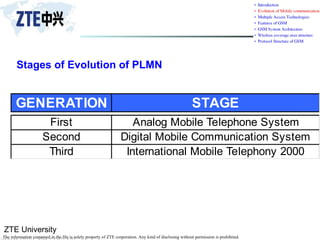
Stages of Evolution of PLMN
GENERATION STAGE
First Analog Mobile Telephone System
Second Digital Mobile Communication System
Third International Mobile Telephony 2000
ZTE University
The information contained in the file is solely property of ZTE corporation. Any kind of disclosing without permission is prohibited.
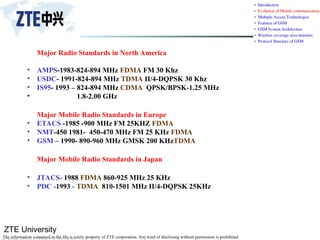
Major Radio Standards in North America
• AMPS-1983-824-894 MHz FDMA FM 30 Khz
• USDC- 1991-824-894 MHz TDMA II/4-DQPSK 30 Khz
• IS95- 1993 – 824-894 MHz CDMA QPSK/BPSK-1.25 MHz
• 1.8-2.00 GHz
Major Mobile Radio Standards in Europe
• ETACS -1985 -900 MHz FM 25KHZ FDMA
• NMT-450 1981- 450-470 MHz FM 25 KHz FDMA
• GSM – 1990- 890-960 MHz GMSK 200 KHzTDMA
Major Mobile Radio Standards in Japan
• JTACS- 1988 FDMA 860-925 MHz 25 KHz
• PDC -1993 - TDMA 810-1501 MHz II/4-DQPSK 25KHz
ZTE University
The information contained in the file is solely property of ZTE corporation. Any kind of disclosing without permission is prohibited.
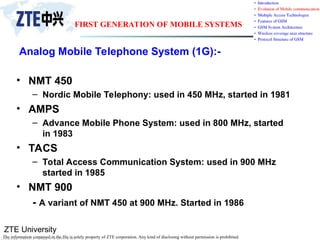
Analog Mobile Telephone System (1G):-
• NMT 450
– Nordic Mobile Telephony: used in 450 MHz, started in 1981
• AMPS
– Advance Mobile Phone System: used in 800 MHz, started
in 1983
• TACS
– Total Access Communication System: used in 900 MHz
started in 1985
• NMT 900
- A variant of NMT 450 at 900 MHz. Started in 1986
FIRST GENERATION OF MOBILE SYSTEMS
ZTE University
The information contained in the file is solely property of ZTE corporation. Any kind of disclosing without permission is prohibited.
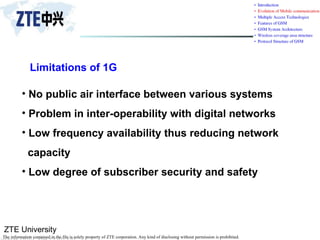
Limitations of 1G
• No public air interface between various systems
• Problem in inter-operability with digital networks
• Low frequency availability thus reducing network
capacity
• Low degree of subscriber security and safety
ZTE University
The information contained in the file is solely property of ZTE corporation. Any kind of disclosing without permission is prohibited.
Digital Mobile Communication System (2G)
1. TIME DIVISION MULTIPLE ACCESS (TDMA)
- D-AMPS, PDC, GSM
2. NARROW BAND CODE DIVISION MULTIPLE ACCESS (N-CDMA)
- IS-95A, IS-95B, CDMA 2000
SECOND GENERATION OF MOBILE SYSTEMS
ZTE University
The information contained in the file is solely property of ZTE corporation. Any kind of disclosing without permission is prohibited.
Digital Mobile Communication System (TDMA):-
• D-AMPS
- Digital – AMPS: used in either 800 or 1900 MHz, started
in 1991
• PDC
- Personal Digital Cellular: used in 1900 MHz, started in
1994
• GSM
- Global Systems for Mobile Communications: used in
900 MHz, started in 1991
ZTE University
The information contained in the file is solely property of ZTE corporation. Any kind of disclosing without permission is prohibited.
Digital Mobile Communication System (N-CDMA):-
• A mobile communication system developed mainly by companies
leaded by the Quacomm Co. on basis of
IS–95.
• The specifications of North American digital cellular systems are
drawn up by the American Telecom Industry Association(TIA).
• This system has been adopted by China Unicom in 2001
ZTE University
The information contained in the file is solely property of ZTE corporation. Any kind of disclosing without permission is prohibited.
THIRD GENERATION OF MOBILE SYSTEM
INTERNATIONAL MOBILE TELEPHONY 2000 (IMT 2000):-
• The future of mobile network that will allow the multi-media
support of high flow of services and mobility, with performances
higher than those currently offered by the GSM/ GPRS
• Designation of frequency bands is harmonized universally in the
vicinity of 2 GHz
• Ideal transmission speed is 2 Mbps
ZTE University
The information contained in the file is solely property of ZTE corporation. Any kind of disclosing without permission is prohibited.
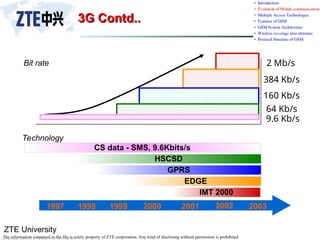
3G Contd..
3G Contd..
IMT 2000
2 Mb/s
384 Kb/s
EDGE
GPRS
160 Kb/s
64 Kb/s
HSCSD
1997 1998 1999 2000 2001 2002 2003
Bit rate
CS data - SMS, 9.6Kbits/s
9.6 Kb/s
Technology
ZTE University
The information contained in the file is solely property of ZTE corporation. Any kind of disclosing without permission is prohibited.
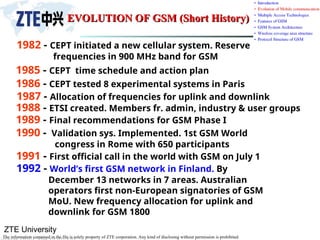
EVOLUTION OF GSM (Short History)
1982 - CEPT initiated a new cellular system. Reserve
frequencies in 900 MHz band for GSM
1985 - CEPT time schedule and action plan
1986 - CEPT tested 8 experimental systems in Paris
1987 - Allocation of frequencies for uplink and downlink
1988 - ETSI created. Members fr. admin, industry & user groups
1989 - Final recommendations for GSM Phase I
1990 - Validation sys. Implemented. 1st GSM World
congress in Rome with 650 participants
1991 - First official call in the world with GSM on July 1
1992 - World’s first GSM network in Finland. By
December 13 networks in 7 areas. Australian
operators first non-European signatories of GSM
MoU. New frequency allocation for uplink and
downlink for GSM 1800
ZTE University
The information contained in the file is solely property of ZTE corporation. Any kind of disclosing without permission is prohibited.
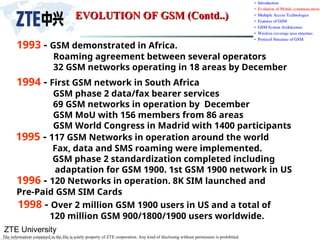
EVOLUTION OF GSM (Contd..)
1993 - GSM demonstrated in Africa.
Roaming agreement between several operators
32 GSM networks operating in 18 areas by December
1994 - First GSM network in South Africa
GSM phase 2 data/fax bearer services
69 GSM networks in operation by December
GSM MoU with 156 members from 86 areas
GSM World Congress in Madrid with 1400 participants
1995 - 117 GSM Networks in operation around the world
Fax, data and SMS roaming were implemented.
GSM phase 2 standardization completed including
adaptation for GSM 1900. 1st GSM 1900 network in US
1996 - 120 Networks in operation. 8K SIM launched and
Pre-Paid GSM SIM Cards
1998 - Over 2 million GSM 1900 users in US and a total of
120 million GSM 900/1800/1900 users worldwide.
ZTE University
The information contained in the file is solely property of ZTE corporation. Any kind of disclosing without permission is prohibited.
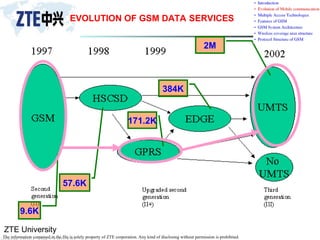
EVOLUTION OF GSM DATA SERVICES
9.6K
57.6K
171.2K
384K
2M
ZTE University
The information contained in the file is solely property of ZTE corporation. Any kind of disclosing without permission is prohibited.
1
1G
G 2
2G
G 3
3G
G
Analog
cellular
D
Di
ig
gi
it
ta
al
l c
ce
el
ll
lu
ul
la
ar
r D
Di
ig
gi
it
ta
al
l c
ce
el
ll
lu
ul
la
ar
r
V
Vo
oi
ic
ce
e V
Vo
oi
ic
ce
e /
/d
da
at
ta
a V
Vi
io
oc
ce
e /
/ h
hi
ig
gh
h s
sp
pe
ee
ed
d d
da
at
ta
a
A
AM
MP
PS
S C
CD
DM
MA
A 1
1X
XR
Rt
tt
t C
CD
DM
MA
A2
20
00
00
0
T
TA
AC
CS
S G
GS
SM
M G
GP
PR
RS
S W
W_
_C
CD
DM
MA
A
8
80
0’
’ 1
19
99
92
2 1
19
99
99
9 2
20
00
01
1 2
20
00
03
3
Summary
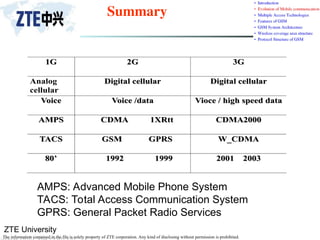
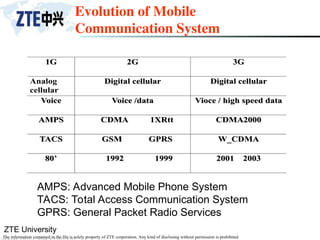
AMPS: Advanced Mobile Phone System
TACS: Total Access Communication System
GPRS: General Packet Radio Services
ZTE University
The information contained in the file is solely property of ZTE corporation. Any kind of disclosing without permission is prohibited.
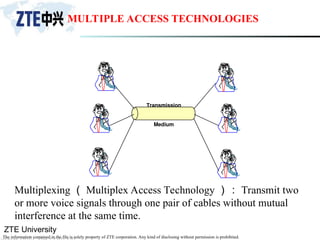
Transmission
Medium
Multiplexing ( Multiplex Access Technology ): Transmit two
or more voice signals through one pair of cables without mutual
interference at the same time.
MULTIPLE ACCESS TECHNOLOGIES
ZTE University
The information contained in the file is solely property of ZTE corporation. Any kind of disclosing without permission is prohibited.
Frequency
Time
Power
Frequency
Time
Power
Frequency
Time
Power
FDMA
TDMA
CDMA
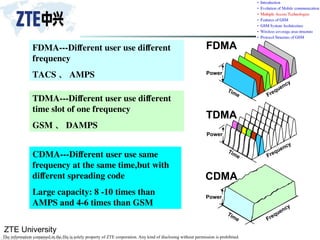
FDMA---Different user use different
frequency
TACS 、 AMPS
TDMA---Different user use different
time slot of one frequency
GSM 、 DAMPS
CDMA---Different user use same
frequency at the same time,but with
different spreading code
Large capacity: 8 -10 times than
AMPS and 4-6 times than GSM
ZTE University
The information contained in the file is solely property of ZTE corporation. Any kind of disclosing without permission is prohibited.
INTRODUCTION TO GSM
INTRODUCTION TO GSM
What is GSM?
Problem:
Problem: Beginning of 1980s - European countries were
using many and different incompatible mobile phone
systems. Increased needs for telecommunication services
Action by CEPT
Action by CEPT: founded a group to specify a common
mobile system for WESTERN EUROPE
Name of the Group and System:
Name of the Group and System: GSM
“Groupe Speciale Mobile”
Global System for Mobile Communications
ZTE University
The information contained in the file is solely property of ZTE corporation. Any kind of disclosing without permission is prohibited.
Why was there a need to develop a cellular
standard?
• Incompatibility among existing cellular systems
which were mostly analog
• Spectrum Efficiency
• International roaming capability
• Low mobile and Station Cost
• Good subjective voice quality
• Ability to support new services
ZTE University
The information contained in the file is solely property of ZTE corporation. Any kind of disclosing without permission is prohibited.
FEATURES OF GSM
FEATURES OF GSM
1. Spectrum Efficiency
2. Capacity
3. Voice Quality
4. Open Interfaces
5. Security
6. Interconnection with other Networks
7. Roaming
ZTE University
The information contained in the file is solely property of ZTE corporation. Any kind of disclosing without permission is prohibited.
(1) Spectrum efficiency: due to the adoption of high-efficiency
modulator, channel coding, interleaving, equalization and voice
coding technologies, the system has a high spectrum efficiency.
(2) Capacity: due to the increase of the transmission bandwidth of
each channel, the requirement of co-channel reuse carrier-to-
interference ratio is lowered to 9dB, So,the cofrequency reuse
mode of the GSM system can be narrowed down to 4/12 or 3/9 or
even less (for a analog system, it is 7/21).
GSM system capacity is 3~5 times higher than that of a TACS
system.
ZTE University
The information contained in the file is solely property of ZTE corporation. Any kind of disclosing without permission is prohibited.
(3) Voice quality: due to digital transmission
technology, GSM system has a strong anti-
interference capability compared with analog system,
thus the voice quality is guaranteed.
(4) Interfaces openness: the open interfaces provided
by GSM standards refer not only to air interface
(Um), but also A interface.
ZTE University
The information contained in the file is solely property of ZTE corporation. Any kind of disclosing without permission is prohibited.
(5) Security: security is guaranteed with authentification,
encryption and TMSI.
(6) Interconnection with ISDN, PSTN, etc.:
interconnections with other networks normally use the
existing standard interfaces, such as ISUP or TUP.
(7) Roaming: roaming is realized on basis of SIM cards.
ZTE University
The information contained in the file is solely property of ZTE corporation. Any kind of disclosing without permission is prohibited.
GSM SYSTEM ARCHITECTURE
ZTE University
The information contained in the file is solely property of ZTE corporation. Any kind of disclosing without permission is prohibited.
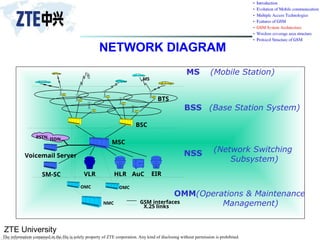
NETWORK DIAGRAM
BTS
BSC
MSC
VLR HLR AuC EIR
PSTN, ISDN...
OMC
OMC
NMC
X.25 links
GSM interfaces
Voicemail Server
SM-SC
MS (Mobile Station)
BSS (Base Station System)
NSS (Network Switching
Subsystem)
OMM(Operations & Maintenance
Management)
MS
ZTE University
The information contained in the file is solely property of ZTE corporation. Any kind of disclosing without permission is prohibited.
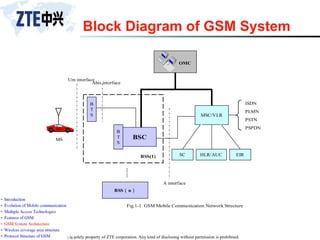
Block Diagram of GSM System
BSC
B
T
S
B
T
S
HLR/AUC EIR
SC
ISDN
PLMN
PSTN
PSPDN
OMC
BSS(1)
……
BSS(n)
MS
A interface
Abis interface
Um interface
Fig.1-1 GSM Mobile Communication Network Structure
MSC/VLR
ZTE University
The information contained in the file is solely property of ZTE corporation. Any kind of disclosing without permission is prohibited.
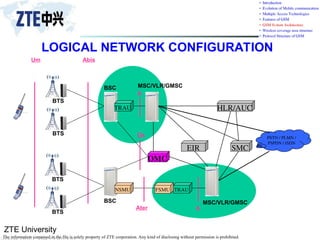
LOGICAL NETWORK CONFIGURATION
BSC
A
Abis
Um
BTS
BSC
TRAU
MSC/VLR/GMSC
MSC/VLR/GMSC
NSMU FSMU
TRAU
Ater A
OMC
Qx
HLR/AUC
EIR SMC
PSTN / PLMN /
PSPDN / ISDN
BTS
BTS
BTS
ZTE University
The information contained in the file is solely property of ZTE corporation. Any kind of disclosing without permission is prohibited.
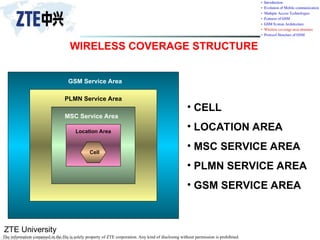
WIRELESS COVERAGE STRUCTURE
GSM Service Area
PLMN Service Area
MSC Service Area
Location Area
Cell
• CELL
• LOCATION AREA
• MSC SERVICE AREA
• PLMN SERVICE AREA
• GSM SERVICE AREA
ZTE University
The information contained in the file is solely property of ZTE corporation. Any kind of disclosing without permission is prohibited.
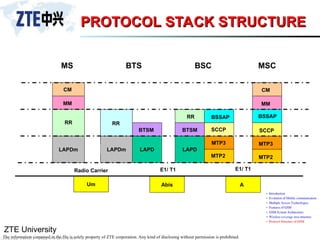
PROTOCOL STACK STRUCTURE
Um
MTP2
MTP3
SCCP
BSSAP
MM
CM
LAPD
MTP2
MTP3
SCCP
BSSAP
BTSM
RR
LAPDm LAPD
BTSM
RR
LAPDm
RR
MM
CM
MS BTS BSC MSC
Radio Carrier E1/ T1 E1/ T1
Abis A
ZTE University
The information contained in the file is solely property of ZTE corporation. Any kind of disclosing without permission is prohibited.
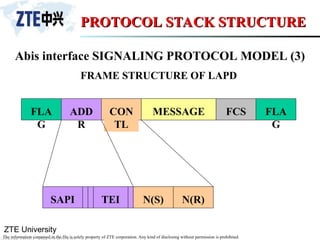
PROTOCOL STACK STRUCTURE
Abis interface SIGNALING PROTOCOL MODEL (3)
FRAME STRUCTURE OF LAPD
FLA
G
ADD
R
FCS FLA
G
CON
TL
MESSAGE
SAPI TEI N(S) N(R)
ZTE University
The information contained in the file is solely property of ZTE corporation. Any kind of disclosing without permission is prohibited.
PROTOCOL STACK STRUCTURE
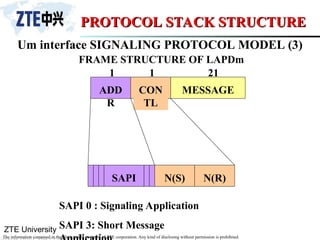
Um interface SIGNALING PROTOCOL MODEL (3)
FRAME STRUCTURE OF LAPDm
ADD
R
CON
TL
MESSAGE
SAPI N(S) N(R)
1 1 21
SAPI 0 : Signaling Application
SAPI 3: Short Message
ZTE University
The information contained in the file is solely property of ZTE corporation. Any kind of disclosing without permission is prohibited.
PROTOCOL STACK STRUCTURE
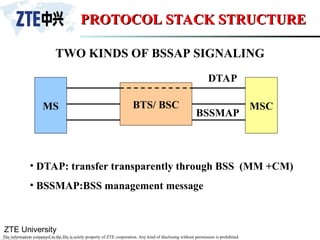
TWO KINDS OF BSSAP SIGNALING
MS BTS/ BSC MSC
DTAP
BSSMAP
• DTAP: transfer transparently through BSS (MM +CM)
• BSSMAP:BSS management message
ZTE University
The information contained in the file is solely property of ZTE corporation. Any kind of disclosing without permission is prohibited.
Um Interface
ZTE University
The information contained in the file is solely property of ZTE corporation. Any kind of disclosing without permission is prohibited.
Overview
• GSM Wireless Operating Band
• Channel Types
• Types of Burst
• TDMA Frame structure in GSM
• Channel combination
• Traffic
• Voice Transform Process
ZTE University
The information contained in the file is solely property of ZTE corporation. Any kind of disclosing without permission is prohibited.
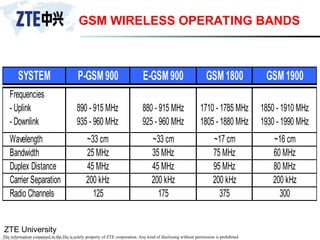
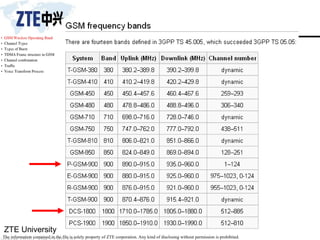
GSM WIRELESS OPERATING BANDS
SYSTEM P-GSM900 E-GSM900 GSM1800 GSM1900
Frequencies
- Uplink
- Downlink
890 - 915 MHz
935 - 960 MHz
880 - 915 MHz
925 - 960 MHz
1710 - 1785 MHz
1805 - 1880 MHz
1850 - 1910 MHz
1930 - 1990 MHz
Wavelength ~33 cm ~33 cm ~17 cm ~16 cm
Bandwidth 25 MHz 35 MHz 75 MHz 60 MHz
Duplex Distance 45 MHz 45 MHz 95 MHz 80 MHz
Carrier Separation 200 kHz 200 kHz 200 kHz 200 kHz
Radio Channels 125 175 375 300
ZTE University
The information contained in the file is solely property of ZTE corporation. Any kind of disclosing without permission is prohibited.
ZTE University
The information contained in the file is solely property of ZTE corporation. Any kind of disclosing without permission is prohibited.
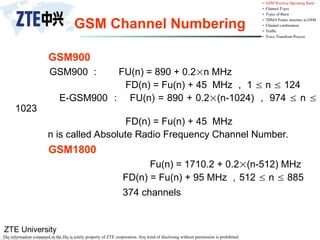
GSM Channel Numbering
GSM900
GSM900 : FU(n) = 890 + 0.2n MHz
FD(n) = Fu(n) + 45 MHz , 1  n  124
E-GSM900 : FU(n) = 890 + 0.2(n-1024) , 974  n 
1023
FD(n) = Fu(n) + 45 MHz
n is called Absolute Radio Frequency Channel Number.
GSM1800
Fu(n) = 1710.2 + 0.2(n-512) MHz
FD(n) = Fu(n) + 95 MHz ,512  n  885
374 channels
ZTE University
The information contained in the file is solely property of ZTE corporation. Any kind of disclosing without permission is prohibited.
CHANNEL TYPES
CHANNEL TYPES
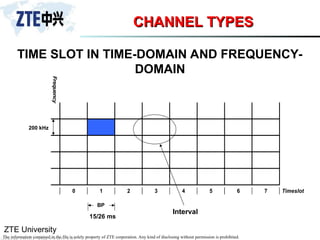
TIME SLOT IN TIME-DOMAIN AND FREQUENCY-
DOMAIN
Frequency
0 1 2 3 4 5 6 7 Timeslot
Interval
BP
15/26 ms
200 kHz
ZTE University
The information contained in the file is solely property of ZTE corporation. Any kind of disclosing without permission is prohibited.
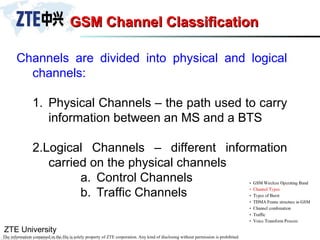
GSM Channel Classification
Channels are divided into physical and logical
channels:
1. Physical Channels – the path used to carry
information between an MS and a BTS
2.Logical Channels – different information
carried on the physical channels
a. Control Channels
b. Traffic Channels
ZTE University
The information contained in the file is solely property of ZTE corporation. Any kind of disclosing without permission is prohibited.
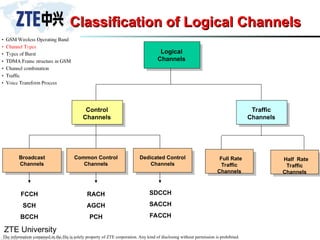
Classification of Logical Channels
Logical
Channels
Control
Channels
Common Control
Channels
Traffic
Channels
Broadcast
Channels
Dedicated Control
Channels
FCCH
SCH
BCCH
RACH
AGCH
PCH
SDCCH
SACCH
FACCH
Full Rate
Traffic
Channels
Half Rate
Traffic
Channels
ZTE University
The information contained in the file is solely property of ZTE corporation. Any kind of disclosing without permission is prohibited.
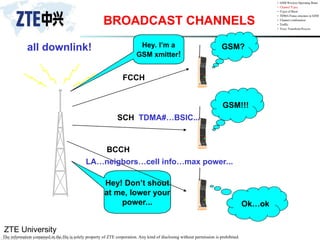
Hey! Don’t shout
at me, lower your
power...
BROADCAST CHANNELS
all downlink!
FCCH
SCH TDMA#…BSIC...
BCCH
Hey. I’m a
GSM xmitter!
GSM?
GSM!!!
LA…neigbors…cell info…max power...
Ok…ok
ZTE University
The information contained in the file is solely property of ZTE corporation. Any kind of disclosing without permission is prohibited.
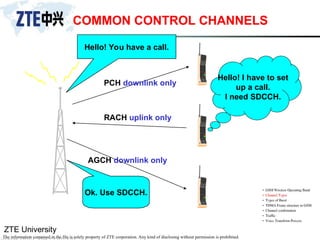
COMMON CONTROL CHANNELS
PCH downlink only
Hello! You have a call.
RACH uplink only
Hello! I have to set
up a call.
I need SDCCH.
AGCH downlink only
Ok. Use SDCCH.
ZTE University
The information contained in the file is solely property of ZTE corporation. Any kind of disclosing without permission is prohibited.
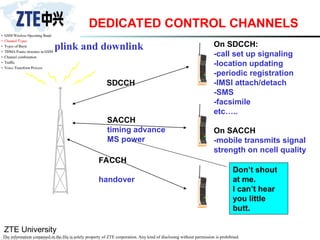
DEDICATED CONTROL CHANNELS
SDCCH
SACCH
timing advance
MS power
FACCH
handover
On SDCCH:
-call set up signaling
-location updating
-periodic registration
-IMSI attach/detach
-SMS
-facsimile
etc…..
On SACCH
-mobile transmits signal
strength on ncell quality
Don’t shout
at me.
I can’t hear
you little
butt.
uplink and downlink
ZTE University
The information contained in the file is solely property of ZTE corporation. Any kind of disclosing without permission is prohibited.
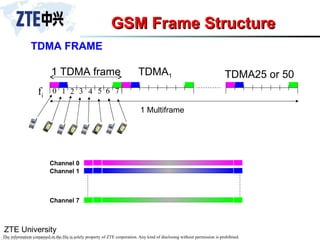
GSM Frame Structure
GSM Frame Structure
TDMA FRAME
fi
1 TDMA frame
1 2 3 4 5 7
6
0
TDMA1 TDMA25 or 50
1 Multiframe
Channel 0
Channel 1
Channel 7
ZTE University
The information contained in the file is solely property of ZTE corporation. Any kind of disclosing without permission is prohibited.
ZTE University
The information contained in the file is solely property of ZTE corporation. Any kind of disclosing without permission is prohibited.
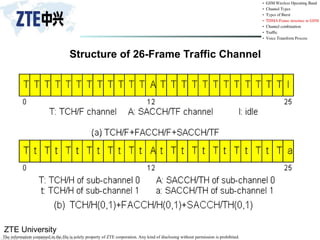
Structure of 26-Frame Traffic Channel
ZTE University
The information contained in the file is solely property of ZTE corporation. Any kind of disclosing without permission is prohibited.
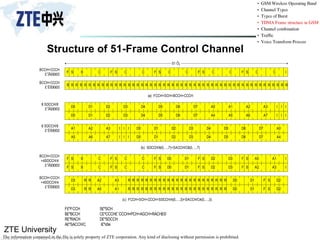
Structure of 51-Frame Control Channel
S
F B C
R R R R R R R R R R R R R R R R R R R R R R R R R R R R R R R
51 Ö¡
S
F C C S
F C C S
F C C I
R R R R R R R R R R
D0 D1 D2 D3 D4 D5 D6 D7 A0 A1 A2 A3
S
F C C
R R R R R R R R R R
I
I
I
D0 D1 D2 D3 D4 D5 D6 D7 A4 A5 A6 A7 I
I
I
A1 A2 A3 I
I
I
A5 A6 A7 I
I
I
D0 D1 D2 D3 D4 D5 D6 D7 A0
D0 D1 D2 D3 D4 D5 D6 D7 A4
S
F B C S
F C C S
F D0 D1 S
F D2 D3 I
S
F A0 A1
S
F B C S
F C C S
F D0 D1 S
F D2 D3 I
S
F A2 A3
D3
D3
R R
R R
A2 A3
A0 A1
D2
D2
S
F
S
F
D0 D1
D0 D1
R R R R R R R R R R R R R R R R R R R R R R R
F£ºFCCH S£ºSCH
B£ºBCCH C£ºCCCH£¨CCCH=PCH+AGCH+RACH£©
R£ºRACH D£ºSDCCH
A£ºSACCH/C I£ºidle
BCCH+CCCH
£¨ÏÂÐУ©
BCCH+CCCH
£¨ÉÏÐУ©
8 SDCCH/8
£¨ÏÂÐУ©
8 SDCCH/8
£¨ÉÏÐУ©
BCCH+CCCH
+4SDCCH/4
£¨ÏÂÐУ©
BCCH+CCCH
+4SDCCH/4
£¨ÉÏÐУ©
(a) FCCH+SCH+BCCH+CCCH
(b) SDCCH/8(0,...,7)+SACCH/C8(0,...,7)
(c) FCCH+SCH+CCCH+SDCCH/4(0,...,3)+SACCH/C4(0,...,3)
ZTE University
The information contained in the file is solely property of ZTE corporation. Any kind of disclosing without permission is prohibited.
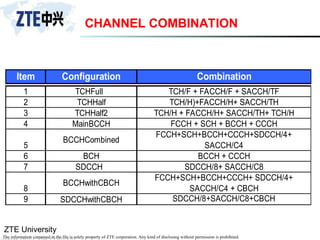
CHANNEL COMBINATION
Item Configuration Combination
1 TCHFull TCH/F + FACCH/F + SACCH/TF
2 TCHHalf TCH/H)+FACCH/H+ SACCH/TH
3 TCHHalf2 TCH/H + FACCH/H+ SACCH/TH+ TCH/H
4 MainBCCH FCCH + SCH + BCCH + CCCH
5
BCCHCombined
FCCH+SCH+BCCH+CCCH+SDCCH/4+
SACCH/C4
6 BCH BCCH + CCCH
7 SDCCH SDCCH/8+ SACCH/C8
8
BCCHwithCBCH
FCCH+SCH+BCCH+CCCH+ SDCCH/4+
SACCH/C4 + CBCH
9 SDCCHwithCBCH SDCCH/8+SACCH/C8+CBCH
ZTE University
The information contained in the file is solely property of ZTE corporation. Any kind of disclosing without permission is prohibited.
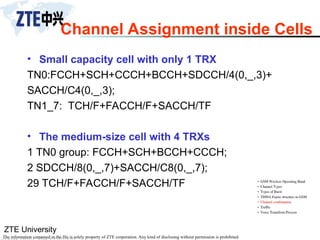
Channel Assignment inside Cells
• Small capacity cell with only 1 TRX
TN0:FCCH+SCH+CCCH+BCCH+SDCCH/4(0,_,3)+
SACCH/C4(0,_,3);
TN1_7: TCH/F+FACCH/F+SACCH/TF
• The medium-size cell with 4 TRXs
1 TN0 group: FCCH+SCH+BCCH+CCCH;
2 SDCCH/8(0,_,7)+SACCH/C8(0,_,7);
29 TCH/F+FACCH/F+SACCH/TF
ZTE University
The information contained in the file is solely property of ZTE corporation. Any kind of disclosing without permission is prohibited.
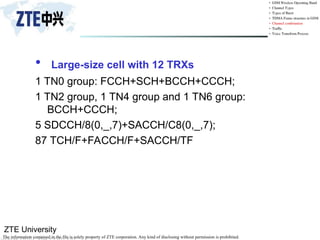
• Large-size cell with 12 TRXs
1 TN0 group: FCCH+SCH+BCCH+CCCH;
1 TN2 group, 1 TN4 group and 1 TN6 group:
BCCH+CCCH;
5 SDCCH/8(0,_,7)+SACCH/C8(0,_,7);
87 TCH/F+FACCH/F+SACCH/TF
ZTE University
The information contained in the file is solely property of ZTE corporation. Any kind of disclosing without permission is prohibited.
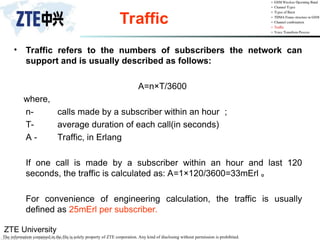
Traffic
• Traffic refers to the numbers of subscribers the network can
support and is usually described as follows:
A=n×T/3600
where,
n- calls made by a subscriber within an hour ;
T- average duration of each call(in seconds)
A - Traffic, in Erlang
If one call is made by a subscriber within an hour and last 120
seconds, the traffic is calculated as: A=1×120/3600=33mErl 。
For convenience of engineering calculation, the traffic is usually
defined as 25mErl per subscriber.
ZTE University
The information contained in the file is solely property of ZTE corporation. Any kind of disclosing without permission is prohibited.
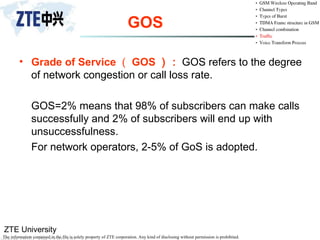
GOS
• Grade of Service ( GOS ): GOS refers to the degree
of network congestion or call loss rate.
GOS=2% means that 98% of subscribers can make calls
successfully and 2% of subscribers will end up with
unsuccessfulness.
For network operators, 2-5% of GoS is adopted.
ZTE University
The information contained in the file is solely property of ZTE corporation. Any kind of disclosing without permission is prohibited.
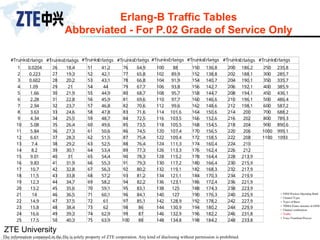
Erlang-B Traffic Tables
Abbreviated - For P.02 Grade of Service Only
#TrunksErlangs #TrunksErlangs #Trunks #TrunksErlangs #TrunksErlangs #TrunksErlangs #TrunksErlangs #Trunks
Erlangs
1 0.0204 26 18.4 51 41.2 76 64.9 100 88 150 136.8 200 186.2 250 235.8
2 0.223 27 19.3 52 42.1 77 65.8 102 89.9 152 138.8 202 188.1 300 285.7
3 0.602 28 20.2 53 43.1 78 66.8 104 91.9 154 140.7 204 190.1 350 335.7
4 1.09 29 21 54 44 79 67.7 106 93.8 156 142.7 206 192.1 400 385.9
5 1.66 30 21.9 55 44.9 80 68.7 108 95.7 158 144.7 208 194.1 450 436.1
6 2.28 31 22.8 56 45.9 81 69.6 110 97.7 160 146.6 210 196.1 500 486.4
7 2.94 32 23.7 57 46.8 82 70.6 112 99.6 162 148.6 212 198.1 600 587.2
8 3.63 33 24.6 58 47.8 83 71.6 114 101.6 164 150.6 214 200 700 688.2
9 4.34 34 25.5 59 48.7 84 72.5 116 103.5 166 152.6 216 202 800 789.3
10 5.08 35 26.4 60 49.6 85 73.5 118 105.5 168 154.5 218 204 900 890.6
11 5.84 36 27.3 61 50.6 86 74.5 120 107.4 170 156.5 220 206 1000 999.1
12 6.61 37 28.3 62 51.5 87 75.4 122 109.4 172 158.5 222 208 1100 1093
13 7.4 38 29.2 63 52.5 88 76.4 124 111.3 174 160.4 224 210
14 8.2 39 30.1 64 53.4 89 77.3 126 113.3 176 162.4 226 212
15 9.01 40 31 65 54.4 90 78.3 128 115.2 178 164.4 228 213.9
16 9.83 41 31.9 66 55.3 91 79.3 130 117.2 180 166.4 230 215.9
17 10.7 42 32.8 67 56.3 92 80.2 132 119.1 182 168.3 232 217.9
18 11.5 43 33.8 68 57.2 93 81.2 134 121.1 184 170.3 234 219.9
19 12.3 44 34.7 69 58.2 94 82.2 136 123.1 186 172.4 236 221.9
20 13.2 45 35.6 70 59.1 95 83.1 138 125 188 174.3 238 223.9
21 14 46 36.5 71 60.1 96 84.1 140 127 190 176.3 240 225.9
22 14.9 47 37.5 72 61 97 85.1 142 128.9 192 178.2 242 227.9
23 15.8 48 38.4 73 62 98 86 144 130.9 194 180.2 244 229.9
24 16.6 49 39.3 74 62.9 99 87 146 132.9 196 182.2 246 231.8
25 17.5 50 40.3 75 63.9 100 88 148 134.8 198 184.2 248 233.8
Erlangs
ZTE University
The information contained in the file is solely property of ZTE corporation. Any kind of disclosing without permission is prohibited.
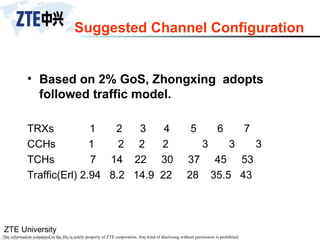
Suggested Channel Configuration
• Based on 2% GoS, Zhongxing adopts
followed traffic model.
TRXs 1 2 3 4 5 6 7
CCHs 1 2 2 2 3 3 3
TCHs 7 14 22 30 37 45 53
Traffic(Erl) 2.94 8.2 14.9 22 28 35.5 43
ZTE University
The information contained in the file is solely property of ZTE corporation. Any kind of disclosing without permission is prohibited.
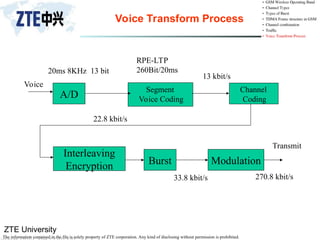
Voice Transform Process
A/D
Interleaving
Encryption
Channel
Coding
Segment
Voice Coding
20ms 8KHz 13 bit
13 kbit/s
Voice
RPE-LTP
260Bit/20ms
22.8 kbit/s
Burst Modulation
Transmit
33.8 kbit/s 270.8 kbit/s
ZTE University
The information contained in the file is solely property of ZTE corporation. Any kind of disclosing without permission is prohibited.
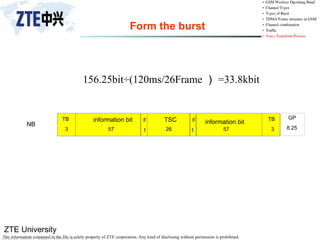
Form the burst
TB
3
information bit
57
TSC
26
information bit
57
GP
8.25
TB
3
NB
F F
1 1
156.25bit÷(120ms/26Frame ) =33.8kbit
ZTE University
The information contained in the file is solely property of ZTE corporation. Any kind of disclosing without permission is prohibited.
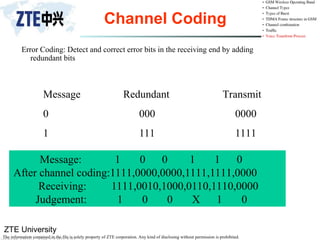
Error Coding: Detect and correct error bits in the receiving end by adding
redundant bits
Message: 1 0 0 1 1 0
After channel coding:1111,0000,0000,1111,1111,0000
Receiving: 1111,0010,1000,0110,1110,0000
Judgement: 1 0 0 X 1 0
Channel Coding
Message Redundant Transmit
0 000 0000
1 111 1111
ZTE University
The information contained in the file is solely property of ZTE corporation. Any kind of disclosing without permission is prohibited.
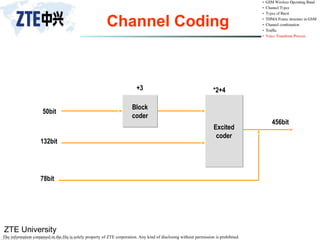
Block
coder
Excited
coder
50bit
+3 *2+4
132bit
78bit
456bit
Channel Coding
ZTE University
The information contained in the file is solely property of ZTE corporation. Any kind of disclosing without permission is prohibited.
24/10/4 1 61
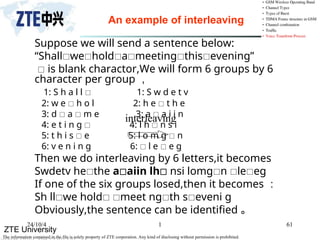
Suppose we will send a sentence below:
“Shallweholdameetingthisevening”
 is blank charactor,We will form 6 groups by 6
character per group ,
1: S h a l l  1: S w d e t v
2: w e  h o l 2: h e  t h e
3: d  a  m e 3: a  a i i n
4: e t i n g  4: l h  n s i
5: t h i s  e 5: l o m g  n
6: v e n i n g 6:  l e  e g
Then we do interleaving by 6 letters,it becomes
Swdetv hethe aaiin lh nsi lomgn leeg
If one of the six groups losed,then it becomes :
Sh llwe hold meet ngth seveni g
Obviously,the sentence can be identified 。
An example of interleaving
interleaving
ZTE University
The information contained in the file is solely property of ZTE corporation. Any kind of disclosing without permission is prohibited.
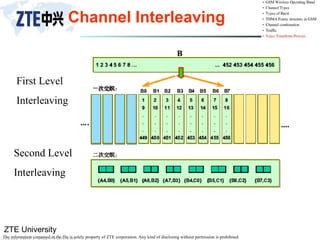
First Level
Interleaving
Second Level
Interleaving
Channel Interleaving
ZTE University
The information contained in the file is solely property of ZTE corporation. Any kind of disclosing without permission is prohibited.
ZTE University
The information contained in the file is solely property of ZTE corporation. Any kind of disclosing without permission is prohibited.
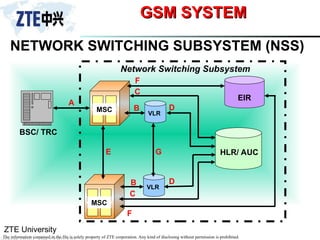
NETWORK SWITCHING SUBSYSTEM (NSS)
GSM SYSTEM
GSM SYSTEM
MSC VLR
MSC
HLR/ AUC
EIR
VLR
BSC/ TRC
A
B
B
G
C
F
D
E
C
D
F
Network Switching Subsystem
ZTE University
The information contained in the file is solely property of ZTE corporation. Any kind of disclosing without permission is prohibited.
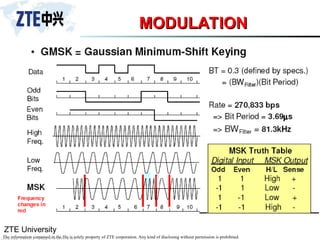
MODULATION
MODULATION
ZTE University
The information contained in the file is solely property of ZTE corporation. Any kind of disclosing without permission is prohibited.
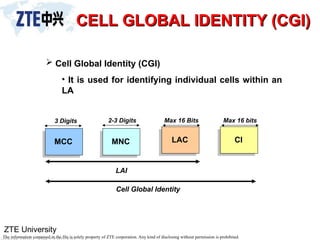
CELL GLOBAL IDENTITY (CGI)
MCC LAC
Cell Global Identity
MNC
3 Digits 2-3 Digits Max 16 Bits
CI
Max 16 bits
LAI
 Cell Global Identity (CGI)
• It is used for identifying individual cells within an
LA
ZTE University
The information contained in the file is solely property of ZTE corporation. Any kind of disclosing without permission is prohibited.
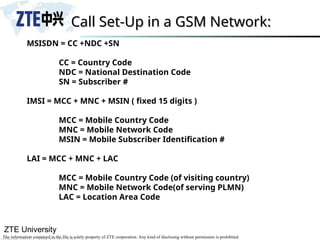
MSISDN = CC +NDC +SN
CC = Country Code
NDC = National Destination Code
SN = Subscriber #
IMSI = MCC + MNC + MSIN ( fixed 15 digits )
MCC = Mobile Country Code
MNC = Mobile Network Code
MSIN = Mobile Subscriber Identification #
LAI = MCC + MNC + LAC
MCC = Mobile Country Code (of visiting country)
MNC = Mobile Network Code(of serving PLMN)
LAC = Location Area Code
Call Set-Up in a GSM Network:
ZTE University
The information contained in the file is solely property of ZTE corporation. Any kind of disclosing without permission is prohibited.
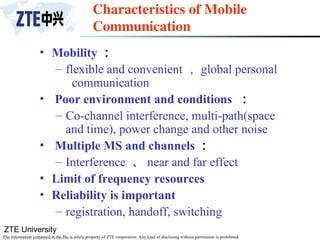
• Mobility :
– flexible and convenient , global personal
communication
• Poor environment and conditions :
– Co-channel interference, multi-path(space
and time), power change and other noise
• Multiple MS and channels :
– Interference 、 near and far effect
• Limit of frequency resources
• Reliability is important
– registration, handoff, switching
Characteristics of Mobile
Communication
ZTE University
The information contained in the file is solely property of ZTE corporation. Any kind of disclosing without permission is prohibited.
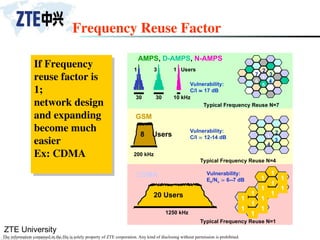
If Frequency
reuse factor is
1;
network design
and expanding
become much
easier
Ex: CDMA
Frequency Reuse Factor
AMPS, D-AMPS, N-AMPS
CDMA
30 30 10 kHz
200 kHz
1250 kHz
1 3 1 Users
8 Users
20 Users
1
1
1
1
1
1
1
1
1
1
1
1
1
1
1
2
3
4
4
3
2
5
6
1
7
Typical Frequency Reuse N=7
Typical Frequency Reuse N=4
Typical Frequency Reuse N=1
Vulnerability:
C/I  17 dB
Vulnerability:
C/I  12-14 dB
Vulnerability:
Eb/No  6--7 dB
GSM
ZTE University
The information contained in the file is solely property of ZTE corporation. Any kind of disclosing without permission is prohibited.
1
1G
G 2
2G
G 3
3G
G
Analog
cellular
D
Di
ig
gi
it
ta
al
l c
ce
el
ll
lu
ul
la
ar
r D
Di
ig
gi
it
ta
al
l c
ce
el
ll
lu
ul
la
ar
r
V
Vo
oi
ic
ce
e V
Vo
oi
ic
ce
e /
/d
da
at
ta
a V
Vi
io
oc
ce
e /
/ h
hi
ig
gh
h s
sp
pe
ee
ed
d d
da
at
ta
a
A
AM
MP
PS
S C
CD
DM
MA
A 1
1X
XR
Rt
tt
t C
CD
DM
MA
A2
20
00
00
0
T
TA
AC
CS
S G
GS
SM
M G
GP
PR
RS
S W
W_
_C
CD
DM
MA
A
8
80
0’
’ 1
19
99
92
2 1
19
99
99
9 2
20
00
01
1 2
20
00
03
3
Evolution of Mobile
Communication System
AMPS: Advanced Mobile Phone System
TACS: Total Access Communication System
GPRS: General Packet Radio Services

1 GSM-Introduction- Mobile technology and application

  • 1.
    ZTE University The informationcontained in the file is solely property of ZTE corporation. Any kind of disclosing without permission is prohibited.
  • 2.
    ZTE University The informationcontained in the file is solely property of ZTE corporation. Any kind of disclosing without permission is prohibited. Overview • Introduction • Evolution of Mobile communication • Multiple Access Technologies • Features of GSM • GSM System Architecture • Wireless coverage area structure • Protocol Structure of GSM
  • 3.
    ZTE University The informationcontained in the file is solely property of ZTE corporation. Any kind of disclosing without permission is prohibited. OBJECTIVES OBJECTIVES • To be aware of the developments of cellular mobile technology • To understand the entities that made up GSM Mobile System • To know the principles and services that make up GSM
  • 4.
    ZTE University The informationcontained in the file is solely property of ZTE corporation. Any kind of disclosing without permission is prohibited. EVOLUTION OF MOBILE COMMUNICATIONS EVOLUTION OF MOBILE COMMUNICATIONS • One of the fastest growing and most demanding of all telecommunications technologies. •Mobile communication existed half a century ago, but it was in the 1980’s that it was really developed. • The main goal of mobile communication is to realize communication among any objects at any time, and in any place. Mobile Communications:-
  • 5.
    ZTE University The informationcontained in the file is solely property of ZTE corporation. Any kind of disclosing without permission is prohibited. Stages of Evolution of PLMN GENERATION STAGE First Analog Mobile Telephone System Second Digital Mobile Communication System Third International Mobile Telephony 2000
  • 6.
    ZTE University The informationcontained in the file is solely property of ZTE corporation. Any kind of disclosing without permission is prohibited. Major Radio Standards in North America • AMPS-1983-824-894 MHz FDMA FM 30 Khz • USDC- 1991-824-894 MHz TDMA II/4-DQPSK 30 Khz • IS95- 1993 – 824-894 MHz CDMA QPSK/BPSK-1.25 MHz • 1.8-2.00 GHz Major Mobile Radio Standards in Europe • ETACS -1985 -900 MHz FM 25KHZ FDMA • NMT-450 1981- 450-470 MHz FM 25 KHz FDMA • GSM – 1990- 890-960 MHz GMSK 200 KHzTDMA Major Mobile Radio Standards in Japan • JTACS- 1988 FDMA 860-925 MHz 25 KHz • PDC -1993 - TDMA 810-1501 MHz II/4-DQPSK 25KHz
  • 7.
    ZTE University The informationcontained in the file is solely property of ZTE corporation. Any kind of disclosing without permission is prohibited. Analog Mobile Telephone System (1G):- • NMT 450 – Nordic Mobile Telephony: used in 450 MHz, started in 1981 • AMPS – Advance Mobile Phone System: used in 800 MHz, started in 1983 • TACS – Total Access Communication System: used in 900 MHz started in 1985 • NMT 900 - A variant of NMT 450 at 900 MHz. Started in 1986 FIRST GENERATION OF MOBILE SYSTEMS
  • 8.
    ZTE University The informationcontained in the file is solely property of ZTE corporation. Any kind of disclosing without permission is prohibited. Limitations of 1G • No public air interface between various systems • Problem in inter-operability with digital networks • Low frequency availability thus reducing network capacity • Low degree of subscriber security and safety
  • 9.
    ZTE University The informationcontained in the file is solely property of ZTE corporation. Any kind of disclosing without permission is prohibited. Digital Mobile Communication System (2G) 1. TIME DIVISION MULTIPLE ACCESS (TDMA) - D-AMPS, PDC, GSM 2. NARROW BAND CODE DIVISION MULTIPLE ACCESS (N-CDMA) - IS-95A, IS-95B, CDMA 2000 SECOND GENERATION OF MOBILE SYSTEMS
  • 10.
    ZTE University The informationcontained in the file is solely property of ZTE corporation. Any kind of disclosing without permission is prohibited. Digital Mobile Communication System (TDMA):- • D-AMPS - Digital – AMPS: used in either 800 or 1900 MHz, started in 1991 • PDC - Personal Digital Cellular: used in 1900 MHz, started in 1994 • GSM - Global Systems for Mobile Communications: used in 900 MHz, started in 1991
  • 11.
    ZTE University The informationcontained in the file is solely property of ZTE corporation. Any kind of disclosing without permission is prohibited. Digital Mobile Communication System (N-CDMA):- • A mobile communication system developed mainly by companies leaded by the Quacomm Co. on basis of IS–95. • The specifications of North American digital cellular systems are drawn up by the American Telecom Industry Association(TIA). • This system has been adopted by China Unicom in 2001
  • 12.
    ZTE University The informationcontained in the file is solely property of ZTE corporation. Any kind of disclosing without permission is prohibited. THIRD GENERATION OF MOBILE SYSTEM THIRD GENERATION OF MOBILE SYSTEM INTERNATIONAL MOBILE TELEPHONY 2000 (IMT 2000):- • The future of mobile network that will allow the multi-media support of high flow of services and mobility, with performances higher than those currently offered by the GSM/ GPRS • Designation of frequency bands is harmonized universally in the vicinity of 2 GHz • Ideal transmission speed is 2 Mbps
  • 13.
    ZTE University The informationcontained in the file is solely property of ZTE corporation. Any kind of disclosing without permission is prohibited. 3G Contd.. 3G Contd.. IMT 2000 2 Mb/s 384 Kb/s EDGE GPRS 160 Kb/s 64 Kb/s HSCSD 1997 1998 1999 2000 2001 2002 2003 Bit rate CS data - SMS, 9.6Kbits/s 9.6 Kb/s Technology
  • 14.
    ZTE University The informationcontained in the file is solely property of ZTE corporation. Any kind of disclosing without permission is prohibited. EVOLUTION OF GSM (Short History) EVOLUTION OF GSM (Short History) 1982 - CEPT initiated a new cellular system. Reserve frequencies in 900 MHz band for GSM 1985 - CEPT time schedule and action plan 1986 - CEPT tested 8 experimental systems in Paris 1987 - Allocation of frequencies for uplink and downlink 1988 - ETSI created. Members fr. admin, industry & user groups 1989 - Final recommendations for GSM Phase I 1990 - Validation sys. Implemented. 1st GSM World congress in Rome with 650 participants 1991 - First official call in the world with GSM on July 1 1992 - World’s first GSM network in Finland. By December 13 networks in 7 areas. Australian operators first non-European signatories of GSM MoU. New frequency allocation for uplink and downlink for GSM 1800
  • 15.
    ZTE University The informationcontained in the file is solely property of ZTE corporation. Any kind of disclosing without permission is prohibited. EVOLUTION OF GSM (Contd..) EVOLUTION OF GSM (Contd..) 1993 - GSM demonstrated in Africa. Roaming agreement between several operators 32 GSM networks operating in 18 areas by December 1994 - First GSM network in South Africa GSM phase 2 data/fax bearer services 69 GSM networks in operation by December GSM MoU with 156 members from 86 areas GSM World Congress in Madrid with 1400 participants 1995 - 117 GSM Networks in operation around the world Fax, data and SMS roaming were implemented. GSM phase 2 standardization completed including adaptation for GSM 1900. 1st GSM 1900 network in US 1996 - 120 Networks in operation. 8K SIM launched and Pre-Paid GSM SIM Cards 1998 - Over 2 million GSM 1900 users in US and a total of 120 million GSM 900/1800/1900 users worldwide.
  • 16.
    ZTE University The informationcontained in the file is solely property of ZTE corporation. Any kind of disclosing without permission is prohibited. EVOLUTION OF GSM DATA SERVICES 9.6K 57.6K 171.2K 384K 2M
  • 17.
    ZTE University The informationcontained in the file is solely property of ZTE corporation. Any kind of disclosing without permission is prohibited. 1 1G G 2 2G G 3 3G G Analog cellular D Di ig gi it ta al l c ce el ll lu ul la ar r D Di ig gi it ta al l c ce el ll lu ul la ar r V Vo oi ic ce e V Vo oi ic ce e / /d da at ta a V Vi io oc ce e / / h hi ig gh h s sp pe ee ed d d da at ta a A AM MP PS S C CD DM MA A 1 1X XR Rt tt t C CD DM MA A2 20 00 00 0 T TA AC CS S G GS SM M G GP PR RS S W W_ _C CD DM MA A 8 80 0’ ’ 1 19 99 92 2 1 19 99 99 9 2 20 00 01 1 2 20 00 03 3 Summary AMPS: Advanced Mobile Phone System TACS: Total Access Communication System GPRS: General Packet Radio Services
  • 18.
    ZTE University The informationcontained in the file is solely property of ZTE corporation. Any kind of disclosing without permission is prohibited. Transmission Medium Multiplexing ( Multiplex Access Technology ): Transmit two or more voice signals through one pair of cables without mutual interference at the same time. MULTIPLE ACCESS TECHNOLOGIES
  • 19.
    ZTE University The informationcontained in the file is solely property of ZTE corporation. Any kind of disclosing without permission is prohibited. Frequency Time Power Frequency Time Power Frequency Time Power FDMA TDMA CDMA FDMA---Different user use different frequency TACS 、 AMPS TDMA---Different user use different time slot of one frequency GSM 、 DAMPS CDMA---Different user use same frequency at the same time,but with different spreading code Large capacity: 8 -10 times than AMPS and 4-6 times than GSM
  • 20.
    ZTE University The informationcontained in the file is solely property of ZTE corporation. Any kind of disclosing without permission is prohibited. INTRODUCTION TO GSM INTRODUCTION TO GSM What is GSM? Problem: Problem: Beginning of 1980s - European countries were using many and different incompatible mobile phone systems. Increased needs for telecommunication services Action by CEPT Action by CEPT: founded a group to specify a common mobile system for WESTERN EUROPE Name of the Group and System: Name of the Group and System: GSM “Groupe Speciale Mobile” Global System for Mobile Communications
  • 21.
    ZTE University The informationcontained in the file is solely property of ZTE corporation. Any kind of disclosing without permission is prohibited. Why was there a need to develop a cellular standard? • Incompatibility among existing cellular systems which were mostly analog • Spectrum Efficiency • International roaming capability • Low mobile and Station Cost • Good subjective voice quality • Ability to support new services
  • 22.
    ZTE University The informationcontained in the file is solely property of ZTE corporation. Any kind of disclosing without permission is prohibited. FEATURES OF GSM FEATURES OF GSM 1. Spectrum Efficiency 2. Capacity 3. Voice Quality 4. Open Interfaces 5. Security 6. Interconnection with other Networks 7. Roaming
  • 23.
    ZTE University The informationcontained in the file is solely property of ZTE corporation. Any kind of disclosing without permission is prohibited. (1) Spectrum efficiency: due to the adoption of high-efficiency modulator, channel coding, interleaving, equalization and voice coding technologies, the system has a high spectrum efficiency. (2) Capacity: due to the increase of the transmission bandwidth of each channel, the requirement of co-channel reuse carrier-to- interference ratio is lowered to 9dB, So,the cofrequency reuse mode of the GSM system can be narrowed down to 4/12 or 3/9 or even less (for a analog system, it is 7/21). GSM system capacity is 3~5 times higher than that of a TACS system.
  • 24.
    ZTE University The informationcontained in the file is solely property of ZTE corporation. Any kind of disclosing without permission is prohibited. (3) Voice quality: due to digital transmission technology, GSM system has a strong anti- interference capability compared with analog system, thus the voice quality is guaranteed. (4) Interfaces openness: the open interfaces provided by GSM standards refer not only to air interface (Um), but also A interface.
  • 25.
    ZTE University The informationcontained in the file is solely property of ZTE corporation. Any kind of disclosing without permission is prohibited. (5) Security: security is guaranteed with authentification, encryption and TMSI. (6) Interconnection with ISDN, PSTN, etc.: interconnections with other networks normally use the existing standard interfaces, such as ISUP or TUP. (7) Roaming: roaming is realized on basis of SIM cards.
  • 26.
    ZTE University The informationcontained in the file is solely property of ZTE corporation. Any kind of disclosing without permission is prohibited. GSM SYSTEM ARCHITECTURE GSM SYSTEM ARCHITECTURE
  • 27.
    ZTE University The informationcontained in the file is solely property of ZTE corporation. Any kind of disclosing without permission is prohibited. NETWORK DIAGRAM BTS BSC MSC VLR HLR AuC EIR PSTN, ISDN... OMC OMC NMC X.25 links GSM interfaces Voicemail Server SM-SC MS (Mobile Station) BSS (Base Station System) NSS (Network Switching Subsystem) OMM(Operations & Maintenance Management) MS
  • 28.
    ZTE University The informationcontained in the file is solely property of ZTE corporation. Any kind of disclosing without permission is prohibited. Block Diagram of GSM System BSC B T S B T S HLR/AUC EIR SC ISDN PLMN PSTN PSPDN OMC BSS(1) …… BSS(n) MS A interface Abis interface Um interface Fig.1-1 GSM Mobile Communication Network Structure MSC/VLR
  • 29.
    ZTE University The informationcontained in the file is solely property of ZTE corporation. Any kind of disclosing without permission is prohibited. LOGICAL NETWORK CONFIGURATION BSC A Abis Um BTS BSC TRAU MSC/VLR/GMSC MSC/VLR/GMSC NSMU FSMU TRAU Ater A OMC Qx HLR/AUC EIR SMC PSTN / PLMN / PSPDN / ISDN BTS BTS BTS
  • 30.
    ZTE University The informationcontained in the file is solely property of ZTE corporation. Any kind of disclosing without permission is prohibited. WIRELESS COVERAGE STRUCTURE GSM Service Area PLMN Service Area MSC Service Area Location Area Cell • CELL • LOCATION AREA • MSC SERVICE AREA • PLMN SERVICE AREA • GSM SERVICE AREA
  • 31.
    ZTE University The informationcontained in the file is solely property of ZTE corporation. Any kind of disclosing without permission is prohibited. PROTOCOL STACK STRUCTURE PROTOCOL STACK STRUCTURE Um MTP2 MTP3 SCCP BSSAP MM CM LAPD MTP2 MTP3 SCCP BSSAP BTSM RR LAPDm LAPD BTSM RR LAPDm RR MM CM MS BTS BSC MSC Radio Carrier E1/ T1 E1/ T1 Abis A
  • 32.
    ZTE University The informationcontained in the file is solely property of ZTE corporation. Any kind of disclosing without permission is prohibited. PROTOCOL STACK STRUCTURE PROTOCOL STACK STRUCTURE Abis interface SIGNALING PROTOCOL MODEL (3) FRAME STRUCTURE OF LAPD FLA G ADD R FCS FLA G CON TL MESSAGE SAPI TEI N(S) N(R)
  • 33.
    ZTE University The informationcontained in the file is solely property of ZTE corporation. Any kind of disclosing without permission is prohibited. PROTOCOL STACK STRUCTURE PROTOCOL STACK STRUCTURE Um interface SIGNALING PROTOCOL MODEL (3) FRAME STRUCTURE OF LAPDm ADD R CON TL MESSAGE SAPI N(S) N(R) 1 1 21 SAPI 0 : Signaling Application SAPI 3: Short Message
  • 34.
    ZTE University The informationcontained in the file is solely property of ZTE corporation. Any kind of disclosing without permission is prohibited. PROTOCOL STACK STRUCTURE PROTOCOL STACK STRUCTURE TWO KINDS OF BSSAP SIGNALING MS BTS/ BSC MSC DTAP BSSMAP • DTAP: transfer transparently through BSS (MM +CM) • BSSMAP:BSS management message
  • 35.
    ZTE University The informationcontained in the file is solely property of ZTE corporation. Any kind of disclosing without permission is prohibited. Um Interface
  • 36.
    ZTE University The informationcontained in the file is solely property of ZTE corporation. Any kind of disclosing without permission is prohibited. Overview • GSM Wireless Operating Band • Channel Types • Types of Burst • TDMA Frame structure in GSM • Channel combination • Traffic • Voice Transform Process
  • 37.
    ZTE University The informationcontained in the file is solely property of ZTE corporation. Any kind of disclosing without permission is prohibited. GSM WIRELESS OPERATING BANDS SYSTEM P-GSM900 E-GSM900 GSM1800 GSM1900 Frequencies - Uplink - Downlink 890 - 915 MHz 935 - 960 MHz 880 - 915 MHz 925 - 960 MHz 1710 - 1785 MHz 1805 - 1880 MHz 1850 - 1910 MHz 1930 - 1990 MHz Wavelength ~33 cm ~33 cm ~17 cm ~16 cm Bandwidth 25 MHz 35 MHz 75 MHz 60 MHz Duplex Distance 45 MHz 45 MHz 95 MHz 80 MHz Carrier Separation 200 kHz 200 kHz 200 kHz 200 kHz Radio Channels 125 175 375 300
  • 38.
    ZTE University The informationcontained in the file is solely property of ZTE corporation. Any kind of disclosing without permission is prohibited.
  • 39.
    ZTE University The informationcontained in the file is solely property of ZTE corporation. Any kind of disclosing without permission is prohibited. GSM Channel Numbering GSM900 GSM900 : FU(n) = 890 + 0.2n MHz FD(n) = Fu(n) + 45 MHz , 1  n  124 E-GSM900 : FU(n) = 890 + 0.2(n-1024) , 974  n  1023 FD(n) = Fu(n) + 45 MHz n is called Absolute Radio Frequency Channel Number. GSM1800 Fu(n) = 1710.2 + 0.2(n-512) MHz FD(n) = Fu(n) + 95 MHz ,512  n  885 374 channels
  • 40.
    ZTE University The informationcontained in the file is solely property of ZTE corporation. Any kind of disclosing without permission is prohibited. CHANNEL TYPES CHANNEL TYPES TIME SLOT IN TIME-DOMAIN AND FREQUENCY- DOMAIN Frequency 0 1 2 3 4 5 6 7 Timeslot Interval BP 15/26 ms 200 kHz
  • 41.
    ZTE University The informationcontained in the file is solely property of ZTE corporation. Any kind of disclosing without permission is prohibited. GSM Channel Classification GSM Channel Classification Channels are divided into physical and logical channels: 1. Physical Channels – the path used to carry information between an MS and a BTS 2.Logical Channels – different information carried on the physical channels a. Control Channels b. Traffic Channels
  • 42.
    ZTE University The informationcontained in the file is solely property of ZTE corporation. Any kind of disclosing without permission is prohibited. Classification of Logical Channels Classification of Logical Channels Logical Channels Control Channels Common Control Channels Traffic Channels Broadcast Channels Dedicated Control Channels FCCH SCH BCCH RACH AGCH PCH SDCCH SACCH FACCH Full Rate Traffic Channels Half Rate Traffic Channels
  • 43.
    ZTE University The informationcontained in the file is solely property of ZTE corporation. Any kind of disclosing without permission is prohibited. Hey! Don’t shout at me, lower your power... BROADCAST CHANNELS all downlink! FCCH SCH TDMA#…BSIC... BCCH Hey. I’m a GSM xmitter! GSM? GSM!!! LA…neigbors…cell info…max power... Ok…ok
  • 44.
    ZTE University The informationcontained in the file is solely property of ZTE corporation. Any kind of disclosing without permission is prohibited. COMMON CONTROL CHANNELS PCH downlink only Hello! You have a call. RACH uplink only Hello! I have to set up a call. I need SDCCH. AGCH downlink only Ok. Use SDCCH.
  • 45.
    ZTE University The informationcontained in the file is solely property of ZTE corporation. Any kind of disclosing without permission is prohibited. DEDICATED CONTROL CHANNELS SDCCH SACCH timing advance MS power FACCH handover On SDCCH: -call set up signaling -location updating -periodic registration -IMSI attach/detach -SMS -facsimile etc….. On SACCH -mobile transmits signal strength on ncell quality Don’t shout at me. I can’t hear you little butt. uplink and downlink
  • 46.
    ZTE University The informationcontained in the file is solely property of ZTE corporation. Any kind of disclosing without permission is prohibited. GSM Frame Structure GSM Frame Structure TDMA FRAME fi 1 TDMA frame 1 2 3 4 5 7 6 0 TDMA1 TDMA25 or 50 1 Multiframe Channel 0 Channel 1 Channel 7
  • 47.
    ZTE University The informationcontained in the file is solely property of ZTE corporation. Any kind of disclosing without permission is prohibited.
  • 48.
    ZTE University The informationcontained in the file is solely property of ZTE corporation. Any kind of disclosing without permission is prohibited. Structure of 26-Frame Traffic Channel
  • 49.
    ZTE University The informationcontained in the file is solely property of ZTE corporation. Any kind of disclosing without permission is prohibited. Structure of 51-Frame Control Channel S F B C R R R R R R R R R R R R R R R R R R R R R R R R R R R R R R R 51 Ö¡ S F C C S F C C S F C C I R R R R R R R R R R D0 D1 D2 D3 D4 D5 D6 D7 A0 A1 A2 A3 S F C C R R R R R R R R R R I I I D0 D1 D2 D3 D4 D5 D6 D7 A4 A5 A6 A7 I I I A1 A2 A3 I I I A5 A6 A7 I I I D0 D1 D2 D3 D4 D5 D6 D7 A0 D0 D1 D2 D3 D4 D5 D6 D7 A4 S F B C S F C C S F D0 D1 S F D2 D3 I S F A0 A1 S F B C S F C C S F D0 D1 S F D2 D3 I S F A2 A3 D3 D3 R R R R A2 A3 A0 A1 D2 D2 S F S F D0 D1 D0 D1 R R R R R R R R R R R R R R R R R R R R R R R R R R R R R R R R R R R R R R R R R R R R R R F£ºFCCH S£ºSCH B£ºBCCH C£ºCCCH£¨CCCH=PCH+AGCH+RACH£© R£ºRACH D£ºSDCCH A£ºSACCH/C I£ºidle BCCH+CCCH £¨ÏÂÐУ© BCCH+CCCH £¨ÉÏÐУ© 8 SDCCH/8 £¨ÏÂÐУ© 8 SDCCH/8 £¨ÉÏÐУ© BCCH+CCCH +4SDCCH/4 £¨ÏÂÐУ© BCCH+CCCH +4SDCCH/4 £¨ÉÏÐУ© (a) FCCH+SCH+BCCH+CCCH (b) SDCCH/8(0,...,7)+SACCH/C8(0,...,7) (c) FCCH+SCH+CCCH+SDCCH/4(0,...,3)+SACCH/C4(0,...,3)
  • 50.
    ZTE University The informationcontained in the file is solely property of ZTE corporation. Any kind of disclosing without permission is prohibited. CHANNEL COMBINATION Item Configuration Combination 1 TCHFull TCH/F + FACCH/F + SACCH/TF 2 TCHHalf TCH/H)+FACCH/H+ SACCH/TH 3 TCHHalf2 TCH/H + FACCH/H+ SACCH/TH+ TCH/H 4 MainBCCH FCCH + SCH + BCCH + CCCH 5 BCCHCombined FCCH+SCH+BCCH+CCCH+SDCCH/4+ SACCH/C4 6 BCH BCCH + CCCH 7 SDCCH SDCCH/8+ SACCH/C8 8 BCCHwithCBCH FCCH+SCH+BCCH+CCCH+ SDCCH/4+ SACCH/C4 + CBCH 9 SDCCHwithCBCH SDCCH/8+SACCH/C8+CBCH
  • 51.
    ZTE University The informationcontained in the file is solely property of ZTE corporation. Any kind of disclosing without permission is prohibited. Channel Assignment inside Cells • Small capacity cell with only 1 TRX TN0:FCCH+SCH+CCCH+BCCH+SDCCH/4(0,_,3)+ SACCH/C4(0,_,3); TN1_7: TCH/F+FACCH/F+SACCH/TF • The medium-size cell with 4 TRXs 1 TN0 group: FCCH+SCH+BCCH+CCCH; 2 SDCCH/8(0,_,7)+SACCH/C8(0,_,7); 29 TCH/F+FACCH/F+SACCH/TF
  • 52.
    ZTE University The informationcontained in the file is solely property of ZTE corporation. Any kind of disclosing without permission is prohibited. • Large-size cell with 12 TRXs 1 TN0 group: FCCH+SCH+BCCH+CCCH; 1 TN2 group, 1 TN4 group and 1 TN6 group: BCCH+CCCH; 5 SDCCH/8(0,_,7)+SACCH/C8(0,_,7); 87 TCH/F+FACCH/F+SACCH/TF
  • 53.
    ZTE University The informationcontained in the file is solely property of ZTE corporation. Any kind of disclosing without permission is prohibited. Traffic • Traffic refers to the numbers of subscribers the network can support and is usually described as follows: A=n×T/3600 where, n- calls made by a subscriber within an hour ; T- average duration of each call(in seconds) A - Traffic, in Erlang If one call is made by a subscriber within an hour and last 120 seconds, the traffic is calculated as: A=1×120/3600=33mErl 。 For convenience of engineering calculation, the traffic is usually defined as 25mErl per subscriber.
  • 54.
    ZTE University The informationcontained in the file is solely property of ZTE corporation. Any kind of disclosing without permission is prohibited. GOS • Grade of Service ( GOS ): GOS refers to the degree of network congestion or call loss rate. GOS=2% means that 98% of subscribers can make calls successfully and 2% of subscribers will end up with unsuccessfulness. For network operators, 2-5% of GoS is adopted.
  • 55.
    ZTE University The informationcontained in the file is solely property of ZTE corporation. Any kind of disclosing without permission is prohibited. Erlang-B Traffic Tables Abbreviated - For P.02 Grade of Service Only #TrunksErlangs #TrunksErlangs #Trunks #TrunksErlangs #TrunksErlangs #TrunksErlangs #TrunksErlangs #Trunks Erlangs 1 0.0204 26 18.4 51 41.2 76 64.9 100 88 150 136.8 200 186.2 250 235.8 2 0.223 27 19.3 52 42.1 77 65.8 102 89.9 152 138.8 202 188.1 300 285.7 3 0.602 28 20.2 53 43.1 78 66.8 104 91.9 154 140.7 204 190.1 350 335.7 4 1.09 29 21 54 44 79 67.7 106 93.8 156 142.7 206 192.1 400 385.9 5 1.66 30 21.9 55 44.9 80 68.7 108 95.7 158 144.7 208 194.1 450 436.1 6 2.28 31 22.8 56 45.9 81 69.6 110 97.7 160 146.6 210 196.1 500 486.4 7 2.94 32 23.7 57 46.8 82 70.6 112 99.6 162 148.6 212 198.1 600 587.2 8 3.63 33 24.6 58 47.8 83 71.6 114 101.6 164 150.6 214 200 700 688.2 9 4.34 34 25.5 59 48.7 84 72.5 116 103.5 166 152.6 216 202 800 789.3 10 5.08 35 26.4 60 49.6 85 73.5 118 105.5 168 154.5 218 204 900 890.6 11 5.84 36 27.3 61 50.6 86 74.5 120 107.4 170 156.5 220 206 1000 999.1 12 6.61 37 28.3 62 51.5 87 75.4 122 109.4 172 158.5 222 208 1100 1093 13 7.4 38 29.2 63 52.5 88 76.4 124 111.3 174 160.4 224 210 14 8.2 39 30.1 64 53.4 89 77.3 126 113.3 176 162.4 226 212 15 9.01 40 31 65 54.4 90 78.3 128 115.2 178 164.4 228 213.9 16 9.83 41 31.9 66 55.3 91 79.3 130 117.2 180 166.4 230 215.9 17 10.7 42 32.8 67 56.3 92 80.2 132 119.1 182 168.3 232 217.9 18 11.5 43 33.8 68 57.2 93 81.2 134 121.1 184 170.3 234 219.9 19 12.3 44 34.7 69 58.2 94 82.2 136 123.1 186 172.4 236 221.9 20 13.2 45 35.6 70 59.1 95 83.1 138 125 188 174.3 238 223.9 21 14 46 36.5 71 60.1 96 84.1 140 127 190 176.3 240 225.9 22 14.9 47 37.5 72 61 97 85.1 142 128.9 192 178.2 242 227.9 23 15.8 48 38.4 73 62 98 86 144 130.9 194 180.2 244 229.9 24 16.6 49 39.3 74 62.9 99 87 146 132.9 196 182.2 246 231.8 25 17.5 50 40.3 75 63.9 100 88 148 134.8 198 184.2 248 233.8 Erlangs
  • 56.
    ZTE University The informationcontained in the file is solely property of ZTE corporation. Any kind of disclosing without permission is prohibited. Suggested Channel Configuration • Based on 2% GoS, Zhongxing adopts followed traffic model. TRXs 1 2 3 4 5 6 7 CCHs 1 2 2 2 3 3 3 TCHs 7 14 22 30 37 45 53 Traffic(Erl) 2.94 8.2 14.9 22 28 35.5 43
  • 57.
    ZTE University The informationcontained in the file is solely property of ZTE corporation. Any kind of disclosing without permission is prohibited. Voice Transform Process A/D Interleaving Encryption Channel Coding Segment Voice Coding 20ms 8KHz 13 bit 13 kbit/s Voice RPE-LTP 260Bit/20ms 22.8 kbit/s Burst Modulation Transmit 33.8 kbit/s 270.8 kbit/s
  • 58.
    ZTE University The informationcontained in the file is solely property of ZTE corporation. Any kind of disclosing without permission is prohibited. Form the burst TB 3 information bit 57 TSC 26 information bit 57 GP 8.25 TB 3 NB F F 1 1 156.25bit÷(120ms/26Frame ) =33.8kbit
  • 59.
    ZTE University The informationcontained in the file is solely property of ZTE corporation. Any kind of disclosing without permission is prohibited. Error Coding: Detect and correct error bits in the receiving end by adding redundant bits Message: 1 0 0 1 1 0 After channel coding:1111,0000,0000,1111,1111,0000 Receiving: 1111,0010,1000,0110,1110,0000 Judgement: 1 0 0 X 1 0 Channel Coding Message Redundant Transmit 0 000 0000 1 111 1111
  • 60.
    ZTE University The informationcontained in the file is solely property of ZTE corporation. Any kind of disclosing without permission is prohibited. Block coder Excited coder 50bit +3 *2+4 132bit 78bit 456bit Channel Coding
  • 61.
    ZTE University The informationcontained in the file is solely property of ZTE corporation. Any kind of disclosing without permission is prohibited. 24/10/4 1 61 Suppose we will send a sentence below: “Shallweholdameetingthisevening”  is blank charactor,We will form 6 groups by 6 character per group , 1: S h a l l  1: S w d e t v 2: w e  h o l 2: h e  t h e 3: d  a  m e 3: a  a i i n 4: e t i n g  4: l h  n s i 5: t h i s  e 5: l o m g  n 6: v e n i n g 6:  l e  e g Then we do interleaving by 6 letters,it becomes Swdetv hethe aaiin lh nsi lomgn leeg If one of the six groups losed,then it becomes : Sh llwe hold meet ngth seveni g Obviously,the sentence can be identified 。 An example of interleaving interleaving
  • 62.
    ZTE University The informationcontained in the file is solely property of ZTE corporation. Any kind of disclosing without permission is prohibited. First Level Interleaving Second Level Interleaving Channel Interleaving
  • 63.
    ZTE University The informationcontained in the file is solely property of ZTE corporation. Any kind of disclosing without permission is prohibited.
  • 64.
    ZTE University The informationcontained in the file is solely property of ZTE corporation. Any kind of disclosing without permission is prohibited. NETWORK SWITCHING SUBSYSTEM (NSS) GSM SYSTEM GSM SYSTEM MSC VLR MSC HLR/ AUC EIR VLR BSC/ TRC A B B G C F D E C D F Network Switching Subsystem
  • 65.
    ZTE University The informationcontained in the file is solely property of ZTE corporation. Any kind of disclosing without permission is prohibited. MODULATION MODULATION
  • 66.
    ZTE University The informationcontained in the file is solely property of ZTE corporation. Any kind of disclosing without permission is prohibited. CELL GLOBAL IDENTITY (CGI) CELL GLOBAL IDENTITY (CGI) MCC LAC Cell Global Identity MNC 3 Digits 2-3 Digits Max 16 Bits CI Max 16 bits LAI  Cell Global Identity (CGI) • It is used for identifying individual cells within an LA
  • 67.
    ZTE University The informationcontained in the file is solely property of ZTE corporation. Any kind of disclosing without permission is prohibited. MSISDN = CC +NDC +SN CC = Country Code NDC = National Destination Code SN = Subscriber # IMSI = MCC + MNC + MSIN ( fixed 15 digits ) MCC = Mobile Country Code MNC = Mobile Network Code MSIN = Mobile Subscriber Identification # LAI = MCC + MNC + LAC MCC = Mobile Country Code (of visiting country) MNC = Mobile Network Code(of serving PLMN) LAC = Location Area Code Call Set-Up in a GSM Network: Call Set-Up in a GSM Network:
  • 68.
    ZTE University The informationcontained in the file is solely property of ZTE corporation. Any kind of disclosing without permission is prohibited. • Mobility : – flexible and convenient , global personal communication • Poor environment and conditions : – Co-channel interference, multi-path(space and time), power change and other noise • Multiple MS and channels : – Interference 、 near and far effect • Limit of frequency resources • Reliability is important – registration, handoff, switching Characteristics of Mobile Communication
  • 69.
    ZTE University The informationcontained in the file is solely property of ZTE corporation. Any kind of disclosing without permission is prohibited. If Frequency reuse factor is 1; network design and expanding become much easier Ex: CDMA Frequency Reuse Factor AMPS, D-AMPS, N-AMPS CDMA 30 30 10 kHz 200 kHz 1250 kHz 1 3 1 Users 8 Users 20 Users 1 1 1 1 1 1 1 1 1 1 1 1 1 1 1 2 3 4 4 3 2 5 6 1 7 Typical Frequency Reuse N=7 Typical Frequency Reuse N=4 Typical Frequency Reuse N=1 Vulnerability: C/I  17 dB Vulnerability: C/I  12-14 dB Vulnerability: Eb/No  6--7 dB GSM
  • 70.
    ZTE University The informationcontained in the file is solely property of ZTE corporation. Any kind of disclosing without permission is prohibited. 1 1G G 2 2G G 3 3G G Analog cellular D Di ig gi it ta al l c ce el ll lu ul la ar r D Di ig gi it ta al l c ce el ll lu ul la ar r V Vo oi ic ce e V Vo oi ic ce e / /d da at ta a V Vi io oc ce e / / h hi ig gh h s sp pe ee ed d d da at ta a A AM MP PS S C CD DM MA A 1 1X XR Rt tt t C CD DM MA A2 20 00 00 0 T TA AC CS S G GS SM M G GP PR RS S W W_ _C CD DM MA A 8 80 0’ ’ 1 19 99 92 2 1 19 99 99 9 2 20 00 01 1 2 20 00 03 3 Evolution of Mobile Communication System AMPS: Advanced Mobile Phone System TACS: Total Access Communication System GPRS: General Packet Radio Services

Editor's Notes

  • #1 Some people think that Black Color as sentimentally BAD. But they forget to know that every BLACK board makes the students Bright- Dr. A.P.J Abdul Kalam
  • #2 Welcome to 10 days ZTE GSM BSS basic Training… over view of all the sessions…self introduction and introduction from trainees.. As we all know the ability to communicate with people on the move has evolved remarkably since marconi first demonstrated radio’s ability to provide continous contact with ships sailing in English channel. That was in 1897 and since then new wireless communicaions methods and services has been enthusiastically adopted by people throughout the world. Particulary during past 15 years…and continue even at greater pace during the next decade. A connection between two people- a caller and the called person is the basic services of all Telephone Network. To provide this service, the Network must be able to setup and maintain a call, which involves a number of tasks. In a fixed telephone network providing and managing connection is relatively easy process becos telephones are connectd by wires to the network and their location is permanent from the networks point of view. In a mobile network however the establishment of a call is a far more complex task, as the wireless connection enables the users to move at their own free will. – providing they stay within the n/w service area. This is the difference between Fixed network and mobile network. Bell laboratories invented the cellular concept---1960s and 1970 1935 Edwin Armstrong- demonstrated FM Major Radio Standards in North America AMPS-1983-824-894 MHz FDMA FM 30 Khz USDC- 1991-824-894 MHz TDMA II/4-DQPSK 30 Khz IS95- 1993 – 824-894 MHz CDMA QPSK/BPSK-1.25 MHz 1.8-2.00 GHz Major Mobile Radio Standards in Europe ETACS 1985 900 MHz FM 25 HZ FDMA NMT-450 1981 450-470 MHz FM 25 KHz FDMA GSM 1990 890-960 MHz GMSK 200 KHz Major Mobile Radio Standards in Japan JTACS 1988 FDMA 860-925 MHz 25 KHz PDC 1993 TDMA 810-1501 MHz II/4-DQPSK 25KHz Charactristics IS-95 GSM PDC Uplink Frequenicies 824-849 MHz 890 – 915 MHz 800 MHz,1500 MHz ( Japan) 1850-1910 MHz 1850-1910 MHz Downlink frequencies 869-894 MHz 935- 960 MHz 869-895 MHZ, 1930-1990 MHz 1930-1990 MHz 800 MHz, 1500 MHz Duplexing FDD FDD FDD Multiple Access Tech CDMA TDMA TDMA Modulation BPSK with Quadrature GMSK BT=0.3 II/4-QPSK spreading Carrier Separation 1.25 MHz 200 KHz 25 KHz Channel Data Rate 1.2288 Mchips/sec 270.833 Kbps 42 Kbps Voice Channels per carrier 64 8 3 Speech Coding CELP( code excited..) RPE-LTP@13KBPS Vector Sum Excited linear Prediction VSELP CDMA Evolution 1G -AMPS -Analog Cellular- Voice only- Rateset1=9.6 Kbps, Rateset2 = 14.4 Kbps, poor voice quality, low reliablity 2G-CDMA -2G -1990 Digital Cellular Systems, Supports two Protocols 1. IS95-A supports Voice (9.6 Kbps) and data (14.4 Kbps) IS95-B, Voice=9.6Kbps and data = 64 Kbps 2.5G - CDMA 2000 1xRtt ( Radio Transmission Technology ) ; 1 carrier for data transfer ; 144 Kbps /user ; DSSS 2.75 G- CDMA 2000 3xRtt ; 3 carriers in forward link; 1. Release -0 ; singular service voice/data ; 153.6 kbps for data 2. Release –A; concurrent service voce/data; 307.2 Kbps for data supports Fax Note: average throughput 60 to 100 Kbps 3G- CDMA 1x-EVDO; Evolution of Data only Type: 1. Release-0 ; Fwd data rate=2.4 Mbps Rev data Rate=153.6 Kbps 2. Release –A; Fwd Data Rate=3.09 Mbps Rev data rate= 1.8 Mbps 3G-WCDMA ( UMPTS) Duplexing method- FDD & TDD Backward compatibilty- GSM, IS136, PDC, TDMA Technologies as well as 2.5 G technologies. Upto 2.048 Mbps on downlink in FDD Mode Minimium forward channel bandwidth of 5 MHz The 3G W-CDMA air interface standard had been designed always on packet based wireless service so that computers, entertainment devices, and telephones may all share the same wireless network and be connected to the Internet , anytime anywhere. W-CDMA support packet data rates upto 2.048 Mbpsper user, thereby allowing high quality data, multimedia, streaming audio, streaming video and broadcast type serrvies to consumers With W-CDMA data rates from as low as 8 Kbps to as high as 2 Mbps will be carried simultaneously on a single carrier w-CDMA 5 Mhz radio channel, and each channel will be able to support between 100 and 350 simultaneous voice calls at once, depending on antenna sectoring, propagation conditions, user velocity and antenna polarizations.
  • #17 In fact , the mobile communication had been appeared in the early 1920’s, But at times the concept about cell and repetition of the frequency had never been appeared ; until the early 1970’s ,the cellular mobile communition had not been arised ,and at 1980’s it made a rapid developpment , like the AMPS ,TACS became operational and as a trial ; the 1G cellular mobile communition , But , with the mobile communication developpment , because the analog cellular system has some deficiencies about low capacity , poor voice quality , supporting less service , it couldn’t meet the people’s requirement ; So, the 2G moblie communcition system have been generated in the 1990’s , and it is digital cellular system , including CDMA and GSM; CDMA can provide more capacity , voice quality is good , can support voice and data ; With the people’s life improved , people request more high ,more requests ;like on-line ,and download the software ,watch the cinema; This is the 3G’s Function;
  • #18 Mobile radio transmision system may be classified as SIMPLEX, Half duplex or full duplex.. Full duplex systems allows simultaneous txn and receptionl between a subscriber and BS by providing 2 simultaneous but separate channels ( FDD) or adjacent time slots on a single radio channel..( TDD).. Multiple accesss schemes are used to allow many mobile users to share simultaneously a finite amount of radio spectrum. FDMA,TDMA and CDMA are the three major acess technologies used to share the available BW in wireless communication system. FDMA- Assigns individual channels to individual user Types: FDMA/FDD ---The users are assigned a channel as a pair of frequencies ;one frequency is used for forward channel, while the other freq is used for the reverse channel. Limitations: if an FDMA Channel is not in use, then it sits idle and cannot be used by other users to increase or share capacity. It is essentially wasted resource. TDMA/FDD ------ GSM( 1 carrier -8 subscriber) and TDMA/TDD, CDMA/FDD -----IS95 FDMA;;; N= Bt-2Bguard/Bc;;;;;;N---total channels, Bt—total spect..allocated…….Bc---channel bw TDMA---- Divide the radio spectrum into time slots and in each slot only one user is allowed to either transmit or receiver. In TDMA/FDD an identical or similar frame structure which be used soley for either forwsard or reverese transmissionj . But he carrier frequencies would be different fro the forward and reverese link. CDMA--- narrowband message signal is multiplied by a very large BW signal called the spreading signal. All users in CDMA use the same carrier frequency and may transmit simultaneously. Each user is identified by codes ( which is apparently orthogonal ( walshcodes) to each other) Mutipath fading may be substantially reduced becos the signal is spread over a large Spectrum. For the communication, it is similar to the road , how to let the more people communicate in the channel is imortant , like the road ,the number of holding the people is limited by the time and breadth , it is very alike , In communication , it is limited by the time , frequency and power ; so, the access tenique is generated; About the multiple access , it is similar to the road , in fact ; many people walked in the same road; SO , how to hold more people is important in the road ; according to the breadth of the road ,people can go one by one according to the time ,or people can go at the same time if only the road is broad enough ; but in the communication , it have some differences ; there is difference with the road
  • #19 1、In face , Large capacity is related to Eb/I。,C/I 2、Because the frequence reuse , voice activation , cellor division,can provide large capacity; 3、Cellor division is equle to reduce the coefficient of frequence reuse , which makes the co-channel interference reduced ,So can add capacity; 4、Voice activation is that the user transmits signal when it communicated with others, which makes background interference reduced ,So can add capacity; DAMPS- Digital Advanced mobile phone Service is digital version of AMPS..
  • #23 Frequency Reuse… Definition of C/I…. Shannon’s Theorem….C=B*log2(1+S/N) Where C– Capacity of Channel b/sec B---Signal Bandwidth Hz S--- Average Power for signal N---Average power for noise Spectrum efficiency- compare to analog system. Same frequency accomodates more subscriber( TDMA and Freqreuse) Two major types of system-generated cellular interference are co-channel interference and adjacent channel interference Frequency reuse implies that in a given coverage area there are several cells that use the same set of frequencies. These cells are called co-channel cells, and interference between Signals from these cells are called co-channel interference. To reduce co-channel interference co-channel cells must be physically separated by a minimum distance to provide sufficient isolation due to propagation. Cochannel reuse factor Q = D/R=sqrt3N If Q increases…transmission quality increases and co-channel interference decreases, but capacity smaller. S/I=S/summation I; i=1 to i0 normally i0=6 taken Assuming 6 closest cells, US AMPS..30 KHz channel—voice can be heard clear if S/I >18 dB.;;;; we have S/I=(D/R)n/io=sqrt(N)n/io for this assuming i0 =6 we get N=6.49 for n=4 Where i0=number of co-channel interfereing cells, S= desired signal power from BS, Ii=interference power caused by ith co-channel cell ; n =2 to 4 path loss; for urban areas For 200 Khz , sufficient voice quality is observed if S/I > 9+3 db..Here N=3 or4 so cluster size now reduced to 3 or 4. Each basestation is allocated a group of radio channels to be used within a small area called cell. The design process of selecting and allocating channel groups for all the cellular base station within a system is called frequency reuse or frequency plannijhng.
  • #24 Interfaces openess.. Explanation with block diagram
  • #25 In GSM security is provided by 3 things..1). Sim Card---IMSI—one sim card 1 IMSI 2) TMSI—Temporary mob. Sub identity ..when location area is changed ..system will identify by TMSI not IMSI-not easy to trace Mobile station 3) Authentication and Encryption—show the last ppts and explain.. ISUP-Integrated Services User Part( ISDN user part) TUP-Telephone services user Pat( signalling system 7) Roaming—If 2 operators have contact.. Roaming option is available
  • #28 PSPDN—Packet switched Public data network SC- Short message centre Discussion of HLR, VLR.. … Note;Sim information is safe in HLR NSS Performs the following main functions: Switching functions Database functions Mobility Management Safety Management Manages communication among GSM Mobile subscribers and other communication network subscribers MSC obtains all the data for processing subscriber call requests from 3 types of databases (HLR, VLR and AUC). Series of services provided by MSC: TELECOM SERVICES eg. Telephony, fax, emergency call, etc SUPPLEMENTARY SERVICES eg. Call forwarding, call barring, etc. BEARER SERVICES eg. Security and authentication, etc. VISITOR LOCATION REGISTER (VLR) Dynamic subscriber database Stores all related information of mobile subscribers entering the MSC Service Area Obtains and stores necessary data from the HLR of a mobile subscriber EQUIPMENT IDENTIFCATION REGISTER (EIR) Stores International Mobile Equipment Identifier (IMEI) of mobile equipment 3 Types of List: WHITE – Authorized Mobile Equipment GRAY – MEs that should be monitored in case of faults BLACK – Unauthorized Mobile equipment Mobile operators used EIR information the location of reported stolen MS and block it
  • #31 It resembles open system interface module. PL-defines voltages or waveform,for a bit ( 1 and 0), the time duration of a bit, thepin connector and connectorytype, frequency used by radio system DL- convertes bits into frames ; error detectionn and correction; adds redundancy bits for error detection and correction. Provides reliable data transfer. N/w Layer- this layer passes packets of information between 2 diff end points. This layer is often designed to let Layer 4 to see an error free channel. At his layer biling and routing information for packets must be done. Buffering must by done at this layer to prevent too many packets causing network congestion. Transport layer: last layers which does error detection and correction. The goal of this layer is to provide an error free channel for higher layers. If layer 3 has errors, the transport protocol must allow for retransmission of data, error detection an correction. Session Layer; This layer allows presentation layer process o communicate. Exchange of communication prarameters occurs here such as baud rate and full/half duplex. :Presentation layer: this layer copes with things like protocol conversion, terminal type, encryption ,definition of primitives, message compression and file format conversion. Sometimes the workdone by the application layer is minimal and a null application layer is implemented. Application Layer: here the defintion of what goes on is up to the end user. Lapdm-converts bits into frames. Channel coding and framing to provide reliability. Application Layer- responsible for control and management. It arranges the subscriber and system control information to the designated logical channels a/c to specific protocols. RR- channel allocation and handoff decided by BSC Power management decided by BTS MM- performs mobility and security management. For ex. Necessary processing when MS inititates location update. Location update , cipering all these are MM message CM- layer implements communication management, establishes connections and maintain /release calls between users. This layer includes CC,( call control ), SSM (supplementatry service messages )and SMS. Lapd adopts frame structure, including Flag field, control field, information field, check field and flag sequence. Accommodated in Flag field are Service Access point indentification ( SAPI), and Terminal Equipment Identification ( TEI) which indicates what are services are accessed and what entities are involved. BTS Management-On the Abis interface, the BSC provides the signalling control informations such as BTS configuration, BTS Monitoring, BTS Test and service control. Content in Ater is similar to A interface except the transmission rates of speech channel is differetn on two interfaces ( 64K and 16k). MTP2- is a variation of High level data link control ( HDLC)-communication protocol. The frame is composed of tag field, control field, information fiedl and check and tag sequesnce. Provides reliable data transfer of information between SPs. IT examines tranmitted data to check for errors and to correct them when they are discovered if possible. Messages into packets: MSU ( message signalling unit which transfers singalling information), LSSU ( link in status singalling unit which provides information of Link itself) and FISU ( Fill in signalling unit- makes link not to kept idle). MTP3- MTP3 and SCCP completes functions such as signal route selection. MTP3 – addressing and routing; it performs two function; Message routing 2) network management Message routing relates to the sending of received messages to the appropriate destination either above or below it in the stack. Network management which concern to control of traffic routing, the links which bear the traffic and dealing with errors. SCCP- Signaling connection control part. Without SCCP impossible to realize international roaming. The SCCP uses a number of more discriminatory addressing methods to ensure that data reaches its destination. SCCP uses 2 principal modes of data transfer, connection oriented in which a session must be initiated before data transfer begin and connectionless in which data transfer can takesplace without prior negotiation, Although an individual singalling point can indentified by its point code, there may exist several components wthin the system to which differetn kinds of messages could be directed. MTP lacks the capabiility to distinguish between these but SCCP can perform discrimination to ensure that messages reach their correct destination BSSAP- The protocol used on Application layer is the BSS application procedure ( BSSAP). It implements mainteance and management of BSS Resources and connection, and removal of services. BSSAP--- 1) BSSMAP; BSC ---------- MSC 2) DTAP; MM, CM.. MS------------- MSC
  • #38 Note: The table shows the extents of each band and not its center frequency. P-GSM, Standard or Primary GSM-900 Band E-GSM, Extended GSM-900 Band (includes Standard GSM-900 band) R-GSM, Railways GSM-900 Band (includes Standard and Extended GSM-900 band) T-GSM, TETRA-GSM GSM-900 and GSM-1800 GSM-900 and GSM-1800 are used in most parts of the world: Europe, Middle East, Africa and most of Asia. In South Americas it is in Costa Rica (GSM-1800), Brazil (GSM-850, 900 and 1800), Guatemala (GSM-850, GSM-900 and 1900), El Salvador (GSM-850, GSM-900 and 1900). GSM-900 uses 890–915 MHz to send information from the mobile station to the base station (uplink) and 935–960 MHz for the other direction (downlink), providing 124 RF channels (channel numbers 1 to 124) spaced at 200 kHz. Duplex spacing of 45 MHz is used. In some countries the GSM-900 band has been extended to cover a larger frequency range. This 'extended GSM', E-GSM, uses 880–915 MHz (uplink) and 925–960 MHz (downlink), adding 50 channels (channel numbers 975 to 1023 and 0) to the original GSM-900 band. The GSM specifications also describe 'railways GSM', GSM-R, which uses 876–915 MHz (uplink) and 921–960 MHz (downlink). Channel numbers 955 to 1023. GSM-R provides additional channels and specialized services for use by railway personnel. All these variants are included in the GSM-900 specification. GSM-1800 uses 1710–1785 MHz to send information from the mobile station to the base tranceiver station (uplink) and 1805–1880 MHz for the other direction (downlink), providing 374 channels (channel numbers 512 to 885). Duplex spacing is 95 MHz. GSM-1800 is also called DCS (Digital Cellular Service) in the United Kingdom, while being called PCS in Hong Kong[1] (not to mix up with GSM-1900 which is commonly called PCS in the rest of the world.) GSM-850 and GSM-1900 GSM-850 and GSM-1900 are used in the United States, Canada, and many other countries in the Americas. GSM-850 uses 824–849 MHz to send information from the mobile station to the base station (uplink) and 869–894 MHz for the other direction (downlink). Channel numbers are 128 to 251. GSM-850 is also sometimes called GSM-800 because this frequency range was known as the "800 MHz band" (for simplification) when it was first allocated for AMPS in the United States in 1983. Term Cellular is sometimes used to describe the 850 MHz band, because the original analog cellular mobile communication system was allocated in this spectrum. GSM-1900 uses 1850–1910 MHz to send information from the mobile station to the base station (uplink) and 1930–1990 MHz for the other direction (downlink). Channel numbers are 512 to 810. PCS is the original name in North America for the 1900 MHz band. It is an initialism for Personal Communications Service. GSM-450 Another less common GSM version is GSM-450[2]. It uses the same band as, and can co-exist with, old analog NMT systems. NMT is a first generation (1G) mobile phone system which was primarily used in Nordic countries, Eastern Europe and Russia prior to the introduction of GSM. It operates in either 450.4–457.6 MHz paired with 460.4–467.6 MHz (channel numbers 259 to 293), or 478.8–486 MHz paired with 488.8–496 MHz (channel numbers 306 to 340). GSM Association claims one of its around 680 operator-members has a license to operate a GSM450 network in Tanzania. However,currently all active public operators in Tanzania use GSM 900/1800 MHz. GSM frequency usage in the Americas In North America, GSM operates on the primary mobile communication bands—850 MHz and 1900 MHz. In Canada, GSM-1900 is the primary band used in urban areas with 850 as a backup, and GSM-850 being the primary rural band. In the United States, regulatory requirements determine which area can use which band. GSM-1900 and GSM-850 are also used in most of South and Central America, and both Ecuador and Panama use GSM-850 exclusively. Venezuela and Brazil use GSM-850 and GSM-900/1800 mixing the European and American bands. Some countries in the Americas use GSM-900 or GSM-1800, some others use 3, GSM-850/900/1900, GSM-850/1800/1900, GSM-900/1800/1900 or GSM-850/900/1800. Soon some countries will use GSM-850/900/1800/1900 MHZ like the Dominican Republic, Trinidad & Tobago and Venezuela. In Brazil, the 1900MHz band is paired with 2100MHz to form the IMT-compliant 2100MHz band for 3G services. The result is a mixture of usage in the Americas that requires travelers to confirm that the phones they have are compatible with the band of the networks at their destinations. Frequency-compatibility problems can be avoided through the use of multi-band (tri-band or, especially, quad-band), phones. Some countries in the Americas that use GSM-1900:
  • #39 Q) If frequency is 899.6 MHz what is the channel number?ans:48 Q) If ARFN is 98 what is down frequency? Ans: 954.6 MHz
  • #47 Q)Time taken for transferring 26 Frames==? 1 Frame=4.615msec 26Frame=? 120 msec. Q) When Power is ON what are the channels that come into picture one by one.. FCCH- Ms searches for frequency SCH-BSIC and FN BCCH- system information PCH- if any one calls To make a call.. RACH, AGCH,SDCCH, TCH--- Busy From the above point if handover occurs.. FACCH, FACCH—If another person makes a call, FACCH– to stop a call or call released After call released –BCCH.
  • #52 Large size cell with 12 TRX is not practicle S3/3/3 how many Traffic channels…
  • #53 For example. 5 different subsriber made calls in peak hour as follows… 20min, 5min, 4 min.. 50 sec ,,20 sec… Find traffic.. Ans: A=0.5 Q) How many subsriber can a traffic of 9.83 Erlang dcan support? Ans: 393 Q) For 1000 subsriber what is trafic.. Q) For 34 channesl what is configuration ? Q) How many subsriber can S3/3/1 can handle Q) Sector1=1100 subscriber, Sectro2=600 subsriber, sector 3= 1900 subsriber. In ZTE S12/12/12 can support???
  • #57 A Law Principle(我国和欧洲) 13bit quantification(量化),u Principle 14bit(美国) 1:20ms为一段,8KHZ抽样,共160个样本,每个样本用16bit量化,得2560bit/20ms=128kbps 2:RPE_LTP编码,压缩(compress),得260bit/20ms,即13Kbps.语音编码 3:通过信道编码将260bit 变成456bit,此时22.8bit/s 4:通过交织将两个57bit(114bit)变成156.25bit The radio channel is quite different from the wired channel. First, the radio channel has a distinct time-change characteristic. The radio channel is exposed to the air, so it is vulnerable to the interferences in the air. The signal is influenced by various interferences, multi-path fading and shadow fading, so the error bit ratio is rather high. To solve the problems mentioned above, a series of forward and backward(uplink & downlink) transmission techniques are applied. The original subscriber data or signaling data are transformed before being carried by the radio waves. And at the other end of the transmission, a reverse transforming will be done. This can provide necessary protection to the transmitting signal. The transformation methods roughly include the channel coding/decoding, interleaving/de-interleaving, burst formatting, encryption/decryption, and modulation/demodulation. For the voice, to pass an analog-to-digital converter is actually a sampling process in the rate of 8KHz,after quantification each 125μs contains 13bit of code stream; then speech coding is performed with every 20ms as a segment and the code transmission rate is reduced to 13Kbit/s, which becomes 22.8Kbit/s after the channel coding; then the voice becomes a code stream at 33.8kbit/s after code interleaving, encryption and burst formatting and is transmitted finally. The processing at the terminal is just the reverse of the above procedures.
  • #59 X:表示可以检错但不可揪错
  • #60 To check and correct errors during the transmission, redundancy data and the information calculated from the source data are added to the stream so as to increase the bit rate. For the voice, the length of these codes is 456 bits every 20ms. The bit rate of code stream output from the voice coder is 13Kbit/s, which is divided into many 20ms continuous segments with each segment containing 260 bits. They can be classified as: 50 very important bits; 132 important bits; 78 ordinary bits, Redundancy processing is conducted, as shown in the above diagram. The block coder is applied with 3 bits of redundancy code; while the excited coder applies with 2 times redundancy and then adds 4 tail bits into the data stream. There are three channel coding modes in the GSM system: convolution coding, block coding and parity coding. For detailed information, please refer to related documents.
  • #66 A3 id dependent on the GSM service provider. Since the visited system may notknow the A3 algorithm of a roaming MS, authentication result SRES is generated at the home system of the MS.
  • #67 If the MS is accepted for access , an encryption key kc is produced by an algorithm A8, with Ki and RAND as inputs. A8 is like A3 specific to home system. After the home system has generated Kc this encryption key is sent to the visited system. Kc and the TDMA frame number encoded in the data bits are used by an algorithm, A5 to cipher and decipher the data stream between the MS and the visited system. The same A5 algorithm may be used in all systems participating in the GSM service
  • #68 MCC(Mobile Country Code): consists of 3 decimal digits, and the value range is the decimal 000 ~ 999. MNC(Mobile Network Code): consists of 3 decimal digits, and the value range is the decimal 00 ~ 999. LAC(Location Area Code): The range is 1-65535. CI(Cell Identity): The range is 0-65535.
  • #70 1、Interference 、near and far effect is resolved ( solved ) through the power control ; 2、limit of frequency resources is resolved ( solved ) through the CDMA; 3、Relibability is resolved ( solved )through the registration , handoff , switching ; 4、Co-Channel intereference : the interference is generated between the cellar of the sam frequency in different clusters; 5、
  • #71 This only want to show the cdma , Frequency reuse is 1 , because of the 1 , it lead to the C/I . Here , some questions will be put to , like “soft capability” and “frequency reuse “;
  • #72 In fact , the mobile communication had been appeared in the early 1920’s, But at times the concept about cell and repetition of the frequency had never been appeared ; until the early 1970’s ,the cellular mobile communition had not been arised ,and at 1980’s it made a rapid developpment , like the AMPS ,TACS became operational and as a trial ; the 1G cellular mobile communition , But , with the mobile communication developpment , because the analog cellular system has some deficiencies about low capacity , poor voice quality , supporting less service , it couldn’t meet the people’s requirement ; So, the 2G moblie communcition system have been generated in the 1990’s , and it is digital cellular system , including CDMA and GSM; CDMA can provide more capacity , voice quality is good , can support voice and data ; With the people’s life improved , people request more high ,more requests ;like on-line ,and download the software ,watch the cinema; This is the 3G’s Function;