WILDLIFE
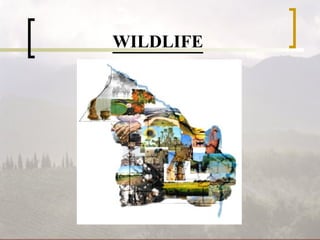
WILDLIFE Wildlife in the Chaco region is rich and varied. Here you can find mammals, birds and reptiles, etc. It is particularly abundant in areas where there is no logging and its habitat has not yet been altered. THE Chaco has two main parks: “GRAN CHACO” NATIONAL PARK and PROVINCIAL PARK “PAMPA DEL INDIO”.
AGUARA-GUAZÚ
AGUARA-GUAZÚ It is a big animal   with long feet and legs . The fur is reddish brown and black. The head is long and the ears are large. The paws have long nails . solitary animal, timid, cautions, and very fast aguara- guazu is characterized by the “lobizon”.
FAUNA
YAGUARETÉ
YAGUARETÉ Yaguarete meaning “real best”.  Strength and ferocity . It is a carnivorous mammal, and has a sturdy and muscular body . The neck is short and the tail is long. The head is large and broad, with rounded and small ears. short legs   diet: rodents, lizards, fish, pigs, horses, cattle, and domestic animals like dogs.   It is a solitary animal, except during the periods of breeding. It lives in forests usually near the water
LAMPALAGUA
LAMPALAGUA Meaning “snake of the land”.  It has a dark brown body with clear hexagonal shapes on the back . It feeds on rodents, rabbits and birds. It’s a good swimmer and it is not poisonous.   It kills its prey by strangling .
YURUMI
YURUMI Means “small mouth” It has long hair on its legs, tail and sides of the body; its paws have strong and curved nails . The muzzle is long with a small mouth, located on the end.  It doesn’t have teeth . The tongue is long and cylindrical. It feeds on ants and termites
MONO CARAYA
MONO CARAYÁ Means “head of the forest”   It is characterized by its curiosity and ability to scream powerfully.   These animals are semi howling animals so they use various places to sleep and to eat.   They are vegetarians
VISCACHA
VISCACHA It is a rodent mammal that lives in the big plains . It is bigger than the common rabbit. Its hunting is allowed in most areas where they live.   It is a great builder of tunnels.   The viscacha attacks all types of plant roots and causes damage to crops, so they are always fighting . It has nocturnal habits.  The meat of this animal is white and very delicious, suitable for human consumption.
ÑANDU
ÑANDU  Ñandu meaning “spider” in the Guarani language.  It is a flightless bird . It has a height that can reach 1.5m. with developed legs that are adapted for racing. His head is small and has a strong beak   It is omnivorous, eats seeds, grains, fruits, insects, reptiles, small mammals and birds. The ñandu takes earth baths for keeping the feathers white and in good conditions, free of parasites.
TERO
TERO It is a small animal with long legs and the wings are the size of its body . When it walk on the floor it seems to be squatting.  It feeds on insects and raw meat.   It uses a tactic of “false nest”
YACARE
YACARE It has four legs but just the behind legs are adapted for swimming.   It is an inhabitant of quiet rivers . It leaves its habitat to take naps and heat its body.  It is not dangerous for the man because it is very cowardly and timid.   It feeds on fishes.
FLORA
Quebracho Colorado
Quebracho Colorado It is a large tree. It needs high temperatures and lots sunlight for its development It has deep roots and straight trunk, in which its branches are in the form  of spines. The colour of the Wood is reddish brown and it is very high and heavy. Carpenters use them in quality furniture. It is valued for its timber.
Palo Borracho
Palo Borracho It is very large, in size The wood is light and soft It has a form of bottle but it is more pronounced. It has flowers and the colors can be: white and pink. it has plenty of thick conical spines.
Mistol
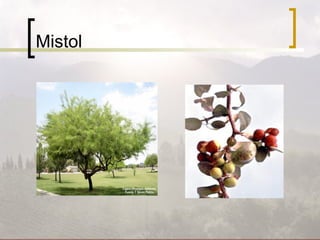
Mistol It has a smooth bark, which is thin and thikens with age. It is full of segments trunk and hard spines. It contains simple leaves white flowers and fruits, which are used as food.
CEIBO
Ceibo It is not a very high tree. It has a gnarled trunk, Its seeds are stored in pods and its flowers are red in colour. It was declared a nacional flower in our country.

Wildlife in Chaco

  • 1.
  • 2.
    WILDLIFE Wildlife inthe Chaco region is rich and varied. Here you can find mammals, birds and reptiles, etc. It is particularly abundant in areas where there is no logging and its habitat has not yet been altered. THE Chaco has two main parks: “GRAN CHACO” NATIONAL PARK and PROVINCIAL PARK “PAMPA DEL INDIO”.
  • 3.
  • 4.
    AGUARA-GUAZÚ It isa big animal with long feet and legs . The fur is reddish brown and black. The head is long and the ears are large. The paws have long nails . solitary animal, timid, cautions, and very fast aguara- guazu is characterized by the “lobizon”.
  • 5.
  • 6.
  • 7.
    YAGUARETÉ Yaguarete meaning“real best”. Strength and ferocity . It is a carnivorous mammal, and has a sturdy and muscular body . The neck is short and the tail is long. The head is large and broad, with rounded and small ears. short legs diet: rodents, lizards, fish, pigs, horses, cattle, and domestic animals like dogs. It is a solitary animal, except during the periods of breeding. It lives in forests usually near the water
  • 8.
  • 9.
    LAMPALAGUA Meaning “snakeof the land”. It has a dark brown body with clear hexagonal shapes on the back . It feeds on rodents, rabbits and birds. It’s a good swimmer and it is not poisonous. It kills its prey by strangling .
  • 10.
  • 11.
    YURUMI Means “smallmouth” It has long hair on its legs, tail and sides of the body; its paws have strong and curved nails . The muzzle is long with a small mouth, located on the end. It doesn’t have teeth . The tongue is long and cylindrical. It feeds on ants and termites
  • 12.
  • 13.
    MONO CARAYÁ Means“head of the forest” It is characterized by its curiosity and ability to scream powerfully. These animals are semi howling animals so they use various places to sleep and to eat. They are vegetarians
  • 14.
  • 15.
    VISCACHA It isa rodent mammal that lives in the big plains . It is bigger than the common rabbit. Its hunting is allowed in most areas where they live. It is a great builder of tunnels. The viscacha attacks all types of plant roots and causes damage to crops, so they are always fighting . It has nocturnal habits. The meat of this animal is white and very delicious, suitable for human consumption.
  • 16.
  • 17.
    ÑANDU Ñandumeaning “spider” in the Guarani language. It is a flightless bird . It has a height that can reach 1.5m. with developed legs that are adapted for racing. His head is small and has a strong beak It is omnivorous, eats seeds, grains, fruits, insects, reptiles, small mammals and birds. The ñandu takes earth baths for keeping the feathers white and in good conditions, free of parasites.
  • 18.
  • 19.
    TERO It isa small animal with long legs and the wings are the size of its body . When it walk on the floor it seems to be squatting. It feeds on insects and raw meat. It uses a tactic of “false nest”
  • 20.
  • 21.
    YACARE It hasfour legs but just the behind legs are adapted for swimming. It is an inhabitant of quiet rivers . It leaves its habitat to take naps and heat its body. It is not dangerous for the man because it is very cowardly and timid. It feeds on fishes.
  • 22.
  • 23.
  • 24.
    Quebracho Colorado Itis a large tree. It needs high temperatures and lots sunlight for its development It has deep roots and straight trunk, in which its branches are in the form of spines. The colour of the Wood is reddish brown and it is very high and heavy. Carpenters use them in quality furniture. It is valued for its timber.
  • 25.
  • 26.
    Palo Borracho Itis very large, in size The wood is light and soft It has a form of bottle but it is more pronounced. It has flowers and the colors can be: white and pink. it has plenty of thick conical spines.
  • 27.
  • 28.
    Mistol It hasa smooth bark, which is thin and thikens with age. It is full of segments trunk and hard spines. It contains simple leaves white flowers and fruits, which are used as food.
  • 29.
  • 30.
    Ceibo It isnot a very high tree. It has a gnarled trunk, Its seeds are stored in pods and its flowers are red in colour. It was declared a nacional flower in our country.