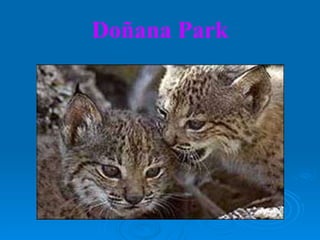
Doñana Park
Index The presentation of doñana park The ecosystems : the verge the dunes  the bushes the marshes the beach The fauna The flora extinction flora and fauna
Doñana area is found in the  opening of the Guadalquivir river ,in the centre of one lake where thin sediments accumulate (sands ) Doñana is shaped by moving eolic sands from west winds.Dunes are made up of 25 kilometres. Doñana has 50.750 ha, 5 ecosystems and 449 species of  animals and 875 species of plants. The Presentation
the ecosystems Doñana park has 5 different ecosystems:  verge, dunes, bushes,  marshes and beaches.
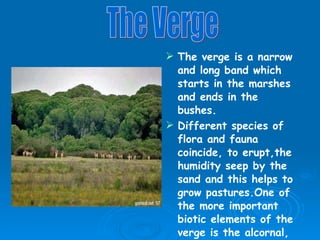
The verge is a narrow and long band which starts in the marshes and ends in the bushes. Different species of flora and fauna coincide, to erupt,the humidity seep by the sand and this helps to grow pastures.One of the more important biotic elements of the verge is the alcornal, where many different species are found. The Verge
< The large volume of sand accumulated in the dunes starts a slow but safe advance to the interior.This advance, of 2 to 6 metres of speed per year does not stop until it reaches the marshes. However, some sands do not move at all.The dense vegetation of pine forest stops the advance of the dunes. the dunes
The complex typical dune, between the beach and the sands is divided into mobile dunes and immobile dunes. Mobile dunes are found in the major part of the surface system.  The dunes subsystem is the place where a lot of animals are and this depends on things such as the weather and the environment in general. One of the more common characteristic of the dunes in autumn, is the appearance of animals´footsteps.
the bushes The shrub also called curb represents a type of terminal  and mature ecosystem of Mediterranean forest. The park is rich with hardy  species. The area covered by this ecosystem within the park occupies two distinct areas.  The first, between the edge of the marsh,  the road of the Rocio-Matalascañas and the access road to the palace of Doñana. The second is south of the road and marks the dividing  line and has a broken brush but with the same composition.
The scrub is composed of thirty woody species which fall into two broad types: Black mountain and White mountain. The black forest is dominated by several species of heather. These species are unable to survive without a continuous supply of water in summer, but stand up well to winter. There is an irregular appearance of oak trees nestled in the scrub. In these areas there are about 80 species of vertebrates, half of which are birds. The bush has many species of great interest.
some photos of bushes
Lagoon. Within the area of scrub there is a characteristic formation of gaps that become flooded during rainfall. Given the ecological importance of the gaps themselves, this constitute a sufficiently significant lake ecosystem, formed by a large and varied range of gaps with individual peculiarities. Despite the dispersion and diversity there is a common denominator with a basic biocenosis.
The most common plant species are pine,oak,tamarisk,ferns, bushes, dwarf gorse, rushes and heather.   Amphibians are represented by the spadefoot toad. There are a large number of species in this ecosystem type.
the marshes The marshes represent approximatly 50% of doñana park the major ecosystem of doñana, which is 27.000 ha.The different seasons of the year produce variations in the marshes which present 1000  stages  produced by fluctuations in flood waters. In October the marshes die and with the first rains of Spring they begin to grow again. The surface of the water is covered by buttercup flowers. In summer the soil of the marshes is totally uncovered and the clay  remains totally cracked.
It is a place of special importance as a transit, breeding and wintering  area for European and African birds.  Depending on the degree of flooding the marsh has different habitats in which different species are developed. This will distinguish the flooded marsh from the dry marsh
The strength of South-West winds introduces a great dynamic in the sand that constantly adjusts the profile of the beaches. Doñana preserves one of the few mobile dune systems in Iberia. This results in vegetation clinging  to unstable and dry soil, forming small obstacles which create dunes. This vegetation is ephemeral and lacks consistency  the beach . On the one hand the presence of shellfish, fishermen and pedestrians. Furthermore the only area In fond vitality system where you can receive the training and development of assets denominated in front of trains of dunes. On the beach take place human and natural events singularity containing one of more than 30 km along the lines of the Atlantic coasts and rocky cliffs no. His long-range view at low tide intertidal flat expanses of sand rock you live oysters, the mejillónlos, barnacles and a large number of algae.
There are 360 species of birds,37 species of aquatic animals,20 species of  freshwater ,11 species of amphibians and 21 species of reptiles. Due to its privileged geographical situation between two continents and its proximity to the meeting-place of the Atlantic Ocean and the Mediterranean Sea at the Straight of Gibraltar, in Doñana we can observe over 300 different bird species over the course of a year, since thousands of them - European and African, water fowl and land birds - migrate over it, breed in it and even winter here.  the fauna
In the marsh two extreme ecosystems or habitats can be distinguished: a dry Doñana or dry marsh and a wet Doñana. A dry marsh situated in high areas,which show a predominance of woodland masses of cork oak, strawberry tree, Mediterranean scrub (white rockrose, stone pine,common juniper,and wild olive, and which grow on the so-called &quot;monte blanco&quot; (&quot;white&quot; common, so called because it is dry).A wet Doñana or flooded marsh, situated in deeper areas, which have predominant species such as the alkali bulrush, pond water-crowfoot, common reed and other species, distributed according to the diverse physical and chemical factors of the place   the flora
FAUNA: Ibis ( Osprey  Lesser Kestrel  Crested Coot  Bustard  Iberian Imperial Eagle  Bearded Vulture Iberian Lynx  Chameleon  Tortoise  Lizard of Valverde  Land Snails  CrayFish  Marbled Teal  Egyptian vulture  Black Vulture  Montagu’s Harrier  Bonelli’s Eagle  FLORA: extinction flora and fauna
BIBLIOGRAPHY INTERNET: www.ecosystemofdoñana.com www.doñanapark.com www.doñananationalpark.com www.doñanafloraandfauna.com Googles images ENCYCLOPEDIAS PHOTOCOPY SHEETS
Made by: Nerea García Palomo Sonia Oliva Rodríguez Yanierkis Armario Aguirre Estefanía Muñoz Carrera Daniel Ortiz Rodríguez

Doñana park

  • 1.
  • 2.
    Index The presentationof doñana park The ecosystems : the verge the dunes the bushes the marshes the beach The fauna The flora extinction flora and fauna
  • 3.
    Doñana area isfound in the opening of the Guadalquivir river ,in the centre of one lake where thin sediments accumulate (sands ) Doñana is shaped by moving eolic sands from west winds.Dunes are made up of 25 kilometres. Doñana has 50.750 ha, 5 ecosystems and 449 species of animals and 875 species of plants. The Presentation
  • 4.
    the ecosystems Doñanapark has 5 different ecosystems: verge, dunes, bushes, marshes and beaches.
  • 5.
    The verge isa narrow and long band which starts in the marshes and ends in the bushes. Different species of flora and fauna coincide, to erupt,the humidity seep by the sand and this helps to grow pastures.One of the more important biotic elements of the verge is the alcornal, where many different species are found. The Verge
  • 6.
    < The largevolume of sand accumulated in the dunes starts a slow but safe advance to the interior.This advance, of 2 to 6 metres of speed per year does not stop until it reaches the marshes. However, some sands do not move at all.The dense vegetation of pine forest stops the advance of the dunes. the dunes
  • 7.
    The complex typicaldune, between the beach and the sands is divided into mobile dunes and immobile dunes. Mobile dunes are found in the major part of the surface system. The dunes subsystem is the place where a lot of animals are and this depends on things such as the weather and the environment in general. One of the more common characteristic of the dunes in autumn, is the appearance of animals´footsteps.
  • 8.
    the bushes Theshrub also called curb represents a type of terminal and mature ecosystem of Mediterranean forest. The park is rich with hardy species. The area covered by this ecosystem within the park occupies two distinct areas. The first, between the edge of the marsh, the road of the Rocio-Matalascañas and the access road to the palace of Doñana. The second is south of the road and marks the dividing line and has a broken brush but with the same composition.
  • 9.
    The scrub iscomposed of thirty woody species which fall into two broad types: Black mountain and White mountain. The black forest is dominated by several species of heather. These species are unable to survive without a continuous supply of water in summer, but stand up well to winter. There is an irregular appearance of oak trees nestled in the scrub. In these areas there are about 80 species of vertebrates, half of which are birds. The bush has many species of great interest.
  • 10.
  • 11.
    Lagoon. Within thearea of scrub there is a characteristic formation of gaps that become flooded during rainfall. Given the ecological importance of the gaps themselves, this constitute a sufficiently significant lake ecosystem, formed by a large and varied range of gaps with individual peculiarities. Despite the dispersion and diversity there is a common denominator with a basic biocenosis.
  • 12.
    The most commonplant species are pine,oak,tamarisk,ferns, bushes, dwarf gorse, rushes and heather.   Amphibians are represented by the spadefoot toad. There are a large number of species in this ecosystem type.
  • 13.
    the marshes Themarshes represent approximatly 50% of doñana park the major ecosystem of doñana, which is 27.000 ha.The different seasons of the year produce variations in the marshes which present 1000 stages produced by fluctuations in flood waters. In October the marshes die and with the first rains of Spring they begin to grow again. The surface of the water is covered by buttercup flowers. In summer the soil of the marshes is totally uncovered and the clay remains totally cracked.
  • 14.
    It is aplace of special importance as a transit, breeding and wintering area for European and African birds. Depending on the degree of flooding the marsh has different habitats in which different species are developed. This will distinguish the flooded marsh from the dry marsh
  • 15.
    The strength ofSouth-West winds introduces a great dynamic in the sand that constantly adjusts the profile of the beaches. Doñana preserves one of the few mobile dune systems in Iberia. This results in vegetation clinging to unstable and dry soil, forming small obstacles which create dunes. This vegetation is ephemeral and lacks consistency the beach . On the one hand the presence of shellfish, fishermen and pedestrians. Furthermore the only area In fond vitality system where you can receive the training and development of assets denominated in front of trains of dunes. On the beach take place human and natural events singularity containing one of more than 30 km along the lines of the Atlantic coasts and rocky cliffs no. His long-range view at low tide intertidal flat expanses of sand rock you live oysters, the mejillónlos, barnacles and a large number of algae.
  • 16.
    There are 360species of birds,37 species of aquatic animals,20 species of freshwater ,11 species of amphibians and 21 species of reptiles. Due to its privileged geographical situation between two continents and its proximity to the meeting-place of the Atlantic Ocean and the Mediterranean Sea at the Straight of Gibraltar, in Doñana we can observe over 300 different bird species over the course of a year, since thousands of them - European and African, water fowl and land birds - migrate over it, breed in it and even winter here. the fauna
  • 17.
    In the marshtwo extreme ecosystems or habitats can be distinguished: a dry Doñana or dry marsh and a wet Doñana. A dry marsh situated in high areas,which show a predominance of woodland masses of cork oak, strawberry tree, Mediterranean scrub (white rockrose, stone pine,common juniper,and wild olive, and which grow on the so-called &quot;monte blanco&quot; (&quot;white&quot; common, so called because it is dry).A wet Doñana or flooded marsh, situated in deeper areas, which have predominant species such as the alkali bulrush, pond water-crowfoot, common reed and other species, distributed according to the diverse physical and chemical factors of the place the flora
  • 18.
    FAUNA: Ibis (Osprey Lesser Kestrel Crested Coot Bustard Iberian Imperial Eagle Bearded Vulture Iberian Lynx Chameleon Tortoise Lizard of Valverde Land Snails CrayFish Marbled Teal Egyptian vulture Black Vulture Montagu’s Harrier Bonelli’s Eagle FLORA: extinction flora and fauna
  • 19.
    BIBLIOGRAPHY INTERNET: www.ecosystemofdoñana.comwww.doñanapark.com www.doñananationalpark.com www.doñanafloraandfauna.com Googles images ENCYCLOPEDIAS PHOTOCOPY SHEETS
  • 20.
    Made by: NereaGarcía Palomo Sonia Oliva Rodríguez Yanierkis Armario Aguirre Estefanía Muñoz Carrera Daniel Ortiz Rodríguez