Flor a and
      fauna

       Re gion of
         Centr al
      Macedonia
KILKIS (
    Area: 2.519 sq. km, Population: 89.056 )
Flora
  Under the influence of flora, climate,
   orographic modulation of geological-
   petrographic composition, soil and strong
   anthropogenic influences, past and present,
   formed in the area three main vegetation zones
   (potential vegetation), distinguished by
   floristic , ecological, and historical
   physiognomy.
  The boundaries of these zones, as well as
   growth areas and sub-areas that include, it is
   often unclear, as their depiction is only possible
   after a more or less generalized information.
Flora

 The main vegetation zones in the area
    identified as follows:

 A. Evmesogeiaki vegetation zone
    (Quercetalia ilicis)
 B. Paramesogeiaki vegetation zone
    (Quercetalia pubescentis)
 C. Zone of beech forests (Fagetalia)
Flora
 Land Reforestations
  It should be emphasized the existence of large areas of
   plantations of exotic conifers and Greek in
   paramesogeiaki vegetation zone. The pine has been
   used as the main species in reforestation of several
   regions.
  The forest species used in reforestation are: Pinus
   brutia, Pinus halepensis, Pinus pinea, Pinus nigra,
   Cupressus sempervirens, Cupressus arizonica,
   Robinia pseudacacia, Populus x canadensis etc.
Flora


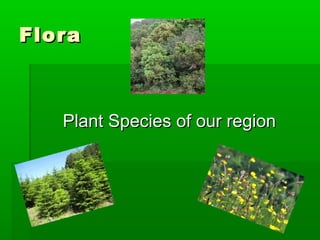
   Plant Species of our region
Flora
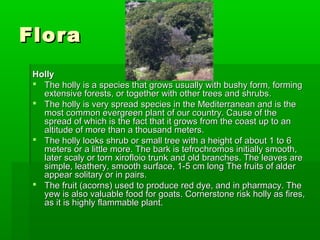
 Holly
  The holly is a species that grows usually with bushy form, forming
   extensive forests, or together with other trees and shrubs.
  The holly is very spread species in the Mediterranean and is the
   most common evergreen plant of our country. Cause of the
   spread of which is the fact that it grows from the coast up to an
   altitude of more than a thousand meters.
  The holly looks shrub or small tree with a height of about 1 to 6
   meters or a little more. The bark is tefrochromos initially smooth,
   later scaly or torn xirofloio trunk and old branches. The leaves are
   simple, leathery, smooth surface, 1-5 cm long The fruits of alder
   appear solitary or in pairs.
  The fruit (acorns) used to produce red dye, and in pharmacy. The
   yew is also valuable food for goats. Cornerstone risk holly as fires,
   as it is highly flammable plant.
Flora
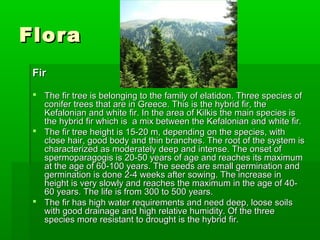
 Fir

  The fir tree is belonging to the family of elatidon. Three species of
   conifer trees that are in Greece. This is the hybrid fir, the
                                             ​
   Kefalonian and white fir. In the area of Kilkis the main species is
   the hybrid fir which is a mix between the Kefalonian and white fir.
  The fir tree height is 15-20 m, depending on the species, with
   close hair, good body and thin branches. The root of the system is
   characterized as moderately deep and intense. The onset of
   spermoparagogis is 20-50 years of age and reaches its maximum
   at the age of 60-100 years. The seeds are small germination and
   germination is done 2-4 weeks after sowing. The increase in
   height is very slowly and reaches the maximum in the age of 40-
   60 years. The life is from 300 to 500 years.
  The fir has high water requirements and need deep, loose soils
   with good drainage and high relative humidity. Of the three
   species more resistant to drought is the hybrid fir.
Flora
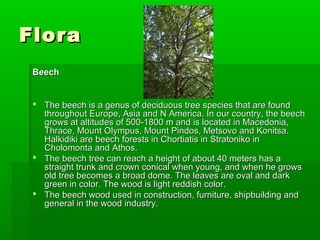
 Beech


  The beech is a genus of deciduous tree species that are found
   throughout Europe, Asia and N America. In our country, the beech
   grows at altitudes of 500-1800 m and is located in Macedonia,
   Thrace, Mount Olympus, Mount Pindos, Metsovo and Konitsa.
   Halkidiki are beech forests in Chortiatis in Stratoniko in
   Cholomonta and Athos.
  The beech tree can reach a height of about 40 meters has a
   straight trunk and crown conical when young, and when he grows
   old tree becomes a broad dome. The leaves are oval and dark
   green in color. The wood is light reddish color.
  The beech wood used in construction, furniture, shipbuilding and
   general in the wood industry.
Flora
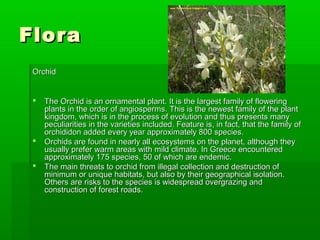
 Orchid


    The Orchid is an ornamental plant. It is the largest family of flowering
     plants in the order of angiosperms. This is the newest family of the plant
     kingdom, which is in the process of evolution and thus presents many
     peculiarities in the varieties included. Feature is, in fact, that the family of
     orchididon added every year approximately 800 species.
    Orchids are found in nearly all ecosystems on the planet, although they
     usually prefer warm areas with mild climate. In Greece encountered
     approximately 175 species, 50 of which are endemic.
    The main threats to orchid from illegal collection and destruction of
     minimum or unique habitats, but also by their geographical isolation.
     Others are risks to the species is widespread overgrazing and
     construction of forest roads.
Fauna
   TODO : General Info
   Add some photos
Flora


   Wild Animals of our region
Fauna
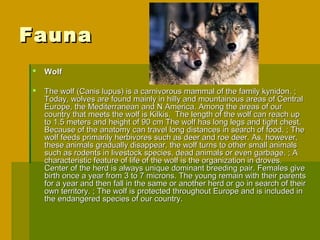
   Wolf

   The wolf (Canis lupus) is a carnivorous mammal of the family kynidon. ;
    Today, wolves are found mainly in hilly and mountainous areas of Central
    Europe, the Mediterranean and N America. Among the areas of our
    country that meets the wolf is Kilkis. The length of the wolf can reach up
    to 1.5 meters and height of 90 cm The wolf has long legs and tight chest.
    Because of the anatomy can travel long distances in search of food. ; The
    wolf feeds primarily herbivores such as deer and roe deer. As, however,
    these animals gradually disappear, the wolf turns to other small animals
    such as rodents in livestock species, dead animals or even garbage. ; A
    characteristic feature of life of the wolf is the organization in droves.
    Center of the herd is always unique dominant breeding pair. Females give
    birth once a year from 3 to 7 microns. The young remain with their parents
    for a year and then fall in the same or another herd or go in search of their
    own territory. ; The wolf is protected throughout Europe and is included in
    the endangered species of our country.
Fauna
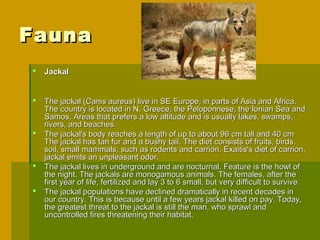
   Jackal


   The jackal (Canis aureus) live in SE Europe, in parts of Asia and Africa.
    The country is located in N. Greece, the Peloponnese, the Ionian Sea and
    Samos. Areas that prefers a low altitude and is usually lakes, swamps,
    rivers, and beaches.
   The jackal's body reaches a length of up to about 96 cm tall and 40 cm
    The jackal has tan fur and a bushy tail. The diet consists of fruits, birds,
    soil, small mammals, such as rodents and carrion. Exaitis's diet of carrion,
    jackal emits an unpleasant odor.
   The jackal lives in underground and are nocturnal. Feature is the howl of
    the night. The jackals are monogamous animals. The females, after the
    first year of life, fertilized and lay 3 to 6 small, but very difficult to survive.
   The jackal populations have declined dramatically in recent decades in
    our country. This is because until a few years jackal killed on pay. Today,
    the greatest threat to the jackal is still the man, who sprawl and
    uncontrolled fires threatening their habitat.
Fauna
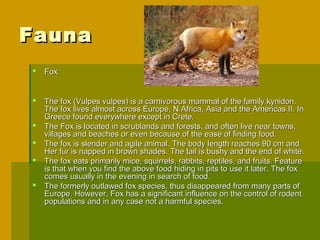
   Fox


   The fox (Vulpes vulpes) is a carnivorous mammal of the family kynidon.
    The fox lives almost across Europe, N Africa, Asia and the Americas II. In
    Greece found everywhere except in Crete.
   The Fox is located in scrublands and forests, and often live near towns,
    villages and beaches or even because of the ease of finding food.
   The fox is slender and agile animal. The body length reaches 90 cm and
    Her fur is napped in brown shades. The tail is bushy and the end of white.
   The fox eats primarily mice, squirrels, rabbits, reptiles, and fruits. Feature
    is that when you find the above food hiding in pits to use it later. The fox
    comes usually in the evening in search of food.
   The formerly outlawed fox species, thus disappeared from many parts of
    Europe. However, Fox has a significant influence on the control of rodent
    populations and in any case not a harmful species.

Greece flora & fauna ver 1

  • 1.
    Flor a and fauna Re gion of Centr al Macedonia KILKIS ( Area: 2.519 sq. km, Population: 89.056 )
  • 2.
    Flora  Underthe influence of flora, climate, orographic modulation of geological- petrographic composition, soil and strong anthropogenic influences, past and present, formed in the area three main vegetation zones (potential vegetation), distinguished by floristic , ecological, and historical physiognomy.  The boundaries of these zones, as well as growth areas and sub-areas that include, it is often unclear, as their depiction is only possible after a more or less generalized information.
  • 3.
    Flora The mainvegetation zones in the area identified as follows: A. Evmesogeiaki vegetation zone (Quercetalia ilicis) B. Paramesogeiaki vegetation zone (Quercetalia pubescentis) C. Zone of beech forests (Fagetalia)
  • 4.
    Flora Land Reforestations  It should be emphasized the existence of large areas of plantations of exotic conifers and Greek in paramesogeiaki vegetation zone. The pine has been used as the main species in reforestation of several regions.  The forest species used in reforestation are: Pinus brutia, Pinus halepensis, Pinus pinea, Pinus nigra, Cupressus sempervirens, Cupressus arizonica, Robinia pseudacacia, Populus x canadensis etc.
  • 5.
    Flora Plant Species of our region
  • 6.
    Flora Holly The holly is a species that grows usually with bushy form, forming extensive forests, or together with other trees and shrubs.  The holly is very spread species in the Mediterranean and is the most common evergreen plant of our country. Cause of the spread of which is the fact that it grows from the coast up to an altitude of more than a thousand meters.  The holly looks shrub or small tree with a height of about 1 to 6 meters or a little more. The bark is tefrochromos initially smooth, later scaly or torn xirofloio trunk and old branches. The leaves are simple, leathery, smooth surface, 1-5 cm long The fruits of alder appear solitary or in pairs.  The fruit (acorns) used to produce red dye, and in pharmacy. The yew is also valuable food for goats. Cornerstone risk holly as fires, as it is highly flammable plant.
  • 7.
    Flora Fir The fir tree is belonging to the family of elatidon. Three species of conifer trees that are in Greece. This is the hybrid fir, the ​ Kefalonian and white fir. In the area of Kilkis the main species is the hybrid fir which is a mix between the Kefalonian and white fir.  The fir tree height is 15-20 m, depending on the species, with close hair, good body and thin branches. The root of the system is characterized as moderately deep and intense. The onset of spermoparagogis is 20-50 years of age and reaches its maximum at the age of 60-100 years. The seeds are small germination and germination is done 2-4 weeks after sowing. The increase in height is very slowly and reaches the maximum in the age of 40- 60 years. The life is from 300 to 500 years.  The fir has high water requirements and need deep, loose soils with good drainage and high relative humidity. Of the three species more resistant to drought is the hybrid fir.
  • 8.
    Flora Beech The beech is a genus of deciduous tree species that are found throughout Europe, Asia and N America. In our country, the beech grows at altitudes of 500-1800 m and is located in Macedonia, Thrace, Mount Olympus, Mount Pindos, Metsovo and Konitsa. Halkidiki are beech forests in Chortiatis in Stratoniko in Cholomonta and Athos.  The beech tree can reach a height of about 40 meters has a straight trunk and crown conical when young, and when he grows old tree becomes a broad dome. The leaves are oval and dark green in color. The wood is light reddish color.  The beech wood used in construction, furniture, shipbuilding and general in the wood industry.
  • 9.
    Flora Orchid  The Orchid is an ornamental plant. It is the largest family of flowering plants in the order of angiosperms. This is the newest family of the plant kingdom, which is in the process of evolution and thus presents many peculiarities in the varieties included. Feature is, in fact, that the family of orchididon added every year approximately 800 species.  Orchids are found in nearly all ecosystems on the planet, although they usually prefer warm areas with mild climate. In Greece encountered approximately 175 species, 50 of which are endemic.  The main threats to orchid from illegal collection and destruction of minimum or unique habitats, but also by their geographical isolation. Others are risks to the species is widespread overgrazing and construction of forest roads.
  • 10.
    Fauna  TODO : General Info  Add some photos
  • 11.
    Flora Wild Animals of our region
  • 12.
    Fauna  Wolf  The wolf (Canis lupus) is a carnivorous mammal of the family kynidon. ; Today, wolves are found mainly in hilly and mountainous areas of Central Europe, the Mediterranean and N America. Among the areas of our country that meets the wolf is Kilkis. The length of the wolf can reach up to 1.5 meters and height of 90 cm The wolf has long legs and tight chest. Because of the anatomy can travel long distances in search of food. ; The wolf feeds primarily herbivores such as deer and roe deer. As, however, these animals gradually disappear, the wolf turns to other small animals such as rodents in livestock species, dead animals or even garbage. ; A characteristic feature of life of the wolf is the organization in droves. Center of the herd is always unique dominant breeding pair. Females give birth once a year from 3 to 7 microns. The young remain with their parents for a year and then fall in the same or another herd or go in search of their own territory. ; The wolf is protected throughout Europe and is included in the endangered species of our country.
  • 13.
    Fauna  Jackal  The jackal (Canis aureus) live in SE Europe, in parts of Asia and Africa. The country is located in N. Greece, the Peloponnese, the Ionian Sea and Samos. Areas that prefers a low altitude and is usually lakes, swamps, rivers, and beaches.  The jackal's body reaches a length of up to about 96 cm tall and 40 cm The jackal has tan fur and a bushy tail. The diet consists of fruits, birds, soil, small mammals, such as rodents and carrion. Exaitis's diet of carrion, jackal emits an unpleasant odor.  The jackal lives in underground and are nocturnal. Feature is the howl of the night. The jackals are monogamous animals. The females, after the first year of life, fertilized and lay 3 to 6 small, but very difficult to survive.  The jackal populations have declined dramatically in recent decades in our country. This is because until a few years jackal killed on pay. Today, the greatest threat to the jackal is still the man, who sprawl and uncontrolled fires threatening their habitat.
  • 14.
    Fauna  Fox  The fox (Vulpes vulpes) is a carnivorous mammal of the family kynidon. The fox lives almost across Europe, N Africa, Asia and the Americas II. In Greece found everywhere except in Crete.  The Fox is located in scrublands and forests, and often live near towns, villages and beaches or even because of the ease of finding food.  The fox is slender and agile animal. The body length reaches 90 cm and Her fur is napped in brown shades. The tail is bushy and the end of white.  The fox eats primarily mice, squirrels, rabbits, reptiles, and fruits. Feature is that when you find the above food hiding in pits to use it later. The fox comes usually in the evening in search of food.  The formerly outlawed fox species, thus disappeared from many parts of Europe. However, Fox has a significant influence on the control of rodent populations and in any case not a harmful species.